Roundup: West African praise medley, reading poetry and fiction, and more

SPOTIFY PLAYLIST: August 2022 by Victoria Emily Jones: Most months I compile thirty songs and other musical selections into a nonthematic playlist as a way to share good music, mostly from the Christian tradition but otherwise Christian-adjacent. This month’s list includes a traditional Black gospel song performed by Chris Rodrigues and professional spoon player Abby Roach (featured here); a Zulu song from South Africa about holding on to Jesus (bambelela = “hold on”); a song in the voice of Christ Our Mother by Irish singer-songwriter Sinéad O’Connor, from her album Gospel Oak; a portion of Barbados-born Judy Bailey’s Caribbean-style setting of the Anglican liturgy; a brass arrangement of a Golden Gate Quartet classic; Palestrina’s beautiful multivoiced setting of a Latin hymn by Bernard of Clairvaux; a future-looking song of celebration by country artist Naomi Judd, who passed away in April; a condensation of “In Christ Alone” by Texas soul artist Micah Edwards; and more.

The two videos below are from the list: a medley of the Twi praise chorus “Ayeyi Wura” (King of Our Praise) from Ghana and “Most High God” from Nigeria, led by Eric Lige at the 2018 Urbana missions conference, and a new arrangement by Marcus & Marketo of “I’ve Got a River of Life,” a song that I have fond memories of singing in children’s church as a kid (with hand motions!) (you can hear a more standard rendition here). The first line is derived from Jesus’s saying in John 7:38 (“Out of the believer’s heart shall flow rivers of living water”), and the refrain “Spring up, O well!” comes from Numbers 21:17, where the Israelites praise God for providing them water in the desert.

+++

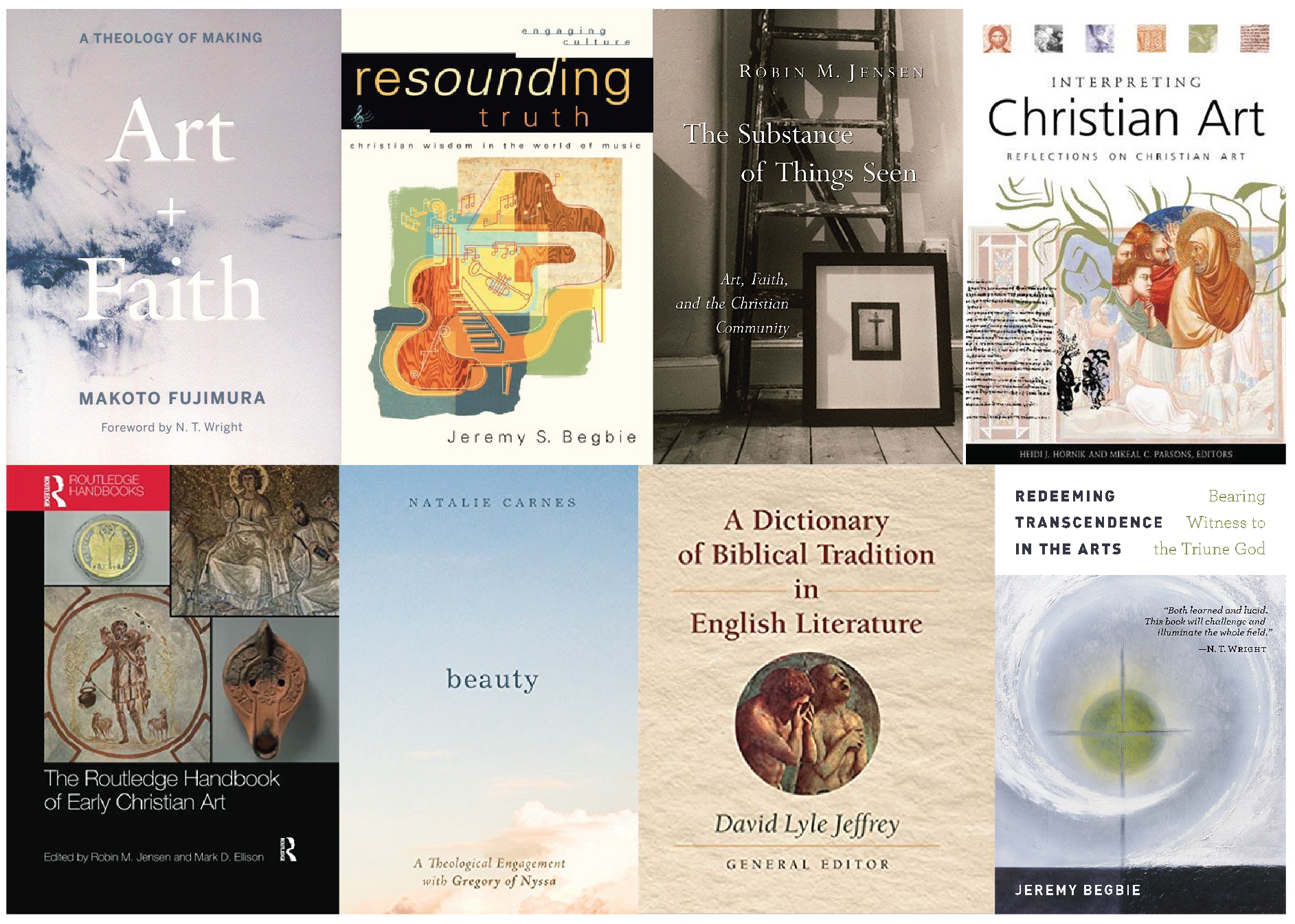
Reading books is a key way that I grow intellectually and spiritually, and books are often where I find content to highlight on the blog, be it poems, visual art, people, or ideas. Because I’m not affiliated with an academic institution, I don’t have easy access to a lot of the books I need for my research, and I rely heavily on my personal library (as well as the Marina interlibrary loan system). If you’d like to support the work of Art & Theology, buying me a book from my wish list is a great way to do that! I’ll consider it a birthday gift, as my birthday is Saturday. 😊

+++

ESSAYS:

>> “Poetry’s Mad Instead” by Abram Van Engen, Reformed Journal: “I believe that poetry has a particular place in the church. I think it responds directly to the call and the invitation of God to ‘sing a new song,’” says Abram Van Engen, chair and professor of English at Washington University in St. Louis and cohost of the podcast Poetry for All. “And in the singing of poetry, the faithful can begin to understand and experience and engage God’s world afresh.” He adds, “Poets often invite us to practice thinking and noticing at a different pace. It is only at a slower speed of processing that we can begin to observe what we have too often missed or ignored.”

In this essay, Van Engen walks readers through the sonnet “Praise in Summer” by Richard Wilbur, which is what he begins with whenever he teaches poetry at church. He teaches you some of the poet’s tools so that you can feel more confident in approaching poems on your own.

>> “In Defense of Fiction: Christian Love for Great Literature” by Leland Ryken: An excellent article, by a professor emeritus of English at Wheaton College and author of The Christian Imagination: The Practice of Faith in Literature and Writing, A Complete Handbook of Literary Forms in the Bible, and more. “With so many valuable nonfiction books available to Christians, many wonder if reading fiction is worth the time. Others view fiction as a form of escapism, a flight from reality and the world of responsibility. But rightly understood, reading fiction clarifies rather than obscures reality. The subject of literature is life, and the best writers offer a portrait of human experience that awakens us to the real world. Fiction tells the truth in ways nonfiction never could, even as it delights our aesthetic sensibilities in the process. Reading fiction may be a form of recreation, but it is the kind that expands the soul and prepares us to reenter reality.”

+++

VISUAL MEDITATION: On Christ and the Samaritan Woman by Jacek Malczewski, by William Collen: William Collen introduced me to this unusual painting on the subject of Christ’s meeting with the woman at the well from John 4—a subject the artist painted several times (e.g., here, here, and here). Whereas Christ is traditionally shown pontificating to the woman with an air of formality, here there is an appealing casualness to their interaction, and the woman dominates the composition.

Malczewski, Jacek_Christ and the Samaritan Woman
Jacek Malczewski (Polish, 1854–1929), Christ and the Samaritan Woman, 1912. Oil on plywood, 92 × 72.5 cm. Borys Voznytskyi Lviv National Art Gallery, Ukraine.

Collen is an art writer and researcher from Omaha, Nebraska, who is a Christian and who blogs at Ruins. I’ve enjoyed following his posts, which include “The proper response to an art of sorrow”; “Dikla Laor’s photographs of the women of the Bible”; how household chores are approached differently by Koons, Picasso, Degas, and Vermeer; “Good art / bad art / non-art”; and “Artists and agency: assumptions and limits.” He writes in a conversational manner that’s really refreshing.

Roundup: Feast of Mary Magdalene; holiness of people and place; black squares

Richardson, Jan_The Hours of Mary Magdalene
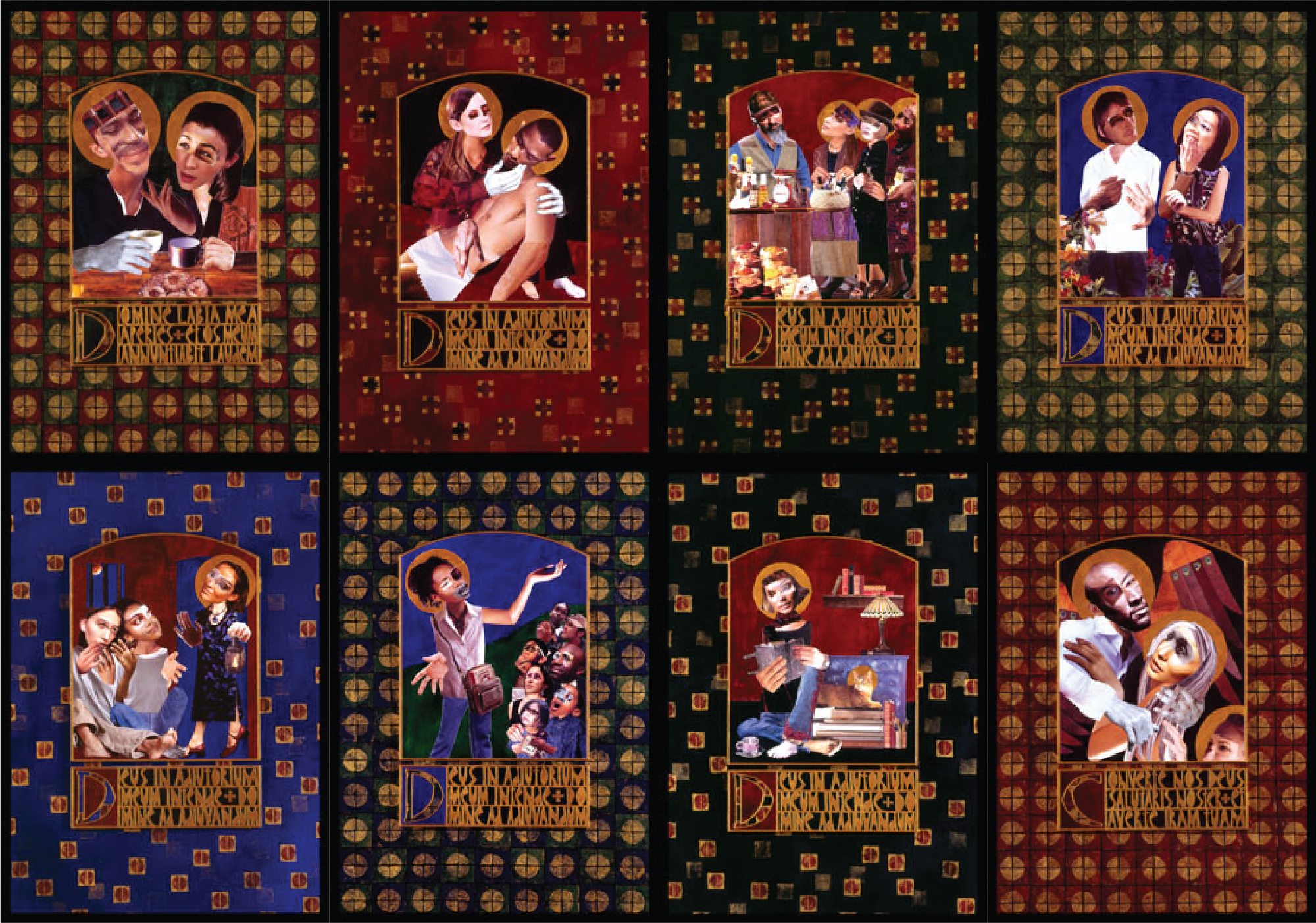
The Hours of Mary Magdalene by Jan L. Richardson

ART CYCLE: The Hours of Mary Magdalene by Jan L. Richardson: July 22 is the feast day of Mary Magdalene, one of Jesus’s closest disciples and the first witness and preacher of the Resurrection. American artist, writer, and minister Jan L. Richardson created a sequence of collages picturing events from her life, drawing on both the biblical narratives and medieval legends. The structure and presentation (decorative borders, Latin script) were inspired by medieval books of hours, used for the praying of the Divine Office. The text below each image reads, Deus, in adiutorium meum intende; Domine, ad adiuvandum me festina (“O God, come to my assistance; O Lord, make haste to help me”), the first verse of Psalm 70, which is prayed at the start of each of the canonical hours.

According to legend, after Jesus’s ascension Mary Magdalene moved to southern France, where she preached the gospel and performed miracles. The last thirty years of her life she lived as a hermit in a cave. Each time she prayed the hours, she was lifted up to heaven by angels, then brought back down at the end of her devotions.

Richardson put together a delightful little video showcasing the art cycle as well as the song “Mary Magdalena” by her late husband, Garrison Doles.

You can purchase these images as digital downloads from Richardson’s website:

  1. Matins: The Blessing Cups: Mary Magdalene and Jesus at Tea
  2. Lauds: After the Cross: The Magdalene’s Farewell
  3. Prime: Shopping for Spices: The Three Marys on Holy Saturday
  4. Terce: Touch Me Not: Resurrection Morning
  5. Sext: Release: Mary Magdalene Freeing Prisoners
  6. None: L’Evangeliste: Mary Magdalene Preaching in France
  7. Vespers: At Her Prayers: Mary Magdalene with a Book of Hours
  8. Compline: Magdalene Ascending: The Divine Hours

+++

DANCE: “Holy, Holy, Holy”: Choreographed by Betsey Beckman to a song by Karen Drucker, this dance number affirms the sacredness of every human being. It was filmed inside St. Gregory of Nyssa Episcopal Church in San Francisco, a church that “invites people to see God’s image in all humankind, to sing and dance to Jesus’ lead, and to become God’s friends.” Beckman dances with Dawon Davis and Corey Action throughout the worship space, which comprises a rectangular room where the Liturgy of the Word is celebrated and an octagonal rotunda for the Liturgy of the Table. The Dancing Saints icon that covers the walls is by Mark Doox. [HT: Global Christian Worship]

+++

MUSIC:

>> “Locus iste” by Anton Bruckner, performed by VOCES8: The British vocal ensemble VOCES8 performs Anton Bruckner’s sacred motet “Locus iste” (This Place) at Les Dominicains de Haute-Alsace in Guebwiller, France. Bruckner composed it in 1869 for the dedication of the Votivkapelle (votive chapel) at the New Cathedral in Linz, Austria, where he had been a cathedral organist. The text—a Latin gradual for church dedications and their anniversaries—is informed by Jacob’s saying, after his dream of the ladder uniting heaven and earth, that “surely the Lord is in this place; and I knew it not” (Gen. 28:16), and by the story of the burning bush where Moses is told to “put off thy shoes from off thy feet, for the place whereon thou standest is holy ground” (Exod. 3:5).

Locus iste a Deo factus est,
inaestimabile sacramentum;
irreprehensibilis est.

This place is made by God,
a priceless sacrament;
it is without reproach.

(Or, alternatively:)
This dwelling is God’s handiwork;
a mystery beyond all price,
that cannot be spoken against.

>> “Tabernacle” by Josh Rodriguez, performed by Mary Vanhoozer: A modernist piano composition inspired by Psalm 19, dedicated to the composer’s father-in-law, the theologian Kevin Vanhoozer.

Tabernacle is a musical triptych shaped by the drama of Psalm 19. While this word, tabernacle, is loaded with religious affection within both Jewish and Christian traditions, some modern readers may not be familiar with its implications. Merriam-Webster offers three related definitions: “a house of worship, a receptacle for the consecrated elements of the Eucharist, or a tent sanctuary used by the Israelites during the Exodus.” By extension, it has come to represent a “dwelling place” or a “temporary shelter.” In short, this is no ordinary space, rather it is a place that is set apart, made holy for a terrifying transformative encounter with the Divine.

Fragments of a prayerful hymn-like melody appear underneath this canopy of sounds. Shifting metric changes, polyrhythms, and percussive primal-sounding harmonies climax in a loud, noisy quote from the 16th-century Genevan Psalter.

More extensive program notes can be found in the YouTube video description.

+++

ESSAY: “Precedents of the Unprecedented: Black Squares Before Malevich” by Andrew Spira, Public Domain Review: Considered one of the seminal works of modern art, Kazimir Malevich’s Black Square (1915) has been cast as a total break from all that came before it. Yet searching across more than five hundred years of images related to cosmology, religious devotion, mourning, humor, politics, and philosophy, art historian Andrew Spira uncovers a slew of unlikely foreshadows to Malevich’s radical abstraction.

Et sic in infinitum
Robert Fludd’s black square representing the nothingness that was prior to the universe, from his Utriusque Cosmi (1617). On each side of the square is written “Et sic in infinitum…” (“And so on to infinity…”).

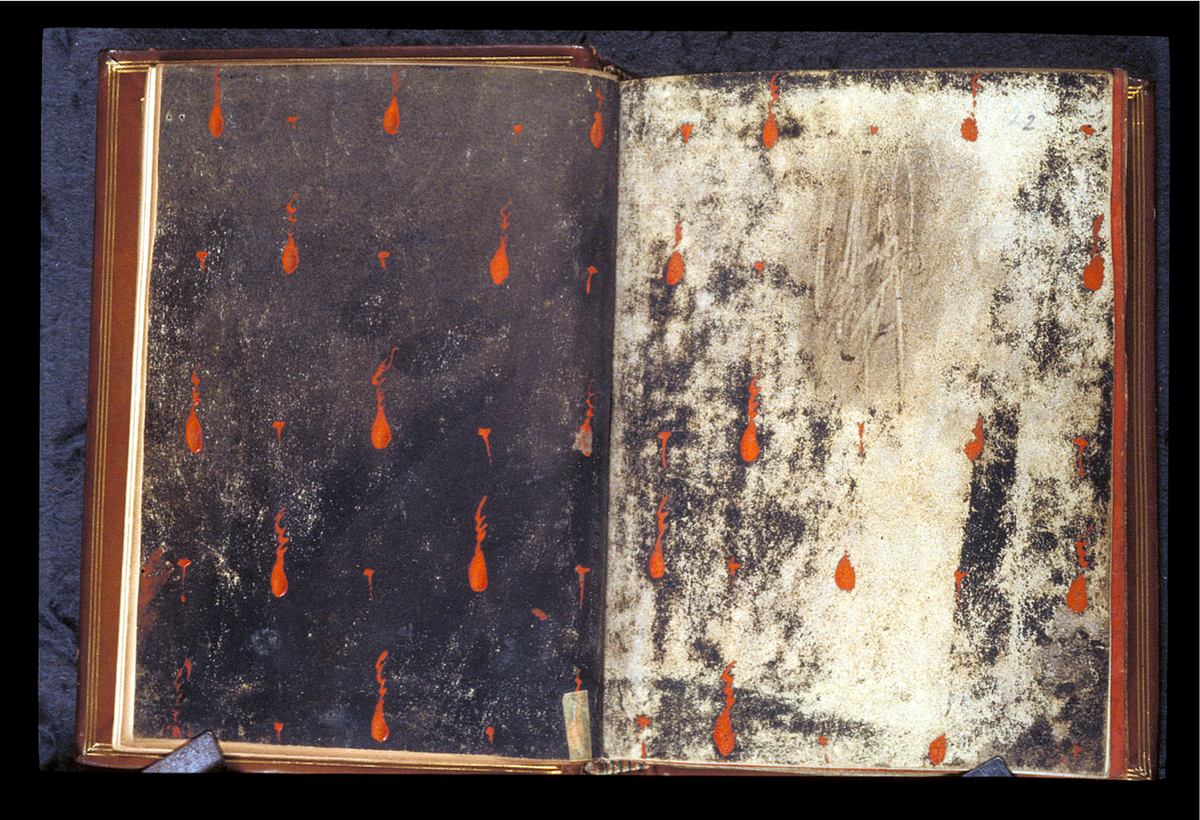
Blood of Christ
Black pages with red drops of blood, signifying the wounds of Christ, from a psalter and rosary of the Virgin, ca. 1500. The recto is worn from devotional engagement, damaged through kissing and rubbing, perhaps.

For a much more extensive treatment of the topic, see Spira’s Foreshadowed: Malevich’s “Black Square” and Its Precursors, published this month. And for a faith-positive (non-nihilistic) reading of Malevich’s Black Square that honors the artist’s own views, see pages 209–25 of Jonathan A. Anderson and William A. Dyrness’s Modern Art and the Life of a Culture, where they discuss the work in relation to the Russian icons tradition and “apophatic or ‘negative’ theology—a mode of theology that meditates on the absolute Fullness and Otherness of God by way of negating the verbal, visual and conceptual forms used to signify (and to ‘grasp’) God” (220).

Roundup: Ukrainian Madonnas and songs of peace

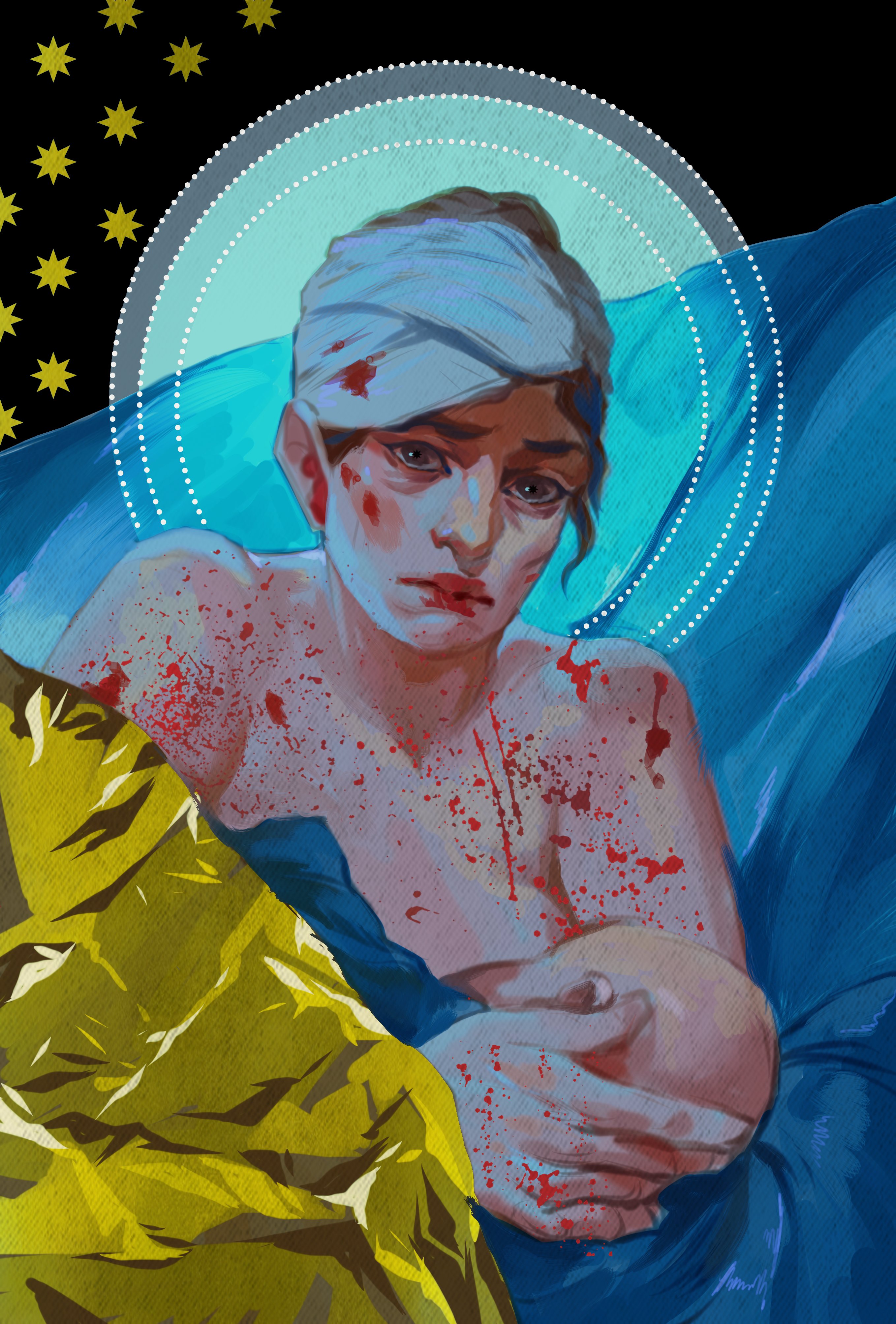
UKRAINIAN MADONNAS: Since Russia invaded Ukraine on February 24 and even still continues to aggress, artists have taken up their art to address the war—several drawing on iconography of the Madonna and Child, particularly the Maria lactans (breastfeeding Mary) type. Two Ukrainian artists were inspired by different news photos of young mothers protecting their infants from the shelling in Kyiv in March—one of whom was photographed in a hospital being treated for wounds she sustained from fallen glass while shielding her daughter with her body, and the other hiding from the blasts in a subway station.

Kyivan Madonna
Maryna Solomennykova, Kyivan Madonna, 2022, digital painting [purchase] [see news photo]

Frirean, Anta_Madonna
Anta Frirean, Ukrainian Madonna, 2022 [see news photo]

These images show the vulnerability of Christ, who is with us in our suffering, and indict those who cause such suffering.

In his response to the war in Ukraine, Serbian artist Michael Galovic, who lives in Australia, also uses Christian iconography: the Theotokos Kyriotissa (Mother of God enthroned with Christ); Archangel Michael, the patron saint of Kyiv, fighting a dragon (Rev. 12:7–8) in an ethereal rendering of a scene from the Très Riches Heures du Duc de Berry, a fifteenth-century French book of hours; and a hellmouth from the twelfth-century Winchester Psalter. These three medieval images are superimposed on Picasso’s masterwork Guernica, named after the Spanish town bombed by Nazis in 1937 and representative of the horrors of war.

Ukraine Response by Michael Galovic
Michael Galovic (Serbian Australian, 1949–), Ukraine Response, 2022. Egg tempera and gold leaf on linen on board, 170 × 80 cm. Collection of the Australian Centre for Christianity and Culture, Canberra, Australia.

Whereas Frirean’s and Solomennykova’s paintings are more intimate, Galovic takes a more cosmic approach, showing wails of lament from abstracted forms intercut with epic battles between good and evil—but at the calm center, Christ is on the throne, holding the scroll of his good word. History is going somewhere. Hate will be damned. Love will triumph.

Thanks to Art/s and Theology Australia for introducing me to the Galovic painting.

+++

SONGS:

>> “Galoba (The Prayer),” performed by Trio Mandili: A sung performance of a poem written in 1858 by the Georgian poet and statesman Ilia Chavchavadze (1837–1907). An English translation follows.

Our Father, who art in heaven,
With tenderness I stand before thee on my knees.
I ask for neither wealth nor glory;
I won’t debase my holy prayer with such matters.
I desire instead for my soul to be enlightened by heaven,
My heart to be radiant with thy love.
Even if my enemies pierce me in the heart,
I beg thee: “Forgive them, Lord, for they know not what they do!”
Even if my enemies pierce me in the heart,
I beg thee: “Forgive them, Lord, for they know not what they do!” [source, adapt.]

>> “Peace All Over the World” by Robert Bradley: Written and performed by Detroit musician Robert Bradley, this song originally appeared on the film Playing for Change: A Cinematic Discovery of Street Music (2005). To celebrate their twentieth anniversary, Playing for Change [previously] has remastered it and added new footage from Ukraine.

>> “Du som gick före oss” (You Who Went Before Us) | Words by Olov Hartman, 1968 | Music by Sven-Erik Bäck, 1959 | Performed by VOCES8, 2022: The melody uses all twelve semitones of the octave! I’ve provided a literal English translation of the Swedish below with the help of Google Translate; for a looser but more poetic translation by Fred Kaan, from 1976, see here. Note: The video identifies the song parenthetically as Psalm 74, not because it’s a setting of Psalm 74 from the Bible, but because it is no. 74 in Den svenska Psalmboken, the official hymnal of the Church of Sweden.

Du som gick före oss
längst in i ångesten,
hjälp oss att finna dig,
Herre, i mörkret.

Du som bar all vår skuld
in i förlåtelsen,
du är vårt hjärtas fred,
Jesus, för evigt.

Du som med livets bröd
går genom tid och rum,
giv oss för varje dag,
Kristus, det brödet.

Du som går före oss
ut i en trasig värld,
sänd oss med fred och bröd,
Herre, i världen.
You who went before us
in the depths of anxiety,
help us to find you,
Lord, in the dark.

You who bore all our guilt
into forgiveness,
you are the peace of our hearts,
Jesus, forever.

You who are the living bread
offered abundantly through all the earth,
give us each day,
dear Christ, that bread.

You who go before us
out into a broken world,
send us out likewise, Lord, 
with peace and bread. 

Roundup: Afro-Atlantic Histories, upcoming events, and more

EXHIBITION: Afro-Atlantic Histories, National Gallery of Art, Washington, DC, April 10–July 17, 2022: There are still two more weeks to catch this excellent exhibition in the US capital, which I saw in June, before it travels to the Los Angeles County Museum of Art (December 11, 2022–April 30, 2023) and the Dallas Museum of Art (dates TBA). “For centuries, artists have told and retold the complex histories of the African Diaspora. Explore this enduring legacy in the exhibition Afro-Atlantic Histories, which takes an in-depth look at the historical experiences and cultural formations of Black and African people since the 17th century. More than 130 powerful works of art, including paintings, sculpture, photographs, and time-based media by artists from Africa, Europe, the Americas, and the Caribbean, bring these narratives to life.”

I wish I had more time to devote to it here before it wraps, as there are so many compelling artworks, but instead let me just share a two-minute video tour, followed by a lecture from April 10, which both provide a good overview:

The exhibition is divided into six sections: Maps and Margins, Enslavements and Emancipations, Everyday Lives, Rites and Rhythms, Portraits, and Resistances and Activisms. Kanitra Fletcher, associate curator of African American and Afro-Diasporic art at the National Gallery of Art, says in her talk,

The word histories in the title indicates the plurality of the narratives represented in the exhibition. They are fictional and nonfictional, mythical and factual. As a framework to coalesce narratives that have been left aside at the margins and forgotten, Afro-Atlantic Histories is open, plural, diverse, and inclusive, refusing the canon of traditional art history. This show resists the idea of a definitive history or a “grand narrative” of the Diaspora and presents diverse accounts of the past that challenge long-established hierarchies and forges new questions and connections that show how complex and intertwined are all of our histories.

Here’s an artwork that isn’t included in either of the above videos and that was new to me:

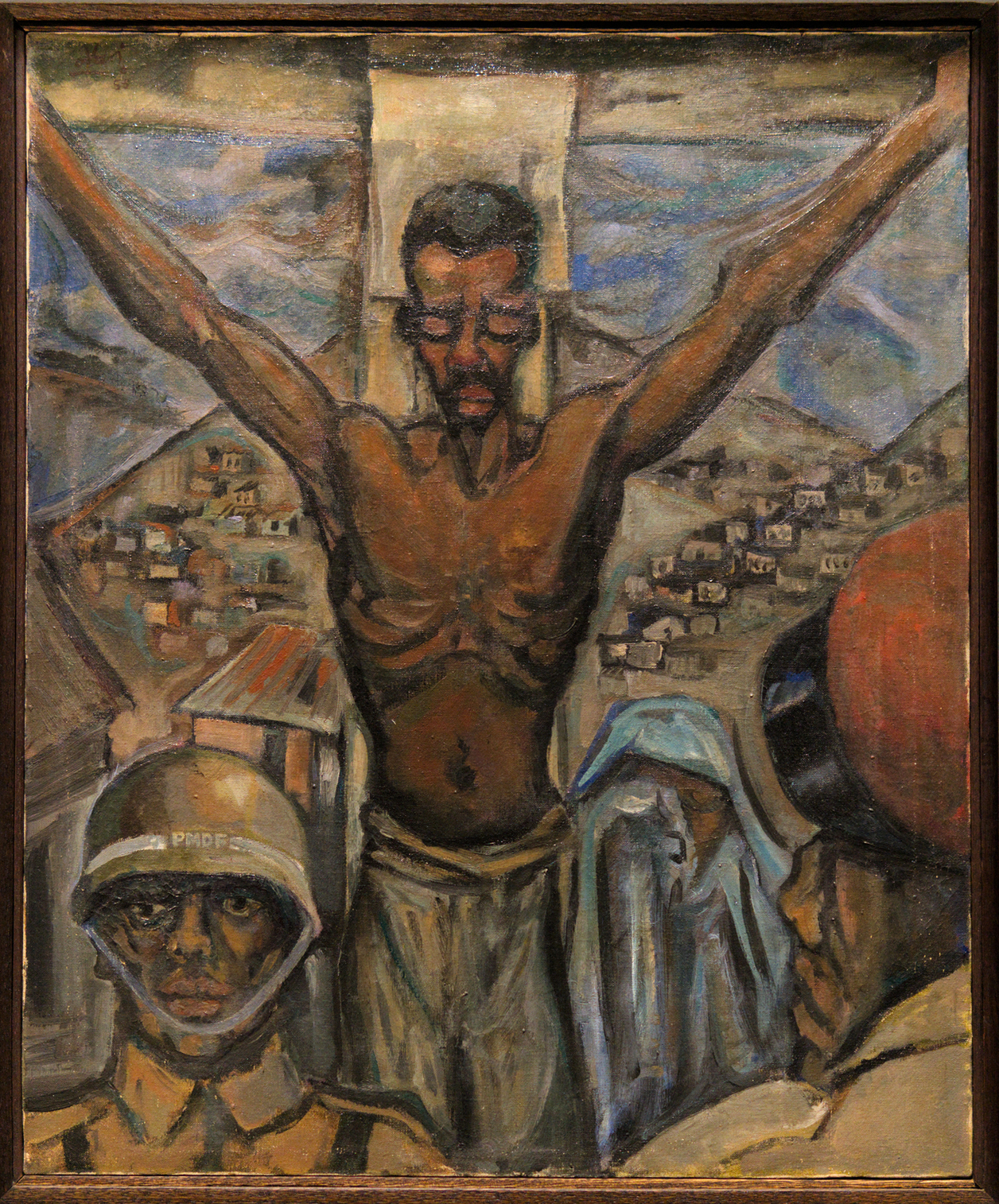
Araujo, Octavio_Slum Christ
Octávio Araújo (Brazilian, 1926–2015), Cristo favelado (Slum Christ), 1950. Oil on canvas, 64 × 53 cm. Collection of the Instituto de Pesquisas e Estudos Afro-Brasileiros (IPEAFRO), Rio de Janeiro. Photo: Victoria Emily Jones, at Afro-Atlantic Histories at the National Gallery of Art, Washington, DC, June 2022.

Artist Octávio Araújo entered this painting in the Black Christ contest held in 1955 by the Teatro Experimental do Negro (Black Experimental Theater) in Rio de Janeiro (I mentioned this contest previously in relation to another submission, a painting by Djanira da Motta e Silva). It shows Christ crucified in a Brazilian favela, his Roman tormentors replaced with military police officers, perpetrators of state-sanctioned violence against the nation’s Black people.

+++

ONLINE COURSE: “Theology and the Arts,” with Jason Goroncy, Rod Pattenden, and guest artists, September 19, 20, 21, 26, 27, 28 and October 21, 2022: Whitley College, a teaching college of the University of Divinity outside Melbourne, is offering a seven-day intensive online course on theology and the arts this fall (description below), taught by the coeditors of the new book Imagination in an Age of Crisis: Soundings from the Arts and Theology. Registration is open to anyone, but participants will need to be available to engage live online from 9:30 a.m. to 3:00 p.m. (Melbourne time) on each of the scheduled days, for lectures, discussions, and other online activities, such as “meet the artist,” gallery visits, interviews, and student presentations. The cost to audit the course is AUD $500 (~ USD $343). There’s also an option to receive academic credit. Professor Goroncy writes,

When, in 1741, George Frideric Handel completed writing the Hallelujah Chorus for his oratorio Messiah, he reportedly told his servant: ‘I did think I did see all Heaven before me, and the great God Himself [sic] seated on His throne, with His Company of Angels’. More recently, the Australian musician Nick Cave described how the gods are closely associated with the flight of the imagination. Both musicians had a sense, each in their own way, of how closely related are the arts and theological work.

Theology and art are often considered separate expressions of human activity, but are they? How might they relate? What influence do they have on one another, and how might such inform our understanding of faith, of the human condition, of the creature’s vocation, and maybe even of God?

Whitley College is offering a unit of study to explore such questions. ‘Theology and the Arts’ expands traditional views of theology into the world of the arts in a way that both delights and challenges. It will be delivered online by Jason Goroncy and Rod Pattenden, together with a host of guest artists, including Emmanuel GaribayJulie PerrinDoug PurnellTrish WattsPaul MitchellRebekah Pryor, and Libby Byrne.

The registration deadline is July 15—but if there are still open spots available, it’s possible you could get in after that date. Email Dorothy Morgan at registrar@whitley.edu.au for an application form and more information.

+++

SYMPOSIUM: “Humanity Redeemed: The Theological Vision of Georges Rouault,” September 23–24, 2022, Gordon Conwell Theological Seminary, Charlotte, NC: I’m considering attending! The early-bird rate, good through July 23, is $80 for the general public and includes a Friday dinner and Saturday lunch. “Georges Rouault (1871–1958) was unique among French modernist artists due to his Christian commitment and its influence on his work. The theological vision unveiled through his art is honest and complex, one that reflects the changing climate and tumultuous events of the early twentieth century. In doing so, Rouault showed the possibility of salvation and hope within the inexplicable suffering and mundane realities of human life. His close friend Jacques Maritain identified this as ‘the art of humanity redeemed.’

“This symposium will gather teachers, pastors, artists, ministry leaders, and others to reflect on the theological vision of Georges Rouault and his ongoing impact. Prominent scholars and practitioners with expertise in theology, art history, philosophy, therapy, and community leadership will be offering papers and leading the discussion. One of the speakers, Philippe Rouault, is the great grandson of Georges Rouault and will be providing a personal introduction to his life, work, and family. In addition, several artists will present new work inspired by Rouault, which will both enrich our experience together and show the ongoing generativity of Rouault’s vision and style.”

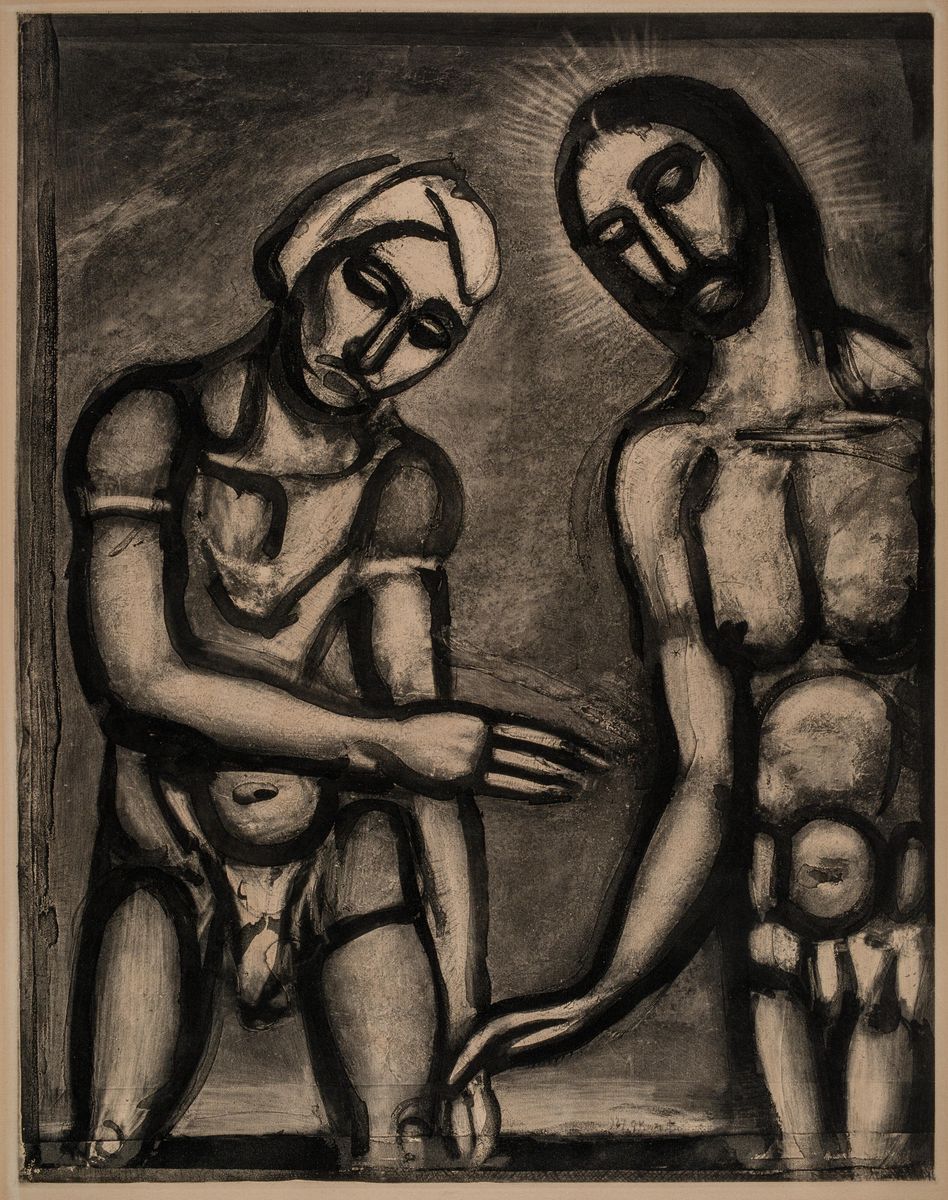
Rouault, Georges_Lord, it is you, I know you
Georges Rouault (French, 1871–1958), Seigneur, c’est vous, je vous reconnais [Lord, it is you, I know you], plate 32 from the Miserere et Guerre series, 1948. Aquatint, roulette, drypoint over heliogravure on paper, 57.4 × 44.9 cm (plate). Art Gallery of South Australia, Adelaide.

+++

SPOTIFY PLAYLIST: July 2022 by Victoria Emily Jones: Includes a thirteenth-century antiphon for the Holy Spirit by Hildegard of Bingen (“Love abounds in all . . .”); a Luganda praise song for children’s choir; an excerpt from an Orthodox Vespers service in the Yup’ik language from Kodiak, Alaska; a gospel-style setting of Psalm 23; and more. Below are live recordings on YouTube of a few songs from the list: a cover by Amir Darzi and Lital Regev of “Long, Long, Long” from the Beatles’ White Album, which songwriter George Harrison said addresses God; “Love Like There’s No Tomorrow” by gospel-blues husband-wife duo The War and Treaty; and “Here in the Vineyard of My Lord,” a Primitive Baptist hymn compiled in The Good Old Songs (1913) and performed by Americana/folk music duo Anna & Elizabeth.

Icons roundup

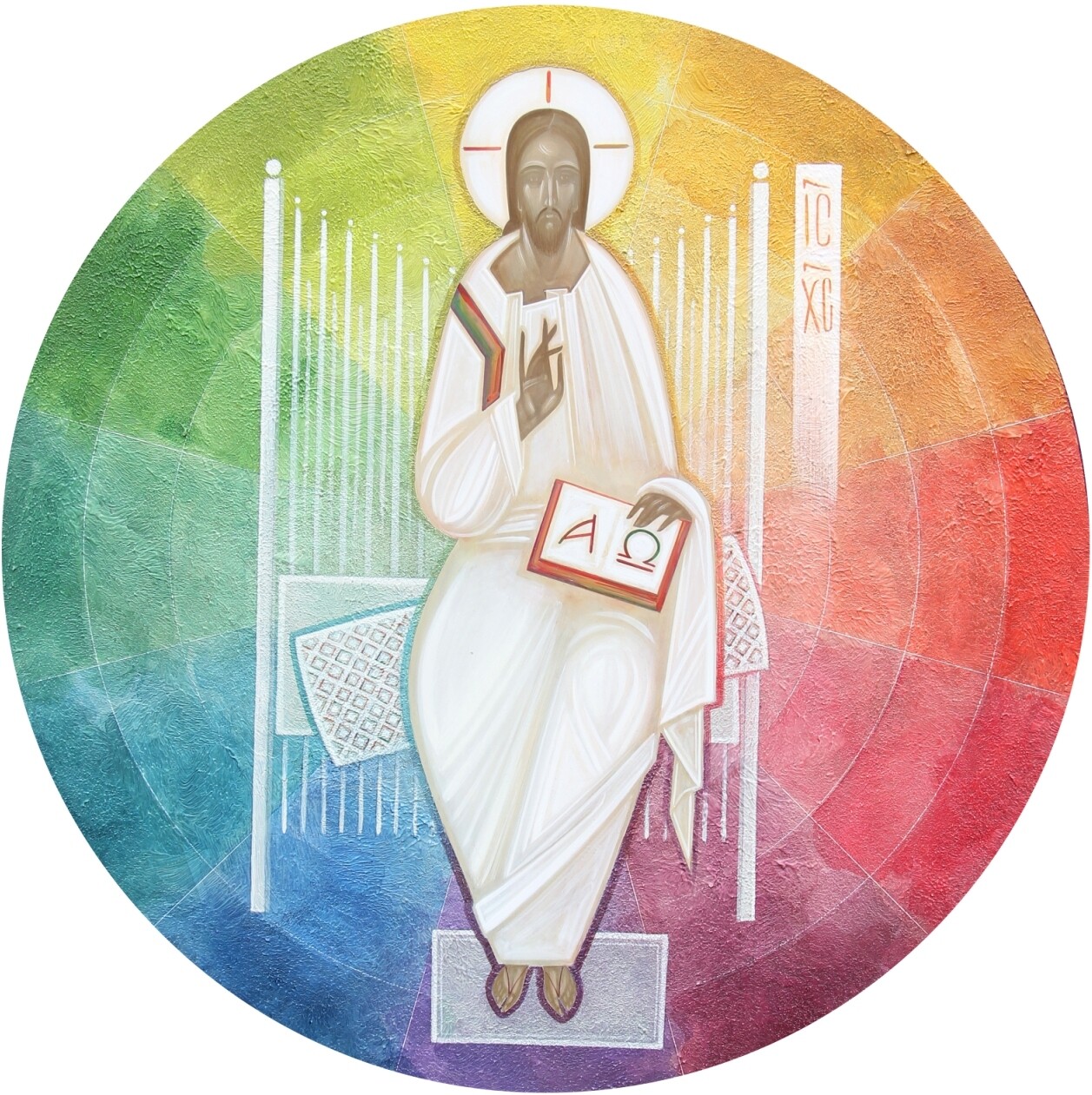
As a caveat, I am a Protestant, and while I do have a profound respect and appreciation for icons, my theology of images, including my definition of sacred art, is not the same as the Orthodox Church’s—even though elements of it are influenced by the Orthodox position. All the same, I believe it’s important for Christians of all denominations to understand the significance of icons and what differentiates them from noniconic religious images. Those lines are being blurred a bit by the new schools of iconography coming out of western Ukraine and Poland, which honor tradition even as they push it forward into the contemporary era. Here are a few icon-related videos, articles, and weblinks that I’ve gathered over the past several months.

LECTURES:

>> “The Meaning of Icons” by Fr. Maximos Constas, November 13, 2019, Notre Dame Seminary: Father Maximos Constas, professor of patristics and Orthodox spirituality at Hellenic College Holy Cross Greek Orthodox School of Theology, explains the significance of icons in the Orthodox Church, with special attention to their aesthetic features and theological meaning, which is informed by the church’s Christology and cosmology. He answers such questions as, Why do the figures in icons look bored and unnatural? And, Doesn’t the Second Commandment forbid representations of Christ? He does not address icon veneration or details of the making process.

Constas spends the first fifteen minutes juxtaposing Eastern and Western approaches to religious images, discussing how the Renaissance values of humanism and naturalism came to prevail in the West. The Orthodox, he says, see this as the “secularization” or “carnalization” of sacred art—in its commitment to depicting observable realities, Western art from the Renaissance onward typically lacks overt signs of transcendence.

Constas also discusses the dogmatization of sacred images in the East. Icons are never simply works of art or pedagogical tools, he says. “They were understood to be visual artistic expressions of the church’s theology. And in the same way that church doctrines could not be changed, neither could the image in which the doctrines were embodied.”

Here are some notes I took on the talk, including some transcriptions:

  • An icon can be a panel painting, a fresco, a mosaic, a relief carving, an enameled plaque, a manuscript illumination, etc. “What ultimately defines an icon has nothing to do with artistic medium or style but rather depends on how the image is used and, most importantly, what it is believed to be. And every icon is a means of spiritual encounter and dialogue. It offers us the possibility of such an encounter because it shares in the holiness of the sacred figure whose likeness it bears.”
  • An icon is not a work of art but a work of witness that makes use of art.
  • “Icons are not simply portraits but manifestations of human persons in their new heavenly condition. They are images of the spiritual character of human beings reborn, as it were, in the womb of eternity.”
  • “The icon has the ability to evoke within me the memory of the forgotten depth of my own being. It enables me to see my true face. It orients me toward my destiny in God. And this vision, this remembrance, this knowledge fills me with unspeakable joy and profound consolation.”
  • We not only can but must make images of Christ; “to deny the icon is to deny the reality of the Incarnation.”
  • “All created things are intrinsically good, and all, therefore, have spirit-bearing potentialities. And to this essential goodness and beauty of the material world, the icon bears joyful witness. In the icon, we see matter restored to harmony and so fulfilling its true vocation, which is to reflect and transmit the divine glory. The icon, then, safeguards not only the authenticity of Christ’s physical body, but also the true value of creation in its unfallen state as created by God. Inherent in the very fact of the icon is an optimistic, affirmative vision of the material creation. As spirit-bearing matter, the icon has what we would call eschatological significance—it anticipates the final transfiguration of the cosmos at the last day, when the created world will be delivered from its present bondage to corruption, to quote St. Paul, and will enter into the glorious liberty of the children of God.”
  • Icons as:
    • windows, doors, thresholds into heaven (spiritual places of passage)
    • mirrors, a reflection of their living source
    • tracks or traces
  • 32:40: Portrayal of figures in icons
    • Alteration of the natural symmetries and proportions of the body, including the features of the face (eyes and ears enlarged; nose elongated; mouth small and closed)
    • Full frontality—wholeness, completion, perfection; makes the icon dialogical and relational
    • Serene, controlled facial expression
  • No shadows cast; illumined from within

>> “Rajaton hengellinen kuva: Kärsimyksen ja ylösnousemuksen kuvat” (Boundless Spiritual Image: Images of Suffering and Resurrection) by Ari Luomajoki, March 26, 2021, Kuopio Cathedral, Kuopio, Finland: I don’t speak Finnish, but I share this seventy-minute video for the visuals (and of course for any Finnish speakers!) and to show how contemporary icons are spreading west. In August 2016 under the leadership of Pastor Ari Luomajoki, the Lutheran Monastic Community of Enonkoski in Ihamaniemi, Finland, organized its first international icon workshop (read more here, and follow @LutheranIcon on Facebook), which attracted iconographers from Poland and Ukraine, as well as a few domestic artists. It was reprised in 2017 (I mentioned this second workshop here). Icons that came out of these workshops have been exhibited several times in Finland, and have facilitated relationships that have led to new exhibitions—such as Kärsimyksen ja ylösnousemuksen kuvat (Images of Suffering and Resurrection) at Kuopio Cathedral, which ran March 26–April 11, 2021. Follow the boldface link to see a taping of the opening, which includes opening comments, a tour, and a lecture.  

Movchan, Danylo_Descent from the Cross
Danylo Movchan (Ukrainian, 1979–), Descent from the Cross, 2021. Watercolor on paper, 33 × 38 cm.

Mindewicz, Basia_Entombment of Christ
Basia Mindewicz (Polish, 1978–), Lamentation, 2016. Acrylic on wood, 26 × 20 cm.

In the first sixteen minutes of the video, Pastor Olli Viitaniemi, one of the main organizers of the exhibition (with Pastor Salla Tyrväinen), shows screen captures from the website he built connected to the exhibition, https://sielunkuvat.net/. At around 16:24 he gives a tour of the exhibition around the church sanctuary.

At 32:48 Luomajoki—who is a Lutheran pastor in Kouvola, Finland, and has a master’s degree in art history—starts his half-hour lecture. He introduces Międzynarodowe Warsztaty Ikonopisów w Nowicy (International Iconography Workshop in Nowica) in Poland and Lviv National Academy of Arts and the Iconart gallery in Ukraine, two centers of contemporary Eastern iconography that inspired the icons project at the Enonkoski monastery in Finland. At 47:41 Luomajoki does side-by-side image comparisons to show similarities and differences across time. At 50:41 he discusses the use of images in early Lutheranism. He goes on to show some examples of religious art in Finland in the past century (including a really compelling Crucifixion painting by Helene Schjerfbeck and crucifix by Paavo Halonen!). He closes by spotlighting Hidden Life in Nazareth by Ivanka Demchuk and a Nativity by Arsen Bereza, participants in the workshop.

Luomajoki is a wonderful photographer of art. Follow him on Instagram @ari.luomajoki.

+++

INTERVIEW with contemporary iconographer Khrystyna Kvyk, by Kevin Antlitz: OK, Patheos blog posts are painful to read because of all the obtrusive ads, which is why I rarely link to them. But I’m making an exception for this one, where American Anglican pastor Kevin Antlitz interviews Ukrainian Greek Catholic iconographer Khrystyna Kvyk, who earned a master’s degree in sacral art in 2020. She discusses her process of painting icons, what makes an icon an icon, timelessness and transfiguration, the relationship between tradition and innovation, the idea of divine light as reflected in two of her icons, and more. I really love her work and was delighted to hear some of her own words about it.

Kvyk, Krystyna_I Am the Light of the World
Khrystyna Kvyk (Ukrainian, 1994–), I Am the Light of the World, 2021. Acrylic on gessoed wood, diameter 35 cm.

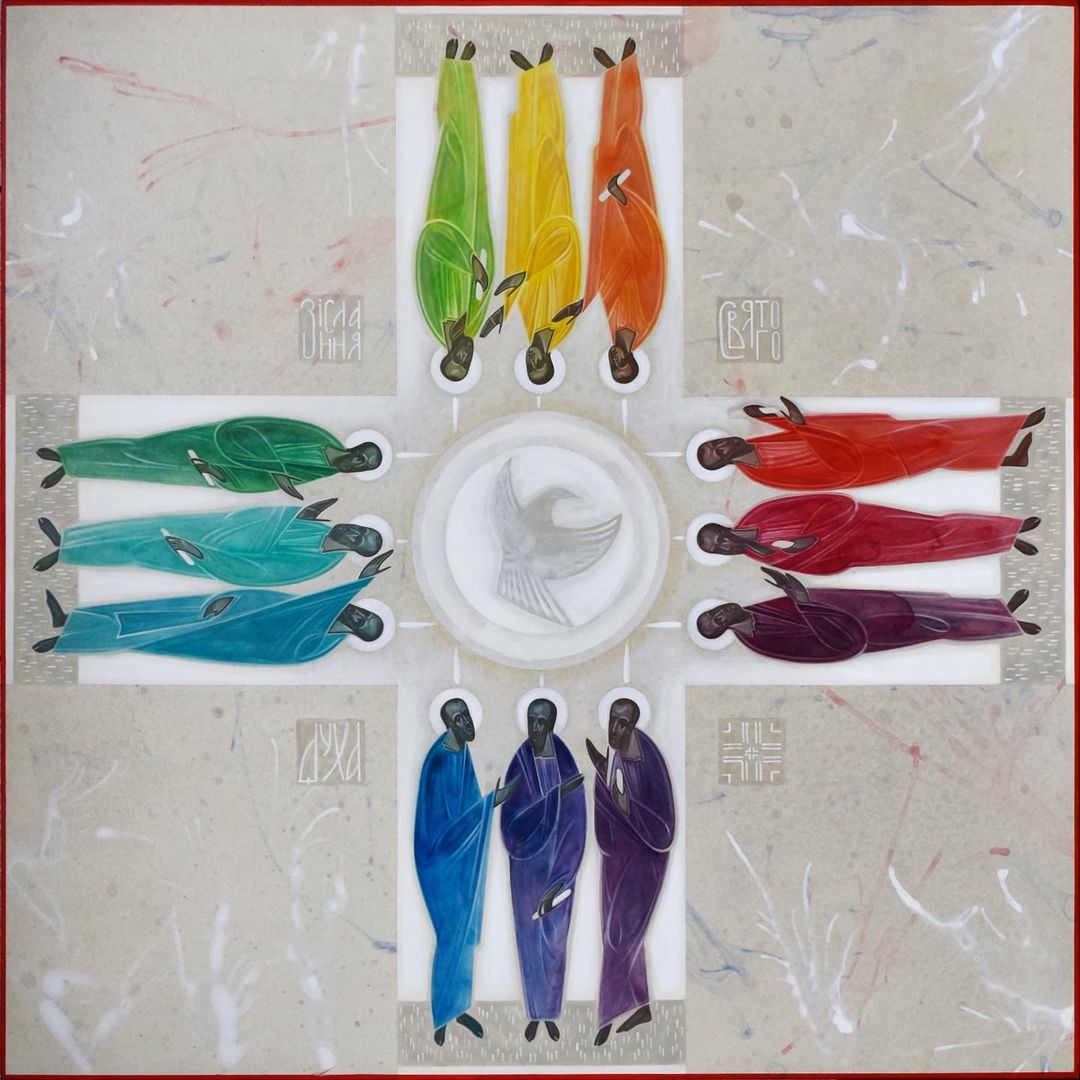
Kvyk, Khrystyna_Pentecost
Khrystyna Kvyk (Ukrainian, 1994–), Pentecost, 2021. Acrylic on gessoed wood, 45 × 45 cm.

This is the final installment of a three-part series by Antlitz. Part 1 answers, What Are Icons?, and part 2 is about “Praying Through Icons.”

+++

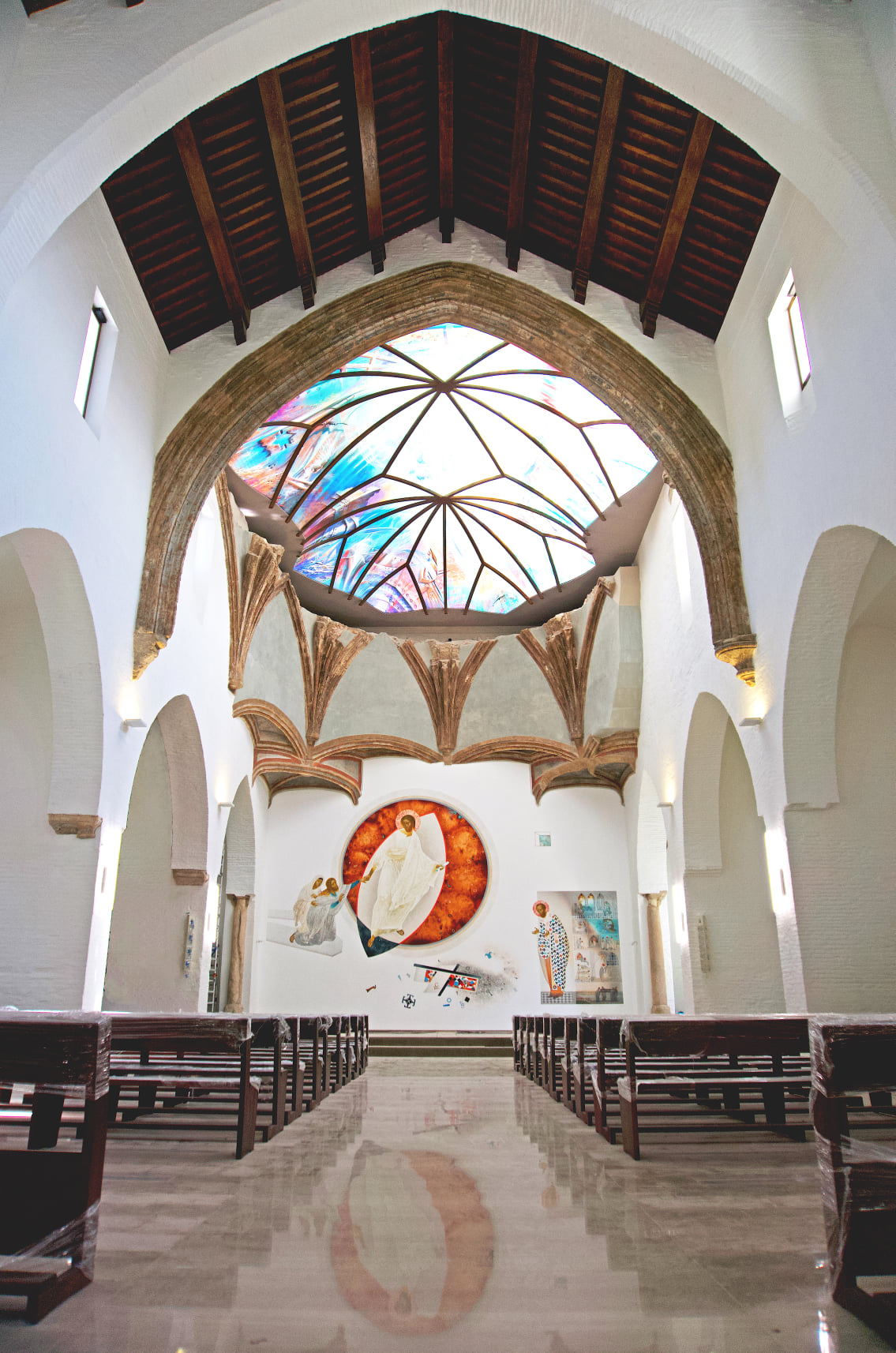
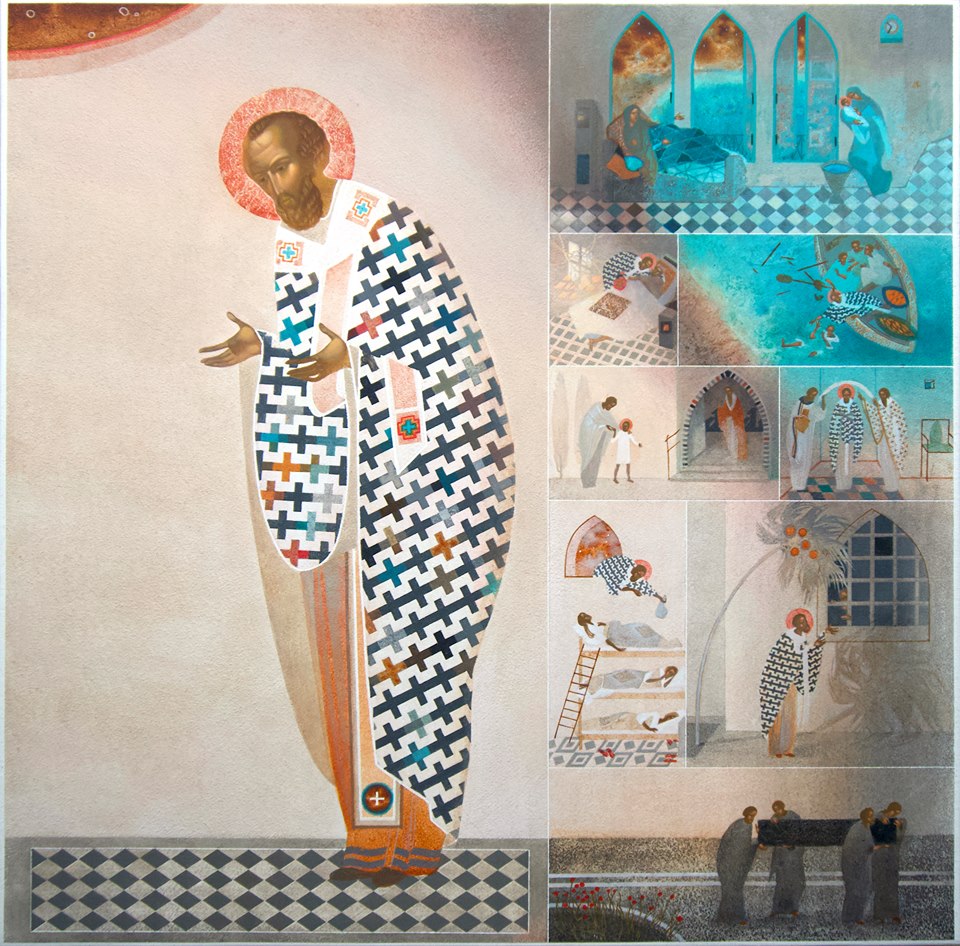
NEW CHURCH COMMISSION: Wall paintings at Iglesia de San Nicolás by Ivanka Demchuk and Arsen Bereza: Ukrainian artists Ivanka Demchuk and Arsen Bereza—a married couple!—have completed a monumental painting on the east wall of the Catholic church of Saint Nicholas in Granada. It was deeply influenced by Byzantine iconography, in which they’ve both been trained, but also contains some modern abstract and geometric elements.

The church building is from the sixteenth century and recently underwent extensive renovations, finally reopening to the public in April, which is when Demchuk and Bereza’s mural was unveiled. It portrays the Anastasis, the Eastern Orthodox image of Christ’s resurrection, which shows him breaking down the doors of hell to release its captives. In the video (which is in Ukrainian with Spanish subtitles), Demchuk describes how they painted two mandorlas behind him: the almond-shaped one symbolizing his divine light, and a round one symbolizing the cosmos.

Appearing alongside this focal point is a portrait of the church’s namesake, Saint Nicholas, with eight scenes from his life—including my favorite, where he tosses three bags of gold through the window of an impoverished family’s home. (The legend of Santa Claus—Claus being a shortened form of “Nicholas”—evolved from this story of anonymous gift giving.)

Demchuk, Ivanka_Anastasis (in situ)
Iglesia de San Nicolás, Granada, Spain, 2022, with east end mural by Ivanka Demchuk and Arsen Bereza

Demchuk, Ivanka_Resurrection
Ivanka Demchuk (Ukrainian, 1990–), Resurrection, 2018. Mixed media on wood. Design for the Church of St. Nicholas, Granada, Spain.

Demchuk, Ivanka_St. Nicholas with Scenes from His Life
Ivanka Demchuk (Ukrainian, 1990–), Saint Nicholas with Scenes from His Life, 2018. Mixed media on wood. Design for the Church of St. Nicholas, Granada, Spain.

See more photos of the project on Demchuk’s Facebook page.

+++

BLOG POST: “The Meaning of Melchizedek in Icons” by David Coomler: Though he’s not religious, David Coomler is an expert on Christian icons and often consults on them. On his blog he unpacks the iconography of standard types but also more unusual ones, like You Are a Priest Forever After the Order of Melchizedek, inspired by Hebrews 7. This rare type is meant to show that Jesus is both the offering and the offerer. The variation pictured below shows, I think, three representations of Christ: as crucified seraph (still quite puzzling to me, but Coomler points out that the Greek of Isaiah 9:6 refers to the Messiah as the “Messenger of Great Counsel”), Holy Wisdom (aka Sophia), and high priest—hence the man in ecclesiastical garb in the back. Wild!

Icon with Jesus High Priest

Juneteenth roundup: Documentary, playlists, Alvin Ailey’s Revelations

DOCUMENTARY: Juneteenth: Faith and Freedom, dir. Ya’Ke Smith: Released June 7 by Our Daily Bread Ministries, this film follows Where Ya From? podcast host Rasool Berry to Texas to talk with pastors, historians, activists, artists, and elected officials about the spiritual significance of America’s newest federal holiday, and to visit historic sites associated with it. You can watch the full seventy-five-minute film for free on YouTube. Here’s the trailer:

The interviewees, in order of appearance, are:

  • Dr. Michael W. Waters, pastor, Abundant Life African Methodist Episcopal Church
  • Sam Collins, president, Juneteenth Legacy Project
  • Lisa Fields, founder, Jude 3 Project
  • DJ Norman-Fox, historian, author of Juneteenth 101: Popular Myths and Forgotten Facts
  • Lawrence Thomas, Juneteenth organizer
  • Dr. Carey Latimore, history professor, Trinity University
  • Sharon Batiste Gillins, genealogist, Institute of Genealogy and Historical Research
  • Diane Henderson-Moore, member, Reedy Chapel AME
  • Deborah Blacklock-Sloan, historical researcher and genealogist, Rutherford B. H. Yates Museum
  • Jacqueline W. Bostic, chairman, Fourth Ward Redevelopment Authority
  • Jacqueline Bostic-McElroy, assistant district attorney, Fort Bend County
  • Rev. Art McElroy, senior pastor, Antioch Missionary Baptist Church
  • Opal Lee, civil rights activist and “grandmother of Juneteenth”
  • Lecrae, hip-hop artist

+++

SPOTIFY PLAYLISTS by Lara Downes (with commentary!):

>> Songs for Freedom: A Juneteenth Playlist (2021): Award-winning pianist and NPR radio host Lara Downes curated an excellent Spotify playlist for Juneteenth last year—a mix of jazz, classical, and soul. It is full of wonderful surprises, introducing me to the work of several African American composers, new and old, such as Wynton Marsalis’s The Democracy! Suite for jazz ensemble; a symphony by William Grant Still titled “Song of a New Race”; “Adoration” by Florence Price (originally written for organ but arranged here for violin and piano); “Fanfare on Amazing Grace” by Adolphus Hailstork; and “Startin’ Sumthin’” by Jeff Scott, a French hornist who performs “urban classical chamber music.”

There are also several well-known names—Billie Holiday, Mahalia Jackson, Aretha Franklin, Nina Simone, Duke Ellington, John Coltrane, Stevie Wonder—and more recent popular artists like Jon Batiste and Rhiannon Giddens. Batiste’s arrangement of “What a Wonderful World” is gorgeous, and the music video—wow (see below). It features a group of Black nuns having fun around London—picnicking on a park bench, traversing monkey bars, sharing the gospel with passersby, eating cotton candy, riding bumper cars. It captures the tone of the song perfectly.

From Downes’s list I also really like the blues song “I Knew I Could Fly” by Allison Russell and Leyla McCalla, excerpted in the following featurette. It’s from the album Songs of Our Native Daughters, which sheds light on African American women’s stories of struggle, resistance, and hope.

Be sure to read the NPR article that introduces the playlist. Downes calls out nine of the musical selections with blurbs that provide some background, and throughout there is a smattering of historical photographs of Black flourishing in and around Washington, DC, from 1904 onward, taken by the Black-owned Scurlock Studio.

YWCA camp for girls
YWCA camp for girls. Highland Beach, Maryland, 1930. This photo is from the Scurlock Studio Collection at the Smithsonian National Museum of American History.

>> Songs to Believe In: A Juneteenth Playlist (2022): As I was formatting this post I realized that Downes just published a brand-new playlist for Juneteenth 2022. I haven’t had time to listen yet, but it looks awesome. “I offer you a collection of music that insists on the promise of freedom, however long in coming,” she writes. “Music that counters the shrieking dissonance of conflict with the radiant warmth of its harmonies, that offers us comfort in our sorrow and sustenance in our struggle. Songs that ground us with the steadiness of their rhythms and embrace us in the lines of their melodies. Music that brings us hope and faith and even joy, urging us to stand and fight another day, reminding us that what we are celebrating on this holiday is our freedom to believe, even in the hardest of times.”

+++

YOUTUBE PLAYLIST: Juneteenth Playlist by Victoria Emily Jones. Nineteen songs of freedom and faith—gospel, pop, funk, R&B, and spirituals. I wanted to choose all live performances or music videos so that there’s a visual element to engage.

One of the songs is “Clap Praise” by Diane White-Clayton, performed by Selah Gospel Choir. It’s a setting of Psalm 47, which opens, “Clap your hands, all you peoples; shout to God with loud songs of joy!”

Dr. Diane White-Clayton is a composer, conductor, pianist, and lecturer in ethnomusicology specializing in Black sacred music. I love the exuberance and all the body percussion in this widely performed piece of hers. I learned about Selah Gospel Choir through Bridge Projects, an art gallery in Los Angeles where they recently performed. The choir was founded in 2007 “as a space for people who want to sing gospel music birthed by the spirit of the Black church and the ancestry of Black community but are either unable to find it in their home place of worship or do not identify with being in a church at all.”

+++

DANCE WORK: Revelations, choreographed by Alvin Ailey: This classic thirty-six-minute work choreographed by the pioneering Alvin Ailey premiered in New York in 1960 and since then has been performed continually around the globe. This particular performance at Lincoln Center premiered online on December 6, 2020, as part of Alvin Ailey American Dance Theater’s virtual season during the pandemic. “Using African American spirituals, song-sermons, gospel songs, and holy blues, Revelations fervently explores the places of deepest grief and holiest joy in the soul.” Ailey said it was born of the “blood memories” of his childhood in rural Texas and his affection for the Baptist church that nurtured him.

All the numbers are great, but my favorite is “Wade in the Water” (part of the “Take Me to the Water” sequence that begins at 9:41). Second favorite: “Fix Me” (5:22).

Roundup: Paula Rego’s Life of the Virgin; corito medleys; more

EXHIBITION: Paula Rego: Secrets of Faith, Victoria Miro Venice, April 23–June 18, 2022: Portuguese-born British artist Paula Rego died last Wednesday, June 8, after a seven-decade career, and in the midst of four solo exhibitions of her work—including this one at Victoria Miro’s gallery in Venice, which explores her small but significant body of religious art. [HT: Jonathan Evens]

In 2002 Jorge Sampaio, then president of Portugal, commissioned Paula Rego to create eight pastel drawings based on episodes from the life of the Virgin Mary, to be installed permanently in the chapel of the presidential palace (Palácio de Belém) in Lisbon. Titled Nossa Senhora (Our Lady), the cycle comprises Annunciation; Nativity; Adoration; Purification at the Temple; Flight into Egypt; Lamentation; Pietà; and Assumption. Rego had such fun with the commission that she produced additional works on the subject, which she decided to keep for herself. It is these, along with her watercolor studies, that are currently on display in Venice. (The original eight pastels are not allowed to leave the chapel for which they were made.)

Rego, Paula_The Flight to Egypt
Paula Rego (Portuguese British, 1935–2022), The Flight to Egypt, 2002. Watercolor and ink on paper, 8 1/4 × 11 3/4 in. (21 × 29 cm).

Rego, Paula_Descent from the Cross
Paula Rego (Portuguese British, 1935–2022), Descent from the Cross, 2002. Pastel on paper mounted on aluminum, 29 1/2 × 28 3/8 in. (75 × 72 cm).

I learned about Rego’s Marian cycle a few years ago and became enthralled by it, though I’ve never seen it in person, and most of these supplemental works are new to me. It’s unique, in part because of Mary’s corporeality. In a 2003 interview with Richard Zimler, Rego said, “If there is anything new about these representations of the Virgin, it is the fact that they were done by a woman, which is very rare. . . . It always used to be men who painted the life of the Virgin, and now it is a woman. It offers a different point of view, because we identify more easily with her.”

While the president praised the cycle and Rego insisted that “these pictures were created with admiration and respect,” an open letter to Sampaio referred to it as an “outrage done to the vast majority of the Portuguese people,” an “outrage against their religious beliefs and an offence to the Virgin Mary.” In brief: “blasphemous and scandalous.” I can see why Rego’s larger oeuvre, with its often menacing and/or transgressive imagery (not least of which is her Abortion Series), would scandalize conservative viewers, but I am a bit confused by the outrage at Nossa Senhora, which to me seems very honoring. The objectors, it sounds like, are those who prefer Mary to be more ethereal and sedate; they don’t want to see her, for example, slouching or wincing or expressing astonishment, or awkwardly struggling to hold the weight of her son’s corpse. There will always be those who resist any kind of updating of religious art. If the scenes are restaged in an unfamiliar way or rendered in an unfamiliar style or introduce a new element or the figures don’t look like how we have always pictured them, then some will oppose them outright—which is a shame, because such art often invites us more deeply into the story, helping us to see it afresh.

Definitely check out the boldface link above to view more pieces from the exhibition, as well as a video that shows Nossa Senhora in situ. For further reading, see “Paula and the Madonna: Who’s That Girl?” by Maria Manuel Lisboa and the transcript from Zimler’s interview with Rego.

+++

PODCAST EPISODE: “Past Hymns for the Present Moment,” Tokens, May 26, 2022: “Hymns are often sentimentalized in the American church, cast aside as merely retired songs with dated language, bearing no real appeal or relevance. But of course it may be that our old hymnals have some crucial things to say to us in our current cultural moment. This is the challenge I [Lee C. Camp] posed to Odessa Settles, Phil Madeira, and Leslie Jordan: find and perform some old hymns which might be both indicting and encouraging to the modern church, and to the world at large. Beautiful conversation and moving performances, taped at Nashville’s Sound Emporium.”

+++

POETRY UNBOUND EPISODES:

In each episode of this podcast from On Being Studio, host Pádraig Ó Tuama unpacks a contemporary poem in fifteen minutes. Here are two from season 5 (which just came to an end) that I particularly liked.

>> “Looking for The Gulf Motel” by Richard Blanco: “What happens when we remember?” Ó Tuama asks. “Why do we remember? Is it sweet or sad? Is it both? If you particularly associate warm memories, romantic memories, nostalgic memories with a place, and then that place is changed, does that mean that all those memories are gone?” In this poem from a collection of the same title (which I checked out from my local library at Ó Tuama’s recommendation, and it’s excellent!), Cuban American poet Richard Blanco, at age thirty-eight, reminisces about a family beach vacation from his childhood. Read the poem here.

If I were writing this poem, it would be called “Looking for The Blockade Runner,” as that’s the name of the Wrightsville Beach hotel in North Carolina that my family and I used to stay at for four days or so each summer. My little brother and I should still be running around on the waterfront lawn as our parents watch us from inside the giant window of the dining room, finishing up their breakfast. My dad should still be riding in a wave on a boogie board, teaching me technique. My mom should still be lounging at the pool in her black one-piece with sunglasses and a Vanity Fair, I feeling so grown up beside her sipping my virgin piña colada. My brother should still be exhilarated by the live hermit crabs at Wings, and I by the dried starfish and sand dollars. We should all still be walking back from the Oceanic, our bellies filled with she-crab soup and hush puppies and catch-of-the-day, down the shore at dusk.

>> “The change room” by Andy Jackson: A poet who’s interested in difference and embodiment, here Andy Jackson, who has severe spinal curvature due to Marfan syndrome, “is looking at the attention that he gets in his body and is refocusing it, extending it wider, looking at the deeper question of, what does it mean for any of us to be in a body, and how do we in bodies relate to others in bodies?” Read the poem here, from the collection Human Looking.

+++

CORITO VIDEOS: A corito (literally “short song”) is a type of Latino Christian worship song. Coritos have “fairly simple tunes, often with repetitive words, that the people sing by heart,” writes Justo L. González in ¡Alabádle!: Hispanic Christian Worship. “Most of them are anonymous, and pass by word of mouth from one congregation to another. For that reason, the tune or the words of a particular corito may vary significantly from one place to another. They are often sung to the accompaniment of clapping hands, tambourines, and other instruments.” To learn more about this genre, see the Calvin Institute of Christian Worship interview with Rosa Cándida Ramírez and Analisse Reyes and the entry in the Encyclopedia of Christianity in the Global South, vol. 2.

>> Joseph Espinoza sings a corito medley consisting of “Cuando el pueblo del Señor” (When the People of the Lord), “No puede estar triste” (The Heart That Worships Christ Cannot Be Sad), “Ven, ven, Espiritu divino” (Come, Come, Holy Spirit), “Cantaré al Señor por siempre” (I Will Sing to the Lord Forever), and “El Poderoso de Israel” (The Mighty One of Israel). Aaron Barbosa is on keyboard, Fabian Chavez is on percussion, and Yosmel Montejo is on bass.

>> The video below was shared March 25, 2020, in the Multicultural Worship Leaders Network Facebook group that I belong to, and it’s pure joy! The performers string together three coritos: “Le canto aleluya” (I Sing Alleluia), “Hay victoria” (There’s Victory), and “Los que esperan en Jesus” (Those Who Wait in Jesus).

Federico Apecena provides the following translation. (The slashes indicate the number of times that line or passage is sung.)

//The heart that worships Jesus cannot be sad
The heart that worships God cannot be sad//

//That’s why I sing, I sing hallelujah
The heart that worships God cannot be sad//

//There’s victory, there’s victory, there’s victory in the blood of Jesus//
The enemy will not be able to defeat our souls
//Because there is victory, because there is victory, because there is victory in the blood of Jesus//

//That’s why I sing, I sing hallelujah
The heart that worships God cannot be sad//

///Those that wait, that wait in Jesus///
//Like eagles, like eagles, their wings will open//

They will walk and will not get tired, they will run and will not stop
//New life they will have, new life they will have, those that wait, that wait in Jesus//

//That’s why I sing, I sing hallelujah
The heart that worships God cannot be sad//

Roundup: Prayers for a violent world, sad church songs, Climate Vigil Songs, and more

PRAYER COMPILATION: “Prayers for a Violent World” by W. David O. Taylor: “How exactly do we pray in the aftermath of violence? What words should we put on our lips? What can the whole people of God say ‘amen’ to and what might only one of us be able to say amen to in good conscience? These questions are, of course, far from easy to answer, but over the past couple of years I have attempted to give language to such matters and I have included here a number of those prayers, in the hope that they might prove useful, and perhaps comforting, to people who face the terrors and traumas of violent activities on a regular basis.” Included are prayers After a Mass Shooting, Against Bloodthirstiness, For Loving a Hurting Neighbor, For Enemies, For Bitter Lament, For Peace in a Time of War, For Those Who Weary of Doing Justice, and more.

Kubin, Alfred_War
Alfred Kubin (Austrian, 1877–1959), War, 1903

Here’s Taylor’s Prayer of Allegiance to the Prince of Peace:

O Lord, you who deserve all our loyalties, we pledge allegiance this day to the Lamb of God and to the upside-down Kingdom for which he stands, one holy nation under God, the Servant King and the Prince of Peace, with liberty and justice for all without remainder. We pray this in the name of the Holy Trinity. Amen.

+++

NEW ALBUMS:

>> Sorrow’s Got a Hold on Me by Paul Zach: On May 20, singer-songwriter Paul Zach wrote on his Instagram, “My new album of thirteen sad church songs is out today! Many of these songs were written right after one of my weekly EMDR therapy sessions, as I have been working through the sorrow, trauma, and grief of the past few years. I’m learning to bring all of myself to God in prayer and songwriting, which includes my sorrow and anger. I’ve always heard that God shows up in a unique way in times of grief but that has not been my experience. These songs are an invitation for the ‘man of sorrows’ to join me in my grief.”

Below is a demo of the first verse of my favorite song on the album, “We Bring You All Our Sorrows,” followed by the album link from Spotify. It includes a newly revised version of one of my favorite songs by Zach, “When Your Kingdom Comes” [previously].

Zach often writes collaboratively (including as part of the Porter’s Gate! see below), and the cowriters on some of the songs here are Kate Bluett, Latifah Alattas (Page CXVI), Nick Chambers, Orlando Palmer (IAMSON), Jessica Fox, Alex Johnson, and Philip Zach. There are also a few guest vocalists.

>> Climate Vigil Songs by the Porter’s Gate: The Porter’s Gate is a collective of fifty-plus songwriters, musicians, scholars, pastors, and music industry professionals from a variety of Christian worship traditions and cultural backgrounds, making music for churches. This sixth album of theirs, made in partnership with the #ClimateVigil movement, is themed around environmental justice and creation care. Below are videos for “Brother Son (Giving Glory!)” and “Jubilee.”

Besides “Brother Sun,” my favorite tracks are “Satisfied,” a prayer that we would stop seeking to build our wealth (a motive that drives a lot of environmental injustices) and instead be grateful for God’s provision; “The Kingdom Is Coming,” a marchlike call-and-response song that rallies us to pray, wait, and work for an end to creation’s groaning; and “Water to Wine,” which wonders at the miraculous process of planting and growing grapes for harvest. There’s also “All Creatures Lament,” a minor-key arrangement of “All Creatures of Our God and King” with new lyrics that enjoin the animals to mourn habitat loss, air pollution, and other results of humans’ power abuses and irresponsible stewardship.

To learn more about the album, listen to this great interview with Porter’s Gate cofounder and producer Isaac Wardell; it’s from the RESOUNDworship Songwriting Podcast, hosted by Joel Payne. Wardell discusses the vision for Climate Vigil Songs, and especially the difficulty, with thematic albums, of avoiding the pitfalls of being too heavy-handed with the messaging on the one hand, and on the other, being so vague that people don’t see the connection. There’s also a need for tonal balance, and for songs that fill different functions.

We wanted to write for this album at least three different kinds of songs. One kind is essentially songs of lament—songs lamenting the state of creation because of human sin and the brokenness of the world. Secondly, we wanted to write hopeful, you might even call them eschatological, songs—songs that are joyful, that are about this is the world that God has made, this is God’s creative work, this is how God calls us into his creative work. . . . And lastly, we wanted to write mobilization songs—songs that have some kind of an ethical component of calling people to action in some way. . . . We want to make sure the record is not too much of a downer, like all lament songs; we want to make sure that it’s not too much of a happy-clappy “Isn’t creation beautiful!”; and we also don’t want to let it just delve into being a 100 percent political action record. . . . We want to balance those things.

Wardell also talks about the group’s collaborative songwriting approach (including all the theological and editorial work that’s put in), Te Fiti’s stolen (and later, restored) heart in Disney’s Moana, personified nature in the Psalms, creation as an experiencer of the fall and redemption, the role of provocation in church, and biblical imagery he wishes they could have included on the album but had to leave out for length.

+++

POEM + CHORAL SETTING: “when god decided to invent” by E. E. Cummings: “Here’s a brief powerhouse of a poem from E. E. Cummings, two stanzas that draw a sharp distinction between God’s inventive, joyful creativity on the one hand, and our too-frequent turn toward violence on the other. As the mass shootings in Buffalo, Uvalde, and elsewhere continue to reverberate, Cummings’ poem helps us feel and think about what’s at stake – and what the way forward looks like.”

SALT Project reproduces the poem, provides brief commentary, and links to a musical setting by Joshua Shank—a composition for SATB, soprano saxophone, and finger cymbals that premiered in 2005. Shank says the arc of his piece is creation-destruction-recreation. “This final chord is the creator taking control of the creation again.”

+++

RADIO EPISODE: “Belief in Poetry: John Donne”: John Donne (1572–1631) is one of my favorite poets, and looking back on the blog, I can’t believe I’ve not yet featured any of his poems! (I’ll have to rectify that . . .) In this BBC Radio 4 segment from March 13, poet and theologian Pádraig Ó Tuama considers Donne’s complex faith life through his poetry. He speaks with Julie Sanders, professor of English literature and drama at Newcastle University; Mark Oakley, writer and dean of St. John’s College, Cambridge; and Michael Symmons Roberts, poet and professor of poetry at Manchester Metropolitan University. Sir Simon Russell Beale reads the four featured Donne poems: “Death, be not proud” and “Batter my heart, three-person’d God” from his Holy Sonnets series, “Hymn to God, My God, in My Sickness,” and “A Hymn to God the Father.”

Here are two of the quotes that stood out to me:

  • “It’s easy to think of John Donne’s life falling neatly into two parts: the worldly man, and the spiritual seeker; the lover of women, and the lover of God; Catholic, then Protestant; before Anne, and after Anne; love poet, and religious poet. But life is rarely that clear. And rather, it’s the tension between these dynamics of him that gives birth to so much of his work.”—Pádraig Ó Tuama
  • “There’s an assumption that a poet working in this territory is sure of their ground and knows what they’re writing about. I don’t think that’s ever true, because why would you write the poems, if that were true? You’d just bathe in your certainty! The whole act of sitting down to write a poem is not to dress up something you already know in a way that makes it an enticing package for other people to be convinced by—and if you attempted that, it’s going to fall like the deadest thing on the page. Making a poem is an exploratory process. You don’t know where it’s going to end when you start it.”—Michael Symmons Roberts

Pentecost roundup

SONGS: The Holy Spirit Prayer is a traditional Catholic prayer that’s sung at Mass on the feast of Pentecost: “Come, Holy Spirit; fill the hearts of your faithful, and kindle in them the fire of your love. Send forth your Spirit and they shall be created, and you shall renew the face of the earth. O God, who by the light of the Holy Spirit did instruct the hearts of the faithful, grant that by the same Holy Spirit we may be truly wise and ever enjoy his consolations, through Christ our Lord. Amen.” The following two songs are settings of the first part of this prayer.

>> “Kindle in Us Your Love” by Deanna Witkowski: This funky refrain by jazz composer Deanna Witkowski “works well as a gospel acclamation, prayer response, or opening song,” especially for Pentecost. I’m planning to introduce it to my Presbyterian congregation this Sunday. (For church services, Witkowski charges a licensing fee of just $3 per use.) You can purchase the piano score here; it also appears in the Voices Together hymnal. Hear a high school choir perform the piece in the video below, with Witkowski accompanying on keys.

Come, Holy Spirit
Kindle in us the fire of your love
Come, Holy Spirit
Kindle in us your love

>> “Holy Spirit, Come to Us” by Jacques Berthier (Taizé chant): Taizé is an ecumenical Christian monastic community in France comprising more than one hundred Catholic and Protestant brothers from some thirty different countries. They welcome in around a hundred thousand young pilgrims a year, who come for prayer, Bible study, and communal work and worship. The songs of Taizé use simple musical phrases and few words that are repeated. Composed in 1998, “Holy Spirit, Come to Us” is one of 232 songs Jacques Berthier wrote for Taizé. It consists of solo verses sung by a leader over an ostinato refrain sung by the people.

Holy Spirit, come to us
Kindle in us the fire of your love
Holy Spirit, come to us

Jesus said, “It is by your love for one another
That everyone will recognize you as my disciples.”

Jesus said, “No one has greater love than this:
To lay down one’s life for those one loves.”

We know love by this,
That Christ laid down his life for us.

This is love: it is not we who have loved God
But God who loved us.

Taizé songs may be sung in public worship settings free of charge, provided their simplicity is preserved (i.e., no elaborate arrangements are permitted); for other uses, see here.

+++

DIGITAL DOWNLOAD: Pentecost Party: Word & Wonder is offering a free twelve-page PDF of resources for celebrating Pentecost with children. Besides a list of party ideas, it includes an imaginative retelling of the Pentecost story from the perspective of a child, a prayer guide, prompts for talking about the Holy Spirit, coloring pages, and a pinwheel craft. On their website you will also find other family-friendly resources for the church year. [HT: Global Christian Worship]

+++

BLOG POST: “Whitsun Week” by Eleanor Parker: “The week following Pentecost is a lost holiday. From the Middle Ages until the early 20th century the period around Whitsun was the principal summer holiday of the year – especially Whit-Monday”—which is June 6 this year. “It was the time for fairs, Morris dancing, games, ale-drinking, school and church processions, weddings, wandering into the countryside, and generally having a good time.” Gooseberries and cheesecakes were broken out for the occasion, and communities engaged in fun activities like cricket, archery, sack races, and donkey derbies.

British medievalist Eleanor Parker compiles several sources that describe the Whitsuntide festivities of medieval western Europe and calls her readers to revive the week’s outdoor merrymaking!

+++

SHORT FILM: Stickmatch: Created in 2020 by London-born animator William Crook, this twenty-second stop-motion animation uses autumn leaves to simulate flames. [HT: Colossal]

+++

Here’s a new Spotify playlist I made for the month of June.

+++

Previous posts on the blog that are related, either directly or indirectly, to Pentecost include:

Roundup: Spirituality of food docuseries; a psalm and a jazz band walk into a bar; and more

DOCUMENTARY SERIES: Taste and See, dir. Andrew Brumme:Taste and See is a documentary series exploring the spirituality of food with farmers, chefs, bakers, and winemakers engaging with food as a profound gift from God. Their stories serve as a meditation on the beauty, mystery, and wonder to be found in every meal shared at the table.” The Rabbit Room, who is partnering with them for a virtual cinema event (see below), says, “If, in some blessed alternate universe, Robert Farrar Capon had decided to make a documentary with Terrence Malick, guided by the foundational wisdom of Wendell Berry, then they would have made something like the pilot of Taste and See.”

Some of the people you see in the series trailer are Shamu Sadeh, cofounder of Adamah Farm and Fellowship in Connecticut, which integrates organic farming, Jewish learning, sustainable living, and contemplative spiritual practice (Adamah is the focus of the pilot film); The Soul of Wine: Savoring the Goodness of God author Gisela Kreglinger, who grew up on a winery that has been in her family for generations and who leads wine pilgrimages in Burgundy and Franconia (“a spiritual, cultural, and sensory exploration of wine”); Norman Wirzba, a professor at Duke who teaches and publishes at the intersections of theology, philosophy, ecology, and agrarian and environmental studies (see, e.g., his Food and Faith: A Theology of Eating); Kendall Vanderslice, a North Carolina baker, author, and founder of Edible Theology, which offers “curriculum, community, and communications that connect the Communion table to the kitchen table”; and Joel Salatin, who raises livestock on his Polyface Farm in Swoope, Virginia, in the Shenandoah Valley.

You can buy tickets to a virtual screening of the hour-long pilot, which is happening twice daily from June 3 to June 19 and includes exclusive access to a panel discussion with singer-songwriter Andrew Peterson, theologian Norman Wirzba, and director Andrew Brumme. Revenue from ticket sales will fund the production of future films, some of which are already in the works. “The funding raised will determine how far we can go and which stories we can pursue,” Brumme tells me. “We’re hopeful the virtual event will bring together enough of a supportive base of people who want to see this series made.” There’s also an option on the website to donate.

To hear more from the director, especially about the inspiration behind the series, check out the interview Drew Miller conducted with him.

+++

DISCUSSION PANEL: “Art Between the Sacred and the Secular,” June 6, 2022, Akademie der Künste, Berlin: Moderated by the Rev. Professor Ben Quash, this free public event (reserve tickets here) puts in conversation artist Alicja Kwade; Dr. María López-Fanjul y Díez del Corral, senior curator of the Bode Museum and the Gemäldegalerie; and Dr. Neil MacGregor, former director of the British Museum and the National Gallery, London. The questions they’ll address (see below) sound really intriguing!

Kwade, Alicja_Causal Emergence
Alicja Kwade (Polish, 1979–), Causal Emergence (December 2020), 2019. Watch hands on cardboard, framed, 175 × 175 cm.

“The abiding power of Christian motifs, ideas and styles in a host of modern and contemporary works that superficially look un- or anti-Christian indicates that visual art and Christian tradition have not become complete strangers. This invites analysis and understanding.

“How have Christian artworks and artistic traditions found new articulations, caused new departures, or provoked new subversions in the last 100 to 150 years? What forms of engagement between theology and modern and contemporary art do such developments in the relationship between art and Christianity invite and reward?

“How do viewers (Christian and non-Christian) interact with historical Christian art today, and how do modern sensibilities affect our viewing of earlier Christian artworks and artistic traditions?

“Is contemporary art an alternative to religion or can it sometimes be an ally? How do contemporary art and religion each respond to human experiences of the absurd or the tragic? What do contemporary art and the spaces in which we encounter it, tell us about the histories of both Western Christianity and Western secularisation?”

+++

FUNDRAISER: New Ordinary Time Album: The indie folk trio Ordinary Time is one of my favorite musical groups—I heard them in concert at a church here in Baltimore a few years ago!—so I’m really excited to see that they’re working on their sixth full-length album, their first since 2016. It will be produced by the esteemed Isaac Wardell, founder of Bifrost Arts and the Porter’s Gate. Per usual, it will comprise a mix of original and classic sacred songs, including the new “I Will Trust,” demoed in the second video below. Help fund their production costs through this Indiegogo campaign, which ends June 15. A donation of just $25 will get you an early download of the album.

+++

SONG: “Oh Give Thanks (Psalm 107)” by Wendell Kimbrough: Wendell Kimbrough is among today’s foremost singer-songwriters engaging with the Psalms. His adaptation of Psalm 107 [previously] is one of his most popular songs, ever since the original studio recording released in 2016. Now he’s recorded a live version with a New Orleans jazz band! It is available on most streaming and purchase platforms.

The music video was shot in February at a bar in Daphne, Alabama, with some eighty of Kimbrough’s friends and supporters, and it premiered May 13. It was his way of saying farewell to his Church of the Apostles community in Fairhope, Alabama, where he served as worship leader and artist-in-residence for eight years. He left this spring to take a new job as uptown artist-in-residence at Church of the Incarnation in Dallas.

“From the time I wrote ‘Oh Give Thanks,’ I always pictured it as a bar tune, specifically set in New Orleans,” Kimbrough says. “The image Psalm 107 conjures for me is a group of friends sitting together swapping stories of God’s deliverance and raising their glasses to celebrate his goodness.” He has noted that some people are uneasy about singing the line “We cried like drunken sailors” in church, but he points out that it’s there in the Old Testament psalm! (Recounting how God rescued a group of men from a storm at sea, the psalmist says that as the waves rose, “they reeled and staggered like drunkards / and were at their wits’ end. Then they cried to the Lord in their trouble, / and he brought them out from their distress,” vv. 27–28).

To learn how to play the song on guitar, see Kimbrough’s video tutorial. You may also want to check out the songs of thanksgiving I compiled on Spotify.

+++

CHURCH ARCHITECTURE: Santa Maria Goretti Church, Mormanno, Italy: In 2013 architect Mario Cucinella won a competition held by Italy’s assembly of Catholic bishops to create the new parish church of Santa Maria Goretti in the hilltop town of Mormanno in Calabria. Because a third of the funds had to be raised locally, the project wasn’t completed until last year. Cucinella says that gave him time to win over its most important constituency: the elderly women who go to Mass every day, and who at first “were suspicious of its modernism.” [HT: My Modern Met]

Cucinella designed an elegantly minimalist concrete building with sinuous surfaces that form the shape of a four-leaf clover, a reinterpretation, Cucinella says, of the shape of Baroque churches. The enclosure has only a few openings. “On its north side, two walls part to create an entrance—while also contributing edges to a cross cut into the curves and lit by LEDs at night. On its south side, a small window is positioned to focus afternoon sunlight on a crucifix on July 6,” Maria Goretti’s birthday.

Santa Maria Goretti Church
Santa Maria Goretti Church, Mormanno, Italy, designed by Mario Cucinella Architects, completed 2021. Photo: Duccio Malagamba.

Photo: Duccio Malagamba

Maraniello, Giuseppe_Baptismal font
Baptismal font by Giuseppe Maraniello. Photo: Duccio Malagamba.

Inside, the walls are hand-finished in plaster mixed with hemp fibers and lime, which give them a mottled, earth-toned look. The most dominant feature of the interior is the twelve-foot-deep scrim that falls from the ceiling in swirls, filtering in sunlight. Artist Giuseppe Maraniello (b. 1945) was commissioned to create the lectern, tabernacle, baptismal font, and figure of the Virgin Mary, while the simple steel and wood seating is by Mario Cucinella Design. Click on any of the three photos above to view more.

The church’s namesake, one of the youngest saints to be canonized, was stabbed to death in 1902 at age eleven while resisting a rape. She is the patron saint of purity, young women, and victims of sexual assault.