LECTURE: “Light in Sacred Space: Light from the Cave” by Matthew J. Milliner and Alexei Lidov, December 19, 2019, Bridge Projects, Los Angeles: This double lecture about the role of light in Christian spirituality and theology was organized to coincide with the premiere of 10 Columns, an immersive light installation by Phillip K. Smith III that Bridge Projects commissioned for their inaugural exhibition.
While the Light & Space movement was born in Southern California in the 1960s, in many ways it participates in a much longer history of artists in dialogue with the phenomena of light. This presentation by two art historians, Matthew Milliner and Alexei Lidov, will begin with Milliner exploring the unexpected resonance of Phillip K. Smith III’s work with Byzantine and Gothic traditions. Lidov will then expand on these ideas with his scholarship in the Eastern Orthodox tradition and its long history of engaging light and mysticism. What kinds of insights might come when Light and Space artists, including Phillip K. Smith III, are put in conversation with ancient Orthodox Christian concepts of the nativity and uncreated light? [source]
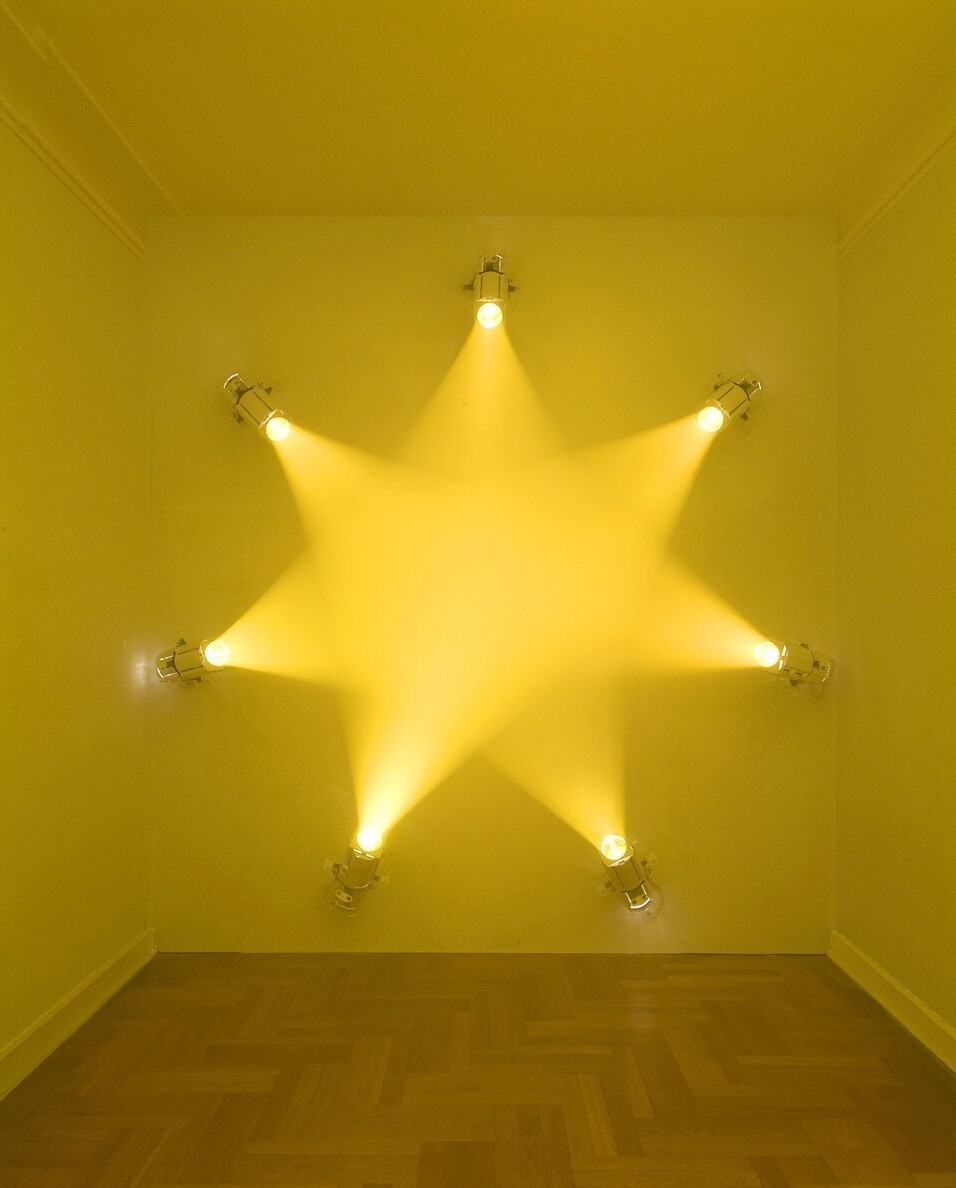
Milliner speaks for the first forty minutes, discussing Nativity and Transfiguration icons and their correlatives in the West and making, as always, fascinating connections between art of the past and present. For example, he overlays Olafur Eliasson’s Ephemeral Afterimage Star (2008) on Rublev’s Transfiguration icon (19:19), and Ann Veronica Janssens’s Yellow Rose on an Adoration of the Magi illumination from a fifteenth-century book of hours at the Getty (26:32). He also introduced me to a fascinating medieval manuscript illumination from Germany (which he in turn learned about through Solrunn Nes) that combines the light of Bethlehem and Tabor—two Gospel scenes in one. Don’t miss the quote by Gregory of Nazianzus.
Ann Veronica Janssens (Belgian, 1956–), Yellow Rose, 2007. Projectors, dichroic filters, and artificial mist, dimensions variable (min. 360 cm diameter, min. 250 cm depth). Museum Morsbroich, Leverkusen, Germany. Photo: Philippe De Gobert.The Nativity and the Transfiguration, from an Ottonian Gospel-book made in Cologne, 1025–50. Bamberg State Library, Msc.Bibl.94, fol. 155r.
Combining art history and theology (he has advanced degrees in both), Milliner’s talk is organized as follows:
Thessaloniki | Gregory Palamas (d. 1337)
Constantinople | Pseudo-Dionysius the Areopagite (d. ca. 500)
Paris | Abbot Suger (d. 1151)
Los Angeles | Phillip K. Smith III (b. 1972)
+++
ART VIDEOS:
>> “A 60-second introduction to ‘The Nativity at Night’”: One of my favorite Nativity paintings! By fifteenth-century Dutch artist Geertgen tot Sint Jans, a lay brother in the religious order of St. John. In this video from the National Gallery in London, a camera scans over the painting as an atmospheric soundscape plays and captions guide us in looking at the details.
Geertgen tot Sint Jans (Dutch, ca. 1455/65–ca. 1485/95), The Nativity at Night, ca. 1490. Oil on oak, 34 × 25.3 cm. National Gallery, London.
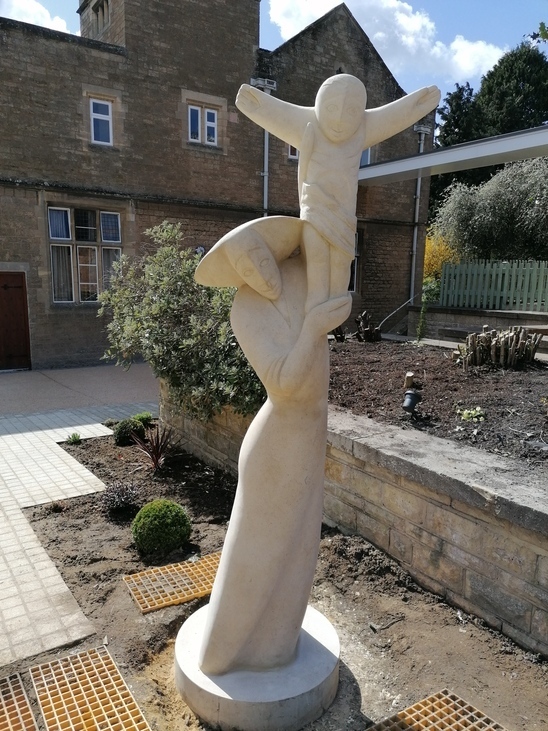
>> “Mother and Child Commission”: In this twelve-minute “making of” video, filmmaker Nick Clarke talks to artist Nicholas Mynheer over the first half of 2020, tracing his progress on the life-size Mother and Child sculpture that was commissioned by the Community of St Mary the Virgin, Wantage, an Anglican convent in Oxfordshire. I was struck by, from the looks of it, the physical demands of the sculpting process—the strength and endurance required to chip away daily at blocks of stone outside in winter, until they yield the shape you desire, then the logistics of attaching the blocks with steel, which weigh nearly a ton collectively, and disassembling, transporting, and reassembling them for installation. I was also interested to hear Mynheer discuss the expressive capabilities of English limestone—how you can convey emotional and sartorial subtleties, for example, through the precise angling of the chisel.
Nicholas Mynheer (British, 1958–), Mother and Child, 2020–21. English limestone, height 230 cm.
Mother and Child was installed in the outdoor reception area of St Mary’s on April 12, 2021; you can watch a video of the installation here. “In very, apparently, simplified form, there is so much tenderness, energy, and something new,” says Sister Stella, the sister in charge, about the sculpture. “Jesus isn’t going to be held back. Her son’s going to go places.”
>> “Corazón Pesebre” (Heart Manger) by Rescate: A follower of the blog introduced me to this Christmas song from Argentina, and I dig it! Released as a single in 2017, it’s about turning our hearts into a manger to receive Christ. Read the Spanish lyrics in the YouTube video description.
The song is by the highly popular Argentinian Christian rock band Rescate, active from 1987 to 2020. Their lead singer and main songwriter, Ulises Eyherabide, died of cancer in July.
>> “Hallelujah, What a Savior!” (Christmas Version), performed by Providence Church, Austin, Texas: In 2012 Austin Stone Worship songwriters Aaron Ivey, Halim Suh, and Matt Carter rewrote the lyrics to Philip P. Bliss’s classic “Hallelujah, What a Savior!” to make them more Christmas-centered and added a new refrain; their version was released that year on A Day of Glory (Songs for Christmas). Here the song is performed by another Austin worship team—Jordan Hurst, Jaleesa McCreary, and Brian Douglas Phillips from Providence Church—for a virtual worship service on November 29, 2020. Instead of using the Austin Stone refrain, they quote Leonard Cohen’s “Hallelujah” between verses.
Many Catholics and Orthodox decry that Protestants really only ever talk about Mary during Christmas. While she does get some extra attention here on the blog in December, I also try to talk about her throughout the year, from the feasts of the Annunciation (March 25) and the Visitation (May 31) to her witness during Holy Week and Pentecost and her being such an important figure in Jesus’s life and exemplary for our own. Here’s a new Marian roundup, plus at the bottom a Christmas gift idea involving a product I helped create. 🙂
VISUAL MEDITATIONS:
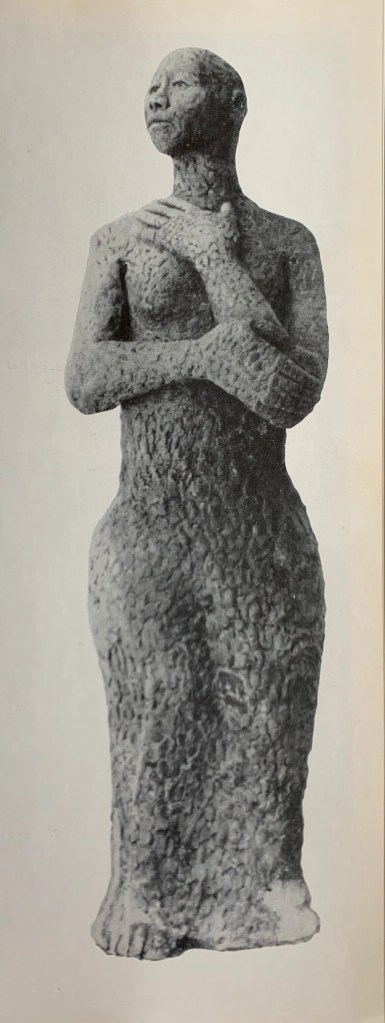
>> “Wondrous” by Paul Simpson Duke, Seeing the Sacred: In 2019, Rev. Drs. Paul and Stacey Simpson Duke, co-pastors of First Baptist Church in Ann Arbor, Michigan, ran an Annunciation art series on their blog, meditating on one artwork on the subject per day for twenty-five days. I commend the whole series, but I was particularly compelled by Day 13, which centers on a terracotta sculpture made by the late Kenyan artist Rosemary Namuli Karuga when she was a student at Makerere College Art School in Uganda. Paul Duke considers especially the mixture of sorrow and awe expressed in the figure’s face.
Rosemary Namuli Karuga (Kenyan, 1928–2021), Mary, ca. 1950. Terracotta. This image is Plate 4 in the book Christian Art in Africa and Asia by Arno Lehmann.
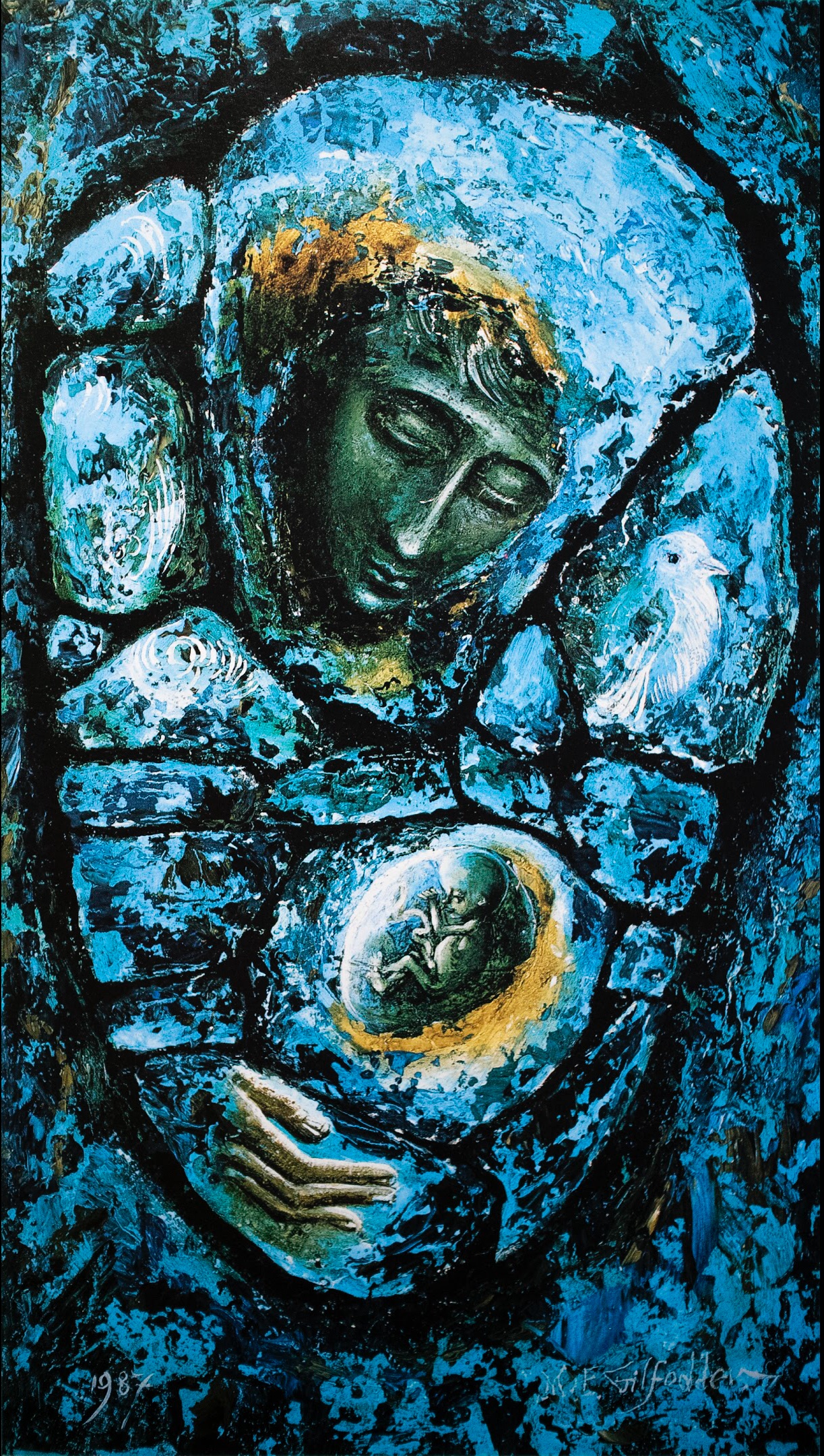
>> “Pregnant with God” by Victoria Emily Jones, ArtWay: For the first Sunday of Advent, I wrote about the painting Blue Madonna by Scottish Catholic artist Michael Felix Gilfedder, which shows the Christ child developing inside Mary’s womb. Pregnancy has always been an image I’ve carried with me during Advent, as it embodies the expectancy characteristic of the season—the growth of new life, a hidden fullness, about to come forth.
Michael Felix Gilfedder (Scottish, 1948–), Blue Madonna (Mary, Mother of God), 1987. Oil and tempera on wood with gesso relief, 25 1/4 × 13 in. (64 × 33 cm). Private collection, London. [prints for sale]
+++
PODCAST EPISODES: Both of the following come from For the Life of the World, the podcast of the Yale Center for Faith and Culture. Released back-to-back last December.
>> “Mary Theotokos: Her Bright Sorrow, Her Suffering Faith, and Her Compassion” with Frederica Mathewes-Green:Frederica Mathewes-Green is an American author and speaker, chiefly on topics related to Eastern Orthodox belief and practice. Here she discusses the Orthodox reverence for Mary; the scriptural account of her life; Mary as the mother of us all; the Protevangelium of James, which provides legendary material about Mary’s upbringing and betrothal; the ancient prayer “Sub tuum praesidium” (“Under Your Compassion”) from 250 CE, the earliest known appearance of the title “Theotokos”; and Mary’s role as intercessor. The latter point is something that Protestants like me are wary of—praying through saints who have passed on is not something I practice—but the way Mathewes-Green explains it is, just as we would ask fellow believers on earth to pray for us, why shouldn’t we also ask our friends in heaven to do the same, if we truly believe that they are alive and that we are in communion with them (as we confess in the Apostles’ Creed)?
Besides explicating several Marian doctrines, Mathewes-Green also speaks of Mary as an ordinary human being with an extraordinary call. With tenderness, she considers Mary’s experiences and emotions at different life stages: first as a perplexed young woman who is taken aback by Gabriel’s announcement but ultimately responds with humility and magnanimity, then as a parent who raises a child and later witnesses his violent death.
>> “A Womb More Spacious Than Stars: How Mary’s Beauty and Presence Upends the Patriarchy and Stabilizes Christian Spirituality” with Matthew J. Milliner: Matthew Milliner, an art history professor at Wheaton College and the author of Mother of the Lamb: The Story of a Global Icon, is a Protestant who wants to see other Protestants embrace a more robust doctrine of Mary as Theotokos, “Mother of God,” and develop a keener sense of her ecclesial presence. In this hour-long conversation he discusses Mary as person and as symbol; the need for “hermeneutical adventurousness anchored in the revelation of God in Christ”; how icons work, and particularly how Marian icons are spiritually formative; how to read a Nativity icon; the feminist objection to Mary; how Mary upends the ancient pagan goddess culture; and how we all must be Marian if we are to be orthodox Christians.
VIDEO: “Magnificat” by SALT Project: This short film features a reading of the Magnificat in Spanish, its words fleshed out in contemporary images. For the same video but in English, see here.
+++
ARTICLE: “The Political Is Personal: Mary as a Parent and Prophet of Righteousness” by Erin Dufault-Hunter, Fuller Magazine: What does the New Testament mean by “righteousness” (dikē)? Is it personal piety, or social justice? This article by Christian ethics professor Erin Dufault-Hunter examines how Mary upholds both connotations of the word. “Perhaps more than anyone else, Mary displays for us how saying yes to the kingdom, and its unlikely king, necessarily involves the personal but also reorients our social and political allegiances,” Dufault-Hunter writes. “Intimacy with God necessarily entails a political orientation, bringing or solidifying a way of seeing power and position.” Debunking the claim that Jesus’s coming was not political, Dufault-Hunter considers Mary’s Magnificat as well as other elements of the Christmas story—like the title “Son of God,” the word “gospel,” and the angels’ potentially treasonous news to the shepherds—showing how the good news of Christ is both personal and political.
+++
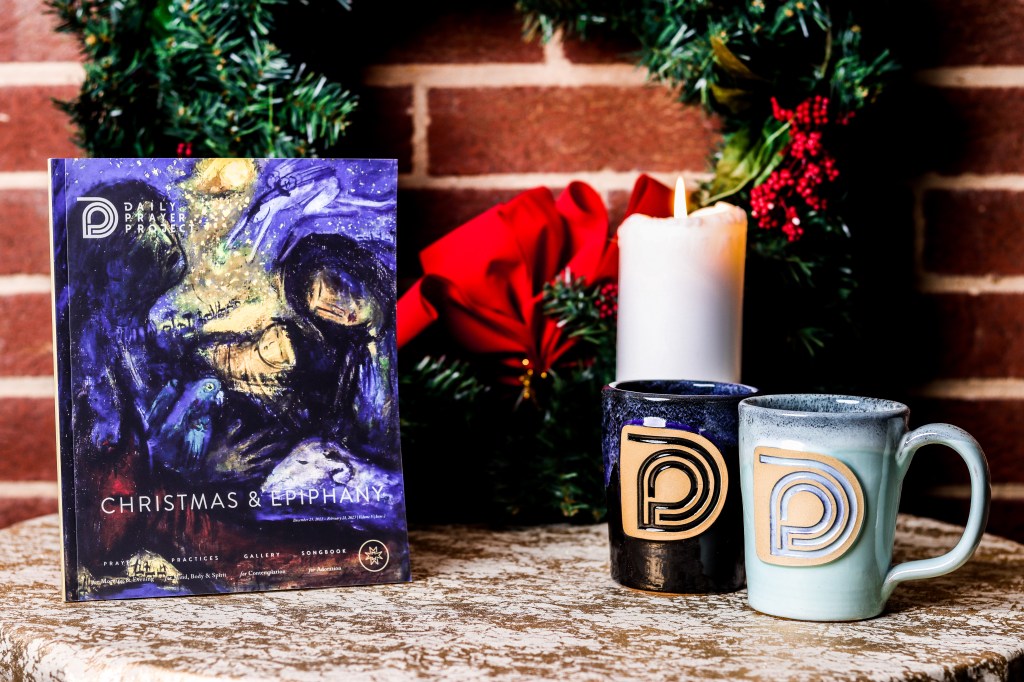
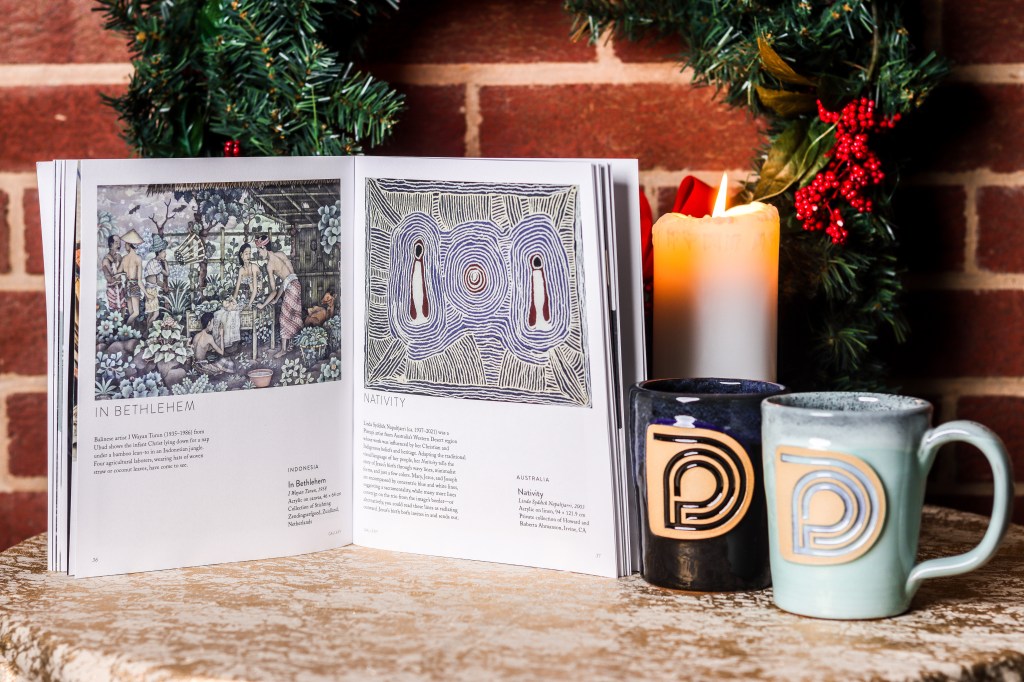
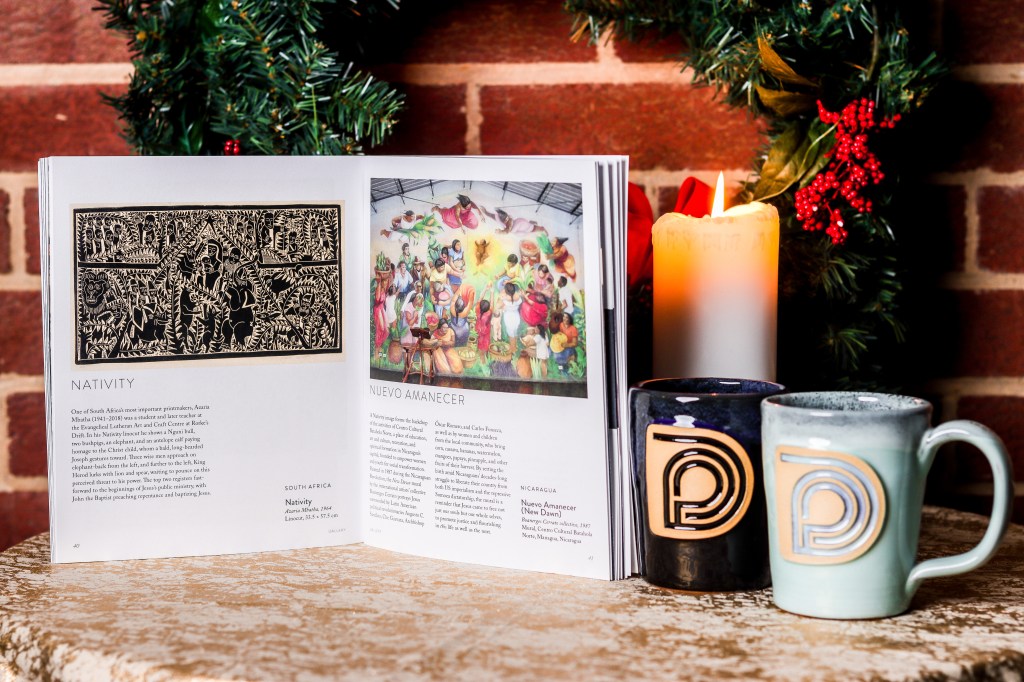
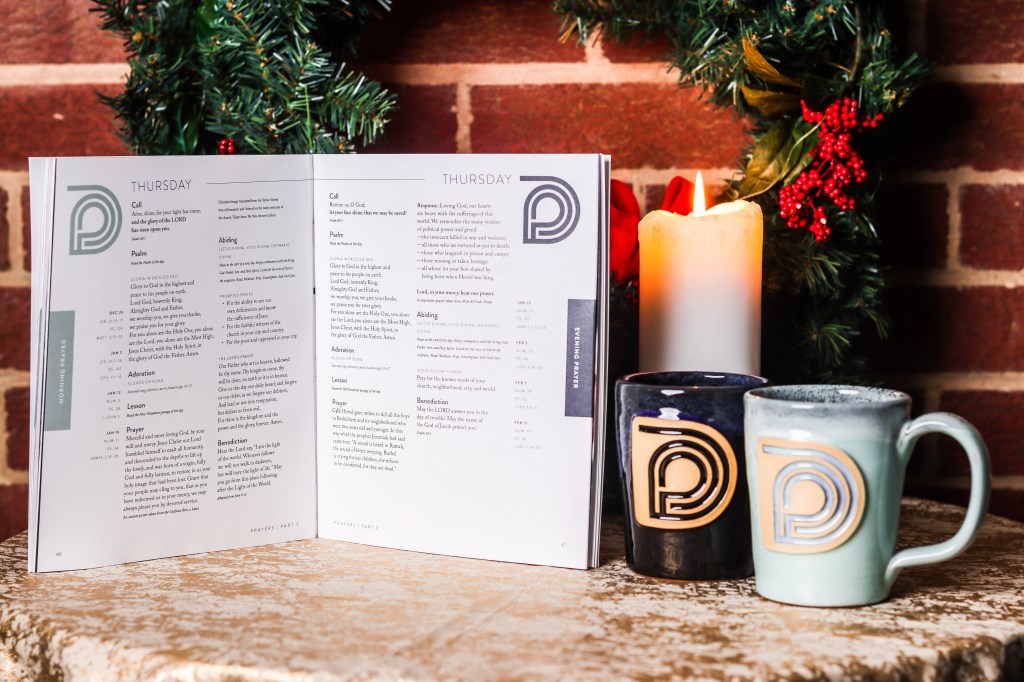
The Daily Prayer Project is running a special Christmas gift offer that, for $50, includes a physical and digital copy of our hot-off-the-press Christmas–Epiphany prayer periodical (covering December 25 through February 21) and two hand-thrown, dishwasher-safe mugs with a raised medallion of our labyrinth-inspired logo and glazes that map onto our morning and evening prayer colors. Packages ship early next week, so get your order in soon! There are also yearly subscription options, individual or communal, on the website.
In addition to working as a copyeditor and proofreader for the DPP, I also curate the art for the Gallery section, which is expanded in this edition to eight pieces—in this case, Nativities from around the world, each accompanied by a short reflection. The cover image is Morning Star by the Japanese Christian artist Hiroshi Tabata (1929–2014).
December 4:“For God So Loved the Cosmos: A Service of Lessons and Carols,” Calvin Institute of Christian Worship, Grand Rapids, Michigan
December 11: “A Dawning Light” service, Grace Mosaic, Washington, DC
December 14: (Virtual) Advent Art Salon, organized by Image journal
More info below!
STORY & SONG SERVICES:
>> “A Dawning Light,” Grace Mosaic, Washington, DC: On December 12 last year, I attended Grace Mosaic’s fourth annual “Dawning Light” service, an evening of Advent and Christmas gospel music and scripture readings. It was wonderful, progressing from darkness to light together, feeling collectively our longing and our joy. The service was organized by the church’s pastor of worship and formation, Joel Littlepage, who’s at the keys. The song list is below. My favorite is probably the “Emmanuel” medley around fifty-two minutes in, or the medley that follows.
Processional: “Wait for the Lord” by Jacques Berthier, Taizé Community
9:06: “The Truth Sent from Above,” traditional English carol with music by Joel Littlepage
15:50: “Come, O Redeemer, Come” by Fernando Ortega
19:14: “O Come, O Come, Emmanuel,” arr. Kimberly Williams | Soloist: Kimberly Williams
26:17: “Tenemos Esperanza” by Federico J. Pagura (words) and Homero R. Perera (music), Argentina | Soloist: Melissa Littlepage
35:51: “Lift Up Your Voices” by Nikki Grier, as performed by the Sunday Service Choir
44:10: “O Holy Night” by Adolphe Charles Adam, Placide Cappeau, John S. Dwight, arr. Kimberly Williams | Soloist: Kimberly Williams
52:13: “Emmanuel” by Solly Mahlangu, South Africa, sung in Sotho
55:10: “Emmanuel” by Norman Hutchins | Soloist: Russ Whitfield
59:20: “Christmas Worship Medley” (“Alpha and Omega,” “Be Unto Your Name,” “Magnificent and Holy,” “The Almighty Reigns”), as performed by Israel Houghton, arr. Dan Galbraith
1:15:10: “Jesus Is the Reason” by Kirk Franklin
1:20:19: “Joy to the World” by Isaac Watts (words) and George Frideric Handel (music) (congregational hymn)
1:23:24: Recessional: “Joy to the World” (instrumental)
This year’s “Dawning Light” service will be held December 11 at 5:30 p.m. at Grace Mosaic in Northeast Washington, DC. A catered reception will follow. RSVP here.
>> “For God So Loved the Cosmos: A Service of Lessons and Carols,” December 4, 2022, LaGrave Avenue Christian Reformed Church, Grand Rapids, Michigan: This Sunday at 3 p.m. and 6 p.m. Eastern, the Calvin Institute of Christian Worship is holding a Lessons & Carols service (in-person and livestreamed) celebrating the Bible’s all-creation vision of redemption. The program is posted, and it looks great! If you’re remote, you can tune in on YouTube.
+++
2021 ADVENT ART SALON: Organized by Image journal, this virtual hour-long salon took place on December 14, 2021. The two highlights for me are Christopher J. Domig’s performance of the Shepherd’s monologue from “The Birth” by Frederick Buechner (12:54–18:33), in Secrets in the Dark: A Life in Sermons, and the Rev. Dr. Lauren Winner’s reflection on Mary’s pregnancy (43:44–49:26), in which she shares, in addition to two images, an unusual Advent practice she follows, recommended to her by a Baptist pastor who is also a doula!
Lorie Dodge Leininger (American, 1926–2016), Infinite Riches in a Little Room, 1968. Woodblock print, 14 × 11 1/2 in.
Image is hosting another virtual Advent Art Salon this year on December 14 at 5 p.m. Eastern (2 p.m. Pacific). It will feature an Advent meditation by Amy Peterson, poetry readings by Karen An-hwei Lee and Jonathan Chan, a performance of Annie Dillard’s “God in the Doorway” by Rachel Ingram, a musical performance by Eric Marshall of Young Oceans (who is on my Advent playlist!), and a reading on feasting by Kendall Vanderslice. View more info here, and register here.
+++
NEW ADVENT/CHRISTMAS ALBUMS: All three of these are available on Spotify andother streaming services.
>> We Wait: Advent and Christmas, vol. 2 by The Many: An EP of two traditional songs and two originals by The Many, an intentionally diverse collective gathered around their “shared love of music and commitment to honest expressions of faith, peace-making, economic and racial justice, and LGBTQ+ inclusion.” They draw on indie-pop and gospel influences.
>> The Soil and The Seed Project, vol. 5: Advent, Christmas, Epiphany: The Soil and The Seed Project is a liturgical collective based in Harrisonburg, Virginia, writing music and at-home liturgies structured around the church year. They’ve just released their fifth collection, available for free through their website. The music portion includes, among other songs, retunes of a few traditional Advent hymns; the electro-hop “Restore Us,” a lament by Greg Yoder; a setting of the Beatitudes; and a setting of Psalm 96:1–2 in its original Hebrew by the late Rev. Dr. Anil Solanki, a former seminary professor of TSATSP director Seth Crissman’s (Crissman said Professor Solanki would often open his Hebrew exegesis classes by leading students in this song).
>> Christmas Hymns by Paul Zach: Four originals and twelve traditionals from one of my favorite sacred singer-songwriters. Most are for Christmas, but a few are more Advent-y. Taylor Leonhardt, Lauren Plank Goans, Keiko Ying, and Noah Zach provide supporting vocals. [Apple Music]
Before I launch into the Advent content, I want to alert newcomers to, and remind old-timers of, my Thanksgiving Playlist on Spotify (introduced here), which is revised and expanded since last year. You can get an overview at this blog post. From Destiny’s Child to Yo-Yo Ma, Meister Eckhart to Mister Rogers, there’s a little something for everyone, I hope. And exemplifying the global nature of Christianity, there are songs in Hebrew, Luganda, Zulu, Swahili, Yoruba, Spanish, French, Hawaiian, Arabic, Korean, and Tamil.
+++
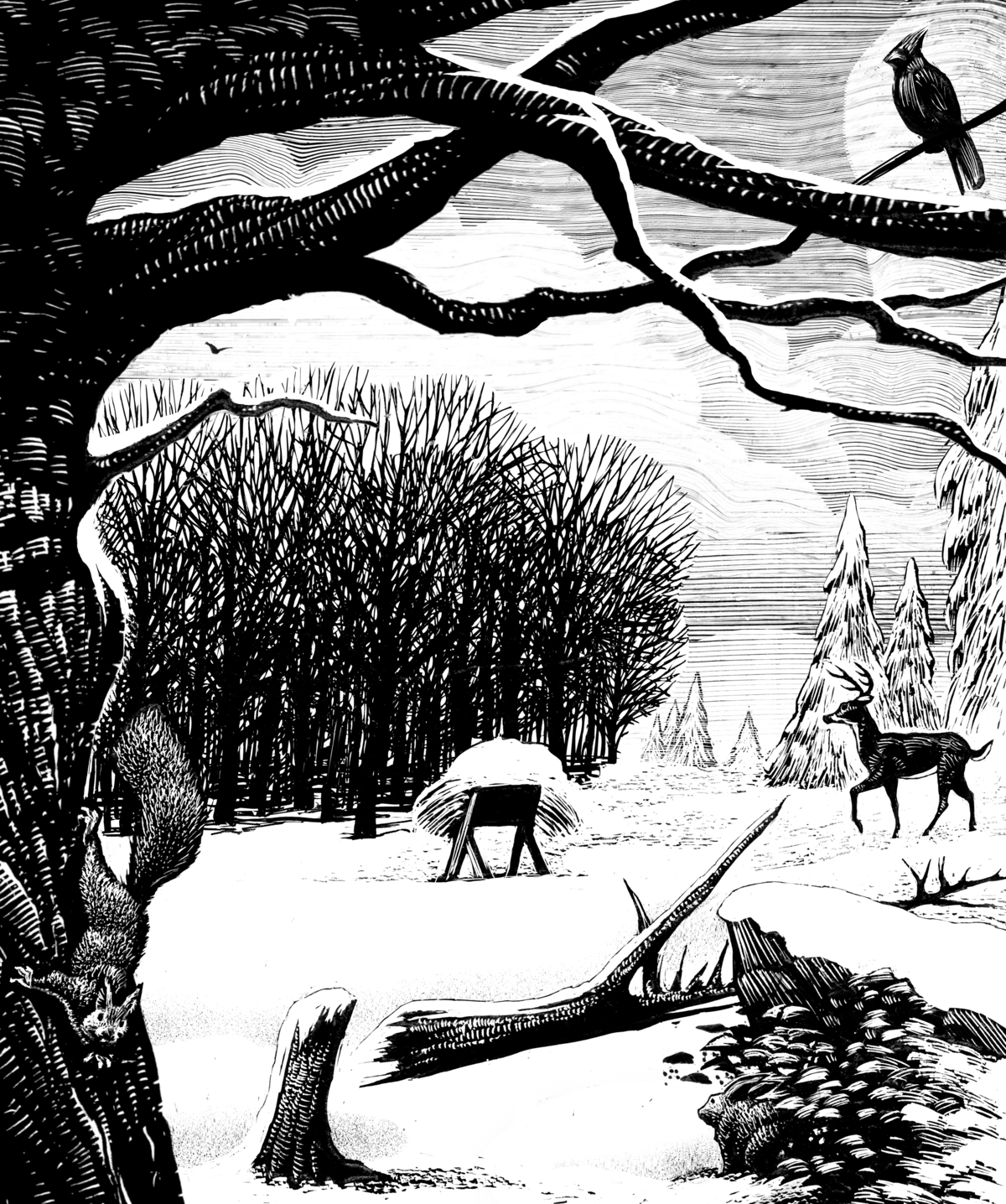
ESSAY: “All Creation Waits” by Gayle Boss: In the northern hemisphere, Advent is accompanied by a deepening of the dark and cold. In her bestselling and wholly unique Advent devotional, All Creation Waits, Gayle Boss provides twenty-five reflections that detail how wildlife—turtles, loons, black bears, and so on—adapts to these changing conditions. Animals know that the darkness is a door to a new beginning, and we would do well to embrace this wisdom. In the book, each day’s reading is paired with a woodcut illustration by David G. Klein.
The year of the book’s 2016 release, On Being published the introduction on its blog, where Boss answers, “Why animals for Advent?” and describes some of the inspiration behind and framing of the book. This year Paraclete Press released a hardcover gift edition with a new introduction and afterword.
Woodcut by David G. Klein, 2016. In All Creation Waits, Gayle Boss tells a story of how one year, a week into Advent, she found a manger in the woods, which local children had filled with hay for the animals, then shelled corn.
+++
SONG: “O Come, O Come, Emmanuel”: There are hundreds of arrangements and recordings of this most beloved Advent hymn. Last year I featured two that I particularly like, and I think I’ll start a trend on the blog by doing the same at the beginning of each Advent—sharing two new renditions of the song.
>> Anna Hawkins.Anna Hawkins is a singer-songwriter of Irish heritage living in New Zealand. In her version of “O Come, O Come, Emmanuel” from her album Divine (2015), she sings the first verse in Hebrew, honoring the lyrics’ rootedness in the Hebrew scriptures. The music video was shot in Israel (cinematography by Michael Hilsden from Aspiring Productions). [HT: Global Christian Worship]
חזור חזור עמנואל ופדה אסירי ישראל שבגולה נאנחים עד כי תבוא בן- האלוהים ,שמחו! שמחו! עמנואל יבוא לכם בני ישראל
Chazor, chazor Immanu-El Ufde asirei Israel Shebagola ne’enachim Ad ki tavo Ben Elohim Simchu, Simchu, Immanu-El Yavo lachem bnei-Israel
[English translation:] O come, O come, Emmanuel And ransom captive Israel That mourns in lonely exile here Until the Son of God appear Rejoice! Rejoice! Emmanuel Shall come to thee, O Israel
>> CeCe Winans, arr. Alvin Love III.CeCe Winans is a gospel legend. On Something’s Happening! A Christmas Album (2018), she collaborated with her son, Alvin Love III, who wrote the lush orchestral arrangements and produced the record. “O Come, O Come, Emmanuel” opens with a celesta, which sounds like a music box or twinkling stars and has long been associated with the supernatural. The accompaniment is played by the Zagreb Philharmonic Orchestra, conducted by Tim Akers.
+++
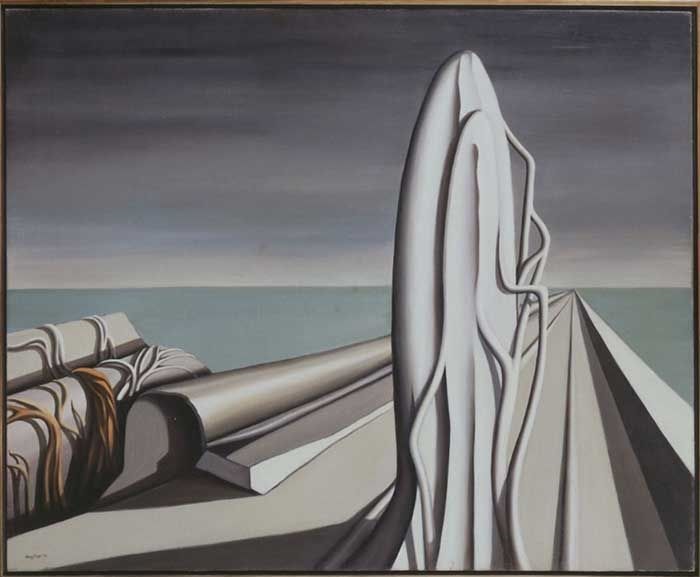
VISUAL MEDITATION: “I Corinthians 7:29-31: God Only Knows” by Lynn Miller: Rev. Dr. Lynn Miller is an author, ecclesiastical artist, workshop leader, and Presbyterian minister who holds a BFA in graphic design, an MA in art history, an MFA in creative writing, an MDiv, and a DMin. From 2014 to 2021 she ran the blog Art&Faith Matters, curating a diversity of images based on the liturgical calendar. In this post she guides us in looking at the surrealist painting At the Appointed Time by Kay Sage, which features a mysterious, draped figure or object and lines receding toward the horizon. “What do you see in the painting? What do you think about what you see? What do you wonder about this painting?” She posits a number of possible interpretations.
Kay Sage (American, 1898–1963), At the Appointed Time, 1942. Oil on canvas, 81.3 × 99.1 cm. Newark Museum of Art, Newark, New Jersey.
+++
PODCAST SERIES: “Whispered Light: Advent Reflections on Death, Judgement, Heaven and Hell” by Matt Simpkins: In this four-episode podcast series from December 2020, Rev. Matt Simpkins, an Anglican priest and musician from Essex, explores the four themes traditionally contemplated by Christians during Advent—death, judgment, heaven, and hell—through four old American folk songs. He performs the songs, giving their history and using them as a launchpad for spiritual and theological reflection, which also integrates discussion of the Psalms. He addresses misconceptions about these “last things,” tracing the thread of hope and redemption that runs through them all. Just twenty to thirty minutes each, the episodes are available on your favorite podcast app and on YouTube (links below).
Episode 1: “O Death” (aka “A Dialogue with Death”)
VIRTUAL ARTIST RESIDENCY: 2023 Inbreak Residency: Led by Dea Jenkins, the organization Inbreak, which promotes social healing through the arts, is hosting its third annual (virtual) residency, open to US-based artists of any discipline interested in exploring the intersections of art, faith, and race in the United States. The residency provides a collaborative environment and opportunities for artistic development and creative leadership growth, with group workshops, group feedback sessions, studio visits, and a curriculum featuring a curated selection of viewings, readings, and dialogue prompts. It culminates in a live or virtual exhibition.
Applications are due by November 20, 2022; you are required to submit work samples, an artist statement and/or short bio, and a community-focused project proposal. Four applicants will be selected for the 2023 cohort, which runs from January to May, and each given a $500 stipend.
+++
SONG: “Lux Aeterna”: “Lux Aeterna” (Eternal Light) is the Communion antiphon for the Roman Catholic Requiem Mass. The traditional Latin text has been set to music by many composers. Recorded at All Hallows’ Gospel Oak in London in May 2021, this performance by the Gesualdo Six is of the setting by Spanish Renaissance composer Cristóbal de Morales. I share it in anticipation of All Saints’ Day on November 1.
The lyrics translate as follows:
May eternal light shine upon them, Lord, with your saints forever, for you are good.
Grant them eternal rest, Lord, and may light perpetual shine upon them, with your saints forever, for you are good.
The video came out of the Interfaith Sacred Art Forum and the Sacred Art in Collections pre-1900 Network, both launched last year as part of the National Gallery’s Art and Religion research strand. In their inaugural 2021–22 season, the theme was “Crossing Borders,” and they have used two paintings in the museum’s collection as a foundation for wide-ranging events and activities. The theme for 2022–23 is “The Art of Creation,” and the two paintings around which conversations and activities are based are Rachel Ruysch’s Flowers in a Vase (1685) and Claude Monet’s Flood Waters (1896).
+++
VIDEO: “Introducing Annie Dillard” by Tish Harrison Warren: In this video from the Trinity Forum, Anglican priest and writer Tish Harrison Warren introduces the forum’s fall reading, the Pulitzer Prize–winning classic Pilgrim at Tinker Creek (1975) by Annie Dillard. The book comprises Dillard’s evocative reflections on her time spent wandering about and observing the lively woods, creeks, and natural world of Virginia’s Roanoke Valley while she convalesced from illness.
“She [Dillard] has taught me, in the words of Eugene Peterson, to pray with my eyes open,” Warren says. “She has taught me to notice God at work in the world in ways that I wouldn’t.”
I hear Dillard quoted all the time, but I’m embarrassed to say that I have not yet read this quintessential book of hers! Though I do own it. I have now pulled it off the shelf and put it in my “to read imminently” stack. 😊
+++
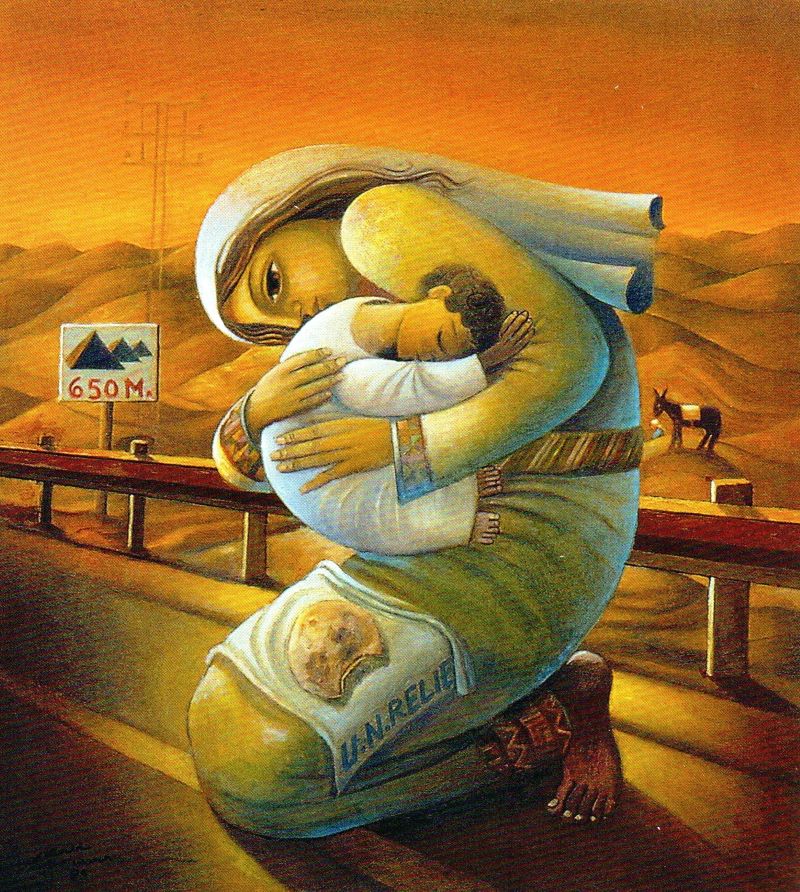
VISUAL MEDITATION: “The Taste of Palestine” by Meryl Doney, on the art of Sliman Mansour: Sliman Mansour is a Palestinian Christian artist whose work centers on the Palestinian struggle against the Israeli occupation. This ArtWay article is a great, concise introduction to his work, spotlighting four of his paintings: Picking Olives; The Flight to Egypt; Hagar; and The Holy Family in an Olive Grove.
Sliman Mansour (Palestinian, 1947–), The Flight to Egypt, 1984. Oil on canvas.
Last month my friend Becky Hadeed, food photographer and creator and host of The Storied Recipe podcast, released an episode called “Honoring the Women of Palestine,” where she interviews Mai of Almond and Fig. Mai discusses growing up in Palestine and shares some of the ways she seeks to connect with her Middle Eastern heritage from her kitchen in Chicago.
WEBSITE LAUNCH: The Foundation for Spirituality and the Arts: From a September 20 press release: “The Foundation for Spirituality and the Arts is pleased to announce the debut of our new website, fsa.art. Complementing in-person programming in Charleston and New York City, fsa.art functions as FSA’s online curatorial wing. It hosts both commissioned and curated content as well as a selection of features spotlighting significant artists, scholars, exhibitions, and publications from recent decades. We hope this site will be a valuable and inspiring resource that fosters dialogue, community, and innovation in the field of spirituality and the arts.”
FSA is “devoted to nurturing connections between spirituality and contemporary art. . . . By encouraging a mutual flow of creativity and faith from both artists and scholars, we hope to initiate fresh channels of spiritual enrichment from new depths of artistic expression. Nurturing innovative and experimental collaborations between a wide range of communities, we aspire to integrate estranged voices together in a spirit of harmony, openness, and inquisitiveness.”
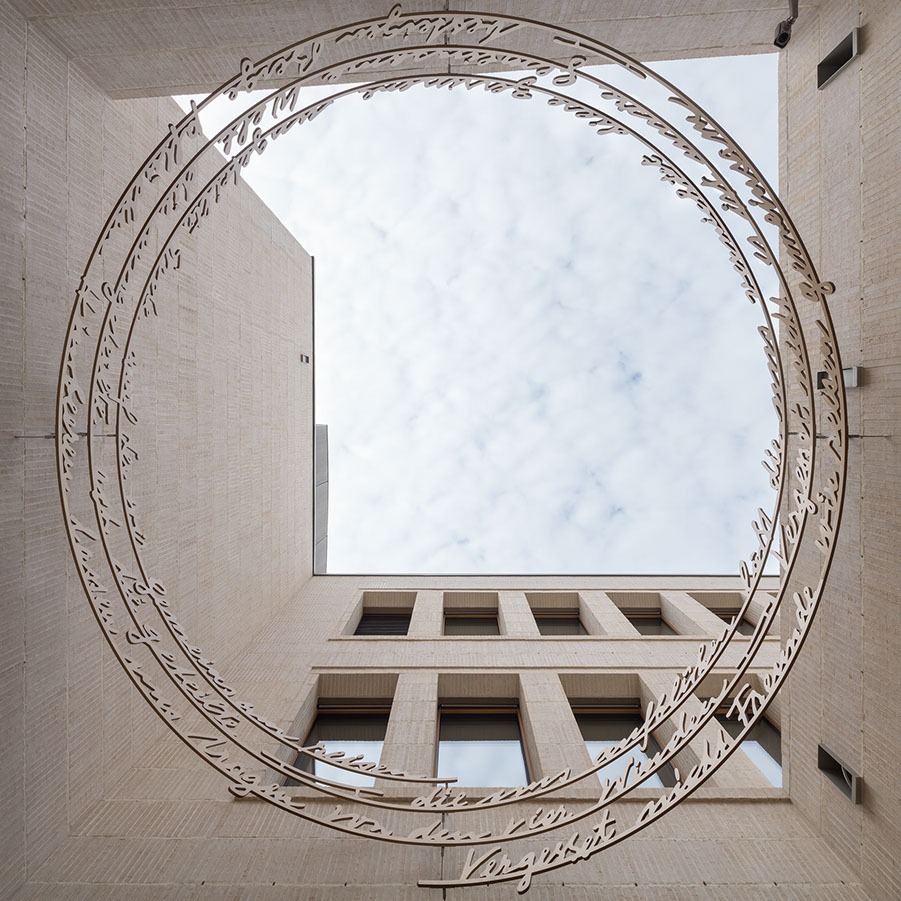
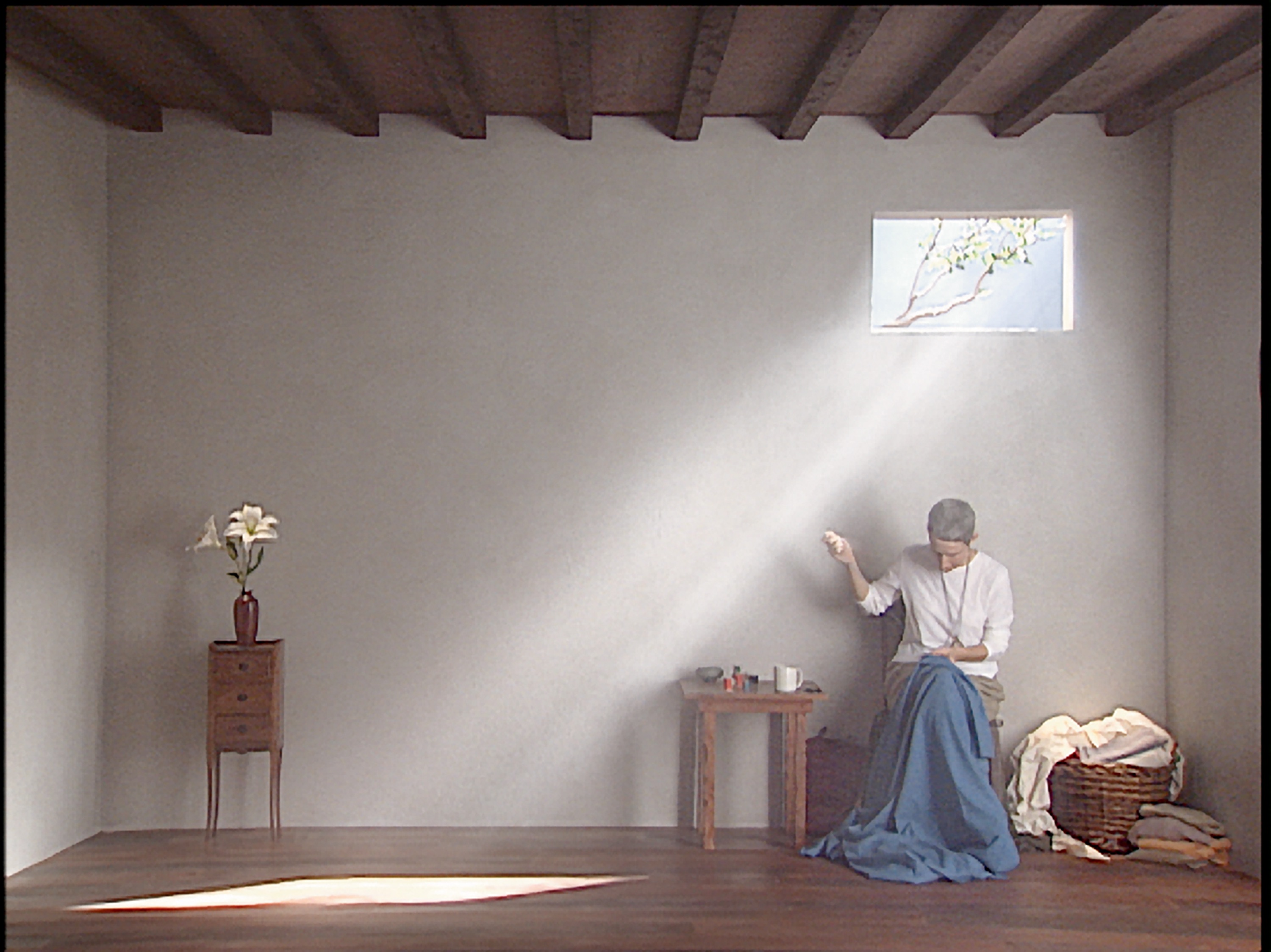
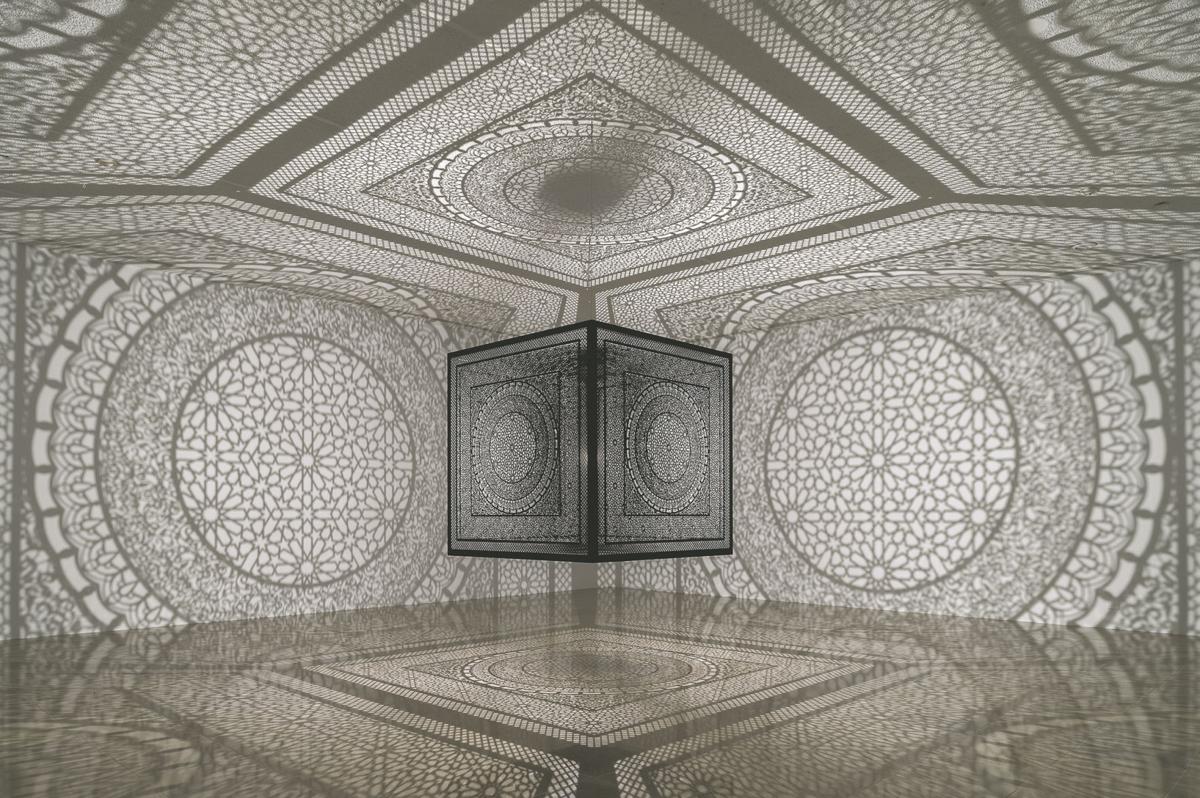
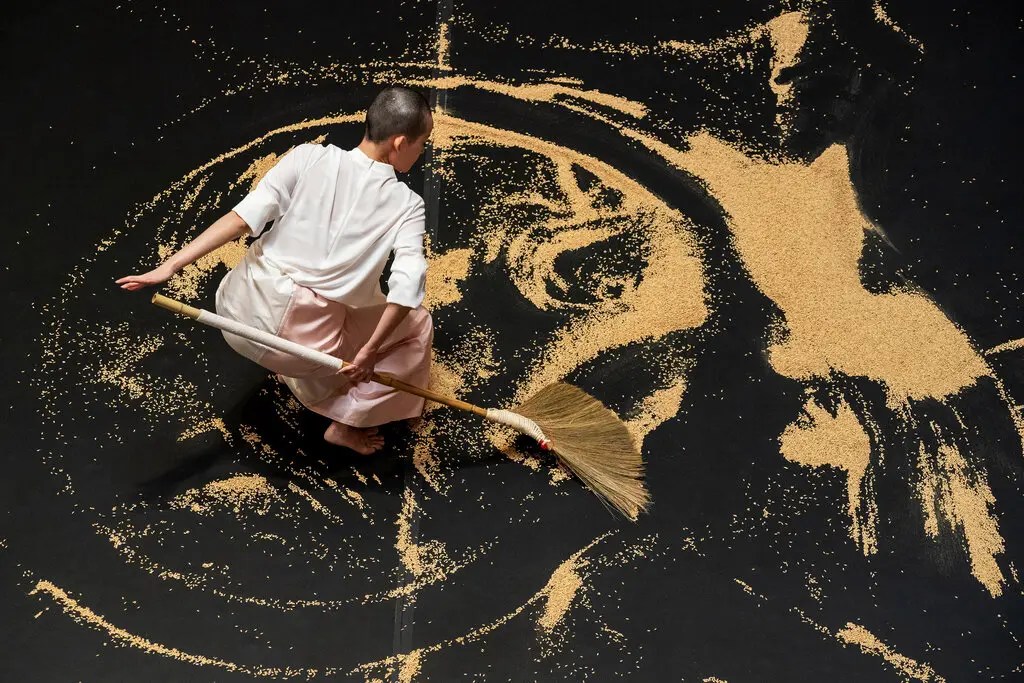
At the heart of their programming is their annual series of residencies, open to visual artists, performers, composers, choreographers, curators, writers, and theologians. Visit their website to find out more, and follow them on Instagram @foundation.spirituality.arts. Below are four artworks I’ve encountered through their social media postings.
Tom Kristen (German, 1968–), Gemeinsam (Together), 2019. Jewish Synagogue and Community Center, Regensburg, Bavaria. Photo: Marcus Eben. Floating above the center’s atrium, this gilded bronze spiral text is taken from Rose Ausländer’s poem “Gemeinsam”: “Vergesst nicht, Freunde, wir reisen gemeinsam. . . . Es ist unsre gemeinsame Welt.” (“Don’t forget, friends: we travel together. . . . It is our common world.”)Bill Viola (American, 1951–), Still from Catherine’s Room, 2001. Color video polyptych on five flat panel displays, 18:39 minutes, performer: Weba Garretson. Photo: Kira Perov, courtesy Bill Viola Studio.Anila Quayyum Agha (Pakistani American, 1965–), Intersections, 2013. Lacquered wood and halogen bulb, 78 × 78 × 78 in. (cast shadows: 43.5 × 43.5 × 16 ft.). Installation view at Rice Gallery, Houston, Texas, 2015.Lee Mingwei (Taiwanese American, 1964–), Our Labyrinth, 2015–present. Photo: Stephanie Berger. In this performance work, single dancers, dressed in floor-length sarongs and wearing ankle bells, take turns sweeping a mound of rice in patterns on the floor in a designated gallery space. This iteration from 2020 at the Metropolitan Museum of Art was a collaboration with choreographer Bill T. Jones, and the performer in the photo is I-Ling Liu. [Watch on YouTube]
+++
LECTURE: “The New Visibility of Religion in Contemporary Art” by Jonathan A. Anderson: Religion is becoming more visible in contemporary art and more discussable, says artist, art critic, and theologian Jonathan Anderson in his September 17 talk sponsored by Bridge Projects in Los Angeles. Danh Vo, Kris Martin, Andrea Büttner, Deana Lawson, Arthur Jafa, Genesis Tramaine, Hossein Valamanesh, Theaster Gates, Zarah Hussain, Francis Alÿs, Louise Bourgeois, Sol LeWitt, Sean Kelly, Gerhard Richter, James Turrell—these are just some of the many contemporary artists who have engaged substantively with religion in their work, either through form or content or through the ways in which they frame the work’s central questions. Curators and art historians are recognizing this more and more, and it’s being reflected in exhibitions and scholarship. Anderson highlights several such instances from the past two decades, celebrating religion’s increased visibility but also pointing out where there’s room for improvement. The talk starts at 6:36:
At 28:58, Anderson outlines four interpretive horizons, or fundamental hermeneutics, within which religion is becoming visible, intelligible, and meaningful in contemporary art: anthropological (31:00), political (37:43), spiritual (42:51), and theological (48:42). He discusses the problems and possibilities of each—ways in which it has been productive or insightful, and ways in which it’s limiting. The fourth horizon, the theological, is the least developed in the art world and the most contested, he says.
He concludes,
A more concentrated and well-developed mode of theological inquiry has much to contribute to the history, theory, and criticism of contemporary art without being reductive, but instead opening much of what’s going on in contemporary art. And so going forward, I do envision a mode of study that keeps all these horizons in view, and a mode of discourse that keeps all these horizons in view, while especially developing the potential for the modes of critical writing capable of addressing theological conceptualities, genealogies, and implications that are in play in so much of the art being made today. And that involves thinking better from both directions, developing concepts and capacities—skills, really—where art criticism might operate with a more agile, historically sensitive understanding of religion and theology (a richer theological intelligence), and theology might operate with a more agile, historically sensitive understanding of art and criticism (a richer art historical intelligence, or visual intelligence).
The last half hour is Q&A. What he says at 1:03:59 is fascinating! If you enjoyed this talk, check out, too, the one he gave ten years ago, “The (In)visibility of Theology in Contemporary Art Criticism,” which I published detailed notes on and which became a chapter in the book Christian Scholarship in the Twenty-First Century: Prospects and Perils, edited by Thomas M. Crisp, Steve L. Porter, and Gregg A. Ten Elshof.
As a side note, Anderson teaches two courses at Duke Divinity School, where he is a postdoctoral associate in the DITA program: “Contemporary Art and Theology” and “Visual Art as Theology.” The latter looks at the history of primarily Christian art as a domain of primary theological reasoning and biblical commentary, done in visual-spatial terms rather than in verbal-written terms. His hope is that divinity students—future biblical scholars, theologians, pastors, etc.—will become more literate in the visual-spatial forms of theology. I mention this because it’s what I’m about too!
+++
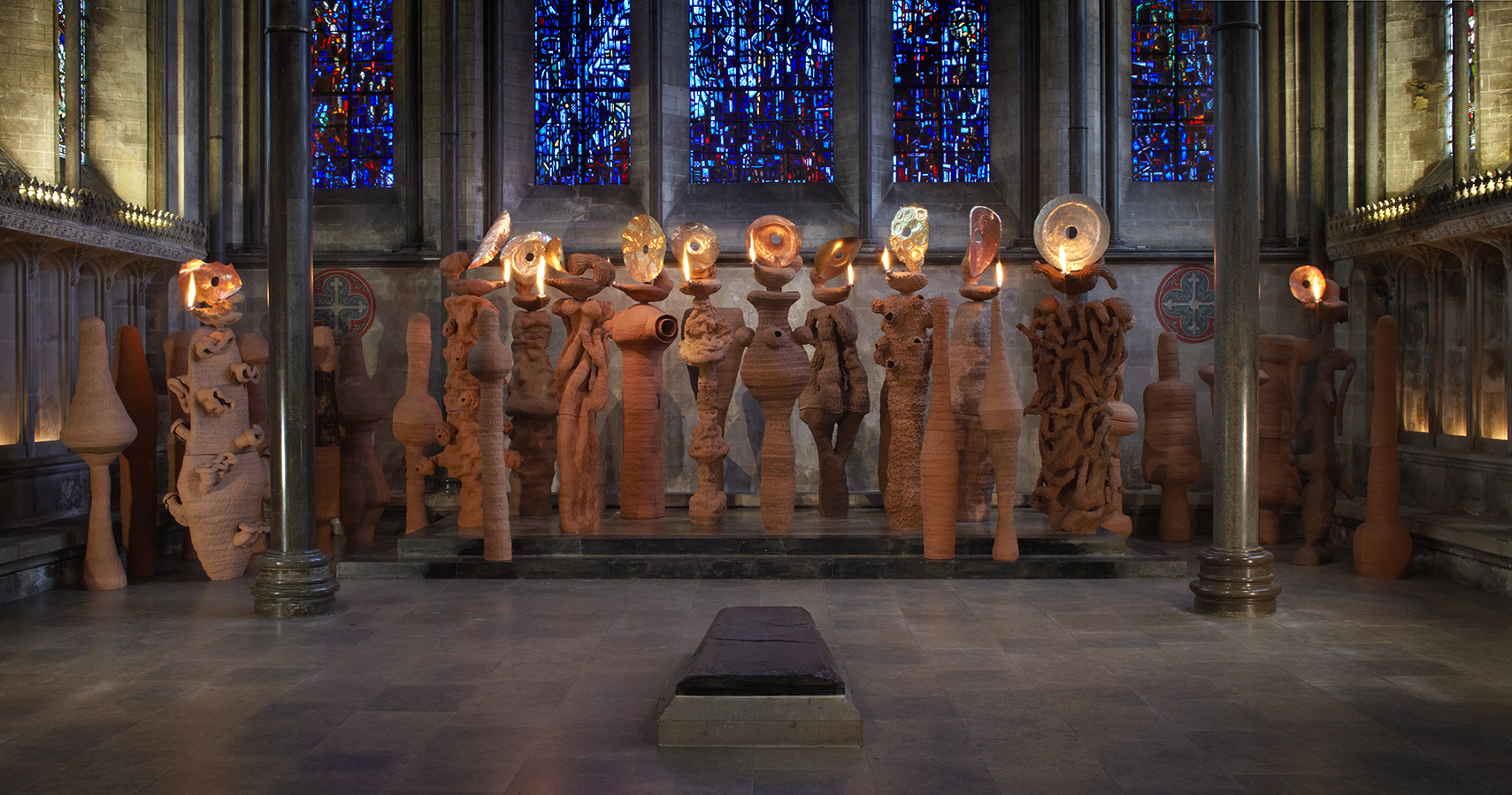
PODCAST EPISODE: “Jacquiline Creswell: Curating in Sacred Spaces,”Exhibiting Faith: Hosted by critic and art historian David Trigg, this is the first episode of a brand-new podcast about the intersection of art and faith, featuring a range of guests for whom those two elements have played a significant role. First up is Jacquiline Creswell, a visual arts adviser and curator who has, since 2009, organized more than forty-five exhibitions in sacred spaces. She has been central to the development of the visual arts programs at Salisbury, Ely, and Chichester Cathedrals. She discusses some of the projects she has worked on and how they’ve been received by the congregation and the wider public, how the setting of an artwork can alter its meaning and the way people engage with it, the logistical challenges of placing art in historic churches, and more.
I was interested to learn that she is from a Jewish background, even though most of her jobs have been with Christian institutions. Check out the eight objectives she lists on her website, which have guided her curatorial work and which I find exciting; the first is “To present artwork which is engaging, that encourages a spiritual response and may at times challenge conventional perceptions.”
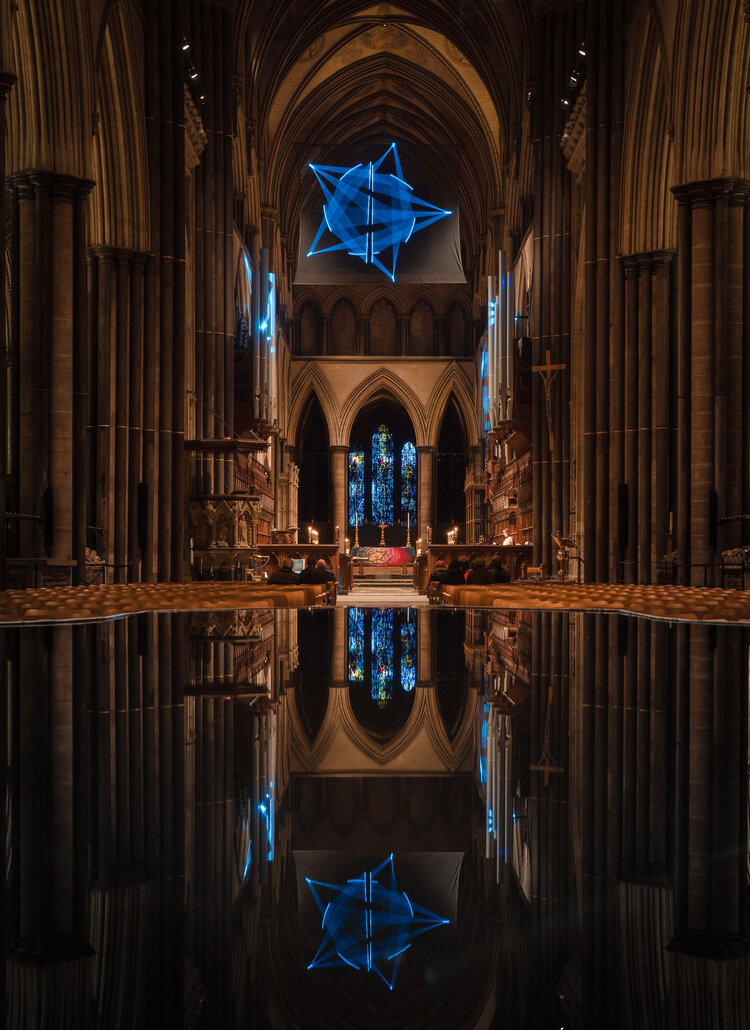
Nicholas Pope (British, 1949–), The Apostles Speaking in Tongues Lit By Their Own Lamps, 1996, installed 2014. Thirty-three figures in terracotta, metal, wick, paraffin, and flame. Trinity Chapel, Salisbury Cathedral. Photo: FXP, London.Jayson Haebich (born in Australia, living in Hong Kong and London), Star of Bethlehem, 2016. Interactive laser installation at Salisbury Cathedral, England.
New episodes of Exhibiting Faith are released once a month. The second (and latest) episode is an interview with Dubai-born, Birmingham-based textile artist Farwa Moledina, whose Women of Paradise (2022) scrutinizes the portrayal of Muslim women in the canon of Western art. Moledina also discusses her experience of Ramadan during lockdown and how it resulted in By Your Coming We Are Healed (2020), two sufras (floor mats for communal dining) made up of photographs of plated dishes submitted to her by participants in the virtual iftars she hosted, arranged according to Islamic design principles of symmetry, abstraction, and recurrence.
+++
SHORT FILM SERIES: At the Threshold: Theology on Film, dir. Sean Dimond:At the Threshold is the latest project from UNTAMED, a documentary film studio in Seattle that “pursue[s] stories of spiritual and narrative depth, with a bias for hope, risk, and redemption.” Filmed in Belgium, Germany, and the UK, it profiles six Christian theologians from Europe, each one humble, open-hearted, and reflective.
“The Open Narrative of Love” with Lieven Boeve, Leuven, Belgium: Boeve reflects on how God interrupts people’s self-enclosed stories. Christianity, he says, is itself an open narrative, not a closed one, and it leads us not away from the world but right into it. One of the filming locations in this short is a rural landscape in Borgloon where Pieterjan Gijs and Arnout van Vaerenbergh built Reading between the Lines, an open-air chapel created to imagine a church inseparable from the world around it.
“The Greater Part” with David Brown, St Andrews, Scotland: Brown talks about prayer, the Bible as part of a living tradition, the church’s call to be creatively other, and the only time he ever saw his father cry. He also cites some of the poets, novelists, and composers/singer-songwriters he admires.
“The Radiance” with Perry Schmidt-Leukel, Muenster, Germany: “The fractcal structure of religious diversity” is of deep interest to Schmidt-Leukel, a Christian who draws insights from Buddhism and who was criticized by Cardinal Joseph Ratzinger for doing so.
“Danseuse” with Ann Loades, Durham, England: A feminist theologian, Loades is one of only two people ever to be awarded a CBE for services to theology. The Christian tradition is responsible for the devaluation of women, she says, but that tradition also contains resources for its own transformation. She also discusses dance as prefiguring the resurrection body.
“To Imagine That” with Garrick Allen, Glasgow, Scotland: Allen sees the book of Revelation as being about how to live in a system that is unjust. “This is John’s response to an oppressive system, and it gives us space to rethink what a just system would look like in our world—to begin to imagine that.”
“Begin with the End” with Judith Wolfe, St Andrews, Scotland: “We have to take seriously the claim that we do not yet live in the world as it will be, and as we will be, and that we have to live towards an eschaton, a presence of God in the world, which is not only not yet apparent, but is not even comprehensible to us. So how do we live authentically in this life?”
From the studio: “Theology offers a home for the vast and the intimate. No question is foreclosed. Visually immersive, poetic, and global in scale, these narrative and theological short films invite viewers into a conversation about life and its limits which is as vibrant as it is challenging. This series isn’t about promoting theological ideas we necessarily agree with, but rather we are exploring the connections between vulnerable life, big questions, and the diversity of theological work being done today. It’s not that we are on the threshold of discovering God, but that perhaps God is already on the threshold of our lives, knocking to enter through our wounds, deepest desires, and questions.”
SPOTIFY PLAYLIST: October 2022 by Victoria Emily Jones: This month’s thirty-track assortment includes the jaunty “Now I’m on My Way” by Howard Smith and Frederick D. Fuller, performed by the Brooklyn Tabernacle Choir under the direction of Carol Cymbala, and the recently released “Good Tree” by the Hillbilly Thomists, a bluegrass band of Dominican friars.
+++
GOSPEL PERFORMANCE: “I’ve Got the Joy / It Is Summertime in My Heart / Give Me Oil in My Lamp” and “Do Lord” by The Four Girls: Did you know that Hollywood Golden Age actress Jane Russell was part of a traveling gospel music quartet, The Four Girls? In 1954, a year after starring with Marilyn Monroe in Gentlemen Prefer Blondes, she sang this medley on an Easter Sunday broadcast alongside fellow group members Connie Haines, Beryl Davis, and Rhonda Fleming (replacing Della Russell), who were Baptist, Episcopalian, and Mormon, respectively. Quite the interdenominational group! All four were active in the Hollywood Christian Group, founded in 1947 by Henrietta Mears.
That choreo, haha! And boy are they aggressive in their evangelism/catechesis of that little girl in the last number!
The Four Girls grew out of an impromptu performance at a fundraising event for St. Stephen’s Episcopal Church in Los Angeles in fall 1953. A representative of Coral Records was in the audience, and he signed the women immediately. Their recording of the spiritual “Do Lord” sold over 2 million copies.
+++
I get a kick out of Jack Black’s hammy character performances, especially the ones that involve singing. In each of the last two movies I saw him in, he plays a strangely likeable Christian criminal based on a real-life person.
In the dark comedy Bernie (2011) by Richard Linklater, Black plays Bernie Tiede, a small-town Texas mortician who befriends a wealthy widow but, when the emotional toll of her possessiveness and persistent nagging becomes too much, ends up killing her. The opening credit sequence (which comes after a scene of Bernie teaching a class, with great tenderness, on how to prepare a deceased body for viewing) shows him driving in his Lincoln Town Car, jamming to the Florida Boys’ “Love Lifted Me” on the radio. Millennium Entertainment has released a singalong version on YouTube, featuring a take from the movie with added lyrics and a bouncing Jack Black head!
Six years after this Golden Globe–nominated performance, Black starred in The Polka King (2017) as Polish American polka legend Jan Lewan, who was imprisoned in 2004 for running a Ponzi scheme. Although he’s a con artist, the movie portrays him as sympathetic—bright-eyed, kind, gentle—and devoutly Catholic. (Yes, he really did meet the pope!) The end credits feature Black as Lewan singing “Thank You So Much, Jesus,” written by Stephen Kaminski, Maya Forbes, and Wallace Wolodarsky for the movie. The repeated “dziekuje” is Polish for “thank you.” Enjoy the accent.
+++
SONG: “Morning Star Rise” by Josh White: Josh White is a singer-songwriter, the founding pastor of Door of Hope church in Portland, Oregon, and cofounder, with Evan Way, of Deeper Well Records. In the early 2010s he formed the neo-gospel collective The Followers, and encouraged one of his parishioners, Liz Vice, to get involved as a vocalist. She is featured on Deeper Well’s first record, Wounded Healer (2012), including on the song “Morning Star Rise”—performed live in 2012 in the video below, with White on lead. (Vice is on the left; Holly Ann is on the right.)
White recognized Vice’s musical talent and wrote a batch of songs for her to record on her own, which became her debut solo album, There’s a Light (2015)—an immense hit. Yay for pastors who notice and nurture the gifts of their people!
>> “The Music of the Psalms in Church History” by W. David O. Taylor, Christ Church, Austin, Texas, October 1, 2022: “For two thousand years, Christians have found the Psalter to be an invaluable resource for worship and prayer. And, like the original psalmists, Christians have felt compelled and inspired to set the text of the psalms to music, of all sorts: from a cappella to choral, from folk to rock, from reggae to gospel, and more. In collaboration with local musicians, David Taylor, Associate Professor of Theology and Culture at Fuller Theological Seminary and author of Open and Unafraid: The Psalms as a Guide to Life, will explore how Christians in different periods of church history have sung the psalms within corporate worship,” spanning the apostolic, medieval, Renaissance, Reformation, modern, and contemporary eras.
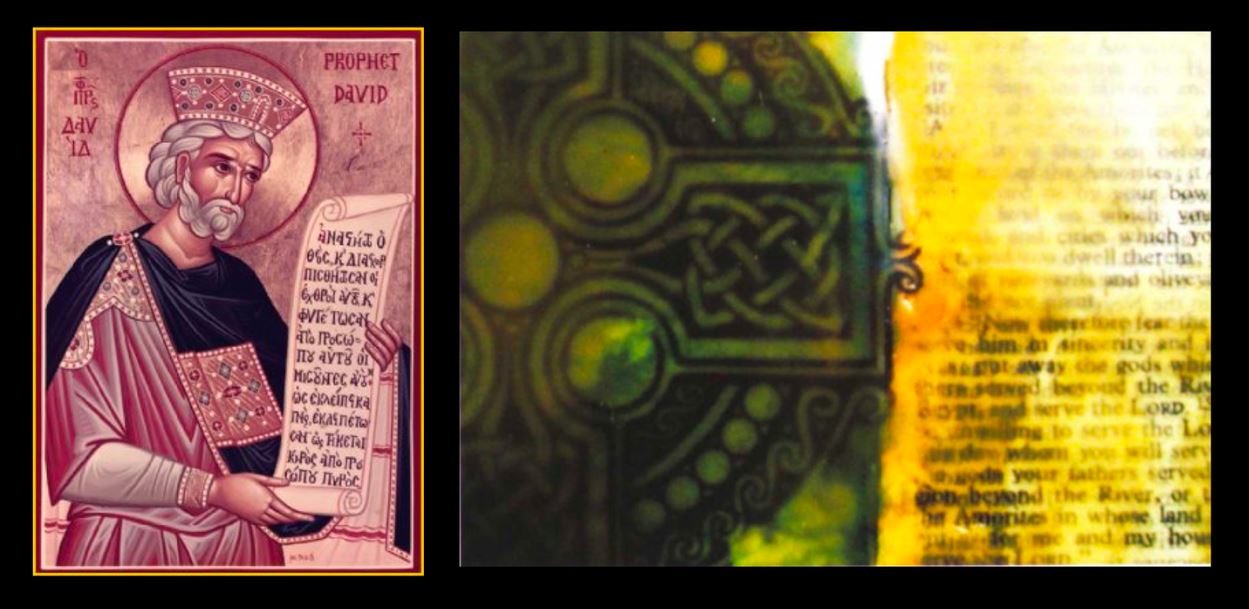
Left: Icon of the Holy Prophet-King David. Right: Celtic Cross with Bible Page, encaustic by Phaedra Jean Taylor.
A choir will perform several chants (Hebrew, Byzantine, Gregorian) and a motet, and then attendees will be led in a handful of Psalm-based songs, from a hymn of German origin to an African American spiritual to CCM classics. Along the way Taylor will provide historical context and trace a narrative.
Sponsored by the Brehm Center at Fuller Theological Seminary, the event is free, but registration is required and filling up; reserve your spot here. It will be recorded and eventually posted on the Fuller Studio YouTube channel (whether there will be a livestream is still TBD).
>> Baylor Symposium on Faith and Culture: Art Seeking Understanding, Baylor University, Waco, Texas, October 26–28, 2022: Every fall the Institute for Faith and Learning at Baylor University organizes a symposium around a given topic, and this year’s topic is the arts. Registration is still open! The standard cost is $250, or $125 for students. “The notion of art seeking understanding (ars quaerens intellectum) invites association with the notion of faith seeking understanding (fides quaerens intellectum). Just as faith is a gift of grace that grows toward deeper knowledge, so it seems that art is a gift whose practice leads to a deeper order of understanding. This seems true not only for the person who experiences art, but also the artist—whether musician, painter, sculptor, or poet. The 2022 Baylor Symposium on Faith and Culture invites contributions from across the disciplines (including scholars, artists, and other practitioners) as we explore together how art seeks understanding and thus contributes to human flourishing.”
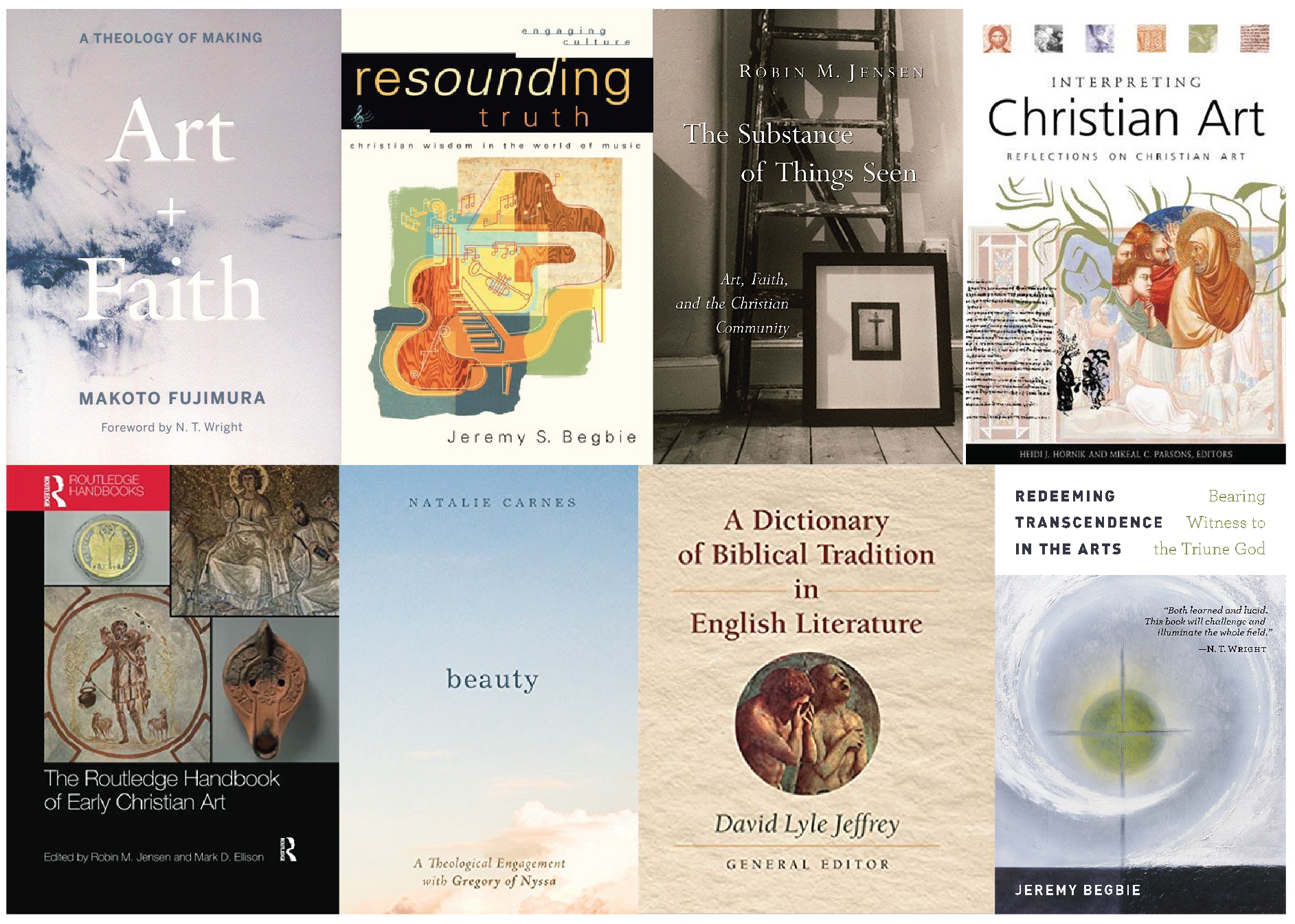
Their line-up of presenters includes several from within Baylor’s own distinguished ranks, such as composer and liturgist Carlos Colón, theologian Natalie Carnes, art historian Heidi J. Hornik, and literature scholar David Lyle Jeffrey, in addition to famous outside guests like theologian-pianist Jeremy Begbie, contemporary nihonga painter Makoto Fujimura, and Early Christian art historian Robin M. Jensen. See a full list by clicking on the boldface link above.
Just a fraction of the books authored by the eminent speakers at the upcoming Baylor symposium
The website does not provide a list of presentation titles, but among the topic suggestions on its call for proposals page are how art contributes to moral and spiritual perception, sensitivity, and/or character formation; the power of imagination; the relation of poetic art to the communication of moral truth; art therapy in pastoral counseling; how musical settings of biblical texts add value to those texts; and how to reconcile the making of religious art with the commandment in Exodus 20:4.
+++
SONG: “The Lord Is My Light” by Lillian Bouknight | Performed by the Notre Dame Folk Choir, dir. Emorja Roberson: “Very little is known about Lillian Bouknight (d. 1990), except that she was an African American from North Carolina, and a soloist and composer in the Pentecostal Holiness movement in the Aliquippam, PA, Community, also serving as a prayer warrior and on the Mother’s Board.” This setting of Psalm 27 that she composed appears in the African American Heritage Hymnal #160.
+++
VIDEO: “Theology through the Arts” by Jeremy Begbie: A pioneer of the field of theology and the arts, UK-born and US-based scholar Jeremy Begbie is the headliner for the Baylor symposium mentioned above. I met him briefly at a Duke conference a few years ago, and he’s such a delightful person, not to mention a phenomenal teacher who often dispenses wisdom from a piano bench. If you’re not familiar with his work, this fourteen-minute video is a great introduction to it. He’s all about demonstrating how instrumental music (his specialization is Western classical) can help unlock the truths of the Christian gospel. Here he talks about the given, the improvised, and the ministry of the Holy Spirit.
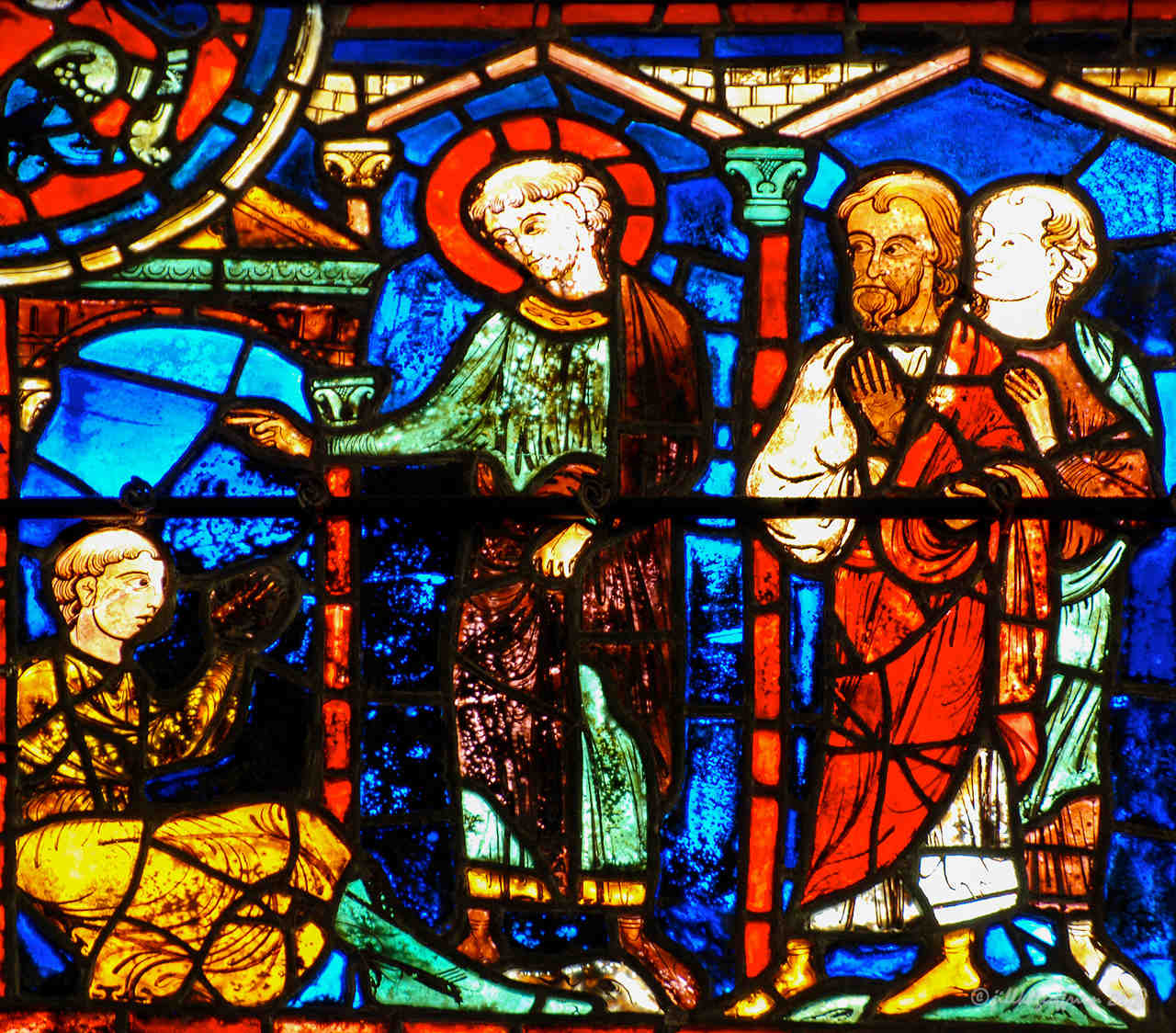
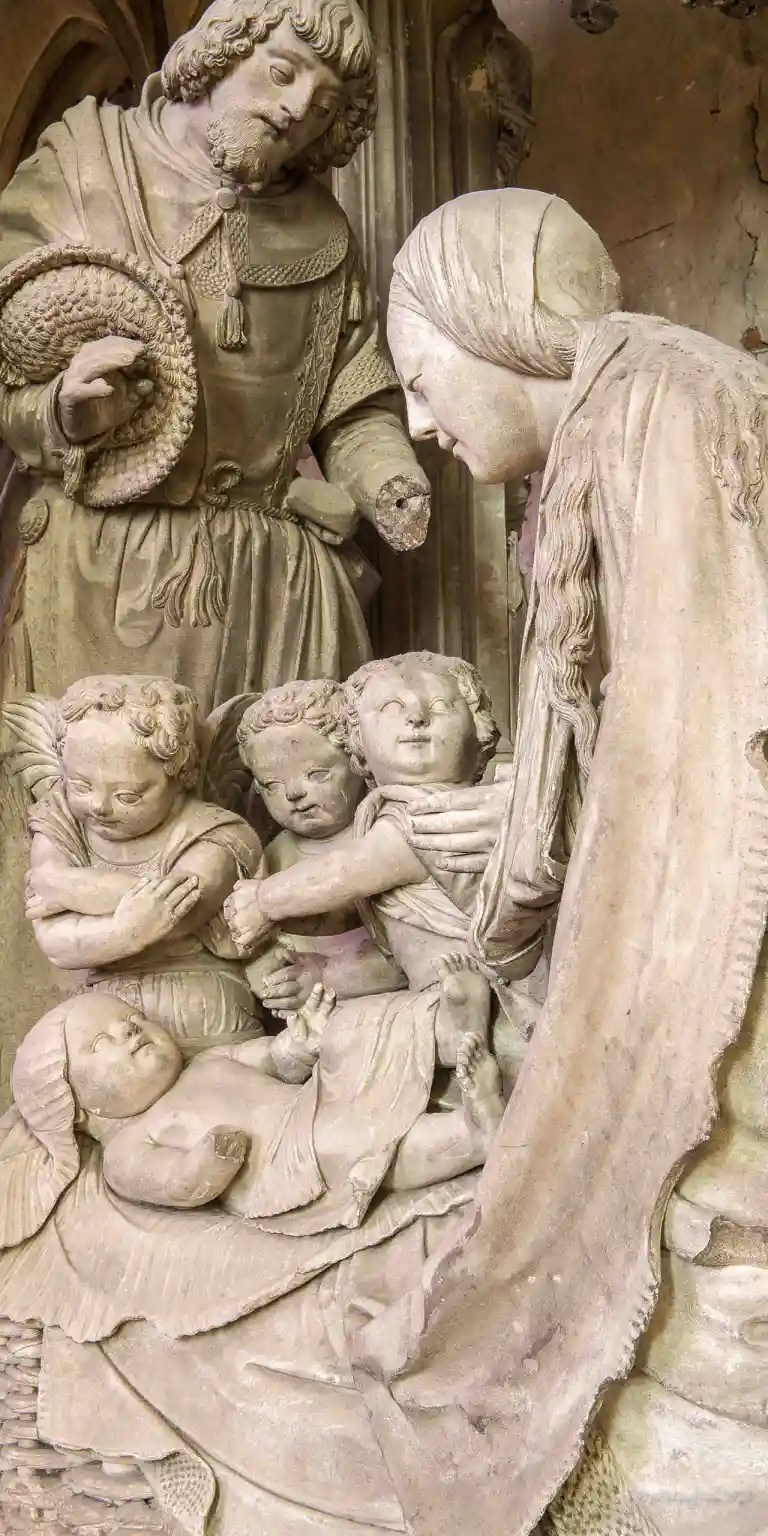
Geoffrion is also a professional photographer, and she shares many of her beautiful art photographs from Chartres on her blog, providing specific prompts for prayer and meditation based on the images. For example, in a post on the stained glass panel of Saint Martin bringing a man back to life, she writes, “Think of what is dead and needs resurrection in you, in those you love, in those who live within twenty-five miles of you, and in whatever country you call home. Then, take a very deep exhale and plead with God, ‘Bring resurrection!’” Or, reflecting on the sixteenth-century Nativity sculpture group attributed to Jehan Soulas, she invites us to “imitate one or more of the sets of eyes in the image . . . as you pray, ‘May I see with Your eyes, God. Teach me to see anew.’”
Saint Martin bringing a man back to life (with two onlookers), 1217–20, stained glass window panel in the south ambulatory at Chartres Cathedral, France. Photo: Jill Geoffrion.Jehan Soulas, Nativity, 1529, from the choir screen in Chartres Cathedral, France. Photo: Jill Geoffrion.
Geoffrion’s blog is a wonderful free resource for those looking to engage prayerfully with the art treasures of Chartres Cathedral. New content is typically posted in batches a few times a year, and the archive goes back to 2015. Sometimes Geoffrion digitally isolates certain details of the stained glass to aid in a more concentrated focus.
As I said when I featured the Tree of Jesse window several years ago, Chartres is high on my list of places to visit, for aesthetic, historical, and spiritual reasons. I hope to make it there sometime in the next five years.
SPOTIFY PLAYLIST: September 2022 by Victoria Emily Jones: This month’s thirty-song lineup includes a tango, a Pentecostal praise song, a playful setting of the Heidelberg Catechism Q&A number one, an Americana lament for hard times, a Negro spiritual on sax, Christina Rossetti, guitar evangelist Mother McCollum with a unique Jesus metaphor (!), a 9/11-inspired interfaith prayer that I will write about in a separate post, and songs in Turkish (“Kutsal, Kutsal, Kutsal Allah” = Holy, Holy, Holy Lord God) and Sepedi (“Modimo re boka wena” = God, we praise you).
+++
LECTURE (AUDIO): “God’s Thumbprint” by Frederick Buechner: Ordained minister and Pulitzer Prize– and National Book Award–nominated author Frederick Buechner died August 15 at age ninety-six. He was a wonderful writer (of both fiction and spiritual nonfiction) and preacher, and I hear him quoted all the time. He once summed up the theme of all his work as “Listen to your life.”
In 1992 Buechner spoke for the biennial Festival of Faith and Writing at Calvin University in Grand Rapids, Michigan, about how “art and religion are twin expressions of the human spirit.” Discussing poetry, painting, and music, he shows how the arts help us to pay attention. Listen to the talk, “God’s Thumbprint,” on FFW’s Rewrite Radio podcast. It is an expansion of the “Art” entry Buechner wrote in his book Whistling in the Dark: An ABC Theologized (1988); read the full excerpt here.
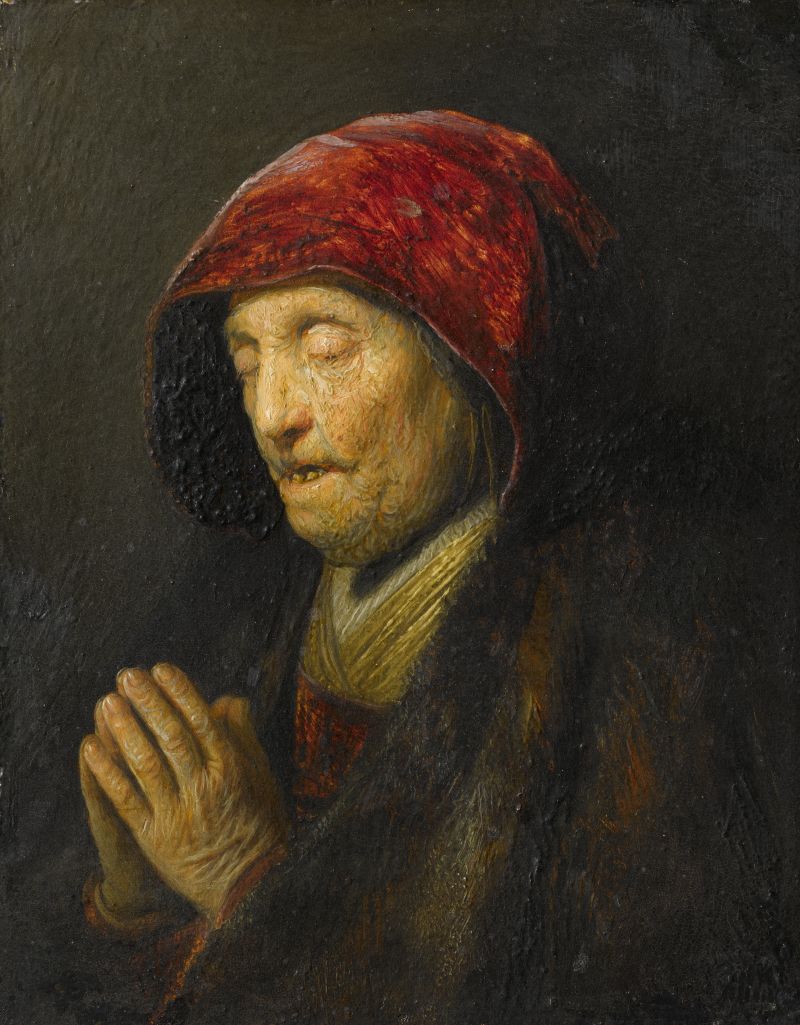
Rembrandt van Rijn (Dutch, 1606–1669), Old Woman Praying, 1629–30. Oil on gilded copper, 15.5 × 12.2 cm. Residenzgalerie Salzburg, Austria. This is one of the many careworn, lived-in elderly faces Rembrandt painted.
+++
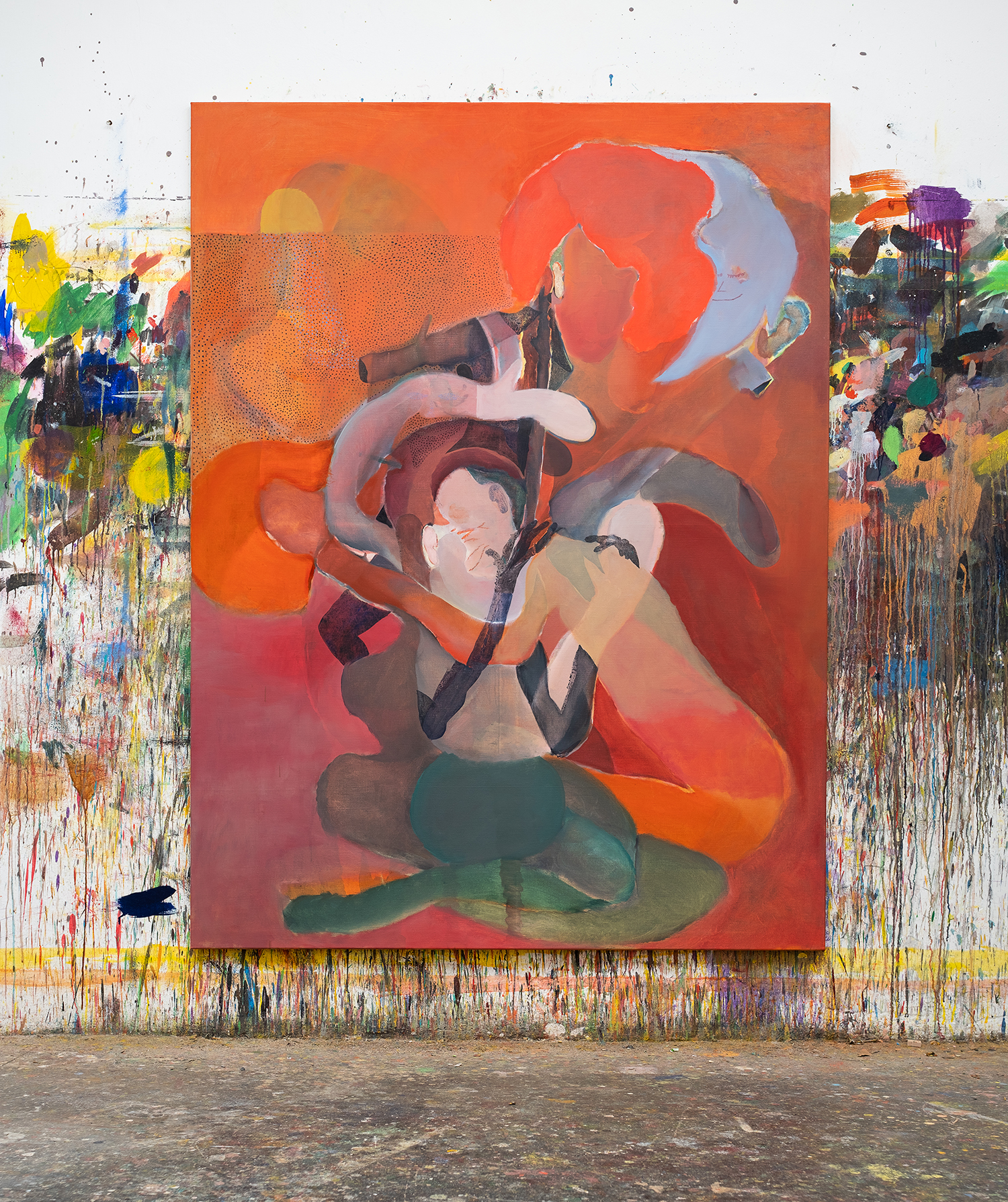
LECTURE (VIDEO): “Difficult Beauty: Contemporary Art as Spiritual Discipline” by James K. A. Smith: In its content selection and development, the arts quarterly Image, says editor in chief James K. A. Smith, resists both nostalgia (old is better) and progressivism (new is better), charting a third way that he calls “archaic avant-garde.” The journal’s focus is on contemporary art, but contemporary art funded by tradition. Most of the writers and artists they feature see the tradition of religious art as a gift and a launchpad.
In this lunchtime Zoom talk from May 19, 2021, Smith considers why contemporary art so often feels alienating. He focuses on painting, giving a brief history of the onset of modernism in that medium, starting with the impact of photography, which pushed painters beyond the representation of objective reality. He shares compelling quotes by art critic Peter Schjeldahl and philosopher John Carvalho, about how we look and when thinking happens. Smith discusses the need for humility—to be comfortable with the not-knowing, to surrender our desire for mastery and control (i.e., demanding that paintings explain themselves).
What if the art that first alienates us is the art that might also stretch us? Or what if the literature that’s intimidating might also be the literature that has the possibility to kind of break us open in new ways, open us up to others, and even open us up to God? What if the difficulty of contemporary art is a virtue? And what if experiencing that difficulty is actually what we need? (12:42)
Daniel Domig (Canadian/Austrian, 1983–), Prayer Invites Chaos, 2019. Oil on mixed fibers, 75 × 59 in. [artist’s website]
The last twenty minutes consists of Q&A and addresses icons, art as propaganda, whether and how to engage art that comes out of a place of despair, and more.
I admit that I find much of contemporary art difficult, often unpleasantly so. A few readers have requested that I feature more abstract art, but I struggle to know how to talk about it. But I do want to learn. Image helps me do that.
+++
ESSAY: “Venice Undone” by Matthew J. Milliner: A core publication of Cardus, Comment magazine is committed to “the difficult work of being faithfully present in culture.” This summer they published an essay by art historian Matthew Milliner reflecting on the Anish Kapoor and Anselm Kiefer exhibitions at the 59th Venice Biennale, one of the art world’s largest and most significant recurring events.
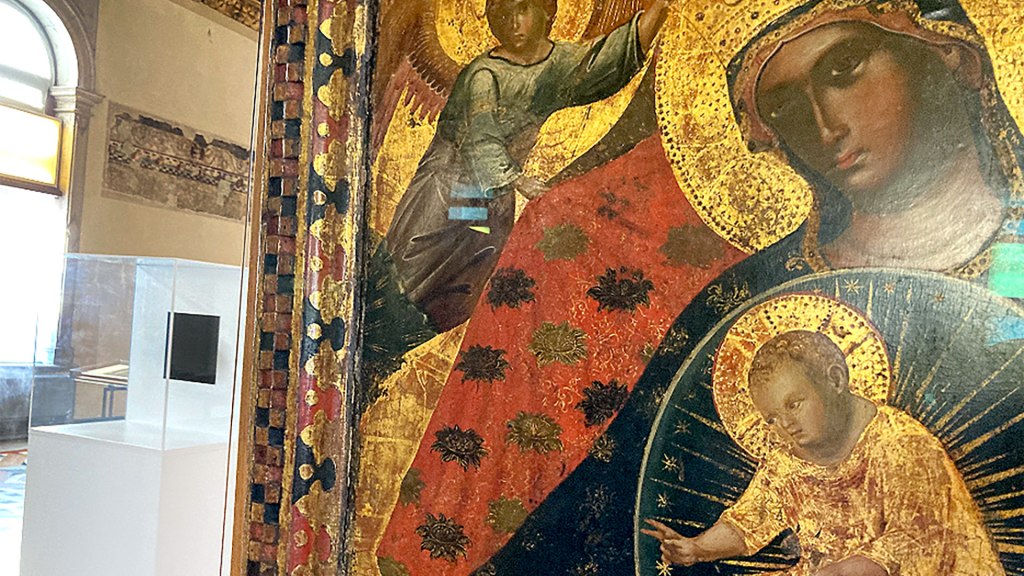
At the 59th Venice Biennale, the Infant Christ from Paolo Veneziano’s Madonna and Child Enthroned (1320s) seems to bless one of Anish Kapoor’s “voids,” a black-painted work that appears flat when viewed head-on but whose convexity becomes apparent when viewed from the side. Photo: Matthew J. Milliner.
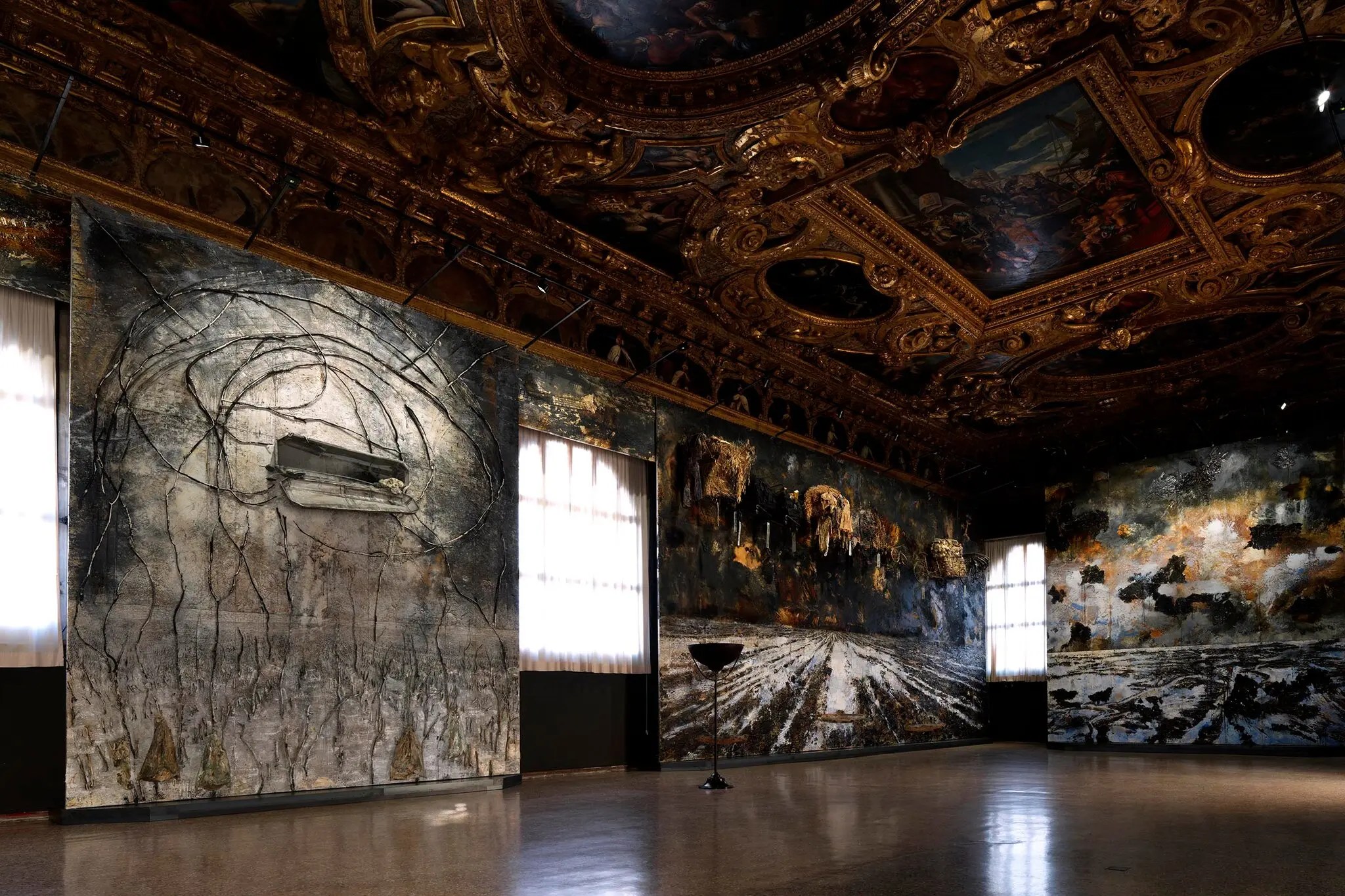
In part 2 of the essay, Milliner considers how the Kiefer show at the Doge’s Palace critiques Venice’s history of military conquest, replacing Titian’s The Conquest of Zara (1584) with an image of an empty tomb that evokes Jesus’s conquest over death. Apocalyptic themes have long been noted in Kiefer’s work; Milliner sees in particular traces of St. Paul and an interrogation of historic Venice’s bombastic displays of wealth and splendor, which are not lasting. And of course there’s the Jacob’s ladder motif. For a silent video tour of the exhibition, see here.
Anselm Kiefer (German, 1945–), These writings, when burned, will finally give some light, site-specific exhibition at the 59th Venice Biennale, 2022. Sala dello Scrutinio, Palazzo Ducale, Venice. Photo courtesy of the artist.
Prompted in part by their use of darkness, Kapoor and Kiefer have been read by some scholars through a lens of despair, but Milliner looks with eyes of hope and sees plenitude and light.
+++
SONG: “Jordan” by Jana Horn: One of Art & Theology’s subscribers sent this to me, and I’m not sure what to make of it, but I definitely find it intriguing, if a bit unsettling. A song from Jana Horn’s debut solo album, Optimism (2022), which Pitchfork calls “cryptic, bewildering, and daringly simple.” “Jordan” is full of veiled biblical allusions and touches on themes of pilgrimage, belief, destruction, incarnation, and burden bearing. I share it here in the spirit of Jamie Smith’s talk above, about not needing to nail down meaning in an artwork—even though I can’t help but ask, “Just who are the two dialogue partners?!” (God the Son and God the Father?)
Horn is a singer-songwriter from Austin, Texas, and a fiction-writing graduate student at the University of Virginia–Charlottesville.
PODCAST EPISODE: “Incarnation and Imagination (with Malcolm Guite),”Imagination Redeemed: On March 28, 2015, the Anglican poet-priest Malcolm Guite from Cambridge, England, gave a talk in Colorado Springs for the Anselm Society, an ecumenical Christian organization whose mission is a renaissance of the Christian imagination. They have just released it on their podcast.
Guite discusses how the job of the arts is to link earth and heaven, heaven and earth; where a poem or other work of art stays on only one of those planes, it typically fails. He unpacks Theseus’s monologue from Act 5, scene 1 of Shakespeare’s A Midsummer Night’s Dream, focusing on these six lines: “The poet’s eye, in fine frenzy rolling, / Doth glance from heaven to earth, from earth to heaven. / And as imagination bodies forth / The forms of things unknown, the poet’s pen / Turns them to shapes and gives to airy nothing / A local habitation and a name.”
Shakespeare, Guite says, is riffing on the prologue to John’s Gospel.
The Logos . . . is bodied forth perfectly and beautifully in the living, walking poem of Jesus Christ, in whom everything eternal is made particular, and who invites everybody to come towards him . . . because he is a habitation with open doors. So of course in John’s Gospel he says, ‘I am the door’! . . . Open up, walk in! (48:51)
And one more quote from Guite!
The church . . . is founded by one who is himself artistically embodied meaning—meaning made visible, meaning made beautiful, meaning made habitable and hospitable and welcoming in the touch of the body and in the physical event, which is then transfigured, because it is also a meaningful event, because earth and heaven meet. (55:34)
It’s a brilliant and inspiring talk, and it integrates other poetic verse besides Shakespeare’s.
>> “King Clave” by Planet Drum: In 1991 Mickey Hart (best known as a drummer of the Grateful Dead) and Zakir Hussain (a classical tabla virtuoso from Mumbai) formed the Grammy-winning global percussion ensemble Planet Drum, bringing together the world’s greatest rhythm masters into a one-of-a-kind improvisational supergroup. Prompted by ongoing international strife, Planet Drum reconvened over the past two years to record their third album, In the Groove, which released August 5. It features six unique compositions led by Hart, Hussain, Sikiru Adepoju of Nigeria, and Giovanni Hidalgo of Puerto Rico.
The centerpiece of the album is “King Clave” (the clave is a rhythmic pattern), created in partnership with Playing for Change and with funding from the United Nations Population Fund. The four core musicians mentioned above are joined by other percussionists and dancers from around the world. The music video uses the “Alternate Version” of the performance, released separately as a single.
Learn more about the Planet Drum project in this six-minute video:
+++
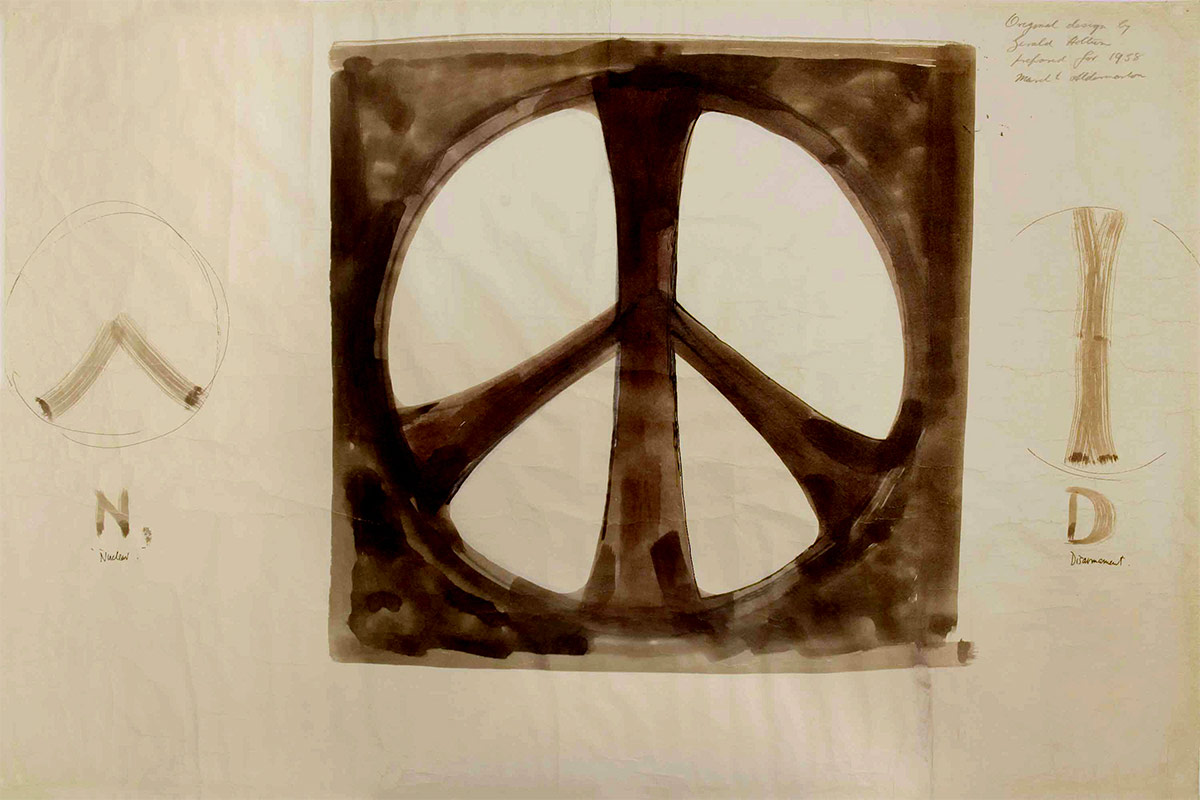
STILL LIFE EDITION: “The History of the Peace Symbol” by Michael Wright: Did you know that the peace symbol that spread worldwide during the 1960s was designed by a Christian from the UK? (Christian pacifism was one of the underappreciated drivers of the nuclear disarmament and antiwar movements.) Learn more about the symbol’s history and art historical and nautical influences in the August 15, 2022, edition of Michael Wright’s weekly letter on art and spirit, Still Life. Also included is the poem “Wildpeace” by Yehuda Amichai, and four weblinks of interest, such as an article on how the patristic tradition agrees with cognitive neuroscience, and a video of FKA Twigs performing in a church!
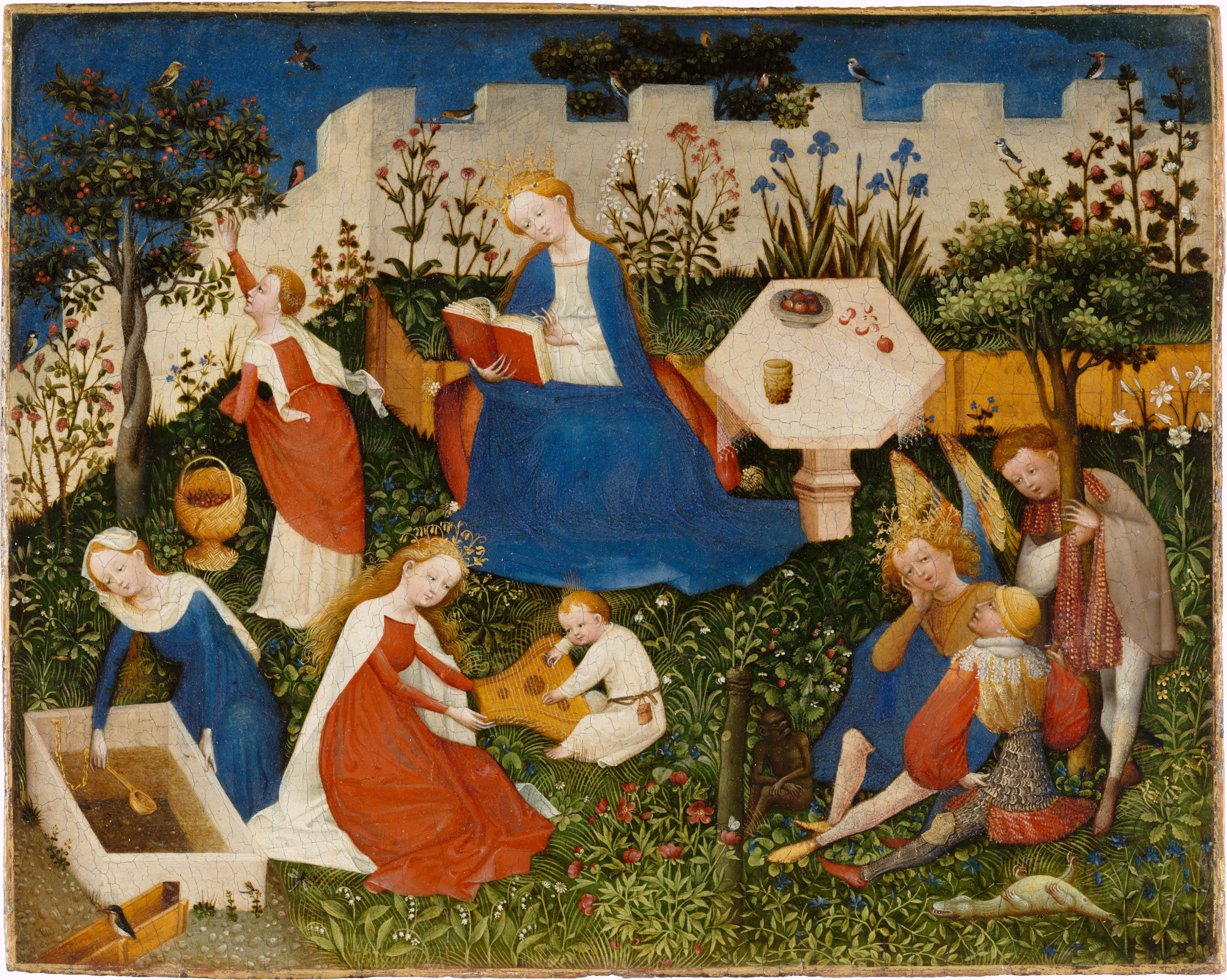
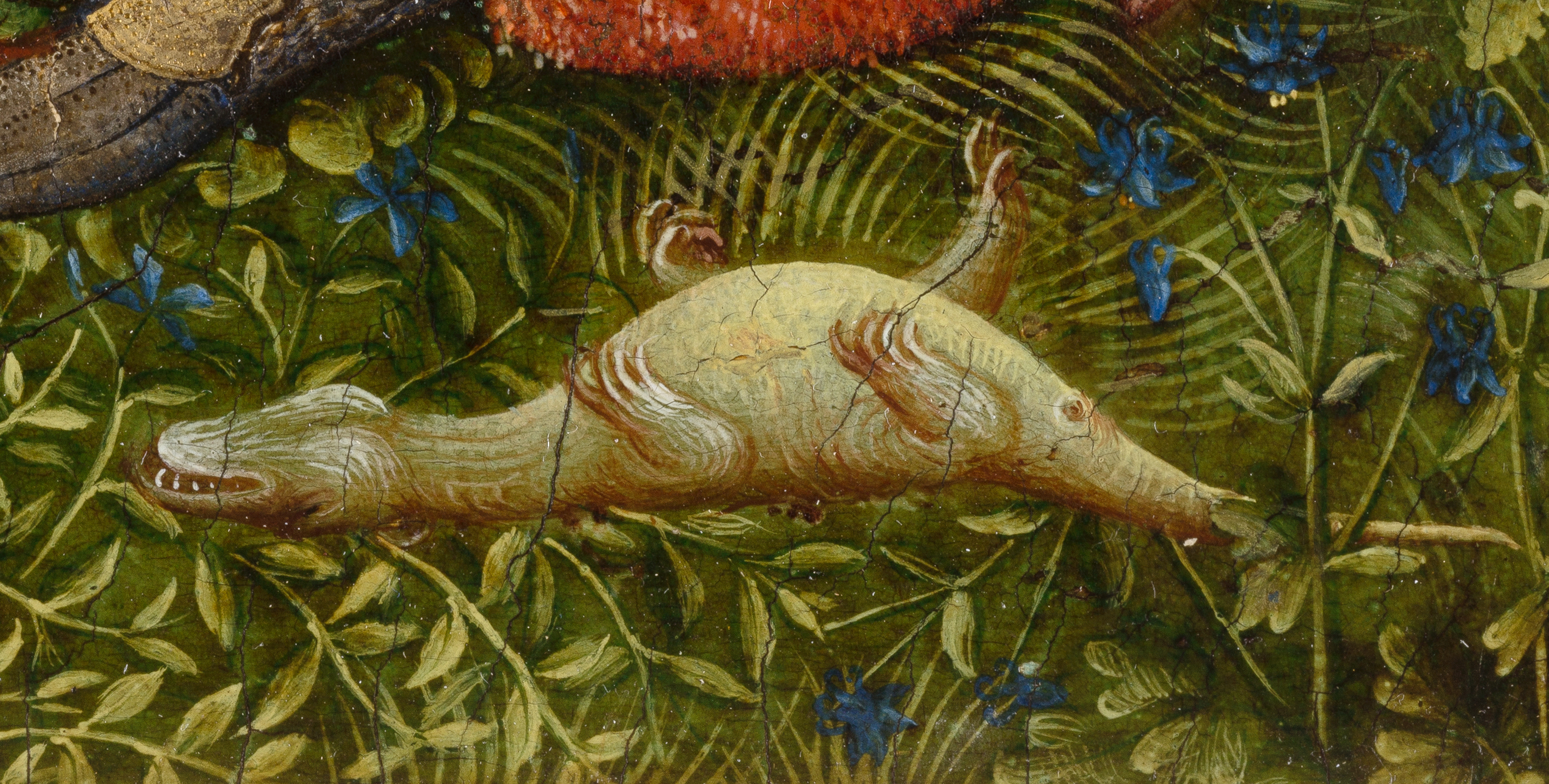
VIDEO LECTURE: “Symbolism and Sacramentality in Art: Medieval and Postmodern Representations of the Little Garden of Paradise” (Religion and Art Talks) by Tina Beattie: Dr. Tina Beattie is a professor emerita of Catholic Studies at the University of Roehampton whose research is at the intersections of art, gender, and theology. In this talk she explores the sacramental imagination of the medieval world through a Late Gothic painting from the Rhineland known as The Little Garden of Paradise. (You can zoom in in tremendous detail on the Städel Museum’s website.) It shows Mary reading in an enclosed garden in the company of saints, her little boy Jesus playing a psaltery at her feet. “Christ retunes the cosmos,” Beattie says. “The harmonies of creation were disrupted by sin. But all of creation is brought back into harmony through the Incarnation.”
Symbolism and allegory abound in medieval religious paintings, encoding profound meanings that can be discerned if we would but take the time to look and to meditate and to understand the world from which these images arose. “The visual image can say things that the theological text can’t,” Beattie asserts. “It can play with the doctrinal truth in ways that allow other meanings to emerge discreetly.”
Though many interpretations of hortus conclusus imagery focus on Mary’s virginity, and indeed that was a primary aspect motivating the creatives who developed such imagery, Beattie draws out themes of new creation and discusses the garden as the human soul.
The Little Garden of Paradise, Upper Rhine, ca. 1410–20. Mixed media on oak, 26.3 × 33.4 cm. Städel Museum, Frankfurt am Main, Germany.A small, slain dragon lies belly-up beside a man in greaves and chain mail, probably Saint George.
The other artworks she glosses are:
Resurrection XI by Edward Armitage Robinson (1963)