Roundup: Art and the Psalms, “We Americans,” the Walking Roots Band, and more

“Psalms in Dialogue: Psalms 22, 23, and 24,” presented by Duke University Chapel: This multidisciplinary video presentation brings together dancers, musicians, a theologian, a painter, and (other) members of the Duke community to draw out the meaning of, or respond to, these three sequential psalms through art, prayer, and conversation. The livestreamed event aired October 17 and will be available for viewing for a limited time. Several of the segments, which I’ve time-stamped below, are intercut with photos from the streets in 2020 (showing the impact of the pandemic and racial unrest), of artist Makoto Fujimura in his studio and of his three finished paintings, and of Ekklesia Contemporary Ballet dancers in training. I wish more university chapels and well-resourced churches would offer experiences like this! Thank you to my friend Peggy for telling me about it. Read more about Duke Chapel’s multiyear Psalms project here.

1:51: “How do we name the impossible mystery?,” a theological reflection by Morley Van Yperen

6:02: Organ: “Jésus accepte la souffrance,” from La Nativité du Seigneur [previously] by Olivier Messiaen, performed by Christopher Jacobson

10:58: Psalm 22 by Makoto Fujimura, 2020, oyster shell on Belgium canvas, 48 × 48 in.

11:09: Reading of Psalm 22:1–22 by Luke A. Powery, with balletic responses by Paiter van Yperen, Elijah Ryan, Heather Bachman, and Sasha Biagiarelli

15:40: Lament, ballet solo danced by Paiter van Yperen (music by Max Richter, choreo by Elisa Schroth)

18:10: Psalm 22:22–32 chant by Zebulon Highben

21:09: Conversation on the Psalms with Makoto Fujimura and Ellen F. Davis, moderated by Amanda Millay Hughes

29:32: Organ: “Christus, der uns selig macht,” BWV 620, by Johann Sebastian Bach, performed by Christopher Jacobson

32:00: Prayer by Nathan Liang

34:11: Recitation of Psalm 23 by Julia Hendrickson

35:22: 6IX, a tap dance by Andrew Nemr

37:10: “The 23rd Psalm,” text adaptation and music by Bobby McFerrin, performed by the Duke Chapel Staff Singers (*this was my favorite!)

40:42: Prayer by Jonathan Avendano

42:39: “The Lord Is My Shepherd,” music by Howard Goodall, performed by the Royal School of Church Music in America Choristers

46:13: Psalm 24 remix produced by Andrew Nemr

48:21: Prayer by Jordyn Blake

49:45: Recitation of Psalm 24 by Julia Hendrickson

51:32: Conversation continued

1:11:49: “He’s Got the Whole World in His Hands,” African American spiritual arranged by Mark A. Miller, performed by the Duke Chapel Choir

+++

POEMS: This week’s edition of ImageUpdate includes two poems that I really appreciated. The first, which was new to me, is “America” by Claude McKay, a key figure in the Harlem Renaissance. Originally published in The Liberator in 1921, it expresses the pain of living in a country where you’re hated for your race and yet remains optimistic, beginning, “Although she feeds me bread of bitterness, / And sinks into my throat her tiger’s tooth, / Stealing my breath of life, I will confess / I love this cultured hell . . .” The second poem is “Making Peace” by Denise Levertov, one of the best-known Christian poets of the twentieth century. “The poets must give us / imagination of peace, to oust the intense, familiar / imagination of disaster,” she writes. Poets can help us feel our way toward shalom—give us a vision of its permeating the world that inspires us to live out its rhythms, its metaphors, its structure, its grammar, our lives like poems.

+++

MUSIC VIDEO: “We Americans” by the Avett Brothers: I’m so moved by this song from the Avett Brothers’ 2019 album Closer Than Together—its grappling with the historical legacy of the US, its greatness and its guilt, with a mixture of heartache, empathy, and hope. It’s one of the healthiest expressions of patriotism I’ve ever come across in a song. We need to see America as the complex entity that she is, which means in part not ignoring her flaws but with love exposing them so that they can be remediated and we can move forward together more faithful to her celebrated ideals. “We Americans” is both confession and supplication, an “I’m sorry, God” and “God, help us to do better.” The final chorus:

I am a son of God and man
And I may never understand
The good and evil
But I dearly love this land
Because of and in spite of We the People
We are more than the sum of our parts
All these broken bones and broken hearts
God, will you keep us wherever we go?
Can you forgive us for where we’ve been?
We Americans

I was reminded of this song in the September 17 episode of the RTN Theology podcast, “You Shall Know the Truth and the Truth Shall Unsettle You.” Chris Breslin interviews Mark Charles, a Native American activist, public speaker, Christian leader, and independent candidate in this year’s US presidential election. He is the coauthor, with Soong-Chan Rah, of Unsettling Truths: The Ongoing, Dehumanizing Legacy of the Doctrine of Discovery. Charles enters at 12:40 with a discussion of the lack of common memory.

+++

SONGS:

>> “Whatever Comes Next” by Drew Miller: This song came out of “Hutchmoot: Homebound,” a virtual arts gathering organized by the Rabbit Room that took place earlier this month. In writing the song, Drew Miller [previously] was inspired in part by Shigé Clark’s new poem “Grateful” (see her perform the poem here).

>> “Bring Your Peace” by the Walking Roots Band: This song was written this year by Seth Thomas Crissman and Greg J. Yoder of the Walking Roots Band as part of a collection of fifteen songs for Shine, a children’s Sunday school curriculum published by MennoMedia and Brethren Press. It appears on Everybody Sing: Worship Songs for Children, released in June as a double album with Everybody Sing: Songs for the Seasons (which comprises ten original songs by The Many). The song asks God to bring his peace into our fears and into the storms we face, and to make us instruments of that peace to others.

>> “Rest Assured,” sung by the Walking Roots Band: TWRB learned this song from a bandmate’s parent (original authorship unknown) and recorded it a cappella in their separate locations at the start of quarantine in March. The chorus goes,

Rest assured, He’s not forgotten
Rest assured, He’ll take care of you
Look at the times He’s been there before
He’ll be there again, rest assured

>> “Let Justice Roll Like a River,” sung by Eric Lige: Bobby Gilles and Rebecca Elliott of Sojourn Music wrote this song in 2017, inspired by Amos 5. In this lyric video from July 5, it’s performed by Eric Lige and Paul Lee of Ethnos Community Church. The singing starts at 1:33. [HT: Global Christian Worship]

Roundup: Jesus as Dancer, The Daily Prayer Project, ethnoarts in Indonesia, and more

BLOG POST: “Jesus as Dancer: Jyoti Sahi’s ‘Lord of Creation’” by Victoria Emily Jones: I wrote a guest post for the Sojourn Arts blog about a gouache I own by Indian artist Jyoti Sahi, which shows Jesus leading the dance of new creation. On one side he pounds a drum, and on the other he emerges from a lotus. The painting brings together Jyoti’s interests in Christian and Hindu theologies and folk symbolism.

Sahi, Jyoti_Lord of Creation
Jyoti Sahi (Indian, 1944–), Lord of Creation, 1982. Gouache on paper, 14 3/4 × 20 in. Collection of Victoria Emily Jones.

Sojourn Arts is a ministry of Sojourn Church Midtown in Louisville, Kentucky, that seeks to support artists and build up the church through the arts. They have organized and/or hosted numerous exhibitions over the years and have commissioned temporary installations for their sanctuary, as well as coordinated community art projects. Visit www.sojourn-arts.com.

+++

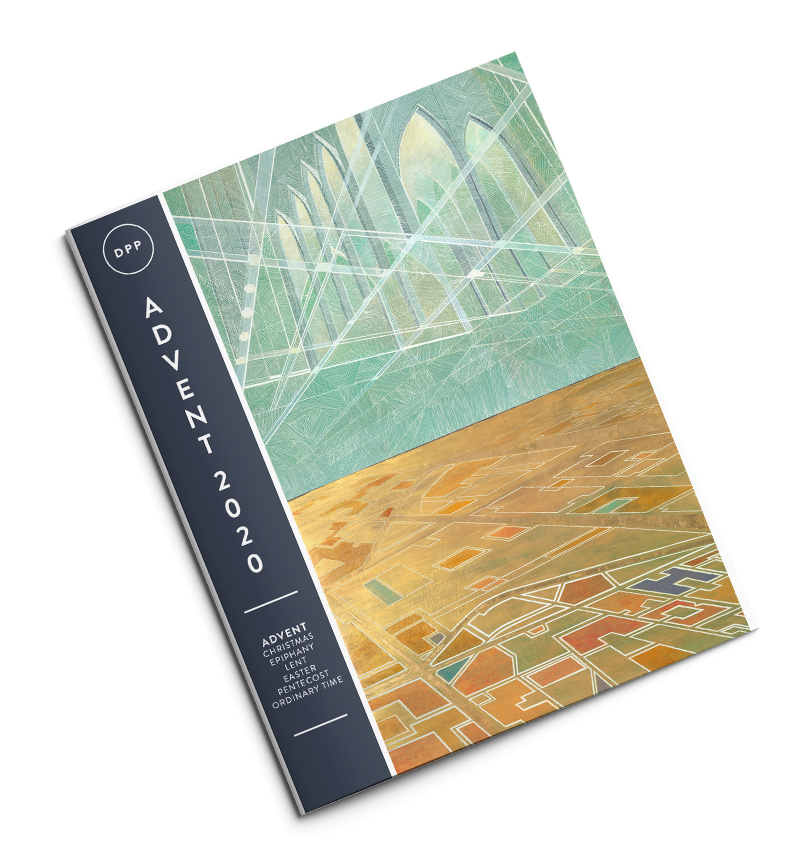
THE DAILY PRAYER PROJECT: This fall I joined the team at the Daily Prayer Project as curator of visual art. The Daily Prayer Project is a periodical that covers every season of the Christian year with robust, rooted, and cross-cultural liturgies for use in congregations, households, workplaces, small groups, or other gatherings. Released in seven editions per year, it features daily morning and evening prayer guides for the week, which include Psalm, Old Testament, and New Testament readings; short prayers sourced from around the globe and from different eras; specific prayer prompts; and songs (including lead sheets). In addition to the cover image, there is a mini-gallery of two art images inside, reproduced in full color, to serve as visual prompts for further contemplation and prayer. There is also a section called “The Practices,” with two page-long seasonal reflections by staff members or guest contributors.

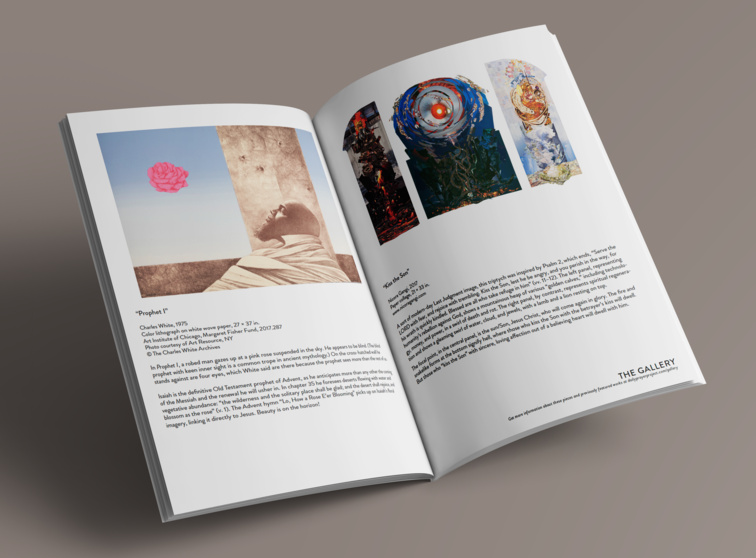
The Advent 2020 issue of the DPP, covering November 29 through December 24, was released last week. It features prayers by African American civil rights leader Fannie Lou Hamer, the tenth-century English saint Ethelwold, and others; a Hebrew folk song, a Taizé chant, and an Argentine hymn by Federico J. Pagura; a striking cover image by Hilary Siber, which shows heaven coming down to earth; Charles White’s Prophet I, which resonates with passages from Isaiah; and an apocalyptic paper collage by Nicora Gangi.

The periodical is available as a physical booklet or as a PDF download. Visit the website for more information. If you are an artist and are interested in having your work considered for publication in a future prayerbook, email team@dailyprayerproject.com.

DPP Advent 2020 interior

+++

VIDEO: “Local Riches: Ethnoarts and Sumba”: A workshop for churches on the island of Sumba in Indonesia, led by Yayasan Suluh Insan Lestari in July 2019, reinforced that God is best honored, and the global body of Christ built up, when people worship God using their unique cultural and linguistic gifts, bringing their whole, authentic selves before him in praise. [HT: Global Christian Worship]

For centuries many Christian missionaries to other countries brought with them Western hymns and images, presenting them as definitive—as forms that alone are good and pleasing to God. (For example, a woman in the video mentions how she had previously thought that worship songs had to be based on Western scales and performed using certain instruments to be acceptable.) But in the last fifty or so years especially, at least from what I’ve noticed, many missionaries have recognized the falsity of this line of thinking and seek to undo negative conditioning by promoting the use of indigenous artistic expressions (sometimes called “ethnoarts”) in Christian worship, be it dance, drama, music, storytelling, carving, or what have you. I found it interesting that the interviewees seem to suggest that now it’s the forces of modernism that most threaten the survival of traditional cultures, whereas it used to be that the church was largely blamed (missionaries did undeniably play a large part, banning this and that, though in every era there were exceptions to the rule). Now the church is at the forefront of trying to preserve not only traditional languages but also traditional art forms.

“Everything we have was created by God, and we need to return to it with gratefulness because this is how God made us!” says Rev. Herlina of the Christian Church of Sumba. “With whatever we already have, we can be a blessing to our people.”

+++

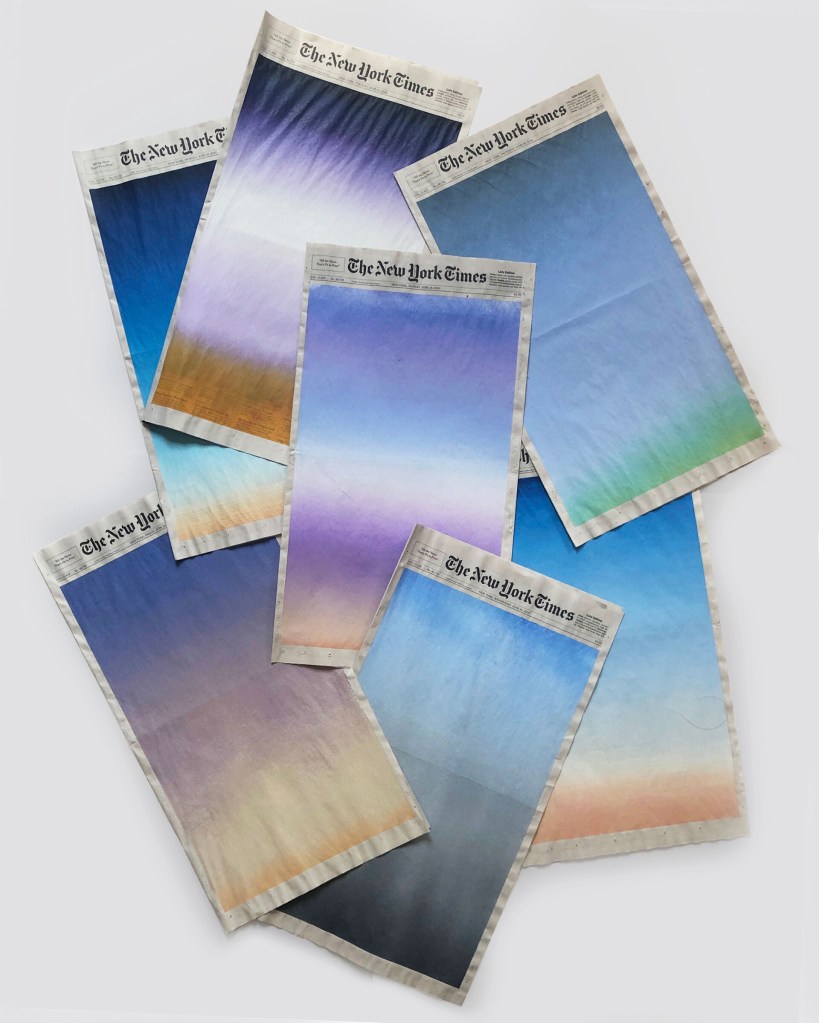
NEW ART SERIES: “Organic, Sunrise Gradients Mask Front Pages of the New York Times by Artist Sho Shibuya”: Since the lockdown started in March, Brooklyn-based artist and graphic designer Sho Shibuya has been painting color gradients in acrylic over the front pages of the New York Times, inspired by each morning’s sunrise. He calls the series “Sunrises from a Small Window.” I love how he’s able to express gratitude for a beautiful new day and to access calm amid dire news cycles. Shibuya is still reading those headlines and articles; he’s just putting them in a larger perspective. (As for myself, call me escapist, but I’ve found that actually blocking out the news—turning down the noise—for certain periods can be a helpful spiritual practice.)

Sho Shibuya, Sunrises from a Small Window, June 22–28, 2020. Acrylic on newsprint.

“I started . . . contrasting the anxiety of the news with the serenity of the sky, creating a record of my new normal,” Shibuya says. “Their front page has always been a time capsule of a day in history, so it made sense to use history as the canvas because the paintings are meant to capture a moment in time. . . . The spirit of the project is that maybe, even after the pandemic subsides, people can continue some of the generosity and peace we discovered in ourselves and that the sky reminds us of every day with a sunrise through a small window. If one thing the news has made clear, we need generosity and peace for all people now more than ever.”

+++

TWO FILMS: “Death on Netflix: I’m Thinking of Ending Things and Dick Johnson Is Dead by Mitch Wiley: I really liked both these cinematic reflections on mortality, but they’re completely different, as this short Gospel Coalition article bears out. Dick Johnson Is Dead is the more “Christian” of the two because of its hopeful perspective—the human subject of the film is a Seventh-Day Adventist, so death for him is not a final end. After her father was diagnosed with dementia, filmmaker Kirsten Johnson asked her dad if he’d be interested in a collaborative film project where, to help them both face the inevitable, she would stage his death in inventive and comical ways. Relishing the opportunity to spend more time with his busy daughter, he enthusiastically agreed.

The documentary shows them preparing and carrying out these stunts but also interacting in other contexts—birthday parties, trick-or-treating, looking through old photo albums, cleaning out Dick’s office, Dick’s being asked to give up driving, and so on. It made me laugh and cry—films that can do both tend to rate highly on my favorites list. There’s so much love and warmth and heartache and whimsy in it as father and daughter confront death together, talking very openly about it, which I found, strange as it may seem, refreshing. Oh, and the heaven sequences just may be the best I’ve ever seen.

For a more cynical take on death, here’s the trailer to I’m Thinking of Ending Things (Charlie Kaufman isn’t for everyone, but I’m still thinking about this movie after watching it a month ago, which means it made an impression!):

Seeing and Believing, a Christ and Pop Culture podcast, covered Ending Things and Dick Johnson in episodes 264 and 266, respectively, as have most other film podcasts and reviewers, with Dick Johnson being uniformly lauded as one of the best movies of the year.

+++

SONG: “Hodu” (Give Thanks), performed by the Platt Brothers: The Platt Brothers [previously] singing scripture to me? Yes, please. The text of this song is Psalm 118:1–4, and the music is by Debbie Friedman (1951–2011), a Jewish singer-songwriter whose songs are used widely in Reform and Conservative Jewish liturgies in North America. Friedman’s “Hodu” was originally released on her 1981 album And the Youth Shall See Visions. (Find sheet music here.)

In this video from earlier this month, Henry, Jonah, and Ben Platt sing “Hodu” to a guitar accompaniment by Al Seller.

Hodu l’Adonai kitov
Ki l’olam chasdo, ki l’oam chasdo
Yomar na, yomar na, Yisraeil
Ki l’olam chasdo, ki l’olam chasdo
Yomru na, yomru na veit Aharon
Ki l’olam chasdo, ki l’olam chasdo

Let all who revere G-d’s name now say
Ki l’olam chasdo
Give thanks to the Lord for G-d is good
Ki l’olam chasdo

The first time the Platt Brothers performed in public as a trio was this April, when they appeared in a virtual Yom Ha’atzmaut celebration at the request of the Jewish Federations of North America, singing “Ahavat Olam.” Ben and Jonah are musical theater performers: Ben originated the title role in Broadway’s Dear Evan Hansen and won a Tony for it, and Jonah is best known for playing Fiyero in Wicked on Broadway from 2015 to 2016. Henry is a senior at the University of Pennsylvania, where’s he’s a member of the a cappella group Counterparts.

Roundup: CIVA art auction, lament album, Kaphar and “things unseen,” empathy

Several readers have asked if there’s a way to donate to the work of this blog. After much thought I’ve decided to go ahead and add a Donation page, where those who wish to send a small financial gift to support the blog’s upkeep and development can do so through PayPal if they feel so inclined. Thank you!

+++

CIVA ART AUCTION, November 13–15, 2020: In a few weeks CIVA (Christians in the Visual Arts) is hosting an online auction of art created and/or donated by CIVA members. The lots comprise a range of media, sizes, and styles—a little something for everyone. It’s a great way to support artists of faith (by supporting CIVA), and to acquire beautiful art for your home!

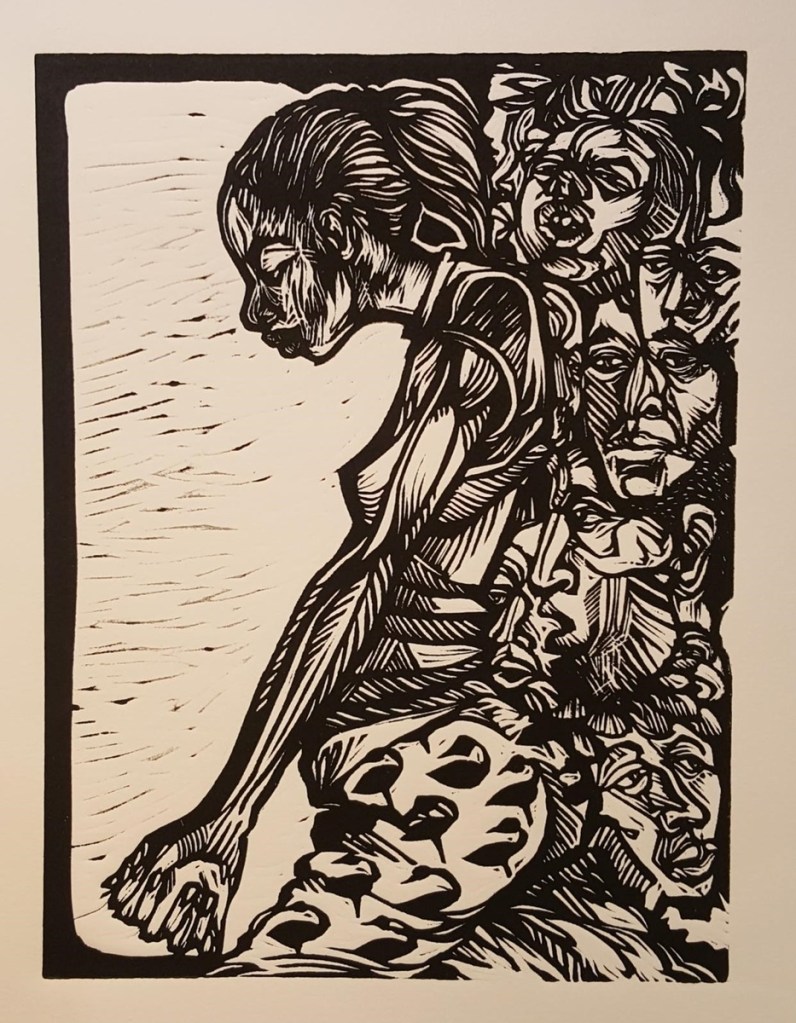
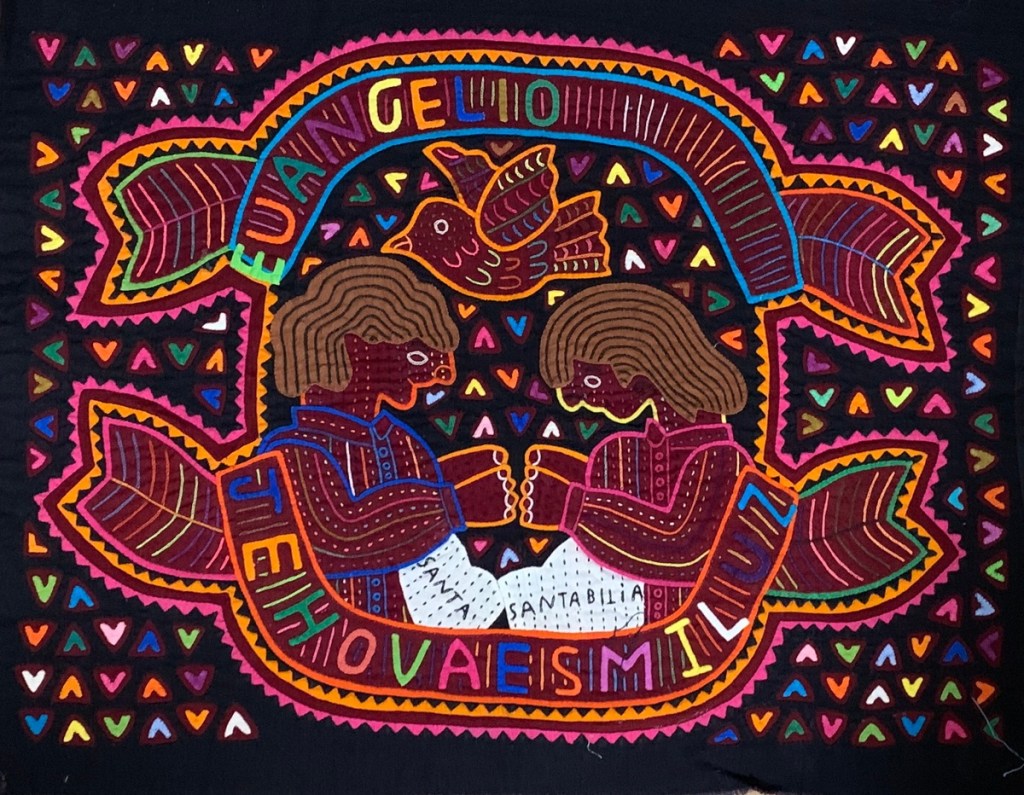
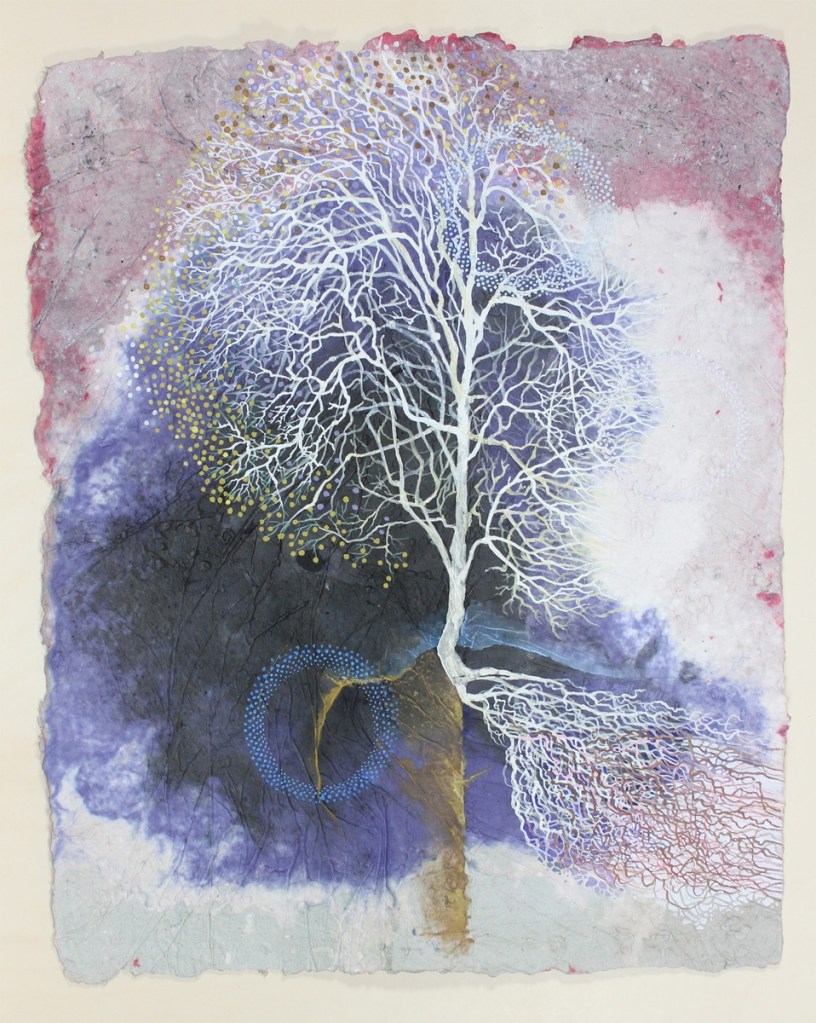
The first artwork I ever purchased was through a CIVA auction: a linocut by Steve Prince, who has three new works up for bid this year. Sandra Bowden has donated several works from her extensive and esteemed collection of religious art, including an Adoration of the Magi lithograph by the major modern artist Otto Dix and a mola (handmade textile) from Panama, which I’m eyeing. I also noticed 40 Days, Forty Sacraments, a set of gouaches painted by Kari Dunham over the course of Lent one year as a way to rediscover beauty in the ordinary. And a mixed-media piece by Joseph di Bella, whose theme of redemption is underscored by the making of the substrate, which consists of “failed and unfinished works on paper” that “are destroyed, then reformed into new, yet still imperfect sheets.”

Steve Prince, Faith Walk. Linocut, 12 × 9 in. “Shows a woman walking in faith while the ancestors encourage, uplift, and guide her along the way.”

Jehovah Is My Light (Panama)
Jehova es mi luz (Jehovah Is My Light), San Blas Islands, Panama, 1980s. Reverse embroidery, 14 × 17 1/2 in.

di Bella, Joseph_Tree Parables (Generations)
Joseph di Bella, Tree Parables (Generations), 2017. Gouache, dry pigment, and ashes on handmade paper, 38 1/2 × 30 1/2 × 1 1/2 in. (framed).

If you plan on bidding, be sure to register; you will be able to see all the other bids and can set up notifications. And if you don’t win, don’t be discouraged: you can always go to the artist’s website, and there will likely be other works available for purchase there.

+++

ALBUM: Daughter Zion’s Woe: Produced by Rachel Wilhelm and released last month by Cardiphonia, this new album features thirteen lament songs written, arranged, and performed by women. It will be available on Spotify after Christmas, but until then, all Bandcamp sales benefit Hagar’s Sisters, an organization that serves victims of domestic violence. My favorite song on the album is “The Glory Shall Be Thine” by Christy Danner, a retuning of the late nineteenth-century “Transformed” by F. G. Burroughs (pseudonym for Ophelia Burroughs, later Adams, née Browning); this hymn text is completely new to me, and what a gem! Danner’s music really draws out its poignancy. Other highlights include Eden Wilhelm’s “Lord, Draw Near” (Psalm 88), Sister Sinjin’s “Silence,” and Lo Sy Lo’s “Let It Be So” (Psalm 12).

+++

EXHIBITION: The Evidence of Things Unseen by Titus Kaphar, October 16–November 28, 2020, former Église du Gesù, Brussels: Titus Kaphar’s [previously] art, which reinterprets traditional Anglo-centric imagery through a Black lens, has grown out of his “spending time in European museums and longing for pictures that looked like they actually made space for individuals that look like me.” In this new exhibition, staged by the Maruani Mercier gallery in a deconsecrated church in Belgium, Kaphar revises Christian paintings by silhouetting, covering in tar, or duct-taping over likenesses of white Jesus, drawing attention to unseen people and narratives. The exhibition’s title is taken from Hebrews 11:1.

Kaphar, Titus_Untitled (Entombment)
Titus Kaphar, Untitled, 2020. Oil and tar on canvas. Photo courtesy Maruani Mercier.

The press release reads: “It is virtually impossible to tell the story of Renaissance art without an exploration of Christianity. While the personal faith of the individual artist varied from devotee to atheist opportunist, the largest patron of the arts was the Church, and Catholic iconography the artist’s lingua franca. . . .

“In The Evidence of Things Unseen, Kaphar utilizes Catholic iconography as a ground on which to explore ideas beyond simple proselytization. Kaphar utilizes his whole vocabulary of formal innovation in this exhibition: canvases aggressively fold, crumple, undulate, and project from the wall, forcing themselves into the space of the viewer. Through Kaphar’s physical interventions, works like Susan and the Elders and Eve exist as bodies transformed into landscape and typography rather than polite easel paintings. In Jesus Noir Kaphar duct-tapes a portrait of a young black man over the face of Christ. Christ’s outstretched right hand, originally pointing to the heavens, now appears as a plea for help. The application of duct tape – a utilitarian material known to be used in all kinds of industrial and household repairs – suggest urgency and impermanence.

“Even though many biblical stories take place in the Middle East and Africa, representations of Christ and his followers are almost always depicted as European. It is not surprising that the devoted attempt to see themselves in the stories of the Bible, and to envision a Christ they can recognize: Christian tradition teaches that mankind was created in God’s own ‘image and likeness.’ And yet, religious paintings from the Renaissance unwittingly oversimplify an understanding of God by excluding a part of his creation. There are no black angels of the Renaissance. The Evidence of Things Unseen is Kaphar’s latest attempt at revision.”

+++

ANIMATED SHORT: “Brené Brown on Empathy”: In this 2013 video from the RSA (Royal Society for Arts, Manufactures and Commerce), Katy Davis animates an excerpt from a talk by Professor Brené Brown, “The Power of Vulnerability.” “The Webby Award-winning RSA Shorts animation series provides a snapshot of a big idea, blending voices from the RSA Public Events Programme and the creative talents of illustrators and animators from around the world. It responds to the ever-increasing need for new ideas and inspiration in our busy lives and acts as a jolt of ‘mental espresso’ that will awaken the curiosity in all of us. If you’re interested in the opportunity of animating one of our Shorts, please email your bio and links to your portfolio to shorts@rsa.org.uk.” Other RSA shorts include Jonathan Haidt on Why We’re Convinced We’re Right, David Brooks on Character in a Selfie Age, and David Graeber on the Value of Work.

+++

PANEL DISCUSSION: “Perspectives on Empathy and the Arts”: In 2017 Roots of Empathy brought together a panel of three—Cameron Bailey, artistic director of the Toronto International Film Festival (TIFF); Martha Durdin, chair of the board of trustees of the Royal Ontario Museum (ROM); and Raymond Mar, professor of psychology at York University—to discuss the connection between art and empathy and why it’s so important. The conversation is moderated by Mary Ito. I especially appreciated from 42:32 onward.

4:10: Children who take acting lessons are more prosocial and empathetic
5:48: Films and empathy
9:34: Fiction and empathy
12:42: Moonlight (2016)
21:54: Learning from mistakes: Into the Heart of Africa (1989) and point of view
28:38: Pompeii: In the Shadow of the Volcano (2015)
30:37: Forced assimilation of Native people in church-run residential schools
31:18: Can art museums institutionalize empathy?
34:48: How does me empathizing with a character in a book or a painted figure translate to me being empathetic to actual people?
39:05: Superhero comics and movies
41:22: Are we suffering from an empathy deficit?
44:37: Empathy for ideological opponents
46:10: Where does empathy run up against morality/ethics? Are we to empathize with abusers?
46:56: How do we do better through the arts?

Roundup: Jewish prayer song, stolen paintings, graphic novels by John Lewis, and new VCS videos

SONG: “Ahavat Olam”: Back in April the Platt Brothers—Jonah, Henry, and Ben—posted a home-recorded video of themselves singing this traditional Jewish prayer arranged by Gabriel Mann and Piper Rutman. (I know actor-singer Ben Platt from The Politician, which is probably how the video came to be recommended to me by YouTube!)

It stoked a lot of public enthusiasm, so on September 21 they released a studio recording, available for streaming and download from all major music platforms.

A translation of the Hebrew is as follows:

With an eternal love have You loved your people Israel, by teaching us the Torah and its commandments, laws, and precepts. Therefore, Adonai our God, we shall meditate on Your laws when we lie down and when we rise up, and we shall rejoice in the words of Your Torah and Your commandments forever. For they are our life and the length of our days, and we shall reflect upon them day and night.

O may You never remove Your love from us. Blessed are You, Adonai, Who loves your people Israel. [source]

+++

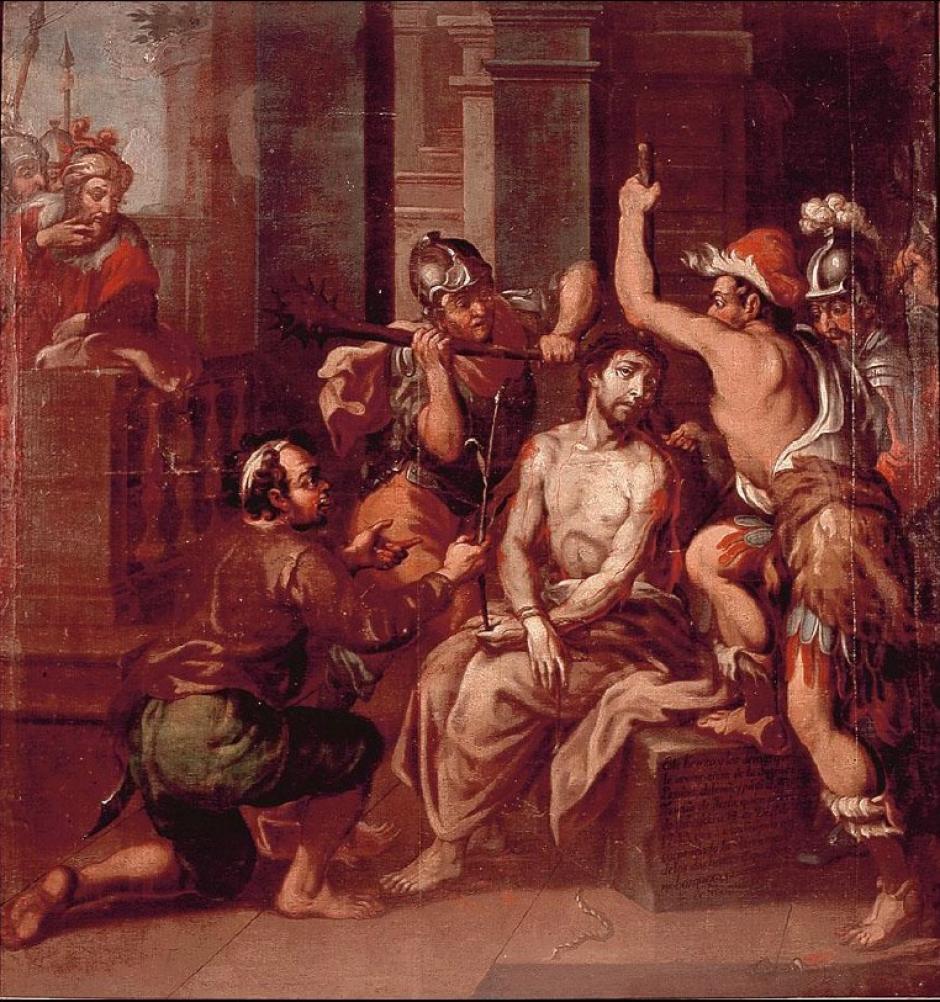
PIANO CONCERTO: Tomás de Merlo by Xavier Beteta: In February 2014 six religious paintings by the early eighteenth-century Guatemalan painter Tomás de Merlo were stolen from a church in Antigua. Although the thieves have been caught, the paintings have disappeared into the black market and have likely been smuggled out of the country. Wanting to preserve the essence of the paintings in music, Guatemalan composer Xavier Beteta wrote a piano concerto whose three movements, titled after the stolen paintings, are “La Oración en el Huerto” (The Prayer in the Garden), “La Piedad” (The Pietà), and “El Rey de Burlas” (The Mocking of Christ). Beteta said he may eventually compose three additional movements, one for each of the other three lost paintings.

Tomás de Merlo (Guatemalan, 1694–1739), El Rey de Burlas (aka La Coronación de Espinas), 1737

Last year the Camellia Symphony Orchestra in Sacramento, California, premiered the concerto. Listen to excerpts, interspersed with interview clips of the composer by Josh Rodriguez, in the video below—which is itself excerpted from the Deus Ex Musica podcast episode “How Stolen Sacred Paintings Inspired a New Piano Concerto.”

See photos of the other paintings at https://www.soy502.com/articulo/capturan-dos-robo-valiosas-obras-iglesia-calvario.

+++

DOCUMENTARY: The Painter and the Thief (2020), dir. Benjamin Ree: A story of crime and trauma, love and redemption, this documentary follows Oslo-based Czech artist Barbora Kysilkova as she confronts one of the men, Karl-Bertil Nordland, who stole two of her most prized paintings. A mutual friendship develops, and it’s so beautiful to watch.

What I love about the film is how it captures the rehabilitation of both subjects—in a way that honors the complexity, the nonlinearity of that process—and the role art can play in healing. “Barbar” forgives “the Bertilizer” and helps him on his road to sobriety, and he helps her access deep parts of herself and come to grips with the history of abuse she’s suffered. They become, in a sense, each other’s muses. His stunned, tearful reaction when he sees the first portrait she paints of him melted me—someone sees him for the first time.

With documentaries I always wonder who’s the person making it and why. I had cynically assumed the project was instigated by the artist to try to vitalize her career, but no, the filmmaker, who has had an ongoing interest in art theft, contacted Kysilkova after reading about the gallery break-in in the news. As is true with most documentarians, he had no idea when he started filming that the story would evolve the way it did and shift genres, and even become feature-length. Streaming on Hulu.

+++

INTERVIEW: In 2016 Adelle M. Banks of the Religion News Service interviewed Rep. John Lewis about the National Book Award–winning graphic novel trilogy March, the role of music and religious faith in the civil rights movement, protest (and getting into “good trouble”) as a form of Christian ministry, the urgent need for the church to be a headlight, not a taillight, and more.

+++

VCS VIDEO EXHIBITION SERIES: The Visual Commentary on Scripture [previously] is an online, open-access resource for those looking to explore the biblical text through art. For every passage of scripture, an art historian, artist, theologian, media theorist, or other is solicited to select and comment on three art images that illuminate the text in some way. The site’s typical format is written commentaries, but by way of experimentation, the VCS has just released video commentaries instead for four new texts. Ben Quash comments on the story of Lot’s Wife through the lens of an early English stained glass panel, a Flemish Renaissance landscape, and a stunning photograph taken after the Allied bombing of Dresden. For Belshazzar’s Feast from the book of Daniel, Michelle Fletcher is guided by paintings from the Dutch Golden Age and the English Romantic period, which she juxtaposes with a contemporary room installation. But here I’ll highlight the videos for two New Testament passages.

The Burial of Christ, with commentary by Italian Renaissance art expert Jennifer Sliwka [previously], covers Andrea Mantegna’s innovatively foreshortened Christ on a marble slab; an altarpiece painting by Michelangelo, in which Christ’s dead body is held up for display, evoking the presentation of the eucharistic host; and a contemporary Pietà, of sorts, by Swiss artist Urs Fischer, which involves a skeleton and a fountain.

Michelle Fletcher, a feminist scholar and specialist on the book of Revelation, comments on the controversial apocalyptic figure known as The Whore of Babylon, which she discusses as a symbol of a city, as a satirization of the goddess Roma, and as bequeathing a legacy of vilification of prostitutes. Fletcher selected a didactic painting by street evangelist Robert Roberg, an ancient Roman coin, and William Hogarth’s A Harlot’s Progress.

Roundup: Works of mercy, #GettyMuseumChallenge, new gospel songs, and poems

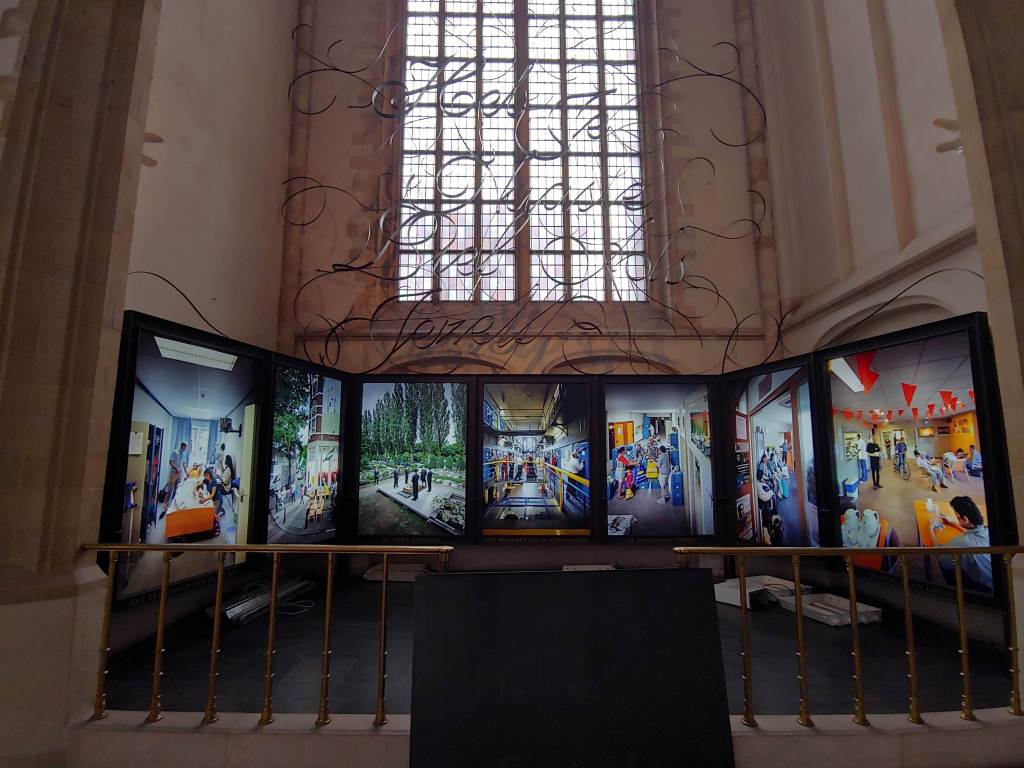
RADIX ARTICLE: “The Seven Works of Mercy: How two Dutch artworks—one Renaissance, one contemporary—can help us recover an ethic of neighborly care” by Victoria Emily Jones: When I was in the Netherlands last year, I saw lots of artistic representations of what are called the seven works of mercy, derived from Matthew 25. (Even after the Protestant Reformation, the subject remained popular among Dutch artists, who delighted in representations of everyday life.) In this article, published last week, I share just two. One is a multipaneled painting, now at the Rijksmuseum, commissioned in 1504 by the Holy Ghost Confraternity in Alkmaar, which ran an almshouse that provided medical care for the sick and housing for the poor (social welfare programs were carried out by the church in those days); notably, in each contemporary townscape, Jesus stands among the afflicted—a theologically loaded artistic choice. The other artwork is a set of photographs by Thijs Wolzak on display inside Rotterdam Cathedral, which feature community service organizations in action, caring for drug users, undocumented immigrants, and others. (Note: The chapel was in a bit of disarray when I was there, with light fixtures disassembled all over the floor and a ramp blocking my entrance, hence the messy staging of my photo! See a professional photograph in the article link, including photos of individual panels.)

Feeding the Hungry by the Alkmaar Master
Master of Alkmaar, Feeding the Hungry, leftmost panel from the Seven Works of Mercy polyptych, 1504. Oil on panel, 103.5 × 55 cm. Rijksmuseum, Amsterdam. The inscription on the original frame underneath (not pictured) is a rhyming Dutch couplet: “Deelt mildelick den armen / God zal u weder ontfarmen” (Share generously [with] the poor, [and] God shall have mercy on you).
Wolzak, Thijs_Works of Mercy
Thijs Wolzak (Dutch, 1965–), in collaboration with Kathelijne Eisses, Werken van Barmhartigheid (Works of Mercy), 2010. Duratrans prints in light boxes. Chapel of Works of Mercy, Sint-Laurenskerk (Church of St. Lawrence), Rotterdam, Netherlands. Photo: Victoria Emily Jones.

It’s interesting to consider the overlap of Christian and civic duty the images present and the way in which they function(ed) in their disparate spaces. The more explicitly theological Alkmaar polyptych was originally owned by a lay brotherhood and sited in a church beside the collection box, and its primary purpose was “to stir up . . . to love and good works” (Heb. 10:24), and to financial giving—but it is now in a large, government-run art museum, where it’s viewed mainly as an art historical object. The Wolzak piece, on the other hand, was commissioned as a permanent installation inside an active church that is also a heritage museum and something like a community center, with the purpose of highlighting the charitable work being done in the city. I like how Wolzak helps us to see where some of the needs lie in contemporary society and examples of tangible ways they might be met, through such services as safe-injection sites (for those suffering from heroin addiction) or the Lonely Funeral Foundation (for the anonymous dead).

The summer 2020 issue of Radix magazine also includes an interview with Mark Labberton, president of Fuller Theological Seminary, on his book The Dangerous Act of Loving Your Neighbor: Seeing Others Through the Eyes of Jesus; an interview with D. L. Mayfield on her book The Myth of the American Dream: Reflections on Affluence, Autonomy, Safety, and Power; Martin Buber on genuine dialogue; Simone Weil and the “kinship of affliction”; a review of the film Just Mercy; and more.

+++

NEW BOOK: Off the Walls: Inspired Re-Creations of Iconic Artworks: This March on social media, the Getty Museum issued the #GettyMuseumChallenge, inviting art lovers to channel the stir-crazy energy of COVID-19 quarantine into crafting themselves, their families, and their pets into masterpieces of world art and posting the photos online. By May there were at least 100,000 re-creations uploaded to the Internet—246 of which are featured in the new book Off the Walls, released this month by Getty Publications. All profits from the book will go to the charity Artist Relief to support artists facing financial emergencies to the coronavirus pandemic. This is such a fun way to get people to engage with art!

+++

NEW SONG RELEASES

“Hallelujah (Come Bless the Lord)” by September Penn: September Penn is a singer, songwriter, performance artist, worship leader, and cofounder of The Power of Song Inc., an organization that educates about social justice issues through song, theater, and art. She wrote “Hallelujah” while directing the Kaleo Choir at Fuller Theological Seminary, where she earned an MDiv this year with a focus on Worship, Theology, and the Arts. The song was released September 3 as a single on all music-streaming platforms.

“Nara Ekele Mo” by Tim Godfrey, performed by Resonance: Last month the Global Resonance Multicultural Worship Collective, under the organization Arts Release, posted on YouTube a multicontinent, multilingual cover of the Nigerian Igbo song “Nara Ekelo Mo” by Tim Godfrey. It features thirty-seven singers from Brazil, England, France, Indonesia, Singapore, and Spain, with lyrics in Igbo, Yoruba, Tamil, Bahasa Indonesia, French, Mandarin, Portuguese, Spanish, and English. (See the original version of the song here.) [HT: Global Christian Worship]
+++

POEMS

“Field Guide” by Tony Hoagland: A few weeks ago SALT Project reprinted this poem that celebrates the ordinary in nature—along with brief commentary and a stunning macrophoto of a dragonfly. An excerpt from the opening chapter of Ralph Waldo Emerson’s essay “Nature” is referenced: “If the stars should appear one night in a thousand years, how would men believe and adore; and preserve for many generations the remembrance of the city of God which had been shown! But every night come out these envoys of beauty, and light the universe with their admonishing smile.” (The poem is from Hoagland’s 2010 collection Unincorporated Persons in the Late Honda Dynasty, published by Graywolf Press.)

from the current issue of Image: Image journal is the one piece of mail I most look forward to receiving every quarter—full of poetry, visual art, literary essays, and short stories with a spiritual sensibility. In its current issue, no. 105, some of the poems I particularly enjoyed were “Trench Coat” by Cameron Alexander Lawrence, on the accumulation of things; “Pastoral with Wheat” by John Hart, on fatherhood as beatitude, and as a continual lesson in dying to self; “Duet” by Chelsea Wagenaar [previously], about the “music” of the ordinary moments of motherhood, like tending to your child’s bee sting; and “The Eighth Sacrament” by Peter Cooley, on grief, written after the death of his wife, Jacqueline.

Roundup: The Crucifixion in modern art, “Lift Every Voice” ballet solo, and more

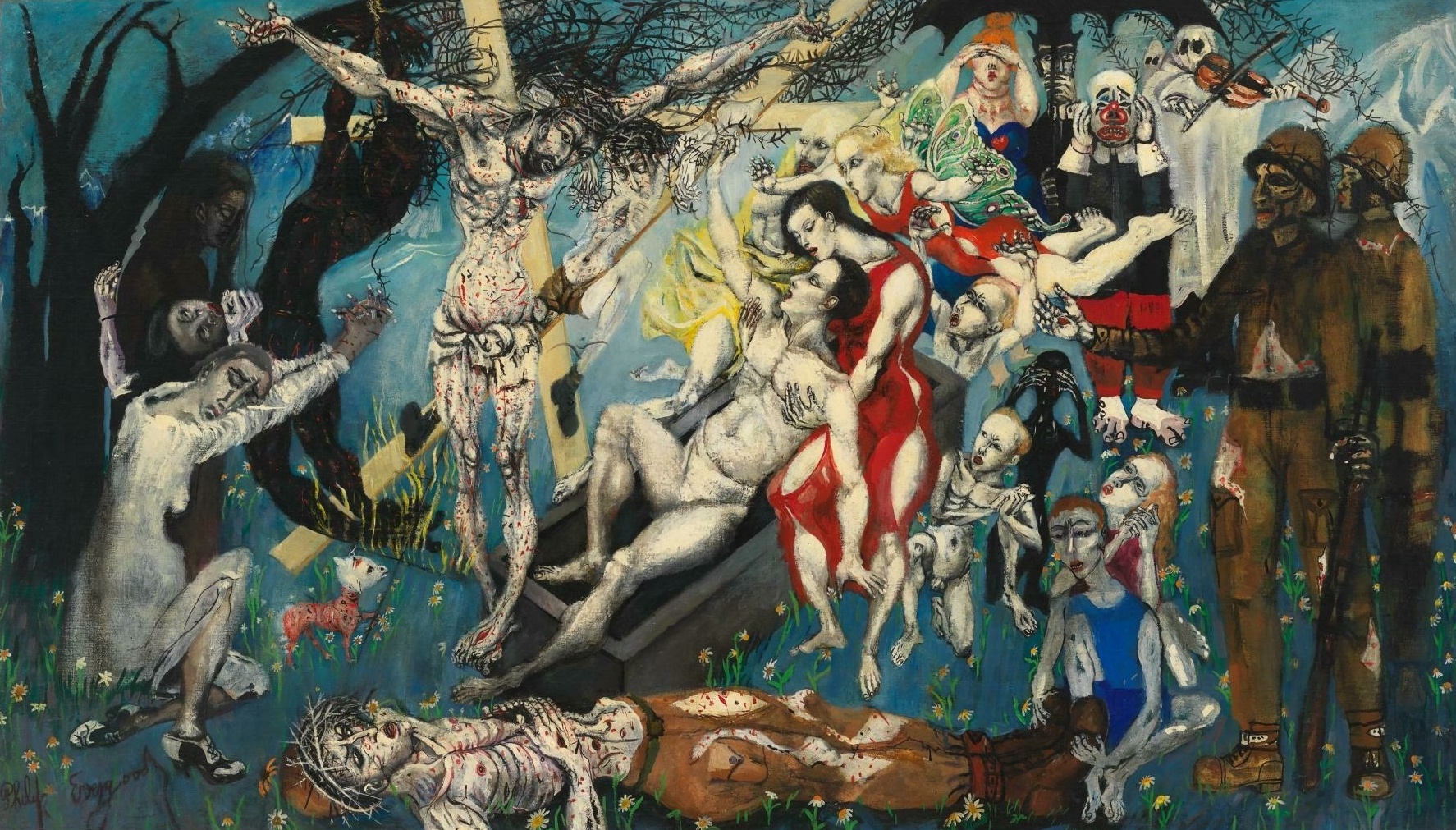
VISUAL MEDITATION: “Waking Up from Apathy,” on Philip Evergood’s The New Lazarus: My latest visual meditation for ArtWay has just been published. It’s on a crowded, noisy, garish painting that, honestly, is distressing to look at. And it’s supposed to be. Because it exposes what Martin Luther King Jr. called the triple evils of society: racism, militarism (war), and economic exploitation (aka extreme materialism, a systematic cause of poverty). Though Philip Evergood was not a Christian, he draws on Christian narrative and iconography, with the figures of Lazarus and Christ, to protest the cycles of violence that we need to rise out of before we self-destruct.

Evergood, Philip_The New Lazarus
Philip Evergood (American, 1901–1973), The New Lazarus, 1927–54. Oil and enamel on canvas mounted on wood, 148 × 237.2 cm. Whitney Museum of American Art, New York.

The see-nothing, hear-nothing, say-nothing figures in the background remind me of people today who insist that racism does not exist and therefore tune out the cries of Black Lives Matter, for instance. I’m implicated too by these symbols of willful ignorance, because I admit that I do not often care to question where my food, clothes, coffee, chocolate, and other conveniences come from, or how the businesses I regularly support with my dollars treat their employees.

Evergood was politically engaged in both his art and his life, espousing egalitarian ideals. He participated in strikes and demonstrations for workers’ rights and was jailed more than once and beaten by police. He was greatly influenced by Mexican muralism, and he embraced the label of “propaganda” for his art, acknowledging that he was trying persuade the public to join the cause of social justice. “He was a figurative painter when much of the art world placed greater value on abstraction,” writes the University of Kentucky Art Museum, “and he was a moralist when moralizing was not considered an option for serious painters.” Nevertheless, he had a successful career, and his work is in many major museum collections, including the Tate Gallery, the Los Angeles County Museum of Art, the Art Institute of Chicago, the Hirshhorn Museum, the Museum of Modern Art, and the Whitney Museum of American Art.

+++

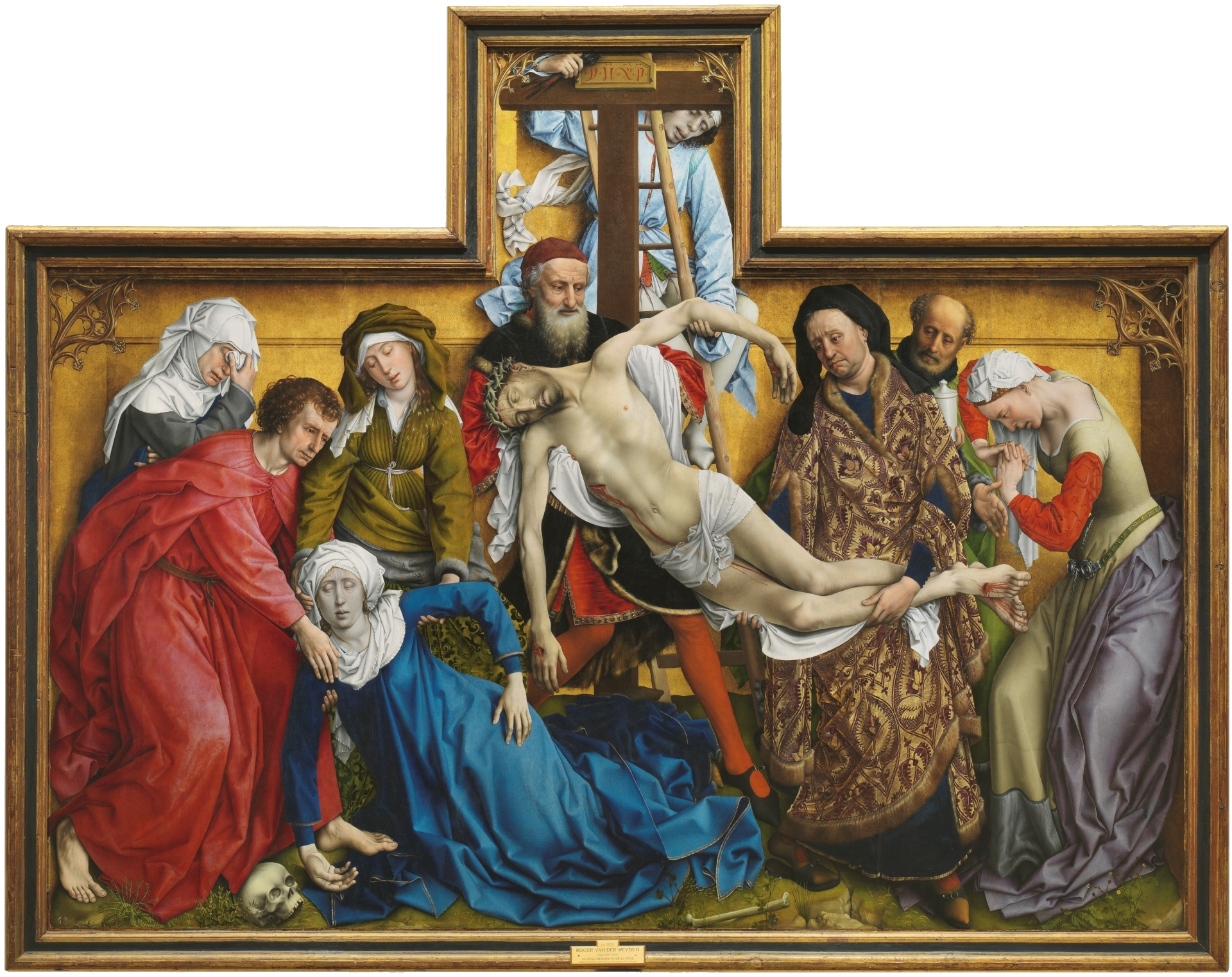
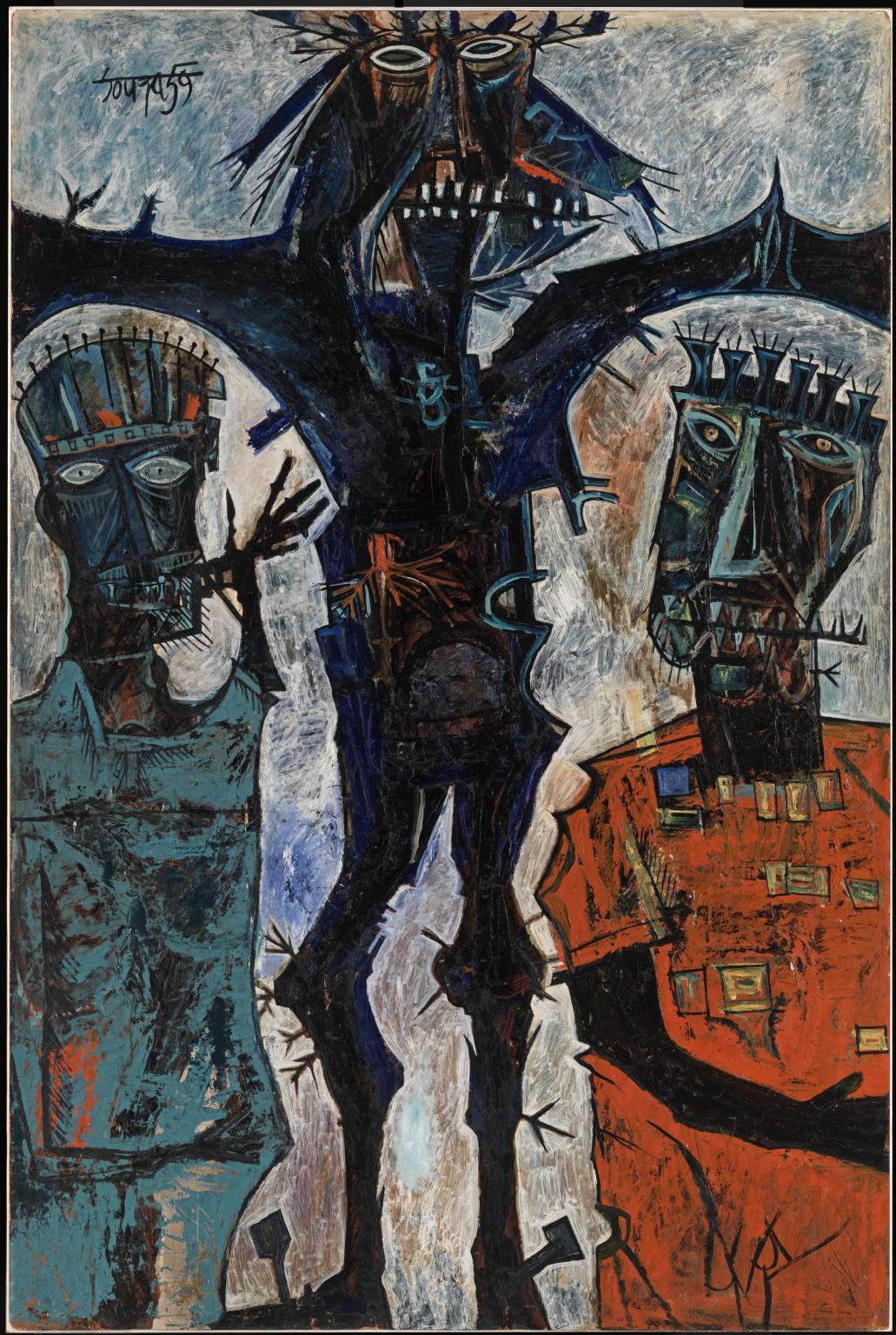
PODCAST EPISODE: “How a ‘biblically illiterate’ generation can discover Christian art,” Holy Smoke, July 28, 2020: I love hearing Ben Quash [previously] discuss specific artworks in detail! He brings such reverence, inquiry, wonder, curiosity, and openness to his looking and interpreting. For this interview with Carmel Thompson he has selected six Christ images spanning the early Renaissance through contemporary eras: the side-by-side Byzantine-inspired Healing of the Man Born Blind and Transfiguration panels of the Maestà Altarpiece by Duccio, the classically beautiful Descent from the Cross by Rogier van der Weyden at the Prado (“probably the painting that put realistic tears on the map of Western art”), Albrecht Dürer’s daring self-portrait as Christ, a homely Christ in the Wilderness: Consider the Lilies by Stanley Spencer, a grotesque Crucifixion by F. N. Souza (with reference to crucifixions by Grünewald, Picasso, Sutherland, and Bacon), and Michael Landy’s kinetic sculpture Doubting Thomas.

In addition to providing individual commentaries, Quash also talks about reading art theologically instead of just aesthetically, art as developing physical sight toward spiritual insight (external and internal seeing), the persistence of Christian iconography in the art of today, and the ways in which art can implicate the viewer.

Weyden, Rogier van der_Descent from the Cross
Rogier van der Weyden (Netherlandish, 1399–1464), Descent from the Cross, before 1443. Oil on panel, 204.5 × 261.5 cm. Museo Nacional del Prado, Madrid.

Crucifixion by F. N. Souza
F. N. Souza (Indian, 1924–2002), Crucifixion, 1959. Oil on board, 183.1 × 122 cm. Tate Modern, London.

There’s so much that’s quotable in the conversation, but because it applies to the ArtWay meditation I linked to above, I’ll just highlight part of his discussion of nonreligious artists’ attraction to Crucifixion imagery in the twentieth century. The Isenheim Altarpiece (1515), he says, a visual reference point for many modern artists,

shows an agonized Christ whose tongue is swollen and protruding from his mouth, whose body is covered in sores, whose skin is tinged green, whose fingers are curled up in agony. There’s no idealization here of what a death like that might have been. Instead there’s a strong assertion that the extremes of human pain and suffering are not alien to the Christian message. And yet it’s a religious image—this is a Christian image painted for a Christian context.

When that work comes into contact with the new traumas of the twentieth century—we talked about [Stanley] Spencer and the Second World War, here [Francis Newton] Souza experiencing colonialism in India—when that painting comes into contact with those sorts of extremes of human experience, it activates, it speaks to them, and calls forth new artistic responses, because it feels as though Christianity can still speak, even in those extremes. And I think Souza, like [Graham] Sutherland and [Francis] Bacon, while they may not have felt comfortable with traditional Christianity, saw the power of that Christian tradition to in some way help them articulate the traumas and the horrors of their own time.

So that’s a very interesting work, and typical of several examples of the extraordinary way in which we might think we’re in a secular age, but Christian iconography is probably as lively as ever—although it’s doing new things—in the work of modern and contemporary artists.

+++

SONGS . . .

from the GOOD SHEPHERD COLLECTIVE: Spearheaded by David Gungor and Tyler Chester, the Good Shepherd Collective [previously] “creates liturgical art to inspire the Christian imagination, that we may embody the love of Christ for the good of our neighbors.” They’ve just released an album of ten hymns. One of them is “Joyful, Joyful, We Adore Thee,” queued up in the liturgical service video below, and though it didn’t make the final album cut, I also really like their version of “His Eye Is on the Sparrow.”

from Family Company: Charles Jones, the lead singer on both of the above videos, is also a part of Family Company, an LA-based music collective celebrating the traditions of soul, blues, and R&B. You might enjoy these seventies covers of theirs: “Heaven Help Us All” (popularized by Stevie Wonder), featuring Charles Jones, and “Let Us Love” by Bill Withers, featuring Teddy Grossman. See more on their YouTube channel.

+++

BALLET SOLO: “Lift Every Voice and Sing”: Premiering at the Lincoln Center in 2019, Ounce of Faith is a contemporary ballet choreographed by Darrell Grand Moultrie, the score a mix of jazz standards, original music, and spoken word. This excerpt is performed by Khalia Campbell of the Alvin Ailey American Dance Theater, with movements suggestive of both struggle and pride.

Known as the Black National Anthem, “Lift Every Voice and Sing” was written in 1899 by writer and activist James Weldon Johnson and set to music by his brother, John Rosamond Johnson. The hymn is sung here, just the first of its three verses, by Aisha Jackson, with Dante Hawkins on piano. It’s a song of historical remembrance and lament but also of hope, a rallying cry to move forward together, in unity, out of our “dark past,” into the truth of God, continuing to fight injustice wherever we find it so that everyone can live free. It acknowledges that God is the one who leads his people in love and who wills liberty, and it supplicates: “Keep us forever in the path [of Your light], we pray.” Learn more about the hymn in this NPR feature. See also this UMC Discipleship article, especially the part where Dr. James Abbington, a choir director and a scholar of African American sacred music, answers the question, “Is this a hymn just for African Americans or is it for all people?”

+++

LITERARY ESSAY: “To Sit with an Onion” by Elizabeth Harwell: God “is tethered to this world in delight” and does not weary of it as we do, writes Elizabeth Harwell after having sat with a mussel shell for one hour, upon the advice of Robert Farrar Capon. (An exercise in wonder! Any inanimate object will do.) Harwell marvels at how the shell—blueberry-blue and milk-white, cold, curvaceous, smooth—was “an entire world to the mussel who called [it] home,” and now, since she picked it up off a Maine beach, it sits in a silver dish in her dining room, a reminder of the Creator’s quiet mirth. And there’s much more where that came from. “That shell represented one of thousands (millions?) of pearly homes that will never lay bare in front of human eyes—miles of ocean floor, covered in secret delights, that began as thoughts in my Father’s mind. We humans can be so self-important that we’ve never considered that God is enjoying parts of creation that none of us will ever see.” Read the whole essay at The Rabbit Room.

(Quash’s discussion of Stanley Spencer’s Wilderness series in the abovementioned podcast, in which Christ gets down on the ground like a curious child to observe wildflowers, scorpion, hen, dovetails nicely with this essay!)

Roundup: Ecotheology, “Kadosh,” black church music, and more

I didn’t post an Artful Devotion this week, as I struggled to satisfactorily put together image and song for any of the readings, but I’ve now cycled through all three lectionary years on the blog, which are stored in the archives. For content on Sunday’s lectionary reading from the psalms, Psalm 133, see “When Brothers Dwell in Unity (Artful Devotion)” (featuring a Chicago mural by William Walker and a joyful new psalm setting from the Psalter Project); see also the poem “Aaron’s Beard” by Eugene Peterson.

+++

NEW ALBUM: Quarantine Sessions by Eric Marshall: Eric Marshall is the frontman of and songwriter for the meditative art rock band Young Oceans. During the COVID-19 quarantine he recorded eleven of the band’s old songs acoustically in his home studio—just his voice and guitar—and has released them digitally on Bandcamp. Several music artists have been making stripped-down records during this season, and I’m digging it!

+++

ART COMMENTARIES from ART/S AND THEOLOGY AUSTRALIA

Art/s and Theology Australia is an online publication that aims to provoke public reflection and promote research on conversations between the arts and theology, predominantly in Australian contexts. Here are a few articles from the recent past that I particularly enjoyed.

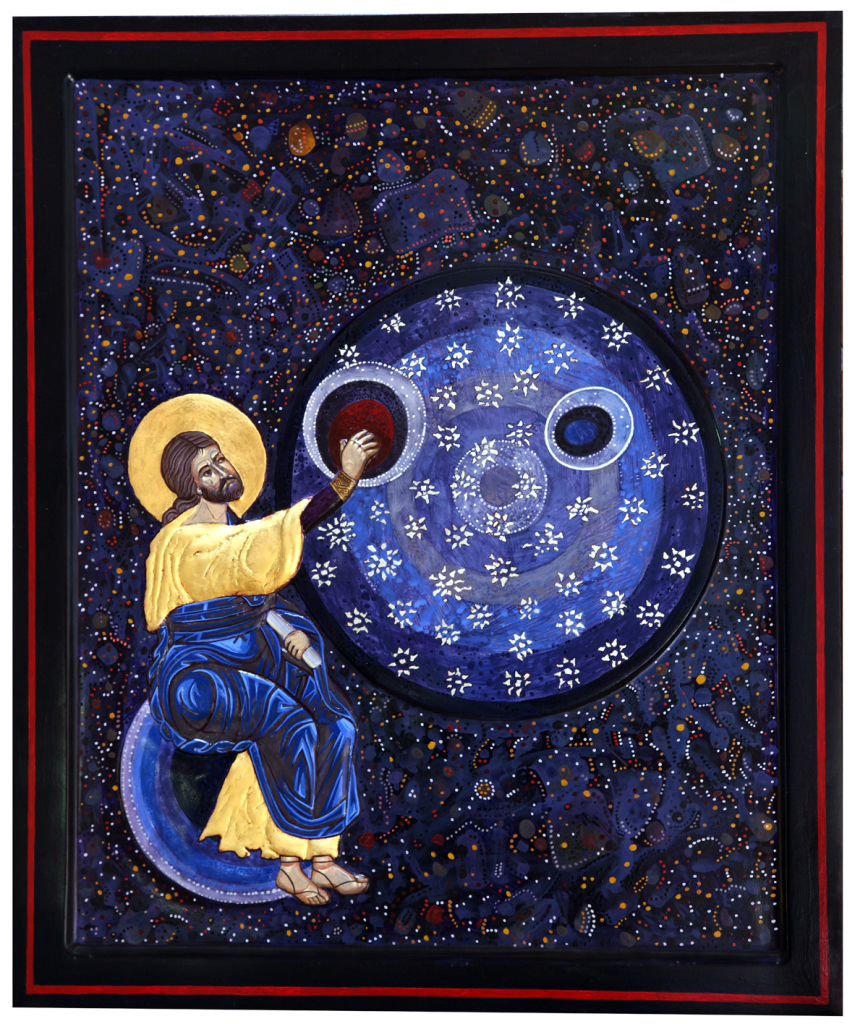
Galovic, Michael_Creation of Light in the Heavens
Michael Galovic (Serbian Australian, 1949–), Creation of Lights in the Heavens, n.d.

^^ “Jesus Dreaming: A Theological Reaction to Michael Galovic’s Creation of Lights in the Heavens by Merv Duffy: Creation of Lights in the Heavens by contemporary artist and iconographer Michael Galovic is an authentically Australian reading and rewriting of one of the Byzantine creation mosaics at Monreale Cathedral. Like its visual referent, it shows the Logos-Christ seated on the cosmos, hanging the sun in place (medieval artists tended to show God the Son, who is depictable, as Creator), but the gold background, used in icons to represent the eternal uncreated light of God, is replaced with dots, curves, and circles that represent the Dreamtime of Aboriginal theology, the origin of time and eternity.

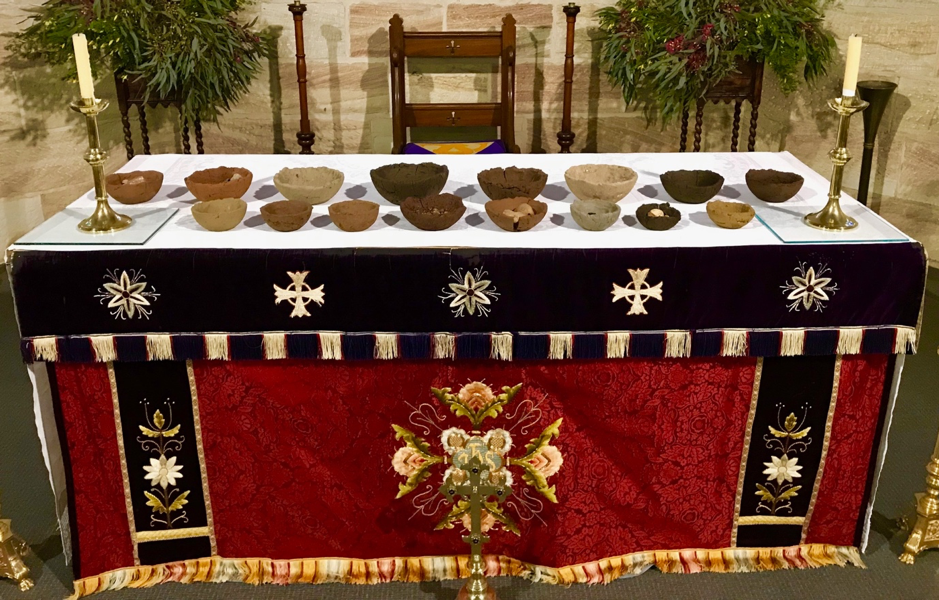
Dunstan, Penny_Sixteen Earth Bowls
Penny Dunstan, Sixteen Earth Bowls, 2018. Installed at Holy Trinity Anglican Church, Merriwa, for the Festival of the Fleeces.

^^ “Sixteen Earth Bowls” by Penny Dunstan: Soil scientist and visual artist Penny Dunstan has crafted bowls out of topsoil from rehabilitated coal mines in the Hunter Valley in Warkworth, New South Wales, which she exhibits in churches, among other places. “Making earth bowls is a way of thinking about my ethical responses to soil use in a post-mining landscape,” she writes. “It is a way of thinking with my heart and not just my head. As I work with each Hunter Valley topsoil, I come to understand each as an individual, a special part of God’s creation. Each soil behaves according to its own chemical nature and historical past when I fashion it into a bowl shape. . . .

“These soils, full of tiny lives, are responsible for growing our food, making our air and storing atmospheric carbon. Our very lives as humans on the earth depend on them. By fashioning these soils into bowls and placing them in sacred places, I hope to remind us to honour the earth that we stand upon, that earth that speaks to us by pushing back at our feet.” (Note: See also Rod Pattenden’s ArtWay visual meditation on Dunstan’s work.)

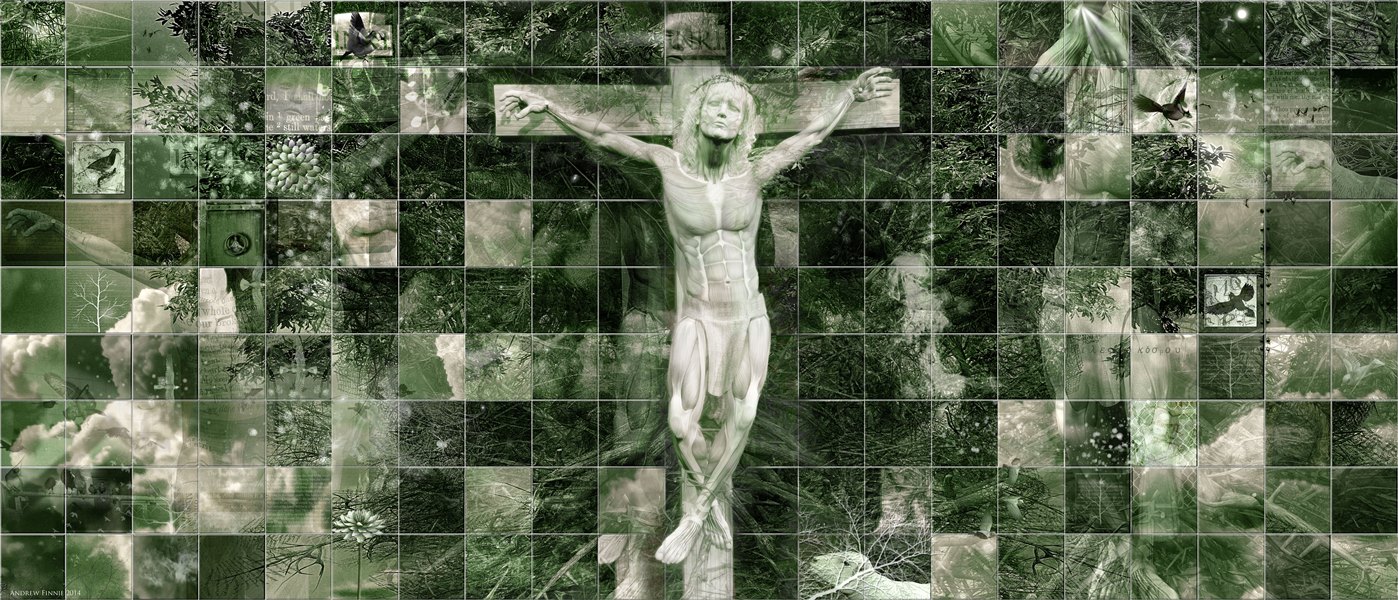
Finnie, Andrew_The Body of Christ, the Tree of Life
Andrew Finnie (Australian, 1957–), The Body of Christ, The Tree of Life, 2014. Pigment print on Hahnemuhle paper, 78 × 182 cm.

^^ “The Cross and the Tree of Life” by Rod Pattenden: “One of the pressing questions for the Church is how we see Christology being renewed in the face of climate change and the potential for the quality of life on this planet to decline,” writes art historian Rod Pattenden [previously]. “Who is Jesus for us in the midst of the profound changes that are occurring to the earth, water, and air of our world? . . .

Andrew Finnie’s image The Body of Christ, The Tree of Life”—a large-scale ecotheological digital collage—“is an attempt to re-imagine the figure of Christ in conversation with the earth and the networks that sustain human life in all its thriving beauty. Here, the traditional figure of the cross has become entwined in the roots of the tree, a tree of life that is giving form to the variety and beauty of the natural world.”

+++

SONG: “Kadosh” by Wally Brath, sung by Nikki Lerner: The Kedushah is part of the Amidah, the central prayer of the Jewish liturgy. Its first verse is taken from the song of the seraphim in Isaiah 6:3: “Holy, holy, holy, is the LORD of hosts; the whole earth is full of his glory!” (Kadosh means “holy.”) In this original composition for voice, piano, and string quartet, Wally Brath [previously] has combined this Hebrew exclamation from the book of the prophets with an English excerpt from the Lord’s Prayer taught by Jesus in Matthew 6:10: “Thy kingdom come, thy will be done on earth as it is in heaven.” [HT: Multicultural Worship Leaders Network]

The performance captured in this video, featuring Nikki Lerner, took place at Winona Lake Grace Brethren Church in Winona Lake, Indiana, on July 11, 2020. A full list of performers is given in the YouTube description.

+++

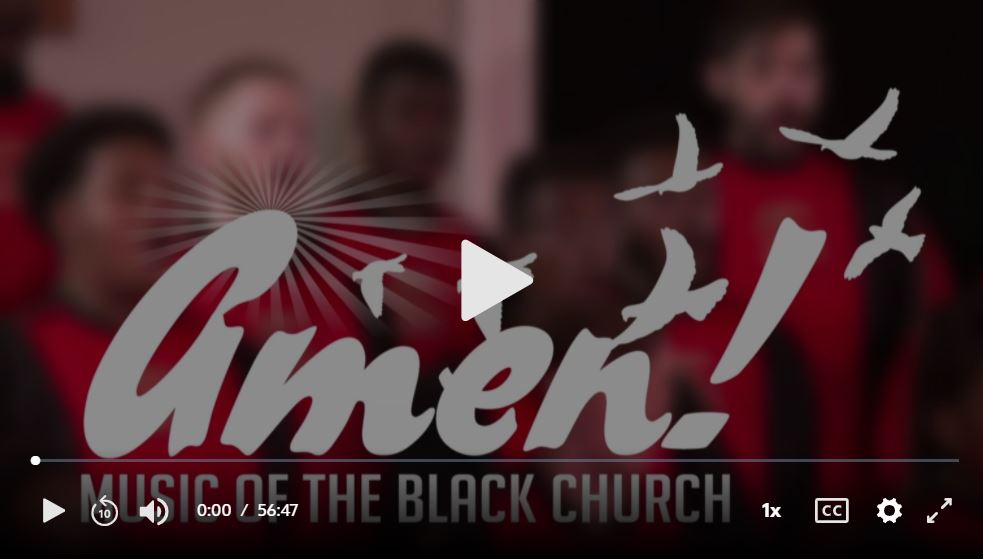
CONCERT FILM: Amen! Music of the Black Church: Recorded before a live audience at the Second Baptist Church in Bloomington, Indiana, and airing April 26, this PBS special explores the rich traditions, historical significance, and meaning of black church music. Dr. Raymond Wise leads the Indiana University African American Choral Ensemble in twenty-one spirituals, hymns, and gospel songs, showing how black church music is not monolithic. He demonstrates the stylistic spectrum you can find among black church communities using a song text derived from Psalm 24:7–10 (“Lift up your heads . . .”): one performed with the European aesthetic preferred in more affluent congregations, one a classical-gospel hybrid, and one pure gospel. One thing I learned from the program is that there is a tradition of shape-note singing in the black church! (See, e.g., The Colored Sacred Harp.) [HT: Global Christian Worship]

Music of the Black Church

Here’s the set list:

  • “We’ve Come This Far by Faith” by Albert Goodson
  • “Kumbaya”
  • “Run, Mary, Run”
  • “Oh Freedom”
  • “What a Happy Time” by J. M. Henson and J. T. Cook
  • “Amazing Grace” by John Newton
  • “Ain’t Got Time to Die” by Hall Johnson
  • “I’ve Been ’Buked”
  • “Lift Up Your Heads” by Emma Louise Ashford, arr. Lani Smith
  • “Lift Up Your Heads” by Clinton Hubert Utterbach
  • “Lift Up Your Heads, All Ye Gates” by Raymond Wise
  • “Glory, Glory, Hallelujah”
  • “Jesus on the Mainline”
  • “I Need Thee Every Hour” by Annie S. Hawks and Robert Lowry
  • “You Can’t Beat God Giving” by Doris Akers
  • “Come to Jesus” by E. R. Latta and J. H. Tenney
  • “We Shall Overcome” by Charles Tindley
  • “Lord, Keep Me Day by Day” by Eddie Williams
  • “Lord, Do It for Me” by James Cleveland
  • “Oh Happy Day” by Edwin Hawkins
  • “I’ve Got a Robe” by Raymond Wise
  • “Hallelujah, Praise the Lord, Amen” by Raymond Wise

+++

INTERVIEW: Last September The Cultivating Project interviewed Malcolm Guite [previously] on his latest poetry collection After Prayer, the poet-priest George Herbert, the life of a writer, art as faithful service, doubt and despair, his Ordinary Saints collaboration with Bruce Herman and J.A.C. Redford, his friendship with Michael Ward (author of Planet Narnia), the blessing of seasons (both earthly and liturgical), and making room for joy. The interview includes three of Guite’s poems: “Christ’s side-piercing spear,” “A Portrait of the Artist,” and “St. Augustine and the Reapers.”

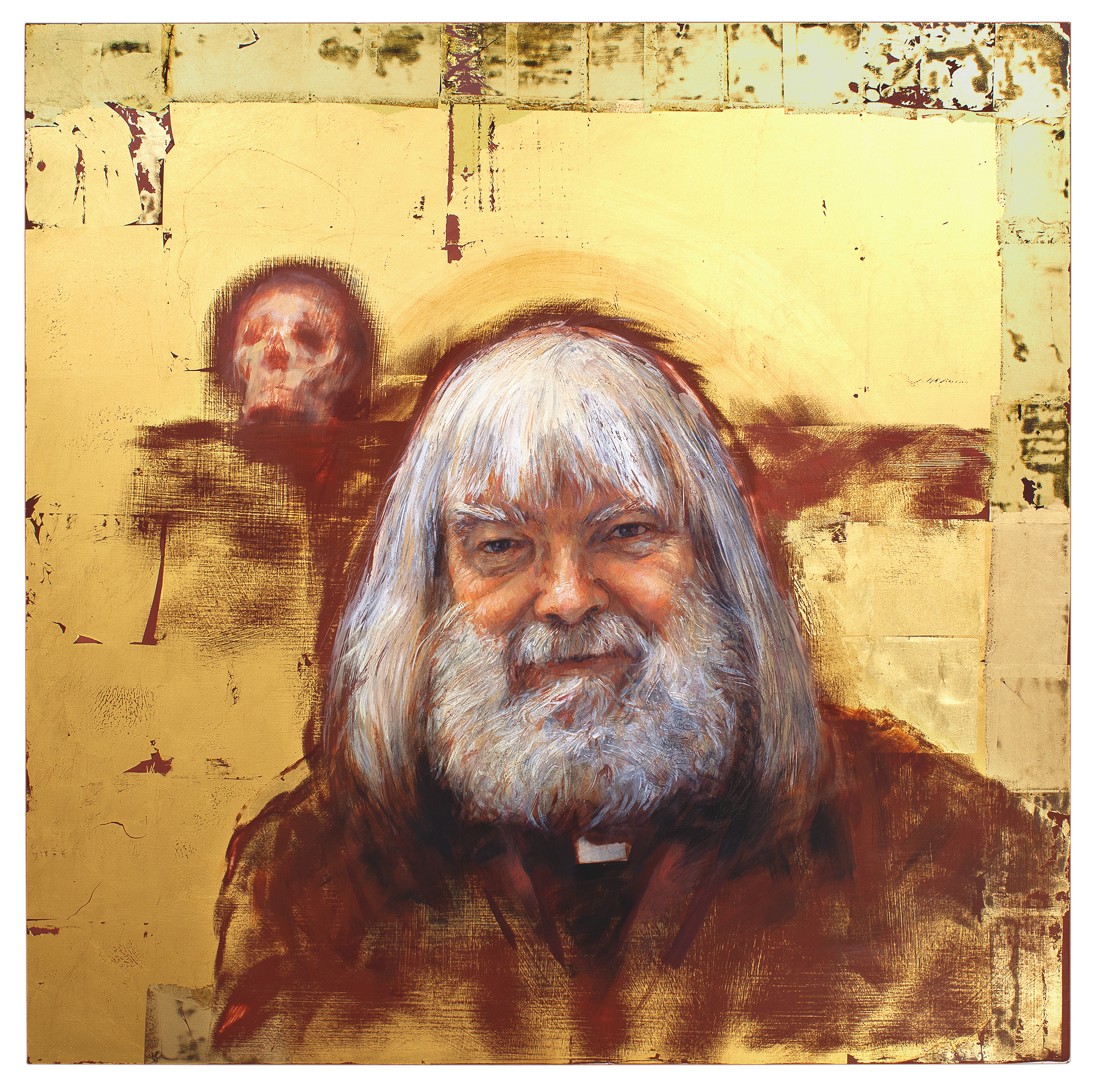
Herman, Bruce_Malcolm Guite
Bruce Herman (American, 1953–), Malcolm Guite, 2016. Oil on panel with gold leaf, 30 × 30 in.

Roundup: Carrying a boulder, toppling statues, art and prayer retreat, and more

NEW SONG: “Trust in You” by Antoine Bradford: Alternative soul artist Antoine Bradford released the original song “Trust in You” on April 21, and then came this acoustic version, which simultaneously moves me and stills me! Another single, “How Many Times,” came out yesterday, and a full-length album is on its way, on the Humble Beast label.

+++

PODCAST EPISODES

“Andre Henry on Systemic Racism,” Conversing (Fuller Studio), May 7, 2020: Writer, musical artist, speaker, and activist Andre Henry sits down with Mark Labberton, president of Fuller Theological Seminary (where Henry earned a master’s in 2016), to share his personal journey of learning about systemic racism and some of the ways he’s exposing and pushing against it. He talks about growing up the son of Jamaican immigrants in Stone Mountain, Georgia, and the early influence of reggae music; his moving to New York City during the age of stop-and-frisk to take a job as a worship leader; and his time at Fuller in California, where, in the wake of Freddie Gray’s death, he shifted from the perspective of “Black people are treated differently in the US” to “The US is a fundamentally racist society.”

Along the way, he discusses “whiteness” as an invention made to subjugate other people, not letting the news cycle dictate when you talk about racism, his study of social movement theory and the post-Shoah theologians, his realization that black people are not powerless, his writing the songs “It Doesn’t Have to Be This Way” and “How Long,” the failure of many (white) church ministers to minister to black congregants, the resistance he met while interviewing for pastoral positions, the religious doubts that surfaced after repeatedly hearing from Christian friends that “Racism isn’t a priority for God” and that social activism distracts from the gospel, and more.

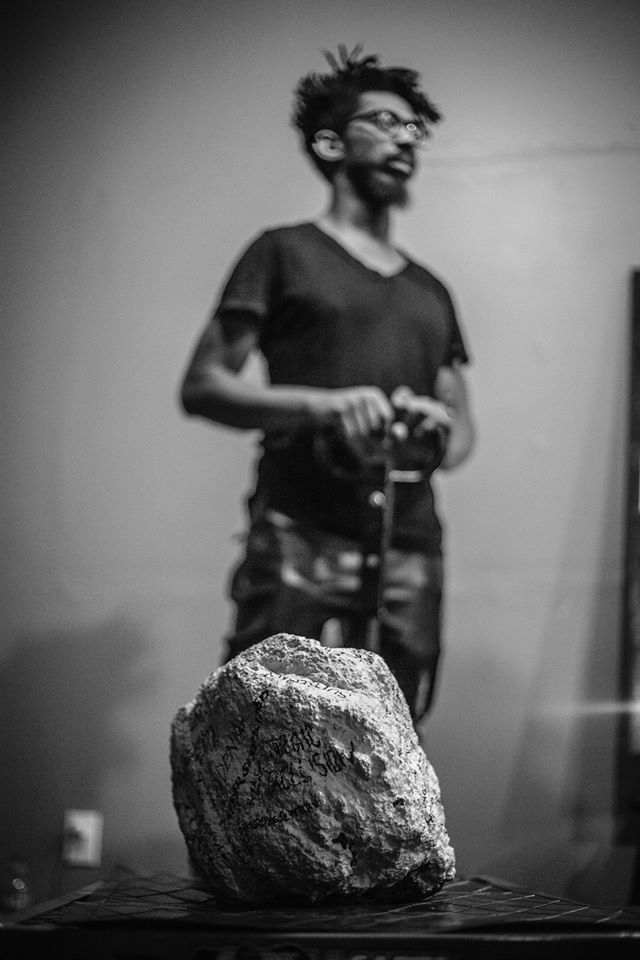
I particularly appreciated hearing Henry describe, starting at 28:36, an art piece he performed over the course of six months in 2016, in which he pulled around a hundred-pound boulder in a wagon everywhere he went—work, classes, dinners, church, grocery store, etc. The boulder was painted white and had words like “Mass incarceration,” “police brutality,” and “white fragility” written on it. Labberton, who was one of the many witnesses of this performance, interprets its intent as “I’m trying to externalize a burden that is the burden that I walk with every day, and I want you to see it for what it actually is, and the weightiness of it.” “Stunning,” “profound,” “a significant liturgical act,” and “a Jeremiah kind of an enactment” are some of the ways Labberton describes Henry’s boulder-carrying, the latter referring to the biblical prophet’s outrageous symbolic acts, such as the retrieval of soiled, tattered underwear, the breaking of a clay jug, and the wearing of an oxen yoke. (As a side note, one of my all-time favorite articles from the esteemed Image journal is “The Avant-Garde and Sacred Discontent: Contemporary Performance Artists Meet Ancient Jewish Prophets” by Wayne Roosa.)

Andre Henry carrying a boulder

To learn more about Andre Henry, visit his website, http://andrehenry.co/, where you can find his Hope and Hard Pills podcast, blog, and music and sign up for his newsletter. See also his self-introduction on Twitter and the short video Fuller Studio made with him in 2016, “Culture Care and Music.”

“Why Christians Have a Reputation for Smashing Statues,” Quick to Listen, interview with Matthew Milliner, July 8, 2020: Following the killing of George Floyd in May, protesters have torn down or vandalized dozens of statues connected to the Confederacy and to other controversial historical figures like Christopher Columbus. Matthew Milliner, associate professor of art history at Wheaton College, joins Christianity Today’s global media manager Morgan Lee and editorial director Ted Olsen “to discuss how much earlier Christian battles over statues echo today’s fights, what Christians have learned that might help us better understand the call to remove statues today, and whether we should even be creating memorials and monuments in the first place.”

Milliner references the Emancipation Memorial and Mary McLeod Bethune statue in DC’s Lincoln Park; the National Memorial for Peace and Justice in Montgomery, Alabama [previously]; Maya Lin’s Vietnam Veterans Memorial; the St. Augustine Foot Soldiers Monument; and UNC–Chapel Hill’s Silent Sam monument to the Confederacy and lesser-known Unsung Founders Memorial. After the interview he created a chart titled “What to Do with Monuments,” providing five options and citing historical analogues as well as contemporary examples in the US and internationally.

+++

OBITUARY: “Ennio Morricone, Oscar-Winning Composer of Film Scores, Dies at 91”: Regarded as one of the most influential film composers of all time, Ennio Morricone wrote over four hundred scores for cinema and television, as well as over a hundred classical works. I know him best for the soundtrack of The Mission, especially the “Gabriel’s Oboe” theme, which is played in the movie by the Spanish Jesuit priest Father Gabriel (Jeremy Irons) as an outreaching gesture of friendship to the Paraguayan Guarani.

+++

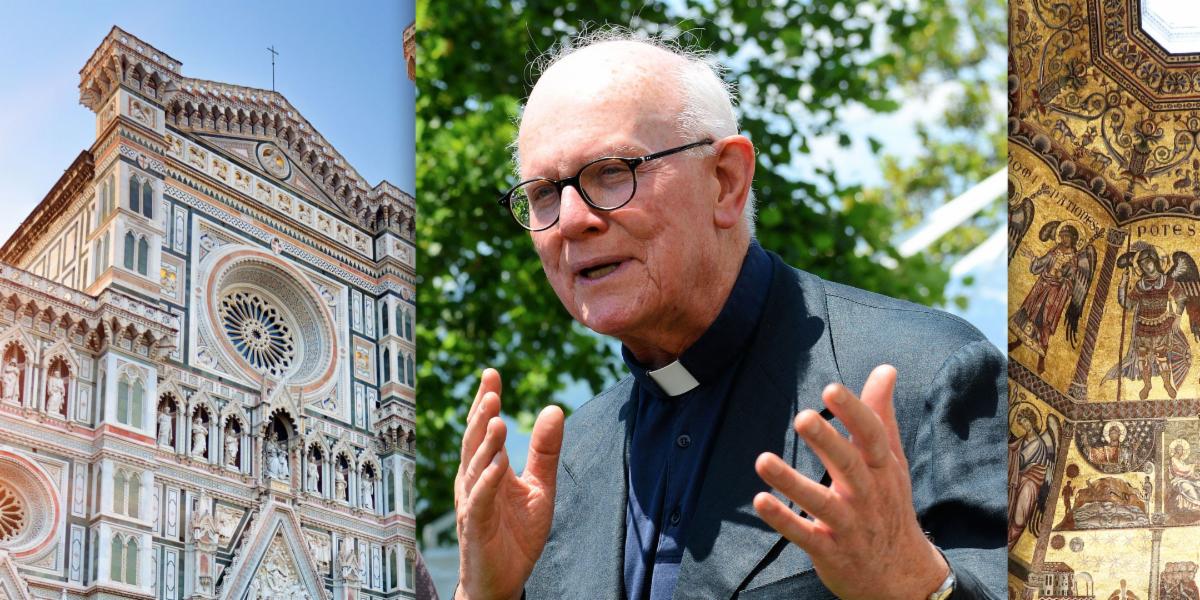
ONLINE RETREAT: “The Art of Prayer” with Monsignor Timothy Verdon: On August 7 Paraclete Press is hosting an online retreat with Monsignor Timothy Verdon, a Roman Catholic priest and art historian based in Florence, Italy. As in his book Art and Prayer: The Beauty of Turning to God, Msgr. Verdon will reflect on the ways in which visual art has historically supported, and can still support, prayer, guiding participants in meditating on images from the lives of Christ, Mary, and the saints. View the schedule and reserve your ticket here.

Timothy Verdon

+++

CHORAL ANTHEM: “Lead Me, Lord” | Text: Psalm 5:8, Psalm 4:9 | Music by Samuel Sebastian Wesley, 1905 | Performed by the Chapel Choir of Girton College, Cambridge, June 2020 [HT: Malcolm Guite]

Lead me, Lord,
Lead me in thy righteousness;
Make thy way plain before my face.
For it is thou, Lord,
Thou, Lord, only,
That makest me dwell in safety.

Roundup: Why Art Matters, “Spirit and Endeavour” exhibition, and more songs in lockdown

VIDEO TALK: “The Breath of Life: Why Art Matters in a Pandemic” by James K.A. Smith: In this half-hour Zoom talk released June 2, Image journal editor in chief Jamie Smith [previously] discusses the ability of the arts to stimulate our cultural imagination in much-needed ways. “The arts matter in a pandemic,” he says, “because they shape us for the work of reshaping and rebuilding society. In other words, we all need artists to continue creating for us so the rest of us can cultivate the imagination we need to re-create our common life, our social bonds.” And again: “The arts train our imagination so that we relearn to see what we need to see. . . . It’s art as imagination therapy, it’s art as an ophthalmology of the soul that we need in order to build and sustain and restore the institutions of a healthy, flourishing society. . . . If we’re going to imagine the world otherwise, we need imaginations that are trained in subtlety, that have been humbled by mystery, and that are infused with infinity.”

At 14:44 Smith introduces three ways in which art matters during and after a pandemic: art helps us (1) attend, (2) transcend, and (3) mend. That is, art helps us attend more carefully to the world and our neighbors, calling sometimes for gratitude, sometimes for grief, often both; art helps us transcend despair, attesting to the “something more” we long for (“the arts enable us to transcend the tragic when they invite us into a joy that forgets nothing”); and art helps us mend our tattered social fabric by helping us to better understand one another and to imagine possibilities. For each of these functions he provides a few concrete examples, including the current Home Alone Together exhibition.

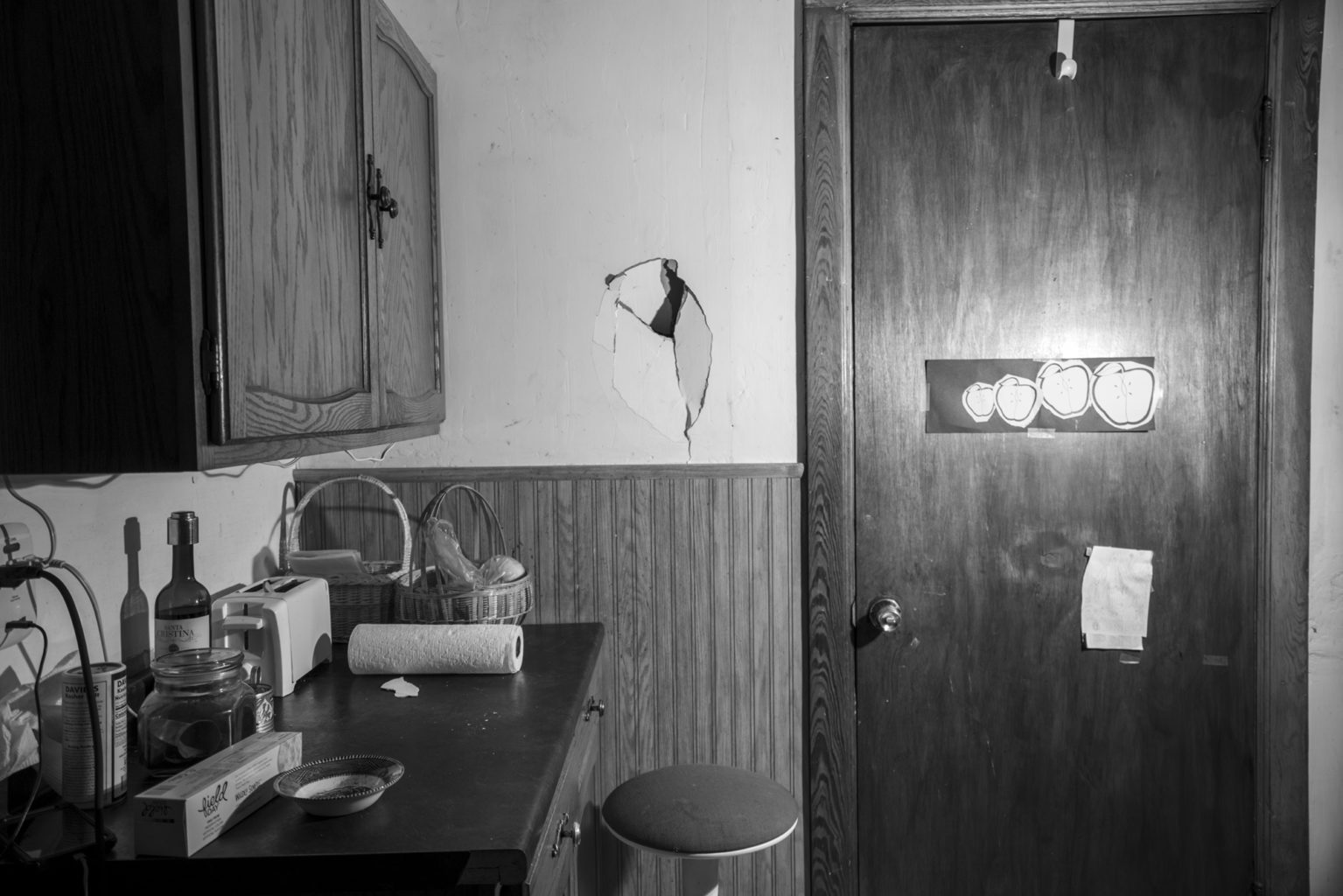
Kitchen
Photo by Yola Monakhov Stockton, May 17, 2020, for the “Home Alone Together” exhibition

+++

Along these same lines . . . at the end of the Makers & Mystics podcast episode “Art as Healing,” recorded live last year at The Farm House in Charlottesville, Virginia, and released June 5, 2020, host Stephen Roach reads an excerpt from a book he’s writing:

In our present day, it can be easy to conclude from the various crises taking place around the world, all the injustice and political unrest, the rampant poverty and environmental threats, persecution and killings, diseases and displacements, that art and beauty are mere luxury. It could even make some feel that to focus on art and beauty is insensitive or shortsighted. However, I want to suggest that it’s precisely because of these desperate situations that the artist is called upon to beautify the world with art and engage these issues from a vantage point of hope.

The desperate situation in our world calls for the artist to emerge as a prophetic voice for change and to offer heaven’s alternatives. I’m reminded of the example of Iraqi cellist Karim Wasfi, who countered the tragedy of war by playing music at the sites of car-bomb explosions, with smoldering buildings in the background of his concertos. Wasfi said, “The other side chose to turn every element, every aspect of life in Iraq into a battle and into a war zone. I chose to turn every corner of Iraq into a spot for civility, beauty, and compassion.”

This is the call of the artist in collaboration with God: we are called to be the architects of hope and to counter the destruction of life with the opposite spirit in beauty and creativity.

Here’s a video of Wasfi playing an original cello composition in the destroyed buildings of Al Shifa Hospital in Mosul, Iraq, in September 2018, where some two thousand explosive hazards were removed by UNMAS (United Nations Mine Action Service):

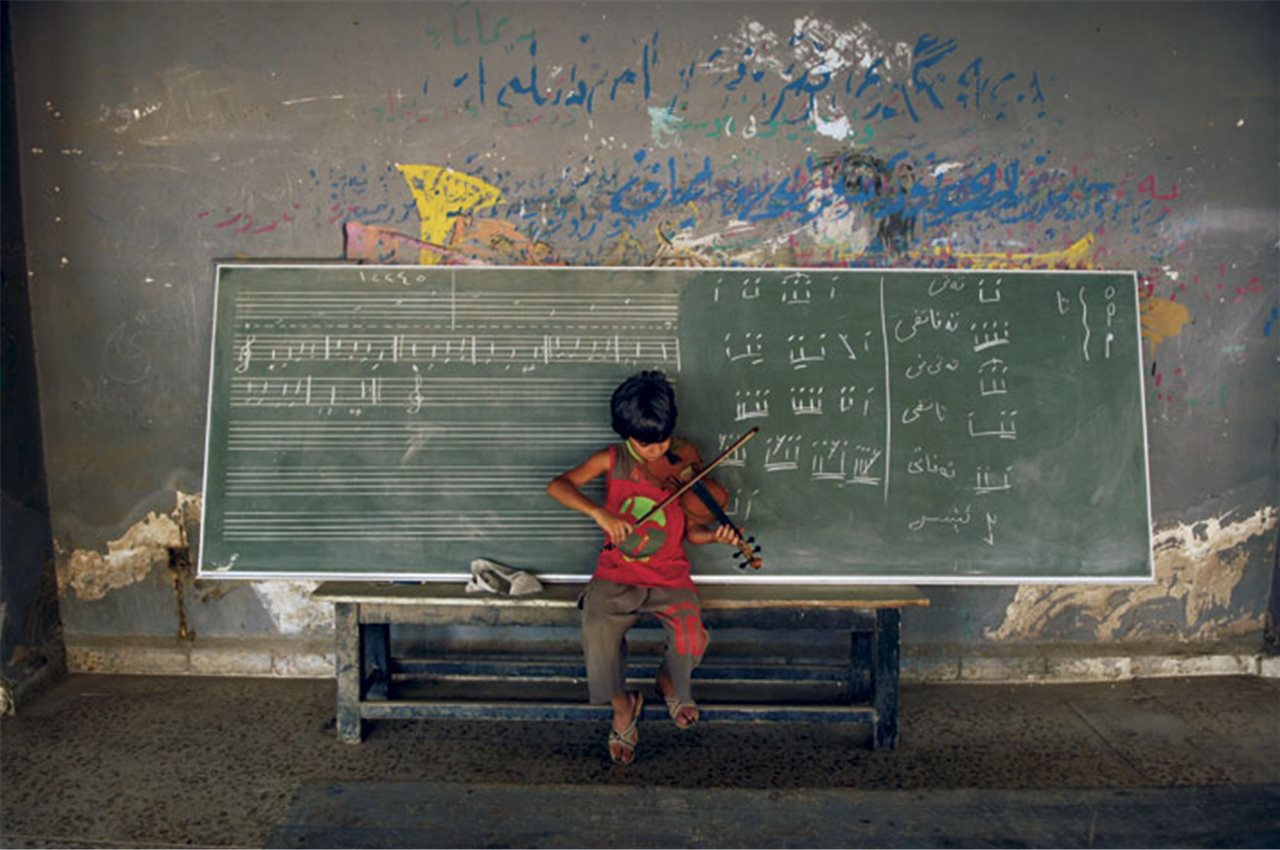
It reminds me of a photograph by Julie Adnan that I saw in National Geographic a decade ago and that, of all the extraordinary photos published in that magazine, has stuck with me the most. Its caption reads, “Some 160 miles northeast of Baghdad, in a Sulaymaniyah music hall ravaged by war, looting, and neglect, a violin-playing boy sounds a note of hope. His teacher, Azad Maaruf, lives there, instructing scores of students.”

Boy playing violin
Photo by Julie Adnan, taken in Sulaymaniyah, Iraq, published in the February 2010 issue of National Geographic

The expression “fiddling while Rome burns,” which legend says the emperor Nero did in 64 CE, is used deprecatingly to refer to the doing of something trivial and irresponsible during a crisis. But beauty is not trivial, and its pursuit during times of crisis does not indicate apathy. I love that this little boy wants to play music while bombs sound out around him. Making art can be a daring act of resistance, an assertion of and call to common humanity, a better way. It’s life-affirming. As artist Laura Bon says: “Artists need to create on the same scale that society has the capacity to destroy.”

+++

NEW SONG: “The Medicine” by Dee Wilson: Dee Wilson of Common Hymnal premiered this song on his YouTube channel on May 27, and then Good Shepherd New York and friends put together a beautiful arrangement for the church’s June 7 virtual worship service. It’s a prayer that God would save us from the virus of racism, which harms and divides. The chorus goes: “We don’t know what to do, so we turn our eyes to you. We’ve run out of words to say. But if you come and have your way, you can save us from ourselves before our wounds hurt someone else. We need you now.” The video features Wilson on lead vocals, Liz Vice on background vocals, Orlando Palmer and Charles Jones on keyboard, Franklin Rankin on guitar, Michael Decena on bass, and Terence F. Clark on drums.

Every Sunday since March 15, Good Shepherd New York (“an interdenominational church helping New Yorkers embody the love of Christ for the good of our neighbors”) has been releasing a worship service video with liturgy, prayer, sermon, open communion—and phenomenal music led by associate pastor David Gungor, which engages current events. The whole services are worth watching/participating in, but here are a few musical highlights I’ve queued up. I especially like the medleys, which blend together excerpts from a range of songs:

  • June 21, instrumental prelude: “Strange Fruit” by Abel Meeropol, arr. Edward W. Hardy
  • June 7: MEDLEY: “What’s Goin’ On?” by Marvin Gaye / “Which Way Are You Goin’?” by Jim Croce / “Will We Ever Rise” by the Brilliance
  • May 31: “Let the Waters” by Michael Gungor (also a standalone video)
  • May 10: MEDLEY: “My Brother, My Sister” by David Gungor / “Higher Love” by Steve Winwood
  • March 22: MEDLEY: “All Who Are Thirsty” by Brenton Brown and Glenn Roberts / “Take Me to the River” by Leon Bridges / “Amazing Grace” (with traditional English folk tune RISING SUN)
  • March 15: “Until These Tears Are Gone” by Young Oceans

A link to the digital worship guide for each week is provided in the video’s YouTube description field.

+++

NEW COVER SONGS

“Something Has to Break”Written by Kierra Sheard, Mia Fields, and Jonathan Smith – Performed by Tinika Wyatt, Andy Delos Santos, Julia Carbajal, Eric Lige, and Shawn Halim (members of the Urbana Worship Team) – Premiered at InterVarsity Live! on June 5, 2020 [HT: Global Christian Worship]

“Way Maker” – Written by Sinach (Osinachi Kalu) – Performed by Zanbeni and Benny Prasad – This husband-wife duo [previously] brings a fusion of R&B, jazz, and Indian classical music to this 2015 gospel song.

+++

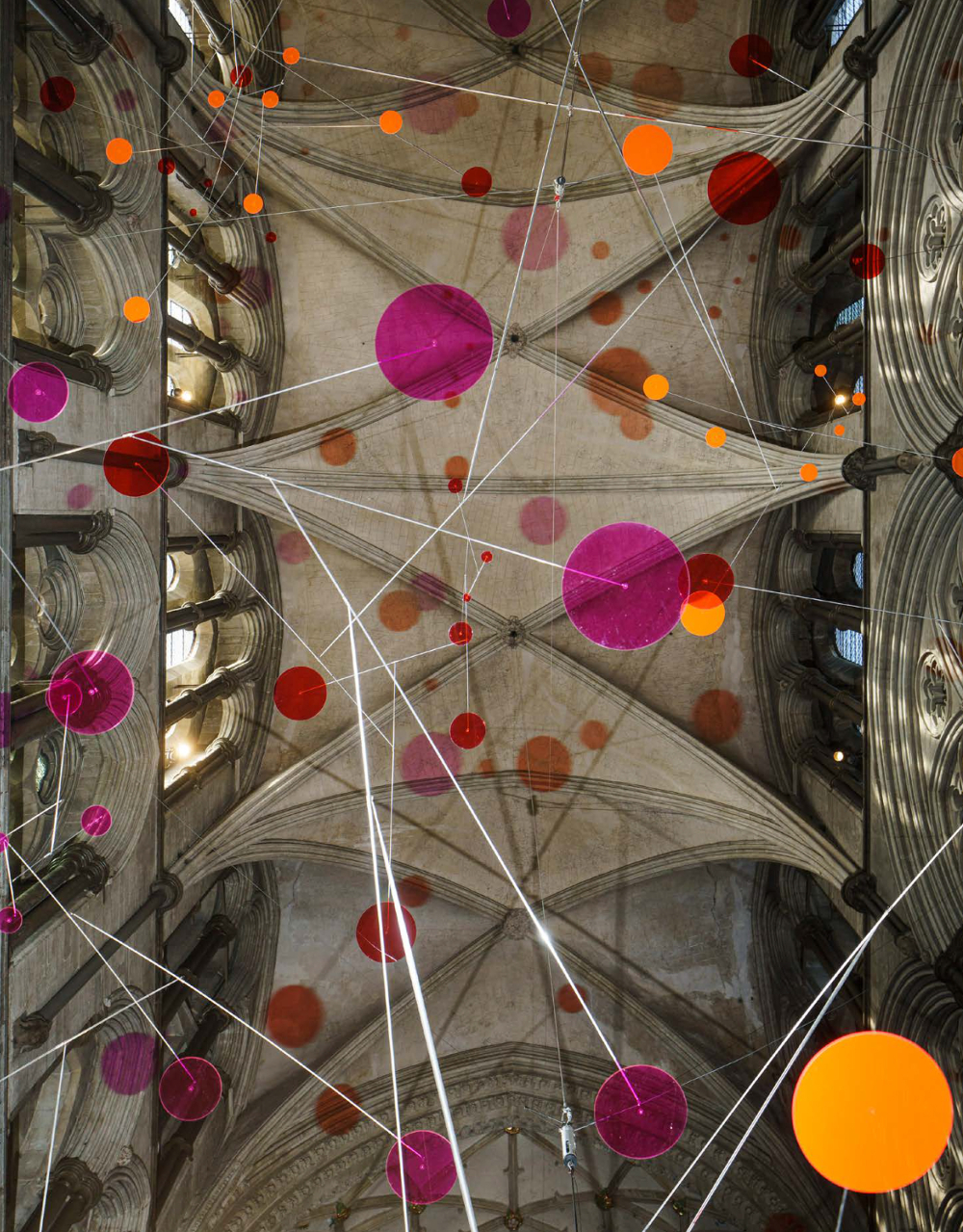
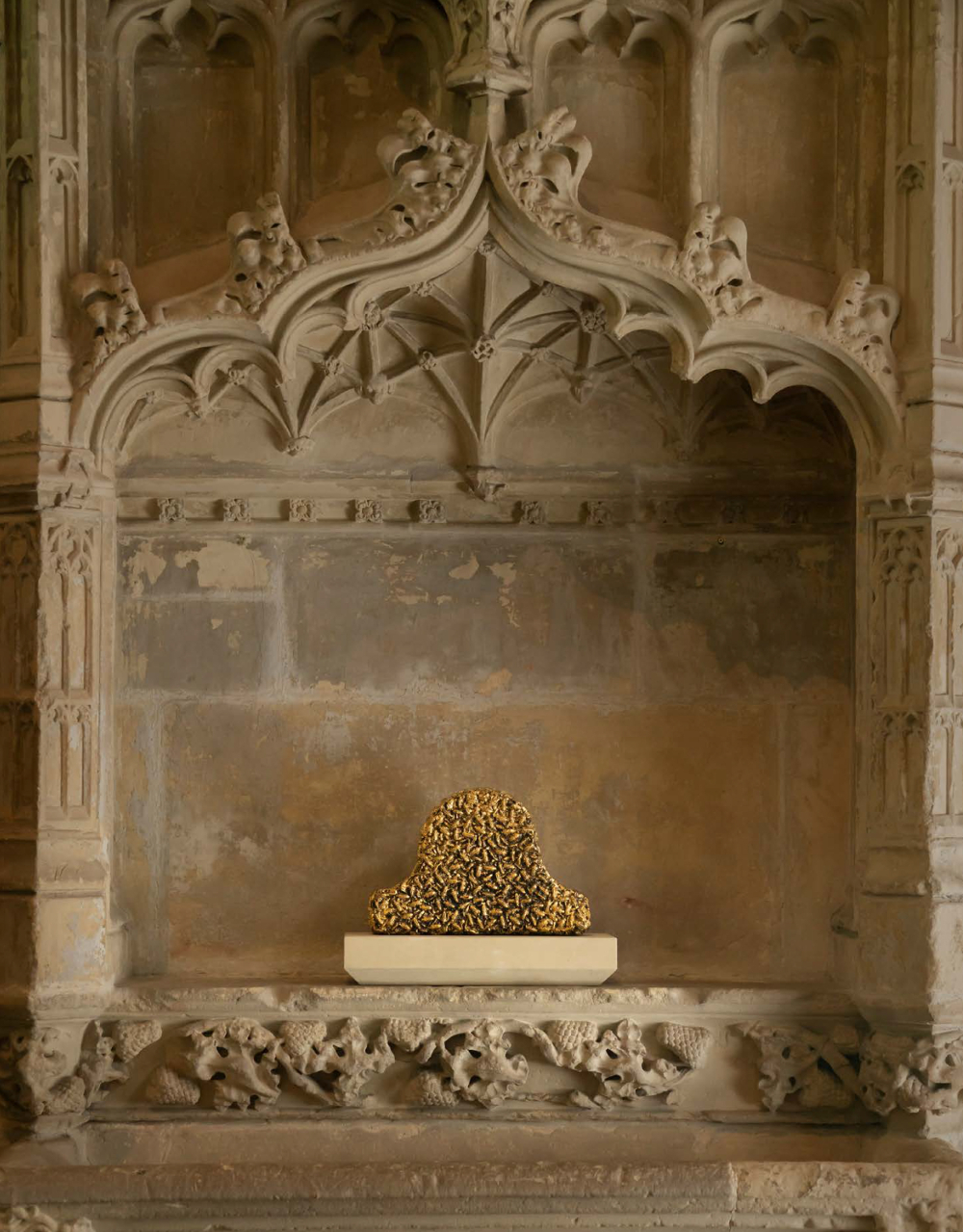
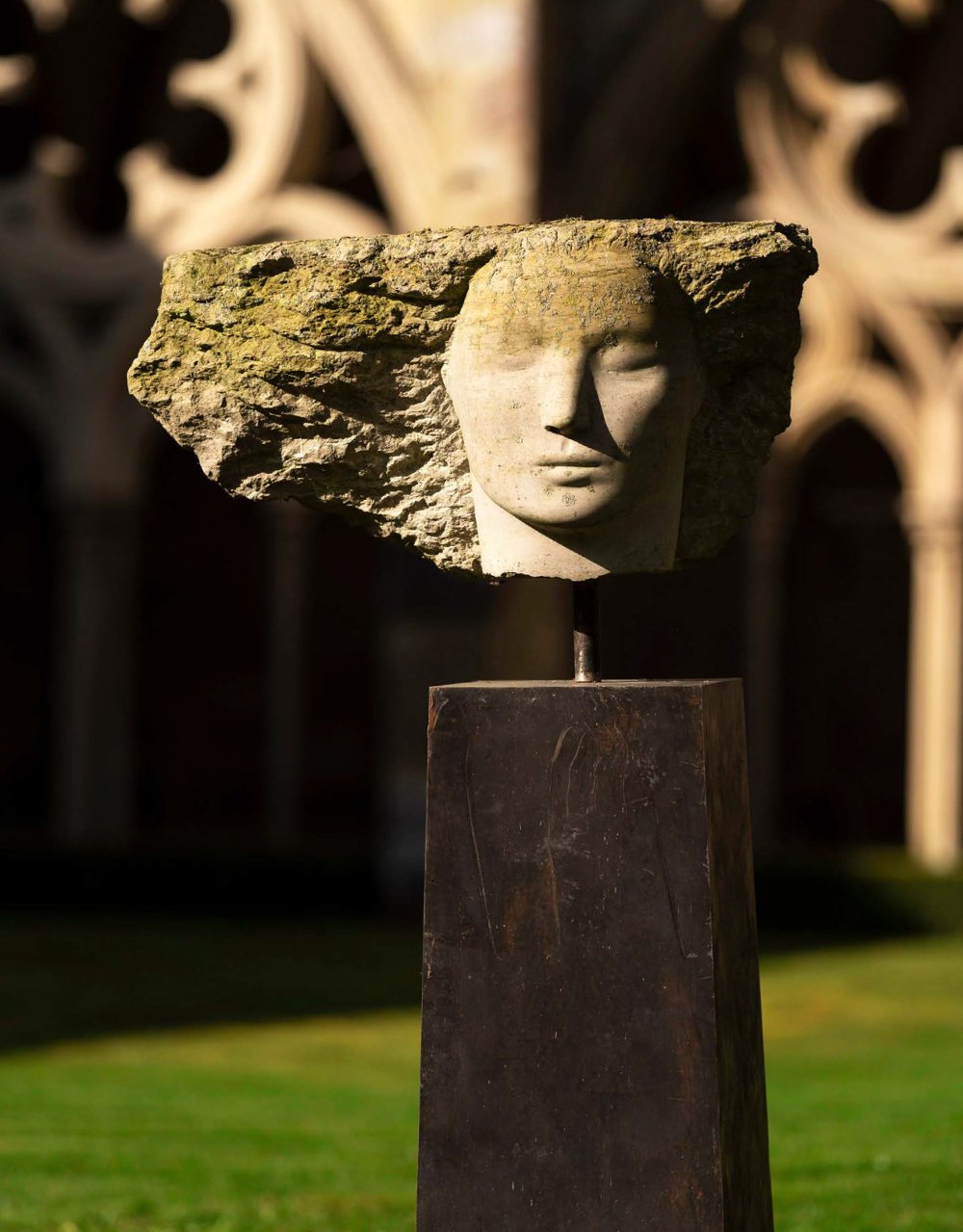
EXHIBITION / VIRTUAL ART TOUR: Celebrating 800 Years of Spirit and Endeavour: To celebrate the eight hundredth anniversary of the laying of its first foundation stone, Salisbury Cathedral organized a major exhibition this year, which was three years in the making. After the art was sited and installed both inside the building and outside on the lawns, COVID-19 hit, and the cathedral was forced to close. But the planning team adapted to the setback, developing a virtual tour that uses panorama technology to enable the viewer to enter the cathedral virtually, watch a video introduction, and navigate around the exhibition space by clicking on thumbnail images of the works and links to the corresponding catalog pages.

Curated by Jacquiline Creswell, who has led the cathedral’s visual arts program for the past eleven years, the exhibition features twenty-nine works of art by significant artists of the modern and contemporary eras, including Henry Moore, Elisabeth Frink, Antony Gormley, Mark Wallinger, Shirazeh Houshiary, and Subodh Gupta. Nine of the works are from the cathedral’s permanent collection, while the other twenty were specially brought in, of which two were newly commissioned: the abstract, solar-powered mobile in the nave by Daniel Chadwick, and the light installation in the north porch by Bruce Munro.

The beautifully photographed, ninety-page exhibition catalog is available for free download from the Spirit and Endeavour page of the cathedral website. Besides providing commentary on all the artworks, it also includes an essay by Sandy Nairne that discusses significant art commissions by British churches in the twentieth and twenty-first centuries and the difference between viewing art in a cathedral versus a museum gallery. Another available resource is a guide for kids with questions and activities. While I do hope the interior portion of the exhibition is able to open to visitors soon, I’m grateful that the online resources enable me to “visit” from my living room in the US.

Chadwick, Daniel_Somewhere in the Universe
Daniel Chadwick (British, 1965–), Somewhere in The Universe, 2019–20. Acrylic sheet, stainless steel, solar-powered motor, 1,000 × 1,000 cm. Temporary installation at Salisbury Cathedral. Photo: Ash Mills.

Woodrow, Bill_Clockswarm
Bill Woodrow (British, 1948–), Clockswarm, 2001. Bronze, 25 × 35 × 11 cm. Photo: Ash Mills.

Young, Emily_Angel Gabriel
Emily Young (British, 1951–), Angel Gabriel, 2008. Purbeck stone, 90 cm. Collection of Salisbury Cathedral. Photo: Ash Mills.

View more photos here.

+++

PSALM 13 SETTINGS FROM INDIA: In November 2015 a group of musicians from Poona Faith Community Church in Pune, India, composed and recorded worship songs in several of the country’s languages. Because Psalm 13 is assigned in today’s lectionary, here are three settings of that lament, in Marathi, Hindi, and Nepali. [HT: Global Christian Worship]
How long, O LORD? Will you forget me forever?
How long will you hide your face from me?
How long must I take counsel in my soul
and have sorrow in my heart all the day?
How long shall my enemy be exalted over me?

Consider and answer me, O LORD my God;
light up my eyes, lest I sleep the sleep of death,
lest my enemy say, “I have prevailed over him,”
lest my foes rejoice because I am shaken.

But I have trusted in your steadfast love;
my heart shall rejoice in your salvation.
I will sing to the LORD,
because he has dealt bountifully with me.

(This psalm has also been impactfully adapted by Isaac Wardell, as “How Long,” on Bifrost Arts’ 2016 Lamentations album.)

Roundup: Anger, lament, and racial oppression

INTERVIEW: “Singing the Songs of Injustice” with David M. Bailey and W. David O. Taylor: David Bailey is the director of the reconciliation ministry Arrabon and founder of its music-making and liturgical resource arm, Urban Doxology, and David Taylor is an assistant professor of theology and culture at Fuller Theological Seminary. In this conversation the two men discuss how “biblical, angry, congregational worship can help transform our hearts and churches.” “God has given us the psalms to be an ‘anger school’ for us and I’ve discovered that when we skip class, we aren’t emotionally equipped to deal with difficult stuff we’re experiencing now,” Taylor says. “The extraordinary gift of the psalms is that they show us how to pray angry prayers without being overcome by our anger, how to hate without sinning (to borrow from Saint Paul’s language), or, as Eugene Peterson once put it, how to ‘cuss without cussing.’”

Bailey and Taylor talk about the constant simmer of race relations in America, faithful versus unfaithful expressions of anger, the language of “enemy” in the Psalms, the importance of lament in Sunday gatherings and the need for language that expresses the horizontal aspects of what it means to be a Christian, and leading without moderation during turbulent times.

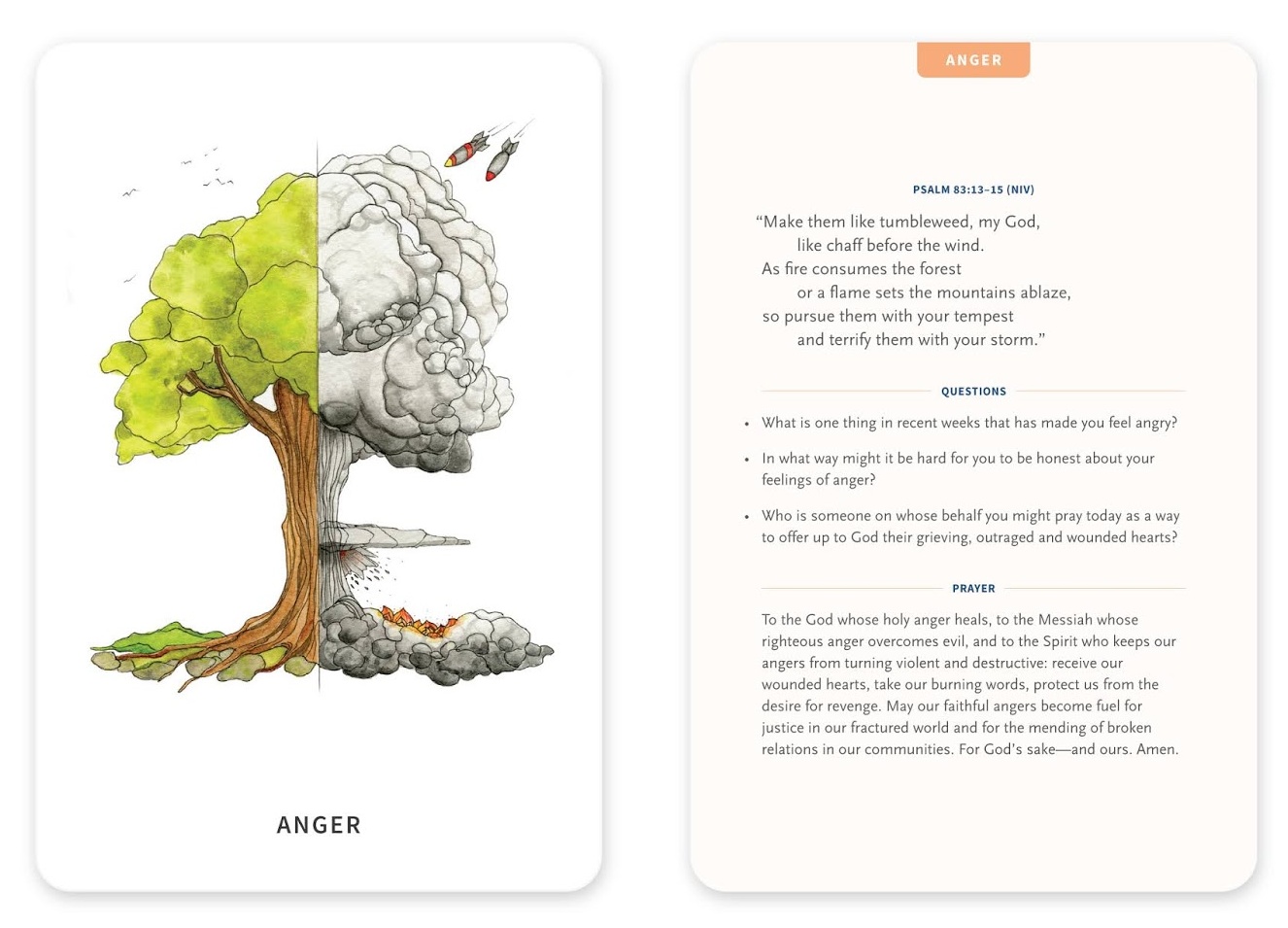
Anger prayer card
The Psalms of Anger: Prayer Card (illustration by Phaedra Taylor)

Taylor’s latest book, Open and Unafraid: The Psalms as a Guide to Life, contains a chapter on “The Psalms of Anger.” Read an excerpt here, or view this video talk. To coincide with the release in March, he and his wife Phaedra created a set of fifteen prayer cards. His prayer on the “Anger” card reads, “To the God whose holy anger heals, to the Messiah whose righteous anger overcomes evil, and to the Spirit who keeps our angers from turning violent and destructive: receive our wounded hearts, take our burning words, protect us from the desire for revenge. May our faithful angers become fuel for justice in our fractured world and for the mending of broken relations in our communities. For God’s sake—and ours. Amen.”

+++

LITURGIES

+++

LAMENT SONGS

The first two are new.

“I Just Wanna Live” by Johnnetta Bryant, performed by Keedron Bryant: Twelve-year-old gospel singer Keedron Bryant posted a video on Instagram last week of himself singing a song his mom wrote in response to the killing of George Floyd. “God gave me those lyrics” for Keedron, she said in a joint interview on Today. Keedron said he prayed the song, meditated with it, then hit record. It’s a heart-baring, heartbreaking lament, a plea for divine protection in a world that is especially dangerous for young black males.

“It Is Enough!” by R. DeAndre Johnson: R. DeAndre Johnson is the pastor of music and worship life at Christ Church Sugar Land outside Houston. He wrote the lyrics for “It Is Enough!” in July 2016 following the deaths of Alton Sterling and Philando Castile but hadn’t set them to music until now. The nine verses bear the refrain “Kyrie eleison” (Lord, have mercy!), or “Christe eleison” (Christ, have mercy!), a common cry of lament. “There are no words that can contain / The depth of sorrow, grief, and pain / That mothers, sons, and all exclaim: / Kyrie eleison!” Johnson sang the song for his church’s livestreamed service on May 31. A lead sheet is available on his Facebook page. [HT: Global Christian Worship]
“I Want Jesus to Walk with Me”: Sharon Irving is a singer-songwriter, spoken-word artist, and worship leader from Chicago who was also a semifinalist on season 10 of America’s Got Talent. In this video from 2015 she sings a spiritual that expresses deep sorrow—“When my strength is failing,” “When my heart is aching,” “When my life feels like a burden”—but also trust in the companionship of Christ, who walks with us through valleys of death. Having likely originated as an improvisation, the song has several lyrical variations and can be easily adapted to voice a range of feelings: “In my rage,” “In my frustration,” “In my exhaustion,” “In my confusion,” etc.

“O This Night Is Dark” by Tom Wuest: Last Sunday my congregation sang Isaac’s Wardell’s setting of Psalm 126 [previously], whose refrain is “Although we are weeping, Lord, help us keep sowing the seeds of your kingdom . . .” Seeds of love, truth, justice, hope. I just learned that Wardell’s song was inspired by Tom Wuest’s “O This Night Is Dark,” released in 2008 on Rain Down Heaven. In addition to Psalm 126, Wuest’s song also references 1 Corinthians 15, Isaiah 2, Amos 9, and Isaiah 65.


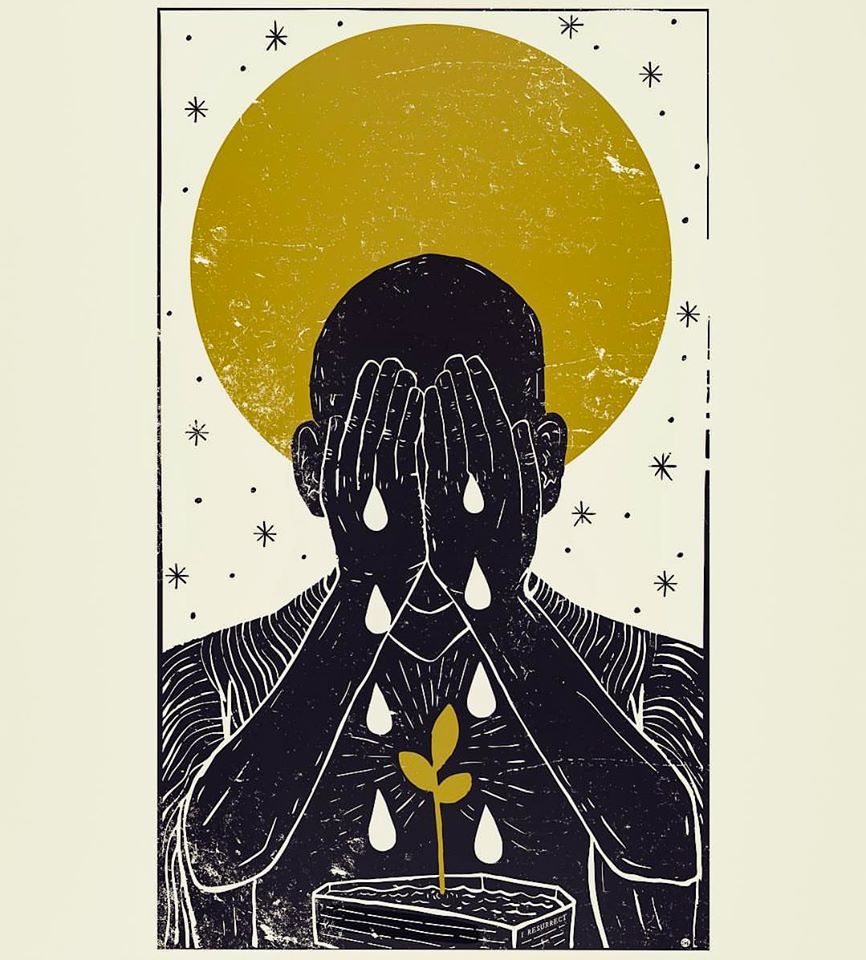
And this week as I was listening to the song, the following image by Scott Erickson showed up on my Instagram feed, with the caption “If one part suffers, all the parts suffer with it” (1 Cor. 12:26).

Erickson, Scott_Sorrowful Saint
Scott Erickson (American, 1977–), The Sorrowful Saint, 2016

Erickson painted the image in July 2016 in response to the fatal shootings of Sterling and Castile. It suggests that tears of grief can be generative, that new life can rise out of death. That’s not at all to say that death is good because it catalyzes a movement of change, but that our mourning the evils of racism and murder, our publicly crying out “Enough!,” is not fruitless, though it often seems so. Growth will come.

+++

VIDEO ART: Weight by André Daughtry:Weight is an attempt to visualize societal projections on the black male body,” writes André Daughtry, a Brooklyn-based interdisciplinary photography and media artist, writer, and performer. The piece is from 2014, and last year PBS’s AllArts station commissioned Daughtry to restage it in New York City as part of a larger video work. [HT: ImageUpdate]

Daughtry has a master’s degree in theology and the arts from Union Theological Seminary and serves as community minister of the arts at Judson Memorial Church, which has a long history of nurturing artists. “We believe that artists have the potential to serve as our modern-day prophets,” the church website reads. “They show us where we’ve been, who we are, and what we can become.”

+++

PODCAST EPISODE: “The SPU Conversation About Spike Lee Films,” North by Pacific Northwest: In this Seattle Pacific University conversation released April 11, 2019, two cinephiles, Jeffrey Overstreet and Josh Hornbeck, discuss some of the films of writer-director Spike Lee, “the boldest and brashest auteur in American film” (Guardian). The first several minutes, though, are spent decrying the then recent Oscar win of Green Book, which popular audiences loved but critics were generally sour on because it perpetuates the simplistic and ultimately false notion that to solve racism, white people just need to realize that “we’re all the same” and find a black friend.

Best known for Do the Right Thing (1989), Lee is one of several filmmakers they cite who deals with race in more complex ways, and while some people dismiss him as an “angry black man,” many celebrate him for forcing audiences to reckon with the problem of racism. “I think there should be rage inside of every conscious human being in the world, because there’s stuff that’s just not right,” he said in a 2000 interview. “Anger can be constructive.” Lee’s films are heavy-handed, in-your-face; they shout and unsettle. Heavy-handedness usually makes for bad art, but Overstreet and Hornbeck show how the approach works for Lee.

Spike Lee Films-01

Starting at 16:44, they focus on the satirical comedy-drama Bamboozled (2000), which joined the prestigious Criterion Collection just this March. (It’s also been the subject of much scholarly study across fields, one instance I’ve come across being an essay by art theorist W. J. T. Mitchell, titled “Living Color: Race, Stereotype, and Animation in Spike Lee’s Bamboozled,” in What Do Pictures Want? The Lives and Loves of Images.) “Under pressure to help revive his network’s low rating, television writer Pierre Delacroix (Damon Wayans) hits on an explosively offensive idea: bringing back blackface with The New Millennium Minstrel Show. The white network executives love it, and so do audiences, forcing Pierre and his collaborators to confront their public’s insatiable appetite for dehumanizing stereotypes.”

From 25:54 onward, Overstreet and Hornbeck discuss more generally their passion for cinema and the importance of revisiting films.

Here are some things they reference:

+++

People have been expressing frustration that The Help, a civil rights era drama that sidelines the perspectives of its black characters, is the number one most-streamed movie on Netflix right now. Film critic Alissa Wilkinson gives a list of fifteen movies to watch instead on racial injustice and being black in America. A mix of dramas and documentaries by such filmmakers as Barry Jenkins, Ava DuVernay, Spike Lee, and others, these are black-centered stories that help illuminate where we’re at right now. All are available for online streaming, and Wilkinson provides links to her reviews.