Roundup: Jonah disgorged, Watching TV Religiously, “My Mother’s Body,” and more

VISUAL MEDITATIONS (ARTWAY.EU)

Jonah Swallowed and Jonah Cast Up, commentary by Victoria Emily Jones: My latest visual meditation for ArtWay was published Sunday—it’s on two third-century Jonah sculptures from Asia Minor that likely decorated a family fountain. Early Christians read the story allegorically (at least on one level), as pointing forward to the death and resurrection of Christ. The “great fish” is portrayed as a ketos, a sea-monster of Greek myth.
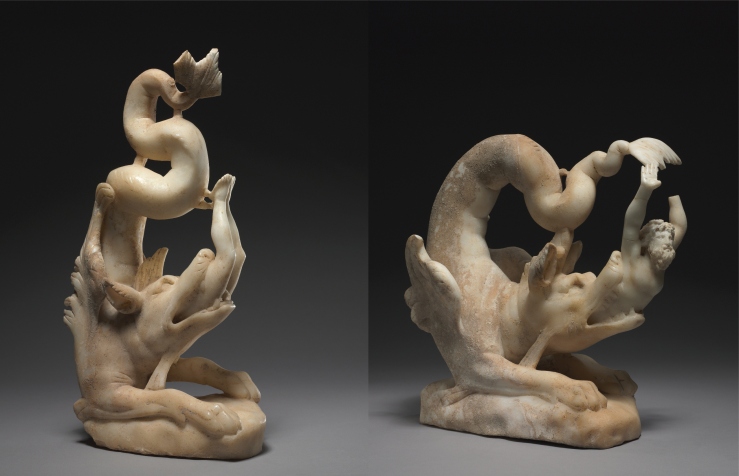
Jonah Marbles
“Jonah Swallowed” and “Jonah Cast Up,” made in Asia Minor, probably Phrygia, 280–90 CE. Marble, 50.4 × 15.5 × 26.9 cm (left) and 41.5 × 36 × 18.5 cm (right). Cleveland Museum of Art, Ohio.

Run by Marleen Hengelaar-Rookmaaker, the faith-based website ArtWay has been publishing a new visual meditation every Sunday for years, as well as a lot of other content from a variety of contributors. To subscribe to the weekly email, click here. Here are just a few VMs published in the past year that I particularly enjoyed:

Manu-Kahu by Brett a’Court, commentary by Rod Pattenden: Pattenden begins, “This striking image of an airborne Christ is from New Zealand painter Brett a’Court. It is part of his investigations into a way of bringing together the spiritual insights of the indigenous culture of the Maori people and that of Christianity brought to New Zealand by British settlers. In cultural terms it is a hybrid image. This is something that occurs when two cultures are in a process of mutual re-assessment. That sort of conversation is full of conflict and critique but also allows for the potential for new forms to arise that express the best of both traditions. A Christ figure flying in the sky like a kite, is such a form. It is a new thing, a potential heresy or aberration, but one full of potential for new insight and spiritual refreshment.”
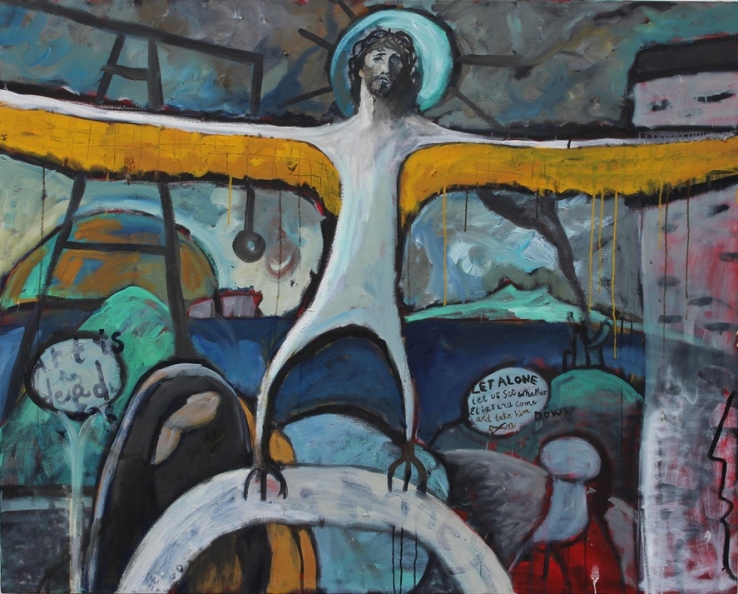
Manu-Kahu by Brett a'Court
Brett a’Court (New Zealand, 1968–), Manu-Kahu, 2007. Oil on canvas.

Knife Angel by Alfie Bradley, commentary by Rachel Wilkerson: This twenty-seven-foot-tall sculpture, welded from 100,000 knives collected in confiscations and amnesties around the UK, confronts the issue of knife violence. The artist cleaned and dulled the blade of each knife he received and engraved personal messages on all the wings’ “feathers,” messages sent by families affected by knife violence.
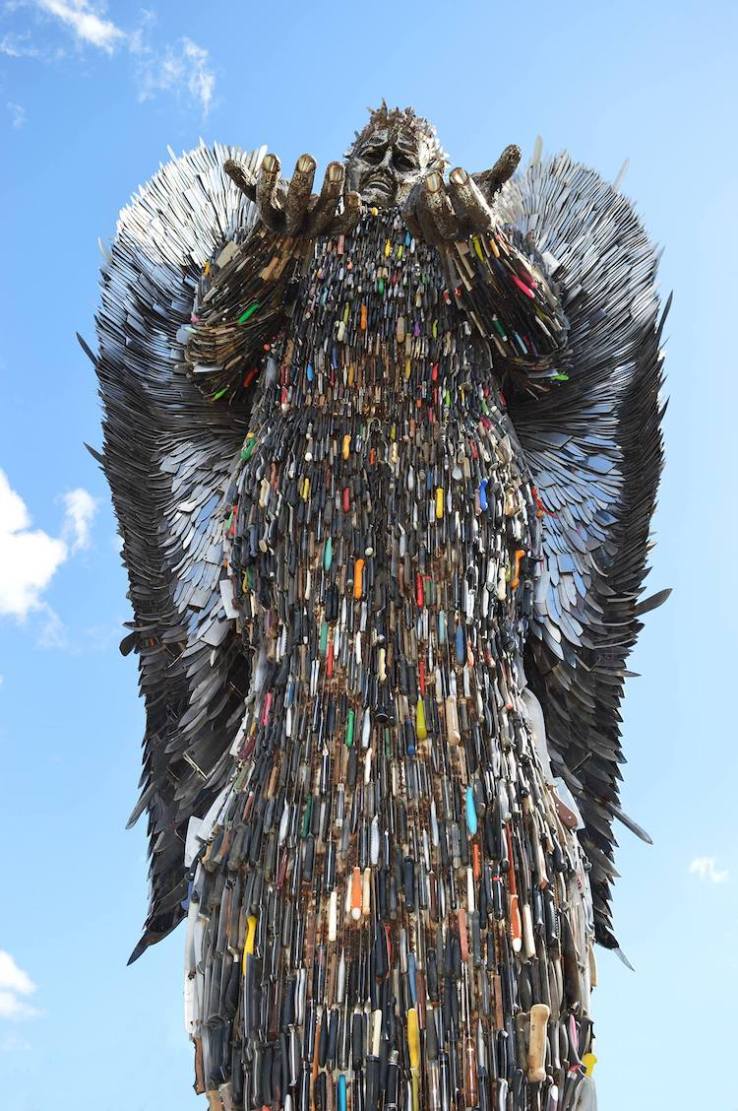
Bradley, Alfie_Knife Angel
Alfie Bradley (British, 1990–), Knife Angel, 2018. Mixed media sculpture, incl. 100,000 knives.

Cathedra by Barnett Newman, commentary by Grady van den Bosch: I saw this painting in Amsterdam last spring and was surprised by how it compelled me. (I don’t typically gravitate to abstract art.) After spending some time up close—I supposed this was a Newman, and Newman says his paintings need to be experienced up close—I looked at the label and saw that it has a religiously inflected title: Cathedra. The word is Latin for “seat,” and in Christianity it refers specifically to the bishop’s chair inside a church (churches that had a cathedra were called cathedrals). But Newman was of Jewish descent, and van den Bosch writes that Cathedra is meant to represent the throne of God. “And above the firmament that was over their heads was the likeness of a throne, as the appearance of a sapphire stone . . .” (Ezek. 1:26).
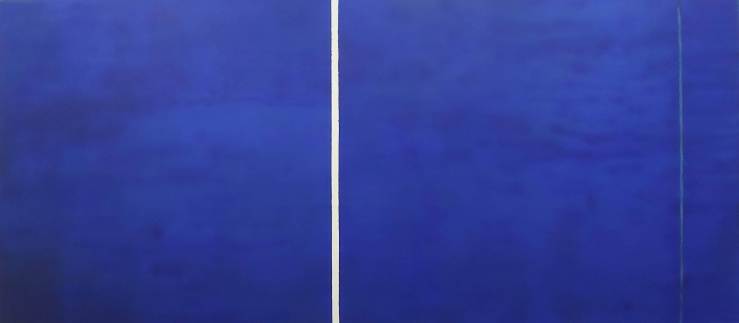
Newman, Barnett_Cathedra
Barnett Newman (American, 1905–1970), Cathedra, 1951. Oil and acrylic on canvas, 243 × 543 cm. Stedelijk Museum, Amsterdam, Netherlands. Photo: Victoria Emily Jones.

As someone who loves historical Christian art, including its many Christ Pantocrators, I must nevertheless admit that there is something so right about modern artists’ often apophatic approach to evoking the Divine. While I do believe God imaged Godself in the person of Jesus Christ and is therefore representable, I understand the argument some make that abstraction is a better visual language for spiritual subject matter or encounter. I accept both/and. Whether God is shown as a rich, blue expanse that invites and envelops, or a heroic nude emerging from the jaws of death, or a Man of Sorrows head with a harrier hawk’s body, I think we can learn a little something from the diversity of representations, which are not mutually exclusive. Not all representations need be embraced, but nor do unfamiliar, difficult, or even shocking ones need be automatically dismissed.

Click on the link for more on how to read Newman’s color field paintings, including his signature “zips.”

+++

FREE ONLINE COURSE: Watching TV Religiously: Through at least July 1, Fuller Theological Seminary is offering all its online Fuller Formation courses for free! I just finished taking Watching TV Religiously, taught by Kutter Callaway [previously], author of the book of the same title, and really enjoyed it. It’s a series of six self-paced lessons, which includes short video lectures by the professor, audio conversations with TV writer Dean Batali (Buffy the Vampire Slayer; That ’70s Show), TV watching assignments, reflection questions, and more.

The course aims to help Christians develop critical tools for watching television and a vocabulary that is as rich and thoughtful as the medium itself, so that we can engage it constructively. (It need not be mindless entertainment!) Callaway explores television as a technology, a narrative art form, a commodity, and a portal for our ritual lives. He’s interested in how stories are told in this episodic, audiovisual format, and what that means for the Story we tell. The course is not about what Christians should watch, but how Christians should watch, leaving ample room for individual viewers to set their own boundaries, ethical and otherwise. (Callaway acknowledges that TV can form as well as de-form us.) He discusses empathy building and access to other perspectives, knowing your sensibilities, how being offended can be useful, watching in community, seeing God in all places, being aware of how your desires and imagination are being shaped, Christians in Hollywood (and Christian characters on TV), and the culture shaping TV and TV shaping culture, among other things.

The course is fairly broad in its approach; it does not analyze particular shows or episodes, though some specific examples are mentioned in conversations, and students are encouraged to form discussion groups with friends or family members and apply what they’re learning to shows of their choice. I really appreciated the assigned PBS docuseries America in Primetime (somewhat outdated because made in 2011 but very good nonetheless), whose four episodes explore character types throughout the history of TV, from the fifties to today: “The Independent Woman,” “Man of the House,” “The Misfit,” and “The Crusader.” From taking this course I realized how many acclaimed TV shows I’ve never seen. I’ve got a lot of homework to do!

Other arts courses offered by Fuller Formation are

+++

POEM: “My Mother’s Body” by Marie Howe, read with commentary by Pádraig Ó Tuama: As Mother’s Day is Sunday, I thought I’d share this wonderful, sad-sweet, mother-themed episode of the new Poetry Unbound podcast from On Being Studios. Pádraig Ó Tuama introduces Marie Howe’s “My Mother’s Body,” in which a middle-age woman, caring for her dying mother, thinks back to the time when her mother was just a twenty-four-year-old girl giving birth to her. The speaker in the poem is Howe.

She imagines being in her mother’s womb, experiencing the rhythm of her mother’s heartbeat. (What an exercise, to imagine yourself as your mother’s baby!) Now decades later, her mother is dying—that heart is failing, and the kidneys too. The uterus has been removed. Toggling between the two time frames, the poem is both a celebration of the strength of women’s bodies and a lament for its vulnerabilities, especially in old age. Howe marvels at how her mother’s body was capable of such a wonder as giving and sustaining life, and now to see that once-vibrant form breaking down grieves her. In some sense their roles have switched as daughter mothers mother, combing her hair, changing her soiled bedsheets.

The poem opens with “Bless my mother’s body” and ends with “Bless this body she made . . .” In the progression of pronouns in the last two lines—my, her, our—is a recognition of how our mothers always remain a physical part of us. They are in our cells. “My Mother’s Body” is a thank-you and a letting go.

The poem is from Howe’s collection The Kingdom of the Ordinary—which I highly recommend.

+++

ARTICLE: “5 Contemporary Poets Christians Should Read” by Mischa Willett: There is so much good crop still being pulled from the fertile fields of theologically inflected verse,” writes poet Mischa Willett—so don’t stop short, content merely with Donne and Hopkins! This is an excellent short list of contemporary poets of faith, with summaries of key themes and recommendations for which volume(s) to start with. Willet was recently on The Ride Home with John and Kathy to discuss this topic, and he wrote a follow-up post on his blog.

+++

MUSIC VIDEO: “I Am a Poor Wayfaring Stranger”: One of the most poignant scenes in last year’s 1917 is when, after a harrowing journey across No Man’s Land, Lance Corporal William Schofield—exhausted, disoriented—reaches a wood and encounters a fellow British soldier singing the spiritual “Wayfaring Stranger” [previously] to a battalion that sits at somber attention, for they’re about to go into battle. This official music video from Sony splices together clips from the movie with studio footage of the actor and singer Jos Slovick.
Making Music in Quarantine

Here’s a quick roundup of some of the music videos and songs I’ve really enjoyed that have come about as a result of the COVID-19 pandemic.

“He Will Carry You”: A song by Scott Wesley Brown performed by Zanbeni Prasad on lead vocals, with her husband Benny Prasad on guitar and her sister-in-law Aruni Prasad on backing vocals. [HT: Global Christian Worship]

+++

“The Sun Will Rise”: One of The Brilliance’s early songs, from their 2010 self-titled album—sung here by Madison Cunningham [previously], Matt Maher, Liz Vice, Jayne Sugg, Tyler Chester, and David Gungor, with multiple contributing instrumentalists (see full list on YouTube).

+++

“Maren” (Have Mercy on Us): The First Lady of Ethiopia, Zinash Tayachew, sings a new gospel song whose Amharic title, ማረን, transliterated “Maren,” means “Have mercy on us,” a plea addressed to God. “Do not abandon us during this time when the world is terrorized by bad news,” she sings. [HT: Global Christian Worship]

+++

Apocalyptic Lockdown Blues, a new EP by David Benjamin Blower: One of my favorite singer-songwriters, from Birmingham, England. “Apocalyptic Lockdown Blues is a small oral history of a global pandemic,” Blower writes. “This is folk, rootsy and ambient, with sacred longings, poetry and politics, sung out of windows and accompanied by birdsong.”

+++

“A Celtic Prayer”: Produced by Jonathan Estabrooks, this video features the choir of Fifth Avenue Presbyterian Church in New York City singing a traditional Celtic blessing set to music by Barry Peters. It begins, “May the Christ who walks on wounded feet walk with you on the road.”

+++

Virtual May Morning 2020: May Day, May 1, is a public holiday in England, and for the past five hundred-plus years it has been an Oxford tradition to kick off the celebration at dawn by having the Choir of Magdalen College sing unaccompanied in the Renaissance style from the top of the college’s bell tower. Typically a crowd of thousands gathers for May Morning along High Street and on Magdalen Bridge, but this year the event was canceled due to COVID-19. However, Magdalen College pulled off a virtual choir! The boy choristers and lay clerks recorded their parts from home, under the direction of Mark Williams, which were combined in a video that was released online at 6 a.m. local time. [HT: Joy Clarkson]

The choir sings “Hymnus Eucharisticus,” a seventeenth-century Trinitarian hymn, and “Now Is the Month of Maying,” an English ballett (a light, dancelike part song similar to a madrigal) from 1595, about lads and lasses frolicking in the grass. The prayer in the middle is led by the Rev. Dr. Andrew Bowyer, dean of divinity. The actual church bells did ring out the hour like usual, with a celebratory chime following the performance (the chimes in the video were prerecorded).

+++

“Doxology”: One of the things I miss most about communal (in-person) worship is singing the Doxology together with my church family each week. As part of his “Covers from an Empty House” series, Ben Rector has posted a contemplative rendition at the piano, which captures the sense of both mourning and hope that so characterizes this global moment. [HT: TGC Arts & Culture Newsletter]

+++

“I Know Who Holds Tomorrow”: This song was written by Ira Stanphill in 1950 following a painful divorce. It’s covered here by The Petersens, a family bluegrass group from Missouri.

+++

Scott Avett [previously] has been posting #emptylivingroomconcert videos on Instagram since the beginning of the year—just him and his guitar (or banjo) and a sixty-second time limit. Here are a few. (He’s the writer of all these songs, I’m assuming.)

Roundup: Multiethnic Jesus, egg dancing, new Easter album, and more

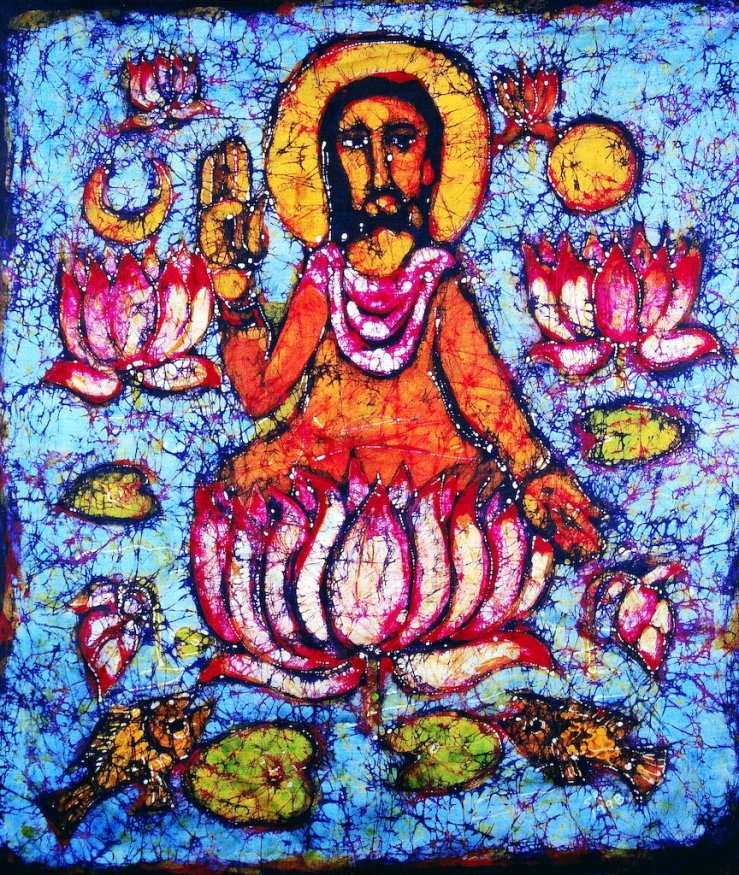
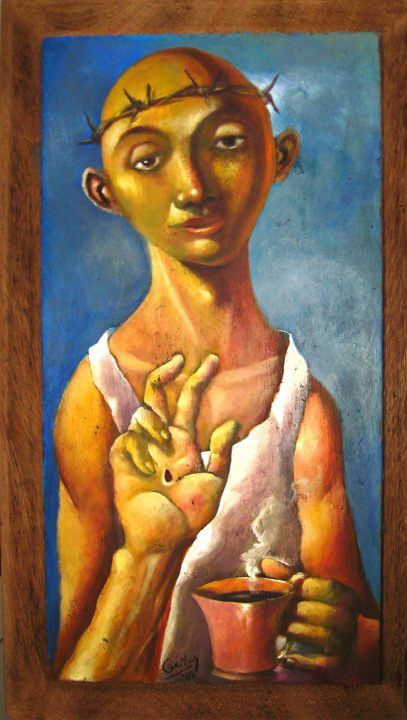
ARTICLE: “Searching for a Jesus Who Looks More Like Me” by Eric V. Copage: I was interviewed the other week for this New York Times piece on multiethnic images of Christ. I comment on paintings by Wisnu Sasongko (Indonesian), Greg Weatherby (Aboriginal Australian), Emmanuel Garibay (Filipino), and Solomon Raj (Indian), and helped select a few of the other images.

Jesus on a Lotus by Solomon Raj
Solomon Raj (Indian, 1921–2019), Jesus on the Lotus Flower, 1998. Batik. Photo: Gudrun Löwner.
Garibay, Emmanuel_Jesus with coffee
Emmanuel Garibay (Filipino, 1962–), Untitled, 2007. Oil on wood. Photo via the artist.

Of those Christians who even permit images of Jesus, some hold to a strict literalism and object to images that show him as anything other than a first-century Jew from Israel-Palestine—even though these same literalists would rightly insist that no image is literally Jesus. As I hope is clear from my website, I embrace a wide range of Christological imagery, which I feel reflects the universal presence and revelation of God. (“Christ is all, and in all,” as the apostle Paul wrote in Colossians 3:11; he continues to manifest spiritually, and through his ecclesial body, all over the world.) I’m not so proud to assume that my way of picturing Jesus is the most right or authoritative; I need others to help me see Jesus more fully, more truly. Like C. S. Lewis said, “My own eyes are not enough for me, I will see through those of others.” And historical realism is not the only, or even necessarily the best (depends on context), art style to show who Jesus is.

Even though the historical Jesus never wore a full-face moko (tattoo) like the Maori, as Sofia Minson paints him, nor did he sit on a lotus flower when he taught his disciples, nor did he appear to Peter, James, and John transfigured between two Yoruba deities, these images and others like them tell us something about Jesus. At a broad level, they proclaim the Incarnation—God in flesh, dwelling among us, as us, that is, fully human. The historical Jesus existed in a specific time and place, and had ethnic particularities, but his coming was not just for the Jews but for the Gentiles too, and not just for his day, for but all time. Through symbol and metaphor and materiality, artists make this truth real.

+++

UPDATED BLOG POSTS

Occasionally if I’ve covered an art topic in the past and then come across a new image that fits that topic perfectly, I will add it as an addendum to the original post. I’ve done that with two Eastertide posts.

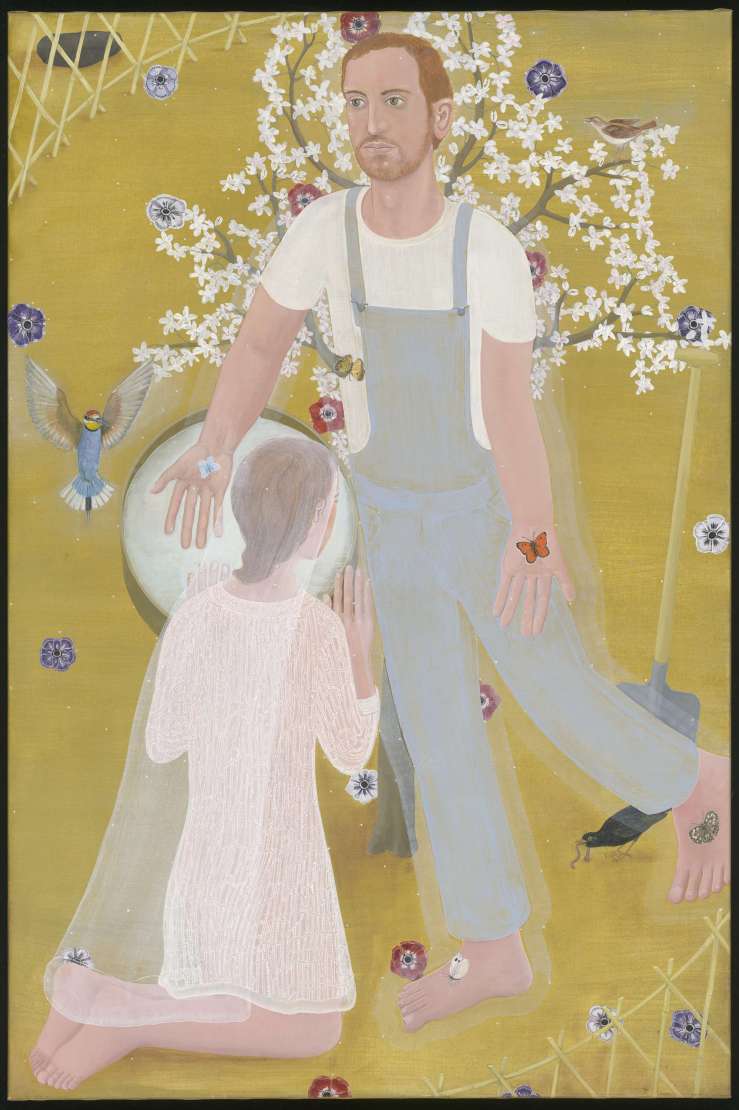
“‘She mistook him for the gardener’”: Humanity was born in a garden and reborn in a garden, as biblical scholars like N. T. Wright are keen to point out, with Easter morning marking the launch of new creation. In art history the resurrected Christ is sometimes amusingly shown carrying gardening tools when he encounters Mary Magdalene outside his tomb—to explain the case of mistaken identity that John records, perhaps, but more likely to establish a metaphor. Two of the paintings I’ve added to this post are by Janpeter Muilwijk, whose New Gardener from 2017 shows the freshly risen Christ in a white T-shirt and overalls, heading with open arms toward Mary, who is dressed like a bride to receive him. (Mary is modeled after the artist’s daughter Mattia, who died.) Butterflies alight on each of Jesus’s five wounds, marking them as sites of transformation, and the flowering branches of a tree crown him with spring glory.

Muilwijk, Janpeter_New Gardener
Janpeter Muilwijk (Dutch, 1960–), New Gardener, 2017. Oil on canvas, 150 × 100 cm. Private collection, Netherlands.

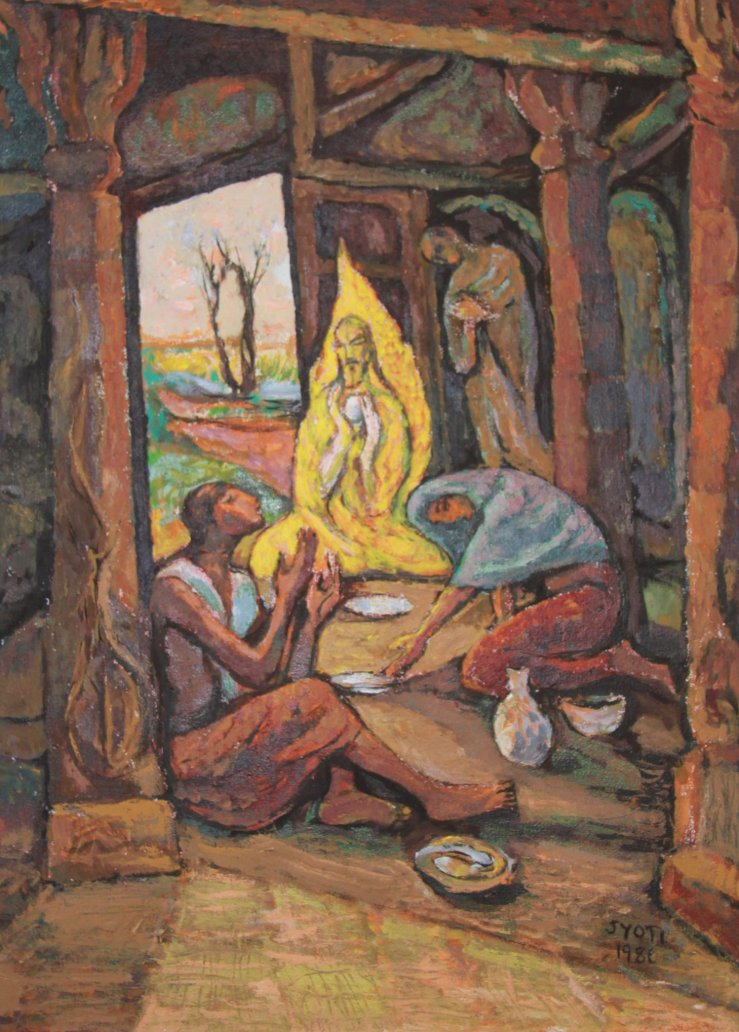
“The Unnamed Emmaus Disciple: Mary, wife of Cleopas?”: Written in 2017, this is one of Art & Theology’s most visited posts. In it I conjecture that the pilgrim who traveled with Cleopas from Jerusalem to Emmaus in the famous Easter story could have been a woman, perhaps Cleopas’s wife. Several artists have conjectured the same, and besides adding to this compilation three Emmaus paintings that the artist Maximino Cerezo Barredo sent me after the initial publication, I’ve also added one by Jyoti Sahi, which shows Jesus sitting with the two disciples—one male, one female—on the floor of a small roadside dwelling, breaking chapati (Indian flatbread) together. He is ablaze with glory, evoking his earlier revelations as I AM in the burning bush before Moses and to Peter, James, and John on Mount Tabor at the Transfiguration.

Sahi, Jyoti_Supper at Emmaus
Jyoti Sahi (Indian, 1944–), The Supper at Emmaus, 1980. Mixed media on canvas. Photo courtesy of the artist.

+++

NEW SONGS

“A Bedtime Song for Anxious Children” by W. David O. Taylor and Paul Zach: David Taylor has written a new children’s song (set to music by Paul Zach), which he sings here with his daughter, Blythe. The lyrics are in the video description on YouTube.

“I’ve heard from so many parents recently that their children are struggling with anxiety, fear, frustration, sadness, anger, and restlessness,” Taylor writes, “and so I thought a little song reassuring them of God’s care at night, when they’re most vulnerable, might help their hearts. Our hope is that the melody might be simple enough for parents and children to be able to sing it when they go to bed.”

“See the Day” by Liz Vice: One of my favorite singers, Liz Vice, released a new single on April 10, called “See the Day.” Cowritten by her, Leslie Jordan, and Jonathan Day, it expresses hope for the coming day of the Lord, when justice will roll down like a mighty river, walls of division will crumble into dust, oppression will cease, and the whole world will be startled awake by love. “Precious Lord, come lead us on” to that reality.

+++

NEW ALBUM: Easter 1 by Mac Meador: Mac Meador, a singer-songwriter from Austin, Texas, released a new EP of six songs for Eastertide this April, a sort of flip side to the Lent 1 EP he released in February. I really enjoyed them both (and the same goes for his Summer of Psalms from 2018). The Easter album strikes just the right note for me right now—of a quiet hope and joy that’s not absent of pain. The songs celebrate Christ the risen king while also expressing longing for the age to come, when the kingdom will be established in full. Lean into that promise!


You can stream and purchase Meador’s music on Bandcamp. (Note: To help musicians affected by COVID-19, Bandcamp is waiving its cut of all sales made on its site on May 1.) You might also want to check out his YouTube channel, where he posts additional songs. For the past four weeks he has been releasing “Quarantine Hymn Sing” lyric videos for his church, Grace + Peace Austin, where he serves as minister of music. (He also sets Bible memory verses to music for kids!)

+++

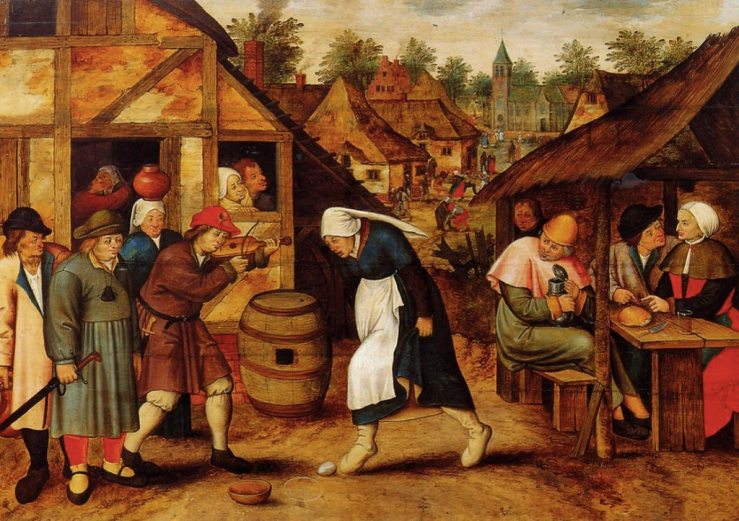
EGG DANCING: “The Egg Dance: From Peasant Village to Political Caricature”: The Public Domain Review has compiled an amusing gallery of historical paintings, drawings, and prints that show the egg dance, a traditional Easter game with several variations, most associated with western European peasantry of the sixteenth and seventeenth centuries.

Brueghel the Younger, Pieter_The Egg Dance
Pieter Brueghel the Younger (Flemish, 1564/65–1637/38), The Egg Dance, ca. 1620. Oil on panel, 26 1/4 × 41 1/4 in. (66.7 × 104.8 cm).

+++

ART VIDEO: “500 Years of the Herrenberg Altarpiece”: I love seeing all the fun, creative resources being produced by art museums to help educate and engage the public in viewing art. Though I speak not a lick of German, this video from the Staatsgalerie Stuttgart about Jörg (Jerg) Ratgeb’s Herrenberg Altarpiece made me laugh and had me hooked for its full five minutes. (I came across it when I was prepping a Holy Week blog post that features a different painting attributed to the same artist.) Released last October for the five hundredth anniversary of the altarpiece, the video, directed by Valentin Hennig and Oleg Kauz, animates some of the birds from the painted panels and has them narrate as the camera zooms in on details (one of them quite jarring and unseemly!). They then fly through the museum hall and over the town some twenty miles southwest to the church where the piece originally stood.

To add autogenerated subtitles, click the “CC” (closed captioning) button on the bottom of the video player, then select your language using the gear icon.

Painted in 1519, this double-winged altarpiece was commissioned by the Brethren of the Common Life, a Catholic pietist community, for the high altar of the collegiate church of Herrenberg in Swabia. Closed, it shows the apostles about to set out on their mission to spread the word of God. The first open view (interior panels closed, exterior wings folded out) reveals scenes from the passion of Christ, each panel with a primary scene in the foreground and a secondary scene in the background: the Last Supper with the Agony in the Garden, the Flagellation and Crowning with Thorns with the Ecce Homo (presentation to the crowd), the Crucifixion with the Carrying of the Cross and the Entombment, and the Resurrection with the Noli me tangere (appearance to Mary Magdalene). Completely opened (its feast-day configuration), the altarpiece shows scenes from the infancy of Christ, with reference also to the life of the Virgin Mary. It used to have a central Marian statue and predella figures, but these were likely destroyed when the Protestant Reformation came to Württemberg in 1534.

The artist had already died by this time—he was executed (drawn and quartered) for treason in 1526 for his role as one of the leaders of the German Peasants’ Rebellion.

Roundup: Leon Bridges, Stations of the Cross, Hermitage Museum tour, and contemporary “religious” poetry

NEW SONG RELEASE: “Conversion” by Leon Bridges: A smoky, minor-key redemption ballad closes out Leon Bridges’s [previously] latest EP, Texas Sun, a collaboration with the three-piece psychedelic funk band Khruangbin. Bridges wrote the song in 2012 in response to his conversion to Christianity, he said, but this is the first time he’s recorded it. Halfway through, following a personal testimonial about being made alive by the Holy Spirit, the song breaks into a slow R&B rendition of Isaac Watts’s “At the Cross.” Lyrics here. See also the musical and lyrical analysis Aarik Danielsen wrote over at Think Christian.

+++

STATIONS OF THE CROSS:

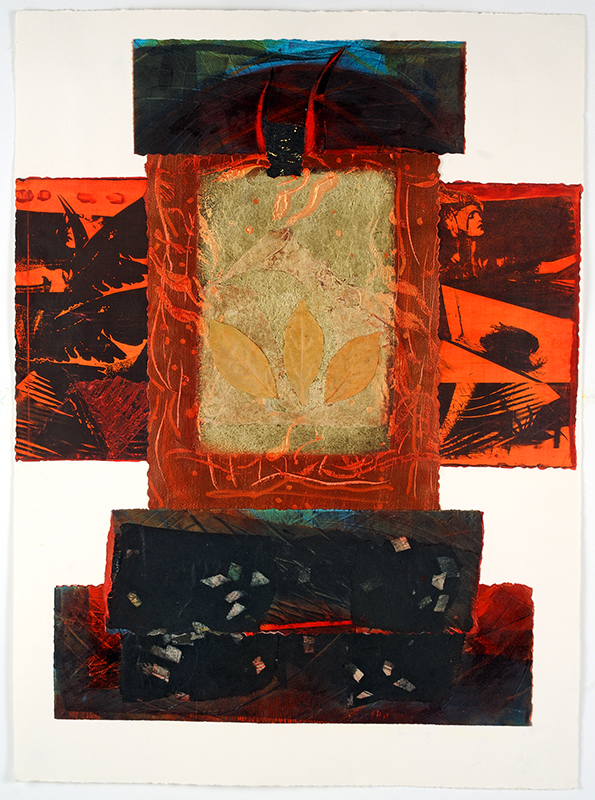
Contemporary Artists Interpret Stations of the Cross, St. Michael’s Episcopal Church, Arlington, Virginia, February 19–April 3, 2020: Thanks to one of my readers reaching out, I found out about this church-sponsored exhibition just south of where I live and was able to attend the opening reception, where many of the artists were present to talk about their work and answer questions. Unfortunately, the coronavirus has led to its early closure, but photos of the artworks, which are for sale, can be viewed online: see this write-up by curator Maureen Doallas. Below are the works representing station 8 (“Jesus meets the women of Jerusalem”) and station 14 (“Jesus is laid in the sepulcher”).

Peckarsky, Terry_Still Weeping on the Via Dolorosa
Terry Peckarsky, Still Weeping on the Via Dolorosa, 2020. Quilted commercial cotton fabrics, digitally altered photographs printed on fabric, tsukineko inks, and watercolor, 23 × 31 in. Photo: Victoria Emily Jones. Artist’s website: https://tpeckarsky.tumblr.com/
Lukitsch, Carol_Sophia Icon
Carol Lukitsch, Sophia Icon. Mixed media collage on paper (with laurel leaves), 30 × 22 in. Photo courtesy of the artist. Artist’s website: http://carollukitsch.com/

Passion and Compassion Oxford: This self-guided tour through Oxford, released this February with a new website and supported by the “Alight: Art and the Sacred” app [previously] for Android and iOS, stops at fourteen artworks or artifacts in multiple locations across the city. Designed around the Scriptural Stations of the Cross as a pilgrimage of sorts, it comprises a mix of historical and contemporary pieces, including sculptures by Jacob Epstein and Antony Gormley, Old Master paintings by Anthony van Dyck and the studio of Andrea Mantegna, a medieval stained glass lily crucifix, Roger Wagner’s Elie Wiesel–inspired Menorah, a “celure” depicting the Pleiades in white gold, Thomas Cranmer’s prison band, and more. Each stop comes with audio commentary by a clergyperson, theologian, or artist. The tour starts at University Church Oxford, the institution that created this wonderful resource. (Note: Most of the sites on this tour are currently closed indefinitely due to the coronavirus.)

Caroe, Oliver_Celure
Oliver Caroe, Celure, 2012. University Church of St. Mary the Virgin, Oxford.
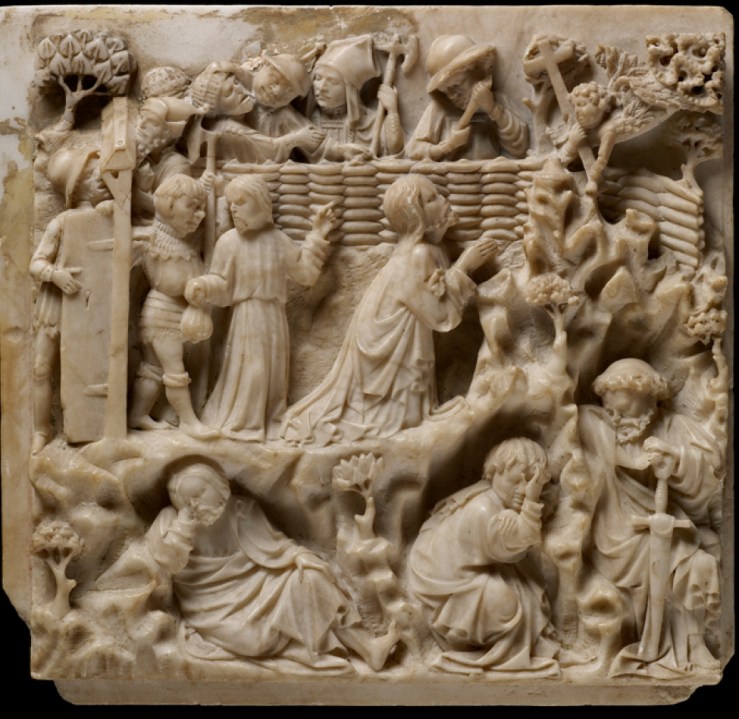
Agony in the Garden (alabaster)
Alabaster relief by the Master of Rimini or workshop, southern Netherlands or northern France, ca. 1430–40. Ashmolean Museum of Art and Archaeology, Oxford.

+++

VIRTUAL TOUR: Single-shot walk-through of Russia’s Hermitage Museum: The State Hermitage Museum in St. Petersburg is the second-largest museum in the world (the Louvre is the largest), with over one million square feet of exhibition space extending across six historic buildings, including the Winter Palace, the former residence of the Russian tsars. Thanks to a five-and-a-half-hour advertisement by Apple showing off the iPhone 11’s battery life, people can move seamlessly through 45 of the museum’s 309 galleries from their own homes. Shot in one continuous take, the video includes close-ups of individual artworks as well as wide shots of the lavish interiors. It doesn’t cover the entire museum, but there is much western Christian art to see, starting at 1:04:41 with Hugo van der Goes’s Adoration of the Magi triptych. Among the most famous religious artworks in its collection, which you may know from Henri Nouwen’s book about it, is Rembrandt’s Return of the Prodigal Son (2:15:54). Here’s the trailer, followed by the full-length video:

It includes ballet sequences throughout and concludes with a live orchestral performance featuring Russian pianist and composer Kirill Richter.

The Hermitage Museum offers virtual tours of its entire collection, in an interactive format that uses panoramic photos, at https://www.hermitagemuseum.org/wps/portal/hermitage/panorama/. Unlike the Apple video, whose purpose is to showcase the capabilities of the new iPhone, the Hermitage-created tour inserts “info” buttons over each artwork so that you can click through to find out the artist, title, etc., if interested. But this format, in addition to requiring a brief load time for each step forward, lacks the grandiose scoring and camerawork of the new Apple video.

+++

POET FEATURE: Jeanne Murray Walker: A semirecent recent blog post by “online abbess” Christine Valters Paintner introduces the work of poet Jeanne Murray Walker, author of Helping the Morning (2014), Pilgrim, You Find the Path by Walking (2019), and eight other books. Reprinted in full are the poems “Staying Power,” about God’s pursuant nature (a modern-day “The Hound of Heaven,” if you will); “Attempt,” which opens with a quote by Traherne; and “Everywhere You Look You See Lilacs,” about being in the moment, taking cues from nature. There is also a video of Walker reading her poem “The Creation,” which muses on the beautiful quirkiness of giraffes, who “spring up like Wow . . . riff-raff of [God’s] imagination.”

+++

GOODLETTERS ESSAY: “What Does It Mean to Be a ‘Religious’ Poet?” by Brian Volck: The contemporary English theologian Nicholas Lash wrote that sadly, “the relation of human beings to the Holy One” has, by many and certainly in the popular imagination, been “reduced to knowledge of an object known as ‘God’ . . . [,] faith’s attentive presence to the entertaining of particular beliefs.” Such reductionism has led many artists to resist being labeled “religious”—“a designation that typically serves to qualify, marginalize, or dismiss creative work.”

But good poetry, Brian Volck says, “and the human sensibilities we’re taught to call religious needn’t be strangers.” There are many poets today who tread the “vast borderlands where religion, spirituality, faith, art, and mystery overlap,” and Volck briefly reviews four such collections from 2019: Anaphora by Scott Cairns, Pilgrim, You Find the Path by Walking by Jeanne Murray Walker, This Far by Kathleen O’Toole, and Long after Lauds by Jeanine Hathaway.

Roundup: Pool of Bethesda, Argentine tango hymn, Ernesto Cardenal, beauty and suffering, “Spiritual Cosmonaut” playlist, and “The Two Popes”

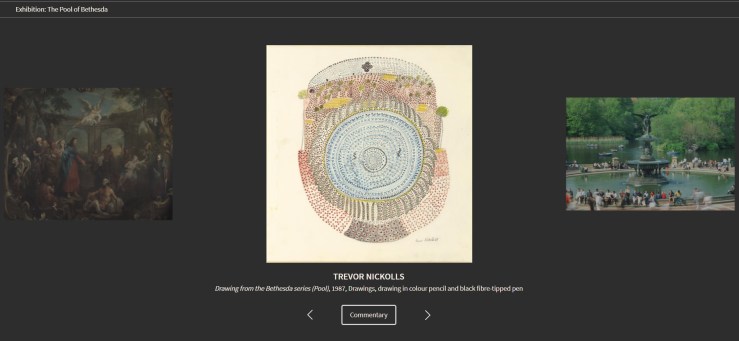
VISUAL COMMENTARIES: “The Pool of Bethesda” by Naomi Billingsley: In a recent contribution to the online Visual Commentary on Scripture [previously], Naomi Billingsley has compiled and written about three artworks based on John 5:1–18, a story in which Jesus heals a paralyzed man at a reservoir in Jerusalem. A source of hydration, cleansing, and tranquility, the pool of Bethesda, Billingsley says, is a symbol that transcends individual religious traditions.

Pool of Bethesda

She discusses William Hogarth’s painting of the subject for a hospital, showing sick patients receiving care; a “Dreamtime” drawing from Aboriginal Australian artist Trevor Nickolls’s Bethesda series, created during his recovery from a major car accident; and The Angel of the Waters fountain in Bethesda Terrace in Manhattan’s Central Park, designed by Emma Stebbins in 1842 to celebrate an aqueduct that brought clean water to New York City and improved public health (and which you may recognize as the site where John the Baptist baptizes disciples in the opening sequence of the movie Godspell).

+++

ARGENTINE TANGO HYMN: “Tenemos Esperanza” (We Have Hope): This hymn text was written in 1979 by Federico Pagura (1923–2016), a Methodist bishop and human rights champion from Argentina, and set to tango music by Homero Perera (1939–2019) of Uruguay. Argentinian pastor Federico “Fede” Apecena, who lives in Georgia in the US, recently introduced the song to his friend Josh Davis, who heads the multicultural worship ministry Proskuneo, and the two banged out this awesome video performance. “The song is a record of all that Jesus came to do and to be,” Apecena explains at the end of the video. [HT: Global Christian Worship]

+++

OBITUARY: Ernesto Cardenal (1925–2020), poet and priest who mixed religion and politics in his commitment to social justice in Nicaragua, dies at 95: A Catholic priest, poet, and political revolutionary from Nicaragua, Ernesto Cardenal was a controversial figure. He supported the Sandinista insurrection against the dictatorial Somoza regime in the seventies and, when the Sandinista government (which claimed to integrate Marxist and Christian ideals) came to power, served as its minister of culture from 1979 to 1987. He viewed this post as an extension of his priestly office and, refusing to quit it at Pope John Paul II’s behest, was forthwith suspended from the priesthood in 1984. (Pope Francis absolved him of canonical censure in February 2019, permitting him to administer the sacraments once again.)

Cardenal’s most enduring achievement was his 1966 founding of a religious community among the peasant farmers and fishermen of the Solentiname archipelago in Lake Nicaragua. He saw to the construction of a small wooden church, where he led collaborative Masses: instead of giving a homily on the week’s assigned Gospel reading, he opened up dialogues about it with his parishioners, relishing their insights. Transcripts of these conversations were published in four volumes as El Evangelio en Solentiname (The Gospel in Solentiname) between 1975 and 1977, with English translations appearing in 1976–82—a classic work of liberation theology.

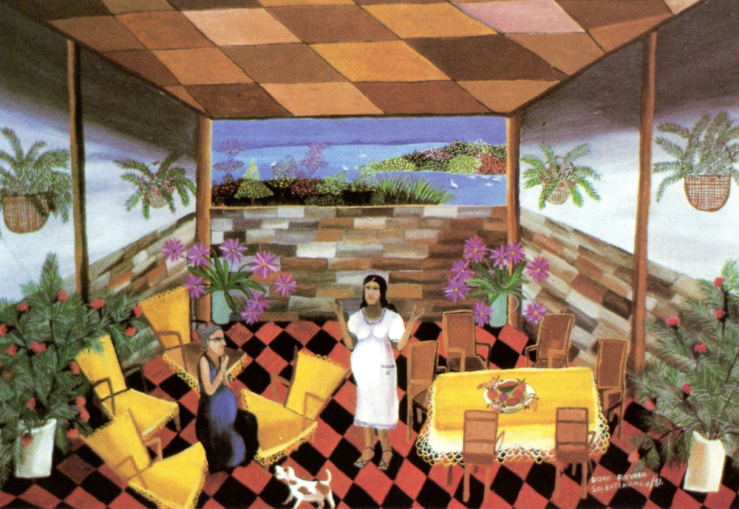
Besides cultivating the islanders’ interest in the Bible, Cardenal also took notice of their creative talents. He brought in artists to lead workshops, which led to the development of a primitivist art school that achieved international recognition for its paintings, many of them depicting Jesus’s birth, ministry, and passion taking place in Solentiname, in and around the familiar thatched-roof buildings, blue waters, and lush vegetation. In 1984 Orbis Books editors Philip and Sally Scharper combined several such images with a heavily abridged version of The Gospel in Solentiname and published it as The Gospel in Art by the Peasants of Solentiname, a slim, full-color hardcover that I highly recommend.

Guevara, Gloria_Visitation
Gloria Guevara (Nicaraguan, 1954–), The Visitation, 1981 [source: The Gospel in Art by the Peasants of Solentiname]
“It was the Gospel which radicalized us politically,” Cardenal said. “The peasants began to understand the core of the Gospel message: the announcement of the kingdom of God, that is, the establishment on this earth of a just society, without exploiters or exploited.” Afraid of the dangerous ideas taking root in Solentiname, Somoza’s National Guard razed the settlement to the ground in 1977, and Cardenal was forced to flee to Costa Rica. He gave his blessing to his community’s decision to join the Sandinistas, the people’s army, to attempt an overthrow of Somoza, a victory they achieved in 1979. The surviving peasants returned to Solentiname to rebuild, and their practice of art and faith continues to thrive to the present day.

Cardenal is also known as a poet. I’ve read only one volume of his poetry, in English translation: Apocalypse: And Other Poems (New Directions, 1977). I didn’t connect well with a lot of it, but it does have a few gems, like “Prayer for Marilyn Monroe,” “The Cosmos Is His Sanctuary (Psalm 150),” and “Behind the Monastery,” reprinted here in full:

Behind the monastery, down the road,
there is a cemetery of worn-out things
where lie smashed china, rusty metal,
cracked pipes and twisted bits of wire,
empty cigarette packs, sawdust,
corrugated iron, old plastic, tires beyond repair:
all waiting for the Resurrection, like ourselves.

(translated from the Spanish by Robert Pring-Mill)

+++

LECTURE: “On Beauty” by Natalie Carnes: “Beauty has been leveraged in ways that wound us, with legacies of misogyny, class hatred, and racial injustice,” says Dr. Natalie Carnes, associate professor of theology at Baylor University. “And yet I want to suggest that beauty tends those same wounds, and can be found in those same wounds, for beauty is a name for God.”

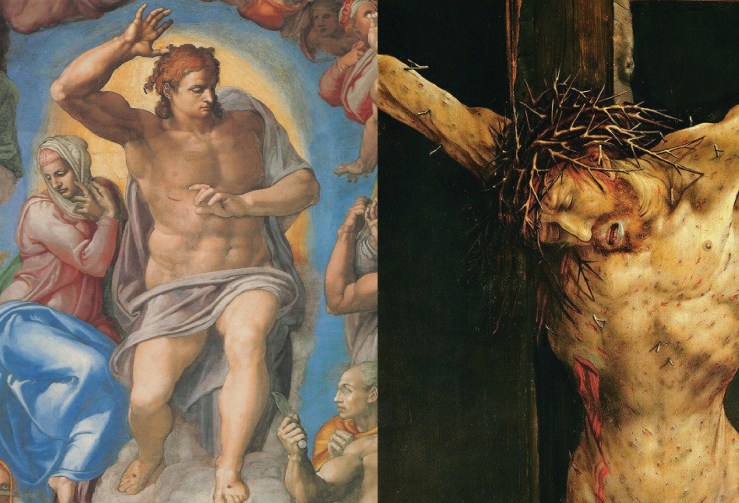
In this half-hour talk given November 1, 2017, at Dallas Theological Seminary as part of school’s Arts Week, Carnes examines the paradox, expressed in the church’s art and theology across history, that God is both beautiful and not beautiful. In his suffering, Carnes says—his entering the ravaged and scarred places of our humanity—God does not renounce his beauty but reveals it.

The divine presence in grotesque suffering is not a departure from the divine life but characteristic of it. And that movement into the grotesque is not antagonistic to beauty but the revelation of it. God’s faithfulness goes by way of intimacy with not-God, and beauty by way of the grotesque. The beauty that rejects suffering is false, and the one who follows the call of beauty faithfully will find herself in the scarred places of the world. Beauty, after all, is a name for God, and God does not abandon divinity in identifying with the suffering and afflicted but expresses through such identification the very marker of divine life.

This is not to say that suffering, affliction, or poverty is beautiful. Beauty is distinct from the mode of its arriving. Poverty and suffering can be important sites of beauty, even as they are not themselves beautiful, because they mediate the beauty of the God who is charity. . . .

Beauty and Suffering
Left: Michelangelo, Last Judgment (detail), 1536–41 | Right: Matthais Grünewald, Isenheim Altarpiece (detail), 1515

Natalie Carnes is the author of Beauty: A Theological Engagement with Gregory of Nyssa, Image and Presence: A Christological Reflection on Iconoclasm and Iconophilia, and (forthcoming) Motherhood: A Confession.

+++

PLAYLIST: “Spiritual Cosmonaut,” compiled by Latifah Alattas: Last month singer-songwriter and music producer Latifah Alattas [previously] curated a short Spotify playlist of “Spiritual songs that stir my soul. Melodies that tap into mystery. Sounds that open me up to the wonder and peace of God.” It’s great!

Alattas is the frontwoman of the band Page CXVI [previously], which has just returned from a six-year hiatus. I’m so moved by their recently released rendition of “Great Is Thy Faithfulness,” with piano, synthesizer, and pedal steel guitar. Alattas has made the song more communal, subbing out all first-person singular pronouns for first-person plural, even rewording whole lines, like the last two of the chorus, which become “Amidst the pain of this world you grieve with us—unfailing faithfulness, dwelling so near.” Or the final line of the final verse, which she changed from “Blessings all mine, with ten thousand beside!” to “Blessings for all, Christ within us resides.”

People who are attached to singing the song a certain way might object to such lyrical revisions, but I see them, along with the creative musical liberties she takes, as helping to bring out the themes that are already there. Alattas helped me to hear this classic hymn with new ears.

+++

FILM: The Two Popes (2019), dir. Fernando Meirelles: I recently watched this Oscar-nominated biographical drama and enjoyed it more than I thought I would! I wasn’t expecting the respect it gives to its subjects and to Christianity. Its title refers to the fact that, for the first time in six hundred years, the Roman Catholic Church has one reigning pope and one retired pope, the “pope emeritus.” (When Benedict announced his resignation in 2013, it shocked the world, as it’s expected that, if chosen, you serve in that role until death.)

The movie is primarily about the relationship between the traditionalist Pope Benedict XVI (born Joseph Ratzinger) and the progressive Pope Francis (born Jorge Bergoglio), which starts out antagonistically but buds into a friendship of sorts. It’s dialogue-heavy (it was adapted from a stage play), but in the most interesting way, as the two engage in “a series of philosophical and dogmatic discussions and disagreements about the nature of faith and forgiveness, and the direction of a church struggling to maintain relevance in the modern world” [source].

But it’s not just about the church’s struggle or the burdens of high office; it’s also about personal faith as a struggle—how to discern one’s calling in life, how to hear God’s voice and deal with his silence, and how to forgive oneself for one’s own tragic silences (in Benedict’s case, regarding the sex abuse perpetrated by clergy; in Francis’s, regarding the Dirty War in his home country of Argentina in the late seventies and early eighties, while he was serving as priest).

Francis’s backstory, of which I knew nothing beforehand, is told in flashbacks. (The fiancée is fictional, though the real Francis has admitted to having romantic crushes as a teenager and even as a seminarian.) The portrayal of both men, by Anthony Hopkins as Benedict and Jonathan Pryce as Francis, is very humanizing (not initially for Benedict, but his character gets there)—and not just because of the glimpse it provides into Francis’s life prior to the cloth, but also, in part, because of little nods it gives to their interests beyond the church, like Francis’s love of soccer and tango dancing, and Benedict’s piano playing and Fanta drinking. And because it shows their personal fallibility, their regret over past misdeeds.

It should be noted that the meeting of the two men at the papal summer residence of Castel Gandolfo prior to Benedict’s resignation is invented, as are many of their lengthy dialogues, which are nonetheless inspired by speeches, letters, and other writings of theirs, brought into conversation with one another by playwright and screenwriter Anthony McCarten.

Roundup: Acoustic ecology, trees in religion, the Pharaoh Sisters, and more

Below you will find a mix of annotated links to songs, interviews, articles, and art showings of interest: “The Sound of Silence” on classical guitar; an acoustic ecologist whose job is to record nature’s music; giving up books for Lent; two interfaith art exhibitions (Faces of Prayer in Vienna and To Bough and To Bend in Los Angeles); and two new folk music albums (Old Wow by Sam Lee and Civil Dawn by the Pharaoh Sisters).

+++

MUSIC VIDEO: “The Sound of Silence” (arr. Lawson, Trueman): Classical guitarist Miloš Karadaglić collaborated with members of the string orchestra 12 Ensemble on this instrumental rendition of Simon & Garfunkel’s “The Sound of Silence.” [HT: Philip Chircop]

This is the title track of Karadaglić’s fifth album, Sound of Silence, released last fall. To watch him perform the piece in London’s Air Studios, as filmed by Classic FM in October for Live Music Month 2019, click here.

+++

PODCAST EPISODE: “Silence and the Presence of Everything,” On Being interview with Gordon Hempton: “Acoustic ecologist Gordon Hempton collects sounds from around the world. He’s recorded inside Sitka spruce logs in the Pacific Northwest, thunder in the Kalahari Desert, and dawn breaking across six continents. An attentive listener, he says silence is an endangered species on the verge of extinction. He defines real quiet as presence—not an absence of sound but an absence of noise.”

Such a unique vocation—listening to places, preserving natural soundscapes. “I hear music coming from the land,” Hempton says. “Some of the most sublime symphonies have been hidden away in something as simple as a driftwood log.” Among his other favorite “musics” are “grass wind” (“the tone, the pitch, of the wind is a function of the length of . . . the blade of grass”) and sounds from “the most musical beach in the world,” Rialto Beach.

Earth is a solar-powered jukebox. . . . We can go to the equator, listen to the Amazon, where we have maximum sunlight, maximum solar energy. The solar panels, the leaves, are harvesting that and cycling it into the bioacoustic system. And, to my ears, that’s a little too intense. That’s a little bit too much action.

Then we can jump up into Central America, and we can still feel and hear the intense solar energy, but it’s beginning to wane.

And we notice a really big difference when we start getting into the temperate latitudes, of which I particularly enjoy recording in because it’s not just about the sound, but it’s about something that I call the “poetics” of space. . . .

“Silence is really wonderful, isn’t it?” he beams. “Even when we just let it exist, it feeds our soul.”

+++

ESSAY: Last year Leah Slawson gave up books for Lent. When I first read that headline, I balked. Books are so life-giving to me! But as I read on, I came to understand Slawson’s reasoning (with which I can identify), and, while I’m not fasting from reading, I admire her choice. “I put a high value on reading, but I am keenly aware that I can use it as an escape from thinking my own thoughts or from noticing my feelings. . . . Reading, for me, is a distraction from the hard work of writing, and since it is so worthy of an activity, I feel justified and redeemed. I even read and study as a way to fool myself into thinking I am practicing faith; when really, I am just reading about someone else’s spiritual practice.” [HT: Rachel A. Dawson]

+++

EXHIBITIONS:

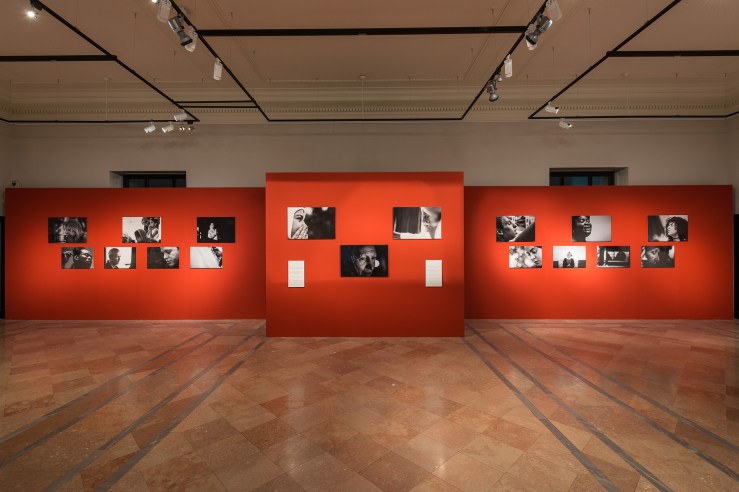
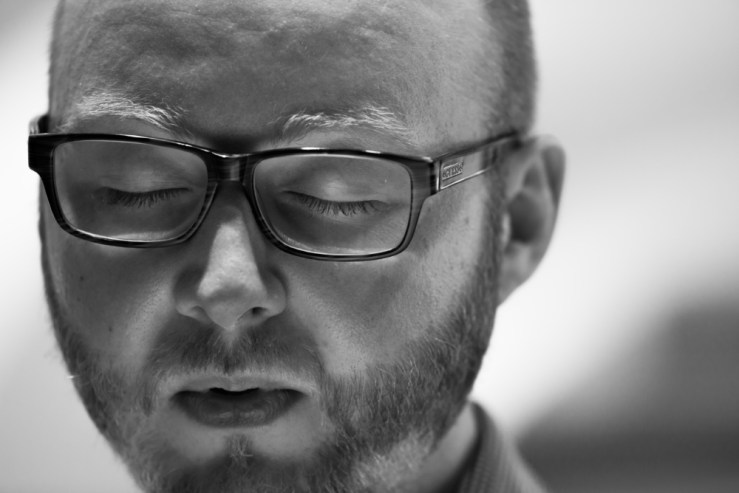
>> Faces in Prayer: Photography by Katharina Heigl, Weltmuseum Wien, Vienna, December 5, 2019–March 24, 2020: A series of thirty-one intimate black-and-white photographs showing people of different faiths in prayer. To capture these shots, photographer Katharina Heigl visited churches, temples, mosques, synagogues, and other places of worship in Austria and Israel, but, important to the display, there are no labels to tell you who is praying to which god(s). That’s because Heigl wishes to emphasize the universality of the human impulse to communicate with the Divine. There are signs, however, that reproduce quotes from anonymous sources, printed in German, English, Hebrew, and Arabic, such as “Prayer is like an oasis of calm inside me. Like a tree giving me shade.” [HT: ArtWay]

Faces in Prayer
Exhibition view of “Faces in Prayer: Photography by Katharina Heigl” (2019–20) at the Weltmuseum Wien, Vienna
Heigl, Katharina_Faces in Prayer
Photograph by Katharina Heigl, from the “Faces in Prayer” series

>> To Bough and To Bend, Bridge Projects, Los Angeles, March 11–April 25, 2020: Officially launched last October, Bridge Projects is an LA exhibition space with public programs connecting art history, spirituality, living religious traditions, and contemporary art practices. Their second exhibition, To Bough and To Bend, opens Wednesday, with thirty-two participating artists.

“The Tree of Life is found in both the beginning of the Jewish Tanakh and in the last book of the Christian Scriptures. The Bodhi Tree is said to be the site of Siddhārtha Gautama’s awakening as the Buddha. Ancient Chinook prayers address God as the ‘Maker of Trees.’ As the novelist Richard Powers said, trees are rightly called ‘architecture of imagination.’ Their shade and branches have been sites of contemplation, suffering, and imagining our renewal.

“Today, trees still speak: blunt stumps communicate deforestation and charred limbs speak of Los Angeles fires started by our own hands—or our negligence. New discoveries of communicating root systems speak to a tangled web of connections just below the surface of the visible world, just as LA’s iconic—and imported—palms evoke a colonial past. In To Bough and To Bend, artists explore these ecological issues and look to both religious and contemporary art practices that help us listen to these old friends, so that we might relearn to ‘walk slowly and bow often’ and find our way back into the living world we share.”

Shochat, Tal_Lessons in Time 3
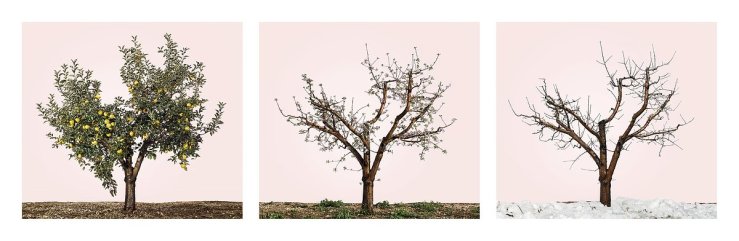
Tal Shochat (Israeli, 1974–), Lessons in Time 3 (Yellow Apple Tree), 2016. C-prints, mounted and framed, 39 1/4 × 44 in. each. Photo courtesy of the artist and Meislin Projects.

The opening celebration on March 14 will consist of a communal poetry reading followed by a Tu B’Shevat (New Year of the Trees) ritual presentation by community organizer Michal David. Other events are: “Called to Shine: Trees in Myth, Symbol, and Art”; a live interview with artist Lucas Reiner on his Trees as Stations of the Cross project; a talk on indigenous trees of Southern California, given by a member of the Tongva tribe; a discussion of art’s role in nature preservation; a lecture by Dr. Kimberly Ball on Yggdrasil, the tree of life in Norse mythology; “Paradise and Agony in the Garden: Sacred Trees in Italian Renaissance Art”; Dr. Duncan Ryūken Williams on the intersections of Buddhism and ecology; a bonsai demonstration; and a poetry reading and song performance by Iranian-born writer Sholeh Wolpé.

+++

NEW ALBUMS: Both these were released in January.

>> Old Wow by Sam Lee: An avid collector and reinterpreter of traditional songs, Britfolk artist Sam Lee is acclaimed for “breaking the boundaries between folk and contemporary music and the assumed place and way folksong is heard . . . not only inviting in a new listenership but also interrogating what the messages in these old songs hold for us today.” He studied under the Scottish storyteller and ballad singer Stanley Robertson (1940–2009) and, in addition to singing, plays the Jew’s harp and the Indian shruti box. Other instruments in his unique fusion include the klezmeresque cello, tabla, Japanese koto, ukulele, violins, and percussion.

Below are two music videos from his latest album, Old Wow. The first is “Lay This Body Down,” a song about death; in the choreographed video, Lee is tugged and caressed by a gaggle of deceased souls, who at the end enfold him in the ground. “The Moon Shines Bright,” on the other hand, which features Elizabeth Fraser, is about life: its call (fitting for Lent) is to “Rise, arise, wake thee, arise / Life, she is calling thee / For it might be the mothering of your sweet soul / If you open your eyes and see.” I’ve heard many different iterations of this song, which usually appears on Advent/Christmas albums with verses about the Nativity, Crucifixion, etc., but this adaptation was gifted to Lee by an elderly Gypsy woman named Freda Black and is absent of overt Christological references.

Another highlight: “Soul Cake,” a song I know from Peter, Paul, and Mary’s 1963 “A’ Soalin’.” It refers to a medieval Hallowmas tradition.

>> Civil Dawn by the Pharaoh Sisters: The Pharaoh Sisters is a folk outfit from Winston-Salem, North Carolina, whose debut album has arrived! Influenced by mountain, old-time, and gospel traditions, the band consists of Austin Pfeiffer on acoustic guitar and lead vocals, Jared Meyer on acoustic guitar and backing vocals, Kevin Beck on lap steel guitar, and John Daniel Ray on upright bass. “Their music blends the cowboy sensibilities of Western-native frontman and lyricist Austin Pfeiffer with the Appalachian traditions of dark imagery and poignant guitars from their current home in the foothills of the Blue Ridge.”

The biblical narrative is deeply embedded in the album, with many sideways references to specific scriptures. Topography is used symbolically throughout—fissures, canyons, mountains—and helps establish the central metaphor of Jesus as a pioneer, opening up a new frontier for us, leading us through the wilderness into the land of promise.

The album’s title, Civil Dawn, is a scientific term referring to when the center of the sun is six degrees below the horizon in the morning—in other words, the moment before the sun rises. The first song, which muses on the paradoxical character of Jesus, ends with a yearning for “Healing wings / Righteous sun,” a subtle nod to Malachi 4:2. That leads into “Awake, my soul, to the sun,” a prayer that we would incline ourselves toward the Light that’s already shining. As the journey continues, there’s darkness, dryness, a feeling of lostness and thirst. But we are not abandoned by our co-traveler, who is our light, our rest and refreshment, our way-maker. The last song, “Homecoming,” celebrates the “pioneer man with sun-scorched hands” who “guides on a trail he’s blazed”—an evocative image, which makes me think of Christ’s glorious wounds (in many traditional religious paintings, the nail prints emit light), but also, in light of the whole record, Isaiah 58:11: “The LORD will guide you always; he will satisfy your needs in a sun-scorched land and will strengthen your frame. You will be like a well-watered garden, like a spring whose waters never fail.”

Roundup: Lent devotionals, Joseph Shabalala, dancing with dust, kids’ songs and doodles

Lent begins next week, and as usual, I’ll be sharing visual art, music, poetry, and other media throughout the season that I hope will be a quiet support to your spiritual walk. If you are giving up social media for Lent but want to be kept aware of new Art & Theology posts, sign up to receive the posts by email by clicking the “Subscribe” button—on the right sidebar if you’re on a desktop, or at the bottom of this post if you’re on your phone. (Note that the sidebar/footer is not visible from the homepage; you have to click through into a post to see it.)

+++

Lent devotionals 2020

NEW LENT DEVOTIONALS: I’ve become aware of two new poetry devotionals for Lent published this year.

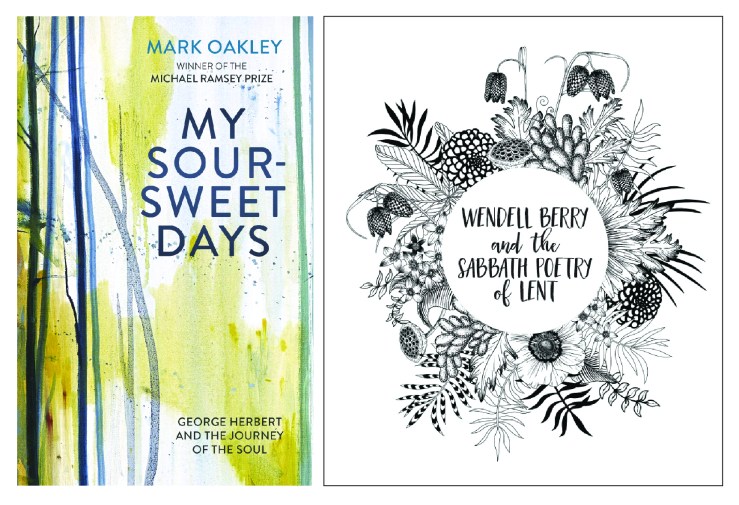
My Sour-Sweet Days: George Herbert and the Journey of the Soul by Mark Oakley: “George Herbert is one of the great 17th century poet-priests. His poems embrace every shade of the spiritual life, from love and closeness, to anger and despair, to reconciliation and hope. And his work is always rich with audacious playfulness: he seems to take God on, knowing God will win, as if he’s having an argument with a faithful friend he knows is not going to leave. In much of theology and spirituality, God is a critical spectator to human lives, but for Herbert, his sense of relationship with God is primarily of a friendship that can never be broken. These are some of the themes Mark Oakley explores in this book. He offers a poem for every day in Lent, with a two-page commentary on each of the forty included.”

Wendell Berry and the Sabbath Poetry of Lent by SALT Project: “In this Lenten devotional, biblical texts and simple, accessible practices walk hand-in-hand with Wendell Berry’s poetic vision of sabbath and the natural world. All you’ll need is your favorite Bible and Wendell Berry’s This Day: Collected and New Sabbath Poems. Week by week, we’ll walk through the woods together toward Easter morning, keeping sabbath as we go—with Wendell Berry as our guide.” Sold as a professionally designed, downloadable PDF with printing and folding instructions.

I really enjoyed SALT Project’s Lent devotional from last year, built around the poetry of Mary Oliver, so I bought this new one and gave it a breeze-through so I could recommend it here prior to Lent; I look forward to spending more time with it throughout the season. Devotions are provided for Ash Wednesday; the first, second, third, fourth, and fifth Sundays of Lent; Palm Sunday, Maundy Thursday, Good Friday, and Easter Sunday. Each one includes an instruction to read a Bible passage and a Wendell Berry poem, a short meditation that draws the two together, an additional reading of two more related Berry poems, a candle lighting and one-sentence prayer (on the themes of silence, trust, delight, care, insight, resurrection, joy, love, sorrow), a few recommended practices for the week, and personal questions to ponder and discuss with a friend, if desired.

I especially appreciate the “Practices” section, which includes ideas like: make a list of your favorite little delights (“the sunlight’s slant in the late afternoon, your dog’s ears, the steam rising from your coffee—no delight is too slight!”) and read it aloud with family or friends over a meal; take a neighborhood walk and count how many shades of green you see; ignore a household chore for an entire day each week.

+++

DANCE VIDEO: “Seas of Crimson”: In this music video for one of the pieces on Bethel Music’s album Without Words: Synesthesia, Jessica Lind of the Oregon Ballet Theatre dances with dust that by the composition’s end turns to vibrant color. A metaphor for the Lenten journey, perhaps? [HT: A Sacramental Life]

+++

OBITUARY: Joseph Shabalala, Ladysmith Black Mambazo Founder, Dies at 78: From the New York Times obituary by Jon Pareles:

Joseph Shabalala, the gentle-voiced South African songwriter whose choir, Ladysmith Black Mambazo, brought Zulu music to listeners worldwide, died on [February 11] in a hospital in Pretoria. He was 78. . . . Mr. Shabalala began leading choral groups at the end of the 1950s. By the early ’70s his Ladysmith Black Mambazo — in Zulu, “the black ax of Ladysmith,” a town in KwaZulu-Natal Province — had become one of South Africa’s most popular groups, singing about love, Zulu folklore, rural childhood memories, moral admonitions and Christian faith. Ladysmith Black Mambazo’s collaborations with Paul Simon on his 1986 album “Graceland,” on the tracks “Homeless” and “Diamonds on the Soles of Her Shoes,” introduced South African choral music to an international pop audience.

Joseph Shabalala

Shabalala was an ordained minister in the Pentecostal Church of God of Prophecy, having become a Christian in 1976. He said he hopes his music shows people “how to be good to God, how to praise God, how to respect, how to forgive each other . . .”

Below is a video of Shabalala with Ladysmith Black Mambazo singing one of his songs, “King of Kings,” live in Montreux, Switzerland, in 2000. Written during apartheid, it is a prayer for peace in South Africa and the rest of the world. It was first released on the 1987 album Shaka Zulu. [Listen on Spotify]

+++

KIDS’ SONGS: I’m not a mom, but I often enjoy listening to “children’s music,” as there’s so much of quality out there these days. Here are two songs released this year in that too-restrictively-titled genre (because hey, there’s much for grown-ups to love here too!), along with animated music videos.

“Glad You’re Here” by Justin Roberts: This new single by “the Judy Blume of kiddie rock” (New York Times) is for a new or soon-to-be-born baby. So fun, warm, and adorable! (Note: The video was produced by the same company that brought you the Wendell Berry devotional mentioned above.)

“Dinosaurs in Love” by Fenn Rosenthal, feat. Tom Rosenthal: This sad-sweet song about two dinosaurs eating cucumbers and having parties and then, well, you’ll have to listen . . . was written by three-year-old Fenn Rosenthal from London (with some help on the tune from her dad, Tom). At the end of January Tom Rosenthal, who is himself a singer-songwriter, posted a recording of Fenn singing this one-minute creation of hers on Twitter, and it went viral. Now the song is streaming on Spotify and is up on iTunes, Amazon, and other e-tailer websites, with all proceeds benefitting wildlife charities. It was also picked up by directorial team Hannah Jacobs, Katy Wang, and Anna Ginsburg, who created a music video using 2D frame-by-frame animation. [HT: Colossal]

+++

DRAWING CONTEST: “Doodle for Google,” for K–12 artists: Google Doodles are those special drawings, sometimes animated, that embellish Google’s logo on the website’s homepage from time to time. For the twelfth consecutive year, that highly visible space is up for grabs to one young artist in the US through the tech company’s “Doodle for Google” competition, open to ages K–12. This year the theme is “How do you show kindness?” In addition to having their work featured on Google’s landing page for an entire day, the winner will receive a $30,000 college scholarship, and the winner’s school will be awarded a $50,000 technology package. The deadline for submissions is March 13, 2020, at 11 p.m. ET. [HT: Hyperallergic]

Roundup: New weekly Psalm settings, Venezuelan immigrant portraits, liturgy for peace, Warhol and Scott Avett exhibitions, and Micah 6:8 song

EVERYPSALM: Over the next three years, indie-folk duo Poor Bishop Hooper (whom I blurbed here) will be writing and releasing one biblical psalm setting per week, sequentially from Psalm 1 to Psalm 150. And they are very graciously making all these songs available to download for free! They’ve already released the first three, and I’ve been thoroughly enjoying them. To sign up to receive a weekly download link in your inbox, visit https://www.everypsalm.com/. You may also want to consider giving to the project.

+++

PHOTO SERIES: Un-Daily Bread by Gregg Segal: For his latest project, US-based photographer Gregg Segal has been photographing Venezuelan immigrants with the entirety of their belongings lying around them. According to the United Nations High Commissioner for Refugees (UNHCR), an organization that Segal is collaborating with, the number of people in Venezuela forced to leave their homes due to violence, insecurity, threats, and/or lack of essential services keeps increasing, with more than 4.6 million refugees and migrants from the country living around the world, mostly in South America. In the photograph below, you can see a young mother and her two children surrounded by a few changes of clothes, a doll, a baby bottle, medicine, diapers, arepas, and a Bible. The three traveled over six hundred miles from Maracaibo to Bogotá, hitching rides and catching buses.

Segal, Gregg_Undaily Bread
Alesia, Arianny, and Lucas, Colombia, 2019. Photo by Gregg Segal, from his Un-Daily Bread series.

Un-Daily Bread it is an offshoot of Segal’s Daily Bread series, in which he photographed images of kids from around the world surrounded by what they eat each day.

+++

LITURGY: Impelled by the various antagonisms that have been on the rise both domestically and abroad, Aaron Niequist has written and compiled a ten-page Liturgy for Peacemakers, which includes a call to worship, two songs, a confession of sin and assurance of pardon, scripture readings, and prayers, including one minute of holy space each to pray for a global enemy, a local enemy, and a personal enemy. The liturgy, which focuses on shaping us to be instruments of God’s peace in the world, is free for you to use in your living rooms and/or churches, and to adapt in any way you wish.

+++

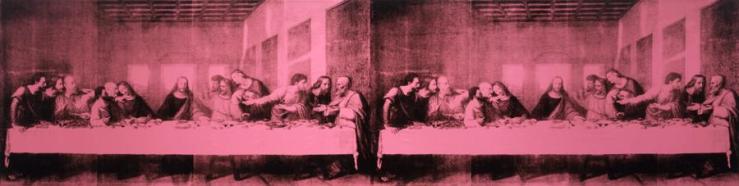
EXHIBITION: Andy Warhol: Revelation, October 20, 2019–February 16, 2020, Andy Warhol Museum, Pittsburgh: Ever since reading Jane Daggett Dillenberger’s illuminating book The Religious Art of Andy Warhol (1998), I’ve been interested to explore more deeply the Byzantine Catholicism of Andy Warhol and how it influenced his art. (I was surprised to learn, for example, that although he had a complicated relationship with Christianity, Warhol regularly attended Mass, wore a cross around his neck, carried a pocket missal and rosary, and prayed daily with his mother in Old Slavonic over the forty years he lived with her.) A pioneer of the pop art movement best known for his silkscreen prints of Marilyn Monroe and Campbell’s soup cans, Warhol also made giant cross paintings as well as screen prints of famous Renaissance religious paintings in full or in detail (by Piero della Francesca, Raphael, and Leonardo da Vinci)—especially The Last Supper, his last and largest series. Jesus is surely a part of American pop culture, so Warhol’s use of such imagery is not all that unusual in light of his larger oeuvre. But is there anything more to this choice of subject?

Warhol, Andy_The Last Supper
Andy Warhol (American, 1928–1987), The Last Supper, 1986. Acrylic and silkscreen ink on linen, 78 × 306 in. (198.1 × 777.2 cm). Andy Warhol Museum, Pittsburgh.
Warhol, Andy_Cross (Red)
Andy Warhol (American, 1928–1987), Cross (Red), 1982. Synthetic polymer paint and silkscreen on canvas, 90 × 70 in. (228.6 × 177.8 cm). Andy Warhol Museum, Pittsburgh.

I’ll be driving to Pittsburgh next weekend, where Warhol grew up, to see an exhibition of his religious works curated by José Carlos Diaz from the Andy Warhol Museum’s permanent collection. I’ll also be attending a lecture at the museum given by Jonathan A. Anderson, titled “Religion in an Age of Mass Media: Andy Warhol’s Catholicism.” (It’s January 25 at 6 p.m. Update: Watch the lecture on YouTube.) In and around Pittsburgh is also where Fred Rogers (of Mister Rogers’ Neighborhood fame) spent most of his life, so I’ll be visiting a few key spots related to him as well!

+++

EXHIBITION: Scott Avett: INVISIBLE, October 12, 2019–February 2, 2020, North Carolina Museum of Art, Raleigh: “Internationally recognized as co-founder of the band The Avett Brothers, Scott Avett has been a working artist, focusing on painting and printmaking, since he earned a BFA in studio art from East Carolina University in 2000. But until now this art-making part of his life has been a secret and a more solitary creative pursuit in comparison to his life as a musician, singer, and songwriter. This solo exhibition features Avett’s large-scale oil paintings. These are psychologically charged and emotionally intense portraits focused on his family and himself—often intimate, vulnerable, and sometimes uncomfortably truthful portrayals. Like his songs, Avett’s paintings speak to universal issues of spirituality and struggle, love and loss, heartache and joy, as well as more personal stories of career, family, and living in the South.”

As an Avett Brothers fan, I made it a point to see this exhibition in December when I was visiting family for Christmas, and actually, it exceeded my expectations. It was endearing to see portraits of Avett’s three children tumbling around, swinging, engaged in deep thought at the dinner table, playacting as monsters, wailing—and he and his wife in the middle of it all, experiencing both the joys and stresses of parenting. My favorite pieces were probably the companion paintings Motherhood and Fatherhood, which show the messiness of those callings.

Avett, Scott_Motherhood and Fatherhood
Scott Avett (American, 1976–): Motherhood (2012); Fatherhood (2013). Oil on canvas, 106 × 65 in. each. Photo: Victoria Emily Jones.

Fatherhood is one of several self-portraits in the show. The one that’s most prominently displayed, right at the entrance, is Black Mouse, White Mouse, which references Leo Tolstoy’s personal essay “A Confession,” about an existential crisis. In it Tolstoy recounts a fable of a man who falls into a well with a dragon at the bottom. On his way down he grabs hold of a branch growing out of the wall, but it’s being nibbled by two mice, and his fall to death is imminent. This scenario is representative of where we all find ourselves: finite beings in an infinite world, dangling over the abyss. There are four possible ways to respond, says Tolstoy: ignorance, epicureanism, suicide, or hanging on to life. He thinks suicide the most logical but says he lacks the nerve to carry it out.

Tolstoy then launches into metaphysical musings, grappling with the question of God’s existence, when suddenly, he has an epiphany that “God is Life,” and that “I live, really live, only when I feel Him and seek Him.” He continues, “I returned to the belief in that Will which produced me and desires something of me. I returned to the belief that the chief and only aim of my life is to be better, i.e. to live in accord with that Will. And I returned . . . to a belief in God . . .”

Avett, Scott_Black Mouse, White Mouse
Scott Avett (American, 1976–), Black Mouse, White Mouse, 2010. Oil on canvas, 106 × 65 in. Photo: Victoria Emily Jones.

Avett’s spirituality isn’t overt in any of the paintings, but it’s been interesting to hear him open up more about that aspect of himself in artist talks and interviews. In an October talk, for example, he said, “I’m a true believer that every single one of us is a beloved son or daughter of God, period. I know that for certain. And because of that, this [pointing to himself] isn’t the only bright shining person in this room. It’s insane how true that is. . . . I’ve just always lived like that—like someone was watching. It was God the whole time; he was right there with me and in me, the whole time. When I was younger it was so much easier to access that. And now growing older, it’s about opening up to access that again.”

Scott Avett: INVISIBLE is ticketed with Frida Kahlo, Diego Rivera, and Mexican Modernism from the Jacques and Natasha Gelman Collection—which was also great, though it definitely majors in archival photographs and cultural artifacts and re-creations, not paintings by the famous couple.

+++

SONG: “Offertory” by John Ness Beck, performed by Future:Past: Micah 6:8 has, for me, functioned as what some would call a “life verse”: a guiding principle that I return to again and again to reorient myself to the divine will. I long to be the kind of person the verse describes: one who does justice, loves mercy, and walks humbly with God. Thanks to Paul Neeley at Global Christian Worship, I’ve just been made aware of a beautiful musical setting of this passage, which happens to be one of the Revised Common Lectionary readings for February 2 this year.

“With what shall I come before the LORD,
and bow myself before God on high?
Shall I come before him with burnt offerings,
with calves a year old?
Will the LORD be pleased with thousands of rams,
with ten thousands of rivers of oil?
Shall I give my firstborn for my transgression,
the fruit of my body for the sin of my soul?”
He has told you, O man, what is good;
and what does the LORD require of you
but to do justice, and to love kindness,
and to walk humbly with your God?

—Micah 6:6–8

The music was composed in the second half of the twentieth century by John Ness Beck and was adapted for TTBB (tenor-tenor-bass-bass) by Craig Courtney—performed here a cappella by Josh Adams, Davis Gibson, Jon Kok, and Matthew Reiskytl of the Christian music and media ministry Future:Past. To purchase sheet music for “Offertory” (available in SATB, SSA, and TTBB voicings, with keyboard and optional string quartet), click here.

Roundup: Advent art, songs, poems

So much to share today! Be sure not to miss “Psalm 126” by Drew Miller (a new favorite Advent song) and Matthew Milliner’s excellent presentation on the Virgin Mary in art, which opened an exhibition that’s running in Southern California—both below. (If you only have time to take in a few items from this post, those are the ones I’d recommend.)

PODCAST EPISODE: “A Time for Wanting and Waiting: An Advent Conversation with W. David O. Taylor”: In this recent episode of The Road to Now, hosts Bob Crawford and Chris Breslin interview liturgical theologian David Taylor [previously] about the season of Advent: what it is, its history and how it fits into the wider church year (see especially 43:29ff.), the canon of Advent and Christmas songs, and the gift the Psalms offers us during this season. Referencing his 2015 Washington Post article, Taylor says our picture of Christ’s coming, especially as expressed through our hymnody, tends to be unidimensional and far too sanitized:

We should permit the Nativity stories to remain as strange and bizarre and fantastical and difficult as they in fact are, rather than taming and distilling them down to this one nugget or theme of effusive joy. There is effusive joy in that—it’s simply that that’s not the only thing that characterizes these stories. Unfortunately, most of our canon of Christmas carols or hymns tends to focus on what I would argue is only 50 percent of the Nativity stories. Everything that begins with Elizabeth and Zechariah and goes all the way to, say, Anna and Simeon and the visit of the Magi and the flight to Egypt . . . it really is one whole story that is being told with these subplots.

I would love to see us create . . . new music that either retells portions that we are already telling but not the whole of it, or we need to tell parts that have not yet been told. . . . Let’s ask ourselves how God is at work in all the minor-key or difficult or dissonant parts of the Nativity stories, not absent from—those are not extraneous to God incarnating himself in Jesus Christ. Those are essential parts of it. And so how can our hymns become ways of praying ourselves into these stories so they can sink deeply into the fibers of our hearts and minds and bodies, and for us to say, “Oh, all the weird and difficult and dissonant parts of our lives are part and parcel of God’s good work,” not, again, on the margins of it, or things we should eschew.

To help deepen and expand the church’s repertoire of Christmas music, Taylor founded, along with a few others, the Christmas Songwriters Project. The Psalms are an inspiration in this task, as they express a joy that is at times quiet and at others raucous, as in the Nativity narratives, and that exists as part of a dynamic constellation of emotions and postures that praise can encompass. Most of us don’t recognize the pure, undistilled happiness that is marketed to us throughout December, Taylor says, and we shouldn’t force ourselves to try to feel it but rather should take a cue from the Psalms and also see the same emotional complexity at work at the beginning of the Gospels:

The Psalms, and I think Christian faith at its heart, can make space for joy and sorrow to exist alongside each other in a way that happiness, as we commonly understand it, cannot, or only with great difficulty. . . . What the psalms of praise do . . . is that in one movement, there’s this effusive joy or a shouting joy or a convivial joy, and then it segues to a quieter joy or a contemplative joy or a yearning, painful kind of joy. . . .

So in the season of Advent, when we look at the characters in scripture—you know, Mary and Joseph and Zechariah and Elizabeth and the shepherds and Anna and Simeon—every one of them has this moment, perhaps, of which we could say, “That sounds like joy.” . . . But immediately before or immediately after, it transitions to something else. So does that mean that joy is negated? Is joy squashed? Is joy extinguished? Or is joy able to continue to exist side by side, to subsist, with a continued experience of longing or a sudden moment of sadness?

+++

ART BY SCOTT ERICKSON: This month Portland-based artist Scott Erickson has been posting on Instagram Advent-themed images he has made, along with thoughtful meditations. Some emphasize the bodiliness of the Incarnation, which often gets overlooked, presumably out of a sense of propriety. But “grace comes to us floating in embryonic fluid . . . embedded in the uterine wall of a Middle Eastern teenage woman,” Erickson writes about With Us – With Child, to which one Instagrammer responded, “This is trajectory changing. Thank you for this. Nipples, vaginas, and Jesus CAN coexist!” Another mentioned how she had never seen Mary with a belly button and a linea nigra before. The image reminds us that Jesus was indeed “born of woman” (Gal. 4:4).

Erickson, Scott_With Us, With Child
Scott Erickson (American, 1977–), With Us – With Child, 2016 [purchase as poster]
Another imaginative image suggests that Christ came to set the world on fire, so to speak. God, who is of old, gives himself to earth as a Jewish babe (“Love has always been FOR GIVENESS,” Erickson writes), sparking a revolution.

Erickson, Scott_Advent
Art by Scott Erickson

View more art by Scott Erickson @scottthepainter.

+++

LECTIONARY POEMS FOR ADVENT: This year Englewood Review of Books launched a new feature on their website: a weekly post of four to six poems that resonate with the Revised Common Lectionary readings for that week. “We will offer here a broad selection of classic and contemporary poems from diverse poets that stir our imaginations with thoughts of how the biblical text speaks to us in the twenty-first century. We hope that these poems will be fruitful not only for preachers who will be preaching these texts on the coming Sunday, but also for church members in the pews, as a way to prime our minds for encountering the biblical texts.” I’m really enjoying these stellar selections, several of which are new to me.

Continue reading “Roundup: Advent art, songs, poems”

Roundup: Saar installation, Christian themes in Australian and New Zealand art, “heart of God” chant, jazz Communion song

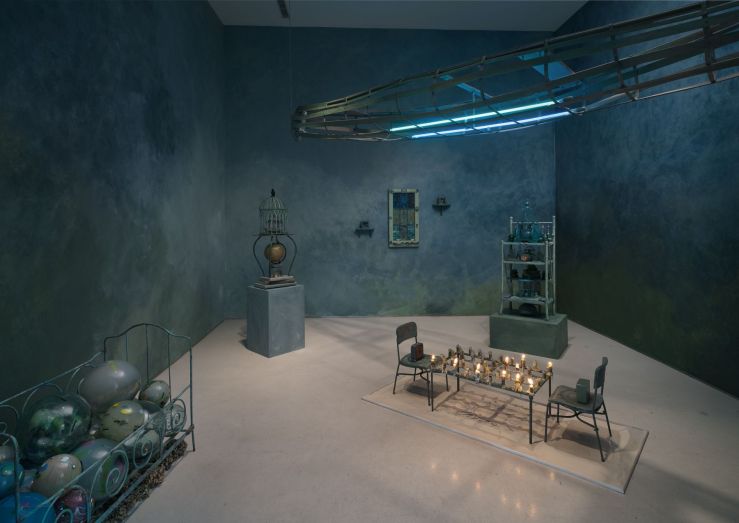
VISUAL MEDITATION: On The Alpha & The Omega by Betye Saar: A few weeks ago my commentary on a Betye Saar installation was published on ArtWay.eu. The idiomatic Hebrew in the title is a reference not to Christ but to the beginning and the end of life, a theme Saar explored by arranging around a blue-painted room such found objects as an antique cradle, dried hydrangeas, a boat shell, a mammy figurine, a washboard, empty apothecary bottles, books, clocks, a moon-phase diagram, etc.

Saar, Betye_Alpha and Omega installation
Betye Saar, The Alpha & The Omega: The Beginning & The End, 2013. Installation at Roberts & Tilton, Culver City, California.

With an educational background in design, Saar began her career as a printmaker and working in theater on costumes and sets. She then ventured into collage, which led to assemblage (for which she is most celebrated), sculpture, and installations. With installations, she likes how “the whole body has the experience”—how you are quite literally inside the work. Saar is one of today’s leading American contemporary artists, with two exhibitions currently running in the United States: one at MoMA, and the other at LACMA. I first encountered her in a college art history course, through her most famous work, The Liberation of Aunt Jemima. Race, memory, and spirituality are recurring themes in her oeuvre.

+++

ESSAY: “‘A pretty decent sort of bloke’: Towards the quest for an Australian Jesus” by Jason A. Goroncy: “What happens to religious images and symbols when they get employed outside of their traditional contexts and charged with unapproved and heterodox interpretations?” asks Goroncy. “From many Aboriginal elders, such as Tjangika Napaltjani, Bob Williams and Djiniyini Gondarra, to painters, such as Arthur Boyd, Pro Hart and John Forrester-Clack, from historians, such as Manning Clark, and poets, such as Maureen Watson, Francis Webb and Henry Lawson, to celebrated novelists, such as Joseph Furphy, Patrick White and Tim Winton, the figure of Jesus has occupied an endearing and idiosyncratic place in the Australian imagination. It is evidence enough that ‘Australians have been anticlerical and antichurch, but rarely anti-Jesus’. But which Jesus? In what follows, I seek to listen to what some Australians make of Jesus, and to consider some theological implications of their contributions for the enduring quest for an Australian Jesus.” [HT: Art/s and Theology Australia]

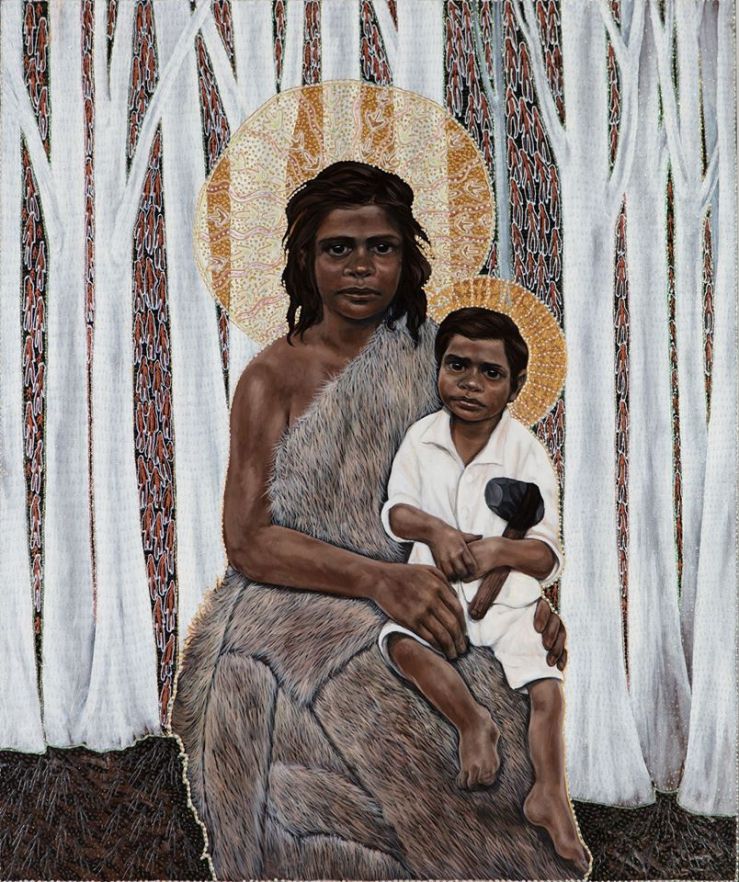
Dowling, Julie_Black Madonna, Omega
Julie Dowling (Badimaya/Yamatji/Widi, 1969–), Black Madonna: Omega, 2004. Synthetic polymer paint, red ocher, glitter, and metallic paint on canvas, 120 × 100 cm. Art Gallery of Western Australia. “I painted this in honour of First Nation mothers who have their children stolen from them by white governments in order to assimilate their children.”
Mombassa, Reg_Jesus Is Stripped Bare
Chris O’Doherty (aka Reg Mombassa) (Australian, 1951–), Australian Jesus Is Stripped Bare, station 10 from the Stations of the Cross cycle. Chapel at the Australian Centre for Christianity and Culture, Barton, ACT, Australia. Photo: Katherine Spackman.

Goroncy quotes Wilson Yates, who says that Jesus has become “a part of the culture and life far beyond the final control of the church, . . . imaged in diverse ways by non-Christian as well as Christian artists, often contrary to the church’s dominant interpretation. . . . This should not be viewed as threatening,” however, but rather as “a means by which, paradoxically, the traditional symbols are kept vital – are kept alive in the midst of human life.”

+++

AUDIO INTERVIEW: Justin Paton on New Zealand artist Colin McCahon: In celebration of the centenary of Colin McCahon’s birth, art critic and curator Justin Paton has published McCahon Country, which examines nearly two hundred of the artist’s paintings and drawings. In this Saturday Morning (RNZ) interview, Paton says that McCahon is one of the great modern religious artists; an unabashed Christian, he grappled with how to make religious art in a post-religious age, often interweaving biblical themes and texts with New Zealand landscapes. His paintings, Paton says, are “an unequivocal statement of faith,” painted at times with “sophisticated unsophistication.” In 1948 one critic described them dismissively as “like graffiti in some celestial lavatory”—a comparison Paton affirms but sees as commendatory.

McCahon, Colin_The days and the nights in the wilderness
Colin McCahon (New Zealand, 1919–1987), The days and the nights in the wilderness showing the constant flow of light passing into a dark landscape, 1971
McCahon, Colin_The Resurrection of Lazarus
Colin McCahon (New Zealand, 1919–1987), Practical religion: The resurrection of Lazarus showing Mount Martha, 1969–70. Acrylic on unstretched canvas, 207.5 × 807 cm. Te Papa (Museum of New Zealand), Wellington.

I was familiar with McCahon’s early works—Annunciations, Crucifixions—but not so much the later ones featured here. For example, The days and the nights, about which Paton says,

You could take a first look at this thing and you could think it’s not so exciting, in a way. It’s . . . smeary blacks and then there’s this . . . kind of clay color—muddy, you might say. . . . The form is this kind of ocher cross with black surrounding it. But give it some time, and you realize that the space above describes a horizon line. You can see the riffle of clouds along that horizon. If you know Muriwai on the West Coast, you can recognize it as a West Coast landscape, which is of course the spirit landscape up which souls travel in Maori mythology. And then you realize that this cross is also a kind of estuary, that it is descending through to areas or gates. So it is at once the Christian cross, it’s the Buddhist idea of light as grace which descends towards us . . .

About Lazarus:

McCahon said the Lazarus story was one of the great stories about seeing: all those people who were witnesses to this event saw as never before. What’s wonderful in the work is, as you read your way from left to right—and it really is this kind of epic telling of the story—when you’re about two-thirds of the way across, he almost makes you into Lazarus. He puts you into the position of this person who is emerging from the tomb, because there’s this sliver of light that opens up and bursts then fills the right-hand third of the painting. It’s like coming out of a dark space and suddenly being blinded by sunlight.

It’s a great example of what a great reader he was. He got into these texts with the avidity of a fan. You really felt he was there with these people in this ancient story and then tries to put us inside it as we stand and walk in front of this giant canvas. It has a terrific oscillation between something worldly and vernacular and then something exalted and sacred at the other end.

For more on McCahon, see “Victory over death: The gospel according to Colin McCahon” by Rex Butler (2012), The Spirit of Colin McCahon by Zoe Alderton (2015), and Colin McCahon: A Question of Faith (2003).

+++

CHANT: “I Am Here in the Heart of God” by Erin McGaughan, adapt. & arr. Chandra Rule: At the Singing Beloved Community workshop held in September in Cincinnati, song leader Chanda Rule led participants in a chant that she adapted from Erin McGaughan. To McGaughan’s original, Rule added three new verses with a modulation between each, and she presented the whole of it in a call-and-response format. [HT: Global Christian Worship]

I am here in the heart of God
God is here in the heart of me
Like the wave in the water and the water in the wave
I am here in the heart of God

I am here in the breath of God
God is here in the breath of me
Like the wind in the springtime and the springtime in the wind
I am here in the breath of God

I am here in the soul of God
God is here in the soul of me
Like the flame in the fire and the fire in the flame
I am here in the soul of God

I am here in the mind of God
God is here in the mind of me
Like the earth in my body and my body in the earth
Like the flame in the fire and the fire in the flame
Like the wind in the springtime and the springtime in the wind
Like the wave in the water and the water in the wave
I am here in the heart of God

+++

SONG: “I Hunger and I Thirst,” words by John S. B. Monsell (1866), with new music by Wally Brath: I was listening to the video recording of the Grace College Worship Arts jazz vespers service that took place November 8 at Warsaw First United Methodist Church in Indiana, when I heard this striking hymn. Written by a nineteenth-century Anglican clergyman, it was set to music by Wally Brath, an assistant professor of worship arts at Grace College, who’s playing the piano in the video. The performance features Grammy Award–winning bassist John Patitucci, and vocalist Ethan Leininger. Click here to listen to the whole service and to see the full list of musicians. [HT: Global Christian Worship]

I hunger and I thirst:
Jesu, my manna be;
ye living waters, burst
out of the rock for me.

Thou bruised and broken Bread,
my life-long wants supply;
as living souls are fed,
O feed me, or I die.

Thou true life-giving Vine,
let me thy sweetness prove;
renew my life with thine,
refresh my soul with love.

Rough paths my feet have trod
since first their course began:
feed me, thou Bread of God;
help me, thou Son of Man.

For still the desert lies
my thirsting soul before:
O living waters, rise
within me evermore.