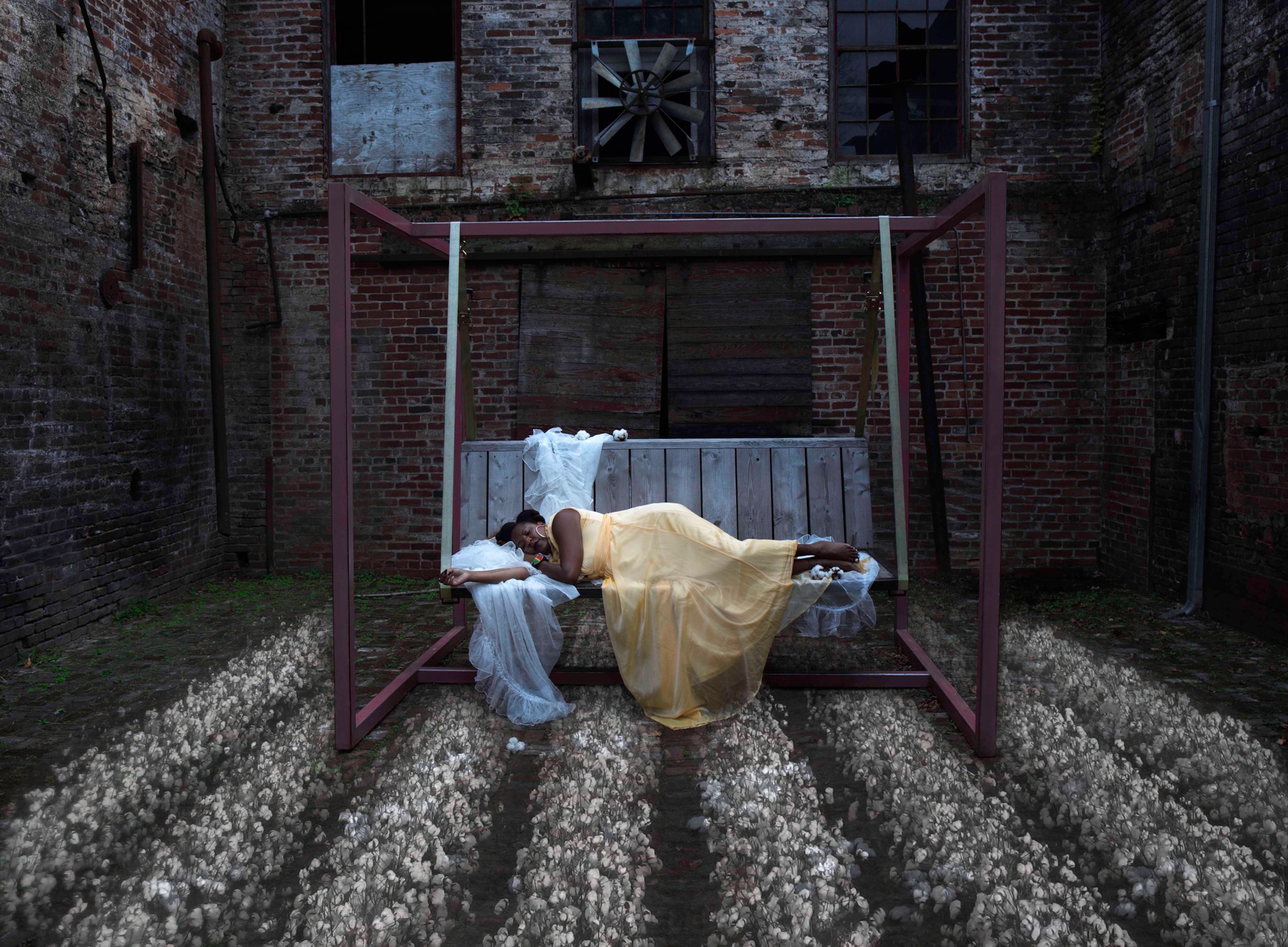
Pentecost roundup: Invocations; Holy Spirit as “lodes-mon”; organ improv; tongues of fire in a flower patch

SONGS:

Here are three sung invocations of the Holy Spirit, seeking his power, liberation, comfort, light, and renewal.

>> “Holy Spirit, Come with Power”: This hymn was written by Anne Neufeld Rupp in 1970, who set it to a Sacred Harp tune from 1844 attributed to B. F. White. It’s performed here by the Bel Canto Singers from Hesston College in Kansas, featuring Gretchen Priest-May on fiddle and Tim May on acoustic guitar.

I was introduced to this hymn through the Voices Together Mennonite hymnal, where it appears in both English and Spanish as no. 57.

>> “Mweya Mutsvene” (Holy Spirit, Take Your Place) by Joshua Mtima and The Unveiled: The Unveiled is a collective of Christian musicians from Harare, Zimbabwe, founded by Joshua Mtima in 2020. Here they sing one of their songs in Shona. An English translation is provided onscreen. [HT: Global Christian Worship]

>> “Ven Espíritu Divino (Secuencia de Pentecostés)” (Come, Spirit Divine) by Pablo Coloma, performed by Chiara Bellucci: The Spanish lyrics of this contemporary Christian song from the Latin American Catholic tradition are in the YouTube video description. They ask the Holy Spirit, “sweet guest of our souls,” to come bringing healing, regeneration, growth, joy, and charisms.

+++

SUBSTACK POST: “Veni Creator Spiritus: A Lush Middle English Hymn” by Grace Hamman, Medievalish: Dr. Grace Hamman shares Friar William Herebert’s (ca. 1270–ca. 1333) Middle English translation of the classic Latin Pentecost hymn attributed to Rabanus Maurus (ca. 780–856), “Veni Creator Spiritus” [previously]. Herebert uses words like vor-speker (for-speaker; i.e., intercessor), lodes-mon (lodesman; i.e., journeyman or navigator), and shuppere (shaper) as titles for the Holy Spirit.

+++

ORGAN WORK: “Improvisation on Veni Creator Spiritus” by Alfred V. Fedak: “Your congregation will hear the rushing of the Holy Spirit in this improvisatory prelude (taken from Fedak’s and Carl P. Daw’s oratorio The Glories of God’s Grace),” writes Selah Publishing. “Fedak effectively uses sweeping whole-tone scale passages and arpeggios to indicate the Spirit’s presence, while the pedal plays phrases of the hymn tune,” a medieval plainchant. The publisher has posted the following performance of the piece (audio only), by the composer himself, along with a selection of Pentecost art from the thirteenth to eighteenth centuries. [HT: Global Christian Worship]

There are many other works on organ (fantasias, partitas, fugues) based on the “Veni Creator Spiritus” tune; view a select list on Wikipedia.

+++

POEM: “Book of Hours” by Kimberly Johnson: “A pentecost of bloom: all the furred tongues / awag in the iris patch, windrush through the fireflower.” So opens the poem “Book of Hours” by Kimberly Johnson [previously], from her collection Uncommon Prayer (Persea, 2014). A book of hours is a genre of medieval prayer-book used by laypeople, which arranges prayers, scripture, and other devotional texts for reading at prescribed times of the day. Johnson’s “Book of Hours” draws on the fields of codicology (the study of manuscripts as physical objects) and botany to consider how God’s Spirit moves through and enlivens the material world, be it the irises, fire lilies, alyssum, and paperwhite narcissus in her garden, or the ink and natural pigments on calfskin—green verdigris, red cochineal, yellow curcumin—in the rare manuscripts library where she examines a book of hours whose embellished Latin text she can’t quite make out but whose beauty enraptures her nonetheless. These are but two untranslatable experiences of sensual, embodied communion with God that Johnson narrates in the collection, the paint flakes on her lips and the pollen on her wrist a chrism and a prayer.

Roundup: Tea with strangers, church forests of Ethiopia, and more

CHILDREN’S BOOK: Let There Be Light by Desmond Tutu, illustrated by Nancy Tillman: I saw this enchanting little book at my local library recently—a retelling of the creation narrative from Genesis 1 by the late South African Anglican bishop, theologian, and Nobel Peace Prize laureate Desmond Tutu. Published by Zonderkidz in 2014, it opens, “In the very beginning, God’s love bubbled over when there was nothing else . . .” Hear it read aloud, and view the illustrations, in this video from the Seuss’s Gooses YouTube channel:

+++

ARTICLES:

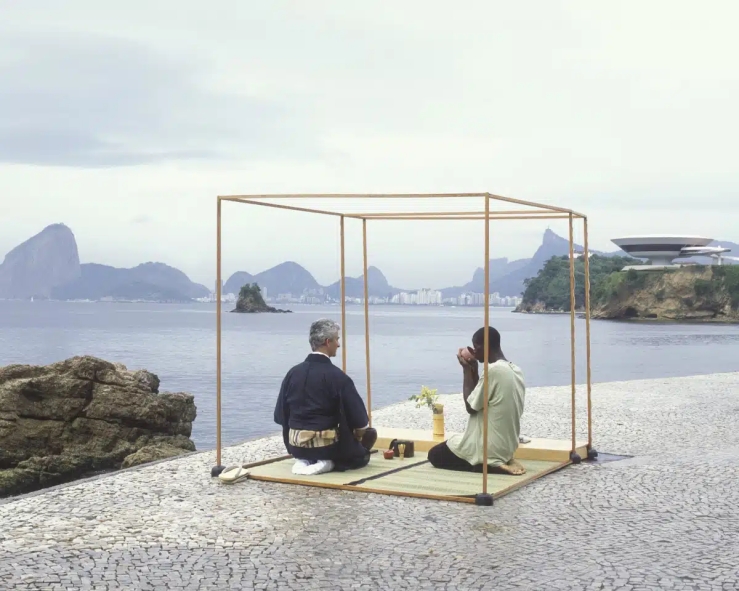
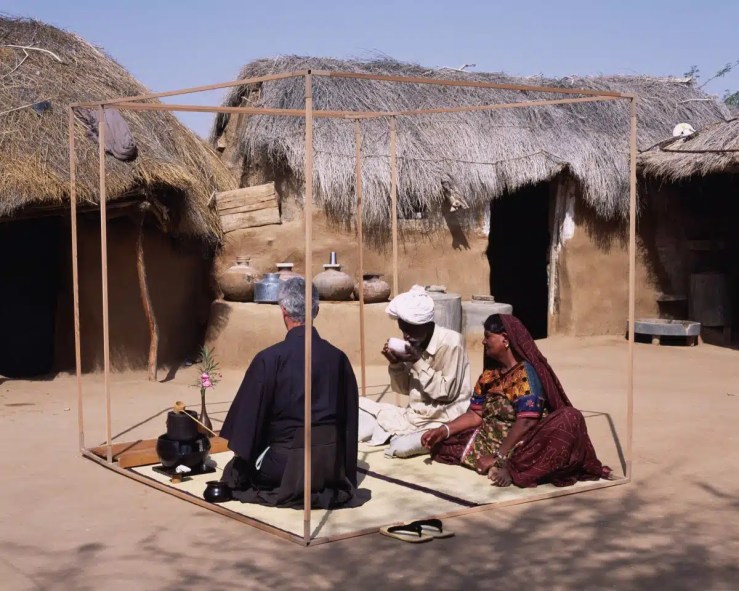
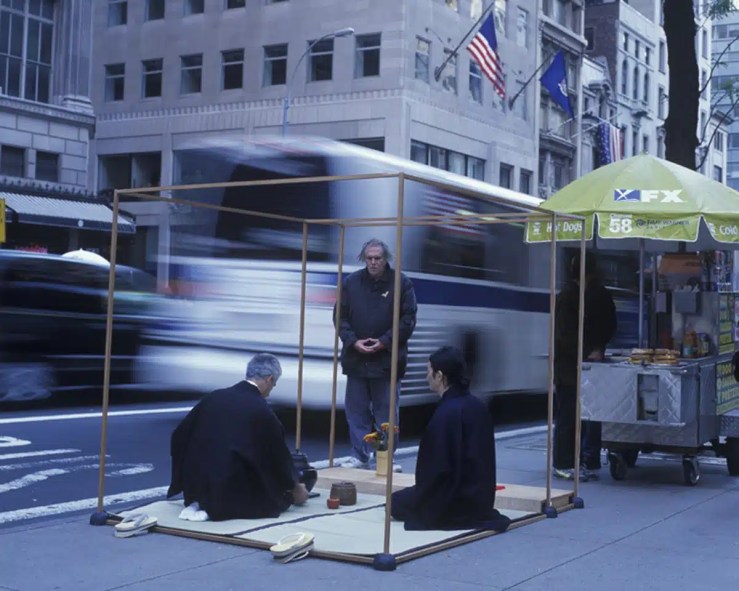
>> “Artist Traveled to Over 30 Cities to Perform Tea Ceremony with Strangers,” an interview with Pierre Sernet by Jessica Stewart: From 2001 to 2008, artist Pierre Sernet (French-born and residing in Japan) traveled to over thirty countries to spontaneously enact abbreviated Japanese tea ceremonies, inviting passersby to come sit and drink the cup of matcha he prepared in front of them. From deserts and beaches to villages and construction sites, he would set up a portable wood cube that denoted the “tea room,” and the ensuing encounters were documented with photography. Called One (and nicknamed Guerrilla Tea), the series was meant to promote respect across cultures and “to emphasize to viewers the importance of each moment we live in.”

  • Sernet, Pierre_Denilson, Niteroi, Brazil
  • Sernet, Pierre_Kheth and Mayndevi, Jaisalmer, India
  • Sernet, Pierre_Shinya, Rockefeller Center, NY

View more photos at https://pierresernet.com/one/.

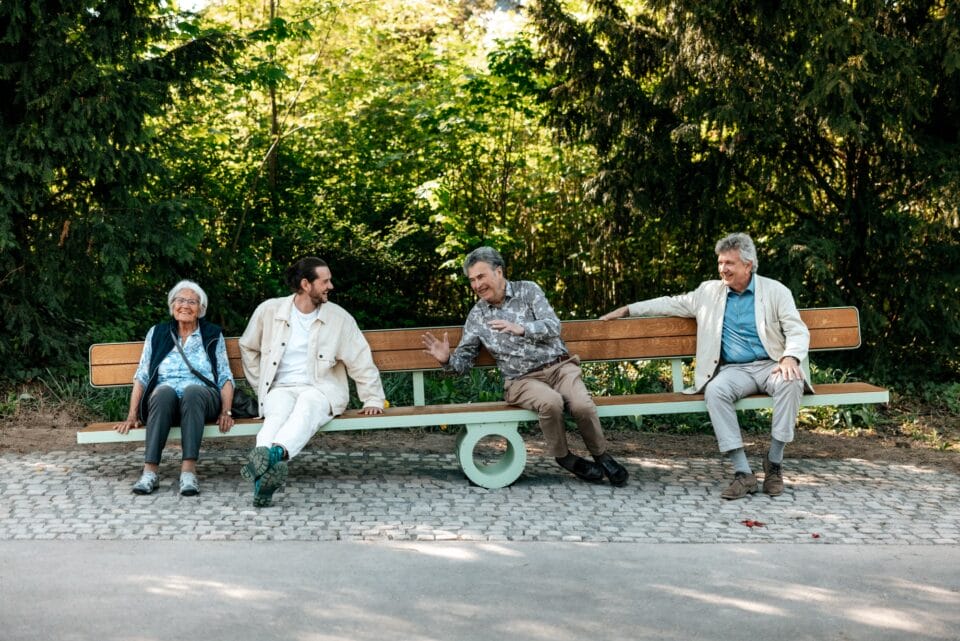
>> “A Teeter-Totter Style Bench Invites Sitters to Find Common Ground” by Grace Ebert: “In the Garden of Generations in Einbeck, Germany, a playful new installation asks park goers to find equilibrium with their neighbors. ‘Balance Bench” is the latest project of Berlin-based artist Martin Binder. Installed in his hometown, the interactive artwork rests on a central cylinder rather than four legs, requiring that at least two people sit on either side to level. ‘It cannot be used alone—it demands awareness, consensus, and cooperation between people to become a functional public space,’ he says.”

Binder, Martin_Balance Bench
Martin Binder (German, 1990–), Balance Bench, 2025. Steel, oak. Installation at the Garden of Generations, Einbeck, Germany. Construction by Henning Müller Sondermaschinen. Photo by Spieker Fotografie.

+++

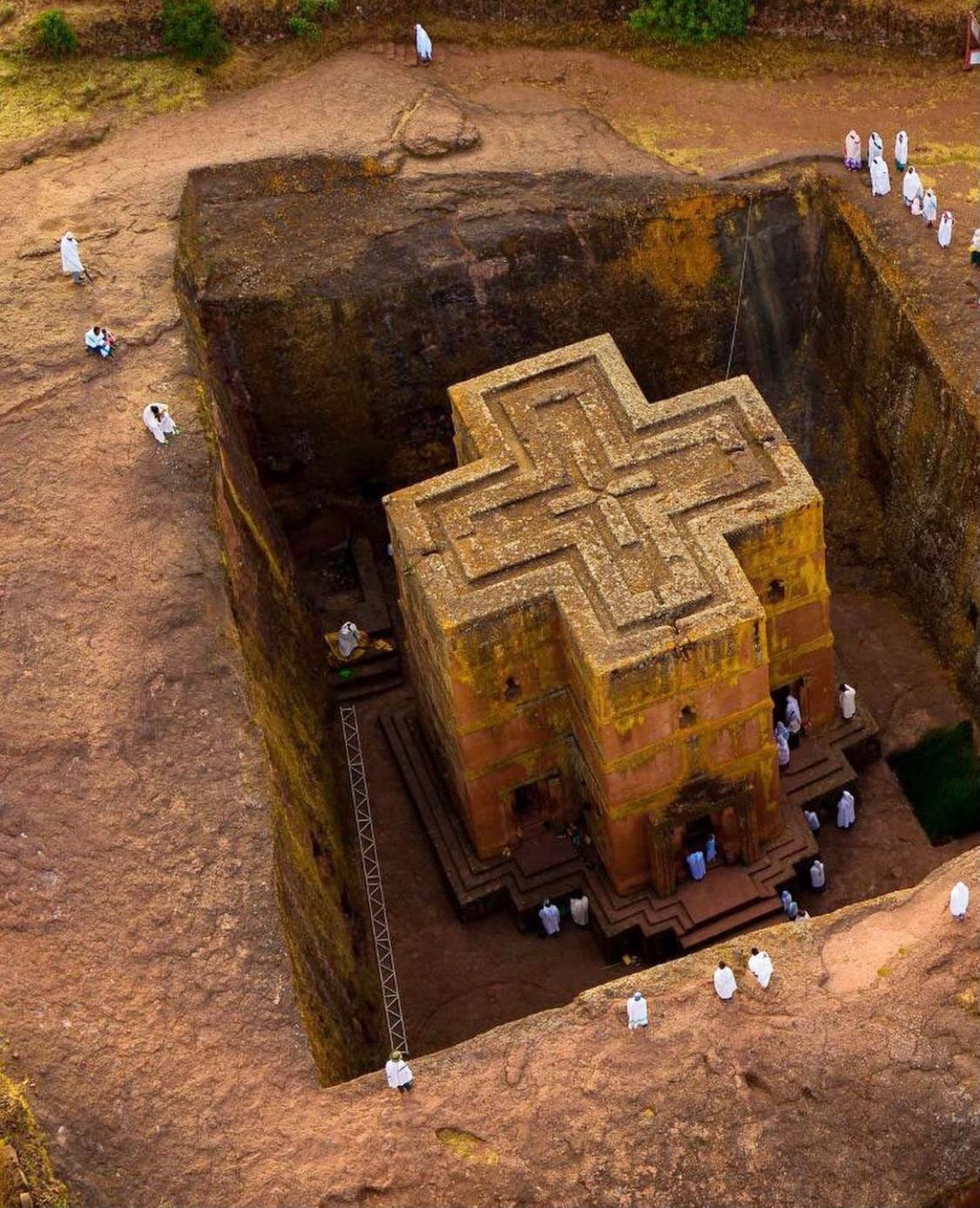
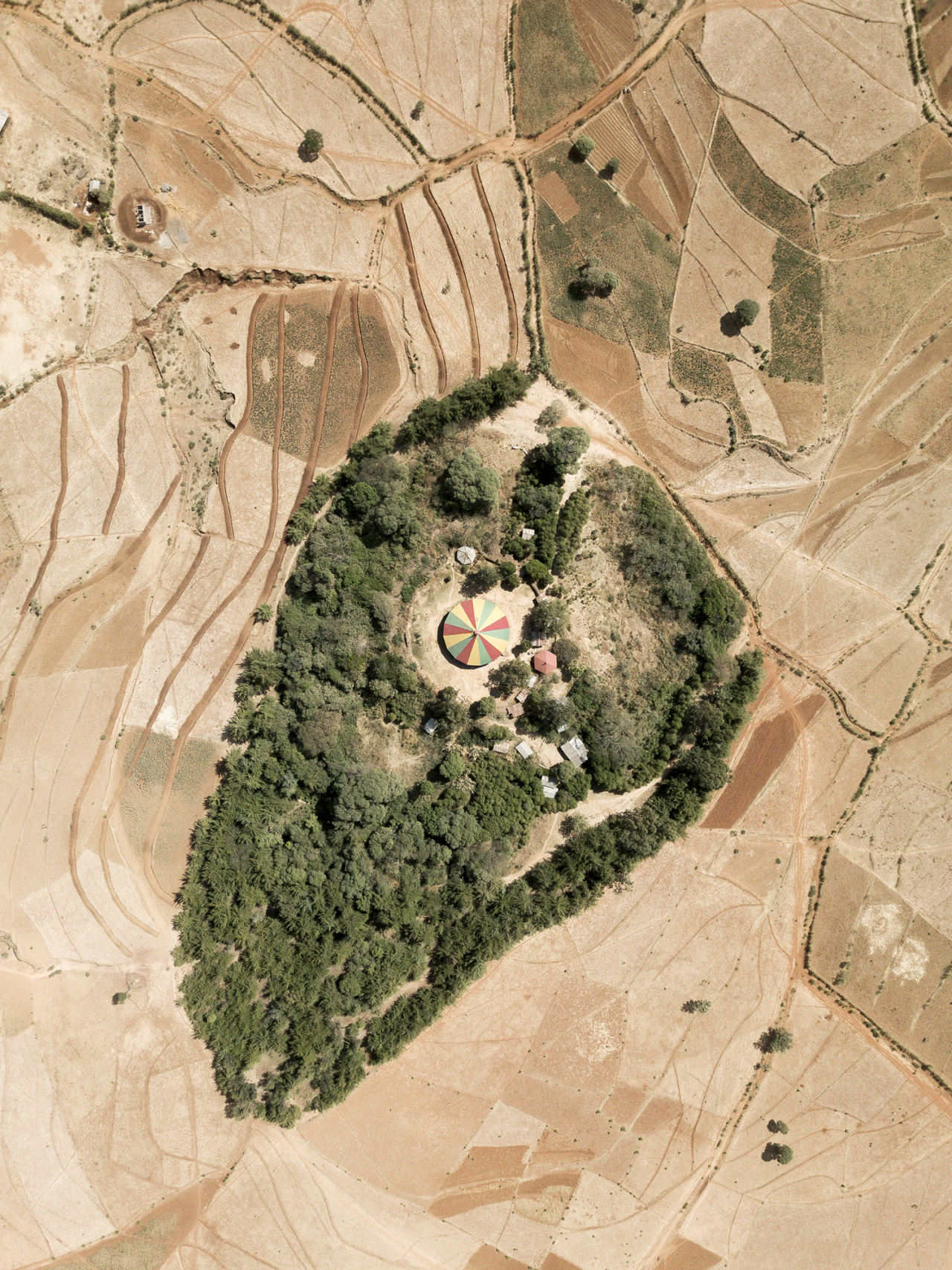
PHOTO SERIES: Hierotopia by Kieran Dodds: “Kieran Dodds (Scottish, b. 1980) is a non-fiction photographer known for his research-driven photo stories and portraiture. His personal work considers the interplay of environment and culture, and the importance of spiritual belief in global conservation.” In his Hierotopia series (from the Greek for “sacred place”), carried out from 2015 to 2018, he explores the green “church forests” east of Lake Tana in Ethiopia—little islands of biodiversity scattered throughout the region’s desert landscape. “To its guardians,” Dodds writes, “each forest resembles a miniature Garden of Eden and is essential to the dignity of the building. . . . The air inside the forests is cool, fragrant and filled with a cacophony of life. This is in stark contrast to the arid silence of the surrounding land which is feeling the strain of centuries of human activity and agriculture.”

Dodds, Kieran_Hierotopia
Debre Mihret Arbiatu Ensesa church near Anbesame, Ethiopia, surrounded by woodland and fields. Photo: Kieran Dodds, from the Hierotopia series, 2015–18.

“The core Christian belief in stewardship for the environment is a powerful concept,” Dodds continues, remarking on the Ethiopian Orthodox Tewahedo Church’s commitment to conservation, “and, if applied globally by people who are at least nominally Christian, could transform the world for better.”

+++

SONGS:

>> “Hold You in Our Circle” by Emily Roblyn: This simple song of blessing by UK-based singer-songwriter and retreat leader Emily Roblyn has been sung at the bedsides of the sick or dying, over women about to be released from prison, and through myriad other life transitions and trials, by friends and communities seeking to voice their support. “We hold you in our circle, hold you in our love.” [HT: Nadia Bolz-Weber]

>> “The Lord Bless You and Keep You” by Peter C. Lutkin: Performed by the Capital University Chapel Choir in 2020, this song is a choral setting by the Midwestern composer Peter C. Lutkin (1858–1931) of the Aaronic Blessing from Numbers 6:24–26: (in Lutkin’s rendering) “The LORD bless you and keep you; the LORD lift his countenance upon you, and give you peace; the LORD make his face to shine upon you, and be gracious unto you.” God instructed the Levitical priests of ancient Israel to pronounce these words over the people, and though the Levitical priesthood is no more, this particular benediction is still used regularly in Jewish and Christian liturgies.

Roundup: Ellsworth Kelly’s “Austin,” new book by Jonathan Anderson, religion in pop art, and more

PRINT INTERVIEWS:

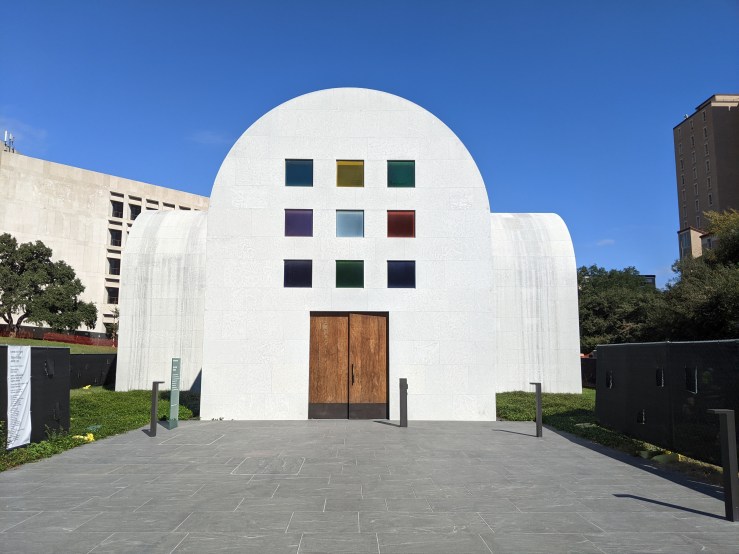
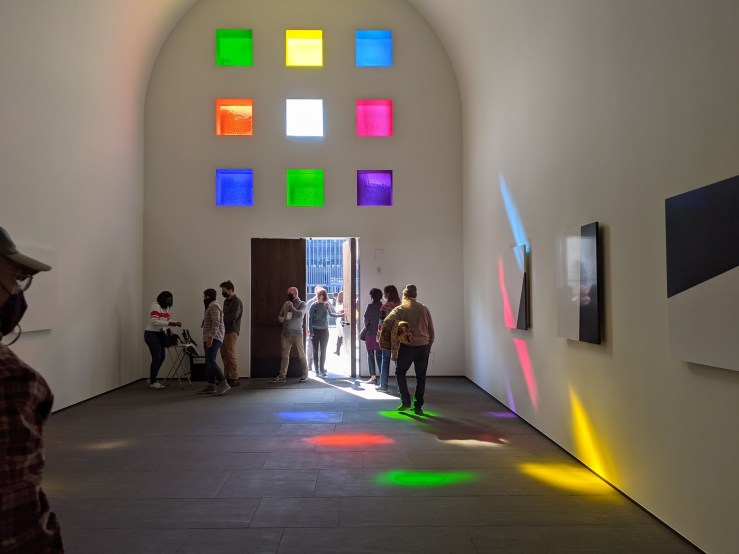
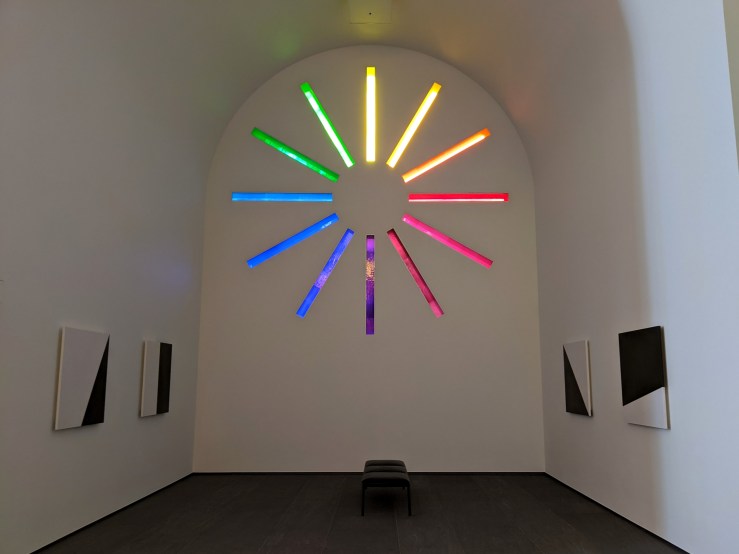
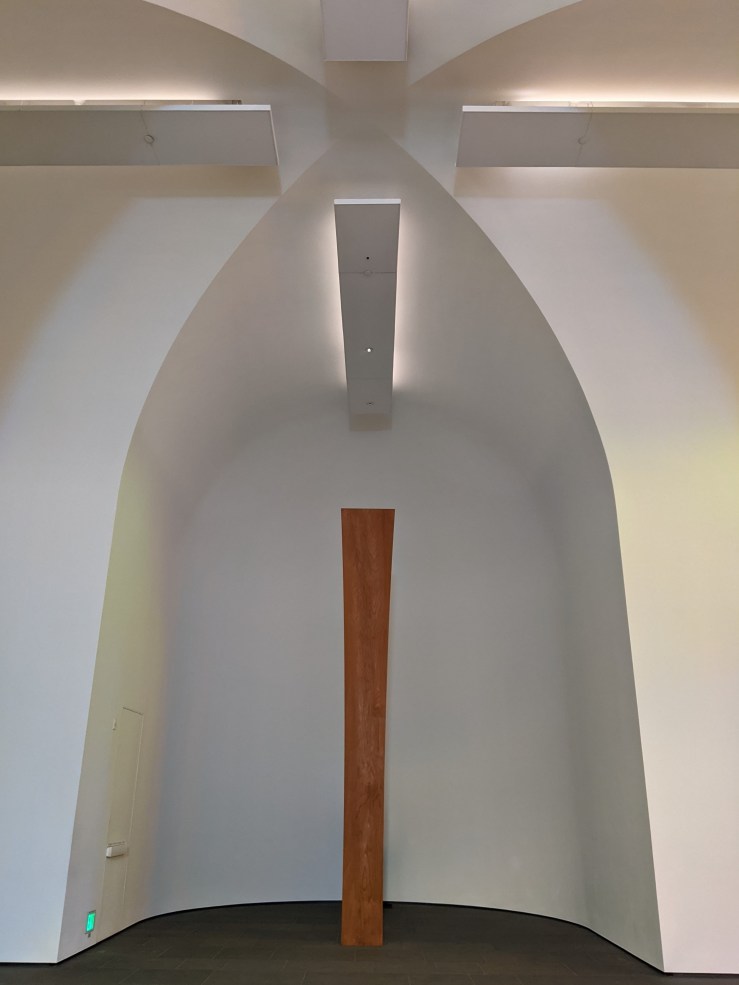
>> “What Remains: The Making of Ellsworth Kelly’s Last Work,” Image interview with Rick Archer: I got to experience Ellsworth Kelly’s Austin—a modernist “chapel” containing three stained glass windows, fourteen black-and-white marble panels (Stations of the Cross), and a redwood totem—while in Texas for a CIVA conference in 2021; see some of my photos below. Kelly was an atheist inspired by Romanesque church architecture, and the architect he chose to collaborate with on Austin, Rick Archer, is a Christian. In this wonderful new interview by Bruce Buescher, Archer discusses his working relationship with Kelly, Kelly’s desire for randomization and form over meaning, the technical and architectural challenges of bringing Kelly’s vision to life, religious references, and the artist’s objective for the space. “I hope when people go in here, they will experience joy,” Archer remembers Kelly saying.

  • Austin by Ellsworth Kelly
  • Austin by Ellsworth Kelly
  • Austin by Ellsworth Kelly
  • Austin by Ellsworth Kelly
  • Austin by Ellsworth Kelly

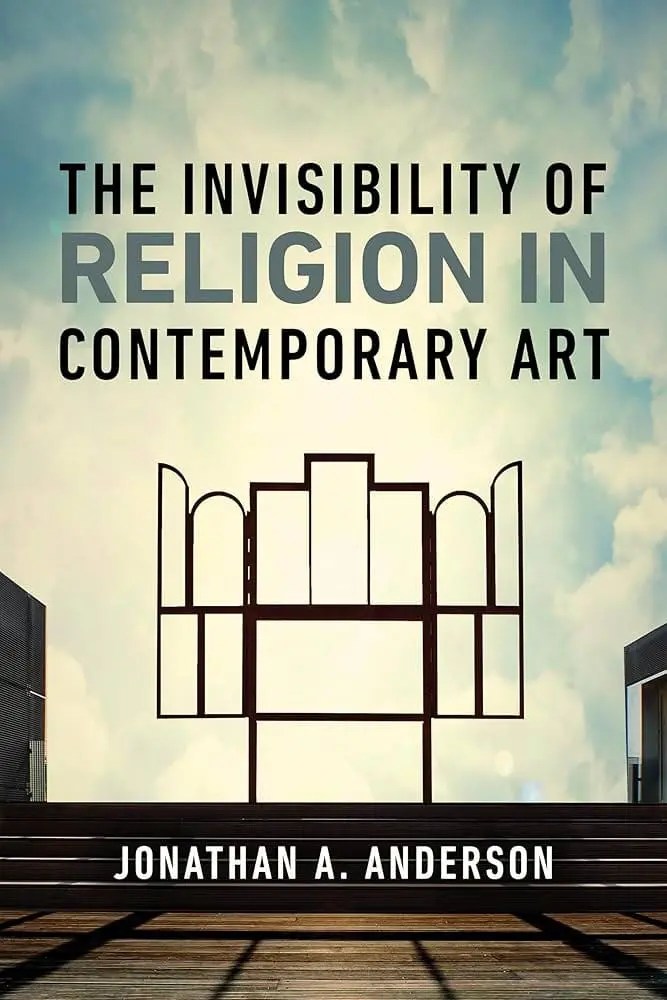
>> “The Invisibility of Religion in Contemporary Art: An interview with Jonathan A. Anderson” by Matthew J. Milliner: Jonathan Anderson [previously] is one of the most important people working across the disciplines of art and theology, and I’m thrilled that his book The Invisibility of Religion in Contemporary Art is now available from the University of Notre Dame Press!

Invisibility of Religion in Contemporary Art

In this recent interview for Comment magazine, Anderson explains his purpose in writing the book:

I have become increasingly convinced that so many pivotal artists and artworks over the past century are deeply shaped by religious traditions and seriously engaged in theological questioning, but this remains severely under-interpreted or misinterpreted in the scholarship about these artists. One might see these threads running through an artist’s artworks and personal writings and even discuss these topics with the artist in their studio, but when one moves to the scholarly writing and teaching about that same artist, that language consistently disappears or is transposed into another register—usually politics, occasionally a highly esoteric spirituality. I wanted to understand, at a non-superficial level, why this was the case, and I wanted to see how other ways of speaking and writing about this topic might be possible.

Don’t miss, at the end of the article, his three hopes for the field of “art and theology,” which I very much share!

+++

LECTURE: “The Problems and Possibilities of Visual Theology: The Ascension as a Case Study” by Jonathan A. Anderson: With Ascension Day coming up on May 29, it’s timely to share this talk given by Jonathan Anderson (see previous roundup item) a few years ago at Duke Divinity School, where he worked as a postdoctoral associate of theology and the visual arts from 2020 to 2023. Anderson explores a handful of images depicting the Ascension of Christ, a particularly challenging subject because of the spatial ambiguity. The scriptural accounts of the event (Luke 24:50–53 and Acts 1:6–11) beg the question, “What does ‘lifted up’ mean? Where is Jesus?” Attempting to work out these spatial difficulties visually can be theologically and exegetically productive, Anderson claims—even if it sometimes leads to unsatisfying results, as, Anderson says, it often does in Western art from the Renaissance onward. By contrast, when artists foster intertextual readings across the biblical canon and focus not so much on what the Ascension looks like as a historical event but rather on what it means, they are generally more successful.

Here are some time stamps, with links to the artworks discussed:

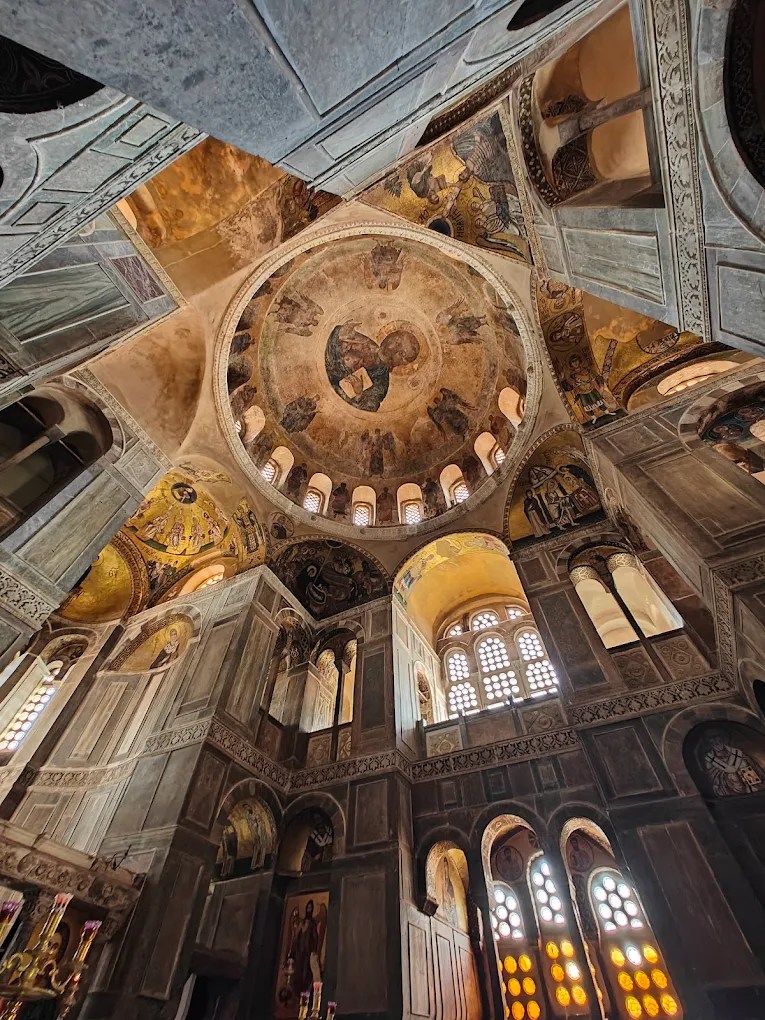
Hosios Loukas
Katholikon of Hosios Loukas monastery, Boeotia, Greece, 1011–12

+++

INSTRUMENTAL JAZZ: “Prayer” by Cory Wong: This video shows a live performance of Cory Wong’s “Prayer” on July 4, 2023, at Gesù music hall in Montreal. Wong, on guitar at far left, is joined by Ariel Posen on guitar, Victor Wooten on bass, and Nate Smith on drums. I learned about Wong through his collaborative album with Jon Batiste, Meditations (2020), which includes a version of this piece featuring Batiste’s piano playing.

+++

EXHIBITION: OMG! Reli Popart, Museum Krona, Uden, Netherlands, April 5–September 7, 2025: This exhibition at Museum Krona (housed in the complex of the still-active Birgittine Abbey of Maria Refugie in Uden, Netherlands) explores the connection between the pop art movement and Christianity through works by artists such as Andy Warhol, Corita Kent, Niki de Saint Phalle, and especially Dutch artists, including Woody van Amen and Wim Delvoye. Pop art is characterized by the use of imagery from popular culture, sourced from television, magazines, comic books, ads—and sometimes from the trash bin.

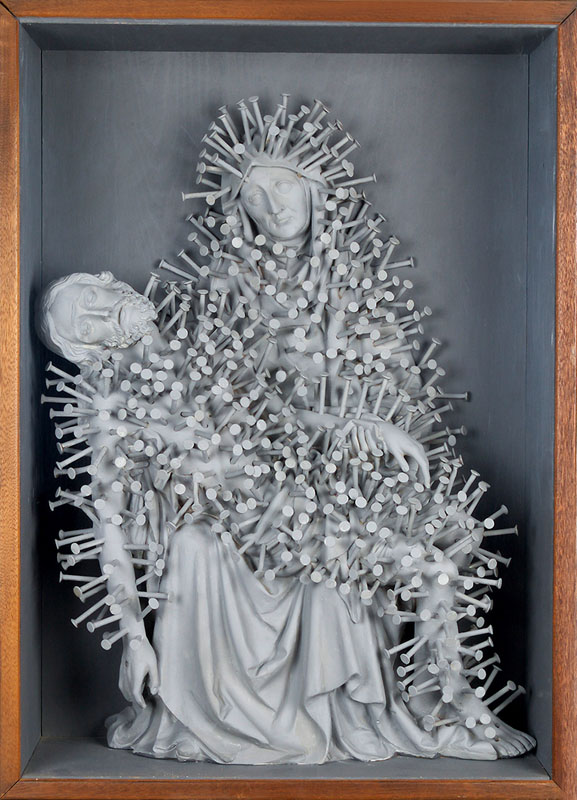
Jacques Frenken [previously], for example, built a body of work by salvaging discarded plaster sculptures of Christ and the saints—mass-produced for Catholic devotional use—and reconstructing them into assemblages. For his Spijkerpiëta, he “brought the Pietà back into our midst and accentuated the pain it radiates with nails,” the artist said.

Frenken, Jacques_Spijkerpieta
Jacques Frenken (Dutch, 1929–2022), Spijkerpiëta (Nail Pietà), 1967. Plaster, paint, iron, wood. Museum Krona, Uden, Netherlands.

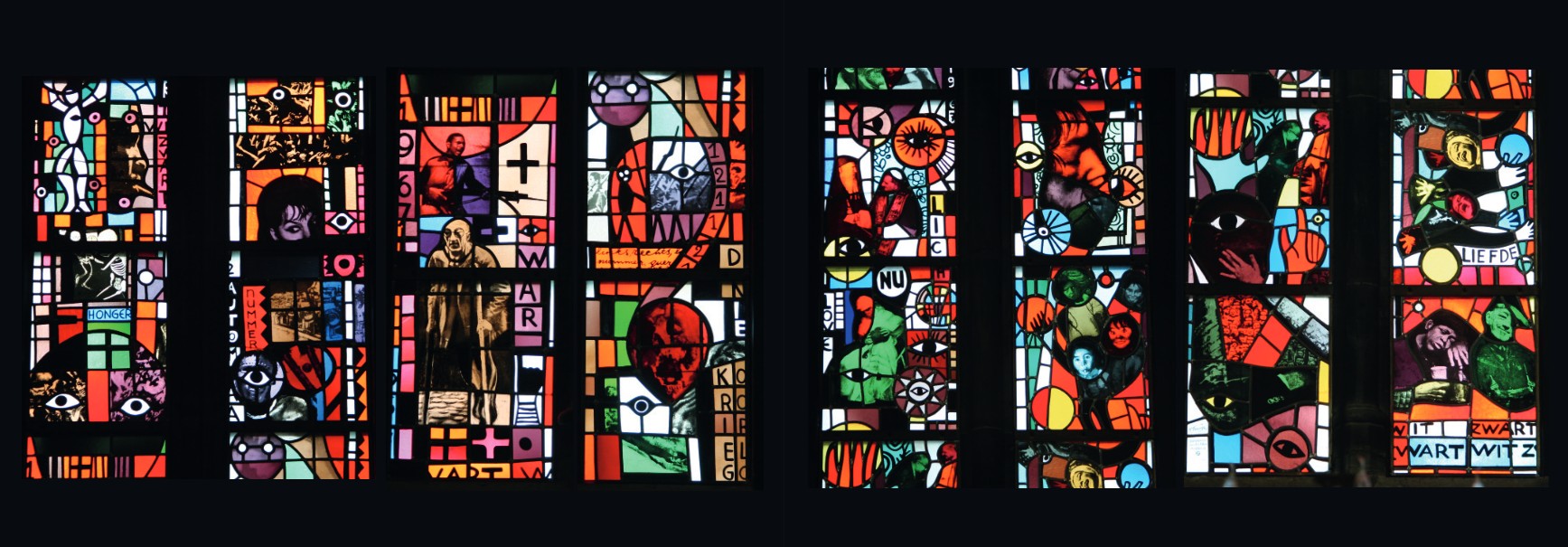
Another artist represented in the exhibition is Hans Truijen, who was commissioned in the 1960s by St. Martin’s Church in Maastricht to design eight stained glass windows for their worship space. The four along the left aisle of the nave depict human and divine suffering, whereas those on the right express hope, love, freedom, and happiness. He chose photographic images from various periodicals, including ones of the Vietnam War, and transferred them to glass using a special screen-printing process.

Truijen, Hans_Stained glass
Hans Truijen (Dutch, 1928–2005), Studies for the eight stained glass windows commissioned by St. Martinuskerk, Wyck-Maastricht, Netherlands, 1966–68. Courtesy of the artist’s son, Marc Truijen.

Roundup: “Harrowing of Hades” audio drama, Easter chant in Arabic, and more

HYMN TEXT: “Lights” by Kate Bluett: Kate Bluett [previously] is a Catholic poet and lyricist from North Texas who frequently participates in cross-denominational music collaborations. Her work has been published by Oregon Catholic Press and GIA Publications and recorded by the Porter’s Gate and Paul Zach, among others. I enjoy following her at https://katebluett.home.blog/, where she regularly shares new metrical verses she has written, tied to the liturgical calendar. Last Eastertide she published a text called “Lights,” which muses on candle flames, stars, and other light sources as reflections of the light of the risen Christ.

+++

AUDIO DRAMA: Anastasis: The Harrowing of Hades by Creative Orthodox: Creative Orthodox is the moniker of Michael Elgamal, a Coptic Orthodox artist and storyteller born in Egypt and living in Canada. Last May he released an audio drama, adapted from a graphic novel, about Christ’s epic descent into the underworld to reclaim the Old Testament righteous. This theatrical medium, which relies on voice acting, sound effects, and music to tell a story, was a very popular form of entertainment in the 1920s–40s before the advent of television but is much rarer today—which is a shame, because I find it really engaging! See the YouTube description for a full list of credits (script, score, actors, etc.).

+++

BLOG POST: “Iconography of the Descent of Jesus Christ into Hell” by Daria Chechko: A brief history and compilation of Anastasis icons.

Dionysius_Descent into Hell icon
Dionysius (Russian, ca. 1440–ca. 1508), Christ’s Descent into Hades, from Ferapontov Monastery, ca. 1495–1504. Tempera on wood, 31.2 × 10.5 cm. State Russian Museum, Saint Petersburg.

+++

SONGS:

>> “Christ Is Risen” (لمسيح قام) by Ribale Wehbé: Ribale Wehbé is a Lebanese singer specializing in Byzantine chant. Here she sings a traditional Easter chant in Arabic, arranged by Joseph Yazbeck.

>> “Hallelujah, Hosanna” (हाल्लेलुयाह होशन्ना) by One Tribe: Originally written in Tamil by pastors Dudley Thangaiah and Paul Thangaiah, “Hallelujah, Hosanna” is sung here in Hindi by the Indian Christian worship collective One Tribe. Turn on “CC” for closed captioning, and view the full credits in the YouTube video description. [HT: Global Christian Worship]

>> “He Did Rise” by Monroe Crossing: A bluegrass song about the women’s discovery of the empty tomb on Easter morning, written by Mark Anderson and performed here by his band, Monroe Crossing, at a music festival in Lexington, Kentucky, in 2009. Anderson is on the double bass. [HT: Global Christian Worship]

+++

SPOTIFY PLAYLIST: May 2025 (Art & Theology): An assortment of psalms, hymns, and spiritual songs, old and new. For my Easter-specific playlist from 2022 (with a smattering of new additions since, including a large batch from Cardiphonia at the bottom), see here.

Roundup: Multilingual Paschal greeting, Easter sermon by N. T. Wright, the Myrrhbearers and the Magi, and more

VIDEO: “The Lord is Risen! Proclaimed by people from 29 countries”: This video was put out in 2020 by ICF Rotterdam, an intercultural church in the Netherlands whose congregation consists of members from over forty nations! They asked a handful of them to recite the Paschal greeting in their native tongue, so represented here are Indonesian, Chinese, Zulu, Igbo, Urdu, Nepali, Kurdish, Romanian, and more. [HT: Global Christian Worship]

Wycliffe Bibliafordítók (Wycliffe Bible Translators) in Hungary produced a similar video last year:

+++

SERMON: “Let Beauty Awake” by N. T. Wright: One of the things I love about the Anglican cleric N. T. Wright’s preaching and teaching is the importance he places on beauty. (I actually met Wright once—and it was at an arts conference.) In this sermon, which he preached at Durham Cathedral on Easter Sunday 2009, he takes as his text what I’ve heard him say is his favorite chapter in the Bible, John 20, and discusses how in Jesus’s rising, the glory of God was let loose in all the world.

“Easter carries with it a strange and powerful beauty,” he says. “I hope that, by exploring the biblical roots of why this is so, I may have surprised some of you at least into asking, afresh, What can we do to celebrate, more consciously and deliberately, the reawakening of beauty which comes with the light of Easter Day? How can we take this forward, as an explicit project, so that a world so full of ugliness and functionality, and in consequence so full of unbelief or false belief, can once again be wooed into belief and love?”

He opens the sermon by quoting a stanza from a poem by Robert Louis Stevenson, and near the close, he reprises it in his own words, which were developed into a song by Steve Bell:

Let Beauty awake in the morn from the cool of the grave,
Beauty awake from death;
Let Beauty awake,
For Jesus’ sake,
In the hour when the angels their silence break
And the garden is bright with His Breath.

+++

RECIPE: “Tsoureki: The Symbolic Greek Easter Bread”: On her blog The Liturgical Home (and on Instagram), Ashley Tumlin Wallace shares a recipe for tsoureki, a brioche-like sweet bread made by many Greek Christians on Easter. It is soft and fluffy, flavored with citrus, and decorated with red-dyed eggs!

+++

SPOKEN WORD + SONG: “Because He Lives” by Sharon Irving: Singer-songwriter, worship leader, and spoken word artist Sharon Irving [previously] recorded this video for City First Church Spring Creek’s virtual worship service for Easter 2020. It begins with an original spoken word piece, and then is followed by her singing the Gaither classic “Because He Lives.”

+++

SONG: “Sbab Dia Hidup” (Because He Lives) by Prison Akustik: The song “Because He Lives,” written in 1971 by Bill and Gloria Gaither, has made its way all around the world and has been translated into many languages. Here is the group Prison Akustik [previously] singing it in Indonesian.

+++

SUBSTACK POST: “Myrrhbearers & Magi” by Beth Felker Jones: In her Church Blogmatics post from last week, theologian Beth Felker Jones [previously] shares three new digital collages she made: one of the three myrrh-bearing women who discovered Jesus’s empty tomb, one of the three magi who brought gifts to the newborn Christ, and one that combines both groups of devoted witnesses. She provides descriptions of each and two original prayers, including the one below.

Myrrhbearers
Digital collage (with AI-generated elements) by Beth Felker Jones, 2025

Holy Father, who accompanied your daughters on their way to the tomb, and in the power of your Spirit, turned their sorrow into joy, bring us too into the joy of those who found the tomb empty, and incorporate us, with them, into your resurrection life. With our sisters at the tomb that day, help us to say, “I have seen the Lord!” Amen.

Roundup: Alfombras from Antigua, Christ the Grapevine, “Ask Now the Beasts,” and more

HOLY WEEK TRADITION: Antigua, Guatemala, is renowned for its annual Good Friday observance, which involves the laying out of alfombras (carpets) of multicolored sawdust through the city’s cobblestone streets, hundreds of feet long. On Maundy Thursday, the city closes so that families and businesses can spend the day constructing the carpets, applying the sawdust to planned designs using stencils and strainers and adding pine needles, flowers, fruits, and other natural materials as well.

Alfombra
People watch while locals make an alfombra (carpet) of dyed sawdust for Antigua’s Good Friday processions, the most famous in Latin America. Photo: Lucy Brown, 2016.

At 4 a.m. on Good Friday, the processions begin, with people carrying floats that bear statues of Christ carrying his cross, followed by marching bands playing solemn music. (This is a remembrance of Jesus’s walk to Calvary.) As their feet pass over the alfombras, the dust scatters. Locals and visitors gather along the streets dressed in black for mourning, and at 11 p.m. a figure of Jesus is laid to rest in the church.

Here are two resources for exploring this tradition further:

>> ARTICLE: “Exploring Guatemala’s Vibrant Easter Tradition” by Meredith Carey

>> VIDEO: “Alfombras de Semana Santa en Guatemala,” dir. Federica Dominguez: This short film (in Spanish, with English subtitles) interviews Rolando Ortiz, an alfombrero who is also a shoemaker. He explains that the carpets hark back to Jesus’s triumphal entry into Jerusalem, when the crowds strewed his path with palm branches (giving him the red carpet treatment, so to speak). Even though the alfombras last only a brief time, locals spare no expense in bringing them to fruition each year—“for Jesus,” Ortiz says. “It is an act of gratitude above all.” An offering of beauty and praise.

+++

NEW ALBUM: As Foretold, Part 3 by Poor Bishop Hooper: Released today, this is the final album in a trilogy based on the prophetic fulfillment passages in the Gospel of Matthew. It centers on Jesus’s passion and concludes with a resurrection epilogue. As with all their music, the duo graciously offers it for free download from their website.

+++

SONGS performed by Emorja Roberson: Emorja Roberson [previously] is a singer, gospel choir conductor, and assistant professor of music and African American studies at Oxford College of Emory University in Georgia. I enjoy following his YouTube channel. Here are two songs that are especially fitting for Holy Week.

>> “I Know It Was the Blood”: Roberson sings three verses of this beloved African American spiritual: the title verse, “They whipped him all night long,” and “He never said a mumblin’ word.” The song is more typically sung in a major key, and its full lyrics span Christ’s passion, resurrection, ascension, and second coming. But Roberson slows down the tempo and sings in a minor key, homing in on the sorrow of Good Friday.

>> “He Decided to Die” by Margaret Pleasant Douroux: Roberson, on keys, sings a gospel classic with friends Marcus Morton and Cameron Scott, a song that emphasizes Christ’s resoluteness on the cross, his endurance for love.

+++

VISUAL COMMENTARIES: “After the Order of Melchizedek” by Victoria Emily Jones: My latest contribution to the Visual Commentary on Scripture, a project based out of King’s College London, was published earlier this month. Tasked with choosing and commenting on three artworks that dialogue with Hebrews 7–8, I landed on a “You Are a Priest Forever” icon from Russia (very strange!), an Antwerp Mannerist triptych that centers the Last Supper, and (my favorite) a wall painting of Christ the Grapevine from a Romanian church. I was interested to explore the idea of how Jesus, in giving his body and blood, is both the offerer and the offered, both priest and sacrifice.

Melchizedek exhibition

+++

POEM: “The Death of Christ” by Emperor Kangxi: Emperor Kangxi (1654–1722) ruled in China for sixty-one years during the Qing Dynasty. In 1692 he issued the Edict of Toleration, which barred attacks on churches and legalized the practice of Christianity among Chinese people. Curious about and respectful of other faiths, he penned this short poem on the Crucifixion using the classical qi-yen-she form.

+++

EXHIBITION: Tara Sellios: Ask Now the Beasts, Fitchburg Art Museum, January 18, 2025–January 18, 2026: Tara Sellios is a multidisciplinary artist from South Boston working mainly in large-format photography. Delighting in detail and complex symbolism, she often uses insects, dried fauna, bone, and other organic matter to create elaborate still lifes that she then photographs under dramatic lighting. She is inspired by art historical representations of the end of the world, especially the bizarre paintings of Hieronymus Bosch and Albrecht Dürer’s Apocalypse woodcuts, and by seventeenth-century Dutch vanitas paintings.

The photographs in her current solo show, Ask Now the Beasts at Fitchburg Art Museum in Massachusetts, are “contemporary allegories of suffering and transcendence.” The exhibition’s title comes from Job 12:7.

Two of the works on display are a pair of crosses: Umbra (Latin for “darkness” or “shadow”) and Dilucesco (“to begin to grow light, to dawn”), which together suggest a movement from death to resurrection. Constructed with a throng of black beetles and other black insects, the Umbra cross evokes the detail from the Synoptic Gospels’ Crucifixion accounts that at noon, “darkness came over the whole land until three in the afternoon, while the sun’s light failed” (Luke 23:44–45; cf. Matt. 27:45; Mark 15:33). Dilucesco, on the other hand, shows the cross seemingly exploding into light, as white moths and other winged insects break out of their cruciform shape. View these two photographic artworks, plus a few process photos and sketches the artist sent me, below. See, too, www.tarasellios.com.

UMBRA
Tara Sellios (American, 1987–), Umbra, 2024, from the series Ask Now the Beasts. Inkjet print from 8 × 10 negative, 55 × 35 in. Courtesy of the artist.

DILUCESCO
Tara Sellios (American, 1987–), Dilucesco, 2024, from the series Ask Now the Beasts. Inkjet print from 8 × 10 negative, 55 × 35 in. Courtesy of the artist.

  • SKETCH_UMBRA
  • Umbra_process
  • Dilucesco-Umbra_process
  • SKETCH_DILUCESCO
  • Dilucesco (detail)

Roundup: Peter’s tears, “The Mission” film, Tan Dun’s “Water Passion,” and more

VISUAL COMMENTARY: “Repentance (Transforming Tears)” by Clemena Antonova: One of the three works that art historian Clemena Antonova curated for the Visual Commentary on Scripture exhibition on Peter’s denial of Christ (Matt. 26:69–75; Mark 14:66–72; Luke 22:54–62; John 18:15–18, 25–27) is the installation Lágrimas de São Pedro (Tears of Saint Peter) by contemporary Brazilian artist Vinícius Silva de Almeida. The artist used hundreds of light bulbs, filled with water and suspended on near-invisible nylon threads, to create an environment in which visitors move between “tears” falling like raindrops from above. In the Christian tradition, Peter is regarded as a paradigm of penitence, as scripture says he “wept bitterly” when he realized his sin, and soon after he was restored to Christ. As Antonova interprets, Tears of Saint Peter invites folks to reflect on the interconnection of sorrow and healing in Peter’s story and in their own.

Silva de Almeida, Vinicius_Tears of Saint Peter
Vinícius Silva de Almeida (Vinícius S.A.) (Brazilian, 1983–), Lágrimas de São Pedro (Tears of Saint Peter), 2005–21. 6,000 light bulbs filled with water (various numbers in different locations). Photo: Erivan Morais.

View additional photos here.

+++

SONGS:

>> “Peter” by Montell Fish: Montell Fish (the stage name of Montell Frazier) is a singer-songwriter from Pittsburgh whose music combines elements of lo-fi and classic R&B. In his song “Peter” from the album Camp Lukewarm (2020), he compares himself, in confessional mode, to the titular apostle, who denied Christ three times. “Sometimes I feel like Peter / Denied you and I cannot deny that I did / Can I rest my head on your shoulders again?” In the bridge, Christ answers in the affirmative: Yes, come rest.

>> “O How He Loves You and Me / Your Love Divine”: The first song in this medley was written by CCM (contemporary Christian music) pioneer Kurt Kaiser in 1975; the second by the legendary gospel artist Richard Smallwood. Recorded live at Jericho City of Praise in Landover, Maryland, it’s performed here by Smallwood (at piano) and his vocal and instrumental ensemble Vision, featuring soloist Vanessa Williams. The recording appears as two separate tracks on Persuaded: Live in D.C. (2001).

Here are the lyrics to the second song, starting at 3:06:

Refrain:
Lord, you know the pain, pain we bear
And Lord, you know the toils, toils and cares
Send your direction
Send your protection
Send your compassion
And your love divine

Verse:
Help us love those who would do us wrong
Send your cleansing power from above
Unite our hearts as one
Make us vessels for the flow-through of your love

[Refrain]

Vamp:
Your love divine
Your love divine

+++

BOOK CHAPTER: “Maundy Thursday—The Mission,” chap. 16 from Films for All Seasons by Abby Olcese: Abby Olcese is a writer on film, faith, and popular culture, living in Kansas City. Last year her book Films for All Seasons: Experiencing the Church Year at the Movies was published by InterVarsity Press, spotlighting twenty-six films as lenses through which to reflect on the great themes of the church calendar. I was preparing to write something on The Mission, the 1986 film directed by Roland Joffé, for Lent this year when I encountered this book, and because Olcese covers the movie so well, I secured permission from IVP to provide a free PDF download of the chapter to Art & Theology readers. Olcese situates The Mission as a film that’s especially appropriate for Maundy Thursday, a day when the church reflects on the call to servant-love and commemorates, among other things, Jesus’s arrest in the garden of Gethsemane, during which he and his disciples “face the forces of human empire, a dramatic moment of conflict ending in what, for the moment, feels like defeat.”

The Mission addresses themes of Christian ministry, the kingdom of God, repentance, forgiveness, love, respect, and the nonviolent ethic of Christ. Based on actual events, it follows an eighteenth-century Spanish Jesuit priest, Father Gabriel (Jeremy Irons), as he establishes a mission among the Guaraní people in the borderlands of present-day Argentina, Paraguay, and Brazil and seeks to protect the Guaraní from the encroachment of Spanish and Portuguese enslavers. He is later joined by the penitent Rodrigo Mendoza (Robert De Niro), a recent convert and former slave dealer and mercenary soldier. But the two clash over how best and most faithfully to protect the people they live among and serve.

PDF excerpt from Films for All Seasons by Abby Olcese. Copyright © 2024 by Abigail Olcese. Used by permission of InterVarsity Press. www.ivpress.com

+++

ORATORIO: Water Passion After St. Matthew by Tan Dun: Commissioned for the 250th anniversary of Bach’s death in 2000, this eclectic, Asian-influenced Passion oratorio by the Chinese American composer Tan Dun follows Jesus from his baptism to his resurrection. As the title suggests, water plays an important role in the work. When performed, seventeen large transparent water bowls, dramatically lit from below, form a cross on the stage and are used by percussionists throughout the piece’s ninety-minute duration, creating various timbres. (“The three percussionists make water drip, flow, burble, crash and hiss. They lift handfuls of water, then fling it back down. They stir it, strike it with pairs of plastic cups, float soup bowls upside down in it and play them,” Justin Davidson described in his review of the world premiere.) For Tan, water is “a symbol of baptism, renewal, re-creation, and resurrection.”

Tan Dun
Composer Tan Dun plays a “water drum” in Hangzhou, Zhejiang Province. Photo courtesy of Visual China Group (VCG).

In addition to the water percussion, the work calls for an SATB chorus that doubles on stones and tingsha (Tibetan finger cymbals); soprano and bass soloists who double on the xun (Chinese ocarina, or globular vessel flute) and who are required to do some Mongolian overtone singing; one violin; one cello; and one sampler player (Yamaha A-3000).

Water Passion premiered in Stuttgart, Germany, on September 8, 2000, conducted by Tan—you can listen to the full live recording on Spotify—and it has since been performed a handful of other times across the globe. I recommend the following hour-long video from Symphony Tacoma in Washington, which features excerpts from their March 30, 2016, performance augmented by interviews with some of the key players:

+++

ARTWORK: The Judas Window by Laurence Whistler: In 1940, St Nicholas Moreton in Dorset was hit by a German bomb, destroying much of the church building, including its nineteenth-century stained glass windows. After rebuilding, the church commissioned the renowned glass engraver Laurence Whistler in 1955 to make twelve new windows, replacing the ruined ones, a project he worked on for the next three decades; they depict butterflies, birds, rabbits, wildflowers, candles, stars and planets, and local scenes. (See a few photos at The Dorset Rambler or Chris Belsten’s Flickr album.) In 1987 he offered to donate a thirteenth window on the theme of forgiveness, featuring the death of Judas, which would be visible, by design, from the outside only (the proposed space was blocked on the inside by a memorial tablet). The idea was entertained but, after consultation between the rector, parish council, and local diocese, was ultimately rejected due to its controversial nature—too many felt that it just wasn’t a fitting subject for a church window. Eager to pursue his vision, Whistler made the window anyway and loaned it to the county museum in Dorchester but insisted that if the church ever changed its mind, it should be given to them.

Whistler, Laurence_The Death of Judas
Laurence Whistler (British, 1912–2000), The Death of Judas (aka the Forgiveness Window), made 1993, installed 2013. Engraved glass, St Nicholas’ Church, Moreton, Dorset, England. Photo: Phil Yeomans / Bournemouth News and Picture Service.

In 2012, Rev. Jacqueline Birdseye, the new rector, encouraged the parish to revisit the issue, and this time around, there was unanimous approval to install the window, startling though it is. Again, it’s a blind window—behind it is black wooden boarding—which was the artist’s intent, as he wanted Judas to be a “shadowy” figure (so he couldn’t be front-lit and backlit) and on the outside, near the graveyard. But, unlike traditional portrayals of Judas’s suicide, which are bleak and punishing, Whistler’s portrayal is one of subtle hope, redemption, and new life. The uniting theme of the twelve interior windows is “light,” and here a bright shaft falls from the heavens on Judas’s upturned face. Hanging from his noose, he relinquishes the thirty coins for which he sold his Savior, and when they hit the ground they transform into flowers; the “field of blood” (Acts 1:18–19) becomes a spring meadow.

Scripture tells us that after realizing his enormous error, Judas “repented” (Matt. 27:3 KJV), “was filled with remorse” (NLT), and returned the blood money. Though Christians have historically counted Judas as eternally damned, other Christians have suggested the possibility of forgiveness beyond the grave for the traitorous disciple who was desperately grieved by his sin. “There’s a wideness in God’s mercy.” “A broken and contrite heart, O God, you will not despise” (Ps. 51:17).

Roundup: New albums, historic Boston church to get new mural, new opera sets words of Mexican nun, and more

NEW ALBUMS:

>> The Divine Dark, vol. 1: This three-song EP was released December 15, 2024, on Re-Echo Records, a new label for music created by artists from Resurrection Philadelphia church. “The Divine Dark is an ongoing series of original arrangements and compositions for devotion, contemplation, and edification. The series takes its name from a phrase that emerged in the fifth century among Christian mystics to describe the ineffable unknowableness of God . . . in all his kindness, grace, and mystery.”

The first volume features new arrangements by Joshua Stamper [previously] of two seventeenth-century German hymns (both translated into English by Catherine Winkworth, and sung here by Sarah Long), plus one new hymn that Stamper wrote with his wife, Kory Stamper, whose refrain is taken from Psalm 127:4. The songs quietly explore the mysteries of salvation, the Eucharist, and God’s sovereignty as well as some of the paradoxes of God’s character, such as his being both storm and shelter (wild and thundering, but also safe and enfolding).

Volume 2 of The Divine Dark is likely to release later this year.

>> It Is Good to Be Here with You by Nick Chambers: Out today, the first full-length album by singer-songwriter Nick Chambers. These songs of spiritual seeking touch on sobriety, divine nearness, ambiguity and wonder, the pursuit of understanding or insight, the longing to be held and loved, and more. Chambers deftly weaves voices from scripture—the blind beggar Bartimaeus, who cried out to Christ for mercy; the sons of Korah, who thirsted for God like a deer thirsts for water; the apostle Paul, who experienced a frustrating tension between desire and action—with his own poetic voice, finding companionship with those ancient seekers who were transformed by their encounters God. There’s reference to the wrestling patriarch Jacob, the blazing bush-vision of Moses, Elijah in a wilderness cave, the mount of Transfiguration, the eighth day of creation. Besides biblical texts, the songs bear influences from writers Rainer Maria Rilke, Madeleine L’Engle, Gregory of Nyssa, and Esther de Waal.

The album features some co-writing contributions by Jon Guerra (“Hold Me”), Paul Zach (“A Sweeter Word,” “Always Already”), and Tyson Matthews (“It Is Good to Be Here with You”).

My favorite tracks: “To an Unknown God,” “Hear,” “Thanks Be to God.”

+++

NEW ART COMMISSION: Memorial to Enslaved Persons by Harmonia Rosales, King’s Chapel, Boston: Harmonia Rosales, an Afro-Cuban artist born and raised in Chicago and living in Los Angeles, is at work on a three-part commission for the historic King’s Chapel at 58 Tremont Street in Boston, a church originally built in wood in 1686 and then rebuilt in stone in the 1750s. One of the oldest churches in the United States, it (and its adjacent burying ground) is one of the stops along the Freedom Trail, and it still has an active congregation.

Rosales, Harmonia_King's Chapel ceiling mural
Conceptual image of the mural by Harmonia Rosales that’s being installed this year on the ceiling of King’s Chapel in Boston, Massachusetts

Despite being in the North, King’s Chapel has links to the slave trade. Historical documents reveal that at least 219 persons, most of them of African descent but at least two of them Native American, were enslaved by ministers and members of the church throughout its history, and that even after slavery was abolished in Massachusetts in 1783, donations to the church continued to flow in from people whose wealth depended on Southern slave labor, such as textile magnates. You can read more details in Slavery and King’s Chapel, the thirty-two-page report published by King’s Chapel’s Ad Hoc Committee on Slavery in 2018.

Until at least the mid-nineteenth century, people of color, both enslaved and free, who attended King’s Chapel were relegated to the balcony seats. We know the names of 182 enslaved attendees from the church’s baptismal, marriage, and burial registers. “As a community of faith,” the church writes on its website, “we are working to recover, honor, and remember these long-overlooked members of our community. We hope to make their lives and their presence in early Boston visible in new and powerful ways as we tell a more complete version of our history for our congregation, our city, and the 4 million people who walk the Freedom Trail each year.”

In addition to setting up a “living fund” to “provide monetary support for programs and engagement centered around reparative justice and reconciliation in the community,” the church has hired artist Harmonia Rosales, in partnership with the MASS Design Group, to create a physical commemoration of this history, which has three components: a figurative sculpture in the church’s courtyard, a collection of bronze birds perched throughout the church’s exterior and grounds, and a trompe l’oeil ceiling mural in the sanctuary. The memorial will be unveiled later this year. Here are two videos about it:

>> “How a Freedom Trail landmark is reckoning with its ties to slavery,” GBH News, July 19, 2023: This news segment features interview clips of Cassandra Dumay and Jessie Sage O’Leary, Boston University journalism students who are inquiring further into King’s Chapel’s links to the colonial slave trade; Rev. Joy Fallon, senior minister at King’s Chapel; Marissa Cheifetz, director of the King’s Chapel History Program; and memorial committee member David Waters.

>> “VCS Creative Conversations: Ben Quash with Harmonia Rosales,” Visual Commentary on Scripture, February 27, 2025: Theologian and VCS director Ben Quash sits down with artist Harmonia Rosales inside King’s Chapel to discuss her latest commission for that space, plus her paintings Birth of Oshun, The Creation of God, Strangler Fig, and more. Raised in the Santería religious tradition, in her art Rosales draws Yoruba deities (the orishas) into play with Christian ones and centers Black women. Speaking of the VCS’s commitment to showcasing biblical engagement from diverse vantage points, Quash tells Rosales, “We’ve always said that these conversations should not just be about the Bible’s importance to Christians or Jews, but the Bible’s importance to those of other traditions, as something to bounce off, to use, sometimes to object to. And you are a wonderful example of how to do that in a way that’s constantly creative and generous.”

+++

ARTICLE: “At the Cloisters, Sor Juana’s Words Ring Out in Song” by Elisabeth Vincentelli, The New York Times: Primero Sueño (First Dream) is a new opera by Magos Herrera and Paola Prestini that adapts to music the seventeenth-century mystical poem of the same title by the Mexican Catholic nun Sor Juana Inés de la Cruz, one of the greatest literary works of the Hispanic Baroque. Commissioned by the Metropolitan Museum of Art’s Department of Live Arts (MetLiveArts) and VisionIntoArt, it was conceived as a processional opera that meanders throughout the Met Cloisters, audience in tow—an appropriate choice, as the poem is about the soul’s journey. It premiered January 23, with Herrera playing Sor Juana, the nun in black, “sing[ing] in an earthy mezzo that complements the heavenly harmonies of the six nuns in white, performed by the German vocal ensemble Sjaella.” Accompaniment was provided by harps, hand percussion, theorbo, and Spanish guitar. Here’s a trailer (not filmed on location):

Primero Sueno performance
Magos Herrera, center, as Sor Juana in a rehearsal of the opera Primero Sueño at the Met Cloisters. Photo: Earl Wilson / The New York Times.

The Cloisters—a building designed to evoke a medieval European monastery and housing a sizeable portion of the Met’s medieval art collection—is one of my favorite spaces in all of New York. What a delight that Herrara, Prestini, and team utilized its halls and rooms as staging ground for this dramatic, musical reimagining of a historic sacred poem by a pioneering female Christian writer.

+++

INTERFAITH ART EXHIBITION: Cloud of Witnesses: Images of Faith and Divinity Today, St John’s Waterloo, London, March 4–April 27, 2025: A juried exhibition featuring the work of twenty-six artists from the UK, funded and supported by Art + Christianity; The God Who Speaks; St John’s Church, Waterloo; the Catholic Bishops’ Conference of England and Wales; Culham St Gabriel Trust; and Bible Society. Click here to view the exhibition catalog.

The image used for the cover of the exhibition catalog is Life 1, a linocut by Svetlana Atlavina consisting of fifty golden concentric circles that she said represent the vibrations of the heart—the sounds constantly being emitted from our cardiac valves, which mean we’re alive.

Atlavina, Svetlana_Life 1
Svetlana Atlavina, Life 1, 2024. Handmade linocut with gold ink on 300g white Somerset paper, 70 x 50 cm.

The work that I find most compelling is the eight-piece series of COME AND REST photographs by Kirsty Kerr.

Come and Rest: Bethnal Green Library
Kirsty Kerr, COME AND REST: Bethnal Green Library, 2018. Photograph of a public intervention, from a series, 30.5 × 44 cm. Documentation by Will Alcock.

COME AND REST documents a series of public interventions informed by the demolition and rebuilding of Bethnal Green Mission Church. Taking letters from a scripture text that had hung on the old building (Jesus’ words: ‘Come to me and I will give you rest’), Kirsty spelt the phrase in Bethnal Green locations, recording the process with local filmmaker Will Alcock. The words were a gentle yet radical proclamation: of welcome, refuge, and quiet protest against loneliness and exhaustion often synonymous with city life. The act of spelling them out became a performed prayer, symbolic of the church’s continued presence and God’s enduring invitation.

Against the backdrop of this racially and religiously diverse neighbourhood, the words were both witnessed to and overlooked by passers-by of all faiths and none.

Kerr displayed Christ’s invitation in fields and basketball courts, on street corners and scaffolding and bandstand steps, outside subway stops and housing estates and libraries. View the full series here, using the right scroll arrow. I also enjoyed exploring the artist’s other projects on her website.

+++

EVENT: Taste of Heaven Intercultural Worship Festival, Coventry Cathedral, May 24, 2025: Organized by Intercultural Churches UK. “The Taste of Heaven Festival will be an exciting opportunity to celebrate the rich cultural diversity and creativity of the UK church through live performances, workshops, food and worship. The festival will take place in the iconic venue of Coventry Cathedral and its beautiful surrounding ruins. The day will trace our history of increasing diversity, by highlighting different cultural worship expressions from Celtic to Choral, South Asian and Caribbean, to more recent immigrant communities including Middle Eastern, African, and Hong Kong. It will culminate in a celebration of Intercultural Worship, demonstrating how churches can draw from different cultural streams in their corporate worship.” Tickets range from £10 to £25. Register here. [HT: Global Christian Worship]

Intercultural Worship Festival

+++

SPOTIFY PLAYLIST: April 2025 (Art & Theology): The song selections on my short monthly playlists are somewhat random—a smorgasbord of what I’ve been listening to, a mix of brand-new releases and older faves—but for thematic playlists keyed to where we are in the liturgical calendar during April, see my Lent Playlist, Holy Week Playlist (I’m especially proud of this one!), and Eastertide Playlist.

Roundup: Fractured series, the Darkling Psalter, “Parce mihi Domine” with sax, and more

ART PROJECT: Fractured by David Popa:Fractured is a project located on various ice floes in southern Finland. By use of only earth, charcoal and the source water, a series of portraits were created on fractured ice floes that remained for only a brief time. The pieces were documented via aerial drone video, photography and photogrammetry and hold a tactile form as limited-edition prints as well as in digital form through 1/1 NFTs. The project evolved as a response to the ongoing conflict in Ukraine, which has only further highlighted the fractured state of the world in which we live. During the project, the ice fractured completely unexpectedly at unpredictable times, leaving the artist at odds as to whether continuing the work was even worthwhile. From the ground, one would never be able to decipher any silver linings within the chaos; however, from above, the fragments hold a harmony and beauty that is imperceptible from any other perspective. The work offers a means to point the viewer not to despair and chaos, but rather questions where we must look to mend the broken fragments of our lived reality and perhaps how the fragments can be used to create an entirely new mosaic from the scattered vestiges.”

David Popa (American, 1997–), from the Fractured series, 2023. Iron oxide black earth pigment and charcoal on floating ice.

Explore more of the artist’s work at www.davidpopaart.com. For a printed interview with Popa (featuring many of his amazing photos of his amazing land art), see www.yatzer.com/david-popa.

+++

POEMS: Seven Reimagined Psalms from the Darkling Psalter by Andy Patton: The Darkling Psalter is a project by Andy Patton (MA, Trinity Evangelical Divinity School) to write new creative renditions of the Bible’s 150 psalms. The Rabbit Room recently featured seven of these: Psalms 5, 10, 12, 14, 25, 27, 30.

+++

PODCAST INTERVIEW: “Van Gogh Has a Broken Heart, with Russ Ramsey,” Makers & Mystics: I appreciated this recent conversation in which pastor, writer, and arts enthusiast Russ Ramsey discusses his latest book, exploring the struggles and sorrows of a handful of historical artists and how they are reflected in their art.

van Gogh, Vincent_Self-Portrait with Bandaged Ear
Vincent van Gogh (Dutch, 1853–1890), Self-Portrait with Bandaged Ear, 1889. Oil on canvas, 60 × 49 cm. Courtauld Gallery, London.

If you’re interested to learn more about Vincent van Gogh, check out the Artist Profile I was commissioned to create for the same podcast, which I expand on here. I spent two months doing intensive research to write this seventeen-minute script!

+++

EXHIBITION REVIEW: “Selva Aparicio’s Memorials to Loss and Renewal” by Lori Waxman, Hyperallergic: Mounted last year by the DePaul Art Museum in Chicago, the first solo show of the Barcelona-born artist Selva Aparicio featured works that “offer a merciful focal point for grief.” Aparicio, Waxman writes, “treats unwanted things with extreme sensitivity, personally gathering and storing them over many years, eventually renewing them with remarkable vision.” She reproduced the twice-destroyed rose window of the Basilica de Santa Maria del Pi using lettuce leaves discarded by her neighborhood market; she filled the interior of an upright piano with wasp nests; she constructed over two dozen pairs of decorative ears out of moss, shells, seed pods, animal hair, and other materials for her late cat, Momo, whose ears were removed due to illness; using strands of hair from herself, her mother, and her niece, she sewed a mourning veil, the kind traditionally worn by widows, out of 1,365 cicada wings.

Selva Aparicio exhibition view
Exhibition view: Selva Aparicio: In Memory Of, DePaul Art Museum, Chicago, 2024. Left: Velo de luto (Mourning Veil) (2020), formed from 1,365 Magicicada wings; right: Solace (2023–24), crochet cotton blanket woven through with honey locust thorns.

I didn’t get to see this exhibition in person, but I’m compelled by what I saw and read of it online—how it deals so tenderly with suffering, death, remembrance, and hope.

+++

SONGS:

>> “Parce mihi Domine” (Spare Me, O Lord): A musical setting of the Latin translation of Job 7:16b–21, this motet by the Spanish Renaissance composer Cristòbal de Morales “captures the sense of desolation and abandonment that is expressed by Job, a dark condition akin to the forsakenness that our Lord experienced on the cross,” writes church music director Ken Myers. In 1994 the Hilliard Ensemble recorded the piece in collaboration with the Norwegian saxophonist Jan Garbarek for their album Officium, a jazz-classical fusion that became one of ECM’s most successful releases, selling over 1.5 million copies.

The video below features a different set of musicians paying tribute to this “unexpected . . . alliance of austere vocal music and wandering saxophone” (Elodie Olson-Coons). Filmed December 18, 2015, at the Chiesa di Sant’Anna (Church of St. Anne) in Cagliari, Italy, the performance is by the vocal ensemble Cantar Lontano (under the direction of Marco Mencoboni) and saxophonist Gavino Murgia. [HT: Global Christian Worship]

After losing his health, wealth, and children, the Old Testament character Job laments openly before God. “I will not restrain my mouth,” he says. “I will speak in the anguish of my spirit; I will complain in the bitterness of my soul” (Job 7:11). He views God as his tormentor and begs God to leave him alone (“spare me”). Adopting Job’s voice, the four singers of the Morales piece sing the following biblical passage:

Parce mihi Domine, nihil enim sunt dies mei.
Quid est homo, quia magnificas eum?
Aut quid apponis erga eum cor tuum? Visitas cum diluculo, et subito probas illum.
Usquequo non parcis michi, nec dimittas me, ut glutiam salivam meam? Peccavi.
Quid faciam tibi, o custos hominum? Quare posuisti me contrarium tibi, et factus sum michimet ipsi gravis?
Cur non tollis peccatum meum, et quare non aufers iniquitatem meam?
Ecce nunc in pulvere dormio; et si mane me quesieris, non subsistam.

English translation (NRSVUE):

    Let me alone, for my days are a breath.
What are humans, that you make so much of them,
    that you set your mind on them,
visit them every morning,
    test them every moment?
Will you not look away from me for a while,
    let me alone until I swallow my spittle?
If I sin, what do I do to you, you watcher of humanity?
    Why have you made me your target?
    Why have I become a burden to you?
Why do you not pardon my transgression
    and take away my iniquity?
For now I shall lie in the earth;
    you will seek me, but I shall not be.

>> “Lamb of God” by The Many: From the EP Have Mercy (2021) by The Many [previously], “an uncommon, intentionally diverse collective making music for people to sing together about peace and justice and a world where all belong.” This song is an adaptation of the ancient Christian liturgical prayer known as the Agnus Dei. The music is by Gary Rand, and the lyrics are by Gary Rand and his daughter, Lenora Rand. Click here to purchase an individual MP3 recording or sheet music, or visit the group’s Bandcamp page.

Lamb of God, with love poured out
you suffer with the world.
Have mercy. Have mercy.
Lamb of God who suffers with the world,
grant us peace, grant us peace.

Roundup: Weighed-down sheep, sin and grace, Bermejo’s devil, and more

POEM: “Lost Sheep” by Margaret DeRitter: DeRitter writes about a lost Merino sheep in Australia who, because left unsheared for so long, was carrying over seventy-five pounds of wool on his back. He was found in 2021 and rescued by Edgar’s Mission Farm Sanctuary in Lancefield.

+++

SONGS:

>> “What Have We Become” by the Sweeplings: The Sweeplings are Cami Bradley and Whitney Dean, a singing-songwriting folk pop duo. From their album Rise and Fall (2015), “What Have We Become” laments how sin encroaches on our lives—we may welcome it in at first, but then it takes over, makes of our house a wasteland. This theme is embodied by a shadowy, thorny-veiled dancer in the music video.

>> “It Knows Me” by Avi Kaplan: Living outside Nashville, Tennessee, Avi Kaplan is best known for being the original vocal bass of the a cappella group Pentatonix, from 2011 to 2017. This song of self-probing is from his second solo EP, I’ll Get By (2020). It’s about the freedom that comes from reckoning with one’s inner darkness and accepting grace. The animation in the video is by Mertcan Mertbilek.

Kaplan, who is Jewish, wrote on Facebook,

“It Knows Me” is an extremely personal song to me. I believe that everyone has a darker side of them, and that you can choose to play into that, or you can choose to not. This song is about that battle between those two forces, and having a little grace for yourself when you do falter on your path.

>> “Not the Devil Song” by Marcus & Marketo: Marcus & Marketo (Marcus Clingaman and Marketo Michel) are a worship music duo from South Bend, Indiana, fusing the styles of gospel, classical, country, and soul. “Not the Devil Song,” which they wrote in 2019, is about the power Christians are given to tell Satan to back off! When he dangles temptations in front of you, whispers lies in your ear, sows seeds of doubt or fear or hopelessness, you can confidently retort, “Devil, no, you gotta let go; Jesus died to save my soul.”

+++

WOODCUT SERIES: Das Herz de Menschen (The Heart of Man): “The following illustrations—which, in a wonderful marriage of word and image, plot out the life of the Christian soul—form the central strain in The Heart of Man: Either a Temple of God, or a Habitation of Satan: Represented in Ten Emblematical Figures, Calculated to Awaken and Promote a Christian Disposition (1851), an English edition of a German book published in 1812 in Berlin by the ‘divine’ and philanthropist Johannes Gossner (1773-1858),” which was itself based on an older French text. The illustrations are not credited and are probably copies of ones that originated in France in the late seventeenth or early eighteenth century.

The Heart of Man

In his book The Forge of Vision (2015), visual studies scholar David Morgan contrasts this emblematic series with the related Cor Jesu amanti sacrum by Anton Wierix (which I wrote about here). Whereas the Wierix engravings from Antwerp are marked by sweetness, with the Christ child gently cleaning and setting up house in the human heart, the anonymous illustrations Gossner uses portray more of a psychomachia (battle for the soul), with armed angels seeking to oust Satan and his minions.

+++

VIDEO: “How Bermejo paints good and evil in Saint Michael Triumphs over the Devil: In this nine-minute video, Daniel Sobrino Ralston, associate curator for Spanish paintings at the National Gallery in London, examines a late Gothic painting in the museum’s collection by the Spanish artist Bartolomé Bermejo, showing the archangel Michael slaying Satan. Based on Revelation 12:7–9, this subject gave artists the chance to flex their imaginations in portraying evil incarnate and its vanquishment. Possessing an impressive capacity for fantastical invention, Bermejo gives the devil snakes for arms, eyes for nipples, bird claws, moth-like wings, a spiky tail, and a cactus growing out of its head!

Bermejo, Bartolome_St. Michael (detail)
Bartolomé Bermejo (Spanish, ca. 1440–after 1495), Saint Michael Triumphs over the Devil (detail), 1468. Oil and gold on wood, 179.7 × 81.9 cm. National Gallery, London.

If this visual subject interests you, I recommend the book Angels and Demons in Art by Rosa Giorgi, from the J. Paul Getty Museum’s Guide to Imagery series.