Roundup: World-rhythm hymns, the Hillbilly Thomists, 19th-century gameboards, and more

CALL FOR APPLICATIONS: 2025 Artist Residency at Village Church, Beaverton, Oregon:Village Church is seeking an Artist in Residence for 11 months of 2025, February to December, to create a lasting, creative impact on the wider community and church. The artist will create original work, lead art showcases, inspire future generations, and use art as a bridge between the tech culture surrounding the church, with the spiritual and theological. This residency offers the chance to create art that reflects God’s beauty, promotes worship, and connects people in meaningful ways.”

Applicants must have a minimum of five years of experience. If chosen, you will receive a monthly stipend, free housing, and studio space and will have the cost of all art supplies covered. The pastor tells me that the original application deadline of January 15 is being extended.

+++

NEW(ISH) ALBUM: The Hymnal by Life in Grooveland: Released last April. From World Music Central: “Life in Grooveland’s The Hymnal reimagines traditional hymns with dynamic, world music-influenced rhythms, creating an album that brings together spirituality and groove. Produced and arranged by Nashville session drummer and percussionist Justin Amaral, this fascinating instrumental collection features ten exquisitely crafted duets presenting some of Nashville’s most talented and inventive musicians, including Jeff Coffin (Dave Matthews Band, Béla Fleck), Fats Kaplin (Mitski, Jack White), Paul Niehaus (Lambchop), and Billy Contreras (Ricky Skaggs). Amaral’s versatile drumming, which ranges from subtle to explosive, provides the backbone for each track, layering rhythm to amplify each hymn.” Thanks to blog reader Ted Olsen for bringing this to my attention!

+++

PODCAST EPISODE: “The Hillbilly Thomists: Bourbon, Bluegrass, and the Bible,” No Small Endeavor: I really enjoyed this! “There aren’t many Billboard-charting bluegrass bands made up entirely of Dominican friars, who play their shows clad in white tunics and rosaries. In fact, there is precisely one such band: the Hillbilly Thomists. ‘A Thomist is someone who follows the thought and theological teaching of Saint Thomas Aquinas,’ they explain. ‘We combine it with a little bit of humor about our human condition.’ In this episode, they talk about their theology and vocation, as well as how they manage life on the road as priests who have taken a vow of poverty. Plus, they give live performances of some of their finest songs.”

+++

NEW POEM: “Jesus, Son of Gop” by Sarah M. Wells: Exposing the ridiculousness of followers of the nonviolent Christ sanctioning violence, this satirical poem is a response to a politician’s egregious misappropriation of the apostle Paul’s “armor of God” language. It’s an alternate history that rewrites how Jesus’s arrest in the garden went down. Listen to Wells discuss the poem on The Reformed Journal Podcast.

+++

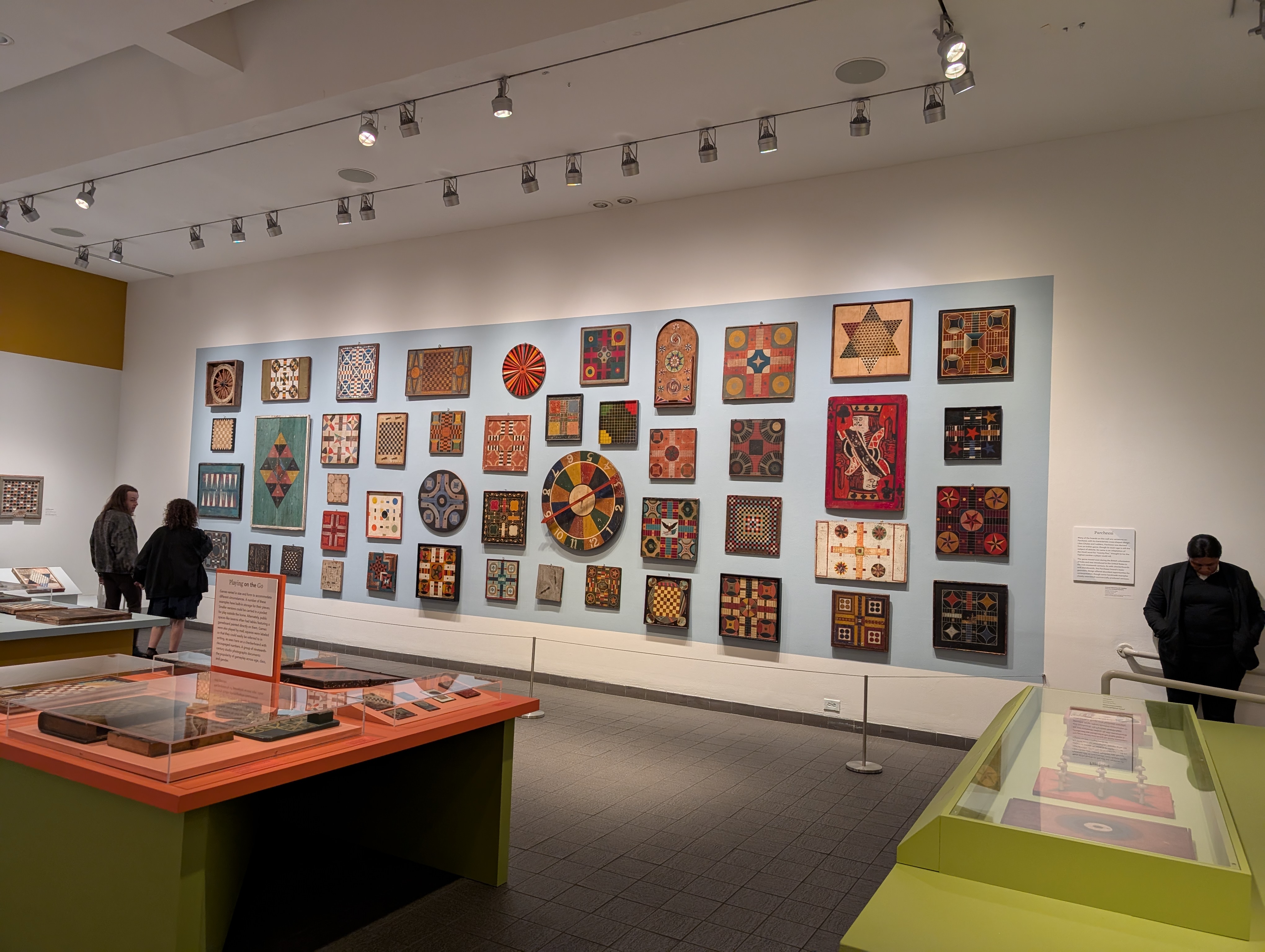
EXHIBITION: Playing with Design: Gameboards, Art, and Culture, September 13, 2024–January 26, 2025, American Folk Art Museum, New York City: I saw this show last weekend and was absolutely delighted by it! Curated by Emelie Gevalt with Austin Losada, it features over one hundred handmade gameboards, mostly nineteenth century, from the exuberant collection of Bruce and Doranna Wendel. Many are of familiar games I used to play as a child—Parcheesi (which I learned originated in India, its name an adaptation of the Hindi word for “twenty-five”), checkers, Chutes and Ladders—and others are creative variations on the typical racing board game. There is also a fortune-telling game, in the vein of the Magic 8 Ball! The objects on display—hand-carved and hand-painted and from the imaginations of common folk—are interesting both culturally and aesthetically.

Gameboards exhibition

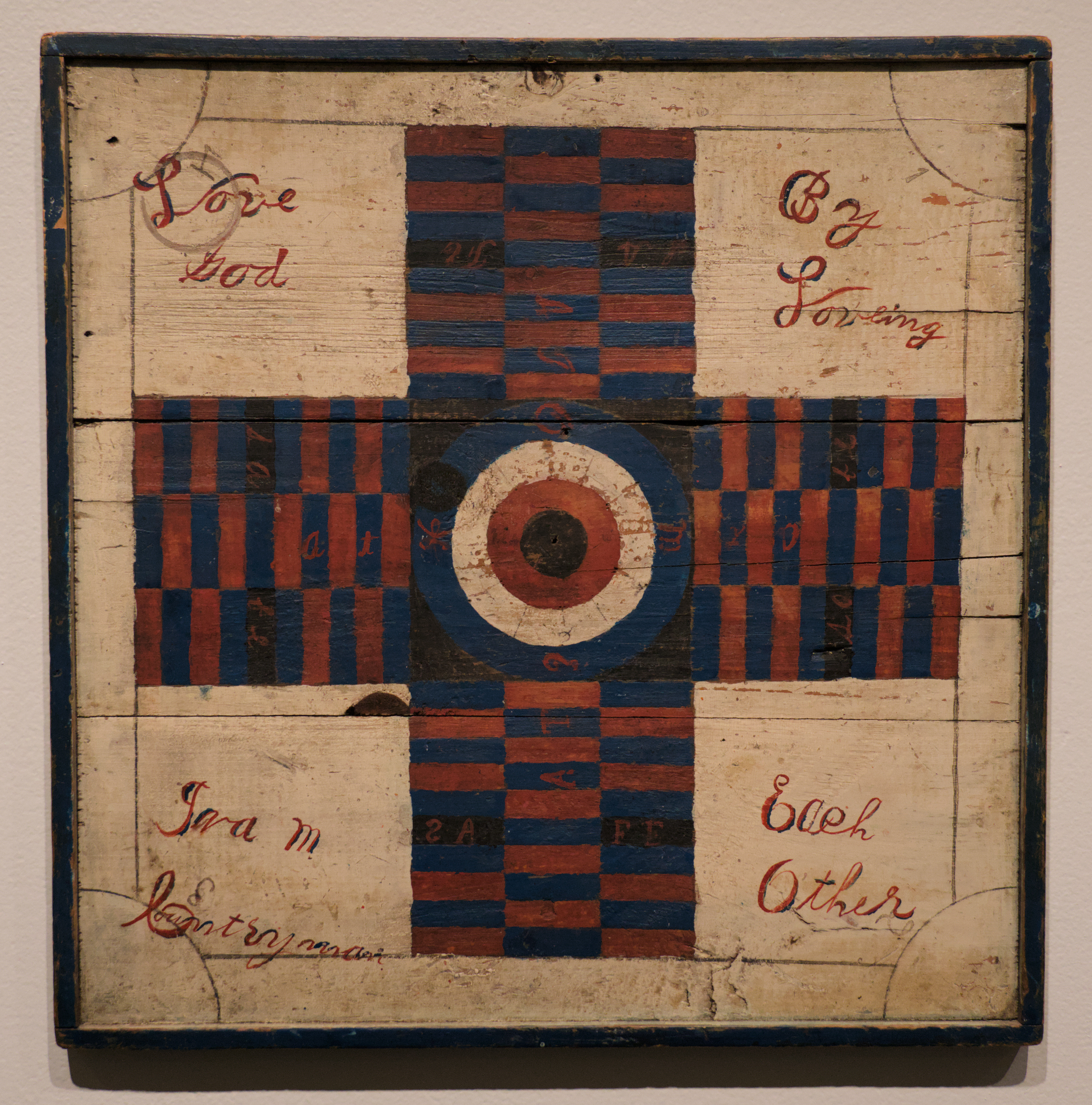
Two that made me chuckle contain religious references. “Gameplay, especially cards, was sometimes thought to encourage vice, in particular gambling or idleness,” the gallery label reads. So board makers sometimes incorporated spiritual aphorisms or precepts into the design to counteract the corrupting influence and remind players to uphold Christian virtues even in moments of leisure. A Parcheesi board instructs players to “Love God by loving each other”—and I can’t make out what the Chinese checkers board says, other than “The Lord . . . your . . . God . . .”

Parcheesi Board
Possibly Ira M. Countryman or Jimmy Hall, Parcheesi Board, late 19th century. Paint on wood, 21 × 21 in. American Folk Art Museum, Gift of Doranna and Bruce Wendel, 2024.7.3. Photo: Victoria Emily Jones.

Chinese Checkers Board
Possibly George Clark, Chinese Checkers Board, late 19th or early 20th century. Paint on wood, 17 1/2 × 15 in. Collection of Doranna and Bruce Wendel. Photo: Victoria Emily Jones.

There are just two weeks left to see the exhibition. (And as I mentioned in November, there’s also an exhibition of Shaker gift drawings on view, also through January 26.) View more photos at the AFAM link above, and also here.

The American Folk Art Museum is one of the few FREE museums in New York, and I’ve enjoyed it so much every time I’ve been there. (See the blog post “The biblical imagination of folk sculptor Annie Hooper,” documenting one of my previous visits.) It’s small—only three galleries. It’s on the Upper West Side of Manhattan, right off the Lincoln Center subway stop.

+++

Interested to see what books I read in 2024? Goodreads has put together a “My Year in Books” page! Follow me on Goodreads if you want to stay apprised of my latest reads, want-to-reads, and star ratings.

My Year in Books

Epiphany roundup: 12+ ways to celebrate, Ted Nash’s “We Three Kings,” and more

BLOG POST: “On the Twelfth Day of Christmas: 12+ ways to keep celebrating with the rest of the world (loads of links!)” (Watch & Do for Twelfth Night and Epiphanytide) by Tamara Hill Murphy: In this blog post from 2019, spiritual director and writer Tamara Hill Murphy has compiled a wonderful roundup of resources for Twelfth Night (January 5) and the Feast of Epiphany (January 6), on such things as chalking the door, stargazing, making origami Christmas stars, baking a Three Kings Cake, Three Kings Day parades, Christmas tree bonfires, and more. She shares several videos, including this one of Denis Adide reading “The Journey of the Magi” by T. S. Eliot, shot in locations around Bristol:

+++

INSTRUMENTAL JAZZ: “We Three Kings,” arr. Ted Nash: This Grammy-nominated arrangement by Ted Nash of “We Three Kings” is performed by the Jazz at Lincoln Center Orchestra, directed by Wynton Marsalis (the trumpeter in the Santa hat), featuring Nash on soprano sax.

I really love this unique rendition, which, with all its dissonance, is different from all the others I’m familiar with. James Johnson, one of the YouTube commenters on the video, writes: “I think this rendition is transporting. Listen to it. Close your eyes and you can feel the hot dry wind of the desert blowing in your face. You may wonder why make this trip at all, and then, that star. That amazing star. Yep, we can make it past a few more dunes, beyond Herod, and on to . . . ‘a manger’? And the rhythm section just pushes me on. . . . This earthly trinity, Melchior, Caspar, and Balthazar, are the hippest trio in Jerusalem and I want to go where they go, know what they know.”

This performance appears on the orchestra’s live album Big Band Holidays (2015) [previously].

+++

NEW ARTWORK: Christmas in the Air Raid Shelter by Olya Kravchenko: For Christmas 2024, with Russia still deploying cruise missiles and suicide drones against Ukraine, Ukrainian iconographer Olya Kravchenko constructed a three-dimensional painting that shows the Holy Family huddled in the basement of an apartment complex, hiding out from air raids. A large, bright star hovers overhead, showing the three magi to the spot where Jesus lies.

Kravchenko, Olya_Christmas in the Air Raid Shelter
Olya Kravchenko (Ukrainian, 1985–), Christmas in the Air Raid Shelter, 2024. Plywood, tempera, and gilding, 67 × 40 × 25 cm.

This piece can be seen through January 26 at the eighty-fourth annual Krippenausstellung (Nativity Scene) exhibition at RELiGIO: Westfälisches Museum für religiöse Kultur (Westphalian Museum of Religious Culture) in Telgte, Germany, whose theme is “Heller Stern” (Bright Star).

+++

SONG: “Magi, Kings of Persia” by Michael Adamis, from the suite 4 Christmas Idiomela: Performed by Cappella Romana under the direction of Alexander Lingas, this choral piece by the Greek composer Michael Adamis (1929–2013) is a setting of an Eastern Orthodox liturgical text for Christmas that translates to:

The magi, kings of Persia, manifestly recognizing the King of heaven who was born on earth, arrived in Bethlehem, led by the radiant star, bearing choice gifts of gold, frankincense and myrrh; and falling down, they offered worship, for they beheld the Timeless One lying in the cave as a babe.

The video is from Cappella Romana’s 2020 Christmas concert.

+++

BLOG POST: “‘So glorious a gleam, over dale and down’” by Eleanor Parker: Medievalist Eleanor Parker shares two medieval English carols (text only; the original music does not survive) about the visit of the magi, a popular theme in that era. She translates them into modern English and provides commentary.

Roundup: Nativity story told by Kenyan children, Annie Moses Band Christmas Special, industrious Joseph, and more

Some of you may wonder why I’m still posting Christmas content. It’s because it’s still Christmastime! Christmas is a twelve-day feast extending from December 25 to January 5. So keep the celebration going with parties, carols, decoration, storytelling, worship, and meditation on the amazing historic event of the Incarnation.

VIDEO: “The Nativity Story (as Imagined by Children in Kenya)”: Released in 2021, this video produced in Kenya by the faith-based child sponsorship organization Compassion International tells the story of Jesus’s birth with localized details, narrated and enacted by children. I was struck by how Mary is pounding yams when the angel Gabriel comes to her, like in one of Nigerian artist George Bandele’s wood carvings of the Annunciation, and how the shepherds literally run to see Jesus, so excited are they to meet him! [HT: Global Christian Worship]

As far as I can tell, this is the first installment in a series of children’s retellings of the Nativity story from around the world that Compassion International releases annually. Subsequent videos—all of them worth watching!—are from Indonesia (2022), Bolivia (2023), and the Philippines (2024).

+++

CONCERT RECORDING: O Holy Night: An Annie Moses Band Christmas Special: Named after their great-grandmother, the Annie Moses Band is an Americana string band of six siblings, raised by award-winning Nashville songwriters Bill and Robin Wolaver, who are committed to godly excellence in the arts. This Christmas concert of theirs, featuring outstanding arrangements of a range of classic carols and one original, was released on DVD in 2018 and just made available by the band for free on YouTube!

Here’s the set list. Links are to standalone videos, excerpted from the performance above. My favorites are probably the opener, “On This Day,” and “We Three Kings”:

+++

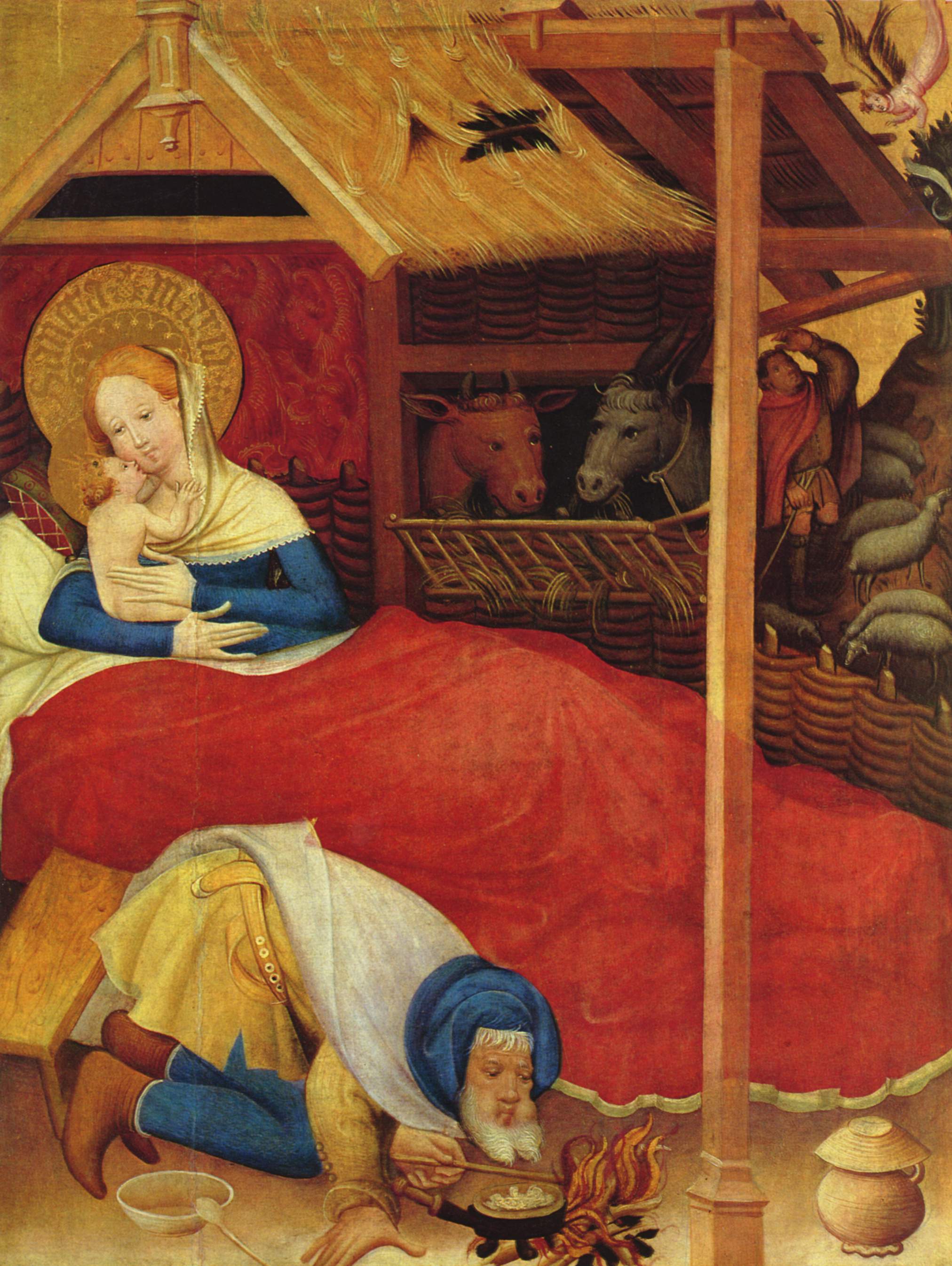
ARTICLE: “Saint Joseph as Baby Daddy: An Illustrated Medieval Guide” by Ela Bobek, DailyArt Magazine: In 2021 on Instagram I shared a small compilation of images that show Joseph as helpful and industrious at the Nativity, as opposed to the more classic depiction of him sitting off to the side with his head in his hands. I’ve since collected over a dozen more and have been wanting to develop a reflection on this motif into a full-fledged article (and probably still will someday), but Ela Bobek has beaten me to it! Check out the images she has compiled that show Joseph cooking, doing laundry, sewing clothes, preparing a bath, and swaddling or holding the baby—allowing Mary some much-needed rest. What a loving, caring, actively involved father and husband!

Konrad von Soest_Nativity
Conrad von Soest (German, ca. 1370–ca. 1422), Nativity, panel in the left wing of the Niederwildungen Altarpiece, 1403. Tempera on wood, 73 × 56 cm. Stadtkirche St. Nikolaus, Bad Wildungen, Germany. [view full altarpiece]

+++

SONGS:

>> “Christmas Ko Ramjham Ma” by Milan Bhujel and Surya Rasaili: This Nepali Christmas song was written by Milan Bhujel (words) and Surya Rasaili (music) in 2022 and is performed here (with dancing!) by Bhujel and friends. I couldn’t find a translation of the Nepali lyrics, but the gist of it is “Let’s dance and rejoice, let’s celebrate the birth of Jesus, who has come to save us. Jesus is a light dispelling all darkness.” [HT: Global Christian Worship]

>> “Christ Is Born (This Day)” by Todd Family Hymnal: This song by Jason B. Todd and Sara K. Todd, a married couple who make music together, is the second track of their Christmas EP from 2020. Jason (who goes by “JB”) is the pastor of administration and music at Westport Baptist Church in Denver, North Carolina.

>> “Funky Little Drummer Boy” by the Good Shepherd Collective: A cover of the funk arrangement of “The Little Drummer Boy” by Sharon Jones & the Dap-Kings, this performance video premiered last week at Good Shepherd New York’s Christmas Eve digital service. The soloist is Stephany Mora. Watch the standalone video on Instagram, or listen on YouTube at this cued-up link.

[Related post: “The Little Drummer Boy: Four Versions (Nigeria, India, Cuba, Norway)]

Roundup: Bolivian Christian art, Ukrainian folk carol, and more

ART SERIES: Pallay: Andean Weaving of Liturgy and Design by Daniela Améstegui: Daniela Améstegui is a graphic designer from Cochabamba, Bolivia, who holds a master’s degree in theological studies from Regent College in Vancouver, with a specialization in Christianity and the arts. Her work “revolves around exploring faith, social justice, and Christian contextualization through design” and “reflects her commitment to using design as a tool for expressing and exploring theological concepts,” she says. She currently lives in Langley, British Columbia, with her husband and two young children, working as a freelancer.

Améstegui’s final Integrative Project in the Arts and Theology for her master’s program was Pallay: Andean Weaving of Liturgy and Design, a series of seven digital illustrations, one for each of the major seasons/feasts of the liturgical year: Advent, Christmas, Epiphany, Lent, Easter, Pentecost, and Ordinary Time. The designs are inspired by Andean textile art and culture. You can view the full series at the link above from Regent College’s Dal Schindell Gallery, where the works were first exhibited in early 2022, but also listen to this wonderful online talk Améstegui gave about Pallay in 2020 for INFEMIT’s Stott-Bediako Forum, where she discusses not only her motivation and influences but also the content of each specific piece:

Whereas those of us in the northern hemisphere associate Advent with cold, darkness, and the onset of winter, in the southern hemisphere Advent falls in early summer, a time when the earth is most fertile and farmers plant their seeds. In her Advent design, Améstegui connects Mary carrying the seed of new life within her with Pachamama (Mother Earth).

Amestegui, Daniela_Advent
Daniela Améstegui (Bolivian, 1990–), Adviento (Advent), 2019–20, from the digital illustration series Pallay: Andean Weaving of Liturgy and Design. Used with permission.

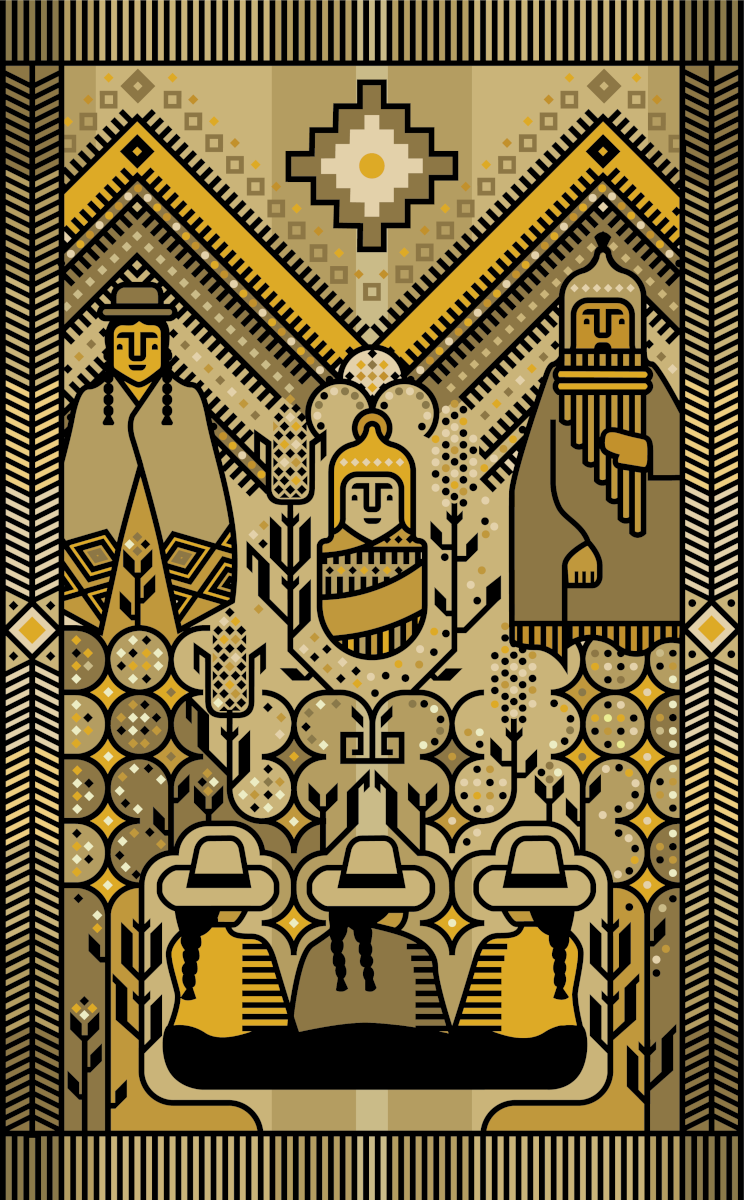
In Bolivia, Christmas takes place during a season of harvest, so in her Christmas design, Améstegui places Jesus in the center between crops of corn and quinoa, the two main agricultural foods cultivated in the country. Mary wears braids and a bowler hat and Joseph plays the zampoña (Andean panflute), and at the bottom three cholitas, Indigenous women from the Bolivian countryside, gather reverently to greet the Christ child.

Amestegui, Daniela_Christmas
Daniela Améstegui (Bolivian, 1990–), Navidad (Christmas), 2019–20, from the digital illustration series Pallay: Andean Weaving of Liturgy and Design. Used with permission.

Améstegui does not have a website just yet but tells me she plans to launch one in 2025. If you would like to purchase one or more of her Pallay pieces, you can contact her at daniela@amestegui.com.

Thank you to blog reader Nicole J. for alerting me to this striking series!

+++

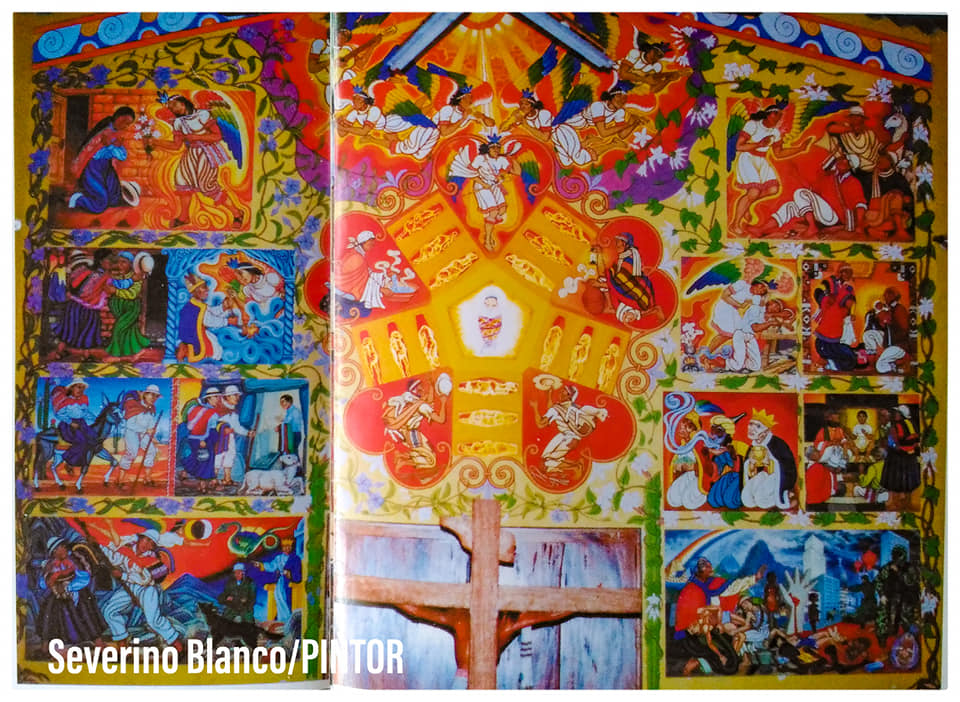
VIDEO COLLECTION: Casa del Catequista (CADECA) chapel paintings: As chance would have it, the same week I learned about Daniela Améstegui’s work, a different blog reader, Mark M., emailed me a link to some videos his Langham Partnership colleague Paul Windsor took during a recent trip to Bolivia. They record the many paintings, most by the late Quechua artist Severino Blanco [previously], inside the chapel of CADECA in Cochabamba, a place where men and women are trained as Christian leaders who then go out to serve their rural communities. They portray scenes from the Old and New Testaments, the parables of Jesus, and Latin American church history, including a remarkable liberation theology–inspired Resurrection, in which Jesus breaks down the doors of death and hell, holding high a cacique’s staff and leading the people of Bolivia into their future. Here’s a 360-degree view captured by Windsor, but visit the boldface link to see additional videos that narrow in on particular portions.

Blanco, Severino_Nativity
Severino Blanco (Quechua [Bolivian], 1951–2020), Infancy of Christ painting cycle, 1985. Chapel of the Casa del Catequista (CADECA), Cochabamba, Bolivia.

On the west end of the chapel (where people enter the space) is an Infancy of Christ cycle—reproduced here from a scan of a pamphlet, it appears. In the center is a Nativity, the Christ child painted over a pane of glass through which natural light comes gleaming in (see a closer view). The oblong shapes radiating out from the center are also glass, onto which the artist has (I think) etched lambs in various stages of prostration. On the sides, two villagers come with hot water and towels, and at the bottom two shepherds kneel before the Savior, removing their hats as a sign of respect. At the top, a host of angels with rainbow-colored wings and indigenous instruments sing Christ’s praises.

To the left of the Nativity are six scenes: (1) The Annunciation to Mary, (2) The Visitation, (3) The Annunciation to Zechariah, (4) The Journey to Bethlehem, (5) No Room at the Inn, and (6) The Flight to Egypt. To the right are (7) The Annunciation to the Shepherds, (8) The Annunciation to Joseph, (9) The Presentation in the Temple, (10) The Adoration of the Magi, (11) Jesus with the Scholars in the Temple, and (12) The Massacre of the Innocents.

+++

SONGS:

>> “Admirable Consejero” (Wonderful Counselor) by Santiago Benavides: Santiago Benavides is a Colombian singer-songwriter living in Toronto. On his Facebook page he describes his musical style as “trova-pop-bossa-carranga worship.” This song he wrote is a setting of Isaiah 9:2, 6–7 in Spanish. In the video, he’s the guitarist with the red-tinted glasses.

>> “The Word Became Flesh” by John Millea: John Millea is “a storyteller with a guitar,” singing in the tradition of Americana, folk, and gospel “about life and all of its joys, sorrows, and struggles.” He’s one of the artists I support through Patreon. This was the first song of his I encountered, and it’s one of my favorites, engaging with John 1:1–3, 14 in a wholly unique way!

In contrast to everyone and everything else in the universe, Millea explains, God had no beginning point, and all that is can in some way be traced back to him, the first link in a massive chain of cause and effect. So here Millea playfully traces his guitar all the way back to God—from the store he bought it at in Illinois, to the factory in Pennsylvania they ordered it from, to the mill in Washington that supplied the wood, to the Alaskan forests whence the tree was logged, and so on and so forth, imagining many thousands of years of fallen and dispersed tree seeds that traversed seas and continents, with an ultimate source in a tree planted in Eden by the Word of God.

When he hits on Eden, he starts moving forward again, through the story of creation, fall, and redemption in Christ, the divine beginningless One who graciously and mysteriously entered human history, born of a woman named Mary.

>> “Mary Had a Baby”: Arranged by Roland Carter, this African American spiritual is performed by the Nathaniel Dett Chorale, featuring the amazing mezzo-soprano Melissa Davis. It’s from their 2003 album An Indigo Christmas, the tracks taken from two live concerts given at the Church of St. George the Martyr in Toronto.

>> “Що то за предиво” (Shcho to za predyvo) (Behold a Miracle): This Ukrainian folk carol is performed by Trioda (Тріода), a musical group consisting of Andrii Gambal, Volodymyr Rybak, and Pavel Chervinskyi.

What is this awe-inspiring miracle?
There is great news on earth!
That the Virgin Mary gave birth to a son.
And upon birthing him, she declared,
“Jesus—my son!”

And the aging Joseph stands nearby in awe
Of Mary having given birth to a son.
And he prepares the swaddling for Jesus Christ.
And Mary swaddles him, and scoops him to her heart—
The pure Virgin Mary!

Trans. Joanna (Ivanka) Fuke [source]

Roundup: Gift-wrapping liturgy, feasting without shame, and more

PRAYER: “A Liturgy for the Wrapping of Christmas Gifts” by Wayne Garvey and Douglas McKelvey: Taken from Every Moment Holy, volume 3 from the Rabbit Room Press.

+++

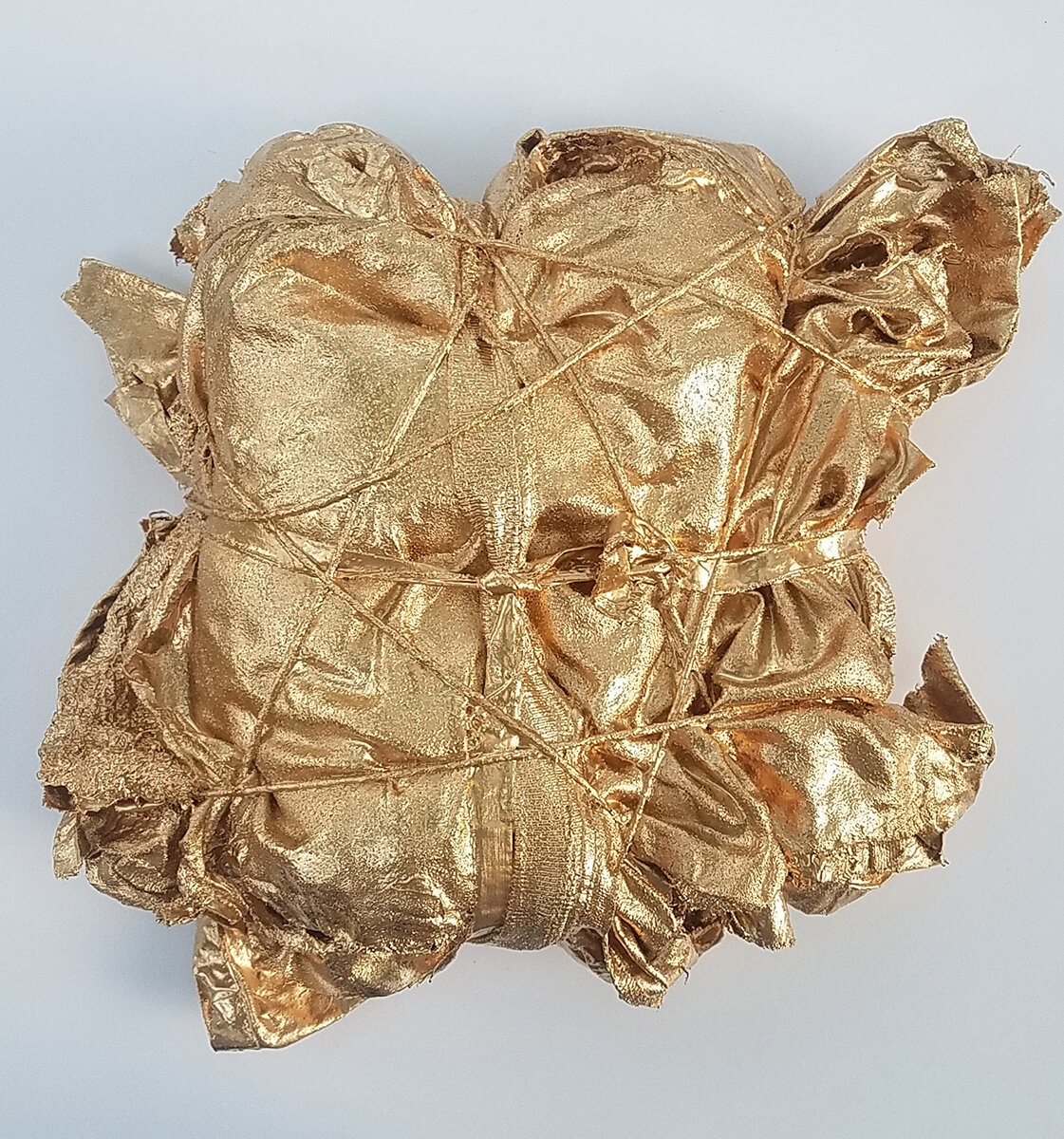
ART SERIES: Magnificat by Mandy Cano Villalobos: Mandy Cano Villalobos [previously] is a multidisciplinary artist from Grand Rapids, Michigan. Her Magnificat series consists of bundles of discarded clothing, bound in string and meticulously hand-coated with imitation gold. The title—the Latin name of Mary’s praise song that opens, “My soul magnifies the Lord!”—invites associations with the Christmas story, including the image of the swaddled Christ child, a gift to the world that surprises and delights.

Cano Villalobos, Mandy_Magnificat XV
Mandy Cano Villalobos (American, 1979–), Magnificat XV, 2019. Cloth, string, and imitation gold.

Villalobos, Mandy Cano_Magnificat installation
Installation of select pieces from the Magnificat and Cor Aurum series by Mandy Cano Villalobos, December 2020, Sojourn Midtown, Louisville, Kentucky

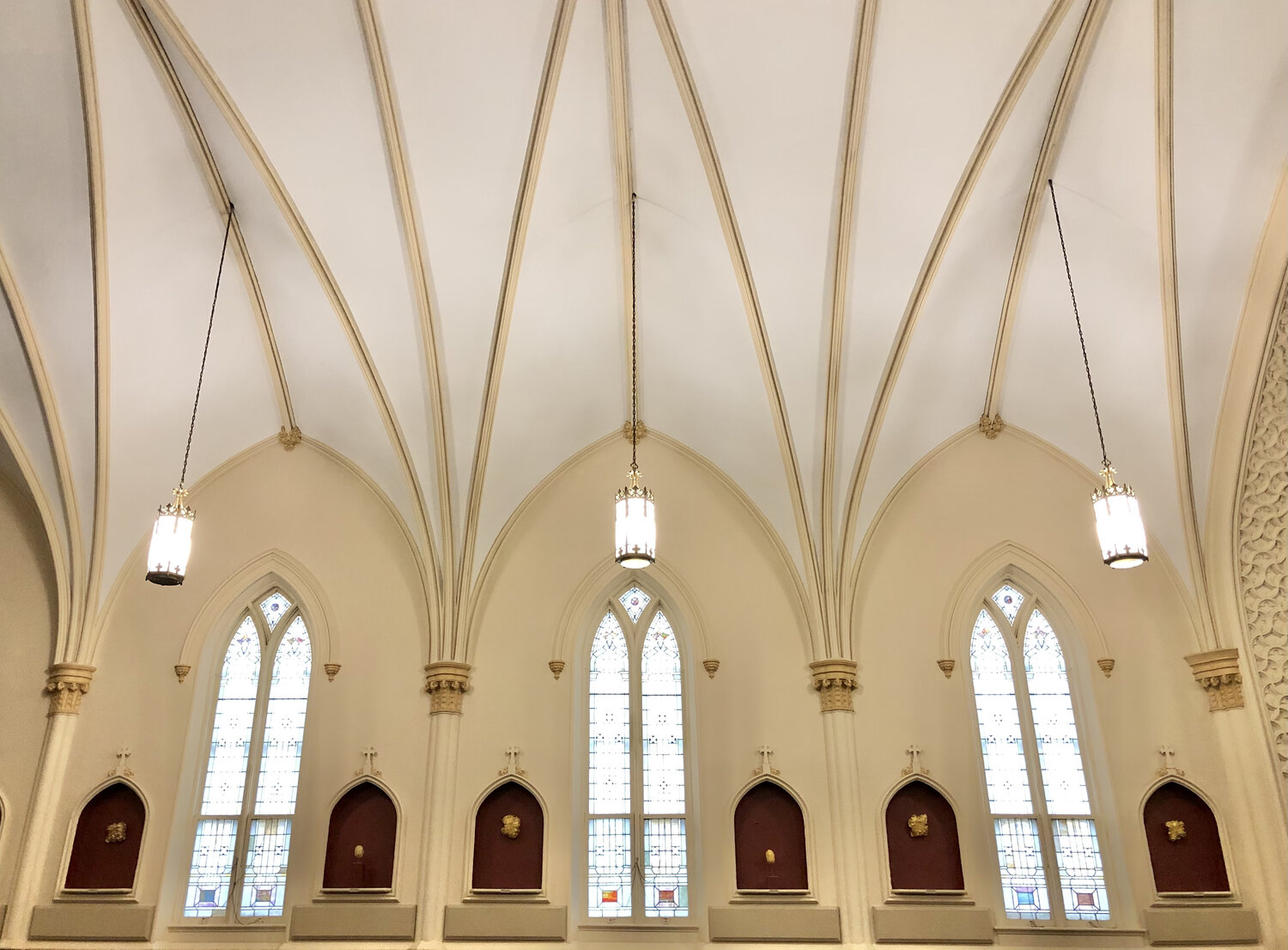
The series debuted in 2019 at Cano Villalobos’s solo show All That Glitters at the Urban Institute for Contemporary Arts (UICA) in Grand Rapids. I first encountered it, though, through online promotions of Sojourn Midtown’s Advent 2020 installation to correspond with the church’s sermon series Wrapped in Flesh, for which twelve of the artist’s works, some from her related Cor Aurum (Heart of Gold) series, were placed in niches around the sanctuary.

“The objects, all made of wood and fabric covered in imitation gold, point to something both humble and glorious,” writes Michael Winters, Sojourn Midtown’s arts and culture director. “Like these small sculptures of rags and gold, the birth of Jesus was also marked by humility and glory.”

+++

ARTICLE: “My Swaddled Savior” by Jeff Peabody, Christianity Today: Pastor Jeff Peabody of Tacoma, Washington, describes the traditional Japanese art of furishoki, or wrapping goods in cloths, as he reflects on Jesus having been swaddled as an infant, a wrapped gift given to the world. “Jesus came to us in furoshiki, wrapped in cloths,” he writes.

+++

BLOG POST: How to receive gifts and enjoy feasting without shame, by Tamara Hill Murphy: In this old blog post of hers, spiritual director and The Spacious Path author Tamara Hill Murphy absolves us of the guilt we so often feel around (1) receiving (unreciprocated) gifts and (2) feasting. We should receive both presents and food, she says, as means of grace. Too often we’re embarrassed when we receive a gift from someone to whom we gave no gift, or a gift of lesser value, and so instead of receiving their gift with joy, we receive it with shame or an annoying sense of obligation. But Murphy says she hopes to receive gifts this way: “When Jesus told us to come to him as little children, he must have been imagining the way children openly, delightedly, innocently receive gifts. Children do not question their place as ones worthy of receiving gifts. Children boldly believe the beauty of unearned kindness.”

As for food, how many times have you been to a Christmas party or dinner and heard people bemoan all the fat and sugar they’ve been consuming, and about how they’ll have to punish their body in the new year to work off the extra calories, to shrink themselves back down to size? Feasting, though, is a spiritual discipline, a way to celebrate important events, like the birth of Christ, with family and friends. Feel no shame about indulging in gustatory pleasures this Christmas! Take in the sweet, the creamy, and the juicy! Murphy’s mom’s motto for hospitality is a wise one: “While we feast, we savor.”

On her blog A Clerk of Oxford, medievalist Eleanor Parker also affirms the virtue of feasting, noting how the popular modern practice of fasting in January runs counter to medieval Christian practice:

Since the late 20th century it’s become common to invert the traditional relationship between fasting and feasting in the Christmas season. The ancient custom was to fast in Advent in preparation for the feast, and then to celebrate for at least twelve days after Christmas (and to some degree, all through January). Now we do it the other way around; for many people the feast is followed by a penitential fast, in the form of ‘Dry January’ or New Year’s resolutions about eating less and going to the gym. As a manifestation of the desire for a fresh start, this ‘new year, new you’ impulse is natural enough, but it does strike me as strange that it’s so often framed in negative terms. There’s an odd sense, encouraged mostly perhaps by journalists and advertisers, that the indulgence of Christmas is a ‘sin’ which has to be atoned for – as if eating and drinking with friends and family, to celebrate the turn of the year from darkness to light, is a moral lapse for which one must subsequently make amends by privation and self-punishment. We are much less kind to ourselves in these weeks after Christmas than the strictest confessor would have been in the Middle Ages. Feasting at Christmas is not something to atone for, but a proper observance due to the season; and that feasting is also the sustenance we need to carry us into the New Year with energy and strength.

+++

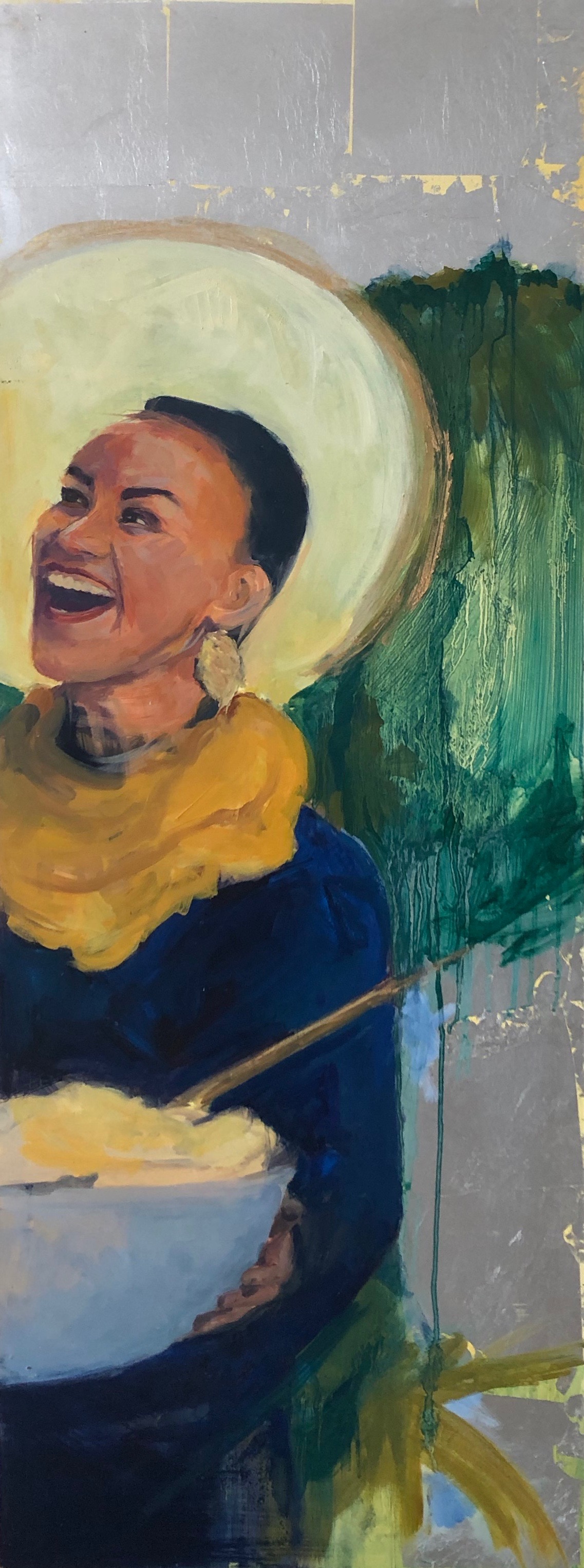
VIDEO: “Our Vocation of Delight: On Advent, Beauty, and Joy” by Christen Yates: In this thirty-minute “Space for God” Advent devotional from Coracle, artist Christen Yates (Instagram @christenbyates) invites us to experience the Christian “duty of delight” through engaging a selection of artworks by herself, Sedrick Huckaby, Letitia Huckaby, and Ashley Sauder Miller. She opens with a liturgical commission she fulfilled for the Advent season while serving as artist in residence at her church in Charlottesville: a portrait painting of congregation member Arley Bell (née Arrington), a baker who is now the owner of Arley Cakes in Richmond. Waiting for her dough to rise, Arley captures the joyful expectancy of Advent.

Yates, Christen_Arley, baker
Christen Yates (American, 1977–), Advent: Arley, baker, 2016. Oil and gold and silver leaf on board, 48 × 18 in. Collection of All Souls Charlottesville, Charlottesville, Virginia. Photo courtesy of the artist.

Roundup: Adoration ’N Prayze, “Elogio all’Innocenza,” and more

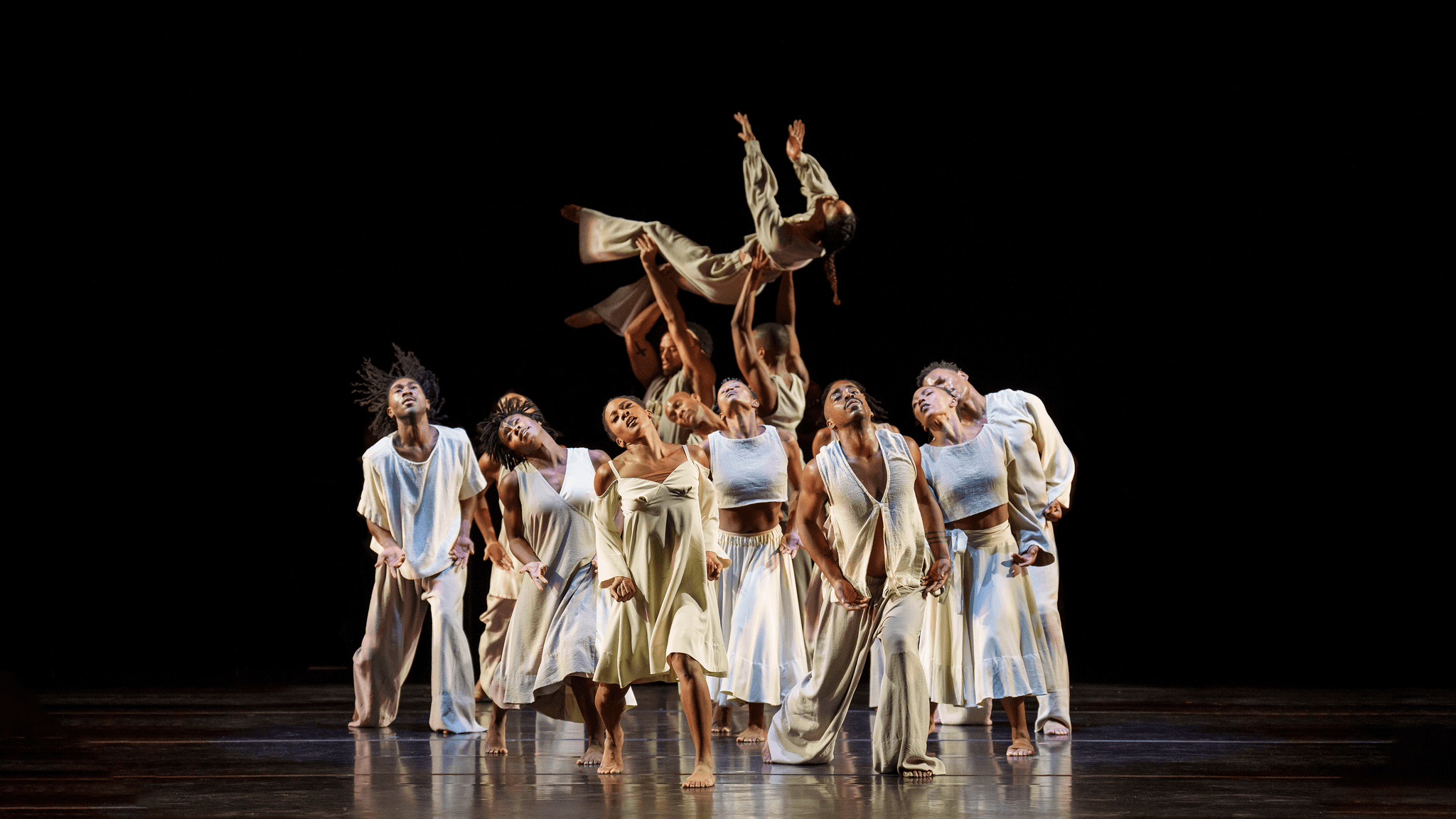
DANCE: “I Wanna Be Ready”: The African American spiritual “I Wanna Be Ready” forms the soundtrack to this iconic solo from Alvin Ailey’s contemporary ballet Revelations. The dancer in this first video is Amos Machanic:

In 2018, in honor of the Alvin Ailey American Dance Theater’s sixtieth anniversary, Matthew Rushing, who is currently the company’s interim artistic director, traveled to Ailey’s birthplace of Rogers, Texas, to dance “I Wanna Be Ready” at Mount Olive Baptist Church, one of the few landmarks of Ailey’s childhood that’s still standing in Rogers. He was accompanied live by five local singers. The performance was filmed, edited, and released on YouTube.

I’m so excited that in January, for the first time, I’m going to see AILEY live in New York! The company will be performing three pieces, including the brand-new Sacred Songs, choreographed by Rushing.

+++

SONGS:

>> “Time Is Running Out” by Adoration ’N Prayze: Adoration ’N Prayze was a female gospel quartet from Detroit that was active in the early nineties, consisting of Damita Bass, Marguerita Bass, Pamela Taylor, and Shontae Graham (later replaced by Audra “Dodi” Alexander). This original song is the title track of their first and only album, released in 1991. The live recording is from a concert they gave at Clowes Memorial Hall in Indianapolis in 1992.

>> “Oil in My Vessel,” traditional gospel song performed by Rani Arbo & daisy mayhem: Rani Arbo & daisy mayhem are a New England–based folk quartet made up of Rani Arbo (fiddle, guitar), Andrew Kinsey (bass, banjo, ukulele), Anand Nayak (electric and acoustic guitars), and Scott Kessel (percussion). This song they perform is based on a recording by Joe Thompson (1918–2012), who was raised in a Holiness Church in Alamance County, North Carolina. Thompson said the song was in his church hymnal, and that he learned it from his mom when he was about five years old (in the 1920s). Its refrain is a statement of intent to “be ready when the Bridegroom comes,” and its stanzas are taken from the seventeenth-century hymn “Must Jesus Bear the Cross Alone?” by Thomas Shepherd and, from the eighteenth century, “Amazing Grace” by John Newton.

+++

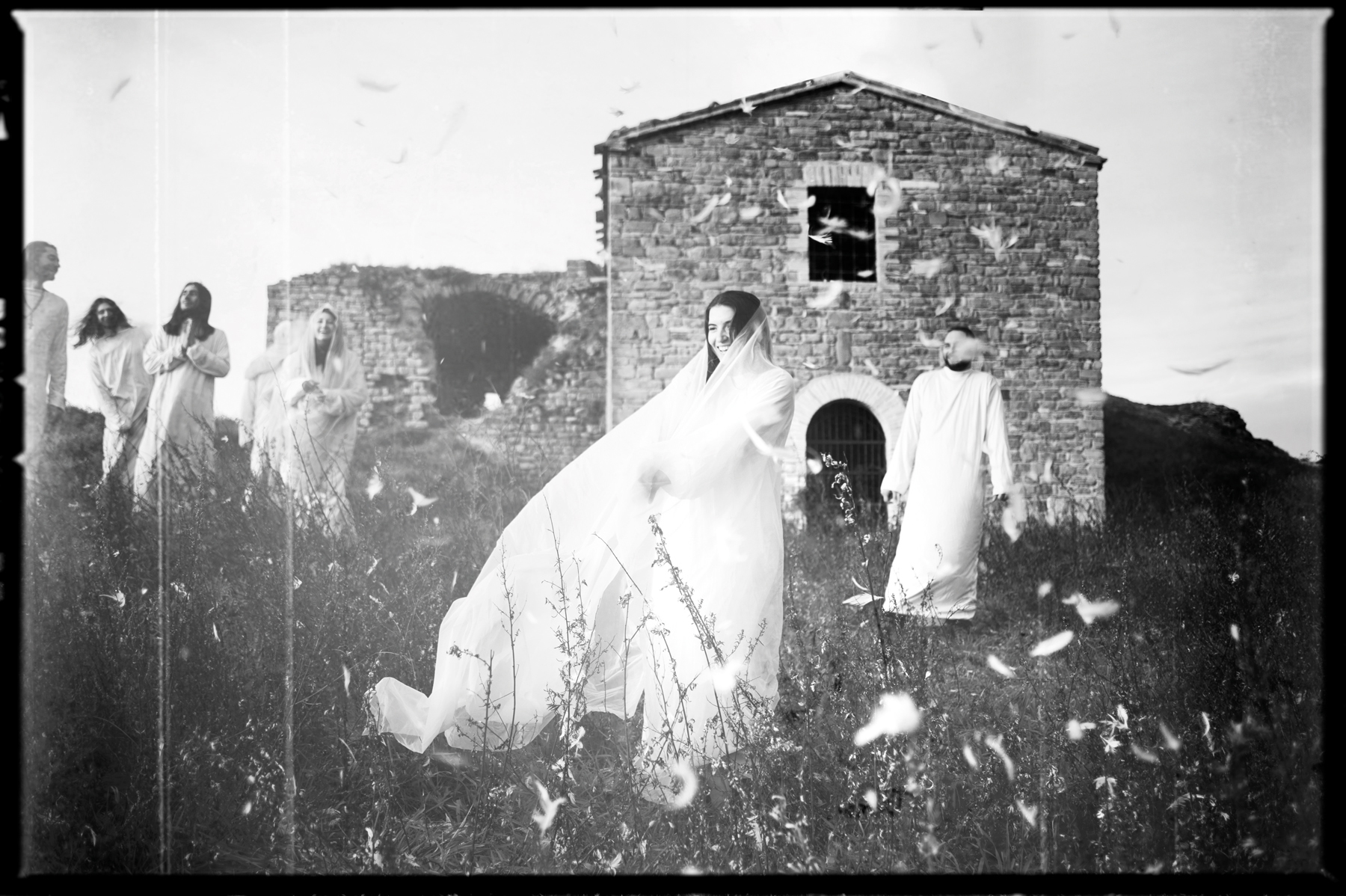
PHOTOGRAPH SERIES: Elogio all’Innocenza (In Praise of Innocence) by Gloria Mancini: Gloria Mancini is an Italian artist working mainly in photography. One of her recent series, divided into three parts, is based on Revelation 3:1–6 (Gli Innocenti, or The Innocents), 12:1 (La Donna Vestita di Sole, or The Woman Clothed with the Sun), and 5:1–7 (L’Agnello, or The Lamb). “Becoming small to become great has been the aim of my exploration of the Book of Revelation,” she writes in her artist’s statement. “Inspired by the visionary and magnetic power of the Kyrios (the Christ, the Lamb), I chose to focus my reflection on innocence as a fundamental and revolutionary value of being, reaffirming its virtue.” She says she is compelled by how in Revelation, it is a meek and vulnerable lamb who defeats evil.

Jesus’s message to the church in Sardis, a wealthy city in west-central Asia Minor, is so seldom (or not at all?) visualized in art history—I’m grateful to Mancini for drawing attention to this passage through her thoughtful work! Jesus tells the church to “wake up,” to “remember . . . what you received and heard; obey it and repent,” following the example of the few there “who have not soiled their clothes.” Those people, he says, “will walk with me, dressed in white, for they are worthy.” He admonishes the Sardis Christians to be watchful and to strengthen and perfect their good works so that they might conquer evil and their names be preserved in the book of life.

Mancini pictures the faithful remnant at Sardis praying, keeping watch, persevering in purity, and gamboling about in the life of the Spirit.

Mancini, Gloria_In Praise of Innocence
Gloria Mancini (Italian, 1992–), photograph from the Elogio all’Innocenza series, 2023

Mancini, Gloria_In Praise of Innocence
Gloria Mancini (Italian, 1992–), photograph from the Elogio all’Innocenza series, 2023

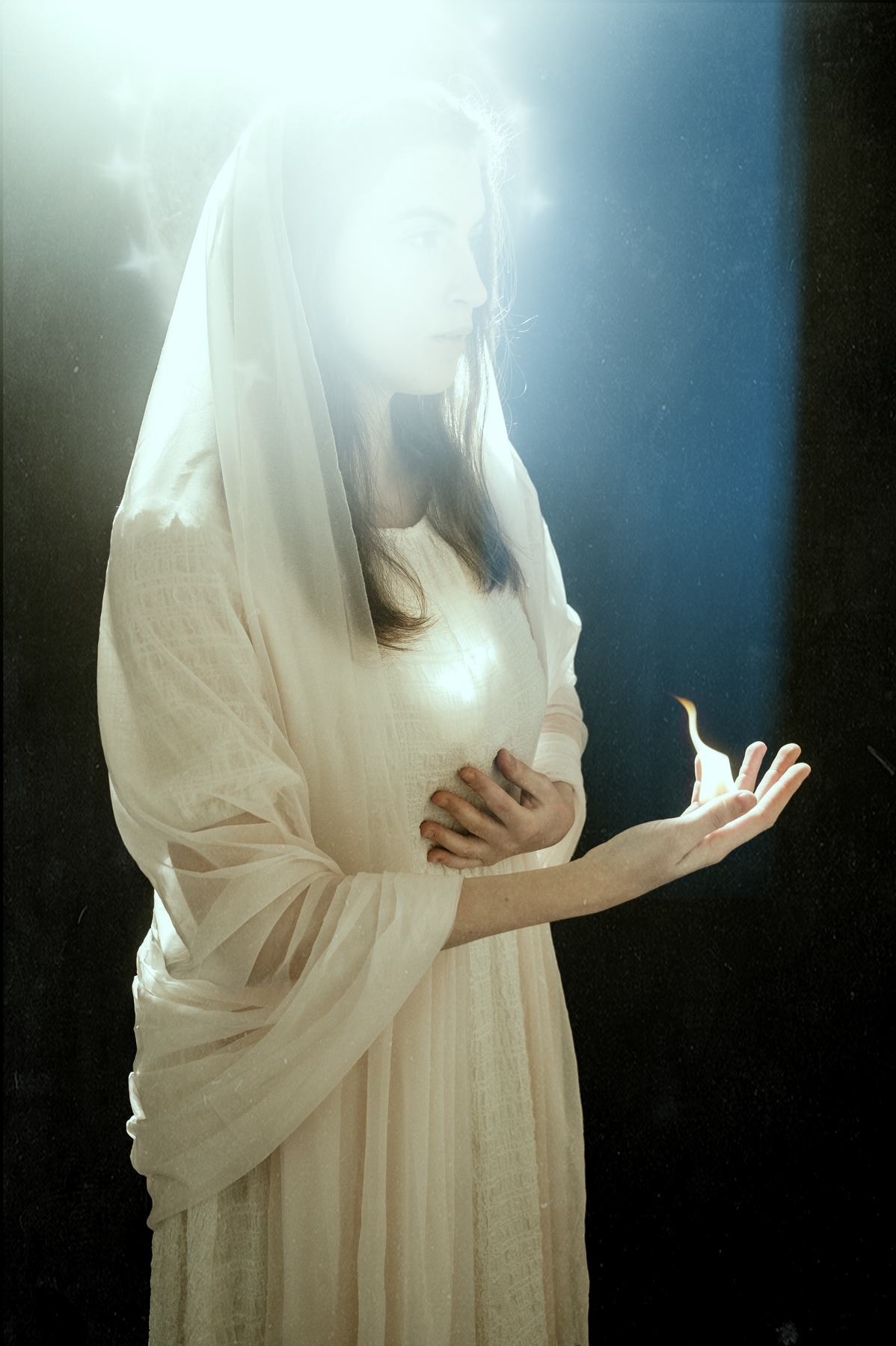
The Woman Clothed with the Sun from Revelation 12, on the other hand, is widely represented in art, and since the twelfth century has been associated with the Virgin Mary, because the woman gives birth to a son who is pursued by the Dragon. In church tradition Mary is also likened to the burning bush in Exodus, because she bore the fire of divinity—God in Christ—within her but was not consumed. Mancini plays on both associations, showing Mary cautiously holding a flame, bringing it closer to her breast: she accepts the Incarnation and is set alight.

Mancini, Gloria_In Praise of Innocence
Gloria Mancini (Italian, 1992–), photograph from the Elogio all’Innocenza series, 2023

+++

ART SPOTLIGHT: “Yellow Silence: Miniature from the Silos Apocalypse (ca. 1100),” Public Domain Review: One of the most dramatic pauses in scripture comes about a third of the way through the book of Revelation. John has just described the nations’ loud and jubilant praises around the throne of God, and then he opens the next chapter, “When the Lamb broke the seventh seal, there was silence in heaven for about half an hour” (Rev. 8:1). This is the calm before the next storm of judgment breaks with the blowing of the seven trumpets, through which God purges the earth of evil.

While artists have historically relished the chance to visualize the rain of blood, fire, locusts, and such initiated by the trumpet blasts, the anonymous artist of a twelfth-century copy of an Apocalypse commentary from Spain saw fit to also visualize the sonic absence that preceded these spectacular occurrences. He did so with a rectangular swath of yellow.

Silence in Heaven (Silos Apocalypse) (detail)
Miniature from the Silos Apocalypse, northern Spain, 1091–1109. British Library, Add MS 11695, fol. 125v.

This swath calls readers to somber, speechless awe and reflection. God’s earlier word spoken to and through the prophet Zephaniah is appropriate here: “Be silent before the Sovereign LORD, for the day of the LORD is near” (Zeph. 1:7).

Click here to browse more images from the Silos Apocalypse.

Five new Advent/Christmas albums

Every fall a number of new holiday albums hit the market. Here are five from this year that I’ve been enjoying. I’ve included one or two sample tracks from each.

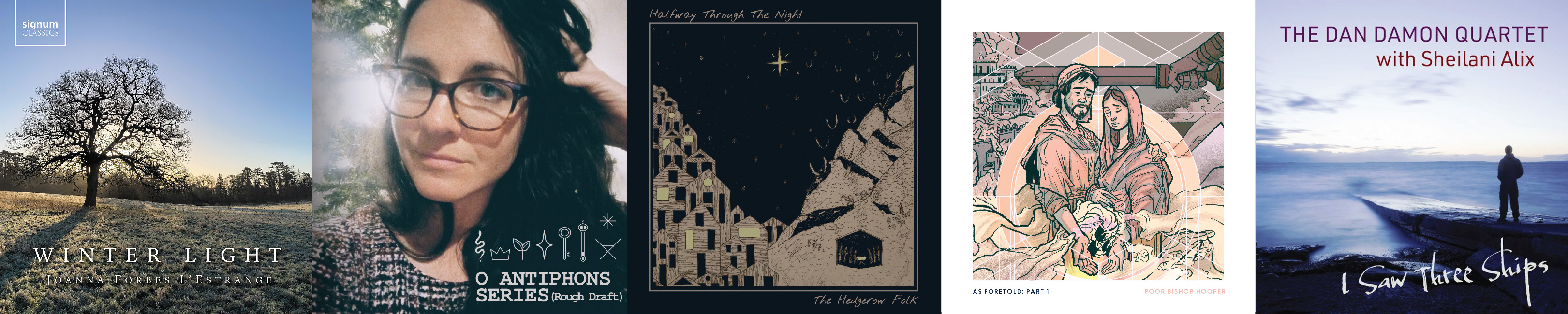
2024 Holiday Albums

Winter Light by Joanna Forbes L’Estrange

A smorgasbord of choral works by the British composer Joanna Forbes L’Estrange, plus a few written or cowritten by her husband, Alexander, and one by her son Harry, all performed by Ben Parry’s London Voices. I learned about this album from Angier Brock, who wrote the anthem text for the title track. One of my favorite pieces is the “Advent ‘O’ Carol,” which I’ll be featuring in a devotional post on December 17. Below is a retune of “In the Bleak Midwinter” (risky, since Holst’s beautiful tune is so iconic, but I love what L’Estrange does with Rossetti’s poem), followed by an original jazzy carol about “The Three Wise Women” of Christmas—Mary, Elizabeth, and Anna.

O Antiphons Series by Elise Massa

Elise Massa is a singer-songwriter and music minister currently living in Durham, England, where she works for United Adoration, a global nonprofit that seeks to empower local artists to create music and art rooted in Christ and meaningful to their particular context, culture, and language. This quiet, understated album consists of seven original songs based on the O Antiphons, refrains sung during evening prayer on the seven last days of Advent preceding Christmas Eve. Here’s the first one, “O Wisdom (O Sapientia)”:

Halfway Through the Night by the Hedgerow Folk

Named after a phrase from a C. S. Lewis poem, The Hedgerow Folk is an Alabama-based acoustic Americana trio: Jon Myles, Amanda Hammett, and Bryant Hains. “Halfway through the night” is a through line that weaves through this their first Christmas album as a declaration of hope. My two favorite tracks: their reharmonized rendition of “Lo, How a Rose E’er Blooming,” and their bluegrass arrangement of “Oh Come, Divine Messiah” (which I knew previously only from an a cappella choir of nuns). Also available on vinyl.

As Foretold: Part 1 by Poor Bishop Hooper

As Foretold is a trilogy of albums that takes its subject matter from the prophetic fulfillment passages in Matthew’s Gospel. Part 1, released this week, covers the first two chapters of the book—Jesus’s birth, his flight to Egypt, Herod’s slaughter of innocents, and Jesus’s return to Nazareth. Three of the tracks deal with Joseph’s three dreams—a rarity in music! In his first dream, an angel appears to tell him that Mary is telling the truth, that the son inside her was indeed conceived by the Holy Spirit. In the second dream, treated in the “Out of Egypt” song below, the angel tells Joseph to take his family and flee Bethlehem to Egypt to escape Herod’s wrath, and in the third, the angel informs him it’s safe to return to their homeland.

Poor Bishop Hooper is offering the album for free download from their website! Parts 2 and 3 will release in early 2025.

I Saw Three Ships by Dan Damon

Daniel Charles Damon is a jazz pianist, hymn writer, and retired Methodist pastor from San Francisco, who also works as associate editor of hymnody at Hope Publishing Company. His latest jazz Christmas album features a combination of classics and originals, including two hymns he wrote both the words and music for (“Like a Child” and “Winter’s Child”); “Hunger Carol” by Shirley Erena Murray (words) and Saya Ojiri (tune), which Damon has freshly arranged; and “Peace Child,” another Murray hymn, for which Damon wrote a tune.

It’s difficult to choose a favorite track, as I love this album through and through! I’ll highlight first the nineties hymn “Peace Child,” a pensive reflection on how Christ comes to us “in the silence of stars, in the violence of wars,” “through the hate and the hurt, through the hunger and dirt.” Second, a lively medieval carol whose Latin refrain, “Id-e-o-o-o, id-e-o-o-o, id-e-o, gloria in excelsis Deo!,” translates to “Therefore, glory to God in the highest!”

The vocalist on the album is the award-winning Sheilani Alix. She is accompanied by Damon on piano, Kurt Ribak on acoustic bass, Carrie Jahde on drums, and Lincoln Adler on tenor saxophone and soprano sax.

If you like this album, be sure to also check out Damon’s 2022 Christmas album, No Obvious Angels.


What 2024 holiday albums have you been enjoying?

Roundup: “Peace on Earth” by U2, guns into shovels, and more

SONGS:

>> “Peace on Earth” by U2: “Heaven on earth—we need it now. I’m sick of all this hanging around. Sick of the sorrow, sick of the pain . . .” U2’s “Peace on Earth” was inspired by the Omagh bombing in Northern Ireland on August 15, 1998. It first appeared on their 2000 album All That You Can’t Leave Behind, but I prefer the stripped-down acoustic version they recorded last year on Songs of Surrender.

The song wrestles with the tension between the angels’ proclamation of peace in Luke 2 and the course of history ever since, riddled, as before, with violence. “Hope and history won’t rhyme,” the lyrics lament—they’re just not matching up. “Peace on earth” feels naive; the words sometimes stick in our throats. The refrain addresses Christ: “Jesus, can you take the time / To throw a drowning man a line?” In its emotional honesty and its asks, it resembles a biblical psalm. (Bono has in fact spoken about how the Psalms have influenced his songwriting.)

When U2 performed “Peace on Earth” live at Sphere Las Vegas this February, Bono substituted the names of five Irish casualties of the Troubles listed in one of the verses with the names of four Palestinian and Israeli children who have been killed in the current Israel-Hamas War: Gal, Ayat, Hind, and Mila.

>> “There Will Be a Day (Isaiah 2)” by Caroline Cobb, arr. Joel Littlepage: I cued up my favorite song from last year’s Dawning Light service at Grace Mosaic church in Washington, DC (it’s at 32:50–37:29 of the video): “There Will Be a Day” by Caroline Cobb, based on Isaiah 2. The song is from Cobb’s album A Seed, a Sunrise: Advent to Christmas Songs (2020)—it’s my favorite of all her songs, and because of its emotional and summative power, I’ve set it as the concluding track of my Advent Playlist. Joel Littlepage, Grace Mosaic’s pastor of worship and formation and the director of the Daily Prayer Project, arranged it with gospel inflections for his church’s annual Advent carols service. He’s at the keyboard; his wife, Melissa Littlepage, is the vocal soloist (she’s also the choir director); and the saxophonist is Skip Pruitt.

Cobb, the songwriter, has published a new book this year that may be of interest: Advent for Exiles: 25 Devotions to Awaken Gospel Hope in Every Longing Heart. She discusses it on a recent episode of The Habit Podcast that I commend to you.

+++

ARTWORK: Home (land) Birth (place) by Beth Krensky: Beth Krensky is an artist, activist, and educator of Jewish heritage who describes herself as “a gatherer of things—objects, words, spirit—and a connector of fragments to make us whole.” Her website documents many compelling artistic projects she has undertaken over the past decade. One of them, Home (land) Birth (place), is a performance from 2016 with her academic colleague Amal Kawar, a professor of political science and the author of Daughters of Palestine: Leading Women of the Palestinian National Movement.

Krensky, Beth_Home Land, Birth Place
Beth Krensky (American, 1965–), Home (land) Birth (place), a performance with Amal Kawar, 2016, Great Salt Lake, Utah. Photo: Josh Blumental.

For this piece, Krensky sewed together a truce flag from baby clothes and other white linens and attached it to two olivewood poles onto which she burned quotes from Israeli and Palestinian mothers who have lost a child to Israeli-Palestinian violence. She and Kawar held the flag aloft in the desert outside their hometown of Salt Lake City as a call for peace. Read the artist’s statement at the link above, and view additional photos of the flag here.

+++

DEVOTIONAL POST: “Swords Will Be Turned into Plowshares,” Center for Christianity, Culture, and the Arts at Biola University: Every year Biola University’s CCCA publishes free daily Advent and Christmas devotions online that feature an artwork, a song, a poem, and a written reflection—the work of many contributors. You can access their 2024 Advent Project here.

Last year I was particularly taken with the peace-themed compilation offered on January 2, which includes a poem by Denise Levertov, a socially conscious, participatory art project led by Pedro Reyes (more on that in next roundup item), a Sweet Honey in the Rock rendition of an African American spiritual, and a wonderful reflection by Dr. Natasha Aleksiuk Duquette, a literature professor. Check it out.

+++

ARTICLE: “Mexican Artist Pedro Reyes Molds 1,527 Guns into Shovels Used to Plant Trees,” Colossal: Pedro Reyes is a Mexican artist, architect, and cultural agent who seeks to turn social problems into opportunities for tangible change through works that integrate elements of theater, psychology, and activism. (I learned about him through Biola’s Advent Project, above.) In 2008, in cooperation with city authorities, he led a campaign in Culiacán, Mexico, to collect firearms, giving donors vouchers for electronic appliances in exchange. The hundreds of guns he received were publicly crushed by a steamroller, melted, and remolded into shovels, which were then distributed to public schools and other institutions who committed to planting trees with them. This project was an effort to curb local gun violence and to cultivate the collective imagination toward life.

Reyes, Pedro_Palas por Pistolas
Pedro Reyes (Mexican, 1972–), Palas por Pistolas (Guns for Shovels), 2008

Reyes, Pedro_Palas por Pistolas
Artist Pedro Reyes steamrolled 1,527 surrendered guns for his Palas por Pistolas project, transforming them into shovels for planting trees.

I’m interested in exploring more of Reyes’s work, as I love what he’s doing. In 2016, as a visiting lecturer in MIT’s Art, Culture, and Technology Program, he cotaught the course “The Reverse Engineering of Warfare: Challenging Techno-optimism and Reimagining the Defense Sector (an Opera for the End of Times).” A full-color illustrated survey of his projects, Pedro Reyes: Ad Usum / To Be Used, was published by Harvard University Press in 2017.

+++

INSTAGRAM SERIES: “Alternative Advent 2024” by Kezia M’Clelland: Through December 24, follow the Instagram account @alternative_advent for a progressively revealed photo essay of Advent promises told through journalistic images from 2024, sourced from various news organizations. I call attention to this project every year. The woman behind it, Kezia M’Clelland, has a master’s degree in violence, conflict, and development from SOAS University of London and helps equip churches and communities to support children and families in crisis situations.

Roundup: Advent video from Fuller Studio, making room for love, “Lord, Remind Me,” and more

VIDEO MEDITATION: “Yearning and Promise (Advent),” dir. Lauralee Farrer (2017): The first in the seven-part Liturgical Meditations series produced by Fuller Studio (a resource center affiliated with Fuller Theological Seminary), this four-minute video features Advent scripture readings by Fuller alum Paul Mpishi (MDiv, ’17) in his native Swahili, set to beautiful cinematography by Lindsey Sheets, Timothy Kay, and Jordan McMahon.

“Yearning and Promise” explores Advent and the expectant longing for the birth of Christ through cityscapes, wilderness, and water from Chicago and Malibu, with scriptures drawn from Isaiah 40 and Matthew 1. The audio for this video is in Swahili with subtitles in English, Spanish, Mandarin, and Korean—a poetic way to represent the primary tongues of our community. . . .

The liturgical calendar spans the life of Christ in a single year—from anticipation (Advent), to hope (Christmas), to transcendence (Epiphany), to lament (Lent), to redemption (Easter), to the birth of the church (Pentecost), and through long, numbered days (Ordinary Time) back to Advent. The liturgical meditation series to which this video belongs relies on nature to tell the story of God, accompanied by scriptures traditional to each season.

The other Liturgical Meditations are “Fear and Glory” (Christmastide), “Desire and Light” (Epiphany), “Hunger and Healing” (Lent), “Death and Resurrection” (Eastertide), “Fire and Wind” (Pentecost), and “Mystery and Love” (Ordinary Time). Full playlist here.

+++

SUBSTACK POST: “The Most Powerful Muscle in the World” by Stephanie Duncan Smith: Stephanie Duncan Smith, author of Even After Everything: The Spiritual Practice of Knowing the Risks and Loving Anyway, reflects here on the strong and capacious “womb-love” (Phyllis Trible’s term) of God, and on the physical transformation Mary underwent to make room for him in her own body. Advent, Smith writes, is about “stretch[ing] to make room for love.”

+++

ARTICLE: “The Birth of Eternity into Time: Contemplating the Incarnation with Piero della Francesca’s Madonna del Parto and Jorie Graham’s ‘San Sepolcro’” by Kathryn Stelmach Artuso, Mockingbird: This short article engages with a famous Italian Renaissance painting of the pregnant Mary (which the British writer Michèle Roberts calls “one of the most beautiful and powerful, sexy and numinous paintings of the Christian era”) and a modern ekphrastic poem about it.

Francesca, Piero della_Madonna del Parto
Piero della Francesca (Italian, ca. 1415–1492), Madonna del Parto, after 1457. Detached fresco, 100 × 80 in. (260 × 203 cm). Musei Civici Madonna del Parto, Monterchi, Italy.

+++

ZOOM GATHERING: Advent Art Salon, December 12, 5 p.m. ET: Image journal is hosting its fourth annual Advent Art Salon in two weeks, a free, hour-long virtual gathering featuring festive seasonal recipes, poetry readings, a musical performance, Advent reflections, and more. This year’s guests include poet Katie Hartsock, singer-songwriter Jon Guerra, composer Mike Capps, and writers Alex Ramirez (here’s his short story “Gabriel”), Meghan Murphy-Gill (author of The Sacred Life of Bread), and Jan Richardson.

+++

SONGS:

>> “Lord, Remind Me” by Jon and Valerie Guerra: From their album It’s Almost Christmas! Jon Guerra writes in the YouTube video description about how most days, hope feels naive; about the narratives in which we misplace our trust; about how Jesus, in his coming, tells a different narrative and brings our hope to fruition.

At Christmastime, Guerra writes,

Christians . . . celebrat[e] the arrival of a “shoot from Jesse’s stump.” It’s a transgressive celebration of fragility and vulnerability. We wanted a fully matured tree—God gave us a shoot coming from a stump. We wanted a strong leader—God gave us a vulnerable baby. We wanted a strength that dominates—God gave us a weakness that submits. We wanted victory—God gave us defeat, destitution, death.

How is this defying of our expectations hopeful? Well, theology at its atomic level says this: God is love. God doesn’t love as a decisive action, as though tomorrow the decision could be reversed. God is, always, love.

That love is not only towards humanity—it becomes humanity. It is not only compassionate towards the broken—it becomes the broken. It is unconditional love that becomes death—and in so doing, defeats it. It defies our expectations only to exceed to them.

So here’s to remembering hope in God’s unconditional love towards the desolate stumpiness of ourselves and the world this season—and to believing that this is not the end of the story. Lord, remind me.

>> “His Name Is Jesus” by Keiko Ying: Released this month on YouTube, this children’s Advent song by Keiko Ying celebrates Jesus as Emmanuel, “God with us.” Here is the lead sheet. The drawings and animation in the music video are by the songwriter’s thirteen-year-old daughter, Clara. [HT: Global Christian Worship]

Roundup: Tish Harrison Warren on Advent; make your own Advent wreath; prayer card pack; and more

Advent begins a week from Sunday, on December 1—a roughly four-week season leading up to Christmas, during which we prepare our hearts to receive the coming Christ. Here are a few resources.

Daily posts at Art & Theology: First I want to let you know that, as I’ve done for the past three years, I will be posting daily here on the Art & Theology blog for the duration of Advent and Christmastide, each day selecting a visual artwork and a piece of music that I feel dialogue fruitfully with each other about a seasonal theme. Many Christians like to read through a devotional book during Advent, and while I do appreciate good devotional writing, I sometimes grow bored of reading prose reflections on the Christmas story. For me, I’ve found that engaging the arts frequently opens up wonder and new angles of inquiry and deepens my longing and gratitude for Christ. Songs, art, and other creative expressions help me slow down and put me in a contemplative frame of mind, and that’s why I use them as companions throughout the liturgical year.

Advent 2024 promo

Though the United States (my country) is heavily represented in the selections, I’ve tried to be intentional about featuring works from a variety of geographic locales. So you’ll see contributions from Mexico, Peru, The Gambia, Kenya, Germany, Turkey, Croatia, Japan, India, the Philippines, and more—a reflection of the global nature of Christianity.

Sometimes I will provide some written context or explication for the song or artwork or relevant biographical details for its maker, but other times I will let the works stand entirely on their own.

I’m really excited to unroll this year’s series! Advent starts December 1, but tune in a day early on November 30 for a “prelude” post to kick things off. The final post in the series will be on Epiphany on January 6. You can view the archives from previous years here:

Advent 2023 | Christmas 2023
Advent 2022 | Christmas 2022
Advent 2021 | Christmas 2021
Advent 2020 (abbreviated)

In addition to the daily posts in the music-art format, I have a few poems lined up and will continue doing periodic link roundups to direct you to other great Advent and Christmas content around the web.

+++

THE DAILY PRAYER PROJECT: Advent 2024: The Daily Prayer Project, a liturgical publishing nonprofit I work for as curator and copyeditor, is entering its seventh year, and our latest Advent edition is out! The cover art is Look forward to the coming of God by Stanley Fung, a pastor and photographer from Taipei; it’s one of three artworks that receive dedicated attention inside.

Advent DPP

In addition to art, the magazine includes a poem, four song sheets, two mini-essays (one on the spiritual practice of encouragement, the other on nurturing the hidden life of Christ within us), and fourteen distinct liturgies, one for each morning and evening of the week (plus a different scripture reading for every day of the season). Here is one of the featured prayers in this edition, from the Christian Council of Nigeria:

Grant us, O God, a vision of our land that is as beautiful as it could be:
a land of justice where none shall prey on others;
a land of plenty where poverty shall cease to fester;
a land of kinship where success shall be founded on service;
a land of peace where order shall rest not on force
but on the love of everyone for their community.
Give us grace to put this vision into practice
through Jesus Christ our Lord.

Our Christmas edition will also be ready for purchase soon. It covers December 25, 2024, through March 4, 2025.

+++

VIDEO INTERVIEW: “Advent: The Season of Hope” with Tish Harrison Warren, Trinity Forum, December 1, 2023: In Celebration of Discipline, Richard J. Foster writes, “In contemporary society our Adversary (the devil) majors in three things: noise, hurry, and crowds. If he can keep us engaged in ‘muchness’ and ‘manyness,’ he will rest satisfied.” The pull toward those things is particularly strong in December. But Advent calls us, counterculturally, to quietness, slowness, and moments of solitude.

Here Tish Harrison Warren, an Anglican priest and the author of Advent: The Season of Hope from IVP’s Fullness of Time series, discusses the character and history of Advent, the three traditional practices associated with it, and how to wait well. She also encourages us to ask ourselves: Where do we need Christ to come in the next year? Where do we need healing? Where do we need to find hope in the next season of our life?

The Q&A starts at 38:00 and includes questions such as: How might the theme of judgment shape our observance of Advent? How do we practice Advent during a time of jollity and indulgence and parties without being perceived as a Scrooge?

+++

SONG: “Come to Us, Emmanuel” by Ordinary Time: Made up of Peter La Grand, Jill McFadden, and Ben Keyes, Ordinary Time is a trio whose music blends elements of folk, Americana, and traditional hymnody. This original song is from their 2007 album In the Town of David, and the music video is shot around Vancouver, where the three band members met when they were students at Regent College.

** This is one of seven songs by Ordinary Time featured on Art & Theology’s Advent Playlist. Join 2,859 others in following the playlist on Spotify, which offers over twenty-one hours of music for the season.

Check out, too, Ordinary Time’s newest album, released Friday, titled You Are My Hiding Place. Favorite track: “All Shall Be Amen Alleluia.”

+++

ARTICLE: “My Favorite Advent Wreath Supplies” by Ashley Tumlin Wallace: The Liturgical Home is one of my favorite blogs to follow. It’s run by Ashley Tumlin Wallace, a pastor’s wife and mom of four from Florida who collects recipes and traditions from around the world and compiles them into liturgical living guidebooks to help families celebrate the seasons of the church in their homes. In this blog post she shares how to make your own Advent wreath, collecting greenery from outside and purchasing a few basic items.

Here’s her Instagram video showing you how to put it all together:

+++

CARD PACK: The Light Has Come: 25 Illustrated Prayers with Activities for Advent, Christmas, and Epiphany by W. David O. Taylor and Phaedra Jean Taylor: Each of the twenty-five, 4 × 6 prayer cards in this pack includes a watercolor illustration by Phaedra Taylor, and on the other side a Bible verse, a collect prayer by David Taylor, and a suggested activity (e.g., stargazing, baking or buying a treat for a friend) or prayer prompt. Included are familiar themes, such as Hope, Joy, Shepherds, and Light, but also less familiar ones, like Feasting, Sorrow, Fear, and the Fantastical. There are also cards for Saint Nicholas Day, New Year’s Eve, New Year’s Day, and Epiphany. They are all held together in a cardstock sleeve.

The Light Has Come card pack
Peace (The Light Has Come)

The cards would work well in personal or family devotions, in a small group, or with church staff. “Our hope is that this box of cards will invite you to stop, look and listen afresh to the nativity narratives and to discover a story that truly heals and restores this very broken and beloved world of ours,” David writes in a blog post introducing the product.

You can order reproductions of the watercolors from this collection and others at Phaedra’s online shop.