VIDEO: “The Lord is Risen! Proclaimed by people from 29 countries”: This video was put out in 2020 by ICF Rotterdam, an intercultural church in the Netherlands whose congregation consists of members from over forty nations! They asked a handful of them to recite the Paschal greeting in their native tongue, so represented here are Indonesian, Chinese, Zulu, Igbo, Urdu, Nepali, Kurdish, Romanian, and more. [HT: Global Christian Worship]
Wycliffe Bibliafordítók (Wycliffe Bible Translators) in Hungary produced a similar video last year:
+++
SERMON: “Let Beauty Awake” by N. T. Wright: One of the things I love about the Anglican cleric N. T. Wright’s preaching and teaching is the importance he places on beauty. (I actually met Wright once—and it was at an arts conference.) In this sermon, which he preached at Durham Cathedral on Easter Sunday 2009, he takes as his text what I’ve heard him say is his favorite chapter in the Bible, John 20, and discusses how in Jesus’s rising, the glory of God was let loose in all the world.
“Easter carries with it a strange and powerful beauty,” he says. “I hope that, by exploring the biblical roots of why this is so, I may have surprised some of you at least into asking, afresh, What can we do to celebrate, more consciously and deliberately, the reawakening of beauty which comes with the light of Easter Day? How can we take this forward, as an explicit project, so that a world so full of ugliness and functionality, and in consequence so full of unbelief or false belief, can once again be wooed into belief and love?”
He opens the sermon by quoting a stanza from a poem by Robert Louis Stevenson, and near the close, he reprises it in his own words, which were developed into a song by Steve Bell:
Let Beauty awake in the morn from the cool of the grave, Beauty awake from death; Let Beauty awake, For Jesus’ sake, In the hour when the angels their silence break And the garden is bright with His Breath.
+++
RECIPE: “Tsoureki: The Symbolic Greek Easter Bread”: On her blog The Liturgical Home (and on Instagram), Ashley Tumlin Wallace shares a recipe for tsoureki, a brioche-like sweet bread made by many Greek Christians on Easter. It is soft and fluffy, flavored with citrus, and decorated with red-dyed eggs!
SPOKEN WORD + SONG: “Because He Lives” by Sharon Irving: Singer-songwriter, worship leader, and spoken word artist Sharon Irving [previously] recorded this video for City First Church Spring Creek’s virtual worship service for Easter 2020. It begins with an original spoken word piece, and then is followed by her singing the Gaither classic “Because He Lives.”
+++
SONG: “Sbab Dia Hidup” (Because He Lives) by Prison Akustik: The song “Because He Lives,” written in 1971 by Bill and Gloria Gaither, has made its way all around the world and has been translated into many languages. Here is the group Prison Akustik [previously] singing it in Indonesian.
+++
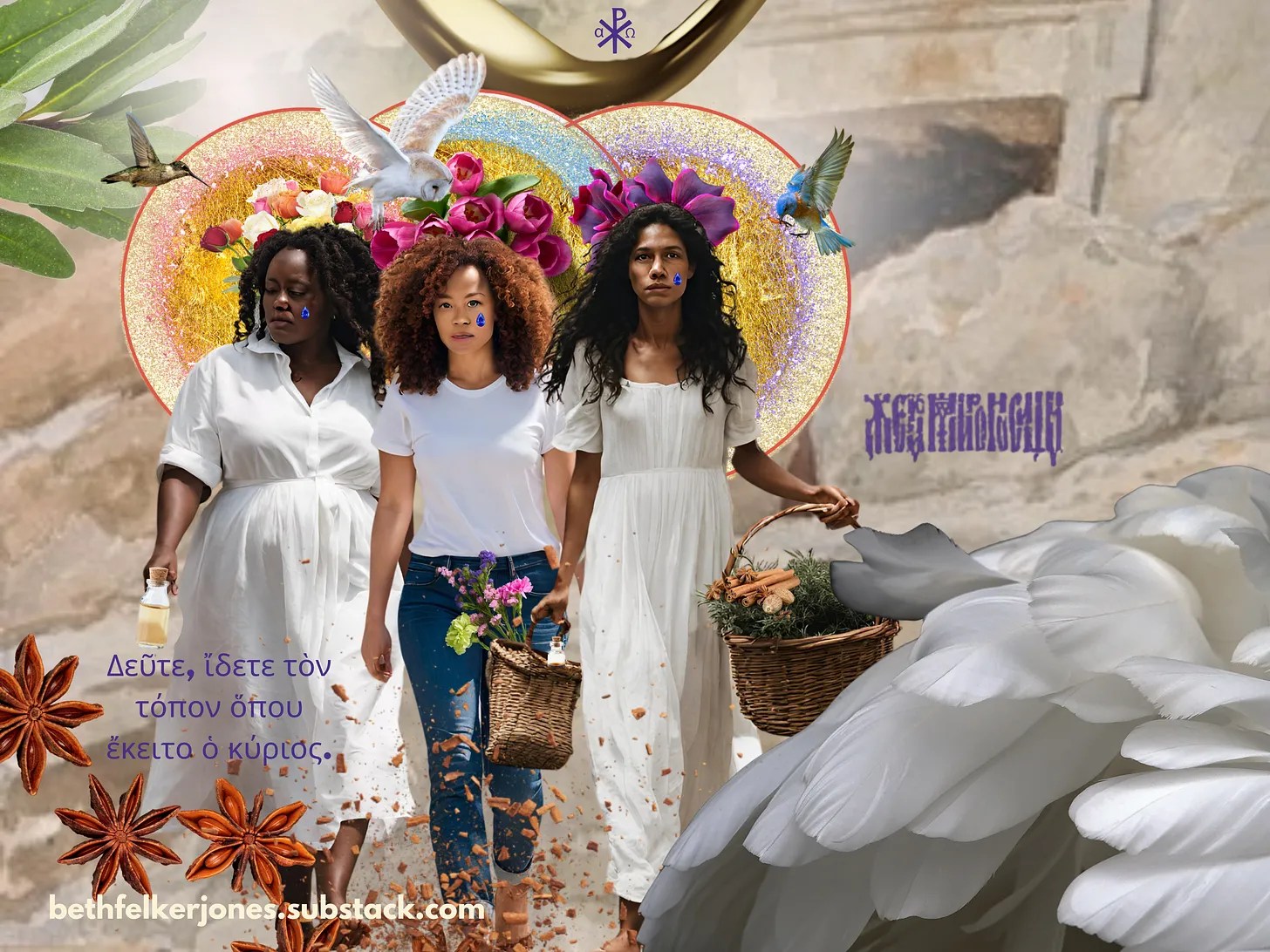
SUBSTACK POST: “Myrrhbearers & Magi” by Beth Felker Jones: In her Church Blogmatics post from last week, theologian Beth Felker Jones [previously] shares three new digital collages she made: one of the three myrrh-bearing women who discovered Jesus’s empty tomb, one of the three magi who brought gifts to the newborn Christ, and one that combines both groups of devoted witnesses. She provides descriptions of each and two original prayers, including the one below.
Digital collage (with AI-generated elements) by Beth Felker Jones, 2025
Holy Father, who accompanied your daughters on their way to the tomb, and in the power of your Spirit, turned their sorrow into joy, bring us too into the joy of those who found the tomb empty, and incorporate us, with them, into your resurrection life. With our sisters at the tomb that day, help us to say, “I have seen the Lord!” Amen.
Tomorrow’s readings in the Revised Common Lectionary, for the fourth Sunday of Easter, include what’s probably the most famous passage in the Bible, Psalm 23:
The LORD is my shepherd; I shall not want.
He maketh me to lie down in green pastures: he leadeth me beside the still waters.
He restoreth my soul: he leadeth me in the paths of righteousness for his name’s sake.
Yea, though I walk through the valley of the shadow of death, I will fear no evil: for thou art with me; thy rod and thy staff, they comfort me.
Thou preparest a table before me in the presence of mine enemies: thou anointest my head with oil; my cup runneth over.
Surely goodness and mercy shall follow me all the days of my life: and I will dwell in the house of the Lord for ever.
In characterizing God as a shepherd, the psalmist expresses how God leads, protects, rescues, feeds, and cares for his own. The author of Psalm 95 uses the same metaphor when he writes, “For he is our God, and we are the people of his pasture, and the sheep of his hand” (v. 7)—as do Isaiah and Ezekiel. During his teaching ministry, Jesus described himself as “the good shepherd [who] lays down his life for the sheep,” and whose flock knows his voice and follows him (John 10:1–18).
Ronald Rae (Scottish, 1946–), Shepherd, 1988. Granite, 4 × 5 × 4 ft. Private collection, Peak District, Scotland.
The Psalm 23 settings that are most widely reproduced in modern English-language hymnals are:
“The Lord’s My Shepherd,” written by Francis Rous but extensively revised by committee and published by the General Assembly of the Church of Scotland in the Scottish Psalter (1650). This text is most commonly matched with the 1872 tune CRIMOND by Ms. Jessie Seymour Irvine of Scotland, but I really like it with the early American folk tune PISGAH, as recorded, for example, by the William Appling Singers. However, both melodies, I feel, are difficult to sing congregationally.
“My Shepherd Will Supply My Need” by Isaac Watts, from The Psalms of David Imitated in the Language of the New Testament (1719). This text is traditionally paired with the tune RESIGNATION, first published in the fifth edition of the shape-note hymnal The Beauties of Harmony (Pittsburgh, 1828), compiled by Freeman Lewis, but first appearing with the Watts text in The Valley Harmonist in 1836. My playlist features a performance by the female a cappella quartet Anonymous 4 (the music arranged by Johanna Maria Rose; see video embed below), as well as by folk singer Claire Holley, who recorded the hymn at the request of a friend who told her it was the song that helped her get sober for good. I also like the minor-key setting by Stephen Gordon.
“The Lord Is My Shepherd (No Want Shall I Know)” by James Montgomery (1822), with music by Thomas Koschat (1862). Here’s the Lower Lights:
“The King of Love My Shepherd Is” [previously] by Henry Williams Baker (1868). This hymn is most often sung to a traditional Irish tune known as ST. COLUMBA (my playlist features both a choral performance by the Choir of Kings School, Canterbury, and a folksy solo by Luke Spehar) and occasionally to MCKEE, also from Ireland, as recorded by Redeemer Knoxville.
At my church we use Wendell Kimbrough’s musical adaptation of the psalm, “His Love Is My Resting Place.” Do you sing Psalm 23 at your church, and if so, what version?
Probably my favorite choral setting is by Bobby McFerrin, “The 23rd Psalm,” performed below by his VOCAbuLarieS, featuring SLIXS & Friends, live in Gdansk, Poland, at the Solidarity of Arts Festival on August 17, 2013:
Some people are thrown off by McFerrin’s use of feminine pronouns for the Divine in this song. God has no literal sex because God does not possess a body, so our gendered binaries are inadequate—but scripture and church tradition refer to God using masculine pronouns. I’m not bothered by the “She” throughout, or even “Mother,” but the substitution of “Daughter” for “Son” in the Trinitarian doxology at the end is theologically confusing, since Jesus was a man. But I get what McFerrin is doing.
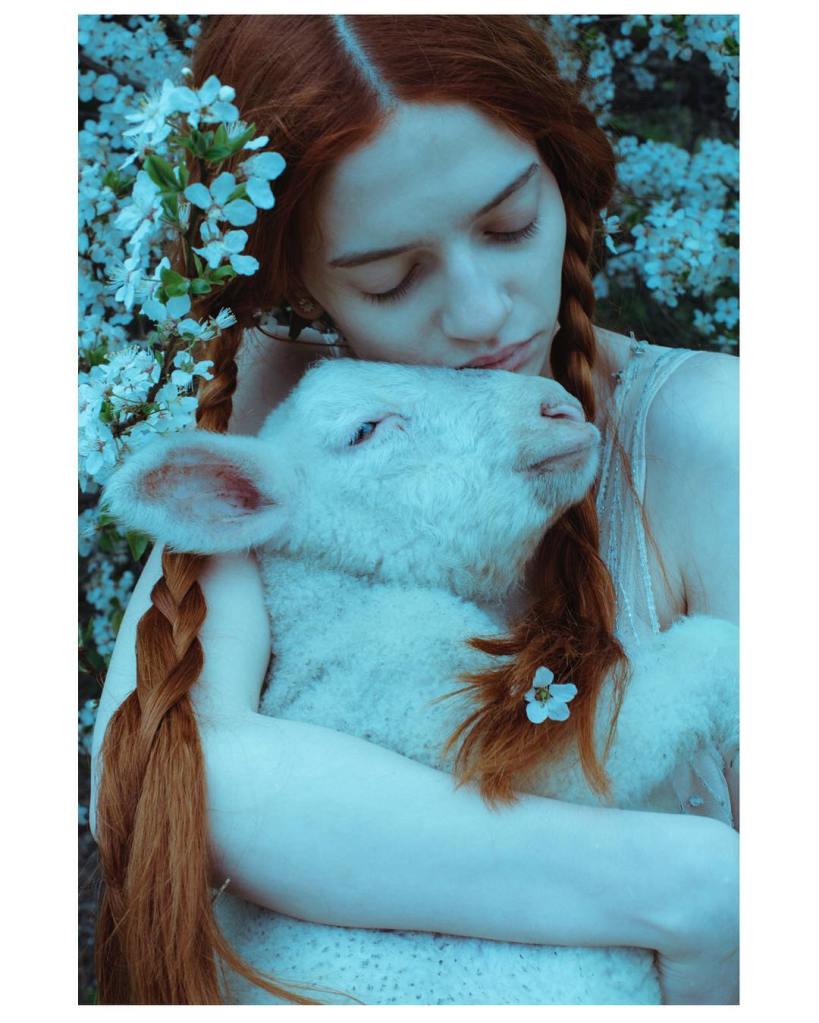
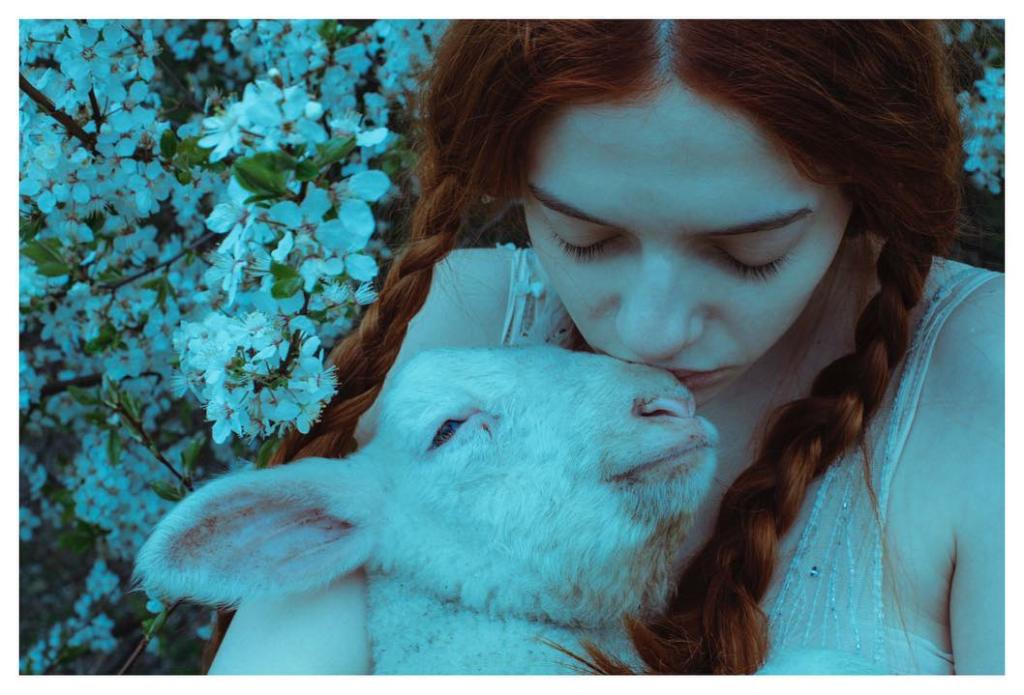
How does the change in gender impact your reception of the psalm text? We’re used to seeing religious imagery of a man with a sheep slung over his shoulders to embody the metaphor of God as shepherd—but what happens when you picture a shepherdess in the role? Note that it was not unusual in the ancient Near East for girls and women to tend their family herds (think of Rachel and Zipporah in the Old Testament, for example), and still today across the globe there are many female shepherds.
McFerrin dedicated his “23rd Psalm” to his mother.
(The above artworks, sourced from Instagram, are from the 2019 series The Shepherd by Laura Makabresku, a fine-art photographer from Poland whose work is influenced by her Catholic faith and by fairy tales.)
Here is a selection of other songs from the playlist:
>> “Adonai Ro’i” is a setting of the original Hebrew of Psalm 23 by Jamie Hilsden of Misqedem, a band from Tel Aviv, Israel, that is heavily influenced by Middle Eastern and North African music styles, often utilizing microtonal scales, irregular time signatures, and regional instruments. The song is sung by Shai Sol. (Available on Bandcamp.)
>> “The Lord Is My Shepherd” by Paul Zach of the United States:
>> “El Señor es mi Pastor” by Omar Salas of the Dominican Republic, a salsa song:
>> “Ke Na Le Modisa” by the Soweto Gospel Choir, sung live at the Nelson Mandela Theatre in Johannesburg in 2008. The song is in Sotho, an official language in South Africa and Lesotho.
>> “The Shadow Can’t Have Me” by Arthur Alligood:
>> “Done Found My Lost Sheep,” an African American spiritual sung by Lucy Simpson [previously] for Smithsonian Folkways, based on Jesus’s parable of the lost sheep (Luke 15:1–7):
Illustration by the nun Sibylla von Bondorf (German, ca. 1440–1525), from a copy of the Clarrissan Rule, Freiburg, ca. 1480. Opaque pigments on parchment, 15 × 10 cm. London, British Library, Add. MS 15686, fol. 30v. The banderole reads, “Rejoice with me, for I have found my sheep that was lost” (Luke 15:6). [HT]Sadao Watanabe (Japanese, 1913–1996), Good Shepherd, 1968. Katazome stencil print.
>> “Our Psalm 23” by Gabriella Velez, Kevin Dailey, Justin Gray, and JonCarlos Velez of Common Hymnal, featuring Sharon Irving:
INTERVIEW:“Singing the Songs of Injustice” with David M. Bailey and W. David O. Taylor: David Bailey is the director of the reconciliation ministry Arrabon and founder of its music-making and liturgical resource arm, Urban Doxology, and David Taylor is an assistant professor of theology and culture at Fuller Theological Seminary. In this conversation the two men discuss how “biblical, angry, congregational worship can help transform our hearts and churches.” “God has given us the psalms to be an ‘anger school’ for us and I’ve discovered that when we skip class, we aren’t emotionally equipped to deal with difficult stuff we’re experiencing now,” Taylor says. “The extraordinary gift of the psalms is that they show us how to pray angry prayers without being overcome by our anger, how to hate without sinning (to borrow from Saint Paul’s language), or, as Eugene Peterson once put it, how to ‘cuss without cussing.’”
Bailey and Taylor talk about the constant simmer of race relations in America, faithful versus unfaithful expressions of anger, the language of “enemy” in the Psalms, the importance of lament in Sunday gatherings and the need for language that expresses the horizontal aspects of what it means to be a Christian, and leading without moderation during turbulent times.
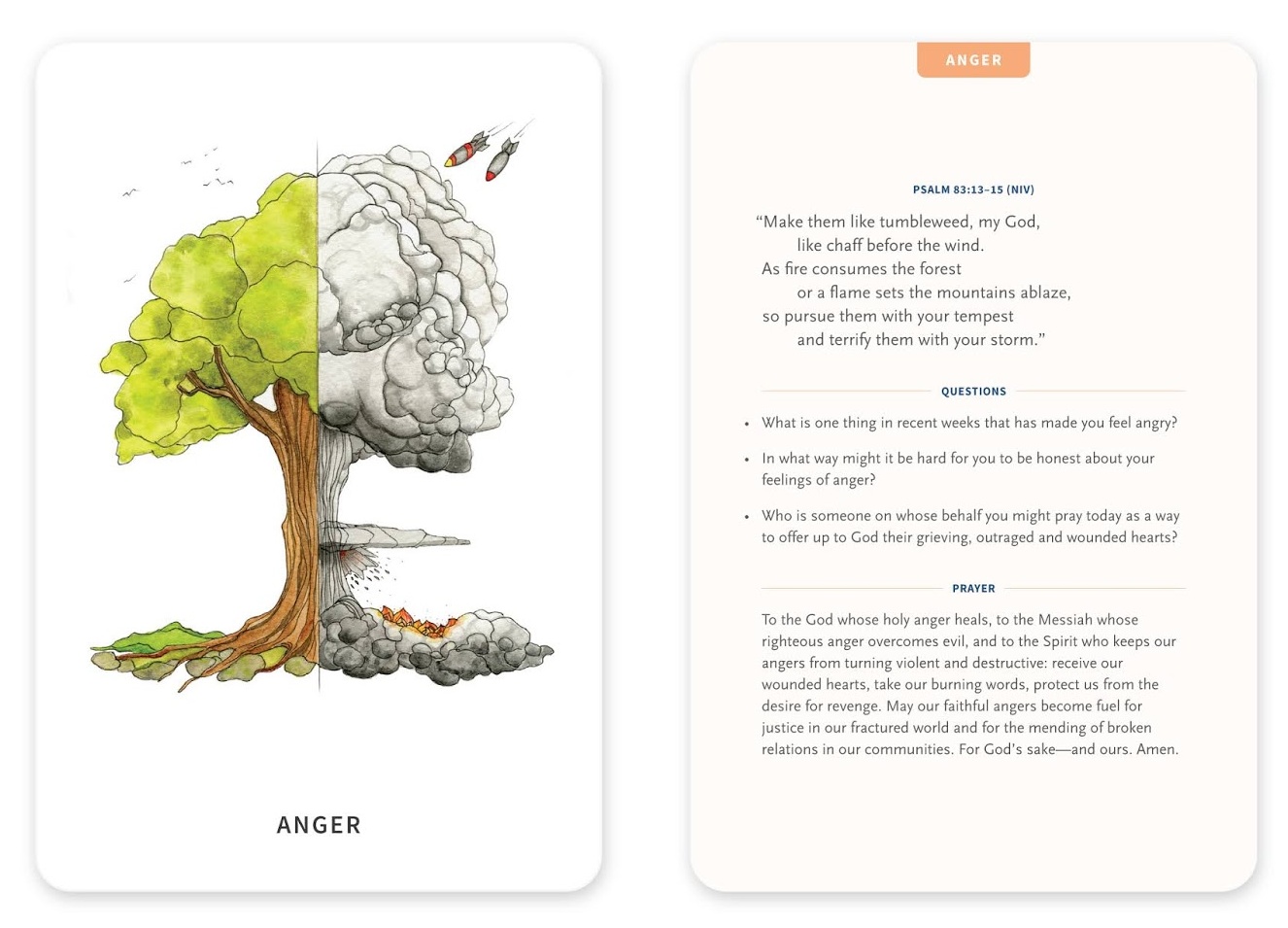
The Psalms of Anger: Prayer Card (illustration by Phaedra Taylor)
Taylor’s latest book, Open and Unafraid: The Psalms as a Guide to Life, contains a chapter on “The Psalms of Anger.” Read an excerpt here, or view this video talk. To coincide with the release in March, he and his wife Phaedra created a set of fifteen prayer cards. His prayer on the “Anger” card reads, “To the God whose holy anger heals, to the Messiah whose righteous anger overcomes evil, and to the Spirit who keeps our angers from turning violent and destructive: receive our wounded hearts, take our burning words, protect us from the desire for revenge. May our faithful angers become fuel for justice in our fractured world and for the mending of broken relations in our communities. For God’s sake—and ours. Amen.”
“I Just Wanna Live” by Johnnetta Bryant, performed by Keedron Bryant: Twelve-year-old gospel singer Keedron Bryant posted a video on Instagram last week of himself singing a song his mom wrote in response to the killing of George Floyd. “God gave me those lyrics” for Keedron, she said in a joint interview on Today. Keedron said he prayed the song, meditated with it, then hit record. It’s a heart-baring, heartbreaking lament, a plea for divine protection in a world that is especially dangerous for young black males.
“It Is Enough!” by R. DeAndre Johnson: R. DeAndre Johnson is the pastor of music and worship life at Christ Church Sugar Land outside Houston. He wrote the lyrics for “It Is Enough!” in July 2016 following the deaths of Alton Sterling and Philando Castile but hadn’t set them to music until now. The nine verses bear the refrain “Kyrie eleison” (Lord, have mercy!), or “Christe eleison” (Christ, have mercy!), a common cry of lament. “There are no words that can contain / The depth of sorrow, grief, and pain / That mothers, sons, and all exclaim: / Kyrie eleison!” Johnson sang the song for his church’s livestreamed service on May 31. A lead sheet is available on his Facebook page. [HT: Global Christian Worship]
“I Want Jesus to Walk with Me”: Sharon Irving is a singer-songwriter, spoken-word artist, and worship leader from Chicago who was also a semifinalist on season 10 of America’s Got Talent. In this video from 2015 she sings a spiritual that expresses deep sorrow—“When my strength is failing,” “When my heart is aching,” “When my life feels like a burden”—but also trust in the companionship of Christ, who walks with us through valleys of death. Having likely originated as an improvisation, the song has several lyrical variations and can be easily adapted to voice a range of feelings: “In my rage,” “In my frustration,” “In my exhaustion,” “In my confusion,” etc.
“O This Night Is Dark” by Tom Wuest: Last Sunday my congregation sang Isaac’s Wardell’s setting of Psalm 126 [previously], whose refrain is “Although we are weeping, Lord, help us keep sowing the seeds of your kingdom . . .” Seeds of love, truth, justice, hope. I just learned that Wardell’s song was inspired by Tom Wuest’s “O This Night Is Dark,” released in 2008 on Rain Down Heaven. In addition to Psalm 126, Wuest’s song also references 1 Corinthians 15, Isaiah 2, Amos 9, and Isaiah 65.
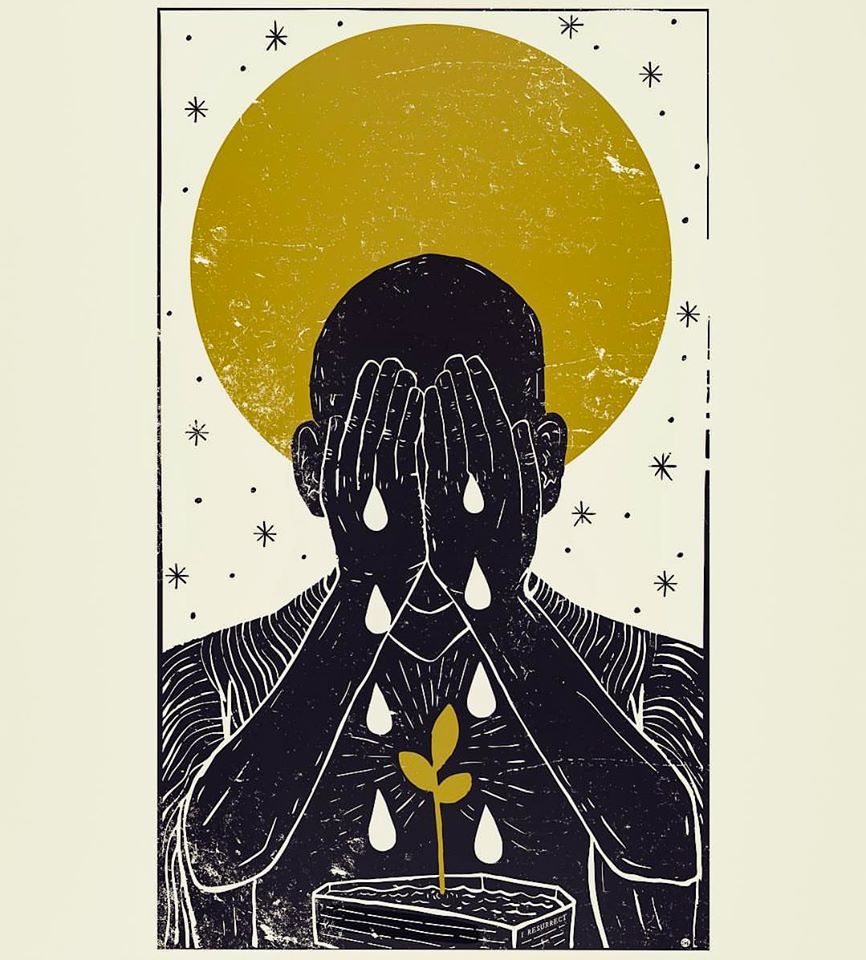
And this week as I was listening to the song, the following image by Scott Erickson showed up on my Instagram feed, with the caption “If one part suffers, all the parts suffer with it” (1 Cor. 12:26).
Scott Erickson (American, 1977–), The Sorrowful Saint, 2016
Erickson painted the image in July 2016 in response to the fatal shootings of Sterling and Castile. It suggests that tears of grief can be generative, that new life can rise out of death. That’s not at all to say that death is good because it catalyzes a movement of change, but that our mourning the evils of racism and murder, our publicly crying out “Enough!,” is not fruitless, though it often seems so. Growth will come.
+++
VIDEO ART: Weight by André Daughtry: “Weight is an attempt to visualize societal projections on the black male body,” writes André Daughtry, a Brooklyn-based interdisciplinary photography and media artist, writer, and performer. The piece is from 2014, and last year PBS’s AllArts station commissioned Daughtry to restage it in New York City as part of a larger video work. [HT: ImageUpdate]
Daughtry has a master’s degree in theology and the arts from Union Theological Seminary and serves as community minister of the arts at Judson Memorial Church, which has a long history of nurturing artists. “We believe that artists have the potential to serve as our modern-day prophets,” the church website reads. “They show us where we’ve been, who we are, and what we can become.”
+++
PODCAST EPISODE: “The SPU Conversation About Spike Lee Films,”North by Pacific Northwest: In this Seattle Pacific University conversation released April 11, 2019, two cinephiles, Jeffrey Overstreet and Josh Hornbeck, discuss some of the films of writer-director Spike Lee, “the boldest and brashest auteur in American film” (Guardian). The first several minutes, though, are spent decrying the then recent Oscar win of Green Book, which popular audiences loved but critics were generally sour on because it perpetuates the simplistic and ultimately false notion that to solve racism, white people just need to realize that “we’re all the same” and find a black friend.
Best known for Do the Right Thing (1989), Lee is one of several filmmakers they cite who deals with race in more complex ways, and while some people dismiss him as an “angry black man,” many celebrate him for forcing audiences to reckon with the problem of racism. “I think there should be rage inside of every conscious human being in the world, because there’s stuff that’s just not right,” he said in a 2000 interview. “Anger can be constructive.” Lee’s films are heavy-handed, in-your-face; they shout and unsettle. Heavy-handedness usually makes for bad art, but Overstreet and Hornbeck show how the approach works for Lee.
Starting at 16:44, they focus on the satirical comedy-drama Bamboozled (2000), which joined the prestigious Criterion Collection just this March. (It’s also been the subject of much scholarly study across fields, one instance I’ve come across being an essay by art theorist W. J. T. Mitchell, titled “Living Color: Race, Stereotype, and Animation in Spike Lee’s Bamboozled,” in What Do Pictures Want? The Lives and Loves of Images.) “Under pressure to help revive his network’s low rating, television writer Pierre Delacroix (Damon Wayans) hits on an explosively offensive idea: bringing back blackface with The New Millennium Minstrel Show. The white network executives love it, and so do audiences, forcing Pierre and his collaborators to confront their public’s insatiable appetite for dehumanizing stereotypes.”
From 25:54 onward, Overstreet and Hornbeck discuss more generally their passion for cinema and the importance of revisiting films.
People have been expressing frustration that The Help, a civil rights era drama that sidelines the perspectives of its black characters, is the number one most-streamed movie on Netflix right now. Film critic Alissa Wilkinson gives a list of fifteen movies to watch instead on racial injustice and being black in America. A mix of dramas and documentaries by such filmmakers as Barry Jenkins, Ava DuVernay, Spike Lee, and others, these are black-centered stories that help illuminate where we’re at right now. All are available for online streaming, and Wilkinson provides links to her reviews.







 Art & Theology