In these long, last days She has borne creation’s Crown; Heavy, sore, afraid, The weight of love is bearing down.
Refrain: We will wait. Even so, Come, Lord, come. We will wait. Even so, Come, Lord, come.
In these long, last days We must bear the weight of sin, Broken, torn, alone, Till you bring your peace to reign. [Refrain]
Bridge: Don’t forget us, Lord, Don’t forget us, Lord, While we wait. (×3) [Refrain ×2]
Sister Sinjin was founded in 2016 by three young moms wanting to record an Advent album: Elise Erikson Barrett, Elizabeth Duffy, and Kaitlyn Ferry. Barrett left the group to focus on her work in the nonprofit and philanthropic sectors, and Duffy and Ferry recorded two more albums. This September the duo announced a name change to A Bright Abyss to reflect the evolution of their vocational identities (they are both now psychotherapists) and music, a genre they call “psychoanalytic folk.”
The lyrics of “In These Long, Last Days,” one of seven original songs on Sister Sinjin’s debut album, were written by Barrett; the music and additional lyrics, by Ferry. The first stanza refers to Mary’s pregnancy with Jesus—her carrying that bundle of Word-made-flesh inside her, eagerly awaiting the birth.
As Mary waited for the Messiah’s first coming, feeling the signs of its nearness in her body, so we await his second, and with it the rebirth of heaven on earth. We do so bearing the weight not of presence but of absence. God is with us in the Spirit, in word and sacrament, and through Christ’s ecclesial body—but the incarnate Christ, the God-man, physically ascended back into the divine realm. “Come back!” we exclaim during Advent, yearning for the return he promised. “Don’t forget us.”
Until that day, we will wait. Even so, come, Lord, come.
Psalm 91 (Psalm 90 in the Vulgate) is a psalm of protection, commonly invoked in times of hardship or before embarking on a journey. It conveys the sheltering presence of God, using the metaphor, tender and intimate, of a mother bird who cares for her fledglings, shading them under her wings and lifting them up out of danger. This image recurs throughout the Psalter and the Bible at large (see Pss. 17:8; 36:7; 57:1; 63:7; Exod. 19:4; Deut. 32:11).
Agnes Pelton (American, 1881–1961), The Primal Wing, 1933. Oil on canvas, 25 × 24 in. San Diego Museum of Art, California. Source: Agnes Pelton: Desert Transcendentalist, p. 113.
Let me quote the psalm in full, using the King James Version, whose poetic quality cannot be beat:
1 He that dwelleth in the secret place of the most High shall abide under the shadow of the Almighty.
2 I will say of the Lord, He is my refuge and my fortress: my God; in him will I trust.
3 Surely he shall deliver thee from the snare of the fowler, and from the noisome pestilence.
4 He shall cover thee with his feathers, and under his wings shalt thou trust: his truth shall be thy shield and buckler.
5 Thou shalt not be afraid for the terror by night; nor for the arrow that flieth by day;
6 Nor for the pestilence that walketh in darkness; nor for the destruction that wasteth at noonday.
7 A thousand shall fall at thy side, and ten thousand at thy right hand; but it shall not come nigh thee.
8 Only with thine eyes shalt thou behold and see the reward of the wicked.
9 Because thou hast made the Lord, which is my refuge, even the most High, thy habitation;
10 There shall no evil befall thee, neither shall any plague come nigh thy dwelling.
11 For he shall give his angels charge over thee, to keep thee in all thy ways.
12 They shall bear thee up in their hands, lest thou dash thy foot against a stone.
13 Thou shalt tread upon the lion and adder: the young lion and the dragon shalt thou trample under feet.
14 Because he hath set his love upon me, therefore will I deliver him: I will set him on high, because he hath known my name.
15 He shall call upon me, and I will answer him: I will be with him in trouble; I will deliver him, and honour him.
16 With long life will I satisfy him, and shew him my salvation.
The righteous will be protected, sings the psalmist, from sickness and attack, whether by arrow or by wild animal. Because of the psalm’s specific mention of plagues, or “deadly disease,” it became especially popular during the COVID-19 pandemic.
Now, we know from experience that some of these statements cannot be taken at face value. Physical harm does befall those who love God. Believers were among the “ten thousand” (and more) felled by the most recent raging pestilence. It’s wrong to conclude that this was a result of their lack of faith.
Biblical scholar J. Alec Motyer clarifies that “the promise [in Psalm 91] is not security from but security in.” That God looks after us is an absolute principle, but the Bible makes clear that no one is immune from suffering. Still, we can trust in God’s grace and strength and ultimate deliverance, and entreat him for specific protections. Bodily salvation won’t come in full until the new heavens and the new earth are ushered in, but we are kept spiritually in the shelter of our loving God.
That doesn’t mean Psalm 91 is a lie; it is poetry, and poetic language is often not meant to be literal. The assurances are still worth praying. God does often intervene on our behalf.
The ancient Jewish community at Qumran near the Dead Sea, through whom the oldest manuscript fragments of the Hebrew Bible come to us, referred to Psalm 91 as a “psalm against demons,” and it is thought to have been used by that community in exorcisms. Jewish midrash interprets many of the listed threats as veiled language for demons, and there is Christian precedent for that interpretation as well. In Luke 10:17, Jesus’s followers marvel that “Lord, in your name even the demons submit to us!,” to which Jesus affirms that yes, “I have given you authority to tread on snakes and scorpions and over all the power of the enemy, and nothing will hurt you”—language very similar to that in Psalm 91.
In the Late Antique era, both Jews and Christians wore the words of Psalm 91 on amulets, to attain or simply feel God’s guarding power. In the church it is traditionally sung or recited during Compline services and on the first Sunday of Lent (in Matthew 4:6 the devil manipulatively quotes verse 11 in his temptation of Christ in the desert).
This psalm has also influenced popular culture, as from it comes the concept of guardian angels (vv. 11–12).
Below I have selected fifteen musical settings or adaptations of Psalm 91 from diverse sources, including homophonic and polyphonic choral works, songs in indie folk and soul styles, a Puerto Rican hymn, a Nepali bhajan, and more.
For each I have embedded either a YouTube video or Bandcamp track, and if a Spotify link exists, I’ve included it at the end of the description. If you cannot see these music players in your email client or RSS feed reader, open the post in your browser.
This is a curation, not a collation, meaning that I’ve intentionally picked these songs from among hundreds of options, for both excellence and variety. I tried to limit the list to ten and just couldn’t, but I thought twenty would be too overwhelming, so I compromised by choosing fifteen with five honorable mentions. I’ve added almost all twenty to a YouTube playlist (the Sister Sinjin song isn’t available on that platform), if you prefer to listen that way.
1. Gregorian chant performed by Harpa Dei: Born in Germany and raised in Ecuador, siblings Nikolai, Lucía, Marie-Elisée, and Mirjana Gerstner form the sacred vocal quartet Harpa Dei. Here they sing Psalm 91 in Latin in the medieval plainchant tradition. Subtitles are provided in Spanish and English.
For a plainchant in English, albeit of verses 4–5 only, see here.
2. “Psalm 91” by Victory Boyd: This is probably my favorite of all the selections. Victory Boyd is one of seven musical siblings, and before she started her solo career, she was a member of the vocal-harmony sibling act Infinity Song. Her voice is gorgeous, as is this simple musical setting she wrote, conveying both the vulnerability and confidence present in the psalm.
3. “Psalm 91” by Poor Bishop Hooper: Every Wednesday since January 1, 2020, married couple Jesse and Leah Roberts, who record music under the alias Poor Bishop Hooper, have been releasing a new psalm-based song for free download as part of their EveryPsalm project. Handling them consecutively, they have just eight left to go! They made a live video for “Psalm 91,” which shows them playing their own piano four hands accompaniment. [Spotify]
4. “Qui habitat in adjutorio altissimi” (He who dwells in the shelter of the Most High)by Josquin des Prez, adapted by Laurel MacDonald: Josquin des Prez (pronounced “joss-can day pray”) was a highly influential Franco-Flemish composer of the High Renaissance. In 1542 he wrote a setting of Psalm 91[90]:1–8 in Latin for twenty-four voices (SATB ×6)—that is, six distinct soprano parts, six distinct alto parts, etc.
Inspired by this choral motet, in 2007 composer and video artist Laurel MacDonald worked with longtime associate John Oswald to create qui, a sound installation of twenty-nine voices singing an adaptation of des Prez’s “Qui habitat” in twenty-nine languages over twenty-nine speakers, for the Royal Ontario Museum in Toronto. MacDonald revisited the project in 2010, creating the short video “XXIX” (below) with twenty-one of the original qui singers, each singing in the language of his or her personal heritage. They weave a complex tapestry with interlocking threads of Krio, Spanish, Korean, Hungarian, Hindi, Greek, Finnish, English, French, Italian, Latin, Zulu, Xhosa, Sesotho, Georgian, Russian, English, Tamil, Hebrew, Swahili, Japanese, and Arabic—a multilingual declaration of God’s protective power.
To hear Josquin des Prez’s motet as originally conceived, click here.
5. “Your Wings” by Lauren Daigle: Lauren Daigle is one of the most popular CCM (contemporary Christian music) artists of the past decade. Two-time-Grammy-winning and with two platinum records, she is often compared to Adele in terms of her vocal style—soulful, rich, in a husky register. In April 2020 she released on YouTube a stripped-down, “social distancing” version of her Psalm 91–based song (written with Jason Ingram and Paul Mabury) from Look Up Child, with just her and a piano. You can get a sense of her strong stage presence from the video; here she hits the melody with both her voice and her body—bouncy on the verses, smooth on the refrain! [Spotify (studio version)]
6. “Whomsoever Dwells” by Sinéad O’Connor: “Whomsoever Dwells,” written with Ron Tomlinson, is one of nine Hebrew Bible–based songs that appears on Sinéad O’Connor’s stellar 2007 double album, Theology. (Thanks to Art & Theology reader Koen Desmecht for introducing me to this!) The acoustic performance below—from November 8, 2006, at The Sugar Club in Dublin—was released on disc one, subtitled “The Dublin Sessions,” and features guitars, fiddle, harp, and low whistle; the same song, arranged for a pop-rock band and recorded in a London studio, is on disc two. (I much prefer the acoustic version.)
“Theology is an attempt to create a place of peace in a time of war and to provoke thought,” O’Connor said. It is very “personal” and “emotional.”
7. “El que habita al abrigo de Dios” (Those Who Dwell in the Shelter of God) by Luz Ester Ríos de Cunaand Rafael Cuna: This 1943 hymn from Puerto Rico is a versification of Psalm 91 in Spanish by Luz Ester Ríos de Cuna, with music by her husband, Rafael Cuna (1907–1995). I learned of it from the bilingual hymnal Santo Santo Santo: Cantos para el pueblo de Dios (Holy, Holy, Holy: Songs for the People of God). Here it’s performed by musicians from Iglesia Central del Movimiento Misionero Mundial en el Perú (Central Church of the World Missionary Movement in Peru) in Lima. Their names are not given.
8. “Denn er hat seinen Engeln befohlen” (For he shall give his angels charge),MWV B 53by Felix Mendelssohn: Early Romantic composer Felix Mendelssohn, a Reformed Christian with Jewish ancestry, wrote this setting of Psalm 91:11–12 in German in 1844 for Berlin Cathedral, where he was serving as Generalmusikdirektor (royal composer of church music). It is for an unaccompanied eight-part choir, but he later reused it with orchestral accompaniment as movement 7 of his oratorio Elijah.
9. “No Harm Befall You (Psalm 91)” by Sister Sinjin: Released on the 2022 compilation album Joy to the World (Psalms 90–106) from Cardiphonia Music, “No Harm Befall You” was written by Elizabeth Duffy and is sung by her and Kaitlyn Ferry, who make up the Indianapolis folk duo Sister Sinjin. Their harmonies are a hallmark of their music.
10. “Psalm 91” by Sharyn:Sharyn (pronounced “sha-REEN”) is a Ugandan-born, London-based gospel/R&B singer-songwriter “whose mission is to spread the gospel through adventurous, original, and engaging music,” she says. She wrote “Psalm 91” during the height of the coronavirus, as that scripture passage is one she would read again and again as a source of comfort amid the uncertainty. “This song is an affirmation and a reminder of who God is, what He can do, will do and has done,” she says. “Never forget that God is faithful and his promises are the greatest form of protection we can ever have. His promises are your armor and shield.” The recording features Calibleubird on backing vocals. [Spotify]
11. “Shelter Me” by Buddy Miller: In a 2010 episode of PBS’s Soundstage, country-rock artist Buddy Miller performed a set with other Americana greats Emmylou Harris, Shawn Colvin, and Patty Griffin, including this original song (written with Julie Miller) from his 2004 album Universal United House of Prayer. “Shelter Me” is about not being scared in the face of disaster or war, for God is our hiding place. The song could apply to Psalm 57 just as well, which addresses the same themes as Psalm 91 and even uses the same language of sheltering under the wings of the Almighty. [Spotify (studio version)]
12. “Underneath the Shadow” by Tom Wuest: This is one of twelve quiet, sparsely instrumented songs that Tom Wuest recorded with his wife, Karen, which were written as their two young sons fell asleep. They all “draw their lyrics from the psalms and from our family’s joy in and meditation upon the good creation of God,” he says. Fitting indeed for meditation, “Underneath the Shadow” comprises just three simple lines: “Underneath the shadow of Your wings / We dwell underneath the shadow of Your wings / Hidden close to Thee, we find rest.” [Spotify]
13. “Mero Saransthaan (My Shelter)” by Suraj Khadka: A Nepali adaptation of Psalm 91, this bhajan (devotional song) from 2021 features traditional instruments from the Indian subcontinent: sarangi (vertical fiddle), bansuri (bamboo flute), and dholak, madal, and tabla (drums). Thanks to Dr. Paul Neeley at Global Christian Worship for alerting me to this one.
14. “Lang en gelukkig (Psalm 91)” (Long and Happy) by Psalmen voor Nu: Founded in 2002, Psalmen voor Nu (Psalms for Now) was a project in the Netherlands to set all 149 psalms (they combined Psalms 42 and 43) in Dutch to music, a task they completed in 2014 with the release of their eleventh album. Seeking “to introduce as many people as possible to the beauty and power of the psalms,” the team comprised some twenty theologians, poets, and composers, plus a band. They wanted the texts to be understandable and the melodies modern and singable. This particular song from the project was written by Liesbeth Goedbloed (words) and Roeland Smith (music) and released in 2013. It has a smoky nightclub vibe. I’ve copied the lyrics below. [Spotify]
[1] Als je bij de Allerhoogste woont, mag je in zijn schaduw slapen. Als je zegt: ‘De Hoogste is mijn huis. mijn God, ik kan op u vertrouwen’, dan mag je in zijn schaduw slapen.
[2] Het is God die jou bevrijdt van de dood, de zwarte dood. Hij dekt je met zijn vleugels toe. Ga maar slapen. Je bent moe. Zijn trouw zal jou beschermen. Dan kun je slapen, dan kun je slapen. God waakt over jou. Dan kun je slapen.
[3] Voor de angst die elke avond komt, hoef je niet meer bang te wezen, ook al spookt de zwarte dood weer rond, al sloopt een ziekte alle mensen, jij hoeft niet meer bang te wezen.
[4] Ook al komt de dood dichtbij, vallen duizend mensen om, toch zul jij altijd veilig zijn wat de rest ook overkomt en slechte mensen krijgen, durf je te kijken, durf je te kijken? hun verdiende loon. Durf je te kijken?
[5] Jij zei ooit: ‘Mijn God, u bent mijn huis. Geen ziekte komt de drempel over.’ Die ellende gaat je deur voorbij, sinds je dicht bij God ging wonen. Geen ziekte komt je drempel over.
[6] Zijn engelen staan klaar. Ze dragen je op handen. God stuurt ze met je mee. Je stoot je nergens aan. De leeuw, de draak, de adder jij loopt over ze heen.
[7] Want je houdt van mij, zegt God, en die liefde maakt je vrij. Ik dek je met mijn vleugels toe, omdat jij weet wie ik ben. Je kent mijn naam en roept me. Ik kom je redden, ik kom je redden. En ik antwoord jou: ik kom je redden.
[8] In de zwartste nacht blijft ik bij jou. Ik red je en ik geef je leven. Deze keer is alle eer voor jou. Ik zeg: Ik ben voor jou een zegen! Voor jou een lang gelukkig leven!
[Outro] Lang en gelukkig, lang zul je leven, lang zul je leven, lang en gelukkig, lang zul je le ven! [source]
15. “In Him I Will Trust” by Sherri Youngward: Covering Psalm 91:1–5, this is one of sixteen psalm-passage settings by Bay Area singer-songwriter Sherri Youngward. For more, see her two Scripture Songs albums.
If you appreciated this post and would like to see more like it in the future, please consider donating to my work. If you do, leave a note telling me which psalm you’d like me to do next!
Now there was a woman who had been suffering from hemorrhages for twelve years. She had endured much under many physicians, and had spent all that she had; and she was no better, but rather grew worse. She had heard about Jesus, and came up behind him in the crowd and touched his cloak, for she said, “If I but touch his clothes, I will be made well.” Immediately her hemorrhage stopped; and she felt in her body that she was healed of her disease. Immediately aware that power had gone forth from him, Jesus turned about in the crowd and said, “Who touched my clothes?” And his disciples said to him, “You see the crowd pressing in on you; how can you say, ‘Who touched me?’” He looked all around to see who had done it. But the woman, knowing what had happened to her, came in fear and trembling, fell down before him, and told him the whole truth. He said to her, “Daughter, your faith has made you well; go in peace, and be healed of your disease.”
—Mark 5:25–34
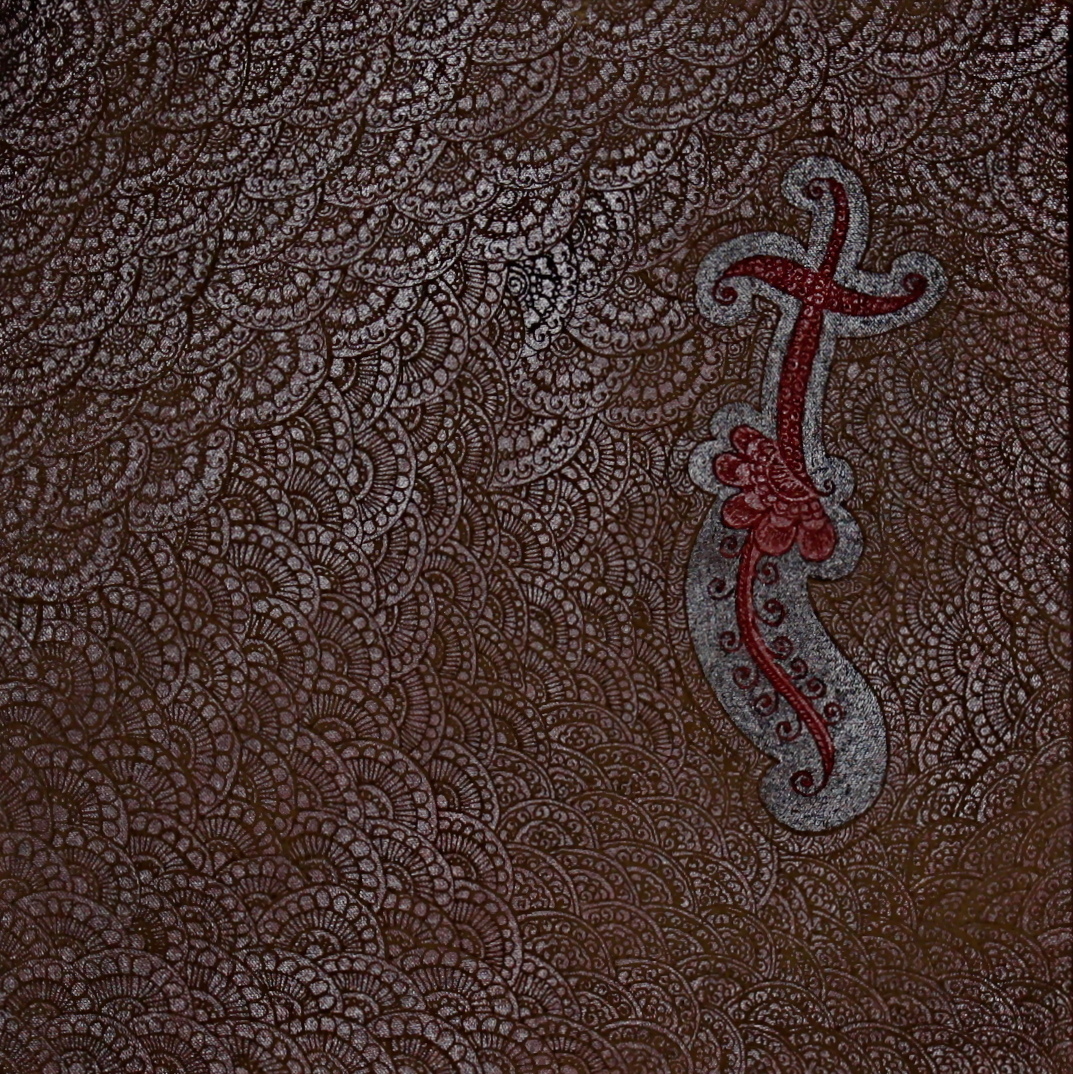
LOOK: Bleeding Woman by Kimberly Stephens
Kimberly Stephens, Bleeding Woman, 2010. Mehndi and acrylic on canvas.
Bleeding Woman is part of a series of eighteen biblical paintings originally exhibited in October 2010 at the L&P Hutheesing Visual Arts Centre in Ahmedabad, India, a country where Stephens lived for two years. Mehndi is a powder taken from the leaves of the henna plant and made into a paste. It’s traditionally applied to the skin as a form of temporary body art for weddings, religious festivals, and other celebrations, but Stephens has fixed it in more permanent form on canvas, and she uses it to tell the story of Jesus.
The episode depicted here is found in Mark 5:25–34 (cf. Matt. 9:20–22; Luke 8:43–47). A woman had been hemorrhaging for twelve years, which made her ceremonially unclean, and thus a social pariah, in the ancient Jewish culture in which she lived. Yet Stephens shows her confidently pressing her way through the crowd so that she can touch the hem of Jesus’s garment and be healed.
There is definitely a sense of claustrophobia in the painting, of tightness and crowding, achieved by the many overlapping waves. But something intimate, something private, is happening amid this very public throng: the woman reaches out to Jesus and immediately blossoms upon contact. Jesus restores her not only physically but also socially, emotionally, and spiritually—a holistic salvation.
Jesus and the woman are represented symbolically using the curled lines that are characteristic of mehndi designs, with Jesus’s form evoking the cross he will later die on. The thick, silvery outline around these two figures serves as an aura of sorts that sacramentalizes the encounter and draws the viewer’s attention to it but that also creates some breathing room and suggests the space of clarity and relief into which the woman has entered.
Reach out, reach out, the hem of his cloak One touch will heal the bleeding Press in, press in, the crowd draws near Your faith the pow’r is heeding
Written by Elizabeth Duffy and arranged by Kaitlyn Ferry of the group Sister Sinjin, “Talitha Koum” is a trilogy of short songs about three females from the New Testament: Jairus’s twelve-year-old daughter, whom Jesus raises from the dead (Matt. 9:18–26; Mark 5:21–43; Luke 8:40–56); the hemorrhaging woman discussed above; and the widow who puts her two small coins into the offering plate (Mark 12:41–44; Luke 21:1–4). The title is Aramaic, translating to “Little girl, arise!”—the words spoken by Jesus to Jairus’s daughter (Mark 5:41).
The song featured here is the second in the set. The woman with the issue of blood experienced a sort of resurrection herself, as Jesus raised her out of the pain, disruptiveness, and isolation of her condition, making possible a new life for her.
Imagine how freeing it must have felt to receive that jolt, I’ll call it, from the tzitzit (tassels) of Rabbi Jesus’s robe, and to know instantly that you have been healed! For over a decade the woman had suffered from continual bleeding, and no doctor was able to help. She lived on the margins of society. Until Jesus came along and she reached out in faith to claim the blessing of healing.
“Talitha Koum, Part 2” is sung in three-part harmony in G minor, but on the final syllable the key shifts up a half-step to G Major. This harmonic device (ending a minor song on a major chord) is known as a Picardy third [previously], and it’s used to lift what can be heard as sad, dark, or heavy into a lightness and brightness, into joy. I hear it as the woman’s sigh of relief. She had been holding her breath for so long, anxious for resolution, and now she can finally let it out.
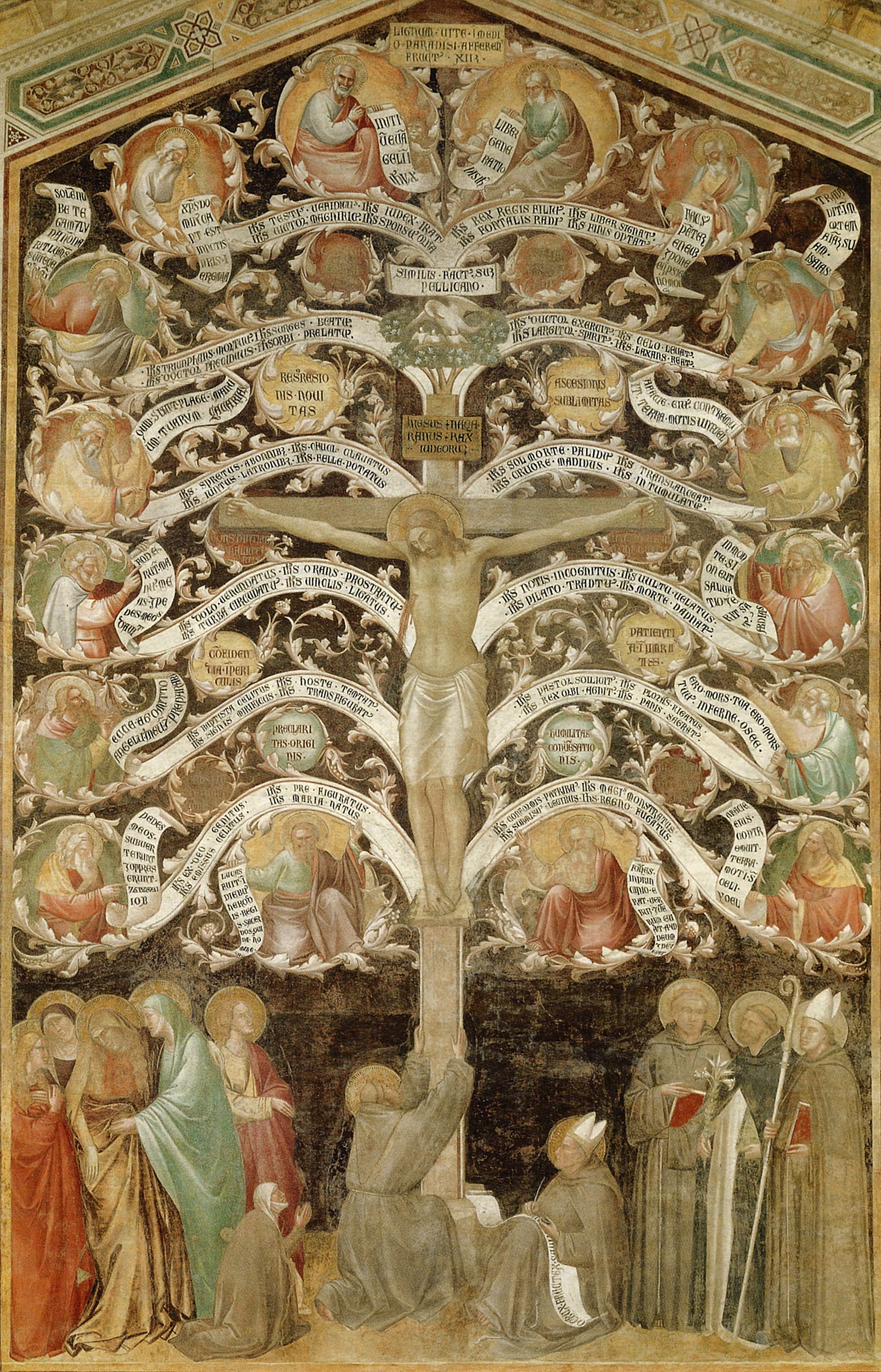
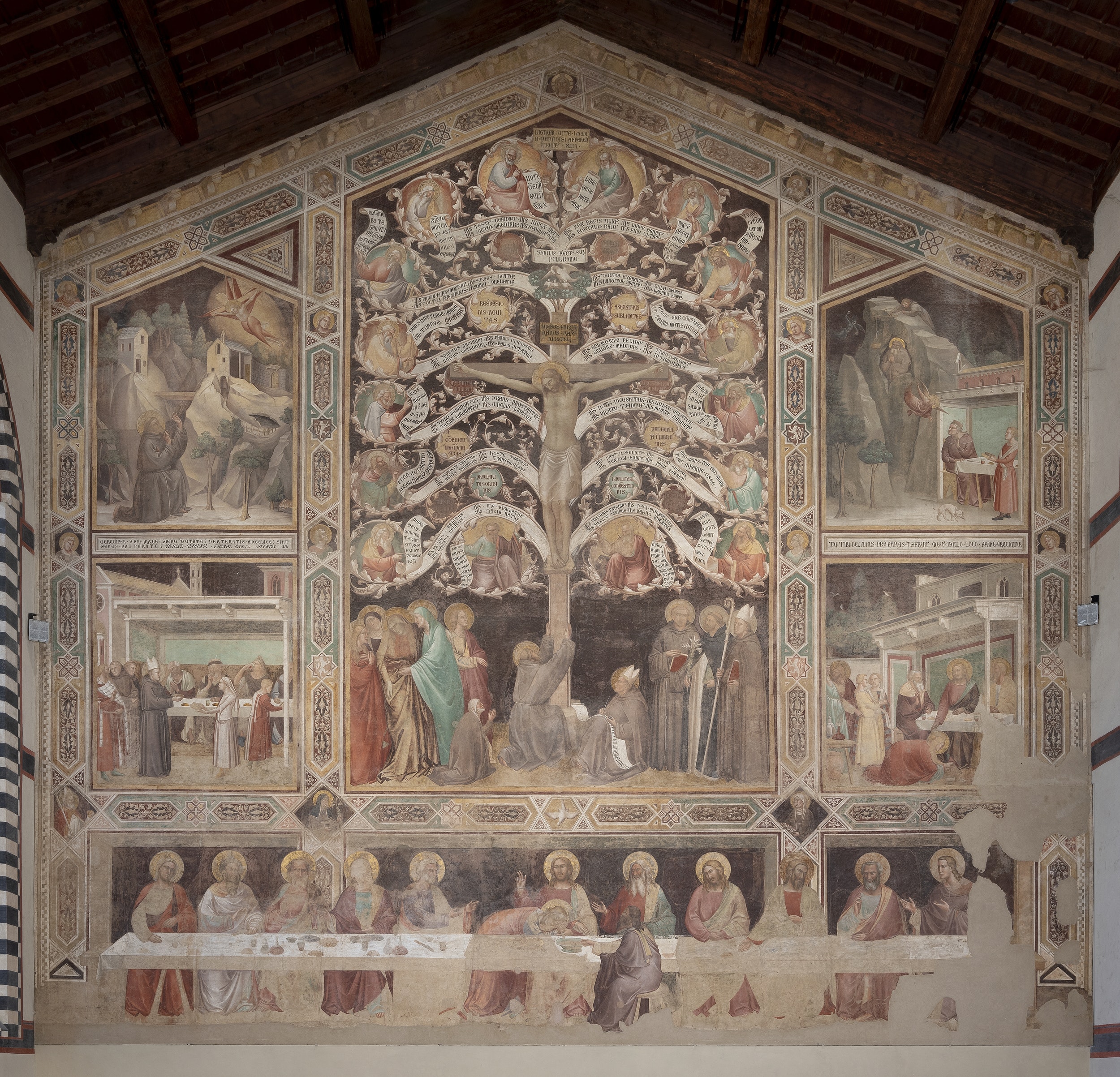
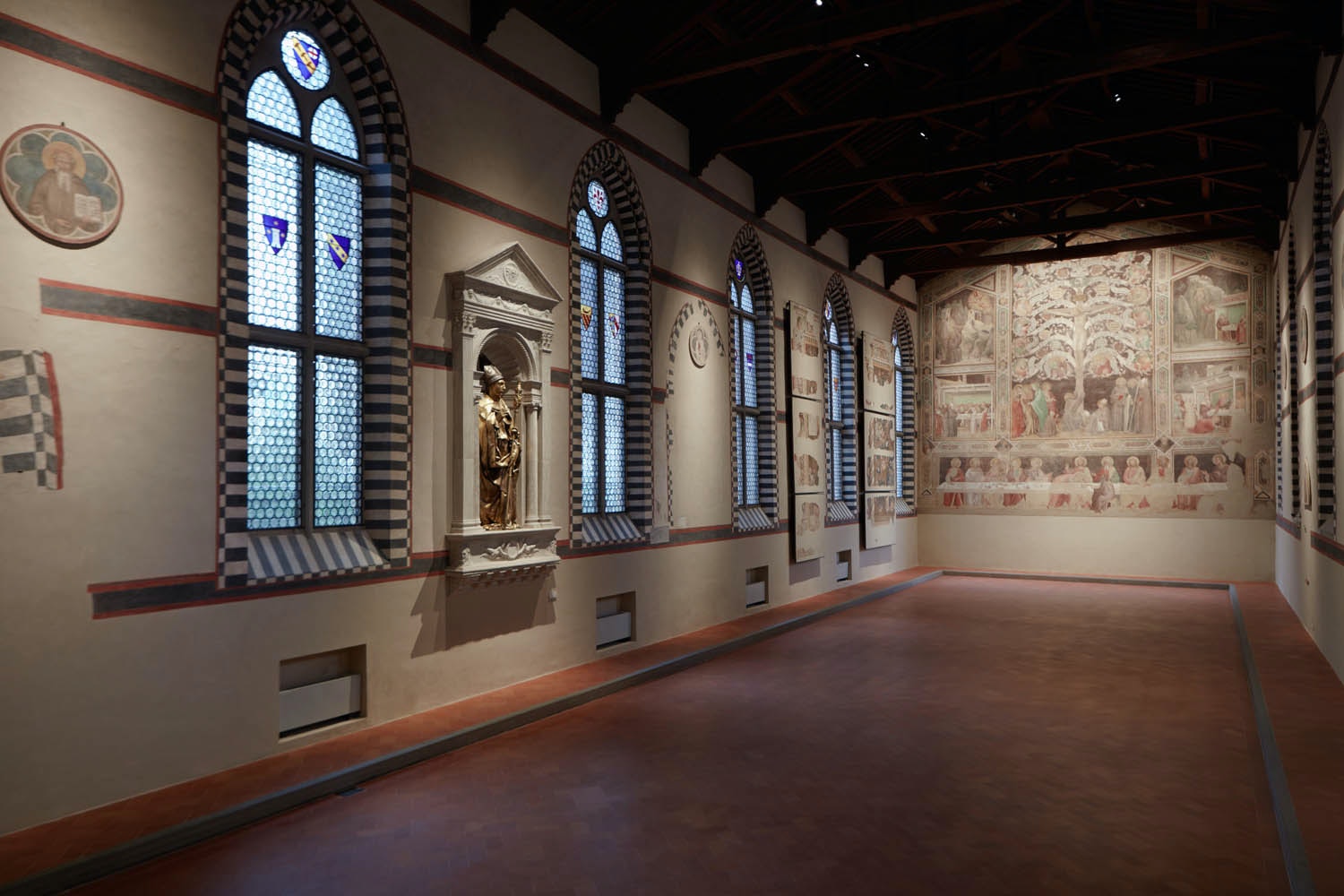
Taddeo Gaddi (Italian, 1290–1366), Tree of Life, ca. 1350. Fresco painted for the refectory of the Franciscan church of Santa Croce in Florence (now a museum).
The Lignum Vitae (Tree of Life) by Bonaventure, an early Franciscan theologian from Bagnoregio, Italy, is a meditational treatise on the life of Christ. It asks readers to picture in their minds a tree bearing twelve fruits (cf. Rev. 22:2), its roots watered by an ever-flowing stream. Standing for specific attributes of Christ or events from the Gospels, “this fruit is offered to God’s servants to be tasted so that when they eat it, they may always be satisfied, yet never grow weary of its taste,” Bonaventure writes. “I call these fruits because they delight with their rich sweetness and strengthen with their nourishment the soul who meditates on them and diligently considers each one.” The chapter outline, organized by “fruit,” is as follows (translation by Ewert Cousins):
PART I. ON THE MYSTERY OF HIS ORIGIN
First Fruit: His Distinguished Origin
Jesus Begotten of God Jesus Prefigured Jesus Sent from Heaven Jesus Born of Mary
Second Fruit: The Humility of His Mode of Life
Jesus Conformed to His Forefathers Jesus Shown to the Magi Jesus Submissive to the Law Jesus Exiled from His Kingdom
Third Fruit: The Loftiness of His Power
Jesus, Heavenly Baptist Jesus Tempted by the Enemy Jesus Wonderful in His Miracles Jesus Transfigured
Fourth Fruit: The Plenitude of His Piety
Jesus, the Solicitous Shepherd Jesus Bathed with Tears Jesus Acclaimed King of the World Jesus, Consecrated Bread
PART II. ON THE MYSTERY OF HIS PASSION
Fifth Fruit: His Confidence in Trials
Jesus Sold through Guile Jesus Prostrate in Prayer Jesus Surrounded by the Mob Jesus Bound with Chains
Sixth Fruit: His Patience in Maltreatment
Jesus Denied by His Own Jesus Blindfolded Jesus Handed Over to Pilate Jesus Condemned to Death
Seventh Fruit: His Constancy Under Torture
Jesus Scorned by All Jesus Nailed to the Cross Jesus Linked with Thieves Jesus Given Gall to Drink
Eighth Fruit: Victory in the Conflict of Death
Jesus, Sun Dimmed in Death Jesus Pierced with a Lance Jesus Dripping with Blood Jesus Laid in the Tomb
PART III. ON THE MYSTERY OF HIS GLORIFICATION
Ninth Fruit: The Novelty of His Resurrection
Jesus Triumphant in Death Jesus Rising in Blessedness Jesus, Extraordinary Beauty Jesus Given Dominion over the Earth
Tenth Fruit: The Sublimity of His Ascension
Jesus, Leader of His Army Jesus Lifted Up to Heaven Jesus, Giver of the Spirit Jesus Freeing from Guilt
Jesus, King, Son of the King Jesus, Inscribed Book Jesus, Fountain-Ray of Light Jesus, Desired End
Written in Latin around 1260, the Tree of Life became an instant classic, giving rise to many visual representations—first in manuscript miniatures, then in panel paintings and large-scale frescoes, including one by the Florentine artist Taddeo Gaddi.
Painted in the mid-fourteenth century in the refectory (dining room) of the Franciscan church of Santa Croce in Florence, the fresco depicts, in its central register, Christ crucified, with twelve scrolls unfurling from the vertical shaft like branches on a tree. On these scrolls, inscribed in Latin, are all the subheadings from Bonaventure’s treatise—IHS EX DEO GENITUS, IHS PREFIGURATUS, and so on, where “IHS” is an abbreviation for the name Jesus. Leafy roundels bear the names of the twelve “fruits,” and others feature busts of prophets.
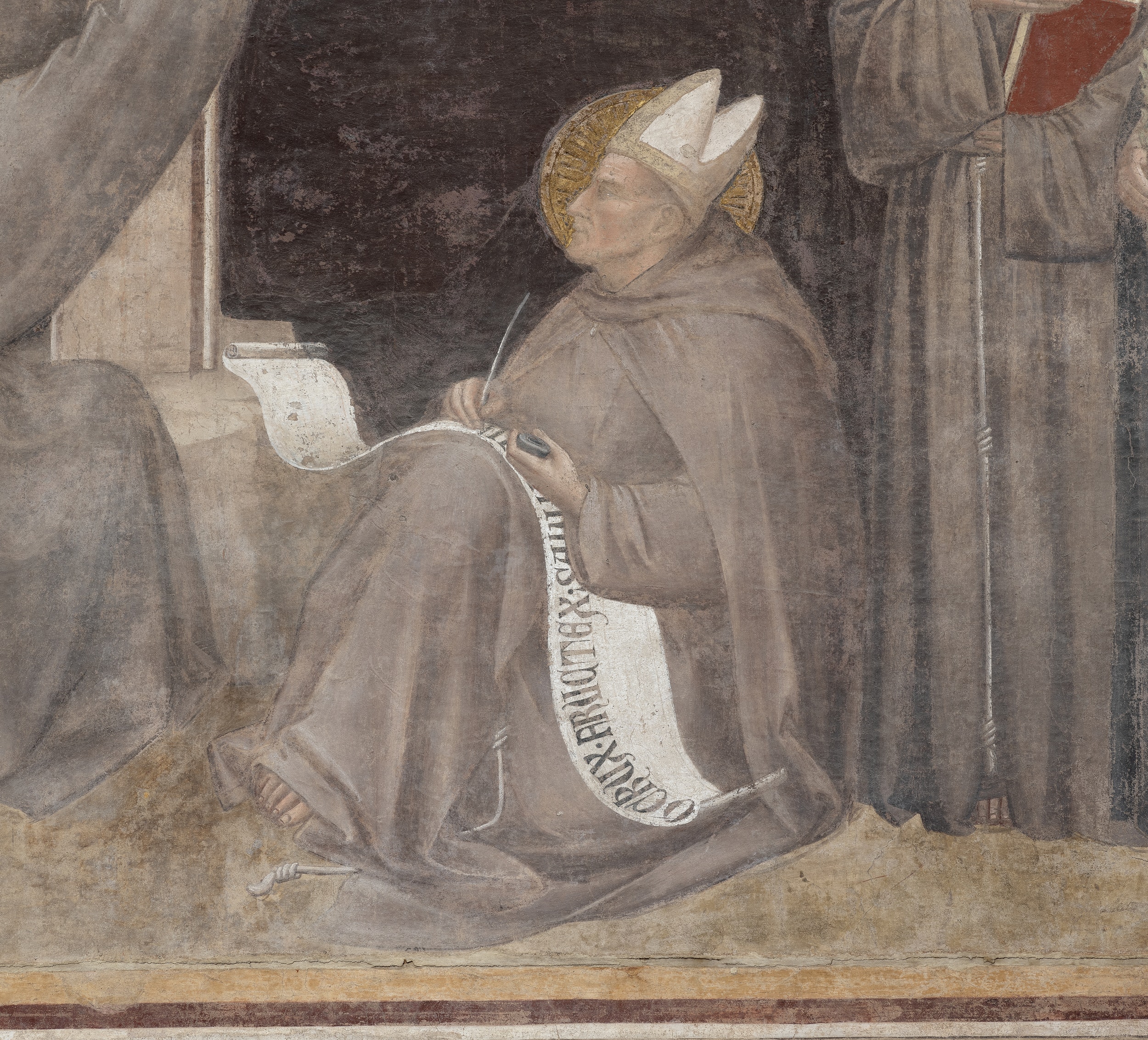
At the bottom of the cross is the Virgin Mary supported by three other women; St. John the Evangelist; the fresco’s patron, probably Vaggia Manfredi, kneeling in prayer; St. Francis, hugging the cross; St. Bonaventure, writing, “O crux, frutex salvificus, / Vivo fonte rigatus, / Quem flos exornat fulgidus, / Fructus fecundat gratus”; St. Anthony of Padua; St. Dominic; and St. Louis of Toulouse.
LISTEN: “O Crux (Frutex Salvificus)” | Original Latin words by Bonaventure, 13th century; translated into English by James Monti | Music by Elizabeth Duffy | Performed by Sister Sinjin on Incarnation (2016; reissued 2019)
O Cross, salvific stem, The watering, living fount, Whose blossom is fragrant, Whose fruit is longed for.
Jesus, begotten of God, Jesus foreshadowed, Jesus sent from heaven, Jesus born of Mary.
Jesus with the patriarchs, Jesus shown the magi, Jesus subject to the law, Jesus from your kingdom.
Jesus holy in the womb, Jesus tempted by Satan, Jesus wondrous in the signs, Jesus transfigured.
Jesus the good shepherd, Jesus sprinkled with tears, Jesus King of the world, Jesus Sacred Bread.
The Sister Sinjin song “O Crux (Frutex Salvificus)” layers the sixteen subheadings from part 1 of Bonaventure’s Tree of Life, “On the Mystery of His Origin,” with the first stanza of a poem that appears in different forms in the various manuscripts of Bonaventure’s works, including the Tree of Life. Another translation of this refrain’s source text, by José de Vinck, is “O cross, tree bearing the fruit of salvation / Refreshed by a living stream / Your blossom so sweetly scented / Your fruit so worthy of desire.”
Detail from Taddeo Gaddi’s Tree of Life. Contemplating the Crucifixion, Bonaventure pens one of his famous poetic lines, “O CRUX FRUTEX SALVIFICUS” (“O cross, tree bearing the fruit of salvation”).
The melody and stylings of the song are evocative of the Middle Ages. Elizabeth Duffy, Kaitlyn Ferry, and Elise Erikson Barrett sing to their own gentle guitar, mandolin, and banjo accompaniment.
For another Advent devotion featuring Sister Sinjin and an even older Italian fresco, see here.
Wednesday, February 17, is the start of Lent, a forty-day season of penitence and renewal. It’s not so much about making resolutions as it is about drawing near to God and encountering his grace afresh—at the foot of the cross.
That closeness entails confronting, confessing, and repenting of sin—sins of commission and omission. (The Book of Common Prayer reminds us that we sin “by what we have done, and by what we have left undone.”) It’s an uncomfortable process, but one that grows us, makes us healthy. It makes our relationships and communities healthier too. Jesus’s grace is not just warm fuzzies in the hearts of private individuals but, rather, works itself out in the world.
As a companion for the Lenten journey, I’ve curated a Spotify playlist of songs for the season, a mix of prayers and praises to the Triune God whose strength avails to meet us in our weakness and our need. Some are invitational, others are penitential, and others are celebratory. Along with images of dust, blood, wilderness, and death, there are themes of victory and rising, healing and wholeness, rivers that cleanse, rivers that quench thirst, agricultural metaphors of planting and growth, calls to lay down one’s burden and to rest in the Savior’s love. There are songs of pursuing and of being pursued (us calling out to God, God calling out to us), for as we deepen our desire for God, we come to realize how deep God’s desire is for us.
The playlist opens with “That We Might See” by Indianapolis folk duo Sister Sinjin, a setting (with slight modifications) of this Christina Rossetti poem:
Lord, purge our eyes to see Within the seed a tree, Within the glowing egg a bird, Within the shroud a butterfly:
Till taught by such, we see Beyond all creatures Thee; And hearken for Thy tender word, And hear it, “Fear not: it is I.”
I chose this as the introductory song because, first, it expresses how out of “death” or dormancy can come great life and beauty—as with the buried seed that, once germinated, brings forth lushness. This is one of the prime metaphors of Lent, and this song is a supplication that we would have eyes to see it and, what’s more, participate in it (see Rom. 6). Second, I like how it reminds us of the tenderness and approachability of Jesus. Some people enter Lent with a sense of dread, fearing that their sins are too great, or that they will never measure up to some set standard of piety. But Jesus tells us not to be afraid. His love and mercy know no bounds. He wants to set us free from our illusions of self-sufficiency and for us to rely on his Spirit to work good things in and through us.
Let me share just a handful of other song highlights.
“Simple Gifts” is a one-verse Shaker hymn from 1848, performed here by the amazing female trio Mountain Man (Alexandra Sauser-Monnig, Amelia Randall Meath, and Molly Erin Sarle). The Shakers, a Christian sect, were known for their use of dance during worship, and “bowing,” “bending,” and “turning” are dance instructions as much as they are instructions for life. Simplicity is another hallmark of the Shakers, a virtue and a discipline that Lent summons us to.
Another Lenten virtue is silence. In 2018 Paul Zach released the EPGod Is the Friend of Silence, whose title track is inspired by a Mother Teresa quote: “We need to find God, and God cannot be found in noise and restlessness. God is the friend of silence.”
There are many originals from the past decade on the playlist, but there are also a lot of classic hymns: “Amazing Grace” (to the tune of “House of the Rising Sun”), “Softly and Tenderly” (intriguingly reharmonized by the Wilderness of Manitoba), “I Am Thine, O Lord,” “Just a Closer Walk with Thee,” “I Need Thee Every Hour,” “Grace That Is Greater,” “Nothing but the Blood,” “Near the Cross,” “Just as I Am,” “Jesus Paid It All,” “Turn Your Eyes Upon Jesus,” “Where He Leads Me.” And a beautiful adaptation of “I Surrender All” by Chanda Rule, who revised the first verse to this:
O Beloved, I surrender All my heart I freely give Ever open, ever trusting Breathing with my Source, I live
Also included are several settings of the ancient liturgical prayer Kyrie (“Lord, have mercy”)—by Hildegard of Bingen, Josquin des Prez, Isaac Wardell, and the monks of Keur Moussa Abbey in Senegal (sung in Wolof). Plus the fourteenth-century prayer known as the Anima Christi, with music composed by jazz master Mary Lou Williams using a 6/8 rhythm pattern and a bass clarinet.
Soul of Christ, be my sanctification Body of Christ, be my salvation Blood of Christ, fill my veins Water of Christ’s side, wash out my stains
Passion of Christ, my comfort be O good Jesus, listen to me Lord, have mercy on me
. . .
The entire Lent album by Liturgical Folk is inspired by specific Lenten readings from the Book of Common Prayer. My favorite song is “Willing Minds,” based loosely on the collect (succinct prayer) for the Fifth Sunday in Lent:
Almighty God, you alone can bring into order the unruly wills and affections of sinners: Grant your people grace to love what you command and desire what you promise; that, among the swift and varied changes of the world, our hearts may surely there be fixed where true joys are to be found; through Jesus Christ our Lord, who lives and reigns with you and the Holy Spirit, one God, now and for ever. Amen.
The melismatic phrases (in which one syllable is stretched out across multiple successive notes) underscore the flightiness of the human will, our inconstancy, our lack of rootedness.
“Create in Me” by Terry Talbot, covered by The Acappella Company in the video below, is a prayer that’s pieced together from various verses of scripture, starting with Psalm 51:10:
Other favorites, which I’ve featured on the blog before, are Leon Bridges’s “River” [previously] and “Hallelujah” by MaMuse [previously]. “I’m gonna let myself be lifted,” the latter asserts.
As much as Lent is about dying to sin, it’s also about rising with Christ, so resurrection is present throughout—in biblical narrative songs about Jonah, Lazarus, Jairus’s daughter, and Ezekiel in the valley of dry bones, for example (foretastes of Easter), but also in songs of personal testimony and aspiration. The theme is especially punctuated in the final few selections. “Where All New Life Begins” by John Lucas seeks to define faith, landing on “Faith is laying your body down / And believing new life will come up from the ground.” Carrie Newcomer’s “Lean in Toward the Light” opens with a similar image of buried seeds, which stretch out underneath the cold winter earth as they prepare to sprout (that is, resurrect), their growth enabled by the light; “keep practicing resurrection!” exclaims the second stanza.
The last two songs are centered on Romans 8. “The Spirit of Life” by Psallos is a contemporary setting of verses 1–17 and part of a larger project. For the final, “sending forth” song I’ve chosen “Conquerors” by Hiram Ring, which is quieter, less anthemic, than the previous one, but its chorus rings of Romans 8:37 and makes for a powerful closing:
We are more than conquerors Heading out into this world Freed from chains and strengthened now ’Cause his love is all around
This is just a sampling of the 150 songs on Art & Theology’s Lent playlist, which I will probably build on indefinitely. Later in the season I plan to publish a different list specifically for Holy Week.
To add the playlist to your account, open the link, then click on the More (…) icon and select “Save to Library.”
Playlist cover art: Vincent van Gogh, Rain (detail), Saint-Rémy, 1889, Philadelphia Museum of Art
+++
I recently started accepting donations to help support the running of this blog ministry. If the Lent playlist has value to you, please consider leaving a gift of $5 through PayPal. If you have already given, thank you. https://www.paypal.me/artandtheology
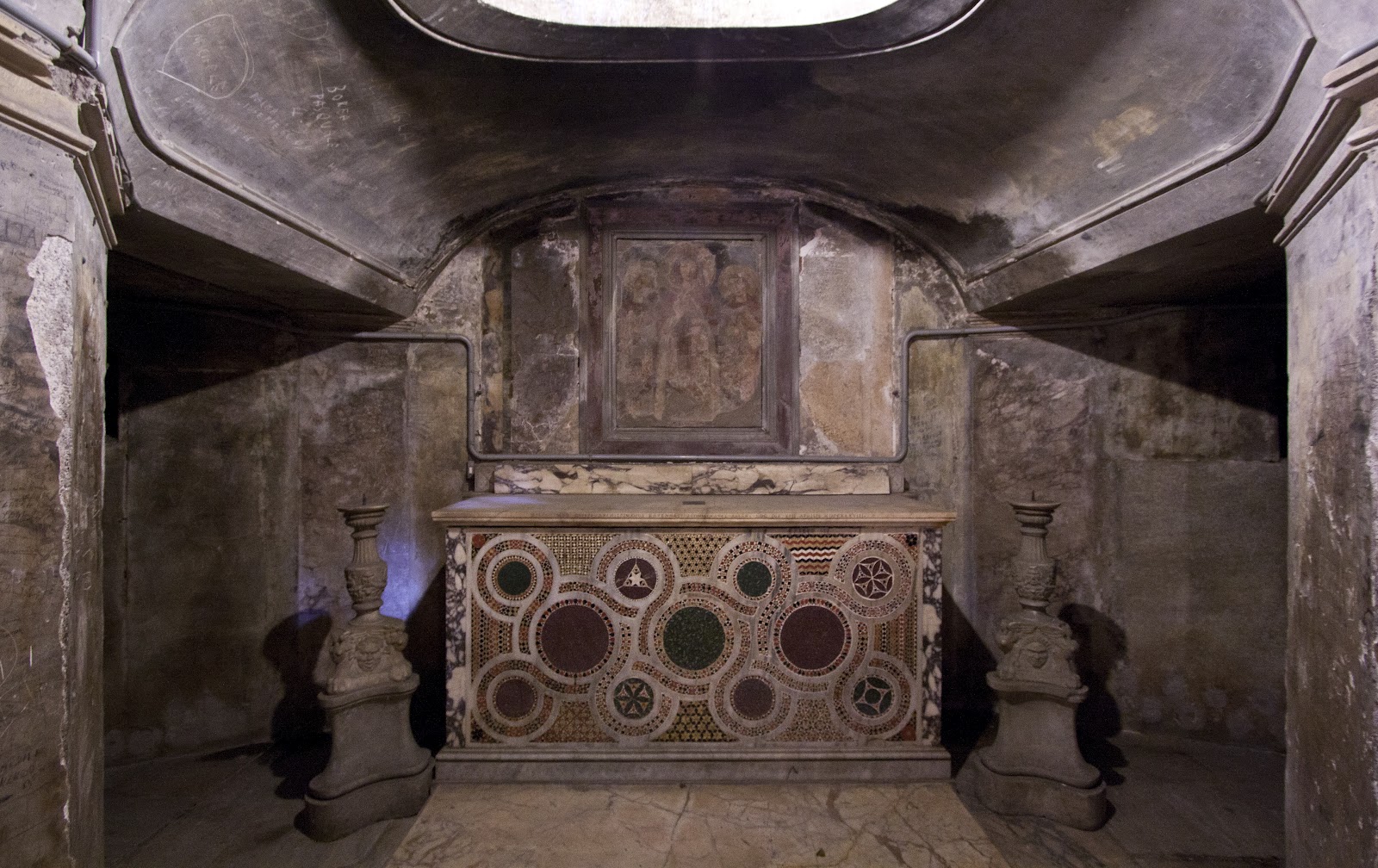
LOOK: Pregnant Madonna, 9th century, fresco, crypt of Santa Prassede, Rome
The Madonna del Parto (Our Lady of Parturition) is an iconic depiction of the Virgin Mary as pregnant, usually pointing to or cradling her belly, where God is being made flesh. The ninth-century fresco in the crypt of Santa Prassede in Rome is the earliest known depiction of a visibly pregnant Mary. I believe she is flanked by saints Praxedes (Italian Prassede) and Pudentiana (Italian Pudenziana), sisters and martyrs, since the painting is from a chamber that contains their relics. In the most famous Madonna del Parto image, however—by Piero della Francesca, ca. 1457—Mary is attended by two angels.
LISTEN: “In the Virgin’s Womb” by Kaitlyn Ferry | Performed by Sister Sinjin (Kaitlyn Ferry, Elizabeth Duffy, and Elise Erikson Barrett), on Incarnation (2016, re-released 2019)
In the Virgin’s womb He lay; God made flesh, the mortal babe. In her body she has held That which heav’n cannot contain.
In the Virgin’s womb He lay; Born to die, His flesh a grave. In her arms she has held He whom death could not hold down.
For each day of the first week of Advent I am publishing one art-and-song pairing as an invitation for seasonal reflection.
Several readers have asked if there’s a way to donate to the work of this blog. After much thought I’ve decided to go ahead and add a Donation page, where those who wish to send a small financial gift to support the blog’s upkeep and development can do so through PayPal if they feel so inclined. Thank you!
+++
CIVA ART AUCTION, November 13–15, 2020: In a few weeks CIVA (Christians in the Visual Arts) is hosting an online auction of art created and/or donated by CIVA members. The lots comprise a range of media, sizes, and styles—a little something for everyone. It’s a great way to support artists of faith (by supporting CIVA), and to acquire beautiful art for your home!
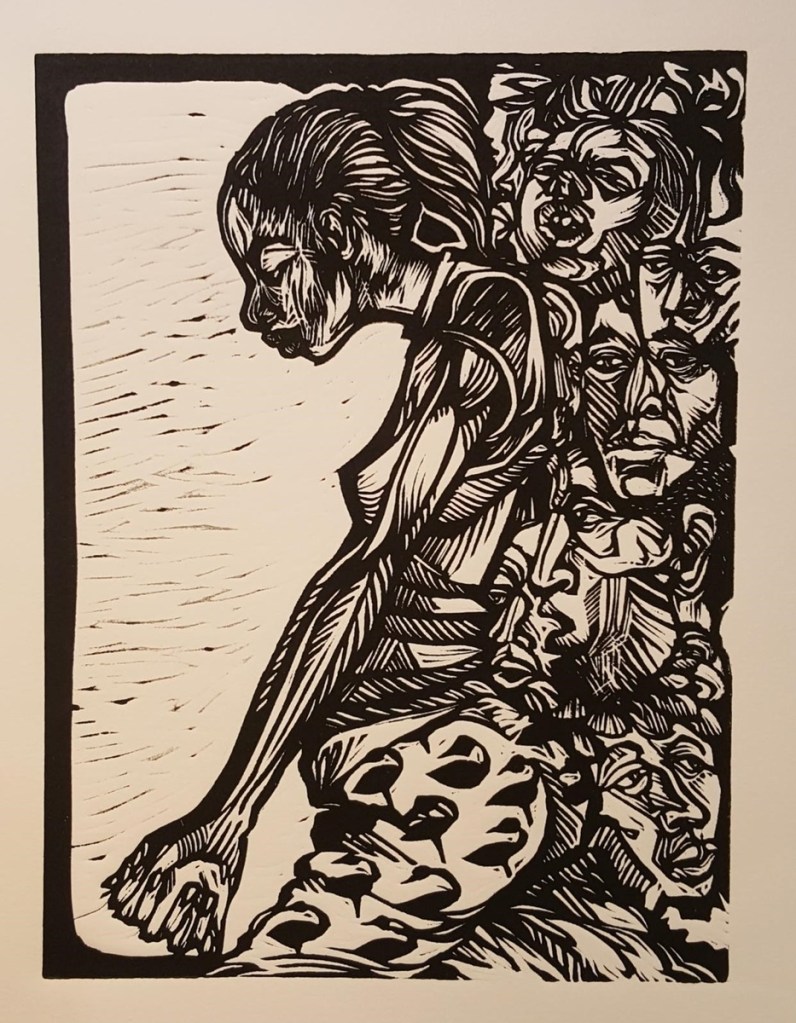
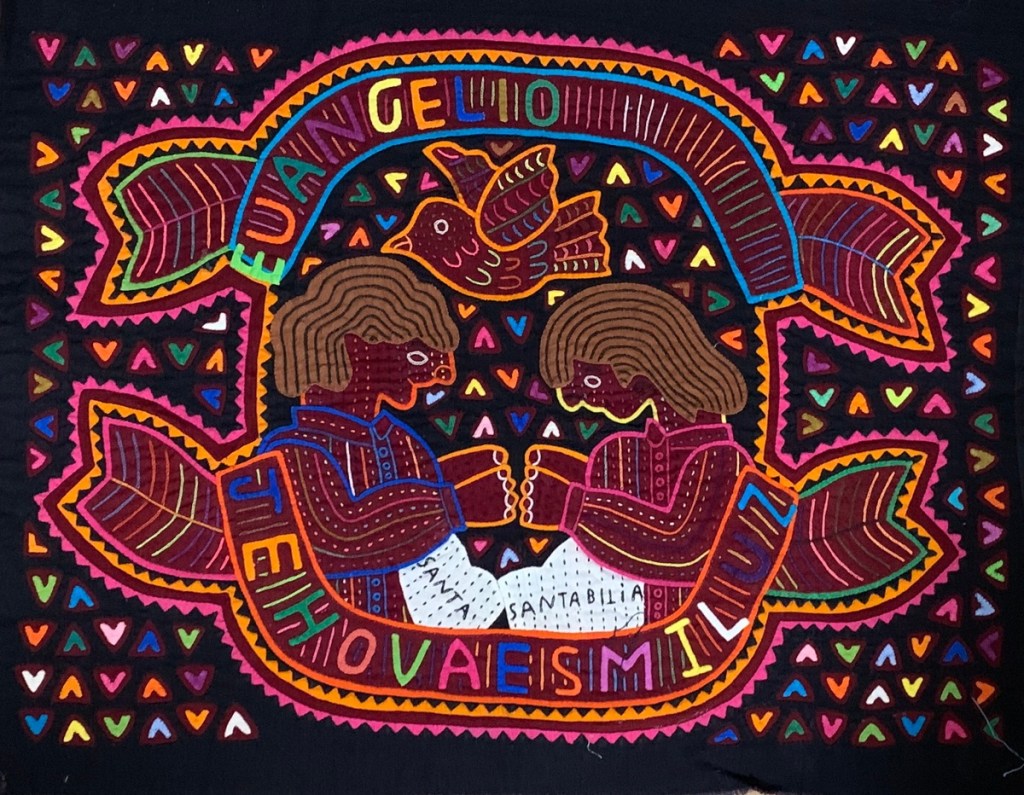
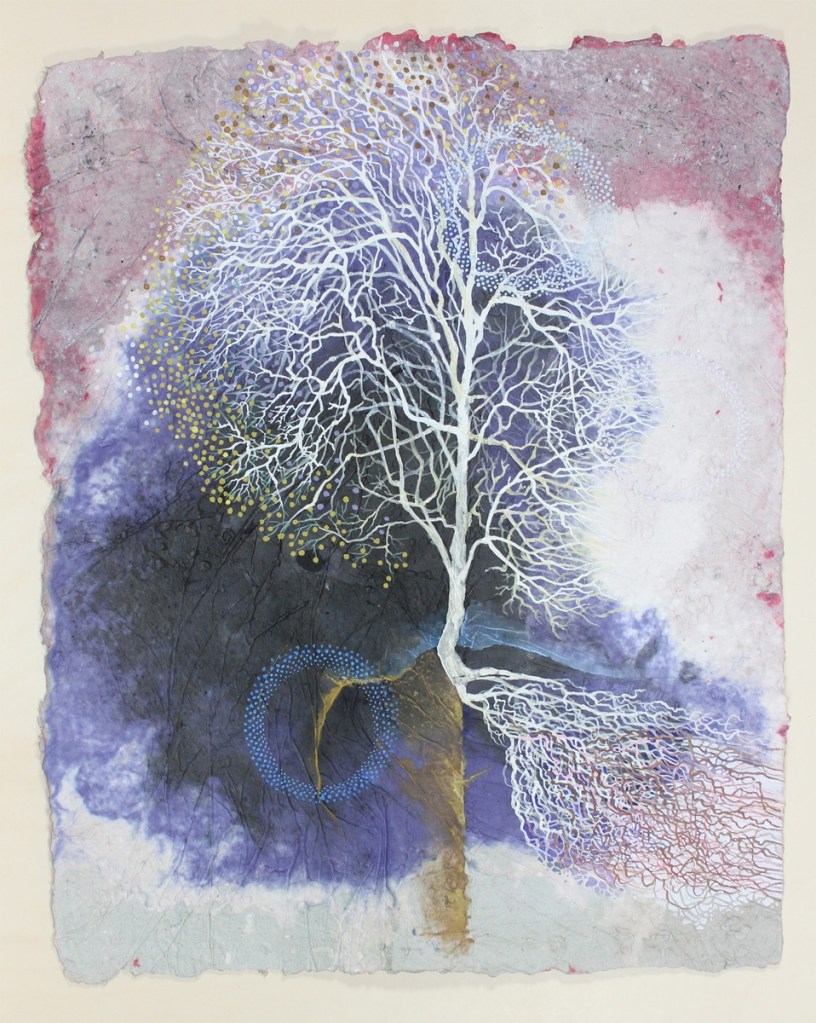
The first artwork I ever purchased was through a CIVA auction: a linocut by Steve Prince, who has three new works up for bid this year. Sandra Bowden has donated several works from her extensive and esteemed collection of religious art, including an Adoration of the Magi lithograph by the major modern artist Otto Dix and a mola (handmade textile) from Panama, which I’m eyeing. I also noticed 40 Days, Forty Sacraments, a set of gouaches painted by Kari Dunham over the course of Lent one year as a way to rediscover beauty in the ordinary. And a mixed-media piece by Joseph di Bella, whose theme of redemption is underscored by the making of the substrate, which consists of “failed and unfinished works on paper” that “are destroyed, then reformed into new, yet still imperfect sheets.”
Steve Prince, Faith Walk. Linocut, 12 × 9 in. “Shows a woman walking in faith while the ancestors encourage, uplift, and guide her along the way.”Jehova es mi luz (Jehovah Is My Light), San Blas Islands, Panama, 1980s. Reverse embroidery, 14 × 17 1/2 in.Joseph di Bella, Tree Parables (Generations), 2017. Gouache, dry pigment, and ashes on handmade paper, 38 1/2 × 30 1/2 × 1 1/2 in. (framed).
If you plan on bidding, be sure to register; you will be able to see all the other bids and can set up notifications. And if you don’t win, don’t be discouraged: you can always go to the artist’s website, and there will likely be other works available for purchase there.
+++
ALBUM: Daughter Zion’s Woe: Produced by Rachel Wilhelm and released last month by Cardiphonia, this new album features thirteen lament songs written, arranged, and performed by women. It will be available on Spotify after Christmas, but until then, all Bandcamp sales benefit Hagar’s Sisters, an organization that serves victims of domestic violence. My favorite song on the album is “The Glory Shall Be Thine” by Christy Danner, a retuning of the late nineteenth-century “Transformed” by F. G. Burroughs (pseudonym for Ophelia Burroughs, later Adams, née Browning); this hymn text is completely new to me, and what a gem! Danner’s music really draws out its poignancy. Other highlights include Eden Wilhelm’s “Lord, Draw Near” (Psalm 88), Sister Sinjin’s “Silence,” and Lo Sy Lo’s “Let It Be So” (Psalm 12).
+++
EXHIBITION:The Evidence of Things Unseen by Titus Kaphar,October 16–November 28, 2020, former Église du Gesù, Brussels: Titus Kaphar’s [previously] art, which reinterprets traditional Anglo-centric imagery through a Black lens, has grown out of his “spending time in European museums and longing for pictures that looked like they actually made space for individuals that look like me.” In this new exhibition, staged by the Maruani Mercier gallery in a deconsecrated church in Belgium, Kaphar revises Christian paintings by silhouetting, covering in tar, or duct-taping over likenesses of white Jesus, drawing attention to unseen people and narratives. The exhibition’s title is taken from Hebrews 11:1.
Titus Kaphar, Untitled, 2020. Oil and tar on canvas. Photo courtesy Maruani Mercier.
The press release reads: “It is virtually impossible to tell the story of Renaissance art without an exploration of Christianity. While the personal faith of the individual artist varied from devotee to atheist opportunist, the largest patron of the arts was the Church, and Catholic iconography the artist’s lingua franca. . . .
“In The Evidence of Things Unseen, Kaphar utilizes Catholic iconography as a ground on which to explore ideas beyond simple proselytization. Kaphar utilizes his whole vocabulary of formal innovation in this exhibition: canvases aggressively fold, crumple, undulate, and project from the wall, forcing themselves into the space of the viewer. Through Kaphar’s physical interventions, works like Susan and the Elders and Eve exist as bodies transformed into landscape and typography rather than polite easel paintings. In Jesus Noir Kaphar duct-tapes a portrait of a young black man over the face of Christ. Christ’s outstretched right hand, originally pointing to the heavens, now appears as a plea for help. The application of duct tape – a utilitarian material known to be used in all kinds of industrial and household repairs – suggest urgency and impermanence.
“Even though many biblical stories take place in the Middle East and Africa, representations of Christ and his followers are almost always depicted as European. It is not surprising that the devoted attempt to see themselves in the stories of the Bible, and to envision a Christ they can recognize: Christian tradition teaches that mankind was created in God’s own ‘image and likeness.’ And yet, religious paintings from the Renaissance unwittingly oversimplify an understanding of God by excluding a part of his creation. There are no black angels of the Renaissance. The Evidence of Things Unseen is Kaphar’s latest attempt at revision.”
+++
ANIMATED SHORT: “Brené Brown on Empathy”: In this 2013 video from the RSA (Royal Society for Arts, Manufactures and Commerce), Katy Davis animates an excerpt from a talk by Professor Brené Brown, “The Power of Vulnerability.” “The Webby Award-winning RSA Shorts animation series provides a snapshot of a big idea, blending voices from the RSA Public Events Programme and the creative talents of illustrators and animators from around the world. It responds to the ever-increasing need for new ideas and inspiration in our busy lives and acts as a jolt of ‘mental espresso’ that will awaken the curiosity in all of us. If you’re interested in the opportunity of animating one of our Shorts, please email your bio and links to your portfolio to shorts@rsa.org.uk.” Other RSA shorts include Jonathan Haidt on Why We’re Convinced We’re Right, David Brooks on Character in a Selfie Age, and David Graeber on the Value of Work.
+++
PANEL DISCUSSION: “Perspectives on Empathy and the Arts”: In 2017 Roots of Empathy brought together a panel of three—Cameron Bailey, artistic director of the Toronto International Film Festival (TIFF); Martha Durdin, chair of the board of trustees of the Royal Ontario Museum (ROM); and Raymond Mar, professor of psychology at York University—to discuss the connection between art and empathy and why it’s so important. The conversation is moderated by Mary Ito. I especially appreciated from 42:32 onward.
4:10: Children who take acting lessons are more prosocial and empathetic 5:48: Films and empathy 9:34: Fiction and empathy 12:42: Moonlight(2016) 21:54: Learning from mistakes: Into the Heart of Africa (1989) and point of view 28:38: Pompeii: In the Shadow of the Volcano (2015) 30:37: Forced assimilation of Native people in church-run residential schools 31:18: Can art museums institutionalize empathy? 34:48: How does me empathizing with a character in a book or a painted figure translate to me being empathetic to actual people? 39:05: Superhero comics and movies 41:22: Are we suffering from an empathy deficit? 44:37: Empathy for ideological opponents 46:10: Where does empathy run up against morality/ethics? Are we to empathize with abusers? 46:56: How do we do better through the arts?
So much to share today! Be sure not to miss “Psalm 126” by Drew Miller (a new favorite Advent song) and Matthew Milliner’s excellent presentation on the Virgin Mary in art, which opened an exhibition that’s running in Southern California—both below. (If you only have time to take in a few items from this post, those are the ones I’d recommend.)
PODCAST EPISODE:“A Time for Wanting and Waiting: An Advent Conversation with W. David O. Taylor”: In this recent episode of The Road to Now, hosts Bob Crawford and Chris Breslin interview liturgical theologian David Taylor [previously] about the season of Advent: what it is, its history and how it fits into the wider church year (see especially 43:29ff.), the canon of Advent and Christmas songs, and the gift the Psalms offers us during this season. Referencing his 2015 Washington Post article, Taylor says our picture of Christ’s coming, especially as expressed through our hymnody, tends to be unidimensional and far too sanitized:
We should permit the Nativity stories to remain as strange and bizarre and fantastical and difficult as they in fact are, rather than taming and distilling them down to this one nugget or theme of effusive joy. There is effusive joy in that—it’s simply that that’s not the only thing that characterizes these stories. Unfortunately, most of our canon of Christmas carols or hymns tends to focus on what I would argue is only 50 percent of the Nativity stories. Everything that begins with Elizabeth and Zechariah and goes all the way to, say, Anna and Simeon and the visit of the Magi and the flight to Egypt . . . it really is one whole story that is being told with these subplots.
I would love to see us create . . . new music that either retells portions that we are already telling but not the whole of it, or we need to tell parts that have not yet been told. . . . Let’s ask ourselves how God is at work in all the minor-key or difficult or dissonant parts of the Nativity stories, not absent from—those are not extraneous to God incarnating himself in Jesus Christ. Those are essential parts of it. And so how can our hymns become ways of praying ourselves into these stories so they can sink deeply into the fibers of our hearts and minds and bodies, and for us to say, “Oh, all the weird and difficult and dissonant parts of our lives are part and parcel of God’s good work,” not, again, on the margins of it, or things we should eschew.
To help deepen and expand the church’s repertoire of Christmas music, Taylor founded, along with a few others, the Christmas Songwriters Project. The Psalms are an inspiration in this task, as they express a joy that is at times quiet and at others raucous, as in the Nativity narratives, and that exists as part of a dynamic constellation of emotions and postures that praise can encompass. Most of us don’t recognize the pure, undistilled happiness that is marketed to us throughout December, Taylor says, and we shouldn’t force ourselves to try to feel it but rather should take a cue from the Psalms and also see the same emotional complexity at work at the beginning of the Gospels:
The Psalms, and I think Christian faith at its heart, can make space for joy and sorrow to exist alongside each other in a way that happiness, as we commonly understand it, cannot, or only with great difficulty. . . . What the psalms of praise do . . . is that in one movement, there’s this effusive joy or a shouting joy or a convivial joy, and then it segues to a quieter joy or a contemplative joy or a yearning, painful kind of joy. . . .
So in the season of Advent, when we look at the characters in scripture—you know, Mary and Joseph and Zechariah and Elizabeth and the shepherds and Anna and Simeon—every one of them has this moment, perhaps, of which we could say, “That sounds like joy.” . . . But immediately before or immediately after, it transitions to something else. So does that mean that joy is negated? Is joy squashed? Is joy extinguished? Or is joy able to continue to exist side by side, to subsist, with a continued experience of longing or a sudden moment of sadness?
+++
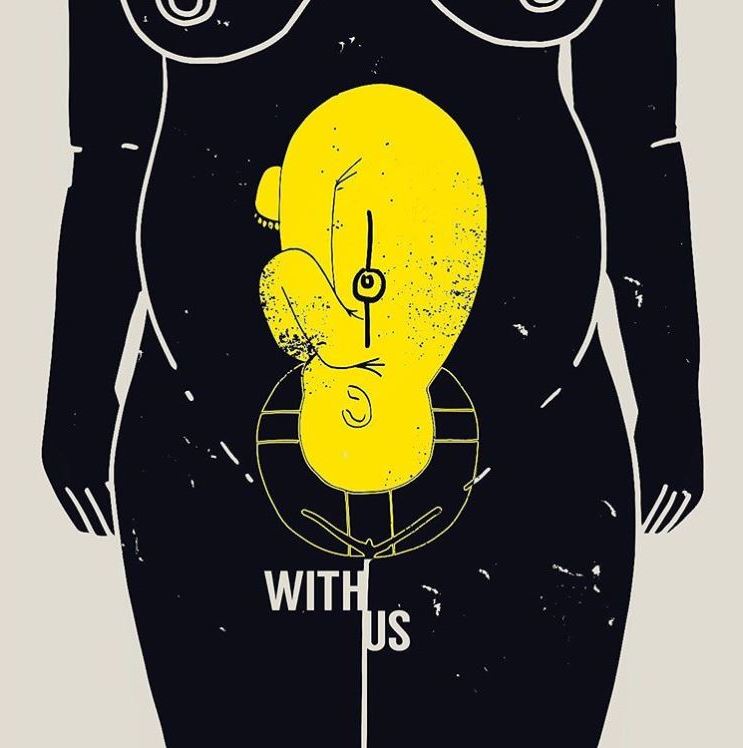
ART BY SCOTT ERICKSON: This month Portland-based artist Scott Erickson has been posting on Instagram Advent-themed images he has made, along with thoughtful meditations. Some emphasize the bodiliness of the Incarnation, which often gets overlooked, presumably out of a sense of propriety. But “grace comes to us floating in embryonic fluid . . . embedded in the uterine wall of a Middle Eastern teenage woman,” Erickson writes about With Us – With Child, to which one Instagrammer responded, “This is trajectory changing. Thank you for this. Nipples, vaginas, and Jesus CAN coexist!” Another mentioned how she had never seen Mary with a belly button and a linea nigra before. The image reminds us that Jesus was indeed “born of woman” (Gal. 4:4).
Scott Erickson (American, 1977–), With Us – With Child, 2016 [purchase as poster]Another imaginative image suggests that Christ came to set the world on fire, so to speak. God, who is of old, gives himself to earth as a Jewish babe (“Love has always been FOR GIVENESS,” Erickson writes), sparking a revolution.
LECTIONARY POEMS FOR ADVENT: This year Englewood Review of Books launched a new feature on their website: a weekly post of four to six poems that resonate with the Revised Common Lectionary readings for that week. “We will offer here a broad selection of classic and contemporary poems from diverse poets that stir our imaginations with thoughts of how the biblical text speaks to us in the twenty-first century. We hope that these poems will be fruitful not only for preachers who will be preaching these texts on the coming Sunday, but also for church members in the pews, as a way to prime our minds for encountering the biblical texts.” I’m really enjoying these stellar selections, several of which are new to me.





 Art & Theology