Art at the United Nations Headquarters in New York

Chagall’s Peace Window is one of the most significant works in the United Nations’ art collection. On my quick visit to New York City last month, where the UN is headquartered, I was hoping to see it, but I emailed ahead of time and found out it’s not currently available for viewing due to construction behind it. (You can “see” it but not really, because it’s not lit, and there’s a tall plastic barrier in front.) I was disappointed, but I decided to visit the UN anyway, to see what other art I might find.

The United Nations was founded in 1945 for the purpose of preventing a third world war. Comprising 193 member states, the organization is committed to maintaining international peace and security, developing friendly relations among nations, and promoting social progress, better living standards, and human rights. Their motto is “Peace, dignity, and equality on a healthy planet.”

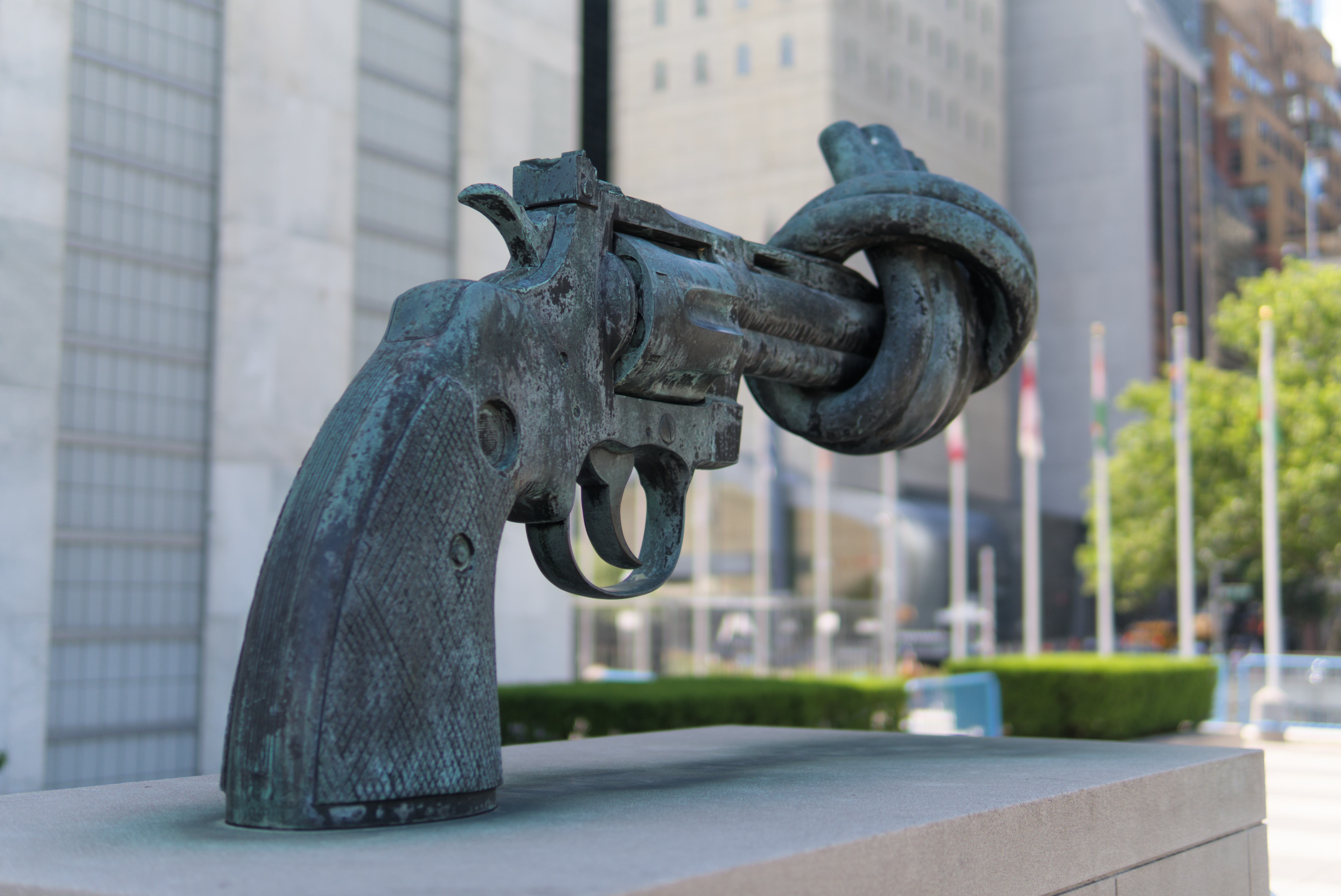
After presenting my ID, getting my photo taken, being stickered, and going through security, I was inside the campus and directed to the General Assembly Building. Outside the entrance to this building is the famous Non-Violence bronze, aka The Knotted Gun, by Carl Fredrik Reuterswärd of Sweden. The artist made the sculpture in 1980 after his friend John Lennon was murdered. He wanted to honor the singer-songwriter’s vision of a peaceful world.
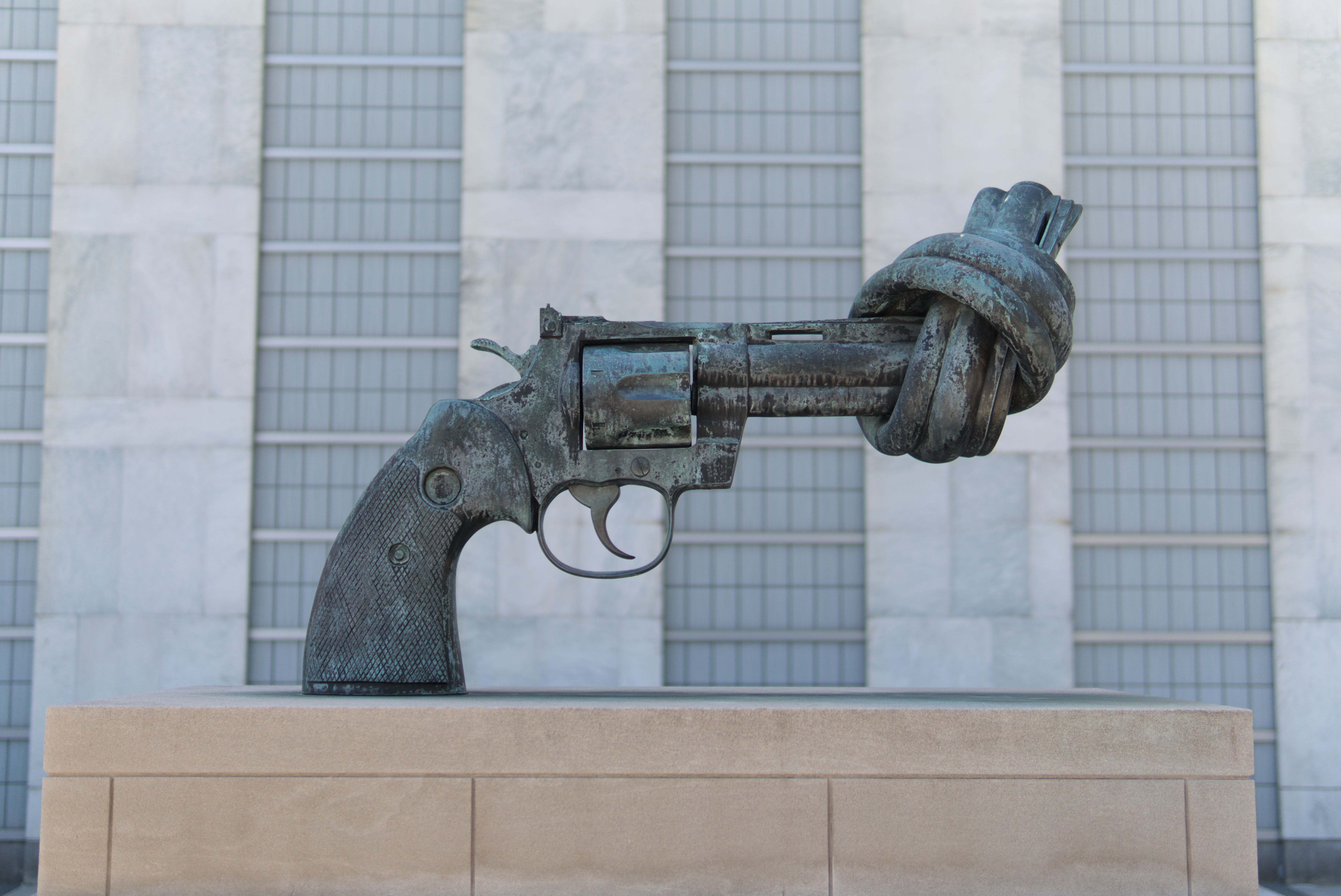
Reuterswärd, Carl Fredrik_Non-Violence
Carl Fredrik Reuterswärd (Swedish, 1934–2016), Non-Violence, 1984. Bronze, 79 × 44 × 50 in. United Nations Headquarters (outside the General Assembly building), New York. Gift from Luxembourg. Photo: Victoria Emily Jones. [object record]

Reuterswärd, Carl Fredrik_Non-Violence

The original cast was first placed at the Strawberry Fields memorial in New York City’s Central Park, across the street from the Dakota apartment building where Lennon and his wife, Yoko Ono, lived, and where he was shot. But Reuterswärd worried it would be stolen there. In 1988, the Government of Luxembourg bought the sculpture and donated it to the United Nations, who installed it inside the gate of their New York headquarters.

Non-Violence is an oversize replica of a Colt Python .357 Magnum revolver with the barrel tied in a knot and the muzzle pointing upward, rendering the weapon useless. In his statement from 1988, Reuterswärd said, “Humor is the finest instrument we have to bring people together. While making my peace-symbol, I thought of the importance of introducing a touch of humor, just to make my ‘weapon’ symbolically ridiculous and completely out of order.”

Reuterswärd ultimately made over thirty additional casts of Non-Violence, which are publicly installed in cities such as Beijing, Beirut, Cape Town, Lausanne, and Mexico City.

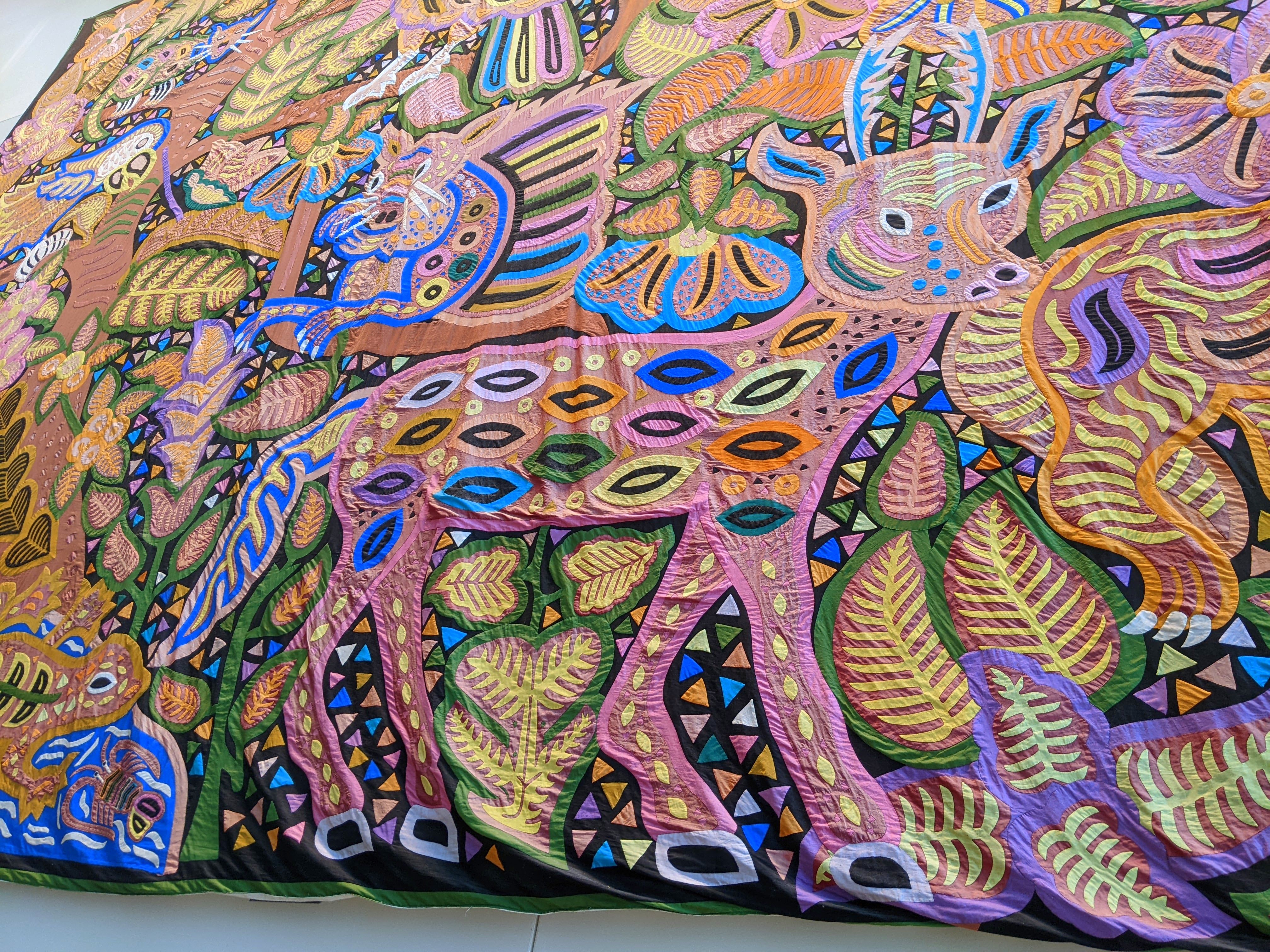
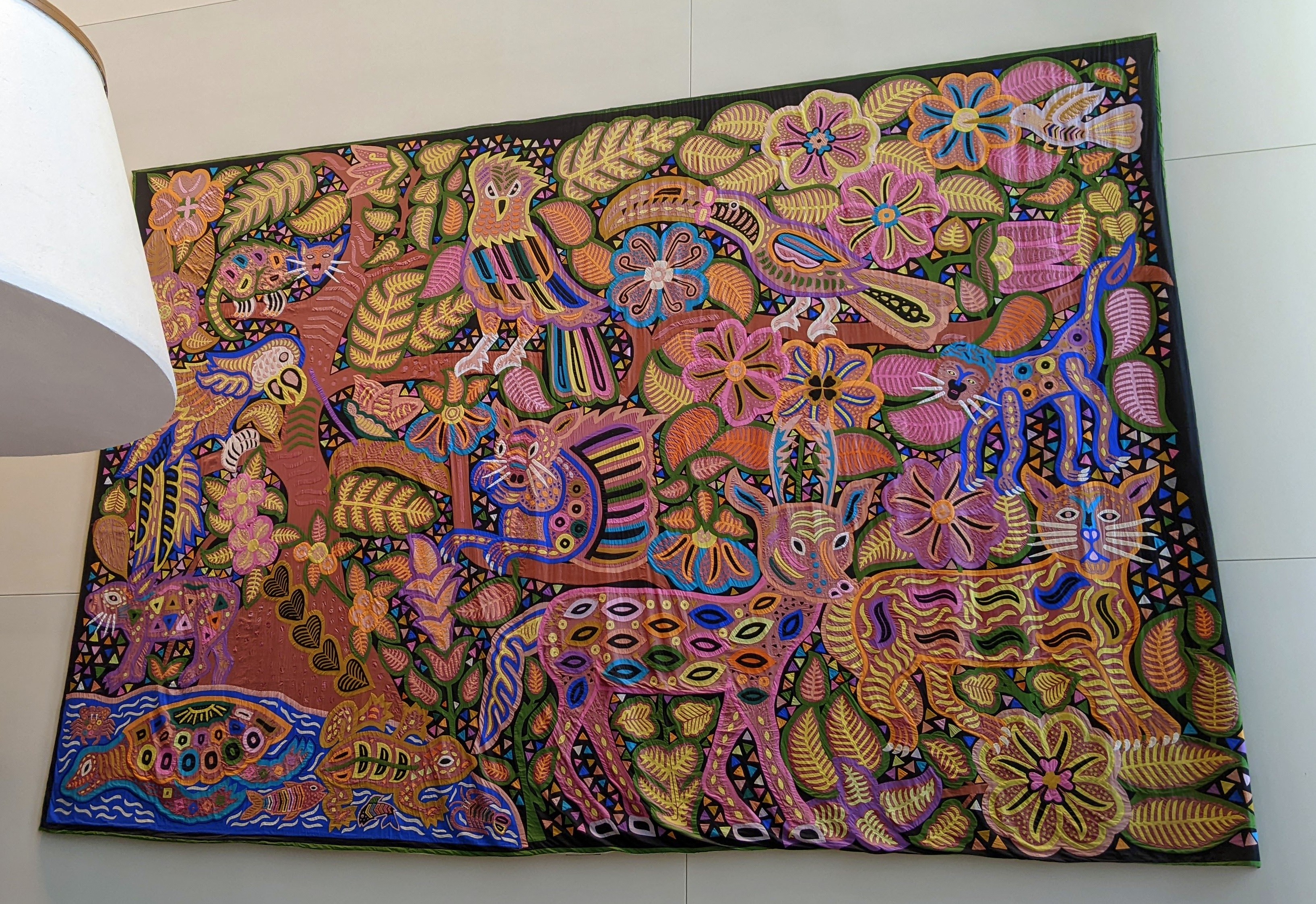
After spending some time with this iconic work, I entered the General Assembly lobby. What first caught my eye, on the right wall, was a monumental Mola Tapestry from Panama, made by unidentified Kuna women. (To learn about the art form, see my previous blog post from Lent 2022.)
Mola Tapestry
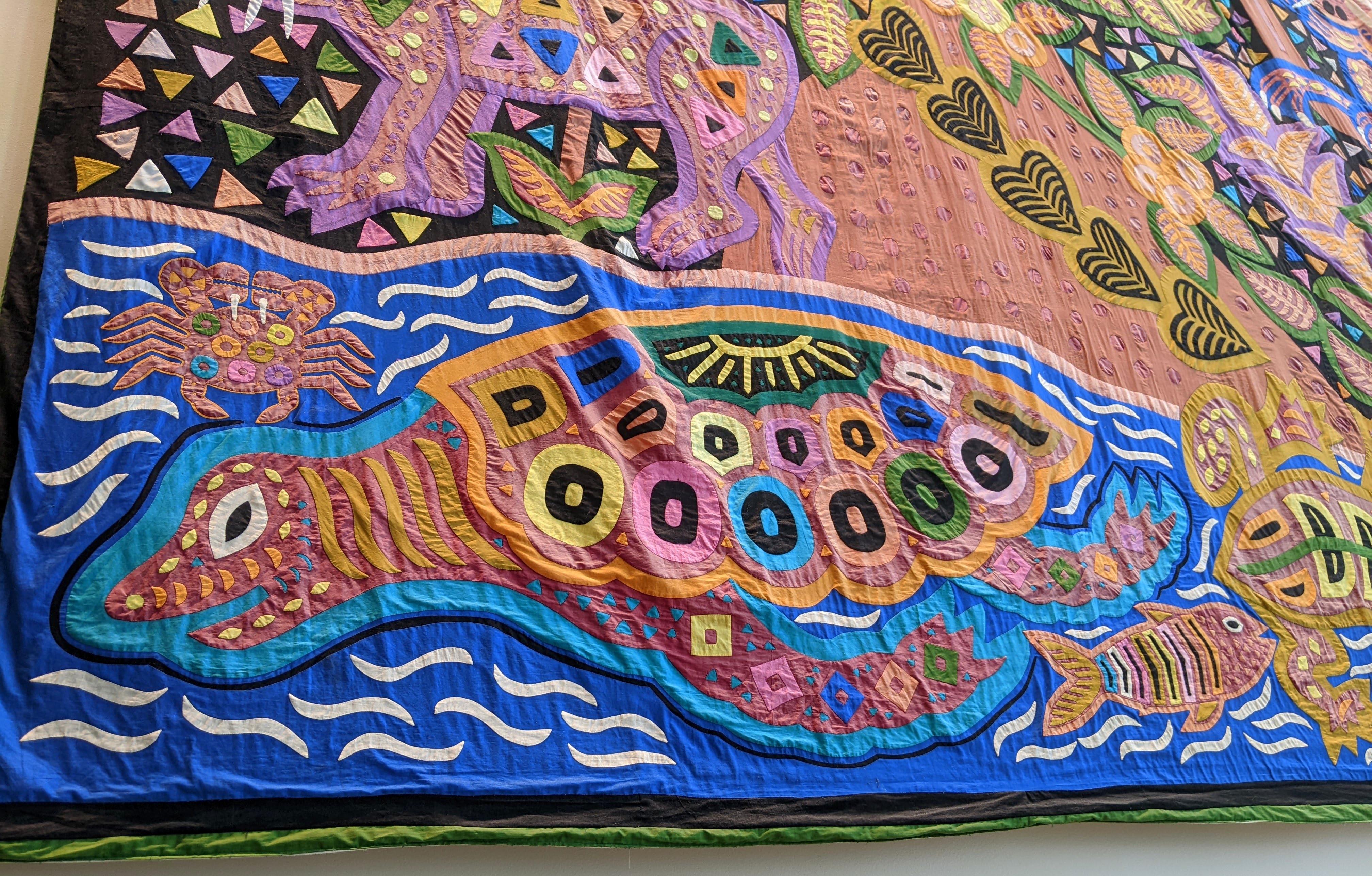
Mola Tapestry by the Kuna people, 1993. Reverse appliqué tapestry, 190 × 284 in. General Assembly Building, United Nations Headquarters, New York. Gift from Panama. Photo: Victoria Emily Jones. [object record]

Molas are made using a reverse appliqué technique, in which several layers of multicolored cloth are sewn together and then parts of each layer are cut out to form the design. These textile panels are traditionally made on a smaller scale and sewn onto women’s blouses, but as outside interest in them grew, local artisans started making some to be displayed as wall hangings.

This one shows a colorful array of indigenous flora and fauna, including a toucan, owl, hummingbird, monkey, turtle, frog, squirrel, rabbit, deer, and wildcat.

On the opposite wall is a nearly thirty-foot-long painting titled La Fraternidad (Brotherhood) by Mexican artist Rufino Tamayo [previously], which shows a group of people gathered around a fire with interlaced arms. The fire may represent enlightenment, knowledge and power, or the Divine Presence.

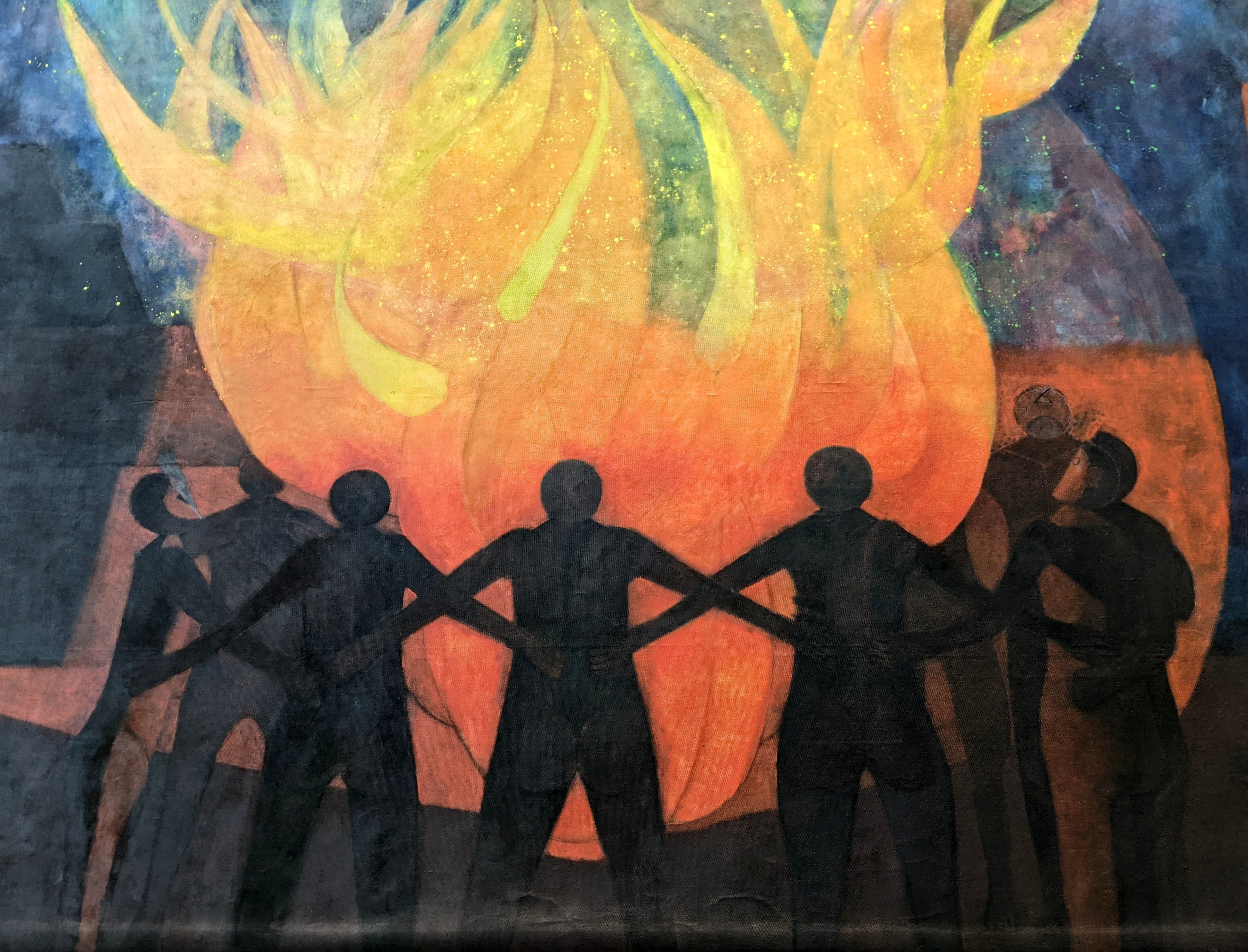
Rufino Tamayo (Mexican, 1899–1991), La Fraternidad (Brotherhood), 1968. Oil on canvas, 160 × 358 in. General Assembly Building, United Nations Headquarters, New York. Gift from Mexico, 1971. Photo: Victoria Emily Jones. [object record]

Tamayo, Rufino_La Fraternidad

At the left is an ancient Aztec or Mayan pyramid, whereas the structure at the right is modern. Tamayo said this shows the span of time, from the ancient era into the present and future.

From 2009 to 2014 the painting was on display at the Mexican state legislature, after which it was restored and returned to the UN.

Situated in front is a replica of an ancient Greek sculpture depicting Poseidon of Artemision, god of the sea, in an active stance. His right hand would have originally wielded a trident, representing his power. At first I thought it an odd choice for the UN to display an apparently militant figure, as Poseidon used his trident as a weapon to fight Trojans, Titans, and others, and indeed here he seems poised to deliver a death blow. But after some rudimentary research, I found that Poseidon also created life-giving springs with the strike of his trident (think Moses striking the rock with his staff), and used it to calm turbulent waters. These ameliorating acts align with the UN’s mission and make the Poseidon sculpture a fitting addition to their collection.  

Also in the lobby is a wool tapestry from Latvia. Titled Hope, it’s by the well-known Latvian textile artist Edīte Pauls-Vīgnere.

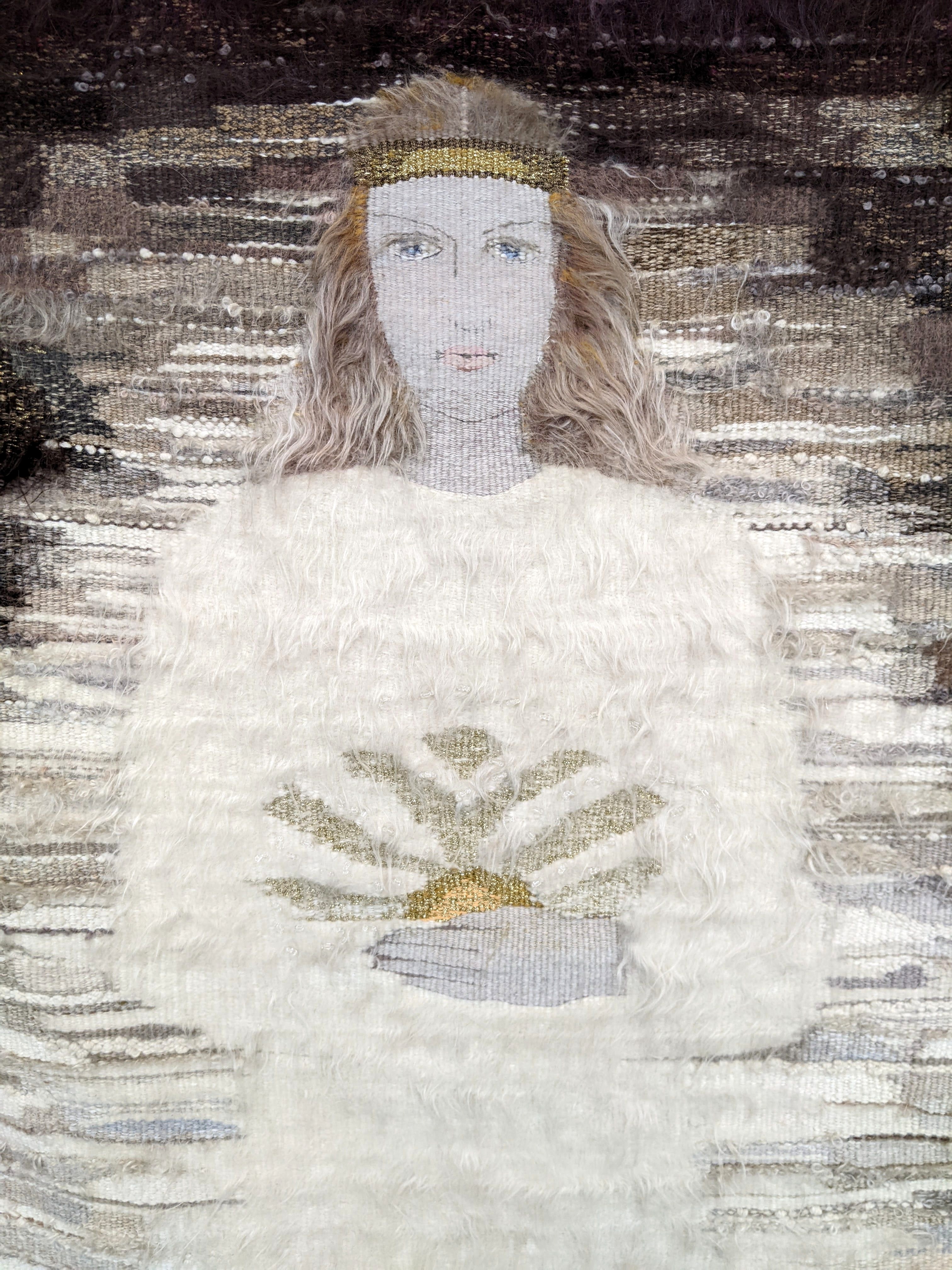
Pauls-Vīgnere, Edīte_Hope
Edīte Pauls-Vīgnere (Latvian, 1939–), Hope, 1994. Tapestry, 126 × 114 in. General Assembly Building, United Nations Headquarters, New York. Gift from Latvia. Photo: Victoria Emily Jones. [object record]

Pauls-Vīgnere, Edīte__Hope (detail)

The female figure in the foreground is, I’m assuming, a personification of hope, dressed in a white gown and golden headband and holding the sun. She stands in front of the Freedom Monument in Riga, which shows Lady Liberty holding three gilded stars, symbolizing the three constitutional districts of Latvia.


Deeper inside the lobby was a temporary exhibition, Interwoven: Refugee Murals Across Borders, organized jointly by UNHCR (the UN Refugee Agency) and Artolution. It opened on June 20, World Refugee Day, and will continue through July 19. The exhibition presents paintings by refugees and host communities in refugee camps, conflict zones, and crisis-affected communities across the world. These were created through a collaborative process in which the work circulated to different locations, with artists contributing additions at each stop. The end results show interwoven narratives of the diverse peoples forced to flee their homes. Themes include joy, lament, labor, empowerment, identity, and home.

Made by about a dozen refugee girls and women from four countries, Fabric of Women’s Resilience began in Uganda with a small group of South Sudanese, who prepared the traditional bark cloth from the bark of a mutuba tree. This substrate then traveled to Bangladesh, where Rohingya women painted a pregnant woman lying on a bed while a female doctor presses a stethoscope to her belly, and on the left, a mother bathing her child. The artists said they wanted to encourage mothers to seek access to prenatal healthcare and to practice good hygiene with their babies.
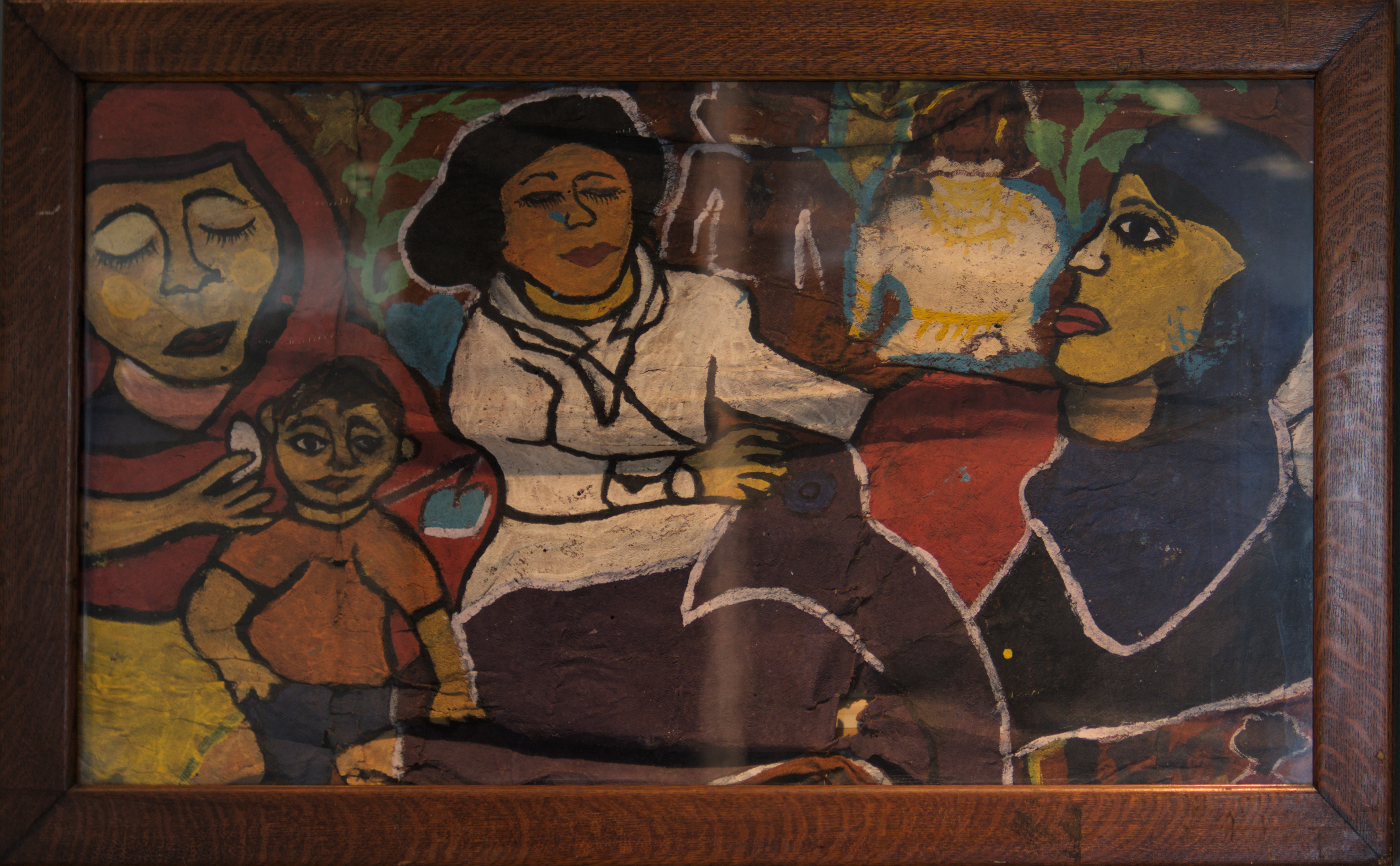
Fabric of Women's Resilience
Fabric of Women’s Resilience, a collaborative painting by approx. twelve Rohingya, Syrian, Afghan, and South Sudanese refugee women, 2018. Acrylic on bark cloth, 24 × 60 in. Photo: Victoria Emily Jones.

In Greece, the bark cloth traveled to Samos refugee camp, where one young Afghan woman, with the help of others, painted one of her traumatic childhood experiences: being married off at age twelve to an older man. This scene at the top is a bit crumpled in the frame, so it’s difficult to see, but the child bride is crying, and the man has a white beard.

The painting also went to Azraq refugee camp in Jordan, where Syrian women added a woman carrying a baby on her back while reading a book to show that women can be mothers and pursue an education. (This scene was at the extreme right but must have come off; view the full original painting on the exhibition webpage, fourth image down.) It ended its journey with a return to Uganda, where the South Sudanese women filled in the remaining spaces with plants, fish, and fruits.

Other artworks include The Creature of Home and Play in the Midst of Chaos, painted on food distribution bags and as a collaboration between South Sudanese and Rohingya refugees, both children and adults.

The Creature of Home, which traveled to BidiBidi Refugee Settlement in Uganda and Balukhali Refugee Camp in Bangladesh, depicts chickens, a soccer field, memories of home, and tools needed to take care of the land.
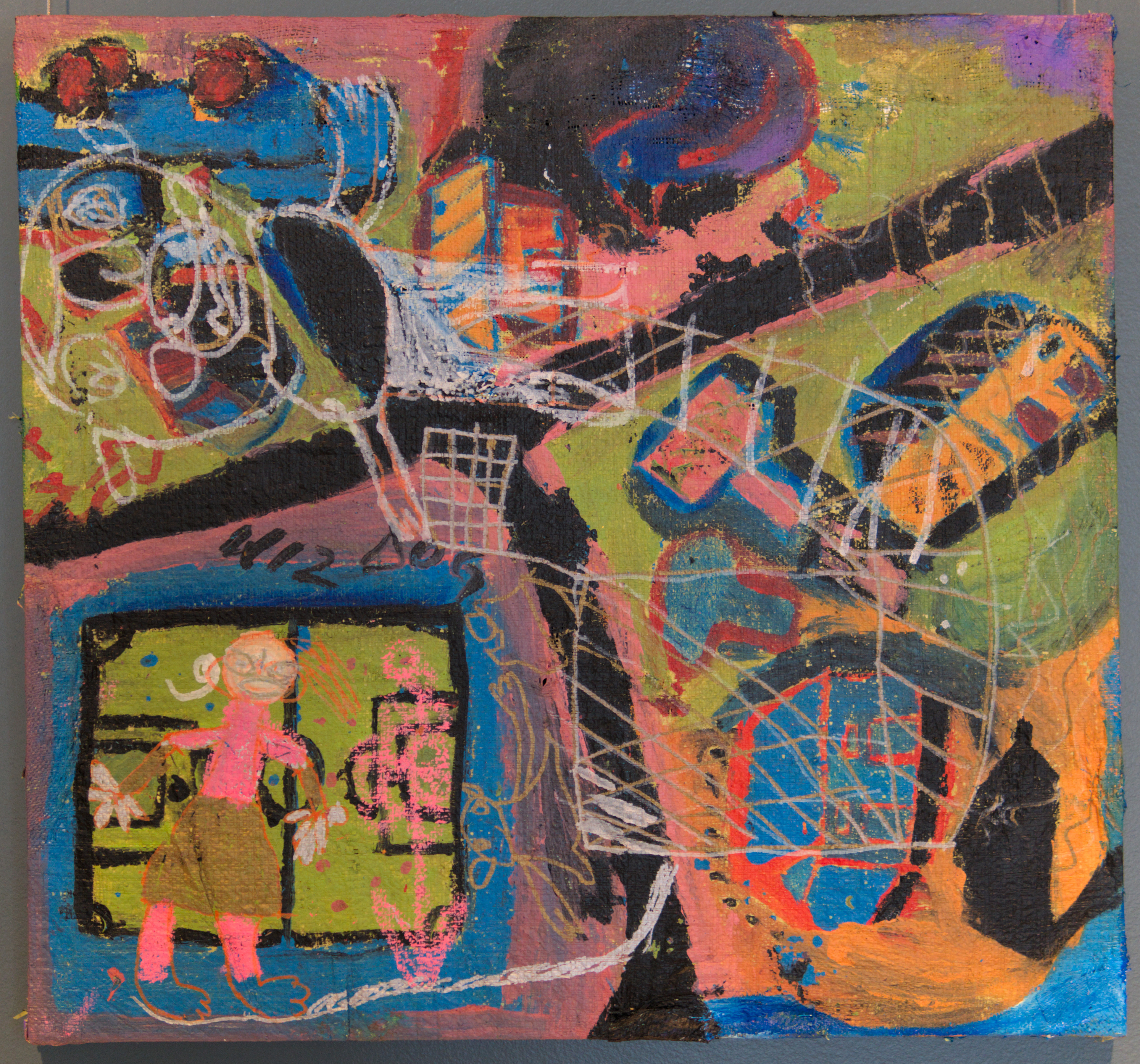
The Creature of Home
The Creature of Home, a collaborative painting by South Sudanese refugees at BidiBidi Refugee Settlement, Uganda, and Rohingya refugees at Balukhali Refugee Camp, Bangladesh. Photo: Victoria Emily Jones.

Play in the Midst of Chaos, which traveled to BidiBidi Refugee Settlement in Uganda and Bhasan Char Island in Bangladesh, captures a sense of joy with its vivid colors and depiction of sports. It also highlights the importance of planting trees and taking climate action.
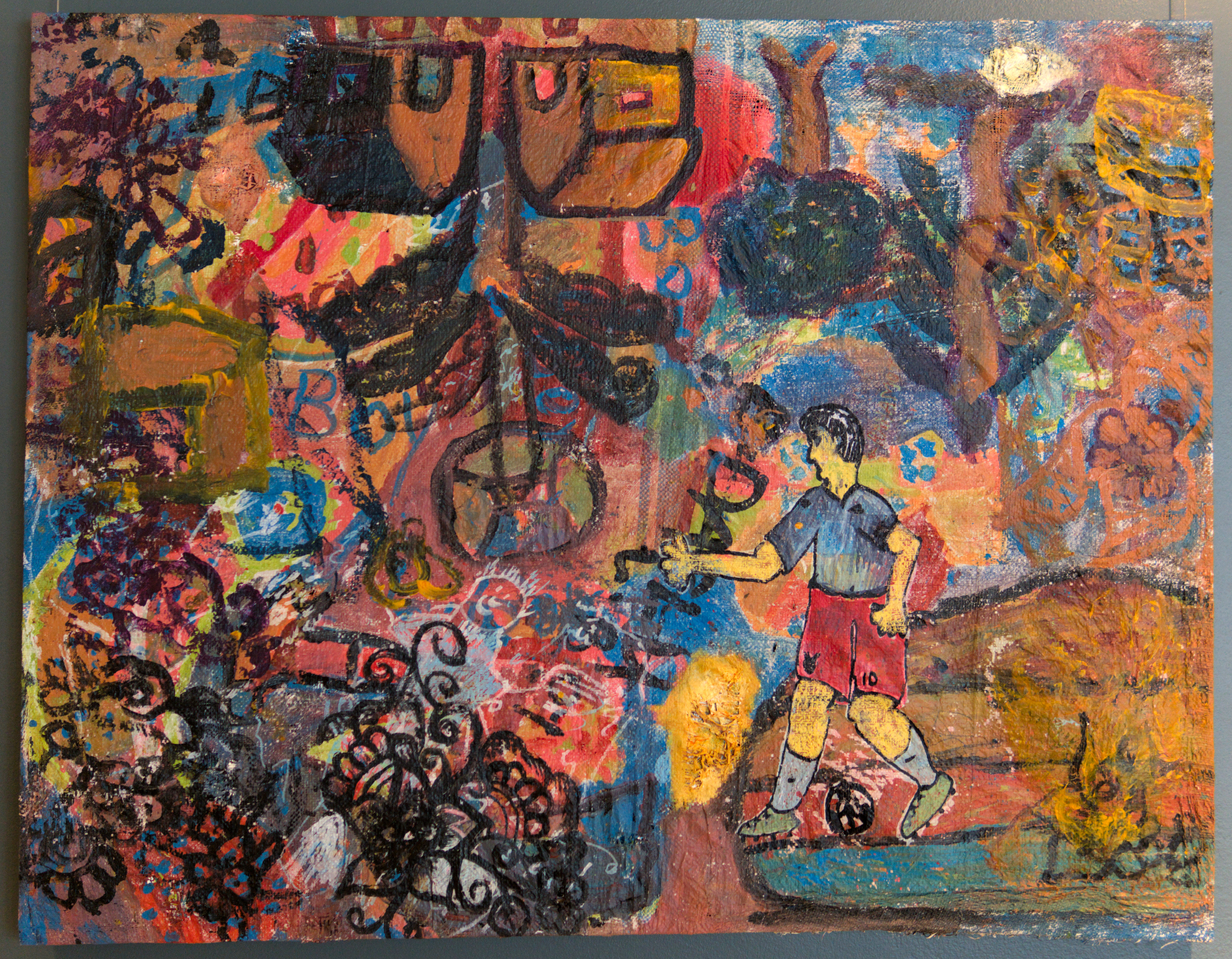
Play in the Midst of Chaos
Play in the Midst of Chaos, a collaborative painting by South Sudanese refugees at BidiBidi Refugee Settlement, Uganda, and Rohingya refugees at Bhasan Char Island, Bangladesh. Photo: Victoria Emily Jones.

Seeing the Interwoven exhibition sent me down an internet rabbit trail of learning more about the co-organizer, Artolution, and the work they’re doing, which then impelled me to learn more about the refugee communities in which they’re active. Follow them on Instagram, Facebook, or Twitter. I also commend to you the Founder Spirit podcast interview with Artolution cofounder and public artist, educator, and humanitarian Max Frieder.


All the above artworks can be seen for free without an appointment. (However, note that the temporary exhibitions change throughout the year.) But to access the sculptures in the garden, which is kept locked, your only option is to pay $26 for the guided, forty-five-minute Garden Tour.

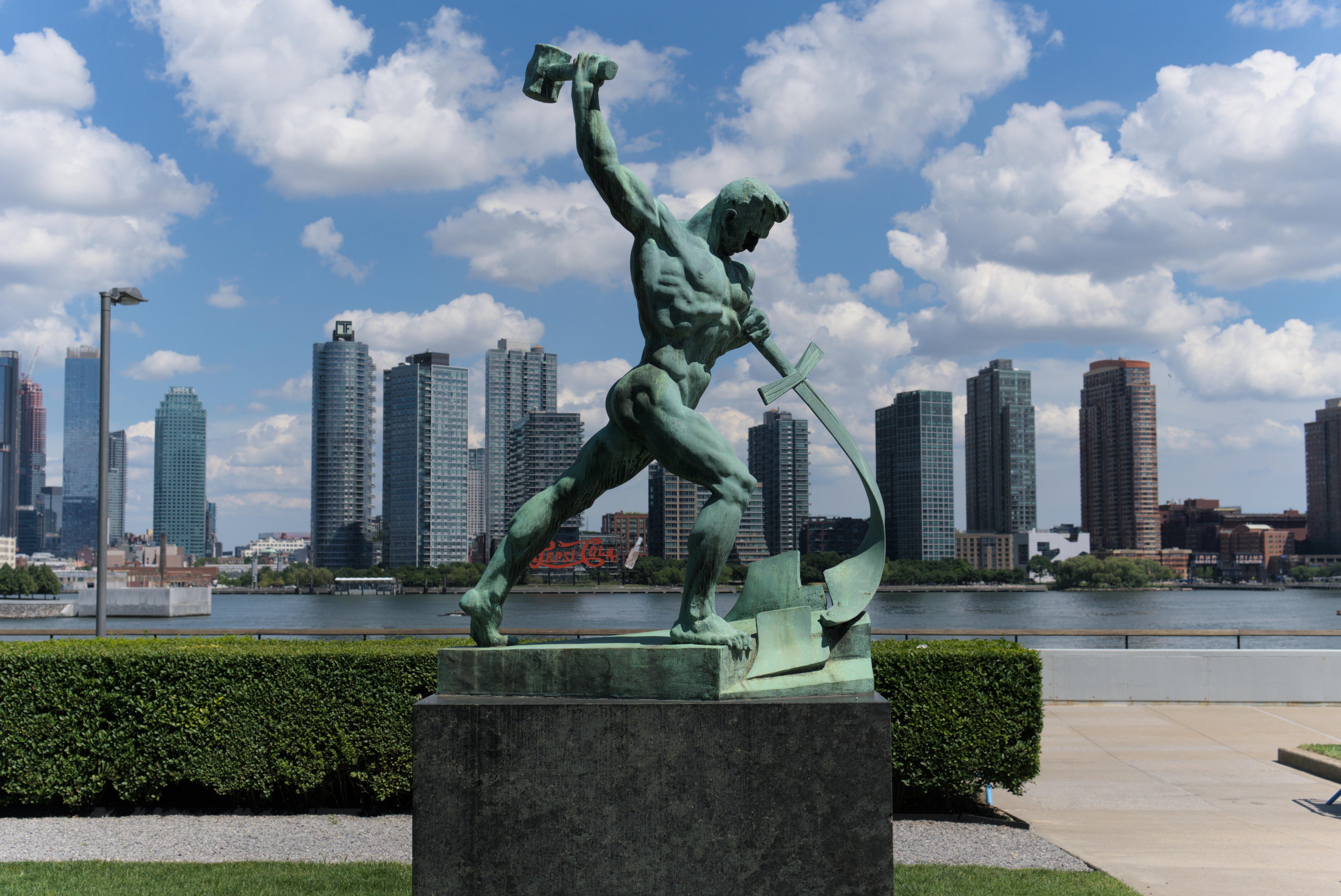
I had seen photos of the biblically inspired Let Us Beat Swords into Ploughshares and wanted to see it in person, so I paid up. It’s vaguely visible from the vantage of the free-access plaza outside the main entrance of the General Assembly Building.
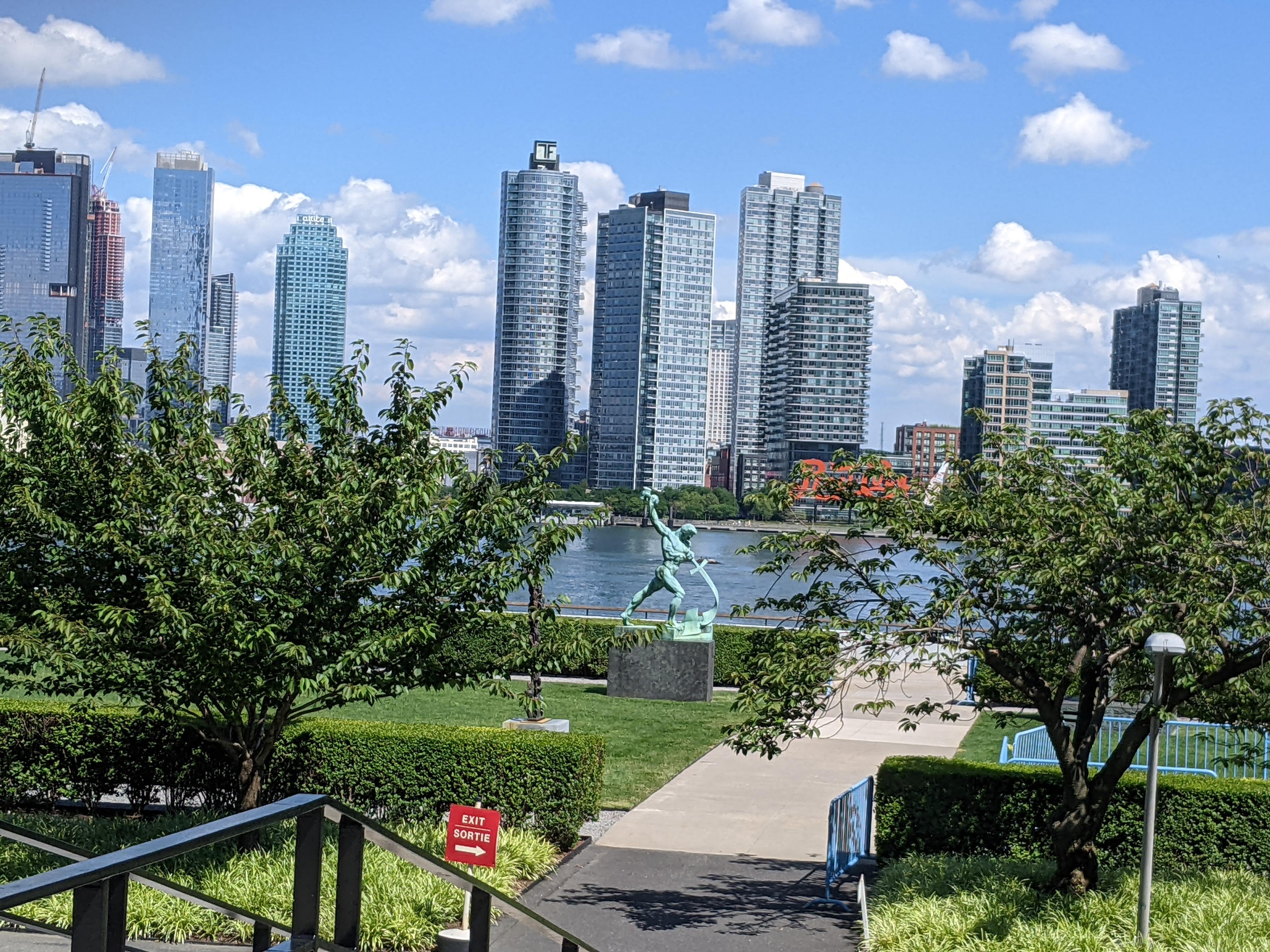
Swords into Plowshares

But let’s move in closer.

Vuchetich, Yevgeny_Let Us Beat Swords into Ploughshares
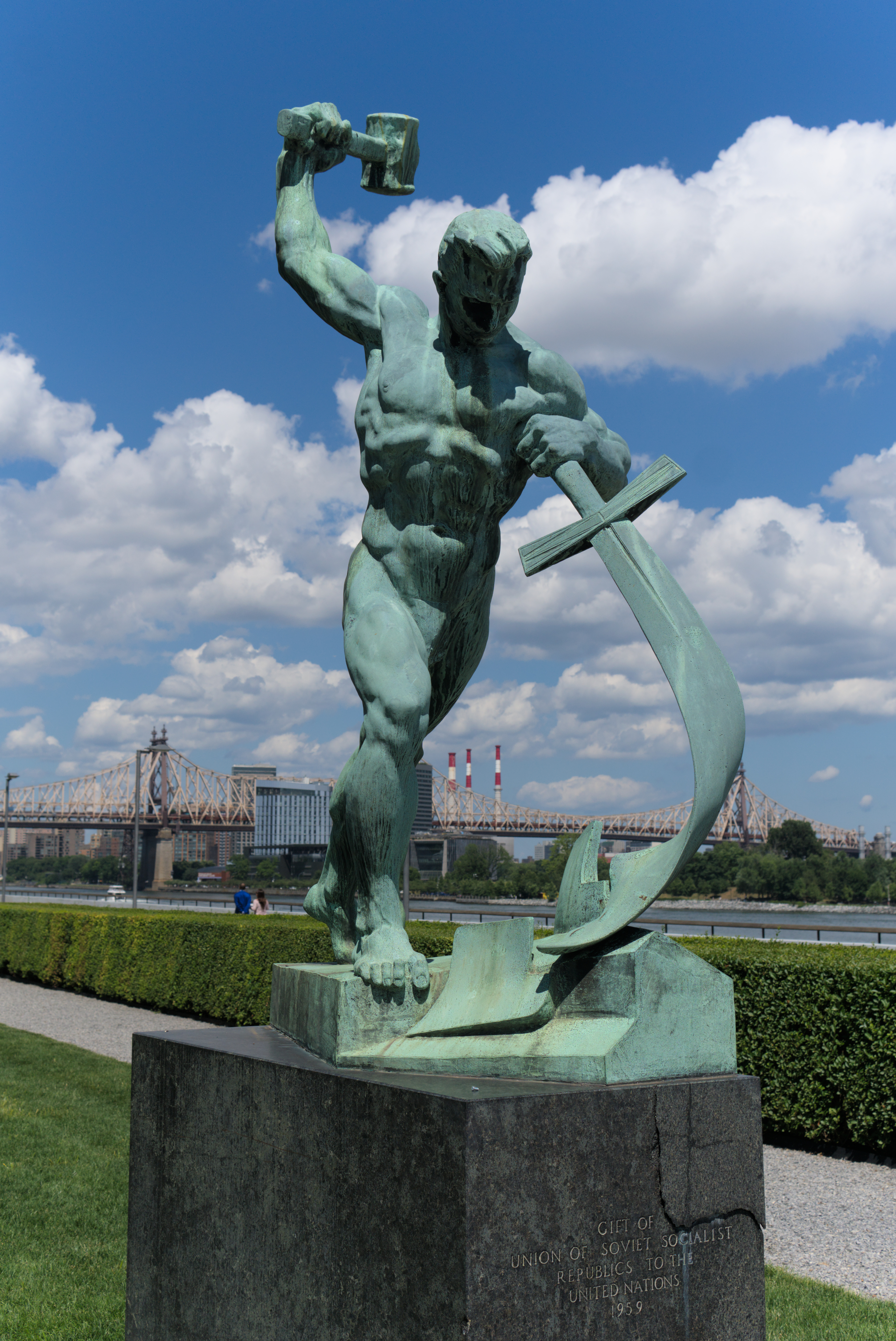
Yevgeny Vuchetich (Russian, 1908–1974), Let Us Beat Swords into Ploughshares, 1959. Cast bronze and granite pedestal, figure 111 × 76 × 35 in., pedestal 44 × 75 × 34 in. North Lawn, United Nations Headquarters, New York. Gift from the USSR. Photo: Victoria Emily Jones. [object record]

Swords into Plowshares

Gifted to the United Nations by the USSR in 1959, the bronze sculpture is by the Soviet artist Yevgeny (sometimes spelled “Evgeniy”) Vuchetich, who was of Russian, French, and Serbian heritage and lived most of his life in Russia. It shows a muscular man (modeled by Olympic wrestler Boris Gurevich) hammering a sword into a plow blade, used to cut furrows for planting crops. Representing the transformation of tools of death into tools of life, the imagery is taken from Isaiah 2:4 in the Hebrew Bible, in which the prophet proclaims that “in days to come,” people of all nations “shall beat their swords into plowshares and their spears into pruning hooks; nation shall not lift up sword against nation; neither shall they learn war any more.” The vision is that in the kingdom of God, instead of the land being littered with human blood and corpses, it will be cultivated and bring forth good food.

This scripture text is the basis of the African American spiritual “Down by the Riverside” [previously], whose refrain declares, “I ain’t gonna study war no more!” One of the commonly used verses is “I’m gonna beat my sword into a plow.” Here’s Michael Wright’s version:

And, from 1959, the Golden Gate Quartet’s, arranged by Orlandus Wilson:

Reflecting the song lyrics, Vuchetich’s sculpture is itself planted “down by the riverside”—the East River.

(Related posts: “A Blessing for Those Who Hate and Hurt”; “The Christmas Truce of 1914”; Benjamin Rush’s “Plan of a Peace-Office for the United States”)

Vuchetich was one of the major figures of Soviet government–backed monumental sculpture, making his name from depictions of military heroes. So I find it a little odd that he was commissioned to make this peace sculpture that subverts the very militarism his other sculptures celebrate. One of his most famous pieces is The Motherland Calls; located at the top of Mamayev Kurgan hill overlooking the city formerly known as Stalingrad, it shows a female personification of Russia lifting high a sword in one hand and calling the Soviet people to battle with the other.

Look, many artists will take what work they can get, regardless of whether a commission matches their own ideology. I don’t claim to know what Vuchetich’s personal views were about war, violence, and empire.

Regardless of its disjunction with the artist’s larger oeuvre—and the uncomfortable fact that the donor’s successor state and caretaker of the sculpture, the Russian Federation, is persisting in an illegal and immoral war against its neighbor Ukraine—I really appreciate the theological imagination that Let Us Beat Swords into Ploughshares embodies, entreating us to apply our strength to constructive, not destructive, acts.

Nearby in the garden, not pictured in this article, is a literalization of the “swords into plowshares” principle. A recent gift from the Government of Colombia, Kusikawsay (Quechua for “peaceful and happy life”) is made of steel armaments melted and cast into the shape of a canoe, sailing upward. A donor representative said the sculpture for them symbolizes the end of an over-fifty-year armed conflict in their country. The idea is that the grotesque paraphernalia of war is metamorphosed into a benign watercraft that, in how it’s positioned, symbolizes humanity’s traveling into a lofty future.

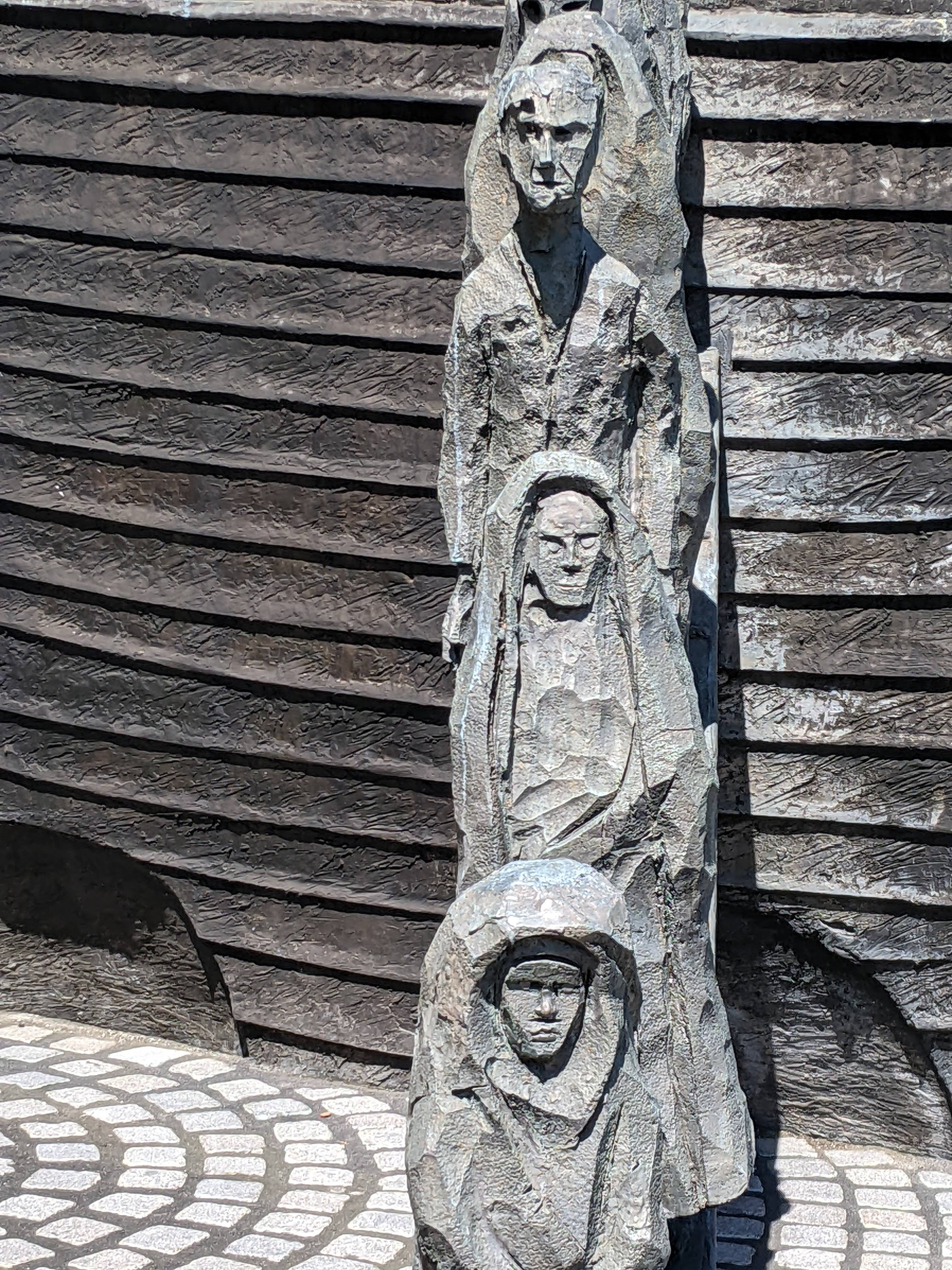
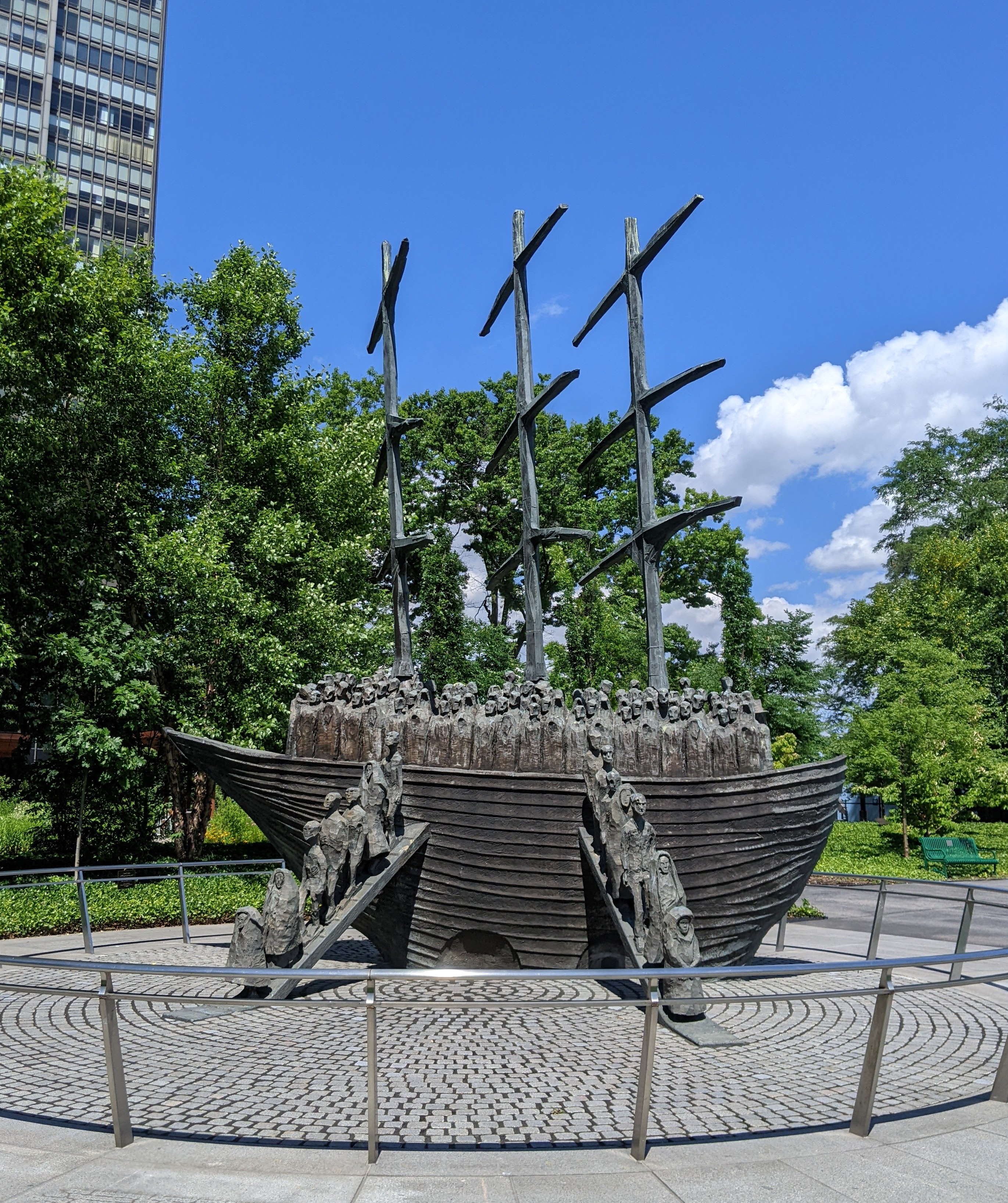
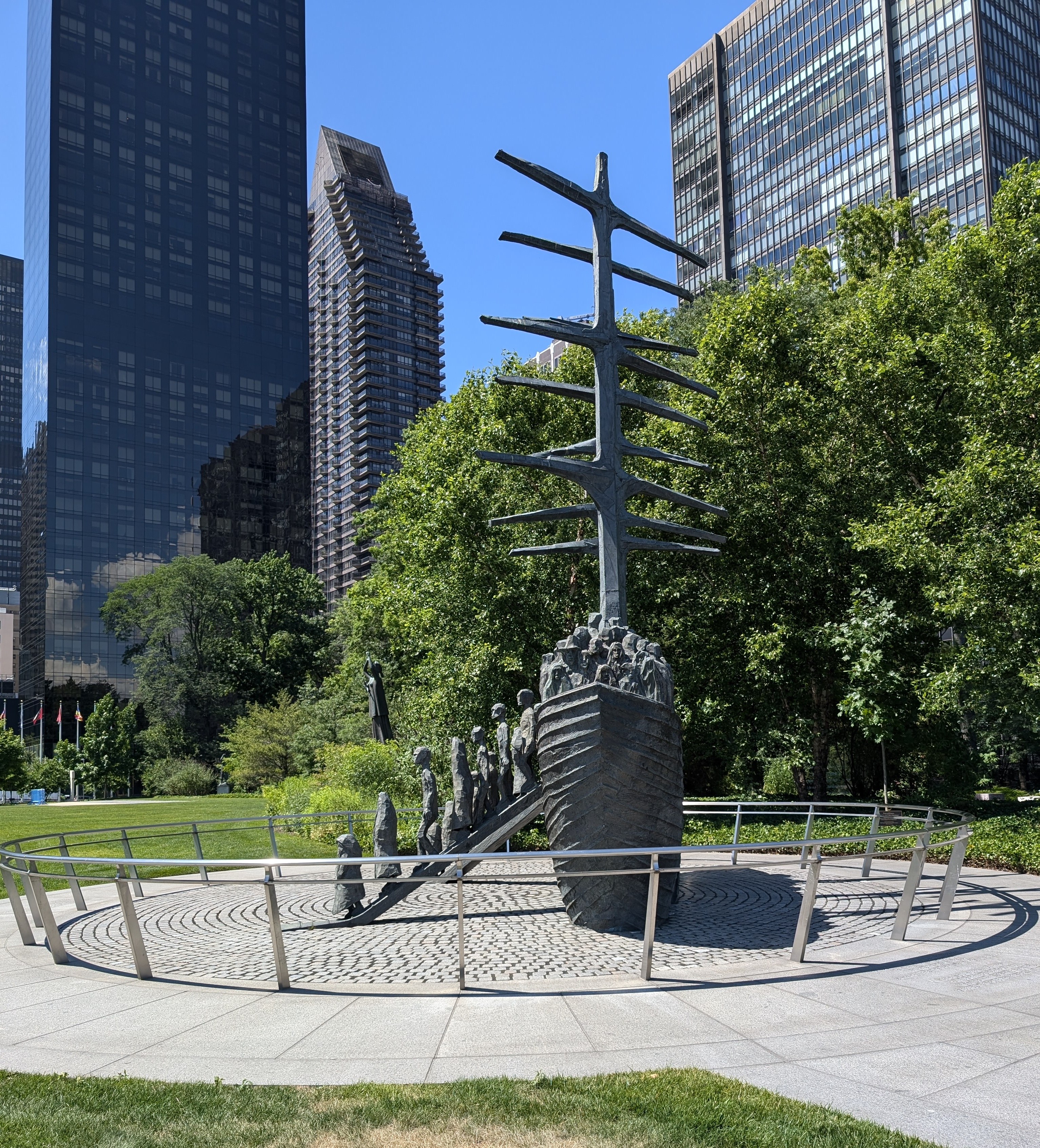
Another boat on the UNHQ’s North Lawn is Arrival by the Irish sculptor John Behan, which shows Irish immigrants disembarking into a new world. The sculpture was intended as a thank-you to the many nations that have received the Irish over the years, including Great Britain, the United States, Canada, Australia, Argentina, Chile, Mexico, New Zealand, and Brazil.
Behan, John_Arrival
John Behan (Irish, 1938–), Arrival, 2000. Bronze, stainless steel on granite pavers, 26 × 23 ft. North Lawn, United Nations Headquarters, New York. Gift from Ireland. Photo: Victoria Emily Jones. [object record]

Behan, John_Arrival

This piece wasn’t covered by the Garden Tour, nor was the colossal Mother and Child by the Italian artist Giacomo Manzù, which I spotted across the lawn and hurriedly snapped a distant photo of while scurrying to keep up with the group.
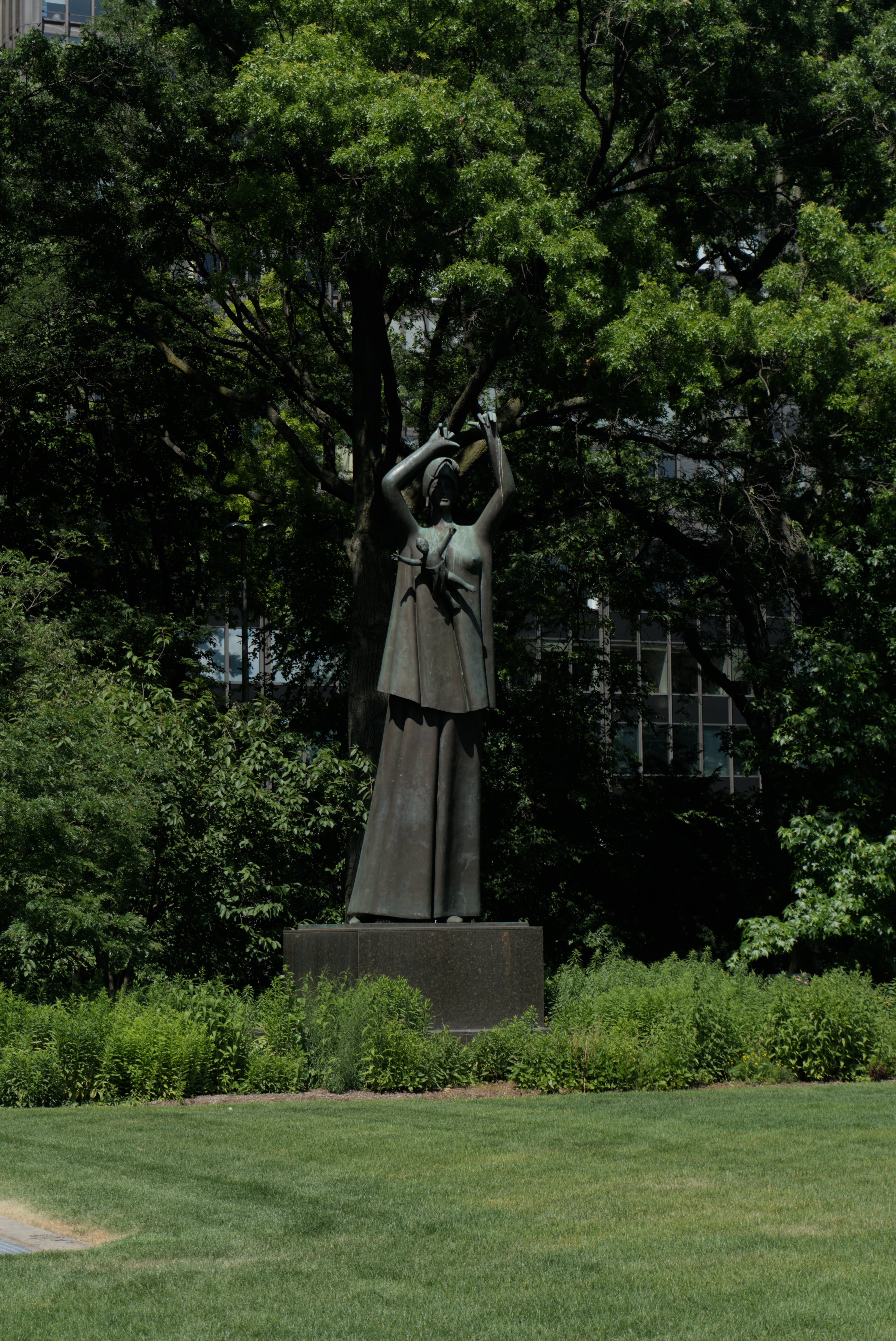
Manzù, Giacomo_Mother and Child
Giacomo Manzù (Italian, 1908–1991), Mother and Child, 1989. Bronze, 254 × 66 × 52 in. North Lawn, United Nations Headquarters, New York. Gift from Italy. Photo: Victoria Emily Jones. [object record]

One of the pieces our guide did stop for and spend a good amount of time on was a fragment of the Berlin Wall gifted by Germany in 2002, after the wall came down in 1989. The ninety-six-mile-long barrier was erected in 1961 to divide the country into East (Communist) and West (Federal Republic), but a peaceful revolution in East Germany resulted in its fall and the country’s reunification as a federal republic, marking the end of the Cold War in Europe.
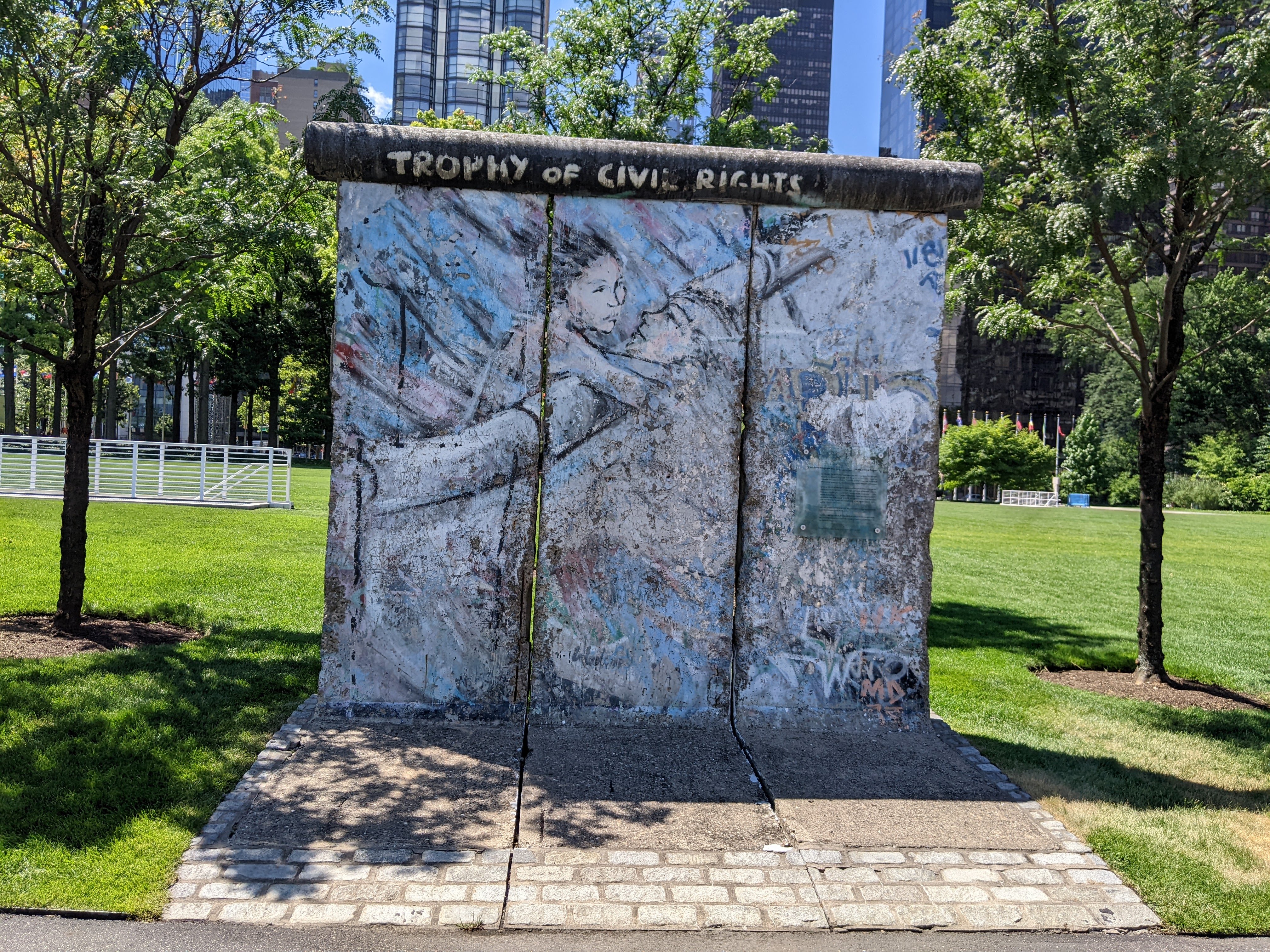
Alavi, Kani_Trophy of Civil Rights
Kani Alavi (Iranian German, 1955–), Trophy of Civil Rights (Berlin Wall Fragment), ca. 1998. Precast reinforced concrete wall sections with paint, overall 84 × 114 in. North Lawn, United Nations Headquarters, New York. Gift from Germany. Photo: Victoria Emily Jones. [object record]

The front of this three-slab wall fragment (that is, the side visible from the paved path) bears a mural by Kani Alavi, an Iranian artist who moved to West Berlin in 1980, living in an apartment overlooking the formidable “Checkpoint Charlie.” Throughout the 1980s, artists painted images on the west side of the wall as a form of political commentary and resistance. The east side, however, was unpainted during the Cold War because it was so heavily guarded; attempted art interventionists probably would have been shot.

After the border opened on November 9, 1989, and demolition of the wall began, Alavi was a key organizer of what’s known as the East Side Gallery, inviting artists from Germany and around the world to paint murals on the east side of the wall, across a segment that would be deliberately left standing as a memorial. “Alavi helped transform the most visible symbol of the Iron Curtain into an enduring monument to the power of freedom,” Ryan Prior wrote for CNN. This open-air gallery is one of Berlin’s most visited attractions, featuring the work of at least 118 artists from twenty-one countries.

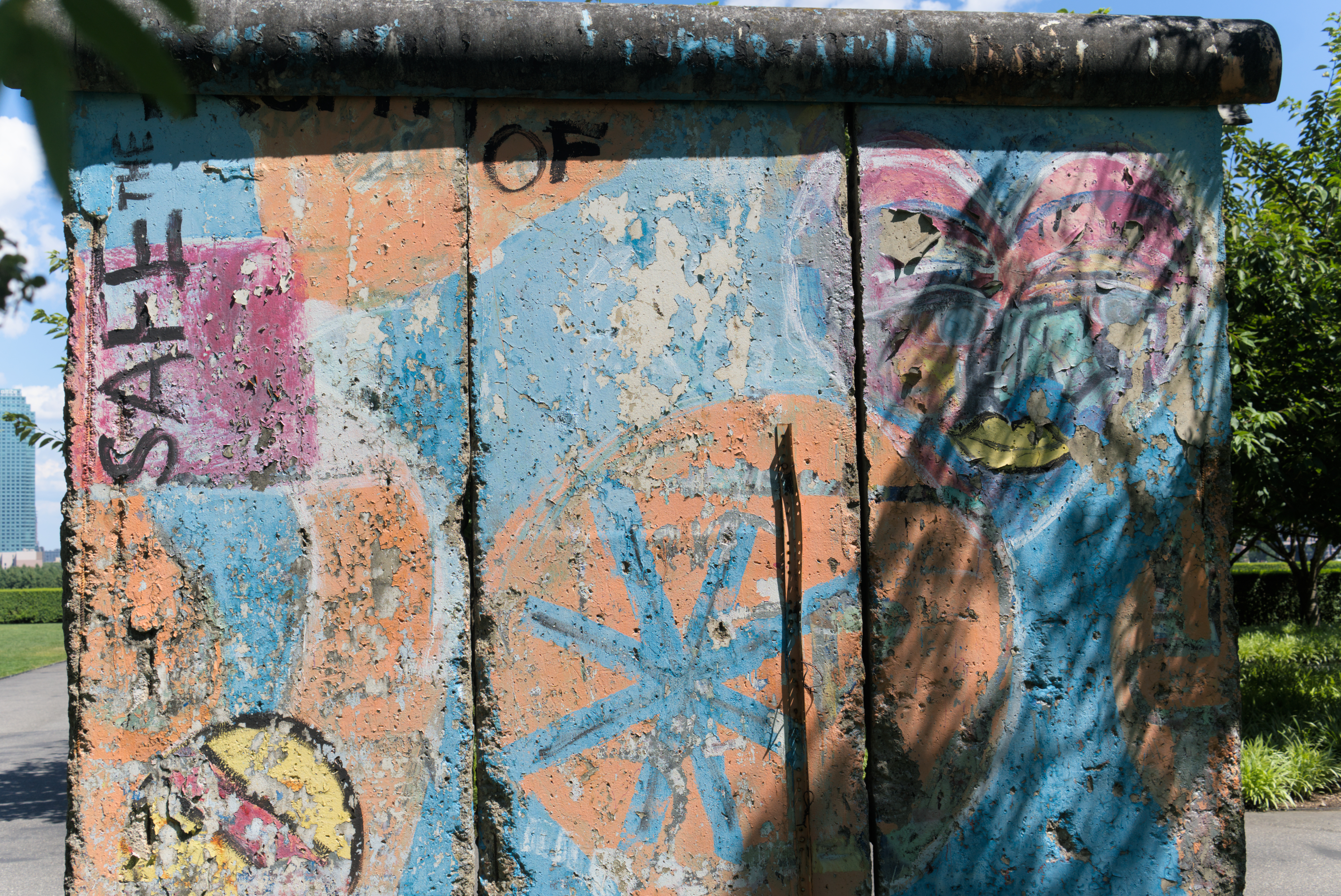
Berlin Wall (detail)

Alavi painted Trophy of Civil Rights (I’m not sure whether that inscription was his or just a remnant from another artist, but it’s become the mural’s de facto title) on a section of remaining wall sometime around 1998. “It is a representation of two people hugging over the wall, a dramatic situation of people trying to get close to each other,” he told NPR through a translator. “It shows how the people were separated. It shows how a culture was divided by a wall. That’s what happened, and that’s what I showed.”

The other side of the wall is painted with miscellaneous graffiti by anonymous artists.
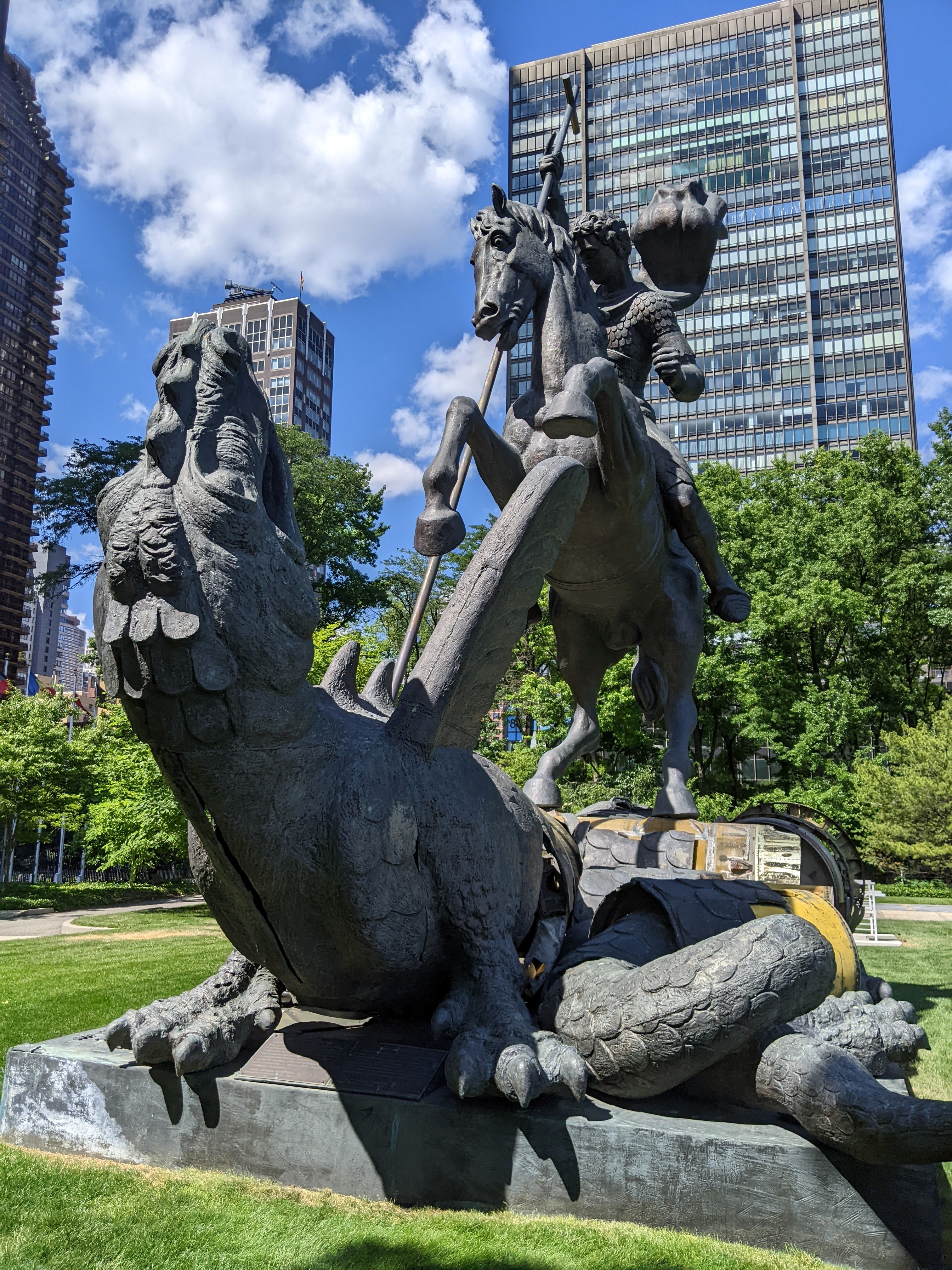
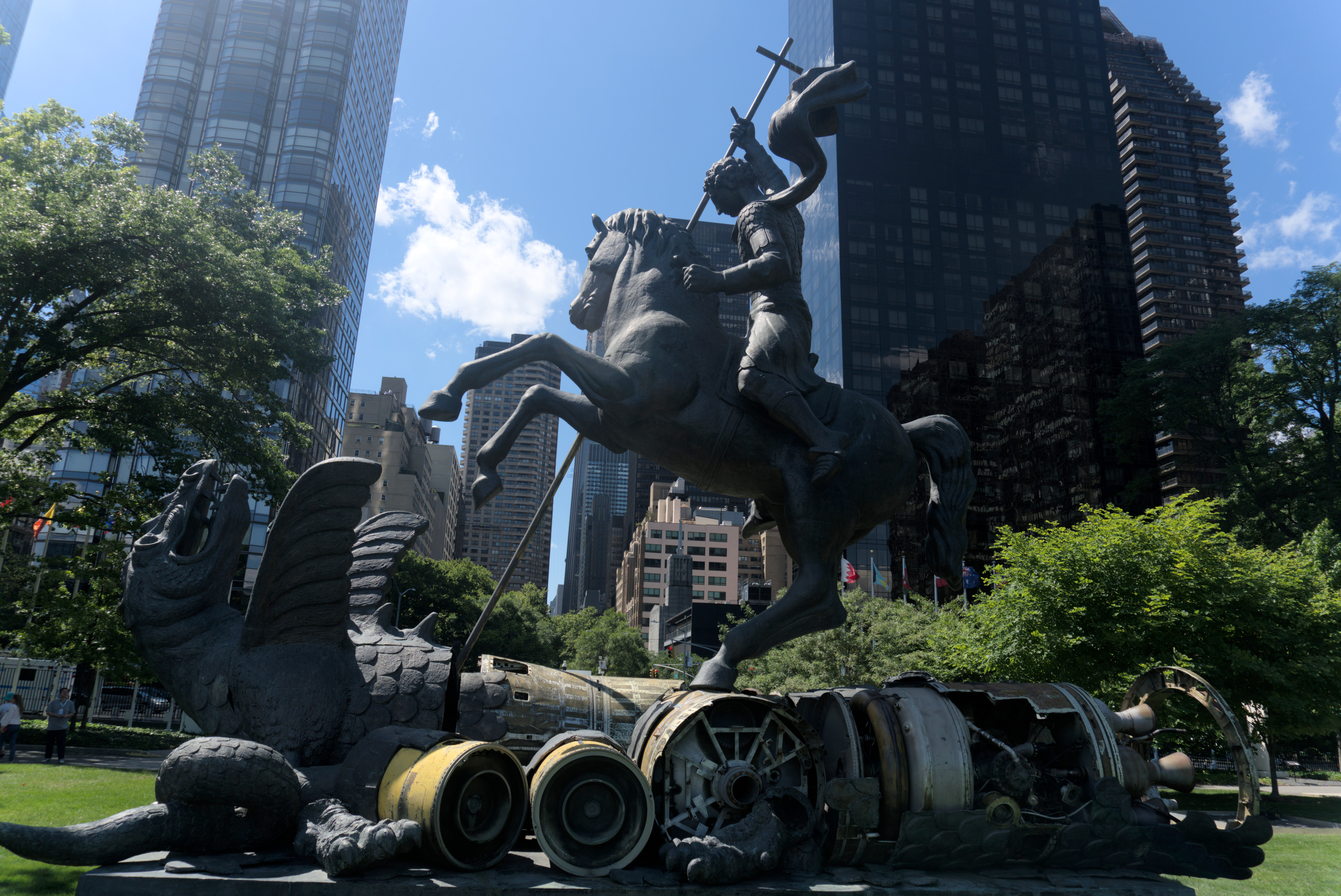
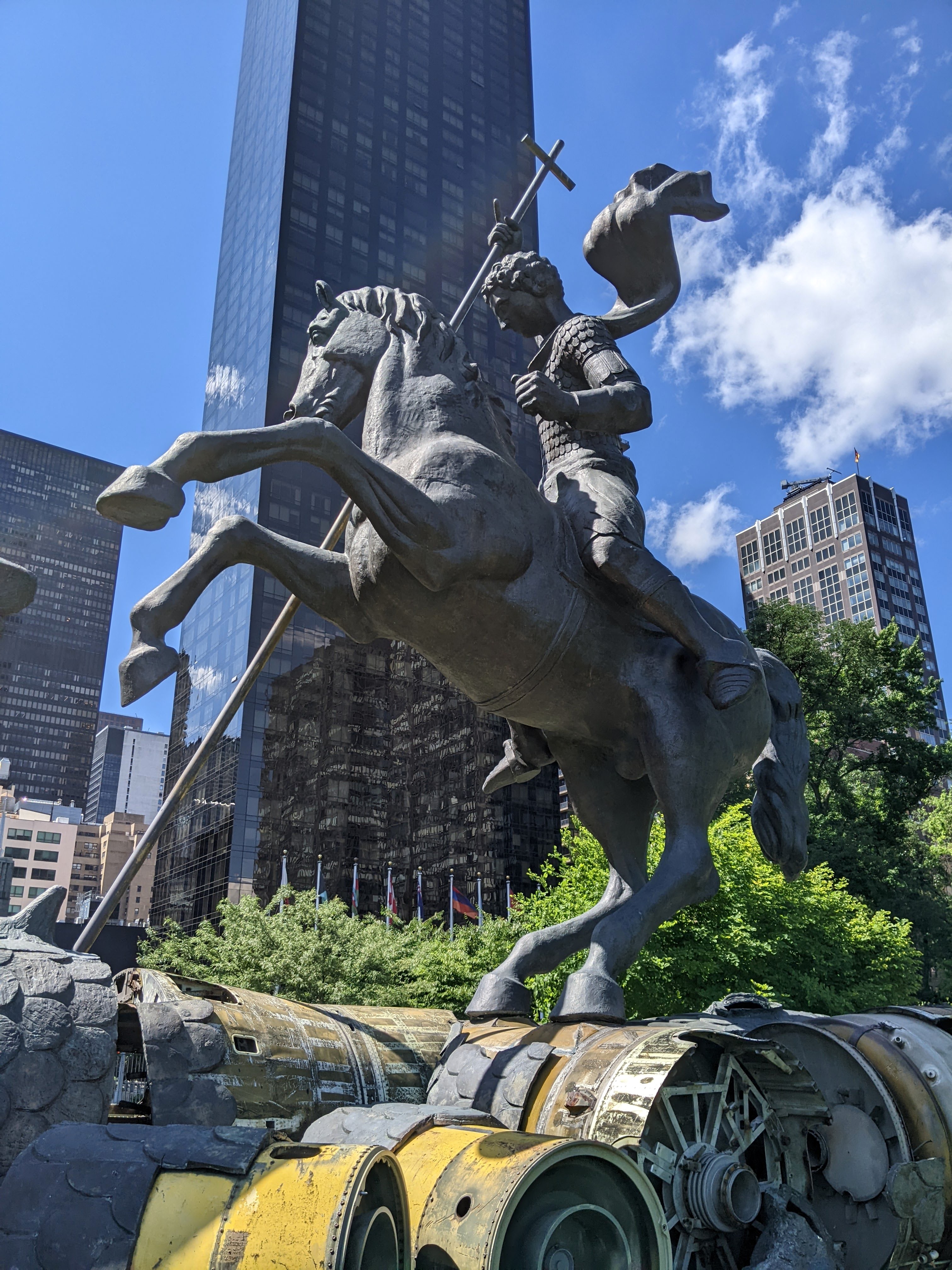
The largest sculpture on the North Lawn, standing at thirty-one feet tall and weighing forty tons, is Good Defeats Evil by the Georgian Russian sculptor Zurab Tsereteli. It depicts the Early Christian martyr-saint George, who was tortured and executed in 303 under the Diocletian persecution. Legends about him started developing in the sixth century and by the thirteenth century were widely circulated and embellished to include a tale of him slaying a dragon to save a Libyan princess whom the terrorized villagers had planned to sacrifice to it for appeasement.
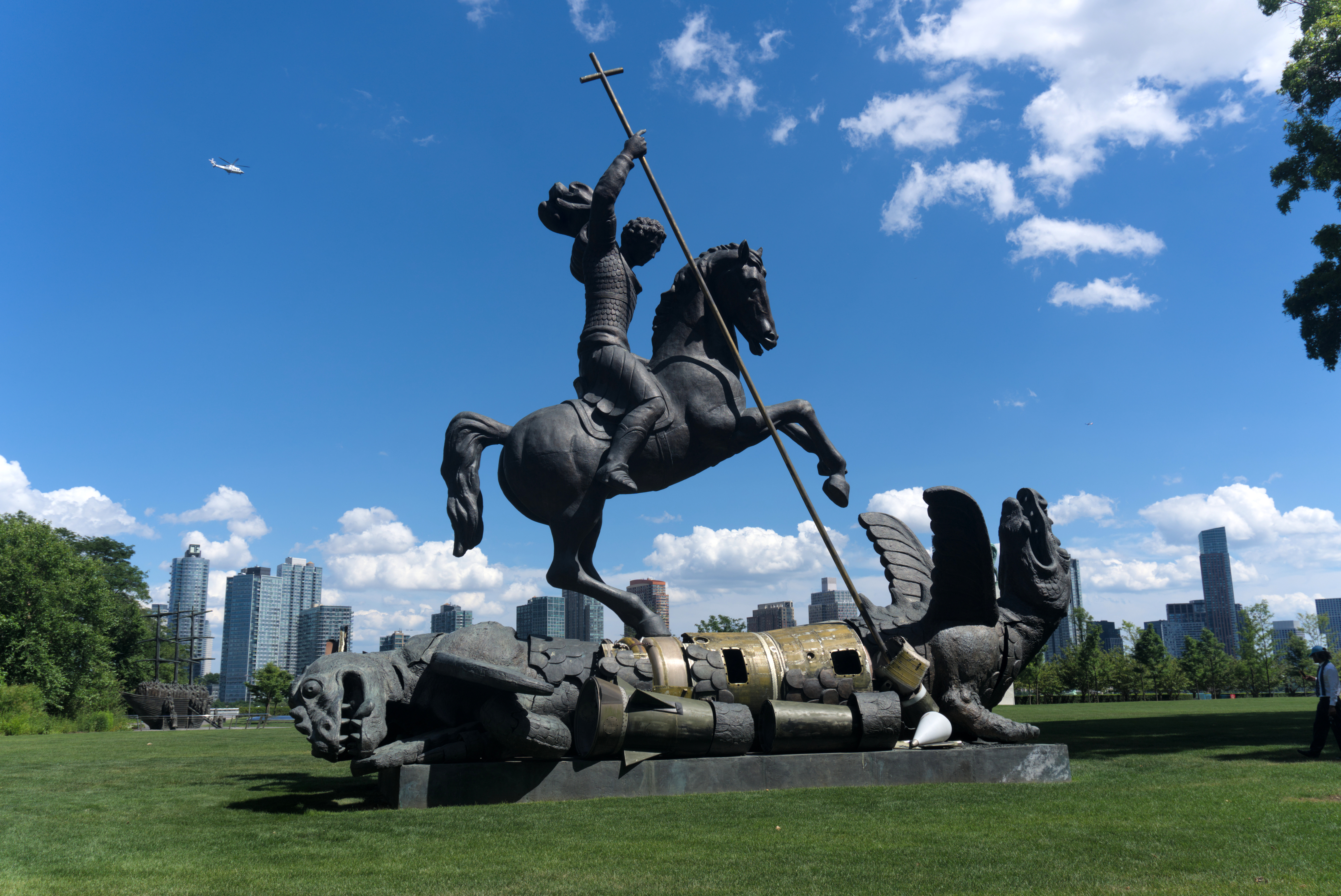
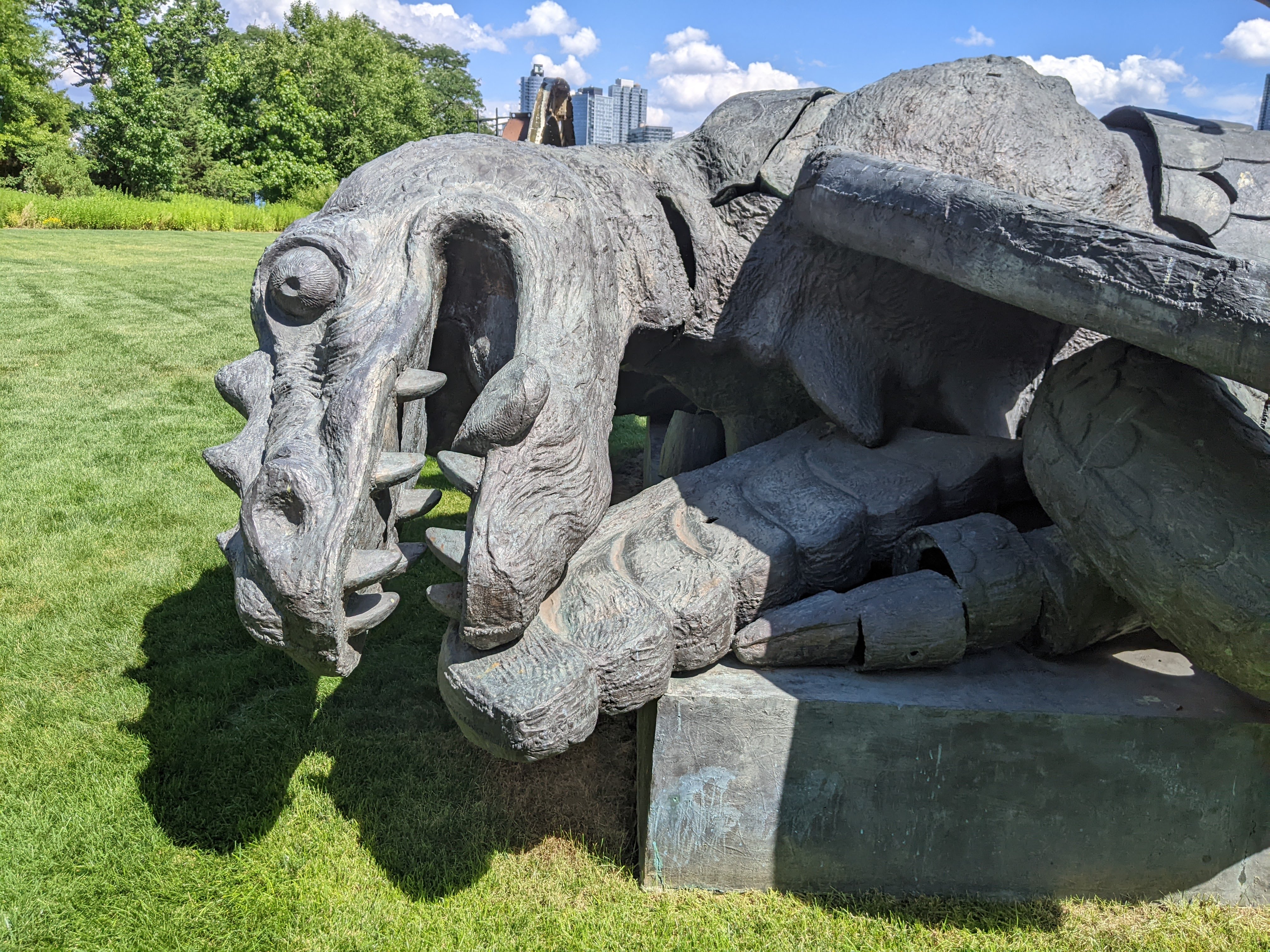
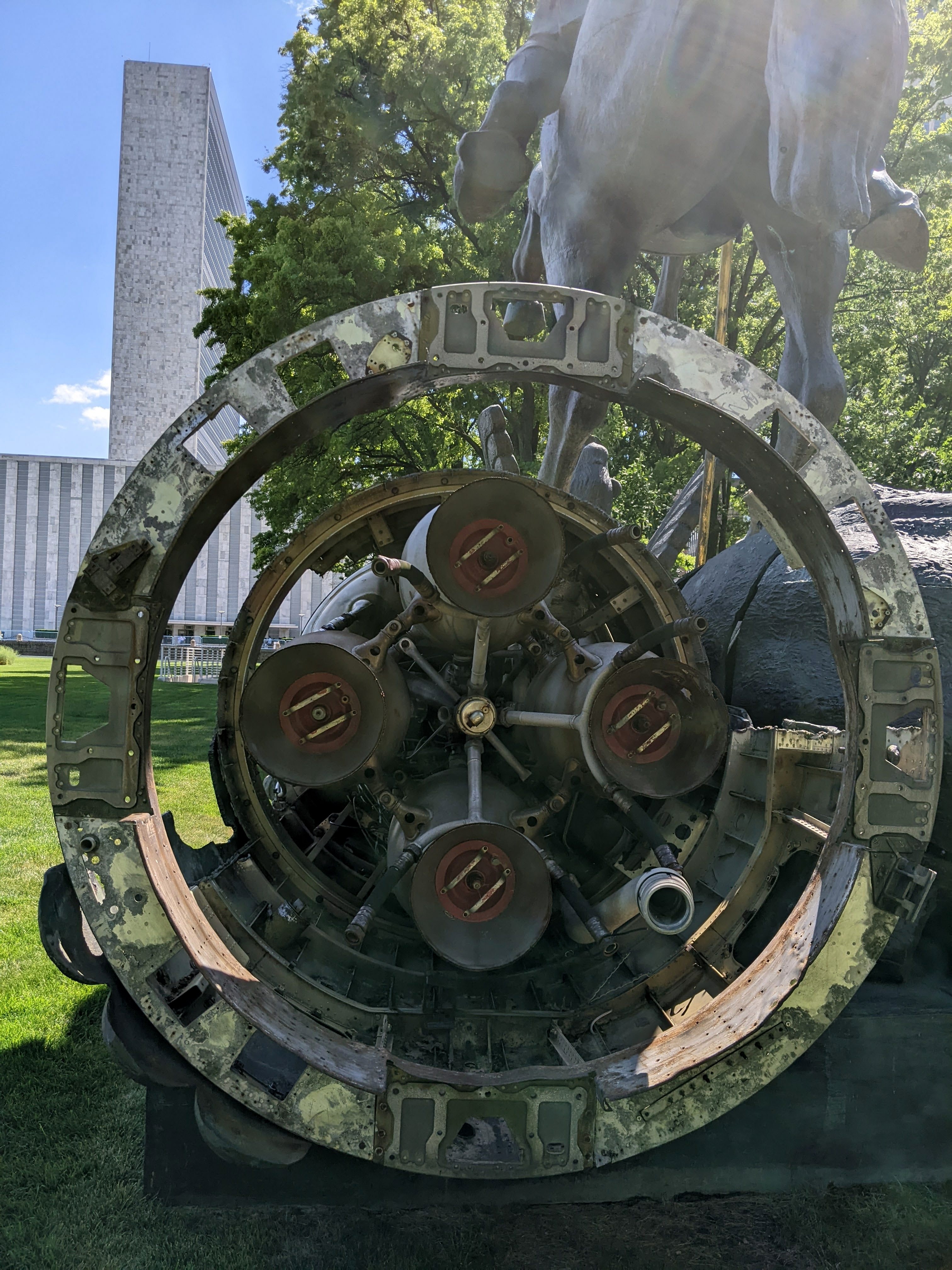
Tsereteli, Zurab_Good Defeats Evil
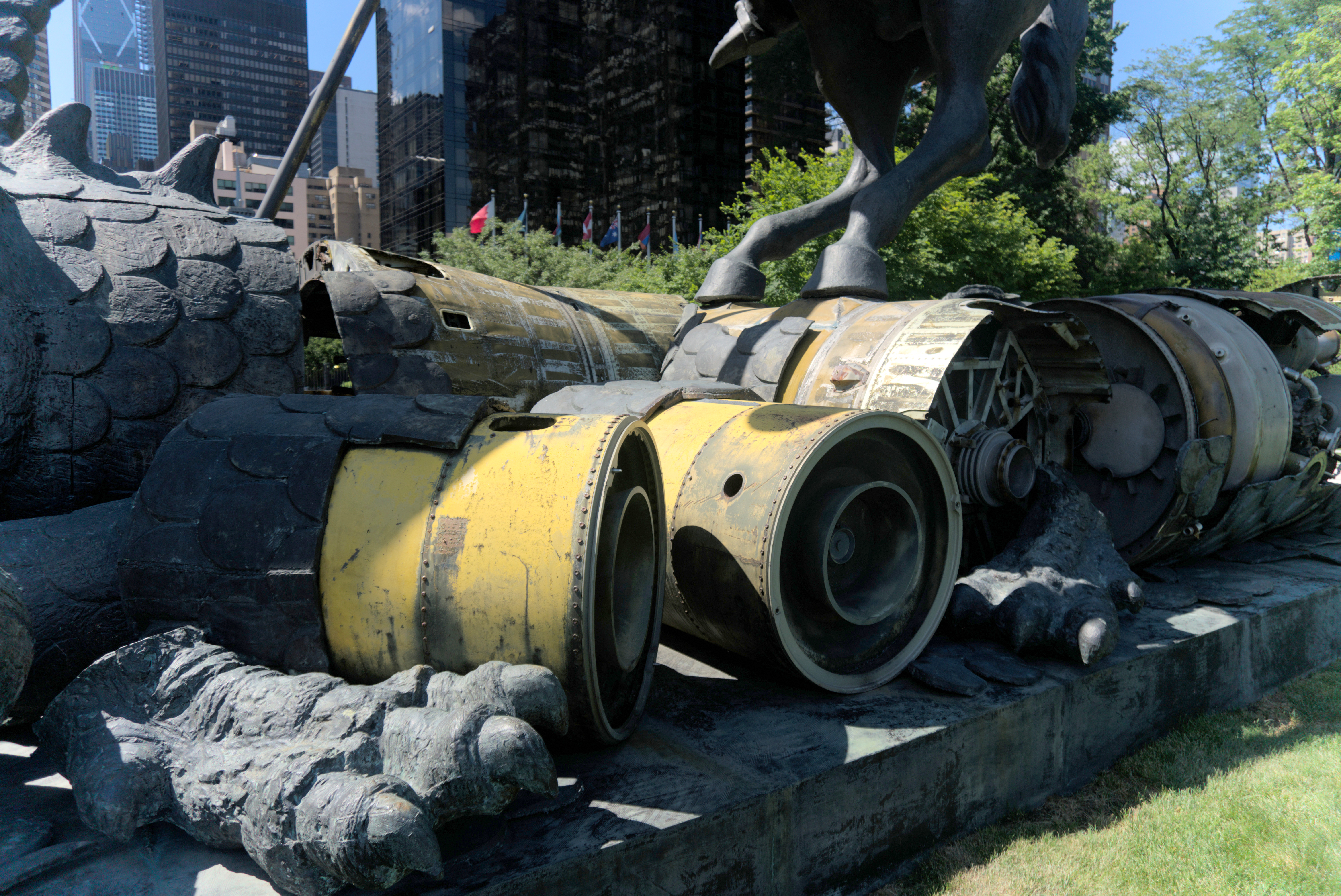
Zurab Tsereteli (Georgian Russian, 1934–), Good Defeats Evil, 1990. Cast bronze figure with dragon formed from sections of two destroyed nuclear missiles, 31 × 18 × 10 ft. North Lawn, United Nations Headquarters, New York. Gift from the USSR. Photo: Victoria Emily Jones. [object record]

Tsereteli, Zurab_Good Defeats Evil (back)
Tsereteli, Zurab_Good Defeats Evil (detail)

(Side note: Saint George is not to be confused with Saint Michael the Archangel from the book of Revelation, who in Christian iconography is usually shown on foot [but occasionally on horseback], also slaying a dragon. The easiest way to tell the two saints apart is that Michael has wings, whereas George does not.)

The most intriguing aspect of this sculpture is that the two-headed dragon is made up of sections of two destroyed nuclear missiles, making the piece a symbol of disarmament. According to the UN website, here

the dragon is not the mythological beast of early Christian tradition, but rather represents the vanquishing of nuclear war through the historic treaty between the Soviet Union and the United States [the Treaty on the Elimination of Intermediate-Range and Short-Range Nuclear Missiles, signed in 1987]. Created as a monument to peace, the sculpture is composed of parts of actual United States and Soviet missiles. Accordingly, the dragon is shown lying amid actual fragments of these weapons, the broken pieces of Soviet SS-20 and U.S. Pershing missiles.
Tsereteli, Zurab_Good Defeats Evil (detail)

The dragon’s two heads thus represent the world’s two largest nuclear arsenals during the Cold War: those of the Soviet Union and the United States.

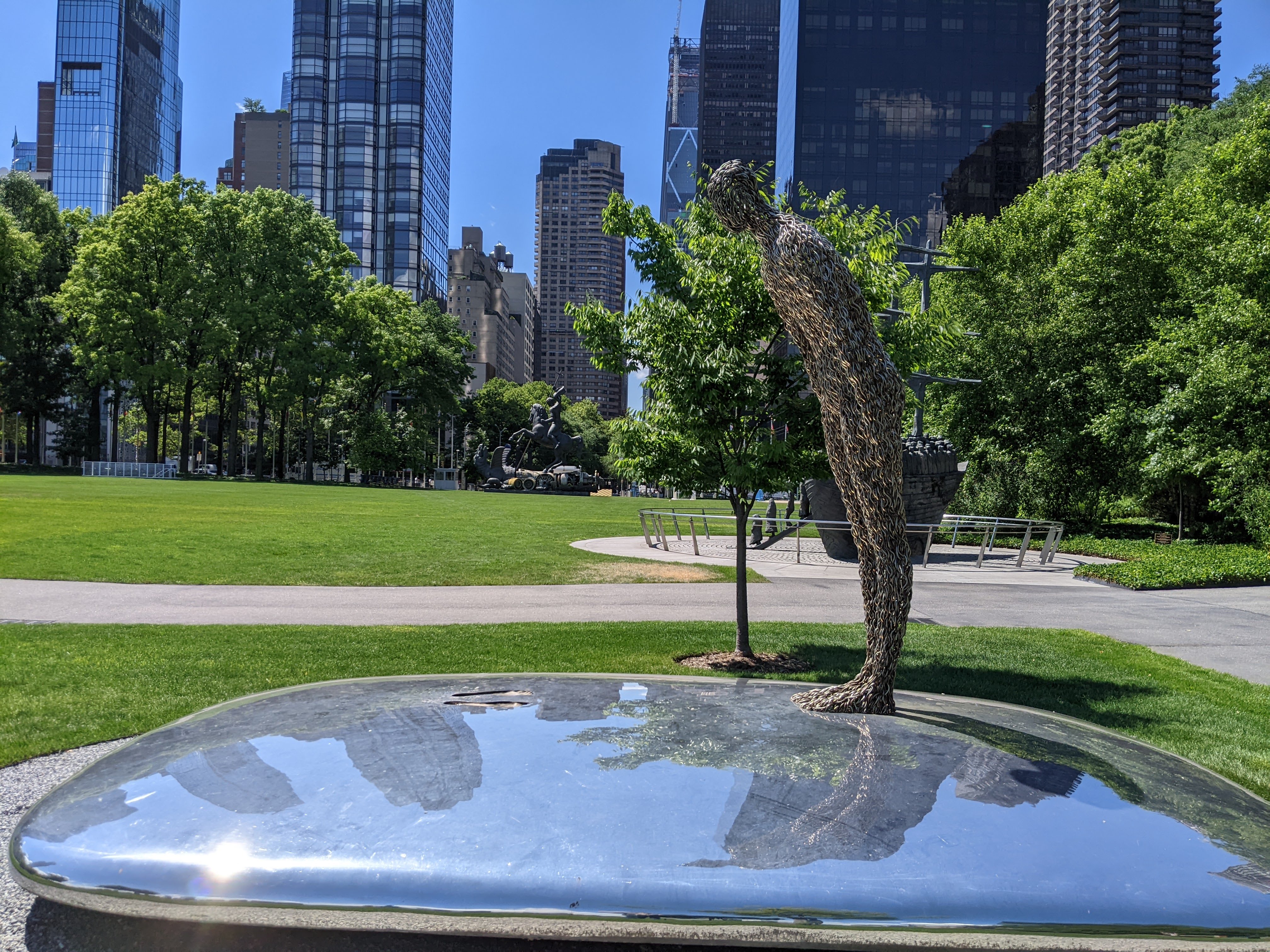
The last sculpture I’ll mention is Consciousness by the Mongolian artist Ochirbold Ayurzana. It consists of a rounded, high-luster steel alloy floor plate on which stands a human figure, made of twisted metal strings, examining the footprints they’ve left on the planet. What mark will we make, for good or ill? The sculpture is dedicated to the historic adoption of two global developmental milestone documents: the UN 2030 Agenda for Sustainable Development and the Paris Agreement on Climate Change.
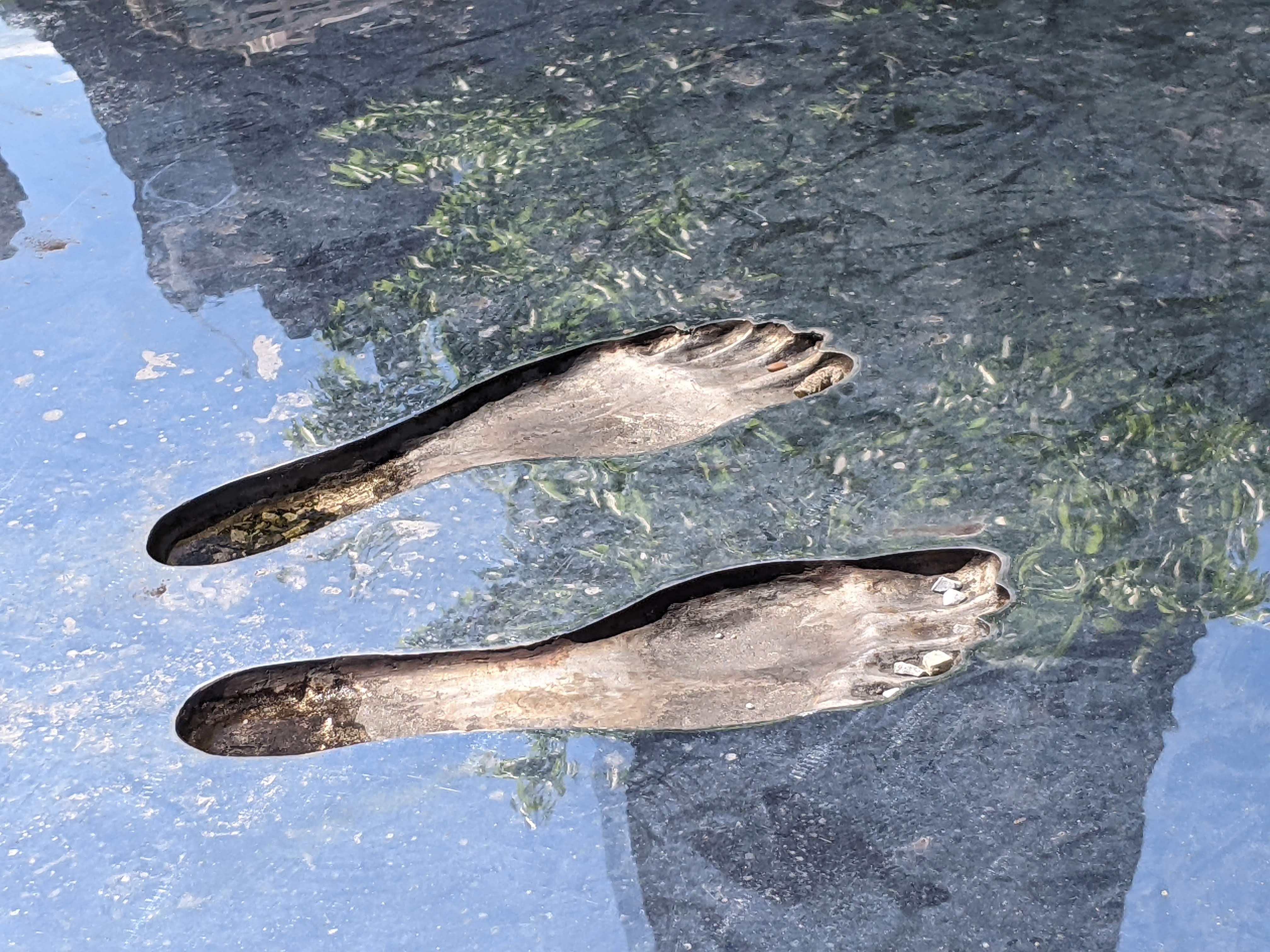
Ayurzana, Ochirbold_Consciousness
Ochirbold Ayurzana (Mongolian, 1976–), Consciousness, 2017. Steel, metal on pedestal, 110 × 196 × 125 in. North Lawn, United Nations Headquarters, New York. Gift from Mongolia. Photo: Victoria Emily Jones. [object record]


This is just a selection of the many artworks on view at the United Nations Headquarters in Manhattan. To view a full catalog, click here.

Garden Tours are offered every Wednesday at 2 p.m. from May through August, and Art Tours are offered every other Thursday at 1:15 p.m. year-round—or either one upon request. I’m grateful for their having accommodated me and my husband while we were in town!

I really wish the UN would allow visitors to move through the garden at their own speed, though, as the tour was so fast-paced that I hardly had time to take in a sculpture before we were made to move on to the next one. Approximately one to three minutes was apportioned for each work, which is hardly enough time to sit with the weight and history of some of these pieces. And I didn’t have time to change camera lenses for different types of shots. Because you have to be accompanied by a staff person, you are not allowed to linger behind when the group advances. Some leeway was given to me, but overall I felt rushed. Perhaps the pacing was anomalous because it was such a hot day—in the nineties—and the few shaded areas were prioritized.

Despite the swiftness, I really enjoyed the tour and experiencing and learning about the variety of sculptures and other art pieces from a variety of UN member countries, which celebrate peace, joy, and global unity and project a hopeful future.
Roundup: Advent songs, “Medicinal Flowers of Lebanon,” and more

ONLINE EVENT: “Every Breath a Birth: Meditations for Advent and Christmastide,” Wednesday, December 13, 5–6 p.m. ET: RSVP for Image journal’s third annual Advent Art Salon [previously], featuring a musical performance by Page CXVI, seasonal recipes by Ashley Rodriguez and Mark Sprinkle, poetry readings by Thomas Lynch and Suphil Lee Park, a homily by Bobby Gross, and a blessing by James K. A. Smith.

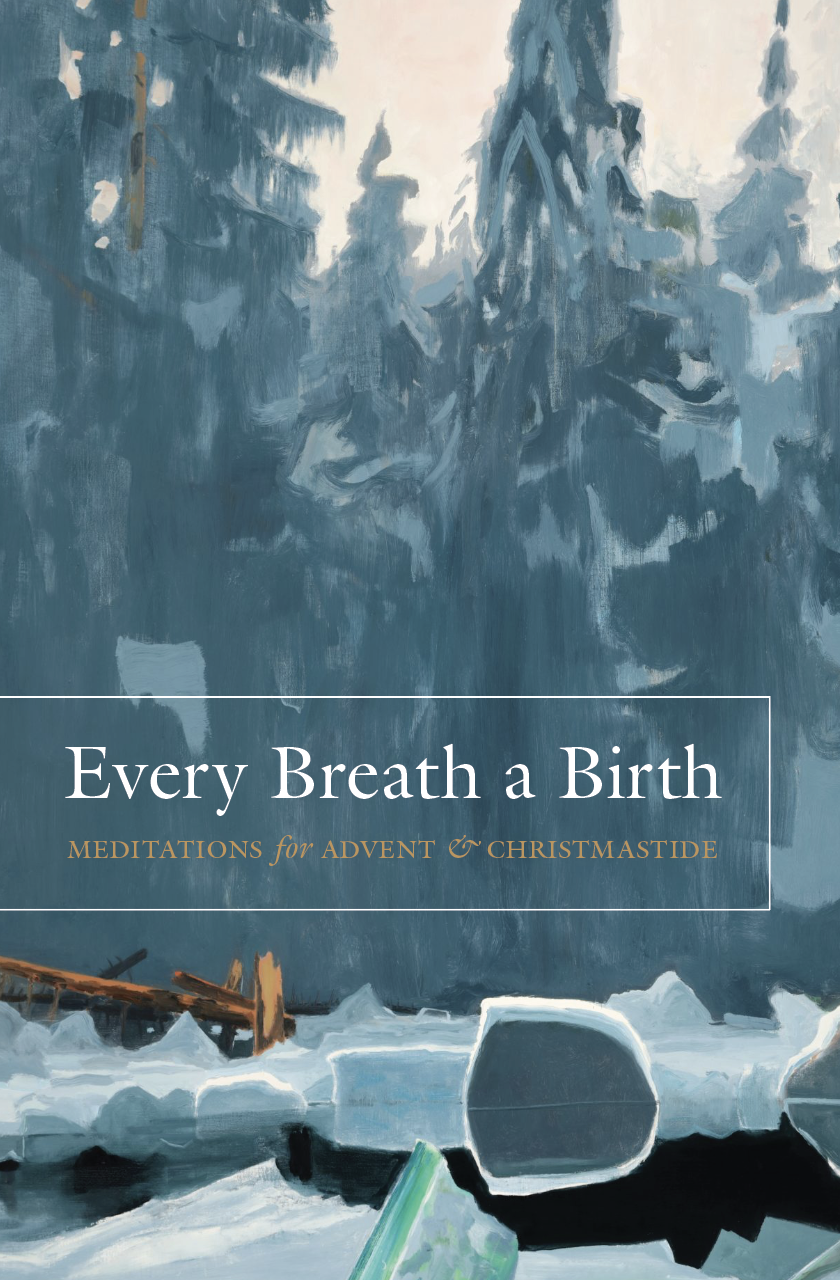
Image has also published a new chapbook this month, Every Breath a Birth, featuring twenty-three distinct creative works (poems, short stories, literary essays, visual art) that draw from its thirty-five-year archival history to celebrate the seasons of Advent and Christmas. Before December 3, it’s $17—or you can purchase it along with an annual subscription to the quarterly Image for just $30!

Every Breath a Birth

(The cover art is the painting Ice Out (Allagash) by Eric Aho, from the “In the Studio” feature in Image no. 110.)

+++

SONGS:

Advent is a season of waiting with deep longing and hope for that long-looked-for day when fear and pain will be no more because Christ will reign and set this world free. These songs tap into that.

>> “It Will Go One Day” by Mac Meador (2015):

>> “Redemption Draweth Nigh” by Gordon Jensen (1970), performed by Rumbi Lee (2018): The title and refrain of this contemporary hymn are drawn from Luke 21:28: “And when these things begin to come to pass, then look up, and lift up your heads; for your redemption draweth nigh” (KJV).

+++

STREET ART SERIES: Medicinal Flowers of Lebanon by Faith XLVII: In September 2021, South African artist Faith XLVII (Liberty Du) traveled to Beirut to paint curative flowers across the rubble of the Lebanese city in the wake of the August 4, 2020, port explosion that caused at least 218 deaths, 7,000 injuries, and $15 billion in property damage, as well as leaving an estimated 300,000 people homeless. Rosehips, horned poppies, chicory, African carline thistle—all these botanicals are used in remedies for common ailments. “Each flower urges us, in a sense, towards healing as they grow out of the concrete,” the artist said.

Faith47_Medicinal Flowers of Lebanon
Faith XLVII (South African, 1979–), Glaucium flavum, from the Medicinal Flowers of Lebanon series, Beirut, Lebanon, 2021. Photo courtesy of the artist.

+++

NEW ALBUMS:

>> The Soil and The Seed Project, vol. 8: Advent-Christmas-Epiphany: For the Advent-Christmas-Epiphany triad of the church year comes this new album from The Soil and The Seed Project, a ministry of Virginia Mennonite Missions—and recently Lilly-Endowed! All their music is free—for download, and even as physical CDs while supplies last. Below are two of my favorite tracks, both written by new contributors to the project. The first verse of Philip Fisher Rhodes’s “Bethlehem One” is in the voice of the in utero Christ; the second, the shepherds; the third, the wise men. The song is sung by Ben Luna. And “Peace Prayer” by Susan Gascho-Cooke is a plea that God would hold his arms around “this tilting planet,” the world’s wounds, and all people.

Each TSATP album is part of a larger project that also includes “Little Liturgies” booklets perfect for families with small kids (but that can also be used by individuals and small groups). Each booklet includes litanies, prayers, reflection questions, suggested activities, and visual art—and again, they’re free! Request a digital or physical copy here.

>> Kindness Is Solid Stone, Violence Is a Heavy Loan to Pay by David Benjamin Blower: Released November 3 and available on Bandcamp only, this album features nine original songs by writer, poet, theologian, and podcaster David Benjamin Blower of Birmingham, UK. I appreciate the minimalist sound and the stark lyricism. My favorite track is probably “Meet Me Where I Sing and Stamp My Feet”:

Roundup: Sermons by Nadia Bolz-Weber, Jewish graffiti, four-word poem by Giuseppe Ungaretti, and more

SERMONS by Rev. Nadia Bolz-Weber: Nadia Bolz-Weber [previously] is an ordained Lutheran pastor who founded the House for All Sinners and Saints in Denver and now guest-preaches around the city. Here are two of her sermons from the past year or so that I’ve come across and appreciate, just twelve minutes each.

>> “Sinking,” Montview Boulevard Presbyterian Church, Denver, August 13, 2023: Preaching on Matthew 14:22–33, Bolz-Weber critiques the idea that our ability to do great things relies on the quality of our faith instead of on the power of God: “I’ve often heard this walking-on-water story from Matthew preached as like The Little Disciple Who Almost Could. Like Peter could have kept walking on water if he just thought ‘I think I can, I think I can’ enough. The message being that with enough faith, you too can walk on water all the way to Jesus. Which, on the surface, sounds inspiring. But taken to its logical conclusion, it also means that if you are not God-like in your ability to overcome all your fears and failings as a human, if you are not God-like in your ability to defy the forces of nature, then the problem isn’t the limits of human potential, the problem is the limits of your faith, and you should probably muster up some more . . .” [Read the transcript]

>> “The Lord Is My Shepherd, (but) I Shall Not Want (a Shepherd, Thank You Very Much),” Saint John’s Cathedral, Denver, May 8, 2022: No matter how much we fancy ourselves “anti-shepherdarian,” wanting to make our own choices and go our own way, we are all shepherded by someone or something, says Bolz-Weber in this sermon on Psalm 23. Perhaps it’s by the “wellness” industry, or by the angriest voices on Twitter. And the thing is, “not one single shepherd-shaped wolf that I have followed has ever actually fulfilled my wants and desires,” she confesses; “they have only ever increased them. They have only ever led me to waters with a high salt content, only ever led me to waters that create thirst and never ever quench it. They leave me feeling insecure and insufficient.” She contrasts the shepherds of this world to the one true Good Shepherd. The preaching starts at 23:20. [Read the transcript]

+++

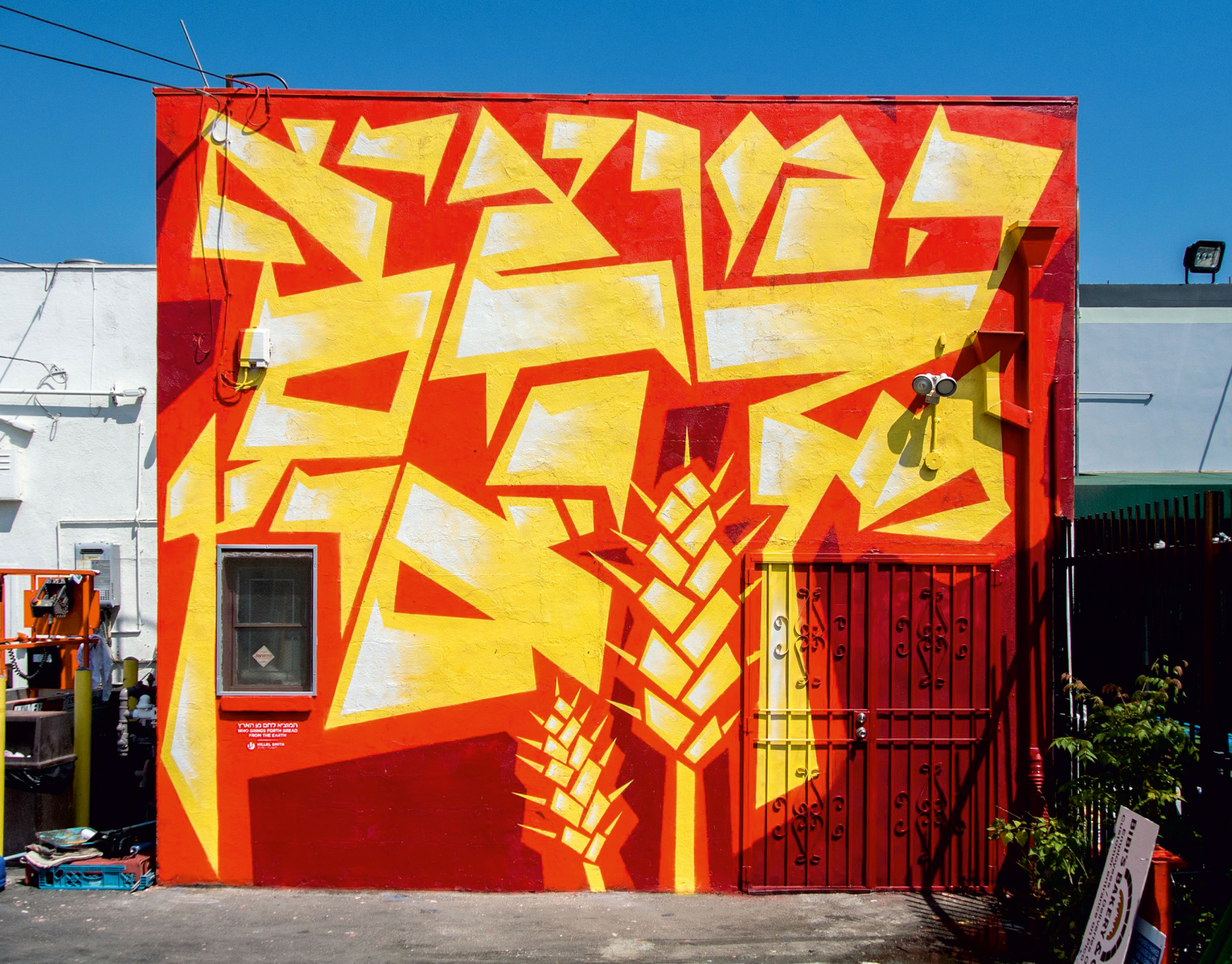
BOOK REVIEW: The Beauty of the Hebrew Letter: From Sacred Scrolls to Graffiti by Izzy Pludwinski, reviewed by Sarah Rose Sharp: In this new book from Brandeis University Press, certified Jewish scribe and calligrapher Izzy Pludwinski looks at the evolution of Hebrew calligraphy from sacred scrolls through modern art and graffiti. “Font enthusiasts, lovers of Judaica, and those passionate about the minutiae and range of the written form” will find much to appreciate here, writes Sarah Rose Sharp, whose review includes a handful of images from the book. For example, below is a mural painted by Hillel Smith on the alley-side exterior of a kosher bakery in the Pico-Robertson neighborhood of Los Angeles, which reads in bright yellow letters, “בָּרוּך אַתָּה אַדָנָי אֱלהֵינוּ מֶלֶך הָעוֹלָם הָמוֹציא לֶחם מן הַארץ” (Hamotzi lechem min ha-aretz) (Who brings forth bread from the earth), part of the traditional Hebrew blessing over bread before a meal: “Blessed are You, Lord our God, King of the Universe, Who brings forth bread from the earth.” [purchase on Amazon]

Smith, Hillel_Hamotzi Mural
Hillel Smith (American, 1984–), Hamotzi Mural, Bibi’s Bakery and Café, Los Angeles, 2016. Photo courtesy of the artist.

+++

SONGS:

>> “Be Alright” by God’s Children: Having amassed over four million collective views, this video was posted August 1 by Shirika “ReRe” Flowers across multiple social media platforms, showing four of her six kids singing a gospel song she wrote for them, “Be Alright,” at her home in Memphis. It’s led by Demeriauna “Sugar Mama” Harper, with the other three parts sung by Thedrick “Preacher” Webb (in orange Crocs), Dedric “Chunky” Trice (seated at left), and Cornbread.

The family performs and records together under the name God’s Children, and this song can be heard on their 2018 album It’s So Amazing.

>> “Aakhaima Rakhchhu Mero Yeshu” (आँखैमा राख्छु मेरो येशू) (Keep My Eyes on Jesus): In this 2016 video, a group of teens from New Life Church in Nepal sing a popular Nepali Christian worship song. I haven’t been able to find who the songwriter is, but from a search on YouTube, I can see that it’s a very popular song to dance to in Nepal! There are dozens of videos, mainly of children or youth, dancing to it with hand motions and a bounce, often in church.

From what I can tell through Google Translate, the lyrics translate roughly to “I keep my eyes on Jesus. I keep him in my heart. He shadows me with his love.”

+++

POEMS:

>> “Mattina” (Morning) by Giuseppe Ungaretti: This week reading the book Poetry and Revelation: For a Phenomenology of Religious Poetry by Kevin Hart, I came across this beautiful four-word poem in Italian from 1917 that stopped me in my tracks: “M’illumino / d’immenso.” (Those euphonic m’s!) Hart didn’t translate it, and though I could recognize the two keywords (they’re English cognates), I wasn’t sure of the words connecting them or the verb tense. In googling the poem, I was sent to the blog Parallel Texts: Words Reflected, run by Canadian literary translator Matilda Colarossi, who lives in Florence. It’s fascinating to hear her describe the complicated process of translating these two spare lines. Click on the link to read her translation and to learn what considerations informed her.

Part of the poem’s brilliance is its openness to various readings. For me, it’s about being known warmly and intimately by an immensity I call God.

>> “What He Did in Solitary” by Amit Majmudar: A second book I read this week was the poetry collection What He Did in Solitary by Amit Majmudar, Ohio’s first poet laureate. The titular poem, the first in a suite of three that conclude the book, made me cry. You can read all three on the website of Shenandoah journal, where they were originally published in 2019.

Other favorites: “Altarpiece,” “Ode to a Jellyfish,” “Elegy with van Gogh’s Ear.”

Advent, Day 8: Prepare Ye the Way

In those days John the Baptist appeared in the wilderness of Judea, proclaiming, “Repent, for the kingdom of heaven has come near.” This is the one of whom the prophet Isaiah spoke when he said,

“The voice of one crying out in the wilderness:
‘Prepare the way of the Lord;
make his paths straight.’”

—Matthew 3:1–3

LOOK: Painted staircases by Xomatok

Xomatok stairway
Painted staircase by Xomatok (b. 1985), Lima, Peru, 2021. All photos by Jeremy Flores.

Xomatok stairway
Xomatok stairway

From Colossal:

Artist Xomatok translates the vibrant, geometric motifs of handwoven Andean blankets, or llicllas, into large-scale works that mark the pathways through the hilly Alisos de Amauta neighborhood in Lima, Peru. Painted during the course of two months as part of the Municipality of Lima’s Pinta Lima Bicentenario, the 13 interventions were a collaborative undertaking by the artist and local residents, who transformed the public staircases that wind through the district into multi-level canvases. The resulting patterns are kaleidoscopic and highlight a spectrum of bright colors and symmetries often associated with the traditional textiles.

View more photos.

LISTEN: “Prepare Ye the Way of the Lord” by Stephen Schwartz, from the musical Godspell (1971)

The following video clip is the opening sequence of the 1973 film adaptation of the stage musical Godspell, which stars David Haskell as John the Baptist:

So. much. joy!

The ram’s horn issues its call. Ballet dancer, student, struggling actress, waitress, cab driver, businessman, businesswoman, parking attendant—they all leave their jobs, casting off their workplace trappings to accept John’s invitation to new and abundant life. They meet him at The Angel of the Waters, a sculpted fountain in New York City’s Central Park. They throw themselves into the fountain like children, receiving their baptism, their initiation into the upside-down kingdom of God.

But John notices Jesus standing at a distance, stripped down and ready for his own baptism. John’s lighthearted visage turns heavy for a moment in recognition that Jesus’s baptism is into suffering and death.

I wrote about Godspell two years ago when I featured one of its songs, “Turn Back, O Man,” to go along with a lectionary reading from Ezekiel. The musical is wacky, with the ragtag disciples forming a comic troupe to act out Jesus’s parables and teachings from the Gospel of Matthew. Some Christians find it all too silly and irreverent. Others, like me, see it as capturing an important element of the Good News, which is joy. This is what Godspell’s creator, John-Michael Tebelak, wanted to get across.

Perhaps the festive tone of the opening number seems disjunctive with what we know of John from the Gospels—a desert ascetic who preached about vipers and axes and fire and winnowing forks, warning his hearers of the wrath to come. Point taken.

However, while his message is a sobering one, repentance need not be a dour affair. We must take honest stock of our sins, yes, laying them out in confession before God, but scripture assures us many times over of God’s pardon, and that’s something to rejoice in! There is a joy to repentance and to following the way of Christ. Turning off the death-road, onto the road of life. As we unload the burdens that have accrued on our backs, we are freed to walk upright once again.

“Repent, for the kingdom of heaven is at hand!” John cries out on the riverbank.

I’d encourage you to read that not as a threat but as an invitation. The kingdom of heaven is marked by grace and possibility. It’s a pearl, it’s a seed, it’s a feast. When we embrace the gospel, our cities become a playground where we enact the values of Christ, childlike as they are, preparing the world to receive her coming King.

Roundup: “Art and Social Impact,” Auld Lang Syne in Birmingham, and more

ONLINE PANEL: “Art and Social Impact,” January 26, 2021, 14:30 GMT (9:30 a.m. EST): Next Tuesday the Rev. Jonathan Evens [previously], associate vicar at St Martin-in-the-Fields in London, will be talking with interdisciplinary photography and media artist André Daughtry [previously], sculptor Nicola Ravenscroft, portrait painter and humanitarian Hannah Rose Thomas, and graphic designer Micah Purnell about their personal journeys in addressing issues of social concern in their art practices. The session will also explore ways in which churches can engage with such art and use it for exploring issues with congregations and beyond. Register here for a Zoom invite. (Update: View the recording.)

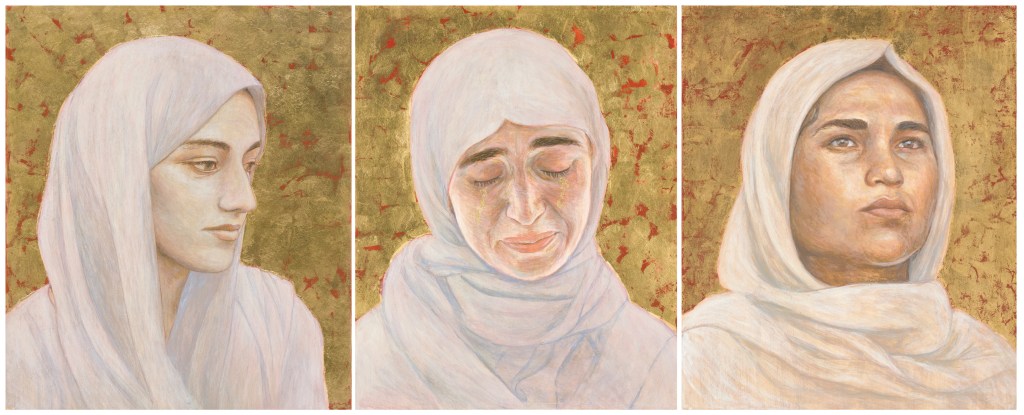
Tears of Gold by Hannah Rose Thomas
Hannah Rose Thomas, paintings from the Tears of Gold series, 2017. Click image to learn more, and see the Google Arts & Culture exhibition.

Ravenscroft, Nicola_With the Heart of a Child
Nicola Ravenscroft, With the Heart of a Child, 2016. Sculpture installation comprising seven life-size bronze children. The artist calls the figures “eco-earthling-warrior-mudcubs.” Click image for artist interview, and here for a theological reflection.

+++

VISUAL COMMENTARIES: Elijah’s Ascent by Victoria Emily Jones: My latest contribution to the Visual Commentary on Scripture was published this month. It’s a mini-exhibition on 2 Kings 2:1–12, featuring a seventeenth-century Russian icon, a 1944 painting by African American artist William H. Johnson, and a 1985 painting (a Jewish chapel commission) by Polish-born Israeli artist Shlomo Katz. (For more context on the Katz painting, see here.)

+++

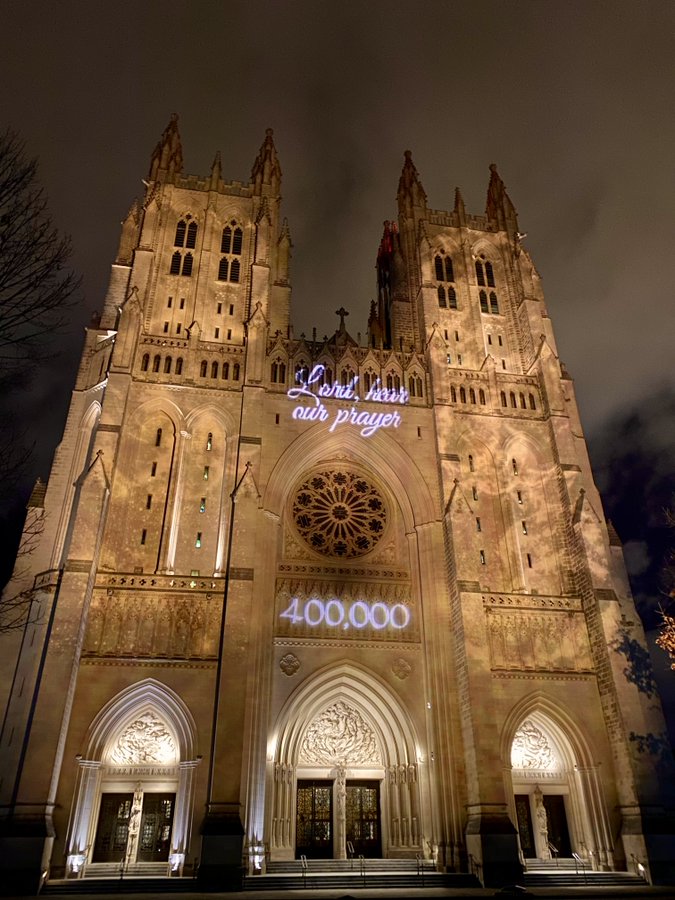
NATIONAL MOURNING: Washington National Cathedral tolled its mourning bell four hundred times Tuesday evening in remembrance of the 400,000 lives lost from COVID in the United States thus far—each ring representing one thousand dead. I spent the thirty-eight-minute livestream lamenting this enormous loss, praying for all those who are grieving and for patients and health care workers, and pleading with God for an end to this virus.

The origami paper doves you see in the video are part of the Les Colombes installation by Michael Pendry [previously], erected in December in the cathedral’s nave to symbolize hope and the Holy Spirit.

Washington National Cathedral COVID memorial

+++

MUSIC VIDEO: “For the Sake of Old Times” (Auld Lang Syne): Directed by Tyler Jones of the narrative studio 1504, this short film premiered December 30, 2020, by NPR. “From the pews of a church where white deacons once refused to seat African Americans, a group of Black singers in Alabama reminds us why preserving our memories of this historic year is vital—even if we’d rather just leave 2020 behind.” [HT: ImageUpdate]

“To me the piece is a personal encouragement going into the future,” Jones says, “that we hopefully strive to work together for a kinder future, especially at a time where we are so distanced.” Read about the making of the film at https://n.pr/3n6d8Ct.

+++

ARTICLE: “On the Gifts of Street Art” by Jason A. Goroncy, Zadok: The Australasian Religious Press Association awarded silver prize for “Best Theological Article” to Jason Goroncy [previously] for this piece. (How cool that it won in the theology category!) Like all art, street art can function as a form of civic dialogue, protest, play, hope, remembrance, etc., but Goroncy discusses how some of its particular qualities uniquely position it to perform those functions: its (usually) unsanctioned and interventionist nature, its fragility and impermanence, its celebration and development of culture, its inseparability from place, and its redefinitions of proprietorship. [HT: Art/s and Theology Australia]

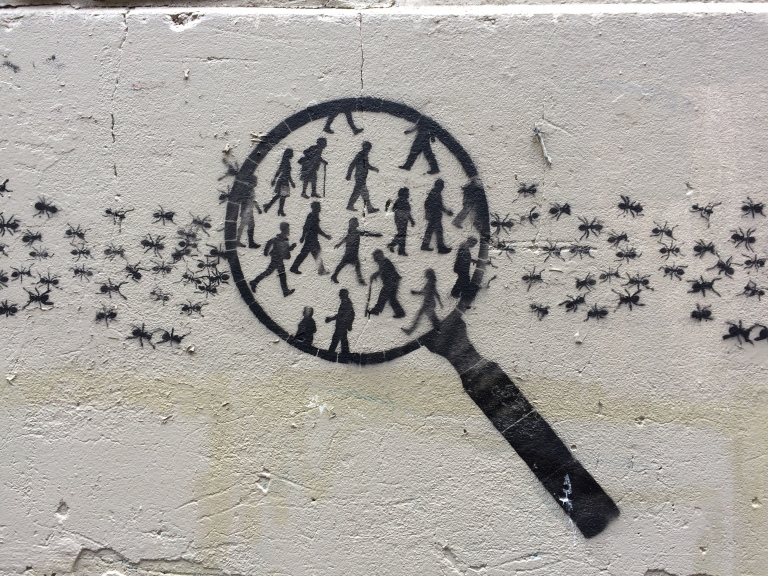
Human Ants (street art)
Human Ants, Liverpool Street, Melbourne, Australia. Photo: Jason Goroncy.

“Among the many gifts that street artists offer,” Goroncy writes, “is a proclivity to bear witness to how things are and not merely to how they might appear to be. Such a proclivity involves a telling of the truth about those largely-untampered-with and untraversed spaces of our urban worlds, about what is present but underexposed or disregarded; and even, as Auden hints, to lead with ‘unconstraining voice’ the way toward healing and toward a renewed sense of enchantment, freedom and praise beyond the pedestrian and clamorous. Such a proclivity is also a form of urban spirituality. It can even be a form of public theology.”