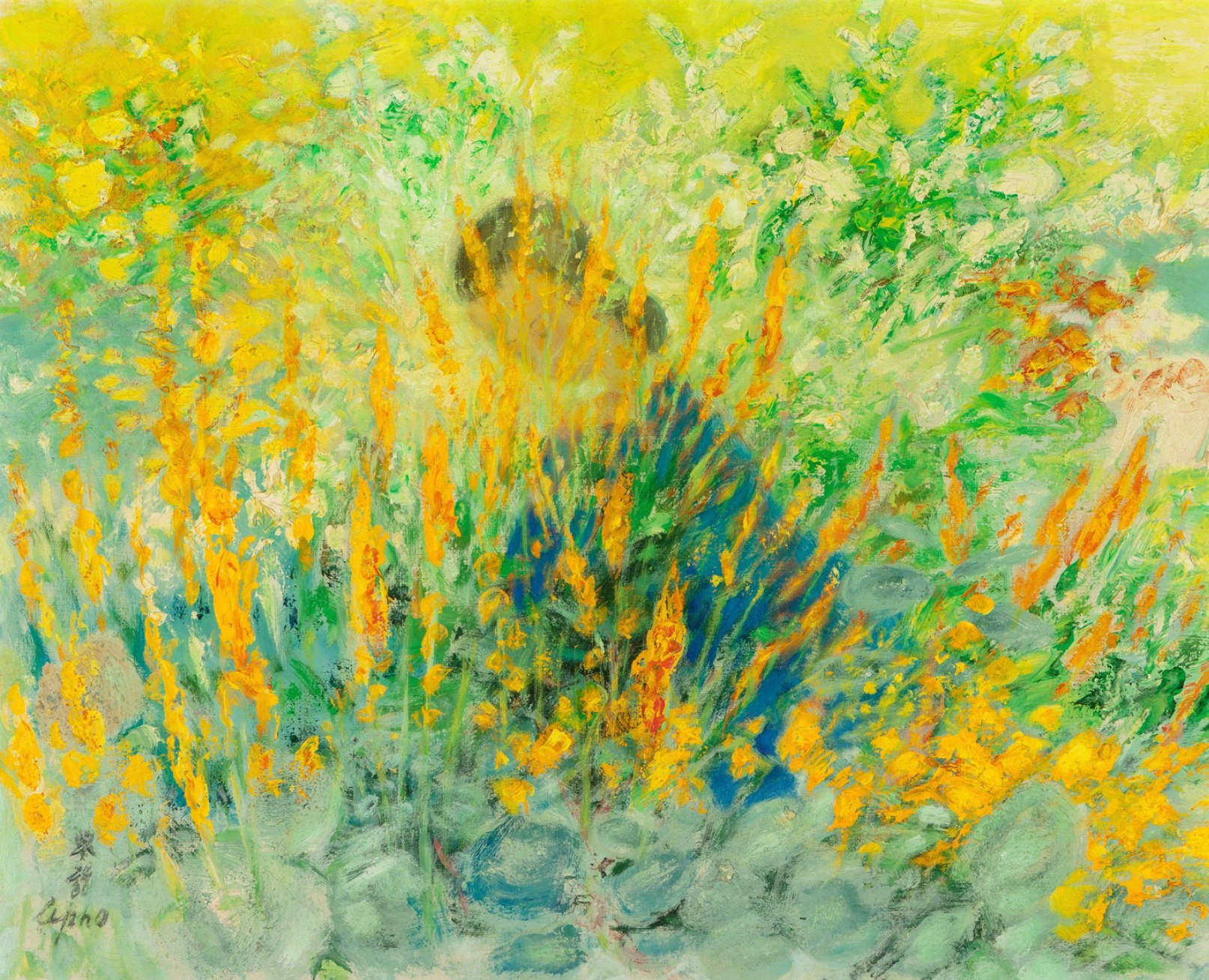
Lê Phổ (Vietnamese, 1907–2001), Composition, 1969. Oil on canvas, 23 3/4 × 29 in. (60.3 × 73.7 cm).
Phil. 2:13

Thou sayest, “Fit me, fashion me for Thee.”
Stretch forth thine empty hands, and be thou still;
O restless soul, thou dost but hinder Me
By valiant purpose and by steadfast will.

Behold the summer flowers beneath the sun:
In stillness his great glory they behold;
And sweetly thus his mighty work is done,
And resting in his gladness they unfold.

So are the sweetness and the joy divine
Thine, O beloved, and the work is Mine.

Translated from the German by Frances Bevan, 1894
In this poem God speaks to his beloved, urging her to cease her anxious striving to please him and to simply be present, soft, and open—to receive his love and its attendant sweetness and joy. The epigraph cites the apostle Paul’s encouragement to the church at Philippi that “it is God which worketh in you both to will and to do of his good pleasure,” but the title is taken from Psalm 136:8: “O give thanks unto the LORD . . . to him that made . . . the sun to rule by day: for his mercy endureth for ever.”
The second stanza is also a biblical allusion, pointing to Matthew 6:27–29, in which Jesus asks rhetorically, “Which of you by taking thought can add one cubit unto his stature? And why take ye thought for raiment? Consider the lilies of the field, how they grow; they toil not, neither do they spin: and yet I say unto you, that even Solomon in all his glory was not arrayed like one of these.”
As we rest in God, he shines his face on us and gladly grows us, beauties all.
Gerhard Tersteegen (1697–1769) was a German Pietist preacher, writer, humanitarian, and hymnist. Self-taught in religious studies, as a young man he gave up a successful career as a merchant to live a simple life of personal devotion and public ministry. Known as “the physician of the poor and forsaken,” he opened his home in Mülhern—it became known as Pilgrim’s Hut—to all manner of needy folks, leading prayer services and dispensing food, medicine, and spiritual counsel. He also traveled the region preaching the gospel. His writings include the hymn collection Das geistliche Blumengärtlein (The Spiritual Flower Garden) (1729), a volume of Gebete (prayers) and another of Briefe (letters), and translations of the French mystics and Julian of Norwich. He is sometimes classified as a mystic himself because of his emphasis on intimacy with God.
George MacDonald (1824–1905) was a Scottish preacher, poet, essayist, and writer of both realist and fantasy fiction. He was a great influence on J. R. R. Tolkien and C. S. Lewis, the latter of whom published, in 1946, a compilation of MacDonald’s theological writings excerpted from his sermons, novels, and other sources. “I know of hardly any other writer who seems to be closer, or more continually close, to the Spirit of Christ Himself,” Lewis wrote in the preface to George MacDonald: An Anthology.
MacDonald is best known for his fairy tales, such as The Princess and the Goblin (my entrée to the author as a child, via a 1991 animated film adaptation from Wales) and Phantastes. But more recently I have been appreciating his devotional poetry.
George MacDonald, as photographed by his friend and fellow writer Lewis Carroll, 1863
While in his fifties, MacDonald published A Book of Strife in the Form of the Diary of an Old Soul (1880), a collection of 366 short, original, untitled devotional poems, one for each day of the year. (Read it for free online.) Addressed to God, these poems voice discouragement, weariness, restlessness, desire, doubt, and trust. MacDonald asks God for healing and refreshment; for a vulnerable, stripped-down soul, clothed anew in Christ; for salvation from his stubbornness and folly; for guidance through his dark night of the soul; for rightly ordered loves; for Christian growth. He searches for God, confesses his sinful tendencies, praises God for God’s love and faithfulness, and prays for words when words fail him.
Below are my favorite selections—some full poems, some just single lines or excerpts—from MacDonald’s Diary of an Old Soul, which is in the public domain. The headings are my own, to aid in navigating more easily to different topics, and the trifold dividers mark separate entries.
When the book was printed privately in 1880, all the left-hand pages were left blank to encourage thoughtful reader responses; “Let your white page be ground, my print be seed,” MacDonald wrote in the dedication. I’d encourage you, too, to grab a journal and record your own prayers and reflections prompted by any of these verses, or simply to copy out the lines that resonate. And songwriters and composers: I can see potential for musical settings here!
A New Song
Barb thou my words with light, make my song new.
Seeing with the Inner Eye
That thou art nowhere to be found, agree
Wise men, whose eyes are but for surfaces;
Men with eyes opened by the second birth,
To whom the seen, husk of the unseen is,
Descry thee soul of everything on earth.
Who know thy ends, thy means and motions see:
Eyes made for glory soon discover thee.
+++
Lord, in the land of things that swell and seem,
Help me to walk by the other light supreme,
Which shows thy facts behind man’s vaguely hinting dream.
God Transcends All Imagining
What the heart’s dear imagination dares,
Thou dost transcend in measureless majesty
All prayers in one—my God, be unto me
Thy own eternal self, absolutely.
+++
Oh, let me live in thy realities,
Nor substitute my notions for thy facts,
Notion with notion making leagues and pacts;
They are to truth but as dream-deeds to acts,
And questioned, make me doubt of everything.—
“O Lord, my God,” my heart gets up and cries,
“Come thy own self, and with thee my faith bring.”
Be My All
Be thou the well by which I lie and rest;
Be thou my tree of life, my garden ground;
Be thou my home, my fire, my chamber blest,
My book of wisdom, loved of all the best;
Oh, be my friend, each day still newer found,
As the eternal days and nights go round!
Nay, nay—thou art my God, in whom all loves are bound!
In Him and by Him All Things Consist
Thy fishes breathe but where thy waters roll;
Thy birds fly but within thy airy sea;
My soul breathes only in thy infinite soul;
I breathe, I think, I love, I live but thee.
Oh breathe, oh think,—O Love, live into me;
Unworthy is my life till all divine,
Till thou see in me only what is thine.
Practicing the Presence of God at Work
Two things at once, thou know’st I cannot think.
When busy with the work thou givest me,
I cannot consciously think then of thee.
. . . . . . . . . . . . . . . . . . . . . . . . . . . . . . . . . .

Therefore I make provision, ere I begin
To do the thing thou givest me to do,
Praying,—Lord, wake me oftener, lest I sin.
Amidst my work, open thine eyes on me,
That I may wake and laugh, and know and see,
Then with healed heart afresh catch up the clue,
And singing drop into my work anew.
“The life is more than meat, the body more than raiment”
Thy will be done. I yield up everything.
“The life is more than meat”—then more than health;
“The body more than raiment”—then than wealth;
The hairs I made not, thou art numbering.
Thou art my life—I the brook, thou the spring.
Because thine eyes are open, I can see;
Because thou art thyself, ’tis therefore I am me.
On Prayer
Sometimes, hard-trying, it seems I cannot pray—
For doubt, and pain, and anger, and all strife.
Yet some poor half-fledged prayer-bird from the nest
May fall, flit, fly, perch—crouch in the bowery breast
Of the large, nation-healing tree of life;—
Moveless there sit through all the burning day,
And on my heart at night a fresh leaf cooling lay.
+++
In my dead moments, master, stir the prayers.
+++
My prayer-bird was cold—would not away,
Although I set it on the edge of the nest.
Then I bethought me of the story old—
Love-fact or loving fable, thou know’st best—
How, when the children had made sparrows of clay,
Thou mad’st them birds, with wings to flutter and fold:
Take, Lord, my prayer in thy hand, and make it pray.
Prayers in Times of Spiritual Destitution
When I no more can stir my soul to move,
And life is but the ashes of a fire;
When I can but remember that my heart
Once used to live and love, long and aspire,—
Oh, be thou then the first, the one thou art;
Be thou the calling, before all answering love,
And in me wake hope, fear, boundless desire.
+++
There is a misty twilight of the soul,
A sickly eclipse, low brooding o’er a man,
When the poor brain is as an empty bowl,
And the thought-spirit, weariful and wan,
Turning from that which yet it loves the best,
Sinks moveless, with life-poverty opprest:—
Watch then, O Lord, thy feebly glimmering coal.
A Prayer for Joy in All Circumstances
Do thou, my God, my spirit’s weather control;
And as I do not gloom though the day be dun,
Let me not gloom when earth-born vapours roll
Across the infinite zenith of my soul.
Should sudden brain-frost through the heart’s summer run,
Cold, weary, joyless, waste of air and sun,
Thou art my south, my summer-wind, my all, my one.
A Prayer for Victory over Temptation
Haste to me, Lord, when this fool-heart of mine
Begins to gnaw itself with selfish craving;
Or, like a foul thing scarcely worth the saving,
Swoln up with wrath, desireth vengeance fine.
Haste, Lord, to help, when reason favours wrong;
Haste when thy soul, the high-born thing divine,
Is torn by passion’s raving, maniac throng.

Fair freshness of the God-breathed spirit air,
Pass through my soul, and make it strong to love;
Wither with gracious cold what demons dare
Shoot from my hell into my world above;
Let them drop down, like leaves the sun doth sear,
And flutter far into the inane and bare,
Leaving my middle-earth calm, wise, and clear.
A Prayer for Endurance through Trials
Thou wouldst not have thy man crushed back to clay;
It must be, God, thou hast a strength to give
To him that fain would do what thou dost say;
Else how shall any soul repentant live,
Old griefs and new fears hurrying on dismay?
Let pain be what thou wilt, kind and degree,
Only in pain calm thou my heart with thee.
A Prayer for Sanctification
Lord, in my silver is much metal base,
Else should my being by this time have shown
Thee thy own self therein. Therefore do I
Wake in the furnace. I know thou sittest by,
Refining—look, keep looking in to try
Thy silver; master, look and see thy face,
Else here I lie for ever, blank as any stone.

But when in the dim silver thou dost look,
I do behold thy face, though blurred and faint.
Oh joy! no flaw in me thy grace will brook,
But still refine: slow shall the silver pass
From bright to brighter, till, sans spot or taint,
Love, well content, shall see no speck of brass,
And I his perfect face shall hold as in a glass.
A Prayer against Workaholism
Help me to yield my will, in labour even,
Nor toil on toil, greedy of doing, heap.
“My yoke is easy, and my burden is light”
I cannot see, my God, a reason why
From morn to night I go not gladsome, free;
For, if thou art what my soul thinketh thee,
There is no burden but should lightly lie,
No duty but a joy at heart must be:
Love’s perfect will can be nor sore nor small,
For God is light—in him no darkness is at all.
God Our Mother
. . . Weary and worn,
Why not to thee run straight, and be at rest?
Motherward, with toy new, or garment torn,
The child that late forsook her changeless breast,
Runs to home’s heart, the heaven that’s heavenliest . . .
Faith and Doubt
Doubt swells and surges, with swelling doubt behind!
My soul in storm is but a tattered sail,
Streaming its ribbons on the torrent gale;
In calm, ’tis but a limp and flapping thing:
Oh! swell it with thy breath; make it a wing,—
To sweep through thee the ocean, with thee the wind
Nor rest until in thee its haven it shall find.
+++
Ever above my coldness and my doubt
Rises up something, reaching forth a hand:
This thing I know, but cannot understand.
Is it the God in me that rises out
Beyond my self, trailing it up with him,
Towards the spirit-home, the freedom-land,
Beyond my conscious ken, my near horizon’s brim?
New Life
If thou hadst closed my life in seed and husk,
And cast me into soft, warm, damp, dark mould,
All unaware of light come through the dusk,
I yet should feel the split of each shelly fold,
Should feel the growing of my prisoned heart,
And dully dream of being slow unrolled,
And in some other vagueness taking part.

And little as the world I should foreknow
Up into which I was about to rise—
Its rains, its radiance, airs, and warmth, and skies,
How it would greet me, how its wind would blow—
As little, it may be, I do know the good
Which I for years half darkling have pursued—
The second birth for which my nature cries.
+++
“Wake, thou that sleepest; rise up from the dead,
And Christ will give thee light.” I do not know
What sleep is, what is death, or what is light;
But I am waked enough to feel a woe,
To rise and leave death. Stumbling through the night,
To my dim lattice, O calling Christ! I go,
And out into the dark look for thy star-crowned head.
+++
Lord, wake me up; rend swift my coffin-planks;
I pray thee, let me live—alive and free.
Rooted in Christ
Thou in my heart hast planted, gardener divine,
A scion of the tree of life: it grows;
But not in every wind or weather it blows;
The leaves fall sometimes from the baby tree,
And the life-power seems melting into pine;
Yet still the sap keeps struggling to the shine,
And the unseen root clings cramplike unto thee.
Dying to Self
Lord, I have fallen again—a human clod!
Selfish I was, and heedless to offend;
Stood on my rights. Thy own child would not send
Away his shreds of nothing for the whole God!
Wretched, to thee who savest, low I bend:
Give me the power to let my rag-rights go
In the great wind that from thy gulf doth blow.
+++
Lord of essential life, help me to die.
To will to die is one with highest life,
The mightiest act that to Will’s hand doth lie—
Born of God’s essence, and of man’s hard strife:
God, give me strength my evil self to kill,
And die into the heaven of thy pure will.—
Then shall this body’s death be very tolerable.
+++
With every morn my life afresh must break
The crust of self, gathered about me fresh;
That thy wind-spirit may rush in and shake
The darkness out of me, and rend the mesh
The spider-devils spin out of the flesh—
Eager to net the soul before it wake,
That it may slumberous lie, and listen to the snake.
Lost Sheep
Things go not wrong when sudden I fall prone,
But when I snatch my upheld hand from thine,
And, proud or careless, think to walk alone.
Then things go wrong, when I, poor, silly sheep,
To shelves and pits from the good pasture creep;
Not when the shepherd leaves the ninety and nine,
And to the mountains goes, after the foolish one.
“Forgive us our debts, as we forgive our debtors”
Keep me from wrath, let it seem ever so right:
My wrath will never work thy righteousness.
Up, up the hill, to the whiter than snow-shine,
Help me to climb, and dwell in pardon’s light.
I must be pure as thou, or ever less
Than thy design of me—therefore incline
My heart to take men’s wrongs as thou tak’st mine.
Spiritual Riches
Lord, in thy spirit’s hurricane, I pray,
Strip my soul naked—dress it then thy way.
Change for me all my rags to cloth of gold.
Who would not poverty for riches yield?
A hovel sell to buy a treasure-field?
Who would a mess of porridge careful hold
Against the universe’s birthright old?
The Prodigal God
Gloriously wasteful, O my Lord, art thou!
Sunset faints after sunset into the night,
Splendorously dying from thy window-sill—
For ever. Sad our poverty doth bow
Before the riches of thy making might:
Sweep from thy space thy systems at thy will—
In thee the sun sets every sunset still.
God’s Stability
Father of me, thou art my bliss secure.
Make of me, maker, whatsoe’er thou wilt.
Let fancy’s wings hang moulting, hope grow poor,
And doubt steam up from where a joy was spilt—
I lose no time to reason it plain and clear,
But fly to thee, my life’s perfection dear:—
Not what I think, but what thou art, makes sure.
God’s Universality
Where should the unknown treasures of the truth
Lie, but there whence the truth comes out the most—
In the Son of man, folded in love and ruth?
Fair shore we see, fair ocean; but behind
Lie infinite reaches bathing many a coast—
The human thought of the eternal mind,
Pulsed by a living tide, blown by a living wind.
Searching for Pleasure
Ah, me, my God! in thee lies every bliss
Whose shadow men go hunting wearily amiss.
+++
I see a little child whose eager hands
Search the thick stream that drains the crowded street
For possible things hid in its current slow.
Near by, behind him, a great palace stands,
Where kings might welcome nobles to their feet.
Soft sounds, sweet scents, fair sights there only go—
There the child’s father lives, but the child does not know.
Perfect Love
Thou dost demand our love, holy Lord Christ,
And batest nothing of thy modesty;—
Thou know’st no other way to bliss the highest
Than loving thee, the loving, perfectly.
Thou lovest perfectly—that is thy bliss:
We must love like thee, or our being miss—
So, to love perfectly, love perfect Love, love thee.
+++
Lord, with thy breath blow on my being’s fires,
Until, even to the soul with self-love wan,
I yield the primal love, that no return desires.
Surrender
O Christ, my life, possess me utterly.
Take me and make a little Christ of me.
+++
O Master, my desires to work, to know,
To be aware that I do live and grow—
All restless wish for anything not thee
I yield, and on thy altar offer me.
Let me no more from out thy presence go,
But keep me waiting watchful for thy will—
Even while I do it, waiting watchful still.
+++
My Lord, I have no clothes to come to thee;
My shoes are pierced and broken with the road;
I am torn and weathered, wounded with the goad,
And soiled with tugging at my weary load:
The more I need thee! A very prodigal
I stagger into thy presence, Lord of me:
One look, my Christ, and at thy feet I fall!
Freedom
So bound in selfishness am I, so chained,
I know it must be glorious to be free
But know not what, full-fraught, the word doth mean.
By loss on loss I have severely gained
Wisdom enough my slavery to see;
But liberty, pure, absolute, serene,
No freest-visioned slave has ever seen.
+++
So shall abundant entrance me be given
Into the truth, my life’s inheritance.
Lo! as the sun shoots straight from out his tomb,
God-floated, casting round a lordly glance
Into the corners of his endless room,
So, through the rent which thou, O Christ, hast riven,
I enter liberty’s divine expanse.
Receptivity to the Spirit
Faith opens all the windows to God’s wind.
Aging
O Life, why dost thou close me up in death?
O Health, why make me inhabit heaviness?—
I ask, yet know: the sum of this distress,
Pang-haunted body, sore-dismayed mind,
Is but the egg that rounds the winged faith;
When that its path into the air shall find,
My heart will follow, high above cold, rain, and wind.
+++
Thou, healthful Father, art the Ancient of Days,
And Jesus is the eternal youth of thee.
Our old age is the scorching of the bush
By life’s indwelling, incorruptible blaze.
O Life, burn at this feeble shell of me,
Till I the sore singed garment off shall push,
Flap out my Psyche wings, and to thee rush.
+++
My harvest withers. Health, my means to live—
All things seem rushing straight into the dark.
But the dark still is God. I would not give
The smallest silver-piece to turn the rush
Backward or sideways. Am I not a spark
Of him who is the light?—Fair hope doth flush
My east.—Divine success—Oh, hush and hark!
Death
God, thou from death dost lift me. As I rise,
Its Lethe from my garment drips and flows.
Ere long I shall be safe in upper air,
With thee, my life—with thee, my answered prayer,
Where thou art God in every wind that blows,
And self alone, and ever, softly dies,
There shall my being blossom, and I know it fair.
+++
I was like Peter when he began to sink.
To thee a new prayer therefore I have got—
That, when Death comes in earnest to my door,
Thou wouldst thyself go, when the latch doth clink,
And lead him to my room, up to my cot;
Then hold thy child’s hand, hold and leave him not,
Till Death has done with him for evermore.
The Diary of an Old Soul represents only a fraction of the poetry George MacDonald wrote. To explore more, see The Poetical Works of George MacDonald, vols. 1 and 2 (1893). Seeing as next year is the bicentenary of his birth, I expect to be hearing his name a lot more!
Steven Homestead (American, 1982–), The Annunciation, 2020. Digital collage.
Artist, composer, writer, curator, and speaker Steven Homestead of Orange County, California, created this collage by overlaying and manipulating three photographs from Unsplash. It depicts the moment when the angel Gabriel came to Mary of Nazareth to tell her that she had been chosen to bear God’s Son. Though Mary was initially taken aback by this announcement, she ultimately gave her full assent, leaning into the future God had for her. Through her fiat, her yes, God worked the salvation of the world.
Gabriel and Mary are represented here by two Brazilian models whose raised arms—his right, her left—form near symmetrical arcs. It’s as if he’s calling and she’s responding. She’s bending to God’s will, but not with the sort of demure posture so often assigned to her in art history; instead, her stance is one of freedom and power and becoming.
The curve of Gabriel’s hand matches the curve of the stained glass leading, which encircles his head and frames a representation of the Holy Spirit as dove, flying forth from a sunburst.
The setting is outdoors in a wooded area. Mary is dressed in white, like a bride. As she surrenders to the Divine, she becomes filled with light, the sun’s rays converging on her womb. A mystical veil falls around the two figures, suggesting sanctity and mystery. Her body has become the temple of the Lord.
March 25—exactly nine months before Christmas—is when the church celebrates the miraculous conception of Christ in Mary’s womb, the first stage of the Incarnation. It’s an event that fills me with awe and wonder—as it has thousands of artists over the centuries. I’m building a Pinterest board of Annunciation art that I find compelling, which you may be interested to browse: https://www.pinterest.com/art_and_theology/annunciation/. Homestead’s piece is my latest addition.
LISTEN: “Lord, Prepare Me to Be a Sanctuary” by Randy Lynn Scruggs and John W. Thompson, 1982 | Arranged and performed by the West Angeles COGIC Mass Choir and Congregation on No Limit, 2007
Lord, prepare me To be a sanctuary Pure and holy Tried and true And with thanksgiving I’ll be a living Sanctuary For you
And whatever you tell me, my answer will be yes Yes (yes) Yes (yes to your will, Lord) Yes (yes to your way) Yes (Lord, I’ll go where you want me to go) Yes (yes) Yes, yes (yes) Yes (whatever you tell me to do, Lord) Yes Yes (my will is your will for me, Lord) Yes (come on, let’s take it higher, say yeah)
Lord, prepare me To be a sanctuary Pure and holy Tried and true And with thanksgiving I’ll be a living Sanctuary For you
Hallelujah, hey! Now I want the Lord to mold me I want him to make me, I want him to shape me I want him to direct me, I want him to purge me I want him to wash me Whatever he wants me to be I’ll be just that, so I tell him:
Lord, mold me (mold me) What you want me to be (what you want me to be) Oh mold me (mold me) What you want me to be (what you want me to be) Oh and say mold me (mold me) Say what you want me to be (what you want me to be) Oh mold me (yes, what you want me to be) (mold me) What you want me to be (what you want me to be)
Mold and we’ll say yes (yes) Yes to your will say (yes to your will) Say yeah, yeah (yeah) Yes to your way, Lord (yes to your way) Say yes everyday (yes everyday) Yes to your way (yes to your way) Say yes, I’ll obey (yes, I’ll obey) Say yes to your way (yes to your way)
Lord, mold me What you want me to be Say what you want me to do Where you want me to go Say where you want me to go When you want me to go Say how you want me to go What you want me to do
And you will say yeah (yeah) Say yeah, yeah, yeah, yeah, yeah, yeah, yeah, yeah (yeah) Say yes to your way (yes to your way) Ooh ooh ooh yeah, yeah, yeah, yeah (yeah) Say yes to your will (yes to your will) Say, say yeah, yeah, yeah, yeah (yeah) Say:
Lord, prepare me To be a sanctuary Pure and holy Tried and true And with thanksgiving I’ll be a living Sanctuary For you
Hallelujah Lord, I say yes Lord, I say yes Lord, I say yes To your will and to your way Not my time, but yours
If there’s one word I most associate with the Annunciation, it’s “yes.”
This song doesn’t directly reference the Annunciation, but it does capture the attitude of surrender to God that Mary modeled for us. “Lord, I say yes to your will and to your way.” We can assume that throughout her girlhood she cultivated a devotion that made her open and receptive to God’s call when it came. She was ready to offer herself as God’s sanctuary, a house for his incarnate presence. She literally became pregnant with God!
In a spiritual sense, we too are called to bear Christ within us (Rom. 8:10; 2 Cor. 4:6–7; 13:5; Gal. 1:15–16; 2:20). To be temples of his Spirit (1 Cor. 6:19–20). And to answer yes when God invites us into some new adventure.
Wednesday, February 17, is the start of Lent, a forty-day season of penitence and renewal. It’s not so much about making resolutions as it is about drawing near to God and encountering his grace afresh—at the foot of the cross.
That closeness entails confronting, confessing, and repenting of sin—sins of commission and omission. (The Book of Common Prayer reminds us that we sin “by what we have done, and by what we have left undone.”) It’s an uncomfortable process, but one that grows us, makes us healthy. It makes our relationships and communities healthier too. Jesus’s grace is not just warm fuzzies in the hearts of private individuals but, rather, works itself out in the world.
As a companion for the Lenten journey, I’ve curated a Spotify playlist of songs for the season, a mix of prayers and praises to the Triune God whose strength avails to meet us in our weakness and our need. Some are invitational, others are penitential, and others are celebratory. Along with images of dust, blood, wilderness, and death, there are themes of victory and rising, healing and wholeness, rivers that cleanse, rivers that quench thirst, agricultural metaphors of planting and growth, calls to lay down one’s burden and to rest in the Savior’s love. There are songs of pursuing and of being pursued (us calling out to God, God calling out to us), for as we deepen our desire for God, we come to realize how deep God’s desire is for us.
The playlist opens with “That We Might See” by Indianapolis folk duo Sister Sinjin, a setting (with slight modifications) of this Christina Rossetti poem:
Lord, purge our eyes to see Within the seed a tree, Within the glowing egg a bird, Within the shroud a butterfly:
Till taught by such, we see Beyond all creatures Thee; And hearken for Thy tender word, And hear it, “Fear not: it is I.”
I chose this as the introductory song because, first, it expresses how out of “death” or dormancy can come great life and beauty—as with the buried seed that, once germinated, brings forth lushness. This is one of the prime metaphors of Lent, and this song is a supplication that we would have eyes to see it and, what’s more, participate in it (see Rom. 6). Second, I like how it reminds us of the tenderness and approachability of Jesus. Some people enter Lent with a sense of dread, fearing that their sins are too great, or that they will never measure up to some set standard of piety. But Jesus tells us not to be afraid. His love and mercy know no bounds. He wants to set us free from our illusions of self-sufficiency and for us to rely on his Spirit to work good things in and through us.
Let me share just a handful of other song highlights.
“Simple Gifts” is a one-verse Shaker hymn from 1848, performed here by the amazing female trio Mountain Man (Alexandra Sauser-Monnig, Amelia Randall Meath, and Molly Erin Sarle). The Shakers, a Christian sect, were known for their use of dance during worship, and “bowing,” “bending,” and “turning” are dance instructions as much as they are instructions for life. Simplicity is another hallmark of the Shakers, a virtue and a discipline that Lent summons us to.
Another Lenten virtue is silence. In 2018 Paul Zach released the EPGod Is the Friend of Silence, whose title track is inspired by a Mother Teresa quote: “We need to find God, and God cannot be found in noise and restlessness. God is the friend of silence.”
There are many originals from the past decade on the playlist, but there are also a lot of classic hymns: “Amazing Grace” (to the tune of “House of the Rising Sun”), “Softly and Tenderly” (intriguingly reharmonized by the Wilderness of Manitoba), “I Am Thine, O Lord,” “Just a Closer Walk with Thee,” “I Need Thee Every Hour,” “Grace That Is Greater,” “Nothing but the Blood,” “Near the Cross,” “Just as I Am,” “Jesus Paid It All,” “Turn Your Eyes Upon Jesus,” “Where He Leads Me.” And a beautiful adaptation of “I Surrender All” by Chanda Rule, who revised the first verse to this:
O Beloved, I surrender All my heart I freely give Ever open, ever trusting Breathing with my Source, I live
Also included are several settings of the ancient liturgical prayer Kyrie (“Lord, have mercy”)—by Hildegard of Bingen, Josquin des Prez, Isaac Wardell, and the monks of Keur Moussa Abbey in Senegal (sung in Wolof). Plus the fourteenth-century prayer known as the Anima Christi, with music composed by jazz master Mary Lou Williams using a 6/8 rhythm pattern and a bass clarinet.
Soul of Christ, be my sanctification Body of Christ, be my salvation Blood of Christ, fill my veins Water of Christ’s side, wash out my stains
Passion of Christ, my comfort be O good Jesus, listen to me Lord, have mercy on me
. . .
The entire Lent album by Liturgical Folk is inspired by specific Lenten readings from the Book of Common Prayer. My favorite song is “Willing Minds,” based loosely on the collect (succinct prayer) for the Fifth Sunday in Lent:
Almighty God, you alone can bring into order the unruly wills and affections of sinners: Grant your people grace to love what you command and desire what you promise; that, among the swift and varied changes of the world, our hearts may surely there be fixed where true joys are to be found; through Jesus Christ our Lord, who lives and reigns with you and the Holy Spirit, one God, now and for ever. Amen.
The melismatic phrases (in which one syllable is stretched out across multiple successive notes) underscore the flightiness of the human will, our inconstancy, our lack of rootedness.
“Create in Me” by Terry Talbot, covered by The Acappella Company in the video below, is a prayer that’s pieced together from various verses of scripture, starting with Psalm 51:10:
Other favorites, which I’ve featured on the blog before, are Leon Bridges’s “River” [previously] and “Hallelujah” by MaMuse [previously]. “I’m gonna let myself be lifted,” the latter asserts.
As much as Lent is about dying to sin, it’s also about rising with Christ, so resurrection is present throughout—in biblical narrative songs about Jonah, Lazarus, Jairus’s daughter, and Ezekiel in the valley of dry bones, for example (foretastes of Easter), but also in songs of personal testimony and aspiration. The theme is especially punctuated in the final few selections. “Where All New Life Begins” by John Lucas seeks to define faith, landing on “Faith is laying your body down / And believing new life will come up from the ground.” Carrie Newcomer’s “Lean in Toward the Light” opens with a similar image of buried seeds, which stretch out underneath the cold winter earth as they prepare to sprout (that is, resurrect), their growth enabled by the light; “keep practicing resurrection!” exclaims the second stanza.
The last two songs are centered on Romans 8. “The Spirit of Life” by Psallos is a contemporary setting of verses 1–17 and part of a larger project. For the final, “sending forth” song I’ve chosen “Conquerors” by Hiram Ring, which is quieter, less anthemic, than the previous one, but its chorus rings of Romans 8:37 and makes for a powerful closing:
We are more than conquerors Heading out into this world Freed from chains and strengthened now ’Cause his love is all around
This is just a sampling of the 150 songs on Art & Theology’s Lent playlist, which I will probably build on indefinitely. Later in the season I plan to publish a different list specifically for Holy Week.
To add the playlist to your account, open the link, then click on the More (…) icon and select “Save to Library.”
Playlist cover art: Vincent van Gogh, Rain (detail), Saint-Rémy, 1889, Philadelphia Museum of Art
+++
I recently started accepting donations to help support the running of this blog ministry. If the Lent playlist has value to you, please consider leaving a gift of $5 through PayPal. If you have already given, thank you. https://www.paypal.me/artandtheology
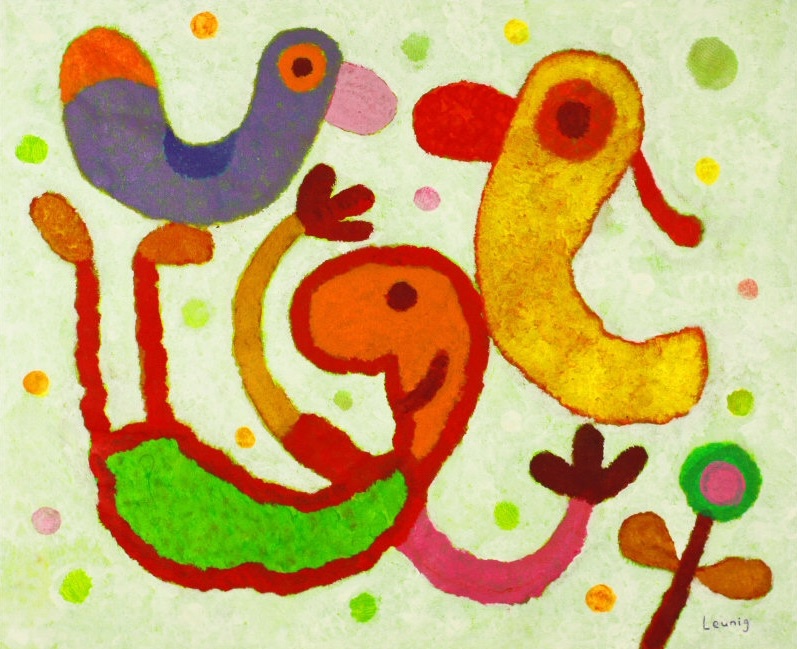
Falling Fool by Michael Leunig (Australian, 1945–)
What is the difference Between your experience of Existence And that of a saint?
The saint knows That the spiritual path Is a sublime chess game with God
And that the Beloved Has just made such a Fantastic Move
That the saint is continually Tripping over Joy And bursting out in Laughter And saying, “I Surrender!”
Whereas, my dear, I am afraid you still think You have a thousand serious moves.
This poem, inspired by the fourteenth-century Persian poet Hafiz, appears in I Heard God Laughing: Poems of Hope and Joy (Penguin, 2006) and is used here by permission of the author.
Mirta Cerra (Cuban, 1904–1986), Plegaria (Prayer), ca. 1946. Oil on canvas, 24 × 17 1/2 in. (60.9 × 44.5 cm). Torna Art Gallery, Havana.
I appeal to you therefore, brothers and sisters, by the mercies of God, to present your bodies as a living sacrifice, holy and acceptable to God, which is your spiritual worship. Do not be conformed to this world, but be transformed by the renewing of your minds, so that you may discern what is the will of God—what is good and acceptable and perfect.
The version on the MP3, from a church service at New City Fellowship’s University City, Missouri, location, is piano-based and led by a female vocalist (and includes strong harmonies), whereas the version in the video, from Redeemer Church in Jackson, Mississippi, is guitar-based and has a male lead (Ryan Dean). Both recordings are from 2011. Visit the New City Fellowship Music website, the source of the MP3, to download sheet music and explore more of the church’s gospel music repertoire.
Songwriter Kirk Ward’s original demo is located here. (I’ve previously featured his song “Year of Jubilee.”)
+++
For an Artful Devotion centered on Isaiah 51:3 (another excerpt from Sunday’s lectionary), click here.
This post belongs to the weekly series Artful Devotion. If you can’t view the music player in your email or RSS reader, try opening the post in your browser.
To view all the Revised Common Lectionary scripture readings for Proper 16, cycle A, click here.




 Art & Theology