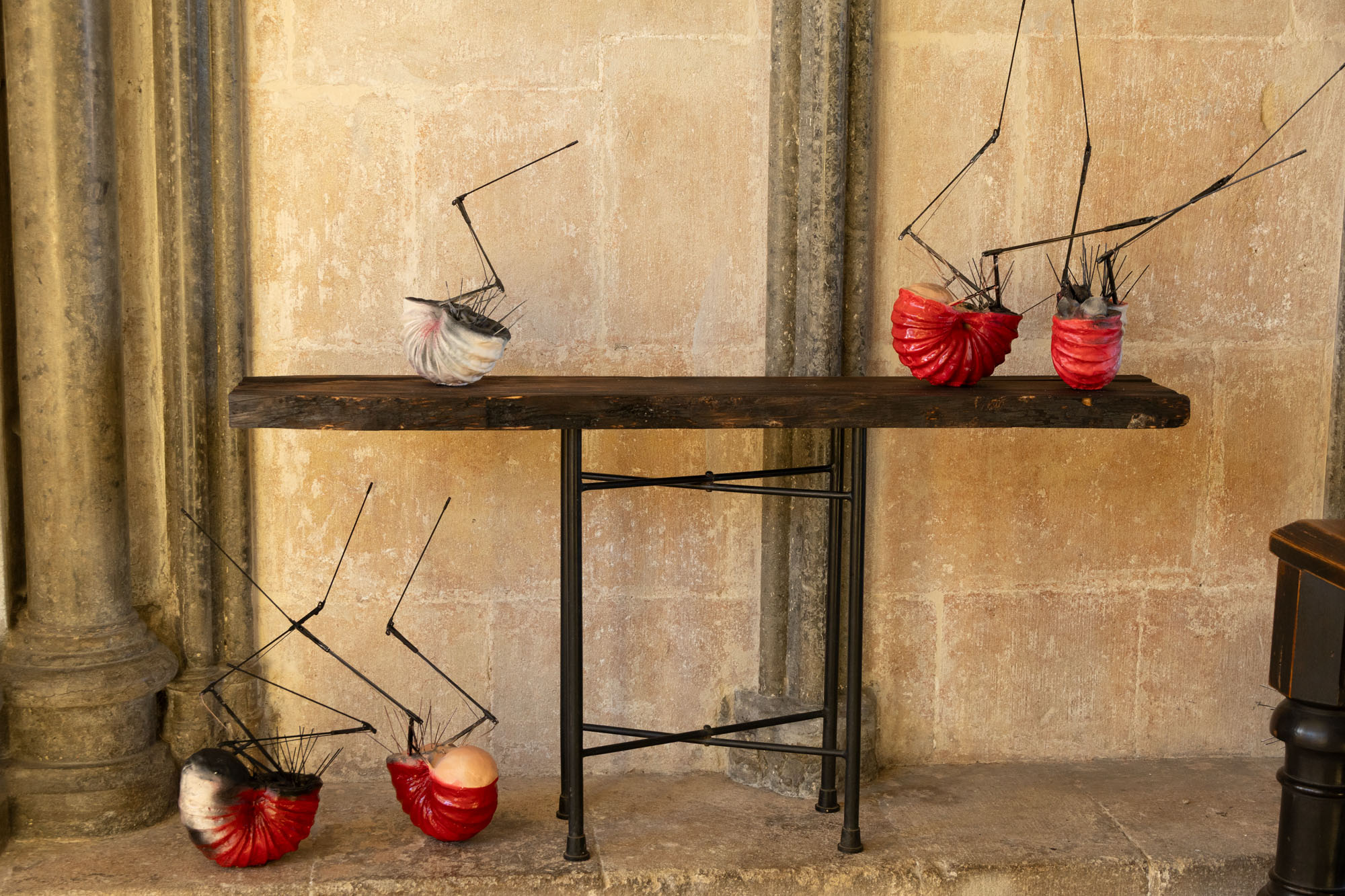
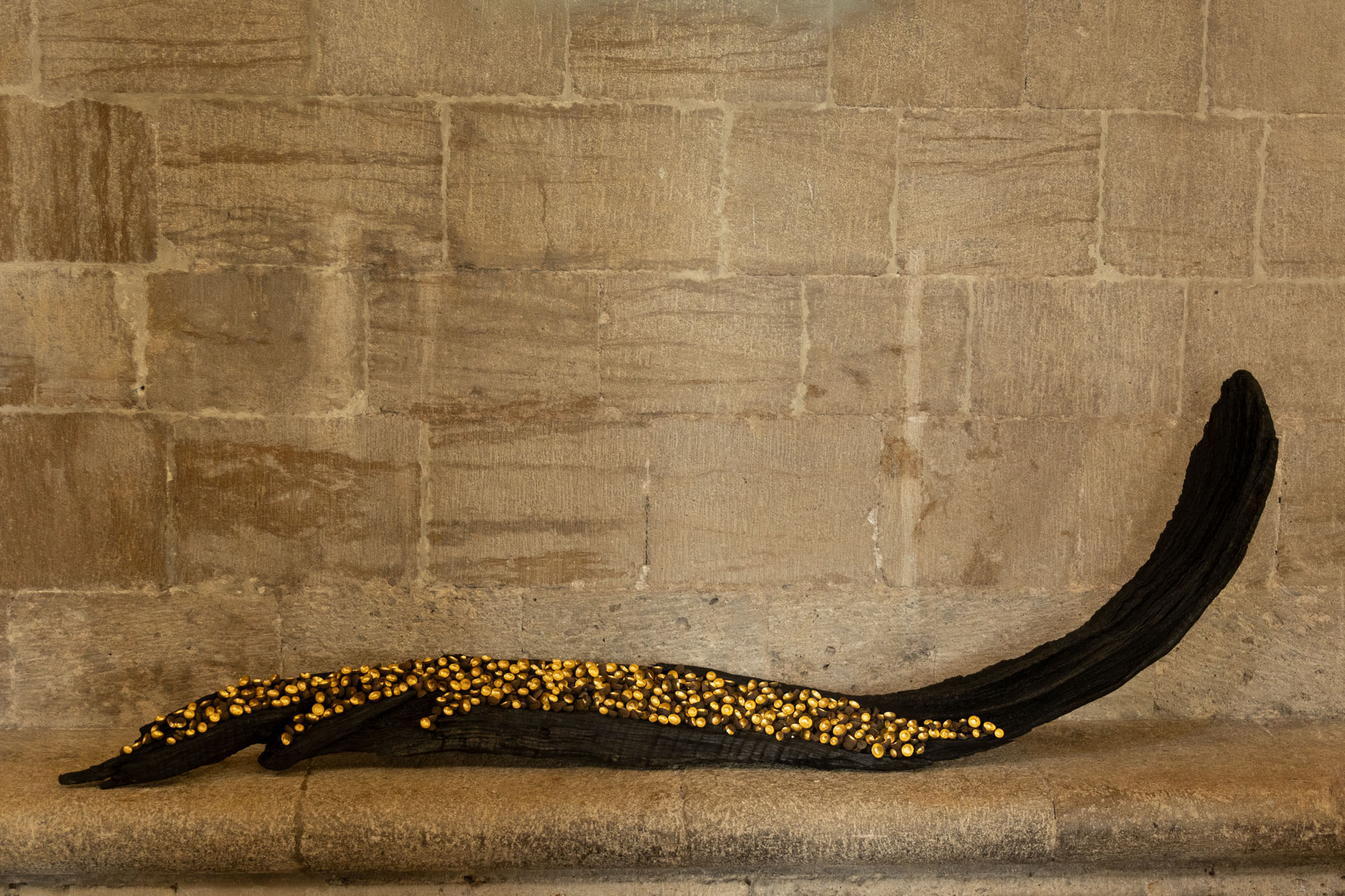
EXHIBITION: TIME, Wells Cathedral, England, October 10–November 7, 2026: The fifteenth annual Wells Art Contemporary exhibition opened this month, featuring seventy gallery artworks and thirty-two site-specific installations, selected from among two thousand-plus entries from forty-nine countries. The art, representing a variety of media, is displayed throughout Wells Cathedral, one of England’s oldest Gothic buildings. It will be up through November 7, and admission (to the church, which includes the exhibition) is £15.50 for adults. Most of the artworks are for sale.
View photos (and purchasing info) at https://www.wellsartcontemporary.co.uk/2026-installation and https://www.wellsartcontemporary.co.uk/2026-gallery.
+++
NEW ALBUM: Tender Mercies by AM Higgins: An American expat in rural France, Annie Meredith Higgins is a singer-songwriter making electro folk pop music. Her latest album was released on October 16. “Tender Mercies is a record in two parts: PART 1-PROTEST and PART 2-PEACE,” she writes. “Together they make a collection of songs that imagine what a new world could look like, through a feminine lens. There’s getting through this current moment that we’re all in, and then there’s imagining what’s ahead. Tenderness is the bridge that we can walk on. Raw piano and drums, lots of room sound, lots of protest, soul and beauty.”
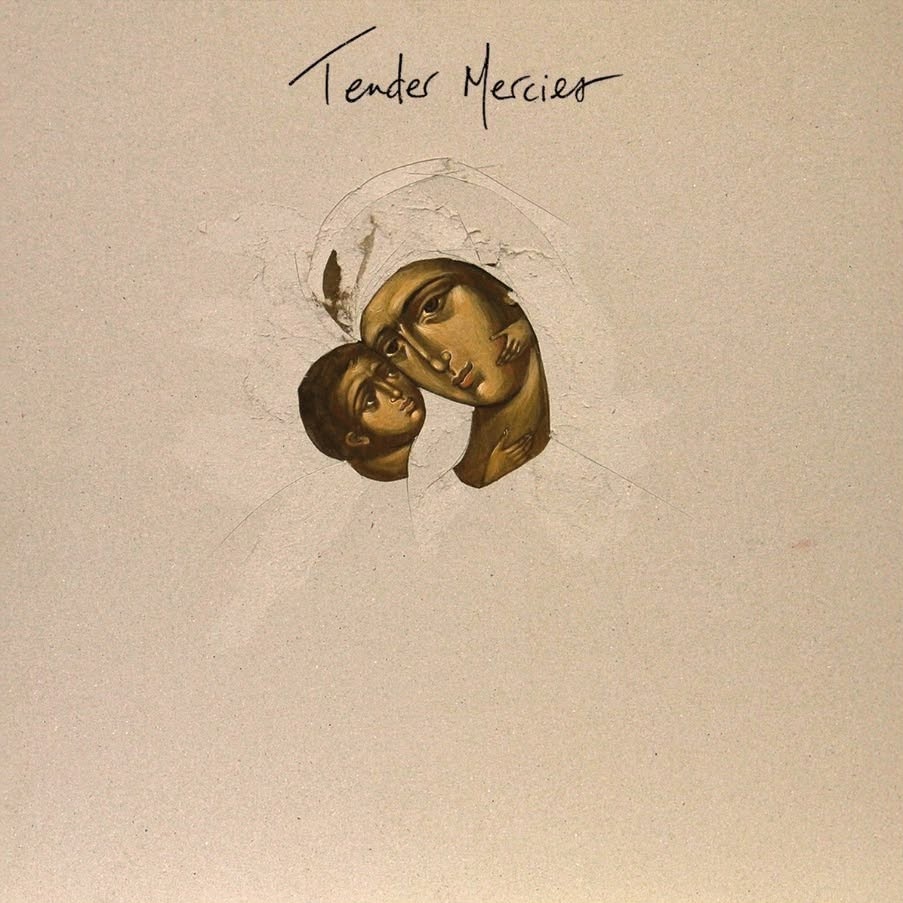
“Eleusa” is the manifesto of Tender Mercies, Higgins says. “Inspired by the Byzantine icon depicting the Virgin Mary and her son, the Christ Child, cheek to cheek, the song asserts that tenderness is a form of resistance. . . . To keep our hearts open and to stay tender is everything, especially now.” The song features contributing vocals by My Brightest Diamond, and the music video, embedded above, shows women from Higgins’s community in Najac “who generously give to us each day.”
Higgins told me she was moved to write “Eleusa” after reading the “Kiss, Kiss” post on my blog last Christmas. “God used your newsletter to light a fire in my heart that was already there—to embrace and dig into the idea of tenderness as strength, in women,” she wrote in an email. “I’m so proud of this song because of the message and how through God’s Spirit, it allows me to contribute something good to a very broken world right now.”
+++
ART SERIES: Holy Bible by Martina La Trobe-Bateman: Martina La Trobe-Bateman is a theologian and multidisciplinary artist whose practice spans installation, photographic processes, paper making, text, book making, and painting. A PhD candidate in the Theology Through Creative Practice program at the University of Glasgow, she is an artist in residence for the Templeton Foundation–funded Mapping the Margins Project, an attempt by an interdisciplinary team of philologists, text specialists, theologians, clinical psychologists, language specialists, and artists to describe the role of paratexts in the process of making meaning when engaging with sacred texts.
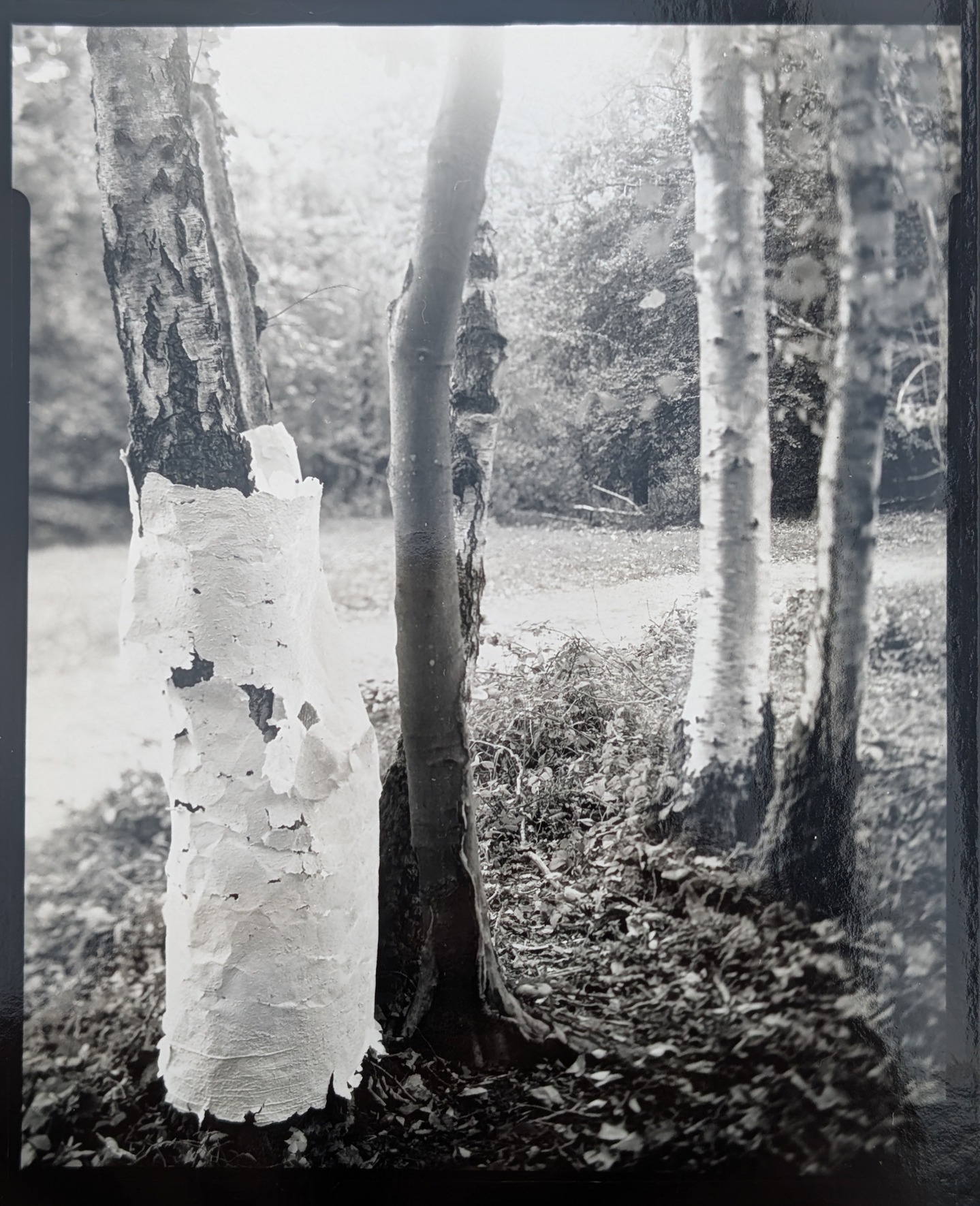
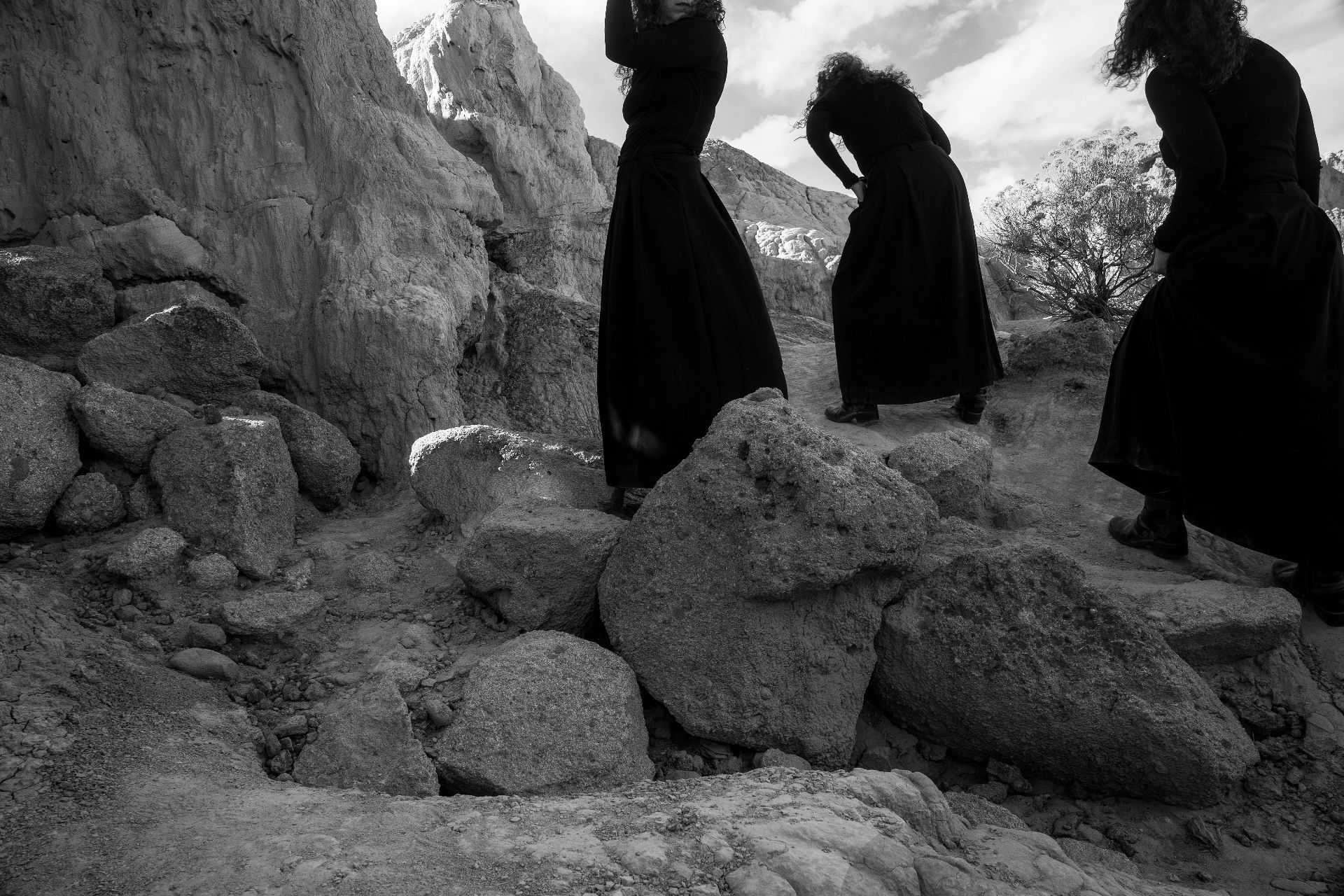
About Holy Bible (NIV), Cycle I, a series of fleeting installations at Ashburnham Place and Birling Gap, documented with photographs, La Trobe-Bateman writes:
Where does text live? How do marks made in ink relate to the substrate that carries them? How do body and text become interwoven, and does meaning emerge, or is there a mutual indwelling or reciprocal inscription? These are just some of the many questions the work invites as it considers material textual relationships: form as paratext. . . .
Working with contemporary codices, in a continual cyclical process of pulping, making, re-pulping, and re-making, I make new paper (embodied texts) from distinct bibles and rainwater as a form of prayer. For each process cycle, spanning several weeks, a single bible is salvaged from unsold charity shop books destined for recycling. Holy Bible is part of a much larger ongoing body of ephemeral works, in which temporary sculptures emerge only to be returned to the process and rhythm of making.
In each sculptural iteration, the material text takes on a different form. Working with guests invited to the studio, gestures, stories, thoughts, and conversations, all become part of the transitional works. The repetitive movements of pulling paper and the constant sound of water in motion become an accompanying liturgy.
La Trobe-Bateman reached out to me last year on Instagram to introduce me to her body of work and to tell me about Manuscripts and the Mind at the Chester Beatty in Dublin, an exhibition featuring her piece The New English Bible – Remnant Papers. I was intrigued but needed some help wrapping my head around these works. I asked her, perhaps overanalytically, “By stripping the words from the Bible, making blank pages—what does that mean to you? Is it a statement about the unknowability of God? Christians consider the Bible sacred not as a physical artifact but because of the words it contains, which reveal God, but when those words are gone, what remains of God’s word? I know you mention the process as like a liturgy or a prayer, but I’m curious what you see the final re-formed codex as revealing.”
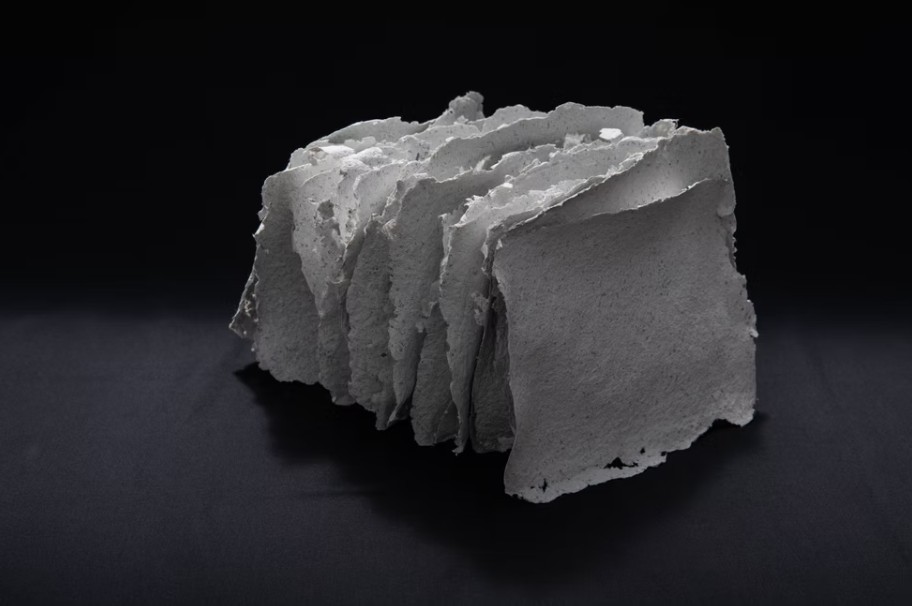
She replied graciously, also sharing some of the reactions viewers have had to The New English Bible – Remnant Papers:
. . . You might find the work more revealing if you consider the processes through which the book has gone not as a “stripping of words” but more as a transformation of form. In material terms, everything that the book is, is preserved. The pages, the ink, even parts of the binding are all still part of its physical presence. In fact, it is quite impossible (without industrial machinery) to pulp the pages to a degree that would mean an erasure of the letters. Letter fragments, entire letters, and word fragments are the most striking marks on the pages. I found that in itself quite revealing. So, in its most basic consideration, the sculpture is one of pure paratext. Here, only that which exceeds the text remains as immediately accessible. Its current form carries the meaning of “book” or “manuscript” or “text”, but it also carries with it the full memory of the forms it has taken in its journey and the people who have interacted with it.
It is fascinating to watch people interact with the work. Almost everyone looks for letters or word fragments and are as excited to find some as an archeologist might be to uncover a letter or word fragment from an ancient gospel codex on a frayed piece of parchment. In this day and age, it’s really exciting to watch unchurched, non-Christian gallery visitors squeal in delight over having recovered a Biblical word. It’s coming alive to them in completely new ways. And isn’t that really how the Word of God is – always new, spoken in a personal address in the eternal present? I agree with Martin Luther and Karl Barth here, in our preaching, in the sacraments, in the word of Scripture, it is always Christ who is speaking. The Word of God is the Word of the living God. This is where my PhD research sits.
I’m writing (and making through creative practice) a new systematic of Scripture, in which I describe it functioning as a place of encounter. A living text in and through which we encounter Christ and leave changed. Of course we need words. My work probes the space of the text and the seat of the text. And as an artwork in a gallery setting, I hope the work raises exactly these sorts of questions and becomes a place that welcomes the stranger. Christians coming to the work seem to need more explanation and reassurance to be able to engage with it in a way that makes it positive and generative for them. Non-Christians are finding in it a space of welcome and curiosity. They are drawn in and want to discover more of this Word, that seems to want to reveal itself to them. I have spoken to several people who were interested to find out more and actually started reading a Bible after having seen the work. This, I find most fascinating of all.
+++
AMBIENT AUDIO: tree.fm: Listen to forests from around the world with these crowdsourced recordings. What a cool idea! [HT: Amy Peterson]
+++
VIDEOS:
I recently discovered the @christianart YouTube channel, whose mission is “to offer a pathway to grow closer to God through the beauty of art and the Gospel.” An outworking of the website https://christian.art/, it’s run by Father Patrick van der Vorst, a Roman Catholic priest for the Diocese of Westminster, a former director of Sotheby’s London, and the author of The Story of Christian Art: Revelation Through the Centuries (Paulist Press; SPCK, 2026). Follow Christian Art on Instagram or Facebook. Here are two of their videos:
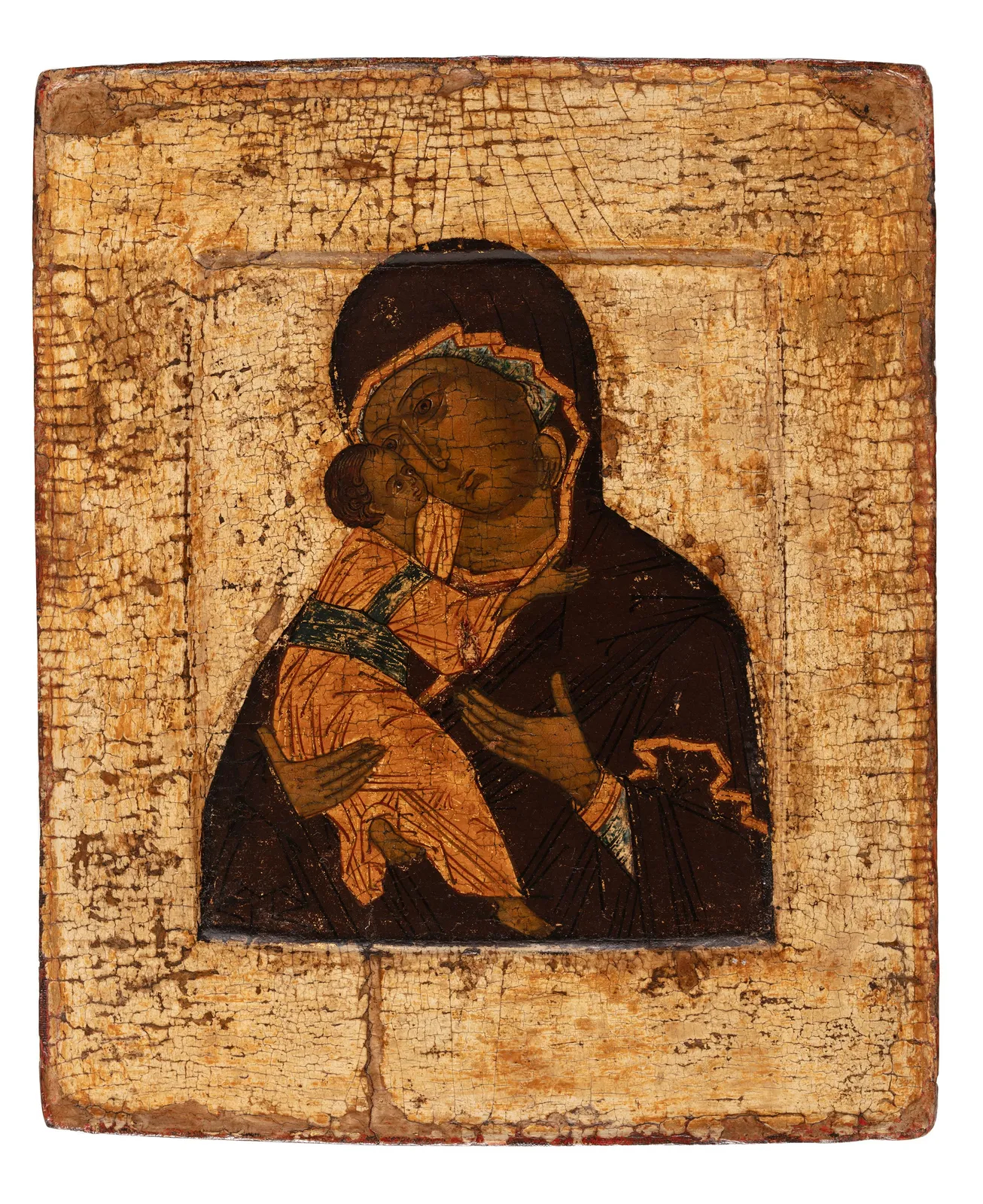
>> “Exploring the hidden world of icons at the Temple Gallery”: “Fr Patrick explores the Temple Gallery in London, one of the foremost galleries in the world dedicated to the ancient tradition of icons. Founded in 1959 by Richard Temple and tucked away on a backstreet in Notting Hill, the gallery houses a remarkable collection of icons and has exhibited pieces believed to date as far back as the fourth century. Richard shares with Fr Patrick his first encounter with icons as a sixteen-year-old, when he purchased an image of Saint Gregory of Nazianzus. He describes how the image seemed to ‘speak to him,’ marking the beginning of a career spanning more than sixty years, devoted to the documentation, research, and acquisition of sacred art.”
>> “A Painting That Shocked Victorian England: Christ in the House of His Parents”: “Standing in the heart of Tate Britain’s Pre-Raphaelite gallery, surrounded by luminous works by the founding members of the Brotherhood, Fr Patrick explores how this groundbreaking image [by Sir John Everett Millais] invites us into a moment of quiet drama and deep theological meaning. . . . The young Jesus – red-haired, barefoot and bleeding – has pricked his hand on a nail in his father’s workshop. His blood falls not only on his palm, but on his foot – a subtle allusion to the Crucifixion. Mary kneels before him, her gesture echoing the Pietà, while Joseph tends gently to the wound. The triangle of figures, the scattered tools, the unfinished door, and even the dove perched above suggest layer upon layer of symbolic meaning. Here, holiness is not cloaked in grandeur but revealed in the dust and shavings of the everyday.”

Difficult as it may be to perceive it as such today, this painting was considered avant-garde in its time—Charles Dickens disparaged it as “mean, odious, repulsive, and revolting,” going into detail about each “ugly” figure in it and the irreverence of the scene’s ordinariness (see 7:56ff.).

