LOOK: The Bride by Gertrude Abercrombie
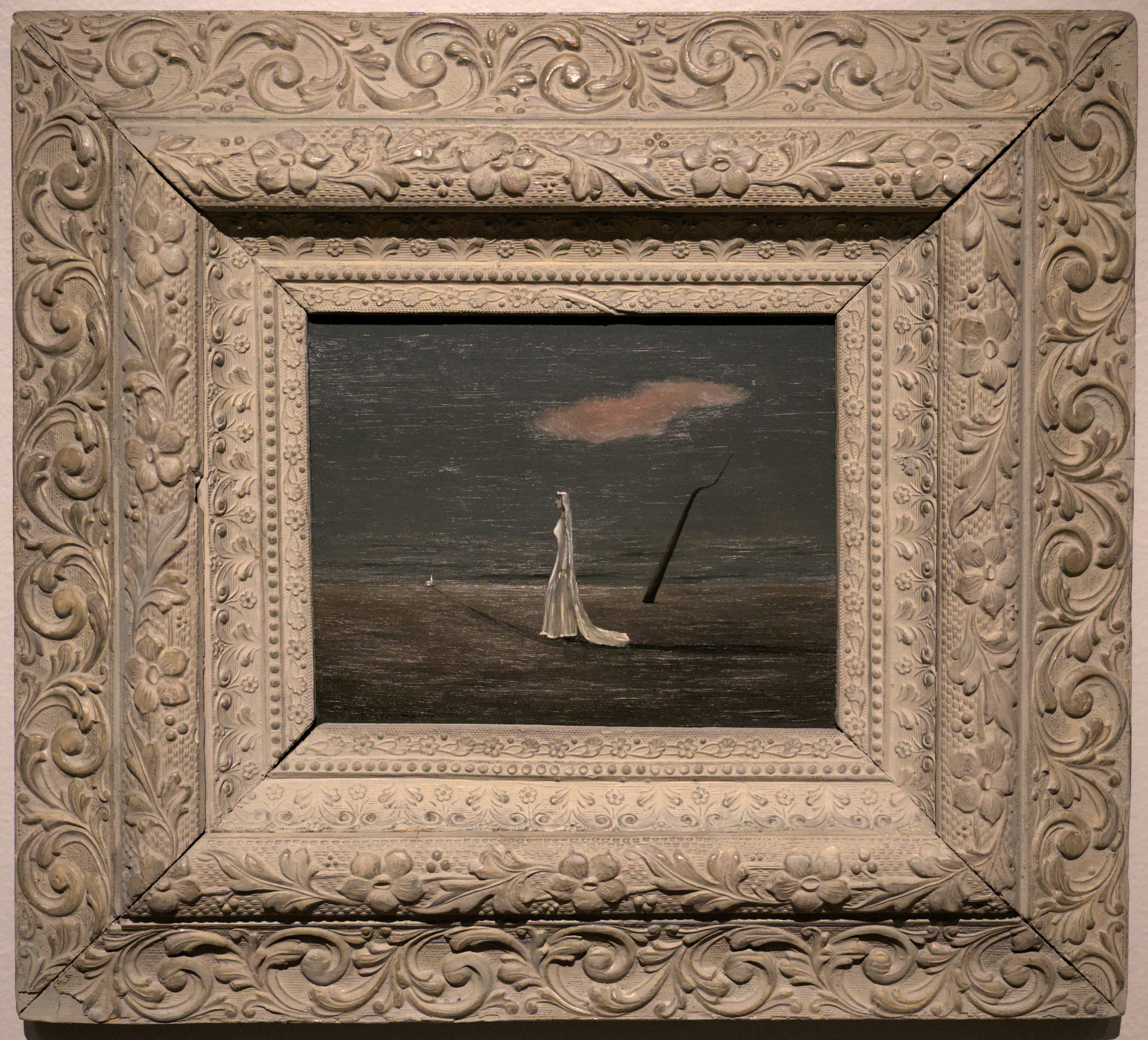
Last year I attended the retrospective Gertrude Abercrombie: The Whole World Is a Mystery at the Carnegie Museum of Art in Pittsburgh, Pennsylvania. Abercrombie was an American surrealist painter from Chicago whose works often feature an enigmatic, solitary female figure in a desolate, nocturnal landscape—a proxy for the artist (“it’s always myself that I paint,” she said). “Cats, doors, moons, barren trees and stumps, seashells, masked and shrouded figures, towers and pyramids, clouds and dominoes and jacks, stairs, eggs, couches, letters, and ladders” (exh. cat., p. 11)—these are some of her recurring motifs.
The scenes she creates tend to be disquieting or melancholy. “Her still, precisely composed paintings, executed in a reduced palette, are tense, mysterious, and pregnant with a sense of searching,” Sarah Humphreville writes in the exhibition catalog essay “Simple Things, a Little Strange.”
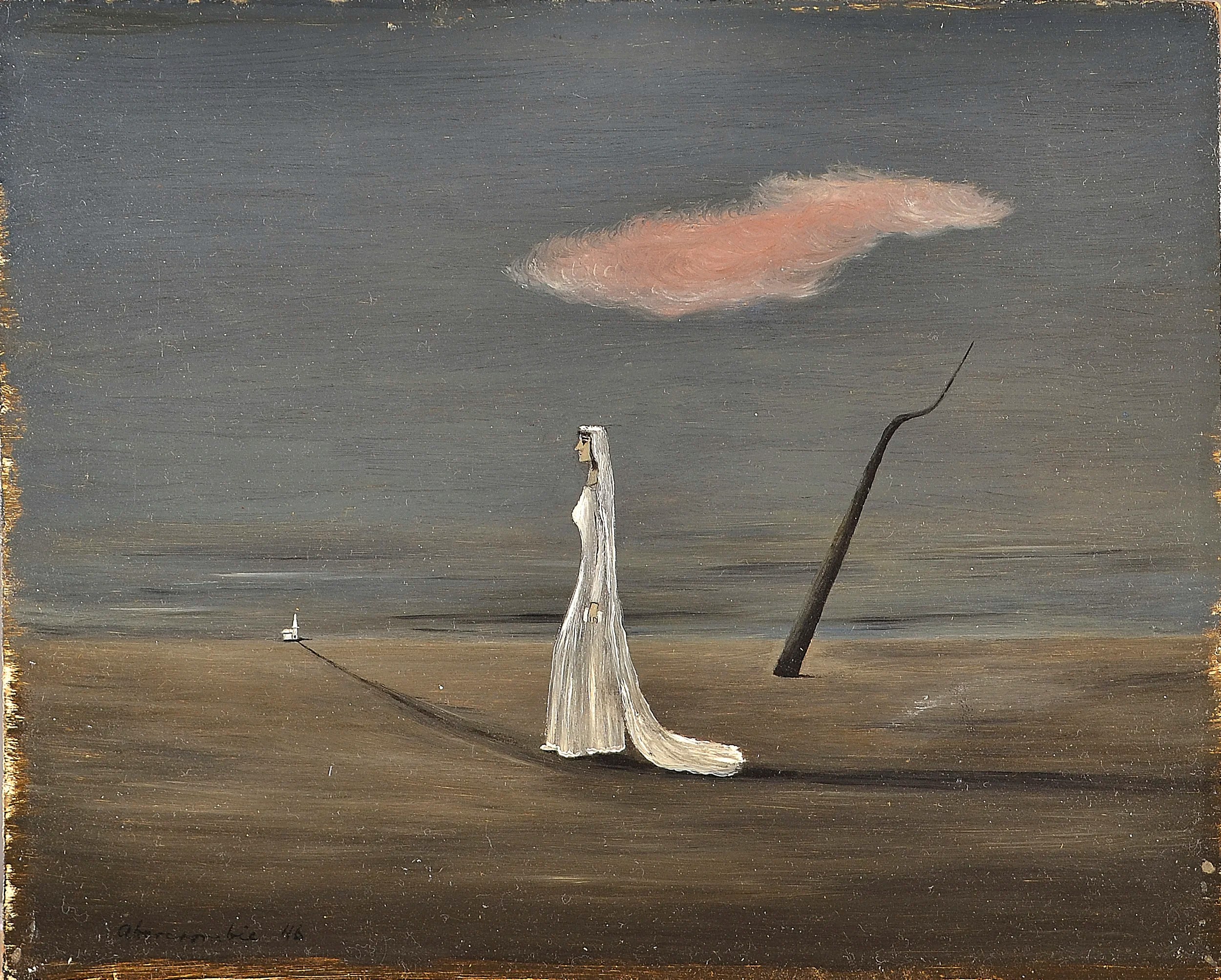
The Bride shows a woman standing in profile in a desert, dressed in a white gown and veil, a handkerchief in hand. Down a footpath in the distance is a little white church with a steeple—but the titular bride is not facing it. Appareled in anticipation of getting married, she seems to be waiting, hoping, for some future groom. Where is he? Will he ever come?
She stands under a pink cloud in a gray sky, to her right a thin, branchless tree trunk leaning precariously. Rather than read it as ominous, I see the cloud as promising, auspicious—getting ready to rain down dew from the heavens. And the trunk, though stark, may sprout a shoot just yet.
(Related post: https://artandtheology.org/2022/12/07/advent-day-11-waiting-bride/)
LISTEN: “Come, Lord, and Tarry Not” | Words by Horatius Bonar, 1846
Horatius Bonar was a Scottish evangelical preacher and hymn-writer. This is my favorite of his hymns. I like how its view of redemption encompasses more than just human souls; it hopes for a renewed earth too. In full, it consists of fourteen stanzas, but most current hymnals include just five. While I understand and support that truncation, here, I split the difference and give eight, because I don’t want to lose some of those middle verses!
Come, Lord, and tarry not!
Bring the long-looked-for day!
O why these years of waiting here,
These ages of delay?Come, for thy saints still wait;
Daily ascends their sigh;
The Spirit and the Bride say, “Come!”
Dost thou not hear the cry?Come, for creation groans,
Impatient of thy stay,
Worn out with these long years of ill,
These ages of decay.. . .
Come, for love waxes cold,
Its steps are faint and slow;
Faith now is lost in unbelief,
Hope’s lamp burns dim and low.Come, for the grave is full,
Earth’s tombs no more can hold,
The sated sepulchers rebel,
And groans the heaving mold.Come, for the corn is ripe,
Put in thy sickle now,
Reap the great harvest of the earth—
Sower and reaper thou.. . .
Come, and make all things new;
Build up this ruined earth;
Restore our faded paradise,
Creation’s second birth.Come, and begin thy reign
Of everlasting peace;
Come, take the kingdom to thyself,
Great King of Righteousness!
I was introduced to this hymn through a recording by the Brotherhood of Hope, a community of Catholic religious brothers with households in New Brunswick, New Jersey; Minneapolis; Orlando; Tampa; and Boston. One of the community members, Brother Joseph Donovan, wrote a new tune for it in the nineties, which I very much like.
>> Music by Br. Joseph Donovan, 1997 | Performed by the Brotherhood of Hope on A Season of Hope: Rediscovering Our Advent Heritage, 2011:
Another contemporary tune is by Clint Wells. He released the song in 2010 with Red Mountain Music, the group he was a part of at the time, under the title “All Things New.” Below is one of my friends, a former worship leader, playing and singing Wells’s version.
>> Music by Clint Wells, 2009 | Performed by Stephen Horst and Tinbit Alemayehu, Church of the Resurrection, Washington, DC, 2020:
Most commonly in the West, however, the hymn is paired with the eighteenth-century English tune ST. BRIDE.
>> Music by Samuel Howard, 1762:
The hymn is also popular in India, where a Tamil version is sung, titled “Neer Vaarum Karthave.” No. 52 in the Kiristheva Paamaalai (Tamil Church Hymnal), it’s paired with a tune called VESPERS, but no composer name is given. It sounds traditional European.
>> Music: VESPERS, origin unknown | Performed by the Holy Trinity Church Choir Fellowship, Pragasapuram, Tamil Nadu, South India, 2018:

