Taken near Mars Desert Research Station in Hanksville, Utah, in 2019, this photograph shows yellow and purple flowers peeping up through the dry cracks of a desert floor. It’s a superbloom, “a rare desert botanical phenomenon in which an unusually high proportion of wildflowers whose seeds have lain dormant in desert soil germinate and blossom at roughly the same time. The phenomenon is associated with an unusually wet rainy season” [source]. View more photos here.
Even the wilderness and desert will be glad in those days The wasteland will rejoice and blossom with spring crocuses Yes, there will be an abundance of flowers and singing for joy The deserts will become as green as the mountains of Lebanon As lovely as Mount Carmel or the plain of Sharon There the Lord will display his glory The splendor of God With this news, strengthen those who have tired hands And encourage those who have weak knees Say to those with fearful hearts: Be strong and do not fear Your God is coming He is coming to save you
This electronica chant sets to music a popular Advent scripture: Isaiah 35:1–4. Sung by Tara Ward [previously] of the Opiate Mass, it was recorded live on December 4, 2010, at Immanuel Lutheran Church in Seattle.
The name [The Opiate Mass] is a nod both to the Christian liturgical form and to Karl Marx’s assessment that religion is the opiate for the masses. Perhaps it is. Or perhaps the common desire for comfort, rest, escape, or relief are more complicated and mysterious than we know.
In our pursuit of creating spaces of beauty and awe, we find ourselves partial to cathedrals, antiquity, ambience, pipe organs, samplers, synthesizers, incense, tongues, silence, joy, meditation, ambiguity, the abstract. We strive to avoid pretense, hype, cliché, certainty, celebrity, egotism, greed, noise.
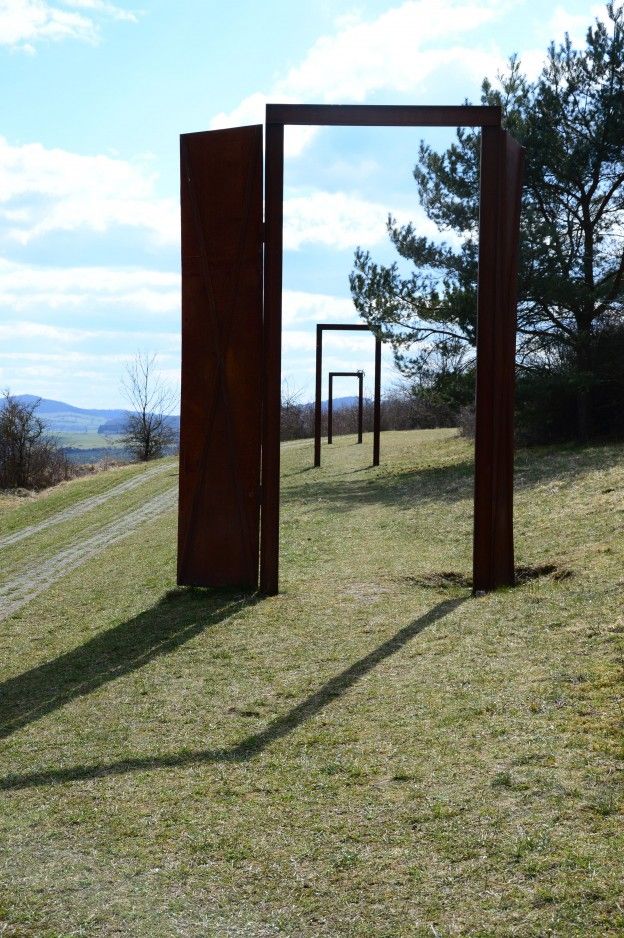
Ulrich Barnickel (German, 1955–), Hoffnung (Hope), fourteenth station from the cycle Weg der Hoffnung (Path of Hope), 2009–10. Iron sculpture, Geisa, Germany.
This is the last of fourteen monumental sculptures situated along the former inner German border that separated Soviet-occupied East Germany and Allied-occupied West Germany from 1952 to 1990. Stretching from Hesse to Thuringia, this highly militarized frontier consisted of high metal fences, barbed wire, alarms, watchtowers, and minefields, a literal iron curtain that divided families, friends, and neighbors.
In 2009, the Point Alpha Foundation, founded to preserve the historic site as a memorial, commissioned German metal sculptor Ulrich Barnickel to create an artwork as part of the memorial. He decided to draw on the traditional fourteen Stations of the Cross, connecting the suffering of Jesus to that of the people on the inner German border under Communism. Collectively titled Path of Hope, his fourteen iron sculptures cover 1,400 meters of ground (scaling down the 1,400 kilometers of the former border). All but the last are figurative, representing Jesus falling, meeting his mother, being nailed to the cross, and so on. They contain artifacts from or references to German Cold War era history, such as a vintage steel helmet hanging on Pilate’s chair, or the grenade and the trench that Jesus stumbles over.
The final station, titled Hope, is a threefold open doorway. After all the heaviness of the previous thirteen stations, we get this breather. Here’s what the doors say to me: Invitation. Possibility. The fourteenth station of the cross is traditionally where Christ is buried in his tomb. But instead of a dead body on a slab or a sealed-up cave, Barnickel gives us an open frame, a door ajar, a view of sky. It alludes to resurrection. Jesus walked through death and came out the other side. And so can we.
While the Path of Hope is a vehicle for remembering, lamenting, and healing from the collective traumas of war and political violence and oppression, it can also speak to personal losses, to any individual’s journey of grief. It’s an invitation to acknowledge the pain we carry but also to see beyond it to the Better Day that is coming, as well as to embrace the life before us here and now. The doors ask us to unburden ourselves of whatever weight is crushing us and to be renewed. (Notice the crown of thorns, an emblem of suffering, left hanging on the corner of the final threshold.) To follow the Man of Sorrows, who walks beside us in our own sorrow, from death into life.
For those accompanying a loved one to the door of death, or who have had a loved one suddenly snatched through, may Barnickel’s Hope meet you in your grieving, filling you with soft consolations of a Love stronger than death, a Love who, once buried, became on the third day the firstfruits of the resurrection harvest.
Waking up to tragic dawn Not comprehending what is going on Alleluia, Christ is risen once again
And it frames a hollow place Lost dreams and accolades Alleluia, Christ is risen once again
Alleluia, Christ is risen Though the walls of castles fall Alleluia, he is risen for us all
From these sights the shadows light In an overwhelming night Alleluia, Christ is risen once again
Hopes fly from us every day Fear reigns far and so does hate Alleluia, Christ is risen once again
Alleluia, Christ is risen Though the gates of all this war Alleluia, Christ is risen evermore
Alleluia, God is able To complete the life you led Alleluia, Christ is risen from the dead
Alleluia, he is risen once again
From the sorrow you have fled You have joy around your head Alleluia, Christ is risen once again
And as from earthly trials you fly You leave sadness when you die Alleluia, Christ is risen once again
Alleluia, Christ is risen And the life you’re living now Alleluia, all’s forgiven somehow
Alleluia, there is beauty When I think of you, joy I feel Alleluia, in my sadness, faith is real
Alleluia, Christ is risen once again Alleluia for you, my friend
Tara Ward [previously] wrote this song during the 2007 Easter season when two tragedies struck within a week of each other. On April 16, a mass shooter opened fire at Virginia Tech, killing thirty-two people, and on April 21, Ward’s friend Liz Duncan was fatally struck by a car while jogging. In the second half of the song, Ward addresses Duncan in the second person, rejoicing through tears that she has entered a state of joy and rest and will one day be raised, body and soul.
Ward returned to the song for Easter 2020 following the death that March of another friend and the initial outbreak of COVID-19. “I was trying to think of what I would sing if I was still working at a church, looking for honest songs to sing on Easter, and this one came up,” she writes on the YouTube video description.
The Nashville community, and America at large, is still reeling from the March 27 shooting at Covenant School that left seven dead, the 131st mass shooting in the US this year. I can only imagine the absolute devastation and rage a parent would feel upon learning that the child they dropped off at school that morning would not be coming home because they were gunned down with an assault rifle.
As I listen to this song, I think, too, of Leslie Bustard, a writer and book publisher, a luminary in the art and faith sphere, who, less than two months after hosting an amazing Square Halo conference on the theme of “ordinary saints,” is now in hospice with late-stage cancer.
Sometimes all the exuberance of Easter can seem disjunctive with the bleak state of the world or our own present circumstances. Christ is risen, but death is still a reality, and it’s still painful. Quiet and aching, this song gives space to grief while also confessing this central Christian doctrine: that Jesus rose from the dead, giving life to all who will receive it. Of course, that doesn’t mean Christians are exempt from experiencing physical death—we will all one day go to the grave—nor from the grief that follows in the wake of a loved one’s passing.
But what Ward’s song helps us do is sing “alleluia” in our sadness, because Christ’s resurrection life is at work in those who have passed on in him, and it’s at work in those of us who walk through the valley of death’s shadow here on earth. The “once again” language—“Christ is risen once again”—indicates that Jesus’s historical rising has ongoing implications, its efficacy extending to every new place of death.
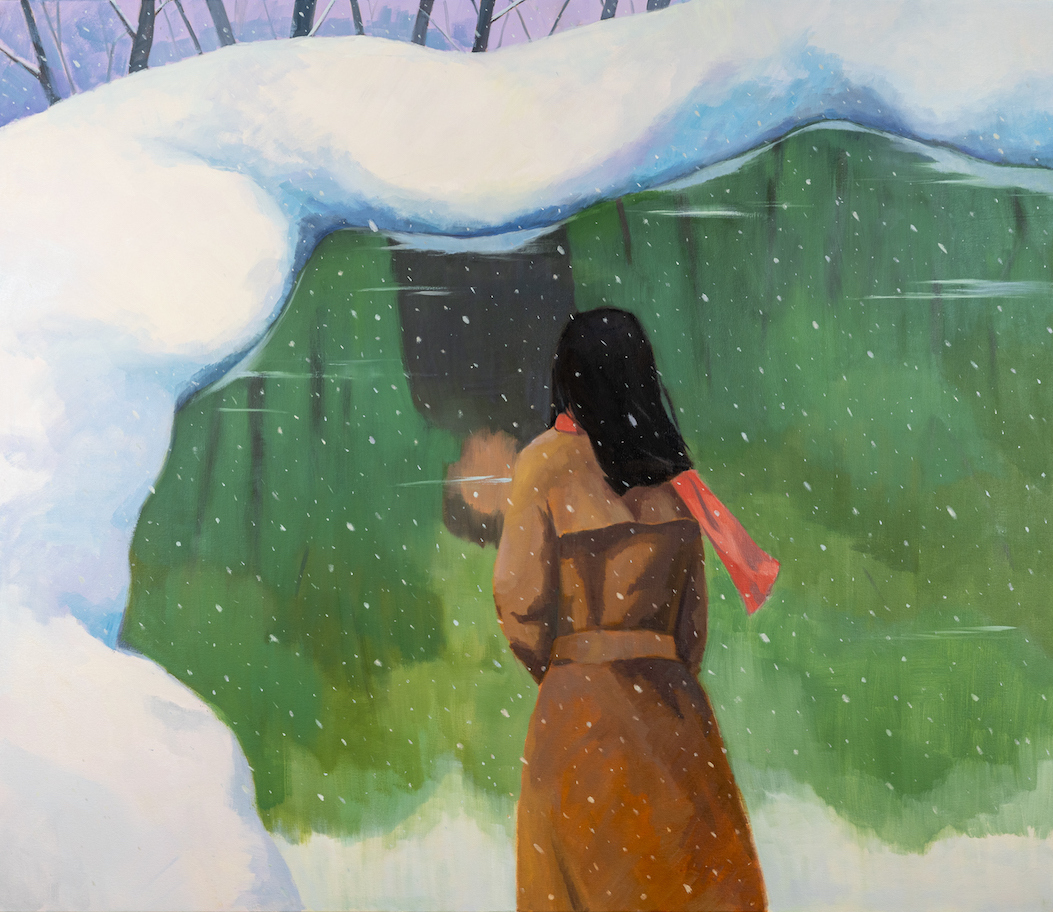
Yuri Yuan (Chinese American, 1996–), Norwegian Wood, 2020. Oil on canvas, 63 × 73 in.
This painting by New York–based artist Yuri Yuan shows a woman in a belted brown trench coat, her back to us, standing at the edge of a frozen pond. A small gust of snowy wind whips her hair and scarf. Though her face isn’t visible, she appears to be deep in thought.
Reflected on the pond’s surface is a man dressed in black. We don’t see his physical form, and his features are indistinguishable in the mirroring ice. Who is he? Does he wish to speak to the woman? Does he come with news, or an invitation, perhaps? Or simply to wait with her in silence?
There’s a mystic quality to the image that’s heightened by the incongruity between the environment and its reflection. In the upper left, the trees are barren and dusted with the white of winter, and indeed the woman is dressed for the cold. And yet in the trees’ reflection in the pond, they are in full foliage, leafy green, as if it were summer.
It’s as if two worlds are converging here in this wood. Or the woman foresees, with the eyes of her spirit, a lushness that has not yet come to pass.
Notice how the snowbanks piled up along the water’s edge could almost double as clouds, particularly in the bottom left, where the white mass meets the sky’s reflection. The heavens and the earth becoming one.
I chose this image to kick off the Advent season (which begins tomorrow) because it captures the sense of longing that the church leans into most especially during these four weeks, but also the sense of promise, the possibility, that’s just as characteristic of the season. In the eschatological reality that Israel’s prophets foresaw, the barren becomes verdant and the dead come to life. “The wilderness and the dry land shall be glad; the desert shall rejoice and blossom” (Isa. 35:1).
Strangely, Norwegian Wood is a painting of both absence and presence, distance and nearness.
If you like, imagine Yuan’s mystery man as God coming close—which is what the Incarnation is: God coming closer than close!
What invitation might God have for you this Advent? What heartache from the past year, or even further back, do you need to bear to the Healer? What hopes do you need to speak out loud?
We wait, we hope We yearn, prepare For who or how or what or where? Maybe the changing of the tide Maybe the turning of someone’s eye Maybe the falling of the snow Only heaven knows What happens when God comes close
We wait, we hope We yearn, prepare For who or how or what or where? Maybe the healing of a heart Maybe reunion of a drift apart Maybe a child’s coming home Only heaven knows What happens when God comes close
We wait, we hope We yearn, prepare For who or how or what or where? Maybe the song, a place to belong Maybe some faith, just a touch of grace Maybe love, it’s rarely what we think of Only heaven knows What happens when God comes close
This is the first post in a daily series that will extend to January 6. You are welcome to subscribe via email or RSS, but posts are optimized for viewing on a web browser. (And note that Gmail sends WordPress posts to your Social tab, unless you create a filter to tell it otherwise.) Links will be shared on Facebook and Twitter.
He shall feed his flock like a shepherd: he shall gather the lambs with his arm, and carry them in his bosom, and shall gently lead those that are with young.
“Come unto me, all ye that labour and are heavy laden, and I will give you rest. Take my yoke upon you, and learn of me; for I am meek and lowly in heart: and ye shall find rest unto your souls. For my yoke is easy, and my burden is light.”
—Matthew 11:28–30 (KJV)
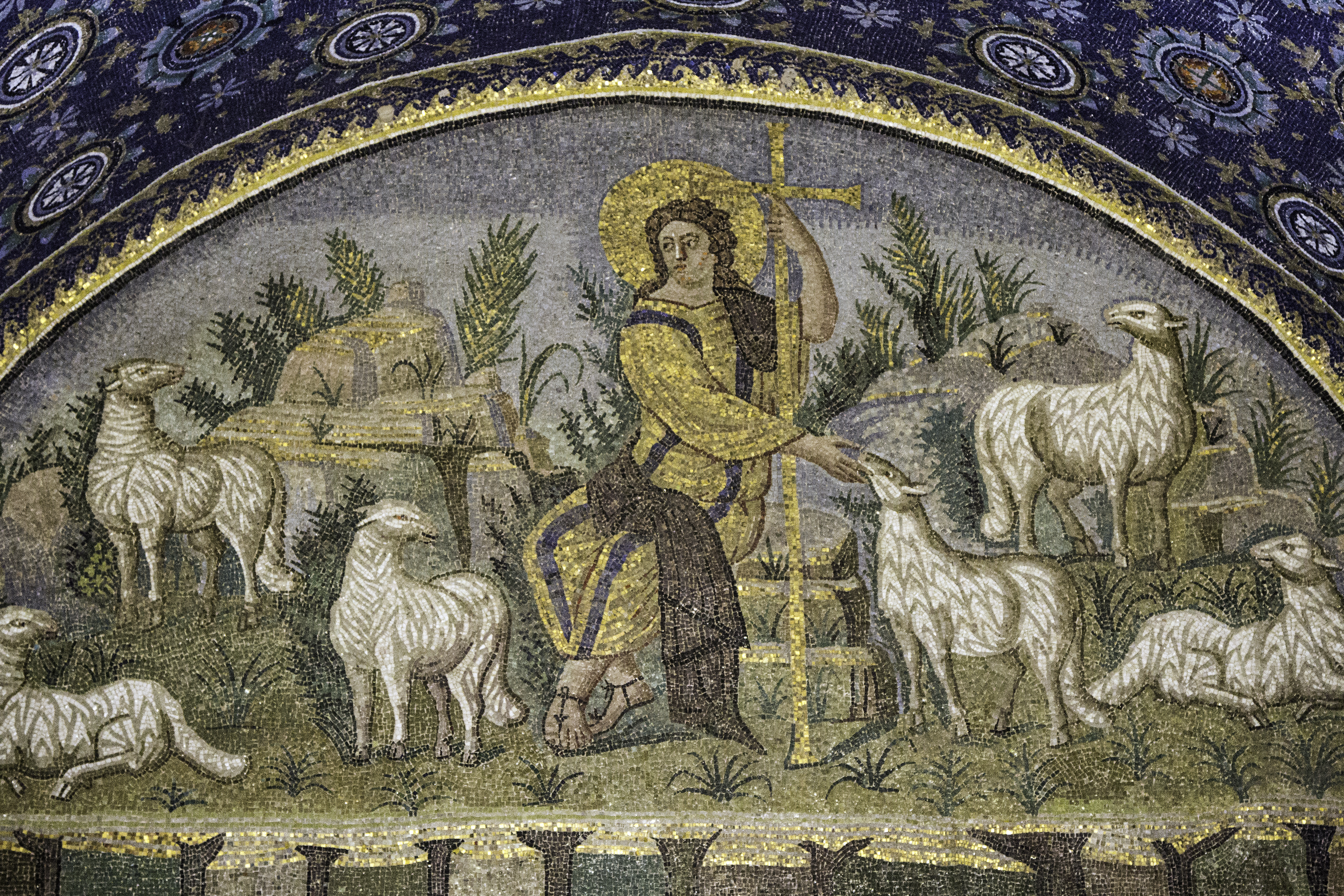
LOOK: Good Shepherd mosaic, Ravenna
Christ the Good Shepherd, 5th century. Mosaic from the tomb of Galla Placidia, Ravenna, Italy. Photo: Fr. Lawrence Lew, OP.
LISTEN: “He Shall Feed His Flock” | Text: Isaiah 40:11; Matthew 11:28–30 (KJV) | Music by Georg Frederic Handel, 1742 | Arranged and sung by Tara Ward on Adventus by Church of the Beloved, 2010
He shall feed his flock Like a shepherd And he shall gather The lambs with his arm With his arm
He shall feed his flock Like a shepherd And he shall gather The lambs with his arm With his arm
And carry them in his bosom And gently lead those That are with young And gently lead those And gently lead those That are with young
Come unto him All ye that labor Come unto him Ye that are heavy laden And he will give you rest
Come unto him All ye that labor Come unto him Ye that are heavy laden And he will give you rest
Take his yoke upon you And learn of him For he is meek And lowly of heart And ye shall find rest And ye shall find rest Unto your souls
Take his yoke upon you And learn of him For he is meek And lowly of heart And ye shall find rest And ye shall find rest Unto your souls
Born out of a group of friends’ reading of Life of the Beloved by Henri Nouwen, the Church of the Beloved in Edmonds, Washington, was active from 2006 to 2019. It had a vibrant music ministry, led by Tara Ward, that put out four albums, including Adventus. One of the tracks on Adventus is Ward’s slow, ambient, synth-driven arrangement of “He Shall Feed His Flock,” an air from Handel’s Messiah. Charles Jennens, the librettist (lyricist) of the oratorio, combined passages from Isaiah and Matthew to evoke a sense of the deep soul-rest and care that Christ proffers. Church of the Beloved’s rendition so beautifully captures the weariness we often feel, whether we’re on a spiritual path or not, and is a gentle reminder that Christ is always calling us back into his bosom.



 Art & Theology