Roundup: Pitjantjatjara picture Bible, “Feeling Through” short film, the reconciling Eucharist, and more

SPOTIFY PLAYLIST: September 2025 (Art & Theology): A new monthly playlist featuring a range of faith-based songs, including “Day by Day” by Lowana Wallace and Isaac Wardell of the Porter’s Gate (especially apt for Labor Day!), sung below by Kimberly Williams; “Jesus of Nazareth” by the early twentieth-century hymn writer Hugh W. Dougall, performed in a bluegrass style by the Lower Lights; and a fantastic instrumental jazz arrangement by Alice Grace of the classic children’s song “Jesus Loves Me,” performed by the Indonesian group Bestindo Music (Grace is at the keys).

+++

VIDEO: “The Apostles’ Creed”: This video presentation of the Apostles’ Creed, one of the oldest statements of Christian belief, used across denominations, was created in 2016 by Faith Church in Dyer, Indiana, using twenty-one of its members to voice the lines. [HT: Global Christian Worship]

+++

CHILDREN’S PICTURE BIBLE: Godaku Tjukurpa (God’s Story): Nami Kulyuru, a long-serving Pitjantjatjara Bible translator and artist from Central Australia, had the vision to pass on the stories of the Bible to her grandchildren and other young Pitjantjatjara readers using traditional Anangu paintings, compiled in book format. She began the artistic work in 2021 but shortly after was diagnosed with a malignant brain tumor. Following her death in 2022, her friends and colleagues rallied together to complete the project, which was published last November by Bible Society Australia. [HT: Global Christian Worship]
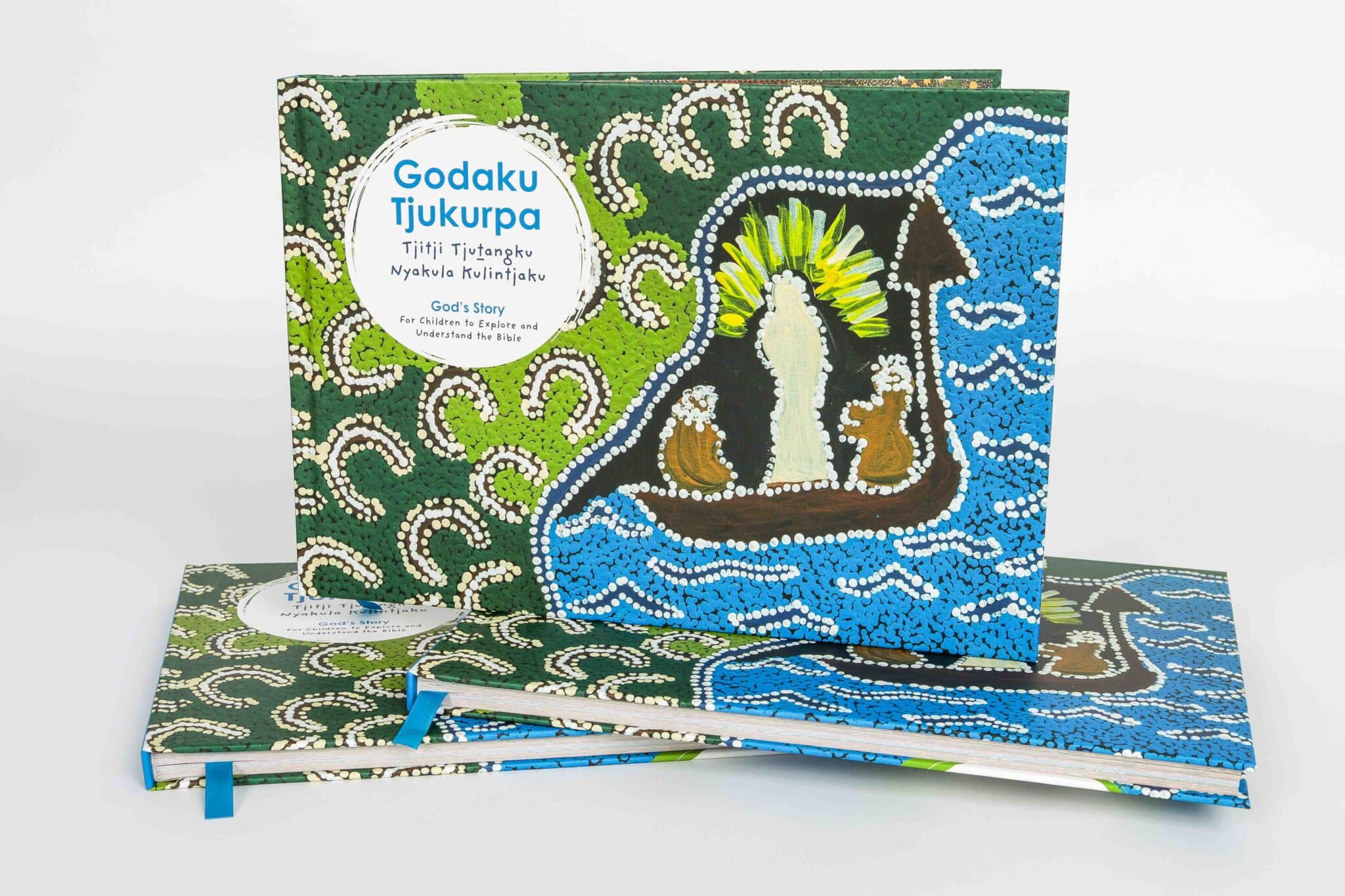
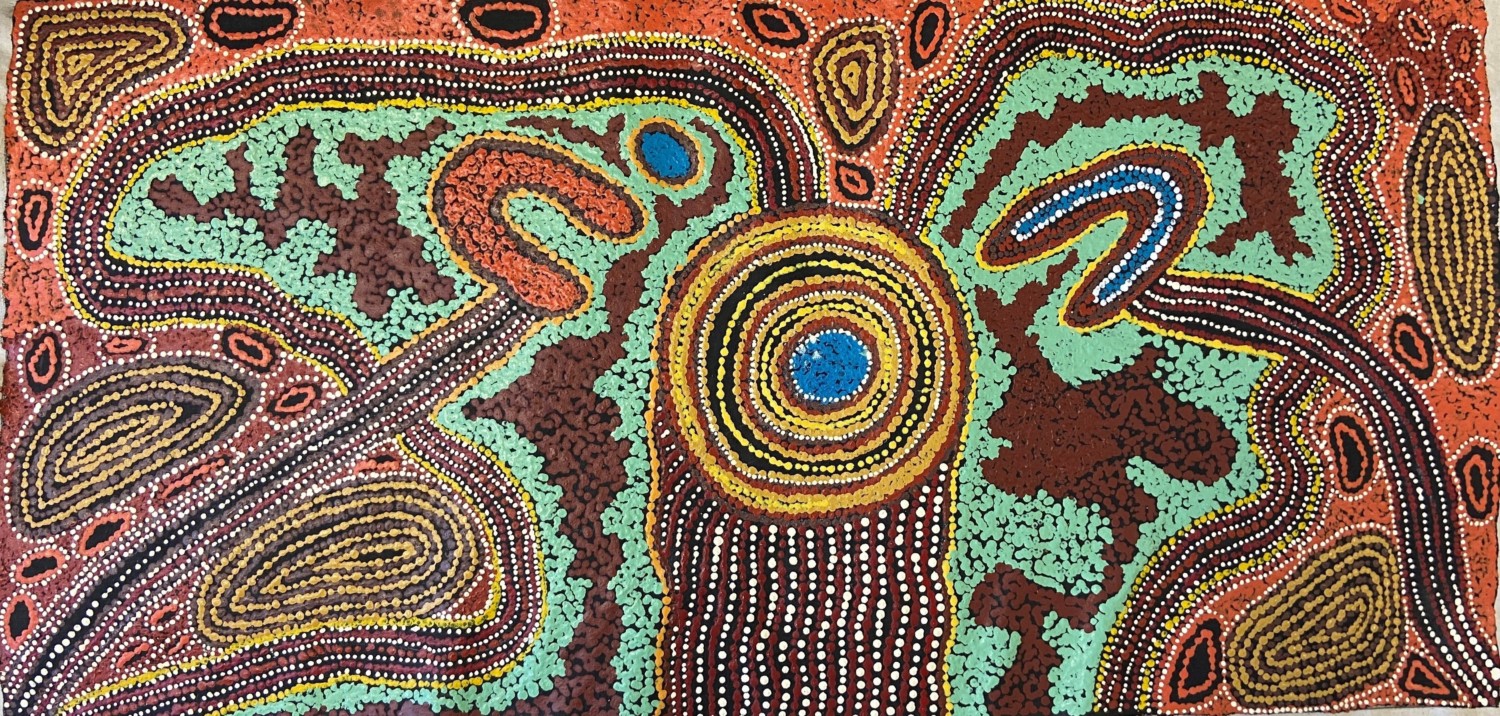
Godaku Tjukurpa
Kulyuru, Nami_Woman by the Well
Nami Kulyuru (Pitjantjatjara, 1964–2022), The Woman at the Well (John 4), 2021, from the bilingual book Godaku Tjukurpa (God’s Story) (Bible Society Australia, 2024)

Spanning the Old and New Testaments, Godaku Tjukurpa (God’s Story) features fifty-four Bible illustrations by Pitjantjatjara artists, along with descriptions in Pitjantjatjara and English. It is available for purchase through the Koorong website, but it appears that it can ship only to Australia or New Zealand.

+++

SHORT FILM: Feeling Through, dir. Doug Roland (2019): Nominated for an Academy Award in 2021, this eighteen-minute film is about a homeless teen (played by Steven Prescod) who encounters a DeafBlind man (played by Robert Tarango) on the streets of New York City. It was inspired by an actual experience writer-director Doug Roland had some years earlier. He partnered with the Helen Keller National Center to make the film, including casting a DeafBlind actor as co-lead, the first film to ever do so. You can watch Feeling Through for free on the film’s website, along with a “making of” documentary. Here’s a trailer:

+++

FEATURE FILM: Places in the Heart, dir. Robert Benton (1984): Set in Jim Crow Texas during the Great Depression, this film centers on the recently widowed Edna Spalding (Sally Field), a middle-age white woman who is struggling to run the cotton farm she inherited from her late husband and to make ends meet for herself and her two small children. To earn some cash, she takes in a boarder, Mr. Will (John Malkovich), a bitter World War I vet who is blind, and she hires Moze (Danny Glover), a Black drifter who is being harassed by the Ku Klux Klan, to teach her how to plant and harvest cotton. The three are thrown together out of necessity and help each other survive.

It’s a pretty good movie overall—and it won Sally Field her second Oscar for Best Actress—but what leads me to recommend it is its theologically profound closing scene, which shows the ordinance of Communion being celebrated at the local country church. First Corinthians 13:1–8, the famous “love” passage, is read from the pulpit, and the choir launches into “In the Garden” (a hymn inspired by the risen Christ’s appearance to Mary Magdalene on Easter morning) as the plates of bread and grape juice are passed down the pews. The camera zooms in close on each congregant as they receive the elements, starting with a couple whose marriage had suffered due to infidelity but who, in this scene, silently reconcile.

On my first watch, what signaled to me that we had entered the realm of the imaginary (the mystical? the aspirational?) was the presence of Moze, who had left town the previous night after having been beaten by Klansmen; he’s here, with no visible wounds, in this conservative white church in the 1930s that very likely would not have welcomed him, being served the body and blood of Christ by a deacon. I believe that some of the white men in the pews in front of him are repentant Klansmen who, when Mr. Will identified them under their hoods by their voices the previous night, mid-assault, slinked away in shame. Within the row, too, is the mortgage collector who was in conflict with Edna, insisting that she sell the farm.

After Edna receives the elements, she passes them to her husband, Royce, who was dead before but here is very much alive. He then passes the elements to the young Black teen, Wylie, who had shot and killed him in a drunken accident, whom vigilantes then lynched. “Peace of God,” they say to each other—a traditional Christian greeting expressing love and reconciliation. The final frame lingers on Royce and Wylie, sharing the meal together, and I’m intrigued by the actors’ choices of expression: Wylie is serene, grace-filled, whereas Royce appears befuddled, perhaps recognizing for the first time the blessed tie that binds him to his Black neighbor, his brother in Christ.

This scene speaks powerfully of the invitation of the Lord’s Table—open to all, even the most morally odious, who would come in humble confession of (and turning from) sin and reliance on God’s mercy through Christ, which heals and transforms. Partaking of the meal are various people from the community—people who have cheated on their spouses; people with ornery dispositions; people with narrow economic interests, who fail in compassion; people who have stolen; people who have committed cruel, racist, violent acts; people driven to drink, leading to fatal harm; people who have silently allowed racial terror to reign in their town. All these sinful, forgiven people make up the body of Christ, are united under his cross. They’ve often hurt one another, but the Holy Spirit is at work making them a new creation. I see this final scene as a picture of heaven, where wrongs are redressed, and of the “beloved community” Martin Luther King Jr. talked about.

Places in the Heart is streaming for free on Tubi (no account required).
“Love is patient…”: Ten songs based on 1 Corinthians 13

This Sunday’s lectionary reading from the Epistles is 1 Corinthians 13:1–13, the famous “love” passage. Here are ten songs that set that text or are based on it. And there are many more besides!

1. “1 Corinthians 13:1–8,” chanted in Romanian by Maria Coman, 2023:

2. “Love Will Never Fail” by Leslie Jordan, Orlando Palmer, Isaac Wardell, and Paul Zach of The Porter’s Gate, from Neighbor Songs, 2019:

For a cover by the Good Shepherd Collective, featuring Jayne Sugg and Son of Cloud (Jonathan Seale) (his is one of my favorite male singing voices), see here. They add as an outro the refrain of Martin Smith’s “I Could Sing of Your Love Forever.”

3. “Tell Him” by Lauryn Hill, 1998, performed by Esperanza Spalding, 2009:

The neo-soul/R&B album The Miseducation of Lauryn Hill (1998), Hill’s solo debut, is one of the most widely acclaimed albums of the nineties. At an evening of jazz and spoken word hosted at the White House on May 19, 2009, by then president Barack Obama, upright bass player, singer, and composer Esperanza Spalding performed her gorgeous arrangement of Hill’s “Tell Him.” The object pronoun “him” used throughout has been interpreted by listening publics as either a romantic partner or God, and the ambiguity is probably intentional. As for me, I hear the song as religious, especially given the line “the love that was shown when our lives were spared,” which I take to be a reference to Christ’s saving sacrifice. [HT]

4. “1 Corinthians 13:8–11” (excerpt) from Uganda, 2021:

This video was uploaded by Bwire Isaac, the founder of Alpha Worship Connection, a registered nonprofit that trains and equips worship leaders in Uganda. It was filmed at one of his Discipleship Training Weeks, and features a pastor named Muwanguzi playing the adungu (bow harp). I believe the language is Luganda. [HT]

5. “Love (1 Corinthians 13)” by Joni Mitchell, from Wild Things Run Fast, 1982:

The song also appears, re-recorded and in new arrangement, on Mitchell’s Travelogue (2002). Hear her speak about how the apostle Paul’s words inspired her in this two-minute video.

(Related post: “The Greatest of These,” a poem by Tania Runyan)

6. “Faith, Hope and Love” by Joanna Forbes L’Estrange, performed by London Voices, dir. Ben Parry, from Heaven to Earth, 2024:

7. “El Amor (1 Corintios 13)” by Michelle Matius, 2023:

Matius is a Christian singer-songwriter and recording artist from the Dominican Republic. Like all her songs, this one is in Spanish.

8. “Live for Love” by Eric Lige, 2022:

9. “The Gift of Love” by Hal Hopson, 1972, performed by Koiné on Gesanbuch, 2008:

The music of this one is adapted from a traditional English folk tune.

10. “Kanoo” (Love) by Elfi Bohl, aka Mariyama Suso, from Suukuu Kutoo / A New Song, 1999:

Bohl’s “Kanoo” is an original setting of 1 Corinthians 13:4–7 in the Mandinka language of West Africa, which she sings to a kora self-accompaniment. She wrote and recorded it while living in The Gambia. To learn more about Bohl and her kora songs, see my previous blog post from December.

Advent, Day 21: Reign of Mercy

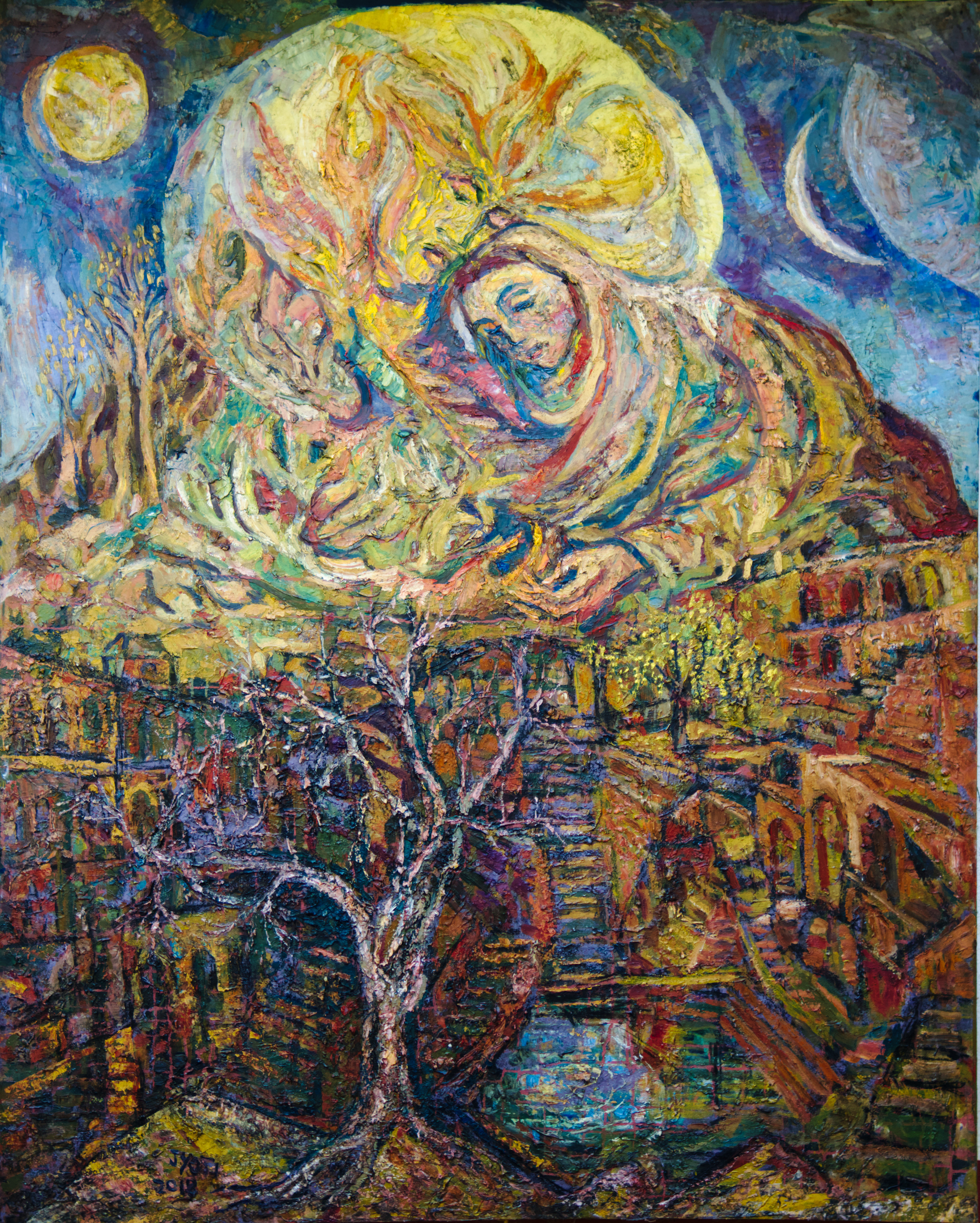
LOOK: Beulah by Jyoti Sahi

Sahi, Jyoti_Beulah
Jyoti Sahi (Indian, 1944–), Beulah, 2018. Oil and acrylic on canvas, 5 × 4 ft. Photo: Victoria Emily Jones.

In Isaiah 62:2–5, God talks to Zion about her future. He says that on the day of the Lord,

The nations shall see your vindication
    and all the kings your glory,
and you shall be called by a new name
    that the mouth of the LORD will give.
You shall be a beautiful crown in the hand of the LORD
    and a royal diadem in the hand of your God.
You shall no more be termed Forsaken,
    and your land shall no more be termed Desolate,
but you shall be called My Delight Is in Her
    and your land Married,
for the Lord delights in you,
    and your land shall be married.
For as a young man marries a young woman,
    so shall your builder marry you,
and as the bridegroom rejoices over the bride,
    so shall your God rejoice over you.

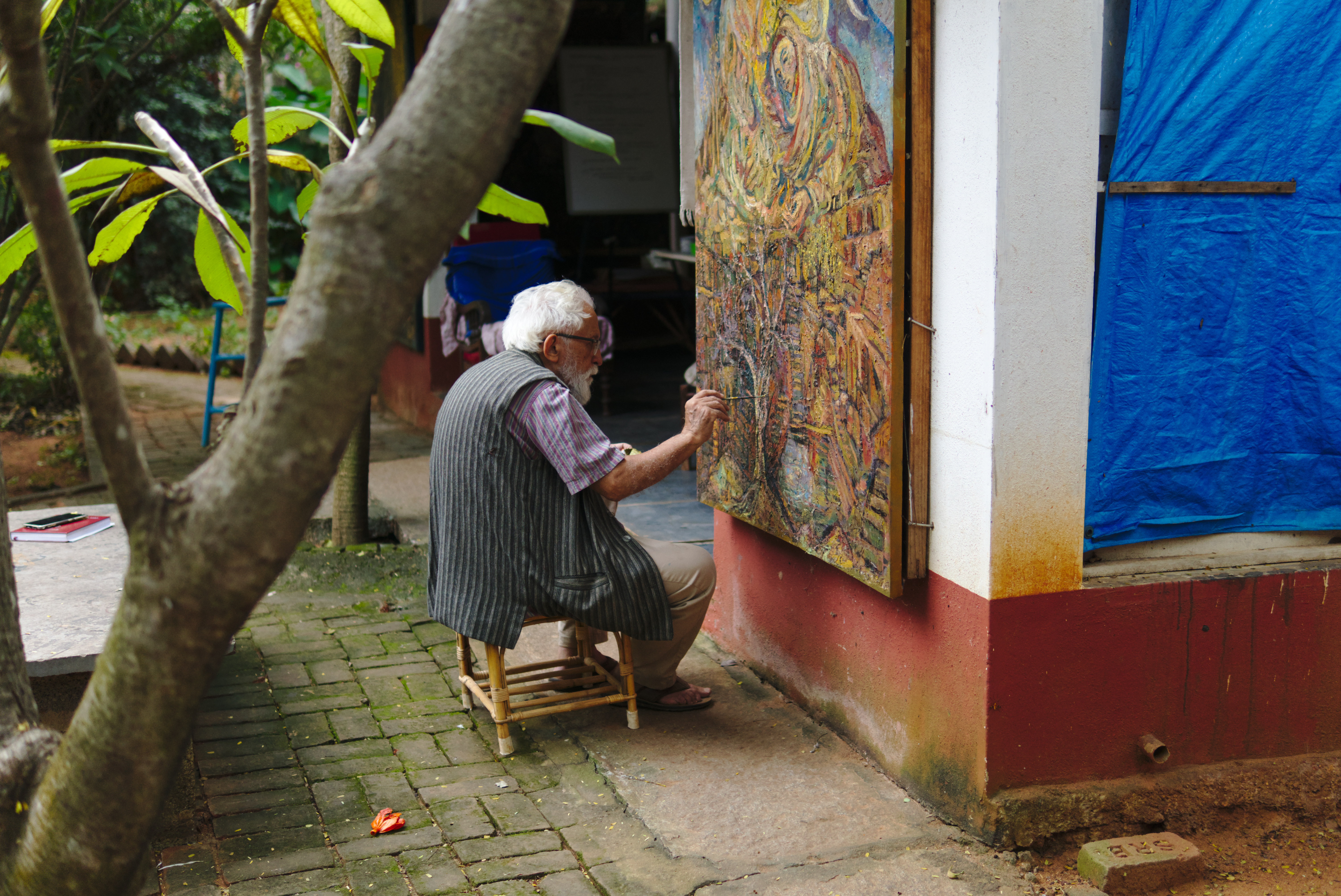
The painting Beulah by the Indian Christian artist Jyoti Sahi (pictured below) takes its title from the Hebrew word for “married” that’s used in Isaiah 62:4. He told me the image pictures the coming together of heaven and earth, the sun marrying the land, which can also be read as Christ uniting with his bride. Christ comes as dawn, his head like flame, like the great I AM revealed to Moses in the burning bush. His glory, the yellow halo around his head, encompasses the female figure. He leans in, tenderly resting his head on hers, and their hands touch.

Beulah shows the reunion not only of humanity and the Divine at the end of time, but also of the land and the Divine. As the Isaiah passage states, the earth, too, will be redeemed and made to flourish once again.

The two figures here form a sacred mountain. A river of life flows down between them, watering the new city, which is a wilderness no longer. This is Isaiah’s vision wrapped up into John the Revelator’s.

Jyoti Sahi
Jyoti Sahi touches up a detail of his painting Beulah. Photo: Victoria Emily Jones.

LISTEN: “The Reign of Mercy” by Kate Bluett and Paul Zach, 2021 | Performed by Paul Zach and Lauren Plank Goans on Advent Songs by the Porter’s Gate, 2021

Oh may our world at last be just
And hilltops echo with your peace
A harvest come from barren dust
The reign of mercy never cease
He comes as rain upon the grass
High heaven’s sun to earth descends
Not as the seasons that will pass
But with a light that never ends

Oh come to him and find your rest
Who saw the poor and came as one
Who hears the cries of the oppressed
And rules till all oppression’s done
Someday he’ll come to reign as king
And we will see his justice done
Our souls will magnify and sing
The Christ whose kingdom now is come

And all the mighty and the strong
Will bow before him on that day
The silenced fill the world with song
The poor and lowly he will raise
And all our bitterness and tears
Our violence and our endless wars
Will end at last when he draws near
Come soon, come soon, oh Christ our Lord

Roundup: Visitation hymn, word games with George Herbert, The Message set to music, and more

HYMN FOR THE FEAST OF THE VISITATION: “Somewhere I hear the church bells ringing” by Gracia Grindal: There are many church songs on the Magnificat, the canticle Mary sings in Luke 1:46–55 when she greets her cousin Elizabeth at Elizabeth’s home in the hills of Judea, but very few hymns, at least in Protestantism, that narrate the Visitation event that occasions it, including Elizabeth’s glad affirmations. Gracia Grindal’s “Somewhere I hear the church bells ringing” is one example of the latter—a four-stanza hymn she wrote in 2010 for the Feast of the Visitation, celebrated every year on May 31, with Elizabeth as the poetic speaker. The hymn captures the excitement of the Messiah coming into the world, and references an Alfred Lord Tennyson poem along the way.

On her blog Hymn for the Day, Grindal provides the lyrics and a reflection on this hymn, as well as sheet music that uses a melody Daniel Charles Damon wrote specifically for the text, which is also available in Damon’s collection Garden of Joy (Hope Publishing, 2011). For public-domain tune alternatives, Grindal suggests DISTRESS or KEDRON from William Walker’s Southern Harmony (1835), or the Renaissance tune by Thomas Tallis known as TALLIS’ CANON—all three of which are commonly used with Fred Pratt Green’s twentieth-century hymn “O Christ, the Healer, We Have Come.”

A professor emerita at Luther Seminary in St. Paul, Minnesota, Gracia Grindal is a prolific writer and translator with expertise in Scandinavian hymns. She has served on several hymn committees and boards and is the author of A Treasury of Faith, a three-volume series of over seven hundred hymn texts on the lessons of the Revised Common Lectionary (Wayne Leupold Editions, 2006–9); Preaching from Home: The Stories of Seven Lutheran Women Hymn Writers (Eerdmans, 2011); an English translation of Hallgrímur Pétursson’s Icelandic Passíusálmar (Hymns of the Passion) (Hallgrím Church, 2020); and Jesus the Harmony: Gospel Sonnets for 366 Days (Fortress, 2021), among many other books.

+++

SUBSTACK POSTS:

>> “The Slow Way: On Being ‘at Peace and in Place’” by Micha Boyett, The Slow Way: When her third child was born with Down syndrome, Micha Boyett, an emerging writer, knew she needed to release herself from the anxiety of producing and focus on parenting; she decided to slow down in order to be faithful to her son. Drawing on themes in her new book, Blessed Are the Rest of Us: How Limits and Longing Make Us Whole, Boyett reflects in this post on the slow, remarkable, intricate work God does when we “allow all that we are to nourish the place we find ourselves”; when we let go of plans and rest in the goodness of what God has for us at this moment. “Rest is something that nourishes our long-term lives. And rarely, if ever, does rest improve our influence, our finances, or our platforms,” she writes. “Rest is an invisible gift to ourselves that results in invisible growth, invisible peace, invisible relational wholeness.”

>> “Word Games with George Herbert” by Grace Hamman, Medievalish: This Herbert poem was new to me, and what a delight it is! It consists of five tercets, each with an end word that gradually diminishes through loss of a letter with each subsequent line—e.g., CHARM, HARM, ARM. Playing this word game, Herbert develops the conceit of himself as a tree in God’s enclosed garden-orchard.

Peach (Tradescants’ Orchard)
“The Nuingetonn Peeche” from the Tradescants’ Orchard, 1620–29. Oxford, Bodleian Library MS. Ashmole 1461, fol. 105r.

I always enjoy the literary works, which are mostly medieval or early modern, that Dr. Grace Hamman explores through her newsletter and podcast—and the “Prayer from the Past” she curates for each newsletter sign-off, like the one in this edition, by Richard Brathwait (1588–1673).

+++

SONG: “Te Atua” (Dear Lord): I heard this popular New Zealand hīmene (hymn) in the Taika Waititi–directed movie Boy (2010) (such a great movie!). It’s a traditional Māori Christian text, set to the Appalachian folk tune NEW BRITAIN (best known for its pairing with “Amazing Grace”) and performed in 1997 by the St. Joseph’s Māori Girls’ College Choir, featuring soloist Maisey Rika. The arrangement is by the college’s principal, Georgina Kingi. Bearing echoes of Jesus’s parable of the sower, this song is particularly appropriate for the season of Ordinary Time that we’re now in, during which the seeds that were planted in us in the first half of the Christian year germinate, grow, and bear fruit.

E te Atua kua ruia nei 
Ö purapura pai
Hömai e koe he ngákau hou
Kia tupu ake ai

E lhu kaua e tukua
Kia whakangaromia
Me whakatupu ake ia
Kia kitea ai ngá hua

A má te Wairua Tapu rá
Mátou e tiaki
Kei hoki ki te mahi hé
Ö mátou ngákau höu
Dear Lord, you have spread
Your seeds of goodness
Give us new hearts
So that these seeds may grow

Dear Lord, do not allow
These seeds to be lost
But rather let them grow
So that the results may be seen

May the Holy Spirit
Guide us
Lest our hearts should
Return to our evil ways

[source]

+++

NEW ALBUMS:

>> Message Songs by the Porter’s Gate: For this album, the Porter’s Gate Worship Project partnered with the Eugene Peterson Center for Christian Imagination at Western Theological Seminary to set to music excerpts from Peterson’s best-selling translation of the Bible, The Message. Included are adaptations of Psalms 5, 16, 27, and 121, Matthew 11:28–30, Luke 15, and John 1—by a range of songwriters. The album release this month coincided with the publication of The Message Anniversary Edition, available from NavPress.

>> Volume 10 (Ordinary Time) of The Soil and The Seed Project: This double album—which is completely free!—features twenty-four songs by musicians of faith under the direction of Seth Thomas Crissman, a Mennonite pastor, educator, songwriter, and multi-instrumentalist from Harrisonburg, Virginia. Here’s one of the songs, “The Way Your Kingdom Comes” by Lindsey FitzGerald Stine, sung by her and her sister Rachel FitzGerald:

The music is one element of a larger project that also includes liturgies and newly commissioned artworks. Learn about the project’s free summer concert series on their Events page, which will feature contributors to the most recent album and other friends.

Roundup: Upcoming conferences, “Rupture as Invitation,” and more

UPCOMING CONFERENCES:

>> Calvin Symposium on Worship, February 7–9, 2024, Calvin University, Grand Rapids, MI: I’ve promoted this event in years past—see, e.g., here and here—and am excited to be attending again this year! I’ll be coleading a breakout session with Joel Littlepage and Ashley Williams about our work at the Daily Prayer Project, curating textual, visual, and musical resources from across time and place to encourage a life of prayer that reflects the church’s beautiful diversity. There are plenty of other sessions being offered as well; a few that stand out to me are “Blues: The Art of Lament” with Ruth Naomi Floyd (she’s also leading a Jazz Vespers service), “Music, Architecture, and the Arts: Early Christian Worship Practices” with Vince Bantu [previously], and “The First Nations Version New Testament and Its Impact on Worship” with Terry Wildman. This is in addition to what is probably my favorite part: the multiple worship services, led by liturgists, preachers, and musicians from different denominations and cultural backgrounds. I love my local church community, but I also love worshipping with folks from outside it—a reminder that the church is far broader than what I’m used to on a weekly basis.

>> “Poetry and Theology: 1800–Present,” February 22–24, 2024, Duke University, Durham, NC: Supported in part by Duke Initiatives in Theology and the Arts, next month Duke is hosting a poetry symposium that’s free and open to the public! The speakers are Lisa Russ Spaar, Judith Wolfe, Toby Martinez de las Rivas, Thomas Pfau, Kevin Hart, Anne M. Carpenter, Ian Cooper, Anthony Domestico, Luke Fischer, Dante Micheaux, Łukasz Tischner, and Bernadette Waterman Ward. Papers are on the poetry of Hopkins, Eliot, Rilke, Miłosz, and more.

>> “Return to Narnia: Creativity, Collaboration, and Community” (Square Halo Books), March 8–9, 2024, Lancaster, PA: Organized by book publisher, author, illustrator, printmaker, and gallerist Ned Bustard, this year’s Square Halo conference will feature author Matthew Dickerson as its keynote speaker and Sarah Sparks as its musical guest, along with various breakout session leaders, such as Brian Brown of the Anselm Society and Stephen Roach of the Makers & Mystics podcast. Tickets are $210 if purchased in advance or $220 at the door.

>> The Breath and the Clay, March 22–24, 2024, Awake Church, Winston-Salem, NC: Organized by Stephen Roach and friends, this annual creative arts gathering aims to foster community and connection around the pursuit of truth, beauty, and goodness, providing opportunities for immersive encounters and kindling for the imagination. There will be main-room sessions, workshops, a juried art exhibition (entry deadline: February 16), a poetry slam and songwriters’ round, a panel discussion on reconciling artists and the church, concerts, a dance performance, a short film screening, and more. Musical artists include Victory Boyd, John Mark McMillan, Young Oceans, and Lowland Hum, and among the keynote speakers are Rachel Marie Kang, Mary McCampbell, Junius Johnson, Vesper Stamper, and Justin McRoberts. I appreciate the bringing together of various artistic disciplines and the emphasis on practice. For tickets, there are both virtual ($99) and in-person ($299) options.

+++

NEW SONG: “MLK Blessing” by the Porter’s Gate: Written by Paul Zach and IAMSON (Orlando Palmer) and just released for Martin Luther King Jr. Day, this song is based on a benediction that MLK prayed, a variant of the ancient Jewish benediction known as the Birkat Kohahim or Aaronic blessing (Num. 6:24–26). It’s sung by Liz Vice and Paul Zach.

+++

PAST LECTURE: “Rupture as Invitation: Generosity and Contemporary Art” by Elissa Yukiko Weichbrodt: I’ve mentioned Elissa several times on the blog—I find her work so illuminating—and was grateful to have her in town last fall to deliver a lecture for the Eliot Society. “Contemporary art can often be unexpected or downright unsettling in its form and subject matter. But what if we reframed our discomfort as an invitation to enter rather than an unbridgeable divide? In this lecture from November 11, 2023, Dr. Elissa Yukiko Weichbrodt demonstrates how approaching contemporary art with humility, love, and courage can be a powerful means of growing in love for our neighbors.”

+++

UPCOMING EVENT: “Why Should Christians Care About Abstract Art?” with Elissa Yukiko Weichbrodt and Jonathan Anderson, February 22, 2024, Gordon-Conwell Theological Seminary–Charlotte, NC: Hosted by the Leighton Ford Initiative for Art, Theology, and Gospel Witness, this evening will consist of an opening of the exhibition Alfred Manessier: Composer in Colors (on display through April 30) and dessert reception, lectures by Elissa Yukiko Weichbrodt and Jonathan Anderson, and a Q&A. “For some people of faith, abstract art is difficult to engage because the meaning remains unclear, and the form can appear chaotic or uncompelling. For others, abstract art is an invitation to engage the whole person, contemplate spiritual realities, and encounter God in transformative ways. If abstract art can facilitate the latter, then Christians have a unique opportunity to learn and care about abstract art for theological, practical, missional, and relational reasons. This event is a unique opportunity to experience abstract art, learn about abstract art, and have formative interaction with one another on this topic.” The cost is just $10, and there is an online option.

Manessier, Alfred_Mount Calvary
Alfred Manessier (French, 1911–1993), La montée au Calvaire (Mount Calvary), from the Suite de Pâques (Easter Series), 1978. Chromolithograph on Arches paper, 22 × 29 9/10 in. (56 × 76 cm). Edition of 99.

+++

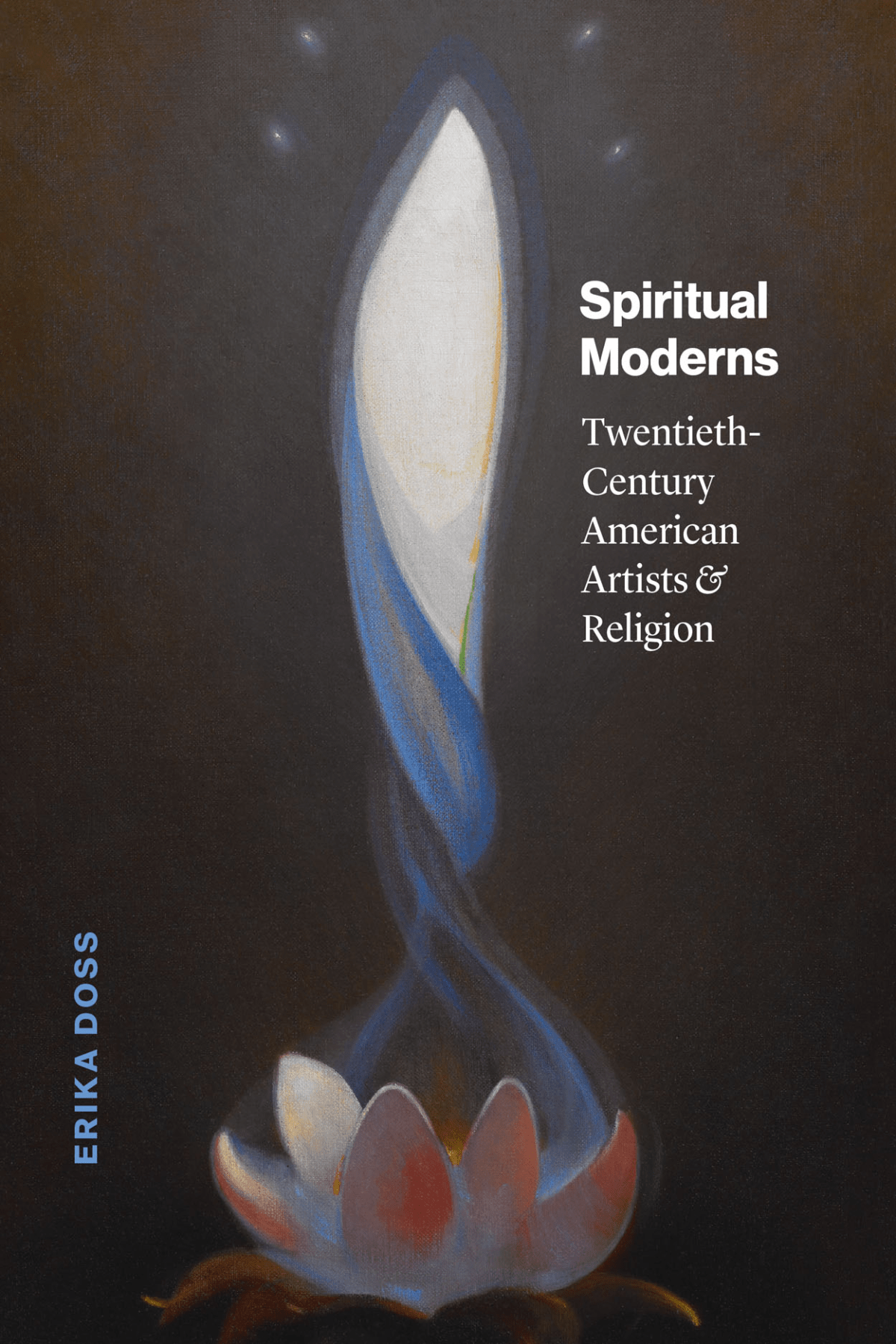
BOOK REVIEW: “Religion’s Understated Influence on Modern Art” by Daniel Larkin, on Spiritual Moderns: Twentieth-Century American Artists and Religion by Erika Doss: Challenging the presumed secularity of modern art, the new book Spiritual Moderns centers on four iconic American artists who were both modern and religious: Andy Warhol, Mark Tobey, Agnes Pelton, and Joseph Cornell.

+ ROUNDTABLE DISCUSSION: Also responding to this publication: the Association of Scholars of Christianity in the History of Art (ASCHA) will be presenting a session at the College Art Association Annual Conference in Chicago on February 16 at 2:30 p.m. that will put four prominent scholars—Stephen S. Bush, Matthew J. Milliner, Robert Weinberg, and Gilbert Vicario—in dialogue with Doss to “explore the assumptions, motivations, and insights of [her] analysis, and consider a more open, inclusive, and diverse reading of American Modernism.”

Advent, Day 2: From the Ruins

Every warrior’s boot used in battle
    and every garment rolled in blood
will be destined for burning,
    will be fuel for the fire.
For to us a child is born,
    to us a son is given,
    and the government will be on his shoulders.
And he will be called
    Wonderful Counselor, Mighty God,
    Everlasting Father, Prince of Peace.

—Isaiah 9:5–6 NIV

LOOK: Nativity by Irenaeus Yurchuk

Yurchuk, Irenaeus_Nativity
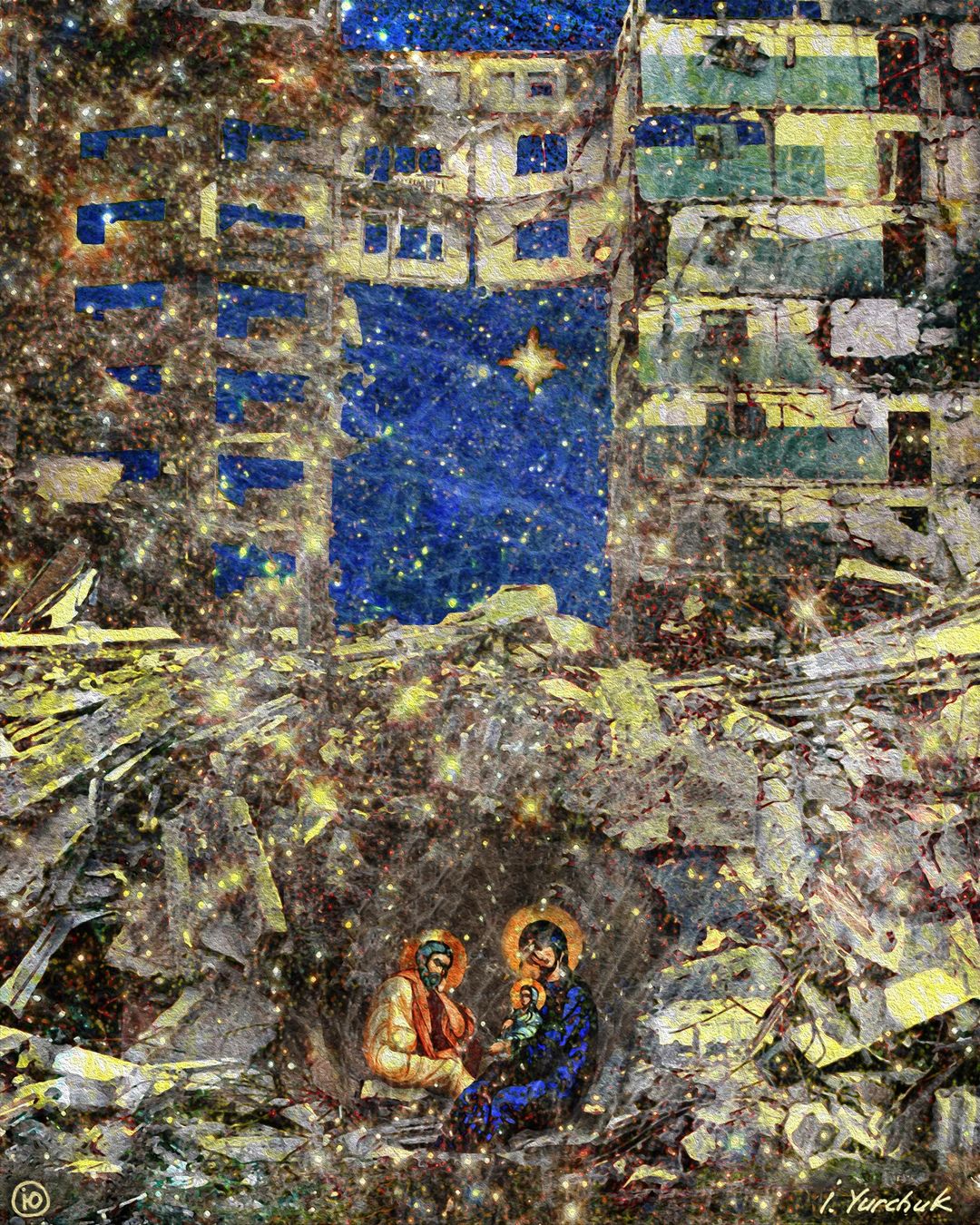
Irenaeus Yurchuk (Іриней Юрчук), Nativity, 2022. Mixed media on canvas. Used with permission.

Irenaeus Yurchuk was born in Ukraine during World War II and raised in central New York, where he still resides. He worked professionally as an urban planner until 2010, when he turned to art full-time.

“Over the years my work has evolved to combine multiple-image photography with drawing and painting, using a variety of digital editing and physical montage techniques,” Yurchuk says. “This includes adjusting inkjet images by applying acrylics, watercolors, pastels, markers, colored pencils together with selected collage materials to achieve a desired effect.”

Yurchuk’s Nativity is a response to Russia’s 2022 military invasion of Ukraine. This is no facile depiction of that historic birth, no cozy winter idyll. It is a war-zone Nativity. It shows the Holy Family, rendered in iconic style, sheltering at night in the rubble of a bombed-out apartment complex. Surrounded by fallen steel beams, concrete, and broken glass, Mother Mary holds the newborn Jesus while a downcast Joseph sits beside them with head in hands. Though their circumstances are dire, through the building’s shell shines one particularly bright star, signifying hope in the horror.

One of the biblical names for Jesus is Emmanuel, Hebrew for “God with us.” By showing the Christ child being born amid the ruins of a contemporary Ukrainian city, Yurchuk reinforces the ongoing relevance of the Incarnation, meditating on God’s descent into our world of woe to dwell with and to deliver. Jesus is “God with us” in our suffering. When everything around us is crumbling, God is there too, hurting alongside and calling all oppressors to account.

Do you recall the famous Christmas text from Isaiah, further immortalized by Handel, that begins “Unto us a child is born . . .”? Well, it is immediately preceded by a prophecy of war’s final demise, of soldiers’ uniforms and accoutrements and all their bloody violence being consigned to one great big burning trash heap. In the new world government established by Christ, the Prince of Peace, tyrants will be overthrown (Luke 1:51–52), and the nations will study war no more (Isa. 2:4). 

May this artwork and the song below prompt you to intercede for those suffering under war today, in Ukraine and elsewhere.

LISTEN: “Drive Out the Darkness” by Paul Zach, Isaac Wardell, Dan Marotta, and John Swinton, on Lament Songs by the Porter’s Gate (2020)

Refrain:
Come, O come
Be our light
Drive out the darkness
Come, Jesus, come

Every year under the thorn
Every wrong that we have known
Every valley will be raised
Ancient ruins will be remade [Refrain]

Every weapon made for war
Every gun and every sword
Will be melted in the flame
To be used for gardening [Refrain]

In the emptiness of grief
Through the night of suffering
In the loss and in the tears
God of comfort, O be near [Refrain]

Coda:
Come, and end all the violence
Come, do not be silent
Come, we cling to your promise
Come, you’ll break all injustice
Come, Jesus, come

For my review of the Lament Songs album by the Porter’s Gate, see here.

In addition to these words that the Porter’s Gate has given us to pray, I commend to you this prayer by Rev. Kenneth Tanner, which he posted October 13 in response to recent atrocities in Israel and Gaza (I’ve been returning to it a lot over the past month):


This post is part of a daily Advent series from December 2 to 24, 2023 (with Christmas to follow through January 6, 2024). View all the posts here, and the accompanying Spotify playlist here.

Roundup: Artists convene at Vatican, “crucified with Christ” artworks, and more

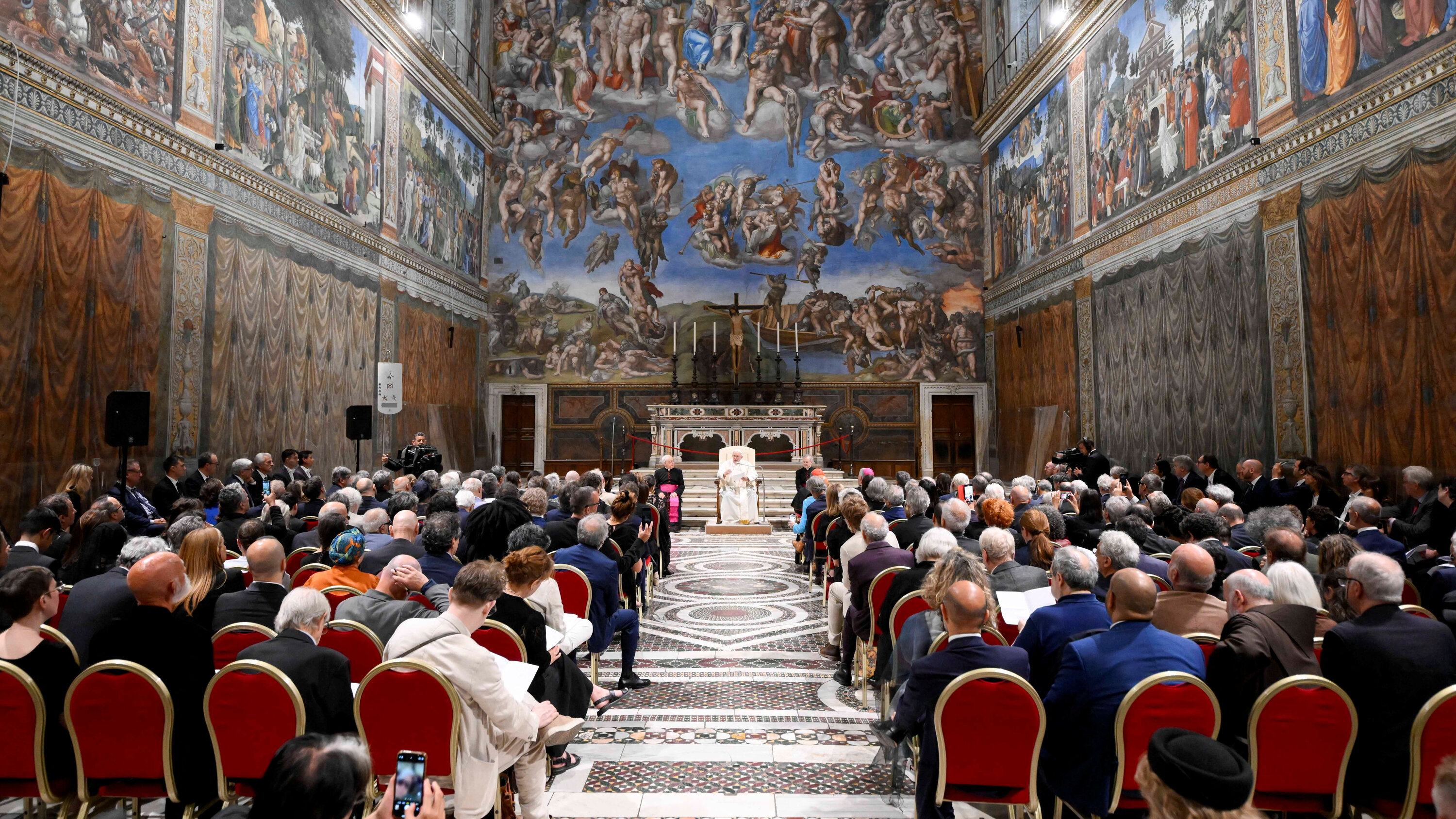
SPEECH: “Address of His Holiness Pope Francis to Artists for the 50th Anniversary of the Inauguration of the Vatican Museums’ Collection of Modern Art”: On June 23, at the invitation of Pope Francis, some two hundred select visual artists, filmmakers, composers, poets, and other creatives gathered at the Sistine Chapel to commemorate the fiftieth anniversary of the Vatican Museums’ Collection of Modern and Contemporary Art, inaugurated in 1973 by Pope John Paul VI. “One of the things that draws art closer to faith is the fact that both tend to be troubling,” Pope Francis said last Friday. “Neither art nor faith can leave things simply as they are: they change, transform, move and convert them.” He applauded how “artists take seriously the richness of human existence, of our lives and the life of the world, including its contradictions and its tragic aspects. . . . Artists remind us that the dimension in which we move, even unconsciously, is always that of the Spirit. Your art . . . propel[s] us forward.” For reporting on this event by the New York Times, see here.

Pope Francis meeting artists
Pope Francis addresses a group of artists, June 23, 2023. Photo: Vatican Media, via Reuters.

This papal address came less than a month after the pope addressed another gathering of artists at the Vatican for the conference The Global Aesthetics of the Catholic Imagination, sponsored by La Civiltà Cattolica with Georgetown University (read that address here).

+++

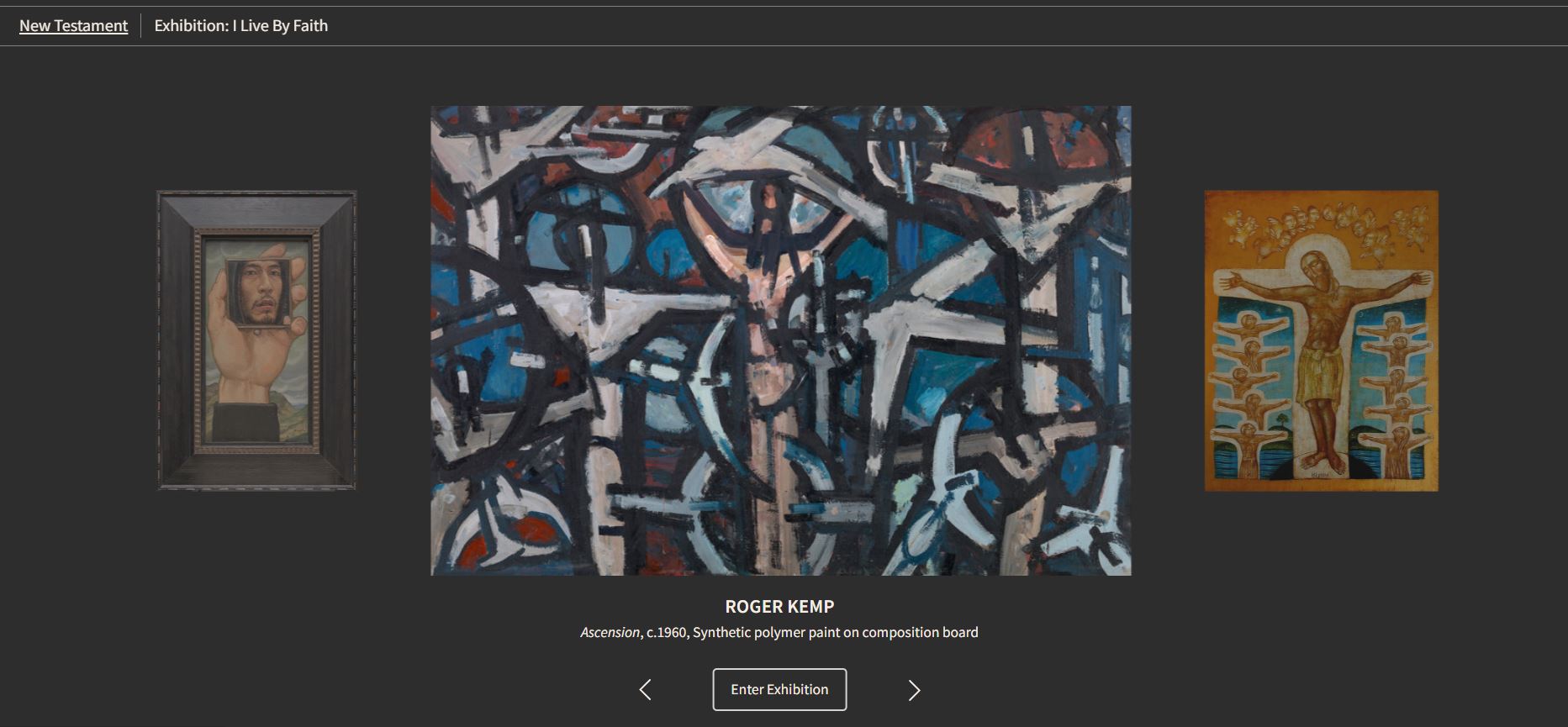
VISUAL COMMENTARY ON SCRIPTURE: “I Live by Faith (Galatians 2:15–21)” by Victoria Emily Jones: My latest set of commentaries for the VCS went live this month! It centers on one of Paul’s famous sayings: “I have been crucified with Christ, and it is no longer I who live, but it is Christ who lives in me.” I was bummed that one of the three commentaries I originally wrote had to be scrapped because the image permission was ultimately denied; I thus had to reconfigure and replace, and I ended up with two artworks in the three-piece exhibition that aren’t as diverse from each other as I had hoped. But still, each artwork brings a unique and compelling lens through which to examine this passage. (Note: If you’re viewing the exhibition on your phone, after you “Enter Exhibition,” you’ll need to expand the “Exhibition Menu” to access the “Show Commentary” button.)

Crucified with Christ (VCS)

The VCS was covered by The Art Newspaper in a recent article by Anna Somers Cocks. “Theology is making a comeback as an important tool for interpreting art,” reads the URL.

+++

VIDEO: “Abraham: An Interfaith Discussion at the Bode-Museum, Berlin”: Besides publishing written commentaries on works of art in dialogue with Bible passages, the Visual Commentary on Scripture also produces videos. This one brings together an Anglican Christian priest (who directs the VCS), a Jewish rabbi, and a Muslim theologian around a fifth-century ivory pyxis depicting Abraham, a figure held in common by all three faith traditions.

+++

POEM: “Gate A-4” by Naomi Shihab Nye: I’ve always loved this heartwarming poem about an unexpected moment of communion shared with strangers at an airport, made possible through kindness and the letting down of one’s guard. Listen to commentary by Joanne Diaz and Abram Van Engen on the Poetry for All podcast, episode 19; they answer the question “Why is this a poem?” Here’s a video of Nye reading it herself:

+++

NEW ALBUMS:

>> April 21: Worship for Workers by the Porter’s Gate: “In 2022 a group of songwriters, pastors, and professionals gathered in Nashville, Tennessee to write a series of worship songs for workers. Over three days they discussed the spiritual, emotional, and material struggles facing workers around the world today. Soon enough, they began to compose a series of songs specifically designed to help Christians carry their daily work before the Lord.” Here’s one of the thirteen songs on the album, “You Hold It All”:

The Worship for Workers album is part of a larger project, sponsored by the Brehm Center and a number of other institutions, to provide music, prayers, art, liturgies, and training to the church around the topic of work. It grew out of the book Work and Worship: Reconnecting Our Labor and Liturgy by Matthew Kaemingk and Cory Willson.

>> May 5: Glory Hour by Victory: Victory Boyd [previously] is a Grammy-winning soul and gospel artist who got her start singing with her siblings in the group Infinity Song but whose career really kicked into high gear when she worked as a songwriter for Kanye West’s Jesus Is King (2019). Glory Hour is her second full-length album as a solo artist; its title refers to the time of the morning when the sun rises. Most of the tracks are original songs or spoken word, but there are also three classic hymns/gospel songs: “His Eye Is on the Sparrow,” “Great Is Thy Faithfulness,” and “I Know It Was the Blood.” Here’s the music video for “Just like in Heaven,” based on the Lord’s Prayer:

>> May 19: Seven Psalms by Paul Simon: Paul Simon released this original seven-movement composition about doubt and belief as a single thirty-three-minute track, as it is meant to be listened to in one sitting. I’m a Simon fan; one of my early blog posts is a review of his and Garfunkel’s debut album, Wednesday Morning, 3 A.M. But if I’m honest, I was underwhelmed by this much-anticipated release. I’m in the minority there, so I think I’ll need to give it another listen. What do you think of it? Here’s the trailer:

>> June 2: Byrd: Mass for Five Voices by the Gesualdo Six: One of my favorite vocal ensembles has just come out with an album of songs by William Byrd—his setting of the Mass along with a handful of motets. A Catholic composer in Protestant England in the late Renaissance, Byrd wove together musical “notes as a garland to adorn certain holy and delightful phrases of the Christian rite,” as he wrote in the preface to his second book of Gradualia (1607). Here’s the Gesualdo Six’s performance of his “Afflicti pro peccatis nostris,” a Latin prayer, a desperate plea for sanctification, that translates to “Afflicted by our sins, each day with tears we look forward to our end: the sorrow in our hearts rises to thee, O Lord, that you may deliver us from those evils that originate within us”:

Roundup: New Lent album, Porter’s Gate Kickstarter, “Bare and Bones,” and more

NEW ALBUM: Lent Hymns by Paul Zach: Released this month, Lent Hymns by Paul Zach comprises twelve songs, a mix of originals and classics, with contributions by IAMSON, Jessica Fox, Sara Groves, Jon Guerra, and Kate Bluett. The LP is available wherever music is streamed or sold. Here’s an Instagram video that excerpts “Draw Me In”:

+++

KICKSTARTER: New Porter’s Gate album: This summer The Porter’s Gate, an interdenominational Christian music collective, is gathering songwriters to write and record musical settings of passages from The Message, a translation of the Bible by the late Eugene Peterson [previously] that uses contemporary idioms and phrases. The project is in partnership with the Eugene Peterson Center for Christian Imagination at Western Theological Seminary in Holland, Michigan. I’m so looking forward to this!

+++

SONGS:

>> “Вечірня молитва” (Vechirnya molytva) (Evening Prayer): A choral setting of a text from the Divine Service of the Eastern Orthodox Church, by contemporary Ukrainian composer Iryna Aleksiychuk. Performed in 2012 by the Female Choir of Kiev Glier Institute of Music, conducted by G. Gorbatenko. [HT: Global Christian Worship]

English translation:

Heavenly King, Comforter, Spirit of Truth,
Who art everywhere present and fillest all things,
Treasury of good things, and Giver of life:
Come and abide in us, and cleanse us from every sin,
And save our souls, O Good One!
Holy God, holy Mighty, holy Immortal,
Have mercy on us.

>> “Bare and Bones” by Candace Coker: Trinidad-born, Vancouver-based singer-songwriter Candace Coker sings the title track from her new album, Bare and Bones, with her boyfriend, Josiah Charleau. The video is shot at Bamboo Cathedral, a thousand-foot stretch of roadway in Tucker Valley in Chaguaramas, Trinidad and Tobago, where bamboo stalks bend toward each other across the road, creating a canopy.

>> “HigherHoly” by IAMSON: IAMSON is the artist name of singer-songwriter and music producer Orlando Palmer, based in Richmond, Virginia. He released this song as a single in 2020. The rap is performed by guest artist Marv (Marvin Hudgins II) of Chattanooga, Tennessee, and the animation in the video is by Kenya Foster.

>> “I Could Sing of Your Love Forever” (cover) by Mary Yang and Ger Vang: Mary Yang and Ger Vang are Hmong Christian musicians living in Milwaukee, Wisconsin. (The Hmong are an Indigenous people group from East and Southeast Asia.) Here they perform their bossa nova arrangement of this modern worship classic by Martin Smith of the English band Delirious?. Yang and Vang are part of the Fishermen’s Project, a band that releases mainly classic hymns translated into the Hmong language. [HT: Global Christian Worship]

Christmas, Day 6: Black-Haired Boy

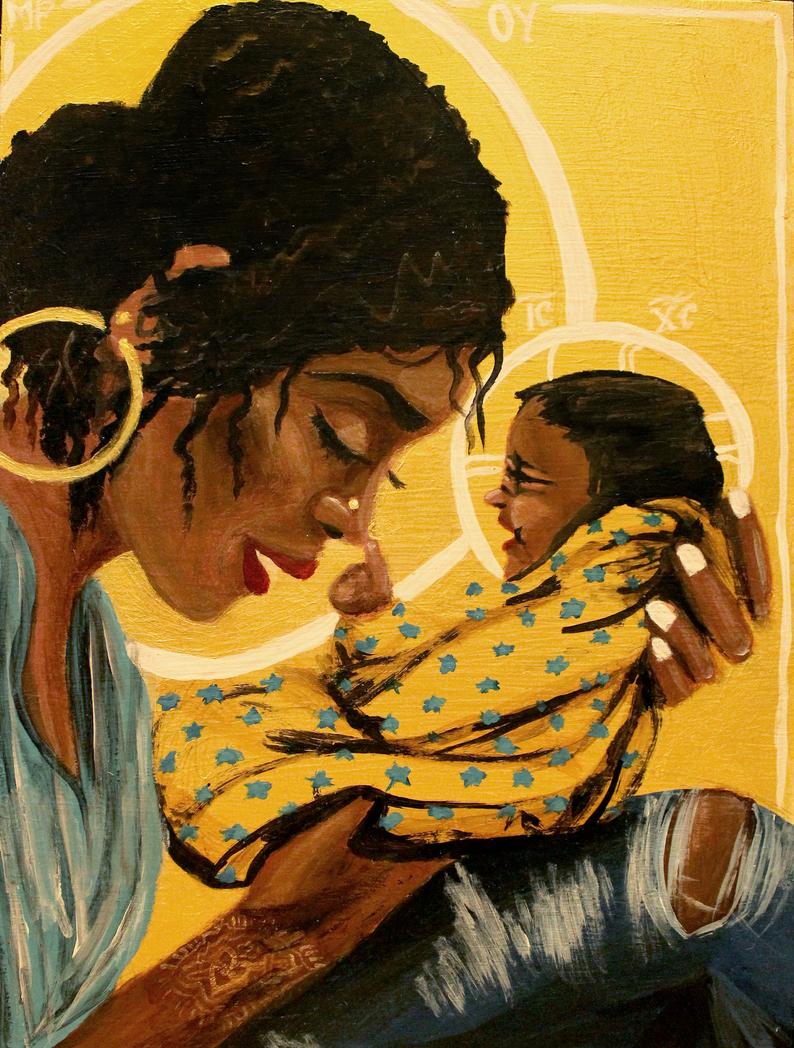
LOOK: Madonna and Child by Gracie Morbitzer

Morbitzer, Gracie_Madonna and Child
Gracie Morbitzer (American, 1997–), Madonna and Child, 2018. Acrylic on repurposed wood, 14 × 12 in. Private collection.

Gracie Morbitzer is a Catholic artist from Columbus, Ohio, who paints biblical and extrabiblical saints as modern, everyday people in a range of skin tones, forgoing the hieratic style of traditional icons in favor of a more relatable, this-worldly look that enables the individuals’ distinctive personalities to shine through. She uses discarded or thrifted pieces of wood as her substrate, welcoming cracks and imperfections as only further reiterating how the extraordinary shines through the ordinary.

In her Madonna and Child, Mary props up her newborn on her knees, basking in her new role as mother. She wears frayed jeans, a loose blouse, gold hoop earrings, and a nose stud. On her wrist is a henna tattoo of her Immaculate Heart—a burning, bloodied heart pierced with a sword and banded with roses, representing the intensity and purity of her love and the suffering that Simeon prophesies.

Jesus, wrapped in a starry blanket and donning a cruciform halo, playfully touches Mom’s nose, crinkling his face as he giggles with delight.

The yellow acrylic background recalls the gold leafing of icons, used to suggest the transfiguring light of God. Morbitzer also uses the traditional Greek abbreviations for the Mother of God (MP OY) and Jesus Christ (IC XC).

This image can be purchased as a 5 × 7-inch print at The Modern Saints Etsy shop.

LISTEN: “Mary’s Lullaby (Black Haired Boy)” | Words by Kate Bluett | Music by Paul Zach | Sung by Liz Vice on Advent Songs by The Porter’s Gate (2021)

Oh, black-haired boy, your eyes are dark
as midnight lit by shining stars
and bright as love that filled my heart
when first I looked at you.
Your skin is brown as pilgrim roads,
laid straight through fragrant olive woods,
as brown as mine, and I’m in awe
each time I look at you.

You made the ox and lamb, my love,
and shaped the wings of turtledoves.
You wrote the hidden secrets of
the world I’ll show to you.
Within my body you took form
and wailed aloud when you were born—
the moment that my heart was torn
with love I’ll show to you.

You wove these wonders through the earth;
you made them all and gave them worth,
and now you join them in your birth,
and I’ll give them to you.
I’ll show you skies filled up with stars
and teach you words for light and dark,
for all the wondrous things there are:
I’ll give them all to you.

I’ll hold you closely as I can
and watch you grow into a man.
As long as I can hold your hand,
I’ll walk the world with you.
And you’ll lead me to God’s own heart,
where all these wonders have their start.
But here within the stable dark,
I’ll be the world for you.

Since the Middle Ages, Christians have written lullabies in the voice of Mary, imagining her rocking her infant son to sleep, sharing with him her most tender feelings and wishes. This contemporary one by frequent songwriting collaborators Kate Bluett and Paul Zach—so poignantly sung by Liz Vice—is among my favorites.

In the first stanza Mary dotes poetically on Jesus’s features—his eyes dark and bright as star-studded midnight skies, his skin brown as the footpaths to Zion. In the remaining stanzas she marvels at how the Creator of the universe lies as a babe in her arms, and how she will get to experience its many wonders with him at her side, discover its secrets together. Jesus made the world in which she lives and moves and has her being, but now, while he is small, vulnerable, and dependent, she’ll be a whole world to him, as mothers are to their children.

Roundup: Prayers for a violent world, sad church songs, Climate Vigil Songs, and more

PRAYER COMPILATION: “Prayers for a Violent World” by W. David O. Taylor: “How exactly do we pray in the aftermath of violence? What words should we put on our lips? What can the whole people of God say ‘amen’ to and what might only one of us be able to say amen to in good conscience? These questions are, of course, far from easy to answer, but over the past couple of years I have attempted to give language to such matters and I have included here a number of those prayers, in the hope that they might prove useful, and perhaps comforting, to people who face the terrors and traumas of violent activities on a regular basis.” Included are prayers After a Mass Shooting, Against Bloodthirstiness, For Loving a Hurting Neighbor, For Enemies, For Bitter Lament, For Peace in a Time of War, For Those Who Weary of Doing Justice, and more.

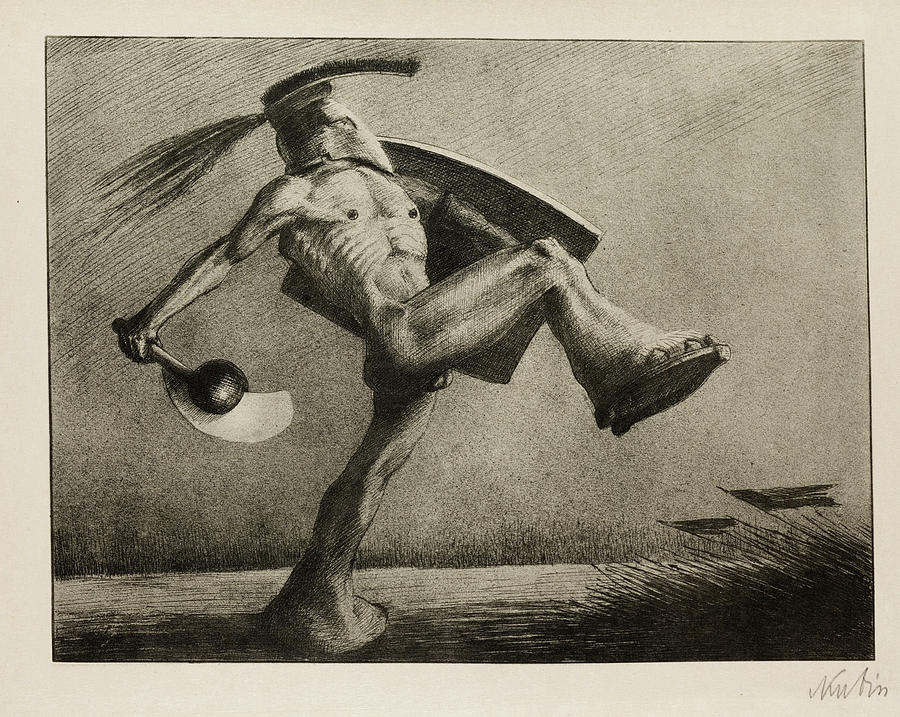
Kubin, Alfred_War
Alfred Kubin (Austrian, 1877–1959), War, 1903

Here’s Taylor’s Prayer of Allegiance to the Prince of Peace:

O Lord, you who deserve all our loyalties, we pledge allegiance this day to the Lamb of God and to the upside-down Kingdom for which he stands, one holy nation under God, the Servant King and the Prince of Peace, with liberty and justice for all without remainder. We pray this in the name of the Holy Trinity. Amen.

+++

NEW ALBUMS:

>> Sorrow’s Got a Hold on Me by Paul Zach: On May 20, singer-songwriter Paul Zach wrote on his Instagram, “My new album of thirteen sad church songs is out today! Many of these songs were written right after one of my weekly EMDR therapy sessions, as I have been working through the sorrow, trauma, and grief of the past few years. I’m learning to bring all of myself to God in prayer and songwriting, which includes my sorrow and anger. I’ve always heard that God shows up in a unique way in times of grief but that has not been my experience. These songs are an invitation for the ‘man of sorrows’ to join me in my grief.”

Below is a demo of the first verse of my favorite song on the album, “We Bring You All Our Sorrows,” followed by the album link from Spotify. It includes a newly revised version of one of my favorite songs by Zach, “When Your Kingdom Comes” [previously].

Zach often writes collaboratively (including as part of the Porter’s Gate! see below), and the cowriters on some of the songs here are Kate Bluett, Latifah Alattas (Page CXVI), Nick Chambers, Orlando Palmer (IAMSON), Jessica Fox, Alex Johnson, and Philip Zach. There are also a few guest vocalists.

>> Climate Vigil Songs by the Porter’s Gate: The Porter’s Gate is a collective of fifty-plus songwriters, musicians, scholars, pastors, and music industry professionals from a variety of Christian worship traditions and cultural backgrounds, making music for churches. This sixth album of theirs, made in partnership with the #ClimateVigil movement, is themed around environmental justice and creation care. Below are videos for “Brother Son (Giving Glory!)” and “Jubilee.”

Besides “Brother Sun,” my favorite tracks are “Satisfied,” a prayer that we would stop seeking to build our wealth (a motive that drives a lot of environmental injustices) and instead be grateful for God’s provision; “The Kingdom Is Coming,” a marchlike call-and-response song that rallies us to pray, wait, and work for an end to creation’s groaning; and “Water to Wine,” which wonders at the miraculous process of planting and growing grapes for harvest. There’s also “All Creatures Lament,” a minor-key arrangement of “All Creatures of Our God and King” with new lyrics that enjoin the animals to mourn habitat loss, air pollution, and other results of humans’ power abuses and irresponsible stewardship.

To learn more about the album, listen to this great interview with Porter’s Gate cofounder and producer Isaac Wardell; it’s from the RESOUNDworship Songwriting Podcast, hosted by Joel Payne. Wardell discusses the vision for Climate Vigil Songs, and especially the difficulty, with thematic albums, of avoiding the pitfalls of being too heavy-handed with the messaging on the one hand, and on the other, being so vague that people don’t see the connection. There’s also a need for tonal balance, and for songs that fill different functions.

We wanted to write for this album at least three different kinds of songs. One kind is essentially songs of lament—songs lamenting the state of creation because of human sin and the brokenness of the world. Secondly, we wanted to write hopeful, you might even call them eschatological, songs—songs that are joyful, that are about this is the world that God has made, this is God’s creative work, this is how God calls us into his creative work. . . . And lastly, we wanted to write mobilization songs—songs that have some kind of an ethical component of calling people to action in some way. . . . We want to make sure the record is not too much of a downer, like all lament songs; we want to make sure that it’s not too much of a happy-clappy “Isn’t creation beautiful!”; and we also don’t want to let it just delve into being a 100 percent political action record. . . . We want to balance those things.

Wardell also talks about the group’s collaborative songwriting approach (including all the theological and editorial work that’s put in), Te Fiti’s stolen (and later, restored) heart in Disney’s Moana, personified nature in the Psalms, creation as an experiencer of the fall and redemption, the role of provocation in church, and biblical imagery he wishes they could have included on the album but had to leave out for length.

+++

POEM + CHORAL SETTING: “when god decided to invent” by E. E. Cummings: “Here’s a brief powerhouse of a poem from E. E. Cummings, two stanzas that draw a sharp distinction between God’s inventive, joyful creativity on the one hand, and our too-frequent turn toward violence on the other. As the mass shootings in Buffalo, Uvalde, and elsewhere continue to reverberate, Cummings’ poem helps us feel and think about what’s at stake – and what the way forward looks like.”

SALT Project reproduces the poem, provides brief commentary, and links to a musical setting by Joshua Shank—a composition for SATB, soprano saxophone, and finger cymbals that premiered in 2005. Shank says the arc of his piece is creation-destruction-recreation. “This final chord is the creator taking control of the creation again.”

+++

RADIO EPISODE: “Belief in Poetry: John Donne”: John Donne (1572–1631) is one of my favorite poets, and looking back on the blog, I can’t believe I’ve not yet featured any of his poems! (I’ll have to rectify that . . .) In this BBC Radio 4 segment from March 13, poet and theologian Pádraig Ó Tuama considers Donne’s complex faith life through his poetry. He speaks with Julie Sanders, professor of English literature and drama at Newcastle University; Mark Oakley, writer and dean of St. John’s College, Cambridge; and Michael Symmons Roberts, poet and professor of poetry at Manchester Metropolitan University. Sir Simon Russell Beale reads the four featured Donne poems: “Death, be not proud” and “Batter my heart, three-person’d God” from his Holy Sonnets series, “Hymn to God, My God, in My Sickness,” and “A Hymn to God the Father.”

Here are two of the quotes that stood out to me:

  • “It’s easy to think of John Donne’s life falling neatly into two parts: the worldly man, and the spiritual seeker; the lover of women, and the lover of God; Catholic, then Protestant; before Anne, and after Anne; love poet, and religious poet. But life is rarely that clear. And rather, it’s the tension between these dynamics of him that gives birth to so much of his work.”—Pádraig Ó Tuama
  • “There’s an assumption that a poet working in this territory is sure of their ground and knows what they’re writing about. I don’t think that’s ever true, because why would you write the poems, if that were true? You’d just bathe in your certainty! The whole act of sitting down to write a poem is not to dress up something you already know in a way that makes it an enticing package for other people to be convinced by—and if you attempted that, it’s going to fall like the deadest thing on the page. Making a poem is an exploratory process. You don’t know where it’s going to end when you start it.”—Michael Symmons Roberts