Day Trip to Würzburg, Part 4: Museum für Franken

This is the final post in my series on religious art highlights from Würzburg, Germany, which I visited on August 28. (See parts 1, 2, and 3.) It took me about fifty-two hours to organize, select, research, write, edit, and format all the content. If you enjoyed the series, would you please consider making a small donation toward this work so that I can avoid setting up paywalls? Thank you! Oh, and since some of you have asked: I offer all my high-resolution photos free of charge for noncommercial use; I just don’t allow reblogging (that is, reproducing these posts in full on a different website).

Old Main Bridge
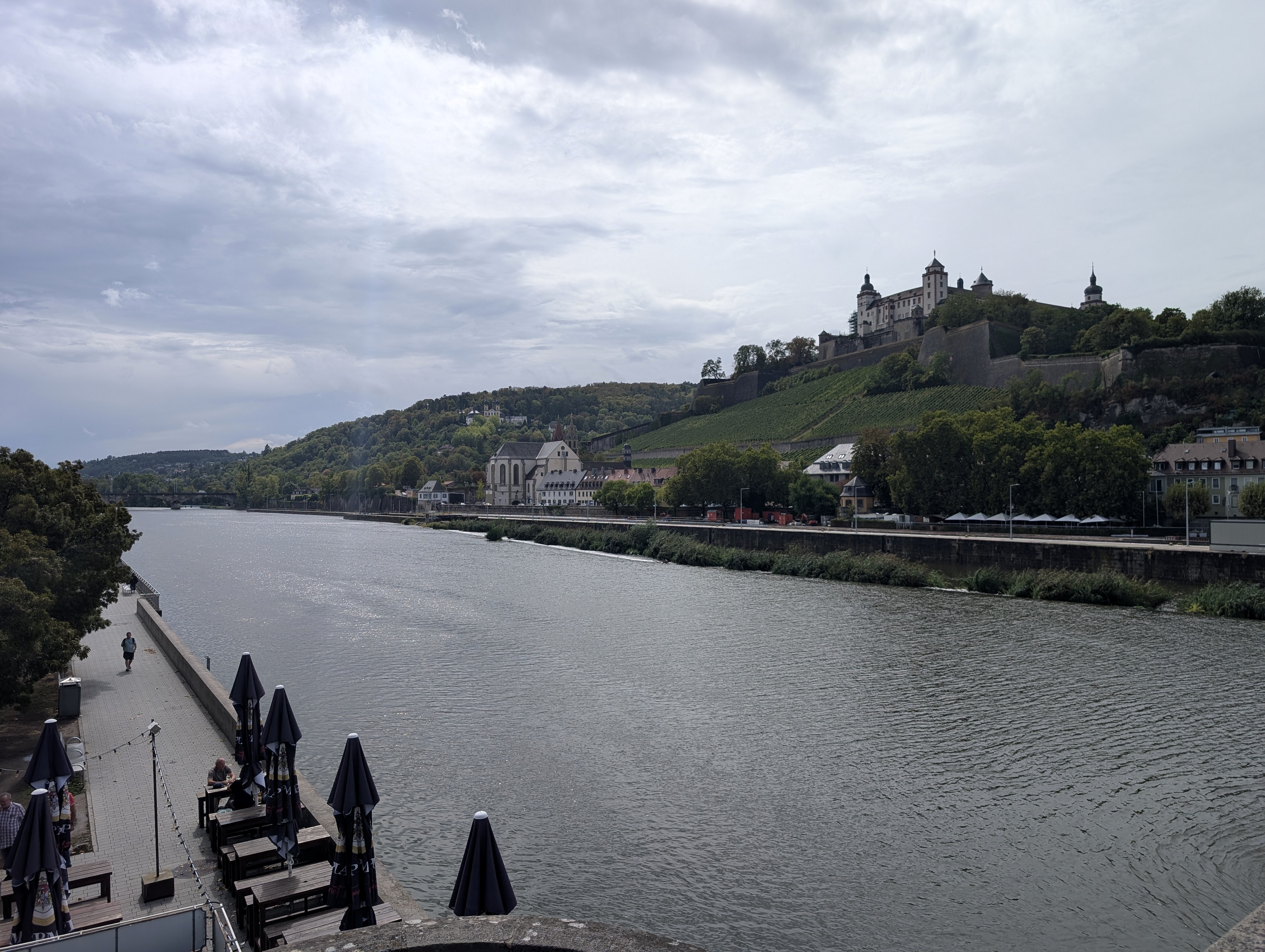
View from the Alte Mainbrücke (Old Main Bridge), with Festung Marienberg (Marienberg Fortress) in the distance

It was afternoon, and Eric and I had a few more hours left in Würzburg. Thankfully, the rain let up, so after a quick lunch of bratwurst, we trekked over the Old Main Bridge up to Marienberg Fortress. It was about a twenty-minute walk up the stepped Tellsteige to the entrance—quite strenuous for this out-of-shape traveler, and in retrospect, I should have taken the bus, which runs to the top via a different route, but at least I was rewarded with some lovely panoramic views of the city along the way.
Würzburg cityscape
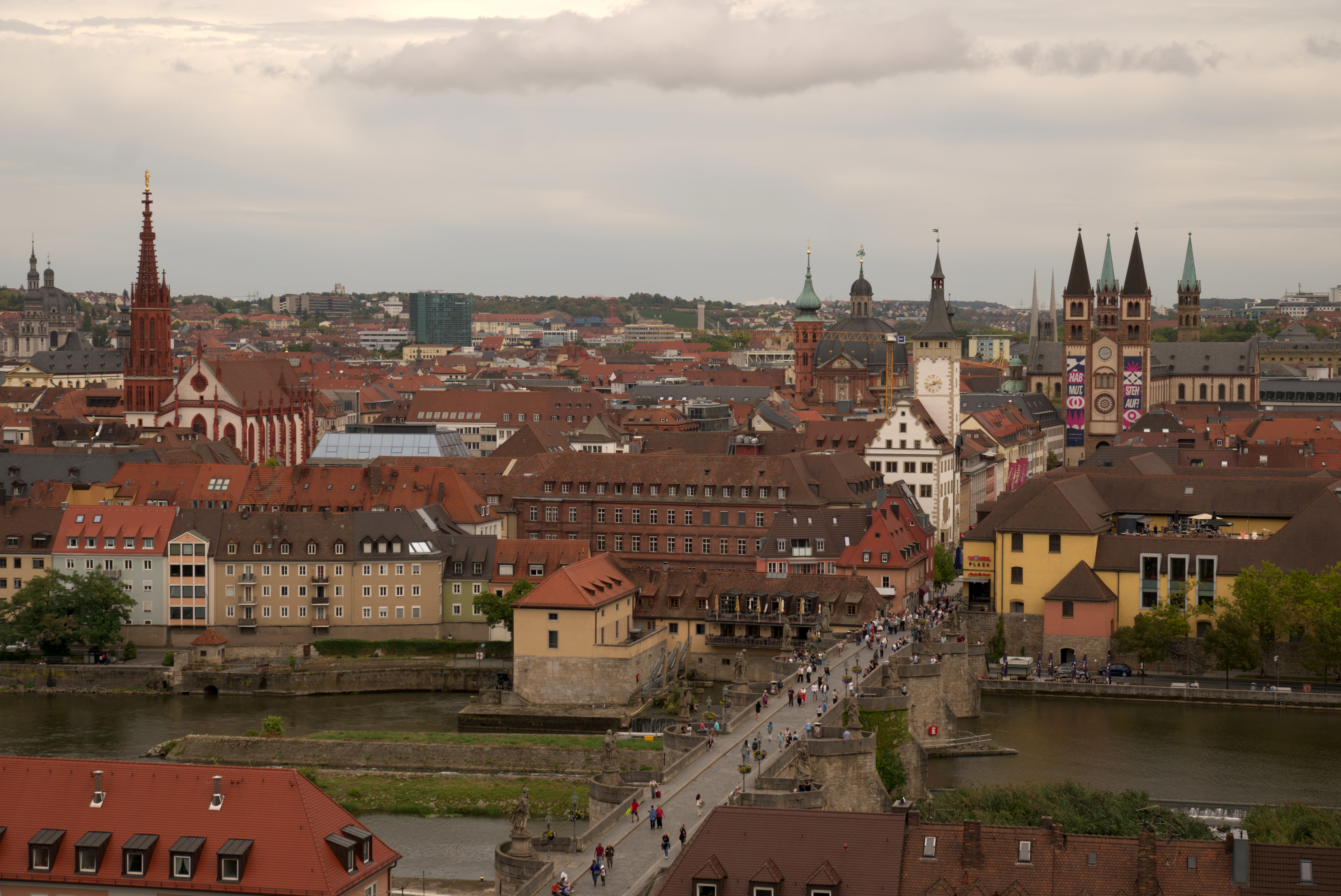
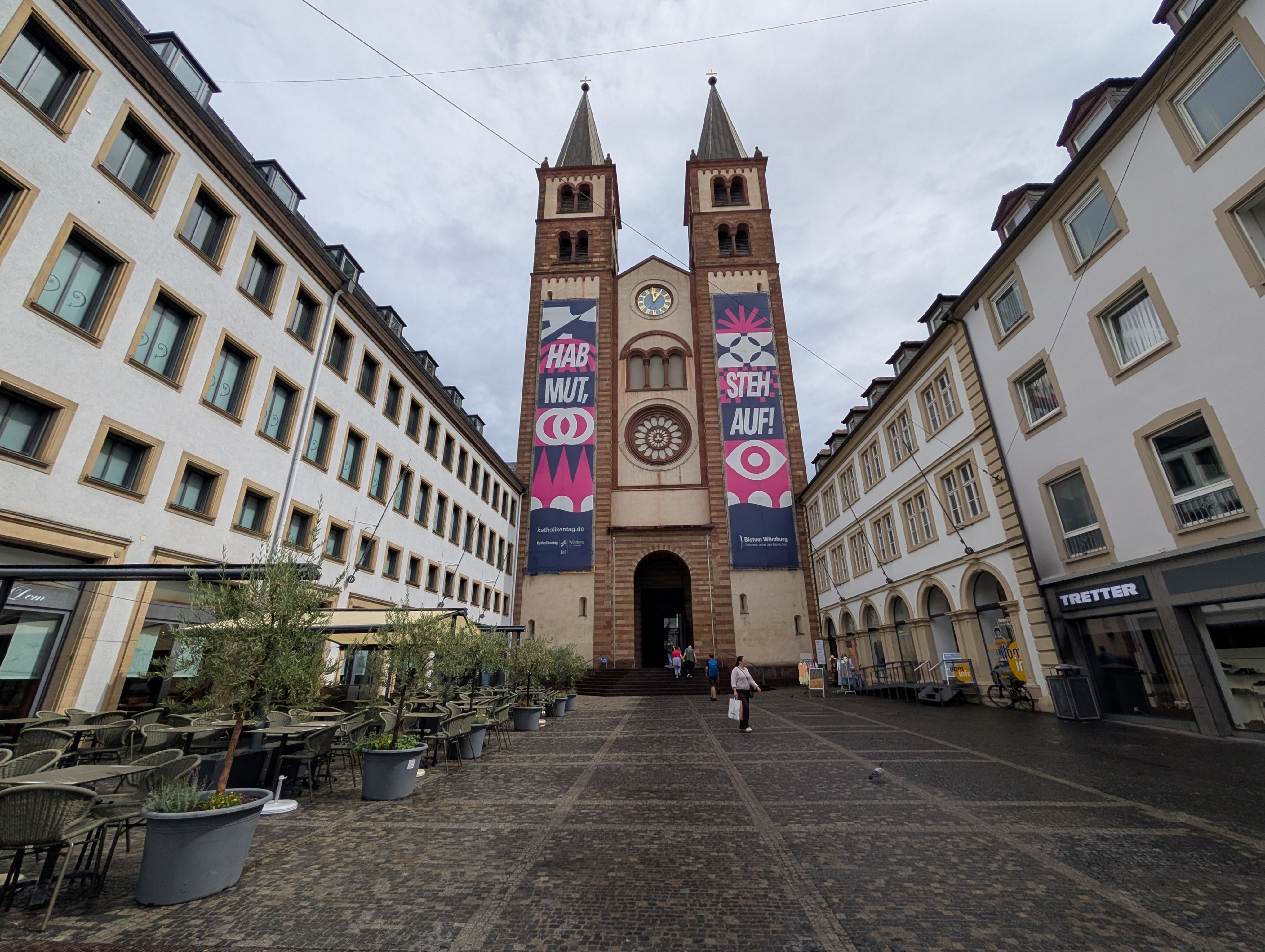
View from the inclined walkway to the Museum für Franken. The red-spired Marienkapelle is on the left, Würzburg Cathedral (with its twin, bannered west towers) is on the right, and just right of center is the gray dome of Neumünster.

Serving as residence of the local prince-bishops from the thirteenth to eighteenth centuries, Marienberg Fortress now houses a collection of Franconian art from the Middle Ages to the Baroque era in its Museum für Franken (labeled “Lower Franconian Museum” in Google Maps and formerly called the Mainfränkisches Museum). Admission is five euros.

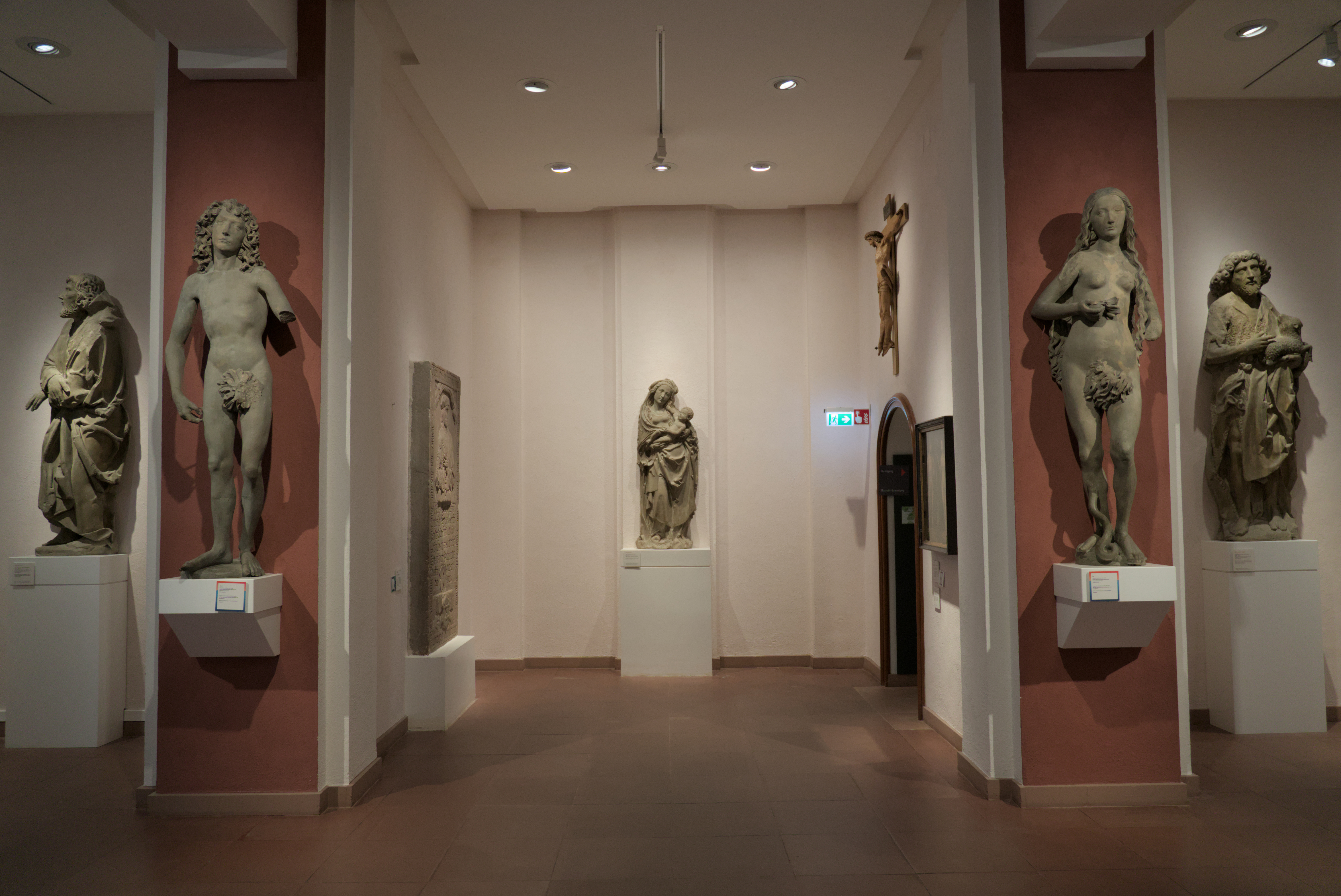
The sculptures of the German late Gothic artist Tilman Riemenschneider (ca. 1460–1531), who lived in Würzburg, are the main attraction of the museum, which owns eighty of them—the largest number of any institution. Riemenschneider was an absolute master of his craft, working in both wood and stone. Made to adorn buildings, his stone sculptures were conceived for particular architectural contexts, whereas most of his wood carvings were made for winged altarpieces. His smaller sculptures, by contrast, were intended for private ownership and worship.
Riemenscheider Gallery

In addition to being an artist, Riemenschneider was involved in local politics, serving on the Würzburg town council. During the German Peasants’ War in 1525, he refused to obey an order by Prince-Bishop Konrad von Thüngen to fight the revolting peasants, as he sympathized with their cause. As a result, most of his property was confiscated and he was incarcerated and tortured in Marienberg Fortress for two months. He received very little work for the remaining six years of his life.

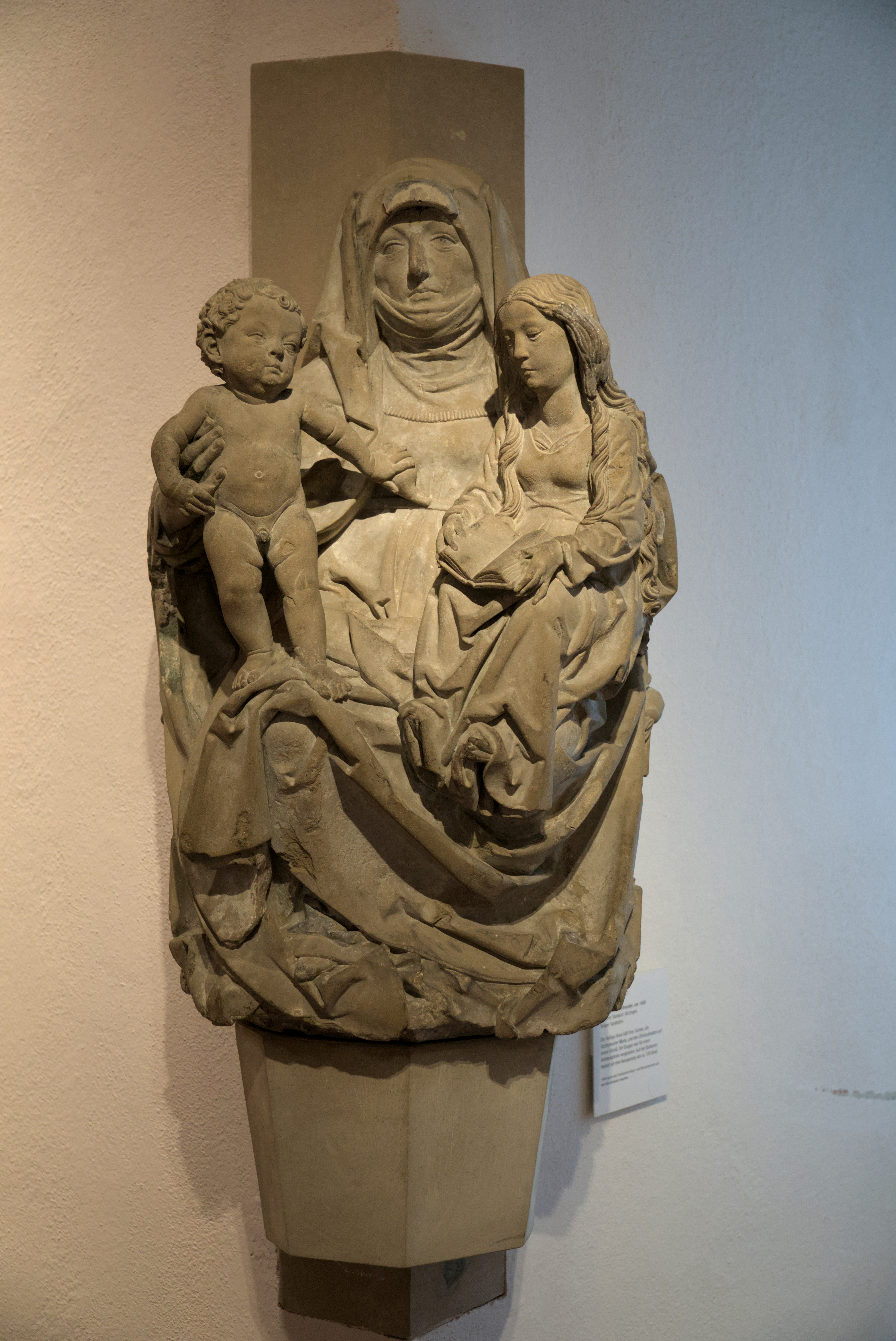
The first work of his that I encountered at the Museum für Franken was an Anna Selbdritt, Middle High German for “Anne herself making a third”—an iconographic type that arose in Germany in the early thirteenth century and gained massive popularity throughout the Rhine-Meuse region in the next few centuries. Emphasizing the human lineage of Jesus, it shows three generations seated together: the matronly St. Anne (the name tradition ascribes to Mary’s mother), with her head and neck typically covered; a diminutive Mary, her hair uncovered to signify her virginal status, and often holding a book, signifying her learning and devoutness; and, toddling on his grandmother’s knee, the infant Christ.
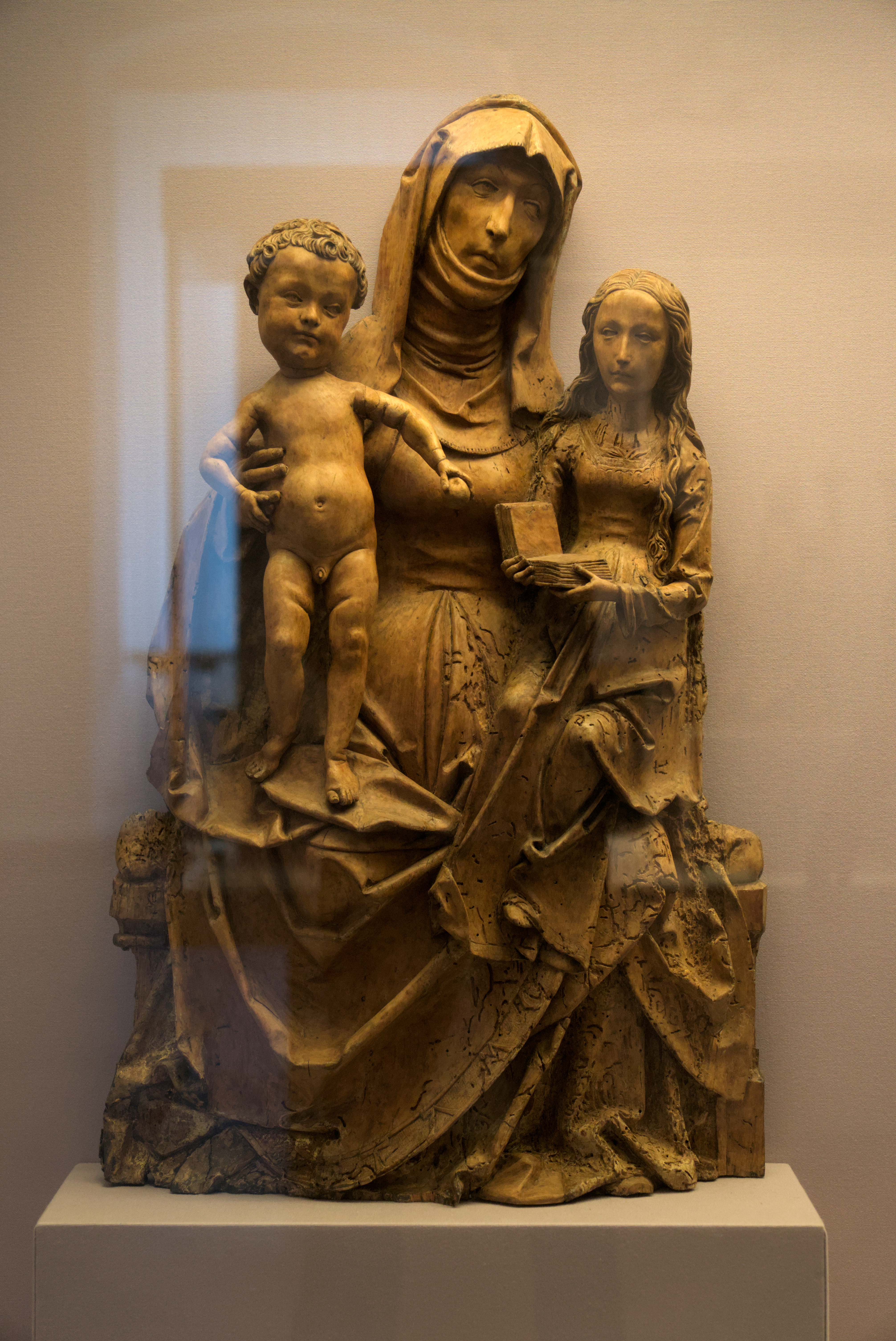
Tilman Riemenschneider_Anna Selbdritt
Tilman Riemenschneider and workshop, Anna Selbdritt, ca. 1500. Limewood, traces of polychromy.

Here’s another:

Tilman Riemenschneider_Anna Selbdritt
Tilman Riemenschneider, Anna Selbdritt, from a church in Kitzingen, ca. 1495. Gray sandstone.

A related subject, the Holy Kinship, showing even more of Jesus’s relatives gathered round, is also featured in the museum’s collection, such as in this fragment sculpted by an anonymous artist influenced by Riemenschneider, which shows Mary and Joseph on the left, and Anne and Joachim (Mary’s parents) on the right. The Christ child whom the young Mary used to hold on her lap is missing, as is the book that Anne once held:
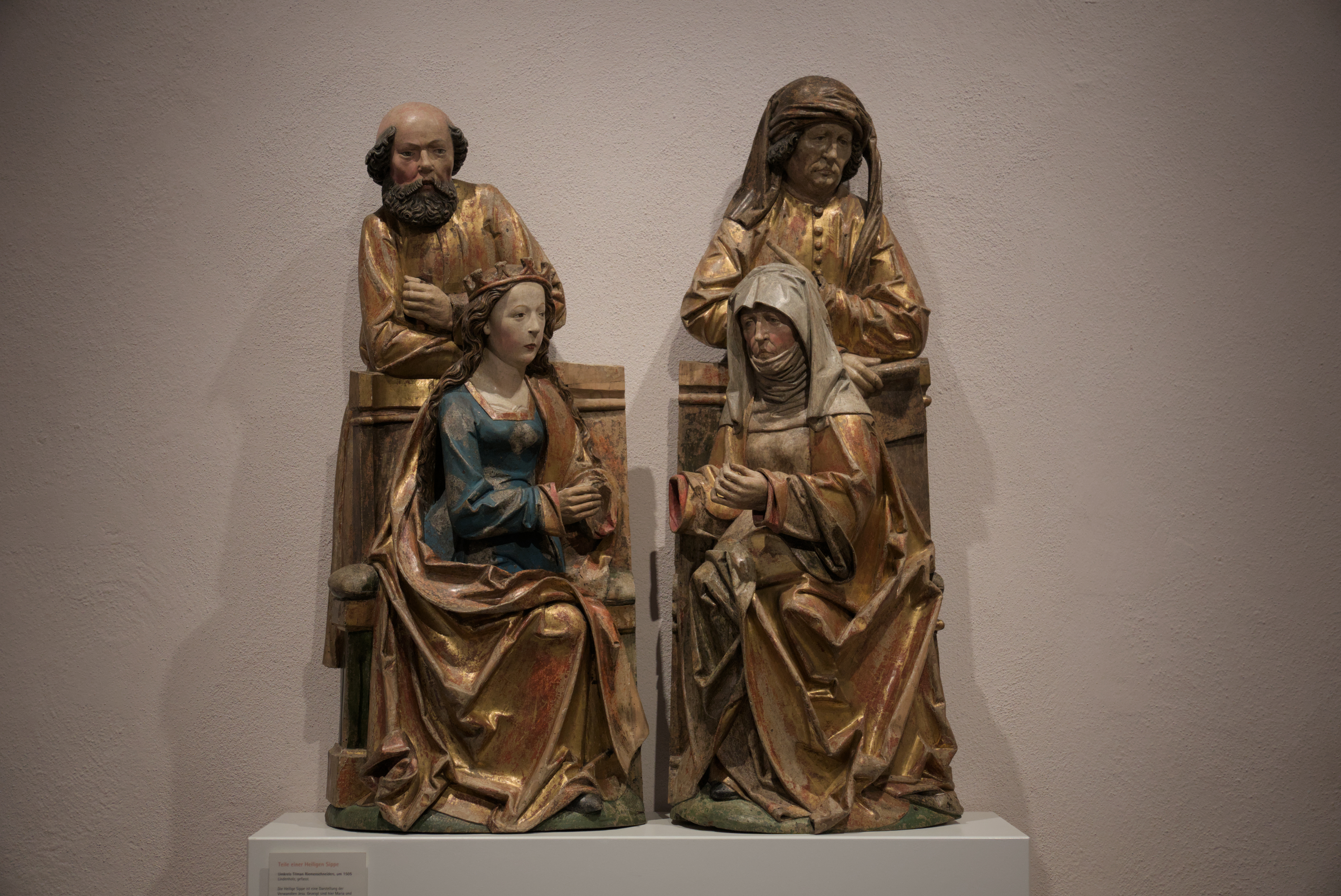
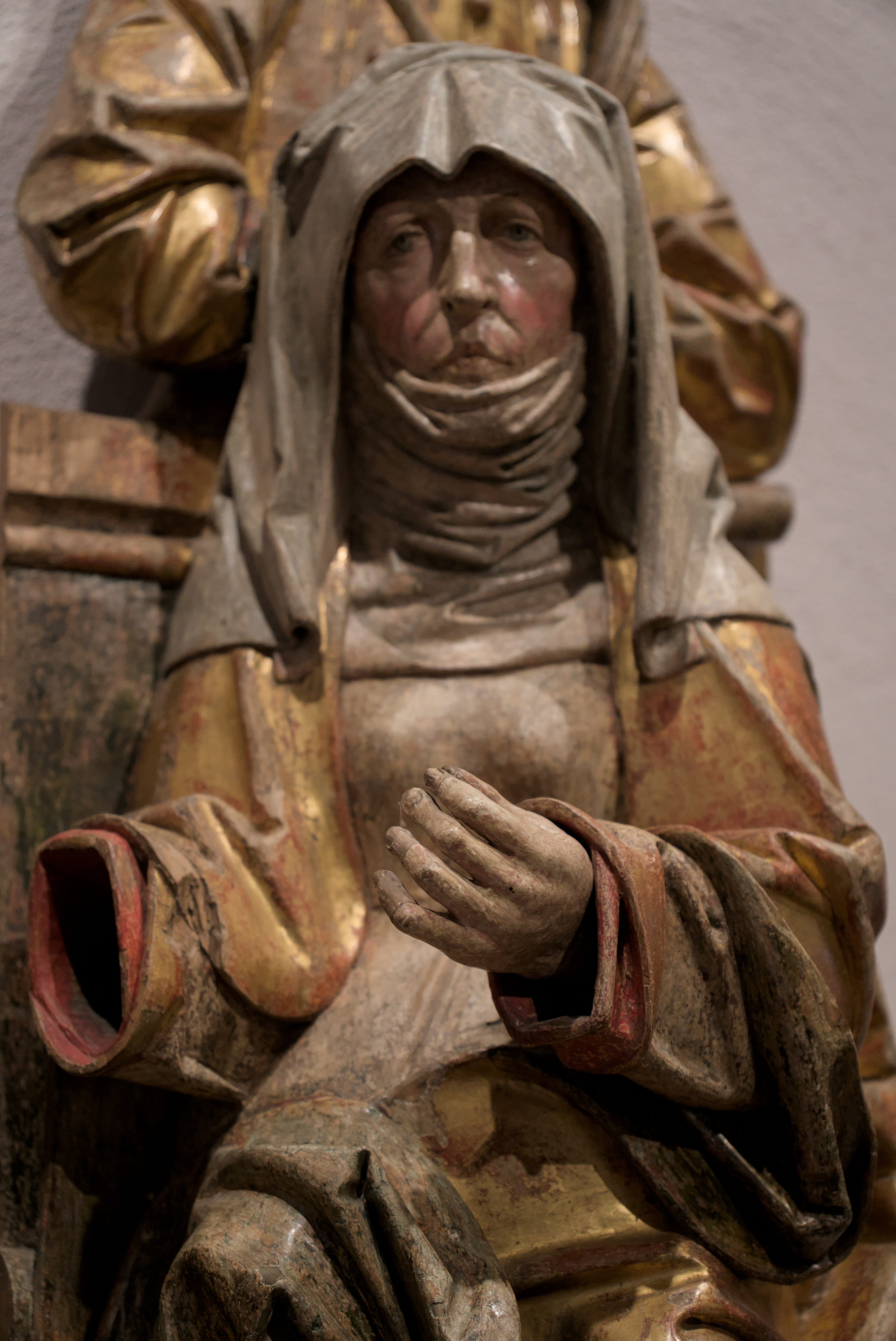
Tilman Riemenschneider (circle)_Holy Kinship
Circle of Tilman Riemenschneider, Parts of a Holy Kinship, ca. 1505. Limewood, painted.

Saint Anne
Saint Anne, from a Holy Kinship group

Jesus’s grandparents are never mentioned in scripture, so I admit, I had never even thought about them until I started seeing them depicted in Holy Kinship groups, and Anne in other contexts. It makes me wonder about how Mary’s mother raised her, and how that shaped the woman she became and how she then mothered Jesus. What lessons of faith did Mary learn from Anne? How did Anne react to the news of Mary being pregnant with the Messiah? What about Joachim? In what ways did Grandma and Grandpa dote on little Jesus? Did they have a nickname for him?

Of course Jesus was part of a larger family unit—extended family was very important in the ancient Near East—but without artists to turn my imagination toward that detail, I had neglected to consider it!

Beside the Anna Selbdritt sculpture is another by Riemenschneider, showing St. Stephen, who can be identified by the stack of stones on his knee. (In art, martyrs are often portrayed holding the instruments of their death.)
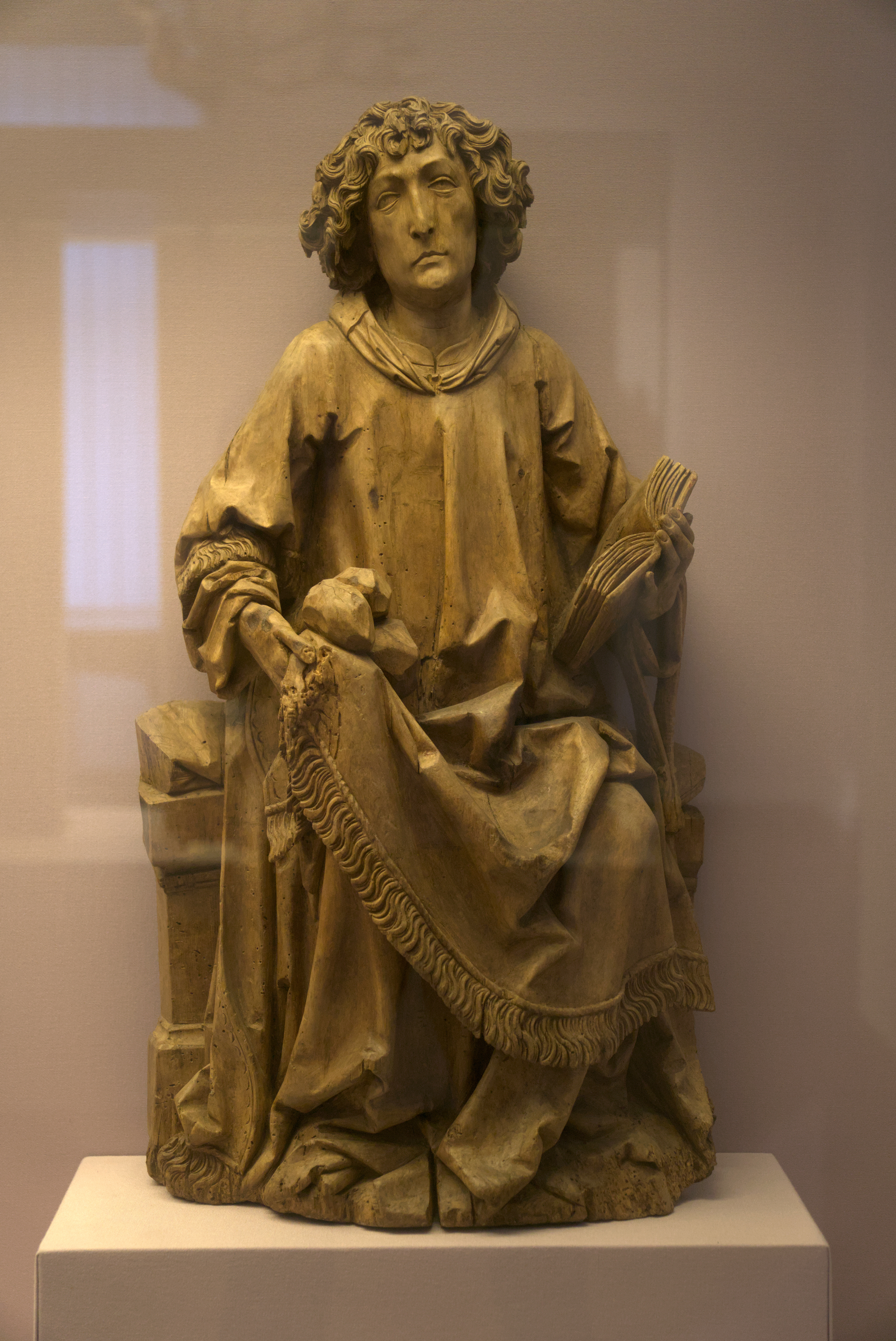
Tilman Riemenschneider_Saint Stephen
Tilman Riemenschneider and workshop, Saint Stephen, ca. 1520. Limewood, originally painted.

Here’s a handful of other works by Riemenschneider or his circle, from the permanent collection of the Museum für Franken or on long-term loan to them.
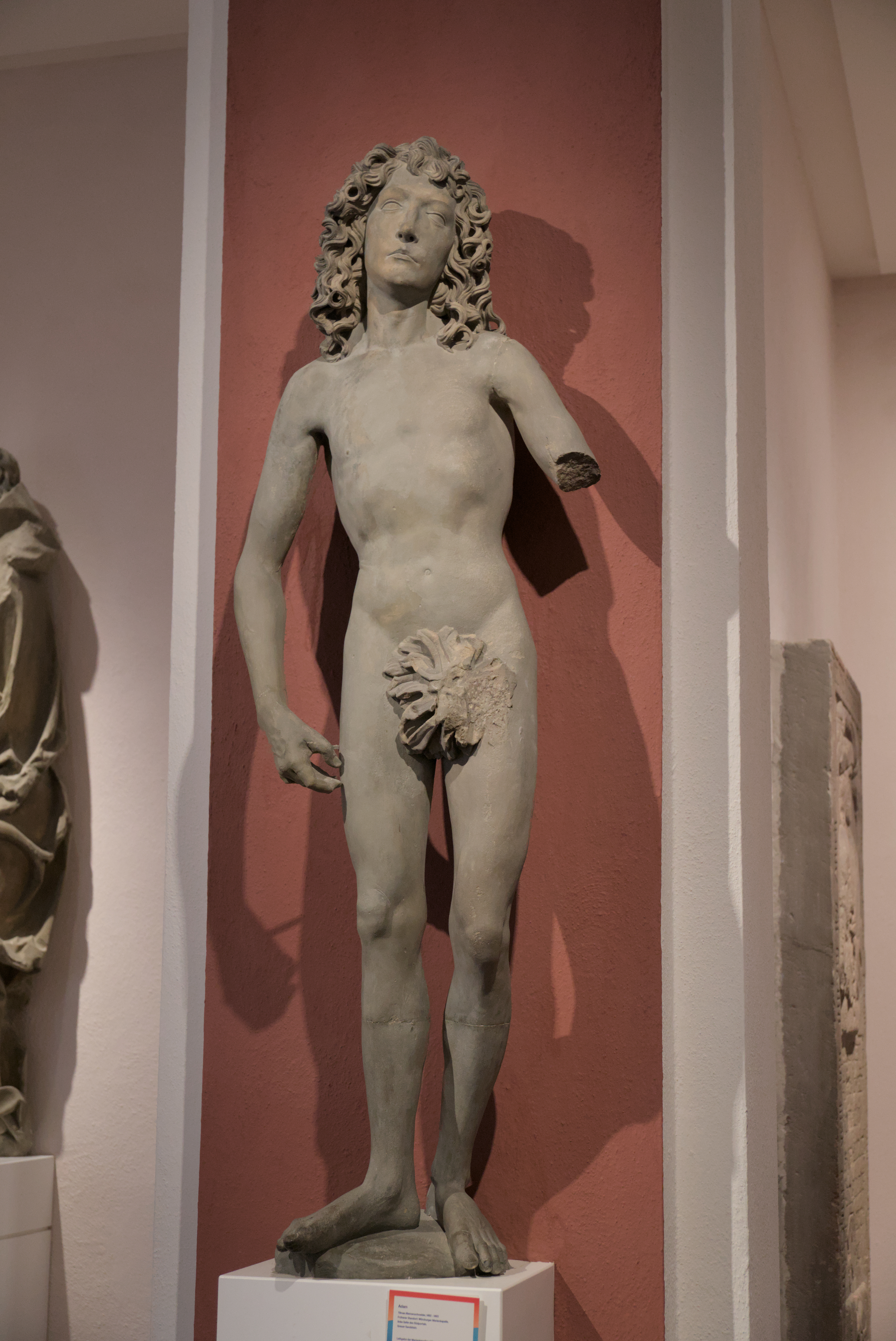
Tilman Riemenschneider_Adam
Tilman Riemenschneider, Adam, 1492–93. Gray sandstone. Former location: Würzburg Marienkapelle, left side of south portal.

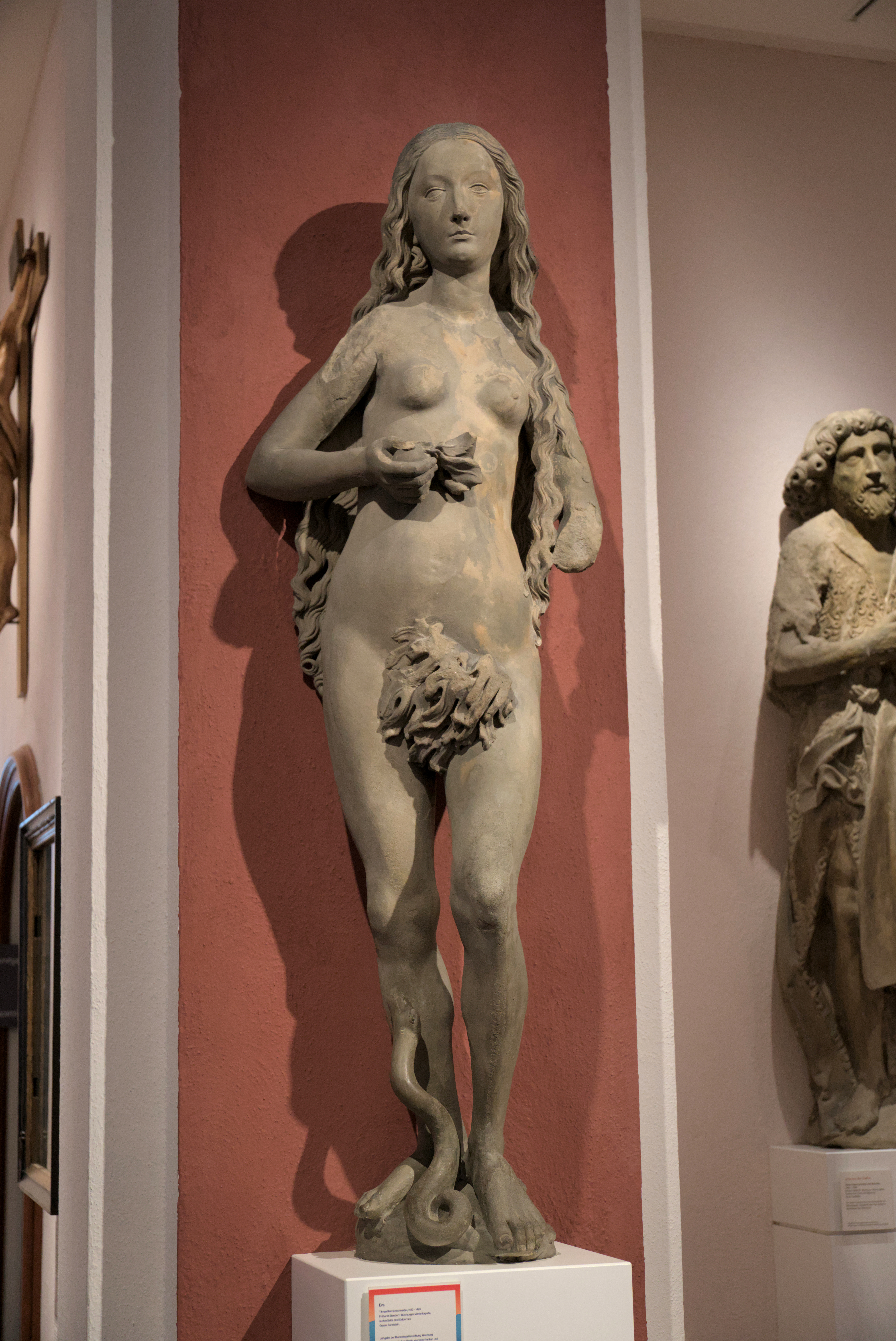
Tilman Riemenschneider_Eve
Tilman Riemenschneider, Eve, 1492–93. Gray sandstone. Former location: Würzburg Marienkapelle, right side of south portal.

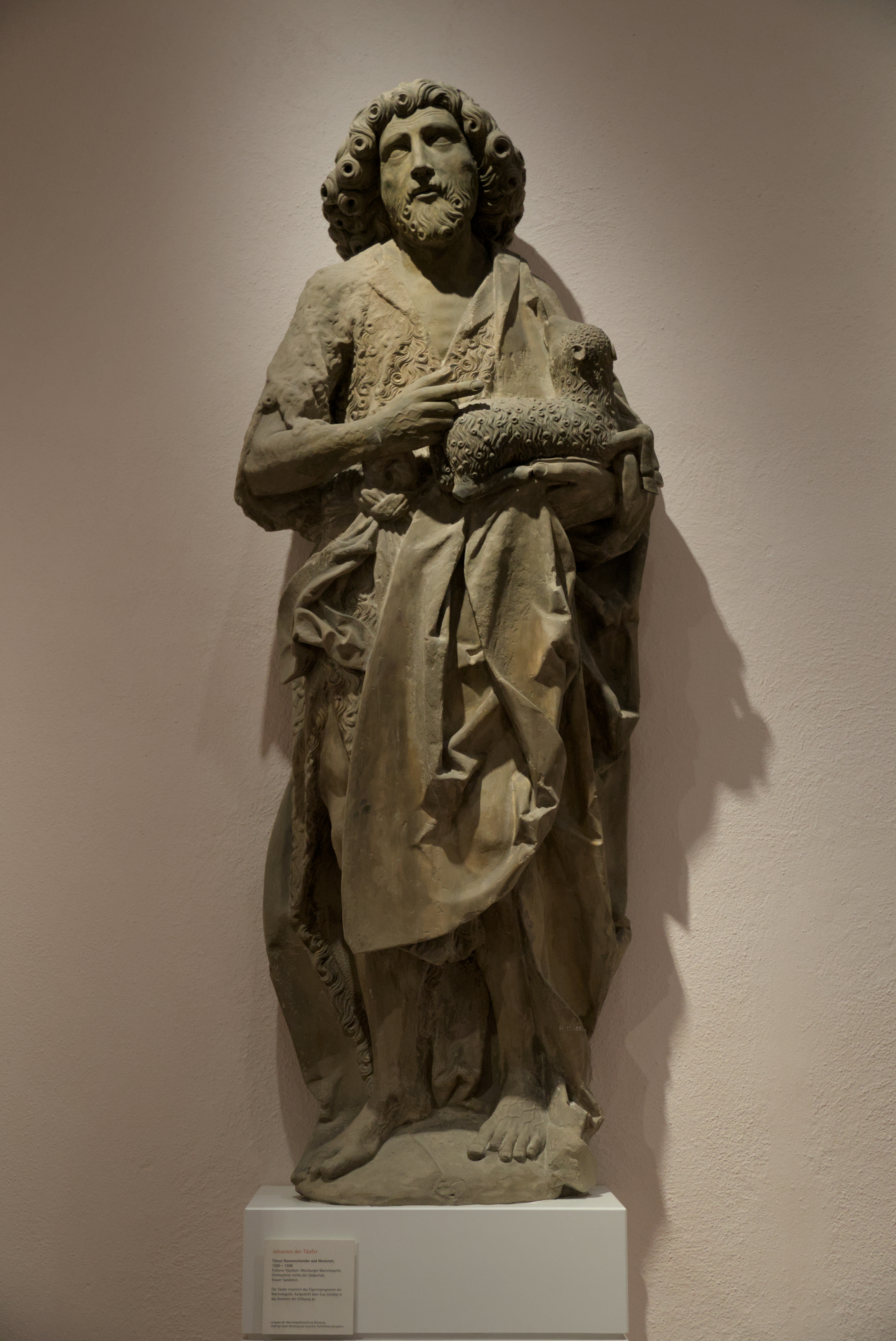
Tilman Riemenschneider_John the Baptist
Tilman Riemenschneider and workshop, John the Baptist, 1500–1506. Gray sandstone. Former location: Würzburg Marienkapelle, buttress to the right of the south portal.

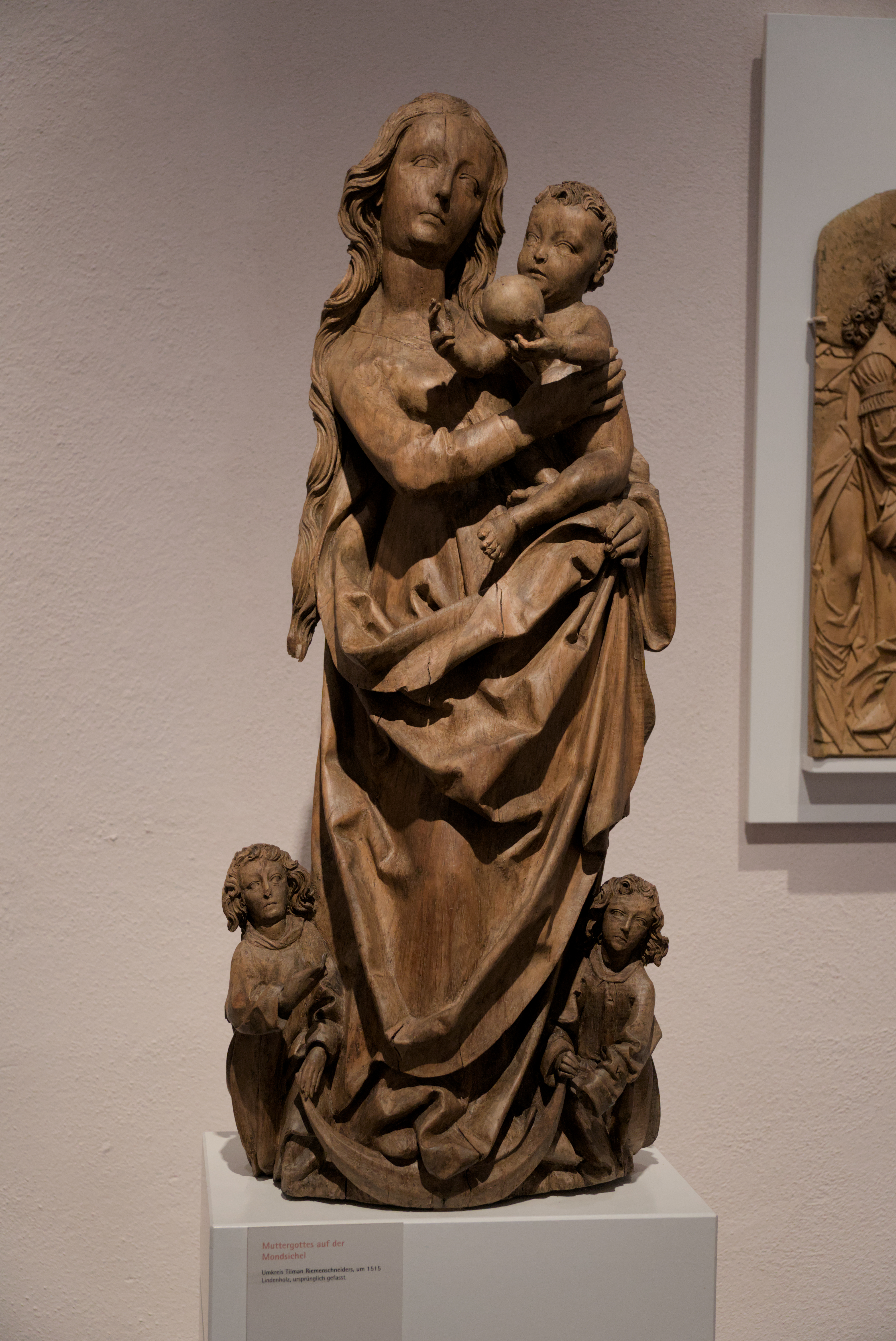
Tilman Riemenschneider (circle)_Madonna and Child
Circle of Tilman Riemenschneider, Madonna and Child on a Crescent Moon, ca. 1515. Limewood, originally painted.

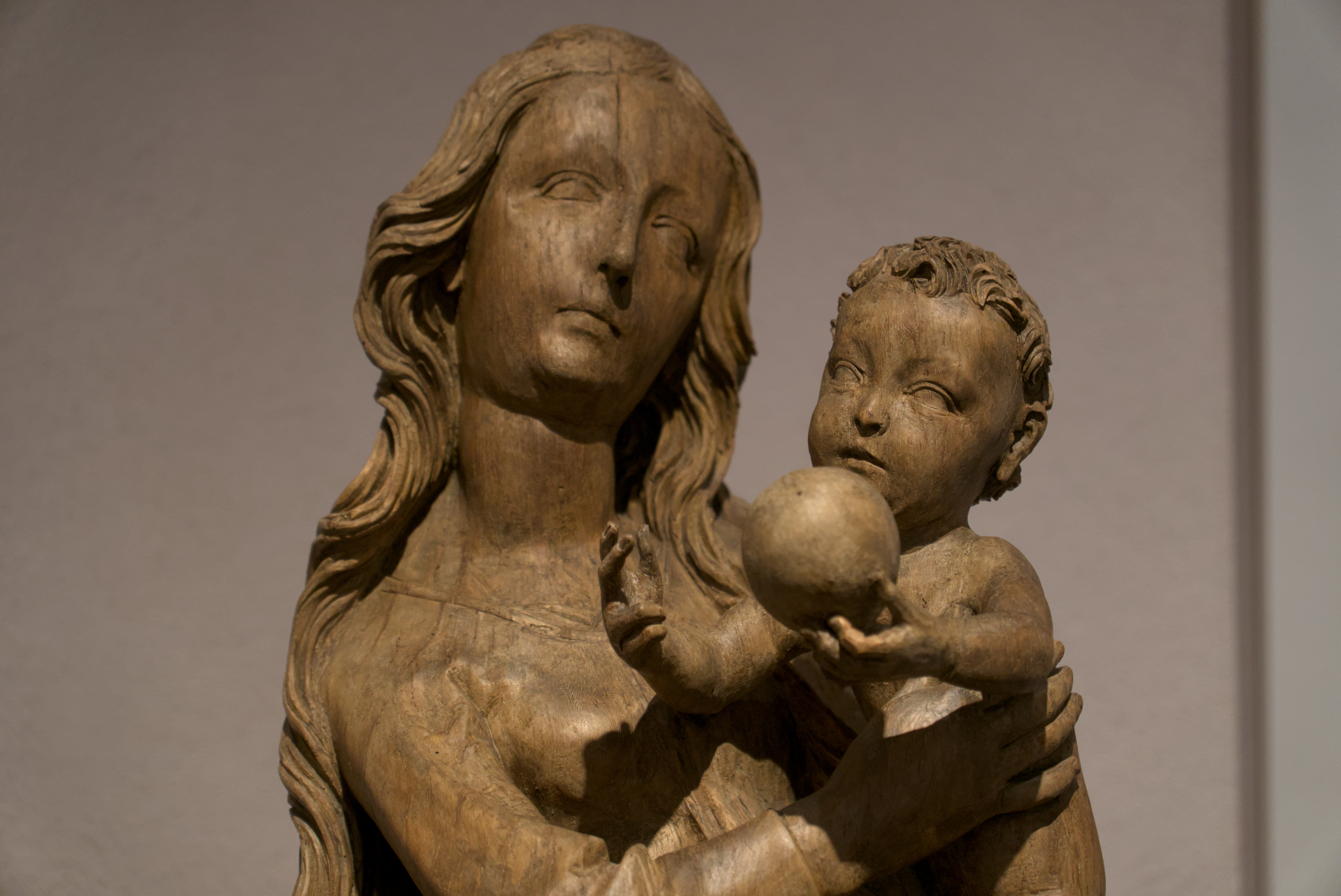
Madonna and Child (detail)
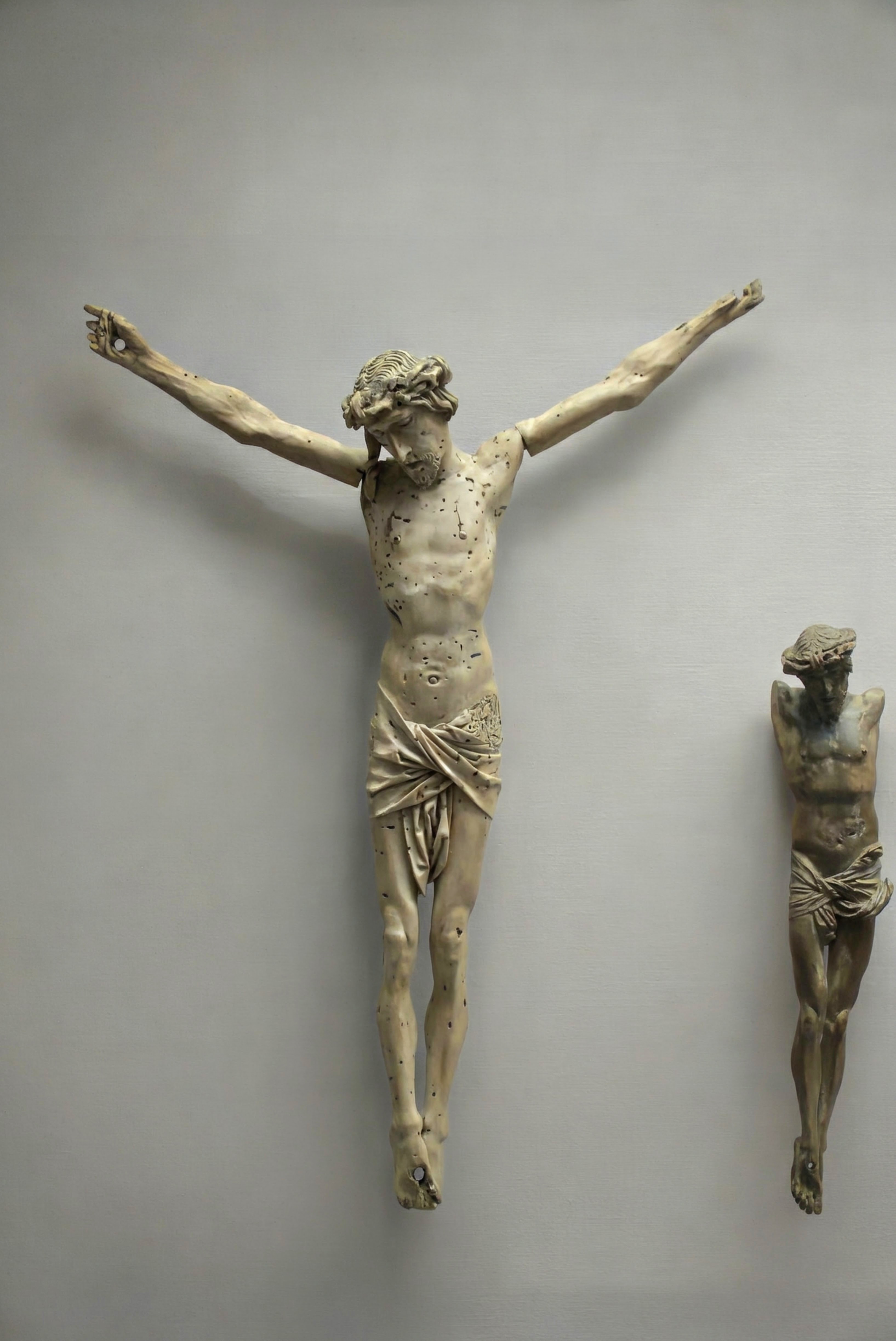
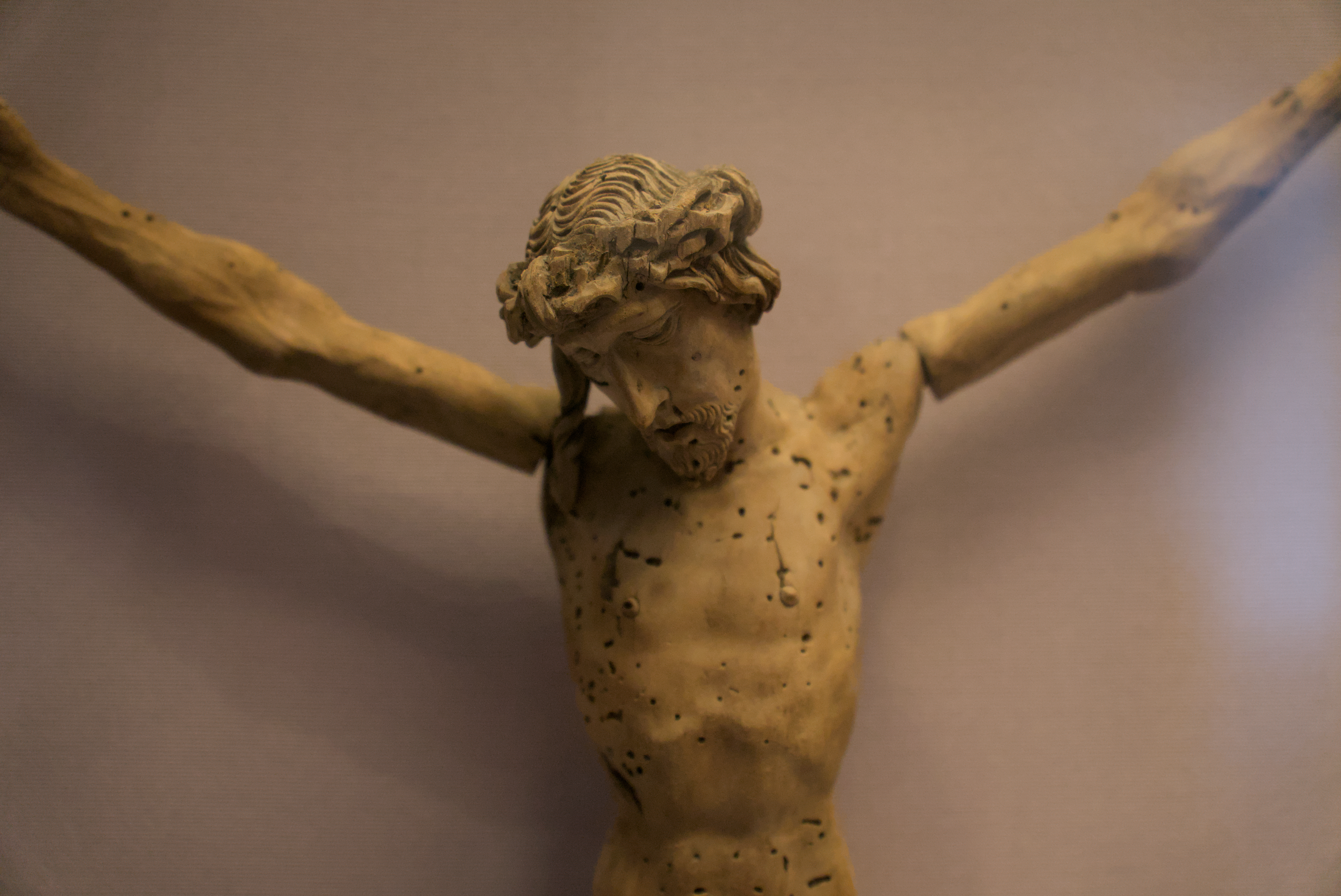
Tilman Riemenschneider_Crucifix
Tilman Riemenschneider, Crucifix, ca. 1500. Limewood, originally painted.

Crucifix (detail)
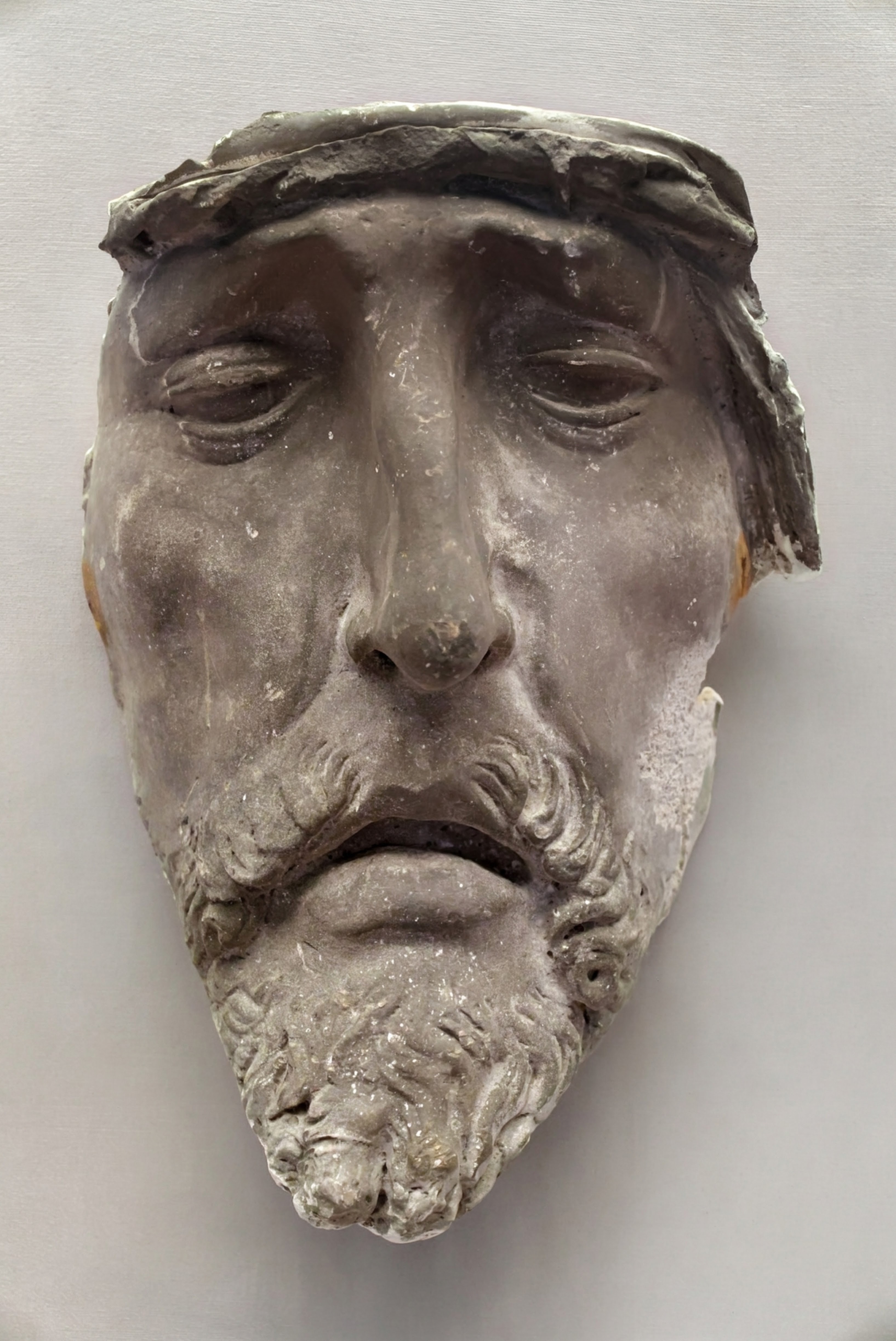
Head of Christ
Head of Christ, plaster cast by Andreas Halbig, ca. 1850–60, after an original by Tilman Riemenschneider, 1497 (destroyed 1945)

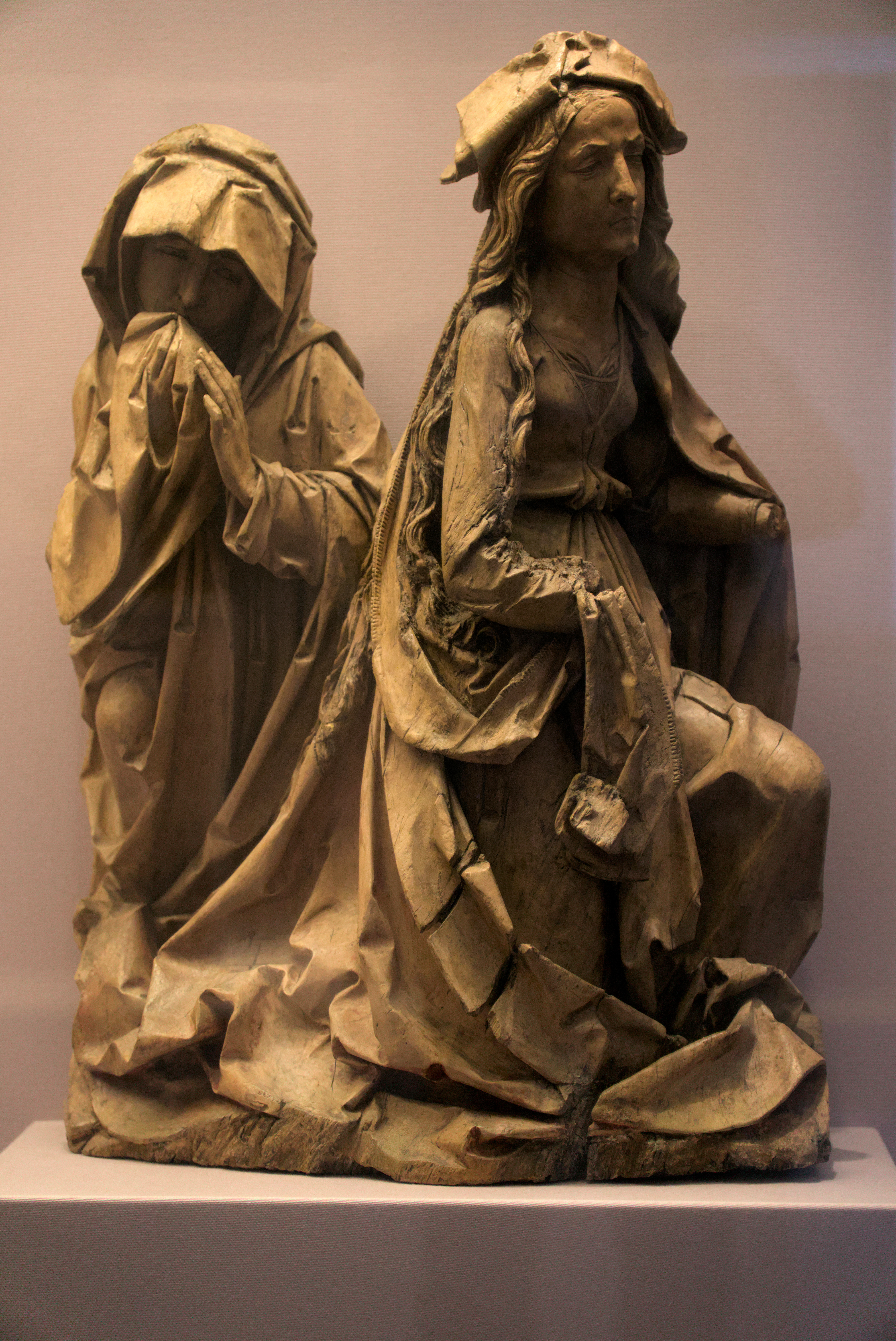
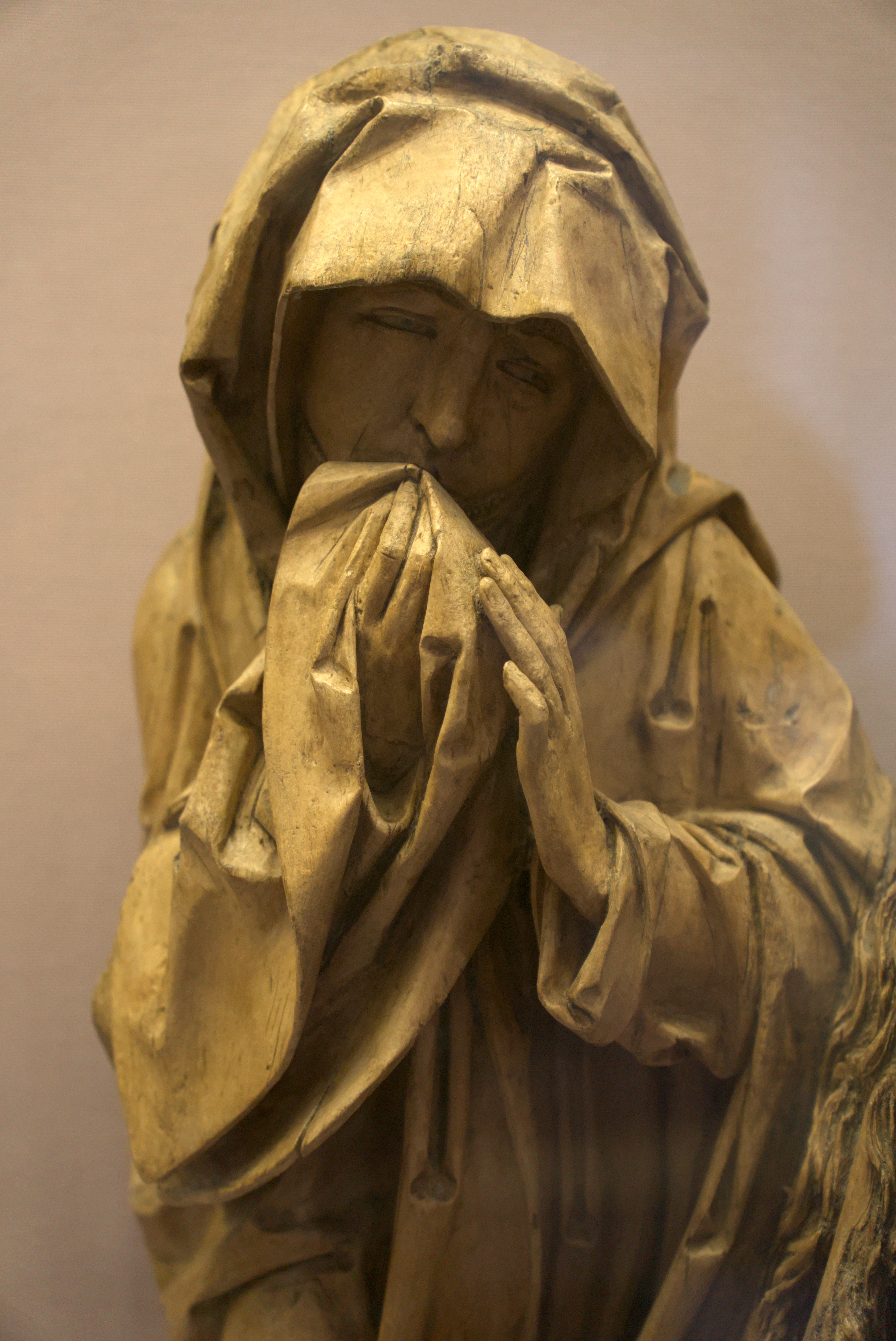
Tilman Riemenschneider_Mourning Women
Tilman Riemenschneider, Mourning Women (fragment from a Lamentation group), ca. 1510. Limewood, originally painted.

Mourning Women (detail)
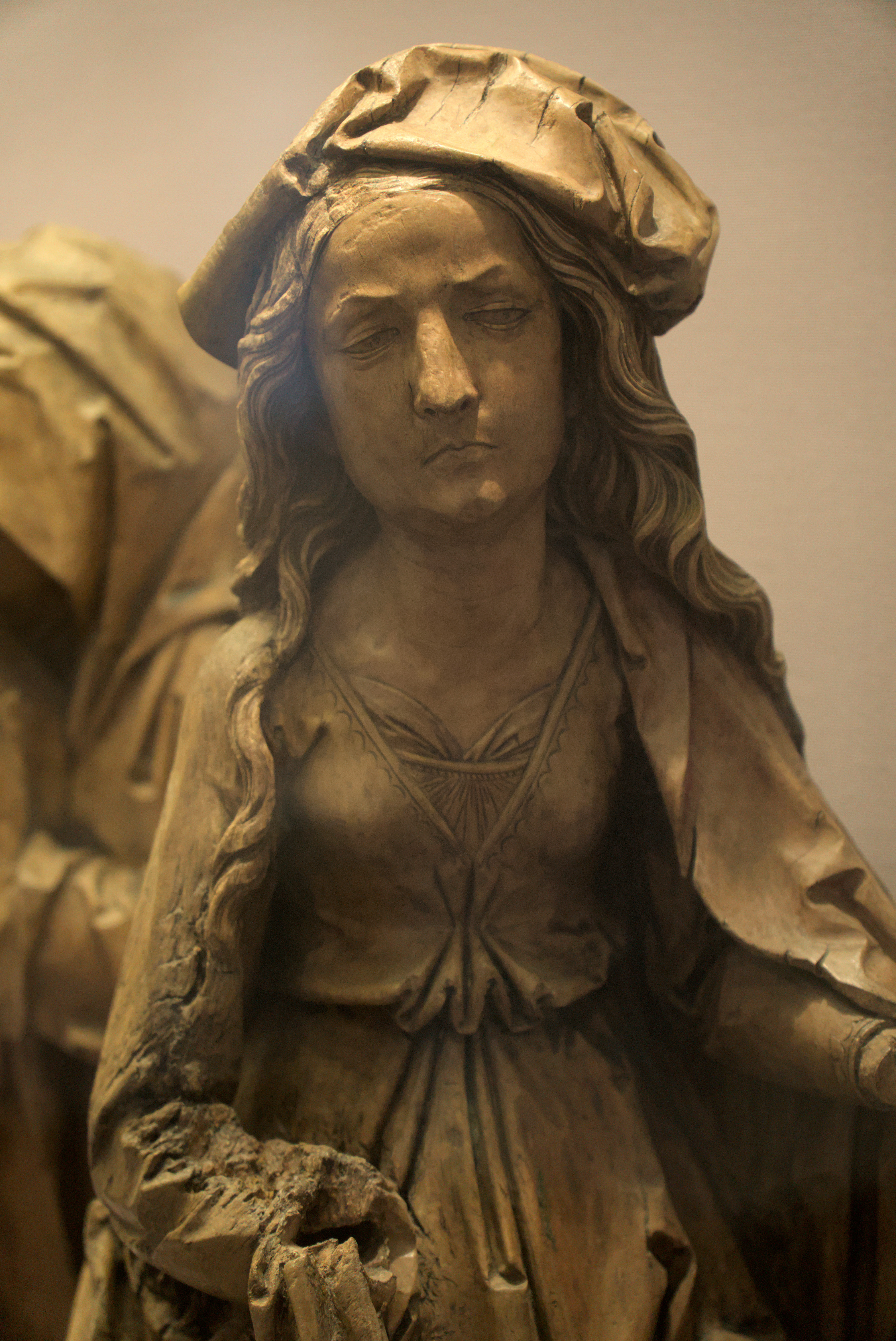
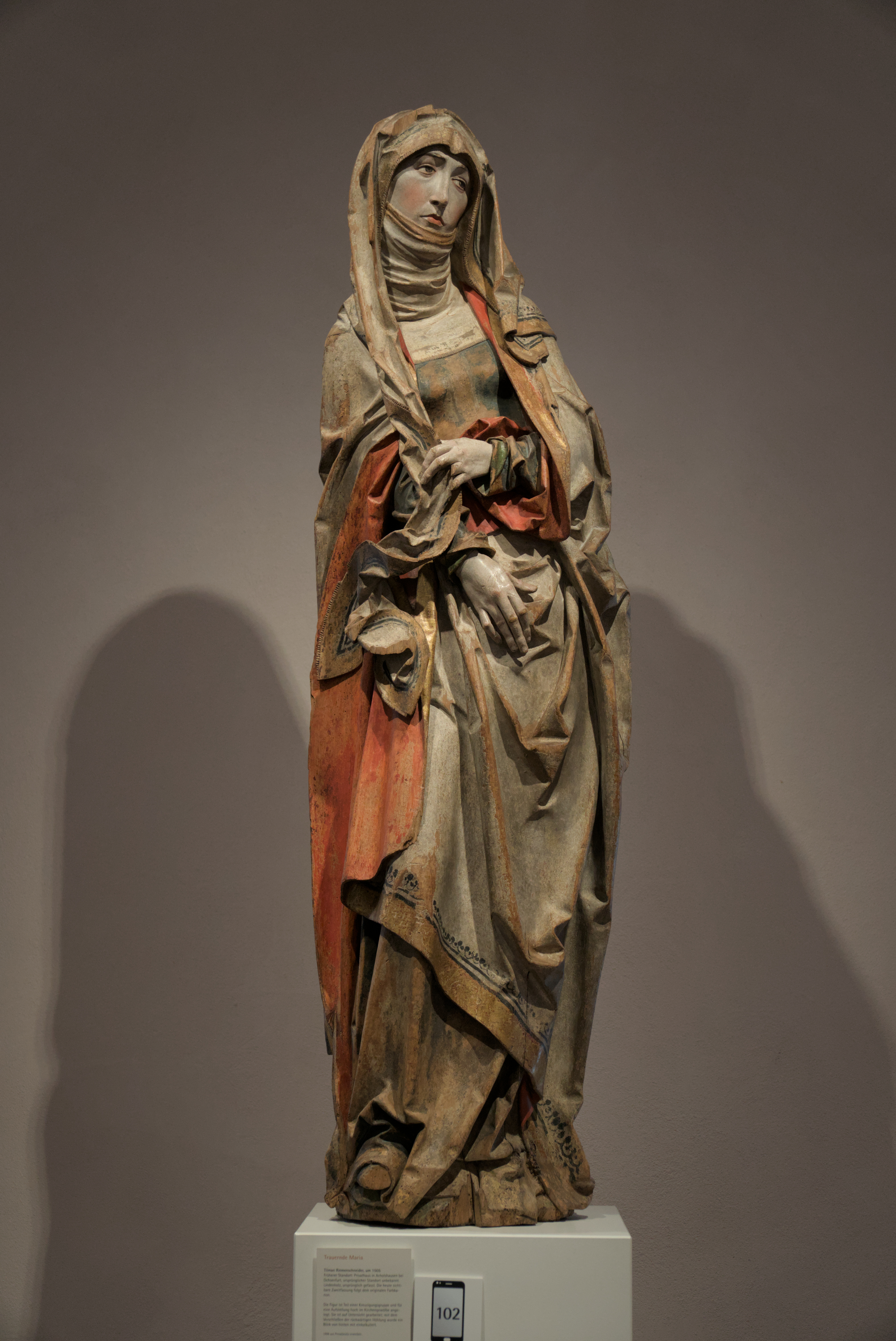
Tilman Riemenschneider_Mourning Mary
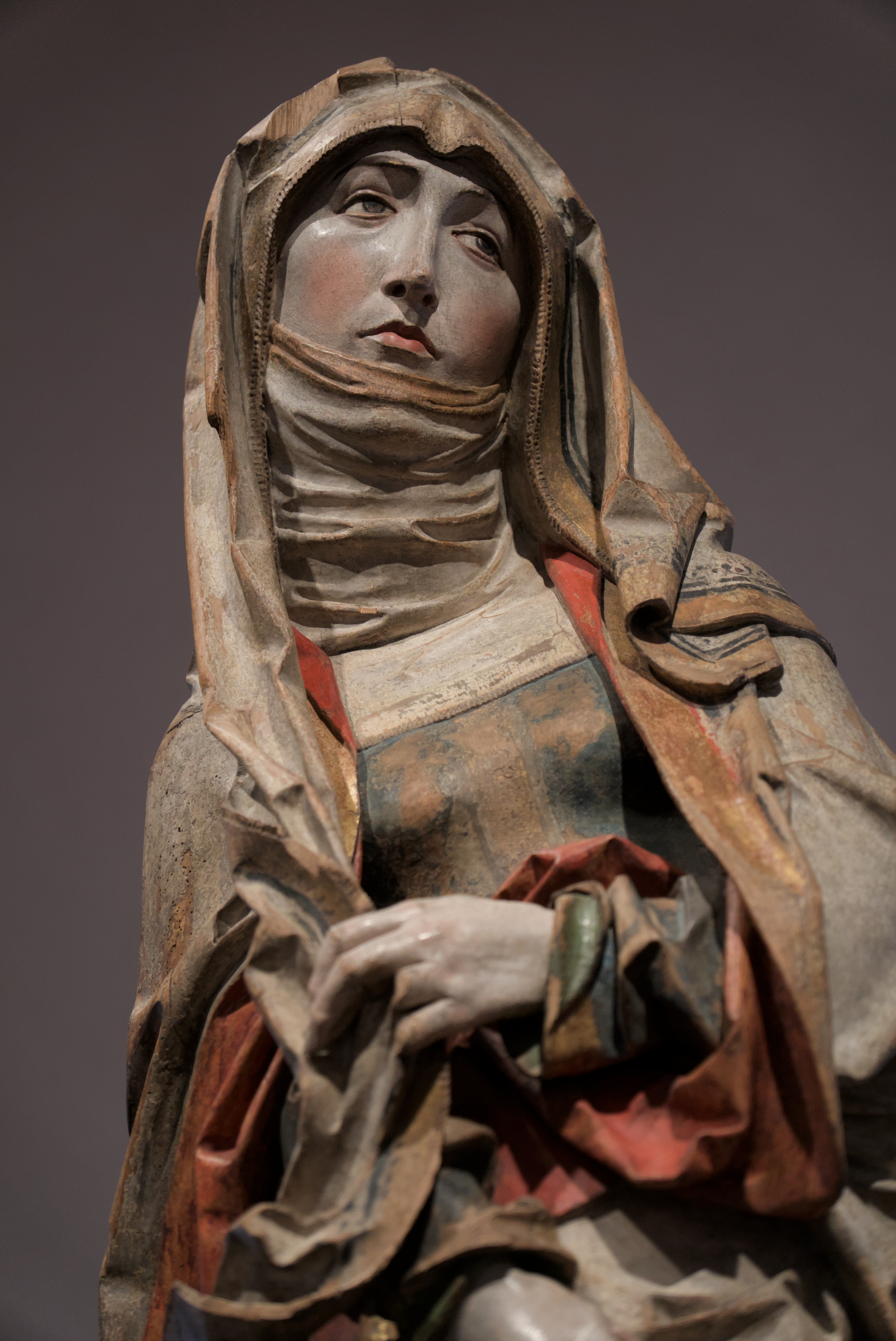
Tilman Riemenschneider, Mourning Mary, from a Crucifixion group, ca. 1505. Limewood, originally painted. (The second layer of paint visible today follows the original color scheme.) Former location: Private house in Acholshausen near Ochsenfurt, original location unknown.

Mourning Mary (detail)
Tilman Riemenschneider_Pieta
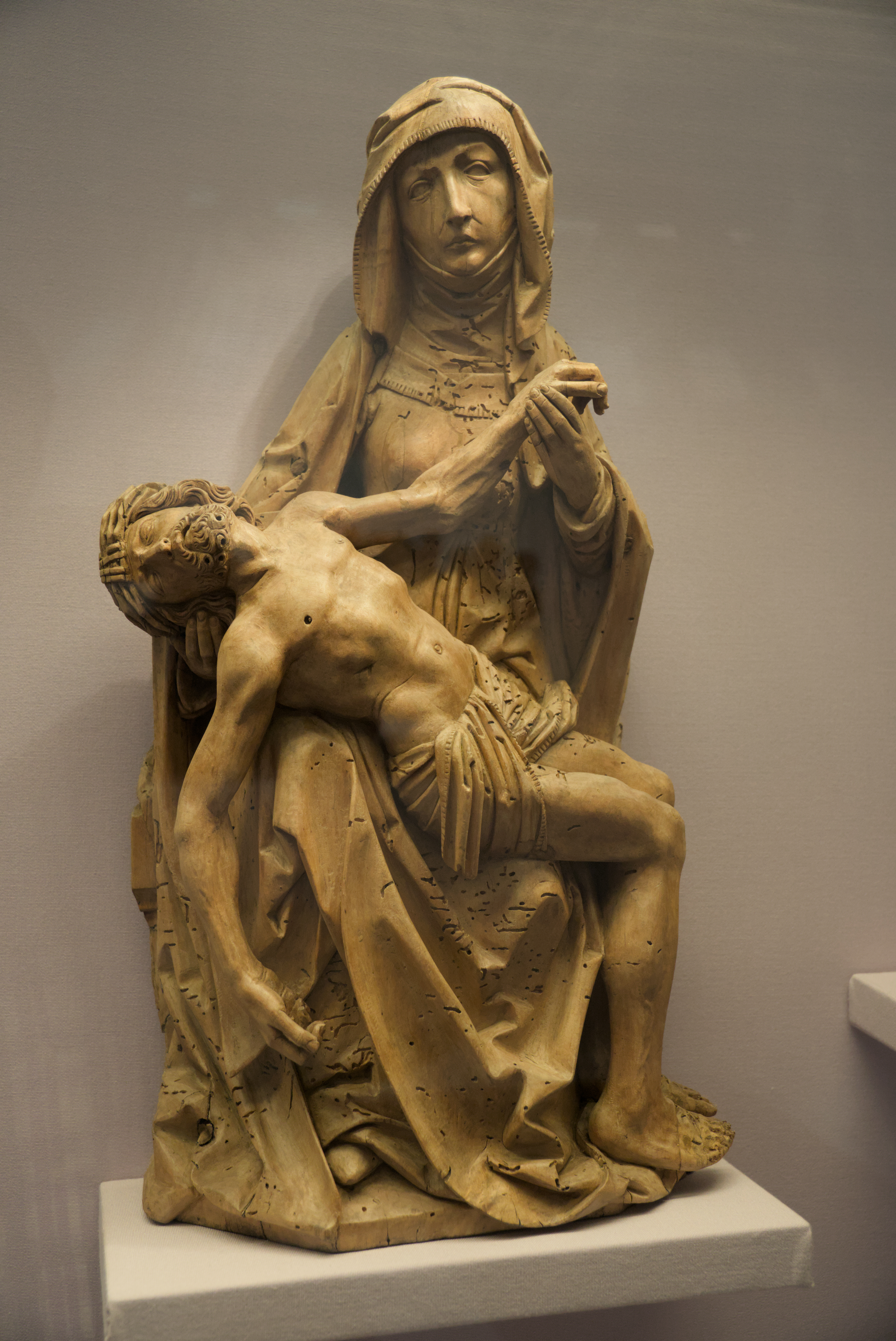
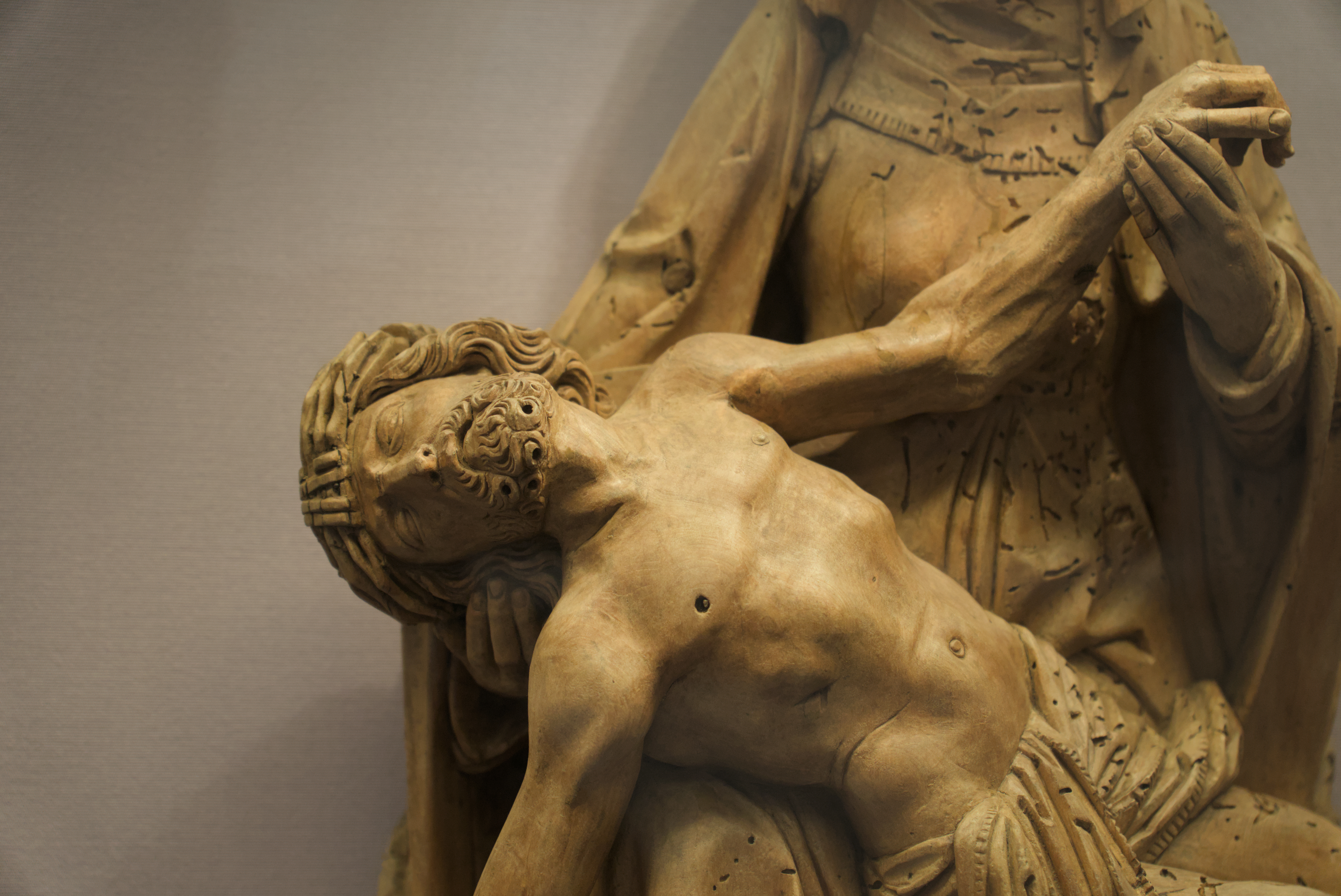
Tilman Riemenschneider and workshop, Vesperbild (Pietà), ca. 1510. Limewood, originally painted.

Pieta (detail)

And the remaining works below are by miscellaneous other artists from Franconia.

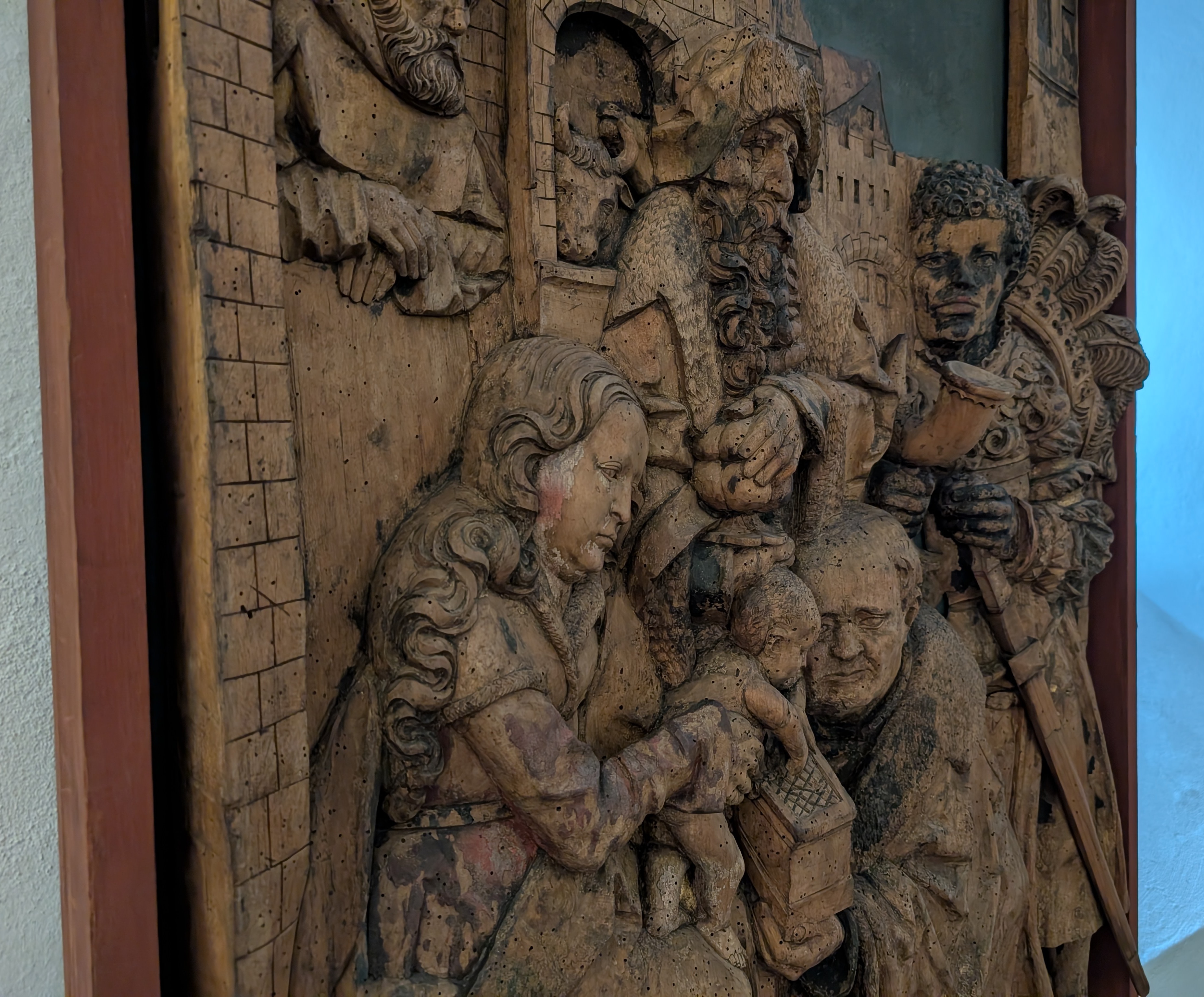
One high-relief wood carving shows the Adoration of the Magi. Look at Balthasar’s feathery headdress!
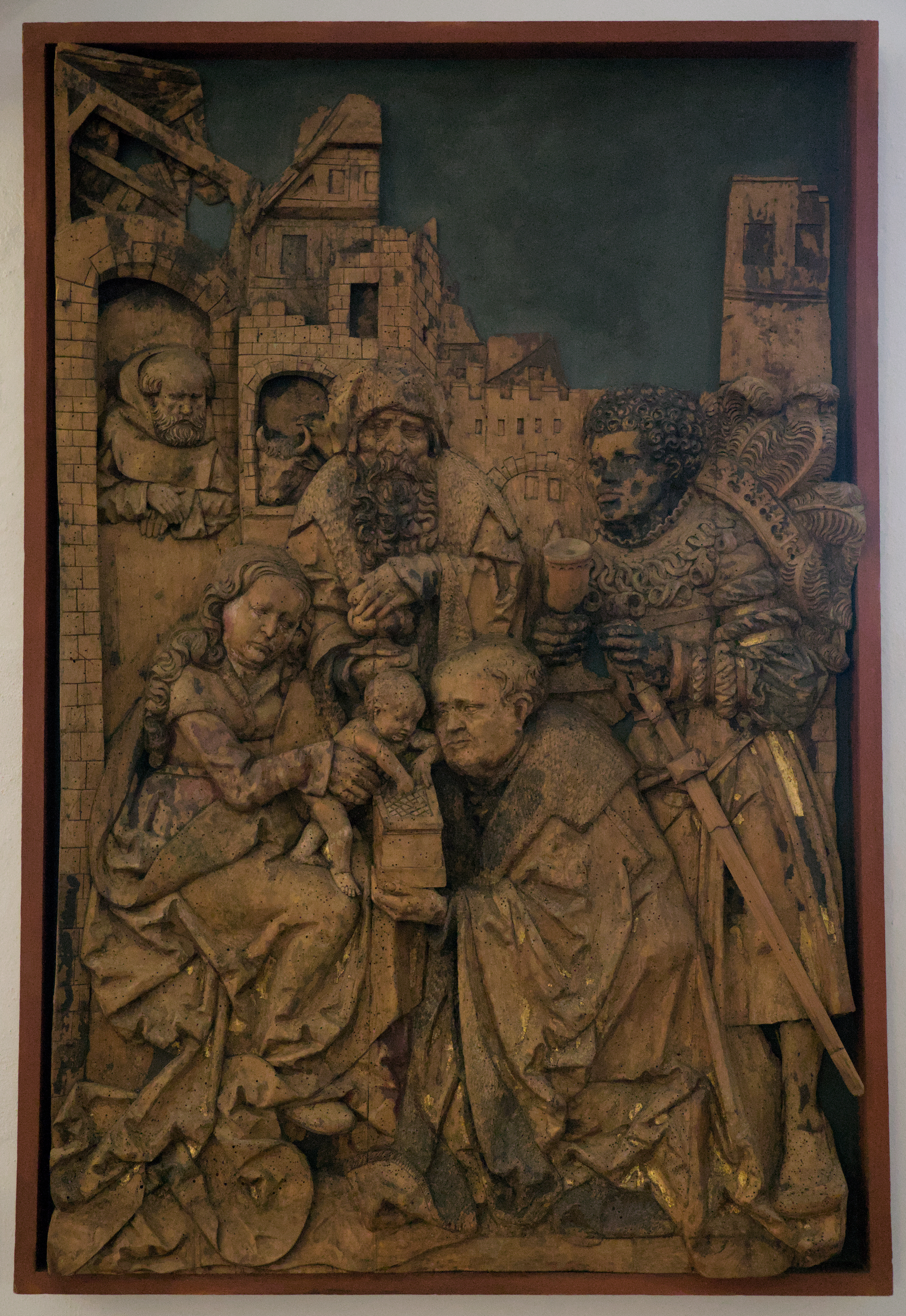
Adoration of the Magi
Adoration of the Magi, Württemberg-Franconia, ca. 1525. Probably part of an altarpiece wing.

Adoration of the Magi (detail)

Another wood sculpture portrays the story from Luke 7:36–50, about the unnamed “sinful woman” anointing the feet of Jesus at the house of Simon the Pharisee, who was hosting a meal. Jesus commends the woman’s act of gratitude, costly love, and hospitality, much to Simon’s consternation. Throughout much of church history, this woman was identified as Mary Magdalene—a view almost all present-day biblical scholars reject. But I use the title the museum provides.
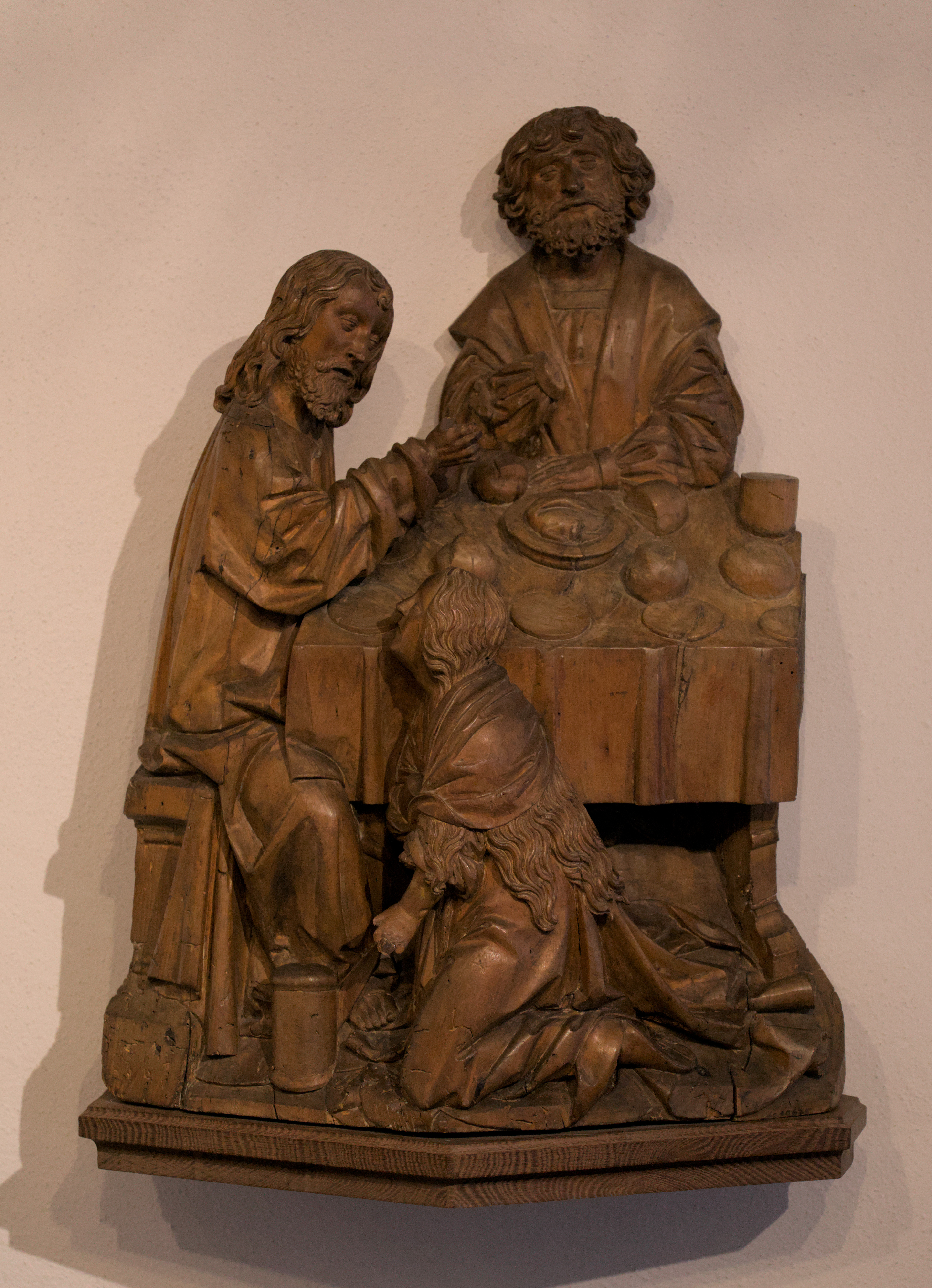
Christ and Mary Magdalene at the House of Simon the Pharisee
Christ and Mary Magdalene at the House of Simon the Pharisee, Franconia, ca. 1510

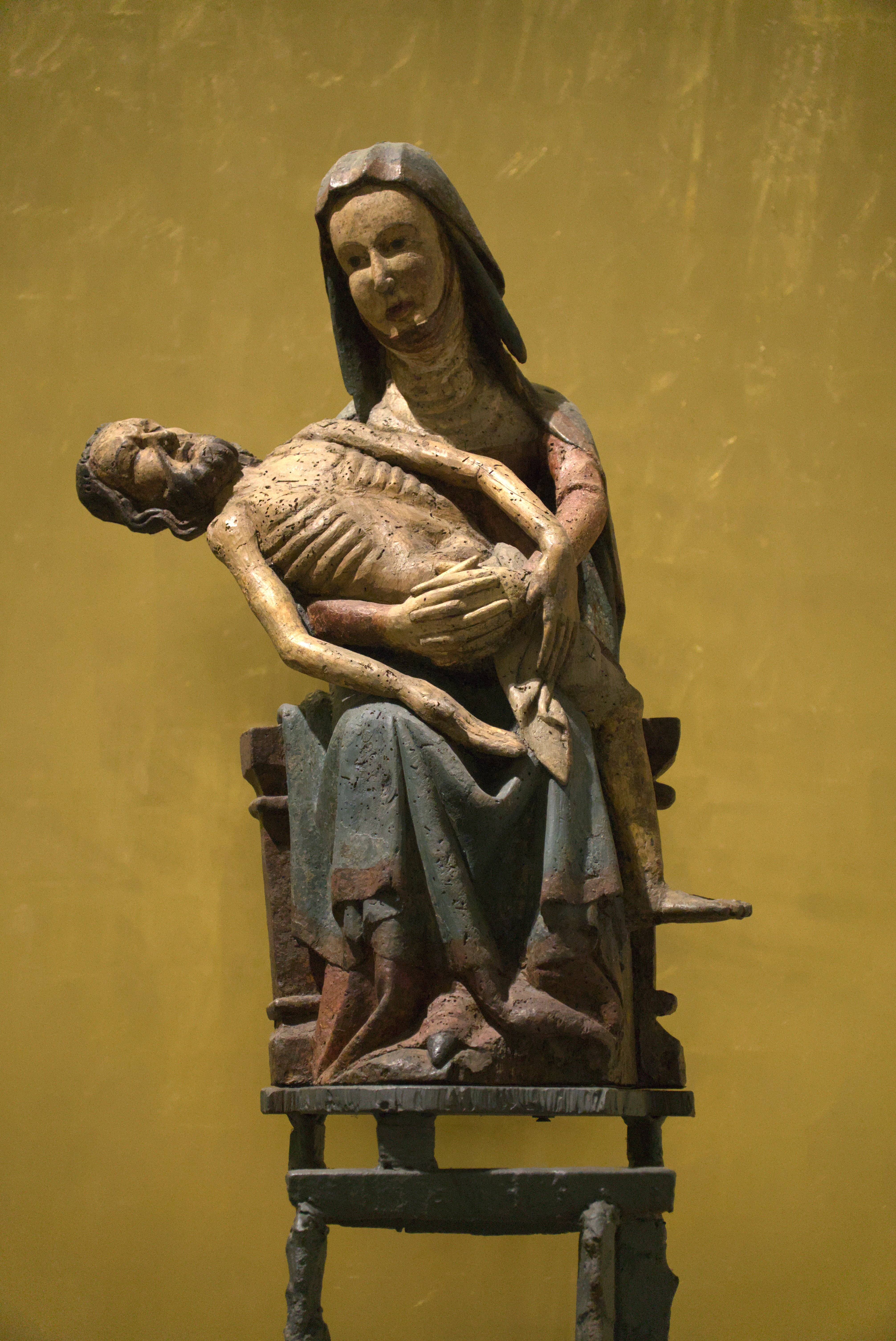
One of the most moving sculptures I saw shows Mary cradling her dead son in her lap, a devotional image type known in German as the Vesperbild (literally “evening picture”). This image type originated in Germany in the early 1300s, spreading throughout Europe, including, around 1400, Italy, where it took on the name Pietà, Italian for “pity” or “compassion.”
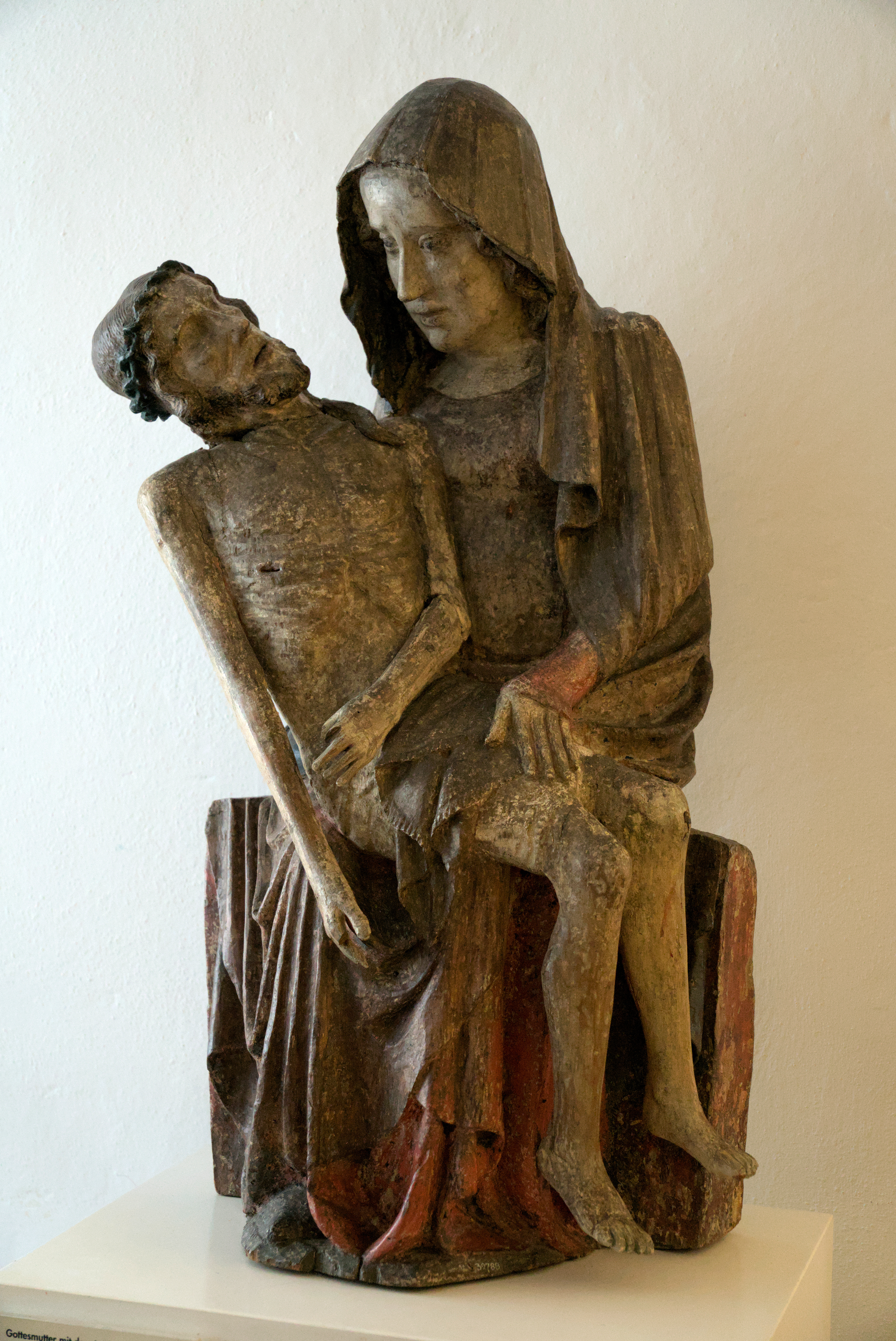
Vesperbild
Vesperbild (Pietà), Würzburg, ca. 1360. Wood with remnants of old paint. From the former Scottish Monastery in Würzburg.

Another image type that originated in Germany is the Gnadenstuhl, variously translated as “Mercy Seat” or “Throne of Grace.” It depicts God the Father holding his crucified Son, with the Holy Spirit as dove in the middle—all three persons of the Trinity.
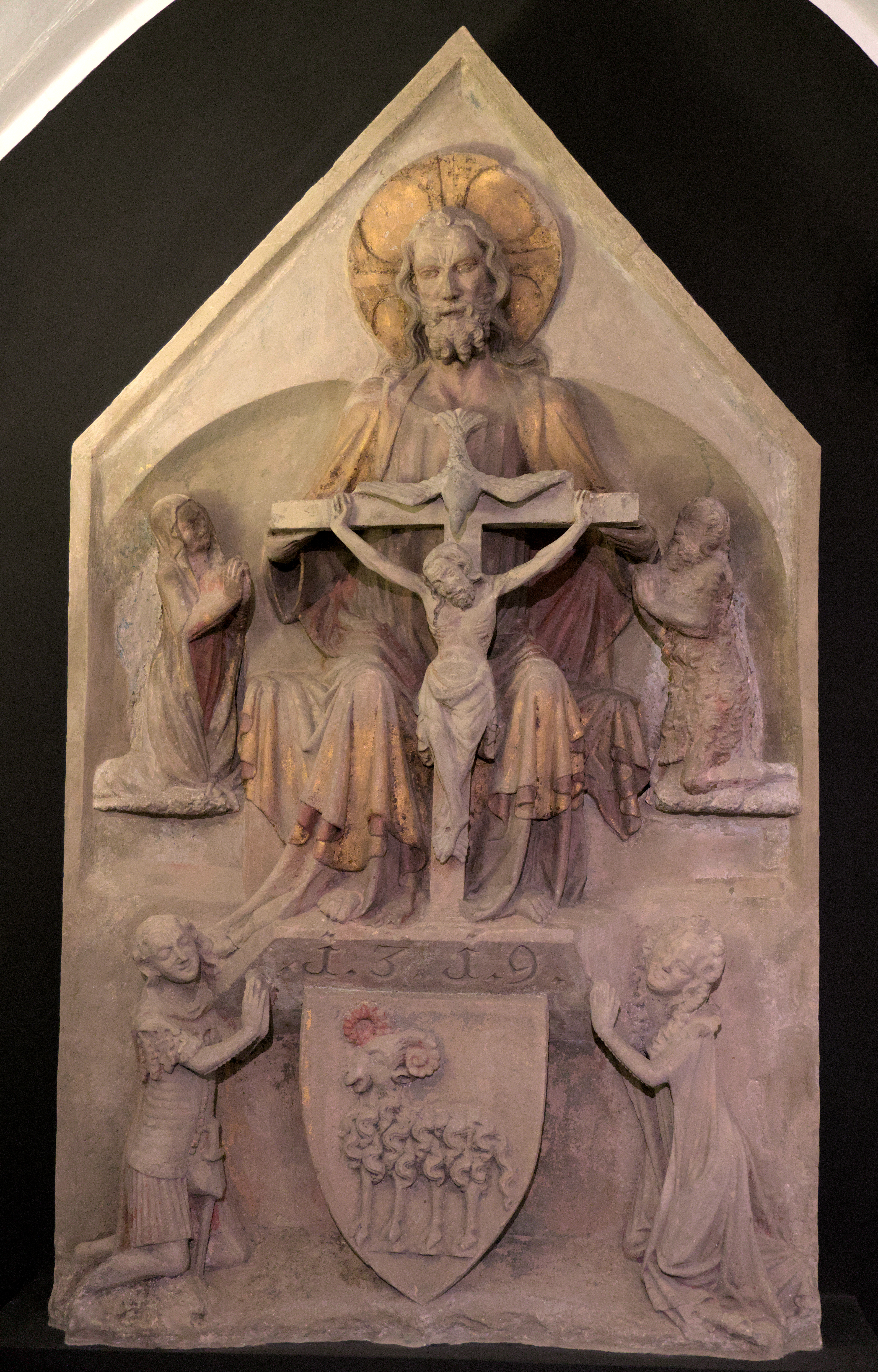
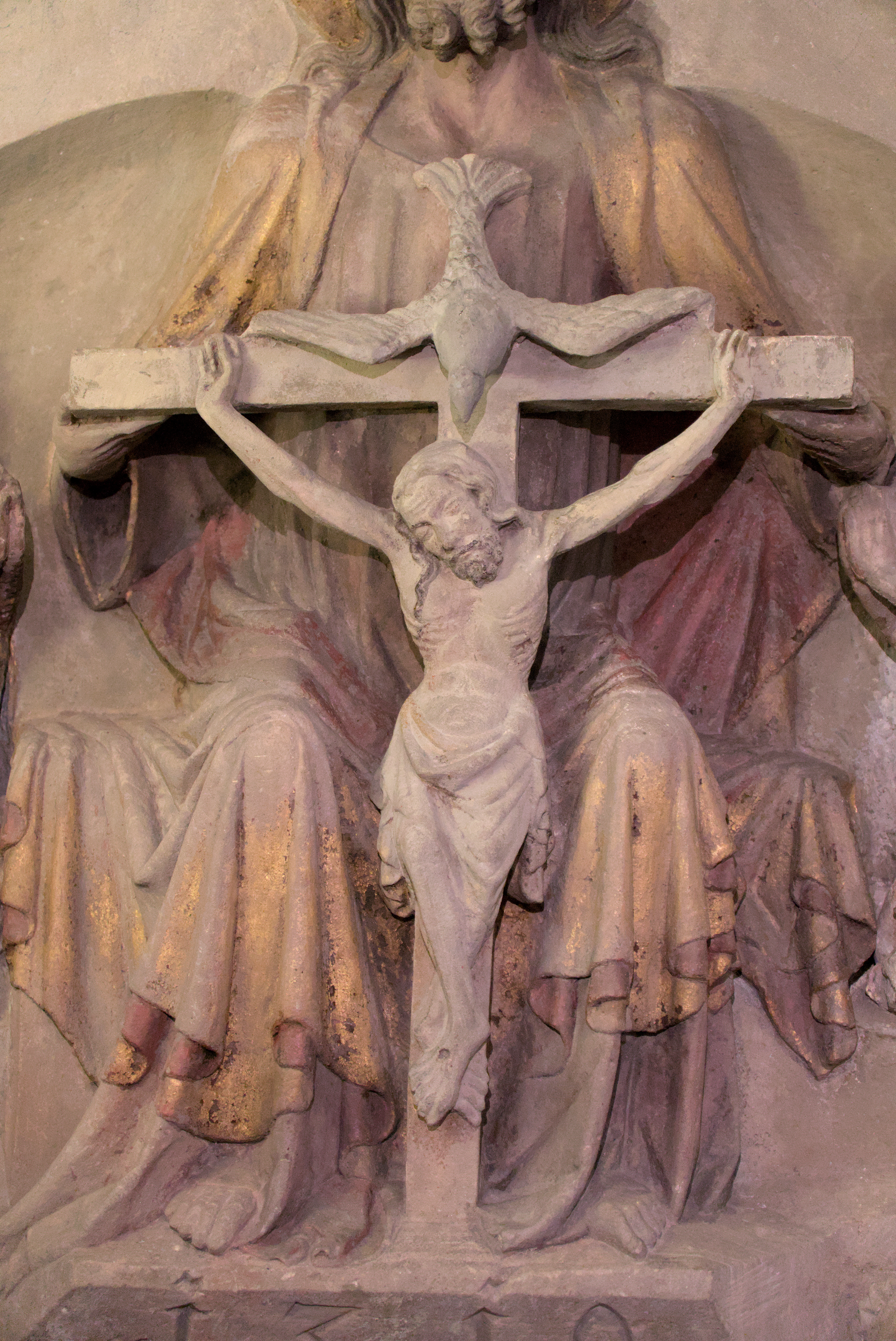
Gnadenstuhl
Circle of the Wolfskeel Master, Gnadenstuhl (Throne of Grace), from the Bürgerspital zum Heiligen Geist, Würzburg, ca. 1340

Gnadenstuhl (detail)

I plan to write a fully developed article on the Gnadenstuhl sometime in the future, as I’m fascinated by its theological implications, which, as I interpret it (and this is clearer in some versions than in others), run counter to a theology of Jesus’s God-forsakenness on the cross. What if, instead of conceptualizing the Crucifixion as an event in which the Father turned his face away from Christ, we saw the Father as with Christ, supporting and sustaining him, and suffering too? What if we saw the Crucifixion not as a temporary break in God’s triunity, the Father severing fellowship with the Son, the punisher versus the punished, but rather Christ on the cross as the object of the Father’s loving gaze, as he always had been? I have much more thinking and reading and consultation to do on this, as I want to be careful with my words. So for now I’ll share just this one example, and defer further theological discussion until another time.

This stone relief was originally located in the Bürgerspital zum Heiligen Geist (Citizens’ Hospital of the Holy Spirit) in Würzburg, founded in the early fourteenth century by Johann von Steren to provide shelter for the poor and treatment for the sick. Johann also endowed the hospital with vineyards that are maintained to this day, as is a public foundation, which operates senior citizens’ homes and a geriatric rehabilitation clinic. The founder is shown at the bottom left opposite his wife, Megardlis von Steren, their family coat of arms between them. On the middle level, flanking the cross, are Mary and the camel-hair-clad John the Baptist, interceding.

Here’s a (German-language) video the museum made about this Gnadenstuhl:

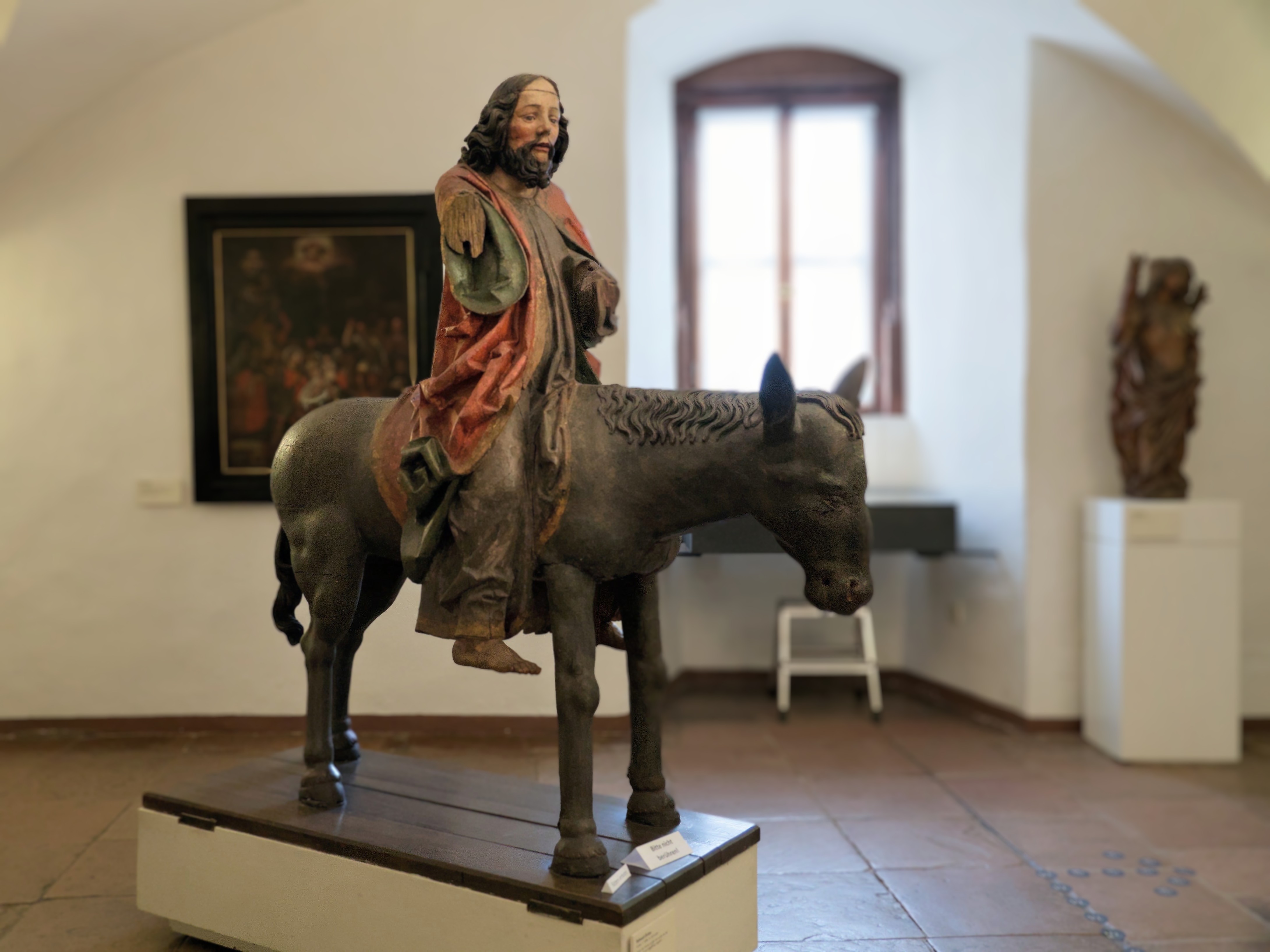
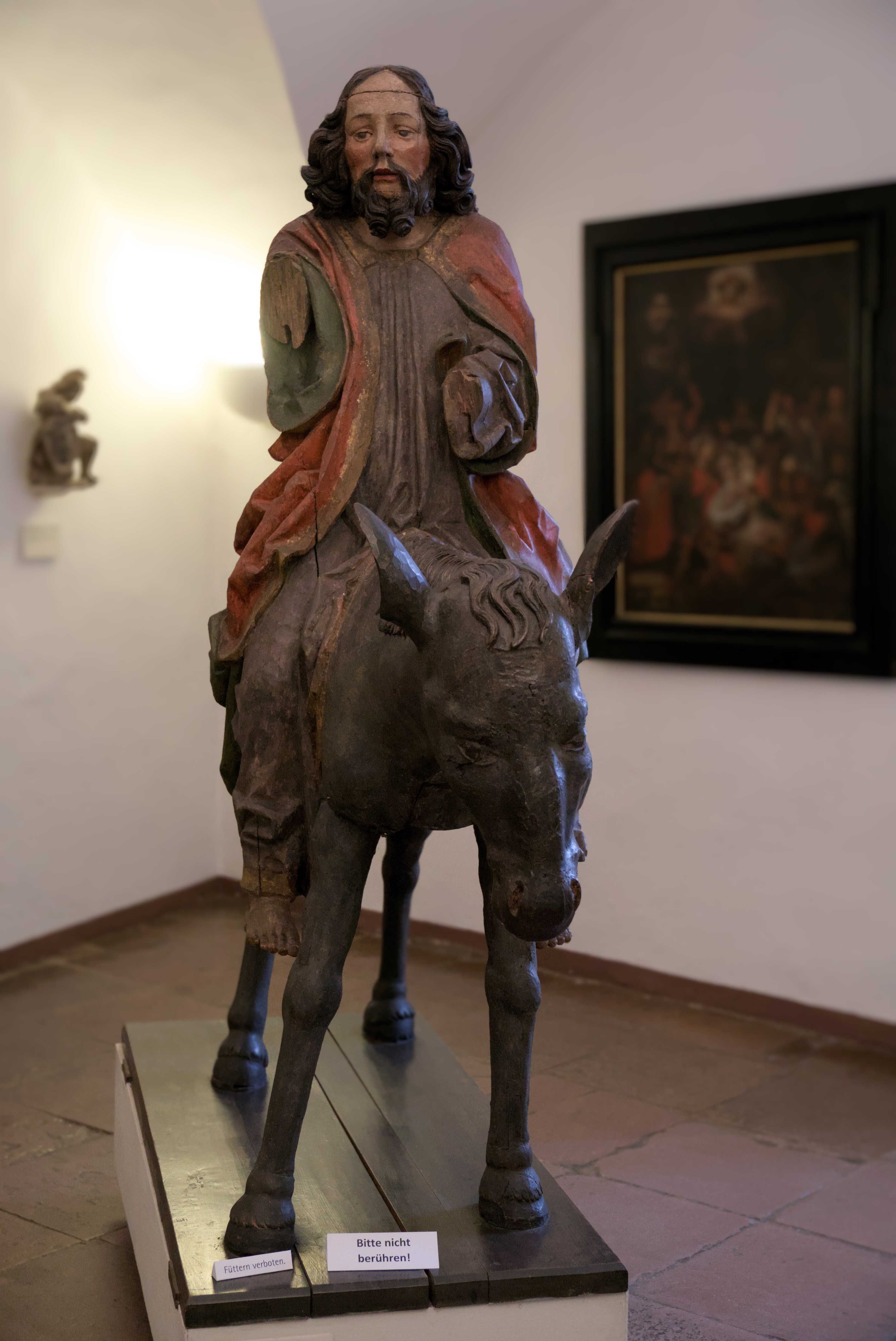
If you’ve been following my blog since Lent, you’ll recognize this next guy. It’s a Palmesel, literally “Palm Donkey,” mounted by a Christ figure, representing Christ’s entry into Jerusalem the week of his death. It’s not known which German town it comes from, but it would have been affixed to a wagon and wheeled through that town’s streets on Palm Sundays.
Palmesel
Palmesel (Palm Donkey), Franconia, first half of 16th century

Palmesel

(See “The Palmesel (‘Palm Donkey’): A Holy Week Tradition from Medieval Germany.”)

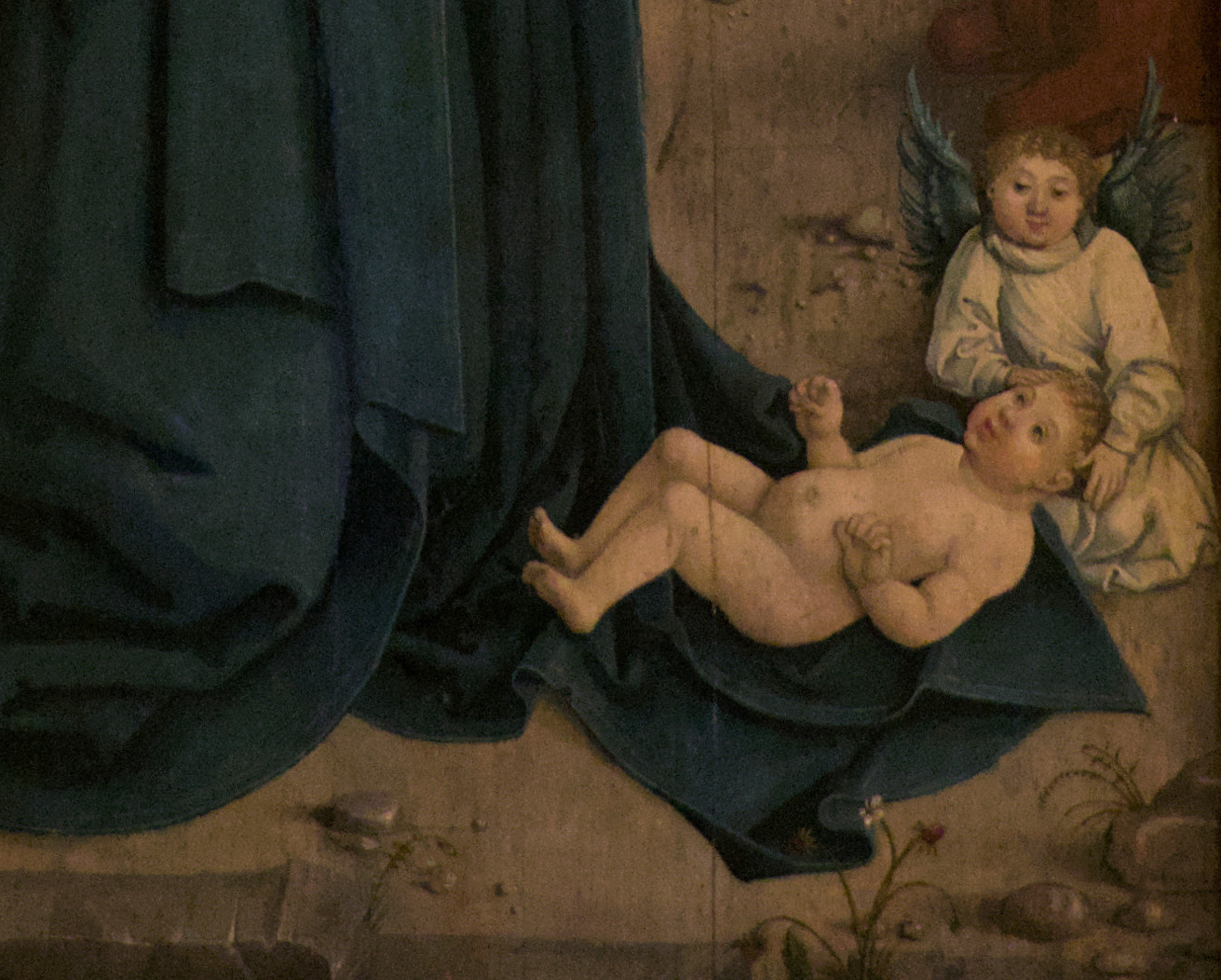
The Museum für Franken majors in sculpture, minors in painting. One pair of paintings I really like is from an early sixteenth-century altarpiece depicting the Nativity and the Adoration of the Magi. On the left, I love how an angel supports the head of Christ so that it’s not lying on the hard ground; he kneels, gently lifts that pudgy little noggin, and cushions it on his lap.
Nativity and Adoration of the Magi
Nativity and Adoration of the Magi, Franconia, ca. 1510. Wooden panel paintings, originally part of a winged altarpiece.

Nativity (detail)

And lastly, another pair of altarpiece wings—depicting St. Margaret and St. Apollonia. The rest of the altarpiece was destroyed in 1945.
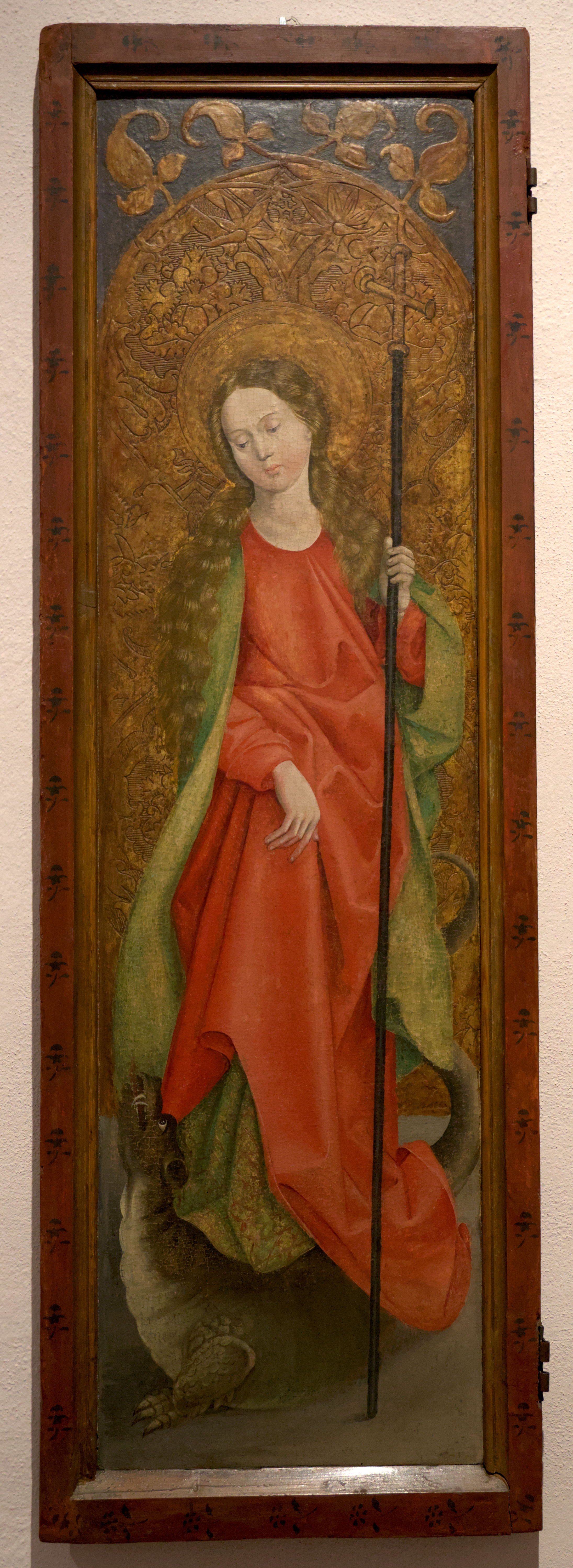
St. Margaret
Brother Martinus Schwarz, Saint Margaret (altar wing), ca. 1485. Mixed media on softwood. Probably from a chapel in Rothenburg ob der Tauber.

Margaret was an early fourth-century Christian martyr from Antioch of Pisidia. Her hagiography is pretty wild. The most famous legend associated with her is that, when she was in prison for refusing to renounce Christianity, she prayed that God would show her the enemy who was fighting her. Satan then appeared in the form of a dragon and swallowed her whole. But when she made the sign of the cross inside him, his belly burst open, and she escaped unscathed. She is traditionally shown holding a cross staff and standing atop or ripping through a dragon, imaging the triumph of good over evil.
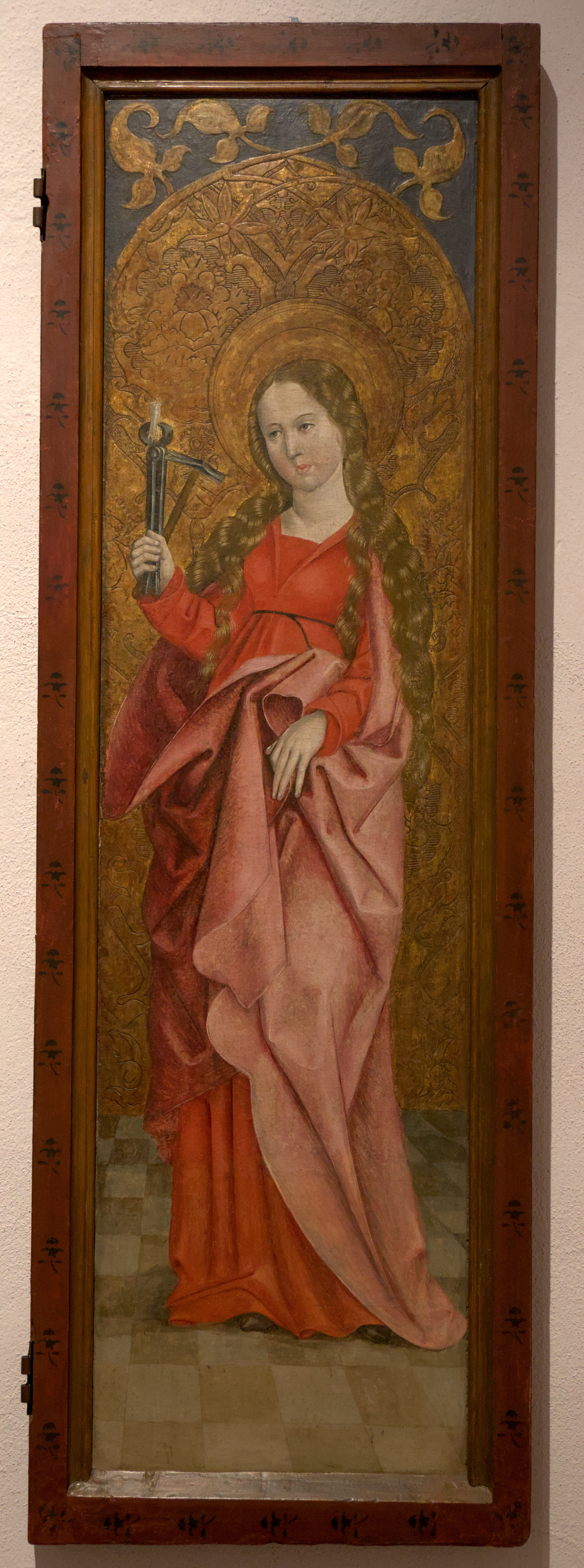
St. Apollonia
Brother Martinus Schwarz, Saint Apollonia (altar wing), ca. 1485. Mixed media on softwood. Probably from a chapel in Rothenburg ob der Tauber.

Apollonia was a second-century Christian martyr from Alexandria whose torture included having all her teeth pulled out or shattered. That’s why she’s traditionally shown holding a set of pliers with a tooth in their grip, or, more rarely, a claw hammer. Here she holds both!

These two paintings are by Brother Martinus Schwarz, the guardian (superior) of the Franciscan monastery in Rothenburg ob der Tauber. On several occasions, he was enlisted by Riemenschneider to paint his sculptures.


I hope you enjoyed this little four-part travelogue. I received an earlier request to share more from my art-related travels (on average, I take an international trip every other year, and it always includes art!), including itineraries, and/or recommendations for religious art destinations. Any itinerary would need to take into account how long you have, who you’re traveling with, what your (and your traveling companions’) other interests are, and your budget. I have more stamina than most when it comes to structuring a day out in the city; others prefer a more leisurely pace, or have to adapt to the needs of young kids. In nine days, I toured Frankfurt, Würzburg, Rothenburg, Nuremburg, Munich, and (just over the border in Austria) Salzburg. The trip would have looked different if I were traveling with friends or parents or children.

If you’re interested in traveling to southern Germany and focusing on religious art, hit me up by email, and I’d be happy to share a list of the museums and churches I visited, and what I thought was worth it versus not.

If you’ve been to that region, or live there, feel free to share some of your favorite places or artworks in the Comment field below.
Day Trip to Würzburg, Part 3: St. Kilian’s Cathedral

All photos in this post are my own.

In the Bavarian city of Würzburg, after visiting the Marienkapelle (part 1) and Neumünster (part 2), my husband Eric and I stepped over to the adjacent St. Kilian’s Cathedral, also referred to simply as Würzburg Cathedral (or Würzburger Dom in German).

Its namesake, Kilian, was a seventh-century Irish missionary bishop to the Germanic tribes of Franconia who was beheaded by Duchess Geilana after he denounced her marriage to Duke Gozbert, her late husband’s brother.

Würzburg Cathedral
St. Kilian's Cathedral

Because the cathedral tours are given only in German, I couldn’t take advantage, but the front desk helpfully offers a free brochure, available in multiple languages, that provides a brief construction history timeline, a map, and a partial list of artworks. I had no idea—though, given the heavy damage Würzburg sustained in World War II, I should have guessed—there would be so many modern and contemporary artworks inside!

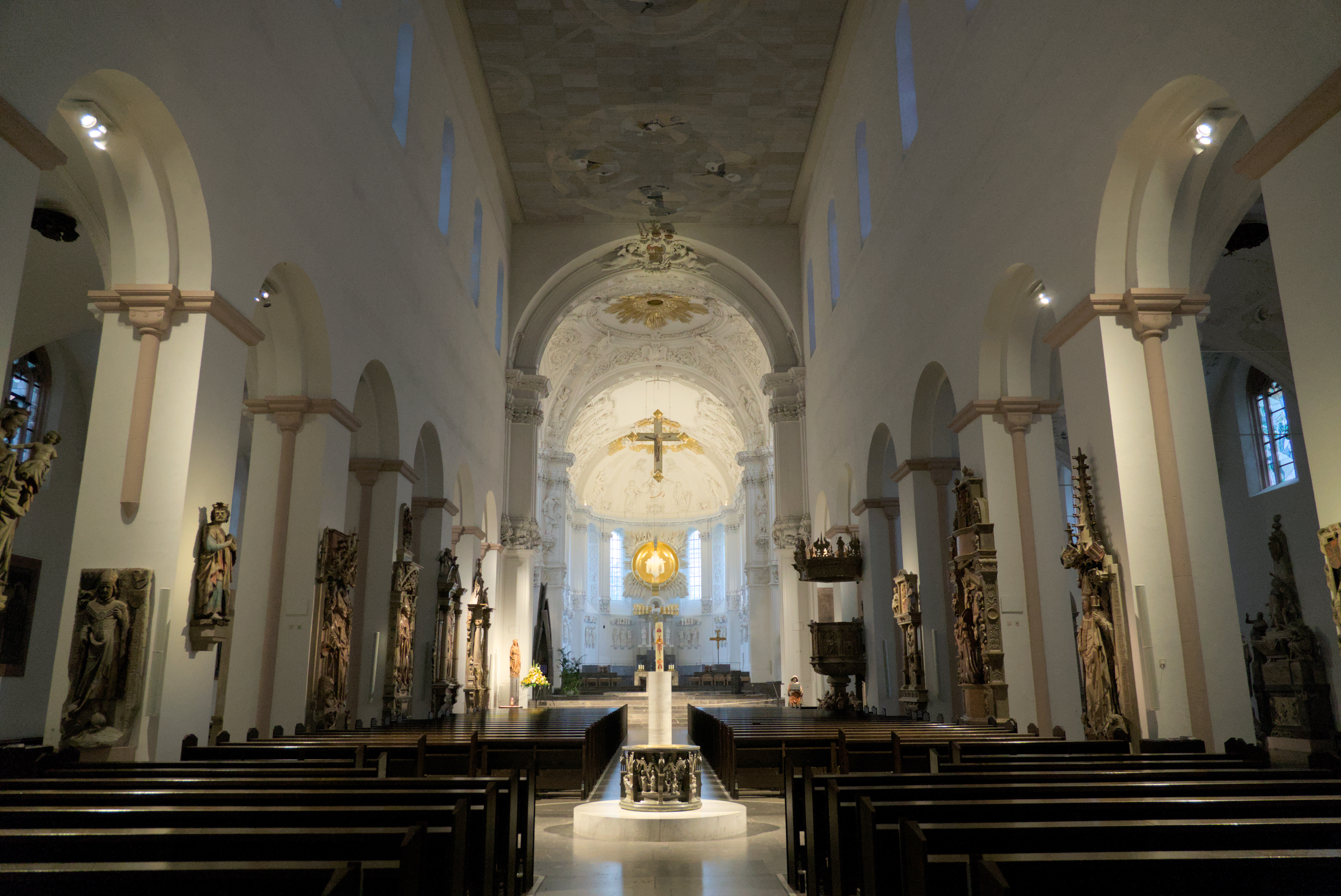
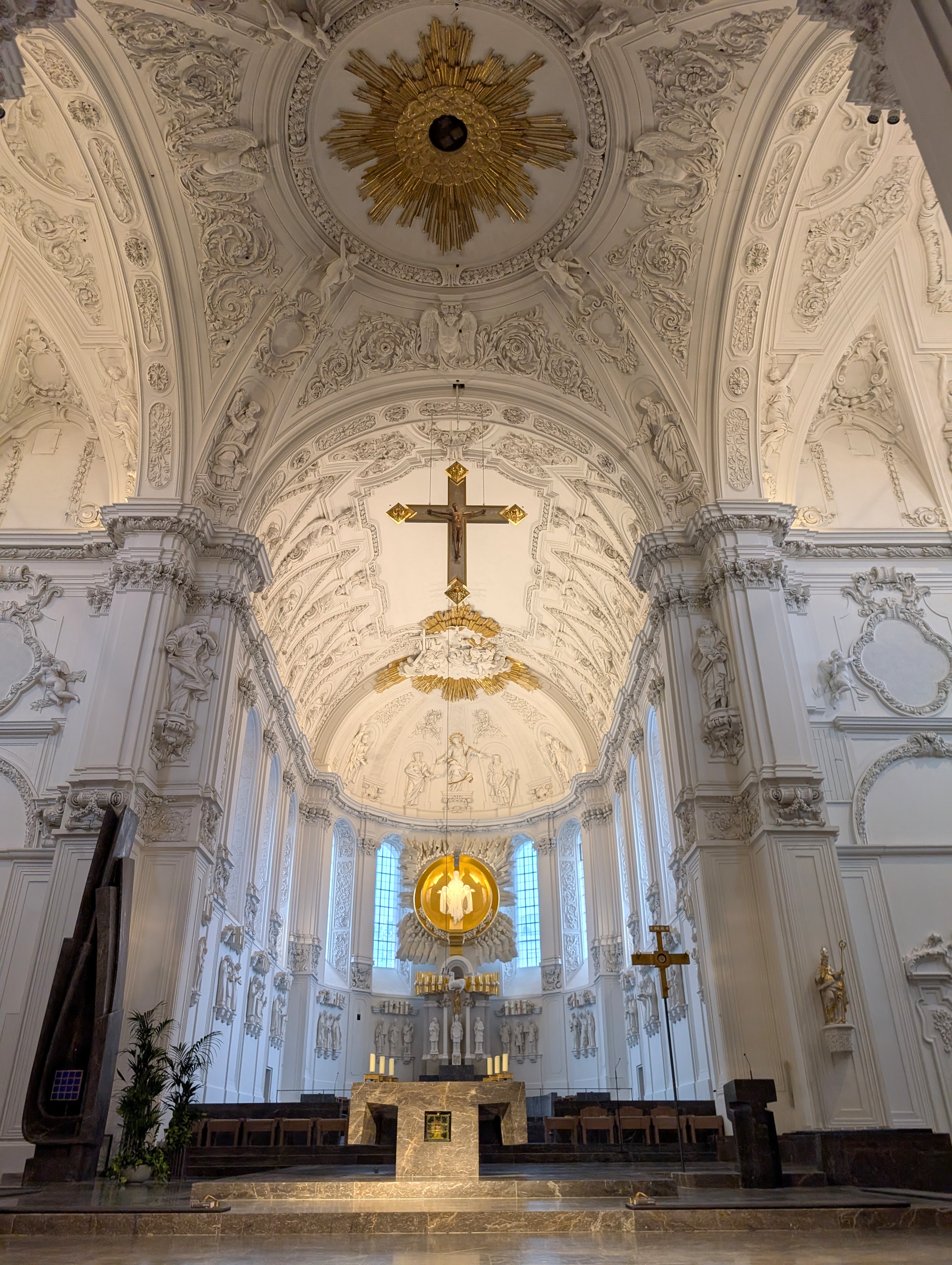
The present cathedral, with its Romanesque cruciform layout, was built starting in 1042 and was consecrated in 1187. It underwent subsequent remodels (late Gothic, then Baroque) and then a major reconstruction following the collapse of its nave in a 1945 air raid, reopening in 1967.

The following is by no means a comprehensive accounting of the art inside, but rather a selection of works that stood out to me. You may notice my general disinterest in relics, tombs, and Baroque ornamentation.

I regret I didn’t get a photo of the bronze door designed by sculptor Fritz Koenig in 1964–67 for the main, west portal, featuring creation motifs! When church doors are propped open, they’re easy to miss.

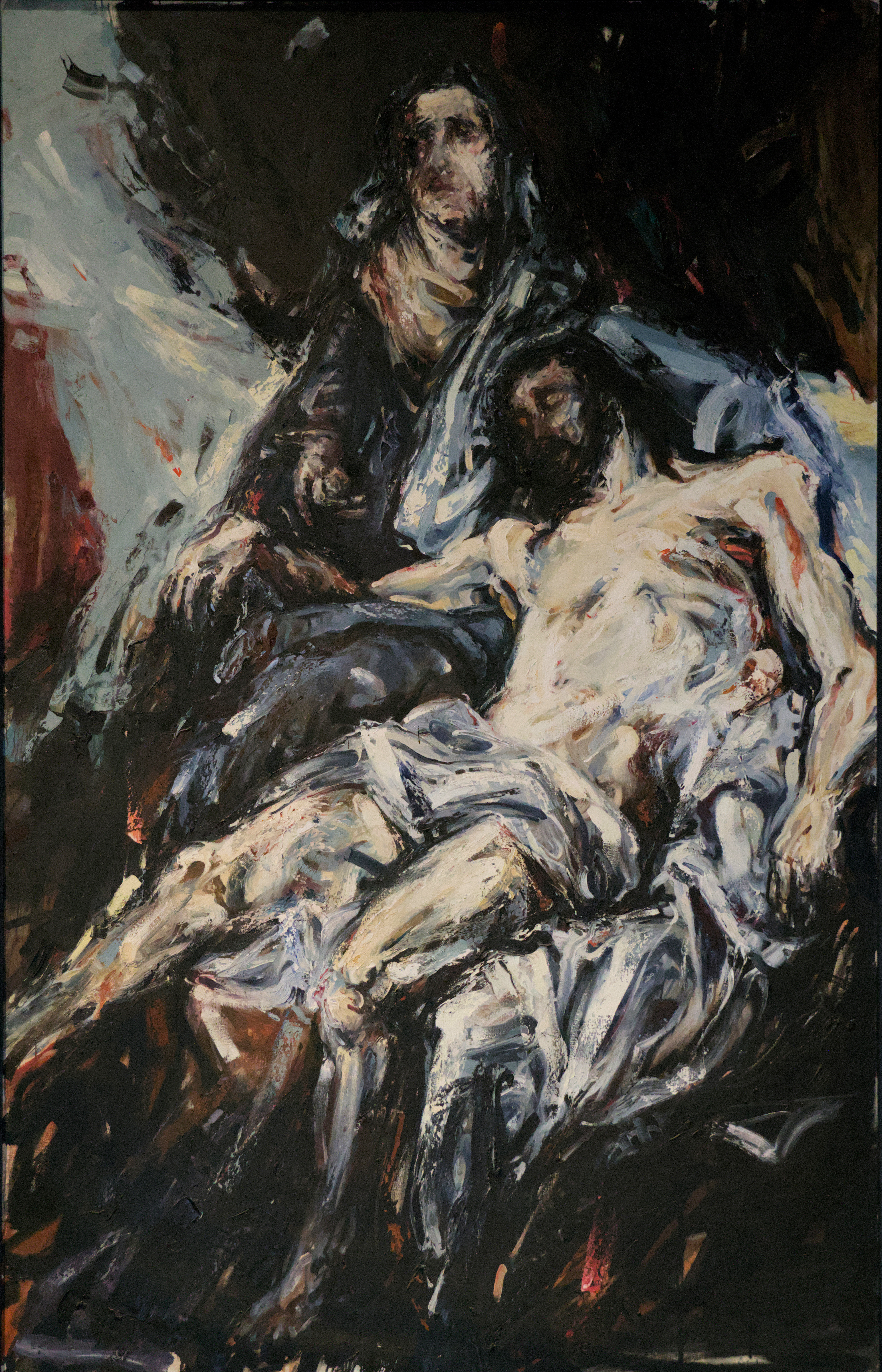
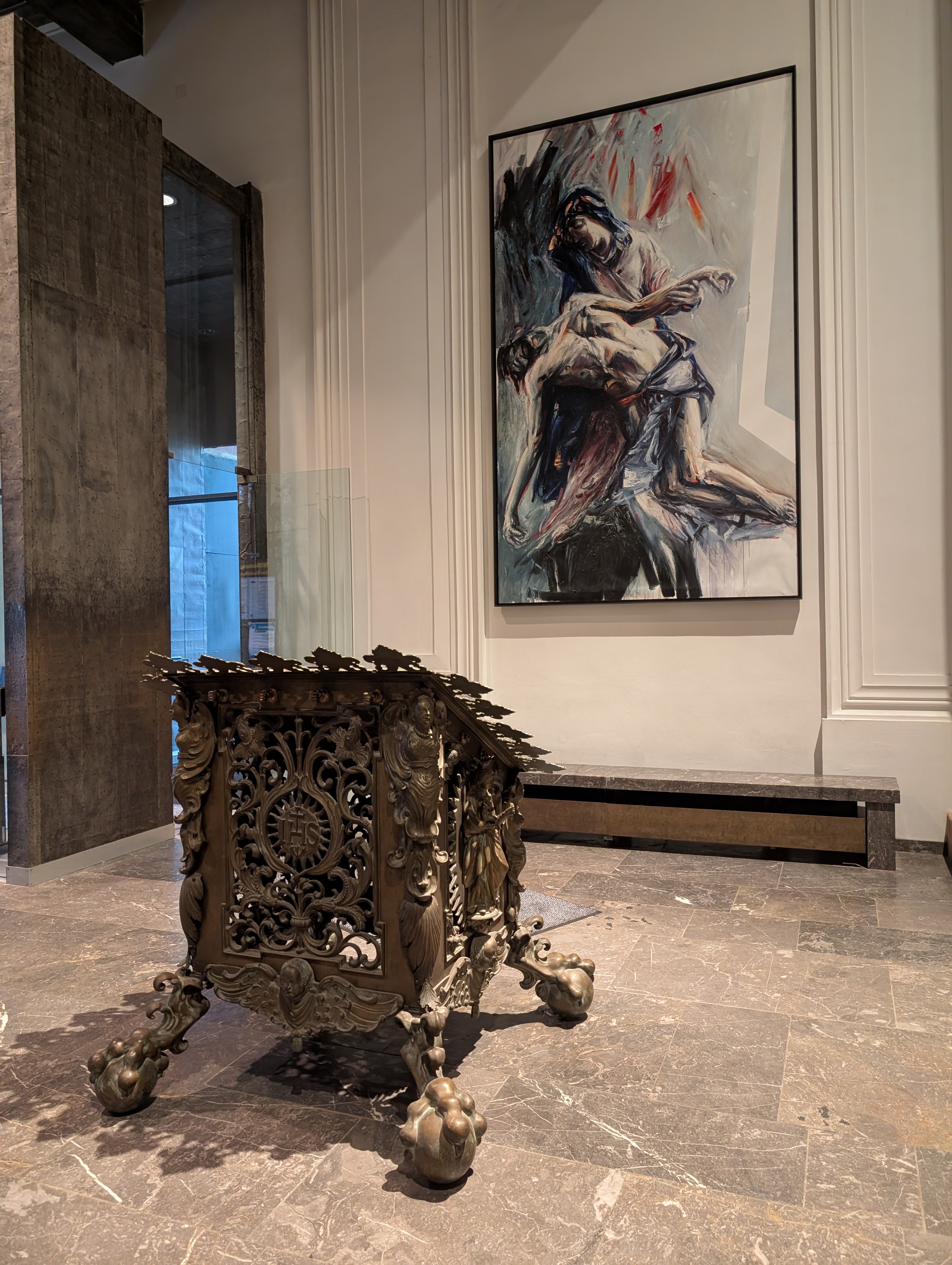
The narthex of Würzburg Cathedral displays two neo-expressionist paintings of the Pietà by Peter Vogt, an artist associated with the southern German Neue Wilde movement of the late 1970s and ’80s.

Peter Vogt_Pieta
Peter Vogt (German, 1944–2013), Pietà, 1986, to your right when you enter Würzburg Cathedral

Peter Vogt_Pieta
Peter Vogt, Pietà, 1985, and choir desk form, 1644, to your left when you enter Würzburg Cathedral

View of west end
View of the west end

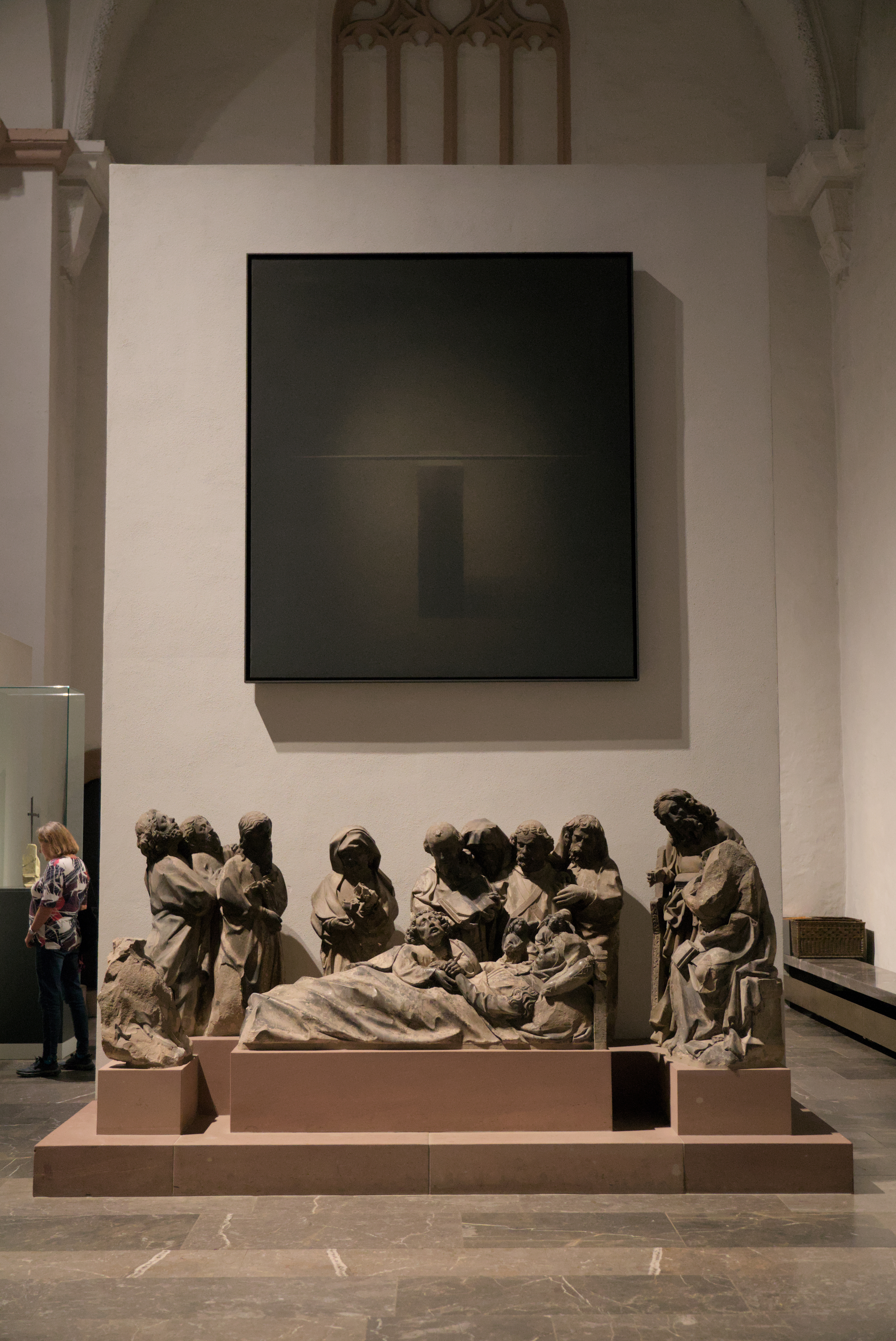
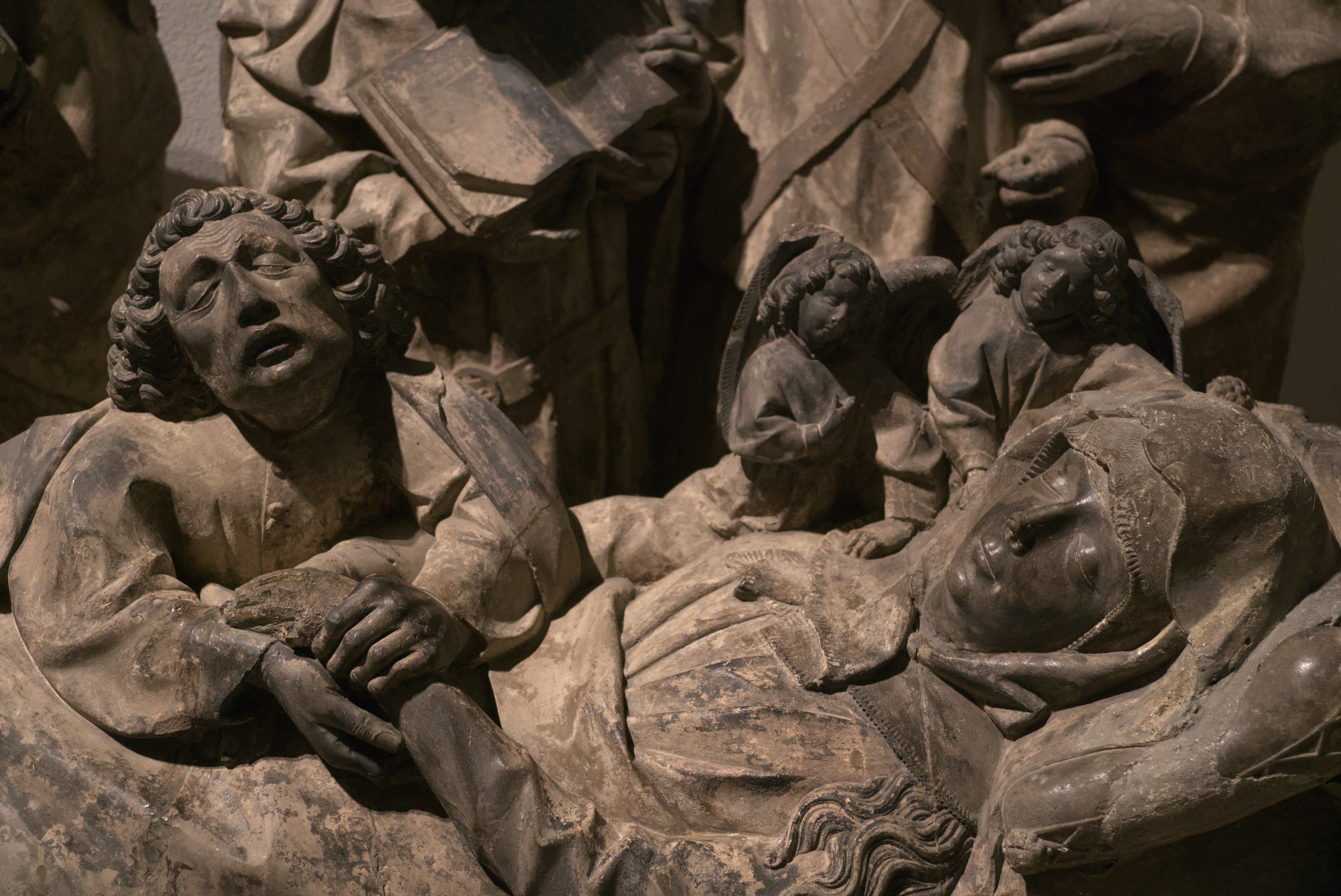
To your left when you enter, there’s a medieval sculpture group depicting the Dormition (the “falling sleep,” or death, of Mary) underneath an untitled contemporary painting by Marco Tirelli, a key member of the San Lorenzo School of painting and sculpture that formed in Rome in the 1980s. Tirelli is known for a “minimalist, atmospheric style . . . characterised by the use of geometric shapes, monochrome surfaces and subtle plays of light and shadow . . . often evok[ing] a sense of mystery and contemplation, inviting the viewer to reflect on the nature of perception and space.” His painting in Würzburg Cathedral shows some kind of linear object balancing on a pedestal. Created specifically for this location, it could suggest a body in repose.

Dormition
Marientod (Death of Mary), Middle Rhine, ca. 1440; Marco Tirelli (Italian, 1956–), Untitled, 2011

Dormition (detail)
John the Evangelist mourning the death of Mary

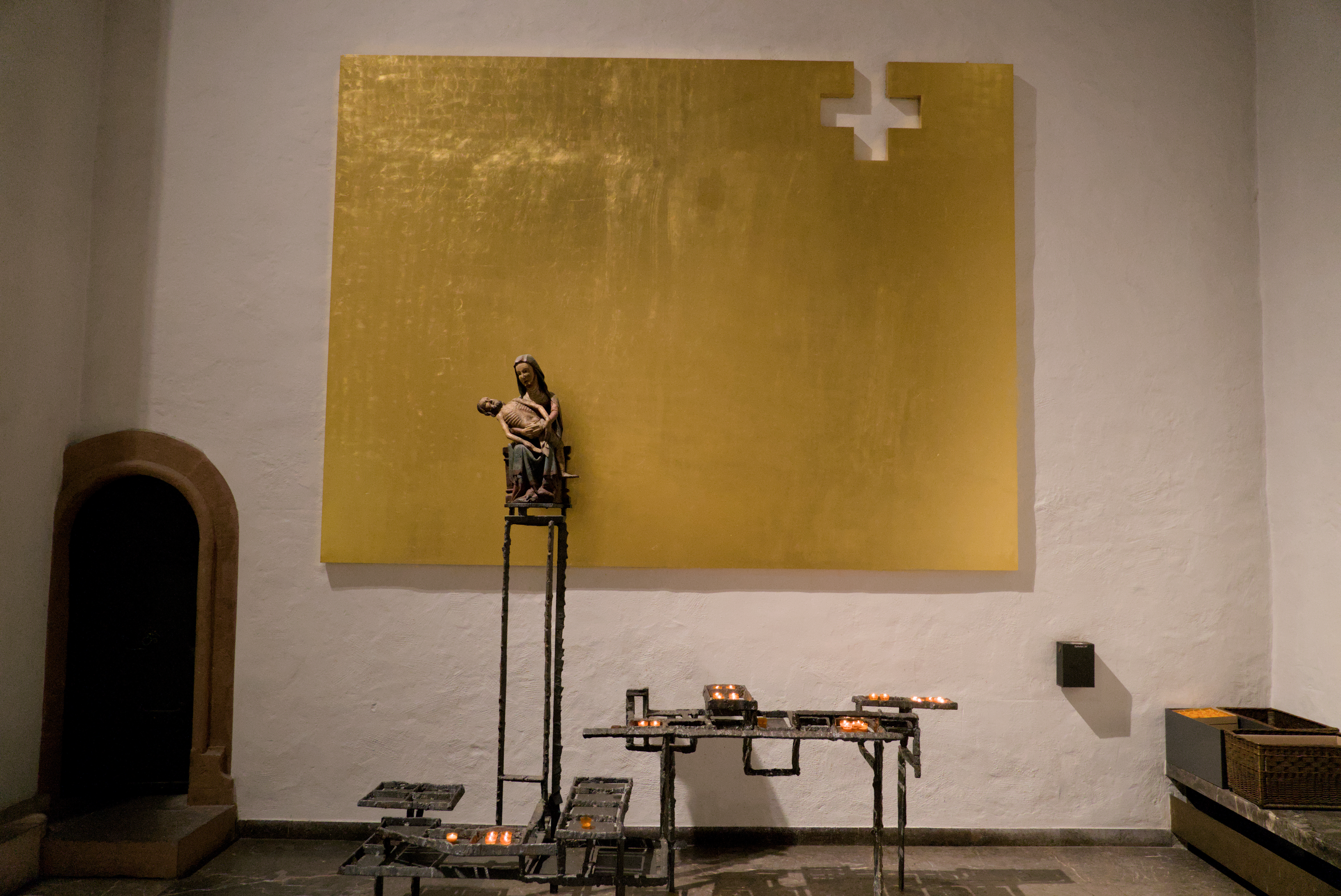
Behind this wall is a semienclosed space designated for private prayer. According to an on-site sign, in the days following the destruction of Würzburg in 1945, the dead were gathered at this spot, where relatives would come to say their final goodbyes before burial. Appropriately, then, the focal point is a late Gothic wood sculpture of the Pietà, where Mary mourns the death of her son. These figures are seated atop a raised metal throne connected to a multitiered votive candle stand that shines with the prayers of the faithful.

Pieta with golden wall plate
Pietà, ca. 1410; golden wall plate by Jürgen Lenssen, 2012

Pieta (ca. 1410)

The sculpture is foregrounded by a gilded wall panel designed by Dr. Jürgen Lenssen, who, in addition to serving as cathedral canon, was the art director for the Diocese of Würzburg from 1992 until his retirement in 2017. The wall plates in this space were part of the interior redesign carried out in 2011–12. I really like Lenssen’s interventions, which we will see more of in the crypt—highlighting historic works of art by adding dramatic backing, visual framing, and/or platforms.

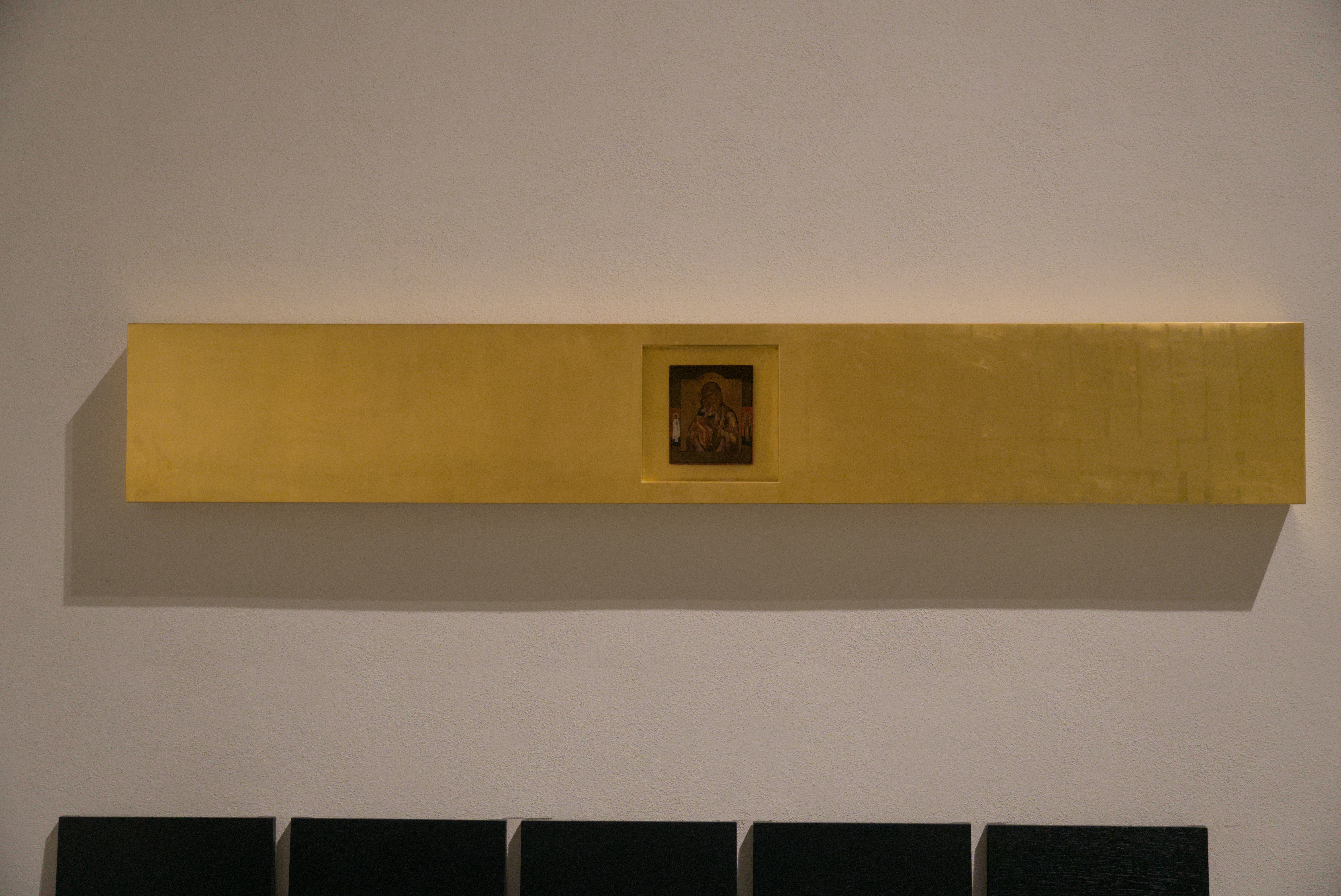
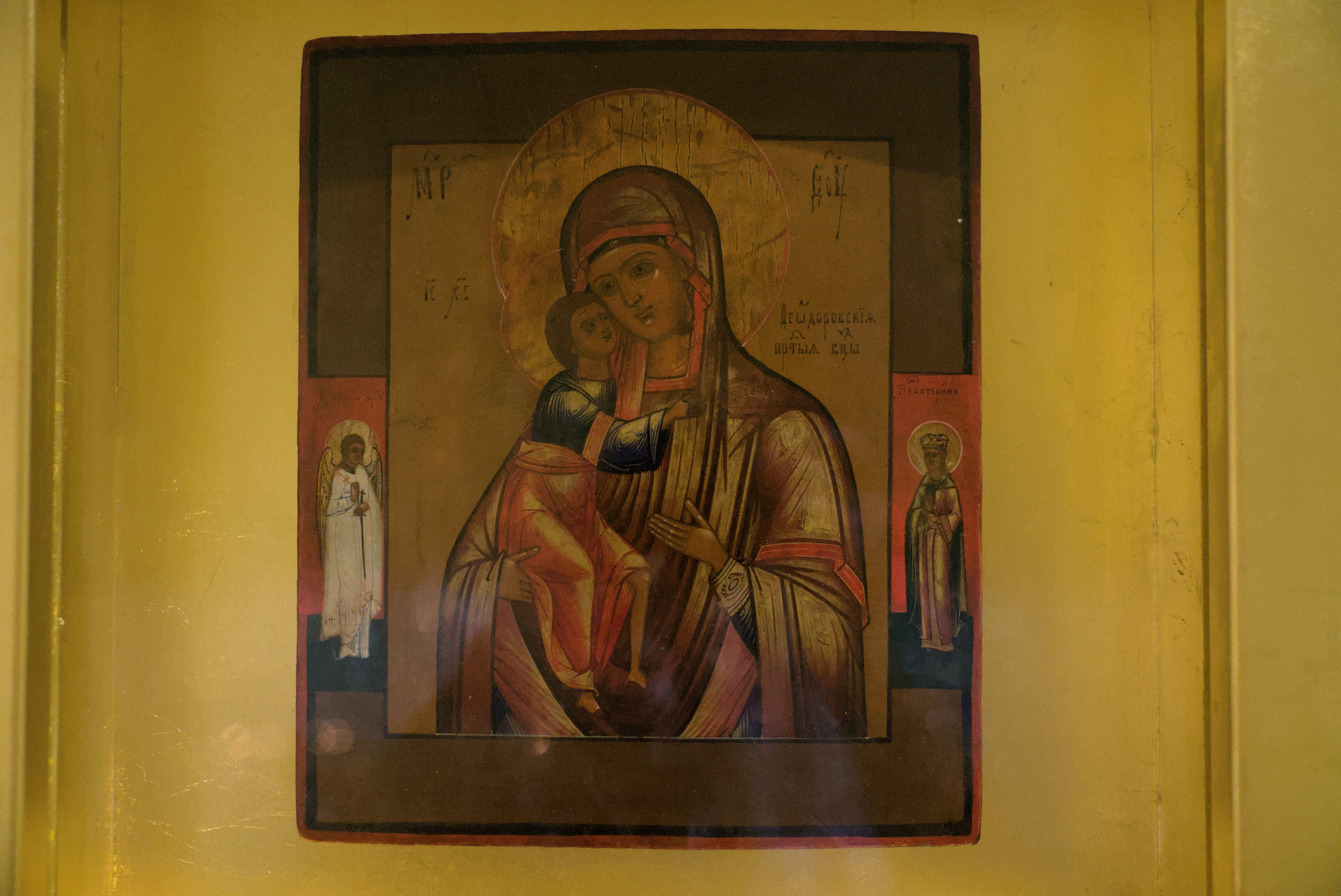
Opposite the Pietà is a Russian icon of the Virgin Eleusa (Virgin of Tenderness), showing Mary affectionately holding the Christ child, who nestles into her cheek. It, too, is enhanced by a gold-leafed wall plate, one that frames it and extends the length of the row of chairs below, creating a sort of frieze.

Virgin of Tenderness icon
Virgin of Tenderness, Russian icon, 19th century; golden wall plate by Jürgen Lenssen, 2012

Virgin of Tenderness icon

In art objects and sacred spaces, Pietà images are often juxtaposed with images of the Virgin and Child, as the very natural mother-infant pose gains additional poignancy when placed in conversation with the horrifically unnatural pose of a mother cradling her dead child.

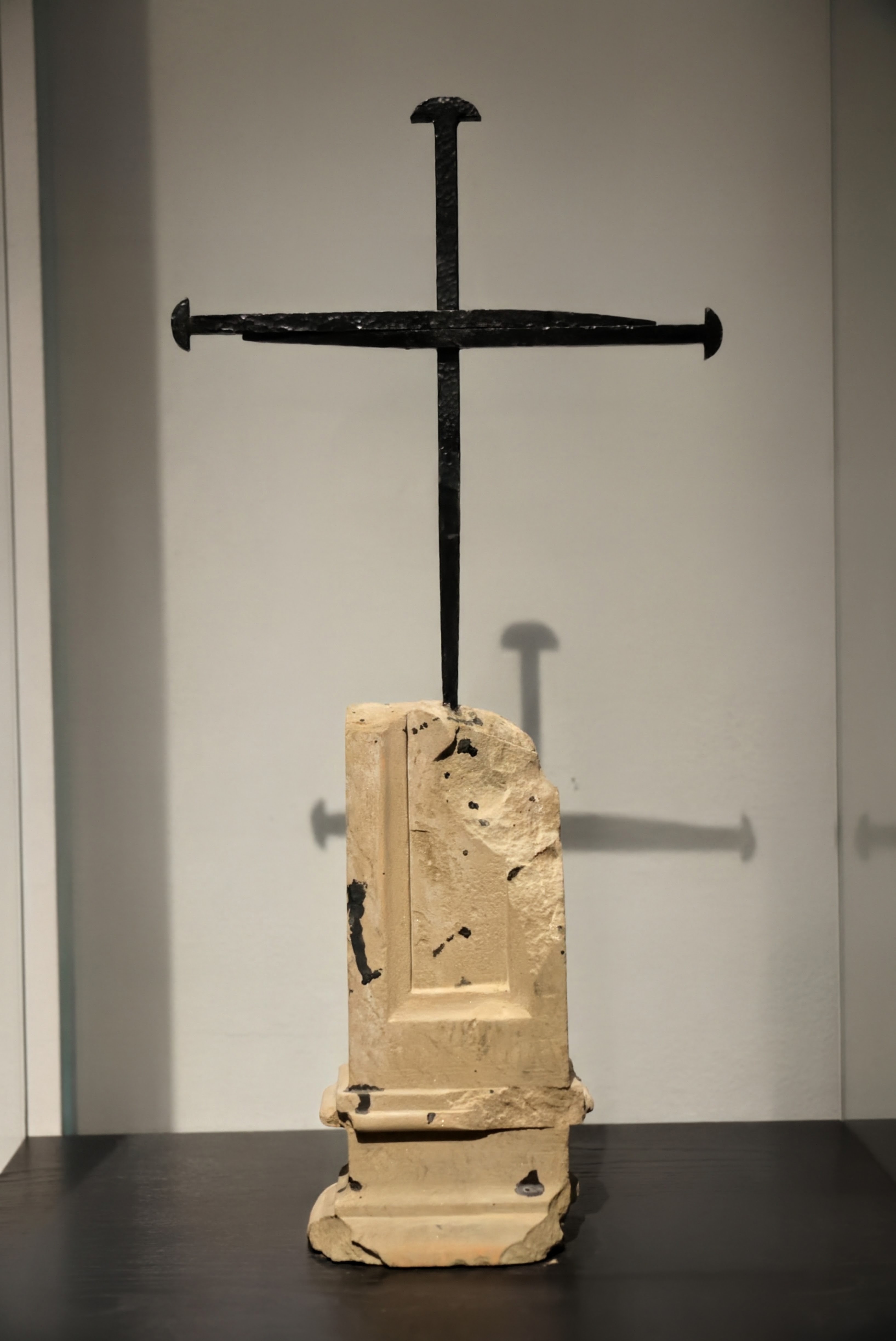
Also in this prayer room is a cross made of three medieval roof-truss nails salvaged from the rubble of Coventry Cathedral in England, destroyed by German bombs on November 14, 1940. It is set into a remnant of a gravestone from Würzburg Cathedral.

Cross of Nails
Cross of Nails, 2015, a gift from Coventry Cathedral in the UK

The original Cross of Nails was made by Rev. Arthur Philip Wales of Coventry the morning after the Coventry Blitz, the nails bound together with wire. In the postwar years, following Wales’s concept, other recovered nails and roof spikes were welded together, plated with silver, and sent as a gift to cities in Germany that also suffered badly from World War II bombings—at the hands of the British—a gesture of reconciliation.

There are now nearly three hundred churches and organizations worldwide that own a Cross of Nails, either made with authentic hand-forged nails from the ruins of Coventry Cathedral or a replica, together forming a network dedicated to global peace and forgiveness. The Cross of Nails in Würzburg Cathedral is a replica, presented to the cathedral in 2015. (Two others, from 2001, are permanently housed in the city’s town hall and Marienkapelle, and a third travels to a new host location in the city each year.)

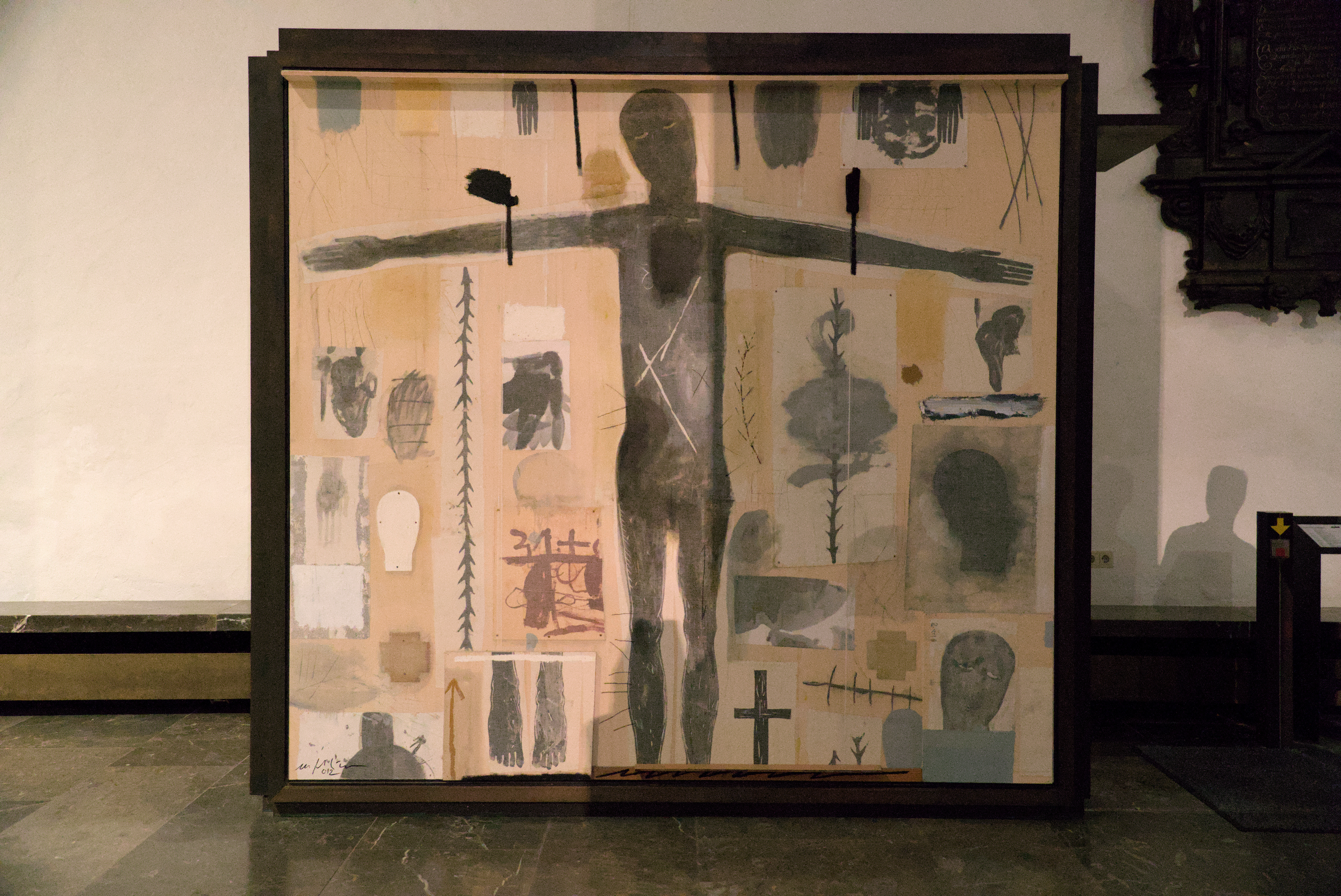
In the north (that is, left) aisle is a Crucifixion painting by Mimmo Paladino, a leading figure of the Transavanguardia (Transavantgarde) movement that swept through Italy in the late 1970s and ’80s, reviving figurative art.

Mimmo Paladino_Crucifixion
Mimmo Paladino (Italian, 1948–), Crucifixion, 2012

Executed in pale grays and yellows, this work portrays the crucified Christ without a cross, although he’s tied down near the elbows. He’s shadowy but appears bruised and scarred, his eyes half closed as he expires. In the background are pinned pages of thorny vines, disembodied parts (hands, feet, a face, a heart), and indistinguishable forms. This Crucifixion is similar to another one of Paladino’s, a triptych from 2010.

The painting projects out from the wall and appears to be the front face of a storage closet or a confessional—I couldn’t tell.

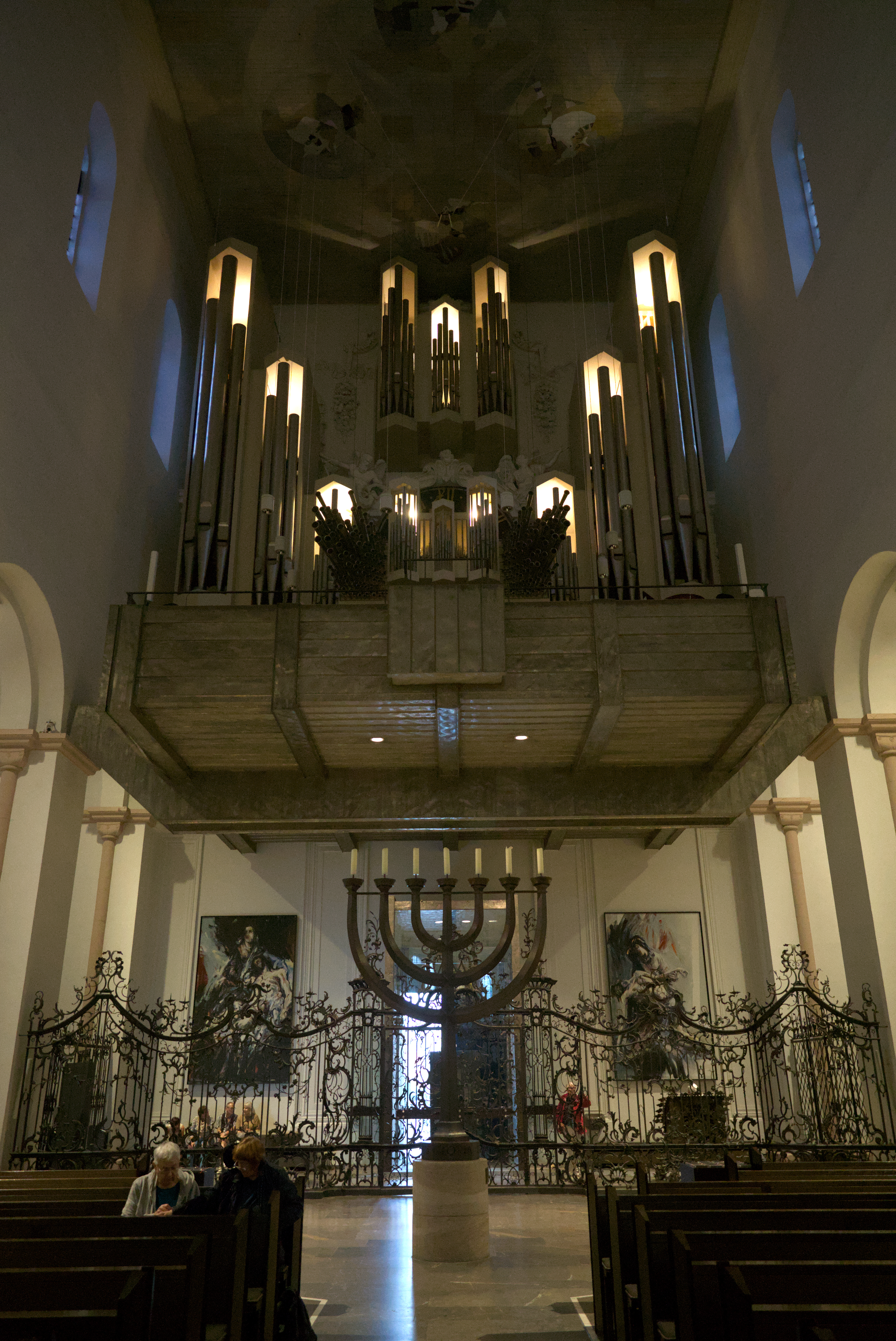
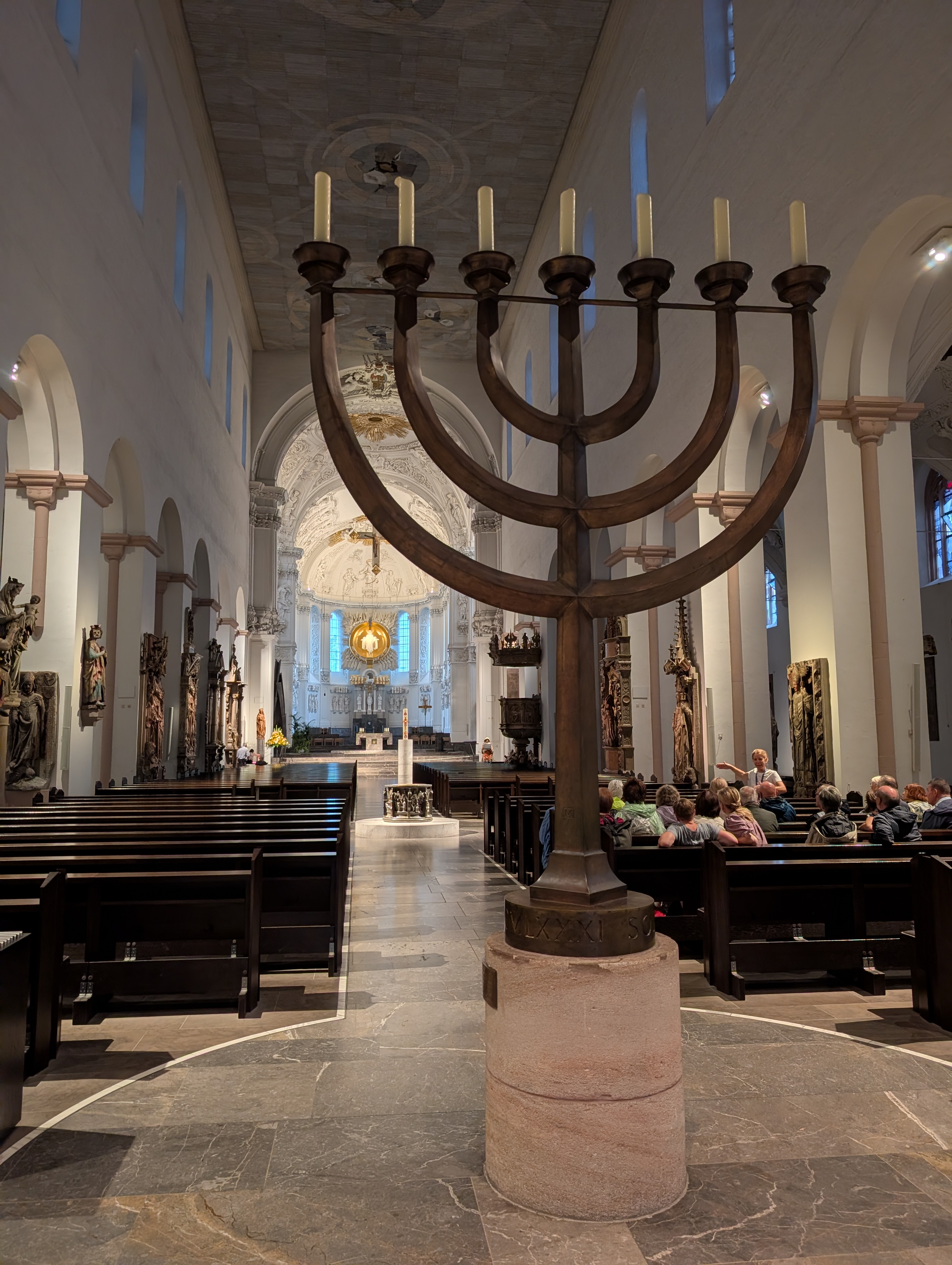
At the entrance to the nave, in the central aisle, is a monumental bronze menorah designed by the German metalsmith Andreas Moritz. It was commissioned to honor the Jewish roots of the Christian faith. “It reminds us that God planted the Torah like a tree of life for humankind,” Fr. Burkhard Hose said in a Lenten sermon at the cathedral in 2007. It was not lit when I was there—I wonder when or even if it ever is.

Andreas Moritz_Menorah
Andreas Moritz (German, 1901–1983), Menorah, 1981

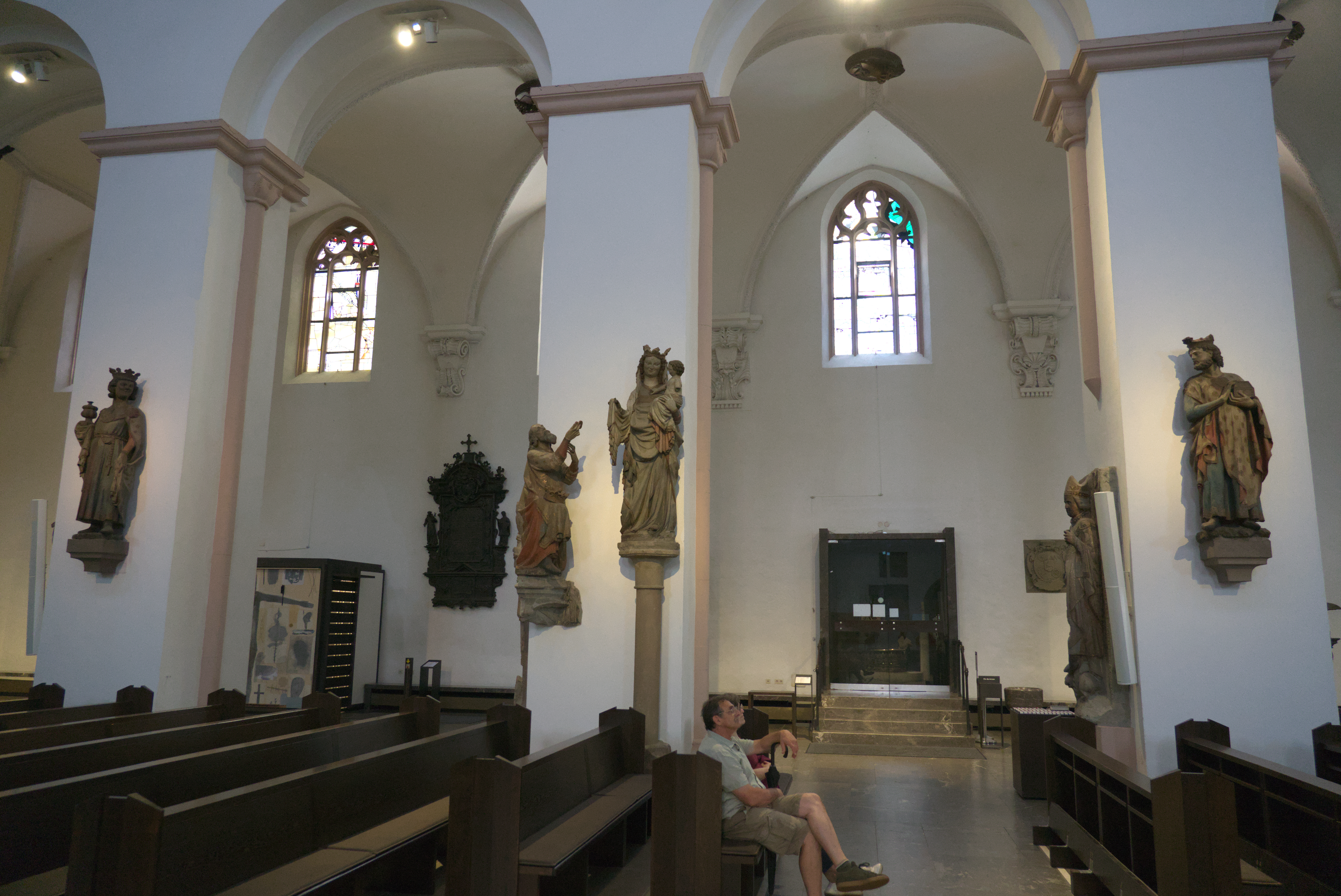
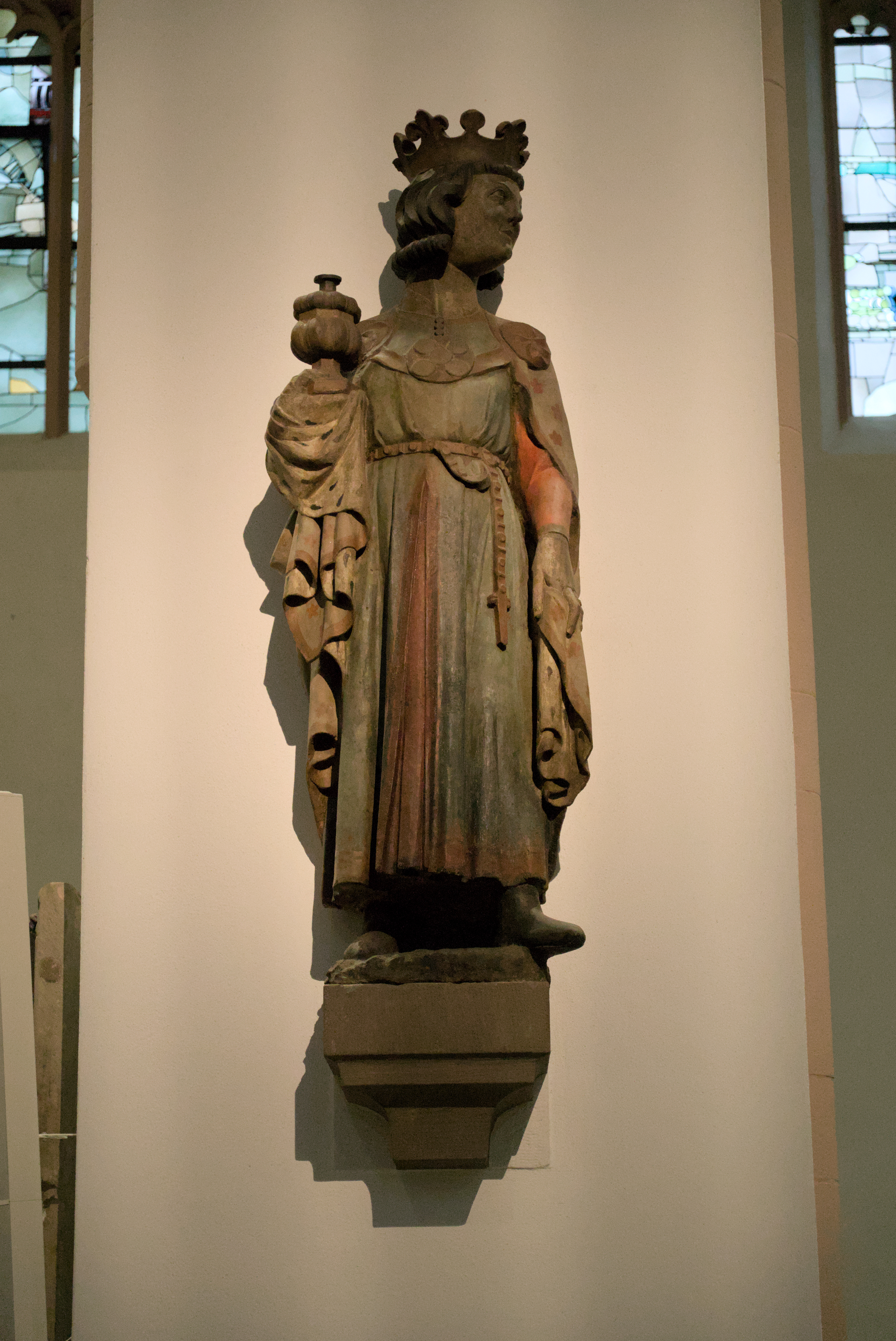
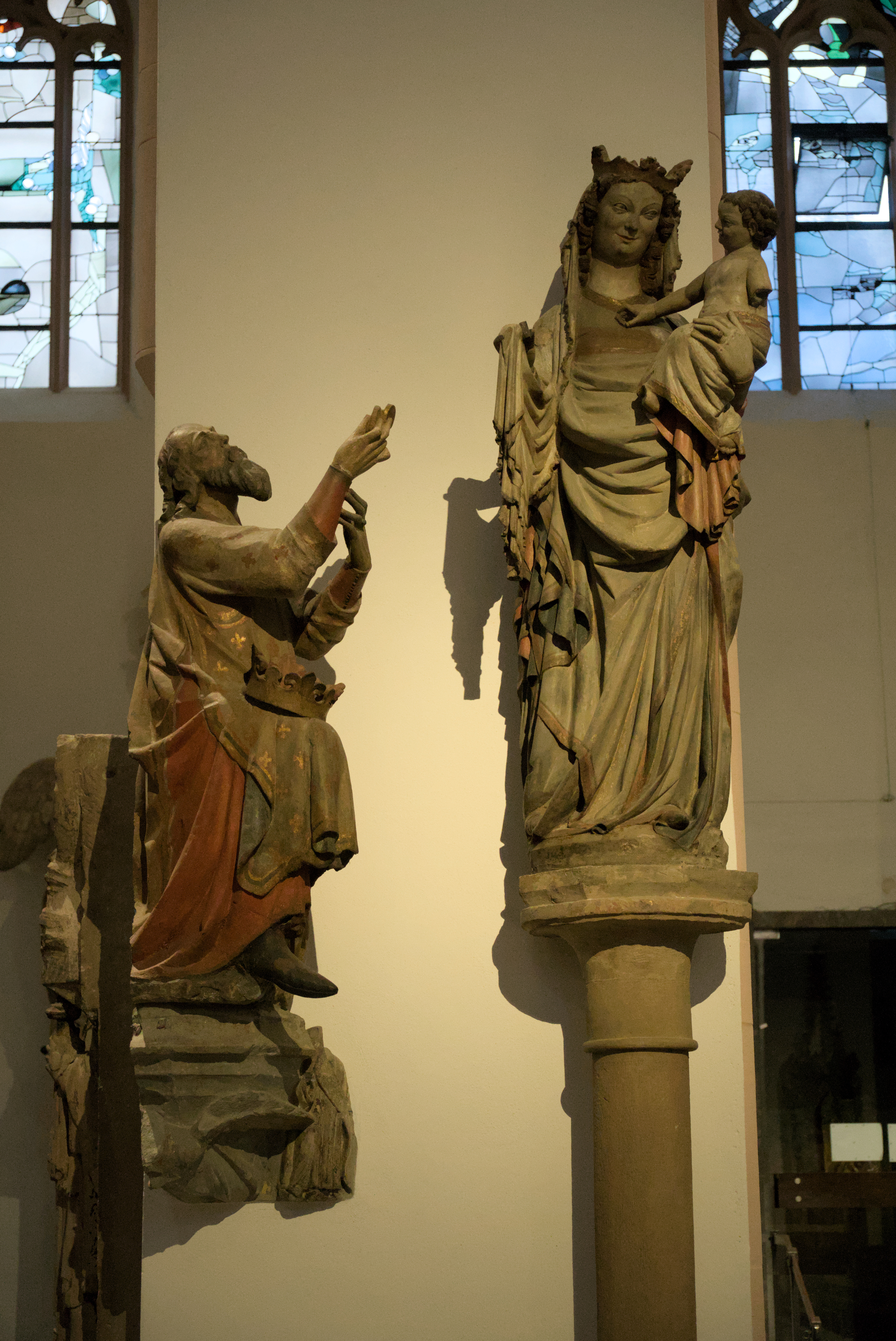
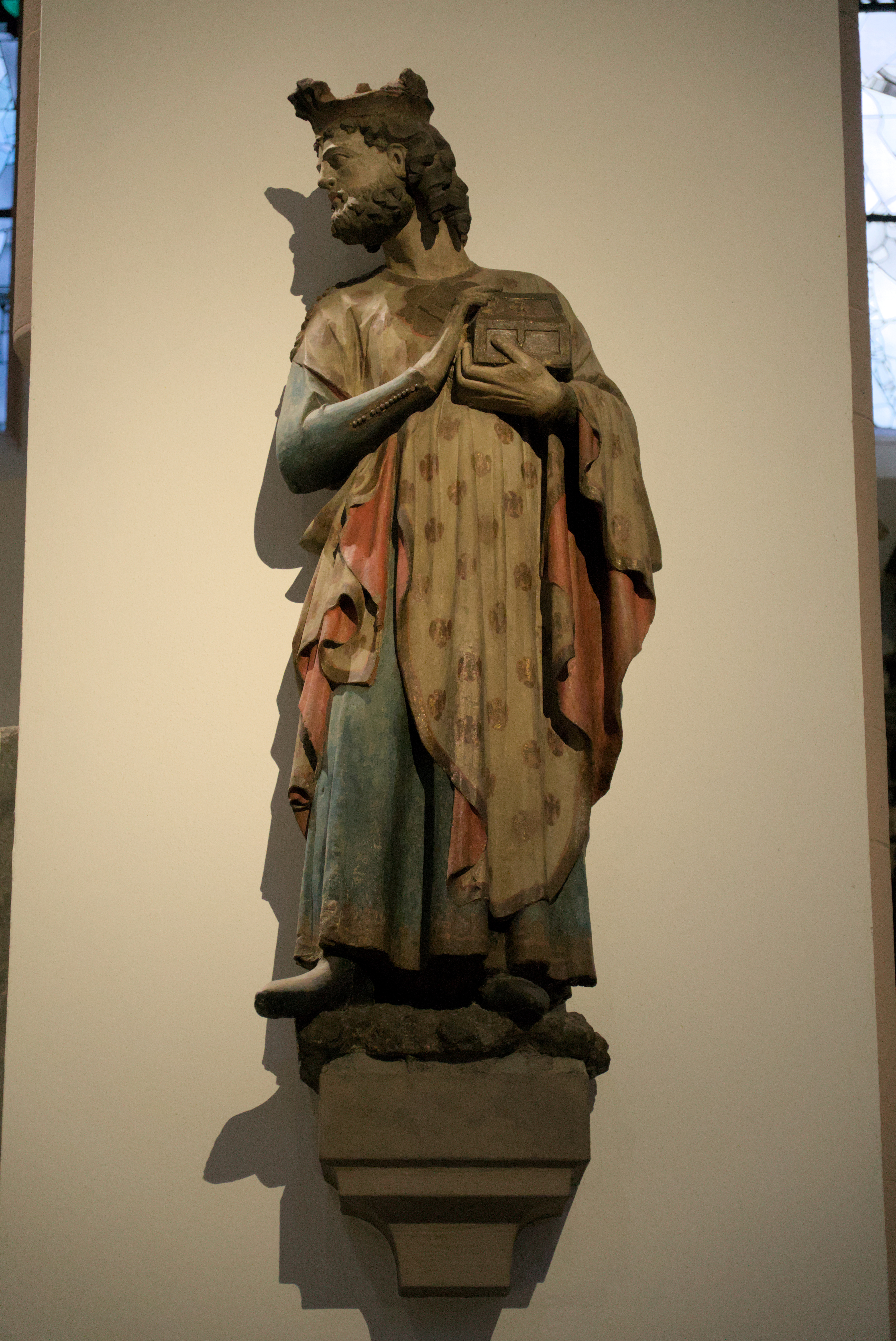
On the north side of the nave, the nations come to Christ in a medieval Adoration of the Magi sculpture group that’s distributed across three pillars. Cathedral guide Rüdiger Seyler told me in an email, in response to my inquiry, that they were carved around 1300 in Germany and demonstrate French influence.

Adoration of the Magi
Magus
Adoration of the Magi
Magus

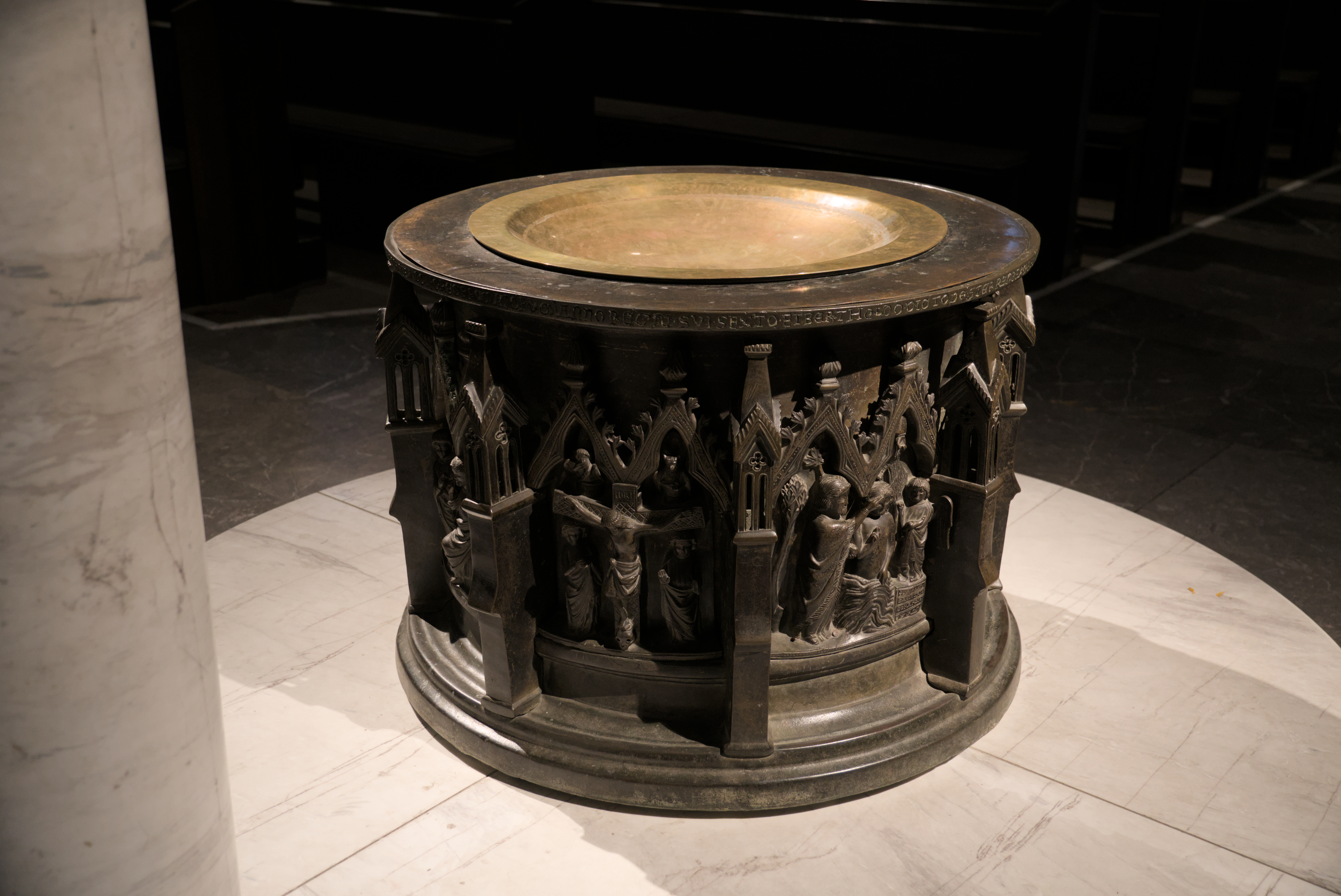
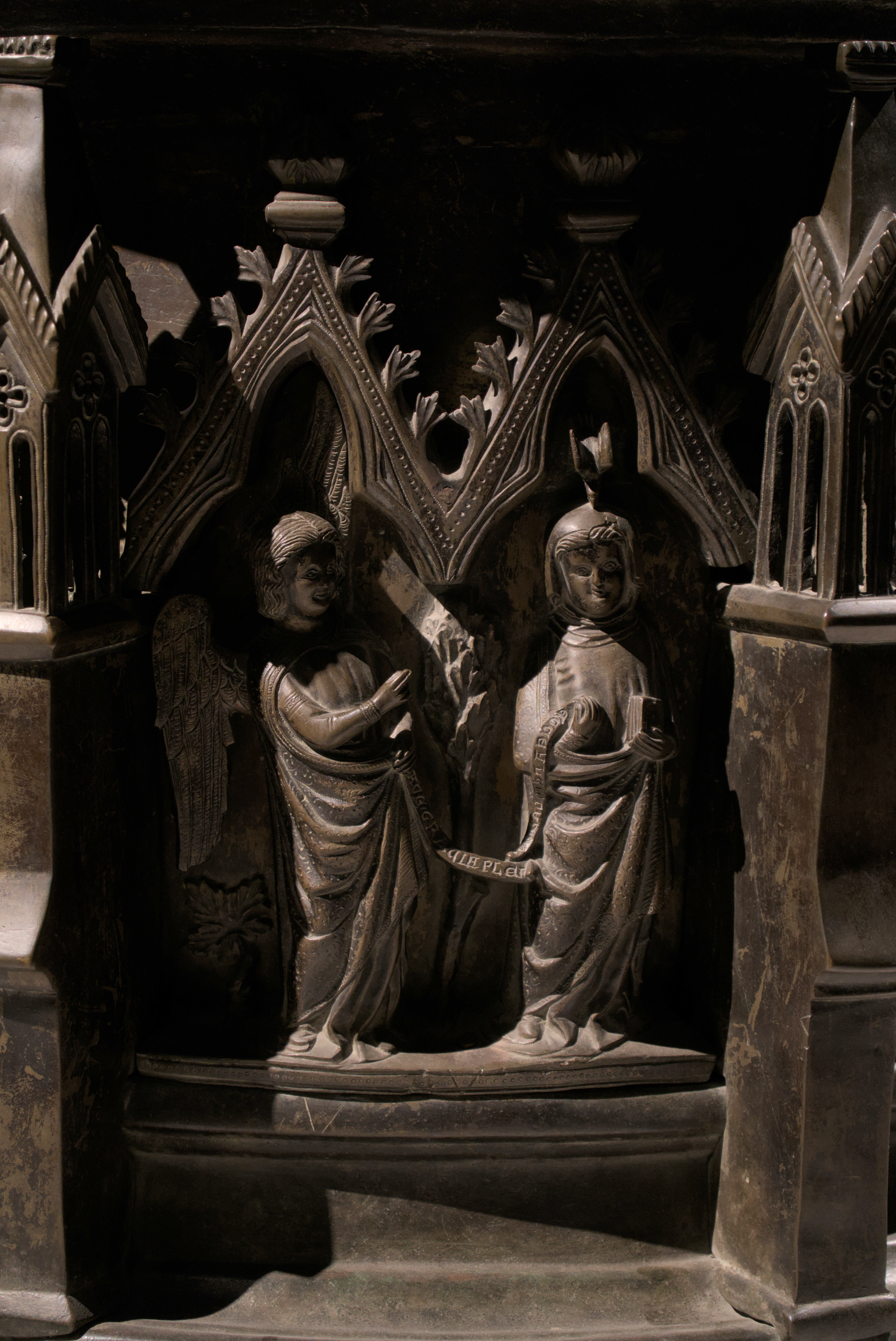
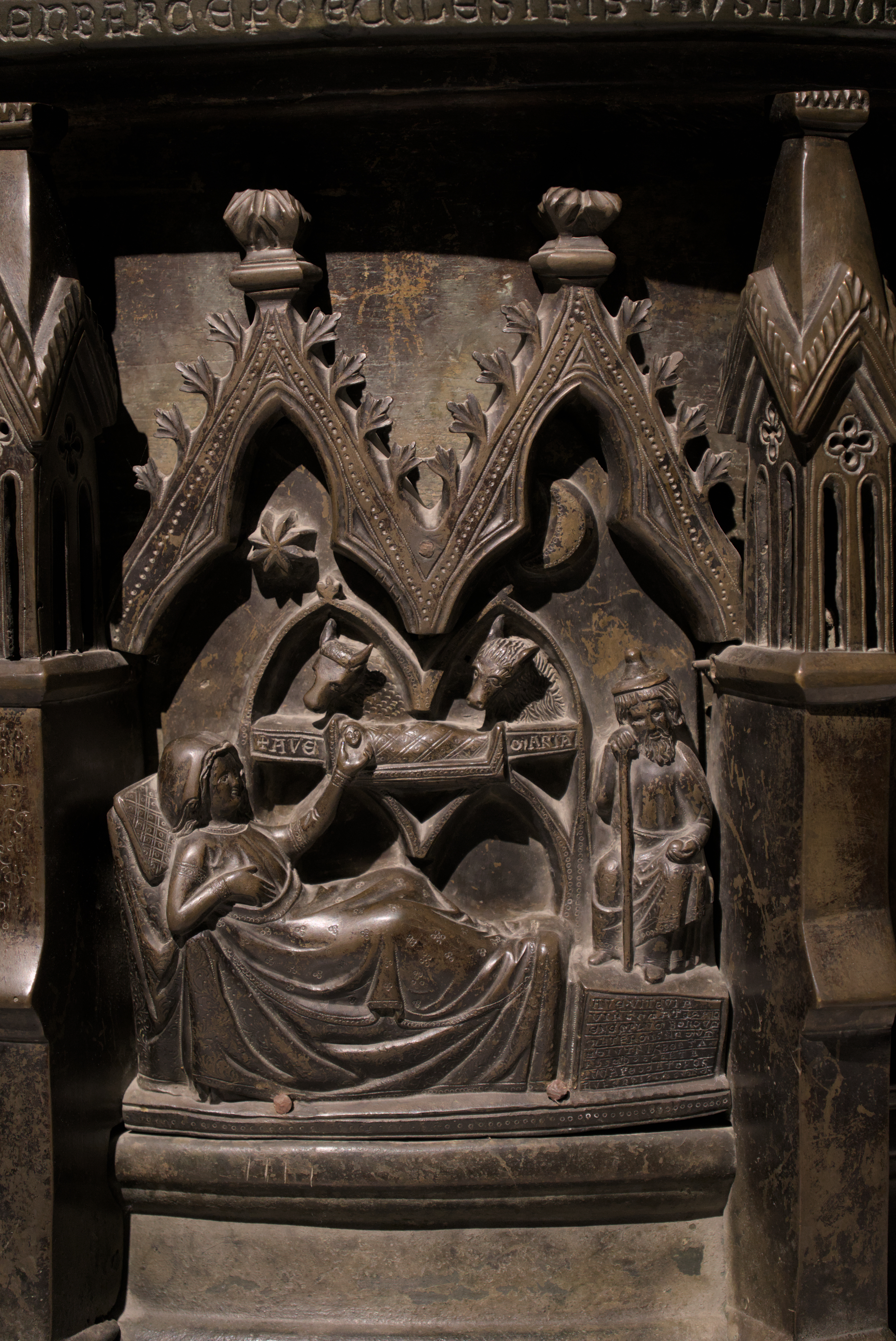
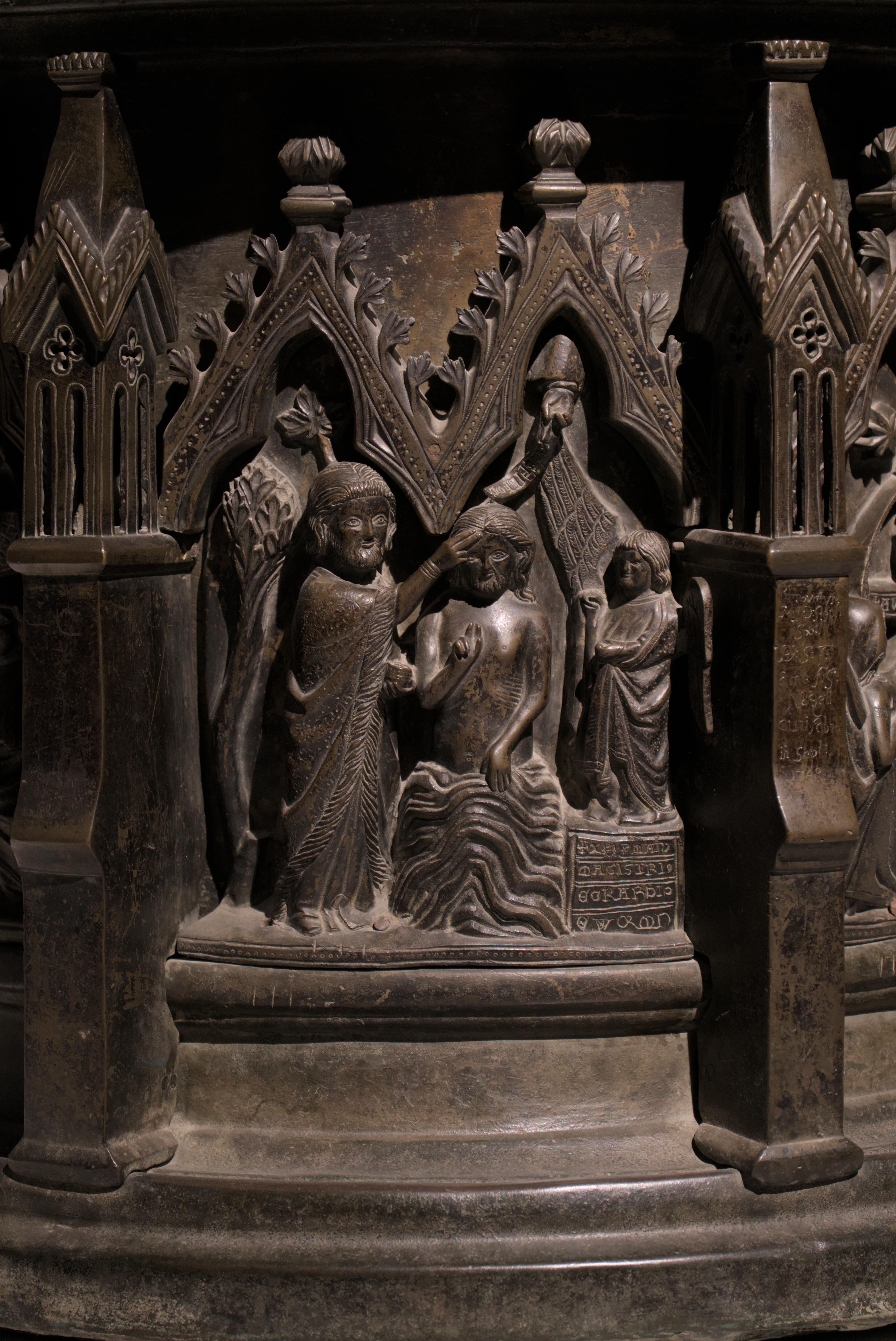
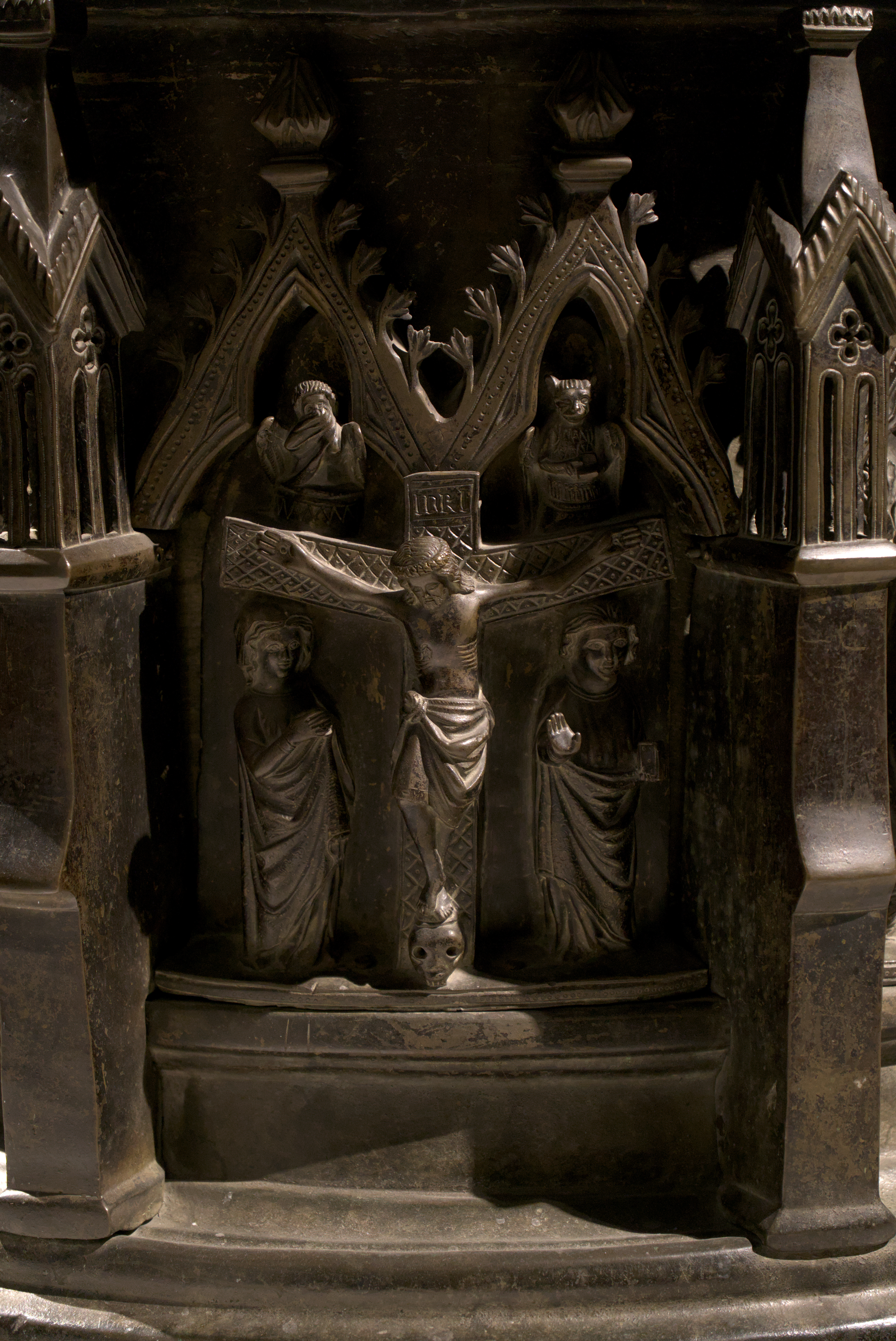
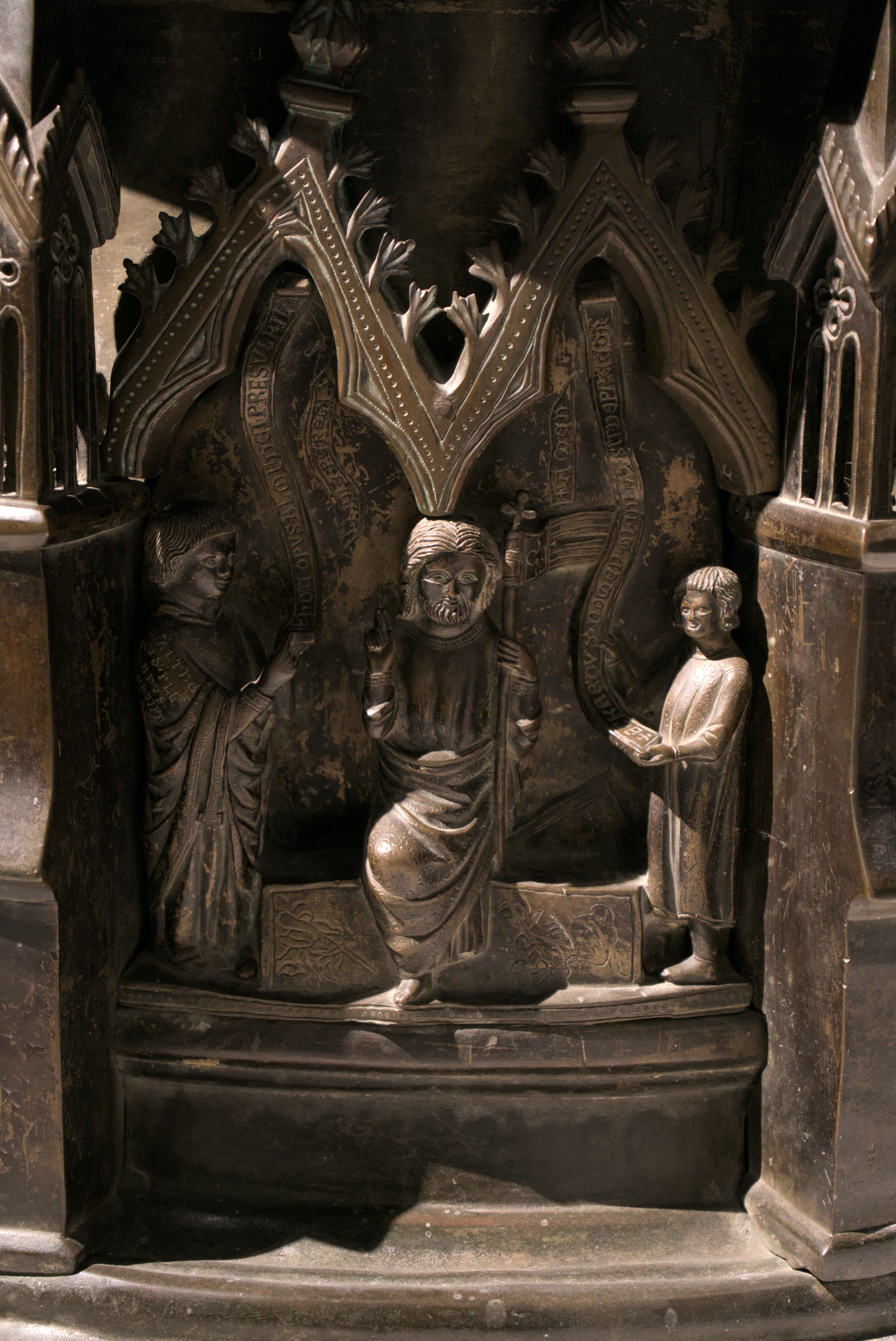
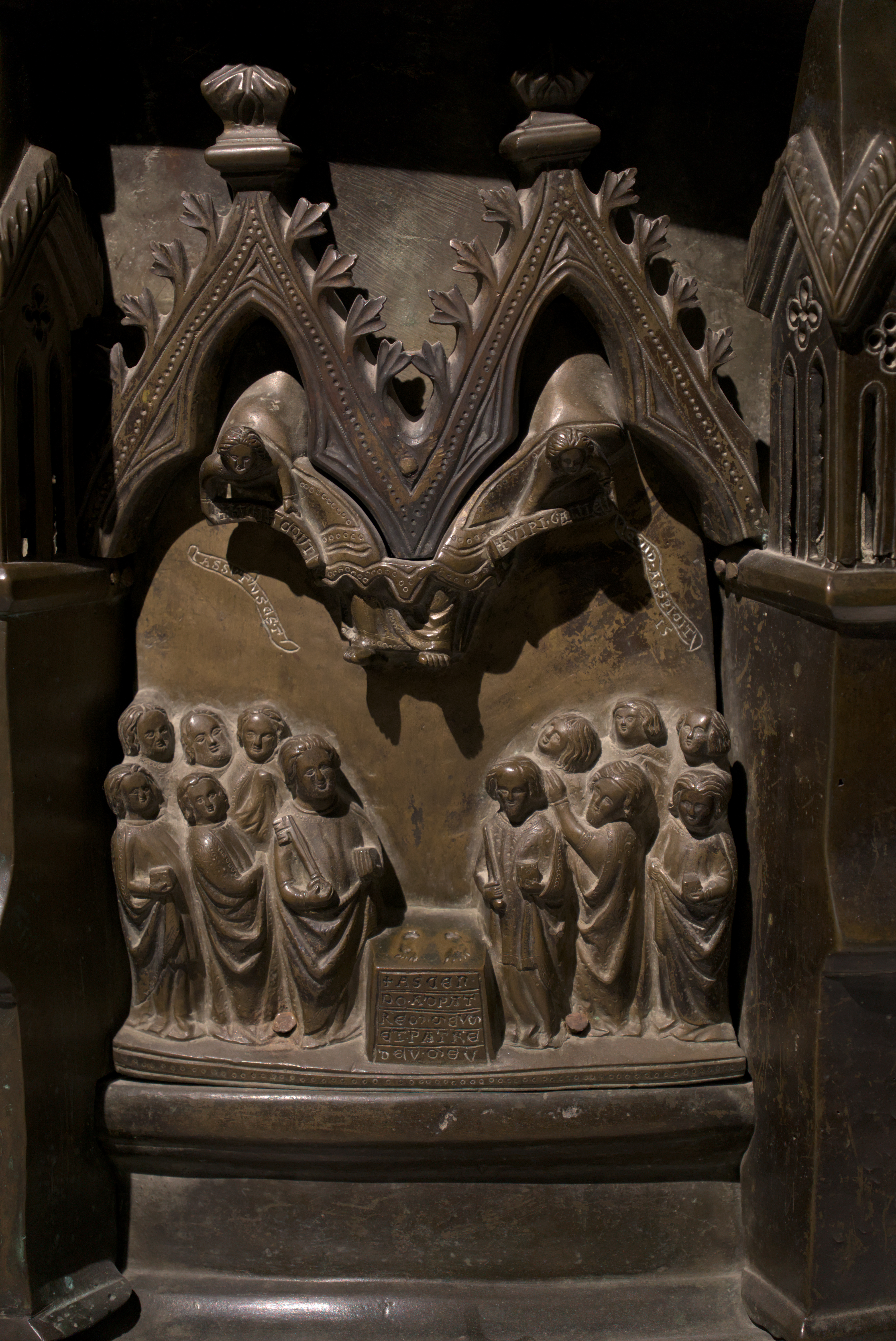
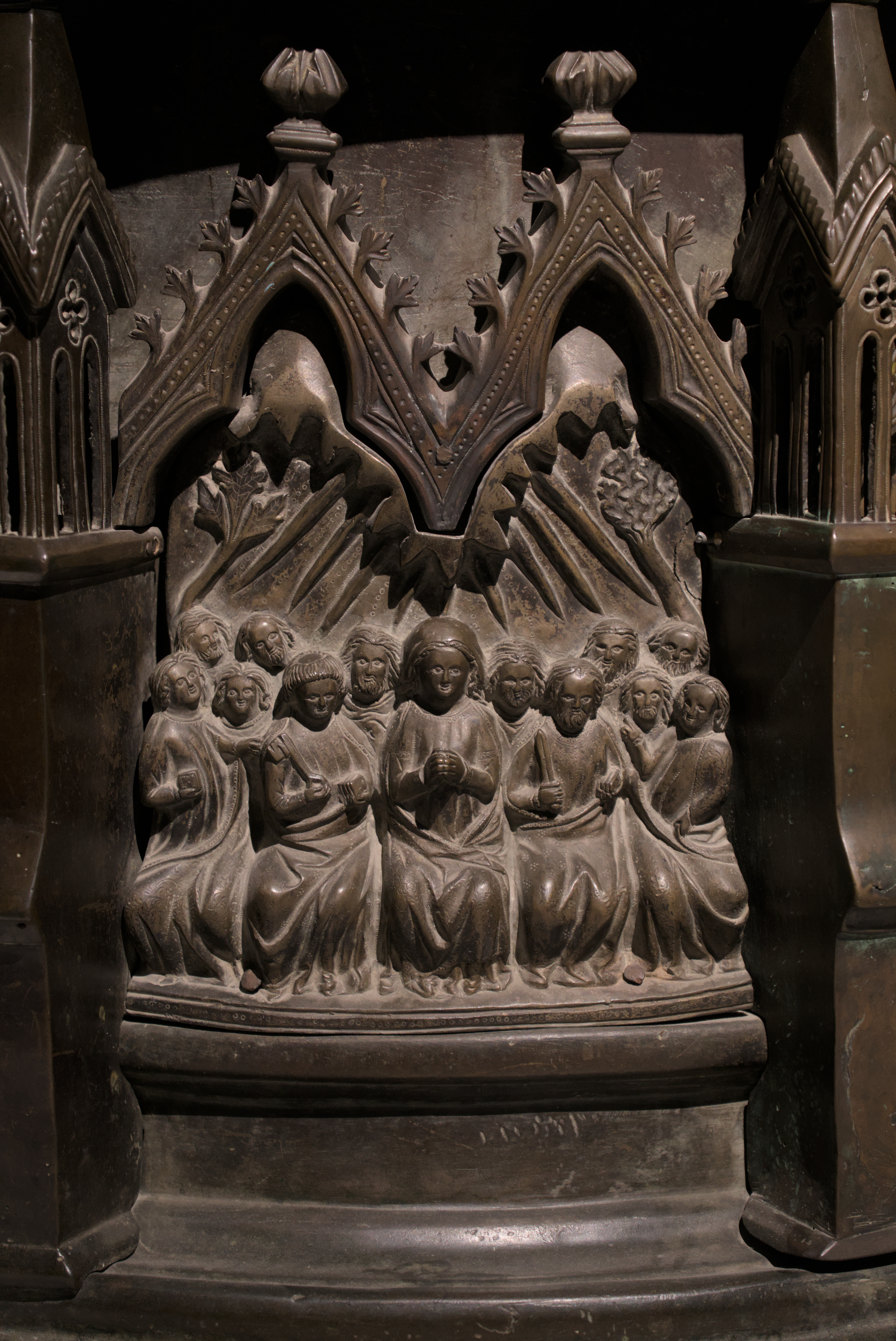
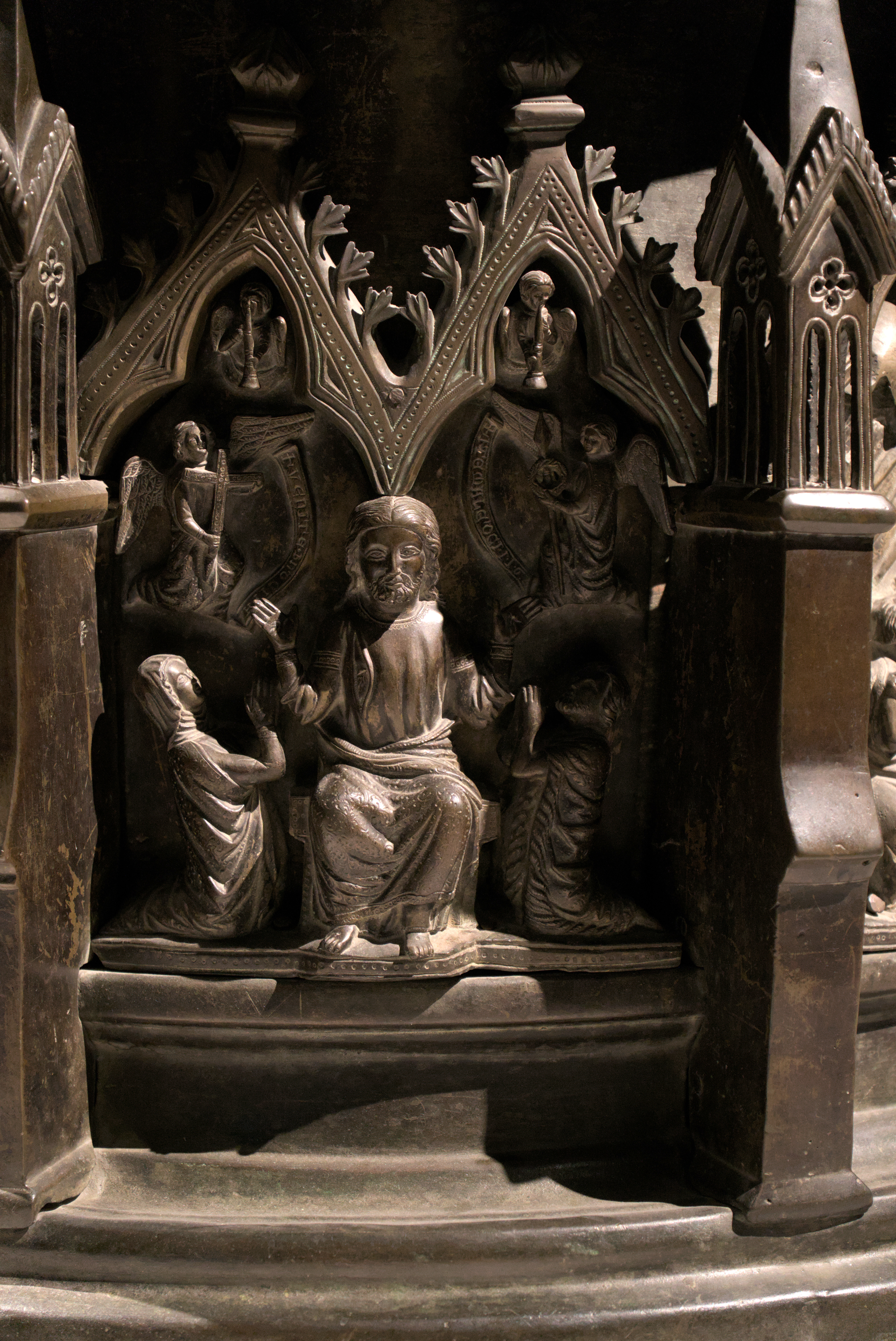
Across from Mary, Christ, and the eldest magus, in the center of the nave, is a bronze baptismal font made by Master Eckard of Worms in 1279. One of the cathedral’s most celebrated medieval treasures, it features eight scenes from the life of Christ, rendered in intricate relief.

Baptismal font by Master Eckard of Worms, 1279

Annunciation
The Annunciation

Nativity
The Nativity

Baptism of Christ
The Baptism of Christ

Crucifixion
The Crucifixion

Resurrection
The Resurrection

Ascension
The Ascension

Pentecost
The Descent of the Holy Spirit

Last Judgment
The Last Judgment

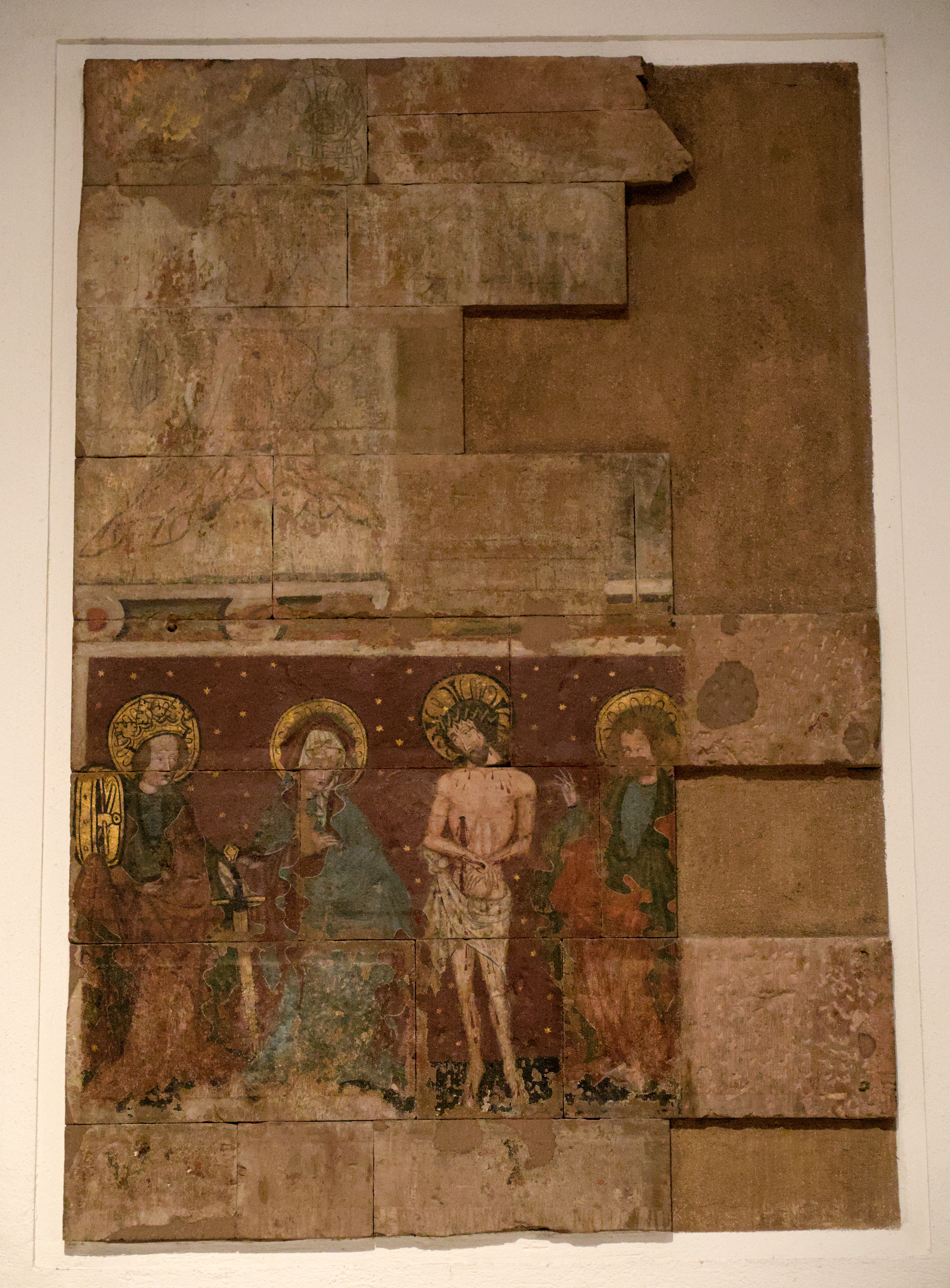
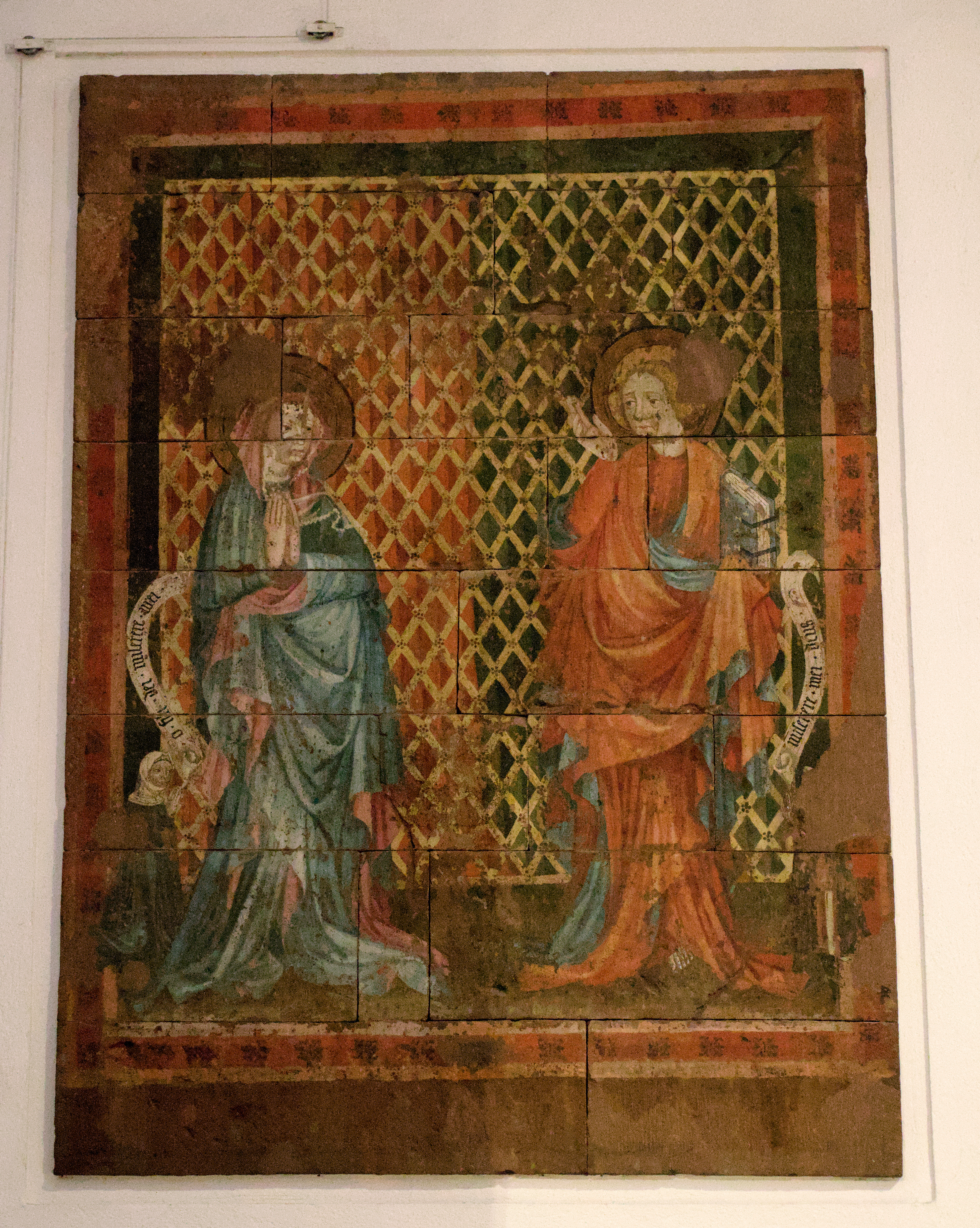
In the south (that is, right) aisle are two detached frescoes from the late fourteenth and early fifteenth centuries. One shows Mary and John the Evangelist as intercessors. On a smaller scale beside them are two donors (the one on the right is rubbed out) holding scrolls with Latin inscriptions appealing to Christ. “O fili dei miserere mei” (O Son of God, have mercy on me), the woman prays. “Miserere mei deus,” the man similarly beseeches.

Christ with saints
St. Catherine of Alexandria, the Virgin Mary, Christ as Man of Sorrows, and ?, ca. 1380

Mary and John
The Virgin Mary and St. John the Evangelist, ca. 1400

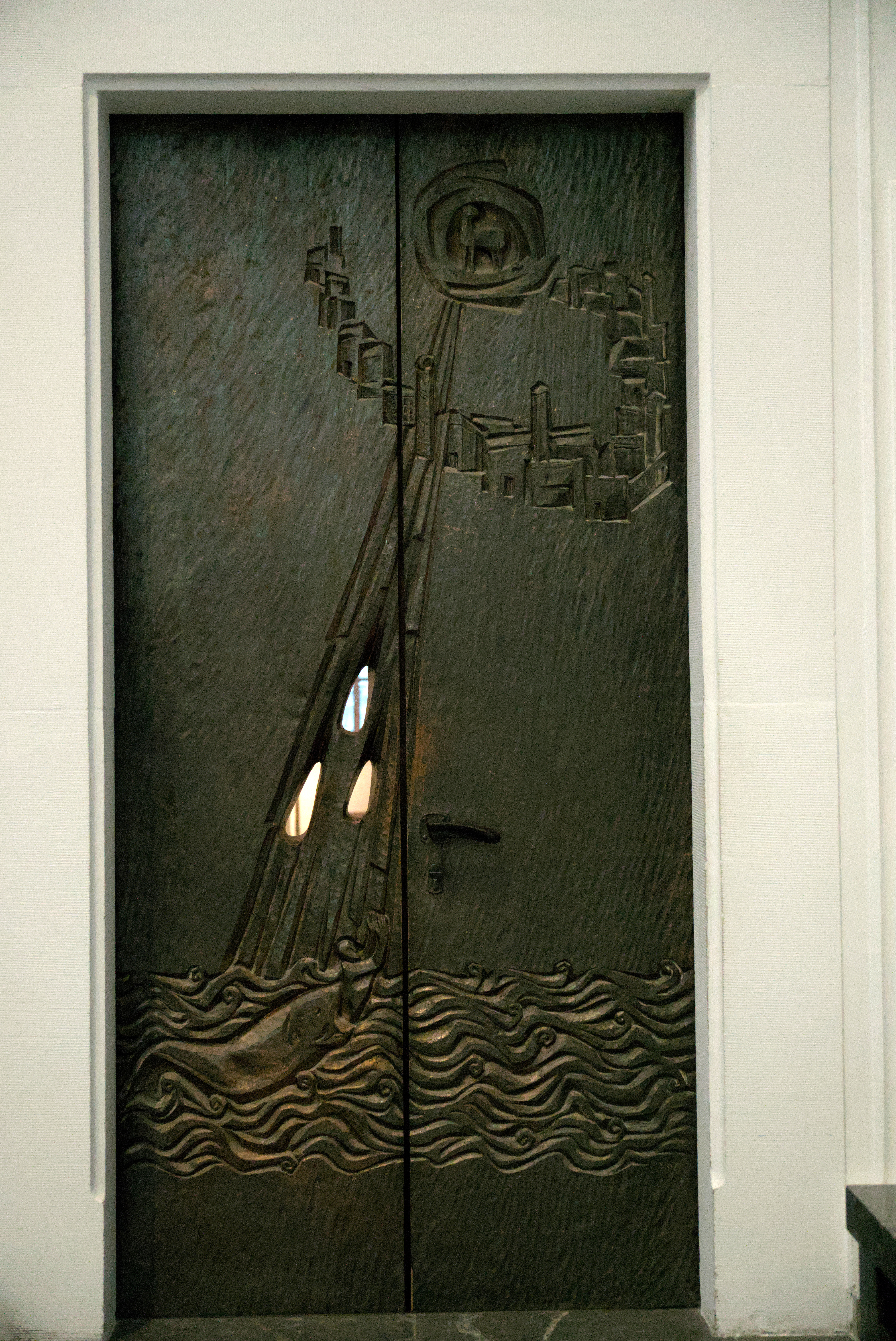
There’s also a modern wood door depicting, in low relief, the Lamb of God in a cityscape in the top right corner (the cathedral guide says it’s the heavenly Jerusalem, but I wonder if it could be Nineveh), and in the lower left, the prophet Jonah being disgorged from the mouth of the whale.

Karl Schneider (German, 1911–1970), Jonah, 1967

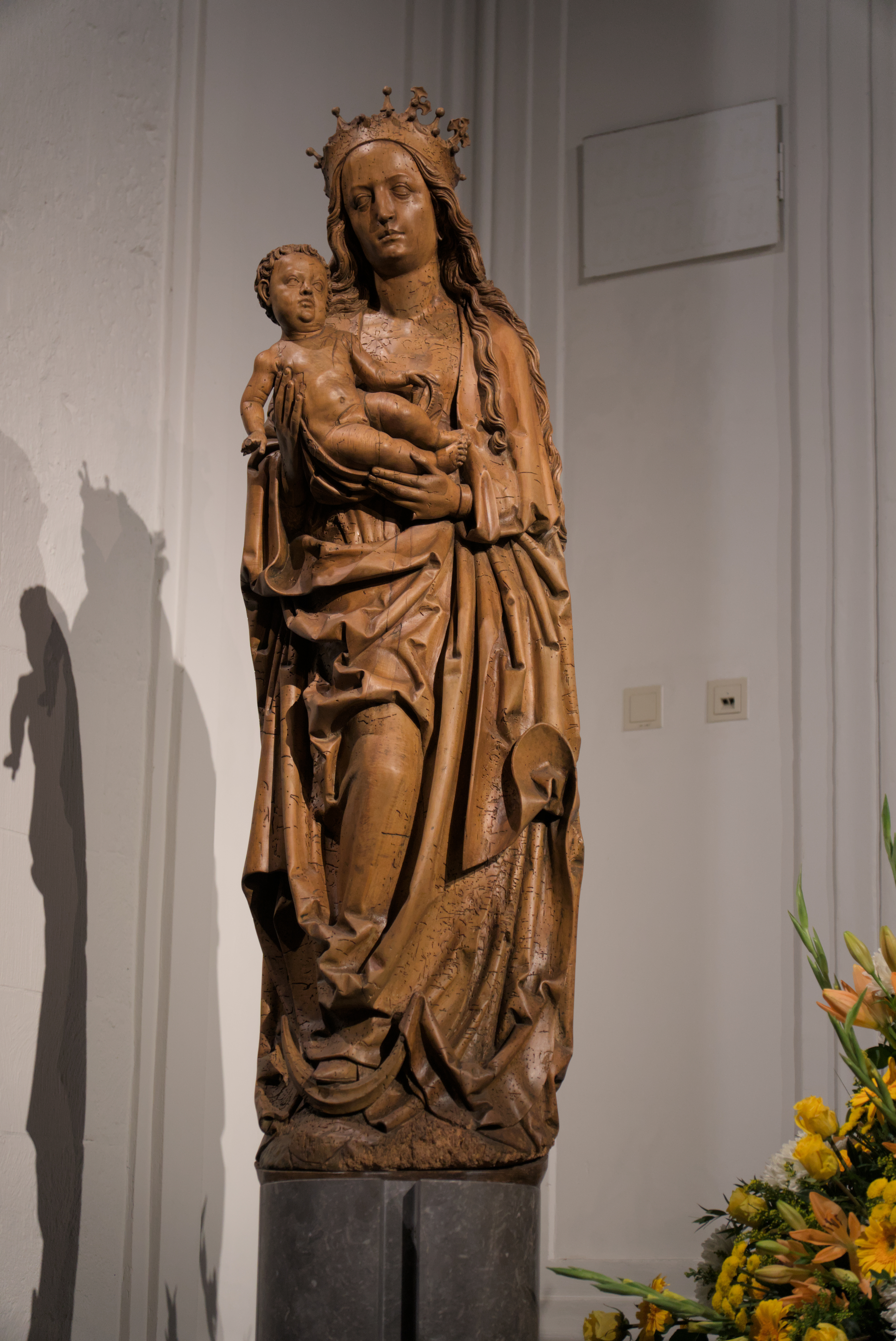
Near the transept, to the left, is a wood sculpture of the Virgin and Child from the workshop of Tilman Riemenschneider. Mary is crowned and stepping on a crescent moon, associating her with the Woman of the Apocalypse in Revelation 12.

Tilman Riemenschneider_Virgin and Child
Workshop of Tilman Riemenschneider, Virgin and Child, ca. 1515, on a stele by Jürgen Lenssen, 2012

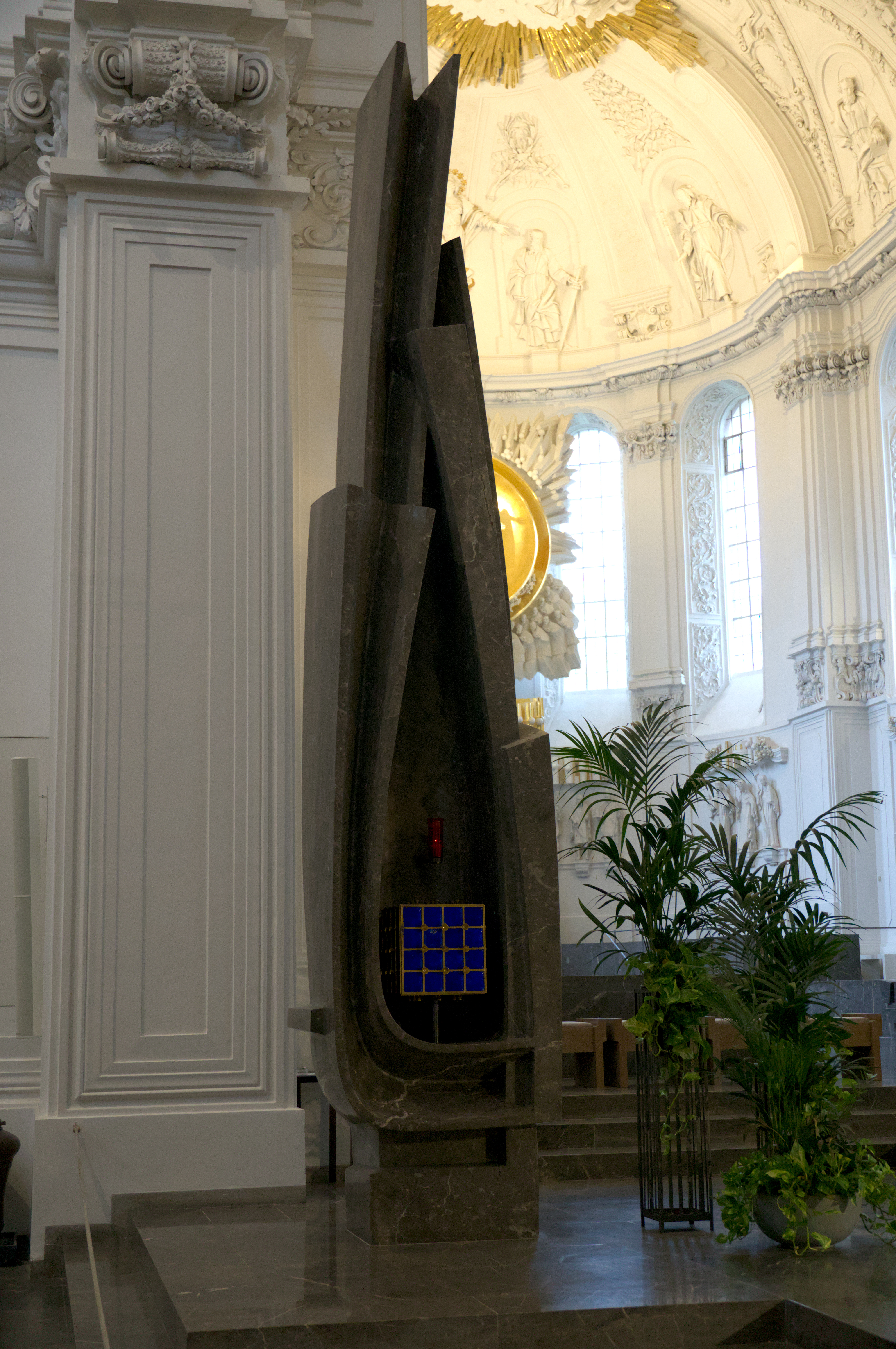
To the left of the high altar is a modern tabernacle, a fixed, locked receptacle in which consecrated hosts left over from the Eucharist are reserved. For me, the stone casing evokes the pillar of fire from the Old Testament, a symbol of God’s presence among his people.

Tabernacle by Albert Schilling, 1964–67
Albert Schilling (Swiss, 1904–1987), Tabernacle, 1964–67

At the east end of the cathedral, the chancel area, designed by Hubert Elsässer in 1987–88, combines Baroque and modern elements in a representation of the New Jerusalem. It is anchored by a prominent stele by Elsässer that pictures the risen Christ in the middle of a gilded circle, its bottom circumference hugged by the tree of life. He is surrounded by angels and the twenty-four elders, and below him is the apocalyptic Lamb of God standing, “as if it had been slaughtered” (Rev. 5:6), before the twelve gates to the city, each bearing a giant pearl.

St. Kilian's Cathedral

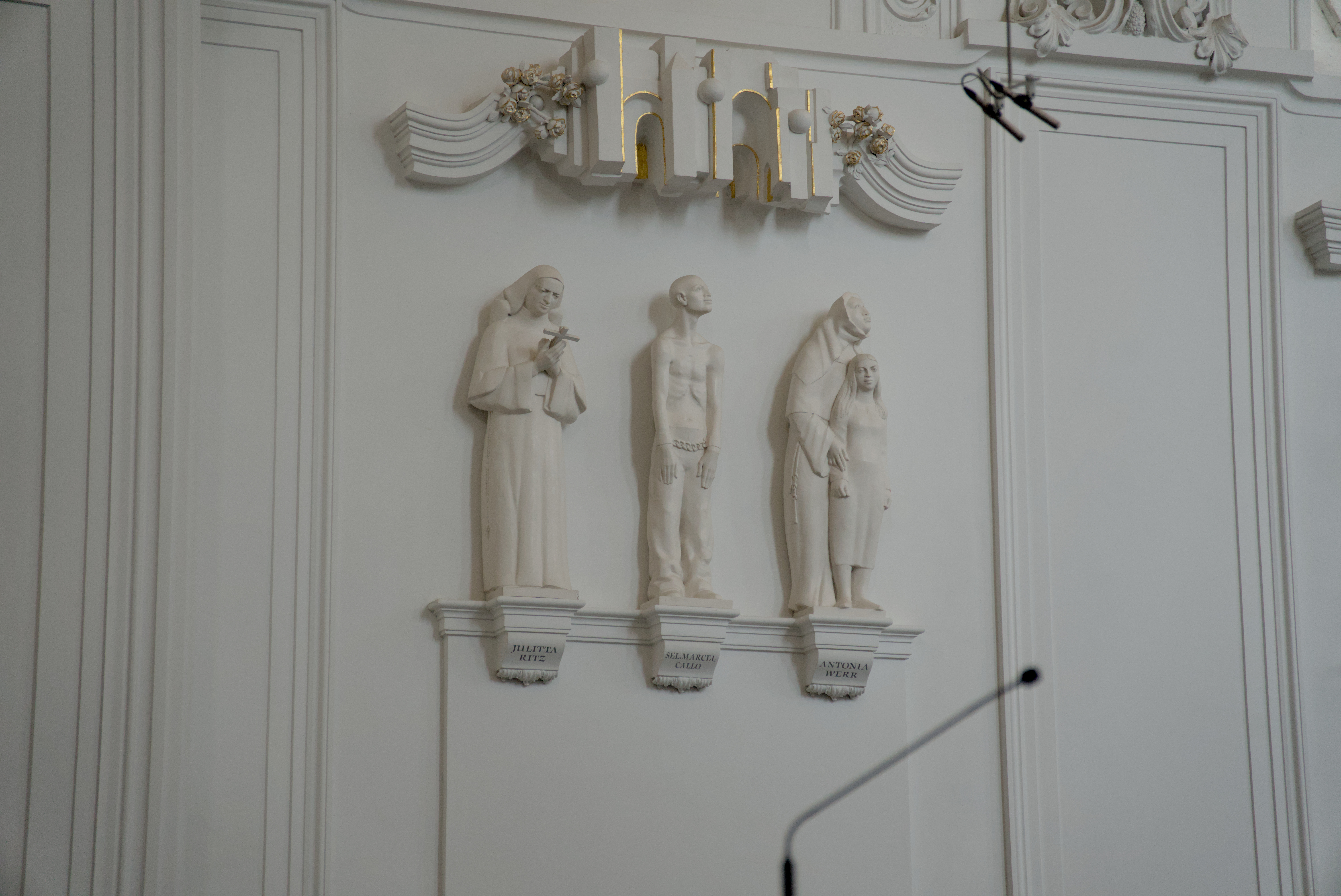
On the walls of the chancel are several trios of Frankish faith witnesses from the seventh to twentieth centuries, sculpted by Hubert Elsässer, Willi Grimm, Tilmar Hornung, Ernst Singer, and Lothar Forster. One group on the left depicts Sister Maria Julitta Ritz (1882–1966), a German Catholic nun, teacher, mystic, and spiritual adviser belonging to the Congregation of the Sisters of the Divine Redeemer in Würzburg; Blessed Marcel Callo (1921–1945), a French Catholic member of the Young Christian Workers who was deported to Germany in 1943 and died two years later in the Mauthausen concentration camp; and Sister Antonia Werr (1813–1868), founder of the Holy Childhood Sisters in Oberzell and a pioneer of the reintegration of women released from prison.

Witnesses in the New Jerusalem
Three witnesses in the New Jerusalem: Sr. Maria Julitta Ritz, CSR; Bl. Marcel Callo; Sr. Antonia Werr, OSF

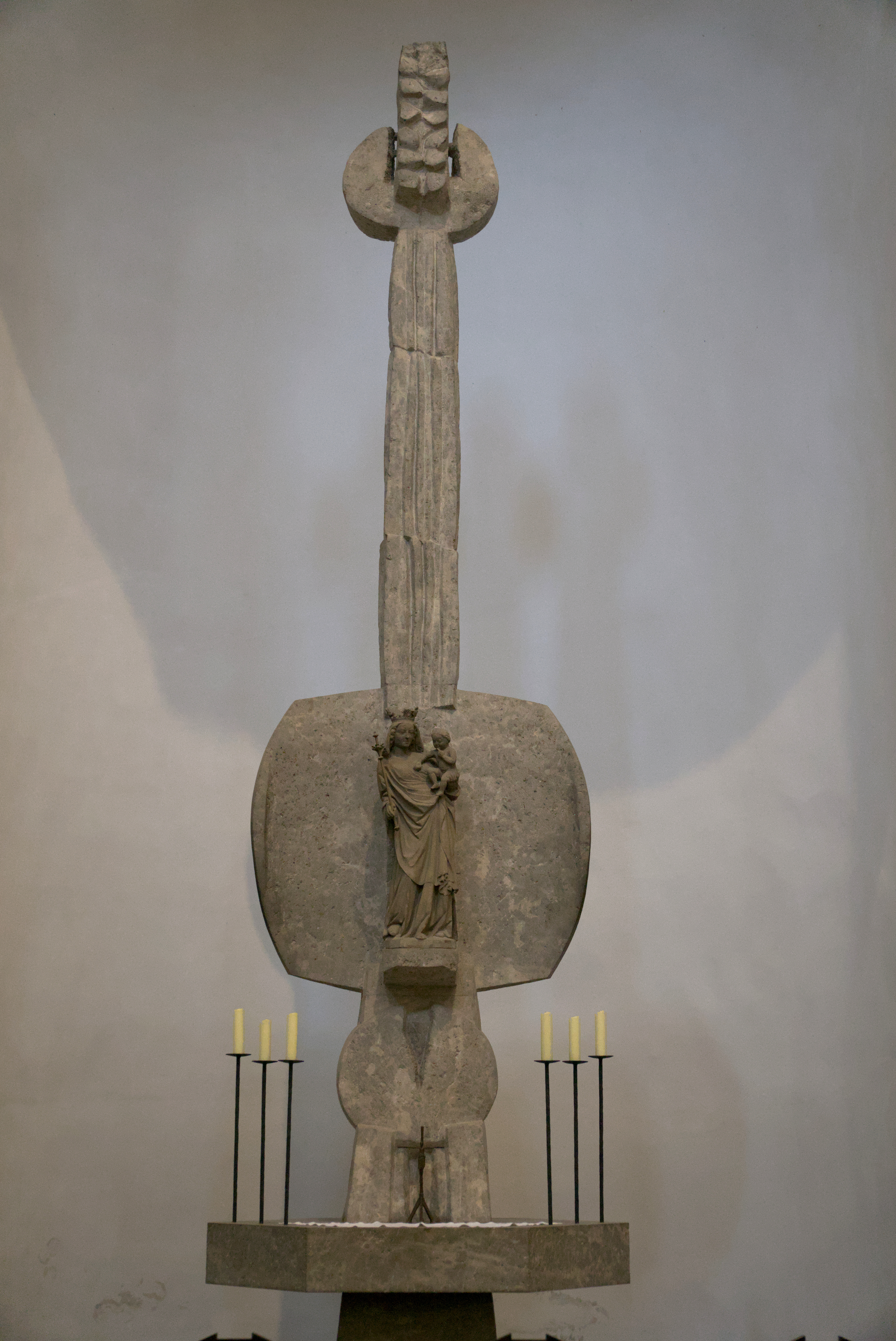
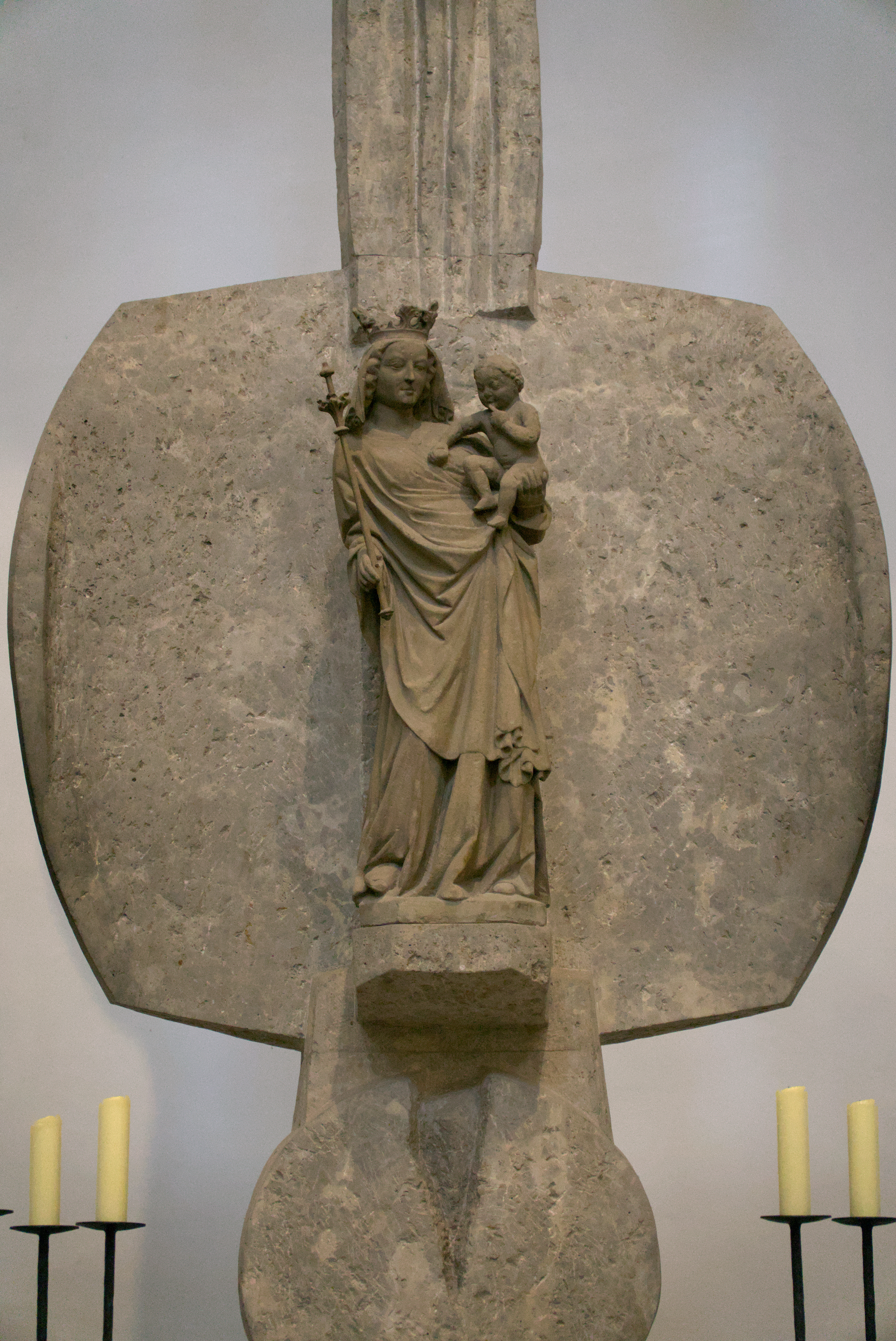
Elsässer also carved the stone, lute-shaped Altar of Mary in the north transept, which centers, in the “soundboard,” a medieval sculpture of the Virgin and Child. What an evocative combination! Conceptually, it reminds me of a charming little quatrain by the seventeenth-century German Christian mystic Angelus Silesius:

Ein Herze das zu Grund
Gott still ist, wie er will,
Wird gern von ihm berührt—
Es ist sein Lautenspiel.

In other words, a heart that is still and hushed readily welcomes the touch of God, like a lute that invites music making. Once God touches the heart, it sings.

Hubert Elsässer (German, 1934–2009), Altar of Mary, 1967, with Virgin and Child, ca. 1420

Altar of Mary (detail)

The Indian mystic Kabir, who didn’t belong to a particular religious tradition, wrote something similar in the fourteenth century:

My friend, this body is His lute. He tightens the strings and plays its songs.

If the strings break and the pegs work loose, this lute, made of dust, returns to dust.

Kabir says: Nobody else can wake from it that heavenly music.

(trans. Stephen Mitchell, The Enlightened Heart: An Anthology of Sacred Poetry)

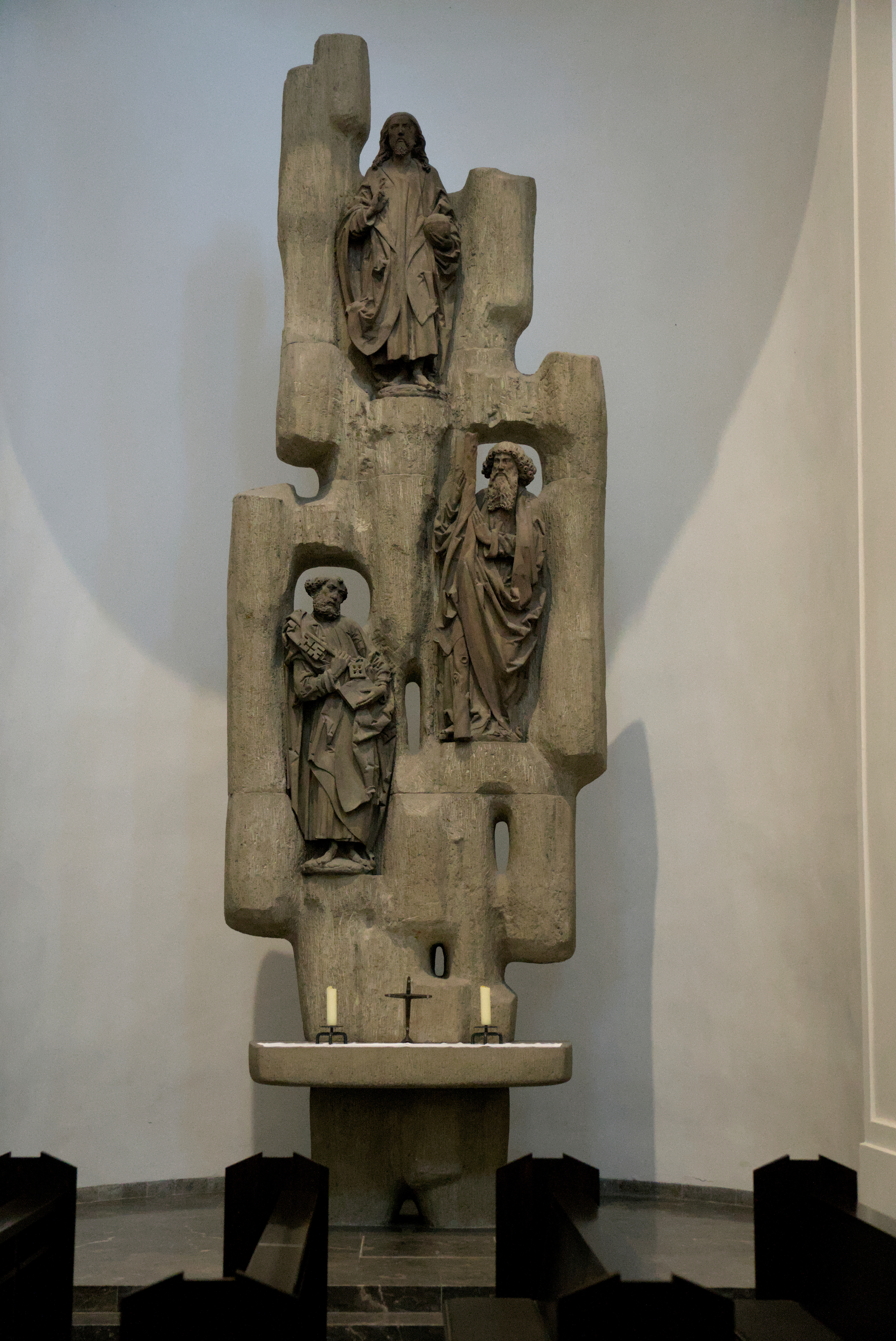
In the equivalent spot in the south transept is the Apostle Altar by Helmut Weber, a thick, vertical stone framework that houses, cave-like, late medieval sculptures by Tilman Riemenschneider depicting Christ holding an orb that represents the world, Andrew holding a fragment of the X-shaped cross he was martyred on, and Peter holding a key (a reference to Matt. 16:19).

Helmut Weber (German, 1924–2012), Apostle Altar, 1966–67, with sculptures of Christ as Salvator Mundi, St. Andrew, and St. Peter by Tilman Riemenschneider, 1502–6

Unfortunately, there is an extension off the south transept that I missed: the Sepulture, a Gothic burial hall. (The door was closed, and I didn’t realize it could be opened; or perhaps the space was temporarily closed to visitors.) It contains, most notably, a 1956 stained glass cycle by Georg Meistermann depicting the seasons and holidays of the church year.

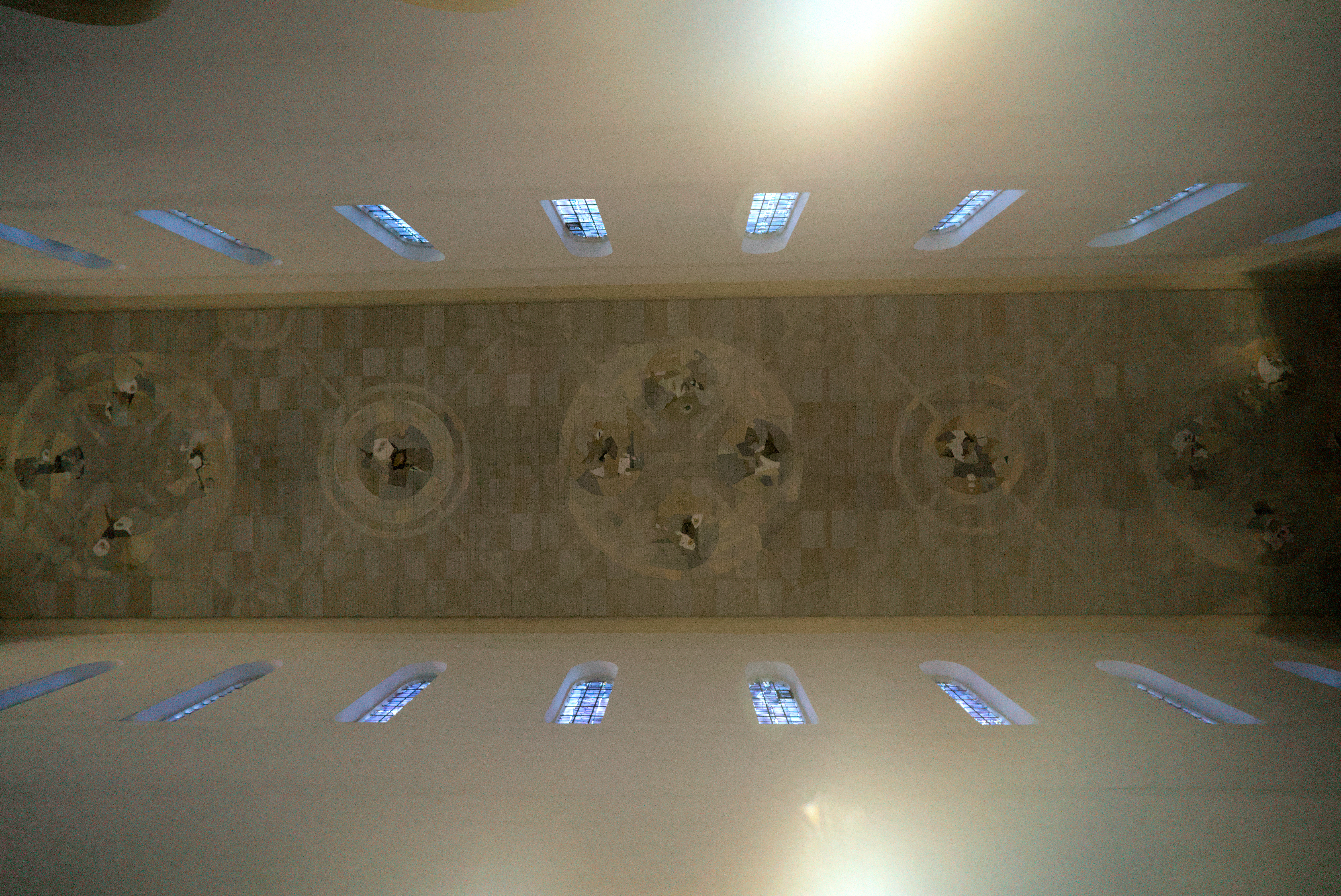
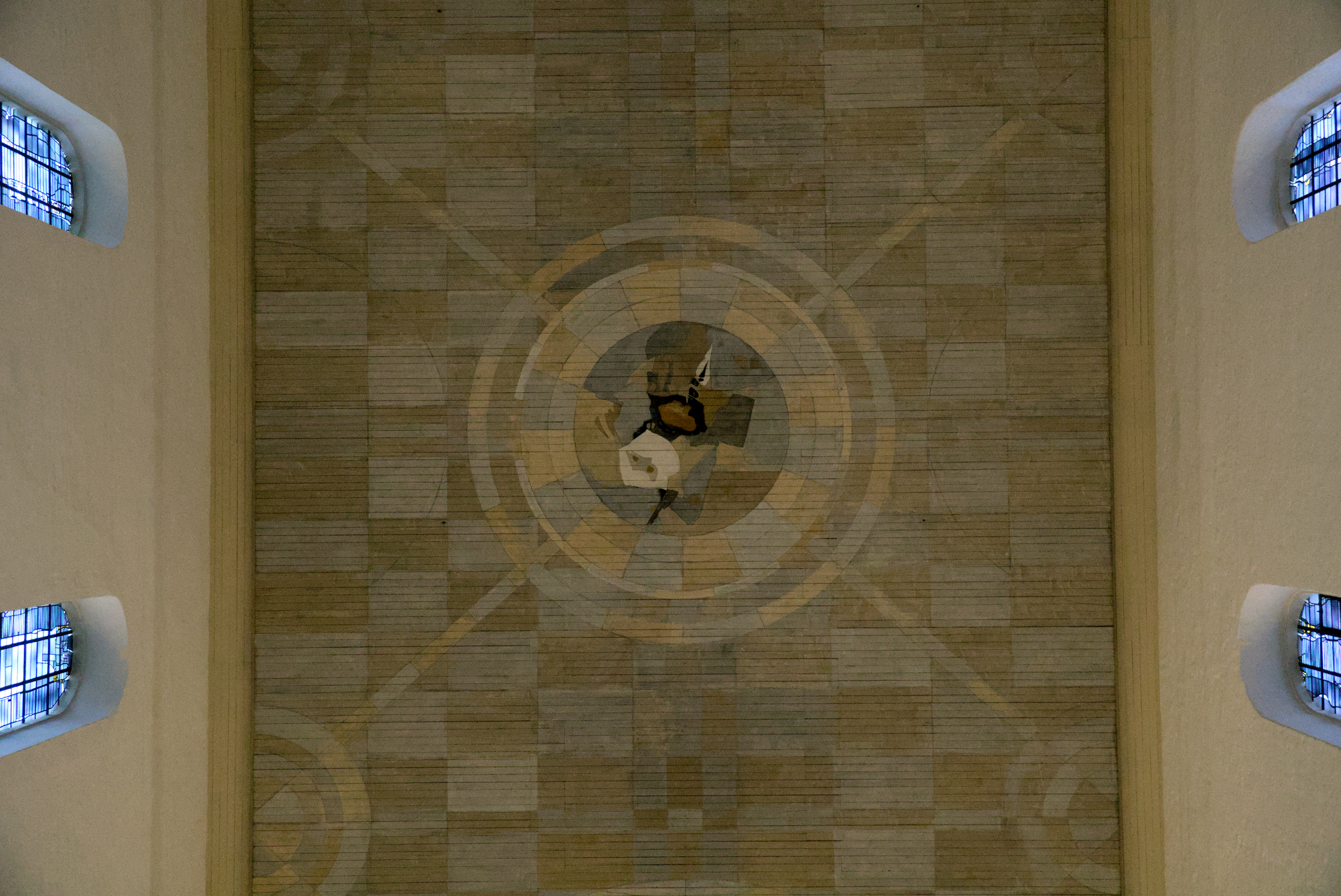
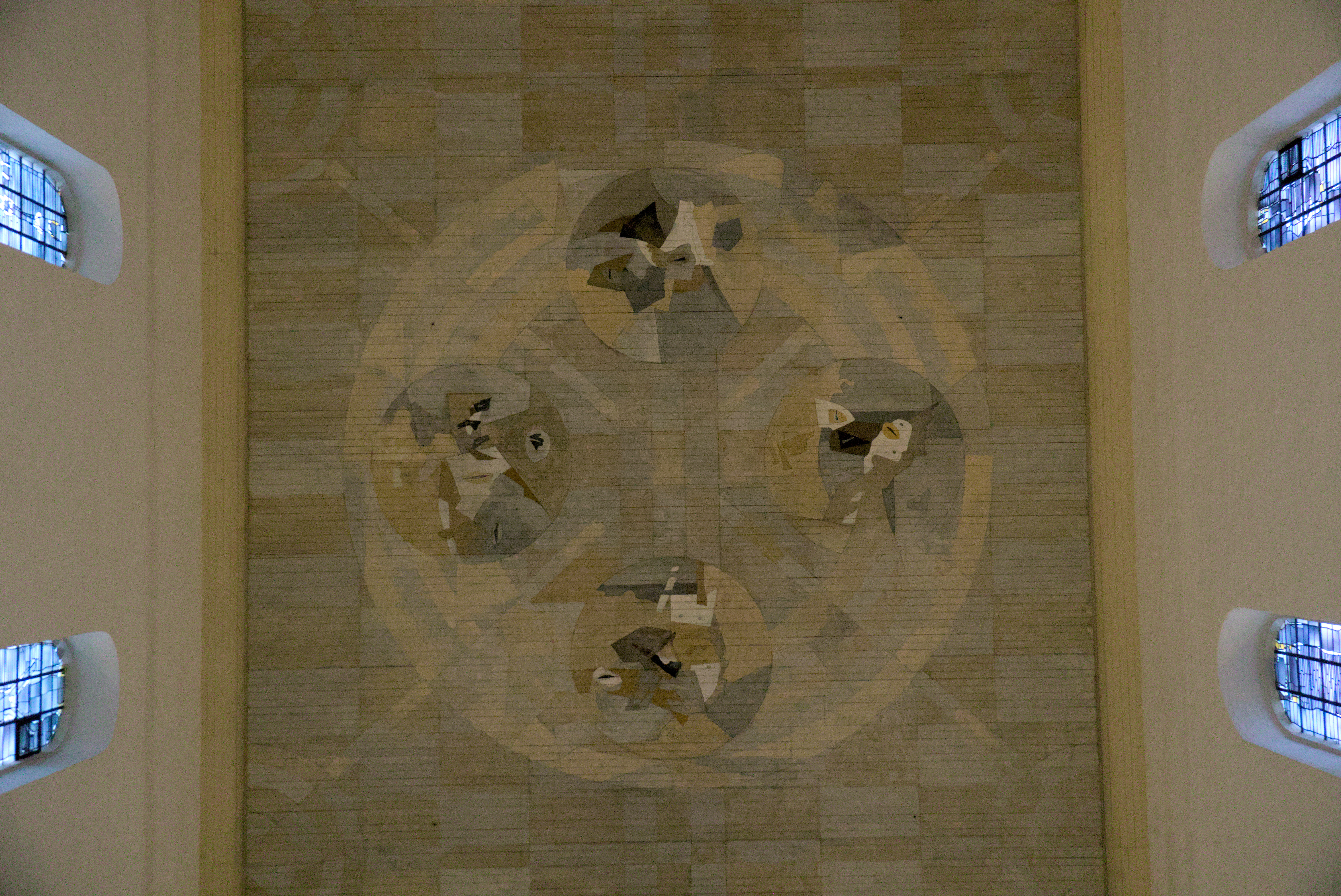
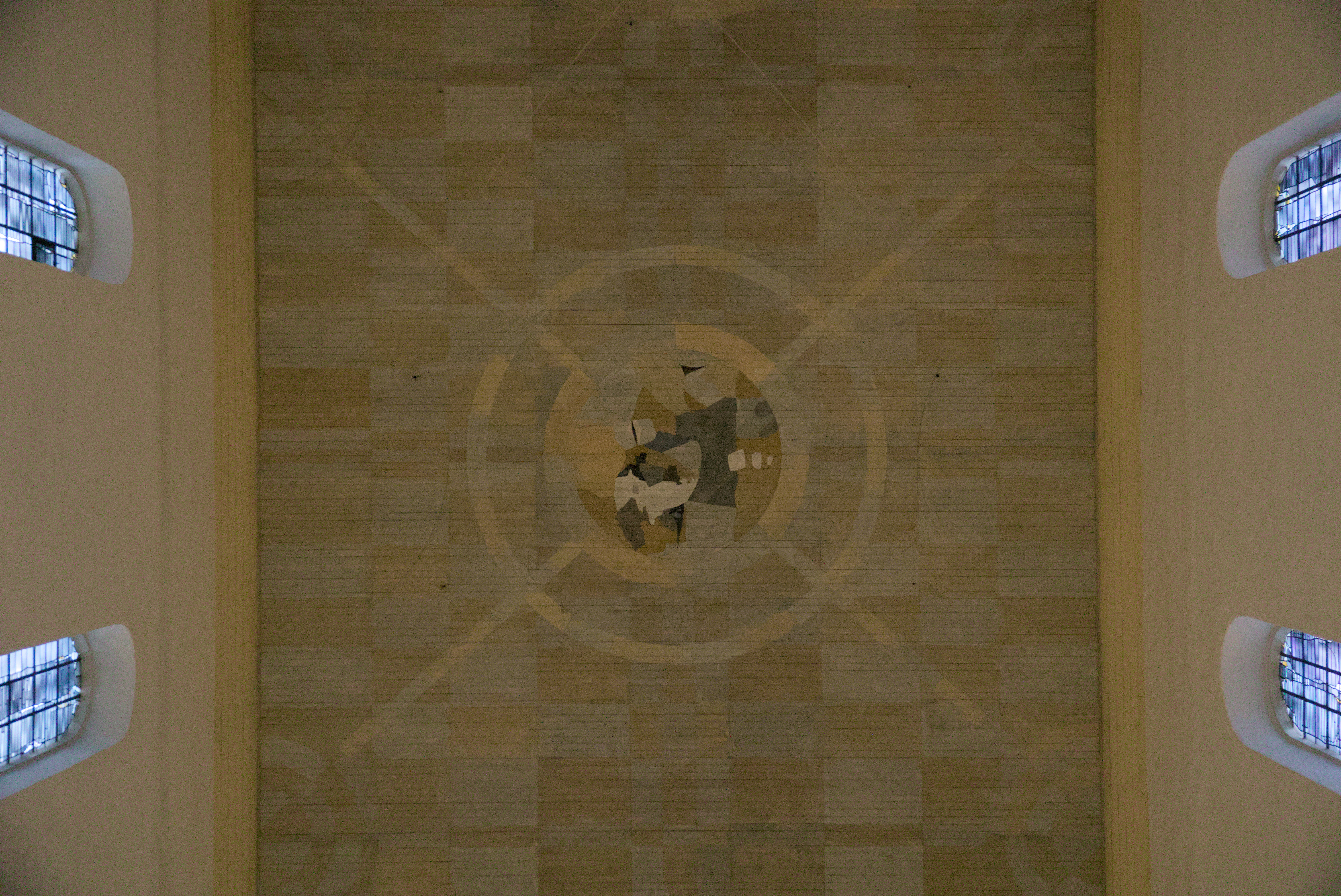
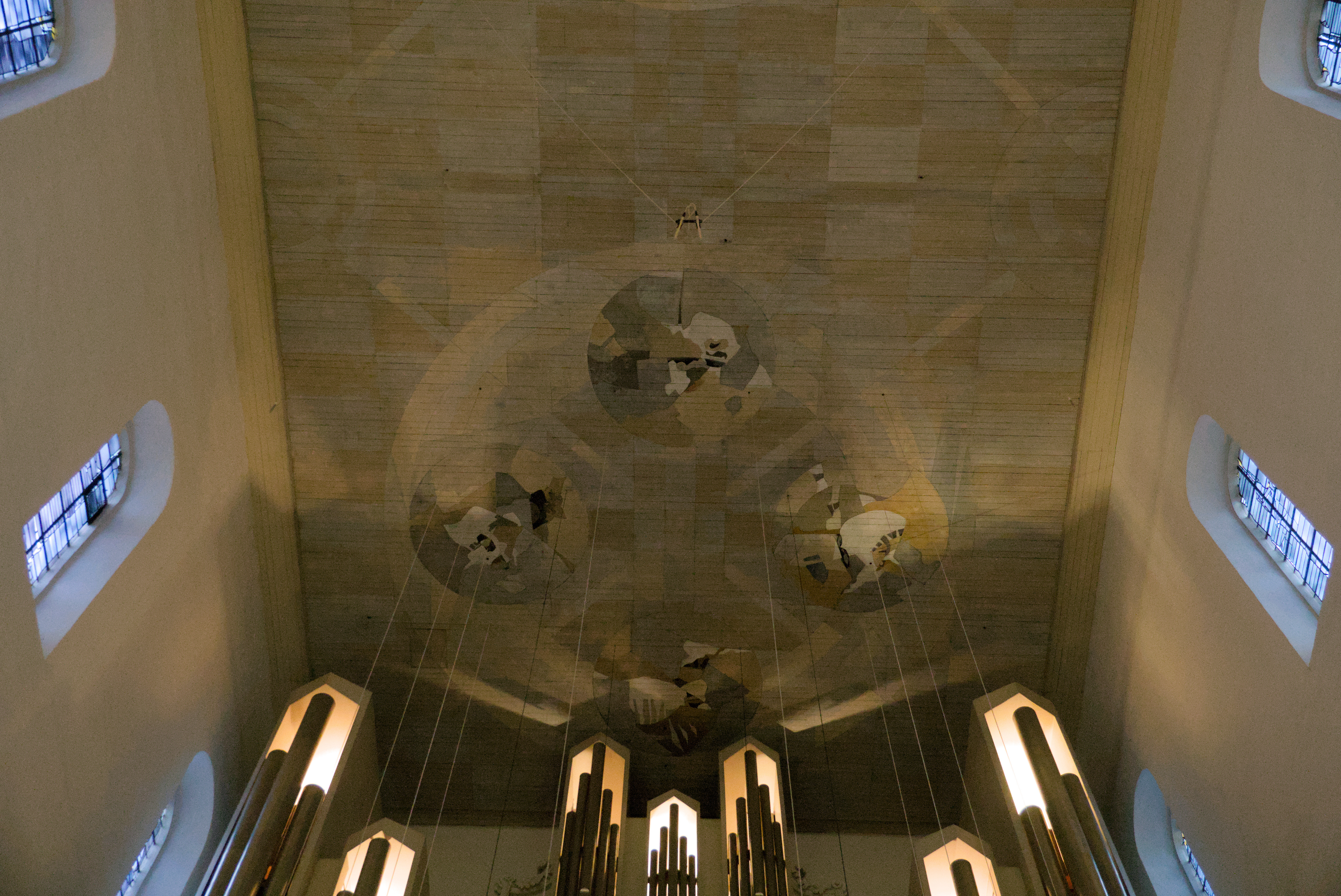
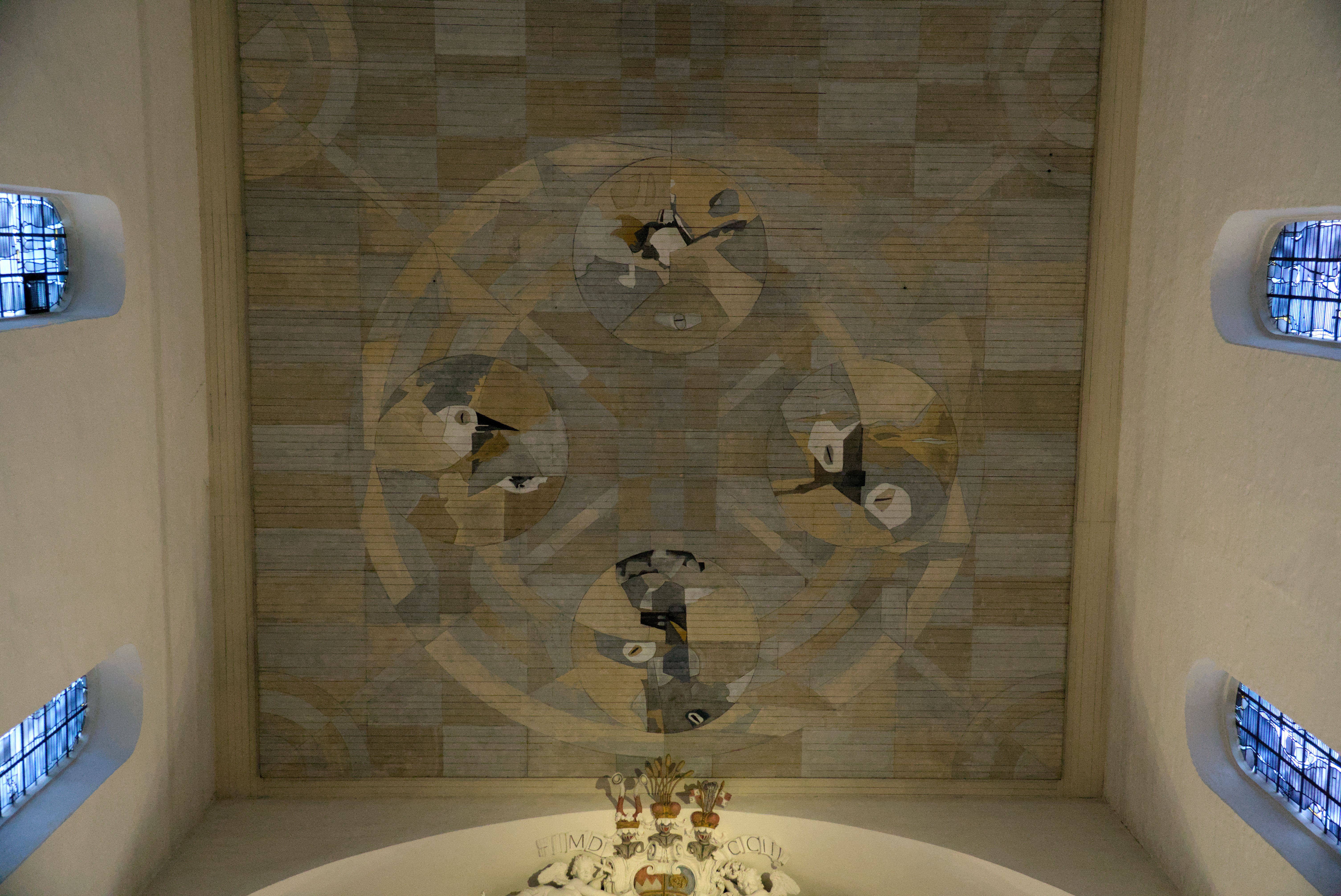
But back to the main body of the cathedral. Overhead, running down the length of the church, is a modern ceiling painting by Franz Nagel depicting the apocalyptic throne chariot vision that the prophet Ezekiel saw while living in exile in Babylon. The vision features bizarre cosmic imagery—wind and fire, a wheeled throne of God, four-faced hybrid creatures with wings, flashes of lightning, a shining crystal dome, eyes all over.

Franz Nagel (German, 1907–1976), Vision of Ezekiel, 1965–66, ceiling painting. Upper clerestory windows by Ludwig Schaffrath (German, 1924–2011), 1965.

Franz Nagel_Vision of Ezekiel

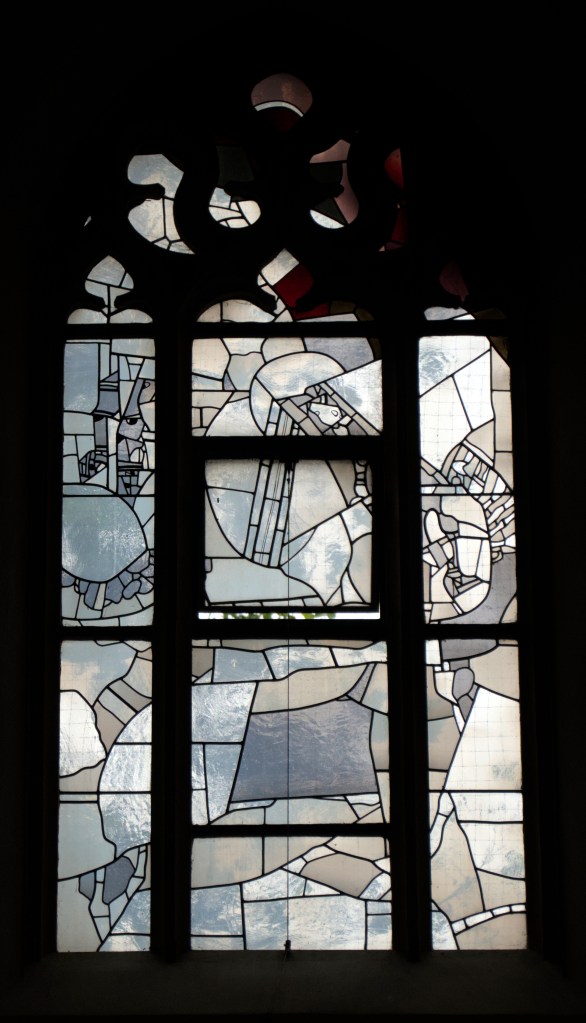
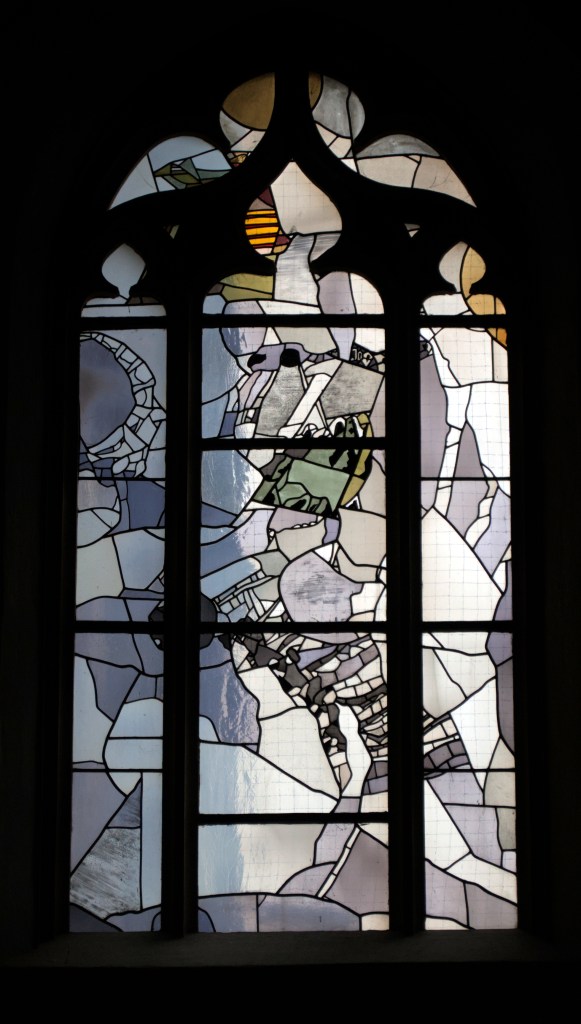
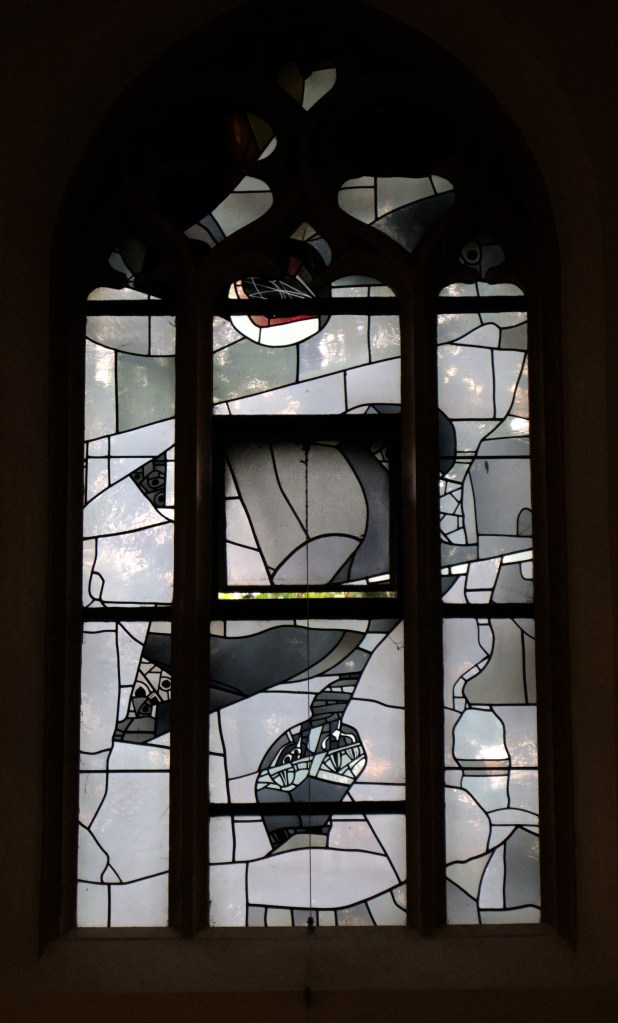
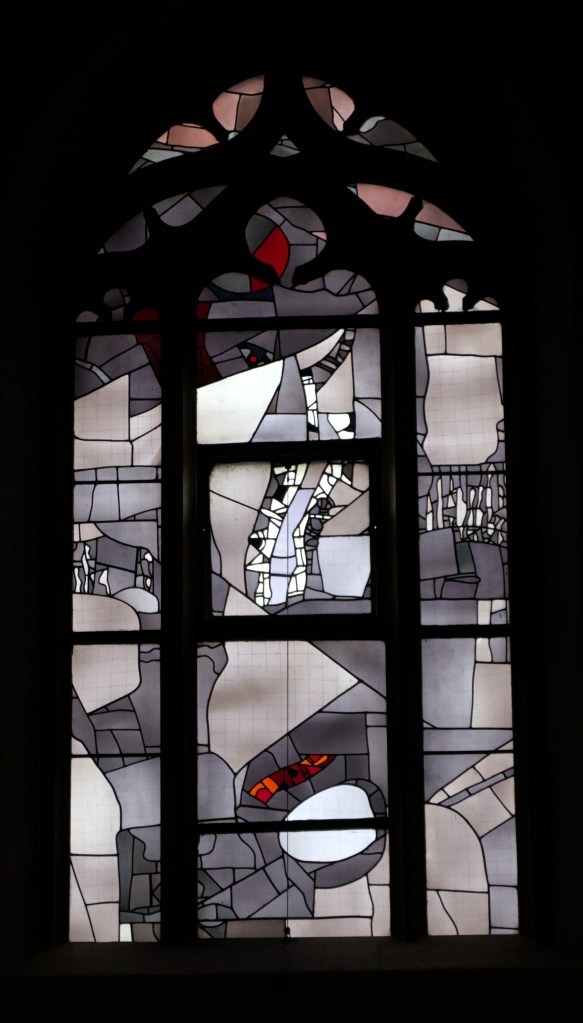
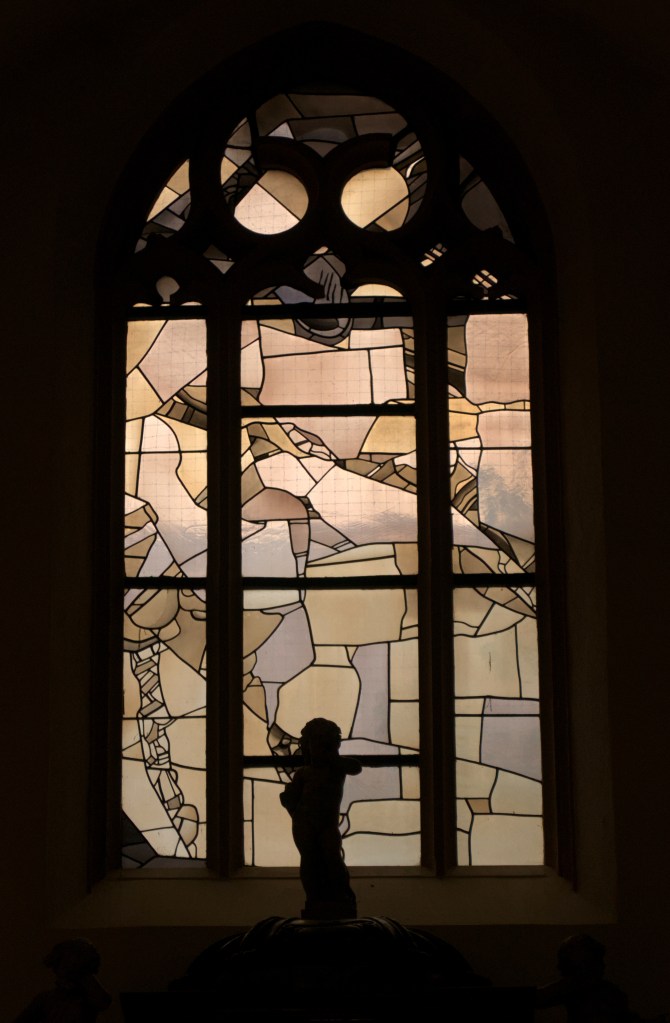
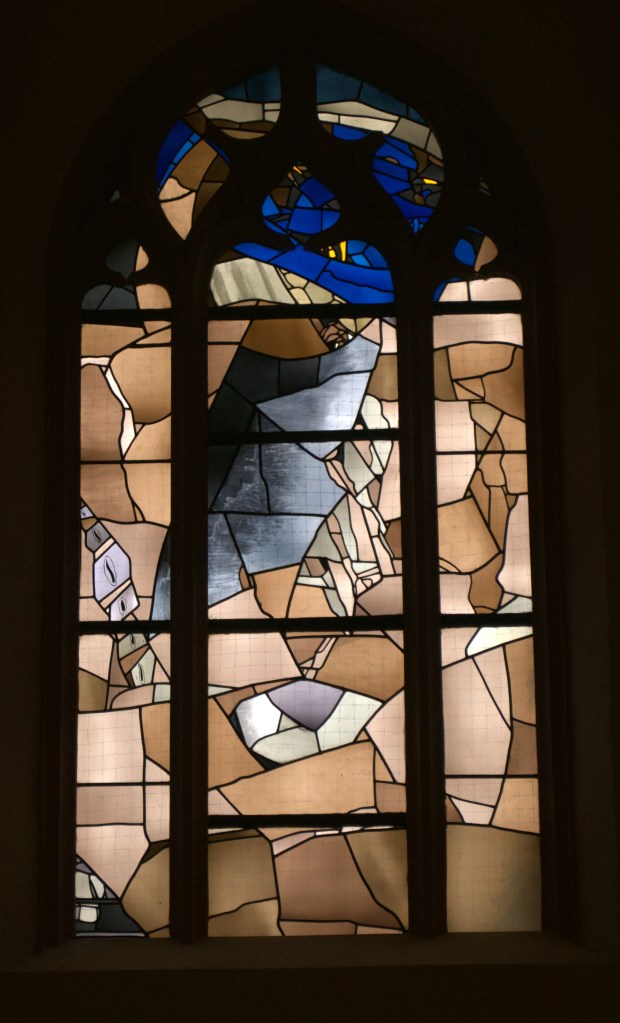
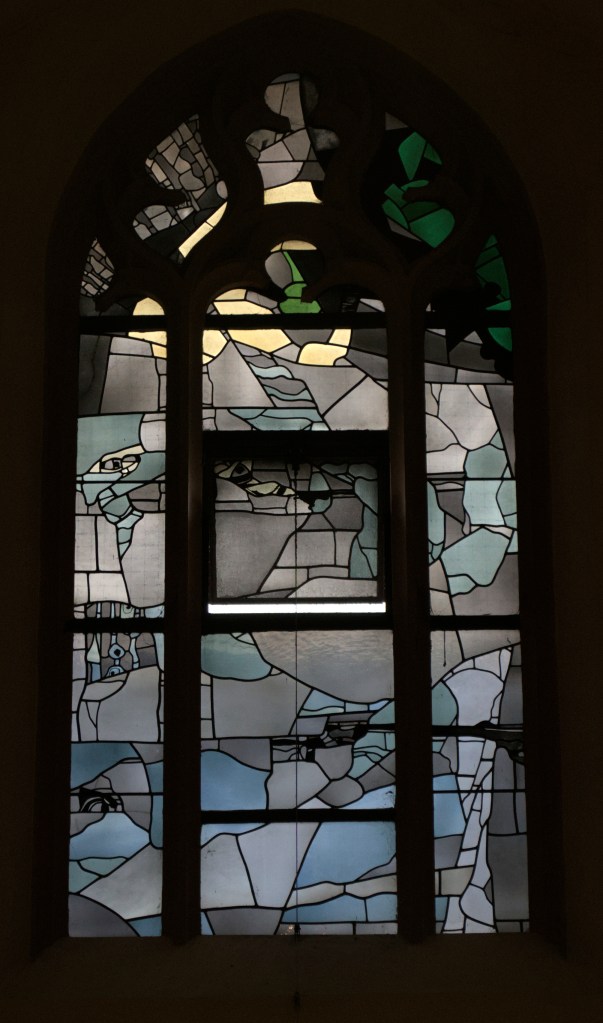
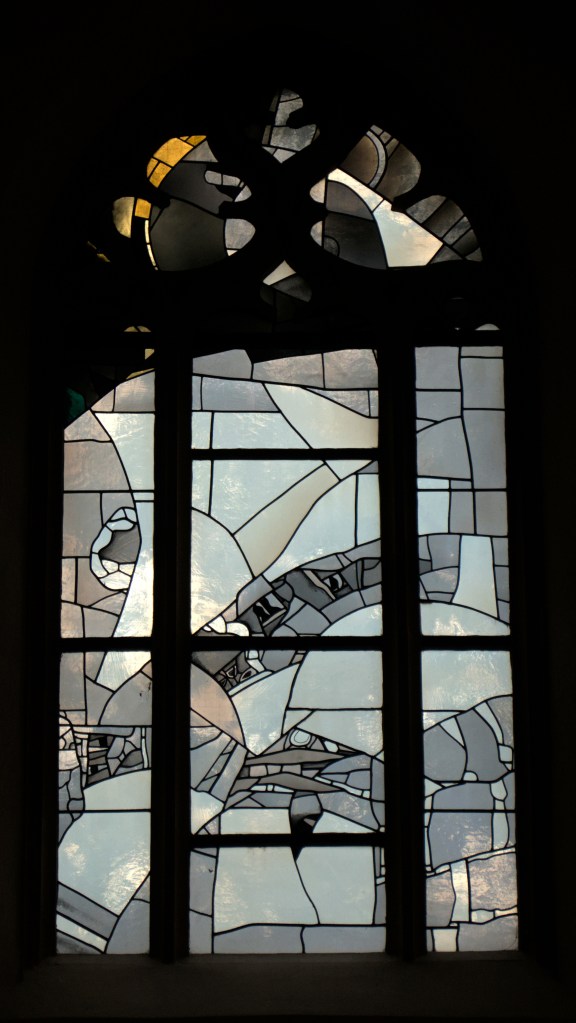
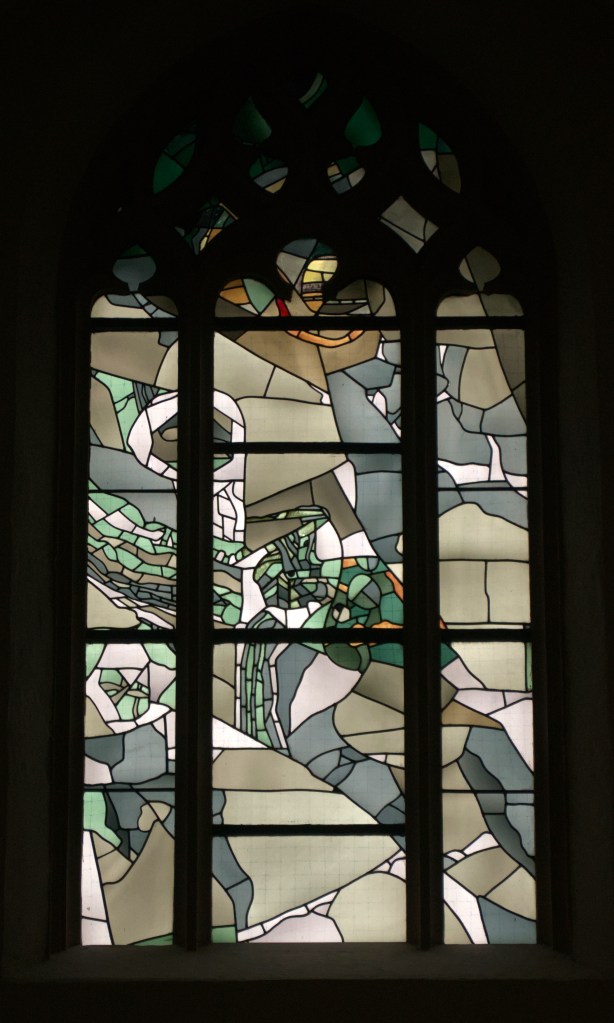
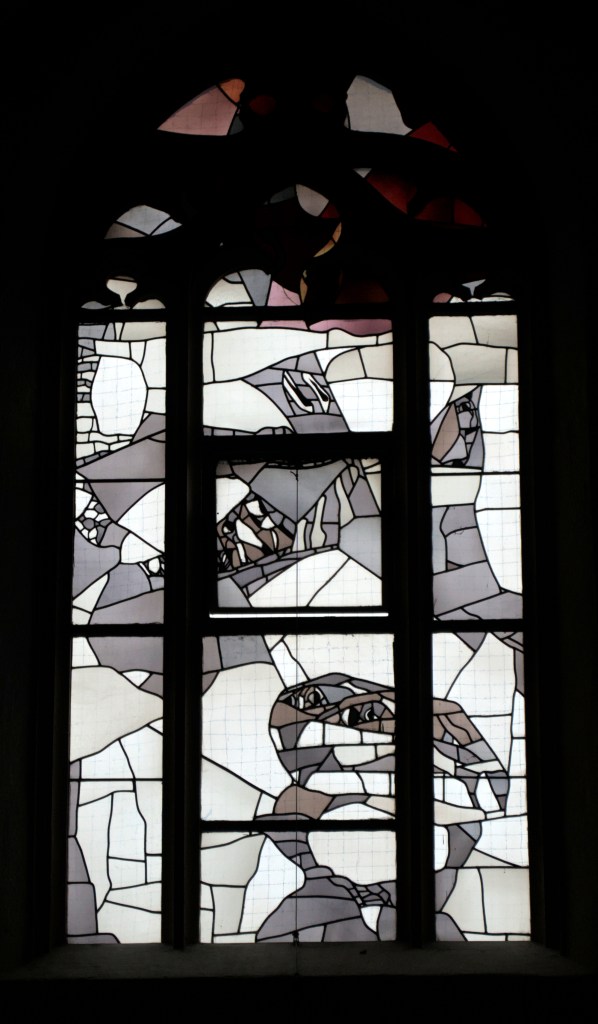
Nagel also created the eighteen stained glass windows along the two side aisles, the cathedral guide told me—in a similarly abstract style.

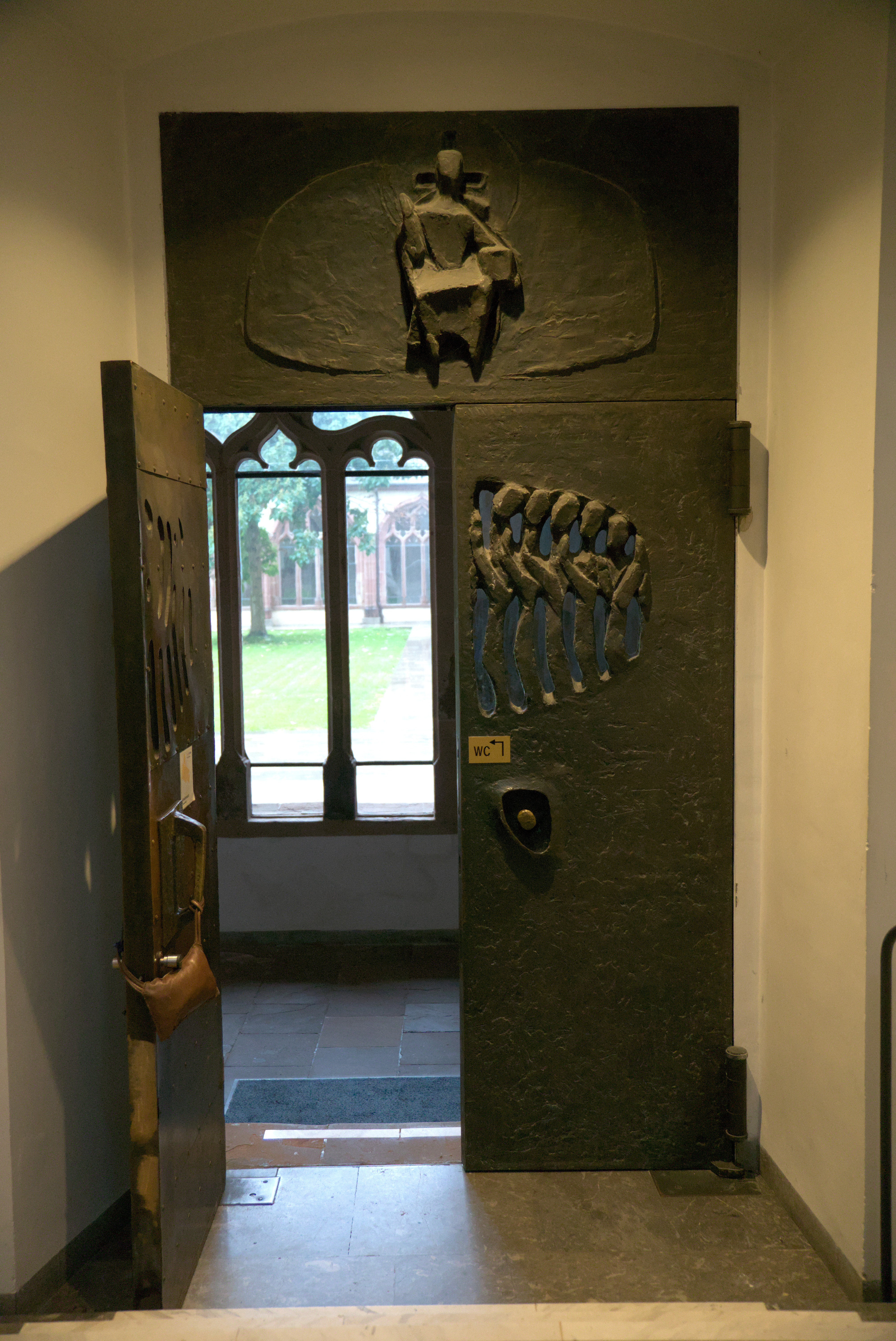
Heading out to cloister, I passed through a bronze door by Heinrich Söller depicting the parable of the wise and foolish virgins.

Heinrich Söller_Wise and Foolish Virgins
Heinrich Söller (German, 1903–1997), The Wise and Foolish Virgins, 1967

The cloister contains several contemporary sculptures, including a bronze by Maria Lehnen.

Maria Lehnen_Dissolution
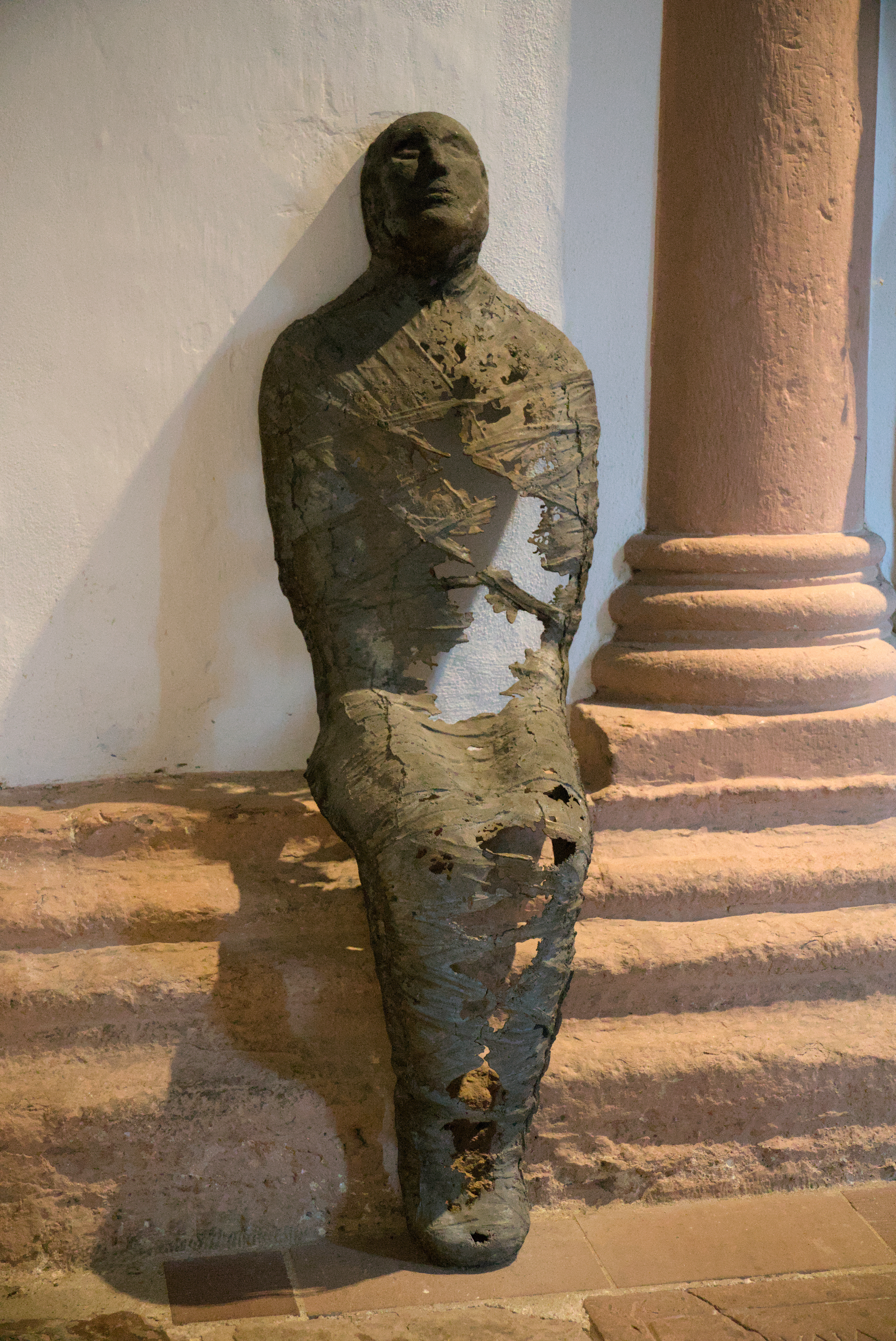
Maria Lehnen (German, 1949–2025), In Auflösung (Dissolution), 2005

Many of Lehnen’s works depict a human figure tightly bound in linen, rope, or bandages but in a state of growth and becoming, alluding to the often arduous process of transformation. Dissolution is no different. It shows the old self inside a cocoon, breaking down to make way for the new. The man lifts his eyes to the hills, whence cometh his help, his life. (I’ve seen photos of a similar sculpture by Lehnen from 2004, Großer Sitzender [Large Seated Man], aka Der Gefesselte [The Bound Man], seated on the steps outside the cathedral, but it wasn’t there when I was.)

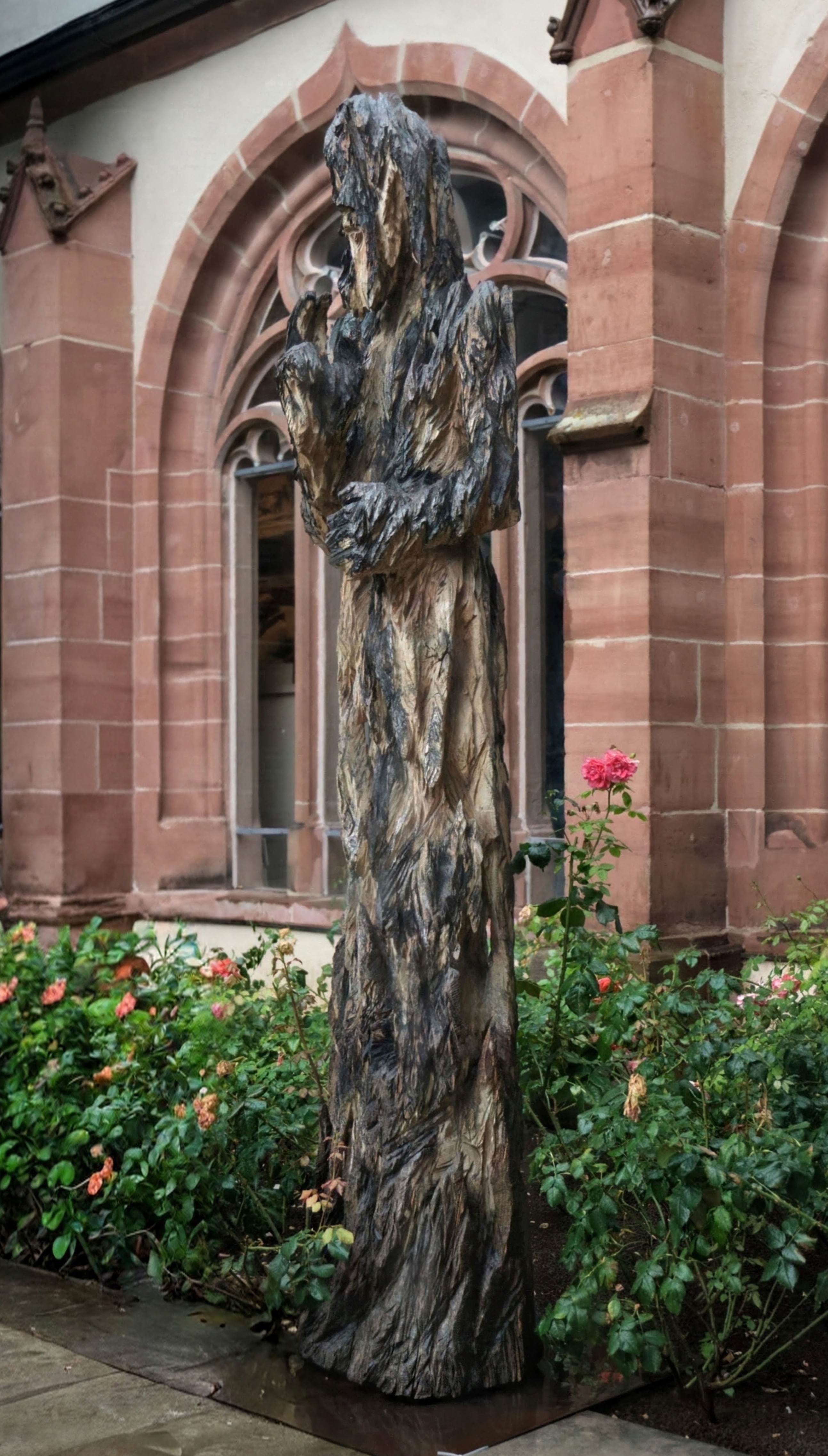
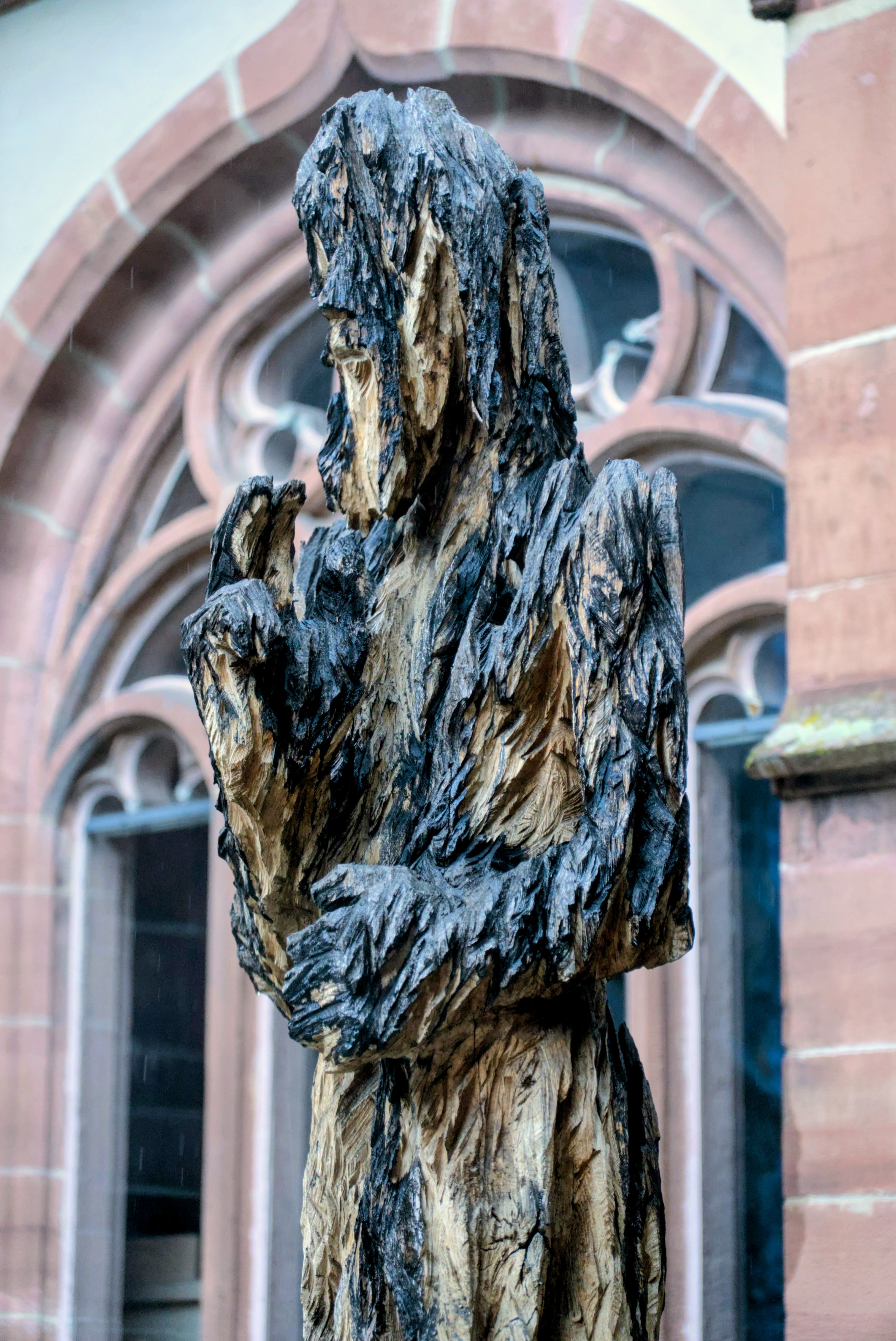
Another striking work in the cloister is Andreas Kuhnlein’s oakwood Risen Christ.

Andreas Kuhnlein (German, 1953–), Auferstandener (Risen Christ), 2013–14

Risen Christ (detail)

Kuhnlein uses a chainsaw to create rugged, life-size, figurative sculptures from uprooted, decaying trees, bringing the dead trunks to “life” by highlighting the protrusions, cuts, fractures, or grain patterns in the hardwood. At the blessing ceremony for the redesigned cloister in 2014, Bishop Dr. Friedhelm Hofmann said that the rough-hewn Risen Christ, bearing scorch marks from Kuhnlein’s aggressive motorized slicing, reminds him of the burning bush in which God revealed himself to Moses.

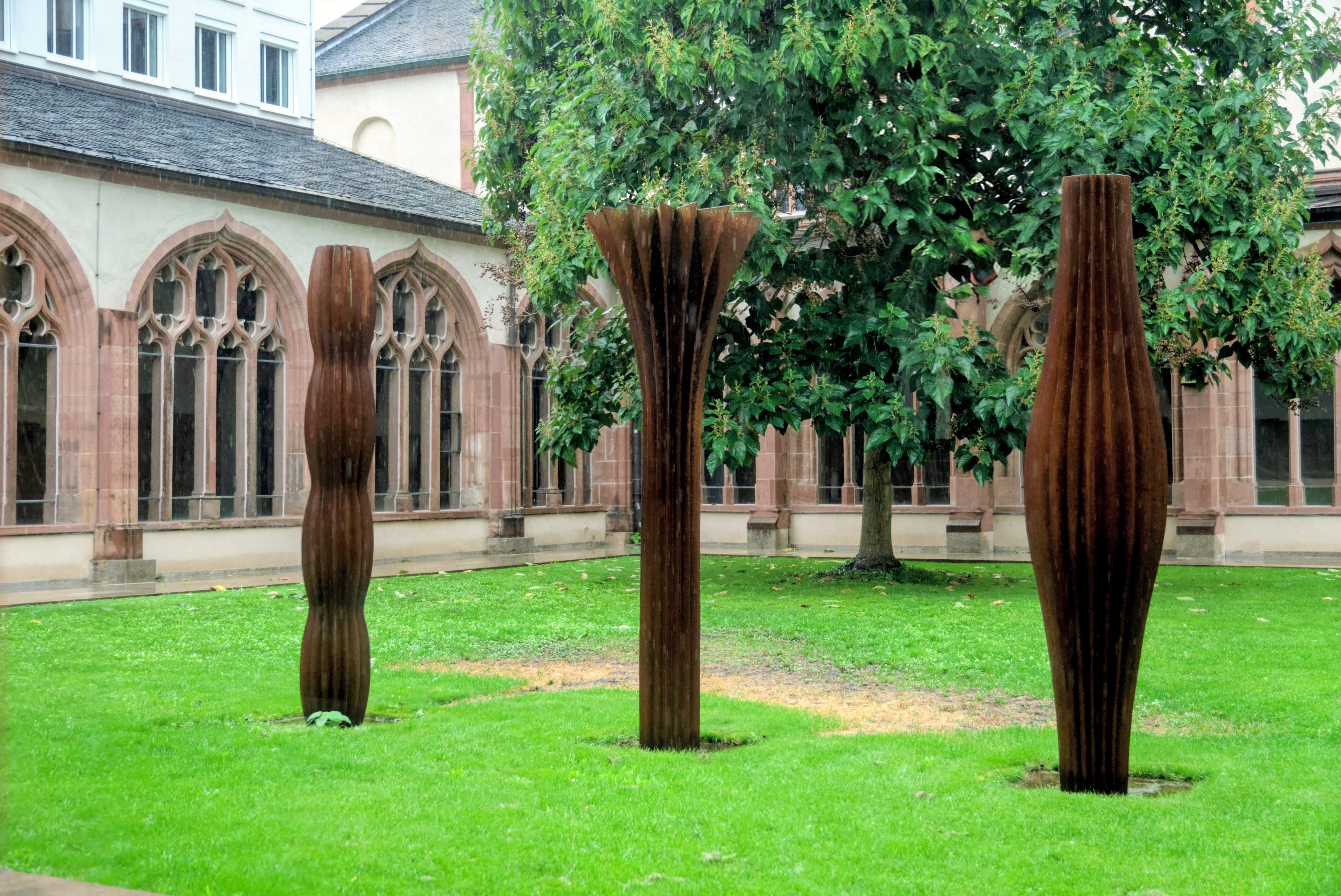
In the center of the courtyard (which, from what I could tell, does not admit entry) is a trio of biomorphic forms in Corten steel.

Herbert Mehler_Kavex
Herbert Mehler (German, 1949–), Kavex, 2006

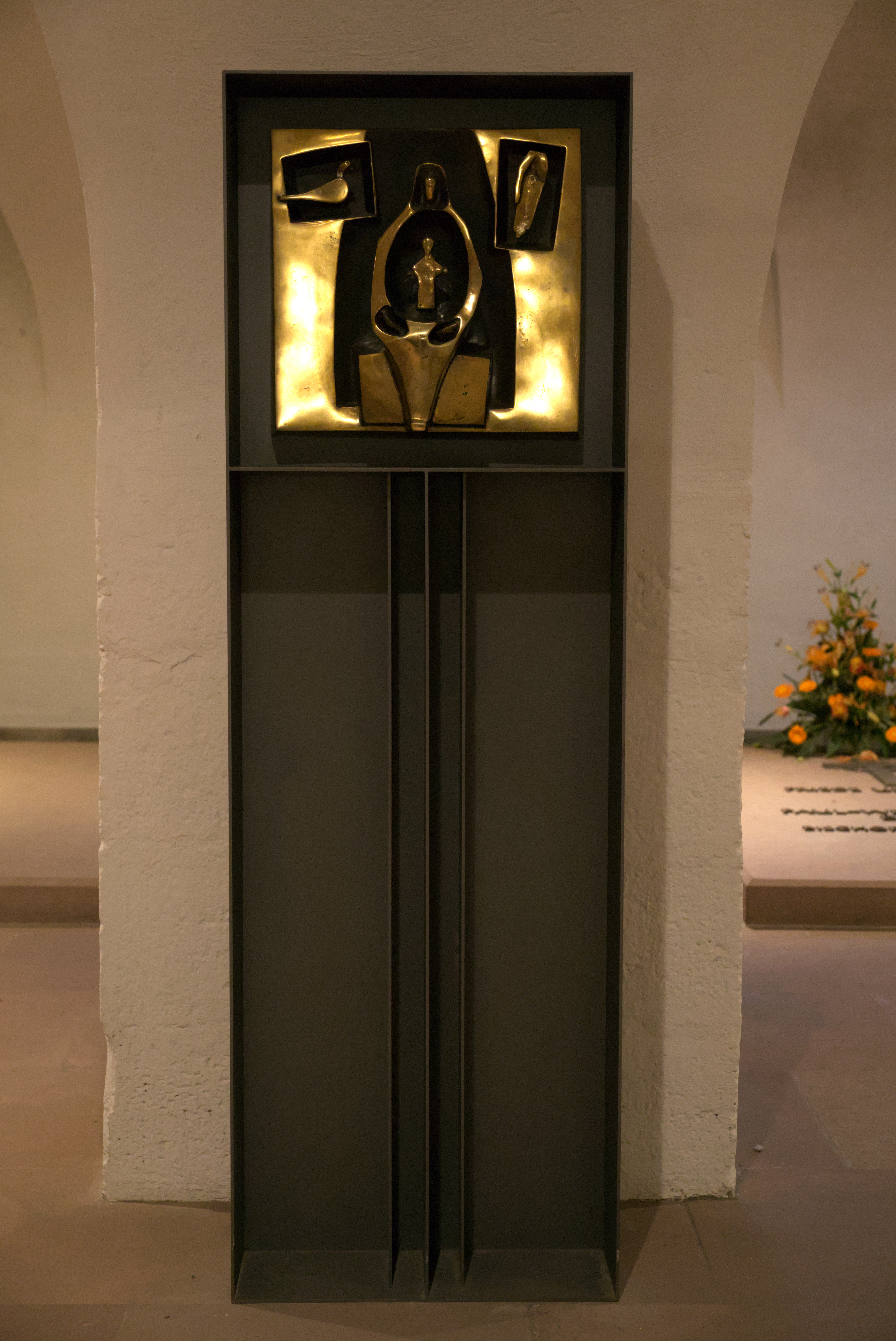
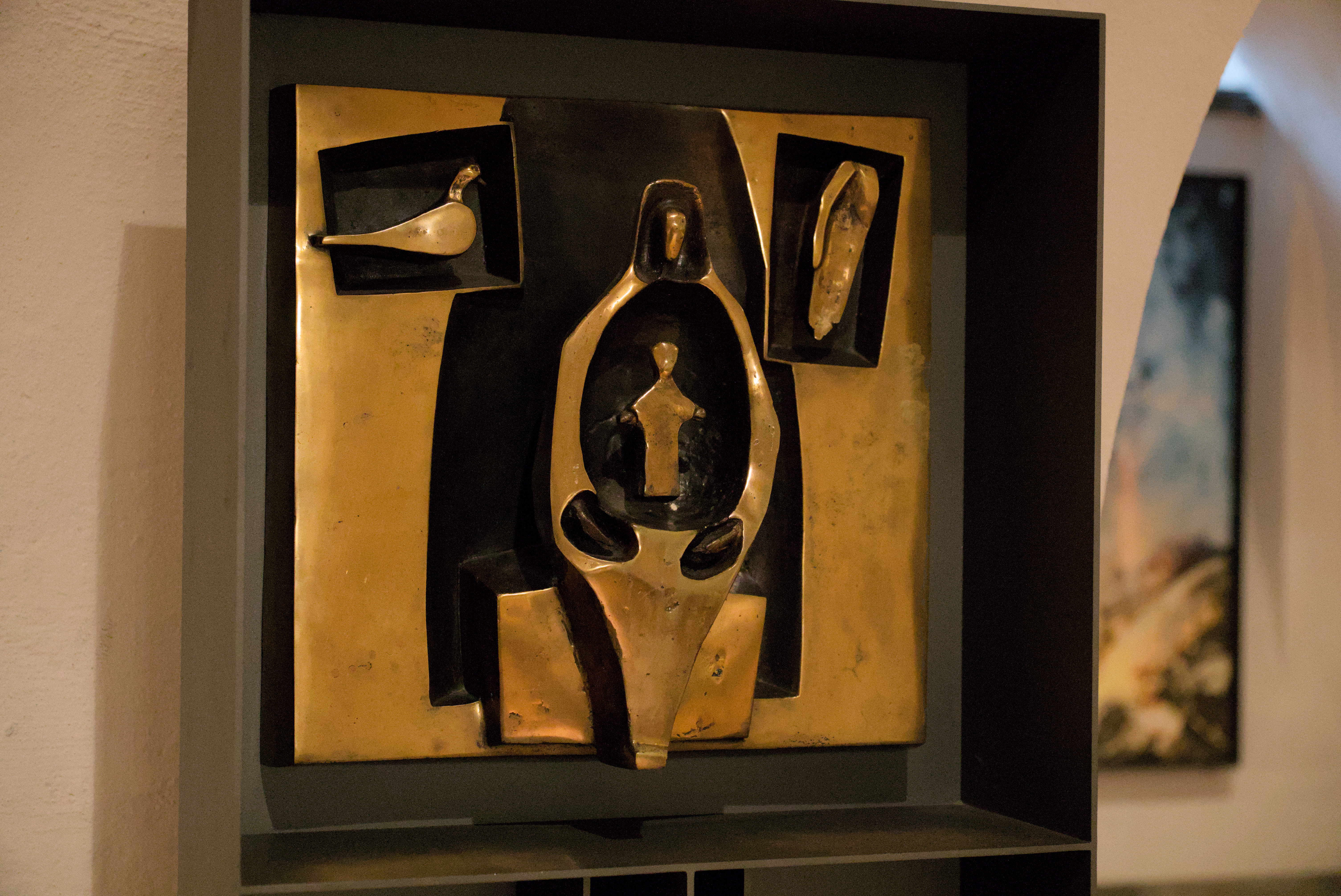
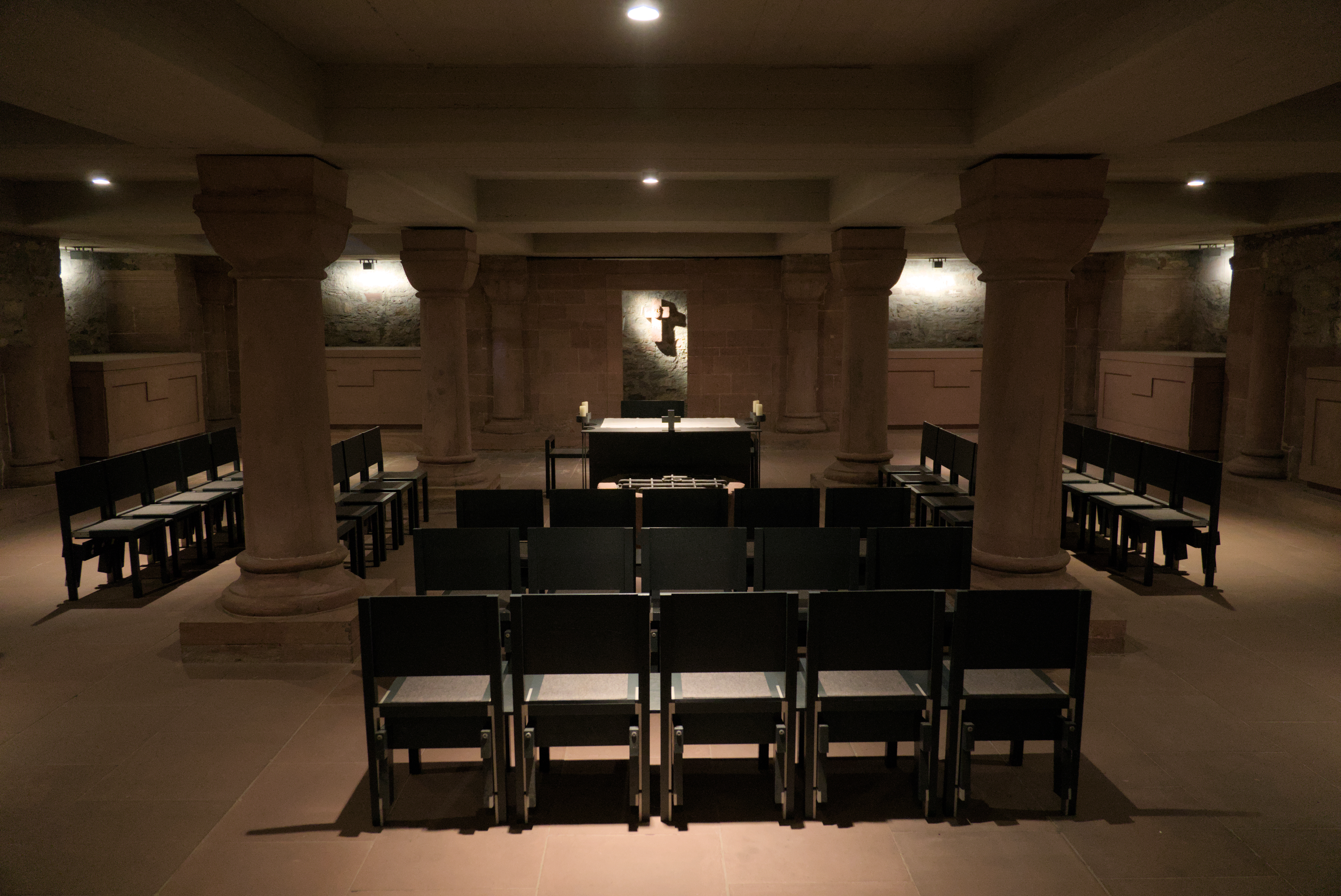
The final section of the cathedral that I visited was the crypt below, divided into four rooms. In one side room there’s a small, square bronze relief of the Trinity, elevated in a simple, black wooden structure: the Father represented as a benevolent hand reaching down from the heavens; the Son as the incarnate Word, the infant Christ, seated in the lap of the woman who bore him into the world, and from whom he took his flesh; and the Holy Spirit as a dove.

Albert Schilling_Our Lady of the Trinity
Albert Schilling (Swiss, 1904–1987), Notre Dame de la Trinité (Our Lady of the Trinity), 1957. Housing by Jürgen Lenssen, 2012.

Albert Schilling_Our Lady of the Trinity

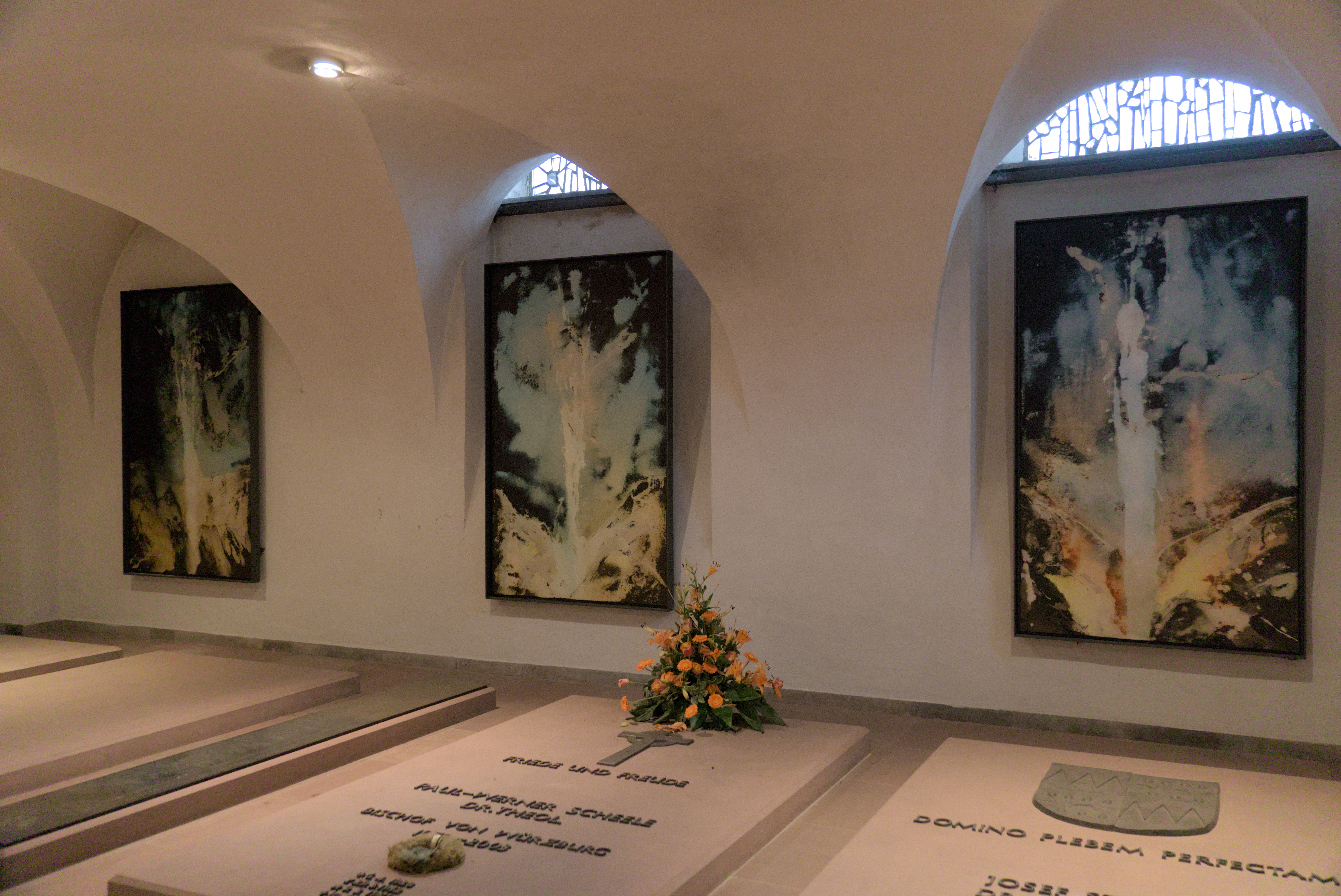
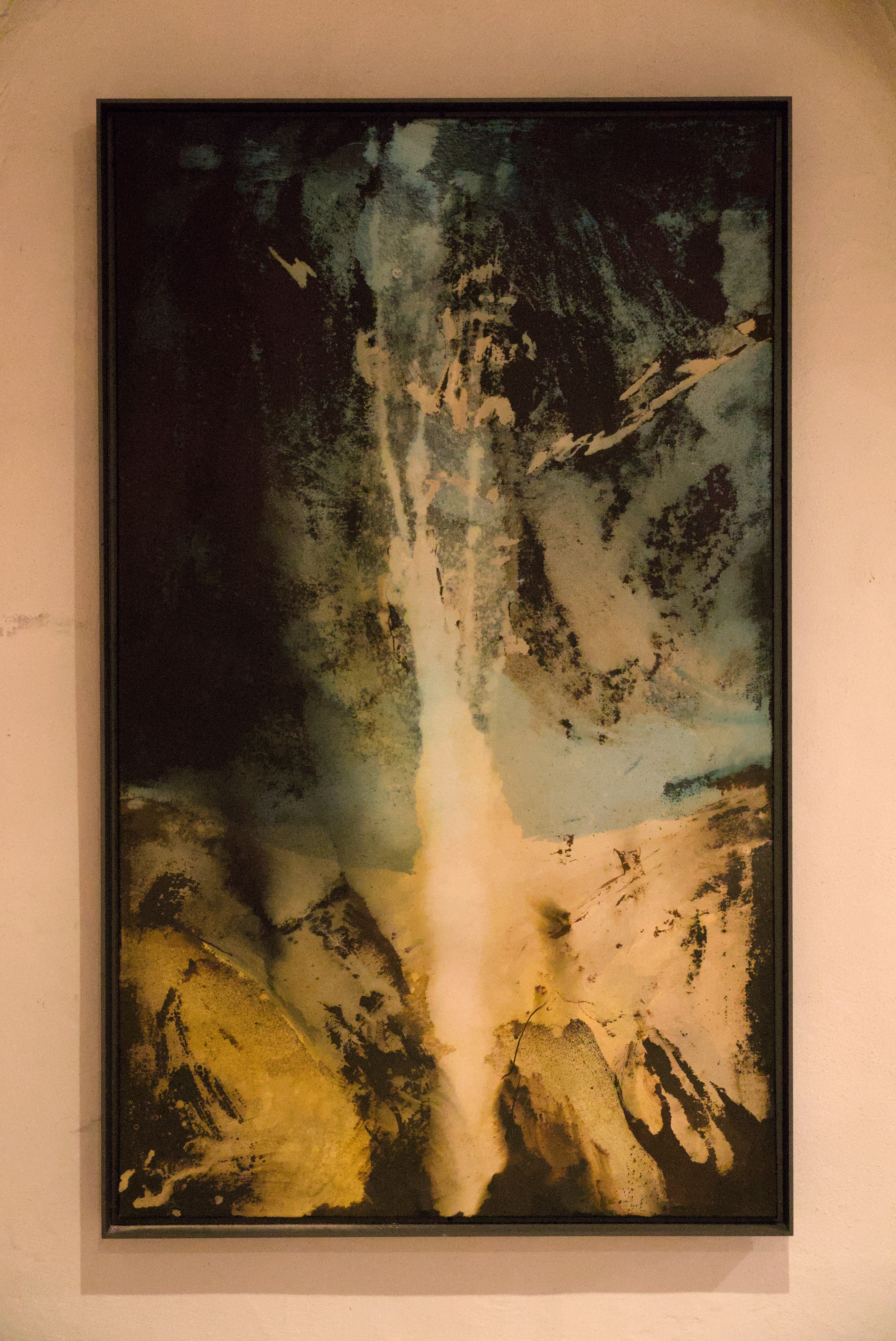
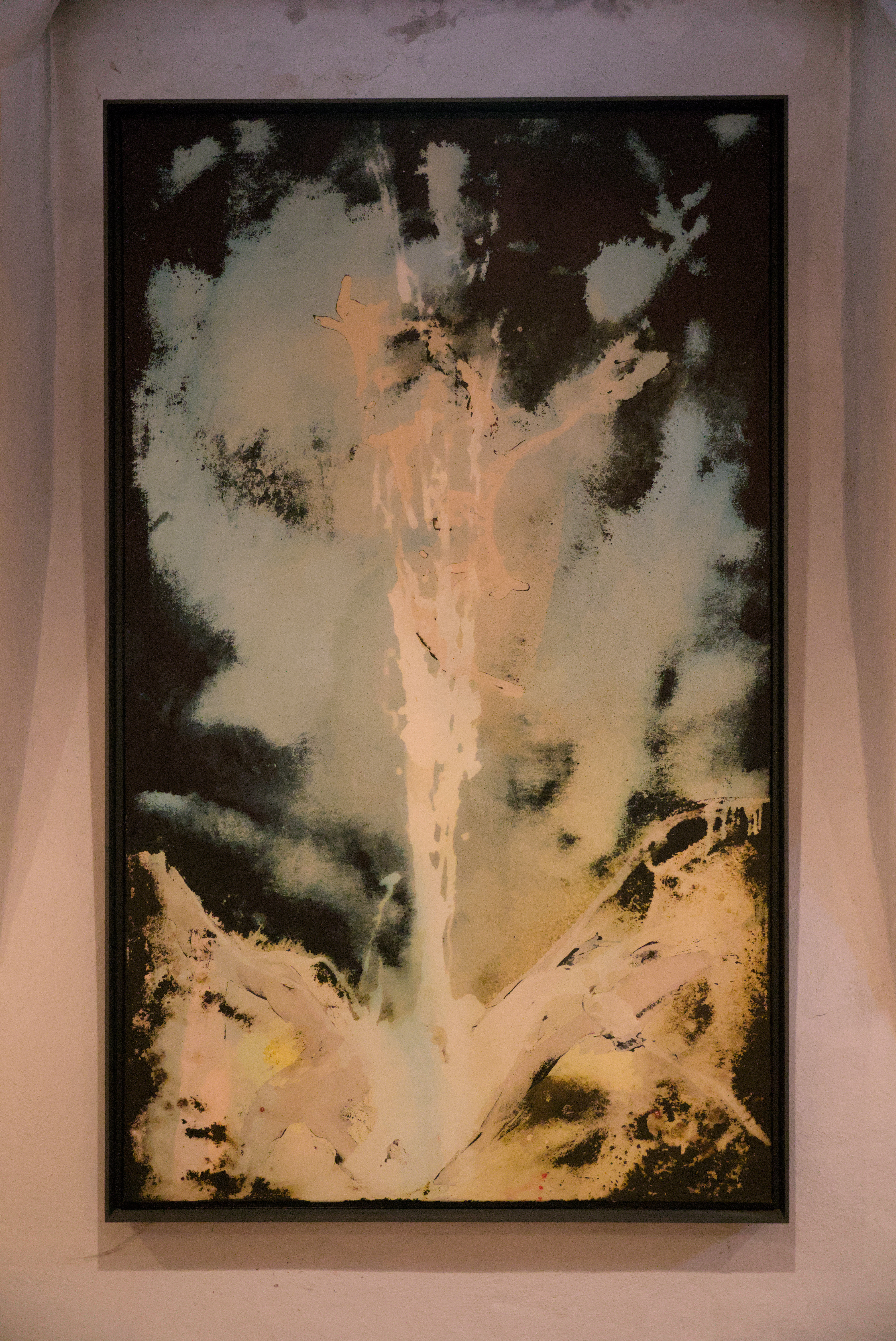
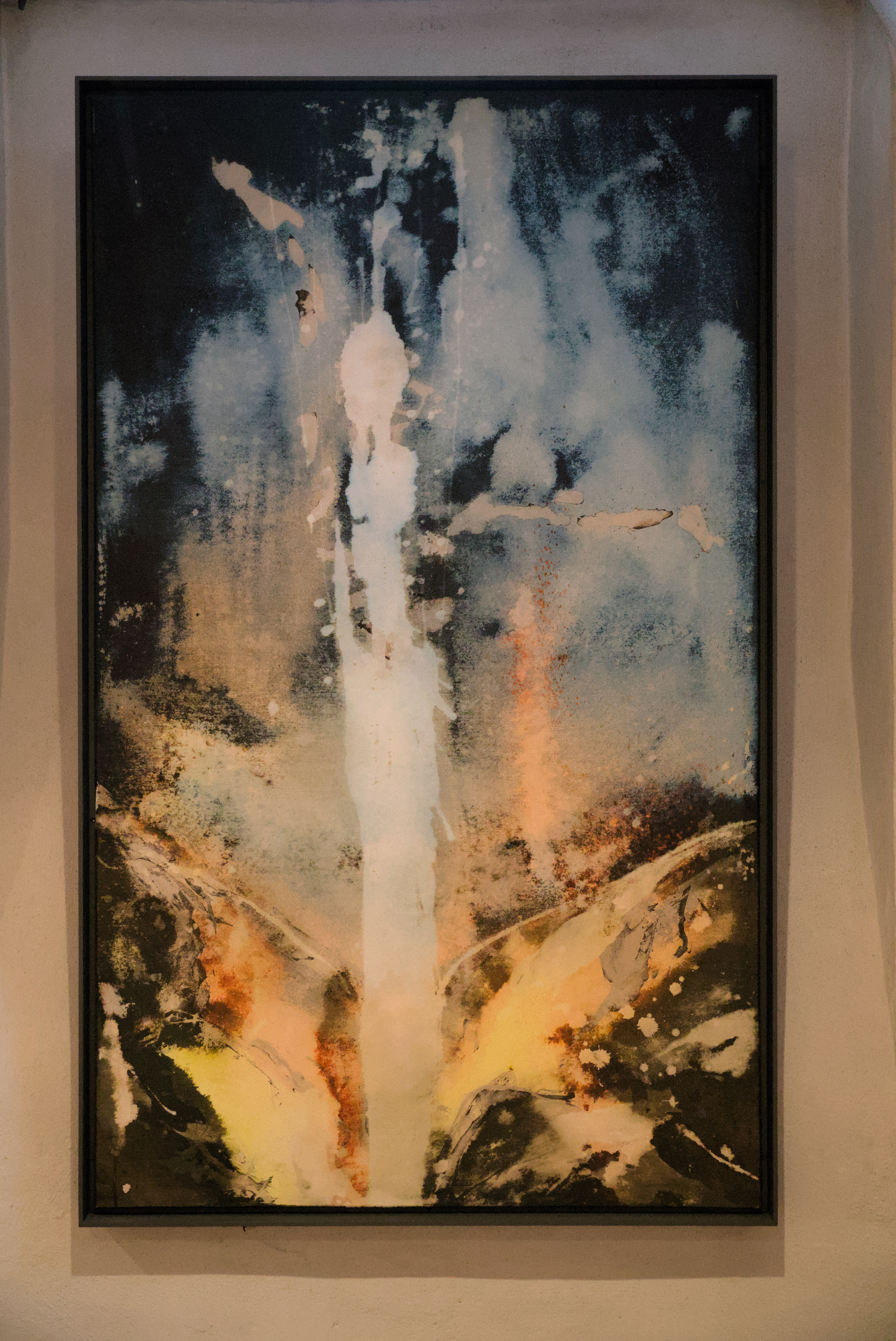
Against the wall are three large gestural paintings—inks on canvas—by Jacques Gassmann, on the theme of resurrection. In each, a pillar of light bursts up out of the ground, pushing aside the darkness.

Jacques Gassmann_Resurrection
Jacques Gassmann (German, 1963–), Resurrection, 2012

  • Jacques Gassman_Resurrection I
  • Jacques Gassman_Resurrection II
  • Jacques Gassman_Resurrection III

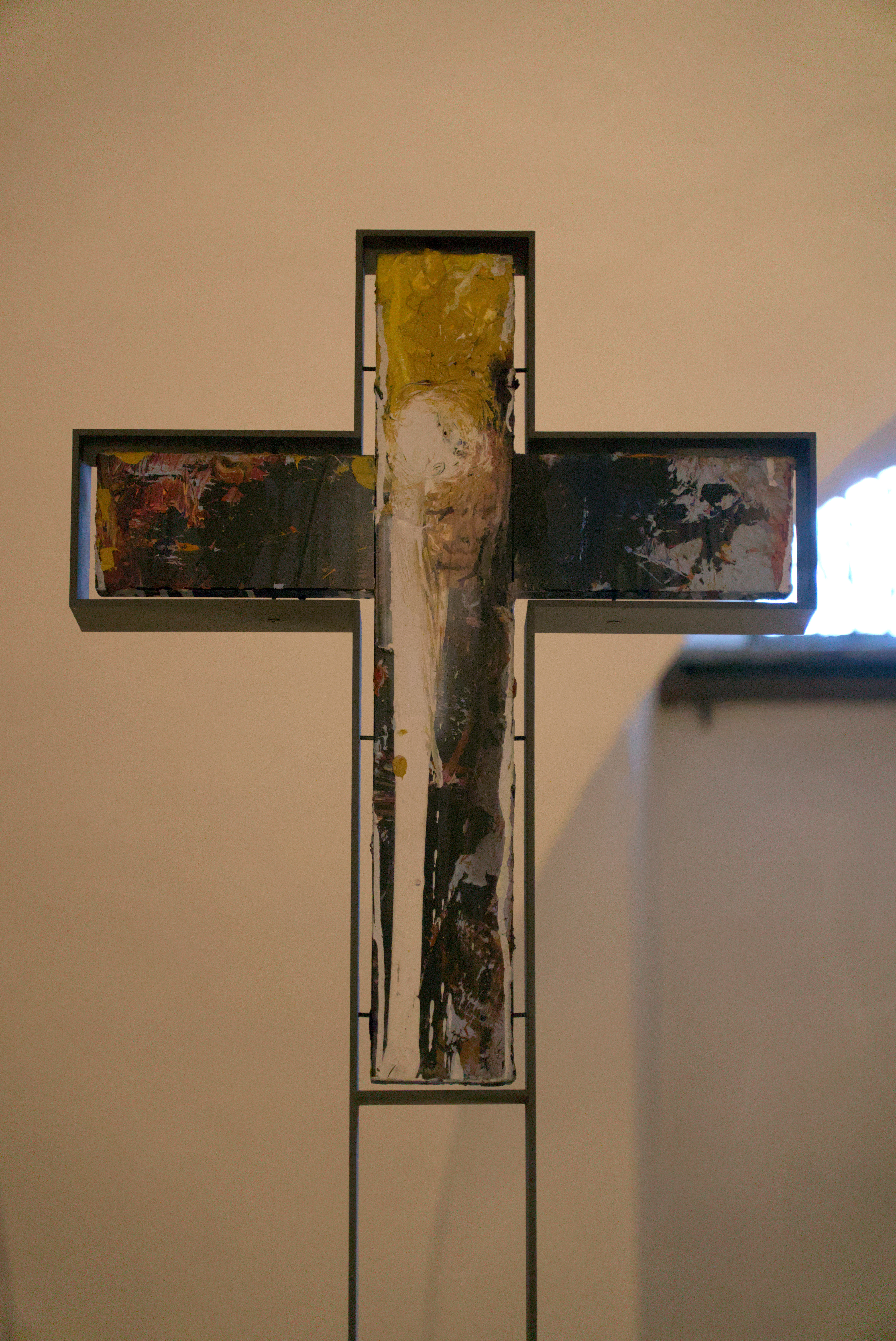
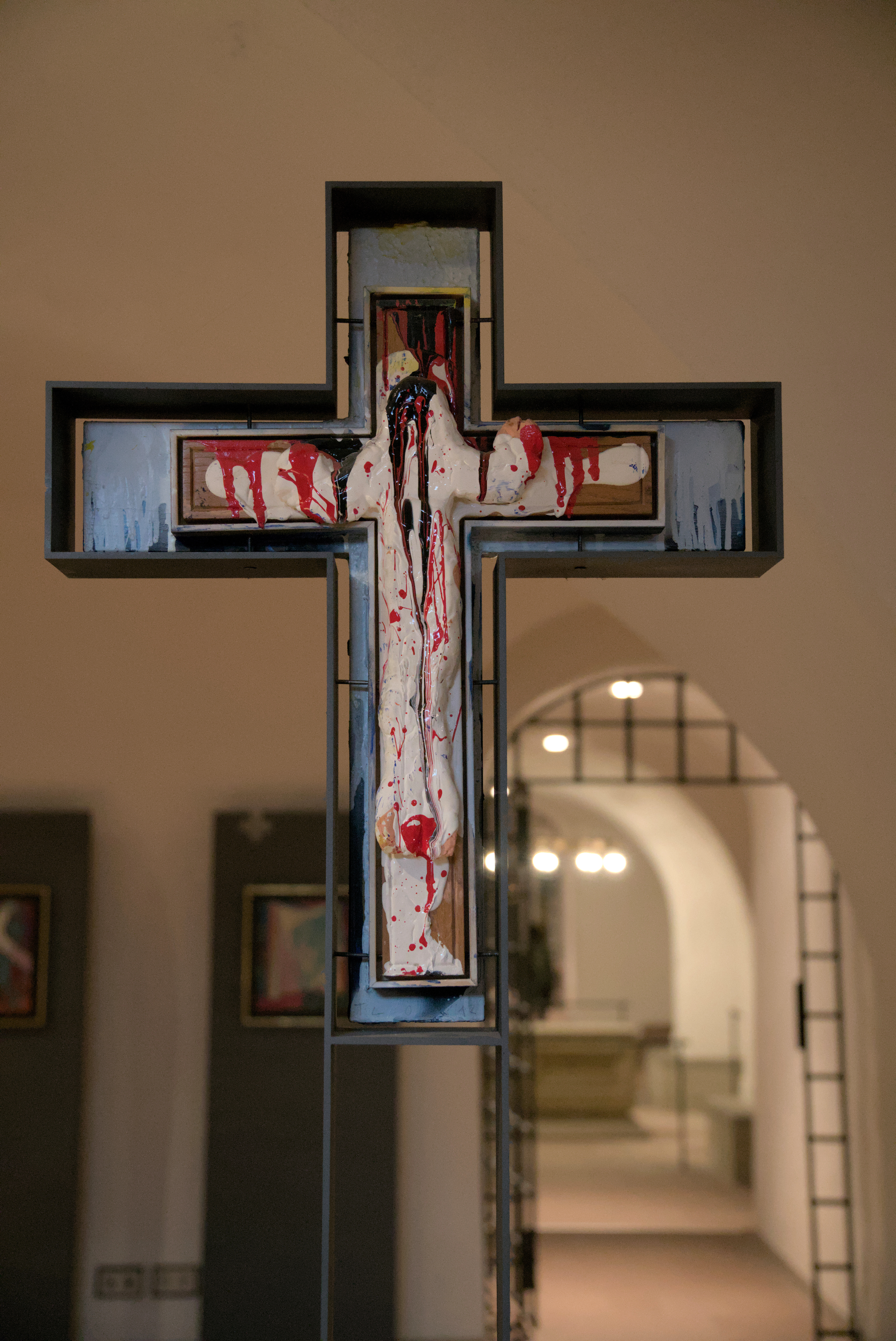
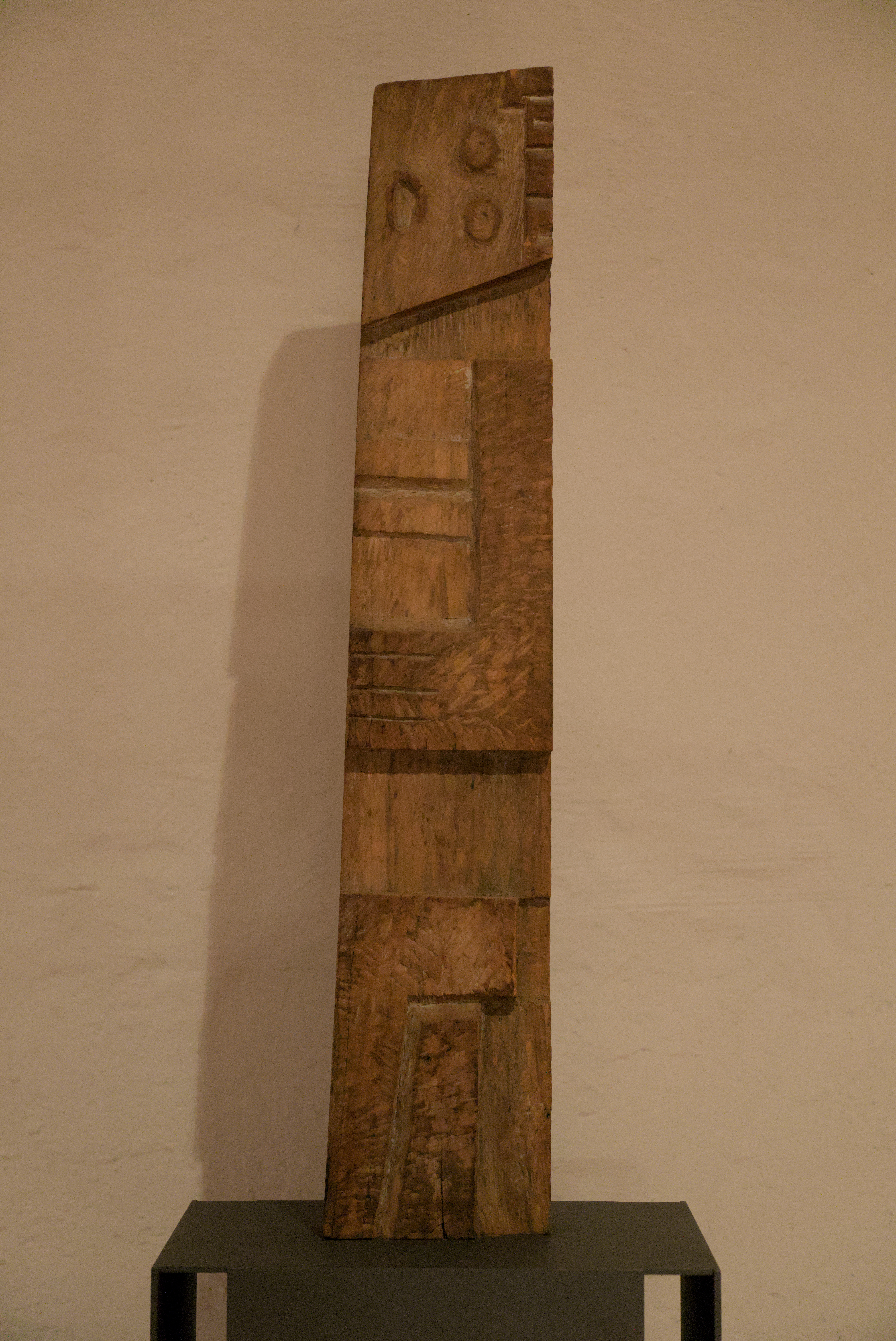
The other side room contains a set of Stations of the Cross paintings by Karl Clobes, plus a double-sided stand cross and a Picasso-esque wooden column carved with the likeness of Christ as the Man of Sorrows.

Stand cross
Stand cross by Jürgen Lenssen, 2012, with cross by Thomas Lange, 2012

Stand cross (back)
Friedrich Press_Man of Sorrows
Friedrich Press (German, 1904–1990), Schmerzensmann (Man of Sorrows), 1970

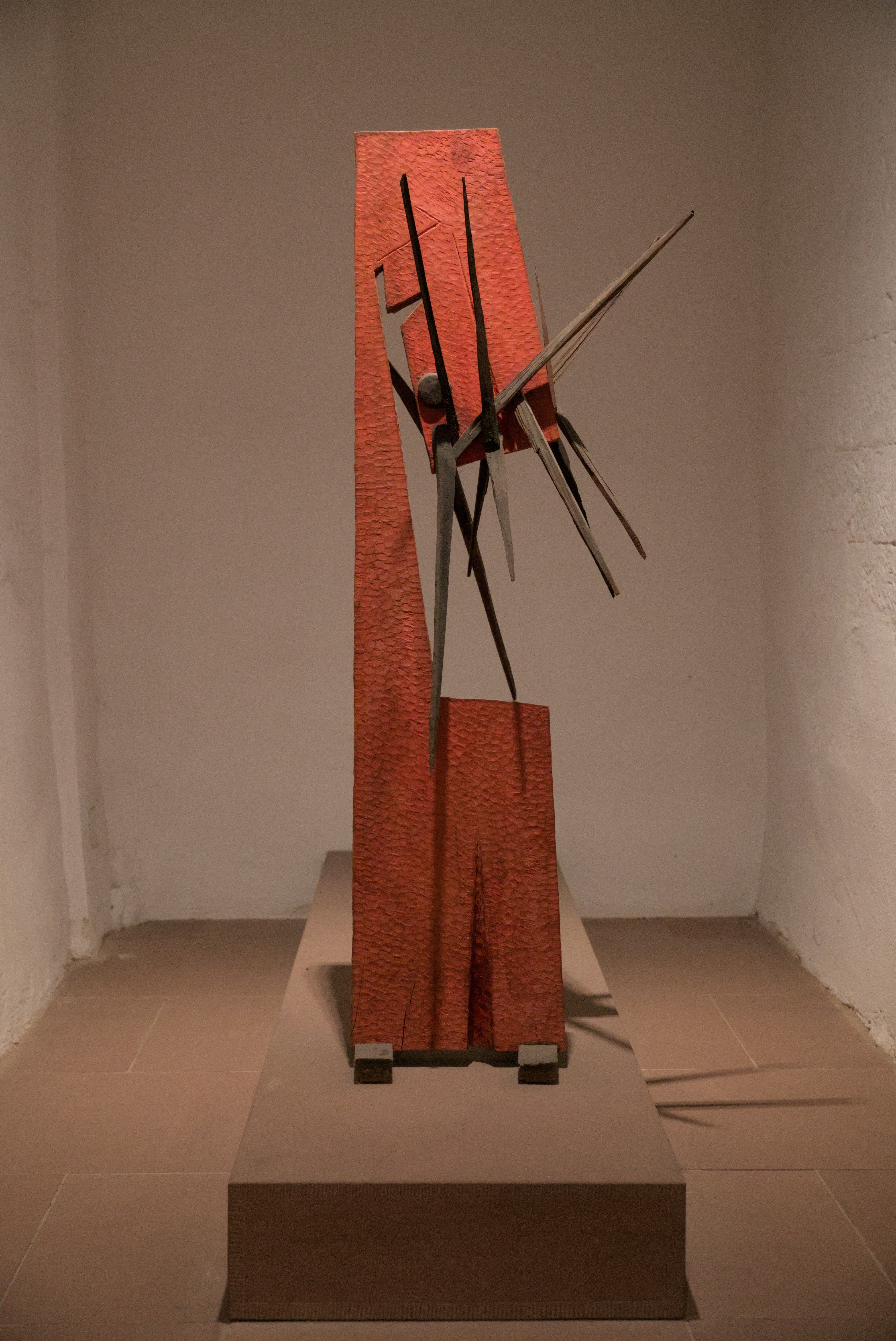
In a niche just outside is another Man of Sorrows sculpture by the same artist, this one in steel. Christ’s form is abstract and distorted. He bows his head, pierced by enormous thorns, at an impossible angle.

Friedrich Press_The Crown
Friedrich Press (German, 1904–1990), Die Krone (The Crown), 1984

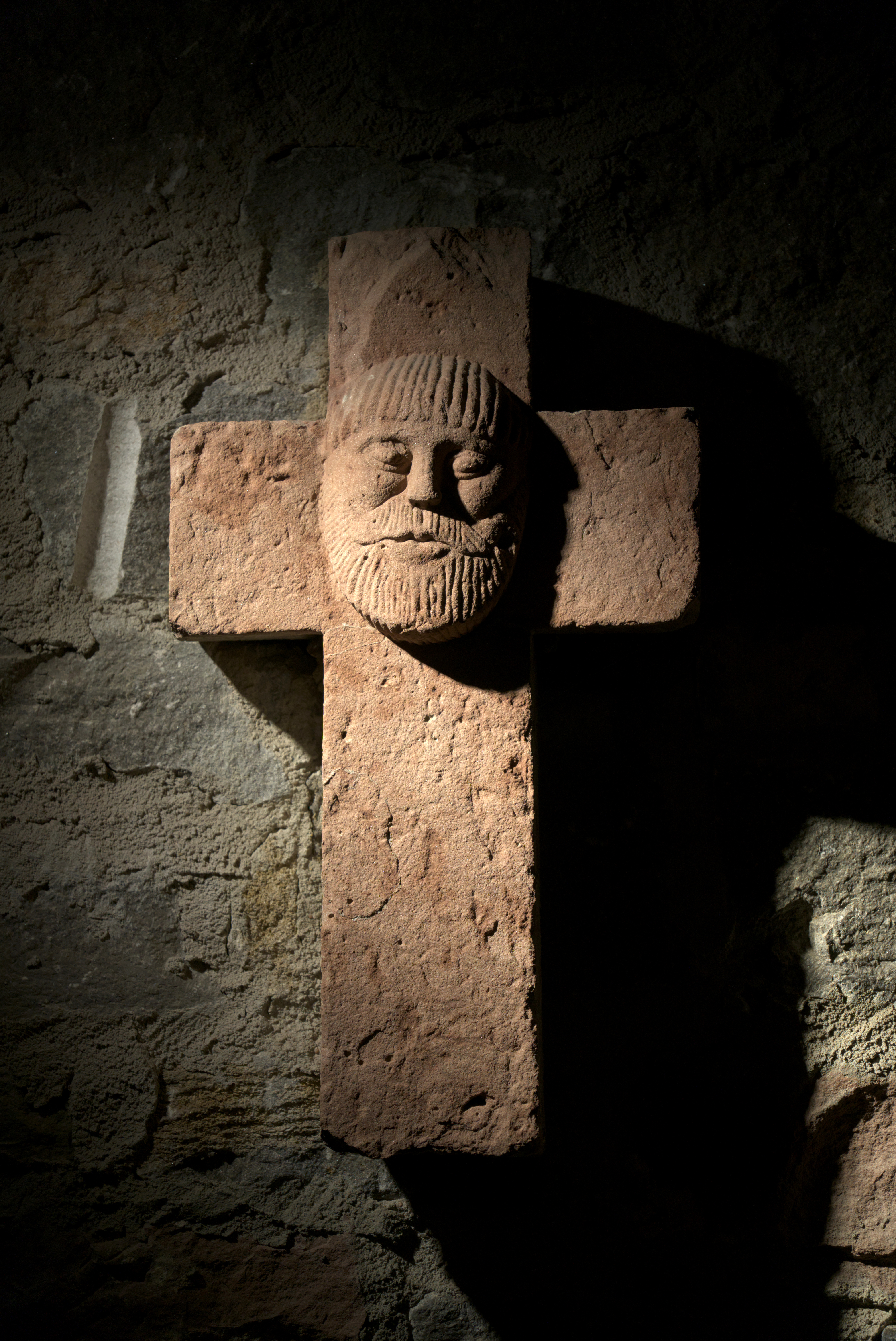
The western crypt contains the oldest artwork in the cathedral: a stone cross with a head of Christ in the center, wearing, the brochure interprets, a faint smile. It was previously supposed to be Merovingian or Carolingian, but more recent studies date it later to around the year 1000, making it Ottonian.

Western crypt, St. Kilian's Cathedral
Ottonian cross
Stone cross with softly smiling Christ, Ottonian, ca. 1000

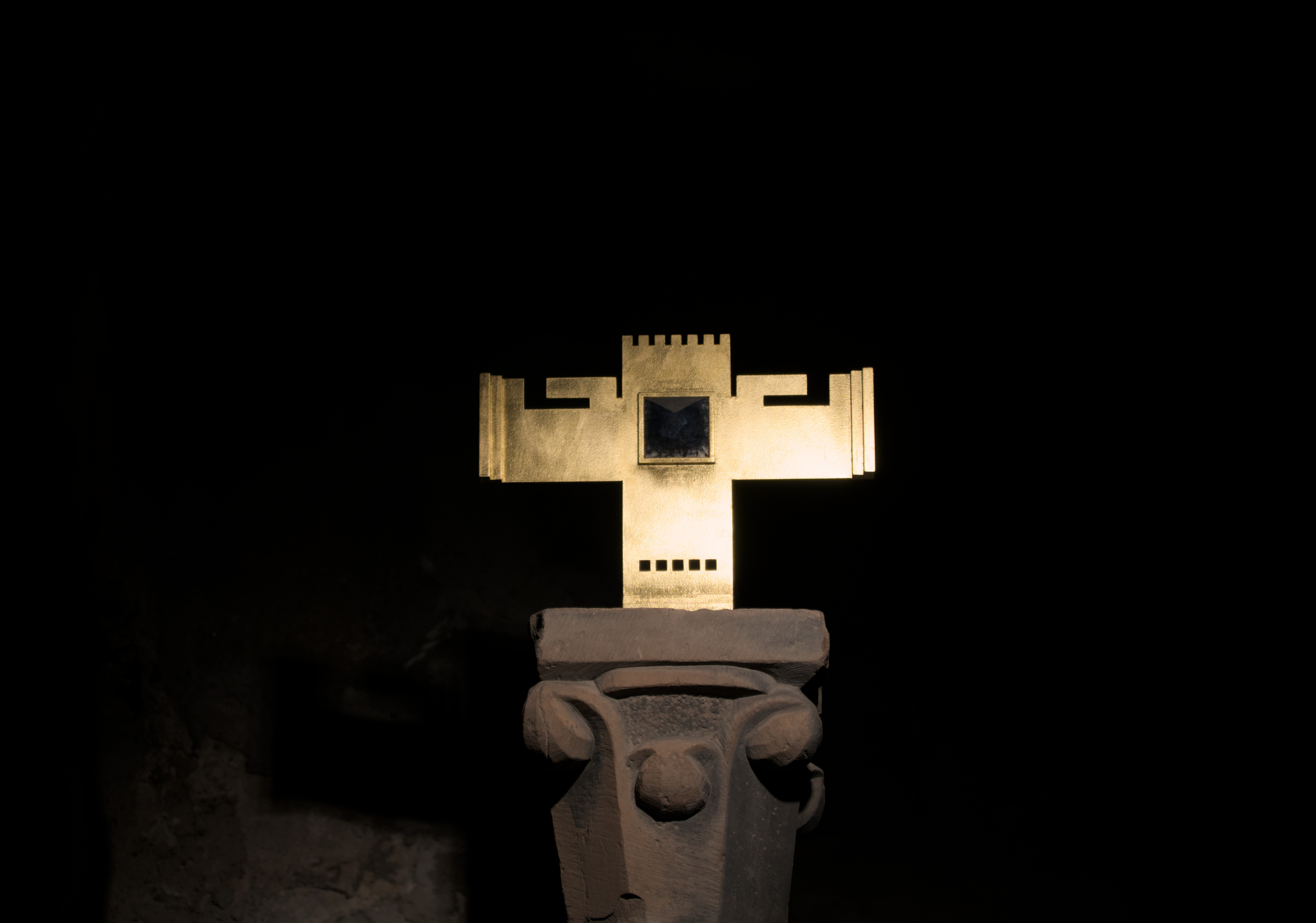
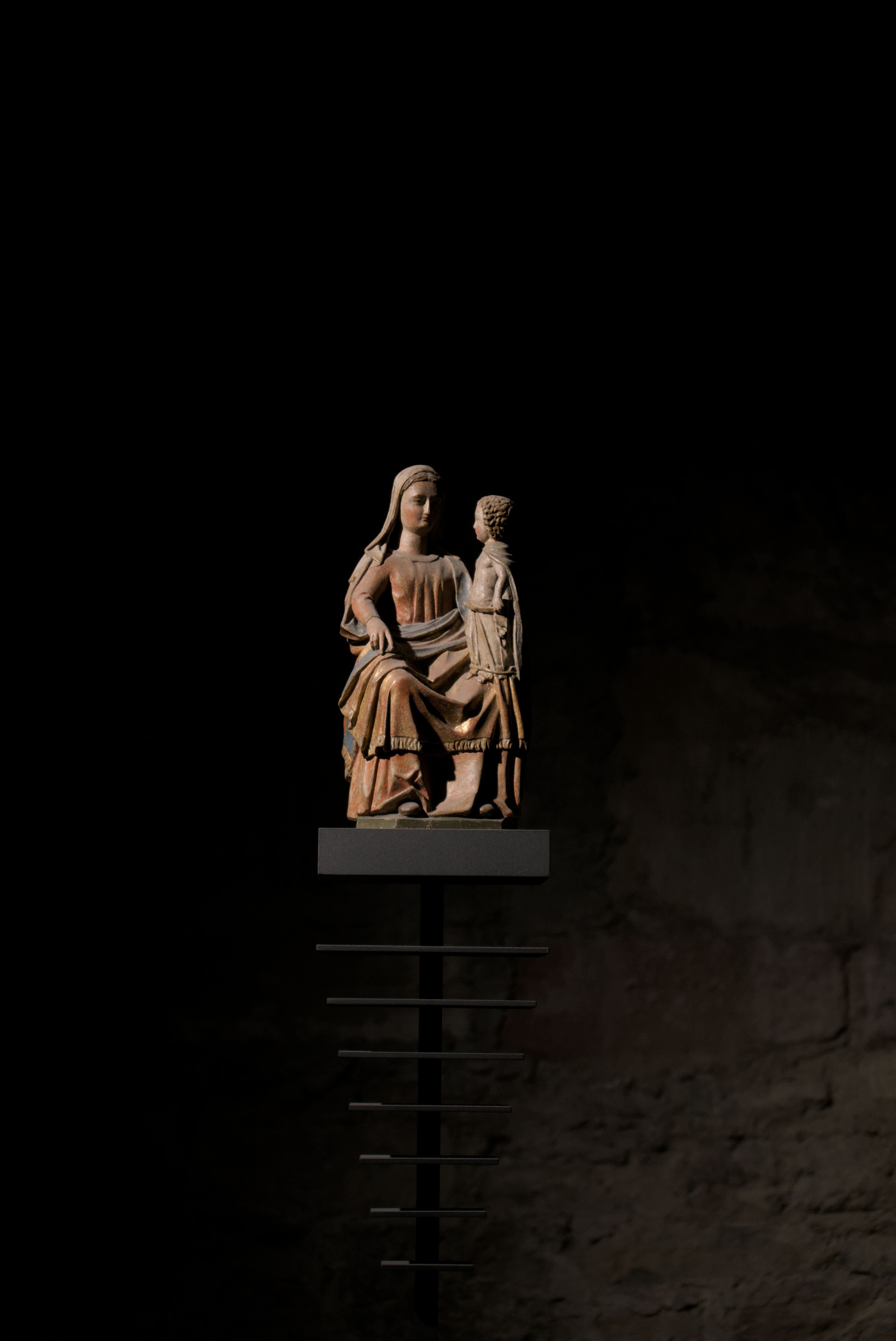
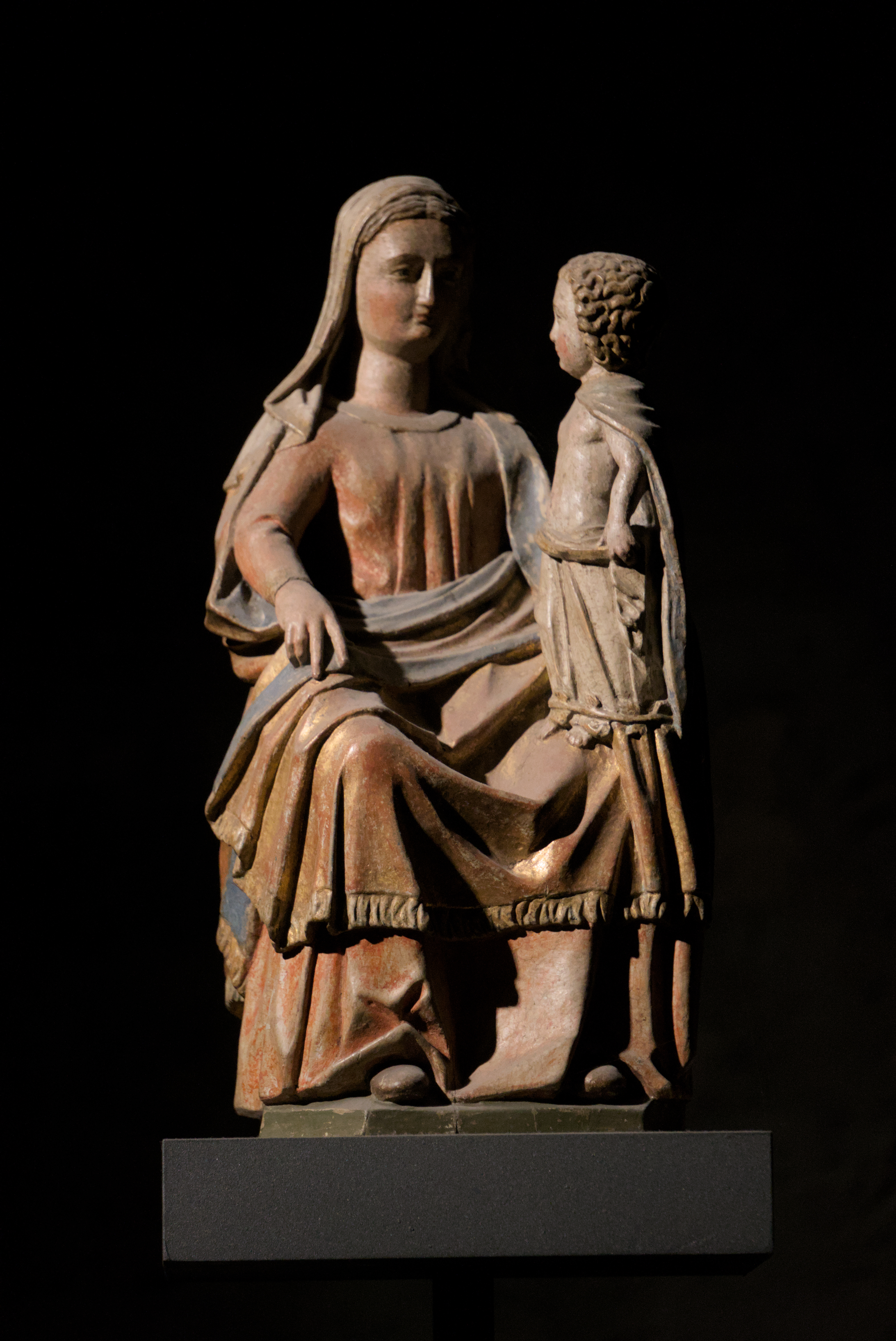
Niches at the left and right entrance of this chapel combine old and new. At the left, a stylized, gold-plated cross by Jürgen Lenssen, contemporary but resembling a pre-Columbian artifact, sits atop a Romanesque stele preserved from the prebombed cathedral. And at the right, a sixteenth-century Italian Madonna and Child are perched on the top tier of a distinctively modern stele, also by Lenssen.

Cross by Jürgen Lenssen
Cross by Jürgen Lenssen, 2012, on Romanesque stele

Madonna and Child
Virgin and Child, Italy, 16th century, with stele by Jürgen Lenssen, 2012

Madonna and Child

At one point while Eric and I were wandering about the cathedral, people were taking seats in the pews, and a man came out and gave some remarks in German. He was dressed nicely but not in liturgical vestments, so I figured it wasn’t a Mass. Since it was pouring rain outside, I was in no rush to reach my final Würzburg destination, so I decided to take a seat as well. When the speaker sat down, sonorous musical tones started issuing forth from the loft behind me. It turns out we were being treated to a lovely fifteen-minute organ concert. Here’s a snippet:

The Museum am Dom (Cathedral Museum) next door was closed for renovations when I was in Würzburg; it will reopen in summer 2028. The Domschatz (Cathedral Treasury), located inside the cathedral, was also closed to individuals, which was a shame.

Even so, Würzburg Cathedral offers many sights worth seeing—and at no cost! Having seen a photo only of the high altar prior to visiting, I was pleasantly surprised by the great variety of works inside.

Day Trip to Würzburg, Part 1: Marienkapelle

All photos in this post are my own.

Late this August, my husband and I flew to Frankfurt, Germany, and from there traveled south, spending nine days in the state of Bavaria. I built our itinerary mainly around religious art I’d been wanting to see, an interest my husband indulges and even appreciates (just not to the same degree I do!).

Bavaria is most associated with the Baroque and Rococo art and architectural styles, which are not styles I gravitate to. I was on the lookout for medieval treasures mostly, but with an openness to surprises.

I planned for us to stop in the city of Würzburg en route from Frankfurt to Rothenburg ob der Tauber because I wanted to see a unique fifteenth-century tympanum relief in the north portal of the Roman Catholic Marienkapelle (pronounced ma-REE-en-kah-PEL-lay), or St. Mary’s Chapel, depicting one of my favorite Gospel stories. More on that below.
Food tents outside the Marienkapelle
Marienkapelle

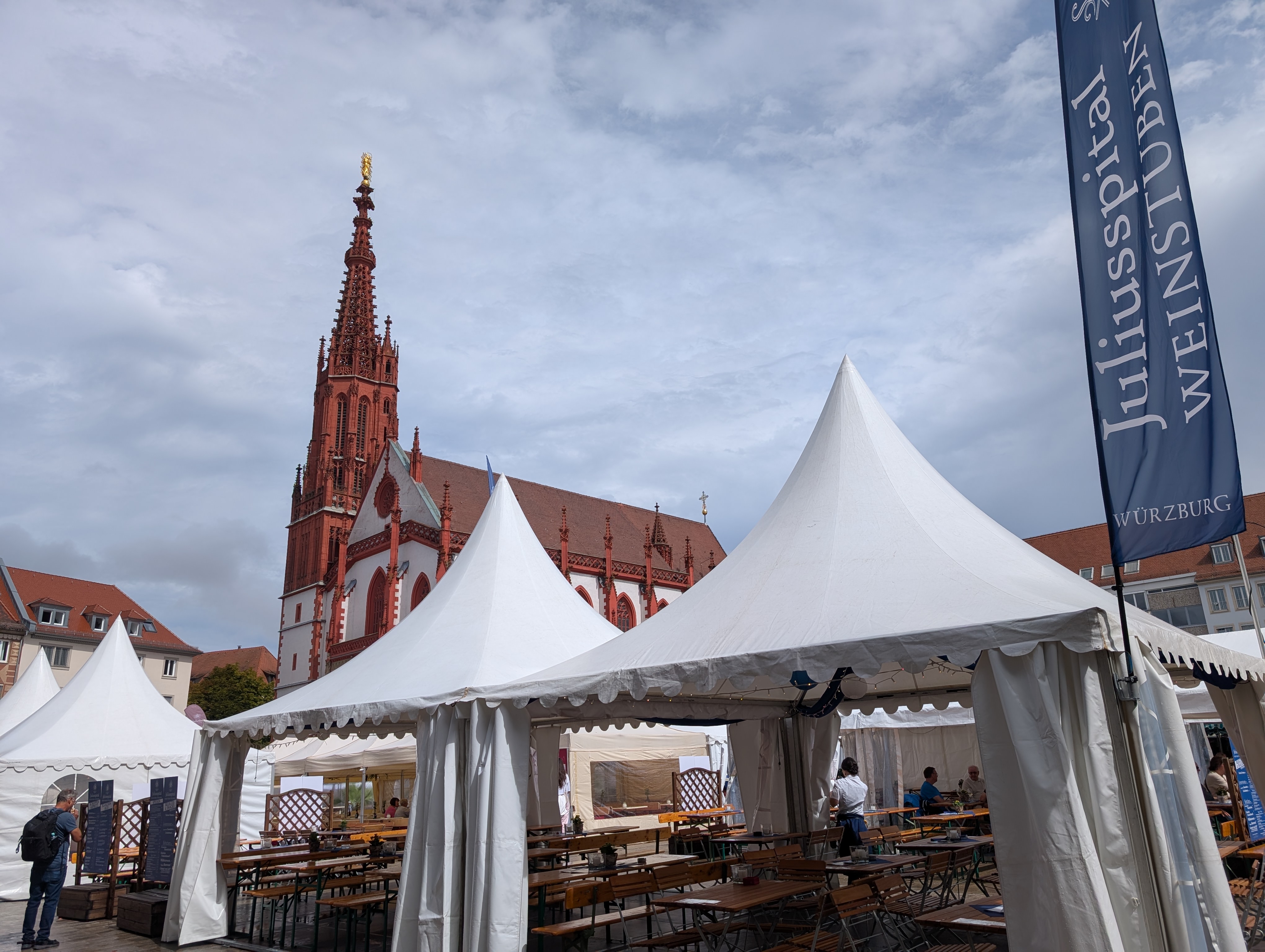
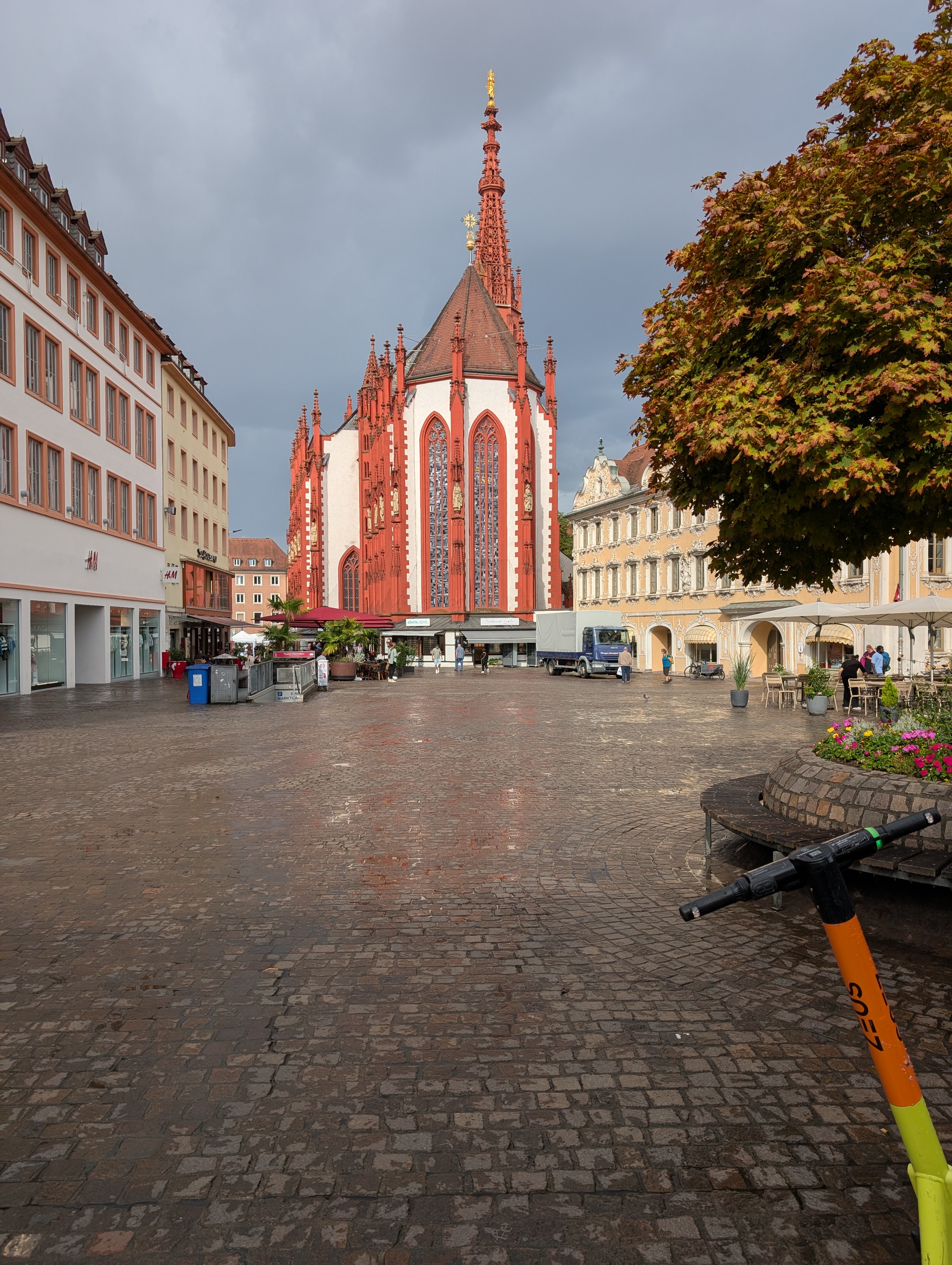
Situated in the town’s Marktplatz (market square), the Marienkapelle is a late Gothic place of worship built in the late fourteenth and fifteenth centuries. It was heavily damaged by an Allied bombing raid on March 16, 1945—the same raid that, in less than twenty minutes, destroyed 90 percent of the historic city and killed an estimated five thousand people—and was rebuilt and restored in 1948–61.
Various little “swallow shops,” selling gifts and pastries, are built into the exterior base and buttresses.

Because of the building’s size and central location, the Marienkapelle is often mistaken for Würzburg’s cathedral, but it is not: A cathedral is the official seat of a diocesan bishop, and that’s St. Kilian’s, a five-minute walk away. In fact, the Marienkapelle is not even technically a church, according to canon law, because it does not have its own independent parish. It’s legally classified as a “chapel.” However, it is a church in the loose sense of the word, as it hosts regular worship services, administered by the united parishes of St. Kilian’s and Neumünster, which we’ll visit in separate posts.

Thankfully, although the Royal Air Force incendiaries destroyed the timber-framed interior of the Marienkapelle, the heavy masonry portals and recessed entryways largely protected the medieval relief carvings on the exterior.

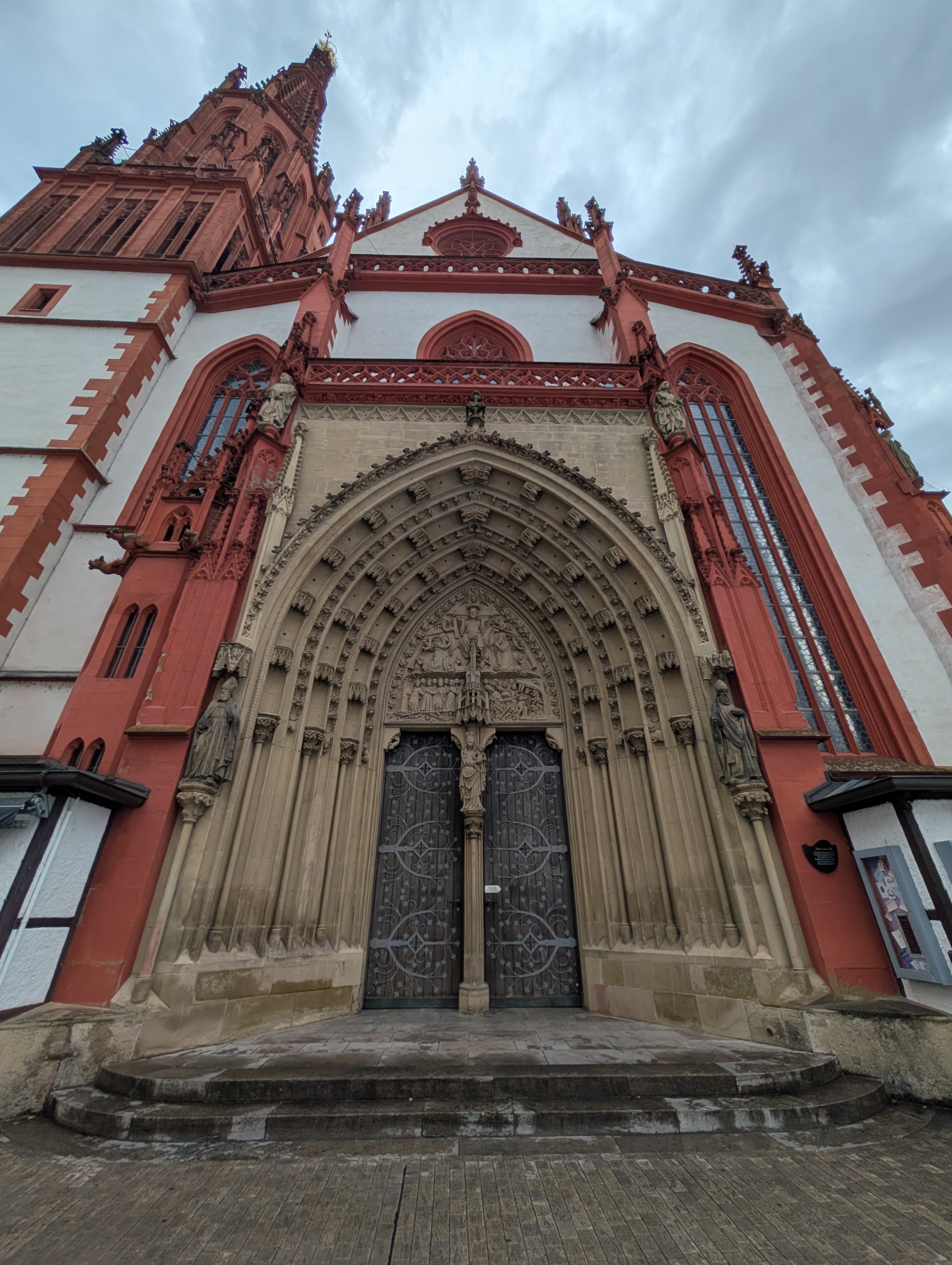
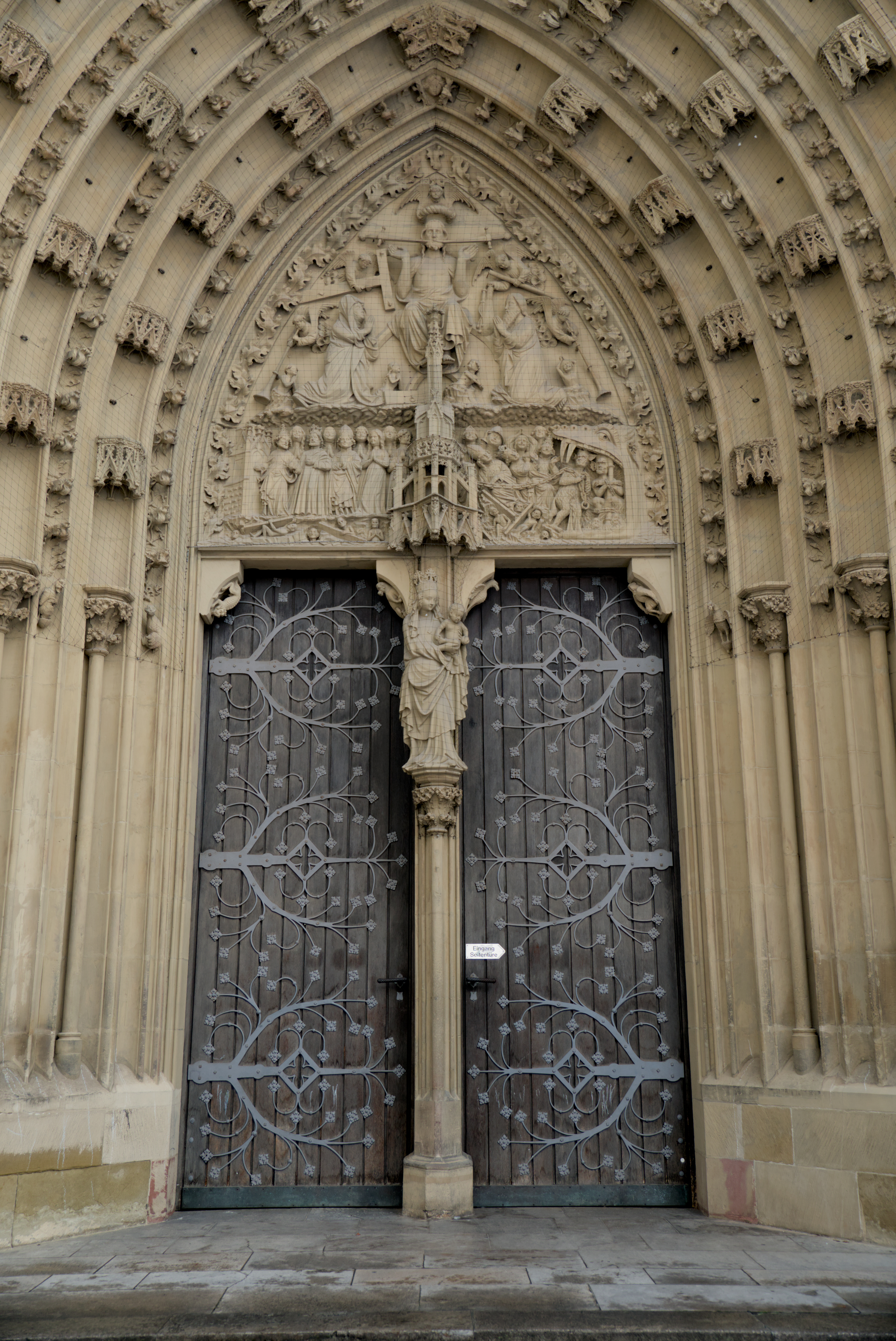
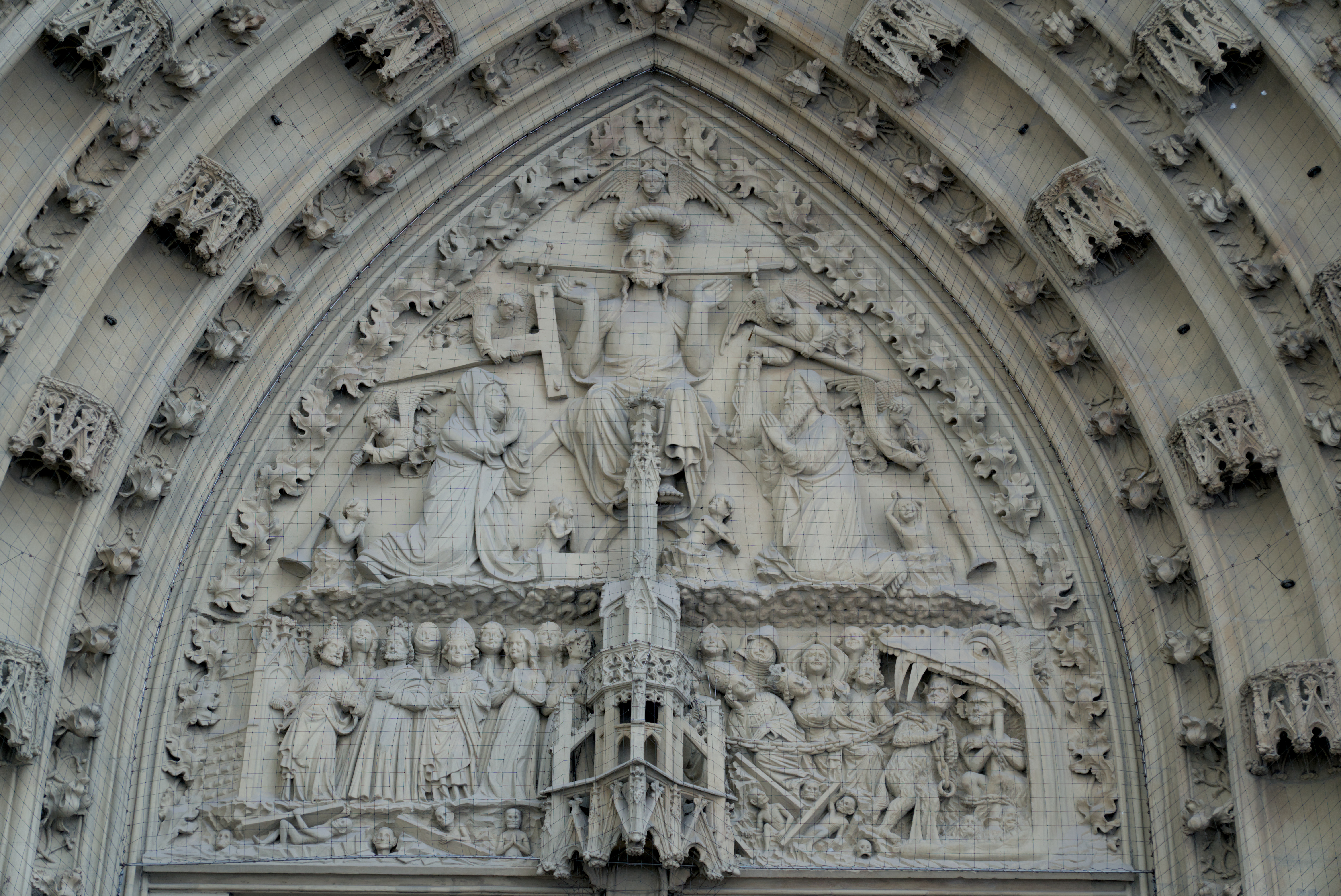
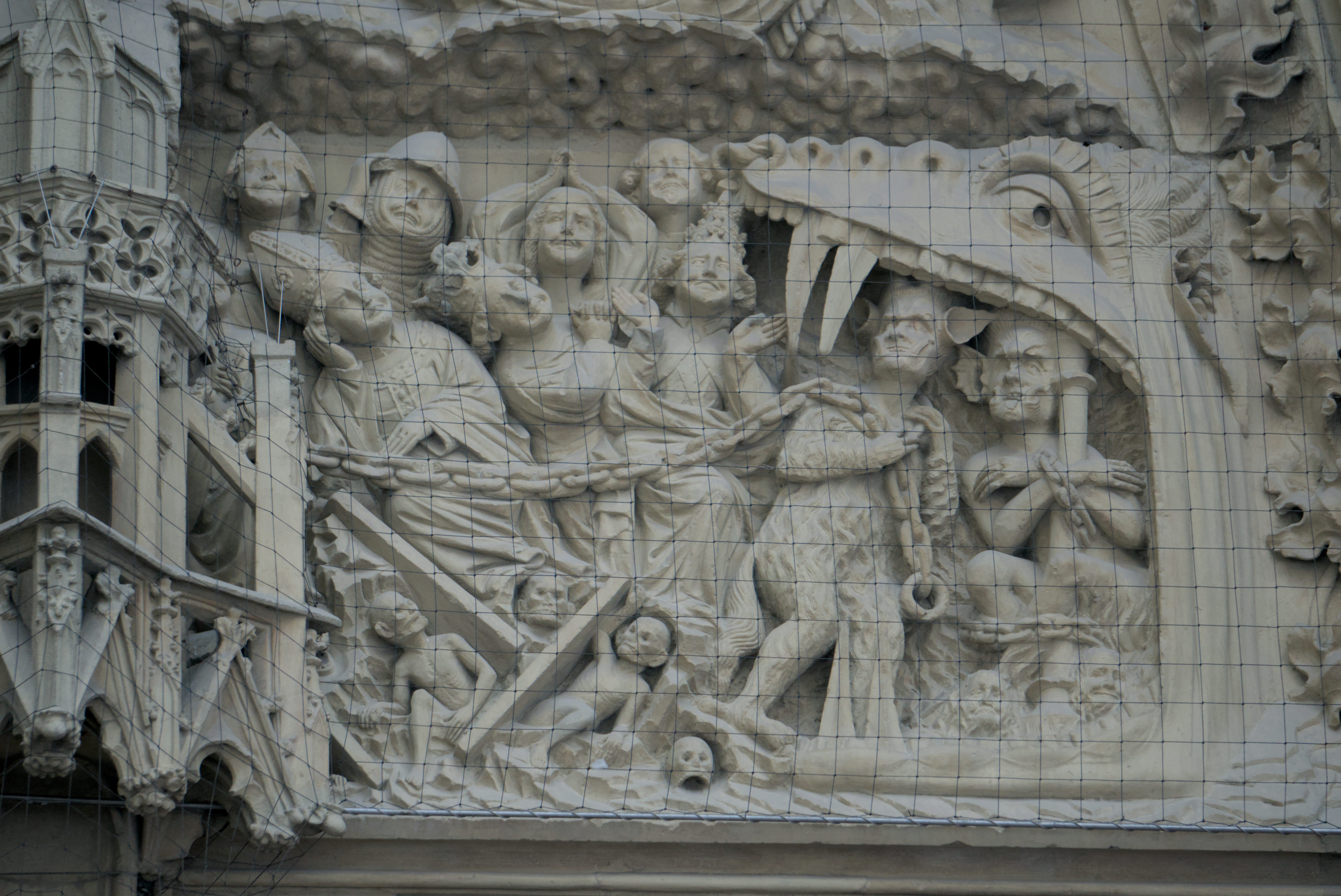
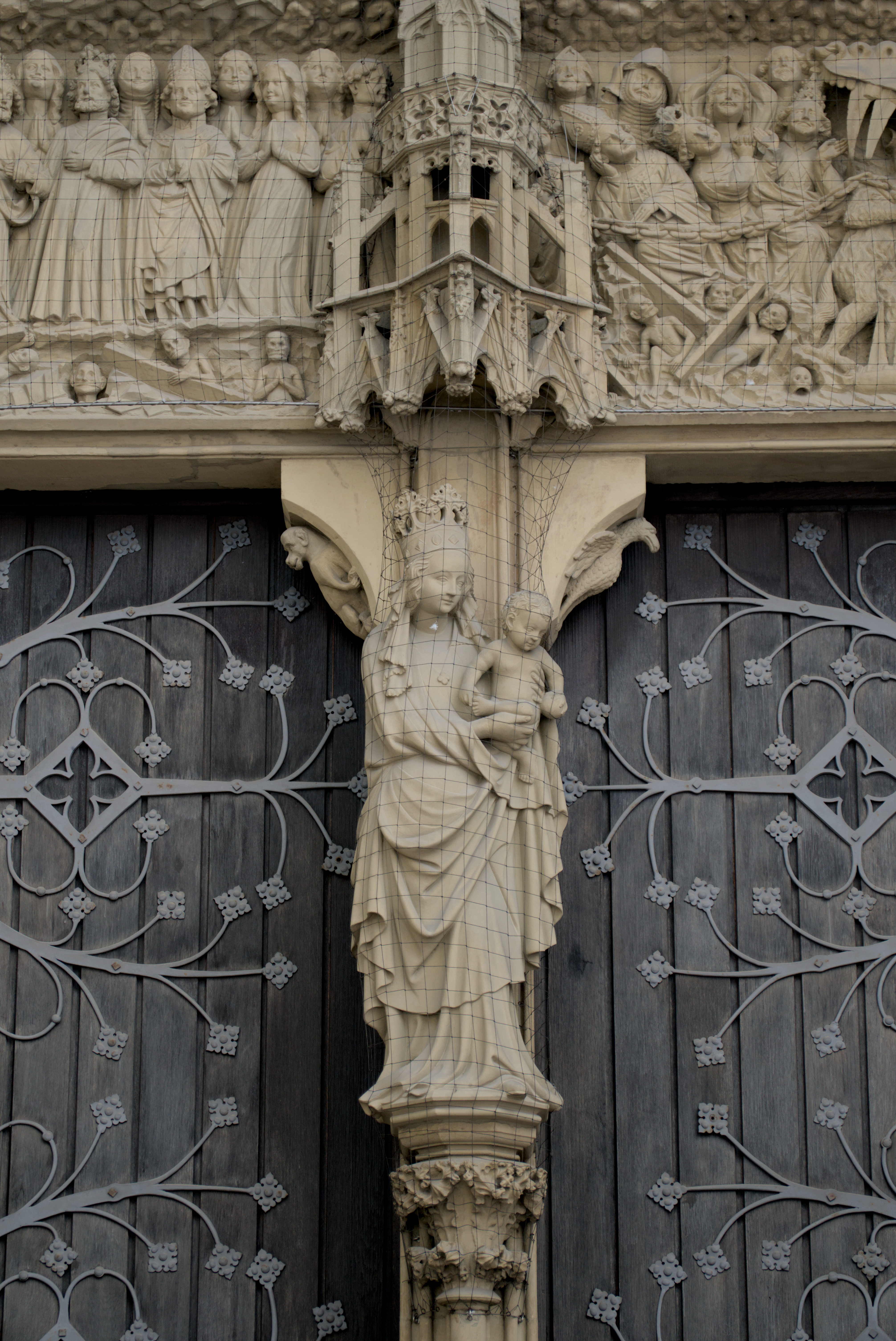
The tympanum of the main, west portal, through which you enter the chapel, portrays the Last Judgment. Jesus Christ is seated on a rainbow throne, being crowned by an angel. Drawing on Revelation 1:16 and 19:15, two swords protrude from his mouth, the one on his right a (likely mistaken) departure from traditional iconography, which has a lily instead, symbolizing mercy, which acts alongside his justice.

Last Judgment, west portal, Marienkapelle
Last Judgment, west portal
Last Judgment tympanum, Marienkapelle

He is flanked by angels carrying instruments of his passion—a cross, a column and whip—and two others blowing trumpets, which wakes the dead from their graves. Mother Mary and John the Baptist intercede for those rising to judgment.

On Christ’s right (our left) are the blessed, and on his left (our right) are the damned, being dragged by a hairy devil into a gaping hellmouth. Among the latter group are kings, knights, and bishops, showing that wealth and institutional status earn you no favors with God, and that outward acts of piety or noble deeds count for nothing if they proceed out of an impure heart.

Last Judgment detail, Marienkapelle

I love the detail at the bottom of people’s skeletons taking on flesh as they push aside the lids of their coffins! This is the general resurrection, the promised reuniting of body and soul prefigured in Ezekiel 37.

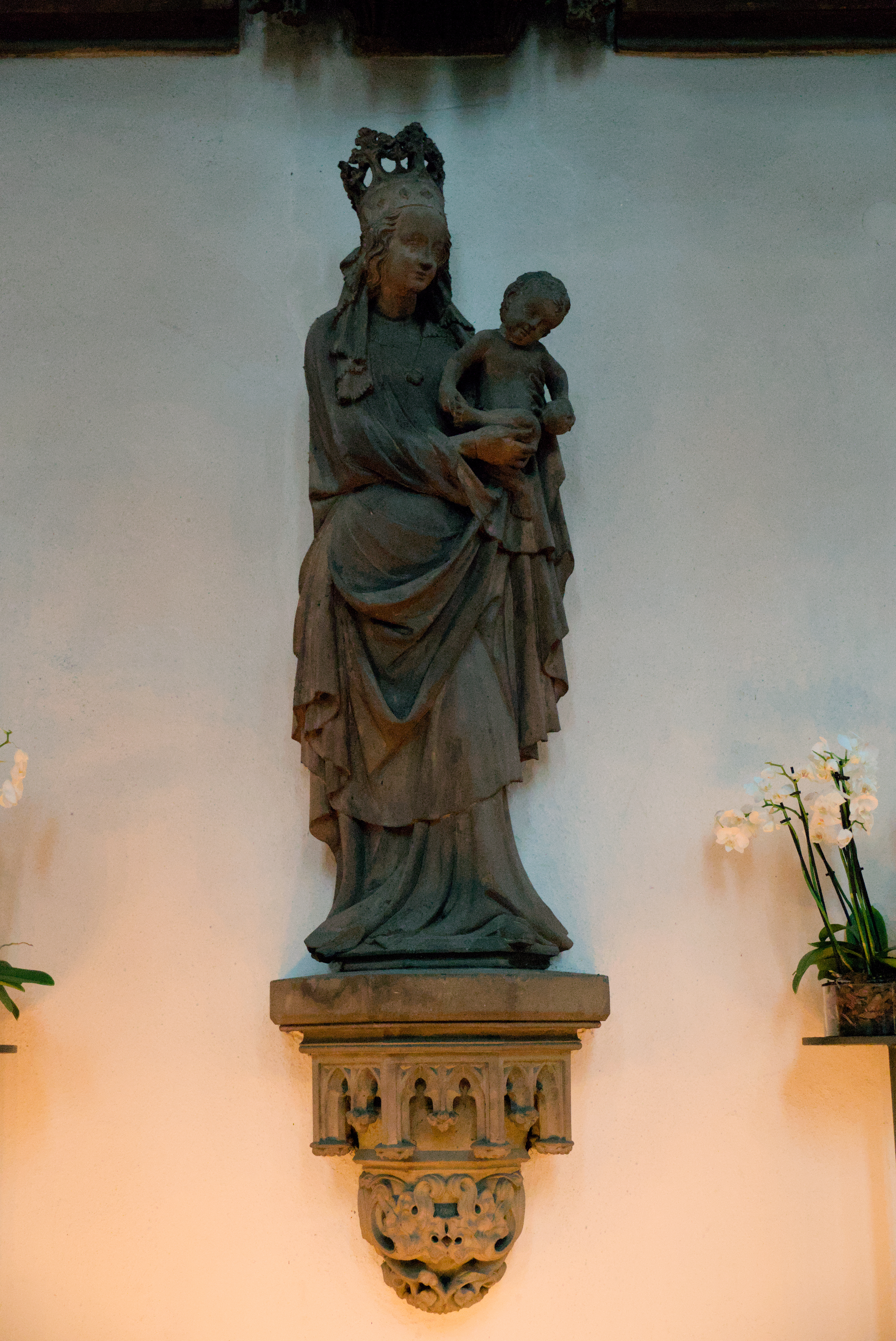
On the trumeau (central pillar) of the west portal stands a copy of a stone Madonna and Child from around 1441; the original is located inside the chapel. The Christ child holds an apple.

Copy: Virgin and Child, ca. 1441, from the west portal of the Marienkapelle
Madonna and Child, Marienkapelle

Another entrance to the church is on the south side.

South portal, Marienkapelle

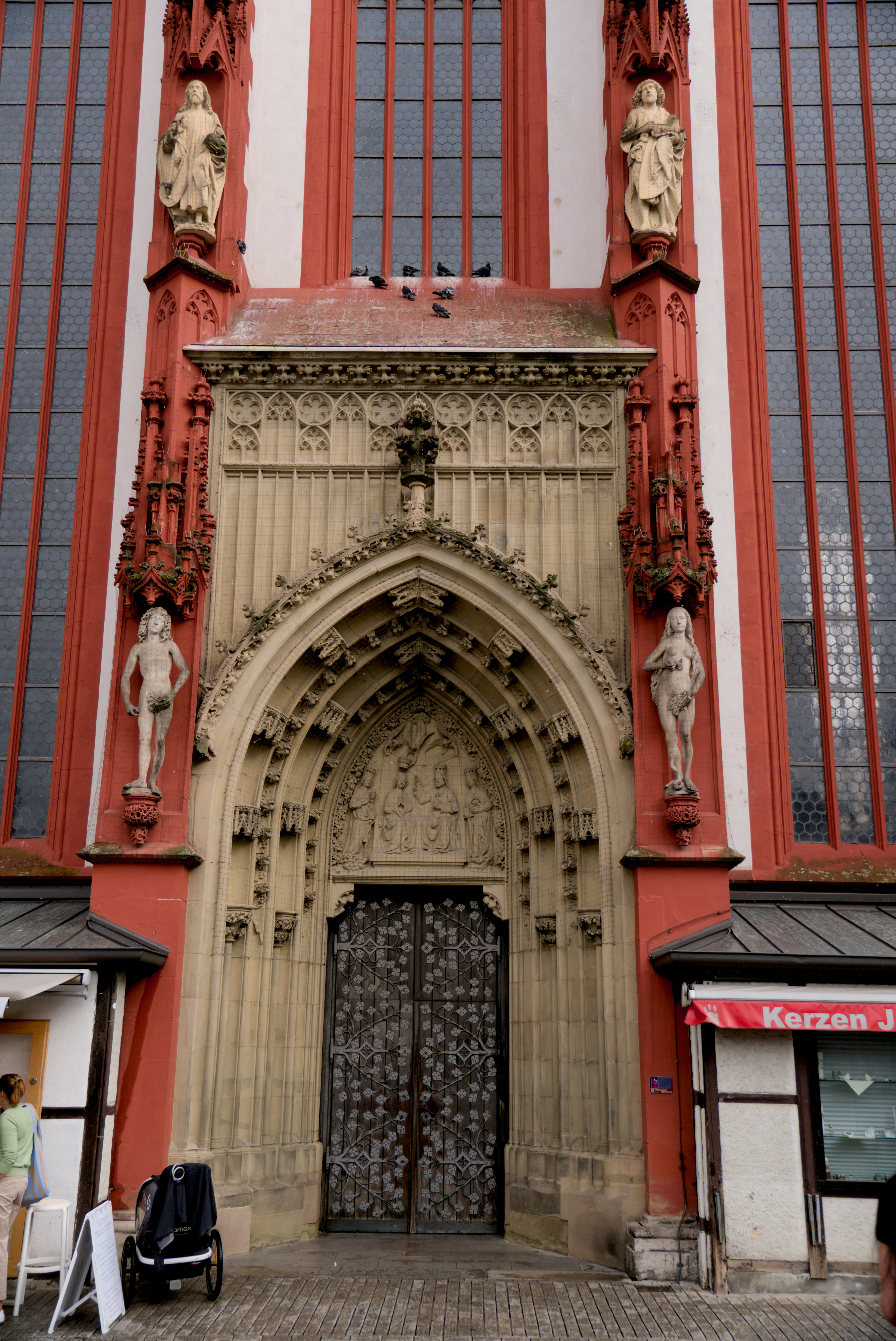
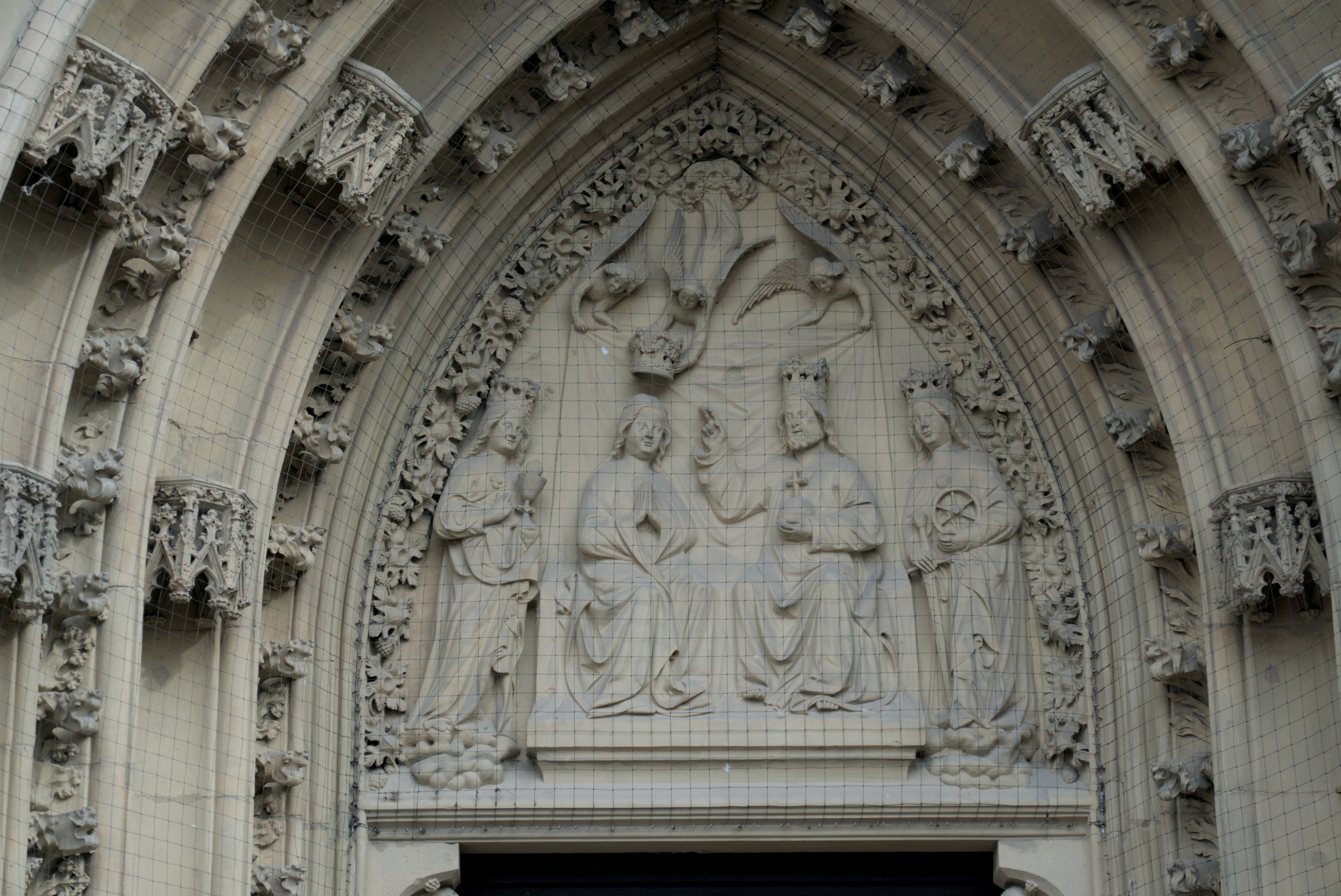
The south tympanum portrays the Coronation of Mary, an extrabiblical subject that grew out of the belief that if Jesus is the King of kings, Mary is the queen mother. To either side of them are St. Barbara, holding a chalice, and St. Catherine of Alexandria, holding the breaking wheel on which she was sentenced to be executed.

Coronation of the Virgin

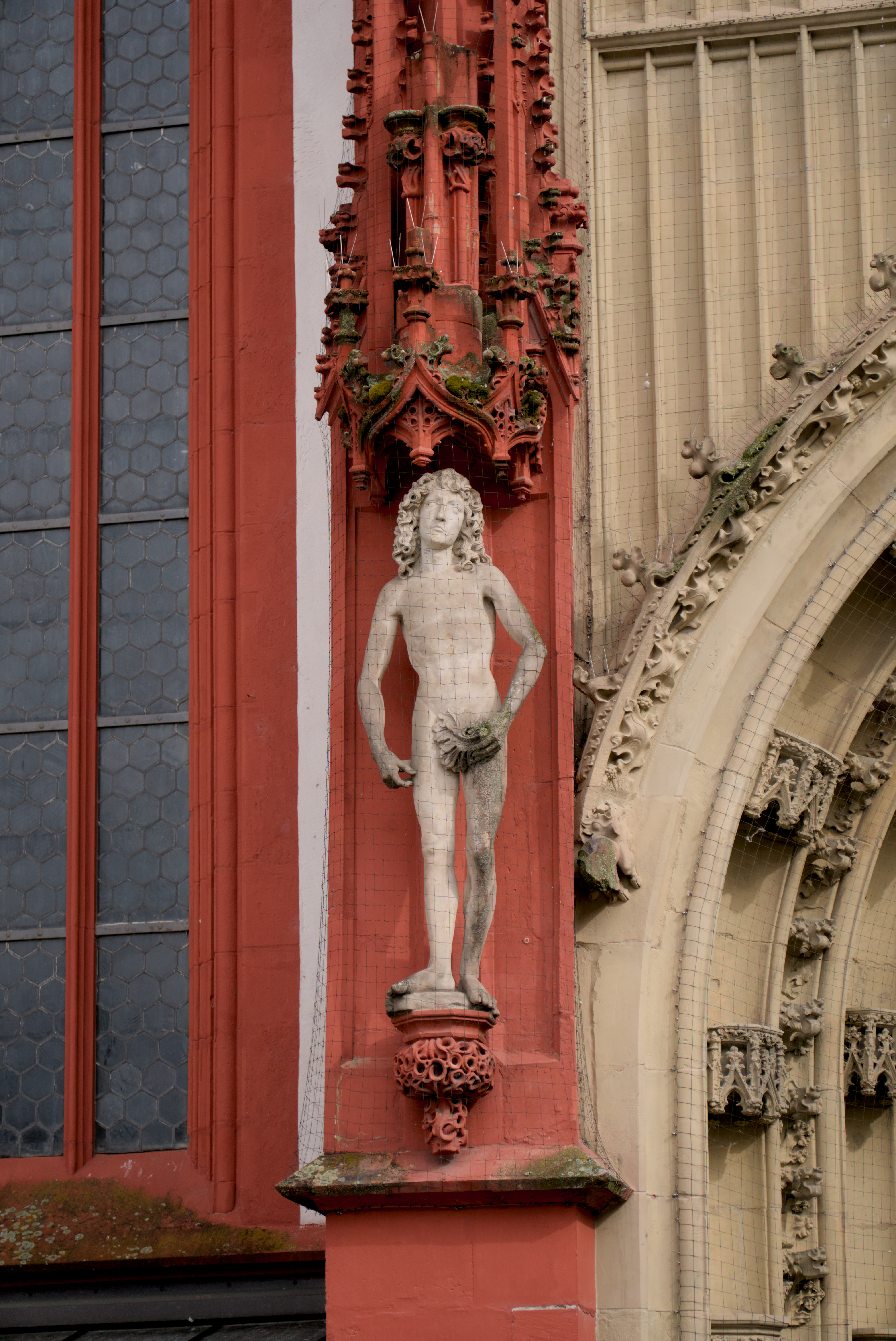
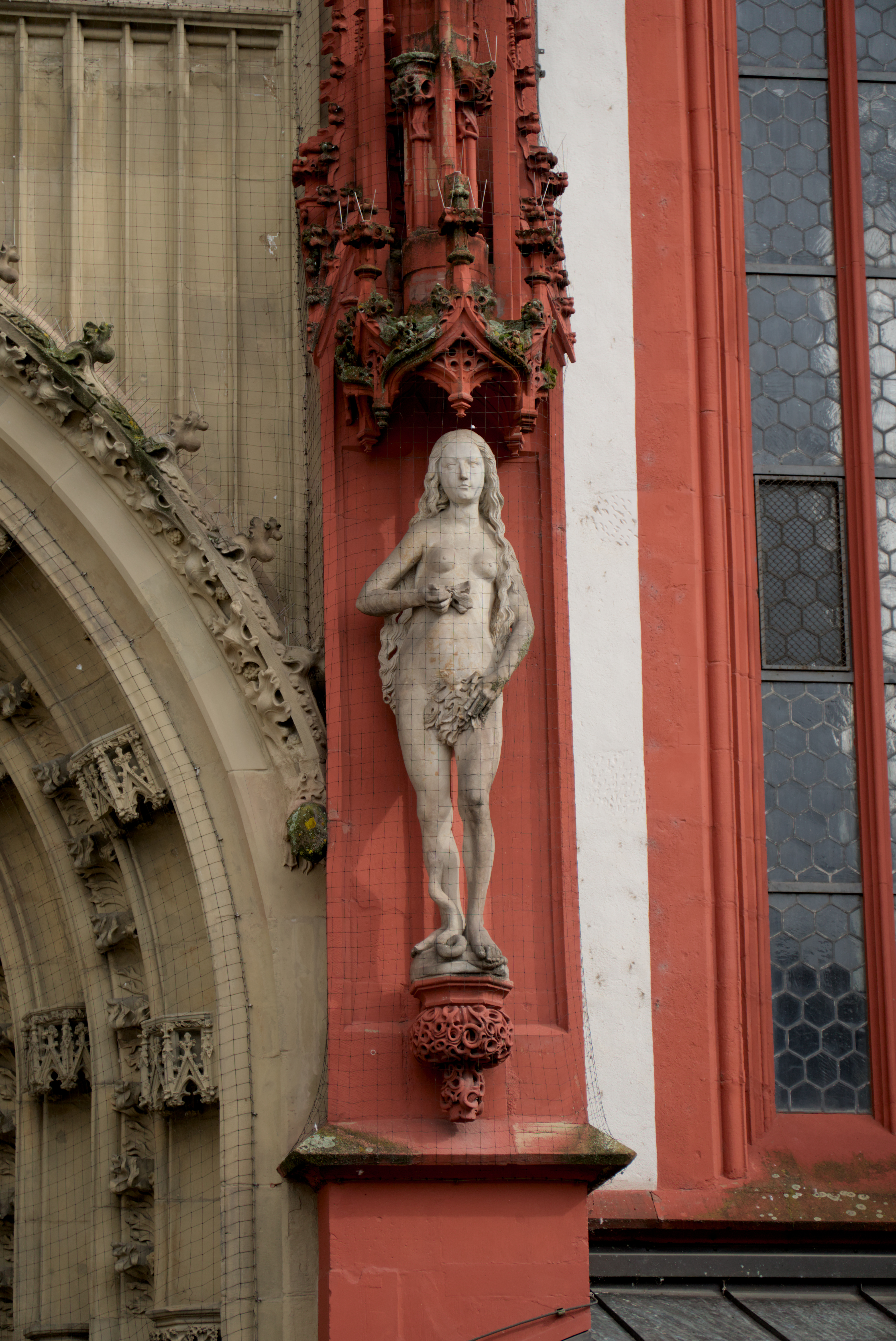
The most striking feature of the south portal is the Adam and Eve sculpture pair by the preeminent German sculptor Tilman Riemenschneider (ca. 1460–1531). Exquisite! Carved in gray sandstone, they are actually copies (all the freestanding sculptures on the exterior are); the originals, from 1493, are in the Museum für Franken, also in Würzburg—which I’ll share about in part 4. Adam and Eve stand on plinths decorated with foliage, sheltered under tabernacles (tower-like crowning structures).

Adam, Marienkapelle
Eve, Marienkapelle

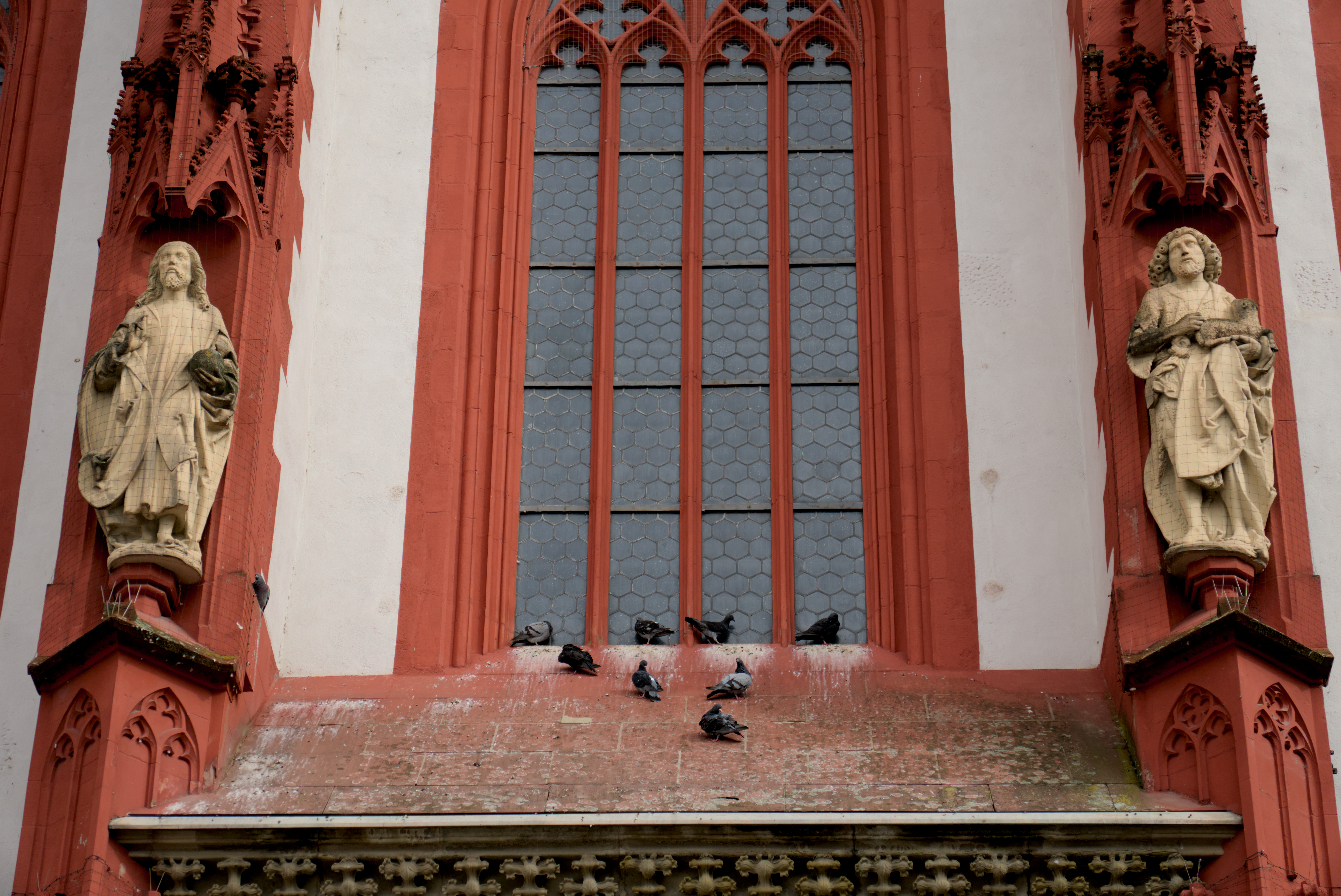
In addition to these, Riemenschneider and his workshop supplied sculptures of the twelve apostles for the buttresses, and of Christ and John the Baptist, who are situated above Adam and Eve. Christ, as Salvator Mundi, holds a globe, and John the Baptist holds a lamb, a symbol of the self-sacrificial Christ, who takes away the sin of the world.

Jesus Christ and St. John the Baptist

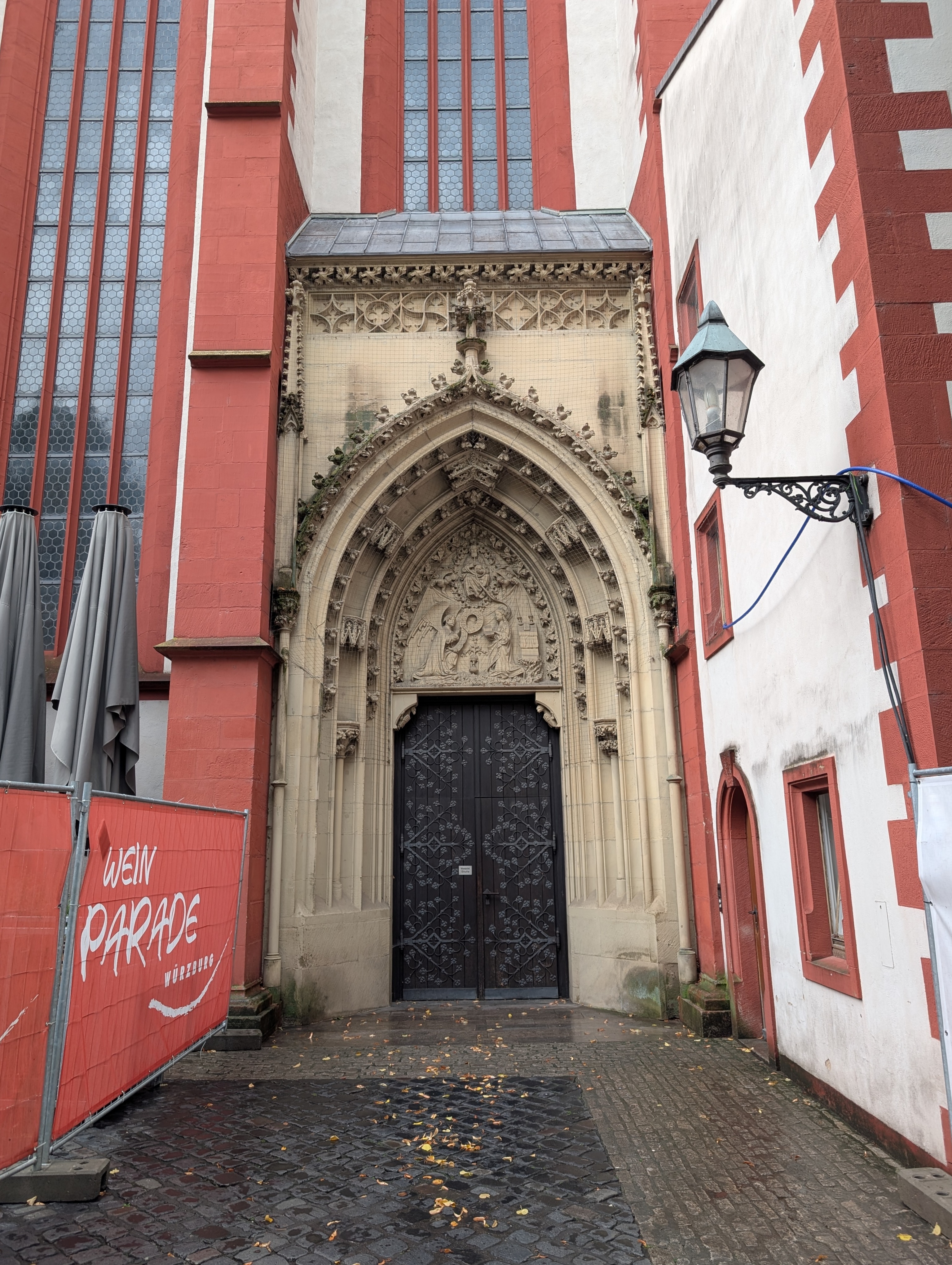
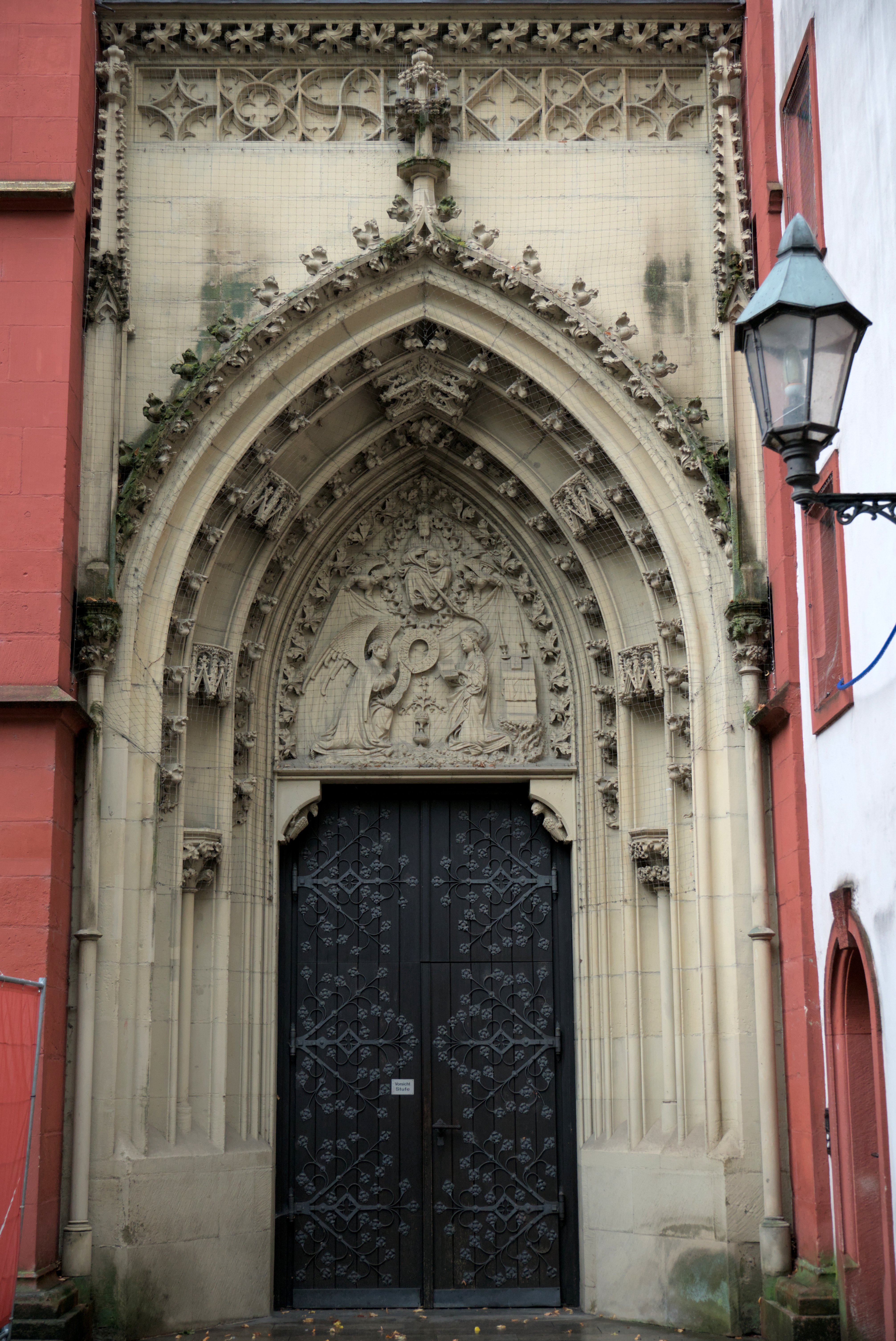
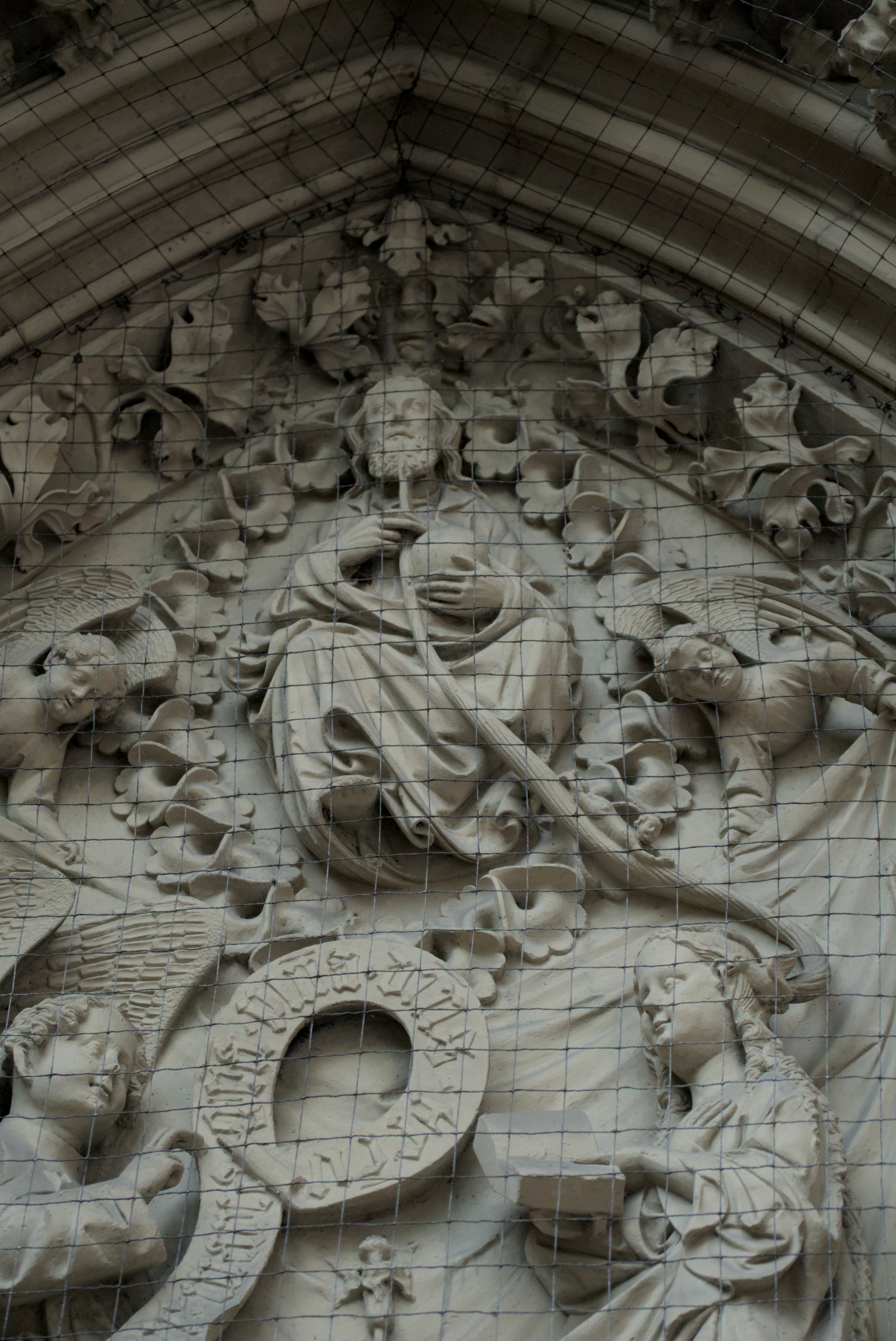
But now, what I consider the most thrilling artwork at the Marienkapelle, immensely amusing, is the Annunciation tympanum in the north portal, carved around 1430.

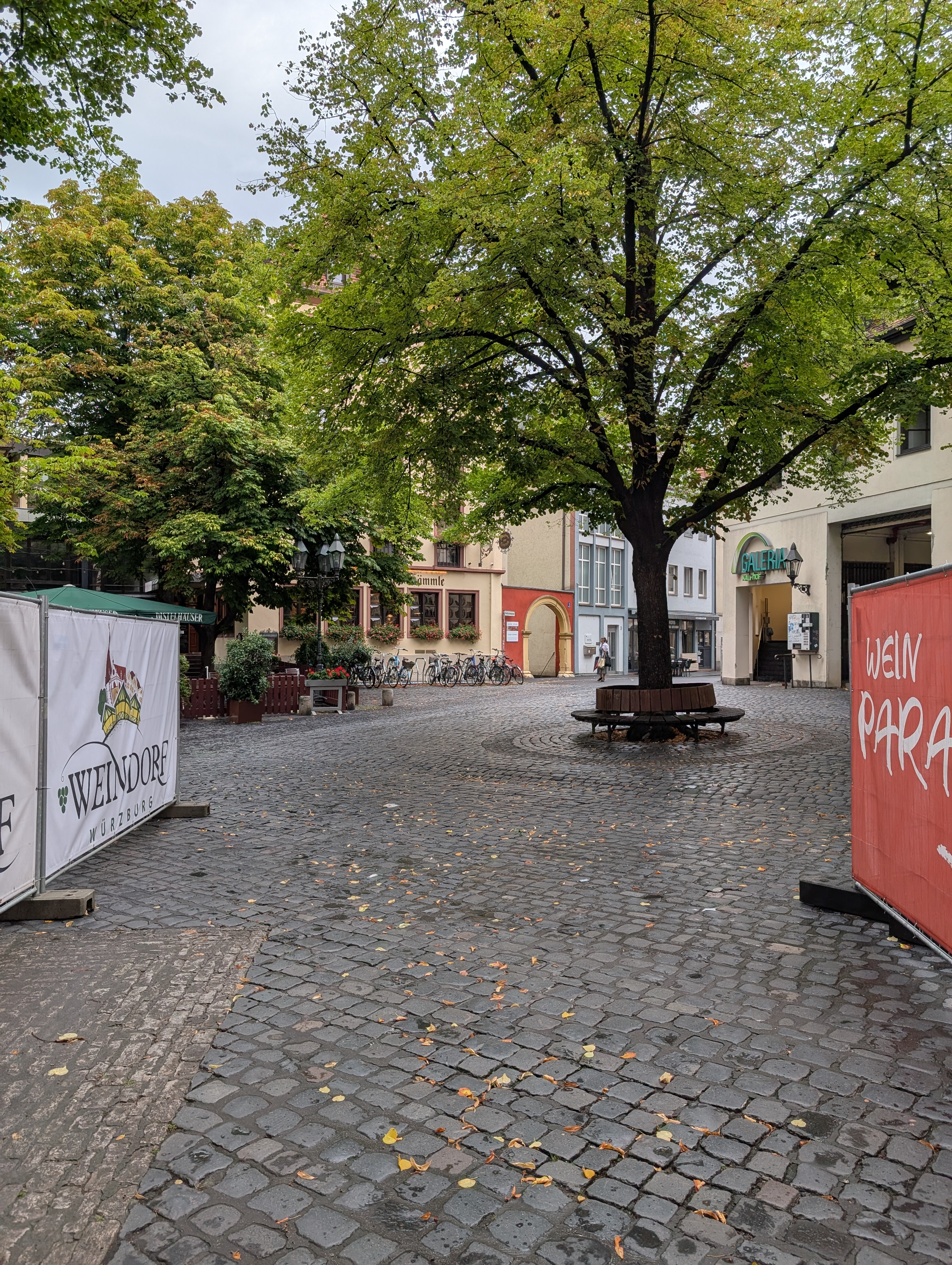
It’s in the least prominent of all three portals, tucked away off the main square, next to, when I was there, a fence banner advertising a local wine festival. No one was stopping to look at it.

Annunciation portal, Marienkapelle
View from the west portal
View from the north portal

Annunciation, north portal, Marienkapelle

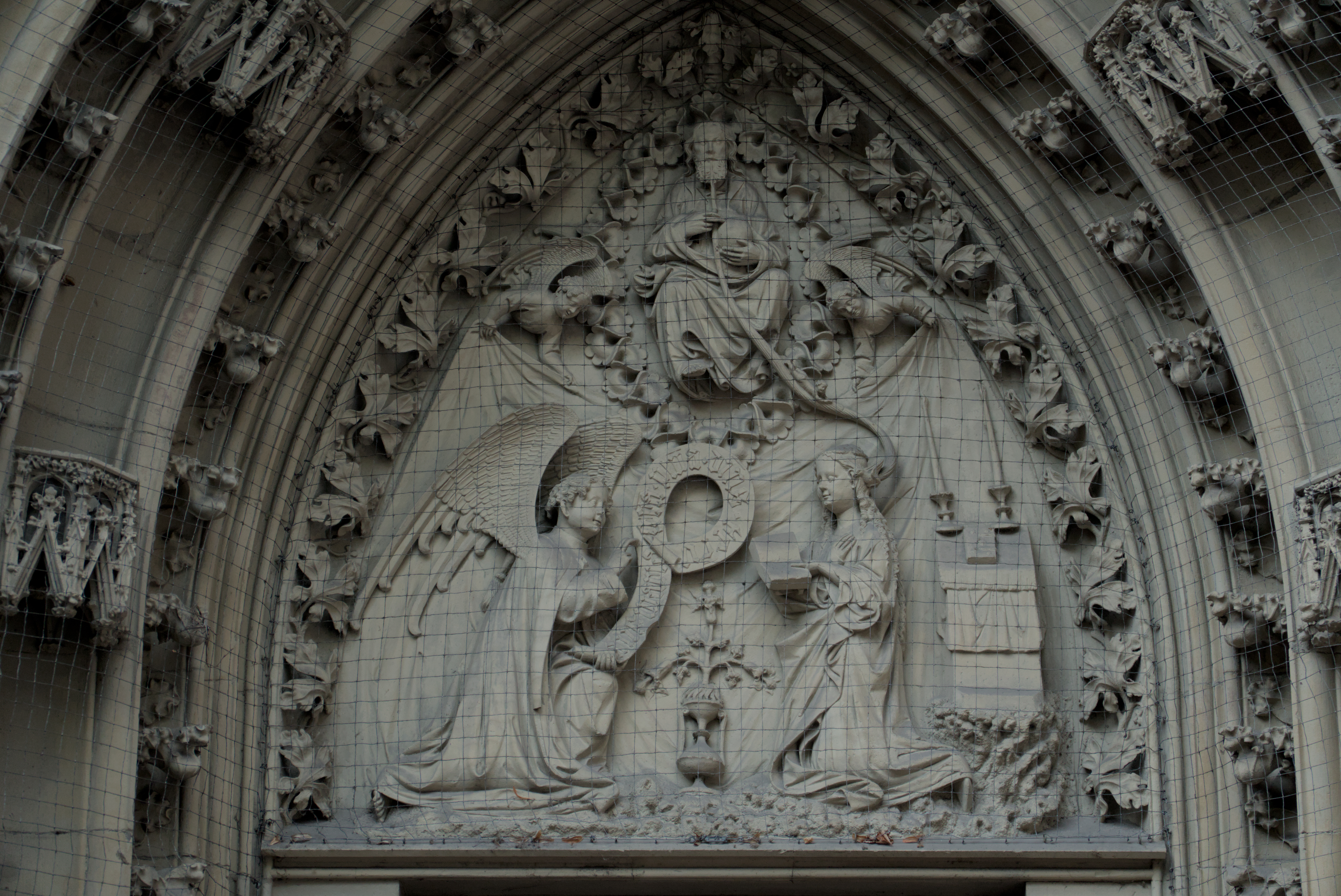
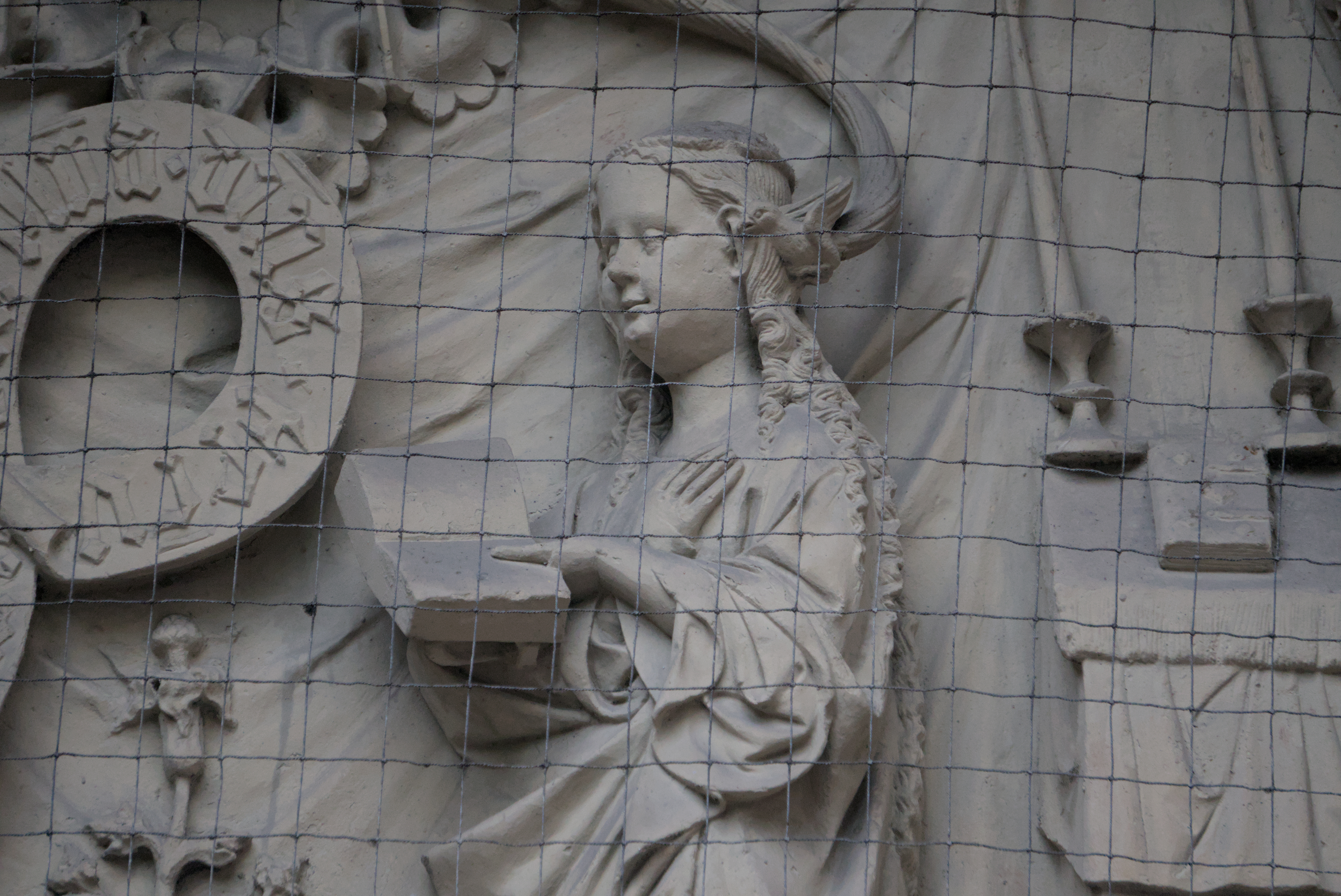
But I knew to search it out—this peculiar carving that visualizes the theological idea, introduced in the fourth century and solidified in the fifth, that Mary conceived Jesus through her sense of hearing. Known as the conceptio per aurem, this teaching stems from a typological connection between Eve and Mary: Whereas Eve listened to the serpent’s lies and conceived death, Mary listened to the angel’s truth and conceived life. The teaching presents Mary as a model of attentive listening to God’s word, which produces fruit; for receiving it into ourselves, bearing it about. It also serves to desexualize the encounter between Mary and Gabriel, focusing attention away from Mary’s genital region and onto her head.

Annunciation tympanum, Marienkapelle

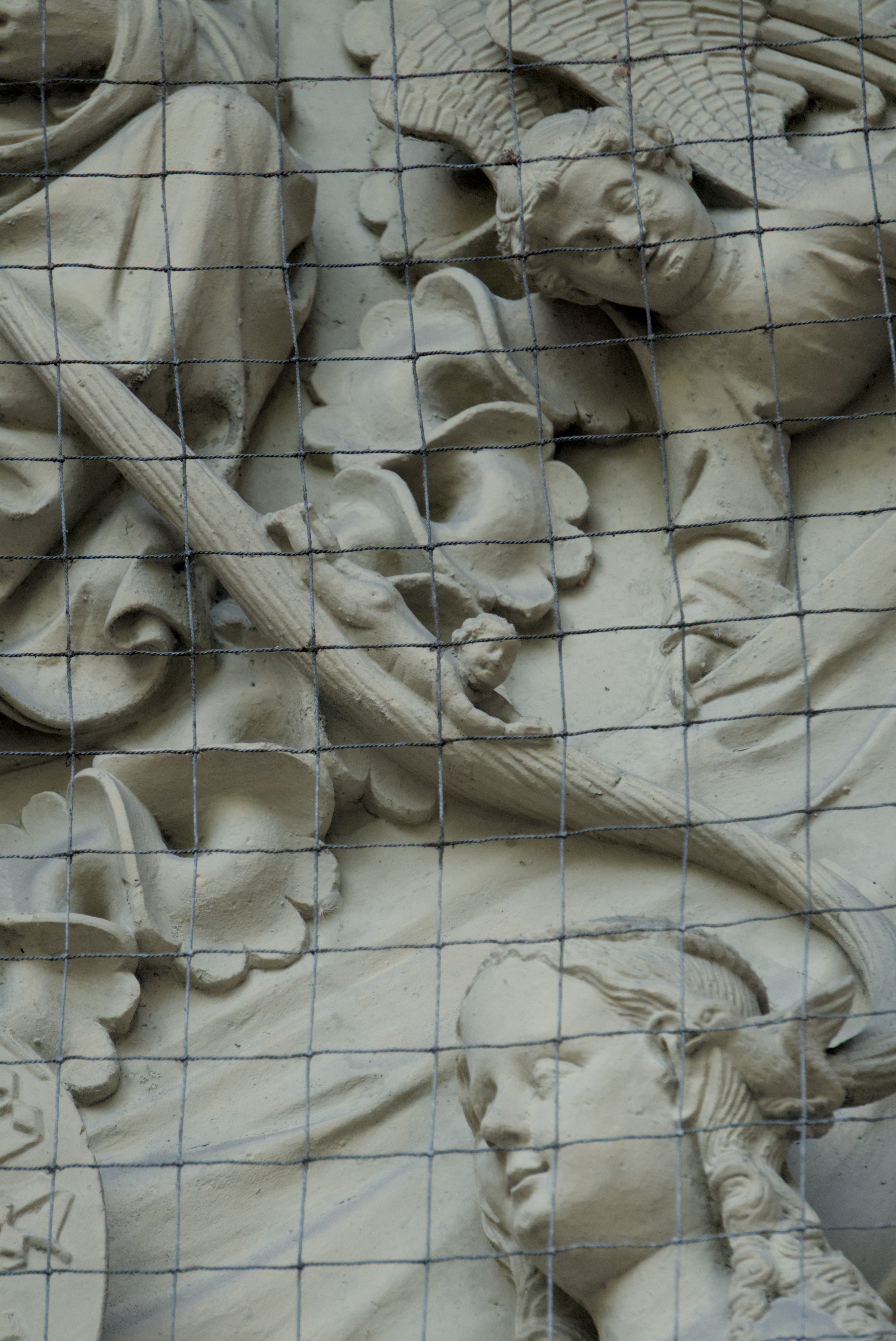
Look at how this artist visualizes the conception by ear! God the Father sits at the top center inside a flowery mandorla, blowing into a serpentine tube that’s attached to Mary’s ear. As he does, a gleefully naked infant Christ glides down the tube on his belly like it’s a waterslide—only it’s not water that’s propelling him; it’s the Father’s breath.

Journeying down this transdimensional slide, he twists and turns and plunges right into his chosen mother’s open auditory canal, where the Holy Spirit as dove enunciates a sacred whisper: “You will conceive in your womb and bear a son, and you will name him Jesus . . .” All three persons of the Trinity are present at this moment—their number echoed by the three-branched lily in the vase on the floor.

Annunciation
homunculus
Annunciation detail

Behind Mary, two angels hold up a cloth of state, befitting royalty.

The conceptio per aurem was developed in both the East and the West by Christian writers and preachers such as Ephrem of Syria, Augustine of Hippo, Theodotus of Ancyra, Proclus of Constantinople, Cyrus of Panopolis, Zeno of Verona, Athanasius of Alexandria, and Bernard of Clairvaux. To learn more, I recommend the excellent book Divine Conception: The Art of the Annunciation by Sarah Drummond (Unicorn, 2019) and Proclus of Constantinople and the Cult of the Virgin in Late Antiquity: Homilies 1–5 by Nicholas Constas (Brill, 2003), each of which devotes an entire chapter to the motif.

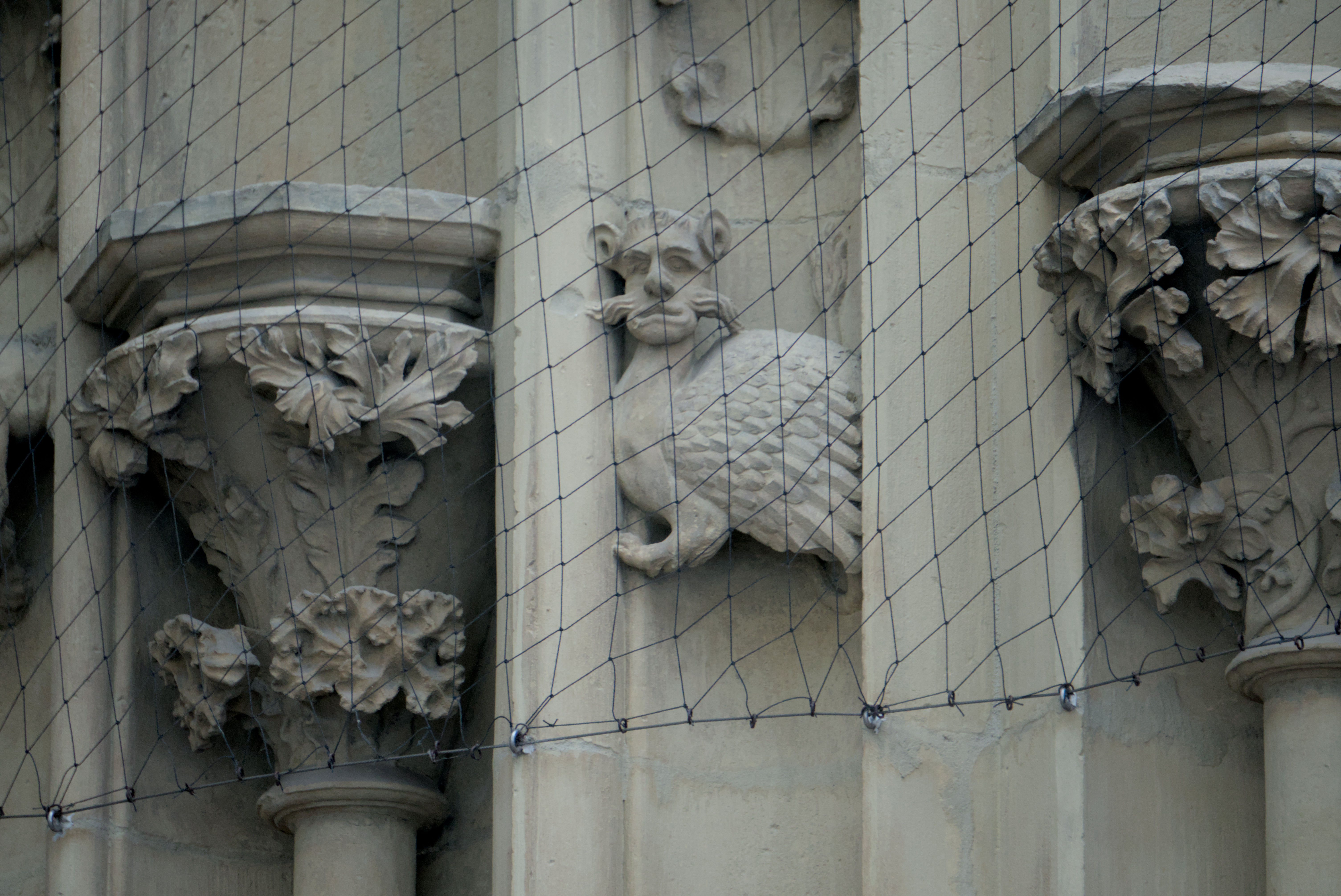
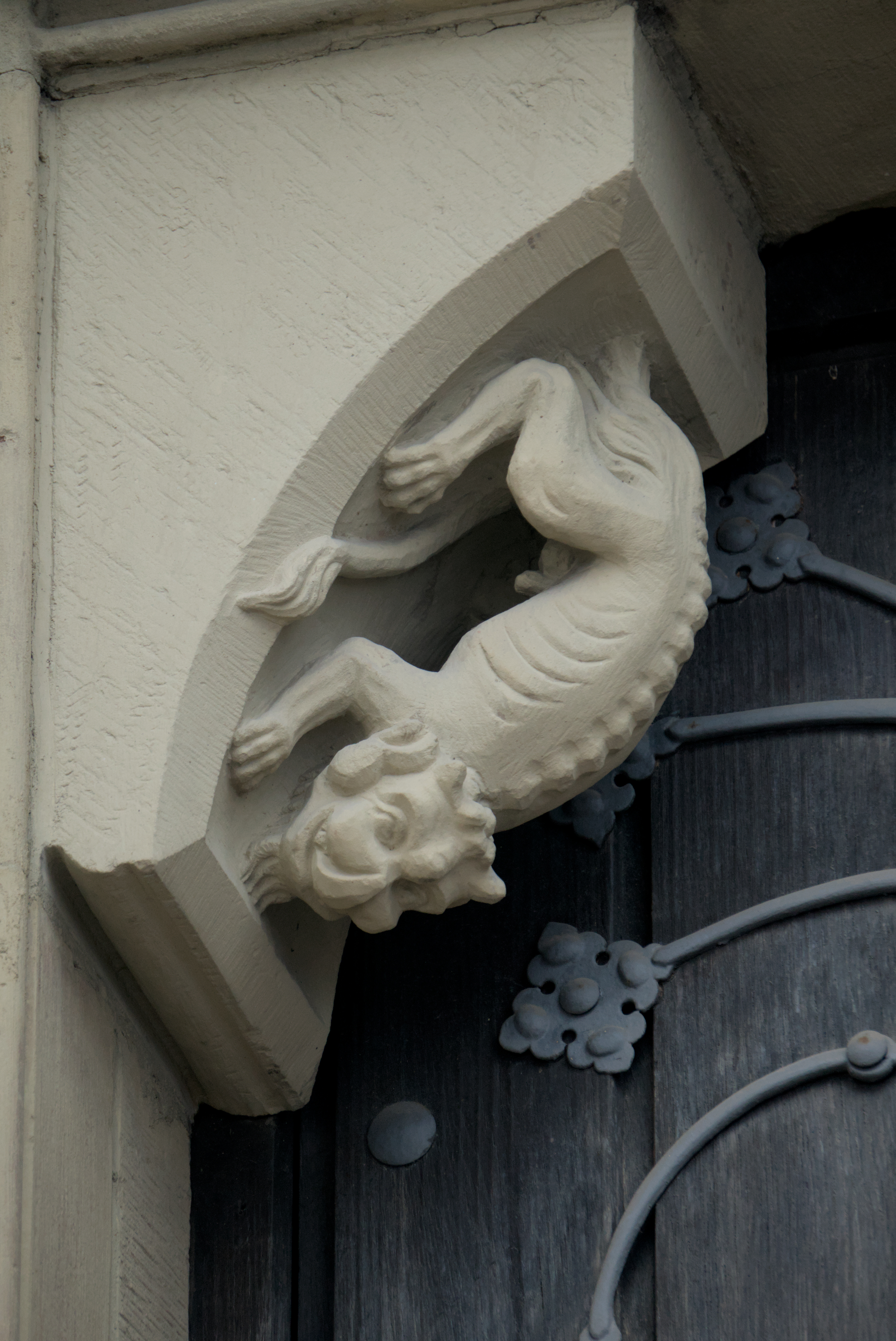
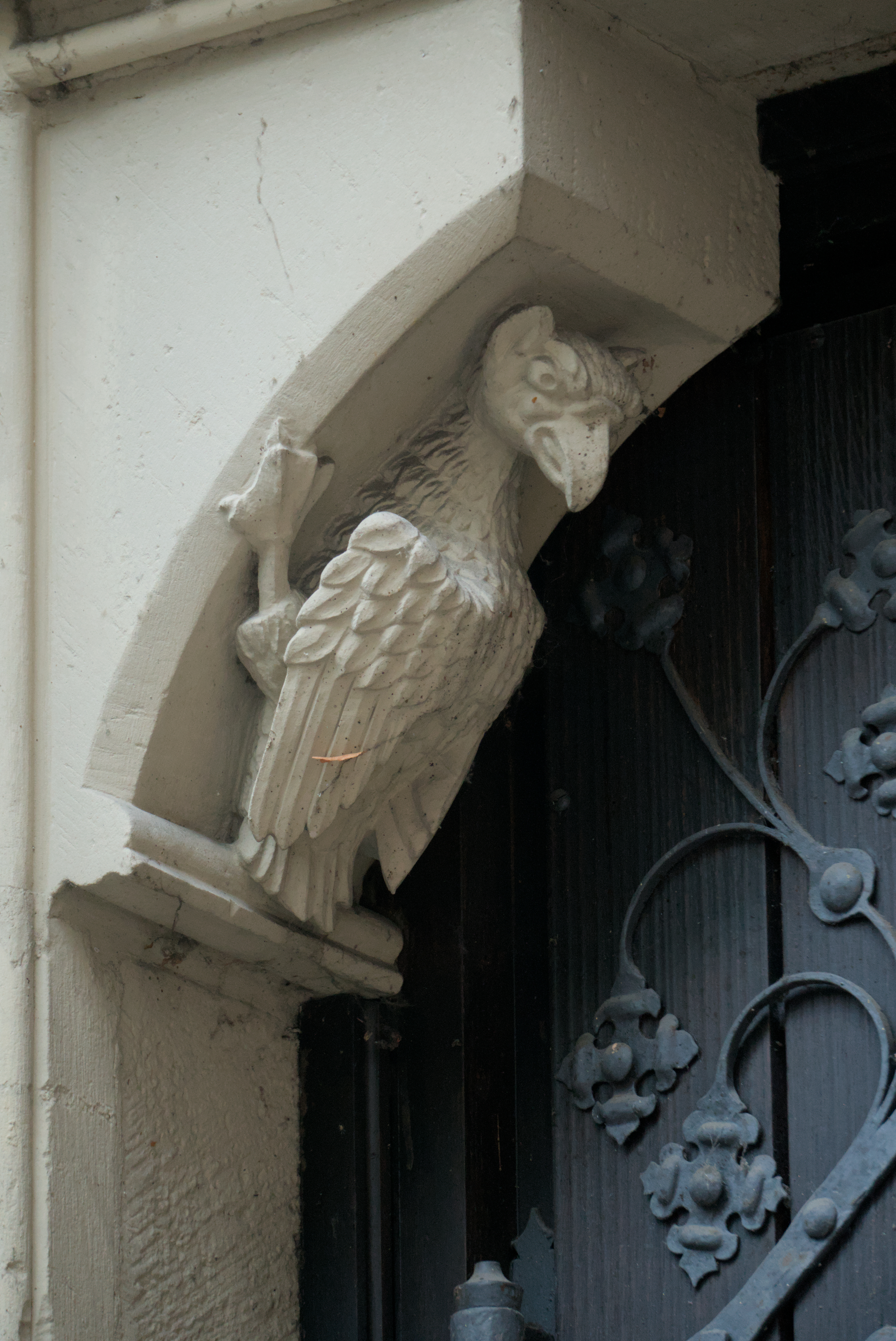
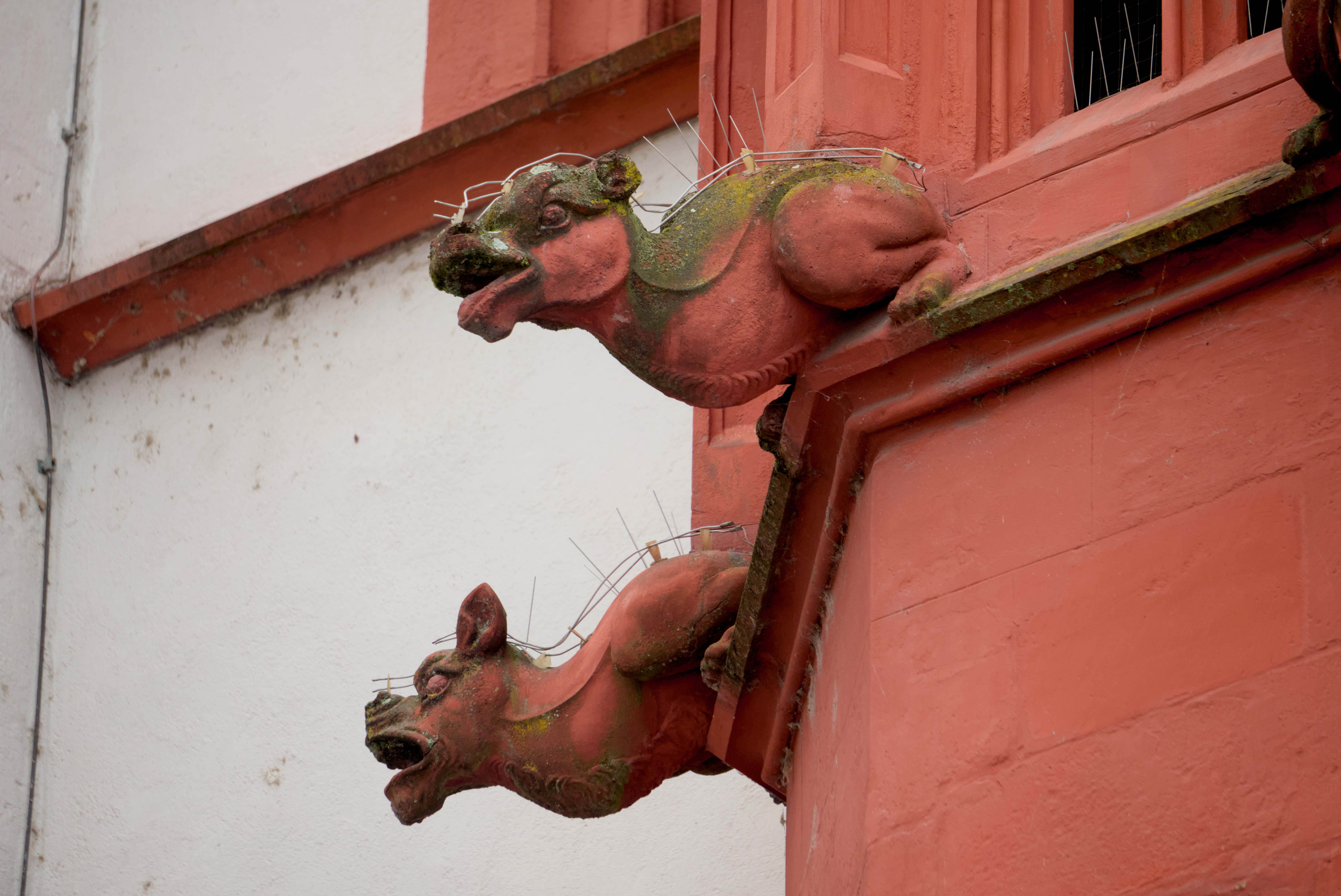
Also on the exterior of the Marienkapelle are a handful of fantastical creatures in the jambs and archivolts and under corbels, and red sandstone grotesques on the eaves.

Grotesques above the west portal, Marienkapelle

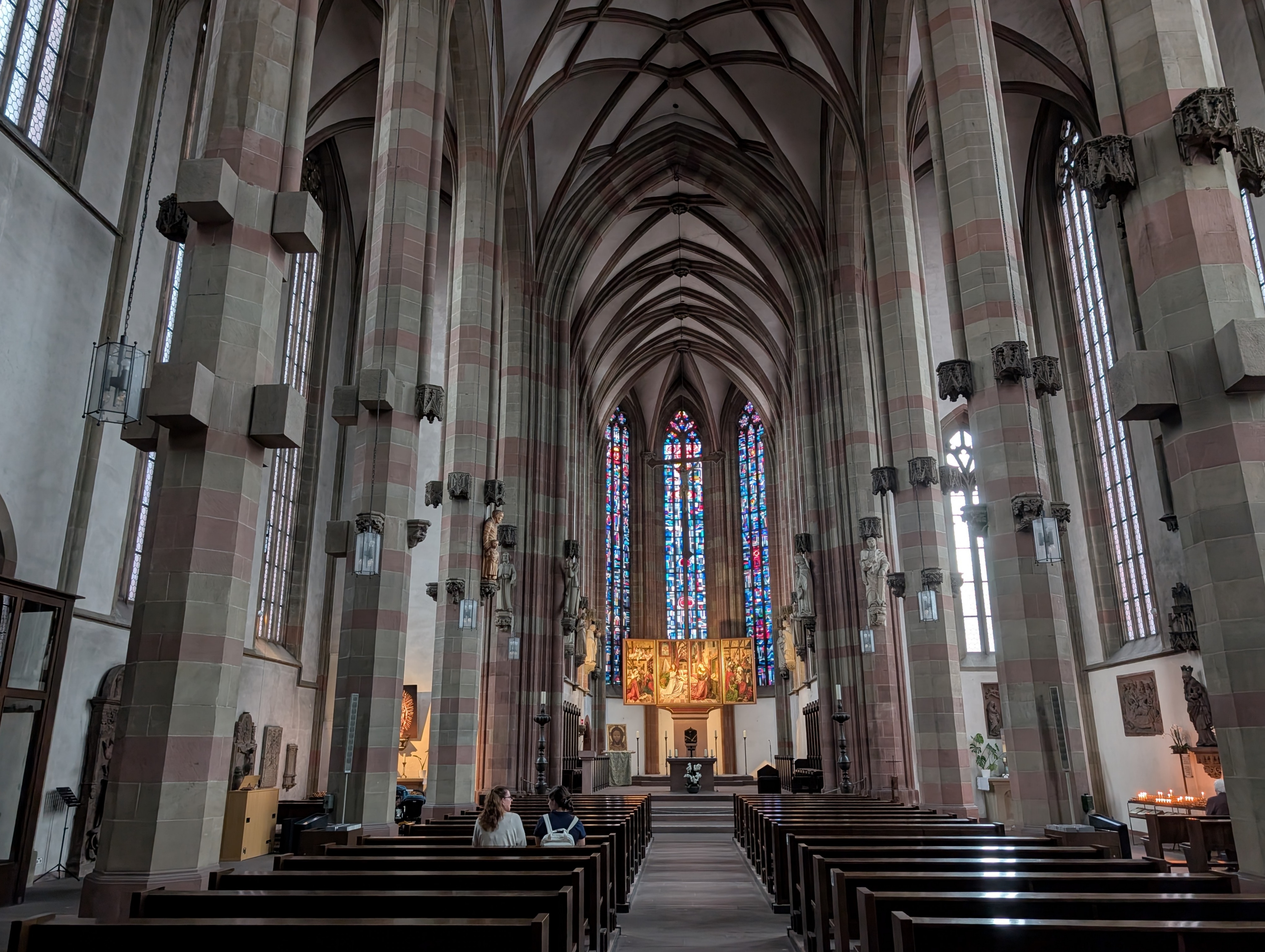
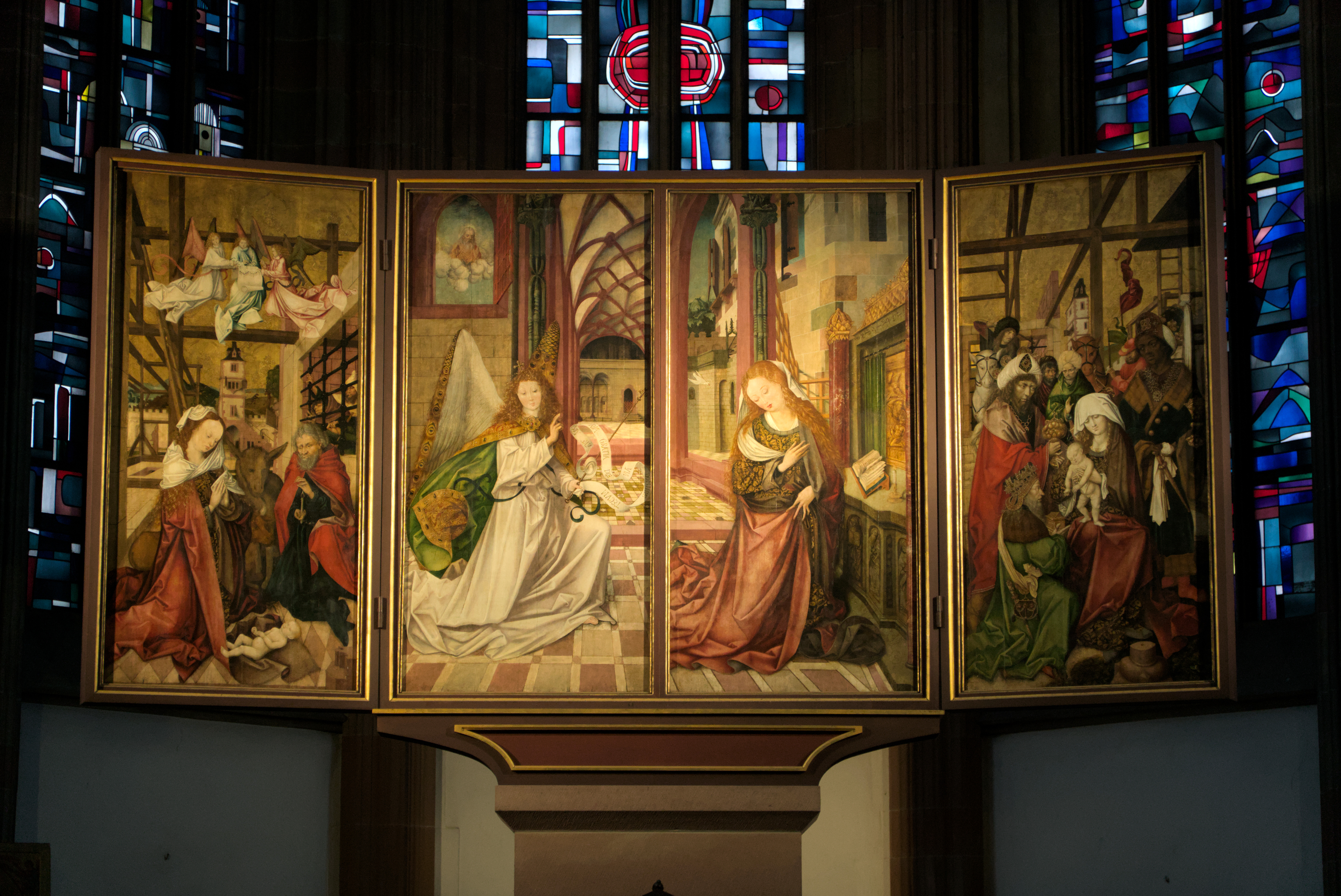
Moving inside, the locally quarried pink and white sandstone columns that support the rib vault down the length of the nave are lovely. So are the post–World War II stained glass windows in the choir. But the main visual attraction is the high altarpiece, painted by an unidentified Franconian artist in 1514.

Marienkapelle interior
High altarpiece, Marienkapelle

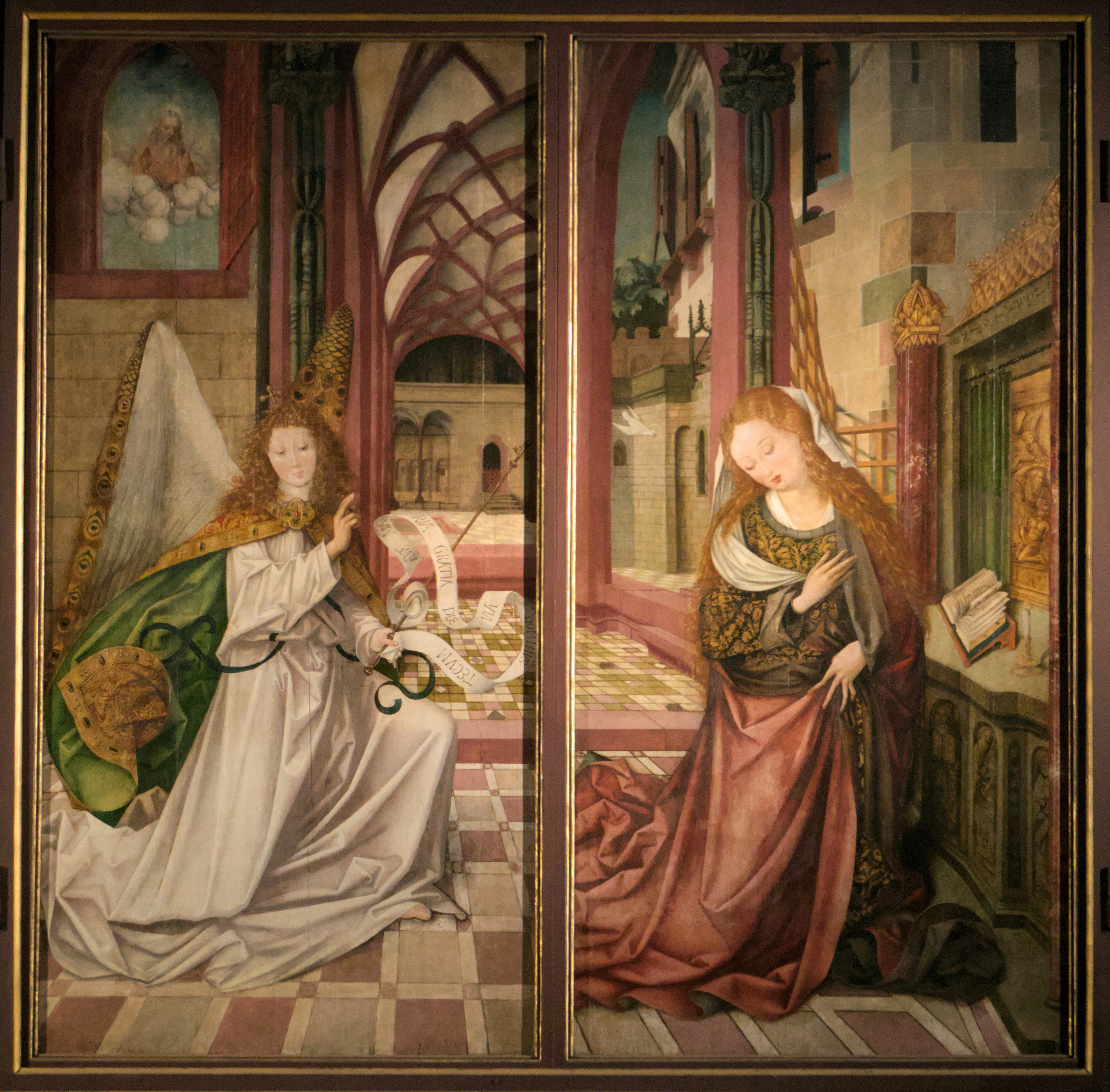
The central scene, consisting of two panels, shows the Annunciation, set inside a well-appointed domestic interior. Mary is interrupted from her prayers by a ruddy-faced messenger, whose banner bears his greeting: “Hail, Mary, full of grace, the Lord is with thee.”

Annunciation

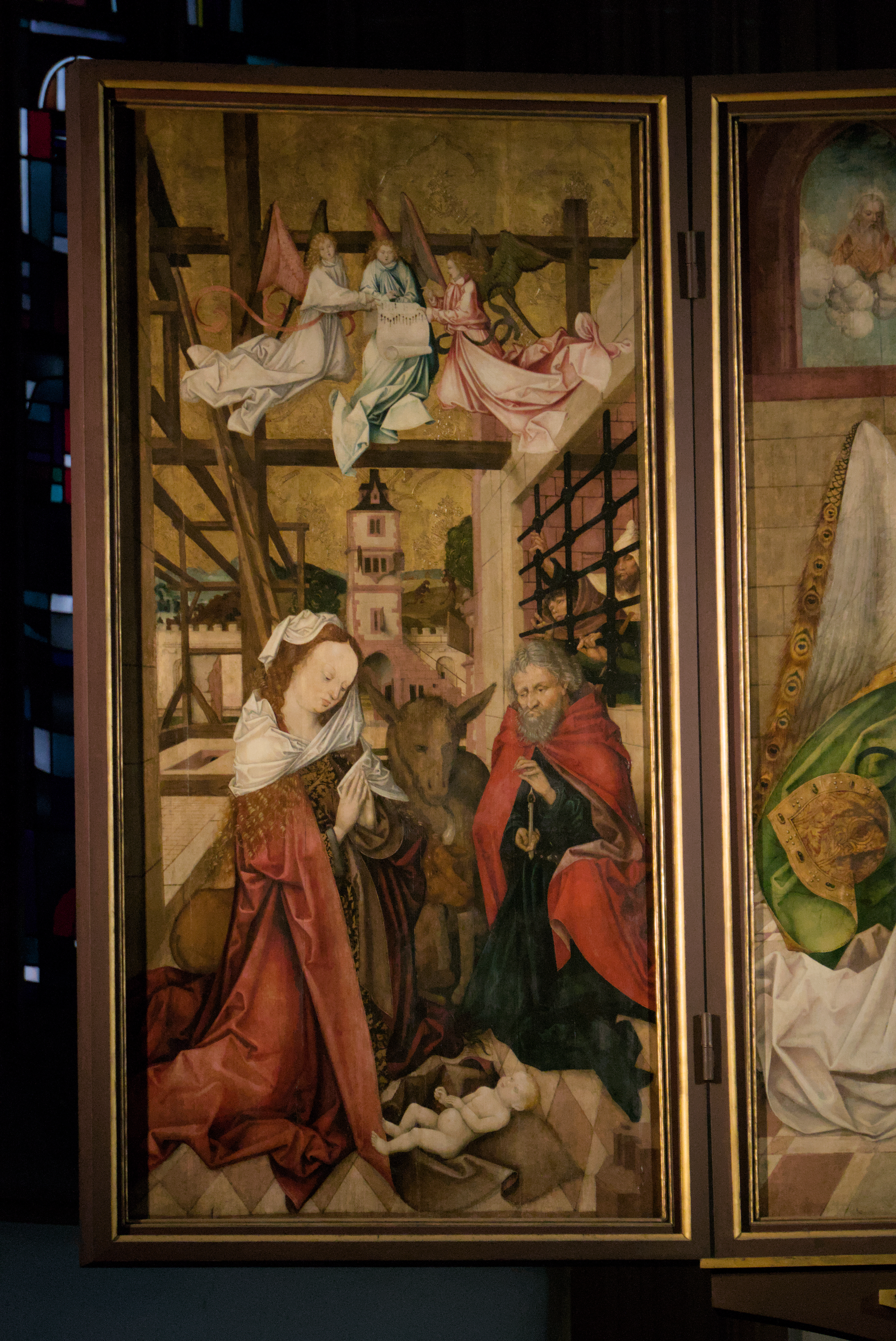
The left wing depicts the Nativity inside a half-built or dilapidated structure that’s exposed to the elements. Mary has laid the infant Christ on the ground, cushioning him as much as possible with her extended cloak. Shepherds peep through the metal bars of the window, craning their necks to see. An ox and ass have front-row seats. Joseph holds a candle, and a trio of angels sing from a song sheet.

Nativity

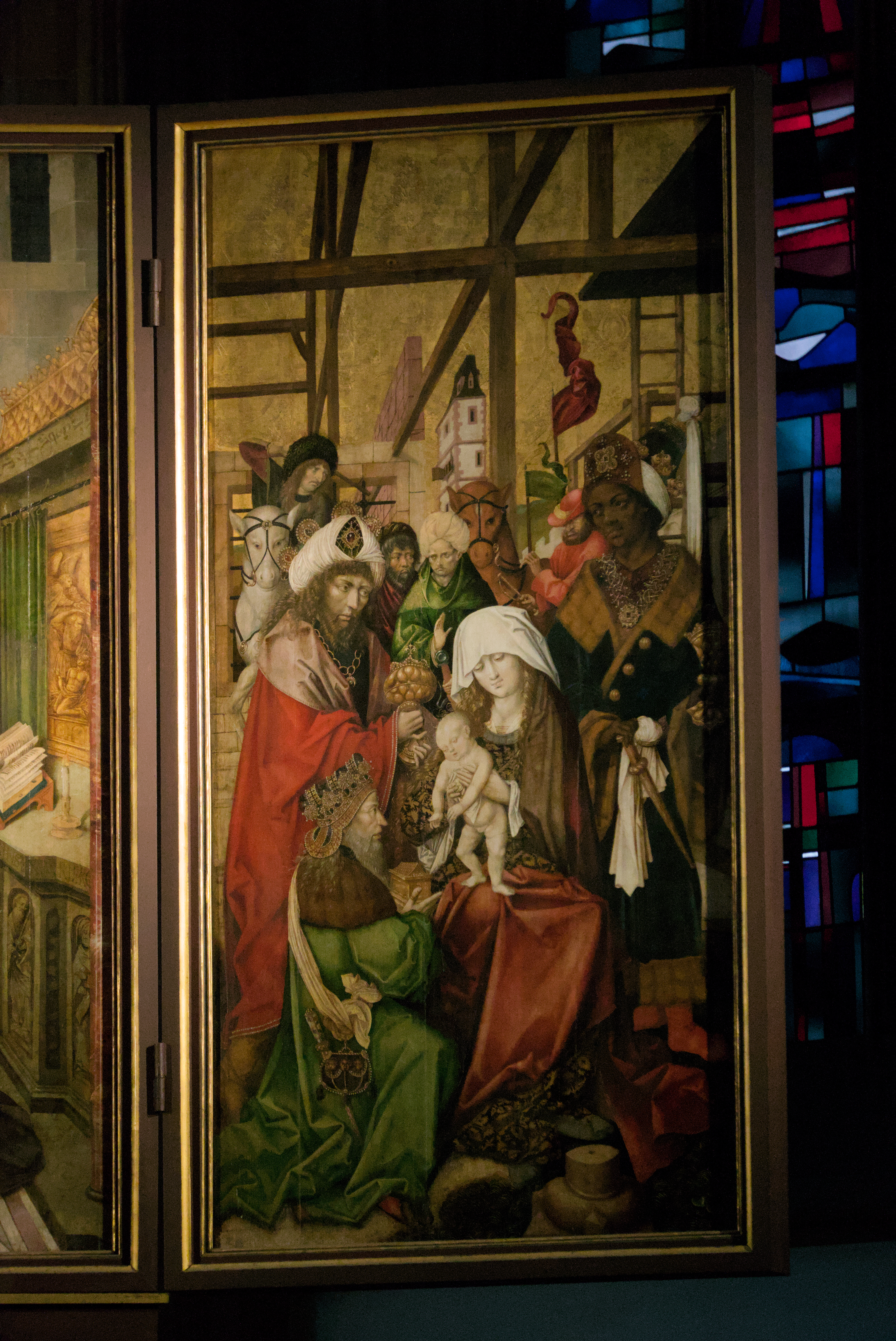
The right wing depicts the Adoration of the Magi. The three foreign men of means present gifts to the Christ child while their entourages stand by patiently in the background. As is traditional, one of them is portrayed as Black.

Adoration of the Magi

Stay tuned for my next Würzburg post, where I’ll share photos from Neumünster, a church that was on my radar because of the unusual crucifix that hangs above one of its side altars.

Marian art at Dumbarton Oaks

Because May is Mary’s month, I thought I’d share some photos I took of various artworks of the Virgin that were on display during my last visit to the Dumbarton Oaks Museum. Dumbarton Oaks is a historic estate, fifty-four acres, in the Georgetown neighborhood of Washington, DC, the former residence and gardens of Robert and Mildred Bliss. In 1940 the Blisses bequeathed the estate, and their extensive collections of Byzantine and pre-Columbian art, to Harvard University, who runs it as a museum, research institute, and library. In addition to housing a stellar permanent collection, the museum also hosts special exhibitions throughout the year, including by contemporary artists. (When I was there I saw the wonderful Outside/IN by Martha Jackson Jarvis.)

The six Marian artworks featured below include paintings, sculptures, and a tapestry, and each originated in a different geographic region: present-day Turkey, Italy, Germany, France, Belgium, and Spain. All but the first are from the House Collection, on display in the beautifully designed Renaissance-style Music Room.

+++

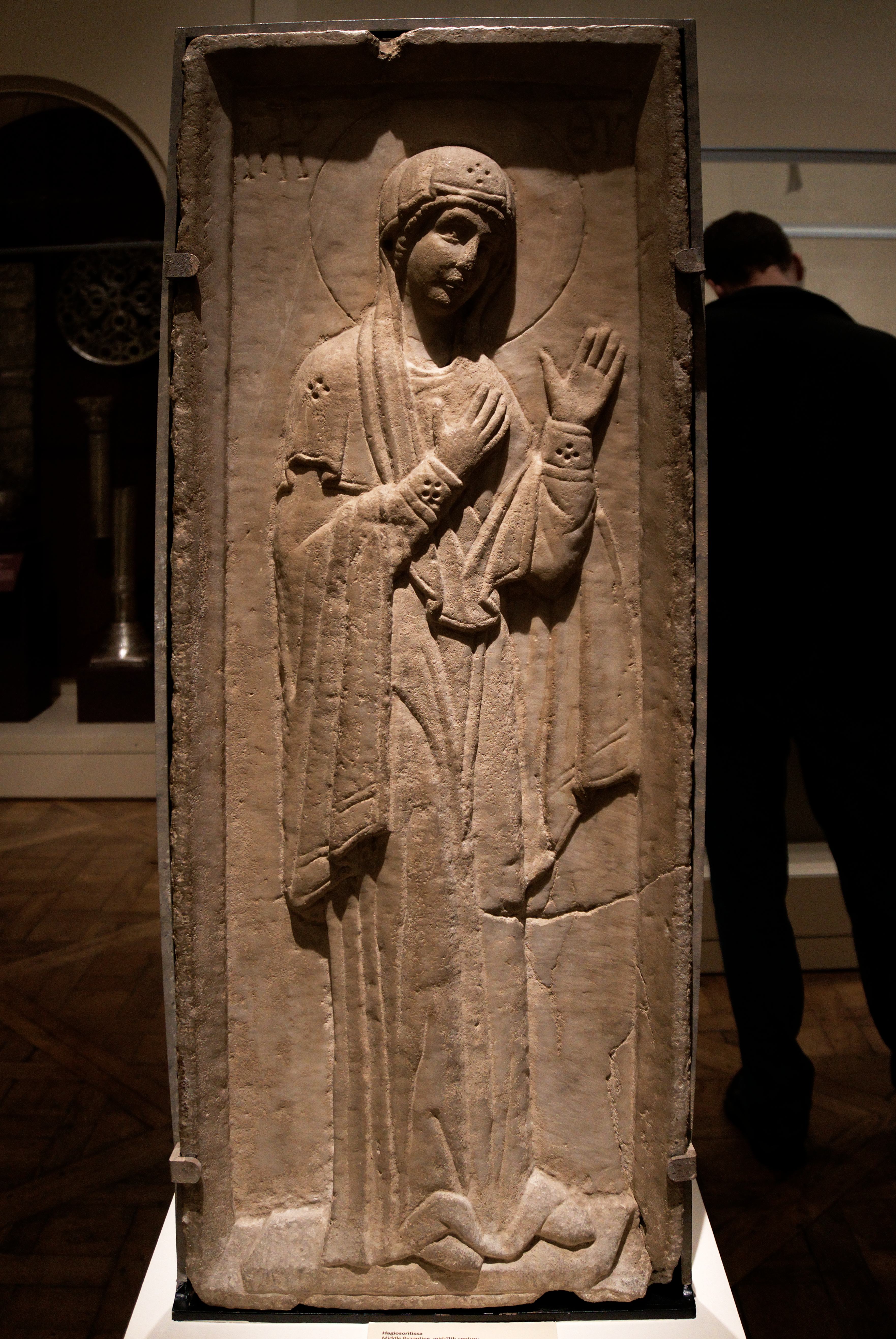
Stone carving is an uncommon medium for Byzantine icons. While sculpture in the round was typically avoided by the church in the East, at least for devotional use, relief carving, with its closeness to two-dimensionality, was more acceptable, though still much rarer than painted wooden panels.

Virgin Hagiosoritissa (11th c)
Virgin Hagiosoritissa, Constantinople, mid-11th century. Marble, 104 × 40 × 7 cm (40 9/10 × 15 7/10 × 2 4/5 in.). Dumbarton Oaks Museum, Washington, DC. Photo: Victoria Emily Jones.

In this carved icon Mary raises her hands in prayer on behalf of humanity, a type known as the Virgin Hagiosoritissa (Gk. “Intercessor”). Made before the development of the iconostasis, it was probably originally placed inside a church on the left pillar of the bema, or sanctuary, while an image of John the Baptist occupied the right pillar, with Christ at the top center, forming a group known as the Deesis (“Supplication”). These two individuals are traditionally shown as primary intercessors, flanking an enthroned Christ like courtiers, because they were the first to recognize Jesus’s saving role: Mary in her “yes” to Gabriel, John in his in utero jump for joy.

The Greek inscription at the top of the icon, ΜΡ ΘΥ, is shorthand for “Mother of God.”

View object record.

+++

Daddi, Bernardo_Madonna and Child with Saints
Bernardo Daddi (Italian, ca. 1280–1348), Madonna and Child with Saints and Angels, 1337. Tempera and gilding on poplar panel, 87.6 × 44.5 × 8.9 cm (34 1/2 × 17 1/2 × 3 1/2 in.). Dumbarton Oaks, Washington, DC. Photo: Victoria Emily Jones.

Bernardo Daddi was the preeminent Florentine painter after Giotto, who had pioneered a new naturalism and may have been Daddi’s teacher. Daddi operated a large and busy workshop, specializing in small-scale paintings and altarpieces commissioned by the well-to-do for their private devotions. While in this panel he uses the traditional Byzantine gold ground, representing the radiance of heaven, he moves toward the Renaissance with individualized facial expressions and depth in space. I love the tenderness of Mary who cuddles her son’s foot as he looks up at her admiringly, climbing over her lap and clutching at her collar.

“This panel was originally the central unit of a triptych, the wings of which are now missing,” writes James N. Carder. “The Virgin Mary holding the Christ Child sits in the center on a high-backed throne. To the left stand Saint Peter, grasping two keys, and Saint Dominic, who wears a Dominican habit and holds a lily. To the right stand Saint James the Great, holding a staff from which hangs a small red purse, and Saint Paul, holding a knife. Behind each group of saints are two angels, and in the gable is a roundel with the bust of Christ making a blessing gesture.”

View object record.

+++

Riemenschneider, Tilman_Virgin and Child
Tilman Riemenschneider (German, ca. 1460–1531), Virgin and Child on the Crescent Moon, ca. 1521–22. Lindenwood, 95.3 × 35 × 21 cm (37 1/2 × 13 4/5 × 8 3/10 in.). Dumbarton Oaks Museum, Washington, DC. Photo: Victoria Emily Jones.

This similarly tender Madonna and Child image was made two centuries later by the German Late Gothic artist Tilman Riemenschneider, who ran the largest sculpture workshop in Würzburg, producing an enormous number of religious images for churches. Jesus reaches his hand up to cradle his mother’s chin, his shirt swept back in a breeze, and she holds him with great fondness while also confronting the viewer with a contemplative air. She stands on a crescent moon, probably meant to associate her with the Woman of the Apocalypse described in Revelation 12, who gives birth to a male ruler whom the dragon seeks to devour.

Riemenschneider was “highly regarded in Europe for his technical virtuosity in wood and stone and for his sensitive blending of religious subject matter with a deeply felt appreciation for humanity.” He was one of the first sculptors to abandon polychromy (the application of color to sculpture) on selected works, emphasizing the simple beauty of the sculpted material, which in his case was usually lindenwood (aka limewood), alabaster, or sandstone. A wealthy, respected, landowning member of Würzburg society, Riemenschneider served on the municipal council. His high status and artistic career came to an abrupt halt, however, during the German Peasants’ War of 1525, in which he refused to obey an order to fight the revolting peasants and was imprisoned as a result.

Riemenschneider, Tilman_Virgin and Child (detail)
Photo: Victoria Emily Jones

View object record.

+++

From the French Late Gothic, the Music Room has this beautiful little broken Pietà. A Pietà (Ital. “pity, compassion”) is a representation of the dead Christ on the lap of his mourning mother, but here the figure of Christ is no longer intact. At first I assumed this was Mary in prayer or contemplation, but upon looking up the object on the printed key and finding it to be a Passion image, I can now see that the expression she bears is an elegiac one.

Virgin from a Pieta (15th c)
Virgin from a Pietà, made in France, last quarter of 15th century. Limestone with polychromy, 50.8 × 22.9 × 27.9 cm (20 × 9 × 11 in.). Dumbarton Oaks Museum, Washington, DC. Photo: Victoria Emily Jones.

Many Christian images throughout history are contextualized to the time and place in which they were made, and this one is no exception. “The Virgin is clothed in a manner contemporary to the portraiture of fifteenth-century noblewomen, with a simple gown tightly fitted above the waist,” writes Kristen Gonzalez. “A mantle is drawn up over her head, underneath which a veil and barbeile partially obscure her head and lower neck. . . . The Virgin’s gown and mantle appear to have been painted blue and edged with gilding,” as the polychrome traces suggest.

View object record.

+++

“Small-scale tapestries with devotional subject matter were produced during the early modern period and were prized for this purpose throughout Europe, particularly among the elite circle of monarchs, princes, dukes, and the highest ecclesiastic echelons,” writes Elizabeth Cleland. “Part of the appeal of the scale of these devotional tapestries must have been their portability. They could easily be rolled up or folded and transported with other court paraphernalia from one location to another, thereby accompanying their often itinerant royal owners.”

Furthermore, unlike the monumental tapestries that were often part of a cycle and that were more decorative in nature, these smaller ones were intended to function individually, as single works, and in more intimate ways, for personal prayer and reflection. Dumbarton Oaks’ Christ and the Virgin, three feet square, may have hung in a private oratory (prayer room).

Christ and the Virgin tapestry
Tapestry of Christ and the Virgin, Flemish, probably Brussels, late 15th–early 16th century. Wool, silk, and silver and gold thread on wool, 96.5 × 96.5 cm (38 × 38 in.). Dumbarton Oaks Museum, Washington, DC. Photo: Victoria Emily Jones.

James N. Carder describes the image: “Side-by-side are seen the bust-length figures of Christ as Savior (Salvator Mundi), holding a cruciform orb and making a blessing gesture, and the Virgin Mary crowned as Queen of Heaven and with her hands together in prayer before an open book on the ledge. The lower field of the foreground is profusely ornamented with floral (millefleurs) motifs, and above the arches are a row of Gothic ornaments and a cloisonné-like geometric band that are reminiscent of the tops of French enamel reliquaries.”

View object record.

+++

Lastly, a painting by one of my favorite artists, the Greek-born Spanish Renaissance painter known as El Greco. The Visitation is a common subject in art that refers to the meeting of the pregnant Virgin Mary (shown at the right by El Greco) and her cousin Elizabeth, who was pregnant with John the Baptist. El Greco’s Visitation was intended for the Chapel of Isabel de Oballe inside the Church of San Vicente in Toledo, but it’s uncertain whether it was ever installed. Originally the canvas had a circular outline, but at some unknown date it was cut down on all sides.

El Greco_The Visitation
El Greco (Doménikos Theotokópoulos) (Greek Spanish, 1541–1614), The Visitation, ca. 1610–14. Oil on canvas, 96.5 × 71.4 cm (38 × 28 1/8 in.). Dumbarton Oaks Museum, Washington, DC. Photo: Victoria Emily Jones.

El Greco’s initial art training was in Byzantine icon painting on the island of what today is Crete, where he was born and which was then under Venetian rule. At age twenty-six he moved to Venice and learned the Italian Mannerist style, and ten years later he left for Spain, where he spent the rest of his life. Characterized by a spiritual fervor and a sort of proto-expressionism, his works were new and unusual and much sought after. The Visitation demonstrates his preference for boldly attenuated figures caught in strong highlighting, abstractions that “emphasize the ethereal and timeless nature of the biblical world,” says Carder.

View object record.