
O my people, what have I done to you?
In what have I wearied you? Answer me!—Micah 6:3
The Reproaches (Latin: Improperia), also known by the first phrase of their refrain, “Popule meus” (O My People), are a series of antiphons and responses used in Good Friday liturgies across all three branches of Christianity. The text contrasts Old Testament stories of God’s goodness with humanity’s enactment of evil against God’s Son. Whereas God graciously delivered his people from death time and again throughout history, they delivered his Son to death—death on a cross. Thus God reproaches us, his beloved ones, for our fatal rejection of Christ, his greatest gift, lamenting that we have spurned his love.
The lyrics are reproduced below (the side-by-side formatting with English translation on the right is best viewed on a computer screen), followed by four musical settings, chosen from among dozens. In the present Roman Rite, the roman-style text is sung by a cantor and the italicized text by a choir, and the lines of the Trisagion (“Thrice Holy”), the ancient hymn that follows the first improperium, are sung by two halves of a choir in alternation—the first singing in Greek, the second in Latin. Composers working outside that context, however, may assign the sections differently.
(Related post: “Blood and Tears”)
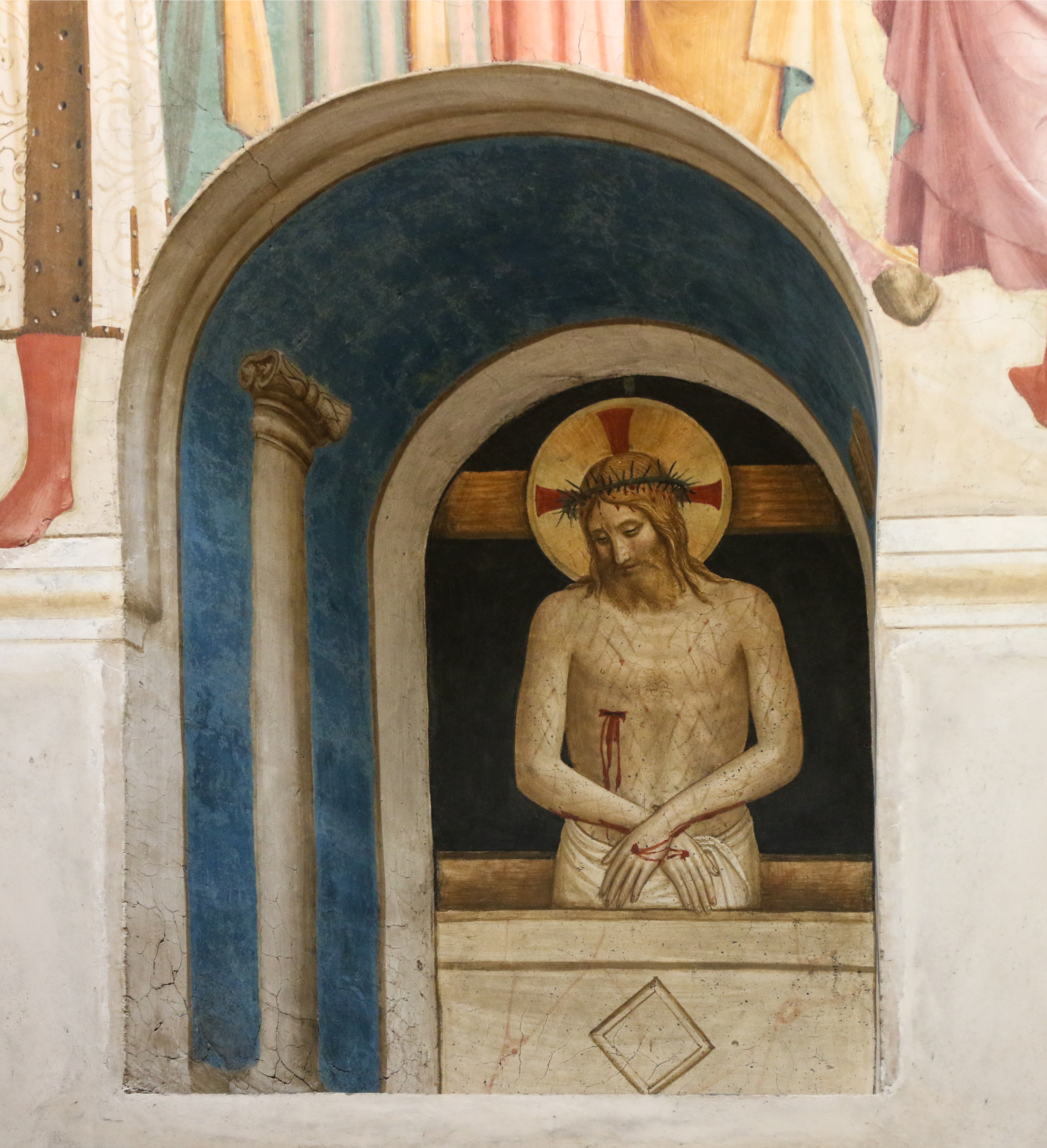
Popule meus, quid feci tibi?
Aut in quo contristavi te?
Responde mihi.

Quia eduxi te de terra Aegypti:
parasti Crucem Salvatori tuo.

   Hagios o Theos.
      Sanctus Deus.
   Hagios Ischyros.
      Sanctus fortis.
   Hagios Athanatos, eleison himas.
      Sanctus immortalis, miserere nobis.

Quia eduxi te per desertum quadraginta annis:
et manna cibavi te, et introduxi te in terram satis bonam:
parasti Crucem Salvatori tuo.
Hagios . . .

Quid ultra debui facere tibi, et non feci?
Ego quidem plantavi te vineam meam speciosissimam:
et tu facta es mihi nimis amara:
aceto namque sitim meam potasti:
et lancea perforasti latus Salvatori tuo.
Hagios . . .

Ego propter te flagellavi Aegyptum cum primogenitis suis:
et tu me flagellatum tradidisti.
Popule meus . . .

Ego te eduxi de Aegypto, demerso Pharone in mare Rubrum:
et tu me tradidisti principibus sacerdotum.
Popule meus . . .

Ego ante te aperui mare:
et tu aperuisti lancea latus meum.
Popule meus . . .

Ego ante te praeivi in columna nubis:
et tu me duxisti ad praetorium Pilati.
Popule meus . . .

Ego te pavi manna in desertum:
et tu me cedisti alapis et flagellis.
Popule meus . . .

Ego te potavi aqua salutis de petra:
et tu me potasti felle et aceto.
Popule meus . . .

Ego propter te Chananeorum reges percussi:
et tu percussisti arundine caput meum.
Popule meus . . .

Ego dedi tibi sceptrum regale:
et tu dedisti capiti meo spineam coronam.
Popule meus . . .

Ego te exaltavi magna virtute:
et tu me suspendisti in patibulo crucis.
Popule meus . . .
O my people, what have I done to thee?
Or how have I offended thee?
Answer me.

Because I led thee out of the land of Egypt:
thou hast prepared a cross for thy Savior.

   O holy God!
      O holy God!
   O holy strong One!
      O holy strong One!
   O holy and immortal, have mercy upon us.
      O holy and immortal, have mercy upon us.

Because I led thee through the desert for forty years:
and fed thee with manna, and brought thee into a land exceeding good:
thou hast prepared a cross for thy Savior.
O holy God! . . .

What more ought I to have done for thee, that I have not done?
I planted thee, indeed, my most beautiful vineyard:
and thou hast become exceeding bitter to me:
for in my thirst thou gavest me vinegar to drink:
and with a spear thou hast pierced the side of thy Savior.
O holy God! . . .

For thy sake I scourged the firstborn of Egypt:
Thou hast given me up to be scourged.
O my people . . .

I led thee out of Egypt, having drowned Pharaoh in the Red Sea:
and thou hast delivered me to the chief priests.
O my people . . .

I opened the sea before thee:
and thou hast opened my side with a spear.
O my people . . .

I went before thee in a pillar of cloud:
and thou hast led me to the judgment hall of Pilate.
O my people . . .

I fed thee with manna in the desert:
and thou hast assaulted me with blows and scourges.
O my people . . .

I gave thee the water of salvation from the rock:
and thou hast given me gall and vinegar to drink.
O my people . . .

For thy sake I struck the kings of the Canaanites:
and thou hast struck my head with a reed.
O my people . . .

I gave thee a royal scepter:
and thou hast given a crown of thorns for my head.
O my people . . .

I exalted thee with great strength:
and thou hast hanged me on the gibbet of the cross.
O my people . . .
1. “Popule meus” by Tomás Luis de Victoria (1585)
First up, a traditional setting of the Latin by the Spanish Renaissance composer Tomás Luis de Victoria (ca. 1548–1611) [previously], performed by Ensemble Invocatio under the direction of Daniel Knaggs in 2022 at Seminary Church in Warsaw, Poland. The soloist is Łukasz Dziuba. This four-part motet is the most widely performed setting of the Reproaches.
2. “The Reproaches” by John Sanders (1984)
This setting in English by the British composer John Sanders (1933–2003) has become standard repertoire for many English cathedral and church choirs. Sanders first wrote it in 1984 for a Good Friday service at Gloucester Cathedral, where he served as organist, but it wasn’t published until 1993. It’s performed here by the Ely Cathedral Choir, conducted by Sarah MacDonald, from 2018. Whereas Victoria scored his setting for four voices (SATB), Sanders scored his for eight (SSAATTBB), creating more complex harmonies, including dissonance.
3. “Popule meus” by Filipe Faria and Sérgio Peixoto (2015)
In 1999 Portuguese composers Filipe Faria (b. 1976) and Sérgio Peixoto (b. 1974) founded Sete Lágrimas ECMC (Early and Contemporary Music Consort) to create dialogues between medieval, Renaissance, and early Baroque music on the one hand and contemporary music on the other. Their “Popule meus,” which includes just the opening refrain, is from their Missa Mínima, a minimalistic setting for two voices and recorder of the five parts of the Catholic Mass, along with other important liturgical texts. They began composing it in 1999, put it on the back burner for a while, and returned to it later, completing it in 2015. In this 2016 recording, the singers are Faria and Peixoto. The melodic embellishment on the syllable -sta in contristavi (literally “saddened” but more often translated in this song as “offended” or “distressed”) creates a tense quivering effect, a climax before the languid return to the title phrase and a petering off with “Responde mihi.”
4. “The Reproaches” by Paul Zach (2021)
American singer-songwriter Paul Zach wrote this condensed version of the Reproaches with frequent collaborator Kate Bluett [previously], which puts the words in the voice of the people, who assume and repent of their responsibility for Jesus’s death—for no matter our temporal or geographical proximity to the event, it was our sin that led him to and held him on the cross. Transferring the speaker from God to the Christian for the whole duration helps make the song more suitable for congregational singing, as it can then function as a corporate confession.
You delivered us from Pharaoh;
We delivered you to death.
You gave manna in the desert;
We gave a crown of thorns for your head.You brought us out of slavery
Into the promised land;
We brought you up to Calvary
And pierced your feet and hands.Holy God, Holy Mighty One,
Holy Immortal One,
Have mercy, mercy,
Have mercy on us.You opened up the Red Sea;
We opened up your side.
“Come down, come down,” we mocked you;
“My God, my God,” you cried.Holy God, Holy Mighty One,
Holy Immortal One,
Have mercy, mercy,
Have mercy on us.
Zach told me he’s not fully satisfied with the song and is working on a rewrite that he may release in 2024. Nonetheless, I really like what he and Bluett have created here! And I appreciate how it brings the Reproaches into an indie-folk idiom, making that long-standing sung portion of the global church’s Good Friday liturgy accessible to those who find it difficult to connect with choral music or chant.
Addendum, 3/21/23: Rev. Bill Combs from Greensboro, Georgia, has just reminded me of a contemporary adaptation of the text of the Reproaches by Janet Morley, a liturgist from the UK. It’s from her wonderful collection All Desires Known, a resource for public worship and private devotion, and can be read here. Combs’s church, Episcopal Church of the Redeemer, chants this text as part of their annual Good Friday service using Tone II.1.


 Art & Theology