In the beginning was the Word, and the Word was with God, and the Word was God. He was in the beginning with God. All things came into being through him, and without him not one thing came into being. . . .
And the Word became flesh and lived among us, and we have seen his glory, the glory as of a father’s only son, full of grace and truth. . . . No one has ever seen God. It is the only Son, himself God, who is close to the Father’s heart, who has made him known.
—John 1:1–3, 14, 18 (NRSV)
He is the reflection of God’s glory and the exact imprint of God’s very being.
—Hebrews 1:3 (NRSV)
His birth is twofold: one, of God before time began; the other, of the Virgin in the fullness of time.
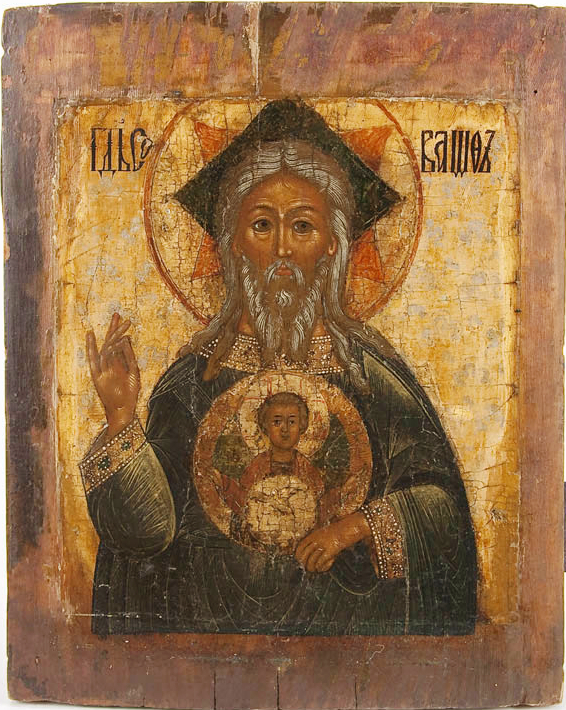
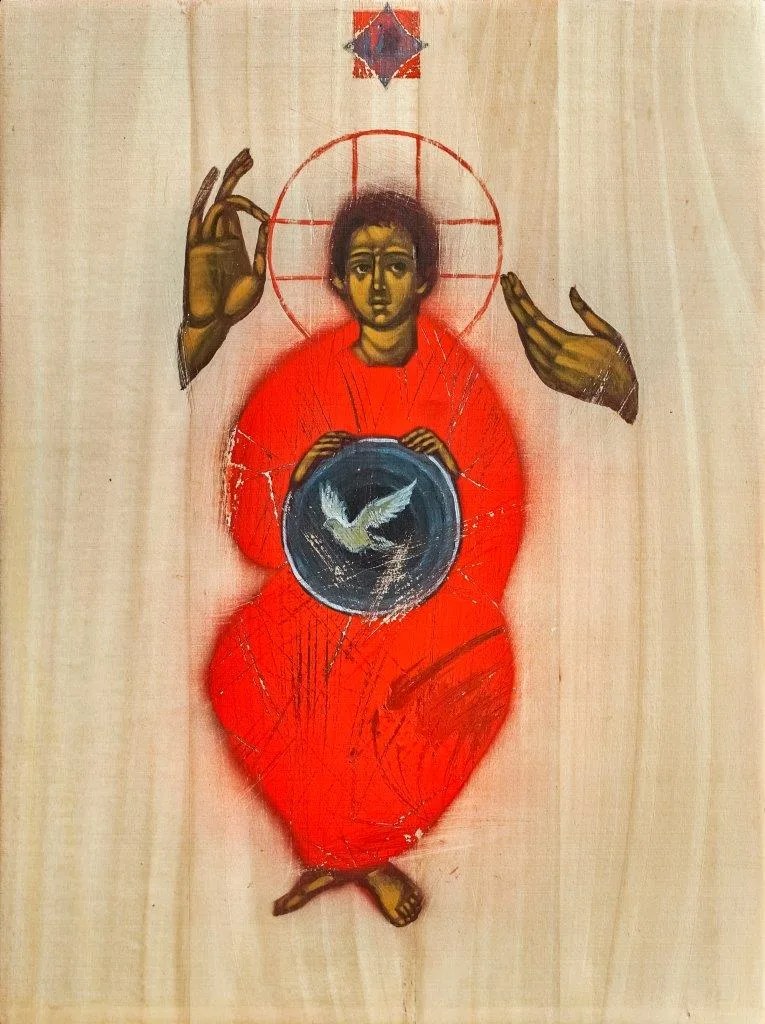
The Otechestvo—“Fatherhood” or “Paternity”—icon shows God the Father (Lord Sabaoth, as he is titled in Russian Orthodoxy) as an old man with Christ Emmanuel (Jesus in child form) seated on his lap or encircled by his “womb,” and the Holy Spirit in the form of a dove hovering before his chest. The eight-pointed slava (“glory”) behind the Father’s head signifies his eternal nature, shared by all three persons. His right hand forms the Greek letters IC XC, abbreviating “Jesus Christ.”
Here are two examples of this Trinitarian image—one from the eighteenth century, and one from just two years ago, which I encountered through the OKSSa [previously] exhibition The Father’s Love.
Otechestvo (Paternity) icon, Russia, 18th century. Tempera on wood, 33 × 27 cm. Sold by Jackson’s International Auctioneers and Appraisers, May 18, 2010.Sylwia Perczak (Polish, 1977–), “Boga nikt nigdy nie widział, Jednorodzony Bóg, który jest w łonie Ojca, o Nim pouczył” (J 1,18), 2023. Acrylic on wood, 40 × 30 cm.
The Polish artist Sylwia Perczak (IG @perczaksylwia) titles her icon after John 1:18: “No one has ever seen God. It is the only Son, himself God, who is close to the Father’s heart, who has made him known” (NRSV). The King James Version contains the lovely phrasing “the only begotten Son . . . is in the bosom of the Father.”
Perczak chooses to keep God the Father, who is incorporeal, out of frame, with the exception of his hands, which gesture to the Son, who holds the Spirit.
Thank you to David Coomler and his Russian Icons blog for introducing me to this icon type.
LISTEN: “In splendoribus sanctorum” by James MacMillan, 2005 | Performed by the Gesualdo Six, dir. Owain Park, feat. Matilda Lloyd, 2020; released on Radiant Dawn, 2025
In splendoribus sanctorum, ex utero, ante luciferum, genui te. [Psalm 109:3 Vulgate]
English translation:
In the brightness of the saints: from the womb before the day star I begot you. [Psalm 109:3 Douay–Rheims Bible]
Written for the Strathclyde University Chamber Choir, the Strathclyde Motets are a collection of fourteen Communion motets for SATB choir by the Scottish composer James MacMillan. “In splendoribus sanctorum” (In the Brightness of the Saints / Amid the Splendors of the Heavenly Sanctuary) is for Midnight Mass on Christmas Eve and includes a trumpet obbligato.
The Latin text is from Psalm 109 in the Vulgate (numbered Psalm 110 in Jewish and Protestant Bibles), a royal psalm that looks forward to the Messiah. The verse is interpreted by Christians as referring to how Christ existed before the dawn of creation, in eternity, and was begotten by the Father; he is the Son of God.
The verse didn’t ring a bell from my many readings of the Psalms over the years—and that’s because it’s from a different manuscript tradition than the Bible translations I typically use (KJV, NRSV, NIV, ESV).
See, the Vulgate, from the late fourth century, is based on the Septuagint, a Greek translation of the Hebrew scriptures produced in Alexandria in the third through first centuries BCE; so is the major Catholic translation of the Bible into English from 1610, the Douay–Rheims. But Protestant and ecumenical translations are based on the Masoretic Text, the authoritative Hebrew and Aramaic text of the twenty-four books of the Jewish canon. The Septuagint and the Masoretic Text contain some textual variants, and this verse is one of them. (Learn more on the Catholic Bible Talk blog.)
Here’s how the verse reads in the New Revised Standard Version:
Your people will offer themselves willingly on the day you lead your forces on the holy mountains.
From the womb of the morning, like dew, your youth will come to you.
The meaning of the Hebrew is obscure, but the phrase “womb of the morning” probably refers to dawn, and “your youth” to the soldiers at the Messiah’s command.
Anyway, I felt I had to explain why if you look up the verse, you might have trouble finding it, depending on which Bible you use.
The Catholic and Orthodox Churches have chosen the “from the womb before the day star I begot you” variant in their liturgies. I love its poetic theology! They use the verse to support the doctrine, taught by all three branches of Christianity, of the eternal generation of the Son—who is “God from God, Light from Light, true God from true God, begotten, not made,” as the Nicene Creed puts it.
By including this verse in its first liturgy of Christmastide, celebrated the night of Christmas Eve, the Catholic Church underscores that Jesus is of the same essence as God the Father. Mary, crucially, gives birth to Jesus, flesh of her flesh—but the Son is generated by the Father before all ages.
To hear “In splendoribus sanctorum” in Old Roman chant from the sixth century, click here.
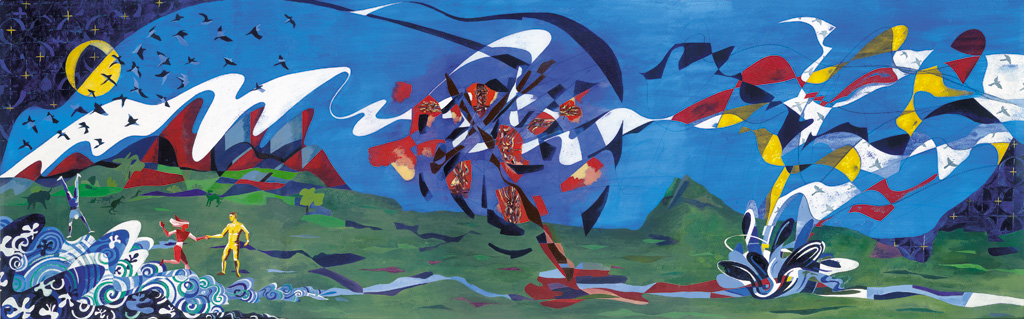
Paul Hobbs (British, 1964–), Three in One, 2000. Acrylic on paper, 55 × 177 cm.
We believe in God above us, Maker and Sustainer of all life, of sun and moon, of water and earth, of male and female.
We believe in God beside us, Jesus Christ, the Word made flesh, born of a woman, servant of the poor, tortured and nailed to a tree. A man of compassion, he died forsaken; he descended into the earth to the place of death. On the third day he rose from the tomb; he ascended into heaven to be everywhere present; and his kingdom will come on earth.
We believe in God within us, the Holy Spirit of Pentecostal fire, life-giving breath of the church, spirit of healing and forgiveness, source of resurrection and eternal life.
Amen.
The Iona Community is an international, ecumenical Christian movement working for justice and peace, the rebuilding of community, and the renewal of worship. This Affirmation of Faith, one of several they use in their liturgies, is found in the Sunday Morning Communion Service A in the Iona Abbey Worship Book (Wild Goose Publications, 2017), pp. 27–28.
The Old Testament reading in the Revised Common Lectionary for this coming Sunday, Trinity Sunday, is Isaiah 6:1–8:
In the year that King Uzziah died, I saw the Lord sitting on a throne, high and lofty, and the hem of his robe filled the temple. Seraphs were in attendance above him; each had six wings: with two they covered their faces, and with two they covered their feet, and with two they flew. And one called to another and said,
Holy, holy, holy is the LORD of hosts; the whole earth is full of his glory.
The pivots on the thresholds shook at the voices of those who called, and the house filled with smoke. And I said, “Woe is me! I am lost, for I am a man of unclean lips, and I live among a people of unclean lips, yet my eyes have seen the King, the LORD of hosts!”
Then one of the seraphs flew to me, holding a live coal that had been taken from the altar with a pair of tongs. The seraph touched my mouth with it and said, “Now that this has touched your lips, your guilt has departed and your sin is blotted out.” Then I heard the voice of the Lord saying, “Whom shall I send, and who will go for us?” And I said, “Here am I; send me!”
Wow. What a truly awesome passage!
I’d like to share two songs inspired by it as well as two visual artworks. The first song is a choral work by the English composer and organist Sir John Stainer (1840–1901), titled “I Saw the Lord.” It was performed by The Sixteen under the direction of Harry Christophers and appears on the ensemble’s 2009 album A New Heaven.
The first stanza is the King James Version of Isaiah 6:1–4, and the second stanza is the third verse of “Ave, colenda Trinitas,” an anonymous Latin hymn of the eleventh century, translated by John David Chambers (1803–1893).
I saw the Lord sitting upon a throne, high and lifted up, and his train filled the temple. Above it stood the seraphims: each one had six wings; with twain he covered his face, and with twain he covered his feet, and with twain he did fly. And one cried unto another, Holy, holy, holy is the LORD of hosts: the whole earth is full of his glory. And the posts of the door moved at the voice of him that cried, and the house was filled with smoke.
O Trinity! O Unity! Be present as we worship thee, And with the songs that angels sing Unite the hymns of praise we bring. Amen.
Christian biblical commentators have discerned in Isaiah 6 two Trinitarian references: the three “holys” pronounced by the angels (v. 3), and the use of both a singular and plural pronoun in God’s question in verse 8: “Whom shall I send, and who will go for us?” (emphasis mine; cf. Gen. 1:26). Unity in plurality. Further, the New Testament relates this passage to both Jesus (John 12:41) and the Holy Spirit (Acts 28:25). That’s why it’s commonly read on Trinity Sunday, and why Stainer has appended to it a Trinitarian hymn text.
Of Stainer’s musical setting, William McVicker writes,
It is often said that I saw the Lord was written with the acoustics of St Paul’s [Cathedral in London] in mind. It is scored for double choir with an independent organ part. The music’s drama is achieved by the simple, largely homophonic texture, and the interplay of the two chorus parts with that of the organ. Stainer breaks into an imitative texture at the words ‘and the house was filled with smoke’ and again in the final verse section, which is reminiscent of a Victorian part-song.
The music is grandiose, majestic, as one would expect for the encounter it frames, which involves robes, thrones, angelic attendants, shaking doorposts, smoke, and an all-pervasive divine glory.
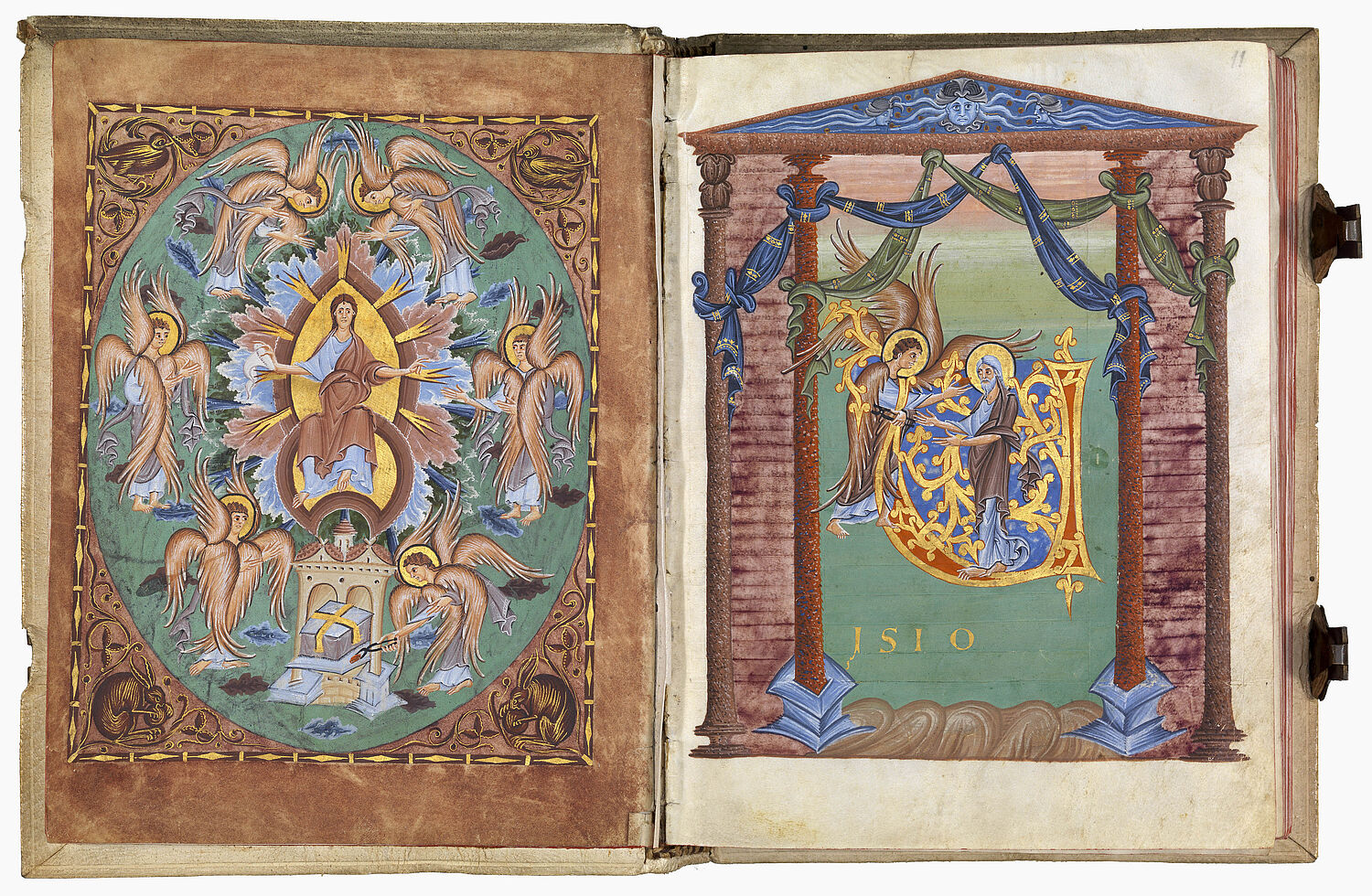
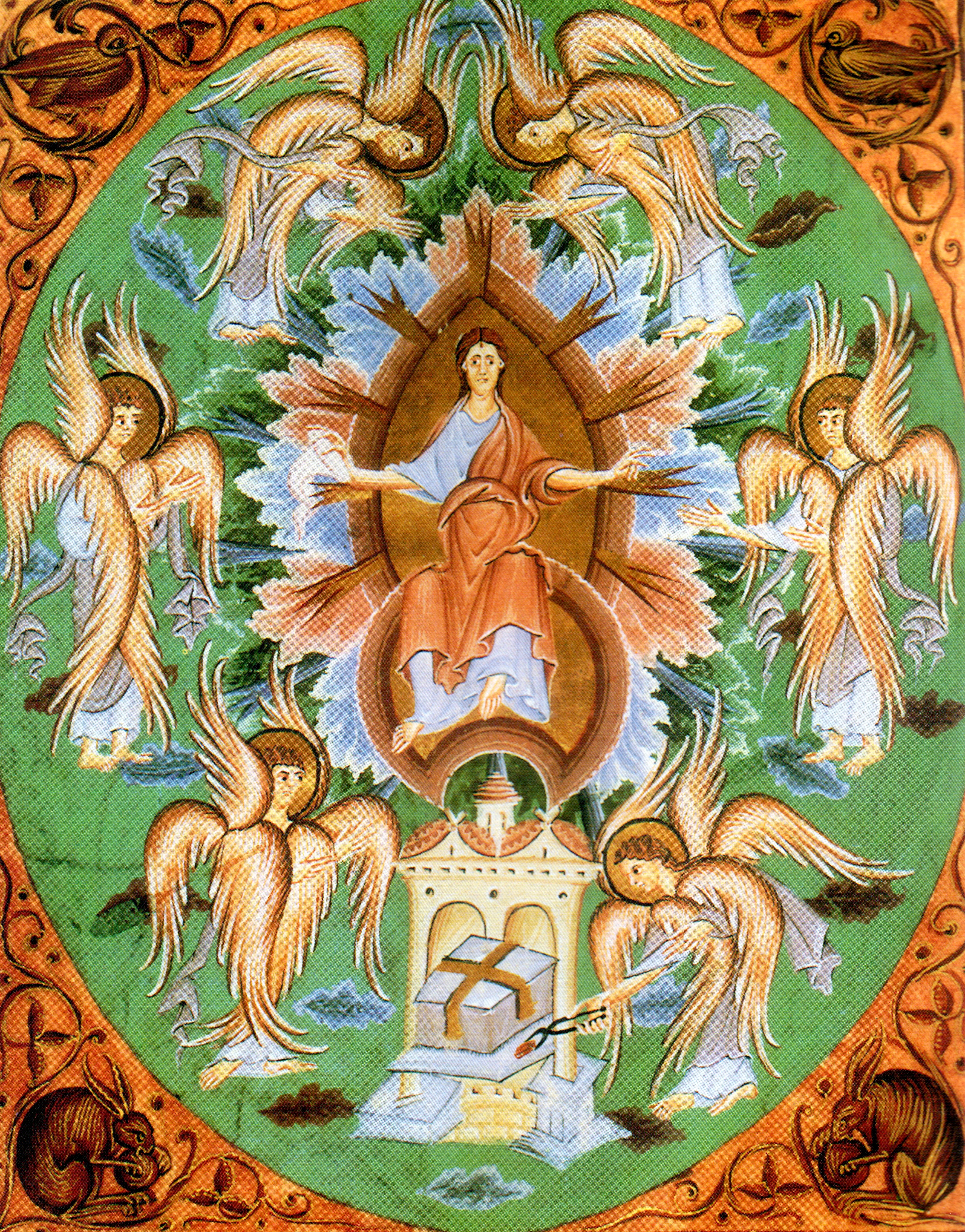
I suggest listening to Stainer’s choral piece as you look on the following page spread from a high medieval German manuscript produced in Reichenau. The manuscript is a copy of Jerome’s (Latin) commentary on Isaiah, with glosses added in the Alemannic dialect of Old High German, and these are the only two images inside.
Miniature depicting the prophet Isaiah’s vision of God and decorative initial page showing the cleansing of the prophet, from an Isaias glossatus made in Reichenau, Germany, ca. 1000. Staatsbibliothek Bamberg, Msc.Bibl.76, fols. 10v–11r. [browse full manuscript]
The island monastery of Reichenau on Lake Constance in southern Germany was an important center of illuminated manuscript production in the Ottonian period (919–1024) of the Holy Roman Empire. The miniatures painted there are among the finest of the Middle Ages. (For another example, see the one I shared back in 2020.)
On folio 10v of the Isaias glossatus that’s kept at the Bamberg State Library, God in the form of Christ sits in a mandorla from which trifold bursts of light shine forth, backed by mauve and powder-blue billows of smoke. In his right hand he holds a scroll that represents the word he speaks to Isaiah in 6:9–13, and the words he will continue to supply him with throughout his ministry. Hovering above a smaller-scale temple, God is attended by six seraphim (lit. “burning ones”), one of whom removes a hot coal from the altar with tongs. All this takes place within a green oval, which is surrounded by a brown and gold decorative border of vine tendrils housing two birds and two hares.
On the opposite page, folio 11r, the tong-bearing seraph touches the coal to Isaiah’s lips, purging his speech and thus fitting him for the office of prophet. This cleansing act is in response to Isaiah’s humble confession of sin, having beheld God’s holiness: “Woe is me! I am lost, for I am a man of unclean lips . . .” (v. 5). The artist shows Isaiah’s hands open and arms outstretched, welcoming God’s cleansing and accepting the call to service: “Here am I; send me!” (v. 8). Notice that this exchange takes place within the letter V, from the opening of Isaiah, “Visio Esaiae” (The vision of Isaiah . . .). The miniature is a historiated initial—that is, an enlarged letter at the beginning of a paragraph that contains a picture.
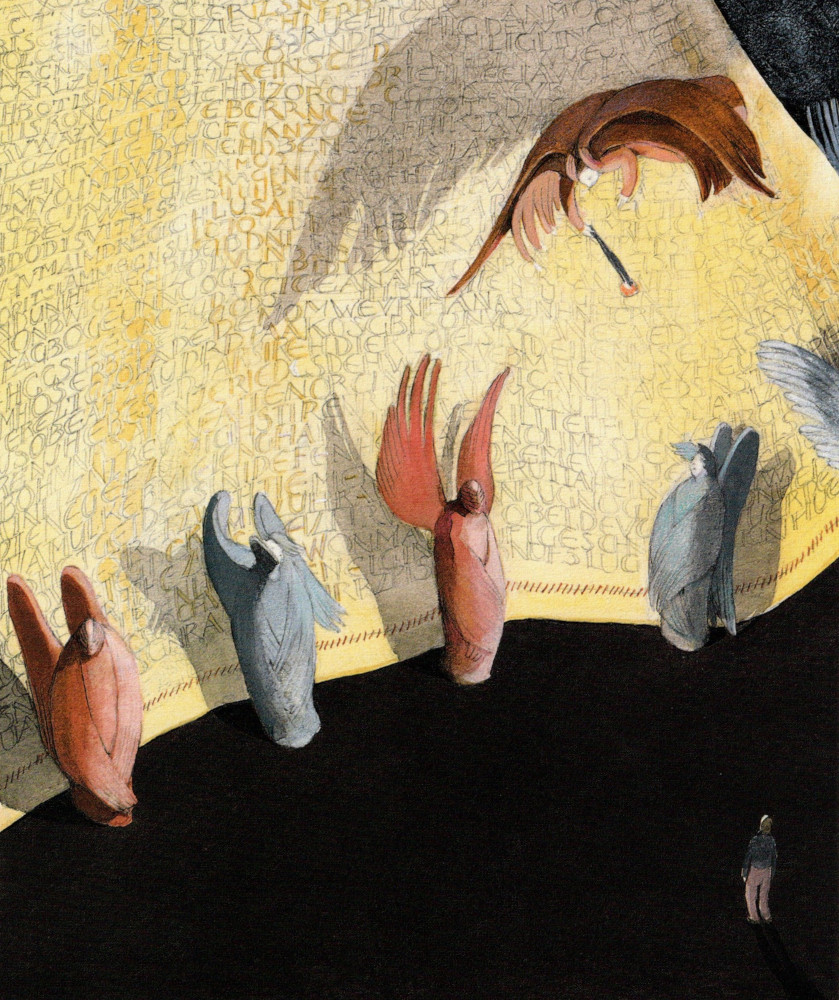
Now let’s shift gears to two Isaiah 6–based works that were made in a folksier idiom. Take in this pen, ink, and watercolor image by the award-winning Austrian illustrator Lisbeth Zwerger, from her book Stories from the Bible (North-South Books, 2002), originally published in German as Die Bibel in 2000:
Lisbeth Zwerger (Austrian, 1954–), Isaiah’s Calling, 2000, an illustration from Stories from the Bible (North-South Books, 2002)
This book contains some of the most imaginative biblical artworks of the past century (I shared a sampling on Instagram), and I recommend it for all Christian bookshelves!
In contrast to the frontal wide shot given by the anonymous Reichenau artist, in Isaiah’s Calling Zwerger zooms in on just one detail of the scene, structured along a diagonal. Isaiah stands at the bottom right in the dark, dwarfed by the immense train of God’s robe, which is pure light. It contains letters that I can’t make out into words; can you? I would have assumed they spell out the passage from Isaiah 6 (in German?), but it’s possible they’re not meant to be intelligible—just a further indicator of God’s mysteriousness. The artist has also deliberately chosen not to show God’s face.
Five blue- and red-plumed seraphim—one mostly out of frame, save for one of his wings—stand at the hem of the royal garment, while a sixth flies down toward Isaiah with that burning coal.
At the hem of Christ’s robe is where the woman from Capernaum with the issue of blood finds healing (Luke 8:43–48), and it’s also here at God’s hem that Isaiah is made well, restored.
For a musical complement to Zwerger’s painting, I recommend the song “Lofty and Exalted” by Lenny Smith. It’s from 1993, but Smith didn’t release a recording until 2020, on the album Splendor and Majesty.
Lofty and exalted, reigning from your throne The train of your robe fills the temple Seraphim above you, calling out your name Proclaiming how good and how lovely
Refrain: Holy, holy, Lord The earth is full of your glory Holy, holy, Lord The earth is full of your praise
“God’s real exalted status and prestige is that He loves being with the lowest of the low,” Smith writes on the song’s Bandcamp page. And in the YouTube description for the song, he reminisces, “Oh for the days when a bunch of us just got together in my basement and just played and sang for hours . . . to our hearts’ content. We had no ulterior motives at all. It was just fun and exhilarating. No audience or pastors or video cameras or aspirations to become worship leaders or famous artists. Oh for those simple, lovely days!”
Smith was involved in the Jesus Movement of the 1960s and ’70s. He has written some two hundred church songs, the most famous of which is “Our God Reigns.” I know him best for “But for You,” through the cover by the Welcome Wagon on their debut album.
Stylistically, this musical adaptation of Isaiah 6 is much different from John Stainer’s. The composition is simple, just a few chords and easily singable (it would work great congregationally), and the instrumentation consists of guitar and piano. It’s also exuberant in tone. Perhaps Stainer’s piece better holds the gravitas of Isaiah’s vision, but Smith’s captures its joy.
In his Prophecy of Isaiah: An Introduction and Commentary, J. Alec Motyer writes, paradoxically, that God’s “transcendent holiness is the mode of God’s immanence, for the whole earth is full of his glory” (77), reminding us that however otherworldly this mystic moment might have felt to Isaiah, the glory of God is profoundly thisworldly too, suffusing the everyday. “God’s glory isn’t ‘up there’ away from us,” writes SALT Project in their lectionary commentary for this Sunday, “but rather fills the whole earth and is intimately, actively involved in our lives, calling and sending us in service to God’s mission in the world.”
Every artistic interpretation—visual, musical, or what have you—of a scripture text has the potential to open us up to the text in new ways. No single interpretation should become totalizing; we need all kinds! I’m so appreciative of those who take the time to sit with a Bible passage and then respond to it in paint or in song, whether that be medieval monks laboring away in the scriptorium with their gold leaf and color pigments or contemporary storybook illustrators with their watercolors, a Victorian organist knighted by the queen and serving a cathedral or folk musicians jamming with friends in informal, at-home worship.
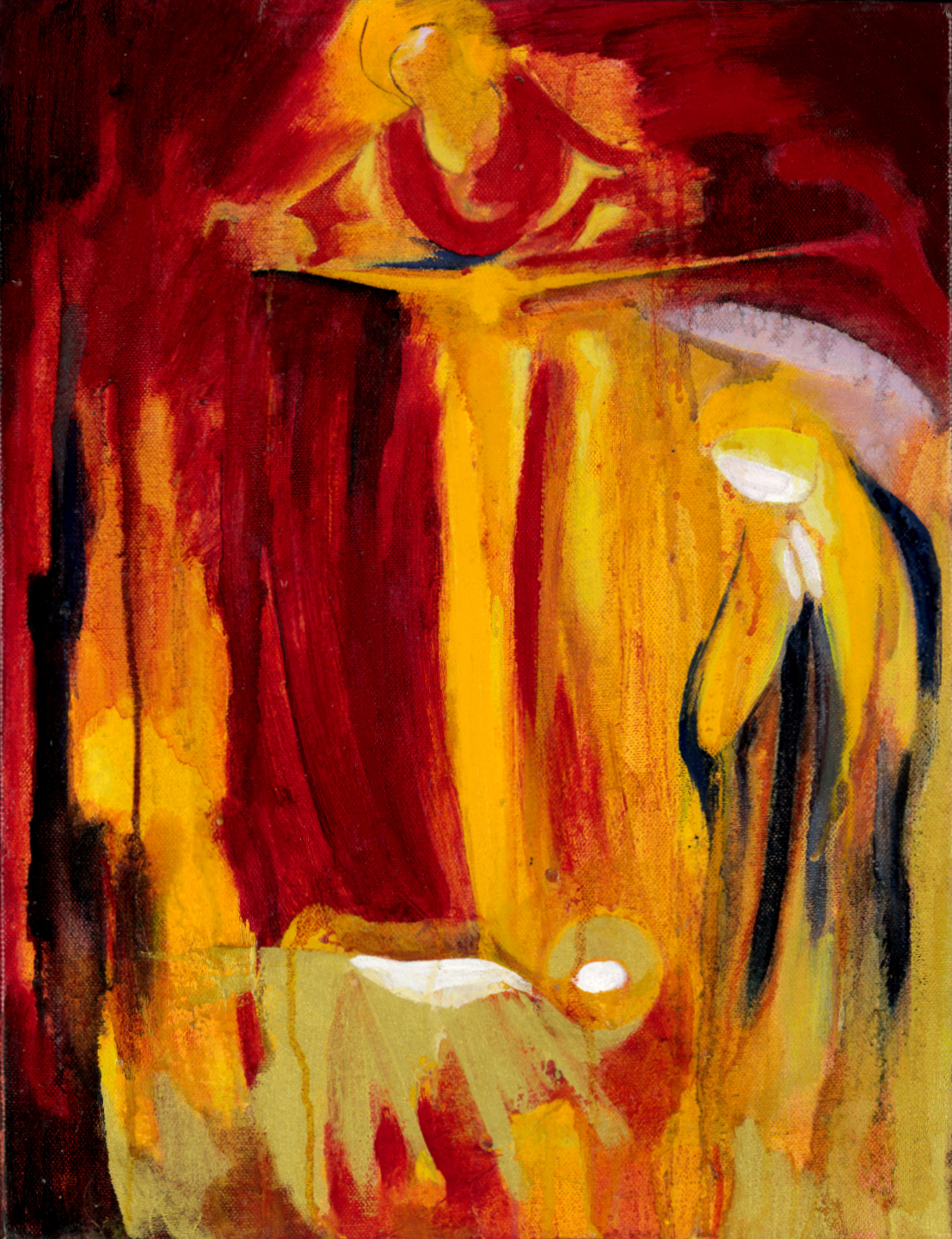
Judith Tutin (Irish, 1979–), Nativity, 2011. Oil on canvas, 60 × 40 cm. Private collection of Fr. Jim Doyle, Wexford, Ireland. Photo courtesy of the artist.
In this semiabstract Nativity painting by Judith Tutin, Mary and Joseph adore the newborn Christ child as God the Father looks down from above, holding in his arms a portent: the traces of a cross. One might also see, overlapping the intimation of a crossbar, the outstretched wings of the Holy Spirit as dove, hovering over the earthly scene below.
This central triad of Father, (crucified) Son, and Spirit evokes the Gnadenstuhl, or “Throne of Mercy,” an iconography of the Trinity that emerged in twelfth-century Europe. Tutin innovates on this type by showing, at the base of the cross, the Son in his infancy, thus drawing together the doctrines of the incarnation and the atonement.
Applied in broad, loose brushstrokes, the deep crimsons and golds further underscore the themes of blood and glory.
LISTEN: “A Stable Lamp Is Lighted” | Words by Richard Wilbur, 1958 | Music by Jennifer Wyatt, 2002 | Performed by Ardyth & Jennifer on WinterFire, 2002
A stable-lamp is lighted Whose glow shall wake the sky; The stars shall bend their voices, And every stone shall cry. And every stone shall cry, And straw like gold shall shine; A barn shall harbor heaven, A stall become a shrine.
This child through David’s city Shall ride in triumph by; The palm shall strew its branches, And every stone shall cry. And every stone shall cry, Though heavy, dull, and dumb, And lie within the roadway To pave his kingdom come.
Yet he shall be forsaken, And yielded up to die; The sky shall groan and darken, And every stone shall cry. And every stone shall cry For stony hearts of men: God’s blood upon the spear-head, God’s love refused again.
But now, as at the ending, The low is lifted high; The stars shall bend their voices, And every stone shall cry. And every stone shall cry, In praises of the Child By whose descent among us The worlds are reconciled.
Richard Wilbur (1921–2017) [previously] was a major American poet, serving as the nation’s second poet laureate and winning two Pulitzer Prizes and a National Medal of Arts. He was a champion of formalist poetry, working within the constraints of meter and rhyme.
He wrote this text to be sung at a December 7, 1958, candlelight service in the Memorial Chapel of Wesleyan University in Middletown, Connecticut, where he was a professor in the English Department. It premiered with a choral setting by Richard Winslow, director of the university’s choral society. Wilbur also sent out the text in his family Christmas cards that year.
A few years later, it was published in his collection Advice to a Prophet (1961) as “A Christmas Hymn,” with Luke 19:39–40 as an epigraph: “And some of the Pharisees from among the multitude said unto him, Master, rebuke thy disciples. And he answered and said unto them, I tell you that, if these should hold their peace, the stones would immediately cry out.” This passage takes place upon Jesus’s entry into Jerusalem the week of his death. People were lauding him as a king who came in the name of the Lord, which the Pharisees considered blasphemous. When they demand that Jesus repudiate such ridiculous claims, he instead validates them, replying that even the inanimate stones know his kingship and would shout, “Hosanna!” if human voices failed to.
The hymn stretches from Christmas to Palm Sunday to Good Friday, then circles back to Christmas, covering the span of Christ’s life.
“Not many other major poets in the past seventy years have written Christmas hymns, classic, straightforward Nativity celebrations with no irony to them, and which work beautifully in a traditional church service,” notes Bruce Michelson in Wilbur’s Poetry: Music in a Scattering Time. Wilbur is an example of a modern poet who was very accomplished at his craft and respected by the establishment as well as being a person of Christian faith.
“A Stable Lamp Is Lighted” appears in a few dozen hymnals. The standard tune for it is ANDÚJAR by David Hurd from 1983, but I prefer the one by Ardyth & Jennifer, Celtic harp and vocal duo Ardyth Robinson and Jennifer Wyatt, based in Shad Bay, Nova Scotia.
This post is part of a daily Christmas series that goes through January 6. View all the posts here, and the accompanying Spotify playlist here.
Today, June 4, is Trinity Sunday! Here’s a handful of art and music items on the topic.
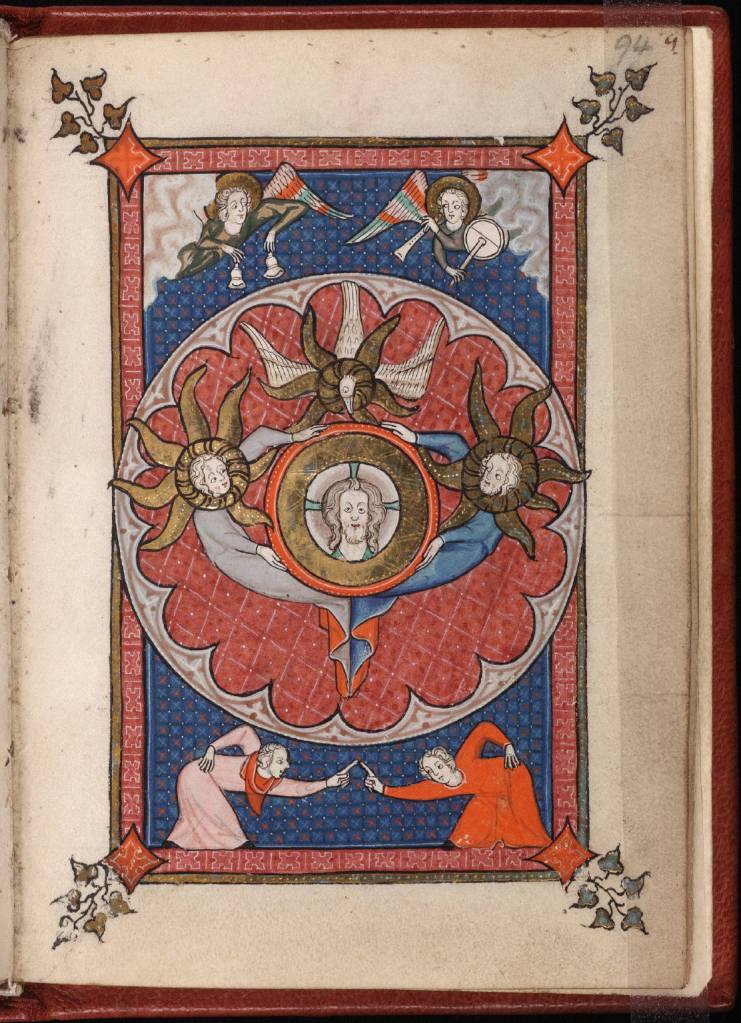
VISUAL MEDITATION: “The Wheeling Playfulness of the Trinity” by Victoria Emily Jones: The Rothschild Canticles [previously] from ca. 1300 Flanders contains some of the most inventive and delightful artistic renderings of the Trinity that I’ve ever seen. I key in on four of them in today’s visual meditation for ArtWay.
Beinecke MS 404, fol. 94r
+++
MUSICAL COMMENTARY: “Theology in Sound and Motion: Perichoresis, for Brass Quintet” by Delvyn Case:Delvyn Case provides musical and theological commentary on his brass quintet composition “Perichoresis” (2006), inspired by the divine dance of the Trinity. “Its overall mood is joyous, an ecstatic whirling-about in which all three members become lost in the ecstasy of divine fellowship,” he writes. “At the exact moment of the dance when one member moves, the other fills in the spot left vacant.” “Perichoresis” premiered by Boston’s Triton Brass and appears on Case’s 2018 album Strange Energy. About this piece, Bible scholar and theologian Walter Brueggemann said, “I . . . have pondered ‘perichoresis’ for a long time. This is the finest exposition of that thick idea that I have encountered.”
+++
SONGS:
>> “Trinity Song” by Paul Zach: Performed in 2021 by Solomon Dorsey with Liz Vice and Madison Cunningham, this song by Paul Zach evolved into “God of Grace and Mystery” for The Porter’s Gate’s 2022 album Climate Vigil Songs. This earlier iteration has a Trinitarian focus that’s just lovely. “God of all eternity / Father, Spirit, and the Son / Ever-loving Three-in-One / O divine community / . . . / Calling us to join your dance . . .”
>> “One-Two-Three” by the Chosen Gospel Singers: This song was recorded in Los Angeles for Specialty Records and released as a single in 1952, with singers J. B. Randall (bass), E. J. Brumfield (tenor), George Butler (tenor), Fred Sims (tenor), and Oscar Cook (baritone). It opens with a repetition of the lines “One, two, three / One-in-Three and the Trinity.” The refrain is:
One for the Father Two for the Son Three for the Holy Ghost All made of one
The song is largely eschatological. The first verse is about John the Revelator’s vision of the New Jerusalem descending, among other wonders; it ascribes a vision of the Trinity to John, even though that is not explicit as such in either John’s Gospel or the Apocalypse (but see “The Trinity in the Book of Revelation” by Edwin Reynolds). The second verse anticipates our singing and praising the Triune God in heaven, dressed in our brand-new robes. It also mentions David and Goliath, and I’m honestly not sure how that relates. But with gospel songs, floating lyrics are common, taken from one song and spliced into another, some more coherent than others in their new context.
+++
ESSAY: “The Hospitality of Abraham in the Work of Julia Stankova, Painter of Bulgarian Icons” by François Bœspflug: The first half of this peer-reviewed article introduces readers to the Bulgarian artist Julia Stankova, rehearsing her biography and examining her relationship to the icons tradition. The second half explores twelve of her paintings on the subject of the three angelic visitors to Abraham and Sarah in Genesis 18, whom the narrator suggests are a manifestation of God (“The LORD appeared to Abraham at the oaks of Mamre . . .”); because of the number of visitors, many Christians interpret this passage as revealing something of God’s triune nature, and for this reason traditional icons of the story are often titled The Trinity.
Julia Stankova (Bulgarian, 1954–), The Hospitality of Abraham, 2004. Tempera on primed wooden panel and lacquer technique, 46 × 41 cm.
Since the publication of this article in 2019, Stankova has made at least three more paintings on the subject, all of which foreground Sarah and are titled Sarah’s Smile. She has just heard the angels announce that she will conceive a son in her old age.
+++
POEM: “After Rublev’s Trinity”by Carrie Purcell Kahler: Published in Image no. 99 (Winter 2018), p. 21, this ekphrastic poem by Carrie Purcell Kahler interprets the famous fifteenth-century Trinity icon by Andrei Rublev. Sometimes referred to as “the hospitality of Abraham,” this biblical episode, as the iconographers interpret it, is really about the hospitality of God, who extends a hand to humanity, ever inviting us to sit at his table.
Andrei Rublev (Russian, 1360–ca. 1430), The Trinity, ca. 1411. Tempera on wood, 141.5 × 114 cm. Tretyakov Gallery, Moscow.
A new choral setting of this poem by Garrett John Law is premiering today at Holy Trinity Episcopal Church in Covina, California, where Law serves as music director and organist. I believe it can be heard on the 10:30 a.m. PT worship service livestream on the church’s YouTube channel, but I’m not sure whether the performance will be archived online for later viewing. (Update, 6/12/23: Here it is! Sung by Holy Trinity’s seven-person choir.)
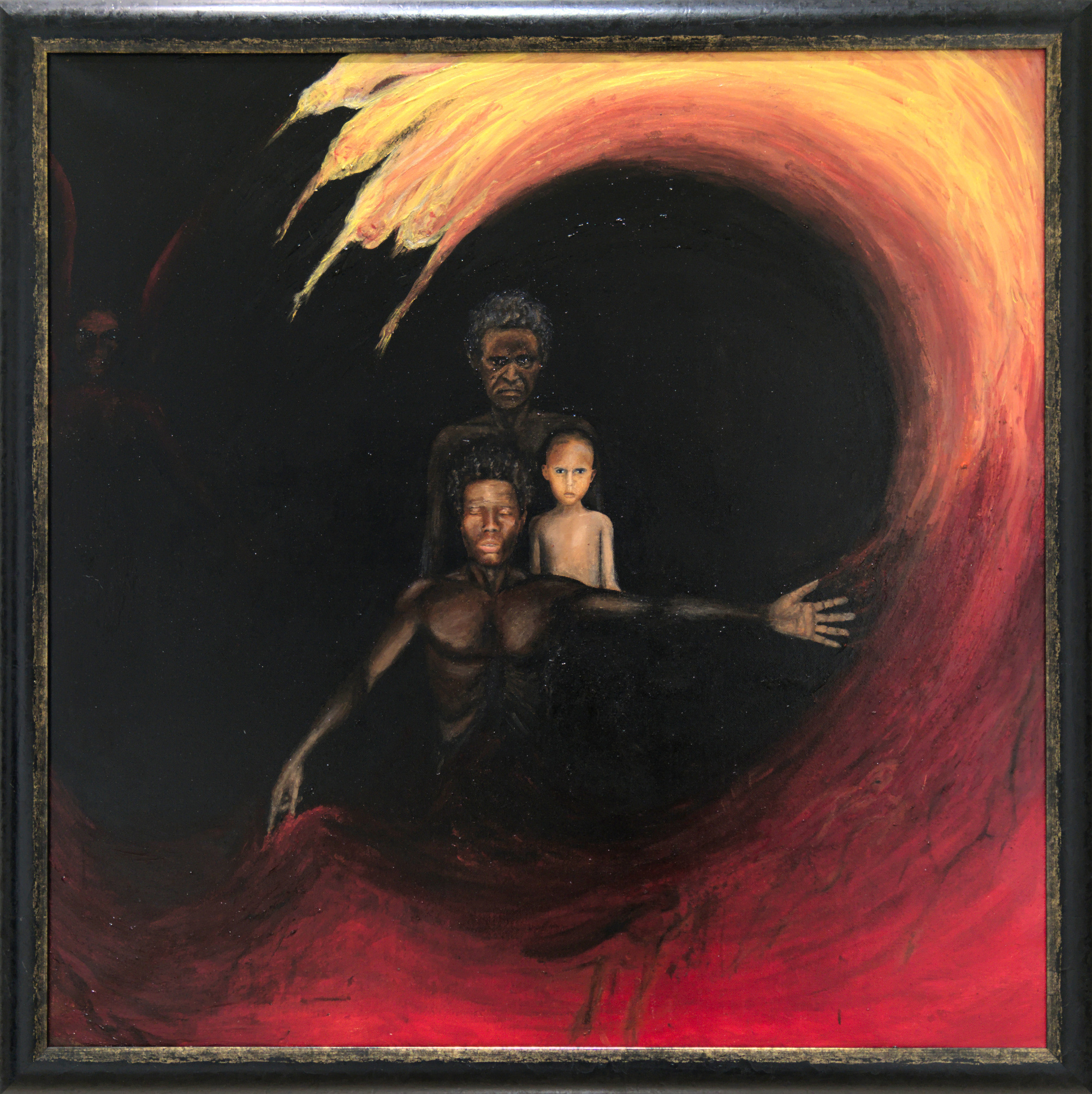
I first encountered the work of Welsh Catholic artist James Keay-Bright last year at the 8th Catholic Arts Biennial at the Verostko Center for the Arts at Saint Vincent College in Latrobe, Pennsylvania, where his Trinity Redemption painting was among the juried selections.
James Keay-Bright (Welsh, 1965–), Trinity Redemption, 2013. Oil on canvas, 40 × 40 in. Private collection, United States. All photos by Victoria Emily Jones, at the 8th Catholic Arts Biennial, Verostko Center for the Arts, Saint Vincent College, Latrobe, Pennsylvania.
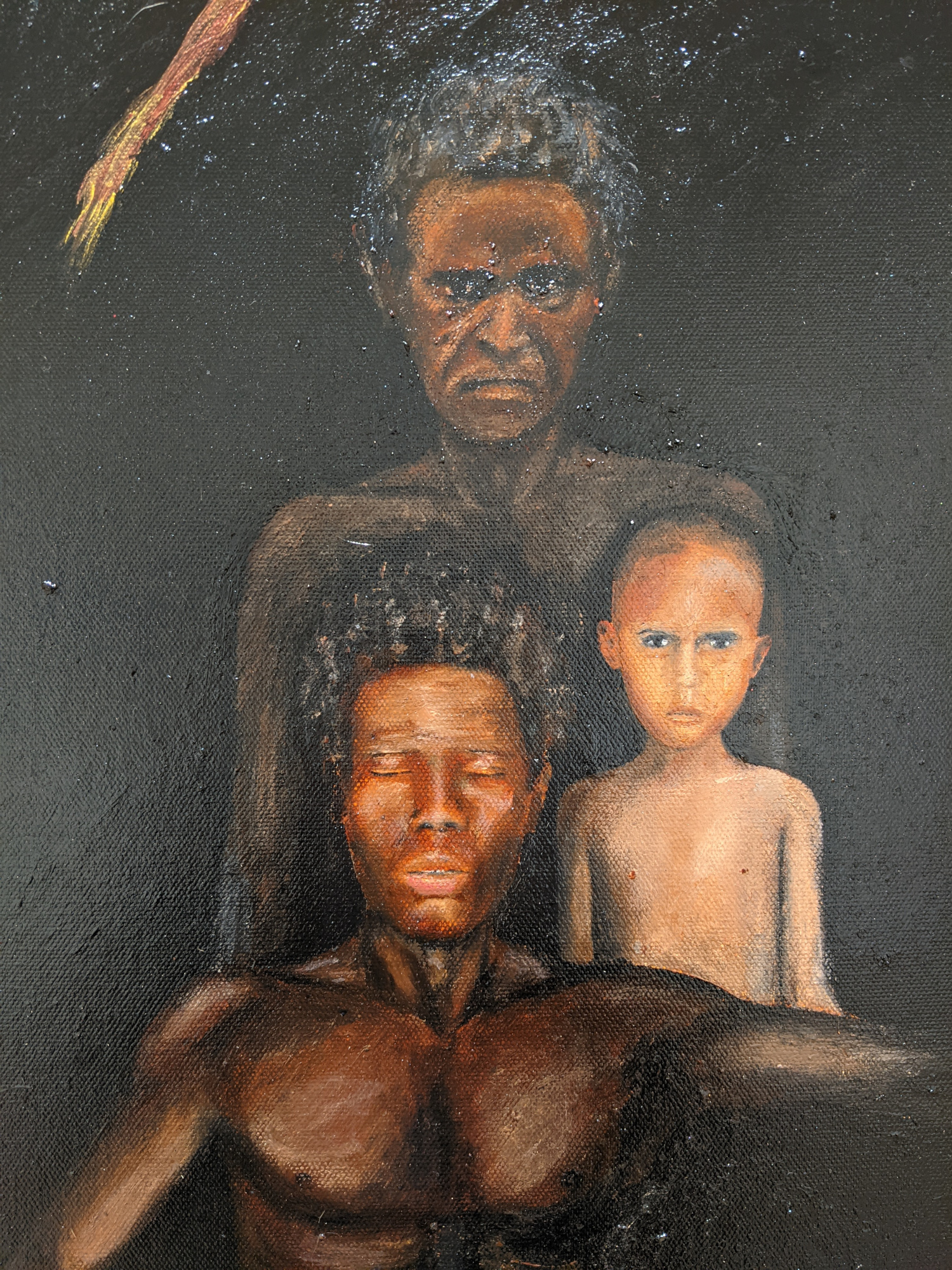
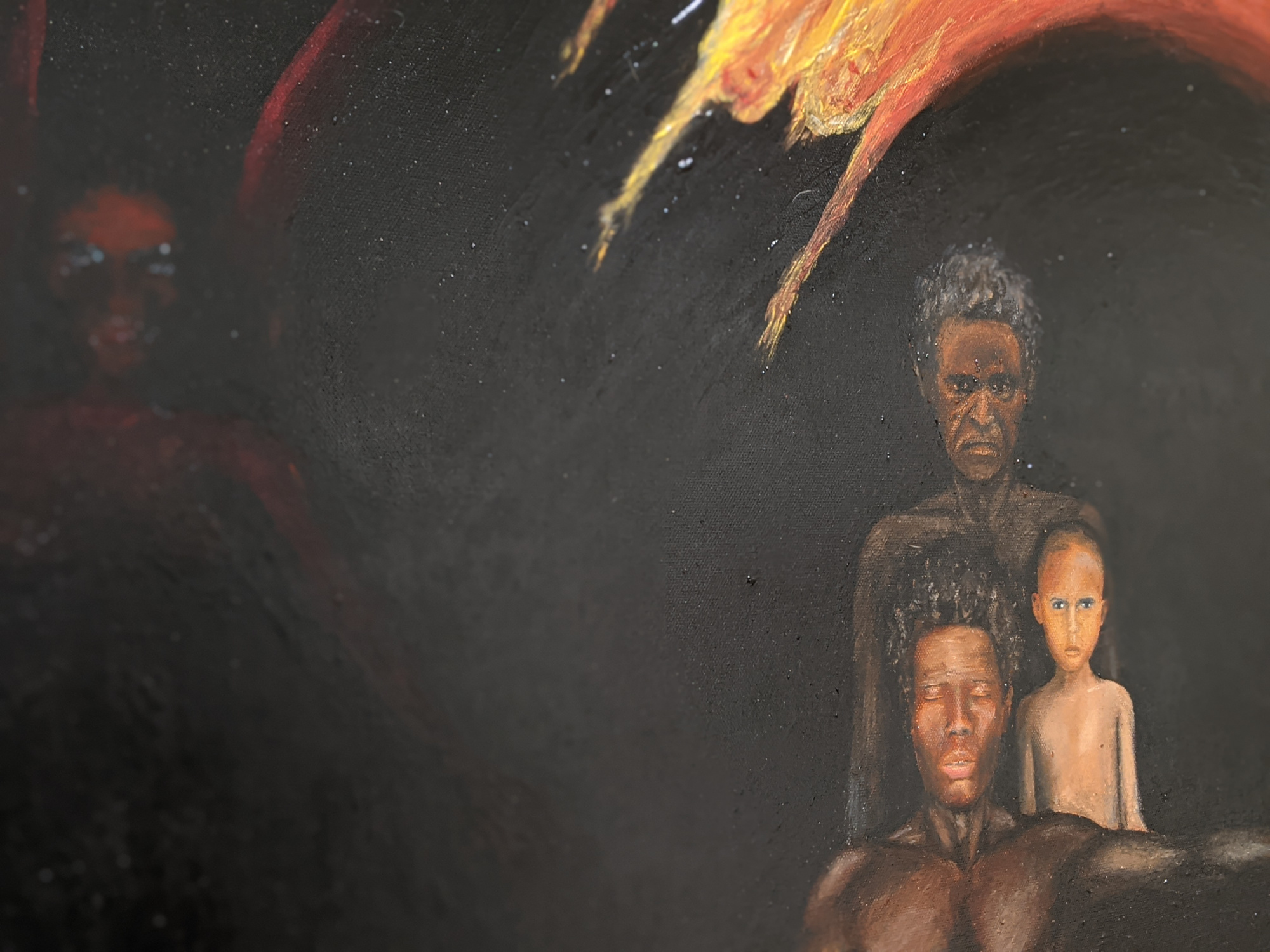
It shows God the Father, Son, and Holy Spirit standing one behind the other against a black background, facing forward. They are semi-encompassed by a wave of fire that emanates from the foreground figure’s outstretched hand. Vigorous and bright, it swells up and around the trio, its branching tip reaching like arms into the darkness.
The young African man in front represents the Holy Spirit sending forth his presence, Keay-Bright told me. (The illumination of his face is wonderful!) Jesus Christ is shown as a Middle Eastern boy of about eight years old, while God the Father is modeled after an elderly Aboriginal Australian.
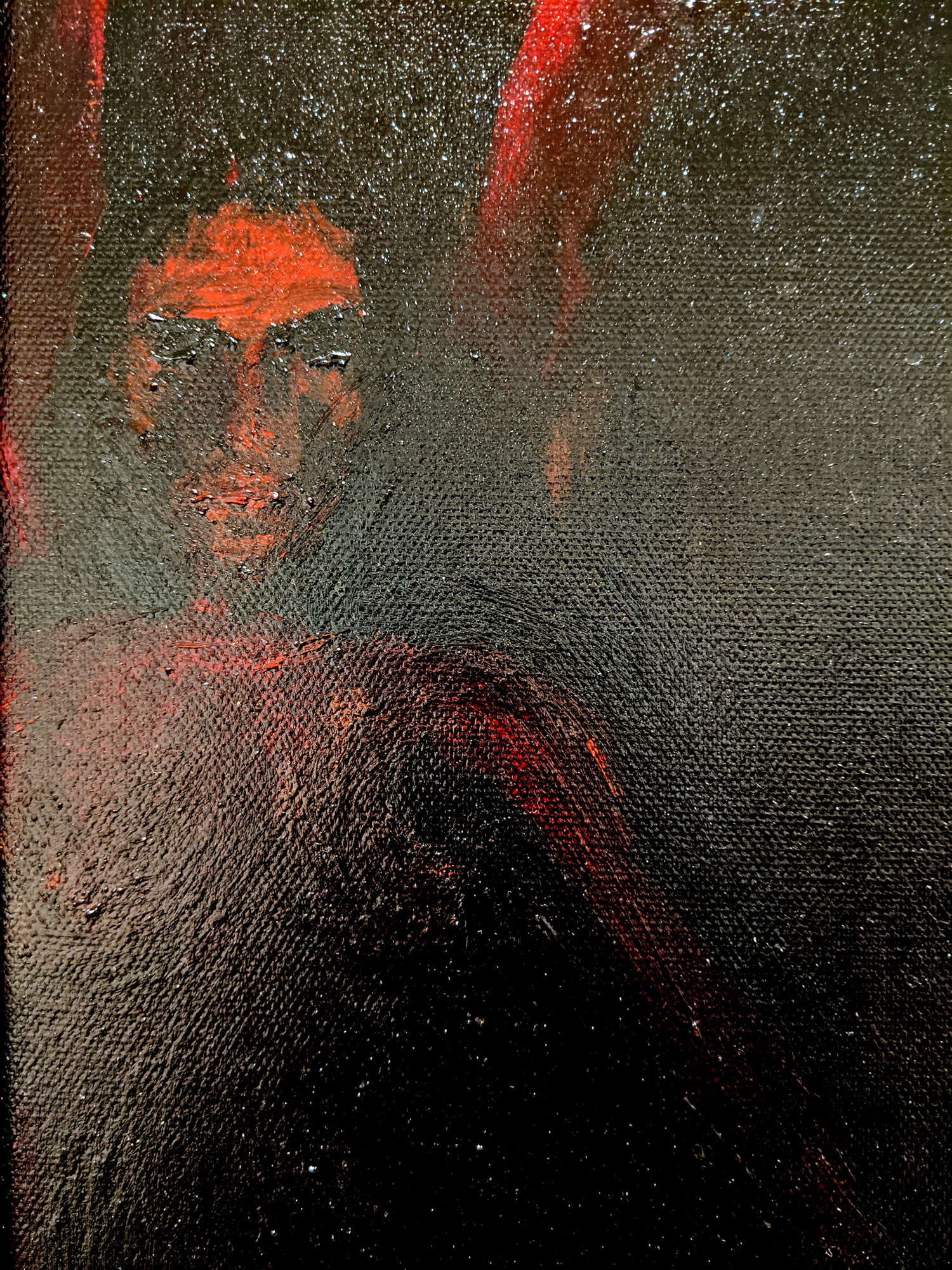
Unable to withstand the tidal wave of divine light, evil retreats into the shadows, symbolized by the satanic figure at the left.
In the Old Testament, fire often signifies the presence of God, as when Moses encounters God in the burning bush (Exod. 3:2), or as with the pillar of fire that leads the Israelites through the wilderness (Exod. 13:21).
In the New Testament, in Acts 2, the Holy Spirit descends like fire on the people who are gathered in Jerusalem for the feast of Pentecost. This “fire” ignites faith and has a sanctifying effect—purifying us of sin, making us holy.
Last Sunday the church celebrated the Spirit’s historic descent, and this Sunday is marked in liturgical calendars as Trinity Sunday. One of the scripture readings in the Revised Common Lectionary comes from Romans 5: “Therefore, since we are justified by faith, we have peace with God through our Lord Jesus Christ, through whom we have obtained access to this grace in which we stand, and we boast in our hope of sharing the glory of God. . . . And hope does not put us to shame, because God’s love has been poured into our hearts through the Holy Spirit that has been given to us” (vv. 1–2, 5). This passage describes the combined activity of the Triune God in bringing about salvation.
Commenting on his painting, Keay-Bright told me, “It’s about cycles of redemption. We respond to God’s call but then fall away. But we can always come back.” God’s “spirit and grace” are constantly extended to us, he says. The fire of divine love is always going out, sweeping through the world to reclaim and restore.
Keay-Bright is interested in non-Caucasian representations of biblical figures. That desire has sprung in part from his international humanitarian work, in which he has encountered the sacred through people of various races and ethnicities. He has worked with refugees in the Balkans, Uganda, and Algeria—first through an NGO and later through the UN Refugee Agency. This month he is traveling to Rwanda to serve refugees from Burundi and the Democratic Republic of Congo.
No one has ever seen God. But the unique One, who is himself God, is near to the Father’s heart. He has revealed God to us.
—John 1:18 (NLT)
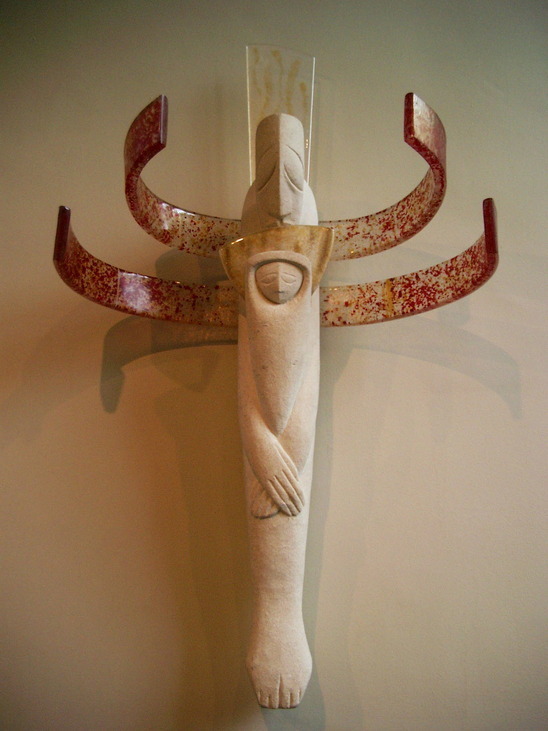
LOOK: The Word by Nicholas Mynheer
Nicholas Mynheer (British, 1958–), The Word, 2000. English limestone and cast glass, height 102 cm. South aisle, Birmingham Cathedral, UK.
This sculpture on the theme of the Incarnation of the Word was commissioned by the Cathedral Church of Saint Philip in Birmingham, England, for the new millennium. The sun shines on the work through the south window, casting light from the colored glass pieces over and across the stone and the surrounding wall.
“The changing light and shadows represent for me the ongoing Incarnation and not merely an historical event,” says artist Nicholas Mynheer. He notes the combination of heaven (glass) and earth (stone).
This is a Trinitarian image: the Father, anthropomorphized but nongendered, presents his glory, the Son, spoken, breathed, coming as infant, and both are embraced by the arcing sweep of the Holy Spirit.
LISTEN: “The Glory of the Father” | Words adapted from John 1 | Music by Egil Hovland, 1957; edited by Frank Pooler, 1974 | Performed by the National Lutheran Choir (US), dir. David Cherwien, 2018
The Word was made flesh, and dwelt among us. We beheld the glory of the Father, Full of grace and truth.
In the beginning was the Word, and the Word was with God. In Him was life, and the life was the light of all. He came to his own, and his own, received him not.
The Word was made flesh, and dwelt among us. We beheld the glory of the Father, Full of grace and truth.
The Rothschild Canticles is the name of a lavishly illuminated manuscript of Franco-Flemish origin, produced at the turn of the fourteenth century. “A potpourri of biblical verses, liturgical praise, dogmatic formulas, exegesis, and theological aphorisms, . . . the manuscript leads its user step by step through meditations on paradise, the Song of Songs, and the Virgin Mary to mystical union and, finally, contemplation of the Trinity,” describes Barbara Newman in her excellent essay “Contemplating the Trinity: Text, Image, and the Origins of the Rothschild Canticles.” It’s a diminutive little book, with a trim size of just four and a half inches by about three and a quarter.
The manuscript lacks any provenance before 1856, but Newman proposes that it was made at the Benedictine abbey of Bergues-Saint-Winnoc in Flanders, located at what is today the northern tip of France. The compiler of its texts, she suggests, was probably the same person who designed its remarkable images—most likely a monk of Saint-Winnoc, who probably employed a professional lay artist from Saint-Omer to execute the designs. The book’s patron was probably a canoness at the nearby abbey of Saint-Victor. It is now preserved at the Beinecke Rare Book and Manuscript Library at Yale University in New Haven, Connecticut. All photographs in this post are courtesy of the Beinecke. Click here to page through the fully digitized manuscript.
The most extraordinary section of the book is a florilegium (collection of literary extracts) on the Trinity, which comprises folios 39v–44r and 74v–106r and draws especially on Augustine’s De Trinitate. Within these pages are nineteen full-page miniatures that exhibit “the most stunning iconographic creativity, . . . bearing witness to a distinctive Trinitarian theology.”
The representation of the Holy Trinity poses one of the most difficult iconographic problems in Christian art. How is one to portray three distinct, divine persons who share one essence? Historical attempts have included the following:
Three identical Christomorphic men (this one is relatively rare)
Three mystically conjoined faces, or three separate heads sharing one body (nicknamed the “monstrous Trinity” and condemned by the Roman Catholic Church)
The Gnadenstuhl (Throne of Mercy, or Throne of Grace), in which the Father is shown holding a crucifix or, in a later variation known as the Mystic Pietà, his slumped Son, while the Holy Spirit in the form of a dove hovers between them
Triangles, trefoils, triquetras, or other abstract geometric designs that suggest Three-in-Oneness
In the Eastern Orthodox Church, the Holy Trinity is represented by three angels seated at a table. These are the three mysterious visitors of Abraham in Genesis 18, believed to be a theophany (visible manifestation of God).
The artist of the Rothschild Canticles relies on none of these conventions, inventing instead an almost wholly original visual language to express the rich yet daunting doctrine. In contrast to other depictions of the Trinity, in the Rothschild Canticles we find, says Newman,
a playful, intimate approach to the triune God, marked by spontaneity rather than solemnity, dynamism rather than hieratic stasis, wit rather than awe. There is no hint of narrative, but something more like an eternal dance. . . . The divine persons are caught up in an everlasting game of hide-and-seek with humans while they enact among themselves, in ever-changing ways, that mutual coinherence that the Greek fathers called perichoresis—literally “dancing around one another.” (135)
Jongleurs (itinerant medieval entertainers proficient in juggling, acrobatics, music, and recitation), angels, and various pointing figures play the role of implied viewers and manifest a joyous attitude. For example,
on fol. 79r a celestial percussionist attacks a row of bells with mallets; on fol. 84r, angels in the upper left and right play a game of ring toss; on fol. 88r, musicians . . . strum whimsically shaped zithers embellished with animal heads. . . . In the lower right corner of fol. 96r, an elfin figure bends over backward to play an instrument whose pinwheel shape mimics the great solar wheel behind which divine Wisdom hides. Four characters in the corners of fol. 98r stretch their arms as if to join hands in a cosmic dance, while on fol. 100r, three spectators raise their hands in wonder beneath a divine apparition, imitating the stunned postures of Peter, James, and John at the Transfiguration. . . . Collectively, they seem to proclaim that the reader need not be ashamed or afraid, even though all human attempts to comprehend the Trinity are comically inept. Nonetheless, she can merrily follow the Lord of the Dance. (135–36)
The quirkiness is so endearing!
Newman continues,
In the Rothschild Canticles, coinherence is the dimension of Trinitarian theology to which the artist seems most profoundly committed. The complex relationality of the three persons is conveyed through the delicate interplay of touch, gesture, and changing positions. Sometimes the Father and Son join hands; on fol. 104r they touch feet behind the wheel they hold. Sometimes they grasp the sides, wings, or talons of the dove, and sometimes they unite around a fourth figure representing the Divine Essence. (143–44)
Moreover,
the artist invented some simple devices to keep the paradox of triunity before the mind’s eye at all times. For example, a prime signifier of divinity—the golden sun with its waving, tentacle-like rays—is sometimes single (fols. 44r, 81r, 88r, 90r), sometimes triple (fols. 40r, 83r, 94r). Elsewhere the artist complicated this formula. On fol. 79r, three small suns for each person are superimposed on one large sun; fols. 92r and 100r insert a smaller sun inside a bigger one; and on fol. 96r, two suns interlock to form a double wheel with spokes radiating both inward and outward. (141)
I particularly like fol. 94r, where the three persons of the Godhead wear the sun like a collar. And fol. 100r, where we see just three feet and three hands, each belonging to a different person, peeping out from behind a giant sun disc!
Another recurring and versatile motif in the Trinity cycle is the veil, which signifies both God’s presence and God’s hiddenness. Sometimes it forms a hammock in which the Trinity rests, partially covered (fols. 75r, 88r); or is braided in an enclosing circle, dangling down for humans to touch (fol. 81r); or is looped about the Father, Son, and Spirit, nestling them snugly (fol. 84r); or is knotted and clutched (fol. 92r); or is draped over bands of cloud (fol. 106r). In this artistic program, veils both conceal and reveal, communicating the paradoxical nature of God who is ensconced in mystery—incomprehensible—and yet accessible, wanting to be known.
Notably, the profusion of Trinitarian imagery is supplemented in the manuscript with textual reminders of the limitations of images. In De Trinitate 8.4.7, for example, Augustine says that all manmade images of God are false, and yet, he says, they are useful insofar as they help the mind cling to the invisible reality to which they point.
Below is a complete compilation of Trinity miniatures from the Rothschild Canticles, reproduced in the order they appear in the manuscript. I have prefaced most with one or more of the quotations that appear on its facing page (thanks to Newman’s identifications) so that you can see how intricately text and image relate. If you wish to reproduce any of these images singly, I suggest the following credit:
Trinity miniature from the Rothschild Canticles (MS 404, fol. _), made in Flanders, ca. 1300. Beinecke Rare Book and Manuscript Library, Yale University, New Haven, Connecticut.
“Dominus in orisunte eternitatis et supra tempus” (The Lord is on the horizon of eternity and beyond time):
Fol. 40rFol. 42r
“Tu es vere Deus absconditus” (Truly you are a hidden God) (Isa. 45:15):
Fol. 44r
“Bene ergo ipsa difficultas loquendi cor nostrum ad intelligentiam trahit, et per infirmitatem nostram coelestis doctrina nos adjuvat: ut quia in Deitate Patris, et Filii, et Spiritus sancti nec singularitas est, nec diversitas cogitanda, vera unitas et vera Trinitas possit quidem simul mente aliquatenus sentiri, sed non possit simul ore proferri.”—Pope Leo I, Sermo 76.2
(“This difficulty in expressing clearly by speech draws our hearts to the power of discerning, and, through our weakness, the heavenly doctrine helps us, that, because of the divinity of Father, Son, and Holy Spirit, neither singularity nor diversity is to be considered. The true unity and true Trinity can be apprehended ‘at the same time’ by the mind, but cannot be produced at the same time by the lips.” Trans. Jane Patricia Freeland, CSJB, and Agnes Josephine Conway, SSJ)
Fol. 75r
“Pater complacet sibi in Filio et Filius in Patre, et Spiritus sanctus ab utroque” (The Father is well pleased in the Son, and the Son in the Father, and the Holy Spirit is from both):
Fol. 77rFol. 79r
“Dicebat enim intra se si tetigero tantum vestimentum eius salva ero” (She said within herself, if I touch the hem of his garment, I will be healed) (Matt. 9:21):
81r
(Also illustrated on fol. 81r is the Holy Spirit as the person “qui facit ex utroque unum” [who makes both one; cf. Eph. 2:14], as cited on the facing page. Notice the shared halo.)
“Trinus personaliter et unus essentialiter” (Three in persons and one in essence):
Fol. 83rFol. 84r
“Dominus Deus noster Deus unus est” (The Lord our God is one God) (Mark 12:29):
Fol. 88r
“Ita et singula sung in singulis, et omnia in singulis, et singula in omnibus, et omnia in omnibus, et unum omnia. Qui videt hec vel ex parte, vel per speculum et in enigmate, gaudeat cognoscens Deum.”—Augustine, De Trinitate 6.12
(“They are each in each and all in each, and each in all and all in all, and all are one. Whoever sees this even in part, or in a puzzling manner in a mirror [1 Cor. 13:12], should rejoice at knowing God.” Trans. M. Mellet, OP, and Th. Camelot)
Fol. 90r
“Sapientia sua, que pertendit a fine usque ad finem fortiter et disponit omnia suaviter” (His wisdom, which reaches from end to end mightily and orders all things sweetly) (Wis. 8:1):
Fol. 92r
“Tres vidit et unum adoravit” (He saw three and worshipped one), a liturgical verse referring to the Trinitarian epiphany in Genesis 18:1–3, in which Abraham saw three men, fell down in worship, and then addressed his divine visitors in the singular:
Fol. 94r
“Gyrum caeli circuivi sola et in profundum abyssi penetravi et in fluctibus maris ambulavi” (I [Wisdom] have circled the vault of heaven alone) (Ecclus. 24:8):
Fol. 96rFol. 98r
“Abscondes eos in abdito faciei tuae” (Thou hidest them [the saints] in the covert of thy presence) (Psa. 30:21):
Fol. 100r
“Optime et pulcrius loquitur qui de Deo tacet” (He speaks best and most beautifully who is silent about God):
Fol. 102r
“Centrum meum ubique locorum, cirumferentia autem nusquam” (My center is in all places, my circumference nowhere). Also, “Quod Deus est, scimus. Quid sit, si scire velimus, / Contra nos imus. Qui cum sit summus et imus, / Ultimus et primus, satis est; plus scire nequimus.” (We know that God is; if we wish to know what he is, / We go against ourselves. That he is the highest and the lowest, / The last and the first, is enough; we can know no more.) And another: “Deus fuit semper et erit sine fine; ubi semper fuit, ibi nunc est. / Et ubi nunc est ibi fuit tunc.” (God always was and shall be without end; where he always was, there he is now. And where he is now, there he was then.)
Fol. 104r
(I love this detail of the Father and Son touching feet behind the wheel to brace themselves up! And the implosion of the sun.)
And lastly, the final text page in the Trinity cycle, which faces a nonfigural miniature of concentric rings of fire and cloud, contains this unidentified apophatic dialogue:
—Domine, duc me in desertum tue deitatis et tenebrositatem tui luminis, et duc me ubi tu non es. —Mea nox obscurum non habet, sed lux glorie mee omnia inlucessit. —Bernardus oravit: Domine duc me ubi es. —Dixit ei: Barnarde, non facio, quoniam si ducerem te ubi sum, annichilareris michi et tibi.
(—Lord, lead me into the desert of your divinity and the darkness of your light; and lead me where you are not. —My night has no darkness, but the light of my glory illumines all things. —Bernard prayed, Lord, lead me where you are. —He said to him, Bernard, I will not, for if I led you where I am, you would be annihilated both to me and to yourself.)
Fol. 106r
My hope is that pastors, theologians, seminarians, and Christians in general spend time studying, meditating on, and delighting in these artworks, which present profound theological content in a compact and sensory format. Visual theology at its best.
Though our efforts to visualize the Trinity will always be clumsy and imperfect, I do think the Rothschild Canticles artist has been more successful than anyone before or since. His miniatures convey, with whimsy and warmth, the eternal relationship of love at the heart of the universe.
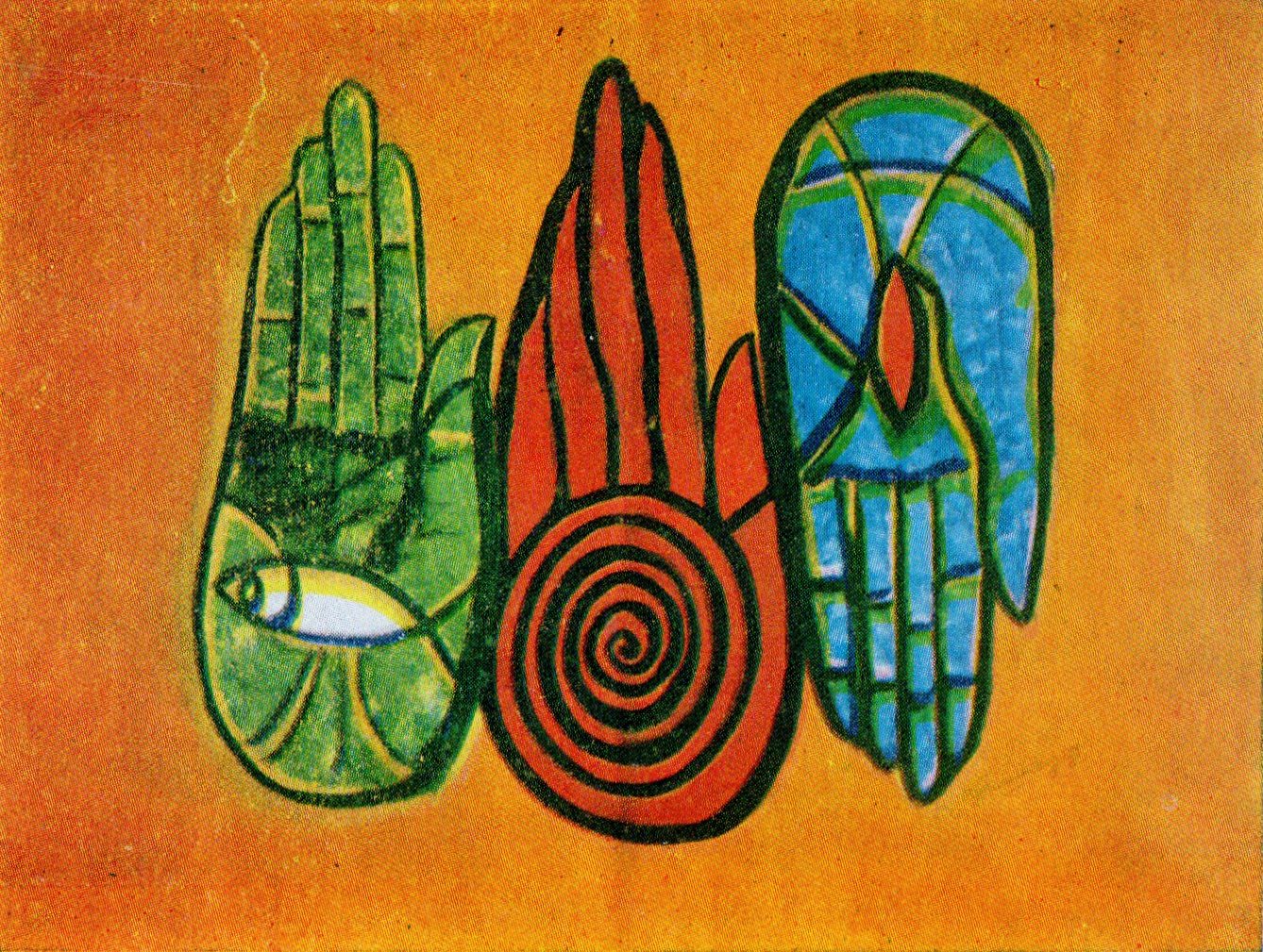
Fr. A. J. Thamburaj, SJ (Indian,, 1939–), The Holy Trinity, before 1982. Oil painting, 23 × 33 in.
The grace of the Lord Jesus Christ and the love of God and the fellowship of the Holy Spirit be with you all.
—2 Corinthians 13:14
+++
SONG: “Om Bhagwan” | Song from the Saccidananda Ashram songbook, composer unknown | Arranged by Chris Hale and Miranda Stone | Performed by Yeshu Satsang Toronto, on Bhakti Geet, vol. 4 (2019)
This Trinitarian song in Hindi comes from a Benedictine monastery in Tamil Nadu. It is performed here by married couple Chris Hale (who grew up in Nepal and India) and Miranda Stone and others from Yeshu Satsang Toronto, a community whose expression of Yeshu Bhakti (Jesus devotion) is “distinctly urban and Canadian, yet informed by the simplicity of the village, honouring what is handmade, humble, and real . . . , navigating . . . between what is traditional and what is progressive.” A transliteration, with English translation, follows. The sacred syllable Om, or Aum, isn’t really translatable.
Om Bhagawan, Om Bhagawan, Om Bhagawan, Prabhu Pita Bhagawan
Om God, Om God, Om God, Lord Father God
Om Bhagawan, Om Bhagawan, Om Bhagawan, Prabhu Putra Bhagawan
Om God, Om God, Om God, Lord Son God
Om Bhagawan, Om Bhagawan, Om Bhagawan, Prabhu Aatma Bhagawan
Om God, Om God, Om God, Lord Spirit God
Om Bhagawan, Om Bhagawan, Om Bhagawan, Prabhu Yeshu Bhagawan
Om God, Om God, Om God, Lord Jesus God
Painted by the Jesuit artist-priest Father A. J. Thamburaj, The Holy Trinity expresses a complex theological doctrine through mudras (Indian hand gestures) and color. I scanned the image from the excellent book Christian Art in India by Herbert E. Hoefer (Chennai: Gurukul Lutheran Theological College and Research Institute, 1982), which features art by thirty-five artists and essay contributions by Jyoti Sahi. Hoefer describes the painting:
Green is the colour of creativity and fertility. Red is the colour of activity. Blue is the colour of the sea and sky, symbols of mystery and eternity. Yellow [saffron] is an auspicious and joyful colour in Indian custom.
The upraised hand [abaya mudra] is a symbol of protection in Indian art and dance. It represents the Father. Its message is ‘Fear not’. The fish denotes the ever-watching eye of God, for the eyelids of the fish never close.
The downward hand [varada mudra] represents Christ. This gesture is common in Indian sculpture and dance. God is said to point his devotees to hide under the arch of his foot for refuge. The red wound reminds us that the risen Lord bears the redemptive marks of the crucifixion.
The red hand symbolizes the purifying fire, the Holy Spirit. The spiral line indicates the wind, connecting all three Persons in unity. Fire and wind are power.
Our life is in the ever-present protecting, redeeming, purifying and empowering hands of the Triune God.
+++
In the church’s year, Trinity Sunday is the day when we stand back from the extraordinary sequence of events that we’ve been celebrating for the previous five months—Advent, Christmas, Epiphany, Lent, Good Friday, Easter, Ascension, Pentecost—and when we rub the sleep from our eyes and discover what the word “god” might actually mean. These events function as a sequence of well-aimed hammer-blows which knock at the clay jars of the gods we want, the gods who reinforce our own pride or prejudice, until they fall away and reveal instead a very different god, a dangerous god, a subversive god, a god who comes to us like a blind beggar with wounds in his hands, a god who comes to us in wind and fire, in bread and wine, in flesh and blood: a god who says to us, “You did not choose me; I chose you.”
You see, the doctrine of the Trinity, properly understood, is as much a way of saying “we don’t know” as of saying “we do know.” To say that the true God is Three and One is to recognize that if there is a God then of course we shouldn’t expect him to fit neatly into our little categories. If he did, he wouldn’t be God at all, merely a god, a god we might perhaps have wanted. The Trinity is not something that the clever theologian comes up with as a result of hours spent in the theological laboratory, after which he or she can return to announce that they’ve got God worked out now, the analysis is complete, and here is God neatly laid out on a slab. The only time they laid God out on a slab he rose again three days afterwards.
On the contrary: the doctrine of the Trinity is, if you like, a signpost pointing ahead into the dark, saying: “Trust me; follow me; my love will keep you safe.” Or, perhaps better, the doctrine of the Trinity is a signpost pointing into a light which gets brighter and brighter until we are dazzled and blinded, but which says: “Come, and I will make you children of light.” The doctrine of the Trinity affirms the rightness, the propriety, of speaking intelligently that the true God must always transcend our grasp of him, even our most intelligent grasp of him.
This post belongs to the weekly series Artful Devotion. If you can’t view the music player in your email or RSS reader, try opening the post in your browser.
To view all the Revised Common Lectionary scripture readings for Trinity Sunday, cycle A, click here.
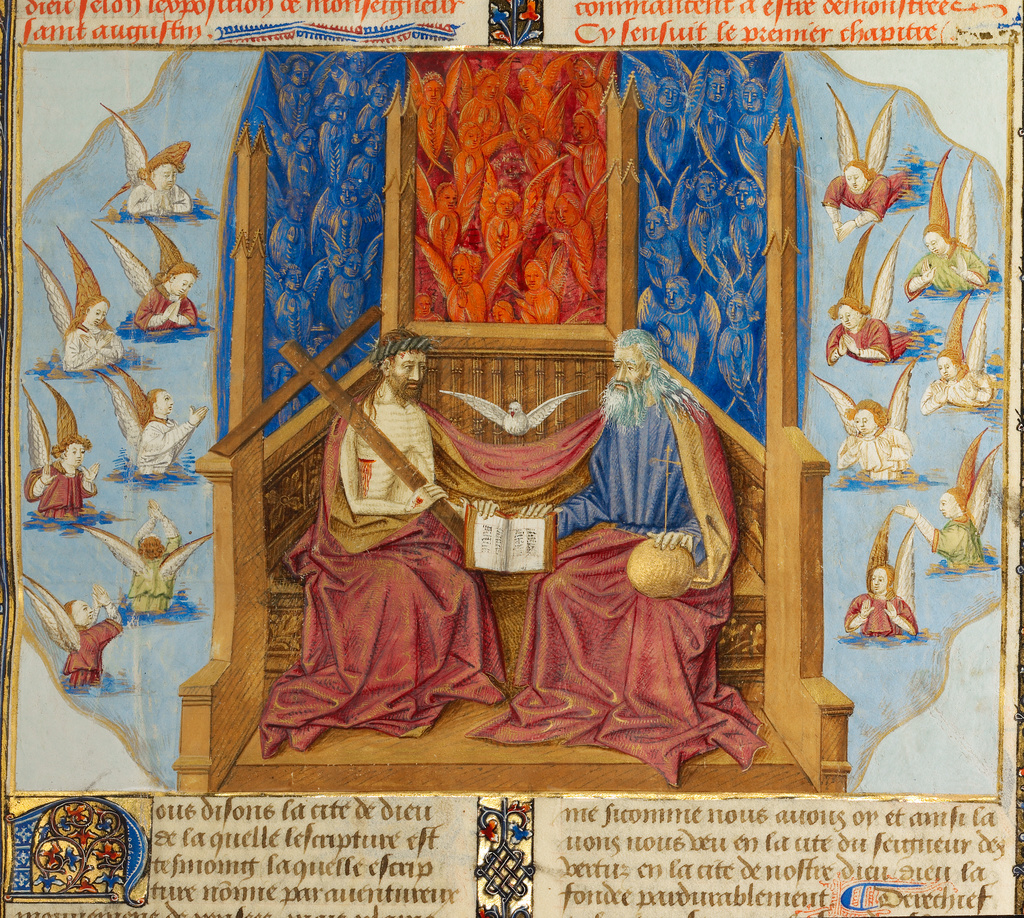
Miniature from a 15th-century French manuscript (Ms. Ludwig XI 10, fol. 2, J. Paul Getty Museum, Los Angeles).
Therefore, since we are justified by faith, we have peace with God through our Lord Jesus Christ, . . . and hope does not disappoint us, because God’s love has been poured into our hearts through the Holy Spirit that has been given to us.
Let us glorify the Lord: Father, Son, and Holy Spirit;
praise him and highly exalt him forever.
In the firmament of his power, glorify the Lord;
praise him and highly exalt him forever.
All efforts to visualize the Trinity are obviously deficient. The doctrine resists figuration. (How do you convey three distinct divine persons who share one essence?) But that hasn’t stopped artists from trying. Over the centuries, several different types evolved to represent the Three-in-One. The example above, from a late medieval French translation of Augustine’s City of God, shows the Father, Son, and Holy Spirit enthroned in heaven—the Father as an old man holding a globe, at his right hand the Son still bearing the wounds of his passion, and the Holy Spirit hovering between them in the form of a dove. The two male figures share a royal robe and jointly hold open a book, their word of truth.
The first person of the Trinity is not a human, nor even male, but in Scripture God reveals himself as father and as Ancient of Days, so anthropomorphic depictions developed, though they have always been controversial. These are meant not to be taken literally but, rather, to tell us a little something about God: that he relates to us like a father relates to his children . . . and that he’s ancient! Authority and personhood are more easily shown through figuration, and our anonymous artist here (through the single robe and single seat) conveys the idea that Father, Son, and Spirit are enthroned together as one, together vested with divinity. This is only one aspect of the rich doctrine that is the Trinity.
This post belongs to the weekly series Artful Devotion. If you can’t view the music player in your email or RSS reader, try opening the post in your browser.
To view all the Revised Common Lectionary scripture readings for Trinity Sunday, cycle C, click here.






 Art & Theology