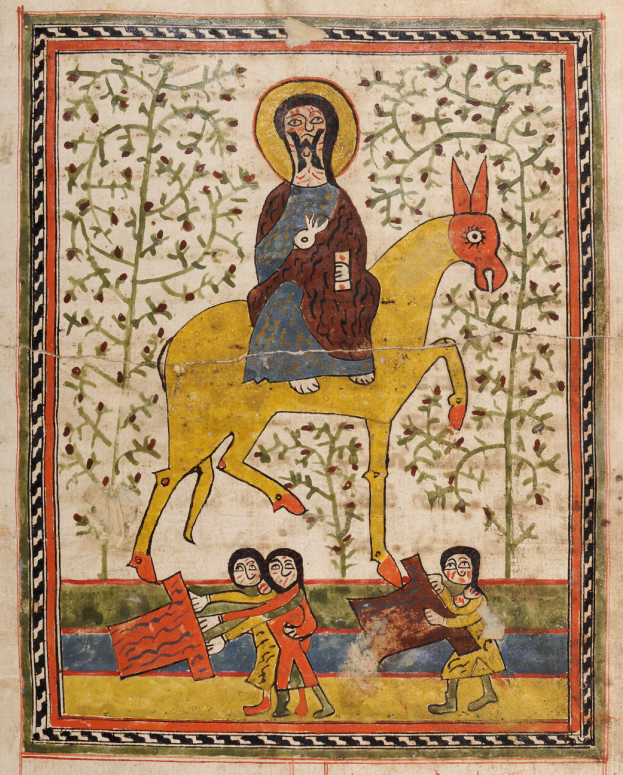
Christ’s Entry into Jerusalem, Alqosh, Iraq, 1723, from a Syriac Gospel lectionary. Collection of the Dominican Friars of Mosul (DFM 13, fol. 43v). Digitized in collaboration with the Centre Numérique des Manuscrits Orientaux (CNMO), Ankawa, Erbil, Iraq.
Made three centuries ago at a monastery in Iraq, this is one of three figurative paintings from a Syriac Gospel lectionary, the other two depicting Thomas touching Jesus’s wounds and the apocryphal saint George defeating a dragon. While the scribe is named in the manuscript as ʼEliyā bar Yaldā, the artist, if he is a different person (as they usually were), is not identified.
I love the fanciful coloration! Yellow and orange for the donkey, and a tricolored road of yellow, blue, and green. Plus, in the background, fruiting tree branches that climb and curl. The red striations on the figures’ necks and faces are, as far as I know, an idiosyncratic aesthetic choice of the artist’s; they may signify blood running through the veins, or perhaps the marks are simply decorative.
While the donkey is shown in profile, clopping along toward Jerusalem’s city center, Jesus rides sidesaddle and is oriented toward us, his eyes meeting ours. He holds a scroll in one hand, signifying that he is the fulfillment of Old Testament prophecies (most directly in this moment, Zechariah 9:9), and his right hand, which is heavily stylized, I can only assume is raised in a gesture of blessing, as it is in many other images of this subject.
At his feet, the people spread their cloaks, a sign of reverence.
Addendum: The following video of Palm Sunday celebrations in Iraq showed up in my Instagram feed a few hours after I published this blog post, and I thought it fitting to add.
LISTEN: “Hosanna! (Matthew 21:9 & 11)” by Frank Hernandez, for Steve Green’s Hide ’Em in Your Heart: Bible Memory Melodies, 1990 | Performed by Susanna and Rosalia, 2026
Blessed is he who comes in the name of the Lord Blessed is he who comes in the name of the Lord
Hosanna to the Son of David Hosanna in the highest Hosanna to the Son of David Hosanna, this is Jesus
Blessed is he (blessed is he) who comes in the name of the Lord Blessed is he (blessed is he) who comes in the name of the Lord
Hosanna to the Son of David Hosanna in the highest Hosanna to the Son of David Hosanna, this is Jesus
Hosanna (Hosanna) Hosanna (in the highest) Hosanna (Hosanna) Hosanna, this is Jesus
I learned this song two years ago when two girls from my church, sisters, sang it during the offertory for our Palm Sunday worship service. I asked them if they’d be willing to reprise their performance for my blog, as I love the sweetness of their voices together, and they obliged. They are thirteen and eleven years old.
Palm Sunday is an especially great day to utilize the children’s voices in your congregation for music or other parts of the liturgy, as Matthew mentions in his account of Christ’s entry into Jerusalem that “when the chief priests and the scribes . . . heard the children crying out in the temple and saying, ‘Hosanna to the Son of David,’ they became angry and said to [Jesus], ‘Do you hear what these are saying?’ Jesus said to them, ‘Yes; have you never read, “Out of the mouths of infants and nursing babies you have prepared praise for yourself” [Ps. 8:2]?’” (Matt. 21:15–16). “Hosanna” is an expression that in this context means something like “Hooray for salvation!,” as John Piper puts it.
The enthusiasm of the masses upon Jesus’s arrival in Judea’s capital city for Passover, and especially their ascription to him of the messianic title “Son of David” (not to mention “prophet” and “wonderworker”), raised the hackles of the temple leadership. He was a threat to their authority and status and to their understanding of the scriptures. So they purposed, in collusion with Rome, to put him to death.
Rejoice greatly, O daughter Zion! Shout aloud, O daughter Jerusalem! See, your king comes to you; triumphant and victorious is he, humble and riding on a donkey, on a colt, the foal of a donkey.
—Zechariah 9:9
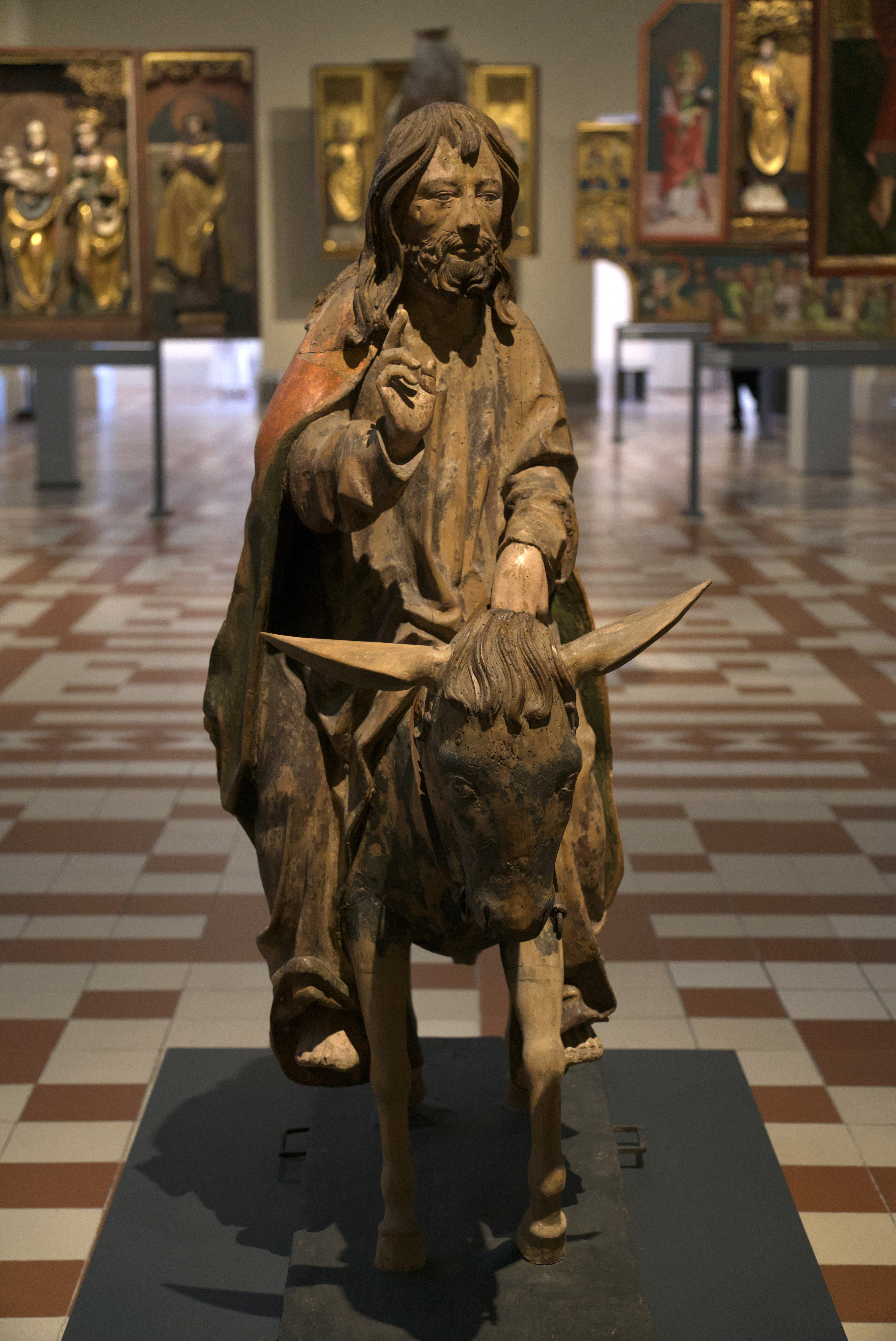
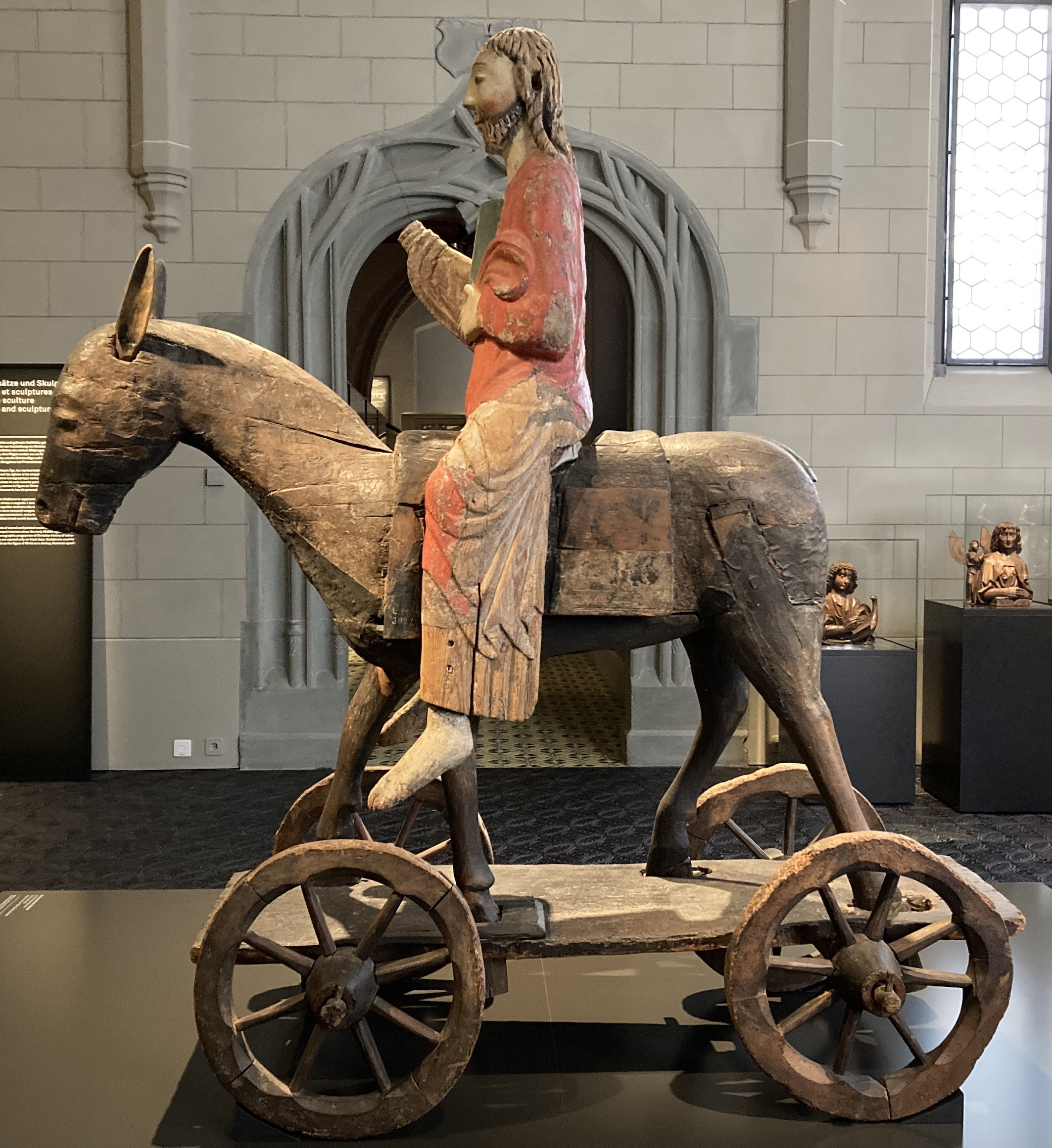
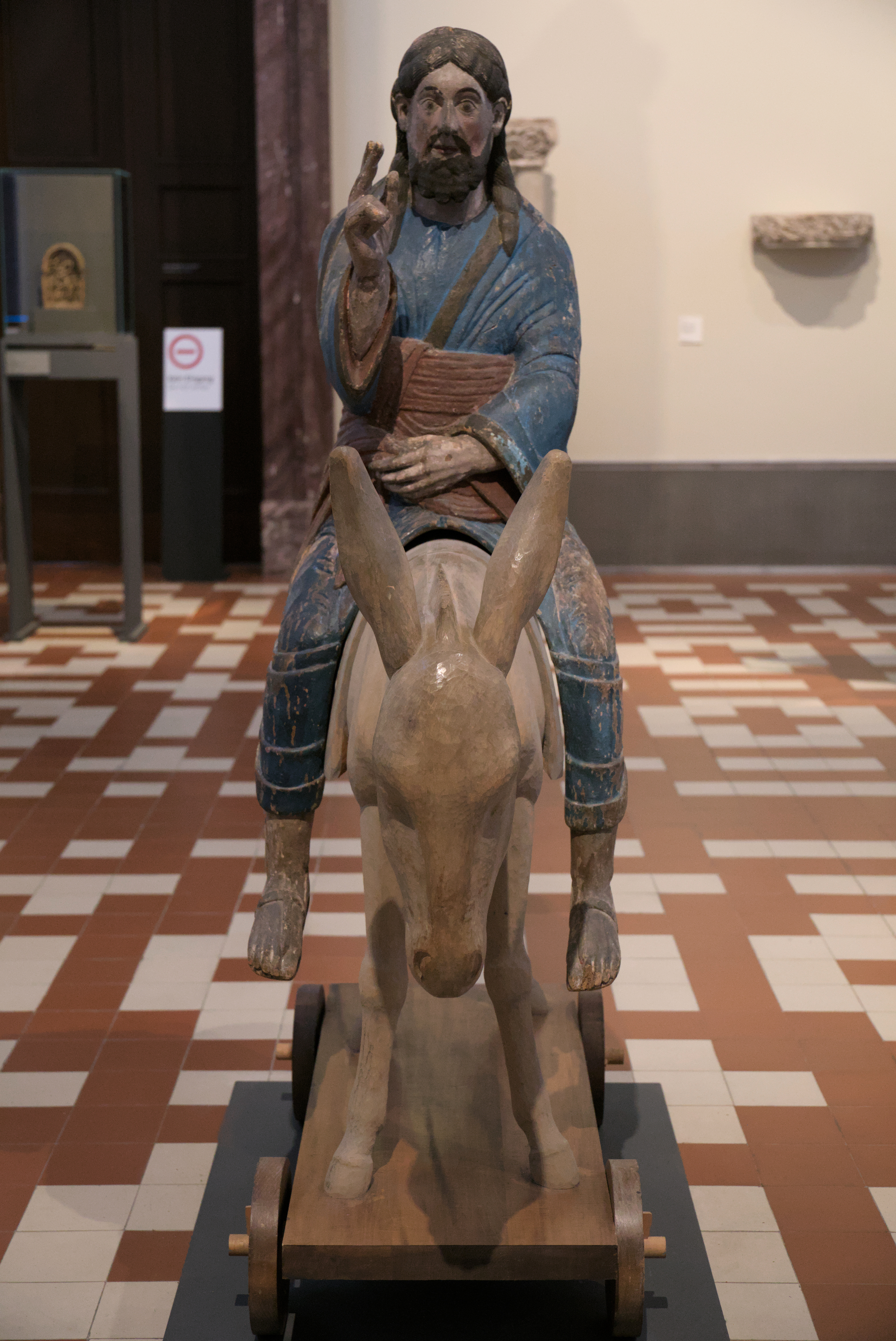
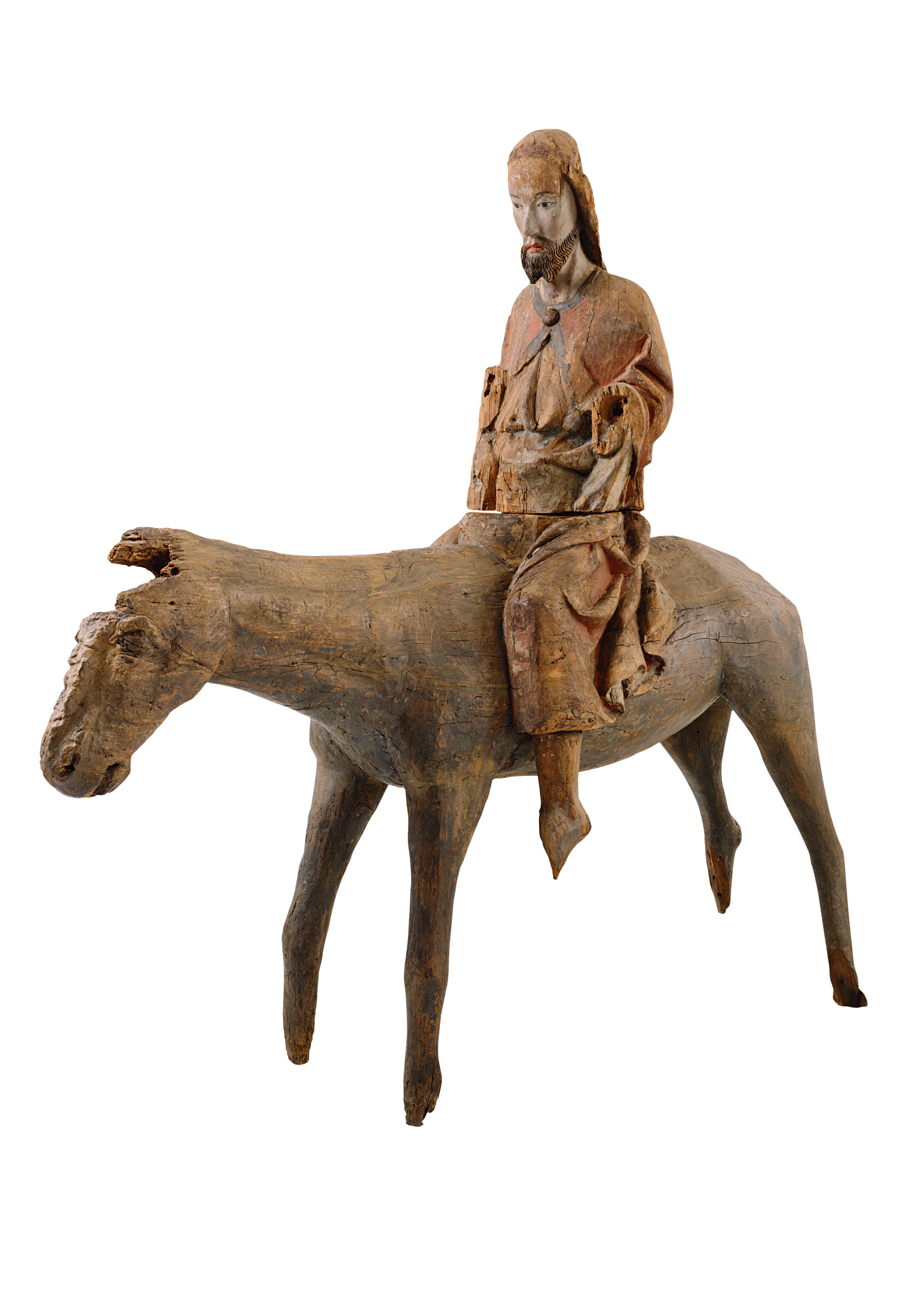
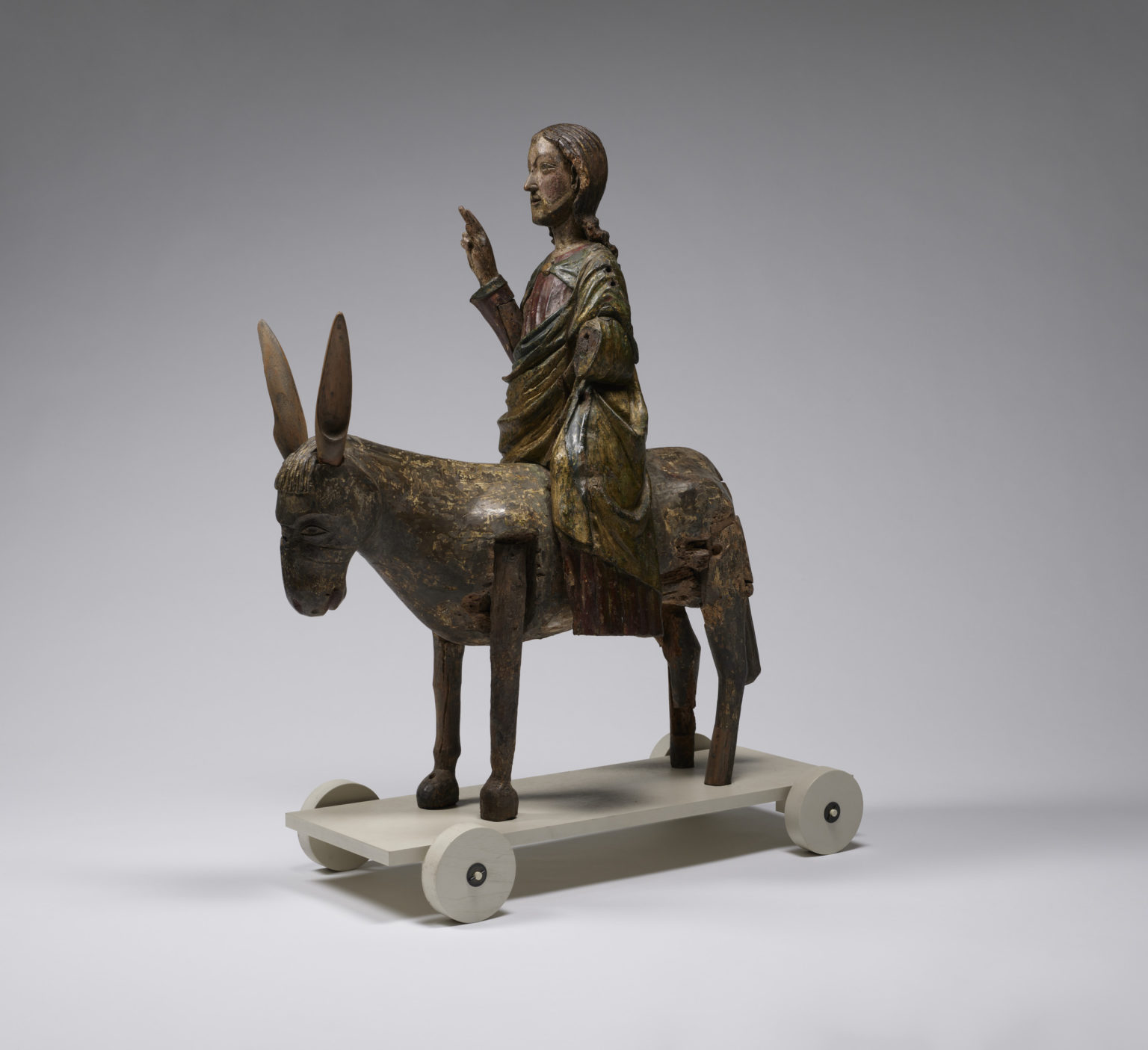
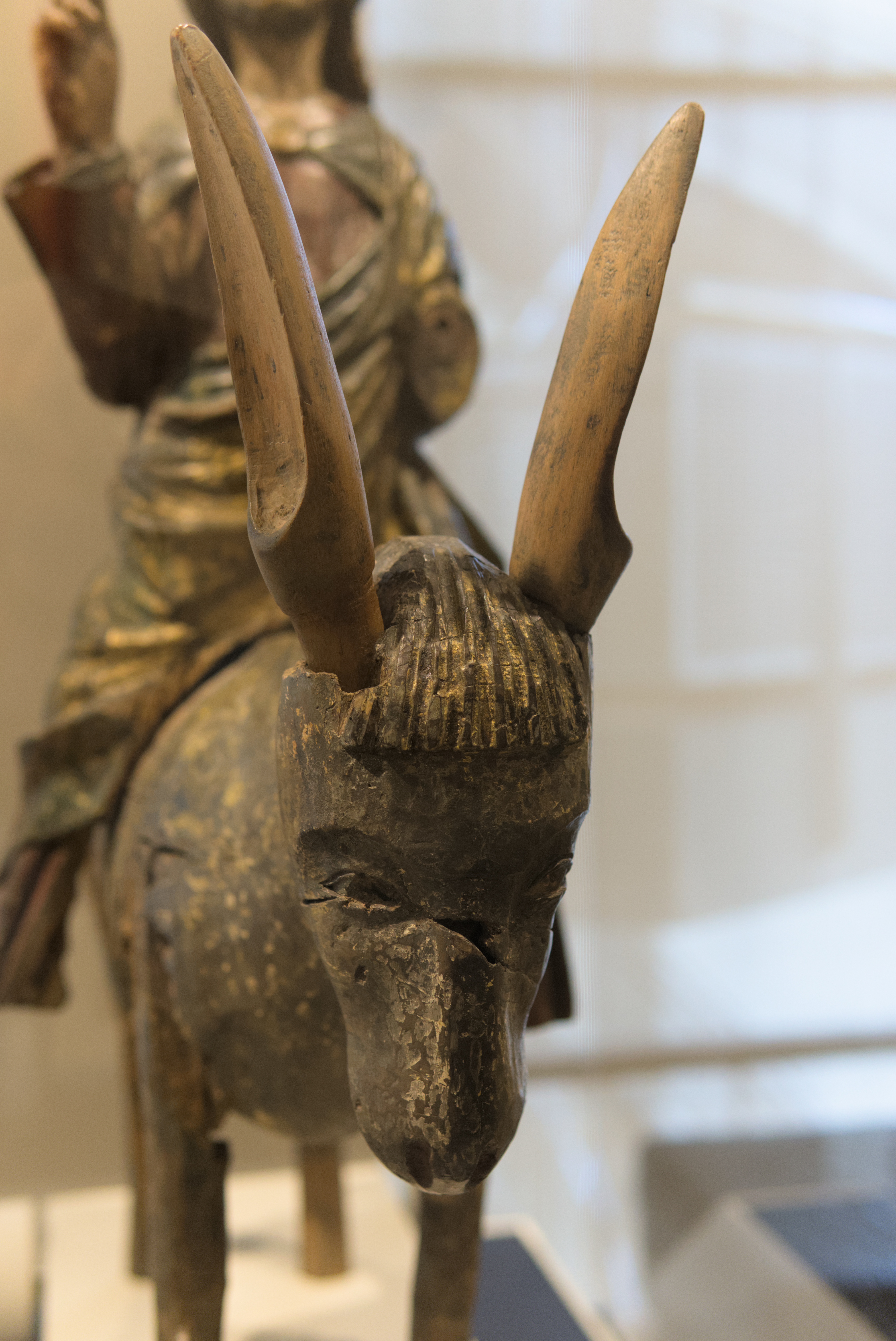
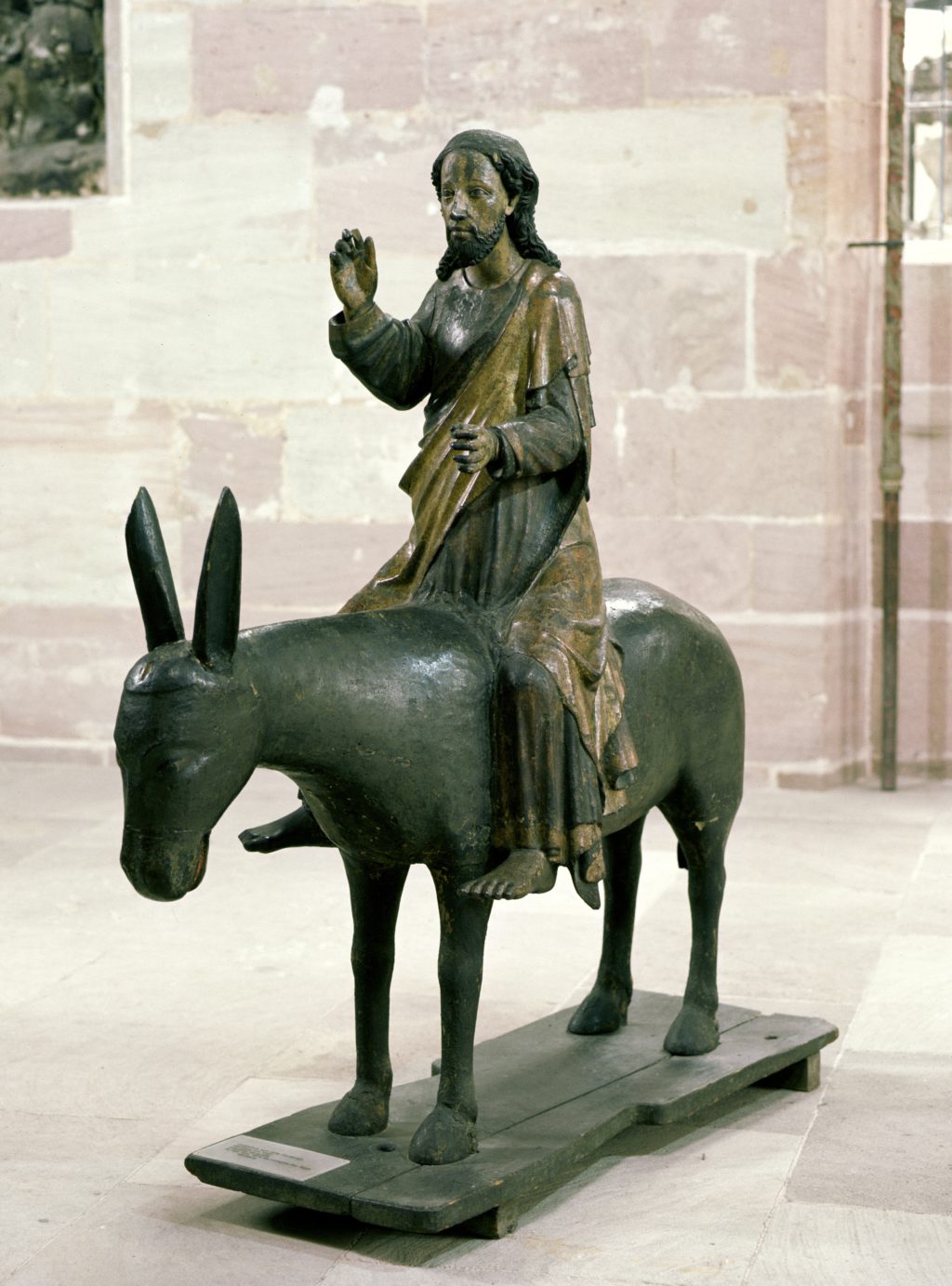
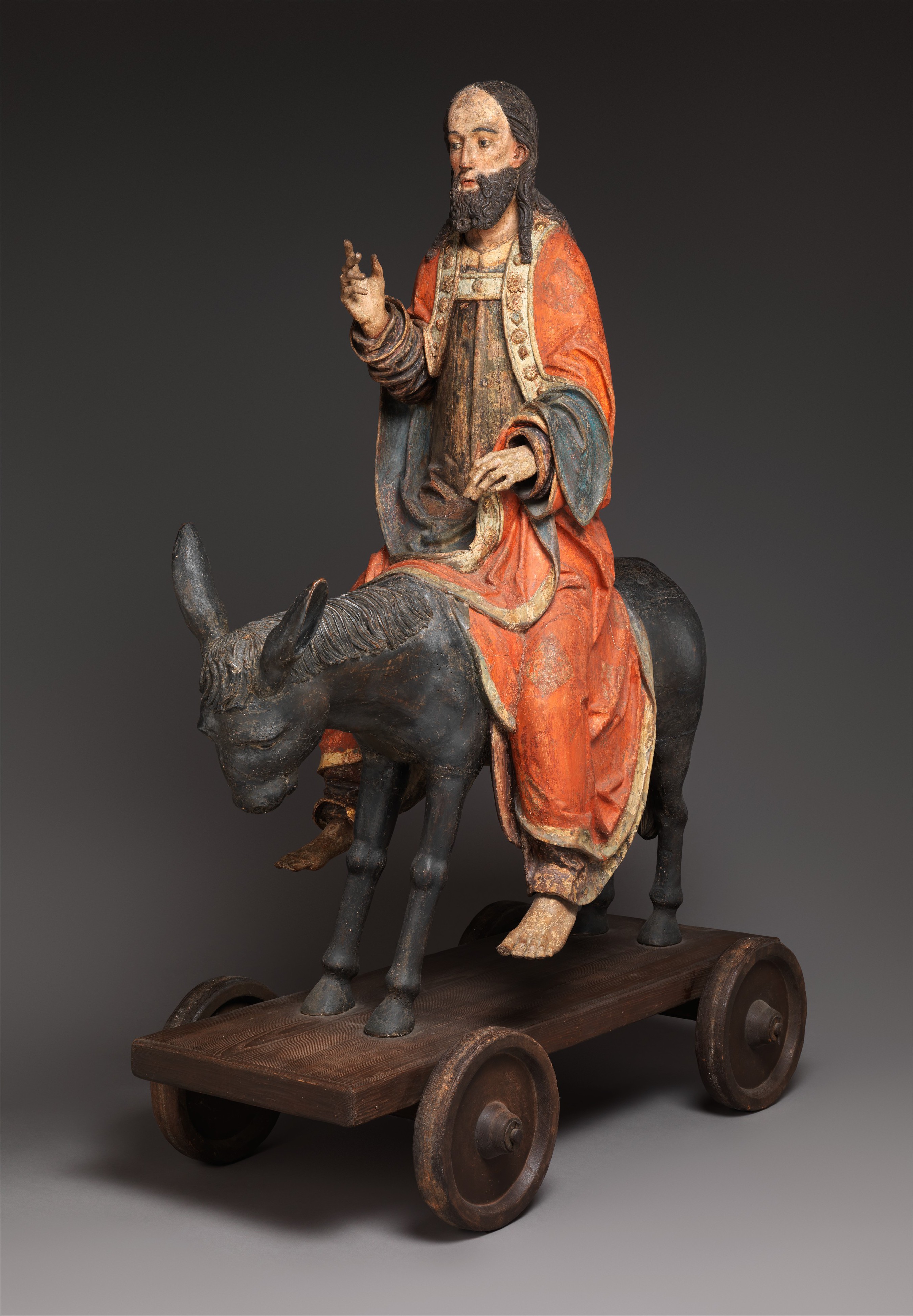
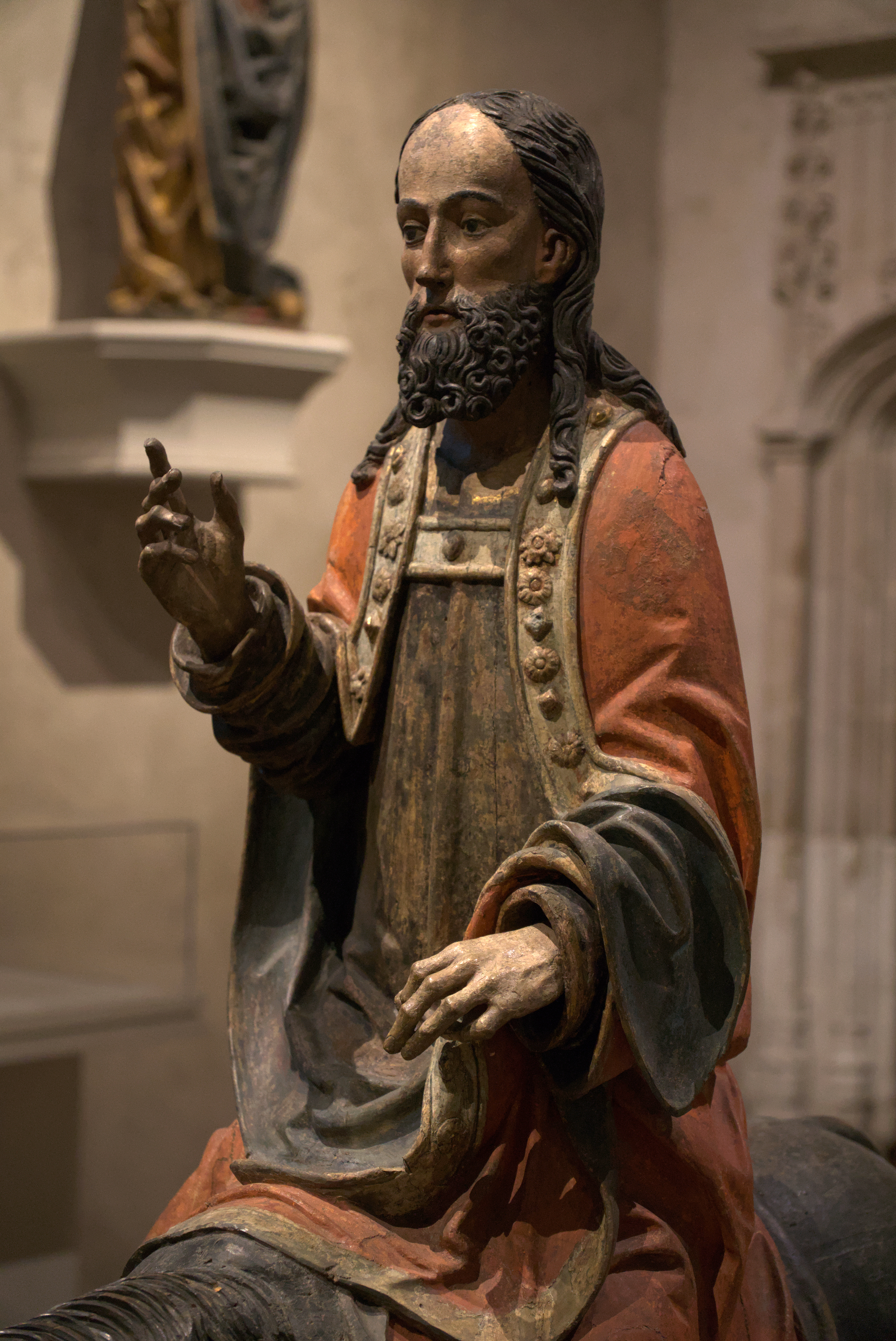
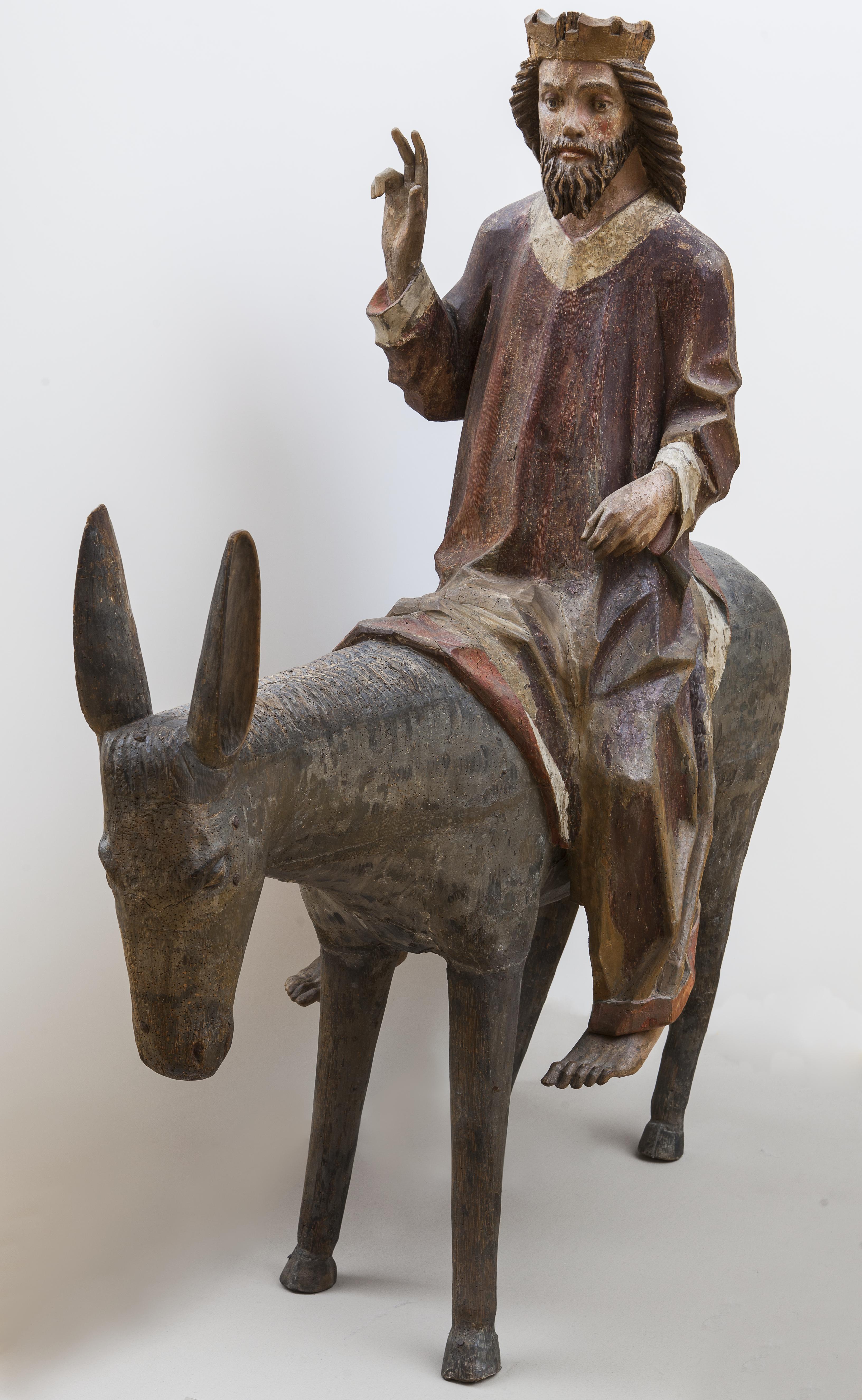
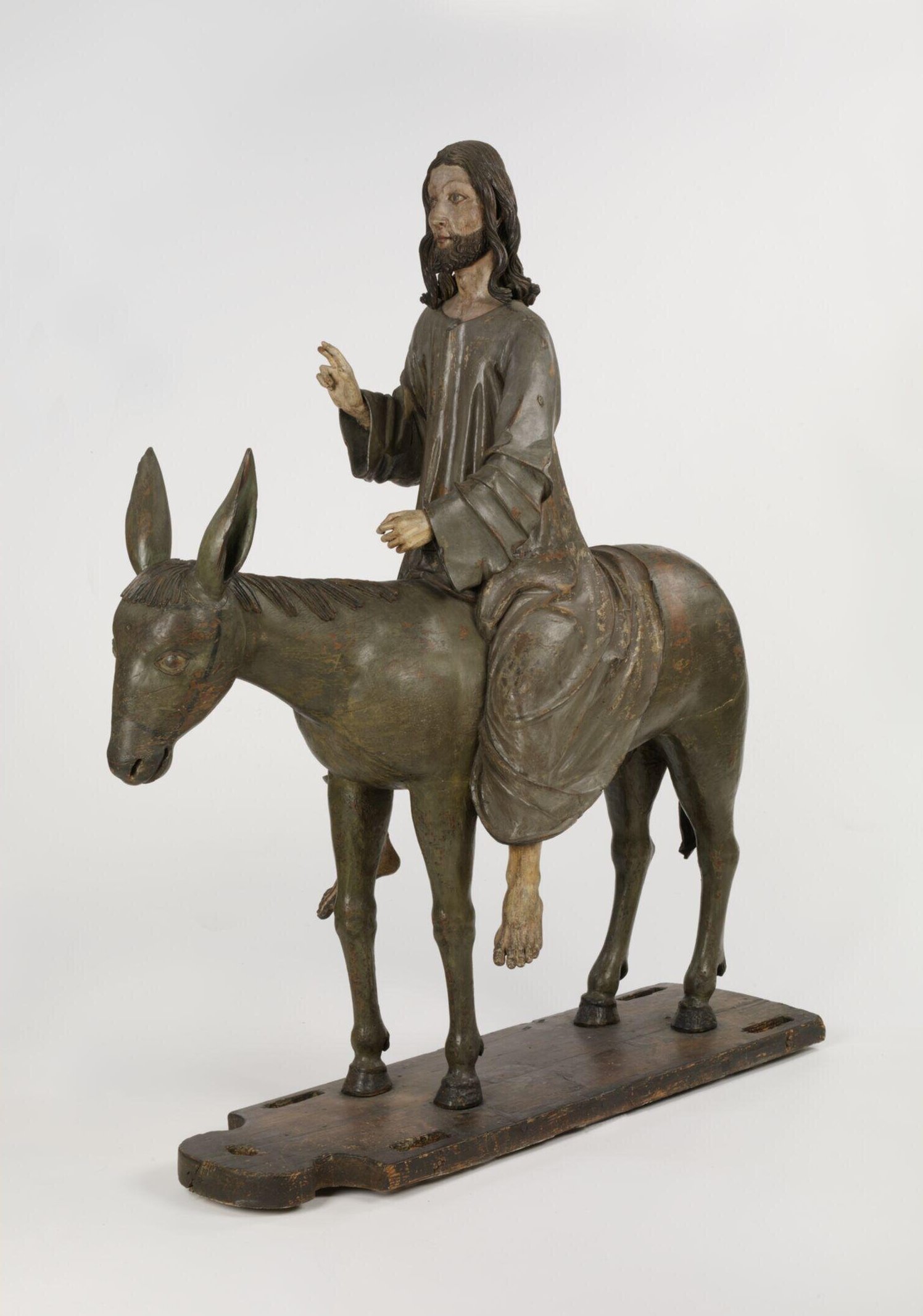
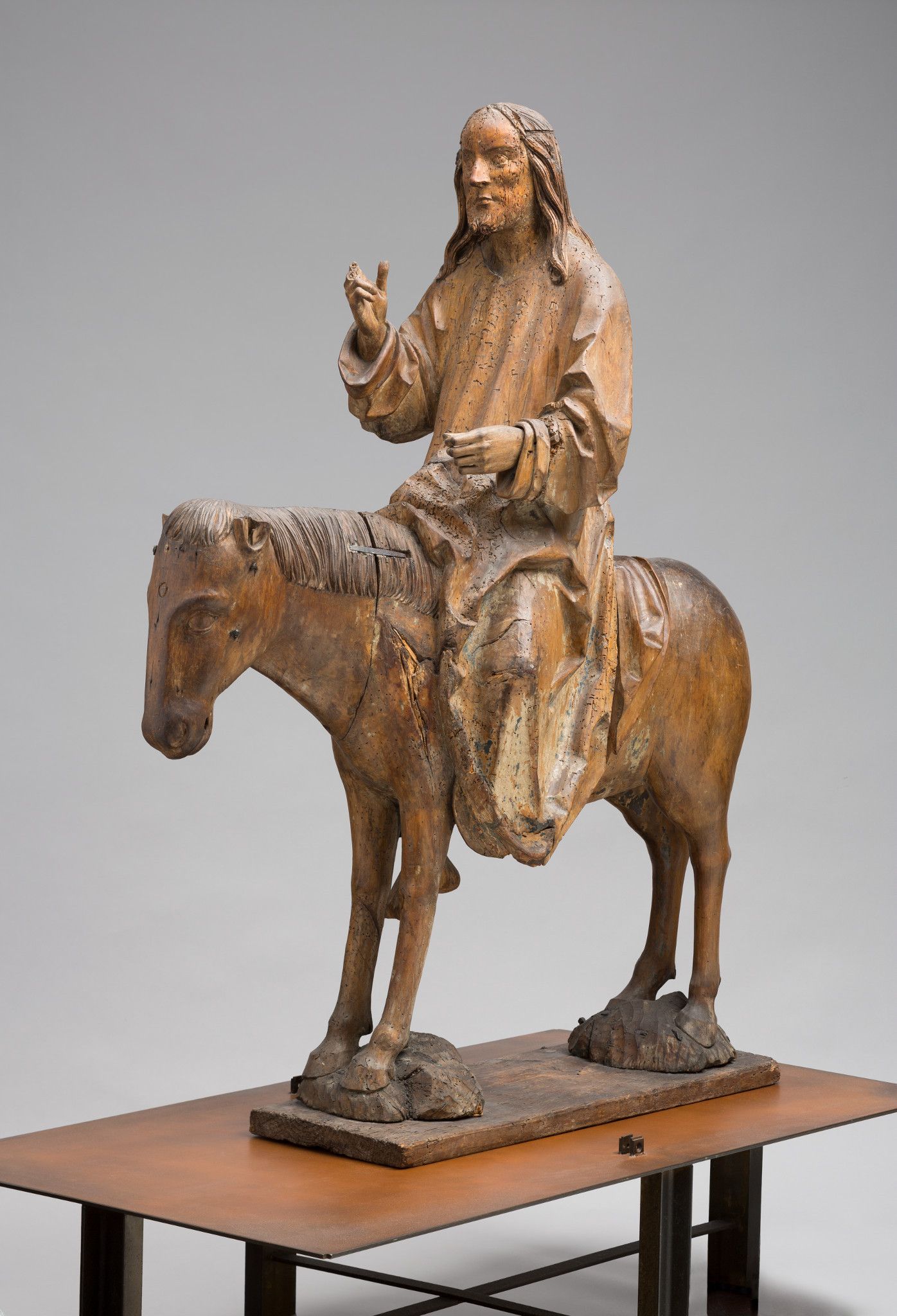
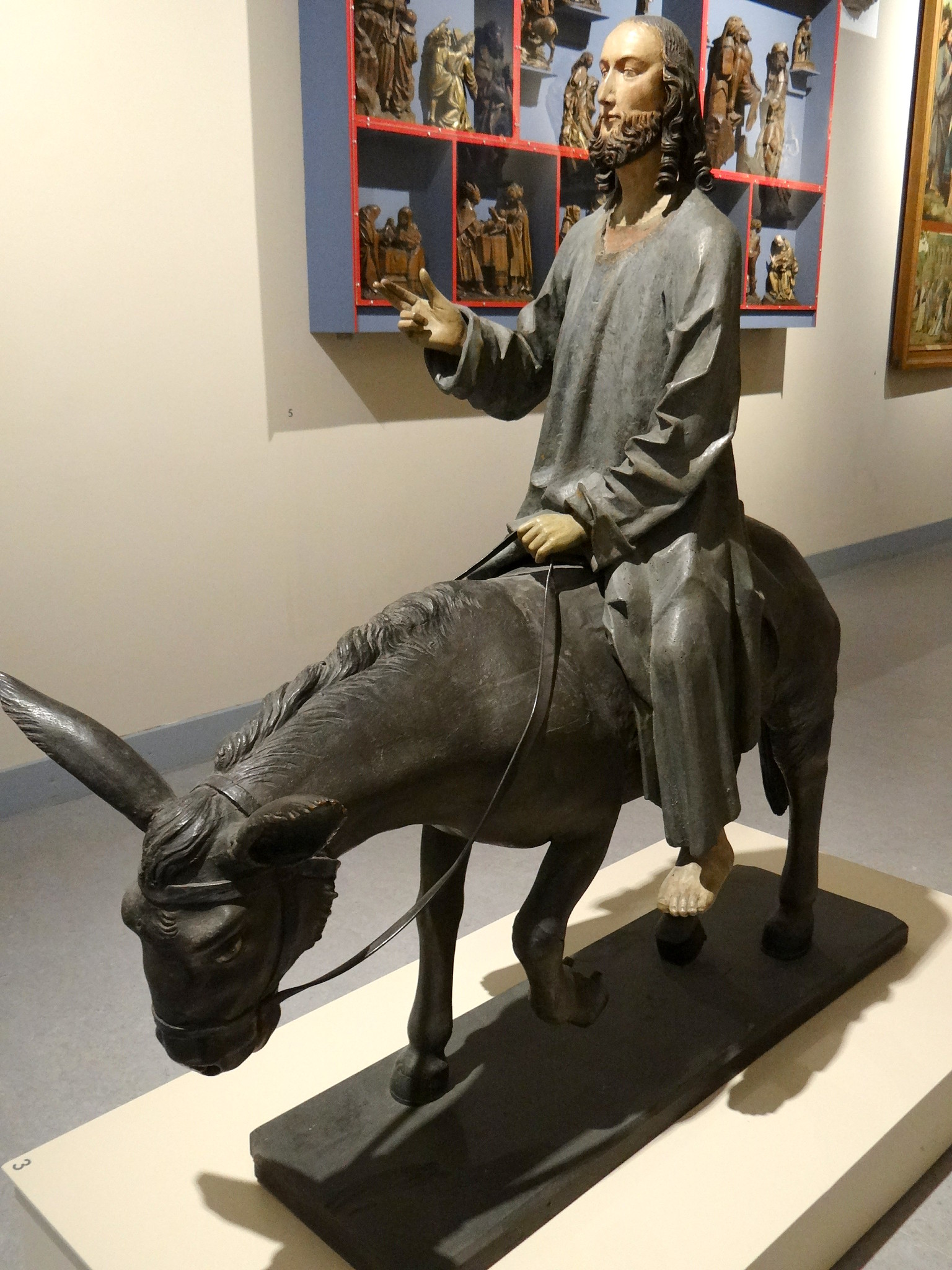
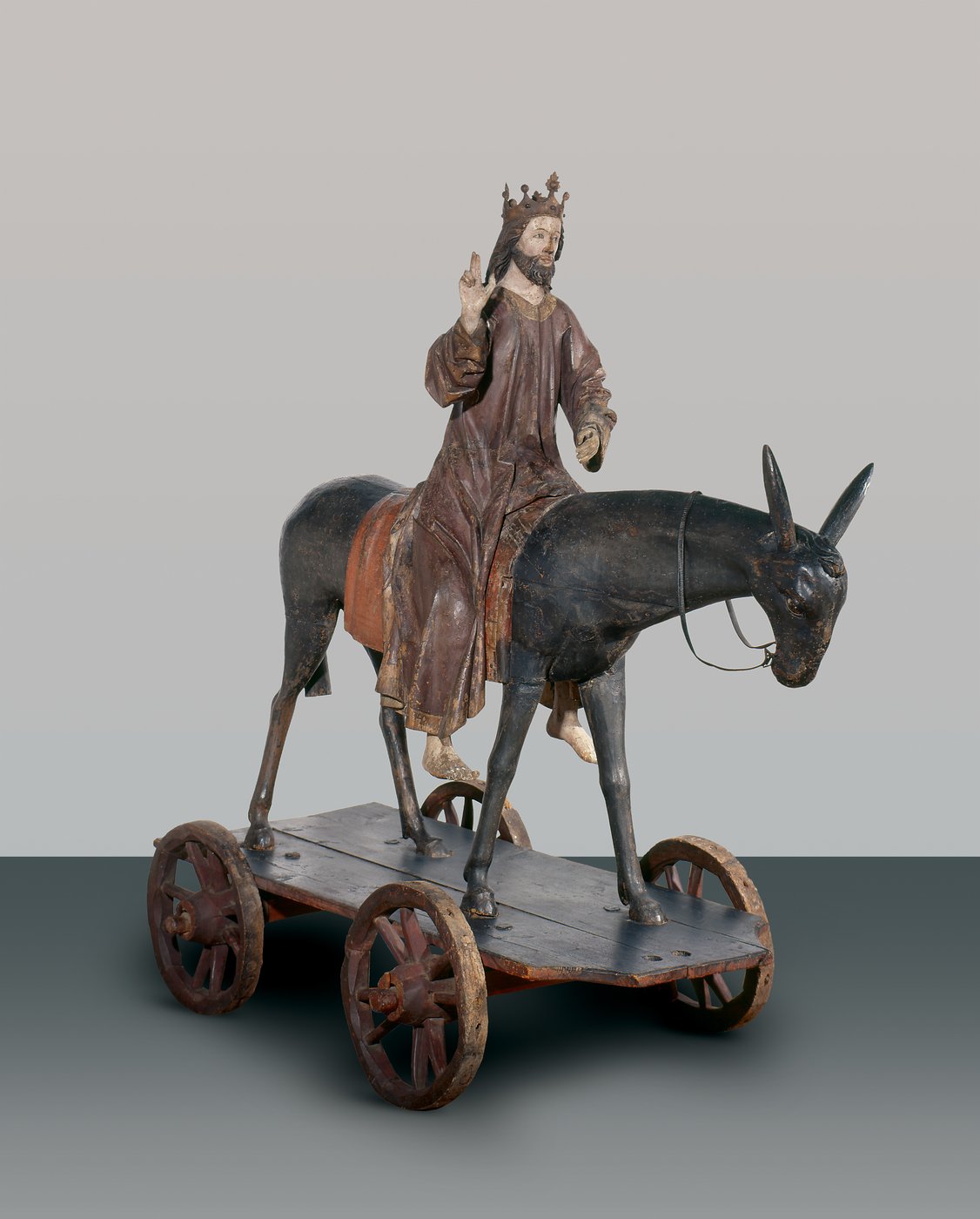
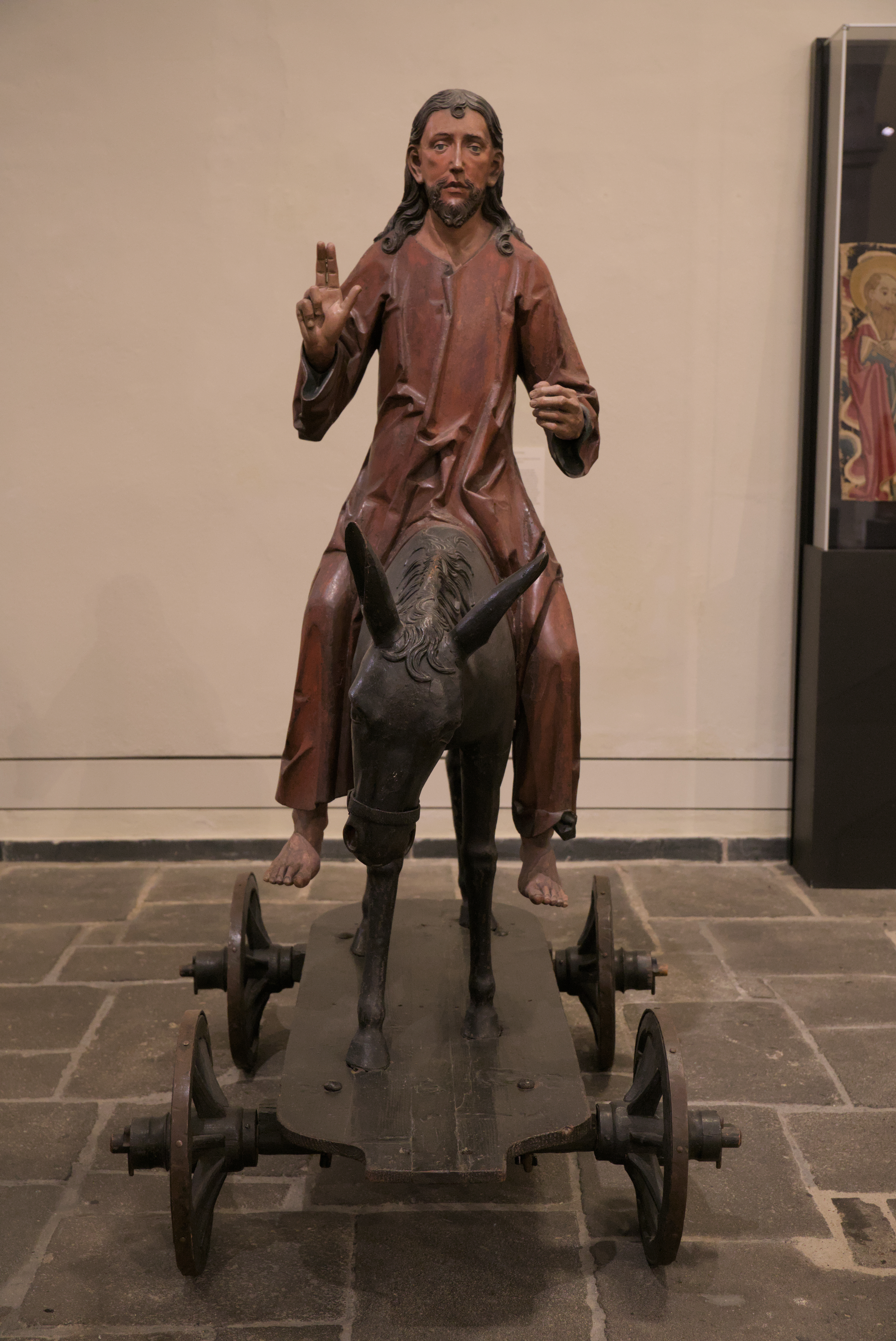
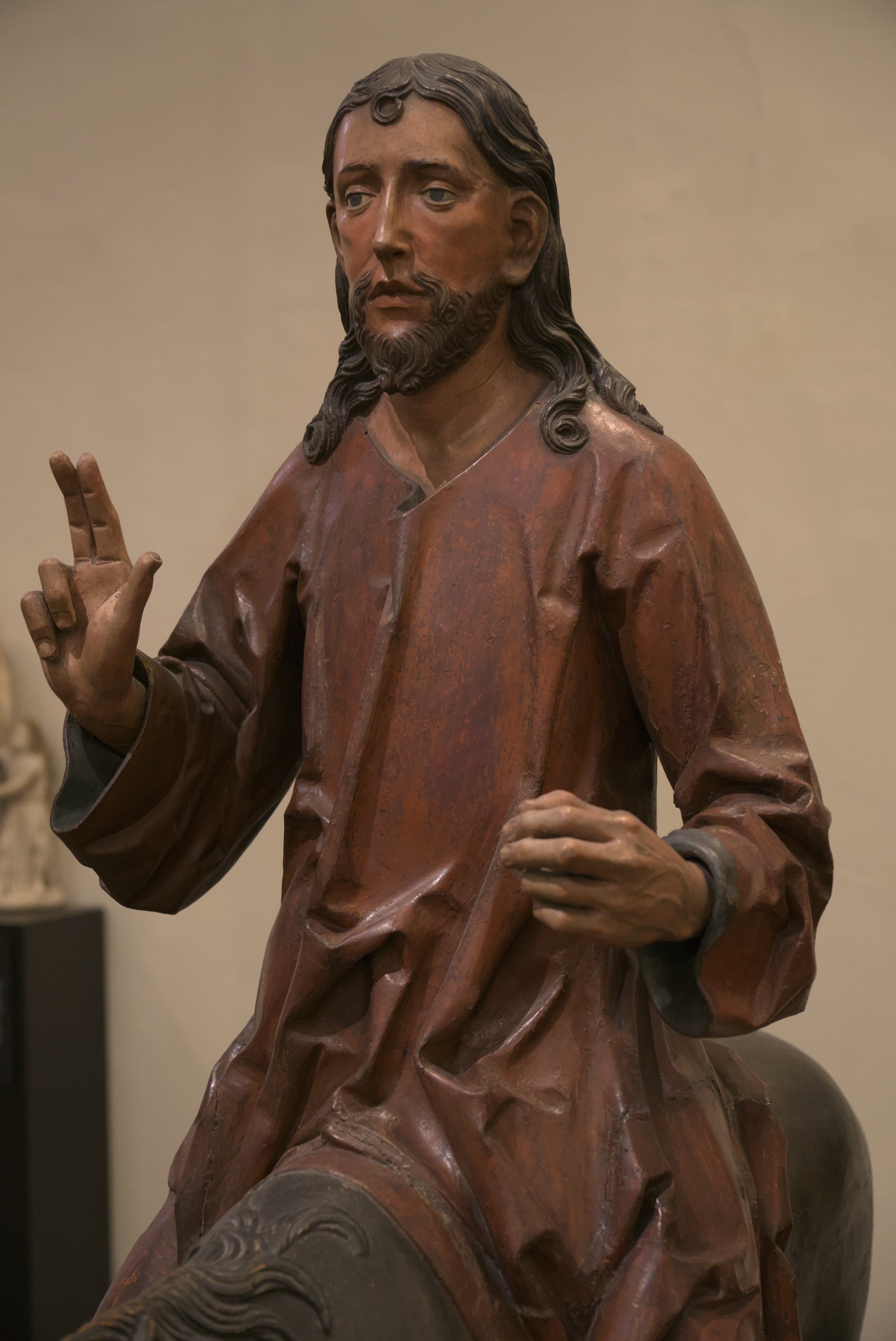
In German-speaking lands from the tenth to sixteenth centuries, many Christian communities would celebrate Palm Sunday by processing through the streets with a painted wood sculpture of Christ astride a donkey, called a Palmesel (pronounced PALM-ay-sul), German for “palm donkey.” Mounted on a wheeled cart and often escorted by children, the sculpture would move around town through crowds who had gathered from nearby villages and hamlets for the inauguration of Holy Week, the period of the Christian liturgical year that commemorates Jesus’s last days. The procession included the singing of hymns and the strewing of palm branches and outer garments along the Christ figure’s path, in imitation of the crowds that greeted Jesus when he entered Jerusalem for his (unbeknown to them) final Passover.
Christus auf dem Palmesel (Christ on the Palm Donkey), Franconia, ca. 1520–30. Polychrome linden wood, 148.5 × 166 × 54 cm. Skulpturensammlung, Bode-Museum, Berlin, Inv. 7710. Photo: Victoria Emily Jones. [object record]Palmesel illustration by the German chronicler Dominikus Debler, ca. 1800
Generally, the Protestant Reformers, with their emphasis on sola scriptura (scripture alone), didn’t like religious pageantry or images, as they believed they promoted idolatry. So when the Reformation swept through Germany in the 1500s, it destroyed many Palmesels. Another wave of destruction hit in the late eighteenth century when, influenced by the Enlightenment, temporary episcopal and synodal decrees in some localities banned “theatrical representations” of liturgical events, including Palmesel processions. Nevertheless, some 175 late medieval and Renaissance Palmesels, either partial or whole, have survived to the present day. The vast majority are in museum collections, no longer in active use.
A Frankenschau broadcast news segment from 2024 (see video below) reports on the Palmesel tradition, opening and closing with a Palmesel from ca. 1470 Nuremberg that’s on display year-round in the Rieterkirche St. Marien und Christophorus (Rieter Church of St. Mary and St. Christopher) in Kalbensteinberg, Germany—surprisingly, not a Catholic church but an Evangelical Lutheran one! The segment also looks at the Miltenberger Palmesel at the Stiftsmuseum Aschaffenburg and the Palmesel at the Met Cloisters in New York City. Press the CC button on the video player for closed captioning in English.
Palmesel sizes range from half-size (more intimate, and more navigable by children) to life-size. Christ is usually dressed in a simple tunic and mantle, and his feet hang bare. Sometimes he wears a crown. Typically his right hand is raised in blessing, while his left hand holds the reins—though in the first example below, it clutches a book.
Steiner Palmesel, ca. 1055. Polychrome linden wood, 176.5 × 135 cm. Landesmuseum (Swiss National Museum), Zurich, Inv. LM 362. Photo: Linda Safran. [object record]Christus auf dem Palmesel, ca. 1200. Poplar wood with renewed finish, 138 × 55.5 × 52 cm. Skulpturensammlung, Bode-Museum, Berlin, Inv. 2766. Photo: Victoria Emily Jones. [object record]Christus auf dem Palmesel, ca. 1310. Church of Saints Peter and Paul, Petersthal, Germany.Christus auf dem Palmesel, Upper Rhine, 1350–60. Polychrome poplar wood, 159.5 × 52.5 × 16.1 cm. Augustinermuseum, Freiburg, Germany, Inv. 10079. Photo: Hans-Peter Vieser.Palmesel, Franconia, ca. 1350–1400. Wood with paint and gilding, 96 × 34 × 82 cm. Walters Art Museum, Baltimore.Photo: Victoria Emily JonesChristus auf dem Palmesel, Franconia, ca. 1370–80. Polychrome alderwood, willow, 172.5 × 61.5 × 169 cm. Germanisches Nationalmuseum, Nuremberg, Inv. PI.O.153.Christus auf dem Palmesel, Poltringen, Germany, ca. 1380. Hohenzollerisches Landesmuseum, Hechingen, Germany.Christus auf dem Palmesel, Swabia, late 14th century. Polychrome linden wood. Landesmuseum Württemberg, Stuttgart, Germany.Christus auf dem Palmesel, Ulm, Germany, 15th century (statue), 18th century (wagon). Zeppelin Museum Friedrichshafen, Germany.Palmesel, Franconia, 15th century. Polychrome linden wood, 156.2 × 60.3 × 138.4 cm. Cloisters Collection, Metropolitan Museum of Art, New York.Photo: Victoria Emily JonesPalmesel, Austria, ca. 1450. Polychrome wood, 154.9 × 144.1 × 50.2 cm. Chazen Museum of Art, University of Wisconsin, Madison, Inv. 1977.2.Christ on an Ass, ca. 1480. Linden wood and pine, painted and gilded, 147.4 × 47.8 × 133.5 cm. Victoria and Albert Museum, London.Christofel Langeisen, Palmesel (Christ Entering Jerusalem on the Back of a Donkey), 1480–90. Polychrome linden wood, 143.5 × 40.6 × 110.5 cm. Detroit Institute of Arts, Detroit, Michigan.Christus auf dem Palmesel, southern Germany, perhaps Swabia, late 15th century. Polychrome linden wood, 122 × 100 × 44 cm. Musée de Cluny, Paris. Photo: Marie-Lan Nguyen.Christus auf dem Palmesel, southern Germany (circle of Erasmus Grasser), ca. 1500. Suermondt-Ludwig Museum, Aachen, Germany. Photo: Rex Harris.Christus auf dem Palmesel, Lake Constance, ca. 1500. Polychrome linden wood, height 190 cm. Historisches Museum, Basel, Switzerland, Inv. 1898.275.Christus auf dem Palmesel, Nuremberg, ca. 1505. Polychrome linden wood, 82 × 31.5 × 88 cm. Germanisches Nationalmuseum, Nuremberg, Germany.Christus auf dem Palmesel, Cologne, ca. 1520. Polychrome linden wood, softwood. Museum Schnütgen, Cologne, Germany, Inv. A 124. Photo: Victoria Emily Jones.Photo: Victoria Emily Jones
Palmesels were living art objects engaged by people of all classes. “Unlike many museum objects from the Middle Ages,” writes a Walters Art Museum curator, “the Palmesel was accessible not just to the wealthy elite and the clergy but to all levels of society. It moved among the laypeople so that they could participate in an immersive experience of a significant event from Christ’s life in their own time and place.”
The following edited video shows a 2018 Palmesel procession, led by choirboys, wending its way through an Alpine landscape from Thaur to Rum. It’s the last of its kind in the Austrian state of Tyrol. The sculpture is modern.
When they were approaching Jerusalem . . . they brought the colt to Jesus and threw their cloaks on it, and he sat on it. Many people spread their cloaks on the road, and others spread leafy branches that they had cut in the fields. Then those who went ahead and those who followed were shouting,
Hosanna! Blessed is the one who comes in the name of the Lord! Blessed is the coming kingdom of our ancestor David! Hosanna in the highest heaven!
Then he entered Jerusalem and went into the temple . . .
—Mark 11:1, 7–11
LOOK: Palm Sunday by Kai Althoff
Kai Althoff (German, 1966–), Palmsonntag (Palm Sunday), 2002. Boat varnish, watercolor, and tinted paper on canvas, 70 × 90 cm. Private collection, Berlin.
In Kai Althoff’s painting of Jesus entering Jerusalem on a donkey, the background pulsates with color and people from all walks of life lay down their garments to carpet his path. There’s a nun and a monk in their habits; two bishops in dalmatics, one of whom casts his mozzetta at Christ’s feet; a choirboy; folks in a coat and tails and party dresses; and others in overalls, sweaters, and wool skirts. On the left, a backpacker passes by, looking behind him with curiosity at the hubbub, while at the bottom right a crowd of haloed people point and gaze—one man even yanks the collar of a friend, trying to pull him closer to the front for a better view.
Several of those present wave palm branches and shout, “Hosanna!,” meaning “Save us!” They quote Psalm 118:25–26: “Save us, we beseech you, O LORD! O LORD, we beseech you, give us success! Blessed is the one who comes in the name of the LORD.” The people recognize Jesus as their delivering Messiah and celebrate.
LISTEN: “Hosanna” by Jacques Berthier, 1978 | Performed by the Paul Leddington Wright Singers on Songs of Taizé, vol. 4 (2006)
Hosanna, hosanna! Hosanna in excelsis!
This Palm Sunday canon (round) is from Taizé, a community of lay brothers in southern France who welcome pilgrims, especially young ones, from all over the world. The Latin in excelsis means “in the highest.”
Though the Hebrew expression that “Hosanna” transliterates was used by Jews as a supplication, a plea, today Christians often use “Hosanna” as a shout of jubilation, an acclamation of praise, in recognition of the salvation Jesus has wrought—so instead of the imperative “Save!,” it’s the exclamative “Salvation!” I think both meanings can hold simultaneously.
This is the first post in a daily series (running through Saturday) in which I’ll highlight a handful of events from Holy Week by choosing a visual artwork and a piece of music that engage with that event. The posts will all be short like this one—I imagine people spending ten minutes or so with each—and are an invitation to prayer and contemplation. For additional music, see the Art & Theology Holy Week Playlist on Spotify.
All photos in this post, except for the last one (of the processional icon), are my own.
(Note: WordPress seems to have disabled the feature that allows you to expand an image upon clicking, but if you’re reading on a computer, you can right-click an image and open it in a new tab to view it in full resolution; if you’re reading on a phone, you can pinch to zoom.)
Located in the Horn of Africa and with access to the Red Sea, Nile River, Mediterranean Sea, and Indian Ocean, Ethiopia stands at the nexus of historical travel, trade, and pilgrimage routes that brought it into contact with surrounding cultures and influenced its artistic development. Coptic Egypt, Nubia, South Arabia, Byzantium, Armenia, Italy, India, and the greater African continent were among those influencers. But Ethiopia not only absorbed influences; it transmitted them too.
A major art exhibition is centering Ethiopia’s artistic traditions in a global context. For Ethiopia at the Crossroads at the Walters Art Museum in Baltimore (running through March 3), curator Christine Sciacca has brought together more than 220 objects from the Walters’ own extraordinary Ethiopian art collection and private and institutional lenders both domestic and international. Icons, wall paintings, processional crosses and hand crosses, illuminated Gospel books and psalters, sensuls (chain manuscripts), healing scrolls, and more are on display throughout the galleries, whose walls have been painted bright green, yellow, and red—the colors of the Ethiopian flag. To round off the exhibition, guest curator Tsedaye Makonnen, an Ethiopian American multidisciplinary artist, was tasked with curating a few works from contemporary artists of the Ethiopian diaspora.
The majority of objects are Christian, made for liturgical or private devotional use. Ethiopia is one of the world’s oldest Christian nations: in the early fourth century, persuaded by a missionary from Syria, King Ezana of Aksum embraced Christianity, and it has been the dominant religion of Ethiopia ever since. But the exhibition does also include some Islamic and Jewish objects.
One of the first works you’ll encounter is a mural that would have originally been mounted on the outer wall of an Ethiopian Orthodox church sanctuary (mäqdäs), portraying the Nativity, the Presentation of Christ in the Temple, and the Adoration of the Magi.
Nativity, Presentation of Christ in the Temple, and Adoration of the Magi, Ethiopia, 18th century. Glue tempera on overlapping canvas pieces mounted to a new stretched canvas, 49 3/16 × 66 15/16 in. (124.9 × 170 cm). Walters Art Museum, Baltimore. [object record]
Remarkably, at the Nativity, there is a feast taking place, and Jesus is feeding his mother with what looks like a Communion wafer! As the theologian Lester Ruth has said, “The sound from most baby beds is a cry to be fed. But the cry from the manger is an offer to feed on his body born into this world.”
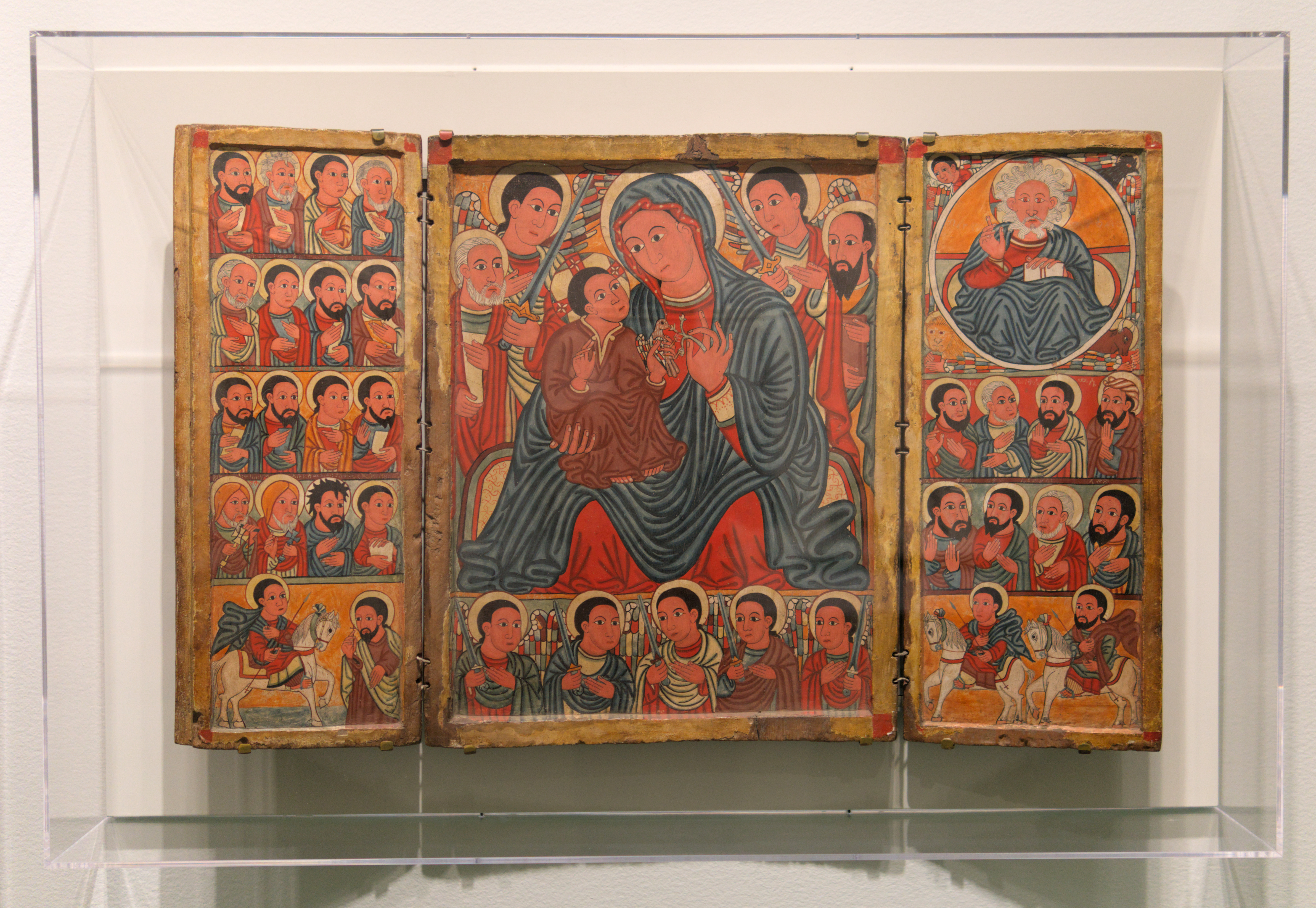
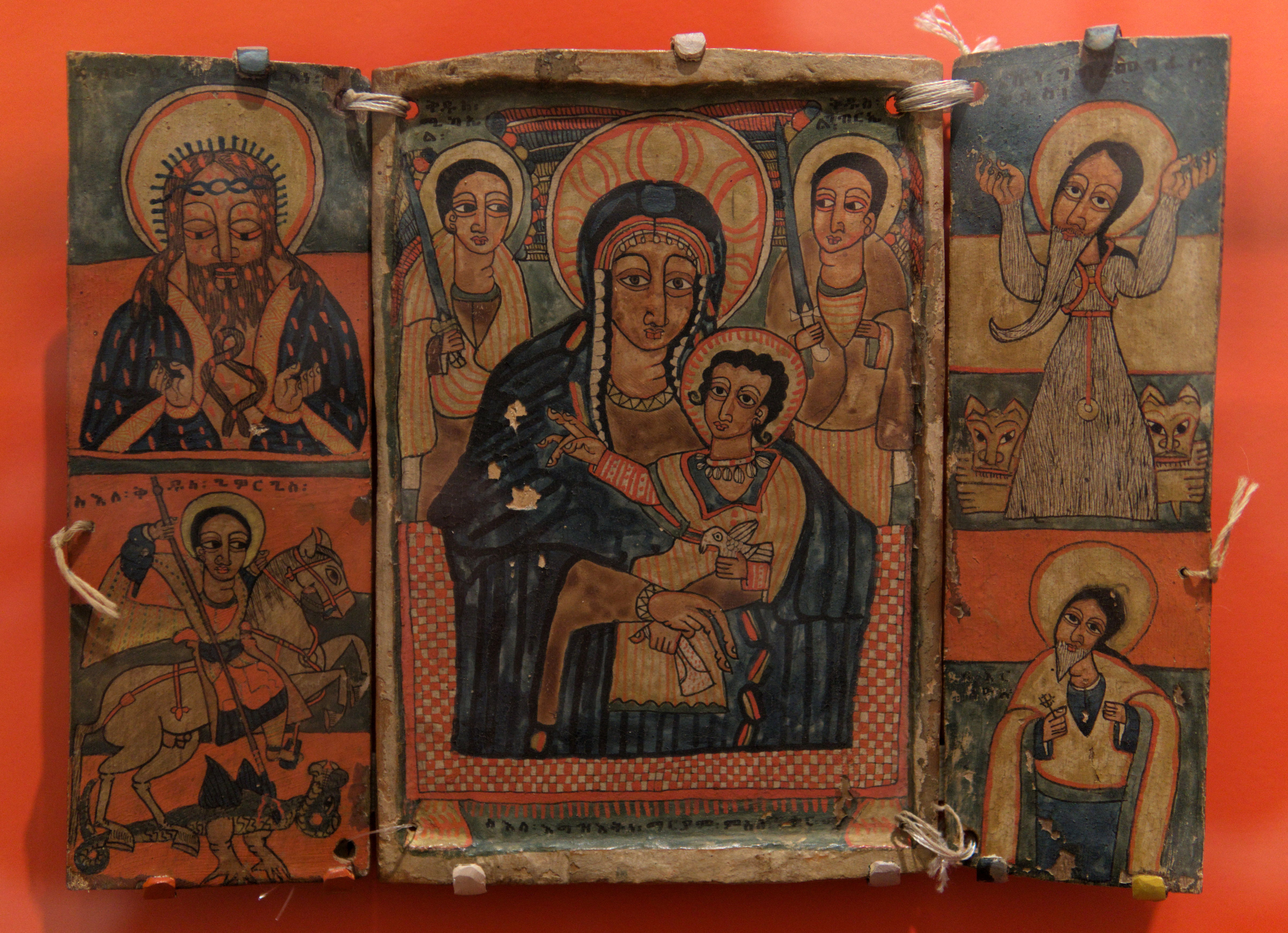
One of history’s most famous Ethiopian painters is Fre Seyon, who worked at the court of Emperor Zara Yaqob (r. 1434–1468) and was of the first generation of Ethiopian artists who painted icons on wood panels. He was also a monk. He likely introduced one of the characteristic features of Ethiopian icons of the Virgin and Child: the archangels Michael and Gabriel flanking them with drawn swords, acting as a kind of honor guard.
Fre Seyon (Ethiopian, active 1445–1480), Triptych Icon with the Virgin Mary and Christ Child Flanked by Archangels and Saints (center), Twelve Apostles and Saints (left), and Prophets and Saints (right), mid- to late 15th century. Tempera on gesso-primed wood. Institute of Ethiopian Studies, Addis Ababa University, acc. no. IESMus4186.
My two favorite details of this triptych by Fre Seyon are (on the right wing) the image of the Ancient of Days surrounded by the tetramorph, his wild gray locks being blown about, and in the center, the bird that Christ holds, its feet grasping at a three-branched twig. On a literal level, the bird is a plaything for the boy that charmingly emphasizes his humanity (in the late Middle Ages, at least in Europe—I’m not sure about in Ethiopia—it was common for young children to keep tame birds as pets). On another level, the bird may be symbolic. In traditional Western art, Jesus sometimes holds a goldfinch, a bird with distinctive red markings that’s fond of eating thistle seeds and gathering thistle down and thus came to be read as a prefiguration of Christ’s thorny, blood-spilt passion. I’m not sure whether Fre Seyon intended a symbolic significance for this bird.
Here’s another triptych from the exhibition, this one from a century and a half later:
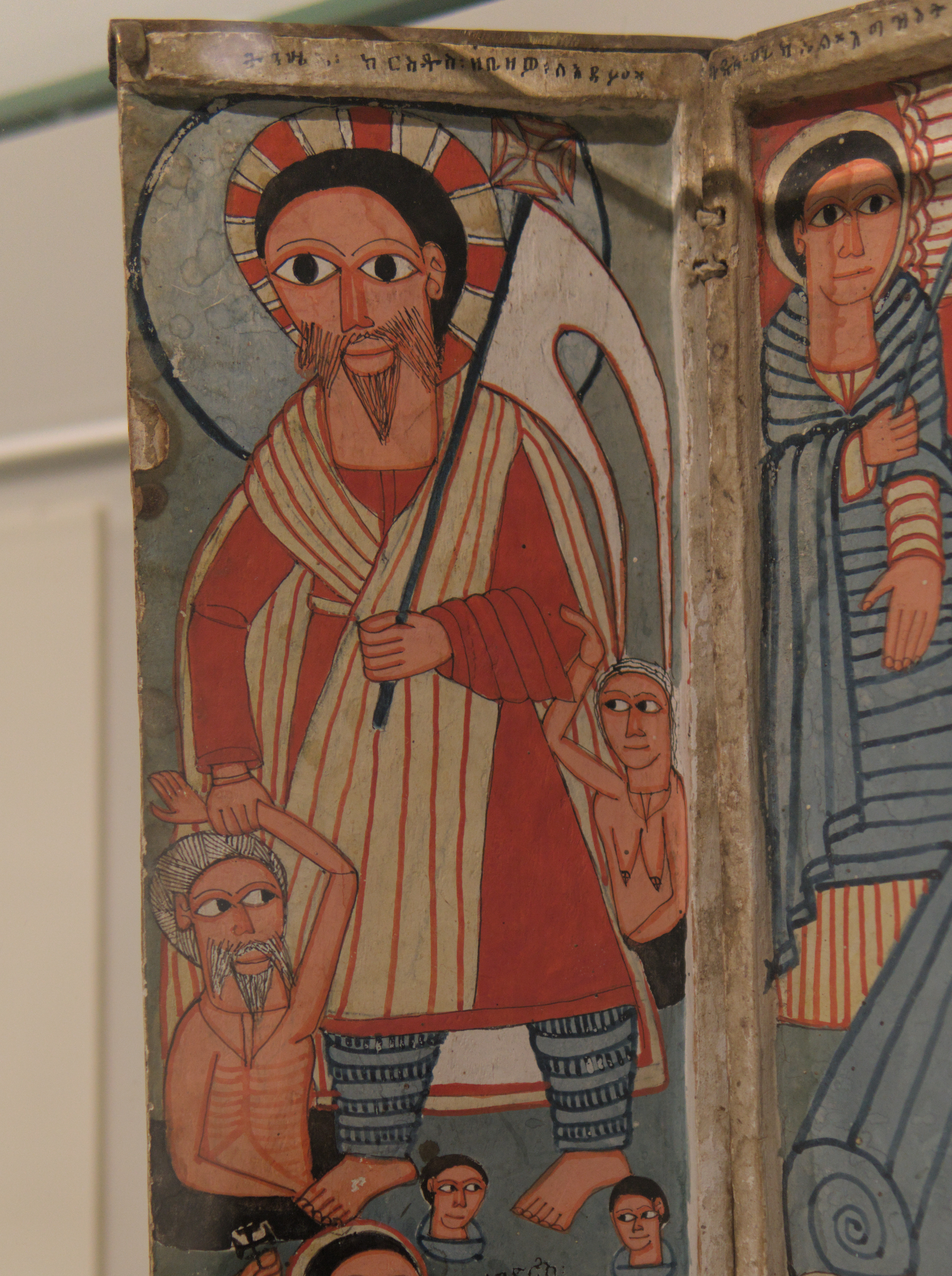
Triptych Icon with the Virgin Mary and Christ Child Flanked by Archangels, Scenes from the Life of Christ, Saint George, and Saints Honorius, Täklä Haymanot, and Ewostatewos, Ethiopia (Tigray), early 17th century. Glue tempera on panel, 16 3/4 × 22 5/16 in. (42.5 × 56.7 cm). Walters Art Museum, Baltimore. [object record]
The composition of the Virgin and Child is based on prints of a painted icon from Santa Maria Maggiore in Rome brought to Ethiopia by Portuguese Jesuit missionaries—but it innovates. As the wall text notes, “Mary’s cloak stretch[es] out in either direction to embrace the scene of Christ Teaching the Apostles below. Umbrella-like, Mary appears as both the protector and personification of the church.”
On the right wing, angels hold up chalices to collect the blood that flows from Jesus’s wounds on the cross, while below that, Joseph of Arimathea and Nicodemus carry Jesus’s wrapped corpse to the tomb. On the left wing is one of my favorite traditional religious scenes: the Harrowing of Hell, or Christ’s Descent into Limbo, in which, on Holy Saturday, Jesus enters the realm of his dead to take back those whom Death has held captive, first of which are our foreparents Adam and Eve. Below that scene is an image of the dragon-slaying Saint George, a late third-century figure from the Levant or Cappadocia who is the patron saint of Ethiopia.
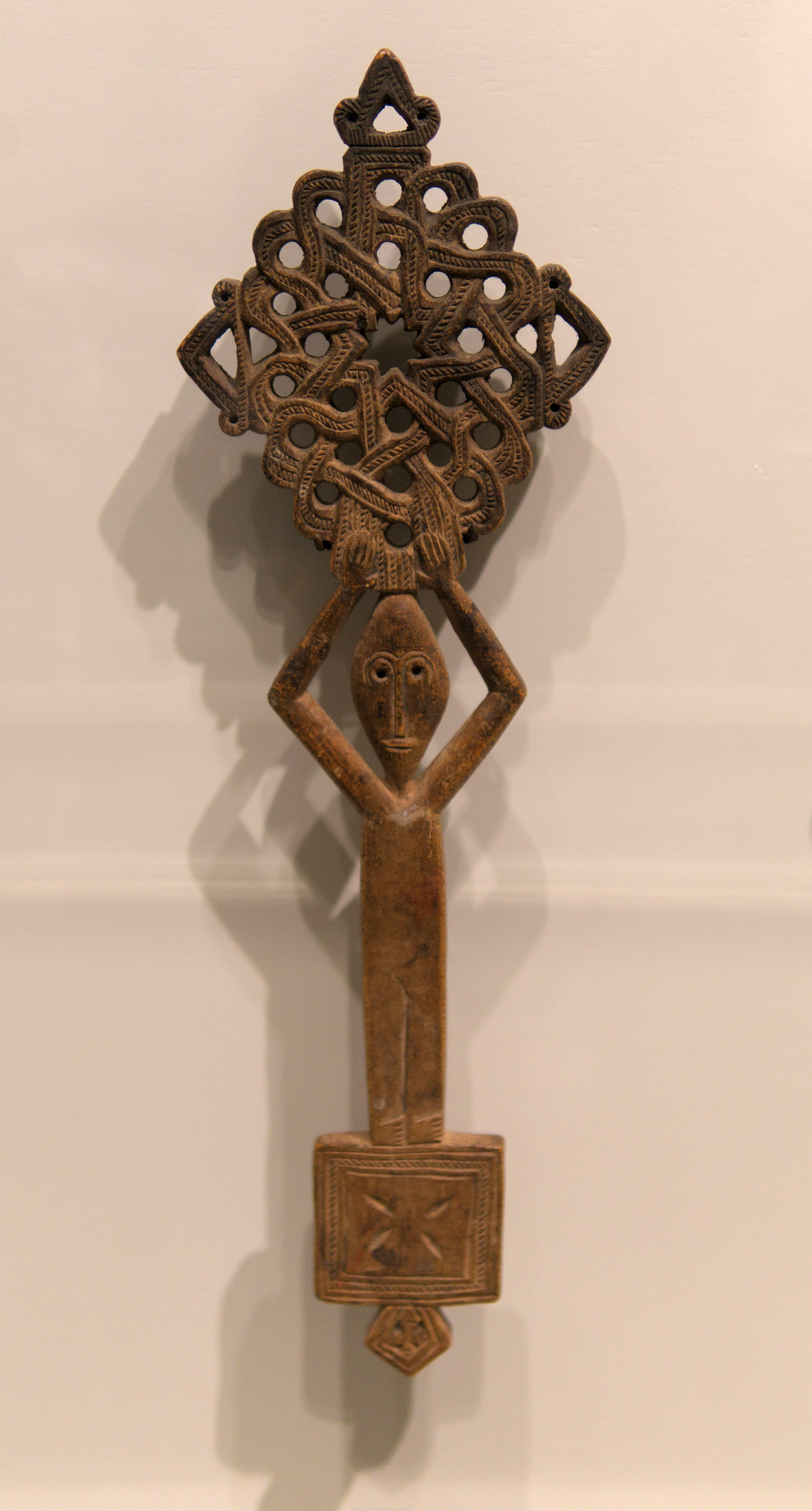
At the bottom center is a scene of Christ teaching the twelve apostles, plus two Ethiopian saints. They all hold hand crosses, like those carried by Ethiopian priests and monks.
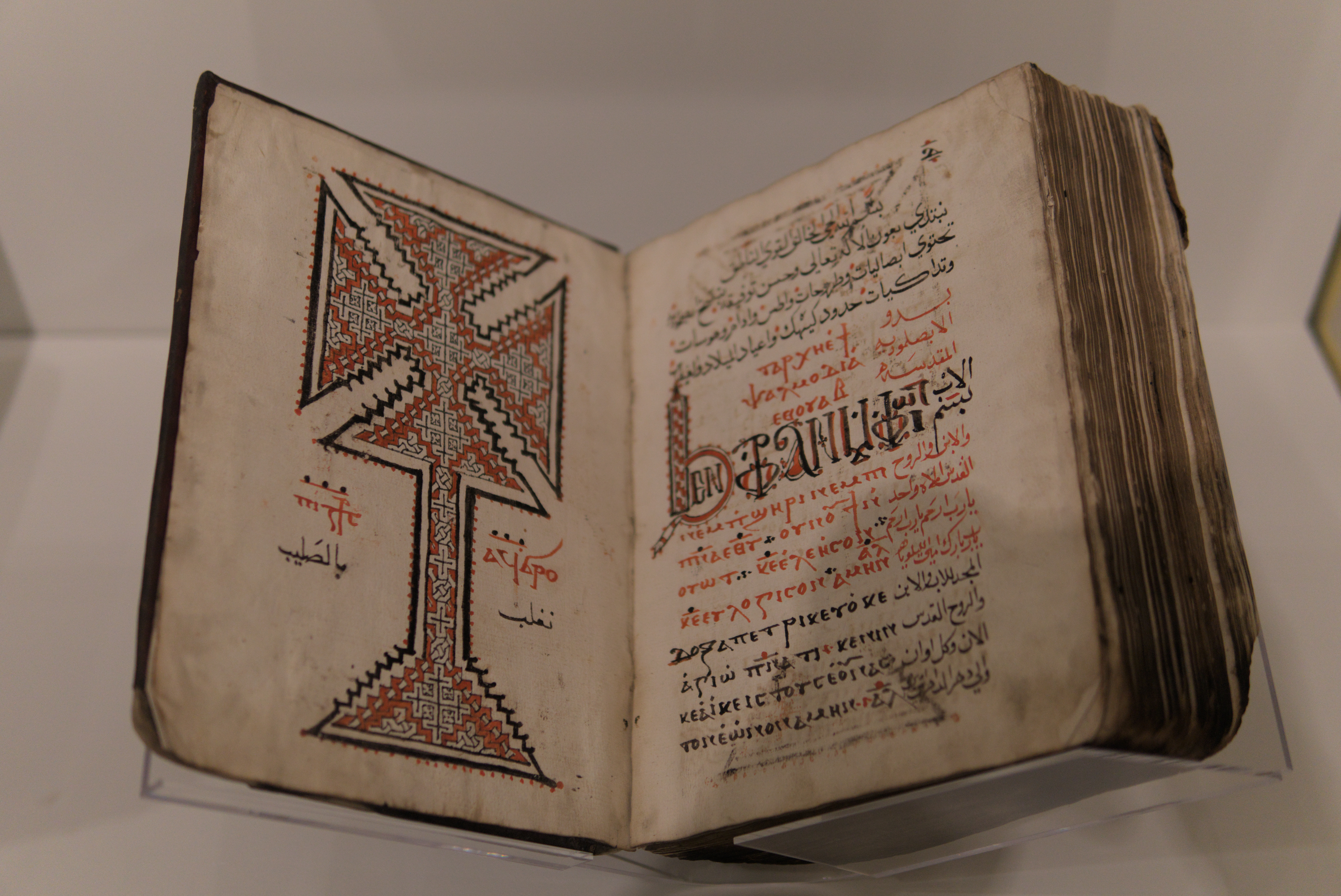
Hand Cross with Figure, Ethiopia, probably 18th–19th century. Wood, 13 3/8 × 4 3/16 × 9/16 in. (34 x 10.7 × 1.4 cm). Walters Art Museum, Baltimore. [object record]Coptic-Arabic Book of Prayer, Egypt, 18th century. Tempera and ink on parchment, 11 3/4 × 9 in. (29.8 × 22.8 cm). Melikian Collection. [object record]
One of the hallmarks of the exhibition is its multisensory nature: attendees are immersed not only in the sights of Ethiopia but also in the sounds and smells. Scratch-and-sniff cards invite people to take a whiff of frankincense, which would have filled the censer on display. Or to smell berbere, a hot spice blend that would have been stored in the woven baskets nearby.
This olfactory element was produced by the Institute for Digital Archaeology, which, as part of its efforts to record and preserve ephemeral culture, has launched an ambitious program to preserve the heritage of smells. “The aim is to provide the technical means for documenting the aromas of today for the benefit of future generations – and to find new methods and opportunities for experiencing the odors of the past.”
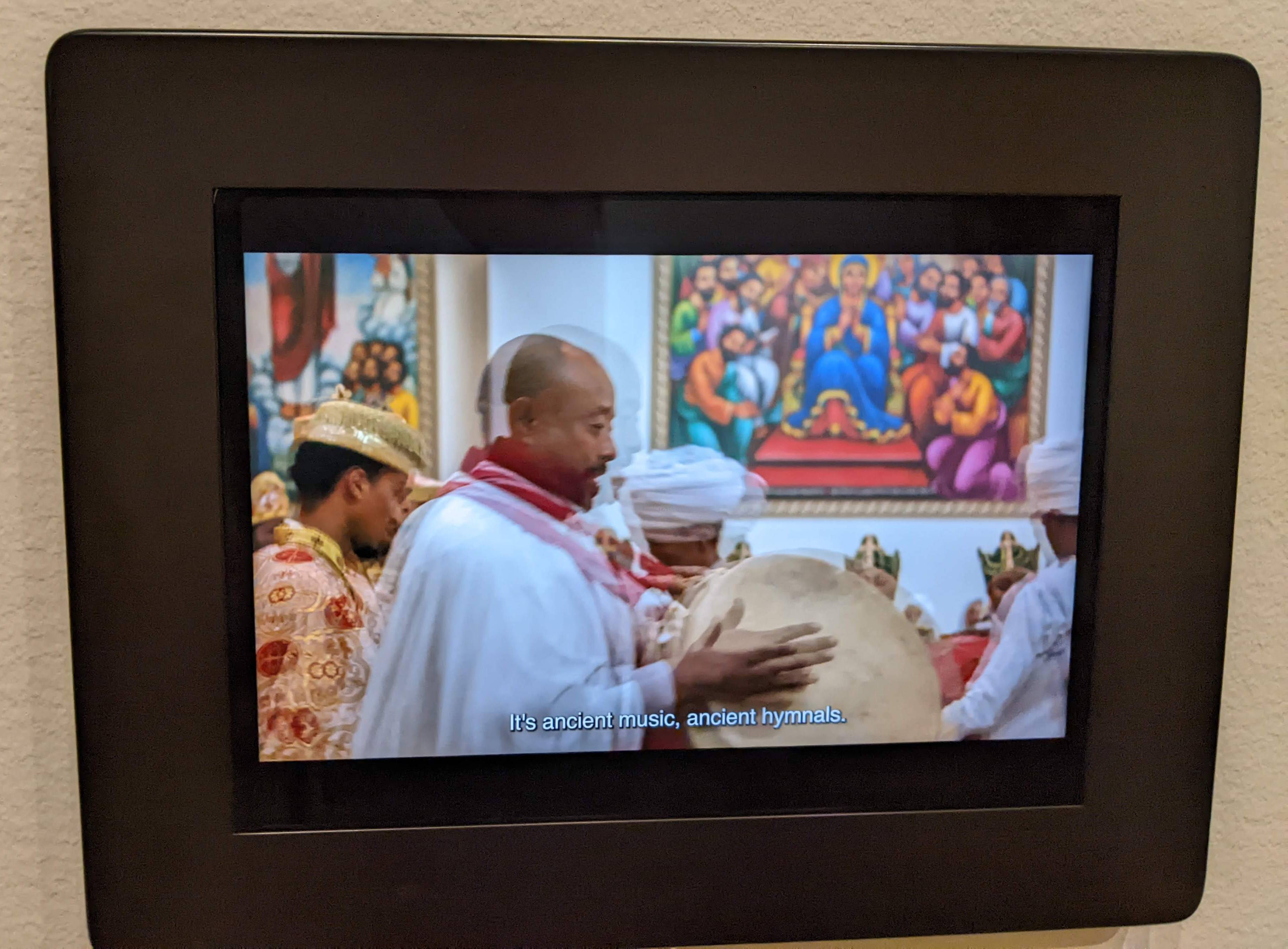
Also in the exhibition there are screens where you can watch videos of Ethiopian Orthodox worship, including music and liturgies, where you will see some of the objects in use. You can also listen to interviews with members of the local Ethiopian diaspora community. (The Washington metropolitan area has the largest Ethiopian population outside Ethiopia.)
Further contextualizing the objects and enhancing the sense of place, pasted onto the wall is a blow-up photograph of a Christian holy-day celebration wending through the streets. This serves as a backdrop to two physical artifacts present in the room: a qämis (dress) and a debab (umbrella).
The inscriptions on many of the Ethiopian icons and manuscript illuminations, which identify the figures and scenes, are in Ge‘ez (aka classical Ethiopic), an ancient South Semitic language that originated over two thousand years ago in what is now northern Ethiopia and Eritrea. It’s no longer spoken in daily life, but it is still used as the language of the Ethiopian Orthodox Church and taught to boys in Sunday school. I really wish I could read it, as it would be a great help in interpreting the Ethiopian images I come across in my studies!
Contrary to what some may assume, Ethiopians in the medieval era were not an isolated people. They traveled—to Rome, to Jerusalem, and so forth. Evidence of Holy Land pilgrimage is suggested by an early fourteenth-century Gospel book that includes the domed Church of the Holy Sepulcher as the backdrop for Christ’s resurrection:
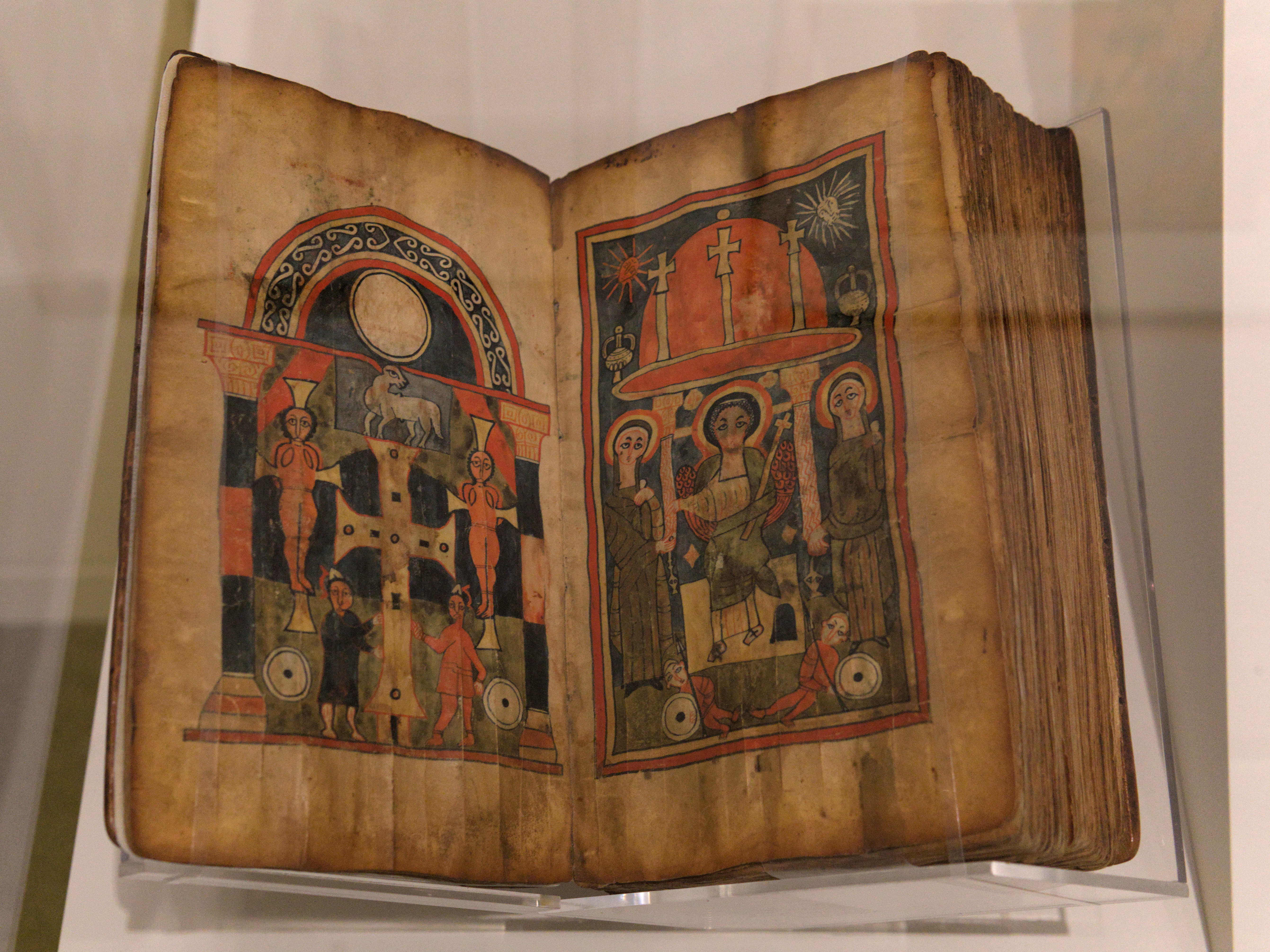
Gospel Book with the Crucifixion and Christ’s Resurrection, Ethiopia (Tigray), early 14th century. Ink and paint on parchment, 10 1/2 × 6 11/16 in. (26.7 × 17 cm). Walters Art Museum, Baltimore, W.8.36, fols. 6v–7r. [object record]
This is an extraordinary book, one of the oldest surviving Ethiopian manuscripts and the oldest in North America. Ethiopian artists weren’t yet depicting Jesus on the cross, so to represent the Crucifixion, this artist has painted a living lamb surmounting a bejeweled cross, with the two thieves crucified on either side.
Also from the fourteenth century, a manuscript opened to a page spread of Christ’s Entry into Jerusalem:
Christ’s Entry into Jerusalem, folios added from an earlier Gospel book to a Ta’ammera Maryam manuscript, Ethiopia, 14th century. Tempera and ink on parchment. Private collection.
I like how the scene extends across both pages, creating a sense of forward progression, and the two onlookers above the city gate.
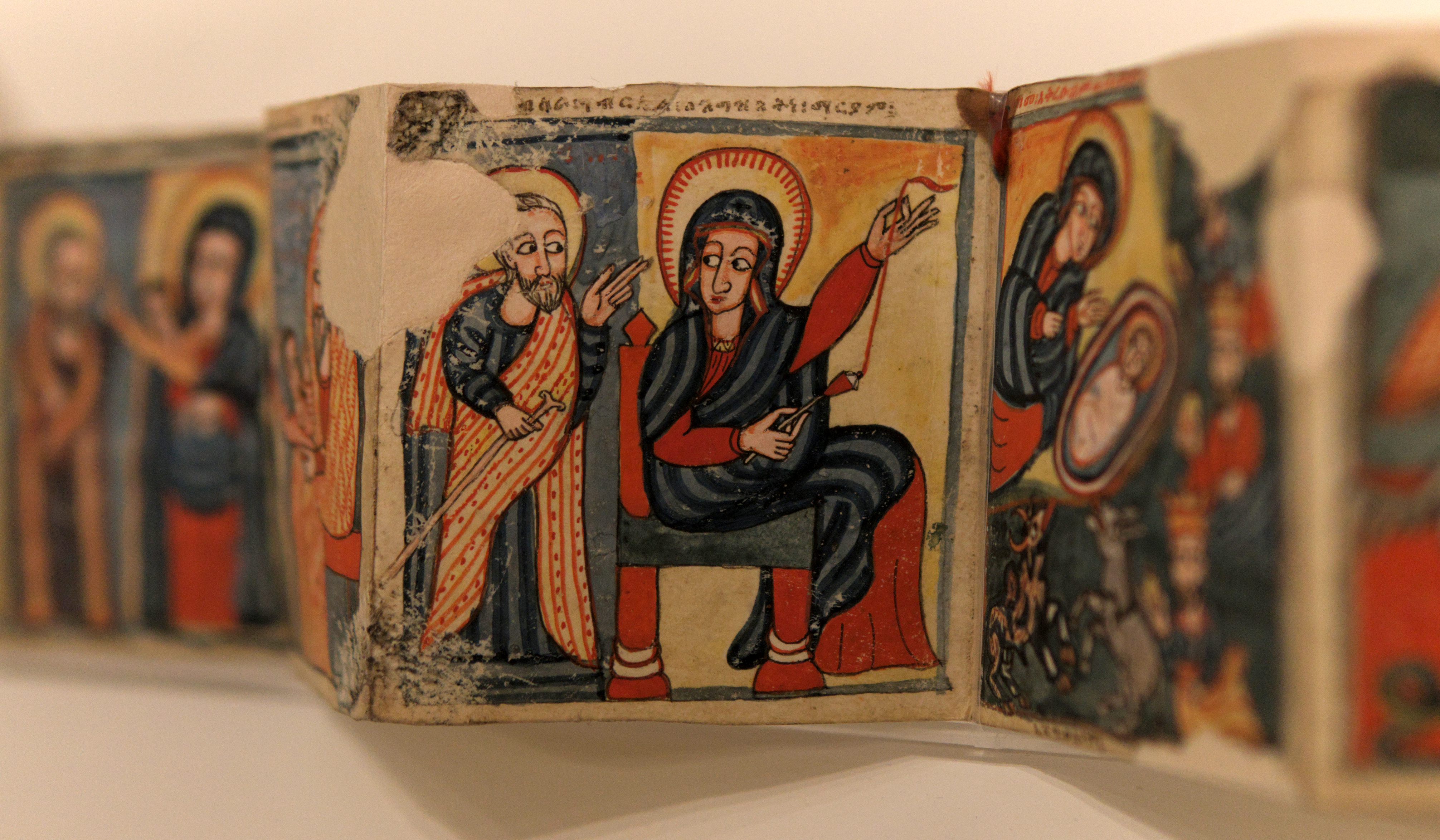
One of my favorite objects from the exhibition is a sensul from Gondar depicting ten scenes from the life of Mary. A sensul is an Ethiopian chain manuscript, in this case pocket-size, created out of a single folded strip of parchment attached to heavy hide boards at each end, which creates a small book when folded shut. Here’s a detail showing the Annunciation:
Annunciation, from a Gondarine sensul (chained manuscript), Ethiopia (Gondar), late 17th century. Ink and paint on parchment, each panel 3 5/8 × 3 1/8 in. (9.2 × 9 cm). Walters Art Museum, Baltimore. [object record] [GIF]
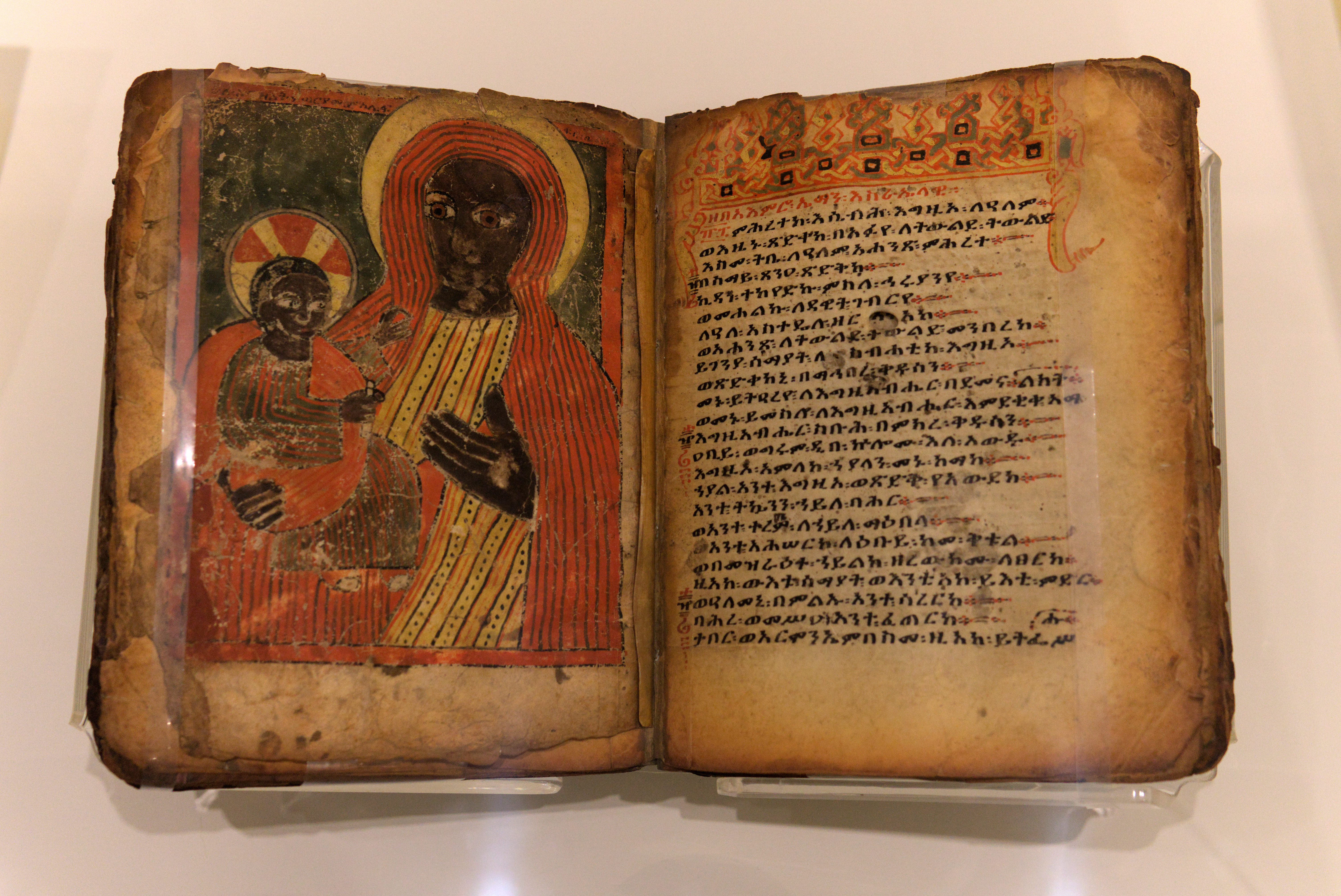
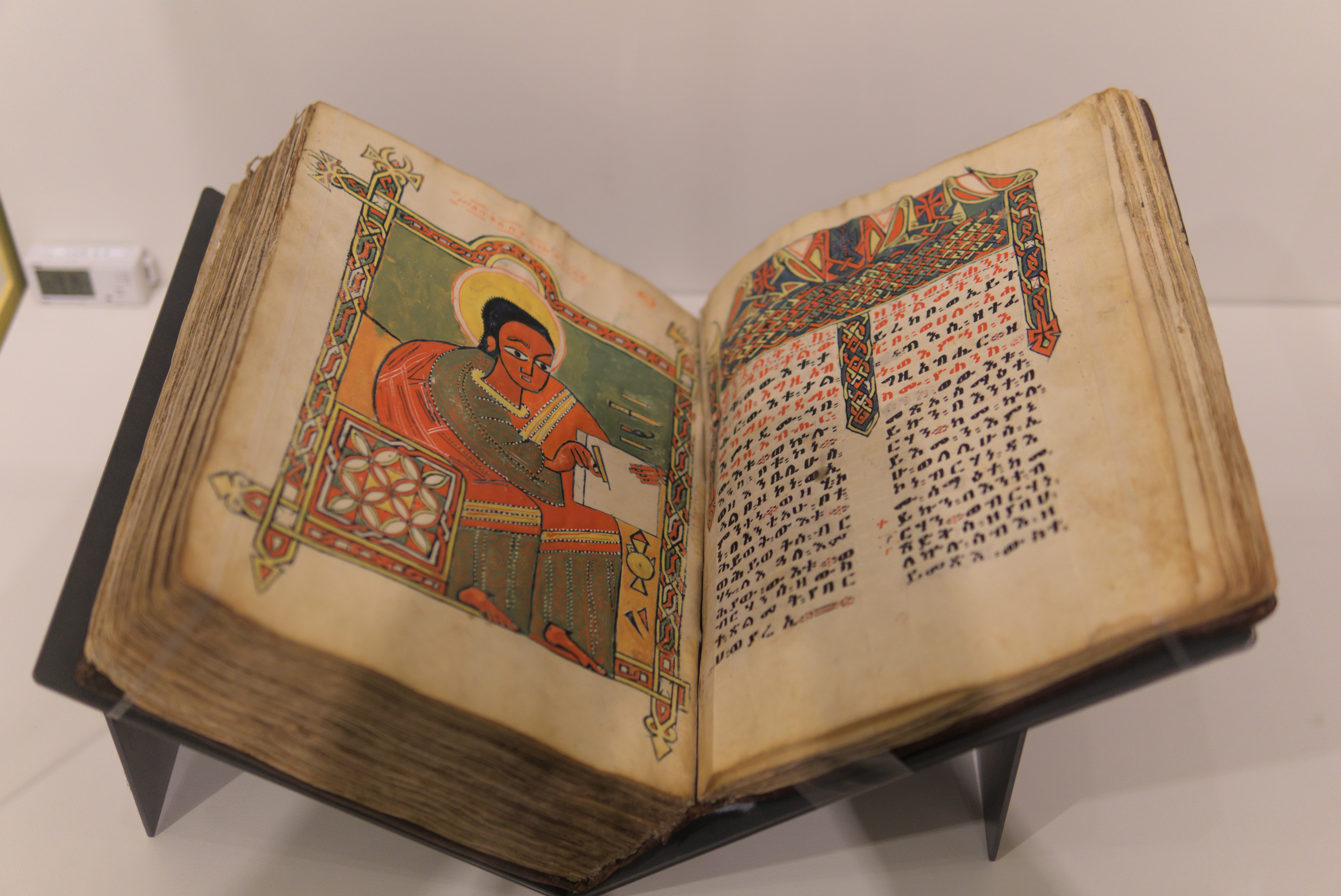
It’s a common misconception that Ethiopians have always depicted biblical figures as dark-skinned to reflect the local population. Such treatment didn’t become normative until the eighteenth century, although some earlier artists did choose black complexions for holy persons:
Virgin and Child, from a Psalter with the Wəddase Maryam (Praise of Mary) and Mähalǝyä Näbiyyat (Canticles of the Prophets), Ethiopia, 15th century. Ink and pigments on parchment with wooden boards, open: 8 7/8 × 6 11/16 × 3 15/16 in. (22.5 × 17 × 10 cm). Toledo Museum of Art, Ohio. [object record]The Opening of the Gospel of John, from a Gospel book, Ethiopia, ca. 1504–5. Tempera on parchment, 13 9/16 × 10 7/16 in. (34.5 × 26.5 cm). J. Paul Getty Museum, Los Angeles, Ms. 102, fols. 215v–216r. [object record]Triptych Icon with the Virgin Mary and Christ Child Flanked by Archangels (center), the Kwer‘atä re’esu (Man of Sorrows) and Saint George (left), and Saint Gäbrä Mänfäs Qeddus and Abba Arsanyos (right), Ethiopia (Gondar), late 17th–early 18th century. Tempera on gesso-primed wood. Institute of Ethiopian Studies, Addis Ababa University, acc. no. IESMus3492.
In the triptych shown above, not only is the infant Jesus depicted as Black, but he also wears a necklace made of cowrie shells, which are traditionally given to Ethiopian children for protection!
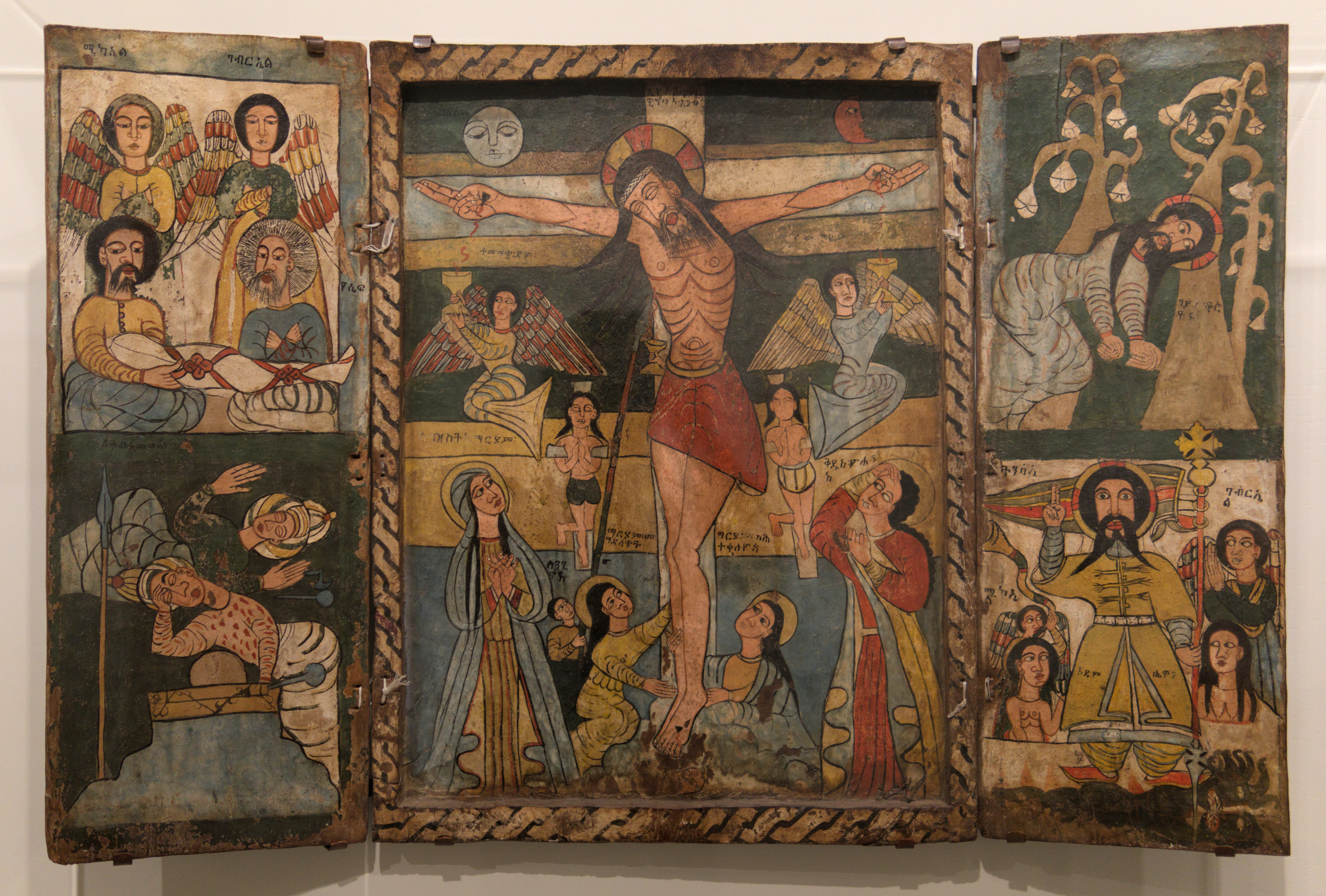
My favorite artwork from the exhibition is probably this triptych:
Triptych Icon with the Crucifixion (center), Entombment and Guards at the Tomb (left), and Temptation in the Wilderness and the Resurrection of Christ (right), Ethiopia, late 16th century. Tempera on gesso-primed wood. Institute of Ethiopian Studies, Addis Ababa University, acc. no. IESMus4126.
Its central panel depicts the Crucifixion, Christ’s head bowed in death and his fingers gesturing blessing, even as his palms are nailed. At the top, the sun and the moon mourn his passing. As we saw before, angels catch the blood that drips from his body (notice the cute little hand sticking out from behind his torso!). At the base, the two larger-scale figures are the Virgin Mary and St. John, while next to Mary on a smaller scale is Longinus, the centurion who pierces Christ’s side with a spear.
The left wing shows the Entombment of Christ, with two guards, wearing pointed turbans, sleeping at their post. The right wing shows a scene that the label identifies as “Temptation in the Wilderness” (presumably a translation of the inscription on the tree) but that looks to me more like an Agony in the Garden. Below that is the Resurrection, with Christ holding a victory banner, standing atop Hades. An angel blows a shofar and the dead rise up out of their graves, following Christ, the firstfruits of the resurrection (1 Cor. 15:20–22). Christ wears a short-sleeved, knee-length jacket with frog closures, and bunched sleeves and trousers, both of which reflect clothing from regions east of Africa.
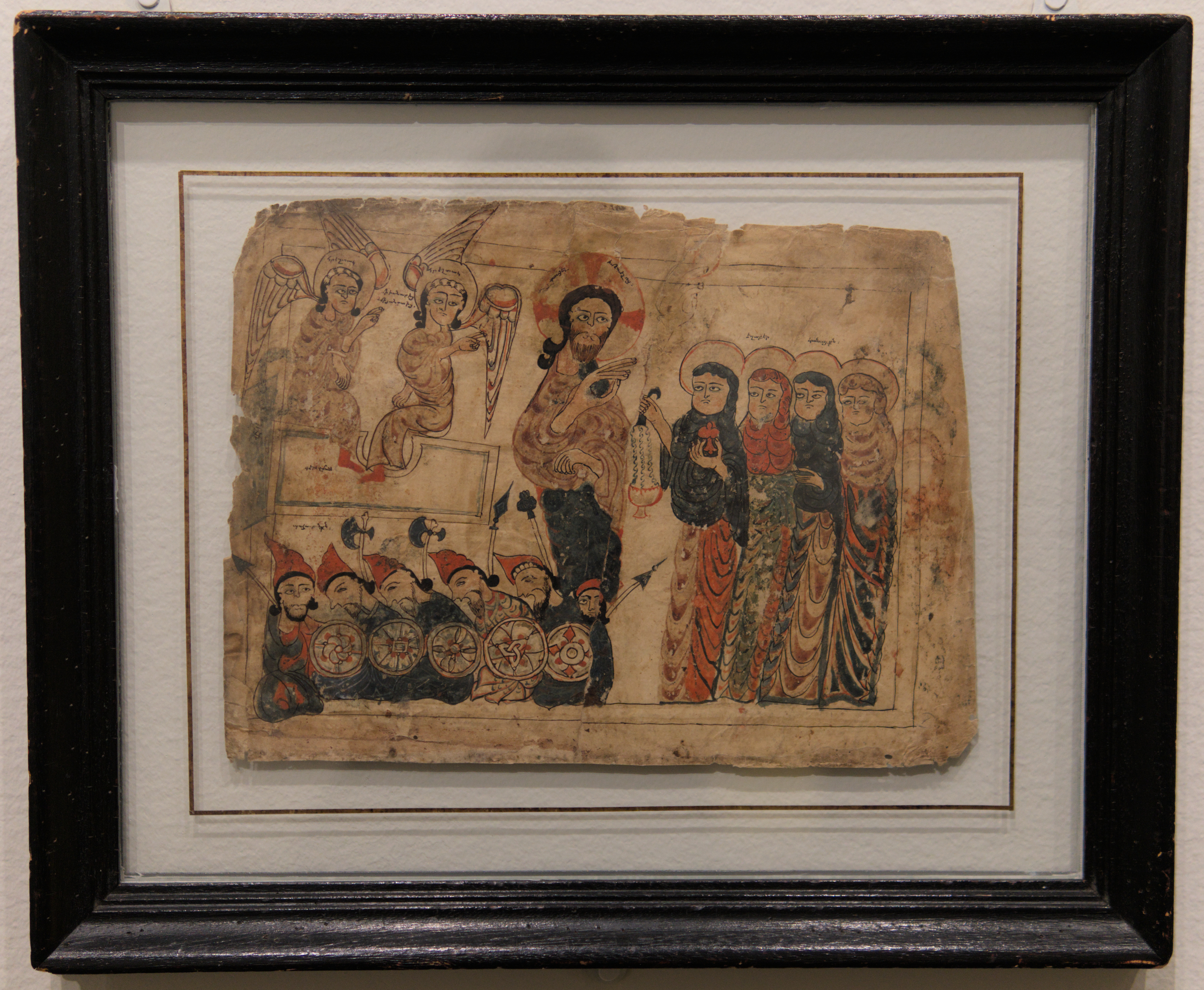
The wall text notes the fine, wavy lines used to render the figures’ draperies, perhaps influenced by Armenian artists from the Lake Van region.
Yovsian of Vaspurakan (Armenian), Leaf from a Gospel book with the Resurrection of Christ and Visit of the Women to the Tomb of Christ, ca. 1350. Tempera on cotton paper. Private collection.
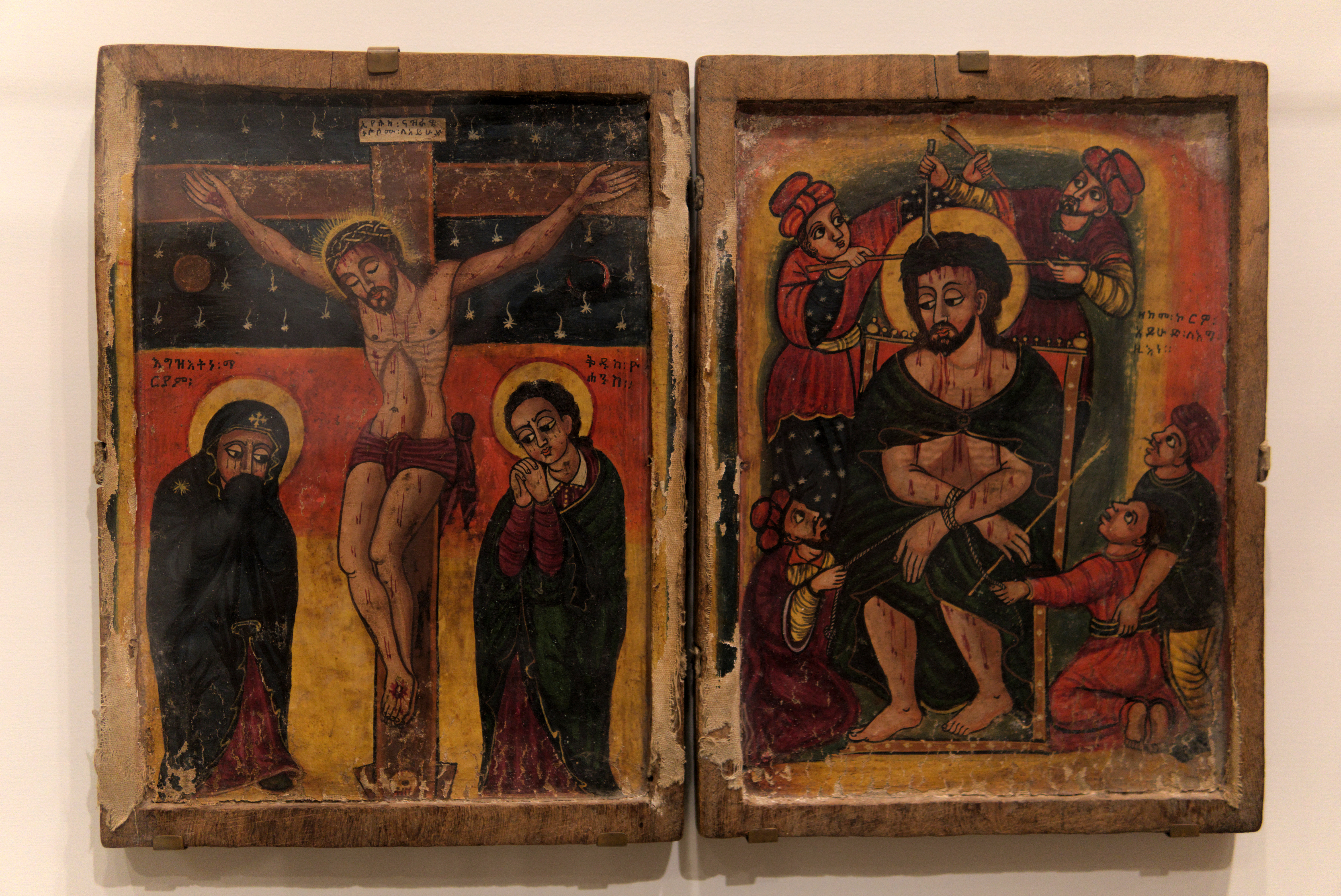
Here’s another Crucifixion, this one painted in what’s called the Second Gondarine style, characterized by smoothly modeled figures, often with darker skin tones, and wide horizontal bands of red, yellow, and green filling the background:
Diptych Icon with the Crucifixion (left) and the Mocking of Christ (right), Ethiopia, late 17th–early 18th century. Wood, polychrome, 13 1/2 × 9 7/8 in. (34.3 × 25.1 cm). Virginia Museum of Fine Arts, Richmond. [object record]
The squiggles behind Christ at the top left may simply be a decorative motif, but to me they look like falling stars, an apocalyptic sign, and as if the sky is weeping.
The right panel of the diptych shows Christ being cruelly fitted with a crown of thorns.
Two other passion images I want to share are a Last Supper wall painting and an Entombment from a disbound album.
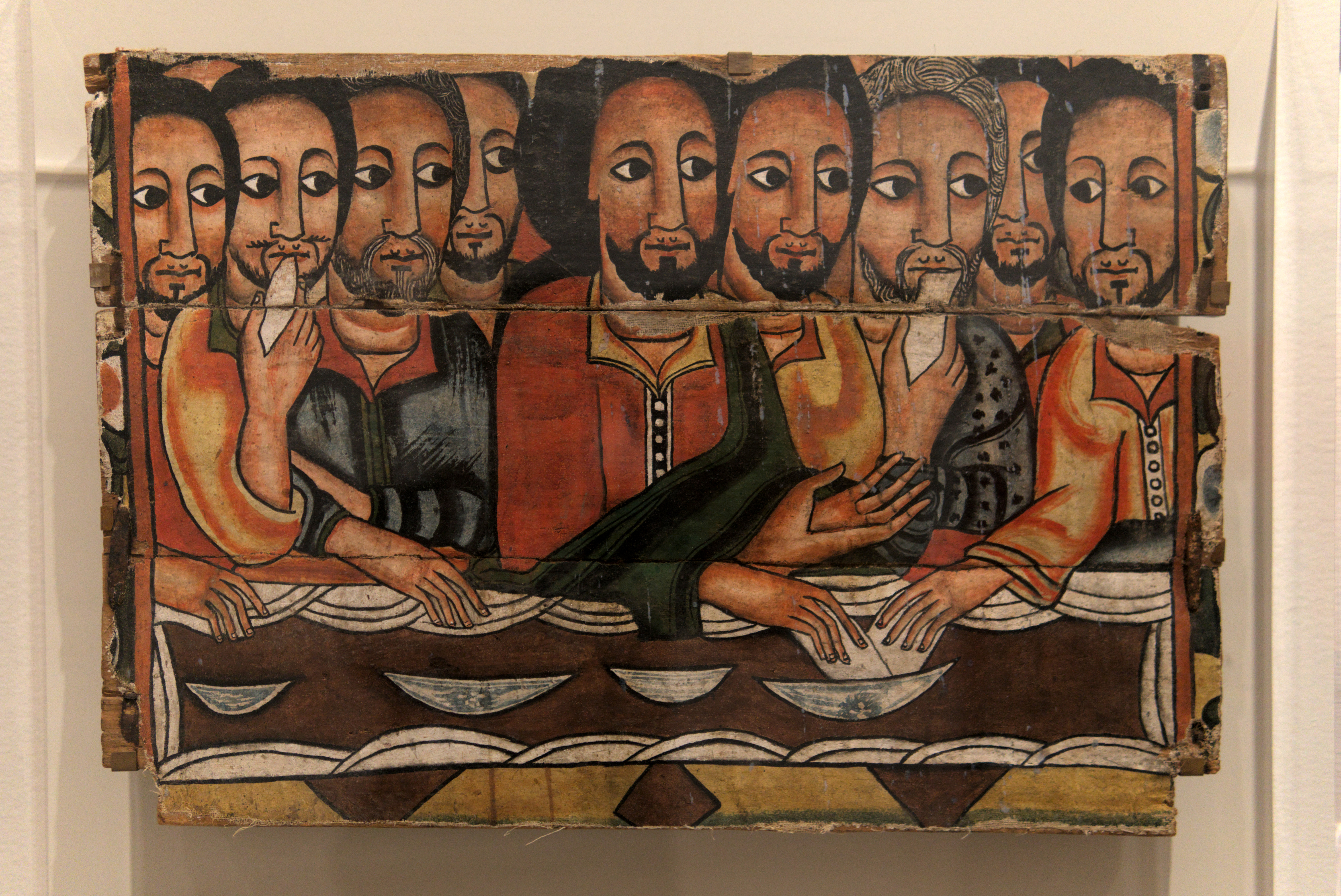
Last Supper, Ethiopia, 18th century. Tempera on linen, mounted on panel, 16 3/4 × 24 in. (42.6 × 61 cm). Virginia Museum of Fine Arts, Richmond. [object record]Album Leaf with the Entombment of Christ, Ethiopia (Sawa?), late 17th century. Pigments on vellum. Minneapolis Institute of Art, 2009.39.3y. [object record]
In the Last Supper, Jesus and Judas both dip their bread (injera!) into the same bowl and exchange a knowing glance.
In the Entombment, Jesus, wrapped in white linen, is lowered into the ground, mourned by several of his women followers. The portrayal of his mother Mary’s weeping, her hands covering her eyes and her face stained with tears, is particularly poignant. This leaf is from a set of forty-four, now matted separately but originally arranged in series and likely painted on several long sheets of parchment that were sewn together and folded accordion-style to form a sensul.
One of the most extraordinary objects on display is a rare folding processional icon that adopts the form of a fan, from the late fifteenth century:
Folding Processional Icon in the Shape of a Fan, Ethiopia, late 15th century (Stephanite). Ink and paint on parchment, thread, extended: 24 1/4 × 154 1/8 × 4 3/4 in. (61.6 × 391.4 × 12 cm). Walters Art Museum, Baltimore. Photo courtesy of the museum. [object record]
Thirty-eight identically sized figures span the surface of this elongated parchment: the early Christian martyrs Julitta (Juliet) and Cyricus, St. George, St. John the Baptist, the archangel Michael, the Virgin Mary, the archangel Raphael, St. Paul, the Ethiopian artist-priest Afnin, and unidentified Old Testament patriarchs and prophets. There would have been a wooden handle attached to either end that, when pulled together, created a double handle for a giant wheel to be displayed during liturgical processions and church services (see here). As the museum website notes, “The Virgin Mary, whose hands are raised in a gesture of prayer, is then at the top of the wheel. By depicting Mary in the company of saints and angels, the icon powerfully evokes the celestial community of the church.”
This is just a sampling of all the wonderful art objects that are a part of the Ethiopia at the Crossroadsexhibition. I’ll share more photos on Instagram (@art_and_theology) in the coming weeks.
I strongly encourage you to go see this! I think it would be enjoyable for children as well, especially Christian children, who will be able to identify many of the painted stories. For Christians, it’s an opportunity to connect with our artistic heritage and with African church history. If you can’t catch the exhibition at the Walters in Baltimore before it closes March 3, it will be traveling to the Peabody Essex Museum in Salem, Massachusetts (April 13–July 7, 2024), and the Toledo Museum of Art in Ohio (August 17–November 10, 2024).
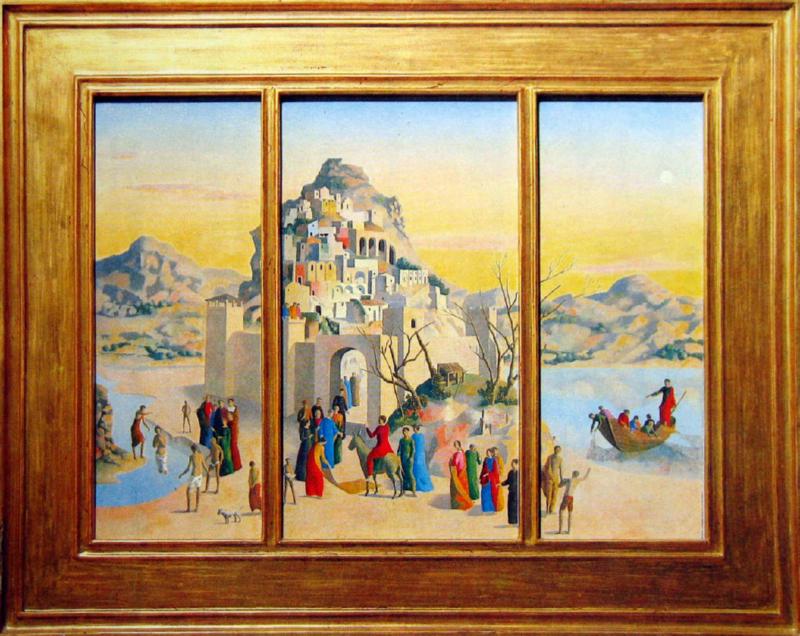
Justin O’Brien (Australian, 1917–1996), Palm Sunday, 1962. Oil on canvas, 45.5 × 62 cm.
This triptych (three-paneled artwork) by Australian artist Justin O’Brien portrays three scenes from the life of Christ. On the left wing is the Baptism of Christ, where he’s anointed by God’s Spirit for his messianic role, and on the right is the Miraculous Draught of Fishes, a story of miraculous abundance. The center panel shows Jesus about to enter the gates of a hilltop city representing Jerusalem. He rides a donkey and is dressed in red, the color of martyrdom. One man lays down his cloak before Jesus’s dusty path as a sign of reverence. Now the people welcome him in, but in just a few short days many will turn on him.
O’Brien grew up in a Catholic household in Sydney. In 1948–49 he visited Italy and fell in love with the work of the Proto- and Early Renaissance painters from Tuscany, like Duccio and Piero della Francesca. Most of O’Brien’s paintings are on religious subjects, despite his renunciation of Catholicism in 1954. Though he self-identified as agnostic for the second half of his life, he continued to be artistically inspired by the stories of the New Testament. He moved to Rome in 1967 and spent the remainder of his days there, returning to his home country of Australia every few years for exhibitions.
LISTEN: “Jerusalem Interlude,” excerpted from “The Holy City” | Words by Frederick E. Weatherly, 1892 | Music by Stephen Adams (pseudonym of Michael Maybrick), 1892; arr. Noble Caine, 1946 | Performed by the Aeolians of Oakwood University on Aeolianology Acappella, vol. 2, 2015
Jerusalem, Jerusalem Lift up your gates and sing Hosanna in the highest Hosanna to your king
This is the refrain of the Victorian choral ballad “The Holy City” by the English lawyer, author, lyricist, and broadcaster Frederick E. Weatherly (best known for writing “Danny Boy”) and his regular collaborator, the English composer Michael Maybrick, who published under the pen name Stephen Adams. The song became hugely popular in the UK and the US at the beginning of the twentieth century, and is even mentioned in James Joyce’s Ulysses (1920). It is sung by early Hollywood musical superstar Jeanette MacDonald in the 1936 film San Francisco.
Lyrics to the complete song are below, as is a video performance by the Aeolians from 2020:
Last night I lay a-sleeping There came a dream so fair I stood in old Jerusalem Beside the temple there I heard the children singing And ever as they sang Methought the voice of angels From heav’n in answer rang
“Jerusalem, Jerusalem! Lift up your gates and sing Hosanna in the highest Hosanna to your king!”
And then methought my dream was chang’d The streets no longer rang Hush’d were the glad Hosannas The little children sang The sun grew dark with mystery The morn was cold and chill As the shadow of a cross arose Upon a lonely hill
“Jerusalem, Jerusalem! Hark! how the angels sing Hosanna in the highest Hosanna to your king!”
And once again the scene was chang’d New earth there seem’d to be I saw the Holy City Beside the tideless sea The light of God was on its streets The gates were open wide And all who would might enter And no one was denied No need of moon or stars by night Or sun to shine by day It was the new Jerusalem That would not pass away
“Jerusalem, Jerusalem! Sing, for the night is o’er! Hosanna in the highest! Hosanna for evermore!”
The song’s speaker has a dream about Christ’s celebrated entry into Jerusalem, with crowds surrounding him and shouting his praises. But then the mood turns dark and hushed as a cross is erected on Golgotha and the newly hailed king is crucified. However, the mood revolves back to one of celebration in the final verse as the New Jerusalem comes down, permanently displacing all sorrow, its gates thrown open wide in universal welcome and the wounded but victorious Jesus seated on the throne.
The Aeolians’ isolation of the first refrain for their “Jerusalem Interlude,” which echoes Psalm 24:7–10 [previously], makes a perfect antiphon for Palm Sunday. Though the words are exultant, the music has an aching quality that foreshadows the suffering that is soon to come and that matches the tone of Jesus’s lament over Jerusalem on this day: “As he came near and saw the city, he wept over it, saying, ‘If you, even you, had only recognized on this day the things that make for peace! But now they are hidden from your eyes’” (Luke 19:41–42; cf. Matt. 23:37–39).
The American jazz composer Duke Ellington used the refrain’s melody as the basis of the opening of his “Black and Tan Fantasy” (1927), in which a cornet and trombone play dolefully in parallel harmony. Can you hear the clopping donkey?
Addendum, 4/23/25: Here’s another arrangement of the song I like, by African Vocals, an a cappella group from Namibia. The following video shows one of the performances from their 2019 Germany tour. Soloist Reinhard Kungairi Kahambuee (who doesn’t come into frame until fifty seconds in) is wonderful! Note that at 1:40, the tempo becomes bright, lively, and more rhythmic, with the addition of hand claps.
Lent begins on Wednesday, February 22. I won’t be doing daily Lenten posts like I did last year, though I will be sharing seasonal content once or twice a week. If you want a set of new daily art-driven devotions that are freely accessible online, I’d encourage you to follow The Lent Project, run by the Center for Christianity, Culture, and the Arts at Biola University; each day features a scripture passage, a poem, a visual artwork, a piece of music, and a written reflection. I’d also direct you to my Lent Playlist (new additions at bottom) and Holy Week Playlist on Spotify.
Carl Spitzweg (German, 1808–1885), Ash Wednesday, 1860. Oil on canvas, 21 × 14 cm. Staatsgalerie Stuttgart, Stuttgart, Germany.
Another spiritual formation resource for Lent is the following series of Arts & Faith videos from Loyola Press, made in 2014–16. Each video features a three-minute commentary by Dr. Daniella Zsupan-Jerome on a historical artwork, chosen based on one of that day’s/week’s scripture readings from the Roman Catholic Mass Lectionary, which is currently in year A. Zsupan-Jerome is the director of ministry formation and field education at Saint John’s School of Theology and Seminary in Collegeville, Minnesota. Here she has crafted a “visual prayer experience” inspired by the Ignatian imagination. In his Spiritual Exercises, Saint Ignatius of Loyola, the founder of the Society of Jesus (the Jesuits), encourages Christians to apply the senses of sight, hearing, smell, touch, and taste to our reading of and meditation on the New Testament, imagining ourselves as present in the Gospel scenes.
Go to the “Arts & Faith: Lent” homepage, or see below, where the link on each artwork title will take you to a new tab where the corresponding video commentary is hosted on the Loyola website. I’ve included sample embeds of a few of the videos below.
Now when they drew near to Jerusalem, to Bethphage and Bethany, at the Mount of Olives, Jesus sent two of his disciples and said to them, “Go into the village in front of you, and immediately as you enter it you will find a colt tied, on which no one has ever sat. Untie it and bring it. If anyone says to you, ‘Why are you doing this?’ say, ‘The Lord has need of it and will send it back here immediately.’” And they went away and found a colt tied at a door outside in the street, and they untied it. And some of those standing there said to them, “What are you doing, untying the colt?” And they told them what Jesus had said, and they let them go. And they brought the colt to Jesus and threw their cloaks on it, and he sat on it. And many spread their cloaks on the road, and others spread leafy branches that they had cut from the fields. And those who went before and those who followed were shouting, “Hosanna! Blessed is he who comes in the name of the Lord! Blessed is the coming kingdom of our father David! Hosanna in the highest!”
—Mark 11:1–10
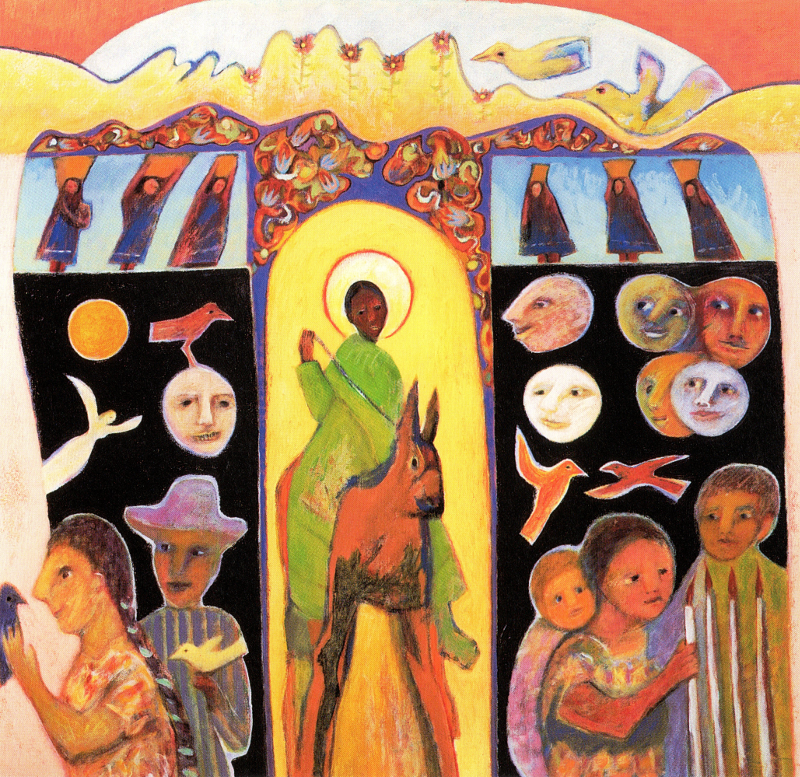
LOOK: Betty LaDuke (American, 1933–), Guatemala: Procession, 1978. Acrylic on canvas, 72 × 68 in.
Before Christmas, at the Mayan village of Chichicastenango in Guatemala, statues of Christ, the Virgin Mary, and the saints are . . . carried aloft in an annual procession. In my painting Guatemala: Procession, Christ appears on a donkey surrounded by the masks worn by the Mayans who dance to honor and celebrate their indigenous roots. They also dance a re-enactment of the brutal Spanish invasion, with satirical masks representing conquistadores. Inside the church many candles are lit and prayers are offered. (181)
So it seems LaDuke has imagined Christ entering this Maya community of Christian celebrants who remember biblical history alongside their history as a people. This isn’t a Palm Sunday image per se, since it visualizes a procession that occurs toward the beginning of the liturgical year, but Jesus’s presence in the center on donkeyback, in a gateway backlit with glorious yellow, flanked by crowds and with angels overhead, evokes his triumphal entry into Jerusalem five days before his death.
LISTEN: “Sanna, Sannanina,” traditional South African
“Sannanina” is a Xhosa derivate of the Greek word “Hosanna,” which is itself a transliteration of a Hebrew phrase that means “Save us, please!” (For more on the word “hosanna” and how its meaning shifted from a cry for help to a shout of exultation—“Salvation!”—read here.) In the first video below, cued up to 24:57, the song is performed by the Africa University Choir under the direction of Patrick Matsinkenyiri. The second video is a demo produced by MennoMedia in preparation for the publication of the Mennonite hymnal Voices Together in 2020.
Jyoti Sahi (Indian, 1944–), Entry into Jerusalem, 2012. Oil and acrylic on canvas. Photo courtesy of the artist.
. . . Most of the crowd spread their cloaks on the road, and others cut branches from the trees and spread them on the road. And the crowds that went before him and that followed him were shouting, “Hosanna to the Son of David! Blessed is he who comes in the name of the Lord! Hosanna in the highest!” And when he entered Jerusalem, the whole city was stirred up, saying, “Who is this?” And the crowds said, “This is the prophet Jesus, from Nazareth of Galilee.”
Ride on, ride on in majesty!
Hark! all the tribes hosanna cry;
O Savior meek, pursue thy road
with palms and scattered garments strowed.
Ride on, ride on in majesty!
In lowly pomp ride on to die:
O Christ, thy triumphs now begin
o’er captive death and conquered sin.
Ride on, ride on in majesty!
The angel armies of the sky
look down with sad and wond’ring eyes
to see th’approaching sacrifice.
Ride on, ride on in majesty!
Thy last and fiercest strife is nigh;
the Father on his sapphire throne
expects his own anointed Son.
Ride on, ride on in majesty!
In lowly pomp ride on to die;
bow thy meek head to mortal pain,
then take, O Christ, thy pow’r and reign.
This year’s Palm Sunday music selection comes from Hymnistry, an excellent podcast that ran from 2015 to 2018. I’ve always liked Henry H. Milman’s hymn text “Ride On, Ride On in Majesty!,” but not the traditional tunes it’s typically paired with. So I was thrilled to hear this contemporary setting by John Hatfield. Hatfield’s introduction to the hymn starts at 5:51. He discusses the cognitive dissonance of Palm Sunday, a celebratory occasion with somber undertones, because we’re really cheering Jesus on to his death. He’s hailed as king, Hatfield says, and “his first act in office is to give himself up for us.” Milman’s text captures this paradox of victory through a cross, and Hatfield seeks to do so as well in his retuning, maintaining a happy energy throughout but sneaking in a minor chord. The actual hymn starts at 10:32.
In the first half of the episode, the Rev. Jacob Paul Breeze, pastor of Holy Family in downtown Houston, gives some illuminating historical background. He says that when Jesus entered Jerusalem during Passover, the Israelites took out the Hanukkah decorations (palm branches) instead! Why were they getting their holidays mixed up? Well, they weren’t. Waving palm branches, which were a symbol of prosperity and triumph in Judaism, is how they celebrated their ancestor Judah Maccabee’s cleansing of the temple in the second century BCE. (He recaptured Jerusalem from the Syrian Greeks and restored Jewish temple worship, which gave way to the first Hanukkah, really a belated celebration of the fall festival of Sukkot; see 2 Maccabees 10:1–8, cf. 1 Maccabees 4:54–60.) The Israelites’ waving of date palms as Jesus processed into their most holy city was their way of affirming him as their chosen one, Breeze says, to lead a revolt against the Romans and secure their freedom.
+++
I love the colorful flurry of excitement in Jyoti Sahi’s painting Entry into Jerusalem, where crowds gather in effusive praise of their new liberator. Birds and angels wing overhead, while green palm branches spill forth from the bottom right to carpet Jesus’s path.
Jyoti told me he started this painting after visiting Jerusalem for an interfaith meeting—his first trip to the Holy Land—where he presented a paper on art and meditation. He was fascinated by the surrounding landscape. The theme of Christ entering Jerusalem is related to the idea of Christ entering the human heart, he says.
The painting was acquired in 2018 by a visiting Italian monk for a Christian chapel in Sicily.
+++
Palm Sunday–related posts from the Art & Theology archives:
A simple, gradually quickening Hebrew folk melody on accordion accompanies a contemporary Bulgarian icon by Julia Stankova in “Hail to the King (Artful Devotion)”
Modernist paintings by Australian artist Nathan Simpson meet Hiram Ring’s blues-inflected song “My Lord” (“My Lord is a donkey-ridin’ man . . .”) in “He Went On Ahead (Artful Devotion)”
Did you know Simon and Garfunkel adapted Orlande de Lassus’s motet setting of the Benedictus (“Blessed is he that comes in the name of the Lord”) and recorded it for their first album? Read more in my review of Wednesday Morning, 3 A.M.
+++
This is the first in a series of eight Artful Devotions I’ve planned—one for each day of Holy Week and the Paschal Triduum. I’m posting this one several days ahead because it’s more substantial than the others; the rest I will endeavor to post in the early morning of the given day, from next Monday through Sunday (Easter!). Most of the world will be spending Holy Week at home this year due to the COVID-19 pandemic. Paul Neeley of Global Christian Worship has compiled a great list of resources to help individuals and families honor these days while in quarantine: https://globalworship.tumblr.com/post/613778966717841408/holy-week-at-home. I’m sure there are many more ideas and materials out there as well.
This post belongs to the weekly series Artful Devotion. If you can’t view the music player in your email or RSS reader, try opening the post in your browser.
To view all the Revised Common Lectionary scripture readings for Palm Sunday, cycle A, click here.
This Sunday marks the start of Passion Week, with Jesus riding into Jerusalem on a donkey, where he is greeted by palm branches and Hosannas. By Thursday, though, these shouts of praise will devolve into “Is it I?,” “I do not know him,” and “Crucify him!”
In a series of simple verses, Hiram Ring’s blues-inflected song “My Lord” moves from Jesus’s triumphal entry to his agony in the garden (where he drinks heavily the bitter draft of suffering) to his crucifixion. The final two verses shift then to his resurrection and his exaltation in heaven.
+++
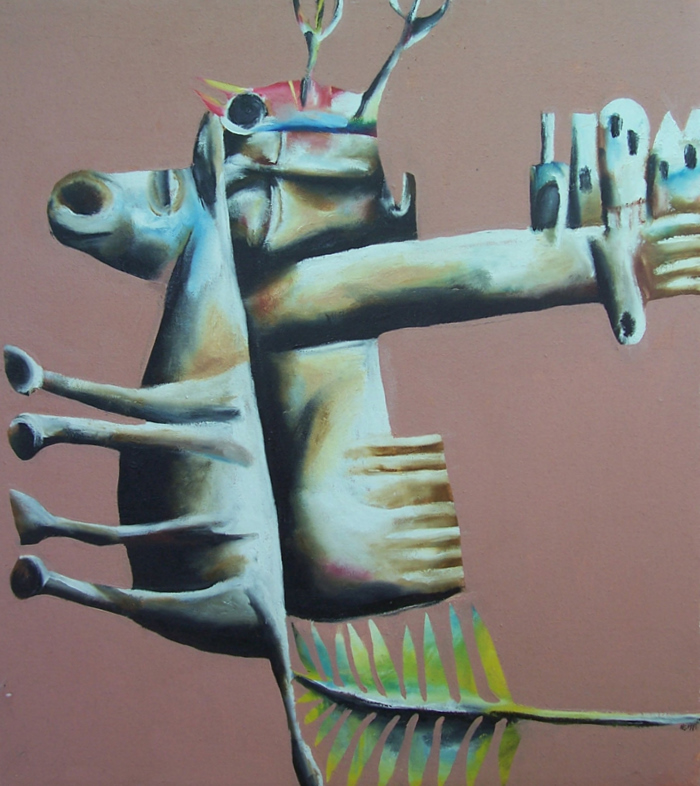
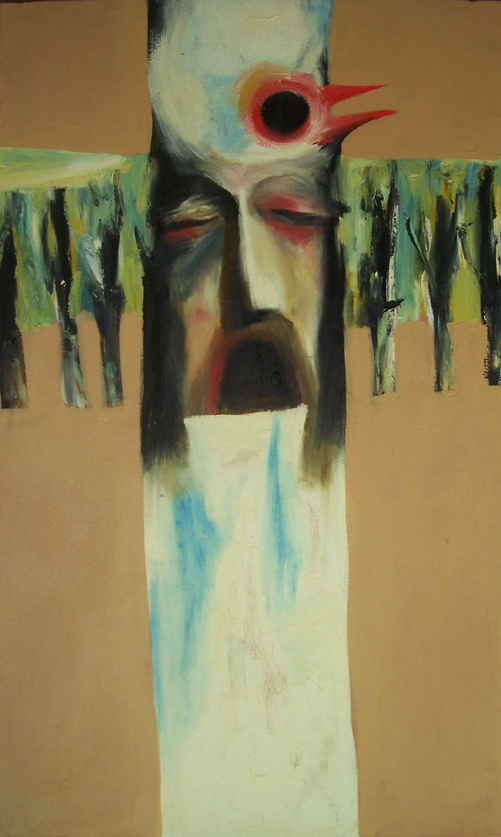
Nathan Simpson (Australian, 1973–), Agony in the Garden, 1999. Oil on canvas.
Nathan Simpson (Australian, 1973–), Large Resurrection, 1999. Oil on canvas.
I’m compelled by the Gospel narrative paintings of contemporary Australian artist Nathan Simpson. These are a few I saved from his website a while ago before it went under construction. In Simpson’s Agony in the Garden, Christ’s anguish is palpable. The image combines the Gethsemane narrative with all the suffering that lies ahead, culminating in death. A row of olive trees forms the horizontal beam of a cross, while a rooster (alluding to Peter’s betrayal) forms the vertical; Christ’s head, with swollen eyes and gaping mouth (“My God, my God . . .”), is the point of intersection.
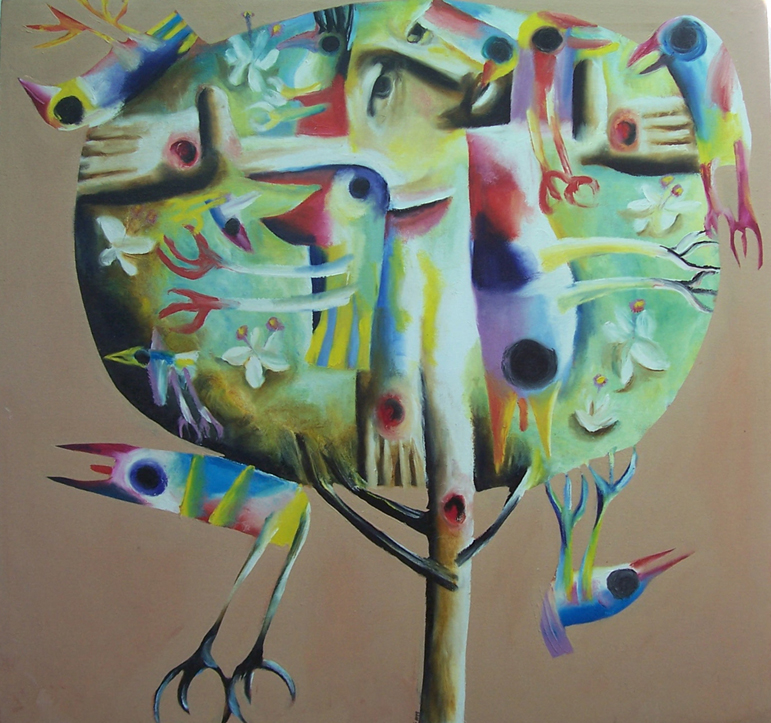
Simpson’s Resurrection painting, by contrast, shows a Christ who’s victorious over death, his face serene. The artist plays with the popular “tree of life” motif, fusing Christ’s body into this flowering, bird-filled plant. An arborescent Christ! See how the nail wound in his left foot is also the tree’s hollow.
+++
In their latest blog post, SALT Project suggests a simple at-home Holy Week ritual for families that I really like: a Tenebrae Wreath (tenebrae means “shadows”).
Imagine . . . a sort of Advent Wreath in reverse: four candles in a circle with a Paschal candle in the middle, extinguished one by one. Sunday night: beginning with only the Paschal candle lit, read Luke’s story of Palm Sunday, and then light all four candles in joy, hope, and thanksgiving. Thursday night: read Luke’s story of the Last Supper, and extinguish one candle; then read Luke’s story of Gethsemane, and extinguish a second. Friday night: read Luke’s story of Peter’s denials and desertion, and extinguish a third candle; then read Luke’s story of Jesus’ suffering, and extinguish the fourth; and then finally, read Luke’s story of Jesus’ death, and extinguish the Paschal candle. Saturday, the wreath remains unlit and bare, perhaps shrouded with cloth. And Sunday morning, the shroud is gone and all candles are lit, with a few more candles added—along with some flowers and Easter sweets! Read Luke’s story of the empty tomb, and sing your favorite Easter hymn (or two).
This post belongs to the weekly series Artful Devotion. If you can’t view the music player in your email or RSS reader, try opening the post in your browser.
To view all the Revised Common Lectionary scripture readings for Palm Sunday and the Liturgy of the Passion, cycle C, click here and here.
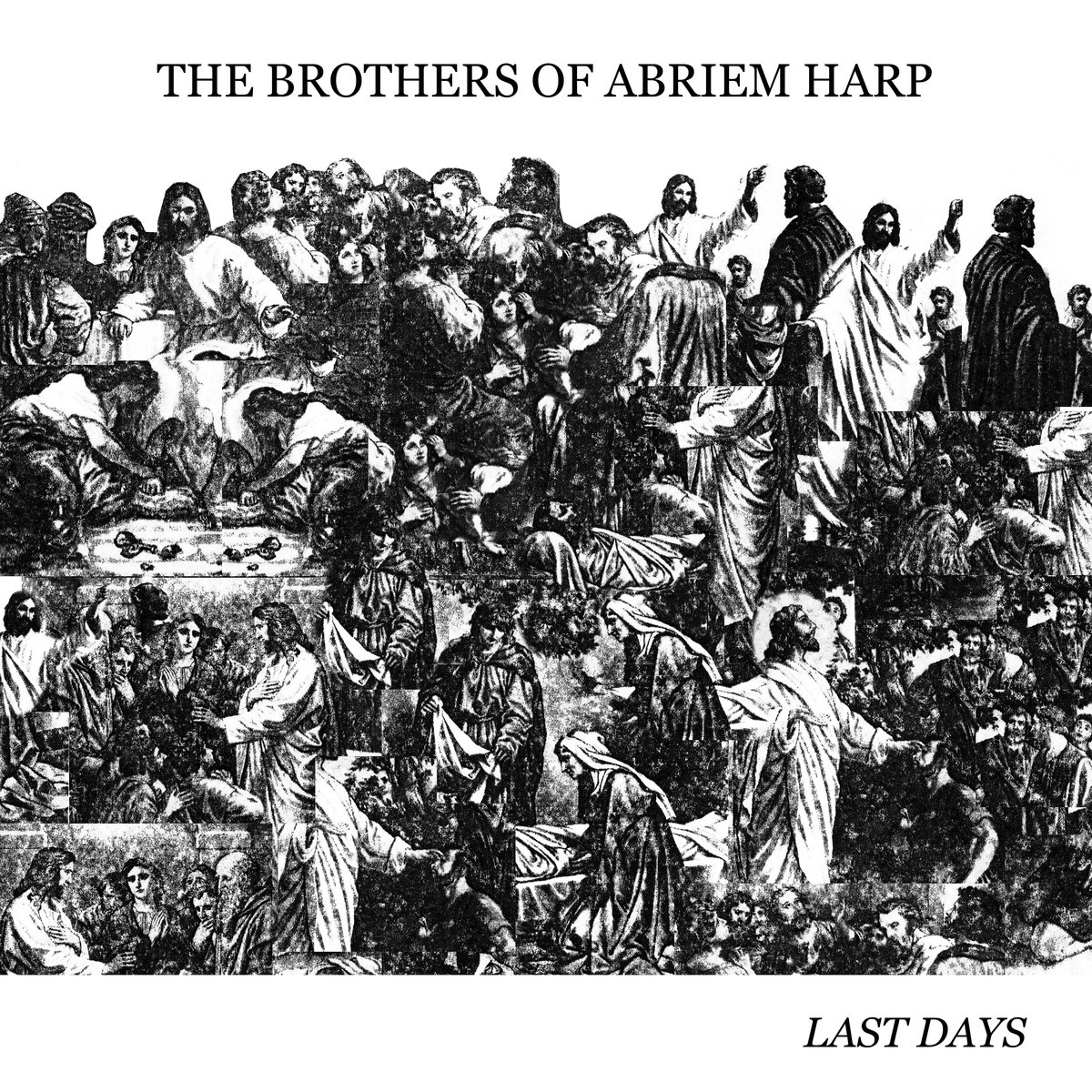
Released in 2015, the album Last Days by the Brothers of Abriem Harp features twelve original indie-folk songs for Holy Week that tell the story of Christ’s passion, from the thundering voice of the Father affirming the Son but also presaging judgment, to the glorification of Christ in the resurrection. One of its major draws is its quiet, understated conveyance of the week’s drama through several different voices: Jesus, of course, but also Mary, Peter, Judas, and other unnamed disciples who reflect on the events they witness, especially in light of their histories with Christ.
Approaching Jesus’s last days primarily through the lens of story—plot, character, mood, etc.—rather than the lens of doctrine makes the listening experience more immersive. That’s not to say theology is absent from the album; it’s very much there. But it is not heavy-handed or abstruse, and neither is it reduced to clichés.
The songs are written and sung by Joe Kurtz (pseudonym: Abriem Harp) and Josh Compton (Josh Harp), with Matt Kurtz (Matthew Harp) on percussion and John Finley (Hezekiah Harp) playing many of the other instruments. On the band’s Facebook page they describe themselves as “gospel-shoutin’ melody makers from the Rust Belt,” and among their musical influences are field recordings, the Sacred Harp tradition, and mountain music.
In the video below, the Brothers have set the entire album to altered footage from Vie et Passion du Christ (Life and Passion of the Christ), a forty-four-minute silent film released in France in 1903. The album is also available for streaming and purchase at https://harpfamilyrecordings.bandcamp.com/album/last-days.
Here’s a rundown of the songs.
1. “Glorify”
A voice arose, a voice arose
A voice arose, a voice
It sounded like thunder, pounded like thunder (×4)
It said, “I’ve glorified it, and again I’ll glorify it”
Yeah, “I’ve glorified it, and again I’ll glorify it” (×3)
This is an unconventional starting point for the passion narrative, which typically begins with Christ’s entry into Jerusalem. Instead, the Brothers have chosen a lesser-known episode from John’s Gospel, which occurs just after the triumphal entry—and what a beautiful passage to highlight. (I actually was not familiar with the references in the song and had to look them up—a great example of how the arts can stimulate renewed engagement with the Bible!)
“The hour has come for the Son of Man to be glorified. Truly, truly, I say to you, unless a grain of wheat falls into the earth and dies, it remains alone; but if it dies, it bears much fruit. . . .
“Now is my soul troubled. And what shall I say? ‘Father, save me from this hour’? But for this purpose I have come to this hour. Father, glorify your name.”
Then a voice came from heaven: “I have glorified it, and I will glorify it again.” The crowd that stood there and heard it said that it had thundered. Others said, “An angel has spoken to him.”
Jesus answered, “This voice has come for your sake, not mine. Now is the judgment of this world; now will the ruler of this world be cast out. And I, when I am lifted up from the earth, will draw all people to myself.” He said this to show by what kind of death he was going to die.
“It’s time.” That’s essentially what Jesus is saying. And then in the middle of this discourse with the disciples, Jesus gets real with the Father. “I’m scared! But what can I do? This is my destiny; I can’t avoid it.” And then, his words of acceptance, of surrender: “Father, glorify your name.” It’s unclear whether this prayer was audible to the disciples or was expressed merely internally. Whatever the case, the Father’s response was heard by all—though some attributed it to natural phenomena, or to an angel.
As this passage clarifies, the “it” in the song is the Father’s name: God says that he has glorified it in the past, and he will glorify it again, when Christ is lifted up for the salvation of the world.
John uses the words glory and glorified a lot in his Gospel, especially in relation to Christ’s passion. In John 13:31, after the Last Supper, where Jesus has just identified Judas as his future betrayer, Jesus says, “Now is the Son of man glorified, and God is glorified in him.” Later that night, in Gethsemane, Jesus prays, “Father, the hour has come; glorify your Son that the Son may glorify you. . . . I glorified you on earth, having accomplished the work that you gave me to do. And now, Father, glorify me in your own presence with the glory that I had with you before the world existed” (John 17:1, 4–5).
The opening song on Last Days, therefore, though just three allusive lines, repeated, is packed with meaning, much of it concentrated in that dense word glorify, a word that orients the whole album. Much like the opening sequence of a movie sets the movie’s tone and hints at what you’re in for, so do opening songs on albums, and this one is somewhat portentous, leaving us wondering, “How will God’s name be glorified?”; it also gives the Father a speaking role and thus situates him as a main character in the story. Continue reading “Album Review: Last Days by the Brothers of Abriem Harp”→


















 Art & Theology