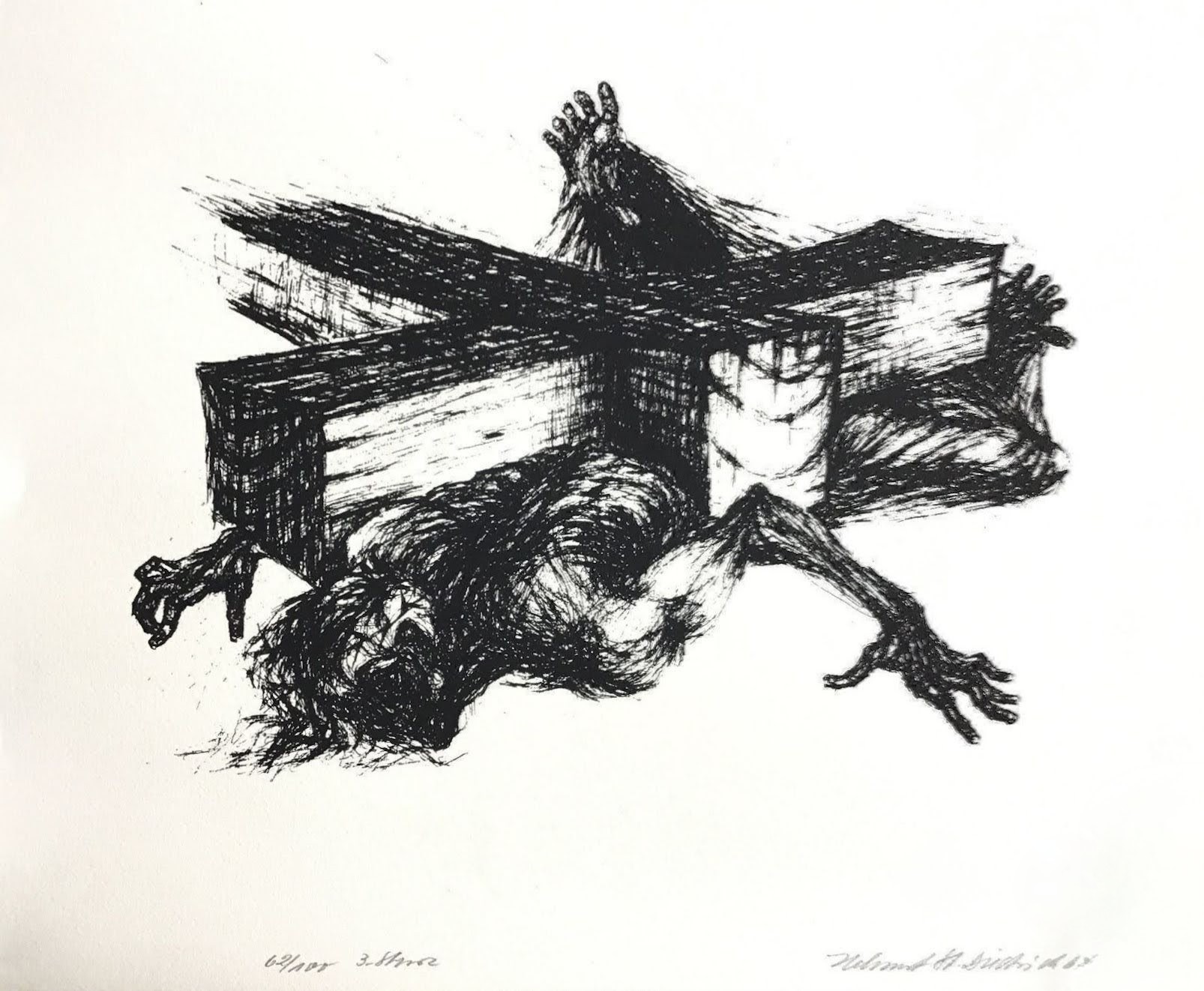
Helmut Stephan Diedrich (German, 1937–), Kreuzfall, 1964. Lithograph, edition 62/100.
You fall, sparrow-bone, God-eyed leaf,
black hair of ox, kernel of wheat,
gold blown from the stalk. You lift wood,
trudge, and lurch, your back pulped. You would
spit up the cup-dregs for relief—

but no, you want not; you believe
your master’s dream. You toss your dreams
like chaff to the breeze. You lift wood.
You fall,

            thin coin,

                          widow’s all,

                                       copper seed
into the mouth of the box. She
brushed you a hundred times, so good
to hold, but better to drop. Wood
weights you, snapped bone, wind-flung leaf.
You fall.
This poem was originally published in Christianity and Literature 59, no. 2 (Winter 2010) and is anthologized in Imago Dei: Poems from Christianity and Literature, ed. Jill Peláez Baumgaertner (Abilene Christian University Press, 2012). Used by permission of the poet.
Originating in the Middle Ages, the Stations of the Cross is a Christian devotional practice in which participants commemorate the journey Jesus took down the Via Dolorosa (Way of Sorrows) to his death—either on location in the Holy Land, physically following a demarcated route, or, more accessibly, in their imaginations, through the aid of images or meditative texts. Traditionally, there are fourteen stations, the third, seventh, and ninth of which are “Jesus falls.” At these stopping places, Christians reflect on the crushing weight of sin and wood, on Jesus’s intensifying exhaustion, and yet, too, on his perseverance to get up each time and, pushing through the debility, to continue his trek to its fatal, foreordained end.
In his poem “Sparrow Lament,” William Woolfitt alludes to Jesus’s three falls on his way to Golgotha: “You fall,” “You fall,” “You fall.” He uses a string of metaphors from the natural world for the falling Christ: He’s a sparrow bone (spat out by a predator?), a floating leaf, a shed bovine hair, a grain of wheat blown loose from its stalk. These are wistful images of solitariness, passage, decease—and yet the descriptor “God-eyed” indicates that the path Christ is on is governed by divine providence.
The sparrow reference, given further weight by its use in the poem’s title, evokes Jesus’s teaching in Matthew 10:28–31: “Do not fear those who kill the body but cannot kill the soul; rather, fear the one who can destroy both soul and body in hell. Are not two sparrows sold for a penny? Yet not one of them will fall to the ground apart from your Father. And even the hairs of your head are all counted. So do not be afraid; you are of more value than many sparrows.”
The Father has willed the Son to drink the bitter cup of suffering and death, which, despite Jesus’s distressed plea less than twenty-four hours prior that the cup be removed, he downs in trust, casting off any dreams he had for living into old age. As he carries out his calling, he stumbles, he falls to the ground—but not apart from the will of his Father.
In the middle of the poem, the lineation—the arrangement of words using lines and line breaks—mimics a downward motion. Like the drop of the storied widow’s coin into the offering box (Mark 12:41–44; Luke 21:1–4). Most biblical interpreters assume that Mary, Jesus’s mother, was a widow by the time Jesus started his ministry, since Joseph is never mentioned in any of the Gospel accounts after the episode of Jesus disappearing in the temple at age twelve. Woolfitt refers to Jesus as “widow’s all”—Mary’s everything, her firstborn son, whom she sacrificially gives to the world, knowing God will bless her gift. She doesn’t hoard this dear treasure of hers. She surrenders him to God’s greater plan.
It wasn’t an easy choice to make. Mothers instinctively want to hold on to their children, and tight. Many intrusively fear dropping them as infants and would do anything to spare them pain. Well, Mary drops her son, on purpose. She relinquishes him, “copper seed,” whose death bears fruit, yields dividends.
William Woolfitt is a writer across the genres of poetry, fiction, and essay. His poetry collections are The Night the Rain Had Nowhere to Go (Belle Point, 2024), Spring Up Everlasting (Mercer, 2020), Charles of the Desert (Paraclete, 2016), and Beauty Strip (Texas Review, 2014). He is an associate professor of creative writing at Lee University in Cleveland, Tennessee, where he lives with his wife and two children. He founded and edits Speaking of Marvels, a blog that features interviews with authors of chapbooks, novellas, and books of assorted lengths.
SPOTIFY PLAYLIST: January 2026 by Art & Theology: Almost every month I compile thirty faith-inspired songs on Spotify—roughly two hours of listening—to showcase just a sampling of the well-crafted, spiritually nourishing music that is out there. Though this is several days late, here are some songs to kick off the new calendar year.
+++
NEW ALBUM + OTHER RESOURCES: Matthew: Gospel Collection by The Soil and The Seed Project: Directed by Seth Thomas Crissman, an educator, musician, and pastor in the Mennonite Church, The Soil and The Seed Project is “a community-supported ministry of the church working for spiritual renewal—in individuals, families, and communities—through beautiful, creative resources that help us together turn towards Jesus in the ordinary moments of life.” I always look forward to their releases, the latest of which is a thirty-song “folk opera,” as they call it, based on the Gospel of Matthew, accompanied by seven commissioned linocut prints by Bethany Tobin (free for church use), seven poems by Michael Stalcup, and twenty-five “little liturgies.”
The beautiful opening track, cowritten and performed by Spectator Bird (“Won’t you tell me a story that’s true . . .”), is followed by a range of narrative-based songs (on the Dreams of Joseph, the Temptation in the Wilderness, the Calming of the Storm, the Transfiguration, the Entry into Jerusalem, the Last Supper, the Resurrection, etc.); settings of the Beatitudes, the Lord’s Prayer, and other teachings from the Sermon on the Mount, as well as cherished sayings about the greatest commandment and Jesus’s easy yoke; songs on parables such as the foolish builder, the sower, the lost sheep; and more. There are far fewer songs about Christ’s passion than I would have expected, but that may be because there’s a relative dearth in music that engages the other parts of the Gospel, or because they anticipate overlap with forthcoming Gospel Collection albums on Mark, Luke, and John. I love what they present here.
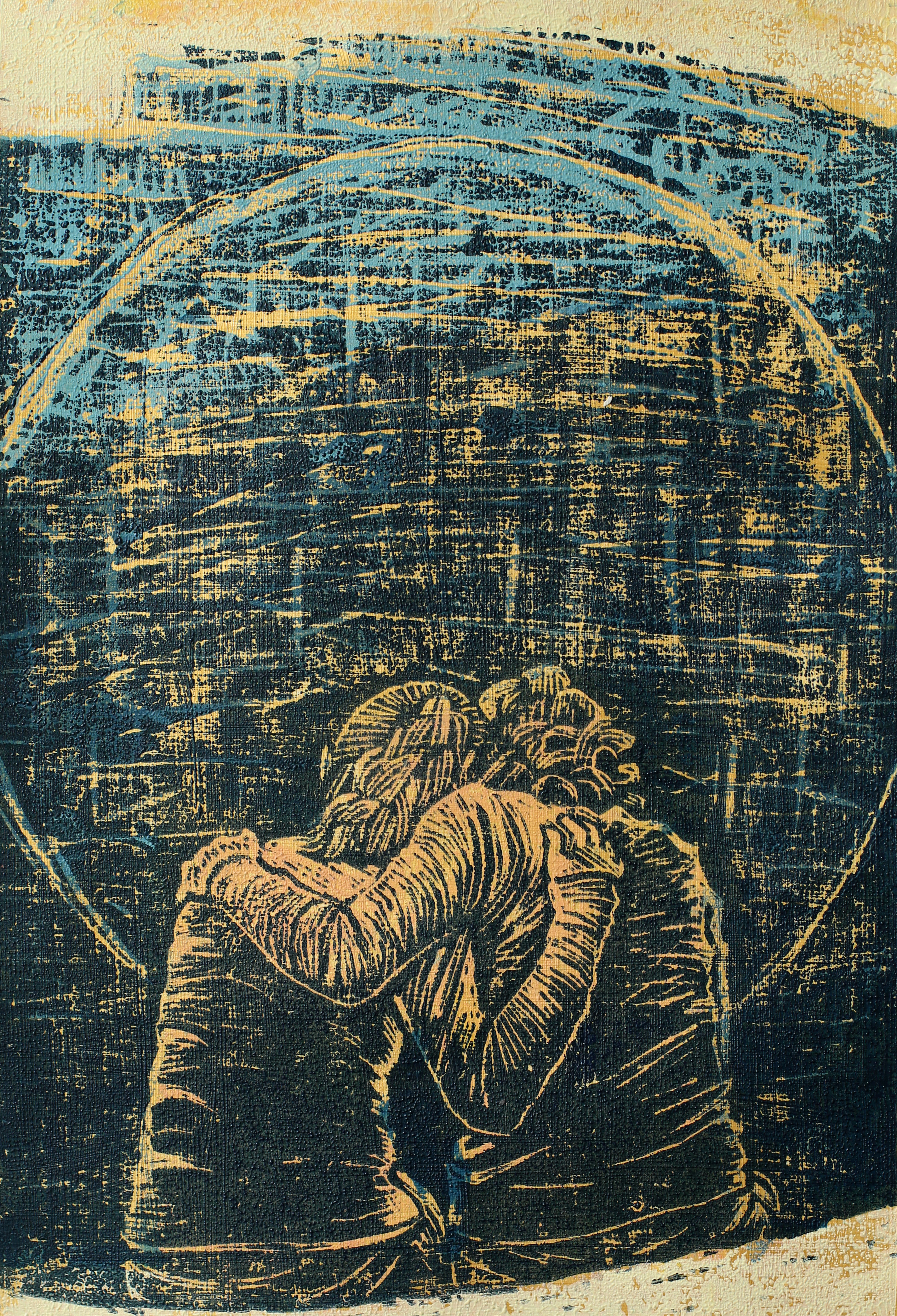
Bethany Tobin, Mary Magdalene and Mary sit opposite the tomb, 2025. Used courtesy of The Soil and The Seed Project.
>> RELEASE CONCERT: On Sunday, January 18, 2026, at 3 p.m. at First Presbyterian Church in Harrisonburg, Virginia, The Soil and The Seed Project are going to perform the entire album from start to finish, with a full band and almost all the contributing artists. Admission is free, but they ask that you consider donating some toiletry items for the local food pantry; there will be a collection box on-site. Find more info at https://www.thesoilandtheseedproject.org/matthew#release-concert.
+++
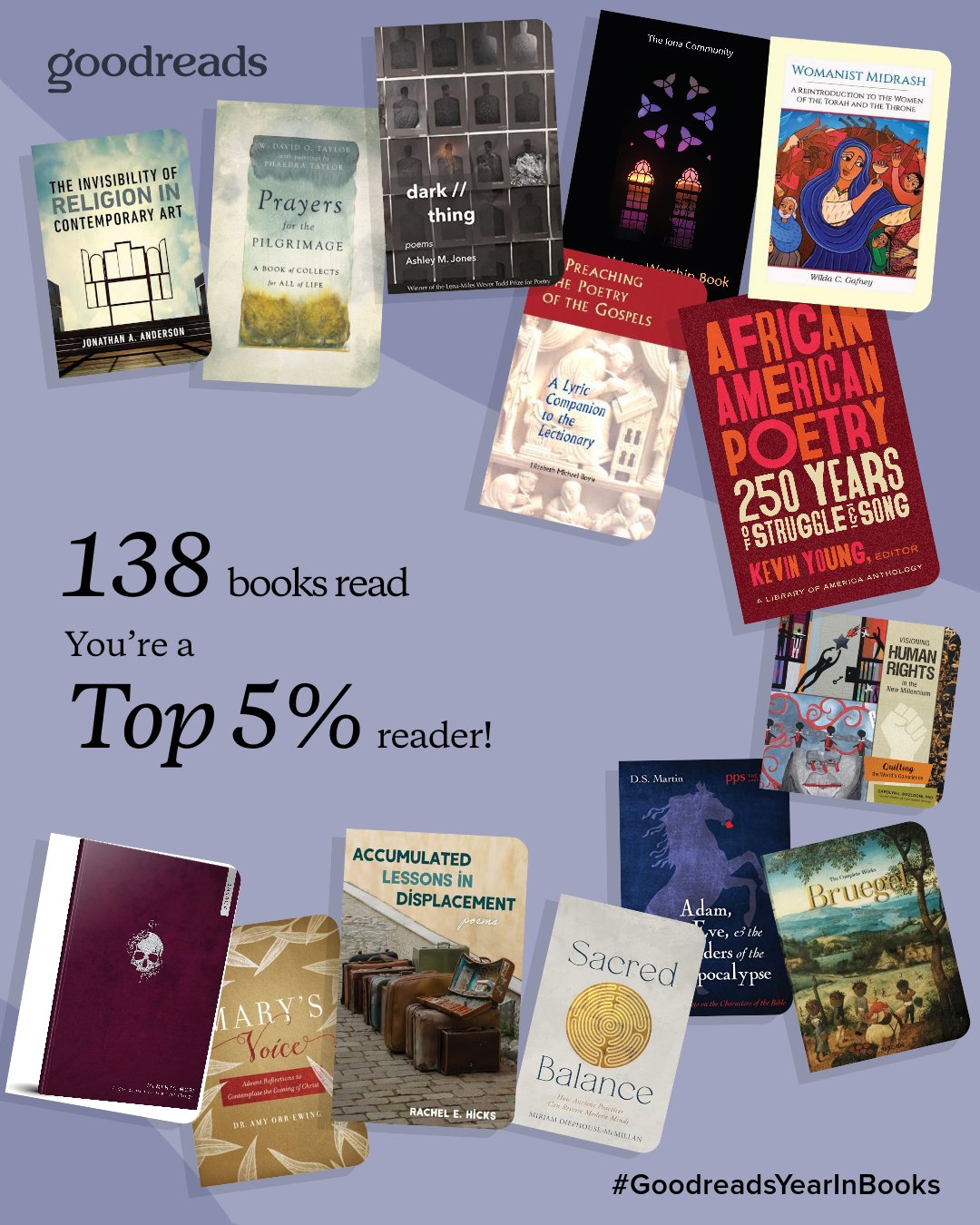
END-OF-YEAR READING STATS: My Year in Books 2025 (Goodreads): I read 138 books last year, mostly poetry. Exactly half were written by women—I’ve been more intentional about seeking out female authors, ever since someone challenged me on that. I hadn’t realized how disproportionately I was reading male authors, especially for theology. Nothing wrong with men!—but in the interest of closing the gender gap in my personal reading habits so that I can benefit from a wider swath of voices and support women writers, I commit to reading at least as many women as men each year.
(The book covers in this graphic are randomly generated by Goodreads from my list of read books.)
I’ve mentioned several of my favorite recent reads on the blog already (e,g., A Whole Life in Twelve Movies, An Axe for the Frozen Sea, Picturing the Apocalypse), but let me mention a few more. I wish I had time to write thoughtful reviews. I’m obliged to mention that if you make a purchase from any of the following links, I earn a small commission from Amazon.
Motherhood: A Confession by Natalie Carnes: This one’s hard to describe, but here’s the publisher’s attempt: “What if Augustine’s Confessions had been written not by a man, but by a mother? How might her tales of desire, temptation, and transformation differ from his? In this memoir, Natalie Carnes describes giving birth to a daughter and beginning a story of conversion strikingly unlike Augustine’s―even as his journey becomes a surprising companion to her own.” Despite my not being a mother, this book, which is also about embodiedness, and by a theologian I’ve met at conferences on multiple occasions, really captivated me. Thank you to a reader who purchased it for me from my wish list!
I really love the newish Fullness of Time series from InterVarsity Press, edited by Esau McCaulley, which celebrates the riches of the church year in seven short little volumes. It starts withAdvent: The Season of Hopeby Tish Harrison Warren and Christmas: The Season of Life and Light by Emily Hunter McGowan. As someone who didn’t grow up observing the liturgical calendar but who now does and gets asked about it by Christians for whom it’s unfamiliar, I find these explainers to be a helpful resource as well as personally enriching, and I look forward to reading more.
Bruegel: The Complete Works: This monster of a book from the art publisher Taschen, which comes in a carrier case, was a present from my husband. It’s beautifully produced, with full-color reproductions, foldouts, essays, and cataloging info. Pieter Bruegel (the Elder), a sixteenth-century Flemish artist, is known for his detailed, densely populated (sometimes a hundred-plus figures!) paintings of biblical narratives and peasant scenes, many of which were copied by his son, Pieter Bruegel the Younger. I give the text four stars but an overall five stars merely for the quality of the images (especially the inclusion of high-resolution details, which are generally not accessible online) and the value of having an authoritative catalog of all the artist’s authenticated works.
Goodreads is a social cataloging website for book lovers. I use it mainly to keep track of the books I’ve read and the ones I want to read. You can also tag books, a feature I use to group by topic or genre, though I’m not entirely consistent with the labeling. I’m a volunteer Goodreads Librarian, meaning I can edit book details and create new book records. Follow me on Goodreads.
+++
Victoria’s Book Wish List: If you would like to support Art & Theology, buying me a book from my Amazon wish list is one tangible way to do that. (Only those with a US Amazon account can do this, I believe.) The books I read influence the content I write and the artists I feature. I keep this link up-to-date year-round, and it lives permanently on this site’s Donate page (where there’s also a link to give financially through PayPal). I only include books that relate to the objectives of this blog. Thank you to those who have gifted me with surprise shipments throughout this past year! My husband says my eyes light up the brightest when I’m receiving a new book. I think it’s because I delight so much in growing my mind and spirit through wisdom and beauty.
Sometimes people ask me how I decide which books to buy versus which to get from the library. On his Astonishing Things Substack, Wes Vander Lugt shares the criteria he uses—and mine are largely the same. He writes:
Is it a book from a favorite writer that I will want to digest slowly, re-read, and cherish having in my home? Buy it.
Is it a book that piques my interest but the quality of writing and value of the content is relatively unknown? Get it from the library.
Is it a novel from a trusted author that I may not be able to finish in a month and/or will most likely want to re-read or at least revisit for inspiration and reflection? Buy it.
Is it a novel that I can reasonably finish in a month without feeling rushed? Get it from the library, along with the audiobook format if available.
Is it a book by a friend? Buy it!
Is it a book by a writer who feels like a friend, and none of the local libraries have a copy after a reasonable time following the release? Buy it.
Is it a book I would really love to own but my buy-it list is too long? Get it from the library first, and if it strikes a deep chord and the book budget is not maxed out, buy it.
I do get many books from the Linthicum Public Library right down the road from my house here in Maryland, which I usually visit at least once a week. I’m grateful for the service they provide, and for their partnership with Marina Interlibrary Loan, through which I can request books from other libraries in the state. I also regularly borrow movies from the library. However, books that I will take a long time to read, will reference again and again, or would want to lend to a friend—or that simply are not available through the library system in my area but that I desperately want to read and are reasonably priced—those are the kinds I’m likely to add to my wish list or purchase myself.
+++
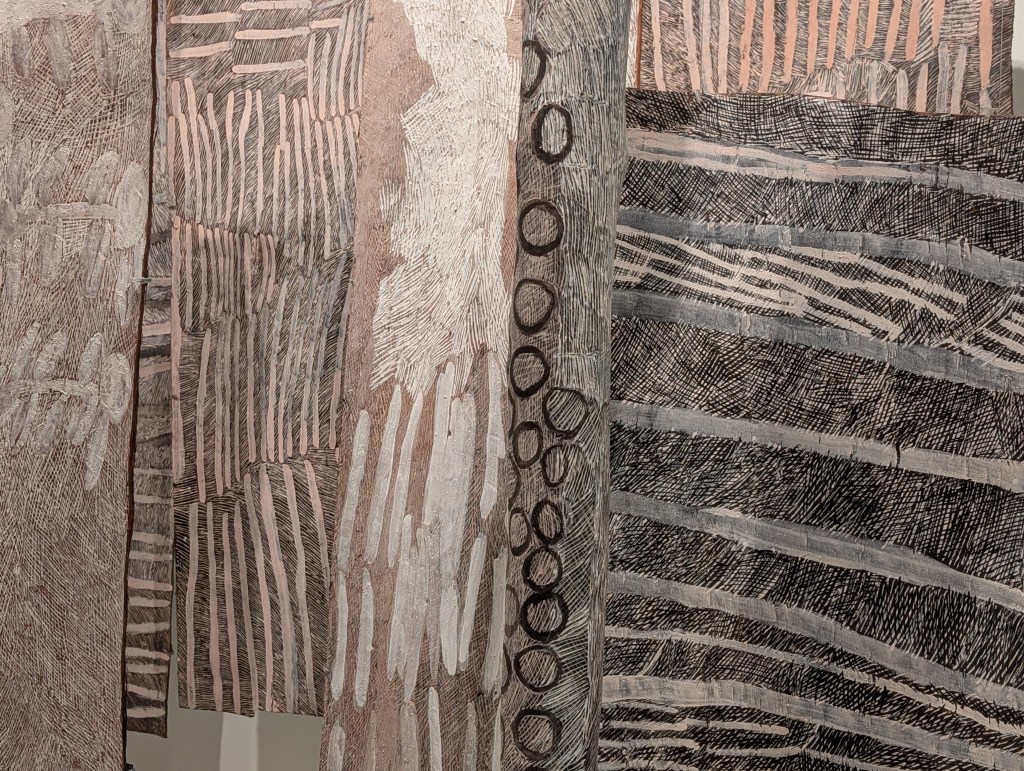
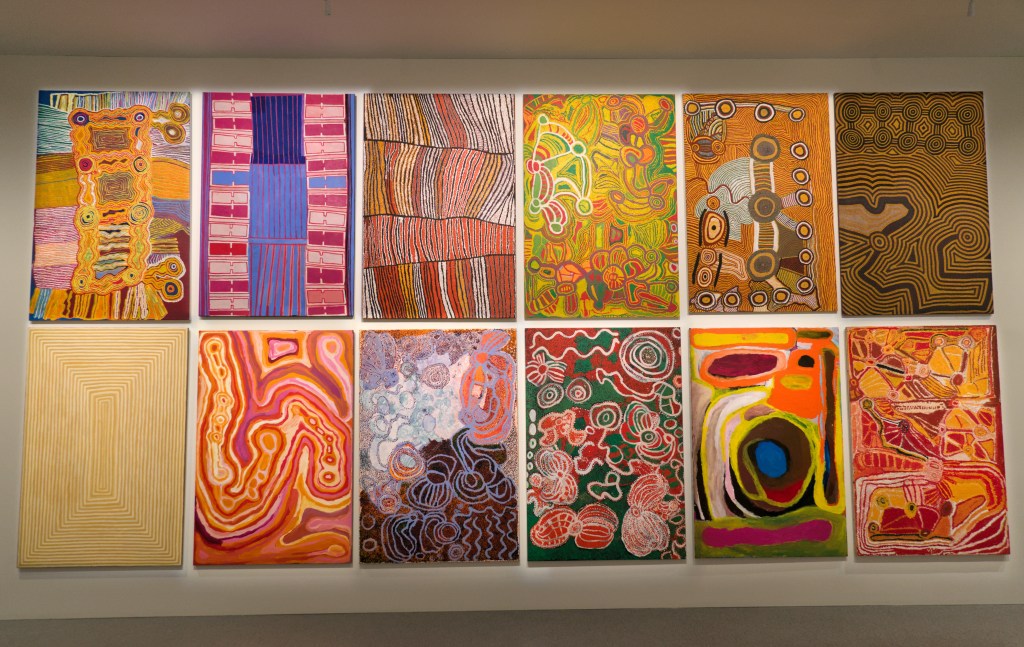
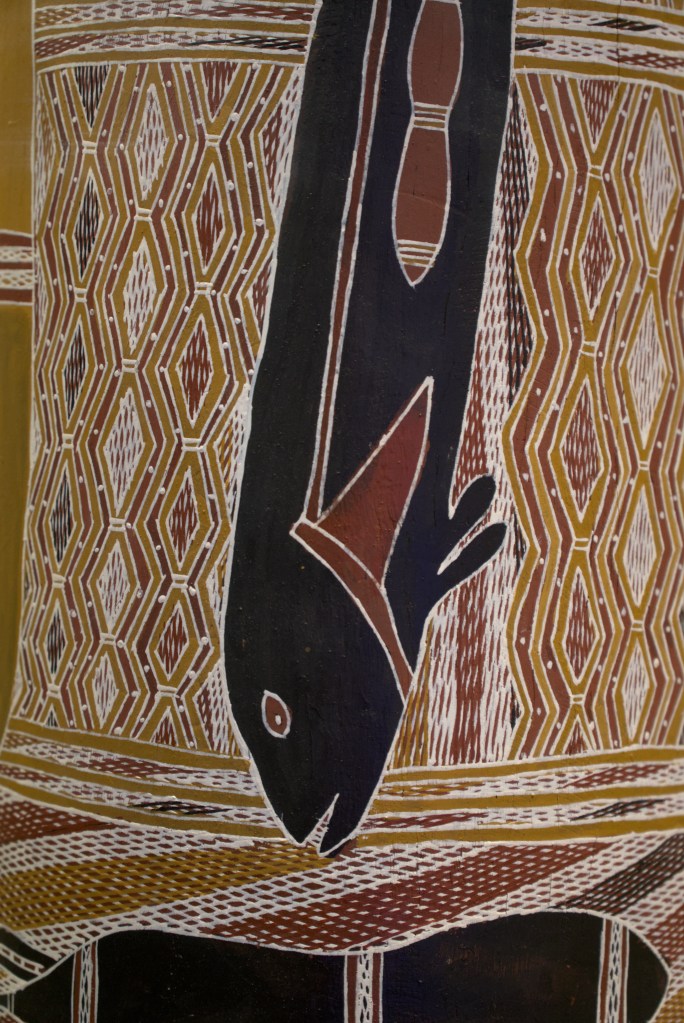
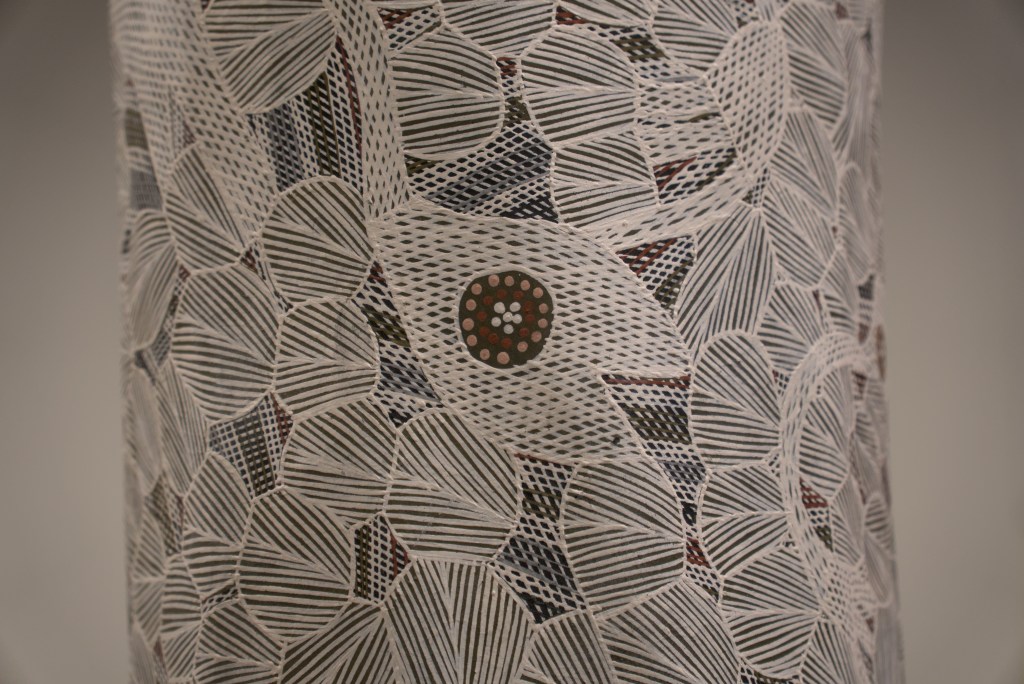
EXHIBITION: The Stars We Do Not See: Australian Indigenous Art, November 15, 2025–March 1, 2026, National Gallery of Art, Washington, DC: I saw this show last month, curated by Myles Russell-Cook from the collection of the National Gallery of Victoria in Melbourne, and it was fantastic. I recommend the free guided tour, especially if Aboriginal art is new to you. “Don’t miss this once-in-a-lifetime exhibition of Aboriginal and Torres Strait Islander art—the largest ever shown in North America. Australian Indigenous art is a visual thread connecting more than 250 nations across 65,000 years. Explore its breadth and brilliance through nearly 200 works from the late 1800s to today. You’ll find ochre paintings made on bark, maps of the Central and Western deserts (so-called ‘dot paintings’), groundbreaking works in neon, video, and photography, and more. And you’ll meet iconic artists who maintain and reinvigorate Ancestral traditions—revealing the rich, living history of creativity behind the world’s longest continuous culture.”
Here are some of the photos I took:
Nyapanyapa Yunupiŋu (Gumatj, ca. 1945–2021), Gäna (Self), Yirrkala, Northern Territory, 2009–18. Earth pigments on eucalyptus. National Gallery of Victoria, Melbourne. Photo: Victoria Emily Jones.
Nyapanyapa Yunupiŋu, Gäna (Self) (detail)
Gulumbu Yunupiŋu (Gumatj, 1945–2012), Garak (The Universe), Yirrkala, Northern Territory, 2008. Earth pigments on eucalyptus. National Gallery of Victoria, Melbourne. Photo: Victoria Emily Jones.
Gulumbu Yunupiŋu, Garak (The Universe) (detail)
Paintings by (top, left to right) Kunmanara (Patju) Presley, Boxer Milner Tjampitjin, Walangkura Napanangka, Tjayanka Woods, Donkeyman Lee Tjupurrula, Ronnie Tjampitjinpa, (bottom, left to right) Turkey Tolson Tjupurrula, Nora Wompi, Wingu Tingima (×2), Wakartu Cory Surprise, Eubena Nampitjin
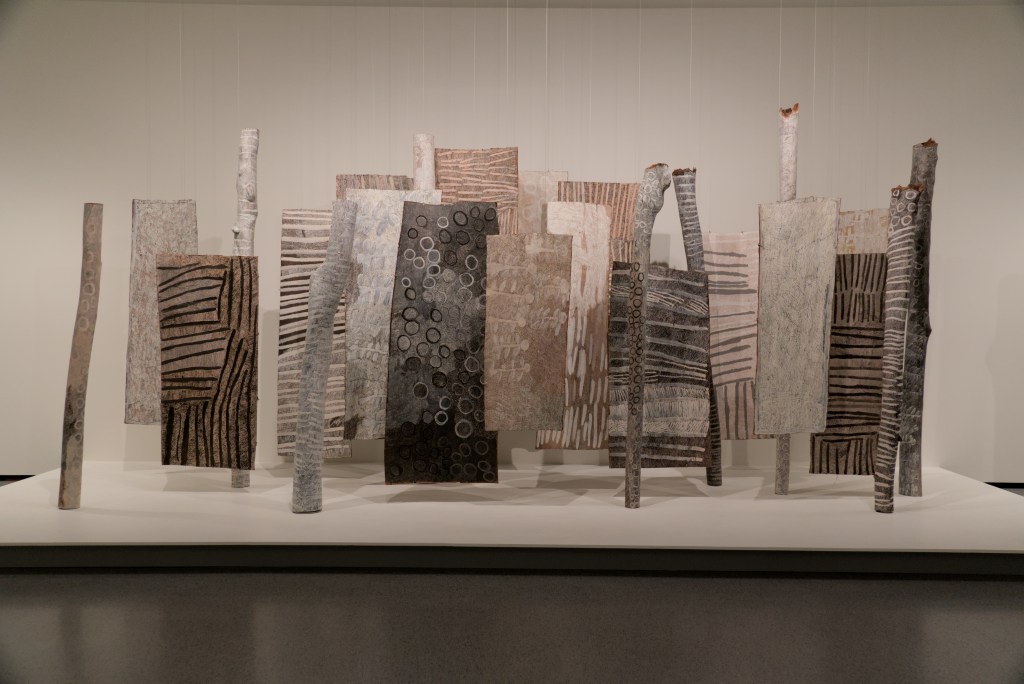
Larrakitj (memorial poles) are hollowed eucalyptus logs, carved and painted, made by the Yolŋu people of Arnhem Land, Australia, traditionally to hold ancestral bones, though some, like these, are made exclusively for the contemporary art market and contain no human remains. Photo: Victoria Emily Jones.
Gawirriṉ Gumana (Dhalwangu, ca. 1935–2016), Guyamirrilil (detail), Gäṉgaṉ, Northern Territory, 2003. Earth pigments on eucalyptus. National Gallery of Victoria, Melbourne. Photo: Victoria Emily Jones.
Malaluba Gumana (Dhalwangu, 1953–2020), Dhatam (Waterlilies) (detail), Gäṉgaṉ, Northern Territory, 2017. Earth pigments on eucalyptus. National Gallery of Victoria, Melbourne. Photo: Victoria Emily Jones.
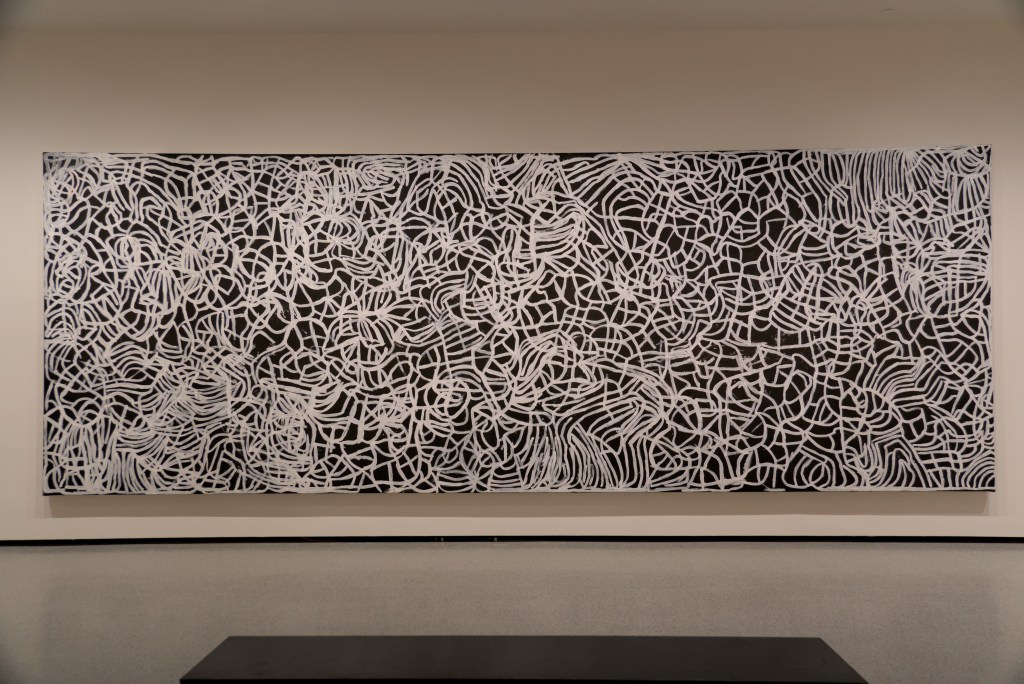
Emily Kam Kngwarray (Anmatyerre, ca. 1910–1996), Anwerlarr Anganenty (Big Yam Dreaming), Delmore Downs, Northern Territory, 1995. Synthetic polymer paint on canvas. National Gallery of Victoria, Australia. Photo: Victoria Emily Jones.
Claudia Moodoonuthi (Kaiadilt, 1995–), 360 Flip on Country, Meanjin/Brisbane, Queensland, 2014. Synthetic polymer paint on skateboards. National Gallery of Victoria, Melbourne. Photo: Victoria Emily Jones.
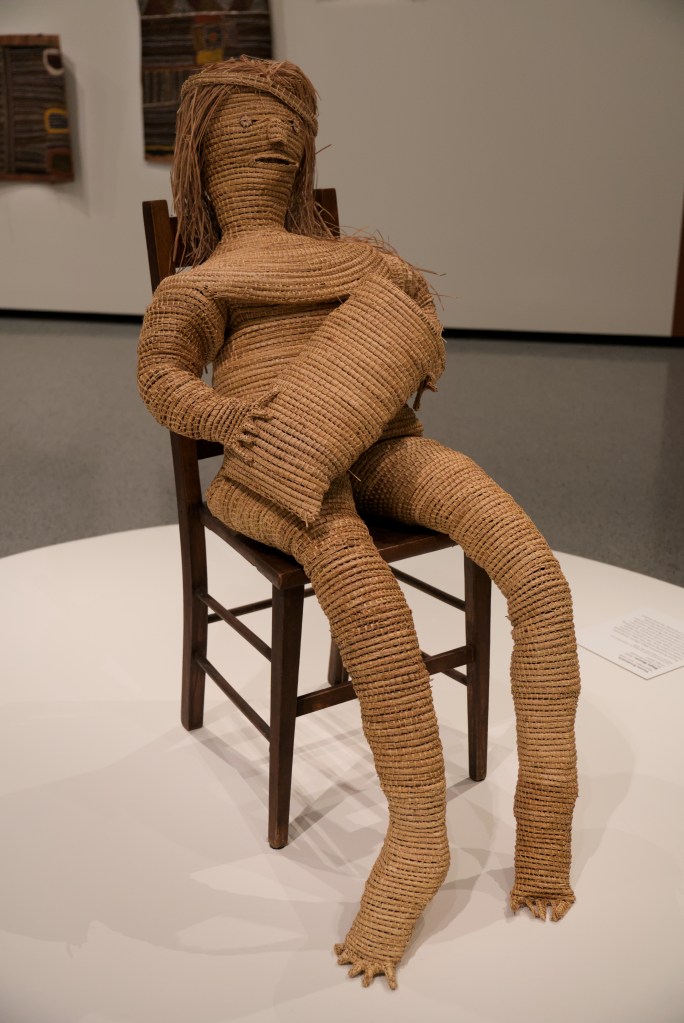
Yvonne Koolmatri (Ngarrindjeri, 1944–), Magic Weaver, Berri, South Australia, 2005. Sedge, wood. National Gallery of Victoria, Melbourne. Photo: Victoria Emily Jones.
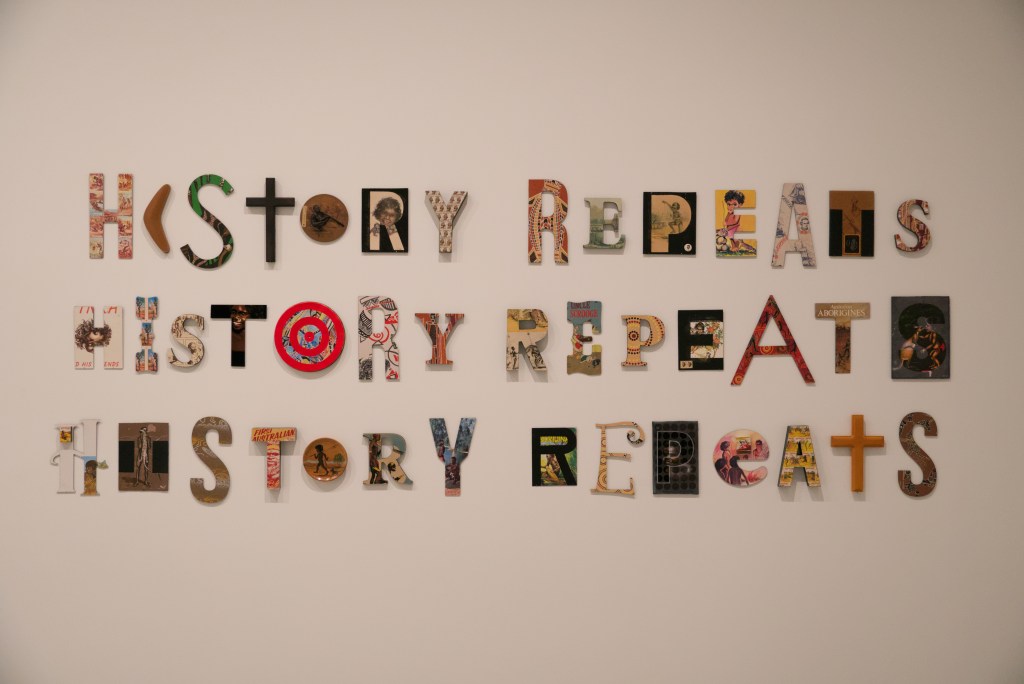
Tony Albert (Girramay / Yidinji / Kuku Yalanji, 1981–), History Repeats, Meanjin/Brisbane, Queensland, 2022. Found kitsch objects and timber. National Gallery of Victoria, Melbourne. Photo: Victoria Emily Jones.
The title of the exhibition comes from the late artist Gulumbu Yunupiŋu, known affectionately as “Star Lady.” She developed “a signature style characterized by dense networks of crosses unified by fields of dots. Each cross represents a star and all that is visible within the known universe, while the dots in between symbolize everything that remains unknown.” See images 3 and 4 in the slideshow above.
After its run at the National Gallery in Washington, The Stars We Do Not See will be traveling to the Denver Art Museum in Colorado, the Portland Art Museum in Oregon, and the Peabody Essex Museum in Massachusetts.
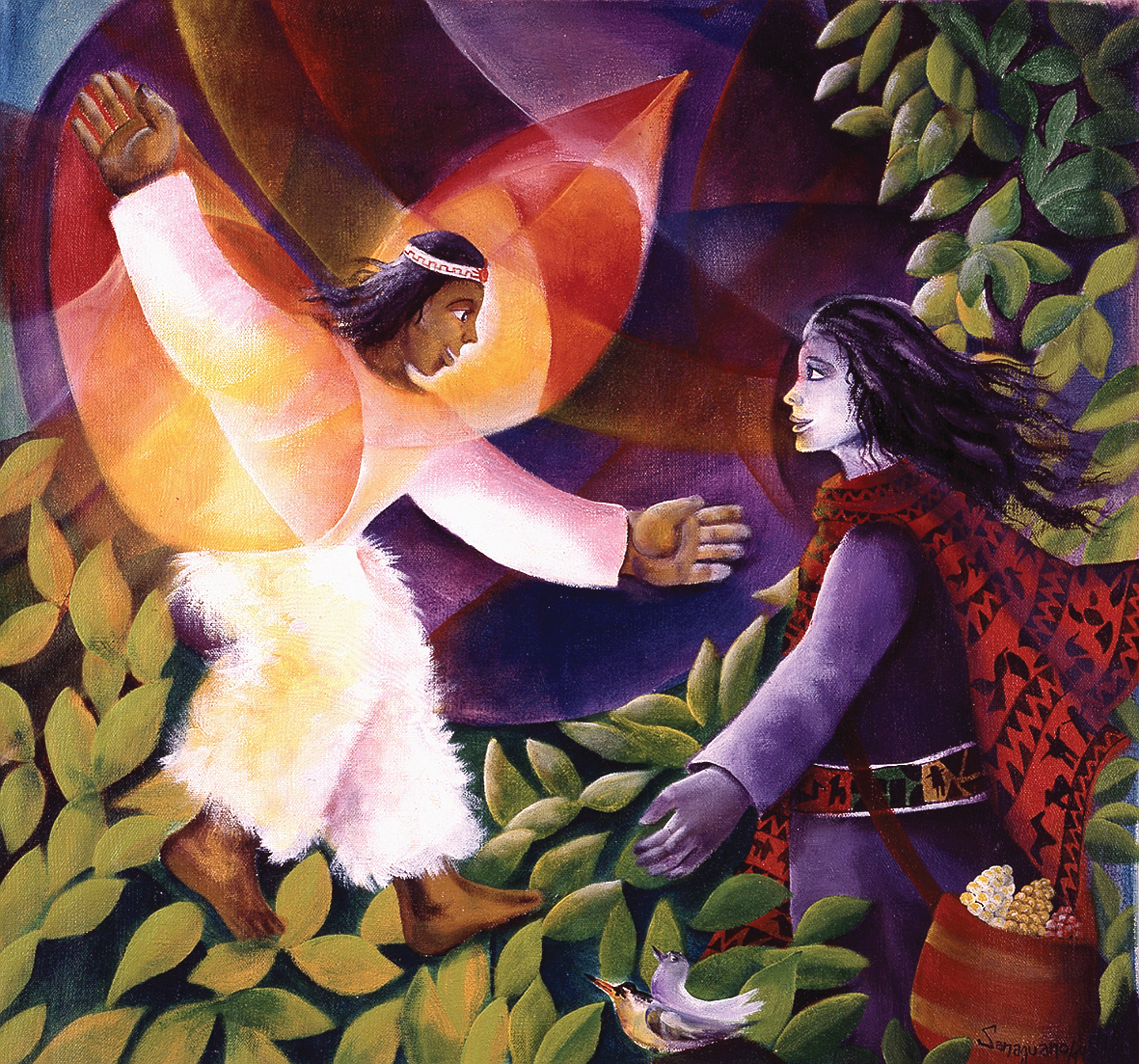
In this outdoor Andean Annunciation scene, the angel Gabriel arrives with a gust of wind before Mary, who has a satchel of freshly harvested corn slung over her shoulders. He wears llama or alpaca pants, part of the traditional male dress in the highlands of Ecuador. With his right hand he gestures toward the heavens, and with his left he gestures toward her, as if to say, “Heaven’s coming down to earth—God wants to be made human in you.”
He smiles. She smiles. Her face is illumined by beams of divine grace. She extends her arms to embrace her new vocation as Mother of God.
LISTEN: “Bendita seas, María” (Blessed Are You, Mary) by Ariel Glaser, on Tercer Milenio, 1997 | Performed by Jimena Muñoz with Brother Alex, 2020
En un silencio profundo tejías plegarias a un Dios que escuchaba tus simples palabras, pequeña María entregada a su amor. Y en una tarde tranquila rompiendo el silencio, las alas de un ángel, sonaban al tiempo que te saludaba de parte de Dios.
Estribillo 1: ¡Bendita seas, María, entre toda mujer! ¡Has encontrado gracia a los ojos de Dios! María, Madre suplicante, ayúdame también a escucharlo a Él.
Fue la palabra más dulce que tocó la tierra, la que te propuso cumplir la promesa de que nacería nuestro Salvador. «Hágase en mí como has dicho;» respondiste al ángel, y el Santo Espíritu descendió al instante. Te habías convertido en Madre de Dios.
Estribillo 2: Bendita seas María, hija del Padre, Esposa del Espíritu, Madre del Emanuel. María, Madre de Jesús, ayúdame, también a decir amén.
ENGLISH TRANSLATION (my own):
In profound silence you wove prayers to a God who heard your simple words, little Mary, surrendered as you were to his love. And on a quiet afternoon, breaking the silence, the wings of an angel sounded as he greeted you on behalf of God.
Refrain 1: Blessed are you, Mary, among all women! You have found favor in the eyes of God! Mary, supplicating mother, help me to listen to him too.
It was the sweetest word that touched the earth, the one that offered you the promise of the birth of our Savior. “Let it be done to me according to your word,” you replied to the angel, and the Holy Spirit descended instantly. You had become the Mother of God.
Refrain 2: Blessed are you, Mary, daughter of the Father, wife of the Spirit, mother of Emmanuel. Mary, mother of Jesus, help me also to say amen.
This song marvels at Mary’s unique calling while recognizing that we, too, are called to say yes and amen (“let it be”) to God’s will in our lives, which includes being filled with Christ.
The first two lines of the first refrain combine Elizabeth’s exclamation to Mary in Luke 1:42 (“Blessed are you among women!”) with Gabriel’s declaration in Luke 1:30 (“You have found favor with God”).
The epithets in the second refrain highlight Mary’s relationship to the three persons of the Trinity. She is a child of God the Father, as we all are. But she was also wed to God’s Spirit, experiencing a unique and nonsexual union that resulted in the conception of Jesus, the Son of God. Jesus received his flesh from Mary, and she mothered him from his birth to his death. The title Theotokos—God-bearer, or Mother of God—was formally affirmed for Mary at the Council of Ephesus in 431 and is held true by all three branches of Christianity.
The songwriter, Ariel Glaser, is from Argentina. He describes himself as “a catechist who sings,” teaching Catholic doctrines in schools and churches through traditional methods and song. He and his wife are members of the Convivencia con Dios (CcD), a charismatic Catholic movement made up of both laypeople and religious, both men and women, responding to Jesus’s call in John 17: “Father, may they all be one as you and I are one!” Follow Glaser on Facebook.
The singer, Jimena Muñoz, has been singing and playing guitar since age twelve. In addition to making gospel-centered music, she is also a professor of sacred sciences (a field in Catholic institutions that includes theology, canon law, philosophy, biblical studies, church history, and liturgy), and a pastoral coordinator for CEF (Centro Educativo Franciscano) La Rioja.
As important as she is in the Christian tradition, the Bible doesn’t give us a whole lot of details about the life of Mary, especially prior to her conception of Jesus. To give her a backstory and fill in some gaps, the Protoevangelium of James (aka the Gospel of James) was written in the second century, probably in Syria. The author purports to be the apostle James, the brother of Jesus (by an earlier marriage of Joseph’s, according to the text), but the actual author is unknown. While parts of it are based on the canonical Gospels of Matthew and Luke, most of the material is legendary, developed to satisfy people’s curiosity about Jesus’s parentage and some of the events of his infancy.
The Protoevangelium of James was, and remains, immensely popular in Eastern Christianity, having been translated early on from its original Greek into Syriac, Ethiopic, Coptic, Armenian, and Arabic. On how the Orthodox Church views the text today, I found this Reddit thread interesting.
A later version of it, with additions and modifications, emerged in Latin by the seventh century under the name the Gospel of Pseudo-Matthew (aka the Infancy Gospel of Matthew), popularizing its stories in the West.
None of the three branches of Christianity regards these gospels as scripture—the Gelasian Decree of circa 495 officially classified the Protoevangelium as apocryphal, meaning not inspired or authoritative—but nonetheless, they have heavily influenced (in Catholicism and Eastern Orthodoxy) Christian art and Mariology.
Trying to interpret Christian artworks depicting unfamiliar scenes or details is how I first brushed up against the Protoevangelium of James and the Gospel of Pseudo-Matthew.
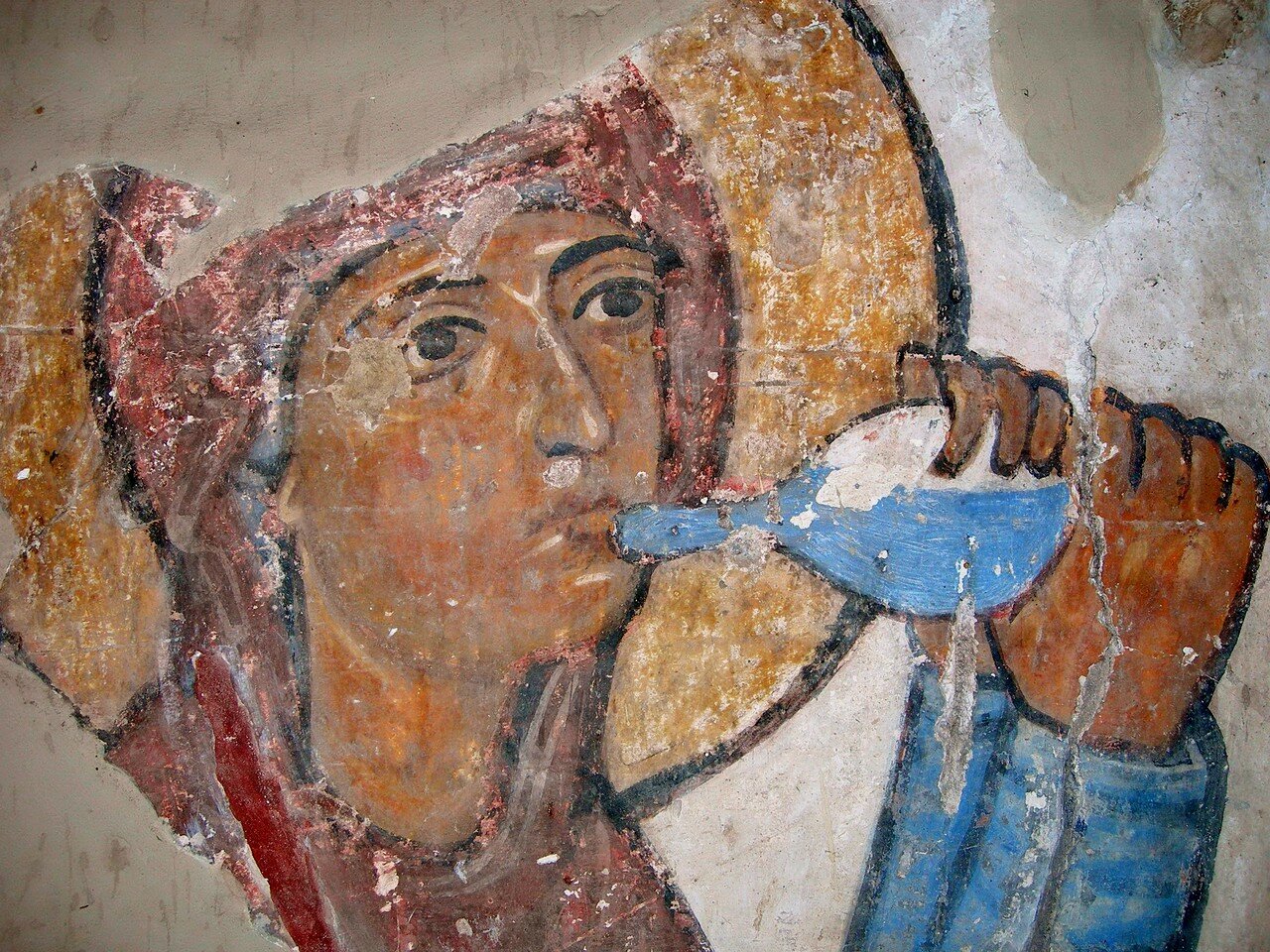
One such scene, which is rare but sometimes appears between images of the Visitation (or the Annunciation to Mary, or the First Dream of Joseph) and the Journey to Bethlehem, is of Mary standing before a priest, holding a cup. This, I learned, depicts the so-called trial by bitter water, or sotah ritual, an ancient Hebrew method for dealing judicially with women who were suspected of adultery. Outlined in Numbers 5:11–31, in this ritual, a suspicious husband was to bring his wife to the tabernacle to subject her to a trial by ordeal. After receiving a grain offering from the husband, the priest would mix a concoction of holy water, dust from the tabernacle floor, and curses scraped off from the parchment they were written on. The wife would be compelled to swear her innocence and then drink the cup. If she was guilty of marital unfaithfulness, she would suffer painful reproductive affliction;1 but if not, she would be unharmed and thus exonerated.
Trial by ordeal was a common legal recourse in patriarchal cultures across the ancient Near East, reflecting distrust of women’s sexuality and reinforcing husbands’ domination over their wives. That it was a sanctioned practice in the Old Testament is troubling, to say the least—but let’s sidestep that discussion for now. Let me simply commend to you the Numbers 5 visual commentary by Maryanne Saunders (Master of Studies, History of Art, Oxford), which examines three artworks based on this passage, including a feminist Jewish one.
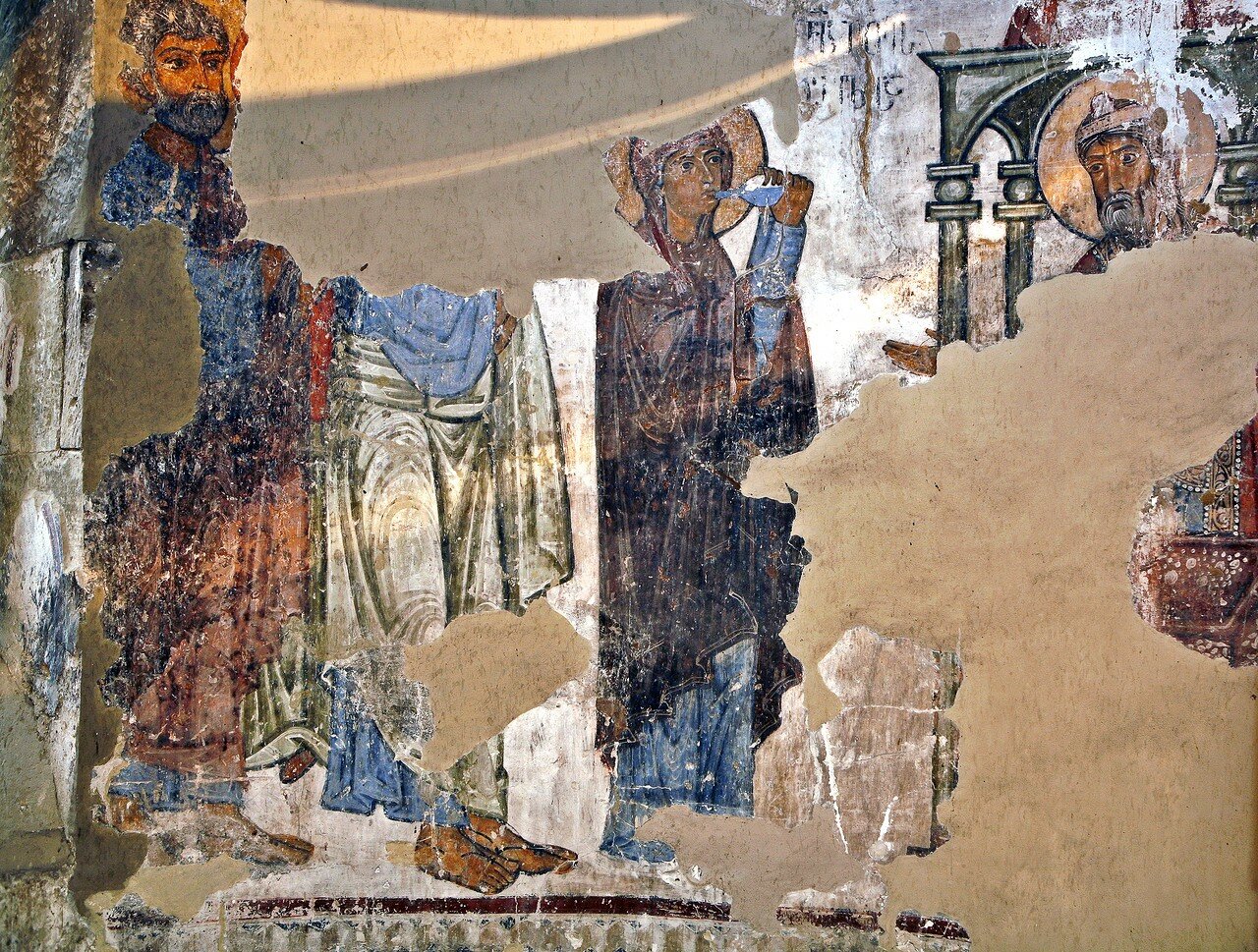
Fresco, 11th century, Church of the Dormition of the Virgin Mary, Ateni, Georgia. (See a wider shot below.)
According to the Protoevangelium of James, sometime after the angel had appeared to Joseph convincing him of Mary’s fidelity, a Jewish scribe named Annas saw Mary’s pregnant belly and reported both her and Joseph to the priest for sexual sin, for they were not yet married. They maintained their innocence and were made to drink a potion that would have no effect if they were telling the truth but that would make them ill if they were indeed guilty. Of course, they came out scot-free. Their chastity was divinely confirmed.
This account of the Jewish ritual of sotah is unique in that (1) it is initiated by a third party, and (2) the male partner is also accused and made to drink the potential curse. Traditionally, the ritual could be initiated only by a husband. Scholars cite the Protoevangelium author’s apparent unfamiliarity with Jewish practices—this and others—as evidence that he was not Jewish (as the historical James was).
The Protoevangelium was written at a time when opponents of Christianity were decrying the virgin birth. The pagan philosopher Celsus, for example, insisted that while pledged to Joseph, Mary had an affair with the Roman soldier Panthera, and that Jesus was the illegitimate fruit of that union. The story of the trial by bitter water was an attempt to defend Mary against the charge of adultery and Jesus against the charge of ignoble origins. It also—if one believes God was indeed the moral adjudicator in the trial—corroborates the message Mary and Joseph claimed to have received separately from an angel, that Jesus was the Son of God.
I’m sharing this episode from the Protoevangelium not because I think it actually happened but so that you have more context for an image that occasionally crops up in cycles on the life of Mary. Also, perhaps its elaboration on the scandal and consequences of alleged adultery in ancient Jewish culture helps better situate us in Mary’s time and place.
Before I quote the relevant excerpt, a little further background is in order, to explain some of what’s mentioned in the dialogues. Earlier in the Protoevangelium, we read that as an expression of gratitude, Mary’s parents dedicated her to the service of God, and that she lived in the temple in Jerusalem from age three until puberty, where she was fed by angels. When her first menstruation loomed, the priests consulted on what to do with her, lest she defile the temple with her blood. They decided to give her over to the care of Joseph, an elderly widower with grown children.
OK, so now, here are chapters 15 and 16 of the Protoevangelium of James, as translated by Alexander Walker, courtesy of New Advent (I’ve added paragraph breaks):
15. And Annas the scribe came to him [Joseph], and said: “Why have you not appeared in our assembly?”
And Joseph said to him: “Because I was weary from my journey, and rested the first day.”
And he [Annas] turned, and saw that Mary was with child. And he ran away to the priest, and said to him: “Joseph, whom you vouched for, has committed a grievous crime.”
And the priest said: “How so?”
And he said: “He has defiled the virgin whom he received out of the temple of the Lord, and has married her by stealth, and has not revealed it to the sons of Israel.”
And the priest answering, said: “Has Joseph done this?”
Then said Annas the scribe: “Send officers, and you will find the virgin with child.” And the officers went away, and found it as he had said; and they brought her along with Joseph to the tribunal.
And the priest said: “Mary, why have you done this? And why have you brought your soul low, and forgotten the Lord your God? You that wast reared in the holy of holies, and that received food from the hand of an angel, and heard the hymns, and danced before Him, why have you done this?”
And she wept bitterly, saying: “As the Lord my God lives, I am pure before Him, and know not a man.”
And the priest said to Joseph: “Why have you done this?”
And Joseph said: “As the Lord lives, I am pure concerning her.”
Then said the priest: “Bear not false witness, but speak the truth. You have married her by stealth, and hast not revealed it to the sons of Israel, and hast not bowed your head under the strong hand, that your seed might be blessed.” And Joseph was silent.
16. And the priest said: “Give up the virgin whom you received out of the temple of the Lord.” And Joseph burst into tears. And the priest said: “I will give you to drink of the water of the ordeal of the Lord, and He shall make manifest your sins in your eyes.”
And the priest took the water, and gave Joseph to drink and sent him away to the hill-country; and he returned unhurt. And he gave to Mary also to drink, and sent her away to the hill-country; and she returned unhurt. And all the people wondered that sin did not appear in them.
And the priest said: “If the Lord God has not made manifest your sins, neither do I judge you.” And he sent them away.
And Joseph took Mary, and went away to his own house, rejoicing and glorifying the God of Israel.
Here’s how that episode is adapted in chapter 12 of the Gospel of Pseudo-Matthew—again, translated by Walker, and in the public domain:
After these things [the angelic announcements to Mary and Joseph] there arose a great report that Mary was with child. And Joseph was seized by the officers of the temple, and brought along with Mary to the high priest. And he with the priests began to reproach him, and to say: “Why have you beguiled so great and so glorious a virgin, who was fed like a dove in the temple by the angels of God, who never wished either to see or to have a man, who had the most excellent knowledge of the law of God? If you had not done violence to her, she would still have remained in her virginity.”
And Joseph vowed, and swore that he had never touched her at all.
And Abiathar the high priest answered him: “As the Lord lives, I will give you to drink of the water of drinking of the Lord, and immediately your sin will appear.”
Then was assembled a multitude of people which could not be numbered, and Mary was brought to the temple. And the priests, and her relatives, and her parents wept, and said to Mary: “Confess to the priests your sin, you that wast like a dove in the temple of God, and received food from the hands of an angel.”
And again Joseph was summoned to the altar, and the water of drinking of the Lord was given him to drink. And when anyone that had lied drank this water, and walked seven times round the altar, God used to show some sign in his face. When, therefore, Joseph had drunk in safety, and had walked round the altar seven times, no sign of sin appeared in him. Then all the priests, and the officers, and the people justified him, saying: “Blessed are you, seeing that no charge has been found good against you.”
And they summoned Mary, and said: “And what excuse can you have? Or what greater sign can appear in you than the conception of your womb, which betrays you? This only we require of you, that since Joseph is pure regarding you, you confess who it is that has beguiled you. For it is better that your confession should betray you, than that the wrath of God should set a mark on your face, and expose you in the midst of the people.”
Then Mary said, steadfastly and without trembling: “O Lord God, King over all, who know all secrets, if there be any pollution in me, or any sin, or any evil desires, or unchastity, expose me in the sight of all the people, and make me an example of punishment to all.” Thus saying, she went up to the altar of the Lord boldly, and drank the water of drinking, and walked round the altar seven times, and no spot was found in her.
And when all the people were in the utmost astonishment, seeing that she was with child, and that no sign had appeared in her face, they began to be disturbed among themselves by conflicting statements: some said that she was holy and unspotted, others that she was wicked and defiled.
Then Mary, seeing that she was still suspected by the people, and that on that account she did not seem to them to be wholly cleared, said in the hearing of all, with a loud voice, “As the Lord Adonai lives, the Lord of Hosts before whom I stand, I have not known man; but I am known by Him to whom from my earliest years I have devoted myself. And this vow I made to my God from my infancy, that I should remain unspotted in Him who created me, and I trust that I shall so live to Him alone, and serve Him alone; and in Him, as long as I shall live, will I remain unpolluted.”
Then they all began to kiss her feet and to embrace her knees, asking her to pardon them for their wicked suspicions. And she was led down to her house with exultation and joy by the people, and the priests, and all the virgins. And they cried out, and said: “Blessed be the name of the Lord forever, because He has manifested your holiness to all His people Israel.”
Some of the differences from the Protoevangelium of James are:
Mary and Joseph’s accusers are a group of unnamed religious officials rather than the scribe Annas.
It’s specified that Mary and Joseph are brought before the high priest, and he’s named Abiathar. (In the Protoevangelium, the high priest, from the time of Mary’s presentation in the temple as a child to just after the birth of Christ, is Zechariah, Elizabeth’s husband.)
The sotah ritual involves the accused circling the altar seven times rather than going away to the hill country and returning.
Most notably, Mary vows to remain celibate for life. This passage lent power to (or derived power from?) the developing doctrine of Mary’s perpetual virginity—considered dogma by the Roman Catholic Church, as formally declared at the Lateran Council of 649, and taught, too, by the Eastern Orthodox Church, who accept the title “ever-virgin” for Mary, as recognized at the Second Council of Constantinople in 553.
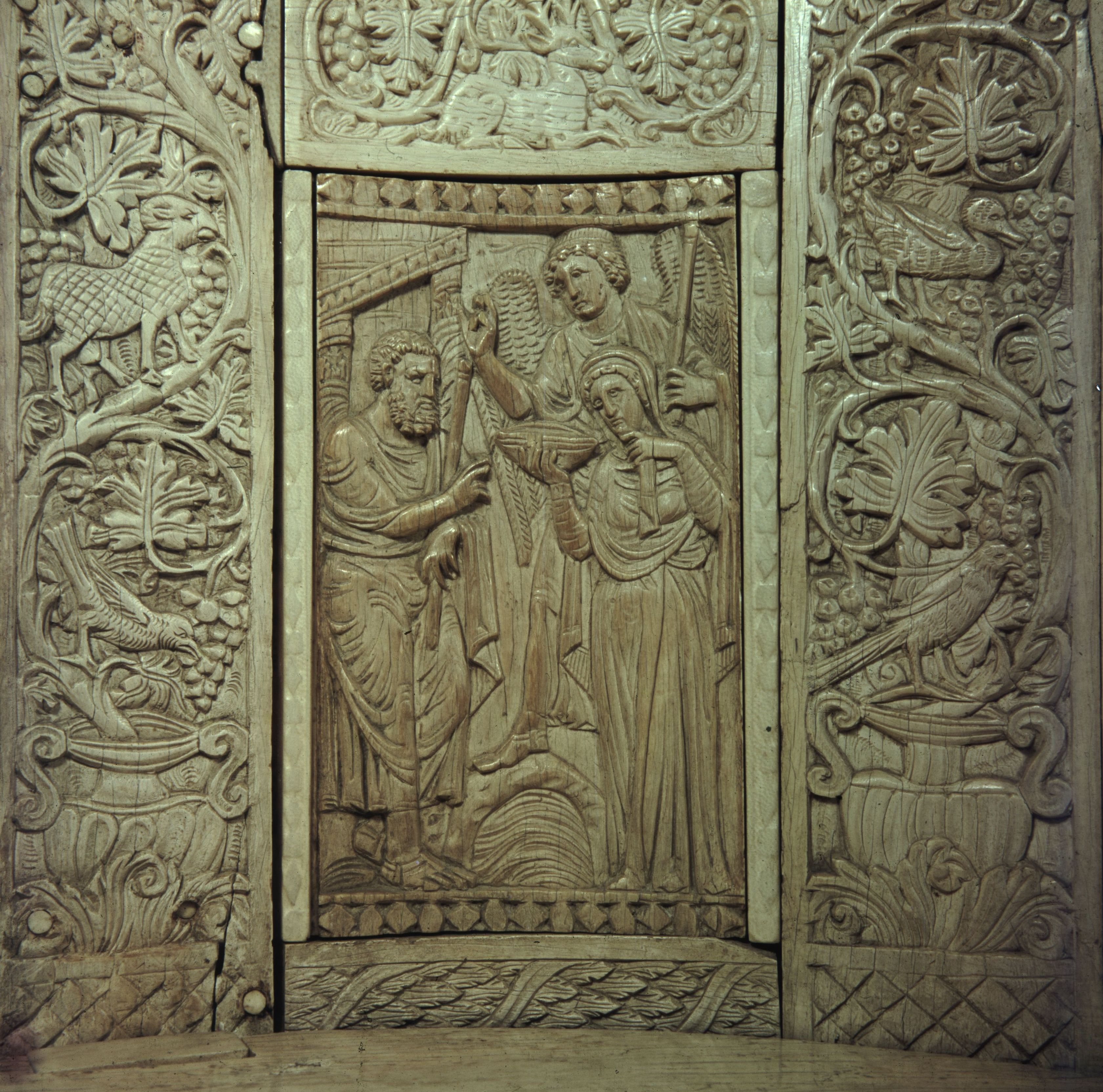
One of the earliest known appearances of the trial by bitter water in visual art is on one of the twenty-seven surviving ivory plaques set into the cathedra (episcopal throne) of Archbishop Maximian of Ravenna.
Throne of Maximian (detail), Constantinople or Alexandria, ca. 545–53. Ivory. Archiepiscopal Museum, Ravenna, Italy. [view full throne]
Standing at the right, Mary holds a vessel in one hand and a skein of wool in the other. (The Protoevangelium says she was among the young women who wove a new veil for the holy of holies.) Joseph stands across from her with a staff in hand, and behind her stands an angel, indicating divine intervention to determine guilt or innocence.
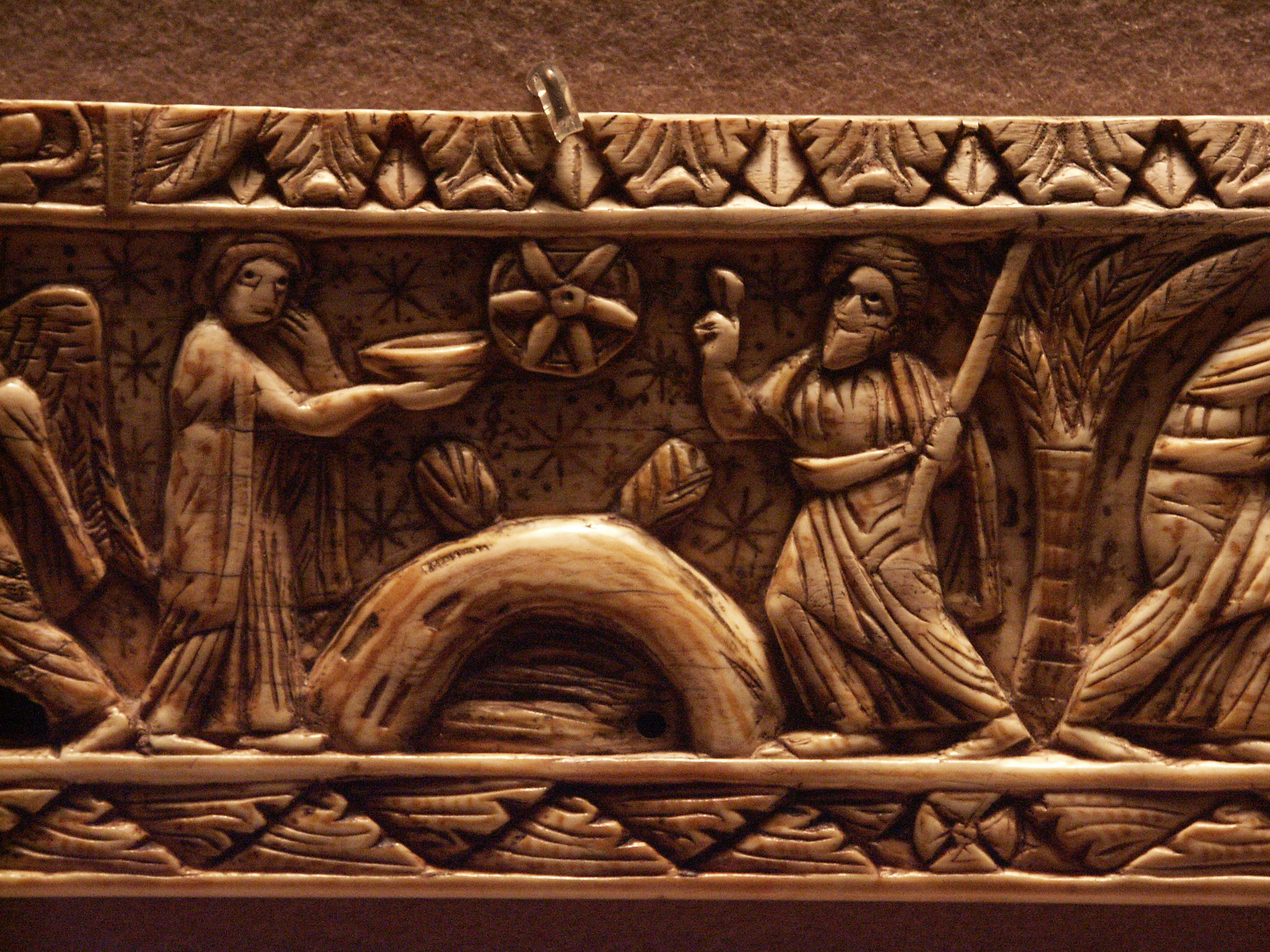
Around the same time, the trial by bitter water appeared in another ivory made in the Eastern Mediterranean—possibly Syria.
Detail of an ivory band depicting the Trial by Bitter Water, Eastern Mediterranean (Syria?), 550–600. Musée du Louvre, OA 11149. [view full artwork]
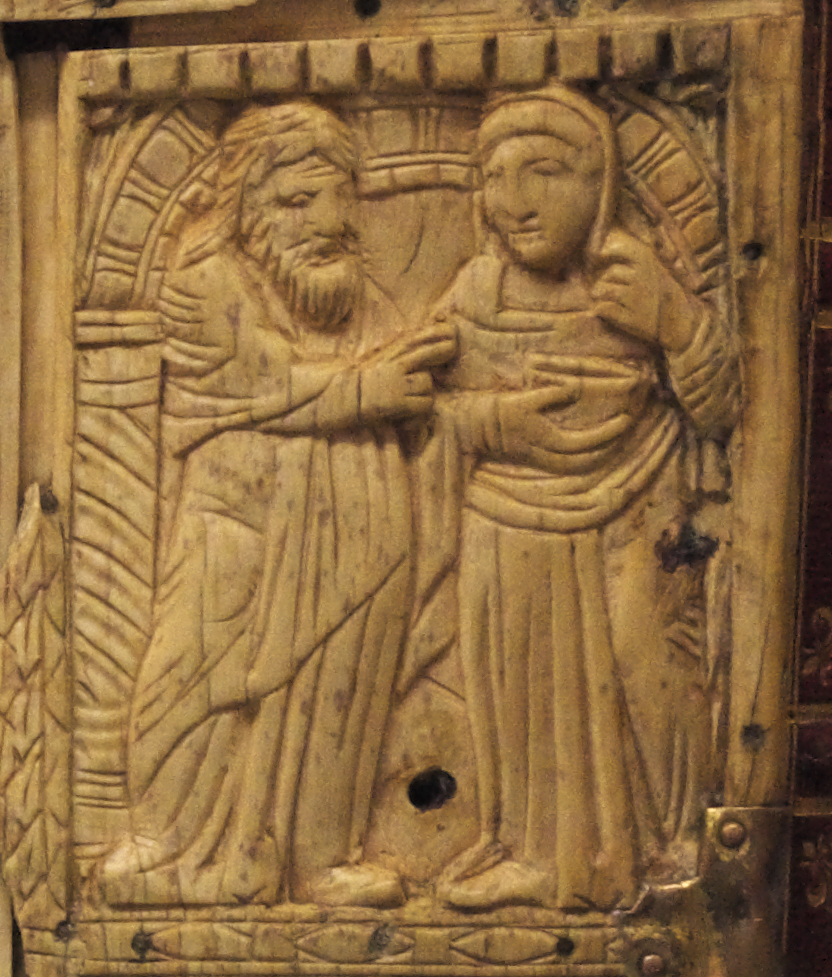
And in a sequence of Marian scenes on a carved ivory Gospel-book cover from France.
Ivory panel from the back cover of the Lupicin Gospels, France, 6th century. Bibliothèque nationale de France, Paris. [view full cover]
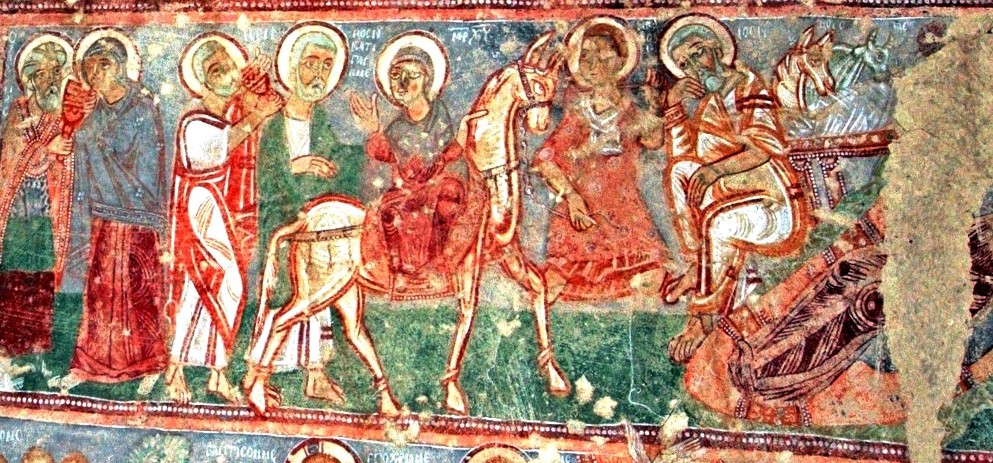
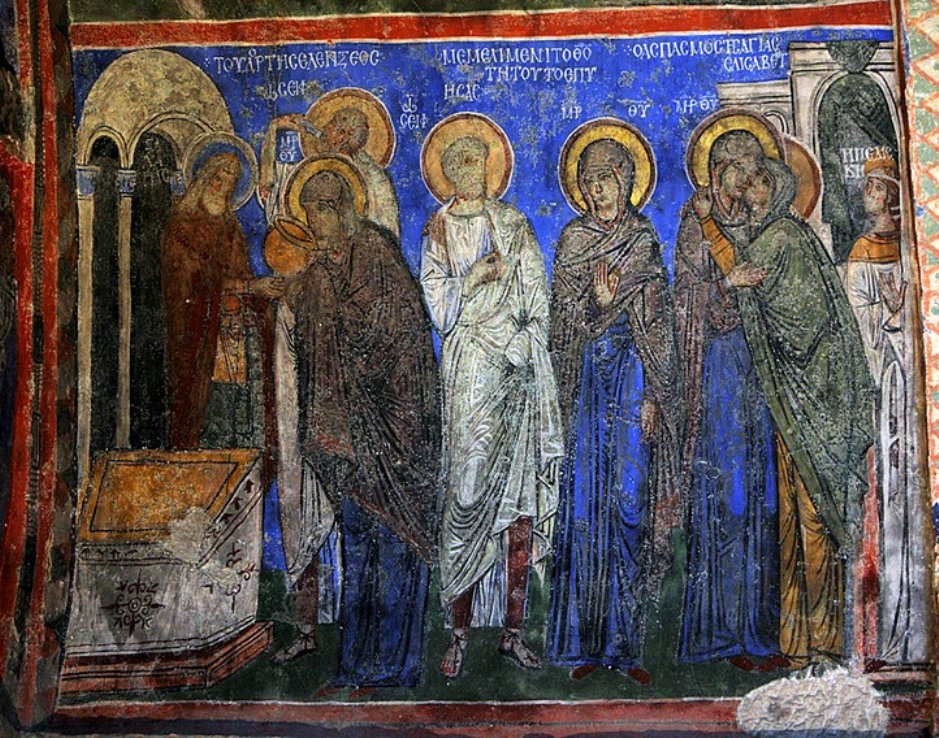
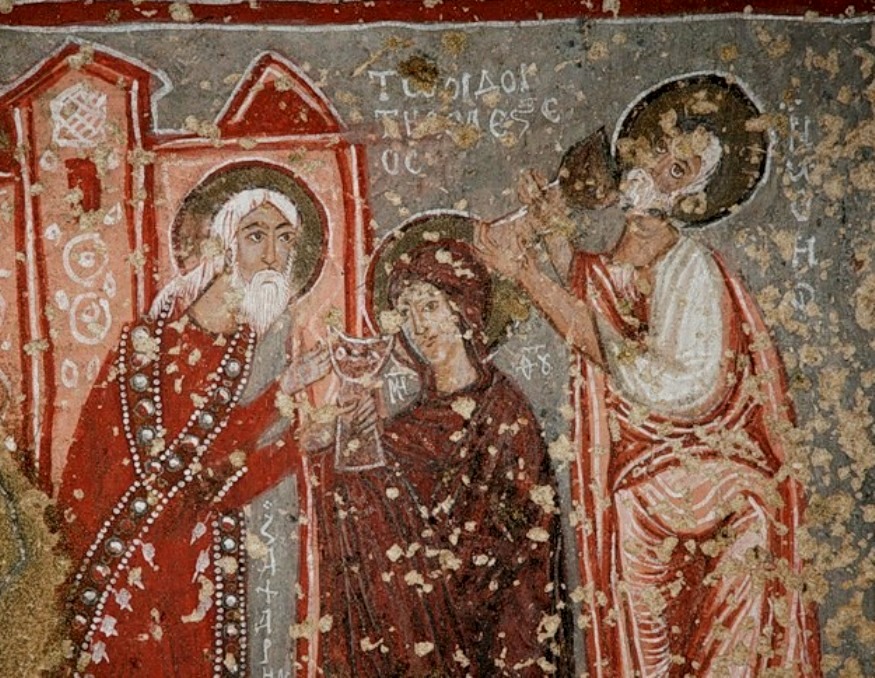
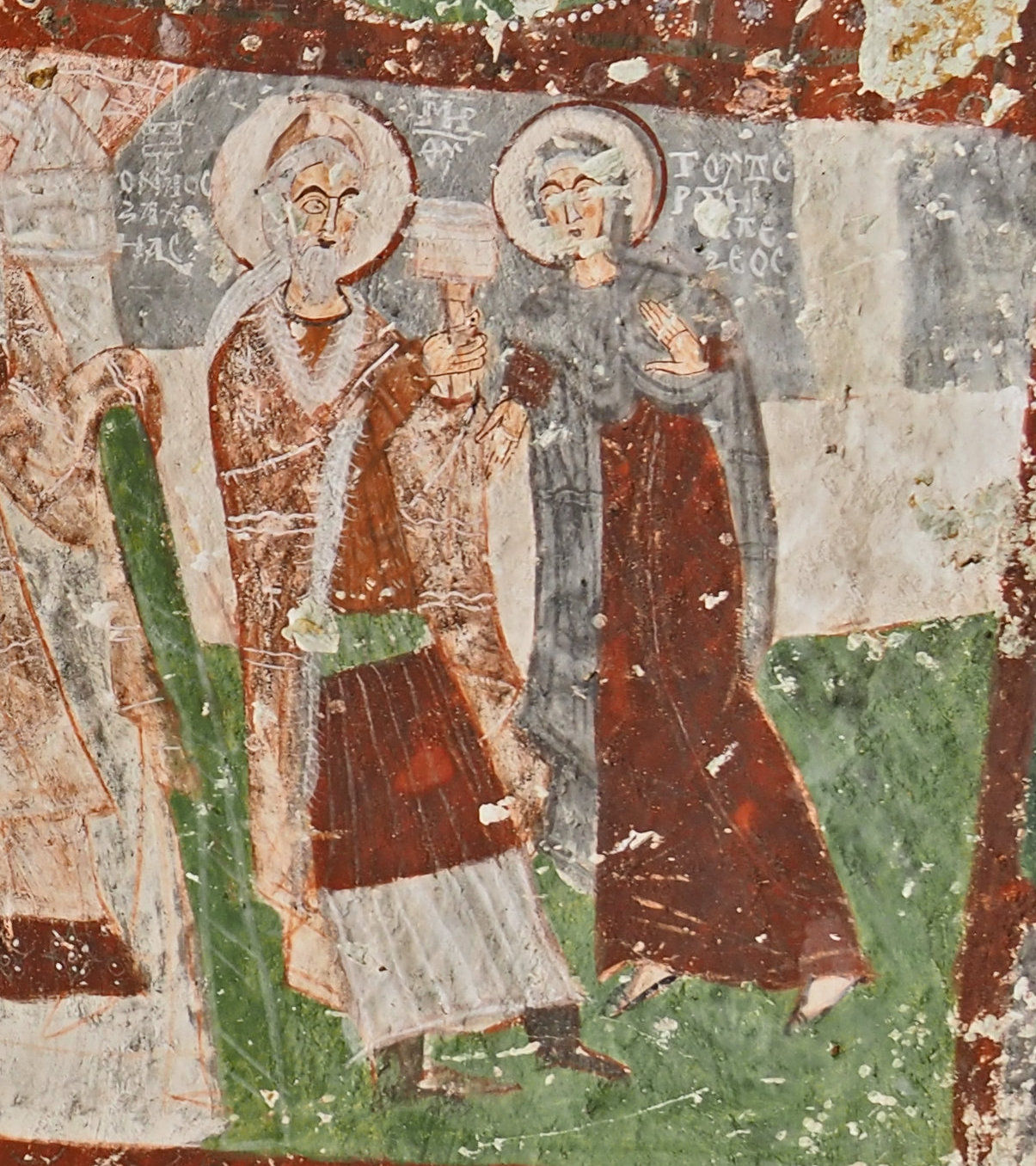
The scene is found painted inside several of the cave churches of Cappadocia from the ninth through eleventh centuries, including St. Eustathios, Tokalı (see below), Kılıçlar, Bahattin Samanlığı, Aynalı, Eğritaş, and Pürenli Seki, as the art historian Yıldız Ötüken has pointed out.
In Old and “New” Tokalı Kilise (Buckle Church), the latter built as an extension forty years after the original, Joseph drinks the bitter water as well as Mary, as the apocryphal gospels state but which is rarely shown.
Fresco, ca. 920, south wall, Old Tokalı Kilise (Buckle Church), Göreme Open Air Museum, Cappadocia, Turkey [view wider shot]Fresco, ca. 960, New Tokalı Kilise (Buckle Church), Göreme Open Air Museum, Cappadocia, Turkey
So, too, at Çavuşin Church:
Fresco, mid-10th century, Çavuşin Church, Göreme National Park, Cappadocia, Turkey [view wider shot]
But not at Pancarlik Church:
Fresco, 11th century, Pancarlik Church, Cappadocia, Turkey [view wider shot]
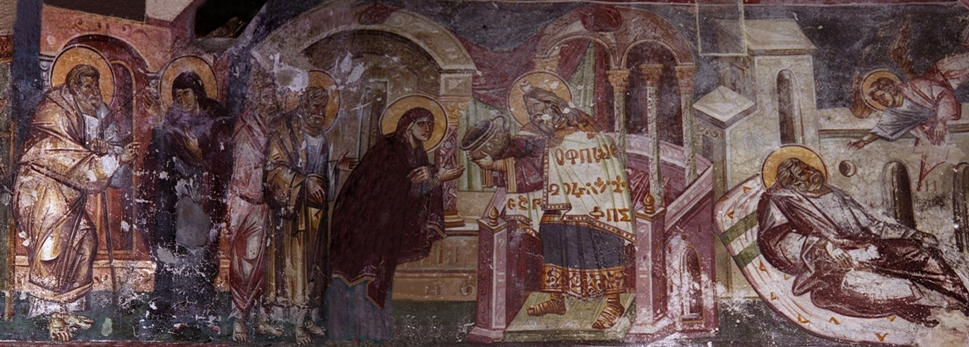
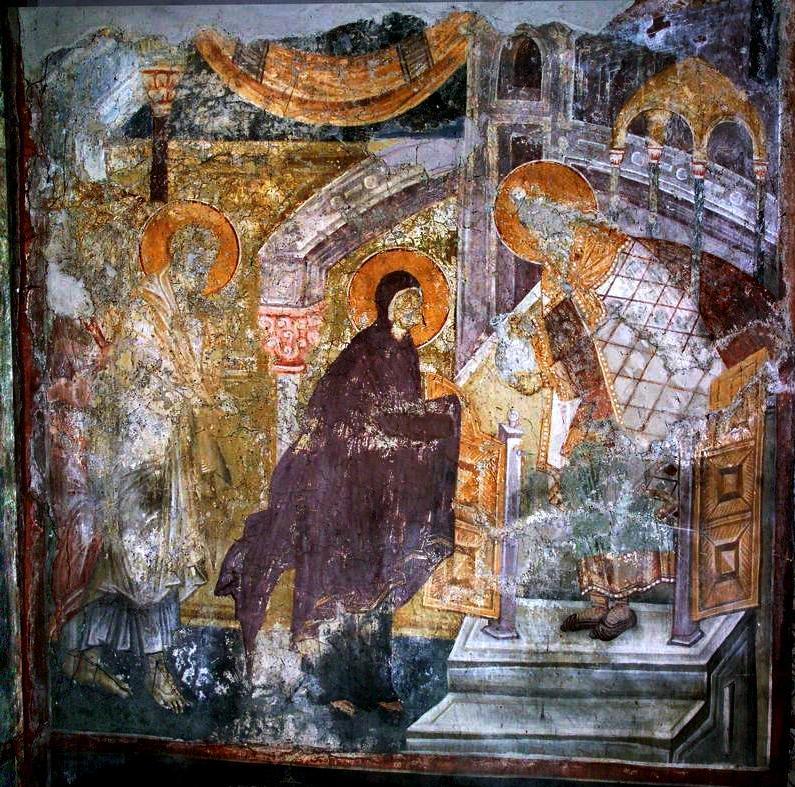
The trial by bitter water also appears elsewhere in the Balkans, such as in Georgia and North Macedonia.
Fresco, 11th century, Church of the Dormition of the Virgin Mary, Ateni, GeorgiaI’m not able to confirm, but blogger Marina Golubina says this is a 13th-century fresco from Sušica (near Skopje) in North Macedonia.Michael Astrapa and Eutychius, Joseph’s Reproach, the Trial by Bitter Water, and Joseph’s Dream, 1295. Fresco, north wall, Church of the Virgin Mary Peribleptos, Ohrid, North Macedonia.Fresco, 1330, Church of the Presentation of the Virgin in the Temple, Kucevište, North Macedonia
In that second image in the above grouping, Mary is accompanied to the temple by her five (four?) virgin companions, named in the Gospel of Pseudo-Matthew as Rebecca, Sephora, Susanna, Abigea, and Cael.
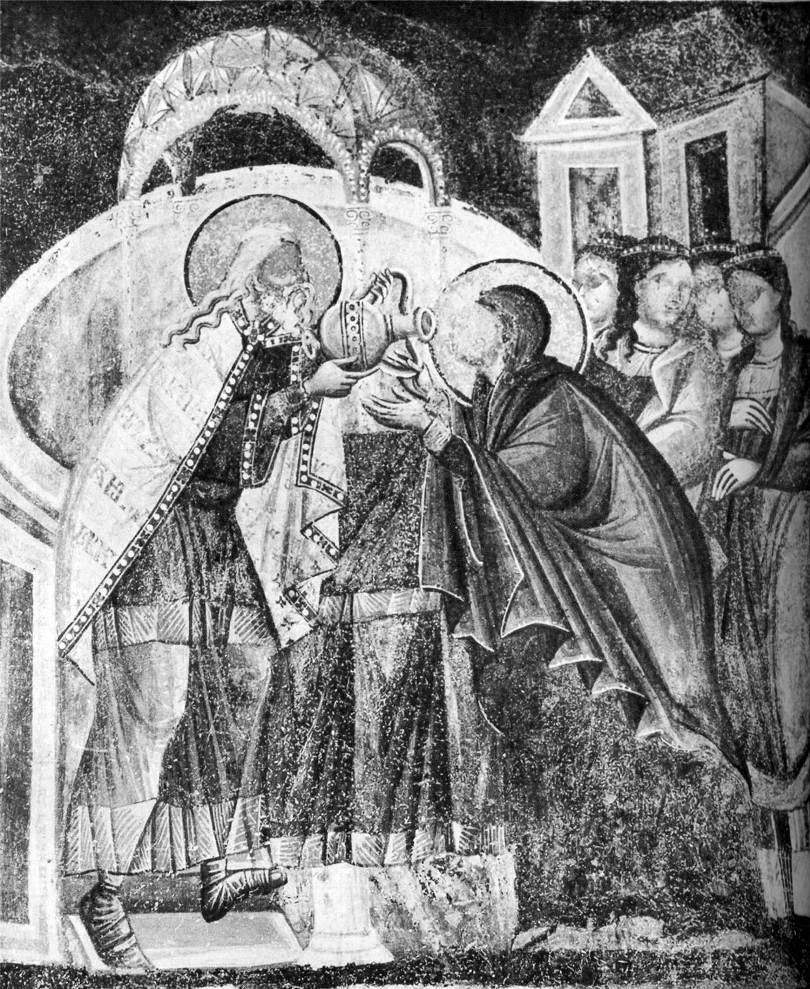
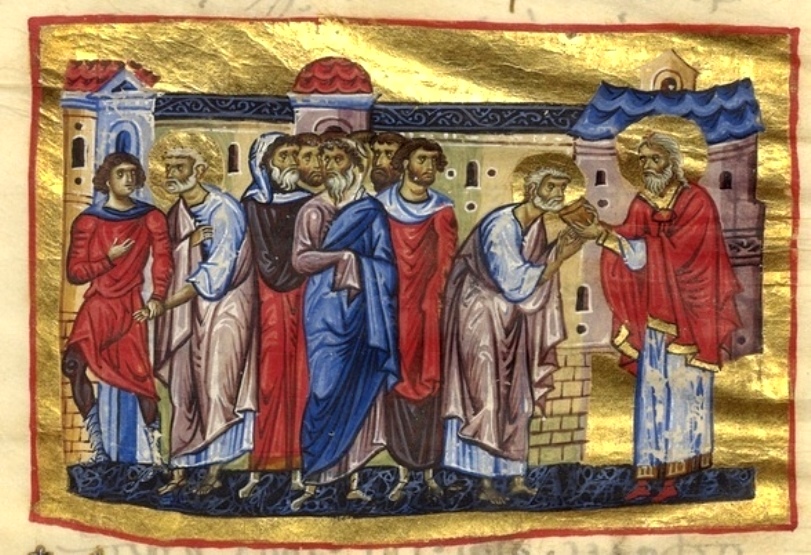
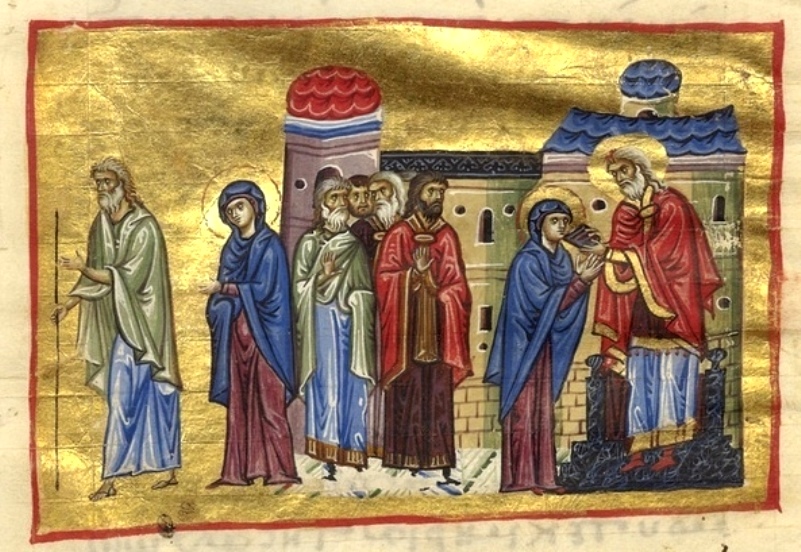
Due to overlapping content, the Protoevangelium of James is illustrated in detail in the twelfth-century manuscript Six Homilies on the Life of the Virgin by James of Kokkinobaphos, which was made by a prominent atelier in Constantinople and is held at the Vatican Library. The trial by bitter water is divided into two separate scenes: one of Joseph drinking the cup and being escorted up the mountain, and one of Mary doing the same.
Joseph drinks the cup from Zechariah, Constantinople, first half of 12th century. From a manuscript of the Six Homilies on the Life of the Virgin by James of Kokkinobaphos. Rome, Biblioteca Apostolica Vaticana, Vat. gr. 1162, fol. 184r. [object record]Mary drinks the cup from Zechariah, Constantinople, first half of 12th century. From a manuscript of the Six Homilies on the Life of the Virgin by James of Kokkinobaphos. Rome, Biblioteca Apostolica Vaticana, Vat. gr. 1162, fol. 188r. [object record]
Other scenes in the sequence portray Joseph’s dream, Joseph consulting with his sons, Joseph apologizing to Mary, Annas the scribe confronting Joseph and the pregnant Mary, Annas reporting the couple to the high priest Zechariah, Mary and Joseph being brought to the temple, Zechariah talking with Joseph, Zechariah talking with Mary, and after the drink, Mary returning unharmed and Zechariah proclaiming her innocence, and then Mary, Joseph, and Joseph’s sons leaving Jerusalem.
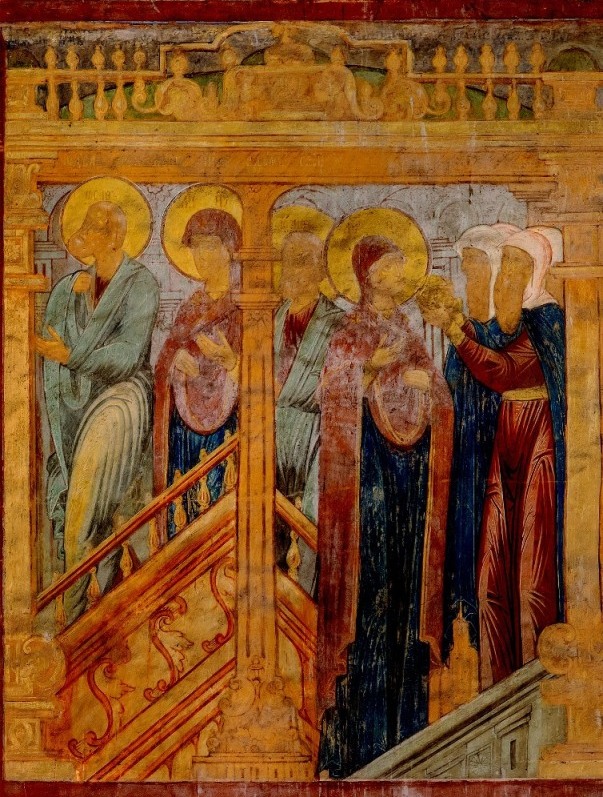
On occasion, the trial by bitter water appears in Russian icons, such as on the walls of St. Sophia Cathedral in Vologda.
Fresco, 1685–87, St. Sophia Cathedral, Vologda, Russia
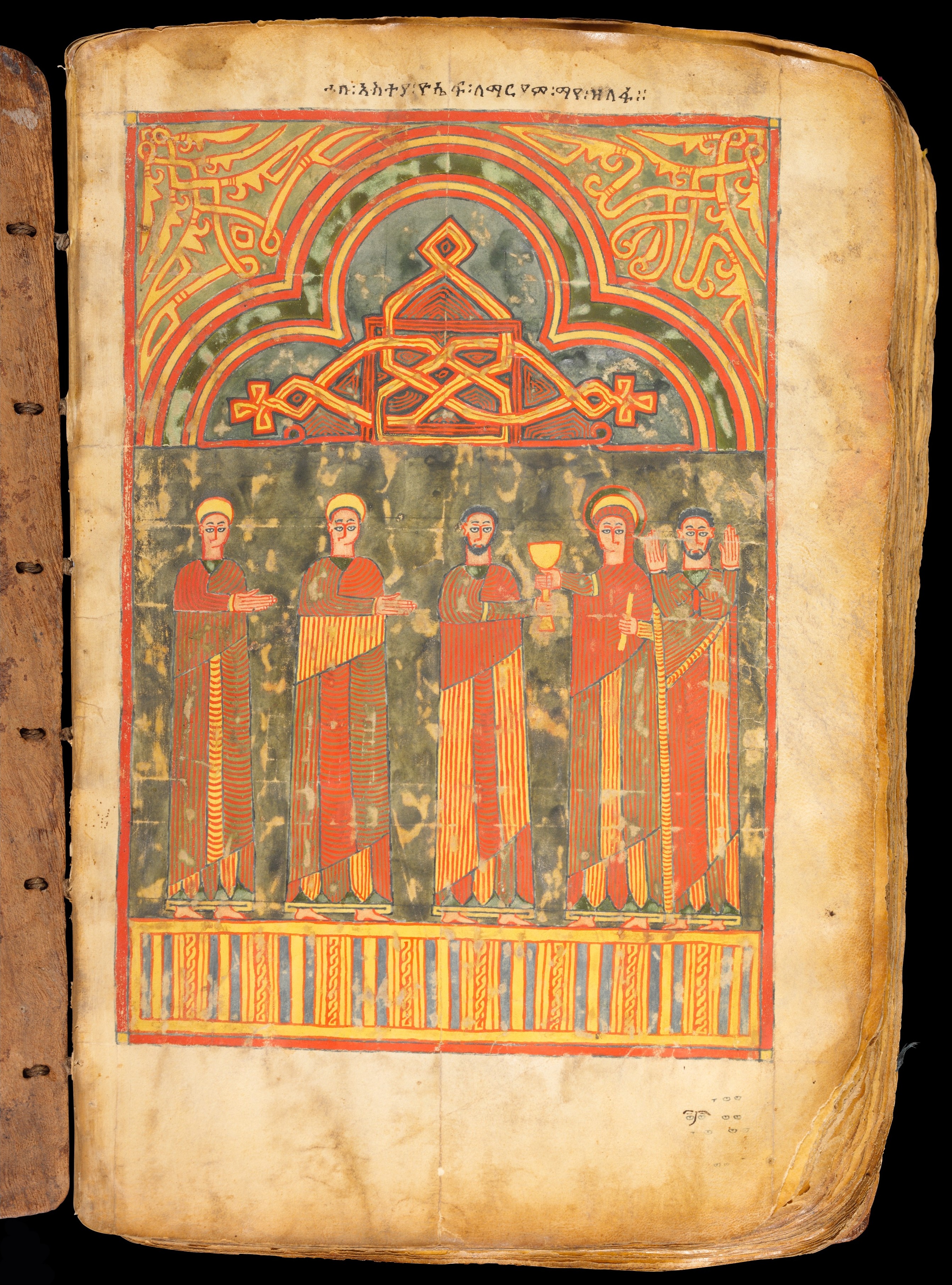
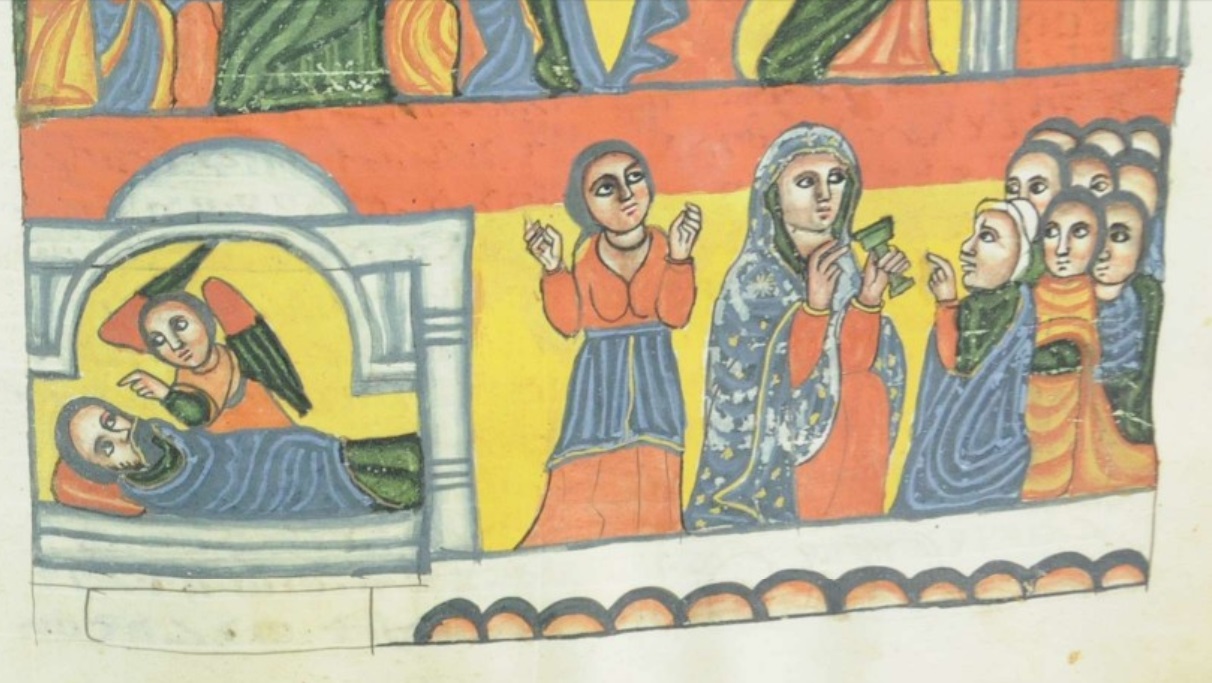
I first encountered it, though, in my studies of Ethiopian art, where it appears in a handful of illuminated manuscripts.
The Trial by Bitter Water, from an Ethiopian Gospel-book, late 14th–early 15th century. Metropolitan Museum of Art, New York.Painting from a Miracles of Mary manuscript, Ethiopia, probably 18th century. Dimā Giyorgis Monastery, Goğğām Province, Ethiopia. Shelfmark: G2-IV-2.
The trial by bitter water is almost nonexistent in Western art. One exception is a fresco inside the Church of Santa Maria foris portas (Church of St. Mary Outside the Gates) in Castelseprio, Italy. All the frescoes there, which are some of the most sophisticated and expressive to have survived from the early medieval period, exhibit a strong Byzantine influence.
Fresco, first half of 9th century, Church of Santa Maria foris portas (Church of St. Mary Outside the Gates), Castelseprio, Italy. Photo: Francesco Bini.
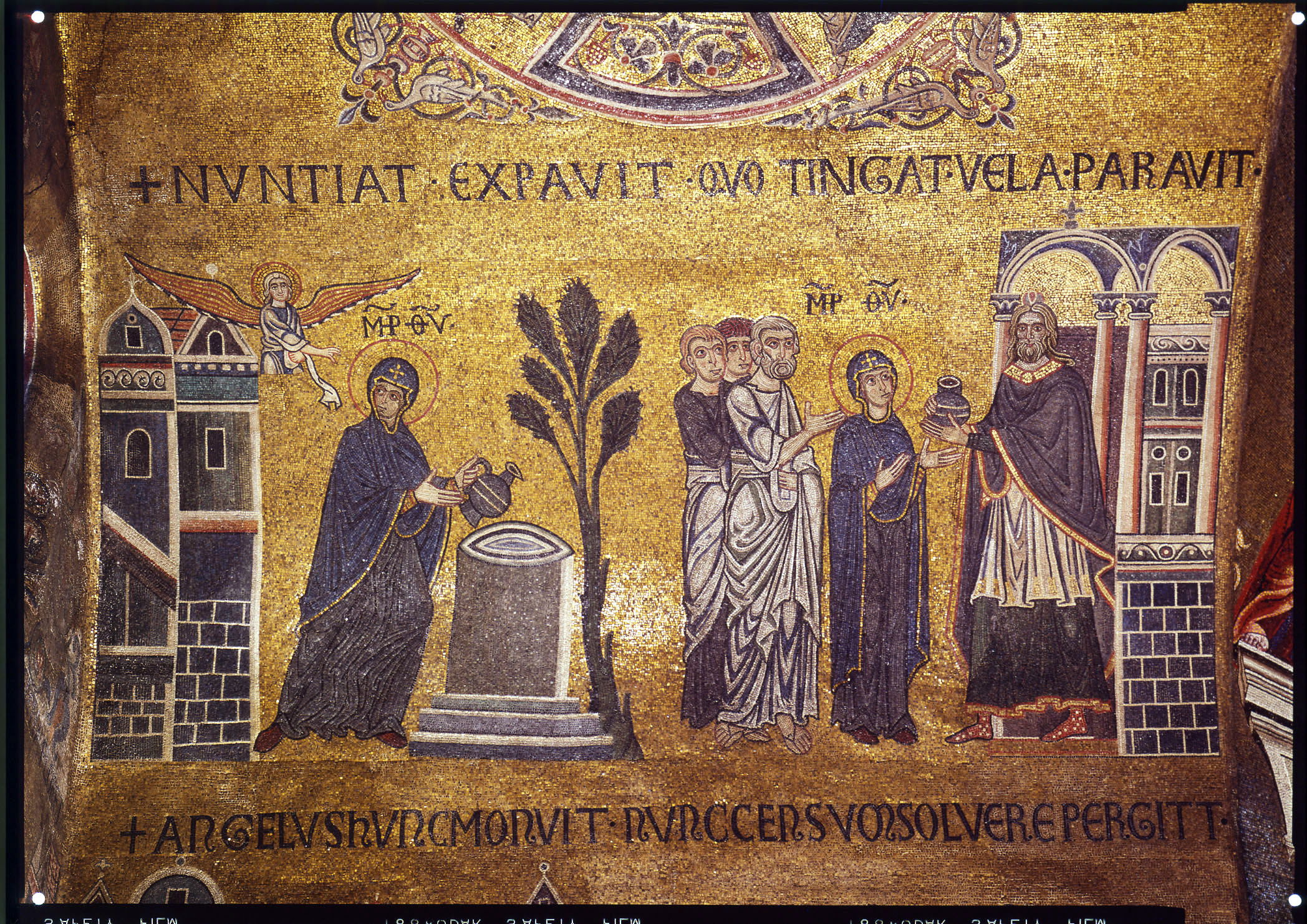
A mosaic at the Basilica of San Marco (Saint Mark’s) in Venice could easily be mistaken for the trial by bitter water, as Mary appears to be taking in hand the same pitcher with which she draws water from the well in the adjacent Annunciation scene.
The Annunciation at the Spring and the Handing Over of Purple to Mary, detail of transept mosaic in the Basilica of San Marco, Venice, 12th century
But the Latin inscription, Quo tingat vela paravit, indicates that the priest is handing Mary a vase of dye. This is another reference to the Protoevangelium: Chapter 10 says that after her betrothal to Joseph but before their marriage, Mary was one of seven virgins from the house of David selected by a council of priests to remake the temple veil (presumably to replace the old worn one). By lot, she was chosen to spin and weave the scarlet and purple.
Other comparable images, such as the mosaic at the former Chora Church (now Kariye Mosque) in Istanbul, show the priest handing Mary a skein of wool instead.
According to the Protoevangelium, Mary was spinning wool for this project when she was interrupted by the angel Gabriel with news of an even greater task she had been chosen for.
Those who disbelieved her about how her pregnancy came to be insisted she be brought to the temple for a trial by bitter water. Sometimes in image cycles on the life of Mary, such as the one on the Carolingian-era Werden Casket, she is shown on her way to the trial rather than at it, being led to the temple by an angel, priest, or moral police to verify her account before God.
When Christians claim that the Bible opposes abortion, some people point to Numbers 5:11–31 as a counterexample, since, for the woman who has conceived a child out of wedlock, the “bitter water” is essentially an abortifacient; “if you have gone astray while under your husband’s authority, if you have defiled yourself and some man other than your husband has had intercourse with you, . . . now may this water that brings the curse enter your bowels and make your womb discharge, your uterus drop!” the priest pronounces (Num. 5:20, 22 NRSV). There’s ambiguity in the Hebrew text as to whether this curse involves loss of a fetus or only infertility. ↩︎
Pamela Mordecai (born 1942) is a Jamaican poet, novelist, short story writer, and scholar of Caribbean literature and culture, living in Toronto. Born and raised in Kingston, she earned a PhD in English from the University of the West Indies and has taught language arts at secondary and postsecondary levels. She often writes in Jamaican Creole, such as for de Man (1995)—a verse play about the crucifixion of Jesus—and the two follow-up collections of narrative poems about Jesus’s parents: de book of Mary (2015) and de book of Joseph (2022).
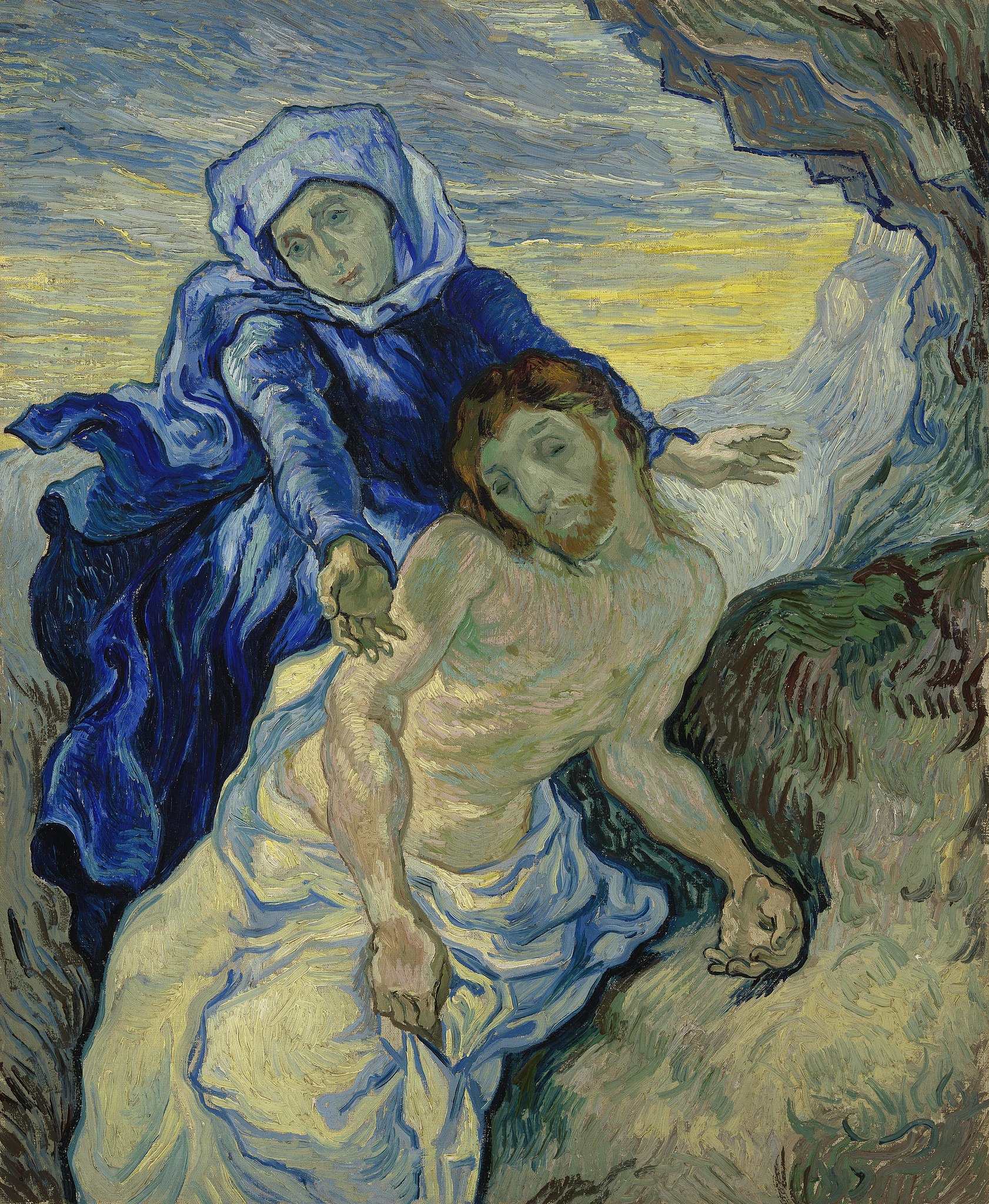
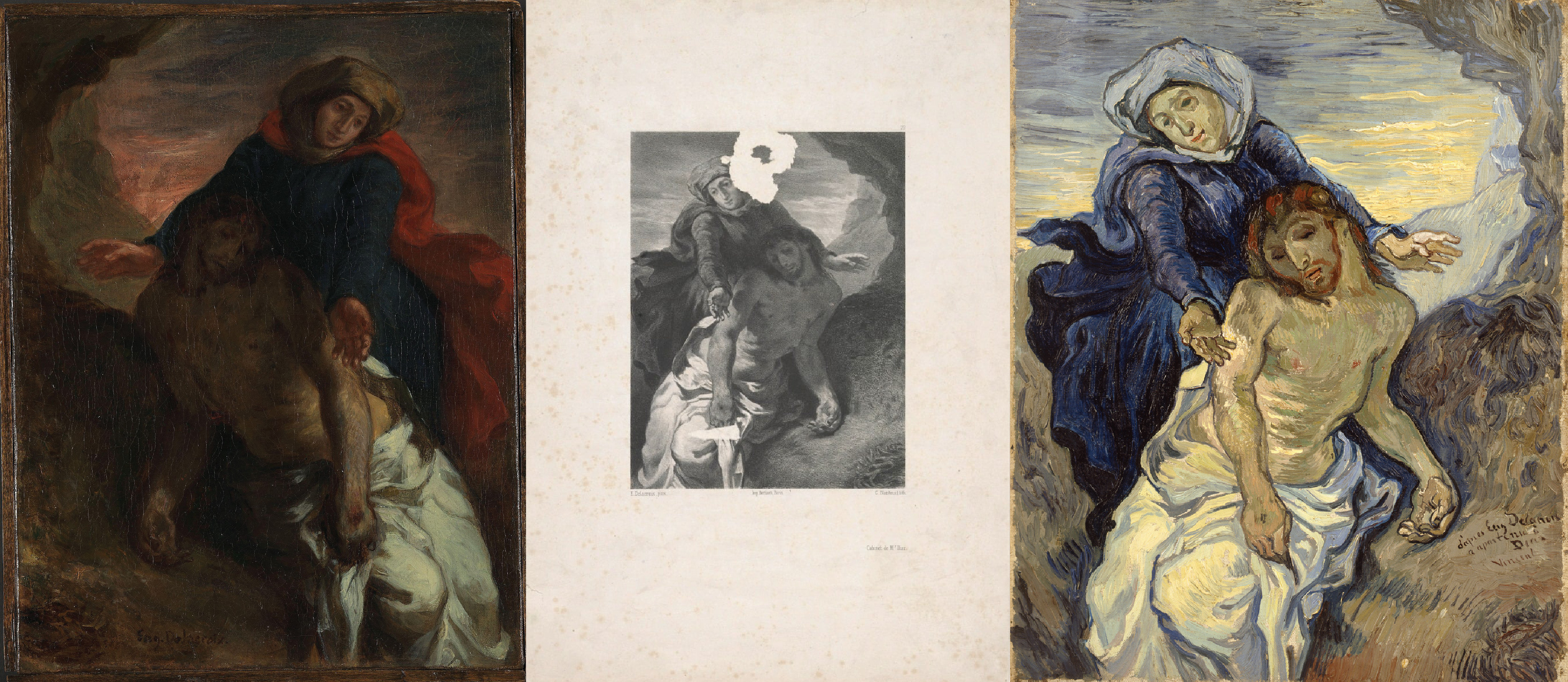
Vincent van Gogh (Dutch, 1853–1890), Pietà (after Delacroix), 1889. Oil on canvas, 73 × 60.5 cm. Van Gogh Museum, Amsterdam.
“Poor fighter, poor sufferer,”
my brother’s words for me.
                                                 Self-pity—
I have to beat it down. But how, exactly?
Never know when the next attack will come.
How to suppress religion?
Down the cloisters of the sick it beckoned—
I abused my God . . . that lithograph of Delacroix’s,
irredeemable sheets I flung in the paint and oil,
his Pietà in ruins.
                               Reconstruct it from memory.
Good technical exercise. Start with the hands,
there were four hands, four arms in the foreground—
mother and son, and the torsions of their bodies
almost impossible, draw them out—
painfully . . . no measurements—
into a great mutual gesture of despair.

Delacroix and I, we both discovered painting
when we no longer had breath or teeth.
Work into his work, strain for health,
the brain clearing, fingers firmer,
brush in the fingers going like a bow,
big bravura work—pure joy! I copy—
no, perform his masterwork of pain.

Genius of iridescent agony, Delacroix,
help me restore your lithograph with color.
I mortify before your model—
how to imitate my Christ? The bronze
of my forelock shadows his, the greatest artist:
stronger than all the others, spurning marble,
clay and paint, he worked in living flesh.

Living and yet immortal, Lord, revive me—
let me inhale the blue of Mary’s cape
billowing hurricanes of hope, clothe me
in your cerements gold with morning—
mother and son, from all your sorrow
all renewal springs, the earth you touch
turns emerald as your hand that burgeons green.
Robert Fagles (1933–2008) (PhD, Yale) was an award-winning American translator, poet, and academic. He is best known for his many translations of ancient Greek and Roman classics, especially the epic poems of Homer. He taught English and comparative literature at Princeton University from 1960 until his retirement in 2002, chairing the department from 1975 onward.
Vincent van Gogh (1853–1890) was raised in the Dutch Reformed Church, the son of a small-town minister—and even worked himself as a lay preacher in the Borinage mining region of southwestern Belgium for two years in his mid-twenties. While there, he gave away all his possessions and lived in poverty like those he served, eating a spare diet, wearing rough garments, and sleeping on the floor. Ironically, his sponsoring evangelical committee deemed such behavior unbecoming of a minister of the gospel, and, due also to his lack of eloquence and theological refinement, they withdrew their support.
This rejection soured Vincent on institutional Christianity. But it didn’t squash his faith. After moving back in with his parents in Nuenen, the Netherlands, he wrote to his brother and close confidante, Theo:
Life [. . .] always turns towards one an infinitely meaningless, discouraging, dispiriting blank side on which there is nothing, any more than on a blank canvas.
But however meaningless and vain, however dead life appears, the man of faith, of energy, of warmth, and who knows something, doesn’t let himself be fobbed off like that. He steps in and does something, and hangs on to that, in short, breaks, ‘violates’ – they say.
Let them talk, those cold theologians. [Letter 464]
Although Vincent left the church and developed conflicted feelings about the Bible, he maintained a reverence for Christ to the end of his days. His time in the Borinage was not for nothing, as it’s there that he discovered, through sketching his parishioners and the surrounding landscapes, his calling to be an artist.
This new vocation was one he ascribed metaphorically to Christ. In a letter to his friend and fellow artist Émile Bernard dated June 26, 1888, Vincent wrote that Jesus’s masterworks are human beings made fully and eternally alive:
Christ – alone – among all the philosophers, magicians, &c. declared eternal life – the endlessness of time, the non-existence of death – to be the principal certainty. The necessity and the raison d’être of serenity and devotion. Lived serenely as an artist greater than all artists–disdaining marble and clay and paint – working in LIVING FLESH. I.e. – this extraordinary artist, hardly conceivable with the obtuse instrument of our nervous and stupefied modern brains, made neither statues nor paintings nor even books . . . he states it loud and clear . . . he made . . . LIVING men, immortals. [Letter 632]
In the same letter, he contended that “the figure of Christ has been painted – as I feel it – only by Delacroix and by Rembrandt…….. And then Millet has painted…. Christ’s doctrine.”
These are the three artists Vincent admired most. He mentions them many times throughout his ample correspondence with family and friends, and he made paintings after all three.
The only painting Vincent ever made of Christ was his Pietà, which he painted in two versions in September 1889, both after the French artist Eugène Delacroix (1798–1863). These are among the many works Vincent painted at a psychiatric hospital in Saint-Rémy-de-Provence in southern France, to which he had voluntarily committed himself after suffering an acute mental breakdown that resulted in his infamous severing of his left ear on December 23, 1888. Theo had rushed to Arles, where Vincent was living in “the Yellow House” at the time, and on December 28 reported on Vincent’s condition in a letter to his wife, Jo van Gogh-Bonger:
I found Vincent in the hospital in Arles. The people around him realized from his agitation that for the past few days he had been showing symptoms of that most dreadful illness, of madness, and an attack of fièvre chaude, when he injured himself with a razor, was the reason he was taken to hospital. Will he remain insane? The doctors think it possible, but daren’t yet say for certain. It should be apparent in a few days’ time when he is rested; then we will see whether he is lucid again. He seemed to be all right for a few minutes when I was with him, but lapsed shortly afterwards into his brooding about philosophy and theology. It was terribly sad being there, because from time to time all his grief would well up inside and he would try to weep, but couldn’t. Poor fighter and poor, poor sufferer. Nothing can be done to relieve his anguish now, but it is deep and hard for him to bear. [Letter 728]
Vincent returned to the Yellow House in January 1889 but over the next few months experienced recurring bouts of mania and depression and was in and out of the hospital. Some of the people of Arles grew increasingly frightened by his erratic behavior, and they essentially ran him out of town. That’s when he made his way twenty miles northeast to the town of Saint-Rémy to check in to Saint-Paul-de-Mausole, a former monastery that then, as now, served as a hospital for the mentally ill.
Vincent had two rooms there, one of which he used as a studio, setting up the various print copies he owned of acclaimed paintings. One was a lithograph by Célestin François Nanteuil-Leboeuf after Delacroix’s Pietà, from the portfolio Les artistes anciens et modernes. (Theo had bought and sent him this litho at his request.) Vincent lamented to his brother that he accidentally damaged it with spilled paint—but that impelled him to paint his own copy of Delacroix. On September 10, 1889, he wrote:
Work is going very well, I’m finding things that I’ve sought in vain for years, and feeling that I always think of those words of Delacroix that you know, that he found painting when he had neither breath nor teeth left. Ah well, I myself with the mental illness I have, I think of so many other artists suffering mentally, and I tell myself that this doesn’t prevent one from practising the role of painter as if nothing had gone wrong.
[. . .] In the very suffering, religious thoughts sometimes console me a great deal. Thus this time during my illness a misfortune happened to me – that lithograph of Delacroix, the Pietà, with other sheets had fallen into some oil and paint and got spoiled.
I was sad about it – then in the meantime I occupied myself painting it, and you’ll see it one day, on a no. 5 or 6 canvas I’ve made a copy of it which I think has feeling. [. . .] My fingers [are] so sure that I drew that Delacroix Pietà without taking a single measurement, though there are those four outstretched hands and arms – gestures and bodily postures that aren’t exactly easy or simple. [Letter 801]
LEFT: Eugène Delacroix, Pietà, ca. 1850, oil on canvas, 35.6 × 27 cm, National Museum of Art, Architecture and Design, Oslo. CENTER: Célestin François Nanteuil-Leboeuf, Pietà (after Delacroix), 1853, lithograph, Van Gogh Museum, Amsterdam. RIGHT: Vincent van Gogh, Pietà (after Delacroix), 1889, oil on canvas, 42 × 34 cm, Vatican Museums.
The painted copy he refers to here is the smaller of the two, which he gifted to his sister Willemien and is now in the collection of the Vatican Museums in Vatican City. In another letter, from September 19, he tells Wil “this little copy of course has no value from any point of view,” but “you’ll be able to see in it that Delacroix doesn’t draw the features of a Mater Dolorosa [sorrowing Mother of God] in the manner of Roman statues – and that the pallid aspect, the lost, vague gaze of a person tired of being in anguish and in tears and keeping vigil is present in it.”
The other Pietàthat Vincent painted—which is similar to the first but larger and brighter—he kept for himself, hanging it in his bedroom at Saint-Rémy. He describes the painting to Wil:
The Delacroix is a Pietà, i.e. a dead Christ with the Mater Dolorosa. The exhausted corpse lies bent forward on its left side at the entrance to a cave, its hands outstretched, and the woman stands behind. It’s an evening after the storm, and this desolate, blue-clad figure stands out – its flowing clothes blown about by the wind – against a sky in which violet clouds fringed with gold are floating. In a great gesture of despair she too is stretching out her empty arms, and one can see her hands, a working woman’s good, solid hands. With its flowing clothes this figure is almost as wide in extent as it’s tall. And as the dead man’s face is in shadow, the woman’s pale head stands out brightly against a cloud – an opposition which makes these two heads appear to be a dark flower with a pale flower, arranged expressly to bring them out better. [Letter 804]
Vincent van Gogh (Dutch, 1853–1890), Pietà (after Delacroix), 1889. Oil on canvas, 73 × 60.5 cm. Van Gogh Museum, Amsterdam.
Although Vincent may have at one time seen Delacroix’s Pietàpainting in person, at Saint-Rémy he had only a grayscale image, the lithograph by Nanteuil-Leboeuf, to reference. For his version, he invented his own color scheme—bold blues and yellows.
On September 20, Vincent described to Theo his process of “copying,” or interpreting, the masters:
What I’m seeking in it, and why it seems good to me to copy them, I’m going to try to tell you. We painters are always asked to compose ourselves and to be nothing but composers.
Very well – but in music it isn’t so – and if such a person plays some Beethoven he’ll add his personal interpretation to it – in music, and then above all for singing – a composer’s interpretation is something, and it isn’t a hard and fast rule that only the composer plays his own compositions.
Good – since I’m above all ill at present, I’m trying to do something to console myself, for my own pleasure.
I place the black-and-white by Delacroix or Millet or after them in front of me as a subject. And then I improvise colour on it but, being me, not completely of course, but seeking memories of their paintings – but the memory, the vague consonance of colours that are in the same sentiment, if not right – that’s my own interpretation.
Heaps of people don’t copy. Heaps of others do copy – for me, I set myself to it by chance, and I find that it teaches and above all sometimes consoles.
So then my brush goes between my fingers as if it were a bow on the violin and absolutely for my pleasure. [Letter 805]
Some art historians believe the Christ figure in the painting is a self-portrait—Vincent identifying himself with the suffering Christ, or recognizing Christ’s presence with him in his suffering, and expressing his longing to be cradled in loving arms and for resurrection from the grave of psychosis. In Vincent van Gogh: The Complete Paintings, Ingo F. Walther and Rainer Metzger write,
Nothing could convey more clearly his need to record his own crisis in the features of another than these two copies [of Delacroix’s Pietà]. The face of the crucified Christ in the lap of a grieving Mary quite unambiguously has van Gogh’s own features. In other words, a ginger-haired Christ with a close-trimmed beard was now the perfect symbol of suffering, the (rather crude) encoding of van Gogh’s own Passion. The painter was to attempt this daring stroke once more, in his interpretation of Rembrandt’s The Raising of Lazarus. Here, van Gogh gave his own features to a Biblical figure who, like Christ, passed through Death into new Life. It was as if, in his work as a copyist, van Gogh was pursuing the kind of oblique allegory he disapproved of in Bernard and Gauguin [see Letter 823]. Five weeks of mental darkness demanded artistic expression – and even that incorrigible realist Vincent van Gogh could not be satisfied with landscape immediacy alone. (542)
On May 16, 1890, Vincent left the hospital at Saint-Rémy, bringing his Pietà painting with him. He moved to Auvers-sur-Oise, a suburb of Paris, placing himself under the care of the homeopathic doctor Paul Gachet, who became a friend. Dr. Gachet admired the painting very much and requested his own copy. (As far as we know, Vincent never got around to making one.)
Vincent was incredibly prolific in Auvers, but his mental health continued to decline, and he died a little over two months after relocating there, on July 29, 1890, from a gunshot wound to the lower chest that was likely self-inflicted.
In his poem “Pietà” from an ekphrastic collection based entirely on Vincent’s paintings, Robert Fagles draws on Vincent’s biography and letters in addition to the titular painting to voice the spiritual and emotional yearnings of Vincent’s final year. The last stanza is a prayer that the poetic speaker Vincent addresses to God—for hope, renewal, light:
Living and yet immortal, Lord, revive me— let me inhale the blue of Mary’s cape billowing hurricanes of hope, clothe me in your cerements gold with morning— mother and son, from all your sorrow all renewal springs, the earth you touch turns emerald as your hand that burgeons green.
In Vincent’s Pietà, the dead Christ’s limp hand rests on a grassy boulder or knoll, which Fagles reads as signifying life awakening from death. You can even see the green reflected in Christ’s face and chest, not to mention the golden sun (“after the storm,” as the historical Vincent wrote) glinting on his right arm, abdomen, and shroud, a faint promise of resurrection.
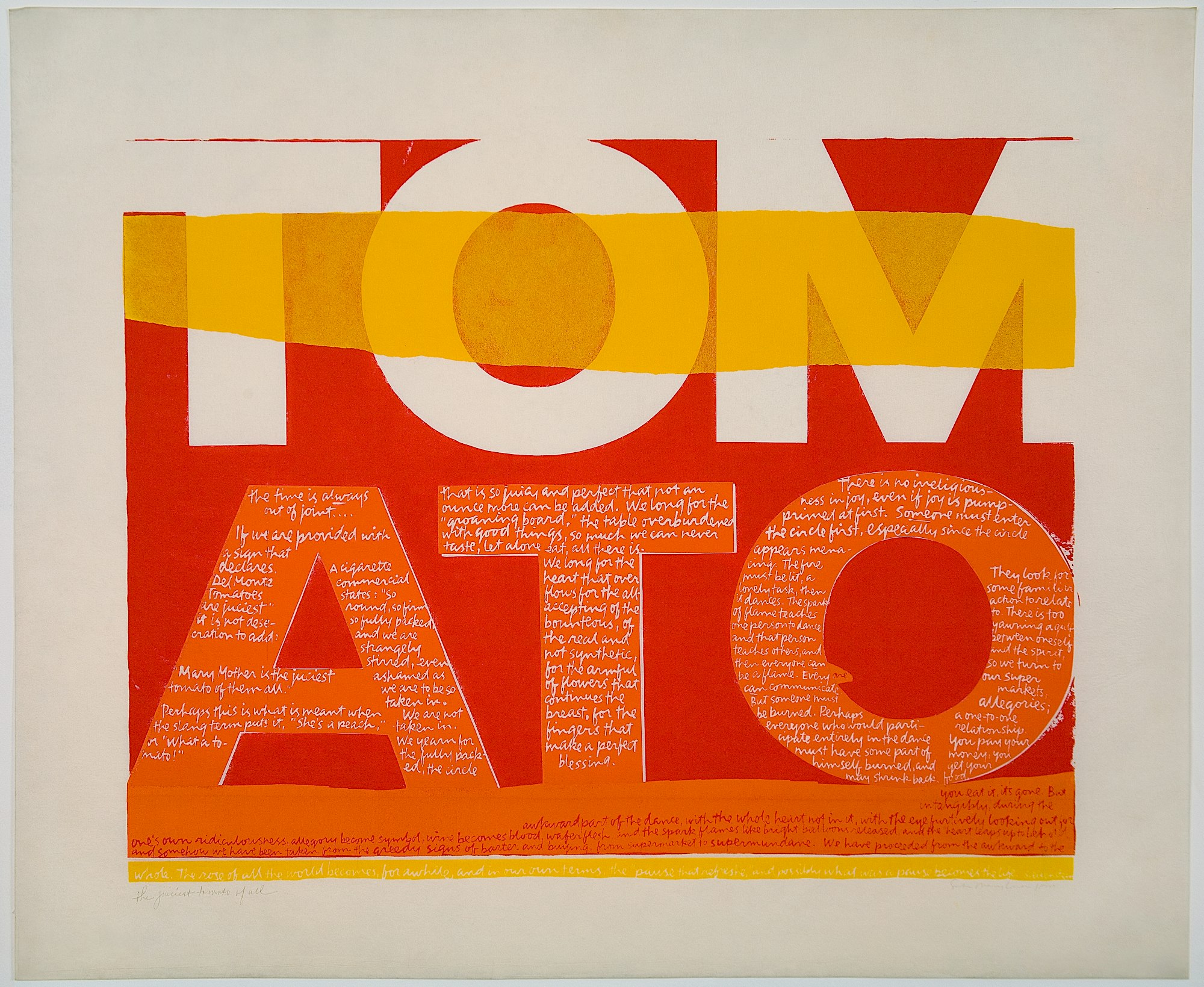
>> Annual Candlemas Lecture by Ayla Lepine, February 3, 2025, 7 p.m. GMT (2 p.m. ET): Rev. Dr. Ayla Lepine, who is the associate rector at St James’s Piccadilly in London and an art historian and theologian, “will explore two works of art featured in her forthcoming book, Women, Art, God. In the series entitled The Annunciation (A Study), Julia Margaret Cameron reimagined and reconfigured paintings by Renaissance artists including Perugino and Lippi. In her photography, blurred and hazy aspects of the image are suggestive of the Holy Spirit in this new technology.
“A century later, the American nun Sister Corita Kent produced a groundbreaking silkscreen print, The Juiciest Tomato of All. This artwork compared the Virgin Mary to a ripe fruit, with a title inspired by Del Monte tinned fruit and vegetable slogans from her local supermarket. By considering these two artworks by women from the nineteenth and twentieth centuries as a pair, new ways of encountering Mary in art history, theology, and prayer can emerge with unexpected resonance for the twenty-first century.”
>> “The Annunciation in Theology and Art: Shedding New Light on an Old Doctrine”by Tina Beattie, March 26, 2025, 3 p.m. GMT (10 a.m. ET): No details other than the title have been given about this lecture. But the speaker is a leading Marian theologian and writer whom I’ve been familiar with for some time, and an emerita professor of Catholic studies at the University of Roehampton. Her research is in the areas of gender, sexuality, and reproductive ethics; Catholic social teaching and women’s rights; theology and the visual arts, especially images of Mary; and the relationship between medieval mysticism, sacramental theology, and psychoanalytic theory.
+++
WEBINAR with Drew Jackson, Eugene Peterson Center for Christian Imagination, February 4, 2025, 7 p.m. ET: A conversation on the intersection of poetry, ministry, and Christian imagination. Registration is free. “Drew Jackson is a poet, speaker, and public theologian. He is author of God Speaks Through Wombs: Poems on God’s Unexpected Coming and Touch the Earth: Poems on the Way. . . . Drew received his B.A. in Political Science from the University of Chicago and his M.A. in Theology from Fuller Theological Seminary. He currently works as the Managing Director of Mission Integration for the Center for Action and Contemplation, and lives in Brooklyn, NY, with his wife and daughters.”
+++
CONFERENCES/SYMPOSIA:
>> Calvin Symposium on Worship, Calvin University, Grand Rapids, Michigan, February 5–7, 2025: “An ecumenical conference dedicated to worship and learning, bringing together people in a variety of roles in worship and leadership from across the country and around the world.”
>> Contemporary Art as/in Pilgrimage, Columbia University, New York, February 11, 2025: Organized by the Association of Scholars of Christianity in the History of Art, this one-day symposium “will explore such questions as: Are galleries, museums, art expos, and art installations the new ‘slow spaces’ for spiritual sustenance and transcendent experiences? How are temples, churches and other ‘religious’ sites transformed by artist installations intended to invoke deep spiritual encounter and healing? And how is the art of contemporary artists working in a diversity of media and practice seen through the lens of pilgrimage?”
The keynote speaker is Kathryn R. Barush, author of Imaging Pilgrimage: Art as Embodied Experience (Bloomsbury, 2021). She will be joined by eleven other presenters. Plus, Elissa Yukiko Weichbrodt, author of Redeeming Vision: A Christian Guide to Looking at and Learning from Art, will lead attendees in the practice of intentional looking at the Cathedral of Saint John the Divine.
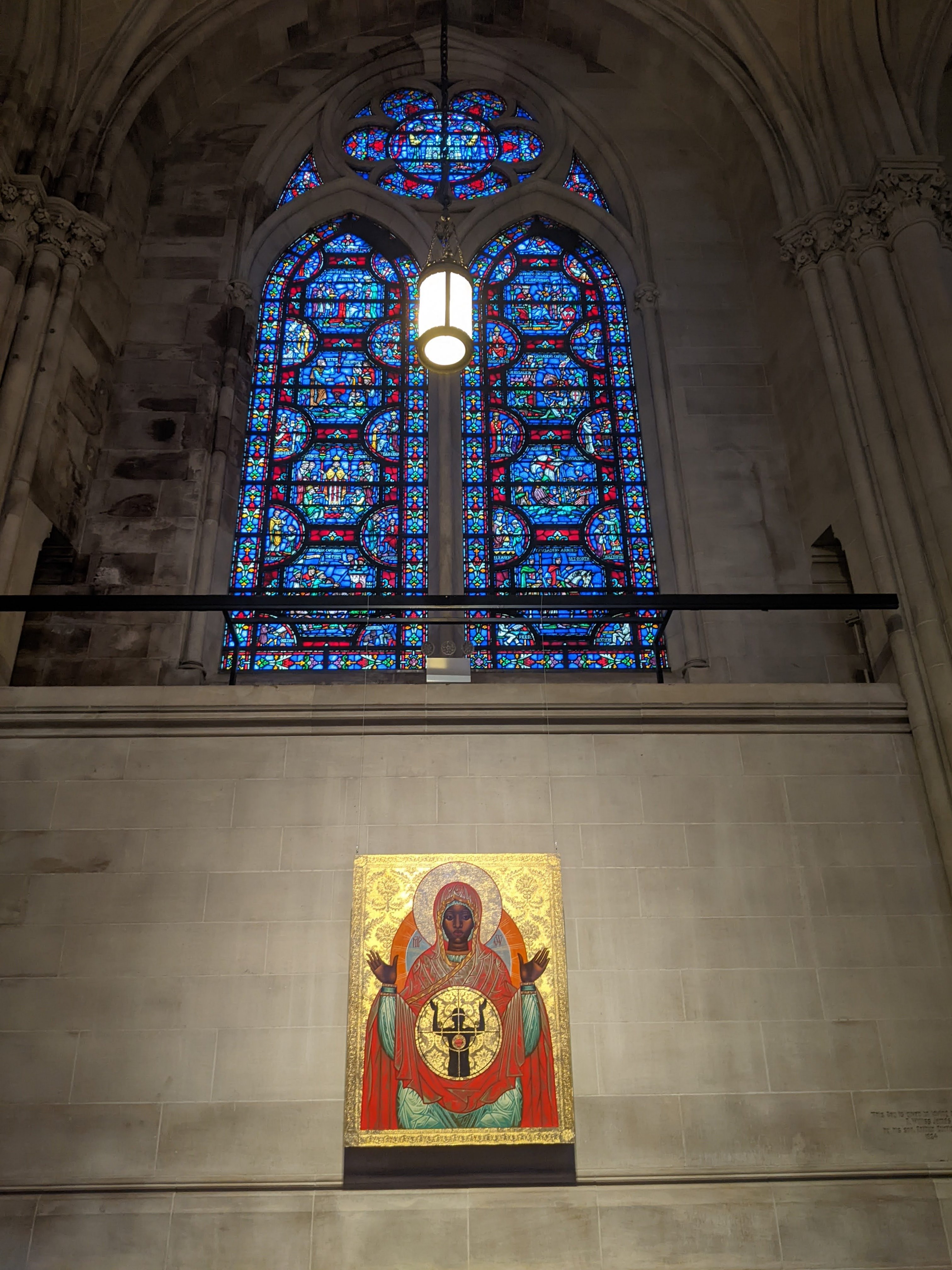
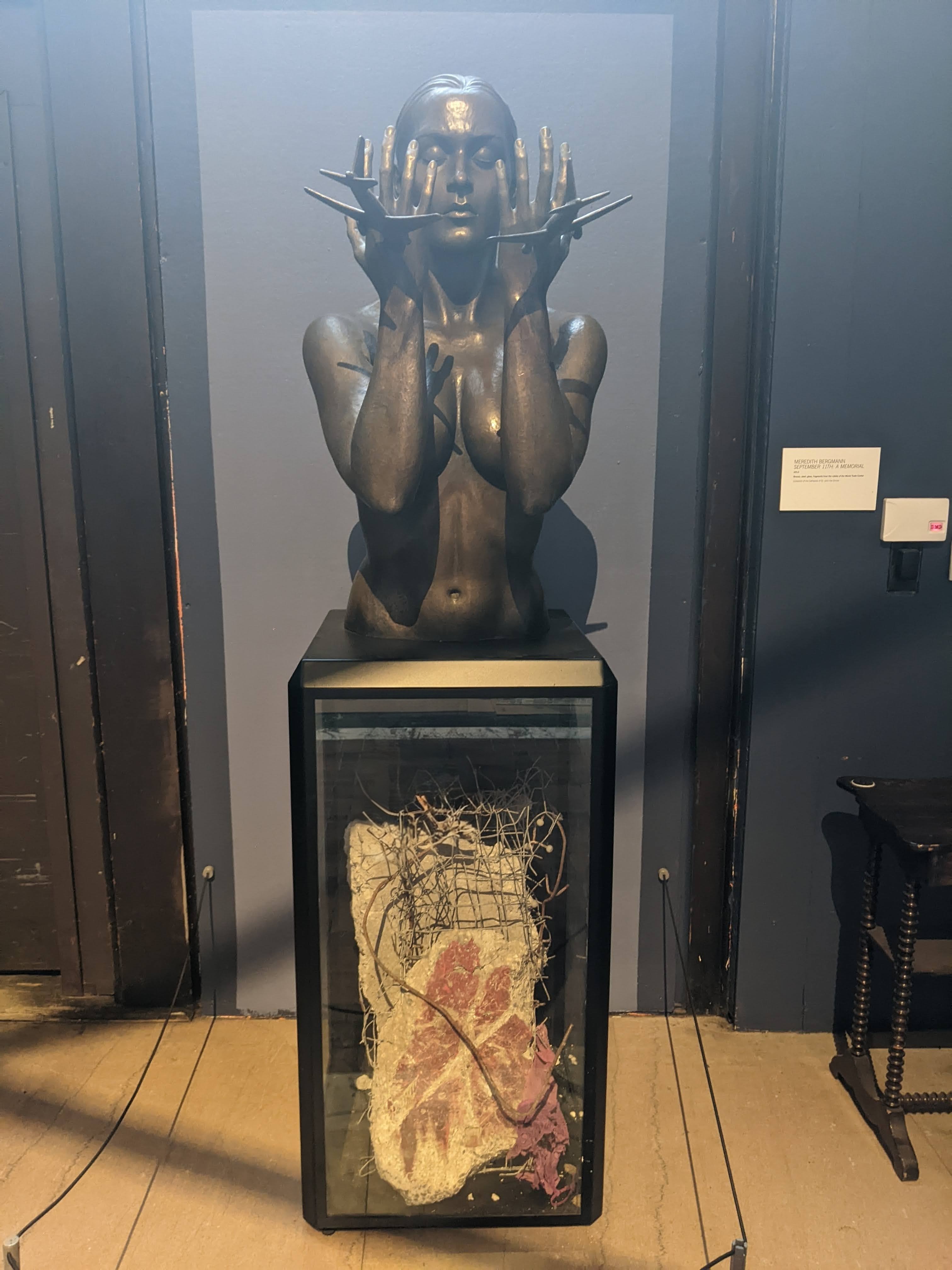
Mark Doox (American, 1958–), Our Lady, Mother of Ferguson and All Those Killed by Gun Violence, 2016. Acrylic and gold leaf on wood, 48 × 36 in. Cathedral of Saint John the Divine, New York. Photo: Victoria Emily Jones, 2022.Meredith Bergmann (American, 1955–), September 11th: A Memorial, 2012. Bronze on pedestal of steel and glass, containing reinforced concrete and brick from the rubble of the World Trade Towers, 78 × 22 × 24 in. Cathedral of Saint John the Divine, New York. Photo: Victoria Emily Jones, 2022.
>> Square Halo Conference, Trust Performing Arts Center, Lancaster, Pennsylvania, March 7–8, 2025: “The Square Halo conferences have offered times not only of fascinating and inspiring ideas in a high caliber of wide and varied presentations, but also of rich, meaningful interactions, dialogue, and (in a deep sense of this word) fellowship. Creativity, collaboration, and community . . . an apt description of what [takes] place” (Matthew Dickerson).
The keynote speaker is Diana Pavlac Glyer, who teaches literature, history, theology, and philosophy in an integrated Great Books curriculum at Azusa Pacific University, and the Saturday-night concert will feature Thomas Austin and Skye Peterson.
>> The Breath and the Clay, Winston-Salem, North Carolina, March 21–23, 2025: “This year we will explore how the light gets in through the fragments of our stories, our lives and our art. We are each built of broken pieces, a mosaic of joys and sorrows, of mundane and miraculous happenings. When we surrender the full spectrum of our human experience, even our pain, doubts and sorrows can heal into art. Through our workshops, keynote talks, immersive gallery and performances, we will explore various facets of the creative life and how everything from inspiration to the everyday, from family to vocation and community coalesce to reveal a hidden wholeness.”
Presenters include Sho Baraka, Vesper Stamper, Justin McRoberts, Cheryl Bridges Johns, Elissa Yukiko Weichbrodt, and more.
>> Illuminate: Art and Faith, Southern Adventist University, Collegedale, Tennessee, March 31–April 1, 2025: “Author and theologian Frederick Buechner famously wrote, ‘Pay attention to the things that bring a tear to your eye or a lump in your throat because they are signs that the holy is drawing near.’ Paintings, poetry, music, and other creative mediums hold strong potential to do just that—to indirectly communicate powerful truths, many of which have eternal consequences. Are we open to what they’re telling us? Will we utilize these tools to share important stories (including The Story) with others? Join us for two rich days of education, inspiration, and community! . . .
“This year’s conference will include a variety of hands-on workshops (flash fiction, drawing, songwriting), as well as sessions exploring fascinating figures, including C. S. Lewis, Madeleine L’Engle, Eugene Peterson, Kurt Vonnegut, Dorothy Sayers, Vincent van Gogh, Norman Rockwell, Ludwig van Beethoven, Duke Ellington, and many more.”
Among the session leaders and performers are art historian Elissa Yukiko Weichbrodt (Redeeming Vision), writer Douglas McKelvey (Every Moment Holy), film and literature scholar Mary McCampbell (Imagining Our Neighbors as Ourselves), pastor Russ Ramsey (Van Gogh Has a Broken Heart; Rembrandt Is in the Wind), illustrator John Hendrix (The Mythmakers; Go and Do Likewise!), and singer-songwriter Andy Gullahorn.
>> Visible and Invisible: Surprising Encounters in Theology and the Arts (DITA 2025), Duke University, Durham, North Carolina, September 4–7, 2025: I’ll be attending this one! Organized by Duke Initiatives in Theology and the Arts. “How can the arts help us open up the very heart of the Christian faith, celebrated at the Council of Nicaea in 325, that Jesus Christ is ‘one in being’ with God? Featuring world-class academics, artists, musicians, and clergy from around the globe and a robust range of programming, DITA2025 is a four-day symposium at Duke University celebrating Nicaea and the myriad surprises the Creed holds in store for artists, academics, clergy, and parishioners today. . . .
“By pairing theologians with poets, clergy with novelists, dancers with liturgists, musicians with scholars, the symposium will generate a series of meetings rarely offered in academic and artistic settings. Including interactive keynotes, plenary presentations, seminar lectures, applied workshops, an evening concert, and more, DITA2025 is a unique opportunity to experience the arts and the academy in action.”
Dancer and choreographer Leah Glenn performs an original work, The Youngest of Nine, at DITA 2019.
Speakers include Rowan Williams, Chigozie Obioma, Natalie Carnes, Sandra McCracken, James K.A. Smith, Malcolm Guite, Amy Peeler, and Josh Rodriguez. Early-bird registration ends February 15.
Jacob Riis (Danish American, 1849–1914), In the Home of an Italian Rag-Picker, Jersey Street, ca. 1890. Photograph, 7 15/16 × 9 3/4 in. (20.2 × 24.7 cm).
My soul magnifies the poor
the sore
the raw
and my spirit rejoices in God
my downcast
my outcast
my twig-bone wrong caste
for He regards the low estate
the no-go estate
the empty plate
and squats there with those generations.

For at Whose Name the cosmos shakes
and canyons quake
sought sanctuary within a womb
a young girl’s chaste, unopened room
a sparse, unblemished catacomb
and holy is He amongst the lame.

His mercy is on those who fear Him
hear Him
those near Him
in desert flapping bivouac or dehydrated barrio.

The night sky rolled out by His arm,
the preening proud ignore His balm
and slink towards the warlock charm
of their small ambitions;
and those on thrones end up alone
replaced by fly-pecked innocents.

He only eats with the hungry,
and if they don’t, He too refrains;
and as for the rich –
a table cannot be found for them.

My soul magnifies the poor
the sore
the raw
and my spirit rejoices in God
my outcast.
Stewart Henderson is a poet, song lyricist, and broadcaster. His children’s poems, taken from his three best-selling children’s collections (Poetry Emotion, All Things Weird and Wonderful, and Who Left Grandad at the Chip Shop?), are included in the UK’s national education curriculum. As a song lyricist, the music magazines Q and Mojo place his lyrics alongside those of Randy Newman and Radiohead. And as an award-winning presenter and producer of many documentaries for BBC network radio, he continues in the grand tradition, established by the likes of Dylan Thomas, Louis MacNeice, Cecil Day-Lewis, and others, of leading poets being commissioned to make primetime programs for Britain’s national broadcaster. Liverpool-born but long since residing on the southwest fringes of London, Henderson has been a regular participant, since its inception in 1974, in the Greenbelt Festival, an annual summer event in England dedicated to the arts, faith, and justice, for which Henderson served as a board director for twelve years.
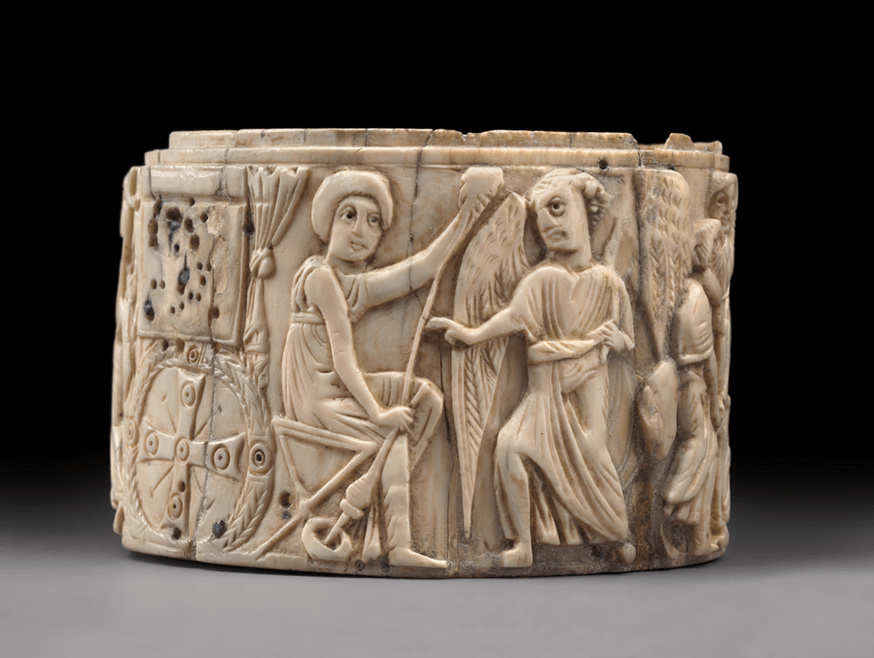
Pyxis with the Annunciation, Byzantine Empire (Minden?), 5th or 6th century. Ivory, height 7.9 cm, diameter 11.8 cm. Museum für Byzantinische Kunst, Bode-Museum, Staatliche Museen zu Berlin. [object record]
According to the Protoevangelium of James, an apocryphal infancy gospel from the second century, the Virgin Mary was raised in the Jerusalem temple from age three and was tasked with weaving the purple and scarlet thread of the veil that shrouded the holy of holies, the temple’s innermost sanctuary. One day while taking a break from this sacred labor to collect water from a well, the angel Gabriel approached her with a greeting: “Hail, favored one. The Lord is with you.” She looked around and saw no one, so she returned to her work indoors.
As she was engaged in her spinning, Gabriel reappeared and delivered the message he had been sent with: that Mary was chosen to bear the Son of God.
This account of the Annunciation gained special traction in the East, where the Virgin Annunciate is almost always shown with a spindle of scarlet thread in her hand, or less frequently, standing at a well—unlike in Western depictions, where she is typically shown holding a book.
The Byzantine art object pictured above is an ivory-carved pyxis (pl. pyxides), a cylindrical container used to store small items, such as jewelry or cosmetics. The Annunciation is one of three scenes represented, the other two being the Journey to Bethlehem and the Nativity (including Salome with her withered hand; see Prot. 19–20). The square to Mary’s left is where the lock case was originally mounted.
In the early fifth century, the prominent Byzantine theologian Proclus of Constantinople (ca. 390–446) developed Mary’s weaving into an extended theological metaphor of the Incarnation. He preached on Mary’s womb as a “workshop” containing the “awesome loom of the divine economy” on which the flesh of God was woven together, providing the bodiless divinity with form and texture. [1] “In the workshop of Mary’s womb, the vertical warp thread of divinity was bound to a weft of virgin flesh,” writes Fr. Maximos Constas (b. 1961), paraphrasing Proclus. [2]
Jesus’s flesh is a kind of clothing—the same we wear—made during Mary’s nine months of pregnancy:
The one who redeemed us was not a mere man. May this never be! But neither was he God denuded of humanity, for he had a body. And if he had not clothed himself with me, he could not have saved me, but in the womb of a virgin the one who pronounced the sentence against Adam clothed himself with me, who stood condemned, and there in her womb was transacted that awesome exchange, for taking my flesh, he gave me his spirit. [3]
Notes:
Nicholas Constas, “The Purple Thread and the Veil of Flesh: Symbols of Weaving in the Sermons of Proclus,” chap. 6 of Proclus of Constantinople and the Cult of the Virgin in Late Antiquity (Leiden and Boston: Brill, 2003), 317. The quotations are from Proclus’s Homily 1.I.21–25.
Constas, 357.
Proclus of Constantinople, Homily 1.VIII.122–27, qtd. Constas, 354.
I’m spinning the scarlet and purple—woman’s work But God is spinning the gold, I see Weaving a tiny thread like me Into the grand design to be The saving of the world
Chosen as the roving fiber—clean and combed Then dropped and spun and quickly wound Upon the spindle tightly bound To serve the One I’m wound around: The Savior of the world
Refrain: Son of the Most High, let it be, let it be Son of God, let it be, let it be to me
In the hands of the Master, I marvel at his ways He brings me into his weaving room My heart is stretched upon the loom The God-man knitted within my womb The Savior of the world [Refrain]
Bridge: First to hear, first to hear and believe First to love, first to love and receive The Son of God
Will they believe me? I wonder, who can say? But I will always answer yes Though a sword may pierce my breast The Father of my son knows best The Savior of the world [Refrain]
In “The Virgin, Spinning,” singer-songwriter Katy Wehr takes the weaving metaphor in a different direction than Proclus. Voiced by Mary, the song reflects on how God is weaving a grand tapestry of salvation, in which Mary is a thread.





#/media/File:Maestro_di_castelseprio,_storie_dell'infanzia_di_cristo,_datazione_incerta_tra_l'830_e_il_950_dc_ca.,_12_prova_delle_acque_1.jpg)




 Art & Theology