Jacob Riis (Danish American, 1849–1914), In the Home of an Italian Rag-Picker, Jersey Street, ca. 1890. Photograph, 7 15/16 × 9 3/4 in. (20.2 × 24.7 cm).
My soul magnifies the poor
the sore
the raw
and my spirit rejoices in God
my downcast
my outcast
my twig-bone wrong caste
for He regards the low estate
the no-go estate
the empty plate
and squats there with those generations.

For at Whose Name the cosmos shakes
and canyons quake
sought sanctuary within a womb
a young girl’s chaste, unopened room
a sparse, unblemished catacomb
and holy is He amongst the lame.

His mercy is on those who fear Him
hear Him
those near Him
in desert flapping bivouac or dehydrated barrio.

The night sky rolled out by His arm,
the preening proud ignore His balm
and slink towards the warlock charm
of their small ambitions;
and those on thrones end up alone
replaced by fly-pecked innocents.

He only eats with the hungry,
and if they don’t, He too refrains;
and as for the rich –
a table cannot be found for them.

My soul magnifies the poor
the sore
the raw
and my spirit rejoices in God
my outcast.
Stewart Henderson is a poet, song lyricist, and broadcaster. His children’s poems, taken from his three best-selling children’s collections (Poetry Emotion, All Things Weird and Wonderful, and Who Left Grandad at the Chip Shop?), are included in the UK’s national education curriculum. As a song lyricist, the music magazines Q and Mojo place his lyrics alongside those of Randy Newman and Radiohead. And as an award-winning presenter and producer of many documentaries for BBC network radio, he continues in the grand tradition, established by the likes of Dylan Thomas, Louis MacNeice, Cecil Day-Lewis, and others, of leading poets being commissioned to make primetime programs for Britain’s national broadcaster. Liverpool-born but long since residing on the southwest fringes of London, Henderson has been a regular participant, since its inception in 1974, in the Greenbelt Festival, an annual summer event in England dedicated to the arts, faith, and justice, for which Henderson served as a board director for twelve years.
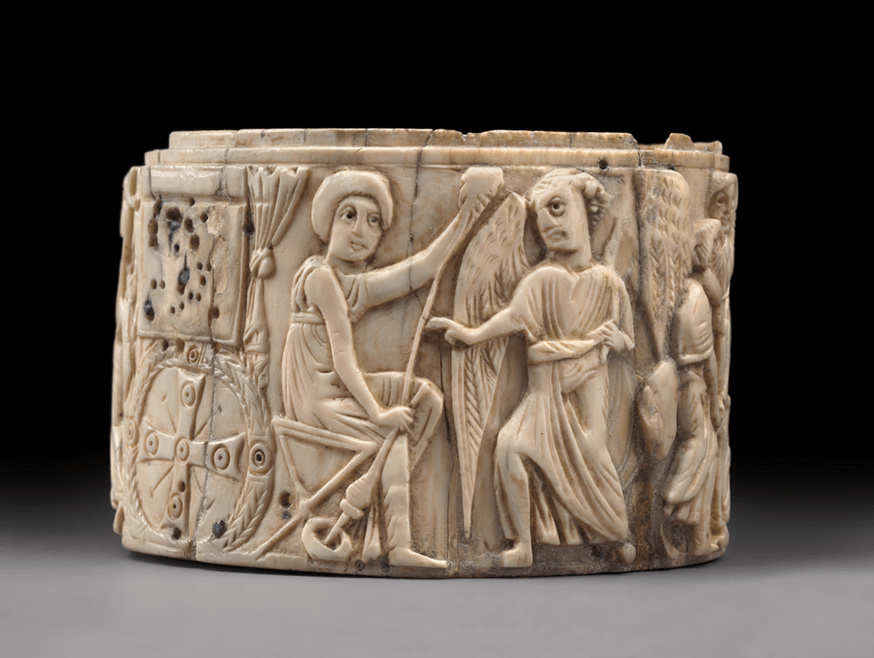
Pyxis with the Annunciation, Byzantine Empire (Minden?), 5th or 6th century. Ivory, height 7.9 cm, diameter 11.8 cm. Museum für Byzantinische Kunst, Bode-Museum, Staatliche Museen zu Berlin. [object record]
According to the Protoevangelium of James, an apocryphal infancy gospel from the second century, the Virgin Mary was raised in the Jerusalem temple from age three and was tasked with weaving the purple and scarlet thread of the veil that shrouded the holy of holies, the temple’s innermost sanctuary. One day while taking a break from this sacred labor to collect water from a well, the angel Gabriel approached her with a greeting: “Hail, favored one. The Lord is with you.” She looked around and saw no one, so she returned to her work indoors.
As she was engaged in her spinning, Gabriel reappeared and delivered the message he had been sent with: that Mary was chosen to bear the Son of God.
This account of the Annunciation gained special traction in the East, where the Virgin Annunciate is almost always shown with a spindle of scarlet thread in her hand, or less frequently, standing at a well—unlike in Western depictions, where she is typically shown holding a book.
The Byzantine art object pictured above is an ivory-carved pyxis (pl. pyxides), a cylindrical container used to store small items, such as jewelry or cosmetics. The Annunciation is one of three scenes represented, the other two being the Journey to Bethlehem and the Nativity (including Salome with her withered hand; see Prot. 19–20). The square to Mary’s left is where the lock case was originally mounted.
In the early fifth century, the prominent Byzantine theologian Proclus of Constantinople (ca. 390–446) developed Mary’s weaving into an extended theological metaphor of the Incarnation. He preached on Mary’s womb as a “workshop” containing the “awesome loom of the divine economy” on which the flesh of God was woven together, providing the bodiless divinity with form and texture. [1] “In the workshop of Mary’s womb, the vertical warp thread of divinity was bound to a weft of virgin flesh,” writes Fr. Maximos Constas (b. 1961), paraphrasing Proclus. [2]
Jesus’s flesh is a kind of clothing—the same we wear—made during Mary’s nine months of pregnancy:
The one who redeemed us was not a mere man. May this never be! But neither was he God denuded of humanity, for he had a body. And if he had not clothed himself with me, he could not have saved me, but in the womb of a virgin the one who pronounced the sentence against Adam clothed himself with me, who stood condemned, and there in her womb was transacted that awesome exchange, for taking my flesh, he gave me his spirit. [3]
Notes:
Nicholas Constas, “The Purple Thread and the Veil of Flesh: Symbols of Weaving in the Sermons of Proclus,” chap. 6 of Proclus of Constantinople and the Cult of the Virgin in Late Antiquity (Leiden and Boston: Brill, 2003), 317. The quotations are from Proclus’s Homily 1.I.21–25.
Constas, 357.
Proclus of Constantinople, Homily 1.VIII.122–27, qtd. Constas, 354.
I’m spinning the scarlet and purple—woman’s work But God is spinning the gold, I see Weaving a tiny thread like me Into the grand design to be The saving of the world
Chosen as the roving fiber—clean and combed Then dropped and spun and quickly wound Upon the spindle tightly bound To serve the One I’m wound around: The Savior of the world
Refrain: Son of the Most High, let it be, let it be Son of God, let it be, let it be to me
In the hands of the Master, I marvel at his ways He brings me into his weaving room My heart is stretched upon the loom The God-man knitted within my womb The Savior of the world [Refrain]
Bridge: First to hear, first to hear and believe First to love, first to love and receive The Son of God
Will they believe me? I wonder, who can say? But I will always answer yes Though a sword may pierce my breast The Father of my son knows best The Savior of the world [Refrain]
In “The Virgin, Spinning,” singer-songwriter Katy Wehr takes the weaving metaphor in a different direction than Proclus. Voiced by Mary, the song reflects on how God is weaving a grand tapestry of salvation, in which Mary is a thread.
Laura Lasworth (American, 1954–), Lily Among the Thistles, 2001. Oil on wood panel. From the Love’s Lyric series, based on the Song of Songs.
This still-life painting by Seattle-based artist Laura Lasworth shows a beautiful cut lily sharing a vase with a bouquet of twelve thorny, withered stems. The water in which they sit is red. The work’s title is taken from the Song of Songs 2:1–2: in Latin, “Ego flos campi, et lilium convallium. Sicut lilium inter spinas, sic amica mea inter filias,” or from the New Revised Standard Version:
I am a rose of Sharon, a lily of the valleys.
As a lily among brambles, so is my love among maidens.
While the Song of Songs, written in the wisdom tradition of Solomon, is first and foremost a collection of poems exploring the human experience of love and sexual desire, most Christians also interpret it as an allegory of the love between Christ and his church, or God and the individual soul. In that reading, Christ is the “lily of the valley” who speaks here.
Early Christian writers such as Origen, Hippolytus, Ambrose, Jerome, and Augustine associated the lily of Song of Songs 2:1 with Christ; in the Middle Ages, Venantius Fortunatus (ca. 530–610), Peter Damian (1007–1072), and Bernard of Clairvaux (1090–1153), among others, followed suit. I’m familiar with this floral metaphor for Jesus from a gospel song I grew up singing!
From the fourteenth century onward, in images of the Annunciation, Western artists commonly portrayed either a lily vase on a table, or the angel Gabriel presenting a lily to Mary. The lily became a symbol both Christological and Mariological, signifying the flowering of the Incarnation: God’s pure Son emerging from the virginal stem of Mary.
On December 10, Jonathan A. Anderson, a professor of theology and the arts at Regent College in Vancouver, gave the homily in chapel, using Luke 1:26–38 as his scripture text and exploring Lasworth’s Lily Among the Thistles in relation to it.
Thorns and thistles are an image of cursedness throughout scripture, starting in Genesis 3:17–18, Anderson points out. But in Lasworth’s painting, a lily rises up from the center of that cursedness. “If the thistles visually articulate the groaning of creation and the sorrows of humanity, the lily symbolically inaugurates a newness of life, somehow flowering right in the midst of this,” Anderson says. “The audacious proclamation of Advent is that the Son of God—the Creator and Healer of all things, our tree of life—was born into the brambles of human history and into the bloody heritages that still cry out daily from the ground.”
Anderson considers the polyvalence of Lily Among the Thistles:
In one sense, this is an icon of Christ’s appearance in human history. In another sense, this vase is also an individual heart—my heart, your heart—that has heard the Annunciation for itself amidst its own sorrows and deathliness. . . . Or we might also see this as an icon of creation, simultaneously groaning for the reconciliation of all things and blooming with new creation. And surely, it is an icon of the church, in which we harbor various fertility altars overgrown with thorns and thistles, and yet in which we are a people of the incarnation, people in whom new creation has begun, people through whom the light of the Spirit is already casting the shadows of the redemption of all things.
1. There sprang a Flower from out a thorn, To save mankind that was forlorn, As prophets spake before that morn: Deo Patri sit Gloria!
2. There sprang a well at Maid Mary’s foot, That turned all this world to good, Of her took Jesu flesh and blood: Deo Patri sit Gloria!
. . .
4. From diverse lands three kings were brought, For each one thought a wondrous thought, A King to find and thank they sought: Deo Patri sit Gloria!
5. Richly laden with gifts they fare, Myrrh, frankincense, and gold they bear, As clerks in sequence still declare: Deo Patri sit Gloria!
. . .
9. There shone a star in heaven bright, That the men of earth might read aright That this Child was Jesu, King of Might: Deo Patri sit Gloria!
This song is a choral setting by London-based composer Dominic Veall of a late medieval lyric that begins, “Ther ys a blossum sprong of a thorn”—or, as Jessie L. Weston modernizes it, “There sprang a Flower from out a thorn.” The recording omits stanzas 3, 6, 7, and 8, but you can read the full lyrics here. The Latin refrain translates to “Glory be to God the Father!”
DANCE: “I Wanna Be Ready”: The African American spiritual “I Wanna Be Ready” forms the soundtrack to this iconic solo from Alvin Ailey’s contemporary ballet Revelations. The dancer in this first video is Amos Machanic:
In 2018, in honor of the Alvin Ailey American Dance Theater’s sixtieth anniversary, Matthew Rushing, who is currently the company’s interim artistic director, traveled to Ailey’s birthplace of Rogers, Texas, to dance “I Wanna Be Ready” at Mount Olive Baptist Church, one of the few landmarks of Ailey’s childhood that’s still standing in Rogers. He was accompanied live by five local singers. The performance was filmed, edited, and released on YouTube.
I’m so excited that in January, for the first time, I’m going to see AILEY live in New York! The company will be performing three pieces, including the brand-new Sacred Songs, choreographed by Rushing.
+++
SONGS:
>> “Time Is Running Out” by Adoration ’N Prayze: Adoration ’N Prayze was a female gospel quartet from Detroit that was active in the early nineties, consisting of Damita Bass, Marguerita Bass, Pamela Taylor, and Shontae Graham (later replaced by Audra “Dodi” Alexander). This original song is the title track of their first and only album, released in 1991. The live recording is from a concert they gave at Clowes Memorial Hall in Indianapolis in 1992.
>> “Oil in My Vessel,” traditional gospel song performed by Rani Arbo & daisy mayhem: Rani Arbo & daisy mayhem are a New England–based folk quartet made up of Rani Arbo (fiddle, guitar), Andrew Kinsey (bass, banjo, ukulele), Anand Nayak (electric and acoustic guitars), and Scott Kessel (percussion). This song they perform is based on a recording by Joe Thompson (1918–2012), who was raised in a Holiness Church in Alamance County, North Carolina. Thompson said the song was in his church hymnal, and that he learned it from his mom when he was about five years old (in the 1920s). Its refrain is a statement of intent to “be ready when the Bridegroom comes,” and its stanzas are taken from the seventeenth-century hymn “Must Jesus Bear the Cross Alone?” by Thomas Shepherd and, from the eighteenth century, “Amazing Grace” by John Newton.
+++
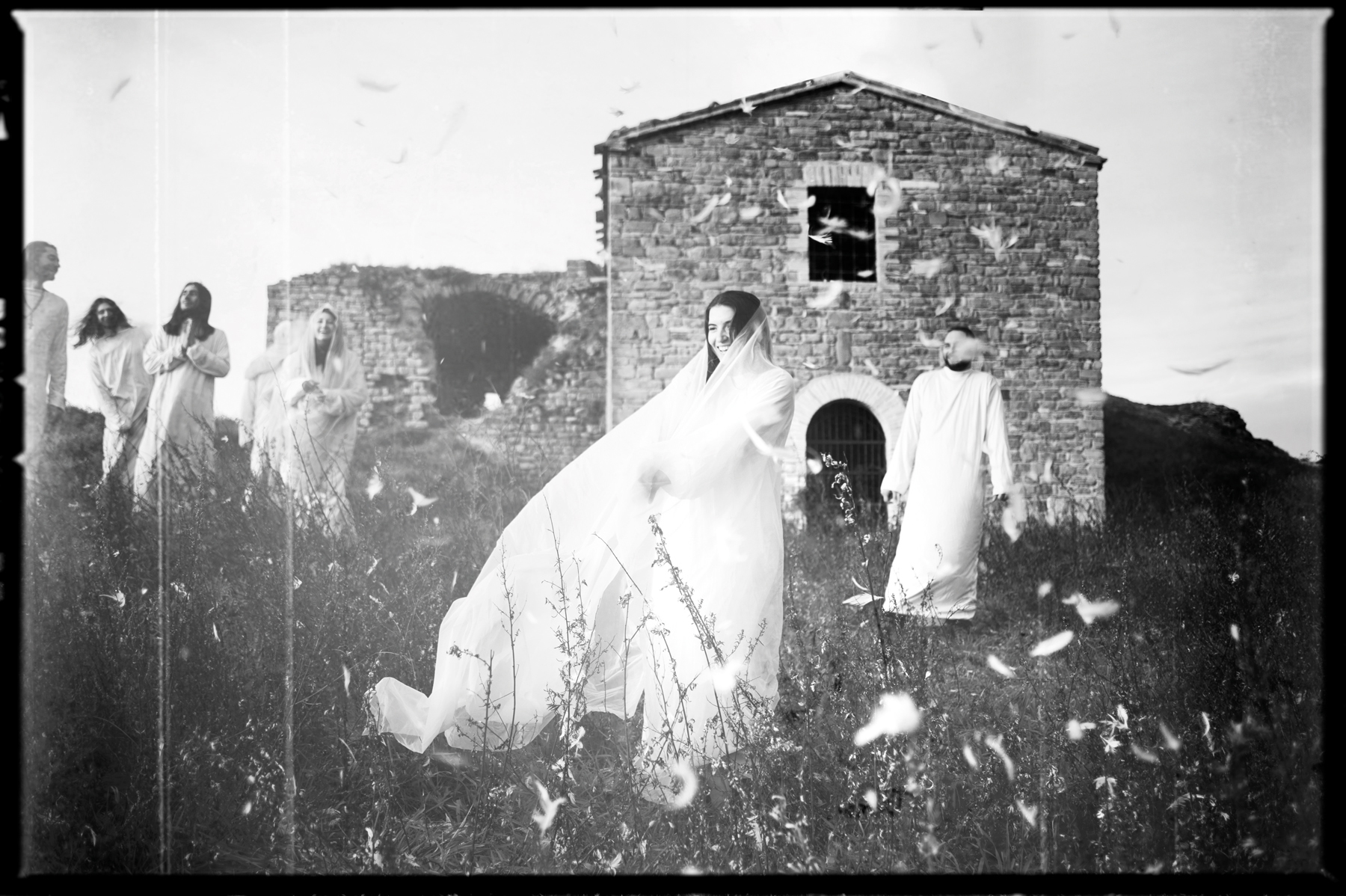
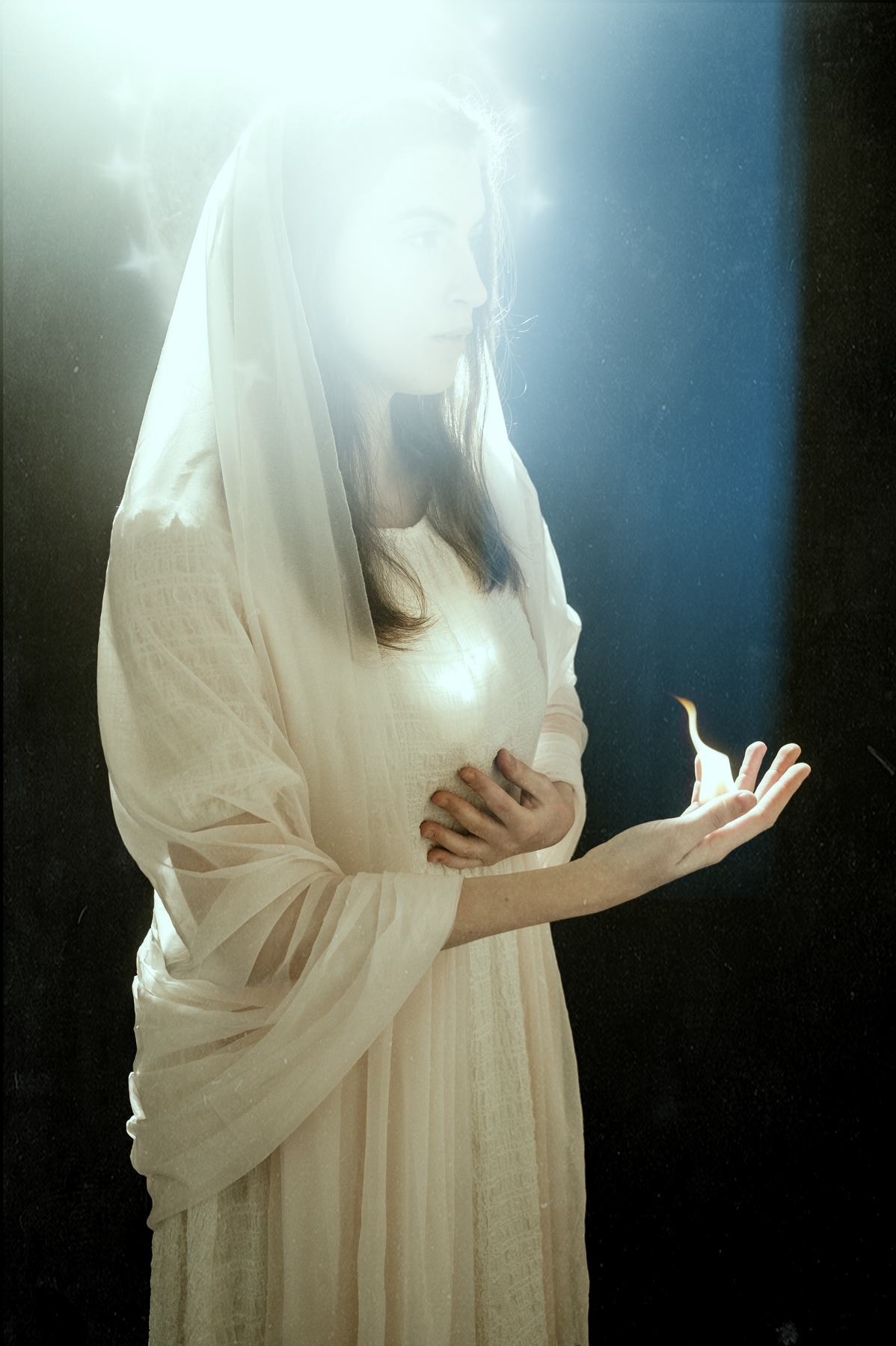
PHOTOGRAPH SERIES: Elogio all’Innocenza (In Praise of Innocence) by Gloria Mancini:Gloria Mancini is an Italian artist working mainly in photography. One of her recent series, divided into three parts, is based on Revelation 3:1–6 (Gli Innocenti, or The Innocents), 12:1 (La Donna Vestita di Sole, or The Woman Clothed with the Sun), and 5:1–7 (L’Agnello, or The Lamb). “Becoming small to become great has been the aim of my exploration of the Book of Revelation,” she writes in her artist’s statement. “Inspired by the visionary and magnetic power of the Kyrios (the Christ, the Lamb), I chose to focus my reflection on innocence as a fundamental and revolutionary value of being, reaffirming its virtue.” She says she is compelled by how in Revelation, it is a meek and vulnerable lamb who defeats evil.
Jesus’s message to the church in Sardis, a wealthy city in west-central Asia Minor, is so seldom (or not at all?) visualized in art history—I’m grateful to Mancini for drawing attention to this passage through her thoughtful work! Jesus tells the church to “wake up,” to “remember . . . what you received and heard; obey it and repent,” following the example of the few there “who have not soiled their clothes.” Those people, he says, “will walk with me, dressed in white, for they are worthy.” He admonishes the Sardis Christians to be watchful and to strengthen and perfect their good works so that they might conquer evil and their names be preserved in the book of life.
Mancini pictures the faithful remnant at Sardis praying, keeping watch, persevering in purity, and gamboling about in the life of the Spirit.
Gloria Mancini (Italian, 1992–), photograph from the Elogio all’Innocenza series, 2023Gloria Mancini (Italian, 1992–), photograph from the Elogio all’Innocenza series, 2023
The Woman Clothed with the Sun from Revelation 12, on the other hand, is widely represented in art, and since the twelfth century has been associated with the Virgin Mary, because the woman gives birth to a son who is pursued by the Dragon. In church tradition Mary is also likened to the burning bush in Exodus, because she bore the fire of divinity—God in Christ—within her but was not consumed. Mancini plays on both associations, showing Mary cautiously holding a flame, bringing it closer to her breast: she accepts the Incarnation and is set alight.
Gloria Mancini (Italian, 1992–), photograph from the Elogio all’Innocenza series, 2023
+++
ART SPOTLIGHT: “Yellow Silence: Miniature from the Silos Apocalypse (ca. 1100),”Public Domain Review: One of the most dramatic pauses in scripture comes about a third of the way through the book of Revelation. John has just described the nations’ loud and jubilant praises around the throne of God, and then he opens the next chapter, “When the Lamb broke the seventh seal, there was silence in heaven for about half an hour” (Rev. 8:1). This is the calm before the next storm of judgment breaks with the blowing of the seven trumpets, through which God purges the earth of evil.
While artists have historically relished the chance to visualize the rain of blood, fire, locusts, and such initiated by the trumpet blasts, the anonymous artist of a twelfth-century copy of an Apocalypse commentary from Spain saw fit to also visualize the sonic absence that preceded these spectacular occurrences. He did so with a rectangular swath of yellow.
Miniature from the Silos Apocalypse, northern Spain, 1091–1109. British Library, Add MS 11695, fol. 125v.
This swath calls readers to somber, speechless awe and reflection. God’s earlier word spoken to and through the prophet Zephaniah is appropriate here: “Be silent before the Sovereign LORD, for the day of the LORD is near” (Zeph. 1:7).
Click here to browse more images from the Silos Apocalypse.
Two women, both pregnant, greet each other—and an instantaneous bond is formed between and deep within them, confirming their identities as bearers of life. In this astonishing moment of communion, each is strengthened in her calling.
This is the story of Mary and Elizabeth, but it is also the story of each of us. Truth always encompasses both the particular and the universal—which is why the ancient biblical account stirs such deep chords when women hear it.
In Luke’s description of Mary’s visit to Elizabeth, profound joy is predicated upon fear. The angel has just announced to the younger woman that she is to give birth; and she has accepted God’s calling to a pregnancy out of wedlock, in ancient Judea a crime of adultery against one’s betrothed. The punishment for such a sin, as Mary would have known, was death by stoning. This cultural background gives pointed meaning to the report that Mary “went with haste into the hill country . . .” The image is not so much Christendom’s traditional view of a young mother-to-be paying a visit to a beloved kinswoman but of a terrified, unmarried woman (perhaps, indeed, only a teenager) fleeing for her life to the temporary asylum of a “safe house” in the hills. The aged Elizabeth, the woman whom Mary seeks out for comfort, protection, and advice, is herself caught up in tenuous circumstances: well advanced in years and beyond the biological age of childbearing, Elizabeth must certainly have had her own collection of fears and hopes about her forthcoming delivery.
Both are women on the fringe of their society. The stirring words recalling their encounter and the spark of Life that it caused to leap within them weave a story of hope overcoming deathly fear. It is a reaffirmation of the importance of our mutual support, our community as women, in enabling us to continue bearing life into the world.
Last summer my husband and I drove up to Chadds Ford, Pennsylvania, to see the Joseph Stella: Visionary Nature exhibition at the Brandywine Museum of Art, which ran June 17–September 24, 2023. (Before that it was shown at the Norton Museum of Art in West Palm Beach, Florida, and the High Museum of Art in Atlanta.) It was lovely! There’s an accompanying catalog still available.
Joseph Stella (1877–1946) was born in the mountain village of Muro Locano in southern Italy, near Naples, and immigrated to New York at age eighteen, becoming a US citizen in 1923. He traveled much throughout his life—between his native country and his adopted country, but also for extended stays in Morocco, Chad, Algeria, France, and Barbados. In Paris in 1911–12 he met many of the leading artists of the European avant-garde, including Matisse, Picasso, and Modigliani, and was exposed to the full range of developments in modern art—postimpressionism, Symbolism, fauvism, cubism, surrealism, futurism, dadaism.
Though Stella absorbed some of these influences, he never aligned with a single group or movement. Art historian Abram Lerner says Stella is difficult to pin down, describing him as “a multiple stylist of unusual scope and energy,” both a modernist and a traditionalist. [1] In terms of content, his oeuvre is divided fairly evenly between urban industrial subjects—his most famous paintings are probably those from his series on the Brooklyn Bridge—and joyful and abundant nature.
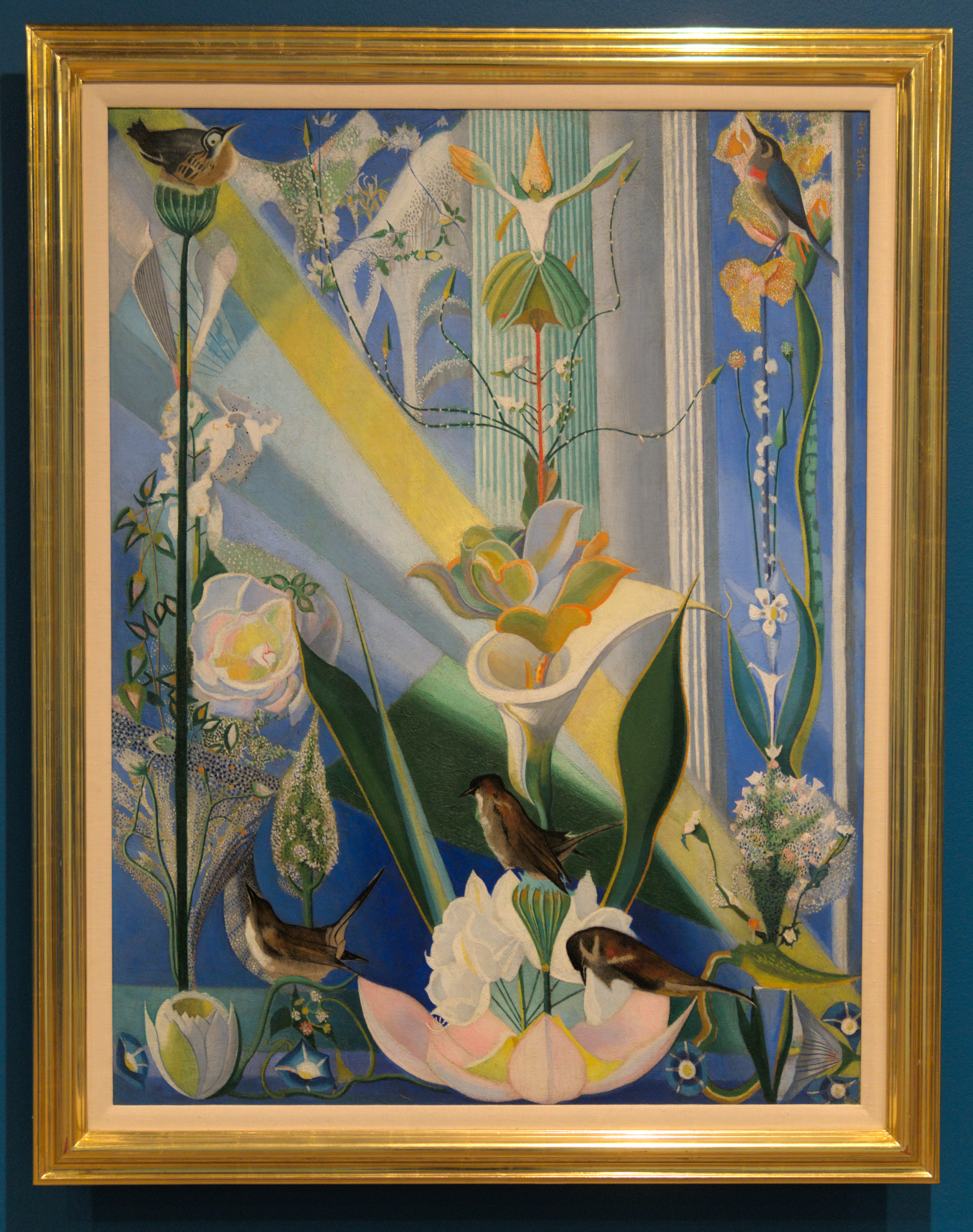
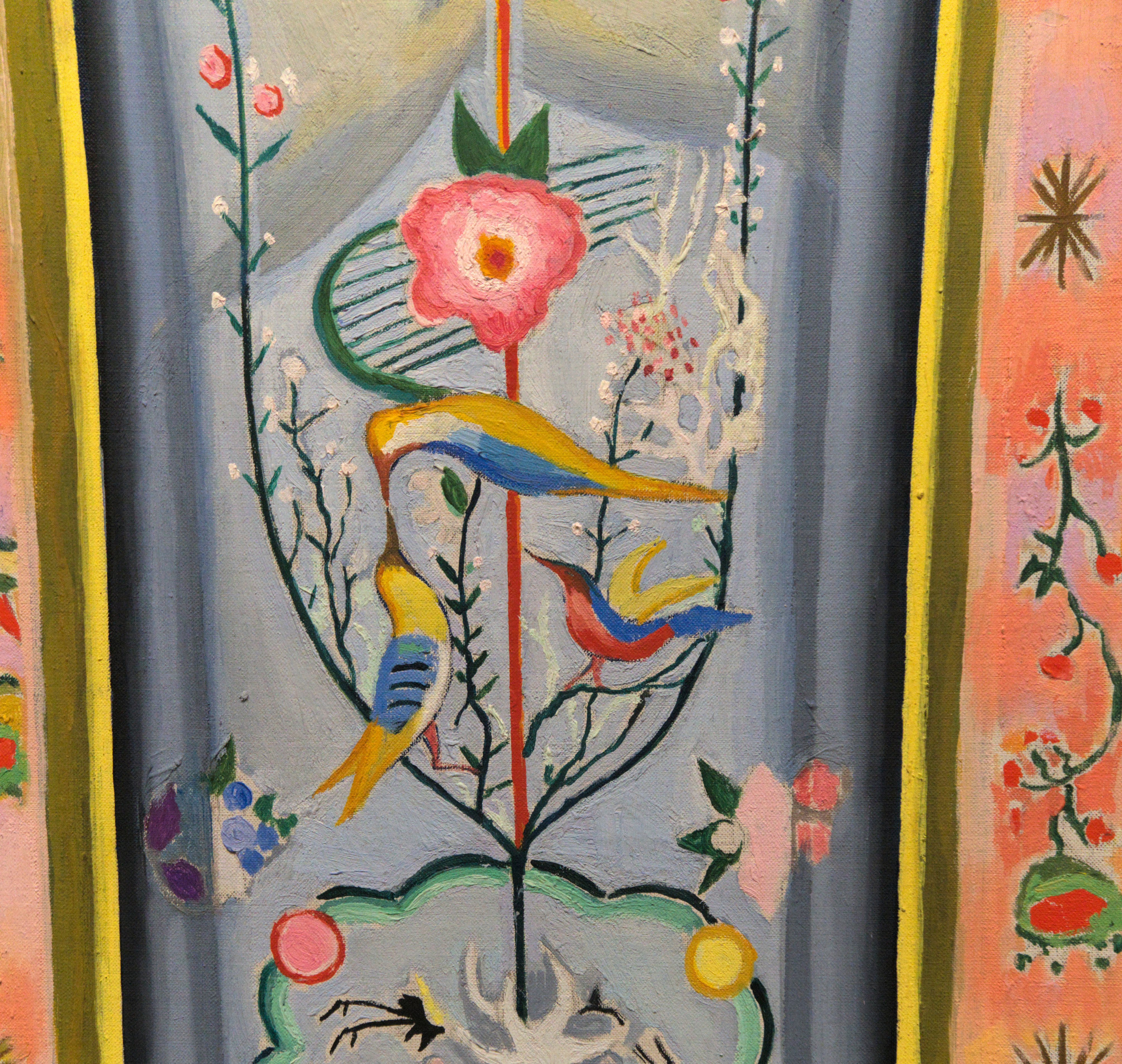
Joseph Stella: Visionary Nature, curated by Stephanie Heydt and Audrey Lewis, spotlights the latter. Many of Stella’s paintings feature birds and foliage hieratically positioned around a central axis, such as Dance of Spring (Song of the Birds).
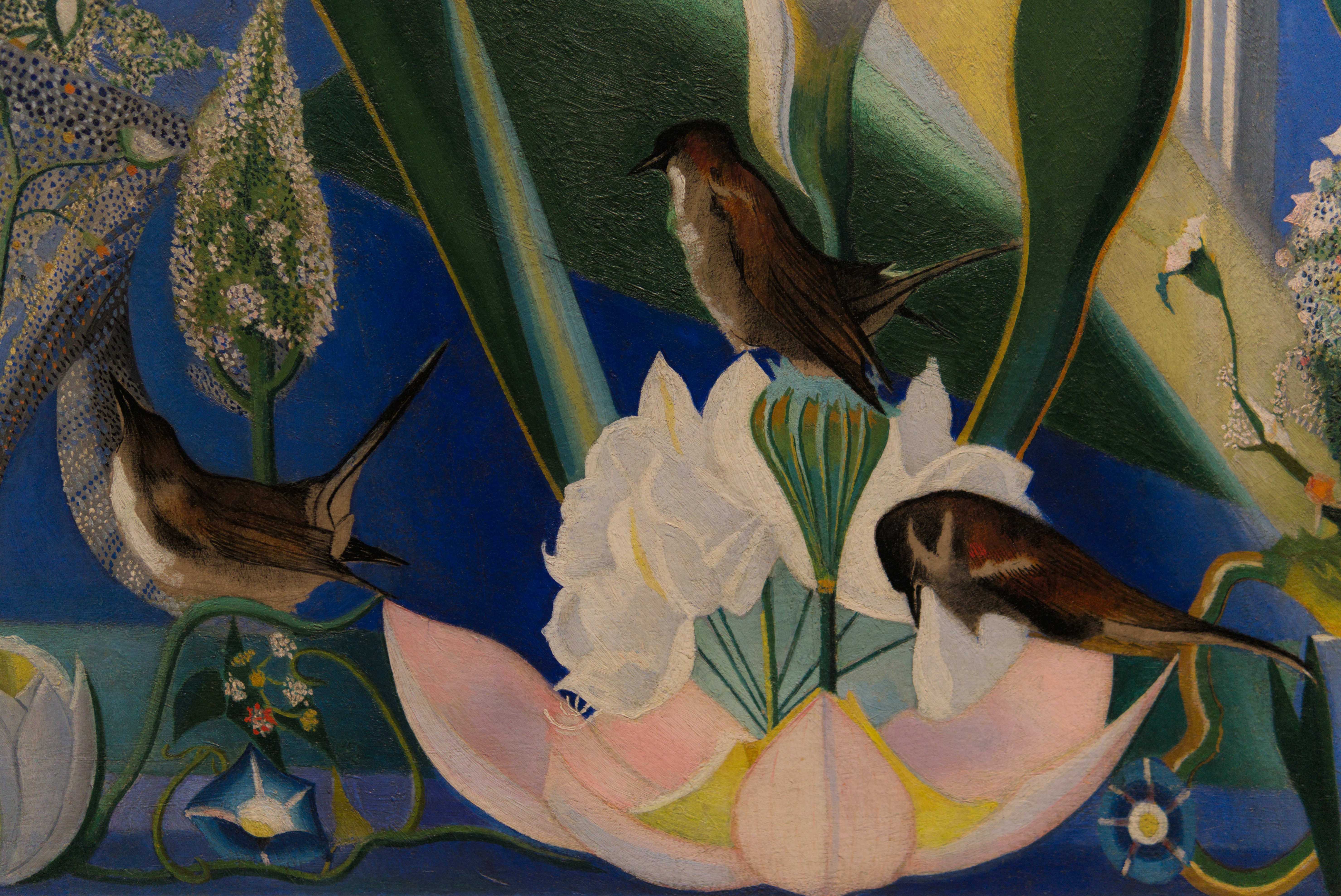
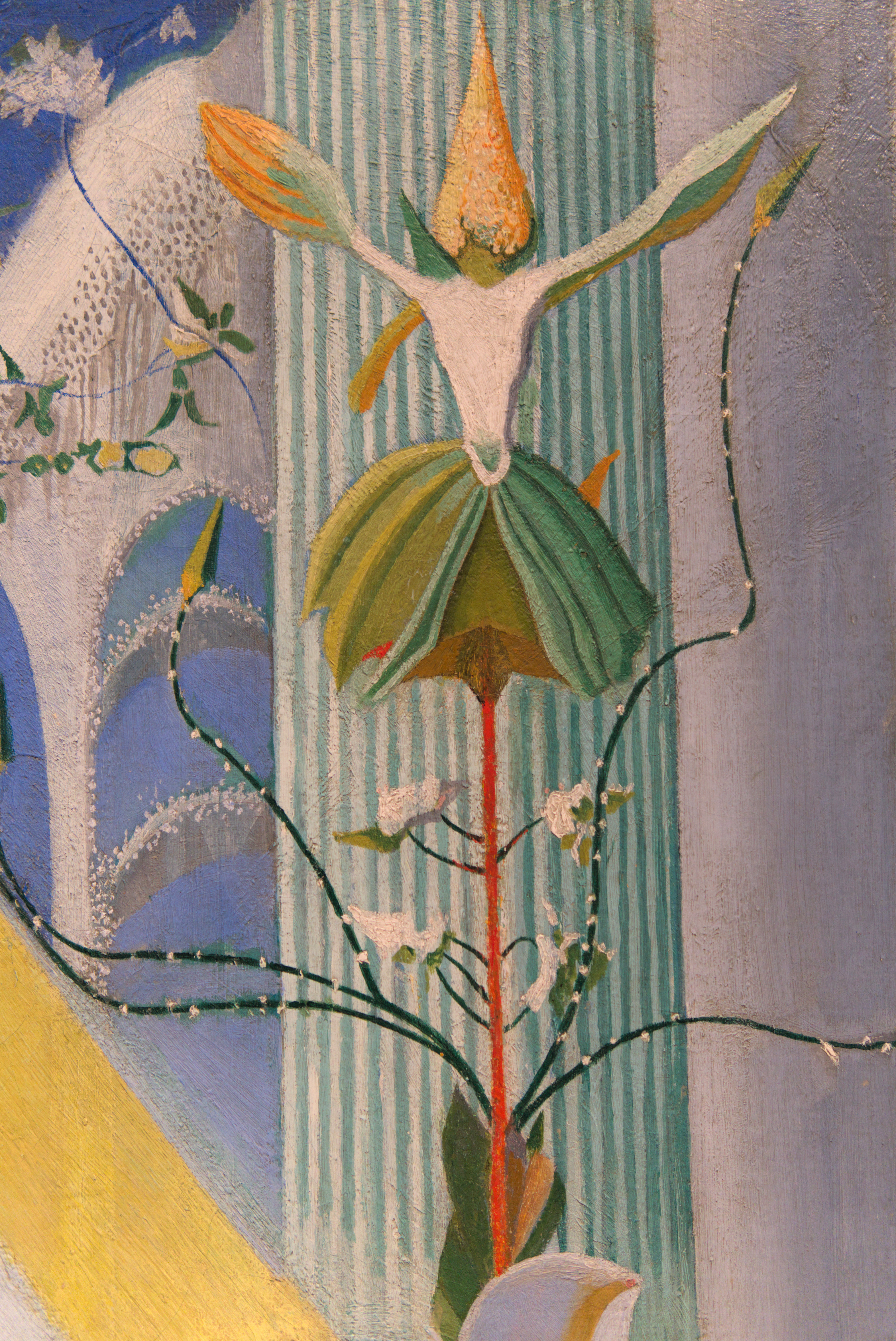
Joseph Stella (Italian American, 1877–1946), Dance of Spring (Song of the Birds), 1924. Oil on canvas, 42 3/8 × 32 3/8 in. (107.6 × 82.2 cm). Kemper Museum of Contemporary Art, Kansas City, Missouri. Photo: Victoria Emily Jones. [object record]Dance of Spring (Song of the Birds) (detail)Dance of Spring (Song of the Birds) (detail)
“Here,” reads the wall text,
Stella assembles a classical temple of flora and fauna—in his own words, culled “from the elysian lyricism of the Italian spring.” Flowers rise from a pink lotus at the base of a central column, culminating in the curious combination of lupine and a longhorn steer’s head flower, a floral form that resembles a bull’s skull. Below perch three sparrows, the national bird of Italy and a favorite of Stella’s.
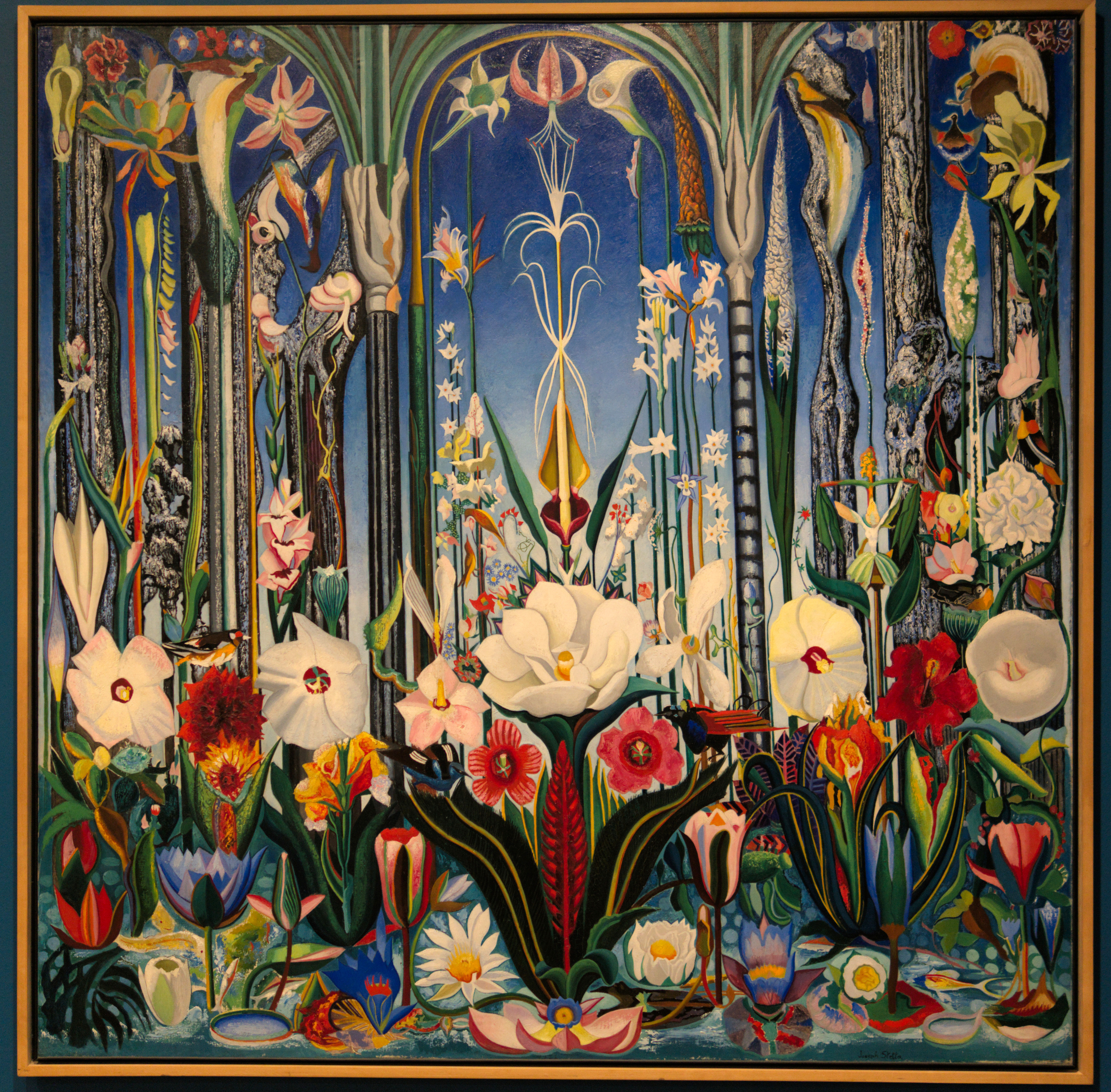
At over six square feet, Stella’s Flowers, Italy is an even more epic floral composition, a symphony of vitality and color.
Joseph Stella (Italian American, 1877–1946), Flowers, Italy, 1931. Oil on canvas, 74 3/4 × 74 3/4 in. (189.9 × 189.9 cm). Phoenix Art Museum, Arizona. Photo: Victoria Emily Jones.
From the wall text:
Order and symmetry are in constant tension with the spontaneity of organic ornamentation. The canvas overflows with colorful depictions of flowers and birds within a setting evoking Gothic architecture: pillars of gnarled tree trunks extend outward from the center, as if aisles of a cathedral. Lupine, gladiolas, and birds-of-paradise fill the vertical spaces with a spectrum of colors simulating stained glass windows. Like a congregation in the pews, a host of smaller flowers and plants are gathered below.
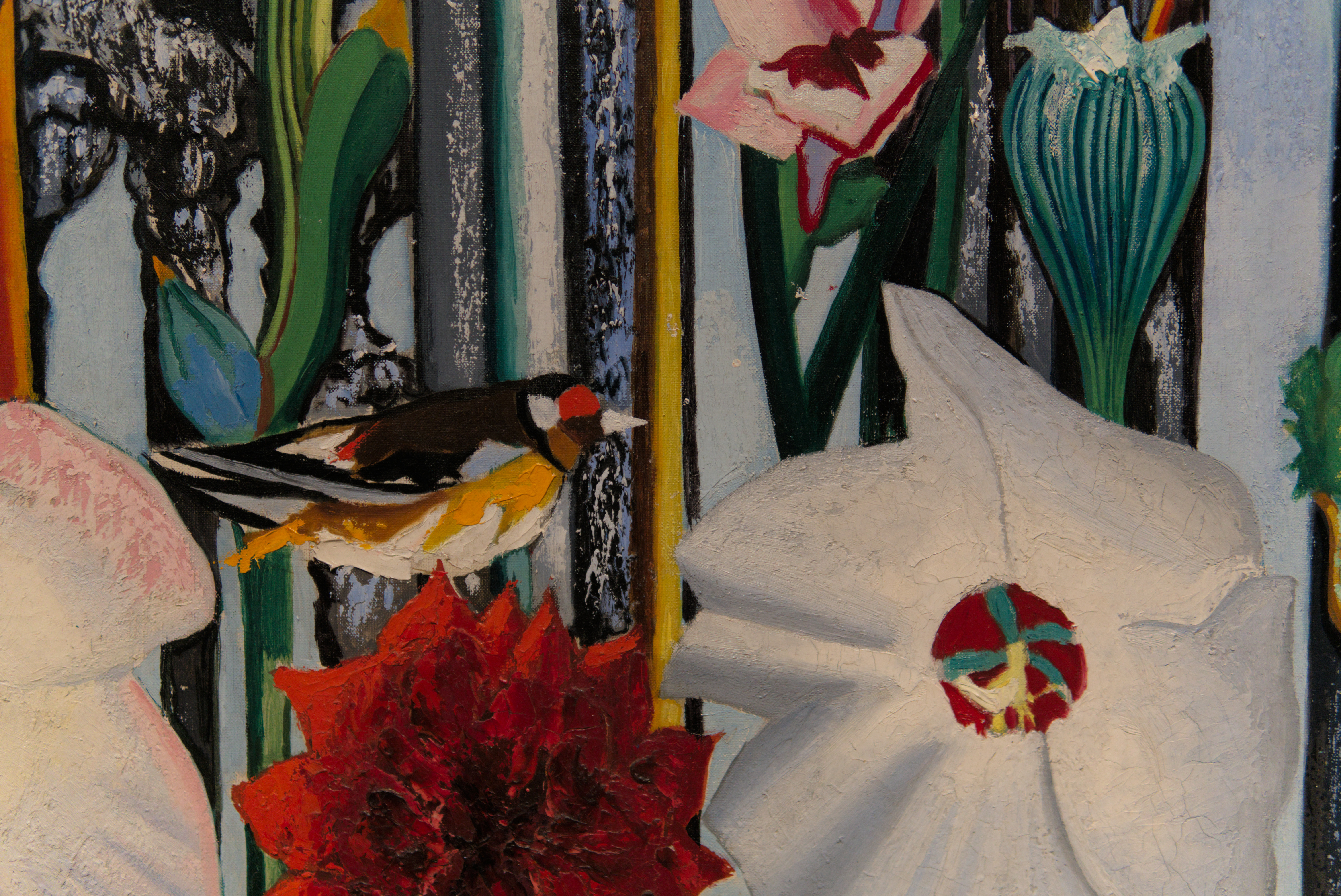
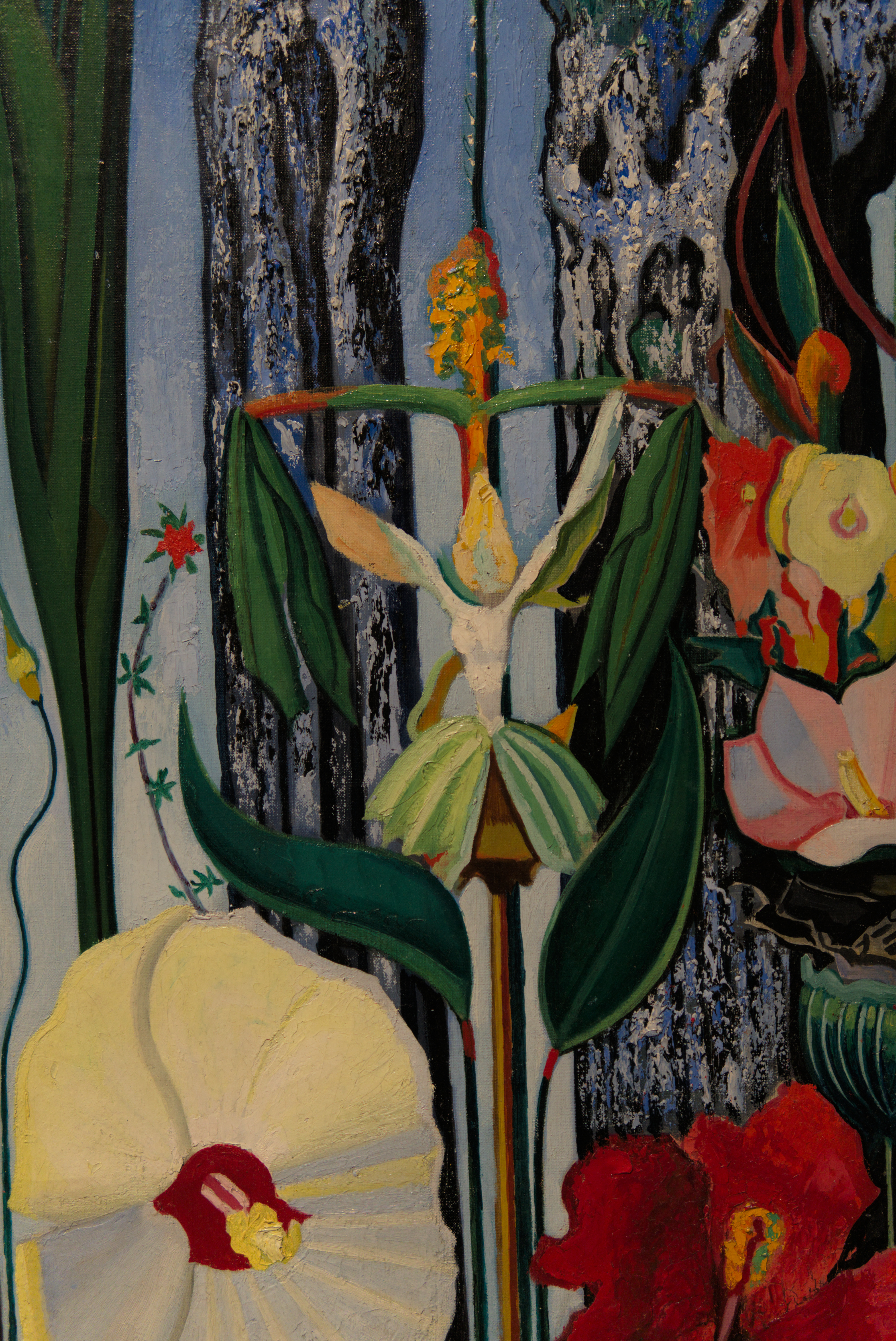
Flowers, Italy (detail)Flowers, Italy (detail)
Despite the title, the flowers depicted are not all native to Italy; Stella culled them from his world travels, and some are his own mystical inventions.
Stella sought to portray the voluptuousness and spirituality of his Italian homeland. He was raised in the Catholic faith, and although he didn’t practice as an adult, he remained proud of that heritage. Devotion to the Virgin Mary was a prominent aspect of his religious experience growing up, and in the 1920s he began painting a series of Madonnas, three of which were part of this exhibition.
Art historian Barbara Haskell identifies some of the artistic influences on these paintings:
The garlands of fruits and flowers that surrounded his Madonnas and their embroidered garments of lacy floral patterns recalled the work of the fifteenth-century Venetian Carlo Crivelli, while their impassive countenances, downcast eyes, and long, slim hands folded under translucent cloaks owed a debt to the Dugento masters Cimabue and Duccio. Yet Stella’s paintings were equally influenced by the flat, naive, and colorful images of the Madonna that proliferated in the popular devotional images and folk art of Southern Italy . . . in prayer sheets and books, scapulars, and ex-votos as well as in the profusion of silk and plastic flowers on altars and religious images. [2]
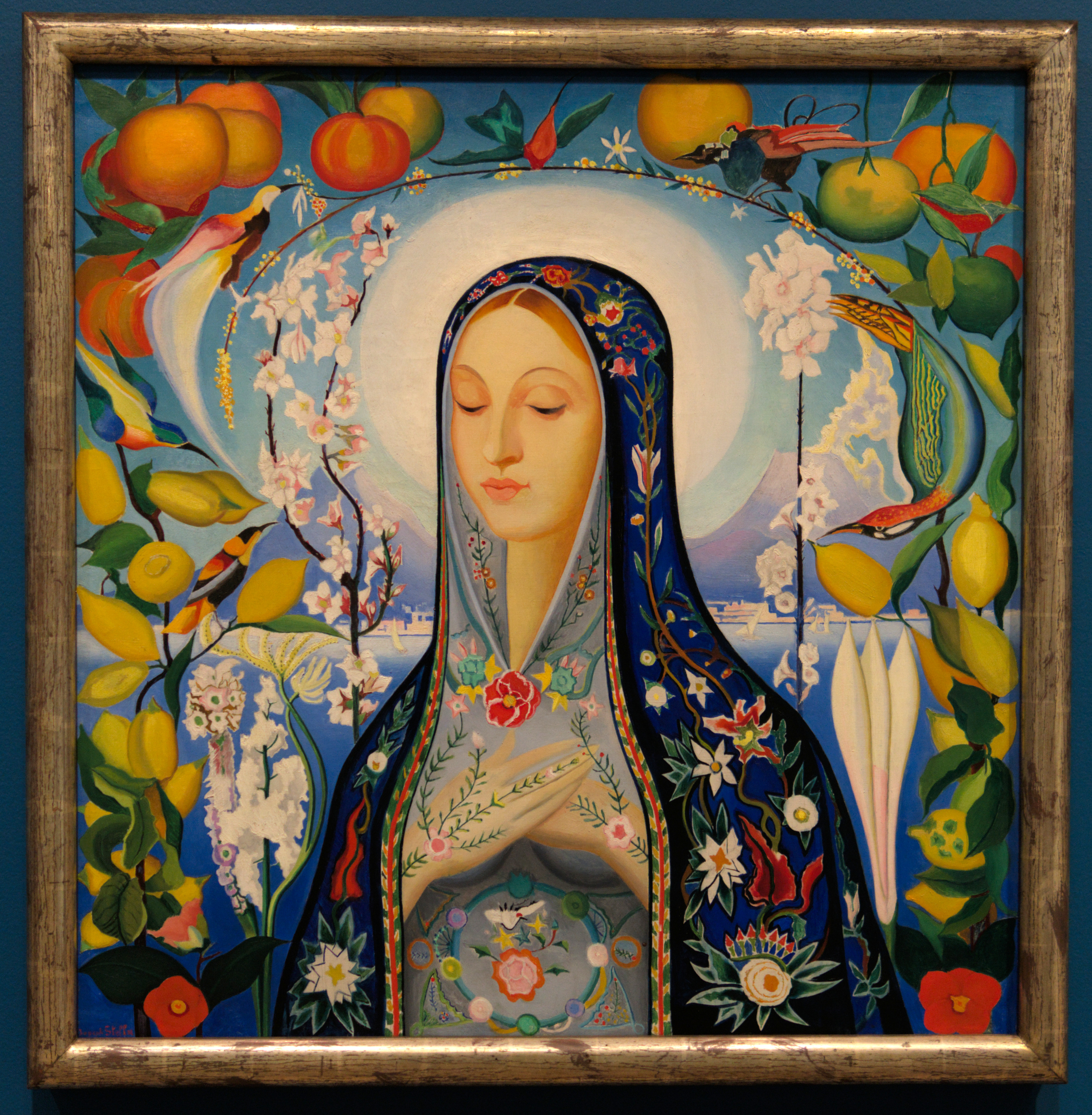
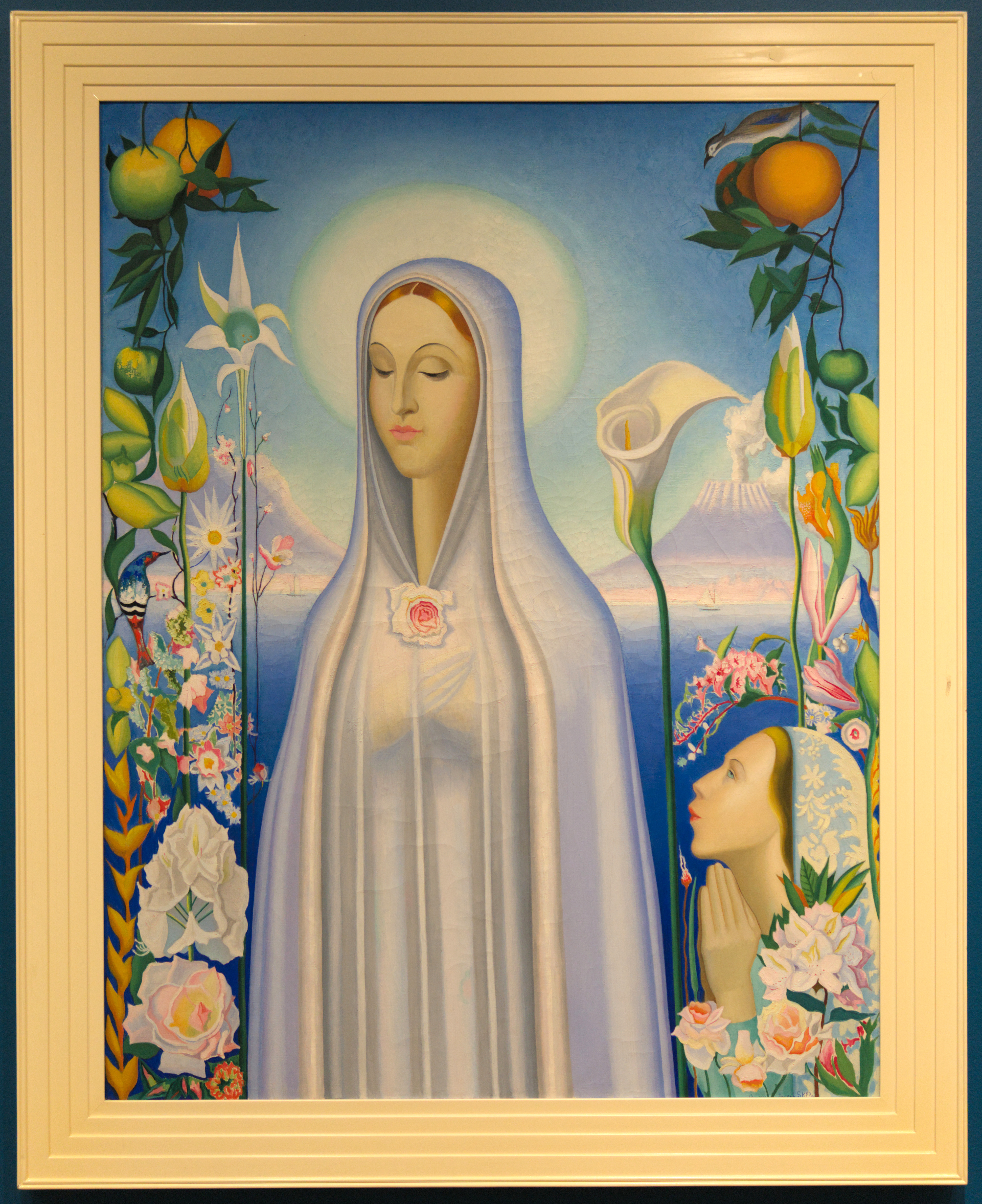
Joseph Stella (Italian American, 1877–1946), The Virgin, 1926. Oil on canvas, 39 11/16 × 38 3/4 in. (100.8 × 98.4 cm). Brooklyn Museum, New York. Photo: Victoria Emily Jones. [object record]
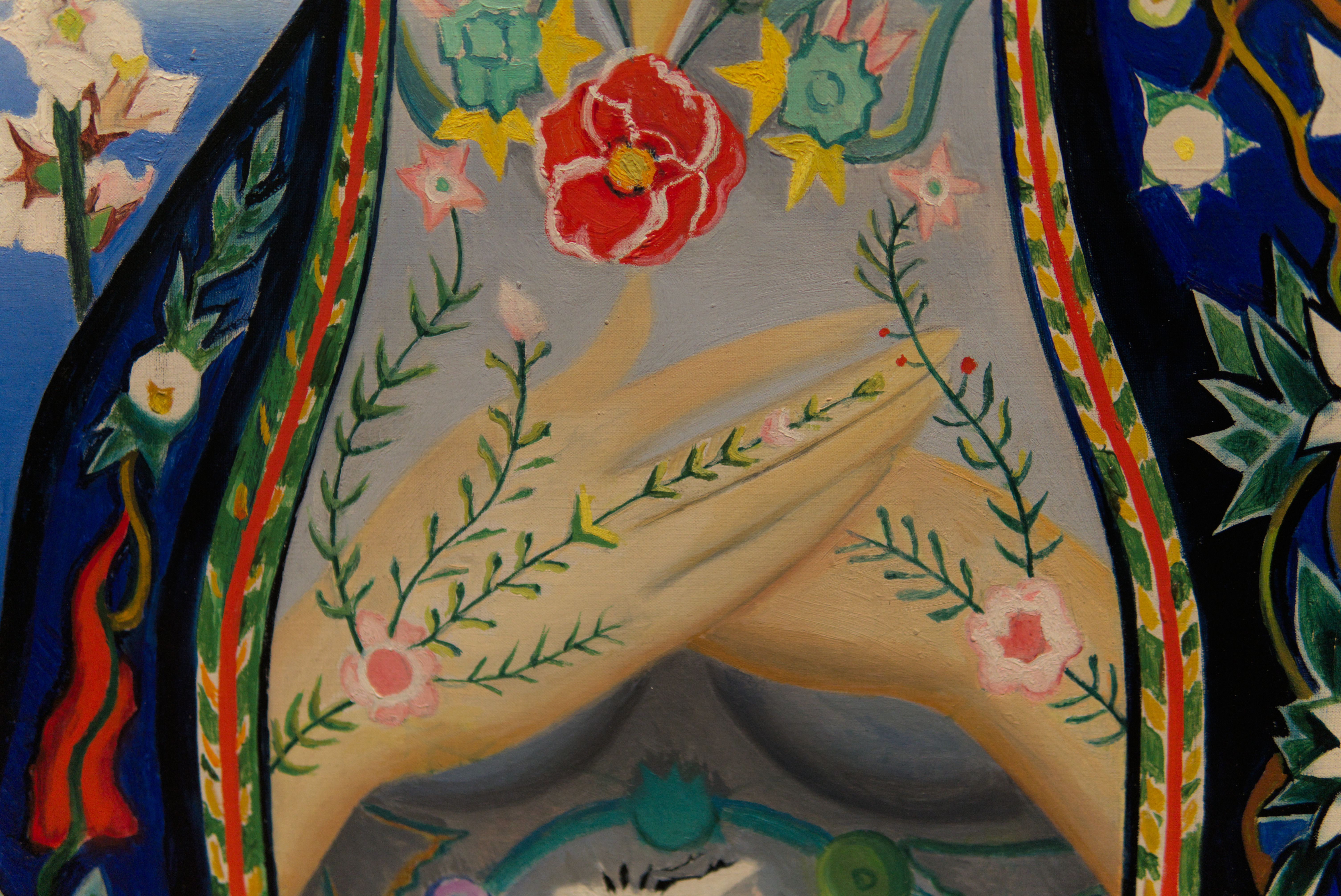
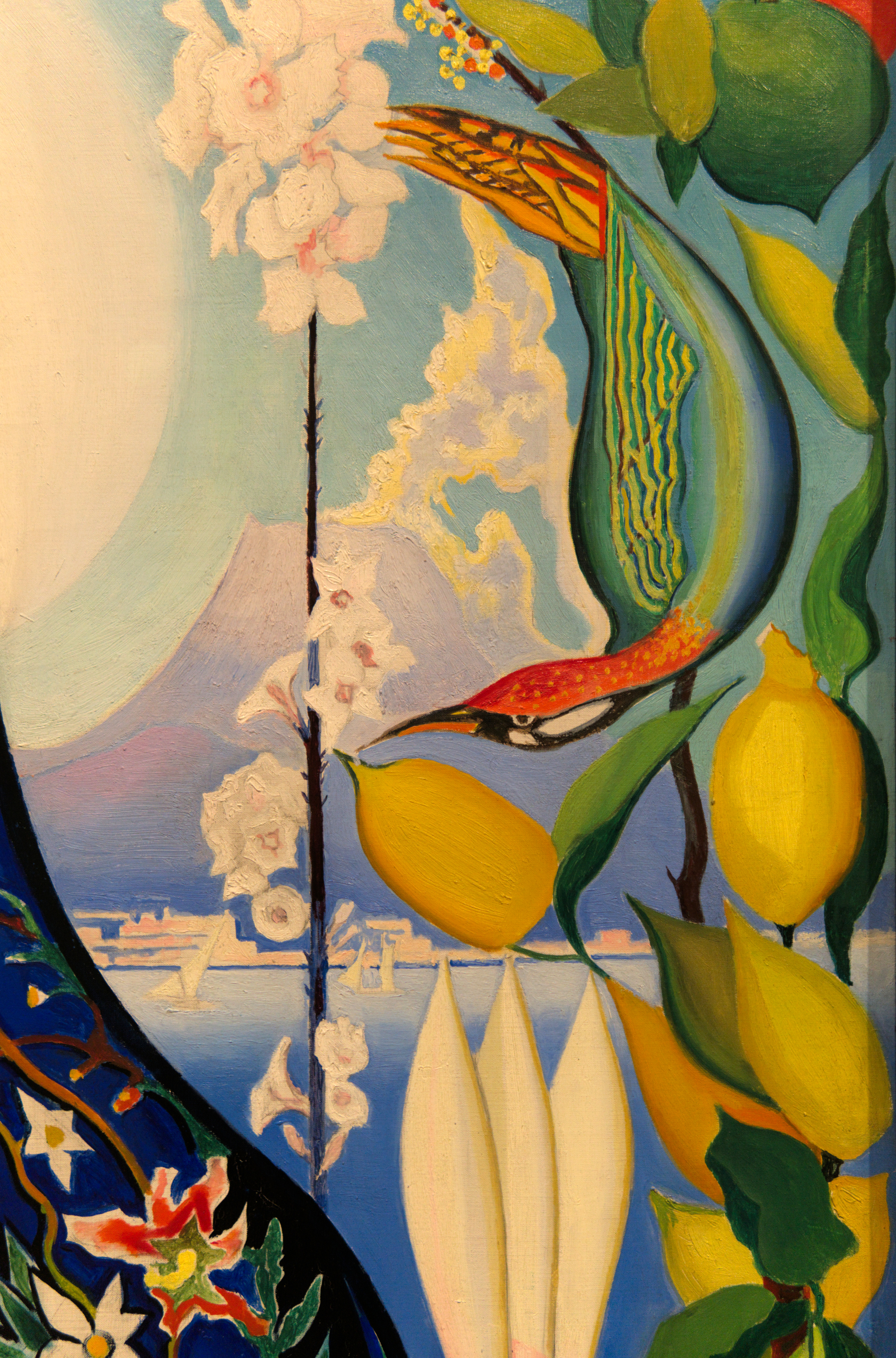
His 1926 Virgin from Brooklyn Museum is my favorite. It shows Mary enshrined among the fruits and flowers of the Mediterranean, with tendrils sweeping up and down her mantle and robe, adorning her neck like a necklace, sprouting out of her prayerful hands, and encircling the womb where she gestated Jesus. The Joseph Stella: Visionary Nature curators provided the following commentary in the wall text:
Eyes downcast and hands folded in a traditional Christian gesture of spiritual humility, Stella’s Madonna is set against the distinctive topography of Naples. Visible in the background is Mount Vesuvius, the smoldering volcano that erupted in AD 79 and a landmark of Southern Italy. The halo-like orb surrounding the Virgin’s head, seemingly nestled into the profiles of the mountains, transforms the modern Naples into a site of religiosity. Stella described “the Virgin praying [. . .] protected, on both sides, by almond blossoms, crowned above by the wreath of the deep and clear gold of the orange and lemon trees.”
Stella captures the wild beauty, the fecundity, the blossoming of Mary when the Holy Spirit plants his seed in her and she conceives God’s Word. Her acceptance of the divine call that the angel Gabriel relays to her produces life that redounds to all of humanity and indeed to the whole world. It’s why Mary’s cousin Elizabeth exclaims to her, “Blessed are you among women, and blessed is the fruit of your womb!” (Luke 1:42).
The Virgin (detail)The Virgin (detail)
There’s a long tradition in Christianity of describing Mary’s conception of Jesus as a flowering and of honoring her with flowers. I’m reminded especially of the twelfth-century mystic Hildegard of Bingen’s many hymns and antiphons that celebrate Mary in such terms.
Yes your flesh held joy like the grass when the dew falls, when heaven freshens its green: O mother of gladness, verdure of spring. [3]
Pierced by the light of God, Mary Virgin, drenched in the speech of God, your body bloomed, swelling with the breath of God. [4]
You glowing, most green, verdant sprout,
in the movement of the spirit, in the midst of wise and holy seekers, you bud forth into light.
Your time to blossom has come.
Balsam scented, in you the beautiful flower blossomed. [5]
The Brooklyn Virgin could be read as an Annunciation image, the Incarnation taking place inside this young woman who said yes to God. The sailboats on the sea, their movement reliant on the wind, may allude to the Holy Spirit who blew onto the scene in a major way in Luke 1 to move salvation history forward.
Joseph Stella (Italian American, 1877–1946), The Virgin (Virgin of the Rose and Lily), 1926. Oil on canvas, 57 1/2 × 44 3/4 in. (146.1 × 113.7 cm). Private collection, courtesy of Collisart, LLC, New York. Photo: Victoria Emily Jones. [object record]
The reference to outdoor religious processions with painted wooden Madonnas in southern Italy is more pronounced in Stella’s Purissima, in which the Mary figure, nearly life-size, is very stiff, statuesque. Co-curator Stephanie Heydt from the High Museum of Art introduces the work in this three-and-a-half-minute video:
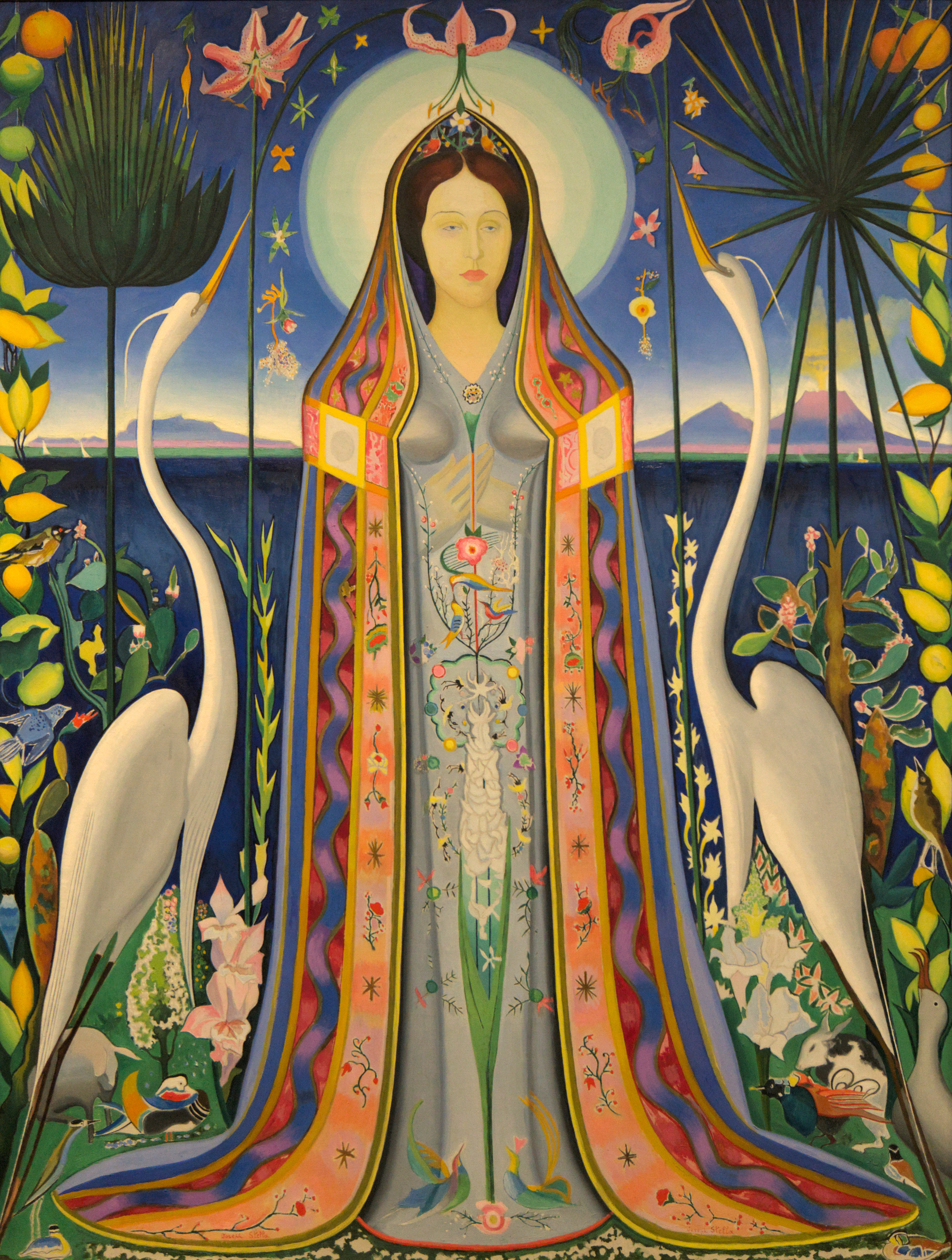
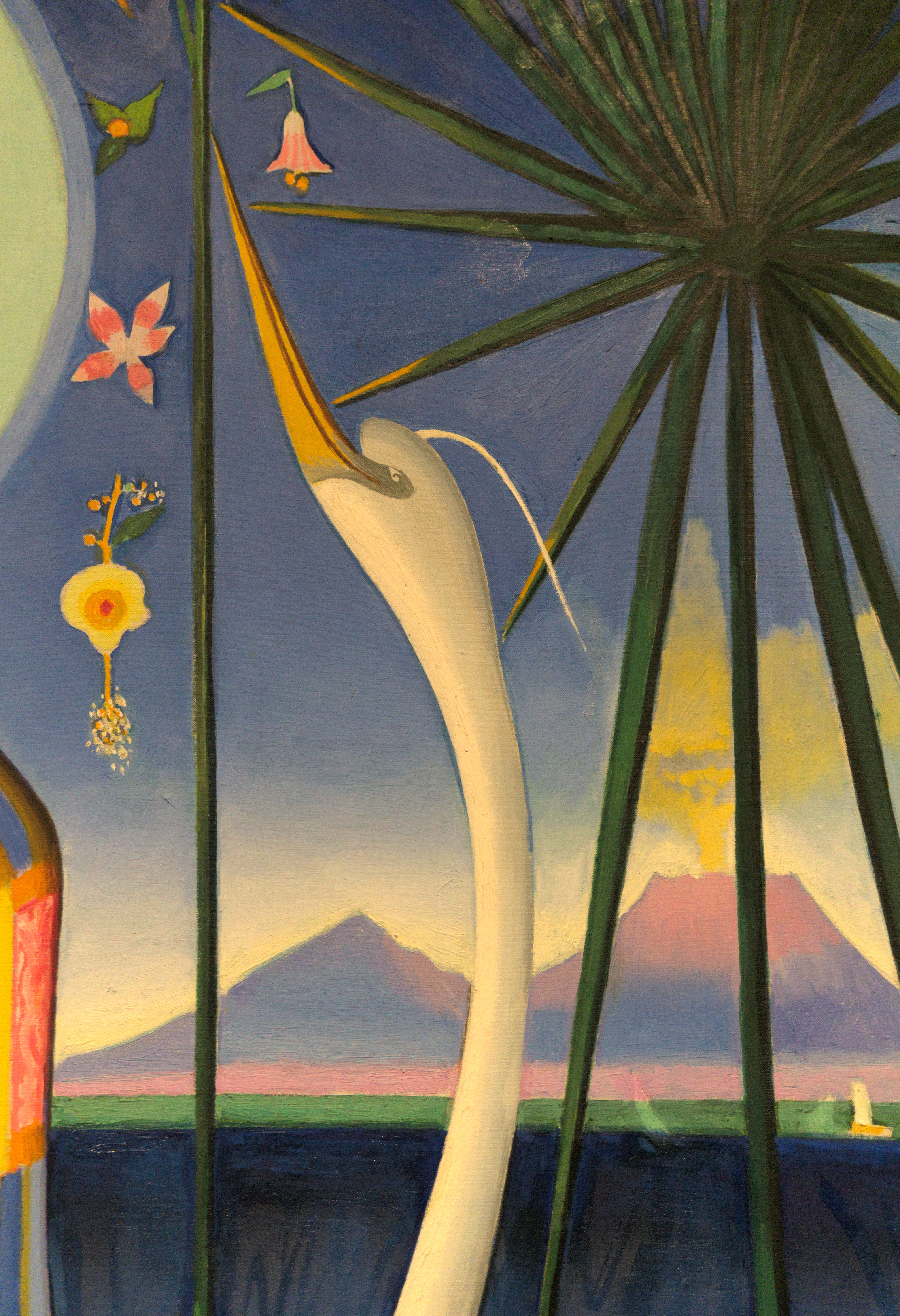
Joseph Stella (Italian American, 1877–1946), Purissima, 1927. Oil on canvas, 76 × 57 in. (193 × 144.8 cm). High Museum of Art, Atlanta, Georgia. Photo: Victoria Emily Jones. [object record]
“Mater Purissima” (Purest Mother), or “Virgo Purissima” (Purest Virgin), is one of Mary’s titles in Catholicism. The artist gave the following description of the painting:
Clear morning chanting of Spring.
BLUE intense cobalt of the sky—deep ultramarine of the Neapolitan sea, calm and clear as crystal—and alternating with zones of lighter blue, the mantle multicolored (an enormous lily blossom turned upside down).
SILVER quicksilver of spring water, quilted with the rose, green, and yellow of the gown—greenish silver, very bright—mystic DAWN-white—of the Halo.
WHITE as snow for the two herons, whose gleaming white necks enclose, like a sacred shrine, the prayer of the VIRGIN.
YELLOW very light—for the edges of the mantle—to bring it out clearly with diamond purity, and reveal the hard firm modeling of the virginal breast. The lines of the mantle fall straight over the long hieratic folds of the gown, forming a frame—and the full, resonant yellow of unpeeled lemons at both sides of the painting like echoing notes of the propitious shrill laughter of SPRING.
VIOLET mixed with ultramarine for the zigzag motif in the panel along the edge of the mantle, and bright, fiery violet at the top of Vesuvius, near the white fountainhead of incense—light violet tinged with rose, for the distant Smile of Divine Capri.
GREEN soft, tender, like the new grass—intense green for the short pointed leaves that enclose the lemons—and a dark green, both sour and sweet, for the palms that fan out at the sides like mystic garlands.
PINK strong—rising to the flaming, pure vermilion borders—of the Rose, brilliant as a jewel, in contrast to the waxy pallor of the hands clasped in prayer—and infinitely subtle, delicately modulated rose for the small flowers that with the others of various colors weave of dreams and promises and splendid bridal gown of the “Purissima.” [6]
Like his Brooklyn Virgin, this painting is also set in the Bay of Naples, with Mount Vesuvius gently erupting in the right background, and the island of Capri rising up out of the sea on the left.
Purissima (detail)Purissima (detail)
Three pink lilies create a frame around the Purissima, their long stalks rising up on either side of her, with one flower bending down to crown her head with its filaments and anthers. She is attended not by angels but by herons, along with other critters at her feet. This is a Madonna both earthy and supernal.
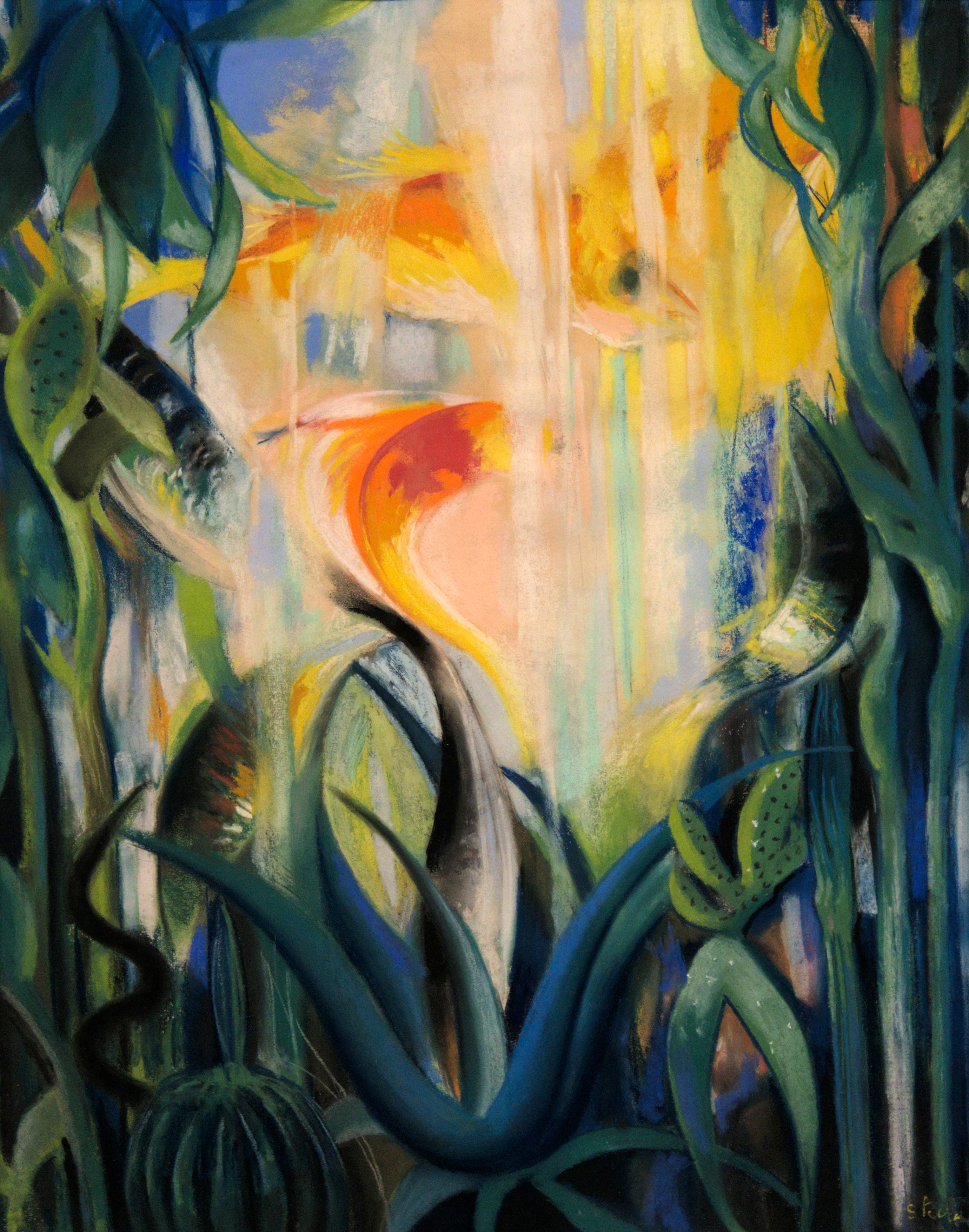
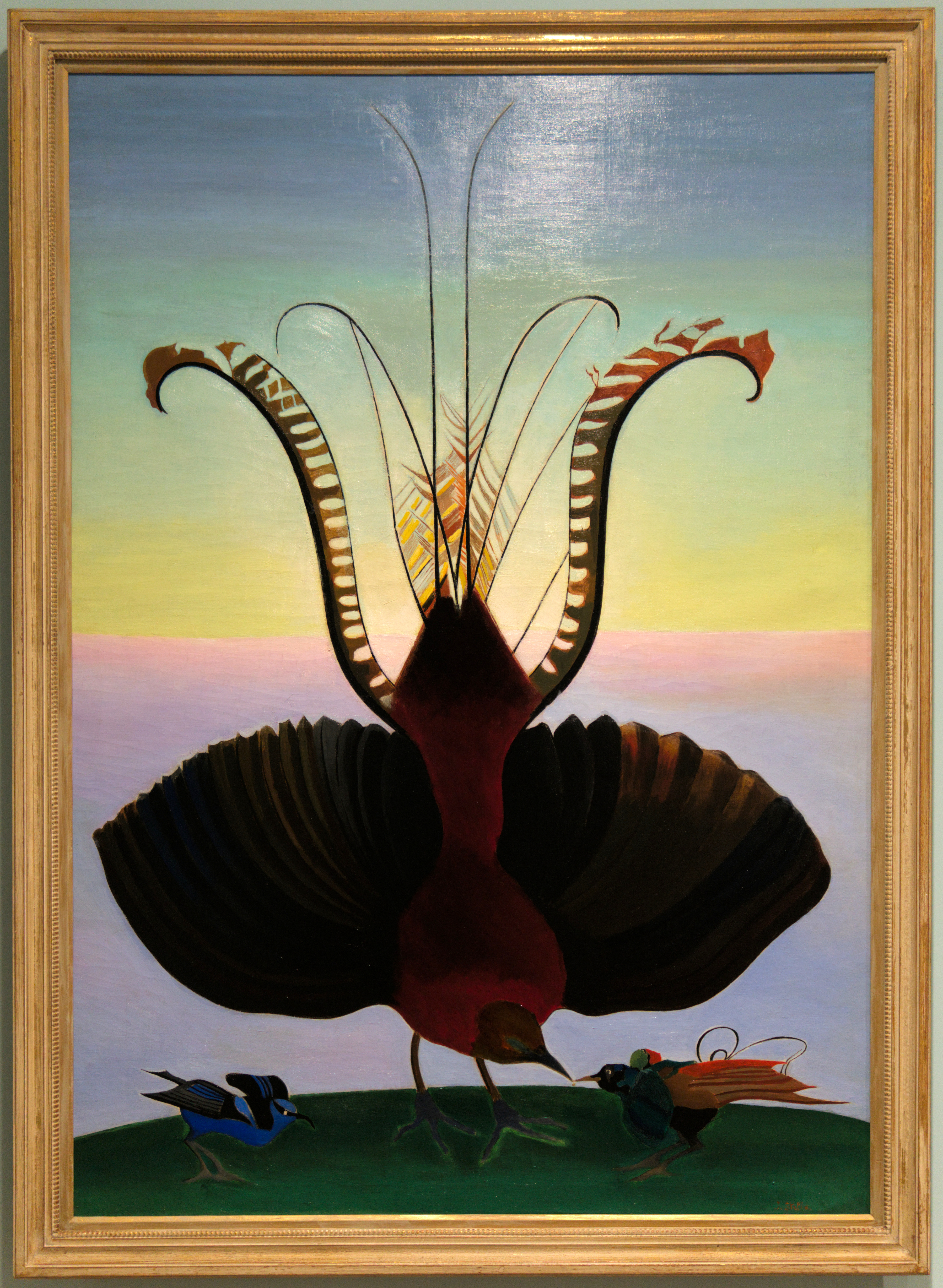
Here are a few more photos from the exhibition:
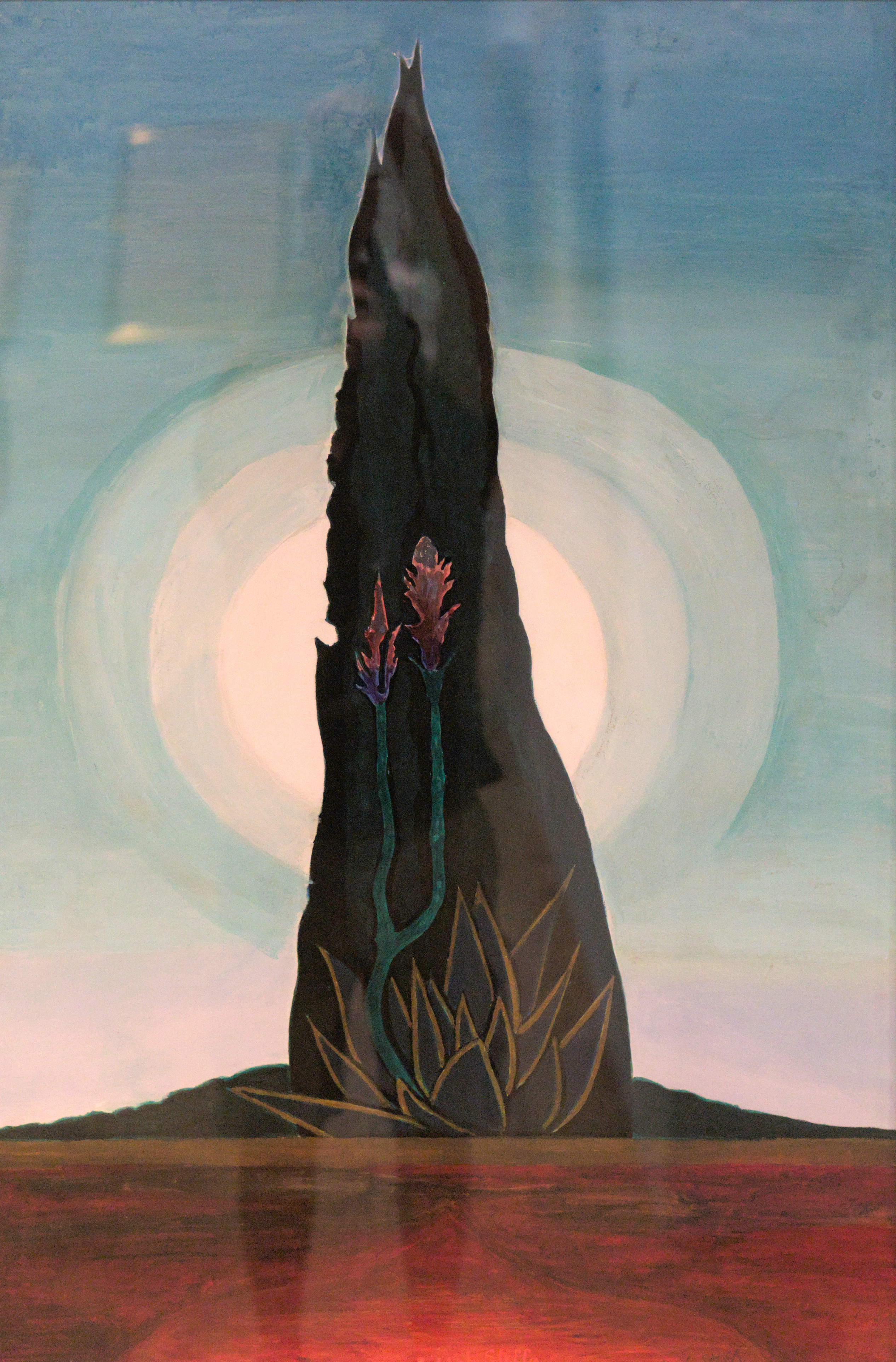
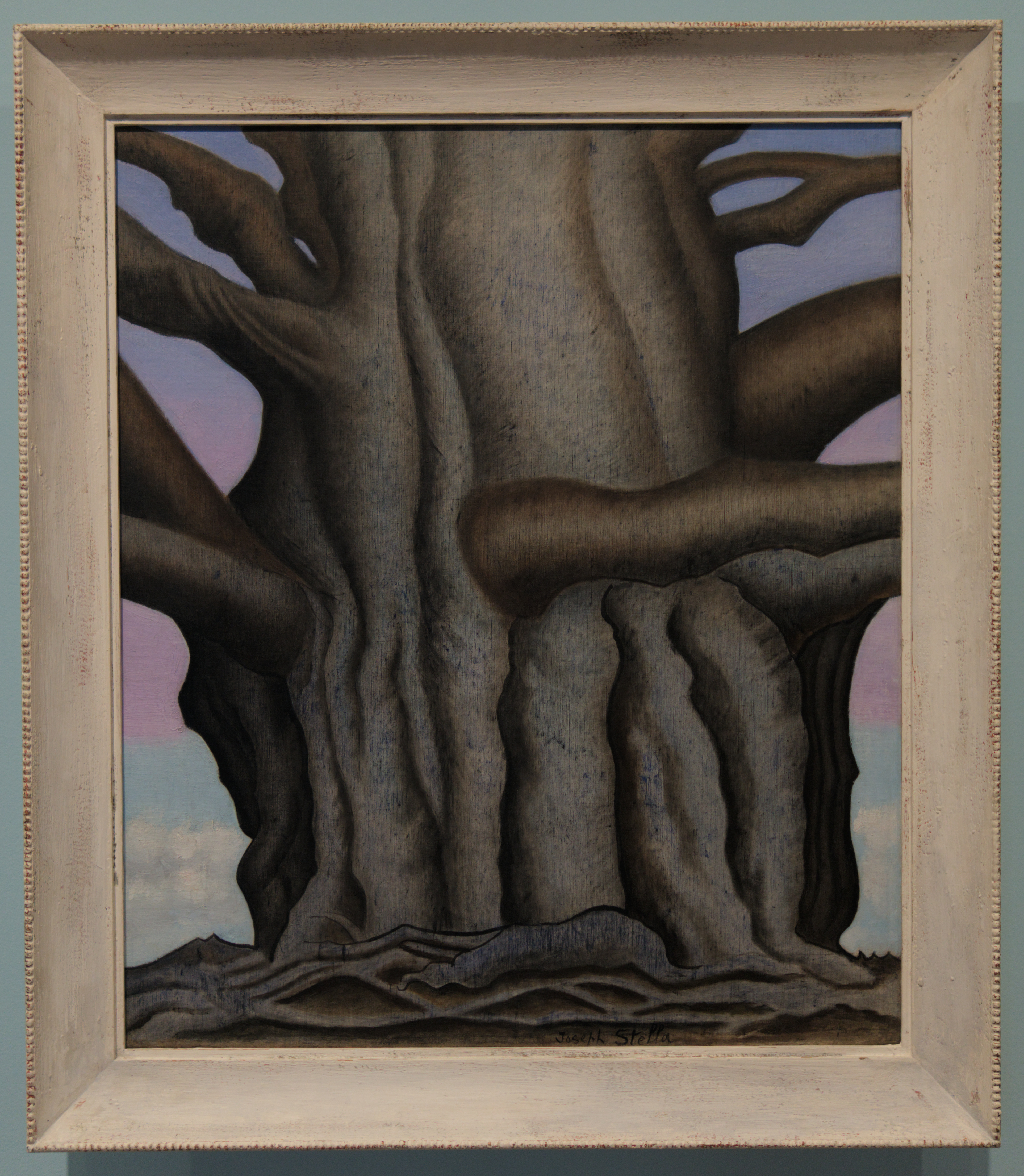
Joseph Stella (Italian American, 1877–1946), Aquatic Life (Goldfish), ca. 1919–22. Pastel on paper. American University Museum, Washington, DC. Photo: Victoria Emily Jones.Joseph Stella (Italian American, 1877–1946), Lyre Bird, ca. 1925. Oil on canvas, 54 × 30 1/8 in. (137.2 × 76.5 cm). Addison Gallery of American Art, Phillips Academy, Andover, Massachusetts. Photo: Victoria Emily Jones.Joseph Stella (Italian American, 1877–1946), Tree, Cactus, Moon, ca. 1928. Gouache on paper, 41 × 27 in. (104.1 × 68.6 cm). Reynolda House Museum of American Art, Winston Salem, North Carolina. Photo: Eric James Jones. [object record]Joseph Stella (Italian American, 1877–1946), Banyan Tree, ca. 1938. Oil on canvas, 36 1/2 × 31 1/2 in. (92.7 × 78.7 cm). Myron Kunin Collection of American Art, Minneapolis, Minnesota. Photo: Victoria Emily Jones.
1. Abram Lerner, foreword to Judith Zilczer, Joseph Stella: The Hirshhorn Museum and Sculpture Garden Collection (Washington, DC: Smithsonian Institution Press, 1983), 6.
2. Barbara Haskell, Joseph Stella (New York: Whitney Museum of American Art / Harry N. Abrams, 1994), 151.
3. From Hildegard of Bingen, “Hymn to the Virgin,” trans. Barbara Newman, in Symphonia: A Critical Edition of the “Symphonia armonie celestium revelationum” (Ithaca, NY: Cornell University Press, 1988, 1998), 123.
4. From Hildegard of Bingen, “Antiphon for the Virgin,” in Symphonia, 137.
5. FromHildegard of Bingen,“A Song to Mary,”rendered by Gabriele Uhlein, in Meditations with Hildegard of Bingen (Rochester, VT: Bear & Co., 1983), 119.
6. English translation from Irma B. Jaffe, Joseph Stella (Cambridge: Harvard University Press, 1970), 99–100. For the original Italian, see appendix 1, #29.
Since the Middle Ages, the Roman Catholic Church has celebrated May, a time of new growth, as “Mary’s month.” The calendrical placement of this celebration probably has to do in part with the fact that the ancient Greeks celebrated a festival to Artemis, the goddess of fecundity, in May; the ancient Romans, Flora, the goddess of flowers and spring. Because Mary, by the power of the Holy Spirit, conceived in her womb and brought to birth the life of the world, Jesus Christ, Christians see her as standing at the threshold of an eternal springtime.
POLL QUESTION: Before moving on to the six roundup items below, if you are a regular reader of this blog or other media like it, would you please help me out by answering the following poll question? (I’m trying out this WordPress feature for the first time!) Over the years I’ve gathered a lot of compelling poems and artworks on the Annunciation, encompassing a variety of eras, styles, and perspectives, and I’d like to pursue the idea of turning one or the other, or both, into a book. Which kind of Annunciation-themed book would you be most inclined to buy? Keep in mind that a book with art would cost significantly more because it would be in full color and probably a larger hardcover. Also note that a book that combines art and poetry would obviously have fewer selections of each than a book dedicated fully to one or the other.
+++
UPCYCLED MARY STATUETTES:Soasig Chamaillard is a French artist who, since 2006, has been acquiring small, damaged statues of the Virgin Mary—either from garage sales or received donations—and restoring and transforming them, often with reference to children’s toy lines and media franchises, comic book heroes, or other pop-culture icons. Some are silly or irreverent; others, merely quirky. Here are two I like, which both modernize Mary, by her dress or her reading material. Click on the images to view detail photos of the final product, and see here and here for blog posts that document the transformation process.
Before/After. Right: Soasig Chamaillard (French, 1976–), Jeans-Marie (Jeans Mary), 2015. Plaster, acrylic paint, resin, metal frame, height 48 cm.Before/After. Right: Soasig Chamaillard (French, 1976–), Nouvelle Bible (New Bible), 2008. Plaster, acrylic paint, resin, digital print, height 40 cm.
The first shows Mary in high-waisted jeans and red Converse high-tops with rosettes on the tongues. The second one, a Madonna del Parto, shows her pregnant and reading the book J’élève mon enfant (Raising My Child) by Laurence Pernoud, picking up tips on being a new mom.
+++
ESSAY: “Mary: Evolution of a Bookworm” by Joel J. Miller: “It’s unlikely the historical Mary could read at all, but medieval Christians transformed her into an icon of literacy,” often showing her with a book in hand, whether as a child learning to read from her mother, Saint Anne; at the Annunciation, with the book of Isaiah, the Psalter, or a book of hours splayed open on her lap; or teaching her own child, Jesus, how to read. Drawing on the research of Laura Saetveit Miles, author of The Virgin Mary’s Book at the Annunciation: Reading, Interpretation, and Devotion in Medieval England [previously], Joel J. Miller discusses how images of Mary reading “rode a wave of rising female literacy and simultaneously encouraged its expansion.”
Ivory plate of the Annunciation from the Brunswick Casket, made in Metz, France, ca. 860–70. Herzog Anton Ulrich Museum, Braunschweig, Lower Saxony, Germany. This is the earliest known representation of the Virgin Mary with a book at the Annunciation.Lorenzo Costa (Italian, 1460–1535), Annunciation (Mary Reading), first third of 16th century. Oil on panel, 62 × 60.5 cm. Gemäldegalerie Alte Meister (Old Masters Picture Gallery), Dresden, Germany.
+++
CONVERSATION: “Sacra Conversazione” with Walter Hansen and Bruce Herman: In this written conversation from Image no. 62, artist Bruce Herman [previously] and patron Walter Hansen discuss the two large altarpieces Herman produced comprising six paintings on the life of the Virgin Mary: Miriam, Virgin Mother and Second Adam. The article is about the creative process and Herman’s collaboration with Hansen and with student apprentices in Orvieto, Italy, but it’s also about attempting to recover Mary’s image from a heap of the saccharine or overly exalted on the one hand, and ironic detachment on the other. Herman says,
I had vivid memories of Boston art critics and museum people back in the 1980s telling me that [religious] subject matter could only be approached ironically, but I had a persistent feeling that they were wrong. I’ve sensed for many years that the tradition of biblical imagery in art is far from exhausted—maybe simply stalled out due to loss of nerve or imagination. To me, much of the recent religious imagery we’ve inherited is fairly shallow. I know this might sound odd, given more than a thousand years of tradition, but I honestly believe that new insights are arrived at in every generation. Why can’t a contemporary artist paint the Virgin Mary without irony—and maybe even specifically attack the problematic nature of much Marian imagery? Why can’t a century of experimentation in painting yield something relevant to that tradition?
It’s an excellent conversation! You may have to subscribe to Image journal to access it, but it’s well worth it for all the wonderful content they put out quarterly and access to their archives.
Bruce Herman (American, 1953–), Miriam, Virgin Mother, 2007. Oil on wood with silver and gold leaf, 95 × 154 in. (241.3 × 391.2 cm).
Read more about the two altarpieces and view more photos at www.bruceherman.com/magnificat, and in the beautifully produced catalog magnificat, with a foreword by Hansen and essays by Rachel Hostetter Smith and John Skillen. The book also features four paintings from Herman’s related Woman series.
+++
ART VIDEOS:
What follows are my two favorite videos from the Visual Commentary on Scripture’s twelve-episode series “Unlocking Christian Art: The Virgin Mary,” in which theologian Ben Quash and art historian Jennifer Sliwka discuss religious artworks from museums in Berlin.
>> “Holy Kinship”: The subject of this video is a late medieval German limewood carving by Hans Thoman depicting Jesus’s extended family on his mother’s side. He and his mom, grandma, grandpa, step-grandpas, aunts, and cousins pose for this matriarchal family portrait that reflects a medieval legend (rejected by the Council of Trent) that Saint Anne was grandmother not just to Jesus but also, through two subsequent marriages, to five of the twelve apostles: James the Greater, Simon, Jude, James the Less, and John the Evangelist. Also included in this sculpture group are Elizabeth and Zechariah with their son, John the Baptist, and Emelia with her son Servatius of Tongeren, a fourth-century saint whom legends name a distant relative of Jesus. [view object record]
>> “Leave-Taking”: From the same period and general region as the above sculpture comes a painting by Bernhard Strigel (1460–1528) that shows Jesus taking leave of his mother just before his entry into Jerusalem the week of his death, a popular subject in northern Europe in the sixteenth century. The episode derives from a versified Marienleben (Life of Mary) from the early fourteenth century written by the Carthusian monk Philipp von Seitz, aka Bruder Philipp, from Middle Franconia. [view object record]
SONG: “Mary” by Patty Griffin: “Mary, you’re covered in roses, you’re covered in ashes, you’re covered in rain . . .” From the 1998 album Flaming Red by the country-folk artist Patty Griffin, the song “Mary” is a tribute to the woman who mothered Jesus and mothers us all. A compassionate presence who lives on in heaven at her son’s right hand, she feels the pain of other mothers who’ve lost their children. Griffin sings of Mary’s beautiful, big, humble, suffering, nurturing, pondering heart.
+++
POEM: “Christ’s Mother Reflects: His Childhood”by Micha Boyett: This is the last in a series of five Advent poems written from the perspective of Mary for John Knox Presbyterian Church in Seattle in 2010, the other four being on the subjects of the Annunciation, the boy who is snatched away by a dragon in Revelation 12, the Visitation, and the Nativity. Here, after Jesus’s death, Mary reflects back on his life—an early heartbreak of his, his contemplative nature, a question he once asked, his delight in scripture study, the hard choices he made, her own unfulfilled hope for normalcy on his behalf, the tearing of his flesh that mends us.
This book is the first time Hildegard’s writings appeared in English. In selecting, translating, and adapting the material for it, Uhlein worked from the German critical editions of De Operatione Dei (1965), Liber Vitae Meritorum (1972), and Hildegard’s letters (Briefweschel) (1965) and songs (Lieder) (1969), all published by Otto Müller Verlag in Salzburg.
For the original Latin of the above hymn and a more straightforward translation by Nathaniel M. Campbell, see here. This link also includes a musical performance of the Latin (Hildegard wrote her own lyrics and music!).
Hildegard of Bingen, OSB, (ca. 1098–1179) was a German Benedictine abbess, theologian, preacher, poet, composer, playwright, and medical writer and practitioner. She founded the monasteries of Rupertsberg and Eibingen and was named a “doctor of the church” by Pope Benedict XVI in recognition of “her holiness of life and the originality of her teaching.” Hildegard’s most significant works are her three volumes of visionary theology: Scivias (Know the Ways) (for which she also supervised thirty-five miniature illuminations), the Liber Vitae Meritorum (Book of Life’s Merits), and the Liber Divinorum Operum (Book of Divine Works). But she is also well known for her liturgical hymns and antiphons, as well as the many letters she wrote to popes, emperors, abbots, abbesses, other monastics, and layfolk, dispensing wisdom and advice.
Gabriele Uhlein, OSF, (born 1952) is a retreat guide, workshop leader, and artist dedicated to the recovery of the Christian mystical tradition and the honoring of intuition and creativity in spiritual deepening. Born in Klingenberg, Germany, she emigrated to the US at age two. She has a PhD in process theology and Jungian-oriented psychology from Chicago Theological Seminary and is a member of the core staff at the Christine Center, a natural sanctuary in Willard, Wisconsin, rooted in the Franciscan principles of contemplation, hospitality, compassion, simplicity, transformation, and care for the earth.
            What is the Christ of God?
It is his touch, his sign, his making known,
His coming forth from out the all-alone,
            The stretching of a rod,

            Abloom with his intent,
From the invisible. He made worlds so:
And souls, whose endless life should be to know
            What the worlds meant.

            Christ is the dear “I am,”
The voice that the cool garden-stillness brake.—
The human heart to human hearts that spake,
            Long before Abraham.

            The word, the thought, the breath,—
All chrism of God that in creation lay,—
Was born unto a life and name this day;
            Jesus of Nazareth!

            With man whom he had made
God came down side by side. Not from the skies
In thunders, but through brother lips and eyes,
            His messages he said.

            Close to our sin he leant,
Whispering, “Be clean!” The high, the awful-holy,—
Utterly meek,—ah! infinitely lowly,—
            Unto our burden bent

            The might it waited for.
“Daughter, be comforted. Thou art made whole.
Son, be forgiven through all thy guilty soul.
            Sin—suffer ye—no more!

            “O dumb, deaf, blind, receive!
Shall he who shaped the ear not hear your cry?
Doth he not tenderly see, who made the eye?
            Ask me, that I may give!

            “O Bethany and Nain!
I show your hearts how safe they are with me.
I reach into my deep eternity
            And bring your dead again!

            “My kingdom cometh nigh.
Look up, and see the lightning from afar.
Over my Bethlehem behold the star
            Quickening the eastward sky!

            “From end to end, always,
The same Lord, I am with you. Down the night,
My visible steps make all the mystery bright.
            Lo! it is Christmas-day!”
This poem was originally published in Pansies: “…for Thoughts” by Adeline T. Whitney (London: Strahan & Co., 1872) and is in the public domain.
Adeline Dutton Train Whitney (1824–1906) was an American writer of poems and juvenile fiction, living in Massachusetts.
The heavens bespeak the glory of God.
The firmament ablaze, a text of his works.
Dawn whispers to sunset.
Dark to dark the word passes: glory glory.

All in a great silence,
no tongue’s clamor—
yet the web of the world trembles
conscious, as of great winds passing.

The bridegroom’s tent is raised,
a cry goes up: He comes! a radiant sun
rejoicing, presiding, his wedding day.
From end to end of the universe his progress.
No creature, no least being but catches fire from him.
This paraphrase of Psalm 19:1–6 by Daniel Berrigan is from Uncommon Prayer: A Book of Psalms(University of Michigan Press, 1978; Orbis, 1998).Used by permission of the Daniel Berrigan Literary Trust. www.danielberrigan.org
The first section of Psalm 19 is about how the natural world declares the glories of its Maker. The night sky, the psalmist describes, is like a tent that spreads its cover over the sun, parting open every morning to release it on the world. The sun is compared to a bright-eyed, handsome, and happy bridegroom emerging from his chamber, and to a vigorous runner who tracks a massive course.
I like to read Psalm 19:1–6 for Advent, especially the poet-priest Fr. Daniel Berrigan’s paraphrase of it, as his use of he/him/his pronouns instead of it/its draws out a Christological connection I hadn’t seen before in this text, made even more pronounced by the apocalyptic tone Berrigan adopts and the sense of excitement he conveys. The poem can, of course, be read as simply the glorious waking of a day, as the psalmist intended. But there’s another layer I want to explore: signs in the heavens, and the coming of Christ.
In the Christian tradition, Jesus is compared to both a sun and a bridegroom, and he, too, like the skies, “bespeak[s] the glory of God.” “Oriens”—Dawn or Dayspring—is one of the traditional titles of Christ, typically invoked in liturgies on December 21 as part of the O Antiphons cycle. From the Church of England’s Common Worship: “O Morning Star, splendor of light eternal and sun of righteousness: come and enlighten those who dwell in darkness and the shadow of death” (cf. Luke 1:78–79; John 8:12; Mal. 4:2). The coming of Jesus—in Bethlehem, in human hearts, and on the last day—illuminates and sets ablaze, revealing who God is and who we ourselves most truly are and exciting the world, flinging abroad the divine light.
As for the bridegroom, Jesus uses this metaphor for himself in his parable of the ten bridesmaids (Matt. 25), as God does in Isaiah 62:5, and indeed one of the major motifs in the book of Revelation is a wedding between Christ and his people. Christ will return to us, scripture suggests, like a husband coming to bring home his new bride.
One of the antiphons for First Vespers of Christmas, I’ve just learned, sung the evening of December 24, connects the bridegroom of Psalm 19 with Jesus. Cum ortus fuerit sol de caelo, the church chants, videbitis Regem regum procedentem a Patre, tanquam sponsum de thalamo suo. (“When the sun shall have risen in the heavens, ye shall see the King of kings coming from the Father, as a Bridegroom from his bride-chamber.”)
Tanja Butler (American, 1955–), Woman Clothed with the Sun, 2008. Acrylic paint, collaged painted paper, and cotton fabric on gessoed acid-free paper, 14 × 5 in. Collection of Victoria Emily Jones.
Artist Tanja Butler further extends Psalm 19’s fittingness for Advent by drawing the passage into conversation with Revelation 12:1–6. This section of John’s Apocalypse introduces us to “a woman clothed with the sun, with the moon under her feet, and on her head a crown of twelve stars”; she gives birth to a baby boy “who is to rule all the nations” but whom a great dragon seeks to devour. In most Christian interpretations, this Woman of the Apocalypse is associated with the Virgin Mary, and there’s a robust iconographic tradition in this vein.
Butler innovates on that tradition with her mixed-media work Woman Clothed with the Sun by showing the infant Jesus busting out of his mother’s womb like the strong athlete of Psalm 19:5. (Ready. Set. Go!) He has a race to run, a mission to fulfill. He is also shown as the sun that clothes his mother and that emerges from a dark (uterine) tent. He is the source and center point of the explosive rays of colorful light in the painting.
In an ArtWay profile, Butler describes her piece as follows:
Mary is represented with the unborn Christ, Light of the World, ready to “come forth from his pavilion, like a champion rejoicing to run his course” (Psalm 19:5). She holds a ladder, referencing both Jacob’s vision and the cross, the ladder of ascent between earth and heaven.
This is a cosmic birth necessitated by a cosmic struggle that will resolve in a cosmic victory: the reunion of God and humanity.
Daniel Joseph Berrigan, SJ, (1921–2016) was an American Jesuit priest, peace activist, award-winning poet, and professor of theology and biblical studies. Through his writings and public witness, he endorsed a consistent life ethic, opposing war, nuclear armament, abortion, capital punishment, and the causes of poverty in the name of Jesus Christ and his holy gospel. Fr. Berrigan, along with his brother Philip, was one of the Catonsville Nine, imprisoned in 1968 for destroying draft files in a protest against the Vietnam War. Later, he spent much of the eighties ministering to AIDS patients in New York City. He is the author of some fifty books.
Tanja Butler (born 1955) is a painter and liturgical artist based in the Albany, New York, area. Her subjects are devotional in character, and her sources of inspiration include Byzantine icons, medieval art, and folk art. Her work is included in the collections of the Vatican Museums, the Hammer Museum in Los Angeles, the Portland Museum of Art in Maine, and the Boston Public Library. “My aim is to develop imagery that has the simplicity and clarity of a child-like vision,” she says, “required, we’re told, if we are to see the kingdom of God.”




.jpg)