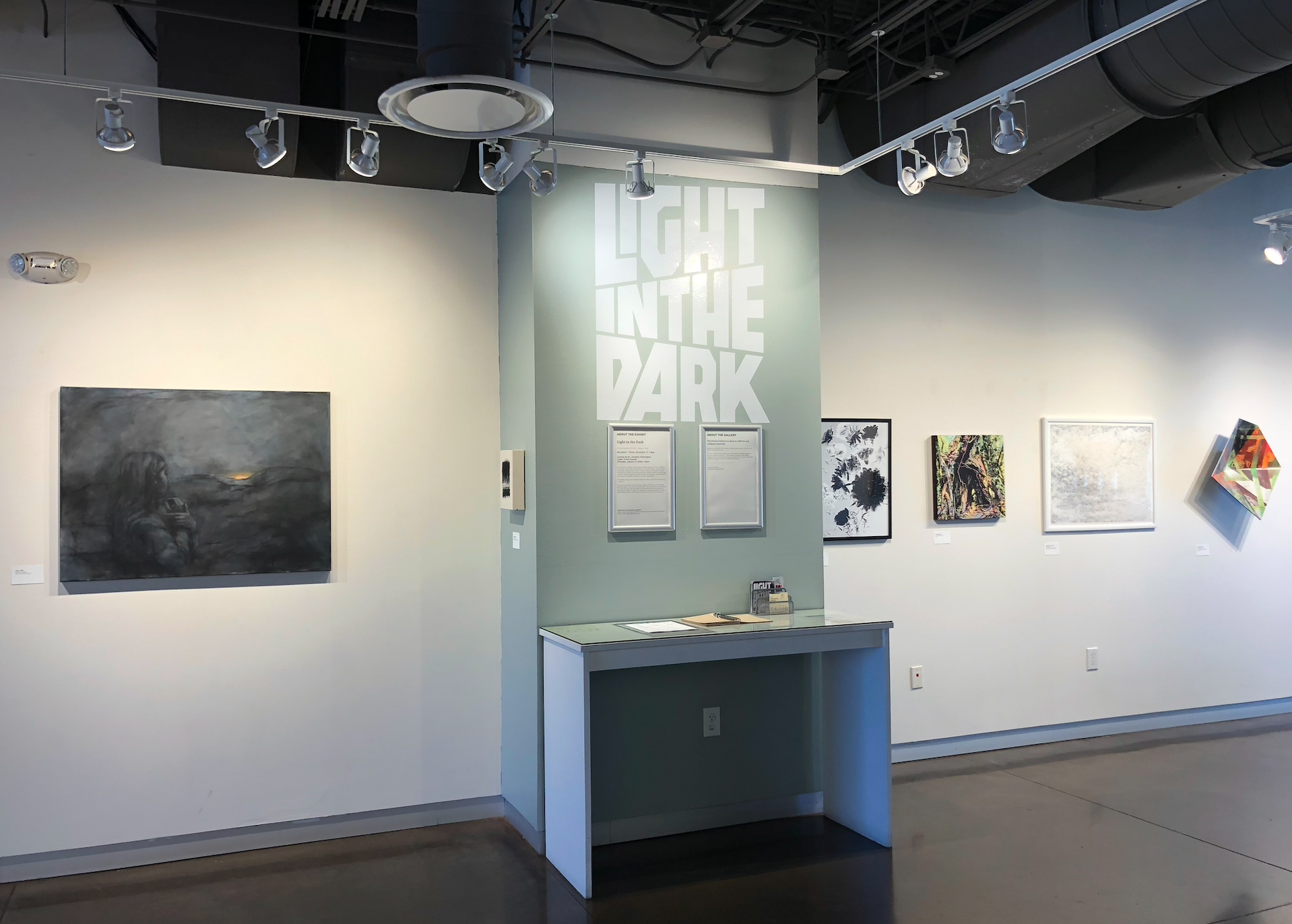
>> Light in the Dark, Sojourn Church Midtown, Louisville, Kentucky, November 17, 2023–January 7, 2024: Organized by Sojourn Arts, this juried exhibition features work by twenty-four artists from throughout the United States. It explores contrasts between light and dark, a powerful artistic as well as biblical theme with strong connections to the Christmas story. A complementary lecture on “Light in the Gospels” by Dr. Jonathan Pennington will take place on January 11, 2024.
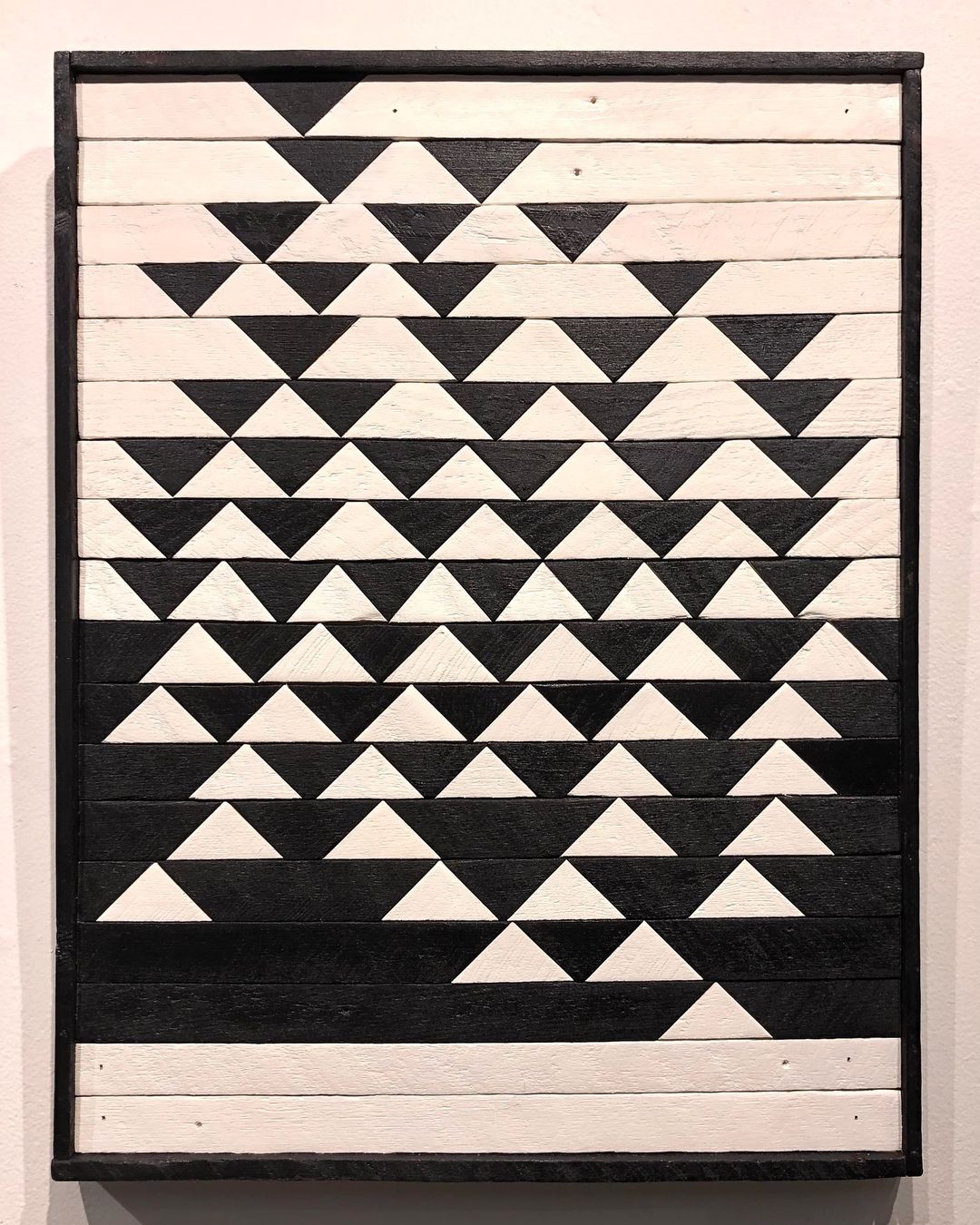
Brandon Hochhalter, The Incredible Power of Light, 2023. Reclaimed lath wood from homes in Old Louisville, 18 × 24 × 1 in. [artist’s website]
>> Wilson Abbey Advent Windows, 935 W. Wilson Ave., Chicago, December 1, 2023–January 6, 2024: A business under the umbrella of Jesus People USA, Wilson Abbey in uptown Chicago is a neighborhood gathering place for coffee, art shows, workshops, theater, dance, film screenings, and live music. Every December since 2016, they have installed a three-story-tall Advent calendar in their windows to be enjoyed from the streets, with one new artwork revealed each day from December 1 to 24. Directed by the building manager, Karl Sullivan, the project commissions local artists to contribute a painting, photograph, or other graphic work, and this year there are twenty-three participating artists. It will be a brand-new series of images, all on the theme “The Soul Felt Its Worth”—which, Sullivan told me, will “explore the idea of the Christ child coming to earth as a promise of justice and care for those who are seen by God, showcasing people groups who may not be seen, or whom we may not want to see because their problems are bigger than us.”
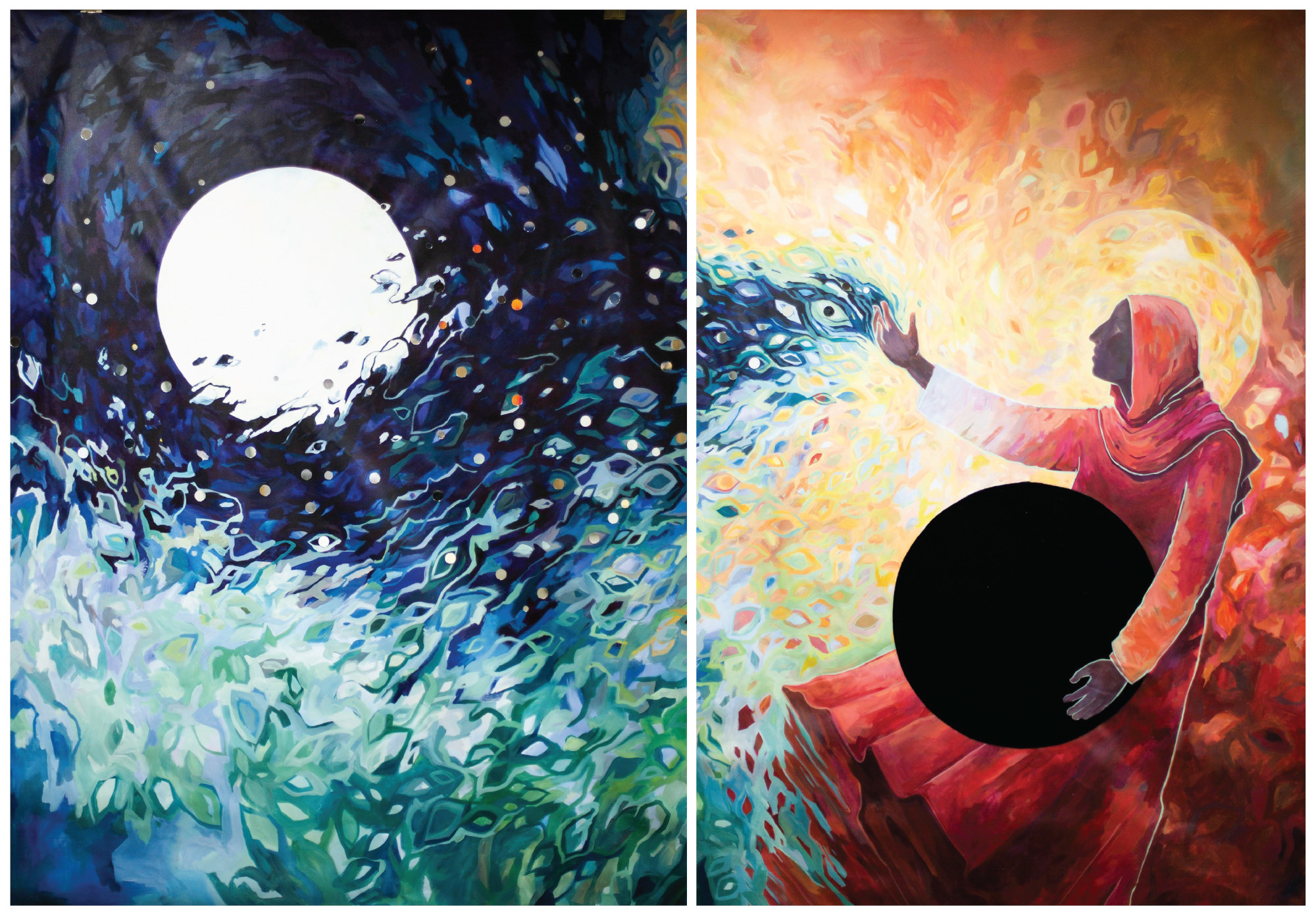
Below are two of the paintings from a previous iteration of the project, which together form an Annunciation scene. The drone video that follows was shot in 2020 by Mike Angelo Rivera.
Stop by 935 West Wilson Avenue in Chicago to see the progressively illuminated windows throughout the month of December (the full display will be up from December 24 to January 6), or follow along on Facebook or Instagram @wilsonabbeywindows. What a unique gift to the city! A fun way to engage the community.
+++
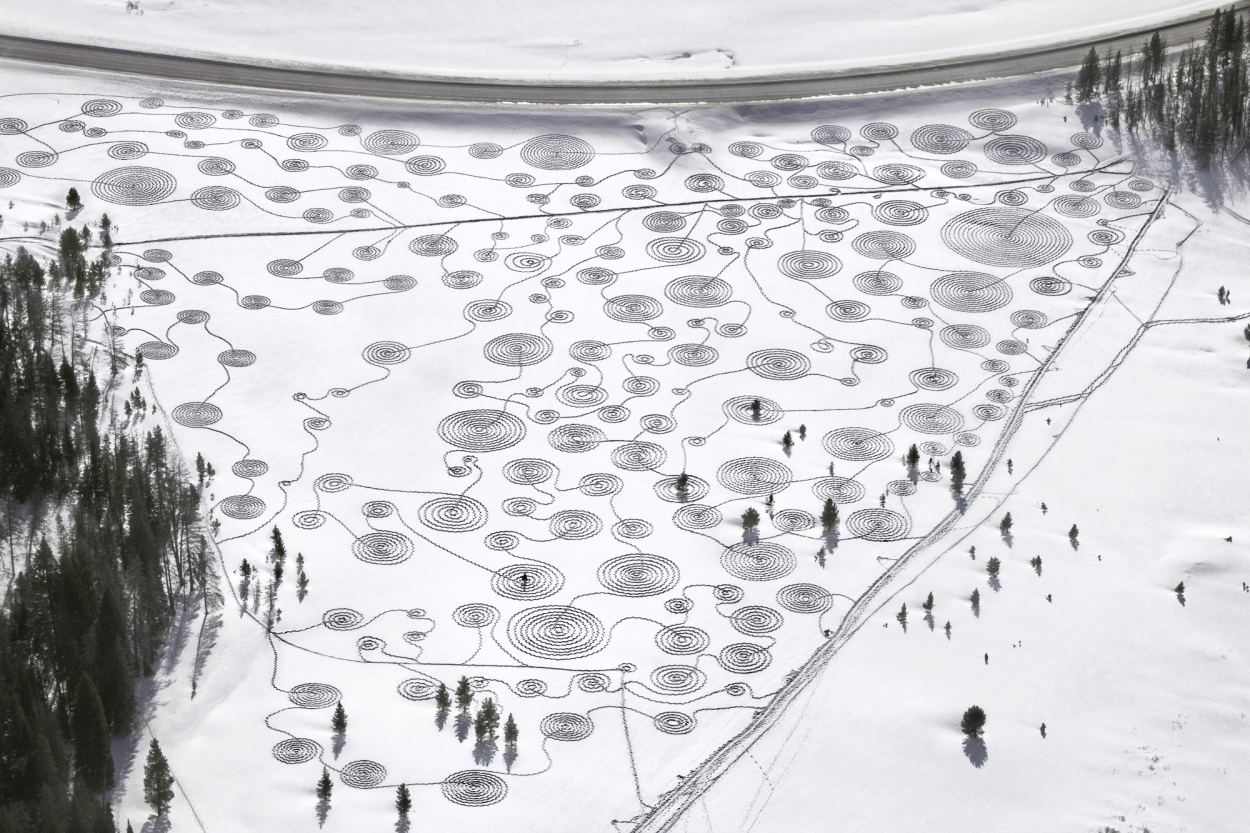
LAND ART: Snow Drawings by Sonja Hinrichsen: German-born, San Francisco–based artist Sonja Hinrichsen creates large-scale, ephemeral “snow drawings” in wintry locations around the world with the help of local volunteers who don snowshoes and track through the snow in patterns. She then photographs the land art from a helicopter or ski lift. These are amazing! Here’s a video by Cedar Beauregard of a drawing in progress at Rabbit Ears Pass, Colorado:
Snow Drawing by Sonja Hinrichsen, Rabbit Ears Pass, Colorado, 2012
Following the popularity of last year’s “25 Poems for Christmas,” I’ve decided to publish a brand-new installment, and will perhaps make this a yearly tradition! All the selections can be read online—just follow the links.
Despite the pithy title of this post, not all the poems are “Christmas” poems, strictly speaking, but rather they encompass the season of Advent too, as well as Epiphany. Advent is a four-week season leading up to Christmas that is characterized by a mood of longing and expectation; it is oriented not only toward Jesus’s first coming but also toward his second. Christmas, of course, celebrates the birth of Jesus, the Word of God made flesh. And Epiphany, on January 6, commemorates the visit of the magi to the crib, representing God’s self-revelation to the wider world.
Each poem is accompanied by a micro-commentary or short descriptive blurb, which I suggest you read after reading the poem itself. There’s a benefit to first entering a poem without having any context—then after registering your initial impressions and questions, to consider another person’s framing or analysis or highlights, and reread. And then a third time! Each reading can potentially reveal new meaning.
Stone Nativity by Juan Manuel Cisneros, Ventura, California, December 2016 [learn more]
1.“Haiku for an Advent Calendar” by Richard Bauckham: Church services during Advent tend to focus on messianic prophecies from the Hebrew Bible, rumblings of a coming savior. In this sequence of twenty-four haiku, Richard Bauckham pulls a detail from each book of the Jewish scriptures, finding anticipations of Christ. For example, Isaiah: “In the wilderness / a voice cries for centuries / seeking an echo.” Or Job: “God answered Job but / not his question. Maybe he / will do that again.”
2. “How Christ Shall Come” (anonymous): The cosmological Christ blew in from the four cardinal directions, coming as lover, knight, merchant, and pilgrim. So says this fourteenth-century Middle English lyric, rich in metaphor, compiled in a book of preaching aids and sermons by John Sheppey (d. 1360), bishop of Rochester. (It is unclear whether he is the author of the poem.) The great medieval literature scholar Carleton Brown gave it the title “How Christ Shall Come” in his landmark Religious Lyrics of the XIVth Century (1924), and Grace Hamman brought it to my attention recently in her wonderful monthly Substack, Medievalish, providing a modern English translation and commentary.
3.“Hawk Lies Down with Rabbit” by Seth Wieck: What would it look like for death to no longer have dominion in the animal world? Grappling with Isaiah’s end-time vision of a peaceable kingdom void of predation, this poem describes in graphic terms a bird of prey making its kill, feeding on flesh, and wonders how a hawk could still be itself with rewired impulses. Hear the author read and provide context for the poem on the Reformed Journal Podcast.
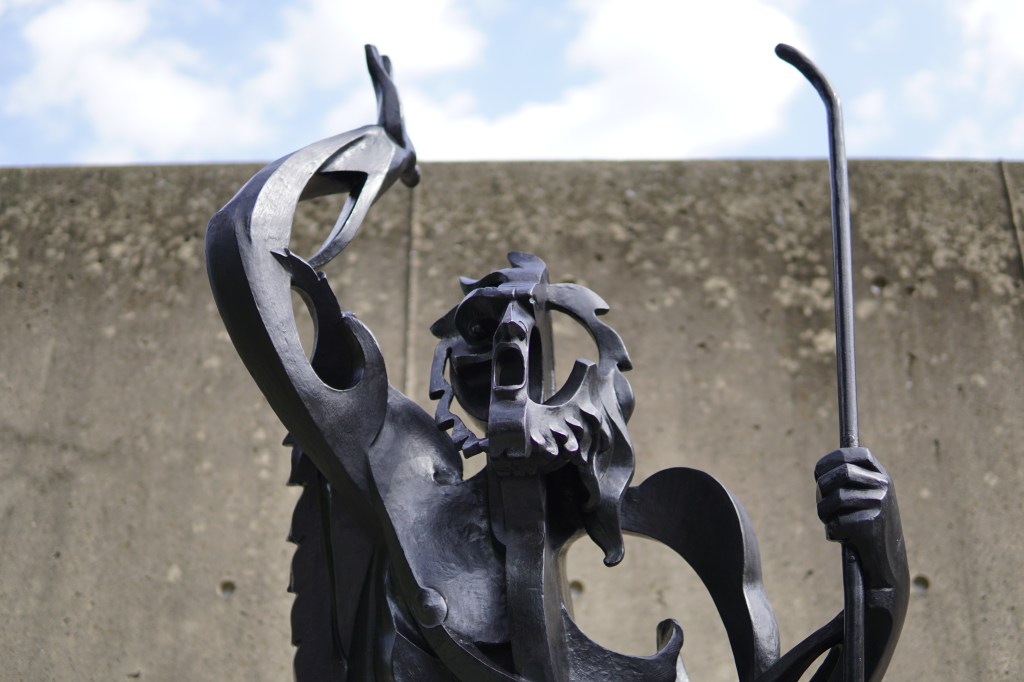
4.“john” by Lucille Clifton: Written in the voice of John the Baptist, this poem is part of an extraordinary sixteen-poem sequence titled “some jesus,” which features a range of biblical characters. In her retelling of his ministry as forerunner to the Messiah, Lucille Clifton casts John as a Black Baptist preacher, preparing his listeners to receive the one who “com[es] in blackness / like a star.” Clifton’s larger body of work would suggest that “blackness” here is multivalent, describing what Jesus comes into and as: the word suggests the darkness of the world that Christ entered, on the one hand, but also functions as a positive racial identifier. In Clifton’s revisioning, Christ comes as a Black man, wearing “a great bush / on his head”—which, again, could be read as an Afro, and/or as a mystical reference to the site at which God revealed himself to Moses in the Sinai desert. Luminous with truth, Christ comes, “calling the people brother.”
Pablo Gargallo (Spanish, 1881–1934), The Prophet (St. John the Baptist) (detail), 1933. Bronze, 91 3/4 × 29 1/2 × 19 in. Wurtzburger Sculpture Garden, Baltimore Museum of Art. Photo: Victoria Emily Jones.
5. “Christmas Mail” by Ted Kooser: Every December the story of an ancient birth comes alive again in couriers’ mailbags, in tin boxes at the ends of driveways, on mantels and fridges. This poem honors those postal workers who deliver good tidings in the form of Christmas cards, the magic spilling out the envelopes to make even the most tiresome routes sparkle a bit.
6. “December 25” by George MacDonald: Through the mid-nineteenth century, denominations influenced by the Reformed tradition, including the Church of Scotland in which George MacDonald was raised, typically did not observe Christmas, the rationale being that no one day should be thought of as holier than any other. But in his book-length dramatic poem Within and Without, MacDonald refers to December 25 as “this one day that blesses all the year”—and in this seven-liner from his Diary of an Old Soul, he describes Christmas as a gleaming blue sapphire, a structural center around which all the other jewels of the church calendar are oriented.
7. “On a Cardinal Climbing Down a Manhole to Restore Power to 400 Homeless People” by Michael Stalcup: On May 11, 2019, Cardinal Konrad Krajewski, the papal almoner (Pope Francis’s special appointee to distribute charity), crawled into a manhole and broke a police seal to personally restore power to a homeless shelter in Rome whose electricity had been shut off due to its failure to pay its bills. The shelter was occupied by some 450 people at the time, 100 of them children, who had been without electric light, hot water, and refrigeration for nearly a week. In this poem, which can be read Christologically, Michael Stalcup celebrates this defiant humanitarian act that brought light to a people living in darkness.
8. “Incarnation” by Amit Majmudar: “Inheart yourself, immensity. Immarrow, / Embone, enrib yourself.” So begins the five-poem sequence “Seventeens.” Musical and witty, this first poem is a plea to the great I AM to take on a body and “be all we are, and all we aren’t.”
9.“The Lord Is with Thee” by Micha Boyett: Written in 2010 as the third in a five-poem sequence commissioned by John Knox Presbyterian Church in Seattle, this poem centers on the Visitation episode described in Luke 1:39–58. It’s about Mary finding belonging in God’s story, especially through the companionship of her elder cousin Elizabeth, who has nurtured Mary’s faith since infancy and continues to do so in this her moment of crisis. “How easily she spoke of God, / as if he were a neighbor, a fish vendor on the street,” Mary admires. Elizabeth supports Mary physically, emotionally, and spiritually, holding her hair back as she vomits, protecting her from vicious rumors, affirming the work of God in her life, and accompanying her at the start of this wild path God has set them both on.
Odilon Redon (French, 1840–1916), Mystical Conversation, ca. 1896. Oil on canvas, 65 × 46 cm. Museum of Fine Arts, Gifu, Japan.
10.“Our Lady” by Mary Elizabeth Coleridge: The great-grandniece of the Romantic poet Samuel Taylor Coleridge, Mary Elizabeth Coleridge (1861–1907) grew up in a home visited by family friends Alfred Lord Tennyson, Anthony Trollope, John Ruskin, and Robert Browning, among others. In this poem she marvels at how God chose the common-born Mary for such a task as mothering the Christ, singing along with Mary’s Magnificat about how God raises up the lowly.
Source: Fancy’s Following (privately published, 1896). Public Domain.
11. “Traveling Man”by Marjorie Maddox: With his pregnant wife alongside, Joseph plods down south to Bethlehem, “convinced of the predestined / roll of dice chrismated with Miracle.” An epigraph from a Leonard Cohen song sets the tone.
12.“Sonnet in the Shape of a Potted Christmas Tree” by George Starbuck: This charming shape poem contrasts the extravagance of our popular celebrations of Christmas with the poverty of the first-century event it marks. The first half describes the furious wind of decorative activity that uproots evergreens from their natural habitats to bring them indoors and deck them with baubles and ribbon. I don’t know how to interpret “no scapegrace of a sect,” but “Daughter-in-Law Elect” refers to a duet from the Gilbert and Sullivan opera The Mikado. The turn comes with “a son born / now / now,” the latter two lines styled as the visible trunk of the tree; here the scene shifts to the simple stable of old, where Mary lies “spent” next to her newborn along with a cow and donkey, a sole “firework” guiding the magi and us all to the spot.
13.“Christmas (I and II)” by George Herbert: George Herbert (1593–1633) is one of the most celebrated poets of the English language. In part 1, a sonnet, of this two-part poem, he imagines himself a weary traveler who chances upon a humble inn where he unexpectedly finds his Lord, the infant Christ. It’s the inn of Bethlehem. Having then received rest from Christ his host, in the closing couplet he expresses his desire to reciprocate—to offer his own soul, lowly though it is, as a residence for Christ, praying that God first adorn it to make it hospitable. In the second part of the poem, Herbert uses a metaphysical conceit (extended metaphor) comparing his soul to a shepherd whose flock of thoughts, words, and deeds pastures on God’s word and who, like the shepherds of Bethlehem, sings glory to God. His shepherd-soul seeks eternal daylight, which he finds in the Son/sun, whose beams so intertwine with his song that the beams sing and his song shines.
14. “Descending Theology: The Nativity” by Mary Karr: The physicality of childbirth, from the contractions (which pierce the Virgin like a star, Karr writes) to the bodily fluids, is heavily featured in this poem. Jesus emerges from his mother “a sticky grub” with a “lolling head” and “sloppy mouth” that seeks out her breast for food. And as she feeds him physically, he feeds her spiritually. Then he falls asleep. His first nap, Karr writes, is a foretaste of the sleep of death he will eventually come to taste. But for now, he wakes up crying—as all babies do.
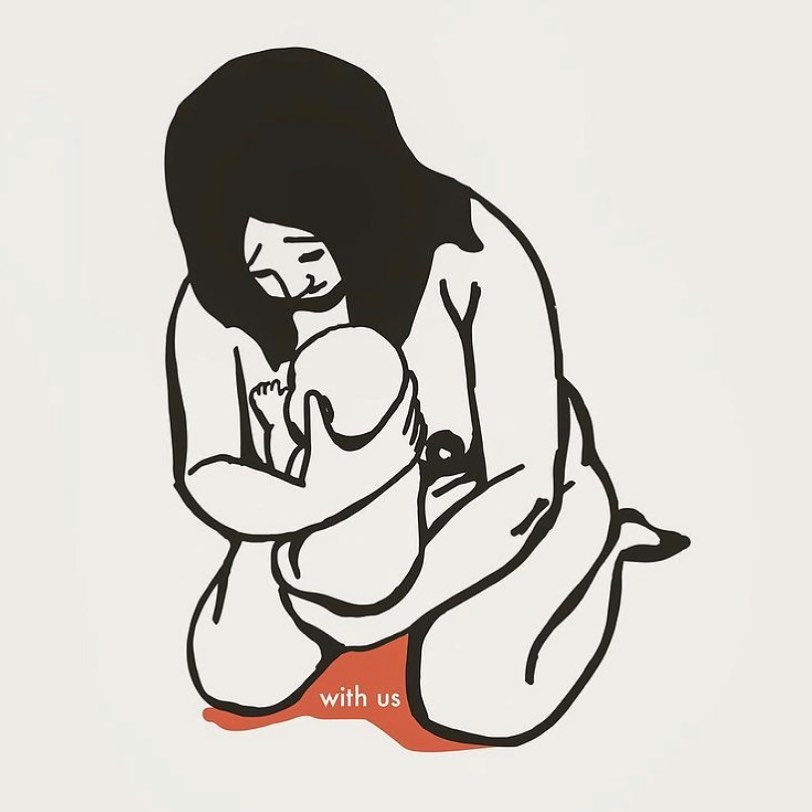
Scott Erickson (American, 1977–), With Us, Face to Face, 2016. Digital art. [available for purchase]
15.“from spiralling ecstatically this”by E. E. Cummings: What a fantastic opening line! The heavenly spheres whirling, twirling, down into the “proud nowhere”—Bethlehem—“of earth’s most prodigious night.” Heretofore living in mundanity, the domestic animals, hungry for miracle, for newness, are vouchsafed to be witnesses of this supernatural event, before which they kneel “humbly in their imagined bodies.” Overhead floats the “perhapsless mystery of paradise,” a phrase suggesting that heaven is beyond human understanding but not without certainty; it’s a declarative reality, not subjunctive, even if it can’t quite be put into words. Mary herself has no words—she silently, knowingly smiles, while the created world erupts in song around her. The “mind without soul” is a reference to Herod, who seeks to snuff out this new life, but to no avail.
The omission of spaces after punctuation marks (e.g., “a newborn babe:around him,eyes”) is not a mistake; that’s how E. E. Cummings liked it. Scholars say it’s to create a faster rhythm, but in this poem I don’t think that choice is as effective, as pauses and slow savoring seem more appropriate to its contemplative mood.
16.“How the Natal Star Was Born”by Violet Nesdoly: Narrated by the angel Gabriel, this poem imaginatively describes heaven’s nervously awaiting the birth of Jesus during the nine months following Gabriel’s dispatch to Mary, and then busting out in celebration when at last they hear his infant-cry. When his Son is born, instead of cigars, the Father passes out trumpets to his company of friends, who sound them all the way to Bethlehem’s fields, and pops open a bottle of champagne whose bubbles spray far and wide.
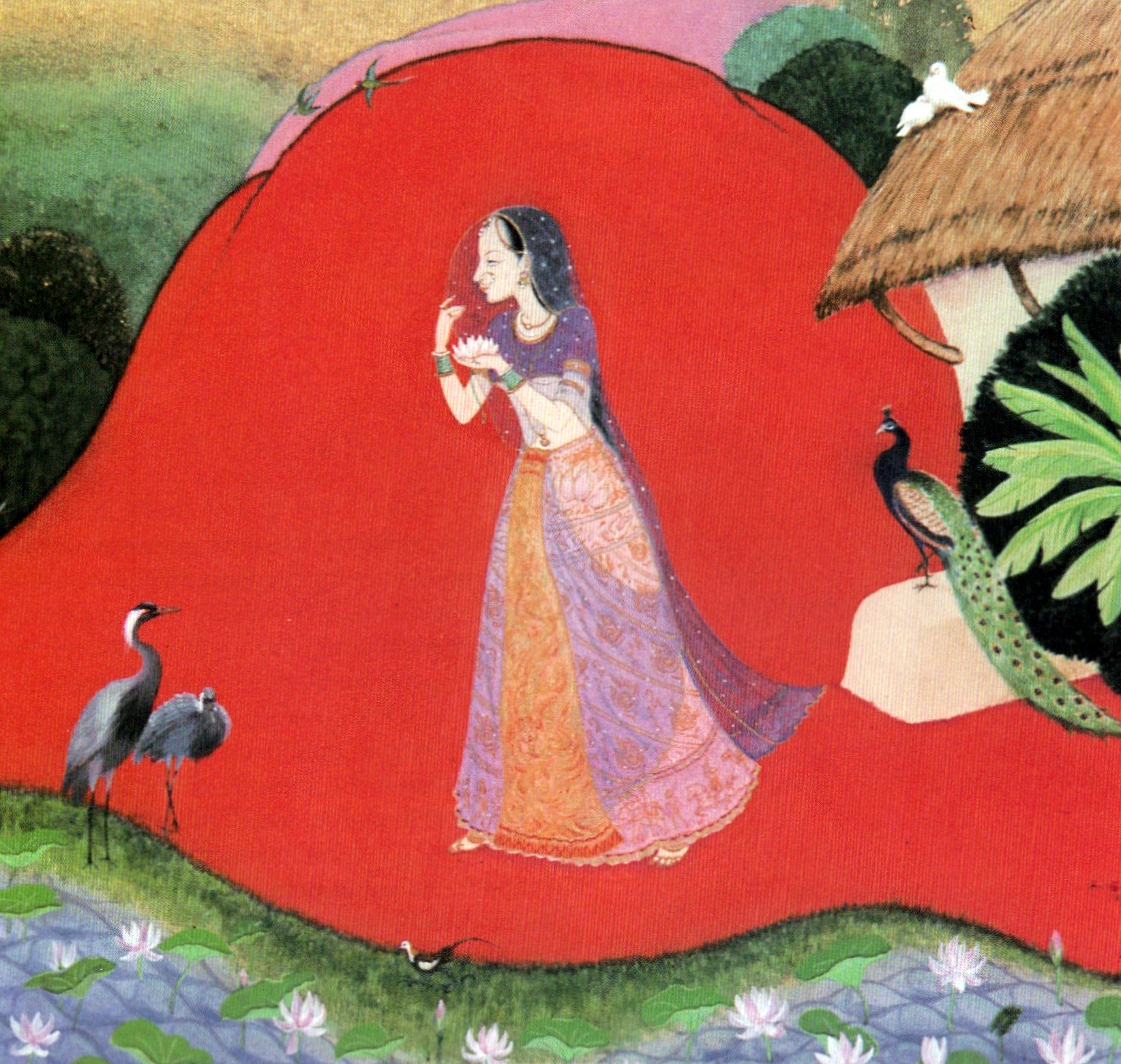
17. Sections 9–10 of “The Child” by Rabindranath Tagore: Hinduism was the religion of Rabindranath Tagore’s birth and upbringing, but he also held deep respect for Jesus Christ. (For more on the influence of Christianity on Tagore’s thought and writing, see chapter 4 of Rabindranath Tagore and Interfaith Dialogue by Manas Kumar Ghosh [DMin thesis, Charles Sturt University, 2010].) “The Child” is a free-verse poem that Tagore wrote in English in 1930 after seeing a passion play in Germany and then translated into Bengali in 1932 with the title “Sishutirtha” (Pilgrimage to Childhood). In it a “Man of faith” gathers people from all walks of life to join him on a “pilgrimage of fulfilment,” to “struggle [through the dark] into the Kingdom of living light.” Initially met with enthusiasm, the Man later becomes a target of the people’s anger and distrust, and they kill him. Disorientation ensues. But a man in the crowd is able to rally the others to repent and resume their quest, following the spirit of “the Victim.”
The final two sections, 9 and 10, are the selection I’ve chosen. (Scroll right to read the last.) At “the first flush of dawn,” when the time is ripe, the pilgrims arrive at a thatched hut in a palm grove, where they finally meet the eternal Light they’ve been seeking: “the mother . . . seated on a straw bed with the babe on her lap, / . . . the morning star.” Here is the Child of the title, humanity’s redeemer.
Source: The Child (London: George Allen and Unwin, 1931)
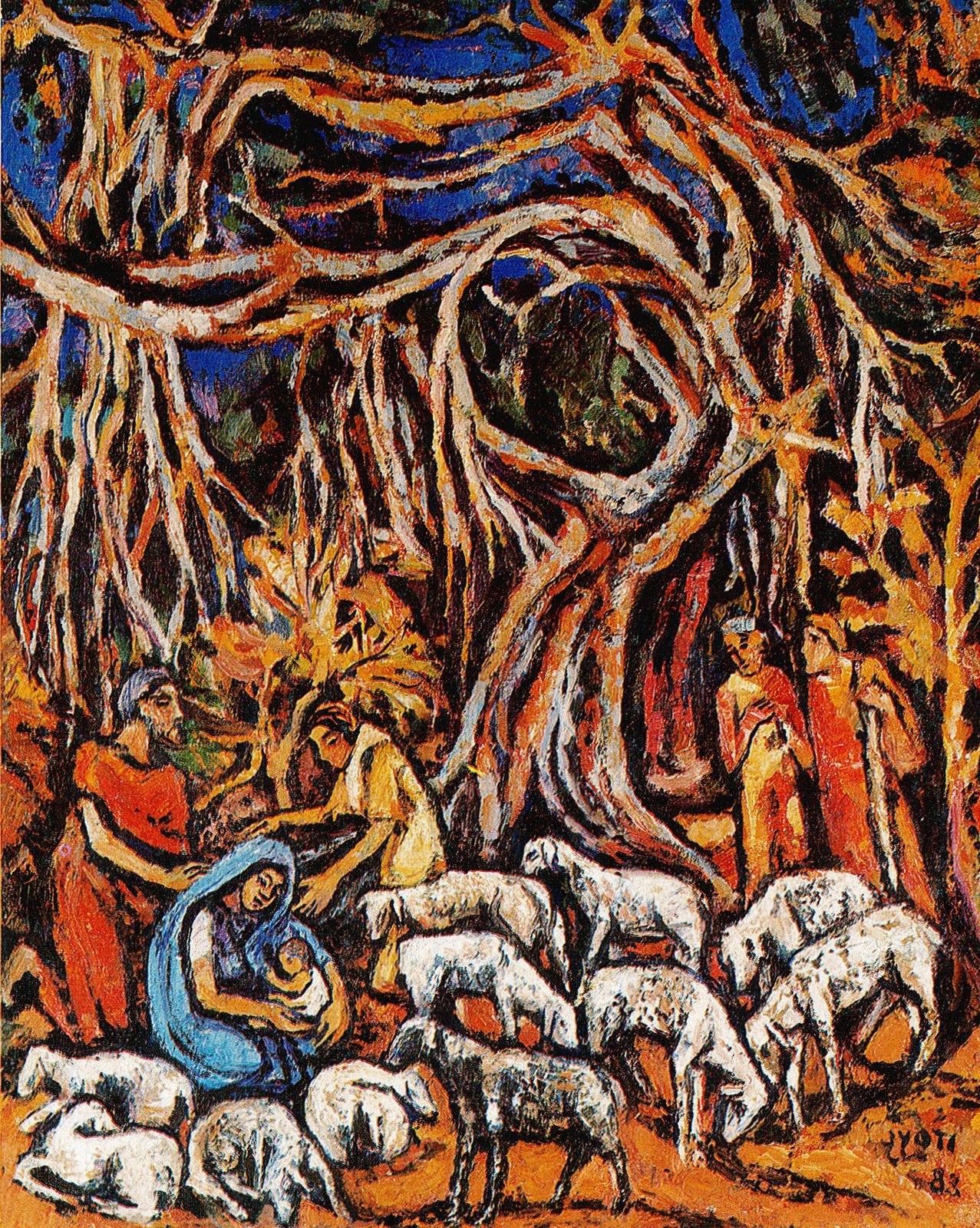
Jyoti Sahi (Indian, 1944–), Adoration of the Shepherds, 1983. Oil on canvas, 80 × 63 cm. Collection of jesuitenweltweit (Jesuits Worldwide), Nuremberg.
18. “Love’s Bitten Tongue (11)”by Vassar Miller: This poem, “You, my God, lonesome man, Love’s bitten tongue,” is from a crown of twenty-two sonnets, a type of sequence in which the last line of each sonnet is repeated as the first line of the next, but each time with a new twist of syntax and sense. The crown as a whole expresses the poet-speaker’s struggle against her ego, and her desire for Christ (whom she gives such an evocative name in the title!). In this particular sonnet she describes waiting at the edge of her bed every Christmas Eve as a child in anticipation of both Santa’s arrival with gifts and the holy mystery of Christ’s birth, an admixture of sacred and profane longings that fill her still as an adult.
19. “Gloria in Profundis” by G. K. Chesterton: G. K. Chesterton’s poems are of variable quality, but this one is brilliant, emphasizing God’s descent from the rich heights of heaven into an obscure cave in a simple town. “Glory to God in the lowest!” it exclaims, a clever inversion of the angels’ song to the shepherds in Luke 2:14. The poem was originally published in a 1927 Christmas pamphlet with wood engravings by Eric Gill. The Latin title translates to “Glory in the Depths.”
Source: Gloria in Profundis by G. K. Chesterton (Ariel series pamphlet) (London: Faber and Gwyer, 1927); compiled in The Spirit of Christmas (New York: Dodd, Mead, 1985)
20.“Silent Night” by Bonnie Bowman Thurston: Rev. Dr. Bonnie Thurston invokes a tradition that says the night of Christ’s birth, there was a whole hour in which time stood still and all was silent. What a fascinating legend! Thurston told me its origin is northern European, said she remembers reading it in some scholarly Celtic studies; I wasn’t able to locate any such mentions, but the second-century Protoevangelium of James, chapter 18, probably written in Egypt or Syria, does describe everything momentarily freezing in place around Joseph as he steps out to find a midwife for Mary. Anyway, the poem ends with a striking metaphor! Word, flesh: fire. (Reminds me of this digital artwork by Scott Erickson.)
21. “After Luke 2:19” by Michelle Ortega: When the shepherds recounted to Mary what the angels had told them in the fields about Jesus being the promised Messiah, “Mary treasured all these words and pondered them in her heart,” Luke narrates in his Gospel. Poet Michelle Ortega expounds on this verse, emphasizing the relationship of Mary’s body to her son’s from conception to birth and now postpartum—an intimacy known well by mothers across the centuries. As wondrous as it was to be part of a cosmic story writ large in the skies, Ortega suggests that Mary treasured just as much as the grand pronouncements those small moments of being just an ordinary mama.
22. “Christmas: 1924”by Thomas Hardy: “We the civilized world have given Christianity a fair trial for nearly 2000 years, & it has not yet taught countries the rudimentary virtue of keeping peace,” lamented the British novelist and poet Thomas Hardy (1840–1928) in a letter to Florence Henniker dated February 25, 1900, during the Boer War. World War I only increased his cynicism, which is on display in this sour little epigram that opens with an ironic quotation of the angels’ proclamation to the shepherds the night of Jesus’s birth.
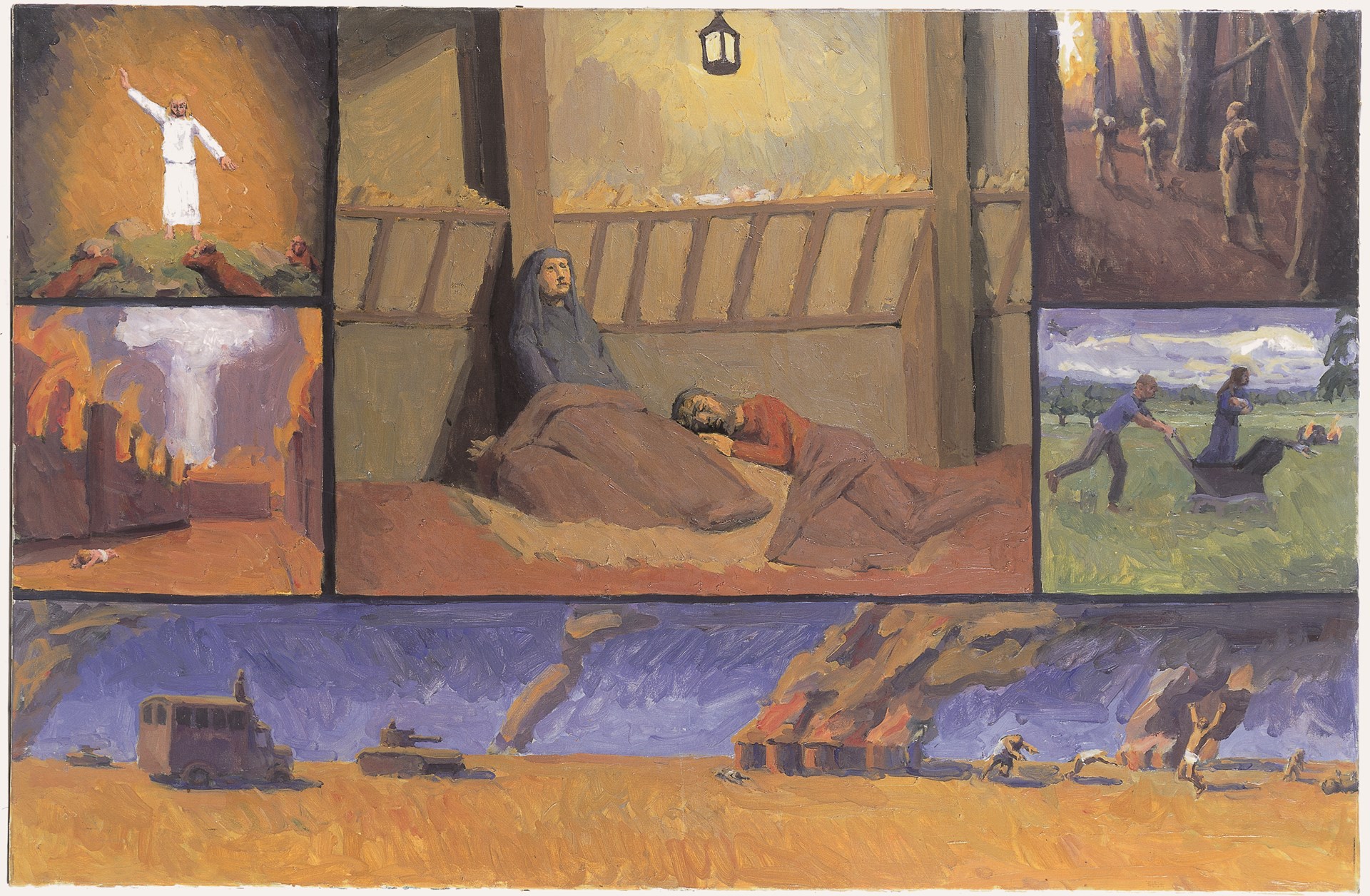
Francis Hoyland (British, 1930–), Nativity, 1961. Oil on canvas, 90 × 120 cm. Methodist Modern Art Collection, HOY/1963/1.
23. “Eating Baklava on New Year’s Eve” by Anya Krugovoy Silver: Poet Anya Silver (1968–2018) reads a spiritual benediction in her piece of baklava, layered and sweet and consumed on the eve of a new year.
Source: Second Bloom (Eugene, OR: Cascade Books, 2017)
24. “A Ballad of Wise Men”by George M. P. Baird: Jesus so often confounds the wisdom of the wise, starting with his birth. With gentle humor and in iambic rhythm and rhyme, this poem celebrates the simple access we all have to Christ.
Source: Rune and Rann (Pittsburgh: Aldine Press, 1916). Public Domain.
25. “Excrucielsis”by Hannah Main-van der Kamp: Originally published at ArtWay.eu as a response to the contemporary Romanian sculpture The Spring by Liviu Mocan, this poem alternates between the weary journeying toward truth of one of the biblical magi and that of a modern-day seeker similarly “longing for / the something more.” It can be a trudge, finding the Light—it involves risk, a willingness to follow the signs, and the tenacity to hold on to your “vision burden,” “clutch[ing] the weight” of it all the way over rough and varied terrain. But the epiphanic moment awaits, to sound like a trumpet blast. The title of the poem is a neologism combining the words “excruciating” and “excelsis” (Latin for “the heights”); “every excelsis contains something excruciating, that’s how we get to genuine excelsis,” the poet told me in an email. Read a related prose reflection by Main-van der Kamp here.
Source: The Slough at Albion (Victoria, BC: Ekstasis Editions, forthcoming)
Disclosure: This post contains Amazon affiliate links, meaning I earn a small commission from qualifying Amazon purchases originating from clicks on this site.
Solomia Kazanivska (Соломія Казанівська) (Ukrainian, 1996–), Mother of God, 2019. Acrylic and soil on wood, 60 × 40 cm.
I.
Here mothers move more than others
into Mary’s mourning, each chorus
a soul full of crosses, weighted
with her child dying
continuously in the contemplation
of our contrition.

II.
That once-upon-a-time angel’s voice
stretching anew her middle-aged womb,
she who once sang Magnify, O Magnify,
when all she screams for now
is mercy in her urgent rebirth
of sorrow.

III.
When he stumbles,
she cannot fix his fall,
cannot cradle the boyhood
scrapes and bruises bleeding
into crowd-sanctioned murder.
No cock crows; she hears his groans
as if the world’s bones
are splintering within her.

IV.
Besides the tree, he carries
the tears of the one who carried him
beneath her Eve ribs, lifted him
into a world he breathed as good,
gone now into this God-crucified-
as-her-son catastrophe
for salvation’s sake.

V.
Simon of Cyrene stands close.
Understanding too well the two sorrows—
mother and son helpless to comfort the other—
he heaves up and shoulders
the burdens of both,
his back the black tablet
of Moses’ commandments fulfilled
to the jot and tittle.

VI.
Veronica—eyes swollen
for the Madonna and Child
wrenched from their rightful honor—
lifts her veil to cool the Savior’s pain,
alleviate, however slightly, a mother’s anguish.

VII.
Thorns gouge the brow she stroked.
The sweat-caked man that came out of her
stumbles again. Already,
the sharp nails gnaw her own palms.

VIII.
Oh, daughters of Jerusalem,
your tears sweep the streets,
wet the weary soles of Mary.
Weep for your own children
forever dashing away from Yahweh.

IX.
Wretched stones that tip her sinless child,
dirt that drives down the innocent son.
His own earth hurts him more each tumble.
Three times he trips,
crashes to the dust we are,
mortal muscles turning their backs
on Man and his Mother.

X.
Threads twisted by her own fingers,
tugged carefully through cloth:
this is the tunic they rip from him,
fabric tattooed with red;
she remembers his baby body
blood-splattered and matted.

XI.
Her soul stabbed by the tree
that slays her son. Her heart nailed.
She swears his life spurts
from her barely breathing body.

XII.
Death is indigo and indelible,
the Roman sky collapsed and re-scribbled
on the shreds of her memories.
She cannot bear to look upon his face
when breath forgets its maker.

XIII.
Ten thousand stillborns better
than this: his torso in her arms,
icon of the inconsolable,
the flesh Pietà with its nails of pain,
pounding, pounding.

XIV.
The hewn tomb seals her grief.
She remembers his first words,
his final prayer. All else rots
within her. They swaddle him,
implant him quickly behind stone.
This poem is from Weeknights at the Cathedral (Cincinnati: WordTech Communications, 2006) and is anthologized in slightly revised form, as here, in Poems of Devotion: An Anthology of Recent Poets, ed. Luke Hankins (Eugene, OR: Wipf & Stock, 2012).Used by permission of the author.
Note: The Stations of the Cross are a form of Catholic devotion organized around the events of Christ’s passion, from his condemnation by Pilate to his crucifixion and burial.
Marjorie Maddox (born 1959) is the author of fourteen poetry collections, including Begin with a Question (Paraclete, 2022); Transplant, Transport, Transubstantiation from the Poiema Poetry Series (Wipf & Stock, 2018); and True, False, None of the Above (Wipf & Stock, 2016). She has also published a short story collection, four children’s and YA books, and 650-plus stories, essays, and poems in journals and anthologies. Living in Central Pennsylvania, she is a professor of English and creative writing at Lock Haven University and is the assistant editor of Presence: A Journal of Catholic Poetry.
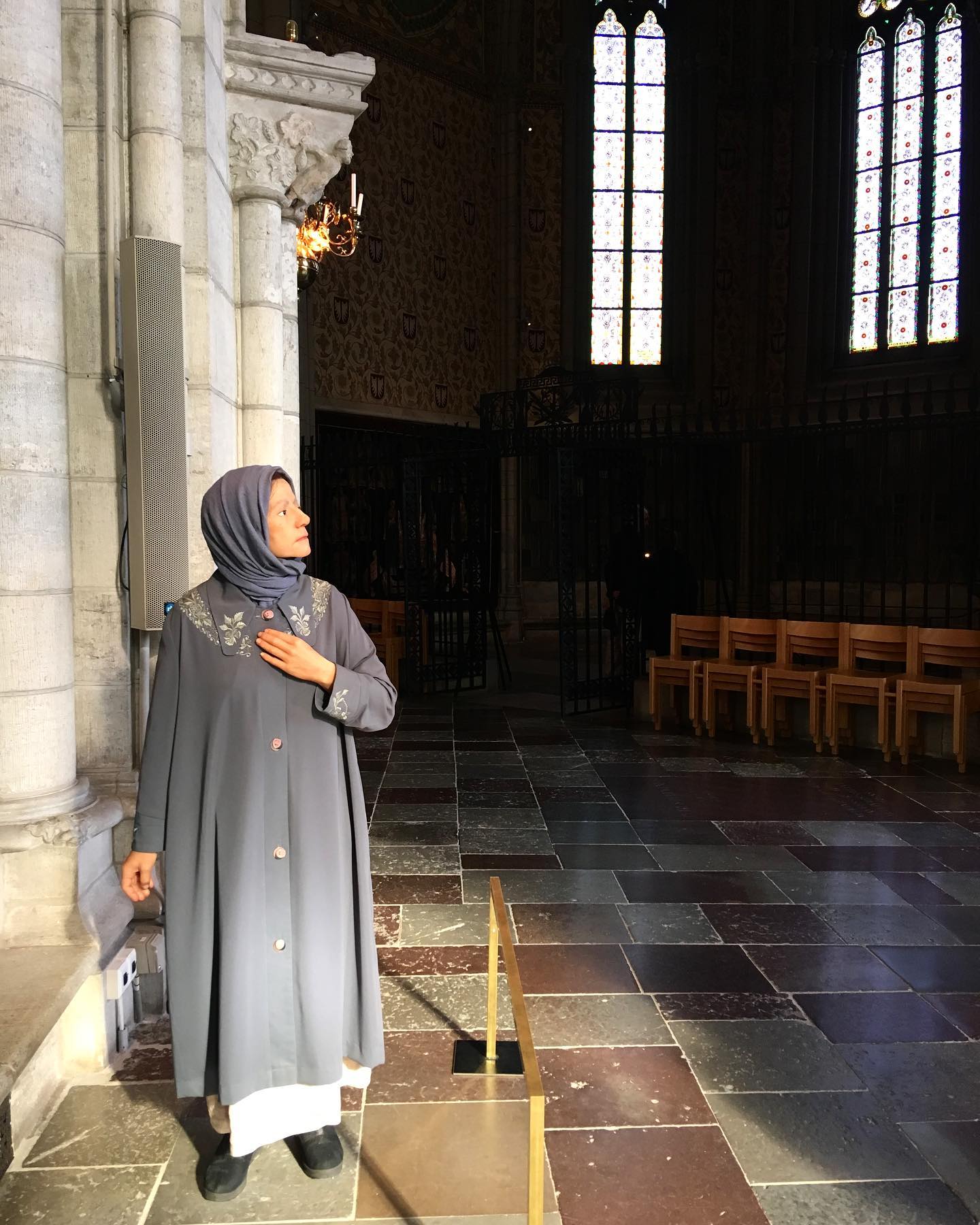
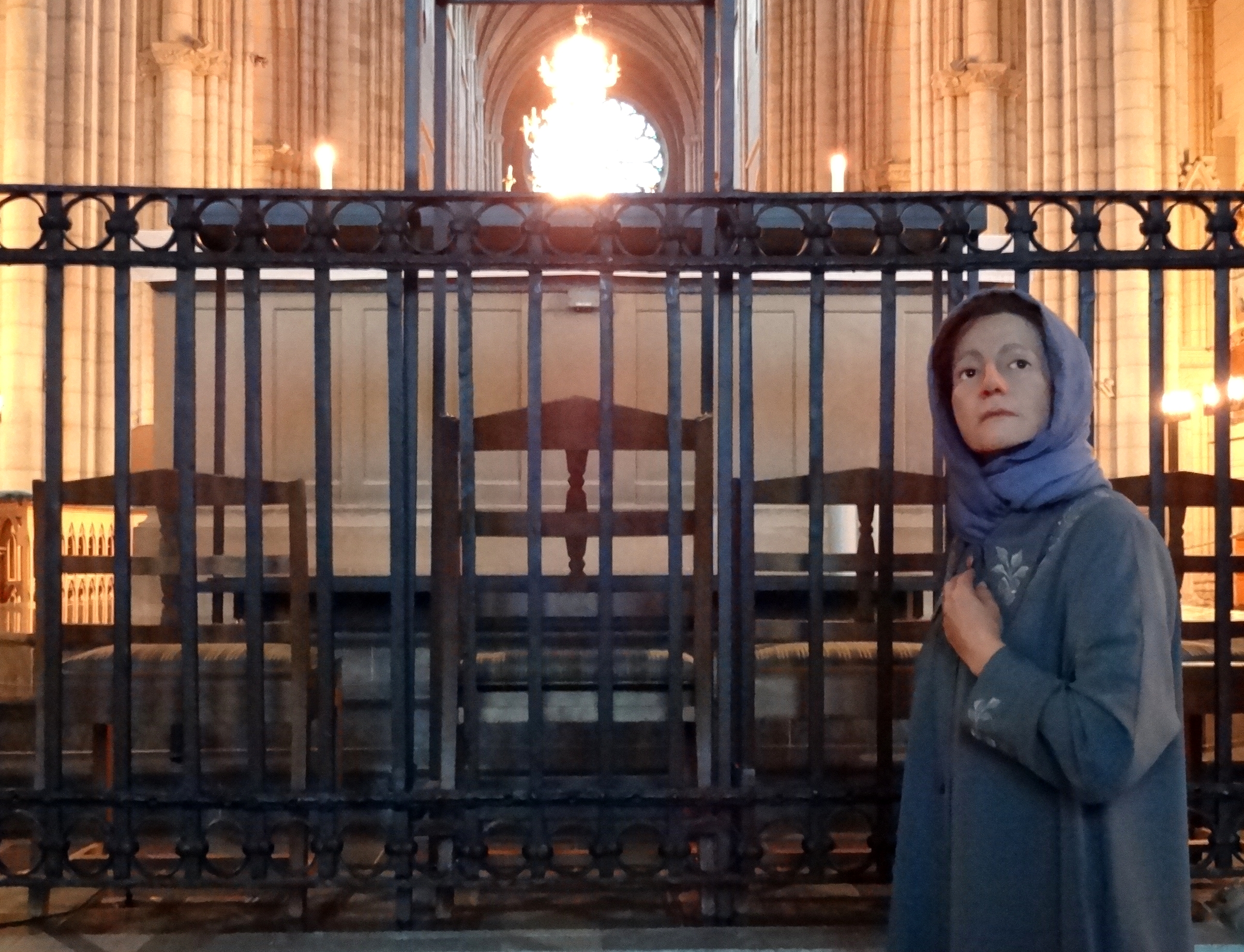
Anders Widoff (Swedish, 1953–), Maria (The Return), 2005. Polyester, silicone, fabric, glass, hair, and oils. Uppsala Cathedral, Sweden. Photo: Lieke Wijnia.
The lengthening shadows of the cedar trees
Have blended into twilight, and the sun
Has plunged in glorious gold precipitance
Beyond the dim crest of the western hills,
Bearing with it the day’s disquietudes;
And now the stars, that lamp the feet of God,
Are lighted, and night’s purple silences
Steal gently round me fraught with memories.

’Twas such an hour as this—long, long ago
Yet seeming yesterday—he came to me,
My little son, in joyous travail born
Out there across the hills in Bethlehem,
Where we who journeyed southward to be taxed—
Strangers in our own father’s land—had found
No shelter in the crowded khan, and shared,
Perforce, a grotto with the stabled kine.

Ah, how it all comes back again to me!
The courtyard, in the flickering torchlight, filled
With huddled trav’lers sleeping ’neath the sky,
The kneeling camels of a caravan,
The patient asses dozing by the wall,
A smell of roasting meat at little fires,
The shouts of melon-sellers, the low drone
Of reverend elders bending at their prayers,
Barking of street-dogs, porters’ blasphemies,
The laughter of a girl, the mellow flute
Of some rapt lover, and the tinkling tune
Of sheep-bells forward moving through the dark.
And then the hour supreme, wherein my soul
Clomb the dark pinnacles of pain, and death
Grappled with life through whirling aeoned years,
But fled at length and left the Miracle.

They laid him there beside me on the hay,
A wee pink being in his world’s first sleep;
My arm was round about him and his breath
Was warm with life on my exultant breast,
And they whose winged watch is set to keep
Ward in the valley lands of heaven looked down,
Not up, that night to find their paradise.
All weak with labor and soul’s happiness,
I lay beneath the sapphire tent of skies,
And in my heart I made a little prayer
Of thanks that flew up to the throne of God
On swift dove pinions of unuttered song;
And as I prayed, lo, upon loops of stars
Night’s velvet curtainings were lifted up,
A wondrous light turned all the world to rose,
And down the skies swept singing seraphim
In mighty echoes of my little prayer.

Oh, can it be that threescore years have marched
In troubled caravan across the waste
Of desert life since then, and can it be
That I, who sit here in mine eventide,
White with the snows of sorrow and of time,
Was once a bright tressed girl who heard the choirs
Of heaven rejoice that she had borne a son?
Why, I can feel that little heart beat still
Close to my own, the touch of little hands
Warm and caressing on this withered breast;
Still I can hear the first low wail that marked
His woe’s beginning and the tortured path
That he should tread in mighty gentleness,
With pain and anguish, ’til his love supreme
And terrible meekness, overcoming death,
Should lead him conqueror to sit with God,
Pleading for sinful men in paradise.

Today I stole into the synagogue
And heard a rabbi read the sacred scroll:
How that my lord, Isaiah, said of old,
Thy Maker is thy husband, he hath called thee
As a forsaken woman, spirit grieved;
God, for a little moment, hides his face
From thee, but with his loving kindness soon
And tender mercies shall he gather thee.
Then was I comforted, and peace displaced
The turmoil in my heart, and minded me
Of that great promise Gabriel bore from God
And the immeasurable fruitage of his word,
The life and death and glory of my son.

So in the shades of life and night I sit,
Under the sheltering arbor of the dark
That curves above, vined o’er with trellised stars,
Waiting my spirit bridegroom, and the sound
Of that loved voice—long silent save in dreams—
Calling across the vibrant firmament,
O Mary, Mother Mary, come to Me.
This poem is from ’Prentice Songs (Pittsburgh: Aldine Press, 1913) and is in the public domain.
George Mahaffey Patterson (M. P.) Baird (1887–1970) was a lifelong resident of Pittsburgh, Pennsylvania, who worked in theater and city government. He graduated from the University of Pittsburgh in 1909 and then taught in the Department of English as a professor of theater history and production. He formed the student group the Pitt Players, financing, writing, and directing several of their early plays. While on the faculty, he also locally published three collections of poetry: ’Prentice Songs (1913), Loaves for Hyacinths (1914), and Rune and Rann (1916). In 1917 Baird joined the US Army, serving as a lieutenant in the Sanitary Corps during World War I. Upon his return to civilian life he began a career in government service for the city of Pittsburgh, serving as executive secretary of the Art Commission and chief examiner and later president of the Civil Service Commission. He was senior research analyst for the Department of City Planning when he retired in 1961.
Frank Wesley (Indian, 1923–2002), Mary Going to Visit Elizabeth, n.d. Egg tempera, 20 × 25 cm. Source: Frank Wesley: Exploring Faith with a Brush, p. 173
To Elizabeth she came,
over the hills,
bearing the Lord flowering in her womb—

sacrament of her flesh,
bud richly taut—

the warmth of her
containing His infinity,
the sun His fire.

The dark earth of her body
seemed to encompass all things.
The terraced fields of Juda
pregnant with seed
called out to her
as she passed,
praising the Child
she was yet to bear,
invoking His blessing
on their expectancy.

These must call out,
full in their fullness,
barren beside hers,
then how should a child
six months conceived
adore with stillness
in his mother’s womb?
“The Visitation” by Calvin B. LeCompte Jr., based on Luke 1:39–45, appears in I Sing of a Maiden: The Mary Book of Verse, ed. Sister M. Thérèse (New York: Macmillan, 1947).
In this poem Calvin B. LeCompte Jr. compares the embryonic Christ to a flower bud about to bloom from the warm, dark seedbed of Mary. The glorious abundance of the spring hills, he writes, is nothing—“barren beside hers”—compared to the abundance and glory Mary holds within her, soon to be revealed. LeCompte personifies the Judean countryside that Mary passes through, in her first trimester, on her way to her cousin Elizabeth’s house, who is herself six months pregnant. Like these women, the fields are “pregnant with seed.” And they recognize with reverence the Christ who travels past them, borne in the womb of his mother. They (the grasses) wave, they bow; they call out to him, seeking blessing. If even nonhuman nature is moved by the as-yet-latent Jesus and can’t help but react with praise, then how much more ought the unborn John, kinsman and appointed forerunner, to leap and rejoice when, momentarily, his mom and Jesus’s embrace belly to belly and sing Magnificat.
Calvin Byrd LeCompte Jr. (1922–2001) was a Black Catholic educator, musician, literary critic, and occasional poet from Washington, DC, the son of a prominent medical doctor. He earned a BA in English in 1943 and an MA in linguistics in 1948, both from the Catholic University of America, and he attended a number of the “literary salons” Ezra Pound held at St. Elizabeths Hospital in DC while Pound was a psychiatric patient there. LeCompte also studied piano under Cecil Cohen, giving lecture-recitals at colleges around the country in the late forties, and taught voice at the Frederick Wilkerson Studio for some twenty years. He then went on to serve for twenty-three years as music director at Epiphany Catholic Church in Georgetown, as well as music director at the classical radio station WGMS, where he created and hosted the program Music in Our Time as a showcase and teaching forum for contemporary classical music. A professor of English and music at the University of the District of Columbia, he also lectured at Howard University, Temple University, the University of Pennsylvania, the Kennedy Center, the Opera Guild, and the Folger Library. In addition, he translated in eight languages for the National Catholic News Service.
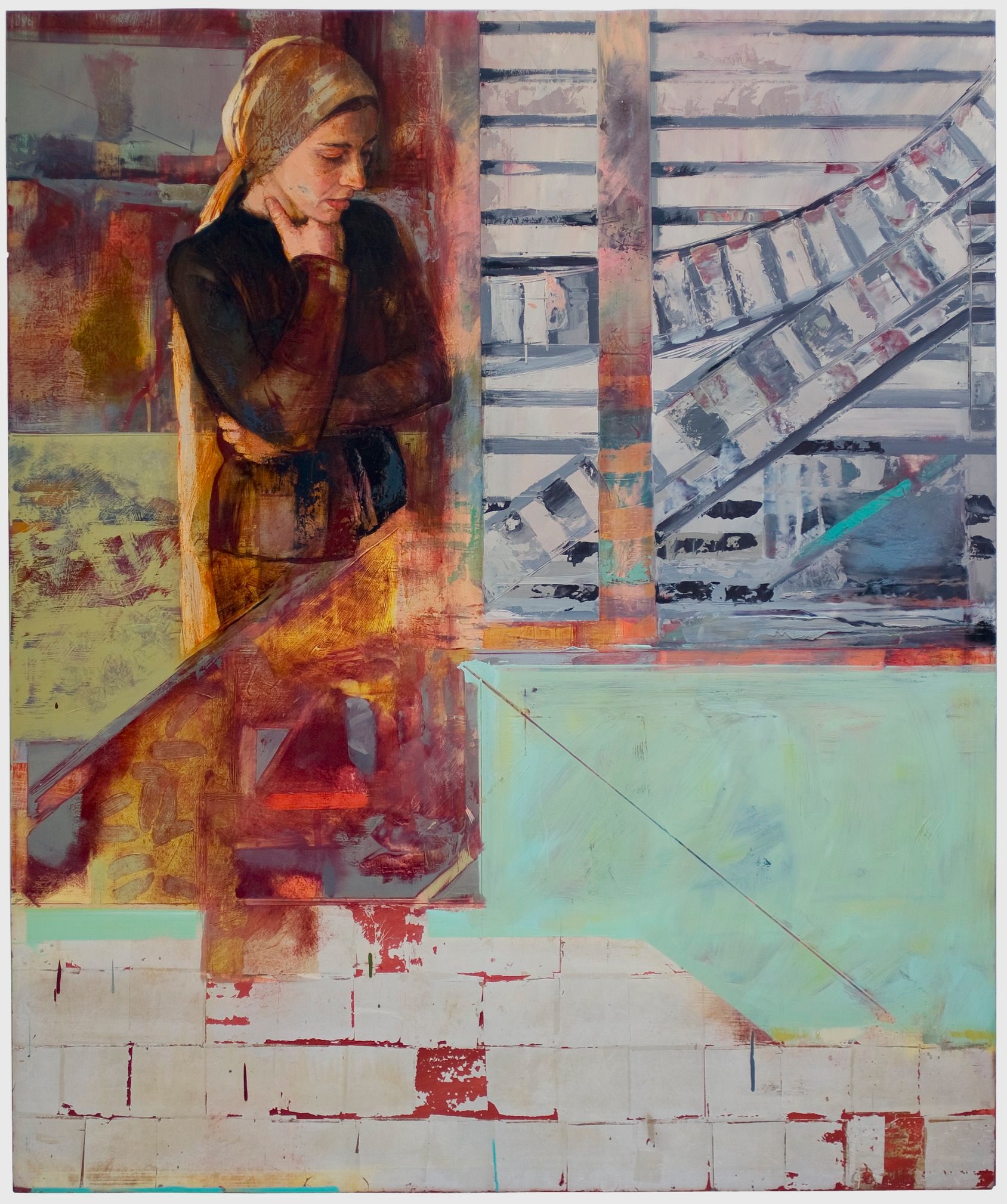
Bruce Herman (American, 1953–), Called, from the Woman series, 2007. Oil, alkyd resin, and 23k gold and silver leaf on wood, 58 3/4 × 48 3/4 in. Collection of Bjorn and Barbara Iwarsson, Lakeville, Minnesota.
My parents named me
    for the daughter of Amram
        and the Levite woman Yocheved:

prophetess with a timbrel
    who cast her baby brother
        on the mercies of the Nile.

Our name means Bitter Waters
    like the salt-encrusted sea
        into which the Jordan flows.

Or perhaps Sea of Myrrh—
    that sticky precious resin
        scenting the anointing oil

which Moshe once used
    to consecrate the Mishkan,
        the place where Presence dwelled.

My namesake had a well
    which followed the Israelites
        in all their wandering,*

a sweet spring in the desert
    bringing clarity to the heart
        of anyone who cupped their hands

and drank. Will I too
    be a wellspring of Torah,
        a source of living waters,

or will I stagnate here
    in this backwater town
        never hearing the voice of God?
* According to the Mishnah (Talmud, Taanit 9a), a well of fresh water miraculously followed Miriam, Moses’s sister, as she wandered with her people through the desert, providing a steady source of drink for all.
Rabbi Rachel Barenblat is a longtime blogger at The Velveteen Rabbi and a cofounder of Bayit, a collective of clergy, liturgists, artists, and educators that develops and distributes online Judaism resources. She holds dual ordination as a rabbi and mashpi’ah (spiritual director) and since 2011 has served as spiritual leader of Congregation Beth Israel in North Adams, Massachusetts. She has an MFA in writing and literature from the Bennington Writing Seminars and is the author of six volumes of poetry, including 70 faces: Torah poems (Phoenicia Publishing, 2011)and Texts to the Holy (Ben Yehuda, 2018). Her work has appeared in Reform Judaism,The Wisdom Daily, The Forward, and anthologies such as The Bloomsbury Anthology of Contemporary Jewish American Poetry and The Women’s Seder Sourcebook. She has taught at Beyond Walls, a writing program for clergy of many faiths at the Kenyon Institute, and is currently serving as a visiting faculty at the Academy for Spiritual Formation.
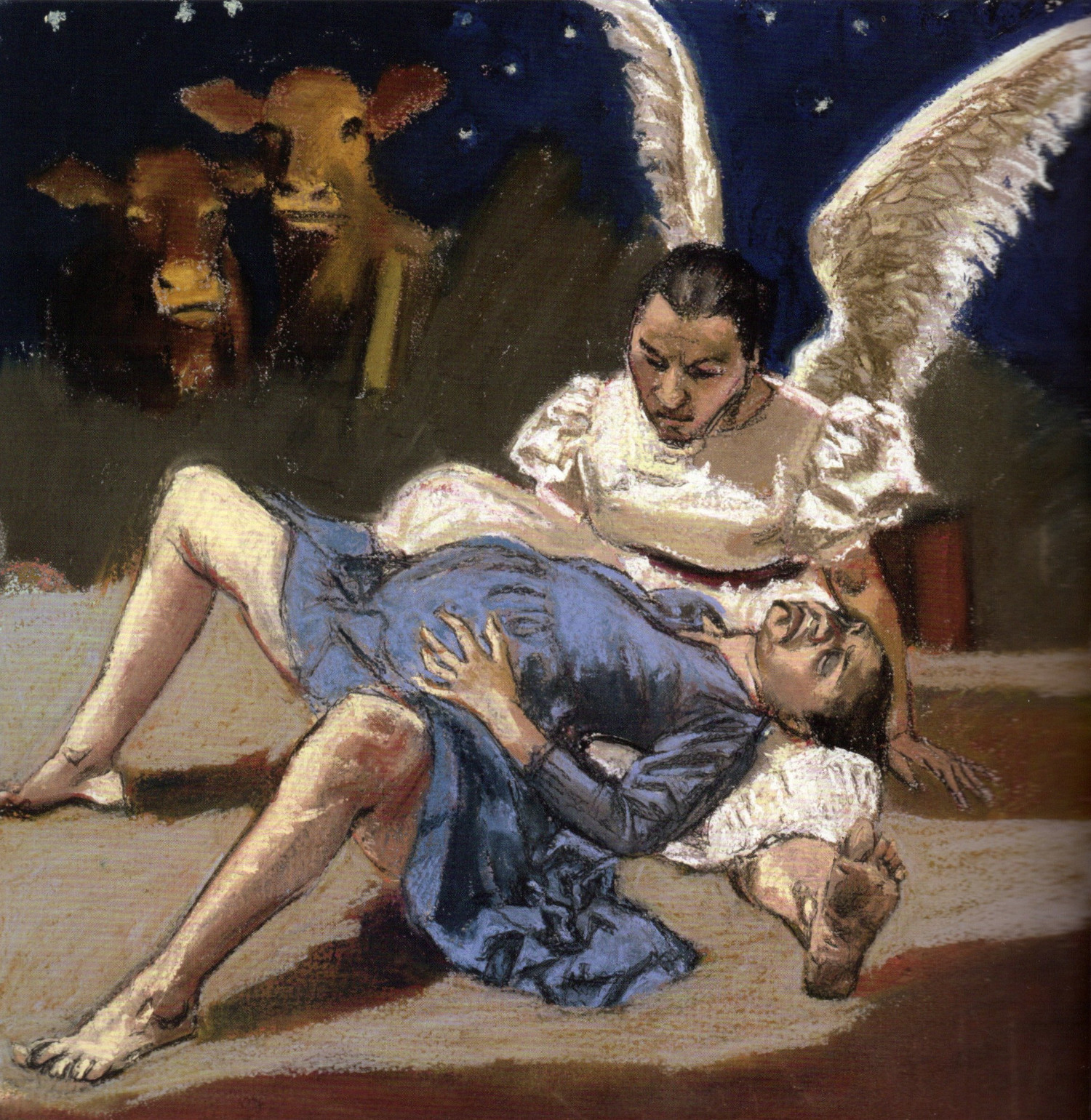
Paula Rego (Portuguese British, 1935–2022), The Nativity, 2002. Pastel on paper mounted on aluminum, 21 3/8 × 20 1/2 in. (54 × 52 cm). Palácio de Belém, Lisbon, Portugal. Source: Paula Rego: The Art of Story, p. 226.
It is time.
My body’s clock gongs
your salvation’s hour.
The water has left the pasture
and flowed toward the river’s mouth.
Follow or you will wither
in the desert that remains.
I will bleed for you
on this your first dark journey,
but in time, when life pushes you
headlong through black canyons,
the wounds will be your own.
May you learn early:
at the end light always shines.
It is here, child.
The time is come.
Breathe.
This poem was originally published in the Winter 1982/83 issue of Today’s Christian Woman and appears in the book Mary’s Journal: A Mother’s Storyby Evelyn Bence (Grand Rapids, MI: Zondervan, 1992). Used by permission of the author.(Thanks to Maureen E. Doallas, curator of the exhibition Mary, Mary, for introducing me to it!)
Evelyn Bence (born 1952) is a writer and editor living in Arlington, Virginia. She is the author of Room at My Table; Prayers for Girlfriends and Sisters and Me; Spiritual Moments with the Great Hymns; and the award-winning Mary’s Journal, a novel written in the voice of Jesus’s mother. She has served as religion editor at Doubleday, managing editor for Today’s Christian Woman, and senior editor at Prison Fellowship Ministries. Her personal essays, poems, and devotional reflections have appeared in various publications.
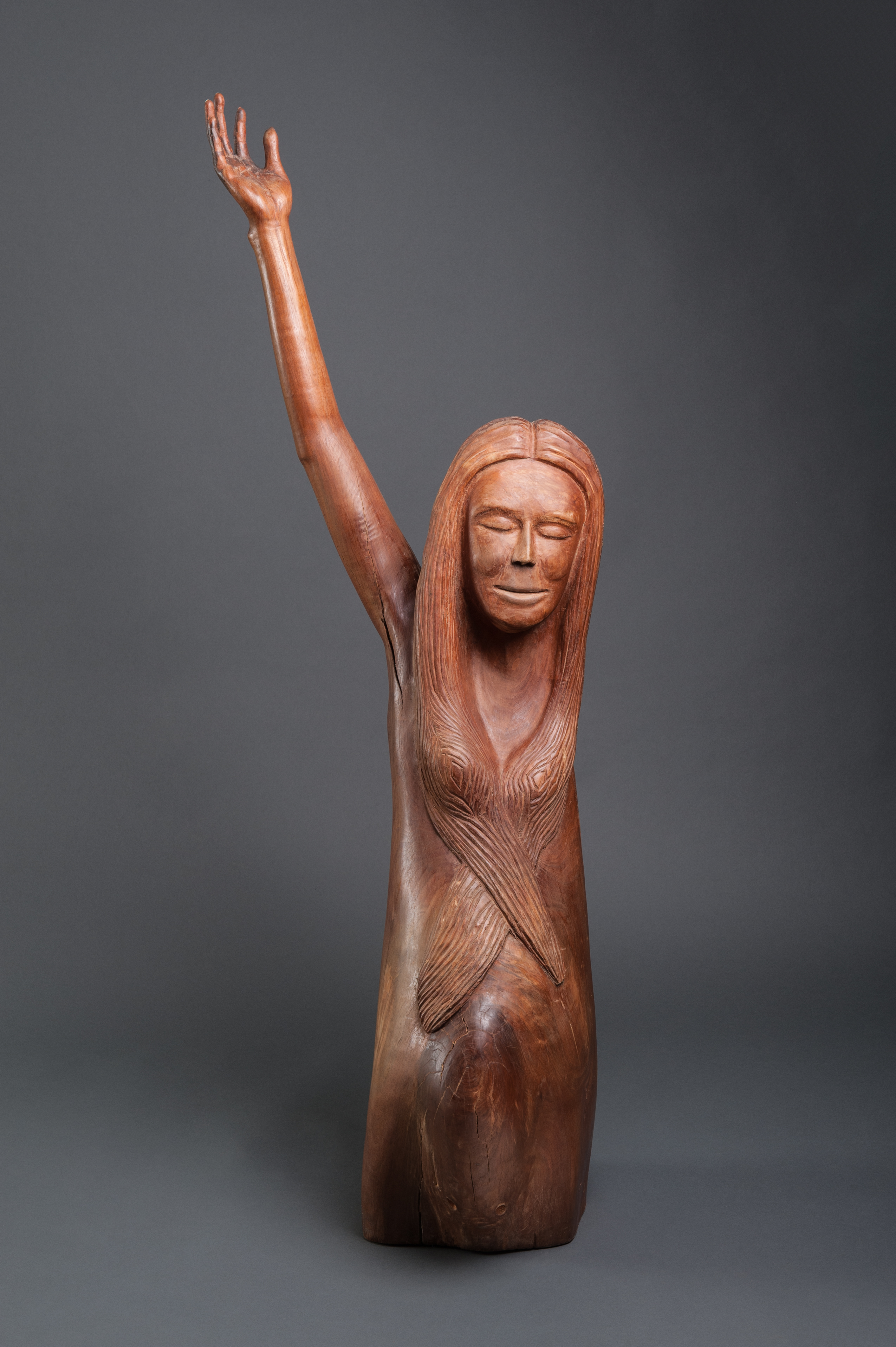
Fred J. Carter (American, 1911–1992), Behold My Miracle, 1980. Walnut, 55 × 20 in. Collection of Mary Carter Owens and Vel-Holly Fleming. Photo: Dan Meyers, courtesy of the American Visionary Art Museum.
Born in 1911 in the mountains of southwestern Virginia, Fred Jerome Carter spent the first few decades of his adulthood as a hardware merchant. In 1938 he married Eloise Davis, and in 1950 they adopted their first and only son, Ross.
In his late forties, Carter began to pursue art making, taking a beginner’s painting class, his only formal artistic training. But wood sculpting is the medium for which he became best known. Writer and documentary filmmaker Jack Wright classifies Carter’s art as “Appalachian art brut,”art brut (“raw art”) being a French term coined by modern artist Jean Dubuffet to describe art made outside the academic tradition.
In 1970 Carter was devastated when his son, having returned as a Marine from Vietnam, hanged himself. He and Eloise divorced shortly after, and Carter opened the Ross Carter Gallery, named in his son’s honor, where he started showing his own work. Below the gallery he established the Cumberland Museum to exhibit a large collection of pioneer tools and artifacts (having to do, for example, with farming, mining, spinning, and moonshining) that provided a window into Appalachian culture and history. It’s there that he met Vickie Hill, whom he later married. Vickie gave birth to Carter’s first biological child, Holly, in 1983, when Carter was seventy-two. Their daughter Mary was born two years later.
Carter created Behold My Miracle two years before Vickie’s first pregnancy, but he retroactively identified the figure with her. In a 1980 interview with Wright for Headwaters Television, he describes how the sculpture came about:
I was back, at Easter [1980], in the mountains, and a fellow was sawing up firewood. Now this was part of a walnut log . . . cut down forty or fifty years ago. . . . There was a limb going up through here about ten feet long. I said, “Don’t cut that up for wood. . . . I see something in this that I want to make. . . . I see a pregnant woman.” . . . So I brought it home and began to look at it. . . . The wood began to talk to me and tell me what it is. . . .
So, I will probably call this Behold My Miracle. That’s what the mother is saying and I am trying to get her to say, in the position of her hand and the look on her face, that this is truly the great miracle. . . . As though she is saying, “Behold me, in my greatest moment of the miracle!”
LISTEN: “The Glory of Jah” by Sinéad O’Connor and Ronald Tomlinson, on Theology (2007) – The acoustic version in the video below, which appears on disc 1 of the album, was recorded live at The Sugar Club in Dublin.
There is no Holy One like you You install kings and take them down Truly there is no one beside you You made all of creation with wisdom
Refrain: May the glory of Jah endure forever The boughs of the mighty are broken And the weak are clothed with strength
There is the sea, vast and wide With all its creatures beyond number There go the ships, they all look to you You lift up the poor into a place of honor [Refrain]
Jah makes poor or he makes rich The pillars of the earth belong to him And he has set his world upon them To raise us up from the dunghill [Refrain]
The eighth full-length album by Irish singer-songwriter Sinéad O’Connor, Theology is a collection of mostly original spiritual songs in the Judeo-Christian tradition. It’s saturated with scripture. It contains:
The opening (and my favorite) “Something Beautiful,” which starts out in O’Connor’s own voice and ends with quotations of Jeremiah 6:14 and 2:32, where God expresses compassion and longing for his people
“Out of the Depths,” a lament for the ways in which organized religion binds God and makes him hard to access, bookended by verses from Psalm 130
O’Connor grew up Catholic and, until converting to Islam in 2018, identified as such, though she has always been unorthodox. Frustrated by the spiritual vapidness of the pop music industry in which she had found fame, in the early 2000s she studied theology at a college in Dublin, looking to connect more deeply with her religious heritage. Her favorite instructor, the Irish Dominican priest Wilfred Harrington, taught a course on the Prophets, reviving her interest in the biblical material that had so fascinated her as a youth. During this time, she was considering leaving her music career, but Fr. Harrington suggested that she set some scripture texts to music and see what happens. She took his advice, and the result is Theology, which she dedicated to Fr. Harrington. Listen to a ten-minute interview with O’Connor about the album, from the limited-edition Theology DVD released in 2008.
When I first heard “The Glory of Jah,” I thought it was a condensation of Mary’s Magnificat, which she voiced upon visiting her cousin Elizabeth following their mutual unexpected pregnancies—Elizabeth with John the Baptist, and Mary with the Christ:
My soul magnifies the Lord, and my spirit rejoices in God my Savior, for he has looked with favor on the lowly state of his servant. Surely from now on all generations will call me blessed, for the Mighty One has done great things for me, and holy is his name; indeed, his mercy is for those who fear him from generation to generation. He has shown strength with his arm; he has scattered the proud in the imagination of their hearts. He has brought down the powerful from their thrones and lifted up the lowly; he has filled the hungry with good things and sent the rich away empty. He has come to the aid of his child Israel, in remembrance of his mercy, according to the promise he made to our ancestors, to Abraham and to his descendants forever. (Luke 1:46–55)
But as I listened more closely and flipped through my Bible to match phrases, I realized that O’Connor’s song is actually a pastiche of Old Testament verses from 1 Samuel, Daniel, and the Psalms, the primary source text being Hannah’s song of thanksgiving:
My heart exults in the LORD; my strength is exalted in my God. My mouth derides my enemies because I rejoice in your victory.
There is no Holy One like the Lord, no one besides you; there is no Rock like our God. Talk no more so very proudly; let not arrogance come from your mouth, for the LORD is a God of knowledge, and by him actions are weighed. The bows of the mighty are broken, but the feeble gird on strength. Those who were full have hired themselves out for bread, but those who were hungry are fat with spoil. The barren has borne seven, but she who has many children is forlorn. The LORD kills and brings to life; he brings down to Sheol and raises up. The LORD makes poor and makes rich; he brings low; he also exalts. He raises up the poor from the dust; he lifts the needy from the ash heap to make them sit with princes and inherit a seat of honor. For the pillars of the earth are the LORD’s, and on them he has set the world.
He will guard the feet of his faithful ones, but the wicked will perish in darkness, for not by might does one prevail. The LORD! His adversaries will be shattered; the Most High will thunder in heaven. The LORD will judge the ends of the earth; he will give strength to his king and exalt the power of his anointed. (1 Sam. 2:1–10)
Hannah, an ancient Jew, prayed these words at the tabernacle at Shiloh upon dedicating her firstborn son, Samuel, to God’s service, as he was conceived after many hard years of infertility and anguished prayer. Mary’s song, which came some ten centuries later, picks up themes from Hannah’s, so it’s no wonder I originally misidentified O’Connor’s source. Mary would have known Hannah’s song from having heard it read in synagogue, and, as Mary’s son would also be set apart for divine service, perhaps she found a special kinship with this ancestral sister. Mary was also spiritually formed by the Psalms, another influence on her Magnificat composition; their words were deep in her bones, naturally coming out in effusions of praise.
Both Hannah and Mary praise God’s kindness, authority, and eternal plan, emphasizing his mercy toward the poor and the humble. Both songs are thematically linked to Psalm 113:5–8:
Who is like the LORD our God, who is seated on high, who looks far down on the heavens and the earth? He raises the poor from the dust and lifts the needy from the ash heap, to make them sit with princes, with the princes of his people.
Now returning to O’Connor’s song: Line 2 has a corollary in Daniel 2:21, “he . . . deposes kings and sets up kings.” And the second verse seems inspired by Psalm 104:24–26, 31:
O LORD, how manifold are your works! In wisdom you have made them all; the earth is full of your creatures. There is the sea, great and wide; creeping things innumerable are there, living things both small and great. There go the ships and Leviathan that you formed to sport in it.
May the glory of the LORD endure forever; may the LORD rejoice in his works . . .
When referring to God, O’Connor uses the Rastafari name for him, “Jah,” a shortened form of “Jehovah.” She had recorded her previous album, Throw Down Your Arms, in Jamaica, a collection of roots reggae song covers, and her spirituality was impacted by her encounters with the Rastafari there. “They use music to reassure people that God is actually with them and watches them, can be called upon,” she said.
So “The Glory of Jah” is a highly intertextual song, rooted in Hannah’s song but weaving in strands from other biblical books—and the result sounds an awful lot like something Mother Mary would sing!
In careful hands
God held the molten world—
fragile filigree
of unfinished blown glass.

Then Mary’s word: Yes!
rose like a pillar of fire,
and Breath blew creation
into Christed crystal.
Sister Irene Zimmerman, OSF, is a Franciscan nun living in Milwaukee, Wisconsin. Born in 1932 into a large Catholic family on a farm near Westphalia, Iowa, she knew from an early age that she wanted to enter the religious life. She joined the School Sisters of St. Francis in 1954 and spent her career in various ministry roles, including high school English and French teacher, secretary, house mother in a German boarding school for girls, and music minister, along the way developing a keen interest in writing poetry. Now in her retirement, she continues to write and to sing in church choirs. She has published five original poetry collections.
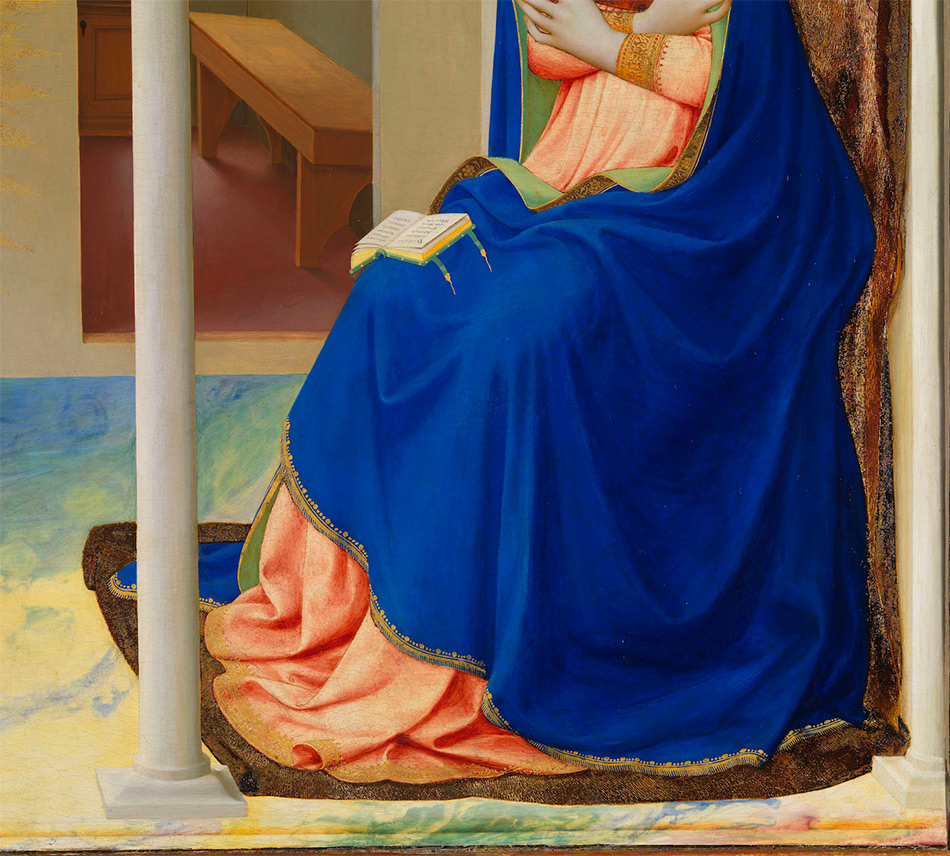
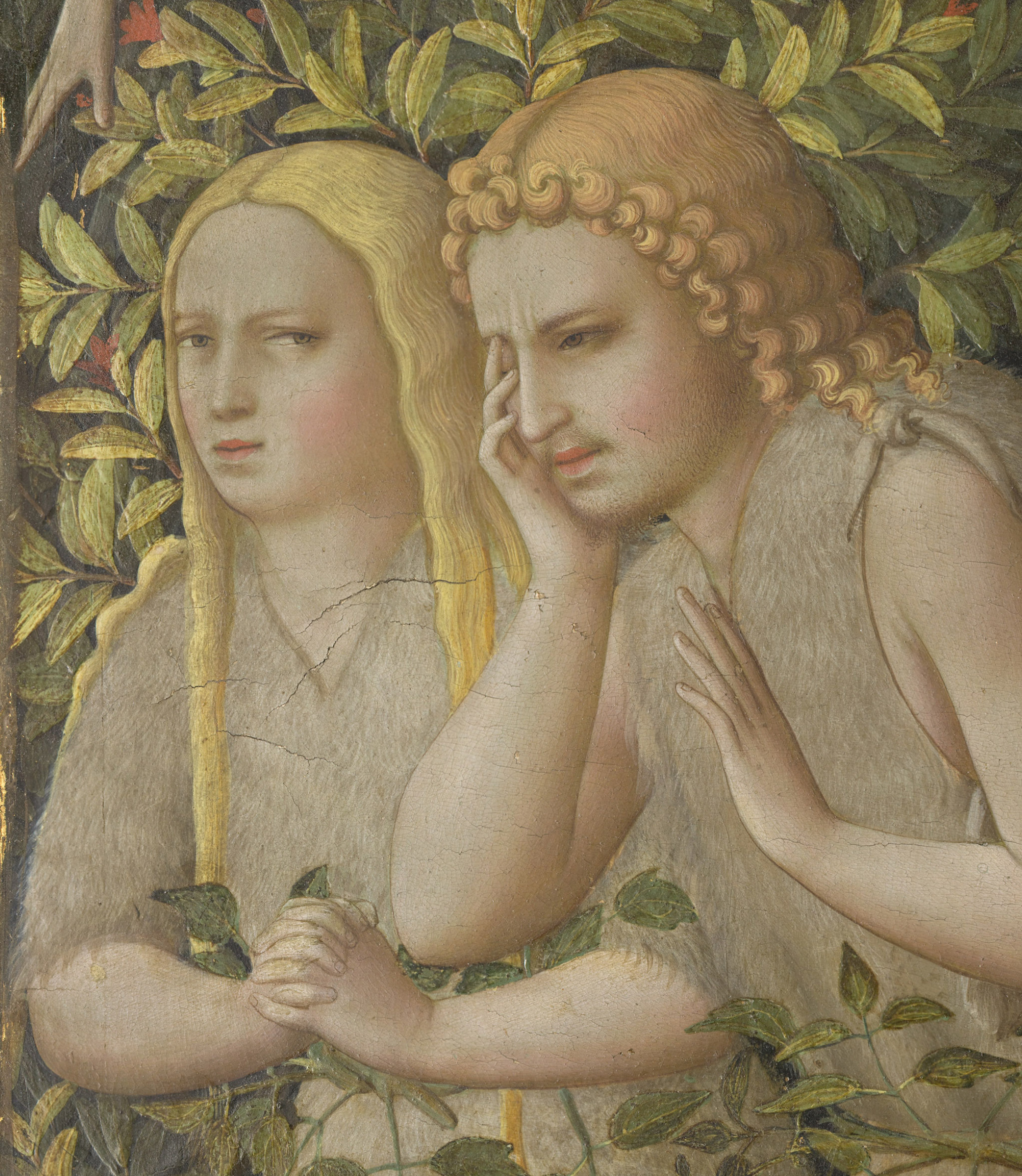
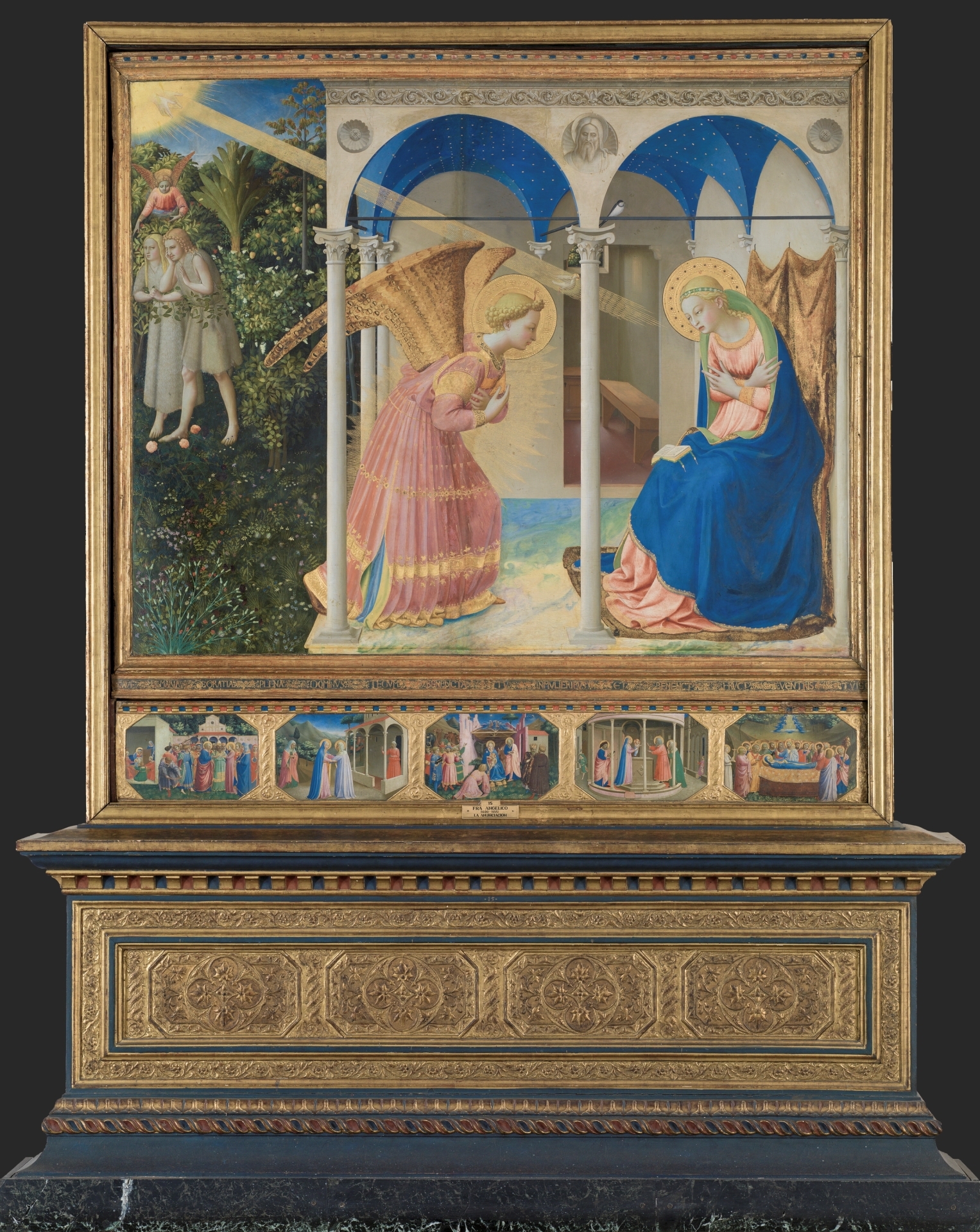
Fra Angelico (Italian, ca. 1395–1455), The Annunciation, ca. 1426. Tempera and gold on wood panel, 162.3 × 191.5 cm. Museo del Prado, Madrid.
The Annunciation was a favorite subject of the Early Renaissance artist Fra Angelico [previously], and he painted it multiple times throughout his career. Once was for an altarpiece for the convent of San Domenico in Fiesole, near Florence, now in the Prado Museum in Madrid.
In this version Mary sits on a draped chair under the portico of a domestic space, reading the scriptures, when suddenly this otherworldly being, dressed in rose and radiating, approaches. It’s the archangel Gabriel. His foot crosses the threshold of paradise into Mary’s space—the divine stepping into the human realm. Will you do it? he asks. Be mother to God?
Mary’s initial fear and perplexity eventually give way to glad acceptance. The artist compresses the episode—the arrival, the ask, the cogitation, the answer—into this singular freeze frame. When Mary says yes to God’s plan to become flesh of her flesh and so work out the salvation of the world, God releases his Spirit, who rides a stream of light from the heavens into her womb. At this miraculous moment, Jesus is conceived.
Gabriel crosses his hands over his chest in humble reverence, a gesture mirrored by Mary. Both are still before the profound mystery of the Incarnation.
Fra Angelico used ultramarine—the finest and most expensive of all pigments, made from lapis lazuli, a semiprecious stone imported to Europe from the Middle East—to paint Mary’s mantle as well as the star-studded ceiling above her. Blue represents heaven, and here Mary is clothed with it and overshadowed by it.
The male figure in the carved roundel above the central column is, I’d say (based on the unambiguous Montecarlo Altarpiece), the prophet Isaiah, who wrote centuries before the event that “the Lord himself shall give you a sign; behold, a virgin shall conceive, and bear a son, and shall call his name Immanuel” (Isa. 7:14).
But Fra Angelico goes even further back than the Old Testament prophets. On the left side of the panel he shows our foreparents, Adam and Eve, being cast out of paradise, having broken God’s trust. They blush in shame—they wince, they cover their face. By including this catalyzing event from salvation history in his painting of the Annunciation, the artist is telling a larger narrative. In particular, he is drawing connections, mainly contrastive, between Adam and Eve and Christ and Mary.
In his epistles, the apostle Paul talks about Christ as the Second Adam, or the New/Last Adam (Rom. 5:12–21; 1 Cor. 15:22–23, 45), who came to restore what was lost with the first Adam. Whereas Adam disobeyed God and caused sin to enter the world, Christ lived a life of perfect obedience to the Father, thereby redeeming humanity. The early church fathers, starting with Justin Martyr, Irenaeus, and Tertullian in the second century, extended this corollary with another: Mary as the Second Eve. Whereas Eve rejected God’s will, Mary embraced it, and her obedient yes, like Eve’s disobedient no, had repercussions for all of humanity. As the arts lecturer John Skillen puts it, our undoing in the Expulsion is undone by the Annunciation.
We see on the left an angel driving humanity out of Eden, but on the right, another angel welcomes humanity back in. And in a glorious reversal of the order of first creation, where Eve was created from Adam, here the Second Adam is created from the Second Eve, knit together from her DNA.
In the first issue of her Medievalish newsletter from last December, Dr. Grace Hamman discusses Fra Angelico’s Prado Annunciation in terms of chronos (ordinary time measured in seconds and hours) and kairos (moments outside of time). “Fra Angelico recognizes something that is easy to forget: because God is outside of time, not bound by chronology like us creatures, this painting offers a ‘God’s-eye view’ of salvation history,” she writes, portraying a simultaneity of “falls” that the fourteenth-century contemplative writer Julian of Norwich expounds on:
When Adam fell, God’s Son fell; because of the true union which was made in heaven, God’s Son could not be separated from Adam, for by Adam I understand all mankind. Adam fell from life to death, into the valley of this wretched world, and after that into hell. God’s Son fell with Adam, into the valley of the womb of the maiden who was the fairest daughter of Adam, and that was to excuse Adam from blame in heaven and on earth; and powerfully he brought him out of hell. (Revelations of Divine Love, chap. 51)
“There was never a moment,” Hamman continues, “even in the expulsion from Eden, that Emmanuel was not with us, if one is given the eyes of kairos.”
And the Annunciation is only the main panel. Along the predella (base) are depicted the Marriage of the Virgin, the Visitation, the Nativity, the Presentation of Christ in the Temple, and the Dormition (the “falling asleep,” or death, of Mary).
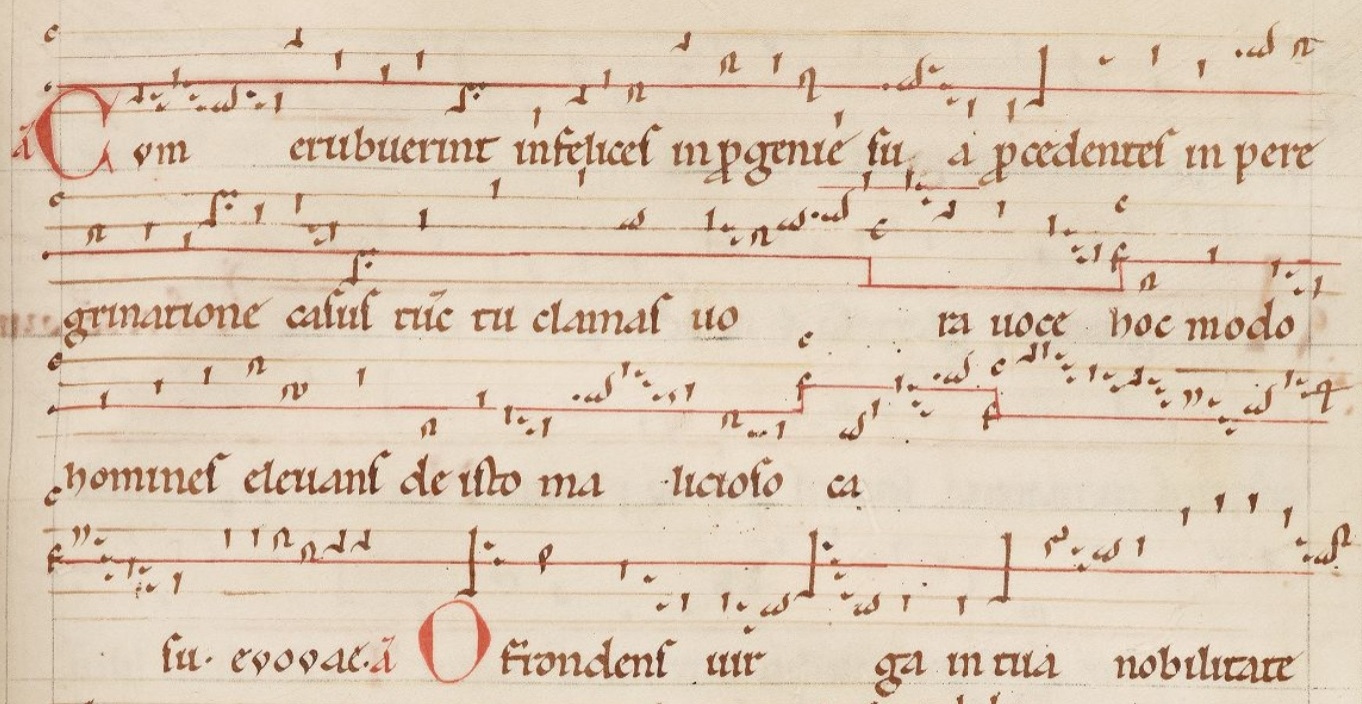
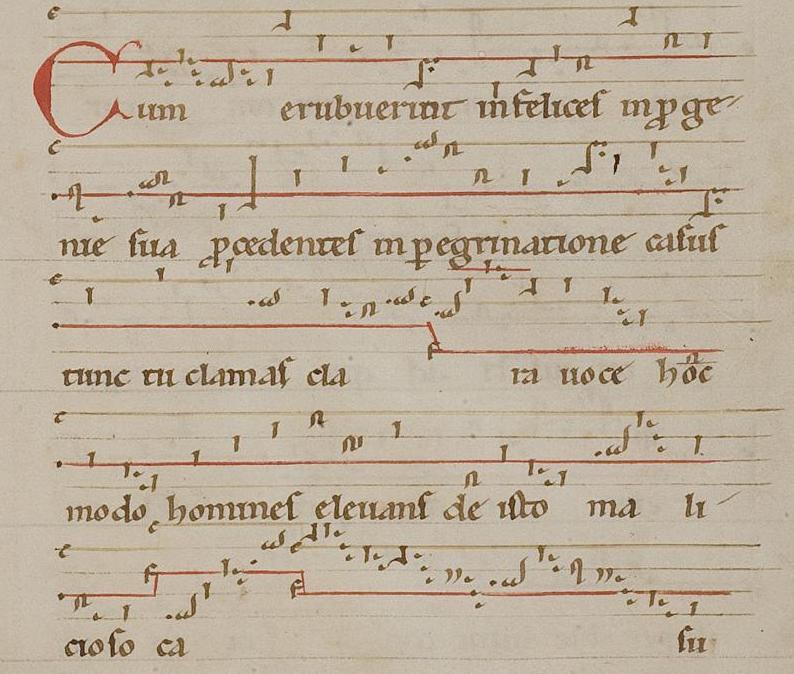
LISTEN: “Cum erubuerint infelices” (While Downcast Parents Blushed) by Hildegard of Bingen, ca. 1175 | Performed by La Reverdie on Sponsa Regis: La victoire de la Vierge dans l’œuvre d’Hildegard, 2003
Cum erubuerint infelices
in progenie sua,
procedentes in peregrinatione casus,
tunc tu clamas clara voce,
hoc modo homines elevans
de isto malicioso
casu.
While downcast parents blushed,
ashamed to see their offspring
wand’ring off into the fallen exile’s pilgrimage,
you cried aloud with crystal voice,
to lift up humankind
from that malicious
fall.

Trans. Nathaniel M. Campbell [source]
The Benedictine abbess Hildegard of Bingen (1098–1179) was a visionary theologian, preacher, poet, composer, and pharmacologist. I first learned about her in a Western music history survey course in college, in a unit centered on her Ordo Virtutum (Play of the Virtues). I couldn’t believe I had never heard about this amazing sister in the faith before. In 2012 she was formally canonized by the Roman Catholic Church—a long time coming!—and Pope Benedict XVI even named her a “doctor of the church,” a title given to saints who have made a significant contribution to theology or doctrine.
The corpus of surviving musical compositions by Hildegard is larger than that of any other medieval composer. More than half of these are antiphons, short free verses sung before and after each set of psalms during monastic prayer.
“Cum erubuerint” is one such antiphon. Hildegard would have sung it with her sisters at her monastery on the Rupertsberg and later the abbey at Eibingen as part of the Divine Office.
The song addresses the Virgin Mary, whose yes to Gabriel set into motion the Incarnation and thus humanity’s deliverance from spiritual exile.
As are many of Hildegard’s compositions, “Cum erubuerint” is highly melismatic—that is, it features long melodic phrases sung to one syllable. For example, I counted thirteen notes on the first syllable, “Cum”! The highest pitch occurs on clara (“clear”), referring to the definitive quality of Mary’s consent, bright and luminous, to this new thing that God is doing. An agent of God’s grace, Mary speaks a word that cuts through the mists of confusion through which we’ve been wandering, lost, uplifting us from the fall (casu), whose depths are underscored by that word’s being pitched the lowest. In her fiat, Mary is essentially saying, “Let there be light.”
Symphonia armonie celestium revelationum (Symphony of the Harmony of Celestial Revelations) is the title Hildegard gave to her collection of musical compositions, which are preserved in two manuscripts:
Dendermonde (D), Belgium, Sint-Pieters-en-Paulusabdij, Cod. 9 (ca. 1175). This one is considered by scholars to be the more authoritative. It was prepared under Hildegard’s supervision as a gift for the monks of Villers and contains fifty-seven songs.
Riesenkodex (R), Wiesbaden, Hessische Landesbibliothek, Hs. 2 (ca. 1180–85). This revised and enlarged edition, which includes seventy-five songs, was produced at the Rupertsberg scriptorium not long after Hildegard’s death.
Hildegard’s creations, compared with a contemporary hymn by Abelard or a sequence by Adam of St. Victor, will sound either primitive or unnervingly avant-garde. In a sense they are both. As a Benedictine, she was acquainted with a large repertoire of chant, but she lacked formal training and made no attempt to imitate the mainstream poetic and musical achievements of her day. Various scholars have hypothesized that she was influenced by German folksong, yet her compositions lack the two essential traits of a popular tune: it must be easy to remember and easy to sing. The difficult music of the Symphonia is sui generis. In [Sr. Maria Immaculata] Ritscher’s words, it is ‘gregorianizing but not Gregorian’ and impossible to classify in terms of any known contemporary movement. (27–28)
And regarding Hildegard’s lyrical texts:
Until the advent of modern vers libre, scholars were reluctant even to dignify Hildegard’s songs with the title of poetry. In style they are much closer to Kunstprosa, a highly wrought figurative language that resembles poetry in its density and musicality, yet with no semblance of meter or regular form. (32–33)
The above performance of “Cum erubuerint” is by La Reverdie, a medieval and Renaissance vocal ensemble that started in 1986 with two pairs of sisters from Italy.
But in addition, here are a few instrumental versions I particularly like:
>> Tina Chancey of the early music ensemble Hesperus plays the melody on kemenche, a bowed instrument from the Black Sea region of Turkey:
The song also appears, under the title “From This Wicked Fall,” on the Billboard-topping Vision: The Music of Hildegard Von Bingen (1994), a classical-electronic crossover album of seventeen of Hildegard’s works arranged by Richard Souther. In Souther’s version, nonlexical vocables (sung by soprano Emily Van Evera and mezzo-soprano Sister Germaine Fritz, OSB) replace the Latin text.