Four scenes from a medieval German altarpiece

When I was at the Museum Catharijneconvent in Utrecht, Netherlands, in 2019, one of the standout pieces I saw was an early fifteenth-century altarpiece from the Middle Rhine region of Germany. The central section, which I imagine would have been a sculpted Crucifixion scene, has been lost, and the surviving panels are arranged in a modern frame.

Middle Rhine Altarpiece (Catharijneconvent)
Altarpiece from the Middle Rhine, ca. 1410. Tempera on panels. Museum Catharijneconvent, Utrecht, Netherlands. Photo: Ruben de Heer.

Ten panels depicting eight scenes from the life of the Virgin Mary decorate what would have originally been the interior wings—that is, visible when the altarpiece was open.

  1. The Annunciation (2 panels)
  2. The Visitation
  3. The Nativity
  4. The Adoration of the Magi
  5. The Resurrection
  6. The Ascension (2 panels)
  7. The Descent of the Holy Spirit
  8. The Dormition

I’ll describe the first four, as they’re my favorites.

All photos in this post are from the museum’s website, which courteously provides them in high resolution under an open-access policy, promoting scholarship and digital engagement. The Annunciation image is a composite I made from two separate photos.

The Annunciation

Annunciation (Middle Rhine Altarpiece)

In the Annunciation, Mary sits in her bedroom beside a window in front of an open pink chest (her dowry chest?), quietly reading the scriptures, when the angel Gabriel slips in through an open door, holding a banderole that bears his greeting: Ave gratia plena d[omi]n[u]s tecum (“Hail, favored one, the Lord is with you,” Luke 1:28). He then goes on to tell her that she has been chosen to bear God’s Son into the world.

What will Mary say? Four little angels look on in eager anticipation from a tower in the panel above, while in the room two angels already start rolling out the royal treatment, holding up a gilt-brocaded velvet “cloth of honor” behind the young maiden in recognition of her high calling.

A thin column divides Gabriel’s space from Mary’s, creating a sense of threshold. It marks a boundary that is about to be crossed. The separation between God and humanity will be broken down by the Incarnation.

Mary ultimately responds to the surprise invitation with acceptance: Ecce ancilla d[omi]ni fiat michi s[e]c[un]d[u]m verbu[m] t[uu]m (“Behold the handmaid of the Lord, be it unto me according to thy word,” Luke 1:38).

Mary’s yes triggers the release of a thick stream of light—it looks to me like a golden conveyor belt!—from the heart of God the Father, who is peering down through an upper window. Riding that stream is a haloed dove (the Holy Spirit) followed by a tiny yet fully formed infant Christ who’s holding a cross and headed straight toward Mary’s womb.

Annunciation (Middle Rhine Altarpiece, detail)
“Weeee!!!”

The homunculus (“little human”) motif in Annunciation images, though relatively rare, always makes me chuckle. It’s one way artists came up with to visualize the unvisualizable mystery of Christ’s conception, one that includes the Second Person of the Trinity as an actor in the event and shows a very literal descent. Not long after the motif started appearing in the fourteenth century, it was disapproved of by theologians, such as Antoninus of Florence and Molanus, and it was finally banned in the eighteenth century by Pope Benedict XIV as being heretical, since it suggests that Jesus did not take his body from Mary.

For brief commentary on this particular scene by Msgr. Herman Woorts, a Dutch art historian and an auxiliary bishop in the Roman Catholic Church, see this video produced by Katholiekleven.nl:

(To translate the Dutch into your language, click the “CC” button on the player, then the cog icon, and select Subtitles→Auto-translate.)

The Visitation

Visitation (Middle Rhine Altarpiece)

In the Visitation panel, Jesus and John the Baptizer are visible in their mothers’ wombs, each encased in a mandorla (almond-shaped aureole). This visual device of showing the cousins in utero was not uncommon at the time, especially in the Low Countries; art historian Matthew J. Milliner amusingly calls it “ultrasound Jesus”! Here you can actually see little John kneeling before his cousin in adoration.

Elizabeth has emerged from a door at the right, whose frame is labeled “Civitas Juda,” City of Judah (and notice the dog in the doorway! a traditional symbol of faithfulness). As she and Mary embrace each other in celebration of their miraculous pregnancies and imminent salvation, scrolls unfurl with their words from the Gospel of Luke: Et unde michi hoc q[uo]d mater d[omi]ni mei venit ad me (“And why is this granted to me that the mother of my Lord should come to me?” Luke 1:43), at right, and at left, Magnificat a[n]i[m]a mea d[omi]n[u]m. Et exultavit sp[iritu]s meus i[n] deo salutalutari (sic) meo (“My soul magnifies the Lord, and my spirit rejoices in God my Savior,” Luke 1:46–47). The scrolls provide a delicate, wing-like framing around the two women.

And at their head, in the center, an open-beaked dove descends, signifying the Holy Spirit—an extremely rare appearance in Visitation images. This is God breathing on his daughters, blessing their ministries, receiving their praise. Like the prophets of old, they are filled with God’s power and truth spills forth from their lips.
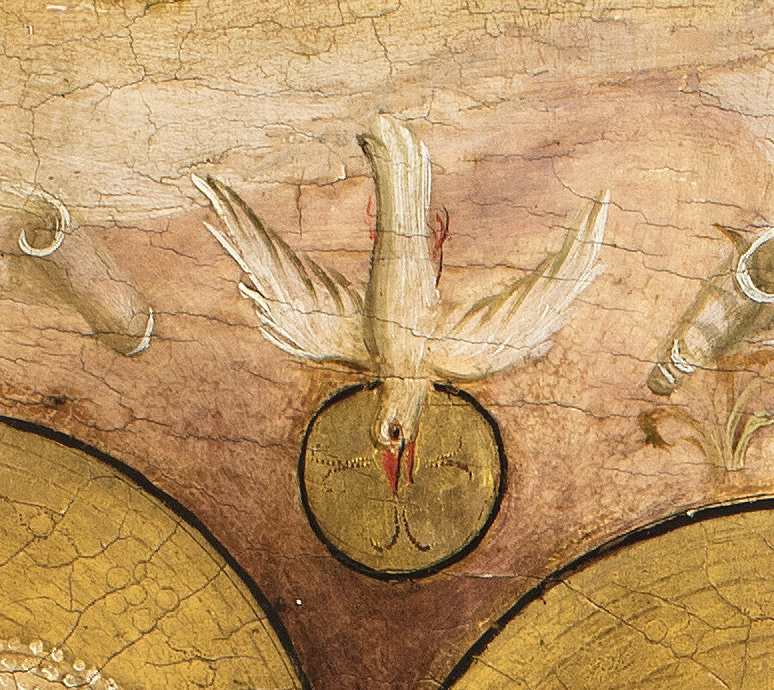
Visitation (Middle Rhine Altarpiece, detail)

At their feet flows a spring of water, a possible allusion to Isaiah 35:6b–7a: “waters shall break forth in the wilderness, / and streams in the desert; / the burning sand shall become a pool, / and the thirsty ground springs of water.” Not to mention the Living Water that is Christ (see John 4).

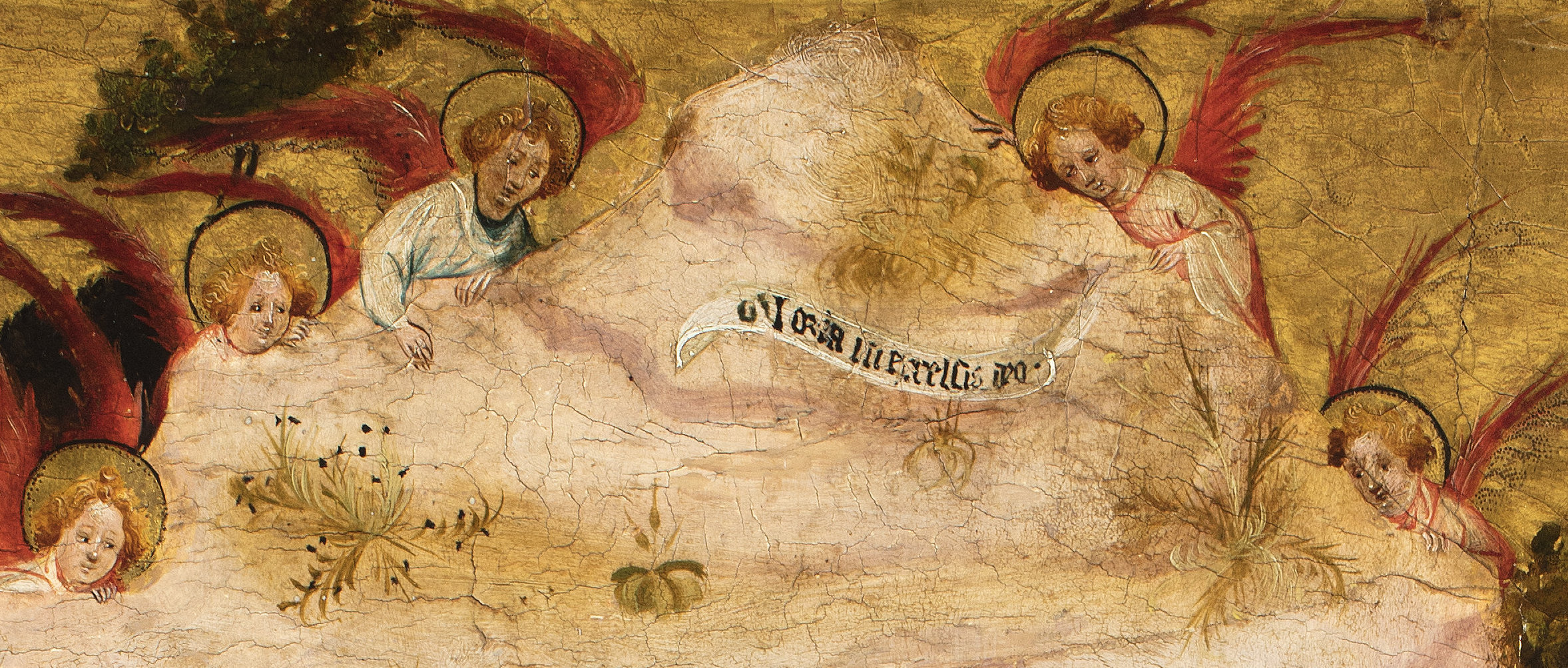
Another charming detail of this panel is the angels, with their wispy red wings, peeking in at this intimate moment from behind rocks. I’m reminded of the epistle of 1 Peter, whose author says that the mysteries of salvation are “things into which angels long to look!” (1:12). Here they seem to whisper their song that will be exclaimed at full blast on the night of Jesus’s birth: Gloria in exelsis deo (“Glory to God in the highest,” Luke 2:14).
The Nativity

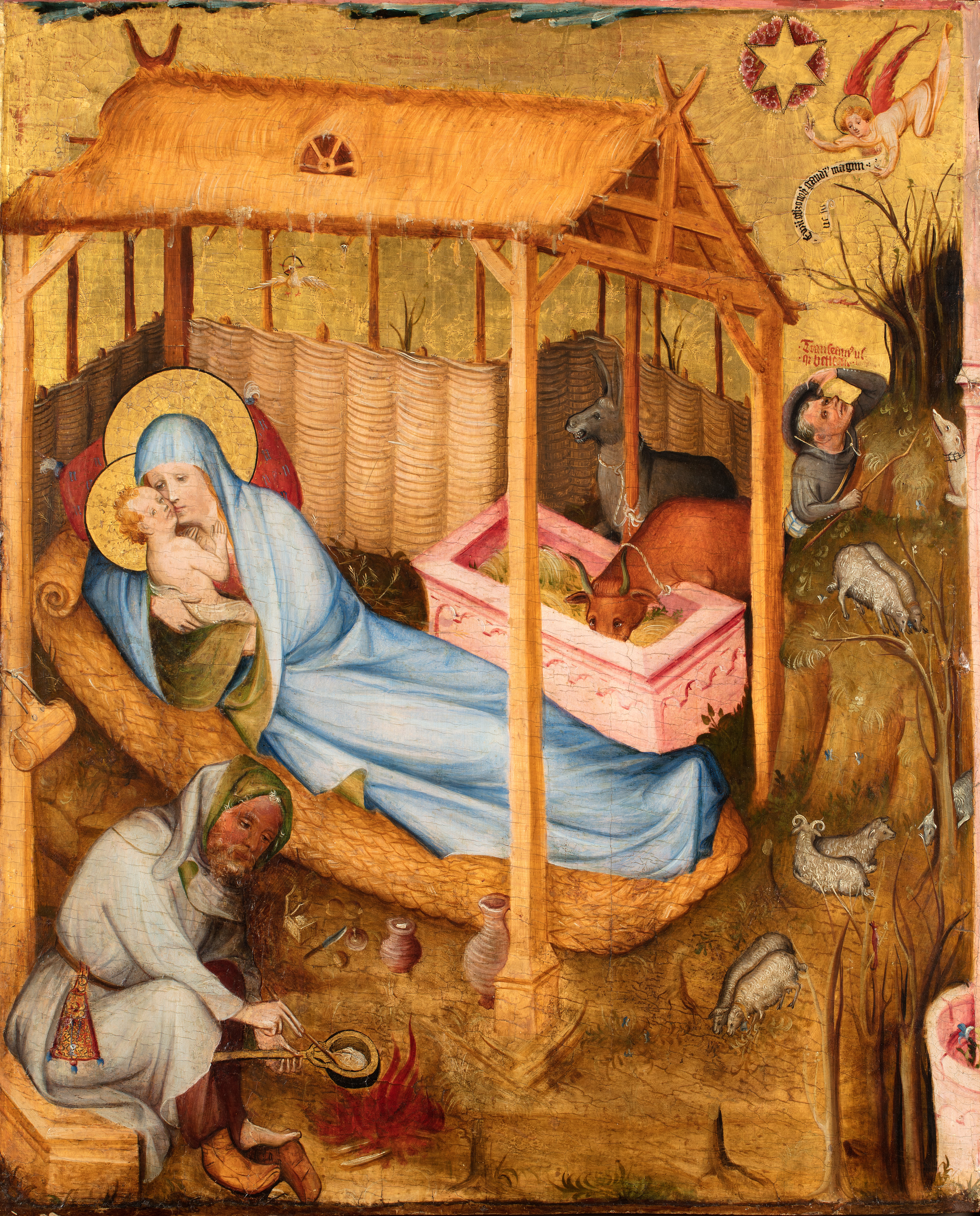
Poor Joseph is often overlooked as a player in the Christmas story, and yet he, too, faithfully responded to a (quite terrifying!) divine calling: to be the adoptive father of Jesus, raising him as his own. Though he initially had doubts about Mary’s story of supernatural conception—who wouldn’t?—an angel set him straight, and he ultimately acted in love and loyalty to Mary, and to God. He was an advocate and a provider for his family, looking out for their best interests all along the way.
Nativity (Middle Rhine Altarpiece)

I mention this because the Middle Rhine Altarpiece shows an actively caring and resourceful Joseph at the Nativity, cooking porridge over an open fire to nourish his hungry and tired wife, who reclines on a rollout mat with her newborn.

Also, notice that his left foot is bare. A legend of unknown origin says that Joseph removed his stockings (German hosen) following Jesus’s birth, cutting them into strips in order to swaddle the child. This narrative detail appealed to popular imagination and was referred to in stories, poems, songs, and the visual arts from the fourteenth through sixteenth centuries in the Netherlands and the Rhineland. At the time this altarpiece was made there was even a venerated relic at Aachen Cathedral purported to be the stockings-turned-swaddling bands.

As had become standard in images of the Nativity, this one includes an ox and an ass. The canonical Gospels don’t mention any animals at the birth—though the mention of a manger in Luke 2:7 implies an animal presence. The seventh-century Gospel of Pseudo-Matthew specifically names the ox and ass, citing their supposed adoration of the Christ child as a fulfillment of an Old Testament “prophecy”: “And on the third day after the birth of our Lord Jesus Christ, the most blessed Mary went forth out of the cave, and entering a stable, placed the child in the stall, and the ox and the ass adored Him. Then was fulfilled that which was said by Isaiah the prophet, saying: The ox knows his owner, and the ass his master’s crib (Isa. 1:3).” These two domestic animals are also mentioned in the Nativity account that appears in the Golden Legend, an immensely popular text from the thirteenth century.

Here the ox is nose-deep in straw, while the ass looks up with his mouth agape. Perhaps he’s excited at having just spotted the Spirit-dove under the rafters.  

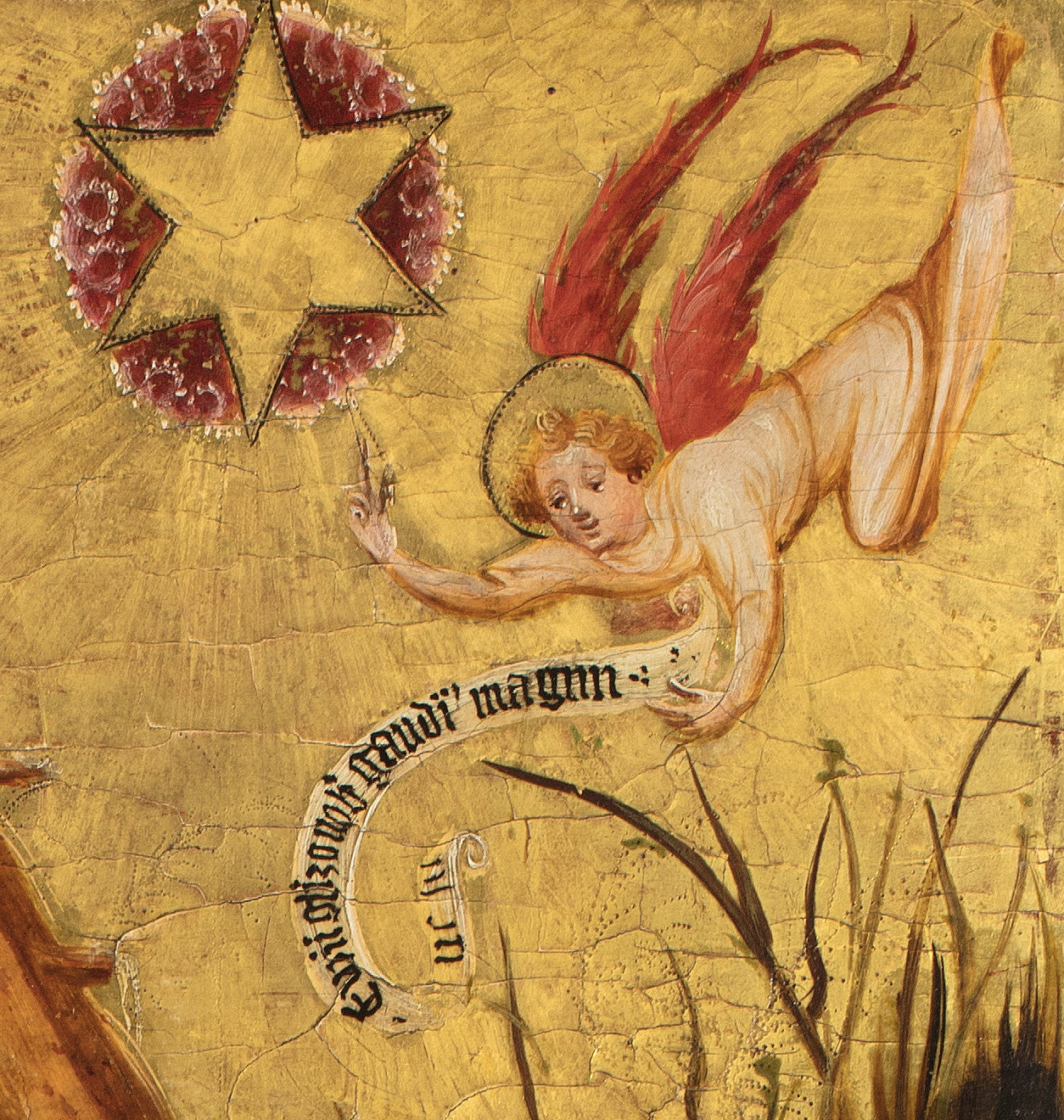
The shepherds are about to arrive at the stable, as in the right background the birth is announced to them. The scroll held by the angel reads, Evanglizo vob[is] gaudi[um] magnu[m] (“I proclaim great joy to you,” Luke 2:10), and above the shepherd is the inscription Transeamu[s] us[que] Betleem (“Let’s go to Bethlehem,” Luke 2:15).
The Adoration of the Magi

In the Adoration of the Magi panel, Mary holds the Christ child on her lap, who is nude save for a thin diaphanous drape, emphasizing his full humanity. She wears a crown, alluding to her identity (in Catholic tradition) as Queen of Heaven. As in the Annunciation, she’s backed by a cloth of honor, which Joseph pulls aside to see what new visitors have come calling. And again, the ever-present Holy Spirit hovers above!

The pointing angel at the top, with the aid of a star, has directed three magi, portrayed here as kings, from their far-off homelands to the Christ child. Ite in iudeam ubi / nascit rex iudeor[um] (“Go to Judea where the king of the Jews was born”), he says.

Having cast his crown at the child’s feet, one of the magi kneels down and kisses the hand of the King of kings. He presents a container of gold coins as tribute, which Jesus rifles through with curiosity (ooo, shiny!).

Two other magi stand behind with their gifts of frankincense and myrrh. One of them, whom tradition calls Balthazar, is African. In the eighth century the historian Bede described Balthazar as having a “black complexion,” and from around 1400 onward he came to be portrayed that way in art, reflecting the growing visibility of other races in Europe.

Exterior Panels

Just to give you a full picture of the altarpiece as a whole . . .

The exterior panels, which were visible when the altarpiece was closed, comprise ten scenes from Christ’s passion. Three, however, are missing, and several of the remaining ones are damaged.

  1. The Agony in the Garden
  2. The Arrest of Christ (lost)
  3. Christ before Pilate
  4. The Flagellation
  5. The Crowning with Thorns
  6. Christ Carrying His Cross
  7. The Deposition (lost)
  8. The Entombment
  9. Mary supported by John
  10. Longinus with the lance (lost)

So all together, the altarpiece would have told the gospel story from Christ’s conception and birth to the Crucifixion to the Resurrection and Ascension to Pentecost. And it would have served as the backdrop to the celebration of the Eucharist, spiritually forming parishioners week after week.

Art museums are full of such treasures as these. I encourage you to visit one of your local museums (or maybe take a weekend trip to one), find a piece of historical art that intrigues you, and sit with it for at least ten minutes. What do you notice? What is strange to you? What makes you smile? What was the object’s original context? What lineages is it a part of (e.g., what communities has it passed through, what iconographies or textual traditions does it draw from and develop, etc.)? What theological ideas, if any, does it express?

If you struggle to meaningfully engage with an artwork, I’m sure a docent would love to help you.

You might also take a photo of the artwork and share it on your social media. Ask your friends what stands out to them.
Advent, Day 13

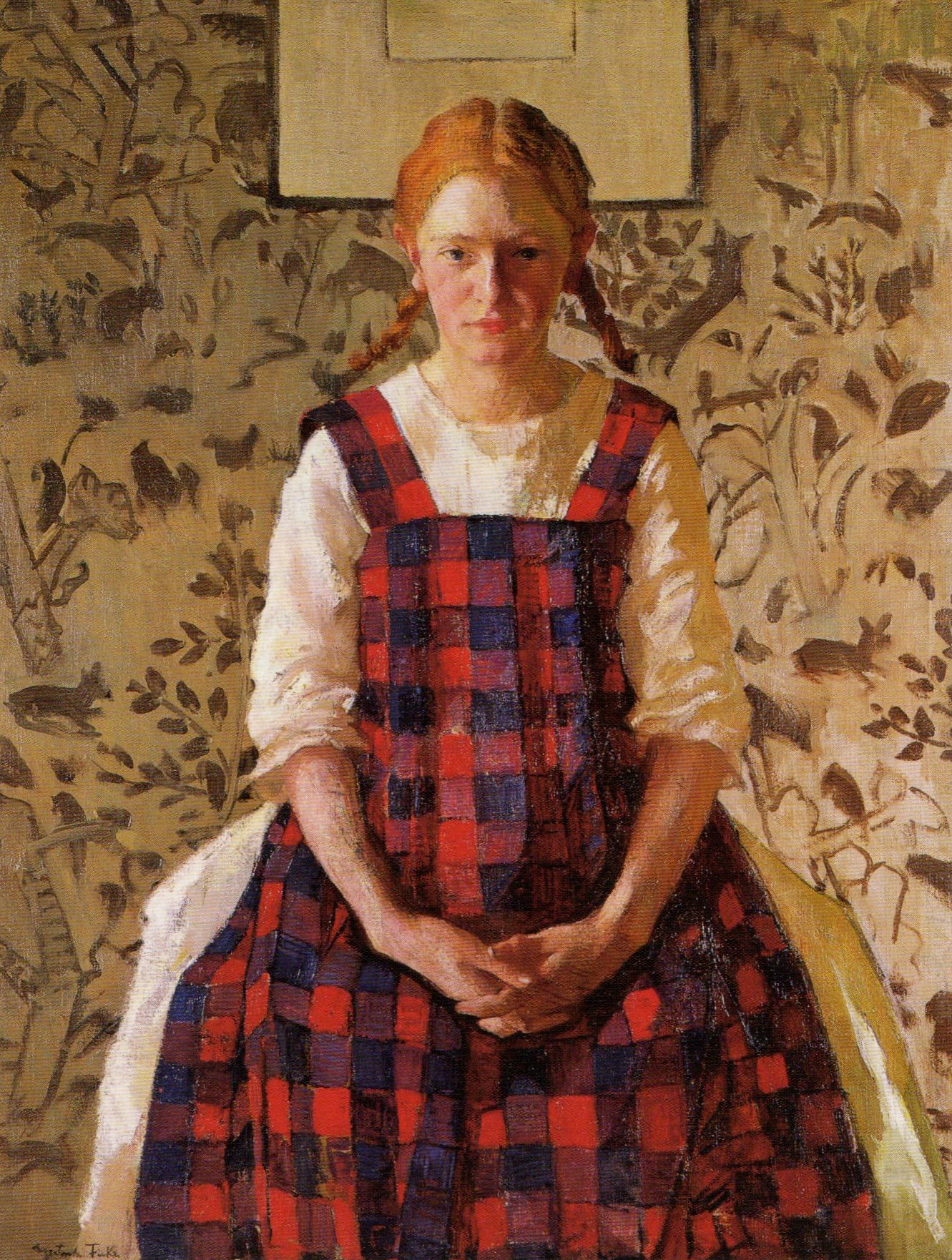
LOOK: Mary by Gertrude H. Fiske

Fiske, Gertrude_Mary
Gertrude H. Fiske (American, 1878–1961), Mary, 1920. Oil on canvas, 39 1/2 × 30 in. (100.3 × 76.2 cm). Davis Museum, Wellesley College, Wellesley, Massachusetts.

In the exhibition catalog Divine Mirrors: The Virgin Mary in the Visual Arts (2001), Rebecca Mongeon writes,

Fiske did not intend to present this Mary as the Virgin Mary, but because they share a name, the viewer begins to notice similarities. Images of the young Virgin Mary present her as innocent and demure, with her head lowered humbly, eyes downcast, and hands drawn to her chest. In Fiske’s portrait, the girl’s innocence is suggested by her youth. Though she may be a teenager, the braids in her hair and the pinafore she wears tie her to childhood. This Mary also slightly bows her head and modestly holds her hands close to her body. In addition, the Virgin’s traditional colors, royal blue and blood red, appear in the long dress worn by Fiske’s Mary. The Virgin’s head is usually framed by a halo; in Fiske’s portrait, a framed picture placed directly behind her Mary’s head creates a haloing effect. (248)

LISTEN: “Ave Maria (The Song for Mary)” by Jason Gray, on Christmas Stories: Repeat the Sounding Joy (2012)

She picks the flowers in the morning
Tucks just a few in her hair
The joy of her mother and father
As she spins around unaware
She carries her song in the evening
And the dreams of all little girls
She carries the bread to the table
She carries the hope of the world

Ave Maria
Ave Maria

Angels can carry glad tidings
Or burdens to bear in the dark
Love can take both fear and wondering
And hold them inside the same heart
You carried hope and a promise
You carried shame and disgrace
Which was the heavier burden
That drew lines in a little girl’s face

Ave Maria, gratia plena
Maria, gratia plena
Maria, gratia plena
Ave, ave dominus
Dominus tecum
Benedicta tu in mulieribus
Et benedictus
Et benedictus fructus ventris
Ventris tui, Jesus

Held by the love you were holding
Is this what it means to be blessed
To carry your hope through the darkness
As it carries you into your rest

Ave Maria
Ave Maria

Singer-songwriter Jason Gray describes the vision behind the song:

When Nichole Nordeman, Cason Cooley, and I were conceptualizing this song, the idea was that musically it would be something like Michael Bublé meets Elvis and that lyrically it would zoom in on very personal details of what it might have been like in Mary’s world and then zoom out to the broad historical view, going back and forth between personal/intimate/rooted in the story that belonged to Mary alone, and then timeless/big picture/rooted in the story that belongs to all of humanity.

As a kid growing up Protestant, I sometimes felt like I didn’t quite know what to do with Mary—it seemed to my young mind that maybe she belonged more to my Catholic friends, so I felt tentative around the idea of her. But she has since become very dear to my heart and an inspiration to me—the progenitor of all who are called to bear Christ to the world.

My hope was to write a song that would contain both a very earthy picture of Mary intermingled with an otherworldly reverence of the mother of Christ. I love getting to sing it every year.

Hear Gray discuss the song further in this two-minute video, especially the double-sided nature of being “chosen”:

The refrain is, of course, a traditional Roman Catholic prayer in Latin, set to the famous tune by Franz Schubert (who actually wrote the tune for a Walter Scott poem!). Taken from the words of the angel Gabriel and, later, Elizabeth to Mary, it translates to “Hail Mary, full of grace, the Lord is with thee; blessed art thou among women, and blessed is the fruit of thy womb, Jesus.”

I love how Gray’s adaptation of the Ave Maria captures Mary’s youthful innocence and the sense of her being forever changed by God’s call on her life.

Annunciation roundup: “The Parliament of Heaven” mystery play, reversioning the story through poetry, and more

Those of you who follow this blog regularly know that the Annunciation is one of my favorite biblical stories. It’s beautiful and wild—and rife with artistic potential! The church celebrates Jesus’s conception in Mary’s womb yearly on March 25, but naturally, it also comes up in the songs, prayers, image cycles, dramas, and meditations of the Advent season. Here’s a roundup of Annunciation-themed art. (You can find more by searching the “Annunciation” tag in the blog archives.)

SONG: “Never Before” by Deanna Witkowski: Jazz pianist and composer Deanna Witkowski [previously] wrote this three-part women’s a cappella piece in 1998 for a Lessons and Carols service at All Angels’ Church in New York City. In the song Mary marvels at the uncanny prospect that she will feel God growing inside her womb, will breastfeed him, will mend his boo-boos—and mourns that she will one day watch him die. “Never Before” appears on Witkowski’s 2009 album From This Place, sung by her, Laila Biali, and Kate McGarry, and was also featured on NPR’s Weekend Edition Sunday (see “Deanna Witkowski: Liturgical Jazz”).

The angel said the Lord is with me:

The Lord is with me in a way he’s never been before;
his Spirit is my lover, his son shall fill my womb
with holiness and joy
and with life that I can feel kicking at my insides.

The Lord will stay with me in a way he’s never stayed before;
he will suckle at my breast and let me hold him in my arms.
He will run to me when he cuts his finger
or wonders aloud at his Father’s creation in a brightly colored butterfly.

Oh, who is this child, Lord, who comes from up above,
whose eyes will look beyond my own to a destiny I do not know?
Oh, who is this God-boy whose hands shall clasp mine
and whose tears I shall wipe away with trembling fingers of my own?

The Lord will leave me in a way he’s never left before;
as a king whose time has come, as a son his mother loved,
as a boy whose laughter has filled my heart,
and as a baby whose tears I have cried as if they were my own.

The angel said the Lord is with me.

+++

ESSAY: “Saying Yes to the Annunciation” by Peggy Rosenthal: Peggy Rosenthal, author of The Poets’ Jesus: Representations at the End of a Millennium, is an excellent guide through poetry. Here she meditates on lines from five poems on the Annunciation: by Hildegard of Bingen, John Donne, Rupert Brooke, Kathleen Wakefield, and Katharine Coles.

+++

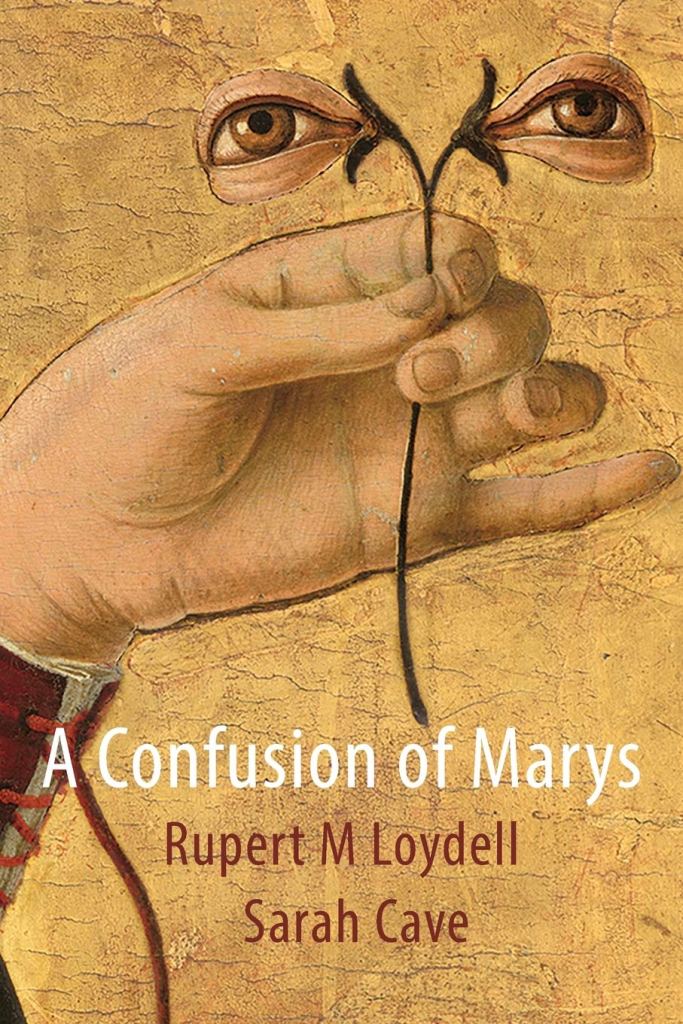
CONVERSATION: “Aliens, angels & annunciations”: In this article, poets Sarah Cave and Rupert Loydell dialogue about their 2020 book A Confusion of Marys, a collection of poems they’ve written inspired by the Annunciation. It’s a series of (sometimes irreverent or humorous) variations on a theme, and not what you’d call devotional poetry. Loydell quotes Gabriel Josipovici, who said stories die unless they are changed, reinvented, argued over, and made new, and that’s what this book does. I definitely gravitated more to some poems than to others.

A Confusion of Mary book cover

“I’m interested in the idea of regenerative theology,” Cave says. “I was a cradle Anglican and within that tradition Mary is more of a backseat figure – usually appearing in knitted form at crib services – no intercessions, etc. I wanted to bring her to the forefront and to understand how, in her all-pervasive way, she has shaped my life and the expectations people place on my life – gender, sexuality, politics, mysticism – and the lives of the women around me, and of course, how those expectations must have affected Mary’s own life.”

As for Loydell, he says he’s interested not in theological certainty but in “doubt and myth, symbolism and tangential ideas”—the Marian annunciation scene as palimpsest. He comes at it from a less personal angle.

+++

MYSTERY PLAY + ART PRESENTATION: “Hope Ubiqui: The Gift of the Annunciation”: This online event hosted by Holy Family (Catholic) Church in South Pasadena, California, on March 16, 2021, combines art reflections by Dr. Leah Marie Buturain Schneider (who’s incredibly warm, wise, and engaging) with a performance of the medieval mystery play The Parliament of Heaven, Salutation, and Conception (from the N-town cycle), translated from the Middle English by Colleen E. Donnelly and directed here by Grete Gryzwana.

The video starts with artist Patty Wickman [previously] outlining the five emotional states Mary cycled through in response to the angel Gabriel, as famously identified by art historian Michael Baxandall. Schneider then discusses a handful of historical artworks depicting the Annunciation, including ones by Fra Angelico and Andrea della Robbia. The thirty-minute play follows, which enacts not only the Annunciation but also an imagined precursor: a heavenly debate among four of God’s virtues—Truth, Mercy, Peace, and Righteousness [previously; see also this Instagram post]—about how to answer humanity’s cries for salvation. (Keep in mind that this was Zoom-mediated, with each actor calling in from a different location, and some with spotty internet connections, so there are some technical glitches, but it’s still a stirring and enjoyable performance!) Schneider continues by highlighting additional artworks of significance, focusing on Dieric Bouts’s Getty Annunciation, particularly the detail of Mary’s hands. She reads from the mystics Meister Eckhart and Julian of Norwich on responding to Love’s call; they ask, What does it matter if Mary gives birth to Jesus if we ourselves do not give birth to him in our souls, in our lives?

2:51–7:41: Introduction by Patty Wickman
9:44–18:16: Leah Marie Buturain Schneider
18:37–50:10: Mystery play
52:01–1:08:27: Leah Marie Buturain Schneider
1:08:52–1:31:00: Q&A

The remaining video is just informal chatting among a few church members who linger behind on the call.

+++

CHILDREN’S VIDEO: “The Gospel According to Hamlet” by SALT Project: A whimsical retelling of the Annunciation story, narrated by kids—and by a small ceramic pig figurine! The characters are played by a reproduction of Antonello da Messina’s Virgin Annunciate, a Barbie with tinsel wings, and a matryoshka doll.

Roundup: Empty chair, how to read a Last Judgment icon, and more

ARTWAY VISUAL MEDITATIONS:

ArtWay.eu is an online hub of resources related to faith and the visual arts. Every Sunday a new “visual meditation” is released on a selected artwork, written by one of a diverse range of volunteers from across the globe. (I contributed last week’s, on Eduardo Kingman, and another of mine, on a Flight to Egypt painting by Pranas Domsaitis, will be forthcoming.) Sign up here to receive the free weekly meditation in your inbox. Here are two examples from the past year, with Advent vibes, that I’ve found particularly meaningful.

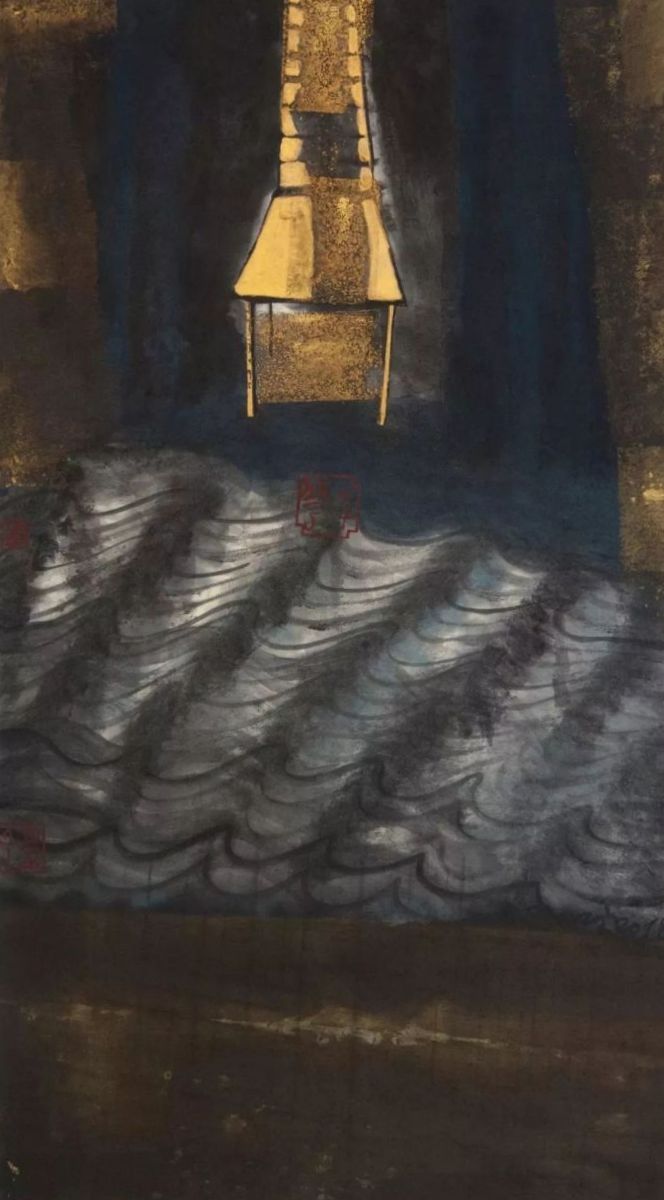
>> “The Empty Chair in a Season of Waiting” by Rachel Hostetter Smith: Last year, in the midst of the COVID-19 pandemic, art history professor Rachel Hostetter Smith wrote about a series of Chinese ink wash paintings by Daozi. They’re a tribute to his friend, the Chinese human rights activist Liu Xiabo (1955–2017), who was unable to accept his 2010 Nobel Peace Prize in person because he was in prison, so he was represented at the ceremony by an empty chair. Smith brings this image of an empty chair into conversation with all the uncertainty and absence in this current time of pandemic; the Jewish Passover Seder liturgy and its setting a place at the table for the prophet Elijah; Franciscan priest Richard Rohr on the liminal space between the old world and the world to come; and John the Revelator’s eschatological vision of a throne descending from heaven (Rev. 21).

Daozi_The Empty Chair on the Sea Ridge
Daozi (aka Wang Min) (Chinese, 1956–), The Empty Chair on the Sea Ridge, 2018. Ink and color on paper, 97 × 54 cm.

This and fifty-four other contemporary artworks are part of the international traveling exhibition Matter + Spirit: A Chinese/American Exhibition, which Smith curated (click the link to explore the art—it’s very compelling!). The exhibition is a product of a gathering of North American and Chinese art professors in June 2018 in Beijing, Nanjing, and Shanghai, sponsored by the Nagel Institute for the Study of World Christianity.

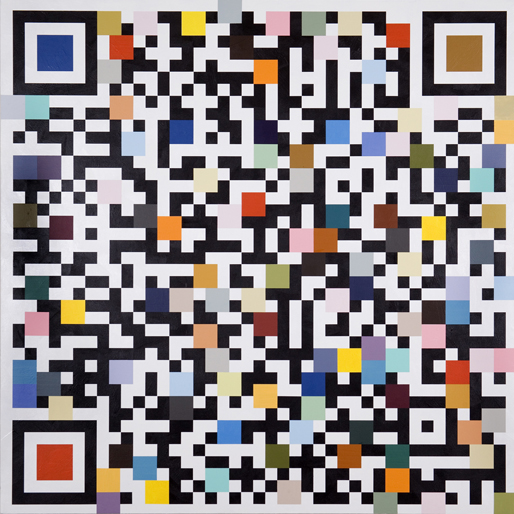
>> “Waiting for the Lord” by Mary McCampbell: Mary McCampbell [previously] writes about a painting by Douglas Coupland, best known for his work as a novelist and for popularizing the term Generation X. “In I wait and I wait and I wait for God to appear (2011), the artist has painted a colorful QR (Quick Response) code, defamiliarizing a familiar symbol of daily life. . . . Like most QR codes, if a viewer holds up her camera to the graphic image, a message is decoded via smart phone. A contrast to the hard geometric edges of the painting, the message that magically appears is soft and human: ‘I wait and I wait and I wait for God to appear.’ . . . The painting reflects a longing for the real God to manifest himself, no longer merely an idea, a doctrine, a rhetorical position. Where is God in the intricate, detailed, yet seemingly random pattern of life? How can we discern WHO He is? . . . This atypical reminder to ‘Wait for the Lord; be strong and take heart and wait for the Lord’ (Psalm 27:14) discloses the curious, humble faith of a non-believer, one hoping and waiting for eyes to see the ‘appearance’ of the Lord.”

Coupland, Douglas_Waiting for the Lord
Douglas Coupland (German, 1961–), I wait and I wait and I wait for God to appear, 2011. Acrylic and latex on canvas, 182.9 × 182.9 cm. Queen’s University, Kingston, Ontario, Canada.

+++

LECTURE: “Understanding the Last Judgment” by Jonathan Pageau: “The traditional icon of the Last Judgment is a very complex image which is both the synthesis of Christian typology as well as an image of the eschatological finality of all things.” In this talk given at St. John Chrysostom Byzantine Catholic Church in Seattle, Jonathan Pageau breaks down Last Judgment iconography, explaining how to read it scene by scene.

Elements include:

  • The Deësis, a representation of Christ enthroned between Mary and John the Baptist
  • The hetoimasia, or prepared throne, which awaits the return of Christ
  • The psychostasis, or weighing of souls
  • The ladder of divine ascent, representing the struggle to reach illumination
  • Paradise, with the “good thief,” Abraham’s bosom, and the Mother of God
  • The last trump and the resurrection of the dead, with beasts regurgitating their human prey
  • The river of fire, per Daniel 7:10, with the damned being swallowed by the mouth of Hades

Why am I sharing this now? Because Advent is eschatological and future-oriented in nature, and, though it tends to be underemphasized in our era, judgment is a major theme—which Fleming Rutledge does a great job unpacking in her book Advent: The Once and Future Coming of Jesus Christ.

+++

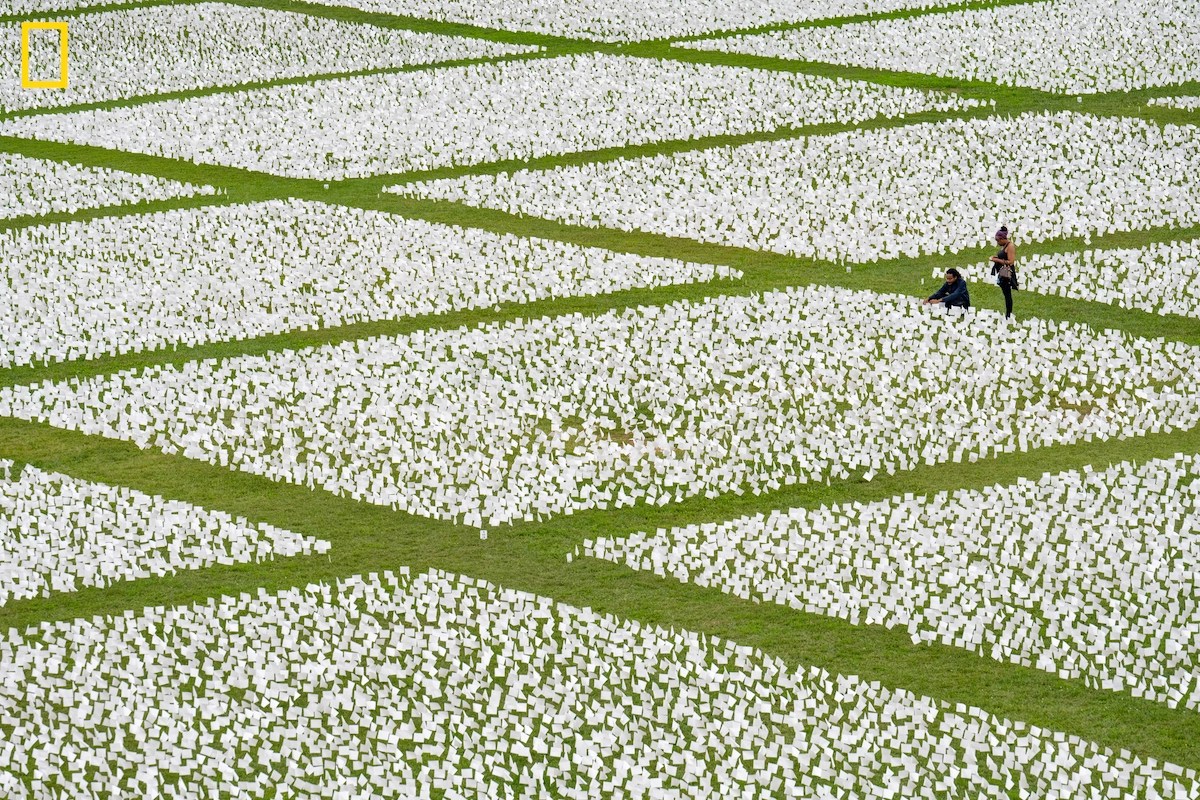
COVID MEMORIAL: From September 17 to October 3, 2021, the National Mall in Washington, DC, was blanketed with some 670,000 white flags, each one representing an American life lost to COVID-19. Titled In America: Remember, the installation was conceived by artist Suzanne Brennan Firstenberg as a way to visualize the magnitude of loss the country has suffered over the past two years in relation to the pandemic, and to invite mourning. Visitors were invited to personalize flags for someone they lost.

Stephen Wilkes’s photos of the memorial undid me. The enormity of suffering represented is difficult to fathom. Every single flag is a devastation. And since the installation was put up this fall, there have been another 100,000-plus COVID deaths in the US, while the global death toll has surpassed 5.2 million.

In America: Remember (detail)
Photo: Stephen Wilkes / National Geographic

In America: Remember (detail)
Photo: Stephen Wilkes / National Geographic

In America: Remember (photo by Stephen Wilkes)
In America: Remember, September 17–October 3, 2021, an installation of 670,000+ white flags on the National Mall, conceived by Suzanne Brennan Firstenberg. Photo: Stephen Wilkes / National Geographic.

+++

ART COMPETITION: “Macierzyństwo Maryi” (The Motherhood of Mary): The results are in for Poland’s first annual Ogólnopolski Konkurs Sztuki Sakralnej (National Competition of Sacred Art, or OKSSa for short), organized by the Fundacji Maria i Marta (Mary and Martha Foundation). The theme was Mary’s motherhood.

First place, with a prize of 15,000 zł (about USD $3,600), went to Błażej Guza for Macierzyństwo Maryi, which shows Mary drawing a hopscotch board on the pavement, its shape portending her boy’s fate. Jesus is not visible in frame, save for his shadow, which reveals simply an innocent child ready to play.

This piece and thirty-four others from among the many entries were exhibited at Concordia Design Wrocław November 25–30, 2021, and this month a few of them will be shown at the National Museum in Wrocław. You can view the top three winners as well as four honorable mentions at the boldface link above, or on the foundation’s Facebook page. And here’s an exhibition view.

The Fundacji Maria i Marta aims to promote the development of contemporary Christian art in Poland by organizing competitions, exhibitions, and workshops and by providing artistic consultation for churches.

Guza, Blazej_The Motherhood of Mary
Błażej Guza, Macierzyństwo Maryi (The Motherhood of Mary), 2021. Acrylic and chalk, 90 × 60 cm.

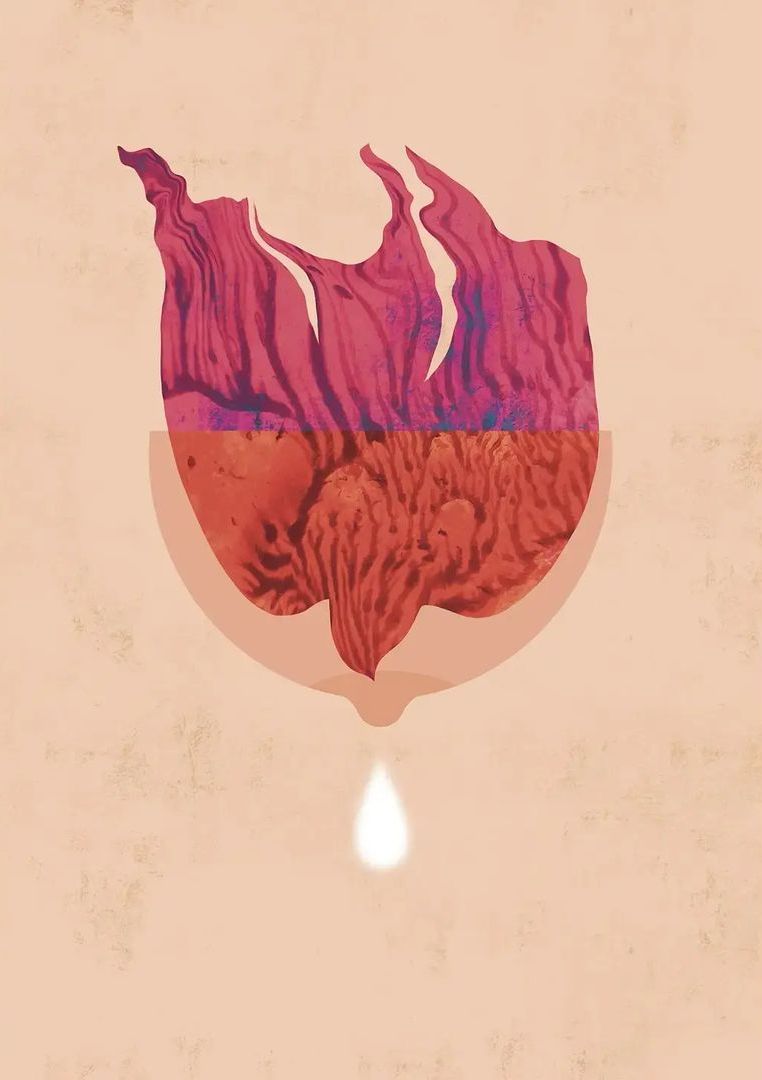
Kowalewska-Tylka, Beata_Fullness of Spirit
Beata Kowalewska-Tylka, Pełnia ducha (Fullness of Spirit), 2021. Digital painting, 70 × 50 cm. The OKSSa jury commented on how this piece shows “the interpenetration of the spiritual and human dimensions of Mary’s motherhood,” the shape of the fiery red cloth evoking the Holy Spirit as dove, and the breast that gives milk signifying Mary’s physical nourishment of her son from her own body.

Roundup: Online literary retreat (Aug. 27), Yvonne Adhiambo Owuor interview, global Marian art, and more

ONLINE LITERARY RETREAT: “The Extraordinary Possibility of Ordinary Time: Retreat with Sarah Arthur,” August 27 (this Friday!), 1–3 p.m. ET: Hosted by Paraclete Press. “Come away for an afternoon of exploration, refreshment, and celebration of Ordinary Time. Sarah Arthur invites you to join her for a deep sip at the well of poetry and literature as devotional reading. Guest poets Luci Shaw and Scott Cairns will also take part in this mini-retreat for lovers of words and Spirit.” The $50 admission price includes a copy of Sarah’s book At the Still Point: A Literary Guide to Prayer in Ordinary Time. I attended her Lent retreat earlier this year and found it very meaningful. Sorry for the short notice.

+++

TRIBUTE: “My Benediction to the Beloved Storyteller Walter Wangerin Jr.” by Philip Yancey: Walter Wangerin Jr. died of cancer on August 5. He was a pastor; a storyteller; a National Book Award–winning author of novels, short stories, and spiritual essays, including The Book of the Dun Cow, The Book of Sorrows, and Ragman: And Other Cries of Faith; and a professor of literature, theology, and creative writing. His friend and fellow writer Philip Yancey has written this nice little tribute to him for Christianity Today.

+++

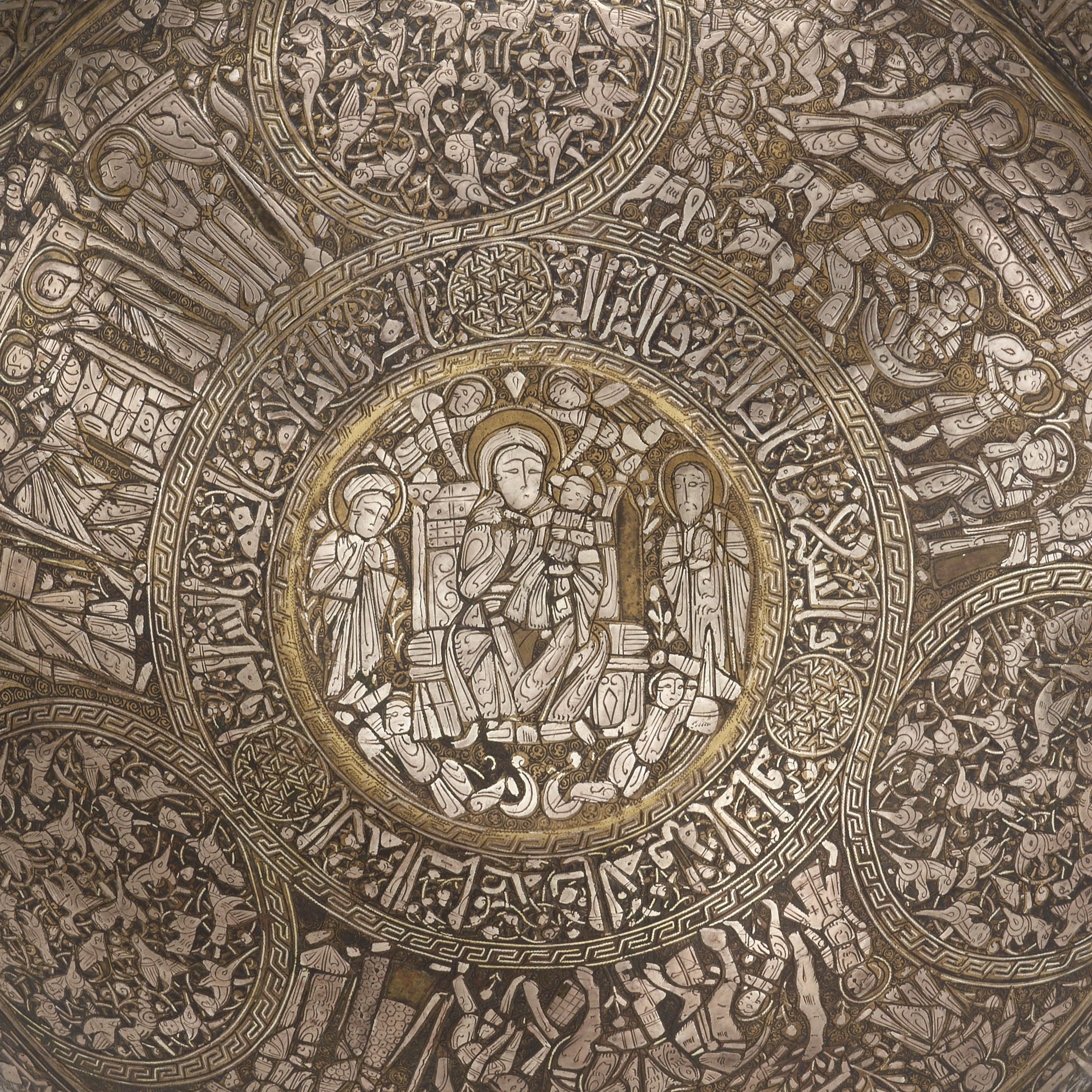
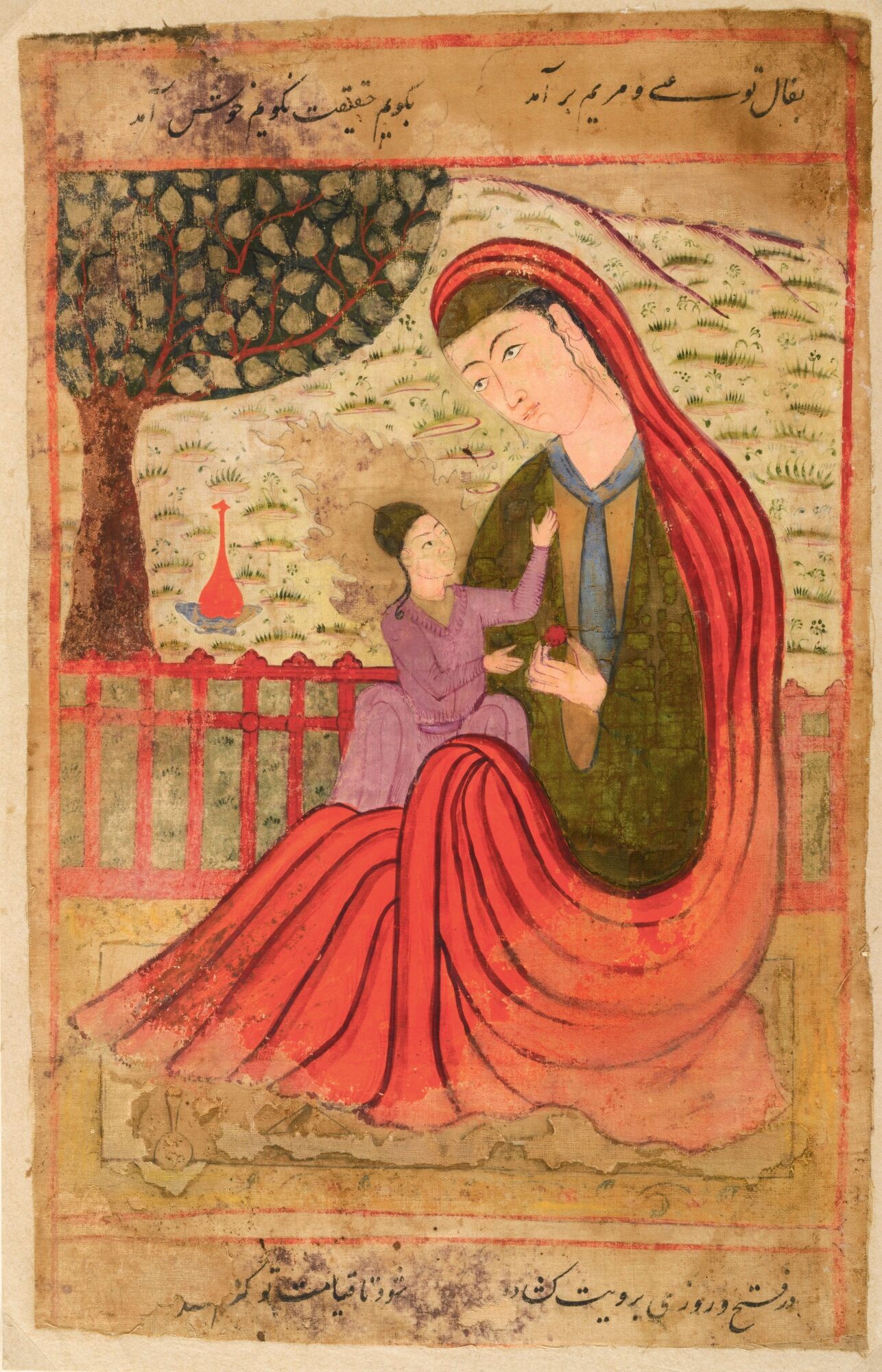
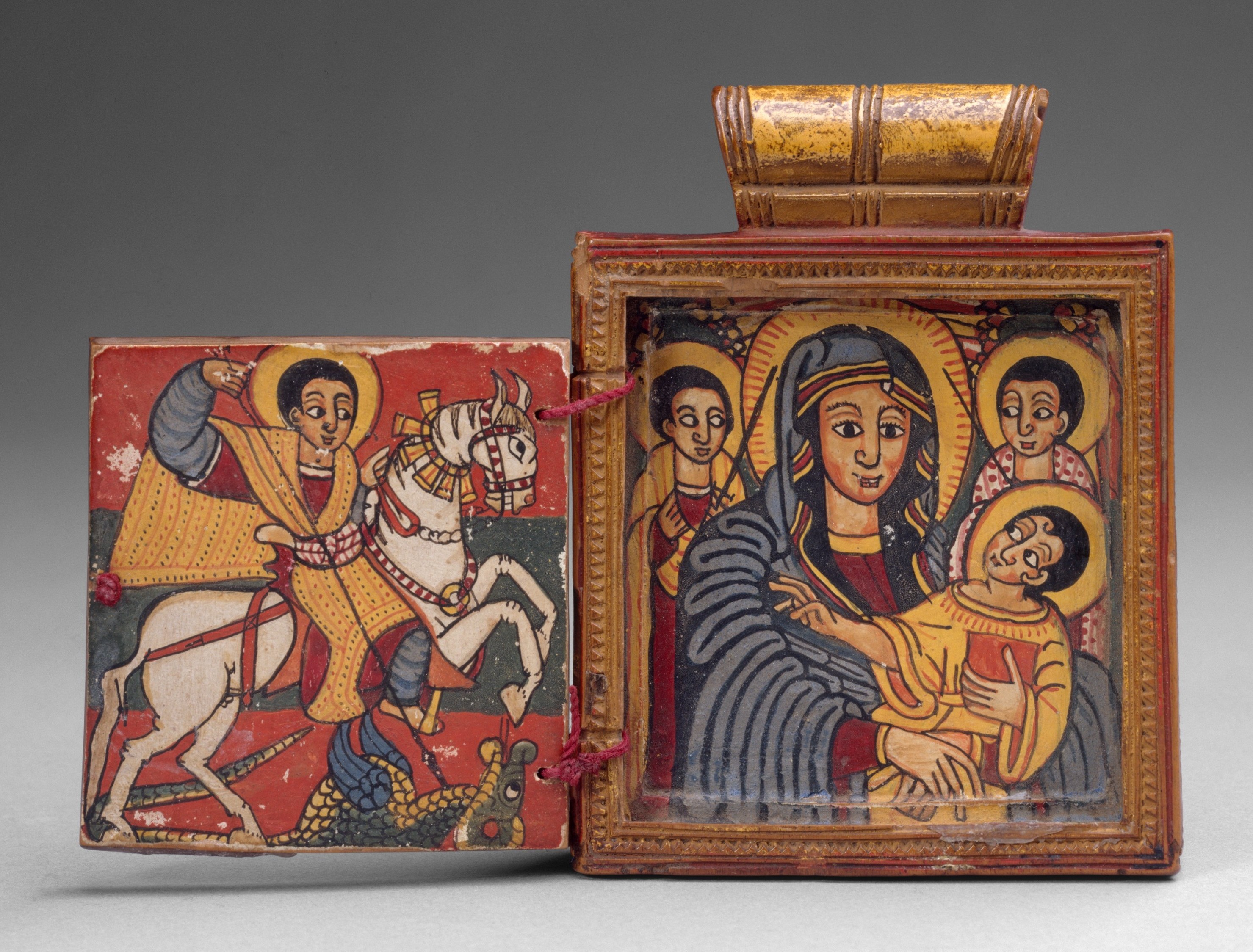
ONLINE EXHIBITION: A Global Icon: Mary in Context, created by the National Museum of Women in the Arts: Curated by Virginia Treanor, this digital resource was created as an expansion of the in-person exhibition Picturing Mary: Woman, Mother, Idea (see catalog), which ran from December 5, 2014, to April 12, 2015. Click through the pages to experience art images with descriptions, videos, and other content having to do with representations of Mary from across the world. The first video in the series is posted below, and here’s a playlist of all seven.

Christian canteen from Iraq
Canteen with Adoration of the Christ Child (detail), Syria or Northern Iraq, mid-13th century. Brass, silver inlay, 17 13/16 × 14 7/16 in. (45.2 × 36.7 cm). Freer Gallery of Art, Smithsonian Institution, Washington, DC. Click image to see full object.

Virgin and Child, from a Falnama (Book of Divination), Mughal India, ca. 1580. Gouache on cloth, 33.4 × 21.1 cm.

Dehua Madonna and Child
Madonna and Child, Dehua, China, 1690–1710. Porcelain, 15 × 3 1/2 × 3 in. (38.1 × 8.9 × 7.6 cm). Peabody Essex Museum, Salem, Massachusetts, inv. AE85957.

Ethiopian pendant icon
Double Diptych Icon Pendant, Ethiopia, early 18th century. Wood, tempera pigment, string, 3 3/4 × 6 × 5 1/2 in. (9.5 × 15.2 × 14 cm) (open, mounted). Metropolitan Museum of Art, New York.

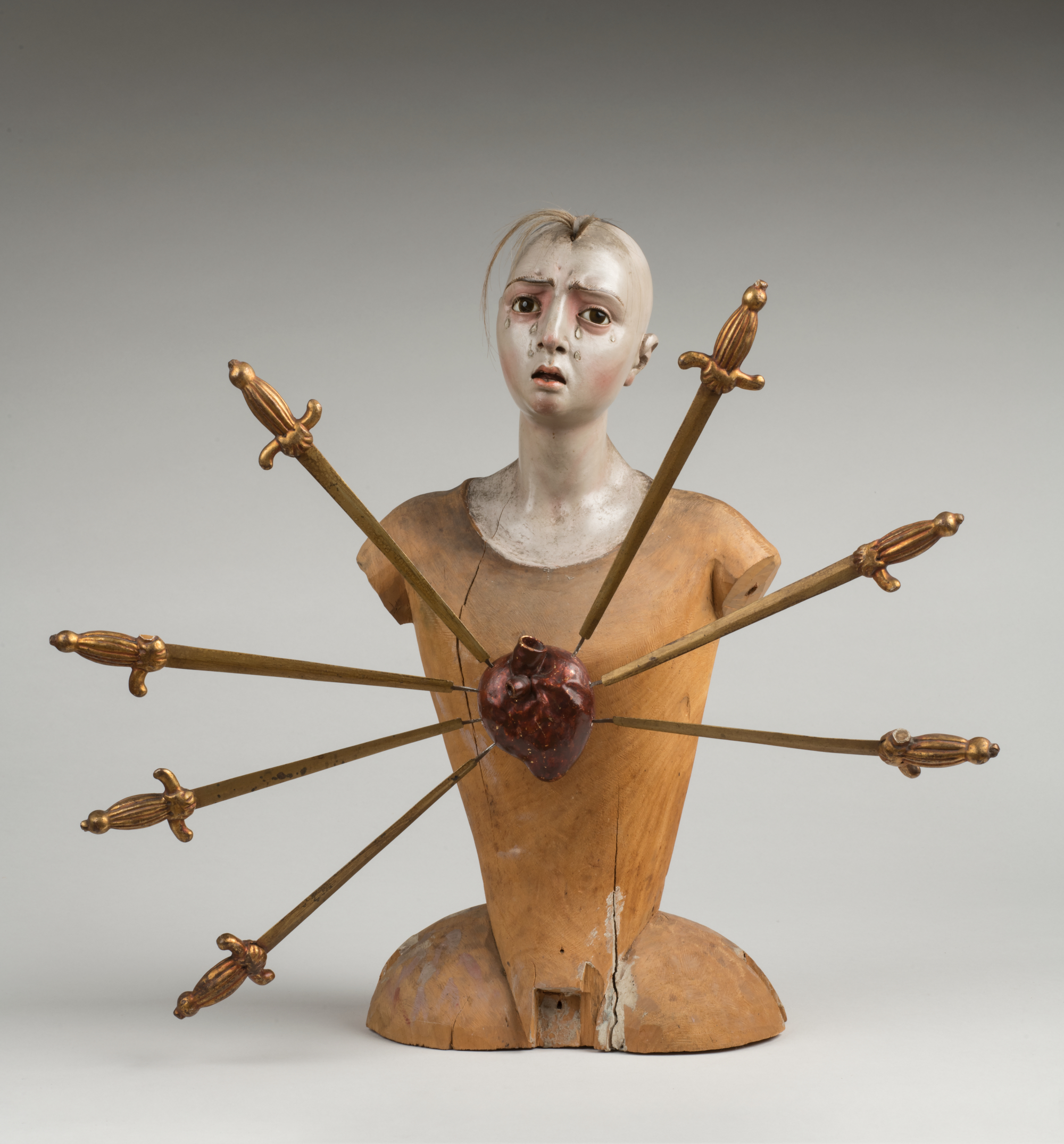
Lady of Sorrows (Italy, 18th c)
Our Lady of the Seven Sorrows, Italy, 18th century. Polychromed wood, human hair, 17 3/4 × 17 3/4 × 9 3/4 in. Royal Museums of Art and History, Brussels, Inv. FB.514. Photo © RMAH, used with permission.

+++

INTERVIEW (+ upcoming virtual conversation): “A God Who Wails and Dances: A Conversation with Yvonne Adhiambo Owuor”: This interview by Erika Kloss, which appears in the current issue of Image journal (no. 109), is so. good. Kenyan writer Yvonne Adhiambo Owuor is the author of the novels Dust and The Dragonfly Sea and award-winning short stories such as “The Weight of Whispers,” as well as the executive director of the Zanzibar International Film Festival. Here she talks about fiction, faith, coffee, and calling colonialism to account. To engage further, you can register for the Image-sponsored online event “The Art of Fiction: A God Who Wails and Dances with Yvonne Adhiambo Owuor,” which takes place September 23 at 3 p.m. ET.

Here’s just a snippet from her conversation with Kloss, where she describes what she would say to those who want nothing to do with Christianity because of all the evil that has been done in its name:

Dare to rescue God as Emmanuel from the dense debris of hubris, and from the weight and stench of whited sepulchers. For it is true, an excess of ghouls have appropriated for themselves the meaning and potency of the revolutionary One who dares to pronounce to humanity, “Love your enemies . . . Do good to those who hate you.”

Why should young people let themselves be revulsed by a legion who never fully entered into the depths of the subversive, seductive, paradigm-dissolving, drinking-and-hanging-out-with-sinners, beautiful, and heroic man-God? Why wouldn’t young people set out to experience for themselves the grand and compelling epic of a creator God in love, who loses his children and the earth to a defiant and rebellious once-beloved prince of light, and who struggles long and hard to regain the humanity he had loved and lost? So passionate and desperate is the creator in this endeavor that he will enter into humanity to try to court and secure these cherished children, even at the risk of his own murder—and even that does not stop the love. A love stronger than death? Don’t we all write anthems, in one form or another, yearning for this?

Let the next generation of seekers . . . visit old worlds that contain the spirit of the faith, not just in the Middle East, but also northern Africa, northern Sudan, Egypt, and Ethiopia, all those rubbed-out places (that colonialists presumed to suggest they were ‘civilizing’) from which Christianity entered into and transformed Europe and the world. . . . An historical quest for meaning at sites of origins might inspire young people to look again at the call to adventure and transcendent idealism that is the Way.

+++

VIDEO SERIES: How to Read the Bible by BibleProject: “Reading the Bible wisely requires that we learn about the ancient literary styles used by the biblical authors. . . . While the Bible is one unified story, it cannot all be read in the same way. The How to Read the Bible series walks through each literary style found in the Bible to show how each uniquely contributes to the overall story of Scripture.”

Led by Dr. Tim Mackie and Jon Collins, BibleProject is a crowdfunded animation studio that creates videos, podcasts, and small-group curricula. From 2017 to 2020 they executed a series called How to Read the Bible, which is nineteen episodes total. In it they examine the three major literary styles that comprise the Bible: narrative (chronicles, biographies, parables), poetry (celebratory, reflective, erotic, politically resistant, apocalyptic), and prose discourse (laws, sermons, letters). Each style lives by its own rules and structure, and we get into trouble, for example, when we don’t properly understand how metaphor works, or when we don’t recognize that Paul’s epistles were situated in a particular historical context. Here’s one of the videos in the series, on design patterns in biblical narrative:

“May is Mary’s month”: Hopkins poem meets Glasgow Style

“The May Magnificat” by Gerard Manley Hopkins

May is Mary’s month, and I
Muse at that and wonder why:
    Her feasts follow reason,
    Dated due to season—
 
Candlemas, Lady Day;
But the Lady Month, May,
    Why fasten that upon her,
    With a feasting in her honour?
 
Is it only its being brighter	
Than the most are must delight her?
    Is it opportunest
    And flowers finds soonest?	

Ask of her, the mighty mother:
Her reply puts this other
    Question: What is Spring?—
    Growth in every thing—
 
Flesh and fleece, fur and feather,
Grass and greenworld all together;
    Star-eyed strawberry-breasted
    Throstle above her nested
 
Cluster of bugle* blue eggs thin
Forms and warms the life within;
    And bird and blossom swell
    In sod or sheath or shell.
 
All things rising, all things sizing
Mary sees, sympathising
    With that world of good,
    Nature’s motherhood.
 
Their magnifying of each its kind
With delight calls to mind
    How she did in her stored
    Magnify the Lord.

Well but there was more than this:
Spring’s universal bliss
    Much, had much to say
    To offering Mary May.
 
When drop-of-blood-and-foam-dapple
Bloom lights the orchard-apple
    And thicket and thorp are merry
    With silver-surfèd cherry
 
And azuring-over greybell makes
Wood banks and brakes wash wet like lakes
    And magic cuckoocall
    Caps, clears, and clinches all—
 
This ecstasy all through mothering earth
Tells Mary her mirth till Christ’s birth
    To remember and exultation
    In God who was her salvation.

* Bugle, or bugleherb, is a blue-flowering plant in the mint family.
† A group of houses standing together in the country; a hamlet; a village.
‡ Bracken ferns.

+++

In the Roman Catholic Church, May is dedicated to Mary, the mother of Jesus, and daily devotions to her are encouraged throughout the month. In many parishes, statues of Mary are crowned with flower garlands at this time.   

Though I myself do not practice Marian devotion, I have an immense appreciation for her example of faith and for the role she played in salvation history, and I feel a kinship to her as a spiritual foremother. I also find myself drawn to poems and visual art that reflect on her pregnancy, on the Life growing inside her.

Written in 1878 by the Jesuit poet-priest Gerard Manley Hopkins, “The May Magnificat” muses on the fittingness of May as a designated period of celebration of Mary. In the yearly cycle of the Christian liturgical calendar, Candlemas, which celebrates the presentation of Jesus in the temple as an infant (and Mary’s postpartum purification), is logically dated to February 2, forty days after Christmas, per Leviticus 12:1–4. Lady Day, the feast of the Annunciation (the day on which Jesus was conceived), is celebrated March 25, nine months before Christmas. But why, Hopkins wonders, has the church set apart May in particular for Christians to honor Mary?

He determines it’s because in May, the natural world—at least in the northern hemisphere, where he, an Englishman, lived—is bursting into full bloom, reflecting Mary’s own fecundity, her body a superabundant source of life. In late spring there is a certain joyousness in the air, a “universal bliss,” an “ecstasy.” Mammals are gestating and/or giving birth, birds are incubating and hatching, groves and gardens are flowering, and earth seems to be swelling to a fullness. There is “[g]rowth in every thing.”

Hopkins delights in the wealth of spring, all its flora and fauna. He marvels how the azure of heaven is reflected on earth in the tangled nest of a song thrush, and how sunlight dapples the apple and cherry trees. Perhaps Mary learned gladness from such gladsome surroundings, he suggests. And not only that, but as mother, she shared an affinity with Nature, also a mother.

The month of May culminates, on the 31st, with the feast of the Visitation, which marks the pregnant Mary’s visit to her pregnant cousin Elizabeth. Upon their meeting Mary sang a praise song known as the Magnificat, Latin for “[My Soul] Magnifies [the Lord]” (see Luke 1:46–56). She makes large God’s name, celebrating his mercy, strength, and provision and the impending birth of her son, Israel’s Savior and the world’s.

+++

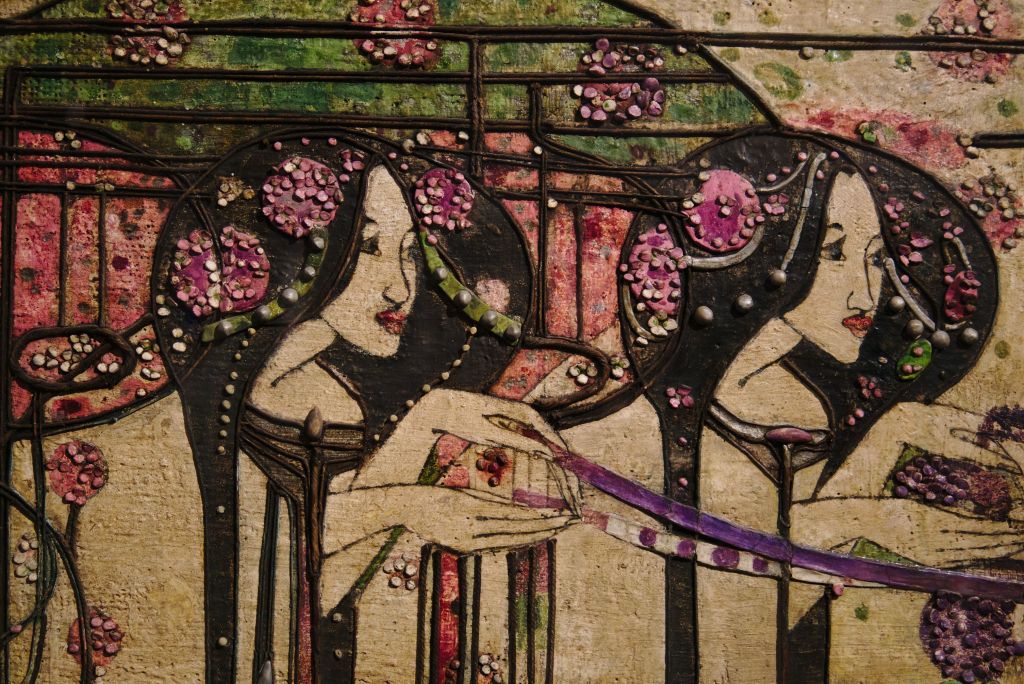
In October 2019 I had the privilege of seeing the internationally touring exhibition Designing the New: Charles Rennie Mackintosh and the Glasgow Style at the Walters Art Museum in Baltimore, whose highlight was a large-scale gesso frieze by Margaret Macdonald Mackintosh, Charles’s artistic collaborator and wife. It was displayed in a narrow hallway behind a plastic screen, so I couldn’t get a shot of the full piece, but here’s a photo provided by the CSG CIC Glasgow Museums Collection:

Macdonald, Margaret_The May Queen
Margaret Macdonald Mackintosh (Scottish, 1864–1933), The May Queen, 1900. Gesso on burlap over wood frame, scrim, twine, glass beads, thread, tin leaf, papier-mâché, steel pins, 158.8 × 457 cm. Kelvingrove Art Gallery and Museum, Glasgow.

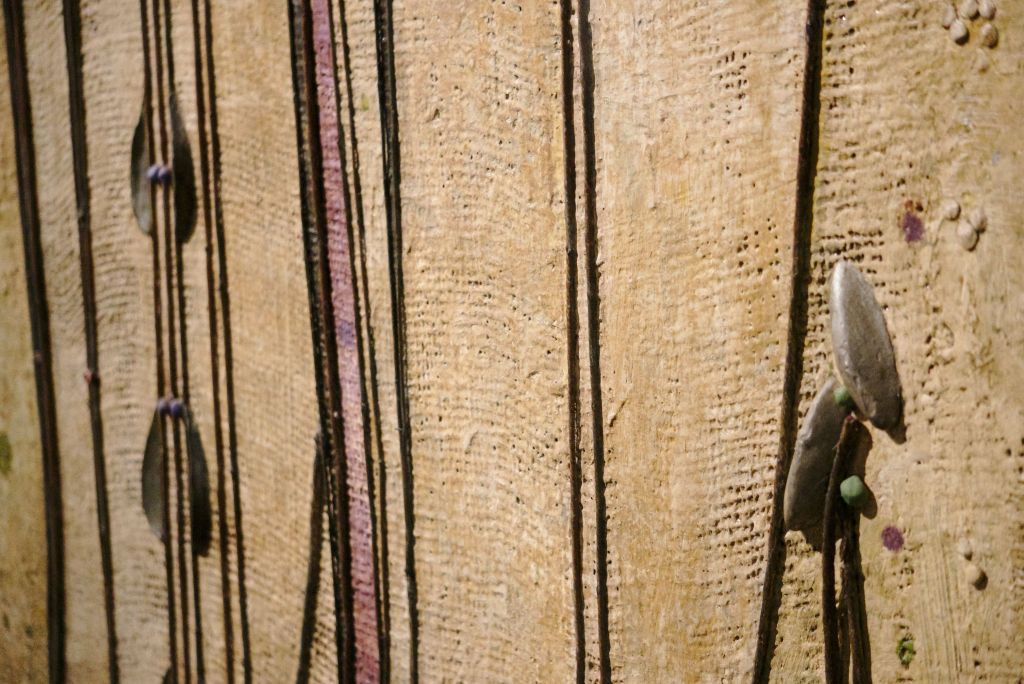
All other photos in this post are my own.

Emerging in the 1890s in the industrial heartland of Scotland, the “Glasgow Style” was the only Art Nouveau movement in Great Britain. “When applied to two-dimensional objects, such as book covers, textiles, posters, and stained glass, the Glasgow Style blended elongated and organic lines, personal symbolic languages, and favored motifs to create otherworldly stylized plant and human forms,” writes Alison Brown, curator of Designing the New. It was developed by a small group of young adult friends known as The Four: Charles Rennie Mackintosh, Margaret Macdonald, Frances Macdonald, and James Herbert McNair. (Charles and Margaret married in 1900, and Margaret’s sister Frances married James in 1899.)

Margaret’s wide-ranging output included watercolors, graphics, metalwork, and textiles, but her specialization was gesso, a plaster-based medium, which she used to make decorative panels for furniture and interiors. The May Queen was commissioned from her at the turn of the century by Miss Catherine Cranston for one of her famous Ingram Street tea rooms in Glasgow, where it hung above a window in the Ladies’ Luncheon Room until 1971. (It is now preserved at the Kelvingrove Art Gallery and Museum.) Gloriously textured, it consists of rough burlap stretched over a wooden frame and covered in gesso, glass beads, metallic leaf, and molded paper. “Some of the modeled plaster shapes bear fingerprints, pinched and pressed into the panel’s surface. The outlines of the figures, trees, and plant forms are ‘drawn’ with brown painted string held fast with long steel pins,” Brown writes.

The crowning of a “May Queen,” a girl chosen to personify May Day and preside over its festivities, is a traditional springtime ritual in western Europe. (If you need a visual, think Florence Pugh’s character in Midsommar . . .) So the title of this artwork is most likely a reference to that. However, I get some serious Marian vibes from the central female figure, which are only reinforced when I view the work in light of the Catholic tradition of the “May crowning” of Mary.

And what a resonant pairing it makes with Hopkins’s “The May Magnificat”! It shows a woman in a strong frontal stance, dressed with flowers, haloed in green, supported by a throne-like backing, and enlarged, perhaps, with child. She’s attended by four maidservants or companions.

This could very well be read as Mary of Nazareth, crowned with beauty, blessed by God to bear his Son into the world.

Roundup: Advent photo essay, carol in a silo, multicultural Christmas, and more

PHOTO ESSAY: “Advent 2020: Comfort My People”: Community development and relief worker Kezia M’Clelland, a child protection in emergencies specialist, works in areas of disaster and conflict. Every December she compiles a set of news photographs published in The Guardian that year, pairing each with an Advent scripture. (I introduced her in a 2017 Advent roundup.) Text and image amplify each other and prompt deeper reflection on the themes of the season as well as an awakening to global crises and/or injustices. The photos in this year’s compilation include a schoolteacher bringing plastic-wrapped hugs to her quarantined students in Rio de Janeiro, flooded roadways in Honduras following Hurricane Eta, a Syrian family from Ariha breaking their Ramadan fast amid the rubble of their home, a Palestinian boy from the Khan Younis refugee camp standing on a pile of scrapped car parts, the aftermath of the Beirut port explosion in August (caused by improperly stored ammonium nitrate), a protester outside Dallas City Hall in the US insisting that all citizens’ presidential election votes be counted, and others.

Comfort, comfort my people
Photo: Pilar Olivares / Reuters [via], set to Isaiah 40:1 by Kezia M’Clelland

The rough ground shall become level
Photo: Aaref Watad / AFP [via], set to Isaiah 40:4 by Kezia M’Clelland

M’Clelland adds one new photo for each day of Advent and then releases them all in video slideshow form on December 24. Here are her photo compilations from 2019 (“Good News of Great Joy”) and 2018 (“Peace on Earth”):

She also made a photo compilation for Holy Week 2020.

+++

SONG: “He Who Made the Starry Skies”: For optimal acoustics, three Bruderhof women from the Fox Hill Community in Walden, New York, trek on over to a silo to sing a fifteenth-century processional carol written by the nuns of St. Mary’s, Chester, in England, a medieval nunnery of which nothing now survives. Both the words and music have been preserved in a ca. 1425 manuscript known as The Chester Mysteries. The original is in Latin (and is titled “Qui creavit coelum”), but singers Alina McPherson, Melinda Goodwin, and Coretta Marchant opt for an English translation. I am providing the sheet music here, courtesy of the Bruderhof Historical Archives. [HT: Tamara Hill Murphy]

He who made the starry skies (Lully, lully, lu)
Sleeping in a manger lies (Lully, lully, lu)
Ruler of all centuries (Lully, lully, lu)

Joseph brings the swaddling clothes (Lully, lully, lu)
Mary wraps the babe so mild (Lully, lully, lu)
In the manger puts the child (Lully, lully, lu)

Humbly clad, the King of kings (Lully, lully, lu)
Joy of heav’n to earth now brings (Lully, lully, lu)
Sweet above all earthly things (Lully, lully, lu)

Mary, ask thy little son (Lully, lully, lu)
That he give us of his joy (Lully, lully, lu)
Now and through eternity (Lully, lully, lu)

The Bruderhof is an Anabaptist Christian movement of more than three thousand people committed to peacemaking, common ownership, and proclamation of the gospel. They have twenty-eight settlements on four continents, made up of families and singles. Perhaps you know them through their publishing house, Plough. Their website reads, “Love your neighbor. Take care of each other. Share everything. Especially in these challenging times, we at the Bruderhof believe that another way of life is possible. We’re not perfect people, but we’re willing to venture everything to build a life where there are no rich or poor. Where everyone is cared for, everyone belongs, and everyone can contribute. We’re pooling all our income, talents, and energy to take care of one another and to reach out to others. We believe that God wants to transform our world, here and now. This takes a life of discipleship, sacrifice and commitment; but when you truly love your neighbor as yourself, peace and justice become a reality. Isn’t that what Jesus came to bring for everyone?”

+++

UPCOMING (ONLINE) CHRISTMAS CONCERTS:

“A Family Holiday Singalong with Dan and Claudia Zanes,” Tuesday, December 15, 6 p.m. EST: Presented by the Lebanon Opera House in New Hampshire, this multicultural concert will feature Christmas, Hanukkah, or New Year’s songs from France, Wales, Germany, America, Puerto Rico, Korea, Tunisia, and Haiti. You can download the set list, which includes lyrics and chords, at the registration link I’ve posted. Dan and Claudia Zanes are a musical couple from Baltimore (my neck of the woods!), and I’ve really enjoyed the daily song videos they’ve been releasing on YouTube since COVID started. Here they are in 2018 with Pauline Jean, singing “Ocho Kandelikas,” a Hanukkah song written by Flory Jagoda in the 1980s in the Judeo-Spanish language known as Ladino. (Update: Concert video available here.)

“Gospel Christmas: O Holy Night,” Friday, December 18, 6 p.m. EST: Presented by Washington National Cathedral, this program will feature gospel, jazz, and blues music interspersed with scripture readings. (Update: Concert video available here.)

“Lowana Wallace Christmas Concert,” Sunday, December 20, 9 p.m. EST: Canadian singer-songwriter Lowana Wallace [previously] incorporates subtle jazz styles into her arrangements of worship songs and her own compositions. Listen to a sampler from her wonderful Hymns & Carols album, and tune in this weekend! (Update: Concert video available here.)

+++

ARTICLE: “Making Space for a Multicultural Christmas” by Michelle Reyes: “How can each of us celebrate Christmas at the intersection of our faith and our culture, while welcoming differing cultural perspectives on Christ’s birth?” asks Dr. Michelle Reyes, VP of the Asian American Christian Collaborative and editorial director of Pax, in this Gospel Coalition article. She briefly discusses four different cultural traditions that highlight unique aspects of Jesus’s birth narrative: posadas in Central America, Kiahk in Egypt, parols (star-shaped lanterns) in the Philippines, and Día de los Reyes [previously] in Puerto Rico, Mexico, and other Hispanic countries.

(Related posts from my old blog: “Nativity Paintings from around the World”; “More Nativity Paintings from around the World”)

+++

PODCAST EPISODE: “God’s Global Family,” BibleProject: BibleProject, a nonprofit ed-tech organization and animation studio, produces one of my favorite podcasts, hosted by biblical scholar Tim Mackie and Jon Collins. (I found episodes 6–11 of their recently wrapped “Character of God” series, on the wrath of God, particularly illuminating.) “Family of God” is the name of the series they’re in now. In this first episode they discuss how Christianity is the most multiethnic religious movement in history, and how our humanity cannot be fully realized without understanding, appreciating, and being connected to the identity of every other culture. I link to it here because it dovetails nicely with the Reyes article and because I want to introduce you to the podcast, if you’re not already familiar with it, but also because Mackie spends time talking about the Basilica of the Annunciation in Nazareth, with its many culturally specific portrayals of Mary and Jesus from around the world.

Widayanto, Fransiskus_Mother Mary
Fransiskus Widayanto (Indonesian, 1953–), Bunda Maria (Mother Mary), 2006. Ceramic mosaic and relief sculpture. Basilica of the Annunciation, Nazareth, Israel. Photo © BibleWalks.com. Mary is depicted in a traditional Javanese kebaya.

Madonna and Child mosaic (Thailand)
Thai Madonna and Child, mosaic, Basilica of the Annunciation, Nazareth, Israel. Photo © BibleWalks.com.

Mveng, Engelbert_Our Lady of Africa
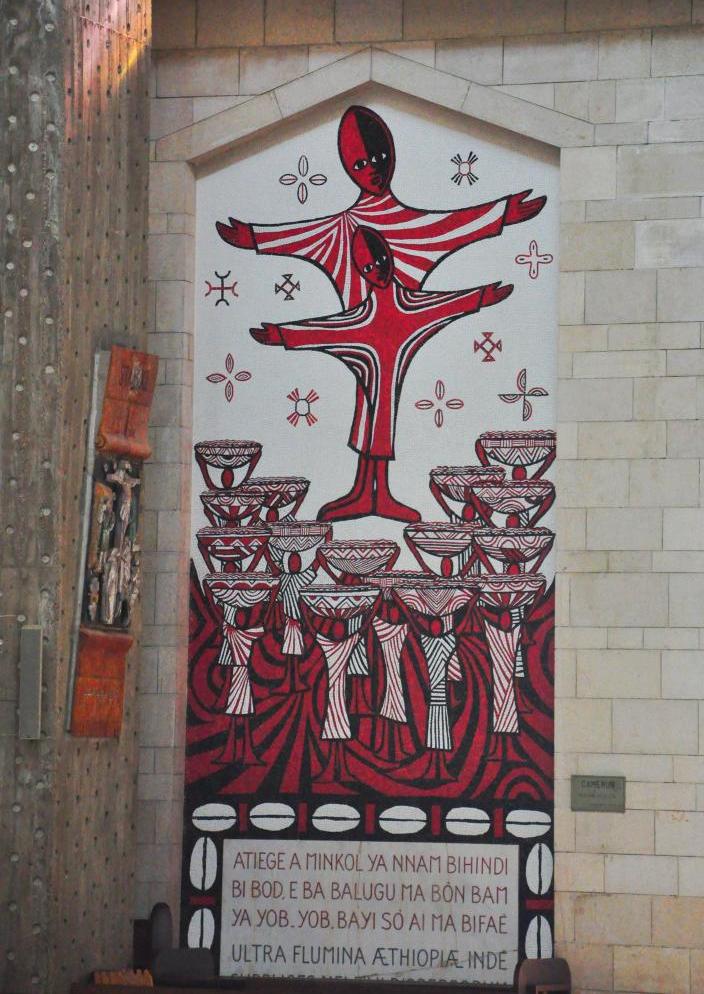
Fr. Engelbert Mveng, SJ (Cameroonian, 1930–1995), Our Lady of Africa, mosaic, Basilica of the Annunciation, Nazareth, Israel. Photo © BibleWalks.com. The inscription is from Zephaniah 3:10: “From beyond the rivers of Cush / my worshipers, the daughter of my dispersed ones, / shall bring my offering.”

As you know, diversity in biblical imagery, especially images of Jesus, is important to me, so I was delighted to hear this popular podcast tip their hat to this pilgrimage site in Israel that features a range of visual interpretations of the incarnation. You can view a compilation of the church’s national mosaics at BibleWalks.com. Most of them are not of high artistic quality, but I appreciate the initiative of inviting the nations to contribute their own localized representations. Above, I posted three that I particularly like.

Roundup: “Ave Maria” ballet, pregnancy, Magnificat

DANCE: “Ave Maria”: Queensland Ballet dancers Victor Estévez and Mia Heathcote perform a pas de deux (ballet duet) to the Schubert melody that today is most associated with the prayer “Ave Maria,” which begins, “Hail Mary, full of grace, the Lord is with thee.” These are the words the angel Gabriel spoke to Mary when he came to announce that she would bear in her body the Son of God. Though I can’t say what this duo had in mind when they choreographed the piece, I can’t help but think, given the music choice, of the Annunciation—the Divine coming to dance with humanity, to partner with her for the redemption of the world. The dancing starts thirty-five seconds in.

+++

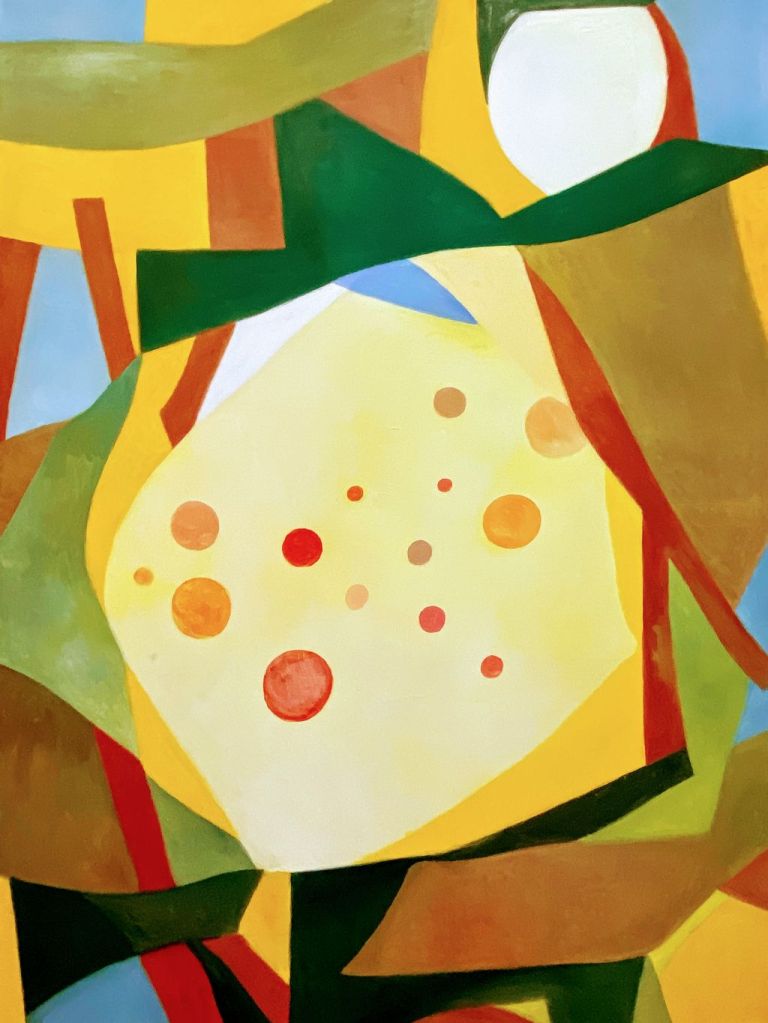
VISUAL MEDITATION: “Embodied Joy, Serious Joy: Making Room in the Body and Life for New Creation” by Alexandra Davison: I shared a visual meditation by this culture care leader just last week. In this devotional piece based on Luke 1:41–55, Davison discusses two abstract paintings from Louise Henderson’s The Twelve Months series. In October, “Henderson has a cropped representation of a pregnant woman, her belly bright and fruitful as a melon, shines with what Henderson describes from her own pregnancy as ‘bubbles of life circulating in the womb.’ She magnifies joy from its tiniest beginnings both seen and unseen in the mother and the child.” Reflecting on this ebullient image in conjunction with her own pregnancy experience and Mary’s, Davison ends by quoting an adaptation of the Magnificat by songwriter Marcus Walton.

Henderson, Louise_October
Louise Henderson (New Zealand, 1902–1994), October, from the series The Twelve Months, 1987. Oil on canvas, 250 × 150 cm. Auckland Art Gallery Toi o Tāmaki, New Zealand.

+++

VIDEO INSTALLATION: Mary! by Arent Weevers: One of the primary images or metaphors for the season of Advent is pregnancy—the pregnant Mary awaiting the birth of Jesus, her belly swelling a little more each day, and a world heavy with expectancy, at the threshold of (re)birth. In 2009, media artist and theologian Arent Weevers [previously] created a gorgeous video installation titled Mary!. “Standing in the middle, a heavily pregnant young woman. Her hair partly covers her naked body to her ankles. She peers past you, with no expression on her face. From underneath, a gusty wind begins to blow, wafting her hair slowly upwards into the air. Suddenly, the woman bends slightly forward, her left arm in front of her abdomen, and grimaces painfully. Losing her balance, she falls sideways out of the frame until only black remains.” You can preview the video here. (Because of the nudity, there will be a content warning you have to accept before proceeding.)

Weevers’s art aims to express the paradoxical nature of the human body—its vulnerability and its strength—and in her role as Mary, the actor in this video exemplifies both so well. Gloriously gravid and standing tall at first, the woman looks into the distance and sees the future suffering of her son. She clasps her belly protectively in response, hunching forward as the painful knowledge of his destiny shoots through her.

+++

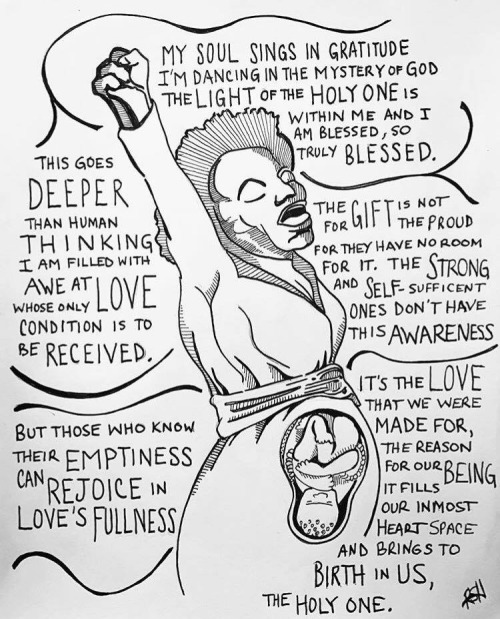
MAGNIFICAT SERMON (and sketch): “The Love That We Are Made For” by Bob Henry: Bob Henry is an American Quaker pastor who often sketches in preparation for and in response to sermons. In this sermon he delivered December 11, 2016, at Silverton Friends Church in Oregon, he reflects on the oldest and most radical Advent hymn: Mary’s Magnificat. We are so used to thinking of Mary as quiet and demure, but Henry imagines her as “a strong woman with arms flaring, fists raised, wild bodily movements, beads of sweat forming on her brow, and a strong voice throwing down these words from Luke 1:46–55.”

Henry, Bob_Mary's Freedom Song
“Mary’s Freedom Song.” Illustration and lettering by Bob Henry, 2016. Text by Joy Cowley, 2007, adapted from Luke 1:46–55.

This characterization is expressed in his drawing, which shows a Black Mary, full of faith and fire, surrounded by the words of Joy Cowley’s “Modern Magnificat.” He says the women of the African Methodist Episcopal Church in Chicago, where he used to teach Bible, embody for him Mary’s bold declaration of justice, freedom, and hope in today’s world. He challenges us to sing Mary’s song in our own political climates.

+++

SONG: “Magnify”: For its November 29 worship service, Good Shepherd New York [previously] premiered a new arrangement of Tom Wuest’s “Magnify,” sung by Paul Zach and Lauren Goans, part of the Good Shepherd Collective (see 7:33 in the video below). The piano part includes the Gloria theme from “Angels We Have Heard on High,” played liltingly. Love it! (Update 12/14/20: Paul Zach posted a standalone video of this song on Instagram this morning.)

+++

I’ve added a new batch of songs to “Advent: An Art & Theology Playlist.” I like to “DJ” them (to balance the styles and moods and create thematic links), so they’re not all grouped at the bottom, but you can look at the “Date added” column to see the latest additions. I want to acknowledge the source of those I found from other Advent playlists and resources: Credit goes to Teer Hardy of the Crackers and Grape Juice podcast, compiler of the “Advent Begins in the Dark” playlist, for “The Man Comes Around” by Johnny Cash, “Jesus Gonna Be Here” by Tom Waits, “Shepherd’s Lament” by Kirby Brown, and “Are You Ready?” by Jason Champion. Pastor, pianist, arranger, and Daily Prayer Project founding director Joel Littlepage cued me in to the songs “Tenemos Esperanza,” “Toda la Tierra,” “Hold on Just a Little While Longer,” and “He’s Right on Time” through his “DPP Advent Songbook.” “I Believe in Being Ready” by Rising Appalachia comes from Lauren Plummer’s “Advent 2020: All Earth Is Waiting,” and “My Soul Doth Magnify the Lord” by O’Landa Draper and the Associates is from Tamara Hill Murphy’s “Advent 2020: Gracious Invitation.” “Intro Comfort My People” by Jamaican artist Chrisinti is featured in Biola’s Advent Project 2020.

Bursting with God-News (Artful Devotion)

Frank, Hannah_Sun
Hannah Frank (Scottish, 1908–2008), Sun, 1943. Pen and ink on paper, 46 × 32.8 cm. Ben Uri Gallery and Museum, London.

Mary didn’t waste a minute. She got up and traveled to a town in Judah in the hill country, straight to Zachariah’s house, and greeted Elizabeth. When Elizabeth heard Mary’s greeting, the baby in her womb leaped. She was filled with the Holy Spirit, and sang out exuberantly,

You’re so blessed among women,
and the babe in your womb, also blessed!
And why am I so blessed that
the mother of my Lord visits me?
The moment the sound of your
greeting entered my ears,
The babe in my womb
skipped like a lamb for sheer joy.
Blessed woman, who believed what God said,
believed every word would come true!

And Mary said,

I’m bursting with God-news;
I’m dancing the song of my Savior God.
God took one good look at me, and look what happened—
I’m the most fortunate woman on earth!
What God has done for me will never be forgotten,
the God whose very name is holy, set apart from all others.
His mercy flows in wave after wave
on those who are in awe before him.
He bared his arm and showed his strength,
scattered the bluffing braggarts.
He knocked tyrants off their high horses,
pulled victims out of the mud.
The starving poor sat down to a banquet;
the callous rich were left out in the cold.
He embraced his chosen child, Israel;
he remembered and piled on the mercies, piled them high.
It’s exactly what he promised,
beginning with Abraham and right up to now.

—Luke 1:39–55 (MSG)

[See also “Jina la Bwana ni takafitu! (Artful Devotion)”]

+++

SONG: “Visitation Song” by Aly Aleigha, on Jealous Love (2015), sung with Jessica Schissel-Romportl


This post belongs to the weekly series Artful Devotion. If you can’t view the music player in your email or RSS reader, try opening the post in your browser.

To view all the Revised Common Lectionary scripture readings for the Visitation of Mary to Elizabeth, cycle A, click here.

Marian art at Dumbarton Oaks

Because May is Mary’s month, I thought I’d share some photos I took of various artworks of the Virgin that were on display during my last visit to the Dumbarton Oaks Museum. Dumbarton Oaks is a historic estate, fifty-four acres, in the Georgetown neighborhood of Washington, DC, the former residence and gardens of Robert and Mildred Bliss. In 1940 the Blisses bequeathed the estate, and their extensive collections of Byzantine and pre-Columbian art, to Harvard University, who runs it as a museum, research institute, and library. In addition to housing a stellar permanent collection, the museum also hosts special exhibitions throughout the year, including by contemporary artists. (When I was there I saw the wonderful Outside/IN by Martha Jackson Jarvis.)

The six Marian artworks featured below include paintings, sculptures, and a tapestry, and each originated in a different geographic region: present-day Turkey, Italy, Germany, France, Belgium, and Spain. All but the first are from the House Collection, on display in the beautifully designed Renaissance-style Music Room.

+++

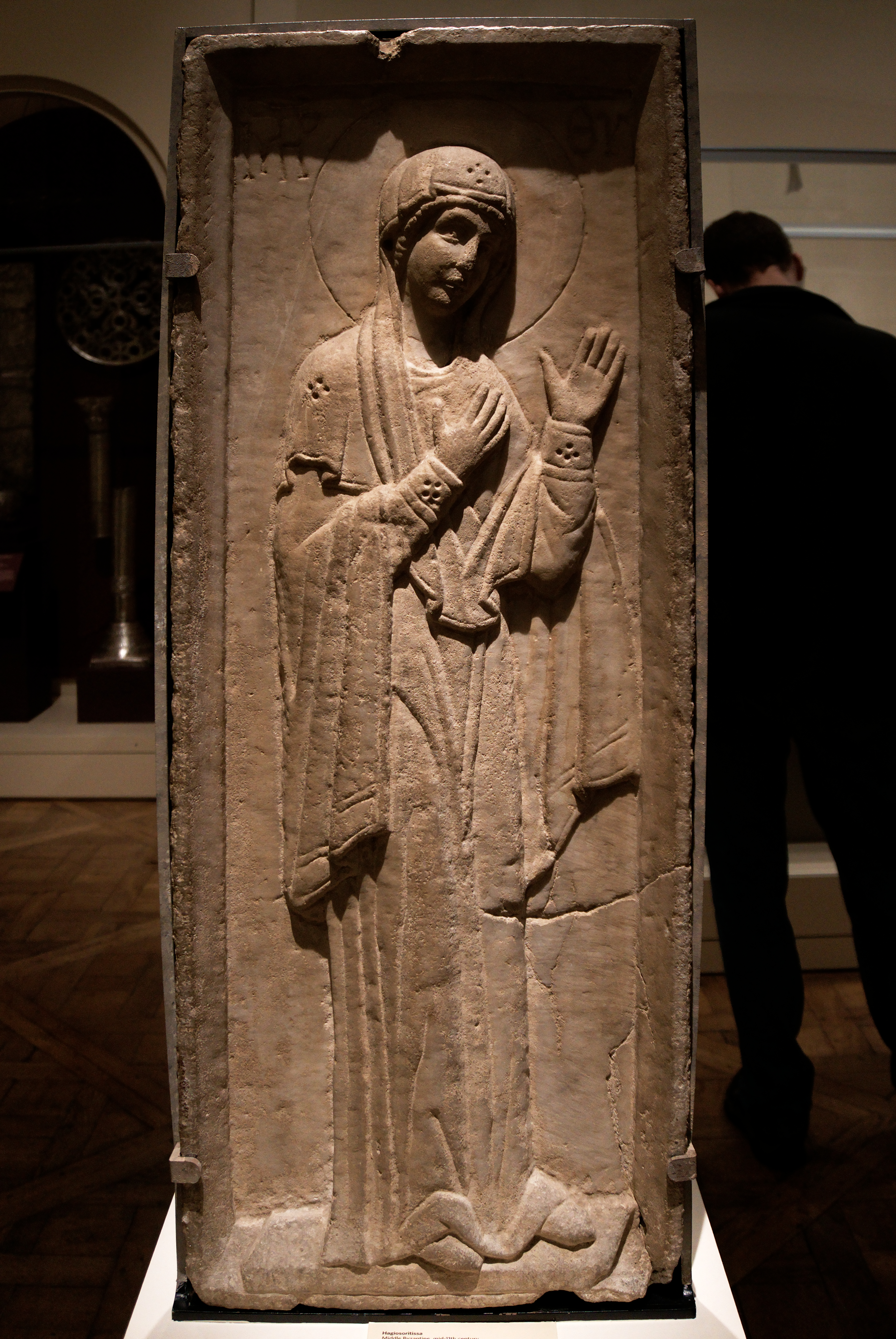
Stone carving is an uncommon medium for Byzantine icons. While sculpture in the round was typically avoided by the church in the East, at least for devotional use, relief carving, with its closeness to two-dimensionality, was more acceptable, though still much rarer than painted wooden panels.

Virgin Hagiosoritissa (11th c)
Virgin Hagiosoritissa, Constantinople, mid-11th century. Marble, 104 × 40 × 7 cm (40 9/10 × 15 7/10 × 2 4/5 in.). Dumbarton Oaks Museum, Washington, DC. Photo: Victoria Emily Jones.

In this carved icon Mary raises her hands in prayer on behalf of humanity, a type known as the Virgin Hagiosoritissa (Gk. “Intercessor”). Made before the development of the iconostasis, it was probably originally placed inside a church on the left pillar of the bema, or sanctuary, while an image of John the Baptist occupied the right pillar, with Christ at the top center, forming a group known as the Deesis (“Supplication”). These two individuals are traditionally shown as primary intercessors, flanking an enthroned Christ like courtiers, because they were the first to recognize Jesus’s saving role: Mary in her “yes” to Gabriel, John in his in utero jump for joy.

The Greek inscription at the top of the icon, ΜΡ ΘΥ, is shorthand for “Mother of God.”

View object record.

+++

Daddi, Bernardo_Madonna and Child with Saints
Bernardo Daddi (Italian, ca. 1280–1348), Madonna and Child with Saints and Angels, 1337. Tempera and gilding on poplar panel, 87.6 × 44.5 × 8.9 cm (34 1/2 × 17 1/2 × 3 1/2 in.). Dumbarton Oaks, Washington, DC. Photo: Victoria Emily Jones.

Bernardo Daddi was the preeminent Florentine painter after Giotto, who had pioneered a new naturalism and may have been Daddi’s teacher. Daddi operated a large and busy workshop, specializing in small-scale paintings and altarpieces commissioned by the well-to-do for their private devotions. While in this panel he uses the traditional Byzantine gold ground, representing the radiance of heaven, he moves toward the Renaissance with individualized facial expressions and depth in space. I love the tenderness of Mary who cuddles her son’s foot as he looks up at her admiringly, climbing over her lap and clutching at her collar.

“This panel was originally the central unit of a triptych, the wings of which are now missing,” writes James N. Carder. “The Virgin Mary holding the Christ Child sits in the center on a high-backed throne. To the left stand Saint Peter, grasping two keys, and Saint Dominic, who wears a Dominican habit and holds a lily. To the right stand Saint James the Great, holding a staff from which hangs a small red purse, and Saint Paul, holding a knife. Behind each group of saints are two angels, and in the gable is a roundel with the bust of Christ making a blessing gesture.”

View object record.

+++

Riemenschneider, Tilman_Virgin and Child
Tilman Riemenschneider (German, ca. 1460–1531), Virgin and Child on the Crescent Moon, ca. 1521–22. Lindenwood, 95.3 × 35 × 21 cm (37 1/2 × 13 4/5 × 8 3/10 in.). Dumbarton Oaks Museum, Washington, DC. Photo: Victoria Emily Jones.

This similarly tender Madonna and Child image was made two centuries later by the German Late Gothic artist Tilman Riemenschneider, who ran the largest sculpture workshop in Würzburg, producing an enormous number of religious images for churches. Jesus reaches his hand up to cradle his mother’s chin, his shirt swept back in a breeze, and she holds him with great fondness while also confronting the viewer with a contemplative air. She stands on a crescent moon, probably meant to associate her with the Woman of the Apocalypse described in Revelation 12, who gives birth to a male ruler whom the dragon seeks to devour.

Riemenschneider was “highly regarded in Europe for his technical virtuosity in wood and stone and for his sensitive blending of religious subject matter with a deeply felt appreciation for humanity.” He was one of the first sculptors to abandon polychromy (the application of color to sculpture) on selected works, emphasizing the simple beauty of the sculpted material, which in his case was usually lindenwood (aka limewood), alabaster, or sandstone. A wealthy, respected, landowning member of Würzburg society, Riemenschneider served on the municipal council. His high status and artistic career came to an abrupt halt, however, during the German Peasants’ War of 1525, in which he refused to obey an order to fight the revolting peasants and was imprisoned as a result.

Riemenschneider, Tilman_Virgin and Child (detail)
Photo: Victoria Emily Jones

View object record.

+++

From the French Late Gothic, the Music Room has this beautiful little broken Pietà. A Pietà (Ital. “pity, compassion”) is a representation of the dead Christ on the lap of his mourning mother, but here the figure of Christ is no longer intact. At first I assumed this was Mary in prayer or contemplation, but upon looking up the object on the printed key and finding it to be a Passion image, I can now see that the expression she bears is an elegiac one.

Virgin from a Pieta (15th c)
Virgin from a Pietà, made in France, last quarter of 15th century. Limestone with polychromy, 50.8 × 22.9 × 27.9 cm (20 × 9 × 11 in.). Dumbarton Oaks Museum, Washington, DC. Photo: Victoria Emily Jones.

Many Christian images throughout history are contextualized to the time and place in which they were made, and this one is no exception. “The Virgin is clothed in a manner contemporary to the portraiture of fifteenth-century noblewomen, with a simple gown tightly fitted above the waist,” writes Kristen Gonzalez. “A mantle is drawn up over her head, underneath which a veil and barbeile partially obscure her head and lower neck. . . . The Virgin’s gown and mantle appear to have been painted blue and edged with gilding,” as the polychrome traces suggest.

View object record.

+++

“Small-scale tapestries with devotional subject matter were produced during the early modern period and were prized for this purpose throughout Europe, particularly among the elite circle of monarchs, princes, dukes, and the highest ecclesiastic echelons,” writes Elizabeth Cleland. “Part of the appeal of the scale of these devotional tapestries must have been their portability. They could easily be rolled up or folded and transported with other court paraphernalia from one location to another, thereby accompanying their often itinerant royal owners.”

Furthermore, unlike the monumental tapestries that were often part of a cycle and that were more decorative in nature, these smaller ones were intended to function individually, as single works, and in more intimate ways, for personal prayer and reflection. Dumbarton Oaks’ Christ and the Virgin, three feet square, may have hung in a private oratory (prayer room).

Christ and the Virgin tapestry
Tapestry of Christ and the Virgin, Flemish, probably Brussels, late 15th–early 16th century. Wool, silk, and silver and gold thread on wool, 96.5 × 96.5 cm (38 × 38 in.). Dumbarton Oaks Museum, Washington, DC. Photo: Victoria Emily Jones.

James N. Carder describes the image: “Side-by-side are seen the bust-length figures of Christ as Savior (Salvator Mundi), holding a cruciform orb and making a blessing gesture, and the Virgin Mary crowned as Queen of Heaven and with her hands together in prayer before an open book on the ledge. The lower field of the foreground is profusely ornamented with floral (millefleurs) motifs, and above the arches are a row of Gothic ornaments and a cloisonné-like geometric band that are reminiscent of the tops of French enamel reliquaries.”

View object record.

+++

Lastly, a painting by one of my favorite artists, the Greek-born Spanish Renaissance painter known as El Greco. The Visitation is a common subject in art that refers to the meeting of the pregnant Virgin Mary (shown at the right by El Greco) and her cousin Elizabeth, who was pregnant with John the Baptist. El Greco’s Visitation was intended for the Chapel of Isabel de Oballe inside the Church of San Vicente in Toledo, but it’s uncertain whether it was ever installed. Originally the canvas had a circular outline, but at some unknown date it was cut down on all sides.

El Greco_The Visitation
El Greco (Doménikos Theotokópoulos) (Greek Spanish, 1541–1614), The Visitation, ca. 1610–14. Oil on canvas, 96.5 × 71.4 cm (38 × 28 1/8 in.). Dumbarton Oaks Museum, Washington, DC. Photo: Victoria Emily Jones.

El Greco’s initial art training was in Byzantine icon painting on the island of what today is Crete, where he was born and which was then under Venetian rule. At age twenty-six he moved to Venice and learned the Italian Mannerist style, and ten years later he left for Spain, where he spent the rest of his life. Characterized by a spiritual fervor and a sort of proto-expressionism, his works were new and unusual and much sought after. The Visitation demonstrates his preference for boldly attenuated figures caught in strong highlighting, abstractions that “emphasize the ethereal and timeless nature of the biblical world,” says Carder.

View object record.