Roundup: “Word Made Fresh” book on poetry; cantata on Smart’s “Jubilate Agno”; and more

SPOTIFY PLAYLIST: July 2024 (Art & Theology): This month’s “mixtape” includes a worship song by Daniel P. Cariño from Baguio, the Philippines; a 1954 recording from the streets of New Orleans of the itinerant preacher, singer, and guitarist Elder David Ross; a piano-violin arrangement of “Amazing Grace” by Carlos Simon; a nineteenth-century American folk hymn; an excerpt from Mendelssohn’s oratorio Elijah; a Jesus bhajan in Hindi from Toronto; a one-word song by choral-pop composer Michael Engelhardt; a brand-new Porter’s Gate single; and more.

+++

NEW BOOKS:

New books: Diary of an Old Soul; Word Made Fresh

>> Diary of an Old Soul: Annotated Edition by George MacDonald, with introduction and notes by Timothy Larsen: At last, a keepsake edition of George MacDonald’s devotional poetry collection Diary of an Old Soul! Last week InterVarsity Press released a cloth-bound hardcover with ribbon bookmark, an introduction and sparing notes by the modern British religious history scholar Timothy Larsen, and, as MacDonald stipulated in the book’s first printing in 1880, a blank page facing each page of verse for readers to continue the conversation. C. S. Lewis gave a copy of Diary of an Old Soul to his future wife, Joy Davidman, as a Christmas gift in 1952, and it would make a wonderful Christmas gift still. For each day of the year MacDonald offers a seven-line poem that voices his spiritual longings, struggles, or joys; the Victorian tastemaker John Ruskin extolled the collection as proof that worthy religious poetry could still be written in the modern age. I highlighted my favorite selections from the book in a blog post last year, but on reading this new edition, new lines are standing out to me.

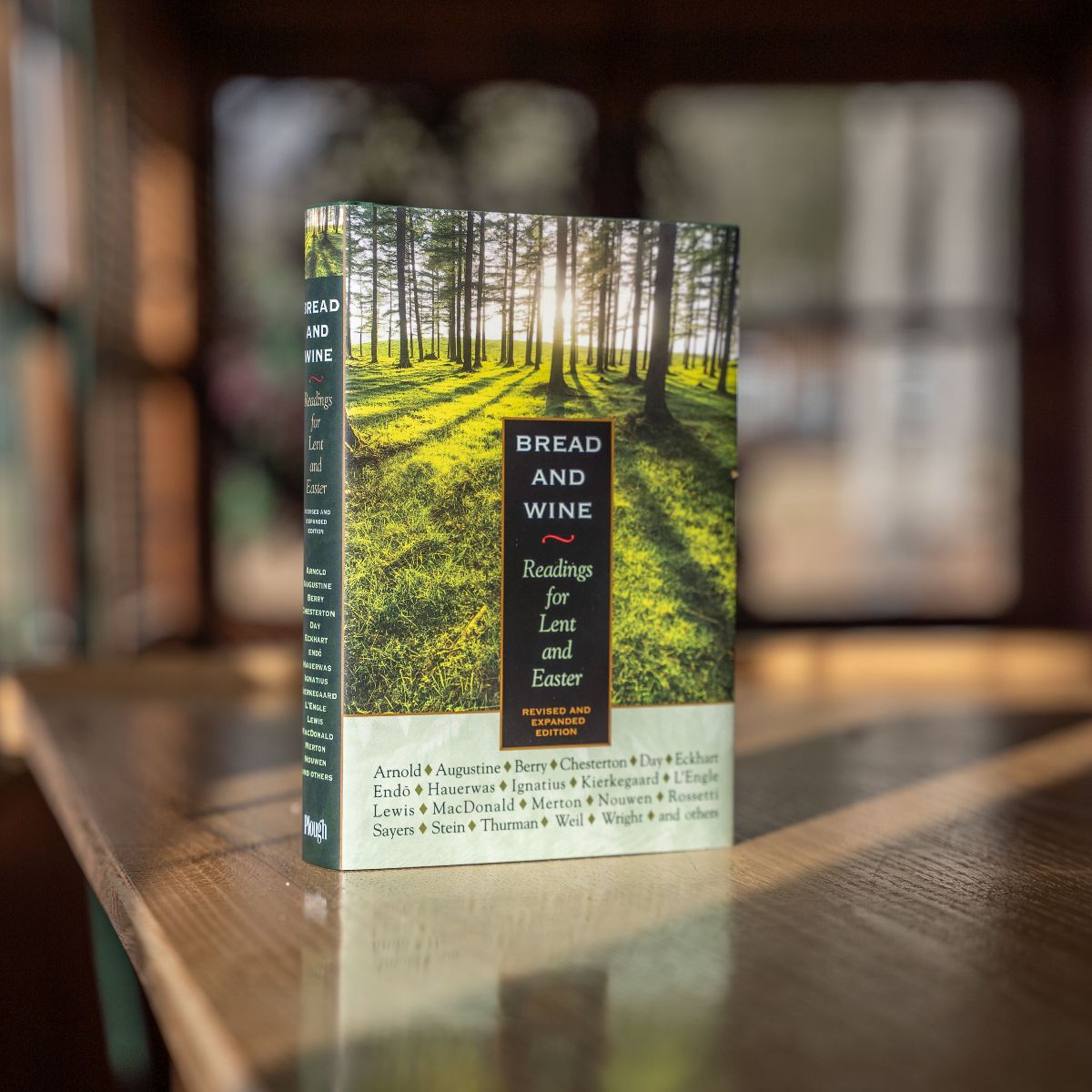
>> Word Made Fresh: An Invitation to Poetry for the Church by Abram Van Engen: Several Christians have told me they want to read more poetry and learn to better appreciate it but don’t know where to start. I usually recommend starting with an anthology, to get a taste of a wide range of styles and eras, and see if there are particular kinds they gravitate to. But now I’m thrilled I can recommend Abram Van Engen’s Word Made Fresh: An Invitation to Poetry for the Church, with a foreword by Shane McCrae. (Full disclosure: I was the copyeditor!) Endorsed by such luminaries as Christian Wiman and James K. A. Smith, the book is an excellent introduction to how and why to read poetry. Van Engen discusses sixty-two distinct poems, almost all of them reproduced in full, ranging from John Donne, Ben Jonson, and Frances Ellen Watkins Harper to Gwendolyn Brooks, Richard Wilbur, and Li-Young Lee and including, too, church hymns and biblical psalms, two forms of poetry with which Christian readers are likely already familiar. In part 1 he demonstrates six ways to read poetry: personally, for pleasure, inquisitively, like it’s a friend, considering form, and through erasure. In part 2 he answers the question “Why read poetry?”: to name creation, to tell the truth, to rejoice with those who rejoice, and to weep with those who weep. Van Engen insists that poetry is for everyone, and Word Made Fresh substantiates the claim.

Image journal is hosting an hour-long virtual book launch on Tuesday, July 9, which will feature readings with Van Engen and Image staff (register here), and for a limited time is also offering a free one-year subscription to Image to those who buy the book and provide proof of purchase (new subscribers only). You can read an excerpt from Word Made Fresh at Reformed Journal.

To access all the poems I’ve shared on this blog, see the “Poetry” tab at the top of the website: https://artandtheology.org/poetry/.

+++

PRINT INTERVIEW: “Through the Rent, Eternity Enters: A Conversation with Marilyn Nelson and Christian Wiman,” moderated by Abram Van Engen, Hedgehog Review: In December 2023, The Carver Project at Washington University in St. Louis brought together award-winning poets Marilyn Nelson and Christian Wiman for a discussion of poetry, faith, love, perception, ambition, humility, prayer, and grace, moderated by Abram Van Engen. Poets, I’ve noticed from attending conferences and reading or listening to interviews with them, tend to have an immense storehouse of wise quotes from other poets and thinkers at the ready, as this interview corroborates. There’s so much here to chew on!

+++

ESSAY: “Christianity and Poetry” by Dana Gioia, First Things: “This brief and inadequate historical survey,” writes poet and literary critic Dana Gioia, “is offered to demonstrate the powerful continuity of Christian poetry in English. Our literary canon is suffused with religious consciousness, which has expressed itself in ways beyond the imagination of theology and apologetics. Milton boasted that his Paradise Lost would ‘justify the ways of God to men,’ but his masterpiece was only one of countless poems that engaged, enlarged, and refined the spirituality of the English-speaking world. Christianity went so deeply into the collective soul of the culture that its impact continues even in our secular age.”

He proposes, “All that is necessary to revive Christian poetry is a change in attitude—a conviction that perfunctory and platitudinous language will not suffice, an awareness that the goal of liturgy, homily, and education is not to condescend but to enliven and elevate. We need to recognize the power of language and use it in ways that engage both the sense and the senses of believers.”

+++

CANTATA: Rejoice in the Lamb by Benjamin Britten, performed by VOCES8 and the VOCES8 Foundation Choir & Orchestra, dir. Barnaby Smith:Rejoice in the Lamb (Op. 30) is a cantata for four soloists, SATB choir and organ composed by Benjamin Britten in 1943 and uses text from the poem Jubilate Agno by Christopher Smart (1722–1771). The poem, written while Smart was in an asylum, depicts idiosyncratic praise and worship of God by different things including animals, letters of the alphabet and musical instruments. Britten was introduced to the poem by W. H. Auden whilst visiting the United States, selecting 48 lines of the poem to set to music with the assistance of Edward Sackville-West. The cantata was commissioned by the Reverend Walter Hussey for the celebration of the 50th anniversary of the consecration of St Matthew’s Church, Northampton. Critics praised the work for its uniqueness and creative handling of the text.” (Wikipedia)

I know this poem from its famous passage about Jeoffry the cat, in which Smart celebrates his cat’s relationship with God: “For I will consider my Cat Jeoffry. / For he is the servant of the Living God duly and daily serving him. / For at the first glance of the glory of God in the East he worships in his Way. / For this is done by wreathing his body seven times round with elegant quickness. / For then he leaps up to catch the musk, which is the blessing of God upon his prayer. . . .” See 3:52 of the video.

Britten’s seventeen-minute work is performed here using the orchestration by Imogen Holst (1907–1984), written at Britten’s request. The performance is available on VOCE8’s new album To Sing of Love, available on all streaming platforms. Follow along with the lyrics here. Read the full text of Christopher Smart’s poem here.

+++

SONG: “Wild Strawberries” by Nick Chambers: This song from 2020 expresses yearning to know the God whose beauty is revealed in nature and who is mysterious, “divinely robed in dark and radiant haze.” It’s based on a 1819 Swedish hymn by Johan Olaf Wallin that was quoted by the aging professor Isak Borg in Ingmar Bergman’s multi-award-winning film Wild Strawberries.

“In the gospel narratives,” Chambers writes, “the risen Jesus is always one step ahead, beckoning us further. We follow after tangible touches and traces he leaves behind—folded grave clothes and broken bread. He travels with us but isn’t always recognizable, still teaching his friends how to fish, readying breakfast on the beach. Wherever he appears and withdraws, the background becomes the foreground, inviting us to see and seek him everywhere. Resurrection cannot be confined; all creation is drawn into its trajectory.” Read more from Chambers in the YouTube video description.

Epiphany: Die Könige

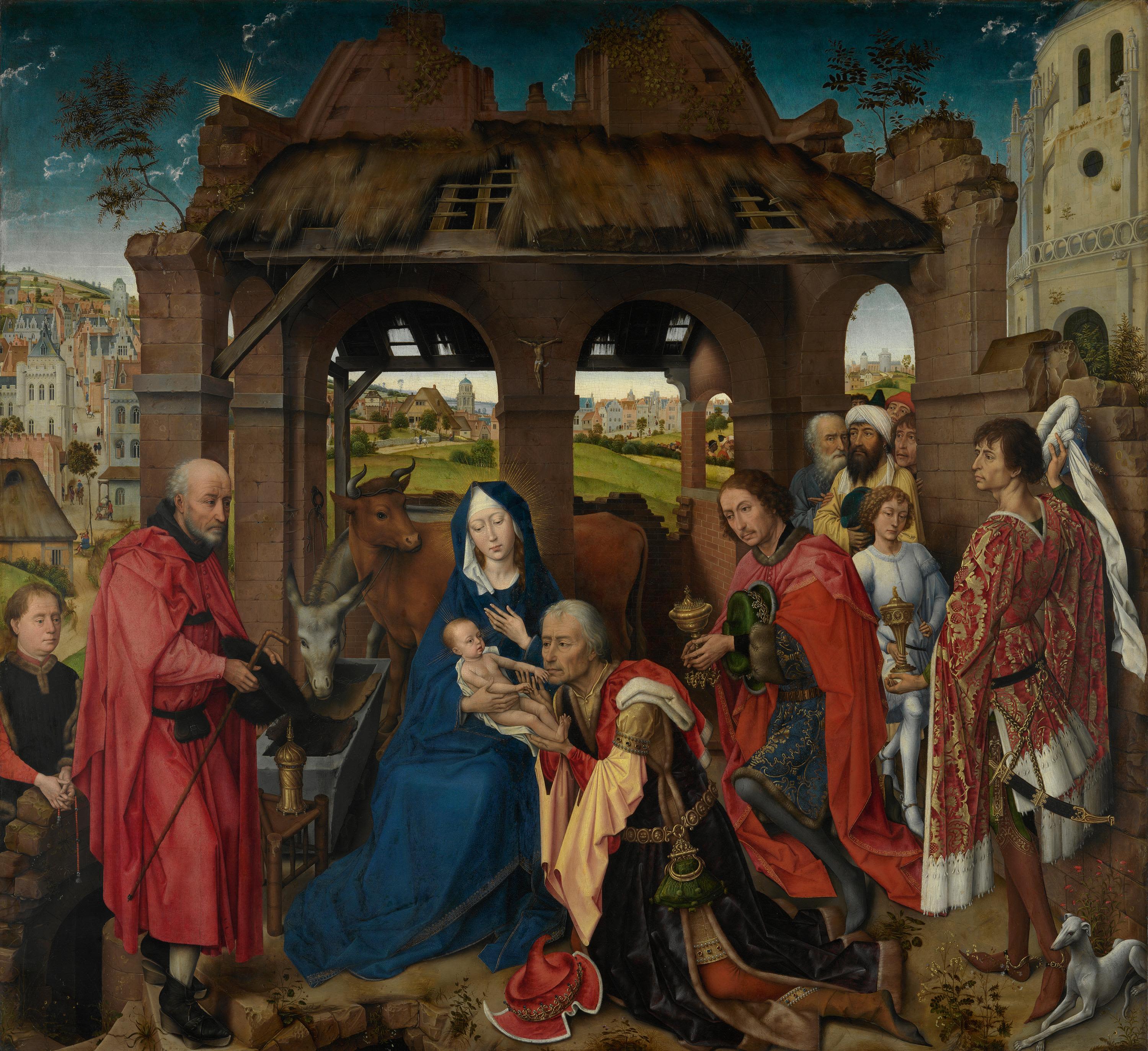
LOOK: Adoration of the Magi by Rogier van der Weyden

van der Weyden, Rogier_Adoration of the Magi
Rogier van der Weyden (Netherlandish, 1399–1464), Adoration of the Magi, ca. 1455. Painting on oak wood, 139.5 × 152.9 cm. Alte Pinakothek, Munich, Germany.

This remarkable painting by the early Northern Renaissance master Rogier van der Weyden shows three kings arriving from afar to worship the Christ child. All the splendor of foreign courts comes to the dilapidated stable of Jesus’s birth, which is relocated to the Low Countries of the fifteenth century. (Notice the contemporary cityscape in the background.)

The most senior king greets the child first, humbly removing his hat and crown and kneeling on the ground, his fur-lined velvet robe rubbing the dirt. He supports the child’s feet with one hand and with the other gently lifts the child’s hand to kiss. Two fellow sovereigns stand behind him, followed by their entourage and various locals.

Standing on the left, in red, is Joseph, hat and staff in hand. He looks reflectively on the visitors, taking it all in. Leaning against the stone wall behind Joseph, a rosary between his fingers, is the painting’s donor. While it’s true that sometimes the practice of painting donors into biblical scenes was done for flattery or, if a condition of the commission, out of arrogance, more often the motivation or purpose was to imaginatively place yourself into the sacred scene as a witness, making yourself present to an event that was in time and yet that also transcends time, in that its impact is ongoing. Seeing oneself as a participant in Christ’s story, a devotee alongside those who walked with him in the flesh, can aid in spiritual contemplation.

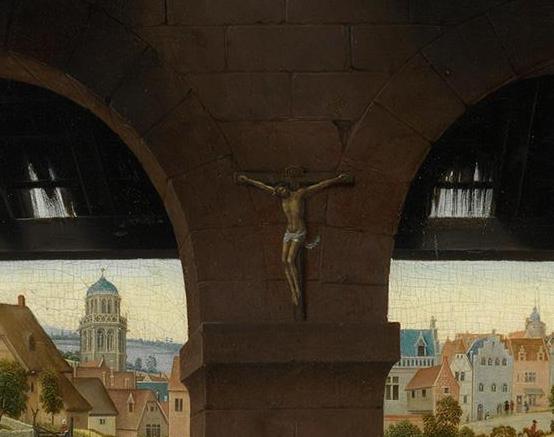
Another anachronism—or rather, a collapsing of chronos and kairos—is the crucifix hung on the central pillar of the stable! This of course alludes to the cruel death Christ would face some thirty years later.

van der Weyden, Rogier_Adoration of the Magi (crucifix detail)

This painting is the centerpiece of a triptych originally made for St. Mary’s Chapel in the church of St. Columba in Cologne. The wings depict the Annunciation and the Presentation of Christ in the Temple.

van der Weyden, Rogier_Columba Altarpiece
Rogier van der Weyden (Netherlandish, 1399–1464), Saint Columba Altarpiece, ca. 1455. Painting on oak wood, 139.5 × 152.9 cm (central), 139.5 × 72.9 cm (each wing). Alte Pinakothek, Munich, Germany.

LISTEN: “Die Könige” (The Kings) from Weihnachtslieder (Christmas Songs), Op. 8, by Peter Cornelius, 1870 | Arranged for a cappella choir by Ivor Atkins, 1957 | Performed by VOCES8, the VOCES8 Scholars, the VOCES8 Foundation Choir, and Apollo5, dir. Barnaby Smith, feat. Jonathan Pacey, 2023

Drei Könige wandern aus Morgenland;
Ein Sternlein führt sie zum Jordanstrand.
In Juda fragen und forschen die drei,
Wo der neugeborene König sei?
Sie wollen Weihrauch, Myrrhen und Gold
Dem Kinde spenden zum Opfersold.

Und hell erglänzet des Sternes Schein:
Zum Stalle gehen die Kön’ge ein;
Das Knäblein schaun sie wonniglich,
Anbetend neigen die Könige sich;
Sie bringen Weihrauch, Myrrhen und Gold
Zum Opfer dar dem Knäblein hold.

O Menschenkind! halte treulich Schritt!
Die Kön’ge wandern, o wandre mit!
Der Stern der Liebe, der Gnade Stern
Erhelle dein Ziel, so du suchst den Herrn,
Und fehlen Weihrauch, Myrrhen und Gold,
Schenke dein Herz dem Knäblein hold!

English translation:

Three kings journey from the East;
A little star leads them to Jordan’s banks.
In Judaea the three of them seek and inquire
Where the newborn king might be.
They wish to make offerings to the child:
Gold, frankincense, and myrrh.

And brightly shines the light of the star.
The three kings enter the stable;
They gaze in rapture at the child,
Bowing low in adoration.
Gold, frankincense, and myrrh
They bring to the child as offering.

O child of man! Follow them faithfully.
The kings are journeying; oh, journey too!
Let the star of love, the star of grace,
Light your way as you seek the Lord,
And if you lack gold, frankincense, and myrrh,
Give your heart to that sweet child.

The German composer and poet Peter Cornelius (1824–1874) was a friend of Franz Liszt’s and Richard Wagner’s. “Die Könige” (The Kings) is the third, and most popular, song in a Christmas cycle he wrote for voice and piano, the others being “Christbaum” (Christmas Tree), “Die Hirten” (The Shepherds), “Simeon,” “Christus der Kinderfreund” (Christ the Friend of Children), and “Christkind” (Christ Child). Cornelius began writing his Weihnachtslieder cycle—both text and music—in 1856, and it underwent several rounds of revision, incorporating input from others, before being published in 1870.

From VOCES8’s Live From London Christmas 2022 broadcast, the performance of “Die Könige” above features as the baritone soloist Jonathan Pacey, who sang bass for VOCES8 from 2015 to 2022. He chose this song as the encore in his final concert. Pacey’s voice is absolutely gorgeous!


This post concludes our journey through the cycle of light, Advent-Christmas-Epiphany. Thanks for walking the road with me! I encourage you to keep journeying, keep following the light, throughout the rest of the church year. May love and grace, as “Die Könige” says, light your way as you seek the Lord.

If you’d like to leave a donation to help offset the costs of running Art & Theology, which I’d really appreciate, you may do so through PayPal or this secure Stripe form. You can expect many more new posts in 2024! Just not at a daily frequency.

Roundup: The Guild Conference, All Saints’ Day, and “Soul on Deck”

UPCOMING EVENT: The Guild Creative Arts Conference, November 4, 2023, Church on Morgan, Raleigh: Organized by singer-songwriter Jess Ray, spoken word poet Sharlene Provilus, and event curator Cary Brege, The Guild Conference endeavors “to care for the craft and character of creative people while encouraging creative community. We want to inspire your creative work, spiritual journey, and daily rhythms.” The special guests this year are singer-songwriters Dwan Hill, Andy Squyres, and Taylor Leonhardt; JourneyMates director Mary Vandel Young; and Makers & Mystics podcaster Stephen Roach. The day-long conference includes sessions, a panel discussion, an artist showcase, and a concert by The Choir Room. The regular ticket price is $75 (group rates and concert-only tickets also available).

+++

ARTICLE: “A Cloud of Witnesses: Why We Should Celebrate All Saints Day” by Leonard J. Vander Zee: In this June 2008 article from Reformed Worship, the Rev. Leonard J. Vander Zee writes to his fellows in the Reformed Protestant tradition, explaining what All Saints’ Day is and why it’s important to celebrate it, as Methodists, Lutherans, Anglicans, and Roman Catholics do every November 1. (Churches without midweek services typically celebrate the feast corporately on whatever Sunday precedes the first of November: this year, October 29.) Vander Zee also offers a sample order of worship, including specific hymn suggestions.

+++

SONGS:

>> “For All the Saints” by John L. Bell and Graham Maule, performed by Roger Sullins: A contemporary hymn from the Iona Community in Scotland, Bell and Maule’s “For All the Saints” is not to be confused with the 1864 William W. How hymn of the same title, which begins “For all the saints who from their labors rest.” Instead of How’s militant language that emphasizes the Christian life as struggle, this hymn focuses on the loving actions of the saints and uses the beautiful English folk tune O WALY WALY. It’s performed below by Roger Sullins, a worship leader at Palma Ceia Presbyterian Church in Tampa. Purchase the sheet music here. (© 1996 Wild Goose Resource Group / The Iona Community; admin. GIA Publications, Inc.) [HT: Global Christian Worship]

For all the saints who’ve shown your love
In how they live and where they move
For mindful women, caring men
Accept our gratitude again

For all the saints who loved your name
Whose faith increased the Savior’s fame
Who sang your songs and shared your word
Accept our gratitude, good Lord

For all the saints who named your will
And showed the kingdom coming still
Through selfless protest, prayer, and praise
Accept the gratitude we raise

Bless all whose will or name or love
Reflects the grace of heav’n above
Though unacclaimed by earthly pow’rs
Your life through theirs has hallowed ours

>> “Lux Aeterna (Nimrod)” by Edward Elgar, arr. John Cameron, performed by Voces8: The orchestral work “Nimrod” is movement 9 from the Enigma Variations by British composer Edward Elgar (1857–1934). In 2004 John Cameron wrote an SSAATTBB choral arrangement of the tune using the words of “Lux aeterna” from the Requiem Mass—which is what Voces8 performs in this video.

Lux aeterna luceat eis, Domine,
cum sanctis tuis in aeternum,
quia pius es.

Requiem aeternam dona eis, Domine,
et lux perpetua leceat eis.

English translation:

May light eternal shine upon them, O Lord,
with thy saints forever,
for thou art kind.

Eternal rest give to them, O Lord,
and let perpetual light shine upon them.

+++

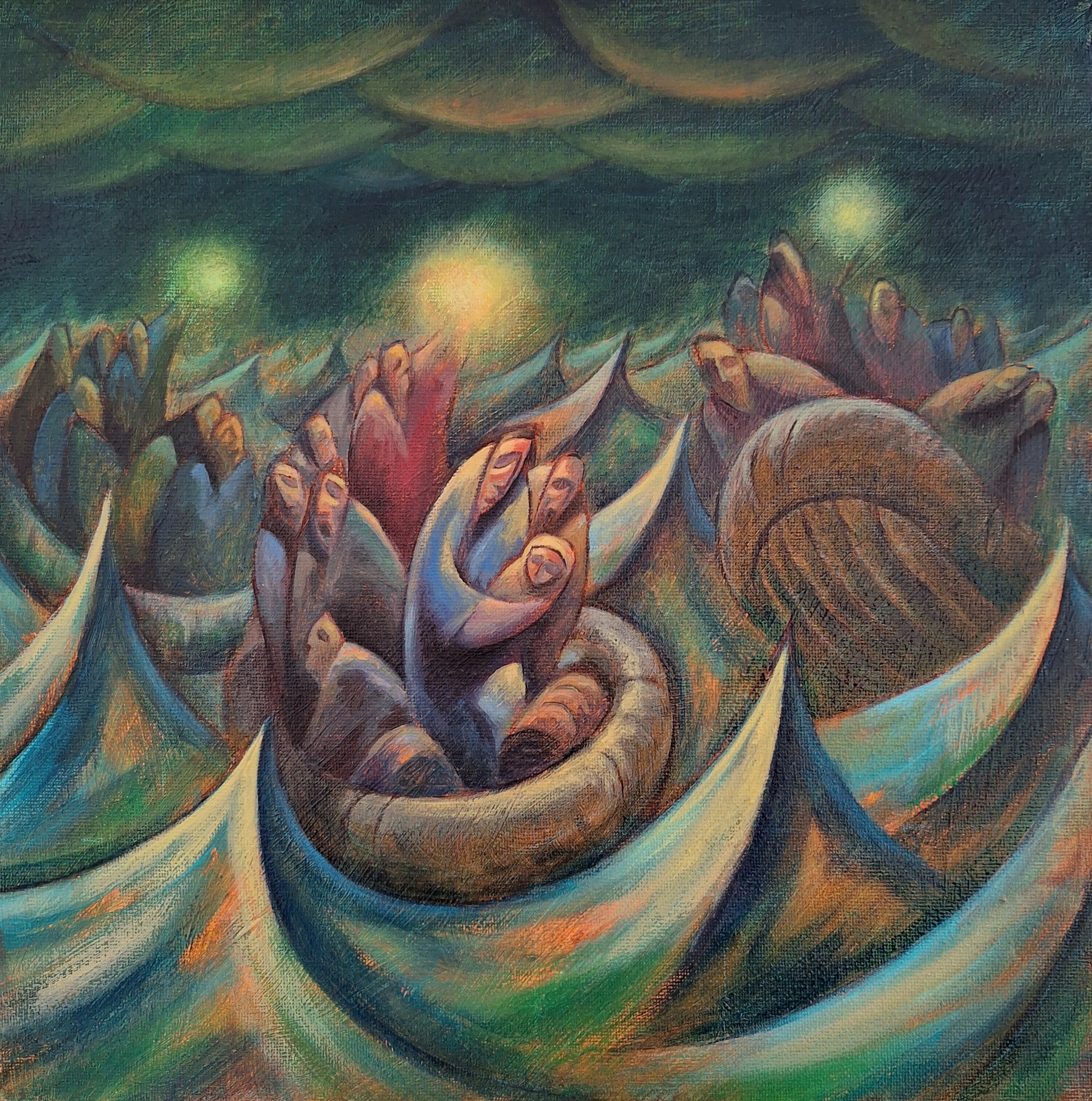
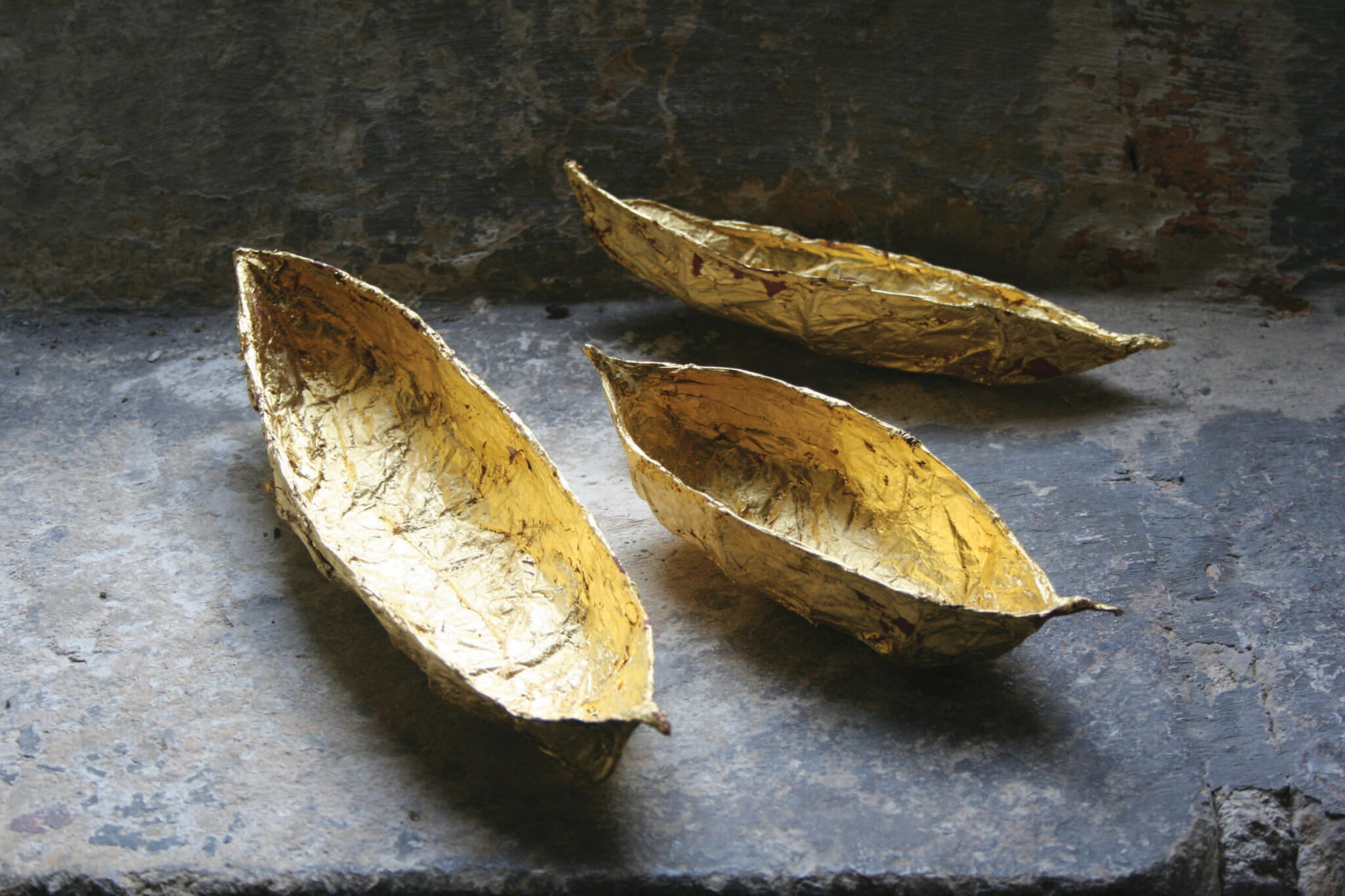
ARTICLE: “Soul on Deck” by Jake Lever: In Image no. 117 (Summer 2023), artist Jake Lever writes about a handful of his artworks having to do with the archetype of the boat as a vessel of passage: Ark, Bardsey Boats, Hailes Boats, Soul Boats, and Do the Little Things. He describes the fragile vessels he creates out of branches or wire, tissue paper, and gold leaf as “both cradle and coffin . . . something akin to a giant belly, cocoon, or womb . . . empty seed pods suggestive of cycles of birth, death, and resurrection.” Editions of some of these were given as gifts to family and friends during COVID, or to members of his collaborator-priest friend’s parish journeying through the final stages of a terminal illness.

Lever, Jake_Hailes Boats
Jake Lever (British, 1963–), Hailes Boats, 2013. Wire, tissue paper, and gold leaf, dimensions variable.

Jake Lever (British, 1963–), Soul Boats, installed at Birmingham Cathedral, 2015–16. Photo by the artist.

For Soul Boats, installed at Birmingham Cathedral for its tercentenary, Lever invited city residents to fill the two thousand boats that would hang from the ceiling of the nave with personal memories, prayers, and reflections. “Created in hospices, youth clubs, schools, sacred spaces, and scores of community settings across the city, boats were made in memory of loved ones who had died, as cries for help in finding employment, as prayers of thanksgiving and gratitude, for peace and justice.” Heading east toward the high altar in the sanctuary, these boats formed a “constellation of souls.”

+++

LITANY: “Litany for All Saints Day” by Fran Pratt: I always appreciate the litanies (responsive prayers for congregational use) that Fran Pratt writes. This one is from 2016.

+++

And for some lighthearted fun: a GIF by James Kerr (artist name: Scorpion Dagger), of Jesus and the twelve apostles riding a tandem bicycle! Kerr makes humorous animated digital collages mostly from Northern and Early Renaissance art.

Roundup: Sing Me High Music Festival, visual LP shot on Mayne Island, and more

SPOTIFY PLAYLIST: August 2023 (Art & Theology): Here’s this month’s!

+++

MUSIC FESTIVAL: “Sing Me High,” August 11–12, 2023: Celebrating music and faith in the Shenandoah Valley. Next Friday evening and all day Saturday at the Brethren & Mennonite Heritage Center in Harrisonburg, Virginia, various folk, bluegrass, and acoustic musicians from the region will be performing: the Walking Roots Band [previously], Chatham Rabbits, Maya de Vitry, Spectator Bird, Honeytown, Juniper Tree, Tide Spring, Good Company, Ebony Nicole, Ears to the Ground Family (read my review of their debut album), Shekinah, Ryan Scarberry, Clymer & Kurtz, and the Rain Pickers. Buy your tickets ahead or at the gate. I’ll be there! (In the audience, that is.)

Below are songs by three different bands/artists who will be playing at the festival: “Praise to God (Whirlwinds),” a new setting by the Walking Roots Band of an eighteenth-century hymn by Anna Barbauld (recorded on The Soil and The Seed Project, vol. 4 and appearing on the Art & Theology Thanksgiving Playlist); “Again, Amen” by Spectator Bird (sisters Rachel and Lindsey FitzGerald); and “Grieve and Rejoice” by Ryan Scarberry, director of music at Incarnation Anglican Church in Williamsburg, Virginia.

+++

ONLINE EVENT: “In Memoriam: An Evening Celebrating Frederick Buechner’s Literary Contributions,” August 15, 2023: “Celebrated as one of the foremost spiritual writers of his generation, Frederick Buechner’s witty, vivid, and rich writing has inspired readers’ minds and stirred hearts through his more than 30 published books for six decades. One year after his passing, Frederick Buechner (July 11, 1926–August 15, 2022) remains an influential voice for writers across genres, from novelists and memoirists to homileticians and theologians alike. For those writers who feel not religious enough for religious readers, or too religious for non-religious readers, Buechner’s voice has been a welcome, guiding light.

“On the one-year-anniversary of Frederick Buechner’s passing, Image is hosting space for community members to gather and share their appreciation for Buechner’s literary contributions. From themes of paying attention to one’s life and stewarding one’s grief, to the unexpected influences on one’s vocation and the ordinary miraculous moments of everyday life, Buechner’s words offer a variety of invitations through which one might come to see the world and one’s place within it more deeply. Image community members are invited to bring a favorite selection of Buechner’s writing to read aloud and to briefly reflect on the difference his words have made for their life.” Register for this free, moderated, open-mic-style time of sharing and reflections at the link above.

+++

DOCUMENTARY: The Sea in Between (2013) by Mason Jar Music: Blayne Johnson and his family, who reside in Mayne Island, British Columbia, are big fans of Portland, Oregon-based indie singer-songwriter Josh Garrels. In 2012 Johnson reached out to Garrels and some of the folks at Mason Jar Music, the Brooklyn-based creative collective Garrels has worked with, to invite them up to his home for a relaxing getaway, and to play for his family and neighbors. Mason Jar specializes in live performance videos, so they sent a small crew and a handful of musicians with the intention of shooting a few of those at various locations around the island—along the bay, on a farm, in a church. Then they decided to extend the footage from the week into a feature-length documentary, directed by Matt Porter, which you can watch for free on YouTube (embedded directly below). The song recordings were released afterward on an album of the same name, along with others that didn’t make the final cut of the film.

The Sea in Between, the film, is about vocation, the creative process, patronage, faith, family, community, and the beauty of place, and it centers on the joy of making and experiencing music together. Besides Garrels, the musicians are Dan Knobler (slide guitar, mandolin), Jay Kirkpatrick (banjo, accordion), Russell Durham (violin), Charlaine Prescott (cello), Jason Burger (drums), Chad Lefkowitz-Brown (clarinet, flute, saxophone), and Gabriel Gall (miscellaneous), who served as music director and wrote the orchestrations. Michelle Garrels and Matt Porter play the aquarion (glass marimba), and everyone contributes vocals. Perhaps my favorite song from the film is “Pilot Me” (not to be confused with the Edward Hopper hymn “Jesus, Savior, Pilot Me”; this is a Garrels original):

+++

SONG: “O nata lux” by Thomas Tallis, performed by VOCES8: “O nata lux de lumine” (O Light Born of Light) is the office hymn at Lauds of the Feast of the Transfiguration, celebrated August 6. Here VOCES8 performs a setting from the English High Renaissance by Thomas Tallis, inside St. Bartholomäus-Kirche in Pegnitz, Germany.

O nata lux de lumine,
Jesu redemptor saeculi,
Dignare clemens supplicum
Laudes precesque sumere.

Qui carne quondam contegi
Dignatus es pro perditis,
Nos membra confer effici
Tui beati corporis.
O Light born of Light,
Jesus, redeemer of the world,
with loving-kindness deign to receive
suppliant praise and prayer.

Thou who once deigned to be clothed in flesh
for the sake of the lost,
grant us to be members
of thy blessed body.

Roundup: Feast of Mary Magdalene; holiness of people and place; black squares

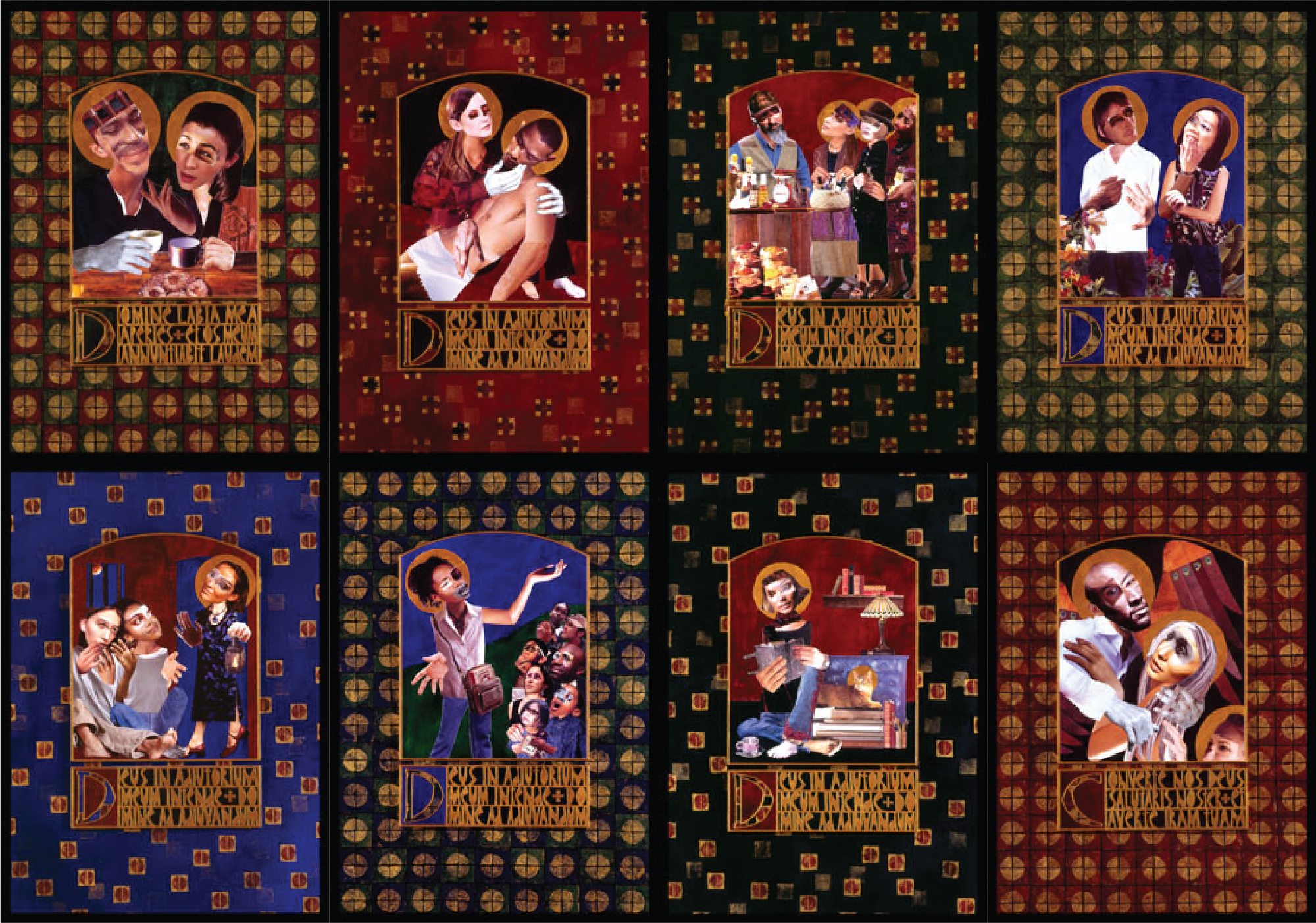
Richardson, Jan_The Hours of Mary Magdalene
The Hours of Mary Magdalene by Jan L. Richardson

ART CYCLE: The Hours of Mary Magdalene by Jan L. Richardson: July 22 is the feast day of Mary Magdalene, one of Jesus’s closest disciples and the first witness and preacher of the Resurrection. American artist, writer, and minister Jan L. Richardson created a sequence of collages picturing events from her life, drawing on both the biblical narratives and medieval legends. The structure and presentation (decorative borders, Latin script) were inspired by medieval books of hours, used for the praying of the Divine Office. The text below each image reads, Deus, in adiutorium meum intende; Domine, ad adiuvandum me festina (“O God, come to my assistance; O Lord, make haste to help me”), the first verse of Psalm 70, which is prayed at the start of each of the canonical hours.

According to legend, after Jesus’s ascension Mary Magdalene moved to southern France, where she preached the gospel and performed miracles. The last thirty years of her life she lived as a hermit in a cave. Each time she prayed the hours, she was lifted up to heaven by angels, then brought back down at the end of her devotions.

Richardson put together a delightful little video showcasing the art cycle as well as the song “Mary Magdalena” by her late husband, Garrison Doles.

You can purchase these images as digital downloads from Richardson’s website:

  1. Matins: The Blessing Cups: Mary Magdalene and Jesus at Tea
  2. Lauds: After the Cross: The Magdalene’s Farewell
  3. Prime: Shopping for Spices: The Three Marys on Holy Saturday
  4. Terce: Touch Me Not: Resurrection Morning
  5. Sext: Release: Mary Magdalene Freeing Prisoners
  6. None: L’Evangeliste: Mary Magdalene Preaching in France
  7. Vespers: At Her Prayers: Mary Magdalene with a Book of Hours
  8. Compline: Magdalene Ascending: The Divine Hours

+++

DANCE: “Holy, Holy, Holy”: Choreographed by Betsey Beckman to a song by Karen Drucker, this dance number affirms the sacredness of every human being. It was filmed inside St. Gregory of Nyssa Episcopal Church in San Francisco, a church that “invites people to see God’s image in all humankind, to sing and dance to Jesus’ lead, and to become God’s friends.” Beckman dances with Dawon Davis and Corey Action throughout the worship space, which comprises a rectangular room where the Liturgy of the Word is celebrated and an octagonal rotunda for the Liturgy of the Table. The Dancing Saints icon that covers the walls is by Mark Doox. [HT: Global Christian Worship]

+++

MUSIC:

>> “Locus iste” by Anton Bruckner, performed by VOCES8: The British vocal ensemble VOCES8 performs Anton Bruckner’s sacred motet “Locus iste” (This Place) at Les Dominicains de Haute-Alsace in Guebwiller, France. Bruckner composed it in 1869 for the dedication of the Votivkapelle (votive chapel) at the New Cathedral in Linz, Austria, where he had been a cathedral organist. The text—a Latin gradual for church dedications and their anniversaries—is informed by Jacob’s saying, after his dream of the ladder uniting heaven and earth, that “surely the Lord is in this place; and I knew it not” (Gen. 28:16), and by the story of the burning bush where Moses is told to “put off thy shoes from off thy feet, for the place whereon thou standest is holy ground” (Exod. 3:5).

Locus iste a Deo factus est,
inaestimabile sacramentum;
irreprehensibilis est.

This place is made by God,
a priceless sacrament;
it is without reproach.

(Or, alternatively:)
This dwelling is God’s handiwork;
a mystery beyond all price,
that cannot be spoken against.

>> “Tabernacle” by Josh Rodriguez, performed by Mary Vanhoozer: A modernist piano composition inspired by Psalm 19, dedicated to the composer’s father-in-law, the theologian Kevin Vanhoozer.

Tabernacle is a musical triptych shaped by the drama of Psalm 19. While this word, tabernacle, is loaded with religious affection within both Jewish and Christian traditions, some modern readers may not be familiar with its implications. Merriam-Webster offers three related definitions: “a house of worship, a receptacle for the consecrated elements of the Eucharist, or a tent sanctuary used by the Israelites during the Exodus.” By extension, it has come to represent a “dwelling place” or a “temporary shelter.” In short, this is no ordinary space, rather it is a place that is set apart, made holy for a terrifying transformative encounter with the Divine.

Fragments of a prayerful hymn-like melody appear underneath this canopy of sounds. Shifting metric changes, polyrhythms, and percussive primal-sounding harmonies climax in a loud, noisy quote from the 16th-century Genevan Psalter.

More extensive program notes can be found in the YouTube video description.

+++

ESSAY: “Precedents of the Unprecedented: Black Squares Before Malevich” by Andrew Spira, Public Domain Review: Considered one of the seminal works of modern art, Kazimir Malevich’s Black Square (1915) has been cast as a total break from all that came before it. Yet searching across more than five hundred years of images related to cosmology, religious devotion, mourning, humor, politics, and philosophy, art historian Andrew Spira uncovers a slew of unlikely foreshadows to Malevich’s radical abstraction.

Et sic in infinitum
Robert Fludd’s black square representing the nothingness that was prior to the universe, from his Utriusque Cosmi (1617). On each side of the square is written “Et sic in infinitum…” (“And so on to infinity…”).

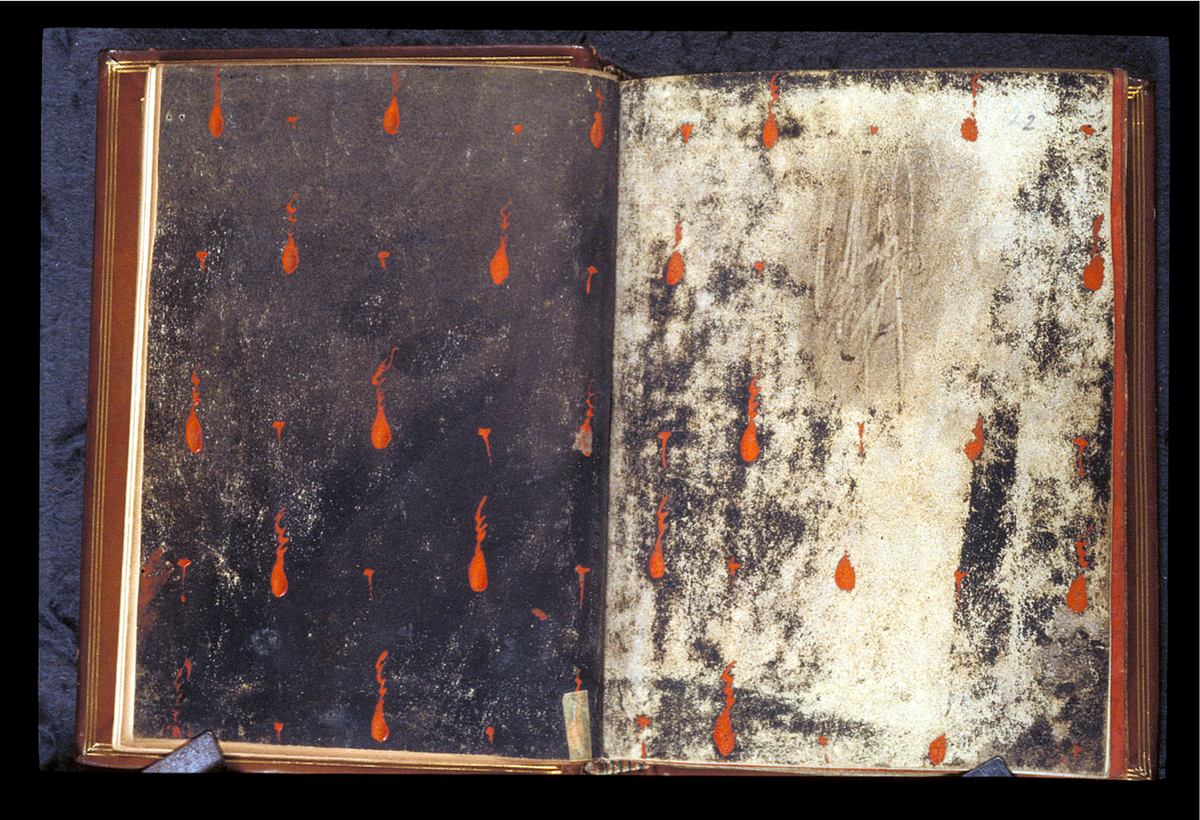
Blood of Christ
Black pages with red drops of blood, signifying the wounds of Christ, from a psalter and rosary of the Virgin, ca. 1500. The recto is worn from devotional engagement, damaged through kissing and rubbing, perhaps.

For a much more extensive treatment of the topic, see Spira’s Foreshadowed: Malevich’s “Black Square” and Its Precursors, published this month. And for a faith-positive (non-nihilistic) reading of Malevich’s Black Square that honors the artist’s own views, see pages 209–25 of Jonathan A. Anderson and William A. Dyrness’s Modern Art and the Life of a Culture, where they discuss the work in relation to the Russian icons tradition and “apophatic or ‘negative’ theology—a mode of theology that meditates on the absolute Fullness and Otherness of God by way of negating the verbal, visual and conceptual forms used to signify (and to ‘grasp’) God” (220).

Roundup: Ukrainian Madonnas and songs of peace

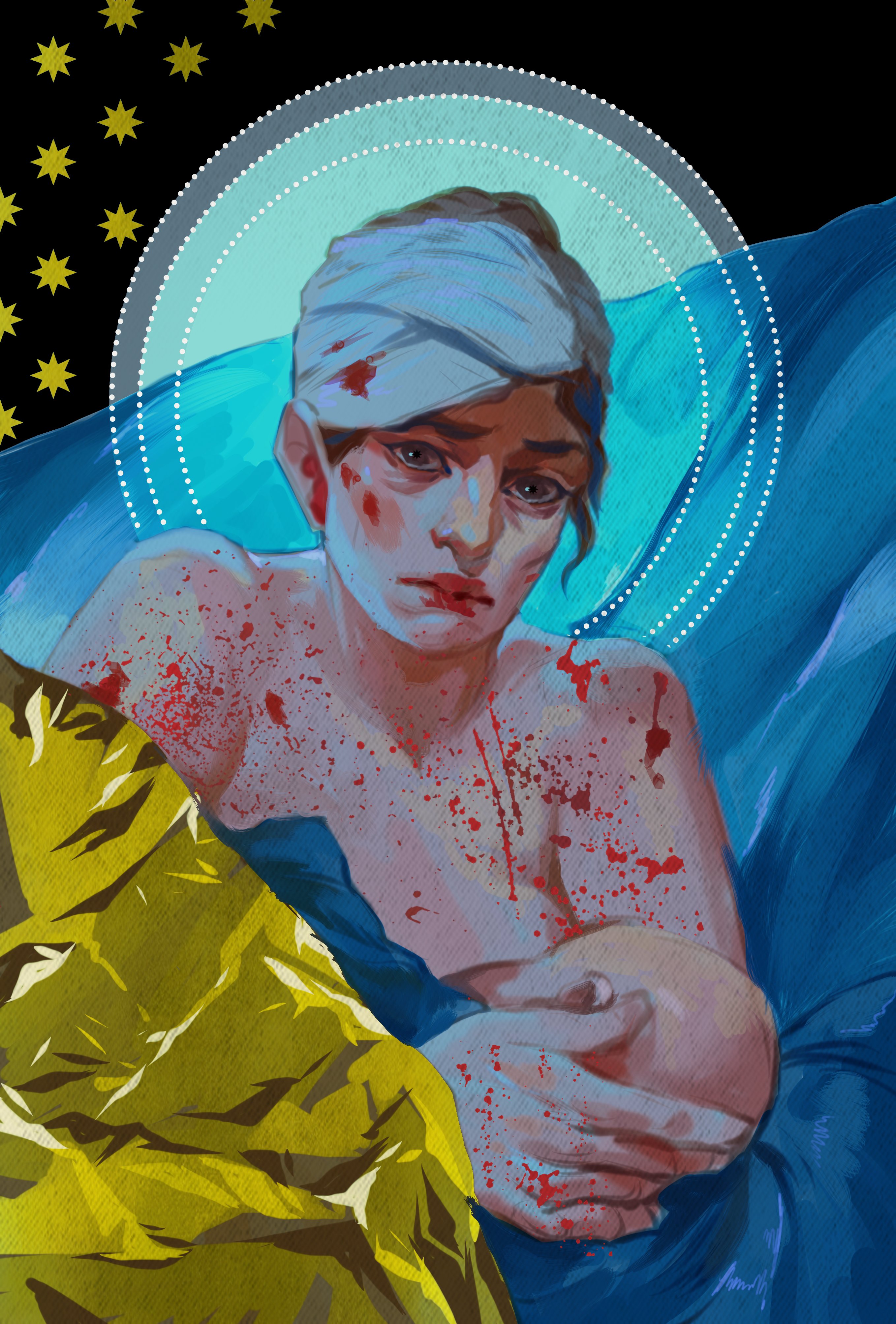
UKRAINIAN MADONNAS: Since Russia invaded Ukraine on February 24 and even still continues to aggress, artists have taken up their art to address the war—several drawing on iconography of the Madonna and Child, particularly the Maria lactans (breastfeeding Mary) type. Two Ukrainian artists were inspired by different news photos of young mothers protecting their infants from the shelling in Kyiv in March—one of whom was photographed in a hospital being treated for wounds she sustained from fallen glass while shielding her daughter with her body, and the other hiding from the blasts in a subway station.

Kyivan Madonna
Maryna Solomennykova, Kyivan Madonna, 2022, digital painting [purchase] [see news photo]

Frirean, Anta_Madonna
Anta Frirean, Ukrainian Madonna, 2022 [see news photo]

These images show the vulnerability of Christ, who is with us in our suffering, and indict those who cause such suffering.

In his response to the war in Ukraine, Serbian artist Michael Galovic, who lives in Australia, also uses Christian iconography: the Theotokos Kyriotissa (Mother of God enthroned with Christ); Archangel Michael, the patron saint of Kyiv, fighting a dragon (Rev. 12:7–8) in an ethereal rendering of a scene from the Très Riches Heures du Duc de Berry, a fifteenth-century French book of hours; and a hellmouth from the twelfth-century Winchester Psalter. These three medieval images are superimposed on Picasso’s masterwork Guernica, named after the Spanish town bombed by Nazis in 1937 and representative of the horrors of war.

Ukraine Response by Michael Galovic
Michael Galovic (Serbian Australian, 1949–), Ukraine Response, 2022. Egg tempera and gold leaf on linen on board, 170 × 80 cm. Collection of the Australian Centre for Christianity and Culture, Canberra, Australia.

Whereas Frirean’s and Solomennykova’s paintings are more intimate, Galovic takes a more cosmic approach, showing wails of lament from abstracted forms intercut with epic battles between good and evil—but at the calm center, Christ is on the throne, holding the scroll of his good word. History is going somewhere. Hate will be damned. Love will triumph.

Thanks to Art/s and Theology Australia for introducing me to the Galovic painting.

+++

SONGS:

>> “Galoba (The Prayer),” performed by Trio Mandili: A sung performance of a poem written in 1858 by the Georgian poet and statesman Ilia Chavchavadze (1837–1907). An English translation follows.

Our Father, who art in heaven,
With tenderness I stand before thee on my knees.
I ask for neither wealth nor glory;
I won’t debase my holy prayer with such matters.
I desire instead for my soul to be enlightened by heaven,
My heart to be radiant with thy love.
Even if my enemies pierce me in the heart,
I beg thee: “Forgive them, Lord, for they know not what they do!”
Even if my enemies pierce me in the heart,
I beg thee: “Forgive them, Lord, for they know not what they do!” [source, adapt.]

>> “Peace All Over the World” by Robert Bradley: Written and performed by Detroit musician Robert Bradley, this song originally appeared on the film Playing for Change: A Cinematic Discovery of Street Music (2005). To celebrate their twentieth anniversary, Playing for Change [previously] has remastered it and added new footage from Ukraine.

>> “Du som gick före oss” (You Who Went Before Us) | Words by Olov Hartman, 1968 | Music by Sven-Erik Bäck, 1959 | Performed by VOCES8, 2022: The melody uses all twelve semitones of the octave! I’ve provided a literal English translation of the Swedish below with the help of Google Translate; for a looser but more poetic translation by Fred Kaan, from 1976, see here. Note: The video identifies the song parenthetically as Psalm 74, not because it’s a setting of Psalm 74 from the Bible, but because it is no. 74 in Den svenska Psalmboken, the official hymnal of the Church of Sweden.

Du som gick före oss
längst in i ångesten,
hjälp oss att finna dig,
Herre, i mörkret.

Du som bar all vår skuld
in i förlåtelsen,
du är vårt hjärtas fred,
Jesus, för evigt.

Du som med livets bröd
går genom tid och rum,
giv oss för varje dag,
Kristus, det brödet.

Du som går före oss
ut i en trasig värld,
sänd oss med fred och bröd,
Herre, i världen.
You who went before us
in the depths of anxiety,
help us to find you,
Lord, in the dark.

You who bore all our guilt
into forgiveness,
you are the peace of our hearts,
Jesus, forever.

You who are the living bread
offered abundantly through all the earth,
give us each day,
dear Christ, that bread.

You who go before us
out into a broken world,
send us out likewise, Lord, 
with peace and bread. 

Roundup: Paradise-themed contemporary art, Rogationtide hymn, Gija Ascension painting, and more

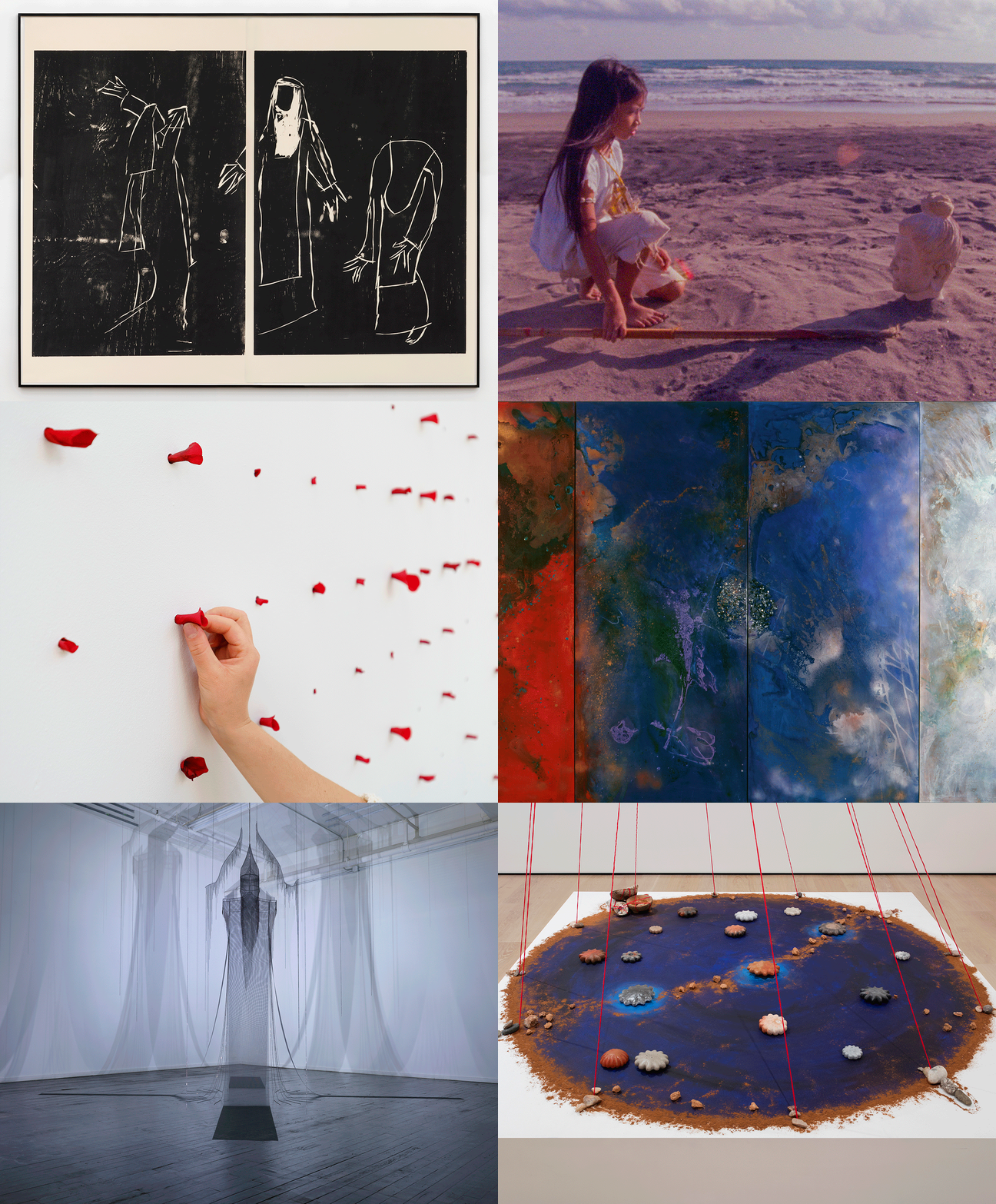
EXHIBITION: Here After, Bridge Projects, Los Angeles, May 7–July 30, 2022: This latest offering from the spirituality-forward art gallery Bridge Projects looks amazing! I appreciate their commitment to featuring religiously and ethnically diverse artists, as well as a range of styles and media.

Here After exhibition
Andrea Büttner, Dancing Nuns, 2007; Tuan Andrew Nguyen, video still from The Boat People, 2020; Belu-Simion Fainaru, Monument for Nothingness, 2012–22; Bonita Helmer, The Four Worlds (Tiferet), 2002–5; Afruz Amighi, Guardian, 2021; Mercedes Dorame, Orion’s Belt—Paahe’ Sheshiiyot—a map for moving between worlds, 2018

The group exhibition features thirty-seven artists who explore the idea of paradise—both how it has been pursued on earth across history, and how it is imagined after life. From Pure Land Buddhism’s chant “Namu Amida Butsu” (“I take refuge in Amida Buddha”) to Christianity’s prayer for the Kingdom to be “on earth as it is in heaven,” the concepts of paradise are as diverse as those who hope for it.

In Here After, works like William Kurelek’s Farm Boy’s Dream of Heaven (1963) envision an eschatological beyond in figurative form, while works by Bonita Helmer and Zarah Hussain do so in more abstract terms. Andrea Büttner and Claire Curneen’s works point to a vulnerable, sensual bodiliness, embedded in the surface of the world where all things come to pass. There is a land beyond the river by Gyun Hur and Tuan Andrew Nguyen’s The Boat People make space for remembrance of those who have passed, while Afruz Amighi, Mercedes Dorame, and Charwei Tsai position the viewer between worlds, feet firmly planted on the ground yet gazing at the glory and wonder of the beyond. In his installation Skywall, David Wallace Haskins plunges into the boundless sky and its immaterial light, letting all the expansive beauty grip the viewer. Kate Ingold intones the rhythmic mantras of what the divine is not with minute stitches, employing almost impossible patience to painstakingly outline absence. Kris Martin lodges small contradictions in the mind, which, in time, grow to be distracting puzzles—the candle in a sealed box, whose existence cannot be proven with the senses. And Tatsuo Miyajima uses digital counters to display the uncountable, unending dimension of existence.

+++

SONGS:

>> “O Jesus, Crowned with All Renown,” performed by Jon and Amanda McGill: The Monday to Wednesday preceding Ascension Day is known as Rogationtide, a short liturgical period (observed by most Anglicans, Episcopalians, Catholics, and others) in which we pray that God blesses the crops so that they yield a good harvest. It falls on May 23–25 this year. The hymn “O Jesus, Crowned with All Renown” is especially associated with the Rogation Days. It was written in 1860 by Edward White Benson, archbishop of Canterbury, and is typically paired with the tune KINGSFOLD.

O Jesus, crowned with all renown,
Since thou the earth hast trod,
Thou reignest, and by thee come down
Henceforth the gifts of God.
Thine is the health and thine the wealth
That in our halls abound,
And thine the beauty and the joy
With which the years are crowned.

Lord, in their change, let frost and heat
And winds and dews be giv’n;
All fostering power, all influence sweet,
Breathe from the bounteous heav’n.
Attemper fair with gentle air
The sunshine and the rain,
That kindly earth with timely birth
May yield her fruits again.

That we may feed the poor aright,
And gathering round thy throne,
Here, in the holy angels’ sight,
Repay thee of thine own:
That we may praise thee all our days,
And with the Father’s name,
And with the Holy Spirit’s gifts,
The Savior’s love proclaim.

Spiritual director and writer Tamara Hill Murphy explains the meaning of Rogationtide:

“Rogation” is derived from the Latin verb rogare, which means “to ask.” In the liturgies of Rogation Days, we ask the Lord to bless the fields, the crops, and the hands of farmers who produce our food. Worship on Rogation Days teaches us that we depend upon God’s favor over his land. We ask him for goodness over not just an abstract idea of our “land” but the very real earth beneath our feet in our backyards, our neighborhoods, and whatever part of the earth our feet hit the ground. As we’ve become a post-industrial society, the prayers for Rogation Days have expanded to include not only prayers for farmers and fishermen, but also for commerce and industry, and for all of us as stewards of creation.

>> “The Twelve: An Anthem for the Feast of Any Apostle,” words by W. H. Auden and music by William Walton: In 1965 the dean of the choir school at Christ Church, Oxford—Dr. Cuthbert Simpson—approached poet W. H. Auden and composer William Walton to write a choral anthem for use on apostolic feast days. “The Twelve” is the result. In this video filmed at Keble College, Oxford, in July 2021, it is performed by the vocal ensembles VOCES8 and Apollo5 (both directed by Barnaby Smith), with Peter Holder on organ. Learn more about the background and structure of the anthem here.

This performance appears on Renewal?, a concept album released February 25 that combines new works by Paul Smith (cofounder of VOCES8) and Donna McKevitt with works by three influential modern composers: William Walton, John Cage, and William Henry Harris. “Multifaceted texts by Lal Ded, Edmund Spenser, W. H. Auden, Lord Byron, Pablo Neruda, Maya Angelou, and Edna St. Vincent Millay offer space to consider our world, past and present, and meditate on a response to build a better future.”

You can read the full text of “The Twelve” in the YouTube video description. It begins,

Without arms or charm of culture,
Persons of no importance
From an unimportant Province,
They did as the Spirit bid,
Went forth into a joyless world
Of swords and rhetoric
To bring it joy.

+++

VISUAL MEDITATIONS:

Ascension Day occurs every year on the Thursday that falls forty days after Easter (see Acts 1:1–3). This year it is May 26. Here are two Ascension-themed visual meditations from ArtWay.eu.

>> On the Reidersche Tafel, by Nigel Halliday: This ivory bas-relief, which was probably originally embedded in a book cover, is the earliest known representation of the Ascension. It shows Jesus striding up a mountain, being pulled up into heaven by the hand of God the Father. (Mark and Luke use the passive voice to describe the Ascension: “he was taken up into heaven.”) He is dressed in a toga and holding a scroll. Learn more from Nigel Halliday at the above link, or visit this Instagram post I made two years ago.

Ascension (Reidersche Tafel)
The Women at Christ’s Tomb and the Ascension, Milan or Rome, ca. 400. Ivory plaque, 18.7 × 11.5 cm. Bayerisches Nationalmuseum (Bavarian National Museum), Munich, Germany.

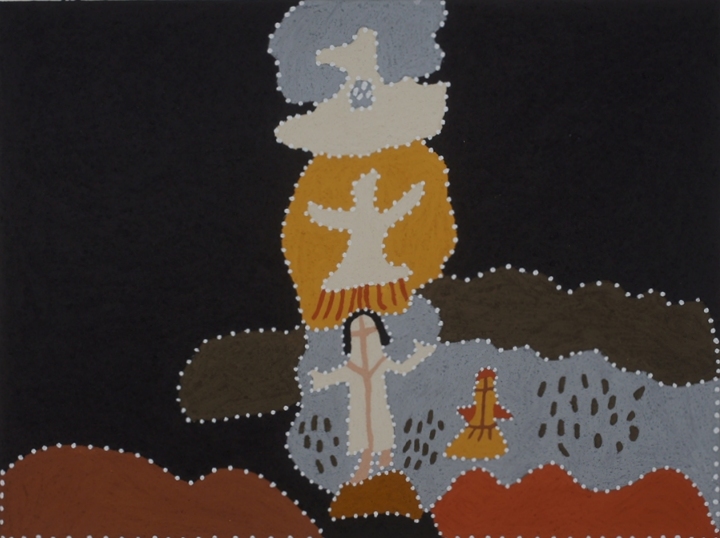
>> On Ngambuny Ascends by Shirley Purdie, by Rod Pattenden: Ngambuny is the Gija name for Jesus. Aboriginal Australian artist Shirley Purdie sets his ascension within the indigenous landscape of the Bungle Bungle Range, using her characteristic style of dotted outlines. “Purdie draws on her cultural tradition to locate the presence of God within the skin of her land,” writes the Rev. Dr. Rod Pattenden. “Her work is literally painted with the earth, as she collects ochres from the land she is responsible for and mixes it with glue to attach to her warm hued canvases.” Pattenden offers a fascinating reading of Purdie’s Ngambuny Ascends, discussing the use of black ocher, God as Creator Spirit alive in the earth, and more.

Purdie, Shirley_Ngambuny Ascends
Shirley Purdie (Gija, 1948–), Ngambuny Ascends, 2013. Natural ocher on canvas, 60 × 80 cm. Private collection. The artist is represented by the Warmun Art Centre in Warmum, WA, Australia.

An Epiphany Blessing

Arise, shine; for your light has come,
    and the glory of the LORD has risen upon you.
For darkness shall cover the earth,
    and thick darkness the peoples;
but the LORD will arise upon you,
    and his glory will appear over you.

—Isaiah 60:1–2

LOOK: Comet by Antonello Silverini

Silverini, Antonello_Comet
Comet, a digital collage by Antonello Silverini (Italian, 1966–). Used with permission.

LISTEN: “May It Be” | Words by Roma Ryan, 2001 | Music by Enya, 2001 | Performed by Voces8, 2018

May it be an evening star
Shines down upon you
May it be when darkness falls
Your heart will be true
You walk a lonely road
Oh, how far you are from home

Mornië utúlië
Believe and you will find your way
Mornië alantië
A promise lives within you now

May it be the shadow’s call
Will fly away
May it be you journey on
To light the day
When the night is overcome
You may rise to find the sun

Mornië utúlië
Believe and you will find your way
Mornië alantië
A promise lives within you now

At the behest of composer Howard Shore, film director Peter Jackson approached Enya to write a song for his 2001 epic fantasy adventure The Lord of the Rings: The Fellowship of the Ring, the first in a trilogy. Enya brought her lyricist Roma Ryan on board, and together they wrote “May It Be.” The song, which plays during the movie’s end credits, contains two lines in the fictional Elvish language Quenya that J. R. R. Tolkien invented: “Mornië utúlië” and “Mornië alantië,” which translate to “Darkness has come” and “Darkness has fallen.”

The original recording by Enya, the London Voices, and the London Philharmonic Orchestra is gorgeous, but I’m partial to the 2018 rendition by the British vocal ensemble Voces8, arranged by Matthew Sheeran. It’s absolutely stunning. I must have listened to it at least a hundred times!

Why am I sharing this “secular” song (inspired by a tale of hobbits, elves, and wizards) on today’s feast of Epiphany, the grand finale of the Christmas season? I could have chosen one of the church’s many beautiful works of music written explicitly for this day (and I have in previous years, such as here, here, and here, not to mention yesterday’s festive feature)—perhaps something louder, brighter, more triumphant—but instead I wanted to cap off the Twelve Days of Christmas with a benediction. It’s from an unlikely source, sure, but it speaks well, I think, to where we’re at in the liturgical year.

According to Christianity, darkness entered the world with humanity’s rebellion against their Creator in the garden of Eden. Sin and death became a reality that, millennia later, we still grapple with. But a promise was spoken in the beginning, was born in a manger at Christmas, walked the dusty streets of Israel-Palestine teaching the Way and performing wonders, was nailed to a cross and buried but then rose from the grave and now lives in the hearts of millions. Jesus Christ is the embodiment of God’s promise of salvation and holistic restoration—shalom, the world set right again.

The light of Christ shone on the small Jewish town of Bethlehem at the Nativity and on the wider Gentile world at Epiphany (when the magi traveled from afar to receive personal revelation, an experience they brought back with them to their homelands), and it continues to shine, often in unexpected places.

Advent is a journey through the dark into the light that breaks at Christmas/Epiphany. Although in one sense morning has broken, in another sense this earth is still very much in darkness. Even the “children of light” (1 Thess. 5:5), those who have been reborn in Christ, experience (and sometimes, sadly, inflict) ache and horror as much as anyone else.

But hope has come. The Word has been spoken, redemption won, even if it’s not yet been consummated. We walk in the valley of shadows, but eventually the night will be vanquished, as Enya’s song says, and we will rise and greet the sun—or, to put a Christian inflection on it, the Son!

May we walk forward into 2022 true to our calling as sons and daughters of God. May we welcome God’s light and bear it to others, and trust the Promise that indwells us.

This is the final post in the 2021–22 Advent/Christmas series. Thanks for following! You can find a collation here (Advent) and here (Christmas). I will now return to my regular publication schedule of roughly one post a week.

Maundy Thursday (Artful Devotion)

Kazanivska, Solomia_Washing of the Feet
Solomia Kazanivska, Washing of the Feet, 2018

Now before the Feast of the Passover, when Jesus knew that his hour had come to depart out of this world to the Father, having loved his own who were in the world, he loved them to the end. During supper, when the devil had already put it into the heart of Judas Iscariot, Simon’s son, to betray him, Jesus, knowing that the Father had given all things into his hands, and that he had come from God and was going back to God, rose from supper. He laid aside his outer garments, and taking a towel, tied it around his waist. Then he poured water into a basin and began to wash the disciples’ feet and to wipe them with the towel that was wrapped around him. He came to Simon Peter, who said to him, “Lord, do you wash my feet?” Jesus answered him, “What I am doing you do not understand now, but afterward you will understand.” Peter said to him, “You shall never wash my feet.” Jesus answered him, “If I do not wash you, you have no share with me.” Simon Peter said to him, “Lord, not my feet only but also my hands and my head!” Jesus said to him, “The one who has bathed does not need to wash, except for his feet, but is completely clean. And you are clean, but not every one of you.” For he knew who was to betray him; that was why he said, “Not all of you are clean.”

When he had washed their feet and put on his outer garments and resumed his place, he said to them, “Do you understand what I have done to you? You call me Teacher and Lord, and you are right, for so I am. If I then, your Lord and Teacher, have washed your feet, you also ought to wash one another’s feet. For I have given you an example, that you also should do just as I have done to you. Truly, truly, I say to you, a servant is not greater than his master, nor is a messenger greater than the one who sent him. If you know these things, blessed are you if you do them.”

. . .

When [Judas] had gone out, Jesus said, “Now is the Son of Man glorified, and God is glorified in him. If God is glorified in him, God will also glorify him in himself, and glorify him at once. Little children, yet a little while I am with you. You will seek me, and just as I said to the Jews, so now I also say to you, ‘Where I am going you cannot come.’ A new commandment I give to you, that you love one another: just as I have loved you, you also are to love one another. By this all people will know that you are my disciples, if you have love for one another.

—John 13:1–17, 31b–35

The Thursday before Easter is referred to as Maundy Thursday—the Middle English word maundy being a derivation of the Old French mandé, from the Latin mandatum, “commandment.” The name refers to John 13:34, where, after the Last Supper, Jesus commands his disciples to love one another.

+++

SONG: “Ubi caritas” | Words: Traditional | Music by Ola Gjeilo, 1999 | Performed by Voces8, on Lux, 2015


“Ubi caritas” is an ancient (or early medieval—it’s disputed) Latin text that is traditionally used as an antiphon, or sung refrain, for the foot-washing ceremony on Maundy Thursday. The current Roman Catholic Missal reassigns it to the offertory procession of the Maundy Thursday Mass.

Originally the text was set to a Gregorian chant melody, but it has since been set and/or arranged by Maurice Duruflé, Ola Gjeilo, Paul Mealor, Ivo Antognini, Audrey Assad, and many others. I’ve chosen the setting by Ola Gjeilo, a Norwegian composer and pianist born in 1978 and now living in the United States.

Ubi caritas et amor, Deus ibi est.
Congregavit nos in unum Christi amor.
Exsultemus, et in ipso jucundemur.
Timeamus, et amemus Deum vivum.
Et ex corde diligamus nos sincero.

Ubi caritas et amor, Deus ibi est.
Simul ergo cum in unum congregamur:
Ne nos mente dividamur, caveamus.
Cessent iurgia maligna, cessent lites.
Et in medio nostri sit Christus Deus.

Ubi caritas et amor, Deus ibi est.
Simul quoque cum beatis videamus,
Glorianter vultum tuum, Christe Deus:
Gaudium quod est immensum, atque probum,
Saecula per infinita saeculorum. Amen.

English Translation:
Where charity and love are, there God is.
The love of Christ has gathered us into one.
Let us exult, and in Him be joyful.
Let us fear and let us love the living God.
And from a sincere heart let us love each other.

Where charity and love are, there God is.
Therefore, whensoever we are gathered as one:
Lest we in mind be divided, let us beware.
Let cease malicious quarrels, let strife give way.
And in the midst of us be Christ our God.

Where charity and love are, there God is.
Together also with the blessed may we see,
Gloriously, Thy countenance, O Christ our God:
A joy which is immense, and also approved:
Through infinite ages of ages. Amen.

+++

The main panel of contemporary iconographer Solomia Kazanivska’s Washing of the Feet shows Christ, whose halo bears a faint cross-shape, washing the dirt off Peter’s feet, as the other disciples, silhouetted in white, look on. At first Peter was much distraught by the notion of his superior stooping to such a menial act of servitude, and he objected. But when Jesus told Peter that Peter would have no part with him unless Peter received the foot-washing, Peter changed his tune completely: he figured that if this were true, then a full body wash would give him an even bigger part with Jesus, so he exclaimed, “Wash my hands and my head too!” That’s why icons show Peter pointing to his head (not, as might be assumed, to signal his initial discomfort, as in “Oh dear . . .”).

What strikes me most about Kazanivska’s icon is the bottom panel, which seems to show the disciples washing one another’s feet, following their teacher’s example. (It’s possible that this band is meant to show Christ washing different disciples’ feet, as the biblical text says he did, but the different clothing of the kneeling figure in each of the six tableaux inclines me toward the other interpretation.) Kazanivska is not suggesting that that’s how it literally went down that evening—the disciples immediately understanding Christ’s meaning and faithfully imitating him. Rather, I read this an aspirational and metaphoric image, of how Christians are to interact with one another: in love and humility, time after time (hence the repetition). And that’s why I chose it to complement the “Ubi caritas” hymn.

Follow Solomia Kazanivska on Facebook @Kazanivska.Icon.Art or on Instagram @kazanivskaicon.


This post belongs to the weekly series Artful Devotion. If you can’t view the music player in your email or RSS reader, try opening the post in your browser.

To view all the Revised Common Lectionary scripture readings for Maundy Thursday, cycle A, click here.