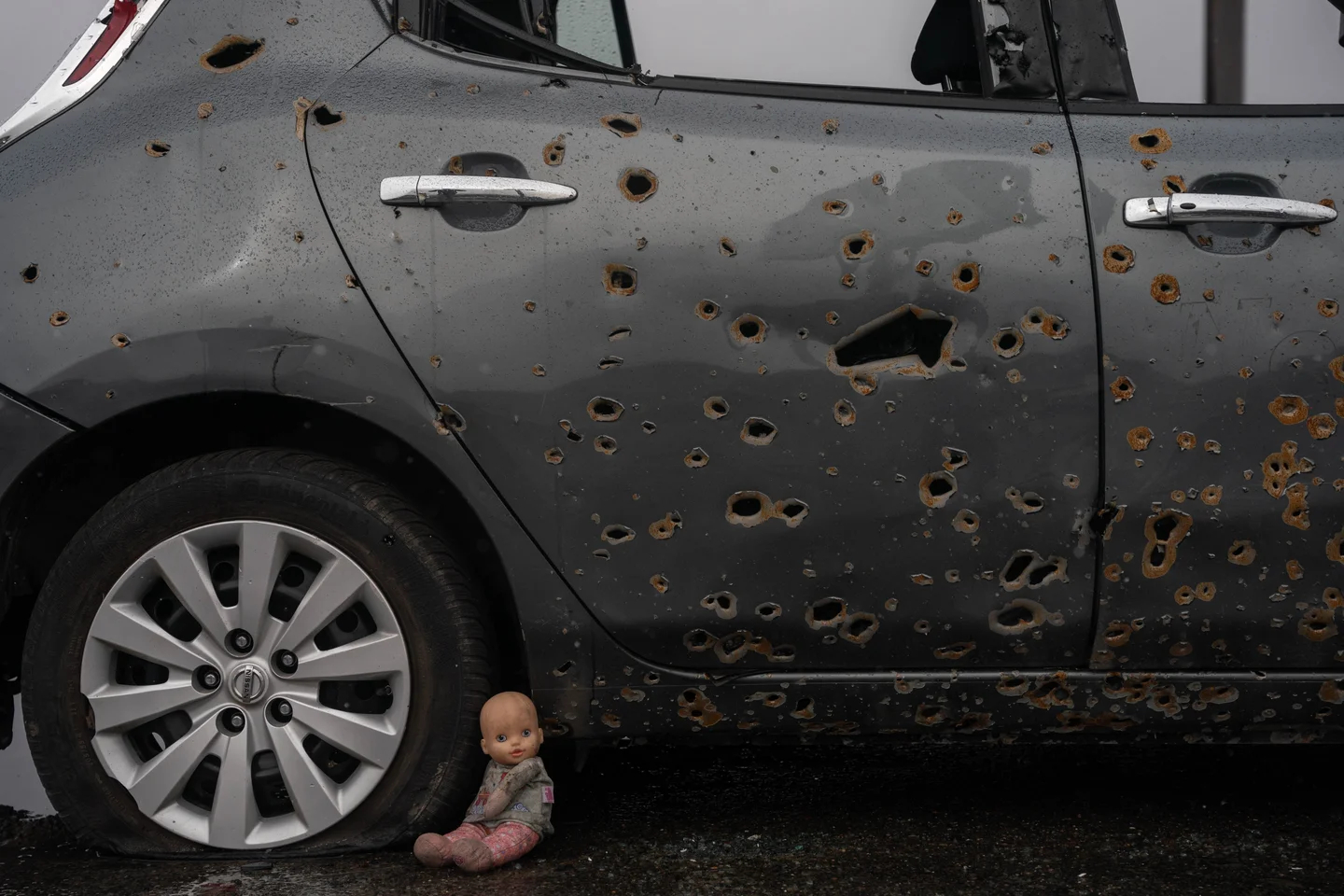
Withdrawing from Kyiv on April 2, 2022, after a lost battle, Russian troops left destruction in their wake. A bullet-riddled car with a flat tire sits abandoned, along with a doll, on the bridge crossing into Irpin, Ukraine. Photo: Franco Fafasuli.
The Russo-Ukrainian war is now in its twelfth year, and it’s been almost four years since Russia’s full-scale military invasion of Ukraine. The devastation is staggering. I can’t even imagine what it must be like to live in a war zone, with bombs, missiles, and gunfire an ever-present threat, part of the everyday background noise. While many photographs have documented the wider destruction and human losses in Ukraine, I was struck by this one by the young Argentine journalist Franco Fafasuli, which focuses not on leveled buildings or intimate griefs but on possessions left behind in the chaos of war: a car, now dotted with dozens of bullet holes, and a plastic-headed baby doll, now covered in grime.
As I reflect on Christ’s coming this Advent season, I think of how he came as a vulnerable child, into a world where people deliberately hurt and kill other people. Then, it was with swords, daggers, spears, arrows, and stones; now we’ve added all manner of firearms and large explosives to our arsenal. That innocent, bald little babe sitting by a deflated tire, suggesting a family with child having suddenly fled their hometown—it looks at me with the eyes of Christ, wondering why we continue to harm each other, but smiling, too, a smile of divine grace. He’s here to show us another way.
LISTEN: “О, Зійди” (Oh, Come Down) by Room for More, 2022
Вся земля cхилилася
Втомлена від боротьби
Зітхаємо у марноті
Бо втратили ми Твій дотик

Заспів:
О, зійди!
Спасе відроди.
Зійди!

Небеса далекі нам
Власний шлях обрали ми
Вся земля чекає на
Спасителя, на мир і спокій

Заспів:
О, прийди!
Царю милості, прийди!
Освіти!
Всім хто в темноті, світи

Небеса схиляються
Являють нам святе Дитя
Земле вся, заспівай
Правдивий Цар, Бог наш з нами

Заспів:
О, радій!
Спас Месія нам родивсь!
О, вклонись!
Царю всіх царів, вклонись!

Бридж:
Підіймай опущені руки
Потішай тих хто відчаєм скуті
Відкриває Син нову
Надію, силу й повноту

Заспів:
О, радій!
Спас Месія нам родивсь!
О, прийми!
Це рятунок твій, прийми!
The whole earth bows down
Weary of the struggle
We sigh in vain
For we have lost your touch

Refrain:
Oh, come down!
Savior, revive
Come down!

The heavens are far from us
We have chosen our own path
The whole earth awaits
The Savior, peace and tranquility

Refrain:
Oh, come!
King of mercy, come!
Enlighten!
Onto all who are in darkness, shine

The heavens bow down
Show us the holy Child
All the earth, sing
The true King, our God is with us

Refrain:
Oh, rejoice!
The Messiah is born to us!
Oh, bow down!
He’s the King of all kings, bow down!

Bridge:
Lift up your hands that hang down
Comfort those who are bound by despair
The Son reveals a new
Hope, strength, and fullness

Refrain:
Oh, rejoice!
The Messiah is born to us!
Oh, accept!
This is your salvation, accept!
The lead singer on “О, Зійди” (Oh, Come Down) is Yaryna Vyslotska. The song was written by Jonathan (Jon) Markey, an American-born minister and musician who grew up as a missionary kid in Ukraine and since 2008 has been a pastor at Calvary Chapel in Ternopil. In 2017 he and his wife Stephanie (Steffie) founded the Ukrainian Christian music collective Room for More.
Every warrior’s boot used in battle and every garment rolled in blood will be destined for burning, will be fuel for the fire. For to us a child is born, to us a son is given, and the government will be on his shoulders. And he will be called Wonderful Counselor, Mighty God, Everlasting Father, Prince of Peace.
—Isaiah 9:5–6 NIV
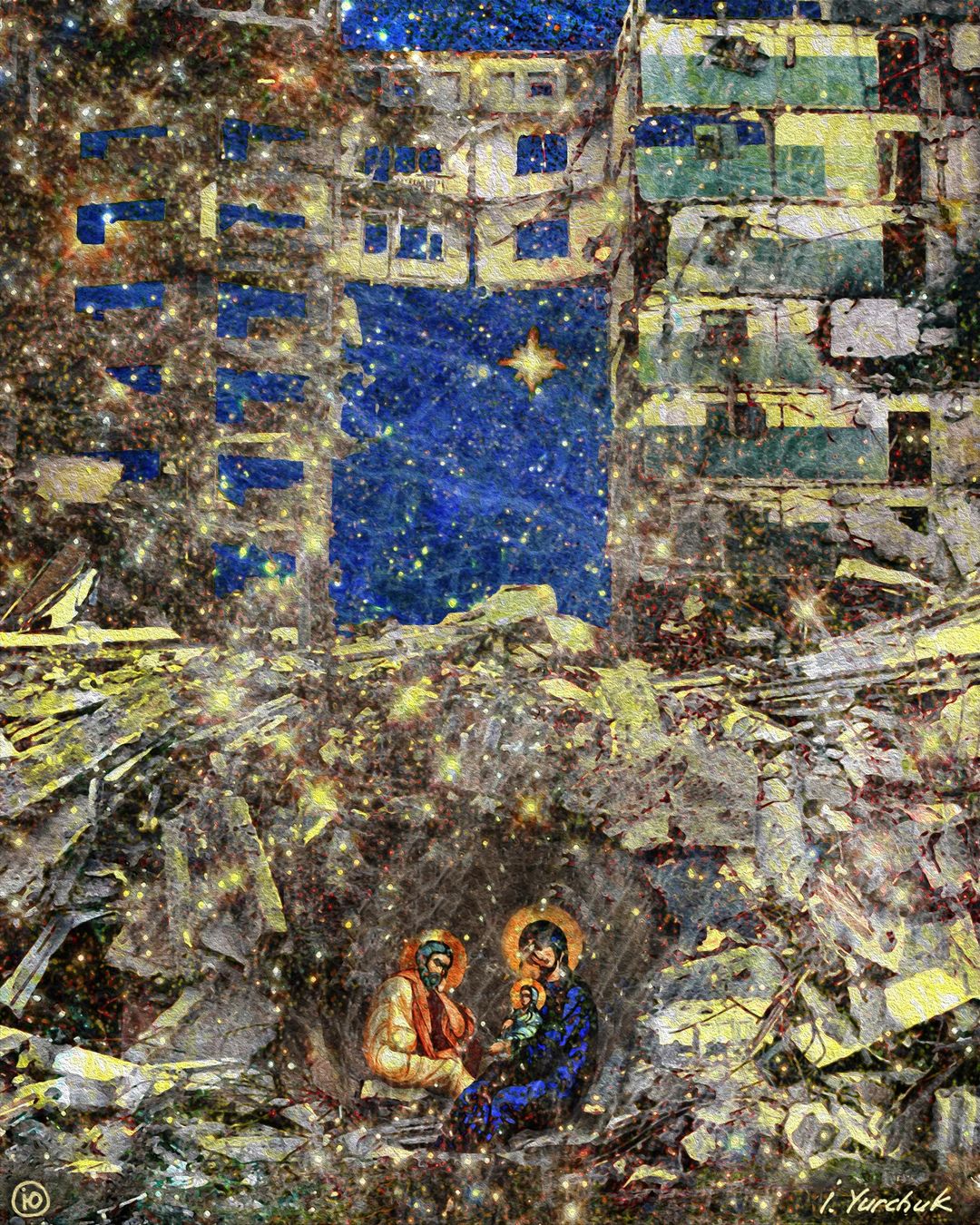
LOOK: Nativity by Irenaeus Yurchuk
Irenaeus Yurchuk (Іриней Юрчук), Nativity, 2022. Mixed media on canvas. Used with permission.
Irenaeus Yurchuk was born in Ukraine during World War II and raised in central New York, where he still resides. He worked professionally as an urban planner until 2010, when he turned to art full-time.
“Over the years my work has evolved to combine multiple-image photography with drawing and painting, using a variety of digital editing and physical montage techniques,” Yurchuk says. “This includes adjusting inkjet images by applying acrylics, watercolors, pastels, markers, colored pencils together with selected collage materials to achieve a desired effect.”
Yurchuk’s Nativity is a response to Russia’s 2022 military invasion of Ukraine. This is no facile depiction of that historic birth, no cozy winter idyll. It is a war-zone Nativity. It shows the Holy Family, rendered in iconic style, sheltering at night in the rubble of a bombed-out apartment complex. Surrounded by fallen steel beams, concrete, and broken glass, Mother Mary holds the newborn Jesus while a downcast Joseph sits beside them with head in hands. Though their circumstances are dire, through the building’s shell shines one particularly bright star, signifying hope in the horror.
One of the biblical names for Jesus is Emmanuel, Hebrew for “God with us.” By showing the Christ child being born amid the ruins of a contemporary Ukrainian city, Yurchuk reinforces the ongoing relevance of the Incarnation, meditating on God’s descent into our world of woe to dwell with and to deliver. Jesus is “God with us” in our suffering. When everything around us is crumbling, God is there too, hurting alongside and calling all oppressors to account.
Do you recall the famous Christmas text from Isaiah, further immortalized by Handel, that begins “Unto us a child is born . . .”? Well, it is immediately preceded by a prophecy of war’s final demise, of soldiers’ uniforms and accoutrements and all their bloody violence being consigned to one great big burning trash heap. In the new world government established by Christ, the Prince of Peace, tyrants will be overthrown (Luke 1:51–52), and the nations will study war no more (Isa. 2:4).
May this artwork and the song below prompt you to intercede for those suffering under war today, in Ukraine and elsewhere.
LISTEN: “Drive Out the Darkness” by Paul Zach, Isaac Wardell, Dan Marotta, and John Swinton, on Lament Songs by the Porter’s Gate (2020)
Refrain: Come, O come Be our light Drive out the darkness Come, Jesus, come
Every year under the thorn Every wrong that we have known Every valley will be raised Ancient ruins will be remade [Refrain]
Every weapon made for war Every gun and every sword Will be melted in the flame To be used for gardening [Refrain]
In the emptiness of grief Through the night of suffering In the loss and in the tears God of comfort, O be near [Refrain]
Coda: Come, and end all the violence Come, do not be silent Come, we cling to your promise Come, you’ll break all injustice Come, Jesus, come
For my review of the Lament Songs album by the Porter’s Gate, see here.
In addition to these words that the Porter’s Gate has given us to pray, I commend to you this prayer by Rev. Kenneth Tanner, which he posted October 13 in response to recent atrocities in Israel and Gaza (I’ve been returning to it a lot over the past month):
This post is part of a daily Advent series from December 2 to 24, 2023 (with Christmas to follow through January 6, 2024). View all the posts here, and the accompanying Spotify playlist here.
PHOTO COMPILATION: “Alternative Advent 2022” by Kezia M’Clelland: Kezia M’Clelland [previously] is the children in emergencies specialist and people care director for Viva and a child protection consultant for MERATH, the Lebanese Society for Educational and Social Development’s community development and relief arm. She is a British citizen, but her work brings her around the world, seeking to safeguard the rights and well-being of children globally.
Every December M’Clelland compiles photos from that year’s news, showing people affected by natural disasters, violence, and injustice, and overlays them with Advent promises. There’s sometimes a disjunction between image and text that’s grievous and challenging, a reminder that our long-looked-for deliverance is not yet fully here, even though we receive foretastes. The twenty-eight photos M’Clelland gathered from 2022 include throngs of people making their way to Aichi cemetery in Saqqez, Iran, to attend a memorial for twenty-two-year-old Mahsa Amini, allegedly beaten to death by the country’s religious morality police for not wearing her hijab properly; a police officer helping a child flee artillery on the outskirts of Kyiv, and a baby being born in a bomb shelter; women carrying pans of granite up the side of a mine in Ouagadougou, Burkina Faso, for meager wages; a woman comforting a neighbor who lost her home to flooding in Tejerias, Venezuela; children playing in a sandstorm at the Sahlah al-Banat camp for displaced people in the countryside of Raqa in northern Syria; children clearing trash from a river in Tonlé Sap, Cambodia; and more.
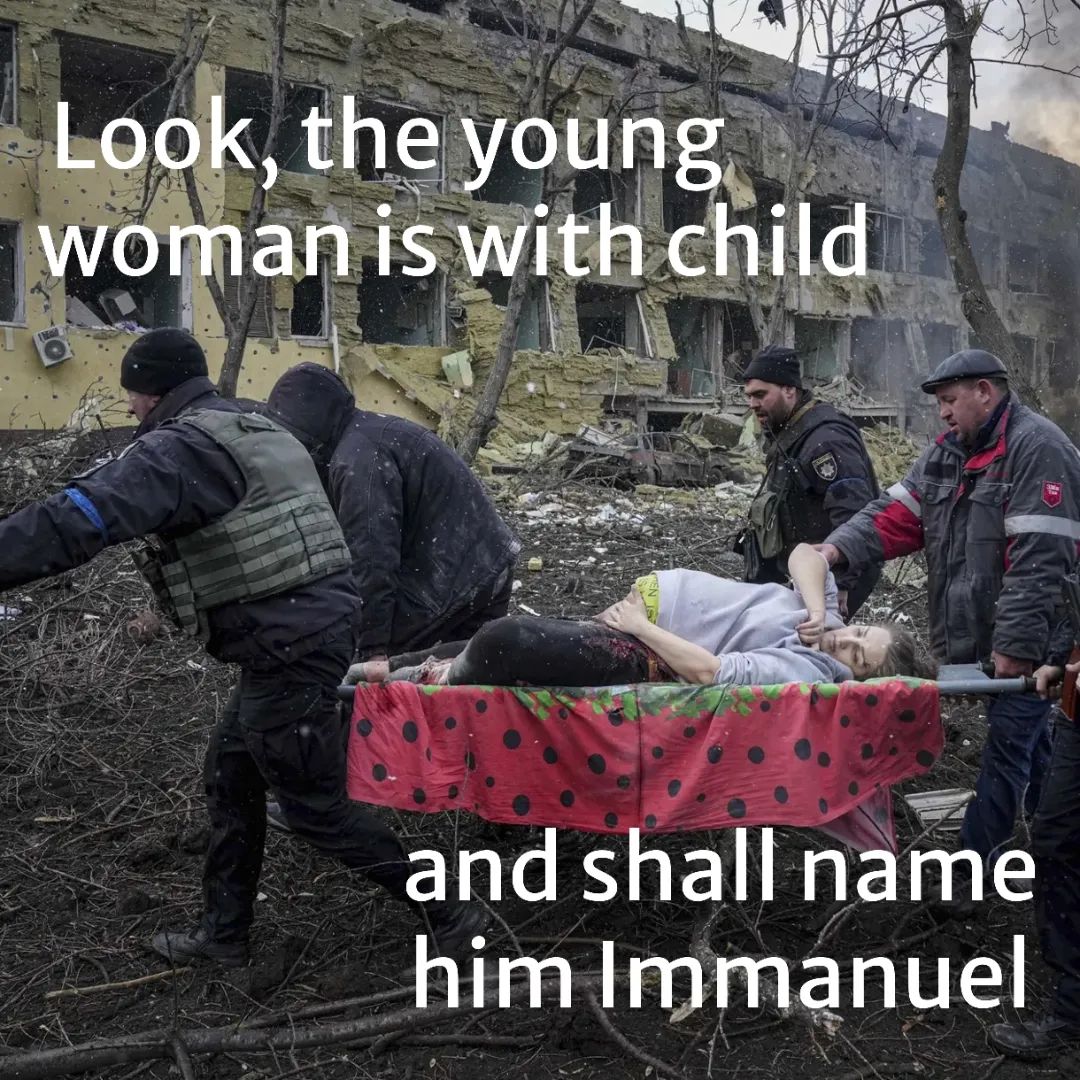
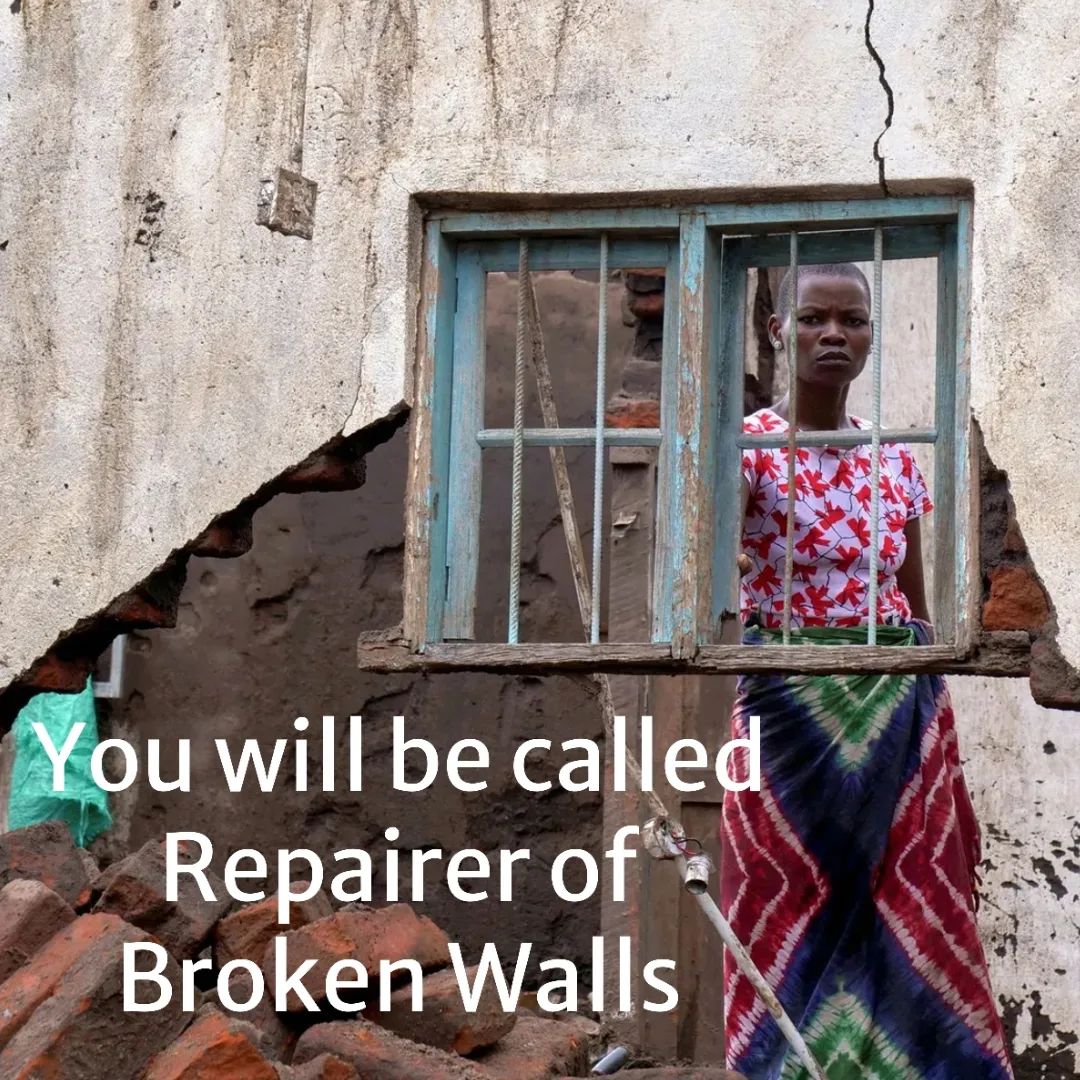
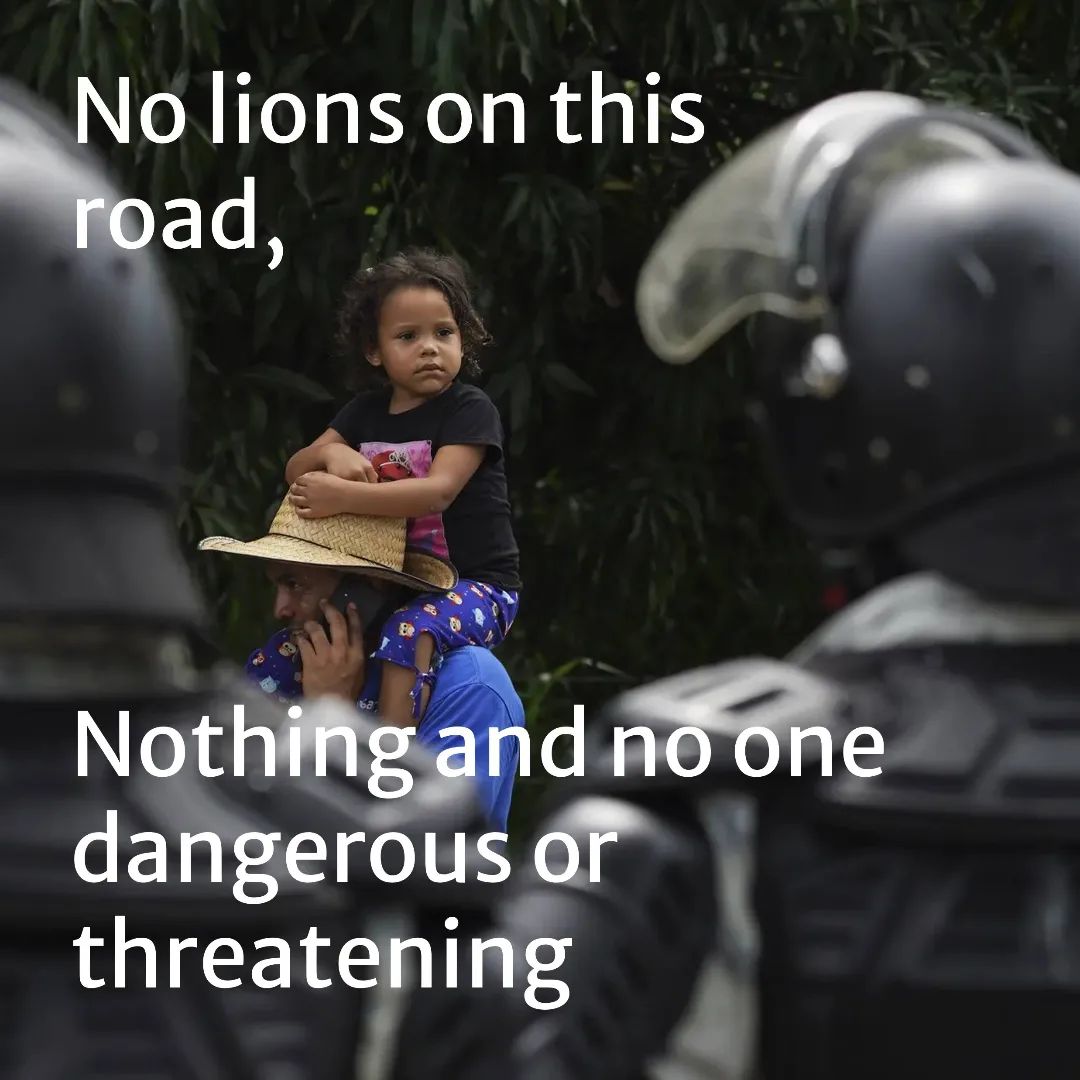
March 9, 2022: An injured pregnant woman is rescued from a maternity hospital in Mariupol, Ukraine, that was bombed by Russian forces. The following week it was reported that she and her child, delivered in an emergency C-section, did not survive. Photo: Evgeniy Maloletka/AP. Scripture: Isaiah 7:14.January 26, 2022: A young woman looks on from her house destroyed by tropical storm Ana in the village of Kanjedza in Malawi. Photo: Eldson Chagara/Reuters. Scripture: Isaiah 58:12.June 7, 2022: A man and child, part of a migrant caravan consisting mostly of Central Americans, are blocked by members of the Mexican National Guard on a Huixtla road in Chiapas state, Mexico. They seek transit visas from the National Migration Institute so that they can continue their thousand-plus-mile journey north to the US. Photo: Marco Ugarte/AP. Scripture: Isaiah 35:9 MSG.
The sequence of images is a visual prayer of lament and intercession. I appreciate how M’Clelland—via the work of photojournalists, and her sensitive curation—raises awareness about these places of suffering, putting faces to the headlines, but also spotlights moments of empowerment and joy amid that suffering. We are encouraged to seek God’s coming into these situations of distress and to see the subtle ways he does come—for example, through the consoling embrace of a friend, the nurturance of an elder sibling, the protective aid of an officer, a jug of clean water, a child’s glee, or acts of protest.
For photo credits and descriptions, see the Instagram page @alternative_advent. (Start here and scroll left if you’re on your computer, or up if you’re on your phone.) Follow the page to receive new posts in your feed starting next Advent.
+++
SONGS by Rev Simpkins, an Anglican priest and singer-songwriter from Essex previously featured here:
>> “Hallelu! (Love the Outcast)”: This song was originally released on The Antigen Christmas Album (2014) with the byline “Ordinand Simpkins & Brother De’Ath”; it was reissued in 2016 on Rev Simpkins’s album Love Unknown, “a cornucopia of non-LP tracks, studio experiments, ingenious live re-workings, radio sessions, off-the-wall demos, obscure b-sides, & pissings about.” The music video was recorded on an iPhone 4 in the Edward King Chapel at Ripon College Cuddesdon in Oxford. [Listen on Bandcamp]
>> “Poor Jesus” (Traditional): Here the Rev. Matt Simpkins performs the African American spiritual “Oh, Po’ Little Jesus” with a soft banjo accompaniment. Harmonizing vocals are supplied by his daughter, Martha Simpkins. It’s the opening track of his EP Poor Child for Thee: 4 Songs for Christmastide(all four songs are wonderful!), released December 11, 2020, to support St Leonard’s Church, Lexden, where he serves as priest-in-charge. [Listen on Bandcamp]
+++
NEW PAINTING: Tent City Nativity by Kelly Latimore:Kelly Latimore is an Episcopalian artist from St. Louis, Missouri, who “rewonders” traditional iconography, especially with an eye to social justice. This Christmas he painted an icon called Tent City Nativity, which shows the Christ child being born in a homeless encampment. A streetlight shines directly over the Holy Family’s tent, like the star of Bethlehem, and neighbors bring gifts for warmth and sustenance: coffees, a blanket, a cup of chili. View close-ups on Instagram, and read the artist’s statement on his website. Proceeds from print and digital sales of the icon will support organizations serving the unhoused in St. Louis.
Kelly Latimore (American, 1986–), Tent City Nativity, 2022. Acrylic, Flashe, and golf leaf on birch board, 27 × 32 in.
SONG MEDLEY: YouTube user African Beats spliced together excerpts from three songs performed at a church in Germany at Christmastime by South African singer Siyabonga Cele and an unnamed woman, including “Akekho ofana no Jesu” (There’s No One like Jesus) and “He’s Got the Whole World in His Hands.” I couldn’t find the name of the last song, and attempts to contact the singer for information were unsuccessful, but it’s in Zulu, as is the first one. Lyrics to the first song, sourced from here, are below.
Akekho ofana no Jesu (There’s no one like Jesus) Akekho ofana naye (There’s no one like him) Akekho ofana no Jesu (There’s no one like Jesus) Akekho ofana naye (There’s no one like him)
Sahamba, hamba, lutho, lutho (I’m walking, walking, nothing, nothing) Safuna, funa, lutho, lutho (I’m searching, searching, nothing, nothing) Sajika, jika, lutho, lutho (I’m turning, turning, nothing, nothing) Akekho afana naye (There is no one like him)
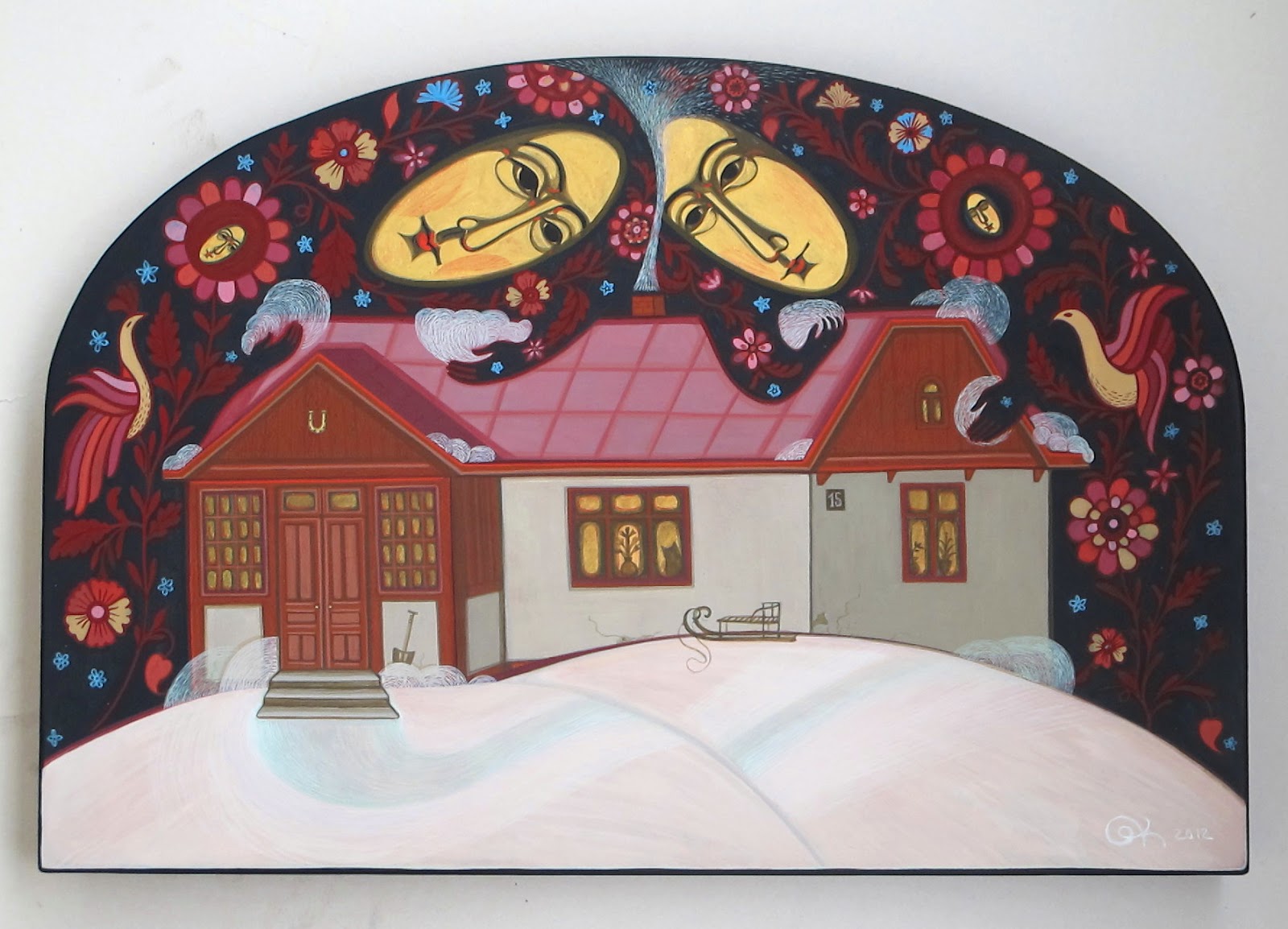
Olya Kravchenko (Ukrainian, 1985–), Home, 2012. Egg tempera on gessoed board, 29 × 39.9 cm.
This painting shows a cottage on a snowy hillside at night. Inside, a fire is lit in the hearth, casting a warm glow and sending smoke rising up the chimney. There’s a cat in the window and a sled on the lawn.
On all sides, the sky is populated by a mystical swirl of birds and flowery tendrils and angelic beings. Two of those angels, represented by large golden heads, hold wisps of snow in their hands and embrace the house, offering a protective presence.
Sadly, this cozy winter idyll is elusive for many this year, not least those in Ukraine, where this painting comes from. Many Ukrainians have had to flee their homes to evade the encroaching Russian troops. Others are dealing with the trauma of having lost family members in the war, or the fear of having loved ones on the front line.
LISTEN: “Jul, Jul, Strålande Jul” (Christmas, Christmas, Glorious Christmas) | Words by Edvard Evers, 1921 | Music by Gustaf Nordqvist, 1921 | Performed by Zero8 on A Zero8 Christmas, 2011 (YouTube: 2016)
Jul, jul, strålande jul, glans över vita skogar, himmelens kronor med gnistrande ljus, glimmande bågar i alla Guds hus, psalm som är sjungen från tid till tid, eviga längtan till ljus och frid! Jul, jul, strålande jul, glans över vita skogar!
Kom, kom, signade jul! Sänk dina vita vingar, över stridernas blod och larm, över all suckan ur människobarm, över de släkten som gå till ro, över de ungas dagande bo! Kom, kom, signade jul, sänk dina vita vingar!
Christmas, Christmas, glorious Christmas: shine over white forests, heavenly crowns with sparkling lights, glimmering arcs in the houses of God, hymns that are sung throughout the ages, eternal longing for light and peace! Christmas, Christmas, glorious Christmas, shine over white forests!
Come, come, blessed Christmas: lower your white wings, over the battlefield’s blood and cry, over the sighs from the bosoms of men, over the loved ones who’ve gone to their rest, over the daybreak of newborn life! Come, come, blessed Christmas: lower your white wings!
“Jul, Jul, Strålande Jul” is one of the most widely sung Swedish Christmas songs. It personifies Christmas as a luminous winged being, asks it to descend over our wooded neighborhoods and over our songs and our longings, dispensing blessing; to extinguish our wars and raging and spread its comforts over our anxieties and losses; and to cradle the new lives that have been born this year, reminders of innocence and signs of hope for a future.
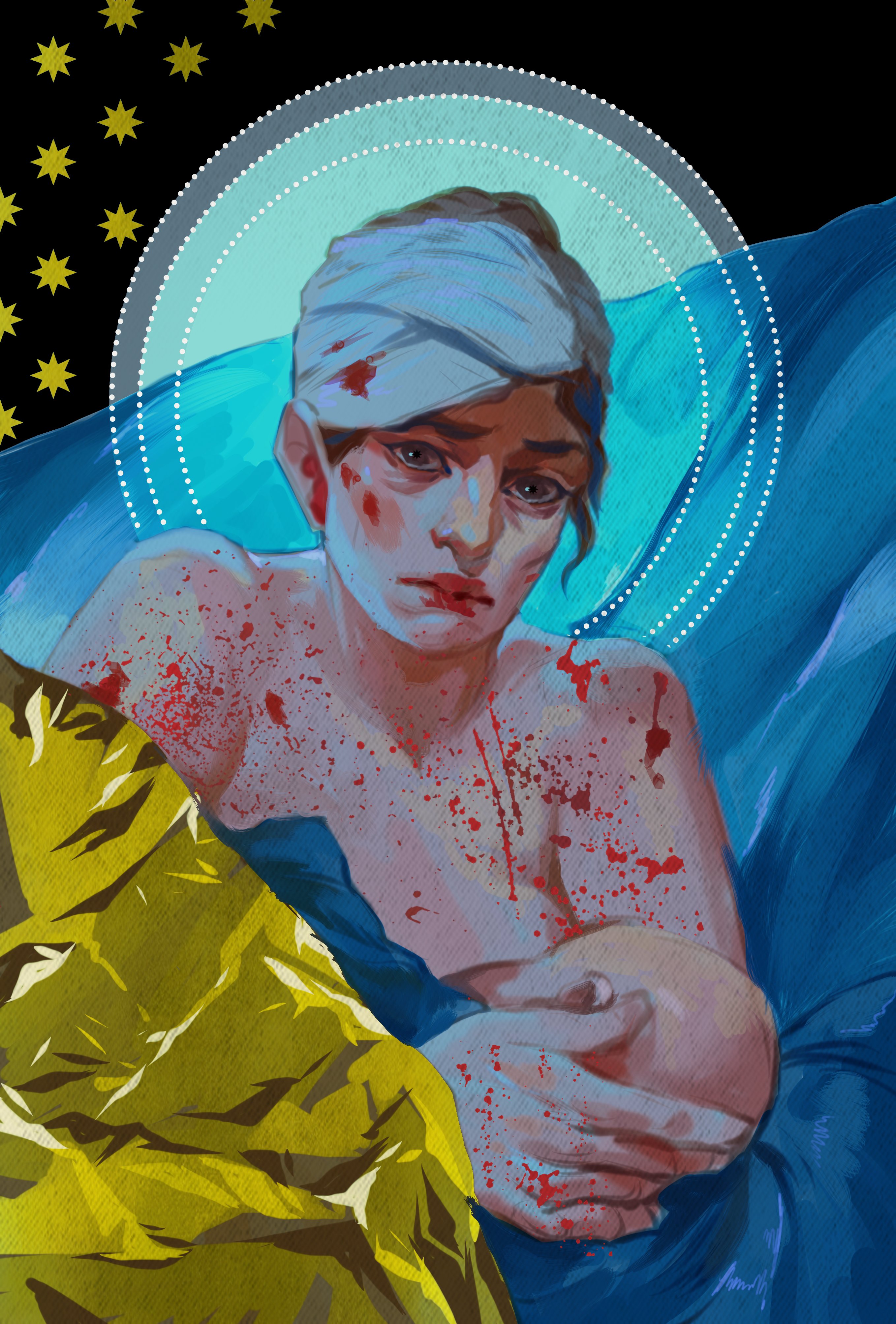
UKRAINIAN MADONNAS: Since Russia invaded Ukraine on February 24 and even still continues to aggress, artists have taken up their art to address the war—several drawing on iconography of the Madonna and Child, particularly the Maria lactans (breastfeeding Mary) type. Two Ukrainian artists were inspired by different news photos of young mothers protecting their infants from the shelling in Kyiv in March—one of whom was photographed in a hospital being treated for wounds she sustained from fallen glass while shielding her daughter with her body, and the other hiding from the blasts in a subway station.
These images show the vulnerability of Christ, who is with us in our suffering, and indict those who cause such suffering.
In his response to the war in Ukraine, Serbian artist Michael Galovic, who lives in Australia, also uses Christian iconography: the Theotokos Kyriotissa (Mother of God enthroned with Christ); Archangel Michael, the patron saint of Kyiv, fighting a dragon (Rev. 12:7–8) in an ethereal rendering of a scene from the Très Riches Heures du Duc de Berry, a fifteenth-century French book of hours; and a hellmouth from the twelfth-century Winchester Psalter. These three medieval images are superimposed on Picasso’s masterwork Guernica, named after the Spanish town bombed by Nazis in 1937 and representative of the horrors of war.
Michael Galovic (Serbian Australian, 1949–), Ukraine Response, 2022. Egg tempera and gold leaf on linen on board, 170 × 80 cm. Collection of the Australian Centre for Christianity and Culture, Canberra, Australia.
Whereas Frirean’s and Solomennykova’s paintings are more intimate, Galovic takes a more cosmic approach, showing wails of lament from abstracted forms intercut with epic battles between good and evil—but at the calm center, Christ is on the throne, holding the scroll of his good word. History is going somewhere. Hate will be damned. Love will triumph.
>> “Galoba (The Prayer),” performed by Trio Mandili: A sung performance of a poem written in 1858 by the Georgian poet and statesman Ilia Chavchavadze (1837–1907). An English translation follows.
Our Father, who art in heaven, With tenderness I stand before thee on my knees. I ask for neither wealth nor glory; I won’t debase my holy prayer with such matters. I desire instead for my soul to be enlightened by heaven, My heart to be radiant with thy love. Even if my enemies pierce me in the heart, I beg thee: “Forgive them, Lord, for they know not what they do!” Even if my enemies pierce me in the heart, I beg thee: “Forgive them, Lord, for they know not what they do!” [source, adapt.]
>> “Peace All Over the World” by Robert Bradley: Written and performed by Detroit musician Robert Bradley, this song originally appeared on the film Playing for Change: A Cinematic Discovery of Street Music (2005). To celebrate their twentieth anniversary, Playing for Change [previously] has remastered it and added new footage from Ukraine.
>> “Du som gick före oss” (You Who Went Before Us) |Words by Olov Hartman, 1968 | Music by Sven-Erik Bäck, 1959 | Performed by VOCES8, 2022: The melody uses all twelve semitones of the octave! I’ve provided a literal English translation of the Swedish below with the help of Google Translate; for a looser but more poetic translation by Fred Kaan, from 1976, see here. Note: The video identifies the song parenthetically as Psalm 74, not because it’s a setting of Psalm 74 from the Bible, but because it is no. 74 in Den svenska Psalmboken, the official hymnal of the Church of Sweden.
Du som gick före oss
längst in i ångesten,
hjälp oss att finna dig,
Herre, i mörkret.

Du som bar all vår skuld
in i förlåtelsen,
du är vårt hjärtas fred,
Jesus, för evigt.

Du som med livets bröd
går genom tid och rum,
giv oss för varje dag,
Kristus, det brödet.

Du som går före oss
ut i en trasig värld,
sänd oss med fred och bröd,
Herre, i världen.
You who went before us
in the depths of anxiety,
help us to find you,
Lord, in the dark.

You who bore all our guilt
into forgiveness,
you are the peace of our hearts,
Jesus, forever.

You who are the living bread
offered abundantly through all the earth,
give us each day,
dear Christ, that bread.

You who go before us
out into a broken world,
send us out likewise, Lord,
with peace and bread.
BLOG POST: “An open letter to pastors (A non-mom speaks about Mother’s Day)” by Amy Young: There’s disagreement among church leaders on whether Hallmark holidays, such as Mother’s Day, should be recognized during a worship service, and if so, how. Having mothers stand (while women who are not mothers in the conventional sense remain seated) can be very othering and bring up feelings of sadness or shame. It’s also a day when people are thinking about their own mothers, which can evoke a complex range of emotions.
Amy Young believes there is a way to honor mothers in church without alienating others, as well as to acknowledge the breadth of experiences associated with mothering. She has drafted a pastoral address that I find so wise and compassionate. Some women are estranged from their children. Some have experienced miscarriage or abortion. Some have had failed adoptions, or failed IVF treatments. Some placed a child for adoption. Some have been surrogate mothers. Some are foster mothers, or are the primary guardian of a relative’s child. Some are spiritual moms. Some women want to be mothers but have no partner or have had trouble conceiving. Some were abused by their mothers. Some have lost mothers. Some never met their mother. Young puts her arms around all these people who are potentially in the pews on Mother’s Day, making room for the complexity of the day—which does include celebration!
+++
VIDEO: “United with Beauty: The Psalms, the Arts, and the Human Experience” by Mallory Johnson: Mallory Johnson graduated last weekend with a bachelor’s in music and worship (concentration: voice) from Samford University in Birmingham, Alabama. (In the fall she will be starting an MDiv program at Beeson Divinity School.) All the seniors in the Samford School of the Arts are required to complete a capstone project tailored to their individual interests and career goals. As Johnson’s interests center on theology, history, and the arts, she created a twenty-minute video rooted in the Psalms that integrates music, poetry, short excerpts of fiction, visual art, and quotes from van Gogh, Tchaikovsky, Goethe, Luther, and others, resulting in a contemplative multimedia experience.
I resonate so much with Johnson’s approach of bringing together works from different artistic disciplines to interpret one another and to invite the viewer into worship. Her curation is stellar! To cite just one example, the contemporary choral work Stars by Ēriks Ešenvalds plays as we see, among other images, an Aboriginal dot painting of the constellations Orion and Canis and a nighttime landscape by realist painter Józef Chełmoński. Another: John Adams’s double piano composition “Hallelujah Junction” is brought into conversation with Psalm 150 and a painting by Jewish artist Richard Bee of David dancing before the ark.
Józef Chełmoński (Polish, 1849–1914), Starry Night, 1888. Oil on canvas, 22 13/16 × 28 3/4 in. (58 × 73 cm). National Museum in Kraków, Poland.
The video opens with the theme of awe and wonder—expanses of sky and sea and field; the beauty and vastness of God mirrored in the natural world—and then moves to lament—of the prospering of the wicked; of exhaustion, anxiety, and other forms of mental or spiritual anguish and their causes; of personal sin—and finally ends with an assurance of grace and with exultation. Johnson shows how the longings of modern people overlap with those of the biblical psalmists. Here’s her description:
In his famous work titled Confessions, St. Augustine writes this: “Yet to praise you, God, is the desire of every human.” Is this true? What does this look like?
During my time at Samford, I have felt my heart and mind overflow with love for the arts. As a Christian, they have played a devotional role in my life. I find such joy in seeing connections between music, art, and literature that may seem unrelated on the surface. I believe that all humans have a longing for the goodness of God and we find “echoes” of Him everywhere, and most beautifully in artistic expression.
I wanted to show others how I understand the world as a Christian artist. This project is a journey through the Psalms, using art to reinforce the idea that the Psalms capture the full universal human experience. Across time and space, we have all felt the same things and we have all had the same deep longing for “something higher.”
I hope you can allow this project to wash over you. Make time to watch it alone or with someone you love, distraction-free. Turn the lights out, light a candle, watch it on a big screen with the volume up loud. Be cozy under a blanket with a cup of coffee, or grab a journal and write down anything that sticks out to you! It is my earnest desire that you will be moved by the artistic expression of humanity, and that you may realize that God has always been the goodness you most deeply desire.
+++
SONGS:
>> “Broken Healers” by Elise Massa: Singer-songwriter Elise Massa is the assistant director of music and worship arts at Church of the Ascension in Pittsburgh. A meditation on Christ as Wounded Healer, this song from her 2014 album of demos, We Are All Rough Drafts, was inspired by an Eastertide sermon.
Here’s the final stanza (the full lyrics are at the Bandcamp link):
Broken healers are we all In a living world, decayed With broken speech we stutter, “Glory” As broken fingers mend what’s frayed Holy Spirit, come, anoint us As you anointed Christ the King Who wore the crown of the oppressed Who bears the scars of suffering
>>“Agnus Dei” by Michael W. Smith, performed by the Ukrainian Easter Choir: This is one of the few CCM songs I listened to as a young teen (Third Day’s version from a WOW CD!) that I’m still really fond of. In this video that premiered April 17, an eighty-person choir conducted by Sergiy Yakobchuk was assembled from multiple churches in Ukraine to perform for an Easter service in Lviv organized by the Billy Graham Evangelistic Association. Michael W. Smith’s “Agnus Dei” is one of three songs they sang, in both English and Ukrainian. The name of the soloist is not given. Many of the vocalists in the choir have been displaced from their homes by the current war with Russia. One of them says, “With the war, celebrating the Resurrection means for us now life above death, good above evil.”
+++
PRAYER EXERCISE: “Visio Divina: A 20-Minute Guided Prayer Reflection for the Crisis in Ukraine”:Visio divina, Latin for “divine seeing,” is a spiritual practice of engaging prayerfully with an image, usually an artwork—allowing the visual to invite you into communion with God. On March 17 Vivianne David led a virtual visio divina exercise with Natalya Rusetska’s Crucifixion, hosted by Renovaré. I caught up with the video afterward and found it a very meaningful experience. As the painting is by a Ukrainian artist and represents Christ’s passion, the war in Ukraine is a natural connection point.
I appreciate David’s wise guidance, which includes these reminders:
Stay with the image, regardless of whether or not you “feel” something happening right away. There is something beautiful about faithfully waiting with that space, having dedicated it to God as a time of prayer.
Notice what draws your attention, what invites you into the image—let that become a space for conversation with Christ.
Notice what sort of emotions arise as you stay with the image. How does it awaken desire? Let these emotions lead you back to continued dialogue with God.
This kind of quiet, focused looking with an openness to encounter is something I encourage on the blog. Any of David’s three tips above I would also suggest for any art image I post—a corrective to hasty scrolling habits. Stick around for the last four minutes of the video to see dozens and dozens of impressions from participants, which may reveal new aspects of the painting to you.





 Art & Theology