Roundup: Christ’s sacred wounds in art, poetry, and song

There are hundreds of creative works I could feature on the topic of Christ’s wounds. Here are just a few of note.

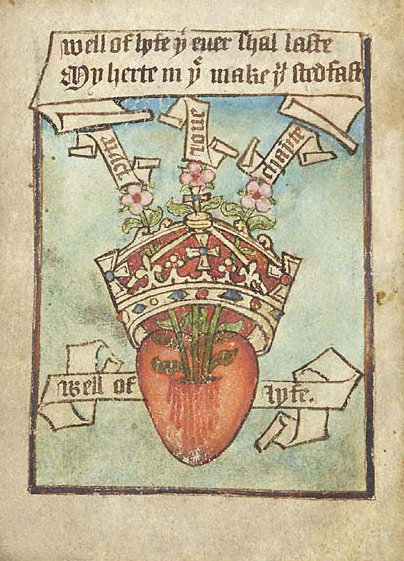
ARTICLE: “‘Your body is full of wounds’: references, social contexts and uses of the wounds of Christ in Late Medieval Europe” by Johanna Pollick, Emily Poore, Sophie Sexon, and Sara Stradal: In this three-part collaborative essay, I was most intrigued, in part because of its newness to me, by the first section, “The flowering wound: Christ’s heart in Princeton University, MS Taylor 17,” in which Dr. Johanna Pollick explores a small English illuminated devotional book, dating from around 1500, that portrays Christ’s wounds as wells. For help in interpreting these images, she turns to medieval literary traditions as well as to the Carthusian Miscellany.
Wounded Heart of Christ
Wounded Heart of Christ as the Well of Lyfe, England, ca. 1500. Princeton University Library, MS Taylor 17, fol. 10v.

Dr. Grace Hamman writes about MS Taylor 17’s extraordinary “well of lyfe” page in Jesus through Medieval Eyes (and for InterVarsity’s The Well), which is what brought me to this essay. The hand-colored image shows flowers—labeled “pyte” (pity), “loue” (love), and “charyte” (charity)—springing forth from the wounded heart of Jesus. The verse prayer at the top reads, “Well of lyfe that ever shall laste / My herte in thee make it stedfast.”

The same theme shows up in another late fifteenth-century English lyric in MS Arundel 286 at the British Library, which appears in modern compilations under the title “The Wounds, as Wells of Life” or “The Wells of Jesus’ Wounds”:

Ihesus woundes so wide
Ben welles of lif to the goode,
Namely the stronde of his syde
That ran ful breme on the rode.
Yif thee list to drinke
To fle fro the fendes of helle,
Bowe thu doun to the brinke
And mekely taste of the welle.
Jesus’s wounds so wide
Are wells of life to the good,
Namely the stream from his side
That ran fiercely on the rood.
If thou list to drink,
To flee from the fiends of hell,
Bow thou down to the brink
And meekly taste of the well.

Trans. Victoria Emily Jones

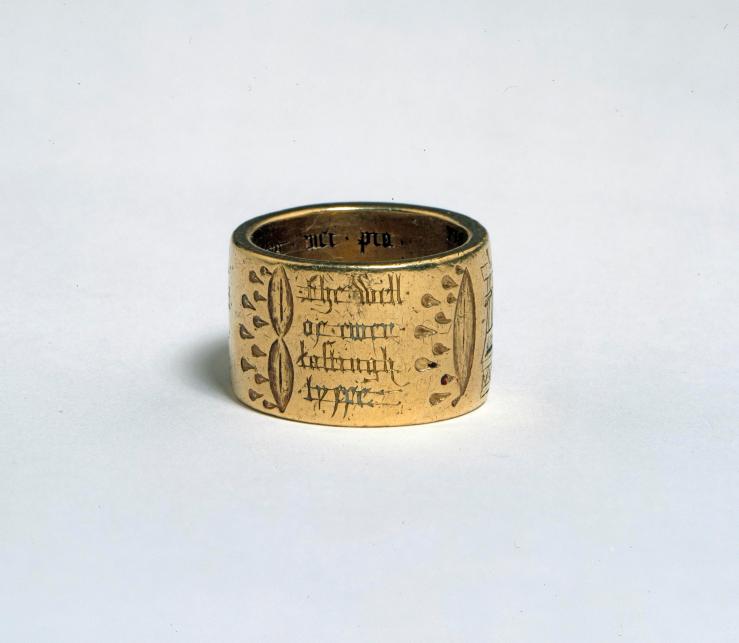
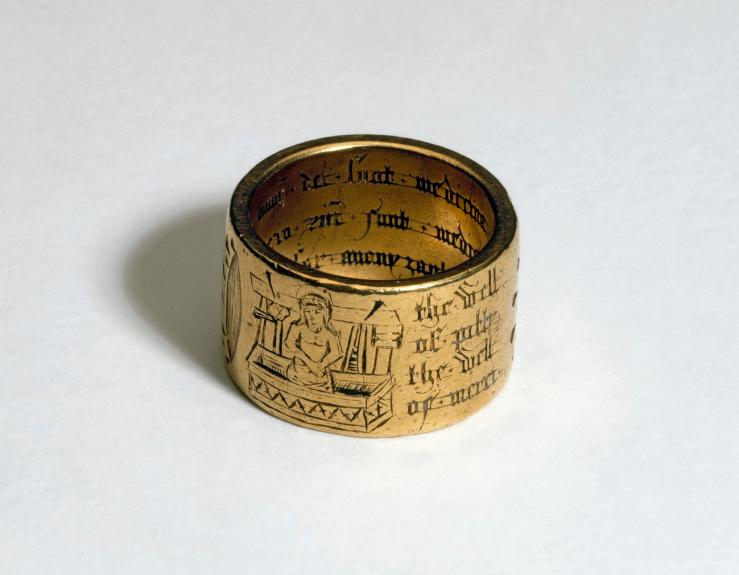
And in a late fifteenth-century gold ring, also from England, engraved with a Man of Sorrows image and hieroglyphs of Christ’s five wounds, labeled “The well of pitty, the well of merci, the well of confort, the well of gracy, the well of everlastingh lyffe”:
(Related posts: “Hidden in the Cleft”; “Upon the Bleeding Crucifix” by Richard Crashaw; By His Wounds)

+++

SONG: “Deep Were His Wounds” by William Johnson, 1953: This midcentury hymn is composed of three simple stanzas: The first half of each meditates on Jesus’s cruel death on the cross, whereas each second half (“But . . .”) celebrates the healing, freedom, and eternal life that death wrought.

>> Music by Leland B. Sateren, 1958: I like this tune, called MARLEE, but it’s difficult to sing congregationally. Here’s a soloist, Sarah Gulseth, singing it for her church’s 2011 Good Friday service, accompanied on organ by Luther Gulseth:

And here’s a Minnesota church choir singing it. Copyright for both the text and tune is held by Augsburg Fortress; you can purchase the sheet music here.

>> Music by Vito Aiuto, 2008: I was first introduced to “Deep Were His Wounds” through the Welcome Wagon’s debut album, Welcome to the Welcome Wagon, “a ramshackle singalong enterprise of a Presbyterian pastor (the Rev. Vito Aiuto) and his wife (Monique) wrestling out the influences of folk music, religion, popular culture, and church tradition.” Mood-wise, Aiuto’s tune wouldn’t work as well for Good Friday—even given the paradox of that day, it’s too bright, in my opinion, for that somber observance. But it’s great for throughout the year, especially for churches that favor a contemporary/folksy style of music.

+++

CANTATA CYCLE: “Membra Jesu Nostri” (The Limbs of Our Suffering Jesus) by Dieterich Buxtehude: Dieterich Buxtehude (ca. 1637–1707) was a Danish German organist and composer of the mid-Baroque period. For Good Friday 1680, he composed a cycle of seven concerto-aria cantatas. The texts of the aria sections are taken from the medieval Latin hymn “Salve mundi salutare” (Hail, the World’s Salvation) by the Cistercian abbot Arnulf of Leuven (ca. 1200–1250), whereas the concerto section texts are Old Testament quotations. The following video is a 2004 performance from Payerne, Switzerland; see the YouTube video description for further credits. The video includes English subtitles, but you can also read the lyrics (with translation) here.

The cycle begins by paying homage to Christ’s wounded feet (“Ad Pedes” = “To the Feet”), and then progresses upward to his knees, hands, side, breast, heart, and finally, face/head. Traditionally, Christ’s wounds are enumerated as five: a hole in each foot, a hole in each hand, and a hole through his side/heart (from the centurion’s spear). But Arnulf meditates on seven distinct body parts of Christ’s that were injured on Good Friday.

+++

ARTWORKS:

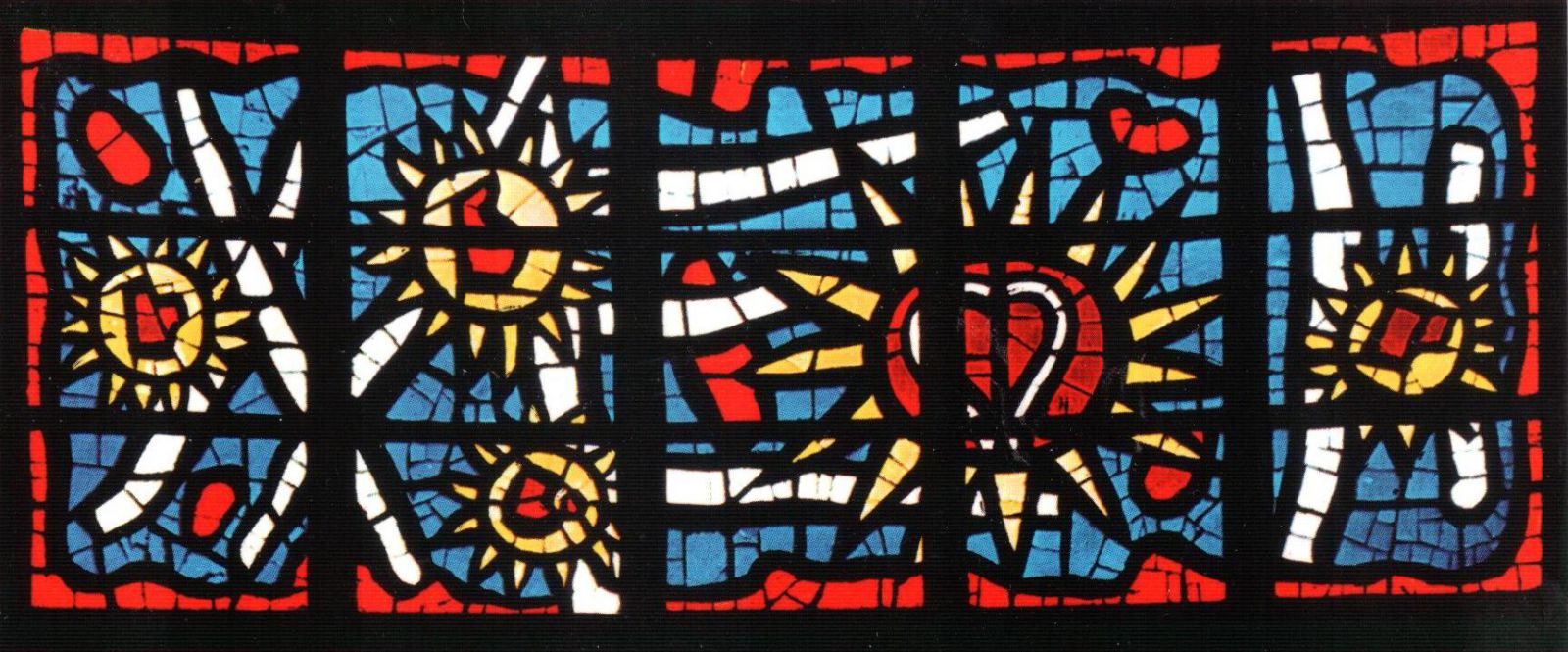
>> The Five Wounds of Christ by Fernand Léger | Commentary by Albert Hengelaar: This visual meditation is about the architecture and interior decoration of the Sacré-Coeur in Audincourt, France, a product of the Art Sacré movement, a Catholic art renaissance spearheaded by the French Dominican Order from 1919 to the 1950s. The centerpiece of the church, sited above the high altar, is a stained glass window depicting the five wounds of Christ shining like suns—one of seventeen windows the artist Fernand Léger designed to encircle the space in a strip.
Leger, Fernand_Five Wounds
Fernand Léger (French, 1881–1955), The Five Wounds of Christ, 1950–52. Stained glass window, Église du Sacré-Cœur (Church of the Sacred Heart), Audincourt, France.

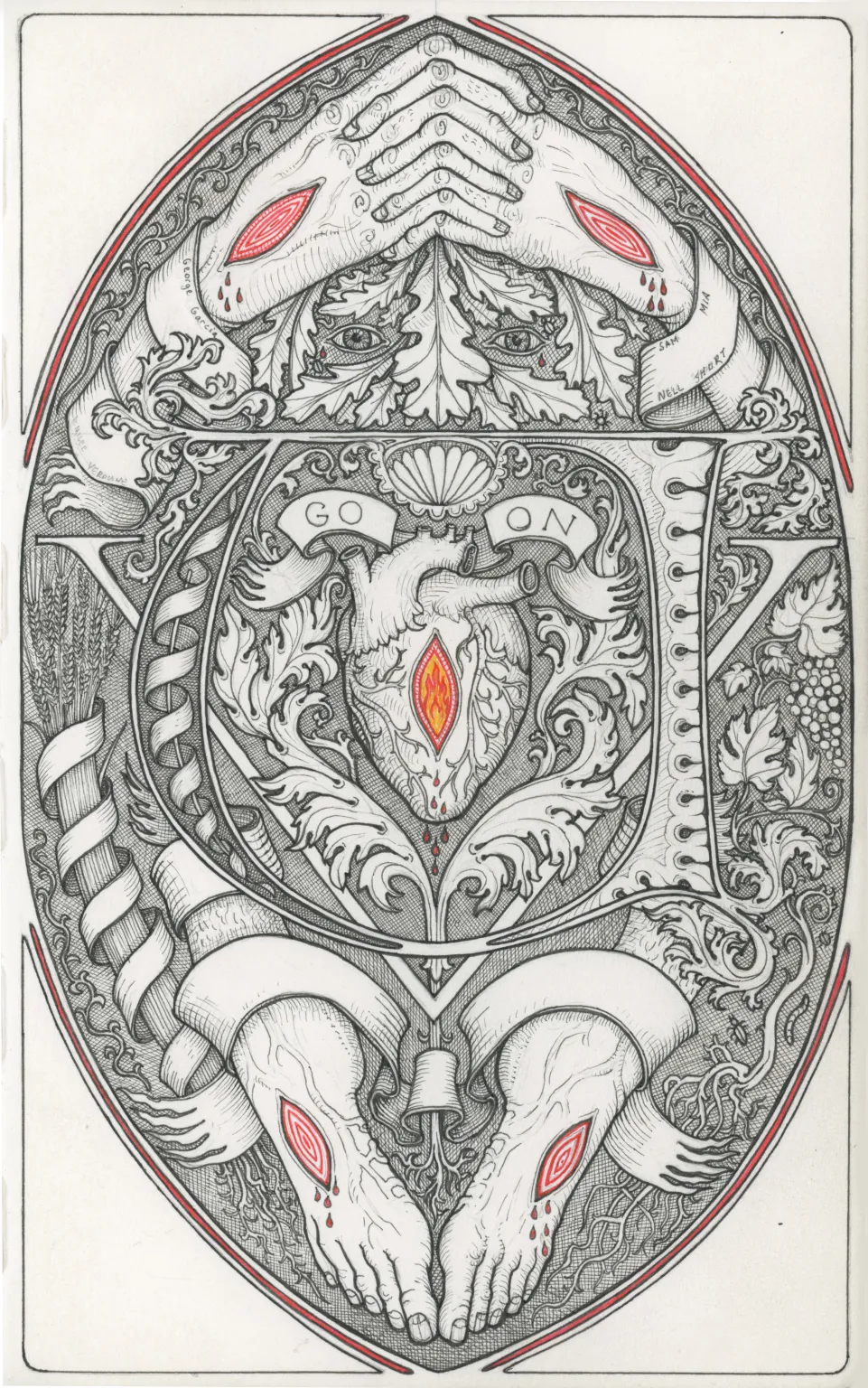
>> The Great Wound, aka Go On, Wounded Healer by Jack Baumgartner | Commentary by Sam Kee: In this Substack post, Sam Kee unpacks a drawing by his friend Jack Baumgartner [previously], which shows that “there is life in His [Christ’s] wounds, and He pours His life into our wounds.” The drawing started with the roman numeral V, which stands for the five wounds of Christ. The circumference is one large wound that encompasses five smaller wounds, eye-like, each one weeping blood. Other symbols that Kee analyzes in the drawing are wheat, grapes, fig leaves, seashell, fire, heart, and womb. “Go on” is a refrain that Baumgartner uses often in his work, a mantra for persevering in the faith, for continuing on the path.
Baumgartner, Jack_The Great Wound
Jack Baumgartner (American, 1976–), The Great Wound, 2024. Drawing from the series The Diary of a Tree Standing on Its Head.

Kee concludes with an original ekphrastic poem.

You can purchase an archival reproduction of The Great Wound from Baumgartner’s online shop. I encourage you to explore his website as well. I admire how his work is somehow both mystical and earthy, rooted.

Roundup: Psalms and the arts, Ukrainian Easter Choir, and more

BLOG POST: “An open letter to pastors (A non-mom speaks about Mother’s Day)” by Amy Young: There’s disagreement among church leaders on whether Hallmark holidays, such as Mother’s Day, should be recognized during a worship service, and if so, how. Having mothers stand (while women who are not mothers in the conventional sense remain seated) can be very othering and bring up feelings of sadness or shame. It’s also a day when people are thinking about their own mothers, which can evoke a complex range of emotions.

Amy Young believes there is a way to honor mothers in church without alienating others, as well as to acknowledge the breadth of experiences associated with mothering. She has drafted a pastoral address that I find so wise and compassionate. Some women are estranged from their children. Some have experienced miscarriage or abortion. Some have had failed adoptions, or failed IVF treatments. Some placed a child for adoption. Some have been surrogate mothers. Some are foster mothers, or are the primary guardian of a relative’s child. Some are spiritual moms. Some women want to be mothers but have no partner or have had trouble conceiving. Some were abused by their mothers. Some have lost mothers. Some never met their mother. Young puts her arms around all these people who are potentially in the pews on Mother’s Day, making room for the complexity of the day—which does include celebration!

+++

VIDEO: “United with Beauty: The Psalms, the Arts, and the Human Experience” by Mallory Johnson: Mallory Johnson graduated last weekend with a bachelor’s in music and worship (concentration: voice) from Samford University in Birmingham, Alabama. (In the fall she will be starting an MDiv program at Beeson Divinity School.) All the seniors in the Samford School of the Arts are required to complete a capstone project tailored to their individual interests and career goals. As Johnson’s interests center on theology, history, and the arts, she created a twenty-minute video rooted in the Psalms that integrates music, poetry, short excerpts of fiction, visual art, and quotes from van Gogh, Tchaikovsky, Goethe, Luther, and others, resulting in a contemplative multimedia experience.

I resonate so much with Johnson’s approach of bringing together works from different artistic disciplines to interpret one another and to invite the viewer into worship. Her curation is stellar! To cite just one example, the contemporary choral work Stars by Ēriks Ešenvalds plays as we see, among other images, an Aboriginal dot painting of the constellations Orion and Canis and a nighttime landscape by realist painter Józef Chełmoński. Another: John Adams’s double piano composition “Hallelujah Junction” is brought into conversation with Psalm 150 and a painting by Jewish artist Richard Bee of David dancing before the ark.

Józef Chełmoński (Polish, 1849–1914), Starry Night, 1888. Oil on canvas, 22 13/16 × 28 3/4 in. (58 × 73 cm). National Museum in Kraków, Poland.

The video opens with the theme of awe and wonder—expanses of sky and sea and field; the beauty and vastness of God mirrored in the natural world—and then moves to lament—of the prospering of the wicked; of exhaustion, anxiety, and other forms of mental or spiritual anguish and their causes; of personal sin—and finally ends with an assurance of grace and with exultation. Johnson shows how the longings of modern people overlap with those of the biblical psalmists. Here’s her description:

In his famous work titled Confessions, St. Augustine writes this: “Yet to praise you, God, is the desire of every human.” Is this true? What does this look like?

During my time at Samford, I have felt my heart and mind overflow with love for the arts. As a Christian, they have played a devotional role in my life. I find such joy in seeing connections between music, art, and literature that may seem unrelated on the surface. I believe that all humans have a longing for the goodness of God and we find “echoes” of Him everywhere, and most beautifully in artistic expression.

I wanted to show others how I understand the world as a Christian artist. This project is a journey through the Psalms, using art to reinforce the idea that the Psalms capture the full universal human experience. Across time and space, we have all felt the same things and we have all had the same deep longing for “something higher.”

I hope you can allow this project to wash over you. Make time to watch it alone or with someone you love, distraction-free. Turn the lights out, light a candle, watch it on a big screen with the volume up loud. Be cozy under a blanket with a cup of coffee, or grab a journal and write down anything that sticks out to you! It is my earnest desire that you will be moved by the artistic expression of humanity, and that you may realize that God has always been the goodness you most deeply desire.

+++

SONGS:

>> “Broken Healers” by Elise Massa: Singer-songwriter Elise Massa is the assistant director of music and worship arts at Church of the Ascension in Pittsburgh. A meditation on Christ as Wounded Healer, this song from her 2014 album of demos, We Are All Rough Drafts, was inspired by an Eastertide sermon.

Here’s the final stanza (the full lyrics are at the Bandcamp link):

Broken healers are we all
In a living world, decayed
With broken speech we stutter, “Glory”
As broken fingers mend what’s frayed
Holy Spirit, come, anoint us
As you anointed Christ the King
Who wore the crown of the oppressed
Who bears the scars of suffering

>> “Agnus Dei” by Michael W. Smith, performed by the Ukrainian Easter Choir: This is one of the few CCM songs I listened to as a young teen (Third Day’s version from a WOW CD!) that I’m still really fond of. In this video that premiered April 17, an eighty-person choir conducted by Sergiy Yakobchuk was assembled from multiple churches in Ukraine to perform for an Easter service in Lviv organized by the Billy Graham Evangelistic Association. Michael W. Smith’s “Agnus Dei” is one of three songs they sang, in both English and Ukrainian. The name of the soloist is not given. Many of the vocalists in the choir have been displaced from their homes by the current war with Russia. One of them says, “With the war, celebrating the Resurrection means for us now life above death, good above evil.”

+++

PRAYER EXERCISE: “Visio Divina: A 20-Minute Guided Prayer Reflection for the Crisis in Ukraine”: Visio divina, Latin for “divine seeing,” is a spiritual practice of engaging prayerfully with an image, usually an artwork—allowing the visual to invite you into communion with God. On March 17 Vivianne David led a virtual visio divina exercise with Natalya Rusetska’s Crucifixion, hosted by Renovaré. I caught up with the video afterward and found it a very meaningful experience. As the painting is by a Ukrainian artist and represents Christ’s passion, the war in Ukraine is a natural connection point.

I appreciate David’s wise guidance, which includes these reminders:

  • Stay with the image, regardless of whether or not you ​“feel” something happening right away. There is something beautiful about faithfully waiting with that space, having dedicated it to God as a time of prayer.
  • Notice what draws your attention, what invites you into the image—let that become a space for conversation with Christ.
  • Notice what sort of emotions arise as you stay with the image. How does it awaken desire? Let these emotions lead you back to continued dialogue with God.

This kind of quiet, focused looking with an openness to encounter is something I encourage on the blog. Any of David’s three tips above I would also suggest for any art image I post—a corrective to hasty scrolling habits. Stick around for the last four minutes of the video to see dozens and dozens of impressions from participants, which may reveal new aspects of the painting to you.