Bone chapel, anti-Nazi martyrs’ memorial, and contemporary stained glass at the Basilica of St. Ursula, Cologne

(All photos in this article are my own, taken either by me or my husband.)

I knew very little about the virgin martyr St. Ursula before visiting the basilica dedicated to her in Cologne, Germany, last month. She’s the patron saint of the city, where, according to hagiography, she was murdered sometime in the fourth century.

There’s no historical veracity to her story, which is why her name was removed from the Catholic calendar of saints when it was revised in 1969. But her feast day is still observed by many on October 21.
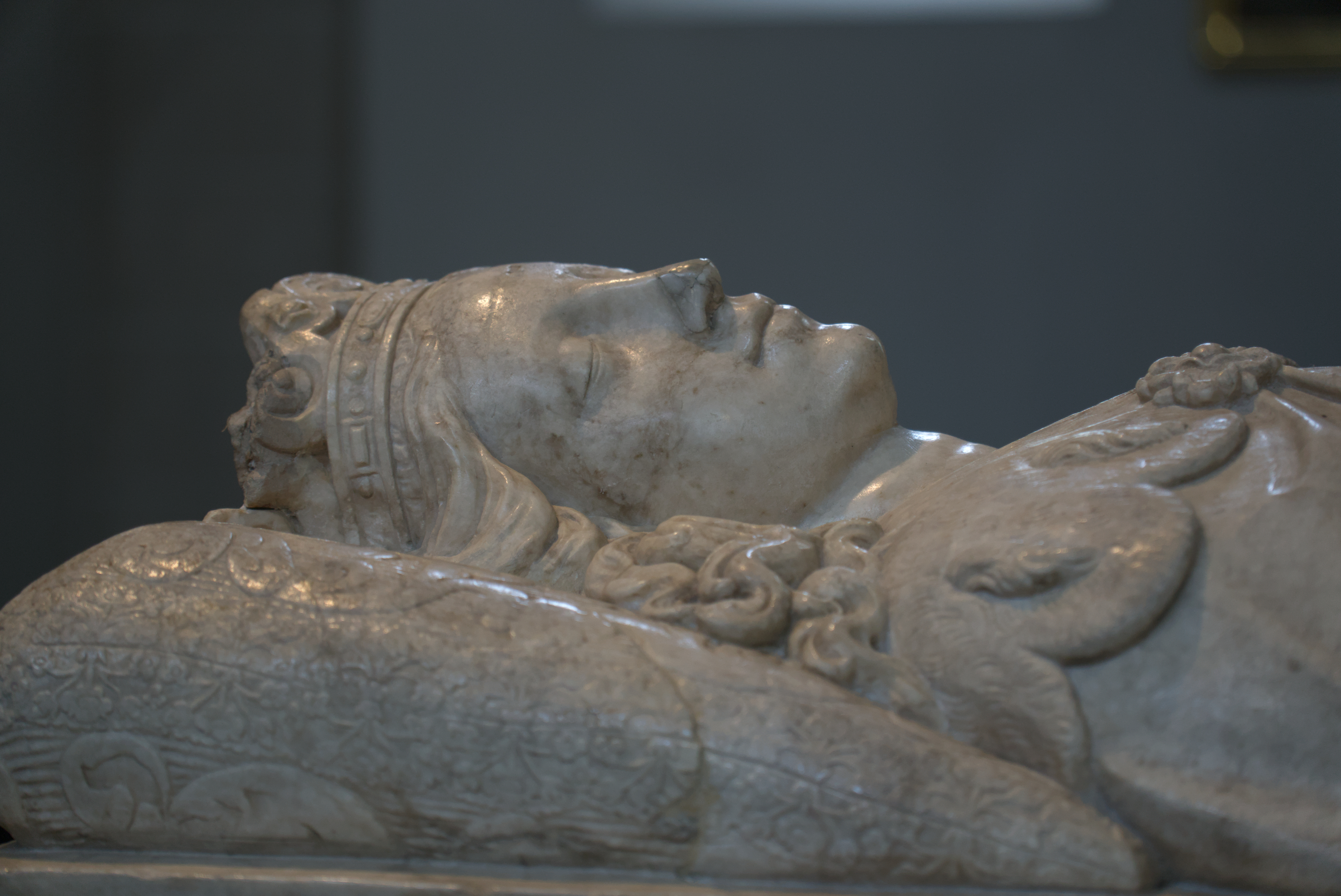
St. Ursula alabaster
Johann T.W. Lentz, St. Ursula (detail), 1659. Alabaster. North transept, Basilica of St. Ursula, Cologne. This reclining figure of the saint lies over her Baroque tomb made of black marble.

As legend has it, Ursula was a Romano-British princess and a Christian. She was engaged to be married to a pagan prince. To delay the wedding, she successfully requested that she first be allowed to take a three-year pilgrimage to Rome, and that she be accompanied by eleven thousand virgins (a ridiculous number that was likely embellished from what was originally eleven). On their voyage, she converted all eleven thousand to the faith.

On their way back to Britain from Rome, they were traveling through Cologne when it was besieged by the Huns, a group of nomadic warriors from Central Asia. Ursula and her companions refused the soldiers’ sexual advances and were slaughtered as a result. One version of the legend says the women’s souls then formed a celestial army that drove out the Huns, saving Cologne.

The earliest possible reference to Ursula and company—though they are unnamed and unnumbered—is a stone plaque dated to 400. Now incorporated into the choir wall of the present Basilica of St. Ursula, it mentions a basilica restored on this site by the Roman senator Clematius to commemorate the “martyred virgins coming from the east, in fulfillment of a vow, . . . holy virgins [who] spilled their blood in the name of Christ.” This inscription not only provides the seed of what would become the Ursula legend; it’s also the earliest evidence of Christianity in Cologne, attesting to the presence of a church there in the fourth century.

It wasn’t until the tenth century that the name Ursula emerged, identified as the leader of the group of virgins, and that their number, which had previously ranged from two to thousands, became fixed at eleven thousand. The women were never officially canonized, but their veneration as saints grew immensely in the twelfth century after a large, late antique Roman cemetery was discovered in 1106 near the aforementioned Church of the Holy Virgins in Cologne during an excavation project to expand the city’s fortifications. The skeletal remains in the hundreds of graves were purported to be those of the martyred women (notwithstanding the presence of many men’s and children’s bones among them).

The discovery of these putative relics called for the rebuilding of the predecessor church to house them. Construction began in the second quarter of the twelfth century, and it’s that structure, with later renovations, refurbishments, additions, and (post–World War II) restorations and repairs, that stands today. The church was elevated to the status of minor basilica in 1920.
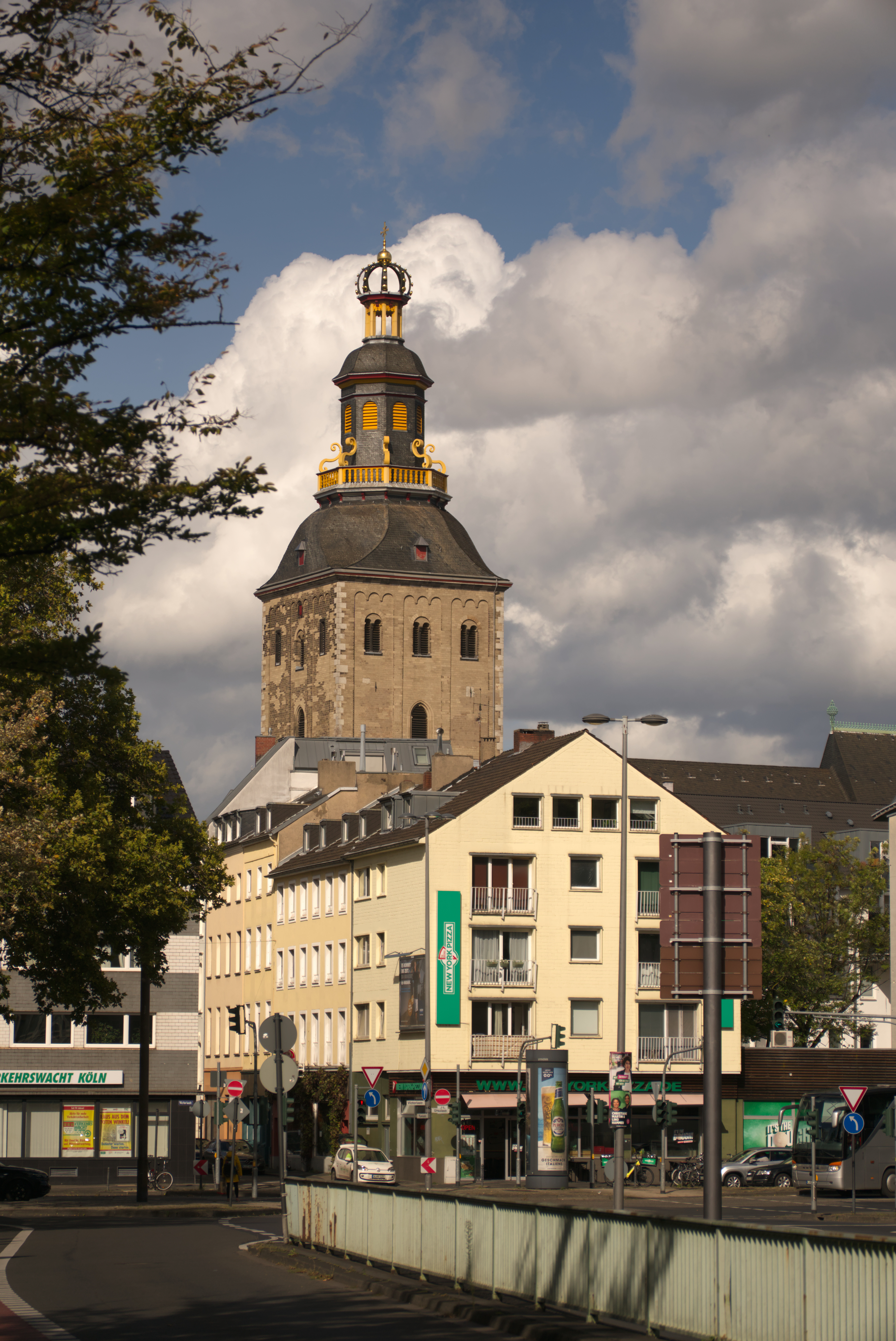
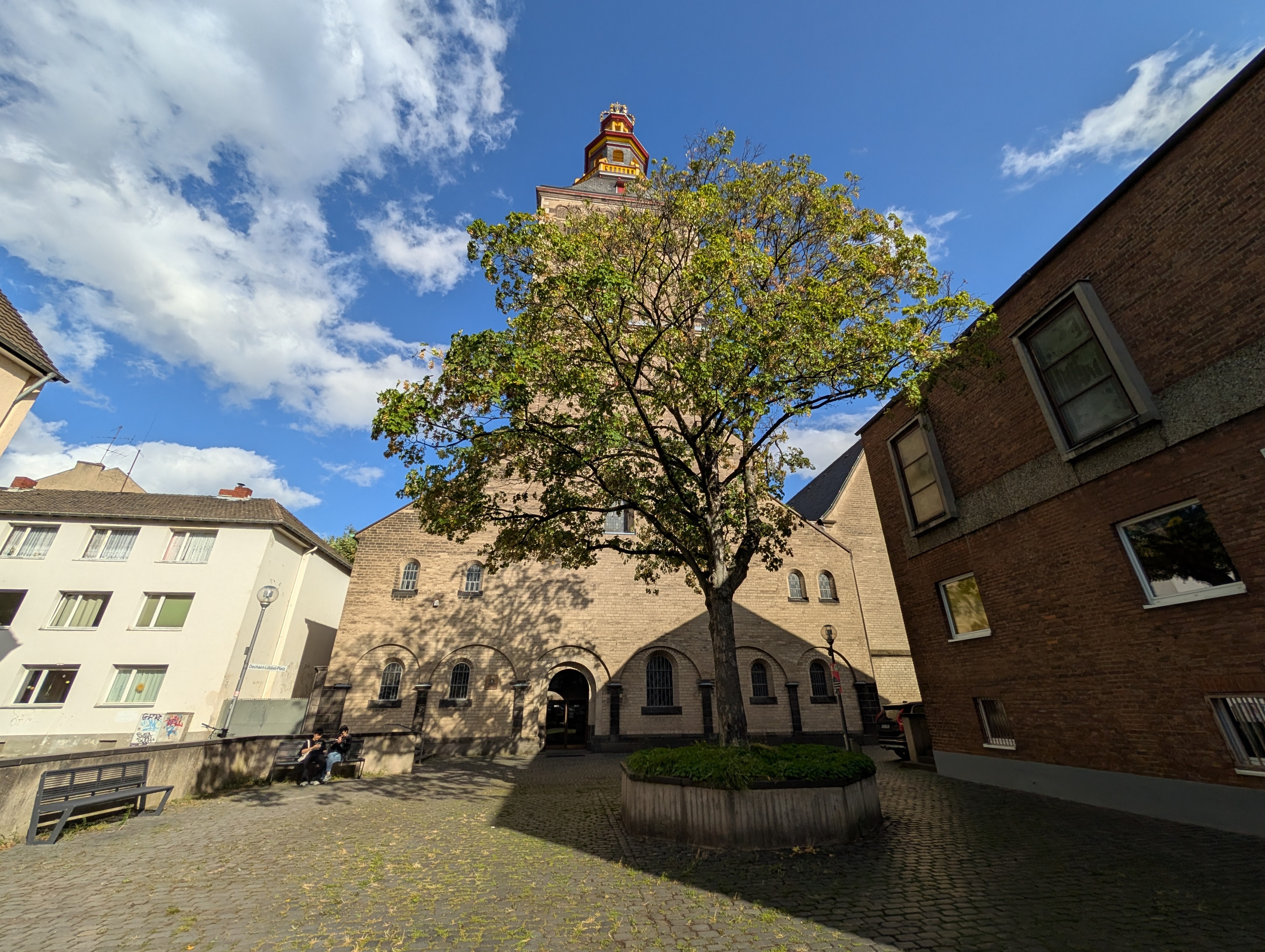
Basilica of St. Ursula, Cologne
West facade, where you enter

Basilica of St. Ursula
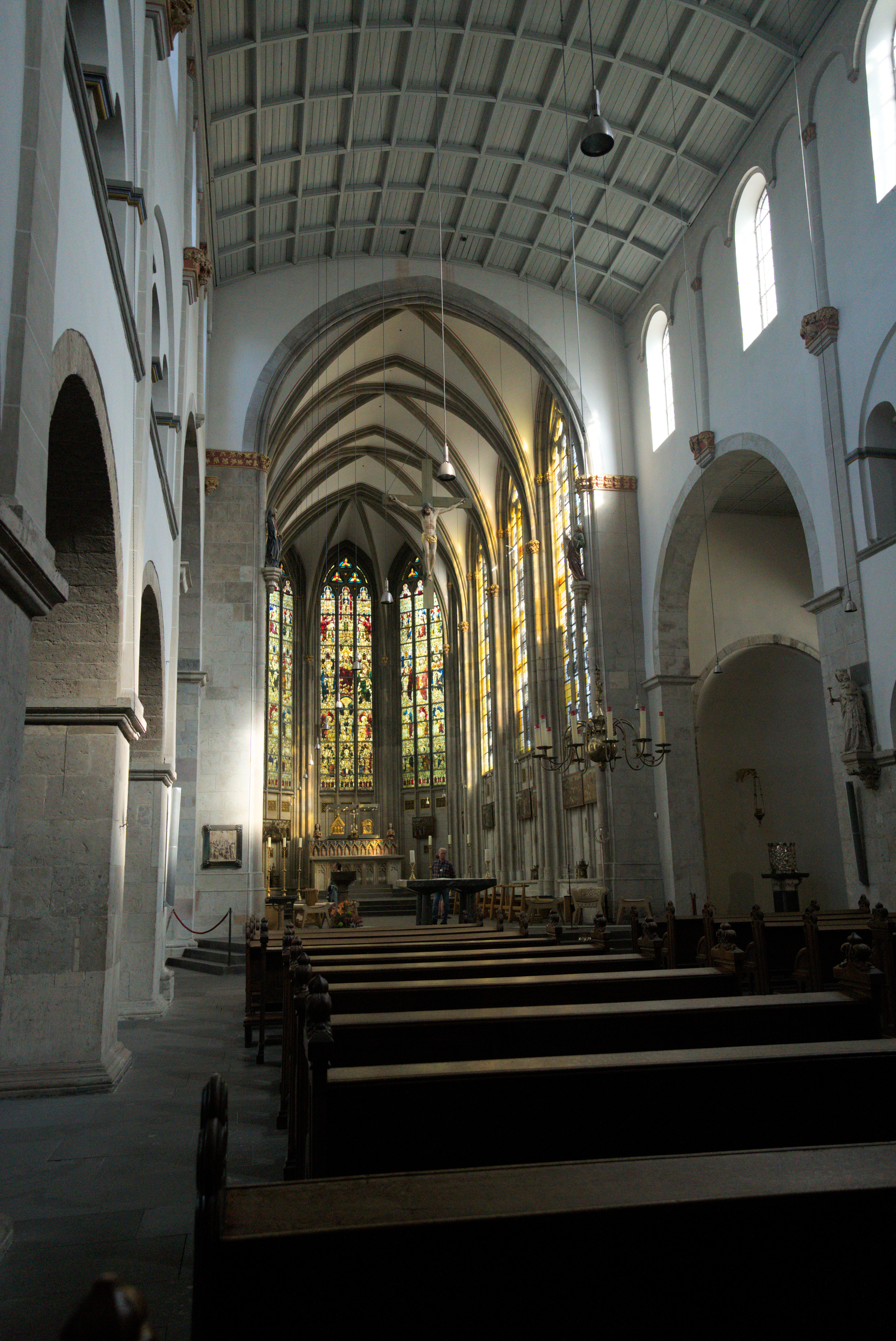
The nave and the main tower of the Basilica of St. Ursula are Romanesque, but the choir was rebuilt in the Gothic style.

Shrine altar
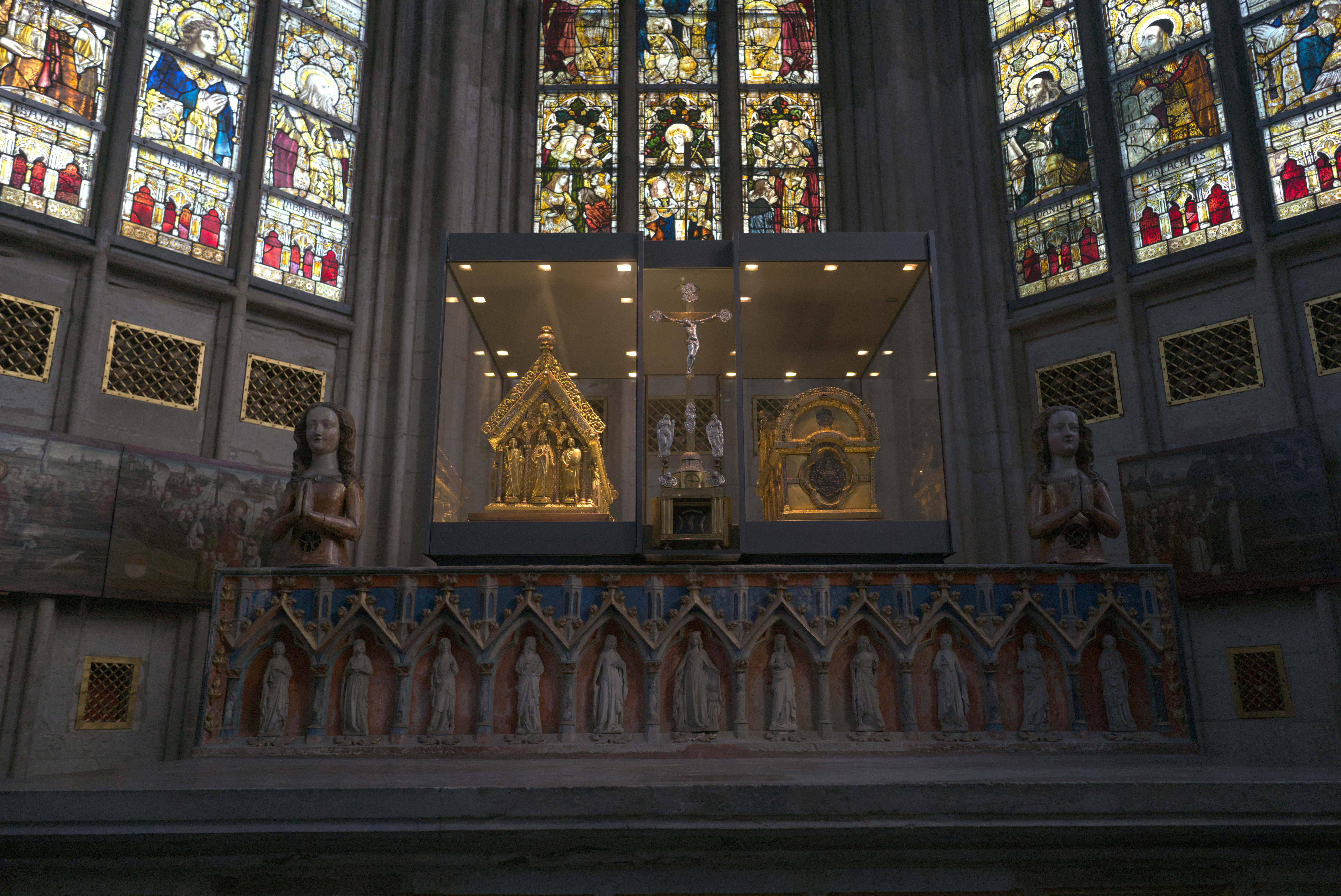
Shrine altar in the choir apse, containing the relics of Ursula, Etherius, and Hippolytus. Behind it are grilled reliquary niches and paintings of the Legend of St. Ursula from from the “long cycle” of 1456.

Chancel windows
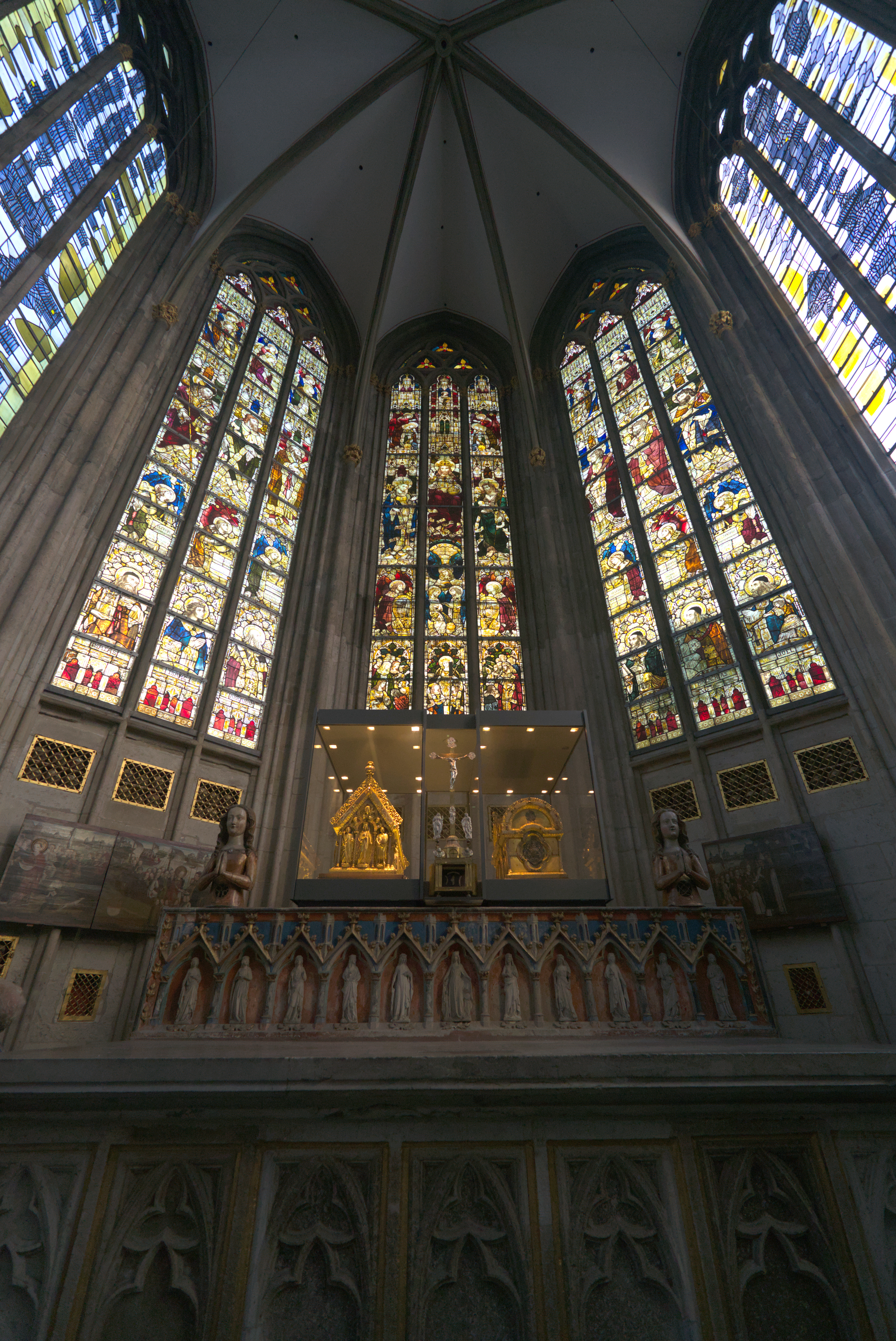
Chancel windows by Francis William Dixon, 1892. Left: St. James the Greater, St. Andrew, and St. Peter, accompanied by angels; lower register: Isaiah, Isaac, and Abraham. Center: Christ enthroned, with Mary and St. John the Baptist (Deesis) at his side; lower register: St. Ursula of Cologne with her companions. Right: St. James the Lesser, St. Matthew, and St. Thomas, accompanied by angels; lower register: Daniel, Malachi, and Joel.

The reason the Basilica of St. Ursula was on my list of stops was I wanted to see its so-called Golden Chamber.

The Golden Chamber

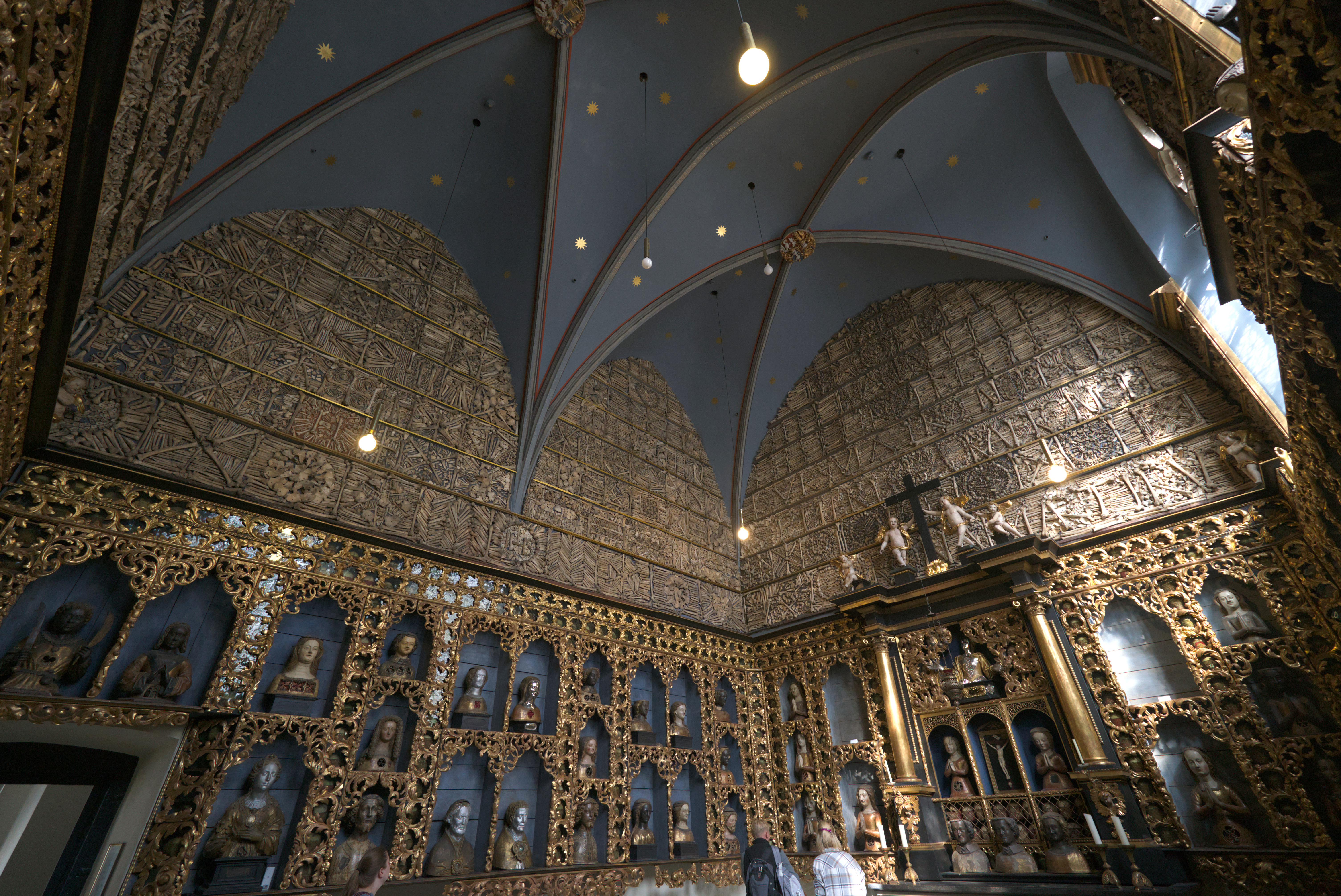
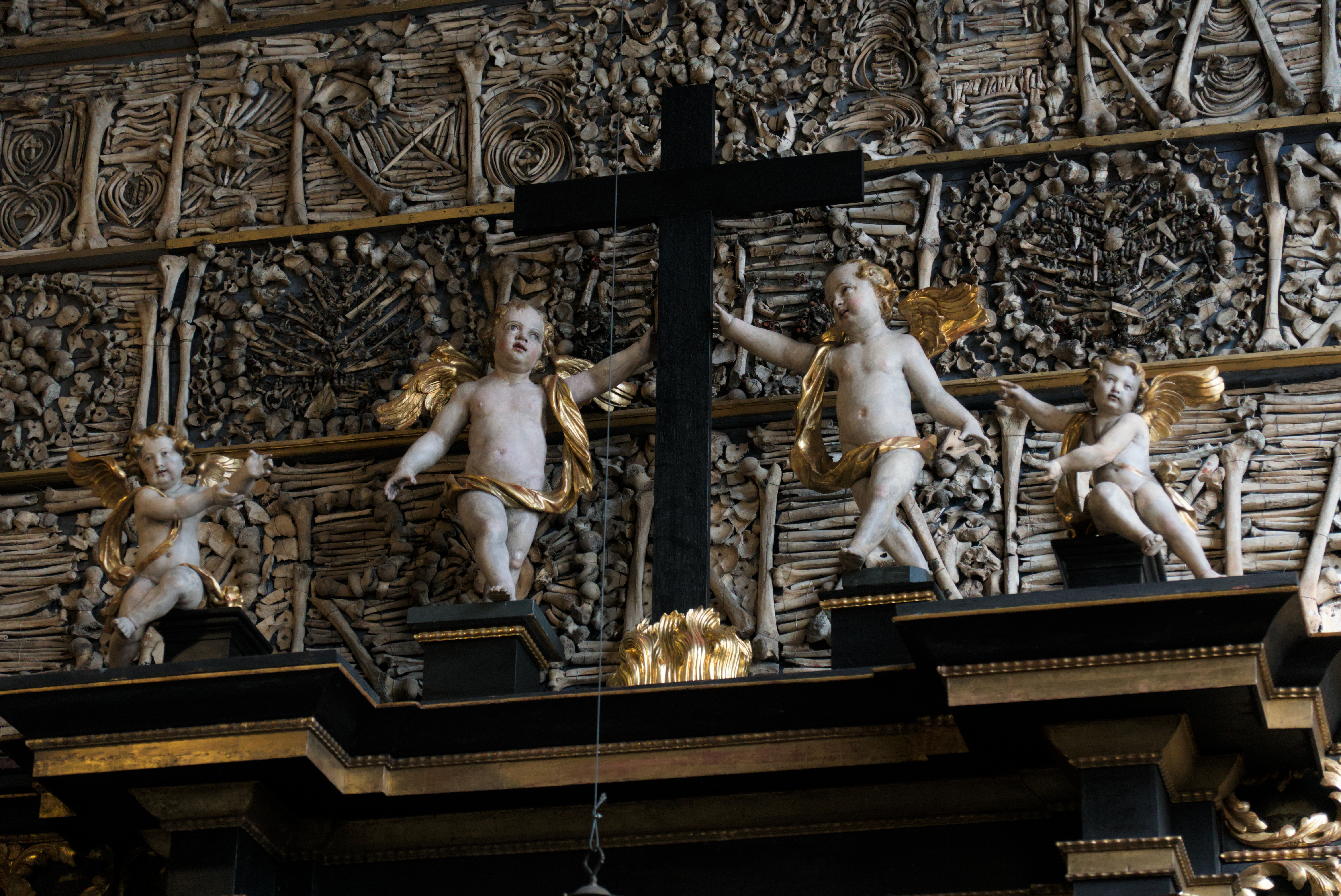
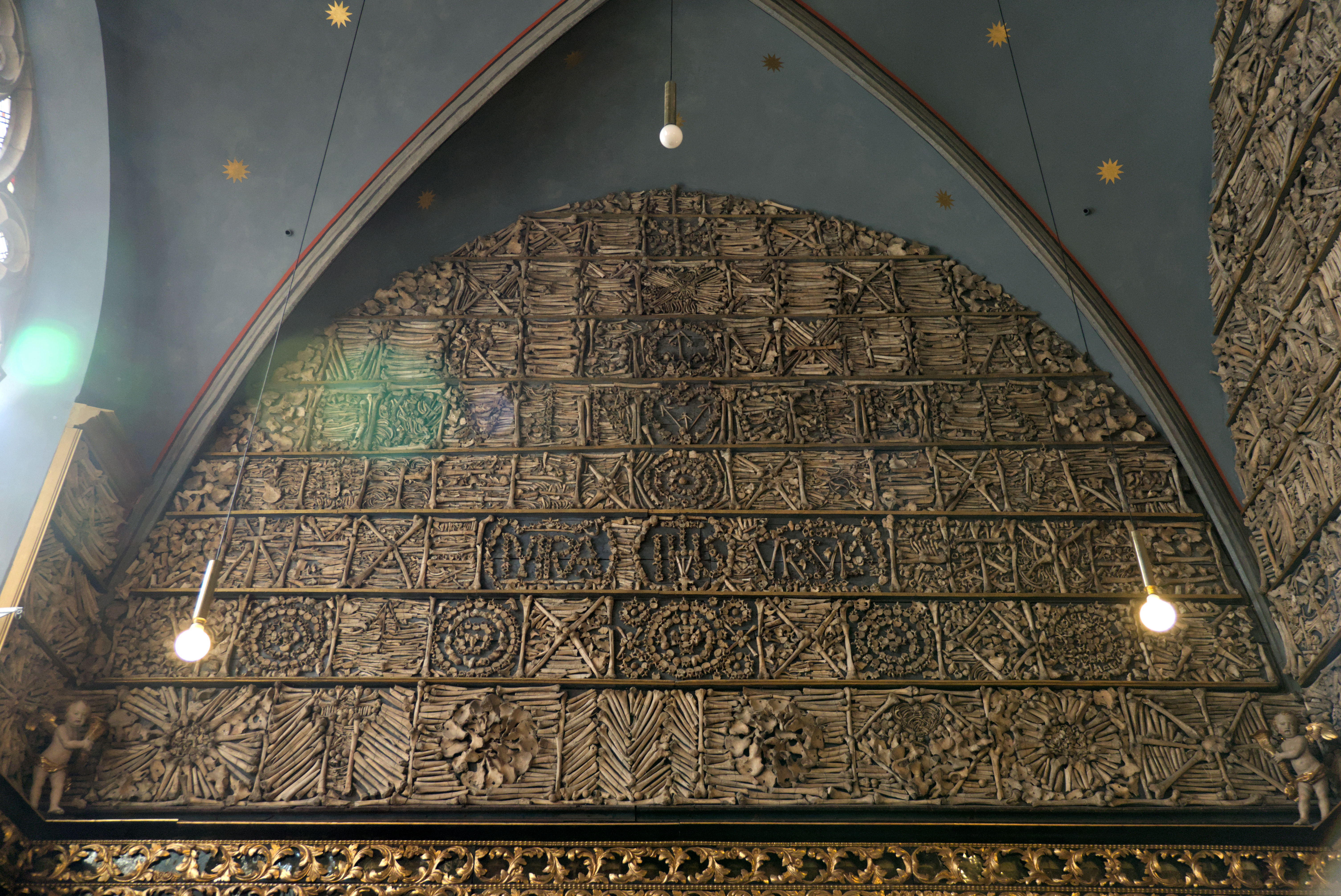
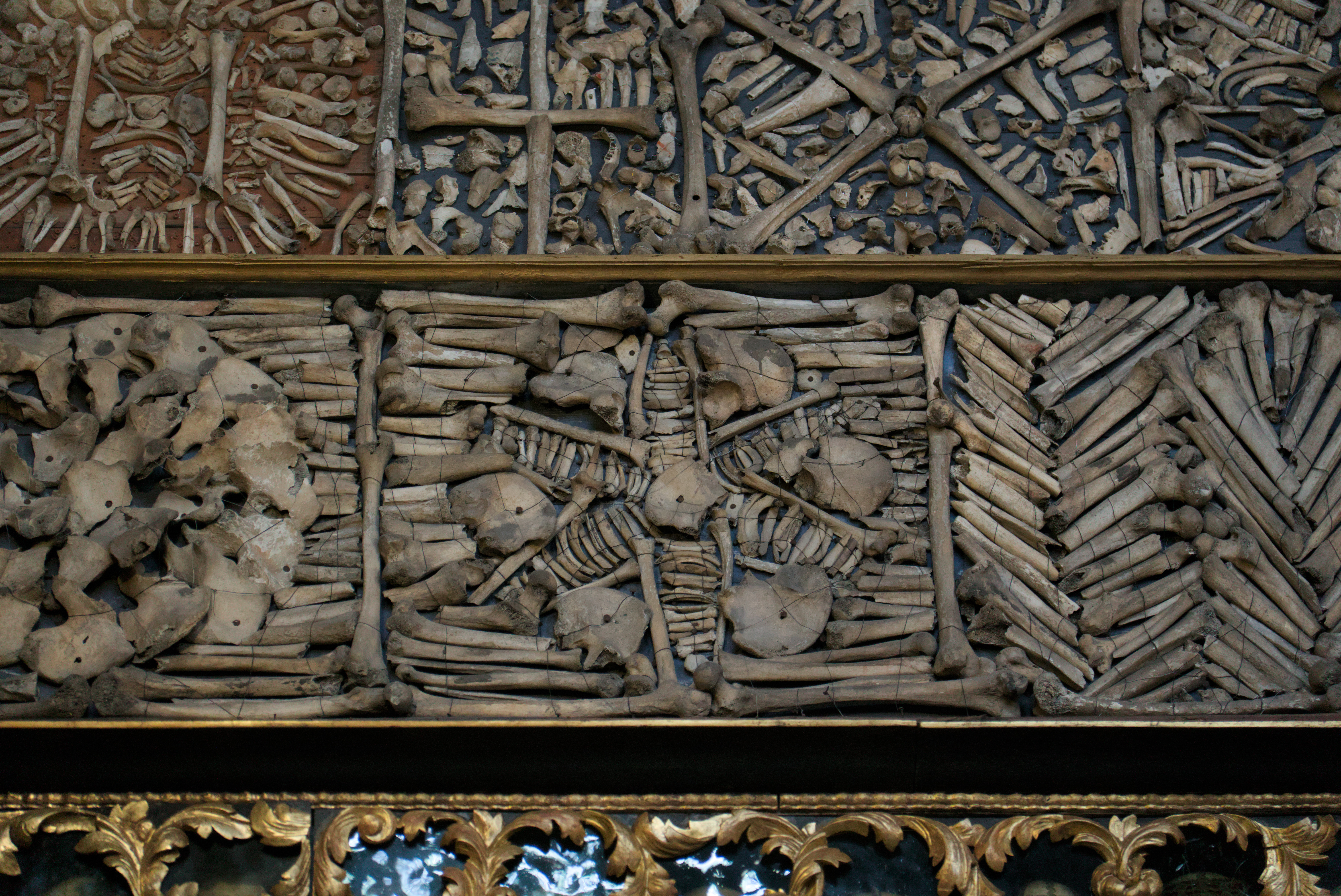
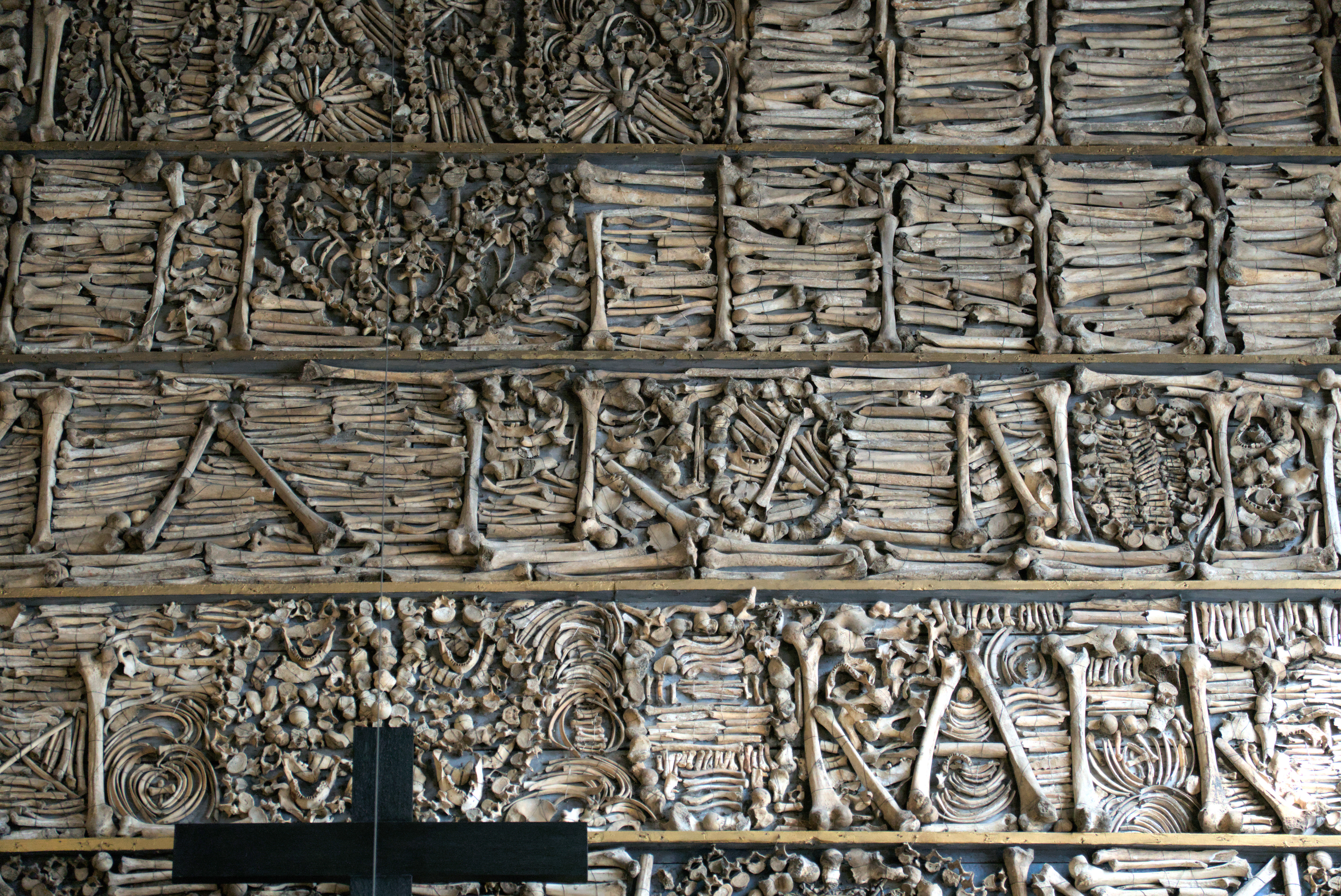
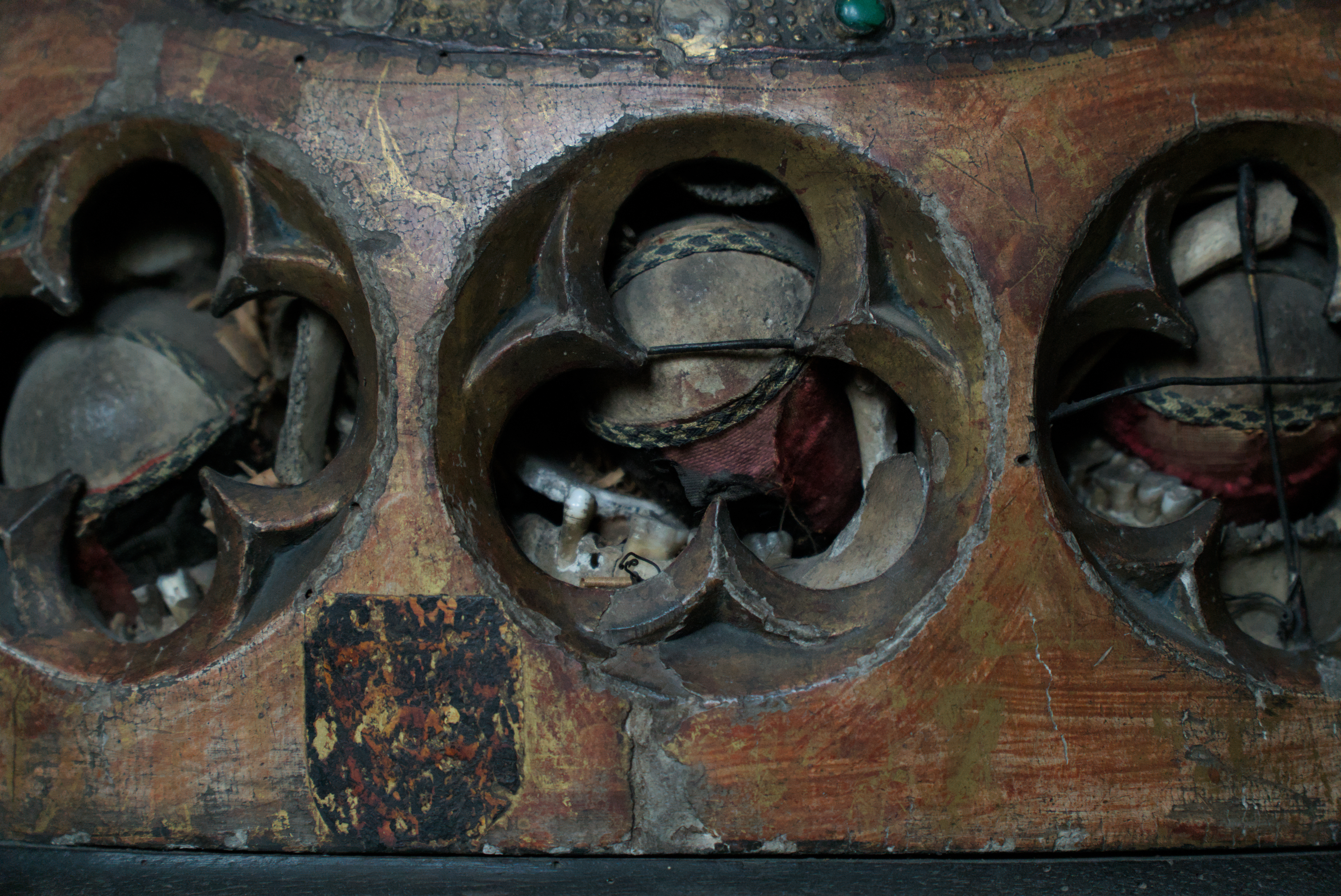
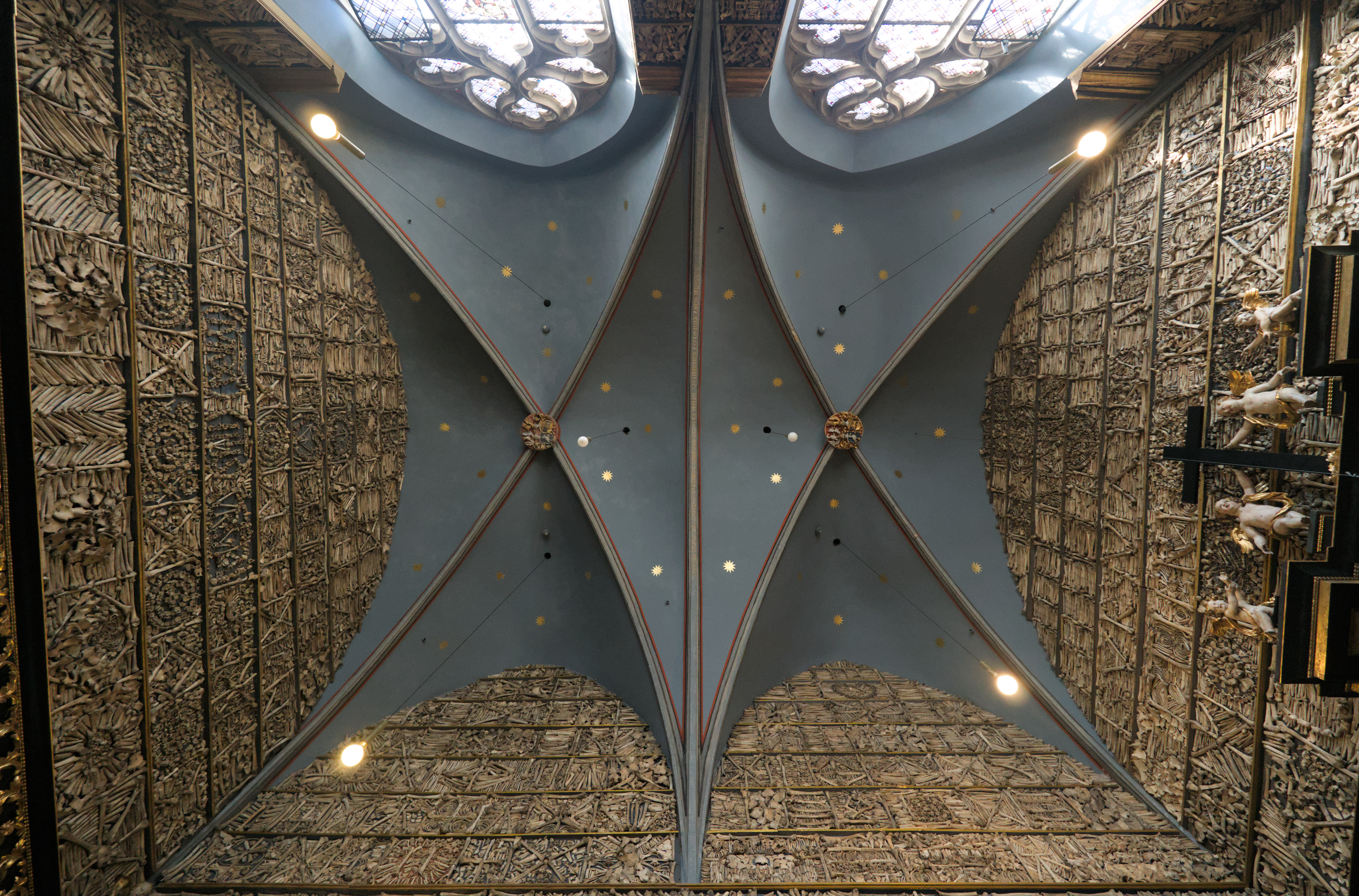
The largest ossuary north of the Alps, the Goldene Kammer (Golden Chamber) is decorated with the bones of, allegedly, St. Ursula and her eleven thousand travel mates, which are artfully arranged across the walls in geometric patterns, rosettes, and even words! Unlike most other relic displays I had seen before, where the relics are kept in some kind of encasement and usually only partially visible, this one puts many of the bones right out in the open, making the whole room a walk-in reliquary.
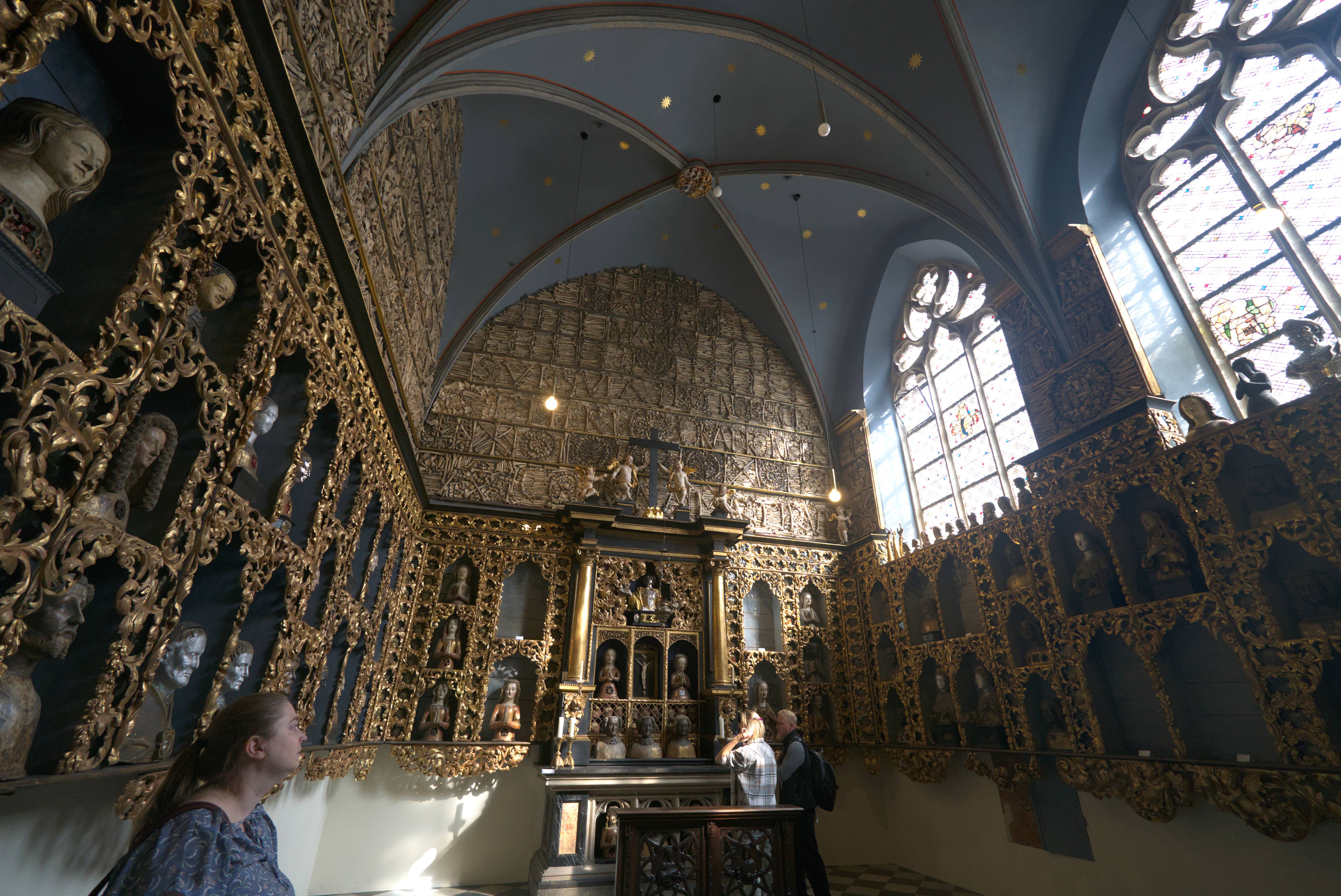
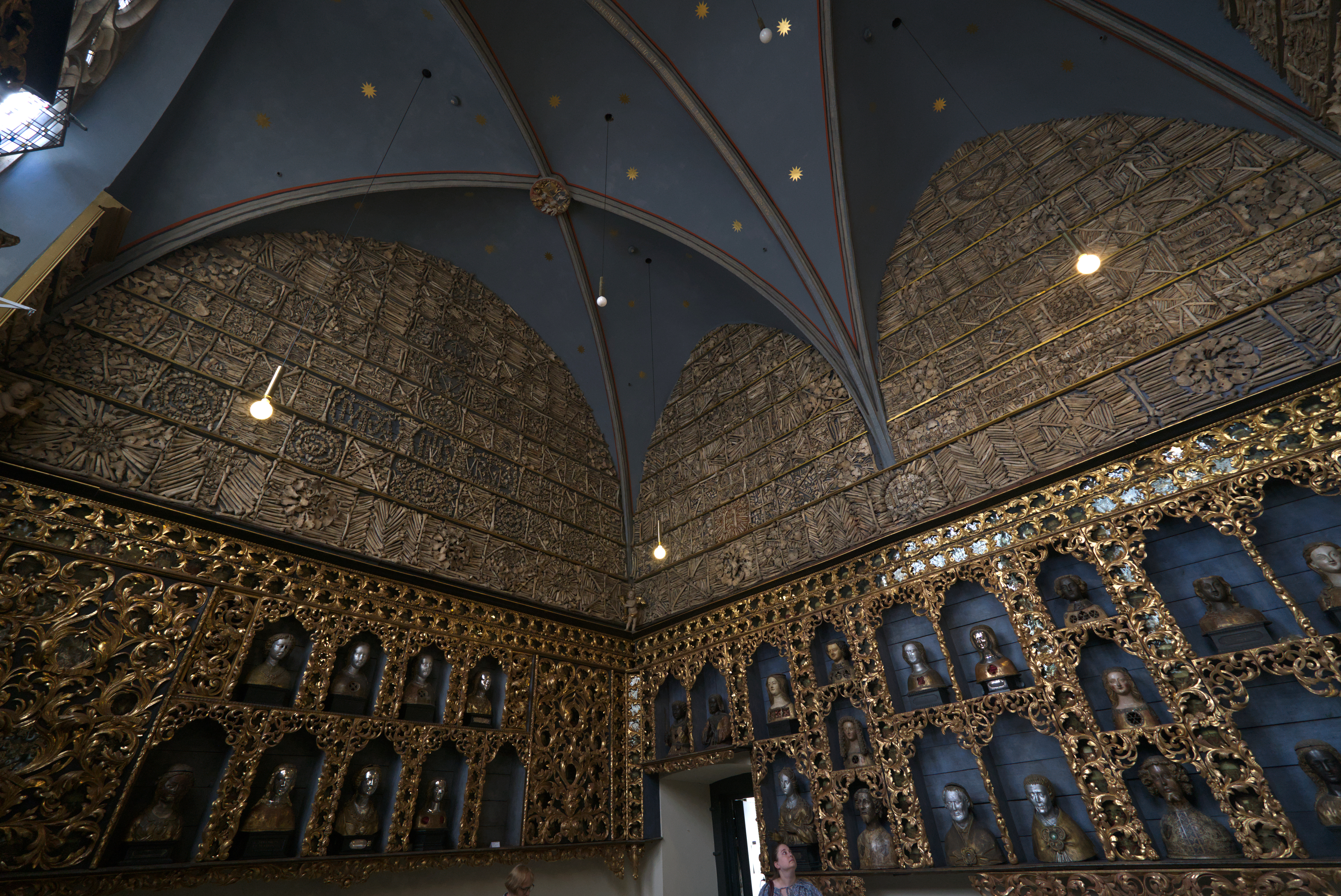
Golden Chamber
That’s me at the left, taking it in.

Golden Chamber
Golden Chamber
Golden Chamber

A Baroque marvel, the Golden Chamber was established on the south side of the church in 1643 through a donation by the imperial court councilor of the Holy Roman Empire Johann von Crane and his wife, Verena Hegemihler. It replaced a smaller medieval camera aurea (treasury and relic chamber), where the bones had previously been displayed. Crane and Hegemihler oversaw the design and construction of the space, with its ribbed, star-studded, sky-blue vault, and the arrangement of the bones into their present form.
Golden Chamber

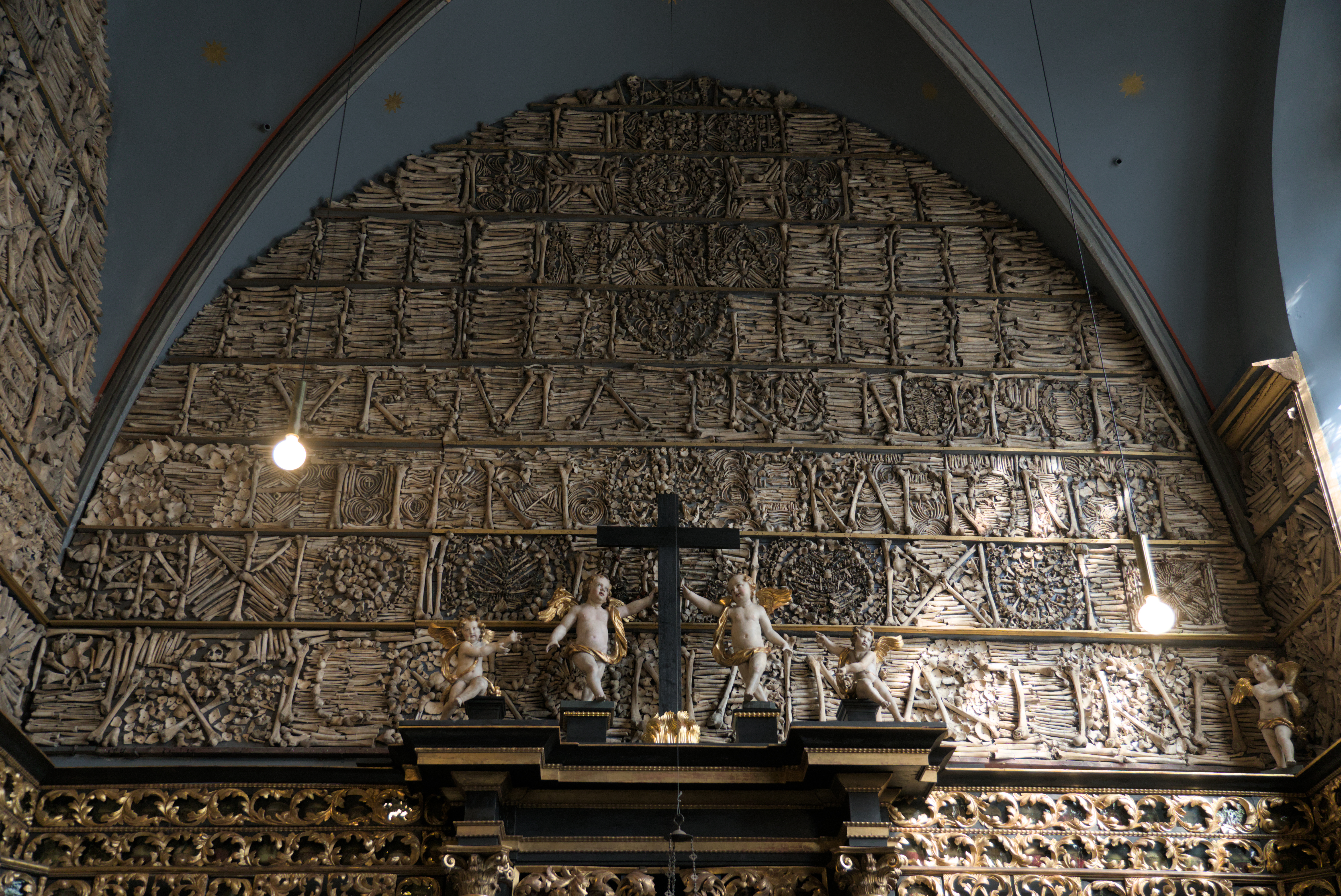
Above the altar, tibias, fibulas, femurs, humeri, and other bones spell out “Sancta Ursula Ora Pro Nobis” (Saint Ursula, pray for us). Also rendered in bones are the name Etherius—Ursula’s fiancé, who converted to Christianity at her insistence and met her in Cologne to die with her—and a mention of the holy virgins.
Golden Chamber
Golden Chamber
Golden Chamber

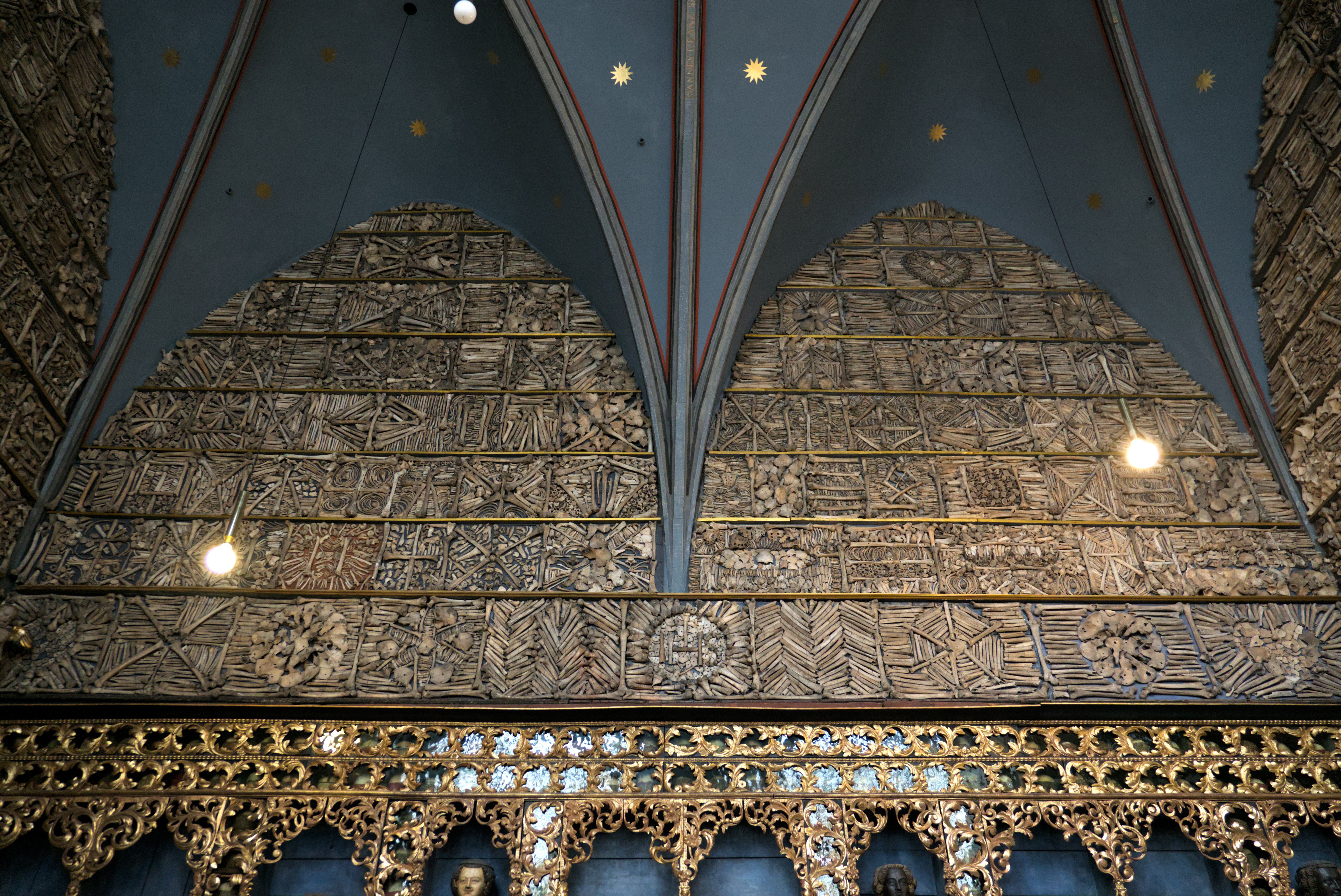
Other sections of the wall use vertebrae, pelvic bones, ribs, shoulder blades, and so on to create ornamental designs like hearts, spirals, webs, flowers, and crosses.
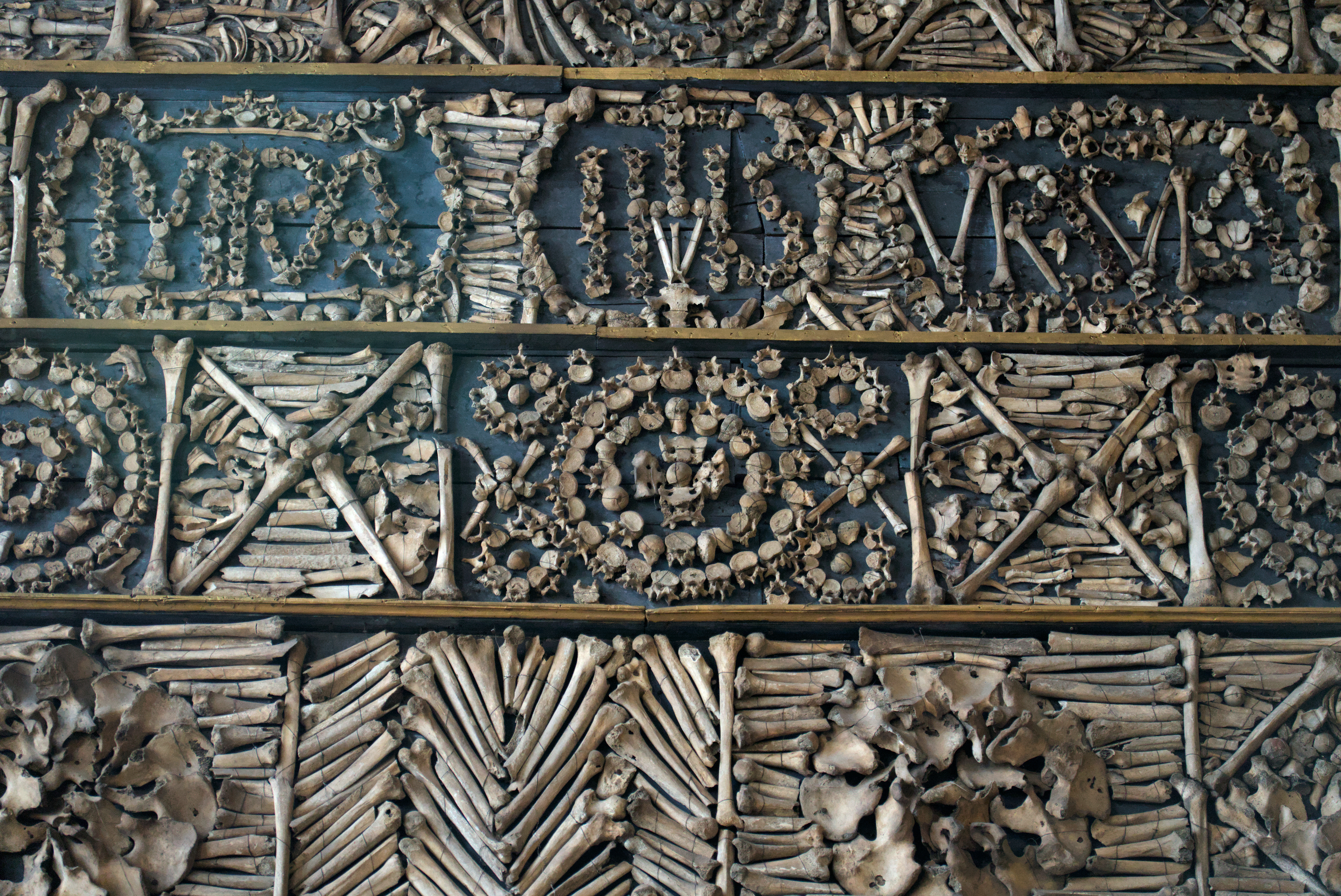
Golden Chamber
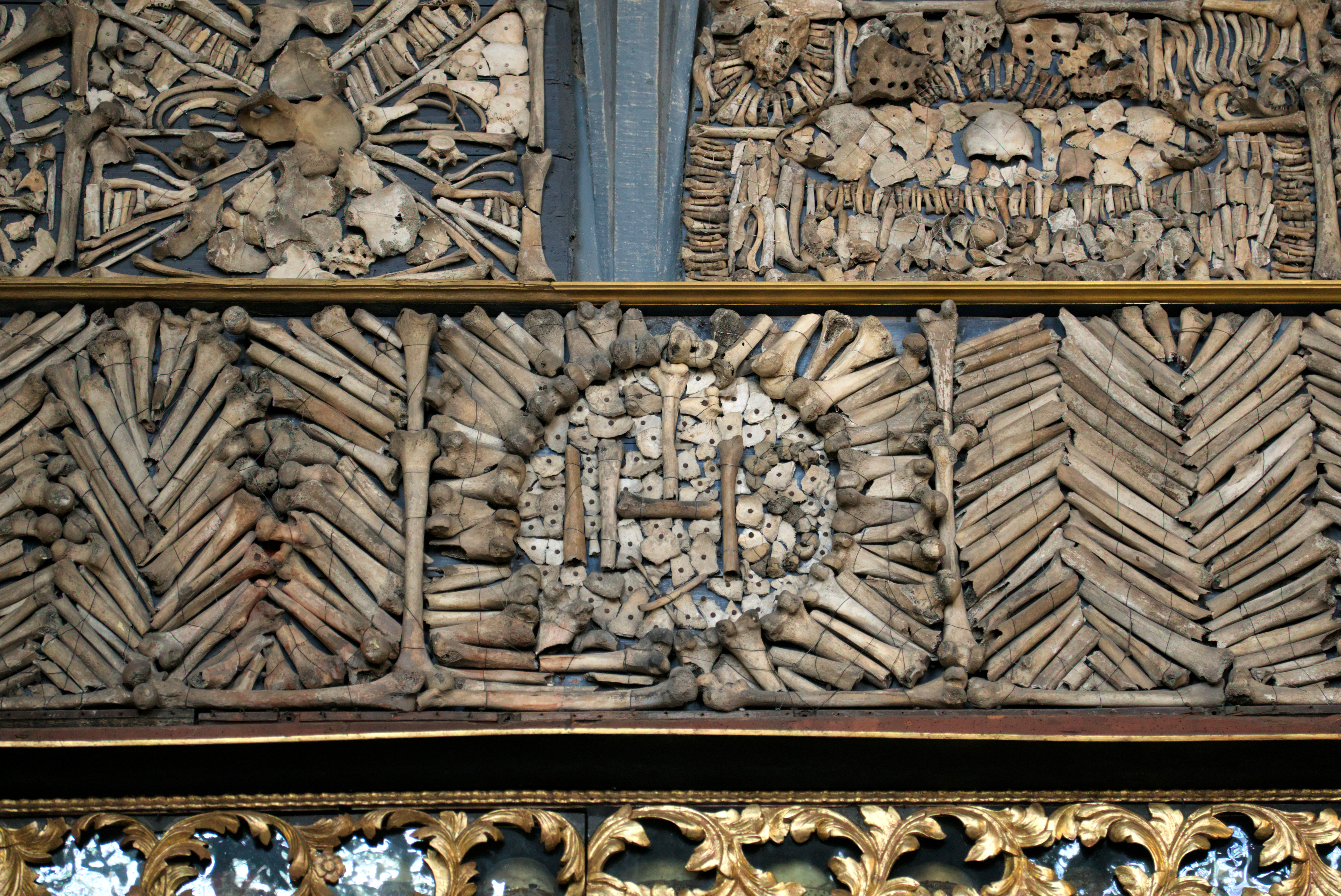
“IHS” is a popular Latin acronym for “Iesus Hominum Salvator” (Jesus, Savior of Humankind).

Golden Chamber
Golden Chamber
Golden Chamber

Similar visual displays of bones in charnel houses, writes art historian Jackie Mann, had become increasingly common in Europe by the late fourteenth century.

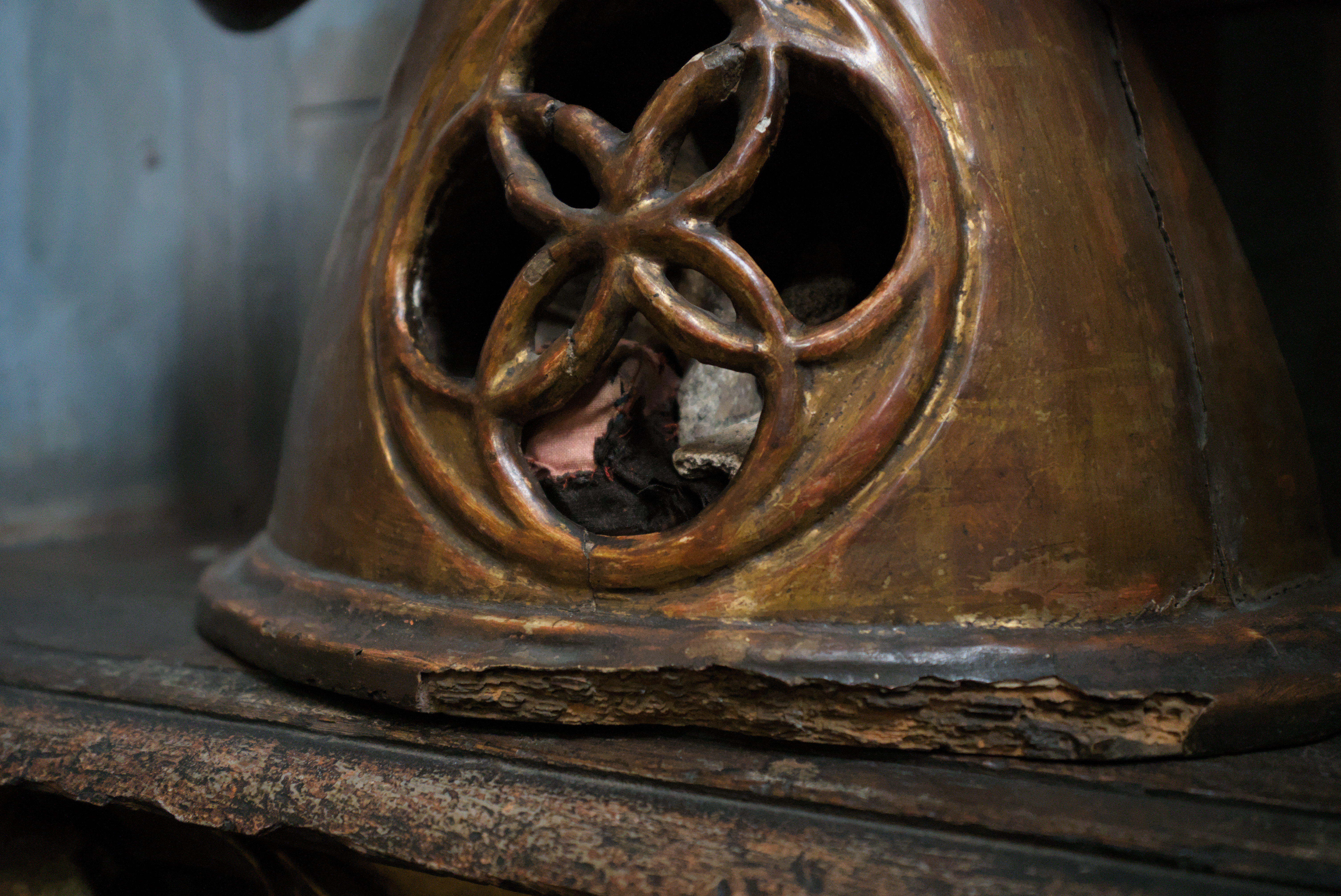
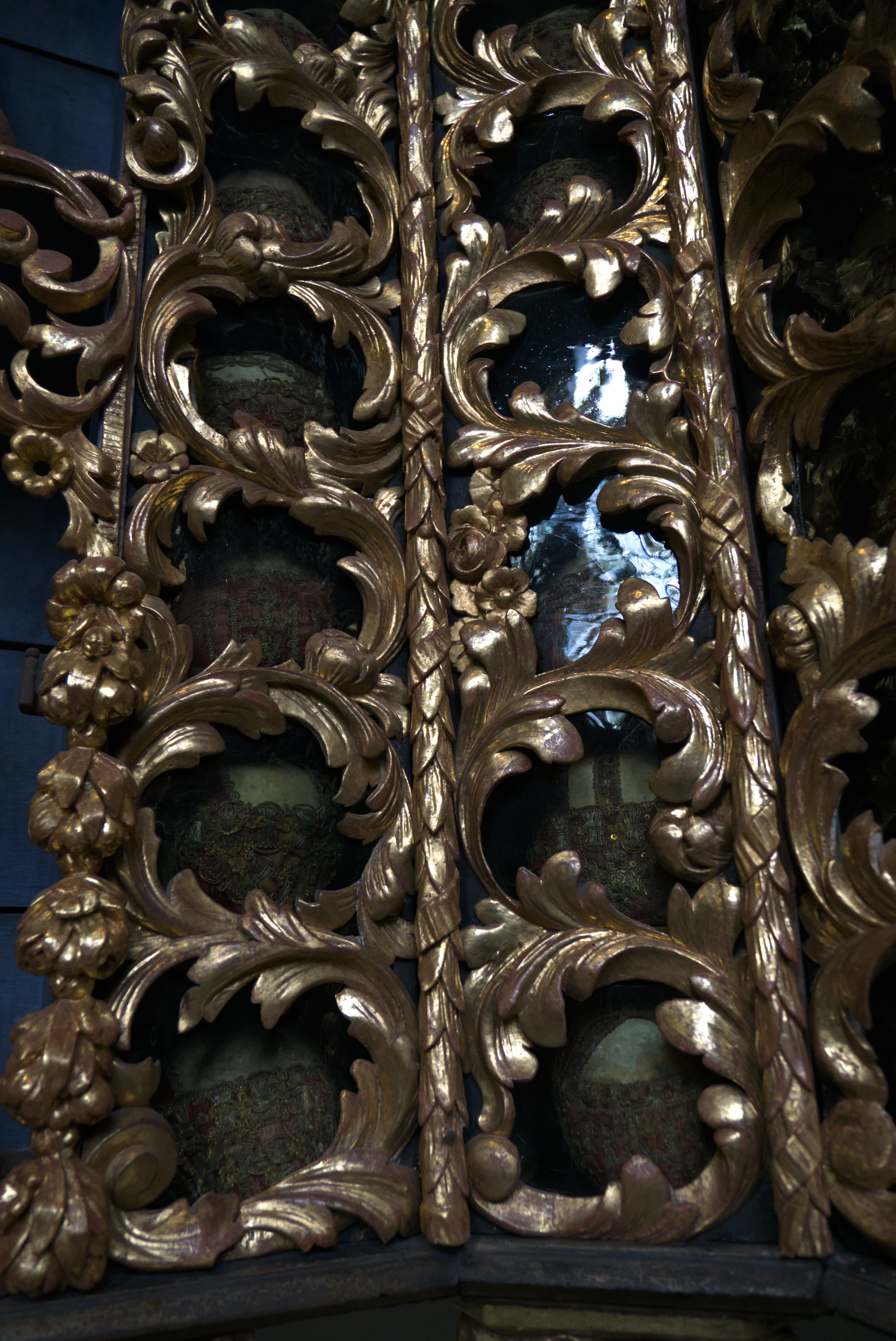
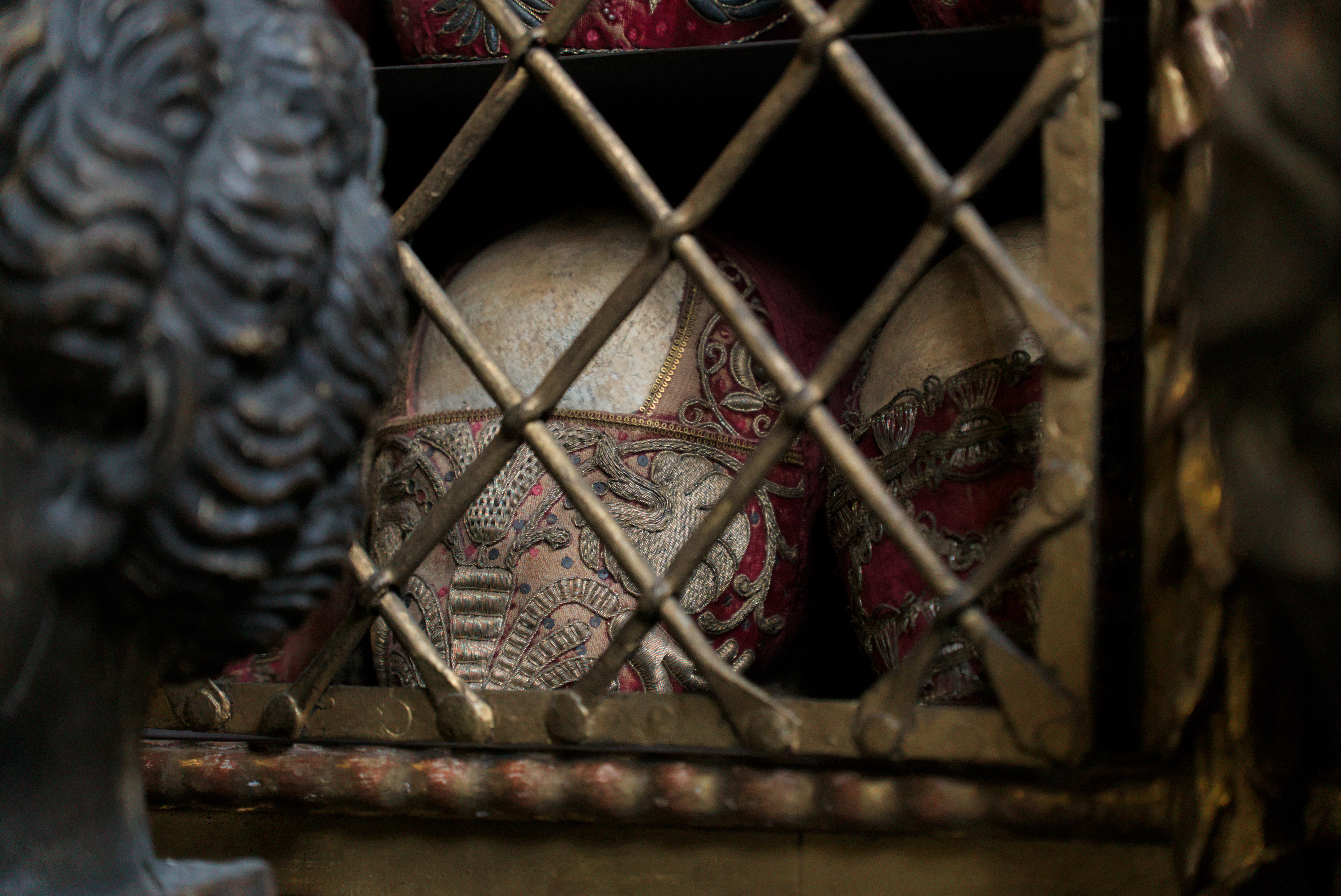
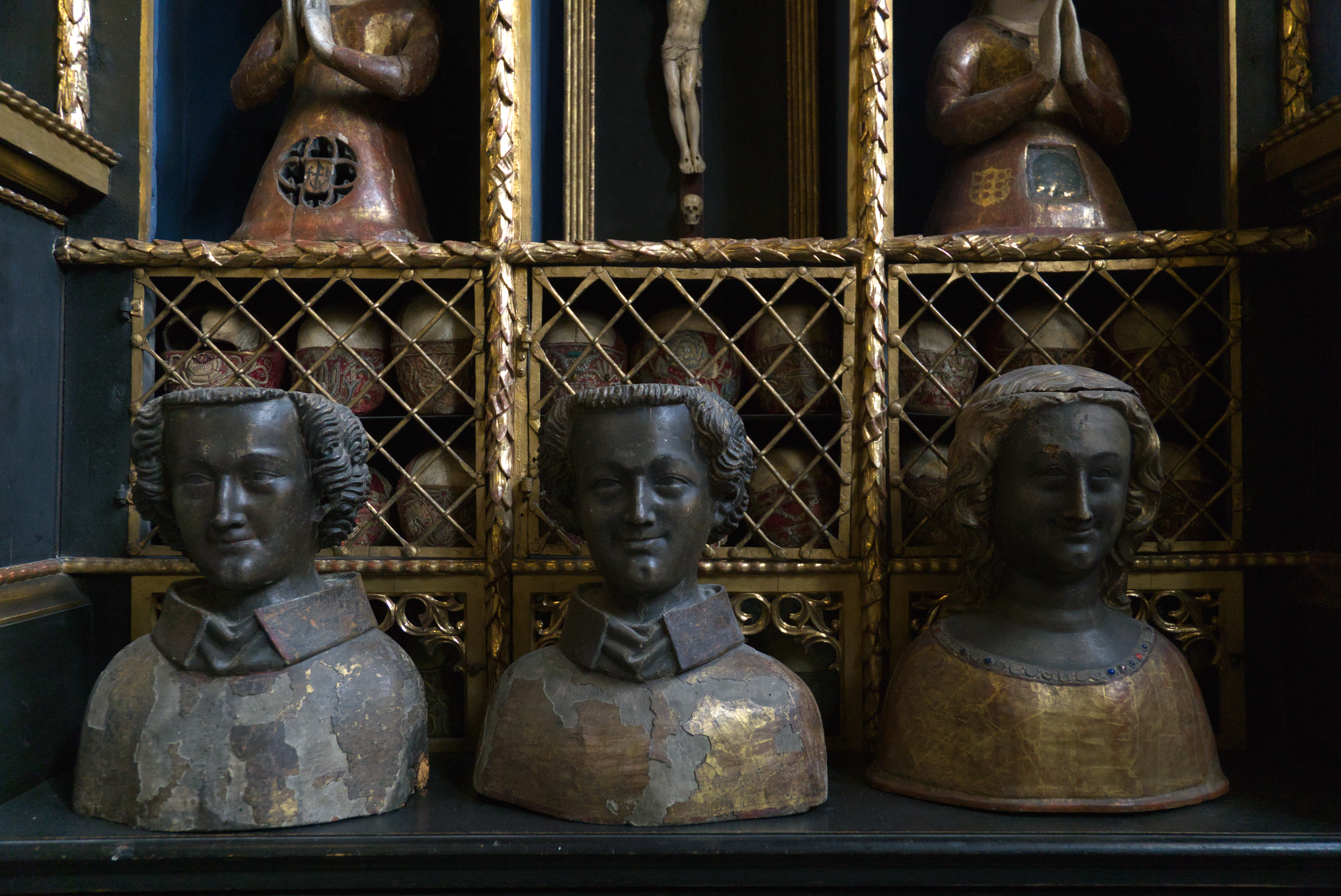
The shelving cabinets below the bone decor belong to the second phase of furnishings around 1700. They contain niches that house 112 reliquary busts (most of them produced between 1260 and 1400 and made of polychromed wood), as well as gilded acanthus tendrils that encompass some 600 skulls. Out of reverence, many of the skulls are at least partially wrapped in red velvet with gold and silver embroidery made by the nuns of the nearby Ursuline convent.
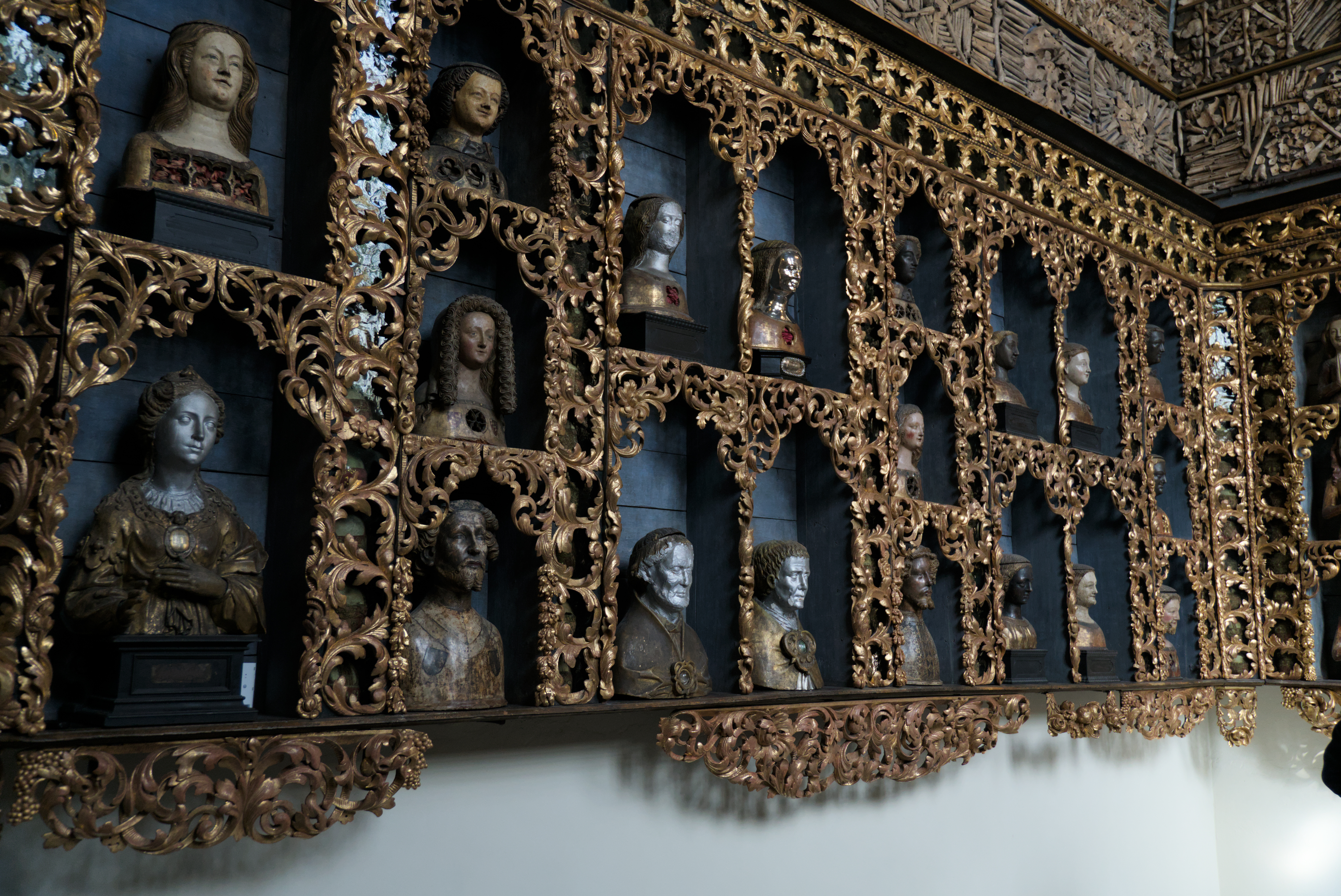
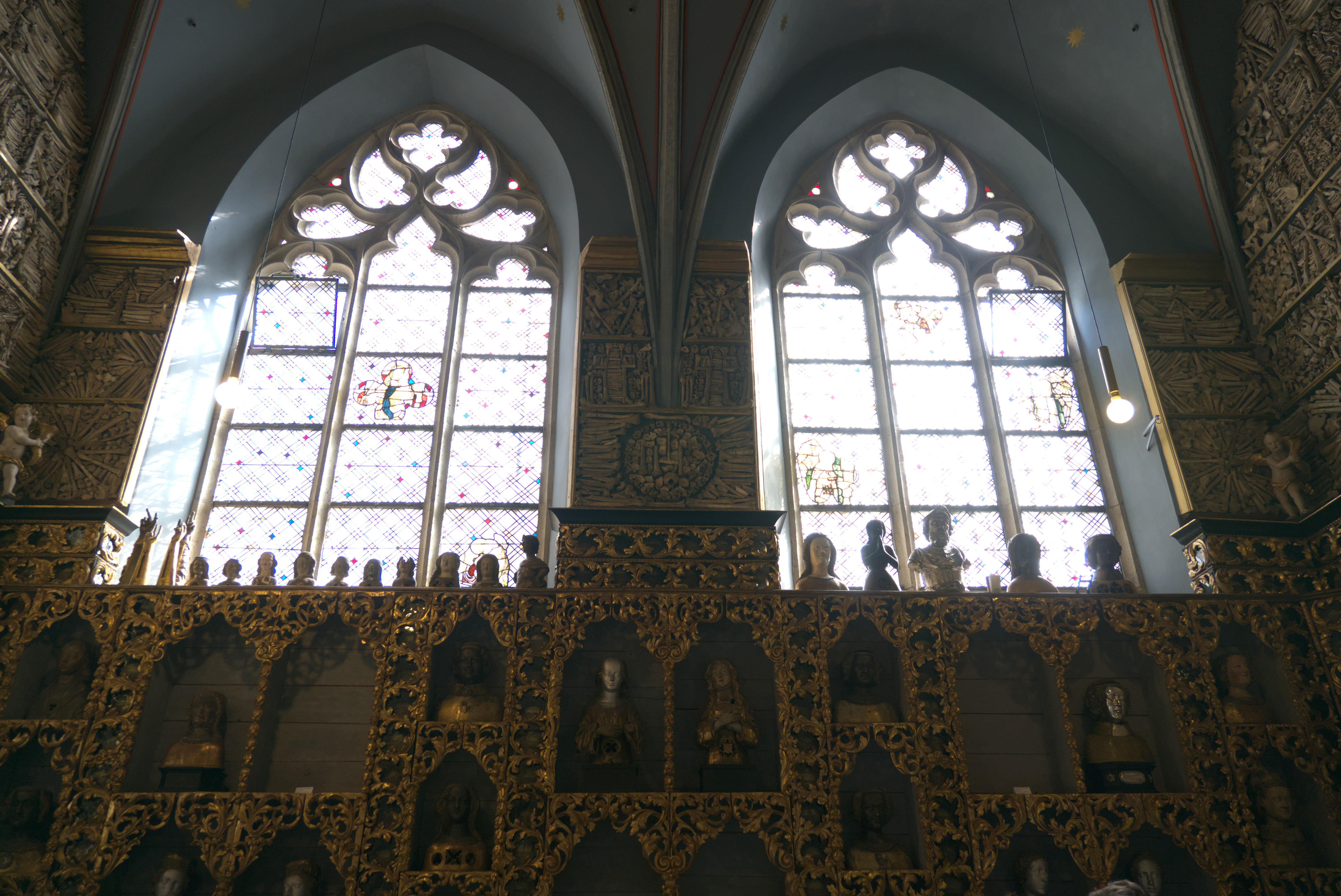
Golden Chamber
Golden Chamber
Inside a reliquary bust
Skulls
Skulls

Occasionally, where the wrapping has slipped, you’ll see an eye hole staring back at you.
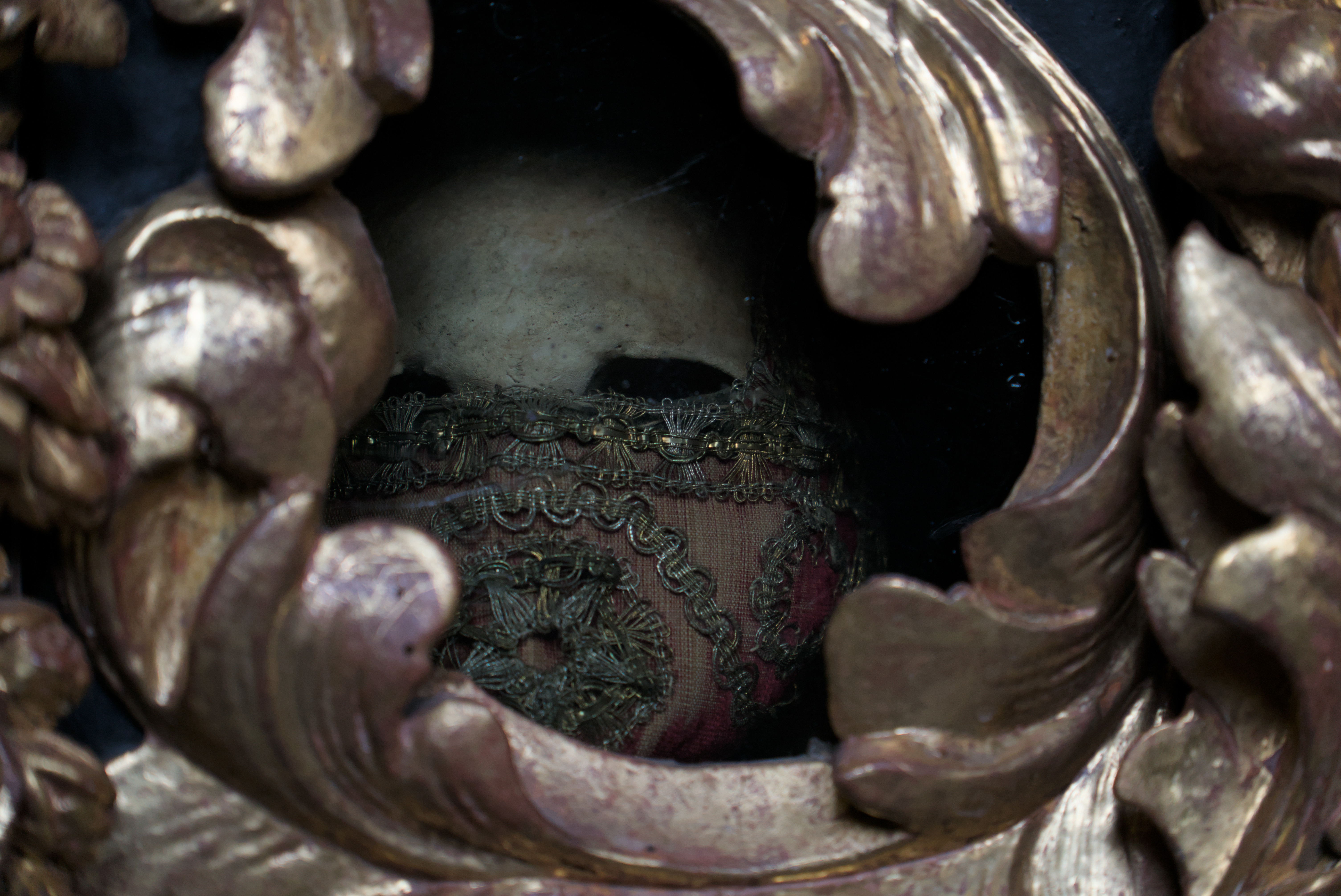
Skulls

To account for the presence of men’s bones in the ancient Roman churchyard, the legend of St. Ursula was adapted in the twelfth century to include male martyrs—namely, Etherius and his retinue. That’s why the Golden Chamber contains several male busts alongside the female.
Golden Chamber

To the average person, the Golden Chamber is a weird, macabre spectacle. But for Catholics, displaying human bones is not meant to be creepy or horror-inducing. Rather, by bringing remnants of the dead into spaces of the living, we are reminded of: (1) our own mortality, (2) the community of saints that transcends time, and (3) the promise of universal, bodily resurrection (dem bones gonna rise again!).

Memento mori (“remember you will die”) was a common trope in seventeenth-century art and devotion, meant to increase one’s awareness of the fleetingness of life and to encourage one to live in light of heaven. Mann calls the Golden Chamber an “immersive memento mori.” Again, the traditional Christian summons to remember our mortality is not meant to frighten. It’s meant to inspire us to live whole and holy lives.

While death is an ending in one sense, it’s also an entry into life immortal. The Golden Chamber gathers together the fragments of local saints that had been scattered in ancient burial ruins, preserving them for the saints of later generations as a witness that our bodies will never be finally lost; they will be raised and renewed by God on the last day and reunited with our souls. Christians treat the remains of the deceased with honor in recognition that our bodies—including the framework of bones that support our soft tissues, protect our organs, enable our movement, store minerals for our use, and produce our blood cells—are not just temporary shells encasing who we really are, but rather are a part of who we are. Hence why we proclaim, in the Apostles’ Creed, that “we believe . . . in the resurrection of the body.”

Memorial for the Martyrs of Today

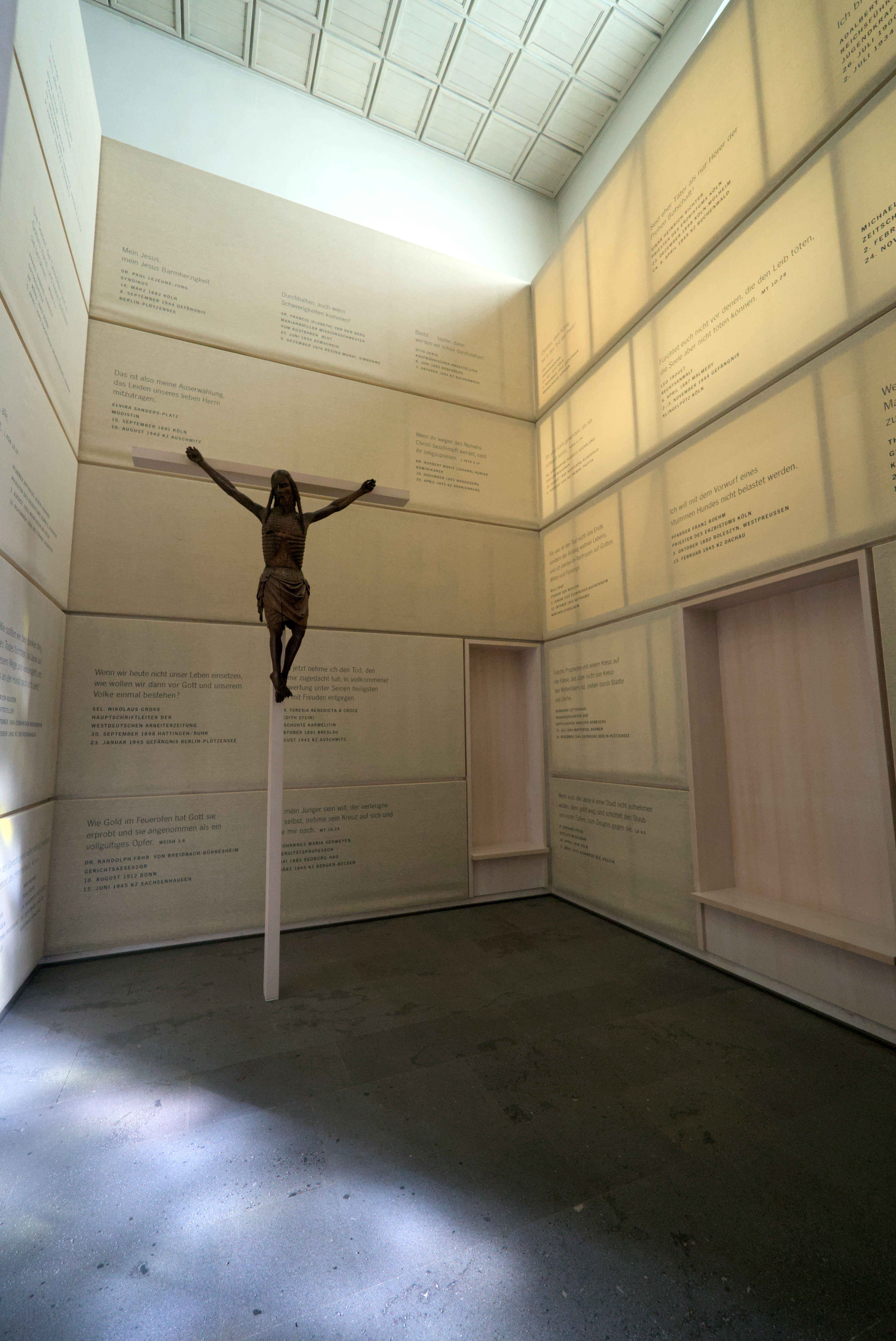
While the Golden Chamber is the primary draw for visitors to the Basilica of St. Ursula, there are other sights in the church worth spending time with, ones I was not expecting. One of them is the Gedenkstätte für die Märtyrer der Gegenwart (Memorial for the Martyrs of Today), a chapel in the south transept that commemorates the Christians in Cologne, both religious and lay, who were killed for resisting the Nazi regime—or, in the case of Sr. Teresa Benedicta of the Cross (Edith Stein) and Elvira Sanders-Platz, for being ethnically Jewish.
Memorial for the Martyrs of Today
Gedenkstätte für die Märtyrer der Gegenwart (Memorial for the Martyrs of Today), designed and built by the firm Kister Scheithauer Gross, 2003–5. South transept, Basilica of St. Ursula, Cologne.

Memorial for the Martyrs of Today

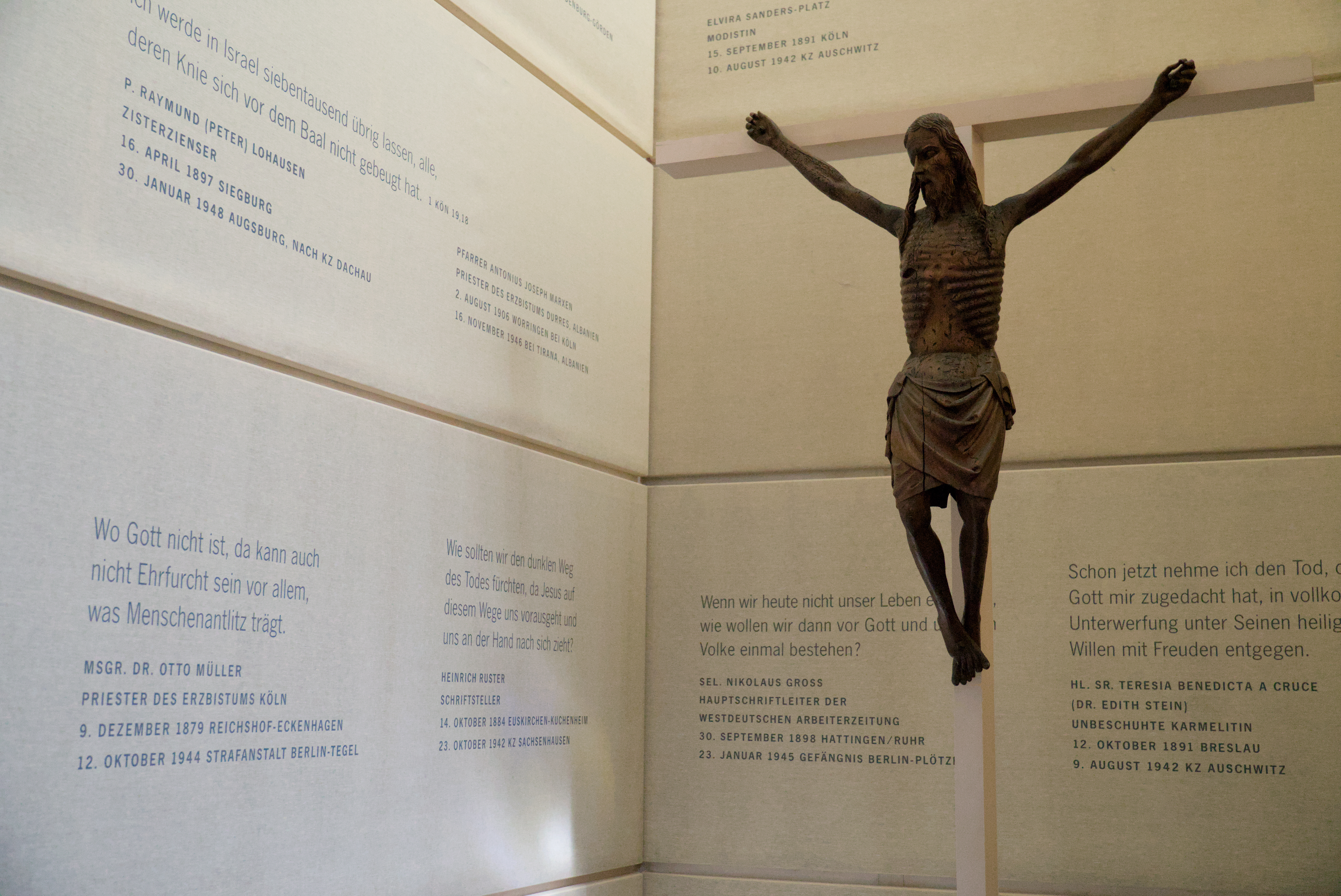
Made by the architectural and design firm Kister Scheithauer Gross, the chapel consists of a double-shelled, slightly transparent canvas construction printed on the inside with the names and dates of the martyrs, as well as quotes they gave before their deaths. Sunlight enters from the window to the right of the chapel, causing the space to glow. There’s a small bench on each of the three sides, for people to sit and pray or reflect.

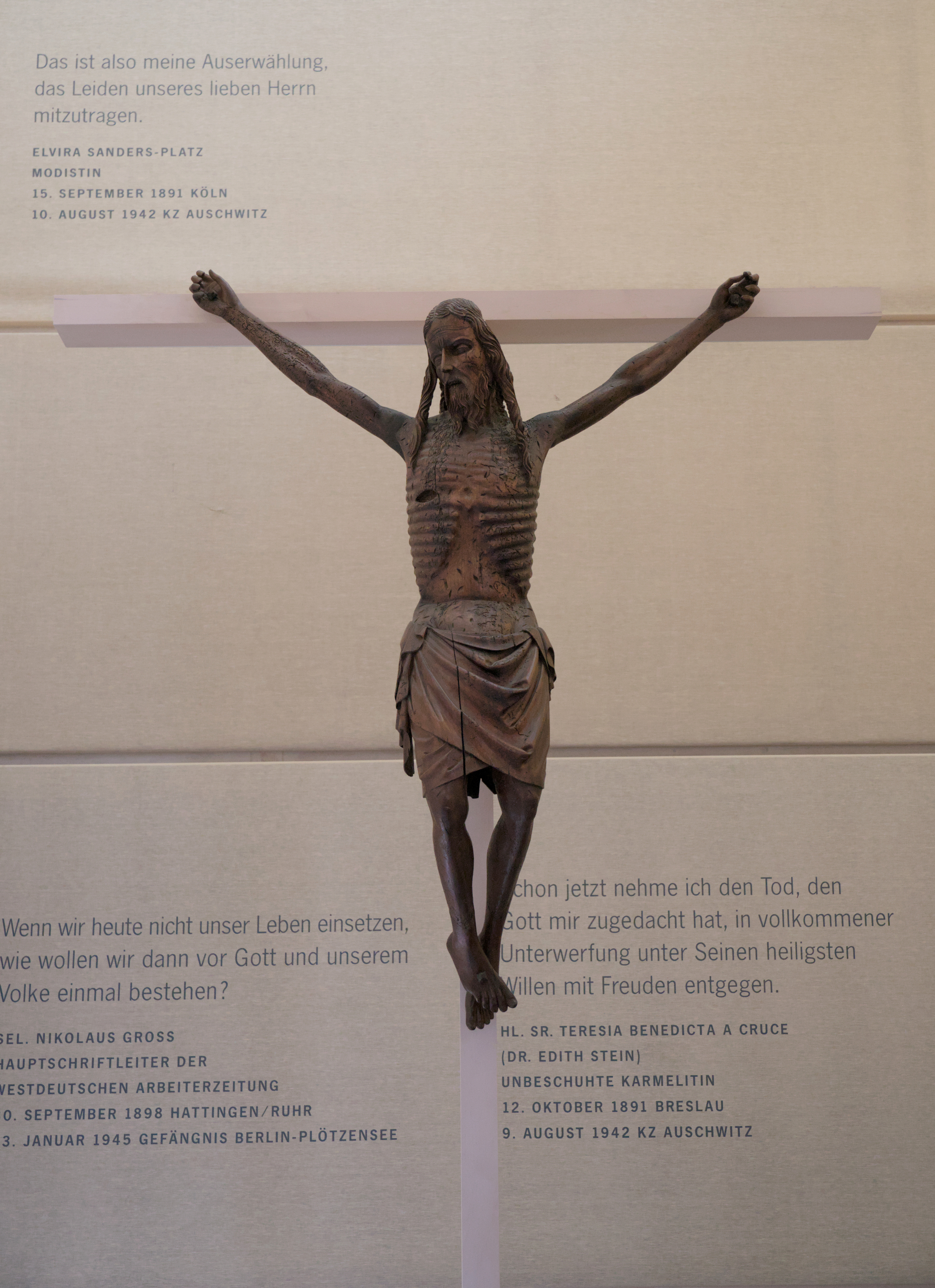
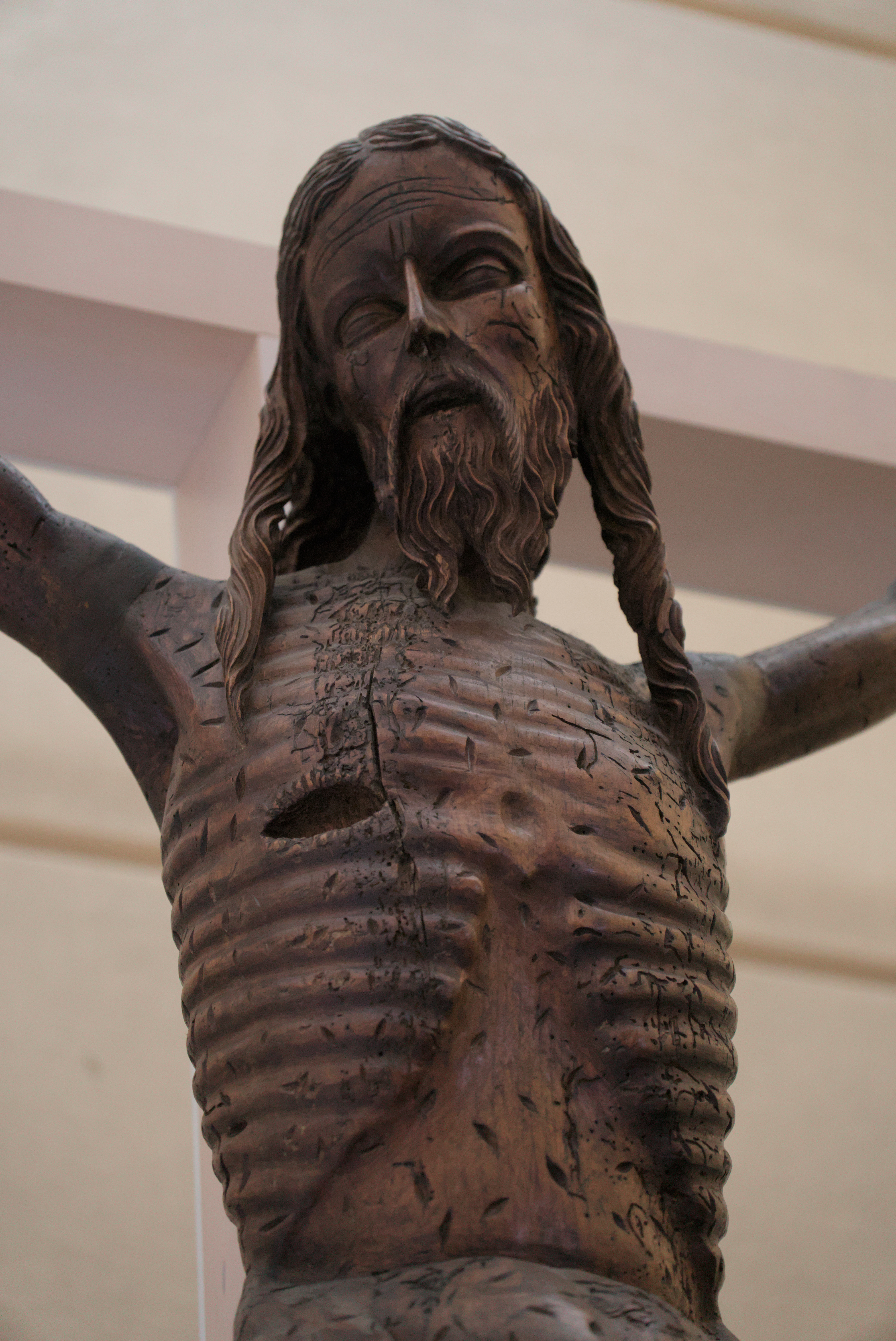
In the center is a life-size wood crucifix. The gaunt Christ figure is pierced all over and bears a deep wound in his side where the centurion’s spear went through. Like those whose names surround him, Jesus preached and pursued love and justice, ultimately laying down his life—a loss that God turned to gain in the Resurrection and in the redemption of the world.

A language barrier prevented me from effectively asking the staff person, or understanding the answer, whether the crucifix was carved in the early 2000s specifically for the chapel, or if it’s medieval. There’s no info inside the church about this chapel.
Crucifix
Crucifix

The Memorial for the Martyrs of Today is an example of what Christian martyrdom looked like in Cologne in the twentieth century. Fr. Otto Müller, Br. Norbert Maria Kubiak, writer Heinrich Ruster, medical student Willi Graf, Catholic Youth leader Adalbert Probst . . . The stories of the many individuals who were executed for subverting Hitler, for calling out his evils, in the name of Christ are far more compelling to me than the fabulous and convoluted story of an ancient princess killed in a land invasion and then heroized—for her virginity?

Contemporary Stained Glass

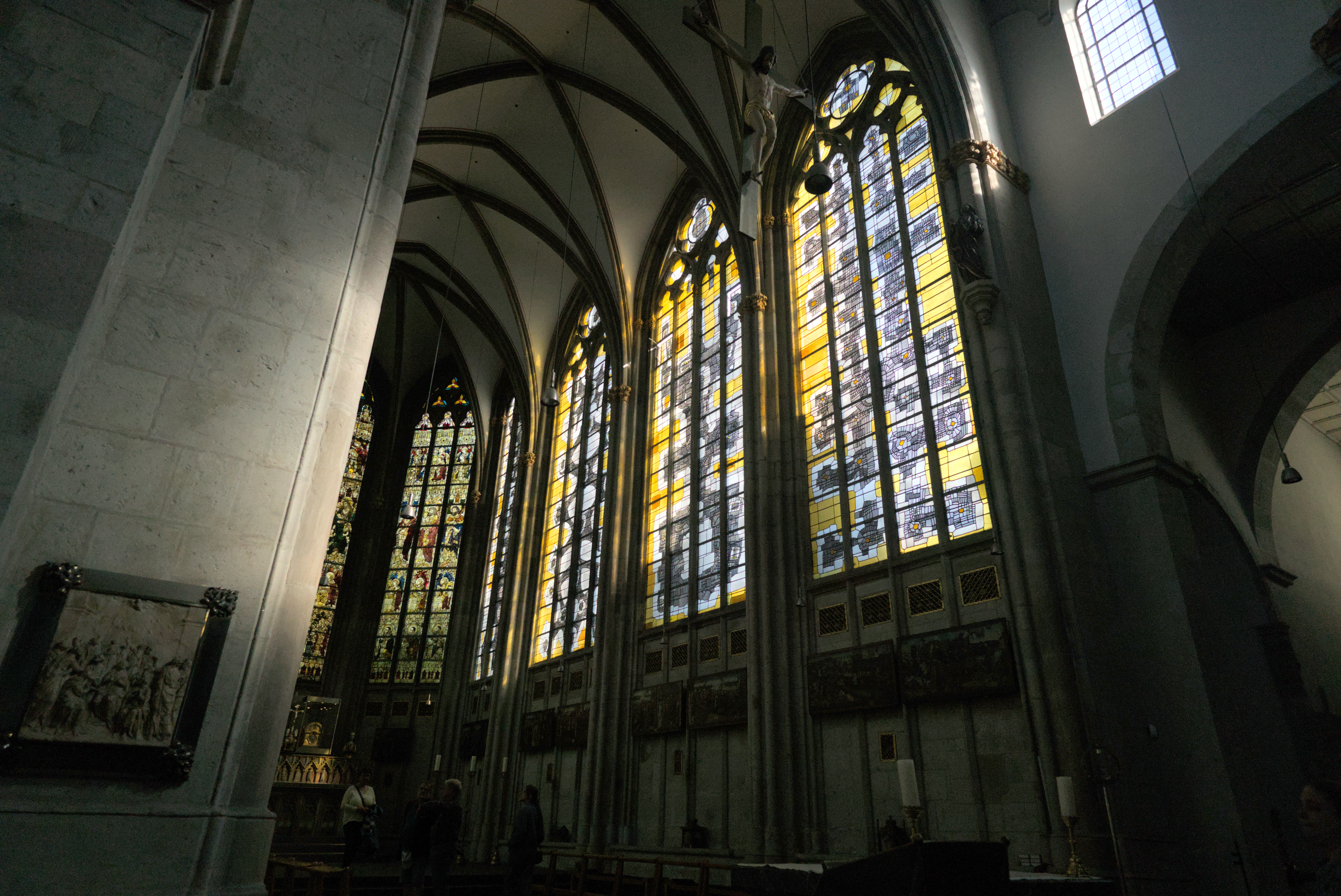
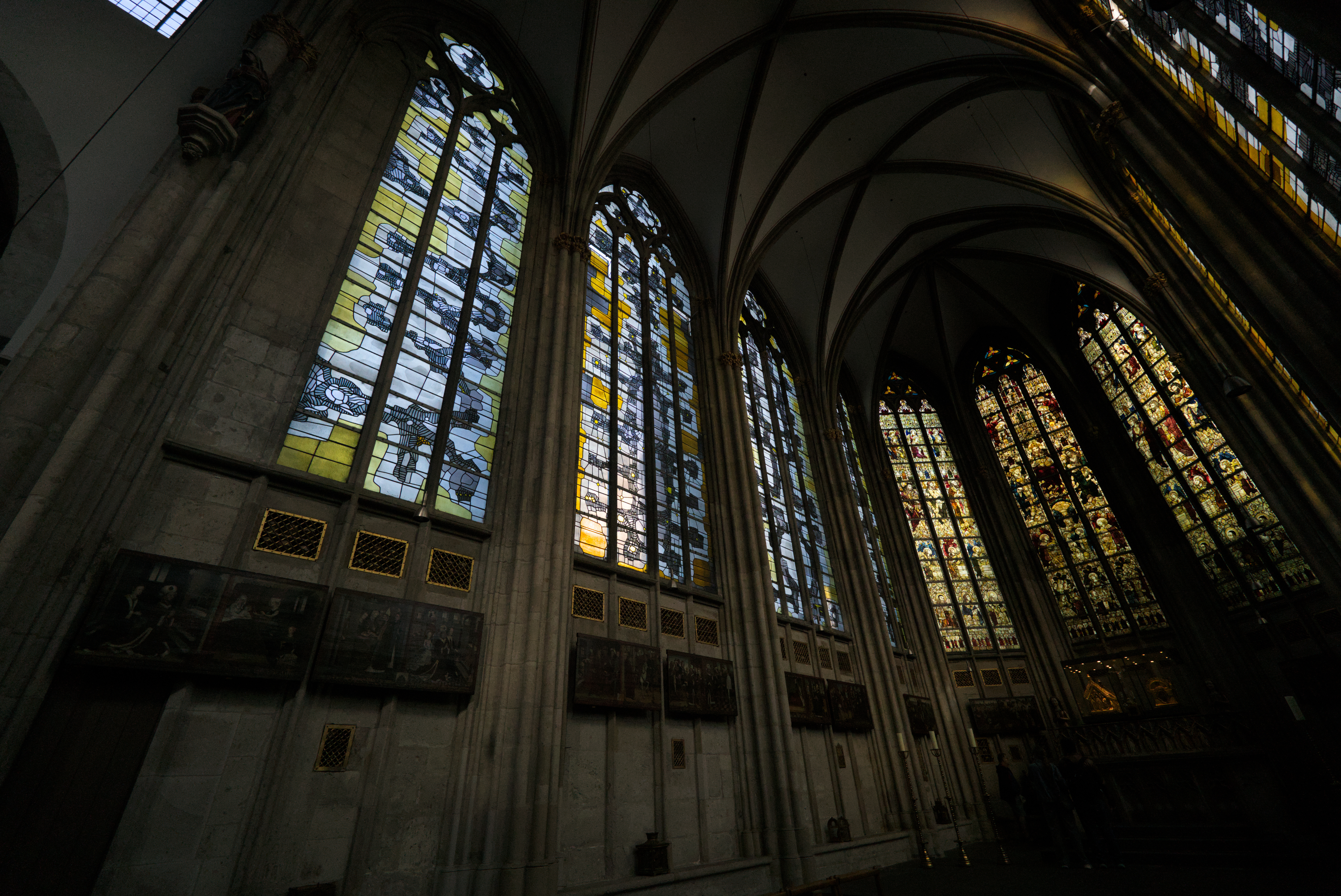
I also liked the contemporary stained glass in the church. In the choir, there’s a set of eight windows by Wilhelm Buschulte—abstract compositions in yellow, white, and gray.
Wilhelm Buschulte
Stained glass windows by Wilhelm Buschulte (German, 1923–2013), 1962, choir, Basilica of St. Ursula, Cologne

Wilhelm Buschulte

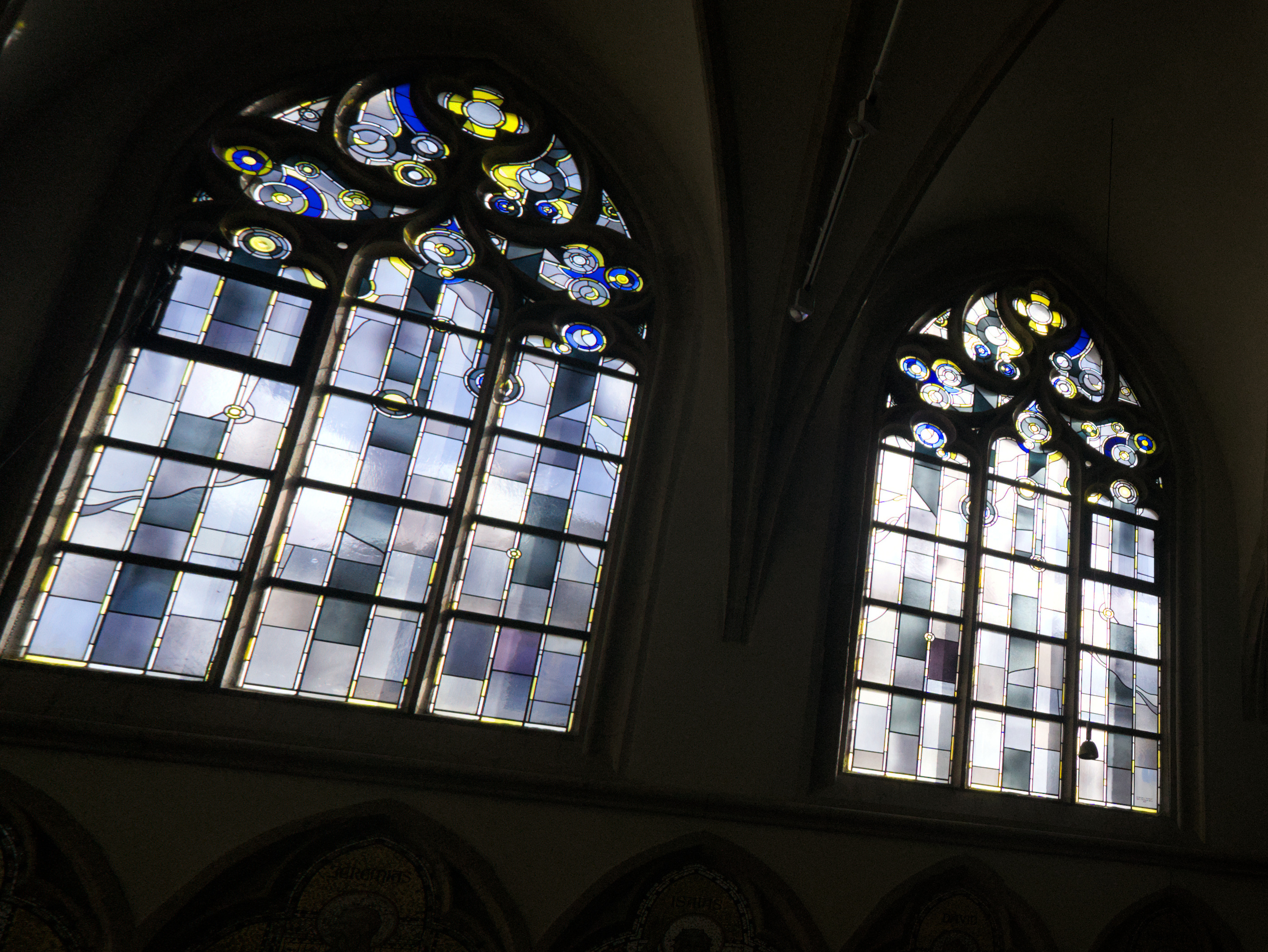
In the south aisle are two round-arched windows by Will Thonett, also abstract: a grid of blues, grays, and lavender, with yellow circles and thin vertical bands.
Will Thonett
Stained glass windows by Will Thonett (1931–1973), 1967, south aisle, Basilica of St. Ursula, Cologne

To the right of these are three Mary-themed windows by Hermann Gottfried. The primary scene of the first one is the Annunciation. A giant red rose appears in the background, probably a reference to Mary as the Rosa Mystica. Below this scene, to the left, is the Creation of Adam and Eve, and to the right, the Expulsion from Paradise; these contextualize Christ’s conception in the greater narrative of scripture. The peripheral scenes in the middle register show the magi following the star to Bethlehem.
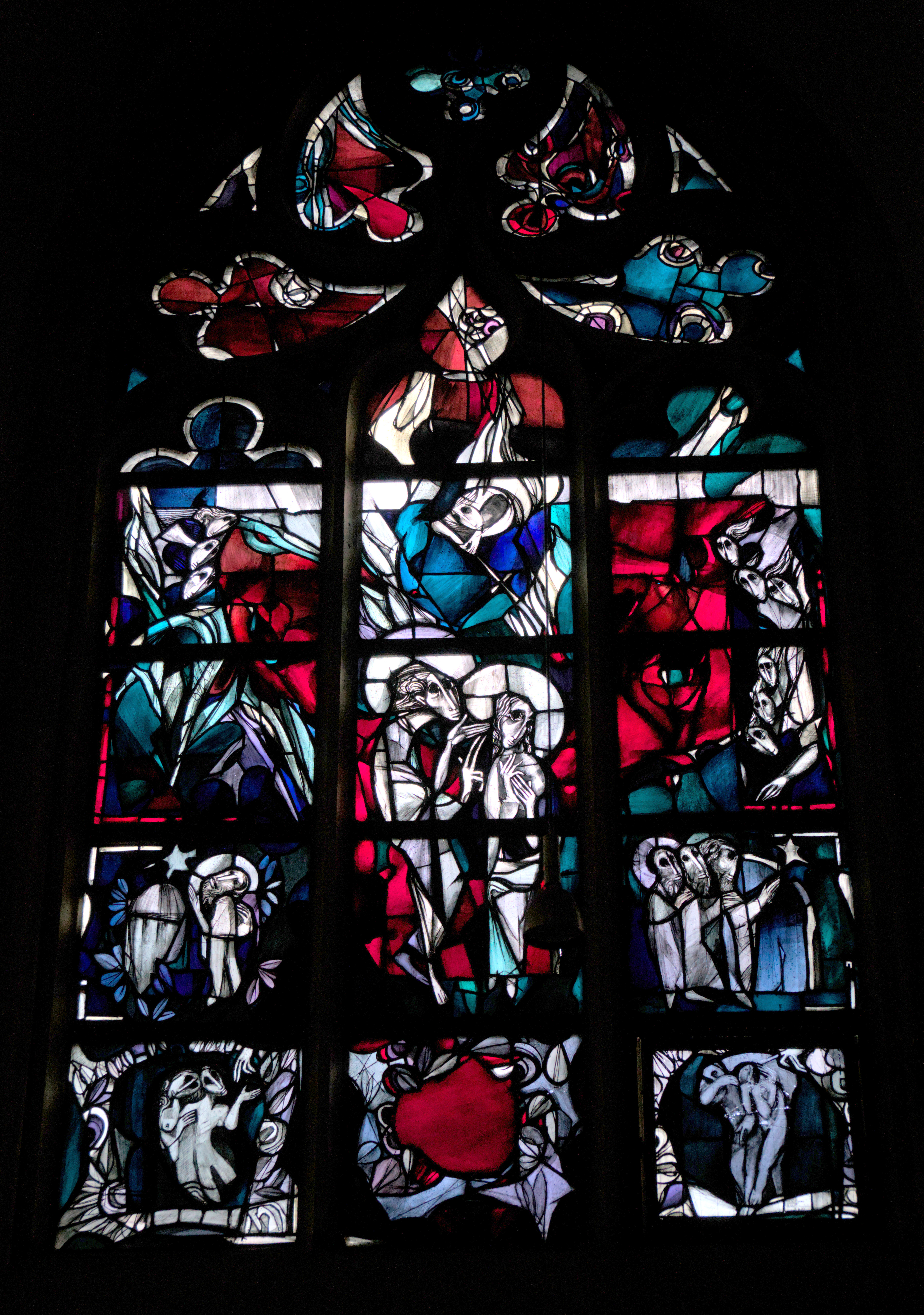
Hermann Gottfried_Annunciation
Stained glass window by Hermann Gottfried (German, 1929–), 1984, south aisle, Basilica of St. Ursula, Cologne

The central window portrays the Coronation of Mary. I believe both figures in the left lancet are Christ—crowning his mother as Queen of Heaven, and at the bottom, crushing the serpent, as the protoevangelium in Genesis 3:15 prophesied. Beneath the enthroned Mary on the right is a smaller vignette, which I think may be Mary again, also stepping on the serpent’s head, since by her cooperation with God’s plan, she shares in the victory over Satan. This imagery is also related to Woman of the Apocalypse described in Revelation 12, whom Catholics interpret as Mary. The hand of God dispenses blessing from above.
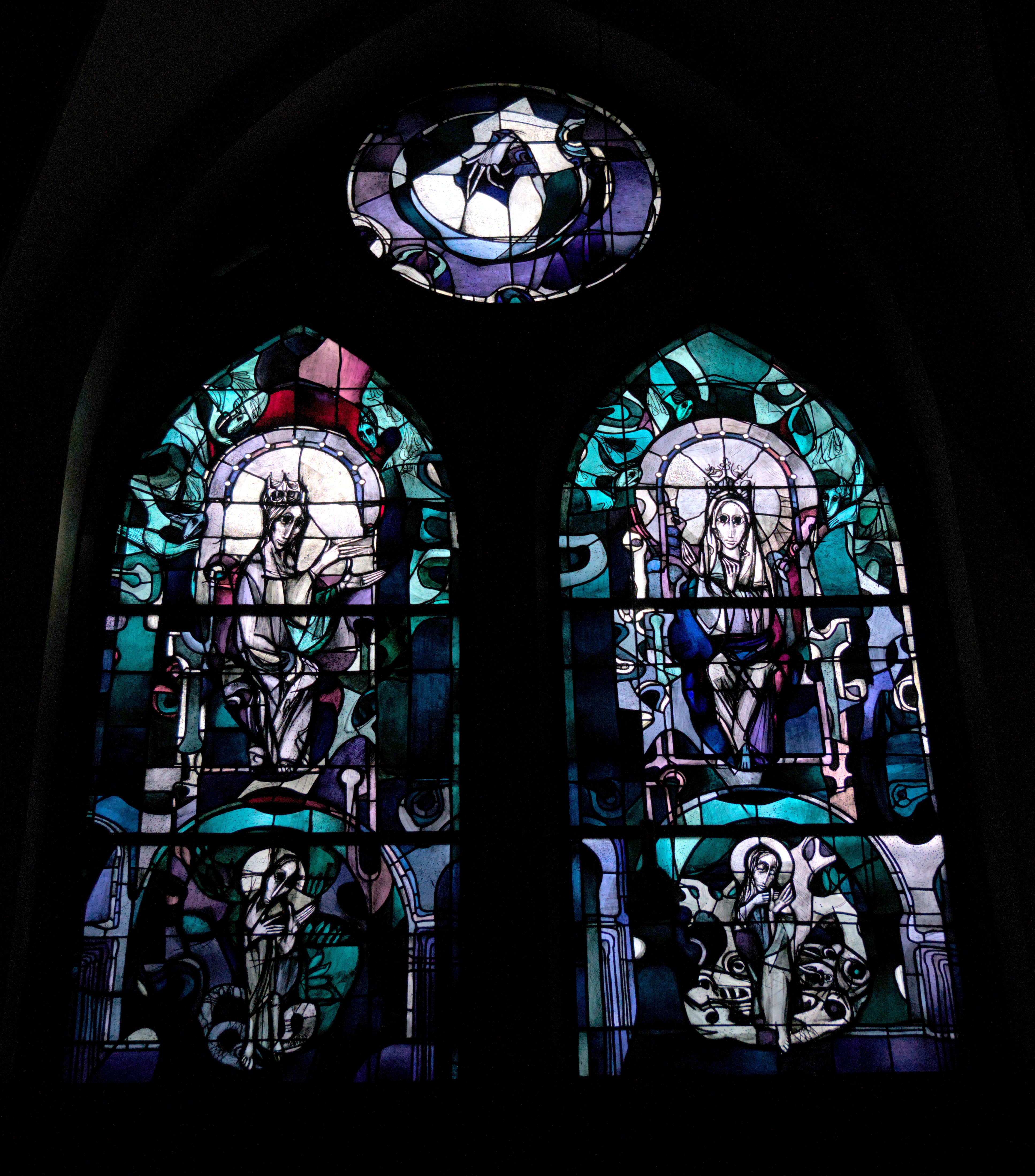
Hermann Gottfried_Coronation of the Virgin
Stained glass window by Hermann Gottfried (German, 1929–), 1984, south aisle, Basilica of St. Ursula, Cologne

The final window in this trio portrays the Descent of the Holy Spirit at Pentecost. The two quadrants at the bottom right show Moses before the burning bush, in which Mary appears; Catholic teaching compares Mary to the burning bush of Exodus because for nine months she held the fire of divinity within her womb (God incarnate) and was not consumed. On the left Moses is receiving the tablets of the law on Mount Sinai, an event often read in parallel with the story of Pentecost in Acts 2, where God writes his word not on stone but on people’s hearts by giving his Spirit to dwell within them.
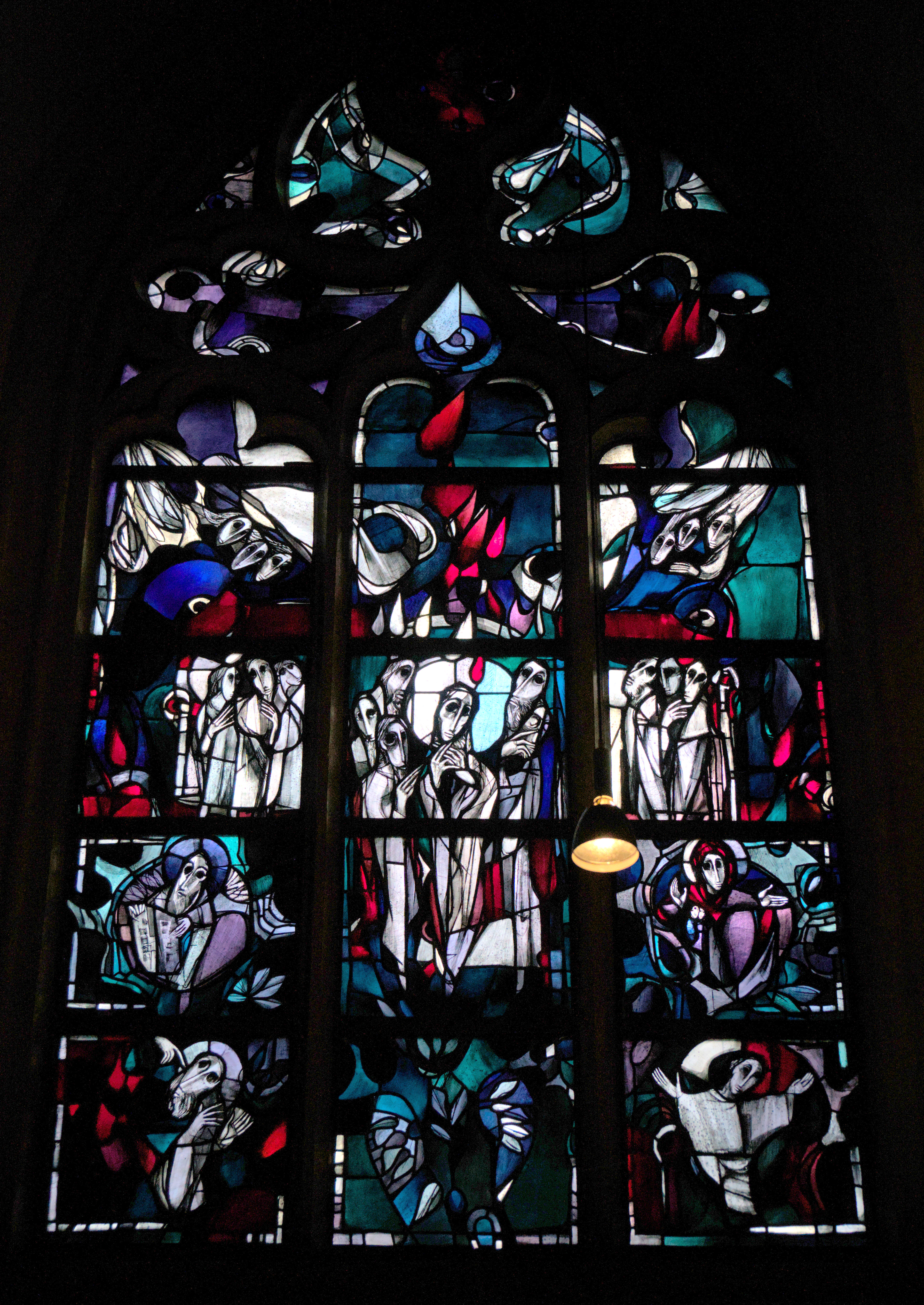
Hermann Gottfried_Pentecost
Stained glass window by Hermann Gottfried (German, 1929–), 1984, south aisle, Basilica of St. Ursula, Cologne


If you’re ever in Cologne, I encourage you to include the Basilica of St. Ursula on your itinerary. Entry to the church is free, but the Golden Chamber costs €2 (only cash is accepted, I believe). There are six large standing posters in the narthex that provide a timeline, in German, of the church’s history, and when I was there, there were two attendants who were available to answer questions, one of whom spoke some English.

For more comprehensive photos of the church’s art and architecture, see https://www.sakrale-bauten.de/kirche_koeln_st_ursula.html and https://www.winckelmann-akademie.de/wp-content/uploads/Koeln_St._Ursula.pdf.

Kolumba and KMSKA: Medieval and contemporary art in conversation (part 1)

One of the delightful surprises of my recent trip to Germany and Belgium was to find, in two of the museums I visited, an integration of the old and new in the curated galleries. Typically, art museums choose to arrange their collections chronologically, grouping together artworks from a particular era, and within each era, like styles. But in Kolumba museum in Cologne and the Koninklijk Museum voor Schone Kunsten Antwerpen (KMSKA) in Antwerp, medieval art from each museum’s collection (and in the case of KMSKA, Renaissance and Baroque art too) is displayed alongside contemporary pieces, creating a vibrant dialogue.

With the exception of the exterior shot of Kolumba, all photos in this post are my own.

Kolumba Kunstmuseum, Cologne

Originally called the Diözesanmuseum (Diocesan Museum), Kolumba was founded in 1853 by the fledgling Christlicher Kunstverein für das Erzbisthum Köln (Christian Art Association for the Archbishopric of Cologne), making it the city’s second oldest museum after the Wallraf-Richartz-Museum. Its collection focus for the majority of its history was late medieval art from Cologne and the Lower Rhine.

Kolumba’s first permanent home, just south of Cologne Cathedral, was a former sugar factory, but the building was destroyed in World War II, though much of the art had been safely evacuated beforehand. After the war, Kolumba relocated its art to a grammar school, then to rented rooms in the Gereonstraße, then to the Curia building at Roncalliplatz 2. But the limited space was an issue.

In 1989, ownership of the museum was transferred to the Archdiocese of Cologne, who decided to expand the collection to include modern and contemporary art, not only by German artists but by international artists as well. The museum shifted its approach from displaying traditional sacred works only, to placing those works in juxtaposition with newer ones by artists who aren’t necessarily Christian but whose works can converse fruitfully with their core collection. They also secured funding to construct a new permanent building.

In 2004, the museum’s name was changed to Kolumba in honor of the history of the site on which the new (and current) building would stand: atop the ruins of the medieval St. Kolumba church, destroyed in an air raid in 1943. St. Columba of Sens was a third-century virgin martyr who was born in Spain but lived mostly in France. The church dedicated to her in Cologne once housed Rogier van der Weyden’s St. Columba Altarpiece (now at the Alte Pinakothek in Munich), a triptych with scenes of the Annunciation, the Adoration of the Magi, and the Presentation in the Temple.

Kolumba museum
Kolumba museum, Cologne. Photo: HP Schaefer / Wikimedia Commons.

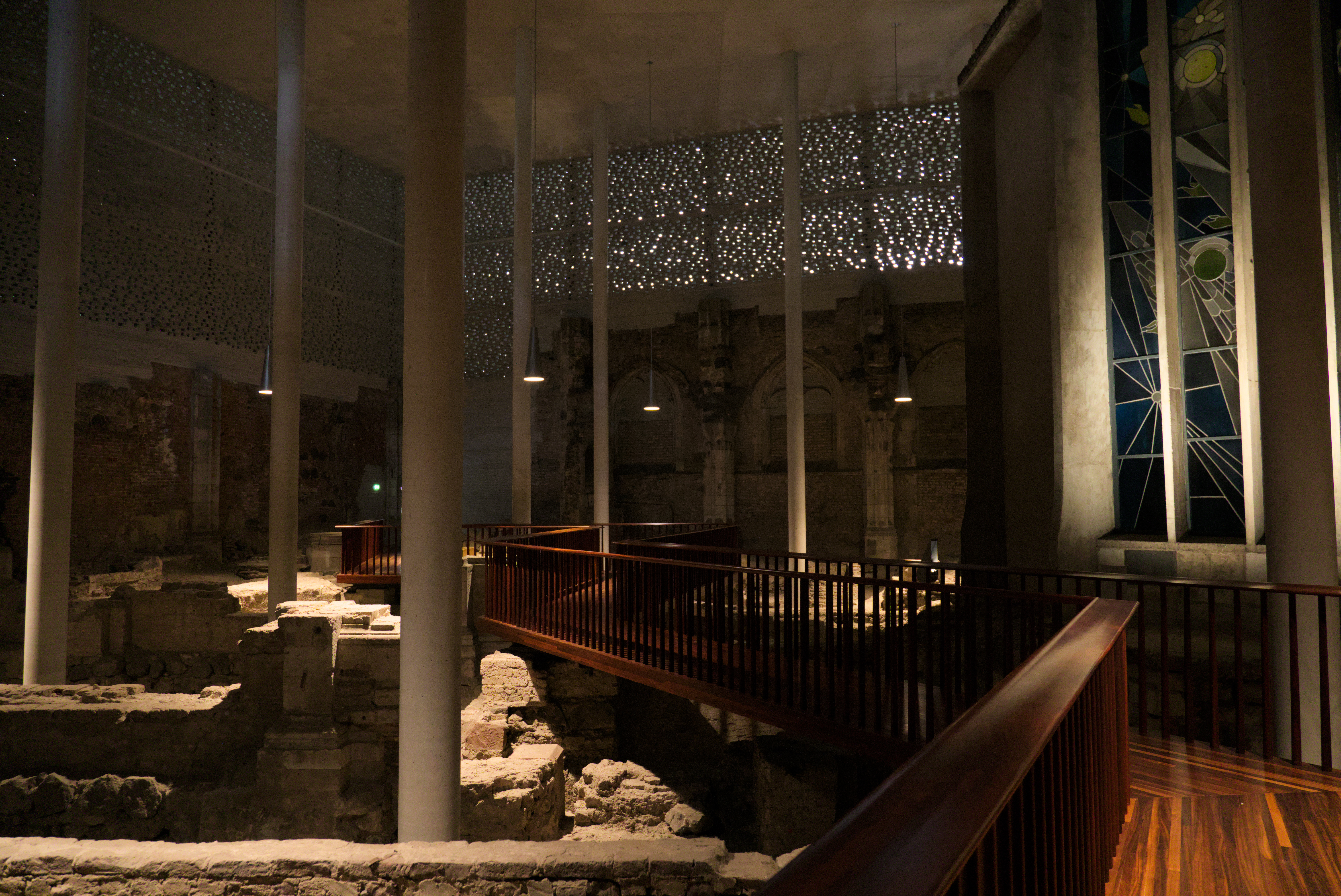
Kolumba museum’s permanent home opened in 2007 at Kolumbastraße 4. Designed by the Swiss architect Peter Zumthor (view more architectural photos here), the building encapsulates the bombed-out Gothic ruins of St. Kolumba with forty-foot-high, porous concrete walls, above which sit the floors of the museum.

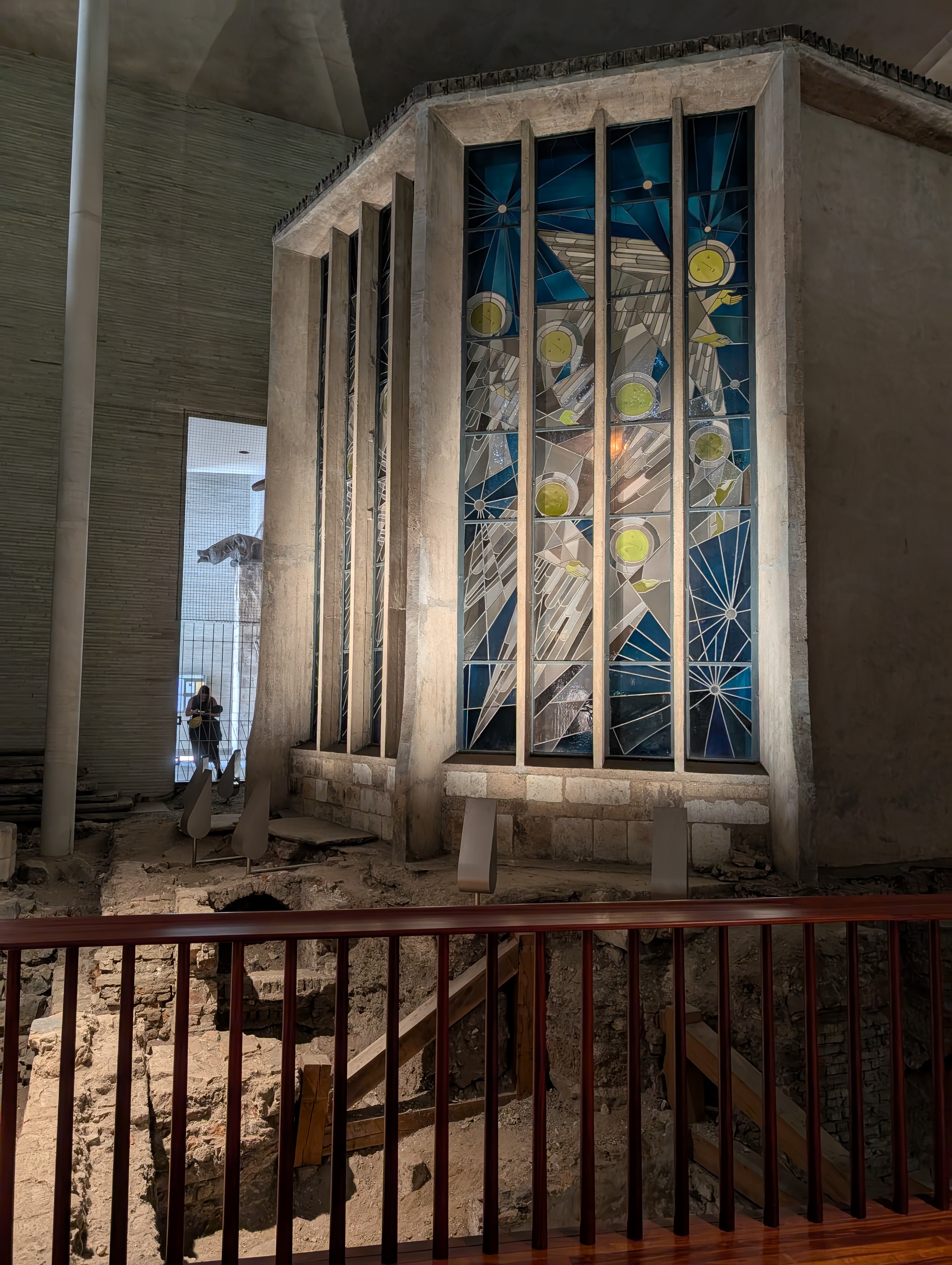
It also incorporates the Madonna in den Trümmern (Madonna in the Ruins) chapel, an octagonal tent-like structure built by Gottfried Böhm in 1947–50 to house a late Gothic statue of the Madonna and Child that miraculously survived the Allied bombings and for the liturgical use of the small Kolumba parish, which continues today.

Ruins of St. Kolumba
The ruins of St. Kolumba church, which dates back to the tenth century (with subsequent expansions and a Gothic-style rebuilding), are integrated into the architecture of Kolumba museum.

Madonna in the Ruins chapel
Exterior of the “Madonna in the Ruins” chapel, dedicated 1950, underneath Kolumba museum in Cologne, with stained glass designed by Ludwig Gies (1887–1966), installed 1954.

The postwar chapel is not accessible from inside the museum; it has its own separate entrance, which, as I found out after I had already left, is on the south side of the building, along Brückenstraße.

But I did cross over the excavation site of St. Kolumba to which the written museum guide directs visitors (it’s labeled “room 3”), and through which a walkway has been constructed. As I took in the war-wrought devastation, I wondered about the sounds I was hearing from an audio system. Turns out it was a sound installation called Pigeon Soundings by the American artist Bill Fontana. In 1994, he made a series of eight-channel sound map recordings of the pigeons that were inhabiting the St. Kolumba ruins at the time, particularly the rafters of the temporary wooden roof that had been erected. The recordings picked up not just the birds’ cooing and flapping, but also the ambient sounds outside.

Above this darkened space, Kolumba has sixteen exhibition rooms. The museum reinstalls its collection annually, each fall opening a new exhibition. I was there for the first day of “make the secrets productive!” Art in Times of Unreason, which runs from September 15, 2025, to August 14, 2026. The lack of art signage throughout is deliberate, to promote a more meditative experience; instead, visitors are given a (German-language) booklet, organized by room, that identifies the pieces on display and provides commentary for some.

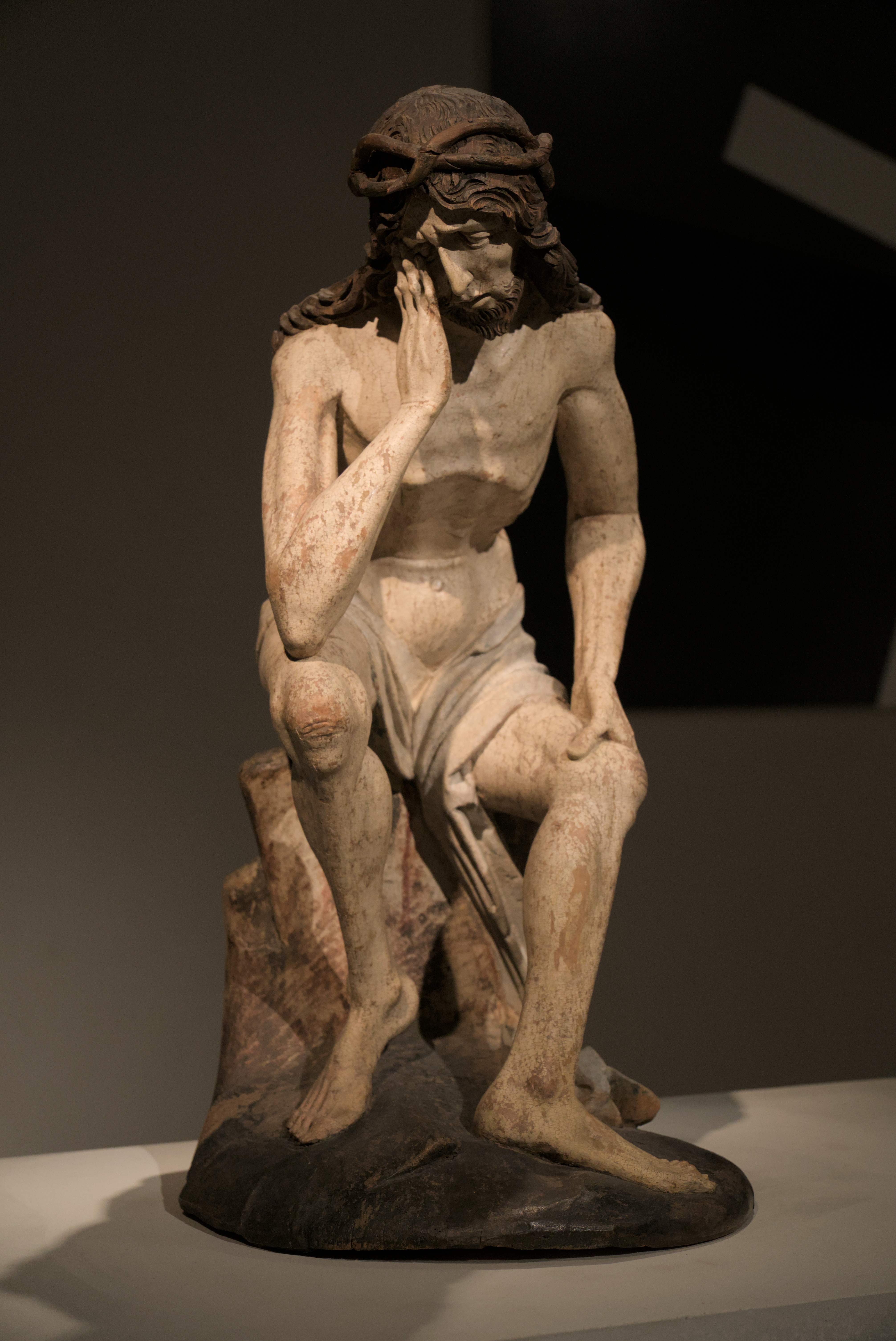
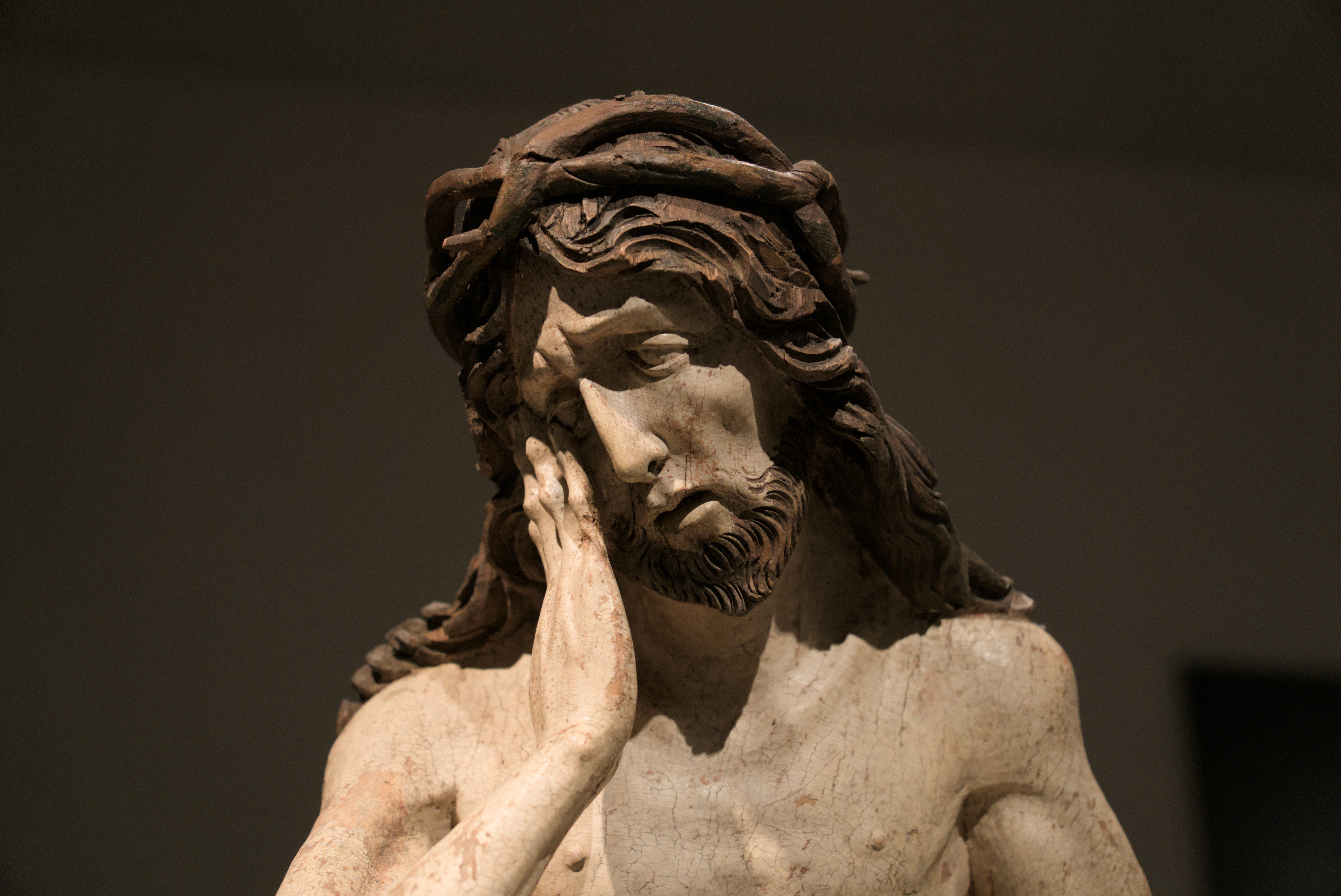
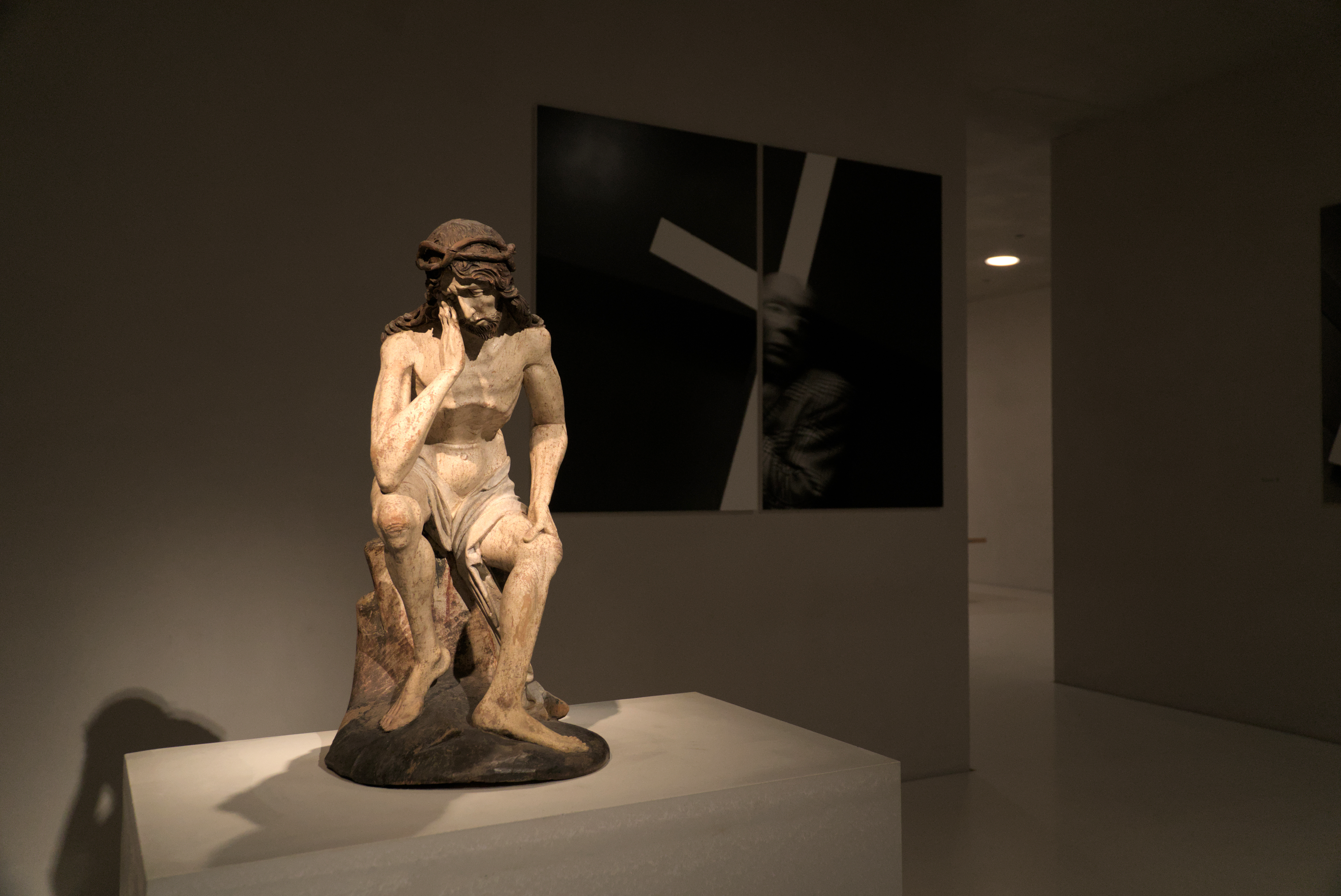
Room 8 features a fifteenth-century sculpture of Christ at Rest—“at rest” not in the sense of being at peace in mind or spirit (he is visibly troubled), but rather in a bodily state of motionlessness or inactivity. Sometimes also called Christ in Distress, Christ on the Cold Stone, or Pensive Christ, the iconography shows an interior moment during Christ’s passion in which, having just been flogged, he sits awaiting his final torture: crucifixion.

Christ at Rest (Upper Rhine)
Christus in der Rast (Christ at Rest), Upper Rhine, ca. 1480. Linden wood with visible primer and remnants of colored paint. Kolumba museum, Cologne.

Christ at Rest (detail)

Though the Gospels don’t mention a moment of seated pause in the narrative, artists were influenced by the figure of Job, an innocent sufferer who in that way prefigured Christ, and in particular the description in Job 2:8 of him sitting on a dung heap. The image of Jesus preparing to meet his death was meant to inspire feelings of pity. Isolated from the action and from all the other characters, the lone figure invites viewers to enter empathetically into the emotional anguish he suffered on his way to the cross.

At Kolumba, this sculpture is surrounded by large-scale, black-and-white photographs from the Transzendentaler Konstruktivismus (Transcendental Constructivism) series by the collaborative duo of German neo-dadaist artists Anna and Bernhard Blume. In the series the couple is threatened by white geometric objects that are unleashed on them in a blur of motion.

Christ at Rest and Transcendental Constructivism
Foreground: Christ at Rest, Upper Rhine, ca. 1480. Background: Anna Blume (1936–2020) and Bernhard Blume (1937–2011), photograph from the Transcendental Constructivism series, 1992–94.

The diptych that hangs behind the Christ sculpture appears to show a man carrying a cross, disoriented by its weight.

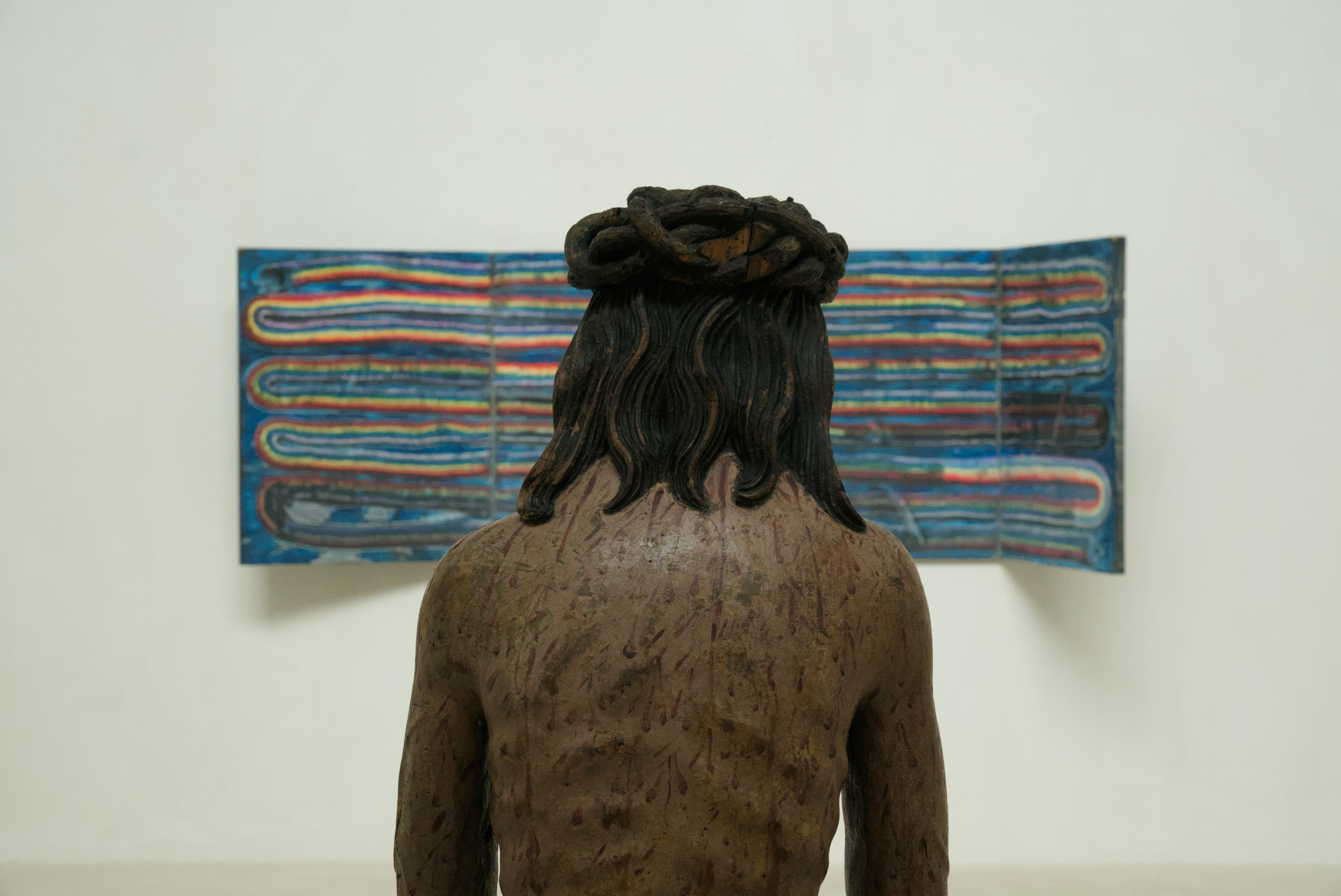
One of the other resonant pairings at Kolumba is in room 21, which stages a fifteenth-century Ecce homo sculpture across from a colored chalk drawing on a three-paneled blackboard.

Ecce Homo and Plumed Serpent

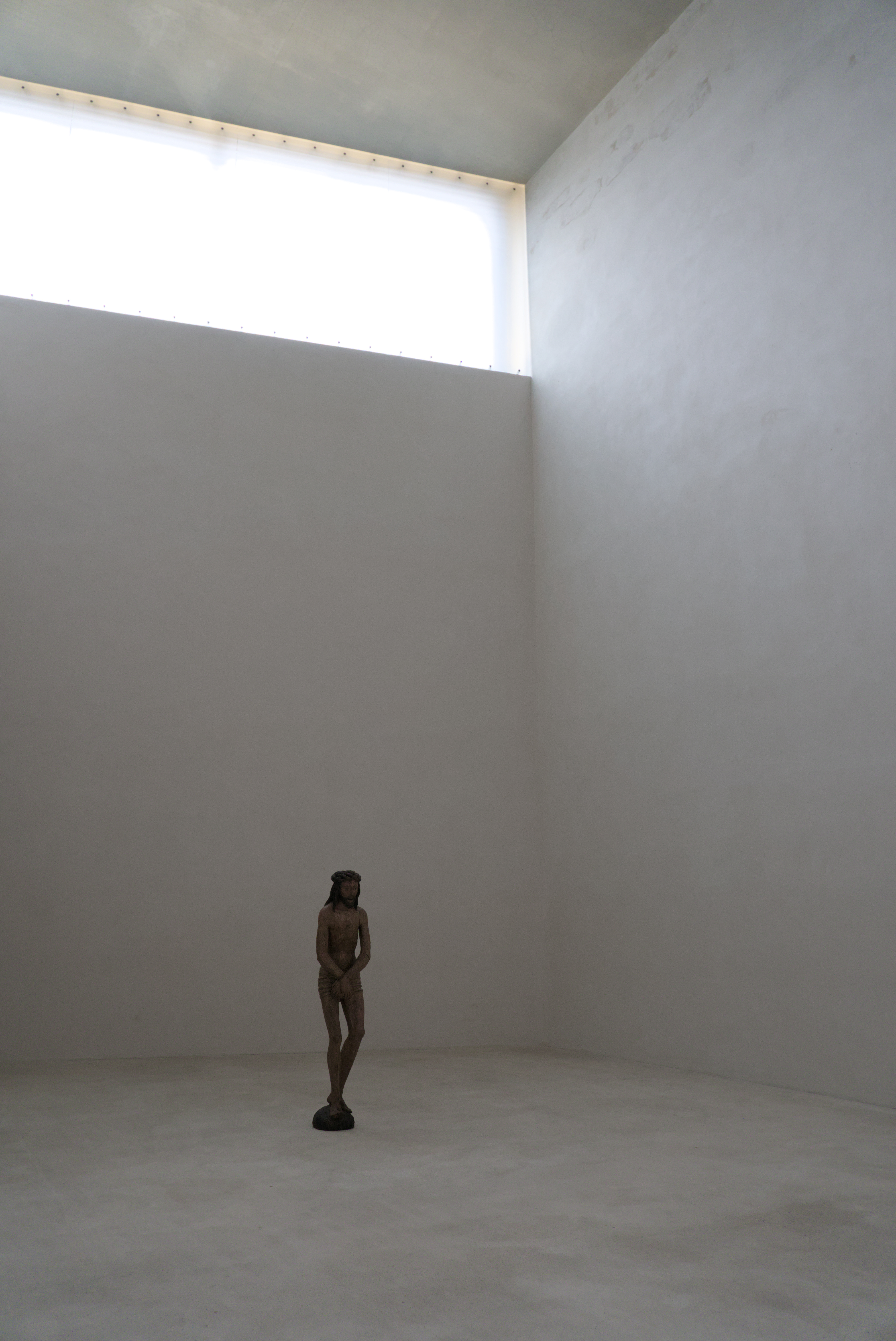
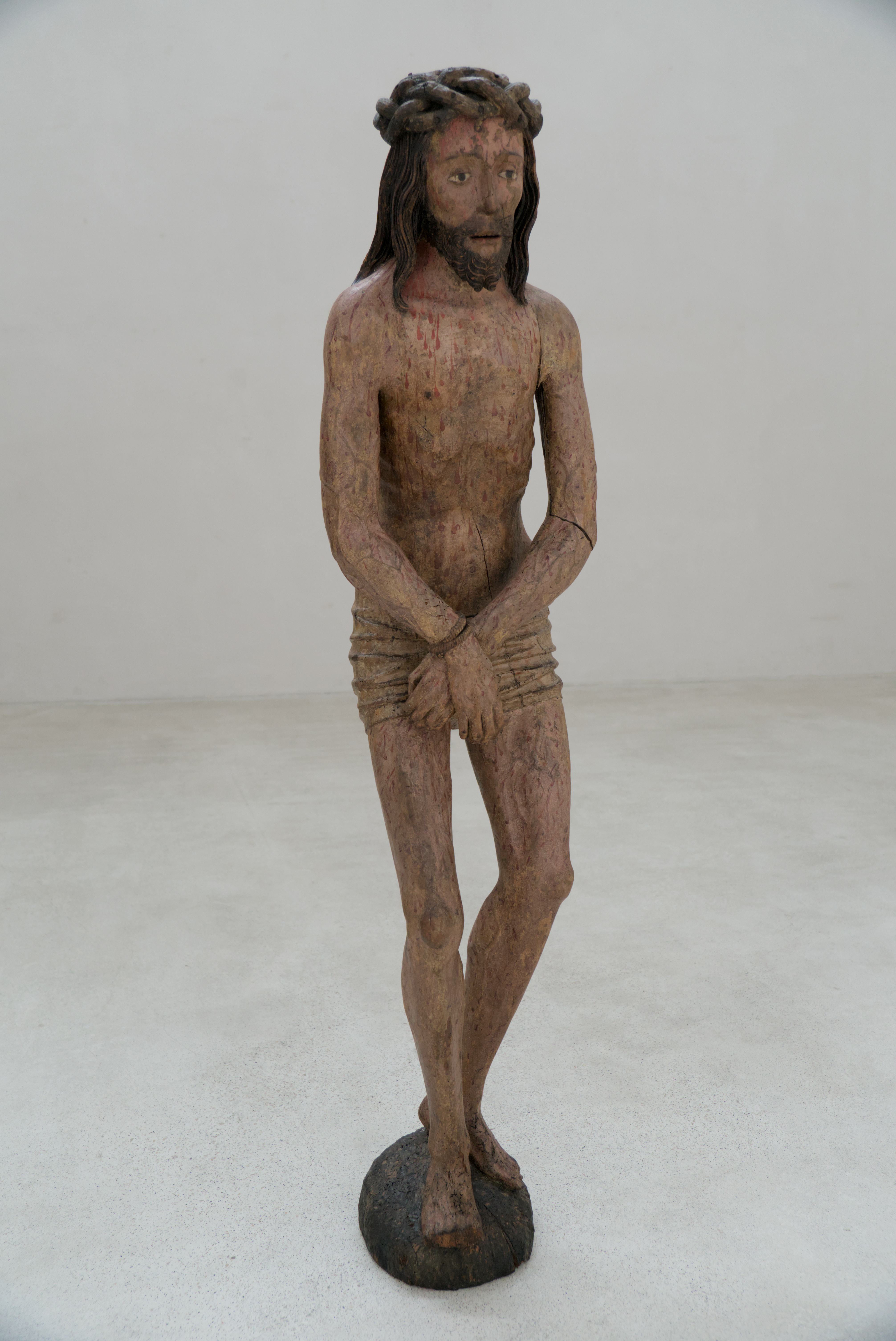
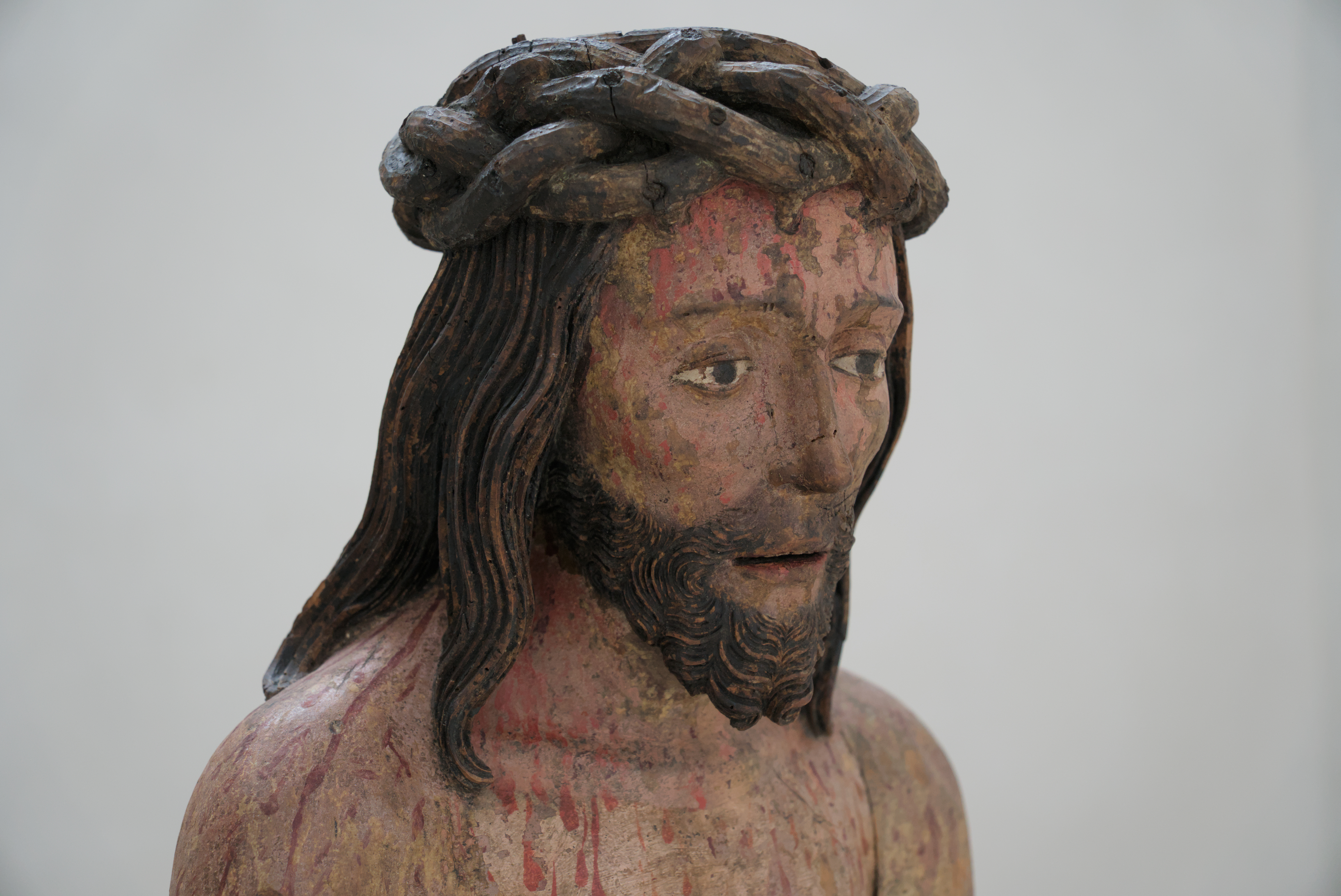
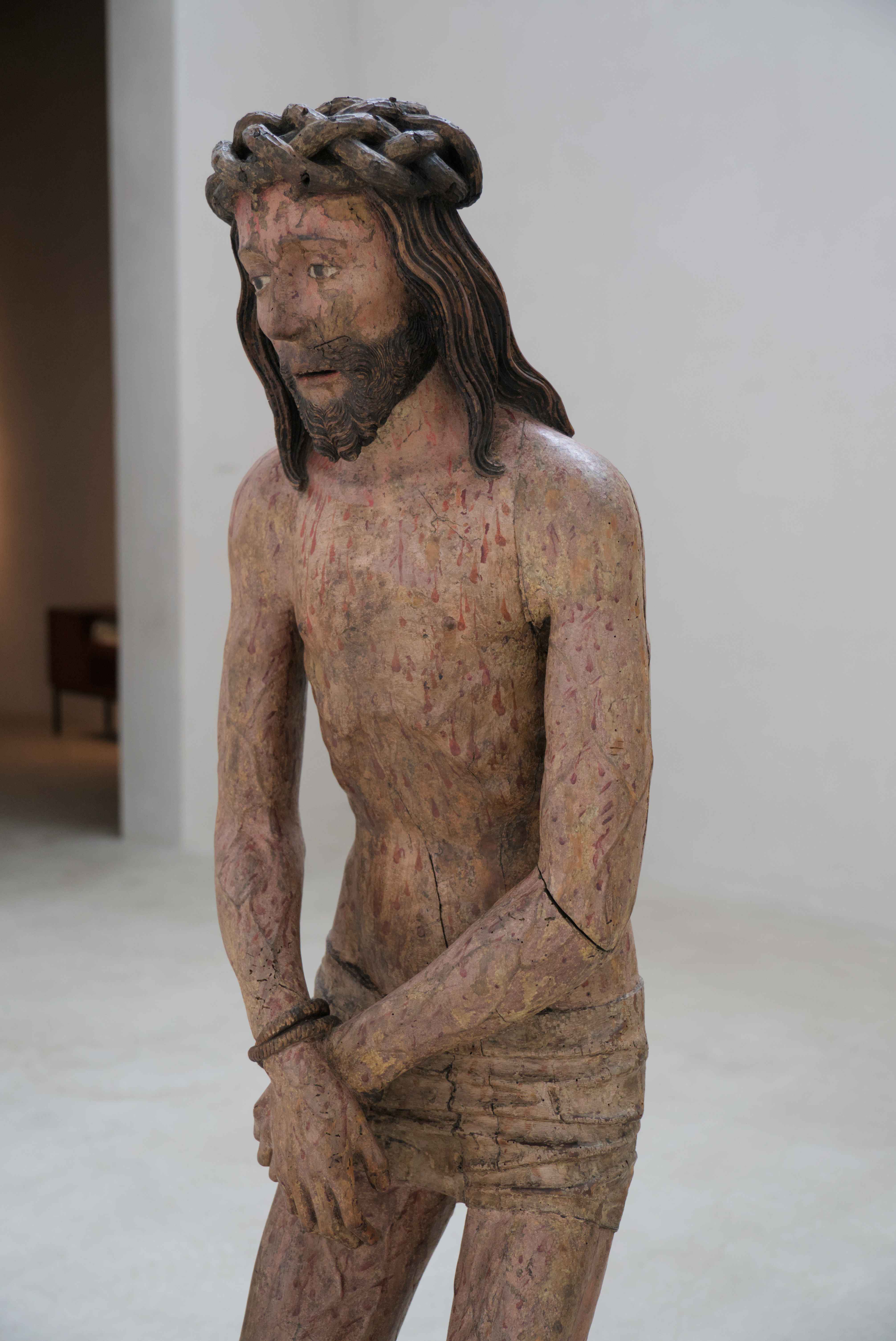
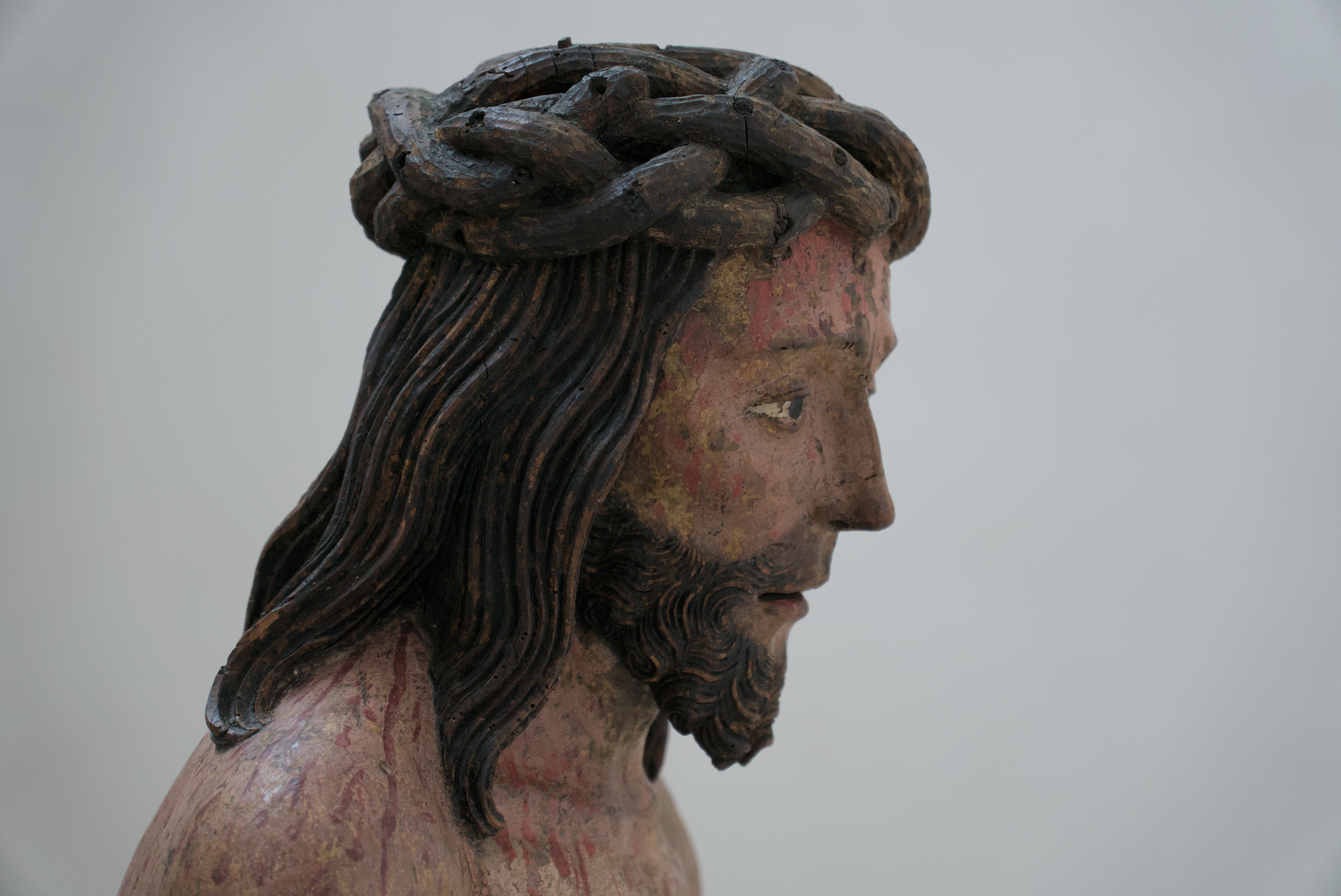
The title Ecce homo, Latin for “Behold the man,” comes from John 19:5, where the Roman governor Pilate presents a scourged, thorn-crowned Jesus to a mob that demands his execution. Like Christ on the Cold Stone, this too is a devotional image intended to stir the affections of the viewer, who is called, like the crowds on that fateful day, to gaze upon the wounded God-man. His hands are bound in front of him, evoking a sacrificial sheep tied up for slaughter. What have we done?

Ecce Homo
Ecce Homo
Ecce Homo, Cologne, ca. 1460–1500. Linden wood. Kolumba museum, Cologne.

Ecce Homo
Ecce Homo
Ecce Homo

While I instantly recognized this subject, the drawing was more of a mystery.

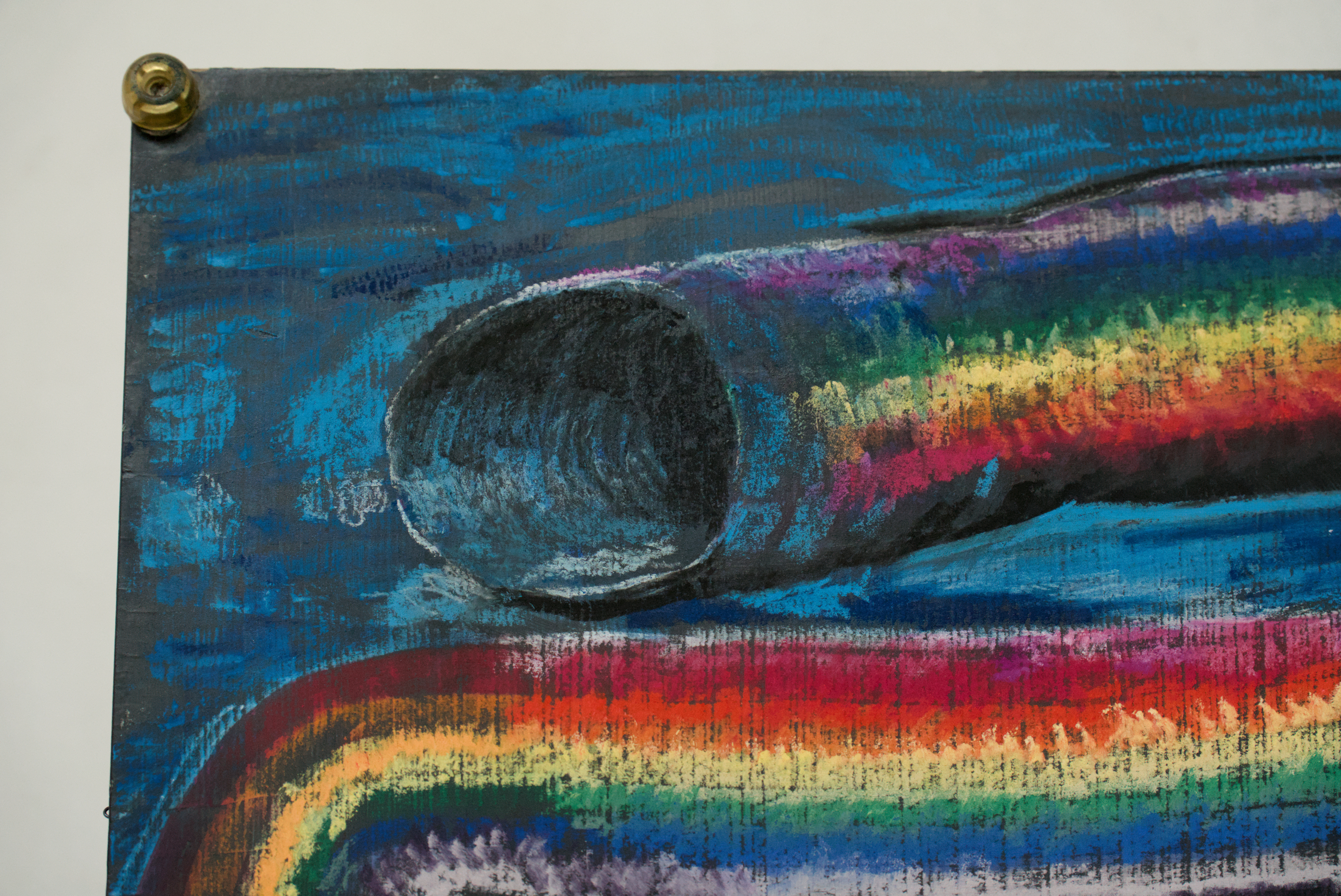
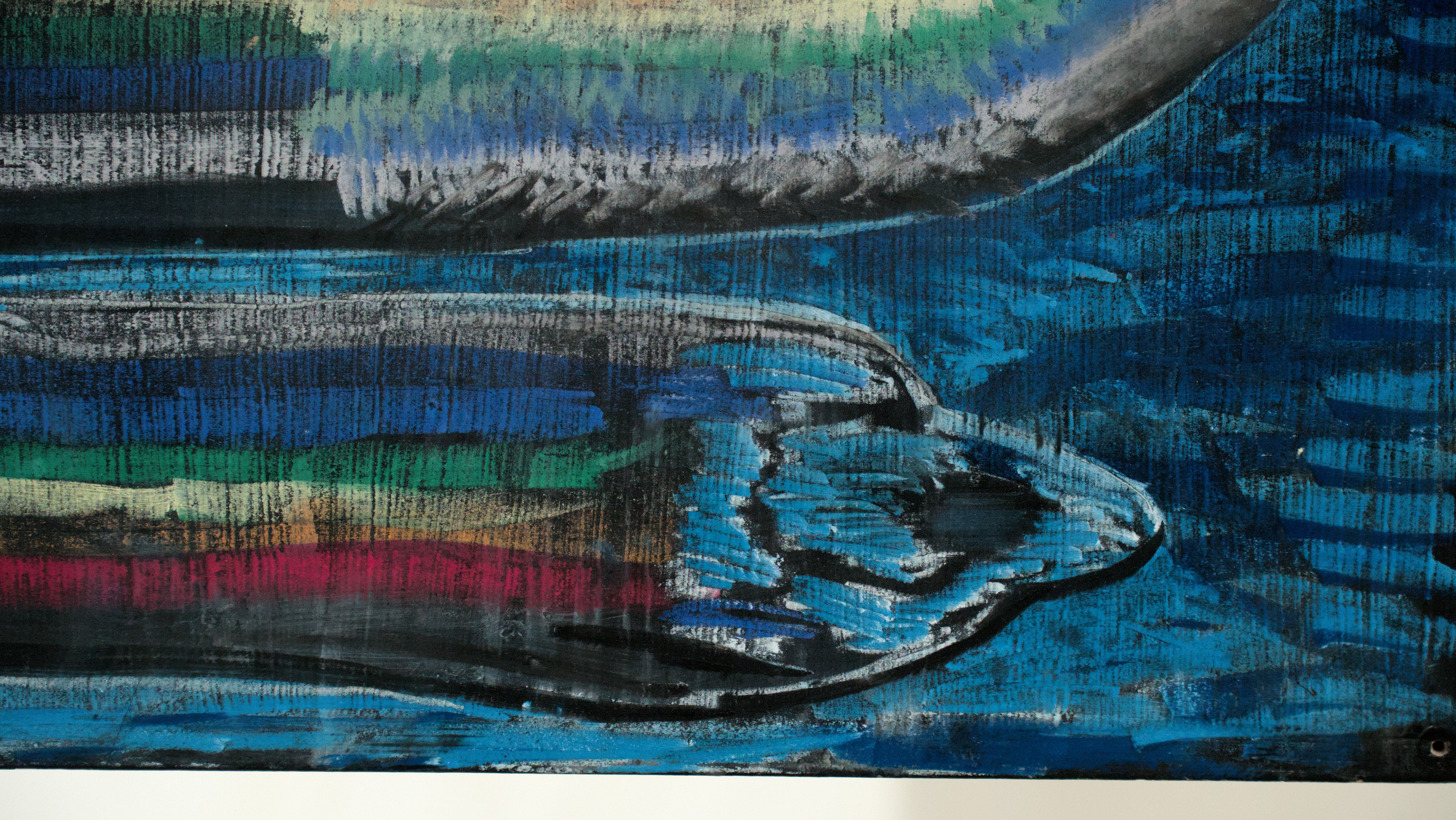
Thek, Paul_Plumed Serpent
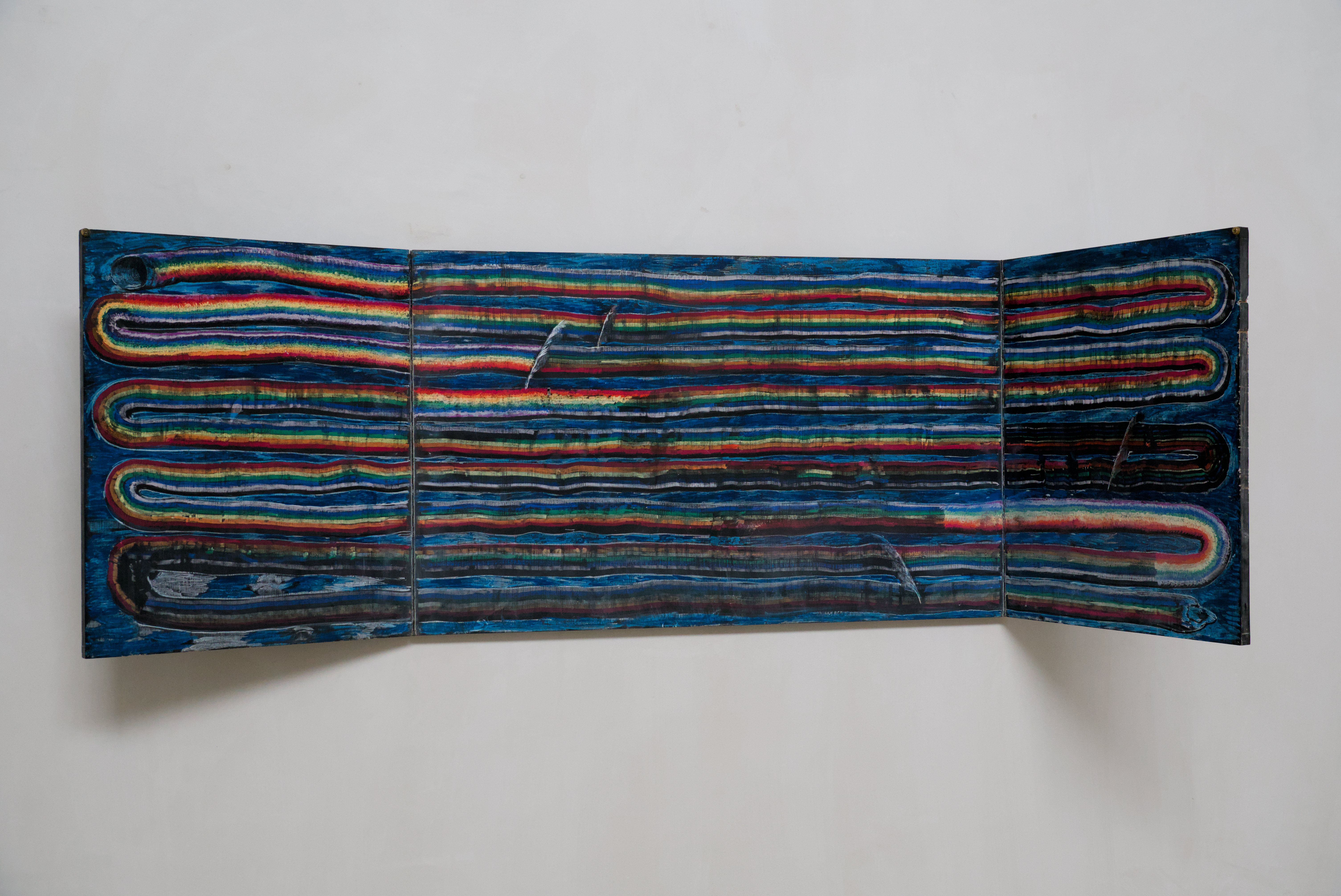
Paul Thek (American, 1933–1988), Plumed Serpent, 1969. Colored chalk on blackboard, 110 × 358 cm. Kolumba museum, Cologne.

Plumed Serpent (detail)

Not having any wall text to clue me in, I had to simply observe and intuit. I saw a winding chute, rainbow-colored, with a few white feathers sticking out of it. And is that water in the background?

I noticed, too, that it’s a triptych, a common format for altarpieces.

Water, birds, rainbows—those all play into the story of Noah’s flood, in which the rainbow signifies God’s promise to never again destroy the earth and all its inhabitants. It’s a symbol of grace and reconciliation.

There are also two prophetic texts in scripture that associate the rainbow with Christ and his glory: Ezekiel’s and John’s recorded visions of the divine throne (Ezek. 1:28; Rev. 4:3).

The curator has positioned Jesus facing the rainbow road, across a fairly large gap. Since, as the museum states, the artworks are arranged to interpret each other, at least in part, then it’s possible this room conveys Jesus following the path of promise, even as it takes dark turns. Or choosing to endure the judgment of the cross to secure a glorious inheritance for his beloveds.

After these ruminations, I looked up the work in the booklet: Plumed Serpent by Paul Thek.

Hmm. In the Christian tradition serpents are often associated with the devil. However, in Numbers 21:1–9, Moses lifts one up on his staff in the wilderness and it becomes an agent of healing and even a symbol of Christ himself, lifted up on the cross for the salvation of the world (John 3:14–15).

The description in the booklet informed me that “plumed serpent” is the English translation of the Nahuatl name Quetzalcoatl, an Aztec creator-god. I don’t know much about pre-Columbian mythologies, so I looked him up when I got home. Apparently he represents the union of earth (reptile) and sky (feathers), and he is also known as the god of the morning star. (Jesus also calls himself the bright morning star!) Although he was initially portrayed as a large snake covered in quetzal feathers, from 1200 onward, he often appeared in human form, wearing shell jewelry and a conical hat. What I find most striking about his story is that he gave new life to humankind by gathering their bones from the land of the dead, grinding them down, and mixing them with his own blood from self-inflicted wounds.

I also did some research on the artist, of whose work Kolumba has the most comprehensive holdings. Paul Thek was a devout Catholic, an identity complicated by the fact that he was also gay. He rose to fame in the 1960s with his “Technological Reliquaries,” hyperrealistic wax sculptures depicting severed body parts and chunks of flesh in vitrines, inspired by his visit to the Capuchin catacombs in Palermo. Much of his art deals with death and rebirth, divinity and decay, mystical transformation.

Feathers feature in another piece of his from the same year as Plumed Serpent: Feathered Cross. (See it against the wall in a photo from the 2021 exhibition Paul Thek: Interior/Landscape at the Watermill Center in Water Mill, New York.) The feathers’ softness, their weightlessness, seem to contradict the reality of crucifixion. But I think it’s Thek’s way of conveying the transcendent meaning of that act of self-giving. I also think of how down feathers fill pillows on which we rest. “Come to me, all you who are weary,” Christ says (Matt. 11:28); we can rest on his finished work.

But back to Plumed Serpent. Chalk is its material—its ephemerality must be a nightmare for conservators, and indeed it seems like some of the drawing has partially rubbed away. But this choice of material plays into the artist’s interest in the enduring versus the perishable, and the transitory dimensions of death.

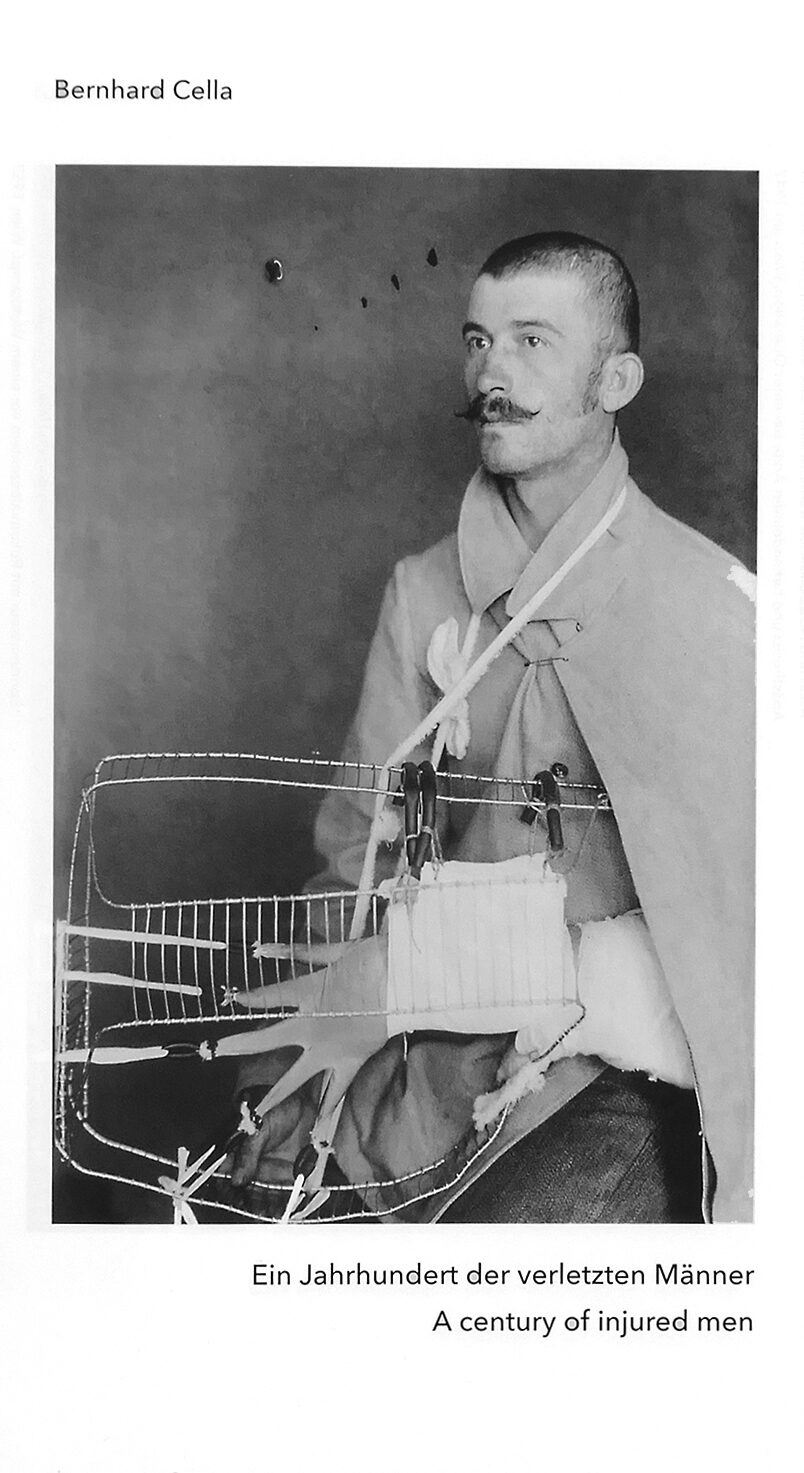
On the right side of room 21, against the wall, are three identical offset-printed artist’s books by Bernhard Cella titled Ein Jahrhundert der verletzten Männer (A Century of Injured Men). Published in 2022, the 152-page book contains photographs of convalescent men over the course of the twentieth century, questioning heroic images of masculinity. I’m assuming many of the injuries were caused by the two world wars.

I neglected to get a photo of the book, but here’s the cover image, and you can view sample pages here and here, as well as two photos of the books in situ at Kolumba on Cella’s Instagram page:

A Century of Injured Men

Vulnerability, injury, sacrifice, healing, the transmutation of pain, new life—these are the themes I gathered from this room.

The current Kolumba exhibition features much more contemporary art than medieval—there are some 175 contemporary works on display, compared to six from the Middle Ages—and I suspect that is now their modus operandi. So, the cross-temporal dialogue isn’t happening in every room, at least not explicitly.

I appreciate the uniqueness of this ecclesiastically run museum, acquiring and showing contemporary works by artists from a range of backgrounds while not shunning its own history as collectors and preservers of medieval German religious art.

As a Christian, I found myself latching on to the imagery that was familiar to me, like Jesus as the Man of Sorrows, and interpreting the surrounding works in light of that. But it seems to me the interpretive process could also move in the other direction, and I wonder how a visitor who doesn’t share my Christian vantage point would respond to the two rooms I’ve highlighted.

For two additional artworks I photographed at Kolumba, an ivory crucifix and an installation with coat, hat, and oil lamp, see my Instagram shares here and here.

Part 2, my reflections on my KMSKA visit, will be published tomorrow.

Roundup: Coventry Cathedral HENI Talk, dilapidated migrant boats transformed into musical instruments, and more

SONGS:

>> “Empty Grave” by Zach Williams: Some southern rock!

>> “Overcome with Light” by Bowerbirds, performed by Daniel Seavey and Liz Vice:

>> “Look Who I Found” by Harry Connick Jr., performed by the Good Shepherd Collective, feat. Charles Jones: This song cover premiered at Good Shepherd New York’s online Easter service last month. The original is from Harry Connick Jr.’s 2021 album Alone with My Faith, a mix of new songs he wrote (like this one) and classic hymns.

+++

ART VIDEO: “Coventry Cathedral: A Journey Through Art” (HENI Talks), written and presented by James Fox: While my husband was presenting at a science conference at Oxford in 2013, I took a train to Coventry and spent the whole day at the city’s cathedral, wandering through its chapels and grounds, sitting in front of its various artworks as the light changed, praying, and even talking with a few locals, including one man who had lived in Coventry since before its bombing in World War II. That bombing destroyed the original St. Michael’s from the fourteenth century, but when the cathedral was rebuilt after the war, it provided the occasion for new commissions from modern architects and artists. Here’s a wonderful video introduction to the history, art, and design of Coventry Cathedral:

In it the art historian and BAFTA-nominated broadcaster Dr. James Fox explores some of the cathedral’s modernist masterpieces: St. Michael’s Victory over the Devil by Jacob Epstein; the West Screen by John Hutton; the Tablets of the Word by Ralph Beyer; the stained glass windows in the nave by Lawrence Lee, Keith New, and Geoffrey Clarke; the lectern eagle by Elisabeth Frink; the high-altar cross of nails by Geoffrey Clarke; the monumental tapestry Christ in Glory in the Tetramorph by Graham Sutherland (which I wrote about for ArtWay); Angel of Agony by Steven Sykes; the Crown of Thorns by Geoffrey Clarke; the Chapel of Unity floor mosaics by Einar Forseth; and the Baptistery Window by John Piper. The latter Fox calls the pinnacle of the entire complex, and I agree—it’s extraordinary. Explore more at www.coventrycathedral.org.uk.

Coventry Cathedral interior
Coventry Cathedral in the West Midlands, England. Photo: David Iliff (CC BY-SA 3.0).

West Screen by John Hutton
Detail of the large glass “west” screen at Coventry Cathedral, designed and hand-engraved by John Hutton, 1962. This view looks out over the ruins of the Old Cathedral. Photo: Victoria Emily Jones.

For more HENI Talks, see heni.com/talks. See also a feature I ran about this video series back in 2021.

+++

SONG: “See What a Morning (Resurrection Hymn)” by Stuart Townend and Keith Getty, sung by the Coventry Cathedral choirs and congregation: Although Coventry Cathedral attracts tourists, it’s also an active church, home to a regular worshipping community! Here’s a video of the beginning of the entrance rite on Easter Day 2012, a procession carried out to the 2003 hymn “See What a Morning.” I appreciate the versatility of Stuart Townend and the Gettys’ hymns, which tend to work equally well if led by a contemporary worship band or a traditional choir with piano/organ accompaniment. I’m used to hearing their hymns sung in low-church contexts (“low church” refers to Christian traditions, such as evangelicalism, that place less emphasis on ritual and sacrament, as opposed to “high church”), so it was a delight to see one used as part of the Anglican liturgy and in such a majestic space!

+++

ARTICLE: “La Scala concert features violins that inmates made from battered migrant boats” by Colleen Barry, AP News, February 13, 2024: “The violins, violas and cellos played by the Orchestra of the Sea in its debut performance at Milan’s famed Teatro alla Scala carry with them tales of desperation and redemption. The wood that was bent, chiseled and gouged to form the instruments was recovered from dilapidated smugglers’ boats that brought migrants to Italy’s shores; the luthiers who created them are inmates in Italy’s largest prison. The project, dubbed Metamorphosis, focuses on transforming what otherwise might be discarded into something of value to society: rotten wood into fine instruments, inmates into craftsmen, all under the principle of rehabilitation . . .” This is a beautiful story of repurposing, of new life—for weathered wood that carried families out of danger zones, and for men who have been convicted of crimes but who seek to engage their hands and hearts in creative projects.

Reclaimed violin
February 9, 2024: A violin made from the wood of wrecked migrants’ boats lies in the instrument workshop at Opera maximum-security prison outside Milan. Photo: Antonio Calanni / Associated Press.

Reclaimed cellos
Two members of the Orchestra of the Sea play cellos made by inmates from reclaimed wood at the orchestra’s debut performance in Milan on February 12, 2024. Photo: Antonio Calanni / Associated Press.

A Dietrich Bonhoeffer Hymn for New Year’s

The German theologian and Nazi resister Dietrich Bonhoeffer wrote the poem “Von guten Mächten” (By Gracious Powers), his last theological work, in December 1944 while he was imprisoned in a basement cell at the Reich Security Main Office on Prinz-Albrecht-Strasse in Berlin. He sent it in a letter to his fiancée, Maria von Wedemeyer, with the note “als ein Weihnachtsgruß für Dich und die Eltern und Geschwister” (“as a Christmas greeting for you and the parents and siblings”). Two months later, the building was destroyed by an air raid, and Bonhoeffer was moved to Büchenwald and from there to other places. He was executed April 9, 1945, at Flossenbürg concentration camp, just two weeks before it was liberated by the Allies.

Bonhoeffer poem
Letter from Dietrich Bonhoeffer to Maria von Wedemeyer, December 19, 1944. Collection of Houghton Library, Harvard University, MS Ger 161 (43).

The poem was published posthumously in The Cost of Discipleship under the title “New Year 1945.”

Von guten Mächten treu und still umgeben,
behütet und getröstet wunderbar,
so will ich diese Tage mit euch leben
und mit euch gehen in ein neues Jahr.

Noch will das alte unsre Herzen quälen,
noch drückt uns böser Tage schwere Last.
Ach Herr, gib unsern aufgeschreckten Seelen
das Heil, für das du uns geschaffen hast.

Und reichst du uns den schweren Kelch, den bittern
des Leids, gefüllt bis an den höchsten Rand,
so nehmen wir ihn dankbar ohne Zittern
aus deiner guten und geliebten Hand.

Doch willst du uns noch einmal Freude schenken
an dieser Welt und ihrer Sonne Glanz,
dann wolln wir des Vergangenen gedenken,
und dann gehört dir unser Leben ganz.

Laß warm und hell die Kerzen heute flammen,
die du in unsre Dunkelheit gebracht,
führ, wenn es sein kann, wieder uns zusammen.
Wir wissen es, dein Licht scheint in der Nacht.

Wenn sich die Stille nun tief um uns breitet,
so laß uns hören jenen vollen Klang
der Welt, die unsichtbar sich um uns weitet,
all deiner Kinder hohen Lobgesang.

Von guten Mächten wunderbar geborgen
erwarten wir getrost, was kommen mag.
Gott ist bei uns am Abend und am Morgen
und ganz gewiß an jedem neuen Tag.
With every power for good to stay and guide me,
comforted and inspired beyond all fear,
I’ll live these days with you in thought beside me,
and pass, with you, into the coming year.

The old year still torments our hearts, unhastening:
the long days of our sorrow still endure.
Father, grant to the soul thou hast been chastening
that thou hast promised—the healing and the cure.

Should it be ours to drain the cup of grieving
even to the dregs of pain, at thy command,
we will not falter, thankfully receiving
all that is given by thy loving hand.

But, should it be thy will once more to release us
to life’s enjoyment and its good sunshine,
that we’ve learned from sorrow shall increase us
and all our life be dedicate as thine.

Today, let candles shed their radiant greeting:
lo, on our darkness are they not thy light,
leading us haply to our longed-for meeting?
Thou canst illumine e’en our darkest night.

When now the silence deepens for our harkening,
grant we may hear thy children’s voices raise
from all the unseen world around us darkening,
their universal paean, in thy praise.

While all the powers of Good aid and attend us,
boldly we’ll face the future, be it what may.
At even, and at morn, God will befriend us,
and oh, most surely each new year’s day!

Trans. Geoffrey Winthrop Young

“In this hymn,” writes Joshua Miller for 1517, “Bonhoeffer leaves us a theological legacy that takes seriously the sorrows of life and the reign of death in a world still under the power of sin and the devil. But it’s a hymn that also confesses hope in a God who holds all things in his hands and demonstrates faithfulness to his promise to work all things together for his children’s ultimate good.”

The text has been set to music more than seventy times and appears in a number of hymnals. It is commonly sung by German congregations around New Year’s.

In 2020, the seventy-fifth anniversary of Bonhoeffer’s death, Berlin-based musical artist Sarah Kaiser released the song as a single, using the 1977 melody by Siegfried Fietz. COVID disrupted her plans to shoot a music video with her whole band, so she pivoted, singing a stripped-down, a cappella version with a minimal crew at the Kunstanstalt in Berlin-Köpenick, a former prison. (Bonhoeffer was not kept here, but the space is evocative of the other Berlin prison, no longer extant, where he was.) Filmed by Lukas Augustin, the video is hauntingly beautiful, with Kaiser’s bare vocals echoing through the dark, dank cell, testifying to God’s goodness amid the bleakest of circumstances.

Turn on the closed captioning (CC) on the YouTube video player for English subtitles.

Also, here’s a metrical translation by Fred Pratt Green (©1974 Hope Publishing Company) of five of Bonhoeffer’s original seven stanzas, which appears in several English-language hymnals:

By gracious powers so wonderfully sheltered,
and confidently waiting, come what may,
we know that God is with us night and morning,
and never fails to greet us each new day.

Yet is this heart by its old foe tormented,
still evil days bring burdens hard to bear;
oh, give our frightened souls the sure salvation
for which, O Lord, you taught us to prepare.

And when this cup you give is filled to brimming
with bitter suffering, hard to understand,
we take it thankfully and without trembling,
out of so good and so beloved a hand.

Yet when again in this same world you give us
the joy we had, the brightness of your sun,
we shall remember all the days we lived through,
and our whole life shall then be yours alone.

By gracious powers so faithfully protected,
so quietly, so wonderfully near,
I’ll live each day in hope, with you beside me,
and go with you through every coming year.

Thank you to Dr. Paul Neeley at the Global Christian Worship blog for introducing me to this hymn and this moving performance.