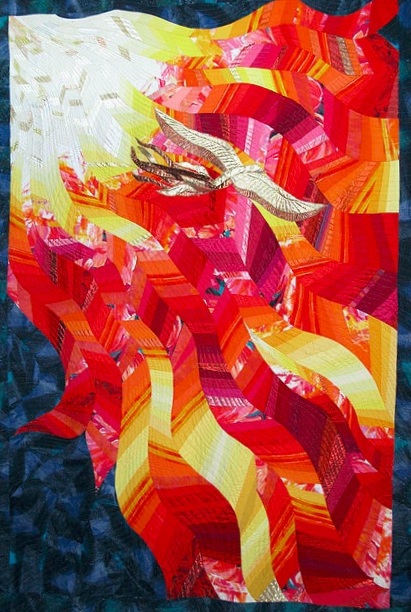
Linda S. Schmidt, Pentecost, 1991. Quilt, 111 × 80 in.
“I came to cast fire on the earth, and would that it were already kindled” (Luke 12:49).
In the churches in which many of us were raised, we were taught to live in fear of this fire of God.
We are not going to repeat that lie. The ancient Christians show us a better way of perceiving this divine fire as we encounter it in the Scriptures and in our experiences.
I want the children listening to me today to know and trust they can welcome and embrace the fire of God, that there is no reason to live in terror about the fire that has come from God, is coming even now, and will come at the end of time.
We welcome the fire of God because we know the character of the God who meets us in the flesh of Jesus Christ.
This God comes among us not to destroy humanity but to burn everything out of us that is not of love, that does not have its origin in the divine life.
Like all healing, deliverance, and reconciliation, there is pain involved in being set free and made well. It is not easy. It is not a cake walk.
But here is the good news: we are free from anxiety and fear as we embrace the cleansing fire of God. “With its fire, love makes better whatever it touches” (Ambrose).
We became cold in our self-imposed exile from God, and like any object, the further it gets away from the fiery source of its life, the colder it becomes.
Remember that God makes his ministers flames of fire, that we shine like the sun in the kingdom of heaven.
Remember that Cleopas, later in Luke, describes that their “hearts burned within them” as Jesus taught them from the Scriptures.
Remember at Pentecost that flames of fire come to rest on the heads of the gathered men and women.
As John promised, Christ baptizes us with fire and the Spirit.
For Cyril of Jerusalem, these words of Jesus about casting fire upon the earth find their fulfillment at Pentecost.
Remember that the flames of the fiery furnace do not consume the Hebrew children, but the angel—Christ himself—stands with them in scorching flames and they emerge from the fire unharmed.
Remember that the burning bush is aflame, is entirely engulfed, but never consumed by the fire of God.
So it is with us: the fire of the love that is the Spirit of God—Ambrose describes this fire of love as having wings—flies through us, consuming whatever is not of Love and trying whatever is good in us in order to purify the good and make it ready for the kingdom.
And we can trust this fire because it comes from the human who is God, who has journeyed through death and hell to bring us back alive with him.
We walk confidently into the fire that is God, knowing that his fire will keep us unto everlasting life.
Kenneth Tanner is the pastor of Church of the Holy Redeemer in Rochester Hills, Michigan, and a contributing writer for Mockingbird, Sojourners, Clarion Journal, and more. He frequently posts theological reflections and sermon excerpts on Facebook, such as the one above [source], which he preached August 18, 2019, the tenth Sunday after Pentecost. I’ve reposted it here with his permission. The liturgical quilt is by fiber artist Linda S. Schmidt.
This call-and-response song is from the December 31, 2015, morning session of the Urbana student missions conference in St. Louis, Missouri. It’s performed by the University of Hawaii’s Hui Poly student group, a ministry of InterVarsity Hawai‘i geared toward Pasifika Christians, along with some new conference friends. The song (and ministry) leader is Moanike’ala Nanod-Sitch, who establishes the rhythm on the djembe and issues the calls. She is the pastor of Ka ‘Ohana o ke Aloha church in Kaneohe and is of Native Hawaiian, Chinese, Japanese, and Ukrainian descent.
The first half of the song is in English (lyrics below), but starting at 3:51, the singers launch into seven different Polynesian or Native American languages: Yup’ik, ‘Ōlelo Hawai‘i (Hawaiian), Fijian, Tongan, Samoan, Hawaiian Pidgin, and Lakota. Subtitles are included in the video. There’s also dancing!
Holy Spirit, come (Holy Spirit, come) Won’t you rain down (Rain down) Rain down (Rain down)
Come like fiyah, come like flames Come like thundah, come like rain Won’t you rain down (Rain down) Rain down (Rain down)
Fill us up, fill our cup Fill us up, fill our cup Won’t you rain down (Rain down) Rain down (Rain down)
We want more, we want more We want more, we want more Won’t you rain down (Rain down) Rain down (Rain down)
Till we overflow Till we overflow Won’t you rain down (Rain down) Rain down (Rain down)
The Son of righteousness will rise With healing in his wings We will be free And dance before our king Let your kingdom come And let your will be done Here on earth as it is In heaven (In heaven) In heaven (In heaven)
We will walk in your love As we advance your kingdom Bringing your word To every nation Let your kingdom come And let your will be done Here on earth as it is In heaven (In heaven) In heaven (In heaven)
To view other video content from Urbana 15, including songs and sermons, see https://2100.intervarsity.org/resource-keyword/urbana-15. Urbana has been held triennially since 1946, and its worship always demonstrates a commitment to global multiculturalism.
1.

Glossolalic and disincarnate, interfere
in me, interleave me
and leave me through my breathing: like some third

person conjugation I’ve rewhispered
in a language I keep trying to learn, a tongue
made only of verbs, and all its verbs irregular.

5.

Because doves have no gall bladder
they have come
to stand for mildness. They stand

for You, warble, blue
underwing-flash and quaver, con-
and in-substantial

Squab of the Holy Ghost.
Some Ark’s scraping some
mud-ridged, just-dried Ararat now

inside me, some dove’s
dropped an olive sprig on its bow, meant to stand
once more for the passing of the gall.

7.

Through “spiration” and not “generation” You are said
to proceed, but the question of Who ex-pires You—
Father or Son, or both—has led to a thousand years of anathema and schism.

The Wikipedia on just that question goes twenty pages.
Ungenerative, ungenerated, You’re like me: recessive and proceeding nonetheless, like the wick’s
wax-wet and sizzle as it hardens into self-douse.

9.

Fricative, constrictive, like a gush
of burnt scrapwood smoke from a neighbor’s yard,
its wintercleared thornbushes and rattlesticks in firepit,

greencrackle and sap-hiss, late March Lent-smoke
ash-smack in back of tongue and eyes, forehead-and-cheek stream of char.
Numinous, pneumatic, Who

bloweth where You listeth, Whom
the world will never know, list to blow
down me.
These are four of the nine sections in “Having Read the Holy Spirit’s Wikipedia” by Bruce Beasley, from Theophobia (BOA Editions, 2012). Reprinted by permission of The Permissions Company, Inc., on behalf of the publisher.
EXHIBITION: “God is . . . ,” May 14–23,gallery@oxo, London: The winning entry from the second Chaiya Art Awards competition, along with forty-nine shortlisted others, are being exhibited in London’s South Bank starting tomorrow. The exhibition also has a virtual option, which I received an advance preview of, along with the catalog. Read my review at ArtWay.eu. There is a diverse range of responses to the theme of “God is . . . ,” in a range of media!
+++
VIRTUAL CONCERT: “I Should Be Glad”: On May 2 the Choral Society of Durham and the Duke University Chorale put on a virtual concert, performing songs of lament and hope. They sing of “hours that go on broken wings” and “the unchanging ache of things”; of “this long, hard climb, carr[ying] ancestral sorrow”; of violence and murder; of God’s seeming absence; of feeling like a “moanin’ dove.” But they also sing invitations to be glad, to lay down one’s burden, to see beauty, to soar. Click here for a copy of the program, which contains credits, texts, and translations. I really enjoyed the selection of pieces—most were new to me—and the execution (technical and artistic) is excellent. An hour very well spent. Note that in lieu of a ticket charge, a $10 donation is recommended.
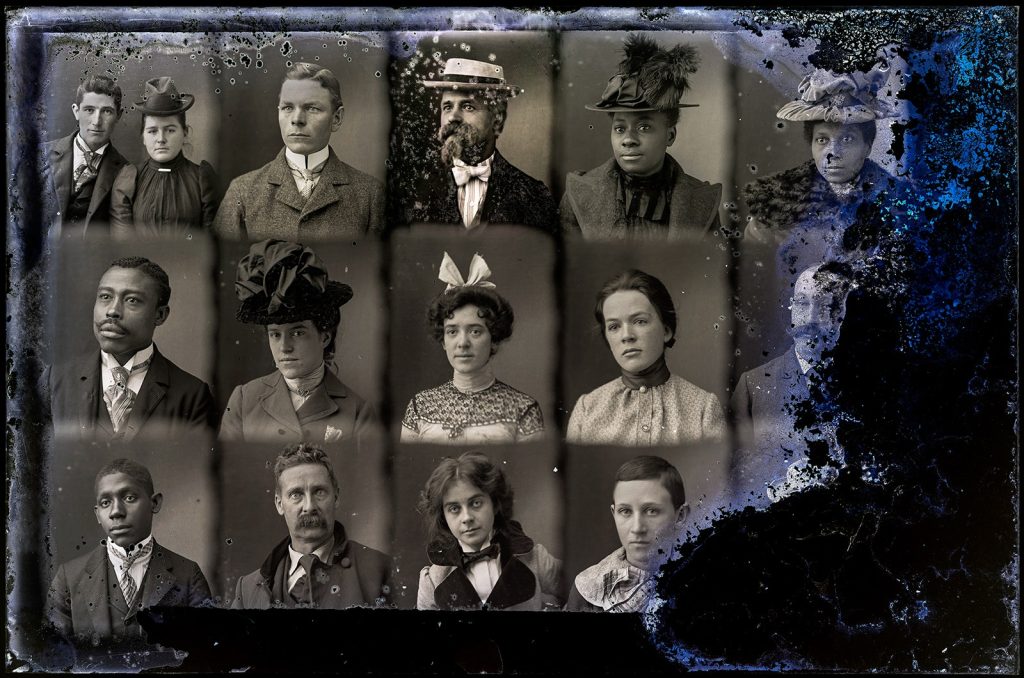
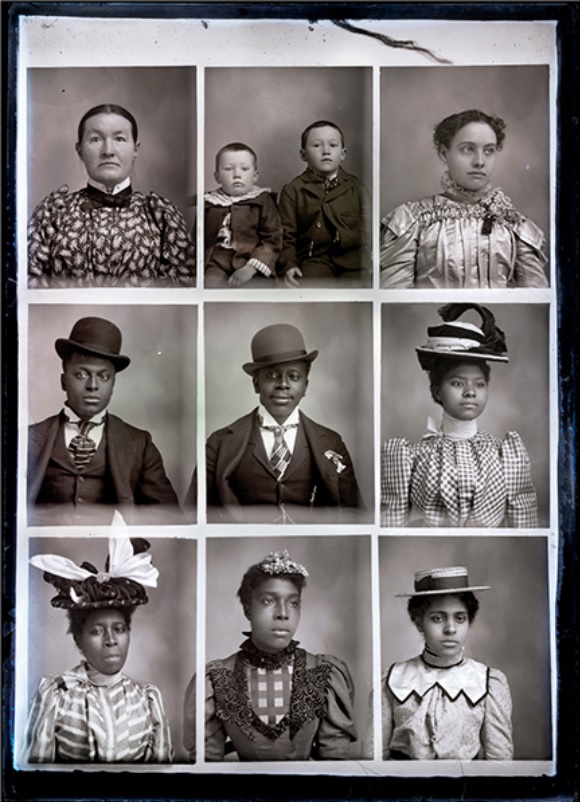
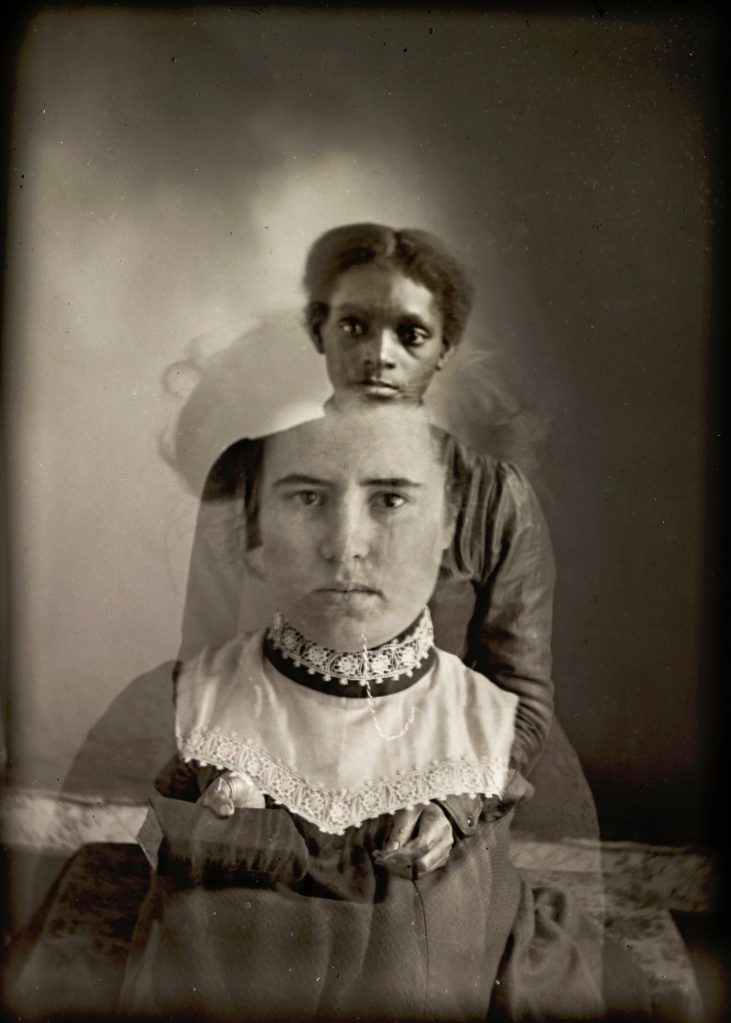
Among the songs are contemporary choral settings of traditional prayers, a civil rights hymn, and the world premiere of the five-movement Where We Find Ourselves by Michael Bussewitz-Quarm (she/her), inspired by the photographs of Hugh Magnum. Magnum, who was white, ran an integrated portrait studio in the Jim Crow South from 1897 until his death in 1922, photographing white and Black clients with equal dignity. The glass plate negatives and contact prints languished in his family’s moldering tobacco barn in Durham, North Carolina, until the 1970s, when they were discovered prior to the property’s slated demolition. They were transferred (many of them damaged) to the Duke University archives, where they again lay mostly dormant until being recently dug out by photographer-writers Margaret Sartor and Alex Harris, who compiled and presented them as an exhibition and accompanying book. Bussewitz-Quarm’s composition is a moving meditation on these timeworn photographs, and the lyrics by Shantel Sellers are pure poetry.
Photographs by Hugh Magnum, courtesy of the David M. Rubenstein Rare Book & Manuscript Library at Duke University, Durham, NCIn some of the negatives the panels have fused, causing the subjects to extend past their frames and thus giving the illusion that they were sitting together.“The portraits are often accidentally double-exposed,” writes Sarah Blackwood for the New Yorker, “and many of the double exposures overlay images of white and black sitters, who suddenly seem to sit alongside or even atop one another. Such ghostly interactions produce from two Mangum portraits an entirely new image altogether, one in which the pride and pleasure of self-presentation is shadowed by the racial realities of the time.”
Set list:
“I Should Be Glad” by Susan LaBarr (composer) and Sara Teasdale (lyricist)
“Sometimes I Feel,” traditional African American spiritual, arr. Alice Parker and Robert Shaw
“Where We Find Ourselves” by Michael Bussewitz-Quarm (composer) and Shantel Sellers (lyricist)
“Hymn to Freedom” by Oscar Peterson (composer) (arr. Paul W. Read) and Harriette Hamilton (lyrics)
+++
POEM COMMENTARY: “The Night” by Henry Vaughan, commentary by Dr. Grace Hamman (blog post | podcast episode): I’ve featured poems by Henry Vaughan several times on this blog but not the one that just might be his most famous: “The Night,” about the Pharisee Nicodemus’s midnight rendezvous with Jesus (see John 3). It contains the beautiful and much-lauded line “There is in God, some say, / A deep but dazzling darkness . . .” Medieval literature scholar Grace Hamman [previously], podcaster and blogger at Old Books with Grace, reads and unpacks the poem, first giving some historical and biographical context. Vaughan was an Anglican Welshman living during the English Civil War when the Puritans were in power, which means he was cut off from the forms of worship through which he was used to encountering Christ. This, Hamman says, influenced his writing of the poem and of the larger collection, Silex Scintillians, it’s a part of.
She has made the commentary available in both written and audio form.
+++
EDITORIALS by JAMES K.A. SMITH:
When I see a James K.A. Smith [previously] byline, I know what follows is going to be good. He’s a fantastic thinker, writer, and speaker—and he’s the editor in chief of my favorite arts journal, Image. Below is a link to the opening editorial he wrote for each of the last two issues. (The whole journal is full of rich content. Subscribe!)
>> “Healing the Imagination: Art Lessons from James Baldwin,”Image no. 107 (Winter 2020): Here Smith engages with James Baldwin’s 1964 essay “The Uses of the Blues,” in which Baldwin discusses how we “project onto the Negro face, because it is so visible, all of our guilts and aggressions and desires”; white America invents stories and images of Black Americans that reflect our disfigured imaginations. “The imagination is a form of habit, a learned, bodily disposition to the world. . . . It’s the imagination—well- or malformed—that determines what I see before I look,” Smith writes.
He connects Baldwin’s essay to Jesus’s parable of the good Samaritan, showing how the priest and the Levite had different habits of perception than the protagonist. “To see the person before me as an enemy or animal”—or, I would add, a burden—“is a failure of imagination; to see a neighbor instead is a feat of the imagination. Our society is grappling with a soul-sickness that is ultimately an infection of our imagination.” We reflexively imagine others as threats, competitors, adversaries.
The arts can play a huge role in reshaping our imaginations, in retraining us to see people rightly. “I dream of a third Great Awakening,” he says, “in which our imaginations would be reborn, a sanctification of sight baptized by stories and images such that even our first glance is holy. The tents for this revival would be galleries and cinemas; we’ll sing from poems and novels; the altar call will invite us to attend plays and contemplate sculpture.” He’s not saying art should replace church or religion but that art is a powerful agent of spiritual and perceptual formation; “the arts pluck the strings of our imagination uniquely.”
In their March 3 episode, “Healing the Imagination, with James K.A. Smith,”The Weight podcast had Smith on to expound on some of the points in the editorial, to unpack this musing: “Could it be that the arts are more likely to move the needle on our collective perception of one another?” He discusses definitions of “culture” and “art,” both creational goods (God has deputized human beings to unfurl the tacit possibilities he has folded into creation!); the influence of Augustine and Kuyper on his thought; the “transcending, opening, decentering” potential of artistic encounters; his experience of becoming an American citizen; and why he believes national healing will come not primarily through politics but through the arts. He mentions a few commendable recent examples of churches’ hospitality toward artists, citing Pope John Paul II’s 1999 Letter to Artists, written “to all who are passionately dedicated to the search for new ‘epiphanies’ of beauty so that through their creative work as artists they may offer these as gifts to the world,” and Redeemer Church of Knoxville, who converted the unused rooms of their building into artist studios for the larger community to use.
“Christian communities, if they actually really care about healing the soul of a nation, could do no better than to invest in the arts,” Smith says. “Not so we can go make Thomas Kinkade paintings or Kirk Cameron movies or whatever, but so that we have artists who are actually speaking to our neighbors in ways that meet them as human.”
>> “How to Visit a Museum: Disciplines of Availability,”Image no. 108 (Spring 2021): “Aesthetic experiences I didn’t go looking for that burrow their way most deeply into my psyche . . . are only possible if I am cultivating a way of life that puts me in front of artworks that don’t conform to my preferences. That might mean signing up for the disciplines of an aesthetic way of life in which I am puzzled or frustrated or decentered by the feeling of ‘not getting it.’ It means approaching paintings and poems without expecting immediate returns. In my experience, the way of surprise lies in listening to a community of friends bear witness to what has captivated them and letting my puzzlement be an impetus to explore new territory. When Shane McCrae gushes about a poet who has felt inaccessible to me, I assume I have something to learn. And so I taste and see. A life hungry for aesthetic surprise does not settle for daily doses of predictably poignant comfort; instead, I need to expose my palate to strange, maybe even unsavory tastes as a way of making myself available for the sublime. While we can’t manufacture the surprise, we can learn to make ourselves available.” Read more at the link.
Reminds me of a creative prompt given last November by Corey Frey of The Well Collaborative in Frederick, Maryland: “Find a challenging poem or work of art or piece of music that doesn’t trigger your appreciative mechanism quite so easily. Sit with it. Let it confuse you. Allow its toe to creep in the crack of the door of your respect (re-spect: look a second time).”
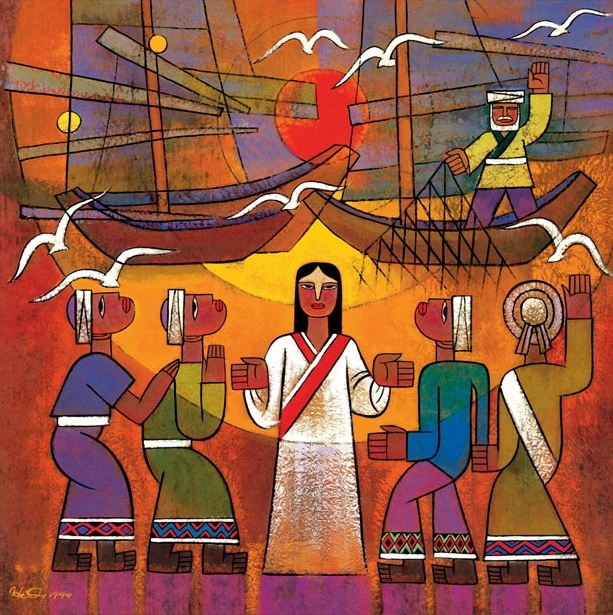
VISIO DIVINA SERIES: “During Asian Pacific American Heritage Month, C4SO [Diocese of Churches for the Sake of Others] celebrates artist He Qi, who reinterprets sacred art within an ancient Chinese art idiom. His work is a blend of Chinese folk art and traditional painting technique with the iconography of the Western Middle Ages and Modern Art. On each Sunday during May, we have licensed one of He’s paintings to illuminate one of the lectionary readings. We will provide prompts for you to do Visio Divina, or ‘sacred seeing,’ an ancient form of Christian prayer in which we allow our hearts and imaginations to enter into a sacred image to see what God might have to show us.” [HT: Global Christian Worship]
He Qi (Chinese, 1950–), Calling the Disciples, 1999. Oil on canvas.
For this past Lent the C4SO brought us the Stations of the Cross by Laura James, a self-taught painter of Antiguan heritage, combined with a liturgy by their scholar in residence, Rev. Dr. W. David O. Taylor. I appreciate their recognition of the value of visual art to the individual and corporate lives of their people.
+++
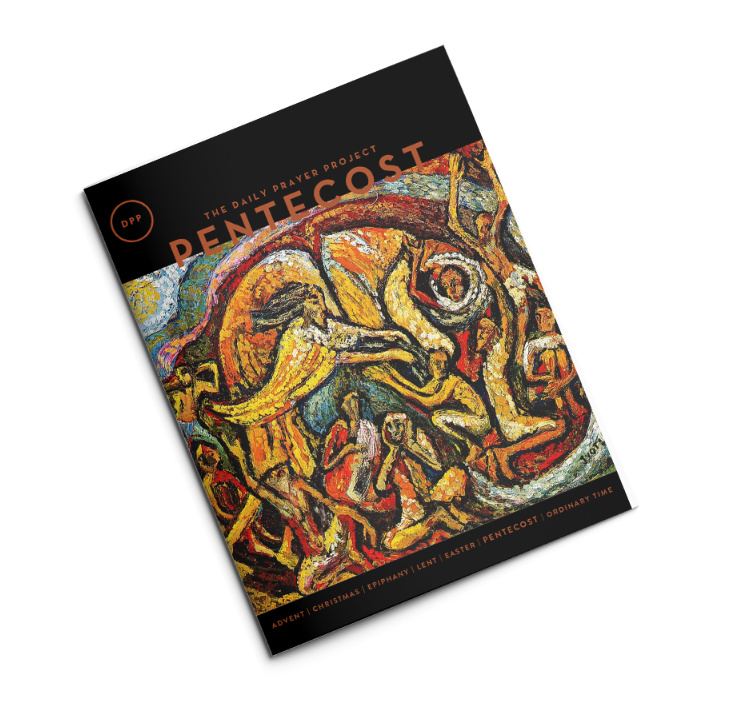
NEW DPP EDITION: Pentecost 2021: Pentecost is May 23, kicking off a new season of the church year—which means a new periodical from The Daily Prayer Project is hot off the presses! This is one of the publications I work for. “We celebrate and join in prayer with a vastly diverse church in this edition of the DPP. The Indian artist Jyoti Sahi’s dynamic painting Receive the Holy Spirit adorns the cover and leads us to a powerful remembrance of and meditation on that great outpouring of Pentecost. The church of the Caribbean gifts us with their song of Pentecost: ‘Fire, fire, fire! Fire fall on me!’ The Christian Council of Nigeria leads us in prayer and asks God to ‘grant us a vision of our land that is as beautiful as it could be . . . [and the] grace to put this vision into practice.’ The Korean songwriter Geon-yong Lee offers up a lament for the fractures of the church and invites us to truly long and work for unity: ‘Come, hope of unity; make us one body. Come, O Lord Jesus; reconcile all nations.’ . . .”
The two other featured artworks in this edition, which will be added to our online gallery May 23, are an abstract ink drawing by Takahiko Hayashi, evocative of the Spirit’s vitality, and a piece by Yuanming Cao that celebrates the steadfastness of the church in China using as its medium the everyday devotional materials of rural Christians in the Suzhou region.
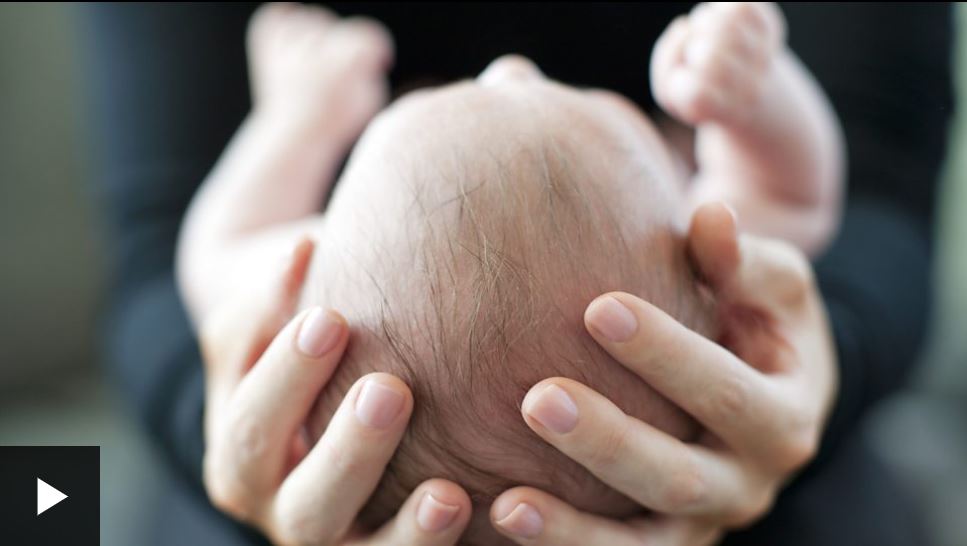
VIDEO: “What happens to humans when we can’t touch?”: “Touch is how we first communicate as babies. And it’s fundamental to human wellbeing. So what happens when we can’t touch?” This recent BBC Radio 4 video by Daniel Nils Roberts discusses the importance of touch to human development, connection, and health. Roberts talks to scientists—and a cuddle therapist!—about why touch makes us feel good, and the skyrocketing of “touch hunger” since the onset of COVID-19. While I have been deprived of physical contact with friends for the past year and I sorely miss it (I hadn’t realized how much hugs, shoulder pats, etc., mean to me), I live with my husband and have been able to receive touch from him; I can’t imagine what it would be like for those who have been completely without touch during this time of restrictiveness. [HT: Joy Clarkson]
+++
NEW BOOK: Enjoying the Bible: Literary Approaches to Loving the Scriptures by Matthew Mullins: Released in January by Baker Academic. “Many Christians view the Bible as an instruction manual. While the Bible does provide instruction, it can also captivate, comfort, delight, shock, and inspire. In short, it elicits emotion—just like poetry. By learning to read and love poetry, says literature professor Matthew Mullins, readers can increase their understanding of the biblical text and learn to love God’s Word more.”
I found out about this book through the interview by Jessica Hooten Wilson in the current issue of Christianity Today, “Reading God’s Word like a Poem, Not an Instruction Manual” [HT: ImageUpdate]. In the interview Mullins says he hopes the book reaches those Christians who tend to privilege information and instruction in their scripture reading above enjoyment—people who go to the Bible only for facts about God or practical guidance, not an encounter. Mullins shows how the Bible wants to shape not only our intellectual understanding but also our desires and emotions, and that many scripture passages are not reducible to a simple message or takeaway. Those who read and enjoy poetry inherently grasp this about the Bible. Here’s a short lecture Mullins gave on the topic in 2018, “You Can’t Understand the Bible If You Don’t Love Poetry”:
+++
ONLINE POETRY RETREAT: Send My Roots Rain, Saturday May 15, 10 a.m.–3 p.m. UK time: Brought to you by the Church Times and Sarum College, this event will feature readings and/or presentations by Pádraig Ó Tuama, Malcolm Guite, Helen Wilcox, Mark Oakley, and others. The cost is £15 (about USD$20). [HT: Arts and the Sacred at King’s (ASK) weekly e-bulletin; email Chloë Reddaway to subscribe]
+++
SUMMER READING GROUP: Phantastes by George MacDonald, led by Kirstin Jeffery Johnson: The Rabbit Room is sponsoring an online book club this summer centered on Phantastes by George MacDonald, a fantasy novel whose young hero Anodos wakes up in Fairy Land one day and is forced to reassess his assumptions about himself and others. Fantasy is not a genre I naturally gravitate to, but I keep hearing about this novel from different sources—how perplexing yet alluring it is—so I’m going to give it a try! I’m especially thrilled that the discussions will be led by MacDonald scholar Kirstin Jeffrey Johnson. Oh, and fun fact: this is the book that C. S. Lewis said most shaped his vocational attitude and philosophy of life.
“The ‘live’ version of this book group, including the online forum, opens May 25 [with chapters 1–4] and will include Zoom chats every Tuesday night at 7:00 p.m. CST for five weeks. However, you are welcome to join at any time, even after the live chats have ended. The discussions will be archived, and the forum will be open indefinitely for new registrants to continue reading and discussing the book.” You can purchase a copy of the book through the Rabbit Room Store, or there’s this annotated edition I bought, edited by John Pennington and Roderick McGillis. (It has a beautiful cover, but the annotations seem geared more toward middle-grade readers.)
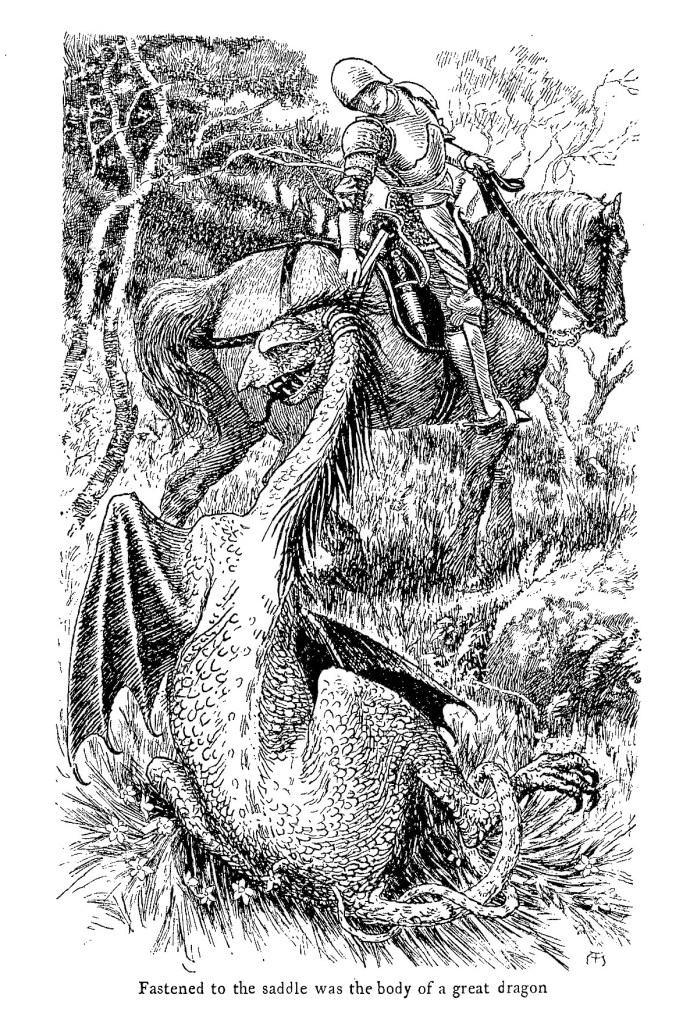
Illustration by Arthur Hughes, from chapter 23 of the third edition of Phantastes by George MacDonald, published by Arthur C. Fifield in 1905
As a bonus, listen to “Giving as the Angels Give,” a two-part session from Hutchmoot 2019 that explores “some of the ways in which, as an author, teacher, and community-builder, MacDonald intentionally manifested hospitality.” Part 1 is a personal on-ramp to the topic by Jennifer Trafton (“I can’t think of any other writer who makes me feel the intimacy of God’s welcome more than MacDonald does,” she says), and part 2, which focuses more on MacDonald’s biography, is by Kirstin Jeffrey Johnson.
Note to reader: “HT” stands for “hat tip”; it’s an acknowledgment of where or from whom I first found mention of the content I link to—that is, if I did not discover it directly from the source itself. I include these tags, along with strategic hyperlinks on the names of people and institutions, because, other than simply being courteous, I want to aid you in building your own “Christianity and the arts” network. One of the primary questions I get from people is “Who should I follow?” or “Where did you find about . . . ?” Soon I will compile a list, on its own tab, of like-minded content curators/providers that inspire me, but regular readers of the blog will, I’m sure, have already picked up on who a lot of those are. And I’m learning of new ones all the time!
May is Mary’s month, and I
Muse at that and wonder why:
    Her feasts follow reason,
    Dated due to season—

Candlemas, Lady Day;
But the Lady Month, May,
    Why fasten that upon her,
    With a feasting in her honour?

Is it only its being brighter
Than the most are must delight her?
    Is it opportunest
    And flowers finds soonest?

Ask of her, the mighty mother:
Her reply puts this other
    Question: What is Spring?—
    Growth in every thing—

Flesh and fleece, fur and feather,
Grass and greenworld all together;
    Star-eyed strawberry-breasted
    Throstle above her nested

Cluster of bugle* blue eggs thin
Forms and warms the life within;
    And bird and blossom swell
    In sod or sheath or shell.

All things rising, all things sizing
Mary sees, sympathising
    With that world of good,
    Nature’s motherhood.

Their magnifying of each its kind
With delight calls to mind
    How she did in her stored
    Magnify the Lord.

Well but there was more than this:
Spring’s universal bliss
    Much, had much to say
    To offering Mary May.

When drop-of-blood-and-foam-dapple
Bloom lights the orchard-apple
    And thicket and thorp† are merry
    With silver-surfèd cherry

And azuring-over greybell makes
Wood banks and brakes‡ wash wet like lakes
    And magic cuckoocall
    Caps, clears, and clinches all—

This ecstasy all through mothering earth
Tells Mary her mirth till Christ’s birth
    To remember and exultation
    In God who was her salvation.
* Bugle, or bugleherb, is a blue-flowering plant in the mint family. † A group of houses standing together in the country; a hamlet; a village. ‡ Bracken ferns.
+++
In the Roman Catholic Church, May is dedicated to Mary, the mother of Jesus, and daily devotions to her are encouraged throughout the month. In many parishes, statues of Mary are crowned with flower garlands at this time.
Though I myself do not practice Marian devotion, I have an immense appreciation for her example of faith and for the role she played in salvation history, and I feel a kinship to her as a spiritual foremother. I also find myself drawn to poems and visual art that reflect on her pregnancy, on the Life growing inside her.
Written in 1878 by the Jesuit poet-priest Gerard Manley Hopkins, “The May Magnificat” muses on the fittingness of May as a designated period of celebration of Mary. In the yearly cycle of the Christian liturgical calendar, Candlemas, which celebrates the presentation of Jesus in the temple as an infant (and Mary’s postpartum purification), is logically dated to February 2, forty days after Christmas, per Leviticus 12:1–4. Lady Day, the feast of the Annunciation (the day on which Jesus was conceived), is celebrated March 25, nine months before Christmas. But why, Hopkins wonders, has the church set apart May in particular for Christians to honor Mary?
He determines it’s because in May, the natural world—at least in the northern hemisphere, where he, an Englishman, lived—is bursting into full bloom, reflecting Mary’s own fecundity, her body a superabundant source of life. In late spring there is a certain joyousness in the air, a “universal bliss,” an “ecstasy.” Mammals are gestating and/or giving birth, birds are incubating and hatching, groves and gardens are flowering, and earth seems to be swelling to a fullness. There is “[g]rowth in every thing.”
Hopkins delights in the wealth of spring, all its flora and fauna. He marvels how the azure of heaven is reflected on earth in the tangled nest of a song thrush, and how sunlight dapples the apple and cherry trees. Perhaps Mary learned gladness from such gladsome surroundings, he suggests. And not only that, but as mother, she shared an affinity with Nature, also a mother.
The month of May culminates, on the 31st, with the feast of the Visitation, which marks the pregnant Mary’s visit to her pregnant cousin Elizabeth. Upon their meeting Mary sang a praise song known as the Magnificat, Latin for “[My Soul] Magnifies [the Lord]” (see Luke 1:46–56). She makes large God’s name, celebrating his mercy, strength, and provision and the impending birth of her son, Israel’s Savior and the world’s.
+++
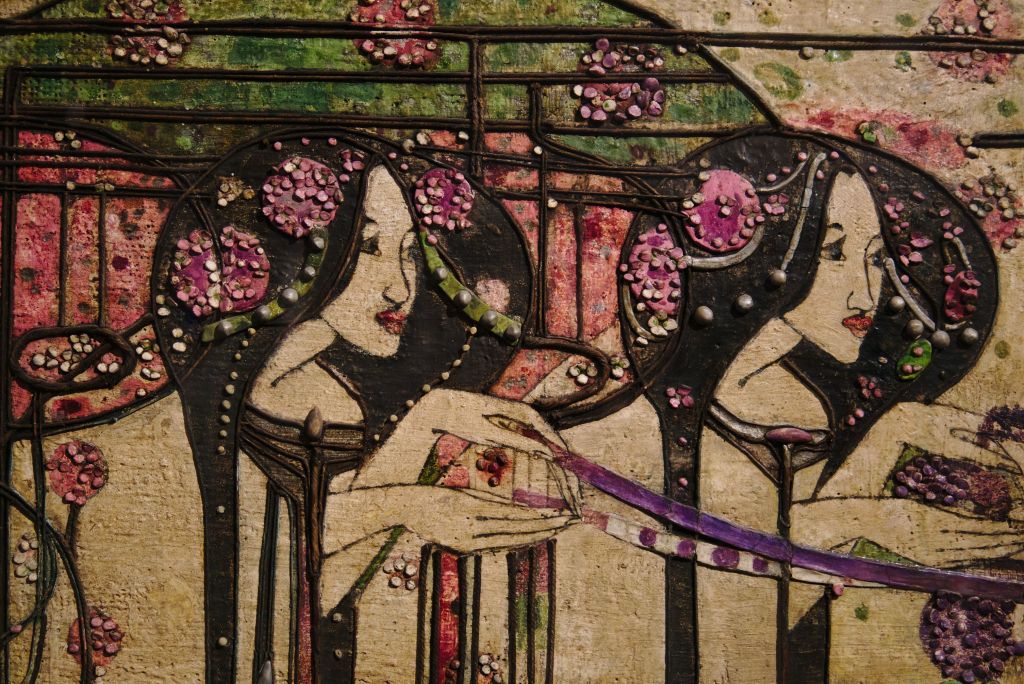
In October 2019 I had the privilege of seeing the internationally touring exhibition Designing the New: Charles Rennie Mackintosh and the Glasgow Style at the Walters Art Museum in Baltimore, whose highlight was a large-scale gesso frieze by Margaret Macdonald Mackintosh, Charles’s artistic collaborator and wife. It was displayed in a narrow hallway behind a plastic screen, so I couldn’t get a shot of the full piece, but here’s a photo provided by the CSG CIC Glasgow Museums Collection:
Margaret Macdonald Mackintosh (Scottish, 1864–1933), The May Queen, 1900. Gesso on burlap over wood frame, scrim, twine, glass beads, thread, tin leaf, papier-mâché, steel pins, 158.8 × 457 cm. Kelvingrove Art Gallery and Museum, Glasgow.
All other photos in this post are my own.
Emerging in the 1890s in the industrial heartland of Scotland, the “Glasgow Style” was the only Art Nouveau movement in Great Britain. “When applied to two-dimensional objects, such as book covers, textiles, posters, and stained glass, the Glasgow Style blended elongated and organic lines, personal symbolic languages, and favored motifs to create otherworldly stylized plant and human forms,” writes Alison Brown, curator of Designing the New. It was developed by a small group of young adult friends known as The Four: Charles Rennie Mackintosh, Margaret Macdonald, Frances Macdonald, and James Herbert McNair. (Charles and Margaret married in 1900, and Margaret’s sister Frances married James in 1899.)
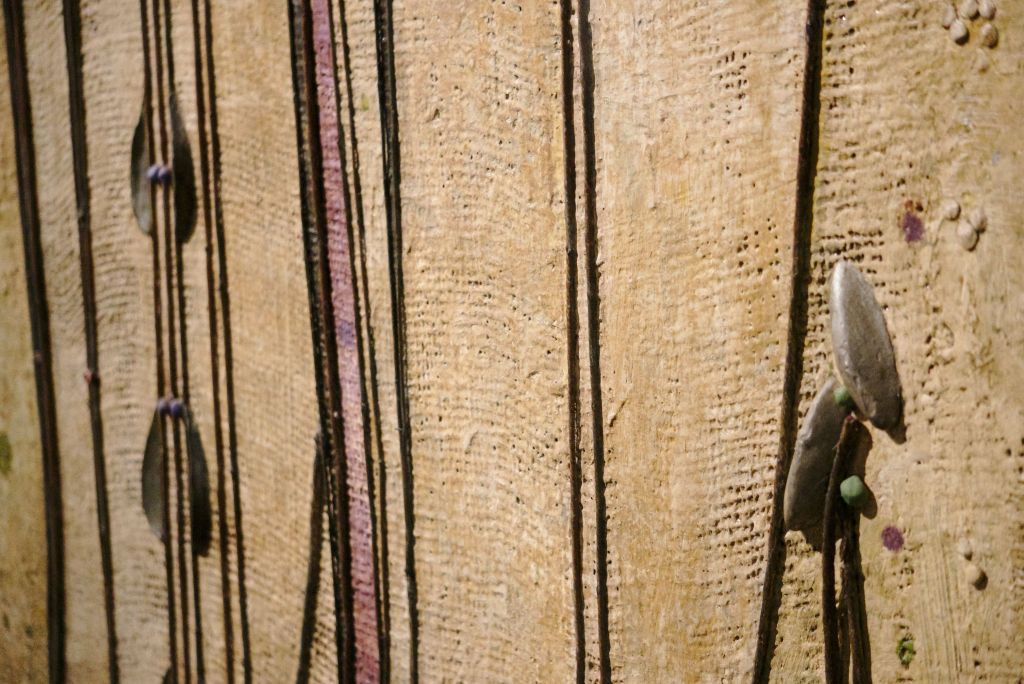
Margaret’s wide-ranging output included watercolors, graphics, metalwork, and textiles, but her specialization was gesso, a plaster-based medium, which she used to make decorative panels for furniture and interiors. The May Queen was commissioned from her at the turn of the century by Miss Catherine Cranston for one of her famous Ingram Street tea rooms in Glasgow, where it hung above a window in the Ladies’ Luncheon Room until 1971. (It is now preserved at the Kelvingrove Art Gallery and Museum.) Gloriously textured, it consists of rough burlap stretched over a wooden frame and covered in gesso, glass beads, metallic leaf, and molded paper. “Some of the modeled plaster shapes bear fingerprints, pinched and pressed into the panel’s surface. The outlines of the figures, trees, and plant forms are ‘drawn’ with brown painted string held fast with long steel pins,” Brown writes.
The crowning of a “May Queen,” a girl chosen to personify May Day and preside over its festivities, is a traditional springtime ritual in western Europe. (If you need a visual, think Florence Pugh’s character in Midsommar . . .) So the title of this artwork is most likely a reference to that. However, I get some serious Marian vibes from the central female figure, which are only reinforced when I view the work in light of the Catholic tradition of the “May crowning” of Mary.
And what a resonant pairing it makes with Hopkins’s “The May Magnificat”! It shows a woman in a strong frontal stance, dressed with flowers, haloed in green, supported by a throne-like backing, and enlarged, perhaps, with child. She’s attended by four maidservants or companions.
This could very well be read as Mary of Nazareth, crowned with beauty, blessed by God to bear his Son into the world.
Piers Plowman is a fourteenth-century allegorical poem in Middle English by William Langland, considered one of the greatest works of medieval literature. Unfolding as a series of dream-visions, it follows the narrator Will’s quest for the true Christian life.
Lines 491–95 of Passus V (as counted in the Norton Critical Edition, which uses the B-text) are among the poem’s most striking:
The sonne for sorwe therof les syghte for a tyme, Aboute midday whan moste lighte is and meletyme of seintes; Feddest with thi fresche blode owre forfadres in derknesse. Populus qui ambulabat in tenebris vidit lucem magnum. The lighte that lepe oute of the, Lucifer [it] blent, And blewe alle thi blissed into the blisse of Paradise.
MODERN ENGLISH TRANSLATION:
The sun for sorrow [at the Crucifixion] lost sight for a time, About midday, when most light is, and mealtime of saints; Thou feddest with Thy fresh blood our forefathers in darkness. Populus qui ambulabat in tenebris vidit lucem magnum. The light that leapt out of Thee, Lucifer it blinded, And blew all Thy blessed into the bliss of Paradise.
All three Synoptic Gospels tell us that from noon to three on Good Friday, “there was darkness over all the land” (Matt. 27:45; Mark 15:33; Luke 23:44–45). Medieval writers and artists sometimes imagined this in personified terms, as the sun veiling its face in mourning over the death of Christ. At what should be the brightest hour of day, the speaker remarks, the sky went black. And while people were eating their midday meal, Christ was preparing for his people a feast of his own flesh and blood.
This latter image is multifaceted, referring in context to the idea that Christ’s blood flowed into hell to rescue the patriarchs and prophets who died before his coming, but also to the legend of the pelican who wounded her breast to feed her children with her blood. The Eucharist is an obvious corollary.
Every line of Piers Plowman has three alliterative stresses, which in V.494–95 in particular create such a beautiful musicality: light, leapt, Lucifer, blinded, blew, blessed, bliss.
In the immense darkness of the Crucifixion, there shone, on a spiritual level, a glory so bright it blinded Lucifer and swept the Old Testament saints into God’s presence. Langland quotes, in Latin, the prophecy from Isaiah 9:2: “The people that walked in darkness have seen a great light.” With the atonement accomplished, our foremothers and fathers could finally inherit the promise they had clung to in faith for so long. The conflation of light and breath as a propulsive force or a vehicle of transport is so unique and vivid—how the saints, expelled from their prison, ride a strong wind or a ray of light into paradise. I see them joyfully tumbling to their new home!
This passage anticipates the triumph of Passus XVIII, which centers on the harrowing of hell. Reiterating the unusual verb choice of “blew,” the poet says it is Christ’s breath that breaks down the hellgate. Here is Christ (“the light”) on Holy Saturday, addressing the fiends of hell:
Again the light bade them unlock, and Lucifer answered, “Who is that? What lord are you?” said Lucifer. The light at once replied, “The King of Glory. The Lord of might and of main and all manner of powers: The Lord of Powers. Dukes of this dim place, at once undo these gates That Christ may come in, the Heaven-King’s son.” And with that breath hell broke along with Belial’s bars; For any warrior or watchman the gates wide opened. Patriarchs and prophets, populus in tenebris, Sang Saint John’s song, Ecce agnus Dei. Lucifer could not look, the light so blinded him. And those that our Lord loved his light caught away.
(XVIII.316–26, modern English translation by E. Talbot Donaldson)
+++
Greta Leśko (Polish, 1979–), Crucifixion with Transfiguration, 2019. Tempera on gessoed wood board.
This multitiered icon by Greta Leśko is not a direct response to the Piers Plowman passages, but boy does it resonate! I love how she has rendered the paradoxical nature of the cross as a site of simultaneous darkness and light by integrating a scene of the Transfiguration beneath.
Earlier in his ministry, Jesus went up to Mount Tabor with his disciples Peter, James, and John, where he revealed to them, in dazzling light, his true glory. Pierced by these rays, they are literally knocked off their feet! As is traditional, Leśko shows the transfigured Christ holding a scroll in his left hand (signifying that he is the Word of God) and making a blessing gesture with the other.
The Transfiguration was a prefiguration of the Resurrection, and indeed in Leśko’s minimalist conception, this tableau could be read secondarily as Christ risen from the grave. The dark orb that encircles him is like the mouth of his tomb, and the three splayed men evoke the Roman guards who were sent reeling as their dead charge emerged from it alive and in full health.
The top half of Leśko’s icon portrays the Crucifixion. Christ spreads wide his arms across the orange beam, which seems to have no end, but rather melds into the all-encompassing border of light. To his right is what appears to be an open window or a doorway—a displacement, perhaps, of his side wound, which we are invited to enter and take shelter in. At the base of the cross, in a darkened recess, sits a skull, representing the death of Adam.
Adam also appears, with Eve, in the roundel at the cross’s upper terminal. This is a scene of the Anastasis (Greek for “Resurrection”), which is the primary icon of Pascha (Easter). It shows Christ descending into Hades, breaking down its doors (which lie in a heap at his feet) and liberating all the Old Testament saints. Known in the West as the harrowing of hell, this event is referenced in the ancient Apostles’ Creed, which states that Jesus “suffered under Pontius Pilate, was crucified, died, and was buried, and he descended into hell . . .” Medievals loved this part of the story, with all its drama and redeemer-heroism. (It’s the climax of Piers Plowman!) In the Orthodox Church it is a central doctrine.
It’s notable that Leśko has chosen to place the underworld action at the top of the composition and the mountaintop action at the bottom. From the depths of the universe to its heights, God’s radiance is ablaze, yes, but is there a significance to their being transposed? The old world order being overturned, perhaps? Maybe it’s simply to give the Transfiguration more prominence, making it an equal counterweight to the Crucifixion—with the Anastasis, small as it is, merely hinted at. In any case, visually and narratively, it means we read the icon from bottom to top.
By sandwiching the cross between two unambiguous manifestations of Christ’s glory, Leśko helps us see the fuller picture of the Crucifixion, where human evil and God’s goodness met and salvation was born. Or, as William Langland puts it: where light leapt out and “blew all [God’s] blessed into the bliss of Paradise.”
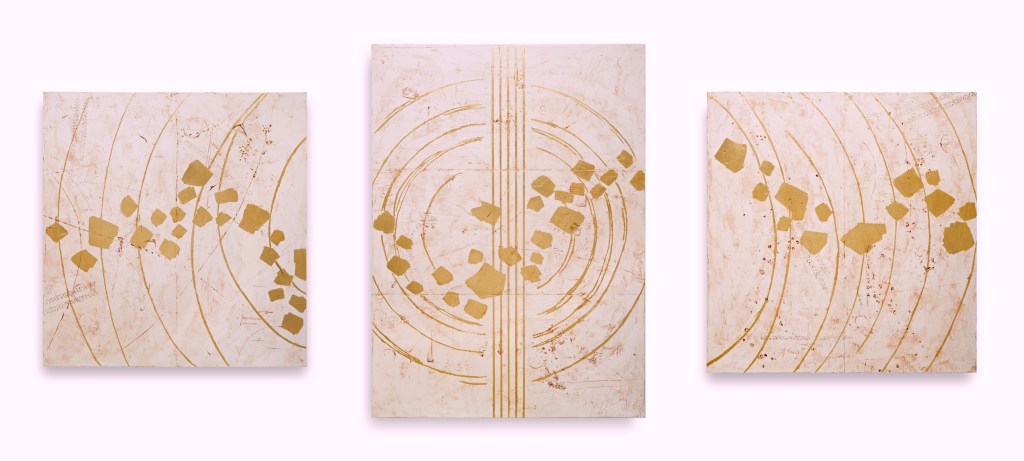
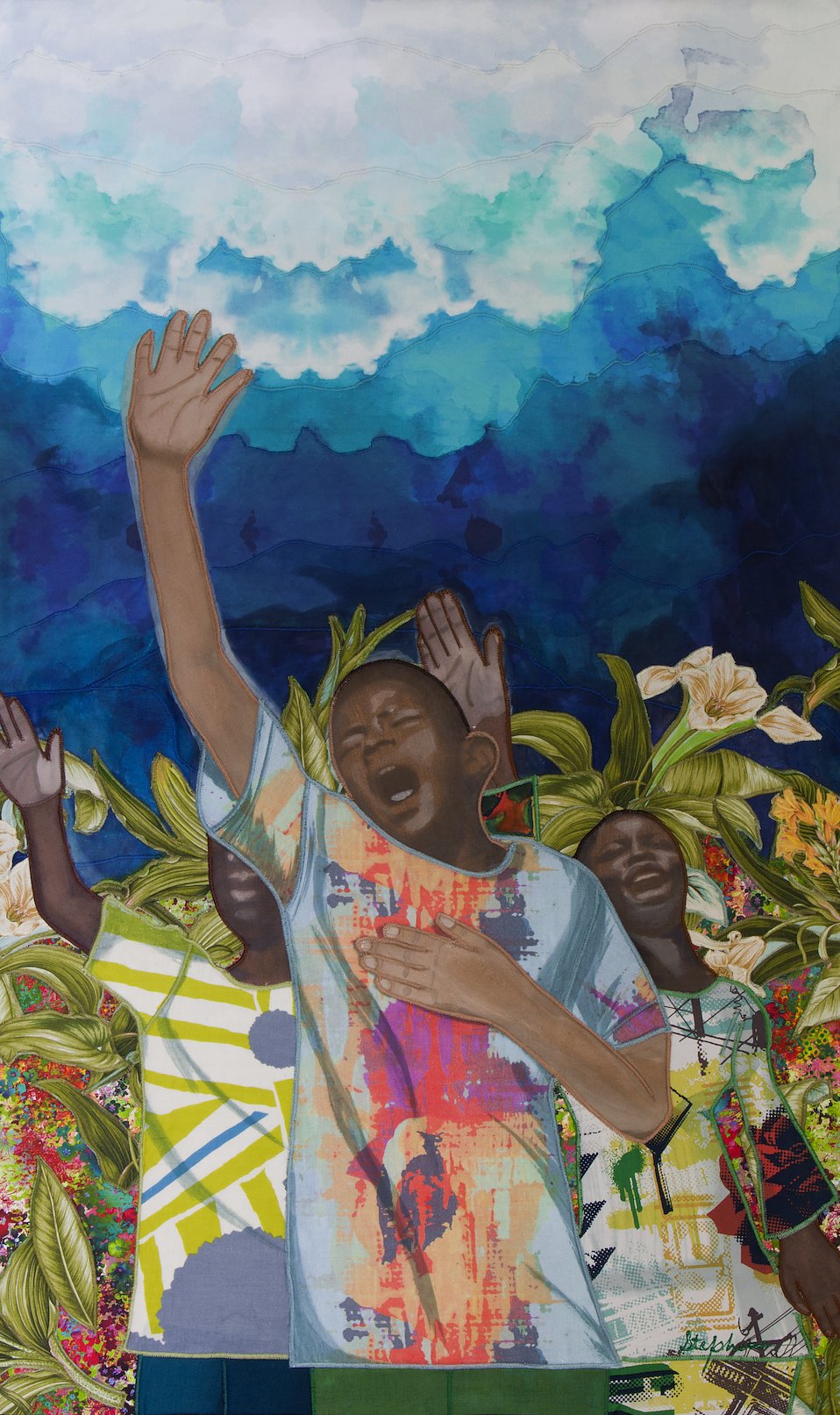
EXHIBITION: Otherwise/Revival, Bridge Projects, Los Angeles, April 9–June 26, 2021: Curated by Jasmine McNeal and Cara Megan Lewis, this group exhibition visualizes the impact of the historic Black church—specifically the Black Pentecostal movement—on contemporary artists. Included are several artists I’ve featured on the blog before—Lava Thomas [here], Kehinde Wiley [here], Clementine Hunter [here], Letitia and Sedrick Huckaby [here]—plus twenty-six others.
Phyllis Stephens (American, 1955–), High and Lifted Up, 2020. Cotton fabric, 57 × 33 in. Private collection. Courtesy of the artist and Richard Beavers Gallery, New York.Kenturah Davis (American, 1984–), Namesake I, 2014. Incense ink on rice paper, applied with rubber stamp letters, 39 × 36 in. Courtesy of the artist and the Petrucci Family Foundation, New Jersey.
I regret that I won’t be able to see the exhibition in person, but there’s a wealth of relevant content available on the gallery’s website, including photos, artist bios and statements, and commentaries. I haven’t fully delved in yet, but some of the artist names are new to me, and I look forward to jumping over to their websites to learn more. There’s also a series of free events that have been scheduled. The premiere of the virtual music performance yes! lord by Ashton T. Crawley and a symposium on the Azusa Street Revival have already passed (both are archived online for on-demand viewing), but here are some upcoming opportunities you can reserve a spot for:
May 1: “Jazz and the Gospel” with Daniel E. Walker, Ashon T. Crawley, Dario Robleto, Norman Teague, Lava Thomas, and Folayemi (Fo) Wilson
ARTICLE: “5 Films About the Beauty of Resurrection” by Brett McCracken: “Resurrection’ tropes are so familiar in certain genres that they can numb us to the jarring beauty and bracing surprise of resurrection. But other films capture the magic and shock of resurrection by situating it within more mundane realities and contexts. Here are five of my favorite examples of this kind—movies that capture resurrection in all of its miraculous, unsettling, hope-giving glory.” One of his selections is Happy as Lazzaro, which I saw last year and enjoyed:
+++
NEW ALBUMS:
>> Hymns I by Lovkn: Steven Lufkin is a singer-songwriter from Phoenix, Arizona, recording under the name Lovkn. His latest EP, a collection of eight acoustic hymn covers, was released April 2. (Also, he’s currently raising funds to record an album of original songs, to be released later this year: kickstarter.com/projects/lovkn/new-album-2021.)
>> Prayers for the Time of Trial by Joel Clarkson: Released April 7, this EP comprises five original SATB choral compositions by Joel Clarkson, which he recorded with his sister Joy Clarkson. My favorite is the first, “Lighten Our Darkness,” a setting of the Book of Common Prayer’s Collect for Aid Against Perils: “Lighten our darkness, we beseech thee, O Lord; and by thy great mercy defend us from all perils and dangers of this night; for the love of thy only Son, our Savior, Jesus Christ. Amen.”
The other four are “Sub Tuum Praesidium” (Beneath Thy Protection), a third-century hymn to the Virgin Mary as Theotokos; “Hail King,” a poem by Joel’s other sister, Sarah Clarkson, that marvels at how rocky cliffs and sea waves and herring gulls sing God’s praises in their own way; “Ubi Caritas,” an ancient hymn centered on the theme of Christian charity; and the simple benediction “May the peace of the Lord be with you now and always.”
ORTHODOX CHANT: Russian Kontakion of the Departed: At Prince Philip’s funeral service at St. George’s Chapel at Windsor Castle on April 17, a choir of four sang, among other pieces, the Russian Kontakion of the Departed, translated into English by William John Birkbeck and arranged by Sir Walter Parratt. “The Russian Kontakion of the Departed is an ancient Kiev chant with its origins in the Russian Orthodox liturgy. This moving chant expresses the sorrow of grief but reminds us of the Christian hope of everlasting life; in the face of sadness, we sing Hallelujahs.” [HT: Global Christian Worship]
Give rest, O Christ, to thy servant with thy saints: where sorrow and pain are no more; neither sighing but life everlasting. Thou only art immortal, the creator and maker of man: and we are mortal formed from the dust of the earth, and unto earth shall we return: for so thou didst ordain, when thou created me saying: Dust thou art und unto dust shalt thou return. All we go down to the dust; and weeping o’er the grave we make our song: Alleluia, alleluia, alleluia.
+++
VISUAL LITURGY: “After Ezekiel” by Madeleine Jubilee Saito: Remember those flip books you probably encountered as a kid—the ones with a series of images that gradually change from one page to the next, giving the illusion of animation when viewed in quick succession? Well, this is a digital version of that. In 2019 cartoonist and illustrator Madeleine Jubilee Saito created an image sequence intended to be swiftly clicked through as part of the Easter Vigil at a church in Boston. It was inspired by the story of Ezekiel in the valley of dry bones (Ezek. 37). Very compelling!
Here’s the second half of my top-twenty list of 2020 films; view part 1 here.
11. The Forty-Year-Old Version, written and directed Radha Blank: Radha plays a fictionalized version of herself in this feature debut of hers, a thoughtful blend of comedy and drama that’s intricate and fresh. Her character is a New York City playwright who, desperate for a breakthrough before turning forty, decides to reinvent herself as rapper RadhaMUSPrime. The film addresses the arts industry’s sometimes stifling expectations of Black artists, which has in its mind what the Black experience (as if there were only one) needs to look like. Producers, for example, want Radha’s Black characters to talk and act a certain way and to fit into a particular storyline, and they try to convince her to make adjustments to her writing to make her plays more palatable to white audiences, who comprise the bulk of ticket sales.
With humor and insight, Blank explores this struggle along with, more broadly, middle-age Black womanhood, which includes for her, in addition to navigating career roadblocks, the experiences of losing a parent, finding human connection, and learning a new art form.
Stream on Netflix.
12. Promising Young Woman, written and directed by Emerald Fennell: I have mixed feelings about revenge thrillers, which ask viewers to root for vindictive outcomes. But this one, though it takes up certain tropes of the genre, subverts others. “We’re used to the idea of a violent journey, but I wanted to look at how a real woman might take revenge, and I had an idea that it would be kind of tricky and malevolent and existentially threatening, rather than something more run-of-the-mill and AK-47 based,” said first-time writer-director Emerald Fennell (who I know as Patsy from Call the Midwife, and you might know as Camilla from The Crown!).
Having dropped out of medical school following the rape of her best friend Nina, Cassie (Carey Mulligan) has developed a compulsive desire to teach “nice guys” who take advantage of women a lesson. She feigns drunkenness in clubs on a regular basis, and when a man inevitably takes her back to his home and gets handsy, he is in for a harrowing confrontation. A critique of rape culture, in which having nonconsensual sex with drunk women is normalized, trivialized, and excused, the film shows how not all rapists are obvious creeps; a lot of them are “normal,” seemingly caring individuals who are thus almost always given the benefit of the doubt over their accusers.
13. Soul, directed by Pete Docter and Kemp Powers; written by Pete Docter, Mike Jones, and Kemp Powers: Joe Gardner (voiced by Jamie Foxx) is a part-time middle-school band teacher in New York City who does side gigs as a jazz pianist. Music is his passion. At the beginning of the film, though, he dies suddenly and then inadvertently stumbles off the skyway escalator to the Great Beyond, landing in the “Great Before,” where preincarnate souls are waiting to be born. There he’s enlisted to mentor an ornery soul named 22 (voiced by Tina Fey), who doesn’t want to go to Earth, which she imagines is just all dirty and bad. But when she mistakenly ends up in Joe’s body and lives his life for a day, she finds such wonder in it—a fresh haircut, twirling maple seeds, the smell and taste of pizza, the thrill of riding the subway or of putting on a sharp-looking suit, laughter and camaraderie. I’m reminded in some ways of Wim Wenders’s Wings of Desire (1987), in which an angel longs to experience life in the physical world.
Soul is a celebration of the inherent goodness of life, despite its challenges and disappointments; it’s about finding joy in the ordinary, and purpose wherever we’re at. It subverts the cultural narrative that every human being has a single defining “purpose in life,” that each one is “born to (fill in the blank).” Instead, it acknowledges that passions can evolve and change (for example, the barber Dez used to want to be a veterinarian), and that several can coexist alongside one another. And while passions can fuel us, they alone are not our reason for living.
Stream on Disney+.
14. Another Round, directed by Thomas Vinterberg; written by Thomas Vinterberg and Tobias Lindholm: In this dramedy from Denmark, four middle-age men who teach at a high school test the hypothesis that maintaining a constant blood alcohol concentration of 0.05% will improve their quality of life by making them more relaxed, self-confident, open, fun to be around, and better at their jobs. But when their experiment gets out of hand, there are consequences on marriage and career.
Though centered on intoxication and male friendship, this is no slapstick buddy comedy, nor is it a one-note cautionary tale against the perils of excessive drinking. It both celebrates the joys of losing yourself in drink and also shows how punishing regular overindulgence can be. Still, the finale is amazingly exuberant and life-affirming—and gives a chance for Martin’s (Mads Mikkelsen) “jazz ballet” to finally come out!
Stream on Hulu.
15. Driveways, directed by Andrew Ahn; written by Hannah Bos and Paul Thureen: I’m a sucker for the “unlikely friendships” genre, and this one is so well done. When single mom Kathy (Hong Chau) and her shy eight-year-old son Cody (Lucas Jaye) move into the house of her recently deceased sister, Cody befriends an elderly white war veteran and widower named Del (Brian Dennehy), who lives next-door. They bring each other out of their shells.
Stream on Showtime.
16. The Invisible Man, written and directed by Leigh Whannell: The Invisible Man is based loosely on the classic H. G. Wells sci-fi horror novel of the same name, in which an optical scientist invents chemicals capable of rendering bodies invisible and then uses this discovery to execute a reign of terror. Whannell brings the story into our present time and centers it on the terror of domestic abuse and its machinations—financial, physical, and emotional control—and especially of not being believed about said abuse. In Whannell’s version, Cecilia (Elisabeth Moss) finally succeeds, it would seem, in escaping her abusive live-in boyfriend, multimillionaire tech genius Adrian Griffin (Oliver Jackson-Cohen). She then learns of his suicide and feels immense relief but soon starts to suspect it is a hoax. Her suspicions are confirmed when she is repeatedly stalked and tormented by an “invisible man.” Because the police and even her friends and family think she’s crazy, she’s forced to take matters into her own hands.
Stream on HBO Max.
17. Blow the Man Down, written and directed by Bridget Savage Cole and Danielle Krudy: Set in a New England coastal town, this dark comedy crime thriller follows sisters Mary Beth (Morgan Saylor) and Priscilla (Sophie Lowe) Connolly in their attempt to cover up a gruesome run-in with a dangerous man. Along the way they are exposed more and more to the town’s underbelly, which includes, as I heard one reviewer refer to it as, a “beauty parlor mafia”!
Stream on Amazon Prime.
18. Mank, directed by David Fincher; written by Jack Fincher: I’m a huge fan of Citizen Kane, so this drama about the writing of its first draft by the witty Herman J. Mankiewicz (Gary Oldman) was really enjoyable for me, not least because it’s full of visual references to Kane! Orson Welles is officially credited as cowriter of Kane, as he heavily revised Mankiewicz’s script, but Mank argues that Welles’s screenwriting contributions were negligible, and that Mankiewicz deserves more credit for the success of Kane than he has typically been given.
The film gives a glimpse into the 1930s Hollywood studio system in all its glamor and corruption and shows the real-life inspirations for the characters of Charles Foster Kane and Susan Alexander Kane: newspaper tycoon William Randolph Hearst (Charles Dance) and his young mistress, the actress Marion Davies (Amanda Seyfried).
Stream on Netflix.
19. His House, written and directed by Remi Weekes: This haunted-house film uses the supernatural to explore the specters of the refugee experience. Married couple Bol and Rial Majur (played by Sope Dirisu and Wunmi Mosaku) have made a harrowing escape from war-torn South Sudan, but they struggle to adjust to their new life in England, as ghosts have followed them there.
Stream on Netflix.
20. Young Ahmed, written and directed by Jean-Pierre Dardenne and Luc Dardenne: Under the influence of a radical imam, a Belgian teenager (Idir Ben Addi) embraces an extremist interpretation of the Quran, which spurs him to a heinous act. He is taken to a rehabilitation center, where staff try to loosen the grip of his zealotry and help him develop a truer, healthier practice of Islam.
I’m a big cinephile, but because I’m not sure how to write about films for an Art & Theology audience, you may not know that about me! Anyway, I wanted to share my top twenty films from last year (all released in the US in 2020). For each I’ll give a brief description and comments, followed by the trailer. If they’re streaming for “free” through a subscription service, I’ve noted which one; otherwise, most are available for online rental, or you might also check to see if your local library has a DVD copy. A few are showing in select theaters.
Because so many big-budget blockbuster films had their releases delayed because of COVID (reliant, as they are, on theatrical releases), it has given the chance for smaller-scale, quieter films to come to the fore—which are usually the type I enjoy most anyway. I like films that are character-driven and/or that make me feel something. As I’ve said before, watching films grows our capacity for empathy, as we encounter characters from different backgrounds and in different situations and are given the opportunity to see things through their eyes.
In this list, which I will complete in a second post tomorrow, the characters include a new member of the deaf community who’s struggling to come to terms with his disability, a Midwestern farmer of Korean vegetables and a pair of entrepreneurial Pac Northwest settlers (new homes, new ventures), a widow who’s out of work and houseless, a survivor of domestic violence, a daughter walking with her dad through a debilitating illness, a London teenager forced to take on adult responsibilities but bolstered up by a strong sisterhood, a crime victim whose forgiveness of her perpetrator initiates healing in multiple directions, a young employee let down by her company and debating whether to make moral compromises to keep her job, a middle school teacher with other career aspirations, a struggling playwright whose race pigeonholes her in the industry, and a refugee couple settling into a new country with a huge weight of grief. Whether the contexts are near or far from our own, we bear witness to these characters’ journeys, attending to their fears and traumas, their stresses and disappointments, their joys and triumphs.
As you’ll see, it’s been a fantastic year for women filmmakers!
1. Sound of Metal, directed by Darius Marder; written by Darius Marder and Abraham Marder: When Ruben (Riz Ahmed), a thrash-metal drummer, loses his hearing, he’s in danger of relapsing into substance abuse, so with the support of his girlfriend (Olivia Cooke), he checks in to a home for deaf people recovering from addiction. Ruben is a fixer and is obsessed with control, and his immediate and persistent impulse upon experiencing hearing loss is to pursue an expensive corrective surgery so that he can return to life as usual. The film’s sound design, which lets us hear the muffled noises Ruben is hearing, helps us better feel his frustration.
The film is about Ruben learning how to be deaf. It’s about disappointment, acceptance, and self-knowledge, and the crucial role community plays in helping us cope with or achieve those things. Against his wishes, Ruben enters a world completely alien to him. He has to learn sign language and how to make new relationships. It’s beautiful to see Ruben’s perspective slowly shift as he learns to regard deafness not as a handicap but as a way of life, a culture.
Stream on Amazon Prime.
2. Minari, written and directed Lee Isaac Chung: In this semiautobiographical film set in the 1980s, a Korean immigrant family moves from California to Arkansas, where the father, Jacob (Steven Yeun), wants to break out of the chicken sexing industry and start his own produce farm. (He says he wants his children to see him succeed at something.) As the Yis put down roots in the rugged Ozarks and prepare and plant the large plot of land they’ve bought, they encounter typical struggles, on top of which is the heart condition of their young son, David (played by the adorable Alan Kim, whose interviews light me up every time!). They end up flying in grandma Soonja (Yuh-Jung Youn) from Korea to help with childcare, and David has difficulties connecting with her because she doesn’t match his idea of an American grandma.
The American Dream, biculturalism, marriage, and family are key themes in Minari.
3. Nomadland, written and directed by Chloé Zhao (based on the nonfiction book by Jessica Bruder): When the gypsum plant in the company town of Empire, Nevada, shuts down during the Great Recession in 2011, the entire town is shuttered, its zip code discontinued, and its residents displaced. Fern (Frances McDormand), a recent widow in her sixties, is one of them. She sells most of her possessions and heads west in her van, searching for work wherever it’s available, and finding connection—with people, with the land—along the way.
The film explores the growing subculture of “workampers,” or, as they more commonly call themselves, nomads—people who, either for a sense of adventure or because of deteriorated economic circumstances, lead itinerant lives, following temporary work. It blurs the line between drama and documentary, as most of the cast, including Linda May and Charlene Swankie, are nonactors playing versions of themselves. Their real-life stories heavily informed the script.
Stream on Hulu.
4. Dick Johnson Is Dead, directed by Kirsten Johnson: A joyous and uplifting documentary in which the filmmaker confronts the impending death of her father, who has dementia. I wrote about it here.
Stream on Netflix.
5. First Cow, directed by Kelly Reichardt; written by Jon Raymond: I’m not typically a fan of westerns, but this one hooked me. Set in the Oregon Territory of the 1820s, it follows Otis, known as Cookie (John Magaro), a lowly cook for a band of trappers, and King-Lu (Orion Lee), a Chinese immigrant wanted for murder. The two meet at a trading post, and a friendship develops, which constitutes the core of the film. (Its epigraph is a quote by William Blake: “The bird a nest, the spider a web, man friendship.”)
The film is also a subtle critique of capitalism. When a local official buys a cow, the first in the territory, the enterprising King-Lu hatches a plan for him and Cookie to steal milk from it each night so that they can make “oily cakes” (fried dough) to sell. It’s either exploit or be exploited, King-Lu reasons.
6. Never, Rarely, Sometimes, Always, written and directed by Eliza Hittman: At the beginning of the film, seventeen-year-old Autumn (Sidney Flanigan) learns she is pregnant, but she can’t obtain an abortion in Pennsylvania without parental consent. So her cousin Skylar (Talia Ryder) accompanies her to New York City, where the abortion can be performed without that restriction, to support her through the trauma.
When Autumn is interviewed by a counselor at the Planned Parenthood clinic in New York about an hour into the film, it’s one of the first times we see her, usually so reserved, exhibit emotion—and laudably, Flanigan plays this moment without an ounce of melodrama. “Has a partner ever refused to use protection?” “Has a partner ever been violent?” “Have you ever been forced into a sexual act?” (She is asked to respond to each question with one of the four answers in the film’s title.) Here we learn how little of her sexual history has been in her control.
Though reviews of and promotions for the film have tended to focus on the importance of “a woman’s right to choose,” you don’t have to be an abortion supporter (I’m not) to appreciate this film. It’s not very polemical. It’s simply a portrait of one girl’s experience, and it’s painted with such tenderness and realism.
Stream on HBO Max.
7. The Painter and the Thief, directed by Benjamin Ree: A documentary about the unlikely friendship between a Czech artist and the man who stole two of her paintings and then lost them on the black market. I wrote about it here.
Stream on Hulu.
8. The Assistant, written and directed by Kitty Green: One of several to come out in the wake of the #MeToo movement, this film is uncomfortable from start to finish—intentionally so. It’s a different kind of thriller, the dread building every banal scene after the next as Jane (Julia Garner), a recently hired assistant to a Hollywood studio executive, goes about her daily work routine and starts discovering some serious abuses of power in the company that target young women. The monster boss, who is never seen, is clearly modeled after Harvey Weinstein. Not much “happens” in The Assistant, but it succeeds in conveying a sense of being trapped in a corrupt system of misogyny, and it reveals how easy it is for those who witness particular offenses to keep quiet in order to protect their careers.
Stream on Hulu.
9. Emma, directed by Autumn de Wilde; written by Eleanor Catton, based on the novel by Jane Austen: “In 1800s England, a well-meaning but selfish young woman meddles in the love lives of her friends”—and learns a lesson. I loved the 2009 film adaptation of this classic novel that stars Romola Garai (she is still my favorite Emma), and the 1996 version with Gwyneth Paltrow is also much celebrated, so I didn’t think there was need for another attempt. But I thoroughly enjoyed this, with Anya Taylor-Joy (of The Queen’s Gambit) playing the title role. Austen was a humorist, and her comedic flair comes across with great effect here. A few things that stand out to me when compared to previous adaptations are the excellent soundtrack (which includes English folk hymns) and the likability of Harriet (Mia Goth), who is given a little more dimensionality than usual.
Stream on HBO Max.
10. Rocks, directed by Sarah Gavron; written by Theresa Ikoko and Claire Wilson: A celebration of young female friendship that’s tested when one in the group, nicknamed Rocks (Bukky Bakray), is abandoned by her mother, her only parent, leaving her to care for her little brother. Rocks struggles to take care of meals, bills, apartment upkeep, and childcare while still attending high school, and she also struggles, initially, with letting anyone in, with accepting help. She eventually confides in her best friend Sumaya (Kosar Ali), and she and others then rally around Rocks to offer support, though they disagree on what is best, and it leads to some fallout. The film shows the resilience of the plucky and determined Rocks and the immense value of having friends to see you through hard times. The relationship between Rocks, a Nigerian Christian, and Sumaya, a Somali Muslim, is especially poignant; the actors’ chemistry is a joy to watch.










 Art & Theology