
LOOK: the heavens wept with me by Caitlin Connolly
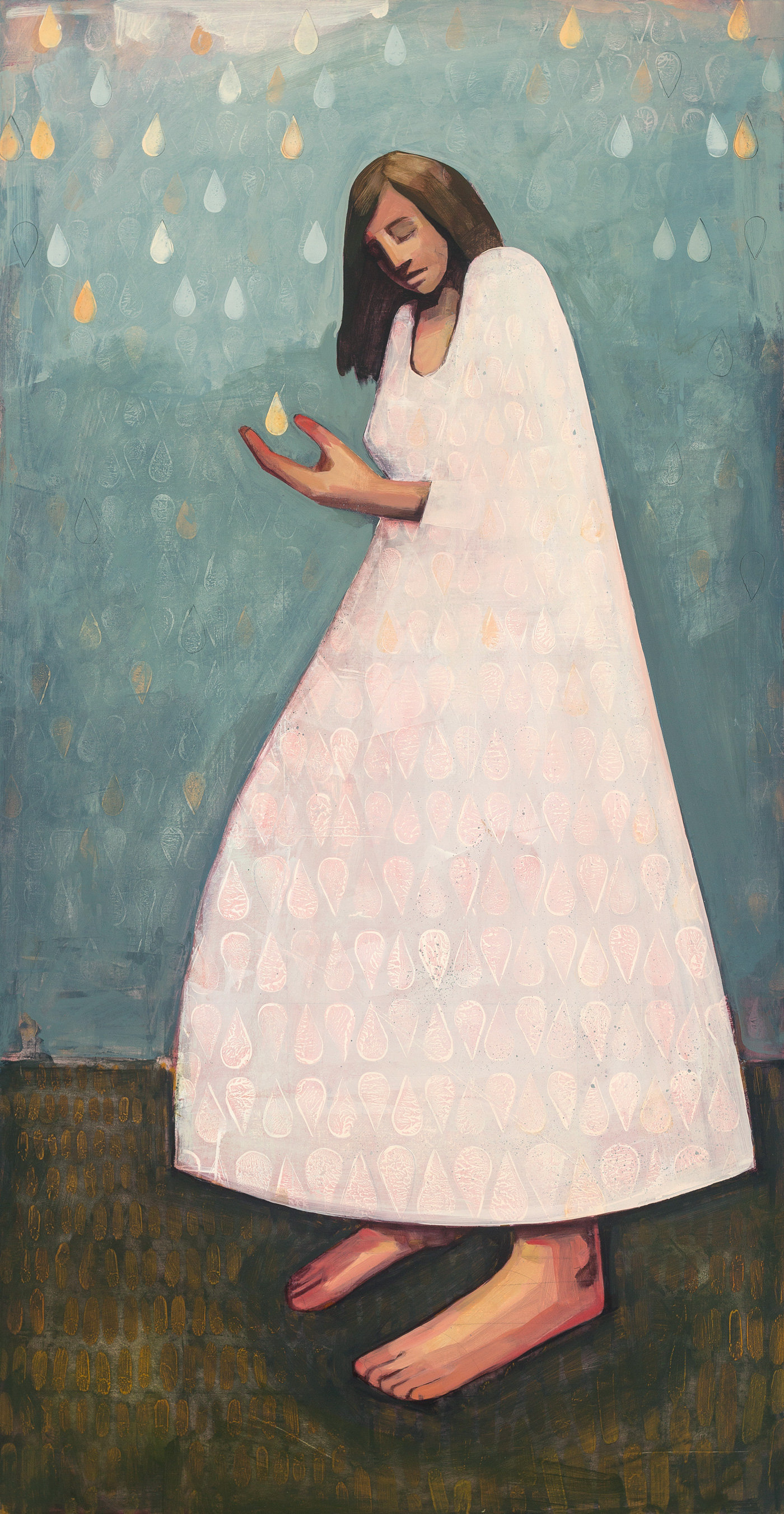
LISTEN: “A Dream / On Another’s Sorrow” | Words by William Blake, from Songs of Innocence, 1789, adapt. | Music by David Benjamin Blower, on Innocence & Experience, 2022
Once a dream did weave a shade
O’er my Angel-guarded bed,
That an Emmet lost its way
Where on grass methought I lay.Troubled, ’wildered, and forlorn,
Dark, benighted, travel-worn,
Over many a tangled spray,
All heart-broke I heard her say:“O my children! do they cry?
Do they hear their father sigh?
Now they look abroad to see:
Now return and weep for me.”Pitying, I dropped a tear;
But I saw a glow-worm near,
Who replied: “What wailing wight
Calls the watchman of the night?“I am set to light the ground,
While the beetle goes his round:
Follow now the beetle’s hum;
Little wanderer, hie thee home.”*
Can I see another’s woe,
And not be in sorrow too?
Can I see another’s grief,
And not seek for kind relief?Can I see a falling tear,
And not feel my sorrow’s share?
Can a father see his child
Weep, nor be with sorrow filled?Can a mother sit and hear
An infant groan, an infant fear?
No, no! never can it be!
Never, never can it be!And can They who smile on all
Hear the wren with sorrows small,
Hear the small bird’s grief and care,
Hear the woes that infants bear,And not sit beside the nest,
Pouring pity in their breast;
And not sit the cradle near,
Weeping tear on infant’s tear;And not sit both night and day,
Wiping all our tears away?
O no! never can it be!
Never, never can it be!They do give Their joy to all;
They become an infant small;
They become a one of woe;
They do feel the sorrow too.Think not thou canst sigh a sigh,
And thy Maker is not by;
Think not thou canst weep a tear,
And thy Maker is not near.
The lyrics of this song comprise two poems from William Blake’s Songs of Innocence: “A Dream” and “On Another’s Sorrow.”
In “A Dream,” the poetic speaker dreams about a lost ant (an emmet) who is trying to find her way back to her children and husband. The speaker is moved by the ant’s distress and weeps for her. But then a glowworm (“the watchman of the night,” as he’s lit like a lantern) graciously intervenes, telling the ant to listen to the sound of the beetle walking and to follow that sound home while he lights the way.
“Told from a trusting, childlike perspective, the poem”—a fable—“suggests that those who ask for help will get it: the world is a naturally compassionate place, and guidance and protection are always at hand, even in difficult times.” (LitCharts)
Aren’t we all “little wanderers”? Many of us troubled, bewildered, lonely, and worn by our seeking and striving?
There is empathy for us not only from fellow travelers but also from the Divine.
“On Another’s Sorrow” is about how God lovingly enters into our woes through the Incarnation. He becomes a participant in the project of being human, experiencing firsthand the many trials, hurts, and vulnerabilities that come with the territory.
In the first three stanzas, the speaker expresses how keenly he feels the sorrows of others. In the fourth stanza, he reflects on how God does the same—only God is perfectly present to all, weeping with those who weep, sighing with those who sigh. Having “become an infant small,” the Creator has demonstrated solidarity with his creation. It is a comfort to know that God is so intimately acquainted with the griefs that afflict us and is keen to companion us through them.
In his creative visioning, British singer-songwriter David Benjamin Blower brought together Blake’s “A Dream” and “On Another’s Sorrow” with a single, spare musical setting, linking the two poems with an instrumental interlude but keeping the same tune throughout. The first poem is about the feeling of weariness or lostness; the second, grief. Both have to do with compassion—we owe it to one another and often receive it from others, and it is always available to us in Christ, who is God brought near.
In “On Another’s Sorrow,” Blower changed the pronouns for God in the fourth and seventh stanzas from “He/His” to “They/Their,” since God is neither male nor female. He also omitted the final stanza in Blake’s original:
O! He gives to us His joy
That our grief He may destroy:
Till our grief is fled and gone,
He doth sit by us and moan.
This post is part of a daily Advent series from December 2 to 24, 2023 (with Christmas to follow through January 6, 2024). View all the posts here, and the accompanying Spotify playlist here.
 Art & Theology
[…] Benjamin Blower [previously] from Birmingham, England, is one of the most original, thoughtful, and compelling songwriters of […]
LikeLike
[…] of woe, / He doth feel the sorrow too.” I featured this poem about Emmanuel, God-with-us, in a musical setting by singer-songwriter David Benjamin Blower in 2023 but was surprised that Blower omitted Blake’s final stanza, whose closing couplet I find […]
LikeLike