
LOOK: (She thought he was) The Gardener by Helen Sherriff
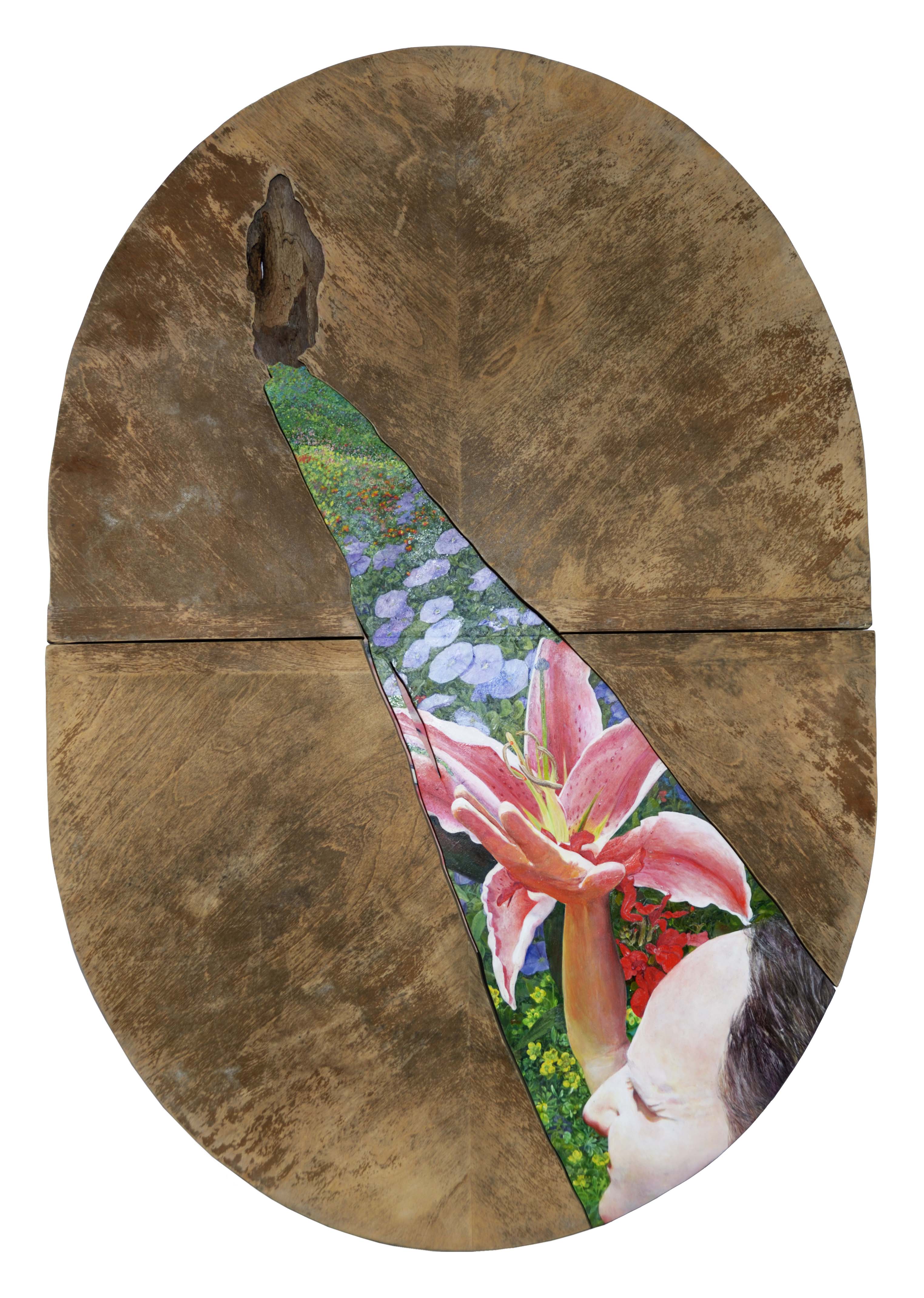
This painting by Helen Sherriff, which won the Needham Religious Art Prize in 2013, shows Christ appearing to the forlorn Mary Magdalene after his resurrection. Sheriff cut the figure of Christ out of the MDF substrate and “inserted a piece of thick tree bark which had a scar in an appropriate place suggesting a wound,” she writes at ArtWay.eu.
The colorful flowering cast forth from his form is such a unique way to visually interpret the significance of this moment of encounter. “Normally there would be a shadow stretching forward,” Sherriff says, “but this darkness is light.”
Sherriff also notes how the shape of the Stargazer lily is echoed by Mary’s hand held up to shield her face from the brightness.
LISTEN: “J’entre dans mon jardin” (I Come to My Garden) by the Choeur des Moines de l’abbaye de Keur Moussa au Sénégal, on L’heure vient (2007)
This instrumental piece, an air for kora (traditional calabash harp-lute) and recorder, is part of the Liturgy of the Resurrection at Keur Moussa Abbey in Senegal. Its title is taken from Song of Songs 5:1:
I come to my garden, my sister, my bride;
I gather my myrrh with my spice;
I eat my honeycomb with my honey;
I drink my wine with my milk.Eat, friends, drink,
and be drunk with love.
The liner notes for this track on the CD sleeve, which are all in French, say, “Christ, in the Christian tradition, is the Bridegroom. He comes, resurrected on Easter morning, to meet Mary Magdalene, seated at the entrance to the tomb. The kora and the flute convey the joy of this Easter reunion with freshness and brightness.”
On Saturday I shared an example of another Christian musician who has linked the Song of Songs to the Easter story.
To learn more about the music making of the Keur Moussa community of brothers, read the 2022 New Yorker profile “The Monks Who Took the Kora to Church” by Julian Lucas, or the blog feature I published in 2017. I also shared their musical setting of the “Vidi aquam” in Wolof last Easter, along with a wood-carved candlestand by Thomas Mpira of Malawi.
 Art & Theology