Miniatures from a Coptic-Arabic Gospel Book, 13th century

Christianity has had a long and deep presence in Egypt. The art historical record is one means of exploring that.

From mid-thirteenth-century Egypt there survives an illuminated New Testament written in Bohairic Coptic with glosses in Arabic. It was copied in Cairo in 1249–50 by Gabriel III (born al-Rashīd Farajallāh), who would serve as patriarch of Alexandria from 1268 to 1271, for the private use of a prosperous lay patron of the Coptic Church. The images are most likely the work of a single artist and his assistant.

This Coptic-Arabic New Testament is divided between two locations: the Four Holy Gospels in Paris (Institut Catholique, Ms. Copte-Arabe 1), and Acts of the Apostles and the Epistles in Cairo (Coptic Museum, Bibl. 94). In this post I will showcase the art from the Gospels portion.

Drawing on Byzantine and Islamic artistic influences, Copte-Arabe 1 “represents the culmination of painting in Egypt and the allied territory of Syria for the Ayyubid period [1171–1260] as a whole,” writes art historian Lucy-Anne Hunt. [1] The manuscript contains fourteen full-page miniatures and four Gospel headpieces. A later hand clumsily retouched in black ink some facial details that had become abraded over the years—so no, those marks most noticeable on folios 56v and 178v are not intended as mockery.

Of the fourteen full-page miniatures, four are portraits of the Evangelists (i.e., Gospel-writers): Matthew, Mark, Luke, and John. These are the most refined and celebrated paintings in the manuscript.

Coptic-Arabic Portrait of Matthew
fol. 1v: Portrait of Matthew the Evangelist

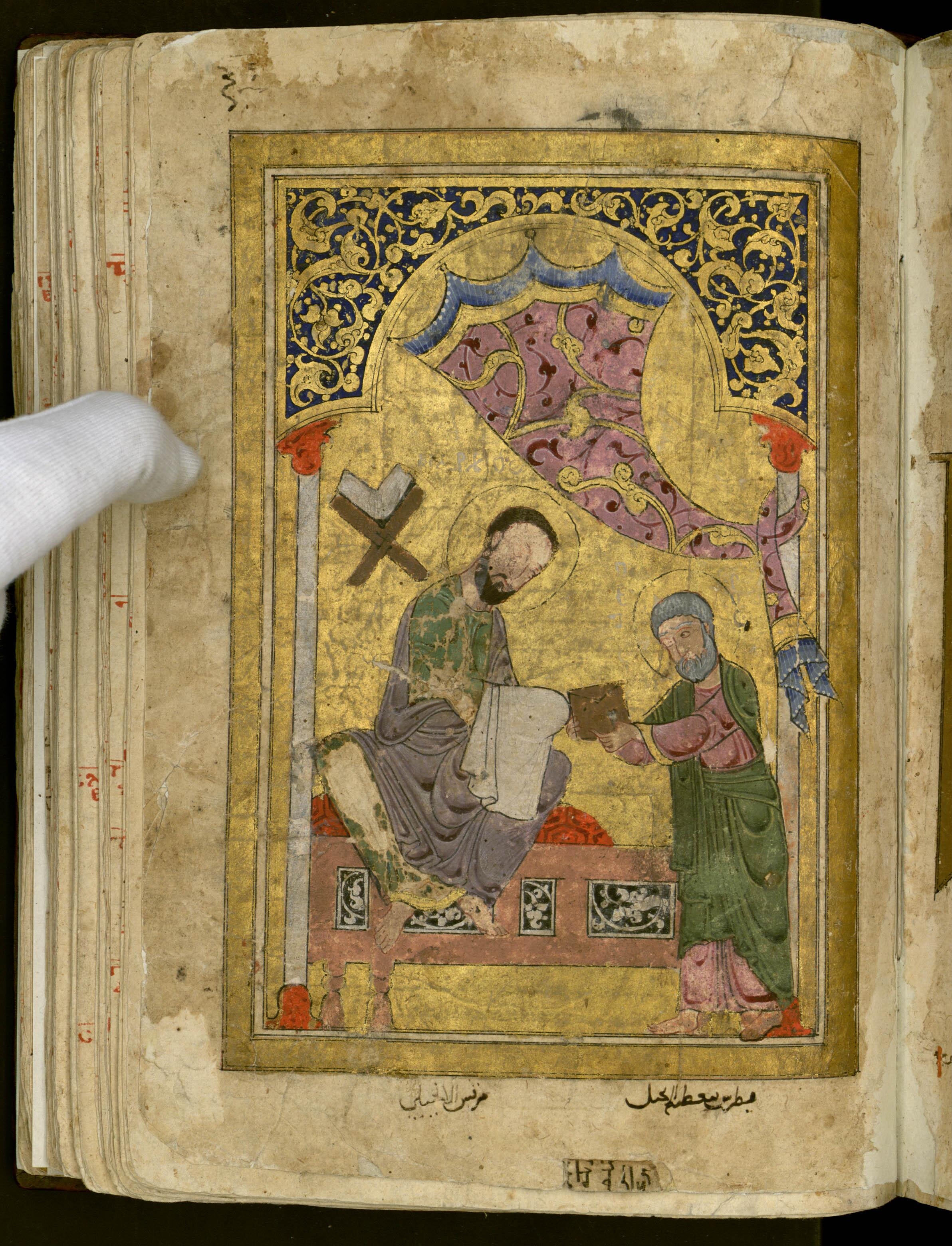
65v: Mark Receives the Gospel from Peter
fol. 65v: Mark the Evangelist Receiving the Gospel from Peter

Coptic-Arabic Portrait of Luke
fol. 105v: Portrait of Luke the Evangelist

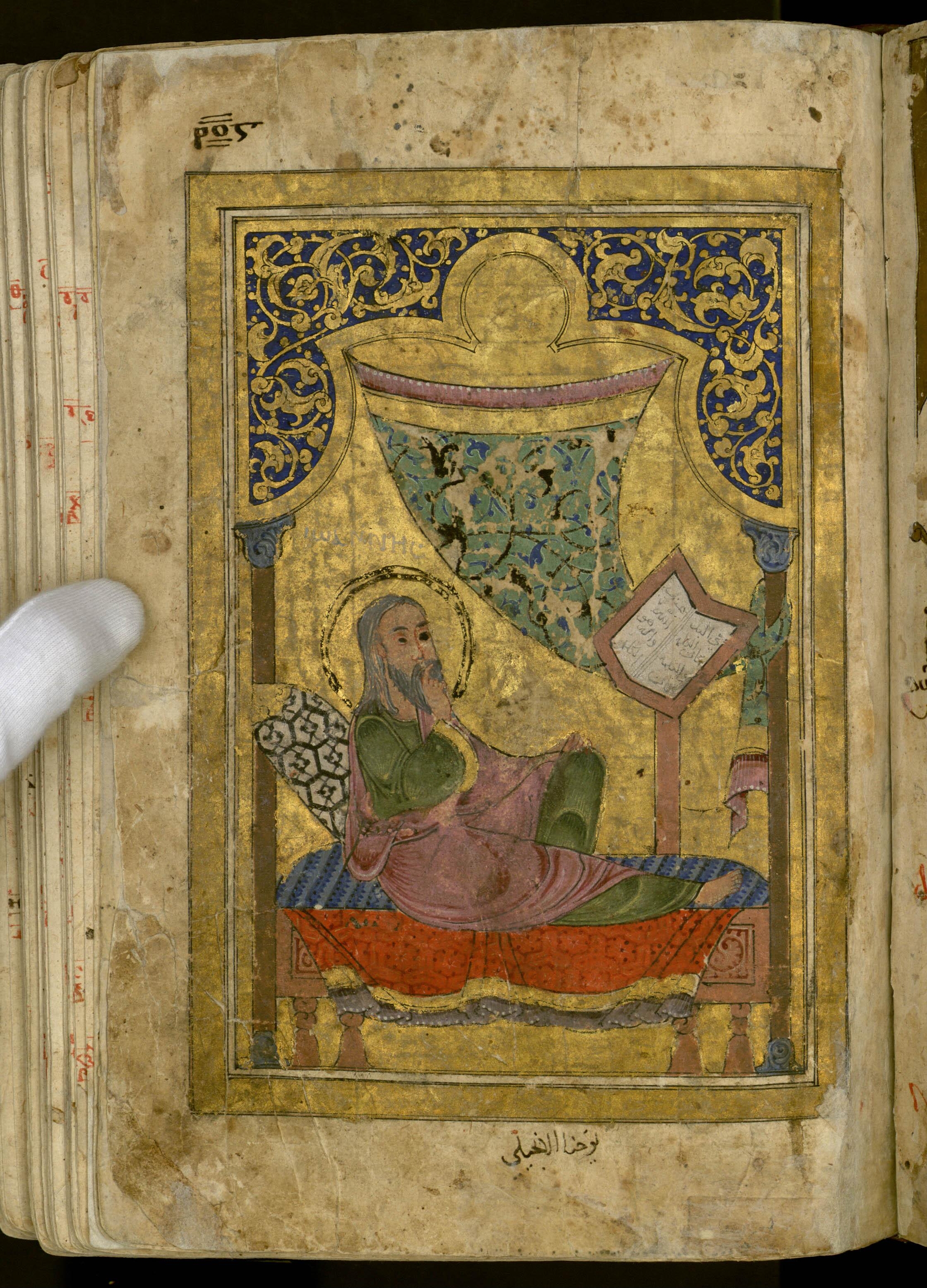
Coptic-Arabic Portrait of John
fol. 174v: Portrait of John the Evangelist

Each Evangelist is shown under a cusped arch—Matthew copying his Gospel in Arabic, Luke seated in front of a pulled-back curtain with a lotus design pattern, and John uniquely reclining, a pose adapted from secular models.

But the most interesting of the four Evangelist portraits is Mark’s, because there’s another figure with him. The owning institution labels the page “Marc l’évangéliste; Pierre lui donnant l’Evangile” (Mark the Evangelist; Peter giving him the Gospel). I had to look into this!

Traditionally, a man named John Mark is credited as the author of the Gospel that begins, “The beginning of the good news of Jesus Christ.” (It came to be called the Gospel of Mark by the end of the second century.) John Mark was a disciple of Peter, whom he is believed to have used as his primary source in composing his Gospel. The two were close companions, and Peter even refers to him as a son (1 Pet. 5:13). John Mark’s mother, Mary, hosted a house church that Peter was connected with (Acts 12:12). John Mark was also a cousin of Barnabas of Cyprus (Col. 4:10) and accompanied Paul in some of his apostolic travels (Acts 12:25; 13:1–5; 15:36–39).

Papias of Hierapolis, Irenaeus, Justin Martyr, Clement of Alexandria, Eusebius, Tertullian, and Origen—church fathers of the first two centuries of Christianity—all mention in their writings that Mark wrote his Gospels based on Peter’s eyewitness testimony and teachings. [2]

So folio 65v of Copte-Arabe 1 shows Peter passing on his intimate knowledge of Christ to Mark. As a sign of respect, Mark’s hands are covered with a cloth, ready to receive Peter’s notes.

Examining artistic precedents of this pair of men, Hunt writes:

Middle Byzantine iconographic sources can . . . be suggested for the Copte-Arabe 1 portrait of Mark with Peter (fol. 65v), which relates to the broad category of Evangelist portraiture with a second, usually inspiring figure. Mark appears seated, with Peter, who stands before him bearing the Gospel. More frequent are portraits of Peter dictating to Mark, the earliest known being that in the mutilated Greek New Testament in Baltimore (Walters Art Gallery W. 524) in which both are seated. Greek manuscripts with such portraits would have been accessible through the Syrian and Armenian communities. Two such twelfth century Gospels today in Jerusalem are the Greek Taphou 56 and the Armenian Theodore Gospels (Armenian Patr. 1796), showing the standing Peter dictating to the seated Mark. It has often been pointed out that secondary figures, either inspiring or presenting, are particularly common in Coptic and other oriental Christian art. [3]

Now let’s take a look at the narrative images. I went through them all and attempted to identify each scene as best I could (I can’t read the Arabic inscriptions), which I label in the caption along with the scripture passage it illustrates. These descriptive titles are preceded by the folio number. Note that in manuscript studies, “fol.” or “f.” stands for “folio” (page), “v” stands for “verso” (a left-hand page), and “r” stands for “recto” (a right-hand page).

All the image files are sourced from La bibliothèque numérique de l’Institut Catholique de Paris (The Digital Library of the Catholic Institute of Paris), which hosts a full scan of the manuscript. If you wish to reproduce any of the images singly, I suggest the following caption: Page from a Coptic-Arabic Gospel Book, Cairo, Egypt, 1249–50. Illuminations on parchment, 25.5 × 17.5 cm. Bibliothèque de Fels (Fels Library), Institut Catholique de Paris, Ms. Copte-Arabe 1, fol. _.

The first narrative scene in the manuscript, a header to the Gospel of Matthew, is a Nativity, with Mary reclining in the hollow of a cave and the Christ child lying swaddled beside her, adored by an ox and ass. An angel with folded hands peers reverently over a rocky outcrop, while shepherds approach from the left and magi from the right. Joseph is seated near his wife, eyeing the coming visitors.

Coptic-Arabic Nativity
fol. 2r: The Nativity (Matt. 1:25; 2:9–11; cf. Luke 2:1–7)

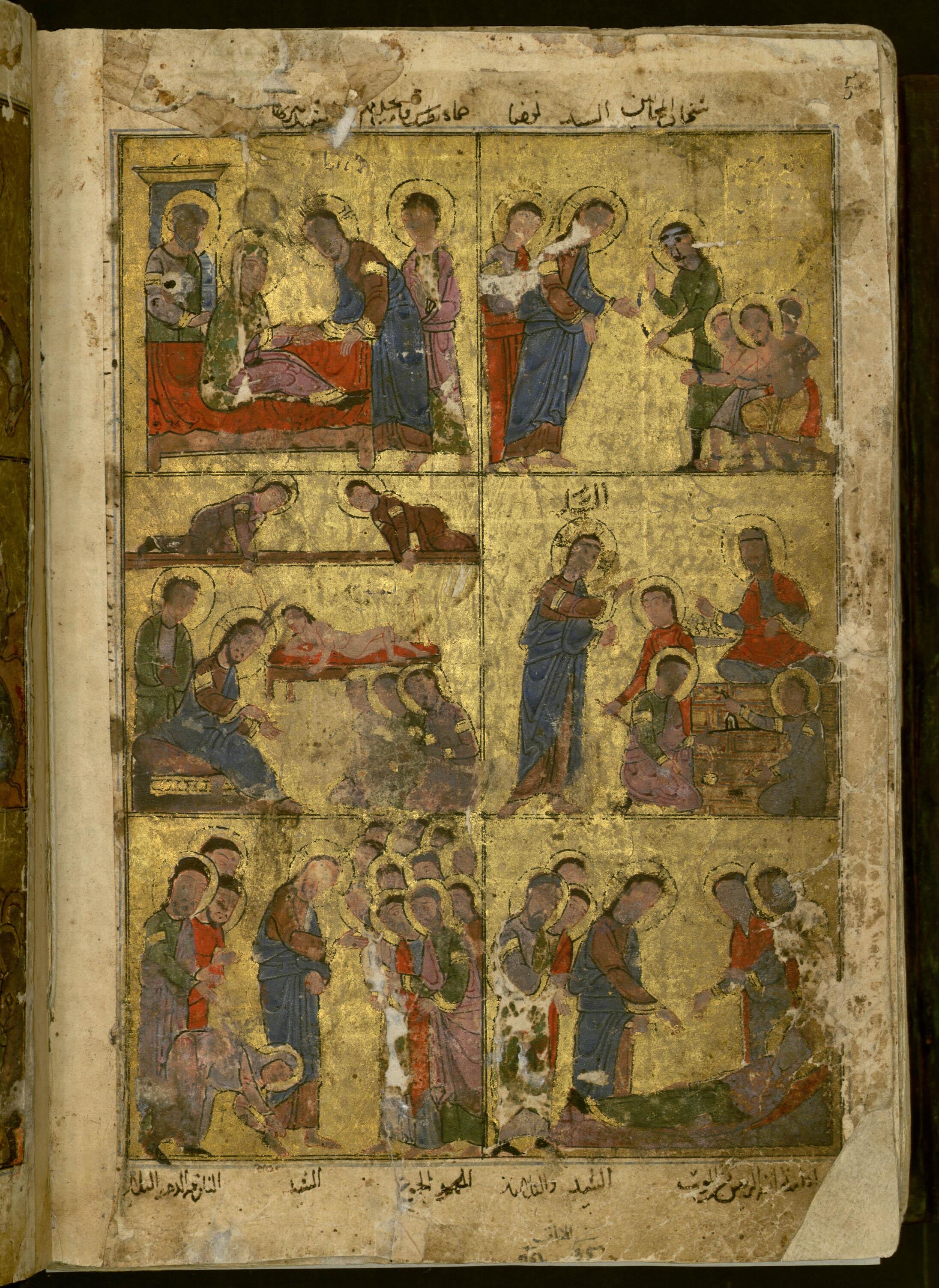
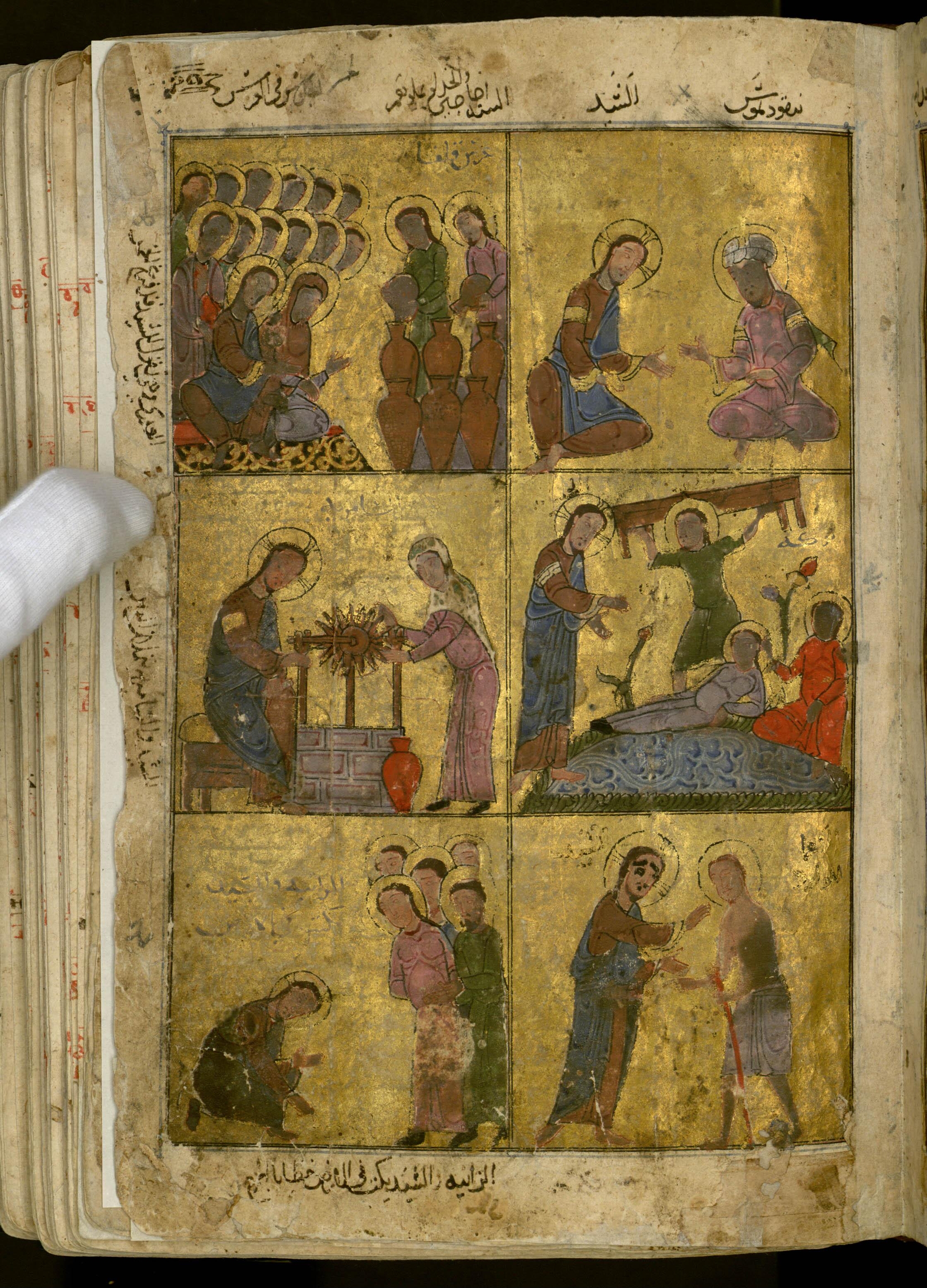
Later there follow six pages illuminating various stories from the Gospel of Matthew—the largest image sequence in the manuscript. As in the Gospels of Luke and John (there are none for Mark), these scenes are arranged on a grid system of six small squares to a page.
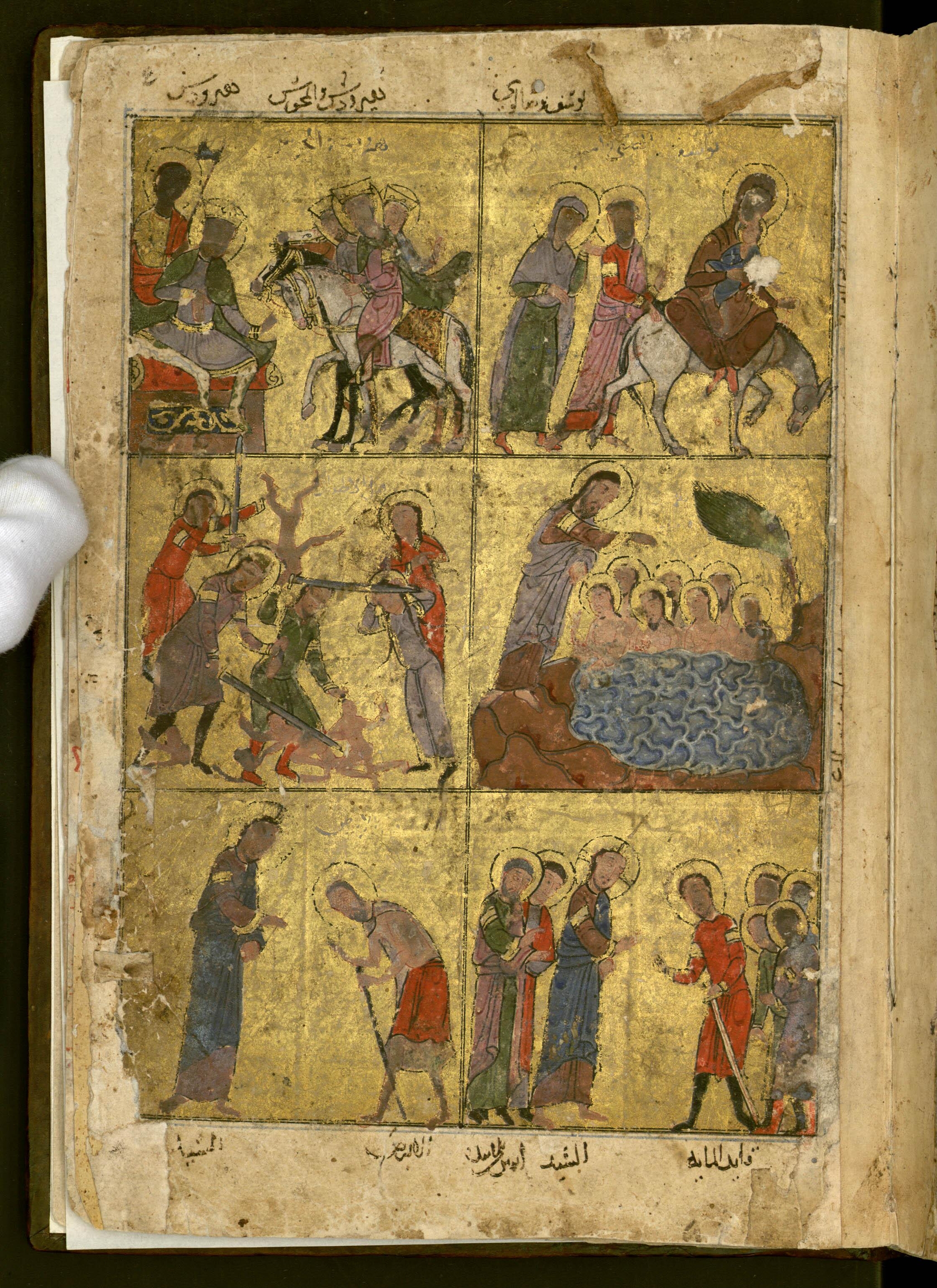
Coptic-Arabic illumination
fol. 4v: The Magi before Herod (Matt. 2:7–8); The Flight to Egypt (Matt. 2:13–15); The Massacre of the Innocents (Matt. 2:16–18); John the Baptist Baptizes Converts (Matt. 3:1–12); Jesus Heals a Man with Leprosy (Matt. 8:1–4); A Centurion of Capernaum Seeks Healing for His Servant (Matt. 8:5–13)

Coptic-Arabic illumination
fol. 5r: The Healing of Peter’s Mother-in-Law (Matt. 8:14–15); Jesus Restores Two Demon-Possessed Men (Matt. 8:28–24); The Healing of the Paralytic (Matt. 9:1–8); The Calling of Matthew (Matt. 9:9–13); The Healing of the Woman with the Issue of Blood (Matt. 9:20–22); The Raising of Jairus’s Daughter (Matt. 9:18–19, 23–26)

Coptic-Arabic illumination
fol. 18v: Messengers from John the Baptist (Matt. 11:2–5); The Beheading of John the Baptist (Matt. 14:1–12); The Feeding of the Multitudes (Matt. 14:13–21); The Transfiguration (Matt. 17:1–13); Jesus Heals a Demon-Possessed Boy (Matt. 17:14–20); The Mother of James and John Requests a Favor (Matt. 20:20–28)

Coptic-Arabic illumination (Passion Week)
fol. 19r: Jesus’s Disciples Fetch a Donkey (Matt. 21:1–6); Christ’s Entry into Jerusalem (Matt. 21:7–11); The Parable of the Wise and Foolish Virgins (Matt. 25:1–13); The Anointing at Bethany (Matt. 26:6–13); Jesus Washes His Disciples’ Feet (John 13:1–17); The Last Supper (Matt. 26:20–29)

From having seen other similar compositions, I know that the man holding the scroll and gesturing toward the donkey on folio 19r/1 is the prophet Zechariah, and that his scroll contains a portion of Zechariah 9:9: “Rejoice greatly, O daughter Zion! Shout aloud, O daughter Jerusalem! See, your king comes to you; triumphant and victorious is he, humble and riding on a donkey, on a colt, the foal of a donkey.”

Coptic-Arabic illumination (Passion Week)
fol. 56v: The Agony in the Garden (Matt. 26:36–46); The Kiss of Judas (Matt. 26:47–49); The Arrest of Christ (Matt. 26:50–56); Christ before Caiaphas (Matt. 26:57–66); The Denial and Repentance of Peter (Matt. 26:69–75); Christ before Pilate (Matt. 27:11–23)

Coptic-Arabic illumination (Passion Week)
fol. 57r: Judas Returns the Blood Money and Hangs Himself (Matt. 27:1–10); Pilate Washes His Hands (Matt. 27:24–26); Christ Carries His Cross (Matt. 27:31); The Crucifixion (Matt. 27:33–56); The Deposition (Matt. 27:57–59); The Entombment (Matt. 27:59–61)

Strikingly, all the figures in this manuscript are given halos around their heads, not just holy figures—for example, King Herod, antagonistic Pharisees, Judas, the Roman soldiers who arrest and taunt Jesus, and the foolish virgins. I’m not sure the reason for this; it’s possible it marks the imago Dei in each and every human, even those who oppose Christ. I welcome the input of scholars better versed in Coptic art than I.

The headpiece to the Gospel of Mark portrays the Baptism of Christ. Fully nude, he is submerged in the Jordan River. John the Baptist stands on the bank and touches Christ’s head, while the hand of God the Father emerges from the heavens, pronouncing blessing over the Son, and the Holy Spirit as dove hovers above. Again, the manus velatae (veiled hands) motif appears, this time with the angels, signaling their reverence. On the left an ax cuts into the base of a tree, a reference to John the Baptist’s stark warning to the Sadducees and Pharisees who observe the baptisms: “Even now the ax is lying at the root of the trees; therefore every tree that does not bear good fruit will be cut down and thrown into the fire” (Matt. 3:10).
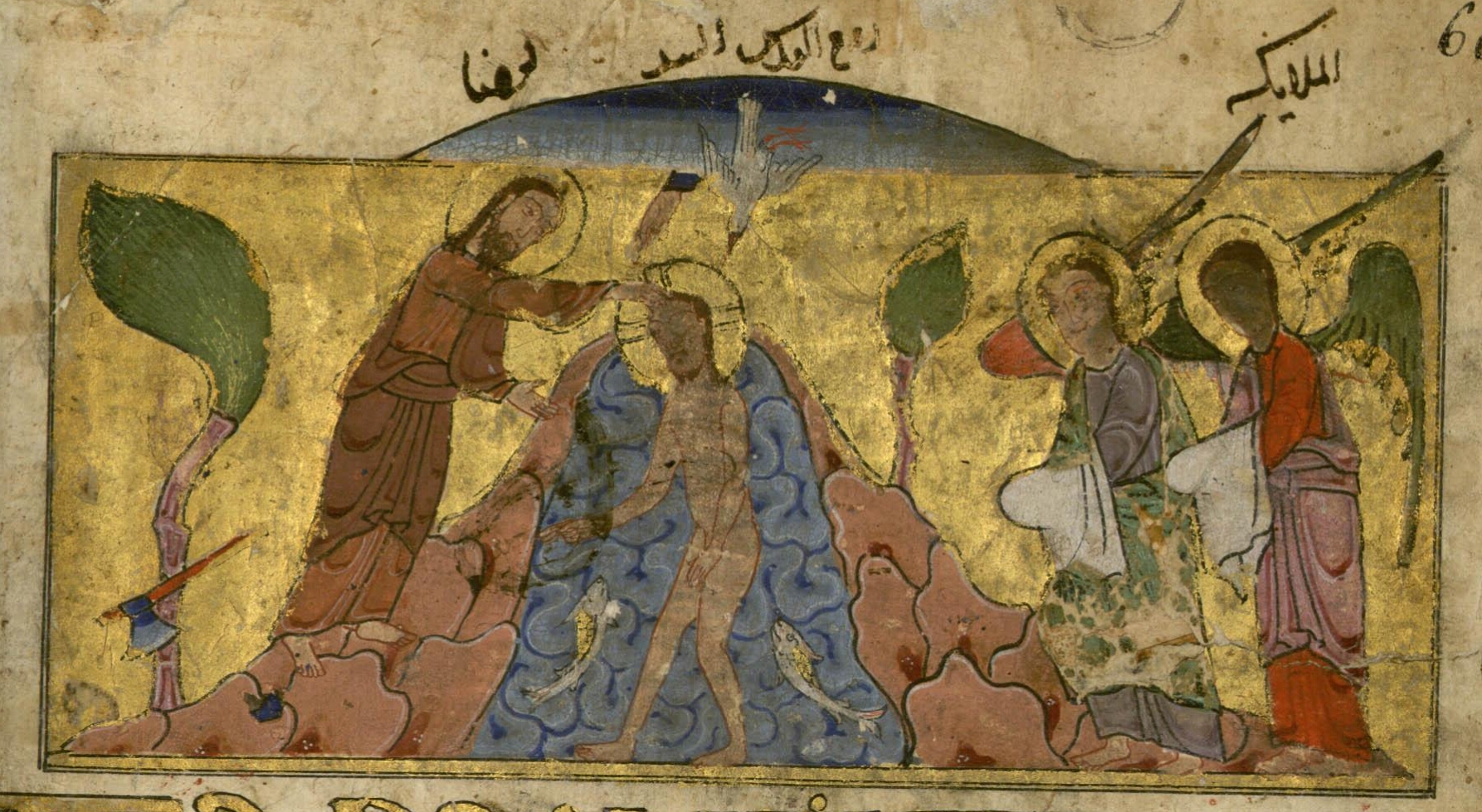
Coptic-Arabic Baptism of Christ
fol. 66r: The Baptism of Christ (Mark 1:9–11)

The next illumination is folio 106r, which opens the Gospel of Luke. It shows three scenes from Luke 1: the angel Gabriel announcing to the priest Zechariah that his wife, Elizabeth, will bear a son named John; Gabriel announcing to the virgin Mary that she will bear a son named Jesus; and Mary and Elizabeth rejoicing together in the unexpected news of their pregnancies and the divine deliverance they signal.

Coptic-Arabic Annunciation, Visitation
fol. 106r: The Annunciation to Zechariah (Luke 1:5–23); The Annunciation to Mary (Luke 1:26–38); The Visitation (Luke 1:39–56)

In the first full-page miniature from Luke (below), the third scene confuses me a bit. I’m fairly sure it’s supposed to be the twelve-year-old Jesus sitting among the doctors of the law in the temple at Jerusalem, as narrated in Luke 2:41–51; this episode is typically included in image cycles on the Life of Christ. But here he’s shown as a full-grown adult. The arch above the group is similar to the one shown in the previous frame where the infant Christ is presented in the temple forty days after his birth, suggesting that this is the temple, not a synagogue.

Coptic-Arabic illumination
fol. 109v: The Birth of John the Baptist (Luke 1:57–58); The Presentation in the Temple (Luke 2:22–38); Christ Disputing with the Doctors in the Temple (Luke 2:46–47); Jesus Teaching in the Synagogue at Nazareth (Luke 4:16–20); The Religious Leaders Attempt to Push Jesus Off a Cliff (Luke 4:28–30); Jesus Raises the Son of the Widow of Nain (Luke 7:11–17)

Regardless, the next episode, portrayed on folio 109v/4, is one of my favorites in Luke’s Gospel: Jesus interpreting the Isaiah scroll at his hometown synagogue, announcing himself as the long-awaited Messiah and thereby launching his ministry.

When he came to Nazareth, where he had been brought up, he went to the synagogue on the Sabbath day, as was his custom. He stood up to read, and the scroll of the prophet Isaiah was given to him. He unrolled the scroll and found the place where it was written:

The Spirit of the Lord is upon me,
    because he has anointed me
        to bring good news to the poor.
He has sent me to proclaim release to the captives
    and recovery of sight to the blind,
        to set free those who are oppressed,
to proclaim the year of the Lord’s favor.

And he rolled up the scroll, gave it back to the attendant, and sat down. The eyes of all in the synagogue were fixed on him. Then he began to say to them, “Today this scripture has been fulfilled in your hearing.” (Luke 4:16–20; cf. Isa. 61)

When asked to expound, Jesus emphasizes how God’s plan of salvation is for all people, recounting two stories from the Hebrew scriptures in which God showed favor to Gentiles—namely, the widow of Zarephath and the Syrian general Naaman. Well, this really raises the ire of his Jewish audience, who believed the Messiah should act exclusively on their behalf. The artist of Copte-Arabe 1 shows on folio 109v/5 the culmination of this contentious encounter between the up-and-coming Jewish teacher making his way through Galilee and the old guard: an attempted murder!

When they heard this, all in the synagogue were filled with rage. They got up, drove him out of the town, and led him to the brow of the hill on which their town was built, so that they might hurl him off the cliff. But he passed through the midst of them and went on his way. (Luke 4:28–30)

On the following page, in the fifth frame, the Rich Man and Lazarus is one of Jesus’s three parables depicted in the manuscript. (The other two are of the Ten Virgins and the Good Samaritan.) The artist depicts not the impoverished, sore-laden Lazarus begging outside the wealthy Dives’s door in this life, but the afterlife. Lazarus, now whole, sits comfortably in Abraham’s bosom, while Dives, who lacked mercy on earth, is denied it in hell; he languishes in flames.

Coptic-Arabic illumination
fol. 110r: Jesus Is Anointed by a Sinful Woman (Luke 7:36–50); The Parable of the Good Samaritan (Luke 10:25–37); The Healing of the Woman with a Bent Back (Luke 13:10–17); The Healing of the Man with Edema(?) (Luke 14:1–6); The Rich Man and Lazarus (Luke 16:19–31); The Healing of the Ten Lepers (Luke 17:11–19)

I’m not sure what the center right scene depicts, but given its placement in the sequence, its setting in a lavish interior, and Jesus’s clear presence at the left (as indicated by the cross in his halo; which I’d say precludes the figures being characters in a parable), my best guess is it represents the healing of the man with edema (dropsy), which takes place in the house of a prominent Pharisee.

Further into the manuscript, our anonymous artist commences the fourth and final Gospel, John, with a depiction of the descent of the Holy Spirit on the apostles at Pentecost—an event described not in John’s Gospel but in the book of Acts.
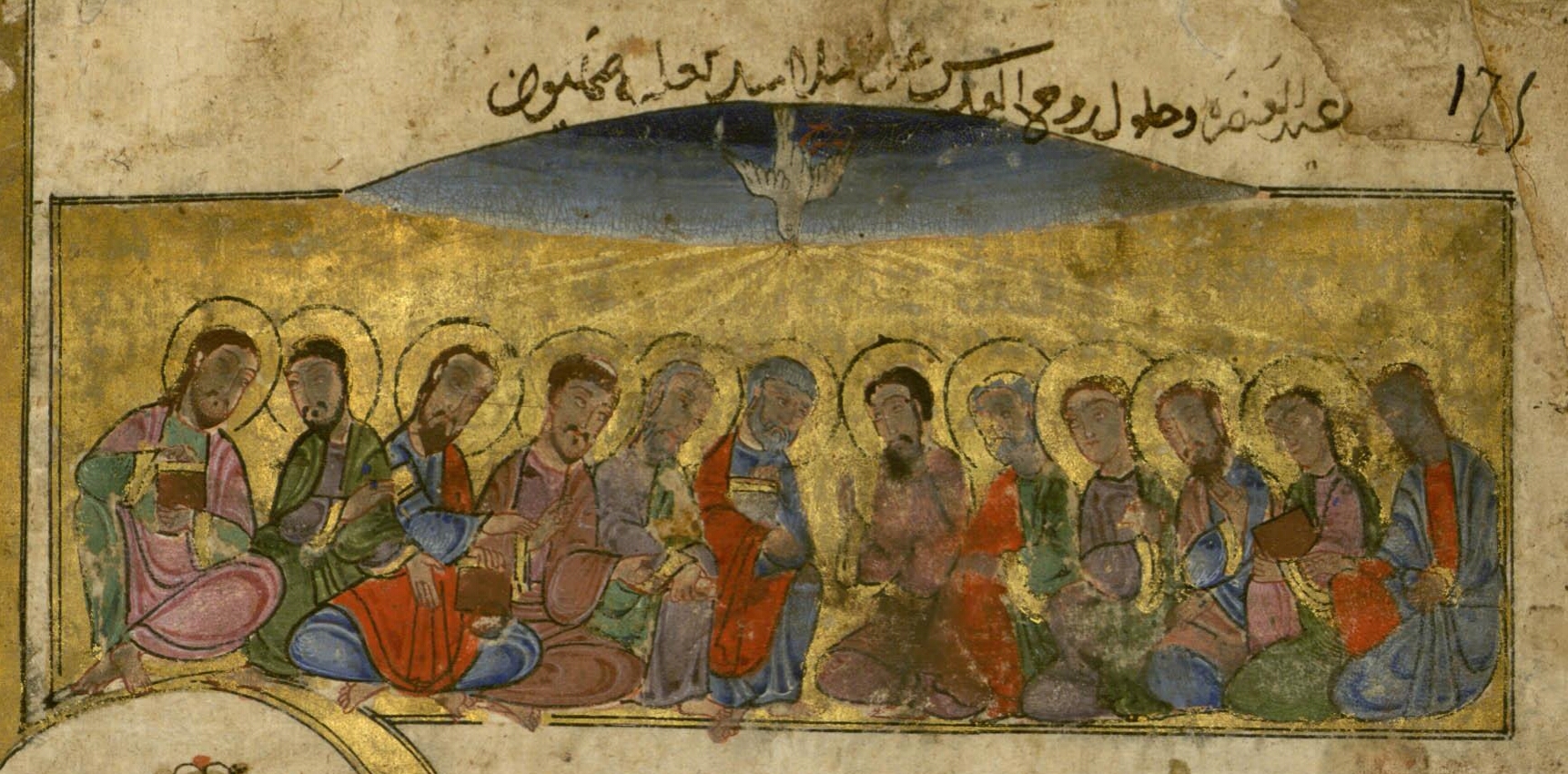
Coptic-Arabic Pentecost
fol. 175r: The Descent of the Holy Spirit (Acts 2:1–13)

Coptic-Arabic illumination
fol. 178v: The Wedding at Cana (John 2:1–12); Jesus Teaches Nicodemus (John 3:1–21); The Woman at the Well (John 4:1–26); The Healing at the Pool of Bethesda (John 5:1–15); The Woman Caught in Adultery (John 8:1–11); The Healing of the Man Born Blind (John 9:1–12)

Coptic-Arabic illumination (Resurrection)
fol. 179r: The Raising of Lazarus (John 11:1–44); The Holy Women at the Tomb (Mark 16:1–8); The Road to Emmaus (Luke 24:13–27; cf. Mark 16:12); The Incredulity of Thomas (John 20:24–29); The Miraculous Catch of Fish (John 21:1–14); The Ascension (Luke 24:50–53)

Folio 179r also contains scenes whose scriptural referents are from other Gospels: four women arriving at Christ’s empty tomb on Easter morning (John mentions only Mary Magdalene, Matthew mentions two women, Mark mentions three, and Luke speaks generally of “the women”); the risen Christ meeting two pilgrims on the road to Emmaus; and Christ’s ascent into heaven. I suppose it’s because this final full-page miniature is Resurrection-themed, so the artist harmonizes the four Gospels, pulling relevant highlights from each.


NOTES

1. Lucy-Anne Hunt, “Christian-Muslim Relations in Painting in Egypt of the Twelfth to Mid-Thirteenth Centuries: Sources of Wallpainting at Deir es-Suriani and the Illustration of the New Testament MS Paris, Copte-Arabe 1 / Cairo Bibl. 94,” Cahiers Archéologiques 33 (1985): 111–55, here 111. Reprinted in Lucy-Anne Hunt, Byzantium, Eastern Christendom and Islam: Art at the Crossroads of the Medieval Mediterranean, vol. 1 (London: Pindar, 1998): 205–81.

2. J. Warner Wallace, “Is Mark’s Gospel an Early Memoir of the Apostle Peter?,” Cold-Case Christianity, July 25, 2018.

3. Hunt, “Christian-Muslim Relations,” 129.
Roundup: “By Babylon’s River,” Jack Baumgartner, Ordinary Saints, and more

NEW ALBUM: By Babylon’s River by the Pharaoh Sisters: A folk band from the foothills of North Carolina, the Pharaoh Sisters [previously] are Austin Pfeiffer, Jared Meyer, Kevin Beck, and John Daniel Ray. On September 13 they released their second album, By Babylon’s River, unveiling a new genre they call “saloon Christian.” The title track is a western waltz adaptation of Psalm 137. Also included on the album are a version of Psalm 81 (“Sing, Oh Sing”); bluegrass arrangements of the gospel standards “Leave It There” and “Hold to God’s Unchanging Hand”; retunes of the hymns “All Things Bright and Beautiful” by Cecil Frances Alexander and “’Tis Finished” by Charles Wesley; a cheeky take on the story of Samson, and more.

Here’s the press release.

+++

TRAILER: A Man Called Hurt: The Life and Music of Mississippi John Hurt: Made by directors Jamison Stalsworth and Alex Oliver of Draft creative agency in conjunction with the Mississippi John Hurt Foundation, this documentary about the titular Delta bluesman premiered May 1 at the San Francisco Documentary Festival and has been continuing on the festival circuit; most imminently, it will be screening at the Nashville Film Festival on September 19–25. I’m eager to see it once it hits on-demand streaming or comes to a screen near me! Follow updates at https://www.facebook.com/HurtTheFilm/.

I was introduced to Hurt over a decade ago through his recording of the African American spiritual “I Shall Not Be Moved,” based on Psalm 1. The songs he sang were a mix of sacred and secular.

+++

ARTISTS’ PROFILE: “Sunny Taylor / Jack Baumgartner,” Artful, season 3, episode 6: The BYUtv docuseries Artful, which is available to watch freely online, profiles a variety of artists of faith—many of them Latter-day Saints, but some (non-LDS) Christian or Jewish.

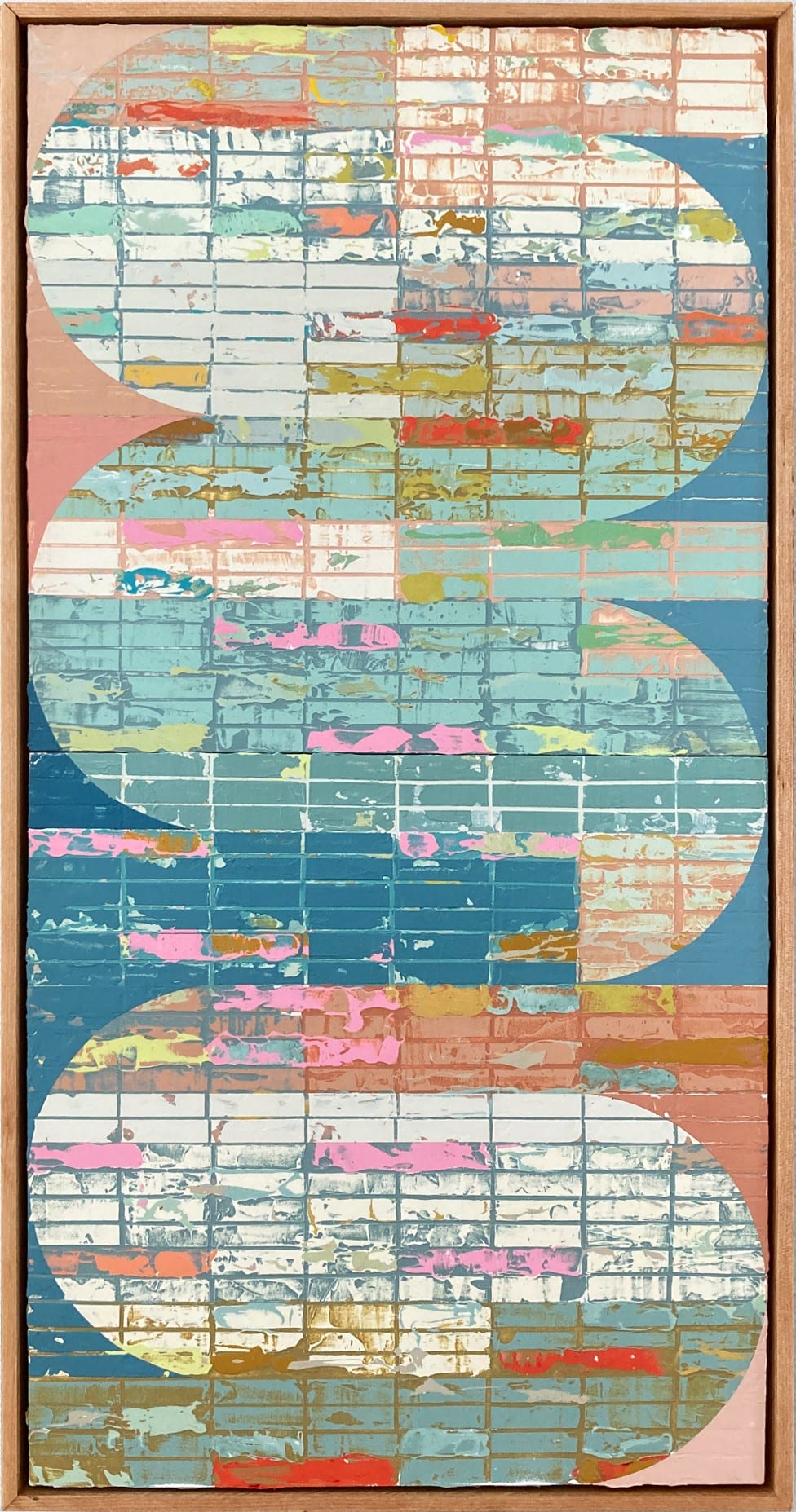
The first half of episode 6, season 3, highlights the work of Sunny Taylor, who lives in Wilton, Maine, and engages with painting’s geometric tradition. She values process over product and wants viewers to observe the surface and textures of her paintings, built up through meticulous layering techniques that involve scraping and grinding. She sees beauty in imperfection, and sorrow and joy as bound up together. Follow her on Instagram @sunnytaylorart.

Taylor, Sunny_Connections
Sunny Taylor (American, 1979–) Connections, 2024. Acrylic on panel, 24 × 12 in. [for sale] [artist’s statement]

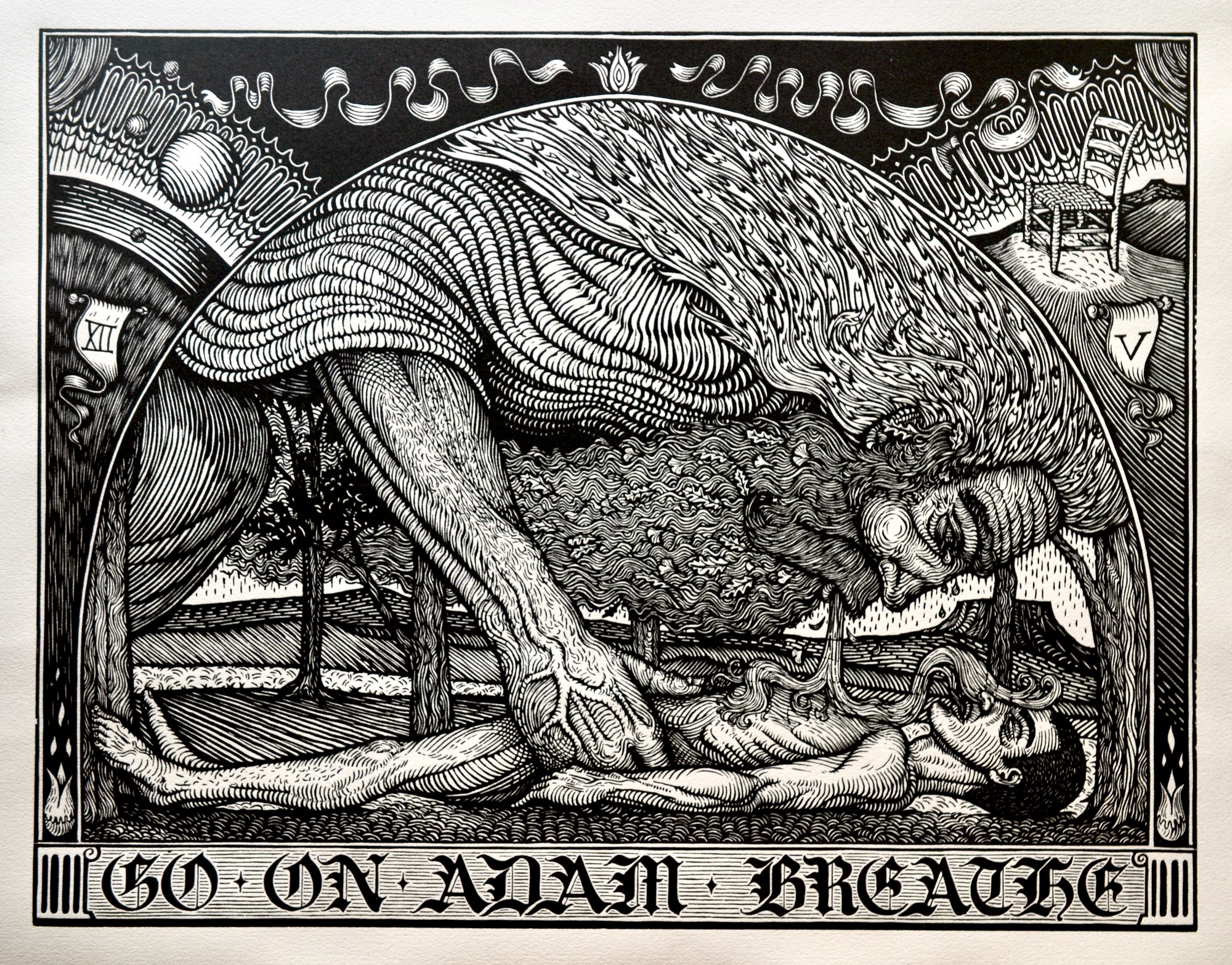
Beginning at the 13:38 time stamp, the second half is on multidisciplinary artist Jack Baumgartner of Kansas. Baumgartner, who has a Presbyterian background, is a printmaker, painter, farmer, woodworker, puppeteer, and musician. He raises sheep, goats, and chickens, builds furniture, plays the banjo, and cohosts the podcast The Color of Dust with two poet friends, “exploring the seen and unseen in the soil of art and agriculture.” He is also a husband and a father of five. I first learned about Baumgartner through an Image journal profile; and Plough published an article about him in 2018. I really enjoyed this twelve-minute video segment that shows him at work and at play in and around his home—especially his puppet theater performance of The Two Deaths of John Beartrist Laceroot! Follow him on Instagram @baumwerkj.

Baumgartner, Jack_Go On, Adam, Breathe
Jack Baumgartner (American, 1976–), Go On, Adam, Breathe, 2023. Linocut, 14 × 18 in. [for sale]

+++

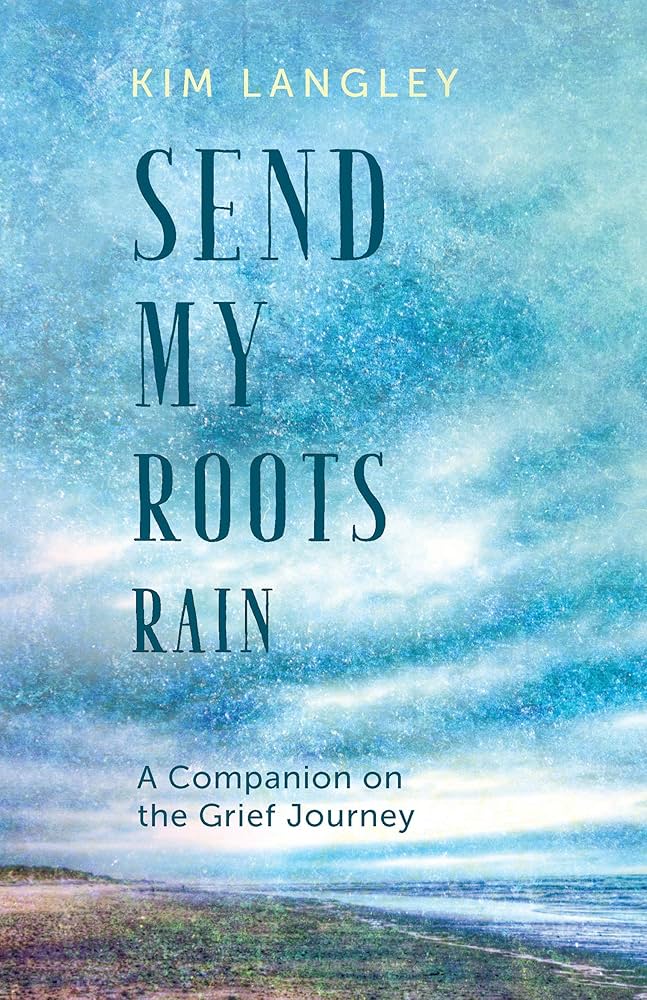
PODCAST EPISODE: “Grief and Poetry, with guest Kim Langley,” Faith and Imagination, October 4, 2021: Kim Langley is a certified spiritual director and retreat leader from Ohio; she is also the founder of WordSPA (acronym for “Spirituality Poetry Appreciation”) and author of Send My Roots Rain: A Companion on the Grief Journey (Paraclete, 2019), a compilation of sixty poems interwoven with narrative and commentary, in preparation for which she interviewed some three dozen chaplains, pastors, grief counselors, hospice workers, funeral directors, and bereaved people. She wrote the book after the death of her parents. “I found such comfort in the poems,” she writes, “written by a host of people just like us, picking up their pain, juggling it awkwardly in their arms at first—or maybe for a long time—then gradually finding the resilience to carry it, to know when and how to put it down, when to pick it up, and how to develop strong muscles for the long haul. They helped me carry my pain, and I think they will help you to survive, and maybe even thrive a little.” In this podcast episode, she and the host read and discuss four poems from the book: “Let Evening Come” and “Otherwise” by Jane Kenyon, “Those Winter Sundays” by Robert Hayden, and “Stillbirth” by Laure-Anne Bosselaar.

Send My Roots Rain

Launched in 2020, Faith and Imagination [previously] is the podcast of the BYU Humanities Center, hosted by founding director Matthew Wickman. It features interviews with a range of writers, scholars, clergy, and others. View the full archive at https://humanitiescenter.byu.edu/podcast/. And in addition to the Langley episode, let me turn your attention to an excellent recent release with an author I’ve mentioned before: “On Deepening Our Religious Experience: An Invitation to Poetry for the Church, with Abram Van Engen.” You may have heard Van Engen discuss his new book elsewhere, but this interview brings some great insights to the fore.

+++

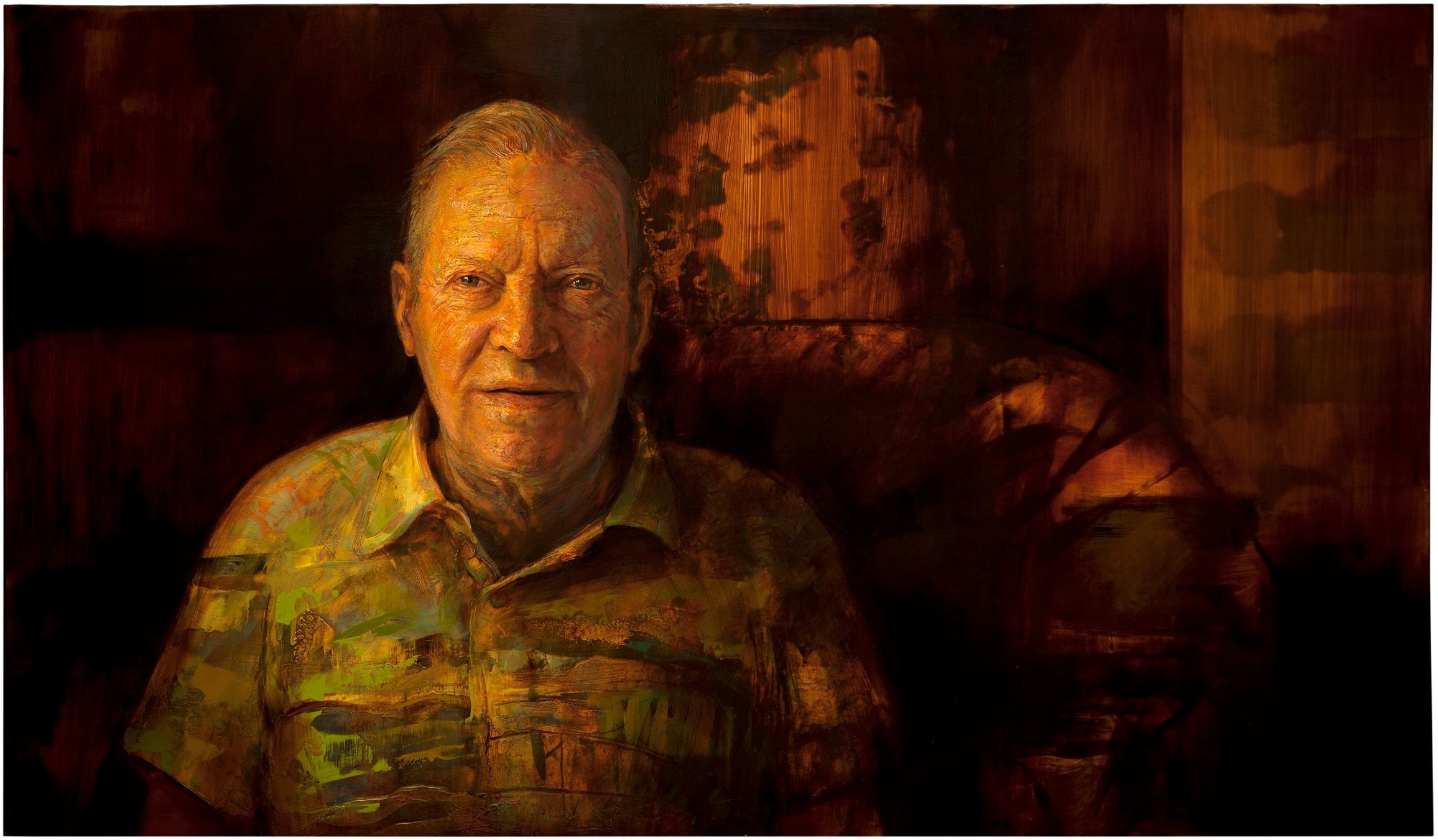
CREATIVE COLLABORATION: Ordinary Saints, a project by artist Bruce Herman, poet Malcolm Guite, and composer J.A.C. Redford: When Bruce Herman’s parents died unexpectedly in 2009, three months apart, painting their portraits was a key way in which he moved through his grief. Poet Malcolm Guite saw Herman’s portrait of his father exhibited at a Christians in the Visual Arts conference in 2011 and, struck by its sheer sense of presence, wrote a sonnet about it. This act of ekphrasis then developed into a three-way collaboration when their mutual friend J.A.C. Redford, a composer, responded by setting Guite’s poem to music.

Herman, Bruce_Portrait of the Artist's Father
Bruce Herman (American, 1953–), Portrait of the Artist’s Father: William C. Herman, 2010. Oil and alkyd on wood, 30 5/8 × 51 in. Collection of the artist.

The basis of Ordinary Saints is a series of portraits Herman painted of family and friends throughout the 2010s, which spawned a series of poems by Guite, which in turn spawned a suite of instrumental music and a song cycle by Redford. The first public presentation of the multidisciplinary project was at a Laity Lodge retreat in the Texas Hill Country on October 26–28, 2018, and it has since traveled to Nashville and Oxford.

The project attempts “to render . . . a glimpse of the glory of our mortal faces when turned toward God . . . faces that point toward the one Face we all must seek,” Herman says. Or, as Guite puts it: “to explore what it means to be truly face to face with one another, how we might discern the image of God in our fellow human beings, and how that discernment might ready us for the time when, as we are promised, we will no longer see ‘through a glass darkly’ but really see God and one another face to face in the all-revealing, and all-healing light of Heaven.”

Here is the title poem, followed by Redford’s title composition for voice, piano, cello, and clarinet:

Ordinary Saints

by Malcolm Guite

The ordinary saints, the ones we know,
Our too-familiar family and friends,
When shall we see them? Who can truly show
Whilst still rough-hewn, the God who shapes our ends?
Who will unveil the presence, glimpse the gold
That is and always was our common ground,
Stretch out a finger, feel, along the fold
To find the flaw, to touch and search that wound
From which the light we never noticed fell
Into our lives? Remember how we turned
To look at them, and they looked back? That full-
Eyed love unselved us, and we turned around,
Unready for the wrench and reach of grace.
But one day we will see them face to face.

Explore more, including readings of all the poems and recordings of the music, at https://ordinary-saints.com/.

+++

POEMS:

>> “Ordinary Sugar” by Amanda Gunn: Pádraig Ó Tuama reads and comments on this food poem in the July 10, 2023, episode of Poetry Unbound. “How can russet potatoes be made to taste of sugar and caramel? By dedication, love, and craft. Amanda Gunn places her poetry in conversation with the farming and culinary skills of her forebears: women who cultivated land, survival, strength, and family bonds.”

>> “Given” by Anna A. Friedrich: This poem by Anna A. Friedrich is a beautiful tribute to her grandmother, Juanita Powell Alphin, who died this June. Friedrich imagines all the gifts her memama ever gave—jump ropes, stuffed animals, homemade fudge, thrift-store doodads, five-dollar bills, a kitten, a plane ticket, etc.—tumbling out onto the golden streets of heaven, a testimony to her generous, loving spirit.

“Hurrahing in Harvest” by Gerard Manley Hopkins (poem)

Linnell, John_Wheat
John Linnell (British, 1792–1882), Wheat, ca. 1860. Oil on canvas, 94.2 × 140.6 cm. National Gallery of Victoria, Australia.

Summer ends now; now, barbarous in beauty, the stooks arise
Around; up above, what wind-walks! what lovely behaviour
Of silk-sack clouds! has wilder, wilful-wavier
Meal-drift moulded ever and melted across skies?

I walk, I lift up, I lift up heart, eyes,
Down all that glory in the heavens to glean our Saviour;
And, eyes, heart, what looks, what lips yet gave you a
Rapturous love’s greeting of realer, of rounder replies?

And the azurous hung hills are his world-wielding shoulder
Majestic—as a stallion stalwart, very-violet-sweet!—
These things, these things were here and but the beholder
Wanting; which two when they once meet,
The heart rears wings bold and bolder
And hurls for him, O half hurls earth for him off under his feet.

The beauty of Christ suffuses the landscape in “Hurrahing in Harvest” by Gerard Manley Hopkins, written September 1, 1877, while he was studying theology at St Bueno’s College in the Vale of Clwyd, Wales. A hurrah is a jubilant shout, an exclamation of joy, and in this poem the object of that joy is the kingdom of God manifest in a late summer day during the wheat harvest. Hopkins wrote to his friend and fellow poet Robert Bridges—the man who championed his work and is responsible for its being known at all—that “the Hurrahing Sonnet was the outcome of half an hour of extreme enthusiasm as I walked home alone one day from fishing in the Elwy.”

Stooks are bound sheaves of wheat, and Hopkins describes them as savage-looking (“barbarous in beauty”), perhaps suggesting their resemblance to an unkempt head of hair. In their wonderfully wild way, when propped up, they point to the clouds, which glide along moving aerial sidewalks—the wind (“wind-walks”). Through metaphor, Hopkins refers to the clouds as “silk-sack[s]” (they’re bulky yet smooth, substantial yet wispy) and not snowdrift but “meal-drift” (mounds of coarsely ground white grain). The clouds are willful and wavy; they mold together and melt into sky.

Hopkins lifts up his eyes and heart—language reflecting the Sursum corda of the liturgy—to behold the day’s glory. “Down” in line 6 can be read as an adverb or verb: Hopkins looks down across the valley, or he “downs” the scene, takes it all in. And seeing the freshly reaped fields, he “glean[s]” Christ. He likens the rapture he feels to receiving a kiss of greeting from a lover, real and round. Addressing his eyes and heart, he says that no adoring human gaze nor tender human lips have ever imparted such pleasure as Christ imparts through nature.

In the final stanza Hopkins perceives the hills as the majestic shoulders of Christ supporting the sky. He compares Christ to a stallion (wild, strong) and a violet (delicate, humble).

The image of a stallion returns in the second-to-last line, where he says his own heart “rears” (raises upright) wings, which enable him to launch himself upward, his legs pushing off the ground. It’s a leaping of the spirit, an ascent of the soul—an intimate meeting of self and Savior in the goodness of the cloudy-blue afternoon. The Divine is always here, he says, “and but the beholder / Wanting”; that is, lacking awareness.

Throughout the poem there’s a strong sense of propulsion, carried in part by all the alliteration: “barbarous in beauty,” “wind-walks,” “silk-sack,” “wilder, wilful-wavier,” “meal-drift moulded . . . melted . . . ,” “glory . . . glean,” “realer, rounder replies,” “hung hills,” “world-wielding,” “stallion stalwart,” “heart . . . hurls.”

Hopkins’s eyes have been oriented to perceive the spiritual in the material, and the result is ecstasy.


Gerard Manley Hopkins (1844–1889) was a preeminent English poet and a Jesuit priest, whose most famous works include “The Wreck of the Deutschland,” “Pied Beauty,” “God’s Grandeur,” and “The Windhover.” In 1866 he converted from Anglicanism to Roman Catholicism, a decision that estranged him from his family; then he entered the Jesuit novitiate in 1868 and was ordained to the priesthood in 1877. He spent the last five years of his life as a classics professor at University College Dublin, struggling with depression, during which time he wrote the “terrible sonnets,” so-called because of their expression of deep anguish and desolation. Very few of his poems were published during his lifetime, and widespread recognition didn’t come until nearly three decades after his death, in 1918, when his friend Robert Bridges edited the first collection of his poems. Hopkins was the most innovative poet of the Victorian era, his “sprung rhythm” creating new acoustic possibilities and anticipating the modernist movement.

Roundup: Apache Christ icon, the Bible in photography, deer in church, and more

SPOTIFY PLAYLIST: September 2024 (Art & Theology)

+++

NEW ALBUMS:

>> Live On by the Good Shepherd Collective: The fourteen songs on this seventh full-length album by the Good Shepherd Collective are a mix of gospel, pop, and indie covers (Natalie Bergman, Harry Connick Jr., Aaron Frazer, Joni Mitchell, the Alabama Shakes, Celine Dion, Valerie June, Toulouse, Wilder Adkins) and two originals. Here’s “Look Who I Found” by Harry Connick Jr., sung by Charles Jones, followed by “Peace in the Middle” by Dee Wilson, Asaph Alexander Ward, and David Gungor, sung by Wilson, Gungor, and Rebecca McCartney. For more video recordings of songs from the album, see the Good Shepherd New York YouTube channel, which also features weekly digital worship services. Released July 12.

>> Facing Eden by Hope Newman Kemp: I heard Kemp perform at last year’s Square Halo conference and was compelled by her style, spirit, and songwriting. So I’m excited to see that several of the songs she shared live have now been recorded and released on her brand-new album! Produced by Jeremy Casella and tracked with a session band at the storied Watershed Studio in Nashville, Facing Eden leans toward café jazz but also bears influences from the Jesus Folk music of the 1960s that she was immersed in growing up. “Encompassing expansive sonic territory, the record isn’t afraid to wander into blue cocktail hours (‘My Inflatable Heart’), gospel riversides (‘Mercy,’ ‘Come Home,’ ‘Let It Rise’), ballad-style acoustic hymnody (‘Maria’s Song’), and even the free rubato motion of a musical theatre sound (‘Take Them Home’).” Released August 30.

+++

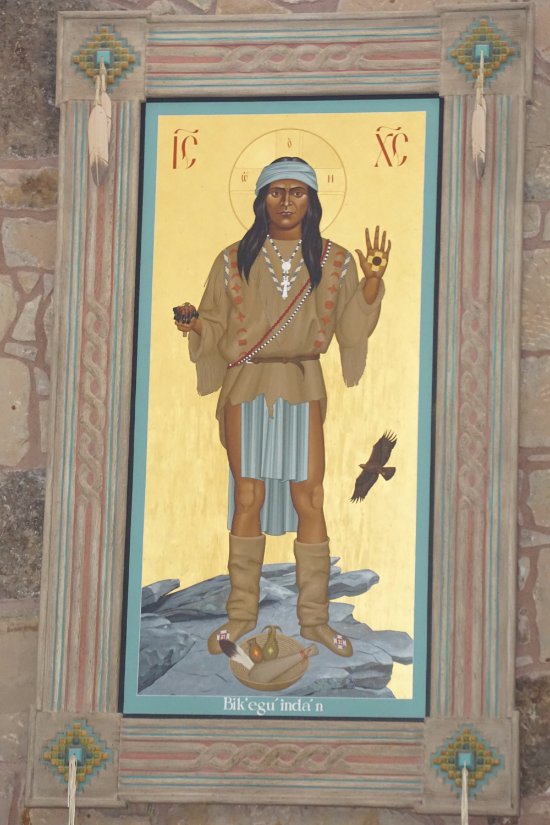
ARTICLE: “Apache Christ icon controversy sparks debate over Indigenous Catholic faith practices” by Deepa Barath, Associated Press: In 1989, a new icon by the Franciscan artist-friar Robert Lentz was installed behind the altar of St. Joseph Apache Mission church in Mescalero, New Mexico. According to the artist’s statement, the painting shows Christ as a Mescalero holy man, standing on the sacred Sierra Blanca (White Mountains). A sun symbol is painted on his left palm, and in his right hand he holds a deer hoof rattle. A basket at his feet holds an eagle feather, a grass brush, and bags of tobacco and cattail pollen, items used in Native rituals. Behind him flies an eagle, the guide who led the nomadic hunter-gatherer Apaches to their “promised land” of the Tularosa Basin in southern New Mexico some seven hundred years ago. The inscription at the bottom reads, “Bik’egu’inda’n,” Apache for “Giver of Life.” The Greek letters in the upper corners are an abbreviation for “Jesus Christ.”

Lentz, Robert_Apache Christ
Br. Robert Lentz (American, 1946–), OFM, Apache Christ, 1989. Egg tempera and gold leaf on gessoed panel, 8 × 4 ft. St. Joseph Apache Mission Church, Mescalero, New Mexico. Photo: Colin Archibald.

Fr. Dave Mercer, a former priest at St. Joseph’s, describes the image and its significance:

When Franciscan Br. Robert Lentz painted his Apache Christ icon, he did so with great care for Apache traditions and sacred customs and with dialogue with tribal spiritual leaders, the medicine men and women. With their approval, he painted Jesus as a medicine man, including symbols and sacred items for which our Apache friends needed no explanation. They understood the message that our Lord Jesus had been with them all along and that he is one of them as he is one with the people of every land.

But on June 26, the church’s then-priest, Father Peter Chudy Sixtus Simeon-Aguinam, who had been installed in December 2023, removed the icon and a smaller painting depicting a sacred Indigenous dancer. Also taken were ceramic chalices and baskets given by the Pueblo community for use during the Eucharist. Neither Father Chudy nor the Diocese of Las Cruces, which oversees the mission, have provided a statement, but in July Father Chudy departed and, due to the demands of the congregation, the icon and other objects were returned. Presumably the removal was due to a fear of syncretism.

I’m not able to address that complicated charge in this roundup format, but I wanted to put this news item out there to show how art so often shapes religious communities—in this case affirming the Apache Christian identity (contrary to the claims of some, the two are not mutually exclusive) and conveying a sense of God-with-us and God-for-us. Click here to watch a five-minute video interview with the artist from 2016, who says the icon of the Apache Christ is an effort to heal the wounds that Christian missionaries inflicted on Native people in the past.

+++

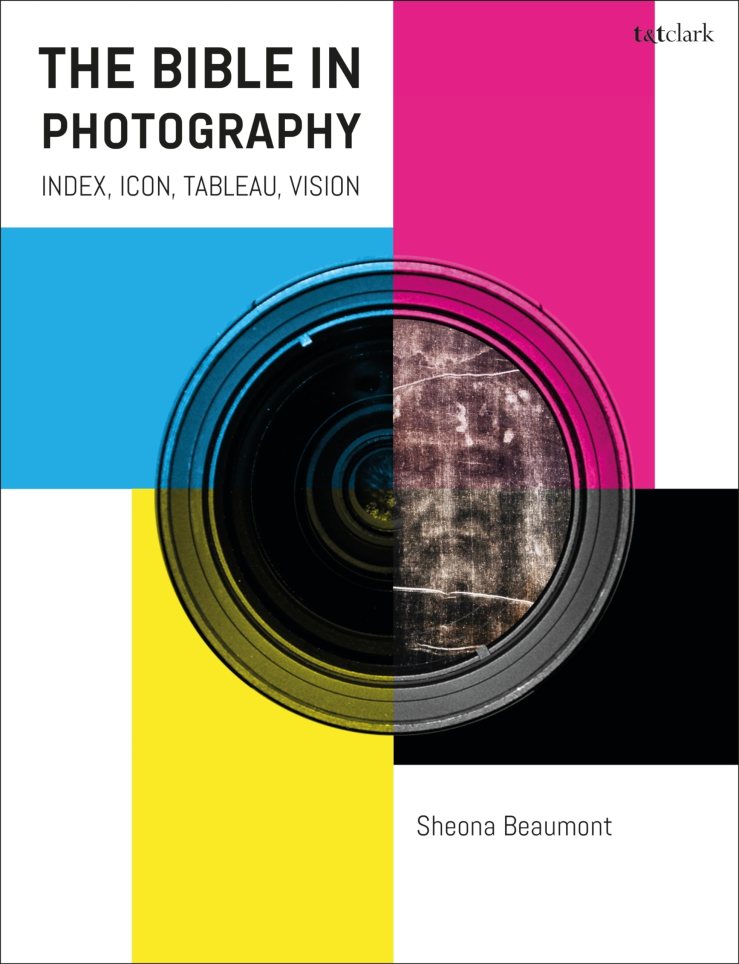
NEW BOOK: The Bible in Photography: Index, Icon, Tableau, Vision by Sheona Beaumont: Artist and scholar Sheona Beaumont [previously] is a visiting research fellow at King’s College London and cofounder of Visual Theology. In this book published by T&T Clark, she discusses, with critical depth, a range of “photographs that depict or refer to biblical subject matter, asking how the reception of the Bible by photographers and their audiences reveals their imaginative interpretation,” she writes. “I hope to show that, far from being an outdated, idiosyncratic or dead referent, the Bible’s many afterlives in photographs are uniquely qualified to show up the workings of a modern religious imagination” (1).

The Bible in Photography

In preparation for this project, Beaumont comprehensively scoped the representations of biblical characters, scenes, and texts through the whole of photographic history, from Fred Holland Day and Julia Margaret Cameron to Gilbert & George and Bettina Rheims. For the book she chose fifty-five such images and interviewed twenty living photographers. In addition to fine-art photography, she covers documentary photography, advertising photography, propaganda, diableries, and spirit photography.

The Bible in Photography is highly academic; nonscholars will probably find part 1, where the author establishes the conceptional and methodological footing for her inquiry, too dense (it’s in dialogue with Hans-Georg Gadamer, Marshall McLuhan, Walter Benjamin, and Anthony Thiselton). For me, the highlight of the book is the selection of images and the grappling with the literal and the spiritual—the difficulties of representing historically real persons using contemporary models, and of conveying a “something more” beyond the surface, an element of transcendence. Some of the photographic pieces I’ve never encountered before, such as Corita Kent’s arrangement of journalistic photographs as Stations of the Cross from the Spring 1966 issue of Living Light. There’s much to savor here!

My research interests center on the figure of Christ, a figure that, Beaumont notes, still has cultural currency in fine-art photography. “Even if our predominantly secular culture has largely abandoned its inheritance of a (Christian) hermeneutic tradition, the heritage-infused currents of visual culture in combination with the return of religion in global terms, demands its voice” (225). She encourages us to consider where and how and why Jesus is showing up in the medium of photography.

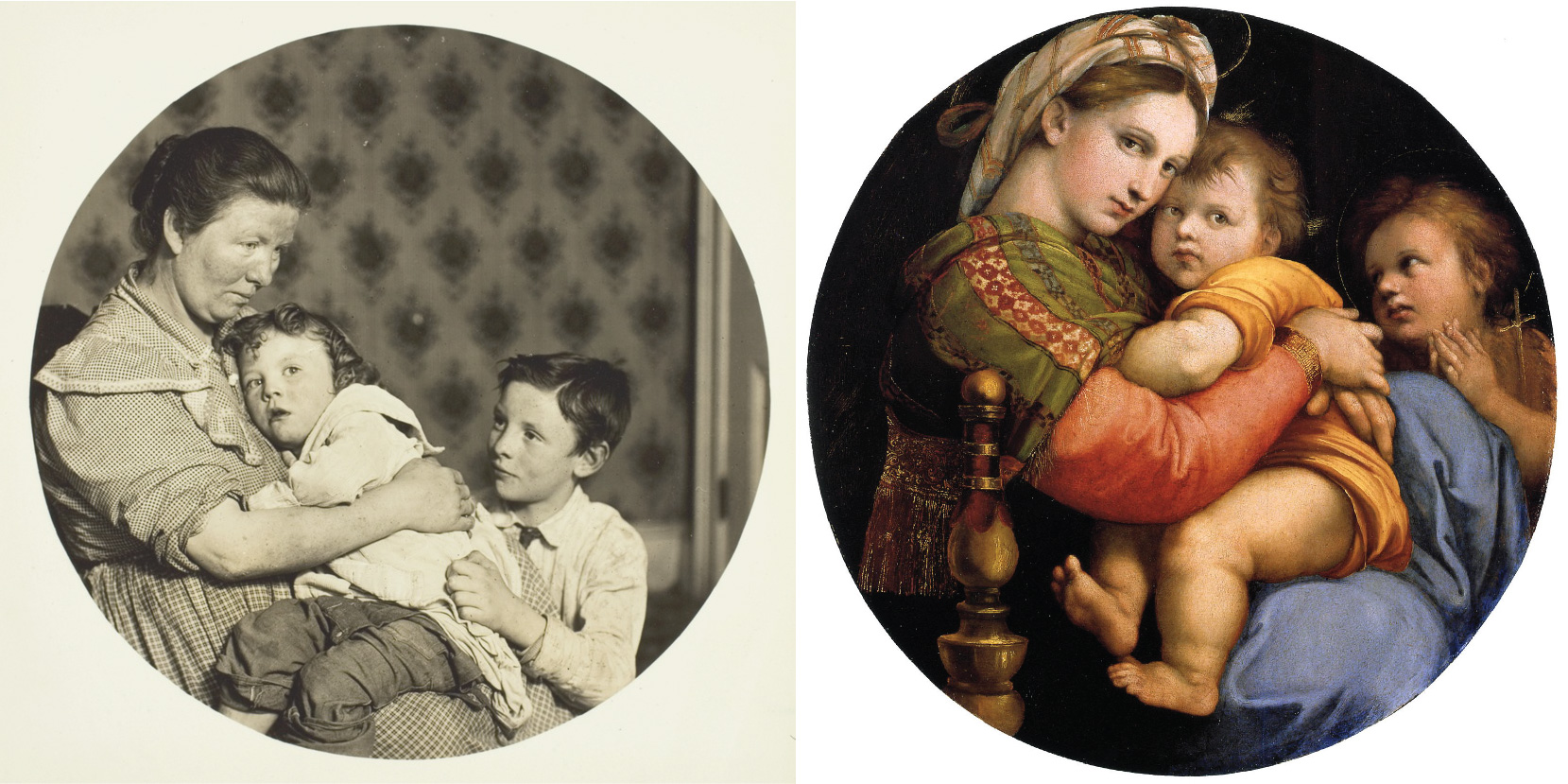
Tenement Madonna
Left: Lewis Hine (American, 1874–1940), A Madonna of the Tenements, 1904. Gelatin silver print, diameter 10 in. Right: Raphael (Italian, 1483–1520), Madonna of the Chair, 1513–14. Oil on panel, diameter 28 in. Palazzo Pitti, Florence.

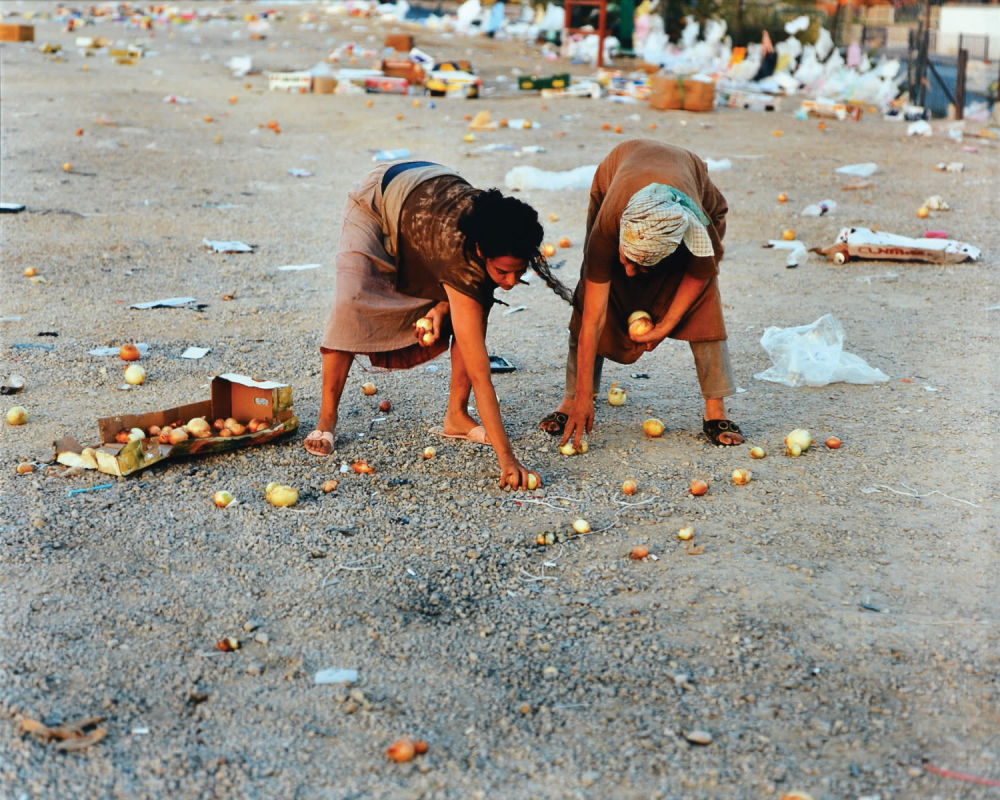
Nes, Adi_Ruth and Naomi
Adi Nes (Israeli, 1966–), Untitled (Ruth and Naomi), 2006. C-print, 140 × 177 cm.

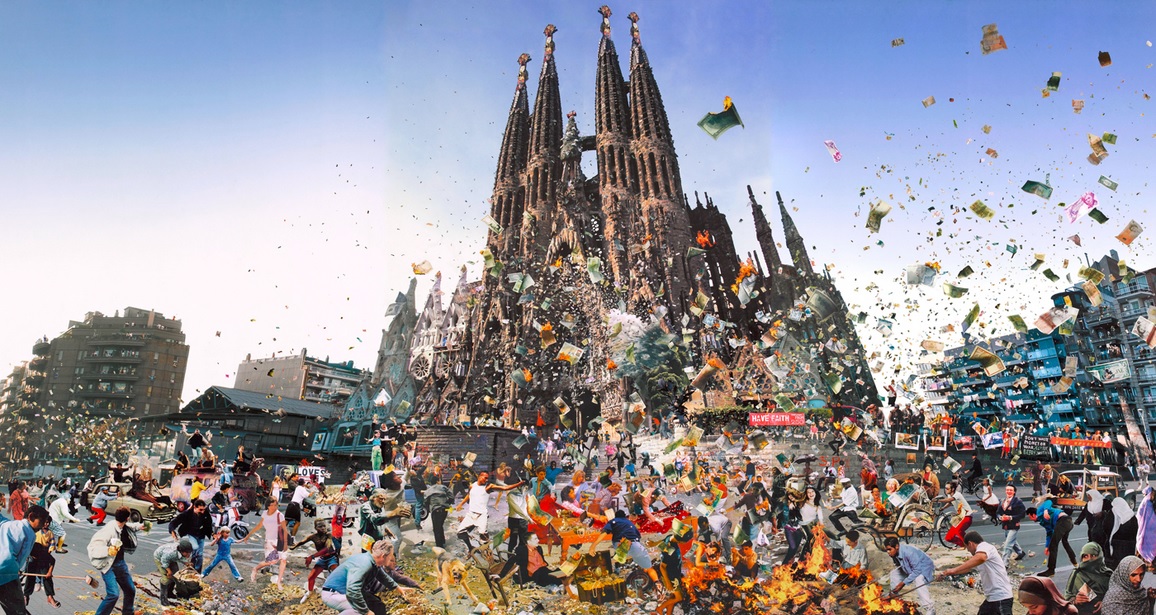
Mach, David_The Money Lenders
David Mach (Scottish, 1956–), The Money Lenders – Barcelona, 2011. Press print collage, 10 × 18 ft.

+++

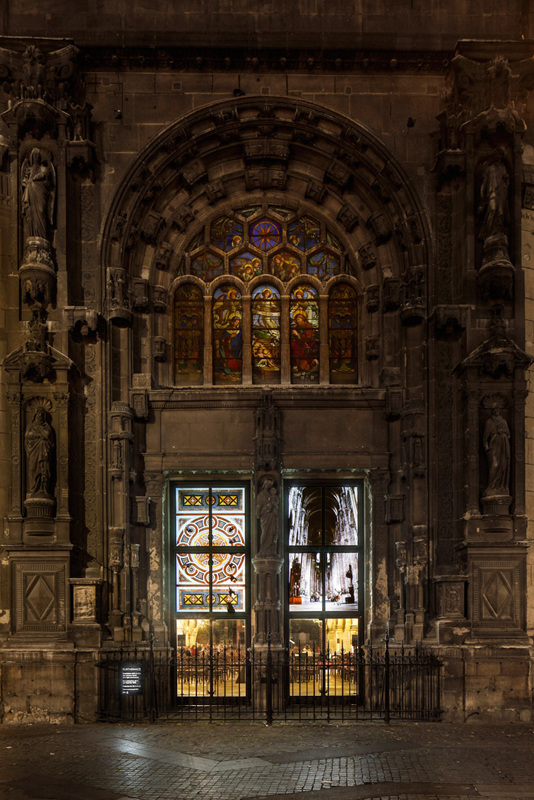
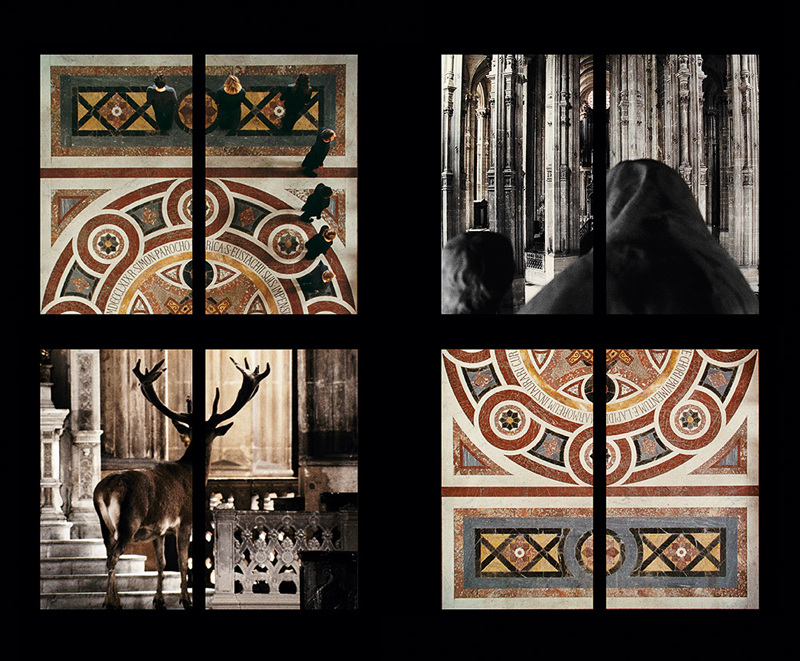
VIDEO: Deer in a Church: This short clip is one of the test scenes filmed on July 23, 2014, at the Église Saint-Eustache (Church of Saint Eustace) in Paris in preparation for a site-specific video installation commissioned for the church from Leonora Hamill, a photographic artist born in Paris and based in London and New York. The church is named after a Roman general who converted from paganism to Christianity during a hunt, after the stag he was pursuing turned to him and a cross appeared between its antlers, and he heard God speak, commanding him to be baptized. Eustace was martyred for his faith by Emperor Trajan in AD 118. His feast day is celebrated on September 20 in the Catholic Church and November 2 in the Orthodox Church.

The magnificent red deer (Cervus elaphus) in the video, a trained stag, is named Chambord. The installation he was filmed for, which was on view from December 4, 2014, to January 18, 2015, is titled Furtherance; a “making of” video can be seen here, and Hamill has posted another test scene on Instagram. Her director of photography for the project was Ghasem Ebrahimian.

From the artist’s website: “Shot on 35mm, the work weaves together traces of everyday activities within the church, unusual architectural points of view and a live stag . . . wandering through the space. Hamill transcribes the collective energy specific to this place of worship by retracing the steps of the church’s various occupants: priests, parishioners, tourists, soup-kitchen volunteers (on duty at the West Entrance every evening during winter) and their ‘guests’. These crossing paths constitute the social essence of the site. Their minimalist and precise choreography merges the human and spiritual sap of St Eustache.”

The footage of the majestic deer inside the majestic seventeenth-century sacred space—looking curiously around the high altar, the soaring candles reminiscent of trees in a forest—is breathtaking! Reminds me of Josh Tiessen’s Streams in the Wastelands painting series. Even nonhuman creatures praise the Creator.

Hamill, Leonora_Furtherance (installation)
Leonora Hamill (French, 1978–), Furtherance, installation view, St. Eustache Church, Paris, 2014. Two-channel HD projection, color. 35 mm transferred to 2K. Duration: 8 mins, 26 secs. Commissioned by the Rubis Mécénat cultural fund. Photo: Liz Eve.

Hamill, Leonora_Furtherance
Production still from Furtherance by Leonora Hill