
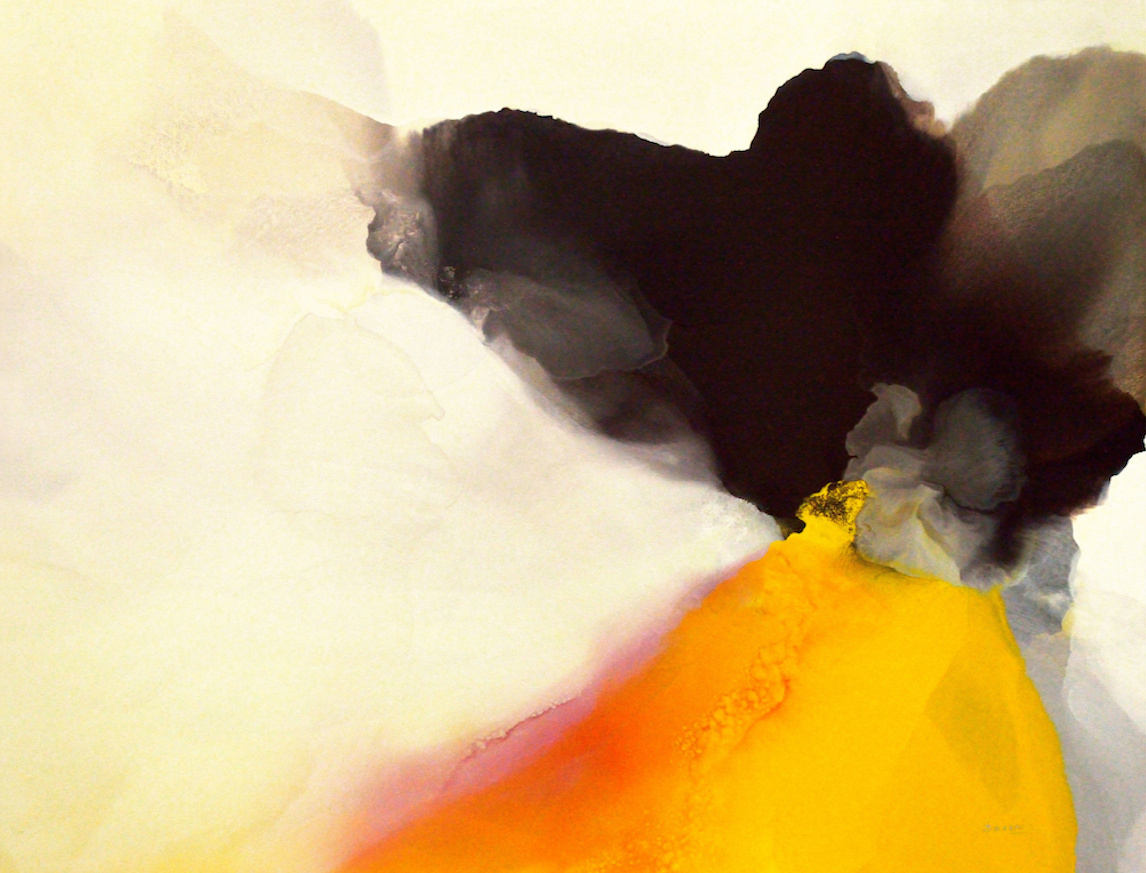
LOOK: Awareness 30 by Bassmi Ibrahim
LISTEN: “Diboo ning Maloo” (Darkness and Light) by Elfi Bohl, on Barakoo (Blessing), 2004 | Text: Isaiah 9:2, 6; 35:5–6a; Psalm 24:9–10 | Performed by Elfi Bohl, 2021
Moolu menu be taama kang
Diboo kono ye mala baa je
Moolu menu be siring sayaa siiringo la
Mala baa le malata I kang

Refrain:
I ko: dingo wuluta n ye, dinkewo diita n na
Adung a be kumandi la:
Yamaroolu baa, Alla talaa, Badaa-badaa Famaa
Yamaroolu baa, Alla talaa, Badaa-badaa Famaa
Kayira-mansoo

Finkintewol’ ñaal’ be yele la
Tulusuukuuringol’ tuloo be yele la
Namatoolu be sawung na ko minango
Nungunungunaal be sari la sewoo kamma la

Dundandal’ ye yele, dundundal’ ye yele hawu,
Fo Mansa kalangkee si dun nang.
Jumal’le mu ñing Mansa kewo ti?
Alla le mu, Alla meng warata
The people who were wandering in darkness
Have seen a great light
On those living in the land of death
A light has dawned

Refrain:
To us a child is born, to us a Son is given
And he will be called:
Wonderful Counselor, Mighty God, Everlasting Father (2×)
Prince of Peace

Then the blind will see
The deaf will hear
The lame leap like a deer
The mute tongue shout for joy

Open the doors and the ancient gates
That the King of Glory may come in
Who is this King of Glory?
It is God, the Lord, strong and mighty
This song by Elfi Bohl combines three short, Advent-themed scripture passages—two from Isaiah, one from the Psalms—in the Mandinka language of West Africa, which Bohl sings to her own kora and flute accompaniment.
Originally from Switzerland, Bohl lived in The Gambia from 1989 to 2001 with her husband and three children as a missionary with WEC International. There she learned to play the kora, a twenty-one-stringed harp-lute made of a dried calabash gourd half covered with cow skin. She was initially hesitant to take up the instrument, as it’s traditionally played only by Mandinka men from jali families, a hereditary caste of oral historians, praise singers, and musicians. She thought it might be considered disrespectful for her, a white European woman, to play it.
She already had a background in piano and guitar, but she told me that neither instrument seemed appropriate in the rural Gambian church setting she was in. “At the little church, we sang Christian songs that former missionaries had brought from Germany, the UK, and Australia and had translated into the Mandinka language. The music I heard on the local radio and the songs people were singing sounded very different,” she said. “I started praying and asking God to show me how I could use my musical gift in a culturally relevant way.”
Then one day in 1998, a salesman came to her house trying to sell her a kora, and she thought that maybe this was God’s answer. She decided to give it a try. A local jali agreed to give her a few lessons, teaching her three traditional melodies. She continued practicing on her own and developing her skill, and even started composing some of her own kora melodies to set Bible passages to, as well as arranging traditional ones for the same purpose.
For a while Bohl played only in private, but one day she took a leap of faith and played a kora song in church. The people in the congregation were delighted to hear one of their native instruments and traditional tunes used in Christian worship, and they encouraged Bohl to seek out other opportunities to play in public.
(Related post: “Music making at Keur Moussa Abbey, Senegal”)
Word got out about Bohl’s facility with the kora, and she started receiving invitations to perform in a variety of settings. Eventually she was playing in Muslim villages, prisons, Islamic schools, and at public meetings and government functions. She was even invited to play some of her songs live on Radio Gambia, the country’s national radio broadcaster, and the station also plays recordings from her two albums.
When she was interviewed on the radio, two imams called in, thanked her for honoring their tradition, and invited her to their villages to sing these “deep words from the Qur’an.” Bohl thanked them for the invitation but clarified that the words originated in the Tawurat, the Jabuur, and the Injil—the books of the followers of Isa (Jesus). Even though the lyrics were from the Bible, they still insisted she come. One promised to prepare a meal with goat meat to honor her coming, and the other said Bohl should first come to his village because he would kill a cow for her! It was the public approval of these imams that gave her the freedom to sing and play anywhere.
Bohl’s kora playing has opened up doors for the gospel to enter places that are typically closed to missionaries. “People believe that the kora itself has a spirit that speaks the truth,” Bohl says. In Mandinka culture, if lyrics are accompanied by a kora, the people must pay attention because there’s an important message for them to hear.
A local pastor told her that when he first heard her play and sing, he believed God had called her to The Gambia to become a jali sharing the gospel with the Mandinka, a people group who are almost entirely Muslim.
During Bohl’s radio appearance, the host introduced her as “Jali-musoo [Female Singer] Mariyama Suso.” I asked her how she got that name. She said,
Even before I started to play the Kora, I had been given the name Mariyama. Our local friends asked us if we could take a local name, mainly because it was often hard for them to pronounce our “foreign” names. The surname “Suso” I got, because the surname of the young man who taught me to play the Kora was Suso. The name Suso tells you that its family members by tradition are musicians. Because I was recognised by the Gambian people as one of their Kora players (jali or griot), I was allowed to take on that name. In fact, it is great honour to be called that name.
Here are some of the comments Bohl has received from Mandinka listeners over the years, as she relayed to the organization Wycliffe:
- “We know these songs and melodies but have never heard these words.”
- “The fact that you’ve learned to play the kora and sing in our language means you really love us.”
- “We know the old prophets you sing about. What Allah told them happened. Therefore, you must also be a prophet and we need to listen to you.”
- “Your songs are educative and soothing for our troubled hearts.”
- “These songs give me real hope although I know I’m soon going to die.”
When I asked Bohl if she has ever received any pushback from West Africans for playing the kora because of her gender, her non-jali biological lineage, and her not having been raised in the culture, she said the response has been overwhelmingly supportive. The only exception, she said, was when she was performing at a baby dedication, invited by the father of the newborn to announce the boy’s name through song, another kora player entered the yard and started singing over her. He left when the host asked him to, and that was that.
In 2001 Bohl and her family returned to their home country of Switzerland, continuing their work with WEC. She and her husband moved back to West Africa in 2011, but this time to Dakar, Senegal, where they served as regional directors of the missions organization in sub-Saharan Africa until 2019, a role that involved traveling the continent and making connections with people and communities.
Bohl currently lives in Switzerland, coaching and mentoring missionaries and prospective missionaries with an interest in Africa and in using music in ministry. She still plays the kora and writes songs for it.
“The Kora has always been part of our ministry,” Bohl told me.
It has been a wonderful “door and hearts opener” in the many African countries we travelled during our time as regional directors. In the years as leaders of WEC in Switzerland, I shared the testimony of the Kora at many missions conferences and in churches to testify that God uses music and arts to reach people with the gospel. I still share the Kora story and sing songs when given the opportunity. Lately, I also play at programmes for immigrants in Switzerland. There again, the Kora draws people from many, not only African, cultures.
Unless otherwise marked by hyperlinked source, quotes by Elfi Bohl are from my November 2024 interview with her via email. Thank you to Paul Neeley of the blog Global Christian Worship for putting me in touch with her!
 Art & Theology
[…] Bohl’s “Kanoo” is an original setting of 1 Corinthians 13:4–7 in the Mandinka language of West Africa, which she sings to a kora self-accompaniment. She wrote and recorded it while living in The Gambia. To learn more about Bohl and her kora songs, see my previous blog post from December. […]
LikeLike