
LOOK: Stations of the Cross #2 and #11 by Charles Ndege
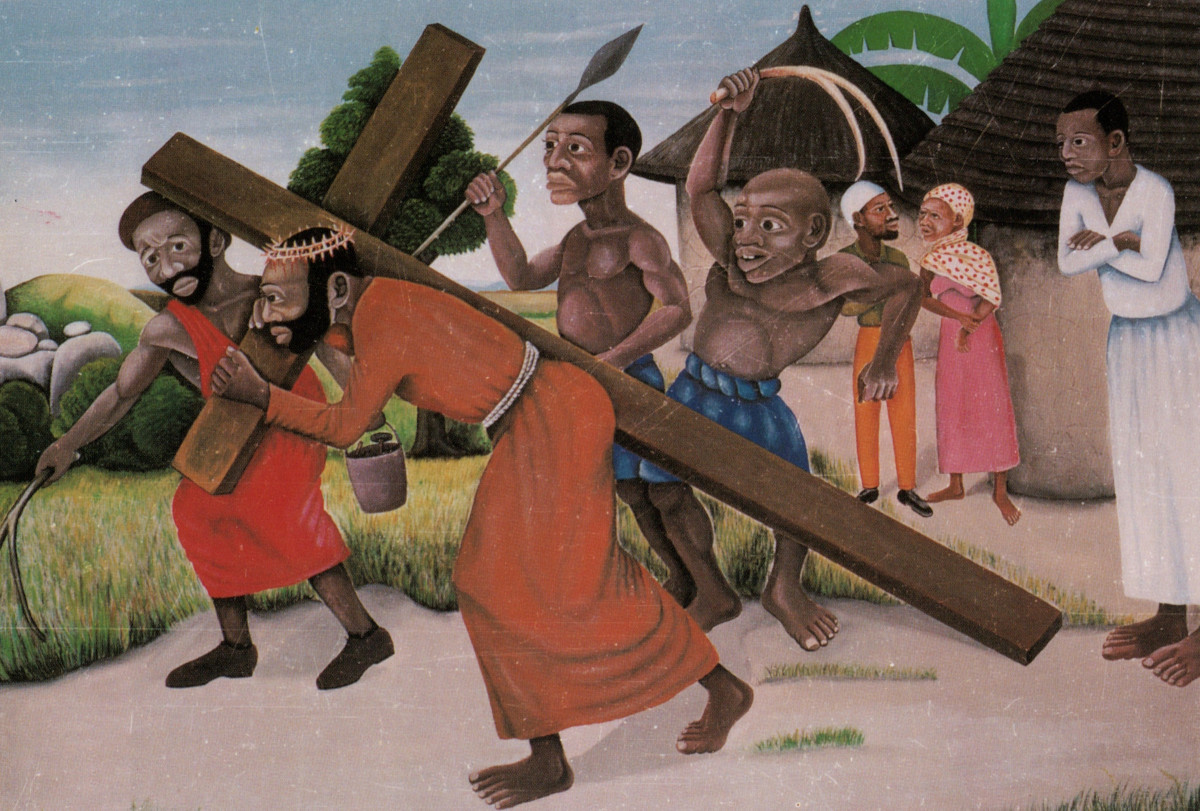

The cement walls of St. Joseph Mukasa Balikuddembe Church in Nyakato, Tanzania, bear a series of murals by the Tanzanian artist Charles Ndege depicting the Stations of the Cross, set around the southern shores of Lake Victoria.
I couldn’t find what year the murals were painted, but the earliest would be 1995, as they are mentioned (and one is reproduced) in the book Towards an African Narrative Theology by the American Maryknoll missionary priests Joseph Healey and Donald Sybertz, which came out in 1996.
I found out about Ndege’s Stations from the book Were You There? Stations of the Cross (Orbis, 2000), a small paperback that reproduces all fourteen scenes in full color and features reflections by the African American Catholic theologian Diana L. Hayes. I recommend it.
You can also view the images in this document provided by Maryknoll, with descriptions and prayers by Fr. Joseph Veneroso, MM.
LISTEN: “See How They Done My Lord,” traditional African American gospel song | Performed by the Angola Quartet (there are actually six voices) from Camp A on Angola Prison Spirituals, 1959
See how they done my Lord
See how they done my Lord
(Can’t you) See how they done my Lord
Lord, have mercy on meWell, they whipped him all night long
They whipped him all night long
(Tell me) Whipped him all night long
Lord, have mercy on meWell, they whipped him up a hill
They whipped him up a hill
(Tell me) Whipped him up a hill
Lord, have mercy on meWell, they nailed him to the cross
They nailed him to the cross
(Tell me) Nailed him to the cross
Lord, have mercy on meWell, two thieves was hanging beside him
Two thieves was hanging beside him
(Tell me) Two thieves was hanging beside him
Lord, have mercy on me
This song is sung by six unidentified men incarcerated at the Louisiana State Penitentiary, known colloquially as Angola Prison, one of the largest maximum-security prisons in the United States. A lament reflecting on Christ’s passion, it’s one of a series of Black gospel songs and spirituals recorded at the prison by the folklorist and musicologist Harry Oster in the late 1950s.
“How they done him” is slang for “how they wronged him” or “how they treated him badly.”
I can’t help but wonder if the singers identified with the abuse Christ suffered and found comfort in knowing that God himself walked the road before them and is with them in their own ways of sorrow. Perhaps (instead or too) they saw themselves in the penitent thief mentioned in the last stanza, who acknowledged the justice of his own sentence and asked Jesus to remember him in God’s kingdom.
The song’s refrain, “Lord, have mercy,” is a common one in liturgical churches, one that invokes God’s mercy in light of personal and corporate sins. It’s a plea for God’s compassion and forgiveness, and for relief.
 Art & Theology
Thank you for these powerful images and accompanying spiritual. Your daily posts for Holy Week have been deeply prayerful.
LikeLike