
I’m always intrigued by how artists respond creatively to sacred Christian spaces when invited to do so by the owning ecclesial bodies. Such invitations tend to appeal to artists, even those of different or no faith backgrounds, because of the chance to work with a (often) grand architectural space already charged with meaning and to make something that will live with a community over time, either temporarily or permanently, likely forming them in some way.
Because the feast of Pentecost is coming up on June 8, in which the church celebrates its “birthday,” effectuated by the descent of the Holy Spirit after Jesus’s ascension (see Acts 2), here are four striking artistic interventions in active or former churches that reference that spectacular event of wind and fire. Only the first was commissioned specially for Pentecost, but the other three bear Pentecostal resonances.
1. Tongues of Fire by Nancy Chinn, Grace Cathedral, San Francisco

Nancy Chinn is a liturgical artist and lay feminist theologian living in California, working in fibers and mixed media. Her Tongues of Fire was originally installed in Grace (Episcopal) Cathedral in San Francisco for Pentecost 1988, and she has since reprised it in a handful of other churches throughout her career.
It consists of fifty strips of nylon netting, painted in red, orange, and gold and suspended along the expansive neo-Gothic nave. She chose that number based on the etymology of the word “Pentecost,” which means “fiftieth” in Koine Greek; it was the name Hellenistic Jews used to refer to the Jewish festival of Shavuot, celebrated fifty days after Passover, but it also became a Christian festival in the first century CE when, fifty days after Jesus rose from the dead, his Spirit descended to empower his nascent community of followers.
Draped in a mighty sweeping movement and overlapping one another, the streamers respond to air flow in the space, furthering the sense of dynamism.
2. Tilting at Giants by Dayton Castleman and Fall to Flight by Alison Dilworth, Broad Street Love, Philadelphia
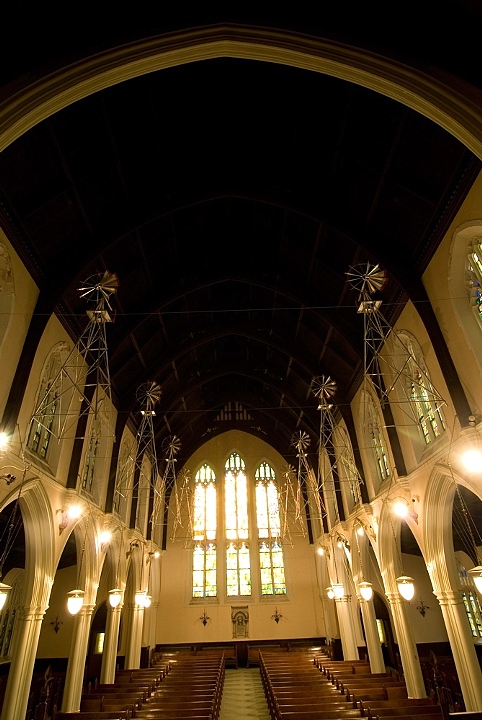
Tilting at Giants was commissioned by Broad Street Ministry (renamed Broad Street Love in 2024), a nonprofit organization in downtown Philadelphia providing stabilizing services to individuals experiencing deep poverty. It’s housed inside the former Chambers-Wylie Memorial Presbyterian Church, a historic turn-of-the-century Gothic Revival church that closed its doors in 1999 due to dwindling membership and the death of its pastor. The Presbytery of Philadelphia (PCUSA) leased the building for a few years to the University of the Arts, who used it for classes and events.
Then in May 2005, Rev. Bill Golderer rejuvenated the dormant church by opening Broad Street Ministry, billed as “an innovative Christian faith community that emphasizes the Gospel imperatives of extending generous hospitality, demonstrating justice and compassion, and providing a ground for artistic expression.” He removed the pews and set communal dining tables in their place, inviting in guests off the streets to enjoy chef-prepared meals all week long. The organization also provides legal help, fresh clothes, medical assistance, and a mailbox for those who lack a permanent address.
In its first year, Golderer issued an open call for proposals for a site-specific art installation that would be funded by the city’s Percent for Art program. Multidisciplinary artist Dayton Castleman, who lived in Philly at the time but who is now based in Northwest Arkansas, was awarded the commission.
His project comprises twelve large windmills that hover in the air, six in a line down each side of the vault—“unexpected, anachronistic, misplaced . . . [and] completely still,” Castleman says. He elaborates:
This stillness infuses the atmosphere with a sense of uneasy expectation. The brilliant towers, tall and clean, flash against the dark, vaulting canopy above. Like sentinels keeping watch, the sun-burst fans are poised, brimming with potential energy, waiting for a mysterious, transcendent wind to fill the space and make it sacred. Cradled within each tower, nearly lost in the spectacle, hover votive candles, glowing, unflickering, in prayer. This sanctuary is a living prayer—an aching, tense, expectant prayer—and a hair pulled taut, waiting to snap. . . .
The air is rich with suggestions and intimations of the invisible.
His artist’s statement also mentions Pentecost. On that seminal day two millennia ago, the disciples were gathered in Jerusalem with anticipation, as Jesus had told them, just before returning to the Father, to remain in the city until they received their new baptism, “for John baptized with water, but you will be baptized with the Holy Spirit not many days from now” (Acts 1:5).
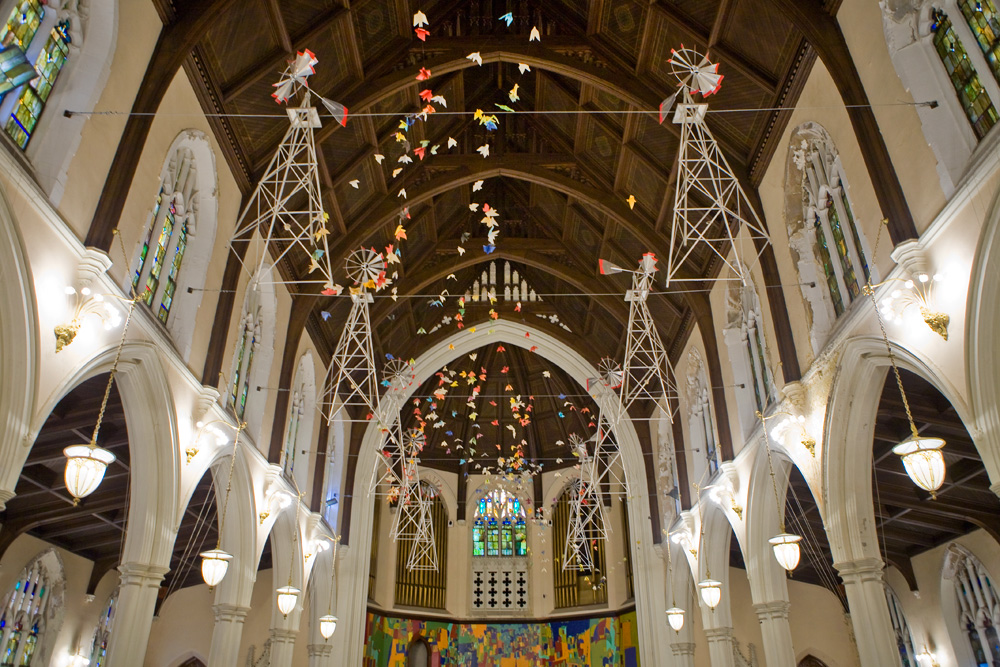
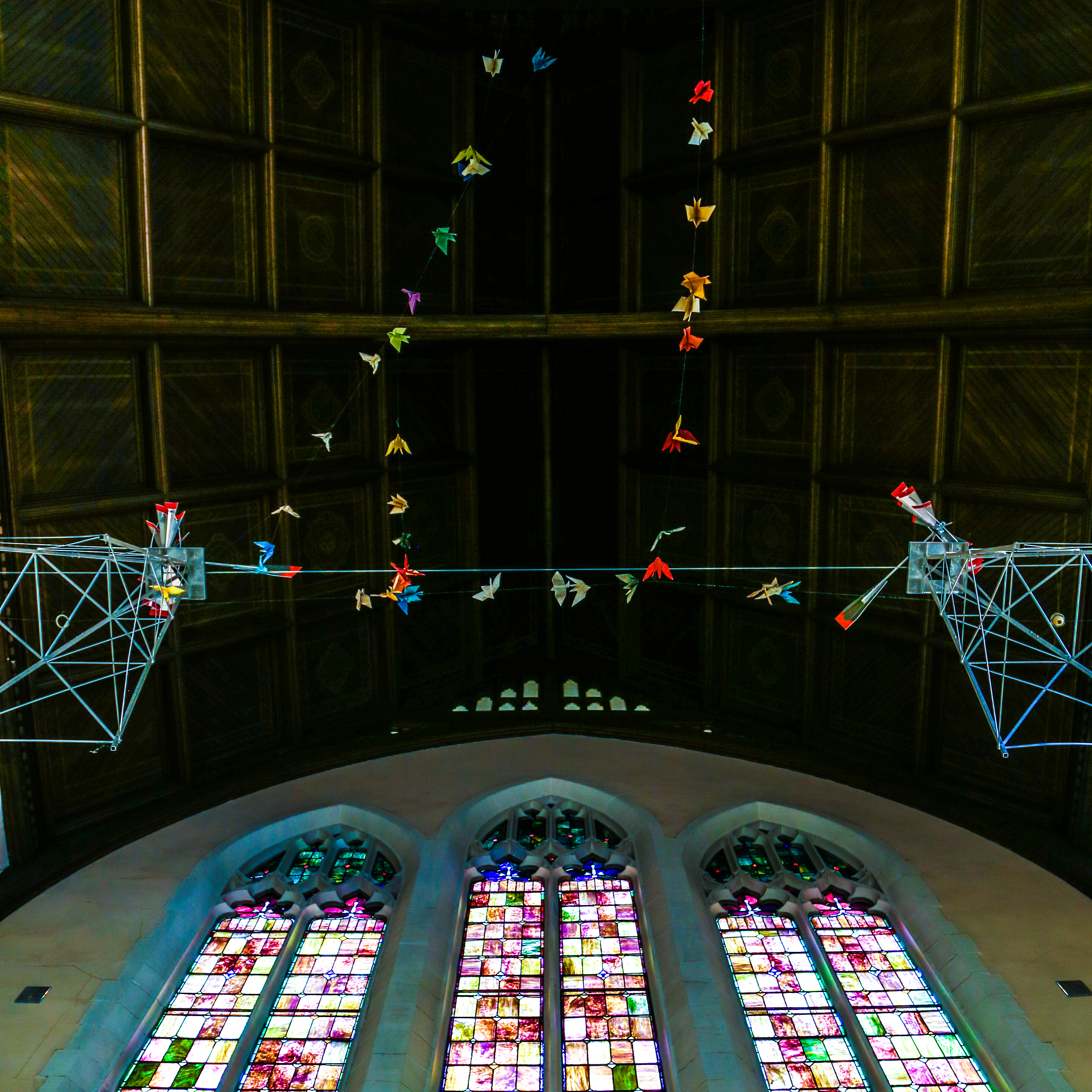
Shortly after Castleman’s Tilting at Giants was installed, it was joined by Fall to Flight, a flock of approximately six hundred origami swallows suspended from the ceiling, containing written prayers of the community. Created by Philadelphia-based artist Alison Dilworth, the multicolored birds winging overhead evoke the unleashed joy of the Holy Spirit, who is sometimes compared in scripture to a dove, but also Jesus’s encouragement in the Sermon on the Mount that God will provide for the needs of his children, just as he provides for our avian friends who neither sow nor reap nor gather.
3. HS by Maciej Urbanek, St. Michael’s Church, Camden Town, London
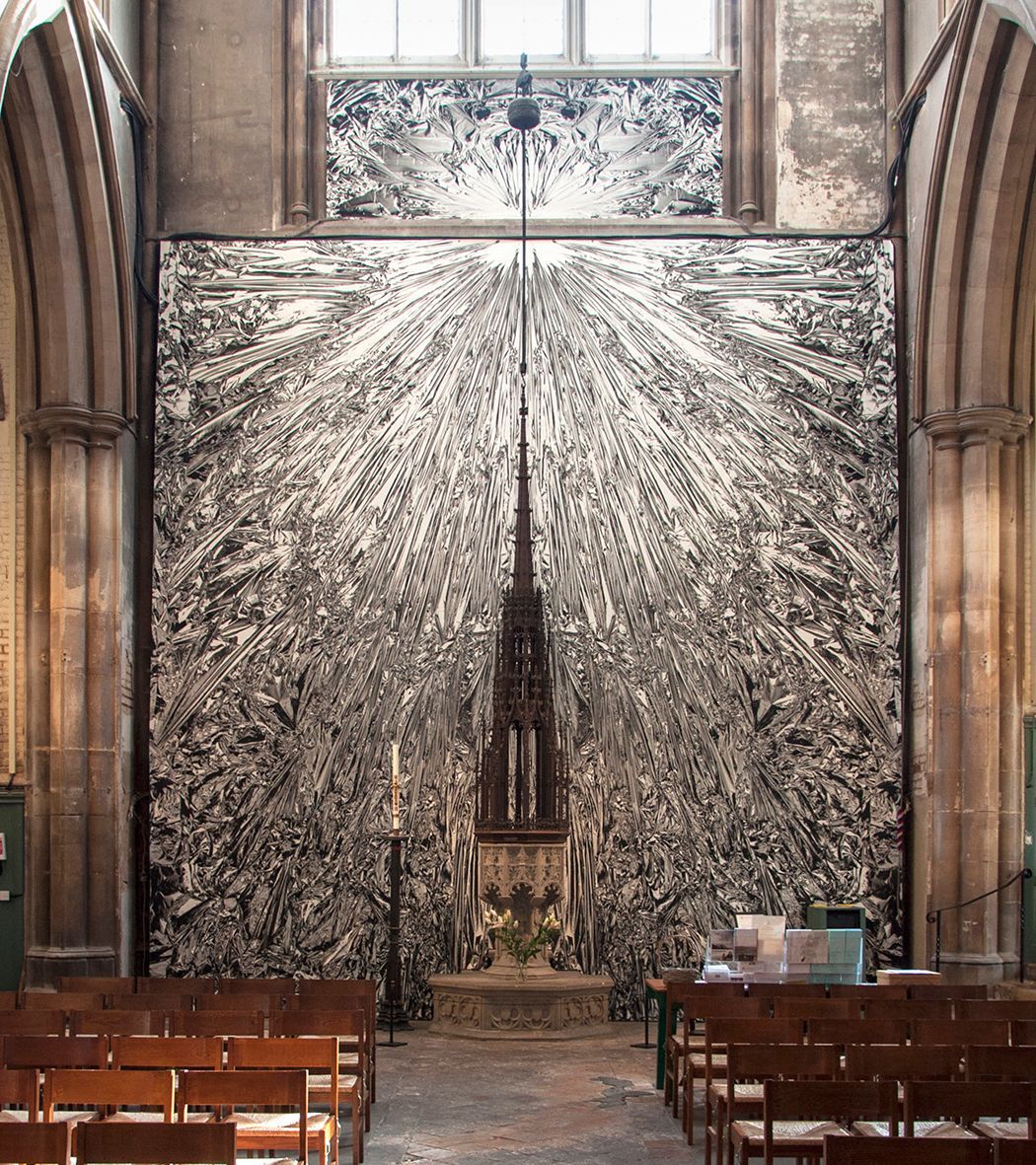
HS by the Polish-born British artist Maciej Urbanek is a monumental composite digital print installed on the west wall of St. Michael’s (Anglican) Church in Camden Town, London, covering up damaged plasterwork in need of restoration. What appears to be an explosion of silvery light is an effect produced with black plastic trash bags, which the artist crumpled up, lit, photographed, digitally reworked, and inkjet-printed on a large scale. Winner of the 2015 Art+Christianity Award for Art in a Religious Context, the work brings a baroque aesthetic to the Victorian interior.
“I am interested in elevating the banal and prosaic elements of life and turning them into powerful and rich visual statements,” Urbanek has said. A sign at the church says that Urbanek’s use of an everyday material to make something so beautifully radiant is “a metaphor for God’s work in taking ordinary human lives and making them extraordinary.”
Commissioned by Father Philip North (then the team rector of the parish of Old St Pancras) and privately funded by John Booth, HS was intended to be a temporary installation, but it was so well received by the parish that it has become a permanent fixture. According to the church’s X account, it “represent[s] the Holy Spirit breaking in from the outside world.”
The artwork’s location just behind the church’s baptismal font creates a linkage between the sacrament of baptism—in the Church of England, marking the beginning of a journey with God and the baptizand’s membership in the community of faith—and the work of the Spirit, who came at Pentecost with great power to set ablaze and send out. Indeed, HS can be read as that dramatic moment of the Spirit’s outpouring, and that parishioners walk past it when they exit the sanctuary is a reminder that they leave empowered by the Spirit to live and proclaim Christ’s gospel.
Thank you to Sheona Beaumont for introducing me to this work in her book The Bible in Photography: Index, Icon, Tableau, Vision. It is also the subject of a 2021 essay by Jonathan A. Anderson, “Bin bag visions: Theological horizons in Maciej Urbanek’s HS,” which I don’t have access to.
 Art & Theology
Oh! Victoria! Thank you so much for introducing me to “Tongues of Fire” by Nancy Chinn the Liturgical Artist! That art installation is wonderful and awe inspiring! I love it! Nancy Chinn is awesome too! I looked up everything about her, and ordered 2 of her books. She really speaks my “heart language.” It’s a great gift to me to receive the bounty of your spiritual and artistic passion, and your research. Thank you sincerely. ~ Kristine
LikeLike
I highly recommend playing “Come Holy Ghost” from the Vince Guaraldi Jazz Mass (commissioned for Grace Cathedral sixty years ago!) while viewing “Tongues of Fire”
LikeLike
Great pairing!
LikeLiked by 1 person