
The following excerpt is from the fourteenth-century biblical drama The Last Judgement from the York cycle of mystery plays [previously], performed annually in York, England, on the feast of Corpus Christi until its suppression by Protestants in 1569. Based on Matthew 25, this final play in the cycle was produced by the city’s guild of mercers (dealers in textile fabrics) and so is sometimes referred to as the Mercers’ Play.
I’ve chosen to feature it at this time because almsgiving—that is, assisting those in need, especially through the giving of money or goods—is one of the three pillars of Lent, and according to Matthew 25:31–46, it’s the measure by which Christ eternally blesses or damns people. It’s what separates the sheep from the goats, those who truly know Christ from those who don’t. The list of six charitable deeds in this Gospel passage—feeding the hungry, giving drink to the thirsty, welcoming the stranger, clothing the naked, caring for the sick, visiting the imprisoned—are called, in church tradition, the corporal works of mercy. A seventh, burying the dead, was added based on the book of Tobit 1:17–19.
(Related posts: “The Seven Works of Mercy: How two Dutch artworks—one Renaissance, one contemporary—can help us recover an ethic of neighborly care”; “On the Swag” by R. A. K. Mason)
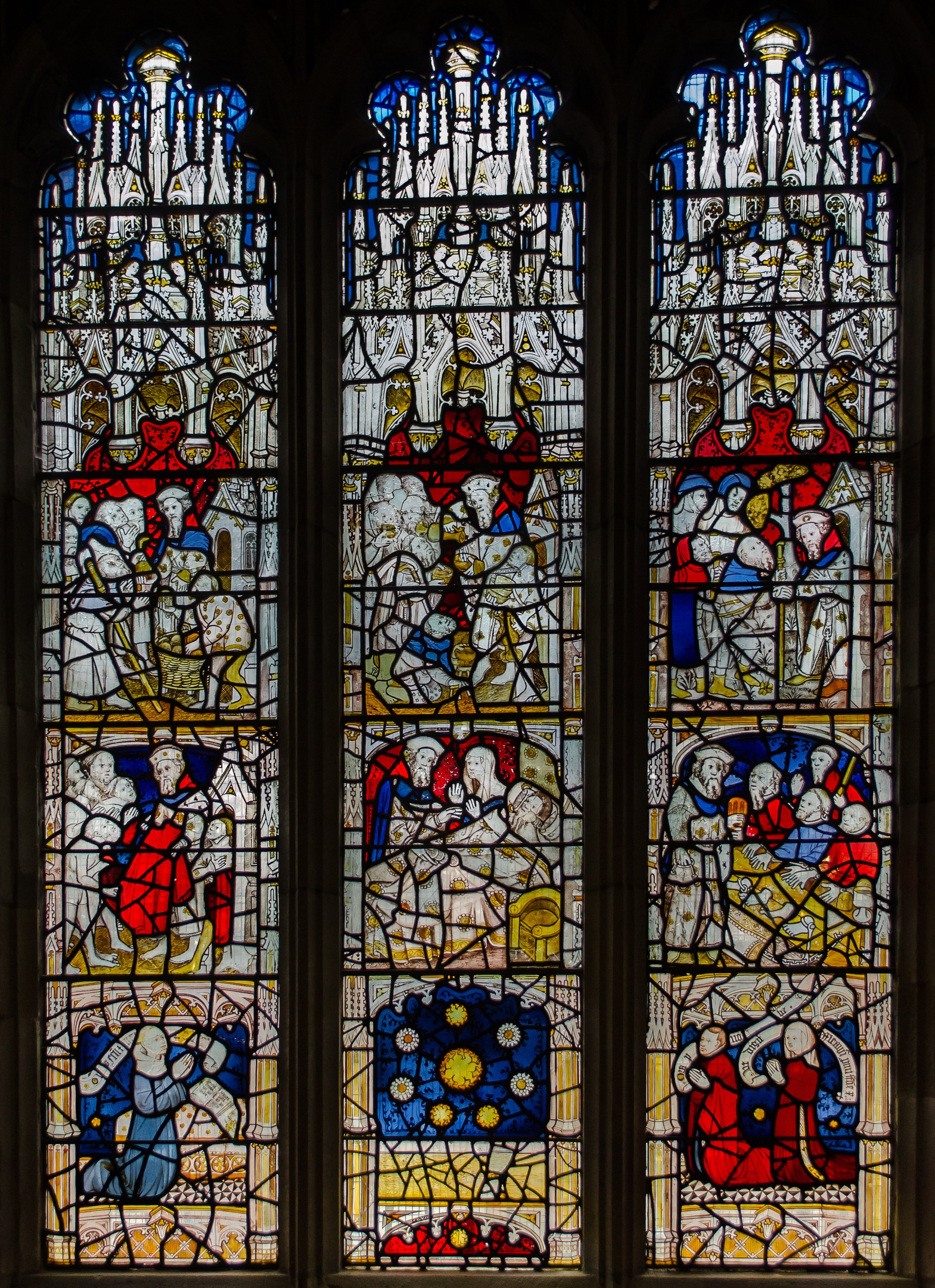
I’ve sourced the Middle English text below from the Oxford World Classics volume York Mystery Plays: A Selection in Modern Spelling, edited by Richard Beadle and Pamela M. King. The glosses are Beadle and King’s.
JESUS: My blessed children on my right hand,
Your doom this day ye thar not dread, [thar = need]
For all your comfort is comand— [command = coming]
Your life in liking shall ye lead.
Come to the kingdom ay-lastand [ay-lastand = eternal]
That you is dight for your good deed; [you is dight = is prepared for you]
Full blithe may ye be where ye stand,
For mickle in heaven shall be your meed. [mickle = great; meed = reward]When I was hungry, ye me fed;
To slake my thirst your heart was free; [free = willing]
When I was clotheless, ye me clad,
Ye would no sorrow upon me see.
In hard press when I was stead, [When I was placed in difficult circumstances]
Of my pains ye had pity;
Full sick when I was brought in bed, [in = to]
Kindly ye came to comfort me.When I was will and weariest [will = distraught]
Ye harbored me full heartfully;
Full glad then were ye of your guest,
And plained my poverty piteously. [plained = lamented]
Belive ye brought me of the best [belive = quickly]
And made my bed full easily, [easily = comfortably]
Therefore in heaven shall be your rest,
In joy and bliss to be me by.1 GOOD SOUL: When had we, Lord that all has wrought,
Meat and drink thee with to feed,
Since we in earth had never nought
But through the grace of thy Godhead?2 GOOD SOUL: When was’t that we thee clothes brought,
Or visited thee in any need,
Or in thy sickness we thee sought?
Lord, when did we thee this deed?JESUS: My blessed children, I shall you say
What time this deed was to me done:
When any that need had, night or day,
Asked you help and had it soon.
Your free hearts said them never nay,
Early ne late, midday ne noon,
But as oft-sithes as they would pray, [pray = ask]
Them thurt but bid, and have their boon. [They only needed to ask, and their request was granted]
For a modern performance of The Last Judgement by Handmade Performance in Toronto, see here. (The above passage is at 16:43ff.) They use a modern translation by Chester N. Scoville and Kimberley M. Yates.
 Art & Theology
[…] From Art & Theology […]
LikeLike