
Christ is risen! He is risen indeed! Happy Easter, friends.
LOOK: Crucifixion sur la ville and Résurrection by Arcabas
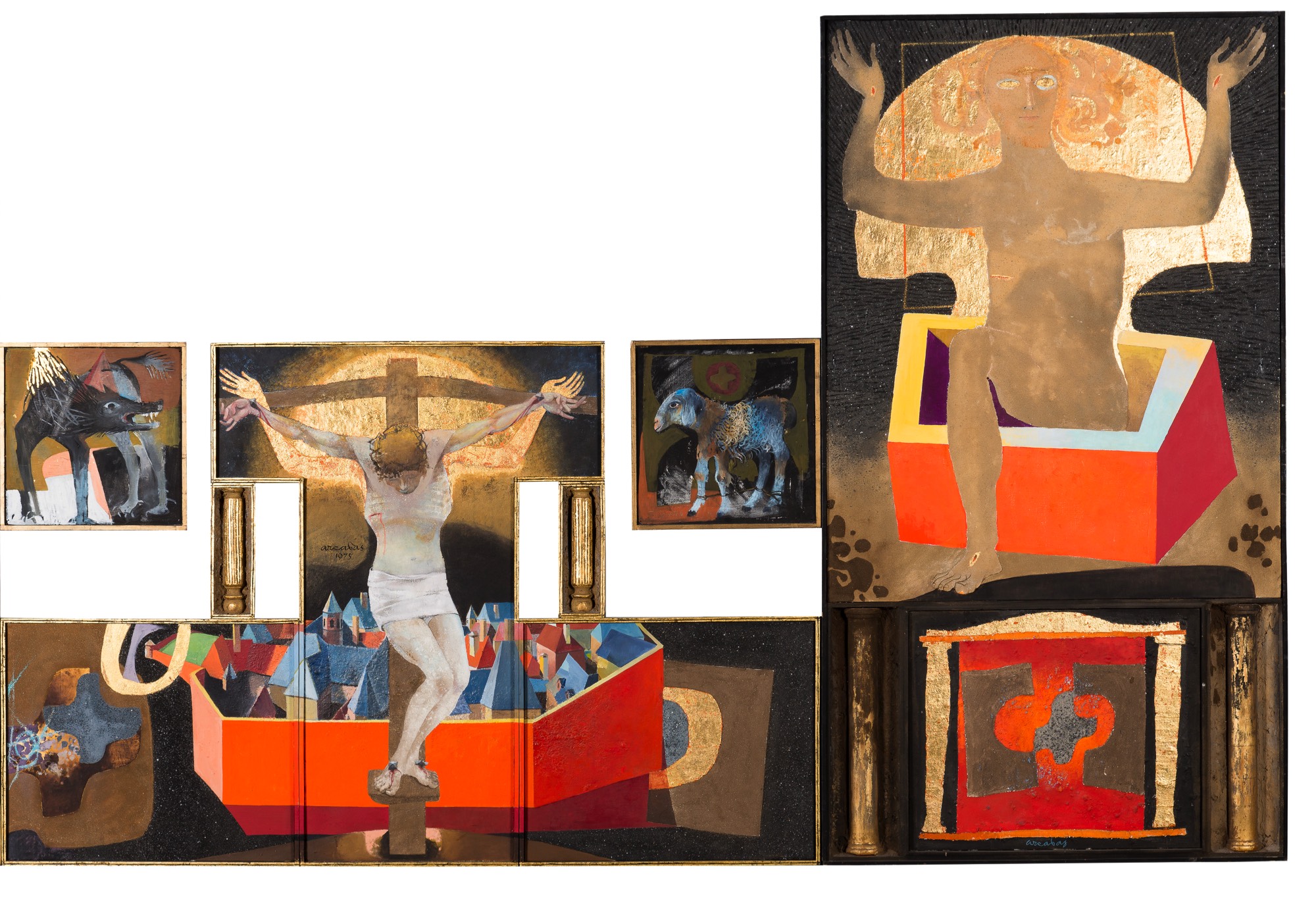
There is very little written in English about the sacred French artist Jean-Marie Pirot (1926–2018), known as Arcabas [previously]—which is a shame, because his work is fantastic. I’d love to see it in person someday. Much of it is concentrated at L’église de Saint-Hugues-de-Chartreuse, near where he lived from 1950 until his death. One published source of information about the artist is Dr. David Lyle Jeffrey’s wonderful book In the Beauty of Holiness: Art and the Bible in Western Culture (Eerdmans, 2017); he devotes the book’s final section, pages 349–63, to Arcabas, reproducing in full color seven of his paintings and translating material from French interviews. Jeffrey cites Kirsten Appleyard’s honors thesis at Baylor University from 2009, which he supervised, as the most complete study of the artist’s work available in English, which I believe is still the case.
Unfortunately, the website arcabas.com, from which I gathered photos of many of Arcabas’s works some ten years ago, is now defunct. That’s where today’s featured image was sourced from. The panels are from a larger polyptych, which you can view in this photo of its temporary exhibition at L’église Saint Ignace in Paris. I’m not sure where it resides now.
The left panels portray Jesus being crucified outside the city walls. But the cityscape is not of first-century Jerusalem; it’s a modern French village. As have many artists before him, Arcabas collapses the distance between Jesus’s life and times and his own by transposing Jesus’s death to a familiar setting.
On the right is a lamb whose legs are bound in preparation for sacrifice—an emblem of Christ, who was led “like a lamb . . . to the slaughter” (Isa. 53:7). Opposite the lamb is a snarling wolf, a reference to Psalm 22:16–18:
For dogs are all around me;
a company of evildoers encircles me;
they bound my hands and feet.
I can count all my bones.
They stare and gloat over me;
they divide my clothes among themselves,
and for my clothing they cast lots.
The Crucified One bows his head. His hands, nailed by the wrists to the cross, are contorted in pain. His ribcage protrudes from his emaciated torso. But as he gives up the spirit, it spills out, a silhouette of his form, in gold, dissolving into a sun/halo behind his head. His golden arms are strong, vigorous, alluding to the Resurrection and capturing something of the paradox of the cross, a site of both shame and glory.
In the right panel, which is on a larger scale than the others, granting it preeminence, Christ emerges victorious from a multicolored sarcophagus. He rises bodily, but his form is transfigured, shiny, especially his eyes. Stepping out of the box that cannot contain him, he lifts his hands to reveal the wounds of crucifixion, signs of our redemption. The lustrous swirls about his head could be his wild, windswept hair, or else some kind of electric or mystic force.
This is one of several Resurrection images Arcabas painted during his lifetime. Another one, you can hear the artist discuss (in French) in the following 2005 interview, cued up at 20:26:
This whole KTO TV segment, nearly an hour long, is worth watching if you’re a French speaker! I am not, but a generous follower of my blog, knowing my enthusiasm for Arcabas, translated significant portions of it for me into English.
Since Arcabas’s death, a new online hub has sprung up to showcase his work: https://arcabas.net/. While it doesn’t host as many image files as its .com predecessor, this archive provides helpful location and copyright information, and I believe it’s in a state of expansion.
LISTEN: “The Resurrection” by Richard Smallwood (based on Rachmaninoff’s “Vocalise”), 1982
And he died
For our sin and our shame
Jesus died
For our sins
He hung high
On a hill called Calvary
To save a wretch undone
Like you and meI can’t forget how he died for me
He suffered so much on Calvary
I can’t forget how they pierced his side
And he bowed his head and diedBut he rose
Conquered death, hell, and grave
And he rose
With all power
Jesus rose
Now he lives forevermore
Through Christ we now are saved eternally
Richard Smallwood (1948–2025) was a legendary gospel composer, pianist, and singer, known for blending classical music with traditional gospel. For “The Resurrection,” which debuted on the album The Richard Smallwood Singers (1982), he adopted the main theme of Rachmaninoff’s wordless song “Vocalise” as the basis. Meditating on Christ’s crucifixion and then resurrection, Smallwood’s song evolves in tone from elegiac to triumphant.
This is the first post in a daily series for the first eight days of Easter, each one of which will pair a visual artwork with a piece of music to encourage celebration of the risen Christ.
 Art & Theology
My favorite Resurrection proclamation:
LikeLike
Yes, this flash mob is amazing! Also one of my faves. I shared the video back in 2018: https://artandtheology.org/2018/04/15/roundup-easter-flash-mob-good-thief-resurrection-photo-sistine-chapel-frescoes-in-3-d-etc/
LikeLike
Thank you for introducing me to Arcabas! The video is fascinating, which I watched with delight as French is my first language.
I found another video, which you can watch with English close-captioning, recorded a decade later in his studio.
Enjoy and keep up the good work!
Catherine Combier-Donovan, MLS
LikeLike
Thank you for bringing this video to my attention, Catherine! I have it bookmarked to listen to this week.
LikeLike