Roundup: Free Bifrost Arts songs, civil religion hymn revised, Bono and Eugene Peterson talk Psalms, Crystal Cathedral transformation, mercy-themed movies

Entire Bifrost Arts catalog available for free download: For a limited time, the Christian music collective Bifrost Arts is offering all forty-eight of their songs for free download from NoiseTrade. Donations are welcome—100 percent of them will go to the Salt and Light Artist fund, which funds residencies for Christian artists in Arab countries, providing a platform for interaction with the local arts community.

Alternative song lyrics for “America, the Beautiful”: In 1993 Sister Miriam Therese Winter adapted the lyrics to “America, the Beautiful” to make the song more appropriate for a Christian worship service (i.e., less nationalistic). Her adaptation is #594 in the United Church of Christ’s New Century Hymnal.

Interview with Bono and Eugene Peterson on the Psalms: This short film, released in April, documents the friendship between Bono (of the band U2) and Eugene Peterson (author of contemporary-language Bible translation The Message) revolving around their common interest in the Psalms. Inspired by their conversation, interviewer David Taylor compiled a list of resources for exploring the Psalms.

Transforming a Protestant worship space into a Catholic one: The largest glass building in the world, the Crystal Cathedral in Orange County, California, has been undergoing renovations since having been sold in 2013 by the Reformed Church in America to the Roman Catholic Diocese of Orange. “Our charge is to convert an open, all-glass Evangelical church into a great Catholic cathedral to serve its centuries-old sacraments and ritual processions, and to reinforce the centrality of the Eucharist,” write architects Scott Johnson and Frank Clementi. This article published in Faith and Form describes some of the symbolic, aesthetic, environmental, and technical challenges of this project and includes renderings of the new space, which is scheduled to reopen next year.

Crystal Cathedral renovations

Top 25 films on mercy: I’ve been enjoying these top 25 film lists put together by the Arts & Faith online community—especially how they reach beyond the obvious choices, dipping into the silent era as well as non-American cinema. Here’s their latest, a list of films that “show us visions of a world so often lacking in mercy, as well as worlds in which one merciful act alters the landscape of human experience forever.” Click here to view their other lists: road films, horror films, divine comedies, films on marriage, and films on memory.
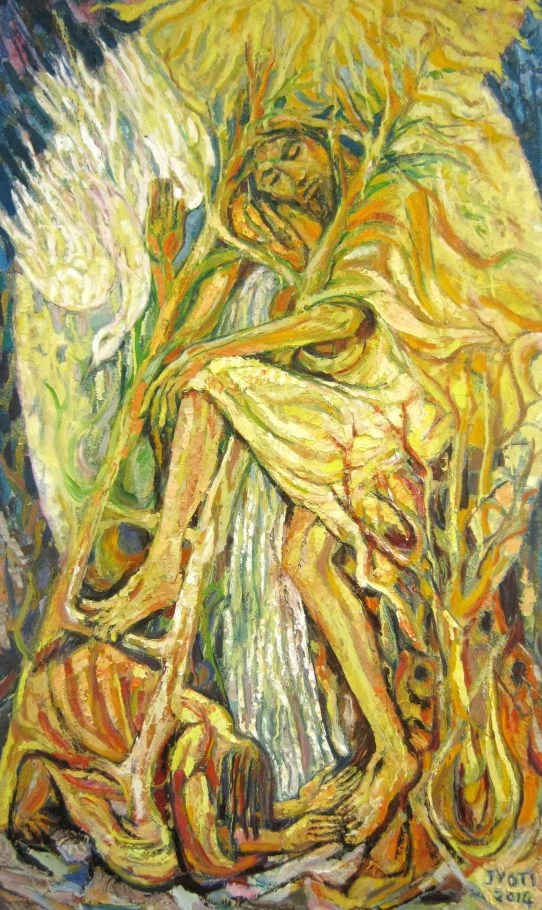
Jesus as Ladder: Jyoti Sahi and Ralph Stanley in conversation with Genesis 28

Jyoti Sahi is a prolific artist who founded an art ashram in Silvepura Village outside Bangalore in southern India. His paintings are infused with Christian spirituality, often depicting biblical narratives set on Indian soil.

Lord as Ladder of Perfection by Jyoti Sahi
Jyoti Sahi (Indian, 1944–), Lord as Ladder of Perfection, 2014. Oil on canvas.

Lord as Ladder of Perfection references Jacob’s dream from Genesis 28:10–22, wherein Jacob witnesses angels descending and ascending a cosmic ladder. This vision resurfaces in the New Testament, when heaven opens and angels are seen pressing in on the Son of Man (John 1:51), ministering to him in his passion and then heralding his resurrection.

By entwining Jesus in this ladder from Genesis, Sahi suggests that Jesus himself is our ladder—the One who connects earth to heaven, heaven to earth. By him, we can access God.

We are meant to identify with the figure in the bottom left corner of the painting, whose gender is deliberately ambiguous. In this figure you might see Jacob, or perhaps you see Mary Magdalene, who is often shown in art weeping at the foot of the cross and is traditionally understood to be the “sinful woman” who anoints Jesus’s feet with expensive perfume and tears in Luke 7:37–38. Either way, we are invited into the painting by this bent body, invited to worship Christ.

(Related post: “Three Resurrection paintings by Indian artist Jyoti Sahi”)

The cosmic implications of Jesus’s mediating role are suggested in a few ways. First, Jesus’s left leg is lifted in the pose of Nataraja (“Lord of the Dance”), an embodiment of the Hindu god Shiva. Nataraja’s dance destroys all obstacles on the path to liberation and prepares the universe for renewal, and here Jesus is grafted into that iconography. He dances, and the world is transformed.

Moreover, the four elements are present: earth, wind, fire, water. Earth forms the base of the painting, where the ladder, treelike, is rooted. Wind sweeps down in the form of a hamsa, a mythical swan-like bird, here signifying the Holy Spirit. Fire burns at the bottom right, a biblical symbol for cleansing and refining, and appears to be setting aflame a bush, a reminder for us to be attentive to God’s call, as Moses was. Straight down the center, water bursts forth from Christ’s side wound, a river of life that washes over the worshipper.

At the top, the ladder branches out and flowers.

Painted in 2014, Lord as Ladder of Perfection reminds me of the traditional hymn “Jacob’s Vision,” which likewise identifies the ladder of Jacob’s dream with the crucified Christ. I wrote about the hymn here—in particular, the beautiful cello-accompanied rendition sung by Ralph Stanley, who passed away on Thursday. I enjoy listening to it while I gaze at Sahi’s painting, as the two interpret each other.

John the Baptist at the National Gallery, London

The feast day of John the Baptist’s birth is coming up on June 24, and London’s National Gallery has provided a great way to immerse yourself in his story—through art! The museum has produced a ten-video series called Saint John the Baptist: From Birth to Beheading, in which Professor Ben Quash, director of the Centre for Arts and the Sacred at King’s College, joins Dr. Jennifer Sliwka, curator of art and religion at the National Gallery, for a stroll through the museum and some nearby sites to discuss various works of art in which John appears.

Quash and Sliwka teach a collaborative master’s program in Christianity and the Arts, which invites participants to

investigate how Christian scripture, beliefs and practices have found expression in art over 2,000 years; trace the idea of beauty in Western theological tradition; make use of examples in London. . . . The MA will enable students to work across disciplinary and specialism boundaries, and in particular to explore simultaneously the art-historical and theological dimensions of Christian art – approaches which are generally pursued in isolation from one another.

Their analysis of the paintings in this video series is superaccessible to those with no art background, and familiarity with Christianity isn’t assumed either.

The ten videos—about eight minutes each—are embedded below.

  1. Introduction

Artwork: Saint John the Baptist from Carlo Crivelli’s Demidoff Altarpiece

  1. Visitation

Artworks: a Visitation painting from the workshop of Goossen van der Weyden; Francesco Zaganelli’s The Baptism of Christ

  1. Birth and Naming

Artworks: scenes from Niccolò di Pietro Gerini’s Baptism Altarpiece; a predella panel by Giovanni di Paolo

  1. Infancy

Artworks: Garofolo’s The Holy Family with Saints; Bronzino’s The Madonna and Child with Saints; Leonardo da Vinci’s The Virgin of the Rocks

  1. Wilderness

Artworks: Giovanni di Paolo’s Saint John the Baptist retiring to the Desert; Saint John the Baptist by an anonymous Italian artist from about 1640–60; Moretto da Brescia’s Christ blessing Saint John the Baptist

  1. Preaching

Artworks: Raphael’s Saint John the Baptist Preaching; Pier Francesco Mola’s Saint John the Baptist preaching in the Wilderness; Parmigianino’s The Madonna and Child with Saints John the Baptist and Jerome

  1. Baptism

Artworks: the baptismal font at Salisbury Cathedral, designed by William Pye; Adam Elsheimer’s The Baptism of Christ; and the most famous painting of this subject in any collection: Piero della Francesca’s The Baptism of Christ

  1. Martyrdom

Artworks: Caravaggio’s The Beheading of Saint John the Baptist at St. John’s Co-Cathedral in Malta; Pierre-Cécile Puvis de Chavanne’s The Beheading of Saint John the Baptist

  1. The Baptist’s Head

Artworks: Caravaggio’s Salome receives the Head of John the Baptist; Ana Maria Pacheco’s Study of Head (John the Baptist III) at a private residence (includes an interview with the artist)

  1. Power and Judgment

Artworks: the anonymous English Portrait of Richard II at Westminster Abbey (John the Baptist was his patron saint); a scene above the central panel of Giovanni dal Ponte’s Ascension of Saint John the Evangelist Altarpiece depicting John the Baptist preparing souls to enter into heaven; and The Wilton Diptych, depicting John the Baptist presenting King Richard to the heavenly retinue


To engage with more art from the National Gallery, consider buying one of the two books I reviewed here.

Remembering Charleston

Friday, June 17, marks the one-year anniversary of the racially motivated mass shooting at Emanuel African Methodist Episcopal Church in Charleston, South Carolina, where nine members were killed by gunman Dylann Roof at a midweek service: Sharonda Coleman-Singleton, Cynthia Marie Graham Hurd, Susie Jackson, Ethel Lee Lance, Depayne Middleton-Doctor, Clementa C. Pinckney, Tywanza Sanders, Daniel Simmons, and Myra Thompson.

In response to the tragic event, Alabama artist Liz Landgren painted A Bridge Over Troubled Water, which shows the nine victims ascending, winged and haloed, from the troubled waters of this world.

A Bridge Over Troubled Water by Liz Landgren
Liz Landgren (American, 1974–), A Bridge Over Troubled Water, 2015. Acrylic on wood panel, 36 × 36 in.

Landgren says her visualization was inspired by Aretha Franklin’s 1971 cover of the Simon and Garfunkel song “Bridge Over Troubled Water”:

The original song premiered on November 30, 1969, on the CBS documentary feature Songs of America. Here, as in Landgren’s painting, it was connected with death, being played over footage from the funerals of John F. Kennedy, Robert Kennedy, and Martin Luther King Jr.

Paul Simon, who wrote the song, says his idea for it came from a line that Claude Jeter extemporized in the Swan Silvertones’ 1958 recording of the African American spiritual “Oh Mary Don’t You Weep”: “I’ll be your bridge over deep water if you trust in my name.” The speaker is Jesus; the context, his raising of Lazarus (see John 11:32–33). So whereas “Bridge Over Troubled Water” is often transmitted today as a message from one friend to another, its source material actually identifies that friend as Jesus, the one who lays himself down so that we can cross over pain without drowning in it.

Because of the religious significance of the song, Simon sought to give it a gospel feel. For this task he enlisted the help of Larry Knechtel, who arranged the song for piano (Simon had written it on guitar), styling it after church hymns. Knechtel’s piano playing is one of the song’s most distinguishing characteristics.

So back to Landgren’s painting. The waters of suffering roll off the figures’ garments, a heaviness they no longer bear, as they “sail on by” to be with their Lord. Saints on earth, they now pass into the extended communion of saints in heaven, leaving behind a world that’s roiling with violence and hate, anger and grief.

We lament the deaths of the Charleston Nine. We lament the laws that make it easier to kill. We lament the dividedness of our country. But we celebrate the witness of Sharonda, Cynthia, Susie, Ethel, Depayne, Clementa, Tywanza, Daniel, and Myra, whose Christian hospitality toward a white stranger cost them their lives.

The painting brings to my mind another song: “All God’s chillun [children] got wings . . . a robe . . . a crown . . . a song,” and when we get to heaven we’re gonna put them on.

Praise be to God, who raises us up—from death and from woe.

Book Review: The Image of God in an Image Driven Age, ed. Beth Felker Jones and Jeffrey W. Barbeau

The Image of God in an Image Driven AgeThe doctrine of the imago Dei—which states that human beings were uniquely created in the image of God and continue to bear that image—is central to Christian theology, for it tells us who (and Whose) we are. The book The Image of God in an Image Driven Age: Explorations in Theological Anthropology (Downers Grove, Illinois: InterVarsity Press, 2016), edited by Beth Felker Jones and Jeffrey W. Barbeau, delves into that doctrine, examining its implications for relationships, ethics, sexuality, consumer visual culture, art making, dissemination of the gospel, and more. Comprising twelve essays that resulted from the 2015 Wheaton Theology Conference, the book explores what it means to be made in God’s image and issues a challenge: that we resist all the false images that try to topple the one true image in our lives.

Two of the chapters revolve around visual images. In chapter 5, “Culture Breaking: In Praise of Iconoclasm,” Matthew J. Milliner starts out by stating that we live in an optocracy—that is, we are ruled by what our eyes see. Advertisements (billboards, commercials, magazines, web banners), celebrity coverage, and product packaging and store displays are high up on the throne, and we think and act according to their influence.

To illustrate the takeover of unedifying imagery, he cites Limelight Shops, a mini-mall in New York City that inhabits the deconsecrated Church of the Holy Communion. Where a Christian community once thrived, signage and shop displays now parody Christianity, beckoning shoppers to “be transformed,” to try on True Religion jeans in confession-booth dressing rooms, and to indulge in a “slice of heaven” at the pizzeria.

Milliner calls for opposition to the deleterious aspects of our optocracy, a reclamation of our iconoclastic heritage (which, he notes later with examples, belongs to all three branches of Christianity, not just Protestantism):

Evangelicals have spent the last half of the century embarrassed of their iconoclastic heritage and attempting to make themselves culturally serious. But the challenge that is so clear in the case of Limelight Shops might spur us to reactivate our iconoclastic heritage as well. Our charge may be not only to go about culture making but to do some culture breaking as well, for breaking is what the people of God do when they find themselves in Babylon. (112)

He endorses not a literal breaking but a mental and rhetorical breaking, much as the Israelites did when they were in Babylon (e.g., Jeremiah 10:5). We need to break the power certain images hold over us, say no to their attempts to shape and define us. God alone can tell us who we truly are, and we bear his imprint.

Many contemporary artists in the macro–art world would claim to share Milliner’s iconoclastic impulse, but in practice, most of them fail to effectively break anything, and Milliner gives a few examples of those failures. Then he recounts several successes from within his own immediate sphere: works by his art faculty colleagues at Wheaton College. Among the commendable works he discusses are Jeremy Botts’s Bee in Hand; Greg Halvorsen Schreck’s Lambertian photograph The Shroud and his American Trinity and the Cry of the Deer (I covered Botts’s and Schreck’s Via Dolorosa cycle in February); David J. P. Hooker’s Corpus (pictured on the book’s cover); and Joel Sheesley’s Camels and his Good Shepherd mural at the local All Souls Anglican Church—all of which are reproduced as halftones in the book. These artists demonstrate different ways to break by making and vice versa—to engage in “creative destruction,” as Philip Jenkins puts it in the final chapter (259).

Camels by Joel Sheesley
Joel Sheesley (American, 1950–), Camels, 1993. Oil on canvas, 58 × 53 in. In the narthex of All Souls Anglican Church, Wheaton, Illinois.

Continue reading “Book Review: The Image of God in an Image Driven Age, ed. Beth Felker Jones and Jeffrey W. Barbeau” →

The soul-nourishing music of MaMuse

MaMuse is an acoustic folk duo from Chico, California, made up of Karisha Longaker and Sarah Nutting. Known for their soulful harmonies and light, bright lyrics, these women have said that they want their music to bring spiritual uplift and to connect people to the richness of life. Both Longaker and Nutting have backgrounds in music therapy and therefore view music as a healing art form. They also consider it an opportunity to bless others. Because of the intimacy it affords, they especially love performing house concerts.

Although they are not confessional Christians (they have a very all-embracing spirituality), they do cite gospel influences, which is evident in songs like “Hallelujah” and “On the Altar.” The former is the first track on their 2009 debut album All the Way and is one of the most beautiful songs I’ve heard in a while. Watch the music video below.

Lyrics | Purchase

The song invokes a whole cluster of water imagery from the Bible. Jesus, for example, declared his Spirit to be the living water that quenches one’s deepest thirst (John 4:1–45, 7:37–39). Those who believe in him will receive within them “a spring of water welling up to eternal life”; “from [their] innermost being will flow rivers of living water.” The third verse of the song alludes to this gift:

There is a river
In this heart of hearts
With a knowingness
Of my highest good

The Spirit not only nourishes and refreshes us but also prompts us to do what is right and good, coursing through our veins like a river of holy desire and spurting forth like a fountain for all to see.   Continue reading “The soul-nourishing music of MaMuse” →

Haitian “hungertuch” by Jacques-Richard Chery

I wrote this week’s visual meditation for ArtWay, on a painting on cloth that Haitian artist Jacques-Richard Chery realized as part of Misereor’s hunger veil project: http://www.artway.eu/content.php?id=2108&lang=en&action=show.

Tree of Life by Jacques-Richard Chery
Jacques-Richard Chery (Haitian, 1928–), The Tree of Life, 1982. Acrylic on cloth. Misereor Lenten veil © MVG Medienproduktion.

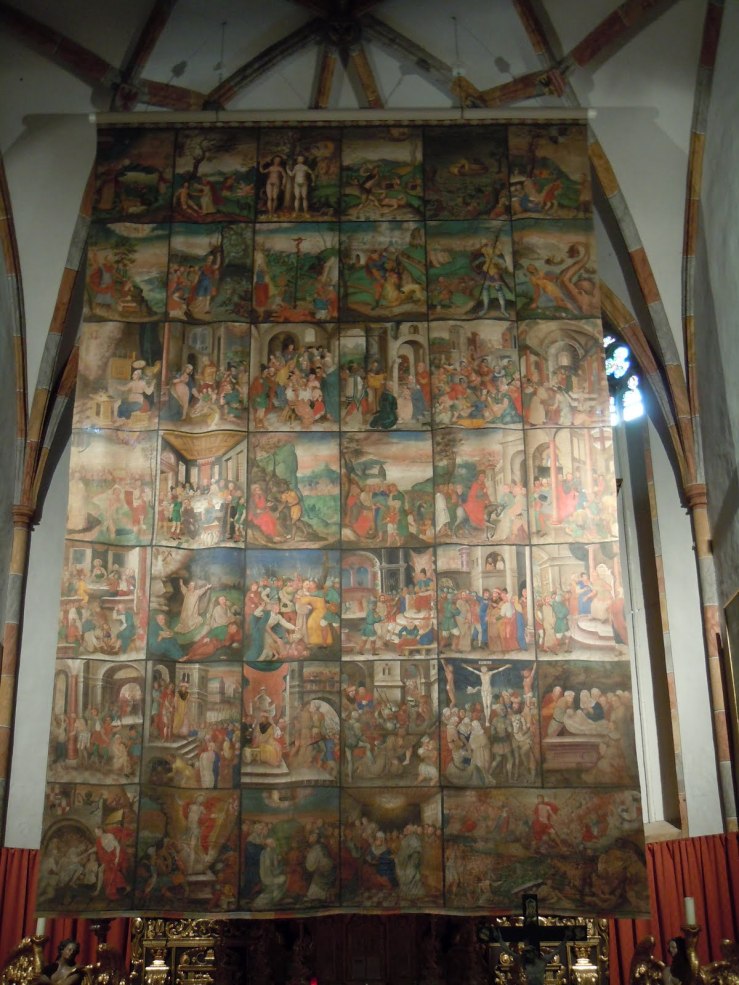
Click through to find out what a hunger veil is (sometimes also called a “fasting sheet” or “languishing rag”) and to be guided through the nine scenes.

Misereor has been carrying out this tradition for the last forty years, commissioning artists from all over the world. You can view nineteen of the twenty veils in their collection at https://www.misereor.de/fileadmin/publikationen/publikation-die-misereor-hungertuecher-begleitheft-ausstellung.pdf, along with German commentary, and last year’s veil can be found at https://www.misereor.de/mitmachen/fastenaktion/hungertuch/. Some of these are available for sale as large-scale prints on cloth at the organization’s online shop.

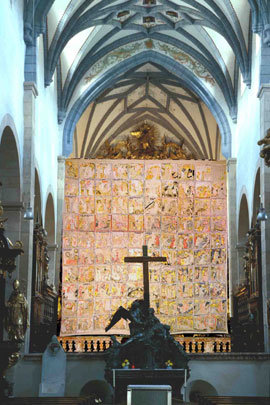
Here are a few examples of hunger veils that were in use during the fifteenth and sixteenth centuries. The liturgical purpose for all but the last one has been recovered.

Millstatt hunger veil
Lenten veil by Oswald Kreuselius, 1593, Millstatt Abbey, Carinthia, Austria.
Freiburg hunger veil
Lenten veil, 15th century, Freiburg Cathedral, Baden-Württemburg, Germany.
Gurk hunger veil
Lenten veil by Konrad von Friesach, 1458, Gurk Cathedral, Carinthia, Austria. Photo © Pressestelle/Eggenberger.
Zittau hunger veil
Lenten veil, 1472, Church of the Holy Cross (museum), Zittau, Saxony, Germany.

In Antwerp Cathedral’s latest art acquisition, a skeptic weighs the truth of Christianity

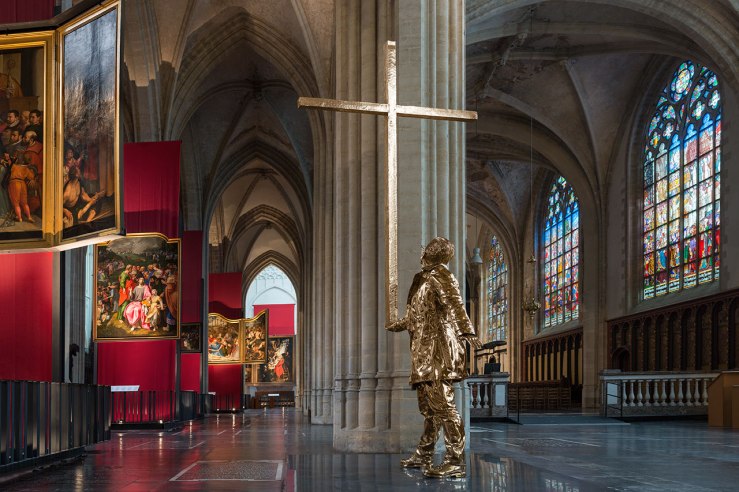
The sixteenth-century Cathedral of Our Lady in Antwerp, Belgium, home to Peter Paul Rubens’s famous Elevation of the Cross and Descent from the Cross, is now also home to a bronze sculpture by contemporary artist Jan Fabre, called The Man Who Bears the Cross. It is a self-portrait of the artist surveying a large cross that he balances in the palm of his hand.

The Man Who Bears the Cross by Jan Fabre
Jan Fabre (Belgian, 1958–), The Man Who Bears the Cross, 2015. Bronze, 394 × 200 × 100 cm. Permanently installed in the Cathedral of Our Lady, Antwerp, Belgium, on November 18, 2015. Photo by Attilio Maranzano © Angelos bvba.
The Man Who Bears the Cross by Jan Fabre
Photo by Attilio Maranzano © Angelos bvba.

Open ended rather than declamatory, The Man Who Bears the Cross was originally shown in wax in the 2014 exhibition “The Spiritual Skeptic” at Antwerp’s At The Gallery. There it was spotted by parish priest Bart Paepen, who had been “looking for a way of making a connection between the world of the church and that of contemporary art” for some time, and thought this piece would be a perfect fit for Our Lady. The last time the cathedral acquired a new piece of art was in 1924.

This six-minute film by Wannes Peremans shows the sculpture being installed and includes interviews with Paepen and local art historian Joanna De Vos.   Continue reading “In Antwerp Cathedral’s latest art acquisition, a skeptic weighs the truth of Christianity” →

Roundup: Mavis Staples documentary, baptizing the imagination, how medieval manuscripts were made, Nubian Christian art, and Twain’s war prayer

Mavis!: The HBO documentary Mavis! profiles gospel and soul music legend Mavis Staples, from her rise to stardom as part of the Staples Singers, whose Uncloudy Day was the first gospel album to sell one million copies, and her involvement in the civil rights movement, to her still active career as a solo artist. “I’ll stop singin’ when I have nothin’ left to say,” she says. “And that ain’t gonna happen!” Watch the trailer below.

Luci Shaw on art and Christian spirituality: In this 1998 article from Direction journal, the oh-so-quotable poet Luci Shaw writes about imagination, mystery, receptivity, sacramentality, the similarities between art and faith, and her muse, the Holy Spirit. Concludes with her poem “Ghostly,” which explores the Spirit’s different manifestations.

Making medieval manuscripts: Through narrated demonstrations, this video by the Getty Museum shows how paper, pens, ink, paint, book covers, and bindings were made during the Middle Ages—laborious processes! It also shows how the illuminators (visual artists) worked with the scribes (calligrapher-copyists), jobs typically filled by two separate people.

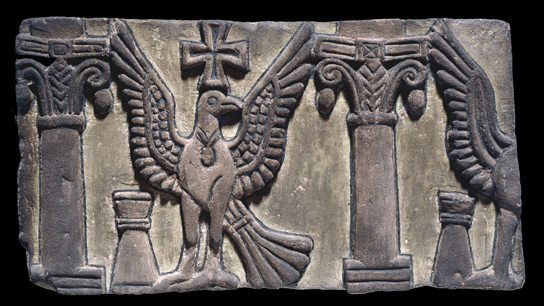
Christianity on the Middle Nile: The two largest Christian kingdoms in the medieval world were actually in modern-day Sudan, writes curator Julie Anderson in a British Museum blog post from 2014: the Makuria and the Alwa kingdoms. Many wall paintings and other objects have been excavated from Faras Cathedral and its adjoining tombs, such as the pottery lamp (with the inscription “Great is the name of God”) and sandstone frieze fragment in the British Museum’s collection. (The paintings are divided between the Sudan National Museum and the National Museum of Warsaw, as it was a Polish team that rescued them from flooding by Lake Nasser.)

Faras Cathedral frieze fragment
Seventh-century sandstone frieze fragment from the former Faras Cathedral in Nubia. Collection of the British Museum.
Fiery Furnace fresco from Faras Cathedral
Fresco from the former Faras Cathedral in Nubia depicting the three youths in the fiery furnace. Collection of the National Museum of Sudan.

“The War Prayer” by Mark Twain: In his day Twain was radically opposed to American military intervention in Cuba and the Philippines and frustrated by the so-called patriotism that made his fellow countrymen so uncritically supportive of it. The stranger’s speech in Twain’s short story “The War Prayer,” set during a church service, exposes the ridiculousness of some of the prayers that go up during wartime even today.

Pentecost art from Asia

Ten days after Jesus ascended into heaven (and fifty days after his resurrection), his Holy Spirit descended on the apostles, manifesting as “tongues of fire” (Acts 2:3). This miraculous gift enabled the apostles to speak in languages foreign to them but native to the many Jews from abroad who were gathered in Jerusalem for Shavuot (called “Pentecost” by Hellenized Jews), a festival of giving thanks for the harvest and for God’s provision of the Torah. For the first time the gospel of Jesus Christ was proclaimed to a global audience. Three thousand people came to faith that day, and the Christian church was born.

The Spirit is still at work in the dissemination of the good news today, breathing life into cultures all over the world and thereby building up an incredibly diverse body of Christ.

The arts are one expression of this diversity.

In the introduction to his groundbreaking book Each with His Own Brush: Contemporary Christian Art in Asia and Africa (New York: Friendship Press, 1938), Daniel Johnson Fleming writes,

As at Pentecost, Parthians, Medes and Elamites heard the message, “every man in his own tongue wherein he was born,” so we see Chinese and Japanese and Indians expressing Christianity’s universal language, each with his own brush. For when the spirit of God descends upon any people, new forms of beauty appear, new artistic gifts are revealed, adding another testimony to the universality of the Christian faith.

Since the publication of this book almost seventy years ago, Christianity has grown exponentially in Asia, as have indigenous artistic expressions of the faith. In 1975 Japanese theologian and arts advocate Masao Takenaka published the heavily illustrated book Christian Art in Asia, highlighting the robust variety being produced on the continent. Three years later the Asian Christian Art Association was founded to encourage the exchange of ideas between Asian artists and theologians. Their magazine, Image (not to be confused with the Seattle-based quarterly), has showcased local talents even further. Dozens more books have been published in English on individual Asian artists, countries, and the Asian Christian art movement in general. For the latter, see the beautifully designed The Christian Story: Five Asian Artists Today, plus The Bible Through Asian Eyes.

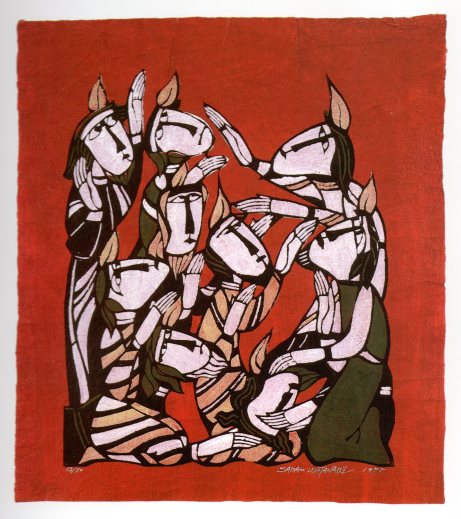
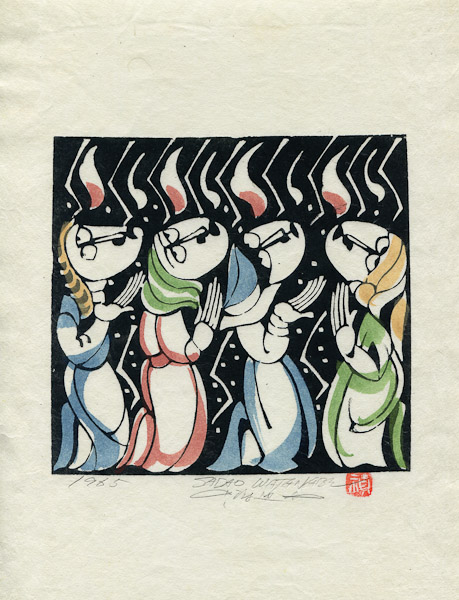
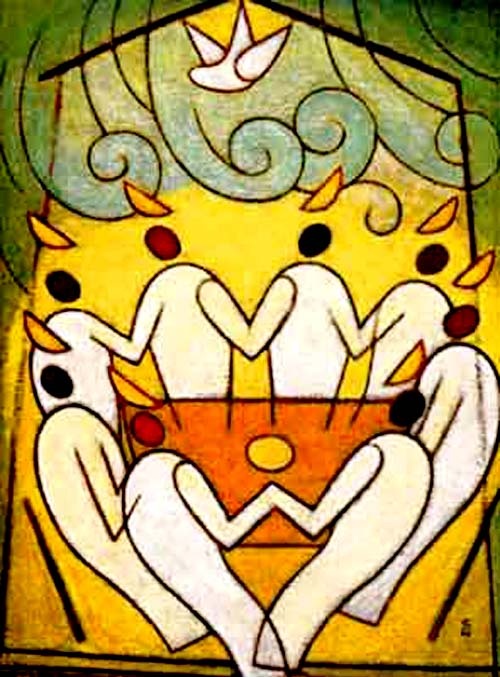
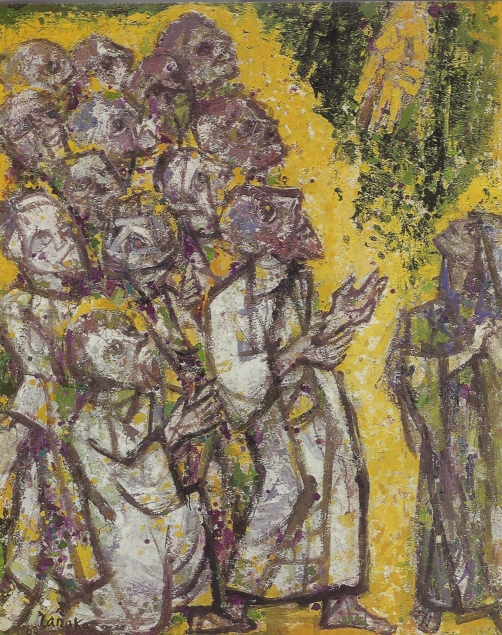
Below is a sampling of Asian art on the theme of Pentecost. Some works were made using traditional art forms or techniques—Chinese papercutting, Japanese flower arranging (ikebana) or stencil printing (kappazuri), Indian cloth dyeing (batik)—while other artists have chosen to work in oils and acrylics, collage, or glass. Some depict native people and settings—for example, Thai dancers wrapped in sabai, or a group sitting under a thatched roof in Indonesia—while others prefer ethnic and geographic ambiguity. There’s no single style that epitomizes the art of any country.

Pentecost by Sadao Watanabe
Sadao Watanabe (Japanese, 1913–1996), Pentecost, 1975. Hand-colored kappazuri-dyed stencil print on washi paper, 25.5 × 22.75 in. Source: Printing the Word: The Art of Watanabe Sadao (Philadelphia: American Bible Society, 2003)
Pentecost by Sadao Watanabe
Sadao Watanabe (Japanese, 1913–1996), Pentecost, 1965. Hand-colored kappazuri-dyed stencil print on washi paper.
The Coming of the Holy Spirit by Soichi Watanabe
Soichi Watanabe (Japanese, 1949–), The Coming of the Holy Spirit, 1996. Oil on canvas, 18 × 13.25 in. Collection of the Overseas Ministries Study Center.
Pentecost by Tadao Tanaka
Tadao Tanaka (Japanese, 1903–1995), Pentecost, 1963. Oil on canvas. Source: Christian Art in Asia by Masao Takenaka (Tokyo: Kyo Bun Kwan, 1975)
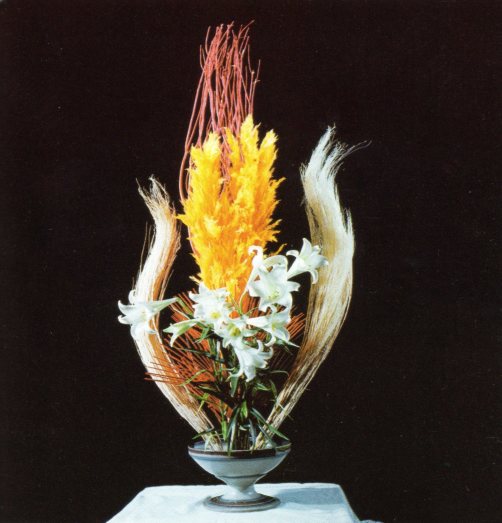
Pentecost by Gako Ota
Gako Ota (Japanese, 1904–1972), Pentecost. Belvedere, pampas grass, paper bush, lilies, and rib of fan. Source: Consider the Flowers: Meditations in Ikebana, ed. Masao Takenaka (Tokyo: Kyo Bun Kwan, 1990)
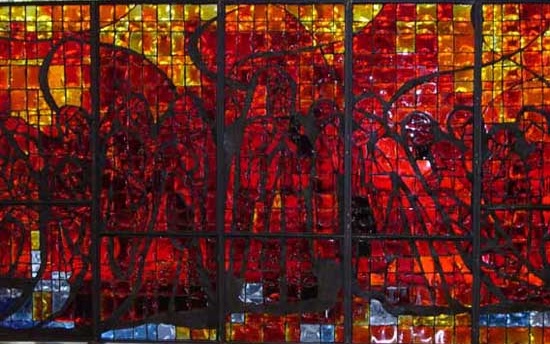
Pentecost by Keiko Miura
Keiko Miura (Japanese, 1935–), Pentecost, 2004. Stained glass window, All Pilgrims Christian Church, Seattle, Washington, USA.
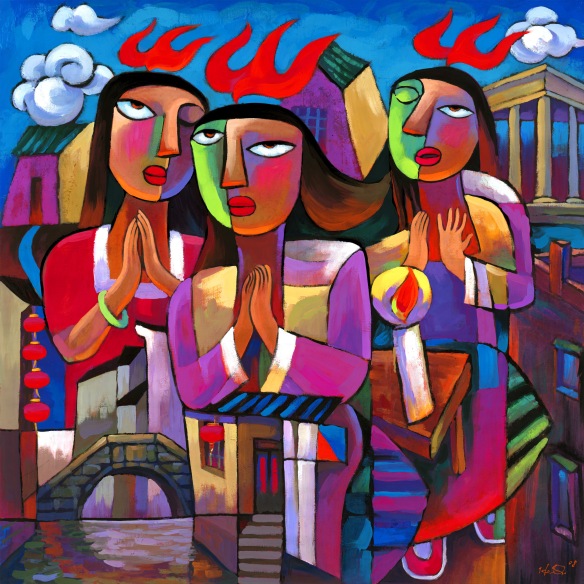
Holy Spirit Coming by He Qi
He Qi (Chinese, 1950–), Holy Spirit Coming, 1998. Oil on canvas.

Continue reading “Pentecost art from Asia” →