Roundup: “Heaven and Earth” performance for Psalms-based exhibition, pay-what-you-can film seminar, Doris Salcedo’s “A Flor de Piel,” and more

EXHIBITION: Sing a New Song: The Psalms in Medieval Art and Life, Morgan Library and Museum, New York, September 12, 2025–January 4, 2026: Sing a New Song traces the impact of the Psalms on people in medieval Europe from the sixth to sixteenth centuries, showing how this poetic book of the Bible suffused daily life, church liturgies, and art. The exhibition features, of course, numerous illuminated Psalters, as well as other art objects influenced by the Psalms, culled from the Morgan’s own collection and some two dozen institutions around the world.

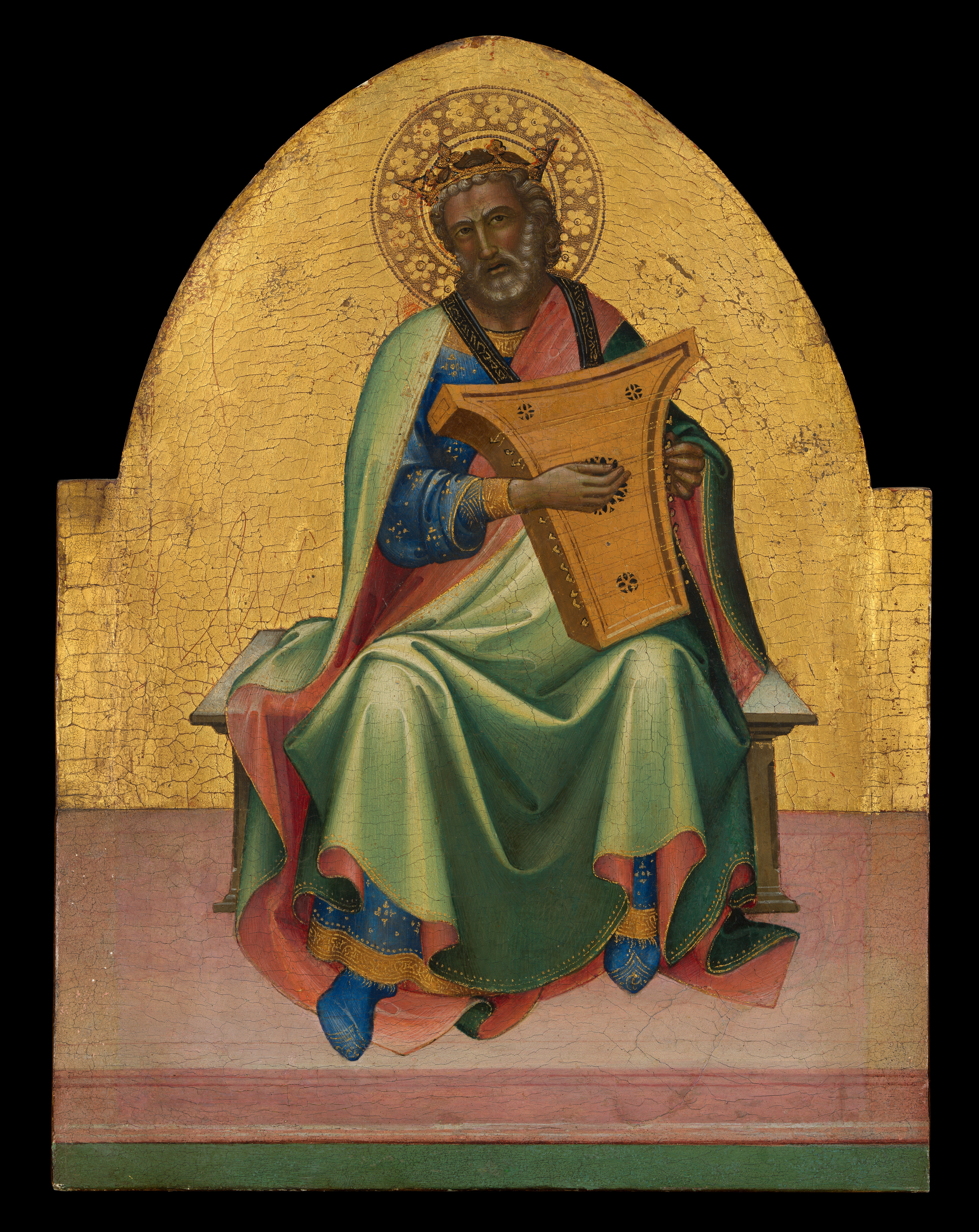
Monaco, Lorenzo_David
Lorenzo Monaco (Italian, ca. 1370–ca. 1425), David, ca. 1408–10. Tempera on wood, gold ground, 22 3/8 × 17 in. (56.8 × 43.2 cm). Metropolitan Museum of Art, New York.

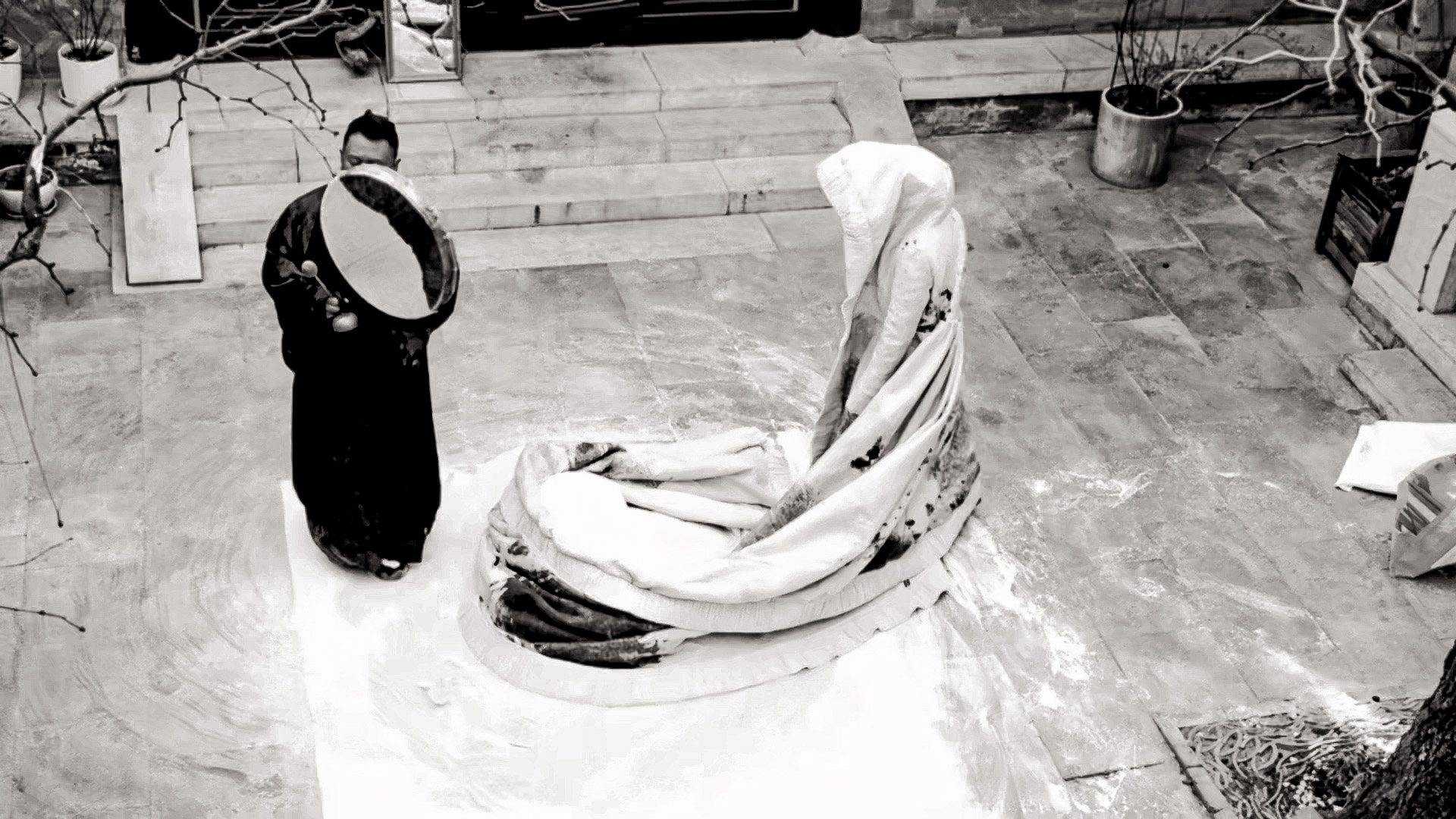
To coincide with the exhibition, on October 10 at 2 p.m. and 3 p.m., the Beijing-based artist Bingyi will be premiering a site-specific performance work in the Morgan’s garden (free with museum admission), made possible in part by the Foundation for Spirituality and the Arts. Titled Heaven and Earth: The Garden of Cosmos, the processional performance is “inspired by Psalm 104 and its reverence for creation, divine order, and cosmic harmony that transcend cultural boundaries.” Drawing on her longstanding engagement with both Abrahamic scriptures and Chinese philosophical traditions, Bingyi will be clad in a flowing, ink-painted garment and be joined by the Tibetan ritual master Nanmei and the Yi singer Aluo.

Bingyi_Heaven and Earth
Rehearsal for Heaven and Earth: The Garden of the Cosmos by Bingyi, to premiere October 10, 2025, at the Morgan Library and Museum in New York City

+++

ONLINE FILM SEMINAR: Dreaming the World: Looking at the World through the Eyes of the Other with Gareth Higgins, September 30–November 11, 2025: “We live in anxious times, with our vision often limited to suspicion of others, concern about the future, and withdrawing into enclaves of the familiar. It can become a self-fulling prophecy, a vicious cycle which does not nurture the security, never mind the happiness we seek. It’s becoming clearer by the day that we need to be dislodged from the narrow circles of self-oriented, tribal thinking. There is a more expansive universe, characterized by connection, sharing, and taking responsibility for co-creating the next good day.”

Sponsored by Image journal and The Porch, Dreaming the World is a seven-week course in which participants will watch seven movies—one from each continent—and learn a more global way of thinking. Leader Gareth Higgins [previously] will share a short video introduction and written essay for each film, and registrants are invited to join a members’ Facebook page for conversation, as well as a weekly video call to discuss the movie and its implications for how we might live better. Those video calls will take place on Tuesdays from 7:00 to 8:15 p.m. ET on September 30, October 7, October 14, October 21, October 28, November 4, and November 11, 2025, but will also be recorded for asynchronous viewing.

The seminar is valued at $195, but the organizer is generously allowing registrants to pay what they can. I will be participating. Join me?

+++

CALLS FOR PAPERS:

>> From the Association of Scholars of Christianity in the History of Art: ‘And Who is My Neighbor?’: Refuge, Sanctuary, and Representation: “The parable of the Good Samaritan (Luke 10:25–37) endures as a powerful meditation on compassion, hospitality, and the boundaries of moral responsibility. In an age marked by geopolitical instability, mass displacement, and deepening social divides, the question ‘And who is my neighbor?’ acquires renewed urgency. We welcome proposals that consider the ways in which visual culture has interpreted, challenged, or reimagined the ideals of refuge and hospitality within religious and intercultural frameworks. How have artistic practices responded to religious calls to welcome the stranger? In what ways do images negotiate the tensions between inclusion and exclusion, faith and politics, identity and alterity? How do modern and contemporary artworks embody, resist, or reinterpret Christian and other religious conceptions of community, care, and obligation? Proposals that engage Catholic visual cultures or interpretive frameworks, perspectives from the Global South, or comparative interreligious approaches are especially encouraged.” To be presented February 17, 2026, at ASCHA’s day-long symposium at DePaul University Chicago, or February 18–21 2026, at the 114th annual CAA Conference. Proposal submission deadline: October 15, 2025.

>> From the Raclin Murphy Museum of Art at the University of Notre Dame: The Art of Encounter: Exploring Spiritual Engagement with Art Objects”: This museum is seeking papers exploring the relationship between art, spirituality, and museum spaces, to be presented April 24, 2026, at the museum’s spring symposium. Proposals that investigate how encounters with art can shape spiritual understanding, foster theological insight, or deepen contemplative practice are all welcome. Proposal submission deadline: November 3, 2025.

+++

SONGS:

September 15 through October 15 is Hispanic Heritage Month. One of the many ways Latinos have contributed to Christian artistic culture has been through the writing and singing of coritos: short, rhythmic, Spanish-language choruses used in worship. Here are two examples, the first one traditional and the second one new.

>> “Montaña” (Mountain), led by Josue Avila: Recorded live on November 29, 2020, from Calvary Orlando’s Unity Sunday Service, this corito is based on Matthew 17:20. The lyrics translate to: “If you have faith like a mustard seed, thus says the Lord: you can tell the mountain, ‘Move, move,’ and that mountain will move!”

Watch another performance, from a concert context, by the Austin, Texas–based band Salvador.

>> “Sal 22 / Te Amo” (Psalm 22 / I Love You) by Israel and New Breed with Aaron Moses: These two coritos, which released this summer as a single track, were written by Israel Houghton, Meleasa Houghton, Ricardo Sanchez, Aaron Lindsey, Rene Sotomayor, and Aaron Moses. The first is based on Psalm 22:3, which says that God is enthroned on the praises of his people, and is sung by Moses on lead; Houghton sings lead on the second.

Aaron Moses, of Dominican and Ecuadorian descent, is best known for his work with Maverick City Música.

Israel Houghton is not himself Latino (his mother is white, his biological father Black), but he was significantly influenced by his upbringing in a Hispanic neighborhood and church, a culture reflected in his musical output and that he remains connected to, not least through his wife, Adrienne Bailon (whom I know from The Cheetah Girls!).

+++

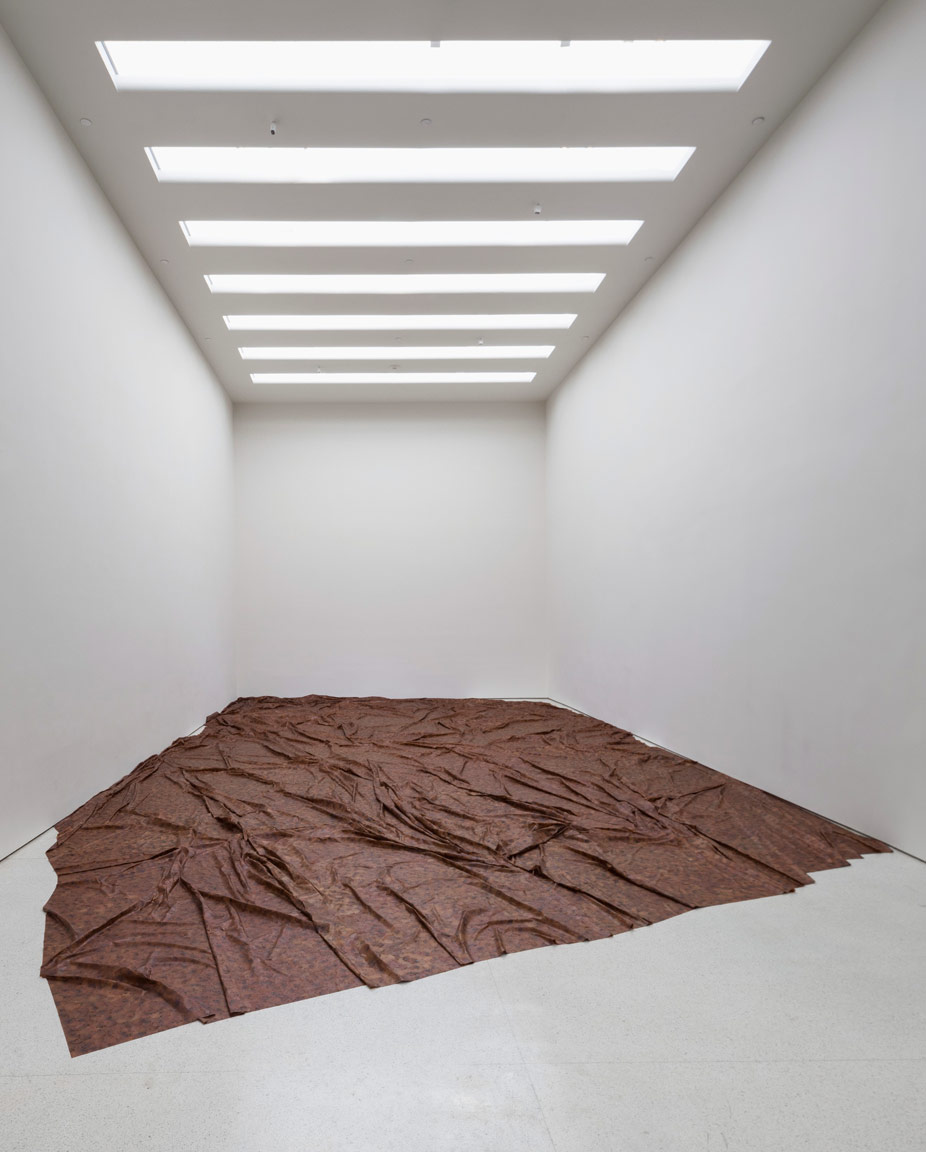
VIDEO: “In the Studio: Doris Salcedo making ‘A Flor de Piel’”: Produced by White Cube, this fourteen-minute documentary charts the collaborative, scientifically informed, labor-intensive process of making Doris Salcedo’s A Flor de Piel, an enormous shroud made of real rose petals as a memorial for a nurse who was brutally captured and murdered in Colombia. (“The title,” explains Lauren Hinkson, “is a Spanish idiomatic expression used to describe an overt display of emotions.”) The film includes footage from Salcedo’s Bogotá studio as well as interviews with the team of people who produced the work. I found this peek into the technical aspects of the piece fascinating.

Salcedo, Doris_A Flor de Piel
Doris Salcedo (Colombian, 1958–), A Flor de Piel, 2011–12. Rose petals and thread, approx. 246 7/8 × 433 1/8 in. (627 × 1100 cm). Photo © Solomon R. Guggenheim Foundation, New York, from the work’s installation at the Guggenheim in 2015.

However, the video doesn’t venture into the inspiration behind or meaning of the work. For a bit of that, see this audio clip from the Guggenheim (where A Flor de Piel was exhibited in 2015), and also Jonathan A. Anderson, The Invisibility of Religion in Contemporary Art, pages 123–24.

Roundup: Pitjantjatjara picture Bible, “Feeling Through” short film, the reconciling Eucharist, and more

SPOTIFY PLAYLIST: September 2025 (Art & Theology): A new monthly playlist featuring a range of faith-based songs, including “Day by Day” by Lowana Wallace and Isaac Wardell of the Porter’s Gate (especially apt for Labor Day!), sung below by Kimberly Williams; “Jesus of Nazareth” by the early twentieth-century hymn writer Hugh W. Dougall, performed in a bluegrass style by the Lower Lights; and a fantastic instrumental jazz arrangement by Alice Grace of the classic children’s song “Jesus Loves Me,” performed by the Indonesian group Bestindo Music (Grace is at the keys).

+++

VIDEO: “The Apostles’ Creed”: This video presentation of the Apostles’ Creed, one of the oldest statements of Christian belief, used across denominations, was created in 2016 by Faith Church in Dyer, Indiana, using twenty-one of its members to voice the lines. [HT: Global Christian Worship]

+++

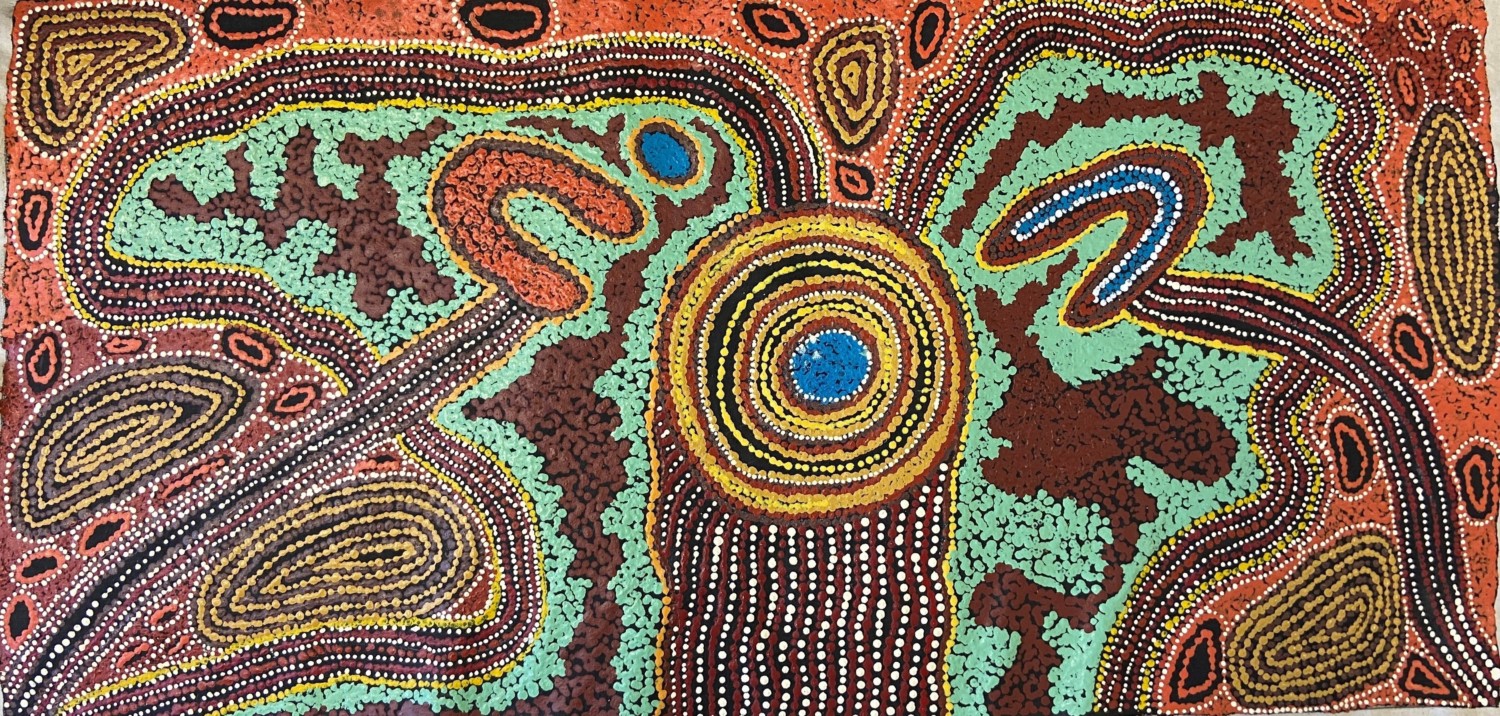
CHILDREN’S PICTURE BIBLE: Godaku Tjukurpa (God’s Story): Nami Kulyuru, a long-serving Pitjantjatjara Bible translator and artist from Central Australia, had the vision to pass on the stories of the Bible to her grandchildren and other young Pitjantjatjara readers using traditional Anangu paintings, compiled in book format. She began the artistic work in 2021 but shortly after was diagnosed with a malignant brain tumor. Following her death in 2022, her friends and colleagues rallied together to complete the project, which was published last November by Bible Society Australia. [HT: Global Christian Worship]

Godaku Tjukurpa
Kulyuru, Nami_Woman by the Well
Nami Kulyuru (Pitjantjatjara, 1964–2022), The Woman at the Well (John 4), 2021, from the bilingual book Godaku Tjukurpa (God’s Story) (Bible Society Australia, 2024)

Spanning the Old and New Testaments, Godaku Tjukurpa (God’s Story) features fifty-four Bible illustrations by Pitjantjatjara artists, along with descriptions in Pitjantjatjara and English. It is available for purchase through the Koorong website, but it appears that it can ship only to Australia or New Zealand.

+++

SHORT FILM: Feeling Through, dir. Doug Roland (2019): Nominated for an Academy Award in 2021, this eighteen-minute film is about a homeless teen (played by Steven Prescod) who encounters a DeafBlind man (played by Robert Tarango) on the streets of New York City. It was inspired by an actual experience writer-director Doug Roland had some years earlier. He partnered with the Helen Keller National Center to make the film, including casting a DeafBlind actor as co-lead, the first film to ever do so. You can watch Feeling Through for free on the film’s website, along with a “making of” documentary. Here’s a trailer:

+++

FEATURE FILM: Places in the Heart, dir. Robert Benton (1984): Set in Jim Crow Texas during the Great Depression, this film centers on the recently widowed Edna Spalding (Sally Field), a middle-age white woman who is struggling to run the cotton farm she inherited from her late husband and to make ends meet for herself and her two small children. To earn some cash, she takes in a boarder, Mr. Will (John Malkovich), a bitter World War I vet who is blind, and she hires Moze (Danny Glover), a Black drifter who is being harassed by the Ku Klux Klan, to teach her how to plant and harvest cotton. The three are thrown together out of necessity and help each other survive.

It’s a pretty good movie overall—and it won Sally Field her second Oscar for Best Actress—but what leads me to recommend it is its theologically profound closing scene, which shows the ordinance of Communion being celebrated at the local country church. First Corinthians 13:1–8, the famous “love” passage, is read from the pulpit, and the choir launches into “In the Garden” (a hymn inspired by the risen Christ’s appearance to Mary Magdalene on Easter morning) as the plates of bread and grape juice are passed down the pews. The camera zooms in close on each congregant as they receive the elements, starting with a couple whose marriage had suffered due to infidelity but who, in this scene, silently reconcile.

On my first watch, what signaled to me that we had entered the realm of the imaginary (the mystical? the aspirational?) was the presence of Moze, who had left town the previous night after having been beaten by Klansmen; he’s here, with no visible wounds, in this conservative white church in the 1930s that very likely would not have welcomed him, being served the body and blood of Christ by a deacon. I believe that some of the white men in the pews in front of him are repentant Klansmen who, when Mr. Will identified them under their hoods by their voices the previous night, mid-assault, slinked away in shame. Within the row, too, is the mortgage collector who was in conflict with Edna, insisting that she sell the farm.

After Edna receives the elements, she passes them to her husband, Royce, who was dead before but here is very much alive. He then passes the elements to the young Black teen, Wylie, who had shot and killed him in a drunken accident, whom vigilantes then lynched. “Peace of God,” they say to each other—a traditional Christian greeting expressing love and reconciliation. The final frame lingers on Royce and Wylie, sharing the meal together, and I’m intrigued by the actors’ choices of expression: Wylie is serene, grace-filled, whereas Royce appears befuddled, perhaps recognizing for the first time the blessed tie that binds him to his Black neighbor, his brother in Christ.

This scene speaks powerfully of the invitation of the Lord’s Table—open to all, even the most morally odious, who would come in humble confession of (and turning from) sin and reliance on God’s mercy through Christ, which heals and transforms. Partaking of the meal are various people from the community—people who have cheated on their spouses; people with ornery dispositions; people with narrow economic interests, who fail in compassion; people who have stolen; people who have committed cruel, racist, violent acts; people driven to drink, leading to fatal harm; people who have silently allowed racial terror to reign in their town. All these sinful, forgiven people make up the body of Christ, are united under his cross. They’ve often hurt one another, but the Holy Spirit is at work making them a new creation. I see this final scene as a picture of heaven, where wrongs are redressed, and of the “beloved community” Martin Luther King Jr. talked about.

Places in the Heart is streaming for free on Tubi (no account required).

Roundup: Free e-book on church art galleries, Hagar in art, Dramatic Encounters film series, and more

SPOTIFY PLAYLIST: August 2025 (Art & Theology)

+++

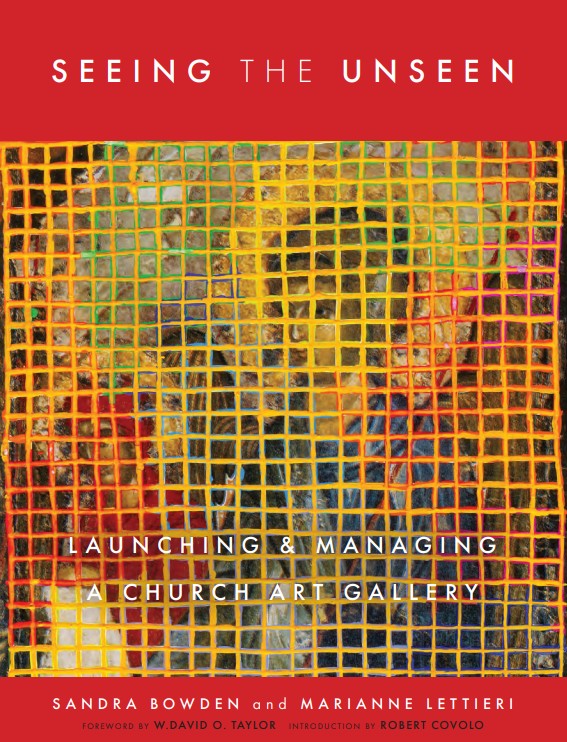
FREE E-BOOK: Seeing the Unseen: Launching and Managing a Church Art Gallery by Sandra Bowden and Marianne Lettieri: I own a copy of the original 2015 edition of this book written by two wise, experienced friends of mine and published by the now-defunct Christians in the Visual Arts; this revised edition, published this year by Square Halo Books, includes all-new images and other updates. It’s an excellent resource for churches looking to start an art gallery, covering the logistics of defining the gallery program, designing the gallery space, funding the gallery, organizing exhibits and juried shows, handling art, engaging viewers, and more. The authors and publisher are generously making it available for free download!

Seeing the Unseen

+++

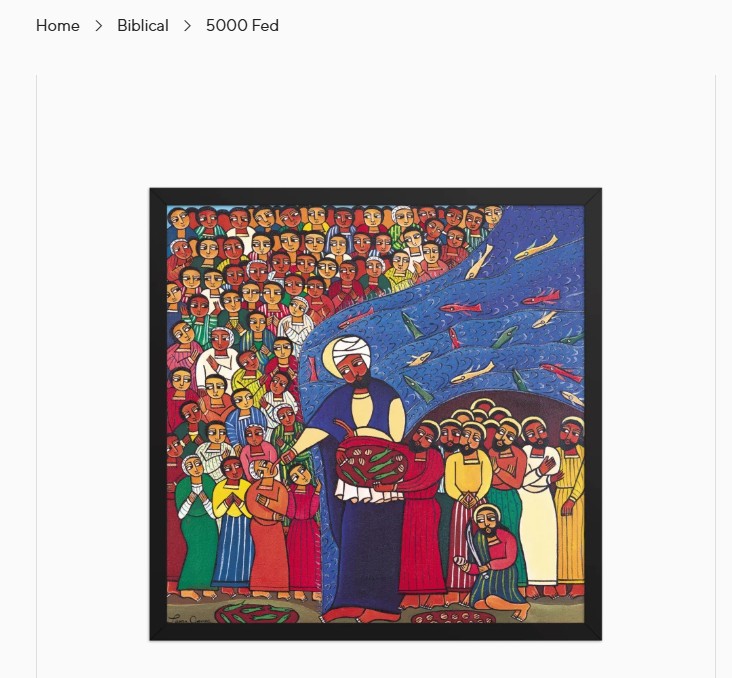
New this summer, the popular artist Laura James [previously], who frequently paints biblical subjects, now has a simple form on her website through which you can license digital image files of hers for use in publications, presentations, or websites: https://shop.laurajamesart.com/product/image-licensing/.

James, Laura_5000 Fed
Screenshot from laurajamesart.com: Laura James (American, 1971–), 5000 Fed, 1999

Also, folks often ask me where they can purchase affordable art: Check out James’s online store, as she sells giclée prints of many of her paintings.

+++

ESSAY: “Toward a Genuine Dialogue between the Bible and Art” by J. Cheryl Exum: J. Cheryl Exum (1946–2024) was a Hebrew Bible scholar renowned for her work on the Song of Songs, feminist biblical studies, and the reception of the Bible in culture and art history. In much of her writing and teaching she staged a dialogue between biblical texts and biblical art, the latter of which, she said, constitutes a form of exegesis. She argued “for adding visual criticism to other criticisms (historical, literary, form, rhetorical, etc.) in the exegete’s toolbox—for making visual criticism part of the exegetical process, so that, in biblical interpretation, we do not just look at the text and the commentaries on the text but also at art as commentary.” More than simply enhancing our appreciation of a biblical text, art “can point to problematic aspects of the text and help us ‘see’ things about the text we might have overlooked, or enable us to see things differently.”

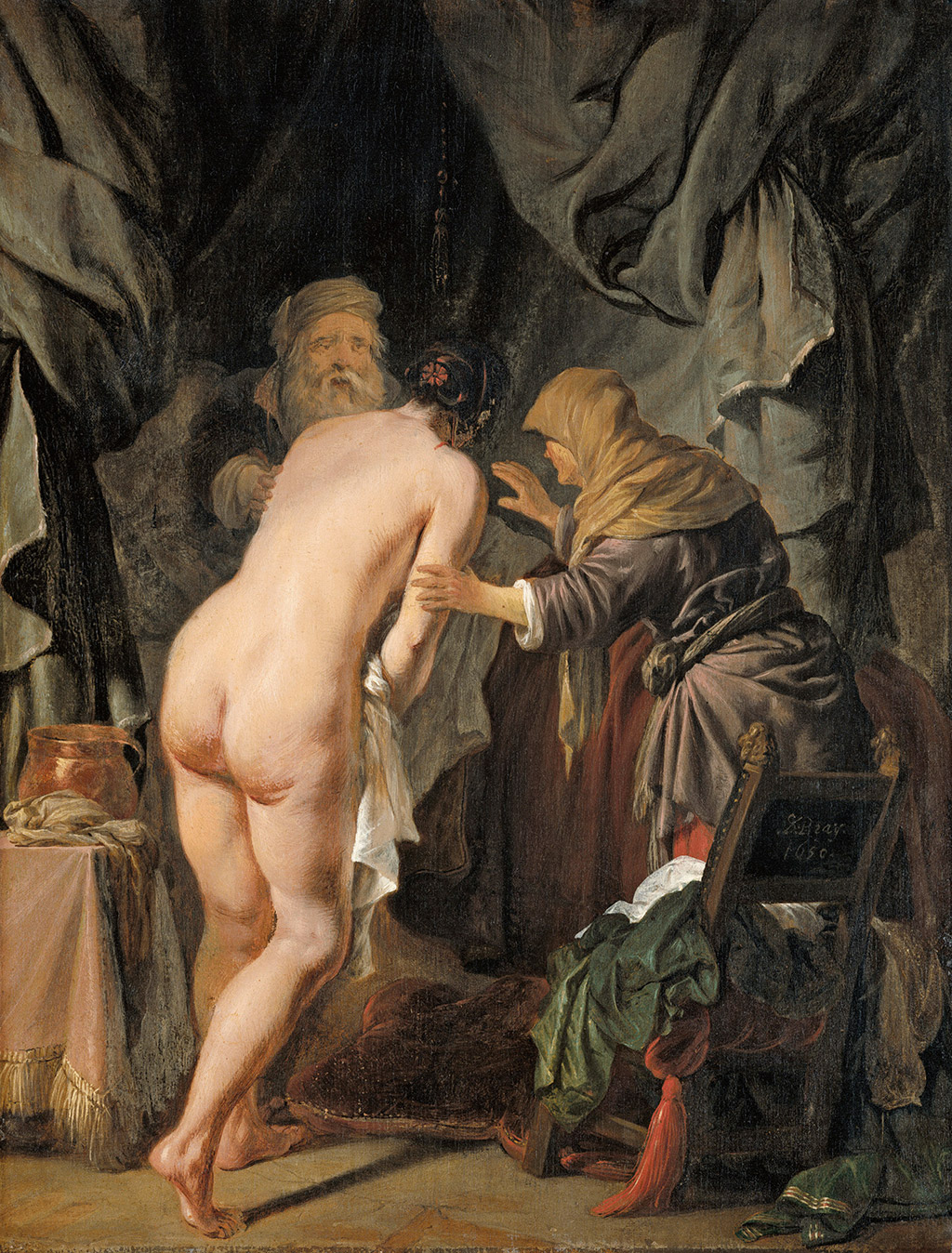
In this paper from 2012, Exum examines two episodes from the life of Hagar: the Expulsion of Hagar and Ishamel (Gen. 21:8–14), and Sarah Presenting Hagar to Abraham (Gen. 16:3–4). I found the second section particularly illuminating in how it addresses a narrative gap in Genesis 16, which is Hagar’s being raped (made to have sex without her consent) by Abraham at Sarah’s behest. Customary in many ancient patriarchal societies, the use of slaves to bear children for one’s family line is what is dramatized in the popular novel-turned-TV series The Handmaid’s Tale. Exum looks at six seventeenth-century paintings of Sarah leading a reluctant and sometimes humiliated Hagar, who tries in vain to cover her nakedness, into Abraham’s bed. “These paintings,” Exum writes, “require us to consider what assumptions about women and slaves and their rights to their bodies lie behind the biblical narrator’s simple ‘he went in to her and she conceived’, assumptions commentators too readily ignore.”

Salomon de Bray_Hagar Brought to Abraham by Sarah
Salomon de Bray (Dutch, 1597–1664), Hagar Brought to Abraham by Sarah, 1650. Oil on panel, 31.2 × 23.5 cm. Agnes Etherington Art Centre, Queen’s University, Kingston, Ontario.

In the final section of the paper, Exum considers a disturbing verse in the Song of Songs that has stumped commentators but that the artist Gustave Moreau chose to visually interpret.

+++

POEM: “He Who Sees Hagar” by Michelle Chin: “She buys me for my birth canal / but beats me for the birth. / I despise her . . .” Published in Reformed Journal.

+++

VIDEO SERIES: Dramatic Encounters (proof of concept pilot), created by Martin J. Young: Martin J. Young, a UK-based speaker, writer, and mentor to church leaders and creatives, is developing a film series with writer-director Ethan Milner of Cedar Creative that explores people’s dramatic encounters with Jesus in John’s Gospel. Inspired in part by David Ford’s The Gospel of John: A Theological Commentary (Baker Academic, 2021), the series will adapt particular gospel stories to screen and, uniquely, will include a documentary component that highlights the creative process from start to finish.

Each episode will consist of four primary elements (expanded from the three showcased in the pilot):

  1. The Roundtable, a conversation with theologians, pastors, and artists about the given gospel story, examining its form, meaning, themes, and interpretations
  2. The Rehearsal, in which the actors, informed by the roundtable discussion, work out how to perform the story, choosing facial expressions, postures and movements, vocal tones and inflections
  3. Behind-the-Scenes, exploring the various cinematographic choices made by Milner and his filmmaking team (e.g., sets, lighting, framing, editing, scoring)
  4. The Film, a roughly ten-minute drama that brings the gospel story to life

The proof of concept pilot episode below is based on John 12:1–8, in which Mary of Bethany anoints Jesus with expensive perfume, much to Judas’s chagrin. The short starts at 24:13. I’m impressed by the quality! And the “voyage of discovery” approach of the overall episode—wrestling with scripture in preparation for inhabiting its characters, and translating it into a filmic narrative—pays off, as viewers are granted insight into the crafts of acting, filmmaking, and literary adaptation.

Young is seeking funding to produce and distribute a season of eight to ten episodes. (None have been made yet.) If you’re interested in helping out financially, visit https://www.cedarcreative.net/encounters, and click “Donate Today.” Explore more at https://this-is-that.com/.

Roundup: New online community for poetry lovers and learners; Christians in the movies; etc.

ONLINE COURSE: The Good, the True, the Beautiful: Reading Literature to Restore the Soul with Karen Swallow Prior, October 29–December 17, 2025: Offered through the Free to Be Faithful initiative of the Institute of Christian Studies in Toronto, this eight-week online course taught by literature scholar Karen Swallow Prior (author of On Reading Well and other books) “invites students into the sacred act of reading—exploring how classic and contemporary works of fiction and poetry can reawaken moral imagination, deepen empathy, and cultivate spiritual resilience. Together we will reflect on the formative power of beauty and goodness through the written word, guided by voices both timeless and timely.”

The class will meet Wednesdays from 6:30 to 8:30 p.m. ET and will include lectures and discussion. The cost for first-time ICS students, not for credit, is $289 USD. (To take it for credit costs about $1,110 USD.) Read the ICS’s course introduction on Substack, and view additional course offerings at https://f2bf.icscanada.edu/#courses.

+++

ONLINE POETRY COMMUNITY: Versed~, founded and led by Dr. Adam Walker: A recently minted Harvard PhD grad and award-winning educator, Adam Walker is a scholar of English and American literature specializing in Romantic poetry. I’ve really been enjoying his “Close Reading Poetry” YouTube channel, where he has posted such videos as “6 Poets Tolkien Fans Should Read,” “The Theological Aesthetics of Gerard Manley Hopkins,” “Mary Sidney Herbert, the Mother of English Devotional Poetry,” “Reading John’s Gospel as Visionary Literature,” and many, many more. He seeks to make great poetry accessible to everyone. I love the combination of erudition and warmth that he exudes.

This March, Walker launched Versed~, “a space where the serious love and study of poetry is available beyond the paywalls of the universities—a place where readers can talk about books, make friends, compare notes, and share their writings with other readers.” He continues:

Our meetings blend the rigor of the classroom with the warmth of a living room. . . . Versed offers a wide range of learning opportunities, including live classes, a library of past courses, exclusive access to unpublished courses, and resources designed for everyone from beginners to advanced readers. At Versed, students can sharpen their literary skills, master various techniques in the art of close reading, and encounter works of great literature with other readers. Here, you’ll find all the insight of a university course, without the pressure, just good books and better company.

You can join for just $20/month.

+++

PODCAST EPISODES:

These are both available for listening wherever you get your podcasts.

>> “How to Read a Poem” with Ben Myers, The Artistic Vision, July 15, 2025: Dr. Benjamin Myers [previously], the 2015/16 poet laureate of Oklahoma and author of four books of poetry, kicks off a new “how to” lecture-style series for The Artistic Vision, providing tips on how to read (and listen to) poetry. “The purpose of poetry is the cultivation of attention,” he says. He urges readers to resist the temptation to try to “solve” the poem, and emphasizes the role of beauty and sound in enhancing the poetic experience. For consideration, he highlights the poems “The Red Wheelbarrow” by William Carlos William, “The Song of Wandering Aengus” by William Butler Yeats, “Birches” by Robert Frost, and “The Lake Isle of Innisfree” by William Butler Yeats. For those who want to learn more, he heartily recommends How to Read a Poem by Tania Runyan.

>> “On the Artistic Vision of Flannery O’Connor” with Jessica Hooten Wilson, The Artistic Vision, December 11, 2024: Dr. Jessica Hooten Wilson—author of The Scandal of Holiness: Renewing Your Imagination in the Company of Literary Saints and the forthcoming Reading for the Love of God: How to Read as a Spiritual Practice, among other titles—discusses the sacramental vision of the Southern fiction writer Flannery O’Connor (1925–1964). She touches on the role of the dark and grotesque in O’Connor’s work; symbolism, allegory, and the accumulation of meaning; her favorite O’Connor short story, “Greenleaf”; Mystery and Manners, a collection of O’Connor’s essays and other prose; being called upon by O’Connor’s estate to present O’Connor’s unfinished third novel, Why Do the Heathen Rage?, to the public for the first time, and artist Steve Prince’s indispensable contribution to the project; and “The Woodcarver,” a parable of craft by the ancient Taoist philosopher Chuang Tzu (Zhuangzi).

+++

MEDLEY: “You’re Nearer / Nearer, My God, to Thee” by Nnenna Freelon: Cued up in the video below, from a 2016 Jazz Vespers service at Duke University Chapel, is a medley by the American jazz singer Nnenna Freelon, which combines a 1940 Broadway musical number by Rodgers and Hart with a nineteenth-century hymn. What a compelling mash-up! It appears on Freelon’s 2000 album Soulcall.

+++

ARTICLE: “Christians in the Movies: The Good, the Bad, and the Ugly” by Mike Frost: “Hollywood movies are full of religious nuts. . . . But it’s not all bad news. Mainstream cinema has presented us with some powerful, complex, and authentic depictions of devout Christians,” writes Mike Frost, a minister from Australia. He gives ten examples.

Roundup: Social music with Dan Zanes, the Green Man, and more

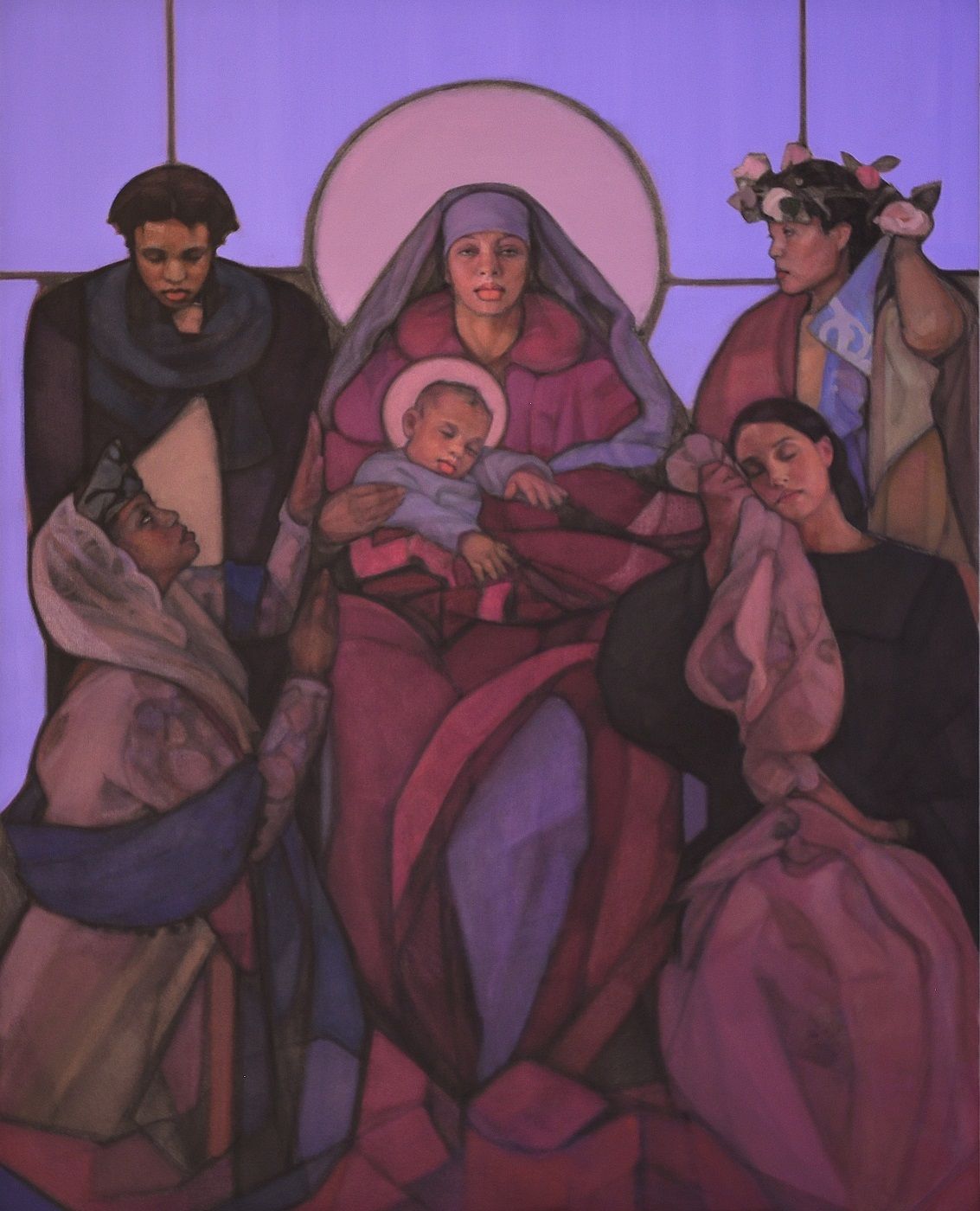
Lancaster Digital Collections has published twelve webpages of “iconography-inspired sacred art,” with downloadable images made available by permission of the artists. I especially like the paintings of Janet McKenzie [previously] and Khrystyna Kvyk [previously].

McKenzie, Janet_The Divine Journey
Janet McKenzie, The Divine Journey: Companions of Love and Hope, 2017. Oil on canvas, 48 × 36 in. Memorial Church, Harvard University, Cambridge, Massachusetts.

Kvyk, Khrystyna_The Descent into Hell
Khrystyna Kvyk (Ukrainian, 1994–), The Descent into Hell, 2023. Acrylic on gessoed wood, 40 × 40 cm. Private collection.

+++

FREE ZOOM CONVERSATION: Social music with Dan Zanes, July 16, 2025, 8 p.m. ET: I met the Baltimore-based folk musicians Dan and Claudia Zanes [previously] two years ago at a local family concert they put on. Joyous, bighearted, faith-filled, community-focused, committed to social justice—I love who they are and what they’re about and all the rich music they share.

In a social media post on June 11, Dan posed the question, “Is there anyone out there who wants to become a music maker and help uplift their community?” Followed by a generous offer: “I can teach you how to play guitar and sing songs (and write songs if you want). No cost, this is a different approach. It will be through a series of Zoom lessons (unless you live down the street). Whether you’re a beginner or someone who’s been dabbling and wants to take it out of the house, I can get you to a confident place so you can play for and with people.” The caveat? You just have to promise to put in the practice and to share your music freely in your community! And to teach someone else what you’ve learned.

“There are so many ways to make positive social change,” Dan says, “and creating music in our communities is certainly one of them.” I believe he has already selected a set of students to take on, but having received so many messages of interest, he has also decided to host a Zoom conversation on social music this coming Wednesday evening. On July 9, he wrote on social media:

Social music in chaotic times, people! Let’s talk about it. I’ve been hearing from many folks who want to be more useful in their communities and see music as the way.

Yes! Music can be healing, galvanizing, uplifting, energizing, and calming. Imagine if every community had many more music makers to play for the young folks, the elders, to lead singalongs and dance parties, to offer songs during times of loss and celebration. Of course it’s happening now, and still I believe there’s so much more that is possible.

If you’re interested in joining the meeting, send Dan an Instagram message @danzanes or a Facebook message @danandclaudiazanes and he’ll send you the link.

To give you a sense of Dan and Claudia’s vibes, here’s one of their original songs, which they debuted on their YouTube channel in 2020:

+++

ONLINE RETREAT: “Read for Your Life: Creating a Story-Formed Home” with Sarah Clarkson, August 5, 2025: Join author Sarah Clarkson [previously] for a daylong online retreat exploring children’s literature, childhood reading, and the development of imagination. “My goal,” she writes, “is to provide a vision for the beauty of the reading life, some good research, and a generous stack of practical booklists to help you begin to outfit and build a home library for the children in your life.” The cost is $35. The event begins at 9:30 a.m. UK time, but all live sessions will be recorded and offered on-demand afterward to registrants.

+++

PODCAST EPISODE: “The Green Man,” Gone Medieval, June 23, 2025: In this episode, Dr. Eleanor Janega talks with Imogen Corrigan, author of The Green Man: Myth and Reality (Amberley, 2025), about the enigmatic “green man” figure, or foliate head, which can be found in almost every pre-Reformation English cathedral and in many churches, decorating arches, corbels, roof bosses, choir stalls, and chancel screens. Corrigan claims that “the image has to be one of the most misunderstood, misinterpreted and misrepresented in the history of church carvings,” having nothing to do with pagan fertility rites. She suggests, rather, that the Green Man gestures toward the resurrection of, and resurrection in, Christ—to spiritual rebirth and eternal life.

Green Man misericord
Misericord from King’s Lynn Minster, England, ca. 1370s, depicting a Green Man disgorging oak leaves. Photo: Lucy Miller. (Click on image for great compilation!)

The two medievalists speak on location at St Mary’s at Minster-in-Thanet and St Nicholas-at-Wade in Kent. The conversation really starts to pick up at 19:47.

+++

This past month has seen the death of two rock ’n’ roll legends whose music, which played regularly on Oldies 100.7 WTRG, formed part of the soundtrack of my 1990s childhood: Brian Wilson (of the Beach Boys) and Sly Stone (of Sly and the Family Stone).

Much has been written about both trailblazers. I just want to mention two things:

1. Love and Mercy, the 2014 film directed by Bill Pohlad about Brian Wilson (played by Paul Dano and John Cusack), is excellent. Elliot Roberts makes the case that it’s the best music biopic ever made, and I’m inclined to agree; New York Times film critic Alissa Wilkinson also cites it as her favorite, at least within the rock genre. The story alternates between Wilson’s production of the Pet Sounds album in the mid-sixties and his psychological treatment under his abusive therapist and conservator Eugene Landy in the late 1980s, which coincided with his meeting Melinda Ledbetter, who would become his wife. The title is taken from one of Wilson’s solo songs from 1988. Here’s the film trailer:

2. Active from 1966 to 1983, Sly and the Family Stone was one of the very few multiracial, mixed-gender bands of the time, modeling integration when the notion was still fairly new in America. Perhaps you’ve heard their most famous hit, “Everyday People,” a call for unity across lines of difference (“There is a blue one who can’t accept the green one / For living with a fat one, tryna be a skinny one . . .”). Sly Stone was the front man—singer, songwriter, multi-instrumentalist, and producer. As is common among so many African American musicians, he got his musical start in church; from infancy, he was immersed in gospel music as a member of the Church of God in Christ, and his musical talent was nurtured there. I learned that in the fifties, he and three of his four siblings even formed a gospel group called the Stewart Four, locally releasing a single in August 1956. Here’s the B-side, “Walking in Jesus’ Name,” with a thirteen-year-old Sly singing lead:

Roundup: Peter’s tears, “The Mission” film, Tan Dun’s “Water Passion,” and more

VISUAL COMMENTARY: “Repentance (Transforming Tears)” by Clemena Antonova: One of the three works that art historian Clemena Antonova curated for the Visual Commentary on Scripture exhibition on Peter’s denial of Christ (Matt. 26:69–75; Mark 14:66–72; Luke 22:54–62; John 18:15–18, 25–27) is the installation Lágrimas de São Pedro (Tears of Saint Peter) by contemporary Brazilian artist Vinícius Silva de Almeida. The artist used hundreds of light bulbs, filled with water and suspended on near-invisible nylon threads, to create an environment in which visitors move between “tears” falling like raindrops from above. In the Christian tradition, Peter is regarded as a paradigm of penitence, as scripture says he “wept bitterly” when he realized his sin, and soon after he was restored to Christ. As Antonova interprets, Tears of Saint Peter invites folks to reflect on the interconnection of sorrow and healing in Peter’s story and in their own.

Silva de Almeida, Vinicius_Tears of Saint Peter
Vinícius Silva de Almeida (Vinícius S.A.) (Brazilian, 1983–), Lágrimas de São Pedro (Tears of Saint Peter), 2005–21. 6,000 light bulbs filled with water (various numbers in different locations). Photo: Erivan Morais.

View additional photos here.

+++

SONGS:

>> “Peter” by Montell Fish: Montell Fish (the stage name of Montell Frazier) is a singer-songwriter from Pittsburgh whose music combines elements of lo-fi and classic R&B. In his song “Peter” from the album Camp Lukewarm (2020), he compares himself, in confessional mode, to the titular apostle, who denied Christ three times. “Sometimes I feel like Peter / Denied you and I cannot deny that I did / Can I rest my head on your shoulders again?” In the bridge, Christ answers in the affirmative: Yes, come rest.

>> “O How He Loves You and Me / Your Love Divine”: The first song in this medley was written by CCM (contemporary Christian music) pioneer Kurt Kaiser in 1975; the second, by the legendary gospel artist Richard Smallwood. Recorded live at Jericho City of Praise in Landover, Maryland, it’s performed here by Smallwood (at piano) and his vocal and instrumental ensemble Vision, featuring soloist Vanessa Williams. The recording appears as two separate tracks on Persuaded: Live in D.C. (2001).

Here are the lyrics to the second song, starting at 3:06:

Refrain:
Lord, you know the pain, pain we bear
And Lord, you know the toils, toils and cares
Send your direction
Send your protection
Send your compassion
And your love divine

Verse:
Help us love those who would do us wrong
Send your cleansing power from above
Unite our hearts as one
Make us vessels for the flow-through of your love

[Refrain]

Vamp:
Your love divine
Your love divine

+++

BOOK CHAPTER: “Maundy Thursday—The Mission,” chap. 16 from Films for All Seasons by Abby Olcese: Abby Olcese is a writer on film, faith, and popular culture, living in Kansas City. Last year her book Films for All Seasons: Experiencing the Church Year at the Movies was published by InterVarsity Press, spotlighting twenty-six films as lenses through which to reflect on the great themes of the church calendar. I was preparing to write something on The Mission, the 1986 film directed by Roland Joffé, for Lent this year when I encountered this book, and because Olcese covers the movie so well, I secured permission from IVP to provide a free PDF download of the chapter to Art & Theology readers. Olcese situates The Mission as a film that’s especially appropriate for Maundy Thursday, a day when the church reflects on the call to servant-love and commemorates, among other things, Jesus’s arrest in the garden of Gethsemane, during which he and his disciples “face the forces of human empire, a dramatic moment of conflict ending in what, for the moment, feels like defeat.”

The Mission addresses themes of Christian ministry, the kingdom of God, repentance, forgiveness, love, respect, and the nonviolent ethic of Christ. Based on actual events, it follows an eighteenth-century Spanish Jesuit priest, Father Gabriel (Jeremy Irons), as he establishes a mission among the Guaraní people in the borderlands of present-day Argentina, Paraguay, and Brazil and seeks to protect the Guaraní from the encroachment of Spanish and Portuguese enslavers. He is later joined by the penitent Rodrigo Mendoza (Robert De Niro), a recent convert and former slave dealer and mercenary soldier. But the two clash over how best and most faithfully to protect the people they live among and serve.

PDF excerpt from Films for All Seasons by Abby Olcese. Copyright © 2024 by Abigail Olcese. Used by permission of InterVarsity Press. www.ivpress.com

+++

ORATORIO: Water Passion After St. Matthew by Tan Dun: Commissioned for the 250th anniversary of Bach’s death in 2000, this eclectic, Asian-influenced Passion oratorio by the Chinese American composer Tan Dun follows Jesus from his baptism to his resurrection. As the title suggests, water plays an important role in the work. When performed, seventeen large transparent water bowls, dramatically lit from below, form a cross on the stage and are used by percussionists throughout the piece’s ninety-minute duration, creating various timbres. (“The three percussionists make water drip, flow, burble, crash and hiss. They lift handfuls of water, then fling it back down. They stir it, strike it with pairs of plastic cups, float soup bowls upside down in it and play them,” Justin Davidson described in his review of the world premiere.) For Tan, water is “a symbol of baptism, renewal, re-creation, and resurrection.”

Tan Dun
Composer Tan Dun plays a “water drum” in Hangzhou, Zhejiang Province. Photo courtesy of Visual China Group (VCG).

In addition to the water percussion, the work calls for an SATB chorus that doubles on stones and tingsha (Tibetan finger cymbals); soprano and bass soloists who double on the xun (Chinese ocarina, or globular vessel flute) and who are required to do some Mongolian overtone singing; one violin; one cello; and one sampler player (Yamaha A-3000).

Water Passion premiered in Stuttgart, Germany, on September 8, 2000, conducted by Tan—you can listen to the full live recording on Spotify—and it has since been performed a handful of other times across the globe. I recommend the following hour-long video from Symphony Tacoma in Washington, which features excerpts from their March 30, 2016, performance augmented by interviews with some of the key players:

+++

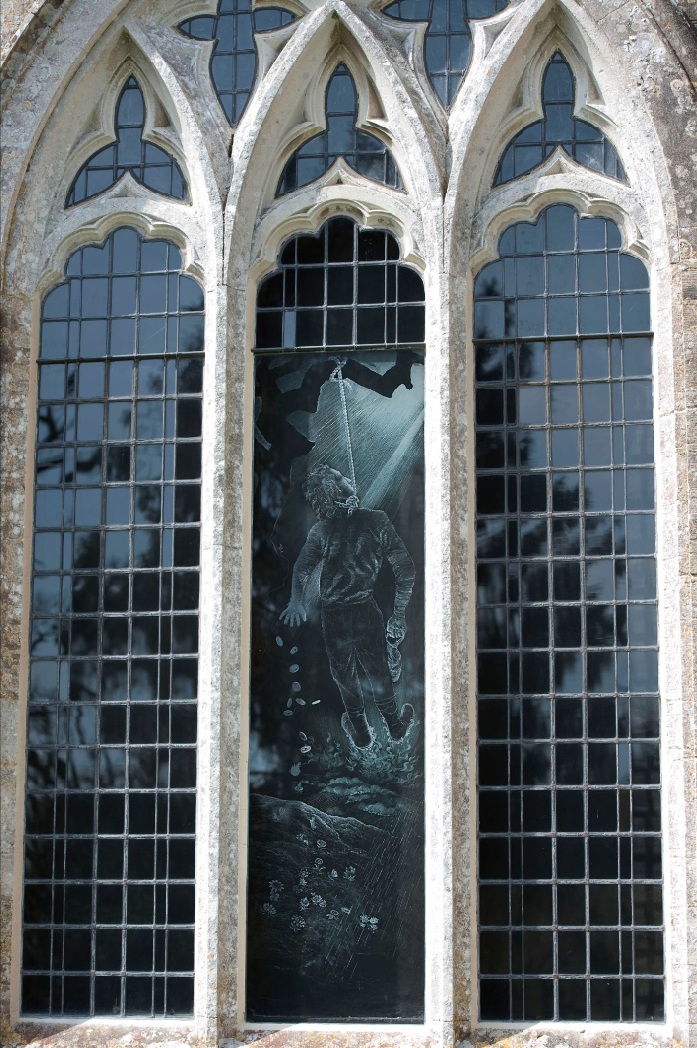
ARTWORK: The Judas Window by Laurence Whistler: In 1940, St Nicholas Moreton in Dorset was hit by a German bomb, destroying much of the church building, including its nineteenth-century stained glass windows. After rebuilding, the church commissioned the renowned glass engraver Laurence Whistler in 1955 to make twelve new windows, replacing the ruined ones, a project he worked on for the next three decades; they depict butterflies, birds, rabbits, wildflowers, candles, stars and planets, and local scenes. (See a few photos at The Dorset Rambler or Chris Belsten’s Flickr album.) In 1987 he offered to donate a thirteenth window on the theme of forgiveness, featuring the death of Judas, which would be visible, by design, from the outside only (the proposed space was blocked on the inside by a memorial tablet). The idea was entertained but, after consultation between the rector, parish council, and local diocese, was ultimately rejected due to its controversial nature—too many felt that it just wasn’t a fitting subject for a church window. Eager to pursue his vision, Whistler made the window anyway and loaned it to the county museum in Dorchester but insisted that if the church ever changed its mind, it should be given to them.

Whistler, Laurence_The Death of Judas
Laurence Whistler (British, 1912–2000), The Death of Judas (aka the Forgiveness Window), made 1993, installed 2013. Engraved glass, St Nicholas’ Church, Moreton, Dorset, England. Photo: Phil Yeomans / Bournemouth News and Picture Service.

In 2012, Rev. Jacqueline Birdseye, the new rector, encouraged the parish to revisit the issue, and this time around, there was unanimous approval to install the window, startling though it is. Again, it’s a blind window—behind it is black wooden boarding—which was the artist’s intent, as he wanted Judas to be a “shadowy” figure (so he couldn’t be front-lit and backlit) and on the outside, near the graveyard. But, unlike traditional portrayals of Judas’s suicide, which are bleak and punishing, Whistler’s portrayal is one of subtle hope, redemption, and new life. The uniting theme of the twelve interior windows is “light,” and here a bright shaft falls from the heavens on Judas’s upturned face. Hanging from his noose, he relinquishes the thirty coins for which he sold his Savior, and when they hit the ground they transform into flowers; the “field of blood” (Acts 1:18–19) becomes a spring meadow.

Scripture tells us that after realizing his enormous error, Judas “repented” (Matt. 27:3 KJV), “was filled with remorse” (NLT), and returned the blood money. Though Christians have historically counted Judas as eternally damned, other Christians have suggested the possibility of forgiveness beyond the grave for the traitorous disciple who was desperately grieved by his sin. “There’s a wideness in God’s mercy.” “A broken and contrite heart, O God, you will not despise” (Ps. 51:17).

Roundup: Cello in a canyon, John Cage and silence, and more

SPOTIFY PLAYLIST: March 2025 (Art & Theology):

(See also my Lent Playlist.)

+++

ANIMATED VIDEO: “Why Jesus Warns Us About Giving, Praying, and Fasting Publicly” by BibleProject: Giving, praying, and fasting are the three major practices of Lent, which begins March 5 this year. Jesus encouraged his followers to engage in all three, but in his Sermon on the Mount he also cautioned them not to do so with the motive of being seen by others. That’s why Matthew 6 is one of the lectionary readings for Ash Wednesday, the first day of Lent. Written by Tim Mackie and Jon Collins and directed by Rose Mayer, with art direction by Joshua Espasandin and PMurphy, the following BibleProject video exposits this teaching.

BibleProject is a nonprofit in Portland, Oregon, that offers free videos, podcasts, articles, and classes to help people experience the Bible in a way that is approachable and transformative.

+++

SONGS from Advent Birmingham [previously]:

The following two songs are from the music ministry of the Cathedral Church of the Advent in downtown Birmingham, Alabama. The ministry flourished under the leadership of Rev. Dr. Zac Hicks, who served as the church’s canon for worship and liturgy from 2016 to 2021. (He is now pastor of Church of the Cross, also in Birmingham.)

The music videos used to be available on YouTube, but it appears that the church has undergone some restructuring, and they have been removed. For now, though, they are still available through Facebook, and the audio releases are available through streaming services.

>> “Lord, Who Throughout These Forty Days”: This 1873 hymn by Claudia Frances Hernaman recounts the forty days Jesus spent in fasting and prayer in the Judean wilderness at the outset of his ministry and beseeches God to give us strength, like Jesus, to fight temptation, to die to self, and to live by his word and with a keen sense of his abiding presence. It’s set to an American folk tune from the Sacred Harp tradition, known as LAND OF REST, which has roots in the ballads of northern England and Scotland. The hymn is sung by Madison Craig (née Hablas), with Emma Lawton (née Dry) and Annie Lee on background vocals, Joey Seales on pump organ, Charley Rowe on cajon, and Zac Hicks on acoustic guitar.

>> “Spring Up, O Well”: This is an original song by Zac Hicks, sung by Jordan Brown. It draws especially on the narrative in John 4, where Jesus tells a Samaritan woman at a well, “Everyone who drinks of this water will be thirsty again, but those who drink of the water that I will give them will never be thirsty. The water that I will give will become in them a spring of water gushing up to eternal life” (vv. 13–14). The exclamation “Spring up, O well!” in the song’s refrain comes from Numbers 21:17, where the Israelites praise God for providing them water in the desert, and that musical phrase is adapted from the old children’s church song “I’ve Got a River of Life.”

+++

SHORT FILM: “Silences,” dir. Nathan Clarke: Shot in 2016 at Box Canyon near Laity Lodge in the Texas Hill Country, this contemplative short film features cellist Steuart Pincombe playing a short improvisation that interacts with the natural space. The impromptu music making was for him an exercise in prayer.

Three years earlier, also while on retreat at Laity Lodge, Pincombe’s wife shot him doing the same inside the newly constructed Threshold, an interactive, site-specific, permanent outdoor installation by Roger Feldman consisting of three curved walls:

The Threshold improvisation, Pincombe writes, “stemmed from a particular note (and its harmonic overtones) that naturally resonated in the space—the cello’s lowest strings were tuned to match this strongest resonation. Playing with the confusion of resonances (or pitches) was an important part of this short musical and spatial exploration—pitches are bent or adjusted in a way that create audible pulses in the sound and play on the conflicts of resonation within the space.”

+++

ESSAY: “Silence in an Age of Mass Media: John Cage and the Art of Living” by Dr. Jonathan A. Anderson, ARTS (Spring 2017): Many twentieth- and twenty-first-century artists have explored the necessities and possibilities for aesthetic stillness and silence, Anderson writes. In this essay he considers the composer John Cage (1912–1992), best known—and most excoriated—for his modernist piano composition 4′33″ (1952), in which the pianist sits at the bench for four minutes and thirty-three seconds, playing no notes. The point was to attune the audience to the ambient sounds of the concert hall (coughing, rustling, creaking, mechanical humming, outside traffic, etc.), testing the distinction between “music” and “noise.” Cage found the fundamental difference between the two to be not in the qualities of sound but in the attentiveness of the listener.

I was pleasantly surprised to learn from Anderson’s article that even after Cage left Christianity (in which he was raised) and turned to Zen Buddhism, he continued to link his love for the givenness of environmental sounds to Jesus’s admonition to “consider the lilies” (Luke 12:27). “Cage sought to quiet his own aesthetic ‘worry’ for musical meaning,” Anderson writes, “and to instead receive the given sounds of the world as richly meaningful in themselves.”

+++

VIDEO: Lenten Jazz Vespers, Duke University Chapel, March 23, 2023: This Jazz Vespers service combines the liturgical traditions of Vespers with the musical improvisation of jazz. Exploring the theme of hope, the service is presided over by Rev. Racquel C. N. Gill, minister for intercultural engagement at Duke University Chapel. Musical leadership is provided by the John Brown Little Big Band.

Here are the time stamps:

  • 0:01: Song: “I Came to Tell You” by Trinity Inspirational Choir
  • 5:40: Welcome and Prayer
  • 8:33: Song: “Miracle (It’s Time for Your Miracle)” by Marvin Sapp
  • 14:38: Poetry reading: “Dark Testament (8)” by Pauli Murray
  • 16:11: Song: “Be Ye Steadfast” by Arthur T. Jones
  • 21:25: Scripture reading: Romans 5:1–11
  • 24:02: Song: “Through It All” by Andraé Crouch
  • 28:10: Sermon by Rev. Bruce Puckett, assistant dean of Duke University Chapel
  • 35:56: Response
  • 52:18: Prayer and Benediction
  • 54:36: Song: “Down on My Knees” by John P. Kee

Roundup: New film book, “Sawubona,” conceptual art, and more

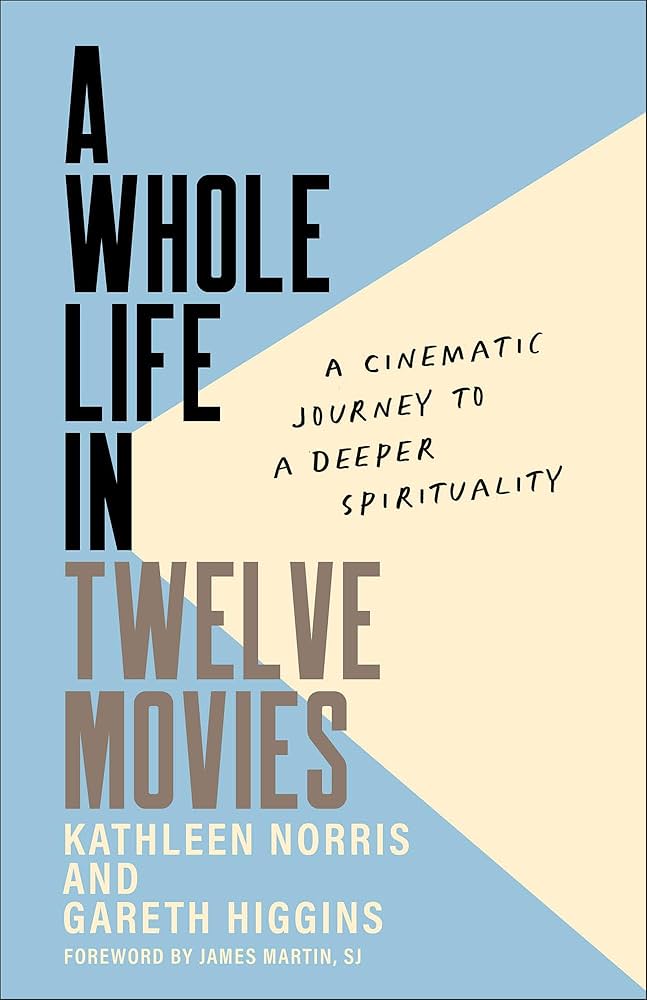
NEW BOOK: A Whole Life in Twelve Movies: A Cinematic Journey to a Deeper Spirituality by Kathleen Norris and Gareth Higgins: Published last October by Brazos Press, this excellent book comprises twelve chapters reflecting on fourteen movies (two chapters feature a complementary pair), drawing out story, insights, and meaning. It’s authored by the award-winning American spiritual memoirist and poet Kathleen Norris (Acedia and Me; The Cloister Walk; Dakota: A Spiritual Geography) and the Irish writer, peace activist, retreat leader, and festival organizer Gareth Higgins. Each chapter contains two mini-essays—one by each author, the second responding to the first, sometimes disagreeing on points—and a section of “Questions and Conversation,” which make the book especially fitting for a film/reading club. There’s also a “For Further Viewing” section in the back, with many more recommendations, several of which are new to me and which I’ve been watching (e.g., Le Havre, Love Is Strange, Patti Cake$) and really enjoying!

A Whole Life in Twelve Movies

I so appreciate the variety of films featured in the book—which come from different eras, cultures, and genres and address different themes—and I like that the writers don’t overdetermine the films’ meanings to try to make them fit a Christian agenda, which is sometimes a trap that people writing on Christianity and film fall into (influenced partly, I’m sure, by publishers’ demands, to make the marketing easier). Norris and Higgins are simply two Christians writing about their shared love of cinema, and I had so much fun listening in on their conversations.

You may also want to check out the Substack that Norris and Higgins write together, Soul Telegram: Movies & Meaning, whose purpose is “to help people find the most life-giving movies, and to write about them as a way of reflecting on the meaning of our lives.” See also the recent Habit podcast episode “Kathleen Norris watches movies,” where Norris discusses Paterson, Babette’s Feast, After Life, and more.

+++

SONGS:

>> “Oh Mercy (Long Way to Go)” by Glen Spencer and David Gungor, 2024: Debuted by the Good Shepherd Collective on December 8, 2024. Watch on Instagram below, or this cued-up YouTube video.

>> “Sawubona” (I See You) by Jane Ramseyer Miller, 2012: The most common greeting used by Zulu people is “Sawubona,” literally meaning “I see you,” with the implication of “My whole attention is with you. I value you.” The word conveys a deep witnessing and presence, acknowledgment and connection. A standard reply is “Ngikhona,” “I am here.” This humanity-honoring exchange that occurs regularly in South Africa was set to music by the American choral director Jane Ramseyer Miller and is performed in the video below by the Justice Choir, a grassroots movement that encourages more community singing for social and environmental justice.

The song is authorized for free noncommercial use, and sheet music is available from the Justice Choir Songbook.

+++

PODCAST EPISODE: “Taylor Worley: Sacramental Eyes and Conceptual Art,” The Artistic Vision, January 31, 2025: Dr. Taylor Worley is a visiting associate professor of art history at Wheaton College, the author of Memento Mori in Contemporary Art: Theologies of Lament and Hope (Routledge, 2019), and a recipient of a grant from the Templeton Religion Trust, which he has used to research the intersection of conceptual art and Christian contemplation. He’s also become a friend of mine, as we often run into each other at conferences!

In this recent podcast interview, he talks about his most amazing teaching experience to date; helping Protestants like himself recover a sacramental ontology of the world; asking questions verbally versus aesthetically; death and mortality; what conceptual art is, and why it’s “real art”; what the esteemed Roger Scruton got wrong in his documentary Why Beauty Matters; the “Art of Attention” study he conducted with a psychophysiology colleague in the modern wing of the Art Institute of Chicago (which I participated in! here’s one of the three pieces I was tasked with looking at for five straight minutes while hooked up to a heart-rate monitor); and why artists inspire him.

+++

LECTURE: “Spirituality and Art in the Twenty-First Century” by Aaron Rosen: For its fourth annual keynote on October 23, 2024, the MSU (Michigan State University) Foglio Speaker Series on Spirituality hosted Dr. Aaron Rosen, a writer, curator, and educator on religion and the arts. He is a practicing agnostic Jew married to an Episcopal priest and the author of Art and Religion in the 21st Century (Thames & Hudson, 2015). His presentation is so well-structured and spotlights a vast range of artworks! It starts at 5:05 of the video below; the Q&A is not included.

Rayner, Stephanie_Boat of Eternal Return
Stephanie Rayner, Boat of Eternal Return, 1998–2012. Pine, tulip poplar, mahogany, ebony, moose ribs, guanaco coccyx, mare pelvis, ruler, dice, DNA sequencing gels from the Human Genome Project, score of Mozart’s Requiem, cello components, hand-worked glass, spirit level, 9 × 30 × 2 1/4 ft.

Azevedo, Nele_Minimum Monument
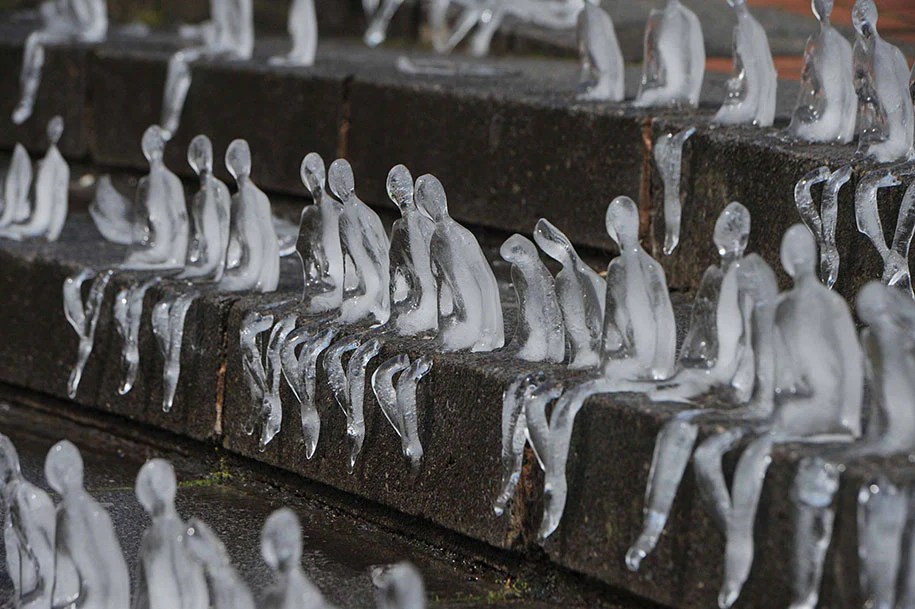
Néle Azevedo (Brazilian, 1950–), Minimum Monument (detail), Chamberlain Square, Birmingham, England, 2014. Sculpted ice.

In the talk, Rosen explores how art can facilitate or exemplify four spiritual states:

  1. Attention
    – Simplicity
    – Repetition
    – Memory
  2. Wonder
    – The Uncanny
    – Technological Sublime
    – Sublime Silence
    – Darkness
    – Ecological Lament
    – Ecological Hope
  3. Care
    – Resilience
    – Replenishment
    – Maintenance
    – Recognition
  4. Belonging
    – Homecoming
    – Pilgrimage
    – Sanctuary
    – Sharing Sacred Space

+++

VIDEO INTERVIEW: “VCS Creative Conversations: Ben Quash with Steve Reich”: “This film continues our series of ‘Creative Conversations’. In these conversations, living artists working in a variety of different artistic media discuss how the Bible and its legacies of visual and theological interpretation operate as a vital resource for their own creativity. In this film, VCS [Visual Commentary on Scripture] Director Ben Quash interviews the legendary American contemporary composer Steve Reich. They discuss the profound role of the Bible in transforming both the subject matter and the style of Reich’s music, reflecting especially on his settings of the Abraham story, the episode of Jacob’s ladder, and texts from the Psalms.”

Favorite Films of 2024, Part 2

Read part 1 here.

Favorite Films of 2024 (Part 2)

11. Dancing Queen, dir. Aurora Gossé. This coming-of-age dramedy from Norway was not promoted at all in the US but quietly arrived on Google Play early this year—thanks to my YouTube algorithm for suggesting it! Seventh-grade Mina (Liv Elvira Kippersund Larsson) has a crush on Edwin (Vilijar Knutsen Bjaadal), aka E.D. Win, a hip-hop dancer with a large social media following who has just transferred to her school. Despite having no dance experience, Mina decides to audition for his crew ahead of a local competition, and she enlists her grandma (Anne Marit Jacobsen) to train her, and her best friend Markus (Sturla Harbitz) to help her practice the partner work. The film is so endearing, even if a bit predictable in its beats. 

12. Ghostlight, dir. Alex Thompson and Kelly O’Sullivan. Dan (Keith Kupferer) is a construction worker who’s grieving a grave loss and is unwilling to open up about it with his wife Sharon (Tara Mallen) and daughter Daisy (Katherine Mallen Kupferer). (The three actors are father-mother-daughter in real life.) One day he inadvertently stumbles into a rehearsal of a community theater production of Romeo and Juliet. The head of the troupe, Rita (Dolly De Leon), invites him to stay, which he reluctantly does. He’s never acted before, but he finds himself taking on a role in the play, which helps him connect with his emotions and with other people and begin his healing journey.

Streaming on AMC+.

13. Janet Planet, dir. Annie Baker. The free-spirited but weary Janet (Julianne Nicholson) lives with her eleven-year-old daughter, Lacy (Zoe Ziegler), in western Massachusetts, running an acupuncture practice out of their home. Lacy is lonely and quirky and craves her mom’s affection; Janet gives it but is usually also absorbed in some kind of interpersonal entanglement. Over the summer of 1991, during which the film is set, a succession of three visitors come in and out of Janet’s life: a live-in boyfriend, a woman trying to escape a cult, and said cult leader. Lacy tolerates these ephemeral presences but wishes her mom were more exclusively available to her. The film is about Lacy learning to share her mom with others and coming to grips with the fact that she is not the only person her mom needs. The last scene, where Lacy comes to this realization while watching her mom contradancing, gutted me!

Streaming on Max.

14. Green Border, dir. Agnieszka Holland. This film is a difficult watch. It dramatizes the humanitarian crisis precipitated in fall 2021 when Alexander Lukashenko, the dictator of Belarus, lured several thousand asylum seekers from the Middle East and Africa to his country with the promise of free transit to the European Union, then dumped them on the borders of Poland, Lithuania, and Latvia as payback for EU sanctions against Belarus. Green Border focuses on a Syrian refugee family of six (Jalal Altawil plays the father) and an Afghan woman (Behi Djanati Atai) they befriend on the plane ride over—their being tossed (like a football, as one character laments) back and forth across the militarized Polish-Belarussian border, cold and hungry, with neither country willing to receive them.

The film also follows two Poles: border guard Jan (Tomasz Wlosok), who contracts PTSD, and budding activist Julia (Maja Ostaszewska), who joins a group providing water, food, clothing, first aid, power banks, and legal counsel to those crossing the forested swampland into Poland. We see one aid worker cradling the head of a hypothermic refugee as she spoon-feeds him hot soup, and another tenderly rubbing ointment onto the swollen, blistered feet of a weary woman traveler. Sadly, government policy has made these tangible acts of loving care acts of political resistance and grounds for arrest. But there’s a double standard at play, as we see in the epilogue.

Streaming on Kanopy.

15. Juror #2, dir. Clint Eastwood. A taut legal thriller, Juror #2 is all about conscience. Family man Justin (Nicholas Hoult) finds himself on the jury of a murder trial, and when the details of the alleged crime are revealed, he realizes he may have been the unwitting perpetrator. He is torn between his integrity and his self-preservation instincts, between his loyalty to the law and his loyalty to his wife and soon-to-be-born child. What I like about the film is how it prompts you to consider what you would do in the same situation—let someone with less to lose and with lower morals take the fall (the defendant, a single man with gang involvement, is a known abuser of women, and the prosecution has a strong case against him), or own up to what you know and have your and your family’s lives upended.

Streaming on Max.

16. Kneecap, dir. Rich Peppiatt. UNESCO classifies the Irish language as “endangered,” as the number of native speakers has continued to decline ever since English became the national language during British rule. However, more recently there’s been an urban revival, owing in part to the proliferation of Irish-language immersion schools—and to the popularity of Kneecap, a hip-hop trio from West Belfast who rap mostly in Irish, for them a sign of national identity and pride. Formed in 2017, they’re a controversial group whose lyrics often contain Irish republican themes along with profanity and references to drugs and sex. Many young Irish people have embraced them and been inspired by their music to learn Irish.

Band members Liam Ó Hannaidh (stage name Mo Chara), Naoise Ó Caireallain (Móglaí Bap), and JJ Ó Dochartaigh (DJ Próvai) play versions of themselves in this riotous, fictionalized origin story that compelled me mostly because of its fresh take on the musical biopic genre and in how it addresses the politicization of language. Also, it’s funny. But expect irreverence.

Streaming on Netflix.

17. The Outrun, dir. Nora Fingscheidt. Based on the best-selling memoir by Amy Liptrot, The Outrun follows Rona (Saoirse Ronan), an alcoholic in her late twenties who drops out of her PhD program in biology and returns to the remote Orkney Islands of Scotland, where she grew up, to pursue recovery. Rona is closely attuned to the natural forces around her, which gives the film an elemental quality, and Ronan attacks the role with an admirable ferocity. It’s a vital portrait of addiction and the journey to and through sobriety. Unlike some other films that tackle the subject, it doesn’t revel in the character’s misery; it shows the destructiveness of addiction, for sure, but it also shows Rona finding happiness along the way in things other than drink, like dancing with neighbors, barking at seals, baking bread, collecting and drawing seaweed, or pretending she’s a sailor at sea.

18. We Live in Time, dir. John Crowley. In nonlinear fashion, this affecting rom dram traces the relationship of Tobias (Andrew Garfield) and Almut (Florence Pugh), from their initial meeting in a hospital hallway, to the birth of their daughter, to Almut’s death from cancer, and a hundred little moments in between. It’s a beautiful picture of committed romantic love and how it negotiates change, crisis, and conflicting aspirations, but also the many joys it holds.

19. The Remarkable Life of Ibelin, dir. Benjamin Ree. The subject of this Norwegian documentary is Mats Steen (1989–2014), a video gamer who was born with Duchenne disease, a rare form of muscular dystrophy. When he died at age twenty-five, his parents had thought he lived an isolated life. But then they started receiving emails from strangers, numbering in the hundreds, who knew Mats through the online role-playing game World of Warcraft, where Mats interacted with friends daily as the character Ibelin Redmoore.

To bring Mats’s story to life, the film starts out conventionally, with home video footage from and interviews with the family. But then it transitions into animated segments that re-create some of Mats’s personal experiences within the world of the game. An actor voices Mats using Mats’s own words, taken from gaming transcripts and blog posts. These segments are interspersed with in-person interviews with some of Ibelin’s fellow Starlight guild members. I appreciate how the film challenges the stereotype of video games as shallow, time-wasting, and solitary, showing how for Mats, who had limited mobility, they were a means of exercising agency and cultivating meaningful connections with people all over the world.

Streaming on Netflix.

20. A Different Man, dir. Aaron Schimberg. Part dark comedy, part psychological thriller, this film stars Sebastian Stan as Edward, a man living with neurofibromatosis, which causes noncancerous tumors to grow on nerve tissue. He undergoes an experimental procedure that undoes his facial disfigurement and thrusts him into an identity crisis, even more so when he meets a man named Oswald (Adam Pearson) who looks a lot like his presurgery self. He envies Oswald’s confidence and charisma and feels increasingly threatened by him when Oswald is cast to play a version of him in a stage play written by his former next-door neighbor Ingrid (Renate Reinsve). We’re made to wonder whether there’s something insidious about Oswald, or Edward’s insecurities are just acting up.

Writer-director Aaron Schimberg, who has a cleft palate, said this film arose in part from his own contradictory feelings about his disfigurement, and the odd experience of looking in a mirror after having had multiple surgeries and wondering if the face he sees is his own or one that was only created by doctors. He also said he wanted to write a role for Pearson, whom he had worked with before, that defies the two roles he is typically offered—either a sympathetic victim who’s deemed heroic simply for existing, or a horror villain—and that makes use of his naturally gregarious, extroverted personality.

Streaming on Max.

HONORABLE MENTIONS: Inside Out 2 (Disney+), Thelma (Hulu), Spermworld (Hulu), Civil War (Max), Problemista (Max), The Promised Land (Hulu)

Favorite Films of 2024, Part 1

Of the 102 films I’ve seen that were released in the United States in 2024, these are my top ten. I’ll reveal my top eleven through twenty in a “part 2” post in the next few days.

Although I typically draw spiritual, theological, or liturgical connections with the art I feature on this website, here I do not do that. I’ve chosen these films not based on any kind of Christian messaging or interpretive possibilities but because they are beautifully made films that resonated with me. They address themes such as family, friendship, simplicity and awe, repressive governments, growing up, grief, mortality, addiction, trauma, joy, disability, identity.

One thing I love about cinema, as holds true with all the arts, is how it can connect us more fully to God, others, the world, and our own selves. So while I don’t think you need to watch movies with a purpose in mind, if you find yourself hesitant to invest the time, perhaps you might consider that connective capacity.

If the film is currently streaming for free with a subscription service, I’ve noted that at the bottom of the entry. Otherwise, check your local theaters or online rental platforms.

[Top 20 from 2023] [Top 20 from 2022] [Top 20 from 2021] [Top 20 from 2020]

Cautionary note: Different viewers have different sensitivities. If there’s a particular type of content you want to avoid, I’d advise you to check out the “Parents’ Guide” section of the film’s IMDb webpage, to which I’ve linked each film title.

Favorite Films of 2024

1. How to Make Millions Before Grandma Dies, dir. Pat Boonnitipat: From Thailand comes this tender story of a late teenage boy, M (Putthipong “Billkin” Assaratanakul), who quits his job as a video game streamer to become the live-in caretaker of his ailing amah (maternal grandmother) (Usha Seamkhum) in the hopes of inheriting her house when she dies. While initially motivated by self-interest, M develops genuine affection and gratitude for his grandma the more time he spends with her—getting up early with her each morning to make and sell congee at the street market, bringing her to the temple to pray, sitting with her during chemotherapy sessions (one of the most moving scenes is when he picks off the loose hairs she’s been shedding, one by one, from her sweater while she rests in her chemo chair). The balance of humor—conveyed especially through Amah’s feistiness—and sadness—loneliness, familial hurt and estrangement, terminal illness—is deftly handled and the emotional climax well earned.

2. Daughters, dir. Angela Patton and Natalie Rae. Pursuing the initiative of a group of young Black girls at Camp Diva Leadership Academy (now merged with Girls For A Change), Virginia-based community activist Angela Patton has helped organize a series of daddy-daughter dances in US prisons, a chance for K–12 girls to connect in person and make memories with their incarcerated fathers. This documentary captures one of those dances from 2019, following Aubrey, Santana, Raziah, and Ja’Ana over the course of eight years—before, during, and after the event. These girls and their fathers speak their sorrows, fears, insights, disappointments, and hopes, shedding light on the impact of parental incarceration and especially the rise, since 2014, of no-touch and even screen-only prison visits.

I appreciate that the film shows the complexity of the father-daughter bond, avoiding a simplistic portrait of that bond as either wholly resilient or frankly unmendable. The dance is not a triumph for all participants. While all at least have a desire to show up for each other, forgiveness and trust don’t always come easily. Nor does conversation, when you’ve been separated from someone for so long and barely know them.

Surely a contender for scene of the year is when the girls come down the hallway in their dresses, hand in hand and proud but nervous, to greet their fathers, who sit in a row of folding chairs in borrowed suits and ties. The men’s reactions are precious.

Streaming on Netflix.

3. Dìdi, dir. Sean Wang. Dìdi means “little brother” in Mandarin, and Chinese parents also use the term as an endearment for their younger sons. In this semiautobiographical dramedy from writer-director Sean Wang, it references the lead character Chris (Izaac Wang), a thirteen-year-old Taiwanese American boy growing up in Fremont, California. It’s 2008, the summer before high school, and all the awkwardness and anxieties of adolescent boyhood are upon him. He’s trying to fit in with a skater crowd and to figure out how to flirt with girls, and he’s navigating turbulent relationships with his mom (Joan Chen), who he feels is ashamed of him, and his sister (Shirley Chen), his only sibling, who’s getting ready to leave for college. Also living in the house is his nai nai (paternal grandmother) (Zhang Li Hua), played by Sean Wang’s actual grandma. The film is cringey in all the right ways, capturing that pubescent period we’ve all gone through of insecurity, immaturity, pressure, and desperation. Izaac Wang’s is one of my favorite performances of the year, especially for the vulnerability he lets us see in his character.

Streaming on Peacock.

4. Perfect Days, dir. Wim Wenders. This serene drama contains little plot, dialogue, or conflict and yet is absorbing to watch. It’s built around the daily routine of Hirayama (Kôji Yakusho), a custodial worker in Tokyo whose job is to clean public toilets. We watch him wake up, fold his bedding, water his plants, brush his teeth, put on his royal blue jumpsuit, and walk outside to greet a new day. He sanitizes toilet bowls, sweeps floors, and wipes mirrors, taking great pride and care in his work. He occasionally pauses to appreciate moments of beauty: children playing in the park, leaves glimmering in sunlight. He eats dinner at a restaurant where he’s friends with the proprietor. Then he reads at home by lamplight before falling asleep. His is a quiet life and a full one. His attentiveness and gratitude call us to the same.

Streaming on Hulu.

5. Sing Sing, dir. Greg Kwedar. Rehabilitation Through the Arts (RTA) is a program at New York’s Sing Sing Correctional Facility in which professional teaching artists lead year-round workshops inside the prison in theater, dance, music, creative writing, and visual arts. The drama Sing Sing spotlights the acting troupe as they put on a production of Breakin’ the Mummy’s Code, a time-traveling epic they helped come up with that involves an Egyptian prince, gladiators, pirates, cowboys, Robin Hood, and Hamlet. Starring Colman Domingo as the real-life John “Divine G” Whitfield (who was a founding member of RTA and who makes a cameo appearance), Clarence “Divine Eye” Maclin as himself, and an ensemble cast of other formerly incarcerated RTA participants, the film celebrates the transformative, therapeutic power of the arts, as the men find vulnerability, agency, creativity, confidence, connection, and release. It’s a real heart-warmer!

6. Nickel Boys, dir. RaMell Ross. Based on the Pulitzer Prize–winning novel by Colson Whitehead, this lyrical film is set in the Jim Crow era primarily at Nickel Academy, a state-run juvenile “reform school” (essentially a prison farm) in Florida, inspired by the real-life Dozier School for Boys that operated from 1900 to 2011, where hundreds of students were subjected to forced labor and physical and/or sexual abuse. The remains of several dozen boys have recently been unearthed from unmarked graves on the school grounds, many presumed to be victims of excessive punishment.

Nickel Boys centers on Elwood (Ethan Herisse), a high-achieving high schooler who gets sent to Nickel after hitching a ride in, unbeknown to him, a stolen car. There he becomes friends with Turner (Brandon Wilson). Despite the harrowing backdrop of their relationship, the boys share moments of leisure and joy, and for any violence that occurs, the director made the deliberate choice to portray it offscreen.

The film is shot almost entirely in double first-person POV, switching between the perspectives of Elwood and Turner. I had heard this beforehand and was skeptical that it would work for an entire movie, worried that it might come across as gimmicky, but on the contrary, it worked beautifully. I was mesmerized by the compositional poetics from the very beginning, by how the use of what the director calls “sentient perspective” allows us to get inside moments in a new way. (Shout-out to cinematographer Jomo Fray for, alongside director RaMell Ross, developing and executing such an evocative visual language; for an enthusiastic, in-depth conversation Fray has on his process, approach, and choices for the film, see here.) Before we meet Turner, a decade-plus earlier in the timeline, we see young Elwood’s face only in reflections—in the chrome plating of his grandma’s iron as he watches her do house chores, or through a window display of televisions that are broadcasting King’s “Our God Is Marching On” speech, before which Elwood stands transfixed. Then later we get to see him through Turner’s eyes. That characters look straight into the camera when they address the two mains creates an atypical intimacy and directness.

7. The Seed of the Sacred Fig, dir. Mohammad Rasoulof: Shot in secret and smuggled out of Iran, this thriller is about a family of four in Tehran who become increasingly divided as the Woman, Life, Freedom movement takes hold in 2022, demanding the end of compulsory hijab laws and other forms of oppression against women. Because the protest and crackdown scenes could not be re-created without attracting scrutiny, the director spliced in documentary footage that had been captured on various anonymous cellphones, some of which, I’ll warn, graphicly depicts police brutality and its aftermath.

In the film, the head of household, Iman (Missagh Zareh), works as an investigator in the country’s Islamic Revolutionary Court, signing death warrants against those who have violated sharia law, much to the chagrin of his daughters, Rezvan (Mahsa Rostami) and Sana (Setareh Maleki), who sympathize with the antigovernment protestors. Their mom, Najmeh (Soheila Golestani), tries to run interference between them and Iman and maintain normalcy, tradition, and respect in the home. But when Iman’s gun goes missing, chaos ensues; he becomes increasingly paranoid and unhinged.

Writer-director Mohammad Rasoulof has served jailtime before for his criticism of the Iranian government, and to avoid his latest eight-year prison sentence, he escaped the country illegally in 2024 and currently resides in self-exile in Berlin.

8. A Real Pain, dir. Jesse Eisenberg. After the recent death of their grandmother, a Holocaust survivor, two Jewish American cousins embark on a tour of Poland to visit her childhood home and connect with their heritage. David (Jesse Eisenberg) is straitlaced, shy, and anxious, whereas Benji (Kieran Culkin) is loud, uninhibited, fly-by-the-seat-of-his-pants, devil-may-care. This clash of personalities makes for a funny film, but we also come to see that behind Benji’s bluster there is, as the title gestures toward, “a real pain.” (The more frivolous meaning, of course, is that Benji is exasperating!) Both comedic and serious, the film succeeds in pulling off its dual tone while exploring relational dynamics and different ways of dealing with pain and trauma.

Streaming on Hulu.

9. All We Imagine as Light, dir. Payal Kapadia. Prabha (Kani Kusruti) and Anu (Divya Prabha) live together as apartment mates in multicultural Mumbai and work as hospital nurses. Prabha’s husband lives in Germany and rarely communicates with her, and Anu is dating a young Muslim man, against her Hindu parents’ wishes. When their friend Parvaty (Chhaya Kadam) becomes widowed, she is evicted from her shantytown, and they help her move back to her home village by the sea. The film is about sisterhood and longing—about these three women of different ages each pursuing a light-filled future in their own way.

10. Nowhere Special, dir. Uberto Pasolini. This warm, affectionate, tragic film set in Belfast was inspired by a newspaper headline: “Father dying of cancer spent his final months finding family for son.” When John (James Norton), a single dad who’s thirty-three, is diagnosed with brain cancer, he starts looking for a home for his four-year-old boy, Michael (Daniel Lamont). He partners with social workers to interview potential parents and tries to prepare Michael for what’s coming. A dead beetle in the park becomes an opportunity to teach him about death.

A premise like this could easily become over-the-top sentimental, but much to the film’s credit, and owing in part to the contained performances of the two leads, it does not. There’s both a sweetness and a sadness to it, as we watch father and son build ordinary memories before their imminent separation: they take naps together, wash their respective vehicles, enjoy ice cream cones in the park, watch dump trucks in action. As John becomes progressively weaker, Michael notices: he observes how his dad now needs to use two hands to pour a cup of OJ; he sees him wincing in pain when he thinks he’s not looking. Despite the heartbreaking scenario, the film is ultimately hopeful.

Streaming on Kanopy.

Read part 2.