Roundup: Traditional Balinese painting, Fijian hymn, and more

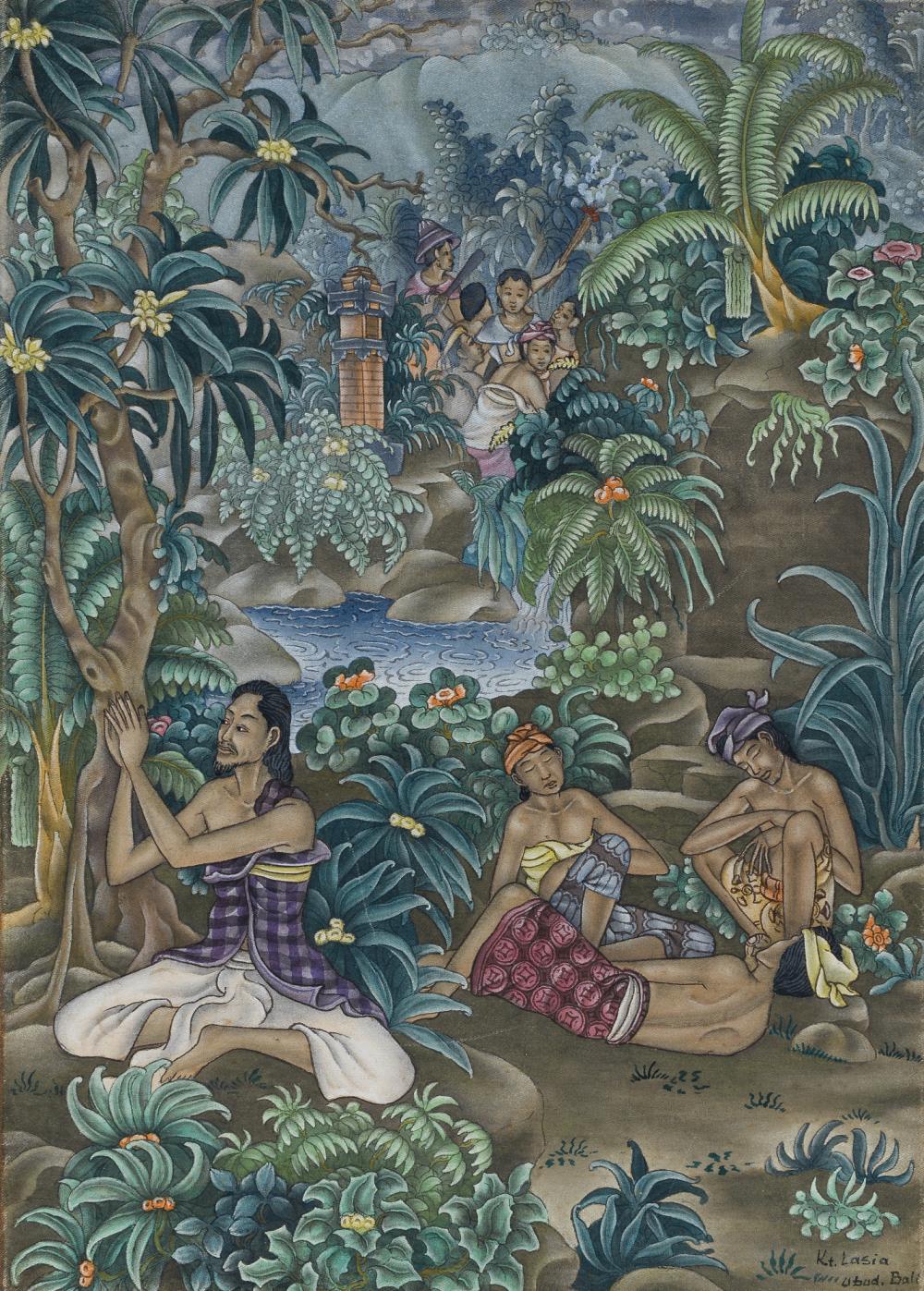
BROADCAST NEWS SEGMENT: “Ketut Lasia: The Last Generation of Ubud Traditional Painters,” UTV Televisi Indonesia, January 7, 2025: This three-minute video was filmed in the home studio of Ketut Lasia (born 1945), one of the last traditional Balinese painters, who studied under I Wayan Turun (1935–1986) and is still active at age eighty. As an adult, Lasia converted from Hinduism to Christianity, and he paints primarily biblical scenes. The video shows his visual interpretations of Jesus calming the storm, Jesus’s entry into Jerusalem, the miraculous catch of fish, the Crucifixion, Jesus in the house of Mary and Martha, and the Ascension.

Lasia, Ketut_Gethsemane
Ketut Lasia (Indonesian, 1945–), Gethsemane, n.d. Acrylic on canvas, 61 × 43 cm.

+++

ESSAY: “Christian Art in Indonesia” by Volker Küster, Karel Steenbrink, and Rai Sudhiarsa: This chapter is from the thousand-page, open-access book A History of Christianity in Indonesia, edited by Karel A. Steenbrink and Jan S. Aritonang (Brill, 2008). The authors discuss the development of an indigenized Indonesian Christian art, starting with the West Javanese sculptor Iko, a Muslim who worked in both wood and stone and fulfilled commissions for the (Catholic) Sacred Heart Chapel on the premises of the Joseph Schmutzer sugar estate in Ganjuran in the 1920s. They then cover a handful of artists who came in the wake of the Second Vatican Council in the 1960s and amid the global trend toward contextual theology promoted by international Protestantism—focusing especially on the most famous two, Bagong Kussudiardja (1929–2004) [previously] and Nyoman Darsane (1939–2024), both Christian converts.

Javanese King Jesus
Iko, Christ the King with Angels, 1924–27. Jati wood. Missiemuseum Steyl, Limburg Province, Netherlands. Photo: Fred de Soet, 2019.

Kussadiardja, Bagong_Crucifixion
Crucifixion batik by Bagong Kussudiardja, Yogyakarta, Indonesia. Private collection, Geneva. Jesus is rendered in the style of a Javanese shadow puppet. Source: On a Friday Noon by Hans-Ruedi Weber (Eerdmans / World Council of Churches, 1979)

Darsane, Nyoman_Creation of Sun and Moon
Nyoman Darsane, Creation of Sun and Moon, 1979

(This essay is not to be confused with the one I shared in 2022, where Volker Küster profiles five Christian artists from Yogyakarta, including one overlap with this present essay.)

+++

VIDEO PROMO: “OMSC Artist in Residence Program”: “Each year, the director of the Overseas Ministries Study Center at Princeton Theological Seminary (OMSC@PTS) invites one Artist in Residence to the Princeton campus to stay with us for a full academic year (September to May). Since its inauguration in 2001, the OMSC Artist in Residence program has hosted outstanding artists from the global South. Today, OMSC’s art collection is comprised of over one hundred fifty pieces, many of which are now on display throughout the campus of Princeton Theological Seminary. They represent some of the finest work being done by contemporary artists who are Christian.” Artists include Sawai Chinnawong (Thailand), Nalini Jayasuriya (Sri Lanka), Wisnu Sasongko (Indonesia), and Emmanuel Garibay (Philippines), among others.

The current OMSC artist in residence is KimyiBo, a Korean American artist based in Berlin. Explore more at http://www.omsc.org/.

+++

EXHIBITION CATALOG: Global Images of Christ: Challenging Perceptions: This free digital catalog documents an art exhibition that ran from September 25 to October 30, 2021, at Chester Cathedral in the UK. Artists include Lorna May Wadsworth, Max Kandhola, Silvia Dimitrova, John Muafangejo, Solomon Raj, Jyoti Sahi, and more.

+++

FIJIAN HYMN: “Oqo Na Noqu Masu” (This Is My Prayer): This Christian hymn is sung regularly in Fiji in churches and at rugby training camps and matches. The lyrics translate roughly to: “Lord, this is my prayer. I need your help in my time of need. I will always praise your name, and I ask that you grant me the desires of my heart. I sing and cry to you, Lord—to you and you alone. Hallelujah.” Here are some examples:

>> From the Rugby League World Cup, Fiji v. USA, 2017:

(Watch a similar video with subtitles.)

>> Again, the Fiji Bati rugby team singing before a match, this time against Papua New Guinea in 2022:

>> And here’s the hymn in a church context—sung by the Nawaka Methodist Village Choir in Nadi, Fiji:

Awareness of the deep-rooted Fijian tradition of four-part Christian hymn singing increased last summer when videos of the country’s Olympic team went viral. In the Christianity Today article “Yes, Fiji Olympians Are Singing Hymns,” Kelsey Kramer McGinnis writes,

Although Fijian hymnody grew out of Methodist songs brought by 19th-century missionaries, it has become a deeply rooted tradition that makes space for indigenous practices across the diverse country. Christianity’s connection to the legacy of colonialism in Fiji (which was a British colony from 1847 to 1970) is undeniable, but Fijian vocal music stands as an example of the ways Fijians have been contextualizing Christian worship and integrating it into their communities for nearly two centuries.

Here’s a 2024 video from a Sunday worship service at the Team Fiji camp in the Olympic Games Village in Paris, showing the team singing a different hymn, whose title and words I don’t know:

Roundup: Social music with Dan Zanes, the Green Man, and more

Lancaster Digital Collections has published twelve webpages of “iconography-inspired sacred art,” with downloadable images made available by permission of the artists. I especially like the paintings of Janet McKenzie [previously] and Khrystyna Kvyk [previously].

McKenzie, Janet_The Divine Journey
Janet McKenzie, The Divine Journey: Companions of Love and Hope, 2017. Oil on canvas, 48 × 36 in. Memorial Church, Harvard University, Cambridge, Massachusetts.

Kvyk, Khrystyna_The Descent into Hell
Khrystyna Kvyk (Ukrainian, 1994–), The Descent into Hell, 2023. Acrylic on gessoed wood, 40 × 40 cm. Private collection.

+++

FREE ZOOM CONVERSATION: Social music with Dan Zanes, July 16, 2025, 8 p.m. ET: I met the Baltimore-based folk musicians Dan and Claudia Zanes [previously] two years ago at a local family concert they put on. Joyous, bighearted, faith-filled, community-focused, committed to social justice—I love who they are and what they’re about and all the rich music they share.

In a social media post on June 11, Dan posed the question, “Is there anyone out there who wants to become a music maker and help uplift their community?” Followed by a generous offer: “I can teach you how to play guitar and sing songs (and write songs if you want). No cost, this is a different approach. It will be through a series of Zoom lessons (unless you live down the street). Whether you’re a beginner or someone who’s been dabbling and wants to take it out of the house, I can get you to a confident place so you can play for and with people.” The caveat? You just have to promise to put in the practice and to share your music freely in your community! And to teach someone else what you’ve learned.

“There are so many ways to make positive social change,” Dan says, “and creating music in our communities is certainly one of them.” I believe he has already selected a set of students to take on, but having received so many messages of interest, he has also decided to host a Zoom conversation on social music this coming Wednesday evening. On July 9, he wrote on social media:

Social music in chaotic times, people! Let’s talk about it. I’ve been hearing from many folks who want to be more useful in their communities and see music as the way.

Yes! Music can be healing, galvanizing, uplifting, energizing, and calming. Imagine if every community had many more music makers to play for the young folks, the elders, to lead singalongs and dance parties, to offer songs during times of loss and celebration. Of course it’s happening now, and still I believe there’s so much more that is possible.

If you’re interested in joining the meeting, send Dan an Instagram message @danzanes or a Facebook message @danandclaudiazanes and he’ll send you the link.

To give you a sense of Dan and Claudia’s vibes, here’s one of their original songs, which they debuted on their YouTube channel in 2020:

+++

ONLINE RETREAT: “Read for Your Life: Creating a Story-Formed Home” with Sarah Clarkson, August 5, 2025: Join author Sarah Clarkson [previously] for a daylong online retreat exploring children’s literature, childhood reading, and the development of imagination. “My goal,” she writes, “is to provide a vision for the beauty of the reading life, some good research, and a generous stack of practical booklists to help you begin to outfit and build a home library for the children in your life.” The cost is $35. The event begins at 9:30 a.m. UK time, but all live sessions will be recorded and offered on-demand afterward to registrants.

+++

PODCAST EPISODE: “The Green Man,” Gone Medieval, June 23, 2025: In this episode, Dr. Eleanor Janega talks with Imogen Corrigan, author of The Green Man: Myth and Reality (Amberley, 2025), about the enigmatic “green man” figure, or foliate head, which can be found in almost every pre-Reformation English cathedral and in many churches, decorating arches, corbels, roof bosses, choir stalls, and chancel screens. Corrigan claims that “the image has to be one of the most misunderstood, misinterpreted and misrepresented in the history of church carvings,” having nothing to do with pagan fertility rites. She suggests, rather, that the Green Man gestures toward the resurrection of, and resurrection in, Christ—to spiritual rebirth and eternal life.

Green Man misericord
Misericord from King’s Lynn Minster, England, ca. 1370s, depicting a Green Man disgorging oak leaves. Photo: Lucy Miller. (Click on image for great compilation!)

The two medievalists speak on location at St Mary’s at Minster-in-Thanet and St Nicholas-at-Wade in Kent. The conversation really starts to pick up at 19:47.

+++

This past month has seen the death of two rock ’n’ roll legends whose music, which played regularly on Oldies 100.7 WTRG, formed part of the soundtrack of my 1990s childhood: Brian Wilson (of the Beach Boys) and Sly Stone (of Sly and the Family Stone).

Much has been written about both trailblazers. I just want to mention two things:

1. Love and Mercy, the 2014 film directed by Bill Pohlad about Brian Wilson (played by Paul Dano and John Cusack), is excellent. Elliot Roberts makes the case that it’s the best music biopic ever made, and I’m inclined to agree; New York Times film critic Alissa Wilkinson also cites it as her favorite, at least within the rock genre. The story alternates between Wilson’s production of the Pet Sounds album in the mid-sixties and his psychological treatment under his abusive therapist and conservator Eugene Landy in the late 1980s, which coincided with his meeting Melinda Ledbetter, who would become his wife. The title is taken from one of Wilson’s solo songs from 1988. Here’s the film trailer:

2. Active from 1966 to 1983, Sly and the Family Stone was one of the very few multiracial, mixed-gender bands of the time, modeling integration when the notion was still fairly new in America. Perhaps you’ve heard their most famous hit, “Everyday People,” a call for unity across lines of difference (“There is a blue one who can’t accept the green one / For living with a fat one, tryna be a skinny one . . .”). Sly Stone was the front man—singer, songwriter, multi-instrumentalist, and producer. As is common among so many African American musicians, he got his musical start in church; from infancy, he was immersed in gospel music as a member of the Church of God in Christ, and his musical talent was nurtured there. I learned that in the fifties, he and three of his four siblings even formed a gospel group called the Stewart Four, locally releasing a single in August 1956. Here’s the B-side, “Walking in Jesus’ Name,” with a thirteen-year-old Sly singing lead:

New albums: “Confessions” by the Anachronists, “Though It Be a Cross” by Weston Skaggs, and more

Here’s my new Spotify playlist for July:

Every month I curate a mix of old and new Christian (or Christian-resonant) song releases. For this coming month, some of the new songs come from the following five albums that were released this spring or early summer, which I’ve really been enjoying. I list them here chronologically and encourage you to listen to them each in full!

New albums 2025

1. Jesus by Jon Guerra, released April 4, 2025: An album of original songs in conversation with the words of Christ. Guerra says that a few years ago, to reacquaint himself with Jesus, he began reading cyclically through the Gospels, and as he did, “little song fragments started coming. I was trying to really hear the words, to feel the stories again, and so I’d write little tunes around certain phrases—‘do not lay up for yourselves treasures on earth,’ ‘if anyone would come after me,’ ‘give to everyone who asks of you,’ ‘take this cup from me,’” etc. He then developed those into the twelve fully fledged songs that made it onto the album.

Favorite tracks: “Reckoner (An Axe Laid to the Root),” “Where Your Treasure Is” (above), “Love Your Enemies”

2. Sermon on the Mount: Bible Memory Collection by The Soil and The Seed Project, released May 16, 2025: The Soil and The Seed Project is a ministry that provides intergenerational resources for people as they follow Jesus, read scripture, and talk about their faith together. One of those resources is new music, written and recorded by an expanding collective of folks. All twenty-five songs on this new double album of theirs are based on the Sermon on the Mount in Matthew 5–7, which contains the Beatitudes, the Lord’s Prayer, warnings against hypocrisy, the call to be salt and light, the command to love one’s enemies, the parable of the wise and foolish builders, assurances of God’s care, and the promise that those who seek will find. For the first disc, the Project set 48 of the 111 sermon verses to music, and for the second, they invited a handful of singer-songwriters to write songs in response to what they encountered as they dwelt in the text.

The album is accompanied by a “Little Liturgies” booklet of litanies, reflection prompts, and line drawings covering eleven weeks. Both the music and the booklet (digital or physical, while supplies last) are FREE from their website!

Favorite tracks: “Come and Eat” (above), “Mountains of Treasure,” “God of Mercy, God of Peace,” “Take What You’ve Given”

3. Though It Be a Cross by Weston Skaggs, released June 20, 2025: An EP of six hymns, freshly arranged and performed by Weston Skaggs of Ohio. The album title comes from a line from “Nearer, My God, to Thee” (video below). “Sarah Fuller Flower Adams wrote the lyrics from the perspective of Jacob and his received revelation of God’s nearness. A nearness that only occurred when he felt most hopeless and alone,” Skaggs explains. “In meditating on that narrative, she determined to be like Saint Peter: who became the most like Christ his master when he was raised on his own cross.” This song and others feature backing vocals by Katy Martin.

The most stylistically daring is “For the Beauty of the Earth,” whose verses Skaggs transposed to a minor key—to allude to the beauty and brokenness of creation and relationships, Skaggs said, “invit[ing] listeners to hold both gratitude and longing in the same breath.”

Favorite tracks: “No, Not One,” “Nearer, My God, to Thee” (above)

4. Confessions by the Anachronists, released June 26, 2025: The Anachronists are Andrés Pérez González, Corey Janz, and Jonathan Lipps, three musician friends who met while studying theology at Regent College in Vancouver and who have formed a group to give renewed voice, through modern indie music, to theologians and mystics from ages past. Confessions is their debut EP, with six songs rooted in Augustine’s spiritual autobiography from the late fourth century. The songs address grief over the death of a dear friend, and God’s merciful pursuit of those who wander; a preconversion sense of dissatisfaction but as yet unwillingness to make any changes; God as the One who is fully at rest in his own self, and how we might share in that rest; struggles with distraction and pride in the spiritual life; and the promise of renewal both personal and universal.

The still life colored-pencil drawing commissioned for the album cover is by the Finnish artist Minni Havas; it portrays Easter lilies growing out of a compost heap. It was especially inspired by the concluding song, “All of Our Decayed Parts,” which is itself based on an excerpt from Book IV.16 of the Confessions:

Do not be vain, my soul. Do not deafen your heart’s ear with the tumult of your vanity. Even you have to listen. The Word himself cries to you to return. There is the place of undisturbed quietness where love is not deserted if it does not itself depart. See how these things pass away to give place to others, and how the universe in this lower order is constituted out of all its parts. “Surely I shall never go anywhere else,” says the word of God. Fix your dwelling there. Put in trust there whatever you have from him, my soul, at least now that you are wearied of deceptions. Entrust to the truth whatever has come to you from the truth. You will lose nothing. The decayed parts of you will receive a new flowering, and all your sicknesses will be healed. All that is ebbing away from you will be given fresh form and renewed. (trans. Henry Chadwick)

This album comprises just six of the thirty-some Confessions-based songs the trio has written; they are testing the waters with it to see if there is more interest and funding to record more, and then to apply this approach to other ancient and medieval theological and spiritual writings by such luminaries as Athanasius and Julian of Norwich. Some laypeople feel daunted to read centuries-old works, or assume that they’re mostly irrelevant. But the Anachronists seek to mine the riches of historical Christian thought and provide an easy access point through music, hopefully encouraging folks to seek out the sources. I’m excited to see what they do next! Follow them on Instagram @anachronists.music.

Favorite tracks: “God of the Runaways,” “All of Our Decayed Parts” (above)

5. All Shall Be Well by the Good Shepherd Collective, released June 27, 2025: This album consists mainly of gospel and hymn covers. The artists in this collective, whom I’ve mentioned many times before, are top-notch, and I’m always excited to see what they put out.

Favorite tracks: “Lift Every Voice” (James Weldon Johnson and J. Rosamond Johnson), “Ancient of Days” (Ron Kenoly) (this appears to be a re-release from the collective’s Gospel Songs, vol. 1; above), “My Jesus Is All” (the Staples Singers), “I Saw the Light” (Hank Williams)

Roundup: The body as sacred offering; rest as resistance; “Amazing Grace”

I’m late in notifying you about my June 2025 playlist (a random compilation of faith-inspired songs I’ve been enjoying lately), but be sure to check it out on Spotify.

See also my Juneteenth Playlist, which I’ve added six new songs to since originally releasing it two years ago, including a cover of Roberta Slavitt’s protest song “Freedom Is a Constant Struggle,” “Black Gold” by Esperanza Spalding, and “The Block” by Carlos Simon, a short orchestral work based on a six-panel collage by Romare Bearden celebrating Harlem street life.

Romare Bearden, The Block
Romare Bearden (American, 1911–1988), The Block, 1971. Cut-and-pasted printed, colored, and metallic papers, photostats, graphite, ink marker, gouache, watercolor, and ink on Masonite, 4 × 18 ft. (121.9 × 548.6 cm). Metropolitan Museum of Art, New York. Photo: Victoria Emily Jones.

+++

PODCAST EPISODE: “The Body as Sacred Offering: Ballet and Embodied Faith” with Silas Farley, For the Life of the World, April 30, 2025: An excellent interview! “Silas Farley, former New York City Ballet dancer and current Dean of the Colburn School’s Trudl Zipper Dance Institute, explores the profound connections between classical ballet, Christian worship, and embodied spirituality. From his early exposure to liturgical dance in a charismatic Lutheran church to his career as a professional dancer and choreographer, Farley illuminates how the physicality of ballet can express deep spiritual truths and serve as an act of worship.”

I was especially compelled by Farley’s discussion of turnout, the rotation of the leg at the hips—foundational to ballet technique. It gives the body an “exalted carriage” and allows for “a more complete revelation of the body,” he says, because you see more of the leg’s musculature that way. This physical positioning, he says, reflects the correlative “spiritual turnout” that’s also happening in dance, and that Christians are called to in life—a posture of openness and giving. He cites the theological concept of incurvatus in se, coined by Augustine and further developed by Martin Luther, which refers to how sin curves one in on oneself instead of turning one outward toward God and others.

Farley also discusses how liturgical dance is like and unlike more performative modes of dance (“liturgical dance . . . is a kind of embodied prayer . . . a movement that goes up to God out of the body”); how discipline and freedom go together; the body as instrument, and how dancers cultivate a hyperawareness of their bodies; the two basic design elements of ballet, the plié and the tendu, and their significance; his formation, from ages fourteen to twenty-six, under the teaching of Rev. Dr. Tim Keller at Redeemer Presbyterian Church; the Four Loves ballet he choreographed on commission for the Houston Ballet, based on a C. S. Lewis book (see promo video below, and his and composer Kyle Werner’s recent in-depth discussion about it for the C. S. Lewis Foundation); Songs from the Spirit, a ballet commissioned from him by the Metropolitan Museum of Art (see next roundup item); Jewels by George Balanchine, a three-act ballet featuring three distinct neoclassical styles; “Hear the Dance” episodes of City Ballet the Podcast, which he hosts; and book recommendations for kids and adults.

+++

SITE-SPECIFIC BALLET: Songs from the Spirit, choreographed by Silas Farley: Commissioned by MetLiveArts [previously], Songs from the Spirit by Silas Farley is a three-part ballet for seven dancers that interprets old and new Christian spirituals, having grown out of an offertory Farley gave at Redeemer Presbyterian Church based on the song “Guide My Feet, Lord.” Staged in the museum’s Assyrian Sculpture Court, Astor Chinese Garden Court, and glass-covered Charles Engelhard Court of the American Wing, the ballet progresses from “Lamentation” to “Contemplation” to “Celebration.” Here’s a full recording of the March 8, 2019, premiere:

For the project, Farley solicited new “songs (and spoken word poetry) from the spirit” from men who were currently or formerly incarcerated at San Quentin State Prison in California, whose creative talent he learned about through the Ear Hustle podcast. Recordings of these contributions form about half the score, while the other half consists of traditional spirituals sung live by soprano Kelly Griffin and tenor Robert May. My favorite section is probably “Deep River” at 26:54, a duet danced by Farley and Taylor Stanley, picturing a soul’s “crossing over” to the other side, supported by an angelic or divine presence, or perhaps one who’s gone before.  

In his artistic statement, Farley says he wanted to invite viewers “to accompany us [dancers] on this journey: from darkness to light, bondage to freedom, exile to home.”

I am struck by how a contemporary work that is, in Farley’s words, so “unequivocally Christ-focused and Christ-exalting” was welcomed, even made financially possible, by a prestigious secular institution. I find apt Farley’s response when asked by Macie Bridge from the Yale Center for Faith & Culture about his consideration of his audiences (see previous roundup item):

All the people coming to the performance are hungry in different ways. Some are longing for beauty. Some are longing for a prophetic image of a better world. Some are longing to see something reflected back to them from their own lives. And I’m just trusting that as I offer the artwork as an act hospitality, and as I offer the artwork as an act of adoration and worship back to God, that in his own beautiful, winsome, totally personalized way, he’ll meet each of the audience members in the way they need to be met.

+++

ARTWORK: Dreaming with the Ancestors by Charlie Watts and Tricia Hersey [HT: Visual Commentary on Scripture]: Tricia Hersey is a poet, performance artist, spiritual director, and community organizer living in Atlanta, Georgia. She is the founder of The Nap Ministry, an organization that promotes rest as a form of resistance against capitalism (which fuels contemporary grind culture) and white supremacy, and the author of the New York Times best-selling Rest Is Resistance: A Manifesto (2022) and We Will Rest! The Art of Escape (2024). She pursued graduate research in Black liberation theology, womanism, somatics, and cultural trauma, earning a master of divinity degree from Candler School of Theology at Emory University.

Watts, Charlie_Dreaming with the Ancestors
Charlie Watts and Tricia Hersey, Dreaming with the Ancestors, 2017. Archival digital print photograph, 76.2 × 101.6 cm.

The photograph Dreaming with the Ancestors, taken by Charlie Watts, portrays Hersey reclining on a wooden bench inside an open brick enclosure and above rows of cotton plants. Dressed in a soft yellow gown, she closes her eyes in rest, practicing what she calls “the art of escape”—from the incessant demand of productivity and overwork, from oppression of body and spirit, from noise that drowns out voices of wisdom.

In We Will Rest!, Hersey advises:

Every day, morning or night, or whenever you can steal away, find silence. Even if for only a few minutes. Look for quiet time, quiet breathing, quiet wind, quiet air. It is there. Even if it’s cultivated in your body by syncing with your own heart beating. Guilt and shame will be a formidable and likely opponent in your resistance. We expect guilt and shame to surface. Let them come. We rest through it. We commit to our subversive stunts of silence, truth, daydreaming, community care, naps, sleep, play, leisure, boundaries, and space. Be passionate about escape. (107)

+++

ALBUM: Grace Will Lead Me Home by Invisible Folk (2024) [HT: Jonathan Evens]: An Arts Council England grant awarded to singer-songwriter Jon Bickley in 2022 enabled him to conduct a research and songwriting project that culminated in the album Grace Will Lead Me Home, which engages with the hymn “Amazing Grace,” its author’s biography, and its legacy. Bickley partnered with the Cowper and Newton Museum in Olney and enlisted the collaboration of fellow folk musicians Angeline Morrison (The Sorrow Songs: Folk Songs of Black British Experience) and Cohen Braithwaite-Kilcoyne (creator of the “Black Singers and Folk Ballads” resource for secondary educators, and concertina player on Reg Meuross’s Stolen from God). Here’s the title track, written and sung by Morrison:

The album also includes a cover of Zoe Mulford’s “The President Sang Amazing Grace,” written in response to the racially motivated mass shooting at Mother Emanuel AME Church in Charleston, South Carolina, on June 17, 2015 (its ten-year anniversary is next Tuesday). In his eulogy at the funeral of one of the nine victims, Rev. Clementa Pinckney, President Barack Obama chose “the power of God’s grace” as his theme, and he closed by singing the first stanza of “Amazing Grace,” a moving gesture that Mulford’s song remembers.

Other songs on Grace Will Lead Me Home address John Newton’s love for his wife Polly, his impressment into naval service, and his friendship with William Cowper. There are also songs that grapple with the harm and suffering Newton inflicted on others through his involvement in the slave trade, and that wonder at his hymn’s being so mightily embraced not only by the Black church, many of whose members are descendants of enslaved Africans, but also by other traumatized communities, who insist amid all the wrongs and afflictions they’ve suffered that God is amazingly gracious.

It’s a myth that John Newton (1725–1807), who converted to Christianity in 1748 after surviving a turbulent sea voyage, immediately gave up his employment as a slave trader upon embracing Christ. In fact, he was soon after promoted from slave ship crew member to captain and sailed three more voyages to Africa as such, trafficking human beings for profit until 1754, when his ill health forced him to retire. But he continued to invest in slaving operations for another decade, until becoming a priest in the Church of England. It wasn’t until 1788, in the pamphlet Thoughts Upon the African Slave Trade, that he publicly denounced slavery and confessed his sin of having participated in that evil institution, and this was the start of his abolitionism.

+++

SONG: “Amazing Grace,” performed by the Good Shepherd Collective: This adaptation of “Amazing Grace” premiered at Good Shepherd New York’s digital worship service on June 1. Listen via the Instagram video below, or cued up on YouTube. The vocalists are, from right to left, Charles Jones on lead, Solomon Dorsey (also on bass), Jon Seale, Dee Wilson, and Aaron Wesley. James McAlister is on drums, Michael Gungor is on electric guitar, and Tyler Chester is on keys.

Pentecost roundup: Invocations; Holy Spirit as “lodes-mon”; organ improv; tongues of fire in a flower patch

SONGS:

Here are three sung invocations of the Holy Spirit, seeking his power, liberation, comfort, light, and renewal.

>> “Holy Spirit, Come with Power”: This hymn was written by Anne Neufeld Rupp in 1970, who set it to a Sacred Harp tune from 1844 attributed to B. F. White. It’s performed here by the Bel Canto Singers from Hesston College in Kansas, featuring Gretchen Priest-May on fiddle and Tim May on acoustic guitar.

I was introduced to this hymn through the Voices Together Mennonite hymnal, where it appears in both English and Spanish as no. 57.

>> “Mweya Mutsvene” (Holy Spirit, Take Your Place) by Joshua Mtima and The Unveiled: The Unveiled is a collective of Christian musicians from Harare, Zimbabwe, founded by Joshua Mtima in 2020. Here they sing one of their songs in Shona. An English translation is provided onscreen. [HT: Global Christian Worship]

>> “Ven Espíritu Divino (Secuencia de Pentecostés)” (Come, Spirit Divine) by Pablo Coloma, performed by Chiara Bellucci: The Spanish lyrics of this contemporary Christian song from the Latin American Catholic tradition are in the YouTube video description. They ask the Holy Spirit, “sweet guest of our souls,” to come bringing healing, regeneration, growth, joy, and charisms.

+++

SUBSTACK POST: “Veni Creator Spiritus: A Lush Middle English Hymn” by Grace Hamman, Medievalish: Dr. Grace Hamman shares Friar William Herebert’s (ca. 1270–ca. 1333) Middle English translation of the classic Latin Pentecost hymn attributed to Rabanus Maurus (ca. 780–856), “Veni Creator Spiritus” [previously]. Herebert uses words like vor-speker (for-speaker; i.e., intercessor), lodes-mon (lodesman; i.e., journeyman or navigator), and shuppere (shaper) as titles for the Holy Spirit.

+++

ORGAN WORK: “Improvisation on Veni Creator Spiritus” by Alfred V. Fedak: “Your congregation will hear the rushing of the Holy Spirit in this improvisatory prelude (taken from Fedak’s and Carl P. Daw’s oratorio The Glories of God’s Grace),” writes Selah Publishing. “Fedak effectively uses sweeping whole-tone scale passages and arpeggios to indicate the Spirit’s presence, while the pedal plays phrases of the hymn tune,” a medieval plainchant. The publisher has posted the following performance of the piece (audio only), by the composer himself, along with a selection of Pentecost art from the thirteenth to eighteenth centuries. [HT: Global Christian Worship]

There are many other works on organ (fantasias, partitas, fugues) based on the “Veni Creator Spiritus” tune; view a select list on Wikipedia.

+++

POEM: “Book of Hours” by Kimberly Johnson: “A pentecost of bloom: all the furred tongues / awag in the iris patch, windrush through the fireflower.” So opens the poem “Book of Hours” by Kimberly Johnson [previously], from her collection Uncommon Prayer (Persea, 2014). A book of hours is a genre of medieval prayer-book used by laypeople, which arranges prayers, scripture, and other devotional texts for reading at prescribed times of the day. Johnson’s “Book of Hours” draws on the fields of codicology (the study of manuscripts as physical objects) and botany to consider how God’s Spirit moves through and enlivens the material world, be it the irises, fire lilies, alyssum, and paperwhite narcissus in her garden, or the ink and natural pigments on calfskin—green verdigris, red cochineal, yellow curcumin—in the rare manuscripts library where she examines a book of hours whose embellished Latin text she can’t quite make out but whose beauty enraptures her nonetheless. These are but two untranslatable experiences of sensual, embodied communion with God that Johnson narrates in the collection, the paint flakes on her lips and the pollen on her wrist a chrism and a prayer.

Roundup: Tea with strangers, church forests of Ethiopia, and more

CHILDREN’S BOOK: Let There Be Light by Desmond Tutu, illustrated by Nancy Tillman: I saw this enchanting little book at my local library recently—a retelling of the creation narrative from Genesis 1 by the late South African Anglican bishop, theologian, and Nobel Peace Prize laureate Desmond Tutu. Published by Zonderkidz in 2014, it opens, “In the very beginning, God’s love bubbled over when there was nothing else . . .” Hear it read aloud, and view the illustrations, in this video from the Seuss’s Gooses YouTube channel:

+++

ARTICLES:

>> “Artist Traveled to Over 30 Cities to Perform Tea Ceremony with Strangers,” an interview with Pierre Sernet by Jessica Stewart: From 2001 to 2008, artist Pierre Sernet (French-born and residing in Japan) traveled to over thirty countries to spontaneously enact abbreviated Japanese tea ceremonies, inviting passersby to come sit and drink the cup of matcha he prepared in front of them. From deserts and beaches to villages and construction sites, he would set up a portable, open-air wooden cube that denoted the “tea room,” and the ensuing encounters were documented with photography. Called One (and nicknamed Guerrilla Tea), the series was meant to promote respect across cultures and “to emphasize to viewers the importance of each moment we live in.”

  • Sernet, Pierre_Denilson, Niteroi, Brazil
  • Sernet, Pierre_Kheth and Mayndevi, Jaisalmer, India
  • Sernet, Pierre_Shinya, Rockefeller Center, NY

View more photos at https://pierresernet.com/one/.

>> “A Teeter-Totter Style Bench Invites Sitters to Find Common Ground” by Grace Ebert: “In the Garden of Generations in Einbeck, Germany, a playful new installation asks park goers to find equilibrium with their neighbors. ‘Balance Bench” is the latest project of Berlin-based artist Martin Binder. Installed in his hometown, the interactive artwork rests on a central cylinder rather than four legs, requiring that at least two people sit on either side to level. ‘It cannot be used alone—it demands awareness, consensus, and cooperation between people to become a functional public space,’ he says.”

Binder, Martin_Balance Bench
Martin Binder (German, 1990–), Balance Bench, 2025. Steel, oak. Installation at the Garden of Generations, Einbeck, Germany. Construction by Henning Müller Sondermaschinen. Photo by Spieker Fotografie.

+++

PHOTO SERIES: Hierotopia by Kieran Dodds: “Kieran Dodds (Scottish, b. 1980) is a non-fiction photographer known for his research-driven photo stories and portraiture. His personal work considers the interplay of environment and culture, and the importance of spiritual belief in global conservation.” In his Hierotopia series (from the Greek for “sacred place”), carried out from 2015 to 2018, he explores the green “church forests” east of Lake Tana in Ethiopia—little islands of biodiversity scattered throughout the region’s desert landscape. “To its guardians,” Dodds writes, “each forest resembles a miniature Garden of Eden and is essential to the dignity of the building. . . . The air inside the forests is cool, fragrant and filled with a cacophony of life. This is in stark contrast to the arid silence of the surrounding land which is feeling the strain of centuries of human activity and agriculture.”

Dodds, Kieran_Hierotopia
Debre Mihret Arbiatu Ensesa church near Anbesame, Ethiopia, surrounded by woodland and fields. Photo: Kieran Dodds, from the Hierotopia series, 2015–18.

“The core Christian belief in stewardship for the environment is a powerful concept,” Dodds continues, remarking on the Ethiopian Orthodox Tewahedo Church’s commitment to conservation, “and, if applied globally by people who are at least nominally Christian, could transform the world for better.”

+++

SONGS:

>> “Hold You in Our Circle” by Emily Roblyn: This simple song of blessing by UK-based singer-songwriter and retreat leader Emily Roblyn has been sung at the bedsides of the sick or dying, over women about to be released from prison, and through myriad other life transitions and trials, by friends and communities seeking to voice their support. “We hold you in our circle, hold you in our love.” [HT: Nadia Bolz-Weber]

>> “The Lord Bless You and Keep You” by Peter C. Lutkin: Performed by the Capital University Chapel Choir in 2020, this song is a choral setting by the Midwestern composer Peter C. Lutkin (1858–1931) of the Aaronic Blessing from Numbers 6:24–26: (in Lutkin’s rendering) “The LORD bless you and keep you; the LORD lift his countenance upon you, and give you peace; the LORD make his face to shine upon you, and be gracious unto you.” God instructed the Levitical priests of ancient Israel to pronounce these words over the people, and though the Levitical priesthood is no more, this particular benediction is still used regularly in Jewish and Christian liturgies.

“Easter Song” by Sedulius Scottus, trans. Helen Waddell

Illustration by Virginie Cognet
Virginie Cognet, Danse, 2023. Gouache on satin-finish watercolor paper, 70 × 50 cm.

Last night did Christ the Sun rise from the dark,
The mystic harvest of the fields of God,
And now the little wandering tribes of bees
Are brawling in the scarlet flowers abroad.
The winds are soft with birdsong; all night long
Darkling the nightingale her descant told,
And now inside church doors the happy folk
The Alleluia chant a hundredfold.
O Father of thy folk, be thine by right
The Easter joy, the threshold of the light.

This English translation of Sedulius Scottus’s “Carmen paschale” originally appeared in Mediaeval Latin Lyrics by Helen Waddell (Henry Holt, 1929) and is in the public domain.

Sedulius Scottus (fl. 840–860) was an early medieval Irish monk, poet, teacher, and biblical commentator. (He is not to be confused with the fifth-century poet Caelius Sedulius, who also wrote a [much longer] Carmen paschale, consisting of five books.) Driven out of his monastery by Viking invaders, Sedulius settled in the city of Liège under the protection of Bishop Hartgar. While living in exile on the Continent, he established himself as a leading literary figure of the Carolingian Renaissance. One of his most important works is De Rectoribus Christianis (On Christian Rulers), an instructional treatise on governing and a noteworthy contribution to Christian ethics. Sedulius was at least trilingual, proficient in Irish, Greek, and Latin. Eighty-three of his poems survive, composed in a variety of classical meters and ranging from mock heroic epics and philosophical puzzles to hymns of praise and drinking songs.

Helen Waddell (1889–1965) was a medieval literature scholar, historical novelist, playwright, and translator (from medieval French and Latin to English) who was awarded the Benson Medal of the Royal Society of Literature. She was born in Tokyo to an Irish Presbyterian missionary family, spending the first eleven years of her life in Japan. She was later educated in Belfast, Oxford, and Paris and became part of a circle of friends in London that included W. B. Yeats, Virginia Woolf, and Siegfried Sassoon. In addition to writing, she worked as a literary adviser and reader for the esteemed publisher Constable. She is the subject of an award-winning biography by Dame Felicitas Corrigan, published in 1986.

Addendum, 1/19/26: The hymn-writer Dan Damon has composed a beautiful, singable setting of this text, available from Hope Publishing Company. He told me he was inspired by reading this post.

Roundup: Ellsworth Kelly’s “Austin,” new book by Jonathan Anderson, religion in pop art, and more

PRINT INTERVIEWS:

>> “What Remains: The Making of Ellsworth Kelly’s Last Work,” Image interview with Rick Archer: I got to experience Ellsworth Kelly’s Austin—a modernist “chapel” containing three stained glass windows, fourteen black-and-white marble panels (Stations of the Cross), and a redwood totem—while in Texas for a CIVA conference in 2021; see some of my photos below. Kelly was an atheist inspired by Romanesque church architecture, and the architect he chose to collaborate with on Austin, Rick Archer, is a Christian. In this wonderful new interview by Bruce Buescher, Archer discusses his working relationship with Kelly, Kelly’s desire for randomization and form over meaning, the technical and architectural challenges of bringing Kelly’s vision to life, religious references, and the artist’s objective for the space. “I hope when people go in here, they will experience joy,” Archer remembers Kelly saying.

  • Austin by Ellsworth Kelly
  • Austin by Ellsworth Kelly
  • Austin by Ellsworth Kelly
  • Austin by Ellsworth Kelly
  • Austin by Ellsworth Kelly

>> “The Invisibility of Religion in Contemporary Art: An interview with Jonathan A. Anderson” by Matthew J. Milliner: Jonathan Anderson [previously] is one of the most important people working across the disciplines of art and theology, and I’m thrilled that his book The Invisibility of Religion in Contemporary Art is now available from the University of Notre Dame Press!

Invisibility of Religion in Contemporary Art

In this recent interview for Comment magazine, Anderson explains his purpose in writing the book:

I have become increasingly convinced that so many pivotal artists and artworks over the past century are deeply shaped by religious traditions and seriously engaged in theological questioning, but this remains severely under-interpreted or misinterpreted in the scholarship about these artists. One might see these threads running through an artist’s artworks and personal writings and even discuss these topics with the artist in their studio, but when one moves to the scholarly writing and teaching about that same artist, that language consistently disappears or is transposed into another register—usually politics, occasionally a highly esoteric spirituality. I wanted to understand, at a non-superficial level, why this was the case, and I wanted to see how other ways of speaking and writing about this topic might be possible.

Don’t miss, at the end of the article, his three hopes for the field of “art and theology,” which I very much share!

+++

LECTURE: “The Problems and Possibilities of Visual Theology: The Ascension as a Case Study” by Jonathan A. Anderson: With Ascension Day coming up on May 29, it’s timely to share this talk given by Jonathan Anderson (see previous roundup item) a few years ago at Duke Divinity School, where he worked as a postdoctoral associate of theology and the visual arts from 2020 to 2023. Anderson explores a handful of images depicting the Ascension of Christ, a particularly challenging subject because of the spatial ambiguity. The scriptural accounts of the event (Luke 24:50–53 and Acts 1:6–11) beg the question, “What does ‘lifted up’ mean? Where is Jesus?” Attempting to work out these spatial difficulties visually can be theologically and exegetically productive, Anderson claims—even if it sometimes leads to unsatisfying results, as, Anderson says, it often does in Western art from the Renaissance onward. By contrast, when artists foster intertextual readings across the biblical canon and focus not so much on what the Ascension looks like as a historical event but rather on what it means, they are generally more successful.

Here are some time stamps, with links to the artworks discussed:

Hosios Loukas
Katholikon of Hosios Loukas monastery, Boeotia, Greece, 1011–12

+++

INSTRUMENTAL JAZZ: “Prayer” by Cory Wong: This video shows a live performance of Cory Wong’s “Prayer” on July 4, 2023, at Gesù music hall in Montreal. Wong, on guitar at far left, is joined by Ariel Posen on guitar, Victor Wooten on bass, and Nate Smith on drums. I learned about Wong through his collaborative album with Jon Batiste, Meditations (2020), which includes a version of this piece featuring Batiste’s piano playing.

+++

EXHIBITION: OMG! Reli Popart, Museum Krona, Uden, Netherlands, April 5–September 7, 2025: This exhibition at Museum Krona (housed in the complex of the still-active Birgittine Abbey of Maria Refugie in Uden, Netherlands) explores the connection between the pop art movement and Christianity through works by artists such as Andy Warhol, Corita Kent, Niki de Saint Phalle, and especially Dutch artists, including Woody van Amen and Wim Delvoye. Pop art is characterized by the use of imagery from popular culture, sourced from television, magazines, comic books, ads—and sometimes from the trash bin.

Jacques Frenken [previously], for example, built a body of work by salvaging discarded plaster sculptures of Christ and the saints—mass-produced for Catholic devotional use—and reconstructing them into assemblages. For his Spijkerpiëta, he “brought the Pietà back into our midst and accentuated the pain it radiates with nails,” the artist said.

Frenken, Jacques_Spijkerpieta
Jacques Frenken (Dutch, 1929–2022), Spijkerpiëta (Nail Pietà), 1967. Plaster, paint, iron, wood. Museum Krona, Uden, Netherlands.

Another artist represented in the exhibition is Hans Truijen, who was commissioned in the 1960s by St. Martin’s Church in Maastricht to design eight stained glass windows for their worship space. The four along the left aisle of the nave depict human and divine suffering, whereas those on the right express hope, love, freedom, and happiness. He chose photographic images from various periodicals, including ones of the Vietnam War, and transferred them to glass using a special screen-printing process.

Truijen, Hans_Stained glass
Hans Truijen (Dutch, 1928–2005), Studies for the eight stained glass windows commissioned by St. Martinuskerk, Wyck-Maastricht, Netherlands, 1966–68. Courtesy of the artist’s son, Marc Truijen.

Roundup: “Harrowing of Hades” audio drama, Easter chant in Arabic, and more

HYMN TEXT: “Lights” by Kate Bluett: Kate Bluett [previously] is a Catholic poet and lyricist from North Texas who frequently participates in cross-denominational music collaborations. Her work has been published by Oregon Catholic Press and GIA Publications and recorded by the Porter’s Gate and Paul Zach, among others. I enjoy following her at https://katebluett.home.blog/, where she regularly shares new metrical verses she has written, tied to the liturgical calendar. Last Eastertide she published a text called “Lights,” which muses on candle flames, stars, and other light sources as reflections of the light of the risen Christ.

+++

AUDIO DRAMA: Anastasis: The Harrowing of Hades by Creative Orthodox: Creative Orthodox is the moniker of Michael Elgamal, a Coptic Orthodox artist and storyteller born in Egypt and living in Canada. Last May he released an audio drama, adapted from a graphic novel, about Christ’s epic descent into the underworld to reclaim the Old Testament righteous. This theatrical medium, which relies on voice acting, sound effects, and music to tell a story, was a very popular form of entertainment in the 1920s–40s before the advent of television but is much rarer today—which is a shame, because I find it really engaging! See the YouTube description for a full list of credits (script, score, actors, etc.).

+++

BLOG POST: “Iconography of the Descent of Jesus Christ into Hell” by Daria Chechko: A brief history and compilation of Anastasis icons.

Dionysius_Descent into Hell icon
Dionysius (Russian, ca. 1440–ca. 1508), Christ’s Descent into Hades, from Ferapontov Monastery, ca. 1495–1504. Tempera on wood, 31.2 × 10.5 cm. State Russian Museum, Saint Petersburg.

+++

SONGS:

>> “Christ Is Risen” (لمسيح قام) by Ribale Wehbé: Ribale Wehbé is a Lebanese singer specializing in Byzantine chant. Here she sings a traditional Easter chant in Arabic, arranged by Joseph Yazbeck.

>> “Hallelujah, Hosanna” (हाल्लेलुयाह होशन्ना) by One Tribe: Originally written in Tamil by pastors Dudley Thangaiah and Paul Thangaiah, “Hallelujah, Hosanna” is sung here in Hindi by the Indian Christian worship collective One Tribe. Turn on “CC” for closed captioning, and view the full credits in the YouTube video description. [HT: Global Christian Worship]

>> “He Did Rise” by Monroe Crossing: A bluegrass song about the women’s discovery of the empty tomb on Easter morning, written by Mark Anderson and performed here by his band, Monroe Crossing, at a music festival in Lexington, Kentucky, in 2009. Anderson is on the double bass. [HT: Global Christian Worship]

+++

SPOTIFY PLAYLIST: May 2025 (Art & Theology): An assortment of psalms, hymns, and spiritual songs, old and new. For my Easter-specific playlist from 2022 (with a smattering of new additions since, including a large batch from Cardiphonia at the bottom), see here.

Roundup: Multilingual Paschal greeting, Easter sermon by N. T. Wright, the Myrrhbearers and the Magi, and more

VIDEO: “The Lord is Risen! Proclaimed by people from 29 countries”: This video was put out in 2020 by ICF Rotterdam, an intercultural church in the Netherlands whose congregation consists of members from over forty nations! They asked a handful of them to recite the Paschal greeting in their native tongue, so represented here are Indonesian, Chinese, Zulu, Igbo, Urdu, Nepali, Kurdish, Romanian, and more. [HT: Global Christian Worship]

Wycliffe Bibliafordítók (Wycliffe Bible Translators) in Hungary produced a similar video last year:

+++

SERMON: “Let Beauty Awake” by N. T. Wright: One of the things I love about the Anglican cleric N. T. Wright’s preaching and teaching is the importance he places on beauty. (I actually met Wright once—and it was at an arts conference.) In this sermon, which he preached at Durham Cathedral on Easter Sunday 2009, he takes as his text what I’ve heard him say is his favorite chapter in the Bible, John 20, and discusses how in Jesus’s rising, the glory of God was let loose in all the world.

“Easter carries with it a strange and powerful beauty,” he says. “I hope that, by exploring the biblical roots of why this is so, I may have surprised some of you at least into asking, afresh, What can we do to celebrate, more consciously and deliberately, the reawakening of beauty which comes with the light of Easter Day? How can we take this forward, as an explicit project, so that a world so full of ugliness and functionality, and in consequence so full of unbelief or false belief, can once again be wooed into belief and love?”

He opens the sermon by quoting a stanza from a poem by Robert Louis Stevenson, and near the close, he reprises it in his own words, which were developed into a song by Steve Bell:

Let Beauty awake in the morn from the cool of the grave,
Beauty awake from death;
Let Beauty awake,
For Jesus’ sake,
In the hour when the angels their silence break
And the garden is bright with His Breath.

+++

RECIPE: “Tsoureki: The Symbolic Greek Easter Bread”: On her blog The Liturgical Home (and on Instagram), Ashley Tumlin Wallace shares a recipe for tsoureki, a brioche-like sweet bread made by many Greek Christians on Easter. It is soft and fluffy, flavored with citrus, and decorated with red-dyed eggs!

+++

SPOKEN WORD + SONG: “Because He Lives” by Sharon Irving: Singer-songwriter, worship leader, and spoken word artist Sharon Irving [previously] recorded this video for City First Church Spring Creek’s virtual worship service for Easter 2020. It begins with an original spoken word piece, and then is followed by her singing the Gaither classic “Because He Lives.”

+++

SONG: “Sbab Dia Hidup” (Because He Lives) by Prison Akustik: The song “Because He Lives,” written in 1971 by Bill and Gloria Gaither, has made its way all around the world and has been translated into many languages. Here is the group Prison Akustik [previously] singing it in Indonesian.

+++

SUBSTACK POST: “Myrrhbearers & Magi” by Beth Felker Jones: In her Church Blogmatics post from last week, theologian Beth Felker Jones [previously] shares three new digital collages she made: one of the three myrrh-bearing women who discovered Jesus’s empty tomb, one of the three magi who brought gifts to the newborn Christ, and one that combines both groups of devoted witnesses. She provides descriptions of each and two original prayers, including the one below.

Myrrhbearers
Digital collage (with AI-generated elements) by Beth Felker Jones, 2025

Holy Father, who accompanied your daughters on their way to the tomb, and in the power of your Spirit, turned their sorrow into joy, bring us too into the joy of those who found the tomb empty, and incorporate us, with them, into your resurrection life. With our sisters at the tomb that day, help us to say, “I have seen the Lord!” Amen.