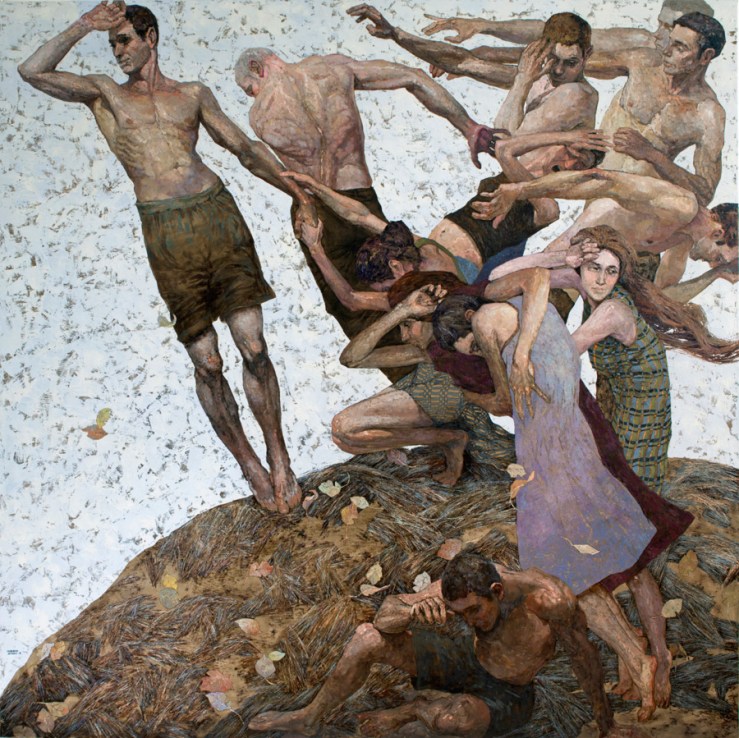
Denis Sarazhin (Ukrainian, 1982–), Wind, 2014. Oil on canvas, 78 3/4 × 78 3/4 in. (200 × 200 cm).
When the day of Pentecost arrived, they were all together in one place. And suddenly there came from heaven a sound like a mighty rushing wind, and it filled the entire house where they were sitting. And divided tongues as of fire appeared to them and rested on each one of them. And they were all filled with the Holy Spirit and began to speak in other tongues as the Spirit gave them utterance.
Now there were dwelling in Jerusalem Jews, devout men from every nation under heaven. And at this sound the multitude came together, and they were bewildered, because each one was hearing them speak in his own language. And they were amazed and astonished, saying, “Are not all these who are speaking Galileans? And how is it that we hear, each of us in his own native language? Parthians and Medes and Elamites and residents of Mesopotamia, Judea and Cappadocia, Pontus and Asia, Phrygia and Pamphylia, Egypt and the parts of Libya belonging to Cyrene, and visitors from Rome, both Jews and proselytes, Cretans and Arabians—we hear them telling in our own tongues the mighty works of God.” And all were amazed and perplexed, saying to one another, “What does this mean?” But others mocking said, “They are filled with new wine.”
But Peter, standing with the eleven, lifted up his voice and addressed them: “Men of Judea and all who dwell in Jerusalem, let this be known to you, and give ear to my words. For these people are not drunk, as you suppose, since it is only the third hour of the day. But this is what was uttered through the prophet Joel:
“‘And in the last days it shall be, God declares,
that I will pour out my Spirit on all flesh,
and your sons and your daughters shall prophesy,
and your young men shall see visions,
and your old men shall dream dreams;
even on my male servants and female servants
in those days I will pour out my Spirit, and they shall prophesy.
And I will show wonders in the heavens above
and signs on the earth below,
blood, and fire, and vapor of smoke;
the sun shall be turned to darkness
and the moon to blood,
before the day of the Lord comes, the great and magnificent day.
And it shall come to pass that everyone who calls upon the name of the Lord shall be saved.’”
For Artful Devotions from previous years’ feast of Pentecost, see:
“Like a Wildfire,” featuring a batik by the late Solomon Raj from India and a collaborative instrumental performance by Japanese jazz pianist Hiromi and Colombian jazz harpist Edmar Castaneda
“Come, Energy Divine,” featuring a cyanotype by contemporary Ukrainian icongrapher Roman Barabakh and a Sacred Harp hymn
This post belongs to the weekly series Artful Devotion. If you can’t view the music player in your email or RSS reader, try opening the post in your browser.
To view all the Revised Common Lectionary scripture readings for Pentecost Sunday, cycle A, click here.
VIDEO: “Ned Bustard: Making Good”:Cursive Films profiles Ned Bustard [previously], a graphic designer, linocut artist, and founder of Square Halo Books. Asked how he as a Christian defines success in his field, he responds with a quote by his friend Kurt Thompson: “We were made in joy to make things in and for joy.” So instead of asking, “Am I successful?,” we should be asking ourselves, “Am I doing what I was designed to do?,” Bustard says.
+++
ESSAY: “I’d Like to Learn to Love It Anyway” by Helena Sorensen: In this personal essay from the Rabbit Room, Sorensen reflects on the world’s brokenness and beauty, a world where there is grief and disappointment and uncertainty and scarring but also love and springtime and strength and song. She opens by recounting her eleven-year-old son’s very visceral feeling of pain in reaction to the death of a baby bird, and his exasperated “What’s the point of it all?” She then introduces a song that crystallizes her son’s struggle—“Letter to the Editor” by J Lind—while sharing her own struggles, since adolescence, to accept her body. There’s no theodicy here, no theological explanations for suffering; just an aspiration to live with openness and gratitude and perspective, and to take the bad along with the good, the cost of being human.
+++
NEW POEM: “Santo Spirito” by Jacqueline Osherow: (Read the poem before reading my commentary; I don’t want the latter to influence your first impressions!) Osherow is Jewish and also a lover of Renaissance art, having previously lived in Florence for a year and a half. And she has been enamored of birds since childhood. These influences coincide in her long free-verse poem “Santo Spirito” (Italian for “Holy Spirit”), subtitled “Autobiography with Doves.” Here she traces the presence, and sometimes absence, of the dove as symbol of the Holy Spirit in Italian master paintings of the Annunciation and the Baptism of Christ. Osherow said she does not read the New Testament but experiences Christian narrative and theology through art, which has “been working / on me all along, its proselytizing / deftly subliminal // like the edgy / come-ons urban / legend claims / were strategically / concealed in / advertisements.” (Still, she says, “I remain a Jew, . . . no matter / what I look at, what / I see.”)
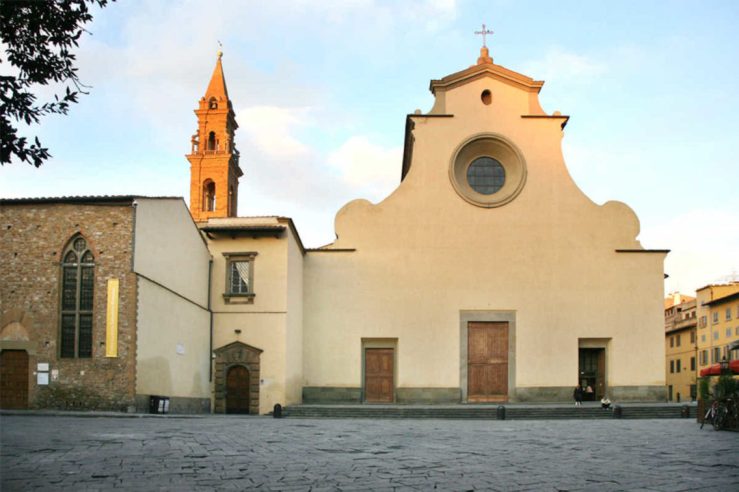
Basilica di Santo Spirito, Florence
The poem is a reflection on divine revelation and hiddenness, precision and mystery, the visible and invisible. Where and how does God’s spirit reside? What is holy, or can we say only when we encounter it? The poem hinges on the fifteenth-century Florentine church the poem takes its title from. Santo Spirito has a strikingly plain façade, a “supple blankness / wide-open, burning, / immaculate, . . . infinite,” like an unrolled scroll without writing. After a catalog of religious art that pictures and describes, Osherow pauses in front of this emptiness that is likewise inviting. Yes to artists’ visions, she says, to doves and other literalisms, to the transcription and translation of God’s word, to apologetic discourse and theologizing, to bumbling our way toward truth—but yes also to the way of unknowing.
My junior year of college I, too, lived in Florence—just a few minutes’ walk from Santo Spirito, in fact—so this poem is full of memories for me, and I love Osherow’s candid reflections on specific artworks in the city:
The Baptism of Christ by Piero della Francesca, made for the Priory of San Giovanni Battista at Sansepolcro in Tuscany, now in the National Gallery, London
The Annunciation panel of an altarpiece Piero della Francesca made for the Franciscan convent of Sant’Antonio da Padova in Perugia, now in the Galleria Nazionale dell’Umbria
Jacqueline Osherow read her poem recently for an Image-sponsored Zoom event followed by a Q&A (video link available on poem page). There were supposed to be photo slides of the paintings keyed to relevant stanzas, but the display doesn’t correct until 8:03.
+++
NEW SONG: “Halo My Path” by Josh Rodriguez: The words to this “quarantine chorale” are excerpted and adapted from a Puritan prayer titled “Voyage,” from the compilation The Valley of Vision. Composer Josh Rodriguez said he wrote the song “as I watched the bravery of medical professionals, the difficult decisions that government leaders faced, the disproportionate suffering of the poor, the unrest in my own heart. . . . I hope this prayer will challenge us to fight against the selfishness that resides in our hearts, to persevere in the long road to recovery, to appreciate once again that simple privilege of life together.” I’m grateful to Rodriguez for throwing this beautiful phrase into high relief: “Halo my path,” an address to God. Make bright my way, sanctify it, illuminate it with gentleness and love so that my every step is into the light of these virtues, not into the darkness of causticity and hate. The song is an aspiration to bless, to sow gladness rather than grief.
Halo my path with gentleness and love,
smooth every temper;
let me not forget how easy it is to occasion grief;
may I strive to bind up every wound,
and pour oil on all troubled waters.
May the world be happier because I live.
Halo my path.
+++
NEW ALBUM: Peace to All Who Enter Here by Josh Garrels: A mix of calming hymns and worship songs, including two previously unreleased originals: “Fear Thou Not” and “Creation Song.” I’ve long had a strong emotional connection to the opening song, “Turn Your Eyes Upon Jesus,” so I was hooked from the beginning!
“in the month of march the world entered a time of quarantine,” Josh’s wife Michelle writes on the album’s Bandcamp page. “our life of work- and school-from-home continued basically as usual. but beyond the boundaries of our yard, the world was rapidly shifting. instinctively for us, it was a time to pray & praise. when we enter into praise in times of uncertainty, we feel God’s goodness, the everything in His hands. His peace is a real, sustaining thing. josh began these days by firelight in the garage, mornings of prayer while winter melted away into hopeful spring. in the afternoons he’d turn on the recording gear & sing out praises. You’ll hear the click of the wood stove, the chirping of birds, our five children playing in the front yard. there was a spontaneity to this recording, & the result is sweet. . . . we hope you encounter the peace of Christ as you enter here, finding hope & faith restored in these turbulent times.”
+++
FILMS:
May 30 is the feast day of Joan of Arc, a French peasant girl who, during the Hundred Years’ War, claimed to have received visions from God instructing her to fight against English domination. She participated in military campaigns with the French army but was eventually captured and, after a trial financed by the English crown, burned at the stake. She was later sainted.
Joan of Arc has been the subject of many films. Here are two I’ve seen, both of which abandon glamorous military heroics to focus instead on some of the less flashy parts of her life, with Jeannette being set during her pre- and early adolescence, and The Passion during her trial.
Jeannette: The Childhood of Joan of Arc (2017): A thrash metal period musical is certainly a unique approach to take for Joan’s story, and this movie is . . . eccentric. It shows Joan, played by nonprofessional actors at ages eight and thirteen, as a shepherd girl in rural France, deeply pained by the English oppression of her people. “Our Father who art in heaven, your name is so far from being hallowed, and your reign from coming,” she laments. Pious beyond her years, she struggles to discern God’s will, and once she does, to follow it. She’s helped along by visions of the nun Madame Gervaise—whom writer-director Bruno Dumont splits into two singing, dancing figures played by twins—and others.
The ridiculousness of this art-house film will be off-putting to some, but I feel it does serve a function: we furrow our brows and roll our eyes and wonder if it’s for real, much like those contemporaries of Joan’s who were dismissive of her strange claims and behaviors.
The dialogue is adapted from Charles Péguy’s 1910 mystery play The Mystery of the Charity of Joan of Arc.
The Passion of Joan of Arc (1928): Starring Renée Falconetti in a legendary performance, this silent film classic paints Joan as a Christ figure who’s mocked and martyred for her refusal to betray God’s will. There are allusions throughout to Christ’s passion: shadows form a cross on the wall; Joan weaves a crown of straw; there’s a bloodletting scene; et cetera. Expressionistic lighting and painfully intimate close-ups immerse viewers in Joan’s subjective experience. (As a sidebar, Falconetti was thirty-five when she played the role, whereas Joan was only nineteen when she was tried and martyred; I think because Falconetti’s portrayal is so iconic, people often forget how young Joan was.)
Director Carl Theodor Dreyer was very concerned with documentary authenticity, so he enlisted the leading expert on Joan of Arc, Pierre Champion, as a historical adviser on the film. The script is based heavily on transcripts of Joan’s trial and execution, which are held at the Bibliothèque Nationale in Paris. The French ecclesiastical court, allied with the English, press Joan on the veracity of her visions, her certainty of salvation, her support of Charles VII, her wearing of men’s clothing; she continues to insist that she is fulfilling the mission God called her to. Though the historical Joan was subjected to twenty-two interrogation sessions spread out over a few months, by necessity the movie telescopes them into a brief timespan.
Many composers have written scores for the film. The Criterion release gives three options: Richard Einhorn’s Voices of Light oratorio, which takes a traditional, maximalist approach; a score by Goldfrapp’s Will Gregory and Portishead’s Adrian Utley, utilizing electric guitars, voices, synthesizers, brass, harp, and percussion; and a minimalist piano score by Mie Yanashita. However, purists say the film should be watched in silence, as Dreyer preferred.
Hannah Frank (Scottish, 1908–2008), Sun, 1943. Pen and ink on paper, 46 × 32.8 cm. Ben Uri Gallery and Museum, London.
Mary didn’t waste a minute. She got up and traveled to a town in Judah in the hill country, straight to Zachariah’s house, and greeted Elizabeth. When Elizabeth heard Mary’s greeting, the baby in her womb leaped. She was filled with the Holy Spirit, and sang out exuberantly,
You’re so blessed among women,
and the babe in your womb, also blessed!
And why am I so blessed that
the mother of my Lord visits me?
The moment the sound of your
greeting entered my ears,
The babe in my womb
skipped like a lamb for sheer joy.
Blessed woman, who believed what God said,
believed every word would come true!
And Mary said,
I’m bursting with God-news;
I’m dancing the song of my Savior God.
God took one good look at me, and look what happened—
I’m the most fortunate woman on earth!
What God has done for me will never be forgotten,
the God whose very name is holy, set apart from all others.
His mercy flows in wave after wave
on those who are in awe before him.
He bared his arm and showed his strength,
scattered the bluffing braggarts.
He knocked tyrants off their high horses,
pulled victims out of the mud.
The starving poor sat down to a banquet;
the callous rich were left out in the cold.
He embraced his chosen child, Israel;
he remembered and piled on the mercies, piled them high.
It’s exactly what he promised,
beginning with Abraham and right up to now.
SONG: “Visitation Song” by Aly Aleigha, on Jealous Love (2015), sung with Jessica Schissel-Romportl
This post belongs to the weekly series Artful Devotion. If you can’t view the music player in your email or RSS reader, try opening the post in your browser.
To view all the Revised Common Lectionary scripture readings for the Visitation of Mary to Elizabeth, cycle A, click here.
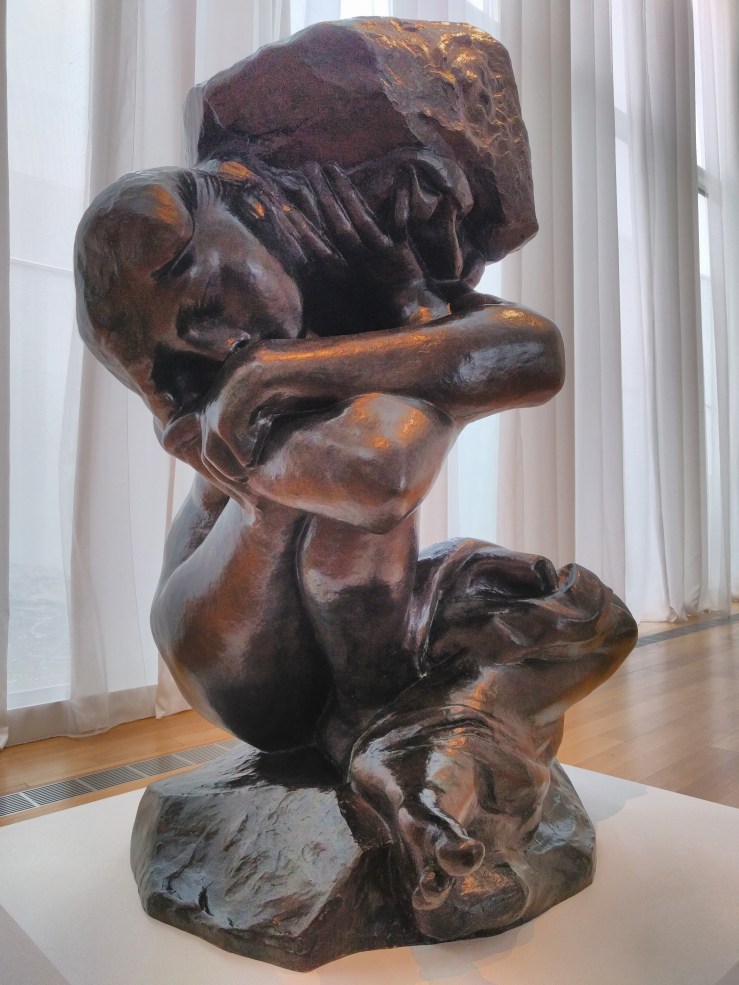
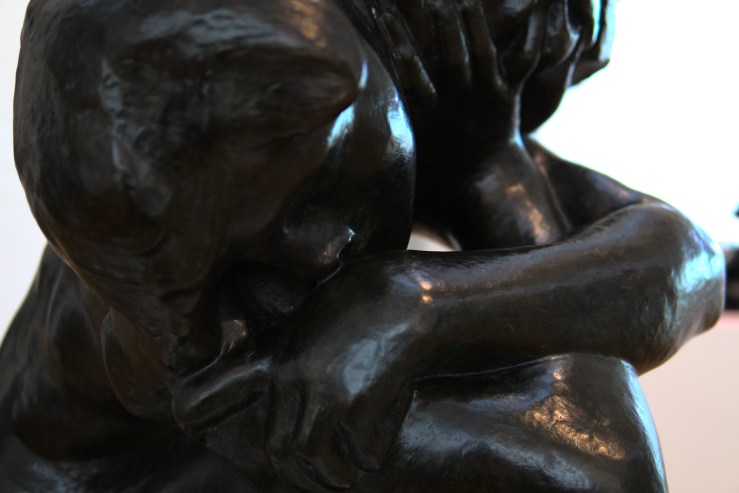
Auguste Rodin (French, 1840–1917), Fallen Caryatid with a Stone, modeled 1881–82, enlarged 1911–17, Musée Rodin cast 1988. Bronze, 52 1/2 × 33 × 39 in. (133.4 × 83.8 × 99.1 cm). North Carolina Museum of Art, Raleigh. Photo: Victoria Emily Jones.
Cast your burden on the LORD,
and he will sustain you;
he will never permit
the righteous to be moved.
—Psalm 55:22
Cast all your anxiety on him, because he cares for you.
—1 Peter 5:7
Whatever form our anxiety takes, it’s a burden that Sunday’s lectionary reading calls us to relinquish at the feet of God. (Note: To the assigned reading from 1 Peter, I’ve added a similar verse from Psalm 55.)
+++
SONG: “Take Your Burden to the Lord and Leave It There” by Charles A. Tindley, 1916 | Recorded by Washington Phillips on December 2, 1927, and released January 1928; reissued by Dust-to-Digital on Washington Phillips and His Manzarene Dreams, 2017
One of the founding fathers of American gospel music, Charles A. Tindley [previously] wrote “Take Your Burden to the Lord and Leave It There” in 1916. It started making the rounds in black churches, and gospel-blues artists and guitar evangelists began recording it for big-city record labels, who would send representatives around the country to collect and record “race music” to then press into 78s to market to African Americans.
One of the earliest recordings of “Burden” is by Washington Phillips (1880–1954), a singing farmer-preacher from Simsboro, East Texas; it’s one of eighteen sides he recorded for Columbia Records from 1927 to 1929. He sings it to his own “novelty accompaniment,” as Columbia credited it—a custom instrument he built by reconfiguring two fretless zithers, restringing them and giving them a unique tuning pattern. He played it with both hands and called it a Manzarene, according to a recently discovered Teague Chronicle article from 1907. Musicologists have marveled at the flowing, harp-like sounds his invention enabled and have been unable to reproduce it with any kind of exactness.
This photo of Phillips from his 1927 recording session in Dallas shows him holding two zithers that appear to be attached.
Phillips’ “Burden” has since been reissued by several labels, but the best-quality reissue is Dust-to-Digital’s from 2016. The sixteen-track CD comes with a small seventy-six-page hardcover containing photographs, news clippings, ads, recording contracts and other documents, lyrics, and biographical and instrumentation information by the world’s premier Phillips researcher, Michael Corcoran. The extensive liner notes open thus:
The mystery of Washington Phillips begins the first time you hear his sweetly-sung Christian blues, bathed in a celestial haze of notes from an instrument that sounds like a child’s music box. His music is a simple prayer, with the blessing in the asking, the singing, the playing. But his ethereal sound is also highly developed to the point of being almost psychedelic. Where did this strange and moving music come from?
Having interviewed former neighbors and living relatives in Freestone County and combed through archives, Corcoran corrects a lot of misinformation about Wash Phillips, some based on his being confused with his cousin of the same name, who died in a mental institution in 1938, and one persistent myth—that his instrument was a dolceola (a keyboard-activated board zither)—stemming from a misidentification in the liner notes of the Dutch label Agram’s 1984 compilation. I’m constantly impressed by what Dust-to-Digital puts out, and I can’t recommend this product enough.
In 2015 the Dutch-based nonprofit The Influences filmed Phil Cook, a phenomenal guitarist, performing a similar rendition (it is one of two songs he chose to represent his musical influences):
Found Wandering also has a great version up on YouTube, with Sarah Comstock on vocals, accompanied by guitar and fiddle:
This post belongs to the weekly series Artful Devotion. If you can’t view the music player in your email or RSS reader, try opening the post in your browser.
To view all the Revised Common Lectionary scripture readings for the Seventh Sunday of Easter, cycle A, click here.
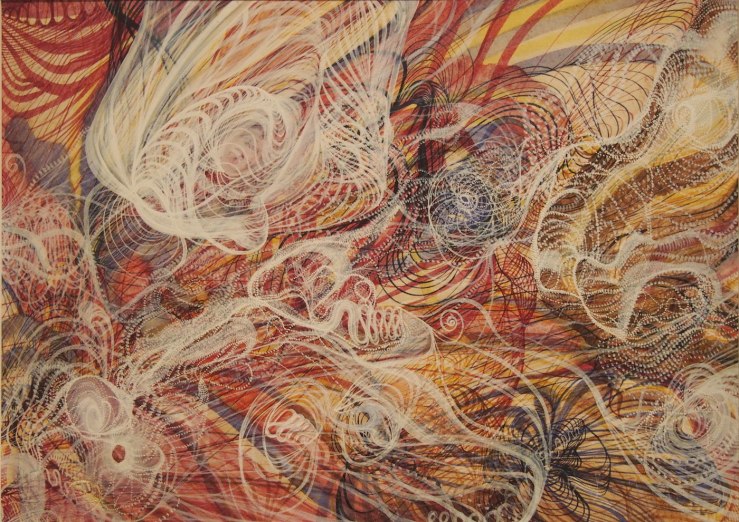
Georgiana Houghton (British, 1814–1884), The Risen Lord, 1864. Watercolor and gouache on paper laid on board with pen and ink inscription on the reverse. Photo: Jessica Freeman-Attwood/Hyperallergic.
In the first book, O Theophilus, I have dealt with all that Jesus began to do and teach, until the day when he was taken up, after he had given commands through the Holy Spirit to the apostles whom he had chosen. He presented himself alive to them after his suffering by many proofs, appearing to them during forty days and speaking about the kingdom of God.
And while staying with them he ordered them not to depart from Jerusalem, but to wait for the promise of the Father, which, he said, “you heard from me; for John baptized with water, but you will be baptized with the Holy Spirit not many days from now.”
So when they had come together, they asked him, “Lord, will you at this time restore the kingdom to Israel?” He said to them, “It is not for you to know times or seasons that the Father has fixed by his own authority. But you will receive power when the Holy Spirit has come upon you, and you will be my witnesses in Jerusalem and in all Judea and Samaria, and to the end of the earth.” And when he had said these things, as they were looking on, he was lifted up, and a cloud took him out of their sight.
—Acts 1:1–9
+++
SONG: “Coelos ascendit hodie” (Ascended today into heaven) | Words: Anonymous, 12th century | Music by Charles Villiers Stanford, ca. 1892 | Performed by the Stanford Chamber Chorale and the Choir of Trinity College, Cambridge, under the direction of Stephen M. Sano, 2007
Coelos ascendit hodie Jesus Christus Rex gloriae Sedet ad Patris dexteram Gubernat coelum et terram
Jam finem habent omnia Patris Davidis carmina Jam Dominus cum Domino Sedet in Dei solio
In hoc triumpho maximo Benedicamus Domino Laudatur Sancta Trinitas Deo dicamus gratias
English translation:
Jesus Christ, the King of Glory,
has ascended today into the heavens.
He sits at the right hand of the Father
and rules heaven and earth.
Now all the psalms of David,
our father, are fulfilled.
Now the Lord sits with the
Lord on the seat of God.
In this greatest of triumphs
let us bless the Lord.
The Holy Trinity be glorified.
Let us give thanks to God.
Stanford’s “Coelos ascendit hodie,” op. 38, no. 2, is a double-choir motet setting of a medieval Ascension hymn, the second piece in his Three Latin Motets set [previously].
+++
Consisting of “frenetic spirals of color and swirling sinuous lines” (source), The Risen Lord by Georgiana Houghton was produced in Victorian England some eighty years before abstract expressionism came onto the scene. Houghton renounced authorship of her artworks, believing herself to be a medium who channeled saints, archangels, Renaissance painters, and dead relatives to produce what she called “spirit drawings.” She was a Spiritualist, which means she believed in the possibility of contact with a spirit realm and that such communication could bring one closer to God. Ink and watercolors were, for her, a way of unveiling an invisible reality, of conveying God’s “wondrous attributes,” she said.
“On the back of most of her works, Houghton included a handwritten explanation, with illustrated annotations of the abstract forms,” Jessica Freeman-Attwood said. “In The Risen Lord Houghton writes that the lower part corresponds to the virtues and sufferings of Christ’s life on earth, whereas the upper part, dominated by arabesque white threads, represents his ascension into heaven.”
+++
Ascension Day is May 21 this year. For previous years’ devotions for the occasion, see “God Ascended” (featuring a German Renaissance painting and a clever repurposing and retuning of an eighteenth-century verse) and “Carried Up” (featuring a balletic Christ image by the late Javanese artist, dancer, and choreographer Bagong Kussudiardja, and a Romantic piano composition).
This post belongs to the weekly series Artful Devotion. If you can’t view the music player in your email or RSS reader, try opening the post in your browser.
To view all the Revised Common Lectionary scripture readings for the Ascension of the Lord, cycle A, click here.
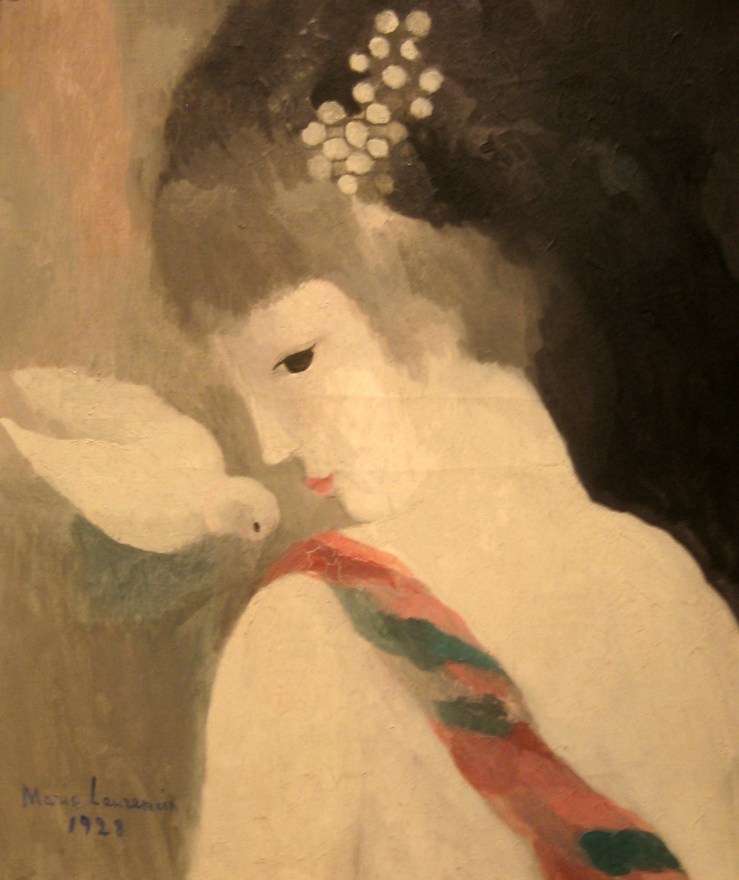
Marie Laurencin (French, 1885–1956), Girl with a Dove, 1928. Oil on linen, 46.3 × 38.4 cm (18 1/4 × 15 1/8 in.). National Gallery of Art, Washington, DC. Photo: Victoria Emily Jones.
“If you love me, you will keep my commandments. And I will ask the Father, and he will give you another Helper, to be with you forever, even the Spirit of truth, whom the world cannot receive, because it neither sees him nor knows him. You know him, for he dwells with you and will be in you.
“I will not leave you as orphans; I will come to you. Yet a little while and the world will see me no more, but you will see me. Because I live, you also will live. In that day you will know that I am in my Father, and you in me, and I in you. Whoever has my commandments and keeps them, he it is who loves me. And he who loves me will be loved by my Father, and I will love him and manifest myself to him.”
This post belongs to the weekly series Artful Devotion. If you can’t view the music player in your email or RSS reader, try opening the post in your browser.
To view all the Revised Common Lectionary scripture readings for the Sixth Sunday of Easter, cycle A, click here.
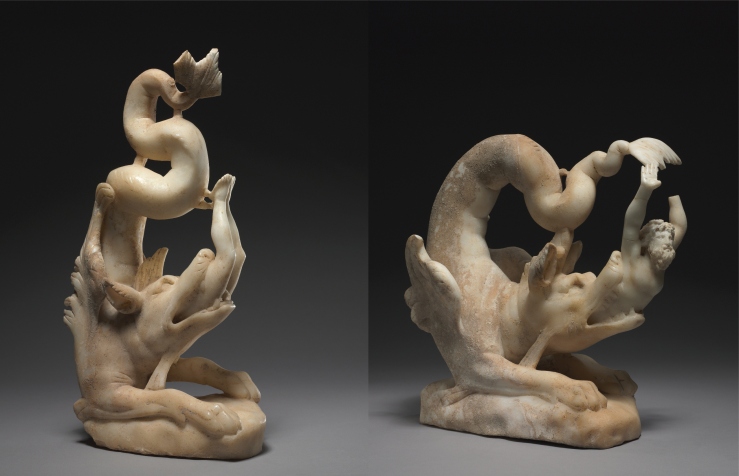
Jonah Swallowed and Jonah Cast Up, commentary by Victoria Emily Jones: My latest visual meditation for ArtWay was published Sunday—it’s on two third-century Jonah sculptures from Asia Minor that likely decorated a family fountain. Early Christians read the story allegorically (at least on one level), as pointing forward to the death and resurrection of Christ. The “great fish” is portrayed as a ketos, a sea-monster of Greek myth.
“Jonah Swallowed” and “Jonah Cast Up,” made in Asia Minor, probably Phrygia, 280–90 CE. Marble, 50.4 × 15.5 × 26.9 cm (left) and 41.5 × 36 × 18.5 cm (right). Cleveland Museum of Art, Ohio.
Run by Marleen Hengelaar-Rookmaaker, the faith-based website ArtWay has been publishing a new visual meditation every Sunday for years, as well as a lot of other content from a variety of contributors. To subscribe to the weekly email, click here. Here are just a few VMs published in the past year that I particularly enjoyed:
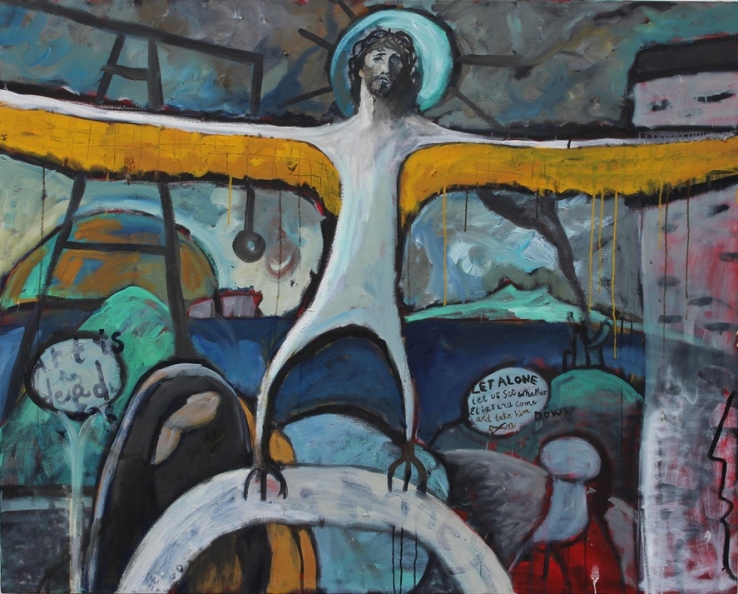
Manu-Kahu by Brett a’Court, commentary by Rod Pattenden: Pattenden begins, “This striking image of an airborne Christ is from New Zealand painter Brett a’Court. It is part of his investigations into a way of bringing together the spiritual insights of the indigenous culture of the Maori people and that of Christianity brought to New Zealand by British settlers. In cultural terms it is a hybrid image. This is something that occurs when two cultures are in a process of mutual re-assessment. That sort of conversation is full of conflict and critique but also allows for the potential for new forms to arise that express the best of both traditions. A Christ figure flying in the sky like a kite, is such a form. It is a new thing, a potential heresy or aberration, but one full of potential for new insight and spiritual refreshment.”
Brett a’Court (New Zealand, 1968–), Manu-Kahu, 2007. Oil on canvas.
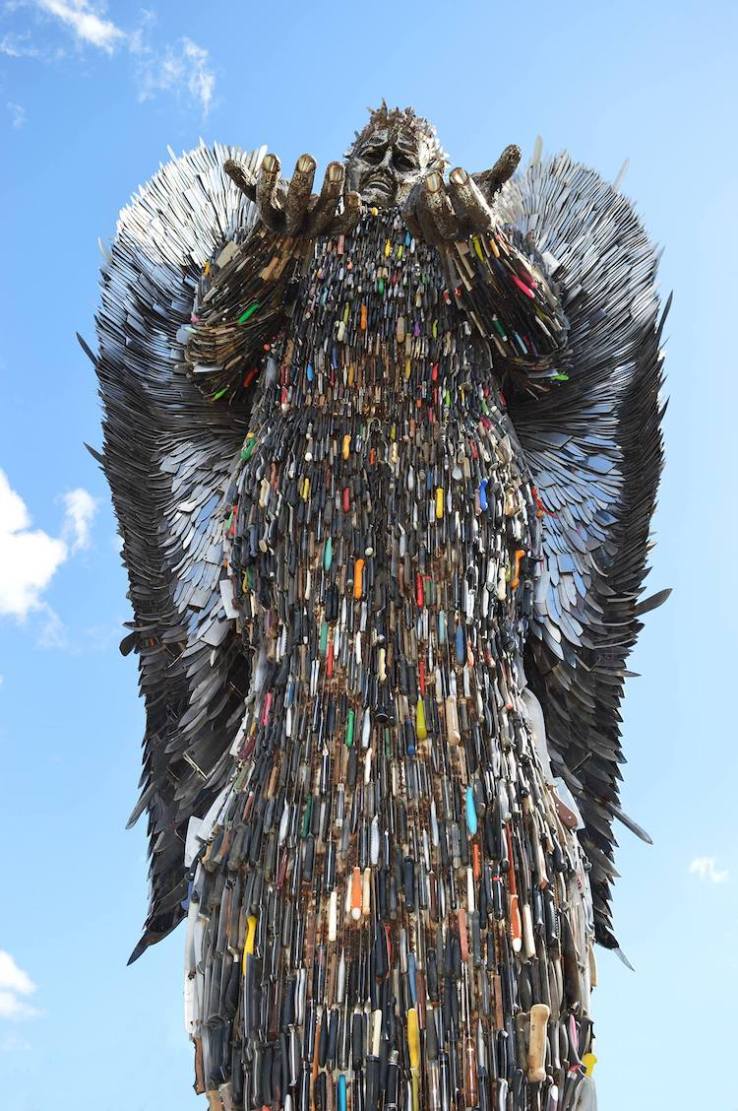
Knife Angel by Alfie Bradley, commentary by Rachel Wilkerson: This twenty-seven-foot-tall sculpture, welded from 100,000 knives collected in confiscations and amnesties around the UK, confronts the issue of knife violence. The artist cleaned and dulled the blade of each knife he received and engraved personal messages on all the wings’ “feathers,” messages sent by families affected by knife violence.
Cathedra by Barnett Newman, commentary by Grady van den Bosch: I saw this painting in Amsterdam last spring and was surprised by how it compelled me. (I don’t typically gravitate to abstract art.) After spending some time up close—I supposed this was a Newman, and Newman says his paintings need to be experienced up close—I looked at the label and saw that it has a religiously inflected title: Cathedra. The word is Latin for “seat,” and in Christianity it refers specifically to the bishop’s chair inside a church (churches that had a cathedra were called cathedrals). But Newman was of Jewish descent, and van den Bosch writes that Cathedra is meant to represent the throne of God. “And above the firmament that was over their heads was the likeness of a throne, as the appearance of a sapphire stone . . .” (Ezek. 1:26).
Barnett Newman (American, 1905–1970), Cathedra, 1951. Oil and acrylic on canvas, 243 × 543 cm. Stedelijk Museum, Amsterdam, Netherlands. Photo: Victoria Emily Jones.
As someone who loves historical Christian art, including its many Christ Pantocrators, I must nevertheless admit that there is something so right about modern artists’ often apophatic approach to evoking the Divine. While I do believe God imaged Godself in the person of Jesus Christ and is therefore representable, I understand the argument some make that abstraction is a better visual language for spiritual subject matter or encounter. I accept both/and. Whether God is shown as a rich, blue expanse that invites and envelops, or a heroic nude emerging from the jaws of death, or a Man of Sorrows head with a harrier hawk’s body, I think we can learn a little something from the diversity of representations, which are not mutually exclusive. Not all representations need be embraced, but nor do unfamiliar, difficult, or even shocking ones need be automatically dismissed.
Click on the link for more on how to read Newman’s color field paintings, including his signature “zips.”
The course aims to help Christians develop critical tools for watching television and a vocabulary that is as rich and thoughtful as the medium itself, so that we can engage it constructively. (It need not be mindless entertainment!) Callaway explores television as a technology, a narrative art form, a commodity, and a portal for our ritual lives. He’s interested in how stories are told in this episodic, audiovisual format, and what that means for the Story we tell. The course is not about what Christians should watch, but how Christians should watch, leaving ample room for individual viewers to set their own boundaries, ethical and otherwise. (Callaway acknowledges that TV can form as well as de-form us.) He discusses empathy building and access to other perspectives, knowing your sensibilities, how being offended can be useful, watching in community, seeing God in all places, being aware of how your desires and imagination are being shaped, Christians in Hollywood (and Christian characters on TV), and the culture shaping TV and TV shaping culture, among other things.
The course is fairly broad in its approach; it does not analyze particular shows or episodes, though some specific examples are mentioned in conversations, and students are encouraged to form discussion groups with friends or family members and apply what they’re learning to shows of their choice. I really appreciated the assigned PBS docuseries America in Primetime (somewhat outdated because made in 2011 but very good nonetheless), whose four episodes explore character types throughout the history of TV, from the fifties to today: “The Independent Woman,” “Man of the House,” “The Misfit,” and “The Crusader.” From taking this course I realized how many acclaimed TV shows I’ve never seen. I’ve got a lot of homework to do!
Other arts courses offered by Fuller Formation are
POEM: “My Mother’s Body” by Marie Howe, read with commentary by Pádraig Ó Tuama: As Mother’s Day is Sunday, I thought I’d share this wonderful, sad-sweet, mother-themed episode of the new Poetry Unbound podcast from On Being Studios. Pádraig Ó Tuama introduces Marie Howe’s “My Mother’s Body,” in which a middle-age woman, caring for her dying mother, thinks back to the time when her mother was just a twenty-four-year-old girl giving birth to her. The speaker in the poem is Howe.
She imagines being in her mother’s womb, experiencing the rhythm of her mother’s heartbeat. (What an exercise, to imagine yourself as your mother’s baby!) Now decades later, her mother is dying—that heart is failing, and the kidneys too. The uterus has been removed. Toggling between the two time frames, the poem is both a celebration of the strength of women’s bodies and a lament for its vulnerabilities, especially in old age. Howe marvels at how her mother’s body was capable of such a wonder as giving and sustaining life, and now to see that once-vibrant form breaking down grieves her. In some sense their roles have switched as daughter mothers mother, combing her hair, changing her soiled bedsheets.
The poem opens with “Bless my mother’s body” and ends with “Bless this body she made . . .” In the progression of pronouns in the last two lines—my, her, our—is a recognition of how our mothers always remain a physical part of us. They are in our cells. “My Mother’s Body” is a thank-you and a letting go.
ARTICLE: “5 Contemporary Poets Christians Should Read” by Mischa Willett:“There is so much good crop still being pulled from the fertile fields of theologically inflected verse,” writes poet Mischa Willett—so don’t stop short, content merely with Donne and Hopkins! This is an excellent short list of contemporary poets of faith, with summaries of key themes and recommendations for which volume(s) to start with. Willet was recently on The Ride Home with John and Kathy to discuss this topic, and he wrote a follow-up post on his blog.
+++
MUSIC VIDEO: “I Am a Poor Wayfaring Stranger”: One of the most poignant scenes in last year’s 1917 is when, after a harrowing journey across No Man’s Land, Lance Corporal William Schofield—exhausted, disoriented—reaches a wood and encounters a fellow British soldier singing the spiritual “Wayfaring Stranger” [previously] to a battalion that sits at somber attention, for they’re about to go into battle. This official music video from Sony splices together clips from the movie with studio footage of the actor and singer Jos Slovick.
Helen Siegl (Austrian, 1924–2009), Rejoice & Be Glad, 1974. Color woodcut, 30 × 30 cm. Edition of 50. Sacred Art Pilgrim Collection.
“Let not your hearts be troubled. Believe in God; believe also in me. In my Father’s house are many rooms. If it were not so, would I have told you that I go to prepare a place for you? And if I go and prepare a place for you, I will come again and will take you to myself, that where I am you may be also.”
—John 14:1–3
+++
SONG: “Come and Go with Me to My Father’s House” | Traditional African American | Performed under the musical direction of Dr. Markanthony Henry (on piano), with soloist Caterina Finocchi, at Iglesia Presbiteriana San Andrés (Saint Andrew’s Presbyterian Church) in Buenos Aires, Argentina, October 28, 2012
Art collector John A. Kohan has a wonderful biographical write-up about Helen Siegl on his website, Sacred Art Pilgrim—not to mention a select compilation of her art.
A devout Catholic all her life, Siegl was born in Vienna and was a teenager at the time of the Anschluss (the annexation of Austria to Nazi Germany). After the traumatic years of World War II and during the Soviet occupation of her home country, she emigrated to Canada in 1952. She got married and settled in Philadelphia, where her husband served as conservator of paintings at the Philadelphia Museum of Art. She raised eight children with him while also working as a printmaker—mostly woodcuts and linocuts. Her style blends elements of folk art and German expressionism, and her themes were often biblical.
This post belongs to the weekly series Artful Devotion. If you can’t view the music player in your email or RSS reader, try opening the post in your browser.
To view all the Revised Common Lectionary scripture readings for the Fifth Sunday of Easter, cycle A, click here.
“Maren” (Have Mercy on Us): The First Lady of Ethiopia, Zinash Tayachew, sings a new gospel song whose Amharic title, ማረን, transliterated “Maren,” means “Have mercy on us,” a plea addressed to God. “Do not abandon us during this time when the world is terrorized by bad news,” she sings. [HT: Global Christian Worship]
+++
Apocalyptic Lockdown Blues, a new EP by David Benjamin Blower: One of my favorite singer-songwriters, from Birmingham, England. “Apocalyptic Lockdown Blues is a small oral history of a global pandemic,” Blower writes. “This is folk, rootsy and ambient, with sacred longings, poetry and politics, sung out of windows and accompanied by birdsong.”
+++
“A Celtic Prayer”: Produced by Jonathan Estabrooks, this video features the choir of Fifth Avenue Presbyterian Church in New York City singing a traditional Celtic blessing set to music by Barry Peters. It begins, “May the Christ who walks on wounded feet walk with you on the road.”
+++
Virtual May Morning 2020: May Day, May 1, is a public holiday in England, and for the past five hundred-plus years it has been an Oxford tradition to kick off the celebration at dawn by having the Choir of Magdalen College sing unaccompanied in the Renaissance style from the top of the college’s bell tower. Typically a crowd of thousands gathers for May Morning along High Street and on Magdalen Bridge, but this year the event was canceled due to COVID-19. However, Magdalen College pulled off a virtual choir! The boy choristers and lay clerks recorded their parts from home, under the direction of Mark Williams, which were combined in a video that was released online at 6 a.m. local time. [HT: Joy Clarkson]
The choir sings “Hymnus Eucharisticus,” a seventeenth-century Trinitarian hymn, and “Now Is the Month of Maying,” an English ballett (a light, dancelike part song similar to a madrigal) from 1595, about lads and lasses frolicking in the grass. The prayer in the middle is led by the Rev. Dr. Andrew Bowyer, dean of divinity. The actual church bells did ring out the hour like usual, with a celebratory chime following the performance (the chimes in the video were prerecorded).
+++
“Doxology”: One of the things I miss most about communal (in-person) worship is singing the Doxology together with my church family each week. As part of his “Covers from an Empty House” series, Ben Rector has posted a contemplative rendition at the piano, which captures the sense of both mourning and hope that so characterizes this global moment. [HT: TGC Arts & Culture Newsletter]
+++
“I Know Who Holds Tomorrow”: This song was written by Ira Stanphill in 1950 following a painful divorce. It’s covered here by The Petersens, a family bluegrass group from Missouri.
+++
Scott Avett [previously] has been posting #emptylivingroomconcert videos on Instagram since the beginning of the year—just him and his guitar (or banjo) and a sixty-second time limit. Here are a few. (He’s the writer of all these songs, I’m assuming.)
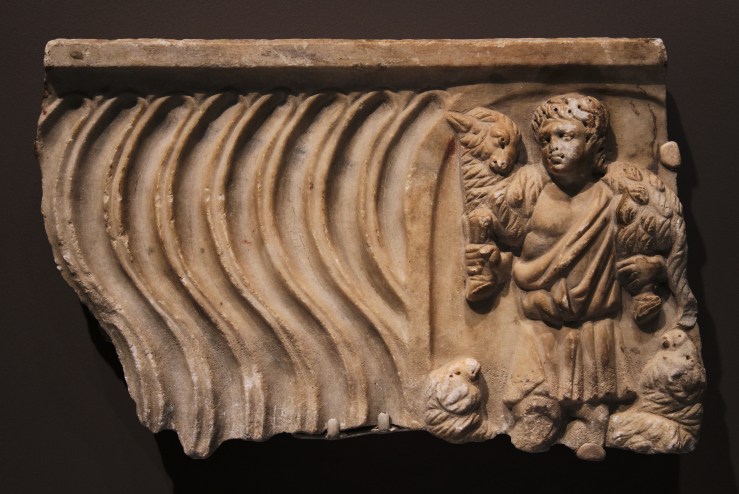
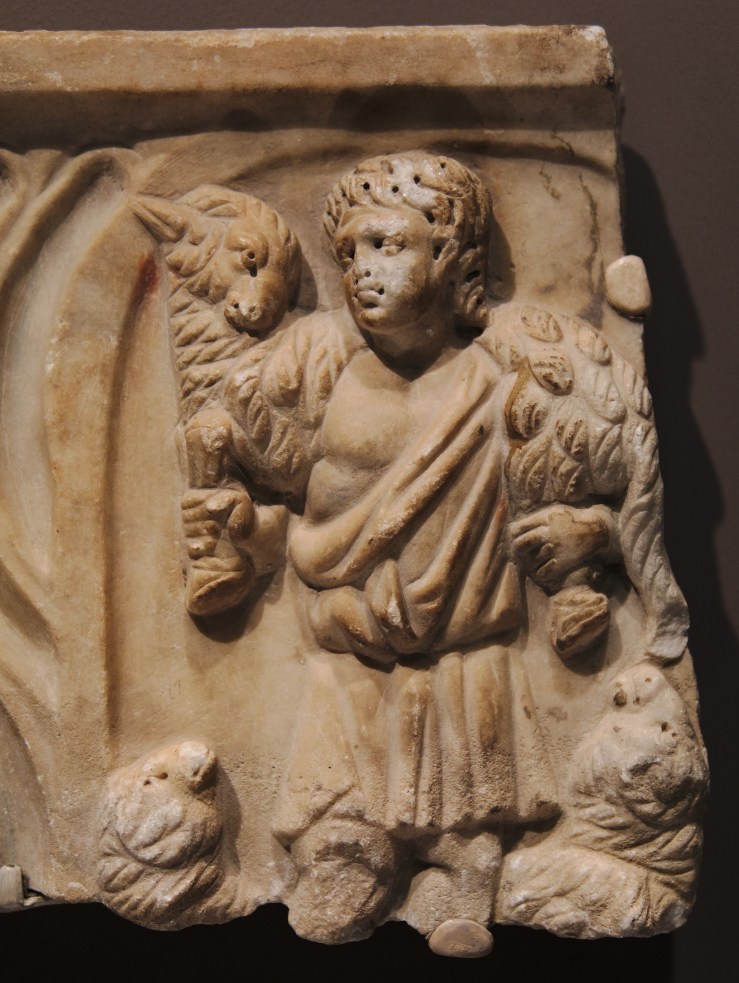
Sarcophagus Fragment with the Good Shepherd, Rome, early 4th century. Marble, 13 9/16 × 21 5/8 in. (34.5 × 55 cm). Walters Art Museum, Baltimore. Photo: Victoria Emily Jones.
God, my shepherd!
I don’t need a thing.
You have bedded me down in lush meadows,
you find me quiet pools to drink from.
True to your word,
you let me catch my breath
and send me in the right direction.
Even when the way goes through
Death Valley,
I’m not afraid
when you walk at my side.
Your trusty shepherd’s crook
makes me feel secure.
You serve me a six-course dinner
right in front of my enemies.
You revive my drooping head;
my cup brims with blessing.
Your beauty and love chase after me
every day of my life.
I’m back home in the house of God
for the rest of my life.
—Psalm 23 (MSG)
The King James Version’s translation of Psalm 23 from Hebrew into English is unsurpassable in terms of sheer poetic beauty, but since I’ve featured it here before and the words are so very familiar, I thought I’d shake things up a bit by giving Eugene Peterson’s contemporary translation.
The relief carving in this post is from a gallery of early Christian art at the Walters Art Museum in Baltimore, one of my favorite local hangouts. The museum label reads,
This fragment comes from a small Early Christian sarcophagus that was probably made for a child. At the right is a young shepherd, who carries a lamb over his shoulders as two sheep gaze up at him from below. The image of the Good Shepherd originated with the pagan Greek figure of Hermes (the gods’ messenger and ram-bearer) and was later transformed into Jesus as the Good Shepherd who watches over his flock.
SONG: “The King of Love My Shepherd Is” | Words by Sir Henry Williams Baker, 1868 | Music: Traditional Irish tune (ST. COLUMBA) | Arranged by Paul Terracini and performed by the Ars Nova Vocal Group, on Hymns of Our Forefathers, 2000
The King of love my shepherd is,
whose goodness faileth never.
I nothing lack if I am his,
and he is mine forever.
Where streams of living water flow,
my ransomed soul he leadeth;
and where the verdant pastures grow,
with food celestial feedeth.
Perverse and foolish, oft I strayed,
but yet in love he sought me;
and on his shoulder gently laid,
and home, rejoicing, brought me.
In death’s dark vale I fear no ill,
with thee, dear Lord, beside me;
thy rod and staff my comfort still,
thy cross before to guide me.
Thou spreadst a table in my sight;
thy unction grace bestoweth;
and oh, what transport of delight
from thy pure chalice floweth!
And so through all the length of days,
thy goodness faileth never;
Good Shepherd, may I sing thy praise
within thy house forever.
I chose this intricate a cappella SATB arrangement as the feature track for today, but for a solo female vocalist on acoustic guitar, see Taylor Tripodi:
Though “The King of Love” is most associated with the traditional Irish tune ST. COLUMBA, it is sometimes sung to a handful of others. Below you can hear it with a different traditional Irish tune (MCKEE), arranged by Harry T. Burleigh in 1939. Performed by Tyler Anthony (of Cereus Bright) and the musicians of Redeemer Knoxville, this peppier version appears on the 2011 Cardiphonia album Songs for the Supper:
This post belongs to the weekly series Artful Devotion. If you can’t view the music player in your email or RSS reader, try opening the post in your browser.
To view all the Revised Common Lectionary scripture readings for the Fourth Sunday of Easter, cycle A, click here.





 Art & Theology