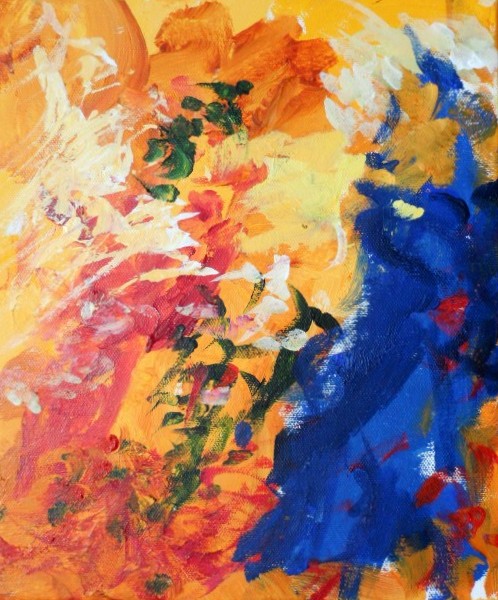
Ivanka Demchuk (Ukrainian, 1990–), Christ in Glory, 2015. Mixed media on wood, 15 3/4 × 11 1/2 in. Collection of John A. Kohan. Photo: Victoria Emily Jones.
I am the Alpha and the Omega, the first and the last, the beginning and the end.
—Revelation 22:13
+++
SONG: “Alpha and Omega” by Erasmus Mutanbira, 2005 | Performed by Spirit & Truth, 2012
(Note: An earlier version of this post misattributed the song to Israel Houghton. Houghton popularized the song on his Alive in South Africa album, but the words and music are by Erasmus Mutanbira from Zimbabwe.)
This post belongs to the weekly series Artful Devotion. If you can’t view the music player in your email or RSS reader, try opening the post in your browser.
To view all the Revised Common Lectionary scripture readings for the Seventh Sunday of Easter, cycle C, click here.
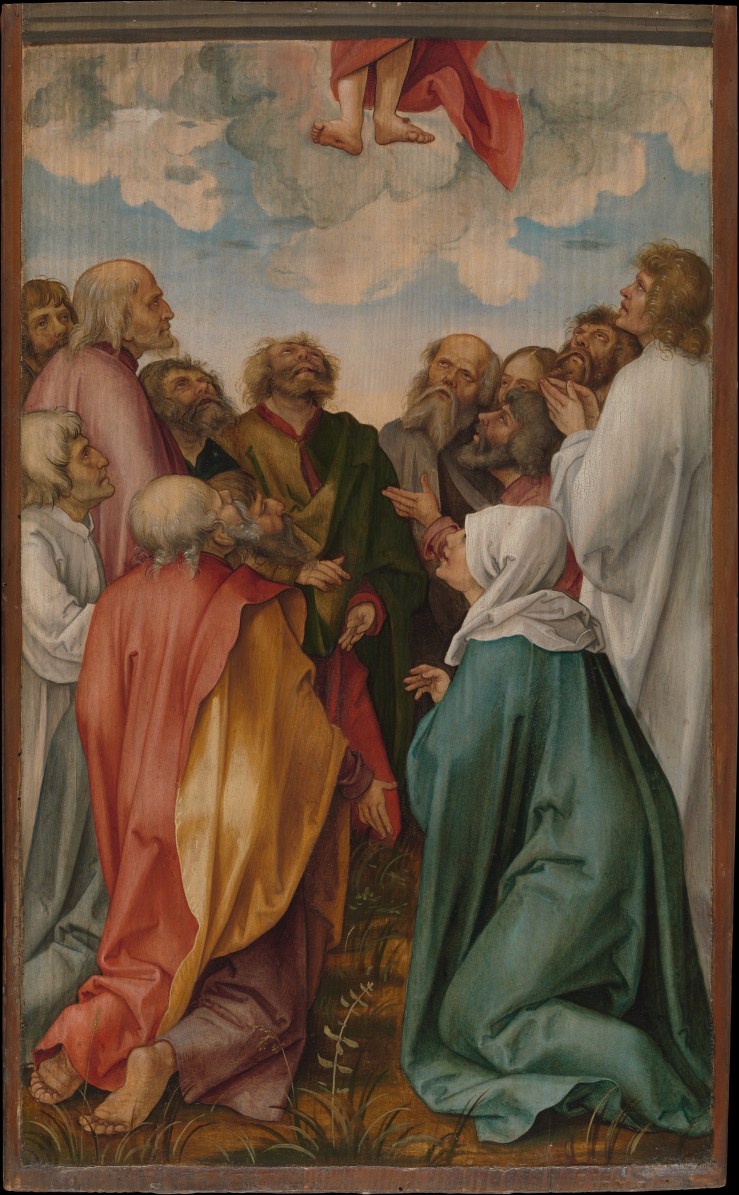
Hans Süss von Kulmbach (German, ca. 1480–1522), The Ascension of Christ, 1513. Oil on fir wood, 24 1/4 × 15 in. (61.5 × 38.1 cm). Metropolitan Museum of Art, New York.
Then he said to them, “These are my words that I spoke to you while I was still with you, that everything written about me in the Law of Moses and the Prophets and the Psalms must be fulfilled.” Then he opened their minds to understand the Scriptures, and said to them, “Thus it is written, that the Christ should suffer and on the third day rise from the dead, and that repentance for the forgiveness of sins should be proclaimed in his name to all nations, beginning from Jerusalem. You are witnesses of these things. And behold, I am sending the promise of my Father upon you. But stay in the city until you are clothed with power from on high.”
And he led them out as far as Bethany, and lifting up his hands he blessed them. While he blessed them, he parted from them and was carried up into heaven. And they worshiped him and returned to Jerusalem with great joy, and were continually in the temple blessing God.
—Luke 24:44–53
+++
SONG: “God Ascended” | Words by Joseph Hart, 1759, add. Bruce Benedict and Sarah Majorins | Music by Sarah Majorins, 2012 | Performed on Ascension Songs, a Cardiphonia compilation album
In this short SATB choral work, Sarah Majorins extracts the final verse from Joseph Hart’s “Come, Ye Sinners, Poor and Needy,” setting it to a new tune. On the one hand, Christ’s ascension is something to celebrate, tied up, as it is, in his exaltation at the right hand of God on high, where he intercedes for us; Luke even tells us that the disciples ultimately responded “with great joy.” But on the other hand, there must have been a solemnity to the occasion, as the disciples were saying goodbye to the physical presence of their friend and teacher. (We know from John’s Gospel that Mary Magdalene, for example, had to resist her desire to not part with Jesus.)
Majorins bends the tune of this song toward the latter mood and, with Bruce Benedict, has added a second verse that expresses a feeling of longing for and complete reliance on Christ’s return. Its refrain is the cry of the church that’s voiced in the penultimate verse of the Bible: “Come, Lord Jesus!” (or, in Aramaic, Maranatha!). Download the full piano score, courtesy of Liturgy Letter and by permission of the artist.
Lo! th’incarnate God, ascended,
Pleads the merit of his blood;
Venture on him, venture wholly,
Let no other trust intrude:
None but Jesus,
None but Jesus,
None but Jesus
Can do helpless sinners good.
Lo! th’incarnate God, ascended,
Enters now the heav’nly realms,
Angels singing alleluia
As they receive their Lord and King.
Maranatha,
Maranatha,
Maranatha,
Maranatha, we on earth still sing:
Come, O come, Lord Jesus, come.
This post belongs to the weekly series Artful Devotion. If you can’t view the music player in your email or RSS reader, try opening the post in your browser.
To view all the Revised Common Lectionary scripture readings for Ascension Day, cycle C, click here.
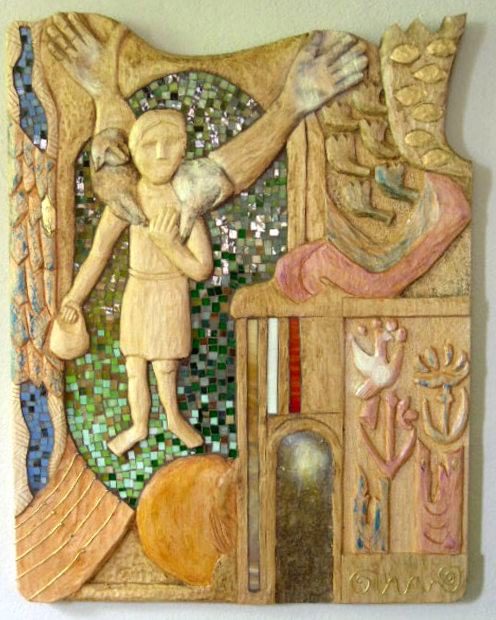
Sister Mary Ann Osborne, SSND, Paths of Peace, 2005. Linden wood, glass, brass wire, gold leaf, and paint, 36 × 27 × 1 in.
Jesus answered him, “If anyone loves me, he will keep my word, and my Father will love him, and we will come to him and make our home with him. Whoever does not love me does not keep my words. And the word that you hear is not mine but the Father’s who sent me.
“These things I have spoken to you while I am still with you. But the Helper, the Holy Spirit, whom the Father will send in my name, he will teach you all things and bring to your remembrance all that I have said to you. Peace I leave with you; my peace I give to you. Not as the world gives do I give to you. Let not your hearts be troubled, neither let them be afraid. You heard me say to you, ‘I am going away, and I will come to you.’ If you loved me, you would have rejoiced, because I am going to the Father, for the Father is greater than I. And now I have told you before it takes place, so that when it does take place you may believe.”
—John 14:23–29
+++
SONG: “I Leave You My Peace” | Music by Maxime Kovalevsky, French Orthodox Church, Paris, 1940s–50s | Arranged by Josef Gulka, Holy Cross Orthodox Church, Medford, NJ | Performed by the St. Symeon Orthodox Church Choir, Birmingham, AL, on Fire and Light (2010)
The mixed-media artwork above is by Sister Mary Ann Osborne, a Minnesota nun in the order of the School Sisters of Notre Dame. The Good Shepherd figure references a Christian fresco from the third-century catacomb of St. Callixtus in Rome, where the shepherd carries a sheep over his shoulders, securing it with one hand while carrying a milk pail in the other; it’s an image of care and protection derived from scripture. Sister Mary Ann has added two open-palmed hands rising up behind, or perhaps emerging from, the shepherd, a posture of prayer (orans) but also of benediction (see, e.g., Lev. 9:22; Luke 24:50).
Christ is pronouncing a blessing—it could be the words of peace and promise from his farewell discourse, excerpted in Sunday’s lectionary reading. We, his people, receive it. He has forged “paths of peace” for us to follow, as Sister Mary Ann’s work suggests, with road markings at the bottom left inviting us to set off where Christ has trod. And he goes with us in the Spirit.
He has called the world to a new order, signified by the shofar at the right, which announces Jubilee. As one of seven, the trump also carries connotations of the day of the Lord.
This post belongs to the weekly series Artful Devotion. If you can’t view the music player in your email or RSS reader, try opening the post in your browser.
To view all the Revised Common Lectionary scripture readings for the Sixth Sunday of Easter, cycle C, click here.
Readers often ask me what podcasts I listen to, so today I want to share one of them with you, which comes out of my home state of North Carolina: Makers & Mystics.
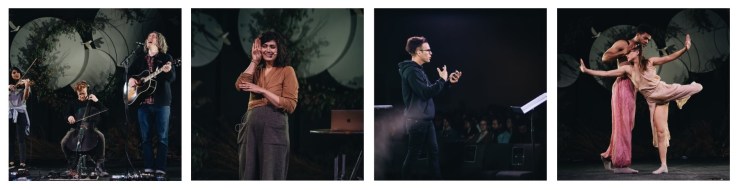
Hosted by Stephen Roach, Makers & Mystics is a biweekly podcast that aims to “develop a greater cultural understanding of why creativity abides at the core of our spirituality and why artists are called to be ‘architects of hope’ for our cities.” It is run by The Breath & the Clay, an organization based in Winston-Salem, which, in addition to producing regular online audio content, also hosts an annual conference and artist retreats. (Their 2019 conference already passed—you can purchase audio of all the presentations here—but two retreats are still being offered this year, in June and October; I just added them to my recent roundup, but you can also just go directly here for all the info.)
Besides interviewing people from our own time, Roach and friends also highlight historical figures who have contributed to the practice or discourse of art, faith, and spirituality. These short (ten- to fifteen-minute) scripted episodes make up the Artist Profile Series. Spotlighted individuals include Hans Rookmaaker, Dorothy Sayers, Hildegard von Bingen, Wassily Kandinsky, and Sadhu Sundar Singh, among others.
The Breath & the Clay creative arts gathering is held in North Carolina every March.
I love to find out about the various creative endeavors that the people of God are engaged in, and Makers & Mystics is one of my primary avenues for doing that. I’m impressed by the wide variety of disciplines and styles that Roach has curated in his selection of interview subjects, and I appreciate the mix of fine and folk art (some people reject this distinction, but you know what I mean). Though there are recurring themes in some of the interviews—things like the importance of honesty and integrity, and how to live a life awake to wonder—I find each episode so unique. It’s fun to hear different people’s stories and creative processes.
If this is the first time you’re encountering Makers & Mystics, you might want to start with one of the foundational episodes, which do not follow an interview format:
The very first things we learn about God in Genesis, Roach says, is that he’s a creative being, and that he takes immense joy in the creative process. So when we’re told in Genesis 1:26 that humans are created in God’s image, Roach continues, our only concept of God up to this point is that he’s a creator who delights in creating. That’s why creativity is not ornamental but, rather, is in our blood; it’s our birthright as human beings.
“Lawgivers don’t shape culture,” says Ray Hughes. “Artists do. They’re the ones that tell us who we are. That’s why I say, songwriters: hey, you’re not writing next year’s most popular chorus; you’re writing the next generation’s language for accessing God.”
To sample some interview highlights from Makers & Mystics, check out the 2017 year-in-review episode. I’ve enjoyed all the episodes, but a few that have particularly stood out to me, in addition to the ones I list above, are “On Vocation and Calling” with Josh Garrels (+ part 2), one of my favorite music artists; “Evergreen” with Audrey Assad, where Audrey discusses overcoming religious trauma, dealing healthily with emotions, and her love of Celtic spirituality and music; and “Ring of Fire” with Moda Spira, which I linked to last fall, on the grief that accompanies divorce.
To explore the Makers & Mystics archives, hop on over to their website, http://www.makersandmystics.com/, and check them out on Patreon if you’re interested in giving financial support. You can also download episodes from iTunes, Spotify, or your favorite podcast-listening app.
Here is a list of upcoming arts conferences and retreats. I will be attending the CIVA conference next month as well as the DITA conference in September—if you’ll be at either, please let me know; I’d love to meet you!
All Things New (International Arts Festival) Date: June 15, 2019 Location: Waterras Common Hall 3F, Tokyo, Japan Cost: ¥2500 (about $22) Presenters: Joshua Messick, Gerda Liebmann, Christopher Elmerick, Roger Lowther, and more Organizer:Community Arts Tokyo (with additional sponsorship by Grace City Church Tokyo) Description: “How can people in a city experience personal, social, and economic flourishing? What is the role of artists in making this world a better place? How can faith, work, and the arts come together for a holistic view of peace for the good of mankind? At this conference, we will hear from artists in the business world, the media world, and the plight of refugees from other countries. Their stories will give us a vision for how the arts point a way to new beginnings and bring goodness and hope into a broken world. Join us as we enter this world through speaker presentations, music performances, a short film, gallery exhibits, small group discussions, and more!” (Note: Presentations in Japanese will have simultaneous English translation over the wireless earphone system.)
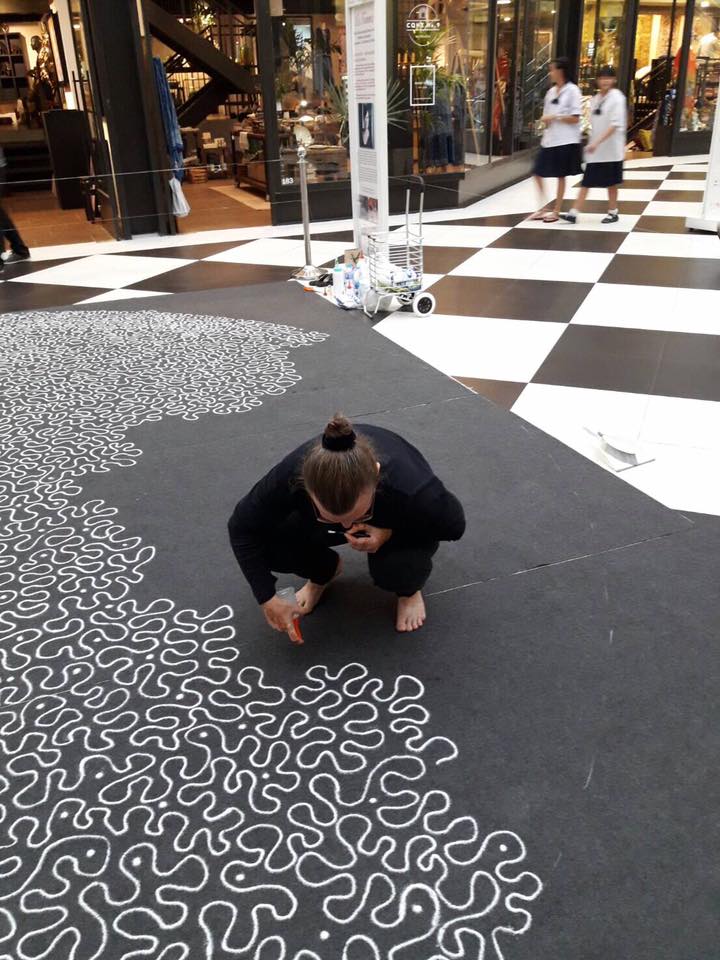
At the “All Things New” festival next month, Thai artist Gerda Liebmann will be installing one of her “salt art” pieces.
The festival will include presentations/workshops/performances by
hammered dulcimer player Joshua Messick, who contributed to the soundtrack of the Japanese animated fantasy film Mary and the Witch’s Flower
visual artist Gerda Liebmann, on how art can foster relationship and connection
Christopher Elmerick, who founded and runs a cultural center in Berlin that promotes the free exchange of ideas through shared work- and performance spaces and more
Megumi Project, a group of women artisans who upcycle vintage kimonos into shawls, scarves, bags, journals, and other accessories
the Charis Chamber Players
organist Roger Lowther, on the physics of music
Roger Lowther is, with his wife Abi, the founder and director of Community Arts Tokyo, “a team of artists, professionals, and Japanese nationals assisting church planting through outreach, discipleship, worship, and disaster relief.” Their work is supported through Mission to the World, the international missions arm of the Presbyterian Church in America (PCA).
+++
Are We There Yet? Date: June 13–16, 2019 Location: Bethel University, St. Paul, Minnesota, USA Cost: $350 for nonmembers; $300 for members Presenters: Sedrick Huckaby, Letitia Huckaby, Hawona Sullivan Janzen, Chris Larson, Rico Gatson, Nate Young, Linnéa Spransy, Cara Megan Lewis, Rev. Babette Chatman, Jamie Bennett, Joanna Taft, Kelly Chatman, Joyce Lee, Caroline Kent, Lyz Wendland, Betsy Carpenter, Amanda Hamilton, Catherine Prescott, Vito Aiuto, and others Organizer:Christians in the Visual Arts (CIVA) Description: “If you’re anything like us, working in an age of high anxiety and disruption has been trying. At the same time, the art world has never seen more diversity, wealth, interconnection, and popular appreciation. Some experience our current creative conditions as a ‘joyful noise,’ others a ‘resounding gong.’ This makes art difficult yet at the same time crucial. With our hope rooted in the Lord, we can rejoice in the unfinished state of our work. There is still so much to be made!
“Are We There Yet invites us to inhabit questions together: What are our shared pursuits? What practices and commitments can guide us in our work and collaboration? What would radical generosity do to the global art market? And how might we be participants in making ‘impossible things possible,’ as described by curator Hans Ulrich Obrist? With a commitment to hospitality, we will ask these questions and many more.”
At Valley House Gallery in Dallas, Sedrick Huckaby stands in front of portraits he painted of his children, his wife Letitia, and himself. Sedrick and Letitia are two of the keynote speakers for CIVA’s 2019 Biennial Conference. Photo: Dane Walters/Kera News.
The conference will consist of plenary talks, panel discussions, and breakout sessions and will include a juried art show, late-night artist show & tells, optional day-ahead tours (art museums, city architecture, or sculpture garden) or workshops (printmaking or photography), a Liz Vice concert, and an ecumenical worship service.
+++
Visual Arts Retreat Date: June 21–23, 2019 Location: Apple Hill Lodge, Moravian Falls, North Carolina, USA Cost: $450 (includes lodging, food, and class materials) Presenters: Allison Luce, Corey Frey, Ty Nathan Clark (via satellite), Stephen Roach, Thomas Torrey, Lauren Olinger Organizer:The Breath & the Clay Description: “Come get away for a weekend designed to inspire and deepen your understanding of visual art both as a spiritual practice and as an art form.”
+++
Vocation, Motherhood, and Artmaking Date: July 25–28, 2019 Location: Laity Lodge, Leakey, Texas, USA Cost: $495 (scholarships available) Presenters: Andi Ashworth, W. David O. Taylor, Letitia Huckaby, Phaedra Taylor, Sandra McCracken, Ashley Cleveland Organizer:Laity Lodge Description: “This retreat is an invitation to explore the opportunities and challenges that are involved in the twin calling to motherhood and artmaking. It is open to mothers in all stations and circumstances of life, whether at the beginning of motherhood or in the fullest years of grandmothering, and to artists of all media, disciplines and contexts.” (Read more from David Taylor.)
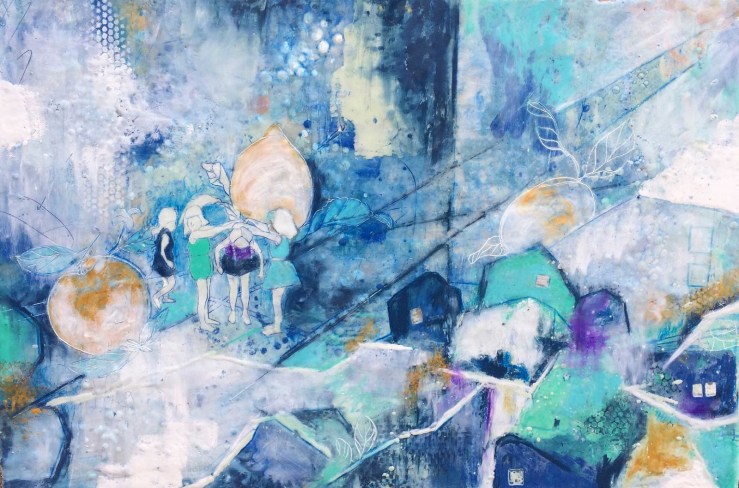
Phaedra Taylor (American), The Book of Games: Oranges & Lemons, 2018. Encaustic on wood panel, 20 × 30 in.
+++
Kingdom Creatives Con Date: August 3, 2019 Location: National Union Building, Washington, DC Cost: $99 Presenters: Noah Elias, Othello Banaci, Rachel Petrillo, Anifa Mvuemba, John David Harris, Ryan Han, Andrew Hochradel Organizer: Bemnet Yemesgen Description: A conference “aimed at igniting inspiration, learning, and networking in the Christian creative community. . . . Attendees will enjoy workshops and talks by creatives from diverse backgrounds and industries. The conference is specifically tailored towards creatives who love Jesus Christ . . . graphic designers, illustrators, photographers, filmmakers, developers, animators, copywriters,” etc.
+++
New York City Arts Weekend Date: August 9–10, 2019 Location: Various venues, New York, USA Cost: $295 CAN Presenters:Makoto Fujimura, Iwan Russell-Jones Organizer:Regent College (host: Jeff Greenman) Description: “Makoto Fujimura and Iwan Russell-Jones lead this exploration of Christian faith and the visual arts in New York City. Enjoy a fascinating tour of the Metropolitan Museum of Art and participate in shared meals, stimulating presentations, and challenging conversations. Develop a deeper understanding of how creativity finds its place in the new creation.”
+++
Creation and New Creation: Discerning the Future of Theology and the Arts Date: September 5–8, 2019 Location: Duke University, Durham, North Carolina, USA Cost: $175 (student discounts available) Presenters: Jeremy Begbie, Malcolm Guite, Christian Wiman, N. T. Wright, Natalie Carnes, Jennifer Craft, Carlos Colón, Steve Prince, Bruce Herman, Judith Wolfe, and others Organizer:Duke Initiatives in Theology and the Arts (DITA) Description: “At DITA10, we will celebrate past scholarship, reflect on today’s landscape, and imagine with tomorrow’s leaders.” The colloquium will include keynote lectures; workshops for church leaders and artists addressing the challenges of theology and the arts in the church and in our daily lives; panel discussions with artists and theologians; a concert by the New Caritas Orchestra; and a corporate worship service.
Bruce Herman (American, 1953–), Riven Tree, 2016. Oil on wood panels with gold, silver, and platinum leaf, 96 × 47 in. York Chapel, Duke Divinity School, Durham, North Carolina. [see “making of” video] [see in situ photo]
+++
The Future of the Catholic Literary Tradition (Catholic Imagination Conference) Date: September 19–21, 2019 Location: Loyola University Chicago, USA Cost: $150 Presenters: Tobias Wolff, Alice McDermott, Paul Schrader, Dana Gioia, Paul Mariani, Richard Rodriguez, Angela Alaimo O’Donnell, and others Organizer:Hank Center for the Catholic Intellectual Heritage Description: “This international biennial conference, sponsored by Loyola’s Hank Center, features over 60 writers, poets, filmmakers, playwrights, journalists, editors, publishers, students, and critics who will explore a variety of questions surrounding the Catholic imagination in literature and the arts. What is the future of the Catholic literary tradition? What is the state of discourses in faith and Christian humanism in a world increasingly described as ‘Post’—postmodern, post-human, post-Christian, post-religious? How is Catholic thought and practice (or the absence of it) represented in literature, poetry, and cinema? If, as David Tracy observes, religion’s ‘closest cousin is not rigid logic, but art,’ what might literary art be trying to communicate to its ‘cousin’—and to us all—as we travel along the first decades of the 21st century?”
The call for papers is still open, until June 15. Also check out some of the special events being offered, which will include a theatrical performance of Flannery O’Connor’s Everything That Rises Must Converge and an evening of poetry readings, live music, and a Chicago blues panel.
+++
Writer’s Retreat Date: October 25–27, 2019 Location: Apple Hill Lodge, Moravian Falls, North Carolina, USA Cost: $450 (includes lodging and food) Presenters: TBA Organizer:The Breath & the Clay Description: “Come get away for a weekend designed to develop your writing both as a spiritual practice and as an art form.”
+++
The Art of the Lost: Destruction, Reconstruction, and Change Date: November 27–29, 2019 Location: Canterbury Cathedral, England Cost: £175 for full conference (single-day tickets also available) Presenters: Sandy Nairne, Simon Cane, James Clark, Ascensión Hernández Martínez, Emma J. Wells, and others Organizer:Canterbury Cathedral Description: “This conference will explore and appraise current and developing studies of how art changes, is reused or repurposed, disappears or is rediscovered. It will look at how and why art is defaced, destroyed or is lost within architectural settings, with a particular focus on art within the context of cathedrals, churches or other places of worship. It will consider changing ideologies, iconoclasm, war, fashion and symbolism. It will cover art from the 6th century to the modern day.”
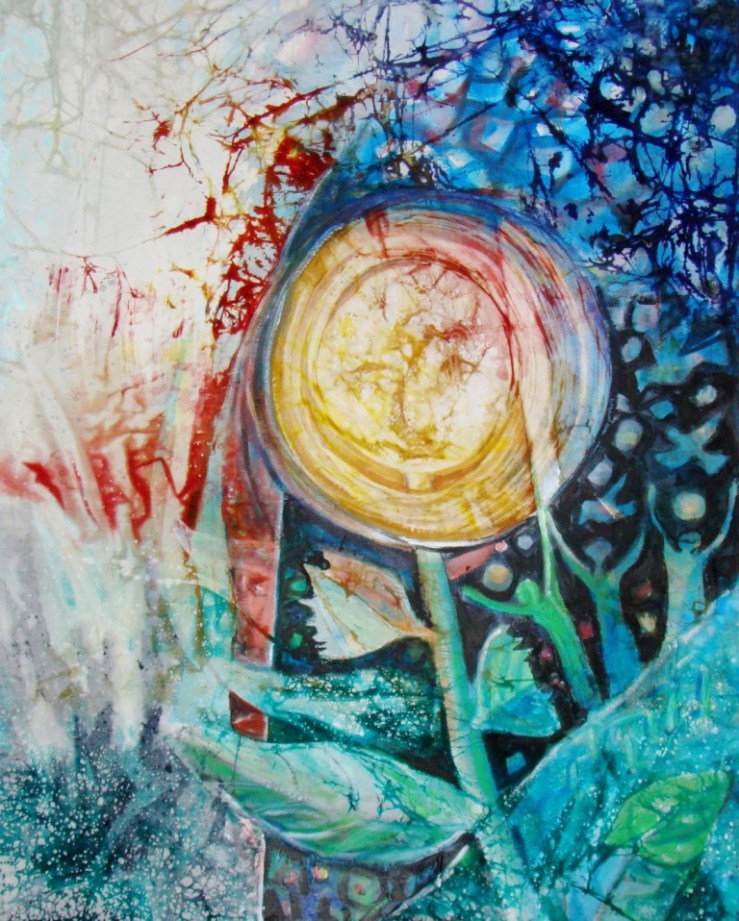
Untitled batik painting by Tony Nwachukwu (Nigerian, 1959–)
Praise the LORD!
Praise the LORD from the heavens;
praise him in the heights!
Praise him, all his angels;
praise him, all his hosts!
Praise him, sun and moon,
praise him, all you shining stars!
Praise him, you highest heavens,
and you waters above the heavens!
Let them praise the name of the LORD!
For he commanded and they were created.
And he established them forever and ever;
he gave a decree, and it shall not pass away.
Praise the LORD from the earth,
you great sea creatures and all deeps,
fire and hail, snow and mist,
stormy wind fulfilling his word!
Mountains and all hills,
fruit trees and all cedars!
Beasts and all livestock,
creeping things and flying birds!
Kings of the earth and all peoples,
princes and all rulers of the earth!
Young men and maidens together,
old men and children!
Let them praise the name of the LORD,
for his name alone is exalted;
his majesty is above earth and heaven.
He has raised up a horn for his people,
praise for all his saints,
for the people of Israel who are near to him.
Praise the LORD!
The above performance, by folk duo All Sons & Daughters (Leslie Jordan and David Leonard), was filmed in the small town of Assisi, Italy, where St. Francis penned his beautiful canticle of all creation, addressing the elements of nature as siblings—Sister Sun, Brother Moon, and so on. Almost seven hundred years later, British pastor William H. Draper paraphrased the poem (which was originally written in the Umbrian dialect) to create “All Creatures of Our God and King,” now a classic of Christian hymnody.
The constant noise in the background is, I believe, cicadas.
All creatures of our God and King,
lift up your voice and with us sing
alleluia, alleluia!
Thou burning sun with golden beam,
thou silver moon with softer gleam,
O praise him, O praise him,
alleluia, alleluia, alleluia!
Thou rushing wind that art so strong,
ye clouds that sail in heav’n along,
O praise him, alleluia!
Thou rising morn, in praise rejoice,
ye lights of evening, find a voice,
O praise him, O praise him,
alleluia, alleluia, alleluia!
Thou flowing water, pure and clear,
make music for thy Lord to hear,
alleluia, alleluia!
Thou fire so masterful and bright,
that givest man both warmth and light,
O praise him, O praise him,
alleluia, alleluia, alleluia!
And all ye men of tender heart,
forgiving others, take your part,
O sing ye, alleluia!
Ye who long pain and sorrow bear,
praise God and on him cast your care,
O praise him, O praise him,
alleluia, alleluia, alleluia!
Let all things their Creator bless,
and worship him in humbleness,
O praise him, alleluia!
Praise, praise the Father, praise the Son,
and praise the Spirit, three in one.
O praise him, O praise him,
alleluia, alleluia, alleluia!
This post belongs to the weekly series Artful Devotion. If you can’t view the music player in your email or RSS reader, try opening the post in your browser.
To view all the Revised Common Lectionary scripture readings for the Fifth Sunday of Easter, cycle C, click here.
TGC ARTICLE:“18 Paintings Christians Should See”: The Gospel Coalition Arts & Culture editor Brett McCracken has rounded up fourteen arts professionals to each choose an artistically and theologically significant painting and write about it in 200 words or less—and I’m one of them! I chose Caravaggio’s The Incredulity of Saint Thomas, which shows that famous encounter between the “doubting” disciple and the risen Christ. Here Thomas literally puts his finger on the flesh-and-blood reality of the resurrection, and you can see the marvel in his face.
Caravaggio (Italian, 1571–1610), The Incredulity of Saint Thomas, 1601–2. Oil on canvas, 107 × 146 cm (42 × 57 in.). Sanssouci Picture Gallery, Potsdam, Germany.
Other selections in the article range from medieval manuscript illuminations and Dutch Golden Age portraits to pop art and abstract minimalism. You might recognize the names of some of the contributors whom I’ve featured before on Art & Theology, like Jonathan A. Anderson, Matthew J. Milliner, W. David O. Taylor, and Terry Glaspey—they have all been influential to me. I’m very encouraged to see this major evangelical website engaging with visual art.
+++
POEMS: “Featured Poet: Laurie Klein”: In this post from Abbey of the Arts, poet Laurie Klein introduces herself, discussing the sacred themes in her work and her approach to writing poetry, as well as sharing three of her poems: “How to Live Like a Backyard Psalmist,” “I Dream You Ask, But Where Do I Start,” and “Poem for Epiphany.” All three are wonderfully evocative, and I’m definitely going to check out her collection, Where the Sky Opens. The first poem references St. Kevin of Glendalough, a sixth-century Celtic monk whose hand outstretched in prayer once became a nesting place for a blackbird. The poem is about how to live a life of joy, wonder, and praise, and it begins,
Wear shoes with soles like meringue
and pale blue stitching so that
every day you feel ten years old.
Befriend what crawls.
Drink rain, hatless, laughing.
Sit on your heels before anything plush
or vaguely kinetic:
hazel-green kneelers of moss
waving their little parcels
of spores, on hair-trigger stems.
ARTISTS GROUP AT BIRCHWOOD: The Birchwood Painters, founded in 2009, is a group of painters with disabilities who live at Birchwood care home in Chesham, Buckinghamshire, in England, exhibiting locally and in an annual art show at Birchwood. One of the members is Mark Urwin, who has cerebral palsy and uses a wheelchair. Mark loves studying art history, especially the impressionists. Landscapes are his favorite genre to paint, but he also interprets religious works by the Old Masters—like Simone Martini and Lippo Memmi’s Annunciation, or Leonardo da Vinci’s Last Supper—in his own semiabstract style, using bright swaths of color. In 2016 Mark gave a lecture on his work at the Royal Academy of Arts in London.
Mark Urwin (British), Annunciation (after Martini and Memmi), 2013. Acrylic on canvas, 30 × 25 cm.Mark Urwin (British), Last Supper (after Leonardo), 2013. Acrylic on canvas, 25 × 75 cm.
Mark uses an easel that was specially designed for him by DEMAND (Design and Manufacture for Disability) to enable greater freedom and control in his creations. Whereas before, an art class volunteer had to hold Mark’s canvas, making certain angles to paint more awkward, the DEMAND easel improves canvas access, as the canvas can be positioned in any orientation to Mark, with the bulk of his electric wheelchair no longer posing a problem. Furthermore, he can keep his talk board on his lap so that he doesn’t lose his voice while painting.
+++
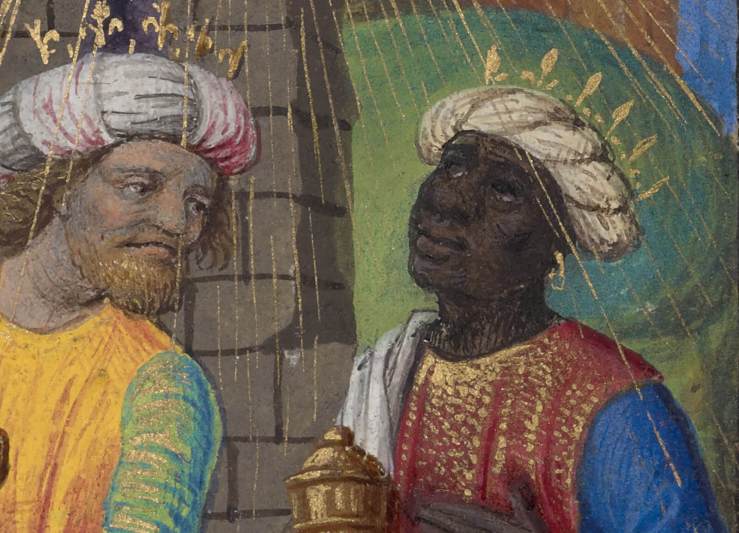
EXHIBITION-IN-PROGRESS: “Exhibition to Examine Balthazar, a Black African King in Medieval and Renaissance European Art”: “Early medieval written legends report that one of the three kings who paid homage to the Christ Child in Bethlehem was from Africa. But it would take nearly 1,000 years for European artists to begin representing Balthazar, the youngest of the three kings, as a black man. Why? . . .
“Delving into the Getty’s collections, we are at work on the exhibition Balthazar: A Black African King in Medieval and Renaissance Art (November 19, 2019–February 17, 2020). We are examining how Balthazar’s depiction coincided with and was furthered by the rise of the slave trade—and we invite your input to inform the exhibition. What questions or ideas do you have about this topic? What stories or themes would you like to see explored? We are eager to incorporate your views into our process.”
Detail of The Adoration of the Magi from a French Book of Hours (Ms. 48, fol. 59) showing the magus Balthazar (right), ca. 1480–90, by Georges Trubert. J. Paul Getty Museum, Los Angeles.
In this post from the Getty’s blog, The Iris, in addition to finding out how to relay feedback, learn about who the Magi were, what tradition says about them, and the development of Balthazar’s image over time.
I appreciate the Getty’s efforts to be more inclusive in the visual histories they highlight and to solicit input from the general public to assist them in this task. They did the same for their 2018 exhibition Outcasts: Prejudice and Persecution in the Medieval World.
+++
TED TALK / LIVE PAINTING: “Can Art Amend History?” by Titus Kaphar: American artist Titus Kaphar reconfigures historical artworks—through cutting, bending, overpainting, stitching, tarring, and tearing—to include African American subjects. In this thirteen-minute presentation before a live audience, Kaphar opens by sharing the words his young son spoke upon seeing the famous equestrian statue outside the Natural History Museum in Manhattan, which has Teddy Roosevelt up high on a horse, flanked by a Native American and an African lower down, on foot—which can easily be read as establishing a racial hierarchy.
Kaphar goes on to discuss some of his own encounters with Western art history and his mission to bring black figures out of the shadows of that tradition. He demonstrates this with a reproduction of Family Group in a Landscapeby the Dutch master Frans Hals, which shows a wealthy white family of four with their young black servant.* More has been written, Kaphar laments, about the lace the wife is wearing and the dog at the right of the picture than about the black youth who stares straight out at us. This claim did surprise me somewhat—and then I visited the museum website, only to find that their six-paragraph description of the painting doesn’t mention the boy at all! By strategically applying white paint across this canvas, Kaphar forces us to “shift our gaze” and to notice the one who has typically gone unnoticed.
James Earle Fraser (American, 1876–1953), Equestrian Statue of Theodore Roosevelt, 1939. Bronze, 300 × 218 × 450 cm (10 × 7 1/6 × 14 3/4 ft.). Museum of Natural History, New York.Titus Kaphar (American, 1976–), Shifting the Gaze, 2017. Oil on canvas, 210.8 × 262.3 cm (83 × 103 1/4 in.). Brooklyn Museum, Brooklyn, New York.
+++
IN THEATERS: Currently showing in theaters are two historical drama films featuring main characters whose work (in art and in activism) was famously inspired by their Christian faith: Tolkien, about the author of Lord of the Rings, and The Best of Enemies, about civil rights leader Ann Atwater from Durham, North Carolina. Both movies have received lukewarm to not-so-great critical reviews but fairly high audience ratings, and I intend to see them. I found out about the latter one through Jonathan Wilson-Hartgrove, one of the mentees of “Grandma Ann,” who prepared a group study guide to accompany the film.
Also in theaters, with rave reviews all around, is Amazing Grace, a documentary about the creation of Aretha Franklin’s best-selling gospel album of the same title, recorded over two nights in 1972 at New Temple Missionary Baptist Church in Los Angeles. The footage was recently unearthed and reassembled after almost fifty years. The resultant film has been called “wonderfully intimate,” “a raw, sensory, reverent experience,” “a transcendent joy,” “the new gold standard of filmed music concerts,” and “one of the finest music documentaries ever.”
It’s been interesting to hear secular reviewers expressing how moved they were by the film, a film that is prayer (e.g., “Precious Lord, Take My Hand”), proclamation and praise (“God Will Take Care of You”), testimony (“Amazing Grace,” “How I Got Over”), and invitation (“Give Yourself to Jesus”).
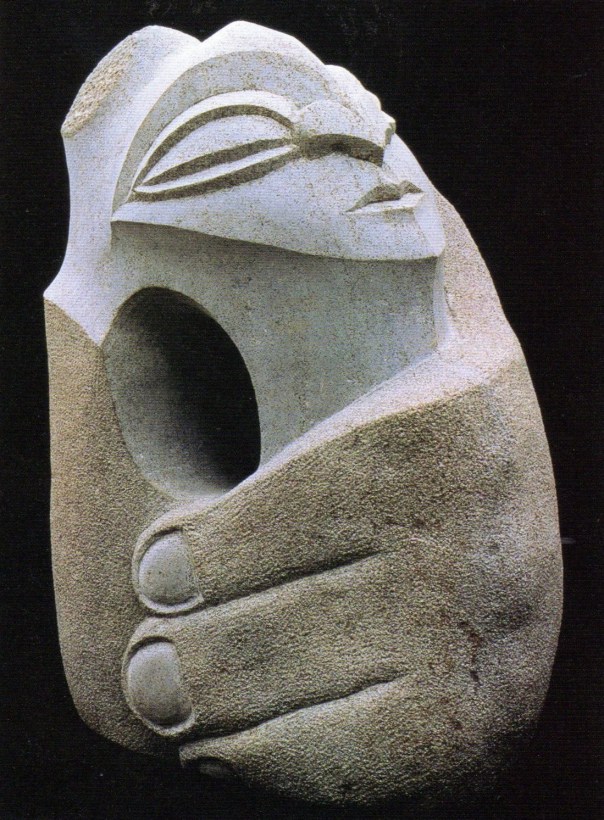
Filipe Tohi (Tongan, resident in New Zealand, 1959–), Fakaukau, 1996. Stone carving. Photo: Museum of New Zealand Te Papa Tongarewa, via Christ for All People, p. 87
I give them eternal life, and they will never perish, and no one will snatch them out of my hand. My Father, who has given them to me, is greater than all, and no one is able to snatch them out of the Father’s hand.
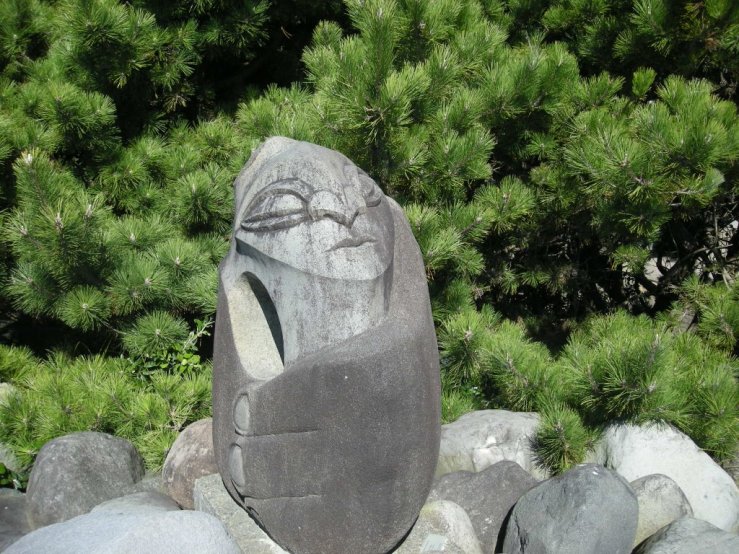
Fakaukau (“Thought”) is the title ascribed to this Tongan sculpture in the excellent book Christ for All People: Celebrating a World of Christian Art, published in 2001, which also places it in a private collection. However, photographs of a very similar—if not the same—sculpture by the same artist can be found online under the name Anchor Stone (see photos here and here), and it’s publicly accessible. Its shape is based on the anchor stone through which Tongan fishermen tie the rope of their boats. You can see the hand of God holding the fisher tenderly yet securely as the fisher rests in that grasp.
Anchor Stone by Filipe Tohi, located along the Coastal Walkway in New Plymouth, Taranaki, North Island, New Zealand. Photo courtesy of New Plymouth District Council.
Anchor Stone is located along the New Plymouth Coastal Walkway, an eight-mile path that forms an expansive sea-edge promenade stretching from Pioneer Park at Port Taranaki all the way to the eastern side of Bell Block Beach in the Taranaki region of North Island, New Zealand. More precisely, the sculpture sits at the eastern end of a bridge that crosses the Huatoki Stream, near the Wind Wand. The walkway features several other sculptures by Filipe Tohi, as well as artworks by other Pacific Islanders.
Filipe Tohi was born in Nuku’alofa, Tonga, in 1959 and moved to Taranaki, New Zealand, in 1979, where he trained as a carver with a Maori cooperative. His early sculptures were mainly in stone and wood, but more recently he has achieved recognition for large contemporary sculptures in aluminum and steel that are inspired by lalava, traditional Tongan coconut sennit lashing (used to build roofs and canoes). Tohi studied and learned this ancient art form during a return visit to his homeland in 1987 and has been responsible for revitalizing and popularizing it. See more of his work at http://www.lalava.net/index.php/ct-menu-item-17#6.
Christianity took root in Tonga in the first half of the nineteenth century when the country’s king, George Tupou I, converted and the people followed suit. It has been Tonga’s main religion ever since.
+++
I first encountered the hymn “O Love That Wilt Not Let Me Go” a few years ago through a Calvary Collective album—I was extremely moved by Madison Cunningham’s understated arrangement and vocal performance, which captures so well the weary tone of the old text and tune. Cunningham adds a four-line chorus: “You will not let me go, so I will trust in thee. You won’t let go, so I will rest. You won’t let go, so I will trust in thee. O I will rest in thee.” Here is the full original text:
O Love that wilt not let me go,
I rest my weary soul in thee;
I give thee back the life I owe,
that in thine ocean depths its flow
may richer, fuller be.
O Light that follow’st all my way,
I yield my flick’ring torch to thee;
my heart restores its borrowed ray,
that in thy sunshine’s blaze its day
may brighter, fairer be.
O Joy that seekest me through pain,
I cannot close my heart to thee;
I trace the rainbow through the rain,
and feel the promise is not vain
that morn shall tearless be.
O Cross that liftest up my head,
I dare not ask to fly from thee;
I lay in dust life’s glory dead,
and from the ground there blossoms red,
life that shall endless be.
Upon hearing this, I immediately set about looking for a piano score—come to find that the hymn is in the hymnal I grew up with! And yet I don’t recall my congregation ever singing it.
In my estimation, “O Love” is one of the most sublime hymns ever written. It taps deeply into that feeling of “I’m tired, burnt out, spent,” meeting us there with gentle hope and joy. The first verse opens with a reminder of the tenacious hold God has on us and with a soul-invitation into the “ocean depths” of God’s being. What a contrast the hymn builds between our weakness and God’s strength. We flicker; God blazes. We bow our heads in exhaustion and lie down to die; God lifts us up and brings us into his full-flowering life. I know some churches have revived “O Love” using new tunes, but those, I feel, don’t hold a candle to Albert Peace’s original. The hymn often crops up in funeral programs and works beautifully in that context, but its relevance is by no means restricted to those at the end of life or those observing a recent passing.
And here’s a great a cappella quartet arrangement by the Gaither Vocal Band:
Update, 10/19/20: Since I published this post, a video by 20schemes has been released, of Pete and Cara Bell from Hope Community Church Barlanark in Glasgow performing “O Love That Wilt Not Let Me Go” with the Peace tune I so admire. It’s a straightforward rendition with acoustic guitar, clear and beautiful singing, and lyrics onscreen, so if you’re looking to introduce the hymn to your church music team, this video would be a helpful start.
This post belongs to the weekly series Artful Devotion. If you can’t view the music player in your email or RSS reader, try opening the post in your browser.
To view all the Revised Common Lectionary scripture readings for the Fourth Sunday of Easter, cycle C, click here.
I returned this week from a wonderful arts conference/retreat in the Colorado mountains, a much-needed time to unplug from work and engage with nature, to meet and worship with other Christians from around the country, and to reaffirm my sense of calling to online arts ministry. Eric came with me, so we took a few extra days there for scenic walks and drives, which included the Peak-to-Peak Scenic Byway, the Flatirons, the Rocky Mountain Arsenal National Wildlife Refuge, Pikes Peak, and Garden of the Gods. So much beauty! Here’s a charming little stone church we spotted outside Estes Park, built in 1939.
Chapel on the Rock (Saint Catherine of Siena Roman Catholic Chapel), Saint Malo Retreat Center, Allenspark, Colorado. Photo: Victoria Emily Jones.
We also visited the Cadet Chapel at the United States Air Force Academy, which I will share about in a separate post.
And as is my practice whenever I visit a new city, I spent time at a local art museum: the Colorado Springs Fine Arts Center at Colorado College. The size and quality of its collection exceeded my expectations, with many fine works of Native American (Pueblo, Plains, Plateau, and Great Basin), Hispanic and Spanish colonial, and twentieth-century American art. I particularly loved the santos galleries, which feature religious folk art of the Southwest, including two monumental altarpieces. Below is a retablo (panel painting) and a bulto (sculpture) from the santos tradition.
José Rafael Aragón (New Mexican, ca. 1796–1867), Cristo (Crucifixion), ca. 1820–35. Tempera on gessoed pine, 19 × 11 in. Colorado Springs Fine Arts Center at Colorado College. Photo: Victoria Emily Jones. Patrociño Barela (New Mexican, 1902–1964), Anuncio de la Nacimiento de Jesus (Announcement of the Birth of Jesus), 1942. Cedar wood. Colorado Springs Fine Arts Center at Colorado College. Photo: Victoria Emily Jones.
José Rafael Aragón is the most highly regarded classic santero from early New Mexico, so I was already familiar with his work (note the visual influences on contemporary santero Vicente Telles, one of whose Crucifixion retablos I own). The chandeliers in Aragón’s painting are like those found in the chancels of New Mexico churches, and the vertical branches that fill the spaces between the figures are also standard elements of church decoration.
Patrociño Barela I was not previously familiar with, and I found myself so captivated by his work. (If you are too, be sure to check out this online solo show of his.) I’m not sure whether to interpret his Anuncio de la Nacimiento de Jesus as an Annunciation image, with Gabriel announcing Christ’s conception to Mary, or a Nativity image, seeing as the babe appears to be ex utero—in which case the top figure could be either an angel or God the Father. I can’t identify the object Mary is holding. (A piece of fruit?)
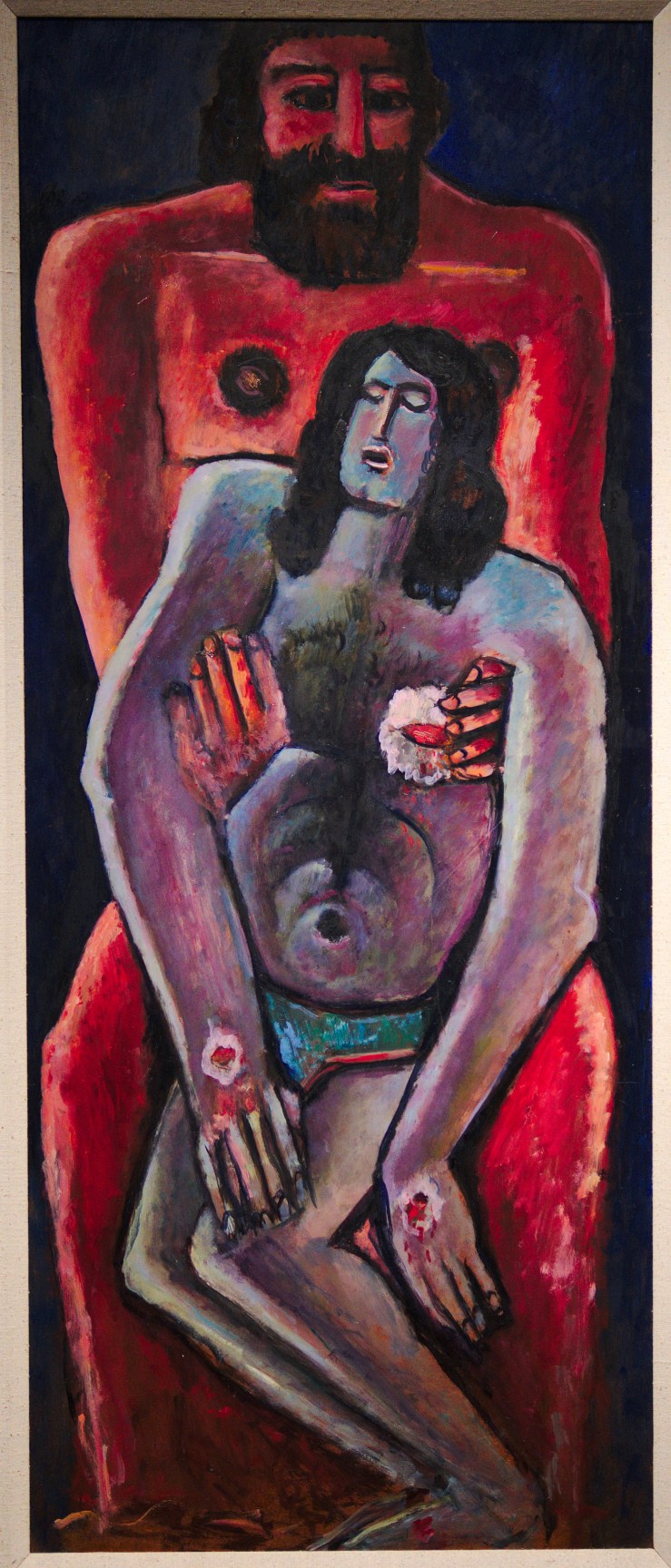
Lastly, here’s a unique Pietà image by the modernist painter Marsden Hartley. Could that be God the Father supporting Christ deposed from the cross? Maybe it’s Nicodemus or Joseph of Arimathea, but I rather like the thought that the Father held his Son in love during this time of his immense suffering and death.
Marsden Hartley (American, 1877–1943), Christ Evicted, 1941–43. Oil on board, 47 × 20 in. Colorado Springs Fine Arts Center at Colorado College. Photo: Victoria Emily Jones.
+++
EVENING DISCUSSION: “Idols and Taboos: Modern and Contemporary Art and Theology Today”: This free public event, consisting of two lectures and a panel discussion, will take place May 23, 2019, at 6 p.m. at the School of the Art Institute of Chicago. The presenters are James Elkins, who will be discussing the distance between avowedly religious art and the disciplines of art history, art criticism, art theory, and studio pedagogy, and Thomas Crow, who will be discussing “the generally inverse relationship between grandiosity in a work of art and its intrinsic theological import,” as well as art’s susceptibility to idolatry. A panel discussion will follow, moderated by Professor Ben Quash, and all are invited to gather afterward in the Lobby Bar of the historic Palmer House (across the street) for further socializing and conversation.
+++
SONG:“O Death”: This Easter, CCLI released a video of Kaden Slay, Melanie Tierce-Slay, and Ryan Kennedy of People & Songs performing Stephen Marti’s “O Death,” written in 2017. Those three-part a cappella harmonies are so sweet.
+++
SONG: “How Great Thou Art / Whakaaria Mai”: On March 23, the Grammy Award–winning singer-songwriter John Mayer began an extensive world tour at Spark Arena in Auckland, New Zealand. He opened the show quite unexpectedly with “How Great Thou Art,” a tribute to those killed and injured during a terrorist attack on two mosques in Christchurch, New Zealand, on March 15. [HT: Global Christian Worship]
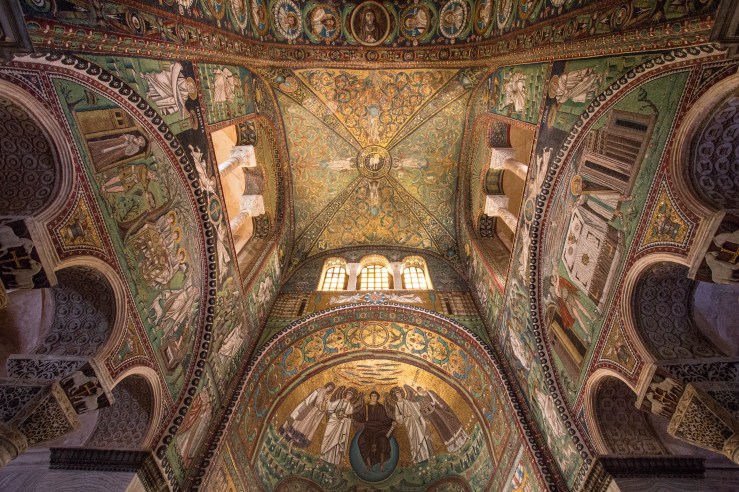
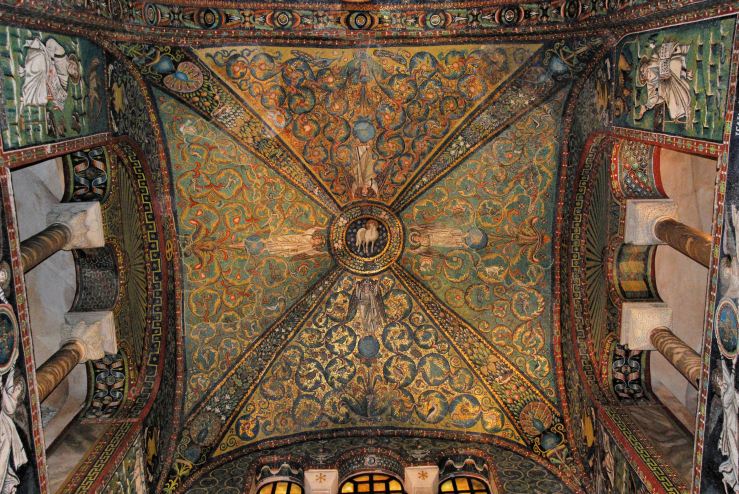
This 6th-century mosaic of the Lamb of God is on the chancel ceiling of the Basilica of San Vitale in Ravenna, Italy. The lamb is encircled by a golden orb (enclosed with stars) and a fruited laurel wreath, supported by angels. Photo: Fr. Lawrence Lew, OP.
Then I looked, and I heard around the throne and the living creatures and the elders the voice of many angels, numbering myriads of myriads and thousands of thousands, saying with a loud voice,
“Worthy is the Lamb who was slain,
to receive power and wealth and wisdom and might
and honor and glory and blessing!”
And I heard every creature in heaven and on earth and under the earth and in the sea, and all that is in them, saying,
“To him who sits on the throne and to the Lamb
be blessing and honor and glory and might forever and ever!”
And the four living creatures said, “Amen!” and the elders fell down and worshiped.
—Revelation 5:11–14
+++
SONG: “Worthy Is the Lamb / Amen” by George Frideric Handel, from Messiah (1742)
This video is a 2014 performance by the Mormon Tabernacle Choir—and you can find many more besides on YouTube. I’m partial, though, to the Oregon Bach Festival Choir and Orchestra’s performance on Easter Joy (2009), which you can stream on Spotify:
Handel was German but spent the bulk of his career in London, settling there in 1712 and becoming a naturalized British citizen in 1727. In the 1730s, he transitioned from composing Italian operas to composing English choral works, one of which is the world-famous oratorio Messiah. (Read Charles Jennens’s full libretto, a curation of scripture passages, here.)
People might assume that the so-oft-performed “Hallelujah” chorus is the finale of this majestic work, but no, that chorus concludes part two, capping off the narrative of Christ’s death, resurrection, and ascension, and the early spreading of the gospel through the known world. The “Worthy Is the Lamb” chorus, rather, serves as the Messiah’s consummation, an acclamation of Christ’s full and final victory over sin and death that follows part three’s prophecies of the day of judgment and the general resurrection. The text is taken from Revelation 5.
Upward view of the east end of San Vitale, Ravenna. Left lunette: The Hospitality of Abraham and The Sacrifice of Isaac. Center (apse): Christ in Majesty. Right lunette: The Offerings of Abel and Melchizedek. Photo: Fr. Lawrence Lew, OP.Photo: Jim Forest
The anonymous sixth-century mosaicists of San Vitale in Ravenna, Italy, gloriously visualized this passage in the cross-ribbed vault of the church’s chancel, just above the altar. Tens of thousands of tesserae (tiny pieces of colored glass, and clear glass sandwiching gold leaf) come together to image Christ high and lifted up as the sacrificial Lamb of God. Can you imagine worshipping in this space? It must have been so transporting for those early Christians of Ravenna: to enter and move toward their promised end in Christ. To be enfolded in this luminous vision of paradise that they enacted below in the liturgy.
To learn more about San Vitale and its mosaics, see this Smarthistory video. (Unfortunately it focuses on the two political portraits at the expense of the biblical subject matter, but nonetheless, it gives a good sense of the architectural setting of the mosaics.)
This post belongs to the weekly series Artful Devotion. If you can’t view the music player in your email or RSS reader, try opening the post in your browser.
To view all the Revised Common Lectionary scripture readings for the Third Sunday of Easter, cycle C, click here.





#/media/File:Caravaggio_-_The_Incredulity_of_Saint_Thomas.jpg)