O Lord, I have heard a good word inviting me to look away to Thee and be satisfied. My heart longs to respond, but sin has clouded my vision till I see Thee but dimly. Be pleased to cleanse me in Thine own precious blood, and make me inwardly pure, so that I may with unveiled eyes gaze upon Thee all the days of my earthly pilgrimage. Then shall I be prepared to behold Thee in full splendor in that day when Thou shalt appear to be glorified in Thy saints and admired in all them that believe. Amen.
—A. W. Tozer, The Pursuit of God
This post belongs to the weekly series Artful Devotion. If you can’t view the music player in your email or RSS reader, try opening the post in your browser.
To view all the Revised Common Lectionary scripture readings for Proper 18, cycle A, click here.
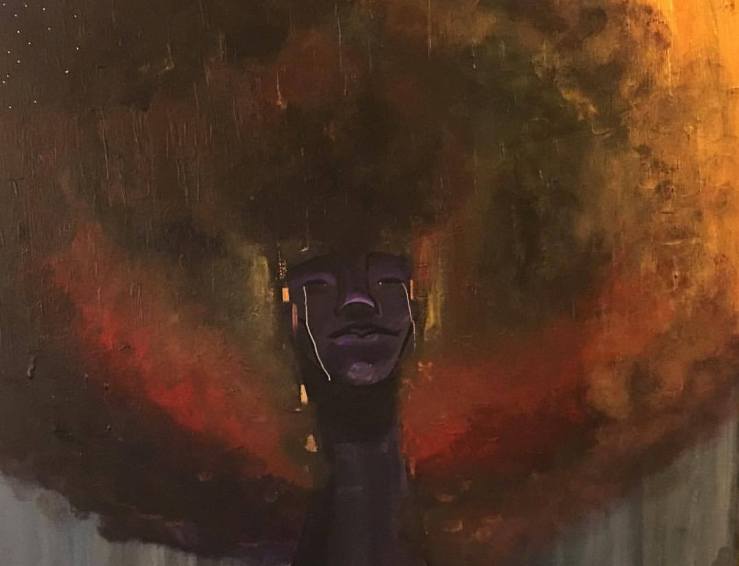
Shin Maeng (@shinhappens), And the Darkness Has Not Overcome Us, 2017. Acrylic. Watch Shin’s story here.
“Do not be overcome by evil, but overcome evil with good.” (Romans 12:21)
+++
SONG: “We Are Not Overcome” by Isaac Wardell and Robert Heiskell of Bifrost Arts, on He Will Not Cry Out (2013)
This post belongs to the weekly series Artful Devotion. If you can’t view the music player in your email or RSS reader, try opening the post in your browser.
To view all the Revised Common Lectionary scripture readings for Proper 17, cycle A, click here.
As a guard against Reformed hubris, Churches Together in England has issued a statement urging churches to mark the Reformation’s fifth centenary with sensitivity to other branches of the faith, providing 5 R’s as guidelines. Keep the anniversary, it says, with the spirit of
Rejoicing – because of the joy in the gospel which we share, and because what we have in common is greater than that which divides; and that God is patient with our divisions, that we are coming back together and can learn from each other.
Remembering – because all three streams of the Reformation have their witnesses and one church’s celebration could be another’s painful memory; and yet all believed they acted in the cause of the gospel of Jesus Christ for their time.
Reforming – because the Church needs always to grow closer to Christ, and therefore closer to all who proclaim him Lord, and it is by the mutual witness of faith that we will approach the unity for which Christ prayed for his followers.
Repenting – because the splintering of our unity led us to formulate stereotypes and prejudices about each other’s traditions which have too often diverted our attention from our calling as witnesses together to the mercy of God in proclamation and service to the world.
Reconciling – because the call to oneness in Christ begins from the perspective of unity not division, strengthening what is held in common, even though the differences are more easily seen and experienced.
This is not to say we can’t celebrate the achievements of the Reformation (we certainly should!), but we ought not to do so with denigration toward our Catholic brothers and sisters, nor hold our own branch above reproof. All church history, before and after the major splits, is our history as a body. Read the full CTE statement here. For other initiatives to foster common witness, service, and understanding between Protestants and Catholics, see the documents “Evangelicals and Catholics Together” (1994) and “Joint Declaration on the Doctrine of Justification” (1999).
+++
ECUMENICAL ARTS SYMPOSIUM
The last two weekends in October will cap off the international “Arts and Ecumenism” symposium organized by the Mount Tabor Ecumenical Centre for Art and Spirituality to commemorate the five hundredth anniversary of the Reformation. With events in Paris, Strasbourg, and Florence, the symposium is now coming to the US to continue the discussion on Catholic and Protestant approaches to art.
The penultimate session, “Sacred Arts in North American Contexts,” will take place October 20–21 at Yale University. “Arts in Celebration: The Word in Color, Action, Music, and Form,” the final session, will take place October 27–29 at the Community of Jesus in Orleans, Massachusetts, and will include demonstrations of mosaic, fresco, and Gregorian chant; lectures and panel discussions with Timothy Verdon, William Dyrness, Deborah Sokolove, and others; exhibits of contemporary sacred art by Susan S. Kanaga and Filippo Rossi (view the catalog); liturgies of the Divine Office and Holy Eucharist; an organ recital; and a fully staged presentation of Ralph Vaughan Williams’s opera The Pilgrim’s Progress, performed by the community’s critically acclaimed Gloriae Dei Cantores choir and Elements Theatre Company. Click here for the schedule.
I stayed at the Community of Jesus last week, and trust me, $425 is a great price for two days and nights at this beautiful Cape Cod monastery, with its Benedictine hospitality, and access to a high caliber of visual, musical, and dramatic art and prominent voices in the field of Christianity and the arts. But the best part, I think, will be the opportunity to inhabit the ecumenical vision the community has established, whereby all Christians—Catholic, Protestant, and Orthodox—live together, eat together, and worship together. Some community members have taken vows of celibacy, while others have chosen marriage and live with spouse and children on the compound. Partaking of the Eucharist last Friday with brothers and sisters from other streams of Christianity and multiple generations was an experience I will not soon forget. Be sure to take advantage of the early-bird registration discount, which ends September 1.
(Click here to take a virtual tour of the Community of Jesus’s Church of the Transfiguration.)
Church of the Transfiguration, Orleans, Massachusetts. Photo: Victoria Emily JonesVento (detail) by Filippo Rossi, from the exhibition “Spirito Creatore”
+++
PAST LECTURE:“Visual Ecumenism” by Matthew Milliner: Milliner is an evangelical Anglican who teaches art history (his specialization is Byzantine) at a Protestant liberal arts college in Illinois. In this talk given April 7, 2017, at the Wheaton Theology Conference “Come, Let Us Eat Together!,” he discusses how we can “put on” other Christian traditions without losing our own by engaging their artistic output, by opening ourselves up to the material expressions of the gospel present all across the denominational spectrum:
I’m taking a particularly cherished part of my tradition—the law/gospel distinction—and showing that it can be found in other traditions as well. This might seem like I’m colonizing other traditions with my Protestantism, but I’m actually trying to strip my own tradition of its exclusive possession of this message and see it elsewhere, so that evangelicals can be at home in late medieval Catholic devotional manuals or in Russian Orthodox cathedrals. (19:04)
In reverse chronological fashion, he examines Lucas Cranach’s Law and Grace (Protestant), Berthold Furtmeyr’s Tree of Life and Death (Catholic), and the Sinai Pantocrator icon (Orthodox). Michelangelo’s late drawings and tomb for Pope Julius II are discussed in light of his involvement in the Spirituali, a Catholic reform movement in Italy that emphasized intensive personal study of scripture and justification by faith. More personally, Milliner describes how he was able to make it through repeated Hail Marys during a Catholic prayer service he inadvertently stumbled into one time and, on another Marian note, shares the Madonna of Mercy mural created last year by a group of Protestant art students he co-taught in Orvieto, Italy, with Bruce Herman, showing how they honored this subject that originated outside their tradition while also bringing it in line with their theological convictions—which, they discovered, were corroborated by Vatican II. In an earlier essay on visual ecumenism, Milliner wrote,
Just as there is, according to our Bibles, ‘one Lord, one faith, one baptism,’ so perhaps there is also one variegated yet unified Christian aesthetic, to which the different traditions, at their utter best, ascend. Full maturity (which for evangelicals has been a long time coming!) is not to see with Protestant, Orthodox or Catholic eyes—but with the eyes of Christ.
Madonna of Mercy painting by the 2016 Gordon in Orvieto cohort
UPCOMING LECTURE: “An Evening with Ken Myers: Luther’s Artistic Legacy,” Saturday, September 9, 7:30 p.m., Wallace Presbyterian Church, College Park, Maryland: To kick off its second season, the Eliot Society has scheduled Mars Hill Audio founder Ken Myers to discuss Martin Luther’s contributions to Christian hymnody. “With the help of some local musicians, Myers will examine the artistic climate Luther helped to create, as well as some of the great composers of sacred music who followed after him. The lecture will argue that the pattern of Luther’s artistic engagement provides a model for contemporary efforts to reconnect faith and the arts.” Click on the link above to reserve your free ticket.
+++
FROM THE ARCHIVES: “An early Protestant painting (commissioned by Luther)”: On my previous blog I wrote a post about an altarpiece Martin Luther commissioned from his friend Lucas Cranach to promote Protestant theology. (It’s the same painting Milliner opens his above talk with.) Luther was more accepting of religious images than many of his fellow reformers, elucidating his position in his Invocavit Sermons (1522) and in the treatise Against the Heavenly Prophets in the Matter of Images and Sacraments (1525). I plan to feature vast swaths of these texts on Art & Theology in the near future.
Lucas Cranach the Elder (German, 1472–1553), Law and Grace, 1529. Tempera on linden wood, 82.2 × 118 cm. Castle Museum Schloss Freidenstein, Gotha, Germany.
Daniel Nevins (American, 1963–), Bloom Within. Oil on wood, 20 × 18 in.
Isaiah 51:3:
For the Lord will comfort Zion;
he will comfort all her waste places,
and will make her wilderness like Eden,
her desert like the garden of the LORD;
joy and gladness will be found in her,
thanksgiving and the voice of song.
“The Comforter” by Thomas Moore (1779–1852):
Oh! thou who dry’st the mourner’s tear,
How dark this world would be,
If, when deceived and wounded here,
We could not fly to thee!
The friends who in our sunshine live,
When winter comes are flown;
And he who has but tears to give,
Must weep those tears alone;
But thou wilt heal that broken heart,
Which, like the plants that throw
Their fragrance from the wounded part,
Breathes sweetness out of woe.
When joy no longer soothes or cheers,
And even the hope that threw
A moment’s sparkle o’er our tears,
Is dimm’d and vanish’d too;
Oh who would bear life’s stormy doom,
Did not thy wing of love
Come brightly wafting through the gloom,
Our peace-branch from above.
Then sorrow, touch’d by thee, grows bright
With more than rapture’s ray;
As darkness shows us worlds of light
We never saw by day.
+++
SONG: “The Sun Will Rise” by the Brilliance, on The Brilliance (2010)
This post belongs to the weekly series Artful Devotion. If you can’t view the music player in your email or RSS reader, try opening the post in your browser.
To view all the Revised Common Lectionary scripture readings for Proper 16, cycle A, click here.
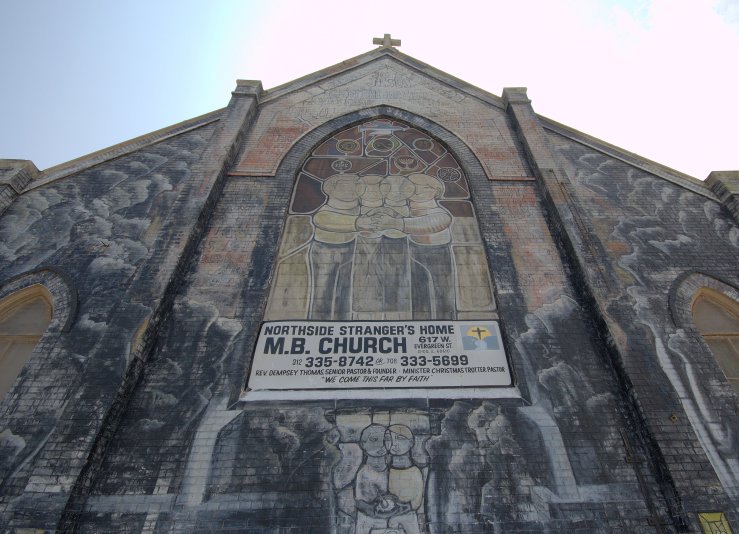
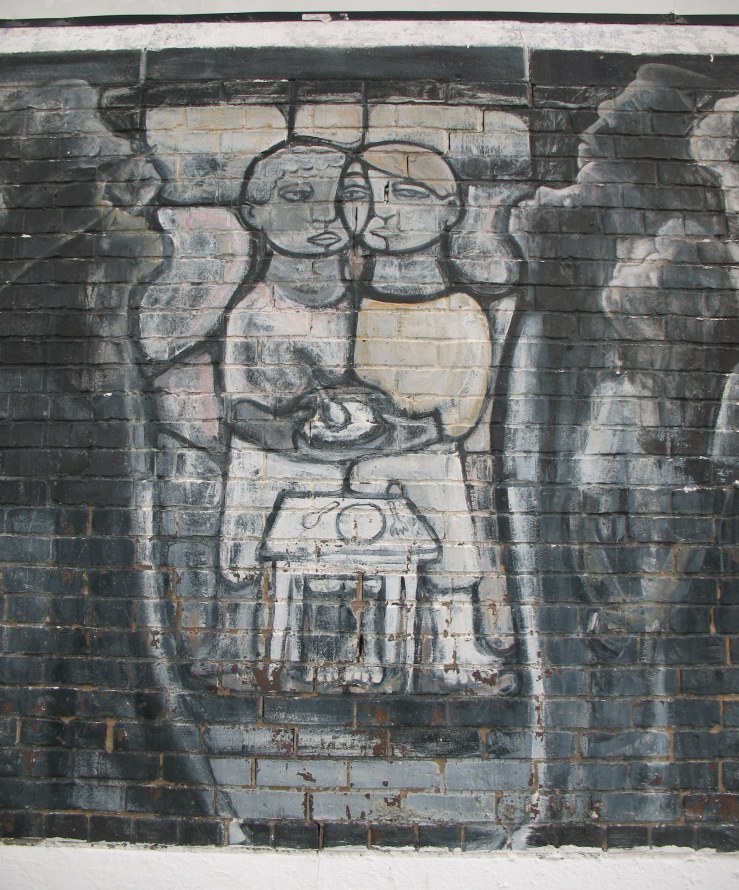
North facade of the former Stranger’s Home Missionary Baptist Church in Chicago, with mural by William Walker, 1972. (The mural was painted over in 2015.) Photo: Gabriel X. Michael/Chicago Patterns.
Behold, how good and pleasant it is
when brothers dwell in unity!
It is like the precious oil on the head,
running down on the beard,
on the beard of Aaron,
running down on the collar of his robes!
It is like the dew of Hermon,
which falls on the mountains of Zion!
For there the Lord has commanded the blessing,
life forevermore.
—Psalm 133
+++
SONG: “Together (Psalm 133)” by James Zeller | Performed by David Potter, on The Good Life by the Psalter Project (2017)
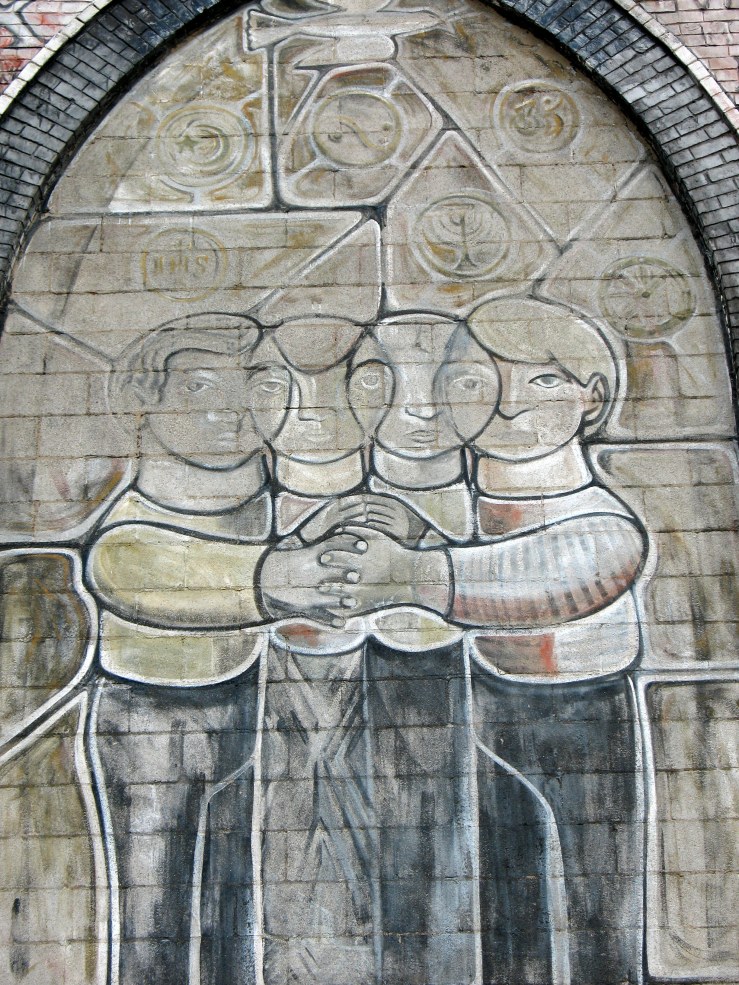
William Walker (American, 1927–2011), All of Mankind mural detail, 1972 (now lost). Stranger’s Home Missionary Baptist Church, Chicago. Photo courtesy of the Chicago Public Art Group.William Walker (American, 1927–2011), All of Mankind mural detail, 1972 (now lost). Stranger’s Home Missionary Baptist Church, Chicago. Photo courtesy of the Chicago Public Art Group.
This weekend we witnessed how bad and destructive it is when brothers dwell in disunity. For congregations seeking resources for responding prayerfully to the racist attack carried out in Charlottesville, Virginia, Rich Villodas has written a litany:
Leader: Lord Jesus, your Kingdom is good news for a world caught in racial hostility. We ask that you would give us grace for the deep challenges facing our country.
Congregation:O Lord, only you can make all things new.
Leader: Lord, we confess our anger, our deep sadness, and our collective sense of weakness to see this world healed through our own strength.
Congregation: O Lord, only you can make all things new.
Leader: Lord, we honestly confess that our country has a long history of racial oppression, that racism has been a strategy of evil powers and principalities.
Congregation:O Lord, only you can make all things new.
Leader: Lord, we confess that the gospel is good news for the oppressed and the oppressor. Both are raised up. Both are liberated, but in different ways. The oppressed are raised up from the harsh burden of inferiority. The oppressor from the destructive illusion of superiority.
Congregation:O Lord, only you can make all things new.
Leader: Lord, we confess that the gospel is your power to form a new people not identified by dominance and superiority, but by unity in the Spirit.
Congregation: O Lord, only you can make all things new.
Leader: Lord, we ask that you would help us name our part in this country’s story of racial oppression and hostility. Whether we have sinned against others by seeing them as inferior, or whether we have been silent in the face of evil. Forgive us of our sin.
Congregation:O Lord, only you can make all things new.
Leader: Lord, we pray for our enemies. For those who have allowed Satanic powers to work through them. Grant them deliverance through your mighty power.
Congregation: O Lord, only you can make all things new.
Leader: Lord, we ask that you would form us to be us peacemakers. May we be people who speak the truth in love as we work for a reconciled world.
Congregation:O Lord, only you can make all things new.
Leader: Lord, we commit our lives to you, believing that you are working in the world in spite of destructive powers and principalities. Bring healing to those who are hurt, peace to those who are anxious, and love to those who are fearful. We wait for you, O Lord. Make haste to help us.
Congregation: O Lord, only you can make all things new.
This post belongs to the weekly series Artful Devotion. If you can’t view the music player in your email or RSS reader, try opening the post in your browser.
To view all the Revised Common Lectionary scripture readings for Proper 15, cycle A, click here.
Whenever I gather with friends, I like to ask them what they’ve been reading, watching, and/or listening to lately (a lot of the media I consume comes from word-of-mouth recommendations), and if they’ve visited any interesting new places. In the spirit of sharing, here are some things on my list this month.
WHERE I’M GOING
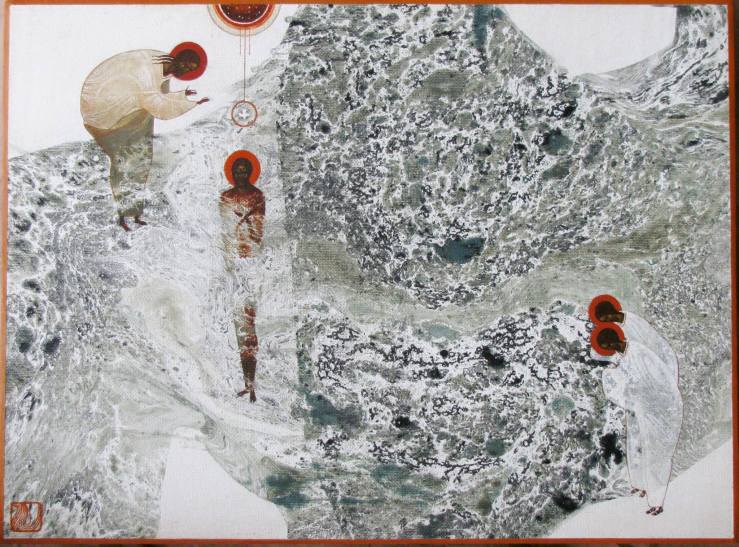
“East Meets West: Women Icon Makers of Western Ukraine,” St. Christopher’s Episcopal Church, Chatham, Massachusetts: This week I’m road-tripping up to Cape Cod with my husband and two friends to see an art exhibition organized by John A. Kohan. On display through the end of the month are twenty-three Ukrainian Greek Catholic icons by four female artists from Lviv who are representative of the eastern European sacred art renaissance sparked by the dissolution of the Soviet Union: Ivanka Demchuk, Natalya Rusetska, Ulyana Tomkevych, and Lyuba Yatskiv. This Thursday, August 17, at 4:30 p.m., Kohan will be giving a gallery talk discussing the artists and their context. I’ve been following these women online for the past few years through Iconart and am thrilled to be able to see their work in person. I’m not sure which specific works will be there, but here are examples of two of the artists’ work:
Lyuba Yatskiv (Ukrainian, 1977–), Adam Gives Names to the Animals, 2015. Acrylic and gold leaf on gessoed board, 80 × 50 cm.Ivanka Demchuk (Ukrainian, 1990–), The Baptism of Christ, 2015. Mixed media on board on canvas, 30 × 40 cm.
Two-day arts lecture and performance series, Duke University, Durham, North Carolina: Thanks, Duke Initiatives in Theology and the Arts! Celebrating the opening of a new art exhibition at the Nasher Museum of Art, “The Patience to See: The Sights & Sounds of Carlo Dolci” on Thursday, August 31, will feature talks by Dr. Ben Quash and Dr. Chloe Reddaway, live period music by top-tier orchestral musicians, and the premiere of Blue Madonna, an original composition by Dr. Jeremy Begbie, inspired by a painting after Dolci. The other program events, taking place on Friday, September 1, are “Secretaries of Praise: Poetry, Song, and Theology” and “Home, Away, and Home Again: The Rhythm of the Gospel in Music.” My family lives in the Raleigh-Durham area, so it will be fun to spend time with them while also taking in some world-class art, music, and scholarship!
Onorio Marinari (Italian, 1627–1715), The Blue Madonna (after Carlo Dolci),17th century. Oil on canvas. John and Mable Ringling Museum of Art, Sarasota, Florida.
WHAT I’M READING
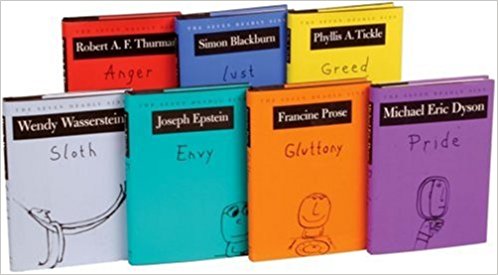
The Seven Deadly Sins: These seven small books (each about 128 pages) grew out of a 2002–2003 lecture series cosponsored by the New York Public Library and Oxford University Press. Each is authored by a different prominent writer and approaches the assigned sin through the lenses of history, theology, philosophy, psychology, ethics, social criticism, popular culture, art, and/or literature. (Several include a full-color insert of images.) My favorite is Gluttony by Francine Prose, in part because it contained the most surprises. Prose points out that one can make the belly a god not only by habitually overeating but by being obsessive about nutrition, calories, body fat, and pants size—being a slave to the scale or to a point system. That’s not to say that dieting and exercise are inherently idolatrous, but . . . you have to read the book. It diagnoses our culture’s “schizophrenic attitude toward gluttony”—inundate us with snack ads, restaurants, and recipes and encourage us to take pleasure in eating, then tell us we’re eating too much and brand us with a scarlet O for Obese, promising that a gym membership and such-and-such health-food regimen will remove that shame. On both sides of our ambivalence, someone is making money.
I also really enjoyed Greed by Phyllis Tickle (she takes a similar approach as Prose, majoring on Christian theology, literature, and art, and is a brilliant writer) and Pride by Michael Eric Dyson, a sociology professor and ordained Baptist minister who focuses on racial pride (addresses why white pride is a vice but black pride is a virtue) and national pride (addresses the difference between patriotism, a virtue, and nationalism, a vice), describing very chillingly what it’s like to be black in America. Sloth is styled as a parody of the self-help genre and contains crude language, and I wasn’t too keen on it. I also wasn’t drawn in by Anger, which is written from a Buddhist perspective.
Acorn by Yoko Ono: Before her marriage to John Lennon, Yoko was a major figure in the underground art scene in New York City, and she continues to create today, mainly conceptual and performance art. On a whim, I bought her 2013 book Acorn on sale at the Hirshhorn—a sequel, of sorts, to her more famous Grapefruit—and have been enjoying reading and “performing” the “instructional poems,” or what I would call mindfulness exercises. Promoting better ways of relating to ourselves, each other, and the planet, these exercises are given names like “Sky Piece” and “Sound Piece,” and each is accompanied by an amoeba-like dot drawing that gives readers “further brainwork,” Yoko says. (Click here to view sample page spreads, which include images.) My husband, Eric, thinks all the pieces are woo-woo—and some of them are. But others have deepened my wonder and praise, given my imagination some much-needed exercise, or convicted me of being a poor friend. Here are two:
“Earth Piece V”
Watch the sunset.
Feel the Earth moving.
“Connection Piece V”
How do you connect with people the most?
With the feeling of:
Curiosity
Interest
Forgiveness
Adoration
Competition
Envy
Fear
Control
Detachment
Rejection
Make a list of people around you and see how it comes out.
Ask yourself if you are comfortable with the way you connect.
Don’t simplify the situation by just saying “I love/hate them all.”
WHAT I’M WATCHING
I just finished the first season of Rectify on Netflix, a drama about a man, Daniel Holden, who’s released from prison after spending nineteen years on Georgia’s death row for the rape and murder of his girlfriend. I’m hooked. A lot of it so far is Daniel learning how to use his freedom, especially how to give and receive human touch, and rediscovering the world—the weightlessness of goose down, for example, or the feeling of bare feet on carpet. I first heard about the show from the Televisionaries podcast, where Kutter Callaway, author of Watching TV Religiously: Television and Theology in Dialogue, praised it for, among other things, giving high visibility to a Christian character who’s portrayed in a nuanced and noncondescending manner. We see evangelism, baptisms, people praying together, people owning their faith and struggling through it, asking hard questions. A second recommendation from film critic Nick Olson via Good Letters last month cinched my resolve to jump in. (Note to prospective viewers: The show is rated TV-14 for intense thematic elements, sexuality, and violence.)
WHAT I’M LISTENING TO
I’ve found that any album on the Deeper Well label is fantastic. Lately I’ve been listening to Wounded Healer (2012) by the Followers, who is Josh White, Eric Earley, and friends. The style is a mixture of soul, gospel, and vintage folk rock—what the group calls “neo-gospel.” The track below, “Enfold Me,” features the vocals of Liz Vice.
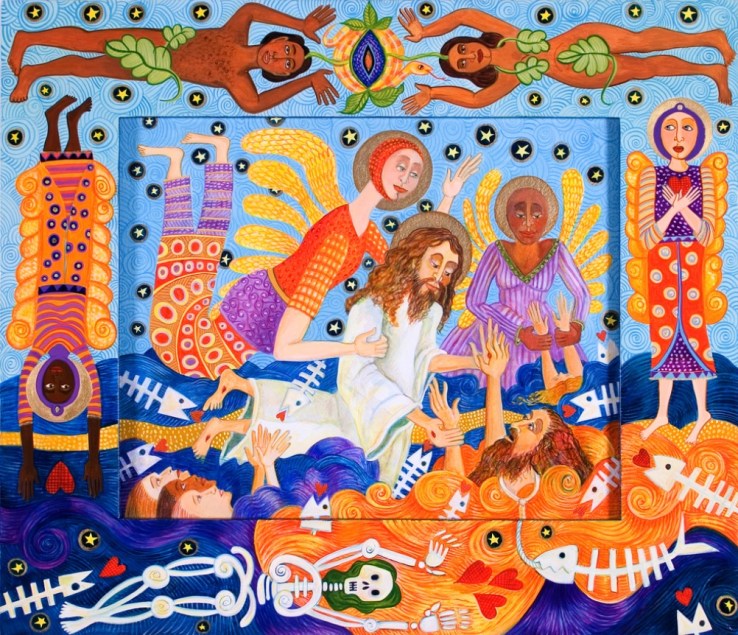
(Update: I found out from the artist that she intended this image to represent not the sinking of Peter but the redemption of Judas, who, like Peter, had a slip of faith, so to speak. Very unique!)
Peter stepped out of the boat onto the water and began walking toward Jesus. But when he remembered how strong the wind was, his courage caught in his throat and he began to sink.
Peter: Master, save me!
Immediately Jesus reached for Peter and caught him.
Jesus: O you of little faith. Why did you doubt and dance back and forth between following Me and heeding fear?
Then Jesus and Peter climbed in the boat together, and the wind became still. And the disciples worshiped Him.
Poem by Arthur Hugh Clough (1819–1861):
It fortifies my soul to know
That, though I perish, Truth is so:
That, howsoe’er I stray and range,
Whate’er I do, Thou dost not change.
I steadier step when I recall
That, if I slip, Thou dost not fall.
This post belongs to the weekly series Artful Devotion. If you can’t view the music player in your email or RSS reader, try opening the post in your browser.
To view all the Revised Common Lectionary scripture readings for Proper 14, cycle A, click here.
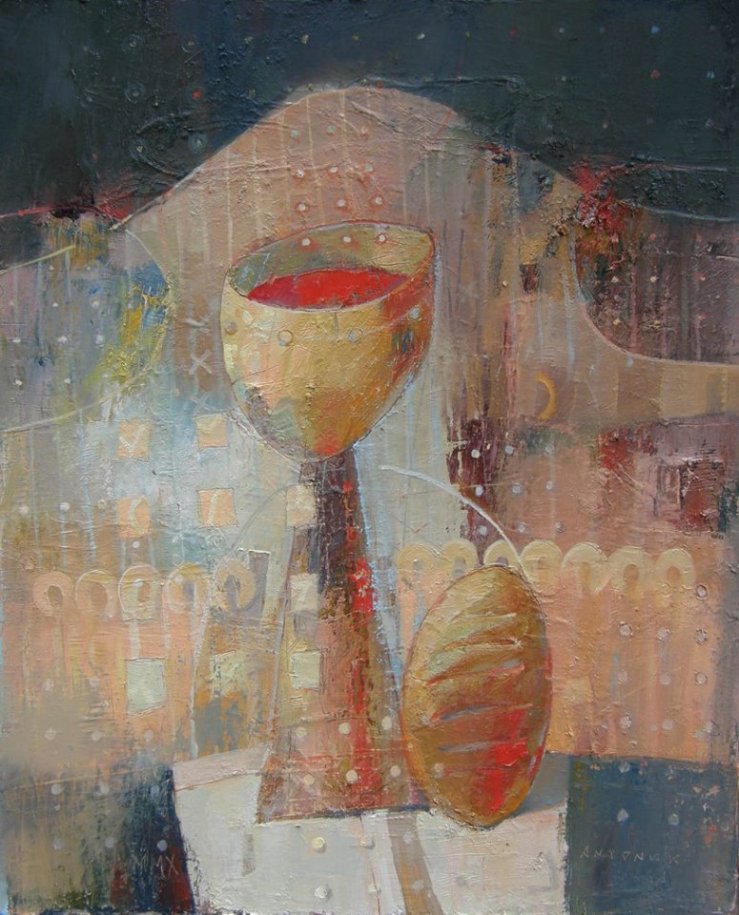
Alexander Antonyuk (Ukrainian, 1971–), Wine and Bread, 2015. Oil on canvas.
Come, everyone who thirsts,
come to the waters;
and he who has no money,
come, buy and eat!
Come, buy wine and milk
without money and without price.
Why do you spend your money for that which is not bread,
and your labor for that which does not satisfy?
Listen diligently to me, and eat what is good,
and delight yourselves in rich food.
—Isaiah 55:1–2
+++
SONG: “Christ My Treasure” by Castle Island Hymns, on Castle Island Hymns (2013)
This post belongs to the weekly series Artful Devotion. If you can’t view the music player in your email or RSS reader, try opening the post in your browser.
To view all the Revised Common Lectionary scripture readings for Proper 13, cycle A, click here.
Imre Szakács (Hungarian, 1948–), Mustard Seed, 2009. Mixed media on canvas, 150 × 130 cm. Private collection, Budapest. Click on the image for commentary.
He put another parable before them, saying, “The kingdom of heaven is like a grain of mustard seed that a man took and sowed in his field. It is the smallest of all seeds, but when it has grown it is larger than all the garden plants and becomes a tree, so that the birds of the air come and make nests in its branches.”
—Matthew 13:31–32
+++
SONG: “Seeds” by the Collection, on The Collection (2011)
This post belongs to the weekly series Artful Devotion. If you can’t view the music player in your email or RSS reader, try opening the post in your browser.
To view all the Revised Common Lectionary scripture readings for Proper 12, cycle A, click here.
“The Cosmopolitan and the Campesino: The Sacred Art of Luis Tapia” by Dana Gioia: I first learned about the pioneering Chicano artist Luis Tapia from the book Crafting Devotions: Tradition in Contemporary New Mexico Santos. His work was memorable, so when I saw it on the cover of the latest Dappled Things issue, I was eager to read inside. Dana Gioia’s essay introduces us to work that is “both strikingly original and deeply respectful of its origins” in the Hispano religious folk art tradition established in New Mexico in the seventeenth century. Pushing the art of polychrome wood sculpture to new levels of craftsmanship and social and political commentary, Tapia “has enlarged his tradition to make it capacious enough to contain his imagination and the complexities of contemporary Latino experience.”
The art world is more accustomed to disruption and transgression than to transformative renewal. (What is more normative in art nowadays than transgression?) It is easier to renounce or mock the past than to master and reshape it to new ends. Assimilating the past, however, allows new work to carry powerful formal and cultural resonance, such as Tapia’s adaptations of New Mexican Catholic folk subjects and symbolism into new secular and social contexts. Tapia does not approach the past with the distanced irony and intellectual condescension of artists such as John Currin or Jeff Koons. Tapia remains invested in the forms, themes, and techniques of the New Mexican Latino Catholic tradition.
Luis Tapia (American, 1950–), Pietà, 1999. Carved and painted wood, 20¼ × 14½ × 9½ in. Collection of John Robertshaw. Photo: Dan Morse, courtesy The Owings Gallery, Santa Fe.
+++
Renaissance-era cutlery engraved with musical notations: The Victoria and Albert Museum in London has in its collection a rare “notation knife” from sixteenth-century Italy, whose blade contains on each side a line of music expressing gratitude for a meal. The inscription on one side reads, “The blessing of the table. May the three-in-one bless that which we are about to eat,” while the other reads, “The saying of grace. We give thanks to you God for your generosity.” The knife, which contains only a tenor voice part, belongs to a set. Art historian Flora Dennis, whose background is in musicology, tracked down the other three in the set and, with the help of the Royal College of Music, transcribed the voice parts into modern notation, then had the benediction and grace from the knives sung and recorded (listen below). Click on the link to hear curator Kirstin Kennedy discuss the knife’s possible uses, to view footage from the recording session, and to listen to two alternate recordings.
Left and right views of an etched, engraved, and gilded steel knife with ivory, brass, and silver handle, by an unknown maker, Italy, 1500–50. Victoria & Albert Museum, London.
Benediction, Version 1
Grace, Version 1
+++
“‘About Suffering They Were Never Wrong’” by Kevin Antlitz: This essay about human indifference to others’ suffering centers on W. H. Auden’s poem “Musée des Beaux Arts,” which is itself a response to two paintings by Pieter Bruegel the Elder: The Census at Bethlehem and The Fall of Icarus. Insights from Mark Twain, Rabbi Abraham Joshua Heschel, Elie Wiesel, Nuremberg prosecutor Benjamin Ferencz, novelist Aleksandr Solzhenitsyn, and St. Theophan the Recluse add to the commentary, which is personalized by the author’s reflections on his visit to Yad Vashem, the World Holocaust Remembrance Center in Jerusalem. The indictment is sobering: we are all of us guilty of evil—the enabler just as much as the perpetrator.
Nobody notices the need of the pregnant couple—the Holy Family—making their way into town. Pieter Bruegel the Elder (Dutch, 1525/30–1569), The Census at Bethlehem, 1566. Oil on panel, 116 × 164.5 cm. Royal Museums of Fine Arts of Belgium, Brussels.The plowman, shepherd, and angler continue with their work, indifferent to the upside-down, flailing legs in the sea beside them, and “the expensive delicate ship” at the crash site “had somewhere to get to and sailed calmly on.” 1560s copy of: Pieter Bruegel the Elder (Dutch, 1525/30–1569), Landscape with the Fall of Icarus, ca. 1558. Oil on canvas, 73.5 × 112 cm. Royal Museums of Fine Arts of Belgium, Brussels.
+++
Offa Rex records spiritual folk standard “The Old Churchyard”: Olivia Chaney has teamed up with the Decemberists under the name Offa Rex to record an album that pays homage to British folk music. Released this month, The Queen of Hearts features a beautiful rendition of “The Old Churchyard,” a song about the pain of death and the hope of resurrection. It invites you, first, to come pay respect to loved ones who have passed out of this world over the years, then entreats you not to feel sorrow for them, “for sweet is their sleep, though cold and hard their pillows may be.” The song acknowledges that words are insufficient to comfort those left behind but nonetheless offers the reassurance of peace and rest for the deceased, and a glorious rising on the last day. (Thanks to Paul Neeley for this find!)
Come, come with me out to the old churchyard,
I so well know those paths ’neath the soft green sward.
Friends slumber in there that we want to regard;
We will trace out their names in the old churchyard.
Mourn not for them, their trials are o’er,
And why weep for those who will weep no more?
For sweet is their sleep, though cold and hard
Their pillows may be in the old churchyard.
I know that it’s vain when our friends depart
To breathe kind words to a broken heart;
And I know that the joy of life is marred
When we follow lost friends to the old churchyard.
But were I at rest ’neath yonder tree,
Oh, why would you weep, my friends, for me?
I’m so weary, so wayworn, why would you retard
The peace I seek in the old churchyard?
Why weep for me, for I’m anxious to go
To that haven of rest where no tears ever flow;
And I fear not to enter that dark lonely tomb
Where our saviour has lain and conquered the gloom.
I rest in the hope that one bright day
Sunshine will burst to these prisons of clay,
And old Gabriel’s trumpet and voice of the Lord
Will wake up the dead in the old churchyard.
+++
Sky Ladder documentary (2016): This Netflix original directed by Kevin Macdonald (The Last King of Scotland) profiles the world-renowned contemporary artist Cai Guo-Qiang (pronounced Tsai gwo chi-ONG), who is best known for reinventing the possibilities of the firework, opening its purpose up beyond mere entertainment. Through interviews with the artist and his family, friends, and critics, the film tracks Cai’s rise from childhood in Mao’s China to global fame, addressing the cultural influences on his work, his desire to effect social change, and his struggles to maintain integrity and artistic freedom (his acceptance to design the fireworks display for the opening ceremony of the 2008 Beijing Olympics was controversial).
The documentary shares its title with Cai’s decades-long obsession and most ambitious work to date: a pyrotechnic ladder that rises up over a quarter mile into the sky, as successive explosions etch each new rung and rail segment into place. “I want to connect the earth to the universe,” Cai said. It was fascinating to be let in on his process for this, his working through all the technical details and other hurdles. Three previous attempts to realize Sky Ladder were canceled—in 1994, due to bad weather; in 2001, due to the 9/11 attacks; and in 2012, due to a revoked permit. It wasn’t until 2015 that the project finally succeeded, in a small Chinese fishing village before an audience of a few hundred. It lasted approximately two and a half minutes. Cai’s Sky Ladder reminds me of “Jacob’s ladder” from Genesis 28:10–19, burning bright, connecting two worlds.
Sky Ladder rising.Photo: Lin Yi & Wen-You Cai, courtesy Cai Studio.Cai Guo-Qiang (Chinese, 1957–), Sky Ladder. Realized at Huiyu Island Harbour, Quanzhou, Fujian, June 15, 2015, at 4:49 a.m., approximately 2 minutes and 30 seconds. Photo: Lin Yi & Wen-You Cai, courtesy Cai Studio.








 Art & Theology