A Little East of Jordan (Artful Devotion)

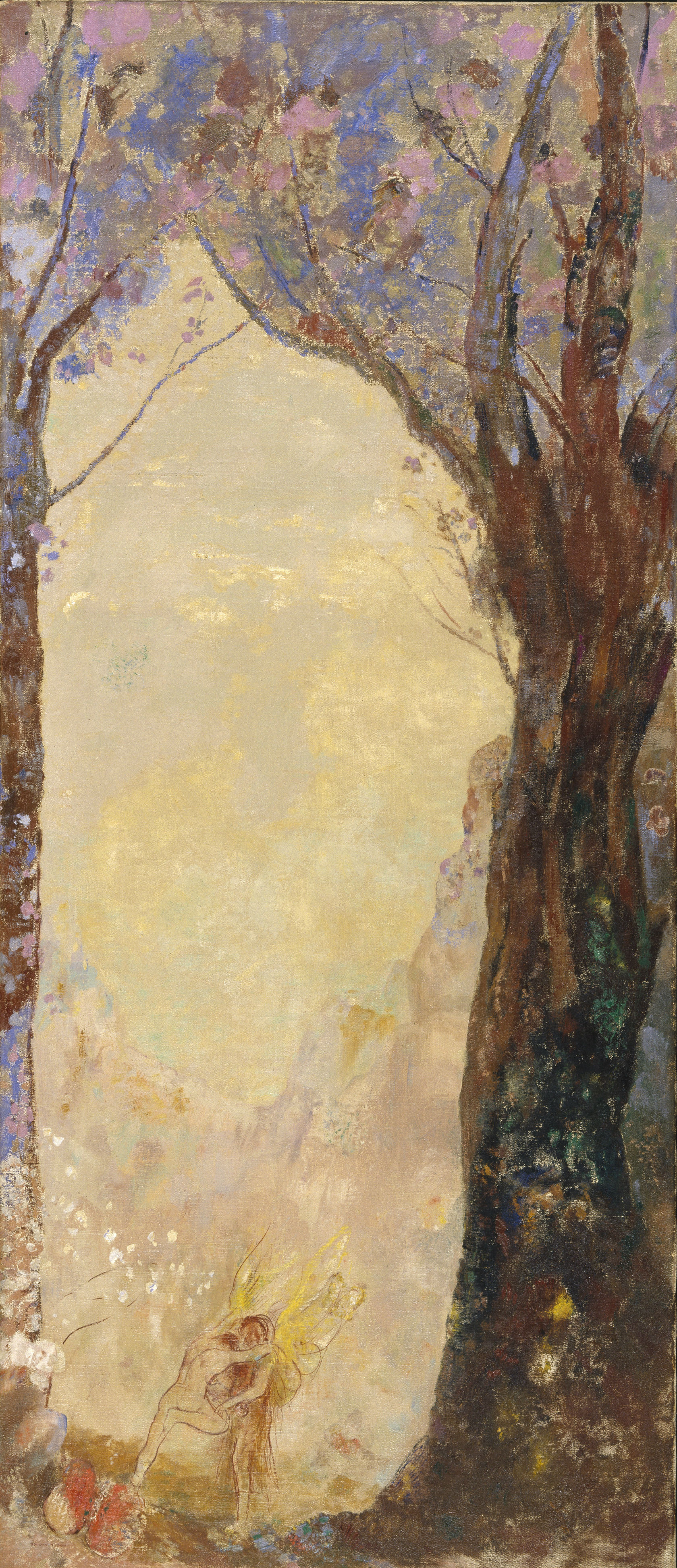
Redon, Odilon_Jacob Wrestling with the Angel
Odilon Redon (French, 1840–1916), Jacob Wrestling with the Angel, ca. 1905–10. Oil on canvas, 56 1/2 × 24 1/2 in. (143.5 × 61.9 cm). Brooklyn Museum of Art, New York.

And he rose up that night, and took his two wives, and his two womenservants, and his eleven sons, and passed over the ford Jabbok.

And he took them, and sent them over the brook, and sent over that he had.

And Jacob was left alone; and there wrestled a man with him until the breaking of the day.

And when he saw that he prevailed not against him, he touched the hollow of his thigh; and the hollow of Jacob’s thigh was out of joint, as he wrestled with him.

And he said, Let me go, for the day breaketh. And he said, I will not let thee go, except thou bless me.

And he said unto him, What is thy name? And he said, Jacob.

And he said, Thy name shall be called no more Jacob, but Israel: for as a prince hast thou power with God and with men, and hast prevailed.

And Jacob asked him, and said, Tell me, I pray thee, thy name. And he said, Wherefore is it that thou dost ask after my name? And he blessed him there.

And Jacob called the name of the place Peniel: for I have seen God face to face, and my life is preserved.

And as he passed over Penuel the sun rose upon him, and he halted upon his thigh.

—Genesis 32:22–31 (KJV)

+++

SONG: “Whilst falling asleep, Savta told me of Jacob” | Text by Emily Dickinson, ca. 1859 | Music by Dominic de Grande, 2017 | Performed by St. Salvator’s Chapel Choir, under the direction of Tom Wilkinson, on Annunciations: Sacred Music for the 21st Century, 2018 [listen on SoundCloud]

This choral composition was commissioned in 2016 as part of the TheoArtistry project [previously] of the Institute of Theology, Imagination and the Arts (ITIA) at the University of St. Andrews in Scotland, the aim of which is to reinvigorate dialogues between theologians and practicing artists. Emerging theologians from St. Andrews’ divinity school were paired with composers under the guidance of Sir James Macmillan to create six new choral settings of Hebrew Bible “annunciations,” communications of God to humankind. The collaborations are mutually beneficial: composers who may have no Christian background or no formal theological training but who want to contribute to the landscape of modern sacred music or seek out new lyrical content in the Bible are provided with textual exegesis and consultation by those who are learned in the fields of theology and biblical studies, and on the other hand theologians have Bible passages opened up to them in new ways through music, helping them to engage the texts on a more experiential level. Creative inspiration on both sides! Dr. George Corbett, director of TheoArtistry and an ITIA lecturer, says the St. Andrews divinity school wants composers and other artists to use them as a resource.

Dominic de Grande was one of six composers selected from an applicant pool of about a hundred to write a choral piece approximately three minutes in length that would be performable by a good amateur choir. He was assigned Jacob’s nocturnal wrestling match and was partnered with theologian Marian Kelsey, who oriented him to the ambiguity of the Genesis 32 narrative, the Hebrew wordplay, and the narrative’s appropriations in liturgy, literature, and visual art. De Grande chose to set Emily Dickinson’s poem on the subject, “A little East of Jordan”:

A little East of Jordan,
Evangelists record,
A Gymnast and an Angel
Did wrestle long and hard—

Till morning touching mountain—
And Jacob, waxing strong,
The Angel begged permission
To Breakfast—to return—

Not so, said cunning Jacob!
“I will not let thee go
Except thou bless me”—Stranger!
The which acceded to—

Light swung the silver fleeces
“Peniel” Hills beyond,
And the bewildered Gymnast
Found he had worsted God!

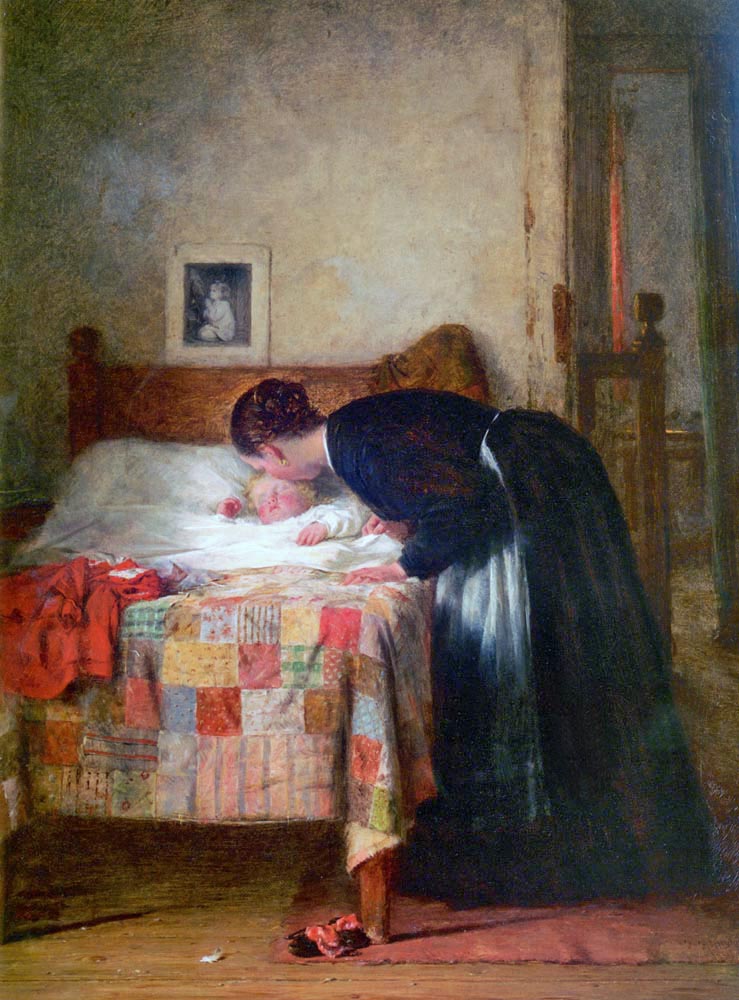
Because the tone of the poem is light and playful, de Grande scored it in the context of a grandmother telling the story to her grandchild at bedtime; he titled the composition “Whilst falling asleep, Savta told me of Jacob,” the word Savta being Hebrew for “grandmother.” It starts off gently, lilting, with a harmonic underpinning consisting of three chords. But, as Kelsey pointed out, the biblical text evokes a sense of danger and intensity, so after Dickinson’s third stanza, de Grande inserted a fragment from Genesis—“LET ME GO, FOR DAY IS BREAKING”—spoken by Jacob’s mysterious opponent. It’s sung as a burst of voices and organ, the latter six syllables introducing six new chords, evoking a sense of otherness. This demand forms a juxtaposition with the sweet, innocuous language of Dickinson’s angel, who politely asks permission to break for mealtime. After the interjection the piece returns to its gentler tone, as dawn dispels the “silver fleeces” of cloud and Jacob sits in the aftermath of the encounter. The human whistling throughout suggests something of the numinous.

Annunciations (ITIA book)

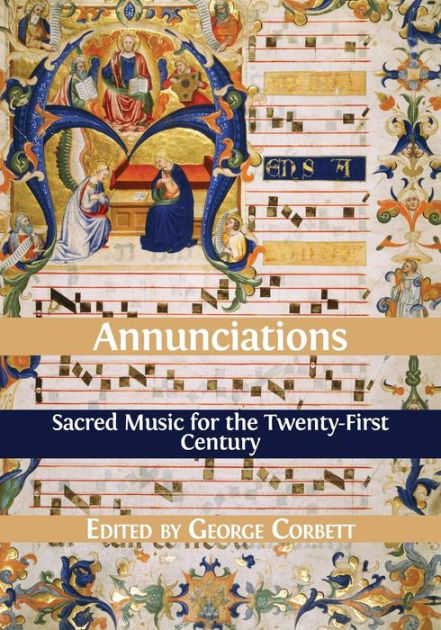
To learn more about the TheoArtistry Composers’ Scheme, check out Annunciations: Sacred Music for the Twenty-First Century (2019), an open-source book available for free download as a PDF or for purchase in other formats. The book includes reflections on the collaboration process and other aspects of the project by all twelve participating theologians and composers (plus full scores! and links to audio) as well as chapters by various contributors on sacred music in worship settings versus secular settings, the theology of music, the vocation of the composer, moments of divine encounter in the ancient Near East, Mary as a model for creative people, the Gospel canticles in church liturgies, and more.

You can also watch this twenty-minute behind-the-scenes documentary:

The other “annunciations” in the TheoArtistry Composers’ Scheme are God speaking to Adam and Eve (Genesis 3), Moses and the burning bush (Exodus 3), the threefold calling of Samuel (1 Samuel 3), Elijah and the “sound of sheer silence” (1 Kings 19), and the Song of Songs 3:6–11.

+++

For an Artful Devotion from last year on this same biblical text, see “Wrestling Jacob”; it features a contemporary woodcut illustration from a German Bible and one of my favorite Charles Wesley hymns, with music from the shape-note tradition.

For theologically informed commentary by Natalie Carnes [previously] on three modern artworks of Jacob wrestling the angel, see The Visual Commentary on Scripture.


This post belongs to the weekly series Artful Devotion. If you can’t view the music player in your email or RSS reader, try opening the post in your browser.

To view all the Revised Common Lectionary scripture readings for Proper 13, cycle A, click here.

“We Walk in Miracles” by Sister Maura Eichner, SSND

Saar, Betye_Flight
Betye Saar (American, 1926–), Flight, 1963. Screenprint, 14 9/16 × 18 1/8 in. (37 × 46 cm). Museum of Modern Art, New York.

We walk in miracles as children scruff
through daisy fields, their dresses appliquéd
with shifting tide of blossom, welkin-stuff,
the Father’s white creative laughter made.

Common as spring, as bread, as sleep, as salt,
the daisies grow. Our Father made them reel
against us like the morning stars that vault
the greater home His love will yet reveal.

The petals push against the ankles, knees,
the thigh, the hands; gold pollen sifts within
the pores to rivulets of veins, to seas
of subtle life behind unsubtle skin.

O deeper and deeper than daisy fields, we drown
in miracles, in God, our Seed, our Crown.

“We Walk in Miracles” appears in After Silence: Selected Poems of Sister Maura Eichner, SSND (Notre Dame of Maryland University, 2011), published posthumously and copyrighted by the Atlantic-Midwest Province of the School Sisters of Notre Dame. Used with permission.

Three poems about Vincent van Gogh

This spring I guest-wrote and narrated an episode of the Makers & Mystics podcast on the life, art, and spirituality of Vincent van Gogh.

Vincent van Gogh artist profile

The son of a Dutch Reformed pastor, Vincent was a lifelong seeker after God who sought through his work to convey the pervasion of the Divine in the everyday. Before he was an artist, he was a missionary to a destitute coal-mining village in Belgium. His ministry was so incarnational—he lived just like those he served—that the sending agency deemed him too undignified to be a minister of the gospel and cut off his support. Hurt by its hypocrisy, Vincent left the institutional church, but he never abandoned his faith. That faith did evolve, however. His so-called evangelical period gave way to a period of artistic discovery, which enabled him to revel even more deeply in the mystery of God and the ethics of Jesus—which he wrote about frequently in letters to his brother Theo.

Despite personal suffering and an acute awareness of the suffering of others, Vincent was very attuned to the beauty of this world and lived a life of wide embrace. He saw the image of God in people and in nature and honored that image through his paintings, of sunflowers, cypresses, olive groves, wheat fields, farmers and mothers and postmen, soldiers, doctors, café owners, and his own self. When he was institutionalized, he continued to paint, so long as his health allowed it, and some of his finest work comes from this period at Saint-Rémy, including The Starry Night. (“When all sounds cease, God’s voice is heard under the stars,” Vincent wrote.) While some interpret the agitated brushstrokes of his later paintings as evidence of internal turmoil and instability, might they not instead express his view of the universe as vibrant, wild, pulsating with life and energy? It is a myth, after all, that Vincent painted in fevered states.

As I was doing research for the podcast episode, I encountered many poets who have responded in verse to specific paintings of Vincent’s, or more generally to Vincent’s oeuvre, vocation, and legacy. I’ve selected three such poems from the latter category, each of which serves as a wonderful introduction to the man and his work—a distillation of his essence, even. I’m struck by how all three poets use religious language to describe Vincent’s paintings: hymns, psalms, prayers.

I’ve compiled the images referred to in the poems, plus a few other representative ones, in the tiled gallery below. To enlarge a photo and to view more info, click on its caption, visible by hovering your cursor over the bottom.

+++

“Dear Lover of Light” by Abigail Carroll

Dear Lover of Light,

There lived a priest
so in love with light
it drove him mad.
Paint was his thing.
When he could no longer
preach, he hopped a train
south, took up a brush,
turned zinc and lead
and chrome
into gaudy, wild-
petaled ambassadors
of the dawn. He slapped
stars as big as brooches
on the sky, danced
crows across bowing fields
of wheat, exalted a bowl
of onions, a bridge, a pipe,
a chair, a bed. Postmen
and prostitutes
were his friends—
so too were irises,
almond trees,
windmills,
clouds. Francis,
if you think of a painting
as a kind of song, he too
canticled the sun.

A Vincent enthusiast

This poem appears in A Gathering of Larks: Letters to Saint Francis from a Modern-Day Pilgrim (Eerdmans, 2017) and is reproduced here by permission of the publisher. All rights reserved.

“Dear Lover of Light” is from a collection of verse-style letters addressed to Saint Francis of Assisi, a thirteenth-century friar who was in love with Christ and with creation—he called animals, the natural elements, and celestial bodies “brothers” and “sisters,” as in his famous “Canticle of the Sun,” and is said to have preached to birds and tamed a wolf.

Abigail Carroll sees Francis as a kindred spirit to Vincent, who, she says, also “canticled the sun.” Vincent’s paintings are like songs of praise. Instead of words he used color—and yellow was his favorite (yellow ocher, cadmium yellow, zinc yellow, chrome yellow), representing for him life, energy, happiness, hope, and friendship.

“When he could no longer / preach” refers to Vincent’s being let go from his village preaching post by a religious board that deemed him too ineloquent and too radical. He moved to The Hague, where he befriended a pregnant sex worker named Sien and her daughter Maria, giving them shelter in his apartment and supporting them as best he could with his own meager funds. From there he went to Nuenen, where his compassion for the working poor manifested in the many earth-toned paintings of this period, including his first major work, The Potato Eaters, showing a family gathered around the dinner table, enjoying the fruit of their labors. After two years in Paris, Vincent needed a respite from the city noise, which led him to Arles in southern France, where he really started finding himself as an artist. He was enraptured by the way sunlight flooded the Provençal landscapes, making them radiant.

Carroll’s poetic descriptions of Vincent’s paintings—dancing crows, jewel-like stars, bowing wheat—capture his sense of all of creation being alive unto God, infused with the sacred. Vincent found great joy in observing what flowered around him, from the irises that grew outside the asylum where he committed himself to the almond tree he painted as a gift for his newborn nephew Vincent, whom his brother named after him. And Vincent saw sacred beauty not only in the natural world but also in everyday articles and objects, be they a pair of well-worn boots in the mudroom or the empty chair of his friend Paul Gauguin.

+++

“What Happened When He Looked” by Marilyn Chandler McEntyre

His miners are made of earth, his sowers so close
to the colors of the fields, only the broad hat, the sack,
the outflung arm keeps them from fading into wheat.

But sometimes, he found, the earth itself turns
to water. Mountains tumble like rapids, waves
curling, blue, roiling and leaping like
the Psalmist’s mountains clapping their hands.

And water turns to air. As life turns to breath.
The sky grows heavy with sun and draws
everything into its fierce embrace, urging
matter upward and homeward to where
the energies of earth begin.

And then there is fire. When they are alive enough
(or we), bushes burn. If you see it, you go
reeling home along a roadway you suddenly know
is temporary and might evaporate or begin
to pinwheel around a star, taking you with it
beyond deeper and deeper blue, into yellow that melts
to a core of thick, transparent white where love
burns day and night to fuel the fallen seed.

This poem appears in The Color of Light: Poems on Van Gogh’s Late Paintings (Eerdmans, 2007) and is reproduced here by permission of the publisher. All rights reserved.

This poem is structured around the four classical elements, understood as the material basis of the physical world: earth, water, air, and fire. Marilyn Chandler McEntyre notes how in Vincent’s paintings, these elements take on characteristics of one another: for example, in Olive Trees in a Mountainous Landscape, the hills surge and flow like water, and in The Sower of 1888, the air burns like fire.

In this latter painting, Vincent said he wished to use the yellow sun as a symbol of Christ’s presence, a sort of halo that covers everything it touches. (See also Letter 673: “I’d like to paint men or women with that je ne sais quoi of the eternal, of which the halo used to be the symbol, and which we try to achieve through the radiance itself, through the vibrancy of our colorations.”) The Sower shows the union between the temporal and eternal, two interpenetrating realms. “The sky . . . draws / everything into its deep embrace, urging / matter upward and homeward,” McEntyre writes.

Vincent saw, in the famous words of Elizabeth Barrett Browning, that “Earth’s crammed with heaven, / And every common bush afire with God.” A reference, of course, to the burning bush in Exodus 3:

Now Moses was keeping the flock of his father-in-law, Jethro, the priest of Midian, and he led his flock to the west side of the wilderness and came to Horeb, the mountain of God. And the angel of the LORD appeared to him in a flame of fire out of the midst of a bush. He looked, and behold, the bush was burning, yet it was not consumed. And Moses said, “I will turn aside to see this great sight, why the bush is not burned.” When the Lord saw that he turned aside to see, God called to him out of the bush, “Moses, Moses!” And he said, “Here I am.” Then he said, “Do not come near; take your sandals off your feet, for the place on which you are standing is holy ground.” (emphasis mine)

McEntyre titled this poem “What Happened When He Looked”—that is, what happened when Vincent, like Moses, looked with intent on the miraculous sights that go unnoticed by so many. What happened is, like Moses, he heard God speak. What happened is he experienced a mystical union with that “something on High—inconceivable, ‘awfully unnameable’— . . . which is higher than Nature.” Vincent’s art making was a reverent act of beholding and of bearing witness to that something.

The final line of McEntyre’s poem refers to Jesus’s parable of the fallen seed, which once it dies, springs forth life—a picture of the promise of resurrection. The sun, or white-hot love of God in Christ, is generative, the energy that raises us out of the dark and fuels our growth and flourishing. Vincent’s paintings radiate that love.

During his time as an assistant preacher under Rev. Thomas Slade-Jones in Isleworth, England, in summer 1876, Vincent wrote to Theo,

I am still far from being what I want to be, but with God’s help I shall succeed. I want to be bound to Christ with unbreakable bonds and to feel these bonds. To be sorrowful yet alway rejoicing. To live in and for Christ, to be one of the poor in His kingdom, steeped in the leaven, filled with His spirit, impelled by His Love, reposing in the Father [. . .]. To become one who finds repose in Him alone, who desires nothing but Him on earth, and who abides in the Love of God and Christ, in whom we are fervently bound to one another.

Though Vincent would later renounce orthodox Christianity, he retained his love for Christ and his sense of awe in the face of the Infinite active in the here and now.

+++

“Van Gogh” by Jeanne Murray Walker

     All right, I love him for the way
                      he painted Vermilion! Orange! jagged as
        shouts, and when no one bought them,
                      no one even heard him,
he shouted louder,
                      Sunflowers! Self-portrait!
     and years later, not one sold,
                      he cut off his own ear.

     Then he had to bring it back on canvas
                      hundreds of times,
        in the brass swelling
                      of the bell
that called him to dinner,
        in the complicated iris
                      at the end of the asylum path.
                            Think how stooping
at a fork in the road
                      he might have seen a stone-shaped ear,
       how the human heart,
                      once it knows what it needs,
will find it everywhere, how
       in the curve of his delicately padded cell
                      one starry night, he must have murmured
                            everything he had ever wanted to say
straight into the ear of God.

This poem appears in A Deed to the Light (University of Illinois Press, 2004) and is reproduced here by permission of the publisher. All rights reserved.

If McEntyre’s poem is about looking and provoking others to look, Jeanne Murray Walker’s is about wanting to be heard, and takes the ear as its central image. Vincent is, of course, notorious for the psychotic episode that culminated in him cutting off his left ear. (His self-portraits show the bandages on his right ear because he painted them while looking in a mirror.) Walker imagines him thereafter seeing ear-shapes everywhere in nature—delicate curves and hollows—manifestations of his longing to be listened to.

Vincent’s paintings are prayers, Walker suggests, that went straight into the ear of the One who hears, who holds all our joys and sadness in love. Others didn’t hear Vincent, but God did.

I will mention that it is a myth that Vincent never sold a painting during his lifetime. True, he sold few—his most significant sale was The Red Vineyard, purchased in January 1890 by Anna Boch while Vincent was convalescing at a psychiatric hospital—“but still,” writes Rainer Metzger in Van Gogh: The Complete Paintings, “the fact should not be overemphasized; after all, Vincent was so willing to give his paintings as presents that many would-be purchasers never needed to part with a penny” (566). And he sometimes made in-kind trades with his paintings.

It’s also false that Vincent died without ever having received recognition for his work. Actually, he was a rising star in the art world. The avant-garde circles in France and Belgium recognized his talent before his death. He was exhibited a few times and received a gushing review in January 1890. Several fellow artists spoke favorably of his work, and his brother Theo, an art dealer, was a tireless champion. It wasn’t easy getting established, and yes, there were many people along the way who didn’t see the value of what he was doing, but Vincent kept at it. He was still in his early career when he died on July 29, 1890, at age thirty-seven. After his death the audience for his work, and thus appreciation for it, grew exponentially, thanks in large part to his sister-in-law, Johanna van Gogh-Bonger, who edited, translated, and published all 652 letters from Vincent that she had in her possession, lent his paintings to various exhibitions, and promoted his work in other ways.

But on a personal level, Vincent was often overlooked, known as something of an eccentric, a crazy person, and was often teased and tormented. In fact, one theory about his death, originating in the 1950s and popularized by the Pulitzer Prize–winning biographers Steven Naifeh and Gregory White Smith in their 2011 book Van Gogh: The Life, is that he was shot by teenage bullies. (The Van Gogh Museum rejects this theory, declaring his death a definitive suicide.)

Vincent battled mental illness: during his lifetime he was diagnosed with a form of epilepsy that causes seizures, hallucinations, and manic depression. While he made friends in each city he lived in, his illness tended to cause rifts, sometimes permanent ones. On occasion he wrote to Theo how lonely he was.

So even when Vincent was starting to attain professional recognition for his art toward the end of his life, he still felt at times unwanted and misunderstood. “A great fire burns within me, but no one stops to warm themselves at it, and passers-by only see a wisp of smoke.” He wrote this line in June 1880, but it’s a sentiment that would resurface in his letters over the next ten years—the idea that people weren’t interested in the gifts he had to offer, whether relational or artistic.

Walker’s poem captures that mixture of confidence and doubt, self-assuredness and vulnerability, hardness and softness, and above all the dogged persistence that characterized Vincent. He “shouted” his soul onto canvas and into a world that in many quarters was plugging its ears. And he “murmured” it to the heavens, where it was received openly, caringly.

+++

To learn more about Vincent van Gogh, here are some recommended resources:

  • The aforementioned “Vincent van Gogh” podcast episode (Makers & Mystics Artist Profile Series no. 28) breaks down Vincent’s art and faith in under twenty minutes.
  • The world’s largest collection of van Gogh’s work is at the Van Gogh Museum in Amsterdam. The museum has an excellent website, which includes high-resolution photos of 200+ paintings and 500+ drawings, plus interactive “Stories” on such topics as “Nature and the Artist,” “Inspiration from Japan,” and “Brotherly Love: Vincent and Theo,” in which you click through bit by bit to view art, archival photos, and quotes connected together with short narration—very engaging! (Kudos to whoever designed the interface.) You can even take a seven-video virtual tour of the museum in 4K, seeing how all the galleries are laid out.
  • The freely accessible website Vincent van Gogh: The Letters contains scans, transcriptions, and translations of all van Gogh’s letters to his brother Theo, his artist friends Paul Gauguin and Émile Bernard, and many others. They are heavily footnoted and include sketches and other enclosures, and the website enables universal searches! I can’t afford the official six-volume, complete illustrated and annotated print edition from Thames & Hudson, but I do own a Penguin Classics edition, The Letters of Vincent van Gogh, a generous selection introduced and editorialized by Ronald de Leeuw and translated by Arnold Pomerans, which is mostly what I quote from in this article. An abridged book like this one might be a good place to start if you’re not able or willing to invest a ton of time poring over the full correspondence, some of which is dull or rambling.
  • Van Gogh’s paintings have been victim to some truly poor-quality reproductions circulating online. The full-color Van Gogh: The Complete Paintings (Taschen, 2012) was indispensable to me as I researched the artist, as it documents his full catalog of paintings (note: not drawings) with high-resolution photos that capture as accurately as possible the works’ colorative and textural richness. These are arranged by period and contextualized with essays.
  • The award-winning HENI Talks produced a seven-minute video titled “Van Gogh’s Olive Trees,” which is gorgeously shot and covers more than just the titular subject.
  • Movies? I really enjoyed the 1956 biopic Lust for Life starring Kirk Douglas—the characterization seems to me spot-on, and overall it does a great job with historical accuracy—and the oil-painted animated feature Loving Vincent from 2017 [previously]. I was not too keen on the recent At Eternity’s Gate starring Willem Dafoe.

Van Gogh books

There are many spiritual biographies of Vincent van Gogh, or books about the religious impulse behind his art:

At Eternity’s Gate, published by Eerdmans in 1998, was the first of its kind and is still probably my favorite; the author has advanced degrees in both religion and art history and does an excellent job arguing that Vincent’s spiritual life was essential to the unfolding of his artistic vision. Carol Berry’s Learning from Henri Nouwen and Vincent van Gogh, though, would probably be my top recommendation to those who just want to dip their toes in and engage Vincent’s story in a less academic, more personal, way, as Berry, an art educator with a background in Christian ministry, interweaves the lives of Vincent and Henri with personal memoir—an excellent gift book.

Roundup: Santo Spirito, Joan of Arc, “Halo My Path,” and more

VIDEO: “Ned Bustard: Making Good”: Cursive Films profiles Ned Bustard [previously], a graphic designer, linocut artist, and founder of Square Halo Books. Asked how he as a Christian defines success in his field, he responds with a quote by his friend Kurt Thompson: “We were made in joy to make things in and for joy.” So instead of asking, “Am I successful?,” we should be asking ourselves, “Am I doing what I was designed to do?,” Bustard says.

+++

ESSAY: “I’d Like to Learn to Love It Anyway” by Helena Sorensen: In this personal essay from the Rabbit Room, Sorensen reflects on the world’s brokenness and beauty, a world where there is grief and disappointment and uncertainty and scarring but also love and springtime and strength and song. She opens by recounting her eleven-year-old son’s very visceral feeling of pain in reaction to the death of a baby bird, and his exasperated “What’s the point of it all?” She then introduces a song that crystallizes her son’s struggle—“Letter to the Editor” by J Lind—while sharing her own struggles, since adolescence, to accept her body. There’s no theodicy here, no theological explanations for suffering; just an aspiration to live with openness and gratitude and perspective, and to take the bad along with the good, the cost of being human.

+++

NEW POEM: “Santo Spirito” by Jacqueline Osherow: (Read the poem before reading my commentary; I don’t want the latter to influence your first impressions!) Osherow is Jewish and also a lover of Renaissance art, having previously lived in Florence for a year and a half. And she has been enamored of birds since childhood. These influences coincide in her long free-verse poem “Santo Spirito” (Italian for “Holy Spirit”), subtitled “Autobiography with Doves.” Here she traces the presence, and sometimes absence, of the dove as symbol of the Holy Spirit in Italian master paintings of the Annunciation and the Baptism of Christ. Osherow said she does not read the New Testament but experiences Christian narrative and theology through art, which has “been working / on me all along, its proselytizing / deftly subliminal // like the edgy / come-ons urban / legend claims / were strategically / concealed in / advertisements.” (Still, she says, “I remain a Jew, . . . no matter / what I look at, what / I see.”)

Santo Spirito
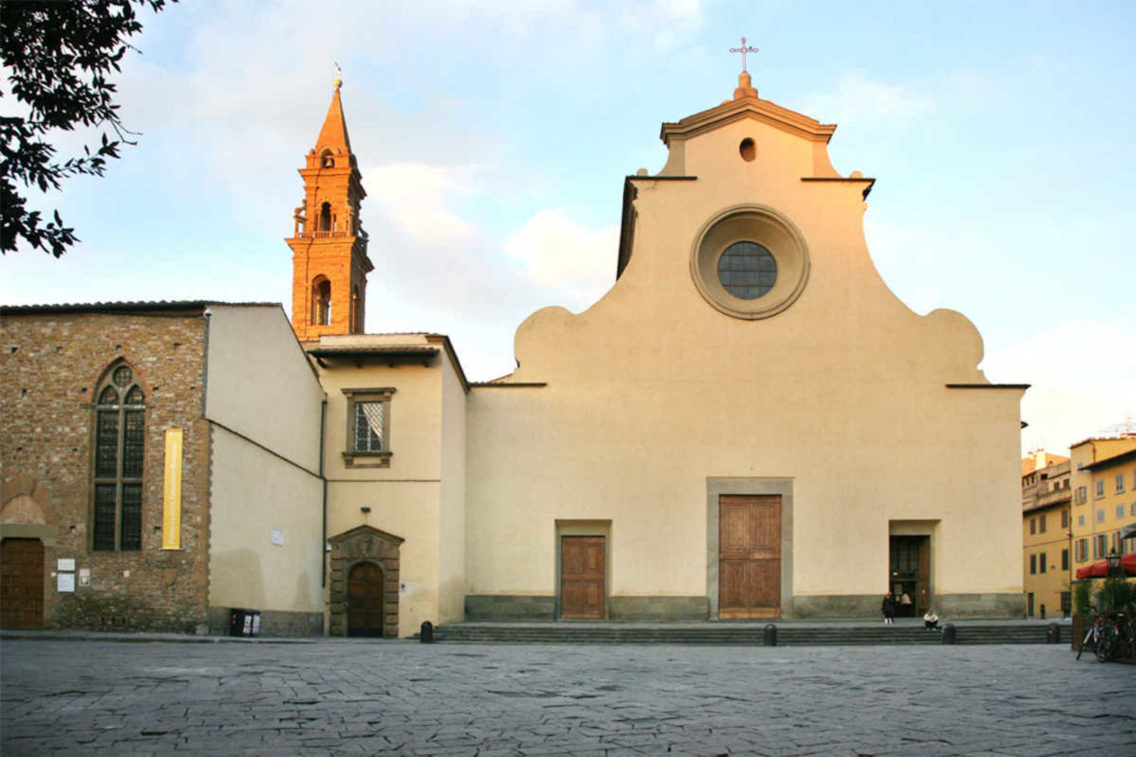
Basilica di Santo Spirito, Florence

The poem is a reflection on divine revelation and hiddenness, precision and mystery, the visible and invisible. Where and how does God’s spirit reside? What is holy, or can we say only when we encounter it? The poem hinges on the fifteenth-century Florentine church the poem takes its title from. Santo Spirito has a strikingly plain façade, a “supple blankness / wide-open, burning, / immaculate, . . . infinite,” like an unrolled scroll without writing. After a catalog of religious art that pictures and describes, Osherow pauses in front of this emptiness that is likewise inviting. Yes to artists’ visions, she says, to doves and other literalisms, to the transcription and translation of God’s word, to apologetic discourse and theologizing, to bumbling our way toward truth—but yes also to the way of unknowing.

My junior year of college I, too, lived in Florence—just a few minutes’ walk from Santo Spirito, in fact—so this poem is full of memories for me, and I love Osherow’s candid reflections on specific artworks in the city:

Plus these two:

  • The Baptism of Christ by Piero della Francesca, made for the Priory of San Giovanni Battista at Sansepolcro in Tuscany, now in the National Gallery, London
  • The Annunciation panel of an altarpiece Piero della Francesca made for the Franciscan convent of Sant’Antonio da Padova in Perugia, now in the Galleria Nazionale dell’Umbria

Jacqueline Osherow read her poem recently for an Image-sponsored Zoom event followed by a Q&A (video link available on poem page). There were supposed to be photo slides of the paintings keyed to relevant stanzas, but the display doesn’t correct until 8:03.

+++

NEW SONG: “Halo My Path” by Josh Rodriguez: The words to this “quarantine chorale” are excerpted and adapted from a Puritan prayer titled “Voyage,” from the compilation The Valley of Vision. Composer Josh Rodriguez said he wrote the song “as I watched the bravery of medical professionals, the difficult decisions that government leaders faced, the disproportionate suffering of the poor, the unrest in my own heart. . . . I hope this prayer will challenge us to fight against the selfishness that resides in our hearts, to persevere in the long road to recovery, to appreciate once again that simple privilege of life together.” I’m grateful to Rodriguez for throwing this beautiful phrase into high relief: “Halo my path,” an address to God. Make bright my way, sanctify it, illuminate it with gentleness and love so that my every step is into the light of these virtues, not into the darkness of causticity and hate. The song is an aspiration to bless, to sow gladness rather than grief.

Halo my path with gentleness and love,
smooth every temper;
let me not forget how easy it is to occasion grief;
may I strive to bind up every wound,
and pour oil on all troubled waters.
May the world be happier because I live.
Halo my path.

+++

NEW ALBUM: Peace to All Who Enter Here by Josh Garrels: A mix of calming hymns and worship songs, including two previously unreleased originals: “Fear Thou Not” and “Creation Song.” I’ve long had a strong emotional connection to the opening song, “Turn Your Eyes Upon Jesus,” so I was hooked from the beginning!

“in the month of march the world entered a time of quarantine,” Josh’s wife Michelle writes on the album’s Bandcamp page. “our life of work- and school-from-home continued basically as usual. but beyond the boundaries of our yard, the world was rapidly shifting. instinctively for us, it was a time to pray & praise. when we enter into praise in times of uncertainty, we feel God’s goodness, the everything in His hands. His peace is a real, sustaining thing. josh began these days by firelight in the garage, mornings of prayer while winter melted away into hopeful spring. in the afternoons he’d turn on the recording gear & sing out praises. You’ll hear the click of the wood stove, the chirping of birds, our five children playing in the front yard. there was a spontaneity to this recording, & the result is sweet. . . . we hope you encounter the peace of Christ as you enter here, finding hope & faith restored in these turbulent times.”

+++

FILMS:

May 30 is the feast day of Joan of Arc, a French peasant girl who, during the Hundred Years’ War, claimed to have received visions from God instructing her to fight against English domination. She participated in military campaigns with the French army but was eventually captured and, after a trial financed by the English crown, burned at the stake. She was later sainted.

Joan of Arc has been the subject of many films. Here are two I’ve seen, both of which abandon glamorous military heroics to focus instead on some of the less flashy parts of her life, with Jeannette being set during her pre- and early adolescence, and The Passion during her trial.

Jeannette: The Childhood of Joan of Arc (2017): A thrash metal period musical is certainly a unique approach to take for Joan’s story, and this movie is . . . eccentric. It shows Joan, played by nonprofessional actors at ages eight and thirteen, as a shepherd girl in rural France, deeply pained by the English oppression of her people. “Our Father who art in heaven, your name is so far from being hallowed, and your reign from coming,” she laments. Pious beyond her years, she struggles to discern God’s will, and once she does, to follow it. She’s helped along by visions of the nun Madame Gervaise—whom writer-director Bruno Dumont splits into two singing, dancing figures played by twins—and others.

The ridiculousness of this art-house film will be off-putting to some, but I feel it does serve a function: we furrow our brows and roll our eyes and wonder if it’s for real, much like those contemporaries of Joan’s who were dismissive of her strange claims and behaviors.

The dialogue is adapted from Charles Péguy’s 1910 mystery play The Mystery of the Charity of Joan of Arc.

The Passion of Joan of Arc (1928): Starring Renée Falconetti in a legendary performance, this silent film classic paints Joan as a Christ figure who’s mocked and martyred for her refusal to betray God’s will. There are allusions throughout to Christ’s passion: shadows form a cross on the wall; Joan weaves a crown of straw; there’s a bloodletting scene; et cetera. Expressionistic lighting and painfully intimate close-ups immerse viewers in Joan’s subjective experience. (As a sidebar, Falconetti was thirty-five when she played the role, whereas Joan was only nineteen when she was tried and martyred; I think because Falconetti’s portrayal is so iconic, people often forget how young Joan was.)

Director Carl Theodor Dreyer was very concerned with documentary authenticity, so he enlisted the leading expert on Joan of Arc, Pierre Champion, as a historical adviser on the film. The script is based heavily on transcripts of Joan’s trial and execution, which are held at the Bibliothèque Nationale in Paris. The French ecclesiastical court, allied with the English, press Joan on the veracity of her visions, her certainty of salvation, her support of Charles VII, her wearing of men’s clothing; she continues to insist that she is fulfilling the mission God called her to. Though the historical Joan was subjected to twenty-two interrogation sessions spread out over a few months, by necessity the movie telescopes them into a brief timespan.

Many composers have written scores for the film. The Criterion release gives three options: Richard Einhorn’s Voices of Light oratorio, which takes a traditional, maximalist approach; a score by Goldfrapp’s Will Gregory and Portishead’s Adrian Utley, utilizing electric guitars, voices, synthesizers, brass, harp, and percussion; and a minimalist piano score by Mie Yanashita. However, purists say the film should be watched in silence, as Dreyer preferred.

Roundup: Jonah disgorged, Watching TV Religiously, “My Mother’s Body,” and more

VISUAL MEDITATIONS (ARTWAY.EU)

Jonah Swallowed and Jonah Cast Up, commentary by Victoria Emily Jones: My latest visual meditation for ArtWay was published Sunday—it’s on two third-century Jonah sculptures from Asia Minor that likely decorated a family fountain. Early Christians read the story allegorically (at least on one level), as pointing forward to the death and resurrection of Christ. The “great fish” is portrayed as a ketos, a sea-monster of Greek myth.

Jonah Marbles
“Jonah Swallowed” and “Jonah Cast Up,” made in Asia Minor, probably Phrygia, 280–90 CE. Marble, 50.4 × 15.5 × 26.9 cm (left) and 41.5 × 36 × 18.5 cm (right). Cleveland Museum of Art, Ohio.

Run by Marleen Hengelaar-Rookmaaker, the faith-based website ArtWay has been publishing a new visual meditation every Sunday for years, as well as a lot of other content from a variety of contributors. To subscribe to the weekly email, click here. Here are just a few VMs published in the past year that I particularly enjoyed:

Manu-Kahu by Brett a’Court, commentary by Rod Pattenden: Pattenden begins, “This striking image of an airborne Christ is from New Zealand painter Brett a’Court. It is part of his investigations into a way of bringing together the spiritual insights of the indigenous culture of the Maori people and that of Christianity brought to New Zealand by British settlers. In cultural terms it is a hybrid image. This is something that occurs when two cultures are in a process of mutual re-assessment. That sort of conversation is full of conflict and critique but also allows for the potential for new forms to arise that express the best of both traditions. A Christ figure flying in the sky like a kite, is such a form. It is a new thing, a potential heresy or aberration, but one full of potential for new insight and spiritual refreshment.”

Manu-Kahu by Brett a'Court
Brett a’Court (New Zealand, 1968–), Manu-Kahu, 2007. Oil on canvas.

Knife Angel by Alfie Bradley, commentary by Rachel Wilkerson: This twenty-seven-foot-tall sculpture, welded from 100,000 knives collected in confiscations and amnesties around the UK, confronts the issue of knife violence. The artist cleaned and dulled the blade of each knife he received and engraved personal messages on all the wings’ “feathers,” messages sent by families affected by knife violence.

Bradley, Alfie_Knife Angel
Alfie Bradley (British, 1990–), Knife Angel, 2018. Mixed media sculpture, incl. 100,000 knives.

Cathedra by Barnett Newman, commentary by Grady van den Bosch: I saw this painting in Amsterdam last spring and was surprised by how it compelled me. (I don’t typically gravitate to abstract art.) After spending some time up close—I supposed this was a Newman, and Newman says his paintings need to be experienced up close—I looked at the label and saw that it has a religiously inflected title: Cathedra. The word is Latin for “seat,” and in Christianity it refers specifically to the bishop’s chair inside a church (churches that had a cathedra were called cathedrals). But Newman was of Jewish descent, and van den Bosch writes that Cathedra is meant to represent the throne of God. “And above the firmament that was over their heads was the likeness of a throne, as the appearance of a sapphire stone . . .” (Ezek. 1:26).

Newman, Barnett_Cathedra
Barnett Newman (American, 1905–1970), Cathedra, 1951. Oil and acrylic on canvas, 243 × 543 cm. Stedelijk Museum, Amsterdam, Netherlands. Photo: Victoria Emily Jones.

As someone who loves historical Christian art, including its many Christ Pantocrators, I must nevertheless admit that there is something so right about modern artists’ often apophatic approach to evoking the Divine. While I do believe God imaged Godself in the person of Jesus Christ and is therefore representable, I understand the argument some make that abstraction is a better visual language for spiritual subject matter or encounter. I accept both/and. Whether God is shown as a rich, blue expanse that invites and envelops, or a heroic nude emerging from the jaws of death, or a Man of Sorrows head with a harrier hawk’s body, I think we can learn a little something from the diversity of representations, which are not mutually exclusive. Not all representations need be embraced, but nor do unfamiliar, difficult, or even shocking ones need be automatically dismissed.

Click on the link for more on how to read Newman’s color field paintings, including his signature “zips.”

+++

FREE ONLINE COURSE: Watching TV Religiously: Through at least July 1, Fuller Theological Seminary is offering all its online Fuller Formation courses for free! I just finished taking Watching TV Religiously, taught by Kutter Callaway [previously], author of the book of the same title, and really enjoyed it. It’s a series of six self-paced lessons, which includes short video lectures by the professor, audio conversations with TV writer Dean Batali (Buffy the Vampire Slayer; That ’70s Show), TV watching assignments, reflection questions, and more.

The course aims to help Christians develop critical tools for watching television and a vocabulary that is as rich and thoughtful as the medium itself, so that we can engage it constructively. (It need not be mindless entertainment!) Callaway explores television as a technology, a narrative art form, a commodity, and a portal for our ritual lives. He’s interested in how stories are told in this episodic, audiovisual format, and what that means for the Story we tell. The course is not about what Christians should watch, but how Christians should watch, leaving ample room for individual viewers to set their own boundaries, ethical and otherwise. (Callaway acknowledges that TV can form as well as de-form us.) He discusses empathy building and access to other perspectives, knowing your sensibilities, how being offended can be useful, watching in community, seeing God in all places, being aware of how your desires and imagination are being shaped, Christians in Hollywood (and Christian characters on TV), and the culture shaping TV and TV shaping culture, among other things.

The course is fairly broad in its approach; it does not analyze particular shows or episodes, though some specific examples are mentioned in conversations, and students are encouraged to form discussion groups with friends or family members and apply what they’re learning to shows of their choice. I really appreciated the assigned PBS docuseries America in Primetime (somewhat outdated because made in 2011 but very good nonetheless), whose four episodes explore character types throughout the history of TV, from the fifties to today: “The Independent Woman,” “Man of the House,” “The Misfit,” and “The Crusader.” From taking this course I realized how many acclaimed TV shows I’ve never seen. I’ve got a lot of homework to do!

Other arts courses offered by Fuller Formation are

+++

POEM: “My Mother’s Body” by Marie Howe, read with commentary by Pádraig Ó Tuama: As Mother’s Day is Sunday, I thought I’d share this wonderful, sad-sweet, mother-themed episode of the new Poetry Unbound podcast from On Being Studios. Pádraig Ó Tuama introduces Marie Howe’s “My Mother’s Body,” in which a middle-age woman, caring for her dying mother, thinks back to the time when her mother was just a twenty-four-year-old girl giving birth to her. The speaker in the poem is Howe.

She imagines being in her mother’s womb, experiencing the rhythm of her mother’s heartbeat. (What an exercise, to imagine yourself as your mother’s baby!) Now decades later, her mother is dying—that heart is failing, and the kidneys too. The uterus has been removed. Toggling between the two time frames, the poem is both a celebration of the strength of women’s bodies and a lament for its vulnerabilities, especially in old age. Howe marvels at how her mother’s body was capable of such a wonder as giving and sustaining life, and now to see that once-vibrant form breaking down grieves her. In some sense their roles have switched as daughter mothers mother, combing her hair, changing her soiled bedsheets.

The poem opens with “Bless my mother’s body” and ends with “Bless this body she made . . .” In the progression of pronouns in the last two lines—my, her, our—is a recognition of how our mothers always remain a physical part of us. They are in our cells. “My Mother’s Body” is a thank-you and a letting go.

The poem is from Howe’s collection The Kingdom of the Ordinary—which I highly recommend.

+++

ARTICLE: “5 Contemporary Poets Christians Should Read” by Mischa Willett: There is so much good crop still being pulled from the fertile fields of theologically inflected verse,” writes poet Mischa Willett—so don’t stop short, content merely with Donne and Hopkins! This is an excellent short list of contemporary poets of faith, with summaries of key themes and recommendations for which volume(s) to start with. Willet was recently on The Ride Home with John and Kathy to discuss this topic, and he wrote a follow-up post on his blog.

+++

MUSIC VIDEO: “I Am a Poor Wayfaring Stranger”: One of the most poignant scenes in last year’s 1917 is when, after a harrowing journey across No Man’s Land, Lance Corporal William Schofield—exhausted, disoriented—reaches a wood and encounters a fellow British soldier singing the spiritual “Wayfaring Stranger” [previously] to a battalion that sits at somber attention, for they’re about to go into battle. This official music video from Sony splices together clips from the movie with studio footage of the actor and singer Jos Slovick.

“The Waterfall” by Henry Vaughan

Senju, Hiroshi_Waterfall
Hiroshi Senju (Japanese, 1958–), Waterfall, 2016. Acrylic and fluorescent pigments on Japanese mulberry paper, 51 × 64 in. Photo courtesy of Sundaram Tagore Gallery.
With what deep murmurs through time’s silent stealth
Doth thy transparent, cool, and wat’ry wealth
                  Here flowing fall,
                  And chide, and call,
As if his liquid, loose retinue stayed
Ling’ring, and were of this steep place afraid,
                  The common pass
                  Where, clear as glass,
                  All must descend
                  Not to an end,
But quick’ned by this deep and rocky grave,
Rise to a longer course more bright and brave.

      Dear stream! dear bank! where often I
      Have sat, and pleased my pensive eye;
      Why, since each drop of thy quick store
      Runs thither, whence it flowed before,
      Should poor souls fear a shade or night,
      Who came, sure, from a sea of light?
      Or, since those drops are all sent back
      So sure to Thee, that none doth lack,
      Why should frail flesh doubt any more
      That what God takes He’ll not restore?

      O useful element and clear!
      My sacred wash and cleanser here;
      My first consigner unto those
      Fountains of life, where the Lamb goes!
      What sublime truths and wholesome themes
      Lodge in thy mystical, deep streams!
      Such as dull man can never find
      Unless that Spirit lead his mind,
      Which first upon thy face did move,
      And hatched all with his quick’ning love.
      As this loud brook’s incessant fall
      In streaming rings restagnates all,
      Which reach by course the bank, and then
      Are no more seen: just so pass men.
      O my invisible estate,
      My glorious liberty, still late!
      Thou art the channel my soul seeks,
      Not this with cataracts and creeks.


In “The Waterfall” by Henry Vaughan (1621–1695), a stream’s sudden surge and plummet over a precipice followed by a calm, continued flow is a picture of the soul’s passage into eternity—the continuation of life after death.

The speaker addresses the stream and its retinue of waters, who “murmur” and “chide”—that is, make incessant noise (in the word’s archaic sense). The waters move with increasing momentum toward the brink and hesitate just before but then take the plunge. Briefly brought under, in their “deep and rocky grave” they are “quickened,” made alive once more, as they rise back up to the surface and course smoothly onward, no longer in a state of agitation. After a momentary crash, serenity.

Vaughan represents this action visually with an alternation of groups of long lines and short lines, which give the impression of water tumbling over ledges of rock. The lines then steady out into a uniform column, signifying the water’s becoming sedate.

“Why,” the speaker wonders, “since each drop of thy quick store / Runs thither, whence it flowed before, / Should poor souls fear a shade or night, / Who came, sure, from a sea of light?” Death is benevolent, merely a drop-off along the route and then reconstitution to the whole. Just as the stream that has fallen returns to the vast ocean from whence (via the cycle of evaporation, condensation, precipitation) it came, so, too, does the soul return to God, its origin.

In the final stanza the speaker muses on water as sacrament—baptism, he says, is our “first consigner unto those / Fountains of life, where the Lamb goes” (see Rev. 7:17; cf. Isa. 49:10). In other words, our baptism gives us over to God, to the New Eden. If baptism is our first consigner, then death is our final consigner, bringing us at last to the One to whom we belong.

The profound mystical truth hidden in something as natural as a waterfall is discerned only by those whom the Spirit reveals it to—that same Spirit who hovered over the waters at Creation (Gen. 1:2) “[a]nd hatched all with his quick’ning love.”

I write this in memory of my husband Eric’s grandfather, who died Sunday. I’m consoled by the image of him as a water droplet whose plunge does not mean a cessation of being but rather a flowing into God, into “glorious liberty.” When water plunges down, it sends ripples toward the bank, Vaughan writes, but then settles into stillness and is imperceptibly carried away to a destination out of view. So Grandpa Jones is now on “a longer course more bright and brave,” flowing toward “a sea of light.”

“Breath” by Yahia Lababidi

Komarechka, Don_Jewels of Summer

Beneath the intricate network of noise
there’s a still more persistent tapestry
woven of whispers, murmurs and chants

It’s the heaving breath of the very earth
carrying along the prayer of all things:
trees, ants, stones, creeks and mountains alike

All giving silent thanks and remembrance
each moment, as a tug on a rosary bead
while we hurry past, heedless of the mysteries

And, yet, every secret wants to be told
every shy creature to approach and trust us
if we patiently listen, with all our senses.

“Breath” by Yahia Lababidi appears in Barely There: Short Poems (Wipf and Stock, 2013) and is used by permission of the publisher. Photograph by Don Komarechka, used with permission.

+++

Lately I’ve been delving into the writings of the Egyptian American poet, aphorist, and essayist Yahia Lababidi. I love his Barely There collection of poems on such topics as poetry / the poet, spiritual longing, virtue and vice, hope, surrender, the quiet beauty of nature, attention and gratitude, and pain as a gift. It’s such a wise and tender collection. His latest book, released last month, is Revolutions of the Heart: Literary, Cultural, and Spiritual.

“The Recompense” by John Banister Tabb

Wesley, Frank_Mary at the Tomb
Frank Wesley (Indian, 1923–2002), Mary at the Tomb, ca. 1991. Watercolor, 25 × 20 cm. Published in “Frank Wesley: Exploring Faith with a Brush” (Auckland: Pace, 1993).

She brake the box, and all the house was filled
With waftures from the fragrant store thereof,
While at His feet a costlier rose distilled
The bruisèd balm of penitential love.

And lo, as if in recompense of her,
Bewildered in the lingering shades of night,
He breaks anon the sealèd sepulcher,
And fills the world with rapture and with light.

“The Recompense” by John Banister Tabb was originally published in Poems by John Banister Tabb (Boston: Copeland and Day, 1894) and is now in the public domain.

This short poem—just two quatrains with an abab cdcd rhyme scheme—draws on Luke 7:36–50. In this Gospel episode, Jesus is dining at the house of Simon the Pharisee when an unnamed “sinful woman” enters with an alabaster jar of precious ointment, which she pours lavishly onto Jesus’s feet in an act of love and gratitude, and in recognition of his messianic identity. So humbled is she by Jesus’s forgiveness of her sin that she is in tears. (Note: Tradition says this woman was Mary Magdalene—based in part on a conflation with the similar account in John 12:1–8, which names the woman Mary.)

Of even more value to Christ than the essential oils, Tabb suggests, is the woman’s “penitential love,” a balm before his wounds. Her beautiful, bruised soul, like a rose, releases such an aroma, though the Pharisees can’t smell it, and they try to shame her. Not long hence Jesus returns her tenderhearted gesture, opening another stone container (his tomb) and spilling forth life and light and bliss, priceless treasures, onto his beloved world. He meets Mary in her bewilderment on that first Easter morning, lavishing on her all his resurrection riches.

Roundup: Leon Bridges, Stations of the Cross, Hermitage Museum tour, and contemporary “religious” poetry

NEW SONG RELEASE: “Conversion” by Leon Bridges: A smoky, minor-key redemption ballad closes out Leon Bridges’s [previously] latest EP, Texas Sun, a collaboration with the three-piece psychedelic funk band Khruangbin. Bridges wrote the song in 2012 in response to his conversion to Christianity, he said, but this is the first time he’s recorded it. Halfway through, following a personal testimonial about being made alive by the Holy Spirit, the song breaks into a slow R&B rendition of Isaac Watts’s “At the Cross.” Lyrics here. See also the musical and lyrical analysis Aarik Danielsen wrote over at Think Christian.

+++

STATIONS OF THE CROSS:

Contemporary Artists Interpret Stations of the Cross, St. Michael’s Episcopal Church, Arlington, Virginia, February 19–April 3, 2020: Thanks to one of my readers reaching out, I found out about this church-sponsored exhibition just south of where I live and was able to attend the opening reception, where many of the artists were present to talk about their work and answer questions. Unfortunately, the coronavirus has led to its early closure, but photos of the artworks, which are for sale, can be viewed online: see this write-up by curator Maureen Doallas. Below are the works representing station 8 (“Jesus meets the women of Jerusalem”) and station 14 (“Jesus is laid in the sepulcher”).

Peckarsky, Terry_Still Weeping on the Via Dolorosa
Terry Peckarsky, Still Weeping on the Via Dolorosa, 2020. Quilted commercial cotton fabrics, digitally altered photographs printed on fabric, tsukineko inks, and watercolor, 23 × 31 in. Photo: Victoria Emily Jones. Artist’s website: https://tpeckarsky.tumblr.com/
Lukitsch, Carol_Sophia Icon
Carol Lukitsch, Sophia Icon. Mixed media collage on paper (with laurel leaves), 30 × 22 in. Photo courtesy of the artist. Artist’s website: http://carollukitsch.com/

Passion and Compassion Oxford: This self-guided tour through Oxford, released this February with a new website and supported by the “Alight: Art and the Sacred” app [previously] for Android and iOS, stops at fourteen artworks or artifacts in multiple locations across the city. Designed around the Scriptural Stations of the Cross as a pilgrimage of sorts, it comprises a mix of historical and contemporary pieces, including sculptures by Jacob Epstein and Antony Gormley, Old Master paintings by Anthony van Dyck and the studio of Andrea Mantegna, a medieval stained glass lily crucifix, Roger Wagner’s Elie Wiesel–inspired Menorah, a “celure” depicting the Pleiades in white gold, Thomas Cranmer’s prison band, and more. Each stop comes with audio commentary by a clergyperson, theologian, or artist. The tour starts at University Church Oxford, the institution that created this wonderful resource. (Note: Most of the sites on this tour are currently closed indefinitely due to the coronavirus.)

Caroe, Oliver_Celure
Oliver Caroe, Celure, 2012. University Church of St. Mary the Virgin, Oxford.
Agony in the Garden (alabaster)
Alabaster relief by the Master of Rimini or workshop, southern Netherlands or northern France, ca. 1430–40. Ashmolean Museum of Art and Archaeology, Oxford.

+++

VIRTUAL TOUR: Single-shot walk-through of Russia’s Hermitage Museum: The State Hermitage Museum in St. Petersburg is the second-largest museum in the world (the Louvre is the largest), with over one million square feet of exhibition space extending across six historic buildings, including the Winter Palace, the former residence of the Russian tsars. Thanks to a five-and-a-half-hour advertisement by Apple showing off the iPhone 11’s battery life, people can move seamlessly through 45 of the museum’s 309 galleries from their own homes. Shot in one continuous take, the video includes close-ups of individual artworks as well as wide shots of the lavish interiors. It doesn’t cover the entire museum, but there is much western Christian art to see, starting at 1:04:41 with Hugo van der Goes’s Adoration of the Magi triptych. Among the most famous religious artworks in its collection, which you may know from Henri Nouwen’s book about it, is Rembrandt’s Return of the Prodigal Son (2:15:54). Here’s the trailer, followed by the full-length video:

It includes ballet sequences throughout and concludes with a live orchestral performance featuring Russian pianist and composer Kirill Richter.

The Hermitage Museum offers virtual tours of its entire collection, in an interactive format that uses panoramic photos, at https://www.hermitagemuseum.org/wps/portal/hermitage/panorama/. Unlike the Apple video, whose purpose is to showcase the capabilities of the new iPhone, the Hermitage-created tour inserts “info” buttons over each artwork so that you can click through to find out the artist, title, etc., if interested. But this format, in addition to requiring a brief load time for each step forward, lacks the grandiose scoring and camerawork of the new Apple video.

+++

POET FEATURE: Jeanne Murray Walker: A semirecent recent blog post by “online abbess” Christine Valters Paintner introduces the work of poet Jeanne Murray Walker, author of Helping the Morning (2014), Pilgrim, You Find the Path by Walking (2019), and eight other books. Reprinted in full are the poems “Staying Power,” about God’s pursuant nature (a modern-day “The Hound of Heaven,” if you will); “Attempt,” which opens with a quote by Traherne; and “Everywhere You Look You See Lilacs,” about being in the moment, taking cues from nature. There is also a video of Walker reading her poem “The Creation,” which muses on the beautiful quirkiness of giraffes, who “spring up like Wow . . . riff-raff of [God’s] imagination.”

+++

GOODLETTERS ESSAY: “What Does It Mean to Be a ‘Religious’ Poet?” by Brian Volck: The contemporary English theologian Nicholas Lash wrote that sadly, “the relation of human beings to the Holy One” has, by many and certainly in the popular imagination, been “reduced to knowledge of an object known as ‘God’ . . . [,] faith’s attentive presence to the entertaining of particular beliefs.” Such reductionism has led many artists to resist being labeled “religious”—“a designation that typically serves to qualify, marginalize, or dismiss creative work.”
But good poetry, Brian Volck says, “and the human sensibilities we’re taught to call religious needn’t be strangers.” There are many poets today who tread the “vast borderlands where religion, spirituality, faith, art, and mystery overlap,” and Volck briefly reviews four such collections from 2019: Anaphora by Scott Cairns, Pilgrim, You Find the Path by Walking by Jeanne Murray Walker, This Far by Kathleen O’Toole, and Long after Lauds by Jeanine Hathaway.