Beneath the intricate network of noise
there’s a still more persistent tapestry
woven of whispers, murmurs and chants
It’s the heaving breath of the very earth
carrying along the prayer of all things:
trees, ants, stones, creeks and mountains alike
All giving silent thanks and remembrance
each moment, as a tug on a rosary bead
while we hurry past, heedless of the mysteries
And, yet, every secret wants to be told
every shy creature to approach and trust us
if we patiently listen, with all our senses.
“Breath” by Yahia Lababidi appears in Barely There: Short Poems (Wipf and Stock, 2013) and is used by permission of the publisher. Photograph by Don Komarechka, used with permission.
+++
Lately I’ve been delving into the writings of the Egyptian American poet, aphorist, and essayist Yahia Lababidi. I love his Barely There collection of poems on such topics as poetry / the poet, spiritual longing, virtue and vice, hope, surrender, the quiet beauty of nature, attention and gratitude, and pain as a gift. It’s such a wise and tender collection. His latest book, released last month, is Revolutions of the Heart: Literary, Cultural, and Spiritual.
Frank Wesley (Indian, 1923–2002), Mary at the Tomb, ca. 1991. Watercolor, 25 × 20 cm. Published in “Frank Wesley: Exploring Faith with a Brush” (Auckland: Pace, 1993).
She brake the box, and all the house was filled
With waftures from the fragrant store thereof,
While at His feet a costlier rose distilled
The bruisèd balm of penitential love.
And lo, as if in recompense of her,
Bewildered in the lingering shades of night,
He breaks anon the sealèd sepulcher,
And fills the world with rapture and with light.
“The Recompense” by John Banister Tabb was originally published in Poems by John Banister Tabb (Boston: Copeland and Day, 1894) and is now in the public domain.
This short poem—just two quatrains with an abab cdcd rhyme scheme—draws on Luke 7:36–50. In this Gospel episode, Jesus is dining at the house of Simon the Pharisee when an unnamed “sinful woman” enters with an alabaster jar of precious ointment, which she pours lavishly onto Jesus’s feet in an act of love and gratitude, and in recognition of his messianic identity. So humbled is she by Jesus’s forgiveness of her sin that she is in tears. (Note: Tradition says this woman was Mary Magdalene—based in part on a conflation with the similar account in John 12:1–8, which names the woman Mary.)
Of even more value to Christ than the essential oils, Tabb suggests, is the woman’s “penitential love,” a balm before his wounds. Her beautiful, bruised soul, like a rose, releases such an aroma, though the Pharisees can’t smell it, and they try to shame her. Not long hence Jesus returns her tenderhearted gesture, opening another stone container (his tomb) and spilling forth life and light and bliss, priceless treasures, onto his beloved world. He meets Mary in her bewilderment on that first Easter morning, lavishing on her all his resurrection riches.
NEW SONG RELEASE: “Conversion” by Leon Bridges: A smoky, minor-key redemption ballad closes out Leon Bridges’s [previously] latest EP, Texas Sun, a collaboration with the three-piece psychedelic funk band Khruangbin. Bridges wrote the song in 2012 in response to his conversion to Christianity, he said, but this is the first time he’s recorded it. Halfway through, following a personal testimonial about being made alive by the Holy Spirit, the song breaks into a slow R&B rendition of Isaac Watts’s “At the Cross.” Lyrics here. See also the musical and lyrical analysis Aarik Danielsen wrote over at Think Christian.
+++
STATIONS OF THE CROSS:
Contemporary Artists Interpret Stations of the Cross, St. Michael’s Episcopal Church, Arlington, Virginia, February 19–April 3, 2020: Thanks to one of my readers reaching out, I found out about this church-sponsored exhibition just south of where I live and was able to attend the opening reception, where many of the artists were present to talk about their work and answer questions. Unfortunately, the coronavirus has led to its early closure, but photos of the artworks, which are for sale, can be viewed online: see this write-up by curator Maureen Doallas. Below are the works representing station 8 (“Jesus meets the women of Jerusalem”) and station 14 (“Jesus is laid in the sepulcher”).
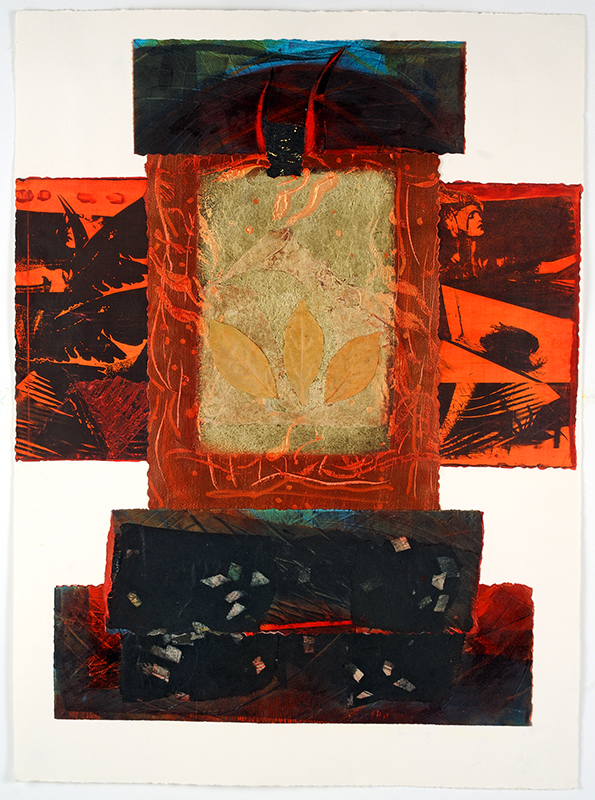
Terry Peckarsky, Still Weeping on the Via Dolorosa, 2020. Quilted commercial cotton fabrics, digitally altered photographs printed on fabric, tsukineko inks, and watercolor, 23 × 31 in. Photo: Victoria Emily Jones. Artist’s website: https://tpeckarsky.tumblr.com/Carol Lukitsch, Sophia Icon. Mixed media collage on paper (with laurel leaves), 30 × 22 in. Photo courtesy of the artist. Artist’s website: http://carollukitsch.com/
Passion and Compassion Oxford: This self-guided tour through Oxford, released this February with a new website and supported by the “Alight: Art and the Sacred” app [previously] for Android and iOS, stops at fourteen artworks or artifacts in multiple locations across the city. Designed around the Scriptural Stations of the Cross as a pilgrimage of sorts, it comprises a mix of historical and contemporary pieces, including sculptures by Jacob Epstein and Antony Gormley, Old Master paintings by Anthony van Dyck and the studio of Andrea Mantegna, a medieval stained glass lily crucifix, Roger Wagner’s Elie Wiesel–inspired Menorah, a “celure” depicting the Pleiades in white gold, Thomas Cranmer’s prison band, and more. Each stop comes with audio commentary by a clergyperson, theologian, or artist. The tour starts at University Church Oxford, the institution that created this wonderful resource. (Note: Most of the sites on this tour are currently closed indefinitely due to the coronavirus.)
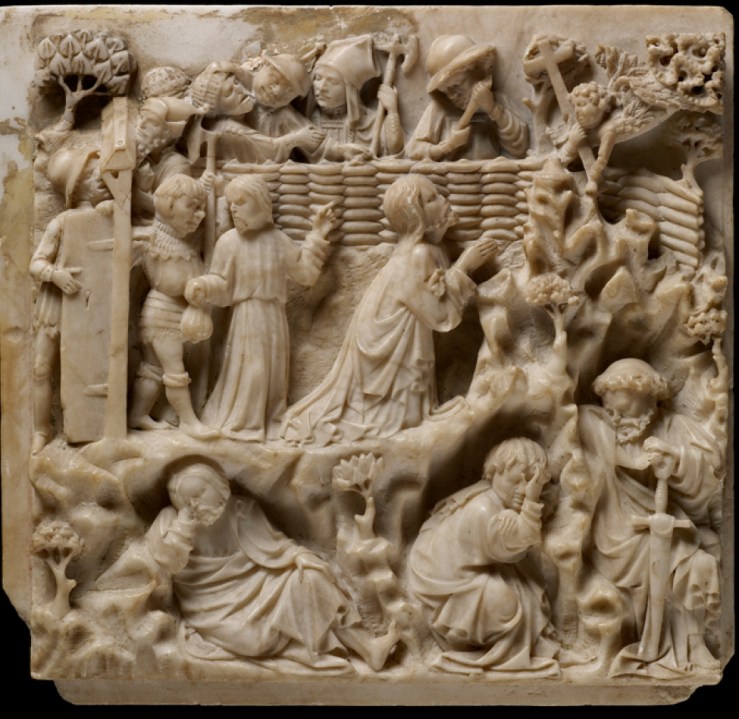
Oliver Caroe, Celure, 2012. University Church of St. Mary the Virgin, Oxford.Alabaster relief by the Master of Rimini or workshop, southern Netherlands or northern France, ca. 1430–40. Ashmolean Museum of Art and Archaeology, Oxford.
+++
VIRTUAL TOUR: Single-shot walk-through of Russia’s Hermitage Museum: The State Hermitage Museum in St. Petersburg is the second-largest museum in the world (the Louvre is the largest), with over one million square feet of exhibition space extending across six historic buildings, including the Winter Palace, the former residence of the Russian tsars. Thanks to a five-and-a-half-hour advertisement by Apple showing off the iPhone 11’s battery life, people can move seamlessly through 45 of the museum’s 309 galleries from their own homes. Shot in one continuous take, the video includes close-ups of individual artworks as well as wide shots of the lavish interiors. It doesn’t cover the entire museum, but there is much western Christian art to see, starting at 1:04:41 with Hugo van der Goes’s Adoration of the Magi triptych. Among the most famous religious artworks in its collection, which you may know from Henri Nouwen’s book about it, is Rembrandt’s Return of the Prodigal Son (2:15:54). Here’s the trailer, followed by the full-length video:
It includes ballet sequences throughout and concludes with a live orchestral performance featuring Russian pianist and composer Kirill Richter.
The Hermitage Museum offers virtual tours of its entire collection, in an interactive format that uses panoramic photos, at https://www.hermitagemuseum.org/wps/portal/hermitage/panorama/. Unlike the Apple video, whose purpose is to showcase the capabilities of the new iPhone, the Hermitage-created tour inserts “info” buttons over each artwork so that you can click through to find out the artist, title, etc., if interested. But this format, in addition to requiring a brief load time for each step forward, lacks the grandiose scoring and camerawork of the new Apple video.
+++
POET FEATURE: Jeanne Murray Walker: A semirecent recent blog post by “online abbess” Christine Valters Paintner introduces the work of poet Jeanne Murray Walker, author of Helping the Morning (2014), Pilgrim, You Find the Path by Walking (2019), and eight other books. Reprinted in full are the poems “Staying Power,” about God’s pursuant nature (a modern-day “The Hound of Heaven,” if you will); “Attempt,” which opens with a quote by Traherne; and “Everywhere You Look You See Lilacs,” about being in the moment, taking cues from nature. There is also a video of Walker reading her poem “The Creation,” which muses on the beautiful quirkiness of giraffes, who “spring up like Wow . . . riff-raff of [God’s] imagination.”
+++
GOODLETTERS ESSAY: “What Does It Mean to Be a ‘Religious’ Poet?” by Brian Volck: The contemporary English theologian Nicholas Lash wrote that sadly, “the relation of human beings to the Holy One” has, by many and certainly in the popular imagination, been “reduced to knowledge of an object known as ‘God’ . . . [,] faith’s attentive presence to the entertaining of particular beliefs.” Such reductionism has led many artists to resist being labeled “religious”—“a designation that typically serves to qualify, marginalize, or dismiss creative work.”
But good poetry, Brian Volck says, “and the human sensibilities we’re taught to call religious needn’t be strangers.” There are many poets today who tread the “vast borderlands where religion, spirituality, faith, art, and mystery overlap,” and Volck briefly reviews four such collections from 2019: Anaphora by Scott Cairns, Pilgrim, You Find the Path by Walking by Jeanne Murray Walker, This Far by Kathleen O’Toole, and Long after Laudsby Jeanine Hathaway.
William-Adolphe Bouguereau (French, 1825–1905), The First Mourning, 1888. Oil on canvas, 79 9/10 × 98 2/5 in. (203 × 250 cm). Museo Nacional de Bellas Artes, Buenos Aires.
“After the Fig Leaves, Eve Cuts Her Hair”
So when they bury Abel, there is no veil
between her grief and her love. And there he stands,
so like his father, his cities yet unbuilt.
His father cuts open earth with bare hands,
leaving plough and shovel, the sharp edges
and the heavy handles, apart in furrowed field.
She calls each animal he resembles: mole, badger, fox.
He named them, once, and now she names him:
father unfathered, sonless, one son less. The sun hangs
round and clear, apple-red, above the dark tree line.
Once, when Cain was the only child in the world,
their fields withered and arrows flew fruitless.
Dull-eyed by the empty fire, beside the windless cedars,
he wailed at the dry breast. Much later,
after thunder dumbed the stars,
they faced the barren, muddied vale together. Adam said,
God made paradise, and we made this—
this is all we have to give him. He struck his staff
upon the seedless ground. Cain made two tiny fists.
Abel she cannot unsee as a splintered spear
of red lightning, reduced to kindling
on the perfumed grass, the churned earth
weeping red mud. Loss escapes her in a hiss
of distant fear: this time, the choice
for death has been made for her,
despite that it was life she’d sent into the world.
Her voiceless throat swells tight, dry as scales.
Her hair is short and stiff and gray. The world is young.
There will yet be other sons, and daughters more;
the seed of man must multiply. But this grief is older
than she knows, its gaze fixed far ahead
on what, someday, must be done. The wind’s voice
keens a long lament, a parent loss,
the form of sons’ deaths yet to come.
“After the Fig Leaves, Eve Cuts Her Hair” by LeighAnna Schesser was originally published in Presence: A Journal of Catholic Poetry 2018 and is used here by permission of the author. The poem will appear in Schesser’s first full-length poetry collection, Struck Dumb with Singing, to be published by Lambing Press in May 2020.
+++
LeighAnna Schesser’s poem “After the Fig Leaves, Eve Cuts Her Hair” explores parental grief following the death of a child—in particular, that of our primordial parents, Adam and Eve, who mourn the loss of their second-born son, Abel. Genesis 4:1–16 recounts how Abel was murdered by his older brother, Cain, in a fit of jealousy. This is the first human death in the Bible, and it was the direct result of sin.
The poem starts with the title, which flows with unbroken syntax into the first line: “After the fig leaves, Eve cuts her hair so when they bury Abel, there is no veil between her grief and her love.” The cutting of hair in response to death in the immediate family is a ritual practiced by women in many Native American tribes and Aboriginal people groups, where the act of severing, and the subsequent absence of, a cherished part of your self serves as a stark physical reminder of your loss. Similarly, after 9/11, many non-Native women in the US cut their hair as a sign of shock and sadness at the immense loss of life; one woman said, “I felt so different internally, I wanted something to express it externally.” Schesser imagines Eve taking part in some form of this ancient mourning ritual, wanting to leave her crying face exposed.
This is “after the fig leaves,” euphemistic shorthand for that landmark event earlier in her life in which she stole fruit from an off-limits tree and then, feeling shame for the first time, went to cover her nakedness with the first available foliage. The title/opening line, between that prepositional phrase and the first clause, skips over quite a long period of time—from the Genesis account, it sounds like at least two decades passed between Adam and Eve’s expulsion from Eden and the murder of Abel. But these two events are life-defining for Eve, so the chronology is collapsed.
“And there he stands / [. . .] his cities yet unbuilt.” The “he” here refers to Cain, who, after being confronted by God, went into exile “east of Eden,” to the land of Nod (Gen. 4:17). In his later life he built up the world’s first city, Enoch.
Like the burrowing species of animals he named, Adam digs into the earth with his bare hands—elemental. For this, the making of his son’s grave, he leaves aside plow and shovel as a sort of penance: he wants to feel directly the hard dirt, his body’s full labor and sweat, the effects of the curse he brought upon the world, which he feels implicates him in his son’s death. As he digs, the sun hangs above him “round and clear, apple-red,” a taunting reminder of his former trespass.
In the third stanza the speaker goes back to the time that’s elided in the poem’s opening, back to when Adam and Eve left God’s teeming garden and entered a dead world. They struggled to secure food for themselves. Eve gave birth to a baby boy, but soon her breast milk dried up. It was then that they resolved to get down to business and fight for a life in this inhospitable land. Even baby Cain expressed defiance against the odds with little fists as Adam broke new ground.
Snapping back to the present, Eve observes Abel’s limp body, bloody and broken and reddening the earth. “The churned earth / weep[s] red mud”—an arresting poetic image to match God’s in Genesis 4:11: “The ground . . . has opened its mouth to receive your brother’s blood from your hand,” he tells Cain. We are taken back again to the Fall through more figurative language, this time evoking the snake: fear “hiss[es]” in the distance; Eve’s throat is “dry as scales.” Eve, God’s child, chose death in the Garden, and now her child, the one to whom she gave life, has chosen death too. She now has a taste of the horror, disappointment, and sadness God must have felt.
“Though the world is young,” the poem continues, “this grief is older / than she knows.” Older, even, than God’s grief at the Fall. For another son, God’s “only begotten” (John 3:16), was destined to die millennia later—“the Lamb slain from the foundation of the world” (Rev. 13:8). In his foreknowledge God saw this death and mourned it immensely. His is the oldest grief.
+++
William-Adolphe Bouguereau’s painting The First Mourning shows the lifeless body of Abel sprawled out over Adam’s lap, and he and Eve ridden with grief. Adam clutches his broken heart, and Eve buries her face in her hands, sobbing uncontrollably. The only color in the bleak landscape is from the puddle of blood on the ground. In the background, smoke rises from an altar, mixing with the storm clouds in the sky; this is the remnant of Abel’s offering going up to God, the cause of Cain’s resentment that led him to commit murder.
By the time Bouguereau painted this scene in 1888, three of his five children had died of illness. (A fourth child of his would also die within his lifetime—twelve years later, at age thirty-two.) He knew the sorrow that accompanies such a traumatic event as seeing your kids leave this world before you do.
The iconography he uses is closely related to that of the Pietà, an image type that shows a grieving Virgin Mary holding her dead son, Jesus, on her lap following his crucifixion. The connection is intentional, as death—which Abel was the first person to experience—will ultimately be undone by the death and resurrection of Jesus. The writer of Hebrews says that “the sprinkled blood [of Jesus] speaks a better word than the blood of Abel” (Heb. 12:24), because Christ’s blood is redemptive, bringing us back to the Garden that we lost through sin.
Call to artists: I’d love to see you interpret Schesser’s poem visually: Eve shorn inside and out (her hair “short and stiff and gray”), wearing her grief openly; Adam animalistic, digging a grave by hand; Cain looking on; and the wind bearing their lament forward to the cross. If you pursue this suggestion, do let me know!
+++
LeighAnna Schesser is a Catholic writer and a homeschooling mom of four from Kansas, whose forthcoming book of poetry, Struck Dumb with Singing (out in May), “meditates on family, devotion, divine mysteries, and their rootedness in place.” Visit Schesser at her website, https://acanticleforhomestead.com/, where you will find, among other things, links to some of her other published poems and articles.
Lent begins next week, and as usual, I’ll be sharing visual art, music, poetry, and other media throughout the season that I hope will be a quiet support to your spiritual walk. If you are giving up social media for Lent but want to be kept aware of new Art & Theology posts, sign up to receive the posts by email by clicking the “Subscribe” button—on the right sidebar if you’re on a desktop, or at the bottom of this post if you’re on your phone. (Note that the sidebar/footer is not visible from the homepage; you have to click through into a post to see it.)
+++
NEW LENT DEVOTIONALS: I’ve become aware of two new poetry devotionals for Lent published this year.
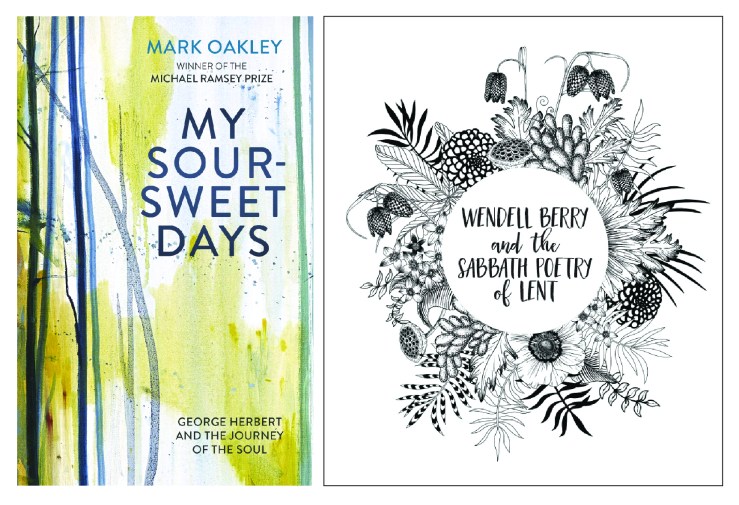
My Sour-Sweet Days: George Herbert and the Journey of the Soul by Mark Oakley: “George Herbert is one of the great 17th century poet-priests. His poems embrace every shade of the spiritual life, from love and closeness, to anger and despair, to reconciliation and hope. And his work is always rich with audacious playfulness: he seems to take God on, knowing God will win, as if he’s having an argument with a faithful friend he knows is not going to leave. In much of theology and spirituality, God is a critical spectator to human lives, but for Herbert, his sense of relationship with God is primarily of a friendship that can never be broken. These are some of the themes Mark Oakley explores in this book. He offers a poem for every day in Lent, with a two-page commentary on each of the forty included.”
Wendell Berry and the Sabbath Poetry of Lent by SALT Project: “In this Lenten devotional, biblical texts and simple, accessible practices walk hand-in-hand with Wendell Berry’s poetic vision of sabbath and the natural world. All you’ll need is your favorite Bible and Wendell Berry’s This Day: Collected and New Sabbath Poems. Week by week, we’ll walk through the woods together toward Easter morning, keeping sabbath as we go—with Wendell Berry as our guide.” Sold as a professionally designed, downloadable PDF with printing and folding instructions.
I really enjoyed SALT Project’s Lent devotional from last year, built around the poetry of Mary Oliver, so I bought this new one and gave it a breeze-through so I could recommend it here prior to Lent; I look forward to spending more time with it throughout the season. Devotions are provided for Ash Wednesday; the first, second, third, fourth, and fifth Sundays of Lent; Palm Sunday, Maundy Thursday, Good Friday, and Easter Sunday. Each one includes an instruction to read a Bible passage and a Wendell Berry poem, a short meditation that draws the two together, an additional reading of two more related Berry poems, a candle lighting and one-sentence prayer (on the themes of silence, trust, delight, care, insight, resurrection, joy, love, sorrow), a few recommended practices for the week, and personal questions to ponder and discuss with a friend, if desired.
I especially appreciate the “Practices” section, which includes ideas like: make a list of your favorite little delights (“the sunlight’s slant in the late afternoon, your dog’s ears, the steam rising from your coffee—no delight is too slight!”) and read it aloud with family or friends over a meal; take a neighborhood walk and count how many shades of green you see; ignore a household chore for an entire day each week.
+++
DANCE VIDEO: “Seas of Crimson”: In this music video for one of the pieces on Bethel Music’s album Without Words: Synesthesia, Jessica Lind of the Oregon Ballet Theatre dances with dust that by the composition’s end turns to vibrant color. A metaphor for the Lenten journey, perhaps? [HT: A Sacramental Life]
Joseph Shabalala, the gentle-voiced South African songwriter whose choir, Ladysmith Black Mambazo, brought Zulu music to listeners worldwide, died on [February 11] in a hospital in Pretoria. He was 78. . . . Mr. Shabalala began leading choral groups at the end of the 1950s. By the early ’70s his Ladysmith Black Mambazo — in Zulu, “the black ax of Ladysmith,” a town in KwaZulu-Natal Province — had become one of South Africa’s most popular groups, singing about love, Zulu folklore, rural childhood memories, moral admonitions and Christian faith. Ladysmith Black Mambazo’s collaborations with Paul Simon on his 1986 album “Graceland,” on the tracks “Homeless” and “Diamonds on the Soles of Her Shoes,” introduced South African choral music to an international pop audience.
Shabalala was an ordained minister in the Pentecostal Church of God of Prophecy, having become a Christian in 1976. He said he hopes his music shows people “how to be good to God, how to praise God, how to respect, how to forgive each other . . .”
Below is a video of Shabalala with Ladysmith Black Mambazo singing one of his songs, “King of Kings,” live in Montreux, Switzerland, in 2000. Written during apartheid, it is a prayer for peace in South Africa and the rest of the world. It was first released on the 1987 album Shaka Zulu. [Listen on Spotify]
+++
KIDS’ SONGS: I’m not a mom, but I often enjoy listening to “children’s music,” as there’s so much of quality out there these days. Here are two songs released this year in that too-restrictively-titled genre (because hey, there’s much for grown-ups to love here too!), along with animated music videos.
“Glad You’re Here” by Justin Roberts: This new single by “the Judy Blume of kiddie rock” (New York Times) is for a new or soon-to-be-born baby. So fun, warm, and adorable! (Note: The video was produced by the same company that brought you the Wendell Berry devotional mentioned above.)
“Dinosaurs in Love” by Fenn Rosenthal, feat. Tom Rosenthal: This sad-sweet song about two dinosaurs eating cucumbers and having parties and then, well, you’ll have to listen . . . was written by three-year-old Fenn Rosenthal from London (with some help on the tune from her dad, Tom). At the end of January Tom Rosenthal, who is himself a singer-songwriter, posted a recording of Fenn singing this one-minute creation of hers on Twitter, and it went viral. Now the song is streaming on Spotify and is up on iTunes, Amazon, and other e-tailer websites, with all proceeds benefitting wildlife charities. It was also picked up by directorial team Hannah Jacobs, Katy Wang, and Anna Ginsburg, who created a music video using 2D frame-by-frame animation. [HT: Colossal]
+++
DRAWING CONTEST: “Doodle for Google,” for K–12 artists:Google Doodles are those special drawings, sometimes animated, that embellish Google’s logo on the website’s homepage from time to time. For the twelfth consecutive year, that highly visible space is up for grabs to one young artist in the US through the tech company’s “Doodle for Google” competition, open to ages K–12. This year the theme is “How do you show kindness?” In addition to having their work featured on Google’s landing page for an entire day, the winner will receive a $30,000 college scholarship, and the winner’s school will be awarded a $50,000 technology package. The deadline for submissions is March 13, 2020, at 11 p.m. ET. [HT: Hyperallergic]
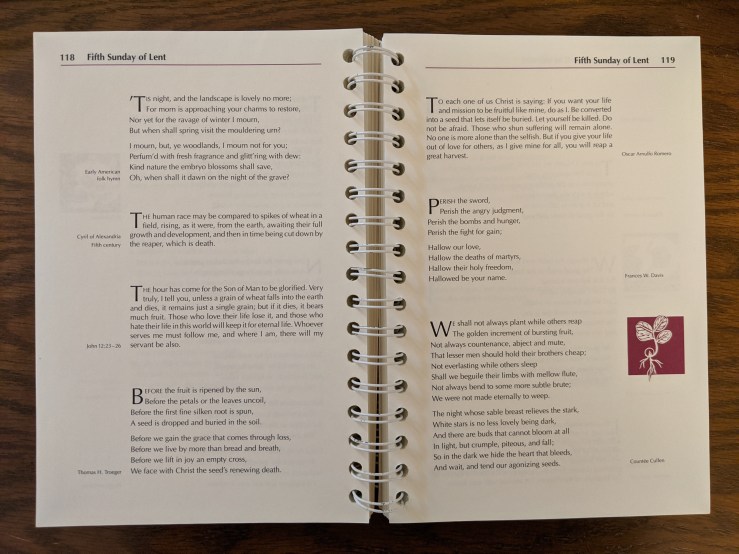
Published in 1990 by Liturgy Training Publications, A Lent Sourcebook: The Forty Days is an anthology of hymns, poems, prayers, homilies, and reflections gathered from ancient and modern sources on a variety of Lenten themes, interspersed with scripture passages. The thousand-plus entries were compiled and edited by J. Robert Baker, Evelyn Kaehler, and Peter Mazar, with additional compilation help from James P. Barron, OP; Thomas Cademartrie; Elizabeth Hoffman; Gabe Huck; Mary McGann, RSCJ; G. Michael Thompson; and Elizabeth-Anne Vanek. The introduction is by Peter Mazar.
I really love the scope of the selections, which come from church fathers, mystics, novelists, poets, songwriters, activists, theologians, saints and martyrs, the Roman Missal and the Byzantine Rite. There’s Graham Greene, Flannery O’Connor, Elie Wiesel, John Donne, Gerard Manley Hopkins, E. E. Cummings, T. S. Eliot, Rainer Maria Rilke, Ambrose, Bonaventure, Dante, Negro spirituals and Shaker hymns and medieval carols, Jewish and Celtic blessings, Teresa of Avila, Julian of Norwich, Pierre Teilhard de Chardin, Dag Hammarskjöld, Thomas Merton, Dorothy Sayers, Simone Weil, C. S. Lewis, Dietrich Bonhoeffer, Daniel Berrigan, Oscar Romero, Desmond Tutu, Robert Farrar Capon, Walter Brueggemann, and many more.
These are some of the better-known names, but there are also names and texts that were new to me, some coming from obscure, out-of-print books or journal articles, and some of the selections that originated in Greek or Polish being translated afresh for this volume. There are a few African and Latin American voices represented, but most voices come from the West—a limitation that is understandable. Several compilation-style Lent devotionals I’ve used in the past feature only British and American writers, and this goes far beyond that, I’m glad to say. Just be aware that because A Lent Sourcebook is now three decades old, it doesn’t include any of the significant Christian voices that have emerged in more recent years.
Also be aware that this book was published by a Catholic institution, and the make-up of the compilation team was (from what I can tell) entirely Catholic, so that theology and tradition is heavily reflected. As a Protestant, that was not a barrier at all to me enjoying the book. There were a few selections that I take issue with on theological or practical grounds—but I never expect to agree with or to gravitate toward everything I read in an anthology! I appreciated learning more about the Catholic liturgies that surround Lent and some of the sources that inform or respond to them, as well as historical practices that developed in different locales. Eastern Orthodox liturgies are also featured, as are Protestant writings (including, in abundance, hymns!). There were several pleasant surprises for me.
I’ve read a handful of volumes from LTP’s Sourcebook series (which includes other liturgical seasons as well as topics like Baptism, Eucharist, Marriage, and so on), and they’re all great.
Because of the way I’m constituted, I tend to get more out of devotionals that integrate the arts rather than those that start off with a scripture passage followed by a lengthy prose reflection ending with a moral lesson or present-day application. I do appreciate discursive prose very much, but I like how this anthology also incorporates poetry, song, and fiction to stoke the imagination and showcase the beauty and multifacetedness of the gospel. Repentance, renewal, feasting and fasting, temptation, purity, divine love and mercy, prayer, silence, and eternity are among the themes addressed, and the biblical texts span from the Genesis narratives to the Pauline epistles.
A Lent Sourcebook is available in two different formats: a single, 462-page, perfect-bound volume (ISBN 9780929650364), which appears to be the only option available on the publisher’s website, or two spiral-bound volumes (9780929650203, 9780929650357), which is what came to me through my local library’s interlibrary loan system. The entries are organized by week (Week of Ash Wednesday, First Week of Lent, . . . Sixth Week of Lent), and those “chapters” are broken down further by day (First Sunday of Lent, etc.), extending from Carnival to Holy Thursday. Basic attributions are given in the margins of each page, with fuller citations available in the back of the book. Also, each page spread contains a simple square (woodcut? linocut?) illustration, printed in magenta, by Suzanne M. Novak.
Below is a sampling of passages I encountered here for the first time.
An effigy of the Carnival is, in a great many places, “condemned to death” and executed (the method of execution varies—sometimes it is burnt, sometimes drowned, sometimes beheaded). The “putting to death of Carnival” is often accompanied by general tussles; nuts are thrown at the grotesque creature itself, or everyone pelts everyone else with flowers or vegetables. In other places (around Tübingen, for instance) the figure of the Carnival is condemned, decapitated and buried in a coffin in the cemetery after a mock ceremony. This is called “Carnival’s funeral.”
The other episode which is of the same sort is the driving out or killing of “Death” in various forms. The most widespread custom in Europe is this: Children make a guy from straw and branches and carry it out of the village saying: “We are carrying Death to the water,” or something of the sort; they then throw it into a lake or well, or else burn it. In Austria, all the audience fight round Death’s funeral pyre to get hold of a bit of the effigy. There we see the fertilizing power of Death—a power attaching to all the symbols of vegetation, and to the ashes of the wood burnt during all the various festivals of the regeneration of nature and the beginning of the New Year. As soon as Death has been driven out or killed, Spring is brought in.
Christianity is not reconciliation with death. It is the revelation of death, and it reveals death because it is the revelation of Life. Christ is this Life. And only if Christ is Life is death what Christianity proclaims it to be, namely the enemy to be destroyed and not a “mystery” to be explained. Religion and secularism, by explaining death, give it a “status,” a rationale, make it “normal.” Only Christianity proclaims it to be abnormal and, therefore, truly horrible.
I was entrusted with a sinless and living land,
but I sowed the ground with sin
and reaped with a sickle the ears of laziness;
in thick sheaves I garnered my actions,
but winnowed them not on the threshing-floor of repentance.
I beg of you, my God, the eternal farmer,
with the wind of your loving-kindness
winnow the chaff of my works,
and grant to my soul the harvest of forgiveness;
shut me in your heavenly storehouse, and save me!
—Byzantine Vespers, from The Lenten Triodion, translated by G. Michael Thompson
+++
Alas, dear Christ, the snake is here again.
Alas, it is here: terror has seized me, and fear.
Alas that I ate of the fruit of the tree of knowledge.
Alas that its envy led me to envy too.
I did not become like God; I was cast out of paradise.
Temper, sword, awhile, the heat of your flames
and let me go again about the garden,
entering with Christ, a thief from another tree.
—Gregory of Nazianzus, from Poemata Dogmatica (382 AD), translated from the Latin by Walter Mitchell and published in Early Christian Prayers, ed. Adalbert Hammon, OFM (1961)
(In this prayer the speaker likens himself to the thief who was executed on a “tree” beside Jesus on Calvary. I am “a thief from another tree,” Gregory confesses, having given in to temptation and stolen the fruit that was not mine. He apostrophizes the cherubim’s flaming sword that bars entry to Eden, begging it to cool down so that he might, by the merits of Christ, pass [back] into paradise, as did that penitent thief on Good Friday.)
+++
Even after several years with the reformed liturgy, it still comes as something of a shock to hear Lent described in the first Lenten preface as “this joyful season.” For those of us conditioned to imagine Lent as a grim, unpleasant time, the temptation will be either to shrug it off as poetic license or to associate it with a mother’s attempt to persuade a child to take its medicine.
But there is always C. S. Lewis. In his account of his youth and his journey of faith, Surprised by Joy (1955), Lewis gives us an inveigling definition of joy as “an unsatisfied desire which is itself more desirable than any satisfaction.” Here, perhaps, is something we can latch onto as we confront the notion of Lent as a “joyful season.”
Lent, in this perspective, is a time for eschewing pleasure in order to be surprised by joy, that unsatisfied desire more desirable than any satisfaction. Conversely, it is a time for recognizing the habit we have of seeking satisfactions that dull the deepest longing of the heart; the habit of having to have and not wanting to want. “The very notion of joy,” writes C. S. Lewis, “makes nonsense of our common distinction between having and wanting. There to have is to want and to want is to have.” Lent would then be a time for discovering what it is we really want, the heart’s desire, the restlessness which for Augustine is a symptom of our being made for something we can never possess. Paradoxically, knowing that longing brings joy.
—Mark Searle, “The Spirit of Lent,” in Assembly 8, no. 3 (1981), published by the University of Notre Dame Press
+++
Each day may I remember the sources of the mercies thou hast bestowed on me gently and generously;
Each day may I be fuller in love to thyself.
Each thing I have received, from thee it came,
Each thing for which I hope, from thy love it will come,
Each thing I enjoy, it is of thy bounty,
Each thing I ask comes of thy disposing.
Holy God, loving Father, of the word everlasting,
Grant me to have of thee this living prayer:
Lighten my understanding, kindle my will, begin my doing,
Incite my love, strengthen my weakness, enfold my desire.
[. . .]
And grant thou to me, Father beloved,
From whom each thing that is freely flows,
That no tie over-strict, no tie over-dear
May be between myself and this world below.
“O Healing River” | Words by Fran Minkoff and music by Fred Hellerman, 1964
O healing river, send down your waters,
Send down your waters upon this land.
O healing river, send down your waters,
And wash the blood from off the sand.
This land is parching; this land is burning;
No seed is growing in the barren ground.
O healing river, send down your waters;
O healing river, send your waters down.
Let the seed of freedom awake and flourish;
Let the deep roots nourish; let the tall stalks rise.
O healing river, send down your waters,
O healing river, from out of the skies.
+++
“The Cast” by Sharon Olds (1985)
When the doctor cut off my son’s cast the
high scream of the saw filled the room
and the boy’s lap was covered with fluff like the
chaff of a new thing emerging, the
down in the hen-yard. . . . [Read the rest at poetryfoundation.org]
+++
Enter into the mystery of silence.
Your goal in life is not to hold your tongue but to love, to know yourself and to receive your God. You need to learn how to listen, how to retreat into the depths, how to rise above yourself.
Silence leads you to all this, so seek it lovingly and vigilantly. But beware of false silence: Yours should be neither taciturnity nor glumness, nor should it be systematic or inflexible, or torpid. Authentic silence is the gateway to peace, adoration and love.
Bartolomé Esteban Murillo (Spanish, 1617–1682), The infant Christ asleep on the cross, ca. 1660–65. Oil on canvas, 24 4/5 × 34 3/5 in. (63 × 88 cm). Prado Museum, Madrid.
When, in the cavern darkness, Jesus
opened his small, bleating mouth (even before
his eyes widened to the supple world his
lungs had sighed into being), did he intuit
how hungrily the lungs gasp? Did he begin, then,
to love the way air sighs as it brushes in and out
through the portals of tissue to sustain
the tiny heart’s iambic beating? And how,
fueled by air, the dazzling blood tramps
the crossroads of the brain like donkey tracks,
corpuscles skittering to the earlobes and toenails?
Bottle of the breath of God, speaking in stories,
shouting across wild, obedient water, his voice
was stoppered only by inquisition, unfaith
and anguish. Did he know that he would,
in the end, leak all his blood, heave a final
groan and throw his breath,
oxygen for the world, back to its Source
before the next dark cave?
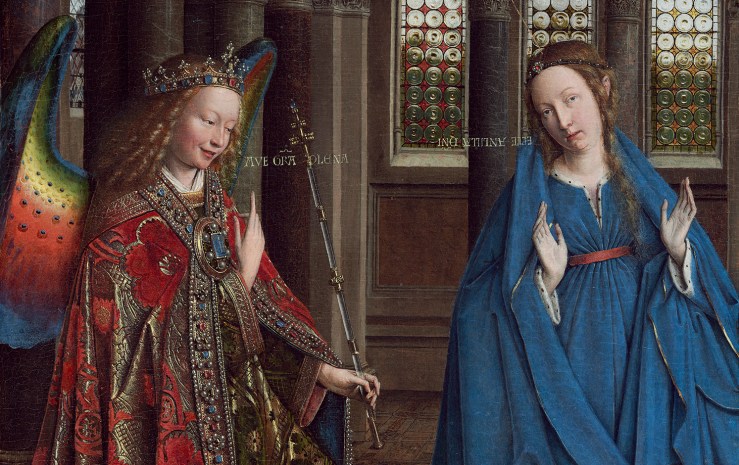
One of the most celebrated paintings of the Northern Renaissance, Jan van Eyck’s 1430s Annunciation depicts the moment of Christ’s conception in a world of forms that have weight and volume and shade and texture that was largely unprecedented in European painting at the time. The extraordinary realism of the Annunciation—its deep, rich, subtly gradated colors, varied textural details (from hard, polished gems to soft, fragile flower petals and plush velvet), and intricate play of light and shadow—were enabled by the use of oil paint, a medium that was not widely used then. van Eyck’s “virtuoso handling of the medium . . . represented a turning point in its eventual adoption as the major painting medium in Europe in the sixteenth century,” replacing egg tempera.
Jan van Eyck (Netherlandish, ca. 1390–1441), The Annunciation, 1434/36. Oil on canvas transferred from panel, 35 1/2 × 13 7/16 in. (90.2 × 34.1 cm). National Gallery of Art, Washington, DC.
This three-foot-tall painting probably originally formed the left wing of a triptych, whose other panels, now lost, may have depicted the Nativity or the Adoration of the Magi and the Visitation or the Presentation in the Temple. It likely spent its first centuries in the ducal chapel of a Carthusian monastery in Dijon, then-capital of Burgundy (van Eyck served as court painter to Philip the Good, duke of Burgundy, from 1425 to 1441), and has since passed through various other rich and powerful hands, including those of King William II of the Netherlands and Czar Nicholas I of Russia. It is now in the collection of the National Gallery of Art in Washington, DC, where it is viewed by people from all over the world.
Several iconographic elements in van Eyck’s Annunciation were already standard for the subject: the dove, the lilies, the Bible laid open to Isaiah 7:14. But van Eyck also introduced his own sophisticated program of typological imagery, which plays out in the background frescoes and the niello floor designs, connecting Old and New Testaments—in addition to other innovative touches that we will explore below.
He was also one of the first artists to locate this momentous event inside a church (as opposed to a portico or domestic space), which would become a popular choice in the Low Countries. In her 1999 Art Bulletin article “Van Eyck’s Washington Annunciation: Narrative Time and Metaphoric Tradition,” Carol J. Purtle argues that van Eyck was connecting the Lukan narrative of the Annunciation with the Golden Mass (“Missa Aurea”), a liturgical drama that was popular in the Netherlands at the time. Taking place yearly on Ember Wednesday (the Wednesday following the third Sunday of Advent), the Golden Mass featured a reenactment of the Annunciation, dove and all, by two young choirboys.
There’s much to lavish attention on in this painting, but I’d like to let three poets be our eyes: Pimone Triplett, Terri Witek, and Peter Steele, each of whom has written a poem reflecting on their encounter with the Annunciation by van Eyck. (The vivid poetic description of a work of visual art is known as ekphrasis, and it is an ancient tradition that I’ve seen explode in recent decades.) Notice what the poets notice in the painting as they pore over van Eyck’s artistic choices and their spiritual import. There is some overlap in their discoveries, but the landing point, and even the emphasis, of each poem is unique.
Starts with a stream of gold that’s ridden
      by a relentlessly linear dove,
ready to pierce a young girl’s head.

            Then, her face, her gaze looking up, out
past the easel and later, past the frame,
      eyes raised as if to ask a question. Take

the virgin robe, for instance, which van Eyck has made
      to fall luxuriously as a second chance
across the old storyline etched below her.

            And, further down, the church’s intricately
strict apse, each floorboard, painstaked as lace, showing here,
      David’s lesson in beheading, there Samson’s

tearing down the temple—that history
            interrupted by her silken, layered folds:
each blue built up from perfecting the oil.

            His favorite signature, “As best I can”
or “As I was able, but not just as I wished.”
      Imagine the endless effort: a man

in the distance, deep in the could have been,
      who sat before the easel, hours, perhaps,
past his patience for lasting regrets,

            flat refusals—the quick-drying water-based
attempts flung around a room.
      And how, alone with pigment barrels, chamber pots,

the canvasses stretched, the fire exhumed,
      he poured a stream of oil back and forth,
watching it catch the light, change a wooden bowl.

            For the sake of making the mundane
seem to marry the mysterious,
      her eyes raised—lacquered, slippery wells, caught—

her startled acceptance. Since it’s her choosing
      to be chosen that mattered, largest figure
in the frame, the virgin form layered

            with gold light, blue, her pale hands open
for the god imagined sick with thin horizon,
      and ready to enter thickness now, the body’s

blood, gristle, vertebrae, whorled fingerprint.
      The oil spread back and forth. His wrist stiffened.
“As I was able, but not just as I wished.”

            So, out to pay the right kind of attention
to detail, as if, in the lengthening
      carelessness of cracked roads leading away

from his town, beneath a matted pulp
      of the year’s leaves, he wished he could hear
silence taking shape: a weed, say, starting

            to split the surface, part vegetal
altar and example of dumb, green change.
      Or, say, through the window, a flock of geese

receding, advancing, by turns, as the sky’s gray
      sometimes meets the double strength gray of sea,
he might have looked between the shapes,

            their invisible lines blooded, some racing ahead,
others falling behind, each filling in, quickly,
      empty spaces where the wings once beat.

And still, she looks up, asking to be entered.
      So that if she turned away from shadows, wood panels,
chamber pots, winter coats lined against the wall,

            he might have looked so far into the difficult
that he finally could believe: behind her gaze,
      beneath her brow, under the layers of

shell, salt, finally skin-white, lay the mind
      of a mother giving birth to a father
and a son, the flesh—a color, an instant, spared.
Pimone Triplett’s poem explores the physicality of the oil-paint medium, focusing on van Eyck’s innovations in that area and as one who both accepts and transcends his limitations. She refers to the personal motto with which he signed several of his paintings (although not this one): Als ich chan, which means “As best I can.” Even with as advanced a painter’s toolkit as he developed and his great skill, how could he possibly succeed in depicting the holy mysteries?
The physicality of the artist’s studio, too, comments on the Incarnation. Christ came into a world of chamber pots! Triplett describes Jesus’s coming into human being, his traveling those seven thin gold rays of light into the womb of his mother, where he takes on flesh: “the god imagined sick with thin horizon, / and ready to enter thickness now, the body’s // blood, gristle, vertebrae, whorled fingerprint.”
There are also some lovely lines that touch on Mary’s agency (“it’s her choosing / to be chosen that mattered”; “she looks up, asking to be entered”) and her role as the Second Eve, whose obedience leads to the redemption of humanity (her robe “fall[s] luxuriously as a second chance” over the Old Testament story line told in the floor below her).
The two most visible floor designs depict Samson destroying the temple of Dagon, killing the Philistines inside, and David cutting off the head of Goliath. These and other Old Testament scenes are framed by stylized columbine and clover and roundels bearing signs of the zodiac.
I’m not entirely sure how to interpret the last stanza. It’s possible that “father” refers to van Eyck as the father of oil painting: his many Marian paintings in this medium cemented his reputation as such, so in that sense Mary gave birth to him as an artist, as well as, of course, to her son Jesus. Shell and salt were ground into pigments to render realistic flesh tones, and the slow drying time of oil paint enabled artists to better blend colors on the canvas, creating subtle variations, and to develop the painting gradually. But why “a color, an instant, spared”? Any thoughts?
+++
“Take a World”by Terri Witek
The Annunciation by Jan Van Eyck, 1434–36
Take a world in which each flower’s an Easter lily
and books chivvy open to the place where our names leap.
Then step into the temple where Mary,
gown belled like a Christmas tree angel’s,
speaks with a real one. Their hands negotiate:
Mary is asking why light curls to ribbony rainbow
on the angel’s back while through her own body
it shoots in stiff gold arrows. The angel nods, grins.
Nothing more gorgeous than their drapery-softened
gesticulation, the room’s blue-propped lilies
and plump ottoman. It’s enough to make us think
they’re standing in the world, two women alert
to the heft of their clothes as Mary asks,
“Who, me?”, her eyes sliding sideways to her painter,
master of distraction. She can’t see Jehovah
behind her, his one blazing window, though we can,
we see the room’s whole depth falling into light
as we wait for someone not transfixed by dilemma
who’s standing where we are. As we wait for Joseph.
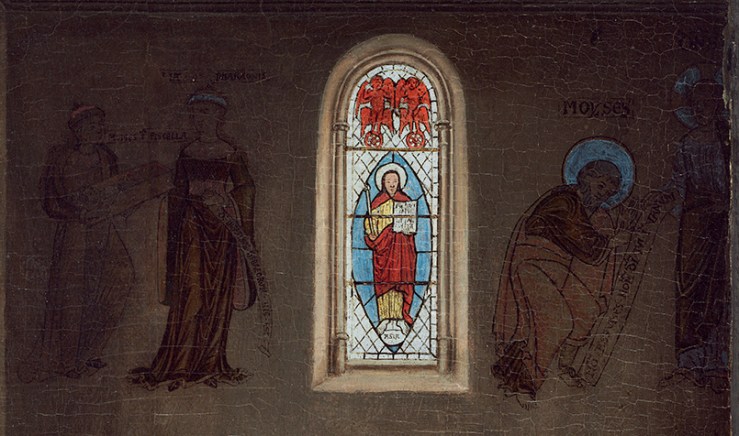
Terri Witek’s poem focuses on the paradox of the Annunciation’s being both an entirely thisworldly and yet profoundly otherworldly moment. The two figures in van Eyck’s painting have bulk and heft, and their clothes hang on their bodies, subject to the laws of gravity, and yet in the scene they inhabit, everything is so carefully placed, so perfect—so divine. Witek mentions the stained glass window in the back, which shows God in a mandorla, standing underneath his fiery chariot on a globe labeled ASIA and holding an open book and a scepter; the light that comes through this window and fills the room is thus refracted through him who is all-sovereign.
(Note: The iconography in the window is very similar to the type known as Christ in Majesty, though there’s no cross-shape inside the halo; I wonder whether the figure is meant to be Jesus in his then-future exaltation. But the art historians I’ve read identify him, along with Witek, as God the Father. I think a case could be made for either.)
To the left of the stained glass window, the baby Moses is presented to Pharaoh’s daughter, while on the right, God presents Moses with a scroll bearing the words of Exodus 20:7: “You shall not take the name of the Lord your God in vain.”Gabriel tells Mary that Jesus “will reign over the house of Jacob forever, and of his kingdom there will be no end” (Luke 1:33). The two roundels painted on the rear wall depict Isaac blessing Jacob (Gen. 27).
I especially like how Witek points out the contrast between the pleasant, blended, colorful way light interacts with the angel’s wings and the severe, narrow manner in which it comes diving toward Mary—and humorously suggests that Mary’s expansis manibus gesture is her asking why. This observation unpeeled for me an additional layer of van Eyck’s possible meaning: how God’s coming to Mary was direct and piercing. His messenger, sure, has a soft rainbow glow, but the actual implantation of God in the womb happens with a laser focus that sears Mary in ways that will be all the more keenly felt as the years go by (see Simeon’s prophecy in Luke 2:34–35).
I got stuck on the last two lines, though: Why do we wait for Joseph? Isn’t he peripheral to the event? And was he not also “transfixed by dilemma” for a time, as he debated whether to say yes or no to God’s plan? So I asked the poet what she had in mind. She said how, standing before the painting, we, like Mary, become transported into this drama that lifts us up to a heavenly plane (I’m paraphrasing here), where we interact vicariously with Gabriel. We need someone to bring us back down to earth, so “we will be glad of Joseph, the human, the touch of the everyday real,” Witek explained to me.
The room “falling into light” describes the painted scene but also the public gallery where the painting is on display, and the name Joseph also has a double meaning, as Witek’s husband’s name is Joseph. In their museum going, his presence sometimes shakes her gently out of her reveries, reminding her that it’s time “to move on to the next painting, though it might not be as gorgeous,” she told me.
+++
“Waiting for the Revolution”by Peter Steele
If love is ‘the bright foreigner’, then here’s
      not Amour himself but still
a follower afire, his wings a blend
      of peacock and rainbow, the pearled cope
blooming to crimson on its ground of gold,
      his hair a downspill from the lock
of a coronet badged with jewels, the fingered sceptre
      a rod of crystal, and the smile
something they practise in another country.

This is not wasted on the woman who,
      her hands come up from the shell of a robe
which seems to have been steeped in ocean when
      darkness and light were still contending,
gazes now from the blaze of being at
      van Eyck, the Duke of Burgundy,
a Tsar made out of ice and marble, or
      whoever gives the alms of an hour
in minute-hungry fuming Washington.

Outside, a beat or two of an angel’s wings
      away on the Capitol is Freedom,
one of the later products of the Bronze
      Age, equipped with shield and sword,
a wreath for some earthly use or other, plumes,
      an eagle-crested helmet. She eyes
the status quo from her eminence and murmurs,
      ‘The past is prologue’, a Delphic saying
which she construes as ‘blessed are those in possession’.

I have been in and out of the world worlds,
      amphibious and double-hearted,
and still am. The shimmer of July
      speaks now for a perpetual
immobility, bronzing the will. The pavement
      beneath woman and angel shows
Goliath down and done with, Samson at grips
      with a sheltering enslaving place:
and for some want of the white bird of esprit

that plunges goldrayed into the woman’s mind,
      I’m in the middle. They say that she
has her consent to the revolution printed
      upside down for easier reading
in heaven. It may be so, but I’m guessing that
      the words in their reversal figure
a world swung round upon its axis, the all-
      clear given to those in quest
of the bright foreigner who lightens angels.
“Waiting for the Revolution” by Peter Steele appears in Plenty: Art into Poetry (Melbourne: Macmillan Art Publishing, 2003).
Peter Steele (1939–2012), a Jesuit priest from Australia, opens and closes his poem with a phrase from a 1849 journal entry by Ralph Waldo Emerson that says, “Love is the bright foreigner, the foreign self.” Steele interprets Jesus as that “bright foreigner” from heaven, Love, Amour, whose light gives angels their light. Those who search for themselves, he suggests implicitly, can find themselves in Jesus, who created them in love and calls them back into that love that is the ground of their being.
Before moving to this conclusion, Steele first relishes the painting’s fabulous details, especially the clothing: Gabriel’s elaborate, brocaded silk cope, with gold embroidery and green fringe, and Mary’s ultramarine robe trimmed in ermine. He also notes the angel’s wry and mysterious smile, an expression that draws me in every time I see this painting.
He considers how Mary’s eyes gazed out first at van Eyck the painter, then at the painting’s various owners over the centuries, and now at any visitor to or resident of Washington, DC, who stands before it in its dimly lit gallery on the National Mall.
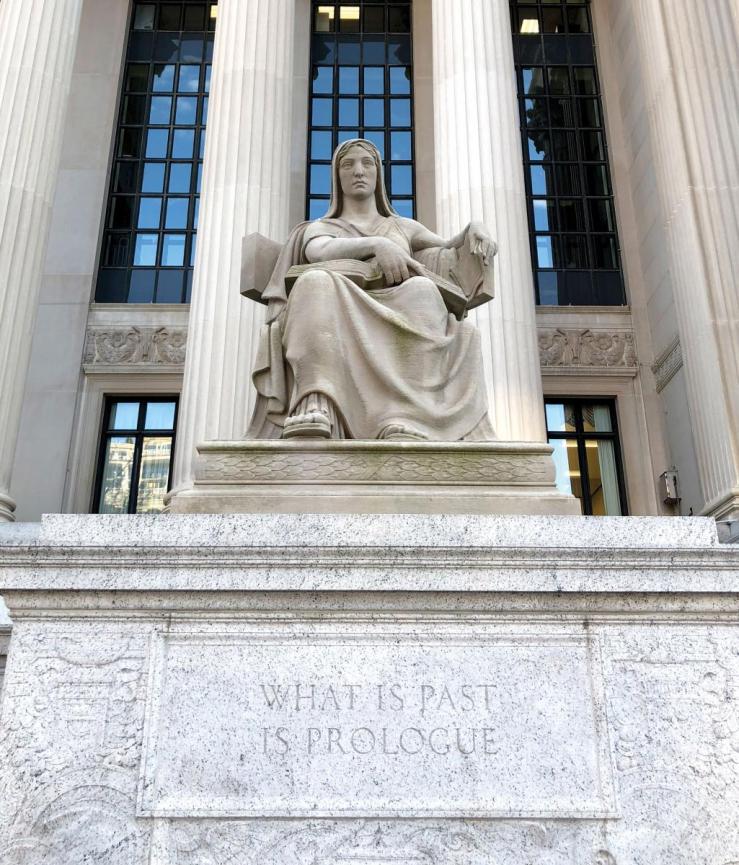
Its location in the United States capital city prompts Steele to contrast it with the nearby monument originally known as Freedom Triumphant in War and Peaceor Armed Freedom, an allegorical figure in bronze that crowns the Capitol building. He has Freedom reciting a famous line from act 2, scene 1 of Shakespeare’s The Tempest—“What’s past is prologue”—spoken by the villainous Anthony in an attempt to convince Sebastian to murder his sleeping father and thus make himself king; the idea is that his whole life up to this point was merely an introduction to the great story that will be underway if he goes through with the plan. (The line is inscribed on the base of Robert Aitken’s sculpture Future, located on the northeast corner of the National Archives Building, which shows a young woman holding an open blank book and contemplating the things to come.) Steele imagines this saying, in the mouth of Freedom, as bearing the subtext “Blessed are those in possession” (or, in its original Latin, Beati sunt possidentes), a proverb popularized by the Prussian general and military theorist Carl von Clausewitz in reference to the possession of power and force.
Thomas Crawford (American, 1814–1857), Statue of Freedom, 1863. Bronze, 19 1/2 ft. tall. Atop the dome of the US Capitol, Washington, DC.Robert Aitken (American, 1878–1949), Future, 1935. Indiana limestone, 20 × 8 × 12 ft. (sculpture), plus 12 × 12 × 15 ft. (base). Outside the National Archives Building, Washington, DC. Photo: Rania Hassan.
The two government-commissioned artworks and two quotes Steele’s poem references ping around in my mind as I think about how they relate to the Annunciation. The picture of Freedom as a colossal helmeted woman bearing a sword differs from the smaller, quieter way “Freedom” comes to reign in the Christmas story: that is, as a babe in a manger. And the self-protecting, self-aggrandizing path commended by Clausewitz butts heads against the self-emptying ethic at the heart of Christianity. So does the motivation of the Shakespearean character—treacherous, underhanded—who was the first to say, “What’s past is prologue.” But when considered in light of Luke 1 and even the Future sculpture in DC, this “Delphic” (obscure, ambiguous) saying from the Bard can be seen as alluding to Mary’s position at the Annunciation, at the turning point of history. Mary is fated to act; the past has set the stage for her yes, and for all that will happen next. The New Testament is as yet unwritten—until her bravely submissive response to the angel’s invitation sets God’s grand redemption plan, on hold for four hundred years, into motion once again, and what we call “gospel,” good news, arrives on earth at last in the person of Christ.
In van Eyck’s Annunciation, as in many others, the words AVE GRA[TIA] PLENA (“Hail, full of grace”) stream forth from Gabriel’s mouth in gold lettering, to which Mary replies, ECCE ANCILLA D[OMI]NI (“Behold the handmaiden of the Lord” [Luke 1:38]). Amusingly, van Eyck renders her response upside-down, a device he also uses in the Ghent Altarpiece, presumably so that God can read it from heaven. Steele playfully interprets the inversion as signaling the upside-down nature of God’s incoming kingdom; the world has been turned on its head by Mary’s yes—which is why that yes is rotated 180 degrees!
One aspect of this upside-down-ness is how Mary contradicts the aforementioned adage, used in diplomacy, “Blessed are those in possession.” In scripture Mary is called blessed, but not because she seizes or owns or controls anything. Quite the opposite: because she relinquishes her right to go on living a normal, play-it-safe life. And because she is humble, God raises her up, and those like her. (She sings about this in her Magnificat.) That’s not at all to say that Mary is passive or lacks agency. She stands actively with open hands to receive grace, to receive God himself, and to gift him to the world. She “consent[s] to the revolution.”
I’m reminded of the song “Canticle of the Turning,” written by Rory Cooney in 1990 based on Mary’s Magnificat and set to the traditional Irish tune STAR OF THE COUNTY DOWN. Listen to an acoustic performance by Katherine Moore:
“The world is about to turn.”
+++
For a further in-depth look at the symbolic significance of the architecture and objects in Jan van Eyck’s Annunciation—including the wall paintings and windows in the background, the nielli in the floor, the footstool in the foreground, and the missing boards in the ceiling—see Early Netherlandish Painting: The Collections of the National Gallery of Art by John and Oliver Hand and Martha Wolff, pages 76–86: a PDF of the entire book is provided for free download by the National Gallery of Art. See also the NGA’s special webpage for this collection highlight.
So much to share today! Be sure not to miss “Psalm 126” by Drew Miller (a new favorite Advent song) and Matthew Milliner’s excellent presentation on the Virgin Mary in art, which opened an exhibition that’s running in Southern California—both below. (If you only have time to take in a few items from this post, those are the ones I’d recommend.)
PODCAST EPISODE:“A Time for Wanting and Waiting: An Advent Conversation with W. David O. Taylor”: In this recent episode of The Road to Now, hosts Bob Crawford and Chris Breslin interview liturgical theologian David Taylor [previously] about the season of Advent: what it is, its history and how it fits into the wider church year (see especially 43:29ff.), the canon of Advent and Christmas songs, and the gift the Psalms offers us during this season. Referencing his 2015 Washington Post article, Taylor says our picture of Christ’s coming, especially as expressed through our hymnody, tends to be unidimensional and far too sanitized:
We should permit the Nativity stories to remain as strange and bizarre and fantastical and difficult as they in fact are, rather than taming and distilling them down to this one nugget or theme of effusive joy. There is effusive joy in that—it’s simply that that’s not the only thing that characterizes these stories. Unfortunately, most of our canon of Christmas carols or hymns tends to focus on what I would argue is only 50 percent of the Nativity stories. Everything that begins with Elizabeth and Zechariah and goes all the way to, say, Anna and Simeon and the visit of the Magi and the flight to Egypt . . . it really is one whole story that is being told with these subplots.
I would love to see us create . . . new music that either retells portions that we are already telling but not the whole of it, or we need to tell parts that have not yet been told. . . . Let’s ask ourselves how God is at work in all the minor-key or difficult or dissonant parts of the Nativity stories, not absent from—those are not extraneous to God incarnating himself in Jesus Christ. Those are essential parts of it. And so how can our hymns become ways of praying ourselves into these stories so they can sink deeply into the fibers of our hearts and minds and bodies, and for us to say, “Oh, all the weird and difficult and dissonant parts of our lives are part and parcel of God’s good work,” not, again, on the margins of it, or things we should eschew.
To help deepen and expand the church’s repertoire of Christmas music, Taylor founded, along with a few others, the Christmas Songwriters Project. The Psalms are an inspiration in this task, as they express a joy that is at times quiet and at others raucous, as in the Nativity narratives, and that exists as part of a dynamic constellation of emotions and postures that praise can encompass. Most of us don’t recognize the pure, undistilled happiness that is marketed to us throughout December, Taylor says, and we shouldn’t force ourselves to try to feel it but rather should take a cue from the Psalms and also see the same emotional complexity at work at the beginning of the Gospels:
The Psalms, and I think Christian faith at its heart, can make space for joy and sorrow to exist alongside each other in a way that happiness, as we commonly understand it, cannot, or only with great difficulty. . . . What the psalms of praise do . . . is that in one movement, there’s this effusive joy or a shouting joy or a convivial joy, and then it segues to a quieter joy or a contemplative joy or a yearning, painful kind of joy. . . .
So in the season of Advent, when we look at the characters in scripture—you know, Mary and Joseph and Zechariah and Elizabeth and the shepherds and Anna and Simeon—every one of them has this moment, perhaps, of which we could say, “That sounds like joy.” . . . But immediately before or immediately after, it transitions to something else. So does that mean that joy is negated? Is joy squashed? Is joy extinguished? Or is joy able to continue to exist side by side, to subsist, with a continued experience of longing or a sudden moment of sadness?
+++
ART BY SCOTT ERICKSON: This month Portland-based artist Scott Erickson has been posting on Instagram Advent-themed images he has made, along with thoughtful meditations. Some emphasize the bodiliness of the Incarnation, which often gets overlooked, presumably out of a sense of propriety. But “grace comes to us floating in embryonic fluid . . . embedded in the uterine wall of a Middle Eastern teenage woman,” Erickson writes about With Us – With Child, to which one Instagrammer responded, “This is trajectory changing. Thank you for this. Nipples, vaginas, and Jesus CAN coexist!” Another mentioned how she had never seen Mary with a belly button and a linea nigra before. The image reminds us that Jesus was indeed “born of woman” (Gal. 4:4).
Scott Erickson (American, 1977–), With Us – With Child, 2016 [purchase as poster]Another imaginative image suggests that Christ came to set the world on fire, so to speak. God, who is of old, gives himself to earth as a Jewish babe (“Love has always been FOR GIVENESS,” Erickson writes), sparking a revolution.
LECTIONARY POEMS FOR ADVENT: This year Englewood Review of Books launched a new feature on their website: a weekly post of four to six poems that resonate with the Revised Common Lectionary readings for that week. “We will offer here a broad selection of classic and contemporary poems from diverse poets that stir our imaginations with thoughts of how the biblical text speaks to us in the twenty-first century. We hope that these poems will be fruitful not only for preachers who will be preaching these texts on the coming Sunday, but also for church members in the pews, as a way to prime our minds for encountering the biblical texts.” I’m really enjoying these stellar selections, several of which are new to me.








.jpg)






 Art & Theology