HYMN TEXT: “Lights” by Kate Bluett: Kate Bluett [previously] is a Catholic poet and lyricist from North Texas who frequently participates in cross-denominational music collaborations. Her work has been published by Oregon Catholic Press and GIA Publications and recorded by the Porter’s Gate and Paul Zach, among others. I enjoy following her at https://katebluett.home.blog/, where she regularly shares new metrical verses she has written, tied to the liturgical calendar. Last Eastertide she published a text called “Lights,” which muses on candle flames, stars, and other light sources as reflections of the light of the risen Christ.
+++
AUDIO DRAMA: Anastasis: The Harrowing of Hades by Creative Orthodox:Creative Orthodox is the moniker of Michael Elgamal, a Coptic Orthodox artist and storyteller born in Egypt and living in Canada. Last May he released an audio drama, adapted from a graphic novel, about Christ’s epic descent into the underworld to reclaim the Old Testament righteous. This theatrical medium, which relies on voice acting, sound effects, and music to tell a story, was a very popular form of entertainment in the 1920s–40s before the advent of television but is much rarer today—which is a shame, because I find it really engaging! See the YouTube description for a full list of credits (script, score, actors, etc.).
Dionysius (Russian, ca. 1440–ca. 1508), Christ’s Descent into Hades, from Ferapontov Monastery, ca. 1495–1504. Tempera on wood, 31.2 × 10.5 cm. State Russian Museum, Saint Petersburg.
+++
SONGS:
>> “Christ Is Risen” (لمسيح قام) by Ribale Wehbé:Ribale Wehbé is a Lebanese singer specializing in Byzantine chant. Here she sings a traditional Easter chant in Arabic, arranged by Joseph Yazbeck.
>> “Hallelujah, Hosanna” (हाल्लेलुयाह होशन्ना) by One Tribe: Originally written in Tamil by pastors Dudley Thangaiah and Paul Thangaiah, “Hallelujah, Hosanna” is sung here in Hindi by the Indian Christian worship collective One Tribe. Turn on “CC” for closed captioning, and view the full credits in the YouTube video description. [HT: Global Christian Worship]
>> “He Did Rise” by Monroe Crossing: A bluegrass song about the women’s discovery of the empty tomb on Easter morning, written by Mark Anderson and performed here by his band, Monroe Crossing, at a music festival in Lexington, Kentucky, in 2009. Anderson is on the double bass. [HT: Global Christian Worship]
+++
SPOTIFY PLAYLIST: May 2025 (Art & Theology): An assortment of psalms, hymns, and spiritual songs, old and new. For my Easter-specific playlist from 2022 (with a smattering of new additions since, including a large batch from Cardiphonia at the bottom), see here.
>> “He Is Lord (In Every People),” adapt. Gregory Kay: In this video from 2021, members of Spring Garden Church in Toronto take turns singing the popular twentieth-century worship song (of unknown authorship) “He Is Lord” in their native languages: English, Portuguese, Arabic, Korean, and Chinese. Greg Kay, one of the church’s copastors, added a fun refrain that highlights the global character of Christianity and the lordship of Christ over all creation, which everyone joins in on. Love this idea! [HT: Liturgy Fellowship]
>> Easter Medley performed by Infinity Song, feat. Victory Boyd:Infinity Song is a sibling band from New York City that was led for years by Victory Boyd, who is now focusing on her solo music career; its current members, represented in this video from 2021, are Abraham, Angel, Israel, and Thalia “Momo” Boyd. (Victory is singing lead.) The group combines the songs “In the Name of Jesus” by David Billingsley, “Jesus Is Alive” by Ron Kenoly [previously], and “Redeemer” by Nicole C. Mullen into an Easter medley at Fount Church in New York.
>> “Yessu Jee Utheya” (یسوع جی اُٹھیا) (Jesus Is Risen), performed by Tehmina Tariq:Tehmina Tariq is a prolific gospel singer from Islamabad, Pakistan. Here she performs a song in Urdu by Nadir Shamir Khan (words) and Michael Daniel (music). Press the “CC” button on the YouTube video player to follow along with the lyrics. For a more recent Easter song that Tariq recorded, see “Zinda Huwa Hai Masih” (The Messiah Is Risen). [HT: Global Christian Worship]
+++
MEDIEVAL MYSTERY PLAY: The Harrowing of Hell from the York cycle, produced by the YMPST (York Mystery Plays Supporters Trust): From the mid-fourteenth to mid-sixteenth century in England, during the feast of Corpus Christi in early summer, villagers used to enact stories from the Bible on moveable stages called pageant wagons, which would wheel through town making various stops for performance. Playing the roles of sacred personages were not professional actors but members of the trade guilds. Such plays were banned in Tudor times but since the mid-twentieth century have enjoyed a revival.
One of the few complete surviving English mystery play cycles, consisting of forty-eight individual verse dramas of about twenty minutes each, is the York Mystery Plays, named after the historic town where they originated. One of the plays, assigned to the town saddlers, is The Harrowing of Hell. The following video is a 2018 performance sponsored by the York Mystery Plays Supporters Trust, also available on DVD. You can follow along with the script at TEAMS Middle English Texts, though note that the players do adapt it lightly. Learn more at https://ympst.co.uk/.
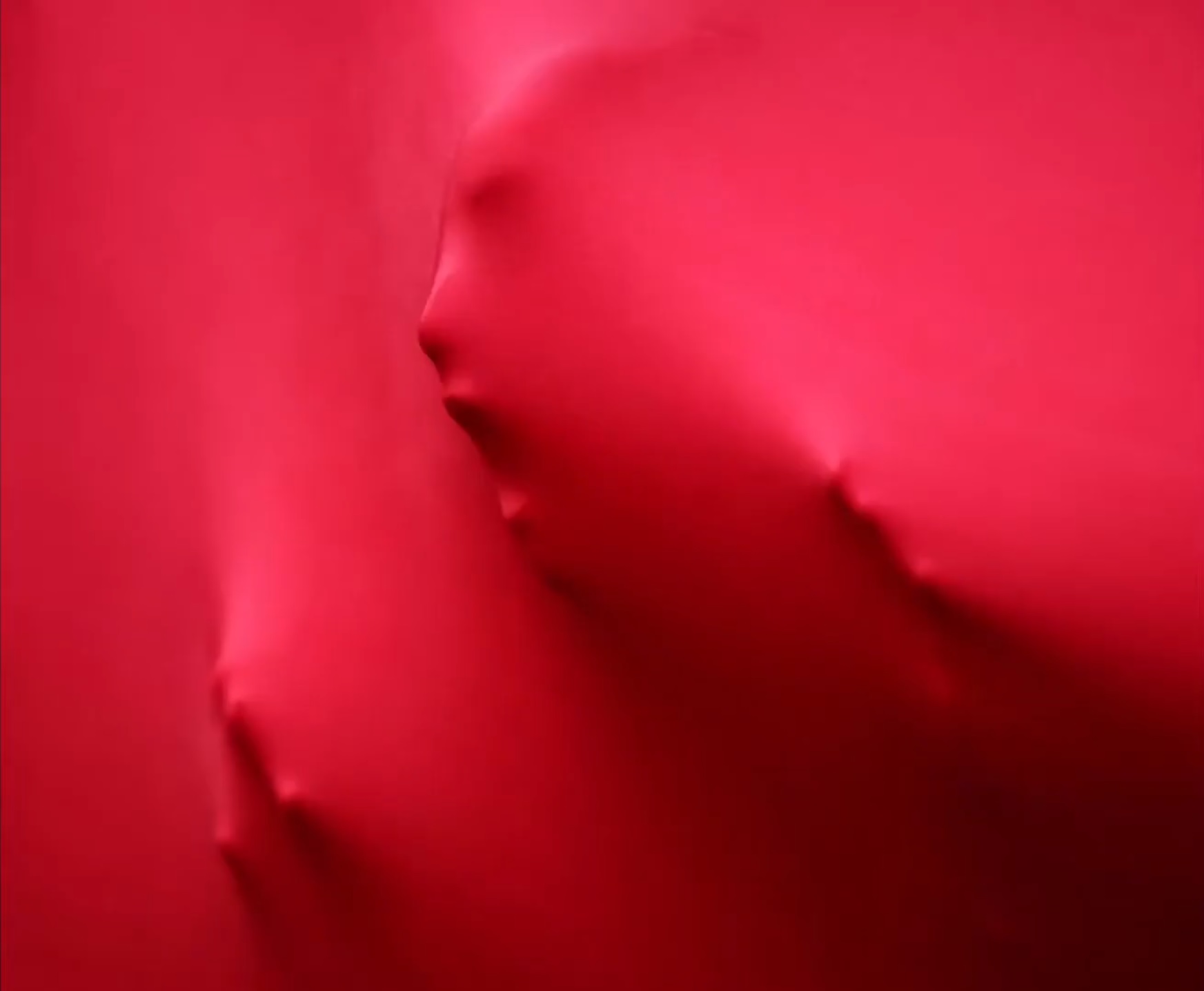
A soul writhes in Hades, awaiting rescue by Christ, in the 2018 YMPST waggon play performance of The Harrowing of Hell
For a preview of the language, here’s Adam’s speech toward the end, after Christ binds Satan and casts him into a fiery pit (I love the alliterative phrase “mickle is thy might”!):
A, Jesu Lorde, mekill is thi myght That mekis thiselffe in this manere Us for to helpe as thou has hight Whanne both forfette, I and my feere. Here have we levyd withouten light Foure thousand and six hundreth yere; Now se I be this solempne sight Howe thy mercy hath made us clene.
Modern English translation:
Ah, Lord Jesus, mickle [great] is thy might That makest thyself in this manner To help us as thou hast said When both of us offended thee, I and my companion [Eve]. Here have we lived without light For four thousand six hundred years; Now see I by this solemn sight How thy mercy hath made us clean.
The YMPST performance incorporates modern elements in the music and costuming, including an electric guitar–driven rendition of the American gospel song “Ain’t No Grave” at the opening and closing.
+++
ART COMMENTARIES:
Below are discussions of two medieval English artworks of the Harrowing of Hell, one of my favorite religious subjects. In modern-day parlance, the word “hell” (an English translation of the Greek “Tartarus” or “Hades” or the Hebrew “Sheol”) typically connotes a place of eternal torment where the damned go, but in Christian theology it was long used more broadly to refer to the compartmentalized netherworld where both righteous and unrighteous souls go after death to await the general resurrection that will take place at Christ’s return.
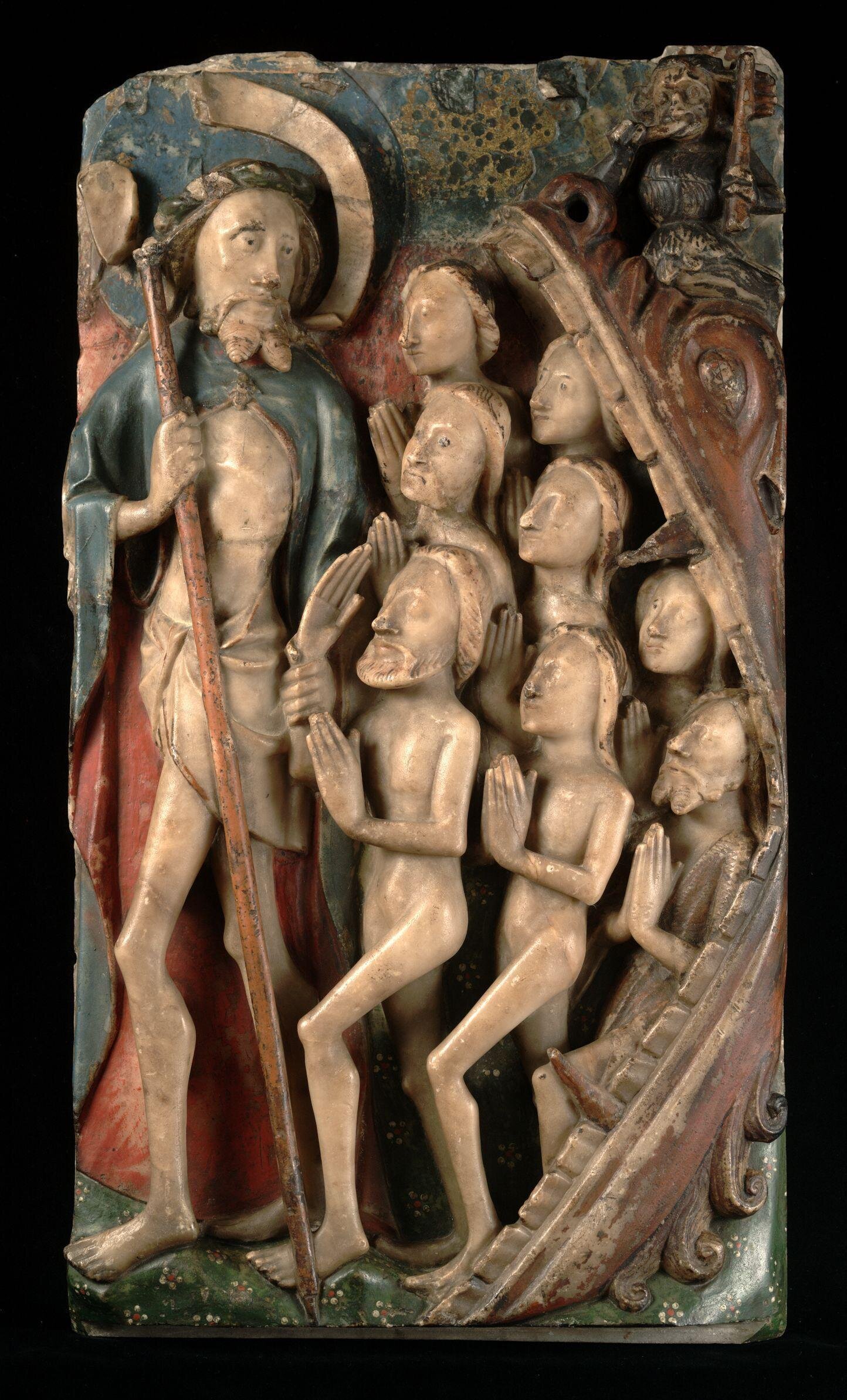
>> “The Harrowing of Hell” (Smarthistory video): Drs. Nancy Ross and Paul Binski discuss a fifteenth-century alabaster that’s in the collection of the Victoria and Albert Museum in London. What sticks out to me—the commentators mention it only briefly—is that Christ stands on a green, flowery lawn! The artist is probably alluding to the springtime, the new life, that Jesus’s resurrection ushered in: the redeemed exit the hellmouth, barefoot like their Lord, onto this lush grass. This detail reminds me a bit of Fra Angelico’s Noli me tangere fresco at San Marco in Florence.
The Harrowing of Hell, England, 15th century. Carved, painted, and gilt alabaster, 58 × 32 cm. Victoria and Albert Museum, London.
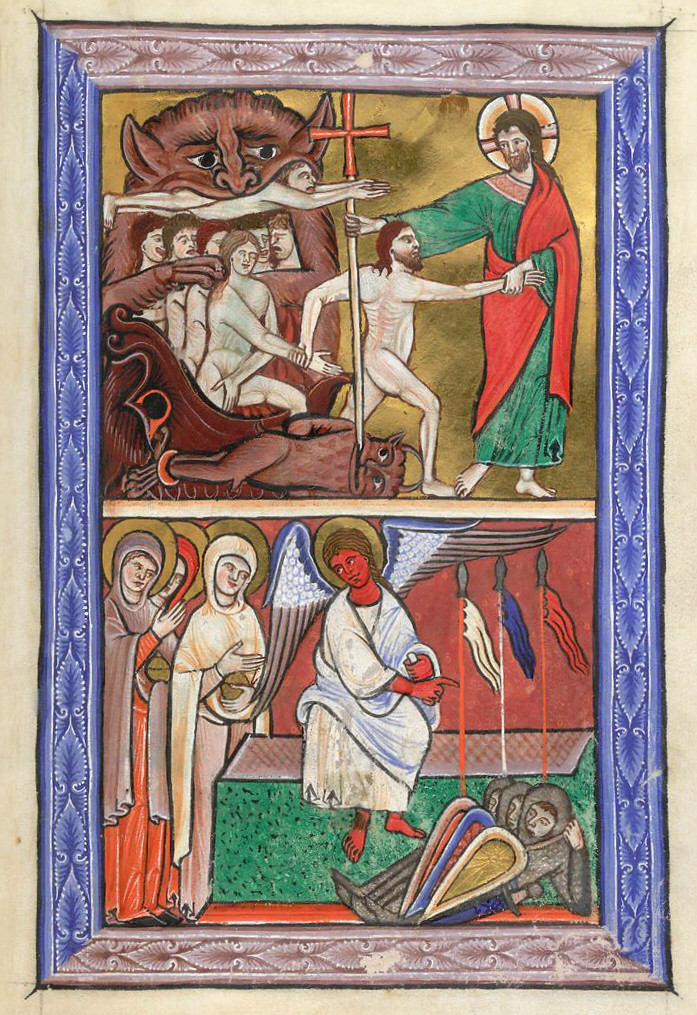
>> “Under the Earth” by Joanna Collicutt: The Visual Commentary on Scripture is a free online resource that provides material for teaching, preaching, researching, and reflecting on the Bible, art, and theology. For one of her three VCS-commissioned “visual commentaries” on Philippians 2:1–11, Rev. Dr. Joanna Collicut has selected an illumination of the Harrowing of Hell from a thirteenth-century psalter. The Christ Hymn that forms the meat of this passage celebrates Jesus’s descent and ascent, and in verse 10 it says that at his name, every knee will bow in heaven, on earth, and “under the earth.” This phrase had never stood out to me until now.
The Harrowing of Hell and The Holy Women at the Tomb, from an English psalter (BL Arundel 157, fol. 110), ca. 1220–40. Ink, tempera, and gold leaf on vellum, 29.5 × 20 cm. British Library, London.
Whereas in our present age it’s common for families to take down their Christmas decorations on Twelfth Night (January 5) or Epiphany (January 6)—and many American Christians do so even sooner—in medieval Europe they typically stayed up through Candlemas on February 2, or were removed the evening before. Yes, Christmas was celebrated for forty days in the Middle Ages! Why that span? Because forty days after his birth, the infant Christ was presented in the temple according to Jewish custom and inspired the famous song of Simeon about finally getting to see God’s salvation and glory. The feast of Candlemas commemorates this event each year, which many medieval worshipping communities regarded as the bookend of the Christmas season.
In her book Winters in the World: A Journey through the Anglo-Saxon Year, Eleanor Parker notes that Candlemas is the last feast of winter and the first feast of spring—a transitional festival that looks back to Christmas and forward to Easter (86). The date coincides with a significant point in the solar year: midway between the winter solstice and the spring equinox. Read more in an UnHerd article by Parker, “Light a candle; spring is coming.”
So as we celebrate Candlemas this Friday, we bid farewell to Christmas and prepare to welcome Lent. The Chorus of Westerly models a respectful send-off in a video they released in January 2021, combining a choral performance of the “Candlemas Eve Carol” with a recitation by James Lawson of “Now Have Good Day”—both texts from early modern England.
The text of the first carol, originally published with the title “Ceremonies for Candlemasse Eve,” is by the poet-priest Robert Herrick (1591–1674), and the tune is traditional, collected from an old church gallery book; the two appear together in The English Carol Book (Second Series) (1923), edited by Martin Shaw and Percy Dearmer. The Chorus of Westerly sings the first two stanzas and refrain:
Down with the rosemary and bays, Down with the mistletoe; Instead of holly, now upraise The greener box (for show).
The holly hitherto did sway; Let box now domineer Until the dancing Easter day, Or Easter’s eve appear.
Thus times do shift; each thing his turn does hold; New things succeed, as former things grow old.
Herrick describes the English family tradition of taking down the Christmas greens—rosemary, bay, mistletoe, holly—on Candlemas Eve, replacing them with boxwood, which would stay up for the duration of Lent.
“Burning the Christmas Greens,” uncredited illustration from the January 29, 1876, edition of Harper’s Weekly
The remaining three stanzas move through the rest of the church year, associating yew with Easter, birch with Pentecost, and rushes and oak with Ordinary Time. The changing of seasonal decorations becomes for Herrick an emblem of the transience of life.
Now have good day, now have good day! I am Christmas, but now I go my way.
Here have I dwelt with more and less [i.e., everyone] From Hallowtide till Candlemas, And now I must from you hence pass; Now have good day!
I take my leave of king and knight, Earl and baron, and lady bright; To wilderness I must me dight; [I must prepare myself to go into the wilderness] Now have good day!
And of the good lord of this hall I take my leave, and of guests all; Methinks I hear that Lent doth call; Now have good day!
. . . . . . . . . . . . . . . . . . .
Another year I trust I shall Make merry in this hall, If rest and peace in our fair land may fall; Now have good day!
. . . . . . . . . . . . . . . . . . .
Now fare ye well, all in fere; [together] Now fare ye well for all this year; Yet for my sake make ye good cheer; Now have good day!
This sixteenth-century carol is compiled in the commonplace book of the London merchant Richard Hill (Oxford, Balliol College MS 354).
Those of you who follow this blog regularly know that the Annunciation is one of my favorite biblical stories. It’s beautiful and wild—and rife with artistic potential! The church celebrates Jesus’s conception in Mary’s womb yearly on March 25, but naturally, it also comes up in the songs, prayers, image cycles, dramas, and meditations of the Advent season. Here’s a roundup of Annunciation-themed art. (You can find more by searching the “Annunciation” tag in the blog archives.)
SONG: “Never Before” by Deanna Witkowski: Jazz pianist and composer Deanna Witkowski [previously] wrote this three-part women’s a cappella piece in 1998 for a Lessons and Carols service at All Angels’ Church in New York City. In the song Mary marvels at the uncanny prospect that she will feel God growing inside her womb, will breastfeed him, will mend his boo-boos—and mourns that she will one day watch him die. “Never Before” appears on Witkowski’s 2009 album From This Place, sung by her, Laila Biali, and Kate McGarry, and was also featured on NPR’s Weekend Edition Sunday (see “Deanna Witkowski: Liturgical Jazz”).
The angel said the Lord is with me:
The Lord is with me in a way he’s never been before; his Spirit is my lover, his son shall fill my womb with holiness and joy and with life that I can feel kicking at my insides.
The Lord will stay with me in a way he’s never stayed before; he will suckle at my breast and let me hold him in my arms. He will run to me when he cuts his finger or wonders aloud at his Father’s creation in a brightly colored butterfly.
Oh, who is this child, Lord, who comes from up above, whose eyes will look beyond my own to a destiny I do not know? Oh, who is this God-boy whose hands shall clasp mine and whose tears I shall wipe away with trembling fingers of my own?
The Lord will leave me in a way he’s never left before; as a king whose time has come, as a son his mother loved, as a boy whose laughter has filled my heart, and as a baby whose tears I have cried as if they were my own.
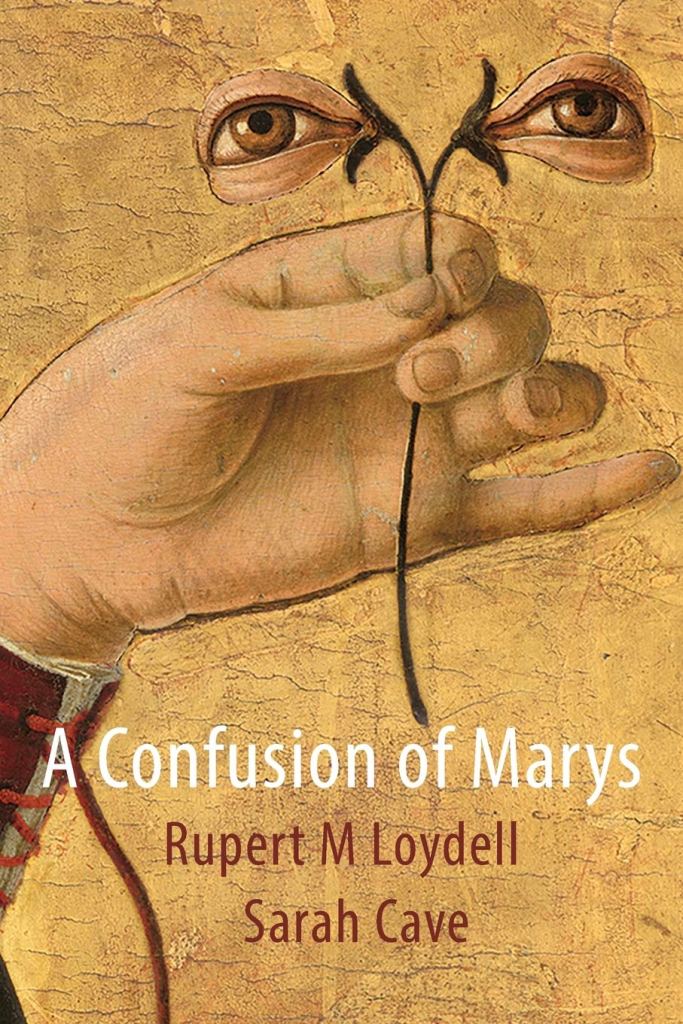
CONVERSATION: “Aliens, angels & annunciations”: In this article, poets Sarah Cave and Rupert Loydell dialogue about their 2020 book A Confusion of Marys, a collection of poems they’ve written inspired by the Annunciation. It’s a series of (sometimes irreverent or humorous) variations on a theme, and not what you’d call devotional poetry. Loydell quotes Gabriel Josipovici, who said stories die unless they are changed, reinvented, argued over, and made new, and that’s what this book does. I definitely gravitated more to some poems than to others.
“I’m interested in the idea of regenerative theology,” Cave says. “I was a cradle Anglican and within that tradition Mary is more of a backseat figure – usually appearing in knitted form at crib services – no intercessions, etc. I wanted to bring her to the forefront and to understand how, in her all-pervasive way, she has shaped my life and the expectations people place on my life – gender, sexuality, politics, mysticism – and the lives of the women around me, and of course, how those expectations must have affected Mary’s own life.”
As for Loydell, he says he’s interested not in theological certainty but in “doubt and myth, symbolism and tangential ideas”—the Marian annunciation scene as palimpsest. He comes at it from a less personal angle.
+++
MYSTERY PLAY + ART PRESENTATION:“Hope Ubiqui: The Gift of the Annunciation”: This online event hosted by Holy Family (Catholic) Church in South Pasadena, California, on March 16, 2021, combines art reflections by Dr. Leah Marie Buturain Schneider (who’s incredibly warm, wise, and engaging) with a performance of the medieval mystery play The Parliament of Heaven, Salutation, and Conception (from the N-town cycle), translated from the Middle Englishby Colleen E. Donnelly and directed here by Grete Gryzwana.
The video starts with artist Patty Wickman [previously] outlining the five emotional states Mary cycled through in response to the angel Gabriel, as famously identified by art historian Michael Baxandall. Schneider then discusses a handful of historical artworks depicting the Annunciation, including ones by Fra Angelico and Andrea della Robbia. The thirty-minute play follows, which enacts not only the Annunciation but also an imagined precursor: a heavenly debate among four of God’s virtues—Truth, Mercy, Peace, and Righteousness [previously; see also this Instagram post]—about how to answer humanity’s cries for salvation. (Keep in mind that this was Zoom-mediated, with each actor calling in from a different location, and some with spotty internet connections, so there are some technical glitches, but it’s still a stirring and enjoyable performance!) Schneider continues by highlighting additional artworks of significance, focusing on Dieric Bouts’s Getty Annunciation, particularly the detail of Mary’s hands. She reads from the mystics Meister Eckhart and Julian of Norwich on responding to Love’s call; they ask, What does it matter if Mary gives birth to Jesus if we ourselves do not give birth to him in our souls, in our lives?
2:51–7:41: Introduction by Patty Wickman 9:44–18:16: Leah Marie Buturain Schneider 18:37–50:10: Mystery play 52:01–1:08:27: Leah Marie Buturain Schneider 1:08:52–1:31:00: Q&A
The remaining video is just informal chatting among a few church members who linger behind on the call.
+++
CHILDREN’S VIDEO: “The Gospel According to Hamlet” by SALT Project: A whimsical retelling of the Annunciation story, narrated by kids—and by a small ceramic pig figurine! The characters are played by a reproduction of Antonello da Messina’s Virgin Annunciate, a Barbie with tinsel wings, and a matryoshka doll.
The arts don’t just fill our time with uplifting stories and pretty pictures. They don’t just distract us with things to look at; they teach us how to look. They train our vision, down to the level of our souls.
Art can teach us to see the tiny gradations in a field of green—or how to see a suffering world in the context of grace. How to recognize the humanity of a character who seems like an irredeemable villain. How to slow down. How to pay attention not just to the notes but the silences between the notes. How to hear the echo of divine music in human speech. How to look at our own failures and successes with perspective, even laughter. The arts ask us to use the full range of our senses. And they can restore us to our full, God-given humanity.
—Greg Pennoyer, executive director of Image journal [source]
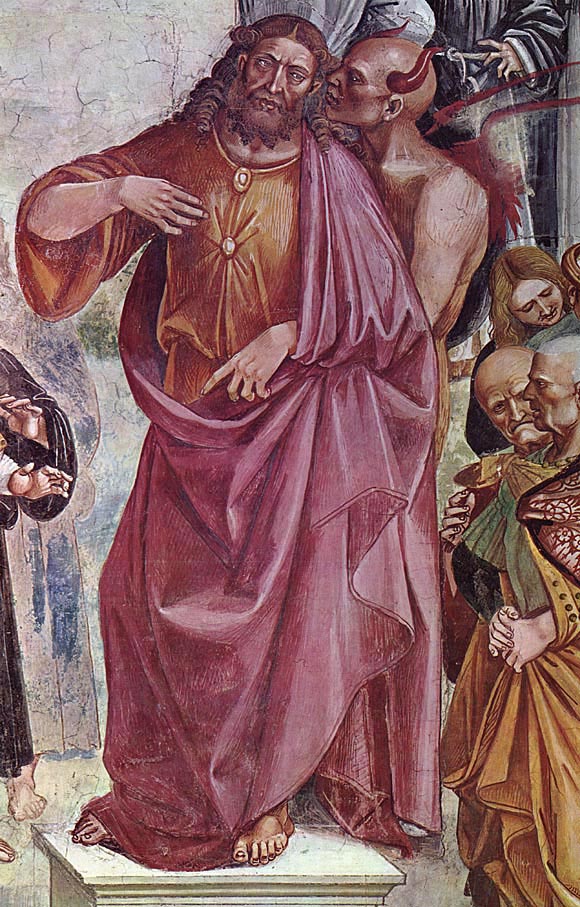
“An Advent Visio Divina” by John Skillen, CIVA blog: John Skillen, author of Putting Art (Back) in Its Place, discusses four works of Advent-themed art from Italy, where he lives for part of each year leading retreats and seminars through the Studio for Art, Faith & History. He starts in Florence with The Adoration of the Shepherds altarpiece by Renaissance artist Domenico Ghirlandaio, which invites worshippers to follow the shepherds’ (and patrons’) example of adoring the Christ child. Then he moves to Orvieto, spotlighting Karin Coonrod’s directing a medieval mystery play in the city’s streets and churches. (For more on this, read Skillen’s excellent essay in Image no. 96, “Fierce Mercy: The Theater Art of Karin Coonrod.”) Advent is also about the second coming, so Luca Signorelli’s apocalyptic frescoes in the Chapel of San Brizio in Orvieto Cathedral are appropriate. Continuous, in some ways, with these late fifteenth-century paintings are the bronze reliefs on the central doors by Emilio Greco from 1962; they depict the seven works of mercy, the criteria, according to Matthew 25, by which humanity will be judged.
Actor Patrice Johnson portrays Mary, who carries the light of the world, in this contemporary adaptation of The Second Shepherds’ Play directed by Karin Coonrod. Photo: Massimo Achille.Luca Signorelli (Italian, ca. 1441/45–1523), Sermon and Deeds of the Antichrist (detail), 1499–1502. Fresco, Chapel of San Brizio, Orvieto Cathedral, Italy. The Antichrist is shown as a puppet of the Evil One.
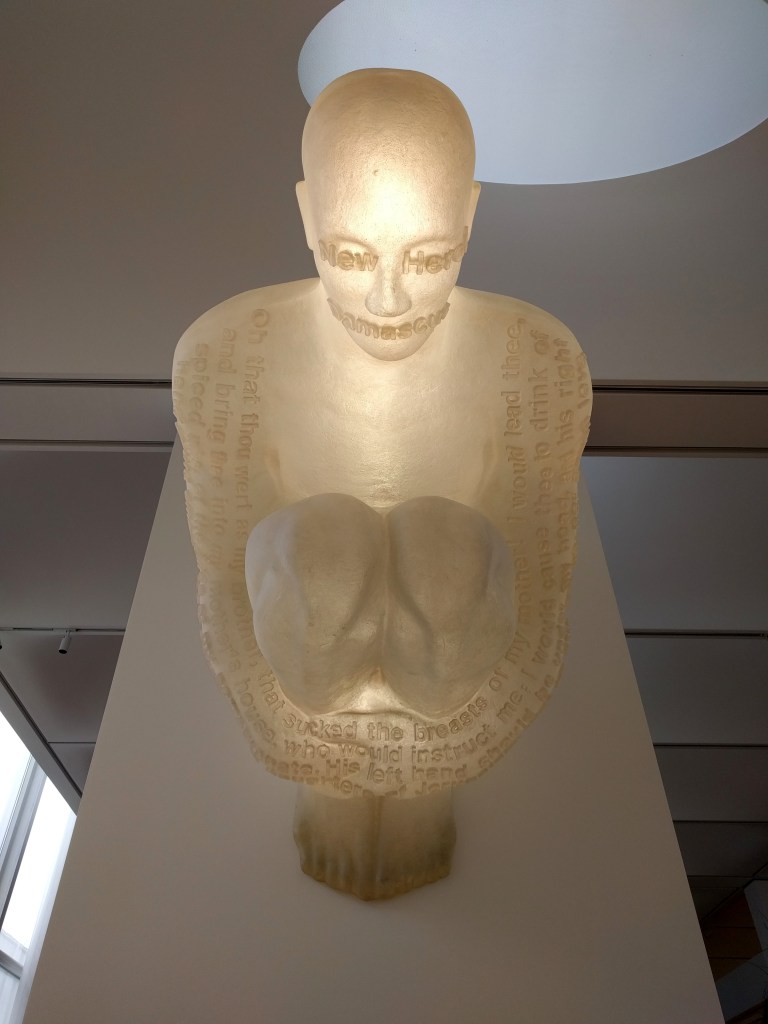
“Passion for the Light” by Alexandra Jean Davison, ArtWay: For last Sunday, the first day of Advent, Culture Care RDU Director Alexandra Jean Davison wrote this wonderful meditation on a set of contemporary sculptures by Jaume Plensa at the North Carolina Museum of Art, connecting them to the season we’re in. She begins, “We see three identical nudes filled with light, the face and arms covered with names and Scripture. Each figure sits at rest horizontally on one of the three walls which form a triangle. The closed eyes and mouth are covered with embossed text of the names of the eight gates of the ancient city walls of Jerusalem: New, Herod, Damascus, Golden (two doors: Gate of Repentance and Gate of Mercy), Lions, Jaffa, Zion, and Dung. Tattoo-like passages from the Song of Songs emerge from the heart upon the arms.” Read more at ArtWay.eu.
Jaume Plensa (Spanish, 1955–), Doors of Jerusalem I, 2006. Resin, stainless steel, and light, 47 1/4 × 62 3/16 × 80 11/16 in. (120 × 158 × 205 cm). North Carolina Museum of Art, Raleigh. Photo: Victoria Emily Jones.
+++
VIDEO: “Matthew 1:18-23” by SALT Project: The Emmy Award–winning production company SALT Project released a short video this week setting a reading from Matthew’s Gospel (“This is how the birth of Jesus came about . . .”) against evocative time lapses of blooming flowers. They’re generously offering it for free download and use in worship services, online or in-person. It could be used as an opener, as one of the morning’s scripture readings, or in a number of other ways.
+++
SONGS (the latter two released this week!):
“Christ Child’s Coming”: This simple Advent song is based on the African American spiritual “The Train Is a-Coming” (where “train” is a multivalent metaphor having to do with salvation). While a musician at Christ Church East Bay in Berkeley, California, Keith Watts adapted the lyrics to relate more explicitly to Advent: “Christ child’s coming, oh yeah!,” “Light is coming, oh yeah!,” and “Our king’s coming, oh yeah!” The song is sung here by Trinity Majorins, accompanied by her mom, Sarah [previously], on the piano and her dad, Philip [previously], on guitar.
“Weight/Wait” by Mike McMonagle: “Hope . . . flicker[s] underneath the weight of the wait.” Introducing this new demo, Mike McMonagle, a roots rock musician from Lancaster, Pennsylvania, wrote on Facebook about how the pandemic has created an extended season of waiting in the darkness this year, which has helped him to feel both pain and longing more keenly: “For the past couple of months, I’ve found myself processing all the ups & downs of the current life experience in step with what I’d label the deepest dive into the Advent season that I’ve ever done. All my life, Advent was just a church-y word for rat race otherwise known as The Holidays. There were happy hours, shopping trips, family outings – things that made it hard to focus on the Advent season for more than an hour each Sunday. This year has been different.”
“In Distress” by the Pharaoh Sisters: Written by Austin Pfeiffer and Jared Meyer and based on Psalms 120 and 121, this song blends Latin and Appalachian folk music influences and has lyrics in both English and Spanish. “The song’s creation began in the spiritual angst after the 2016 [US presidential] election,” Pfeiffer writes. “Calling on believers to put their hope in Christ as King, the song has broad themes of Kingdom orientation, raises questions about social divisions, but also leans into Advent ideas, specifically Isaiah 9.” It premiered at the 2017 Presbyterian Church in America (PCA) General Assembly but didn’t end up fitting on the Pharaoh Sisters’ 2020 debut album, Civil Dawn. “Now as our nation plunges deeper into distress and unrest, be it political and/or social, the band is eager to release the song for Advent 2020.”
+++
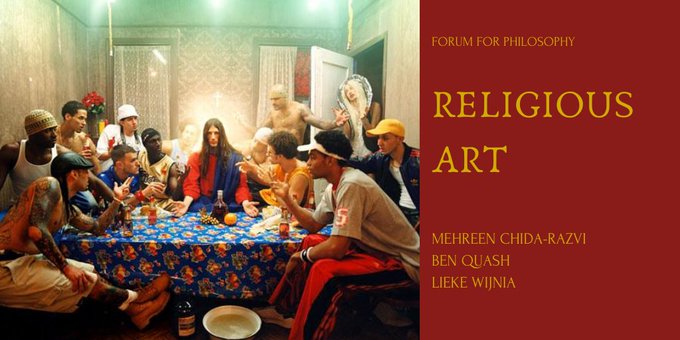
ONLINE PANEL: “Religious Art,”December 9, 6:00–7:15 p.m. London time (1:00–2:15 p.m. ET): “The relationship between religion and art is ancient and complex, varying across religious traditions and cultures. In this event, Mehreen Chida-Razvi, Ben Quash, and Lieke Wijnia consider how these traditions of religious art differ and what role art plays in religion today. How should we display religious art? Might art be a way of opening interfaith dialogue? And has art itself become a kind of religion?” This free Zoom event is organized by the Forum for Philosophy and the Department of Philosophy, Logic and Scientific Method at the London School of Economics. I’ll be attending! (Note: The promotional image below is David LaChapelle’s Last Supper.) Update, 12/10/20: The panel discussion has been archived and can be viewed here.
For those readers who are new, welcome! I want to alert you to (and remind others of) the Art & Theology Advent Music Playlist. I released it last year on Spotify and have made some additions since then, including all six songs from Lo Sy Lo’s excellent album St Fleming of Advent, selections from recent releases by the Porter’s Gate’s, Andrew Bird, and Caroline Cobb, some Nina Simone and Jackson 5, a musical setting of an Emily Dickinson poem by Julie Lee and a Count of Monte Cristo quote by the Duke of Norfolk, the shape-note hymn “Bozrah,” and more. I’ve structured the list as a journey from the early promise of a Savior in God’s covenant with Abraham (Gen. 22:18), through Isaiah’s prophecies about a great light dawning and a shoot springing up out of a stump and valleys being lifted and swords being beaten into plowshares, to the angel’s announcement to Mary and her subsequent Magnificat and pregnant waiting, which I transition into the church’s waiting for Christ’s second coming, with warnings to keep our lamps trimmed and burning, to stay awake, to watch and pray. Sprinkled throughout are groanings from God’s people as well as expressions of joyful expectancy.
A Christmas playlist will be forthcoming in just two weeks.
+++
Bard and Ceilidh Advent Calendar: This Advent, multi-instrumentalist and melodist Mary Vanhoozer (aka Bard and Ceilidh) is offering a digital “Advent calendar” with twenty-four traditional, Celtic-infused Christmas carols played on various folk instruments. For $20, you will receive a code that unlocks a new song daily for download. Here are two of Vanhoozer’s previous releases, to give you a sense of the style she plays in. The first is her own arrangement of “I Saw Three Ships” with “Branle des Chevaux” (The Horse’s Brawl). The second, “When Icicles Hang by the Wall,” is an original setting of the winter hymn from Shakespeare’s Love’s Labours Lost, which celebrates the season of biting cold and red, runny noses and sloshy roads and singing owls and simmering crabapples and interior warmth.
+++
“Veni Emmanuel: A brief meditation on the meaning of Advent” by John B. Graeber: This short piece published last year in Curator is a great introduction to the liturgical season we’re entering into on November 29. It begins, “Advent is the hope of redemption, sung in minor key. It is the promise of resurrection, and the sorrow of that hope not yet fulfilled. In this the midnight of the liturgical year, these few weeks before we celebrate the birth of Christ, we confront a world not yet reborn and embody what Saint Paul calls the ‘hope against hope,’ a hope that endures when the world says it should not. A hope that looks back to the birth of our savior, and forward to His coming again, when all will be made new.”
+++
VIRTUAL DANCE PERFORMANCES: On December 2, Alvin Ailey American Dance Theateris launching itsfirst-ever virtual winter season—and, in the spirit of making dance accessible to all, it’s free! The season will feature the world premiere of the dance films A Jam Session for Troubling Times (choreographed by Jamar Roberts) and Testament (Matthew Rushing, Clifton Brown, and Yusha-Marie Sorzano), plus sixtieth anniversary tributes to Alvin Ailey’s Revelations, a classic that “explores the places of deepest grief and holiest joy in the soul . . . using African American spirituals, song-sermons, gospel songs, and holy blues.” The season will run through December 31. Learn more here.
+++
DRAMATIC READING AND DISCUSSION: The Book of Job: On Sunday, December 6, 4–6 p.m. ET, Theater of War Productions will be hosting a free online event where actors, including Bill Murray, will be performing Stephen Mitchell’s translation of the book of Job, adapted and directed by Bryan Doerries. “The Book of Job is an ancient Hebrew poem that timelessly explores how humans behave when faced with disaster, pestilence and injustice,” Doerries writes, and this dramatic reading aims to serve “as a catalyst for powerful, guided conversations about the impact of the COVID-19 pandemic upon individuals, families, and communities.” After the reading, four community panelists will kick off the discussion with their gut responses to what resonated with them, and then discussion will open up to the audience. RSVP here.
“Theater of War Productions works with leading film, theater, and television actors to present dramatic readings of seminal plays—from classical Greek tragedies to modern and contemporary works—followed by town hall-style discussions designed to confront social issues by drawing out raw and personal reactions to themes highlighted in the plays. The guided discussions underscore how the plays resonate with contemporary audiences and invite audience members to share their perspectives and experiences, and, helping to break down stigmas, foster empathy, compassion, and a deeper understanding of complex issues.” Their many past projects include A Streetcar Named Desire (followed by a discussion on domestic violence), scenes from King Lear (the challenges of aging and dementia), and Sophocles’s Ajax (the invisible wounds of war).
Beginning in May, the company started presenting their projects online. Because they want to cultivate “a dynamic space to participate in an ephemeral experience, in which risks can be taken, interpretations shared, and truths told,” the projects are not available afterward for on-demand views. To get an idea of the format they follow and some of the work they’ve done, see the Theater of War trailer below.
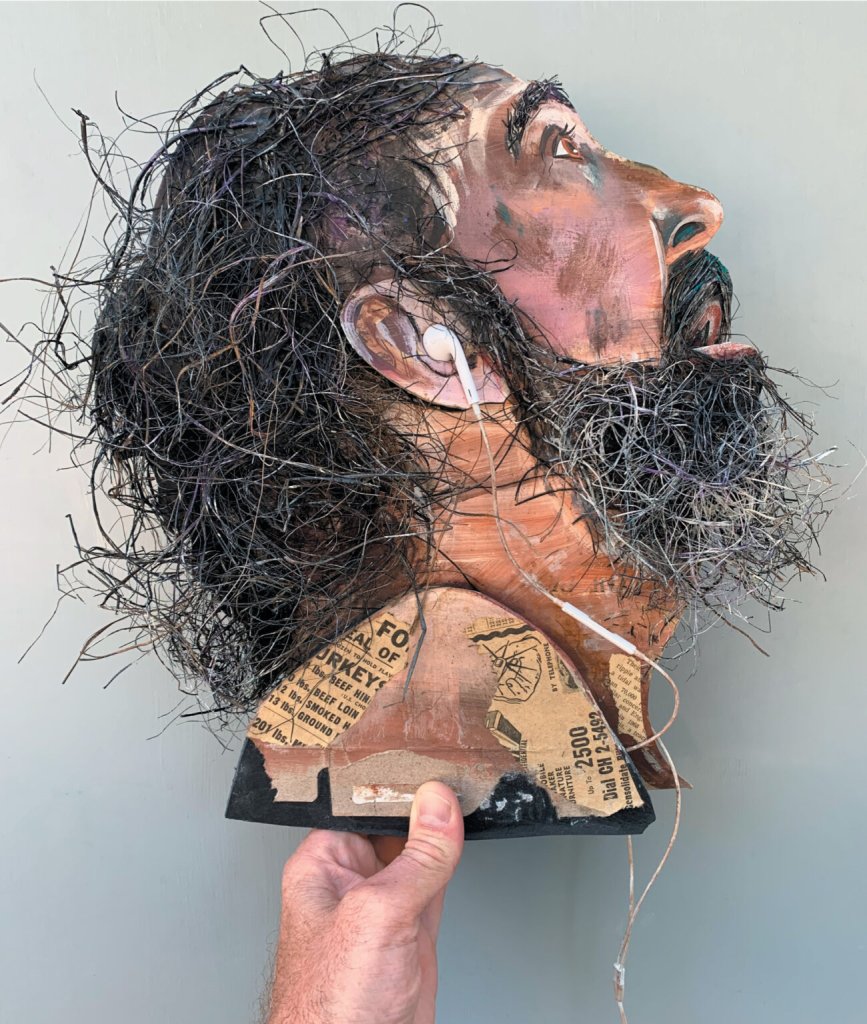
As we sit in the year 2020 and struggle to remember what normal even feels like, I’ve been wondering about people’s emotions and how I might capture the painful realities of human existence we all seem to be feeling this year. In this new work, I will explore the pain and anxiety of massive disruption and how we are changed by it. I’ve been thinking about the biblical character Job from the land of Uz. What might he look like, plucked out of the ancient text, and plopped into modern-day? This is my attempt to bring a re-imagined 21st century Job to life in a way that encapsulates not only his experience, but also our own. I’ll be using a combination of found and repurposed objects, multi-media visuals, and incorporating input from the public on multiple panels that measure 8 feet by 5 feet—my biggest project to date.
Early working prototype for 2020 Disrupted: A Re-Assembled Life by Wayne Brezinka
Next year Brezinka will be taking the completed art on tour across the country in a glass box truck. “The plan is to park at notable cathedrals or churches and community centers in each city. I want to give those who funded this project and the general public an opportunity to pause, interact with the art, and reflect on the last year—the disruptions, the beauty, and the changes it all brings.” He says the art is an invitation for people to feel their sorrow and their grief. Read the interview to find out more about his process and his hopes for the project.
+++
NEW SONG RELEASE: “O Love That Casts Out Fear”: This is my favorite track from the new sacred chamber pop EP by Bobby Krier, Jon Green, and friends, Cast Out All Our Fears. The hymn text was written by Horatius Bonar in 1861, and the music is by Bobby Krier and Justin Ruddy [previously], who collaborated often as musicians at Citylife Presbyterian Church in Boston. (Their retuned version premiered on the 2013 album Castle Island Hymns; they have since moved on from Citylife.) This rendition is sung by Molly Parden.
Several readers have asked if there’s a way to donate to the work of this blog. After much thought I’ve decided to go ahead and add a Donation page, where those who wish to send a small financial gift to support the blog’s upkeep and development can do so through PayPal if they feel so inclined. Thank you!
+++
CIVA ART AUCTION, November 13–15, 2020: In a few weeks CIVA (Christians in the Visual Arts) is hosting an online auction of art created and/or donated by CIVA members. The lots comprise a range of media, sizes, and styles—a little something for everyone. It’s a great way to support artists of faith (by supporting CIVA), and to acquire beautiful art for your home!
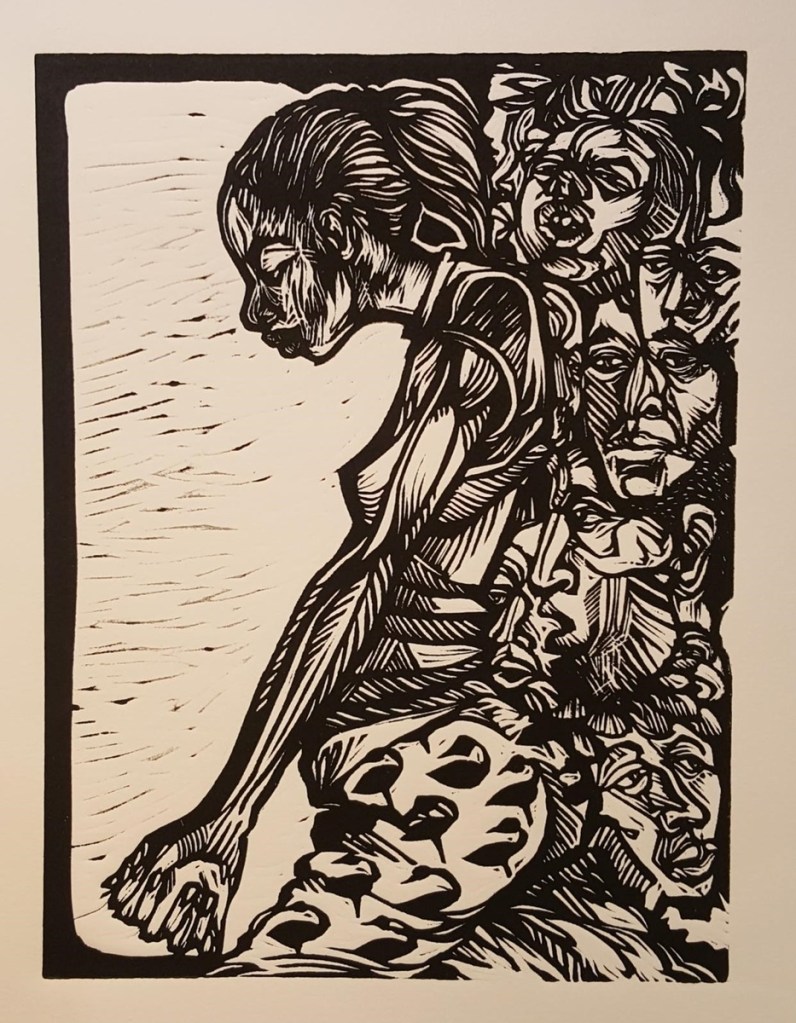
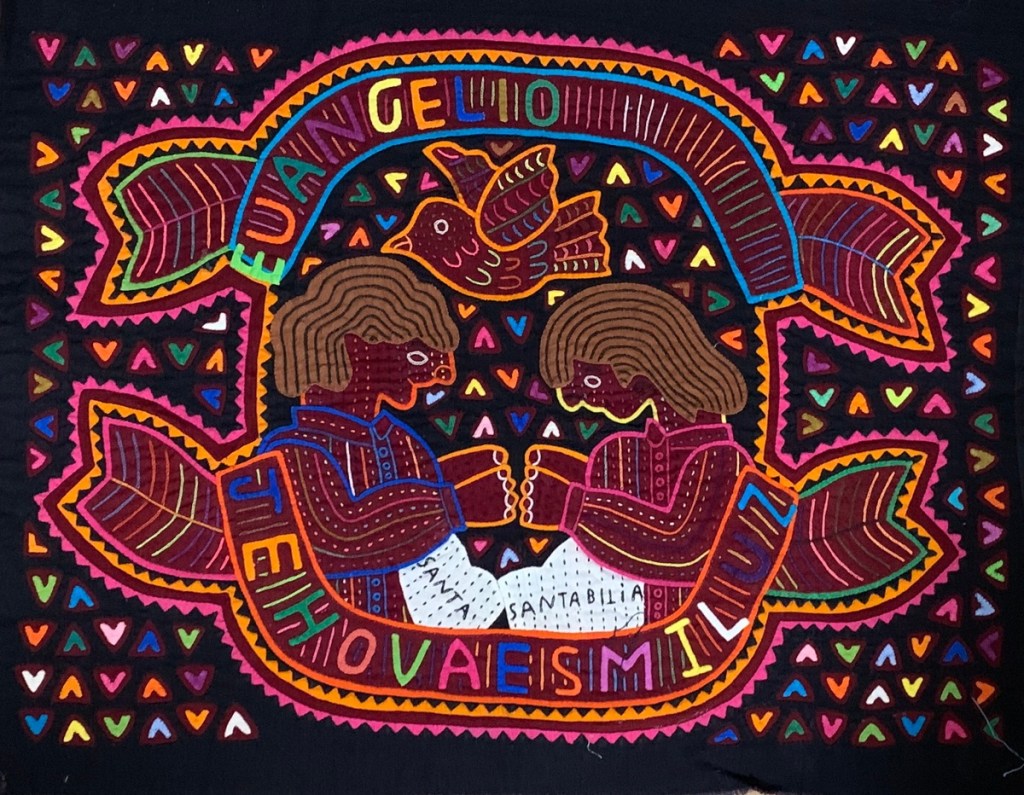
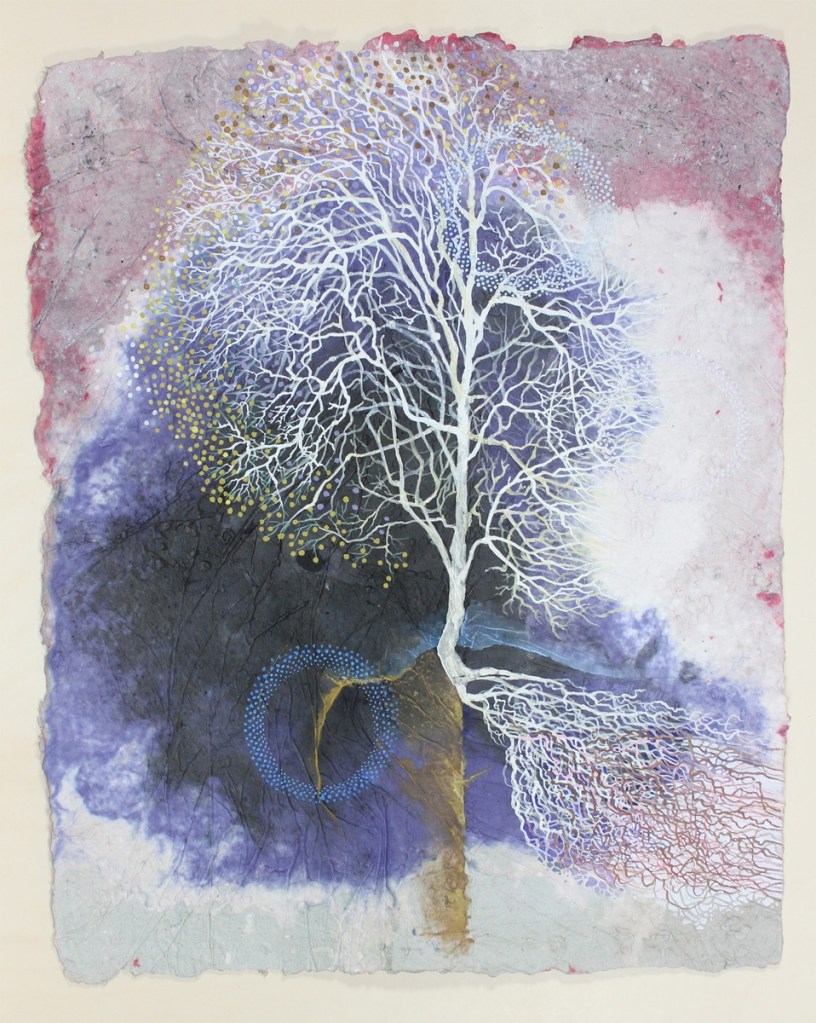
The first artwork I ever purchased was through a CIVA auction: a linocut by Steve Prince, who has three new works up for bid this year. Sandra Bowden has donated several works from her extensive and esteemed collection of religious art, including an Adoration of the Magi lithograph by the major modern artist Otto Dix and a mola (handmade textile) from Panama, which I’m eyeing. I also noticed 40 Days, Forty Sacraments, a set of gouaches painted by Kari Dunham over the course of Lent one year as a way to rediscover beauty in the ordinary. And a mixed-media piece by Joseph di Bella, whose theme of redemption is underscored by the making of the substrate, which consists of “failed and unfinished works on paper” that “are destroyed, then reformed into new, yet still imperfect sheets.”
Steve Prince, Faith Walk. Linocut, 12 × 9 in. “Shows a woman walking in faith while the ancestors encourage, uplift, and guide her along the way.”Jehova es mi luz (Jehovah Is My Light), San Blas Islands, Panama, 1980s. Reverse embroidery, 14 × 17 1/2 in.Joseph di Bella, Tree Parables (Generations), 2017. Gouache, dry pigment, and ashes on handmade paper, 38 1/2 × 30 1/2 × 1 1/2 in. (framed).
If you plan on bidding, be sure to register; you will be able to see all the other bids and can set up notifications. And if you don’t win, don’t be discouraged: you can always go to the artist’s website, and there will likely be other works available for purchase there.
+++
ALBUM: Daughter Zion’s Woe: Produced by Rachel Wilhelm and released last month by Cardiphonia, this new album features thirteen lament songs written, arranged, and performed by women. It will be available on Spotify after Christmas, but until then, all Bandcamp sales benefit Hagar’s Sisters, an organization that serves victims of domestic violence. My favorite song on the album is “The Glory Shall Be Thine” by Christy Danner, a retuning of the late nineteenth-century “Transformed” by F. G. Burroughs (pseudonym for Ophelia Burroughs, later Adams, née Browning); this hymn text is completely new to me, and what a gem! Danner’s music really draws out its poignancy. Other highlights include Eden Wilhelm’s “Lord, Draw Near” (Psalm 88), Sister Sinjin’s “Silence,” and Lo Sy Lo’s “Let It Be So” (Psalm 12).
+++
EXHIBITION:The Evidence of Things Unseen by Titus Kaphar,October 16–November 28, 2020, former Église du Gesù, Brussels: Titus Kaphar’s [previously] art, which reinterprets traditional Anglo-centric imagery through a Black lens, has grown out of his “spending time in European museums and longing for pictures that looked like they actually made space for individuals that look like me.” In this new exhibition, staged by the Maruani Mercier gallery in a deconsecrated church in Belgium, Kaphar revises Christian paintings by silhouetting, covering in tar, or duct-taping over likenesses of white Jesus, drawing attention to unseen people and narratives. The exhibition’s title is taken from Hebrews 11:1.
Titus Kaphar, Untitled, 2020. Oil and tar on canvas. Photo courtesy Maruani Mercier.
The press release reads: “It is virtually impossible to tell the story of Renaissance art without an exploration of Christianity. While the personal faith of the individual artist varied from devotee to atheist opportunist, the largest patron of the arts was the Church, and Catholic iconography the artist’s lingua franca. . . .
“In The Evidence of Things Unseen, Kaphar utilizes Catholic iconography as a ground on which to explore ideas beyond simple proselytization. Kaphar utilizes his whole vocabulary of formal innovation in this exhibition: canvases aggressively fold, crumple, undulate, and project from the wall, forcing themselves into the space of the viewer. Through Kaphar’s physical interventions, works like Susan and the Elders and Eve exist as bodies transformed into landscape and typography rather than polite easel paintings. In Jesus Noir Kaphar duct-tapes a portrait of a young black man over the face of Christ. Christ’s outstretched right hand, originally pointing to the heavens, now appears as a plea for help. The application of duct tape – a utilitarian material known to be used in all kinds of industrial and household repairs – suggest urgency and impermanence.
“Even though many biblical stories take place in the Middle East and Africa, representations of Christ and his followers are almost always depicted as European. It is not surprising that the devoted attempt to see themselves in the stories of the Bible, and to envision a Christ they can recognize: Christian tradition teaches that mankind was created in God’s own ‘image and likeness.’ And yet, religious paintings from the Renaissance unwittingly oversimplify an understanding of God by excluding a part of his creation. There are no black angels of the Renaissance. The Evidence of Things Unseen is Kaphar’s latest attempt at revision.”
+++
ANIMATED SHORT: “Brené Brown on Empathy”: In this 2013 video from the RSA (Royal Society for Arts, Manufactures and Commerce), Katy Davis animates an excerpt from a talk by Professor Brené Brown, “The Power of Vulnerability.” “The Webby Award-winning RSA Shorts animation series provides a snapshot of a big idea, blending voices from the RSA Public Events Programme and the creative talents of illustrators and animators from around the world. It responds to the ever-increasing need for new ideas and inspiration in our busy lives and acts as a jolt of ‘mental espresso’ that will awaken the curiosity in all of us. If you’re interested in the opportunity of animating one of our Shorts, please email your bio and links to your portfolio to shorts@rsa.org.uk.” Other RSA shorts include Jonathan Haidt on Why We’re Convinced We’re Right, David Brooks on Character in a Selfie Age, and David Graeber on the Value of Work.
+++
PANEL DISCUSSION: “Perspectives on Empathy and the Arts”: In 2017 Roots of Empathy brought together a panel of three—Cameron Bailey, artistic director of the Toronto International Film Festival (TIFF); Martha Durdin, chair of the board of trustees of the Royal Ontario Museum (ROM); and Raymond Mar, professor of psychology at York University—to discuss the connection between art and empathy and why it’s so important. The conversation is moderated by Mary Ito. I especially appreciated from 42:32 onward.
4:10: Children who take acting lessons are more prosocial and empathetic 5:48: Films and empathy 9:34: Fiction and empathy 12:42: Moonlight(2016) 21:54: Learning from mistakes: Into the Heart of Africa (1989) and point of view 28:38: Pompeii: In the Shadow of the Volcano (2015) 30:37: Forced assimilation of Native people in church-run residential schools 31:18: Can art museums institutionalize empathy? 34:48: How does me empathizing with a character in a book or a painted figure translate to me being empathetic to actual people? 39:05: Superhero comics and movies 41:22: Are we suffering from an empathy deficit? 44:37: Empathy for ideological opponents 46:10: Where does empathy run up against morality/ethics? Are we to empathize with abusers? 46:56: How do we do better through the arts?
Early this week I was searching the Hymnary database for hymns based on or referent to Sunday’s lectionary reading from Ezekiel 18, where God calls on his people to “repent and turn from all your transgressions, lest iniquity be your ruin” (v. 30b), and the very similar passage later in the book: “As I live, declares the Lord GOD, I have no pleasure in the death of the wicked, but that the wicked turn from his way and live; turn back, turn back from your evil ways, for why will you die, O house of Israel?” (Ezek. 33:11).
One of the search results was “Turn Back, O Man” by the English poet and playwright Clifford Bax. Written in 1916, it doesn’t explicitly reference World War I, but it’s likely that that was the intended subtext.
Turn back, O man, forswear thy foolish ways. Old now is earth, and none may count her days, Yet thou, its child, whose head is crowned with flame, Still wilt not hear thine inner God proclaim, “Turn back, O man, forswear thy foolish ways.”
Earth might be fair, and people glad and wise. Age after age their tragic empires rise, Built while they dream, and in that dreaming weep. Would they but wake from out their haunted sleep, Earth shall be fair, and people glad and wise.
Earth shall be fair, and all its people one, Nor till that hour shall God’s whole will be done! Now, even now, once more from earth to sky Peals forth in joy the old, undaunted cry, “Earth shall be fair, and all its people one.”
The tune it’s set to in hymnals, OLD 124TH, is by Louis Bourgeois and is from the 1551 edition of the Genevan Psalter. Gustav Holst arranged the tune as a motet (a polyphonic, unaccompanied choral composition) in 1916 and in fact is the one who approached Bax with the request for a new text.
Here is a performance by the University of Texas Chamber Singers, from their 2008 album Great Hymns of Faith:
When I read the first line, it sounded familiar, and I was reminded that the song (with a much different tune and style!) opens the second act of Godspell. This 1971 musical created by John-Michael Tebelak and composed by Stephen Schwartz is based on Jesus’s teaching ministry as told in the Gospels, especially Matthew’s. (The show’s title is the archaic English spelling for “gospel.”) In addition to Jesus and John the Baptist/Judas, the cast consists of eight nonbiblical, “holy fool” characters who use their own names and sing and act out the parables and other sayings.
Tebelak, who wrote the play as his master’s thesis at Carnegie Mellon, was studying Greek and Roman mythology when, in his last year at school, he started reading the Christian Gospels in earnest and was enraptured by the joy they exuded and compelled by their emphasis on community. He tells the story of how on March 29, 1970, in pursuit of knowing more, he attended an Easter Vigil service at a church in Pittsburgh, wearing his usual overalls and a T-shirt—and he was frisked for drugs. “I left with the feeling that, rather than rolling the rock away from the Tomb, they were piling more on,” he said. That experience motivated him to write Godspell.
Tebelak’s Godspell was produced at Carnegie Mellon in late fall 1970, featuring an original song by cast member Jay Hamburger (“By My Side”) and a handful of old Episcopal hymns played by a rock band.
After leaving university, Tebelak took the show to New York City, where prospective producers suggested a new score and brought in Stephen Schwartz for the job. The rescored show, which retained Hamburger’s single song contribution, opened May 17, 1971, at the off-Broadway Cherry Lane Theatre and became a hit.
Six of Godspell’s eighteen song texts, including the chart-topping “Day by Day,” are actually taken straight from the Episcopal Hymnal. Schwartz liked the idea of dusting the cobwebs off some of these stodgy hymns and giving them new melodies with a catchy seventies pop vibe that would leave audiences singing them as they exited the theater.
“Turn Back, O Man” is one of those. It’s sung by Sonia, the sassy character with a put-on sensuality, a role originated by Sonia Manzano (of Sesame Street fame). Here’s the scene from the 1973 film adaptation directed by David Greene, with “Sonia” played by Joanne Jonas:
Isolated from the rest of the musical, this song seems completely irreverent and unbefitting the serious nature of God’s call to repentance. Its zaniness and sense of play, punctuated by Jesus’s pensive delivery of the third verse, is on a par with the tone of the whole—and that unique approach to telling the gospel works, I think, really well overall in Godspell, bringing to mind how “the foolishness of God is wiser than men, and the weakness of God is stronger than men” (1 Cor. 1:25). The characters embody the countercultural aspect of Jesus’s teachings, which appear ridiculous, clownish, to the rest of the world.
“The characters in Godspell were never supposed to be hippies,” Stephen Schwartz clarifies.
They were supposed to be putting on “clown” garb to follow the example of the Jesus character as was conceived by Godspell’s originator, John-Michael Tebelak, according to the “Christ as clown” theory propounded by Harvey Cox of the Harvard Divinity School (among others). . . . Because the show was originally produced in the hippie era, and because the director of the Godspell movie somewhat misinterpreted the characters as hippie-esque, that misunderstanding has come to haunt the show a bit.
In this particular song, performed by a hammy character in a feather boa, the lyrics entreat hearers to give up their “foolish ways,” going on to suggest that what is truly foolish is living as if asleep—building “tragic empires,” chasing empty dreams. Though endowed with the flame of reason and conscience, humanity at large, generation after generation, keeps rejecting God’s will, hence the lack of global unity and gladness.
In a recent conversation, poet and novelist Joy Kogawa said, “We need to see each other’s eyes, and see each other through each other’s eyes.” Art, from all disciplines, can help us do that. Art can awaken our social conscience and breed empathy and understanding. It can serve as a vehicle for lament, a practice of voicing suffering before God. It can also widen our imaginations—that is, in part, our ability to think up creative solutions to problems both big and small. Here are just a few recent justice-oriented art projects that inspire me.
+++
CLASSIC SONG REVISED: Earlier this month Liz Vice, Paul Zach, and Orlando Palmer took Woody Guthrie’s folk classic “This Land Is Your Land” and, gathering at Trinity Church in Charlottesville, Virginia, revised the lyrics and tone to project lament over some of America’s more troubling legacies. The lyrical turn happens in the fourth line: where we would expect “To the New York islands,” we get “To the Texas border,” turning our mind from the country’s beauty to its broken systems that prevent us from sharing abundance with our southern neighbors fleeing violence. The song continues to plot a path through various places of historical and present-day suffering in the US, the three stanzas compactly addressing immigration; slavery, the “New Jim Crow,” and police brutality against black people; and the forcible expulsion of Native Americans from their ancestral territories, as well as massacres and other forms of colonialist violence.
This land is your land
This land is my land
From California
To the Texas border
Through the Juarez mountains
With the migrant caravans
This land was made for you and me
This land is your land
This land is my land
From the piers of Charleston
To the fields of cotton
From the crowded prisons
To the streets of Ferguson
This land was made for you and me
This land is your land
This land is my land
From the Jamestown landing
To Lakota Badlands
From the Trail of Tears to
The reservations
This land was made for you and me
Most people don’t know it, but Guthrie actually wrote “This Land Is Your Land” as a protest against the vast income inequalities in the US. Two of its original verses, the radical ones, were nixed when it came time to record (it was the McCarthy era, after all); these referenced breadlines and tall walls with “No Trespassing” signs. In its original form, the song celebrated America as a place of natural abundance—forests and streams and wheat fields under “endless skyways”—while lamenting the scarcity that many Americans experience. The refrain, therefore, was more loaded. Learn more about the song’s history at https://www.npr.org/2000/07/03/1076186/this-land-is-your-land.
+++
An interactive art installation by Rael San Fratello on July 27, 2019, fostered cross-border interactions between residents of Sunland Park, New Mexico, and Colonia Anapra, Mexico.
SEESAWS AT THE BORDER: On July 27, Oakland-based creative duo Ronald Rael and Virginia San Fratello installed three bright pink teeter-totters through the slats of a section of the US-Mexico border wall that separates the neighboring communities of Sunland Park, New Mexico and Colonia Anapra, Mexico. Citizens on both sides were invited to ride this playground essential with a cross-border partner—a whimsical way to engage the other. As the creators said, it enabled people to literally feel the weight of humanity on the other side, using the wall as a fulcrum. The installation lasted forty minutes before it was dismantled (without incident).
I love this idea of play as protest—teeter-tottering as an act of creative defiance. What was enacted July 27 at the wall was a theater of the absurd, something that Rael, an architect, is especially drawn to in his practice. He actually conceived of Teeter-Totter Wall ten years ago, publishing a conceptual drawing in the book Borderwall as Architecture (University of California Press, 2009), along with other outlandish design possibilities for turning the wall into something that brings together rather than divides—these include its use as a massive xylophone played with weapons of mass percussion, a bookshelf feature inside a binational library, and more. Through these humorous proposals, Rael “reimagin[es] design as both an undermining and reparative measure,” as Dr. Marilyn Gates put it.
In his 2018 TED Talk, Rael discusses how the wall, meant to separate, has actually served to unite people in some instances. He mentions, for example, games of Wall y Ball, a variation on volleyball that was established at the wall in 1979, and binational yoga classes. I’ve heard of the Eucharist being celebrated jointly through the slats, and picnics hosted—such as the one organized in Tecate by the French artist JR on October 8, 2017: families passed plates of food between the bars, and musicians on both sides played the same songs.
A picnic at the US-Mexico border on October 8, 2017, organized by the elusive street artist JR
This picnic was the capstone of a month-long installation by JR featuring a monumental photograph of a Mexican toddler named Kikito, peering over the border wall into California from Tecate. (The photograph was held up with scaffolding.)
In early September 2017, street artist JR created a massive art installation on the Mexican side of the US border wall in Tecate showing a child, Kikito, peering over.
Shared play, shared food, shared music, shared sacrament—these are such breathtakingly beautiful countermeasures to separatism. The world needs more imaginative acts like these.
+++
POEM: Timothy E.G. Bartel has just published a new poem, “Status Check,” over at Curator. It’s only five lines, seven questions. A must-read. It’s not about immigration policy per se (it’s open-ended), but it took me back to another poem by Bartel that I featured back in 2017 as part of a blog post entitled “One sonnet vs. shouted prose: Lady Liberty, Emma Lazarus, and Trump.” Bartel has since published a freely downloadable chapbook (a compilation of Sapphic stanzas he wrote this year during National Poetry Month) and a traditionally published collection with Kelsay Books, Aflame but Unconsumed, which I just ordered and am excited about.
+++
VIRTUAL REALITY INSTALLATION: This was in DC last year and I missed it! A VR experience directed by the multi-Academy-Award-winning Alejandro G. Iñárritu, known for the films Birdman, The Revenant, Biutiful, and Babel, and shot by (also multiple-award-winning) cinematographer Emmanuel Lubezki. “Carne y Arenais a six-and-a-half-minute solo experience that employs state-of-the-art technology to create a multi-narrative space with human characters. . . . Based on true accounts from Central American and Mexican refugees, [it] blurs and binds together the superficial lines between subject and bystander, allowing individuals to walk in a vast space and live a fragment of a refugee’s personal journey.”