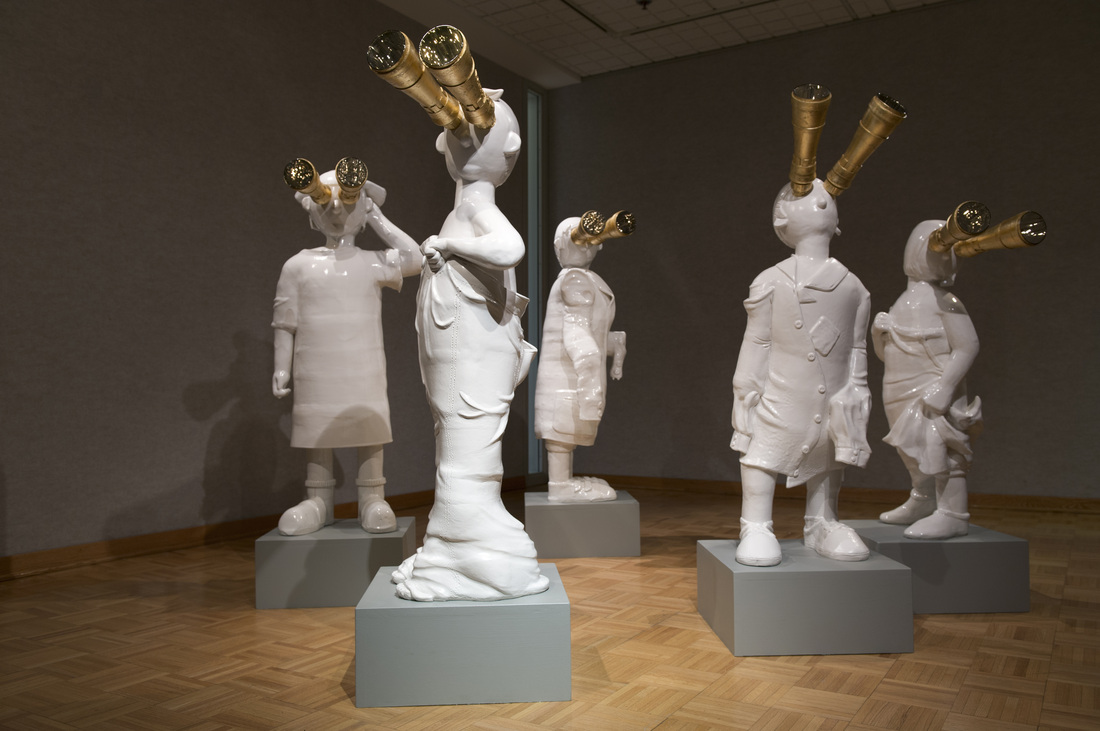
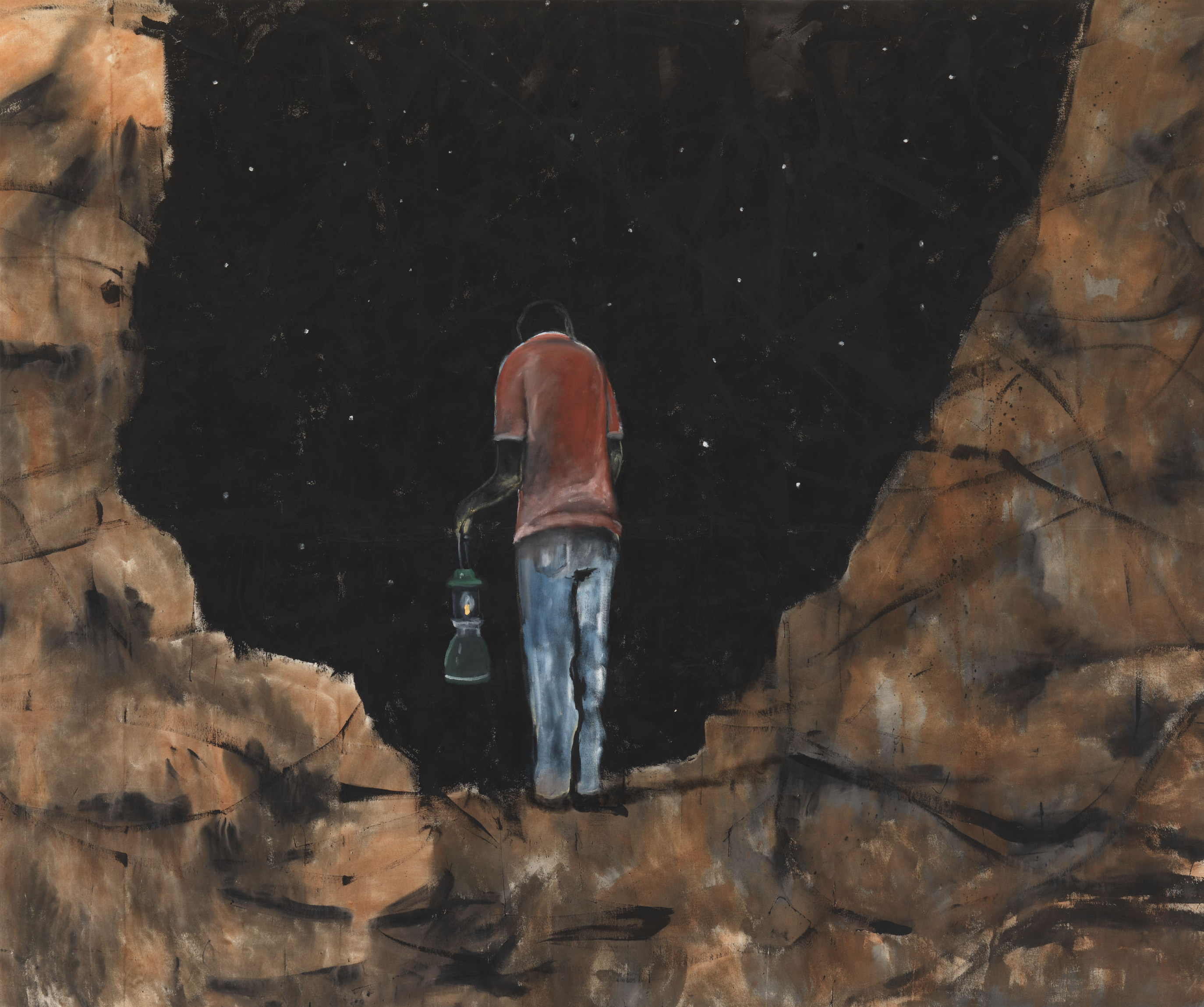
Namdoo Kim (Korean, 1985–), Golden Binoculars, 2013. Glass, ceramic, mixed media, each figure 42 × 20 × 20 in. Installation at the 2018 SOFA Chicago art fair (now Intersect Chicago).
Watchman, tell us of the night, what its signs of promise are. Traveler, o’er yon mountain’s height, see that glory-beaming star. Watchman, does its beauteous ray aught of joy or hope foretell? Traveler, yes; it brings the day, promised day of Israel.
Watchman, tell us of the night; higher yet that star ascends. Traveler, blessedness and light, peace and truth its course portends. Watchman, will its beams alone gild the spot that gave them birth? Traveler, ages are its own; see, it bursts o’er all the earth.
Watchman, tell us of the night, for the morning seems to dawn. Traveler, darkness takes it flight; doubt and terror are withdrawn. Watchman, let thy wanderings cease; hie thee to thy quiet home. Traveler, lo! the Prince of Peace, lo! the Son of God is come!
Unfolding in alternating couplets, this nineteenth-century hymn from England presents a dialogue between a traveler and a watchman—that is, someone stationed at a vantage to look out for coming invasions or things out of the ordinary. The traveler asks the watchman what he sees and what its meaning is; the watchman responds that he sees a glorious star ascending up over the mountains, portending blessing and peace not just for the land of its rising but for all peoples. A beneficent invasion!
This post is part of a daily Advent series from December 2 to 24, 2023 (with Christmas to follow through January 6, 2024). View all the posts here, and the accompanying Spotify playlist here.
To him who loves us and freed us from our sins by his blood and made us a kingdom, priests serving his God and Father, to him be glory and dominion forever and ever. Amen.
Look! He is coming with the clouds; every eye will see him, even those who pierced him, and all the tribes of the earth will wail on account of him.
So it is to be. Amen.
—Revelation 1:5b–7
LOOK: The Last Judgment by Jan van Eyck
Jan van Eyck (Netherlandish, ca. 1390–1441), The Last Judgment, ca. 1436–38. Oil on canvas, transferred from wood, 22 1/4 × 7 2/3 in. (56.5 × 19.7 cm). Metropolitan Museum of Art, New York.
What is your reaction to this image? Terror? Awe? Gratitude? Disgust? Intrigue? Indifference?
I’m often repulsed by how the Last Judgment was interpreted by medieval and Renaissance artists, with graphic displays of torture intending to compel people to righteous living through fear. To be sure, the subject has made for some truly remarkable paintings, full of fantastical grotesqueries and masterfully executed—like this one—but I worry that the scare tactics such paintings use are not helpful and are even harmful.
Nonetheless, the Last Judgment is an unavoidable topic in scripture. The Bible refers several times to God as judge and describes a final accounting of sin upon Christ’s return, resulting in reward for the righteous and punishment for the unrighteous. It’s also in our creeds: “He [Jesus Christ] will come again to judge the living and the dead” (see 2 Tim. 4:1; 1 Pet. 4:5). Those who seek to be faithful to scripture must reckon with the idea of the Last Judgment. Advent, which is penitential in character, has historically been a period for the church to do that. As the Episcopal priest and author Fleming Rutledge points out in her published collection of Advent sermons, judgment is one of the four traditional themes of the season—the other three being death, heaven, and hell.
The early Northern Renaissance master Jan van Eyck’s Last Judgment from ca. 1436–38 is one of history’s most famous and most gruesome. “The diabolical inventions of Bosch and Brueghel,” writes art historian Bryson Burroughs, “are children’s boggy lands compared to the horrors of the hell [van Eyck] has imagined.”
The midground portrays the resurrection of the dead, who rise up out of their graves on land or at sea to be judged by Christ. One of the inscriptions on the frame is Revelation 20:13: “And the sea gave up the dead which were in it; and death and hell delivered up the dead which were in them: and they were judged every man according to their works.”
In the center Saint Michael the Archangel, dressed in his jewel-studded armor and with sword unsheathed, stands atop the giant batlike wings of Death personified, which are inscribed with the words CHAOS MAGNVM (“great chaos”) and UMBRA MORTIS (“shadow of death”). Death is a skeletal figure who excretes the damned through his bowels into hell’s dark slime, where bestial demons tear at, choke, devour, crush, and impale them. One man’s legs are being ripped apart at the anus.
Even kings and clergymen are part of the tragic death-heap—see the bishop’s miter, the cardinal’s galero, the royal crown. Not all who say, “Lord, Lord,” will enter heaven (Matt. 7:21); even the most outwardly pious will have their sins exposed on the last day, and those who prove to be hypocrites, who have harmed others and shamed God without repentance, will be thrown into the pit.
Shooting down like arrows into this pit is the double inscription ITE VOS MALEDICTI IN IGNEM ETERNAM (“Go, ye cursed, into everlasting fire”), taken from Matthew 25:41. And Deuteronomy 32:23–24, a warning from God via Moses to the people of God in their disobedience, is one of the inscriptions on the frame:
I will heap mischiefs upon them; I will spend mine arrows upon them. They shall be burnt with hunger, and devoured with burning heat, and with bitter destruction: I will also send the teeth of beasts upon them, with the poison of serpents of the dust.
Perhaps your chest is tightening right now, your stomach churning. How does this picture cohere with the God of love and mercy?
Look up.
See Jesus Christ, the Son of Man, coming in glory. See his glowing stigmata, beacons of love and mercy. He is dressed in a long, red, open mantle and is barefoot, revealing all five wounds. All around him, angels bear the instruments of his passion: the cross, the three nails, the crown of thorns, the lance, the sponge-tipped reed. See him flanked by all the ranks of the redeemed, including, on a larger scale, the Virgin Mary and John the Baptist, the first two witnesses of Jesus’s divinity.
VENITE BENEDICTI PATRIS MEI, read the inscriptions fanning out from Christ’s elbows: “Come, ye blessed of my Father” (Matt. 25:34). This good word is taken from Jesus’s parable of the sheep and the goats, in which he teaches that those who feed the hungry, clothe the naked, shelter the immigrant, care for the sick, and visit the imprisoned will be honored by God on the last day.
Another benediction is inscribed on the picture’s frame:
And I heard a loud voice from the throne saying,
“See, the home of God is among mortals. He will dwell with them; they will be his peoples, and God himself will be with them and be their God; he will wipe every tear from their eyes. Death will be no more; mourning and crying and pain will be no more, for the first things have passed away.” (Rev. 21:3–4 NRSV)
Van Eyck’s Last Judgment does not stand alone. For centuries it has been configured as a diptych (two-paneled artwork) with a Crucifixion on the left and is thus intended to be read in light of God’s supreme act of vulnerable love and self-giving:
Jan van Eyck (Netherlandish, ca. 1390–1441), The Crucifixion; The Last Judgment (with recently conserved frame), ca. 1436–38. Oil on canvas, transferred from wood, each panel 22 1/4 × 7 2/3 in. (56.5 × 19.7 cm). Metropolitan Museum of Art, New York.
Originally these two paintings very likely served as the wings of a triptych with a painted or sculpted centerpiece, or as the doors to a tabernacle or reliquary shrine. In 2019 the Metropolitan Museum of Art had the frames restored from their modern brass color to their original red.
So, what are we to make of this image today? Is there value in meditating on it?
I’ve presented it here, so I think it’s definitely worth knowing about. It’s a stunning art object that gives us a glimpse into the religious imagination of late medieval Christians. But I would also advise caution, especially to those who have been traumatized by hell teachings in the past. While Christians are called to cultivate a holy fear of God, a soberness around the weight of our sin and the power of God’s justice, this fear is not supposed to be the kind of fear that induces anxiety or paralyzes. That kind of fear will never lead us to love God.
We are never meant to think on hell apart from the grace Christ extends to us with his pierced and outstretched hands, which plead our case before God. Van Eyck holds both together in this painting, but the more visually immersive bottom half seems to indulge some pretty sick fantasies that could well generate an unhealthy fear of God if one were to stay stuck there, not to mention create the false impression that God is monstrously vindictive.
There is debate within Christianity, and has been since the patristic era, whether Jesus’s justice is merely punitive or ultimately restorative—that is, whether hell is a place of eternal conscious torment or a place where one is purged of evil and that will in the end be emptied. (There is biblical support for both views, which I won’t get into here.) There is also disagreement as to whether the Bible’s language about hell, such as its being a place of “fire” and “brimstone” (sulfur) (e.g., Rev. 21:8), is meant to be taken literally or figuratively.
Whatever the duration, physical nature, and ultimate purpose of hell, I want to emphasize that biblical passages about the Last Judgment ought not drive us to despair; they should drive us into the arms of Christ, who receives into his presence all those who trust in his merits and turn from their wickedness. The wounds that Christ so prominently displays in van Eyck’s painting are tokens of divine forgiveness as well as a model of the kind of selfless love we are to follow, a love vulnerable enough to receive injury but never to inflict it. Those who tumble into the depths of the underworld to be ravaged by externalizations of their own destructive evils have rejected the call to “do justice, love mercy, and walk humbly with [their] God” (Mic. 6:8). Many of them are ones who on earth bore much power but used it to abuse others or were neglectful.
For more on the characterization of Jesus as judge in the art and theology of the Middle Ages (whose influence was felt in the Renaissance and later eras), see chapter 2, “The Judge,” of Jesus through Medieval Eyes by Grace Hamman. “The promise of answering unanswered evil, acknowledging the recognized and unrecognized wrongs of the mortal world—everlasting justice and compassion—is ultimately what Christ the Judge signifies. It’s a promise, a prophecy, and a call for action now,” Hamman writes (28). She discusses how neighborliness and fear of God are twinned: “Am I seeing the immortal being, the image of God, Jesus himself, in every person I encounter?” medieval imagery prompted viewers to ask (37). “Jesus the Judge reminds us of our divine community and invites a fear that guides us to love our neighbor as we love ourselves. . . . Fear of Jesus the Judge becomes a gift for our practice of justice, in the radiant light of his justice. Such a fear softens flinty hearts” (21, 36). In the chapter Hamman does also acknowledge the complications and misuses of fear in the medieval church and its legacy today.
I urge you to consider the van Eyck diptych in light of the retuned hymn below as you meditate on Christ’s return and his role as judge.
LISTEN: “Lo! He Comes with Clouds Descending” | Words by Charles Wesley, 1758 | Music by Thomas Vito Aiuto, 2012 | Performed by the Welcome Wagon on Precious Remedies Against Satan’s Devices, 2012
Lo! he comes with clouds descending, once for favored sinners slain; thousand, thousand saints attending swell the triumph of his train.
Ev’ry eye shall now behold him, robed in dreadful majesty; those who set at naught and sold him, pierced, and nailed him to the tree, deeply wailing, deeply wailing, shall the true Messiah see.
Ev’ry island, sea, and mountain, heav’n and earth, shall flee away; all who hate him must, confounded, hear the trump proclaim the day: Come to judgment, come to judgment! Come to judgment, come away! Alleluia, alleluia! God appears on earth to reign.
The dear tokens of his passion Still his dazzling body bears, Cause of endless exultation To his ransomed worshippers. With what rapture, with what rapture Gaze we on those glorious scars! Alleluia, alleluia! God appears on earth to reign.
Yea, amen! Let all adore thee, high on thine eternal throne; Savior, take the pow’r and glory, claim the kingdom for thine own. O come quickly, O come quickly; everlasting God, come down. O come quickly, O come quickly; everlasting God, come down. O come quickly, O come quickly; everlasting God, come down.
I’m struck by the bright, celebratory, homey tone of the new tune Rev. Vito Aiuto gave this old Wesley hymn about Christ’s second coming. One might expect, with its verses about judgment, to have a dark or foreboding tone. But for those who are in Christ, his return, and even the day of judgment, will be an occasion of rejoicing!
Note that “dreadful” here is used in the archaic sense of inspiring awe or reverence.
This post is part of a daily Advent series from December 2 to 24, 2023 (with Christmas to follow through January 6, 2024). View all the posts here, and the accompanying Spotify playlist here.
LOOK: Look forward to the coming of God by Stanley Fung
Stanley Fung (馮君藍) (Chinese, 1961–), 期待上帝 (Look forward to the coming of God), 2002. Digital print on Hahnemühle fine art paper, 100 × 67.5 cm. [for sale]
LISTEN: “Keep Your Lamps,” African American spiritual | Performed by Cantus on That Eternal Day (2010)
Keep your lamps trimmed and a-burnin’ Keep your lamps trimmed and a-burnin’ Keep your lamps trimmed and a-burnin’ For this ol’ world is almost gone
Brothers, don’t get weary . . . This ol’ world is almost gone
Sisters, don’t stop prayin’ . . . This ol’ world is almost gone
Christian, your journey soon will be over . . . The time is drawing nigh
Keep your lamps trimmed and a-burnin’ . . . The time is drawing nigh
This post is part of a daily Advent series from December 2 to 24, 2023 (with Christmas to follow through January 6, 2024). View all the posts here, and the accompanying Spotify playlist here.
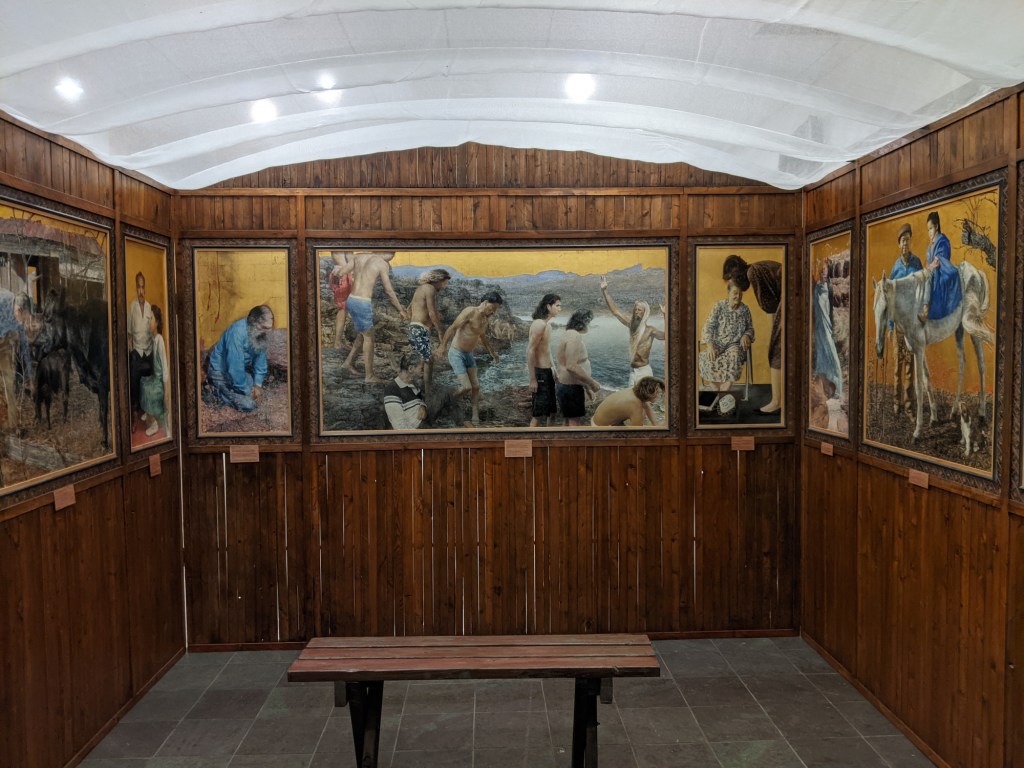
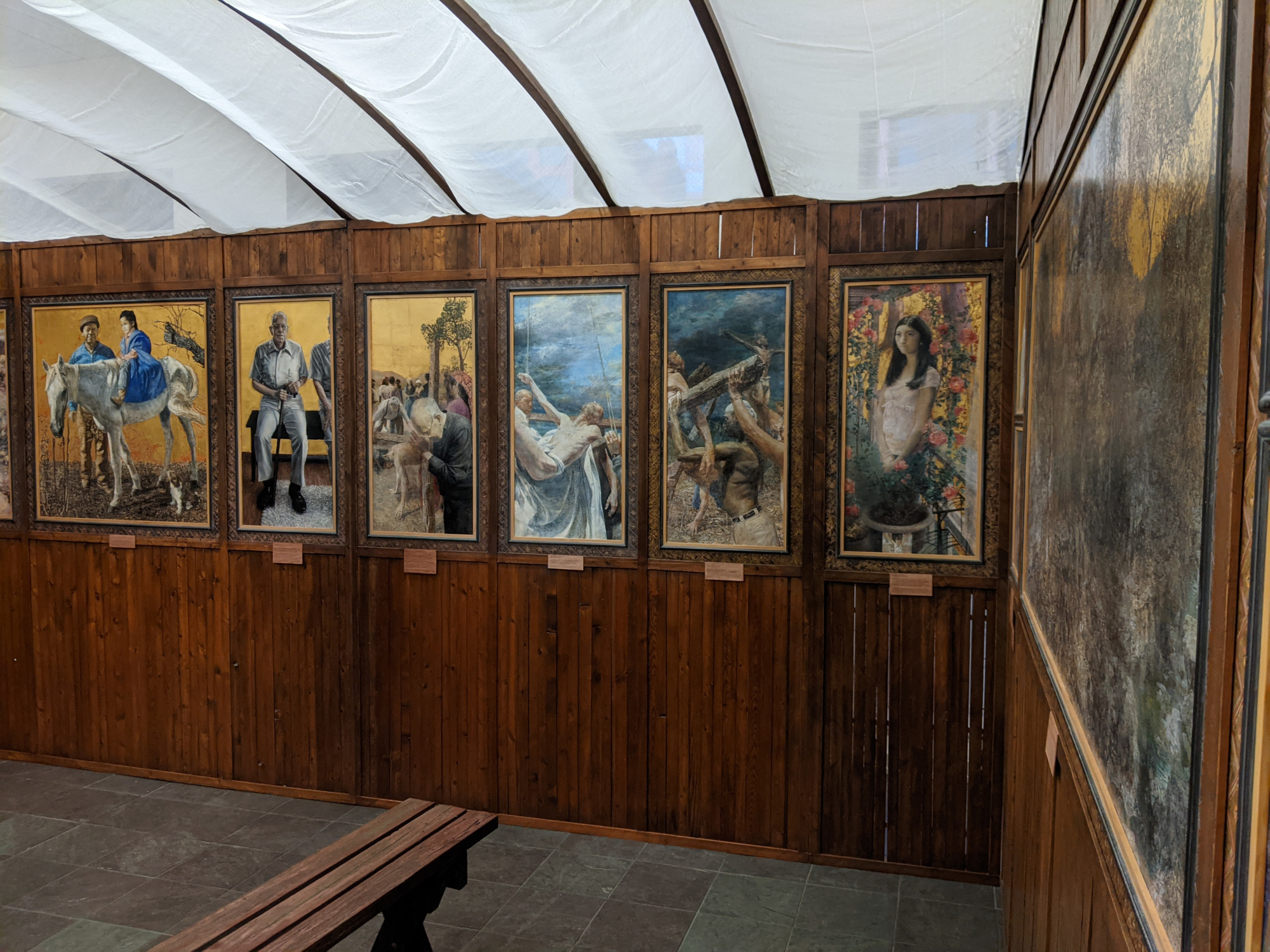
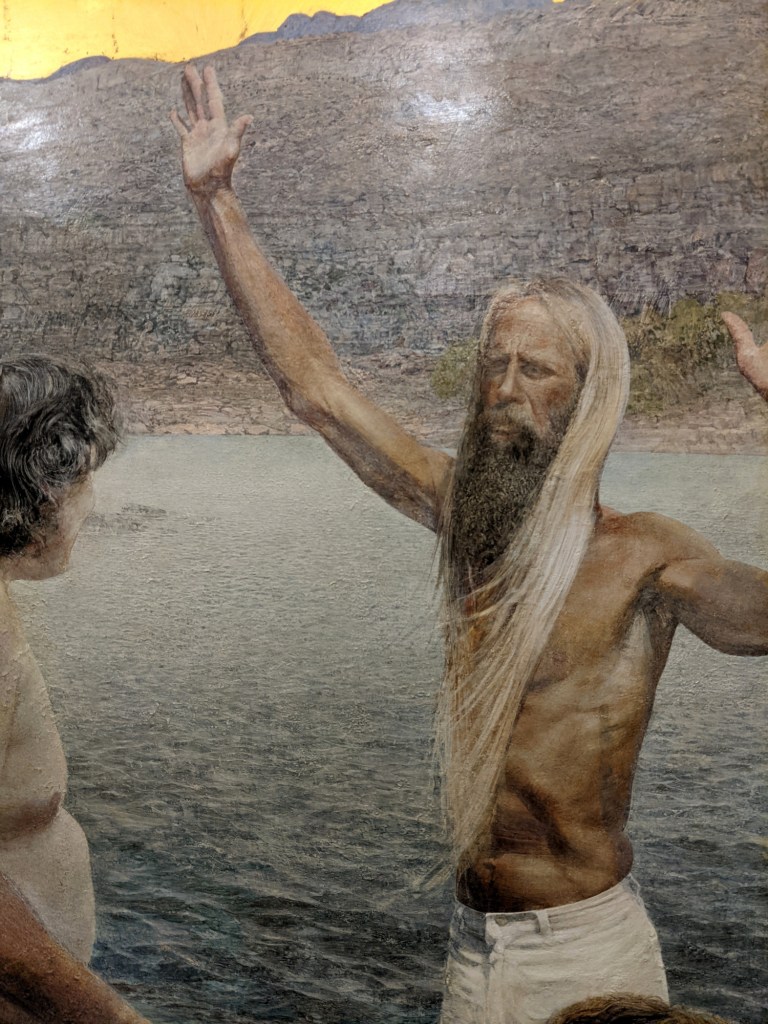
At the 2021 Christians in the Visual Arts (CIVA) conference in Austin, Texas, I got to experience local artist John Patrick Cobb’s Ikon Chapel, a traveling, custom-built wooden structure housing twenty of Cobb’s egg tempera paintings depicting his friends, family, and neighbors as saints and prophets in our modern world. The young and the elderly, farmers, water well drillers, artists, teachers, nurses, Holy Cross brothers, custodians, the unhoused, people with disability or mental illness—these are among those he honors in paint and gold leaf.
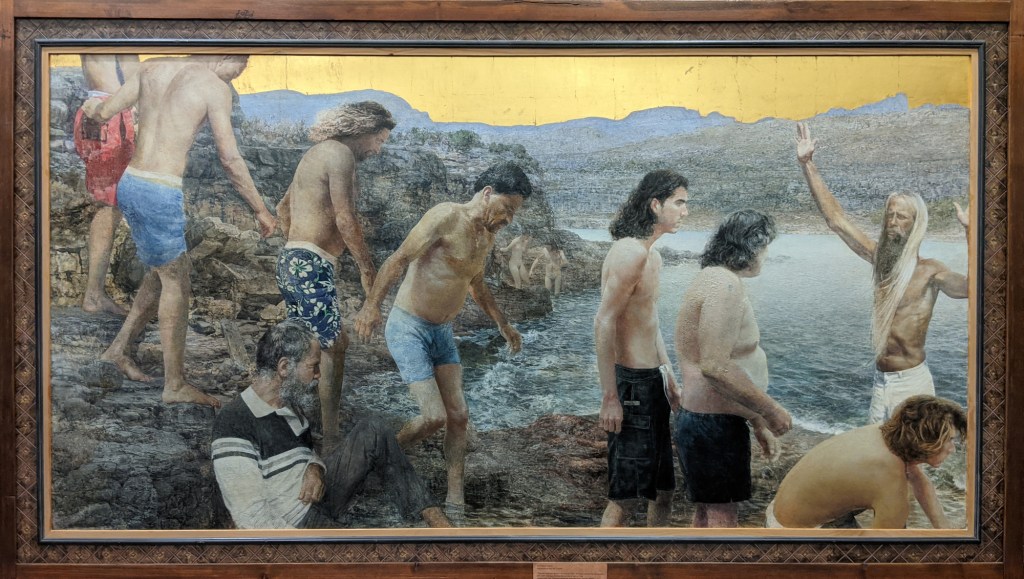
Ikon Chapel (detail) by John Patrick Cobb, as installed at the “Transcend” CIVA biennial conference, November 4–6, 2021, St. David’s Episcopal Church, Austin, Texas. Photo: Victoria Emily Jones.John Patrick Cobb (American, 1954–), Baptism by Water, 1999. Egg tempera and gold leaf on panel, 36 × 77 in. Photo: Victoria Emily Jones.
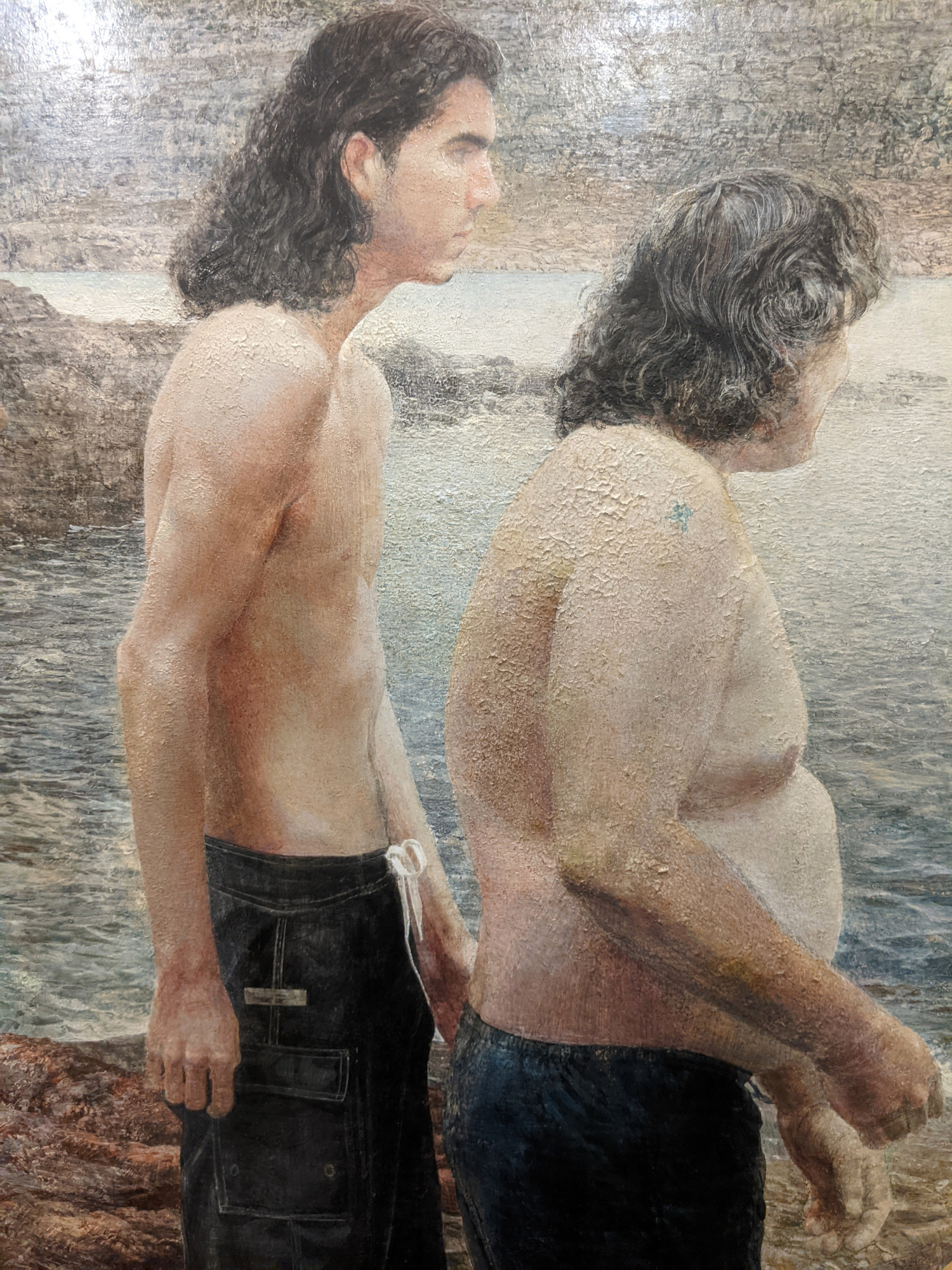
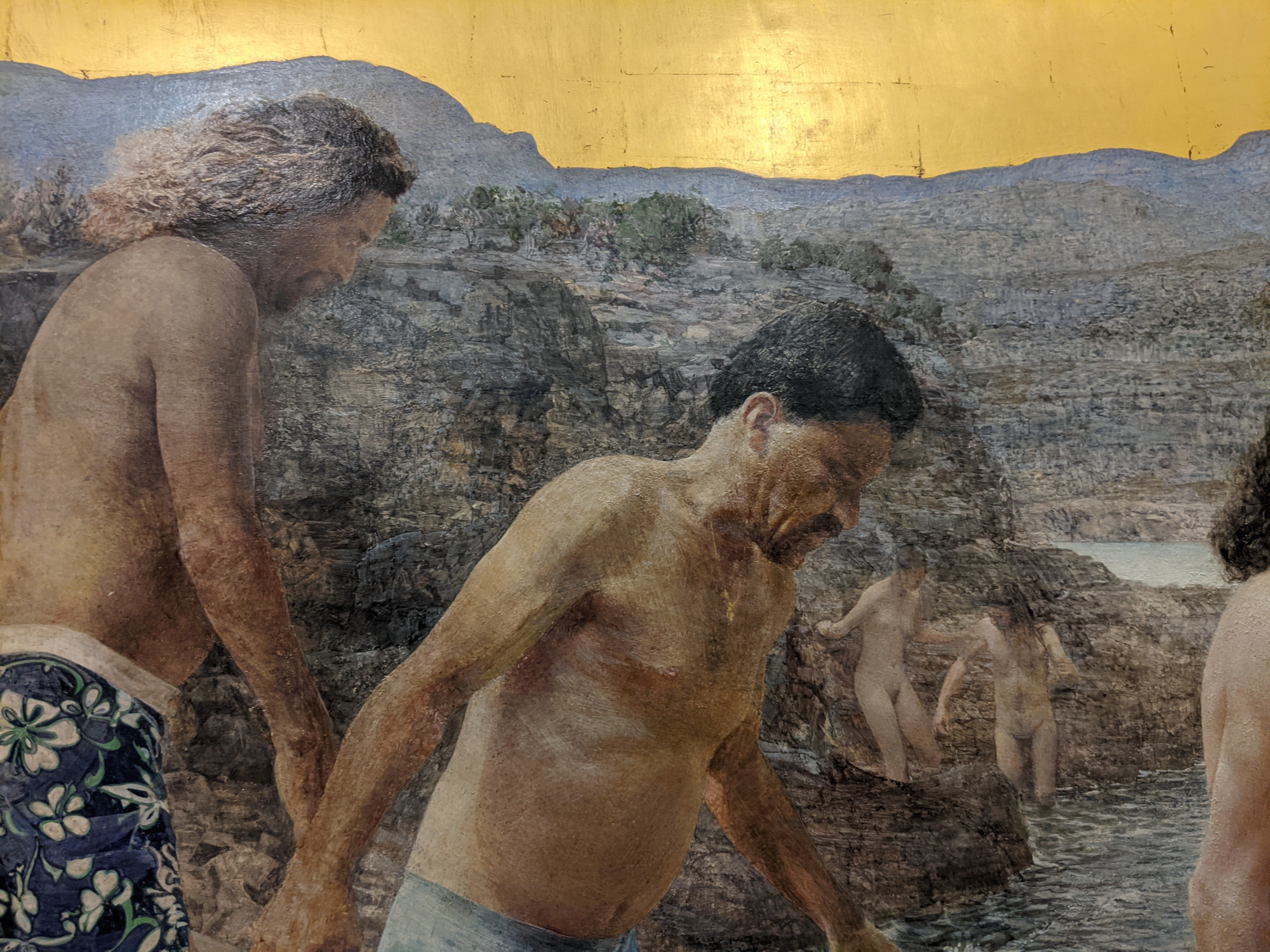
Baptism by Water is, along with its companion piece, Baptism by Fire, the largest painting in the series, at over six feet long. It is a lakeside scene portraying John the Baptist—the long-haired, bleach-blonde guy at the far right—calling folks to repentance. Several men climb down the rocky shoreline to enter the cleansing waters and be raised to new life. The models are all associated in real life with water—surfers, plumbers, fishermen. And this is a local setting: Hippie Hollow on Lake Travis in Central Texas, a famous nude swimming hole.
Jesus, says Cobb, is the young man with the black hair and black trunks. Cobb deliberately made him indistinguishable from the others to emphasize his full humanity. He looks beyond John the Baptist, perhaps mentally preparing for the solitary forty-day fast in the desert he’s about to embark on.
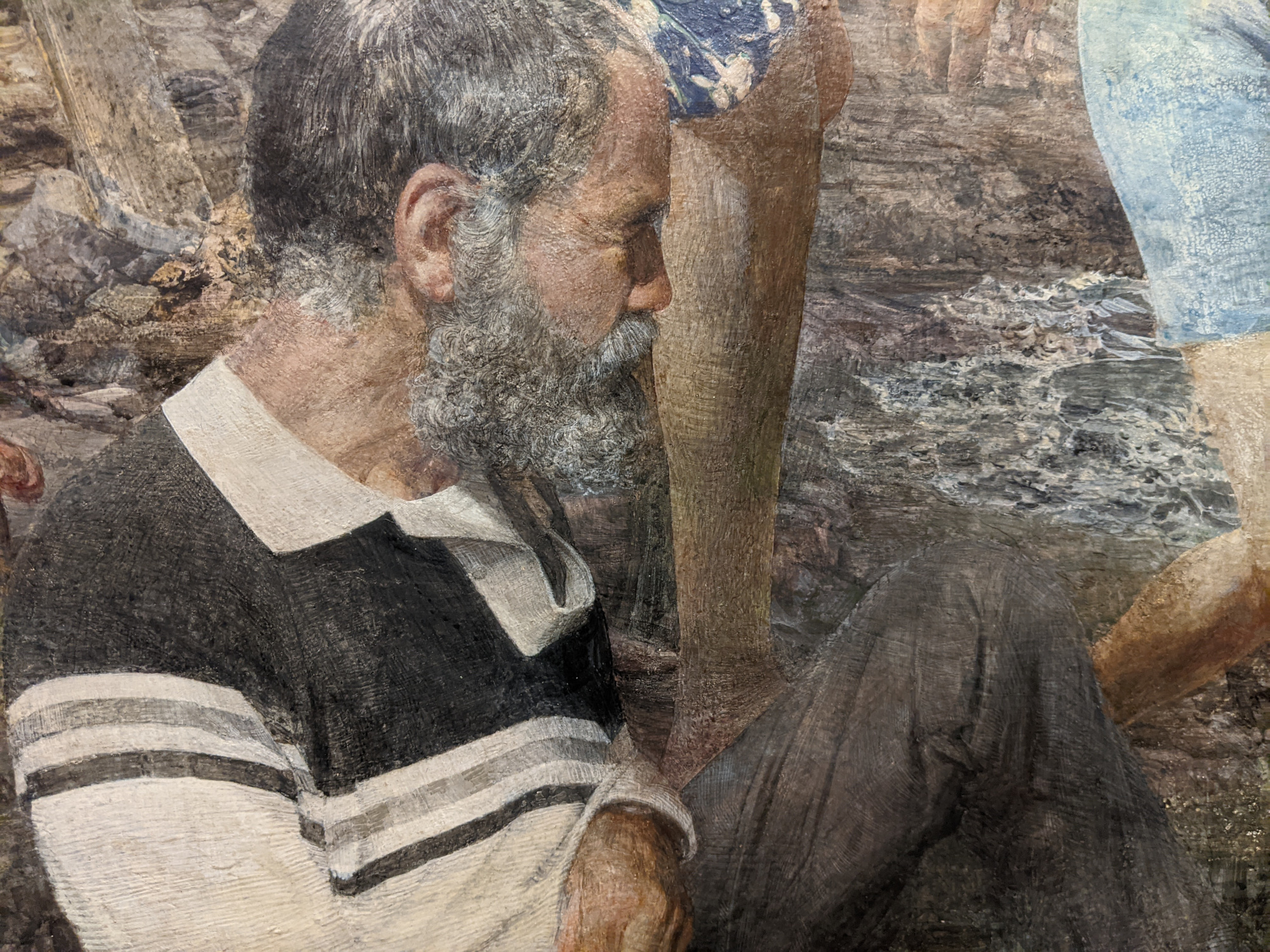
In the wall text in the Ikon Chapel, Cobb describes the seated, shirted man in the foreground as reminiscent of the Gerasene demoniac (Mark 5:1–20):
The figure in the near ground, clothed, was a man who lived in the nook of the sea wall in Galveston and slept in the nearby graveyard at 61st Street. On the worst winter days I would bring him a coffee, and finally asked him one day if I could include him in my painting. He would sometimes drink himself into a frenzy and yell and scream at the cars in horrific anger. His leg had been broken and had healed in a precarious angle. I felt as though if there were anyone who deserved the peace and the Holy Spirit, it would be him.
At the bottom right, one of the figures twists away, rejecting John’s call. The model’s name is Jonah, so Cobb wanted to use him as a Jonah figure, resisting (at least initially) the divine plan.
In the background Adam and Eve are skinny-dipping.
Detail, John the BaptistDetail, Jesus (left)Detail with Eve and Adam in backgroundDetail of a local unhoused man with a leg impairment and alcoholism, for whom the artist wishes God’s peace
I was fortunate enough to get to know Cobb a bit over lunch one day while I was in Austin, and then later at an outdoor gathering he and his wife, Tina, hosted on their property. At the time, he was preparing for an extended trip to Italy to restore some Renaissance frescoes in a village chapel.
To learn more about this remarkable body of work, see the book Chapel Ikons: Biblical Meditations on Living the Spiritual Life in the Modern World (Treaty Oak, 2020), which reproduces all twenty-five paintings in full color with detailed commentaries by William Y. Penn Jr. The postscript says that Cobb and Penn are looking for a permanent institutional home with resources to preserve the chapel ikons for public viewing and study and that if interested, you should contact wpenn@me.com.
Refrain: A voice cries out in the desert Come prepare the way of the Lord God is coming, make straight for him a highway Come prepare the way of the Lord
Every valley shall be exalted Every mountain shall be made low Then shall the Word of God be known All the earth shall proclaim The glory of the Lord [Refrain]
Go upon the highest mountain Zion, herald of good news Lift your voice, cry out with all your soul Jerusalem, proclaim Glad tidings in the Lord [Refrain]
Have no fear, O cities of Judah Here is your God See, the Lord is coming now with power Our God is here The mighty and the strong [Refrain]
Like a shepherd, he feeds his flock He gathers the lambs See, he carries them gently in his arms So tenderly With a mother’s love [Refrain]
This post is part of a daily Advent series from December 2 to 24, 2023 (with Christmas to follow through January 6, 2024). View all the posts here, and the accompanying Spotify playlist here. “A Voice Cries Out” is not on Spotify.
Show us the way home Wayfarers all, Lord Hold us in mercy Through this dark night
O God, we wait on you O God, we wait on you
Gather us in Mender of everything Bright mourning dove Rise over all of us
This post is part of a daily Advent series from December 2 to 24, 2023 (with Christmas to follow through January 6, 2024). View all the posts here, and the accompanying Spotify playlist here.
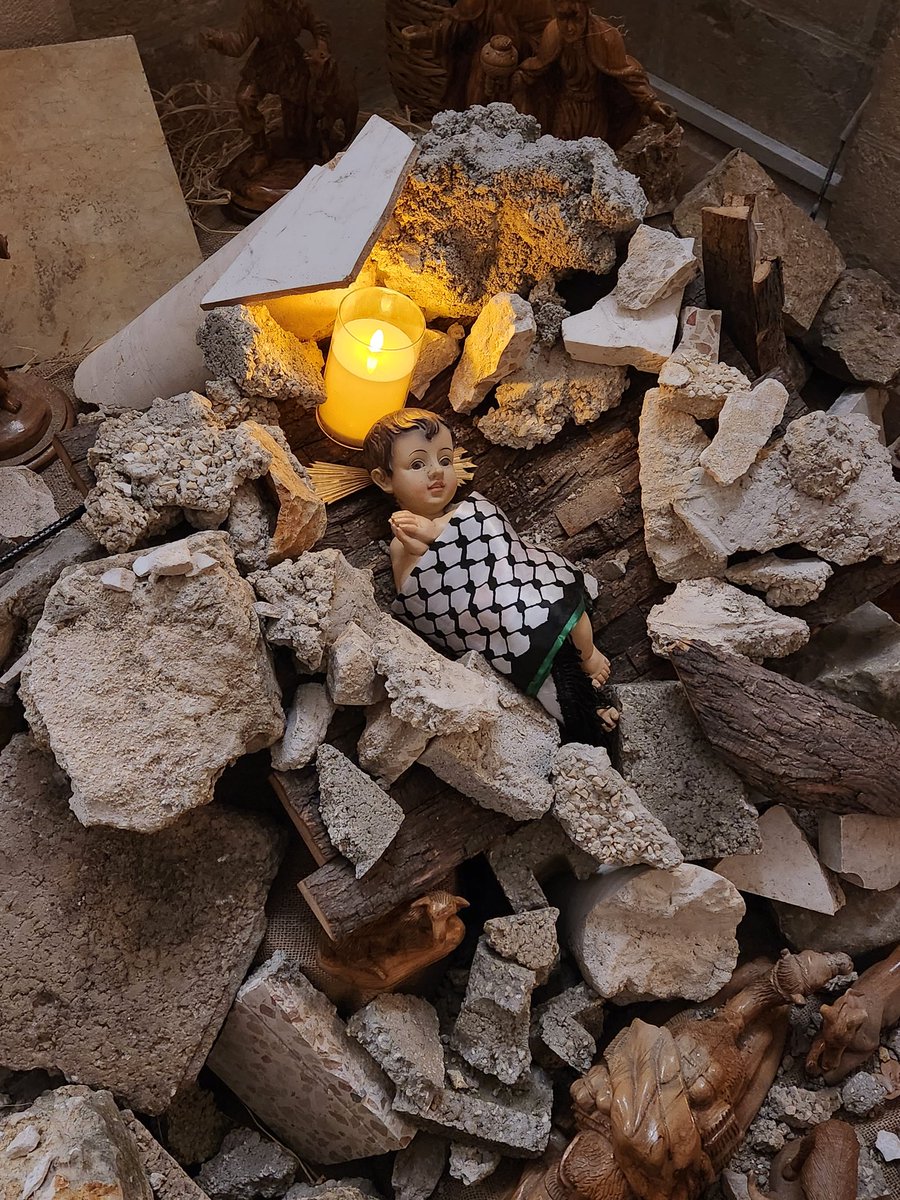
It shows the baby Jesus wrapped in a black-and-white checkered keffiyeh (Palestinian headdress) and lying in a pile of rubble while Mary, Joseph, the shepherds, the wise men, and the animals search for him. It is situated at the side of the altar in Bethlehem’s Evangelical Lutheran Christmas Church, which Rev. Dr. Munther Isaac, a prominent Palestinian Christian peacemaker, pastors. He said he wants the world to know that this is what Christmas looks like in Palestine this year, and for his own congregation to know the solidarity of Christ with the oppressed. Al Jazeera ran a news segment on the crèche on Tuesday, which features an interview with Isaac:
Since October 7, over 16,000 Palestinians have been killed by Israeli forces, and almost 1.9 million Palestinians (over 80 percent of the population) have been displaced. Morgues and hospital halls are overflowing in Gaza, and many people remain trapped under buildings felled by air strikes.
“In Gaza today, God is under the rubble. He is in the operating room,” Isaac wrote on Instagram. “If Christ were to be born today, he would be born under the rubble. We see his image in every child killed and pulled from under the rubble. In every child in incubators.” He expanded on these sentiments in a sermon preached October 22, titled “God Is Under the Rubble in Gaza,” reproduced in Sojourners. See also this video clip of Isaac explaining why his church chose to display such a scene in their sanctuary.
BLOG POST: “When a Dragon Tried to Eat Jesus: The Nativity Story We Don’t Talk About” by Chad Bird: “I’m still searching for a Christmas card with a red dragon in the nativity, lurking amidst the cows and lambs, waiting to devour the baby in the manger,” writes Bible scholar Chad Bird [previously]. “None of the Gospels mention this unwelcome visitor to Bethlehem, but the Apocalypse does. John paints a seven-headed, ten-horned red dragon onto the peaceful Christmas canvas. You can read all about it in Revelation 12. It’s the nativity story we don’t talk about. A dragon trying to eat our Lord . . .”
I’ve been wanting to write a long-form essay on this topic for some time—the dragon as a character in the Christmas story; a cosmic battle underlying our cozy little crèches. I would pull in iconography of the Woman of the Apocalypse and the treading of the beasts, as well as some Christmas songs and poems that reference the dragon. I won’t get around to it this season . . . but it’s coming sometime!
For now, I simply offer Chad Bird’s wonderful blog post to get you thinking about it. Since it was published in 2016, I’ve started seeing more people bringing it up. In 2019, Glen Scrivener, a minister in the Church of England, released the kids’ video “There’s a Dragon in My Nativity,” with illustrations by Alex Webb-Peploe and animation by Diego M. Celestino:
In 2020, Rev. Yohanna Katanacho, a Bible professor in Nazareth, wrote “The Christmas Dragon” for Radix, a retelling of the Nativity story through the lens of Revelation 12. And in a Christianity Today article published last December, Julie Canlis recommended adding a red dragon to your nativity set! Apparently some families have been doing this for years, such as the Gowins and the Palpants:
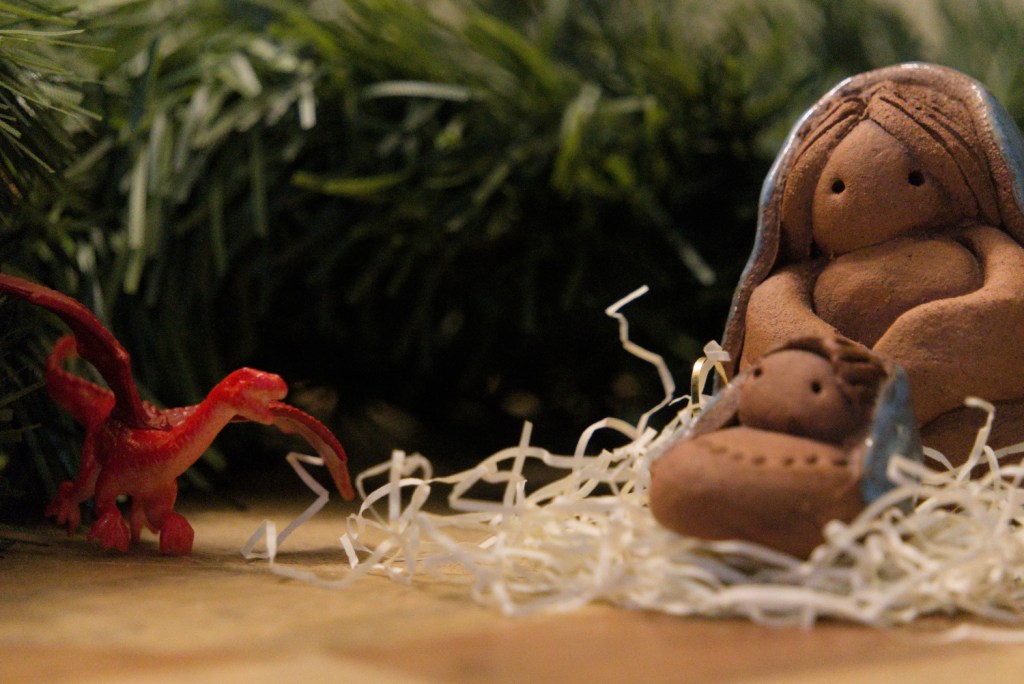
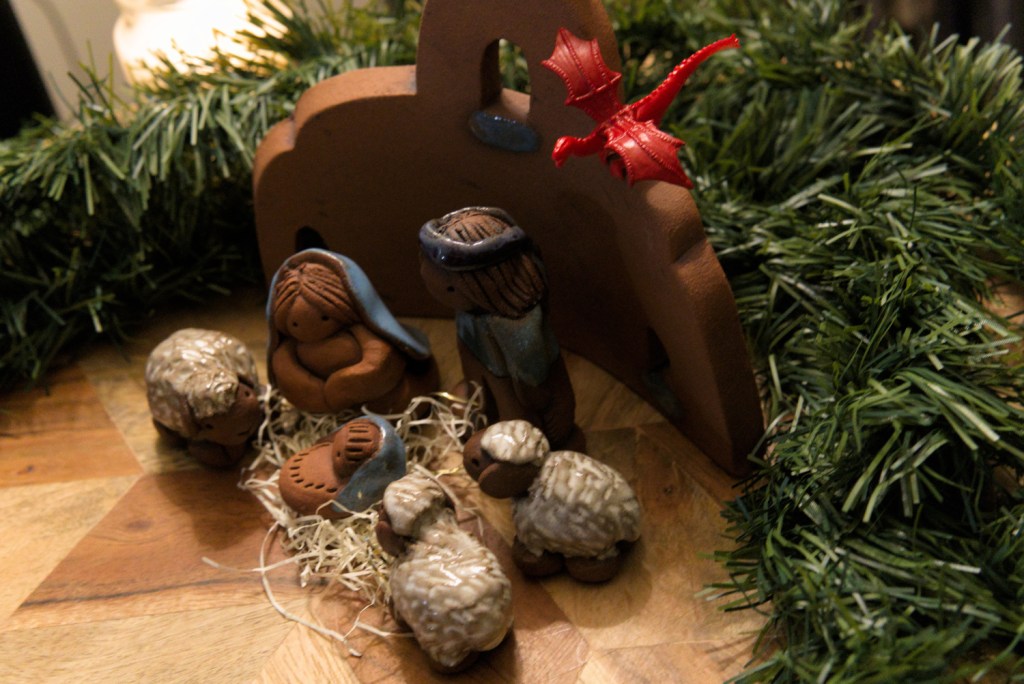
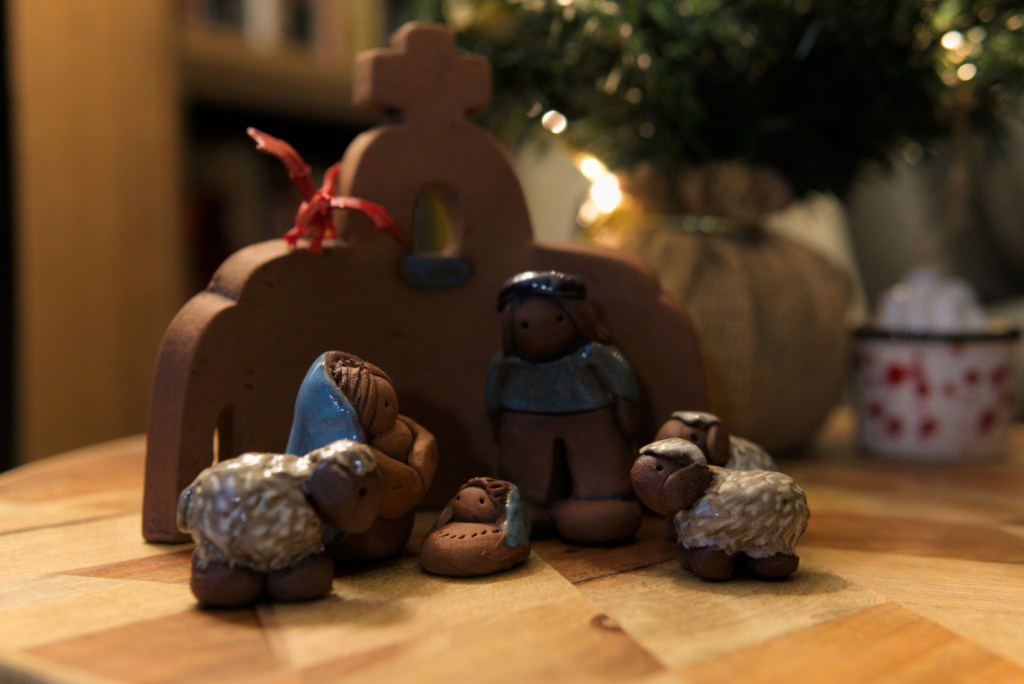
This year I bought a little plastic dragon myself to add to my household nativity! Below are some photos my husband and I took. The clay figurines and adobe-style backdrop were made by Barbara Boyd, an artisan from New Mexico. (I bought them in 2016 at a festival in Albuquerque.)
The dragon was part of a cheap multipack from Amazon, and there are twenty-three other dragons that I don’t know what to do with—so if you live in the US and you want one, shoot me an email at victoria.emily.jones@gmail.com and your physical mailing address and I’ll send you one! The first three respondents get a red one. None of them are seven-headed or horned per Revelation (a gap in the Christmas market, perhaps?!), but they still convey the gist.
+++
LECTURE: “What Is God’s Future for the World?: An Eschatological Vision for the Kingdom on Earth” by N. T. Wright: This talk on inaugurated eschatology, on heaven and earth coming together redemptively and new-creatively, was delivered at the Fuller Forum at Fuller Theological Seminary on May 3, 2014. Any time we talk, sing, or preach about the return of Christ and the end, Wright says, we’re really using signposts that point into a bright mist. But we need those signposts. Wright seeks to dispel the popular belief that humans’ ultimate destination is some disembodied existence “up there” and instead have us embrace the ancient vision of this world as the site of the Messiah’s eternal reign and these bodies as participants, a vision of creation made new from the old. To believe that God will eventually abandon the world to the forces of human wickedness or entropy and decay instead of claiming it as his own undermines the entire narrative of scripture. Wright makes his case by way of the books of Genesis, Isaiah, Ezekiel, Daniel, the Psalms, the Gospels, Romans, and Revelation—the whole gamut.
“The Jewish vision of God’s ultimate future was never that people would leave this world and end up somewhere else called heaven in the company of God. . . . When eschatology comes into full focus, . . . it is all about God’s kingdom being set up on earth as in heaven, and indeed on earth by means of heaven.” He continues, “Heaven is the place where God’s future purposes are stored. And the New Jerusalem comes down from heaven to earth so that the dwelling of God is with humans.”
There’s so much more I could say—but instead of reading my takeaways, listen to the talk itself! It ends at 1:04:45 and is followed by an hour of Q&A. Here is a list of the questions with time stamps:
1:05:33: What is your reading of 2 Peter 3:10–12, which says that the earth will be burned up?
1:08:18: What does Paul mean in 1 Thessalonians 4:17: “Then we who are alive, who are left, will be caught up in the clouds together with them to meet the Lord in the air, and so we will be with the Lord forever”?
1:13:05: Where do you land on premillennialism, amillennialism, postmillennialism?
1:15:42: If earth is already crowded, how will everyone fit in the renewed creation after the resurrection?
1:21:42: If this world is going to be renewed, why should we make economic and lifestyle sacrifices now to protect endangered species and such?
1:24:18: How do you interpret John 14:3: “I go and prepare a place for you; I will come again and take you to myself”?
1:27:48: How do you understand hell? What are your thoughts on the teaching of universal restoration, the idea that everyone will eventually be saved?
1:33:48: Since you take issue with Michelangelo’s Last Judgment, what would you have painted at the east end of the Sistine Chapel instead?
1:34:17: How does Paul’s “now and not yet” correlate with Jesus’s teaching that “this generation will not have passed away before all this has happened” (Matt. 24:34; Mark 13:30; Luke 21:32)?
1:36:59: What is the role of departed saints (the “cloud of witnesses”)? What are your thoughts on the intercession of the saints?
1:41:17: What are your words of advice for preaching on these subjects and for pastorally caring for congregants who come with certain stock images of and language about heaven?
1:44:30: Since we believe in Jesus’s bodily resurrection, where is Jesus now?
1:46:28: Please give us some guidance on Paul’s view on homosexuality and how to address this complex issue in the church.
1:52:16: Is there any sense in which the State of Israel founded in 1948 could be the fulfillment of biblical prophecy?
1:56:40: What impact do you hope your work has on Christian discipleship?
2:10:34: What’s the relationship between faith and action?
Oh, and at 1:18:58, Wright offers this rousing sidebar on Christian art:
We are starved imaginatively as Christians. Christian art easily collapses into sentimentalism, just as contemporary postmodern art easily collapses into brutalism. Both of those are ways of seeing something but not the whole picture. Sentimentalism is what you get when you’re determined to smile even if the whole world is falling apart; it becomes inane, this sort of silly grin, and sadly, there’s a lot of Christian art like that.
But actually, Christians ought to be at the forefront of the art and the music, because that creates the imaginative world within which it’s possible to think differently about things. I think the secular world has done a pretty good job, and we’ve colluded with that, of keeping our imaginative levels down to the level of eighteenth- and nineteenth-century Epicureanism or deism, so that heaven is just this odd place, etc., etc. We need the new art and the new music which will create a world in which it makes sense to think of these things.
+++
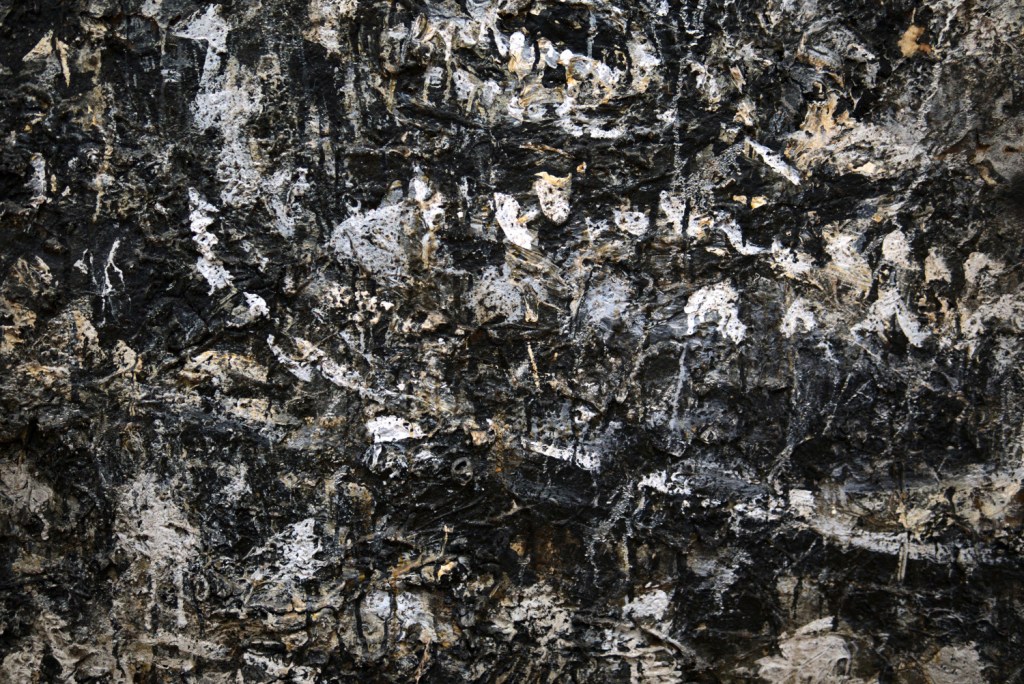
BLOG POST: “Advent Love and Anselm Kiefer’s Alchemist” by Alexandra Davison: I grew up, and my parents and sibling still live, in a suburb of Raleigh, North Carolina, so I’m a somewhat frequent visitor to the North Carolina Museum of Art. Their untitled triptych by Anselm Kiefer is one of my favorite pieces in their collection—it transfixes me every time—so I was delighted to see that Alexandra Davison [previously], a creative director of Artists in Christian Testimony International whom I bump into at arts conferences now and again, wrote about it a few years ago. She describes it as an image of “cosmic drama that waits for resolution,” conveying “an unflinching Advent longing.” I sense that too when I stand in front of it.
Anselm Kiefer (German, 1945–), Untitled, 1980–86. Oil, acrylic, emulsion, shellac, lead, charcoal, and straw on photograph, mounted on canvas, with stones, lead, and steel cable, overall 130 1/4 × 218 1/2 in. North Carolina Museum of Art, Raleigh. Photo: Victoria Emily Jones.
Kiefer is the subject of an acclaimed new documentary by Wim Wenders (which I’m eager to see when it comes to streaming!). He was born in Germany at the tail end of World War II, and his art, which often incorporates materials such as lead, ash, and straw, is inextricably connected to the ravaged landscapes and haunted history of his country.
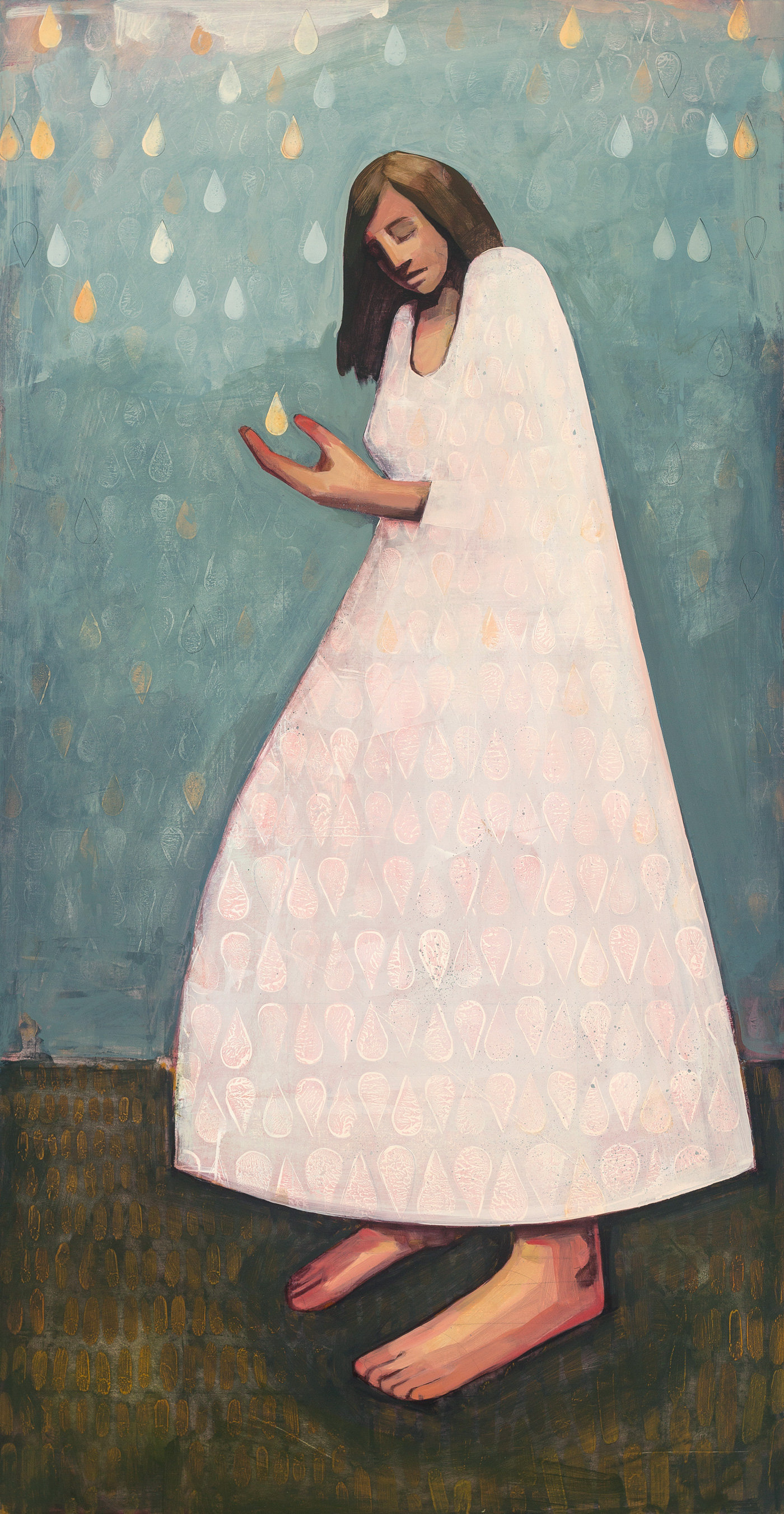
LOOK: the heavens wept with me by Caitlin Connolly
Caitlin Connolly (American, 1986–), the heavens wept with me, 2018. Oil on canvas.
LISTEN: “A Dream / On Another’s Sorrow”| Words by William Blake, from Songs of Innocence, 1789, adapt. | Music by David Benjamin Blower, on Innocence & Experience, 2022
Once a dream did weave a shade O’er my Angel-guarded bed, That an Emmet lost its way Where on grass methought I lay.
Troubled, ’wildered, and forlorn, Dark, benighted, travel-worn, Over many a tangled spray, All heart-broke I heard her say:
“O my children! do they cry? Do they hear their father sigh? Now they look abroad to see: Now return and weep for me.”
Pitying, I dropped a tear; But I saw a glow-worm near, Who replied: “What wailing wight Calls the watchman of the night?
“I am set to light the ground, While the beetle goes his round: Follow now the beetle’s hum; Little wanderer, hie thee home.”
*
Can I see another’s woe, And not be in sorrow too? Can I see another’s grief, And not seek for kind relief?
Can I see a falling tear, And not feel my sorrow’s share? Can a father see his child Weep, nor be with sorrow filled?
Can a mother sit and hear An infant groan, an infant fear? No, no! never can it be! Never, never can it be!
And can They who smile on all Hear the wren with sorrows small, Hear the small bird’s grief and care, Hear the woes that infants bear,
And not sit beside the nest, Pouring pity in their breast; And not sit the cradle near, Weeping tear on infant’s tear;
And not sit both night and day, Wiping all our tears away? O no! never can it be! Never, never can it be!
They do give Their joy to all; They become an infant small; They become a one of woe; They do feel the sorrow too.
Think not thou canst sigh a sigh, And thy Maker is not by; Think not thou canst weep a tear, And thy Maker is not near.
The lyrics of this song comprise two poems from William Blake’s Songs of Innocence: “A Dream” and “On Another’s Sorrow.”
In “A Dream,” the poetic speaker dreams about a lost ant (an emmet) who is trying to find her way back to her children and husband. The speaker is moved by the ant’s distress and weeps for her. But then a glowworm (“the watchman of the night,” as he’s lit like a lantern) graciously intervenes, telling the ant to listen to the sound of the beetle walking and to follow that sound home while he lights the way.
“Told from a trusting, childlike perspective, the poem”—a fable—“suggests that those who ask for help will get it: the world is a naturally compassionate place, and guidance and protection are always at hand, even in difficult times.” (LitCharts)
Aren’t we all “little wanderers”? Many of us troubled, bewildered, lonely, and worn by our seeking and striving?
There is empathy for us not only from fellow travelers but also from the Divine.
“On Another’s Sorrow” is about how God lovingly enters into our woes through the Incarnation. He becomes a participant in the project of being human, experiencing firsthand the many trials, hurts, and vulnerabilities that come with the territory.
In the first three stanzas, the speaker expresses how keenly he feels the sorrows of others. In the fourth stanza, he reflects on how God does the same—only God is perfectly present to all, weeping with those who weep, sighing with those who sigh. Having “become an infant small,” the Creator has demonstrated solidarity with his creation. It is a comfort to know that God is so intimately acquainted with the griefs that afflict us and is keen to companion us through them.
In his creative visioning, British singer-songwriter David Benjamin Blower brought together Blake’s “A Dream” and “On Another’s Sorrow” with a single, spare musical setting, linking the two poems with an instrumental interlude but keeping the same tune throughout. The first poem is about the feeling of weariness or lostness; the second, grief. Both have to do with compassion—we owe it to one another and often receive it from others, and it is always available to us in Christ, who is God brought near.
In “On Another’s Sorrow,” Blower changed the pronouns for God in the fourth and seventh stanzas from “He/His” to “They/Their,” since God is neither male nor female. He also omitted the final stanza in Blake’s original:
O! He gives to us His joy That our grief He may destroy: Till our grief is fled and gone, He doth sit by us and moan.
This post is part of a daily Advent series from December 2 to 24, 2023 (with Christmas to follow through January 6, 2024). View all the posts here, and the accompanying Spotify playlist here.
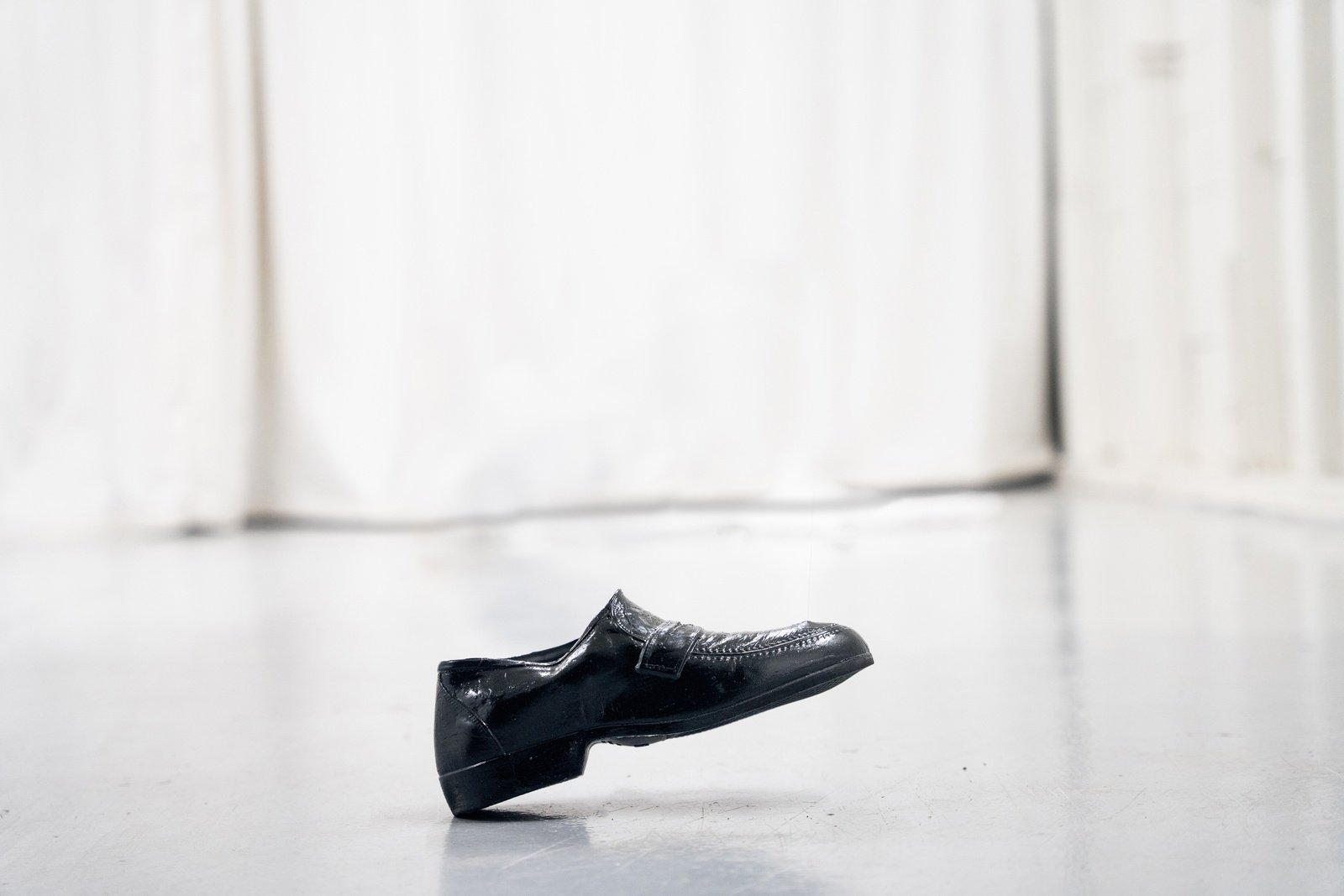
Lisa Walcott (American, 1983–), Other One to Drop, 2022. Rubber shoe, thread, motor, wood, ziptie, 3 1/2 × 8 × 2 in. (shoe).
“Waiting for the other shoe to drop” is an American idiom that means to wait for a seemingly inevitable event. According to Dictionary.com, the expression originated in early twentieth-century New York City tenements and refers to when you’d hear your upstairs neighbor kick off their shoe—you knew the second shoe would likewise be smacking the floor any second.
Midwest-based multidisciplinary artist Lisa Walcott plays upon this expression, as well as the fidgety habit of foot tapping, in her kinetic sculpture Other One to Drop. The piece consists of a loafer connected to a ceiling-mounted mechanism that at regular intervals raises the toe up off the ground by a barely visible thread and then lowers it back down, mimicking the body language of one who is waiting. But the piece also requires the viewers themselves to practice waiting, as the inactivity between movements creates a sense of imminence, and the shoe-drop will be missed if you turn away. Here’s a video of the piece in motion:
The tapping of the shoe conjures ideas of waiting and patience. The repetitive movement is consistent, but the slow pace adds anticipation and may even require some patience as the shoe hovers, finally taps, and repeats. The repetition of movement represents “promise” within the work. Even when the expectation has been demonstrated clearly and consistently, waiting requires patience and anticipation requires trust.
Since its founding at Pentecost, the church has waited for the other shoe to drop, so to speak. The first shoe was God made flesh in Bethlehem. The second shoe will be God’s return, in flesh, at the end of time. Christians are an Advent people, living in this liminal space between the already and not-yet. The liturgical calendar, in its wisdom, assigns us some four weeks each year to lean into that tension, exercising our hope muscles as we wait for Christ to come to us once again.
Walcott is an assistant professor of art at Hope College in Holland, Michigan. Her work “translates elements of daily life, embodies moods, and animates daydreams,” she says. Everyday objects such as brooms, drawers, tablecloths, drying racks, and fly swatters often find their way into her sculptures and installations. Explore more at https://lisawalcott.com/.
This wistful instrumental work was composed by Eric Marshall [previously], the lead singer of and songwriter for the ambient alt-rock band Young Oceans. Young Oceans grew out of Marshall’s collaborations with fellow musicians at Trinity Grace Church in Brooklyn, where he served as a worship leader from 2009 to 2018.
The title of this piece, “Though for Now We’re Waiting,” is a dependent clause that anticipates a second clause to complete the sentence. How would you complete it? The last thirty seconds provide a space for pause, for sitting quietly and attentively with the weight of your desire and God’s promise.
This post is part of a daily Advent series from December 2 to 24, 2023 (with Christmas to follow through January 6, 2024). View all the posts here, and the accompanying Spotify playlist here.
In the church calendar, the linked seasons of Advent, Christmas, and Epiphany are sometimes referred to as the “cycle of light.” “Since earliest times the Christian community has utilized light as a primary symbol to convey the meaning of the Christ-event,” writes Wendy M. Wright in The Vigil: Keeping Watch in the Season of Christ’s Coming. “The power of the symbol was not lost on most generations of believers who lived closer than we do to the truth that we are all ultimately dependent upon the light of the sun for warmth, vision, and life itself” (152). Light imagery permeates scripture and the writings of the church fathers.
The capstone of the cycle of light, celebrated each year on January 6, is Epiphany, which means “manifestation” or “appearance.” In the West, this feast commemorates the visit of the magi, to whom the divinity of Christ was revealed, and who brought back the light they received to their homelands, an early spreading of the gospel. Epiphany is exactly one month away, but I wanted to provide a few resources in advance. For those in the DC metro area: note that there are just two weeks left to see the Anne Lindberg exhibition!
+++
NEW PLAYLIST: Epiphany (Art & Theology): I put together a playlist of nearly a hundred Epiphany songs that celebrate Jesus as the light of the world and that mark the magi’s transformative encounter with him.
Besides the classic “We Three Kings,” it also includes a few versions of the ancient hymn “Phos Hilaron” (originally written in Koine Greek and translated into English as “Gladsome [or Gladdening] Light”), a Provençal carol popularized by Bizet, a shape-note hymn from Appalachia, aguinaldos from Puerto Rico, Arabic hymns from Syria and Lebanon, plainchant scripture settings, Renaissance motets, traditional and contemporary Black gospel songs, indie songs (including retuned hymns) from the past decade, and choral works from the UK, Jamaica, and Argentina. Some of the selections are quieter, more reflective, whereas others are very exuberant, like “Jesus Is the Light” by Hezekiah Walker and the Love Fellowship Crusade Choir:
And “Los Reyes Magos,” the fifth movement of Ariel Ramirez’s folk drama Navidad Nuestra (lyrics here); the song was written as a taquirari, a type of Bolivian folk song that has a syncopated rhythm and that is danced to, and features a charango (small guitar) and siku (Andean panpipe):
+++
ART COMMENTARIES: The VCS Advent Calendar 2023: Every Advent, the Visual Commentary on Scripture sends out a daily image from its online archives to its email list around a seasonal theme. This year’s theme is “light.” The images are keyed to particular scripture passages having to do with light and are accompanied by commentary from a range of contributors. So far the VCS has featured a Genesis 1–inspired Sistine Chapel fresco, John Piper and Patrick Reyntiens’s extraordinary Baptistery Window at Coventry Cathedral, a Trinitarian miniature from an English book of hours, a heliotropic landscape sculpture by David Wood, a light installation by Dan Flavin at a church in Milan, and Vincent van Gogh’s Starry Night.
Baptistery Window, Coventry Cathedral. Designed by John Piper and made by Patrick Reyntiens, 1957–61. Stained glass, 85 × 56 ft.
+++
EXHIBITIONS:
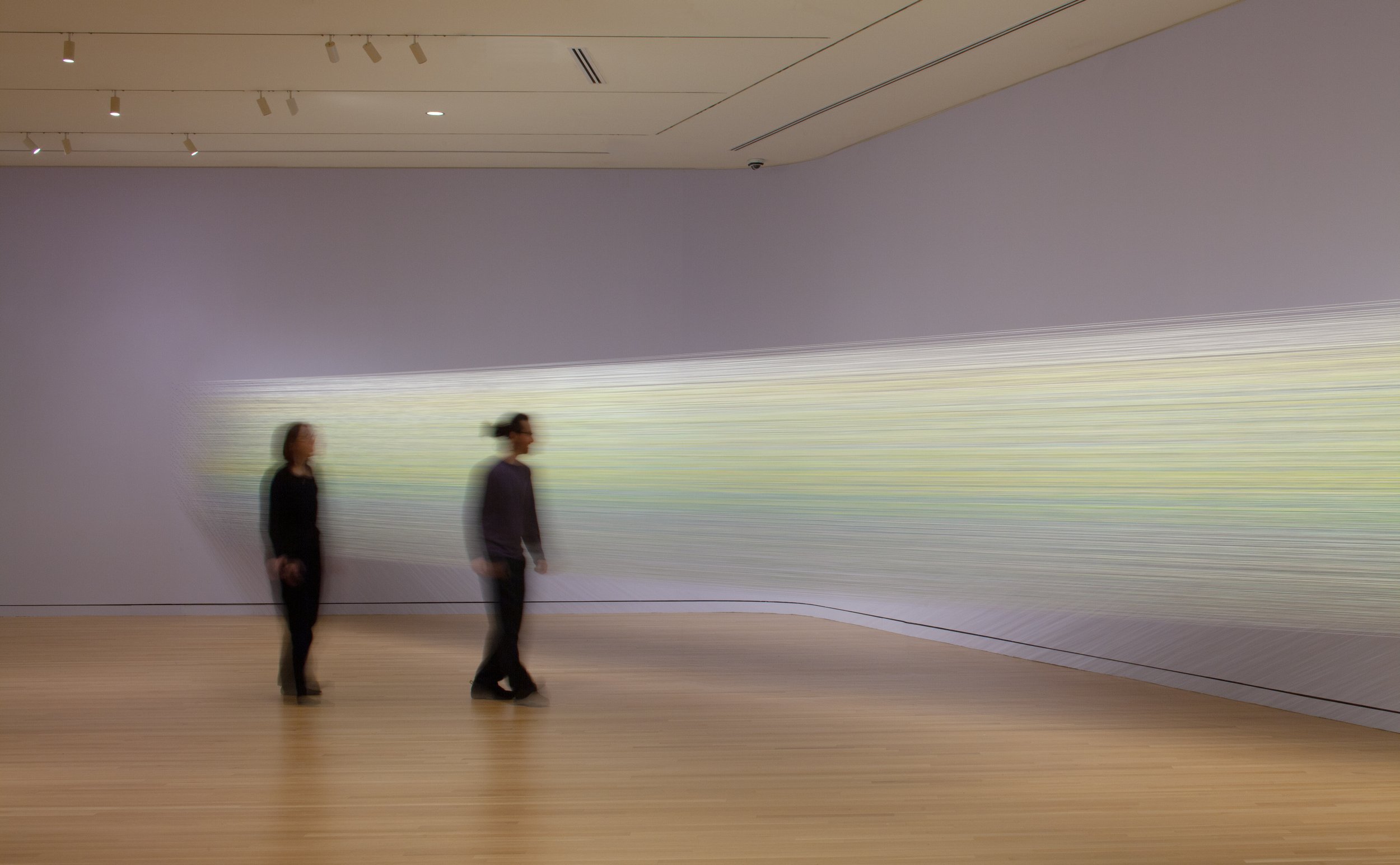
>> What color is divine light? by Anne Lindberg, January 5–December 22, 2023, Textile Museum at George Washington University, Washington, DC: I saw this installation last month, and it is striking! About four thousand strands of complementary yellow and blue cotton thread (and some white and green), stretching across the gallery against a backdrop of lavender-painted walls, evoking light. The artist describes the work as a drawing made of textile material in the air. It was inspired by a 1971 essay of the same title by the art historian Patrik Reuterswärd (see The Visible and Invisible in Art: Essays in the History of Art), and it opened adjacent to an exhibition of prayer carpets, titled Prayer and Transcendence.
Anne Lindberg (American, 1962–), What color is divine light?, 2023. Cotton thread, staples, 5 × 55 × 14 ft. Solo exhibition at the Textile Museum, George Washington University, Washington, DC. Photo: Derek Porter.
>> Bubble Universe: Physical Light, Bubbles of Light, Wobbling Light, and Environmental Light by teamLab, opens early February 2024, Borderless (museum), Azabudai Hills, Tokyo: teamLab is an international collective of “ultra-technologists” consisting of artists, programmers, engineers, CG animators, mathematicians, and architects who collaborate on immersive art projects. One of their upcoming installations is a room with hundreds of glowing spheres, each containing unique changing lights that interact with guests and the environment itself. [HT: My Modern Met]
teamLab, Bubble Universe, 2023 (work in progress). Interactive installation, Borderless, Azabudai Hills, Tokyo.
+++
NEW ALBUMS:
>> The Light by Sarah Sparks: A four-song EP by a Christian singer-songwriter from Hawaii. Here’s the first track:
>> Morning Star: Music for Epiphany Down the Ages by the Gesualdo Six: Released November 3, this wonderful album comprises twenty-one choral pieces for Epiphany—a mix of plainchant propers for Mass, hymns, Renaissance motets, and twenty-first-century works. One of the contemporary works is a setting by Owain Park of Psalm 43:3: “O send out thy light and thy truth, that they may lead me; let them bring me unto thy holy hill, and to thy dwelling”:
In these last days [God] has spoken to us by a Son, whom he appointed heir of all things, through whom he also created the worlds. He is the reflection of God’s glory and the exact imprint of God’s very being, and he sustains all things by his powerful word.
—Hebrews 1:2–3
“The Spirit of the Lord is upon me, because he has anointed me to bring good news to the poor. He has sent me to proclaim release to the captives and recovery of sight to the blind, to set free those who are oppressed, to proclaim the year of the Lord’s favor.”
Today this scripture has been fulfilled in your hearing.
—Jesus’s first public teaching in Nazareth (see Luke 4:16–21), quoting from Isaiah 61
LOOK: Niño Jesus santo
Niño Jesus, Puerto Rico, 18th century. Carved and painted wood and metal, 13 3/8 × 5 1/2 × 4 3/8 in. (34 × 14 × 11.2 cm). Smithsonian American Art Museum, Washington, DC.
“Devotional figures of the infant Jesus became popular in Puerto Rico during the seventeenth and eighteenth centuries,” writes Yvonne Marie Lange in her 1975 PhD dissertation, Santos: The Household Wooden Saints of Puerto Rico. “An unknown craftsman carved this small figure in the act of benediction, or blessing, with an orb in his left hand to symbolize God’s dominion over the earth.” (He’s got the whole world in his hands!) This is a baby Salvator Mundi, “savior of the world.” He is naked to emphasize his full humanity. The three flame-like shapes around his head create a cross and represent the light of God emanating from him.
Just as Isaiah The prophet has foretold A sprout from Jesse’s root Into a tree shall grow This sprout shall bloom Into a mighty tree of life Its fruit will feed us And its source will be our light
The Spirit of the Lord Will come to dwell with us A righteous judge A mighty counselor And by the word Of his everlasting power The baby in the manger Upholds the universe The baby in the manger Upholds the universe
For in him all the fullness Of God was pleased to dwell And through him To reconcile all things to himself Have you ever seen A wolf and a lamb lie down together? Can there ever be peace like this Between enemies? Can there ever be peace like this Between enemies? Would God dare to descend To come live with his enemies?
The Spirit of the Lord Will come to dwell with us Put on flesh Make peace for us with God And by the word Of his everlasting power The baby in the manger Upholds the universe The baby in the manger Upholds the universe
Then I saw heaven open And behold A white horse with its rider Righteousness his clothes With eyes that burn like fire And a crown atop his head Robes dipped in blood That he himself willingly shed Yet I had no doubt I still recognized his face Son of God, Son of Man Glorious grace
King of kings and Lord of lords Messiah, Christ, the Word of God King of kings and Lord of lords Messiah, Christ, the Word of God King of kings and Lord of lords Messiah, Christ, the Word of God King of Kings and Lord of lords Messiah, Christ, the Word of God
The Spirit of the Lord Has come to dwell with us Behold, the Lamb of God Makes all things new And by the word Of his everlasting power The baby in the manger Upholds the universe The baby in the manger Upholds the universe And he shall reign Forever and ever
Katie Ribera is involved in the music ministry of Trinity Church Seattle, which is led by Luke Morton, pastor of worship arts. Ribera wrote this song for her congregation, and it was recorded live from one of their worship services, released under the artist name Trinity Songworks. Listen to more from Trinity Songworks on the church’s website and their SoundCloud page, or on the albums Live Archive 2018–2021 and Let the Little Children Come.
This post is part of a daily Advent series from December 2 to 24, 2023 (with Christmas to follow through January 6, 2024). View all the posts here, and the accompanying Spotify playlist here.