O magnum mysterium, et admirabile sacramentum, ut animalia viderent Dominum natum, iacentem in praesepio! Beata Virgo, cujus viscera meruerunt portare Dominum Iesum Christum. Alleluia!
English translation:
O great mystery, and wonderful sacrament, that animals should see the newborn Lord, lying in a manger! Blessed is the virgin whose womb was worthy to bear the Lord, Jesus Christ. Alleluia!
This text, a responsorial chant from the Matins of Christmas, has been set by many composers over the centuries, including Palestrina, Poulenc, Victoria, Morales, and La Rocca. Morten Lauridsen’s setting—a motet for a cappella choir—is the most popular.
Note the discordant G# sung by the altos on the first syllable of “Virgo” (3:20 in the video), which alludes to the future suffering of Jesus and, by extension, his mother. This vulnerability, this self-giving, of God that results in death on a cross is a key aspect of the Incarnation.
In the second half of the piece, “the chords, the melody, and the range of voices broaden into an open and exhilarating space,” writes Amy Baik Lee, building up to the climax: “alleluia.” The release of that final word of praise “is sheer joy; it is the sound of creation made well and reveling in its freedom from the fathoms-deep trenches of sin, finally awestruck by the intricacy of its long rescue. . . . It is as a cup of cold water that sparkles with the air of a distant, beloved country.”
PHOTO COMPILATION: “Alternative Advent 2022” by Kezia M’Clelland: Kezia M’Clelland [previously] is the children in emergencies specialist and people care director for Viva and a child protection consultant for MERATH, the Lebanese Society for Educational and Social Development’s community development and relief arm. She is a British citizen, but her work brings her around the world, seeking to safeguard the rights and well-being of children globally.
Every December M’Clelland compiles photos from that year’s news, showing people affected by natural disasters, violence, and injustice, and overlays them with Advent promises. There’s sometimes a disjunction between image and text that’s grievous and challenging, a reminder that our long-looked-for deliverance is not yet fully here, even though we receive foretastes. The twenty-eight photos M’Clelland gathered from 2022 include throngs of people making their way to Aichi cemetery in Saqqez, Iran, to attend a memorial for twenty-two-year-old Mahsa Amini, allegedly beaten to death by the country’s religious morality police for not wearing her hijab properly; a police officer helping a child flee artillery on the outskirts of Kyiv, and a baby being born in a bomb shelter; women carrying pans of granite up the side of a mine in Ouagadougou, Burkina Faso, for meager wages; a woman comforting a neighbor who lost her home to flooding in Tejerias, Venezuela; children playing in a sandstorm at the Sahlah al-Banat camp for displaced people in the countryside of Raqa in northern Syria; children clearing trash from a river in Tonlé Sap, Cambodia; and more.
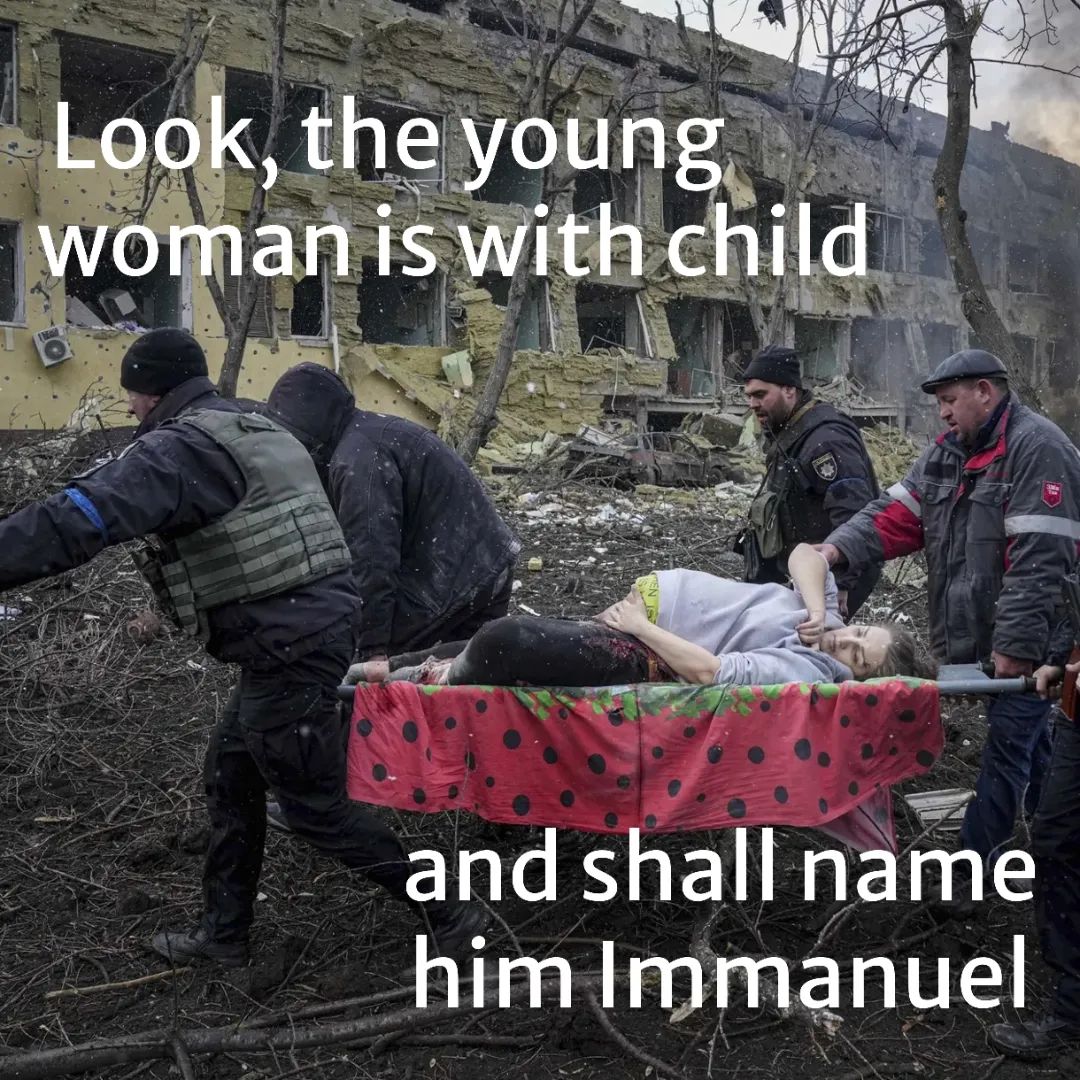
March 9, 2022: An injured pregnant woman is rescued from a maternity hospital in Mariupol, Ukraine, that was bombed by Russian forces. The following week it was reported that she and her child, delivered in an emergency C-section, did not survive. Photo: Evgeniy Maloletka/AP. Scripture: Isaiah 7:14.January 26, 2022: A young woman looks on from her house destroyed by tropical storm Ana in the village of Kanjedza in Malawi. Photo: Eldson Chagara/Reuters. Scripture: Isaiah 58:12.June 7, 2022: A man and child, part of a migrant caravan consisting mostly of Central Americans, are blocked by members of the Mexican National Guard on a Huixtla road in Chiapas state, Mexico. They seek transit visas from the National Migration Institute so that they can continue their thousand-plus-mile journey north to the US. Photo: Marco Ugarte/AP. Scripture: Isaiah 35:9 MSG.
The sequence of images is a visual prayer of lament and intercession. I appreciate how M’Clelland—via the work of photojournalists, and her sensitive curation—raises awareness about these places of suffering, putting faces to the headlines, but also spotlights moments of empowerment and joy amid that suffering. We are encouraged to seek God’s coming into these situations of distress and to see the subtle ways he does come—for example, through the consoling embrace of a friend, the nurturance of an elder sibling, the protective aid of an officer, a jug of clean water, a child’s glee, or acts of protest.
For photo credits and descriptions, see the Instagram page @alternative_advent. (Start here and scroll left if you’re on your computer, or up if you’re on your phone.) Follow the page to receive new posts in your feed starting next Advent.
+++
SONGS by Rev Simpkins, an Anglican priest and singer-songwriter from Essex previously featured here:
>> “Hallelu! (Love the Outcast)”: This song was originally released on The Antigen Christmas Album (2014) with the byline “Ordinand Simpkins & Brother De’Ath”; it was reissued in 2016 on Rev Simpkins’s album Love Unknown, “a cornucopia of non-LP tracks, studio experiments, ingenious live re-workings, radio sessions, off-the-wall demos, obscure b-sides, & pissings about.” The music video was recorded on an iPhone 4 in the Edward King Chapel at Ripon College Cuddesdon in Oxford. [Listen on Bandcamp]
>> “Poor Jesus” (Traditional): Here the Rev. Matt Simpkins performs the African American spiritual “Oh, Po’ Little Jesus” with a soft banjo accompaniment. Harmonizing vocals are supplied by his daughter, Martha Simpkins. It’s the opening track of his EP Poor Child for Thee: 4 Songs for Christmastide(all four songs are wonderful!), released December 11, 2020, to support St Leonard’s Church, Lexden, where he serves as priest-in-charge. [Listen on Bandcamp]
+++
NEW PAINTING: Tent City Nativity by Kelly Latimore:Kelly Latimore is an Episcopalian artist from St. Louis, Missouri, who “rewonders” traditional iconography, especially with an eye to social justice. This Christmas he painted an icon called Tent City Nativity, which shows the Christ child being born in a homeless encampment. A streetlight shines directly over the Holy Family’s tent, like the star of Bethlehem, and neighbors bring gifts for warmth and sustenance: coffees, a blanket, a cup of chili. View close-ups on Instagram, and read the artist’s statement on his website. Proceeds from print and digital sales of the icon will support organizations serving the unhoused in St. Louis.
Kelly Latimore (American, 1986–), Tent City Nativity, 2022. Acrylic, Flashe, and golf leaf on birch board, 27 × 32 in.
SONG MEDLEY: YouTube user African Beats spliced together excerpts from three songs performed at a church in Germany at Christmastime by South African singer Siyabonga Cele and an unnamed woman, including “Akekho ofana no Jesu” (There’s No One like Jesus) and “He’s Got the Whole World in His Hands.” I couldn’t find the name of the last song, and attempts to contact the singer for information were unsuccessful, but it’s in Zulu, as is the first one. Lyrics to the first song, sourced from here, are below.
Akekho ofana no Jesu (There’s no one like Jesus) Akekho ofana naye (There’s no one like him) Akekho ofana no Jesu (There’s no one like Jesus) Akekho ofana naye (There’s no one like him)
Sahamba, hamba, lutho, lutho (I’m walking, walking, nothing, nothing) Safuna, funa, lutho, lutho (I’m searching, searching, nothing, nothing) Sajika, jika, lutho, lutho (I’m turning, turning, nothing, nothing) Akekho afana naye (There is no one like him)
Julius Shumpert (American, 1997–), The Word Made Flesh, 2017. Digital artwork.
This digital artwork by Julius Shumpert shows a silhouette of Christ Pantocrator that’s filled in with stars and planets, emphasizing his eternal preexistence. This is the cosmic Christ. With his left hand he holds a Gospel-book, and with his right he gestures blessing. His halo bears the roman letters A and O for “Alpha” and “Omega” (Rev. 1:8; 21:6; 22:13), as well as the Greek letter X, chi, which is the first letter in ΧΡΙΣΤΟΣ (Christos) and thus ancient shorthand for Jesus the Messiah.
Shumpert writes,
This icon means a lot to me. During Christmas 2016, I dove into the true meaning of Christmas. Past all of the traditional “baby Jesus” storytelling to the bare symbolism of what happened. God, who created everything, and is bigger than infinity, the expanding universe, and all that there is to be, saw us struggling along and squeezed down into the form of precious ordinary baby just to be with us. . . . This icon presents who Jesus is: simply the Word made flesh.
LISTEN: “Of the Father’s Love Begotten” | Original Latin words by Aurelius C. Prudentius, late 4th century; trans. John M. Neale, 1851, and Henry W. Baker, 1861 | Plainchant melody, 13th century | Arranged and performed by Sam P. Bush and Kathryn Caine on A Very Love and Mercy Christmas by Christ Episcopal Church, Charlottesville, Virginia, 2014
I’ve provided the full nine stanzas from the 1861 English version of the hymn by Henry Baker. Christ Episcopal Church sings his stanzas 1, 2, 5, and 9 (in boldface)—wise to omit 7 and 8, as these translations are icky (Roby Furley Davis’s are better), but I quite like the others!
Of the Father’s love begotten Ere the worlds began to be, He is Alpha and Omega; He the source, the ending He, Of the things that are, that have been, And that future years shall see Evermore and evermore!
O that birth forever blessèd, When the Virgin, full of grace, By the Holy Ghost conceiving, Bore the Savior of our race; And the Babe, the world’s Redeemer, First revealed his sacred face, Evermore and evermore!
At His word the worlds were framèd; He commanded; it was done: Heav’n and earth and depths of ocean In their threefold order one; All that grows beneath the shining Of the moon and burning sun, Evermore and evermore!
He is found in human fashion, Death and sorrow here to know, That the race of Adam’s children, Doomed by law to endless woe, May not henceforth die and perish In the dreadful gulf below, Evermore and evermore!
O ye heights of heaven, adore Him, Angel hosts, His praises sing, Pow’rs, dominions, bow before Him, And extol our God and King; Let no tongue on earth be silent, Ev’ry voice in concert ring Evermore and evermore!
This is He whom seers in old time Chanted of with one accord; Whom the voices of the prophets Promised in their faithful word; Now He shines, the long expected, Let creation praise its Lord, Evermore and evermore!
Righteous Judge of souls departed, Righteous King of them that live, On the Father’s throne exalted None in might with Thee may strive, Who at last in vengeance coming Sinners from Thy face shalt drive, Evermore and evermore!
Thee let old men, Thee let young men, Thee let boys in chorus sing; Matrons, virgins, little maidens, With glad voices answering: Let their guileless songs re-echo, And the heart its music bring, Evermore and evermore!
Christ, to Thee with God the Father And, O Holy Ghost, to Thee, Hymn and chant and high thanksgiving And unwearied praises be: Honor, glory, and dominion, And eternal victory Evermore and evermore!
“Of the Father’s Love Begotten” (Lat. Corde natus ex parentis) is one of the oldest Christmas hymns, and it has gone through many translations, additions, revisions, fusions, arrangements, and abridgements to reach the form that’s in our hymnals today.
Its source is a thirty-eight-stanza Latin poem by Prudentius titled “Hymnus Omnis Horae” (Hymn for All Hours), published around 405 CE in his Liber Cathemerinon (Book of Daily Hymns) but written earlier. The poem traces Christ’s ministry from birth to death to resurrection and ascension, with a heavy focus on his miracles. It’s a remarkable poem, and worthy of study, especially as an example of early Christian theology. You can read the original Latin, presented beside a fine English translation by Roby Furley Davis from 1905, here.
Aurelius Clemens Prudentius (ca. 348–ca. 413) was a Roman Christian poet born in what is today northern Spain. After spending decades in law and government, he retired from public life to dedicate himself fully to God’s service, mainly through writing. He was the most significant hymn-writer of the early church.
Prudentius continued to be highly read throughout the Middle Ages, and “Hymnus Omnis Horae” circulated throughout Europe in multiple manuscripts. An eleventh-century manuscript added the refrain “saeculorum saeculi” (evermore and evermore) and a doxology, the Trinitarian final stanza.
The abbreviated form of the hymn (“Corde natus ex parentis,” etc.) entered English hymnody through the six-stanza translation by John Mason Neale, first published in the 1851 edition of Hymnal Noted; Neale renders the first line “Of the Father sole begotten.” Music editor Thomas Helmore presented Neale’s text with the thirteenth-century plainchant melody DIVINUM MYSTERIUM, which he sourced from the 1582 Finnish songbook Piae Cantiones. The pairing has since proven inseparable. Here’s Helmore’s arrangement from the 1852 edition of Hymnal Noted:
An extensive revision of Neale’s translation by Henry W. Baker, which includes three additional, newly translated stanzas, was published in the best-selling Hymns Ancient and Modern in 1861 under the title “Of the Father’s Love Begotten.” This is the version reproduced above, and that has had the most staying power.
The hymn is a praise-filled meditation on how Christ, the second person of the Godhead, who is before all things, entered human time in the person of Jesus. It’s a fairly difficult hymn to sing congregationally—the meter is a bear—but here’s a modern arrangement that I think works well: https://gracemusic.us/sheet_music/of-the-fathers-love-begotten/.
For more about the history, content, meter, transmission, and significance of “Hymnus Omnis Horae,” see the scholarly article by Chris Fenner from the Hymnology Archive: https://www.hymnologyarchive.com/hymnus-omnis-horae.
Solomon Raj (Indian, 1921–2019), Avatharana (Incarnation), late 1980s, batik. Source: Living Flame and Springing Fountain (Indian Society for Promoting Christian Knowledge, 1993).
Avataraṇa (अवतरण), from which we get the word “avatar,” is a Sanskrit word that means stepping down from a higher position. It’s the word used in Hinduism to refer to the incarnation of a deity, to his or her descending to earth. The late Indian Lutheran pastor, artist, and theologian Solomon Raj, from Andhra Pradesh, used the word, with nuance, to refer to the incarnation of Christ.
In this batik—a type of dyed cloth artwork made using a wax-resist method—Raj shows Jesus diving through the ether, surrounded by angels. He hurtles headfirst from heaven to earth to be with humanity. Reproduced in the book Living Flame and Springing Fountain (1993), the image is accompanied by this verse-style reflection by Raj:
When God became man and came to us, the heavens donned a new robe of light. When the son of man came to this earth, the whole creation became renewed. The universe now is redeemed and kept for a glory yet greater than the first because the unknown and the unknowable One became man to live with mankind.
For more on the concept of Jesus as avatar from Christian perspectives, see:
Michael Amaladoss, “Jesus, the Avatar,” in The Asian Jesus (Maryknoll, NY: Orbis, 2006), 105–21
Jacques Richard Sassandra (French, 1932–), Le buisson ardent (The Burning Bush), late 1980s. Oil on canvas, 110 × 272 cm. Collection of the artist.
Last year when I was corresponding with the artist Sassandra about the New Jerusalem collage from his Apocalypse series, he sent me some photos of this painted triptych on the same subject. It’s called The Burning Bush. When open, it’s about nine feet across, and it shows Christ as the Good Shepherd standing in the river of life, which waters the roots of the tree of life, whose leafy branches extend all around. This is a depiction of the new heaven and new earth described in the book of Revelation, with angels posted at its twelve gates. (See Advent, Day 15.)
The image references other biblical passages as well. The lion and the lamb lying down together in peace—the lion having given up its carnivorous diet to eat straw instead of fellow creatures—is an allusion to the messianic kingdom prophesied in Isaiah 11. And the French inscription on the arch above Jesus and the bottom gatepost is the text of John 10:9: Je suis la porte. Si quelqu’un entre par moi il sera sauvé. (“I am the gate. If anyone enters by me, he will be saved.”) Jesus is the doorway through which we enter this glorious future.
Sassandra, Le buisson ardent (central panel)
It’s worth quoting the John passage in full, which rings loudly with the theme of sacrifice:
So again Jesus said to them, “Very truly, I tell you, I am the gate for the sheep. All who came before me are thieves and bandits, but the sheep did not listen to them. I am the gate. Whoever enters by me will be saved and will come in and go out and find pasture. The thief comes only to steal and kill and destroy. I came that they may have life and have it abundantly.
“I am the good shepherd. The good shepherd lays down his life for the sheep. The hired hand, who is not the shepherd and does not own the sheep, sees the wolf coming and leaves the sheep and runs away, and the wolf snatches them and scatters them. The hired hand runs away because a hired hand does not care for the sheep. I am the good shepherd. I know my own, and my own know me, just as the Father knows me, and I know the Father. And I lay down my life for the sheep. I have other sheep that do not belong to this fold. I must bring them also, and they will listen to my voice. So there will be one flock, one shepherd. For this reason the Father loves me, because I lay down my life in order to take it up again. No one takes it from me, but I lay it down of my own accord. I have power to lay it down, and I have power to take it up again. I have received this command from my Father.”
Two of the seven I AM statements that Jesus speaks in the Gospel of John are present here: “I AM the gate of the sheepfold,” “I AM the good shepherd.” The others are “I AM the bread of life,” “I AM the light of the world,” “I AM the resurrection and the life,” “I AM the way, the truth, and the life,” and “I AM the true vine.” Biblical scholars say that with these statements, Jesus was ascribing to himself the divine, if somewhat cryptic name that God disclosed to Moses in Exodus 3:14–15: I AM THAT I AM.
Sassandra, Le buisson ardent (closed)
Sassandra makes that connection in this triptych. When the wings are closed, the outer scene shows Moses before the burning bush, his shoes reverently removed, his arms raised in worship before the fiery Voice that calls him. Inscribed along the sides of these two exterior panels is Saint, saint, saint est le seigneur de l’univers! Toute la terre est pleine de sa gloire! (“Holy, holy, holy is the Lord of the universe! All the earth is full of his glory!”) (Isa. 6:3).
The artwork thus links Yahweh’s revelation to Moses as the great I AM with Christ’s apocalyptic appearing at the end of time. The wispy leaves on the tree of life on the interior panels appear as little flames, and Christ stands among them, the full revelation of God, who beckons us.
“Adonai” is one of the seven traditional O Antiphons, titles for Christ taken from the Old Testament and turned into short Advent refrains. It’s a Hebrew word that translates to “my Lord,” and it was used by the ancient Israelites to refer to God, as they regarded the divine name, I AM, as too sacred to be uttered. The “O Adonai” antiphon of Christian tradition recognizes that the God who spoke to Moses in the burning bush is the same God who speaks through Christ, and it entreats God to come deliver us from bondage, as he did the Israelites from Egypt:
O Adonai and ruler of the house of Israel, who appeared to Moses in the burning bush and gave him the Law on Sinai: come with an outstretched arm and redeem us.
Sassandra’s Burning Bush shows that deliverance—a landscape of liberation, where Christ, having given himself, holds us at rest in his arms and we are refreshed unceasingly by living water, and all creation sings God’s glory.
LISTEN: “All Glory Be to Christ” | Words by Dustin Kensrue, 2012 | Scottish folk melody, probably 17th century | Arranged and performed by The Petersens on Christmas with the Petersens, 2020
Should nothing of our efforts stand No legacy survive Unless the Lord does raise the house In vain its builders strive [Ps. 127:1] To you who boast tomorrow’s gain Tell me, what is your life? A mist that vanishes at dawn [James 4:13–14] All glory be to Christ!
Refrain: All glory be to Christ our king! All glory be to Christ! His rule and reign we’ll ever sing, All glory be to Christ!
His will be done, his kingdom come On earth as is above Who is himself our daily bread [Matt. 6:10–11] Praise him, the Lord of love Let living water satisfy The thirsty without price [Isa. 55:1; John 4:10; 7:37; Rev. 21:6] We’ll take a cup of kindness yet All glory be to Christ! [Refrain]
When on the day the great I Am [Exod. 3:14] The faithful and the true [Rev. 19:11] The Lamb who was for sinners slain [Rev. 5:6] Is making all things new [Rev. 21:5] Behold our God shall live with us And be our steadfast light [Rev. 22:5] And we shall e’er his people be All glory be to Christ! [Refrain]
This traditional folk melody from Scotland is one of the most recognizable in the world. It is most associated with Robert Burns’s Scots poem “Auld Lang Syne,” a staple of New Year’s Eve parties. As the old year passes, it’s common to pause and consider what passes away with it and what will last, and to cast a renewed vision for the new year.
In December 2011 the American singer-songwriter Dustin Kensrue [previously] was inspired to write new lyrics for the tune AULD LANG SYNE. “The idea is that—especially at the beginning of the new year—we would dedicate all our efforts to bringing glory to Jesus Christ,” he said, “to acknowledge that anything else would be of no value, and to celebrate our redemption in him.” Kensrue’s lyrics are full of biblical allusions, whose chapter-verse references I’ve cited in brackets above.
Kings Kaleidoscope recorded “All Glory Be to Christ,” sung by Chad Gardner, on their Christmas EP Joy Has Dawned (2012). The music video was filmed on a carousel at a fair, a metaphor for the passage of time. The years go round and round as our world revolves around the sun. When the ride stops, will we have ridden wisely and well?
Rather than feature the original recording, I’ve chosen to feature a more recent version by The Petersens, a family bluegrass band from Branson, Missouri, because I absolutely love how they have reharmonized it, including starting it in a minor key. Ellen Petersen Haygood sings lead, and harmonizing vocals are supplied by her siblings Matt Petersen and Katie Petersen and her mom, Karen Petersen.
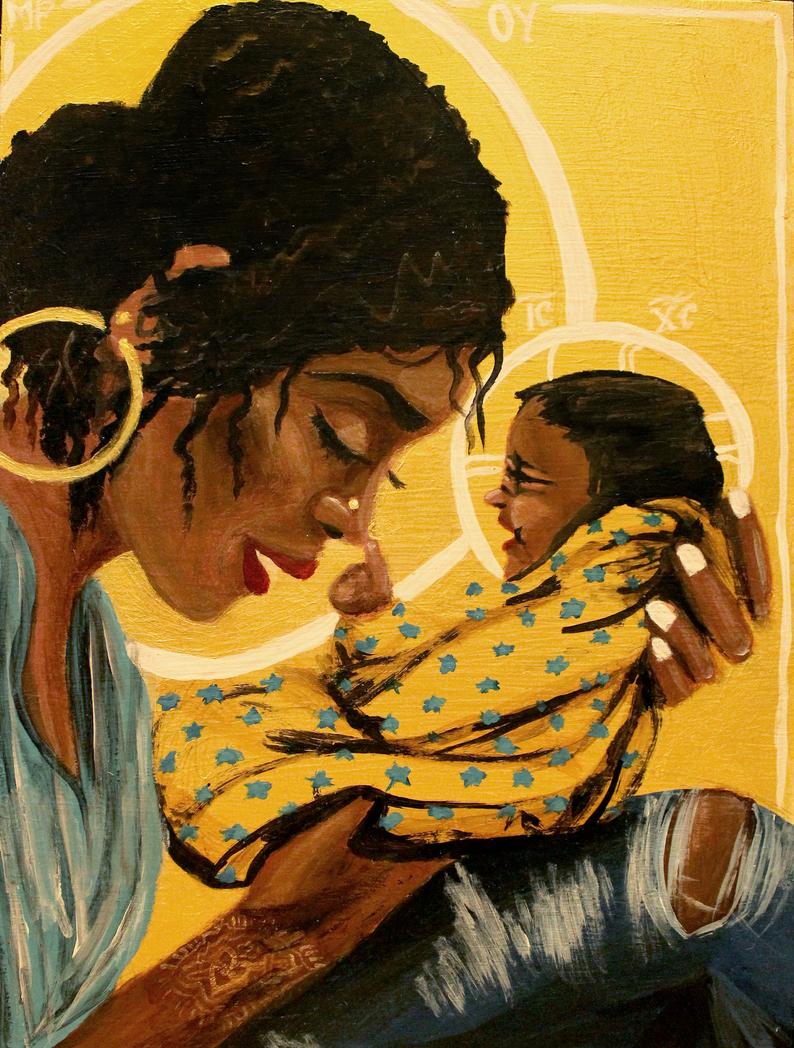
Gracie Morbitzer (American, 1997–), Madonna and Child, 2018. Acrylic on repurposed wood, 14 × 12 in. Private collection.
Gracie Morbitzer is a Catholic artist from Columbus, Ohio, who paints biblical and extrabiblical saints as modern, everyday people in a range of skin tones, forgoing the hieratic style of traditional icons in favor of a more relatable, this-worldly look that enables the individuals’ distinctive personalities to shine through. She uses discarded or thrifted pieces of wood as her substrate, welcoming cracks and imperfections as only further reiterating how the extraordinary shines through the ordinary.
In her Madonna and Child, Mary props up her newborn on her knees, basking in her new role as mother. She wears frayed jeans, a loose blouse, gold hoop earrings, and a nose stud. On her wrist is a henna tattoo of her Immaculate Heart—a burning, bloodied heart pierced with a sword and banded with roses, representing the intensity and purity of her love and the suffering that Simeon prophesies.
Jesus, wrapped in a starry blanket and donning a cruciform halo, playfully touches Mom’s nose, crinkling his face as he giggles with delight.
The yellow acrylic background recalls the gold leafing of icons, used to suggest the transfiguring light of God. Morbitzer also uses the traditional Greek abbreviations for the Mother of God (MP OY) and Jesus Christ (IC XC).
LISTEN: “Mary’s Lullaby (Black Haired Boy)” | Words by Kate Bluett | Music by Paul Zach | Sung by Liz Vice on Advent Songs by The Porter’s Gate (2021)
Oh, black-haired boy, your eyes are dark as midnight lit by shining stars and bright as love that filled my heart when first I looked at you. Your skin is brown as pilgrim roads, laid straight through fragrant olive woods, as brown as mine, and I’m in awe each time I look at you.
You made the ox and lamb, my love, and shaped the wings of turtledoves. You wrote the hidden secrets of the world I’ll show to you. Within my body you took form and wailed aloud when you were born— the moment that my heart was torn with love I’ll show to you.
You wove these wonders through the earth; you made them all and gave them worth, and now you join them in your birth, and I’ll give them to you. I’ll show you skies filled up with stars and teach you words for light and dark, for all the wondrous things there are: I’ll give them all to you.
I’ll hold you closely as I can and watch you grow into a man. As long as I can hold your hand, I’ll walk the world with you. And you’ll lead me to God’s own heart, where all these wonders have their start. But here within the stable dark, I’ll be the world for you.
Since the Middle Ages, Christians have written lullabies in the voice of Mary, imagining her rocking her infant son to sleep, sharing with him her most tender feelings and wishes. This contemporary one by frequent songwriting collaborators Kate Bluett and Paul Zach—so poignantly sung by Liz Vice—is among my favorites.
In the first stanza Mary dotes poetically on Jesus’s features—his eyes dark and bright as star-studded midnight skies, his skin brown as the footpaths to Zion. In the remaining stanzas she marvels at how the Creator of the universe lies as a babe in her arms, and how she will get to experience its many wonders with him at her side, discover its secrets together. Jesus made the world in which she lives and moves and has her being, but now, while he is small, vulnerable, and dependent, she’ll be a whole world to him, as mothers are to their children.
Azaria Mbatha (South African, 1941–2018), Nativity, 1964. Linocut, 33.5 × 57.5 cm. Edition of 10.
One of South Africa’s most important printmakers, Azaria Mbatha was a student and later teacher at the Evangelical Lutheran Art and Craft Centre at Rorke’s Drift. In his Nativity linocut he shows a Nguni bull, two bushpigs, an elephant, and an antelope calf paying homage to the Christ child, whom a bald, long-bearded Joseph gestures toward. Three wise men approach on elephant-back from the left, and further to the left, King Herod lurks with lion and spear, waiting to pounce on this perceived threat to his power. The top two registers fast-forward to the beginnings of Jesus’s public ministry, with John the Baptist preaching repentance and baptizing Jesus.
I’m not sure who the figure at the bottom right is supposed to be. Any guesses? It’s possible he’s just a generic worshipper, or someone of local or national significance.
LISTEN: “Sizalelwe Indodana” (Unto Us a Child Is Born) | Traditional South African Christmas song in Zulu | Arranged and performed by Concord Nkabinde, 2019 [HT: Global Christian Worship]
This time of the year always reminds me of my childhood & my years of growing up in Dube, Soweto. The one song that became a soundtrack for the Christmas season at that time was this simple Traditional song that really takes me back there. This is my interpretation of it.
He has overdubbed six vocal parts and multiple percussion parts.
The fourth day of Christmas is set apart in Christian calendars to commemorate the massacre of innocents in Bethlehem shortly after the birth of Jesus. Herod, a Roman client king of Judea, felt threatened by the news that the “Anointed One” of God had been born and would rule the people. In an attempt to secure his political power, Herod ordered that all the male babies in Bethlehem be killed, thinking that surely the Messiah would be among them.
Applying the prophet Jeremiah’s words about the grief of exile (Jer. 31:15) to the present bloodshed, Matthew tells us in his Gospel that the night of the Bethlehem massacre,
A voice was heard in Ramah, wailing and loud lamentation, Rachel weeping for her children; she refused to be consoled, because they are no more. (Matt. 2:18)
Rachel, a matriarch of Israel, was buried near Bethlehem, so the implication is that she was crying out from her grave in grief over her murdered descendants, joining the chorus of wailing Jewish mothers whose loss is unfathomable.
LOOK: Antiquarum Lacrimae (The Tears of Ancient Women) by Joan Snyder
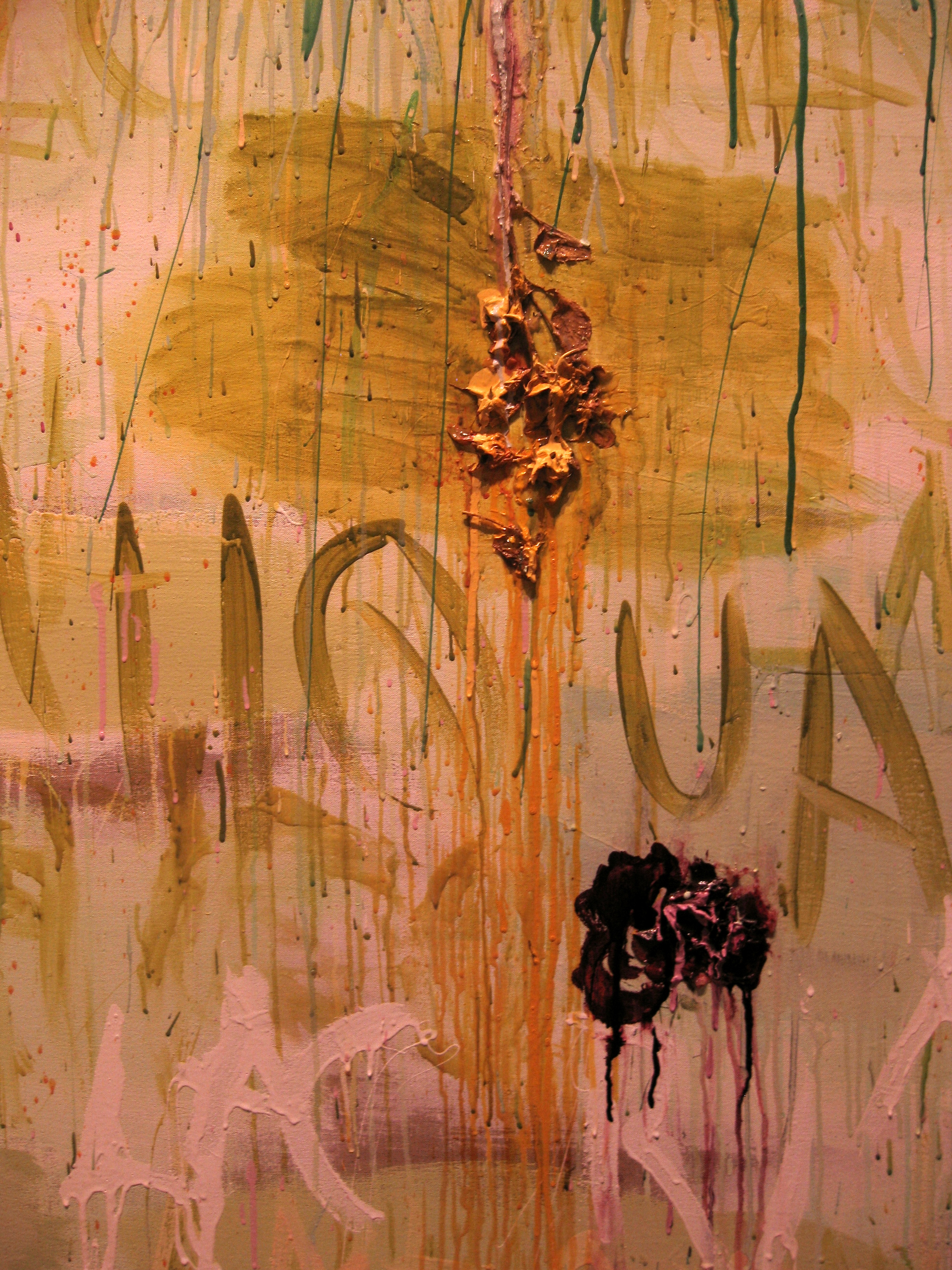
Joan Snyder (American, 1940–), Antiquarum Lacrimae (The Tears of Ancient Women), 2004. Acrylic and dried flowers on linen, 78 × 120 in. Grand Rapids Art Museum, Grand Rapids, Michigan. Photo courtesy of the artist.
Painted in the wake of the September 11, 2001, attack on the New York World Trade Center and the subsequent US invasion of Afghanistan and Iraq, the elegiac Antiquarum Lacrimae by Joan Snyder evokes the suffering of women in times of war and violence. Broad, lateral strokes of green in varying shades form a backdrop for the scrawled repetition of the Latin words of the title, which translate to “The Tears of Ancient Women”—women who weep in personal anguish, lamenting their own losses, but also more broadly for the state of the world. Dried flowers, pressed upside down onto the canvas, suggest a ravaged field, or gravesides, and the thick, round, deep red splotches of dripping paint suggest open wounds.
LISTEN: “Neharót Neharót” by Betty Olivero, 2006–8 | Performed by violist Kim Kashkashian on Neharót, 2009, and live on October 20, 2019 (see video below)
A chamber piece for solo viola, accordion, percussion, two string ensembles, and tape, “Neharót Neharót” is by contemporary Israeli composer Betty Olivero. Its Hebrew title translates to “Rivers Rivers,” referring to the rivers of tears shed by women—though Olivero also points out the word’s resemblance to nehara, meaning “ray of light,” thus identifying a faint hope that shines through floods of suffering. The composition is a textured lament led by viola, which plays lyrically over the top of an ensemble accompaniment and engages with recordings of women’s singing voices.
In 2006 Olivero was working on a commission from 92NY, a Jewish community center in Manhattan, when war broke out at the Israel-Lebanon border between the Israeli military and the militias of Hezbollah, an Islamist group. “Deeply touched and marked by the shocking television images of victims, corpses and mourning people on both sides of the border, [Olivero] chose elegies by mothers, widows and sisters who had lost their loved ones as a point of reference for her composition.”
Olivero taped women in mourning, as well as elegies and love songs of Kurdish and North African origin or derivation performed by professional Israeli singers Lea Avraham and Ilana Elia. One such song is “Fermana” (Destruction), which laments Saddam Hussein’s slaughter of the Kurds. Excerpts from these recordings are played back as part of the fabric of the live performance of “Neharót Neharót.” The piece also quotes Orpheus’s lament from Monteverdi’s L’Orfeo.
“‘Neharót Neharót’ is a dedication to all those women and children living in areas of war,” Olivero says. Though it was catalyzed by and references particular conflicts, it is intended as a universal cry of sorrow on behalf of women everywhere who carry the wounds of war—especially the unremitting grief of having lost children to violence.
Joan Snyder, Antiquarum Lacrimae (detail). Photo: Victoria Emily Jones.
El Greco (Doménikos Theotokópoulos) (Greek Spanish, 1541–1614), The Adoration of the Shepherds, 1612–14. Oil on canvas, 319 × 180 cm. Museo del Prado, Madrid.
One of my most memorable museum-going experiences has been spending time in the El Greco gallery at the Prado Museum in Madrid, with its dynamic, richly hued, floor-to-ceiling paintings of scenes from the life of Christ. It was the first time I had seen any of the artist’s monumental paintings in person (the Adoration is ten and a half feet tall!), and I was captivated. The color, the intensity, the distortions, the interplay of earthly and heavenly. I could feel their spiritual vigor.
El Greco (“The Greek”) was born in Crete in 1541 but ended up settling in Spain and is associated with the Spanish Renaissance. The expressiveness he achieved through his elongated, twisting figures and loose brushwork have led today’s art historians to describe him as a modern artist stuck in the sixteenth century.
Set in a dark and undefined space, El Greco’s Prado Adoration of the Shepherds shows Mary, Joseph (at left in blue tunic and yellow drapery), and three shepherds beholding the wonder of God made flesh. They gather around the naked Christ child, bathed in the light he emits—warming their hands in it, it seems. One shepherd reverentially crosses his arms over his chest. Even the ox is on its knees, adoring.
Overhead, a group of angels unfurls a banner that reads, GLORIA IN EXCEL[SIS DEO E]T IN TERRA PAX [HOMINIBUS] (“Glory to God in the highest, and on earth peace to men”) (Luke 2:14).
Adoration of the Shepherds was El Greco’s final painting. He painted it for his family burial chapel at the convent of Santo Domingo del Antiguo in Toledo, Spain, not knowing that his own body would be resting there so soon, as shortly after he completed the painting, he died of a sudden illness. Even after El Greco’s remains were transferred by his son to the new convent of San Torcuato just a few years later, the painting remained in the possession of the original convent, who moved it to their church’s high altar. It was acquired by the Prado Museum in 1954.
LISTEN: “In a Cave” | Words by Harold B. Franklin, 1961; adapt. | Music by Caleb Chancey, 2020 | Performed by musicians from Redeemer Community Church, Birmingham, Alabama, 2020
LOOK: The Angel Brings Good News to the Shepherds by Luke Hua Xiaoxian
Luke Hua Xiaoxian (華效先), The Angel Brings Good News to the Shepherds (天使向牧人傳佈嘉訊), 1948. Chinese watercolor on silk, mounted as hanging scroll, 47.5 × 53 cm (painting) / 123 × 65.5 cm (mounting). Collection of the Ricci Institute for Chinese-Western Cultural History at Boston College (formerly at the University of San Francisco).
LISTEN: “Pengyou, Ting!” | Words: Anonymous, ca. 1935 | Traditional Chinese melody, arr. Carolyn Jennings, 1994 | Performed by Calvin University’s Capella, dir. Pearl Shangkuan, 2021
Pengyou, ting zhe hao xin xi: Yesu jiangshi wei jiu ni Benlai ta shi tian shang shen Te lai wei jiu shi shang ren
Pengyou, ting zhe hao xin xi: Yesu jiangshi wei jiu ni Yesu Judu, Yesu Jidu Jiangsh wei jiu wo, jiu ni!
English translation:
Listen, friend! Good news: Jesus came to earth for you! Came from heaven where he was Lord! Came to save, to save us all!
Listen, friend! Good news, hear this great good news! Jesus Christ came to earth for you! For me, for you!










 Art & Theology