Fragment of a Roman Christian fresco, 8th–9th century. Dumbarton Oaks Museum (BZ.1938.59), Washington, DC. Photo: Victoria Emily Jones.
Stand up and raise your heads, because your redemption is drawing near.
—Luke 21:28
+++
This upcoming Sunday marks the beginning of Advent, a yearly church season of waiting, watching, hoping, praying, and preparing for the coming of the Savior.
There are theological reasons for observing a serious Advent without being swallowed up prematurely by the Christmas rush. Advent offers an unparalleled opportunity to take a fearless inventory of the darkness in our world and in our hearts, into which the True Light will come.
The season of Advent is an opportunity both to discover the nature of our enfeebled waiting muscles as well as our tired practices of anticipation and to discipline our hearts and minds, bodies and lives so that we might become, together, a people who wait with hope, who anticipate with faith, and who welcome the arrival of the Lord with courage in our hearts.
This carol, likely from the sixteenth century, was traditionally sung by beggars, travelers, and the “roaming folk” of England around Christmastime. Because of its strong moralism, it has fallen out of favor, but interest in it revived somewhat when it was recorded by the Watersons on their 1965 album Frost and Fire. Their version is based on one of those found in the 1914 edition of the Journal of the Folk-Song Society, compiled by Ralph Vaughan Williams and Cecil Sharp from the West Midlands and counties adjoining Wales. James Elkington’s rendition adds a blues tilt, as his “masterful picking style tumbles and curls around the mournful melody,” accompanied by organ and slide guitar.
Christmas is now drawing near at hand
Come serve the Lord and be at his command
God a portion for you will provide
And give a blessing to your soul besides
Down in the garden, where the flowers grow in ranks
Get down on your bended knees and give the Lord thanks
Down on your knees and pray both night and day
Leave off your sins and live from pray to pray
So proud and lofty is some sort of sin
Which many take delight and pleasure in
Whose conversation doth God smirch as lie
And yet he shakes his sword before he strikes
So proud and lofty do some people go
Dressing themselves like players in a show
They patch, paint, and dress with idle stuff
As if God had not made ’em fine enough
Well, even little children learn to curse and swear
They can’t rehearse one word of godly prayer
Teach them better, oh teach them to rely
On Christ, the sinner’s friend, who reigns on high
This post belongs to the weekly series Artful Devotion. If you can’t view the music player in your email or RSS reader, try opening the post in your browser.
To view all the Revised Common Lectionary scripture readings for the First Sunday of Advent, cycle C, click here.
Congrats to the three winners of the Wounded in Spirit book giveaway. Thank you all for entering. I will be giving away another free book, from Eerdmans, sometime in the next month or two, so stay tuned!
+++
A bear and a cow share a snack of grass, and a child pets a leopard without consequence, in this charming little detail from Edward Hicks’s 1834 Peaceable Kingdom in the National Gallery of Art.
ADVENT ART VIDEO:The Peaceable Kingdom by Edward Hicks: This year I was invited to make a guest contribution to art historian James Romaine’s annual Art for Advent video series on YouTube. For 2018, he is spotlighting paintings from the National Gallery of Art in Washington, DC, my neck of the woods. I chose to write about The Peaceable Kingdomby the nineteenth-century Quaker preacher-artist Edward Hicks, which visualizes the prophecy of Isaiah 11 about predators and prey lying down together in friendship, and a little child leading them. But Hicks’s image of “peace on earth” is not as simplistic as it may seem at first; there is tension. See the video below, and be sure to check back on the Seeing Art History YouTube channel next week for subsequent videos. For more on Hicks and this favorite subject of his, see this post of mine from 2016. Thank you to Rain for Roots for letting me use their wonderfully playful musical rendition of Isaiah 11 from their family Advent album Waiting Songs.
+++
PODCAST EPISODE: “Mary Poppins,”Technicolor Jesus, episode 49: “If you want a movie that really shows the foolishness of the gospel next to what the world thinks is wise and is turned on its head . . . if you want a movie about the great reversals that are present in the kingdom of God, you don’t need to look any further than MaryPoppins,” says Pastor Becca Messman. The oppressive orderliness booming over people’s lives “is contrasted with something unpredictable and joyful—the wind, dancing chimney sweeps, and this beautiful bird woman giving her crumbs away.” The movie is about what happens when both adults and kids relax into joy.
It’s also about charity. Last year Niles Reddick wrote an article about Mary Poppins as the first female Christ figure in American film, and “Feed the Birds” as a “song-parable” that serves as the linchpin of the movie. While the world would have us pile up our coins in a bank vault, Jesus calls us, against the world’s wisdom, to give them away.
I love this movie. My mom says that from a young age she would play it for me, and I would sit mesmerized for the entire 139 minutes. I remember trying to soothe my baby brother many a time by singing “Let’s Go Fly a Kite.” Once we were elementary school–age, we would eagerly await the “Step in Time” scene, at which point we would rush to grab brooms from the garage, using them as props as we danced along with Dick Van Dyke—which sometimes ended in injury . . . Now as an adult, I can appreciate some of the movie’s deeper themes, and pick up on its resonances with the upside-down nature of Christ’s kingdom. Can’t wait to see the new Mary Poppins Returns next month!
+++
WRITING CONTEST FOR UK TEENS:“Write on Art”: In an effort to get teenagers learning and writing about art, Art UK and the Paul Mellon Centre for Studies in British Art are co-sponsoring “Write on Art” for the second year in a row. Any kid between the ages of 15 and 18 who is enrolled in a UK school (Years 10–13) is eligible to enter to win up to £500 by submitting a short personal write-up (400–600 words) on any artwork in the UK’s national collection. “With a disturbing decline in the teaching of art and art history in schools, our Write on Art competition . . . is designed to highlight the importance of art as an academic discipline.” The website includes tips on how to write about art, including where to find relevant vocabulary and other resources. All entries must be submitted by January 31, 2019.
+++
BOOK REVIEW:On Reading Well: Finding the Good Life through Great Books by Karen Swallow Prior, reviewed by Nick Roark: In September, Brazos Press released Prior’s latest book on reading widely and well, which received a starred review and a Best Book of 2018 in Religion from Publishers Weekly. I’m a big fan of her previous Booked: Literature in the Soul of Me, so I’m really looking forward to this one. “Covering authors from Henry Fielding to Cormac McCarthy, Jane Austen to George Saunders, and Flannery O’Connor to F. Scott Fitzgerald, Prior explores some of the most compelling universal themes found in the pages of classic books, helping readers learn to love life, literature, and God through their encounters with great writing. In examining works by these authors and more, Prior shows why virtues such as prudence, temperance, humility, and patience are still necessary for human flourishing and civil society.”
Purchase the book between now and Christmas, and receive a piece of free downloadable art by Ned Bustard. Instructions are on her website, https://karenswallowprior.com/.
+++
NEW ADVENT/CHRISTMAS ALBUMS
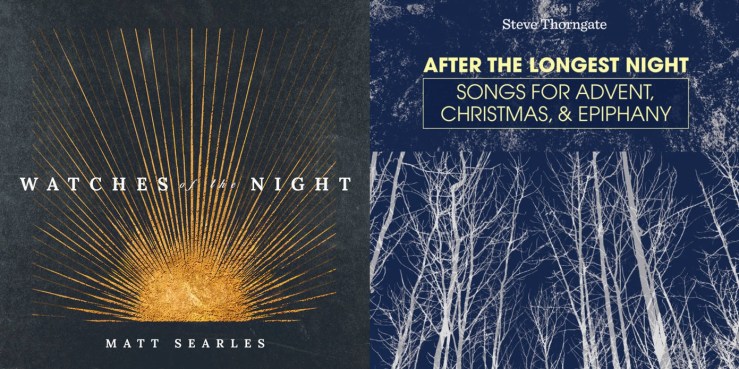
Watches of the Night by Matt Searles: “Christian believers are like watchmen, longing to see the first rays of dawn. We long for the darkness of this world to be finally taken away, and the light of Christ to rise in all its splendour. This album is intended to help us as we wait; to lament the brokenness of this world, but to look to the riches of that which is to come. It is an album of longing, but also of profound hope. Light has dawned. Christ has been raised. But we await the full revelation of him in glory. We are still watchmen. Still waiting.
“This is not a loud album. It is one I hope you might be able to listen to if you lie awake unable to sleep, as I so often find the case. I pray it is an album that might help you – like David in Ps 63:6 – to meditate on God in the watches of the night. An album that will orient you to the future, and help you increasingly be someone whose mind is set on the city that is to come. Songs to help you fix your eyes on Christ, and long above all else for his return when we see him face to face.”
After the Longest Night: Songs for Advent, Christmas, and Epiphanyby Steve Thorngate: These fourteen songs are a mix of originals, including settings of the Lukan Canticles (the songs of Zechariah, Mary, and Simeon), and traditionals: “Creator of the Stars of Night,” “What Child Is This,” “Bright Morning Stars,” and “Let the Light of Your Lighthouse Shine on Me.” Best $7 I’ve spent in a while! (Purchase even includes lead sheets.)
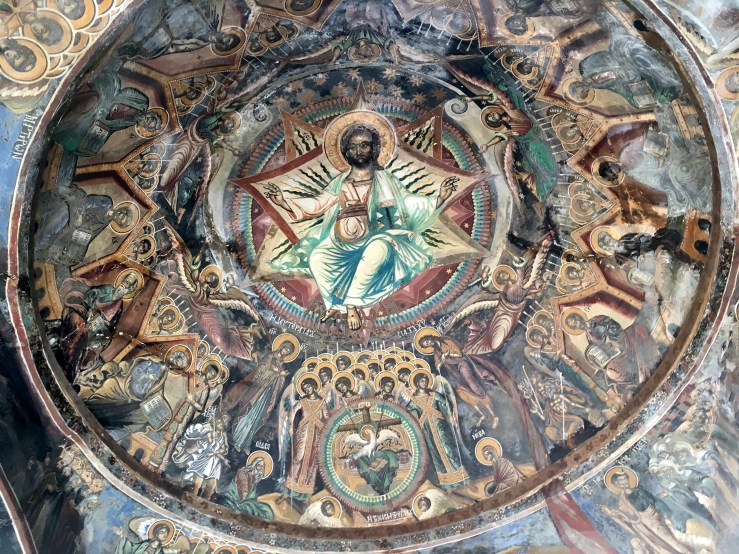
Christ in Glory, 1744. Fresco on a dome of the katholikon (major church building) of Koutloumousiou Monastery, Mount Athos, Greece. Photo: Jim Forest.
As I watched, thrones were set in place, and an Ancient One took his throne. . . . To him was given dominion and glory and kingship, that all peoples, nations, and languages should serve him. His dominion is an everlasting dominion that shall not pass away, and his kingship is one that shall never be destroyed.
—Daniel 7:9, 14
+++
SONG: “He Reigns Forever (We Sing Praises)” | Words and music by Marshall Carpenter, 2002 | Choral arrangement by Carol Cymbala | Performed by the Times Square Church Choir, 2015
This post belongs to the weekly series Artful Devotion. If you can’t view the music player in your email or RSS reader, try opening the post in your browser.
To view all the Revised Common Lectionary scripture readings for Reign of Christ Sunday, cycle B, click here.
My friends at Paraclete Press are offering a free copy of this brand-new book to three lucky readers of Art & Theology. Entry rules are below.
For many, the holiday season is difficult to get through, as it stirs up painful reminders of loss or reveals fractures in present relationships. Author David Bannon knows. Wounded in Spirit: Advent Art and Meditations grew out his grief over the death of his twenty-six-year-old daughter, as well as his brokenness over his criminal past.
The book comprises twenty-five daily readings, each centered on an artist who walked through his own dark valley, groping for the light—and producing extraordinary art in the process. Most of these valleys were ones of death—death of children, parents, siblings, spouse. Some of the featured artists struggled with mental illness, the stigma of illegitimacy, or racial discrimination; others led violent or lascivious lives, and had grave personal sins to overcome. The premise of the book, though, is that Christ meets us in our fallibility and sorrow; he is our hope, our peace. “In their [the artists’] wounds, in our wounds, we may once again encounter ‘God with us.’”
Illustrated in full color and with a foreword by Philip Yancey, Wounded in Spirit combines painting reproductions, commentaries, Bible verses, and quotes about beauty and suffering that prepare us to welcome the coming Messiah in the fullness of his glory and healing grace. Artists include Caravaggio, Murillo, Dürer, Cranach, Friedrich, Tanner, van Gogh, Gauguin, and more. Most of the artwork subjects are biblical, but not all; there are a few landscapes, self-portraits, allegories, and genre scenes as well.
HOW TO ENTER
Clicking on the entry button below will bring you to the entry form on the Rafflecopter website. You can enter up to three times by: subscribing to Art & Theology (to receive semiweekly posts by email), following @artandtheology on Twitter, and/or visiting Art & Theology’s Facebook page. (If you are already an email subscriber or a Twitter follower, you still qualify.)
The contest ends Sunday, November 25, at 12 a.m. Eastern Time. Three winners will be randomly selected and contacted by email later that day for shipping address information, using the email address provided on the entry form.
Unfortunately, this contest is restricted to US addresses only. My sincerest apologies to my international readers!
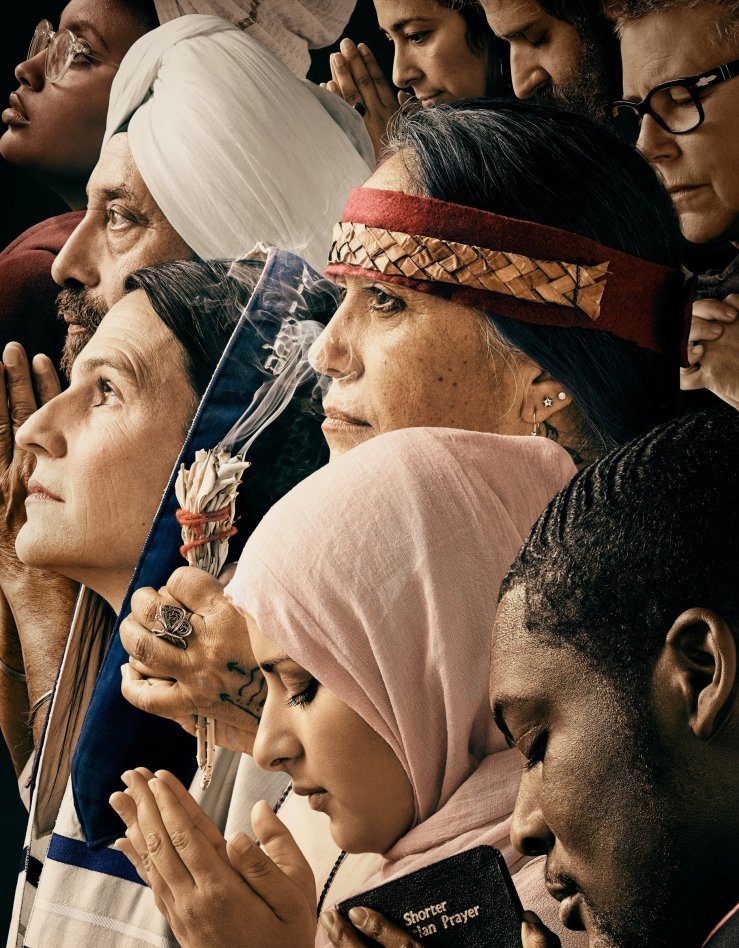
Hank Willis Thomas (American, 1976–) and Emily Shur (American), Freedom of Worship, 2018. While Norman Rockwell’s illustration of the same name contains specific representations of Protestantism, Catholicism, and Judaism, this reinterpretation goes even further to include Islam, Native American spirituality, and Sikhism.
NEW PHOTOGRAPH SERIES:“The Four Freedoms” by Hank Willis Thomas and Emily Shur: In his 1941 State of the Union address, President Franklin D. Roosevelt insisted that people in all nations share Americans’ entitlement to four basic freedoms: freedom of speech, freedom of worship, freedom from want, and freedom from fear. This famous speech became the basis for Norman Rockwell’s set of four illustrations, originally published in the Saturday Evening Post in 1943, that have become some of history’s most iconic representations of the American idea.
Artist Hank Willis Thomas and photographer Emily Shur decided to reimagine these scenes with a cast that’s more representative of American diversity. One of the eighty-two final images they created is published on the cover of the current issue of Time magazine. It and others will form the backbone of a national billboard campaign by the nonpartisan organization For Freedoms to encourage civic engagement. “We believe that if artists’ voices replace advertising across the country, public discourse will become more nuanced,” their website says.
+++
IN CONCERT: Eric and I went to see brother-sister folk duo The Oh Hellos (Tyler Heath and Maggie Heath Chance) in Baltimore earlier this month and had a great time. My favorite song from their set list was “Soldier, Poet, King,” which describes Jesus’s coming in all three roles—perfectly appropriate for the upcoming Advent season! Jesus, the Word of God, comes to tear down Satan’s kingdom and establish his just rule in our lives and world (1 John 3:8b; Rev. 19:11–16). The final verse affirms Jesus’s status as Messiah, the waited-for “Anointed One,” and celebrates his power marked by humility, even unto death. The blood he wears into battle is his own.
There will come a soldier
Who carries a mighty sword
He will tear your city down
O lei o lai o lord
There will come a poet
Whose weapon is his word
He will slay you with his tongue
O lei o lai o lord
There will come a ruler
Whose brow is laid in thorn
Smeared with oil like David’s boy
O lei o lai o lord
The Oh Hellos’ nationwide tour continues through the end of the year, so visit their website to see if they’ll be stopping near you.
+++
NEW ALBUM: Crumbs by Liturgical Folk: Liturgical Folk (previously here and here) released its third album this month, which “build[s] on the themes of eucharist and the mission of the church to bring peace and reconciliation to the world.” The title comes from the track “Prayer of Humble Access,” a verbatim setting from the “Holy Eucharist Rite I” in the Book of Common Prayer that alludes to the story of the Syrophoenician woman.
Most of the song texts on the album come from that traditional Anglican prayer-book and were set to music by Ryan Flanigan, though a few texts are contemporary. “Lord, Lord, Lord,” for example, was written in the wake of the August 9, 2014, shooting of Michael Brown in Ferguson, Missouri, and amid the subsequent escalation of racial tensions in the country. “As a privileged, white, middle class, American man,” Flanigan wrote,
I felt for the first time in my life the systemic injustice against black males in our country. What I found most troubling, besides death itself, was the response of some white, privileged people to the shooting, particularly the response of some Christians on social media and the News. When we should have been mourning with those who mourn, confessing our fears and sins, and seeking reconciliation, many of us turned a blind eye or, worse, assumed a posture of defensiveness and denial. I wrote this song as a corporate confession of sin to God and our fellow men, a plea for God to forgive us and restore our broken trust with him and with those we’ve failed to love.
+++
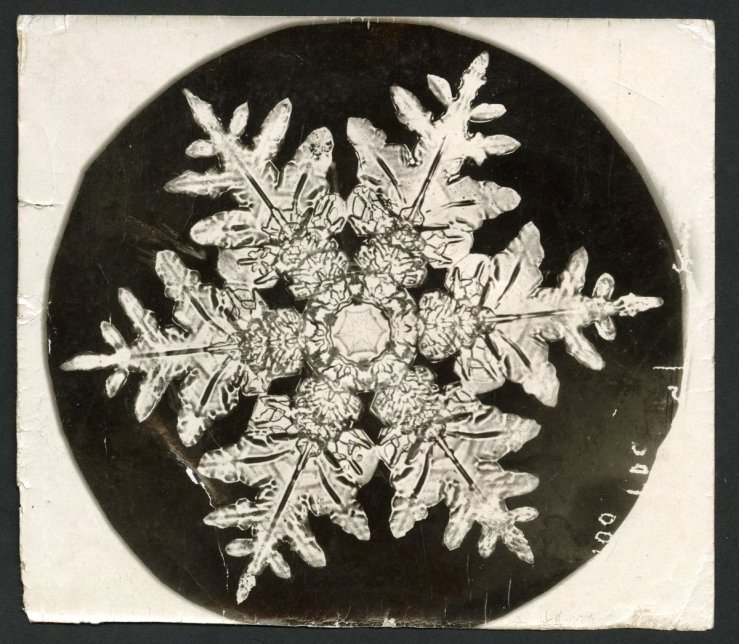
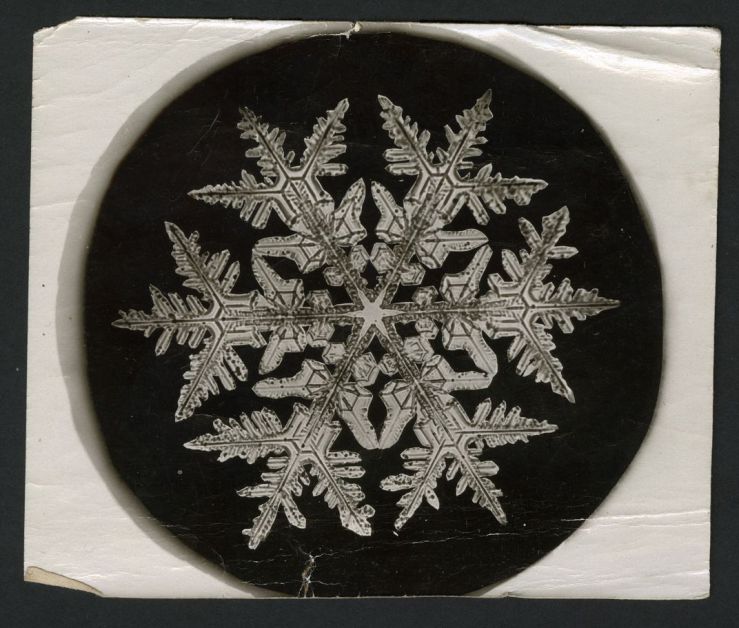
WORLD’S FIRST SNOWFLAKE PHOTOS:“The Man Who Revealed the Hidden Structure of Falling Snowflakes”: Maryland saw its first snow of the season this week, as did most of the East Coast, which means Twitter saw a flurry of snowflake images! The Smithsonian posted about Wilson “Snowflake” Bentley (1865–1931), whose perfection of innovative photomicrographic equipment and techniques (which included chilled velvet and a turkey feather) enabled him to photograph thousands of individual snowflakes without their melting, providing valuable scientific records of snow crystals and their many types.
The first person to photograph a single snowflake, . . . Wilson A. Bentley used a microscope with his bellows camera—plus years of trial and error—to get a photo of one flake in 1885. But he didn’t stop there. Bentley went on to take thousands more, . . . which helped support the belief that no two snowflakes are alike. In 1903, he sent 500 prints of his snowflakes to the Smithsonian, hoping they might be of interest to our Secretary. The images are now part of the Smithsonian Archives.
+++
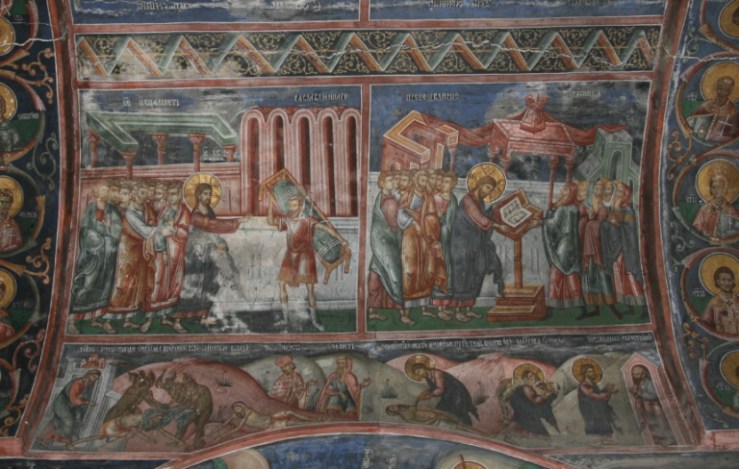
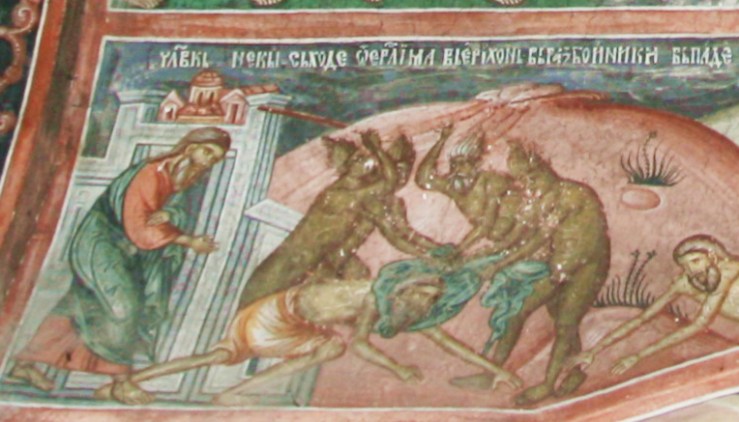
BALKAN ICON:“Transforming a Parable: The Good Samaritan”: Run by David Coomler, a museum researcher, Icons and Their Interpretations discusses aspects of traditional Russian, Greek, and Balkan iconography, inviting people to submit photos of icons for identification of subject or meaning, and translation of inscriptions. Recently he wrote about a fourteenth-century Serbian Orthodox fresco that, like many of the church fathers, promotes an allegorical reading of the parable of the good Samaritan. In this interpretation, the man en route to Jerusalem is Adam, or Everyman, who is beaten by demons; the priest and the Levite represent the law of Moses and the priesthood of Aaron, which cannot help the wounded man. But the “good Samaritan,” Jesus, stoops down to save, carrying the man not on a beast of burden but on his own back, to an “inn,” the church. He hands two “coins,” the Bible and tradition, to the innkeeper, and promises to return. See further image details and commentary at the web link above.
Parable of the Good Samaritan (see bottom register), 14th century. Fresco in the narthex of the Patriarchal of Pech, a Serbian Orthodox monastery in Kosovo.
+++
OBITUARY: Christian composer Kurt Kaiser dies at 83: On November 12, Kaiser passed away at his home in Waco, Texas, after a six-decade-long career in composing, playing, arranging, and producing Christian music. A Gospel Music Hall of Famer and a progenitor of CCM, he’s best known for his song “Pass It On,” but I know him for “Oh How He Loves You and Me,” two renditions of which are posted below; the first is a solo performance by Vanessa Williams with gospel piano accompaniment by Richard Smallwood, and the second is performed a capella in four-part harmony by Kaoma Chende with the use of overdubbing.
This 9th-century mosaic of Christ between the cherubim is located above the apse of the Basilica of Santa Prassede in Rome. Photo: Fr. Lawrence Lew, OP.
Therefore, my friends, since we have confidence to enter the sanctuary by the blood of Jesus, by the new and living way that he opened for us through the curtain (that is, through his flesh), and since we have a great priest over the house of God, let us approach with a true heart in full assurance of faith, with our hearts sprinkled clean from an evil conscience and our bodies washed with pure water.
Lord, how excellent are Thy ways, and how devious and dark are the ways of man. Show us how to die, that we may rise again to newness of life. Rend the veil of our self-life from the top down as Thou didst rend the veil of the Temple. We would draw near in full assurance of faith. We would dwell with Thee in daily experience here on this earth so that we may be accustomed to the glory when we enter Thy heaven to dwell with Thee there. In Jesus’ Name, Amen.
—A. W. Tozer, The Pursuit of God
This post belongs to the weekly series Artful Devotion. If you can’t view the music player in your email or RSS reader, try opening the post in your browser.
To view all the Revised Common Lectionary scripture readings for Proper 28, cycle B, click here.
The angel Gabriel awakes the dead on Resurrection Day in this medieval stained glass tondo from the Musée de Cluny in Paris. Photo: Spencer Means.
And just as it is appointed for man to die once, and after that comes judgment, so Christ, having been offered once to bear the sins of many, will appear a second time, not to deal with sin but to save those who are eagerly waiting for him.
—Hebrews 9:27–28
+++
SONG: “Get Happy” | Words by Ted Koehler, 1930 | Music by Harold Arlen, 1930 | Performed by the Puppini Sisters, on Hollywood(2011)
See also the Judy Garland version from Summer Stock (1950), below, which the American Film Institute ranked #61 in its survey of top tunes in American cinema.
+++
“The Day of Judgment” by Henry Vaughan
O day of life, of light, of love!
The only day dealt from above!
A day so fresh, so bright, so brave,
’Twill show us each forgotten grave,
And make the dead, like flowers, arise
Youthful and fair to see new skies.
All other days, compared to thee,
Are but Light’s weak minority;
They are but veils, and cypress drawn
Like clouds, before thy glorious dawn.
O come! arise! shine! do not stay,
Dearly loved day!
The fields are long since white, and I
With earnest groans for freedom cry;
My fellow-creatures too say “Come!”
And stones, though speechless, are not dumb.
When shall we hear that glorious voice
Of life and joys?
That voice, which to each secret bed
Of my Lord’s dead,
Shall bring true day, and make dust see
The way to immortality?
When shall those first white pilgrims rise,
Whose holy, happy histories
—Because they sleep so long—some men
Count but the blots of a vain pen?
Dear Lord! make haste!
Sin every day commits more waste;
And Thy old enemy, which knows
His time is short, more raging grows.
Nor moan I only—though profuse—
Thy creature’s bondage and abuse;
But what is highest sin and shame,
The vile despite done to Thy name;
The forgeries, which impious wit
And power force on Holy Writ,
With all detestable designs,
That may dishonor those pure lines.
O God! though mercy be in Thee
The greatest attribute we see,
And the most needful for our sins,
Yet, when Thy mercy nothing wins
But mere disdain, let not man say
“Thy arm doth sleep,” but write this day
Thy judging one: descend, descend!
Make all things new, and without end!
This post belongs to the weekly series Artful Devotion. If you can’t view the music player in your email or RSS reader, try opening the post in your browser.
To view all the Revised Common Lectionary scripture readings for Proper 27, cycle B, click here.
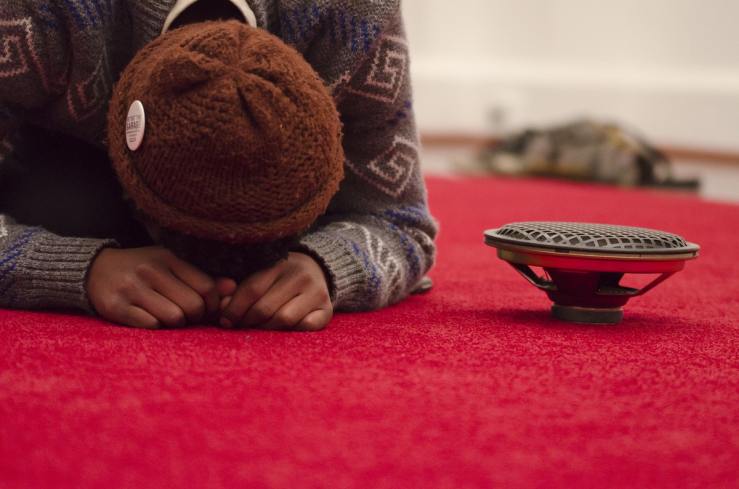
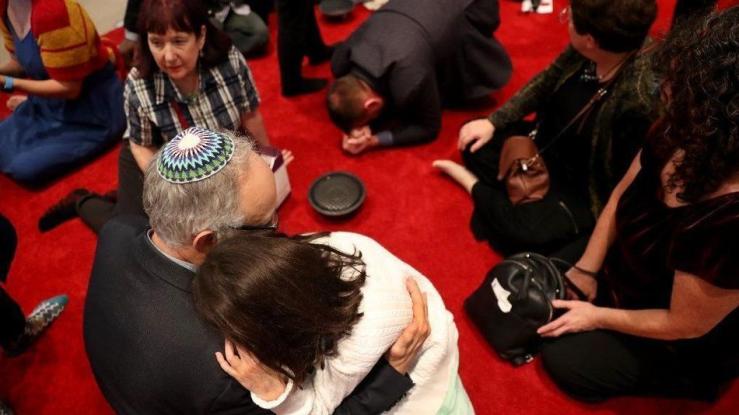
James Webb: Prayer,Art Institute of Chicago, September 6–December 31, 2018: A sound installation that began, said the artist, with the question “What would it be like to listen to all the prayers of a city simultaneously?” “Prayer is an ongoing project, remade around the world since its first presentation in Webb’s home city of Cape Town in 2000. The Chicago version is the 10th and largest to date, as well as the first in North America. The work consists of recordings of prayer from individuals who belong to dozens of faiths and spiritual affinities in the host city. Listeners are invited to remove their shoes and walk the length of the carpet . . . or to kneel or otherwise lower themselves next to a speaker to listen more closely to particular prayers.”
Photo: Anthea PokroyPhoto: Chris Sweda/Chicago Tribune
In his review for the Chicago Tribune, Steve Johnson interviewed several listener-participants. One woman said she stumbled into the museum after missing her train stop on her way home from work; it was a fortuitous accident, she said, because she had been feeling overwhelmed by the suffering in the city (addiction, gun violence, etc.), and hearing the praying, singing, chanting in the gallery helped give her hope.
Click here to see a short video feature of the Stockholm version of Prayer, which took place last year.
+++
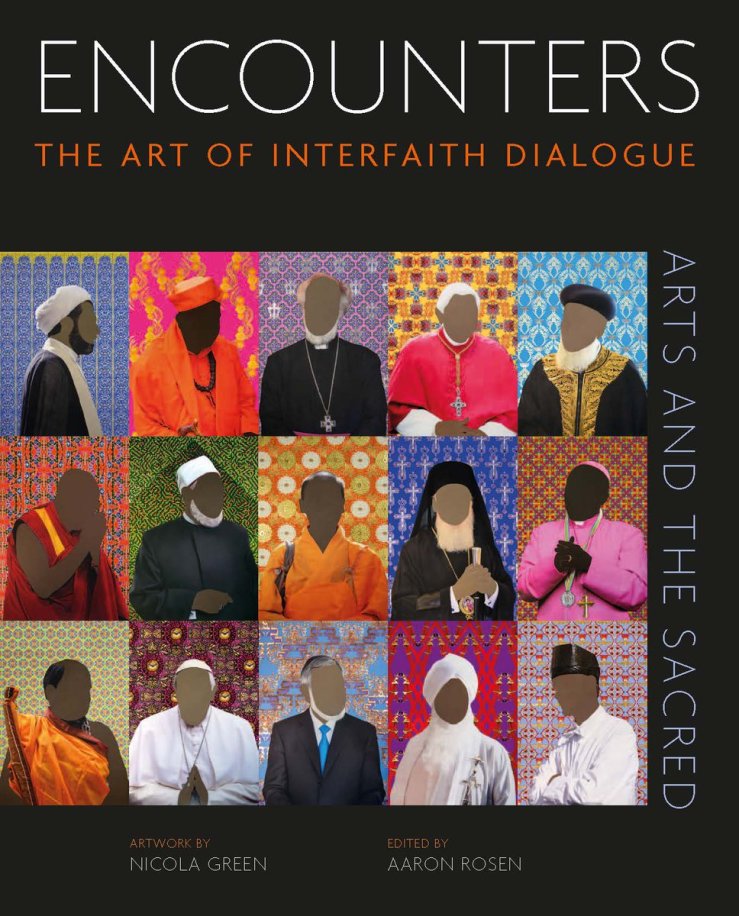
Encounters,St. Martin-in-the-Fields, London, September 18–November 19, 2018: For the past decade, artist and visual social historian Nicola Green has been granted access to private meetings between religious leaders around the world from a variety of faith traditions. These meetings have gone largely unreported in the media, and there has been limited reflection on the encouraging trend they represent. To help remedy the situation, Green has produced thirty-one portraits depicting leaders like Pope Francis, the Dalai Lama, Archbishop Desmond Tutu, former Grand Mufti of Egypt Ali Gomaa, Emeritus Chief Rabbi Jonathan Sacks, and many more—each set against a unique patterned background inspired by liturgical vestments or objects, manuscript illuminations, or sacred architecture particular to the sitter. The faces are obscured to prompt reflection on the relationship between the individual and his office.
“Green makes a compelling case through her art and writings that we have entered a new era in interreligious relations. What is remarkable today is the depth of relationships being formed by faith leaders across historically deep divides. . . . At its heart, the Encounters project is an exploration of difference. It asks: How can people of different faiths, or none, communicate strongly held convictions, whilst respectfully allowing others to do the same? What can be gained from such encounters, and how can we identify common goals whilst working from different perspectives? And how can deep religious commitments become an asset rather than an impediment to understanding and appreciating diversity? Green invites viewers to think about our relationship to those we consider wholly ‘other’ to ourselves, and how this, in turn, shapes our own identity.”
The exhibition is accompanied by the publication of a new multiauthor book, Encounters: The Art of Interfaith Dialogue, as well as a series of lectures, the most recent of which will be taking place Monday.
+++
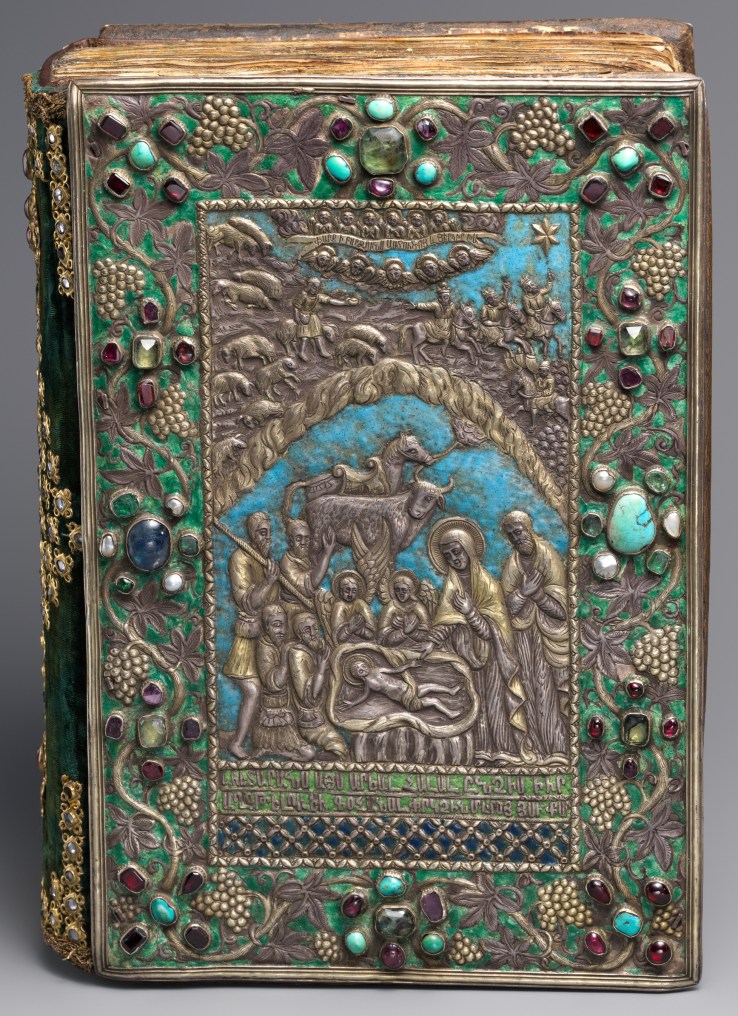
Armenia: Art, Religion, and Trade in the Middle Ages, Metropolitan Museum of Art, New York City, September 22, 2018–January 13, 2019: “This is the first major exhibition to explore the remarkable artistic and cultural achievements of the Armenian people in a global context over fourteen centuries—from the fourth century, when the Armenians converted to Christianity in their homeland at the base of Mount Ararat, to the seventeenth century, when Armenian control of global trade routes first brought books printed in Armenian into the region. Through some 140 objects—including opulent gilded reliquaries, richly illuminated manuscripts, rare textiles, cross stones (khachkars), precious liturgical furnishings, church models, and printed books—the exhibition demonstrates how Armenians developed a unique Christian identity that linked their widespread communities over the years.”
Astuatsatur Shahamir, Adoration of the Shepherds, 1691. Repoussé silver book cover with jewels and enamel, made in present-day Kayseri, Turkey. Inside is an illuminated Gospel from the 13th century.
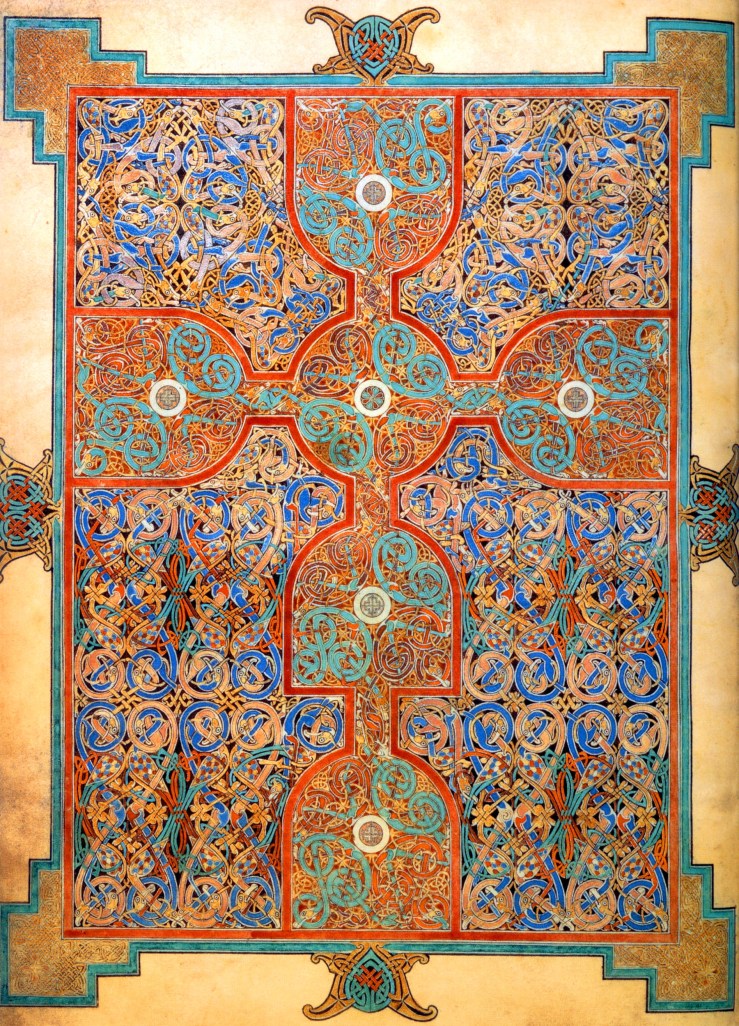
Anglo-Saxon Kingdoms: Art, Word, War,British Library, London, October 19, 2018–February 19, 2019: This “largest ever exhibition on the history, literature and culture of Anglo-Saxon England, spanning all six centuries from the eclipse of Roman Britain to the Norman Conquest,” brings together art objects, manuscripts, and other artifacts from various European collections and from the British Library itself. Because Christianization of the kingdom began in the sixth century, much of its art reflects that. Two highlights are the Codex Amiatinus (a giant Northumbrian Bible taken to Italy in 716 as a gift to the pope and returning to England for the first time since) and the Lindisfarne Gospels (the earliest surviving example of the Gospel texts in English and an exemplary fusion of Anglo-Saxon, Celtic, Pictish, and Mediterranean art styles)—which will be the subject of a lecture on Monday.
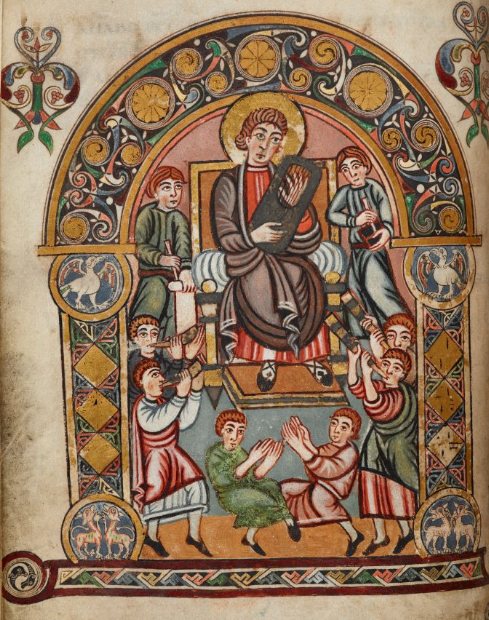
Carpet page from the Lindisfarne Gospels, ca. 698. British Library Cotton MS Nero D.IV, fol. 26v.King David and his musicians, from the Vespasian Psalter, 8th century. British Library Cotton MS Vespasian A. I, fol. 30v.From the Eadwine Psalter, ca. 1150. Trinity College, Cambridge (MS R.17.1, fol. 108v). Illuminates Psalm 64:1-3: “Hear me, my God, as I voice my complaint; protect my life from the threat of the enemy. Hide me from the conspiracy of the wicked, from the plots of evildoers. They sharpen their tongues like swords and aim cruel words like deadly arrows.”“The Harrowing of Hell,” from the Tiberius Psalter, ca. 1050. British Library Cotton MS Tiberius C.vi, fol. 14r.
+++
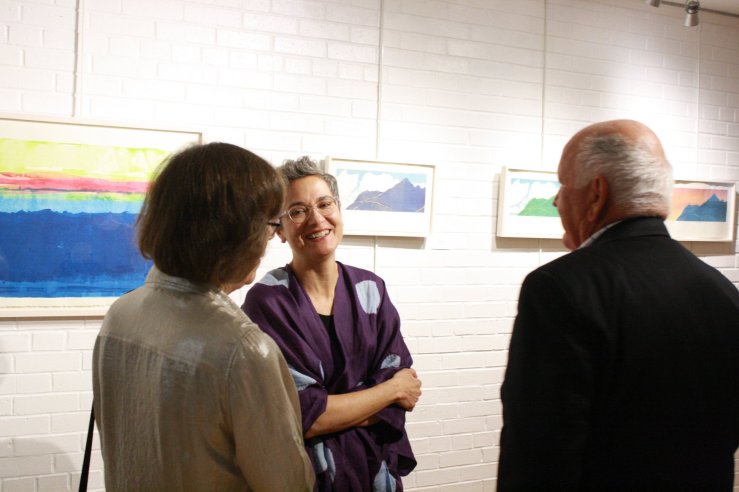
Attending: Paintings and Prints by Julie Shelton Snyder, Gallery at Convergence, Alexandria, Virginia, October 26–December 22, 2018: This exhibition features new work by the artist completed during her residency at the foot of Mount Fuji in Japan, which she spent studying the mokuhanga traditional woodblock printmaking technique. “In my work,” says Snyder, “I explore movement and stillness, being in control and letting go. . . . My longing for stillness is a physical and spiritual quest, and this quest has led me to the practice of Centering Prayer. Through art making, I am given the means to express spiritual truths I cannot otherwise articulate. Expressing the ineffable and the invisible is the aim of my work, and I view abstraction as the best means for this expression.”
Accompanying the exhibition is a series of events, including workshops, prayer services, and, on December 2, “Attending to Advent: A Multisensory Advent Experience”—which I will be, ahem, attending.
+++
The Renaissance Nude,J. Paul Getty Museum, Los Angeles, October 30, 2018–January 27, 2019: “Inspired by a renewed interest in classical sculpture and closer study of nature, Renaissance artists made the nude body ever more vibrant, lifelike, and central to their practice. Yet, pious European Renaissance society was troubled by the nude and its new sensuality—a conflicted response echoed in the world today, where images of nudity have become ubiquitous. This exhibition, with more than 100 objects by Leonardo da Vinci, Raphael, Michelangelo, Dürer, and others, traces the nude’s controversial emergence and its transformative effect on European art and culture.”
Jean Fouquet’s Virgin and Child, which forms the right wing of the Melun diptych, shows Mary baring her breast in what most read as an erotically charged manner. (click to see full image)
It was interesting to hear from curator Thomas Kren that “artists’ and viewers’ attitudes toward the nude were as varied and complex centuries ago as they are today,” provoking conflicting feelings of shame, admiration, curiosity, desire, disgust, anger. Learn more in his fascinating Getty blog post “Deconstructing Myths about the Nude in Renaissance Art,” and in the catalog he edited. Also worth checking out is the blog post by art historian Jill Burke: “Sex, Power, and Violence in the Renaissance Nude.” The exhibition focuses on the period 1400–1530, but even within that narrow slice of history, the unclothed body, male and female, functioned in diverse ways in art.
A large number of biblical figures are represented in the exhibition’s list of artworks, including Adam and Eve, Job, Bathsheba, Mary and the infant Christ, Christ at his baptism and in his passion, and the saved and the damned on the last day, as well as extrabiblical martyrs (especially Saint Sebastian) and devout ascetics.
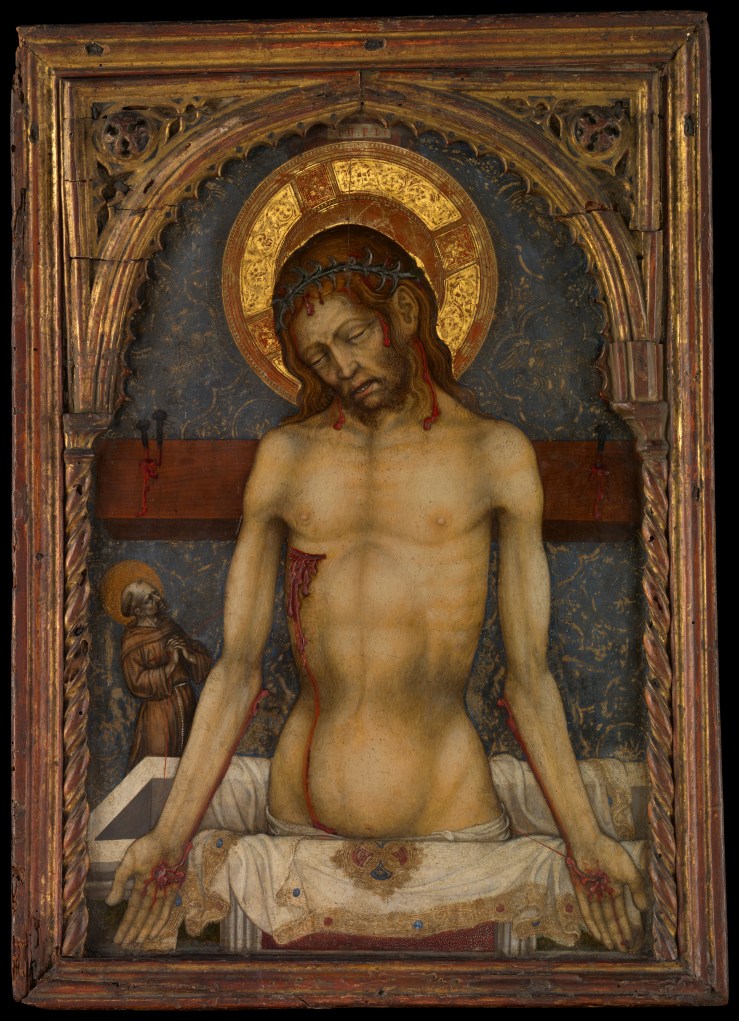
Michele Giambono (Italian, active 1420–1462), Man of Sorrows, ca. 1430. Tempera and gold on wood, 54.9 × 38.7 cm (21 5/8 × 15 1/4 in.). Metropolitan Museum of Art, New York.Dieric Bouts (Netherlandish, ca. 1415–1475), The Way to Paradise, 1469. Oil on panel, 115 × 69.5 cm (45 1/4 × 27 3/8 in.). Palais des Beaux-Arts, Lille, France.
David Hockney (British, 1937–), The Arrival of Spring in Woldgate, East Yorkshire in 2011 (twenty eleven), 2011. Oil on 32 canvases, 365.8 × 975.4 cm (each 91.4 × 121.9 cm); one of a 52-part work. Photo: Jonathan Wilkinson.
Psalm 119:1, three translations:
Blessed are the undefiled in the way, who walk in the law of the LORD. (KJV)
Joyful are people of integrity,
who follow the instructions of the LORD. (NLT)
You’re blessed when you stay on course,
walking steadily on the road revealed by GOD. (The Message)
+++
SONG: “Beati quorum via” (Blessed are those whose way) | Music by Charles Villiers Stanford, ca. 1892 | Performed by VOCES8, 2017
Stanford’s “Beati quorum via,” op. 38, no. 3, is a motet for mixed unaccompanied six-part choir, a setting of Psalm 119:1 in Latin: “Beati quorum via integra est, qui ambulant in lege Domini.” It is the last of Stanford’s Three Latin Motets, published in 1905—the other two being on the subjects of Christ’s ascension and the souls of the just at rest in heaven.
This post belongs to the weekly series Artful Devotion. If you can’t view the music player in your email or RSS reader, try opening the post in your browser.
To view all the Revised Common Lectionary scripture readings for Proper 26, cycle B, click here.
Tomorrow begins Allhallowtide, a three-day Christian festival in which the saints in heaven are remembered. Several friends of mine have lost loved ones this year—siblings, parents, uncles—and just this month my church said goodbye to one of its dear members who passed on. All Hallows’ Day, the central observance of the triduum, recognizes that a spiritual bond still exists between the departed saints and those on earth, whom Christ binds together in one communion. So let us honor this week the memory of those who have gone before us in faith, praising our great and gracious God who sanctifies his people—and who is preparing a family reunion like no other!
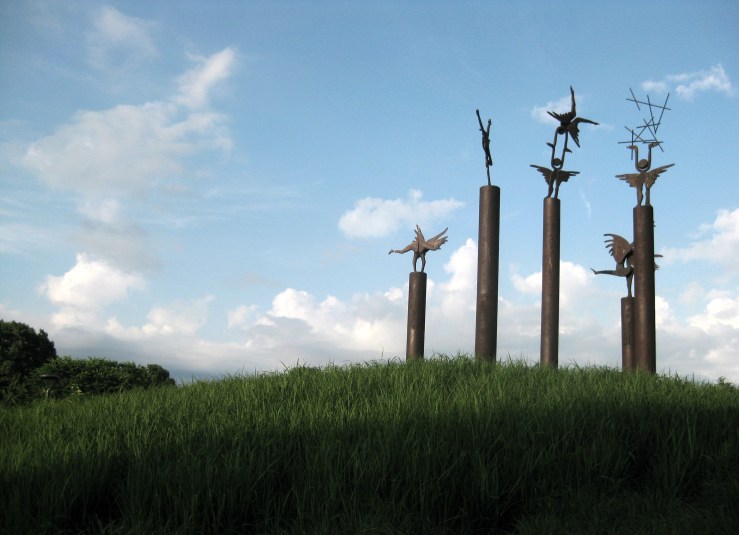
Joseph Kinnebrew (American, 1942–), Visitations: Gifts; A Slight Lapse of Purpose; Hand Stands; Yea; Majorette, 1994–97. Cast iron, 54 to 69 inches tall. Frederik Meijer Gardens and Sculpture Park, Grand Rapids, Michigan. Photo: Victoria Emily Jones.
. . . they seemed to have died, and their departure was thought to be an affliction, and their going from us to be their destruction; but they are at peace. . . . Their hope is full of immortality.
—Wisdom of Solomon 3:2–4
(Note: The Wisdom of Solomon, or the Book of Wisdom, is a deuterocanonical book, meaning it is part of the Septuagint but not the Hebrew canon and therefore is not recognized as canonical by Protestants. However, it still contains spiritual wisdom and, as Martin Luther believed, is “useful and good to read” alongside the inspired scriptures.)
+++
SONG: “Sky World” | Words and music by Theresa Bear Fox, 2015 | Performed by Teio Swathe (vocals) and Supaman (dance), 2017
“Sky World” was written in Mohawk and English by Theresa Bear Fox of the Akwesasne Mohawk Nation as a song of remembrance for those who have passed on. An abridged version was recently recorded by Teio Swathe and released as a music video with Apsáalooke hip-hop artist Supaman fancy-dancing (that’s actually the name of the style!) in White Sands, New Mexico. On October 12 the video won a Nammy Award.
Ha io ho we iaa
Ha na io ho we ia he
Io ha io ha io ho we ia
Ha na io ho we ia he
Ha io ha io ho we ia
Ha na io haioho we ia
Iooho we ia
We ha na io ho we ia he
Let’s put our minds together as one
And remember those who have passed on to the sky world
Their life duties are complete, they are living peacefully
In the sky world, in the sky world
Supaman lives on the Crow Nation reservation in south-central Montana. His own music fuses rapping with traditional Native American sounds and aims to inspire hope; he is best known for his “Prayer Loop Song,” which has over 2.3 million views on YouTube. In 2011 Supaman was interviewed on NPR’s All Things Considered, where he shared the story of his conversion to Christianity as an adult and the influence it has had on his life and work.
+++
This world is not conclusion;
A sequel stands beyond,
Invisible, as music,
But positive, as sound.
—Emily Dickinson
This post belongs to the weekly series Artful Devotion. If you can’t view the music player in your email or RSS reader, try opening the post in your browser.
To view all the Revised Common Lectionary scripture readings for All Saints’ Day, cycle B, click here.












 Art & Theology