Claude Monet (French, 1840–1926), The Sheltered Path, 1873. Oil on canvas, 54.1 × 65.7 cm (21 5/16 × 25 7/8 in.). Philadelphia Museum of Art. Photo: Victoria Emily Jones.
Your roads, God, let me know them.
Your pathways, help me recognize them from the rest.
Lead me down the way of your truth;
teach me its nature.
SONG: “Heaven’s Gate” by Dawn Landes and Piers Faccini, on Desert Songs (2016)
This post belongs to the weekly series Artful Devotion. If you can’t view the music player in your email or RSS reader, try opening the post in your browser.
To view all the Revised Common Lectionary scripture readings for Proper 21, cycle A, click here.
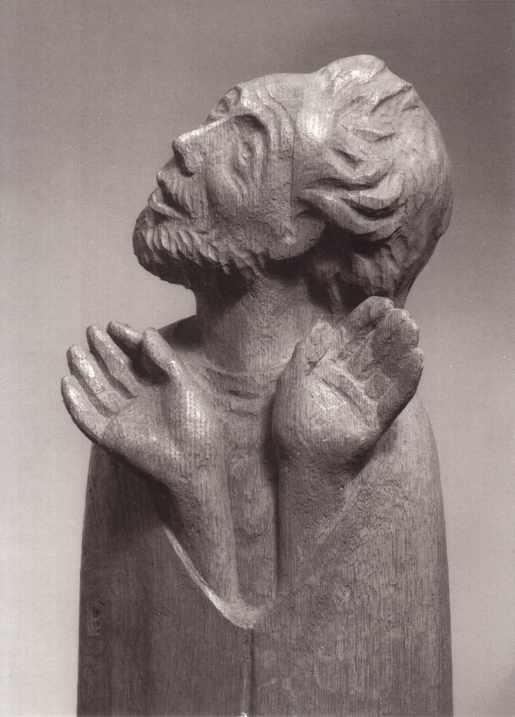
Ernst Barlach (German, 1870–1938), The Believer (detail),1934. Oak wood, 110 × 22 × 12 cm. Part of “The Frieze of the Listeners,” 1930–1935. Barlach Museum, Hamburg, Germany. Click on the image for commentary.
Seek the LORD and his strength;
seek his presence continually!
—Psalm 105:4
+++
SONG: “The Seeker” by Dolly Parton | Performed by the Lower Lights, on Old Time Religion (2016)
This post belongs to the weekly series Artful Devotion. If you can’t view the music player in your email or RSS reader, try opening the post in your browser.
To view all the Revised Common Lectionary scripture readings for Proper 20, cycle A, click here.
On September 12 my husband and I attended a reception at the Rosenberg Gallery at Goucher College in Baltimore County, where mixed media artist Stephen Towns discussed the work in his solo show A Migration. The twenty-three paintings curated by Laura Amussen continue Towns’s exploration of the African diaspora and related issues, including slavery, resistance, and the loss of ancestral roots. He wants to tell history, he said, and to make beautiful images.
At the opening for A Migration, artist Stephen Towns talked about his new series, “Sunken,” inspired by a trip to Ghana in May. Photo via the artist.
Towns is not a Christian (he said he is ambivalent about religion), but he draws extensively on Christian iconography, most notably the halo, which he uses to denote the sanctity of black life. When I met him Tuesday I told him I can’t help but read his work through a Christian lens, and he said that’s great, that he welcomes diverse and particularized readings.
Joy Cometh in the Morning
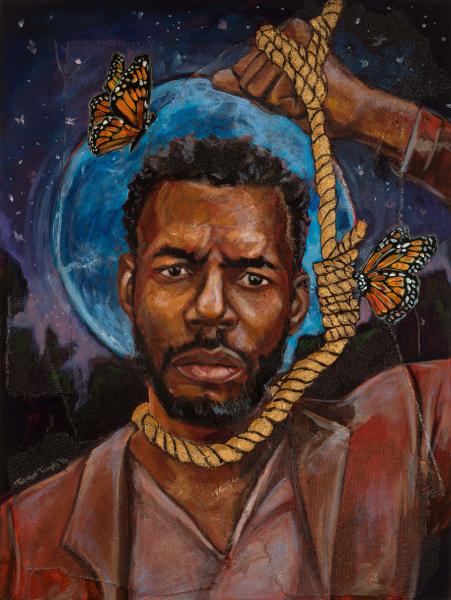
The most conspicuous wall in the exhibition space is the blank one where blue-tape outlines demarcate the spots where six paintings used to hang before a controversy led to their removal. From the series “Joy Cometh in the Morning,” these absent works are head-and-shoulder portraits of unnamed participants in the 1831 slave rebellion in Southampton County, Virginia, led by Nat Turner, who was inspired by his reading of scripture and his discernment of God’s voice. Each figure is noosed around the neck, harking to the method of their execution, but clenches the rope in a raised fist, staring straight ahead at the viewer with a look of defiance. While shadows of violence flare behind them, a butterfly alights on the knot of each rope, and a silent blue moon forms a halo around the subjects’ heads.
Stephen Towns (American, 1980–), What Profit Is There in My Blood?, 2016. Acrylic, oil, metal leaf, Bristol board, canvas, and paper on panel, 24 × 18 in. Photo via the artist.
Just prior to the show’s opening, an African American employee at the gallery complained that these paintings made her work environment feel abusive and uncomfortable. Out of sensitivity, Towns decided to take down the paintings and instead present photos of them in a binder for optional viewing. An artist’s statement is displayed next to the empty frames, which says, in part,
The original intent of the work was to honor the countless black men and women that fought against slavery, with the knowledge that their very fight may end their lives. . . . Though I am saddened to see the work go, I value Goucher’s Black employees’ concern. The intent of my work is to examine the breadth and complexity of American history, both good and bad. It is not to fetishize Black pain, nor to diminish it.
The overwhelming response to this action among viewers at Tuesday’s reception was frustration: commending Towns’s empathy but questioning whether self-censorship was the right way to go. Both white and black attendees spoke about how one of the powers of art is precisely to make us uncomfortable. Art awakens us to reality, even if that reality is painful. Removing offensive work prevents people from having meaningful encounters with it. Towns expressed his mixed feelings about not wanting to trigger trauma but also wanting to shine a light on hard truths. He said he was intentional about not making the images graphic.
To paraphrase his comments, his aim is to comfort the afflicted and afflict the comfortable—and when his work has the reverse effect of afflicting the afflicted, he feels guilty. Continue reading ““Stephen Towns: A Migration” exhibit”→
Sadao Watanabe (Japanese, 1913–1996), Egyptians Drowning in the Red Sea, 1977. Hand-dyed kappazuri stencil print on momigami paper, 21 1/8 × 17 3/4 in. From the Bowden Collections.
Exodus 14:19–31:
Then the angel of God who was going before the host of Israel moved and went behind them, and the pillar of cloud moved from before them and stood behind them, coming between the host of Egypt and the host of Israel. And there was the cloud and the darkness. And it lit up the night without one coming near the other all night.
Then Moses stretched out his hand over the sea, and the LORD drove the sea back by a strong east wind all night and made the sea dry land, and the waters were divided. And the people of Israel went into the midst of the sea on dry ground, the waters being a wall to them on their right hand and on their left. The Egyptians pursued and went in after them into the midst of the sea, all Pharaoh’s horses, his chariots, and his horsemen. And in the morning watch the LORD in the pillar of fire and of cloud looked down on the Egyptian forces and threw the Egyptian forces into a panic, clogging their chariot wheels so that they drove heavily. And the Egyptians said, “Let us flee from before Israel, for the LORD fights for them against the Egyptians.”
Then the LORD said to Moses, “Stretch out your hand over the sea, that the water may come back upon the Egyptians, upon their chariots, and upon their horsemen.” So Moses stretched out his hand over the sea, and the sea returned to its normal course when the morning appeared. And as the Egyptians fled into it, the LORD threw the Egyptians into the midst of the sea. The waters returned and covered the chariots and the horsemen; of all the host of Pharaoh that had followed them into the sea, not one of them remained. But the people of Israel walked on dry ground through the sea, the waters being a wall to them on their right hand and on their left.
Thus the LORD saved Israel that day from the hand of the Egyptians, and Israel saw the Egyptians dead on the seashore. Israel saw the great power that the LORD used against the Egyptians, so the people feared the LORD, and they believed in the LORD and in his servant Moses.
The Crossing of the Red Sea is read by Christians as a picture of our passing safely through the waters of judgment led by Christ, the New Moses. The traditional English carol below, “Carol of the Exodus,” is arranged by Charles Wood.
Moses, sing unto Christ thy King, who hath won the victory
And hath laid low haughty Pharaoh underneath the deep Red Sea.
Yea, merry, merry, merry, merry, merry may we be, As bird upon the berry of the may or cherry tree, While as we stand with harp in hand On the shore of the Red, Red Sea.
God perforce overthrew the horse, rider, car, and axletree.
They sank as lead, and their men lie dead, dead as stone, so mote* it be!
His right hand and his wonderwand did divide at his decree
The surging wave, and thereby did save us and ours from slavery.
Thou didst blow and entomb our foe in the bottom of the sea.
And if dry-shod we went o’er, O God, be ascribed the praise to thee!
* That is, must (obsolete).
This post belongs to the weekly series Artful Devotion. If you can’t view the music player in your email or RSS reader, try opening the post in your browser.
To view all the Revised Common Lectionary scripture readings for Proper 19, cycle A, click here.
Olena Smaha (Ukrainian, 1982–), Elevation of the Cross, 2008. Acrylic on canvas, 120 × 60 cm.
On September 14 the Orthodox Church celebrates the Elevation of the Holy Cross, one of the Twelve Great Feasts of its liturgical year, and Protestants who follow the Revised Common Lectionary will be reading from scripture the episode of the bronze serpent being lifted up in the wilderness, a prefiguration of Christ’s being raised on the cross. This passage plus a few other related ones are given below. (To view all five Holy Cross readings from the Revised Common Lectionary, click here.)
Numbers 21:4–9: From Mount Hor they set out by the way to the Red Sea, to go around the land of Edom. And the people became impatient on the way. And the people spoke against God and against Moses, “Why have you brought us up out of Egypt to die in the wilderness? For there is no food and no water, and we loathe this worthless food.” Then the LORD sent fiery serpents among the people, and they bit the people, so that many people of Israel died. And the people came to Moses and said, “We have sinned, for we have spoken against the Lord and against you. Pray to the LORD, that he take away the serpents from us.” So Moses prayed for the people. And the LORD said to Moses, “Make a fiery serpent and set it on a pole, and everyone who is bitten, when he sees it, shall live.” So Moses made a bronze serpent and set it on a pole. And if a serpent bit anyone, he would look at the bronze serpent and live.
Isaiah 52:13:
[For thus says the LORD God:]
“Behold, my servant shall act wisely;
he shall be high and lifted up,
and shall be exalted.”
John 3:14–15(The Message): “In the same way that Moses lifted the serpent in the desert so people could have something to see and then believe, it is necessary for the Son of Man to be lifted up—and everyone who looks up to him, trusting and expectant, will gain a real, eternal life.”
John 12:32: [Jesus answered,] “And I, when I am lifted up from the earth, will draw all people to myself.”
+++
SONG: “Lift Him Up (How to Reach the Masses)” | Words by Johnson Oatman Jr. (1856–1922) | Music by Benjamin Burke (B. B.) Beall (1874–1945) | African American Heritage Hymnal #547
+++
Life is wasted if we do not grasp the glory of the cross, cherish it for the treasure that it is, and cleave to it as the highest price of every pleasure and the deepest comfort in every pain. What was once foolishness to us—a crucified God—must become our wisdom and our power and our only boast in this world.
—John Piper, Don’t Waste Your Life (2003)
This post belongs to the weekly series Artful Devotion. If you can’t view the music player in your email or RSS reader, try opening the post in your browser.
To view all the Revised Common Lectionary scripture readings for the Feast of the Cross, cycle A, click here.
NEW ALBUM:Makes the Heart to Sing: Jazz Hymns: Last month award-winning composer Deanna Witkowski released an album of fourteen new jazz hymn arrangements for instrumental trio (piano, bass, drums). Injecting an element of surprise—such as changed harmonies and/or rhythms—into the church’s well-worn repertoire of hymn tunes helps people reengage with them in a fresh way, she says. It defamiliarizes. In addition to making the CD available for purchase, Witkowski is offering fully notated sheet music for piano, with the hope that church music directors will consider planning a jazz service for their congregation. (All arrangements are fit for congregational singing.) Hear more about the motivation behind the album, plus track samples, in the video below.
+++
SYMPOSIUM: “In Glass Thy Story,”September 8–9, Robinson College, Cambridge, UK: This weekend Art and Christianity Enquiry (ACE) is holding a two-day symposium that will cover over seventy years of innovation and iconography in the glass art of European churches and cathedrals. The event will seek to draw out the challenges, possibilities, and purpose of stained glass—that is, what it means theologically, and how it relates to the liturgy. Speakers include Martin Crampin, Frances Spalding, Jasmine Allen, Caroline Swash, Jonathan Koestlé-Cate, Deborah Lewer, and Fanny Drugeon. Click here for the schedule and here to register (it costs £120, with discounted options).
John Piper (British, 1903–1992), Light of the World, 1980. Stained glass. Robinson College Chapel, University of Cambridge.
+++
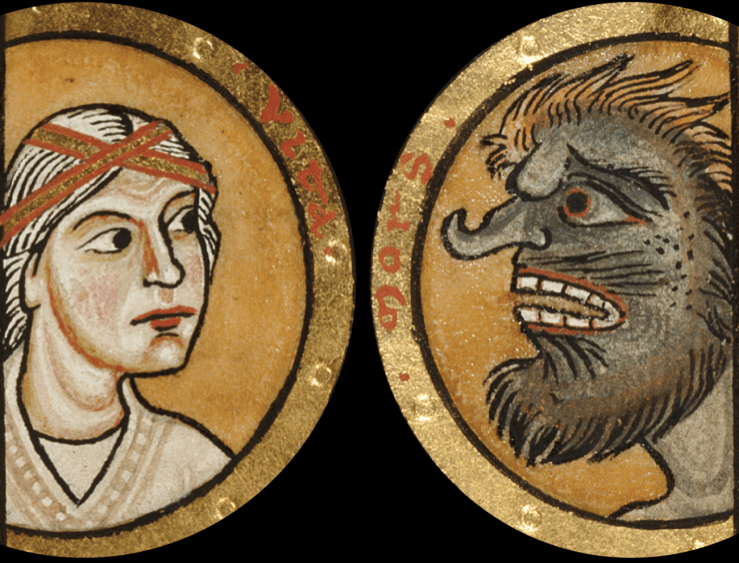
EXHIBITION-IN-PROGRESS: “Dialogue: Exposing the Rhetoric of Exclusion through Medieval Manuscripts”: Getty Museum curators are soliciting advance feedback for a January 2018 exhibition that will address the persistence of prejudice as seen through lingering stereotypes from the Middle Ages. (Input on wording and on points of view to consider, for example, is welcome and is already flowing in through comment threads.) As a museum, the Getty acknowledges and takes seriously its role as a repository of history and memory, knowing full well that its manuscripts collection, which consists primarily of medieval luxury art objects from western Europe, is full of caricature and erasure of “out groups,” such as Jews and Muslims, the poor, those perceived as sexual or gender deviants, and non-Europeans. This presents challenges when trying to connect with a multicultural and increasingly international audience. Click here to read a working description of the exhibition and, if desired, provide critique.
Anti-semitic representation from the Stammheim Missal, made in Germany, 1170s. Ms. 64 (97.MG.21), fol. 86 (details), J. Paul Getty Museum, Los Angeles.
White supremacists explicitly celebrate Europe in the Middle Ages because they imagine that it was a pure, white, Christian place organized wholesomely around military resistance to outside, non-white, non-Christian forces. Marchers in Charlottesville held symbols of the medieval Holy Roman Empire and of the Knights Templar. . . . Someone sprayed “saracen go home” and “deus vult”—a Latin phrase meaning “God wills it” and associated with the history of the Crusades—on a Scottish mosque. . . .
Thankfully there have been robust efforts among medievalists as of late to show how the Middle Ages was actually a religiously, culturally, and ethnically diverse era (which our focus on western European Christian culture has partially disguised) and to learn from fields like critical race theory and ethnic studies how to better understand the ideologies and distributions of power that define the modern world.
+++
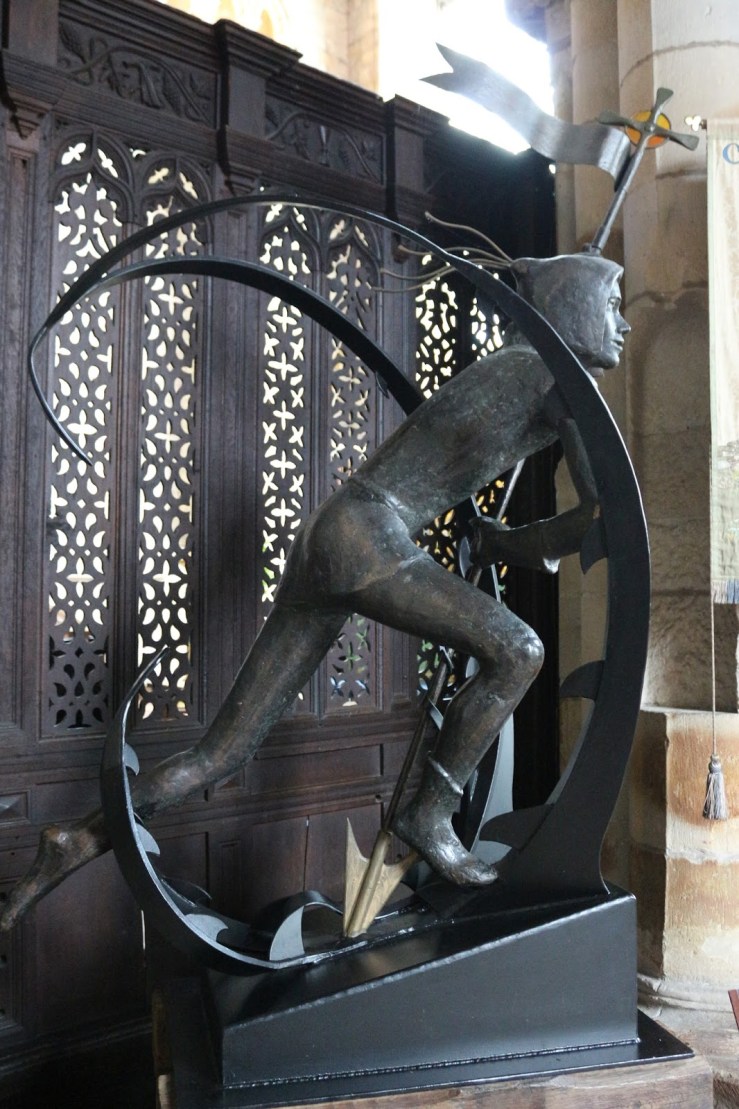
ARTIST SPOTLIGHT: Josefina de Vasconcellos: One of the bloggers I follow is Jonathan Evens, an Anglican priest and art critic who serves as secretary to commission4mission, an organization that encourages the commissioning and placing of contemporary art in churches as a means of fundraising for charities. He frequently undertakes “church art pilgrimages” throughout the UK, researching, photographing, and writing about his discoveries. His recent visit to Kendal Parish Church and Cartmel Priory has yielded a lovely piece on the twentieth-century British sculptor Josefina de Vasconcellos. Featured artworks include the Madonna and Child in a refugee camp, St. Michael the Archangel battling his way through the jaws of a dragon, a martyrs’ memorial, and a compositionally unique Rest on the Flight to Egypt. Click here to view additional photos and information about the artist.
Josefina de Vasconcellos (British, 1904–2005), The Family of Man. Fiberglass. South Aisle, Kendal Parish Church, Cumbria, England. Photo: Jonathan EvensJosefina de Vasconcellos (British, 1904–2005), Saint Michael the Archangel. Cartmel Priory, Cumbria, England. Photo: Jonathan Evens
+++
PLAYING FOR CHANGE DAY (September 23, 2017): “One World, One Voice”: The mission of the Playing for Change Foundation (PFCF) is to create positive change through music education. To that end the organization develops, funds, and supports music schools and programs that are operated by their local communities and then works to connect those communities around the world. Every week 1200-plus young people in Bangladesh, Brazil, Ghana, Mali, Nepal, Rwanda, South Africa, Thailand, Morocco, and Argentina attend free PFCF classes in dance, instruments, music theory, languages, and cultural heritage. PFCF’s community development and empowerment efforts also contribute to meeting essential needs like food, clean water, medicine, and more.
To raise funds to further its peace-building mission, PFCF has set an annual global day of music for September 23. Last year Playing for Change Day resulted in over two hundred events in forty-eight countries on six continents, and consequently more instruments and resources for all the schools. To host an event, attend an event, or donate to the cause, click here.
From 2004 to 2008 a small Playing for Change film crew traveled the world’s highways and byways, recording hundreds of musicians from dozens of countries independently playing a set list of songs; the performances, each with its own distinctive style and texture, were then intercut to create e pluribus unum (out of the many, one; or, unity in diversity)—one seamless video performance, an across-the-globe collaboration. All the videos are up on YouTube, but they’re so much fun to watch, I bought all three DVDs, Songs Around the World 1–3. My favorite track is probably “Down by the Riverside,” a celebration of heavenly harmony featuring Grandpa Elliott, the Preservation Hall Jazz Band, the Congolese Choir of Grace, and over a dozen other musicians. Indigenous instruments include the bombo (large bass drum) from Portugal, the pandeiro (hand drum) from Brazil, the tambura kontra (long-necked lute) and begesh (double bass) from Serbia, and the washboard and cigar box banjo from the United States.
O Lord, I have heard a good word inviting me to look away to Thee and be satisfied. My heart longs to respond, but sin has clouded my vision till I see Thee but dimly. Be pleased to cleanse me in Thine own precious blood, and make me inwardly pure, so that I may with unveiled eyes gaze upon Thee all the days of my earthly pilgrimage. Then shall I be prepared to behold Thee in full splendor in that day when Thou shalt appear to be glorified in Thy saints and admired in all them that believe. Amen.
—A. W. Tozer, The Pursuit of God
This post belongs to the weekly series Artful Devotion. If you can’t view the music player in your email or RSS reader, try opening the post in your browser.
To view all the Revised Common Lectionary scripture readings for Proper 18, cycle A, click here.
Shin Maeng (@shinhappens), And the Darkness Has Not Overcome Us, 2017. Acrylic. Watch Shin’s story here.
“Do not be overcome by evil, but overcome evil with good.” (Romans 12:21)
+++
SONG: “We Are Not Overcome” by Isaac Wardell and Robert Heiskell of Bifrost Arts, on He Will Not Cry Out (2013)
This post belongs to the weekly series Artful Devotion. If you can’t view the music player in your email or RSS reader, try opening the post in your browser.
To view all the Revised Common Lectionary scripture readings for Proper 17, cycle A, click here.
As a guard against Reformed hubris, Churches Together in England has issued a statement urging churches to mark the Reformation’s fifth centenary with sensitivity to other branches of the faith, providing 5 R’s as guidelines. Keep the anniversary, it says, with the spirit of
Rejoicing – because of the joy in the gospel which we share, and because what we have in common is greater than that which divides; and that God is patient with our divisions, that we are coming back together and can learn from each other.
Remembering – because all three streams of the Reformation have their witnesses and one church’s celebration could be another’s painful memory; and yet all believed they acted in the cause of the gospel of Jesus Christ for their time.
Reforming – because the Church needs always to grow closer to Christ, and therefore closer to all who proclaim him Lord, and it is by the mutual witness of faith that we will approach the unity for which Christ prayed for his followers.
Repenting – because the splintering of our unity led us to formulate stereotypes and prejudices about each other’s traditions which have too often diverted our attention from our calling as witnesses together to the mercy of God in proclamation and service to the world.
Reconciling – because the call to oneness in Christ begins from the perspective of unity not division, strengthening what is held in common, even though the differences are more easily seen and experienced.
This is not to say we can’t celebrate the achievements of the Reformation (we certainly should!), but we ought not to do so with denigration toward our Catholic brothers and sisters, nor hold our own branch above reproof. All church history, before and after the major splits, is our history as a body. Read the full CTE statement here. For other initiatives to foster common witness, service, and understanding between Protestants and Catholics, see the documents “Evangelicals and Catholics Together” (1994) and “Joint Declaration on the Doctrine of Justification” (1999).
+++
ECUMENICAL ARTS SYMPOSIUM
The last two weekends in October will cap off the international “Arts and Ecumenism” symposium organized by the Mount Tabor Ecumenical Centre for Art and Spirituality to commemorate the five hundredth anniversary of the Reformation. With events in Paris, Strasbourg, and Florence, the symposium is now coming to the US to continue the discussion on Catholic and Protestant approaches to art.
The penultimate session, “Sacred Arts in North American Contexts,” will take place October 20–21 at Yale University. “Arts in Celebration: The Word in Color, Action, Music, and Form,” the final session, will take place October 27–29 at the Community of Jesus in Orleans, Massachusetts, and will include demonstrations of mosaic, fresco, and Gregorian chant; lectures and panel discussions with Timothy Verdon, William Dyrness, Deborah Sokolove, and others; exhibits of contemporary sacred art by Susan S. Kanaga and Filippo Rossi (view the catalog); liturgies of the Divine Office and Holy Eucharist; an organ recital; and a fully staged presentation of Ralph Vaughan Williams’s opera The Pilgrim’s Progress, performed by the community’s critically acclaimed Gloriae Dei Cantores choir and Elements Theatre Company. Click here for the schedule.
I stayed at the Community of Jesus last week, and trust me, $425 is a great price for two days and nights at this beautiful Cape Cod monastery, with its Benedictine hospitality, and access to a high caliber of visual, musical, and dramatic art and prominent voices in the field of Christianity and the arts. But the best part, I think, will be the opportunity to inhabit the ecumenical vision the community has established, whereby all Christians—Catholic, Protestant, and Orthodox—live together, eat together, and worship together. Some community members have taken vows of celibacy, while others have chosen marriage and live with spouse and children on the compound. Partaking of the Eucharist last Friday with brothers and sisters from other streams of Christianity and multiple generations was an experience I will not soon forget. Be sure to take advantage of the early-bird registration discount, which ends September 1.
(Click here to take a virtual tour of the Community of Jesus’s Church of the Transfiguration.)
Church of the Transfiguration, Orleans, Massachusetts. Photo: Victoria Emily JonesVento (detail) by Filippo Rossi, from the exhibition “Spirito Creatore”
+++
PAST LECTURE:“Visual Ecumenism” by Matthew Milliner: Milliner is an evangelical Anglican who teaches art history (his specialization is Byzantine) at a Protestant liberal arts college in Illinois. In this talk given April 7, 2017, at the Wheaton Theology Conference “Come, Let Us Eat Together!,” he discusses how we can “put on” other Christian traditions without losing our own by engaging their artistic output, by opening ourselves up to the material expressions of the gospel present all across the denominational spectrum:
I’m taking a particularly cherished part of my tradition—the law/gospel distinction—and showing that it can be found in other traditions as well. This might seem like I’m colonizing other traditions with my Protestantism, but I’m actually trying to strip my own tradition of its exclusive possession of this message and see it elsewhere, so that evangelicals can be at home in late medieval Catholic devotional manuals or in Russian Orthodox cathedrals. (19:04)
In reverse chronological fashion, he examines Lucas Cranach’s Law and Grace (Protestant), Berthold Furtmeyr’s Tree of Life and Death (Catholic), and the Sinai Pantocrator icon (Orthodox). Michelangelo’s late drawings and tomb for Pope Julius II are discussed in light of his involvement in the Spirituali, a Catholic reform movement in Italy that emphasized intensive personal study of scripture and justification by faith. More personally, Milliner describes how he was able to make it through repeated Hail Marys during a Catholic prayer service he inadvertently stumbled into one time and, on another Marian note, shares the Madonna of Mercy mural created last year by a group of Protestant art students he co-taught in Orvieto, Italy, with Bruce Herman, showing how they honored this subject that originated outside their tradition while also bringing it in line with their theological convictions—which, they discovered, were corroborated by Vatican II. In an earlier essay on visual ecumenism, Milliner wrote,
Just as there is, according to our Bibles, ‘one Lord, one faith, one baptism,’ so perhaps there is also one variegated yet unified Christian aesthetic, to which the different traditions, at their utter best, ascend. Full maturity (which for evangelicals has been a long time coming!) is not to see with Protestant, Orthodox or Catholic eyes—but with the eyes of Christ.
Madonna of Mercy painting by the 2016 Gordon in Orvieto cohort
UPCOMING LECTURE: “An Evening with Ken Myers: Luther’s Artistic Legacy,” Saturday, September 9, 7:30 p.m., Wallace Presbyterian Church, College Park, Maryland: To kick off its second season, the Eliot Society has scheduled Mars Hill Audio founder Ken Myers to discuss Martin Luther’s contributions to Christian hymnody. “With the help of some local musicians, Myers will examine the artistic climate Luther helped to create, as well as some of the great composers of sacred music who followed after him. The lecture will argue that the pattern of Luther’s artistic engagement provides a model for contemporary efforts to reconnect faith and the arts.” Click on the link above to reserve your free ticket.
+++
FROM THE ARCHIVES: “An early Protestant painting (commissioned by Luther)”: On my previous blog I wrote a post about an altarpiece Martin Luther commissioned from his friend Lucas Cranach to promote Protestant theology. (It’s the same painting Milliner opens his above talk with.) Luther was more accepting of religious images than many of his fellow reformers, elucidating his position in his Invocavit Sermons (1522) and in the treatise Against the Heavenly Prophets in the Matter of Images and Sacraments (1525). I plan to feature vast swaths of these texts on Art & Theology in the near future.
Lucas Cranach the Elder (German, 1472–1553), Law and Grace, 1529. Tempera on linden wood, 82.2 × 118 cm. Castle Museum Schloss Freidenstein, Gotha, Germany.
Daniel Nevins (American, 1963–), Bloom Within. Oil on wood, 20 × 18 in.
Isaiah 51:3:
For the Lord will comfort Zion;
he will comfort all her waste places,
and will make her wilderness like Eden,
her desert like the garden of the LORD;
joy and gladness will be found in her,
thanksgiving and the voice of song.
“The Comforter” by Thomas Moore (1779–1852):
Oh! thou who dry’st the mourner’s tear,
How dark this world would be,
If, when deceived and wounded here,
We could not fly to thee!
The friends who in our sunshine live,
When winter comes are flown;
And he who has but tears to give,
Must weep those tears alone;
But thou wilt heal that broken heart,
Which, like the plants that throw
Their fragrance from the wounded part,
Breathes sweetness out of woe.
When joy no longer soothes or cheers,
And even the hope that threw
A moment’s sparkle o’er our tears,
Is dimm’d and vanish’d too;
Oh who would bear life’s stormy doom,
Did not thy wing of love
Come brightly wafting through the gloom,
Our peace-branch from above.
Then sorrow, touch’d by thee, grows bright
With more than rapture’s ray;
As darkness shows us worlds of light
We never saw by day.
+++
SONG: “The Sun Will Rise” by the Brilliance, on The Brilliance (2010)
This post belongs to the weekly series Artful Devotion. If you can’t view the music player in your email or RSS reader, try opening the post in your browser.
To view all the Revised Common Lectionary scripture readings for Proper 16, cycle A, click here.