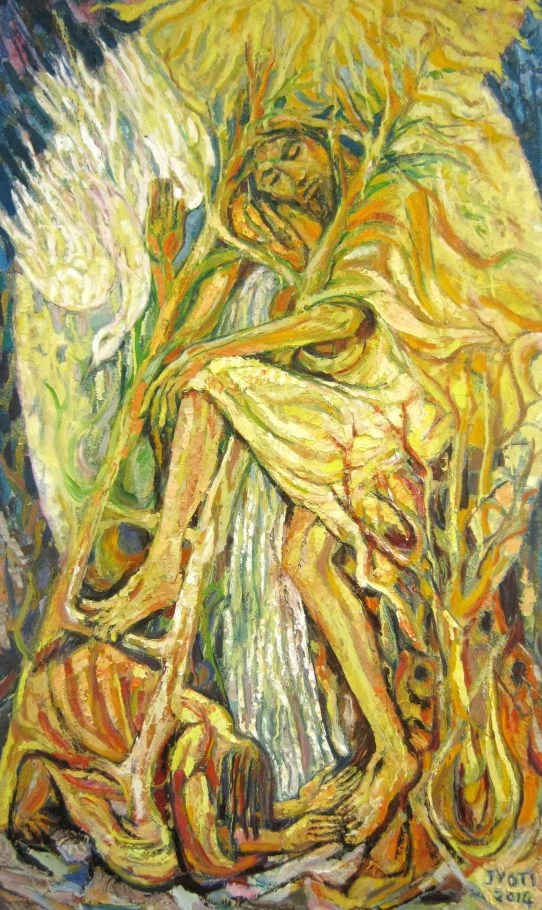
Jyoti Sahi (Indian, 1944–), Thy Kingdom Come. Oil on canvas.
When the heart is hard and parched up, come upon me with a shower of mercy.
When grace is lost from life, come with a burst of song.
When tumultuous work raises its din on all sides, shutting me out from beyond, come to me, my lord of silence, with thy peace and rest.
When my beggarly heart sits crouched, shut up in a corner, break open the door, my king, and come with the ceremony of a king.
When desire blinds the mind with delusion and dust, O thou holy one, thou wakeful one, come with thy light and thy thunder.
This untitled poem is no. 39 from the collection Gitanjali (Song Offerings) by Rabindranath Tagore. Originally written and published in Bengali in 1910, it was translated into English by Tagore himself in 1912, along with other poems of his from various sources, and published by the India Society of London with an introduction by W. B. Yeats. For this volume he was awarded the Nobel Prize in Literature—the first non-European to receive such a distinction.
Here the speaker entreats God to break into his life, bestowing divine gifts: mercy, like rainwater, to moisten his dry heart; grace, like a song, to lift his spirit; and peace and rest to counteract the overwhelm of daily work. He asks God to come like a king and lavish his riches on all us spiritually impoverished, and like thunder and lightning, to jolt us awake from our sin and delusion. Each line of the poem works by contrast: man in his neediness, and the need-meeting God.
Tagore’s poetry bears Hindu influence but has wide cross-religious appeal and has inspired numerous musical settings in his native India and abroad. The composition below (a setting of “When the heart is hard and parched up”) is by the famous Indian classical singer and composer Jagjit Singh.
In 2010 American composer Joan Szymko wrote A Burst of Song, a short three-movement choral cycle that sets three poems from the English Gitanjali. Movement 1, “A Shower of Mercy,” excerpts our familiar text. Listen to a performance below (the first movement goes through 1:56) by Portland University’s Man Choir and its female choir, Vox Femina:
BLESSING: “Blessing for Getting the News” by Jan L. Richardson: August brought two devastating pieces of news to me; I wasn’t in the line of direct impact, but I hurt for the two families who were. A blessing by artist-author Jan L. Richardson came at just the right time. Here’s an excerpt:
. . . when the news comes, may it be attended by every grace, including the ones you will not be able to see now.
When the news comes, may there be hands to enfold and bless, even when you cannot receive their blessing now.
When the news comes, may the humming in your head give way to song, even if it will be long and long before you can hear it,
before you can comprehend the love that latched onto you in the rending— the love that bound itself to you even as it began its leaving and has never let you go.
ESSAY: “Transfiguring Gold: Andy Warhol’s Gold Marilyn Monroe” by James Romaine: In his latest visual meditation for ArtWay, art historian James Romaine writes on external versus essential beauty, and the Orthodox aesthetic, in one of Warhol’s most famous paintings. “A revelation of uncreated and transfiguring light” in the icon tradition, the use of gold, Romaine posits, was a theological choice on Warhol’s part, one influenced by his Byzantine Catholic faith. Warhol drew on celebrity imagery to encourage a transformation in viewers from material sight to metaphysical vision. This essay is adapted from a more extensive one titled “The Transfiguration of the Soup Can,” published in Beauty and the Beautiful in Eastern Christian Culture and linked to here with the author’s permission.
Andy Warhol (American, 1928–1987), Gold Marilyn Monroe, 1962. Silkscreen ink on synthetic polymer paint on canvas, 211.4 × 144.7 cm. Museum of Modern Art, New York.
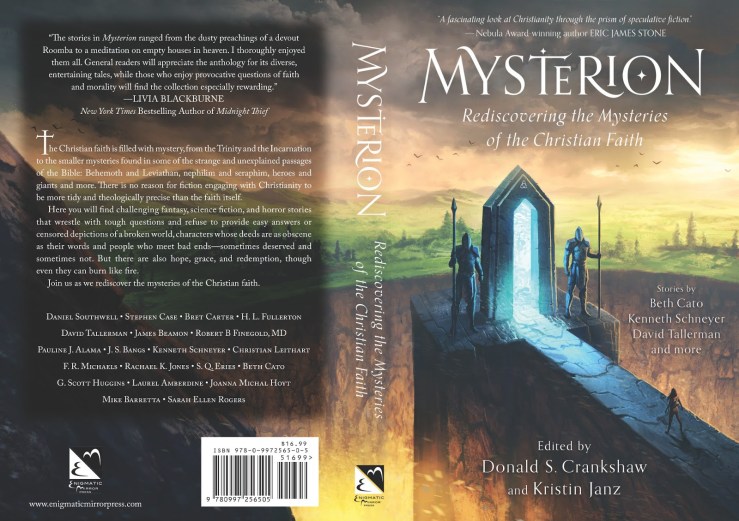
BOOK: Mysterion: Rediscovering the Mysteries of the Christian Faith, edited by Donald Crankshaw and Kristin Janz: Last week the husband and wife team of Donald Crankshaw and Kristin Janz published an anthology of science fiction, fantasy, and horror stories that engage with Christianity. It features twenty of the 450-plus submissions they received, all but four of which are published here for the first time. Describing their criteria for selection, Crankshaw writes in the introduction, “We wanted stories that were as untidy and as theologically imprecise as the Bible itself.” The result is a collection of diverse voices and approaches, exploring such topics as sin, forgiveness, the afterlife, the soul, mission, miracles, and supernatural agents. To read excerpts from the book, visit www.mysterionanthology.com.
Painting is about the world we live in. Black people live in the world. My choice is to include them. This is my way of saying yes to us.
—Kehinde Wiley
Last weekend I visited the Virginia Museum of Fine Arts, where the exhibition Kehinde Wiley: A New Republic is showing through September 5, a fifteen-year survey of Wiley’s art organized by the Brooklyn Museum. An academically trained artist, Wiley paints black and brown bodies in proud poses against ornate decorative backgrounds on monumental canvases, riffing on art-historical masterpieces from the Renaissance and Baroque eras. He “street casts” his models: walks through inner-city neighborhoods, inviting black males, ages eighteen to thirty-five, to sit for portraits. In this collaborative process, the model chooses a painting from a book and reenacts, in his streetwear, the pose of the painting’s figure.
In the exhibition catalog, Connie H. Choi, a research associate at the Brooklyn Museum, writes,
In inserting the urban black male figure into the art-historical canon, the artist brings the canon up to date and at the same time questions its centuries-long exclusion of such figures. His manner of portraying African American men is Wiley’s way of affirming their presence in a society that has long discounted or undervalued them. (24)
Cultural critic Touré describes Wiley’s oeuvre as an “attempt to rehabilitate black images”—in the media (especially before the presidency of Barack Obama), often simplistically skewed toward hip-hop music videos and news reports of urban gang violence—“by putting them in the context of nobility, of import, of beauty” (52).
Kings, nobles, and wealthy merchants are among the subjects depicted in Wiley’s source material. But biblical and extrabiblical saints, and Christ himself, are also present. For centuries religious imagery had a commanding presence in churches, palaces, homes, and government buildings, exercising sway over the imagination and steering popular devotion. By translating European devotional paintings—fashioned in the image of the white ruling class—into a contemporary idiom that places black bodies up front and center, Wiley rectifies the lack of representation of racial minorities in and as the body of Christ.
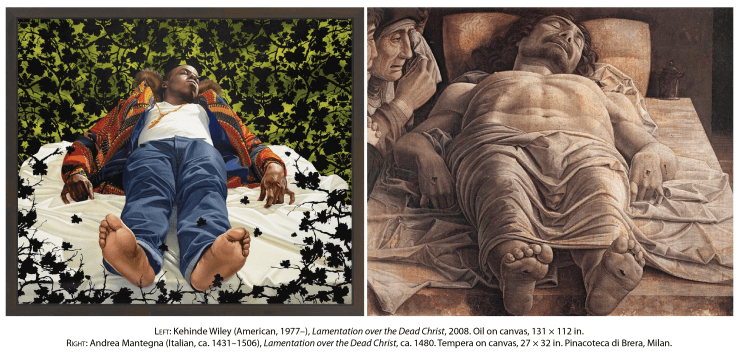
His Down series, which seeks to capture the majesty of fallen warriors and entombed saints, features three paintings of the dead Christ. Hans Holbein’s life-size predella panel on the subject was the starting point; showing Jesus’s putrefying corpse, it is regarded as one of the all-time most grotesque paintings of Jesus. In The Idiot, Dostoyevsky’s Prince Mishkin says that viewed in isolation from the Resurrection, the painting has the power to make one lose one’s Christian faith.
In Wiley’s reconceptualization, Jesus’s body is fit, his skin radiant. Gone are the blue face, puncture wounds, and emaciation of the prototype. Art critics have recognized in this and many more of Wiley’s paintings a homoeroticism, reading them in light of Wiley’s sexuality. That’s their prerogative, but in the direct gaze and parted lips of Wiley’s dead Christ I hear not “Come hither” but “Look, white America, at what you have done, at what you are doing.”
The Down series predates the Black Lives Matter movement but speaks powerfully into that context. It challenges the public—especially the white public—to see the rampant shooting deaths of unarmed black men by police and to name it what it is: an injustice, a tragedy.
For all their visual engagement with and meditation on the Passion, Christians at large have proven deficient in their willingness to mourn the suffering and death of black brothers and sisters. Maybe, just maybe, gazing on a dead black Christ could produce more empathy in us when we see news photos of black people whose lives have been taken from them. Maybe these paintings can lead us into lament. In Wiley’s Lamentation, for example, we’re invited to poke our heads into the void left by the excision of Mary and John and to wail and moan. (For more on racial tensions in America from a Christian perspective, I commend to you the lecture “The Heart Cry of #BlackLivesMatter” by Jemar Tisby, cofounder of the Reformed African American Network.)
John Berger—essayist, novelist, poet, screenwriter, art critic—loves to help people see what is around them, teach them how to look at the world. His life’s work is dedicated to this endeavor.
One of his most celebrated achievements is the BAFTA Award–winning Ways of Seeing, a four-episode television program written and presented by Berger and originally airing in 1972 on the BBC. “A British arts broadcasting landmark” and “a key moment in the democratisation of art education,” The Guardian calls it. The script was adapted the same year into a book, a collaboration among Berger, Mike Dibb (BBC producer/director), Richard Hollis (graphic designer), Chris Fox (consultant), and Sven Blomberg (artist). It’s still in print!
Berger’s super-conversational style and his bucking against tradition no doubt contribute to his appeal. In the first episode, he establishes his aim: to get people to cut the mumbo-jumbo that always rises up around art and instead approach art directly, much like children.
Here it is:
The episode points out the ways in which photographic technology has changed the way we look at art—it has made it more accessible, but it can also manipulate. When a painting is reproduced in a textbook, for example, details may be cut out to force your focus somewhere, or arranged to form a narrative, or compared with other works, and words surround the painting that will influence your reading of it. If presented on film, camera movement and music also play a part. Berger gives examples using, among others, Pieter Bruegel’s The Procession to Calvary [14:03]; Vincent Van Gogh’s Wheatfield with Crows [16:12]; and Francisco Goya’s The Third of May 1808 [18:28].
He says,
The camera, by making the work of art transmittable, has multiplied its possible meanings and destroyed its unique original meaning. Have works of art gained anything by this? They have lost and gained.
Paintings (especially sacred ones) used to be an integral part of the buildings for which they were designed, says Berger, but now they are often experienced outside that context, rendering their meanings ambiguous. Of paintings in churches, he says, “Everything around the image is part of its meaning. Its uniqueness is part of the uniqueness of the single place where it is. Everything around it confirms and consolidates its meaning” [05:20]. He briefly addresses icons, which I know some Orthodox believers are averse to having displayed in museums, where they cannot even be touched and thus lose part of the function for which they were created. Continue reading “John Berger on how to see”→
“Mormon painting of a black Eve draws fire, but not for the reasons you might think” by Peggy Fletcher Stack, Salt Lake Tribune: Early this year a new painting of a seminude black Eve by Mormon artist J. Kirk Richards went on display at Writ & Vision gallery in Provo, Utah. While many Mormons have expressed how captivated and inspired they are by it (and I should note, black figures are extremely rare in Mormon art), a few have insisted it’s wrong for a white man to depict a nude black woman because it conjures up collective memories of sexual brutality and enslavement. The article features some interesting perspectives by black Mormon feminists. In addition to raising important questions surrounding racial histories and representation, the painting, I’ve noticed, also illustrates a distinctly Mormon view of the Fall, which differs from the orthodox Christian view—a fact Richards alludes to in his March 14 gallery talk. View the painting.
+++
“A Conversation about Creativity and the Liturgical Calendar,” panel discussion presented by Brehm Center and Fuller Studio: Moderator Edwin M. Willmington, composer-in-residence at Fuller Theological Seminary, talks with an all-star trio of creatives and liturgists comprising David Gungor of The Brilliance [00:50], on authenticity in songwriting and introducing liturgical practices to the evangelical church he attended; Todd E. Johnson [10:40], on the history, purpose, and major observances of the church calendar; and Lauralee Farrer [26:18], on discovering the Canonical Hours in a New Mexico desert and later developing them into characters for a film project. Questions: [34:02] How has liturgy shaped you? [36:20] Advice for artists on how to bring the church year to bear in their art? [37:11] Have you found that lament is generally embraced or resisted? [39:41] Advice for worship leaders?
+++
“An Art Historical Perspective on the Baton Rouge Protest Photo that Went Viral” by An Xiao Mina and Ray Drainville, Hyperallergic: During a July 10 protest following the fatal killing of Alton Sterling, Reuters photographer Jonathan Bachman captured the moment of twenty-eight-year-old Ieshia L. Evans’s arrest. As heavily armored policemen pressed in, the other protestors dropped back, but Ieshia stood assuredly in the middle of the three-lane highway, prepared to be bound. This article lauds the strength of this image of confrontation by citing compositionally and thematically similar paintings, including Briton Riviere’s Daniel in the Lion’s Denand Giotto’s The Arrest of Christ, and other works of art.
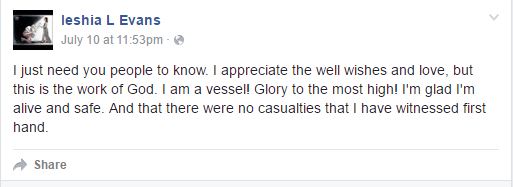
Ieshia considers herself a vessel of God, eager to be used by him to bring justice and peace. Here’s what she wrote on her Facebook wall the night of her release from jail:
+++
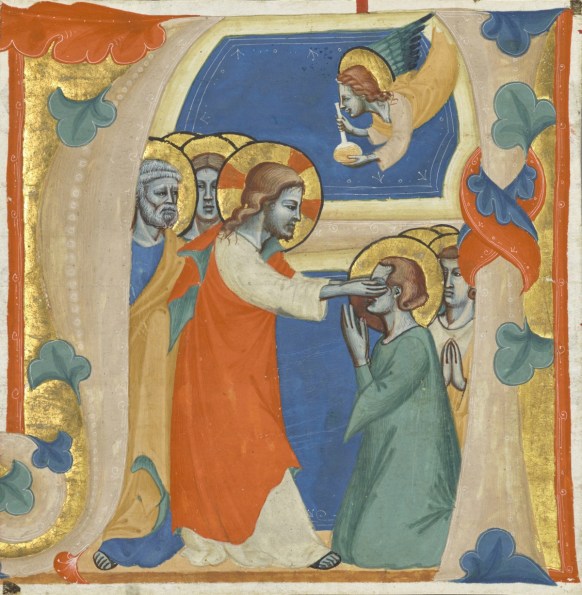
“Things Unseen: Vision, Belief, and Experience in Illuminated Manuscripts”: Running through September 25 at the Getty Center in Los Angeles, this exhibition “explores the visual challenges artists faced as they sought to render miraculous encounters with the divine, grand visions of the end of time, the intricacies of belief, and the intimate communications of prayer.” It includes a September 15 talk, “How Do We Depict Religious Experiences?”—that is, how do we convey metaphysical essence in physical form? I appreciated the Getty’s blog post this week featuring a newly acquired choir book leaf that’s part of the exhibition. Curator Bryan C. Keene writes about the difficulties of identifying the illuminator and about discovering, through an examination of the back and a search on the Cantus database, that the illumination depicts the wiping of tears from saints’ eyes, not, as previously assumed, the healing of the blind.
Initial A: Christ Wiping the Tears from the Eyes of the Saved, attributed to the Master of the Antiphonary of San Giovanni Fuorcivitas, ca. 1345–50. Tempera and gold leaf on parchment, 5 1/3 × 5 1/3 in. (13.5 × 13.5 cm). The J. Paul Getty Museum, Ms. 113, recto. Digital image courtesy of the Getty’s Open Content Program.
+++
“Ya Hey” song cover by The Brilliance: Written by Ezra Koenig of Vampire Weekend, “Ya Hey” is a modern-day psalm that expresses frustration with God’s seeming unresponsiveness—to being spurned and being sought, to brokenness and suffering, to sin and struggle. The title is a play on the word Yahweh, the Hebrew name for God. The chorus references the burning bush of Exodus 3: “Through the fire and through the flames / You won’t even say your name / Only ‘I am that I am.’” The Brilliance’s acoustic cover of “Ya Hey” was released last month as a music video on YouTube featuring four New York City ballet dancers. It abandons the shrill vocoder and heavy percussion of the original song in favor of a softer, purer sound. Read the lyrics and an analysis at Sound: Interrupted.
Images shape our desires. As much as we like to think we’re immune to their influence, that we can encounter them without letting them tell us what is good or true or beautiful, they tend to work a subtle magic on us, especially after years of constant exposure.
I’m talking not just about advertisements and entertainment media, which perpetuate the myth that only one particular type of female body is attractive, and likewise one particular type of male body, and train us to desire that type for ourselves and for our partner.
I’m talking too about the seemingly innocuous images posted on social media. Studies have shown that regularly browsing Facebook, for example, can lead to depression, as users engage in social comparison that may cause them to resent both others’ lives as well as the image of themselves they feel they need to continuously maintain. A network member posts a photo of the just-because gift her amazing, so-thoughtful husband just bought her, and it makes you feel less loved. Another one posts a selfie taken from his scuba dive in Malta, and you wonder where all the adventure has gone in your life. A friend from high school posts a whole album of birthday photos of her two-year-old, and you are reminded of your ticking biological clock, or of her twenty-two-year-old in cap and gown, and you wish your kid had decided to go to college.
There’s nothing inherently wrong with images—creating or consuming. In fact, we need them. But we also need to beware of the propensity they have to plant themselves firmly in our minds and become idols. Whether it’s a perfume commercial on TV or an exotic dinner photo on Instagram, we need to break the power certain images have over us. Instead of allowing images to name us (“ugly,” “boring,” “unwanted,” “failure”), we must name them—denounce as false and unholy any image that claims ultimate authority in our lives, or that tries to redefine who we are against the definition scripture already gives us: we are Christ’s.
In his essay “The Desire of the Church,” published in The Community of the Word:Toward an Evangelical Ecclesiology (InterVarsity Press, 2005), Willie James Jennings discusses the distortion of sight and desire that is the result of the Fall. The tree of knowledge, he writes, was the first unholy icon in human history—an icon in the sense of being “a point of focus that facilitates desire and guides relationships” and “nurtures our seeing and knowing,” and unholy because to look on it was to begin the journey of disobedience. Gazing on the unholy icon of the tree, Adam and Eve saw themselves refracted through it, instead of gazing on God and seeing themselves reflected. By turning their gaze off God and fixating it on something lesser, they stopped seeing themselves, each other, and their Creator rightly.
“The only way to reverse this journey of disobedience,” Jennings says, “is to establish a new point of focus.” So into humanity comes the holy icon—Jesus Christ—whose life overcomes the fracture and fragment of desire. As the image of the invisible God, he reorients our gaze back onto the holy. Continue reading “Disciplining our eyes with holy images”→
Bill Hemmerling (American, 1943–2009), Wrought by Prayer. Oil on canvas, 20 × 30 in.
“. . . More things are wrought by prayer
Than this world dreams of. Wherefore, let thy voice
Rise like a fountain for me night and day.
For what are men better than sheep or goats
That nourish a blind life within the brain,
If, knowing God, they lift not hands of prayer
Both for themselves and those who call them friend?
For so the whole round earth is every way
Bound by gold chains about the feet of God.”
—King Arthur to Sir Bedivere, in “The Passing of Arthur,” from the twelve-poem narrative cycle Idylls of the King by Alfred, Lord Tennyson
“Confess your faults one to another, and pray one for another, that ye may be healed. The effectual fervent prayer of a righteous man availeth much.”
—James, the brother of Jesus, in a letter to Jewish Christians outside Palestine
Jyoti Sahi is a prolific artist who founded an art ashram in Silvepura Village outside Bangalore in southern India. His paintings are infused with Christian spirituality, often depicting biblical narratives set on Indian soil.
Jyoti Sahi (Indian, 1944–), Lord as Ladder of Perfection, 2014. Oil on canvas.
Lord as Ladder of Perfection references Jacob’s dream from Genesis 28:10–22, wherein Jacob witnesses angels descending and ascending a cosmic ladder. This vision resurfaces in the New Testament, when heaven opens and angels are seen pressing in on the Son of Man (John 1:51), ministering to him in his passion and then heralding his resurrection.
By entwining Jesus in this ladder from Genesis, Sahi suggests that Jesus himself is our ladder—the One who connects earth to heaven, heaven to earth. By him, we can access God.
We are meant to identify with the figure in the bottom left corner of the painting, whose gender is deliberately ambiguous. In this figure you might see Jacob, or perhaps you see Mary Magdalene, who is often shown in art weeping at the foot of the cross and is traditionally understood to be the “sinful woman” who anoints Jesus’s feet with expensive perfume and tears in Luke 7:37–38. Either way, we are invited into the painting by this bent body, invited to worship Christ.
The cosmic implications of Jesus’s mediating role are suggested in a few ways. First, Jesus’s left leg is lifted in the pose of Nataraja (“Lord of the Dance”), an embodiment of the Hindu god Shiva. Nataraja’s dance destroys all obstacles on the path to liberation and prepares the universe for renewal, and here Jesus is grafted into that iconography. He dances, and the world is transformed.
Moreover, the four elements are present: earth, wind, fire, water. Earth forms the base of the painting, where the ladder, treelike, is rooted. Wind sweeps down in the form of a hamsa, a mythical swan-like bird, here signifying the Holy Spirit. Fire burns at the bottom right, a biblical symbol for cleansing and refining, and appears to be setting aflame a bush, a reminder for us to be attentive to God’s call, as Moses was. Straight down the center, water bursts forth from Christ’s side wound, a river of life that washes over the worshipper.
At the top, the ladder branches out and flowers.
Painted in 2014, Lord as Ladder of Perfection reminds me of the traditional hymn “Jacob’s Vision,” which likewise identifies the ladder of Jacob’s dream with the crucified Christ. I wrote about the hymn here—in particular, the beautiful cello-accompanied rendition sung by Ralph Stanley, who passed away on Thursday. I enjoy listening to it while I gaze at Sahi’s painting, as the two interpret each other.
The feast day of John the Baptist’s birth is coming up on June 24, and London’s National Gallery has provided a great way to immerse yourself in his story—through art! The museum has produced a ten-video series called Saint John the Baptist: From Birth to Beheading, in which Professor Ben Quash, director of the Centre for Arts and the Sacred at King’s College, joins Dr. Jennifer Sliwka, curator of art and religion at the National Gallery, for a stroll through the museum and some nearby sites to discuss various works of art in which John appears.
investigate how Christian scripture, beliefs and practices have found expression in art over 2,000 years; trace the idea of beauty in Western theological tradition; make use of examples in London. . . . The MA will enable students to work across disciplinary and specialism boundaries, and in particular to explore simultaneously the art-historical and theological dimensions of Christian art – approaches which are generally pursued in isolation from one another.
Their analysis of the paintings in this video series is superaccessible to those with no art background, and familiarity with Christianity isn’t assumed either.
The ten videos—about eight minutes each—are embedded below.
Friday, June 17, marks the one-year anniversary of the racially motivated mass shooting at Emanuel African Methodist Episcopal Church in Charleston, South Carolina, where nine members were killed by gunman Dylann Roof at a midweek service: Sharonda Coleman-Singleton, Cynthia Marie Graham Hurd, Susie Jackson, Ethel Lee Lance, Depayne Middleton-Doctor, Clementa C. Pinckney, Tywanza Sanders, Daniel Simmons, and Myra Thompson.
In response to the tragic event, Alabama artist Liz Landgren painted A Bridge Over Troubled Water, which shows the nine victims ascending, winged and haloed, from the troubled waters of this world.
Liz Landgren (American, 1974–), A Bridge Over Troubled Water, 2015. Acrylic on wood panel, 36 × 36 in.
Landgren says her visualization was inspired by Aretha Franklin’s 1971 cover of the Simon and Garfunkel song “Bridge Over Troubled Water”:
The original song premiered on November 30, 1969, on the CBS documentary feature Songs of America. Here, as in Landgren’s painting, it was connected with death, being played over footage from the funerals of John F. Kennedy, Robert Kennedy, and Martin Luther King Jr.
Paul Simon, who wrote the song, says his idea for it came from a line that Claude Jeter extemporized in the Swan Silvertones’ 1958 recording of the African American spiritual “Oh Mary Don’t You Weep”: “I’ll be your bridge over deep water if you trust in my name.” The speaker is Jesus; the context, his raising of Lazarus (see John 11:32–33). So whereas “Bridge Over Troubled Water” is often transmitted today as a message from one friend to another, its source material actually identifies that friend as Jesus, the one who lays himself down so that we can cross over pain without drowning in it.
Because of the religious significance of the song, Simon sought to give it a gospel feel. For this task he enlisted the help of Larry Knechtel, who arranged the song for piano (Simon had written it on guitar), styling it after church hymns. Knechtel’s piano playing is one of the song’s most distinguishing characteristics.
So back to Landgren’s painting. The waters of suffering roll off the figures’ garments, a heaviness they no longer bear, as they “sail on by” to be with their Lord. Saints on earth, they now pass into the extended communion of saints in heaven, leaving behind a world that’s roiling with violence and hate, anger and grief.
We lament the deaths of the Charleston Nine. We lament the laws that make it easier to kill. We lament the dividedness of our country. But we celebrate the witness of Sharonda, Cynthia, Susie, Ethel, Depayne, Clementa, Tywanza, Daniel, and Myra, whose Christian hospitality toward a white stranger cost them their lives.
The painting brings to my mind another song: “All God’s chillun [children] got wings . . . a robe . . . a crown . . . a song,” and when we get to heaven we’re gonna put them on.
Praise be to God, who raises us up—from death and from woe.