Whenever I meet new people and they ask what I do, I always tell them I’m a writer on Christianity and the arts. The follow-up question is often, “Oh, are you an artist?,” to which I respond with something like “No, but I love to study art, and I want to make Christians aware of the church’s rich artistic heritage.”
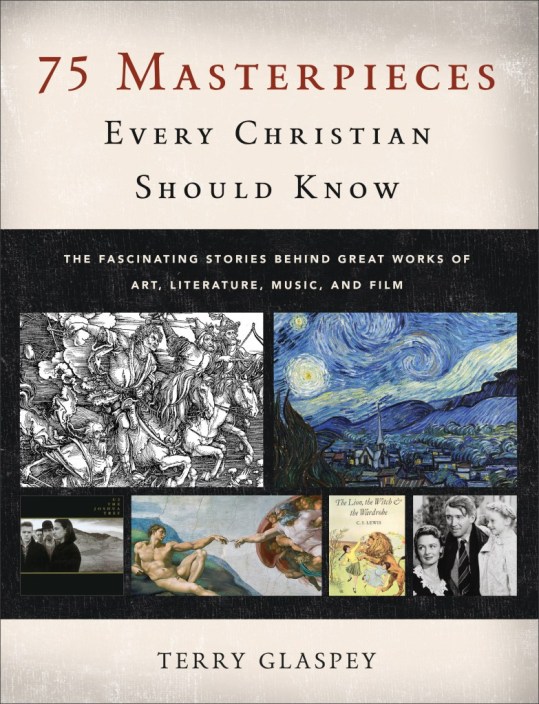
In this full-color survey, Glaspey—curator and tour guide—invites us to be “inspired, entertained, and challenged” as we encounter artists’ material witness to their faith through the ages. An Eastern Orthodox icon, a Renaissance altarpiece, a metaphysical poetry collection, a jazz suite, a rock album, children’s fantasy stories, an Italian neorealist film, a radio drama, and contemporary nihonga are just some of the many creative works featured. Organized chronologically from the Roman catacomb paintings to Terrence Malick’s TheTree of Life, the book encompasses almost all the major artistic disciplines (dance is conspicuously absent) and a variety of styles and eras, with a focus on Western art. (Sadao Watanabe’s Last Supper stencil print, Japanese American artist Makoto Fujimura’s illuminated Gospels project, and a few works from Russia are the only exceptions.) I’m impressed by how fluent Glaspey is in each area. He can speak just as easily about silent film as he can about Gothic architecture and contemporary folk art!
The author says his selection process was guided by these criteria:
works that are universally esteemed for their craftsmanship and creativity, admired not only by Christians but also by those outside the faith
works that stand up well to repeated exposure, the kind of art that can be visited again and again, because there is always something new to discover
works that speak to people across time, cultures, national boundaries, and denominational divides
Preempting readers’ tendencies to object to certain omissions, Glaspey adds,
This is most emphatically not a list of the absolute best or greatest works, nor does it imply any ranking system. Instead, it attempts to represent the breadth and depth of what Christians have accomplished in the arts, and is an intentionally quirky mix of the widely known and the mostly unknown.
Each of the seventy-five entries contains not only discussion of the content, formal qualities, and historical context of the highlighted work but also an overview of the artist’s oeuvre and a mini spiritual biography. These are not generic glosses or rote info dumps. On the contrary, Glaspey devotes individualized care to each one in the space of about four pages, giving us both concision and substance. He likens his offerings to movie trailers: they are meant to give you a sense of the artwork’s flavor and entice you to explore it more fully on your own.
Ceiling detail of La Sagrada Familia Cathedral in Barcelona, designed by Antoni Gaudí, begun 1882
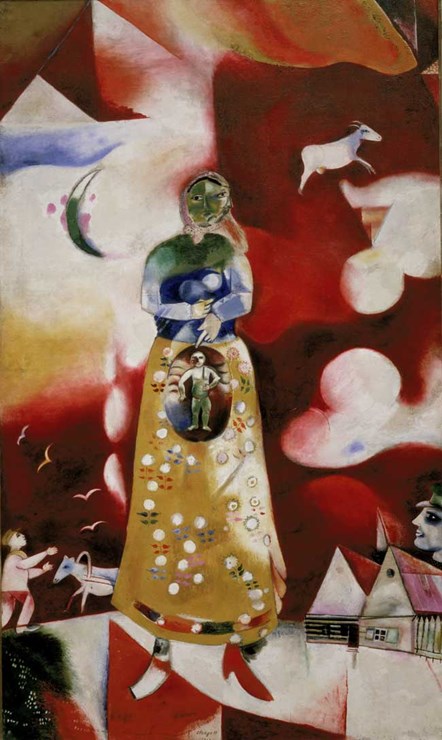
“ART OF ADVENT” SERMON: In his chapel address last December at Wheaton College, assistant professor of art history Matthew Milliner opened with a marriage analogy: If you love your spouse, you’ve got to love their parents. Do we love Mary and Joseph? Have we even met them? “Before the swaddled baby comes the swollen belly,” Milliner reminds us. He helps us dwell in those nine months before Christ’s birth, showing examples of the Virgin of the Sign icon (“ultrasound Jesus”) and Marc Chagall’s modern interpretation of it; these images are good for “target practice,” he says: for focusing our primary affections on Christ. He also shares how Mariko Mori’s video piece Miko No Inori (The Shaman-Girl’s Prayer) reminds him of a Visitation sculpture group by a fourteenth-century German artist, who inset Mary and Elizabeth’s bellies with a gem. Advent is a season of pregnancy, in which we are called to bear Christ within us. Not only that, it’s about “the pregnancy of a groaning planet,” waiting for deliverance from suffering. This address was given a few weeks after the death of Wheaton English professor Brett Foster, and Milliner notes how putting Brett’s body in the ground was an Advent act, in that we wait for it to rise.
Marc Chagall (Russian/French, 1887–1985), The Pregnant Woman, 1913. Oil on canvas. Stedelijk Museum Amsterdam.
+++
CHRISTMAS EXTRAVAGANZA TOUR + MUSIC DOWNLOAD: The Oh Hellos—folk rock sibling duo Maggie and Tyler Heath (and my husband Eric’s favorite band)—are hitting up eight US cities on their Christmas Extravaganza Tour this month, each show “an evening of Christmas music, carols, originals, bad jokes, sing-alongs, dancing, revelry, and all the holiday cheer you can squeeze into one room!” Sure to be featured are the four “movements” from theirFamily Christmas Album, which blend carol excerpts: “O Come, O Come, Emmanuel” with “The Coventry Carol”; “While Shepherds Watched Their Flocks by Night” with “O Come, All Ye Faithful”; “Silent Night”; and “Joy to the World” with “I Saw Three Ships.” I’ve embedded the first one in the player below. They’re offering this Christmas album for free download at NoiseTrade (tips appreciated), or if you want a physical disc, you can purchase it from Bandcamp.
+++
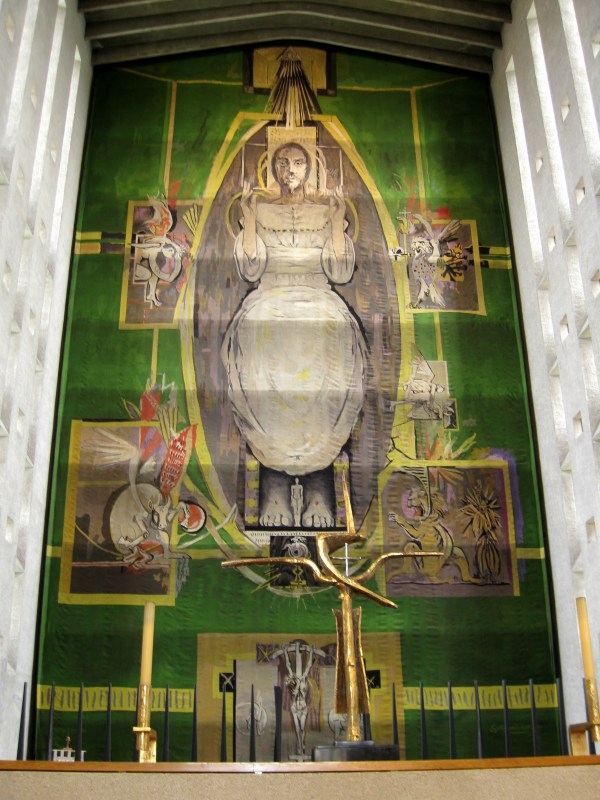
VISUAL MEDITATION: My latest visual meditation for ArtWay is on the gigantic Christ in Glory tapestry by Graham Sutherland that hangs behind the altar of Coventry Cathedral—one of many modern church art commissions in England necessitated by World War II bomb damage. Visiting the cathedral in 2013 was one of the most spiritually rich experiences I’ve ever had, and I plan to share it on this blog sometime in the future. Such a variety of artists were involved in the interior decoration program, and somehow it all comes together, collectively testifying to the power of resurrection. Sutherland wrote of his aspirations for the Christ figure: “The figure must look real—in the sense that it is not a rehash of the past. It must look vital; non sentimental, non-ecclesiastical; of the moment: yet for all time.” I’m taken by the final result, but an elderly gentleman who observed me staring at it for a while approached me and told me how much he hates it, how he thinks the eyes look unkind. (The man has lived in Coventry his whole life and remembers worshiping in the original cathedral before the war.) What do you think?
Christ in Glory in the Tetramorph. Tapestry designed by Graham Sutherland (British, 1903–1980) and woven by Pinton Frères in France, 1962. Dimensions: 75 × 38 ft. Location: Coventry Cathedral, Coventry, UK.
+++
FILM COLUMN: This fall I’ve really been enjoying film critic Jeffrey Overstreet’s new Christianity Today column, “Viewer Discussion Advised,” designed to help Christians explore and discuss a broad range of films. His kickoff article on the Malian-set drama Timbuktu, which is about the city’s occupation by Muslim extremists, highlights how the film “bears artistic witness to the sufferings of our neighbors.” (Quoting Frederick Buechner: “If we are to love our neighbors, before doing anything else we must see our neighbors.”) “Christians can choose to dwell on—and invest in—movies that show us what we already like, tell us what we already know, assure us of our own salvation, and make us feel happily entertained. That isn’t wrong.But might we make better use of our time? Might we exercise courage and conscience, step outside of our comfort zones, attend to our neighbors, and learn from their experiences?”
MUSIC VIDEO: My friendNabil Ince is a third-year music major at Covenant College who writes and produces music under the rap name Seaux Chill. After an internship this summer he became assistant program director for the New City Fellowship–based nonprofit East Lake Expression Engine in Chattanooga, Tennessee, whose mission is to provide children in the East Lake neighborhood with a free music education in a gospel-centered environment. Inspired by the El Sistema movement, the organization believes that music is an effective avenue for developing children’s creativity and problem-solving skills and for building up a strong community. They provide year-round classes on music history, theory, composition, and performance, including choir, bucket band, and orchestra. Below is the music video for “It Always Rains on Tuesdays,” a song Nabil wrote for the kids. The refrain is “Feed the plants / Clean all the cars / Fill the potholes / Tears from the stars.”
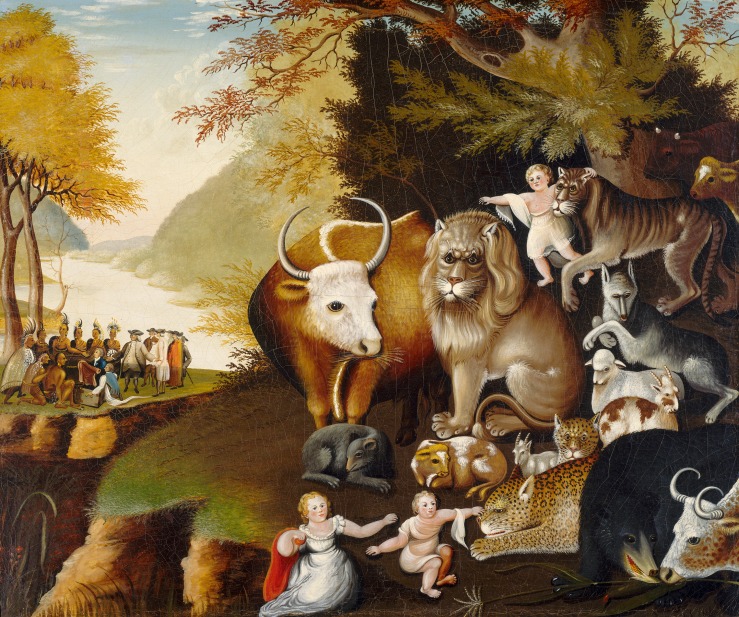
The wolf shall dwell with the lamb, and the leopard shall lie down with the young goat, and the calf and the lion and the fattened calf together; and a little child shall lead them. The cow and the bear shall graze; their young shall lie down together; and the lion shall eat straw like the ox. The nursing child shall play over the hole of the cobra, and the weaned child shall put his hand on the adder’s den. They shall not hurt or destroy in all my holy mountain; for the earth shall be full of the knowledge of the Lord as the waters cover the sea.
This passage describing the peaceable kingdom of the Messiah was, according to biblical scholar John F. A. Sawyer, popularized by the Quaker preacher-artist Edward Hicks, born in Bucks County, Pennsylvania, in 1780. He painted it sixty-two times during his career: predators and prey lying down together in harmony, and a little rosy-cheeked child—the Christ child—leading them.
Edward Hicks (American, 1780–1849), Peaceable Kingdom, 1834. Oil on canvas, 29 5/16 × 35 1/2 in. National Gallery of Art, Washington, DC.
When Edward was just eighteen months old, his mother died. His father was unable to support him financially, so he sent him to board with family friends David and Elizabeth Twining, who exposed him to Quakerism. From ages thirteen to twenty Edward lived with local coach maker William Tomlinson, for whom he worked as an apprentice, developing a talent for ornamental painting. When his apprenticeship ended in 1800, he went into business for himself, now painting with decorative motifs not only carriages but also signs, furniture, and household objects. Some of his signboard compositions would later prompt commissions for easel paintings.
During this time Edward was attending religious meetings with increasing regularity, becoming an official member of the Society of Friends in 1803. But he encountered criticism from many of his fellow Friends for his choice of vocation, which was at odds with the Quaker values of simplicity and utility. Painting is a worldly indulgence, they said. Taking their rebukes to heart, Edward gave up painting for a time and tried his hand at farming, but this venture was unsuccessful.
Edward struggled to reconcile his love of painting with his faith; he was passionate about both. In 1811, at age thirty-one, he set up a painting shop in Newtown, Pennsylvania, and also became a minister, which meant that he was often called away to other states to preach. Quaker ministers were not paid for their services, so it was necessary for Edward to maintain a source of income to support his wife and four (soon to be five) children.
“Of all the types of paintings Edward produced during his lifetime, none was repeated as often or with greater attention to change and refinement than the Kingdom pictures,” writes Carolyn J. Weekly in The Kingdoms of Edward Hicks, the catalog for the major exhibition she organized in 1999 for the Abby Aldrich Rockefeller Folk Art Museum in Williamsburg, Virginia. Edward pursued this subject not for commercial reasons (records suggest that he gave the Kingdom paintings as gifts to friends and family) but to express his yearning for unity and peace, especially in light of the 1827 Hicksite-Orthodox schism within the Society of Friends, the first in the denomination’s history. (Edward’s cousin Elias led the liberal faction that split from the mainstream.) His Kingdom paintings reference the schism through a blasted tree trunk, which doubles also as a reference to the “stump” of Jesse out of which Christ sprung up (Isaiah 11:1).
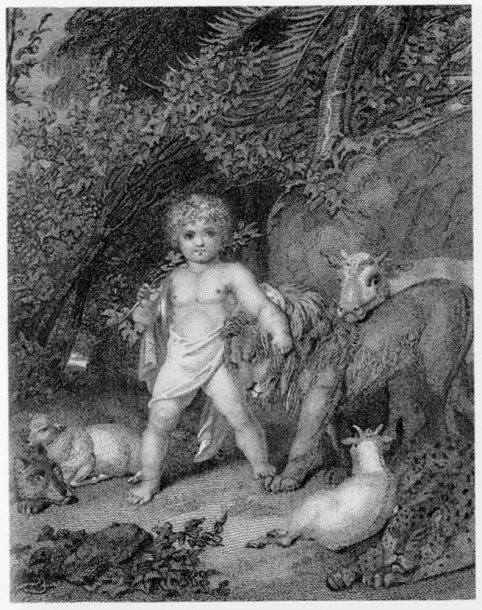
Only a few Peaceable Kingdom images before Hicks’s time have been documented worldwide, among them an early nineteenth-century engraving designed by Richard Westall. Hicks borrowed directly from Westall in his “Peaceable Kingdom of the Branch” compositions, replacing the Christ child’s loincloth with a little jumper suit fashionable among Friends at the time.
The Peaceable Kingdom of the Branch illustration by Richard Westall, from the collection of the Abby Aldrich Rockefeller Folk Art Center, Williamsburg, Virginia. Engraved by Charles Heath for The Holy Bible (London: White, Cochrane & Co., 1815).Edward Hicks (American, 1780–1849), Peaceable Kingdom, 1822–25. Oil on canvas, 30 1/4 × 36 in. Mead Art Museum, Amherst College, Amherst, Massachusetts. The inscription on each of the corners reads, “INNOCENCE – MEEKNESS – LIBERTY.”
The Branch paintings are referred to as such because they show a child holding a grapevine, an allusion to both the fruit-bearing branch of the Tree of Jesse from Isaiah 11:1 and the blood of Christ that we partake of at the Lord’s Supper. Continue reading “The Peaceable Kingdoms of Edward Hicks”→
This year for Advent, my church has built into its liturgy a time for guided reflection on an art image—one per week—corresponding to one or more of the season’s themes. Today I led the congregation in looking at a seventeenth-century German engraving based on John 1. Here’s what I said (adapted from the Advent devotional I published this month):
Christoph Weigel (German, 1654–1725), Word, 1695. Engraving from Biblia ectypa: Bildnussen auss Heiliger Schrifft Alt und Neuen Testaments. Image courtesy of the Digital Image Archive, Pitts Theology Library, Candler School of Theology, Emory University, Atlanta, Georgia, USA.
This copperplate engraving is from a picture Bible by Christoph Weigel published in Augsburg in the late 1600s. The Bible consists entirely of engraved images—839 in all—with key scripture texts inscribed above and below, from Genesis to Revelation.
Looking at this one, you might think of the creation story—God speaking, “Let there be light.” You wouldn’t be wrong to make that association, but actually this engraving illustrates the first chapter of John’s Gospel: the eternal Word of God taking on flesh and entering human history, a doctrine we call the Incarnation. This is the big bang of the new creation. This is God once again hovering over the chaos and proclaiming, “Let there be light.” And there was Light. Because the Savior came, and is still coming.
The top inscription says in Latin, “In the beginning was the Word” (v. 1). And the German one below says, “The light shines in the darkness, but the darkness has not comprehended it” (v. 5).
In Weigel’s illustration, the name YHWH is surrounded by a blast of light that showers down to our dark earth in this magnificent glory-stream. Before this, Israel’s covenant God was mostly invisible and unapproachable, but now he reveals himself as man and Son, the second person of the Trinity, Jesus. He’s still Yahweh, but now he’s Yahweh brought low, to be seen and touched and engaged face-to-face.
This image emphasizes the cosmic nature of the Incarnation and reinforces the meaning of the Greek word for Jesus that John uses in his prologue: Logos, which our English Bibles translate as “Word” with a capital W. This term is a loaded one, used in most schools of Greek philosophy to designate the underlying principle of the universe, one that is rational, intelligent, and vivifying; other translations include “Mind,” “Power,” “Cause,” “Act,” “Ground,” “Reason,” “Structure,” or “Universal Bond.” Philosophers had been reinterpreting the concept of Logos for centuries, but John was the first to link it to the person of Christ.
Advent is a time for us to consider what it means for the Word of God, the Logos, to have a body and be among us.
Advent is just around the corner, commencing Sunday, November 27. To support Christians in their seasonal journey toward Christmas, I’ve developed two companion resources: a slideshow of art images for congregational use, and a devotional booklet for individuals or small groups that offers written reflections on these images.
The structural backbone is a liturgical text written by Jonathan Evens, which has as its refrain the plea “Come, Lord Jesus, come.” It looks forward to Christ’s second advent but also, necessarily, back to his first, in all its various aspects. Along with themes of peace, love, and sacrifice, you are invited to consider
what it meant for Jesus to be born of woman—coming as seed and fetus and birthed son;
the poverty Jesus shared with children around the world;
culturally specific bodies of Christ, like a dancing body and a yogic body;
how we are called to bear God into the world today;
and more.
Art is a great way to open yourself up to the mysteries of God, to sit in the pocket of them as you gaze and ponder. “Blessed are your eyes because they see,” Jesus said. Theologians in their own right, artists are committed to helping us see what was and what is and what could be. Here I’ve taken special care to select images by artists from around the world, not just the West, and ones that go beyond the familiar fare. You’ll see, for example, the Holy Spirit depositing the divine seed into Mary’s womb; Mary with a baby bump, and then with midwives; an outback birth with kangaroos, emus, and lizards in attendance; Jesus as a Filipino slum dweller; and Quaker history married to Isaiah’s vision of the Peaceable Kingdom.
My vision is for the two-minute slideshow to be shown in church on the first day of Advent during the main service. Two minutes is not nearly enough time to take in twenty-four images, so the slideshow is really just an invitation to deeper, one-on-one engagement with the images throughout the week, and that’s where the booklet comes in—as an aid to contemplation. To reinforce the practice and to make it more communal, pastors might consider drawing one image per week into his or her sermon, or discussion could be built into the Sunday school hour. There are twenty-eight days in Advent this year but only twenty-three reflections, so I’ll leave it up to you how to parse them out.
A humongous thanks to the artists and institutions who have granted permission for use of their work. Copyright of the images is retained by them, except where “Public Domain” is indicated, and reproduction outside the context of this slideshow and booklet is prohibited without their express permission. You of course are encouraged to show the slides publicly, and to distribute the booklet, but you must not charge a fee.
I hope these images fill you with wonder and holy desire—to know Christ more and to live into the kingdom he inaugurated two thousand-plus years ago from a Bethlehem manger.
Want to have the booklet print and bound? Use this print-ready version. (I recommend a coil bind with a clear plastic front cover and a vinyl back cover. This will run you about $20 each at most commercial print centers, or less for larger quantities. Be sure to print double-sided, head-to-head.)
I realize that Sara Star’s The Crowning might be too graphic for some churches. Although I personally am compelled by it and obviously endorse it through its inclusion (what better complement to the line “Coming down the birth canal”?), I offer the following as alternative image suggestions for those who might want to substitute it with something more abstract or sanitized: Through the Needle’s Eyeby Grace Carol Bomer; the Dieu parmi nous (God Among Us) panel from La Nativité du Seigneur(The Nativity of the Lord) by Sophie Hacker; Motherhood by Matthew Gill; or Nativity by Paula Rego. Please note that I have NOT received copyright clearance for any of these alternates, which means that if you were to use one, you would be responsible for securing the proper permission.
If you have any questions about how to use these resources, or if you’d like to share any feedback with me—either on how the images or format were received in your congregation, or suggestions for future improvement—feel free to contact me at victoria.emily.jones@gmail.com, or use the comment field below. This is really my first attempt to bring the principles of this blog out into the local church, so I’m eager to see what kind of fruit it bears.
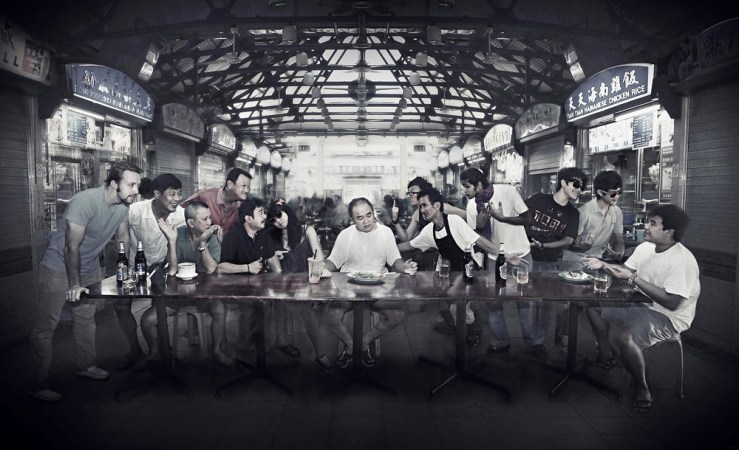
In 2010 Eugene Soh was enrolled in Nanyang Technological University’s School of Art, Design, and Media, on track to becoming a game programmer, when Campusmagazine, aware of his photography hobby, asked him if he’d like to contribute a centerfold to an upcoming issue. He said yes but, after combing through his photos, realized he had nothing great to offer—he’d have to shoot something new, something epic. He chose to restage Leonardo da Vinci’s Last Supper at Maxwell Road Hawker Centre (a “hawker center,” or kopitiam, is what Singaporeans call their open-air food courts), using vendors as models for Christ and his disciples.
Eugene Soh (Singaporean, 1987–), The Last Kopitiam, 2010. Photograph, 140 × 230 cm.
The photo was published but went without much notice until two years later in 2012, when it went viral online. Galleries started contacting him to do shows, not realizing that The Last Kopitiam was a one-off thing. Soh decided to finish out his concentration in interactive media, graduating in 2013, and then to pursue fine art photography as a career.
Encouraged by the interest in his Leonardo adaptation, Soh translated more Western art masterpieces into a contemporary Singaporean idiom, among them the Mona Lisa (renamed Moh Lee Sha), The School of Athens (Food for Thought), The Birth of Venus (Arrival of Venus), Saturn Devouring His Son (Saturn Devouring His Naan), A Sunday on La Grande Jatte (Sunday Afternoon on the Island of Singapore), Arrangement in Grey and Black No. 1 (Arrangement in Grey, Black and Yellow), and American Gothic (Singapore Gothic).
His Creation of Ah Dam, after Michelangelo’s famous Sistine Chapel ceiling fresco, shows a wet-market grocer transferring the spark of life to “Ah Dam” via carrot.
Eugene Soh (Singaporean, 1987–), Creation of Ah Dam, 2015. Photograph, 80 × 120 cm.
It is Soh’s process, as demonstrated in these photos, to shoot his human subjects separately and then stitch them together digitally to create a single composite image. The hawkers in The Last Kopitiam, for example, couldn’t all get away from their stalls at the same time, so this sort of cut-and-paste manipulation was born out of necessity. At first Soh was resistant to using Photoshop in this way, thinking of it as “cheating,” but he quickly became convinced of its legitimacy and artistic potential.
Earlier this year Soh developed a new series called The Second Coming, which reenvisions the life of Christ on Singaporean soil (much like David LaChapelle did, for America, in his 2003 series Jesus Is My Homeboy). Mounted as a solo show in February and March at Chan Hampe Galleries, The Second Coming draws on familiar devotional image types, like the Madonna and Child, the Crucifixion, and the Pietà, as well as invents some new ones, like Jesus answering his cell (Hold Up, Dad’s Calling) or helping one of his hosts prepare dinner (What’s Cooking, Jesus?).
In Happy Birthday & Merry Christmas, Jesus, Jesus blows out the candles on his cake. The mise-en-scène includes a foam crown, maracas, and an umbrella drink.
In contrast, the mood of The Last Christmas is gloom and doom. According to the artist, Jesus has just announced that he is going to destroy the world, putting a damper on the birthday festivities (though one attendee chooses to make light of the news). Staged like a Last Supper, this imagined scene takes place immediately preceding Armageddon. It’s everyone’s last Christmas. Continue reading “Jesus comes to Singapore: The New Testament imagery of Eugene Soh”→
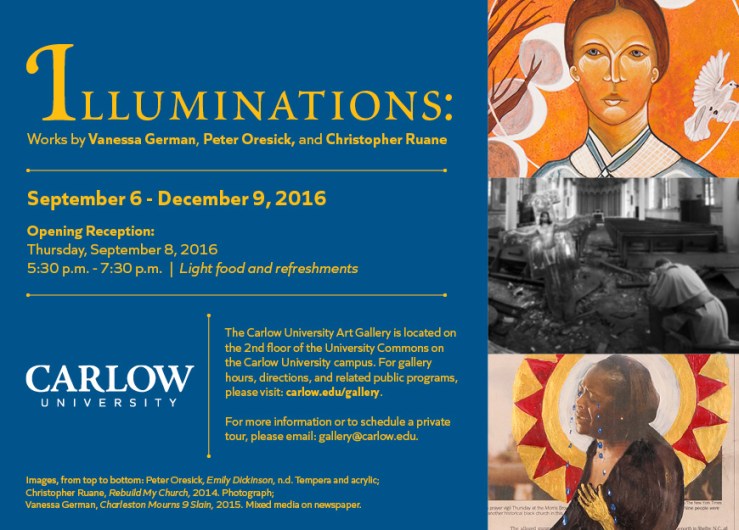
Religion is heavily present in every medieval and Renaissance art museum collection, and curators are constantly organizing exhibitions that highlight this fact. To a smaller extent, religion is also present in contemporary art, and my appreciation goes out to those institutions that have picked up on this and have chosen to mount shows with religion up front and center. Here’s a list of just some such exhibitions currently running that have crossed my radar. (Follow the links to view more images.)
+++
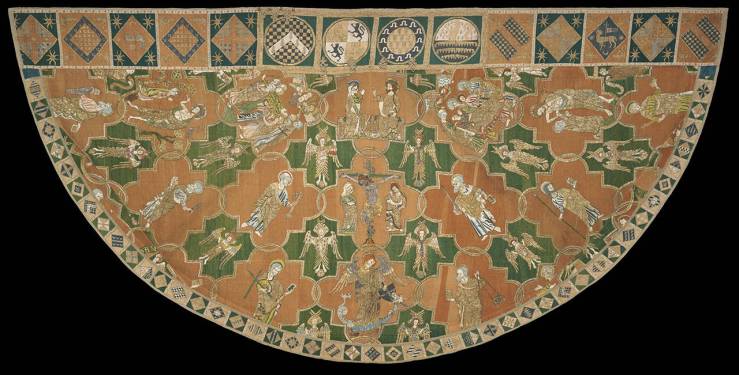
“Opus Anglicanum: Masterpieces of English Embroidery,” Victoria and Albert Museum, London, October 1, 2016–February 5, 2017: In medieval Europe, embroidered textiles were indispensable symbols of wealth and power. Owing to their quality, complexity, and magnificence, English embroideries (referred to as opus Anglicanum, “English work”) enjoyed international demand among kings, queens, popes, and cardinals, and here one hundred of them are brought together. Treasures include the Butler-Bowdon Cope, the Syon Cope, and the Tree of Jesse Cope—ceremonial cloaks made for use in church services and processions, featuring images from the lives of Christ, the Virgin, and the saints. (I love the interactive zoom function on these! To help you navigate the densely packed imagery, details of interest are tagged and can be clicked on to magnify and to reveal a textbox of information.) Hear contemporary embroiderer James Merry discuss some of the aspects of their technique and design that blow him away:
The Syon Cope, 1310–20, England. Collection of the Victoria and Albert Museum, London.
+++
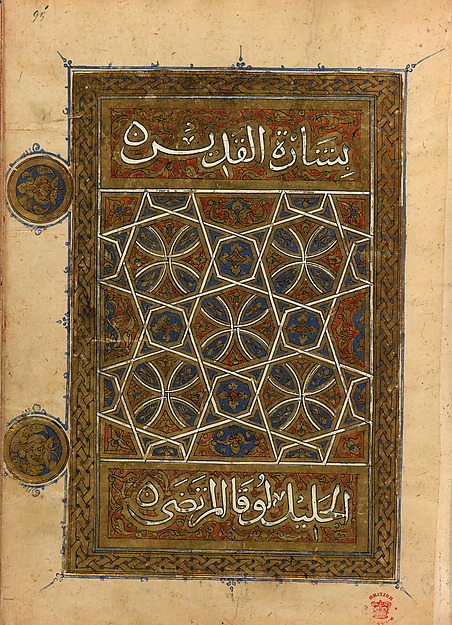
“Jerusalem 1000–1400: Every People Under Heaven,” Metropolitan Museum of Art, New York City, September 26, 2016–January 8, 2017: “This landmark exhibition demonstrates the key role that the Holy City played in shaping the art of the period from 1000 to 1400. In these centuries, Jerusalem was home to more cultures, religions, and languages than ever before. Through times of peace as well as war, Jerusalem remained a constant source of inspiration that resulted in art of great beauty and fascinating complexity. This exhibition is the first to unravel the various cultural traditions and aesthetic strands that enriched and enlivened the medieval city. It features some 200 works of art from 60 lenders worldwide.” I especially love the four Gospels in Arabic borrowed from the British Library, whose geometric illuminations bear an obvious Islamic influence.
Folio from an Arabic Gospel-book, 1335, Jerusalem. Opaque watercolor, gold, and ink on paper, 10 5/8 × 7 7/8 in. (27 × 20 cm). Collection of the British Library (Add. MS 11856).
+++
“The Shimmer of Gold: Giovanni di Paolo in Renaissance Siena,” Getty Center, Los Angeles, October 11, 2016–January 8, 2017: “Manuscript illuminator and panel painter Giovanni di Paolo was one of the most distinctive and imaginative artists working in Siena, Italy, during the Renaissance. This exhibition reunites several panels from one of his most important commissions—an altarpiece for the Branchini family chapel in the church of San Domenico in Siena—for the first time since its dispersal, and presents illuminated manuscripts and paintings by Giovanni and his close collaborators and contemporaries. Through recent technical findings, the exhibition reveals his creative use of gold and paint to achieve remarkable luminous effects in both media.”
Giovanni di Paolo (Italian, ca. 1403–1482), The Adoration of the Magi, 1427. Tempera and gold leaf on panel. Kröller-Müller Museum, Otterlo, the Netherlands.
+++
“The Key” (organized by Caravan), Riverside Church, New York City, September 21–November 6, 2016: Founded by US Episcopal priest Paul-Gordon Chandler, Caravan develops initiatives that use art as a bridge for intercultural and interreligious dialogue. The organization’s 2016 exhibition is in the last leg of its Cairo-London-New York journey. It showcases the work of forty Middle Eastern and Western artists from different monotheistic faith backgrounds, each of whom was given a four-foot-tall fiberglass ankh to develop into a work of art. Known as the “Key of Life,” the ankh is an ancient hieroglyph originating in Egypt but spreading throughout Asia Minor; today it is used as a symbol of pluralism, tolerance, and harmony. I especially like the ones by Sergio Gomez, Arabella Dorman, Fatma Abdel Rahman, and Isaac Daniel.
+++
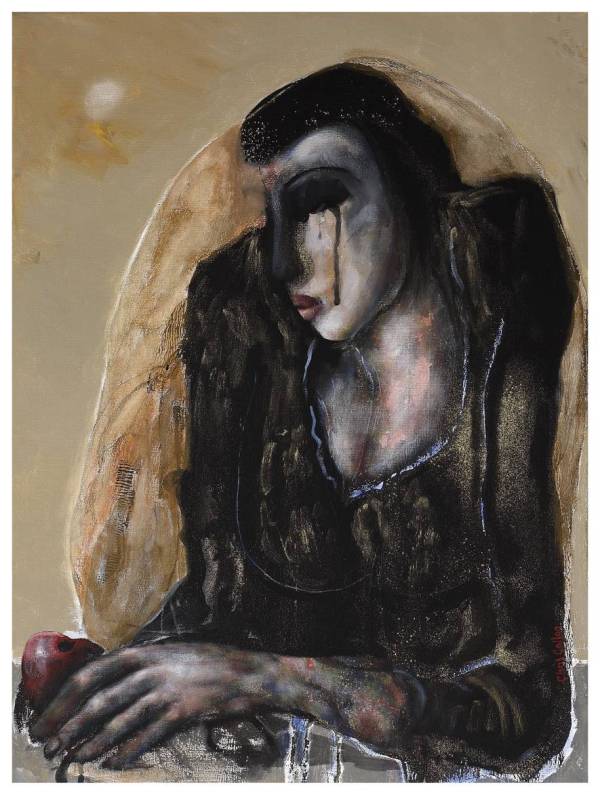
“Incarnation, Mary & Women from the Bible,” Romsey Abbey, Hampshire, England, October 12–November 6, 2016: Having already stopped at Guildford, Norwich, Chichester, Durham, and Hereford Cathedrals, Chris Gollon’s latest series of paintings on women of the Bible is now at Romsey Abbey. It includes the standards, like Eve, Rachel, Hannah, Delilah, Bathsheba, the two Marys (the Virgin, and Magdalene), and Salome, as well as some unnamed and even implied women, like Judas’s wife. It also includes some extrabiblical female saints, like Lucy, Cecilia, Julian of Norwich, and Ethelflaeda. I’m really attracted to the sad quality of many of Gollon’s women, and to the emphasis on hands (much like Eduardo Kingman!).
Chris Gollon (British, 1953–), The Contemplation of Eve, 2011. Acrylic on canvas, 24 × 18 in. (61 × 46 cm).
+++
“Medium: Religion,” Gallery of Art and Design, University of Central Missouri, Warrensburg, Missouri, September 22–October 28, 2016: This exhibition—“meant to inspire, contemplate, and strengthen faith”—features seven contemporary artists whose work engages religion: Tobi Kahn, who creates Jewish ceremonial art like etrog containers, shalom bat chairs, and omer counters; Chris Clack, whose work explores the relationship between Christianity and science; Kysa Johnson, whose Immaculate Conception series links images of the Virgin with asexually reproducing yeast and bacteria; Justine Kuran, known for her quilled hamsas (palm-shaped amulets); Scott Freeman, whose The Wall Remaining laments the long-suffered disunity between Jews and Christians; Tashi Norbu, trained in the art of traditional Tibetan Buddhist thangka painting; and Raudel Arteaga, who deconstructs famous religious paintings into their geometric basics.
I spent last week in New Mexico with my husband, Eric, and my in-laws, visiting relatives in the south, then driving up north to spend some time in Albuquerque and Santa Fe. It was my first time to the Southwest, to the state where Eric was born; his grandparents came over from Mexico as teenagers and settled in Hobbs, a small oil town, and his mom grew up there, learning English in school. I enjoyed all the tastes: spicy green chiles in or on just about everything (eggs, tacos, burgers, soup, corn, French fries); piñons (pine nuts) galore sprinkled alongside dusty footpaths, ready to crack open and eat; and sopapillas (pillow-shaped fried dough drizzled with honey) after every meal.
On the five-hour upstate drive, the blue sky spread wide open across the desert and clouds hung low, casting shadows that, from the car, looked like bodies of water. The way was flat, flat, flat—until we reached Santa Fe, where mountains rose up and aspens flickered their glorious gold.
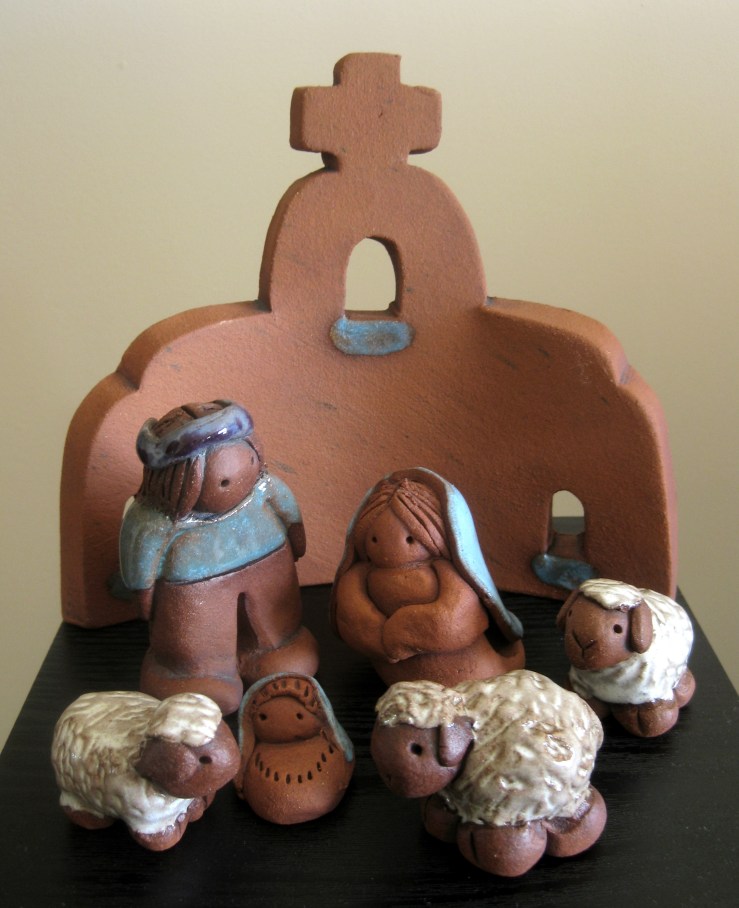
In Albuquerque we went to the International Balloon Fiesta, where hundreds of hot-air balloonists come out once a year to fly. Unfortunately, high winds prevented the “mass ascension” from happening the day we were there, but we saw static displays—inflated balloons in all shapes and colors. (My father-in-law was partial to the Darth Vader balloon; I liked the lovebirds.) And I got to visit to the artisan tent, where I bought my first nativity set! It’s seven pieces in clay by New Mexico native Barbara Boyd. I set it up in our living room when I got home, but Eric says I need to put it away until Advent . . .
We spent an afternoon in Old Town Albuquerque, strolling past historic adobe buildings and into galleries, while street musicians—Native American flautists and mariachi bands, mostly—provided a culturally immersive soundtrack. Our first stop happened to be one of my favorites: John Isaac Antiques and Folk Art. Isaac has a beautiful collection of santos (Hispano Catholic religious images)—a whole roomful—both contemporary and from the last few centuries. I was close to buying a Saint Francis bulto by Ben Ortega (Francis was his hallmark) but decided against it, and now I wish I hadn’t. Nonbuyer’s remorse—ugh.
Just before we left Old Town, my mother-in-law suggested one last gallery: Santisima, owned by Johnny Salas. I immediately recognized the work of Albuquerque native Brandon Maldonado, which is heavily influenced by the tradition of Día de los Muertos. I’m really attracted to Day of the Dead imagery, with all its macabre whimsy—the kind that makes most Protestants feel uncomfortable. I think the draw, for me, is that it embraces death instead of shrinking away from it; it says, “Death, we do not fear you.” As Maldonado says, Day of the Dead is not meant to be frightful but rather mocking, in a way:
The masses may prefer to think of the deceased as haloed angels floating on fluffy white clouds, but I like the idea of dancing skeletons in hats!
At Santisima I was introduced to the work of the young santero Vicente Telles, also a native of Albuquerque. I really liked his Adam and Eve and Saint Pelagia retablos but most especially his Crucifixion one, which I ended up buying.
Vicente Telles (American, 1983–), Cristo crucificado (Christ Crucified), 2015. Natural and watercolor pigments on pinewood, 7.5 × 6.5 in. (framed).
It shows a curtain opening up, and two chandeliers dangling, to present Christ on the cross, given for us. As is traditional in New Mexican art, his shoulders and knees are bloodied; in Telles’s interpretation, the blood marks Christ in patterns, almost like tattoos. The animas solas (lonely souls) in the flames of purgatory is also a common motif in New Mexican art. I do not personally subscribe to the doctrine of purgatory, so I read the souls, rather, as Adam and Eve awaiting redemption. According to church tradition, Golgotha was the site not only of Christ’s execution but also of Adam’s burial, which is why, since the Middle Ages, a skull is often painted at the cross’s base, emphasizing Christ’s role as the Second Adam. Telles shows Eve reaching out to touch this death-symbol, lamenting her and Adam’s primordial rebellion and pleading in faith, with her eyes, for deliverance from its consequences. This is the precursor to the Anastasis (Resurrection) icon of Eastern Orthodoxy, which shows Jesus breaking down the doors of Sheol and pulling Adam and Eve up out of their graves to be with him in heaven. We are dead in our sins until Christ raises us. His spilled blood has “loosed the pains of death” once and for all.
To give the retablo a glistening appearance, Telles applied a micaceous clay slip to the pinewood before applying the paint.
Jonathan A. Anderson is an associate professor of art at Biola University, an interdenominational Christian university in southern California. In addition to being a practicing artist, he researches and writes on modern and contemporary art criticism, especially its relationship to theology. Along with William Dyrness, he has written the first book in InterVarsity Press’s new Studies in Theology and the Arts series: Modern Art and the Life of a Culture: The Religious Impulses of Modernism.
Below is a video of Anderson presenting a paper titled “The (In)visibility of Theology in Contemporary Art Criticism” at the 2012 conference Christian Scholarship in the Twenty-First Century: Prospects and Perils, sponsored by Biola University’s Center for Christian Thought. In it he examines the problematic absence of theologically informed criticism from contemporary art discourse and posits what is (and is not) needed to redress the problem. He very clearly articulates some of my frustrations with the contemporary art world, giving lots of examples and helpful breakdowns as well as advice for Christians writing about art.
On this blog I write primarily for nonscholars, as well as for the church, not the art world (though I’m thrilled if the art world wants to listen in!). So while I do very much approach art theologically, I know I’m not exactly the voice Anderson is looking for; furthermore, I cover a limited range of art here, restricting myself, for the most part, to Anderson’s first category of “religious” art, below.
Still, I share Anderson’s desire to see a new method of criticism develop, one that takes religious belief seriously instead of sweeping it under the rug. And I try, from my own little corner, to model said method—to “work productively in the rift.”
Here’s the presentation, followed by some highlights.
His starting point is Octoberfounder Rosalind Krauss’s pronouncement, in 1979, of an “absolute rift” between art and religion. He elaborates:
The textbooks of twentieth-century art history, theory, and criticism, as well as major museum collections, readily testify to the fact that the institutional art world regards Christianity as having made negligible contributions to the fine arts during the twentieth century, and unfortunately that’s a judgment I largely agree with. But the reverse is also true: for the most part, the church has little regard for the canon of twentieth-century art as having made contributions to the development and deepening of Christian thought. For most of the last century, the worlds of contemporary art theory and Christian theology developed into distinct cultural configurations that have been remarkably disengaged from each other, often to the point of mutual unintelligibility.
The twenty-first century has seen a return of religion to art, Anderson says, but it has been a return riddled with problems. His agenda here is to (1) articulate where the primary problem in the rift lies, (2) offer an argument for how we might think of the return of religion to the art discourse, and (3) suggest ways in which Christians can work productively in the rift.
[03:13]Where does the rift between art and religion lie?
[05:43] Art Since 1900 identifies and articulates the four primary critical methods that have framed the modern and contemporary art discourse: psychoanalysis, social art history, formalism and structuralism, and poststructuralism and deconstruction. (“Theology” is not one of them.)
New Gospel-book set promotes aesthetic reading experience: Photographer Bryan Chung and designer Brian Chung, both campus ministers (and no relation), believe that beauty is fundamental to understanding who God is. So they’ve teamed up for project Alabaster: a brand-new design of the holy Gospels, in four volumes, integrated with contemplative photographs. They’ve already well exceeded their funding goal on Kickstarter, which means there’s already a lot of interest in having Bible reading be a visual experience—and at a 7½ × 9½ trim, the books are definitely wieldy, meant to be regularly handled and read! If you want a guaranteed copy, be sure to back the project on Kickstarter, as the number of names in the system will determine the size of the print order. You have until October 7; the publication month is April 2017. This project aligns so well with my mission here at Art & Theology, and I’m thrilled to see it in the works.
+++
90-year-old man spends lifetime building a cathedral by hand: From Great Big Story: “For 53 years, Justo Gallego has been building a cathedral by hand on the outskirts of Madrid almost entirely by himself. Gallego has no formal architecture or construction training, but that hasn’t stopped him from toiling on this herculean task. At 90 years old, Gallego knows that he will not be able to finish the project in his lifetime. But he keeps at it anyway, day after day, driven by his faith.”
+++
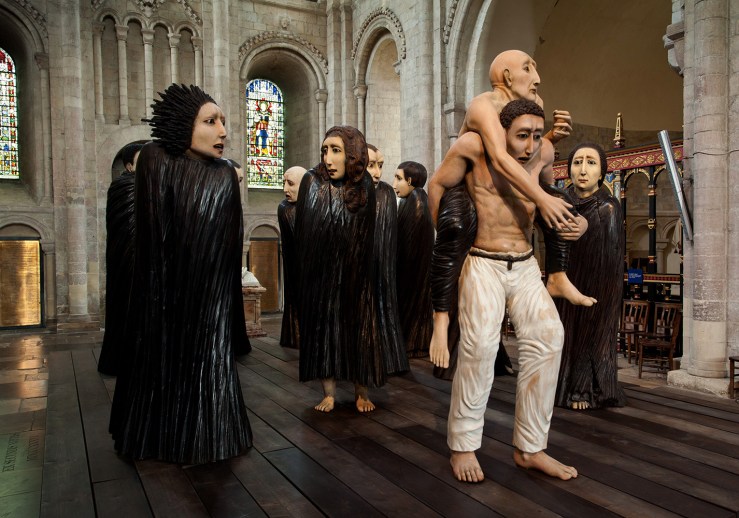
Ana Maria Pacheco (Brazilian, 1943–), Shadows of the Wanderer, 2008. Polychromed wood sculpture, 260 × 390 × 605 cm. Installation view at Norwich Cathedral, 2010, via Pratt Contemporary Art.
Art installation at Chichester Cathedral speaks to the refugee experience:Shadows of the Wanderer by Brazilian-born artist Ana Maria Pacheco is on display in the north transept of Chichester Cathedral through November 14. A multipiece figurative sculpture in polychromed wood, it has as its centerpiece a young man carrying an elderly man on his back—a reference to the Aeneid’s Aeneas carrying his lame father out of the ruins of Troy. The cathedral has organized events around the installation, including a lecture by Christopher Wintle on the representation of suffering in Pacheco’s art (audio here, transcript here); a series of workshops for schools and colleges exploring the refugee experience, developed in partnership with Amnesty International; a debate titled “Refugees: Problem or Gift?”; an interview with the artist; and a woodcarving workshop. The photo above is an installation view from 2010 inside Norwich Cathedral; to see photos of the work in its current location at Chichester, click here.
+++
Addressing racial injustice as a church: Paul Neeley at Global Christian Worship has compiled an excellent list of resources for churches looking for ways to address racial tensions in America with an eye toward healing, including a prayer service of lament by Paul Burkhart; two litanies by Fran Pratt; a list of relevant hymns, curated by the Hymn Society; an article by Sandra Van Opstal, “Reconciling Witness And Worship: Six Ways To Begin”; and materials from the 2016 Reconciliation and Justice Network conference. I’d like to add to it the lecture series “Race and the Church,” especially Jemar Tisby’s “Understanding the Heart Cry of #BlackLivesMatter,” which I live-streamed with my church back in July. (It definitely sparked fruitful conversation.) For common objections to the movement, like “What about black-on-black crime?” and “Don’t #AllLivesMatter?,” he refers listeners to the video below, produced by MTV.
+++
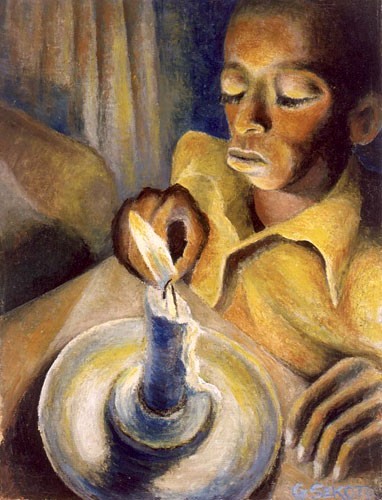
SONG: “Light a Candle”: Also on Neeley’s website I found a video performance of the song “Light a Candle” by Mary Louise Bringle (words) and Lori True (music). It’s sung here, to a ukulele accompaniment, by Becky Gaunt, director of music and liturgy at St. Jude of the Lake Catholic Church in Mahtomedi, Montana.
She posted it on her Facebook page in July along with this note:
We cannot continue to let language divide us. We cannot continue to let language distract us from loving one another. We cannot continue to let words like “black lives matter” or “all lives matter” cause us to keep missing the point!
I’m sad and tired. And you probably are too. But now is NOT the time to be neutral! The Sun may be shining outside, but we need to come together and light a candle in this oppressive darkness. This beautiful song by Lori True (amazing text by Mary Louise Bringle) is my prayer right now. I invite you to pray this with me.
Gerard Sekoto (South African, 1913–1993), Boy with a Candle, 1943. Oil on canvas, 46.2 × 36 cm.